Category: KB

  • MIL-Evening Report: Robot eyes are power hungry. What if we gave them tools inspired by the human brain?

    Source: The Conversation (Au and NZ) – By Adam D Hines, Research Fellow, Centre for Robotics, Queensland University of Technology

    A hexapod robot navigating outdoors. Adam Hines

    Robots are increasingly becoming a part of our lives – from warehouse automation to robotic vacuum cleaners. And just like humans, robots need to know where they are to reliably navigate from A to B.

    How far, and for how long, a robot can navigate depends on how much power it consumes over time. Robot navigation systems are especially energy hungry.

    But what if power consumption was no longer a concern?

    Our research on “brain-inspired” computing, published today in Science Robotics, could make navigational robots of the future more energy efficient than previously imagined.

    This could potentially extend and expand what’s possible for battery-powered systems working in challenging environments such as disaster zones, underwater, and even in space.

    How do robots ‘see’ the world?

    The battery going flat on your smartphone is usually just a minor inconvenience. For a robot, running out of power can mean the difference between life and death – including for the people it might be helping.

    Robots such as search and rescue drones, underwater robots monitoring the Great Barrier Reef, and space rovers all need to navigate while running on limited power supplies.

    Robots that navigate challenging environments need a lot of battery power for their cameras and other sensors.
    NASA/JPL-Caltech/MSSS

    Many of these robots can’t rely on GPS for navigation. They keep track of where they are using a process called visual place recognition. Visual place recognition lets a robot estimate where it’s located in the world using just what it “sees” through its camera.

    But this method uses a lot of energy. Robotic vision systems alone can use up to a third of the energy from a typical lithium ion battery found onboard a robot.

    This is because modern robotic vision, including visual place recognition, typically relies on power-hungry machine learning models, similar to the ones used in AI like ChatGPT.

    By comparison, our brains require just enough power to turn on a light bulb, while allowing us to see things and navigate the world with remarkable precision.

    Robotics engineers often look to biology for inspiration. In our new study, we turned to the human brain to help us create a new, energy-efficient visual place recognition system.

    Mimicking the brain

    Our system uses a brain-inspired technology called neuromorphic computing. As the name suggests, neuromorphic computers take principles from neuroscience to design computer chips and software that can learn and process information like human brains do.

    An important feature of neuromorphic computers is that they are highly energy-efficient. A regular computer can use up to 100 times more power than a neuromorphic chip.

    Neuromorphic computing is not limited to just computer chips, however. It can be paired with bio-inspired cameras that capture the world more like the human eye does. These are called dynamic vision sensors, and they work like motion detectors for each pixel. They only “wake up” and send information when something changes in the scene, rather than constantly streaming data like a regular camera.

    What a regular camera sees (left) compared to a bio-inspired camera (right).
    Adam Hines

    These bio-inspired cameras are also highly energy efficient, using less than 1% of the power of normal cameras.

    So if brain-inspired computers and bio-inspired cameras are so wonderful, why aren’t robots using them everywhere? Well, there are a range of challenges to overcome, which was the focus of our recent research.

    A new kind of LENS

    The unique properties of a dynamic vision sensor are, ironically, a limiting factor in many visual place recognition systems.

    Standard visual place recognition models are built on the foundation of static images, like the ones taken by your smartphone. Since a neuromorphic sensor doesn’t produce static images but senses the world in a constantly changing way, we need a brain-inspired computer to process what it “sees”.

    Our research overcomes this challenge by combining neuromorphic chips and sensors for robots that use visual place recognition. We call this system Locational Encoding with Neuromorphic Systems, or LENS for short.

    LENS uses the continuous information stream from a dynamic vision sensor directly on a neuromorphic chip. The system uses a machine learning method known as spiking neural networks. These process information like human brains do.

    By combining all these neuromorphic components, we reduced the power needed for visual place recognition by over 90%. Since nearly a third of the energy needed for a robot is vision related, this is a significant reduction.

    To achieve this, we used an off-the-shelf product called SynSense Speck, which combines a neuromorphic chip and a dynamic vision sensor all in one compact package.

    The entire system only required 180 kilobytes of memory to map an area of Brisbane eight kilometres in length. That’s a tiny fraction of what would be needed in a standard visual place recognition system.

    Hexapod robots have six legs and can walk on different surfaces both indoors and outdoors.

    A robot in the wild

    For testing, we placed our LENS system on a hexapod robot. Hexapods are multi-terrain robots that can navigate both indoors and outdoors.

    In our tests, the LENS performed as well as a typical visual place recognition system, but used much less energy.

    Our work comes at a time when AI development is trending towards creating bigger, more power-hungry solutions for improved performance. The energy needed to train and use systems like OpenAI’s ChatGPT is notoriously demanding, with concerns that modern AI represents unsustainable growth in energy demands.

    For robots that need to navigate, developing more compact, energy-efficient AI using neuromorphic computing could be key for being able to go farther and for longer periods of time. There are still challenges to solve, but we are closer to making it a reality.

    Michael Milford receives funding from the Australian Research Council, the Australian Economic Accelerator, the Queensland Government, Amazon, Ford Motor Company, iMOVE CRC, the DAAD Australia-Germany Co-operation Scheme and DSTG. He is affiliated with the Motor Trades Association of Queensland as a non-executive board member.

    Tobias Fischer receives funding from the Australian Research Council, the DAAD Australia-Germany Co-operation Scheme, the Great Barrier Reef Foundation via the Reef Restoration and Adaptation Program, and the Queensland Department of Environment, Science and Innovation.

    Adam D Hines does not work for, consult, own shares in or receive funding from any company or organisation that would benefit from this article, and has disclosed no relevant affiliations beyond their academic appointment.

    ref. Robot eyes are power hungry. What if we gave them tools inspired by the human brain? – https://theconversation.com/robot-eyes-are-power-hungry-what-if-we-gave-them-tools-inspired-by-the-human-brain-257978

    MIL OSI AnalysisEveningReport.nz

  • MIL-Evening Report: Jaws at 50: how a single movie changed our perception of white sharks forever

    Source: The Conversation (Au and NZ) – By John Long, Strategic Professor in Palaeontology, Flinders University

    Shane Myers Photography/Shutterstock

    It’s been 50 years since Steven Spielberg’s movie Jaws first cast a terrifying shadow across our screens.

    At a low point during production, Spielberg worried he’d only ever be known for “a big fish story”. The film, however, did not tank.

    Jaws broke box office records and became the highest-grossing movie at the time, only surpassed by the first Star Wars released two years later in 1977.

    A combination of mass advertising, familiar “hero” tropes and old-school showmanship launched Jaws as the first modern blockbuster.

    Hollywood, and our relationship to oceans and the sharks within them, would never be the same.

    The novel Jaws was based on was a bestseller in its own right.
    Snap Shot/Shutterstock

    An unrealistic monster

    In Peter Benchley’s 1974 novel that Jaws is based on, the shark is 6 metres long. For added screen excitement, in the movie it grew to a whopping 7.6 metres.

    However, that’s unrealistically large.

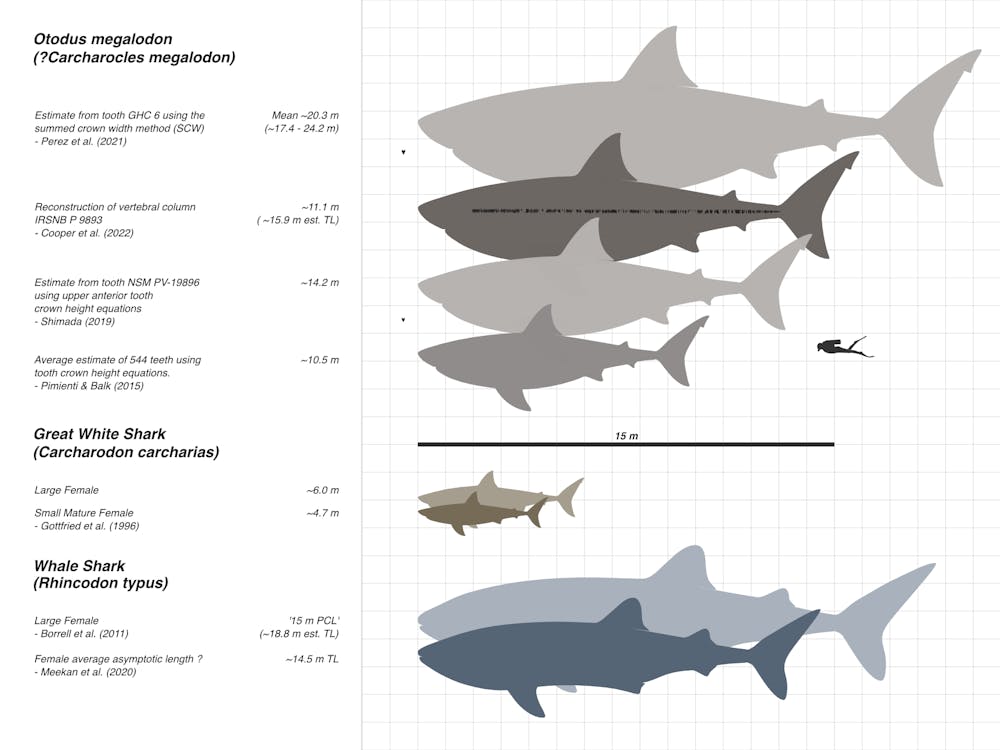
    The average size of a mature great white (Carcharodon carcharias, also known as the white shark) is between 4.6 and 4.9 metres for female sharks and up to 4 metres for male sharks.

    The largest recorded living specimens peak at about 6 metres, with one monster specimen caught in Cuba in 1945 reaching 6.4 metres.

    Earth’s oceans have seen bigger predatory sharks in the past. The biggest one of all time was the megalodon (Otodus megalodon) which lived from 23 to 3 million years ago, and may have been up to 24 metres in length. However, it looked nothing like the modern white shark.

    We don’t know precisely how big the megalodon was, but certainly larger than the great white shark.
    Steveoc 86/Wikimedia Commons, CC BY-SA

    They’re not even directly related – another thing scientists learned quite recently.

    Who was the megalodon, then?

    White sharks first evolved between 6 and 4 million years ago in the shadows of the megalodon. A recent study showed the megalodon’s large serrated teeth show signs of it being a supreme opportunistic super-predator.

    That means it ate just about anything, but especially liked whales and marine mammals.


    Read more:
    Friday essay: Giant shark megalodon was the most powerful superpredator ever. Why did it go extinct?


    But white sharks are not directly related to the megalodon, whose lineage began with a shark called Cretalamna during the age of dinosaurs about 100 million years ago.

    By contrast, the white shark lineage began with an ancient mako shark, Carcharodon hastalis. It was 7 to 8 metres long and had large, similarly shaped teeth to the modern white shark but lacking serrated edges.

    A fossil intermediate species, Carcharodon hubbelli shows the transition over time from weakly serrated to strongly serrated teeth.

    White shark fossil species. Left, the serrated fossil tooth teeth of the extant white shark; right, a similarly shaped unserrated tooth of the extinct giant mako shark which gave rise to white sharks.
    John Long, CC BY

    How did Jaws affect white shark populations?

    Last year, the International Shark Attack File reported 47 unprovoked shark bites to humans worldwide, resulting in seven fatalities. This was well below the previous ten-year average of 70 bites per year; your chances of getting bitten by a shark are extremely rare.

    Following the movies that made up the Jaws franchise, there was an increase in hunting and killing sharks – with a particular focus on great white sharks that were already going into a decline due to overfishing, trophy hunting and lethal control programs.

    Between 80% and 90% of white sharks have disappeared globally since the middle of the 20th century. Recent estimates calculate there are probably less than 500 individual white sharks in Australian waters right now.

    When Jaws first aired, scientists didn’t know how long sharks took to reproduce, or how many offspring a white shark could have each year. We now know it takes about 26 years for a male and 33 years for a female to sexually mature before they can start having pups.

    Data about white shark births is sparse, but recently a 5.6-metre-long female caught on a drum line off the coast of Queensland had just four large pups inside her. This is a very small number. Some large sharks, such as the whale shark, can give birth to up to 300 young.

    Now that we know just how slow they are to breed, it’s clear it will take many decades to reestablish the “pre-Jaws” population of white sharks – important apex predators in the marine ecosystem.

    Charlie Huveneers from Flinders University about to take a tissue sample for research on white sharks. There is still a lot we don’t know about their biology.
    Andrew Fox, Adelaide, CC BY

    Will white sharks survive?

    White sharks are currently listed as vulnerable.

    This classification means if we don’t change the current living conditions for white sharks, including impacts caused by human activities such as commercial fishing, and the impacts of climate change and ocean pollution, they will continue to decline and eventually could go extinct.

    Currently, white sharks are protected in several countries and form the basis for an important tourist industry in Australia, South Africa, western United States and most recently Nova Scotia, Canada.

    These sharks are iconic apex predators that fascinate people. One of us (John) went cage diving with them recently off the Neptune Islands of South Australia and can attest to how breathtaking it is to watch them in their natural environment.

    In terms of economic impact, they are worth far more alive than dead.

    White sharks are a growing tourism draw in several countries.
    Andrew Fox, Adelaide, CC BY

    There’s still much we don’t know about white sharks

    The complete white shark genome was first published only in 2019. It has 4.63 billion base pairs, making it much larger than the human genome (3.2 billion base pairs).

    The genome revealed some surprising things, like how white sharks show strong molecular adaptations for wound-healing processes, and a suite of “genome stability” genes – those used in DNA repair or DNA damage response.

    The transcriptome (or sum total of the messenger RNA) of the white shark showed greater similarity to the human transcriptome than to that of other fishes. This hints that “unexpressed genes” in the shark could one day play a role in uncovering genetic pathways for potential cures in human diseases.

    Jaws and its sequels certainly brought white sharks to the attention (and nightmares) of humans, with devastating impacts on how we treated them as a species.

    Our relationship with white sharks reflects our relationship with nature more broadly – a feared antagonist within the current capitalist paradigm; an enemy to be tamed, contained or consumed.

    As we learn more of the peril and potential of these remarkable creatures, we can learn how to live with them, to see beyond our fears and value their role within our delicate ocean ecosystems.

    John Long receives funding from The Australian Research Council.

    Heather L. Robinson does not work for, consult, own shares in or receive funding from any company or organisation that would benefit from this article, and has disclosed no relevant affiliations beyond their academic appointment.

    ref. Jaws at 50: how a single movie changed our perception of white sharks forever – https://theconversation.com/jaws-at-50-how-a-single-movie-changed-our-perception-of-white-sharks-forever-258306

    MIL OSI AnalysisEveningReport.nz

  • MIL-OSI New Zealand: Bachelor of Applied Science student lands internship mapping native bush remnants

    Source: Eastern Institute of Technology

    19 hours ago

    Bachelor of Applied Science (Biodiversity Management) student Emily Strong helped iwi identify remnants of the historic Seventy Mile Bush during a summer internship with Sustainable Hawke’s Bay.

    The internship was part of her third year of study, delivered by EIT in partnership with Unitec.

    EIT graduate Michael Strand (left) with current Bachelor of Applied Science (Biodiversity Management) student Emily Strong.

    During her internship, Emily worked under the guidance of EIT graduate Michael Strand, who works at Sustainable HB and secured a role as a geospatial analyst there before completing his studies. She contributed to a project focused on locating and assessing remaining areas of native bush in Southern Hawke’s Bay.

    The project involved the use of Geographic Information Systems (GIS) to overlay historical maps with satellite imagery, classify forest remnants, and assess vegetation health by calculating tree canopy height. Historical aerial imagery was also used to track vegetation change over time.

    “The Seventy Mile Bush was a massive podocarp forest that once stretched from Southern Hawke’s Bay to Wairarapa. Being able to contribute to a project that connects iwi with the remaining fragments of that landscape has been really rewarding.”

    Emily previously completed the Level 5 and 6 Diplomas in Environmental Management (Terrestrial strand) at EIT before progressing into the degree.

    Her interest in GIS and conservation has grown throughout her studies. In 2024, she completed a level 6 project focused on revegetation at Cape Sanctuary, comparing aerial images from the 1950s, 2014 and 2024 to assess habitat restoration over time.

    “I compared some aerial photography from the 1950s with current satellite images and then classified and analysed the difference. There was very much an increase in native vegetation. It was quite substantial actually and really cool to see.”

    Originally from Hawke’s Bay, Emily first enrolled at EIT in a teaching degree. After taking time off following the birth of her daughter, Eloise, she decided to return to study and pursue environmental management.

    “I’ve always had an interest in the environment, and once I started the primary industries course, I really enjoyed it,” she says.

    Balancing study and parenting hasn’t always been easy, but Emily says she’s had strong support around her.

    “It’s been quite tough but again I do have a fair amount of family support so that’s definitely been very helpful.”

    She credits her lecturers and tutors for being “really amazing”. “I’ve learned lots and lots and definitely improved from when I started in level 5.”

    Now 22, Emily is also involved in a local bat monitoring project with environmental researcher Kay Griffiths and is exploring future career opportunities that combine her skills in conservation and GIS.

    “There are so many different directions you can go with this degree, but I’d love to do something where I can use GIS to support conservation work.”

    EIT Environmental Management Senior Lecturer Dinusha Jayathilake said she is especially proud of this achievement.

    “This internship is a valuable opportunity for Emily’s professional growth and also benefits the Hawke’s Bay region, Sustainable HB, and EIT. In our Environmental Management programme, we always prefer community engagement. Through the GIS course, I am able to support the local community while introducing the latest  Geographic Information technologies to our region – something I am very proud of.”

    Dinusha said internships give students valuable work experience before they finish their studies, which helps them continue to produce skilled and experienced local graduates who are ready to join the workforce.

    MIL OSI New Zealand News

  • MIL-OSI Australia: ACT Budget 2025–26: supporting primary health care

    Source: Northern Territory Police and Fire Services

    Our CBR is the ACT Government’s key channel to connect with Canberrans and keep you up-to-date with what’s happening in the city. Our CBR includes a monthly print edition, email newsletter and website.

    You can easily opt in or out of the newsletter subscription at any time.

    MIL OSI News

  • MIL-OSI Australia: Stargazing flight: how Bogong moths use the night sky to navigate hundreds of kilometres

    Source:

    19 June 2025

    Bogong moth. Photo credit: Ajay Narendra, Macquarie University.

    In a world-first discovery, researchers have shown that Australia’s iconic Bogong moth uses constellations of stars and the Milky Way to navigate hundreds of kilometres across the country during its annual migration – making it the first known invertebrate to rely on a stellar compass for long-distance travel.

    The landmark study, published today in Nature, reveals how this unassuming nocturnal moth combines celestial navigation with Earth’s magnetic field to pinpoint a specific destination it has never visited before: the cool alpine caves of the Snowy Mountains, where it hibernates for the summer.

    Led by an international team of scientists from Lund University, the Australian National University (ANU), the University of South Australia (UniSA) and other global institutions, the research sheds new light on one of nature’s great migration mysteries, involving approximately four million moths each year.

    “Until now, we knew that some birds and even humans could use the stars to navigate long distances, but this is the first time that it’s been proven in an insect,” says Lund University Professor of Zoology, Eric Warrant, who is also a Visiting Fellow at the ANU and an Adjunct Professor at UniSA.

    “Bogong moths are incredibly precise. They use the stars as a compass to guide them over vast distances, adjusting their bearing based on the season and time of night.”

    Each spring, billions of Bogong moths (Agrotis infusa) emerge from breeding grounds across southeast Australia and fly up to 1000 kilometres to a small number of caves and rocky outcrops in the Australian Alps.

    A wall of Bogong moths, aestivating in a cave in the Australian Alps.

    The moths lie dormant in the cool, dark shelters throughout summer, and in autumn make the return journey to breed and die.

    Using sophisticated flight simulators and brain recordings in controlled, magnetically neutral environments, the researchers tested how moths orient themselves under different sky conditions.

    When presented with natural starry skies and no magnetic field, they consistently flew in the correct migratory direction for the season – southward in spring, northward in autumn.

    When the starry skies were rotated 180 degrees, the moths reversed direction accordingly, but when the stars were scrambled, their orientation vanished.

    “This proves they are not just flying towards the brightest light or following a simple visual cue,” says Prof Warrant. “They’re reading specific patterns in the night sky to determine a geographic direction, just like migratory birds do.”

    Interestingly, when stars were obscured by clouds, the moths maintained their direction using only the Earth’s magnetic field. This dual compass system ensures reliable navigation even in variable conditions.

    The team also delved into the neurological basis of this behaviour, identifying specialised neurons in the moth’s brain that respond to the orientation of the starry sky. These cells, found in brain regions responsible for navigation and steering, fire most strongly when the moth is facing southwards.

    “This kind of directional tuning shows that the Bogong moth brain encodes celestial information in a surprisingly sophisticated way. It’s a remarkable example of complex navigational ability packed into a tiny insect brain.”

    Researchers say the discovery could inform technologies in robotics, drone navigation, and even conservation strategies for species threatened by habitat loss or climate change.

    Bogong moth populations have declined sharply in recent years, promoting their listing as vulnerable.

    The study underscores the importance of protecting migratory pathways and the dark skies these moths rely on.

    “This is not just about a moth  ̶  it’s about how animals read the world around them,” says Prof Warrant. “The night sky has guided human explorers for millennia. Now we know that it guides moths, too.”

    Co-author Professor Javaan Chahl, a remote sensing engineer from the University of South Australia, made headlines in August 2024 using the discoveries from a previous study led by Lund University involving dung beetles, who use the Milky Way as a reference point to roll balls of dung in straight lines.

    Prof Chahl’s team modelled the same technique used by dung beetles to develop an AI sensor for robot navigation in low light.

    The Nature paper “Bogong moths use a stellar compass for long-distance navigation at night” is authored by researchers from Europe, the UK, China, Australia, Canada and Australia. DOI: 10.1038/s41586-025-09135-3

    A video produced by the Australian Academy of Science, explaining Prof Warrant’s research, is available at: www.youtube.com/watch?v=AqiG_xBUFE0.  Prof Warrant was elected a Corresponding Member of the Academy in 2024.

    …………………………………………………………………………………………………………………………

    Media contact: Candy Gibson M: +61 434 605 142 E: candy.gibson@unisa.edu.au

    MIL OSI News

  • MIL-OSI: Oportun Releases Investor Presentation Highlighting Strategic Progress

    Source: GlobeNewswire (MIL-OSI)

    Outlines proactive steps taken by Board and management to drive long-term stockholder value

    Urges stockholders to vote “FOR” Oportun’s two nominees – CEO Raul Vazquez and Carlos Minetti – on the GREEN proxy card

    SAN CARLOS, Calif., June 18, 2025 (GLOBE NEWSWIRE) — Oportun (Nasdaq: OPRT), a mission-driven financial services company, today released an investor presentation in connection with the Company’s upcoming Annual Meeting of Stockholders, scheduled to be held on July 18, 2025. The presentation and additional important information related to the Annual Meeting are available at VoteForOportun.com.

    Oportun’s Board of Directors encourages stockholders to review the Company’s proxy statement carefully and vote “FOR” the Company’s nominees – CEO Raul Vazquez and Carlos Minetti – using the GREEN proxy card or GREEN voting instruction form.

    If you have any questions about how to vote your shares, please call the firm assisting us with the solicitation of proxies:

    INNISFREE M&A INCORPORATED
    Stockholders may call:
    (877) 800-5195 (toll-free from the U.S. and Canada) or
    +1 (412) 232-3651 (from other countries)

    About Oportun

    Oportun (Nasdaq: OPRT) is a mission-driven financial services company that puts its members’ financial goals within reach. With intelligent borrowing, savings, and budgeting capabilities, Oportun empowers members with the confidence to build a better financial future. Since inception, Oportun has provided more than $20.3 billion in responsible and affordable credit, saved its members more than $2.4 billion in interest and fees, and helped its members set aside an average of more than $1,800 annually. For more information, visit Oportun.com.

    Investor Contact
    Dorian Hare
    (650) 590-4323
    ir@oportun.com

    Innisfree M&A Incorporated
    Scott Winter / Gabrielle Wolf / Jonathan Kovacs
    (212) 750-5833

    Media Contact
    FGS Global
    John Christiansen / Bryan Locke
    Oportun@fgsglobal.com

    The MIL Network

  • MIL-OSI: Greystone Housing Impact Investors LP Extends General Line of Credit Facility

    Source: GlobeNewswire (MIL-OSI)

    OMAHA, Neb., June 18, 2025 (GLOBE NEWSWIRE) — Greystone Housing Impact Investors LP (NYSE: GHI) (the “Partnership”) announced today that on June 12, 2025, it amended its existing $50 million secured revolving Line of Credit facility (“LOC”). The LOC is secured by the Partnership’s joint venture equity investments. BankUnited, N.A. serves as sole arranger and administrative agent.

    The amendment extended the maturity date to June 2027, with two additional one-year extension options, increased the maximum allowable seniors housing joint venture equity investments the Partnership can make to 30% of eligible encumbered assets, and increased the Partnership’s maximum allowable limited guaranties of debt associated with its joint venture equity investments.

    An affiliate of the Partnership’s general partner provides a deficiency guaranty for the facility. The affiliate does not charge the Partnership a fee for the deficiency guaranty.

    “The amendment to our general LOC provides valuable liquidity and enhances our operational flexibility to make additional joint venture equity investments in the seniors housing segment,” said Kenneth C. Rogozinski, Chief Executive Officer of the Partnership.

    About Greystone Housing Impact Investors LP

    Greystone Housing Impact Investors LP was formed in 1998 under the Delaware Revised Uniform Limited Partnership Act for the primary purpose of acquiring, holding, selling and otherwise dealing with a portfolio of mortgage revenue bonds which have been issued to provide construction and/or permanent financing for affordable multifamily, seniors and student housing properties. The Partnership is pursuing a business strategy of acquiring additional mortgage revenue bonds and other investments on a leveraged basis. The Partnership expects and believes the interest earned on these mortgage revenue bonds is excludable from gross income for federal income tax purposes. The Partnership seeks to achieve its investment growth strategy by investing in additional mortgage revenue bonds and other investments as permitted by its Second Amended and Restated Limited Partnership Agreement, dated December 5, 2022, taking advantage of attractive financing structures available in the securities market, and entering into interest rate risk management instruments. Greystone Housing Impact Investors LP press releases are available at www.ghiinvestors.com.

    Safe Harbor Statement

    Information contained in this press release contains “forward-looking statements,” which are based on current expectations, forecasts and assumptions that involve risks and uncertainties that could cause actual outcomes and results to differ materially. These risks and uncertainties include, but are not limited to, risks involving current maturities of our financing arrangements and our ability to renew or refinance such maturities, fluctuations in short-term interest rates, collateral valuations, mortgage revenue bond investment valuations and overall economic and credit market conditions. For a further list and description of such risks, see the reports and other filings made by the Partnership with the Securities and Exchange Commission, including but not limited to, its Annual Report on Form 10-K, Quarterly Reports on Form 10-Q, and Current Reports on Form 8-K. Readers are urged to consider these factors carefully in evaluating the forward-looking statements. The Partnership disclaims any intention or obligation to update or revise any forward-looking statements, whether as a result of new information, future events or otherwise.

    MEDIA CONTACT:
    Karen Marotta
    Greystone
    212-896-9149
    Karen.Marotta@greyco.com

    INVESTOR CONTACT:
    Andy Grier
    Senior Vice President
    402-952-1235

    The MIL Network

  • MIL-OSI USA: Senator Markey Demands Answers from Verizon on Worker Exposure to Toxic Lead

    US Senate News:

    Source: United States Senator for Massachusetts Ed Markey
    Letter Text (PDF)
    Washington (June 18, 2025) – Senator Edward J. Markey (D-Mass.), a member of the Commerce, Science, and Transportation Committee and the Health, Education, Labor, and Pensions Committee, today wrote to Hans Vestberg, Chairman and CEO of Verizon, following the publication of a health evaluation from the National Institutes of Occupational Safety and Health (NIOSH) showing extremely high concentrations of toxic lead at Verizon worksites and elevated levels of lead in workers’ blood. In 2023, an extensive Wall Street Journal investigation documented a sprawling nationwide network of legacy lead-sheathed cables that telecommunications companies—including Verizon—installed in the nineteenth and twentieth centuries and left underground, underwater, and overhead.
    In the letter the Senator writes, “It is Verizon’s responsibility—both moral and legal—to safeguard the well-being of its workers and the communities in which it operates. The exposure of telecom workers in Massachusetts to lead-laced environments, including manholes where sediment contained lead concentrations as high as 30,000 parts per million—150 times the Environmental Protection Agency’s (EPA) current safety limit—demands the highest level of attention from Verizon. Verizon must act swiftly to eliminate lead exposure from its operations, remediate affected environments, and commit to full transparency and accountability moving forward.”
    Senator Markey continues, “Most recently, NIOSH completed a Health Hazard Evaluation confirming serious occupational exposures among Verizon workers in Massachusetts; we understand a copy of the final report has been provided to Verizon. NIOSH found that these workers were repeatedly exposed to lead because inadequate safety procedures in place failed to protect them. NIOSH also reviewed past blood-level testing by workers, which found examples of workers with elevated blood lead levels according to federal safety guidelines; this suggests recent worker exposure at unsafe levels of lead. Additionally, NIOSH hygienists found lead on workers hands, boots, and in their trucks, suggesting many may be unknowingly carrying home a substance that could endanger their families. Children are particularly sensitive to lead, with even low levels of exposure resulting in developmental delays, difficulty learning, and behavioral issues.”
    Senator Markey requests responses by July 9, 2025, to questions including:
    What is the status of Verizon’s efforts to compile a comprehensive inventory, including geographic mapping, of all known and suspected lead-sheathed cables it owns or for which it is responsible?
    What steps has Verizon taken since the publication of the Wall Street Journal investigation to:
    (a) Identify and monitor worker exposure to lead from lead-sheathed telecommunications cables?
    (b) Notify and protect workers performing duties in or near areas with lead-sheathed cables?
    (c) Inform the public, especially in environmental justice communities, about risks posed by lead-sheathed cables, and field and respond to concerns?
    (d) Test for and remediate environmental contamination around legacy infrastructure?
    (e) Provide medical monitoring, treatment, or compensation for lead-exposed workers?
    What is the status of any investigations by the U.S. Department of Justice, the EPA, or OSHA into Verizon’s handling of its lead-sheathed cables?
    Will Verizon commit to fully implementing all the NIOSH recommendations, including conducting routine BLL testing and retrofitting hygiene and PPE protocols across all affected facilities? Which recommendations, if any, has Verizon already implemented? What is the status of recommendations not yet implemented?
    Has Verizon conducted its own personal air sampling at work sites containing lead-sheathed cables? If so, please provide the results by year and location of the tests.
    (a) Does Verizon have an explanation for the personal air sample tested by NIOSH that exceeded OSHA limits?
    (b) How did Verizon previously determine whether to conduct a personal air sampling test?
    Has Verizon conducted its own manhole-soil-sediment testing at worksites containing lead-sheathed cables? Does Verizon have an explanation for the bulk sediment sampled that exceeded 30,000 ppm for lead?
    Why was Verizon not providing its workers in Massachusetts with lead removal wipes prior to the NIOSH Health Hazard Evaluation? Why did Verizon start to provide them—in place of wet wipes—between the first and second NIOSH site visits?
    What internal accountability measures is Verizon adopting to ensure executive leadership is fully informed and responsive to worker safety concerns related to lead exposure from legacy telecommunications cables?
    In February 2024, Senator Markey hosted a roundtable event in Chicopee, Massachusetts, along with state and local elected officials, public health leaders, and occupational safety and environmental experts, to discuss the environmental, public health, and occupational safety concerns posed by lead-sheathed telecommunications cables.
    In July 2023, Senator Markey, author of the 1996 Telecommunications Act, wrote to the United States Telecom Association (USTelecom) demanding answers to questions raised by the Wall Street Journal investigation, which found detectable levels of lead contamination in water and soil samples collected near lead-sheathed cables across the country.

    MIL OSI USA News

  • MIL-OSI USA: Senator Markey Statement on Supreme Court Ruling in United States v. Skrmetti to Restrict Gender-Affirming Care for Trans Youth

    US Senate News:

    Source: United States Senator for Massachusetts Ed Markey

    Washington (June 18, 2025) – Senator Edward J. Markey (D-Mass.), Ranking Member of the Health, Education, Labor and Pensions (HELP) Subcommittee on Primary Health and Retirement, today released the following statement after the U.S. Supreme Court announced its decision to uphold Tennessee’s cruel and discriminatory law that bans access to essential gender-affirming care for trans youth in United States v. Skrmetti.

    “Today, hate won. The far-right justices of the Supreme Court endorsed hate and discrimination by delivering a win for Republicans who have relentlessly and cruelly attacked transgender Americans for years. With 25 states already having laws in place that ban gender-affirming care for trans youth, the Supreme Court has cleared the way for families in half of the country to no longer access the medically necessary and life-saving care they need for their children. 

    “But here is what no Court nor politician can ever change: trans people will continue to exist. Their health care is lifesaving and essential, and trans rights are human rights. We have a fight ahead of us, but discrimination and hate cannot and must not win.”

    On September 3, 2024, Senator Markey and Senator Jeff Merkley (D-Ore.), and Representatives Mark Pocan (WI-02), Jerrold Nadler (NY-12), and Frank Pallone (NJ-06) led 159 of their colleagues in submitting an amicus brief in United States v. Skrmetti, urging the Supreme Court to strike Tennessee’s ban, highlighting that the ban is driven by animosity towards transgender people and how health care bans dictate decisions that should be made between patients, health providers, and their families.

    On March 30, 2023, Senator Markey and Representative Pramila Jayapal (WA-07) introduced the?Transgender Bill of Rights, a landmark resolution to recognize the federal government’s duty in protecting and codifying the rights of transgender and nonbinary people, as well as to ensure trans people have access to medical care, shelter, safety, and economic security. The resolution creates a comprehensive framework for these protections to ensure that trans and nonbinary Americans are not discriminated against on the basis of gender identity or expression.

    MIL OSI USA News

  • MIL-OSI USA: Following Trump Attacks on TPS, Markey, Van Hollen, Senate Democrats Put Forward Bill to Protect TPS and DED Recipients

    US Senate News:

    Source: United States Senator for Massachusetts Ed Markey

    Washington (June 18, 2025) – Today, U.S. Senator Chris Van Hollen (D-Md.) was joined by 30 Senate colleagues in putting forward legislation to provide qualified Temporary Protected Status (TPS) and Deferred Enforced Departure (DED) recipients a path to legal permanent residency. The Senators’ reintroduction of this legislation – the Safe Environment from Countries Under Repression and Emergency (SECURE) Act – comes as the Trump Administration and the right-wing Supreme Court undermine TPS, a program that has for years provided refuge to those living in America who have fled natural disasters, violence, and political insecurity. The Trump Administration has revoked TPS for an estimated 563,000 recipients from five countries – Venezuela, Haiti, Afghanistan, Cameroon, and Nepal – and while there have been legal challenges filed against this action, the Supreme Court has temporarily allowed the revocation to stand – putting hundreds of thousands at risk of deportation to their home countries where they would face serious danger.

    This legislation is endorsed by AFL-CIO, Laborers’ International Union of North America (LIUNA), International Union of Painters and Allied Trades (IUPAT), CASA, National TPS Alliance, Working Families United, the National Network for Arab American Communities, International Longshore and Warehouse Union (ILWU), Service Employees International Union (SEIU), and Communities United for Status and Protection (CUSP).

    “As Donald Trump continues to strip immigrant communities of critical legal protections, we must protect the individuals who came to our country seeking safe harbor and who cannot return home safely. I am proud to join my colleagues in introducing the SECURE Act, to ensure that individuals fleeing armed conflicts, political unrest, or environmental disasters have a guaranteed pathway to safety in the United States. Recipients of Temporary Protected Status and Deferred Enforced Departure are our friends, our neighbors, our colleagues, and we cannot turn our backs on them. We must be loud and clear – immigrants are welcome here,” said Senator Markey.

    “America has long used the TPS and DED programs to offer special legal protections to individuals in the United States whose lives would be put at extreme risk if forced to return to their countries of origin. As they’ve sought safety and stability here, TPS and DED recipients have built new lives in America, living here legally for years – sometimes decades – and making important contributions to our communities. But the Trump Administration is threatening both the lives they have built and the safety of these individuals – forcing TPS recipients to return to dangerous places like Haiti, Venezuela, Afghanistan, and more. This bill offers much-needed certainty to TPS and DED recipients – providing a path to stay safely in the U.S. and continue to call America their home,” said Senator Van Hollen.

    “TPS and DED recipients are valuable members of our communities. Many have lived here for years with U.S. children, spouses, and even businesses they’ve built — yet they are forced to live in uncertainty and fear that they may lose everything if they lose TPS or DED. I’m proud to introduce this legislation to give TPS and DED recipients a path to permanent residence so they can continue to contribute to America,” said Senator Kaine.

    “America is strengthened by the contributions and hard work of immigrants. But this Administration’s cruelty has left thousands of workers in limbo — without legal status and without work authorization,” said Senator Padilla. “The SECURE Act provides TPS holders who live and work in the United States legally, seeking safety after fleeing dangerous conditions in their home countries, the security of a pathway to permanent residency protections while continuing to contribute to our communities and economy.”

    “TPS recipients have come to the U.S. to escape widespread violence and environmental disasters in their countries that make returning home unsafe.  As they rebuild their lives here, TPS recipients, as longtime residents of the United States, deserve security and certainty about their immigration status,” said Senator Durbin. “I’m joining Senator Van Hollen to introduce the SECURE Act to provide TPS recipients a pathway to legal permanent residency.”

    “As the Trump administration terrorizes immigrant communities and arbitrarily revokes TPS and DED for law-abiding immigrants, it’s important that we speak up and push back every way we can, and support individuals who are contributing to our communities and would be at severe risk if they were to be forced to return to their countries of origin,” said Senator Murray. “I’m proud to join my colleagues in introducing the SECURE Act to provide immigrants with Temporary Protected Status and Deferred Enforced Departure a path to legal permanent residency.”

    “After escaping horrific violence and persecution in their home countries, TPS and DED recipients come to this country in search of a better life,” said Senator Cortez Masto. “These hardworking men and women have been living in and contributing to our communities for years, and it’s common sense to give them the certainty they need to fulfill the American Dream.”

    “Virginia is home to tens of thousands of law-abiding immigrants who are unable to return to their countries of origin due to painful extraordinary circumstances. Though these individuals benefit from certain protections from deportation, they remain in limbo despite having lived and worked in the U.S. for years,” said Senator Warner. “I’m proud to introduce this legislation to create a real pathway to permanent residency for TPS and DED recipients who drive our economy and make valuable contributions to their communities.”

    “The Temporary Protected Status program has been a lifeline that has allowed people and families facing unimaginable circumstances to find a safe refuge here in the United States,” said Senator Rosen. “TPS recipients contribute to our communities and our economy, and they deserve a pathway to permanent residency, which is why I’m proud to help introduce this bill. I’ll keep standing up to protect Nevada’s immigrant families.”

    “TPS holders deserve certainty, especially when the Trump administration is suddenly ending people’s status with no justification and forcing them to return to unsafe conditions,” said Senator Schatz. “Our bill would enable TPS holders to apply for permanent status so they can continue to live, work, and contribute in the United States without constantly being stuck in limbo.”

    “Families should have protection from ongoing wars, environmental disasters, widespread illness, and other dangers that make it difficult to return home,” said Senator Warren. “While Donald Trump makes it harder for immigrants to navigate our complex immigration system, Senate Democrats are fighting back to protect these vulnerable families.”

    “Scripture tells us: welcome the stranger in your midst,” said Senator Coons. “When we welcome those fleeing persecution and violence, hunger and poverty around the world, we show the world our values. That makes America safer, and it grows the economy in states like Delaware. The SECURE Act gives people searching for freedom and safety, who love this country, and who are already adding their valuable skills and gifts to our nation, a path to continue to do so.”

    “Our country has long supported families fleeing violence and seeking refuge,” said Senator Luján. “As this administration continues its attacks on TPS recipients, Congress must ensure a legal pathway to permanent residency for those who contribute to our communities every day. That’s why I’m partnering with my colleagues to reintroduce the SECURE Act to provide permanent protections for thousands of TPS recipients who live and work lawfully in the U.S.”

    “As immigrant communities continue to come under attack, the SECURE Act provides a clear pathway to permanent residency—offering overdue, necessary protections for immigrants and the lives they’ve built in our nation. America is a nation of immigrants and has a storied history of providing opportunity and refuge for those fleeing hardship or crisis. Individuals with TPS and DED have made America their home—using their talents and skills to strengthen our economies and enrich our communities—often while the countries from which they fled remain in turmoil,” said Senator Blumenthal.

    “Trump’s heartless immigration policies do nothing to make us safer and betray our core values—our nation always has been and always will be stronger because of our immigrant communities,” said Senator Duckworth. “While no one is arguing that we shouldn’t be deporting violent criminals who pose a danger to our country, it’s cruel to target people who fled from life-threatening situations and have been productive members of our communities for years. I’m proud to help Senator Van Hollen reintroduce this legislation to help give TPS and DED recipients a path to remain here as legal permanent residents.”

    “Our country should serve as a refuge for individuals who cannot return to their home country due to dangerous circumstances,” said Senator Hirono. “TPS holders and DED recipients living in our country are essential members of our communities, making up a significant amount of our workforce and contributing to our economy. As this administration continues its all-out attack on immigrants and their loved ones, I am proud to reintroduce this legislation to provide TPS and DED recipients peace of mind that they can remain in the country safely and with a path to lawful permanent residence.”

    “This bill is a necessary step in creating a pathway to legal permanent residency for TPS recipients,” said Senator Bennet. “They are already facing extraordinary and unstable conditions in their home countries; they shouldn’t have to face those same conditions here in the U.S.”

    “I’m joining the effort to pass the SECURE Act to stand by thousands in New Jersey who do not deserve to live in uncertainty and fear as the Trump administration arbitrarily revokes Temporary Protected Status,” said Senator Kim. “TPS recipients are friends and neighbors who are part of our communities and are essential to the economic growth of our state. We should use this moment to address disorder in our TPS program and immigration system – and deliver eligible families a pathway toward permanent stability and security.”

    “TPS provides protection for individuals and families who are unable to return to their countries due to dangerous conditions, including natural disasters, armed conflicts, and other disasters. Many find refuge in California where they can live and work lawfully under its protections. This legislation would provide a much-needed sense of security and stability to those who are living in the legal limbo caused by President Trump’s targeting of this program and his continued erosion of our nation’s commitment to helping those fleeing violence, famine, disease, and disaster,” said Senator Schiff.

    The legislation is cosponsored by Senators Angela Alsobrooks (D-Md.), Tammy Baldwin (D-Wis.), Michael Bennet (D-Colo.), Richard Blumenthal (D-Conn.), Cory Booker (D-N.J.), Chris Coons (D-Del.), Catherine Cortez-Masto (D-Nev.), Tammy Duckworth (D-Ill.), Dick Durbin (D-Ill.), Martin Heinrich (D-N.M.), John Hickenlooper (D-Colo.), Mazie Hirono (D-Hawaii), Tim Kaine (D-Va.), Andy Kim (D-N.J.) Amy Klobuchar (D-Minn.), Ben Ray Luján (D-N.M.), Patty Murray (D-Wash.), Alex Padilla (D-Calif.), Jack Reed (D-R.I.), Jacky Rosen (D-Nev.), Bernie Sanders (I-Vt.), Brian Schatz (D-Hawaii), Adam Schiff (D-Calif.), Tina Smith (D-Minn.), Mark Warner (D-Va.), Raphael Warnock (D-Ga.), Elizabeth Warren (D-Mass.), Sheldon Whitehouse (D-R.I.), and Ron Wyden (D-Ore.).

    “Immigrant workers are under unprecedented attack: hundreds of thousands of people have been stripped of their legal status and work authorization, throwing families and industries into chaos and uncertainty. Workers with Temporary Protected Status, many of whom have lived and worked in our country for decades, are vital members of our communities and our unions. The SECURE Act is common-sense legislation that would provide TPS holders with stable, permanent lawful status so they can continue to raise their families, work, and contribute to our economy,” said Liz Shuler, AFL-CIO President.

    “LIUNA commends Senator Van Hollen for his tireless efforts to protect workers and their family members who have Temporary Protected Status (TPS), many of whom are members of our union and who have lived and worked in the U.S. for decades. About 1/3 of TPS holders work in construction. The SECURE Act will not only provide permanence to these hard-working immigrants, but will also help the U.S. economy by retaining these valued immigrants in our workforce,” said Brent Booker, General President, LIUNA.

    “Every day, thousands of people with TPS and DED who have built their lives, families, and futures here are forced to live with fear and uncertainty. They deserve more than endless waiting; they deserve real, permanent protection. As attacks on immigrant communities grow across the country, we must act without hesitation. We are grateful to Senator Van Hollen’s leadership – in this time of growing instability, the SECURE Act will offer dignity, safety, and security for our community,” said Cathryn Jackson, Public Policy Director of CASA.

    “Immigrant families and allies continue to advocate for permanent protections. The National TPS Alliance calls for long-overdue justice to our immigrant communities. The reintroduction of the SECURE Act in the Senate addresses the uncertainty that our families have been living for years. This bill is timely, ensuring that TPS holders don’t fall out of status and in turn preventing irreparable harm to whole communities, continuing critical contributions to the nation’s economy. We urge congressional leaders to support this critical effort,” said Mardoel Hernandez, TPS recipient from Honduras and National TPS Alliance Executive Committee Member.

    “TPS holders, including members of my own union, contribute to our economy every single day. Some may not know it, but our society is dependent on TPS holders in different industries, including in the building and construction trades. We need the SECURE Act so these workers can continue living, working, and raising their families without fear,” said IUPAT General President Jimmy Williams, Jr.; IUPAT is a member of the Working Families United Coalition.

    “The SECURE Act offers overdue protection for hundreds of thousands living in fear of being uprooted from the families, homes, and careers they built. The National Network for Arab American Communities believes this bill reflects a critical truth: our democracy and safety are strongest when everyone has the opportunity to live and contribute freely and lawfully,” said Rima Meroueh, Director, National Network for Arab American Communities.

    “Now more than ever, we need a solution for immigrants with Temporary Protected Status from countries like El Salvador, Honduras, Venezuela and Haiti, whose lives have been in limbo under the chaos of this administration. We applaud the reintroduction of the SECURE Act by Senator Chris Van Hollen, which would create a path to citizenship for these individuals who contribute billions to our economy and whose lives would be in danger if they were sent back immediately to their home countries,” said Rocio Saenz, Secretary-Treasurer, SEIU.

    “The ILWU stands in strong support of the SECURE Act, a commonsense measure that serves our country’s interests and recognizes the dignity and contributions of TPS and DED holders — hardworking individuals who have paid their taxes, contributed to our economy, and been model members of our communities. These men and women have earned a chance to live without fear, continue to contribute to their communities and build their lives in the country they’ve long called home. We urge Congress to pass this vital legislation without delay,” said International Longshore and Warehouse Union President Robert Olvera.

    “Communities United for Status & Protection (CUSP) endorses the SECURE Act as a critical step toward justice and stability for immigrants with Temporary Protected Status (TPS) and Deferred Enforced Departure (DED). For decades, these communities—Black, Asian, brown, working-class immigrants from countries facing war, repression, and climate disaster—have lived, worked, and raised families in the U.S. They are essential to our economy, our neighborhoods, and our collective future. Yet they continue to live in uncertainty, without a pathway to permanent protection. The SECURE Act honors their dignity, recognizes their profound contributions, and upholds our nation’s values of fairness and humanitarian responsibility. We urge Congress to act with courage and conscience and pass this bill without delay,” said Carolyn Tran, Executive Director, Communities United for Status & Protection (CUSP).

    Additional Background

    TPS is a temporary, legal immigration status granted to foreign citizens who are endangered by conditions in their home country resulting from extraordinary events such as ongoing armed conflict, environmental disaster, or epidemic. TPS status is granted for set periods ranging from six to 18 months, requiring the Department of Homeland Security to extend a country’s status on a recurring basis. Each time a country is recertified, recipients must reapply and pass a thorough background check. Recent estimates found there are approximately 860,000 people with TPS in the United States.

    Deferred enforced departure (DED) is a temporary and discretionary administrative stay of removal granted to foreign citizens from designated countries. Unlike TPS, a DED designation emanates from the President’s constitutional powers to conduct foreign relations and has no statutory basis. Grants are usually in response to war, civil unrest, or natural disasters, through an executive order or presidential memorandum that provides eligibility guidelines.

    The SECURE Act will provide long-term stability for these individuals and their communities by giving them the ability to apply for legal permanent residency. Under the bill, all TPS recipients – current and past – and TPS and DED eligible individuals who have been continuously present in the United States for at least three years would be eligible to apply for legal permanent residency.

    Additionally, under the SECURE Act:

    • A spouse, domestic partner, child, or unmarried child of a qualifying non-citizen would be eligible to obtain permanent resident status (upon meeting certain requirements).
    • Individuals with a pending TPS application will receive work authorization and be eligible for travel authorization.
    • Non-citizens who have a pending application or is prima facie eligible for permanent status under the bill and intends to apply are shielded from deportation.
    • Information from an applicant’s application may not be shared or used for immigration enforcement purposes, with limited exceptions, such as for the identification of fraudulent claims.
    • DHS must report to Congress when terminating a country’s TPS designation with an explanation to justify the termination.

    MIL OSI USA News

  • MIL-OSI USA: Ricketts Introduces VARIANCE Act to Strengthen American Trucking

    US Senate News:

    Source: United States Senator Pete Ricketts (Nebraska)
    WASHINGTON, D.C. – Today, U.S. Senator Pete Ricketts (R-NE) introduced the Vehicle Axle Redistribution Increases Allow New Capacities for Efficiency (VARIANCE) Act.  The bill would improve regulations for American truckers by permitting a 10% axle variance for commercial motor vehicles transporting dry bulk goods.  Senator Adam Schiff (D-CA) is a co-lead of this legislation in the Senate.  Representatives Rick Crawford (R-AR-1) and Salud Carbajal (D-CA-24) are leading companion legislation in the House.
    “This is common-sense policymaking,” said Ricketts.  “Allowing flexibility for truckers with naturally shifting goods will help improve efficiency and safety in Nebraska’s agriculture industry.  American truckers want to carry the same sized load in loose dry bulk that they can for any other freight.  This bill is a win for every step along the supply chain.”
    “Providing commonsense flexibility to our transportation and agriculture sectors will ensure California consumers don’t face higher costs due to regulations that don’t acknowledge the realities of basic physics,” said Schiff.  ”The VARIANCE Act is a bipartisan and bicameral solution that will improve our supply chain, reduce congestion, and help California farmers and producers continue to feed the nation and the world.”
    The Variance Act would:
    Grant a 10% axle variance for commercial motor vehicles transporting dry bulk goods and increase the maximum weight on any tandem-axle trailer to 37,400 lbs. 
    Leave the maximum laden vehicle weight untouched at 80,000 lbs.
    The text of the bill is available here.
    “Farmers, manufacturers, miners, and many other industries depend on truckers to get their goods to market.  When dry bulk cargo is in transit, however, a simple physics problem arises: routine braking often causes the contents of trailers to shift,” said Henry Hanscom, American Trucking Associations SVP of Legislative Affairs.  “ATA applauds Senators Ricketts and Schiff for this bipartisan, commonsense solution that will prevent motor carriers from being unfairly penalized for weight variances, promote the efficient movement of freight, and support hardworking Americans in the trucking industry.”
    “The VARIANCE Act is a commonsense solution that helps address transportation bottlenecks in the grain and feed industry,” said Mike Seyfert, National Grain and Feed Association President and CEO.  “By allowing modest axle weight variances for dry bulk shipments, this legislation supports more efficient and sustainable supply chains while maintaining safety standards.”
    “For 37 years, the Agriculture Transportation Coalition has worked with truck, rail, and ocean carriers in pursuit of greater transport efficiency, in order to keep US agriculture and forest products competitive in the global marketplace,” said Peter Friedmann, Agriculture Transportation Coalition Executive Director.  “Domestic trucking is an important component of the international supply chain.  Thus the AgTC supports the VARIANCE Act to allow for variance in axle weight distribution, which will increase efficiency, safety, cost-effectiveness in transport of grains, feeds of our members.” 
    “This expanded partnership in the Senate showcases the broad support and practical impact of the VARIANCE Act. Thank you to Senator Ricketts and Senator Schiff for their commitment to improve the safe and efficient movement of dry bulk commodities across our country,” said Ryan Streblow, National Tank Truck Carriers President & CEO.  “By enhancing weight distribution for dry bulk trailers, we can increase payload efficiency, reduce highway congestion, and boost safety, all without additional infrastructure wear.  Today, many carriers’ underload, and this flexibility will enable them to hit gross vehicle weight limits and reduce truckloads on our roads.”
    “The Agricultural Retailers Association strongly supports the proposal to authorize a ten percent axle weight variance for commercial motor vehicles transporting dry bulk goods like fertilizer on the Interstate Highway System,” said Richard Gupton, Agricultural Retailers Association SVP of Public Policy & Counsel.  “This common-sense solution addresses the unique challenges posed by the natural shifting of dry bulk cargo during transport, ensuring that trucks can operate safely and efficiently without exceeding the maximum gross vehicle weight limit.  By granting this variance, Congress will not only improve the efficiency of transporting essential commodities like fertilizer and grain but also enhance the overall cost-effectiveness and safety of our nation’s infrastructure.  Agricultural retailers, farmers, and other supply chain stakeholders rely on policies like this to maintain the steady flow of critical goods that drive the U.S. economy.  We urge lawmakers to include this vital measure in the next surface transportation reauthorization bill.”
    “All fertilizer touches a truck at least once it its journey to the field.  Any delay in delivery can negatively impact crop yields and contribute to increased food prices for consumers,” said Corey Rosenbush, Fertilizer Institute President and CEO.  “The Fertilizer Institute thanks Senators Ricketts and Schiff, as well as Representatives Crawford and Carbajal, for their bipartisan leadership in introducing this important legislation to help ensure that fertilizer reaches farmers precisely when and where it is needed.”
    BACKGROUND:
    Corn, soybeans, and other dry bulk are key to Nebraska’s $9.9 billion in agricultural exports.  Nebraska has over 1,600 dry bulk trucking companies, with nearly 18,000 dry bulk drivers.
    Present law limits the maximum laden weight of a commercial truck to 80,000 lbs., including the weight of the cargo.  Most trailers transporting dry bulk goods are tandem axle, limiting the weight for each axle to 34,000 lbs.  Dry bulk goods include plastic pellets, flour, aggregates, and other solid substances with individual particles that easily separate.  Bulk loads of dry goods regularly shift during transport and cause the front trailer axle to exceed its maximum 34,000 lbs.  The force generated when braking compacts the cargo at the front end of the trailer, but the relatively weaker forces from acceleration and forward movement fail to evenly redistribute the weight across axles.  So, even when the cargo was properly loaded, the truck’s natural motion causes the load to become improperly distributed.  This bill would maintain maximum laden vehicle weight limits but allow for cargo to become unevenly distributed during the course of transportation.

    MIL OSI USA News

  • MIL-OSI USA: Senators Ricketts and Kaine Introduce the AUKUS Improvement Act

    US Senate News:

    Source: United States Senator Pete Ricketts (Nebraska)

    WASHINGTON, D.C. – Today, U.S. Senators Pete Ricketts (R-NE) and Tim Kaine (D-VA) introduced the AUKUS Improvement Act. Building upon the bipartisan, AUKUS-enabling legislation in the FY24 National Defense Authorization Act, the AUKUS Improvement Act will further streamline defense industrial base collaboration and co-production between the United States, Australia, and the United Kingdom.  The legislation was also sponsored by Senators John Cornyn (R-TX), Chris Murphy (D-CT), and Dan Sullivan (R-AK).

    The United States, Australia, and the United Kingdom collectively face our most challenging threat environment since WWII. As we approach the 4th anniversary of AUKUS, it’s clear more should be done to break down bureaucratic obstacles and ensure a more seamless defense innovation and trade environment,” said Ricketts. “By streamlining transfers of critical capabilities to two of our closest allies while also facilitating a more efficient co-production ecosystem, the AUKUS Improvement Act will strengthen our allies’ warfighting edge, improve interoperability, and support our own industrial base.”

    “The AUKUS partnership is critical to countering the threat from China and ensuring the Indo-Pacific remains free and open,” said Kaine. “I’m proud to introduce this bipartisan legislation to strengthen AUKUS and boost defense collaboration among our countries.”

    The AUKUS Improvement Act would:

    • Exempt State Department-vetted entities that have been approved as AUKUS Authorized Users from the requirement to obtain Third Party Transfer approvals under Foreign Military Sales. 
    • Exempt Australia and the United Kingdom from the need for Congressional Notification for overseas manufacturing.

    BACKGROUND:

    In the last five years, Australia has placed $23 billion in Foreign Military Sales (FMS) orders, making it one of the biggest users of the FMS process. FMS ensures Australia is procuring the exact same variant that the U.S. military uses, enabling greater interoperability. It also supports American deployed forces operating in Australia through access to spare parts. Australia is often required to transfer elements of equipment procured through FMS to industry for further development, operation, maintenance, and sustainment. In order to do this, it must obtain written consent from the State Department in the form of a Third Party Transfer (TPT) request. However, the TPT process can be slow, with applications often taking many months before being approved. By making TPTs made under FMS subject to similar export controls to those made under AUKUS for Direct Commercial Sales (DCS), the AUKUS Improvement Act will get capability in the hands of our allies faster.

    In March 2021, Australia established the Guided Weapons and Explosive Ordnance (GWEO) Enterprise to expand its munitions and missile stockpiles, establish domestic manufacturing ofguided weapons, and supplement international partners’ supply chains. As part of this announcement, Australia and the U.S. agreed to collaborate on a flexible guided weapons production capability in Australia, with an initial focus on the potential for co-production of Guided Multiple Launch Rocket Systems (GMLRS) by 2025, and eventual co-production of the Precision Strike Missile (PrSM).

    However, the Arms Export Control Act requires Congressional Notification (CN) 15 days prior to approving a commercial technical assistance or manufacturing license agreement to manufacture significant military equipment abroad, regardless of the value. Currently, State Department excludes any transfer of defense articles, technical data, or services that requires a CN from the license-free environment and expedited processing provisions under AUKUS. Therefore, Australia is required to obtain a Manufacturing License Agreement to receive the technical data and manufacturing know-how for each component of a precision-guided munition. This adds complexity, time, and cost, therebylimiting munitions co-production cooperation that benefits both the U.S. and Australia.

    Bill text can be found here.

    MIL OSI USA News

  • Yoga Maha Kumbh Unfolds Across India: A Panoramic Prelude to International Day of Yoga 2025

    Source: Government of India

    Source: Government of India (4)

    As the nation counts down to the 11th International Day of Yoga (IDY) on June 21, a sweeping wave of yogic celebrations is energizing communities across India under the grand initiative titled Yoga Maha Kumbh. The nationwide movement aims to spotlight India’s rich yogic heritage and promote holistic well-being under the overarching theme for 2025: “Yoga for One Earth, One Health.”

    Leading the charge, a major three-day event began today at the Heartfulness Meditation Centre in RK Puram, New Delhi. Jointly organized by the Container Corporation of India (CONCOR) and the Morarji Desai National Institute of Yoga (MDNIY), in collaboration with the Heartfulness Institute, the event features yoga demonstrations, wellness sessions, and cultural performances. The focus is on mindfulness, community well-being, and encouraging citizens to adopt yoga as a way of life.

    Adding a dynamic and creative touch to the Delhi event was a spirited Nukkad Natak performance, through which performers portrayed yoga’s significance in daily life. The street play highlighted the physical, mental, and emotional benefits of yoga, aiming to inspire the audience toward a more balanced and healthy lifestyle.

    Simultaneously, another landmark celebration began on June 15 in Ladakh, where the International Festival of Yoga and Meditation (IFYM) 2025 is underway. Set against the dramatic backdrop of Ladakh’s high-altitude landscape, the festival is capturing national and global attention with yoga sessions conducted at iconic locations including Pangong Lake (over 13,000 feet), Nubra Valley, Sindhu Ghat, and the Mahabodhi International Meditation Centre (MIMC) Devachan Campus. The event is being organized by the Ministry of Ayush in partnership with MIMC, the UT Administration of Ladakh, LAHDC Leh, and allied institutions.

    In Noida, Uttar Pradesh, Arham Dhyan Yog launched its edition of the Yoga Maha Kumbh on June 15 at Sector 50. The event brought together youth, families, and wellness enthusiasts for Harit Yoga sessions, along with essay and debate competitions held at Ved Van Park in Sector 78. As part of the ongoing celebrations, Arham Dhyan Yog is set to host another major event on June 21 at Shivalik Park in Sector 33A, in synchrony with the nationwide Yoga Sangam initiative. The organization is also conducting parallel sessions across the globe, further expanding the reach and resonance of IDY 2025.

    From the towering Himalayan peaks to the cultural heart of Delhi and the bustling parks of Noida, Yoga Maha Kumbh 2025 is unfolding as an inclusive and unifying celebration of India’s yogic legacy. As communities come together in breath, movement, and mindfulness, the events reaffirm yoga’s universal relevance and India’s leadership in championing a healthier, more harmonious world.

  • MIL-OSI USA: Pelosi Joins House Democrats in Defending NIH Grants Against Trump Administration’s Unlawful Termination

    Source: United States House of Representatives – Congresswoman Nancy Pelosi Representing the 12th District of California

    Washington, D.C. — Today, Speaker Emerita Nancy Pelosi joined 151 House Democrats in filing an amicus brief challenging the Trump Administration’s illegal and devastating cuts to life-saving medical research grants at the National Institutes of Health (NIH). The brief defends Congress’s Article I authority to appropriate federal funds and speaks up for every American who relies on crucial life-saving biomedical and public health research conducted at universities, medical schools, research hospitals, and other scientific institutions across the country. 

    House Democrats’ amicus brief was filed in the consolidated cases Commonwealth of Massachusetts v. NIH, Association of American Medical Colleges v. NIH, and Association of American Universities v. Department of Health and Human Services, all currently before the U.S. Court of Appeals for the First Circuit. These cases challenge the Trump Administration’s unlawful and unconstitutional efforts to reduce indirect cost reimbursements for projects funded by the NIH.

    In early February, the Trump Administration arbitrarily slashed the NIH reimbursement rate for indirect research costs. Without fair reimbursement for indirect costs, more than 300,000 scientists and researchers at 2,500 institutions that receive NIH funding will face devastating impacts, and Americans could be left without access to lifesaving and life-extending treatments. The ramifications would also ripple through global collaboration and the development of our future scientific leadership and workforce, limiting our ability to enhance health and reduce illness and disability in the future.

    The full brief is available HERE.

    MIL OSI USA News

  • MIL-OSI: John Pucin Appointed to Board of Directors of NSTS Bancorp, Inc. and North Shore Trust and Savings

    Source: GlobeNewswire (MIL-OSI)

    WAUKEGAN, Ill., June 18, 2025 (GLOBE NEWSWIRE) — NSTS Bancorp, Inc. (the “Company”), the holding company for North Shore Trust and Savings (the “Bank”), announced today that Mr. John S. Pucin has been appointed to the Board of Directors of both the Company and the Bank. Mr. Pucin was appointed to fill the vacancy in the class of directors whose term expires at the Company’s annual stockholder meeting in 2027.

    Mr. Pucin currently serves as Senior Vice President and Corporate Counsel for Caine & Weiner Company, Inc. and the managing partner of the Law Office of John S. Pucin, P.C. He graduated from Xavier University with a B.S.B.A./Finance and from the Capital University Law School with a Juris Doctor degree. Mr. Pucin has been a member of the Commercial Law League for over twenty years and is a past chair of the Midwest Region.

    “We are excited to have Mr. Pucin join our board. Mr. Pucin’s legal and management experience makes him a valuable resource and a qualified addition to the Company,” said Mr. Stephen G. Lear, Chairman, President and Chief Executive Officer of the Company.

    About NSTS Bancorp, Inc. and North Shore Trusts and Savings

    NSTS Bancorp Inc. is the holding company of North Shore Trust and Savings. As of March 31, 2025, North Shore Trust and Savings had approximately $282.7 million in assets and operates from its headquarters and main banking office in Waukegan, Illinois, as well as two additional full-service branch offices located in Waukegan and Lindenhurst, Illinois, respectively. For over 100 years, North Shore Trust and Savings has served the local communities where it operates and has deep and longstanding relationships with its businesses and retail customers as well as local municipalities.

    Contact:

    Stephen G. Lear
    Chairman, President and Chief Executive Officer
    slear@northshoretrust.com 
    (847) 336-4430

    The MIL Network

  • MIL-OSI: John Pucin Appointed to Board of Directors of NSTS Bancorp, Inc. and North Shore Trust and Savings

    Source: GlobeNewswire (MIL-OSI)

    WAUKEGAN, Ill., June 18, 2025 (GLOBE NEWSWIRE) — NSTS Bancorp, Inc. (the “Company”), the holding company for North Shore Trust and Savings (the “Bank”), announced today that Mr. John S. Pucin has been appointed to the Board of Directors of both the Company and the Bank. Mr. Pucin was appointed to fill the vacancy in the class of directors whose term expires at the Company’s annual stockholder meeting in 2027.

    Mr. Pucin currently serves as Senior Vice President and Corporate Counsel for Caine & Weiner Company, Inc. and the managing partner of the Law Office of John S. Pucin, P.C. He graduated from Xavier University with a B.S.B.A./Finance and from the Capital University Law School with a Juris Doctor degree. Mr. Pucin has been a member of the Commercial Law League for over twenty years and is a past chair of the Midwest Region.

    “We are excited to have Mr. Pucin join our board. Mr. Pucin’s legal and management experience makes him a valuable resource and a qualified addition to the Company,” said Mr. Stephen G. Lear, Chairman, President and Chief Executive Officer of the Company.

    About NSTS Bancorp, Inc. and North Shore Trusts and Savings

    NSTS Bancorp Inc. is the holding company of North Shore Trust and Savings. As of March 31, 2025, North Shore Trust and Savings had approximately $282.7 million in assets and operates from its headquarters and main banking office in Waukegan, Illinois, as well as two additional full-service branch offices located in Waukegan and Lindenhurst, Illinois, respectively. For over 100 years, North Shore Trust and Savings has served the local communities where it operates and has deep and longstanding relationships with its businesses and retail customers as well as local municipalities.

    Contact:

    Stephen G. Lear
    Chairman, President and Chief Executive Officer
    slear@northshoretrust.com 
    (847) 336-4430

    The MIL Network

  • MIL-OSI: The Herzfeld Caribbean Basin Fund, Inc. Announces Results of Special Meeting of Stockholders; Approval of Conversion of Fund to CLO Equity Strategy

    Source: GlobeNewswire (MIL-OSI)

    MIAMI BEACH, FLA., June 18, 2025 (GLOBE NEWSWIRE) — The Herzfeld Caribbean Basin Fund, Inc. (NASDAQ: CUBA) (the “Fund”) today announced that the Fund’s Stockholders have approved the Fund’s conversion from its current investment strategy to focus on a “CLO Equity Strategy”. The approval was voted for at a Special Meeting of Stockholders held on June 17, 2025, with approximately 96% of the votes cast in favor of the changes.

    With this change, the Fund’s primary investment objective will change to a total return strategy with a secondary objective of generating high current income for stockholders. In accordance with the change in investment objective, the Fund will focus on investing in equity and junior debt tranches of collateralized loan obligations, or “CLOs”. CLOs are portfolios of collateralized loans consisting primarily of below investment grade U.S. senior secured loans with a large number of distinct underlying borrowers across various industry sectors.

    The three proposals approved by the Fund’s stockholders at the special meeting were:

    • Proposal 1: approval of an amended and restated investment advisory agreement between the Fund and Thomas J. Herzfeld Advisors, Inc. (the “Adviser”) to permit the Adviser to receive a fee based on “managed assets” and an incentive fee.
    • Proposal 2: approval to revise the Fund’s investment objective from obtaining “long term capital appreciation” to a primary objective of “maximizing risk adjusted total returns” with a secondary objective of “generating high current income;” and to reclassify the Fund’s investment objective as non-fundamental.
    • Proposal 3: approval to amend the fundamental policies of the Fund related to borrowing, the issuance of senior securities, underwriting securities issued by other persons, industry concentration, the purchase or sale of real estate, the purchase or sale of commodities, and making loans to other persons.

    The changes approved by the Fund’s Stockholders will go into effect July 1, 2025.

    Cecilia Gondor, Chairperson of the Fund’s Board of Directors commented: “This marks an important day in the long history of our Fund and the beginning of what we hope is a bright future for our Fund investors. I want to thank my fellow board members and our Chairman Emeritus, Tom Herzfeld, for the hard work that was undertaken in managing this transition.”

    About Thomas J. Herzfeld Advisors, Inc.

    Thomas J. Herzfeld Advisors, Inc., founded in 1984, is an SEC registered investment advisor, specializing in investment analysis and account management in closed-end funds.

    More information about the advisor can be found at www.herzfeld.com.

    Past performance is no guarantee of future performance. An investment in the Fund is subject to certain risks, including market risk. In general, shares of closed-end funds often trade at a discount from their net asset value and at the time of sale may be trading on the exchange at a price which is more or less than the original purchase price or the net asset value. An investor should carefully consider the Fund’s investment objective, risks, charges and expenses. Please read the Fund’s disclosure documents before investing.

    Forward-Looking Statements

    This press release, and other statements that TJHA or the Fund may make, may contain forward looking statements within the meaning of the Private Securities Litigation Reform Act, with respect to the Fund’s or TJHA’s future financial or business performance, strategies or expectations. Forward-looking statements are typically identified by words or phrases such as “trend,” “potential,” “opportunity,” “pipeline,” “believe,” “comfortable,” “expect,” “anticipate,” “current,” “intention,” “estimate,” “position,” “assume,” “outlook,” “continue,” “remain,” “maintain,” “sustain,” “seek,” “achieve,” and similar expressions, or future or conditional verbs such as “will,” “would,” “should,” “could,” “may” or similar expressions. TJHA and the Fund caution that forward-looking statements are subject to numerous assumptions, risks and uncertainties, which change over time. Forward-looking statements speak only as of the date they are made, and TJHA and the Fund assume no duty to and do not undertake to update forward-looking statements. Actual results could differ materially from those anticipated in forward-looking statements and future results could differ materially from historical performance. With respect to the Fund, the following factors, among others, could cause actual events to differ materially from forward-looking statements or historical performance: (1) changes and volatility in political, economic or industry conditions, particularly with respect to Cuba and other Caribbean Basin countries, the interest rate environment, foreign exchange rates or financial and capital markets, which could result in changes in demand for the Fund or in the Fund’s net asset value; (2) the relative and absolute investment performance of the Fund and its investments; (3) the impact of increased competition; (4) the unfavorable resolution of any legal proceedings; (5) the extent and timing of any distributions or share repurchases; (6) the impact, extent and timing of technological changes; (7) the impact of legislative and regulatory actions and reforms, including the Dodd-Frank Wall Street Reform and Consumer Protection Act, and regulatory, supervisory or enforcement actions of government agencies relating to the Fund or TJHA, as applicable; (8) terrorist activities, international hostilities and natural disasters, which may adversely affect the general economy, domestic and local financial and capital markets, specific industries or TJHA or the Fund; (9) TJHA’s and the Fund’s ability to attract and retain highly talented professionals; (10) the impact of TJHA electing to provide support to its products from time to time; (11) the impact of problems at other financial institutions or the failure or negative performance of products at other financial institutions; and (12) the effects of an epidemic, pandemic or public health emergency, including without limitation, COVID-19. Annual and Semi-Annual Reports and other regulatory filings of the Fund with the SEC are accessible on the SEC’s website at www.sec.gov and on TJHA’s website at www.herzfeld.com/cuba, and may discuss these or other factors that affect the Fund. The information contained on TJHA’s website is not a part of this press release.

    TJHA has received certain nominations or awards by third-parties as reflected herein. Investors should review the criteria for each nomination or award as reflected on the third-party’s webpage. In addition, the nominations and awards reflect past performance of the nominee or award designee and may not reflect the current performance or status of any such firm or individual and may no longer be applicable. Morningstar award content presented with permission and licensing fee. Contact us for more information on how the ratings are apportioned and for full disclosures regarding third party news and awards.

    Contact:
    Thomas Morgan
    Chief Compliance Officer
    The Herzfeld Caribbean Basin Fund, Inc.
    1-305-777-1660

    The MIL Network

  • MIL-OSI: The Herzfeld Caribbean Basin Fund, Inc. Announces Results of Special Meeting of Stockholders; Approval of Conversion of Fund to CLO Equity Strategy

    Source: GlobeNewswire (MIL-OSI)

    MIAMI BEACH, FLA., June 18, 2025 (GLOBE NEWSWIRE) — The Herzfeld Caribbean Basin Fund, Inc. (NASDAQ: CUBA) (the “Fund”) today announced that the Fund’s Stockholders have approved the Fund’s conversion from its current investment strategy to focus on a “CLO Equity Strategy”. The approval was voted for at a Special Meeting of Stockholders held on June 17, 2025, with approximately 96% of the votes cast in favor of the changes.

    With this change, the Fund’s primary investment objective will change to a total return strategy with a secondary objective of generating high current income for stockholders. In accordance with the change in investment objective, the Fund will focus on investing in equity and junior debt tranches of collateralized loan obligations, or “CLOs”. CLOs are portfolios of collateralized loans consisting primarily of below investment grade U.S. senior secured loans with a large number of distinct underlying borrowers across various industry sectors.

    The three proposals approved by the Fund’s stockholders at the special meeting were:

    • Proposal 1: approval of an amended and restated investment advisory agreement between the Fund and Thomas J. Herzfeld Advisors, Inc. (the “Adviser”) to permit the Adviser to receive a fee based on “managed assets” and an incentive fee.
    • Proposal 2: approval to revise the Fund’s investment objective from obtaining “long term capital appreciation” to a primary objective of “maximizing risk adjusted total returns” with a secondary objective of “generating high current income;” and to reclassify the Fund’s investment objective as non-fundamental.
    • Proposal 3: approval to amend the fundamental policies of the Fund related to borrowing, the issuance of senior securities, underwriting securities issued by other persons, industry concentration, the purchase or sale of real estate, the purchase or sale of commodities, and making loans to other persons.

    The changes approved by the Fund’s Stockholders will go into effect July 1, 2025.

    Cecilia Gondor, Chairperson of the Fund’s Board of Directors commented: “This marks an important day in the long history of our Fund and the beginning of what we hope is a bright future for our Fund investors. I want to thank my fellow board members and our Chairman Emeritus, Tom Herzfeld, for the hard work that was undertaken in managing this transition.”

    About Thomas J. Herzfeld Advisors, Inc.

    Thomas J. Herzfeld Advisors, Inc., founded in 1984, is an SEC registered investment advisor, specializing in investment analysis and account management in closed-end funds.

    More information about the advisor can be found at www.herzfeld.com.

    Past performance is no guarantee of future performance. An investment in the Fund is subject to certain risks, including market risk. In general, shares of closed-end funds often trade at a discount from their net asset value and at the time of sale may be trading on the exchange at a price which is more or less than the original purchase price or the net asset value. An investor should carefully consider the Fund’s investment objective, risks, charges and expenses. Please read the Fund’s disclosure documents before investing.

    Forward-Looking Statements

    This press release, and other statements that TJHA or the Fund may make, may contain forward looking statements within the meaning of the Private Securities Litigation Reform Act, with respect to the Fund’s or TJHA’s future financial or business performance, strategies or expectations. Forward-looking statements are typically identified by words or phrases such as “trend,” “potential,” “opportunity,” “pipeline,” “believe,” “comfortable,” “expect,” “anticipate,” “current,” “intention,” “estimate,” “position,” “assume,” “outlook,” “continue,” “remain,” “maintain,” “sustain,” “seek,” “achieve,” and similar expressions, or future or conditional verbs such as “will,” “would,” “should,” “could,” “may” or similar expressions. TJHA and the Fund caution that forward-looking statements are subject to numerous assumptions, risks and uncertainties, which change over time. Forward-looking statements speak only as of the date they are made, and TJHA and the Fund assume no duty to and do not undertake to update forward-looking statements. Actual results could differ materially from those anticipated in forward-looking statements and future results could differ materially from historical performance. With respect to the Fund, the following factors, among others, could cause actual events to differ materially from forward-looking statements or historical performance: (1) changes and volatility in political, economic or industry conditions, particularly with respect to Cuba and other Caribbean Basin countries, the interest rate environment, foreign exchange rates or financial and capital markets, which could result in changes in demand for the Fund or in the Fund’s net asset value; (2) the relative and absolute investment performance of the Fund and its investments; (3) the impact of increased competition; (4) the unfavorable resolution of any legal proceedings; (5) the extent and timing of any distributions or share repurchases; (6) the impact, extent and timing of technological changes; (7) the impact of legislative and regulatory actions and reforms, including the Dodd-Frank Wall Street Reform and Consumer Protection Act, and regulatory, supervisory or enforcement actions of government agencies relating to the Fund or TJHA, as applicable; (8) terrorist activities, international hostilities and natural disasters, which may adversely affect the general economy, domestic and local financial and capital markets, specific industries or TJHA or the Fund; (9) TJHA’s and the Fund’s ability to attract and retain highly talented professionals; (10) the impact of TJHA electing to provide support to its products from time to time; (11) the impact of problems at other financial institutions or the failure or negative performance of products at other financial institutions; and (12) the effects of an epidemic, pandemic or public health emergency, including without limitation, COVID-19. Annual and Semi-Annual Reports and other regulatory filings of the Fund with the SEC are accessible on the SEC’s website at www.sec.gov and on TJHA’s website at www.herzfeld.com/cuba, and may discuss these or other factors that affect the Fund. The information contained on TJHA’s website is not a part of this press release.

    TJHA has received certain nominations or awards by third-parties as reflected herein. Investors should review the criteria for each nomination or award as reflected on the third-party’s webpage. In addition, the nominations and awards reflect past performance of the nominee or award designee and may not reflect the current performance or status of any such firm or individual and may no longer be applicable. Morningstar award content presented with permission and licensing fee. Contact us for more information on how the ratings are apportioned and for full disclosures regarding third party news and awards.

    Contact:
    Thomas Morgan
    Chief Compliance Officer
    The Herzfeld Caribbean Basin Fund, Inc.
    1-305-777-1660

    The MIL Network

  • MIL-OSI: KDSA Investment Partners Acquires Williams Distributors

    Source: GlobeNewswire (MIL-OSI)

    SPOKANE, Wash., June 18, 2025 (GLOBE NEWSWIRE) — KDSA Investment Partners (“KDSA”), a food and beverage-focused investment firm, announced today that it has acquired Spokane-based Williams Distributors (“Williams”), the leading direct-store-delivery (“DSD”) distributor of ice cream, frozen pizza and frozen foods in the Northwest. The transaction marks a significant milestone for both companies and a major step forward in KDSA’s strategy to build a rapidly growing and scaled independent DSD platform. The investment was completed in partnership with Greyrock Capital Group.

    Founded in 1992 by Roger Williams and led for the past six years by his son, Tony Williams, Williams operates a full-service DSD distribution network across Eastern Washington, Montana, Idaho, Northeast Oregon, and Northern Wyoming. The company services over 2,000 customer locations, including regional grocers, convenience stores, and independent retailers.

    “This is a major step forward for KDSA,” said David Knopf, Co-Managing Partner of KDSA and new Chaiman of Williams Distributors. “Williams has built a terrific business grounded in customer service and trust, reliability and strong supplier partnerships. It’s a great fit with our long-term vision, and we’re excited to support the team in this next phase of growth.”

    As part of the transition, Tim Valdez, an Operating Partner at KDSA, has been named CEO of Williams. A seasoned DSD executive, Valdez previously served as President of Cold Front Distribution. Tony Williams, who has successfully served the company for over two decades, will remain President through the end of the year and continue as a strategic advisor and brand ambassador.

    “I’m incredibly proud of what we’ve built at Williams,” said Tony Williams, former owner and current President. “We’ve spent decades earning trust in our markets by focusing on best-in-class, flawless customer service. KDSA shares that same mindset. With their support and under Tim’s leadership, I’m confident the business will continue to thrive for years to come.”

    “Williams is a standout operation with a great team and a loyal customer base,” added Tim Valdez, incoming CEO. “We’re stepping into a very strong position with significant opportunity ahead. Our focus will be on maintaining exceptional service while expanding our reach and capabilities across the region.”

    The acquisition underscores KDSA’s commitment to partnering with founder-led and family-owned businesses that combine deep local roots with long-term potential. KDSA plans to support Williams through ongoing infrastructure investments, talent expansion, and targeted organic and inorganic growth across the Northwest and Mountain West.

    Greenberg Traurig served as legal counsel to KDSA. Witherspoon Brajcich McPhee served as legal advisor to Williams.

    About Williams Distributors
    Founded in 1992 by Roger Williams, Williams Distributors is the largest independent, full-service direct-store-delivery (DSD) provider of frozen food products in the Northwest. The company operates across Eastern Washington, Northeast Oregon, Idaho, Montana, and Northern Wyoming, serving more than 2,000 customer locations. Williams is known for its strong customer relationships, reliable service, and exclusive distribution partnerships with leading frozen food brands.

    About KDSA Investment Partners
    KDSA Investment Partners is a private investment firm focused on acquiring and growing founder-led and family-owned businesses in the food and beverage industry. The firm combines deep operational expertise, sector-specific investing experience, and a network of experienced operators to support long-term, sustainable growth in its portfolio companies. For more information, visit www.kdsapartners.com.

    About Greyrock Capital Group
    Since 2002, Greyrock has invested subordinated debt and equity in over 85 companies across a broad range of industries in partnership with equity sponsors and management teams. Greyrock currently invests out of its sixth independent fund and has offices in Chicago, IL, Walnut Creek, CA and the New York metro area. For more information, visit www.greyrockcapitalgroup.com

    For inquiries, please contact:
    David Knopf
    Co-Managing Partner, KDSA
    dknopf@kdsapartners.com

    The MIL Network

  • MIL-OSI: KDSA Investment Partners Acquires Williams Distributors

    Source: GlobeNewswire (MIL-OSI)

    SPOKANE, Wash., June 18, 2025 (GLOBE NEWSWIRE) — KDSA Investment Partners (“KDSA”), a food and beverage-focused investment firm, announced today that it has acquired Spokane-based Williams Distributors (“Williams”), the leading direct-store-delivery (“DSD”) distributor of ice cream, frozen pizza and frozen foods in the Northwest. The transaction marks a significant milestone for both companies and a major step forward in KDSA’s strategy to build a rapidly growing and scaled independent DSD platform. The investment was completed in partnership with Greyrock Capital Group.

    Founded in 1992 by Roger Williams and led for the past six years by his son, Tony Williams, Williams operates a full-service DSD distribution network across Eastern Washington, Montana, Idaho, Northeast Oregon, and Northern Wyoming. The company services over 2,000 customer locations, including regional grocers, convenience stores, and independent retailers.

    “This is a major step forward for KDSA,” said David Knopf, Co-Managing Partner of KDSA and new Chaiman of Williams Distributors. “Williams has built a terrific business grounded in customer service and trust, reliability and strong supplier partnerships. It’s a great fit with our long-term vision, and we’re excited to support the team in this next phase of growth.”

    As part of the transition, Tim Valdez, an Operating Partner at KDSA, has been named CEO of Williams. A seasoned DSD executive, Valdez previously served as President of Cold Front Distribution. Tony Williams, who has successfully served the company for over two decades, will remain President through the end of the year and continue as a strategic advisor and brand ambassador.

    “I’m incredibly proud of what we’ve built at Williams,” said Tony Williams, former owner and current President. “We’ve spent decades earning trust in our markets by focusing on best-in-class, flawless customer service. KDSA shares that same mindset. With their support and under Tim’s leadership, I’m confident the business will continue to thrive for years to come.”

    “Williams is a standout operation with a great team and a loyal customer base,” added Tim Valdez, incoming CEO. “We’re stepping into a very strong position with significant opportunity ahead. Our focus will be on maintaining exceptional service while expanding our reach and capabilities across the region.”

    The acquisition underscores KDSA’s commitment to partnering with founder-led and family-owned businesses that combine deep local roots with long-term potential. KDSA plans to support Williams through ongoing infrastructure investments, talent expansion, and targeted organic and inorganic growth across the Northwest and Mountain West.

    Greenberg Traurig served as legal counsel to KDSA. Witherspoon Brajcich McPhee served as legal advisor to Williams.

    About Williams Distributors
    Founded in 1992 by Roger Williams, Williams Distributors is the largest independent, full-service direct-store-delivery (DSD) provider of frozen food products in the Northwest. The company operates across Eastern Washington, Northeast Oregon, Idaho, Montana, and Northern Wyoming, serving more than 2,000 customer locations. Williams is known for its strong customer relationships, reliable service, and exclusive distribution partnerships with leading frozen food brands.

    About KDSA Investment Partners
    KDSA Investment Partners is a private investment firm focused on acquiring and growing founder-led and family-owned businesses in the food and beverage industry. The firm combines deep operational expertise, sector-specific investing experience, and a network of experienced operators to support long-term, sustainable growth in its portfolio companies. For more information, visit www.kdsapartners.com.

    About Greyrock Capital Group
    Since 2002, Greyrock has invested subordinated debt and equity in over 85 companies across a broad range of industries in partnership with equity sponsors and management teams. Greyrock currently invests out of its sixth independent fund and has offices in Chicago, IL, Walnut Creek, CA and the New York metro area. For more information, visit www.greyrockcapitalgroup.com

    For inquiries, please contact:
    David Knopf
    Co-Managing Partner, KDSA
    dknopf@kdsapartners.com

    The MIL Network

  • MIL-OSI: Red Cat Holdings Announces Closing of $46.75 Million Registered Direct Offering of Common Stock

    Source: GlobeNewswire (MIL-OSI)

    SAN JUAN, Puerto Rico, June 18, 2025 (GLOBE NEWSWIRE) — Red Cat Holdings, Inc. (Nasdaq: RCAT) (“Red Cat” or “Company”), a drone technology company integrating robotic hardware and software for military, government, and commercial operations, has successfully closed the previously announced registered direct offering with certain institutional investors for the purchase and sale of 6,448,276 shares of common stock resulting in gross proceeds of approximately $46.75 million, before deducting placement agent fees and other offering expenses. The offering closed on June 18, 2025.

    The Company intends to use net proceeds from the offering for general corporate and working capital purposes, including but not limited to operating expenditures related to its new unmanned surface vessel division.

    “We believe this financing positions Red Cat for significant growth in the drone industry and will accelerate our product development and production for our newly formed Unmanned Surface Vessels (USVs) division for the maritime autonomy market,” said Jeff Thompson, Founder, Chairman and Chief Executive Officer of Red Cat.

    Recent Operational Highlights

    • Expansion of our manufacturing capacity by moving the Edge 130 production to a new, larger facility that will produce 150 Edge 130s per month and is in process of doubling the Black Widow production capacity, enabling an eventual production of 1,000 per month.
    • We have been diligently working to identify top talent and manufacturing capacity for our USV division to meet end market demand for maritime applications.
    • Reiterate 2025 annual revenue guidance of $80 to $120 million for calendar year 2025, which consists of:
      • $25 to $65 million in SRR-related Black Widow sales
      • $25 million in Non-SRR Black Widow sales
      • $25 million in Edge 130 sales
      • $5m in Fang FPV sales

    Northland Capital Markets acted as the exclusive placement agent and Ladenburg Thalmann served as financial advisor for the transaction.

    The offering is being made pursuant to an effective shelf registration statement on Form S-3 (File No. 333-283242), which was declared effective by the Securities and Exchange Commission (the “SEC”) on December 11, 2024. A final prospectus supplement and the accompanying prospectus relating to the registered direct offering will be filed with the SEC and will be available on the SEC’s website located at http://www.sec.gov. Additionally, when available, electronic copies of the final prospectus supplement and the accompanying prospectus may be obtained, when available, from Northland Securities, Inc., 150 South Fifth Street, Suite 3300, Minneapolis, MN.

    This press release shall not constitute an offer to sell or the solicitation of an offer to buy any of the securities described herein, nor shall there be any sale of these securities in any state or jurisdiction in which such offer, solicitation, or sale would be unlawful prior to registration or qualification under the securities laws of any such state or jurisdiction.

    About Red Cat Holdings, Inc.

    Red Cat (Nasdaq: RCAT) is a drone technology company integrating robotic hardware and software for military, government, and commercial operations. Through two wholly owned subsidiaries, Teal Drones and FlightWave Aerospace, Red Cat has developed a leading-edge Family of Systems. This includes the flagship Black Widow™, a small unmanned ISR system that was awarded the U.S. Army’s Short Range Reconnaissance (SRR) Program of Record contract. The Family of Systems also includes TRICHON™, a fixed wing VTOL for extended endurance and range, and FANG™, the industry’s first line of NDAA compliant FPV drones optimized for military operations with precision strike capabilities. Learn more at www.redcat.red.

    Safe Harbor Forward-Looking Statements

    This press release contains “forward-looking statements” that are subject to substantial risks and uncertainties. All statements, other than statements of historical fact, contained in this press release are forward-looking statements. Forward-looking statements contained in this press release may be identified by the use of words such as “anticipate,” “believe,” “contemplate,” “could,” “estimate,” “expect,” “intend,” “seek,” “may,” “might,” “plan,” “potential,” “predict,” “project,” “target,” “aim,” “should,” “will” “would,” or the negative of these words or other similar expressions, although not all forward-looking statements contain these words. Such statements include, but are not limited to, statements relating to our intended use of proceeds from the offering, annual revenue guidance, future manufacturing capacities and future market demand. Forward-looking statements are based on Red Cat Holdings, Inc.’s current expectations and are subject to inherent uncertainties, risks and assumptions that are difficult to predict. Further, certain forward-looking statements are based on assumptions as to future events that may not prove to be accurate. These and other risks and uncertainties are described more fully in the section titled “Risk Factors” in the Form 10-KT filed with the Securities and Exchange Commission on March 31, 2025. Forward-looking statements contained in this announcement are made as of this date, and Red Cat Holdings, Inc. undertakes no duty to update such information except as required under applicable law.

    Contact:

    INVESTORS:
    E-mail: Investors@redcat.red

    NEWS MEDIA:
    Phone: (347) 880-2895
    Email: peter@indicatemedia.com

    The MIL Network

  • MIL-OSI: Red Cat Holdings Announces Closing of $46.75 Million Registered Direct Offering of Common Stock

    Source: GlobeNewswire (MIL-OSI)

    SAN JUAN, Puerto Rico, June 18, 2025 (GLOBE NEWSWIRE) — Red Cat Holdings, Inc. (Nasdaq: RCAT) (“Red Cat” or “Company”), a drone technology company integrating robotic hardware and software for military, government, and commercial operations, has successfully closed the previously announced registered direct offering with certain institutional investors for the purchase and sale of 6,448,276 shares of common stock resulting in gross proceeds of approximately $46.75 million, before deducting placement agent fees and other offering expenses. The offering closed on June 18, 2025.

    The Company intends to use net proceeds from the offering for general corporate and working capital purposes, including but not limited to operating expenditures related to its new unmanned surface vessel division.

    “We believe this financing positions Red Cat for significant growth in the drone industry and will accelerate our product development and production for our newly formed Unmanned Surface Vessels (USVs) division for the maritime autonomy market,” said Jeff Thompson, Founder, Chairman and Chief Executive Officer of Red Cat.

    Recent Operational Highlights

    • Expansion of our manufacturing capacity by moving the Edge 130 production to a new, larger facility that will produce 150 Edge 130s per month and is in process of doubling the Black Widow production capacity, enabling an eventual production of 1,000 per month.
    • We have been diligently working to identify top talent and manufacturing capacity for our USV division to meet end market demand for maritime applications.
    • Reiterate 2025 annual revenue guidance of $80 to $120 million for calendar year 2025, which consists of:
      • $25 to $65 million in SRR-related Black Widow sales
      • $25 million in Non-SRR Black Widow sales
      • $25 million in Edge 130 sales
      • $5m in Fang FPV sales

    Northland Capital Markets acted as the exclusive placement agent and Ladenburg Thalmann served as financial advisor for the transaction.

    The offering is being made pursuant to an effective shelf registration statement on Form S-3 (File No. 333-283242), which was declared effective by the Securities and Exchange Commission (the “SEC”) on December 11, 2024. A final prospectus supplement and the accompanying prospectus relating to the registered direct offering will be filed with the SEC and will be available on the SEC’s website located at http://www.sec.gov. Additionally, when available, electronic copies of the final prospectus supplement and the accompanying prospectus may be obtained, when available, from Northland Securities, Inc., 150 South Fifth Street, Suite 3300, Minneapolis, MN.

    This press release shall not constitute an offer to sell or the solicitation of an offer to buy any of the securities described herein, nor shall there be any sale of these securities in any state or jurisdiction in which such offer, solicitation, or sale would be unlawful prior to registration or qualification under the securities laws of any such state or jurisdiction.

    About Red Cat Holdings, Inc.

    Red Cat (Nasdaq: RCAT) is a drone technology company integrating robotic hardware and software for military, government, and commercial operations. Through two wholly owned subsidiaries, Teal Drones and FlightWave Aerospace, Red Cat has developed a leading-edge Family of Systems. This includes the flagship Black Widow™, a small unmanned ISR system that was awarded the U.S. Army’s Short Range Reconnaissance (SRR) Program of Record contract. The Family of Systems also includes TRICHON™, a fixed wing VTOL for extended endurance and range, and FANG™, the industry’s first line of NDAA compliant FPV drones optimized for military operations with precision strike capabilities. Learn more at www.redcat.red.

    Safe Harbor Forward-Looking Statements

    This press release contains “forward-looking statements” that are subject to substantial risks and uncertainties. All statements, other than statements of historical fact, contained in this press release are forward-looking statements. Forward-looking statements contained in this press release may be identified by the use of words such as “anticipate,” “believe,” “contemplate,” “could,” “estimate,” “expect,” “intend,” “seek,” “may,” “might,” “plan,” “potential,” “predict,” “project,” “target,” “aim,” “should,” “will” “would,” or the negative of these words or other similar expressions, although not all forward-looking statements contain these words. Such statements include, but are not limited to, statements relating to our intended use of proceeds from the offering, annual revenue guidance, future manufacturing capacities and future market demand. Forward-looking statements are based on Red Cat Holdings, Inc.’s current expectations and are subject to inherent uncertainties, risks and assumptions that are difficult to predict. Further, certain forward-looking statements are based on assumptions as to future events that may not prove to be accurate. These and other risks and uncertainties are described more fully in the section titled “Risk Factors” in the Form 10-KT filed with the Securities and Exchange Commission on March 31, 2025. Forward-looking statements contained in this announcement are made as of this date, and Red Cat Holdings, Inc. undertakes no duty to update such information except as required under applicable law.

    Contact:

    INVESTORS:
    E-mail: Investors@redcat.red

    NEWS MEDIA:
    Phone: (347) 880-2895
    Email: peter@indicatemedia.com

    The MIL Network

  • MIL-OSI: Trupanion Announces Winners of the Veterinary Appreciation Day™ Awards

    Source: GlobeNewswire (MIL-OSI)

    SEATTLE, June 18, 2025 (GLOBE NEWSWIRE) — In honor of Veterinary Appreciation Day on June 18, Trupanion, the leading provider of medical insurance for cats and dogs in North America, held its annual awards event to celebrate and recognize the veterinary community for their profound impact on the lives of pets and their families.

    This year, the awards program saw an incredible outpouring of gratitude across North America, receiving more than 47,000 public votes.

    From the thousands of nominees, just 12 winners were chosen based on their significant influence on their veterinary teams, pet parents, and the communities they serve.

    “This year’s record-breaking voter turnout shows how increasingly important veterinary teams throughout the U.S. and Canada are to pet parents, peers, and their broader communities,” said Margi Tooth, President and CEO of Trupanion. “Each of these professionals works tirelessly to keep pets healthy, making picking just twelve honorees from the thousands of talented nominees a truly difficult job. Today, we’re proud to acknowledge and celebrate their achievements.”

    In 2015, Trupanion established June 18 as Veterinary Appreciation Day to celebrate the veterinary community. The annual awards have since become a platform to honor the extraordinary and often unsung efforts of these professionals.

    Here are the 2025 Veterinary Appreciation Day Award Winners.

    United States

    US West

    Veterinarian of the Year

    • Winner: Yafen Zhen, DVM
    • Practice: VCA San Martin Animal Hospital | San Martin, CA


    Veterinary Professional of the Year

    • Winner: Marie Marquez, CSR
    • Practice: VCA Veterinary Care Animal Hospital | Albuquerque, NM


    US Midwest

    Veterinarian of the Year

    • Winner: Jeffrey Baranack, DVM
    • Practice: West Side Animal Hospital | Alliance, OH


    Veterinary Professional of the Year

    • Winner: Ezzy Mercado, CSR
    • Practice: Buffalo Grove Animal Hospital | Buffalo Grove, IL


    US Northeast

    Veterinarian of the Year

    • Winner: Katherine Wheeler, DVM
    • Practice: Back Bay Veterinary Clinic | Boston, MA


    Veterinary Professional of the Year

    • Winner: Maddie LeMarquand, Veterinary Assistant
    • Practice: Heart + Paw – Glen Mills | Glen Mills, PA


    US South

    Veterinarian of the Year

    • Winner: Caitlin Townes, DVM
    • Practice: Paulding Animal Clinic | Dallas, GA


    Veterinary Professional of the Year

    • Winner: Marissa Love, Firefighter, EMT
    • Practice: Country Oaks Animal Hospital | New Port Richey, FL


    Canada

    Canada West

    Veterinarian of the Year

    • Winner: Jody McMurray, DVM, BSc (Ag)
    • Practice: Heartland Veterinary Clinic | Airdrie, AB


    Veterinary Professional of the Year

    • Winner: Leah Penner, RVT, Practice Manager
    • Practice: Pacific Cat Clinic | Victoria, BC


    Canada East

    Veterinarian of the Year

    • Winner: Deirdra Johnson, DVM
    • Practice: CBS Animal Hospital | Conception Bay South, NL


    Veterinary Professional of the Year

    • Winner: Julie Dorney, BSc, RVT, CCRP, CCFT
    • Practice: Gilmour Road Veterinary Services | Puslinch, ON

    “Few professions embody as much compassion, empathy, and dedication as veterinary medicine,” stated Dr. Steve Weinrauch, Chief Veterinary and Product Officer at Trupanion. “While Trupanion celebrates our community daily, the Veterinary Appreciation Day Awards offer a unique platform for fellow professionals and pet parents to express their gratitude. On behalf of Trupanion, I commend these twelve distinguished winners for their unwavering commitment and incredible achievements.”

    Pet lovers everywhere are encouraged to visit vetappreciationday.trupanion.com to learn more about the 2025 winners.

    About Trupanion

    Trupanion is the leader in medical insurance for cats and dogs throughout the United States, Canada, Europe, and Australia with over 1,000,000 pets enrolled. For over two decades, Trupanion has given pet parents peace of mind so they can focus on their pet’s recovery, not financial stress. Trupanion is committed to providing pet parents with the highest value in pet medical insurance with unlimited payouts for the life of their pets. With its patented process, Trupanion is the only North American provider with the technology to pay veterinarians directly in seconds at the time of checkout. Trupanion is listed on NASDAQ under the symbol “TRUP”. The company was founded in 2000 and is headquartered in Seattle, WA. Trupanion policies are issued, in the United States, by its wholly owned insurance entity American Pet Insurance Company and, in Canada, by Accelerant Insurance Company of Canada or GPIC Insurance Company. Trupanion Australia is a partnership between Trupanion and Hollard Insurance Company. Policies are sold and administered in Canada by Canada Pet Health Insurance Services, Inc. dba Trupanion 309-1277 Lynn Valley Road, North Vancouver, BC V7J 0A2 and in the United States by Trupanion Managers USA, Inc. (CA license No. 0G22803, NPN 9588590). Canada Pet Health Insurance Services, Inc. is a registered damage insurance agency and claims adjuster in Quebec #603927. Trupanion Australia is a partnership between Trupanion and Hollard Insurance Company. For more information, please visit trupanion.com

    Contacts:

    Corporate Communications
    Corporate.Communications@trupanion.com

    The MIL Network

  • MIL-OSI: Trupanion Announces Winners of the Veterinary Appreciation Day™ Awards

    Source: GlobeNewswire (MIL-OSI)

    SEATTLE, June 18, 2025 (GLOBE NEWSWIRE) — In honor of Veterinary Appreciation Day on June 18, Trupanion, the leading provider of medical insurance for cats and dogs in North America, held its annual awards event to celebrate and recognize the veterinary community for their profound impact on the lives of pets and their families.

    This year, the awards program saw an incredible outpouring of gratitude across North America, receiving more than 47,000 public votes.

    From the thousands of nominees, just 12 winners were chosen based on their significant influence on their veterinary teams, pet parents, and the communities they serve.

    “This year’s record-breaking voter turnout shows how increasingly important veterinary teams throughout the U.S. and Canada are to pet parents, peers, and their broader communities,” said Margi Tooth, President and CEO of Trupanion. “Each of these professionals works tirelessly to keep pets healthy, making picking just twelve honorees from the thousands of talented nominees a truly difficult job. Today, we’re proud to acknowledge and celebrate their achievements.”

    In 2015, Trupanion established June 18 as Veterinary Appreciation Day to celebrate the veterinary community. The annual awards have since become a platform to honor the extraordinary and often unsung efforts of these professionals.

    Here are the 2025 Veterinary Appreciation Day Award Winners.

    United States

    US West

    Veterinarian of the Year

    • Winner: Yafen Zhen, DVM
    • Practice: VCA San Martin Animal Hospital | San Martin, CA


    Veterinary Professional of the Year

    • Winner: Marie Marquez, CSR
    • Practice: VCA Veterinary Care Animal Hospital | Albuquerque, NM


    US Midwest

    Veterinarian of the Year

    • Winner: Jeffrey Baranack, DVM
    • Practice: West Side Animal Hospital | Alliance, OH


    Veterinary Professional of the Year

    • Winner: Ezzy Mercado, CSR
    • Practice: Buffalo Grove Animal Hospital | Buffalo Grove, IL


    US Northeast

    Veterinarian of the Year

    • Winner: Katherine Wheeler, DVM
    • Practice: Back Bay Veterinary Clinic | Boston, MA


    Veterinary Professional of the Year

    • Winner: Maddie LeMarquand, Veterinary Assistant
    • Practice: Heart + Paw – Glen Mills | Glen Mills, PA


    US South

    Veterinarian of the Year

    • Winner: Caitlin Townes, DVM
    • Practice: Paulding Animal Clinic | Dallas, GA


    Veterinary Professional of the Year

    • Winner: Marissa Love, Firefighter, EMT
    • Practice: Country Oaks Animal Hospital | New Port Richey, FL


    Canada

    Canada West

    Veterinarian of the Year

    • Winner: Jody McMurray, DVM, BSc (Ag)
    • Practice: Heartland Veterinary Clinic | Airdrie, AB


    Veterinary Professional of the Year

    • Winner: Leah Penner, RVT, Practice Manager
    • Practice: Pacific Cat Clinic | Victoria, BC


    Canada East

    Veterinarian of the Year

    • Winner: Deirdra Johnson, DVM
    • Practice: CBS Animal Hospital | Conception Bay South, NL


    Veterinary Professional of the Year

    • Winner: Julie Dorney, BSc, RVT, CCRP, CCFT
    • Practice: Gilmour Road Veterinary Services | Puslinch, ON

    “Few professions embody as much compassion, empathy, and dedication as veterinary medicine,” stated Dr. Steve Weinrauch, Chief Veterinary and Product Officer at Trupanion. “While Trupanion celebrates our community daily, the Veterinary Appreciation Day Awards offer a unique platform for fellow professionals and pet parents to express their gratitude. On behalf of Trupanion, I commend these twelve distinguished winners for their unwavering commitment and incredible achievements.”

    Pet lovers everywhere are encouraged to visit vetappreciationday.trupanion.com to learn more about the 2025 winners.

    About Trupanion

    Trupanion is the leader in medical insurance for cats and dogs throughout the United States, Canada, Europe, and Australia with over 1,000,000 pets enrolled. For over two decades, Trupanion has given pet parents peace of mind so they can focus on their pet’s recovery, not financial stress. Trupanion is committed to providing pet parents with the highest value in pet medical insurance with unlimited payouts for the life of their pets. With its patented process, Trupanion is the only North American provider with the technology to pay veterinarians directly in seconds at the time of checkout. Trupanion is listed on NASDAQ under the symbol “TRUP”. The company was founded in 2000 and is headquartered in Seattle, WA. Trupanion policies are issued, in the United States, by its wholly owned insurance entity American Pet Insurance Company and, in Canada, by Accelerant Insurance Company of Canada or GPIC Insurance Company. Trupanion Australia is a partnership between Trupanion and Hollard Insurance Company. Policies are sold and administered in Canada by Canada Pet Health Insurance Services, Inc. dba Trupanion 309-1277 Lynn Valley Road, North Vancouver, BC V7J 0A2 and in the United States by Trupanion Managers USA, Inc. (CA license No. 0G22803, NPN 9588590). Canada Pet Health Insurance Services, Inc. is a registered damage insurance agency and claims adjuster in Quebec #603927. Trupanion Australia is a partnership between Trupanion and Hollard Insurance Company. For more information, please visit trupanion.com

    Contacts:

    Corporate Communications
    Corporate.Communications@trupanion.com

    The MIL Network

  • MIL-OSI Canada: Tribunal Initiates Final Injury Inquiry—Polyethylene terephthalate from China and Pakistan

    Source: Government of Canada News (2)

    Ottawa, Ontario, June 18, 2025—The Canadian International Trade Tribunal today initiated an inquiry to determine whether the dumping of polyethylene terephthalate from China and Pakistan and the subsidizing of the above-mentioned goods from China have caused injury or retardation or are threatening to cause injury. This final injury inquiry was initiated further to a notice received from the Canada Border Services Agency stating that preliminary determinations had been made respecting the dumping and subsidizing of the above-mentioned goods.

    On October 15, 2025, the Tribunal will determine whether the dumping and subsidizing have caused injury or retardation or are threatening to cause injury to the domestic industry.

    The Tribunal is an independent quasi-judicial body that reports to Parliament through the Minister of Finance. It hears cases on dumped and subsidized imports, safeguard complaints, complaints about federal government procurement and appeals of customs and excise tax rulings. When requested by the federal government, the Tribunal also provides advice on other economic, trade and tariff matters.

    Any interested person, association or government that wishes to participate in the Tribunal’s inquiry may do so by filing Form I—Notice of Participation.

    MIL OSI Canada News

  • MIL-OSI Canada: Tribunal Continues Orders—Circular Copper Tube from Brazil, Greece, China, South Korea and Mexico

    Source: Government of Canada News (2)

    Ottawa, Ontario, June 18, 2025—The Canadian International Trade Tribunal today continued its orders made on September 25, 2019, in expiry review RR‑2018‑005, concerning the dumping of circular copper tube from Brazil, Greece, China, South Korea and Mexico, and the subsidizing of these goods from China.

    The Tribunal found that the expiry of the orders was likely to result in injury. As such, the Tribunal continued its orders. The Canada Border Services Agency will therefore continue to impose anti-dumping and countervailing duties on these goods.

    The Tribunal is an independent quasi-judicial body that reports to Parliament through the Minister of Finance. It hears cases on dumped and subsidized imports, safeguard complaints, complaints about federal government procurement and appeals of customs and excise tax rulings. When requested by the federal government, the Tribunal also provides advice on other economic, trade and tariff matters.

    MIL OSI Canada News

  • MIL-OSI USA: US Department of Labor awards $1M for disaster-relief jobs, training for Kentucky residents affected by severe storms, flooding

    Source: US Department of Labor

    WASHINGTON – The U.S. Department of Labor today awarded $1 million in grant funding to support disaster-relief jobs and employment and training services for Kentucky residents suffering from the aftermath of severe storms. 

    Beginning Feb. 14, 2025, through March 7, 2025, a severe weather system generated heavy torrential rain, flash flooding, and landslides that damaged public infrastructure, utility distribution systems, and private property in Kentucky. This followed severe weather and multiple disasters in the state that led to widespread destruction and numerous fatalities in 2024 and 2025 that impeded recovery efforts. The concurrent disaster events led to significant economic losses and challenges in rebuilding and recovery efforts and the state is assessing the full impact across the affected areas.

    The Federal Emergency Management Agency issued a major disaster declaration, enabling Kentucky to request federal assistance for recovery efforts in the 67 counties of Adair, Allen, Ballard, Barren, Bell, Boyd, Breathitt, Breckinridge, Bullitt, Butler, Caldwell, Carlisle, Clay, Crittenden, Cumberland, Edmonson, Elliott, Estill, Floyd, Franklin, Green, Greenup, Hancock, Harlan, Hart, Henderson, Henry, Hickman, Hopkins, Jackson, Jefferson, Johnson, Knott, Knox, Laurel, Lawrence, Lee, Leslie, Letcher, Lewis, Livingston, Magoffin, Marshall, Martin, McCreary, McLean, Menifee, Metcalfe, Monroe, Morgan, Muhlenberg, Nicholas, Ohio, Owsley, Perry, Pike, Powell, Pulaski, Robertson, Rockcastle, Russell, Spencer, Trigg, Union, Wayne, Whitley, and Wolfe counties. 

    This Disaster Recovery National Dislocated Worker Grant allows the Kentucky Office of Employment and Training to provide residents with temporary jobs focused on cleanup and recovery efforts, as well as offer employment and training services to eligible participants in affected communities. 

    Supported by the Workforce Innovation and Opportunity Act of 2014, National Dislocated Worker Grants provide a state or local board with funding for direct services and assistance in areas experiencing a major economic dislocation event that leads to workforce needs exceeding available resources.

    MIL OSI USA News

  • MIL-OSI USA: US Department of Labor awards $2M to Kentucky to help workers affected by layoffs in Bluegrass Area Development District

    Source: US Department of Labor

    WASHINGTON – The U.S. Department of Labor today awarded $2 million to Bluegrass Area Development District Inc. in Kentucky to support employment and training services for people affected by layoffs at the Bluegrass Chemical Agent Destruction Pilot Plant and Yokohama Industries Americas Inc.  

    In March 2025, Bluegrass Chemical Agent Destruction Pilot Plant layoffs began and are expected to continue into 2026. The total number of individuals impacted by the closure is estimated to be 1,500. In addition, Yokohama announced a closure that will impact 250 workers and begin at the end of May 2025Layoffs at suppliers and other local businesses are also anticipated because of these closures. 

    Administered by the department’s Employment and Training Administration, this National Dislocated Worker Grant will allow the Bluegrass Area Development District – one of 15 development districts in Kentucky – to provide retraining and skills development services for dislocated workers seeking assistance in Anderson, Bourbon, Boyle, Clark, Estill, Fayette, Franklin, Garrard, Harrison, Jessamine, Lincoln, Madison, Mercer, Nicholas, Powell, Scott, and Woodford counties. 

    Supported by the Workforce Innovation and Opportunity Act of 2014, National Dislocated Worker Grants provide a state or local board with funding for direct services and assistance in areas experiencing a major economic dislocation event that leads to workforce needs exceeding available resources. 

    MIL OSI USA News

  • MIL-OSI USA: Former Fort Hood soldiers sentenced to federal prison for alien smuggling as result of ICE El Paso investigation

    Source: US Immigration and Customs Enforcement

    ALPINE, Texas — A former U.S. Army soldier stationed at Fort Hood was sentenced in a federal court in Pecos, Texas, to 33 months in prison for aiding and abetting the transportation of illegal aliens for financial gain.

    U.S. Immigration and Customs Enforcement investigated the case with the assistance from the U.S. Border Patrol, and the Department of the Army Criminal Investigation Division, Central Texas Field Office.

    “The sentencing of these individuals underscores the serious consequences of engaging in human smuggling,” said Special Agent in Charge Jason T. Stevens of ICE Homeland Security Investigations El Paso. “Recruiting fellow soldiers to participate in illegal activities, culminating in a reckless high-speed chase with law enforcement, is a blatant betrayal of duty and public trust. HSI alongside our law enforcement partners, remain committed to dismantling smuggling networks and ensuring those responsible face justice.”

    According to court documents, Enrique Jauregui, 26, organized a smuggling event in 2024, recruiting fellow soldiers Angel Palma, 21, and Emilio Mendoza-Lopez, 22. Jauregui provided Palma and Mendoza-Lopez with the location information to pick up illegal aliens to smuggle, supported them with encouraging messages and instructions, and intended to pay the two co-conspirators after they dropped off the illegal aliens.

    On Nov. 27, 2024, Palma and Mendoza-Lopez drove from Fort Hood (known at the time as Fort Cavazos) to Presidio, Texas, to pick up three illegal aliens before leading Border Patrol agents on a high-speed chase. At one point, the defendants hit a marked Border Patrol vehicle with an agent inside, causing injuries. Palma and Mendoza-Lopez, along with the three illegal aliens, fled the vehicle on foot. All were apprehended except for Palma, who was located at a hotel in Odessa, Texas, and eventually arrested.

    All three co-defendants pleaded guilty in early 2025. Palma and Mendoza-Lopez were each sentenced in May to 24 months in federal prison. In addition to their imprisonment, Palma, Mendoza-Lopez, and Jauregui were also sentenced to three years of supervised release. Jauregui was also ordered to pay a $10,000 fine. U.S. District Judge David Counts presided over the hearings.

    “These three individuals turned their backs on their values in a way that put our nation at risk, and put at risk the lives of others, including the lives of law enforcement officers,” said U.S. Attorney Justin Simmons for the Western District of Texas. “Everyone in this district, regardless of whether you wear the uniform or not, should take note: if you seek to enrich yourself by moving illegal aliens into or through this country, you will face the consequences of federal prosecution and will likely find yourself in federal prison.”

    “This sentencing demonstrates the strong partnership between Army CID, Homeland Security Investigations, and the U.S. Border Patrol,” said Special Agent in Charge Lane Allen of the Department of the Army Criminal Investigation Division’s Central Texas Field Office. “Maintaining the readiness and integrity of our fighting force remains our top priority.”

    Assistant U.S. Attorney Kevin Cayton prosecuted the case.

    This case is part of Operation Take Back America, a nationwide initiative that marshals the full resources of the Department of Justice to repel the invasion of illegal immigration, achieve the total elimination of cartels and transnational criminal organizations, and protect our communities from the perpetrators of violent crime. Operation Take Back America streamlines efforts and resources from the Department’s Organized Crime Drug Enforcement Task Forces and Project Safe Neighborhood.

    MIL OSI USA News

  • MIL-OSI USA: Congressman Gabe Amo Introduces Bill to Close Gun Resale Loophole, Keep Dangerous Firearms from Returning to Rhode Island Streets

    Source: US Congressman Gabe Amo (Rhode Island 1st District)

    Washington, D.C. – Congressman Gabe Amo (D-RI), along with Congressmen Daniel Goldman (D-NY) and Maxwell Frost (D-FL) introduced the Firearm Destruction Licensure Act, legislation to close a gun loophole that is allowing firearms designated for destruction to be sold back into American communities and potentially into the hands of bad actors.

    “Gun violence is fueled by the large number of illegal firearms flooding our streets. Unscrupulous gun disposal companies claim to destroy firearms, when, in reality, they only destroy part of the weapon before reselling the rest as a kit which can be reassembled into a gun. This is unacceptable,” said Congressman Gabe Amo. “The Firearm Destruction Licensure Act would close this loophole and ensure gun disposal companies destroy the entire firearm. I’m grateful for Senator Adam Schiff’s work and the partnership of my colleagues Congressmen Maxwell Frost and Dan Goldman to get guns off our streets, especially during National Gun Violence Awareness Month.”

    Senator Adam Schiff (D-CA) introduced this legislation in the Senate. 

    “Guns that are taken off our streets through law enforcement seizures or buyback programs should stay off our streets for good. Unfortunately, some companies contracted to destroy these firearms are selling off parts for a profit. This bill will eliminate the loophole that allows these companies to turn a profit off of reselling these firearms, rather than destroying them in whole, as they should. This is a commonsense step toward making our neighborhoods safer for everyone,” Senator Schiff said.

    “The gun violence epidemic our communities are living through is being fueled by illegal guns that shouldn’t have been on our streets in the first place. Gun destruction companies that only destroy one part of the gun and resell the rest of the gun as a kit are a huge part of this problem. We need to make sure that every single gun that is retired, seized, and surrendered to a gun disposal company actually gets destroyed, not re-sold,” said Congressman Maxwell Frost.

    “Firearm buyback programs are designed to take dangerous weapons off of the street, not to be recycled and resold,” Congressman Dan Goldman said. “It is outrageous that companies like GunBusters, which claim to destroy firearms, are instead profiting by reselling do-it-yourself ghost gun kits. We must require these companies to be licensed and certified. When someone turns in a gun for destruction, they deserve the basic assurance that it won’t end up back on the street.”

    The bill requires companies that are contracted by local law enforcement to destroy firearms to be licensed, and adds additional guardrails to prevent guns in these programs from returning to the open market.

    Many states and localities are contracting with a growing private industry to handle the dismantling and destruction of hundreds of thousands of firearms each year that have been recovered by law enforcement through criminal investigations, gun buyback programs, or from their own officers at the end of their service. This has unwittingly fueled a secondary market for firearms parts, components, and accessories that are directly contributing to the gun violence epidemic in America.

    Specifically, the Firearm Destruction Licensure Act would:

    • Require those engaged in the business of firearm destruction to become licensed and certify that they will destroy all firearms received by federal, state, local, and tribal law enforcement in their entirety;

    • Direct the Attorney General to prescribe the acceptable methods of firearm destruction, all of which must render a firearm and all parts, attachments, accessories, or other components unable to be restored to working condition and otherwise reduced to scrap;

    • Offset the additional costs local governments or law enforcement may incur to pay for this service by establishing a new grant program for the purposes of having these firearms destroyed.

    The bill is endorsed by Brady,Giffords, and Newtown Action Alliance.

    “Every year, state and local law enforcement dispose of hundreds of thousands of firearms in their possession to firearm destruction companies for the purpose of destruction. However, many of these private companies are destroying only parts of the guns and are reselling their other components for profit — causing law enforcement to unwittingly become an incidental contributor to the criminal market. The Firearm Destruction Licensure Act of 2025 will put an end to this dangerous practice and ensure that law enforcement firearms are destroyed in their entirety so they cannot contribute to gun violence. Brady thanks Senator Schiff and Representative Amo for introducing this important bill and for their steadfast dedication to freeing America from gun violence,” said Mark Collins, Director of Federal Policy, Brady.

    ###

    MIL OSI USA News