Category: KB

  • MIL-OSI United Kingdom: Highland celebrates Gold Infant Feeding Award from Unicef BFI

    Source: Scotland – Highland Council

    Highland Council and NHS Highland are celebrating their joint achievement in attaining the Unicef Baby Friendly Initiative Gold accreditation.

    Image of Unicef BFI Gold logo

    Chair of Health, Social Care and Wellbeing Committee, Cllr David Fraser said: “The Baby Friendly standards provide a roadmap for transforming care for all babies, their mothers and families.

    “The Gold Award is awarded to services that have embedded the Unicef Baby Friendly Achieving Sustainability standards. This means that future generations of babies, their mothers and families will continue to experience Baby Friendly standards of care. The Award recognises that the service is not only implementing the Baby Friendly Initiative standards, but that they also have the leadership, culture and systems to maintain this over the long term.”

    He added: “I would like to express my congratulations and thanks to the Health Visiting Teams, the Family Nurse Partnership and family support staff who have been accredited as a Gold Baby Friendly service. Achieving Gold in the Baby Friendly Initiative reflects a high level of dedication to supporting breastfeeding and the very many benefits that this brings.

    “It is a truly impressive achievement and demonstrates our longstanding commitment to supporting the wellbeing of families in Highland through approaches that achieve real, practical and lasting impact.”

    Karen MacKay, Senior Health Improvement Specialist (Infant Feeding Lead) for NHS Highland said: “This is a fantastic achievement for all involved in this award.  Gold status requires a whole system approach and the use of testing quality improvement initiatives to support families with feeding and early infant behaviour.  The annual reporting mechanism that is now required will further embed the great work that has been taking place in Highland.”

    Gold status specifically indicates sustainability of practice meaning the service has embedded Baby Friendly standards into its leadership, culture and daily practice. It is a significant accomplishment that reflects a services’ commitment to embedding practice that benefit infant health, parental wellbeing, and long-term public health outcomes for both parent and infant.

    Both the Council and NHS Highland first achieved full Baby Friendly accreditation from Unicef in 2013.

    Photo of Highland Council and NHS Highland celebrating their joint achievement in attaining the Unicef Baby Friendly Initiative Gold accreditation.

    MIL OSI United Kingdom

  • MIL-OSI United Kingdom: Highland’s first draft Promise Plan welcomed.

    Source: Scotland – Highland Council

    A draft plan which sets out Highland’s commitment to achieve the aspirations of “The Promise” for care experienced children and families across the region has been scrutinised by Members of the Health Social Care and Wellbeing Committee.

    Chair of the Committee, Cllr David Fraser said: “As corporate parents – along with local partners and service providers – we have a duty to prepare, keep under review, and publish a corporate parenting plan.

    “I am therefore very pleased that Members have welcomed our first Promise Plan and have agreed that an annual report of the progress of the Plan will be submitted to committee for future scrutiny and assurance of Highland’s progress in achieving the aspirations of The Promise.”

    The Promise is that Scotland’s children and young people will grow up loved, safe and respected. #KeepThePromise is a Scottish Government commitment that received support of all political parties in 2020. Organisations, institutions, bodies, communities, and groups across Scotland pledged to #KeepThePromise, including The Highland Council.

    The Highland Promise Plan (2025-2028) was commissioned by the Promise Board, which is a multi-agency partnership of corporate parenting leaders.

    The draft Promise Plan will also be presented to the Integrated Children’s Services Board (which is the key statutory partnership for Children’s Services across Highland) on 28 February.

    Feedback from the Health Social Care and Wellbeing Committee and the Integrated Children’s Services Board will be incorporated into the final version of the Promise Plan.

    Once agreed, the final version of the Promise Plan will be implemented through corporate parenting partner delivery groups which will be monitored and evaluate by The Promise Board.

    The draft Promise Plan can be viewed on the Council’s website at this link.

    5 Feb 2025

    MIL OSI United Kingdom

  • MIL-OSI Canada: Response to first ministers’ meeting: Premier Smith

    Source: Government of Canada regional news (2)

    MIL OSI Canada News

  • MIL-OSI USA: Chairman Aguilar: America will be less safe and more expensive because of Trump and Republican corruption

    Source: US House of Representatives – Democratic Caucus

    The following text contains opinion that is not, or not necessarily, that of MIL-OSI – February 05, 2025

    WASHINGTON, D.C. — Today, House Democratic Caucus Chair Pete Aguilar and Vice Chair Ted Lieu held a press conference on House Republicans’ failure to lower the high cost of living while prioritizing stealing taxpayer dollars from vital programs to pay for tax giveaways to billionaires.

    CHAIRMAN AGUILAR: Good morning. House Democrats had a productive Caucus this morning. Leader Jeffries laid out our path forward as we push back against the chaos and the corruption that we’ve seen from Donald Trump’s White House. 

    One thing is clear: with Trump and Republicans in control, America will be less safe and more expensive. We are less safe because an unelected billionaire with controversial ties to China has access to personal information for every American, including potentially tax and Social Security information. We’re less safe because President Trump released violent criminals into our communities, some with records of domestic violence, rape and attacking police officers. We are less safe because hundreds of FBI agents are on the verge of being fired for not being sufficiently loyal to Donald Trump. Women who serve in the military are less safe today because of an executive order Donald Trump signed preventing them from traveling across state lines to seek abortion care. 

    America is more expensive because egg prices are at an all time high, and Republicans in Congress have not taken a single step to reduce the cost of living. The reckless Republican tariffs will increase costs for households by $1,200 each year. Everything from groceries to alcohol to lumber used to build homes will be more expensive. The Republican rip off will increase health care costs by stealing from Medicaid to pay for tax cuts for billionaires and corporations. 

    The American people voted for solutions to their economic challenges and instead got a corrupt White House in an America that is less safe and more expensive. Vice Chair Ted Lieu. 

    VICE CHAIR LIEU: Thank you, Chairman Aguilar. Leader Jeffries has laid out a 10-point plan to fight back against the lawless actions of the Trump Administration. That plan has three themes. There’s going to be a legislative strategy, a mobilization strategy and a litigation strategy. To that end, over 25 lawsuits have already been filed. We expect that a number of these actions by the Trump Administration will be reversed because all the courts have to do is follow the law. And in fact, if you look at what happened, a number of Trump’s actions have been stopped or the Administration has simply folded. 

    The Administration wants you to think that they are invincible, that they are just rolling right along and doing all these things. That is simply not true. A number of times they have been stopped, and they have had to back down. So, for example, on the birthright citizenship order, a Reagan-appointed federal judge declared it unconstitutional, put an injunction on it. And then with the OMB freeze memo, there was pushback from Democrats, from the American people, and they had to rescind that memo, and a judge also declared that memo to be illegal. And then most recently, you saw Trump’s signature issue, the tariffs. He backed out because of the reaction from the stock market and the reaction from the American people. Basically, Canada and Mexico are doing what they said they were already going to do. So essentially, Donald Trump simply folded on that issue. So, I want people to understand their power to shape public sentiment. 

    And not only are the Trump Administration’s actions ludicrous, they are harming people. So, I’ll end on this example: In California, Donald Trump ordered the Army Corps of Engineers to release a whole bunch of water from these dams when no one needed it. So, over 2 billion gallons of water has now been wasted in California. This water from Northern California isn’t even going down to Southern California. It’s largely going to evaporate when farmers don’t need it, and so Republican Congressman David Valadao is going to have to answer to his farmers when in the summer months, they need water and they don’t have enough. 

    Those are the harmful actions of this Administration, and I want people to understand that pushing back against this Administration gets them to fold. 

    Video of the full press conference and Q&A can be viewed here.

    ###

    MIL OSI USA News

  • MIL-OSI Australia: Historic ship sinks in the D’Entrecasteaux Channel

    Source: Tasmania Police

    Historic ship sinks in the D’Entrecasteaux Channel

    Thursday, 6 February 2025 – 7:03 am.

    Police were called by crew of a 20 metre 1958 Pilot Cutter about 3.45pm yesterday after the vessel suffered mechanical failure and began taking on water, in the D’Entrecasteaux Channel, near Whale Boat Rock (South of Woodbridge) in the state’s south.
    The two crew, 50-year-old woman and 59-year-old male, both from Hobart were sailing from Port Huon to Hobart to participate in the Wooden Boat Festival, when the incident happened.
    The historic vessel, which had previously served as a pilot vessel on Sydney Harbour, and was only one of three of its type quickly began to sink.
    The crew members used marine radio, an EPIRB and mobile phone to raise the alarm and continually provide information to emergency services.
    Two police vessels were quickly on scene but unfortunately the vessel couldn’t be saved and sunk soon after.
    The crew members rescued by police, were wearing life jackets and had the appropriate safety equipment. No one was physically injured in the incident.
    “The regular communication with police enabled a swift and effective rescue operation. This is a timely reminder for those boating to ensure they are wearing their life jacket, take the proper safety precautions, and remember to let someone know where you are going and what time you can be expected back,” said Acting Inspector Danny Jackson of Hobart Police.

    MIL OSI News

  • MIL-OSI USA: YORK COUNTY – Shapiro Administration to Announce Public Access Coming This Spring to Historic Underground Railroad Site in Wrightsville

    Source: US State of Pennsylvania

    February 06, 2025Wrightsville, PA

    ADVISORY – YORK COUNTY – Shapiro Administration to Announce Public Access Coming This Spring to Historic Underground Railroad Site in Wrightsville

    Department of Conservation and Natural Resources (DCNR) Secretary Cindy Adams Dunn will visit the historic Mifflin Farm in York County to celebrate Black History Month and announce that the public will gain access to the site beginning this spring.

    In partnership with the Susquehanna National Heritage Area, DCNR has supported the conservation of the Mifflin House and the surrounding 79-acre landscape – an important Underground Railroad site and Civil War battlefield. Once complete, the site will feature walking trails and interpretive signage, highlighting its role in both the fight for freedom and the pivotal 1863 Gettysburg Campaign.

    The Susquehanna National Heritage Area manages Mifflin Farm and other key cultural sites in central Pennsylvania. Through its Mosaic initiative, DCNR is working to ensure outdoor spaces are more inclusive and accessible for all Pennsylvanians.

    WHO:
    DCNR Secretary Cindy Adams Dunn
    Susquehanna National Heritage Area President and CEO Mark Platts
    State Senator Kristin Phillips-Hill
    York County Commissioner Doug Hoke
    Genealogist Neicy Deshields-Moulton

    WHEN:
    Thursday, February 6, 12:00 PM

    WHERE:
    Mifflin Farm, Cool Springs Rd, Wrightsville, PA 17368

    Please email werobinson@pa.gov if you plan to attend.

    MIL OSI USA News

  • MIL-OSI USA: Bowman, Bank Regulation in 2025 and Beyond

    Source: US State of New York Federal Reserve

    Thank you for the invitation to speak to you today.1 It is a pleasure to be with you. I always enjoy the opportunity to meet bankers from across the country to learn about the issues that are important to you. Recently, I have observed a shift in tone when I talk to bankers about the bank regulatory environment. Bankers are cautiously optimistic that we will see meaningful reform that right-sizes regulation and supervisory approach, reforms that—if executed appropriately—should help the banking system promote economic growth in a safe and sound manner. Today, I will share my views on a number of issues related to banking regulation and supervision, including the importance of tailoring, having a problem-focused approach to bank regulation and supervision, and the imperative of innovation in the banking system.
    One of the unique characteristics of the U.S. banking system is the broad scope of institutions it includes and the wide range of customers and communities it serves. Given this wide variety of institutions, regulators must strive to foster a financial system that enables each and every bank, no matter its size, to thrive, supporting a vibrant economy and financial system. We must also be sensitive to emerging issues and trends that require attention, whether that be unintended consequences from capital requirements, the incentives created by our approach to regulatory applications, and to ensure legal compliance.
    TailoringThe approach to regulation and supervision should promote a healthy and vibrant banking system. One key element of a regulatory approach that does so, and one that I often highlight, is the use of “tailoring” in the regulatory framework. For those familiar with my philosophy on bank regulation and supervision, my interest and focus on tailoring will come as no surprise.2 In its most basic form, it is difficult to disagree with the virtue of regulatory and supervisory tailoring—calibrating the requirements and expectations imposed on a firm based on its size, business model, risk profile, and complexity—as a reasonable, appropriate, and responsible approach for bank regulation and supervision. In fact, tailoring is embedded in the statutory fabric of the Federal Reserve’s bank regulatory responsibilities.3
    The bank regulatory framework inherently includes significant costs—both the cost of operating the banking agencies and the cost to the banking industry of complying with regulations, the examination process, and supplying information to regulators both through formal information collections and through one-off requests. In the aggregate, these costs can ultimately affect the price and availability of credit, geographic access to banking services, and the broader economy. The cost of this framework—both to regulators and to the industry—reflects layers of policy decisions over many years. But this framework could be more effective in balancing the mandate to promote safety and soundness with the need to have a banking system that promotes economic growth.
    Let’s consider costs. As regulatory and supervisory demands grow, there is often parallel growth in the staff and budgets of the banking agencies. We should not only be cognizant of these costs, but we should act in a way that requires efficiency while ensuring safety and soundness. Some degree of elasticity in regulator capacity is necessary to respond to evolving economic and banking conditions, as well as emerging risks, but there must be reasonable constraints on banking agency growth. Expansion of the regulatory framework is not a cost-free endeavor. These costs are shouldered by taxpayers, banks, and, ultimately, bank customers.
    The bank regulatory framework has great potential to provide significant benefits, including supporting an innovative banking system that enhances trust and confidence in our institutions and promotes safety and soundness. When we consider the benefits and the costs, we can institute greater efficiencies in both banking regulation and in the banking industry itself. The framework is complex, and the various elements of this framework are intended to work in a complementary way. As banks evolve—by growing larger or by engaging in new activities—tailoring can help us to quickly recalibrate requirements in light of the new risks posed by the firm.
    But the regulatory framework, especially how supervisors prioritize its application to the banking industry, can pose a serious threat to a bank’s viability. For example, imposing the same regulatory requirements on banks with assets of $2 billion to $2 trillion under the new rules implementing the Community Reinvestment Act demonstrated a missed opportunity to promote greater effectiveness and efficiency.4 I question the wisdom of applying the same evaluation standards to banks within such a broad range.
    Likewise, supervisory guidance can provide fertile ground to differentiate supervisory expectations under a more tailored approach. While supervisory guidance is not binding on banks as a legal matter, it can signal how regulators think about particular risks and activities, and often drives community banks to reallocate resources in a way that may not be necessary or appropriate. The Fed’s guidance on third-party risk management is an example of this. Originally, this guidance was published in a way that applied to all banks, including community banks. Yet it was acknowledged even at the time of publication that it had known shortcomings, particularly in terms of its administration and lack of clarity for community banks.5
    Tailoring is important for all banks, but it is particularly important for community banks. There are real costs not only to banks, but to communities, when the framework is insufficiently tailored, as community banks faced with excessive regulatory burdens may be forced to raise prices or seek to merge or be acquired. These banks often reach unbanked or underbanked corners of the U.S. economy, not only in terms of the customers they serve but also in terms of their geographic footprint. We are all familiar with banking deserts and the challenges many legitimate and law-abiding businesses and consumers have in accessing basic banking services and credit. It is difficult to imagine that a system with far fewer banks would as effectively serve U.S. banking and credit needs and sufficiently support economic growth.
    It is imperative that we keep the benefits of tailoring in focus as the bank regulatory framework evolves. A tailored regulatory and supervisory approach can help inform our policies on a wide range of industry issues that are likely to emerge in the coming years.
    Problem-Based SolutionsOne of the most difficult challenges on the regulatory front is prioritization, both for banks managing their businesses and for regulators deciding how to fulfill their responsibilities. At a basic level, the role of regulators is dictated by statute. Congress granted the Federal Reserve and other banking agencies broad statutory powers but has constrained how those powers may be directed through the use of statutory mandates, including to promote a safe and sound banking system, and broader U.S. financial stability. In the execution of these responsibilities, the Federal Reserve must also balance the need to act in a way that enables the banking system to serve the U.S. economy and promote economic growth. While these objectives are not incompatible, they do require us to consider tradeoffs when establishing policy.
    How can regulators best meet these responsibilities? As many of you may already know, I strongly believe in a pragmatic approach to policymaking.6 This requires us to identify the problem we are trying to solve, determine whether we are the appropriate regulator to address the problem based on our statutory mandates and authorities, and explore options for addressing the identified issue.
    This approach of pragmatic problem-solving also applies to supervision, where process improvements could improve functioning. The Federal Reserve exercises its supervisory responsibilities by supervisory portfolio, with each portfolio relying on a combination of Board and Reserve Bank staff.7 It is important that responsibility for supervisory decisions be paired with accountability for such decisions, which can be complicated depending on the different roles played by Board and Reserve Bank staffs, and as institutions change supervisory portfolios. The misalignment of responsibility and accountability detracts from effective supervision.
    Our supervisory program should require strong examiner training, rely on examiner expertise in the conduct of examinations, and work in partnership with state bank supervisors. Doing so will allow us to leverage the practical experience and judgment of examination staff—characteristics that are necessary for effective supervision—while preserving the role of the Board to delegate and provide Reserve Bank oversight. Examinations cannot be just a box-checking exercise. We must rely on well-trained and experienced examiners empowered to exercise independent judgment and ask questions, which leads to stronger and more effective supervision.
    As we look at the banking system, including the regulatory framework, we must focus on those issues that are most important to advancing statutory priorities. There is always the risk of misidentification and mis-prioritization, and that we fail to take appropriately robust action on key issues or focus on issues that are less material to a bank’s safety and soundness. Our goal should be to develop a better filter to promote appropriate and effective prioritization.
    Treasury market functioningWhere regulation may create or exacerbate financial stability risks, we need to take a close look at whether those risks are justified by the safety and soundness benefits of the regulation. The erosion of liquidity in U.S. Treasury markets provides a good example of unintended consequences and the need to evaluate tradeoffs in regulation. This issue is a byproduct of several important dynamics: (1) the role of large banks in the intermediation of U.S. Treasury markets, (2) the growth of “safe” assets in the banking system, and (3) the increase in leverage-based capital requirements becoming the binding capital constraint on some large banks. While regulators may not have tools to address all of these dynamics, clearly the adverse impact of leverage-based capital requirements falls within the banking regulators’ scope of responsibility.
    Issues with Treasury market functioning have been known for quite some time. We have seen a persistent trend of low liquidity in U.S. Treasury markets for several years, which has been noted in the Board’s semiannual Financial Stability Report.8 Low liquidity can create more volatility in prices, exacerbate the effects of market shocks, and can threaten market functioning. Treasury market functioning and liquidity will likely be affected by the Securities and Exchange Commission’s central clearing requirement for U.S. Treasuries, which may improve market functioning. In addition, the Federal Reserve’s Standing Repo Facility may also help to promote smooth functioning in the Treasury market. But there is uncertainty regarding how the volume of Treasury securities issued and outstanding, and changes to the Fed’s balance sheet over time, may affect this.
    We have seen Treasury markets experience stress events as recently as the September 2019 repo market stress, and the so-called “dash for cash” in March of 2020. Both of these events raised concerns about the resiliency of U.S. Treasury markets. Therefore, we should continue to actively monitor indicators of market function, particularly whether Treasury market functioning improves over time, thereby enabling it to withstand future shocks.
    The banking regulators are uniquely positioned to not only analyze but also remediate components of the bank regulatory framework that may exacerbate Treasury market illiquidity. Large bank-affiliated primary dealers play an important role in the intermediation of U.S. Treasury markets. These dealers are not immune or insulated from the effect of banking regulation. While many factors can affect market liquidity, including interest rate volatility and Treasury market saturation, we must consider whether some of the pressure is a byproduct of bank regulation.
    The Federal Reserve has previously intervened to address market stress and support Treasury market functioning, for example, by temporarily excluding Fed reserves and Treasuries from the denominator of the supplemental leverage ratio (SLR).9 Treasury markets play a critical role in the U.S. and global financial systems, and we should take action to address the unintended consequences of bank regulation, while ensuring the framework continues to promote safety, soundness, and financial stability.10
    Leverage ratios do not differentiate between the risk of certain asset classes or exposures, and therefore appropriately operate as a backstop to risk-based capital requirements. However, in periods of banks’ balance sheet expansion—as during COVID-19 when we saw significant deposit inflows—leverage ratios can become the binding constraint on banks and their affiliates, increasing the amount of required capital based on increased balance sheet size regardless of risk. When constrained in this way, bank-affiliated primary dealers may pull back on market intermediation activities.
    Where we can take proactive regulatory measures to ensure that primary dealers have adequate balance sheet capacity to intermediate Treasury markets, we should do so. This could include amending the leverage ratio and G-SIB surcharge regulations for the largest U.S. banks. Adopting regulatory changes to mitigate these concerns may not be sufficient to ensure market liquidity, but it would be an important step toward building resiliency in advance of future stress events. In my view, it would be better to fix the roof now, while the sun is shining, by addressing over-calibrated leverage ratio requirements, and considering the unintended consequences of any future capital reforms.
    Stress testingI will now turn to another area that the Board has already identified as a priority for review—stress testing. Stress testing can be an important supervisory tool, but its implementation, outcomes and process have raised significant questions and concerns about whether it is useful in identifying systemic weaknesses. In its current structure, it is an opaque test hidden from public scrutiny that is used to establish variable binding capital requirements on large banks. Our review should consider whether it is transparent and fair, and whether there are technical improvements that could enhance the reliability and credibility of the test and its results.11
    In its current form, stress testing is likely deficient on each of these fronts. Transparency promotes fairness, as regulated entities and the public can better understand why and how our actions further our goals. When we identify areas that suffer from a lack of transparency, we should act promptly to address those concerns. On December 23 of last year, the Fed announced that it would soon seek public comment on “significant changes” to the stress testing process designed to improve transparency of the tests and reduce volatility of the resulting stress capital buffers that apply to large financial institutions.12 Given my longstanding support for revisiting the stress testing framework to promote transparency and reduce volatility, I am pleased with this development.13
    FraudFinally, I would like to address the problem of fraud, particularly check fraud, which has grown in frequency and impact over the past several years. Fraud continues to harm banks, damaging the perceived safety of the banking system, and importantly hurting consumers who are the victims of fraudulent activity. Sometimes fraudsters target vulnerable populations, like the elderly, who are particularly susceptible to certain forms of fraud.
    As I have noted in the past, efforts by regulators have been frustratingly slow to advance, and seem to have done little to address the underlying root causes of this increase in fraud. Why has this important issue failed to garner greater attention from all of the appropriate regulatory and law enforcement bodies? Different governmental agencies may share an important role in addressing this problem, but the need for a joint and coordinated solution does not excuse collective inaction.
    Fraud is perhaps the most consistent issue raised when I speak with bankers. Often the concerns note frustrations with the tools available to fight fraud and frictions dealing with counterparties in investigating and addressing fraud. The costs of prevention, detection, and remediation can also be substantial, but so can the costs of navigating these issues dealing with affected bank customers. We are overdue for more assertive action to protect bank customers and the financial system.
    The Innovation ImperativeInnovation has always been a priority for banks of all sizes and business models. Banks in the U.S. have a long history of developing and implementing new technologies, and innovation has the potential to make the banking and payment systems faster and more efficient, to bring new products and services to customers, and even to enhance safety and soundness.
    Regulators must be open to innovation in the banking system. Our goal should be to build and support a clear and sensible regulatory framework that anticipates ongoing and evolving innovation—one that allows the private sector to innovate while also maintaining appropriate safeguards. We must promote innovation through transparency and open communication, including demonstrating a willingness to engage during the development process. Financial institutions should know what activities are permitted, and the supervisory and regulatory expectations that will accompany their activities. By providing clarity and consistency, we can encourage long-term business investment, while also continuing to support today’s products and services. A clear regulatory framework would also empower supervisors to focus on safety and soundness, ensuring a safe and efficient banking and payment system.
    Absent clearer rules of the road, we run the risk of reducing the availability of banking services. Bank regulatory policy should address the needs of the unbanked and expand the availability of banking services. It should not be used to limit or exclude access to banking services for legitimate customers and businesses in a way that is meant to further unrelated policy goals, sometimes referred to as “de-banking” or bank “de-risking.” Credit decisions should not be dictated by banking regulations or supervisory messages. Ultimately, bankers are and should be responsible for their own credit allocation decisions.
    Regulators must change approaches that have resulted in credit allocation decisions, research how banks are making decisions related to which customers they serve, and promote an environment that allows legitimate bank customers to obtain banking services.
    New technologies and services often require novel regulatory and supervisory approaches, and we recognize that past approaches will likely not be effective. Often regulators take a “more is better” approach to regulation and guidance. Over the past several years, the banking industry has faced an onslaught of proposed and final regulations and guidance, materials that require a significant time commitment to review, to comment on, and to implement. Many times, these require changes to policies and procedures or risk-management practices.
    Fundamentally though, this “more is better” approach fails to address the core criticisms, including both an overall lack of transparency, and the perception (and perhaps reality?) that regulators have been overly hostile to innovation, including banks’ involvement in any capacity with digital assets, the use of artificial intelligence, and the availability of new technologies and providers to access the payment system.
    As a banker, state bank commissioner, and as a Board member, I have made the case for a more open-minded approach to innovation, including by co-hosting an informational event for bankers together with three other bank commissioners on distributed ledger technology and banking innovation just prior to joining the Board.14 We must prioritize understanding the risks and benefits of new technologies before developing a supervisory posture, especially when applying rules and using the “soft” power of supervision to discourage its use. Instead, we must create a supervisory and regulatory environment that facilitates reasonable and supportive approaches. The natural posture of a regulator may be to emphasize safety and soundness above all other objectives, but doing so will ultimately stifle innovation and threaten the long-term health and utility of the banking system.
    Closing ThoughtsThank you for the opportunity to speak with you today. The financial system is constantly evolving, and our regulatory approach must anticipate this evolution. We must return to a regulatory approach that emphasizes appropriate tailoring of regulatory requirements and supervisory expectations and take a pragmatic approach in identifying and remediating the most pressing issues. And we must encourage ongoing innovation in the banking and financial systems.

    1. The views expressed here are my own and are not necessarily those of my colleagues on the Federal Reserve Board or the Federal Open Market Committee. Return to text
    2. See, e.g., Michelle W. Bowman, “Tailoring, Fidelity to the Rule of Law, and Unintended Consequences (PDF)” (speech at the Harvard Law School Faculty Club, Cambridge, MA, March 5, 2024). Return to text
    3. See, Economic Growth, Regulatory Relief, and Consumer Protection Act, Pub. L. No. 115-174, § 401(a)(1) (amending 12 U.S.C. § 5365), 132 Stat. 1296 (2018). Return to text
    4. See dissenting statement, “Statement on the Community Reinvestment Act Final Rule by Governor Michelle W. Bowman,” news release, October 24, 2023. Return to text
    5. See “Statement on Third Party Risk Management Guidance by Governor Michelle W. Bowman,” news release, June 6, 2023. Return to text
    6. Michelle W. Bowman, “Approaching Policymaking Pragmatically (PDF)” (remarks to the Forum Club of the Palm Beaches, West Palm Beach, FL, November 20, 2024). Return to text
    7. Board of Governors of the Federal Reserve System, “Understanding Federal Reserve Supervision” (“What is the difference between what examiners do at Reserve Banks and staff do at the Board? Supervision is a function of the Board, with Reserve Banks conducting supervision under the Board’s delegated authority. The Board and Reserve Bank staff both play a critical role in carrying out the function of supervision, but the role varies by the supervisory group in which a bank is designated. LISCC supervision is run by the Board, with examiners employed by the Board and the Reserve Banks. For all other programs, examinations are conducted by Reserve Bank staff, with involvement of Board staff on horizontal exercises and key decisions. For banks in supervisory groups other than LISCC, Board staff set expectations for how Reserve Bank staff conduct examinations and, in turn, conduct oversight of Reserve Bank supervision to determine how well supervision is executed.”). Return to text
    8. See Board of Governors of the Federal Reserve System, Financial Stability Report (PDF) (Washington, DC, November 2024), 10-11. Return to text
    9. See, e.g., Temporary Exclusion of U.S. Treasury Securities and Deposits at Federal Reserve Banks from the Supplementary Leverage Ratio (PDF), 85 Fed. Reg. 20,578, 20,579 (April 14, 2020). Return to text
    10. See Financial Stability Report, 10–11. Board of Governors of the Federal Reserve System, “Federal Reserve Board Announces that the Temporary Change to Its Supplementary Leverage Ratio (SLR) for Bank Holding Companies Will Expire as Scheduled on March 31,” news release, March 19, 2021, (noting that the Board would seek comment on changes to the SLR). Return to text
    11. Michelle W. Bowman, “The Future of Stress Testing and the Stress Capital Buffer Framework (PDF)” (speech at the Executive Council of the Banking Law Section of the Federal Bar Association, Washington, DC, September 10, 2024). Return to text
    12. Board of Governors of the Federal Reserve System, “Due to Evolving Legal Landscape & Changes in the Framework of Administrative Law, Federal Reserve Board Will Soon Seek Public Comment on Significant Changes to Improve Transparency of Bank Stress Tests & Reduce Volatility of Resulting Capital Requirements,” news release, December 23, 2024. Return to text
    13. Bowman, “The Future of Stress Testing.” Return to text
    14. See, e.g., Michelle W. Bowman, “Innovation and the Evolving Financial Landscape (PDF)” (remarks at the Digital Chamber DC Blockchain Summit 2024, Washington, DC, May 15, 2024). Return to text

    MIL OSI USA News

  • MIL-OSI Security: Bible Hill — Bible Hill man charged with child pornography offences

    Source: Royal Canadian Mounted Police

    The RCMP’s Provincial Internet Child Exploitation (ICE) Unit has charged a Bible Hill man with child pornography offences.

    On December 12, 2024, the ICE Unit and Digital Forensic Services, assisted by Colchester County District RCMP, searched a home on Pictou Rd. and seized electronic evidence.

    Investigators were directed to the residence after an electronic service provider notified law enforcement that child pornography was being shared using their service.

    As a result of the search and subsequent investigation, 48-year-old Adam Franklin was arrested on February 4. He’s been charged with Transmitting Child Pornography and Possessing Child Pornography (two counts).

    Franklin, who’s also facing a previous charge of Invitation to Sexual Touching, was released by the courts on conditions. He’s scheduled to appear in Truro Provincial Court on March 12.

    In Nova Scotia, it’s mandatory for citizens to report suspected child pornography; anyone who comes across child pornography material or recordings must report it to the police. Failure to report could result in penalties similar to those for failure to report child abuse under the Child and Family Services Act. Be a voice for children who are victims of sexual exploitation by reporting suspected offences to your local police or to Canada’s national tip line: www.cybertip.ca.

    MIL Security OSI

  • MIL-OSI Security: U.S. Army Major Sentenced to 70 Months for Smuggling Firearms to Ghana

    Source: Office of United States Attorneys

    RALEIGH, N.C. – Kojo Owuso Dartey, age 42, of Fort Liberty, was sentenced to 70 months  in prison and three years of supervised release for false statements made to an agency of the United States, false declarations before the court, conspiracy, dealing in firearms without a license, delivering firearms without notice to the carrier, smuggling goods from the United States, and illegally exporting firearms without a license.  On April 23, 2024, Dartey was found guilty by a jury after trial.

    According to court records and evidence presented at trial, Kojo Owusu Dartey, 42, provided a tip that resulted in a 16-defendant marriage fraud scheme between soldiers on Fort Liberty and foreign nationals from Ghana.  In preparation for and at the trial of U.S. v. Agyapong held between June 28 and July 2, 2021, Dartey lied to federal law enforcement about his sexual relationship with a defense witness and lied on the stand and under oath about the relationship.  During that trial, Dartey purchased seven firearms in the Fort Liberty area and tasked a U.S. Army Staff Sergeant at Fort Campbell, Kentucky, to purchase three firearms there and send them to Dartey in North Carolina.  Dartey then hid all the firearms inside blue barrels underneath rice and household goods and with assistance from an Army Chief Warrant Officer smuggled the barrels out of the Port of Baltimore, Maryland, on a container ship to the Port of Tema in Ghana.  The Ghana Revenue Authority recovered the firearms and reported the seizure to the DEA attaché in Ghana and the ATF Baltimore Field Division.

    Daniel Bubar, Acting U.S. Attorney for the Eastern District of North Carolina, made the announcement after sentencing by Chief U.S. District Judge Richard E. Myers II. The Bureau of Tobacco, Alcohol and Firearms (ATF), Army Criminal Investigation Division (CID), and the U.S. Department of Commerce’s Office of Export Enforcement investigated the case. Assistant U.S. Attorney Gabriel J. Diaz prosecuted the case.

    Related court documents and information can be found on the website of the U.S. District Court for the Eastern District of North Carolina or on PACER by searching for Case No.5:23-cr-00165-M-RJ-1.

    MIL Security OSI

  • MIL-OSI Security: February Federal Grand Jury 2024-A Indictments Announced

    Source: Office of United States Attorneys

    United States Attorney Clint Johnson today announced the results of the February Federal Grand Jury 2024-A Indictments.

    The following individuals have been charged with violations of United States law in indictments returned by the Grand Jury. The return of an indictment is a method of informing a defendant of alleged violations of federal law, which must be proven in a court of law beyond a reasonable doubt to overcome a defendant’s presumption of innocence.

    Derrick Adams. Felon in Possession of a Firearm; Possession of Marijuana with Intent to Distribute; Maintaining a Drug-Involved Premises. Adams, 45, of Tulsa, is charged with possessing a firearm, knowing he was previously convicted of a felony.  He is further charged with knowingly possessing marijuana with intent to distribute and maintaining a residence for the purpose of drug distribution. The Drug Enforcement Administration and the Oklahoma Bureau of Narcotics are the investigative agencies. Assistant U.S. Attorney Attila Bogdan is prosecuting the case. 25-CR-036

    Odon Ambros-Cagan. Unlawful Reentry of a Removed Alien. Ambros-Cagan, 24, a Mexican national, is charged with unlawfully reentering the United States after having been previously removed in Mar. 2020. U.S. Immigration and Custom’s Enforcement (ICE) and Enforcement and Removal Operations (ERO) are the investigative agencies. Assistant U.S. Attorney Augustus Forster is prosecuting the case. 25-CR-023

    Christopher Ray Barrett. Carjacking; Carrying, Using, and Brandishing a Firearm During and in Relation to a Crime of Violence; Felon in Possession of a Firearm and Ammunition. Barrett, 40, of Tulsa, is charged with taking a vehicle by force and brandishing a firearm during a crime of violence. Further, Barrett is charged with possessing a firearm and ammunition, knowing he was previously convicted of felonies The Bureau of Alcohol, Tobacco, Firearms and Explosives and the Tulsa Police Department are the investigative agencies. Assistant U.S. Attorneys Mike Flesher and Jessica Wright are prosecuting the case. 25-CR-024

    Brandon Allen Boone. First Degree Burglary in Indian Country; Assault of an Intimate/Dating Partner by Strangling and Attempting to Strangle in Indian Country; Attempted Witness Tampering by Corrupt Persuasion. Boone, 25, of Bristow and a member of the Muscogee (Creek) Nation, is charged with breaking into an occupied home and strangling an intimate dating partner. Further, Boone attempted to prevent the victim from speaking with law enforcement officials. The Bureau of Indian Affairs and the Bristow Police Department are the investigative agencies. Assistant U.S. Attorneys Mallory Richard and Emily Dewhurst are prosecuting the case. 25-CR-025

    Dylan Lee Boyd. Aggravated Sexual Abuse by Force and Threat in Indian Country; Sexual Abuse of a Minor in Indian Country; Abusive Sexual Contact with a Minor in Indian Country; Commission of Felony Sex Offense Involving a Minor by a Registered Sex Offender (superseding). Boyd, 27, of Quapaw and a member of the Miami Tribe of Oklahoma, is charged with knowingly engaging in a sexual act by force and threat with a minor victim under 16 years old in Nov. 2020.  He allegedly knowingly engaged in sexual abuse and abusive sexual contact with the minor victim. Boyd is further charged with committing a felony offense with a minor while being required to register as a sex offender. The Quapaw Nation Marshals Service is the investigative agency. Assistant U.S. Attorney Stacey P. Todd is prosecuting the case. 24-CR-114

    Luis Fernando Contreras-Luviano. Unlawful Reentry of a Removed Alien. Contreras-Luviano, 39, a Mexican national, is charged with unlawfully reentering the United States after having been previously removed in May 2022. U.S. Immigration and Custom’s Enforcement (ICE) and Enforcement and Removal Operations (ERO) are the investigative agencies. Assistant U.S. Attorney Augustus Forster is prosecuting the case. 25-CR-026

    Jose Guadalupe Franco-Colchado. Unlawful Reentry of a Removed Alien. Franco-Colchado, 27, a Mexican national, is charged with unlawfully reentering the United States after having been previously removed in Mar. 2019. U.S. Immigration and Custom’s Enforcement (ICE) and Enforcement and Removal Operations (ERO) are the investigative agencies. Assistant U.S. Attorney Tyson McCoy is prosecuting the case. 25-CR-027

    Steven Leon Gibbs, Jr. First Degree Burglary in Indian Country; Assault with a Dangerous Weapon with Intent to do Bodily Harm in Indian Country. Gibbs, 34, of Glenpool and a member of the Muscogee (Creek) Nation, is charged with breaking into a home, and assaulting the victim with a dangerous weapon. The FBI and Tulsa Police Department are the investigative agencies. Assistant U.S. Attorneys Melissa Weems and Stephen Flynn are prosecuting the case. 25-CR-035

    Santiago Lopez Gonzalez. Unlawful Reentry of a Removed Alien. Gonzalez, 43, a Mexican national, is charged with unlawfully reentering the United States after having been previously removed in Jan. 2023. U.S. Immigration and Custom’s Enforcement (ICE) and Enforcement and Removal Operations (ERO) are the investigative agencies. Assistant U.S. Attorney Mandy Mackenzie is prosecuting the case. 25-CR-028

    Jason Lynn. Second Degree Murder in Indian Country. Lynn, 31, transient and a member of the Choctaw Nation of Oklahoma, is charged with unlawfully killing Alan Underwood in Jan. 2025. The FBI and Tulsa Police Department are the investigative agencies. Assistant U.S. Attorneys Kenneth Elmore and Stephen Flynn are prosecuting the case. 25-CR-038

    Simon Martinez-Gonzales. Kidnapping of a Child. Martinez-Gonzales, 44, a Mexican National, is charged with kidnapping a minor child in Dec. 2024. The Homeland Security Investigations, the U.S. Border Patrol, Webb County Sheriff’s Office, and the Bartlesville Police Department are the investigative agencies. Assistant U.S. Attorneys Mallory Richard and Ashley Robert are prosecuting the case. 25-CR-029

    Terry Lee Roland, Jr. Assault with a Dangerous Weapon with Intent to do Bodily Harm in Indian Country; Carrying, Using, and Brandishing a Firearm During and in Relation to a Crime of Violence; Felon in Possession of a Firearm and Ammunition; Possession of a Firearm and Ammunition After a Misdemeanor Conviction of Domestic Violence. Roland, 33, of Tulsa and a member of the Muscogee (Creek) Nation, is charged with assaulting a victim with a firearm and brandishing that firearm during a crime of violence. He is further charged with possessing a firearm and ammunition after being convicted of felonies and a domestic violence misdemeanor. The FBI and Tulsa Police Department are the investigative agencies. Assistant U.S. Attorneys Stephen N. Scaife and Valeria Luster are prosecuting the case. 25-CR-037

    Zakkary Shawn Wayne Romannose. Assault with Intent to Commit Murder in Indian Country; Maiming in Indian Country; Assault Resulting in Serious Bodily Injury in Indian Country. Romannose, 32, of Vinita and a member of the Cheyenne and Arapaho Tribe, is charged with attempting to commit murder. He is further charged with torturing the victim by maiming him, which resulted in serious bodily injury. The FBI, Mayes County Sheriff’s Office, and the Cherokee Nation Marshal Service are the investigative agencies. Assistant U.S. Attorney Kate Brandon is prosecuting the case. 25-CR-034

    Luis Ubense Ulloa. Unlawful Reentry of a Removed Alien. Ulloa, 33, a Honduras national, is charged with unlawfully reentering the United States after having been previously removed in May 2023. U.S. Immigration and Custom’s Enforcement (ICE) and Enforcement and Removal Operations (ERO) are the investigative agencies. Assistant U.S. Attorney Thomas E. Buscemi is prosecuting the case. 25-CR-030

    Benigno Villezcas-Alcantar. Unlawful Reentry of a Removed Alien. Villezcas-Alcantar, 41, a Mexican national, is charged with unlawfully reentering the United States after having been previously removed in Aug. 2015. U.S. Immigration and Custom’s Enforcement (ICE) and Enforcement and Removal Operations (ERO) are the investigative agencies. Assistant U.S. Attorney Niko Boulieris is prosecuting the case. 25-CR-031

    Price Grayson Wasson. Felon in Possession of a Firearm and Ammunition. Wasson, 22, of Tulsa, is charged with possessing a firearm and ammunition, knowing he was previously convicted of felonies. The Bureau of Alcohol, Tobacco, Firearms and Explosives and the Tulsa Police Department are the investigative agencies. Assistant U.S. Attorney John Brasher is prosecuting the case. 25-CR-022

    MIL Security OSI

  • MIL-OSI Security: Leader of Drug Trafficking Organization Sentenced to 21 Years in Federal Prison

    Source: Office of United States Attorneys

    SAN ANTONIO – A Honduran national was sentenced in a federal court in San Antonio today to 262 months in prison for his role as a leader of a drug trafficking organization.

    According to court documents, Marco Antonio Morales-Perez, 51, along with Pablo Torres-Zaragoza aka Jose Juan Zaragoza-Cardenas, 42, of Mexico, continued to lead an organization that trafficked methamphetamine and heroin to San Antonio and other areas of south Texas while they were both incarcerated at the Great Plains Correctional Institution in Hinton, Oklahoma on prior federal charges. Morales-Perez and Torres-Zaragoza used contraband cell phones that had been smuggled into the facility by drone to facilitate, broker and coordinate narcotics deliveries, relying on various contacts, acquaintances and intermediaries to ultimately accomplish the deliveries. Ultimately, more than 160 kgs of methamphetamine and 12 kgs of heroin was seized as part of the Drug Enforcement Administration’s investigative efforts.

    “The significant sentences of these two leaders of this sophisticated drug trafficking organization sends a strong message that we are equipped to investigate and infiltrate complex organizations to hold accountable those at the highest levels who are having dangerous drugs delivered to our community,” said U.S. Attorney Jaime Esparza for the Western District of Texas. “I’d also like to thank the many local law enforcement agencies along with state and federal partners who have provided the essential investigative support to help prosecute these drug traffickers.”

    Torres-Zaragoza was sentenced Dec. 4, 2024 to 262 months in federal prison. Five additional co-defendants indicted alongside Morales-Perez have also been sentenced. Jesus Alfredo Palacios was sentenced to 150 months in prison; Juan Del Hoyo was sentenced to 120 months imprisonment; Manuel Montoya received a 34-month prison sentence; Jose Adam Alejandre-Navarro was sentenced to 108 months; and Israel Villegas Alcantar received a federal prison sentence of 47 months.

    The DEA investigated the case with valuable assistance from San Antonio High Intensity Drug Trafficking Areas (HIDTA), the San Antonio Police Department, Bexar County Sheriff’s Office, Great Plains Correctional Facility, Hollywood Park Police Department, Castle Hills Police Department, Live Oak Police Department, Leon Valley Police Department, Texas Department of Public Safety, U.S. Marshals Service, and the Houston Police Department.

    Assistant U.S. Attorney Eric Fuchs prosecuted the case.

    This case resulted from the work of an Organized Crime Drug Enforcement Task Forces (OCDETF) investigation. OCDETF identifies, disrupts, and dismantles the highest-level drug traffickers, money launderers, gangs, and transnational criminal organizations that threaten the United States by using a prosecutor-led, intelligence-driven, multi-agency approach that leverages the strengths of federal, state, and local law enforcement agencies against criminal networks.

    ###

    MIL Security OSI

  • MIL-OSI USA: Wyden, Merkley Demand Answers and Actions from Feds as Many Head Start Programs in Oregon and Nationwide Still Face Funding Disruptions

    US Senate News:

    Source: United States Senator Ron Wyden (D-Ore)
    February 05, 2025
    Washington, D.C. — U.S. Senators Ron Wyden and Jeff Merkley said today they are joining colleagues to demand answers and action from the Trump administration about the acute financial impacts and lingering uncertainty faced by Head Start programs in Oregon and nationwide following the Office of Management and Budget’s memo that froze funding government-wide, and as many Head Start programs continue to be locked out of their funding.
    The letter signed by Wyden, ranking member of the Senate Finance Committee, and Merkley, ranking member of the Senate Budget Committee, went to Acting Secretary of Health and Human Services Dorothy A. Fink, M.D. and Acting Director of the Office of Head Start Captain Tala Hooban.
    “Head Start programs cannot pay their teachers and staff and continue normal operations without the assurances of payment processing and notices of grant renewals and awards,” wrote the senators. “This will impact children, families, and communities across the country, particularly the rural communities where these programs represent a large share of the child care options.”
    While the White House later clarified that Head Start would not be targeted by the funding freeze and the OMB later rescinded its memo, Head Start programs temporarily could not access the Payment Management System to use their allocated federal funds, with many still facing disruptions. As a result, Head Start programs nationwide have not had funding disbursed in a timely manner – imperiling their ability to pay staff and keep educational and child care programs up and running.
    “Even if this issue extends beyond the Office of Head Start, we urge you to do everything in your power to ensure these programs receive transparent and frequent communication on the progress of their funds being released. Head Start programs operate on razor-thin margins and cannot survive without timely intervention. Children, families, employees, and educators all depend on these critical federal funds,” the senators continued.
    In addition to Wyden and Merkley, Senator Tim Kaine, D-Va., led lawmakers in the letter, which was signed by U.S. Senators Lisa Blunt Rochester, D-Del., Tina Smith, D-Minn., Mark R. Warner, D-Va., Jack Reed, D-R.I., Charles E. Schumer, D-N.Y., Bernard Sanders, I-Vt., Elizabeth Warren, D-Mass., Edward J. Markey, D-Mass., Ben Ray Luján, D-N.M., Dick Durbin, D-Ill., Alex Padilla, D-Calif., Amy Klobuchar, D-Minn., Catherine Cortez Masto D-Nev., Richard Blumenthal, D-Conn., Peter Welch, D-V.t., Mark Kelly, D-Ariz., Jeanne Shaheen, D-N.H., Jacky Rosen, D-Nev., Ruben Gallego, D-Ariz., Chris Van Hollen, D-Md., Raphael Warnock, D-Ga., Elissa Slotkin, D-Mich., Cory Booker, D-N.J., Mazie Hirono, D-Hawai’i., Angela Alsobrooks, D-M.d., and Andy Kim, D-N.J.
    The letter text is here.

    MIL OSI USA News

  • MIL-OSI USA: King Introduces Bipartisan Bill to Improve Financial Security for Military Families

    US Senate News:

    Source: United States Senator for Maine Angus King
    WASHINGTON, D.C. — U.S. Senator Angus King, a member of the Senate Veterans Affairs and Armed Services Committees, is introducing bipartisan, bicameral legislation to improve financial security for servicemembers, veterans, and their families. The Fairness for Servicemembers and their Families Act would ensure life insurance packages for servicemembers and veterans adjust for increases in cost of living and inflation.
    From 2006 to 2023, the maximum insurance value available for service members and veterans remained fixed, sliding behind inflation rates. King’s legislation would improve the financial safety net for veterans, service members and their families by helping to ensure coverage rates keep up with the rising cost of living. It would also improve reporting requirements to prevent the U.S. Department of Veterans’ Affairs, the Senate Committee on Veterans’ Affairs and the House Committee on Veterans’ Affairs from going years without assessing inflation rates.
    “Our servicemembers, veterans and their families make countless sacrifices every day to protect our nation, and we are indebted to their selfless service,” said Senator King. “With the bipartisan Fairness for Servicemembers and their Families Act, we can ensure life insurance packages for military members adjust with the rising cost of living — giving more peace of mind to military families when they face difficult times. I’m grateful to my colleagues on both sides of the aisle for coming together to honor our commitment to the brave men and women who have given so much to our country.”
    This legislation is cosponsored by U.S. Senators John Cornyn (R-TX), Maggie Hassan (D-NH), Ted Cruz (R-TX), and U.S. Representatives Marilyn Strickland (D-WA) and Keith Self (R-TX).
    Representing one of the states with the highest rates of military families and veterans per capita, Senator King has been a staunch advocate for America’s servicemembers and veterans. Last year, he led the bipartisan Military Spouse Employment Act — pieces of which passed into law in the FY2024 NDAA — which allows military spouses to have a remote work career with any federal agency and helps them to maintain consistent employment should they move with their spouse. He also introduced the Improving Access to Prenatal Care for Military Families Act to expand military family care to cover critical health care during pregnancies.

    MIL OSI USA News

  • MIL-OSI United Nations: Ms. Bjørg Sandkjær of Norway – Assistant Secretary-General for Policy Coordination in the United Nations Department of Economic and Social Affairs (UN DESA)

    Source: United Nations MIL-OSI 2

    nited Nations Secretary-General António Guterres announced today the appointment of Bjørg Sandkjær of Norway as Assistant Secretary-General for Policy Coordination in the United Nations Department of Economic and Social Affairs (UN DESA).  She will succeed Maria-Francesca Spatolisano of Italy, to whom the Secretary-General and the Under-Secretary-General for Economic and Social Affairs are grateful for her commitment and dedicated service to the Organization.

    Ms. Sandkjær has over 26 years of experience in policymaking and international development.  She served as Deputy Minister for International Development at the Norwegian Ministry of Foreign Affairs since 2021, having been responsible for the development of Norway’s strategic vision and engagement in international development cooperation issues and played a key role in the negotiations on Norway’s budgetary allocations for official development assistance while also leading her country’s engagement in key sustainable development processes and fora, including the High-level Political Forum on Sustainable Development.

    Ms. Sandkjær also served as the deputy leader of the Standing Committee on Health and Welfare of the Oslo City Council and held several positions at the Norwegian Agency for Development Cooperation (Norad), Gavi, the Vaccine Alliance, the United Nations Economic Commission for Africa (UNECA), and the Church of Norway.

    Ms. Sandkjær holds a master’s degree in Demography from the London School of Economics and Political Science (LSE), United Kingdom and an undergraduate degree from the University of Oslo, Norway.  She is fluent in English and Norwegian.

    MIL OSI United Nations News

  • MIL-OSI Global: After he reached the Super Bowl, Colin Kaepernick’s racial justice protests helped expose US views toward sports activism

    Source: The Conversation – USA – By Betina Cutaia Wilkinson, Associate Professor & Associate Chair of Political Science, Wake Forest University

    San Francisco 49ers players Eric Reid, left, and Colin Kaepernick take a knee during the national anthem before a game against the Los Angeles Rams on Sept. 12, 2016. Daniel Gluskoter/AP Images for Panini

    Back in 2012, quarterback Colin Kaepernick was one of the NFL’s most popular stars. He led the San Francisco 49ers to the Super Bowl and was just a few plays away from winning the title and lifting the Lombardi Trophy.

    But America’s focus on Kaepernick’s athletic success waned in 2016. That’s when he began to kneel before games during the playing of “The Star-Spangled Banner” to protest the deaths of young Black men at the hands of white police officers.

    They included Alton Sterling and Philando Castile, two unarmed Black men killed by police in the summer of 2016.

    “To me, this is bigger than football, and it would be selfish on my part to look the other way,” Kaepernick said in The Guardian newspaper. “There are bodies in the street and people getting paid leave and getting away with murder.”

    Kaepernick’s activism, coinciding with the reemergence of the Black Lives Matter movement, received varied responses.

    Some NFL players, like Kaepernick’s then-teammate Eric Reid, imitated Kaepernick’s actions, generating a wave of anti-racist activism – not just in football but in other sports, too, like women’s basketball. Others, including several NFL executives, responded with vitriol and hate.

    A recent study I conducted with colleagues Lisa Kiang and Elizabeth Seagroves examines American attitudes toward sports activism, providing insight into the stark responses to Kaepernick’s advocacy and those of other athletes.

    Making sense of the varied responses

    We surveyed 207 college students and 33 residents in Winston-Salem, North Carolina, where I teach, to examine their views on racial justice activism among professional athletes.

    We found there were three general perspectives.

    One group supported the sports activism and tied it to changing the status quo. People in this group back athletes’ ability to serve as activists and role models, and they hope the protests generate meaningful sociopolitical change.

    “I thought it was very necessary and good,” said one participant in the study, referring to athletes’ activism. “I think that if they can use their platform for something good, they should.”

    When we asked about Kaepernick’s activism in 2016, these participants lauded him for his courage.

    They felt Kaepernick’s protests, along with the Black Lives Matter movement, helped raise awareness of racial injustices in the United States.

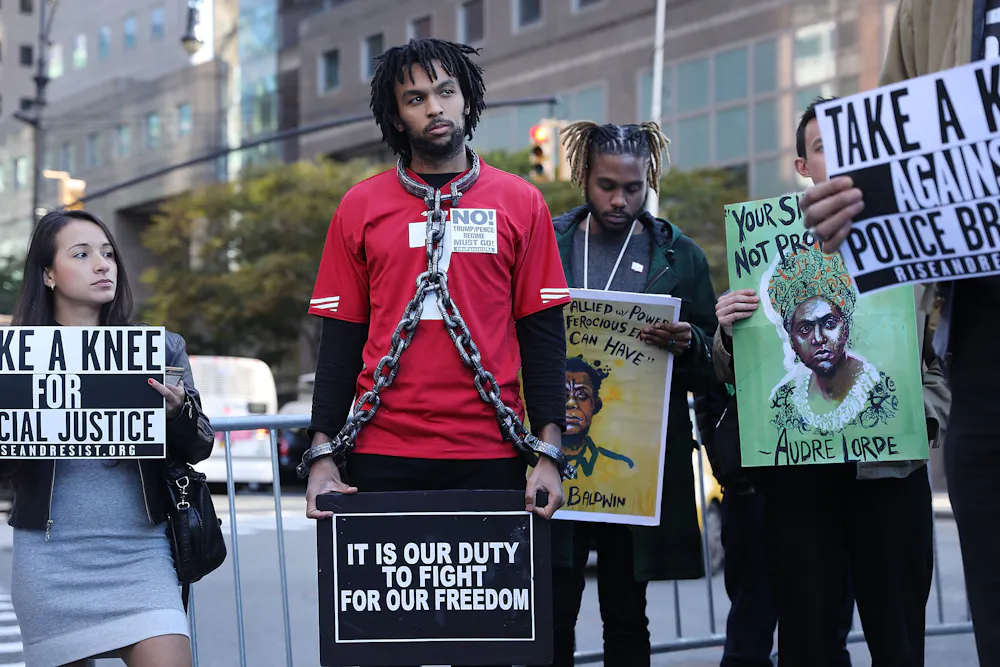
    Activists supporting players’ right to protest appear outside a hotel where NFL meetings were being held on Oct. 17, 2017, in New York.
    Spencer Platt/Getty Images

    Participants reject racial justice advocacy

    Other participants in our study expressed support for athletes’ right to protest, but they rejected their racial justice advocacy.

    They said athletes have the freedom to say what they think. And they tied the protests to the United States’ commitment to freedom of speech. But they disapproved of kneeling during the playing of the national anthem, labeling it as disrespectful.

    “I think most of it is good. If you have a platform, you should use it,” one participant told us. “However, when misinformation is spread, it becomes bad.”

    Several participants felt the conflation of the national anthem with protesting racial injustices was misleading and wrong, and this participant considered Kaepernick’s protest “misinformation.”

    Kaepernick’s activism elicited similarly mixed feelings at the time. A majority of the public viewed Kaepernick’s refusal to stand as unpatriotic. Most, however, also supported his right to free speech.

    In May 2018, NFL Commissioner Roger Goodell barred athletes from protesting on the sidelines during the national anthem, but he gave them the option to remain in the locker room during the playing of “The Star-Spangled Banner” if they preferred. The move came after players had protested racial inequality and police brutality for two seasons.

    “We want people to be respectful of the national anthem,” Goodell said, according to ESPN. “We want people to stand – that’s all personnel – and make sure they treat this moment in a respectful fashion. That’s something we think we owe. But we were also very sensitive to give players choices.”

    In June 2020, in the wake of George Floyd’s death and years into Kaepernick’s activism, Goodell apologized to players and reversed the policy, saying, “We were wrong for not listening to NFL players earlier.”

    Dontari Poe of the Dallas Cowboys kneels during the playing of the national anthem on Sept. 13, 2020, in Inglewood, Calif.
    AP Photo/Ashley Landis

    But team protests varied throughout the league.

    Some teams such as the Green Bay Packers and Jacksonville Jaguars, at least on one occasion, remained in their locker rooms during the playing of “The Star-Spangled Banner.”

    Some teams acted uniformly with the exception of one or two players. Dallas Cowboys player Dontari Poe was the only person on his team to kneel during the playing of the national anthem.

    The fact that not all players protested, and that teams had distinct approaches to protesting, is not surprising given the public’s varied responses to athlete activism.

    Complete disapproval

    A third group of participants in our study disapproved of sports activism entirely. And these participants often accompanied their criticism by saying that athletes strayed from their role as entertainers.

    “I don’t think it’s good because it’s giving people a reason not to like a professional athlete when their job is to play a sport. They are not politicians and haven’t been able to prove they can make a change,” said one participant.

    For example, when responding to WNBA player Skylar Diggins-Smith’s call for the imprisonment of the police officers in Louisville, Kentucky, involved in the 2020 shooting death of Breonna Taylor during a nighttime apartment raid, one participant said: “It’s not for the average citizen to call for police officers to be investigated. It’s just not OK for a professional athlete to push their agenda like that.”

    Our study, much like other studies, found that people who are white, older and politically conservative are more opposed to racial justice activism in sports than their counterparts.

    What does this mean?

    As seen in our study, U.S. views toward sports protests are tied to the role people believe athletes should play in society.

    For some, athletes can and should be role models; that includes by raising awareness of racial injustices. For others, athletes should only express their perspectives under certain conditions.

    And yet other Americans believe athletes are performers whose only role should be to entertain.

    Still, there’s no doubt Kaepernick’s activism changed the playing field, even if his NFL career suffered. After the 2016 season, he was never picked up by another team.

    Kaepernick’s activism inspired people to attend protests and donate to political causes.

    The NAACP has asked college athletes to avoid attending schools that are dismantling their diversity, equity and inclusion, or DEI, initiatives.

    Coach Steve Kerr and All- Star Steph Curry of the Golden State Warriors regularly voice their political views and draw attention to injustices.

    Several sports associations – the NFL, NBA, WNBA and NWSL – have implemented social justice initiatives and councils that strive to mobilize voters and educate the electorate on political issues.

    Colin Kaepernick’s activism may have ended his Super Bowl dreams, but his legacy extends far beyond the game of football.

    Betina Cutaia Wilkinson previously received funding from the Latino Center for Leadership Development.
    Lisa Kiang works with Betina Wilkinson at Wake Forest University. Elizabeth Seagroves was Betina Wilkinson’s student during her time at Wake Forest University

    ref. After he reached the Super Bowl, Colin Kaepernick’s racial justice protests helped expose US views toward sports activism – https://theconversation.com/after-he-reached-the-super-bowl-colin-kaepernicks-racial-justice-protests-helped-expose-us-views-toward-sports-activism-242672

    MIL OSI – Global Reports

  • MIL-OSI USA: Lummis Applauds Trump Administration for Bringing Transparency to FDIC

    US Senate News:

    Source: United States Senator for Wyoming Cynthia Lummis

    February 5, 2025

    Washington, D.C.—  Senator Cynthia Lummis (R-WY) released the following statement in response to a Trump-led Federal Deposit Insurance Corporation (FDIC) releasing 790 pages of previously hidden documents relating to the FDIC’s conduct in Operation Chokepoint 2.0.

    “The days of an administration that operates in the dark are over,” said Lummis. “I appreciate the Trump administration for ensuring the federal government is transparent and beholden to the American people it serves. I look forward to working with Acting Chairman Hill to restore the FDIC’s mission to serving American businesses, not shielding unelected bureaucrats.”

    In January, Senator Lummis sent a letter to FDIC Chair Marty Gruenberg after her office was contacted by whistleblowers alleging the FDIC was destroying materials with respect to the digital asset activities of the agency and threatening retaliation against staff for speaking out.

    MIL OSI USA News

  • MIL-OSI USA: McConnell Proud to Confirm Turner as HUD Secretary

    US Senate News:

    Source: United States Senator for Kentucky Mitch McConnell

    Washington, D.C.U.S. Senator Mitch McConnell (R-KY) issued the following statement today regarding the confirmation of Scott Turner as U.S. Secretary of Housing and Urban Development:

    “Scott Turner is another positive addition to the President’s cabinet at the Department of Housing and Urban Development. His experience spearheading creative solutions, like Opportunity Zones, will be needed to cut bureaucratic red tape and reform our failed federal housing policies. I look forward to working with Secretary Turner to help the agency better serve the American people, particularly improving its delivery of resources to distressed communities.”

    MIL OSI USA News

  • MIL-OSI USA: Ahead of Hearing, Warren Pushes Trump Trade Representative on Tariff Policy

    US Senate News:

    Source: United States Senator for Massachusetts – Elizabeth Warren

    February 05, 2025

    Warren Questions Greer on Trade Agenda, Tariff Exemptions for Trump’s Allies and Special Interests

    “Tariffs are an important strategic economic tool, but Donald Trump’s desire to start and stop random trade wars will not protect jobs, keep Americans safe, or bring down costs for families.”

    Text of Letter (PDF)

    Washington, D.C. – U.S. Senator Elizabeth Warren (D-Mass.), Ranking Member of the Senate Committee on Banking, Housing, and Urban Affairs (BHUA) and member of the Senate Finance Committee, wrote to Jamieson Greer, nominee to be U.S. Trade Representative (USTR), ahead of his February 6, 2025 confirmation hearing, probing his views on trade. Senator Warren asked Mr. Greer to address her concerns with the administration’s tariff strategy, corporate influence over trade agreements, corporations offshoring of jobs, and other trade-related concerns. 

    The USTR is responsible for developing and promoting the U.S. trade agenda and leading trade negotiations on behalf of the U.S., playing a critical role in the economy. This week, the Trump administration announced new tariffs on Canada, Mexico, and China. During the last Trump administration, corporations and their lobbyists abused tariff exclusion loopholes to receive secretive exemptions from President Trump and his trade team. The Commerce Department’s Inspector General found that the process for receiving an exemption was “neither transparent nor objective.”

    “(T)he President does not appear to have a strategic plan in place to ensure that his proposed tariffs are implemented in a way that secures wins for hardworking Americans and precludes carveouts for special interests,” wrote Senator Warren. “Instead, he has threatened, and withdrawn tariff threats in a chaotic and haphazard manner that has only resulted in uncertainty for American consumers, workers, and manufacturers, as well as our allies.”

    Large multinational companies have also gained outsized influence in trade negotiations and trade disputes. For decades, membership of the trade advisory committee has leaned heavily in favor of billionaire corporations and their industry associations, and Investor-State Dispute Settlement (ISDS) provisions have allowed corporations to sue governments—including the United States—for pursuing public policies they may disagree with. Senator Warren encouraged Mr. Greer to pursue the removal of ISDS provisions from trade agreements with U.S. allies. 

    Senator Warren also wrote that she believes large corporations have too many incentives to move jobs and manufacturing abroad. “In order to reverse the negative effects offshoring has had on the American economy, the Administration must invest in domestic industry and eliminate incentives for corporations to hide their profits abroad,” the senator wrote

    Senator Warren also expressed support for the Trade Adjustment Assistance (TAA) program to help American workers whose jobs are displaced by trade. “Renewing TAA is a no-brainer, and I hope you will support it to make sure that workers at home get a fair deal,” said Senator Warren.

    In order to better understand Mr. Greer’s approach to trade, Senator Warren asked him to prepare to answer questions on his vision for the Trump administration’s trade agenda on February 6, 2025, the date of his confirmation hearing. 

    MIL OSI USA News

  • MIL-OSI United Nations: Expand Educational, Workplace Opportunities for Women and Girls to Build Careers in Science, Secretary-General Urges in Observance Message

    Source: United Nations General Assembly and Security Council

    Following is UN Secretary-General António Guterres’ message for the International Day of Women and Girls in Science, observed on 11 February:

    Ten years ago, the first International Day of Women and Girls in Science recognized a fundamental truth:  women’s participation is essential for building a better world through science and technology.  I saw that enormous potential firsthand when I was teaching engineering, and I saw the remarkable talent, creativity, and determination of countless women scientists.

    Yet today, women still represent just one third of the global scientific community.  Deprived of adequate funding, publishing opportunities and leadership positions in universities, women and girls continue to face an uphill battle in building careers in science, technology, engineering and math (STEM).

    Look no further than the development of new digital technologies.  Men dominate the field at every level — including in artificial intelligence.  The result is a surge of biased algorithms and embedded inequality, risking a new era of digital chauvinism.

    The more that women are excluded from STEM, the more we limit our collective power to address urgent global challenges, from climate change and food security to public health and technological transformation. 

    We can and must do more to level the playing field.  By expanding scholarships, internships and mentorship opportunities to open doors for women and girls in STEM; creating workplaces that attract, retain and advance women in science; encouraging girls’ engagement in STEM from an early age; championing women leaders in science through the media; and dismantling gender stereotypes.

    The Pact for the Future, agreed last September by Member States, gives renewed momentum to these goals by committing to address barriers preventing the full, equal and meaningful access for women and girls in scientific fields.

    On the tenth anniversary of this important day, and as we reflect on 30 years since the Beijing Declaration, let’s help pave a path to STEM careers that women and girls deserve — and our world needs.

    MIL OSI United Nations News

  • MIL-OSI Australia: Person impaled on fence

    Source: South Australia Police

    A woman is being treated after being impaled on a fence in Alberton last night.

    Just before 10pm on Wednesday 5 February, police and SAAS were called to Angas Street after reports a person was impaled on a fence.

    The woman aged in her 30s was treated by SAAS members for an upper leg wound.

    There are no suspicious circumstances surrounding the incident.

    MIL OSI News

  • MIL-OSI Security: USS St. Louis (LCS-19) Supports Operation Southern Guard at Naval Station Guantanamo Bay

    Source: United States SOUTHERN COMMAND

    The Freedom-variant littoral combat ship USS St. Louis (LCS 19) is moored at U.S. Naval Station Guantanamo Bay (NSGB) and the crew is supporting the expansion of the base’s Migrant Operations Center as part of Operation Southern Guard.

    At the direction of the President of the United States to the Department of Homeland Security (DHS) and the Department of Defense (DOD), U.S. military service members are supporting removal operations led by DHS at NGSB. U.S. Southern Command has set up a Joint Task Force Migrant Operations (JTF-MIGOPS) at the Naval Station to execute the directive.

    The USS St. Louis is currently deployed to the Caribbean conducting counter-illicit drug trafficking operations in support of Joint Interagency Task Force South (JIATF-South), and participating in operations with partner nations in support of U.S. Naval Forces Southern Command/U.S. 4th Fleet. USS St. Louis arrived at NSGB on January 30, and the crew has been steadily assisting ever since.
     
    “As a forward-deployed asset, our crew is ready to respond to emerging tasks and missions at a moment’s notice,” said Cmdr. Timothy J. Orth, commanding officer of the USS St. Louis. “We’re honored to work alongside our joint task force partners and play a role in this important effort, which reflects U.S. Naval Forces Southern Command and U.S. Fourth Fleet’s commitment to security and cooperation.”

    While USS St. Louis is moored at NSGB, the Sailors are helping to set up tents and participating in other logistics activities in expanding the Migrant Operations Center. The first phase of expansion will increase the center’s capacity to approximately 2,000 migrants, with additional phases to follow at NSGB.

    U.S. Naval Station Guantanamo Bay is a critical forward-operating base that enables the United States to maintain persistent presence in the Caribbean, support regional security objectives, and defend the Homeland.
     
    “In support of DHS, we often practice our migrant contingency plan at U.S. Naval Station Guantanamo Bay” said Rear Adm. Carlos Sardiello, Commander, U.S. Naval Forces Southern Command/U.S. Fourth Fleet. “The naval station routinely provides support to joint and interagency operations like this.”

    U.S. Naval Forces Southern Command/U.S. 4th Fleet integrates and deploys all-domain combat power to expose, deter, degrade malign influences and activities, prevent and to respond to crises, and, if necessary, conduct decisive operations to prevail in conflict in the USSOUTHCOM AOR to protect the Homeland, ensure freedom of action in the maritime domain, protect U.S. interests throughout the region and enhance U.S. Alliances and partnerships.

    MIL Security OSI

  • MIL-OSI Security: U.S. Army South leads joint task force in support of illegal alien holding operation in Guantanamo Bay

    Source: United States SOUTHERN COMMAND

    At the direction of the President of the United States, and in coordination with the Department of Homeland Security and the Department of Defense, U.S. Army South has assumed responsibility as the lead Joint Task Force for ongoing illegal alien holding operations at Naval Station Guantanamo Bay, Cuba.

    Under the command of Maj. Gen. Phil Ryan, USARSOUTH will oversee the establishment and management of facilities supporting DHS-led operations.

    More than 300 U.S. military personnel are currently deployed to support the mission, including elements from USARSOUTH, U.S. Southern Command, and U.S. Marine Corps units. These forces will provide operational support, security, and logistical assistance as part of the broader interagency effort.

    As the land component of USSOUTHCOM, USARSOUTH remains committed to executing its mission in support of national security objectives while working alongside DHS and other federal agencies.

    MIL Security OSI

  • MIL-OSI Security: Ohio Man Pleads Guilty to Methamphetamine Trafficking

    Source: Office of United States Attorneys

    PITTSBURGH, Pa. – A resident of Akron, Ohio, pleaded guilty in federal court to a charge of conspiracy with intent to distribute and distribution of methamphetamine, Acting United States Attorney Troy Rivetti announced today.

    Charles Woods, 67, pleaded guilty to one count before United States District Judge Christy Criswell Wiegand.

    In connection with the guilty plea, the Court was advised that investigators identified Woods as a methamphetamine supplier for a drug trafficking operation between Akron, Ohio, and Pittsburgh, Pennsylvania. Investigators searched Woods’ residence and obtained approximately 294 grams of methamphetamine. During his hearing, Woods admitted that he conspired to distribute and distributed between 500 grams and 1.5 kilograms of methamphetamine over a five-month period.

    Judge Wiegand scheduled sentencing for June 12, 2025. The law provides for a total sentence of not less than five years and up to 40 years in prison, a fine of up to $5 million, or both. Under the federal Sentencing Guidelines, the actual sentence imposed is based upon the seriousness of the offense and the prior criminal history, if any, of the defendant.

    Assistant United States Attorney Rebecca L. Silinski is prosecuting this case on behalf of the government.

    Homeland Security Investigations, the United States Postal Inspection Service, and the Pennsylvania State Police conducted the investigation that led to the prosecution of Woods.

    MIL Security OSI

  • MIL-OSI: Northeast Bank Announces Dates for Fiscal 2025 Second Quarter Earnings Results and Conference Call

    Source: GlobeNewswire (MIL-OSI)

    PORTLAND, Maine, Feb. 05, 2025 (GLOBE NEWSWIRE) — Northeast Bank (the “Bank”) (NASDAQ: NBN), a Maine-based full-service bank, announced today it will release its fiscal 2025 second quarter earnings results on Thursday, February 6, 2025. Following the release, the Bank will host a conference call with a simultaneous webcast at 10:00 a.m. ET on Friday, February 7, 2025. The conference call will be hosted by Rick Wayne, President and Chief Executive Officer, Richard Cohen, Chief Financial Officer, and Pat Dignan, Chief Operating Officer.

    To access the conference call by phone, please go to this link (Phone Registration), and you will be provided with dial in details. The call will be available via a live webcast, which can be viewed by accessing the Bank’s website at www.northeastbank.com and clicking on the Investor Relations section. To listen to the webcast, attendees are encouraged to visit the website at least 15 minutes prior to the start of the call to register, download and install any necessary audio software. Please note there is a slide presentation that will accompany the webcast. For those who cannot listen to the live broadcast, a replay will be available online for one year at www.northeastbank.com.

    About Northeast Bank

    Northeast Bank (NASDAQ: NBN) is a full-service bank headquartered in Portland, Maine. We offer personal and business banking services to the Maine market via seven branches. Our National Lending Division purchases and originates commercial loans on a nationwide basis. ableBanking, a division of Northeast Bank, offers online savings products to consumers nationwide. Information regarding Northeast Bank can be found at www.northeastbank.com.

    NBN-F

    For More Information:
    Richard Cohen, Chief Financial Officer
    Northeast Bank
    27 Pearl Street, Portland, ME 04101
    207.786.3245 ext. 3249
    www.northeastbank.com

    The MIL Network

  • MIL-Evening Report: Mark Zuckerberg wants business to ‘man up’, but what it really needs is more women entrepreneurs

    Source: The Conversation (Au and NZ) – By Rod McNaughton, Professor of Entrepreneurship, University of Auckland, Waipapa Taumata Rau

    Sergey Nivens/Getty Images

    By claiming workplaces need to “man up”, Meta CEO Mark Zuckerberg is ignoring one of the biggest untapped opportunities for economic growth – women entrepreneurs.

    A 2024 study found promoting female entrepreneurship can greatly enhance women’s workforce participation and drive significant economic growth. And in 2015, the McKinsey Global Institute found advancing women’s workforce equality could add US$12 trillion to global growth.

    Yet, women remain significantly underrepresented as startup founders, particularly in high-growth industries.

    According to Startup Genome, which analyses global startup ecosystems, just 26% of founders in New Zealand are women (still one of the higher rates globally). But only about 4% of Australia’s venture capital investment goes to startups founded solely by women, and about 7% in New Zealand.

    Encouraging women to develop entrepreneurial mindsets could help address both countries’ stagnating productivity. So what stops women from pursuing this path?

    Our latest research explores why fewer women undergraduate students at the University of Auckland pursue entrepreneurship and how universities can help close the gap.

    Lagging behind

    We used data from the 2021 Global University Entrepreneurial Spirit Students’ Survey (GUESSS) of more than 267,000 students in 57 countries to assess the gender gap. Among them, 1,050 were undergraduate students from the University of Auckland.

    During the early stages of their undergraduate degrees, male and female students at the university showed similar interest in founding a business at the beginning of their careers – 8% versus 6%. However, both genders significantly lagged behind the 21% and 15% global averages.

    Asked about what they hope to be doing five years later, 28% of men and 18% of women at the University of Auckland said they wished to run their own business. While interest in entrepreneurship increases, the gender gap widens. And both genders still lagged the global averages of 37% for men and 30% for women.

    While university experience influences career ambitions, external factors after graduation can also discourage women from entrepreneurship.

    Societal expectations, industry norms, and lack of access to funding all play a role. Confidence is also a factor. In the survey, women reported lower confidence in their ability to start a business.

    Recent global research has found female entrepreneurship can greatly enhance women’s workforce participation, but women are still lagging behind men when it comes to founding businesses.
    loreanto/Shutterstocl

    The link between STEM and entrepreneurship

    The subjects students choose to study also shape their exposure to entrepreneurship.

    Women at the University of Auckland are underrepresented in STEM (science, technology, engineering and mathematics) and business disciplines.

    This matters because these fields of study are associated with higher interest in business formation. Students in business and STEM programmes are more likely to encounter entrepreneurial concepts, role models and develop relevant industry networks.

    Without efforts to introduce entrepreneurship into a broader range of disciplines, many women may miss out on these vital opportunities and networks.

    Closing the gender gap

    Female participation in the University of Auckland’s Centre for Innovation and Entrepreneurship (CIE) programmes has increased from 23% in 2015 to 44% in 2024. Last year, two of the centre’s alumni were named Cartier Women’s Initiative Fellows.

    Yet our research shows women still enrol in entrepreneurship courses and extracurricular activities less often than men. These experiences matter. Women who engage in them are more likely to see themselves as future entrepreneurs.

    To close the gap, universities must embed entrepreneurship across disciplines. In addition to STEM and business students, those in health, law and social sciences can also benefit from early exposure to entrepreneurial thinking. Tailored programs that show how entrepreneurship applies in these fields can make a difference.

    Role models and mentorship are also essential. Women students need to see successful female entrepreneurs to believe they can follow the same path. Universities should actively recruit women founders as speakers, mentors, and industry partners.

    Hands-on experience is a game-changer. Universities must ensure their startup incubators, pitch competitions and funding programs are accessible to female students. Special funding streams for women-led ventures can help level the playing field.

    Finally, the way entrepreneurship is framed matters.

    Many women are drawn to careers that create social impact. Universities should highlight how startups can drive change in sustainability, healthcare and community development. A broader definition of entrepreneurship will make it more appealing.

    By integrating entrepreneurship into all disciplines, increasing the visibility of female founders, and fostering inclusive networks, universities can help break down the barriers that hold women back.

    If universities take action now, they can unlock untapped potential and drive future economic and social impact.

    The authors do not work for, consult, own shares in or receive funding from any company or organisation that would benefit from this article, and have disclosed no relevant affiliations beyond their academic appointment.

    ref. Mark Zuckerberg wants business to ‘man up’, but what it really needs is more women entrepreneurs – https://theconversation.com/mark-zuckerberg-wants-business-to-man-up-but-what-it-really-needs-is-more-women-entrepreneurs-248440

    MIL OSI AnalysisEveningReport.nz

  • MIL-Evening Report: ‘Serious concerns’: national assessment reveals rivers flowing into the Great Barrier Reef are getting more polluted

    Source: The Conversation (Au and NZ) – By Anna Lintern, Senior Lecturer in Civil Engineering, specialising in water quality, Monash University

    Polluted runoff is still smothering the Great Barrier Reef, our first national assessment of water quality trends in Australian rivers has revealed. The problem on the reef is getting worse, not better, despite efforts to improve farming practices and billions of dollars committed by governments to water-quality improvements.

    But in good news, there are signs of improvement in the Murray-Darling Basin, where less salt, sediment and phosphorous were detected in the water.

    Our latest research quantifies, for the first time, how water quality in Australian rivers has changed over the past two decades. Around half our 287 monitoring sites experienced significant changes in water quality between 2000 and 2019 on every measure we analysed. But the results for the reef and the basin stood out.

    In particular, freshwater flows into the Great Barrier Reef lagoon contained increasing levels of sediment and phosphorous. If the trend continues, we have serious concerns for the health of the Great Barrier Reef and the tourist industry it supports.

    Understanding river water quality

    We studied water quality monitoring data from 287 river sites across Australia. The relevant agency in each state and territory collects this information and makes it available online. The data covers the following:

    • salinity: too much makes water unsuitable for drinking or irrigation
    • dissolved oxygen: when the level is too low it can kill aquatic life
    • nitrogen and phosphorous: high levels of either can cause excessive algae growth and consumes oxygen
    • sediment: too much reduces light penetration and disrupts ecosystems

    We focused on sites with records of all five water quality indicators from 2000 to 2019.

    River flows can vary enormously from year to year and this affects water quality. So we used statistics to account for this and identify underlying long-term trends.

    In the catchments that exhibited significant changes between 2000 and 2019, about half showed improvements in dissolved oxygen, salinity and phosphorus, while the other half deteriorated. Sediment levels mostly improved (86% of catchments) over time. The story was not so good when it came to nitrogen levels, which went up in 60% of catchments.

    Two regions experienced the greatest large-scale changes in water quality over that time: the North East Coast basin and the Murray-Darling Basin.

    The research analysed two decades of water quality monitoring data from 287 sites dotted across Australia.
    Danlu Guo, CC BY-ND

    More polluted water flowing to the reef

    In the North East Coast basin, many rivers capture water from inland areas, including farming regions, and carry it to the ocean near the Great Barrier Reef. So, any pollution in these rivers are carried to the reef.

    Suspended sediments make the water cloudy or “turbid”. This can reduce the growth of seagrass and disrupt the growth and reproductive cycles of coral and some fish.

    Phosphorous and nitrogen are essential minerals or nutrients, which is why they are used on farms as fertiliser. But too much of either can lower coral diversity, and reduce resilience of coral to bleaching and disease.

    We found water quality in rivers flowing to the reef – one of the world’s seven natural wonders – had declined over the past two decades. In particular, levels of phosphorus and sediments had increased at around 5% per year on average across catchments.

    This may be a hangover from intensifying land use and clearing in the 1960s and ‘70s. Land clearing can lead to more erosion of sediment and phosphorus attached to soils. Similarly, intensive agriculture can lead to increased phosphorus in rivers, due to fertiliser use.

    Substantial investment has been made to improve water quality over many years. This includes almost A$1.8 billion committed by the federal and Queensland governments between 2014 and 2030. But it appears greater effort is needed to turn things around.

    It can take a long time for management strategies to start having an effect on water quality. So efforts to date may not yet be showing up. Or perhaps the scale of these changes has not been enough to shift the long-term trend in water quality.

    Regardless, declining water quality over the past two decades has direct implications for the future of the world heritage listed site.

    Cleaning up the basin

    In contrast, we found water quality in the Murray-Darling Basin was improving. Salinity levels declined, along with phosphorus and suspended sediment.

    Managing salinity in the basin is a long-term issue. Much of the basin’s groundwater is naturally saline to begin with. Land clearing and agricultural activities since European colonisation have further exacerbated the problem.

    But our results suggest salinity levels in the Murray-Darling Basin rivers are improving. This may be due to large-scale management actions such as improving irrigation efficiency, reducing drainage, installing salt interception, and drainage diversion schemes to divert saline groundwater away from entering the Murray River.

    These changes in water quality could also be due to declines in rainfall during the Millennium drought period over the late 1990s and early 2000s. The dry conditions might have altered processes controlling flushing of salt, sediments and phosphorus into waterways. As such, the drought has likely had more complicated and long-lasting impacts on water quality than the year-to-year variation in river flow.

    While our research shows water quality in the Murray-Darling Basin has improved, this does not mean funding in this area should reduce or cease. Scientists and policymakers must continue monitoring and working towards a healthy basin for future generations.

    Salt interception schemes divert about 400,000 tonnes of salt away from the river every year.
    Photo by Zac Edmonds on Unsplash, CC BY

    Keeping watch over water quality

    Unfortunately, insufficient long-term water quality monitoring limits our understanding of water quality trends across large parts of the country.

    This includes a large proportion of the western, northern and central parts of Australia. Filling these data gaps will require new and ongoing investment into water quality monitoring.

    Australian water authorities need to keep checking the health of our rivers.

    A national program to harness this data from states and territories, to monitor and track river water quality, is needed to continue similar Australia-wide assessments of water quality.

    Such assessments are vital for providing an evidence base for federal policy and identifying future needs in river water quality protection.

    Anna Lintern has previously received funding from the Australian Research Council and the Victorian State Government. She is an unpaid volunteer for her federal Independent MP’s office.

    Danlu Guo does not work for, consult, own shares in or receive funding from any company or organisation that would benefit from this article, and has disclosed no relevant affiliations beyond their academic appointment.

    ref. ‘Serious concerns’: national assessment reveals rivers flowing into the Great Barrier Reef are getting more polluted – https://theconversation.com/serious-concerns-national-assessment-reveals-rivers-flowing-into-the-great-barrier-reef-are-getting-more-polluted-248903

    MIL OSI AnalysisEveningReport.nz

  • MIL-Evening Report: Elections mean more misinformation. Here’s what we know about how it spreads in migrant communities

    Source: The Conversation (Au and NZ) – By Fan Yang, Research fellow at Melbourne Law School, the University of Melbourne and the ARC Centre of Excellence for Automated Decision-Making and Society., The University of Melbourne

    Shutterstock

    Migrants in Australia often encounter disinformation targeting their communities. However, disinformation circulated in non-English languages and within private chat groups often falls beyond the reach of Australian public agencies, national media and platform algorithms.

    This regulatory gap means migrant communities are disproportionately targeted during crises, elections and referendums when misinformation and disinformation are amplified.

    With a federal election just around the corner, we wanted to understand how migrants come across disinformation, how they respond to it, and importantly, what can be done to help.


    Read more:
    Misinformation, disinformation and hoaxes: What’s the difference?


    Our research

    Our research finds political disinformation circulates both online and in person among friends and family.

    Between 2023 and 2024, we carried out a survey with 192 respondents. We then conducted seven focus groups with 14 participants who identify as having Chinese or South Asian cultural heritage.

    We wanted to understand their experiences of political engagement and media consumption in Australia.

    An important challenge faced by research participants is online disinformation. This issue was already long-standing and inadequately addressed by Australian public agencies and technology companies, even before Meta ended its fact-checking program.

    Lack of diversity in news

    Our study finds participants read news and information from a diverse array of traditional and digital media services with heightened sense of caution.

    They encounter disinformation in two ways.

    The first is information misrepresenting their identity, culture, and countries of origin, particularly found in English-language Australian national media.

    The second is targeted disinformation distributed across non-English social media services, including in private social media channels.

    Misinformation is often spread on Chinese social media platforms to target their users.
    Shutterstock

    From zero (no trust) to five (most trusted), we asked our survey participants to rank their trust towards Australian national media sources. This included the ABC, SBS, The Age, Sydney Morning Herald, 9 News and the 7 Network.

    Participants reported a medium level of trust (three).

    Our focus groups explained the mistrust participants have towards both traditional and social media news sources. Their thoughts echoed other research with migrants. For instance, a second-generation South Asian migrant said:

    it feels like a lot of marketing with traditional media […] they use marketing language to persuade people in a certain way.

    Several participants of Chinese and South Asian cultural backgrounds reported that Australian national media misrepresent their culture and identity due to a lack of genuine diversity within news organisations. One said:

    the moment you’re a person of colour, everyone thinks that you’re Chinese. And we do get painted with the same paintbrush. It is very frustrating […]

    Another added:

    Sri Lanka usually gets in the media for cricket mainly, travel and tourism. So apart from that, there’s not a lot of deep insight.

    For migrants, the lack of genuine engagement with their communities and countries of origin distorts public understanding, reducing migrants to a one-dimensional, often stereotypical, portrayal. This oversimplification undermines migrants’ trust in Australian national media.

    Participants also expressed minimal trust in news and information on social media. They often avoid clicking on headline links, including those shared by Australian national media outlets. According to a politically active male participant of Chinese-Malaysian origin:

    I don’t really like reading Chinese social media even though I’m very active on WeChat and subscribe to some news just to see what’s going on. I don’t rely on them because I usually don’t trust them and can often spot mistakes and opinionated editorials rather than actual news.

    Consuming news from multiple sources to understand a range of political leanings is a strategy many participants employed to counteract biased or partial news coverage. This was particularly the case on issues of personal interest, such as human rights and climate change.


    Read more:
    About half the Asian migrants we surveyed said they didn’t fully understand how our voting systems work. It’s bad for our democracy


    What can be done?

    Currently, Australia lacks effective mechanisms to combat online disinformation targeting migrant communities, especially those whose first language is not English.

    Generalised counter-disinformation approaches (such as awareness camapaigns) fail to be effective even when translated into multiple languages.

    This is because the disinformation circulating in these communities is often highly targeted and tailored. Scaremongering around geopolitical, economic and immigration policies is a common theme. These narratives are too specific for a population-level approach to work.

    Our focus groups revealed that the burden of addressing disinformation often falls on family members or close friends. This responsibility is particularly carried by community-minded individuals with higher levels of media and digital knowledge. Women and younger family members play a key role.

    Women and younger family members play a key role in debunking misinformation in migrant families.
    Shutterstock

    Focus group members told us how they explained Australian political events to their families in terms they were more familiar with.

    During the Voice to Parliament referendum, one participant referenced China’s history of resistance against Japanese Imperialism to help a Chinese-Australian friend better understand the consequences of colonialism and its impacts on Australia’s First Nations communities.

    Younger women participants shared that combating online disinformation is an emotionally taxing process. This is especially so when it occurs within the family, often leading to conflicts. One said:

    I’m so tired of intervening to be honest, and mostly it’s family […] my parents and close friends and alike. There is so much misinformation passed around on WhatsApp or socials. When I do see someone take a very strong stand, usually my father or my mother, I step in.

    Intervening in an informal way doesn’t always work. Family dynamics, gender hierarchies and generational differences can impede these efforts.

    Countering disinformation requires us to confront deeper societal issues related to race, ethnicity, gender, power and the environment.

    International research suggests community-based approaches work better for combating misinformation in specific cohorts, like migrants. This sort of work could take place in settings people trust, be that community centres or public libraries.

    This means not relying exclusively on changes in the law or the practices of online platforms.

    Instead, the evidence suggests developing community-based interventions that are culturally resonant and attuned to historical disadvantage would help.

    Our recently-released toolkit makes a suite of recommendations for Australian public services and institutions, including the national media, to avoid alienating and inadvertently misinforming Asian-Australians as we approach a crucial election campaign.

    Sukhmani Khorana receives funding from the Australia Research Council and has previously conducted commissioned research for migrant and refugee-focused organisations.

    Fan Yang does not work for, consult, own shares in or receive funding from any company or organisation that would benefit from this article, and has disclosed no relevant affiliations beyond their academic appointment.

    ref. Elections mean more misinformation. Here’s what we know about how it spreads in migrant communities – https://theconversation.com/elections-mean-more-misinformation-heres-what-we-know-about-how-it-spreads-in-migrant-communities-247685

    MIL OSI AnalysisEveningReport.nz

  • MIL-Evening Report: The butterfly effect: this obscure mathematical concept has become an everyday idea, but do we have it all wrong?

    Source: The Conversation (Au and NZ) – By Milad Haghani, Associate Professor & Principal Fellow in Urban Risk & Resilience, The University of Melbourne

    Edward Lorenz’s mathematical weather model showed solutions with a butterfly-like shape. Wikimol

    In 1972, the US meteorologist Edward Lorenz asked a now-famous question:

    Does the flap of a butterfly’s wings in Brazil set off a tornado in Texas?

    Over the next 50 years, the so-called “butterfly effect” captivated the public imagination. It has appeared in movies, books, motivational and inspirational speeches, and even casual conversation.

    The image of the tiny flapping butterfly has come to stand for the outsized impact of small actions, or even the inherent unpredictability of life itself. But what was Lorenz – who is now remembered as the founder of the branch of mathematics called chaos theory – really getting at?

    A simulation goes wrong

    Our story begins in the 1960s, when Lorenz was trying to use early computers to predict the weather. He had built a basic weather simulation that used a simplified model, designed to calculate future weather patterns.

    One day, while re-running a simulation, Lorenz decided to save time by restarting the calculations from partway through. He manually inputted the numbers from halfway through a previous printout.

    But instead of inputting, let’s say, 0.506127, he entered 0.506 as the starting point of the calculations. He thought the small difference would be insignificant.

    He was wrong. As he later told the story:

    I started the computer again and went out for a cup of coffee. When I returned about an hour later, after the computer had generated about two months of data, I found that the new solution did not agree with the original one. […] I realized that if the real atmosphere behaved in the same manner as the model, long-range weather prediction would be impossible, since most real weather elements were certainly not measured accurately to three decimal places.

    There was no randomness in Lorenz’s equations. The different outcome was caused by the tiny change in the input numbers.

    Lorenz realised his weather model – and by extension, the real atmosphere – was extremely sensitive to initial conditions. Even the smallest difference at the start – even something as small as the flap of a butterfly’s wings – could amplify over time and make accurate long-term predictions impossible.

    The ‘Lorenz Attractor’ found in models of a chaotic weather system has a characteristic butterfly shape.
    Milad Haghani, CC BY

    Lorenz initially used “the flap of a seagull’s wings” to describe his findings, but switched to “butterfly” after noticing a remarkable feature of the solutions to his equations.

    In his weather model, when he plotted the solutions, they formed a swirling, three-dimensional shape that never repeated itself. This shape — called the Lorenz attractor — looked strikingly like a butterfly with two looping wings.

    Welcome to chaos

    Lorenz’s efforts to understand weather led him to develop chaos theory, which deals with systems that follow fixed rules but behave in ways that seem unpredictable.

    These systems are deterministic, which means the outcome is entirely governed by initial conditions. If you know the starting point and the rules of the system, you should be able to predict the future outcome.

    There is no randomness involved. For example, a pendulum swinging back and forth is deterministic — it operates based on the laws of physics.

    Systems governed by the laws of nature, where human actions don’t play a central role, are often deterministic. In contrast, systems involving humans, such as financial markets, are not typically considered deterministic due to the unpredictable nature of human behaviour.

    A chaotic system is a system that is deterministic but nevertheless behaves unpredictably. The unpredictability happens because chaotic systems are extremely sensitive to initial conditions. Even the tiniest differences at the start can grow over time and lead to wildly different outcomes.

    Chaos is not the same as randomness. In a random system, outcomes have no definitive underlying order. In a chaotic system, however, there is order, but it’s so complex it appears disordered.

    A misunderstood meme

    Like many scientific ideas in popular culture, the butterfly effect has often been misunderstood and oversimplified.

    One common misconception is that the butterfly effect implies every small action leads to massive consequences. In reality, not all systems are chaotic, and for systems that aren’t, small changes usually result in small effects.

    Another is that the butterfly effect carries a sense of inevitability, as though every butterfly in the Amazon is triggering tornadoes in Texas with each flap of its wings.

    This is not at all correct. It’s simply a metaphor pointing out that small changes in chaotic systems can amplify over time, making long-term outcomes impossible to predict with precision.

    Taming butterflies

    Systems that are very sensitive to initial conditions are very hard to predict. Weather systems are still tricky, for example.

    Forecasts have improved a lot since Lorenz’s early efforts, but they are still only reliable for a week or so. After that, small errors or imprecisions in the starting data grow larger and larger, eventually making the forecast inaccurate.

    To deal with the butterfly effect, meteorologists use a method called ensemble forecasting. They run many simulations, each starting with slightly different initial conditions.

    By comparing the results, they can estimate the range of possible outcomes and their likelihoods. For example, if most simulations predict rain but a few predict sunshine, forecasters can report a high probability of rain.

    However, even this approach works only up to a point. As time goes on, the predictions from the models diverge rapidly. Eventually, the differences between the simulations become so large that even their average no longer provides useful information about what will happen on a given day at a given location.

    A butterfly effect for the butterfly effect?

    The journey of the butterfly effect from a rigorous scientific concept to a widely popular metaphor highlights how ideas can evolve as they move beyond their academic roots.

    While this has helped bring attention to a complex scientific concept, it has also led to oversimplifications and misconceptions about what it really means.

    Attaching a metaphor to a scientific phenomenon and releasing it into popular culture can lead to its gradual distortion.

    Any tiny inaccuracies or imprecision in the initial description can be amplified over time, until the final outcome is a long way from reality. Sound familiar?

    Milad Haghani does not work for, consult, own shares in or receive funding from any company or organisation that would benefit from this article, and has disclosed no relevant affiliations beyond their academic appointment.

    ref. The butterfly effect: this obscure mathematical concept has become an everyday idea, but do we have it all wrong? – https://theconversation.com/the-butterfly-effect-this-obscure-mathematical-concept-has-become-an-everyday-idea-but-do-we-have-it-all-wrong-246577

    MIL OSI AnalysisEveningReport.nz

  • MIL-OSI Global: Trump’s reversal of climate policies risks undermining U.S. manufacturing — and could cost people jobs

    Source: The Conversation – Canada – By Thomas Stuart, Lecturer in Communications, Gustavson School of Business, University of Victoria

    United States President Donald Trump’s early executive actions have set American manufacturing on a collision course with his administration’s fossil-fuel-driven agenda. It’s clear that climate change policies run counter to his vision of American primacy.

    Trump wasted no time reversing the green initiatives of his predecessor, former president Joe Biden. He withdrew the U.S. from the Paris Climate Agreement for a second time, rolled back environmental regulations and froze green energy funding.


    Read more:
    The impact of Donald Trump’s anti-climate measures on our heating planet


    However, these reversals have exposed complications in Trump’s economic platform. For all his promises to revive American industry and reduce reliance on foreign production, Trump’s opposition to clean energy threatens green technology investments and other incentives that drive U.S. manufacturing development.

    Trump’s Strategic National Manufacturing Initiative promised to “stop outsourcing” and turn the U.S. into a “manufacturing superpower.” Yet his plans to cancel the electric vehicle mandate and reduce regulations promoting clean energy undermine the manufacturing sector’s shift toward green technology.

    In the long run, Trump’s own actions may undermine his vision of an American manufacturing renaissance by cutting crucial investments, putting the U.S. at odds with a global economy increasingly focused on clean technologies.

    The green manufacturing boom

    Republican congressman John James recently applauded Trump’s reversal of green policies during a congressional hearing. Yet, in the same breath, James called for the administration to continue “onshoring the future of automotive jobs and manufacturing,” a policy he linked to Biden’s Inflation Reduction Act (IRA).

    Other Republican representatives from Michigan, Georgia and North Carolina increasingly find themselves walking along the same rhetorical tight-rope.

    While Biden’s IRA has been widely criticized by the Trump administration, the act has brought Republican districts significant green investments and manufacturing jobs.

    As James acknowledged:

    “While the bulk of the IRA is damaging policy, we must not neglect the sector-wide energy tax provisions that manufacturers and job creators rely on in my district and around the country.”

    The green manufacturing boom is not an abstract concept, but a tangible economic engine, particularly in districts with established fossil fuel industries like Chatham County, N.C. Here, manufacturer Wolfspeed’s new US$5 billion dollar semiconductor plant sits in the heart of traditional coal country.

    Since 2022, the private sector has invested US$133 billion in clean energy and electric vehicle (EV) technology. Manufacturing investments alone have jumped by three times over the previous two years, totalling US$89 billion.

    The impact of the IRA on ‘red states’

    Biden-era policy has largely driven the America’s green energy economic development. The IRA provided a staggering US$312 billion in planned investments in EV and battery manufacturing.

    Eighty-five per cent of this funding flows into Republican-voting districts — areas that have historically voted against climate-focused legislation like the IRA. Yet the rewards of these green tech policies have been a boon for local economies.

    Georgia, for instance, has become a model for the American green energy transformation. In the first two years of the IRA, about US$15 billion dollars flowed into the state. Since then, Georgia has added a projected 43,000 new green jobs.

    Meanwhile, North Carolina’s Randolph County has seen the largest investment in green technology in U.S. history. Under the previous administration, it received about US$14 billion in funding, allowing Toyota to build a manufacturing megasite.

    By 2030, the site is expected to create 5,000 jobs in the area, with wages averaging 80 per cent more than the county median salary. Once fully operational, the site will manufacture enough batteries annually to power and maintain up to 500,000 EVs.

    What comes next?

    As Trump continues to roll back environmental protections and withdraw from climate agreements, whether he can still deliver the manufacturing revival he promised remains to be seen.

    In one respect, his policies may lead to a consolidation in the green technology sector. Despite his administration’s retreat from broader green energy policies, Trump says he will continue securing the U.S. supply of critical minerals for EV batteries.

    This could reflect the influence of Tesla CEO Elon Musk, who is serving under Trump as a “special government employee.” Tesla, which relies on these critical minerals for its EV production, would benefit from a stable supply.

    Musk resents regulatory interventions, particularly those that encourage competition. On a call with investors, Musk said Tesla might feel a slight impact from lost subsidies. However, he suggested the real damage would be to competitors who are scrambling to catch up in an industry where raw materials are king. Musk predicted that “long term, it probably actually helps Tesla.”

    In another respect, Trump’s policy reversal could also weaken Republican unity. Republican politicians like Georgia’s Buddy Carter, Tennessee’s Chuck Fleischmann and Georgia Gov. Brian Kemp have highlighted the short-sighted nature of Trump’s economic plan.

    Trump’s decision to turn his back on climate change policy is more than a blow to environmentalists; it’s a direct challenge to his own economic agenda. He risks not just the environment, but also the green investments essential to American industry’s competitive revival.

    Thomas Stuart does not work for, consult, own shares in or receive funding from any company or organisation that would benefit from this article, and has disclosed no relevant affiliations beyond their academic appointment.

    ref. Trump’s reversal of climate policies risks undermining U.S. manufacturing — and could cost people jobs – https://theconversation.com/trumps-reversal-of-climate-policies-risks-undermining-u-s-manufacturing-and-could-cost-people-jobs-248399

    MIL OSI – Global Reports

  • MIL-OSI Video: Deputy Minister Ms Nonceba Mhlauli visits Kaalfontein High School for back to school campaign

    Source: Republic of South Africa (video statements-2)

    Deputy Minister in the Presidency Ms Nonceba Mhlauli visits Kaalfontein High School for back to school campaign

    https://www.youtube.com/watch?v=eh_uAUbFLlI

    MIL OSI Video