Category: KB

  • MIL-OSI Global: Assad’s fall opens window for Syrian refugees to head home − but for many, it won’t be an easy decision

    Source: The Conversation – USA – By Kelsey Norman, Fellow for the Middle East, Baker Institute for Public Policy, Rice University

    For more than a decade, Syrians have been the world’s largest refugee population.

    More than 6 million Syrians have fled the country since 2011, when an uprising against the regime of Bashar Assad transformed into a 13-year civil war. Most ended up in neighboring countries such as Turkey, Lebanon, Jordan, Iraq and Egypt, while a sizable minority wound up in Europe. But the overthrow of the Assad regime in late 2024 by opposition forces led by the Islamist group Hayat Tahrir al-Sham has seemingly opened a window for their return, and tens of thousands of former refugees have since made the decision to go back to their homeland.

    How many and who decides to go back, and the circumstances under which they reintegrate into Syrian society, will have enormous implications for both Syria and the countries they resettled in. It also provides an opportunity for migration scholars like ourselves to better understand what happens when refugees finally return home.

    Previous research has shown that Syrian refugees who are trying to decide whether to return are motivated more by conditions in Syria than by policy decisions where they’ve resettled. But individual experiences also play an important role. Counterintuitively, refugees who have been exposed to violence during the Syrian civil war are actually more tolerant of and better at assessing the risk of returning to Syria, research has shown.

    But such research was conducted while Assad was still in power, and it has only been several weeks since Assad fell. As a result, it’s unclear how many Syrians will decide to go back. After all, the current government is transitional, and the country is not fully unified.

    The risk of return

    In the month after Assad’s fall, about 125,000 Syrians headed home, primarily from Turkey, Jordan and Lebanon. But for the majority of those yet to return, important questions and considerations remain.

    First and foremost, what will governance look like under the transitional government? So far, Hayat Tahrir al-Sham’s rule under Ahmed al-Sharaa has suggested the group will embrace inclusivity toward Syria’s diverse array of ethnic and religious minorities. Even so, some observers worry about the group’s prior connections to militant Islamist groups, including al-Qaida.

    Similarly, initial fears about restrictions on women’s participation in public life have mostly been assuaged, despite the transitional government appointing only two women to office.

    Syrians debating whether to return home must also confront the economic devastation wrought by years of war, government mismanagement and corruption, and international sanctions placed on the Assad regime.

    Sanctions blocking the entry of medications and equipment, along with Assad’s bombing of infrastructure throughout the war, have crippled the country’s medical system.

    In 2024, 16.7 million Syrians – more than half the country’s population – were in need of essential humanitarian assistance, even as very little was available. In early 2025, the U.S. announced that it was extending a partial, six-month reprieve of sanctions to allow humanitarian groups to provide basic services such as water, sanitation and electricity.

    But rebuilding the country’s infrastructure will take much longer, and Syrian refugees will have to weigh whether they are better off remaining in their host countries. This is especially true for those who have worked to build new lives over a long period in exile from Syria.

    The caretaker Syrian government will also have to address the issue of property restitution. Many individuals may want to return home only if they indeed have a home to return to. And the policy of forced property transfers and the settlement by Alawite and minority groups allied to the Assad regime in former Sunni areas vacated during the war complicates the issue.

    Continued welcome in Europe?

    Since the start of the civil war, approximately 1.3 million Syrians have sought protection in Europe, the majority of them arriving in 2015 and 2016 and settling in countries such as Germany and Sweden. As of December 2023, 780,000 individuals still held refugee status and subsidiary protection – an additional form of international protection – with the remainder having received either long-term residency or citizenship.

    Syria’s 13-year civil war reduced many homes to rubble.
    Ercin Erturk/Anadolu via Getty Images

    Subsidiary protection was granted to those who didn’t meet the stringent requirements for refugee status under the Geneva Conventions – which requires a well-founded fear of persecution based on race, religion, nationality, political opinion or membership of a particular social group – but “would face a real risk of suffering serious harm” if returned to their countries of origin.

    Recognition rates for Syrians have remained consistently high between 2015 and 2023, but the breakdown between subsidiary protection and refugee status has fluctuated over the years, with 81% receiving refugee status in 2015 versus 68% receiving subsidiary protection in 2023.

    For Syrians in the EU who hold refugee status or subsidiary protection, as well as for those with pending asylum claims, the future is very uncertain. In accordance with the Geneva Conventions, EU law allows governments to revoke, end or refuse to renew their status if the reason to offer protection has ceased, which many countries believe is the case after Assad’s fall.

    Since then, at least 12 European countries have suspended asylum applications of Syrian nationals. Some nations, such as Austria, have threatened to implement a program of “orderly return and deportation.”

    Conditions in Turkey and Lebanon

    A much larger number of Syrians obtained protection in neighboring countries, namely Turkey (2.9 million), Lebanon (755,000) and Jordan (611,000), though estimates of unregistered Syrians are much higher. In Turkey, which hosts the largest number of Syrian refugees, Syrians are afforded only temporary protection status.

    In theory, this status allows them access to work, health care and education. But in practice, Syrian refugees in Turkey have not always been able to enjoy these rights. Coupled with anti-immigrant sentiments worsened by the 2023 earthquake and presidential election, life has remained difficult for many.

    And while Turkish President Recep Tayyip Erdogan has publicly stated that Syrians should return home according to their own timeline, his previous scapegoating of the refugee population indicates that he may ultimately like to see them returned – especially as many in Turkey now believe Syrian refugees have no reason to stay in the country.

    Syrians in Lebanon, which hosts the largest number of Syrian refugees per capita, face even greater economic and legal challenges. The country is not a signatory to the Geneva Conventions, and its stringent domestic asylum law has granted residency to only 17% of the more than a million Syrians who live in the country.

    Lebanon has been pressuring Syrian refugees to leave the country for years through policies of marginalization and forced deportation, which have intensified in recent months with a government scheme to deport Syrians not registered with the United Nations. As of 2023, 84% of Syrian families were living in extreme poverty. Their vulnerability was exacerbated by the recent conflict between Hezbollah and Israel in Lebanon, which led 425,000 Syrians to escape war once again and return to Syria even though conditions at the time were not safe.

    Testing the water

    Offering go-and-see visits – whereby one member of a family is allowed to return to a home country to evaluate the situation and subsequently permitted to reenter the host country without losing their legal status – is the norm in many refugee situations. The policy is being used at present for Ukrainians in Europe and was used in the past for Bosnian and South Sudanese refugees.

    The same policy could serve Syrian refugees now – indeed, Turkey recently implemented such a plan. But above all, we believe returns to Syria should be voluntary, not forced. Getting the conditions right for returning refugees will have enormous implications for rebuilding the country and keeping the peace – or not – in the years to come.

    The authors do not work for, consult, own shares in or receive funding from any company or organization that would benefit from this article, and have disclosed no relevant affiliations beyond their academic appointment.

    ref. Assad’s fall opens window for Syrian refugees to head home − but for many, it won’t be an easy decision – https://theconversation.com/assads-fall-opens-window-for-syrian-refugees-to-head-home-but-for-many-it-wont-be-an-easy-decision-247051

    MIL OSI – Global Reports

  • MIL-OSI Global: I study democracy worldwide − here’s how Texas is eroding human rights, free expression and civil liberties

    Source: The Conversation – USA – By Katie Scofield, Assistant Instructional Professor in Political Science, Texas A&M University-San Antonio

    Everything is bigger in Texas, except maybe its democracy. Luis Diaz Devesa/Moment via Getty

    While concerns about the future of American democracy dominate headlines worldwide, millions of Texans are already seeing a rapid decline in democratic standards.

    In December 2024, Texas Attorney General Ken Paxton sued a New York doctor for prescribing abortion-inducing medications to a woman in Collin County, Texas, alleging that the shipment violated Texas’ near-total ban on abortion.

    Two months earlier, Paxton’s office had sued to block a federal rule protecting women’s out-of-state medical records from criminal investigation. And in 2022, it sued the Biden administration over federal guidelines requiring doctors to perform abortions in emergency situations.

    Paxton’s lawsuits – alongside the state’s restrictive abortion policies – raise troubling questions about individual privacy and women’s bodily autonomy in Texas, where I live and teach. And they’re indicative of a broader problem. As my research on democracy and human rights shows, the state government is becoming increasingly antidemocratic.

    Scholars examine a number of factors to determine the health of a democracy. Elections must be free and fair. There should be freedom of expression and belief, multiple competitive political parties and minimal corruption. A democratic government must also respect individual freedom.

    On many of these metrics, I believe Texas falls short.

    Are Texas elections free and fair?

    Texas has some of the most restrictive voting laws in the United States, including strict voter ID laws, stringent limits on mail-in and absentee ballots and no online voter registration.

    Republicans, who passed each of these policies, claim their concern is a democratic one – election integrity. Yet, when Lt. Gov. Dan Patrick offered a US$25,000 reward to anyone who could prove voter fraud in the 2020 election, it led to just one arrest.

    The Texas Legislature nonetheless pledged to pass an even more restrictive voting bill in 2021, referencing “purity of the ballot box,” an old Jim Crow phrase. Democratic lawmakers ended up fleeing the state to paralyze the state assembly and keep the most egregious parts of the bill from passing.

    Healthy democracies also have robust competition between multiple parties so that voters have real choices at the polls.

    Yet since its current constitution was written in 1876, Texas has effectively been a one-party state governed by conservatives. No Democrat has won statewide office since 1994 – the longest Democrats have been locked out of statewide office in any state.

    Money in politics

    Texas puts no limits on individual campaign contributions to the governor, one of just 12 U.S. states that lacks this common anti-corruption measure.

    This has allowed Texas’ current governor, Greg Abbott, who has been in office since 2015, to raise vast sums of money. In the 2022 Texas gubernatorial race – the most expensive in the state’s history at $212 million – Abbott outspent his Democratic opponent by almost $50 million. In 2018, he had 90 times more cash on hand than his Democratic opponent.

    Texas’ lack of effective campaign finance regulations has given big donors access to power in the form of gubernatorial appointments.

    An in-depth investigation by The Texas Tribune in 2022 revealed that 27 of the 41 members of the governor’s COVID-19 task force were campaign donors who had collectively paid $6 million toward the governor’s reelection. Many were business owners who had a vested interest in reopening the state.

    Freedom of expression

    Texas is also at the center of a national struggle over academic freedom, a key component of free expression.

    Texas passed a law in 2023 requiring public universities to close their diversity, equity and inclusion, or DEI, offices, depriving the most vulnerable student communities of resources such as scholarships, mental health programs and career workshops.

    The Texas Senate is considering expanding this legislation to prohibit “DEI curriculum and course content.”

    The mere threat appears to be squelching freedom of thought and intellectual exploration in Texas universities already. The University of North Texas in November started editing course titles and syllabi to remove identity-based topics.

    On Jan. 14, Abbott threatened to fire the president of Texas A&M University – a part of my university system – if faculty attended an academic conference showcasing the work of Black, Latino and Indigenous scholars.

    Human rights at the border

    Abbott’s campaign to control the U.S.-Mexico border has raised concerns among human rights groups about civil rights in the state.

    In March of 2021, Abbott declared a state of emergency in counties on the Texas border, allowing him to deploy the Texas National Guard there. The initiative, Operation Lone Star, was supposed to stop migrants from crossing the border outside official government checkpoints.

    Since border enforcement is a federal authority, however, the troops have mostly enforced state laws on trespassing or drugs and weapons possession. Guardsmen have also participated in busing migrants to Democratic-run cities such as New York and Chicago and built razor-wire barriers in the Rio Grande.

    The result is an $11 billion policing program that has largely targeted Latino American citizens – not immigrants. Fully 96% of those arrested on trespassing charges are Latino, and 75% of those facing court proceedings for that and other crimes as a result of Operation Lone Star are U.S. citizens.

    Gov. Greg Abbott, left, and Donald Trump greet Texas National Guard troops in Edinburg, Texas, on Nov. 19, 2023.
    Michael Gonzalez/Getty Images

    Women’s freedoms

    Finally, women’s right to bodily autonomy is under threat in Texas, which has one of the country’s most restrictive abortion laws.

    At least three women have died as a result of doctors being afraid to treat their miscarriages. Overall, maternal mortality rates have increased by 56% since the ban was imposed in 2021. Scary statistics haven’t stopped the state’s plans to tighten its ban.

    The 2025 Texas legislative session began with Republican legislators having prefiled several bills aimed at ending abortion by mail services, including one that would reclassify common abortion pills as controlled substances like Valium or Ambien. Doctors warn that this reclassification could also make it harder for them to disperse these medications quickly in life-threatening emergencies.

    And a handful of rural Texas counties have made it illegal to transport women seeking out-of-state abortions on their roads.

    As Texas goes, so goes the nation?

    The question of whether a government is democratic is often not black or white. It should be viewed on a sliding scale.

    Freedom House, a nonpartisan international democracy watchdog, ranks countries on a 100-point scale based on the factors I mentioned earlier, among others, and labels countries as “free,” “partly-free” and “not free.”

    The freest country in 2024, Finland, had a score of 100. The U.S. has been sliding down the rankings, receiving a score of 83 in 2024 – down from 94 in 2010. It’s still solidly in the “free” category, but U.S. democracy looks less like Germany’s and more like Romania’s. The antidemocratic policy changes made in Texas and a handful of other states contribute to this slide.

    Freedom House doesn’t rank states, but if it did, Texas would likely still rate as a “free” democracy. There is space for dissent, opposition and free speech. Democratic politicians have occasional political victories.

    But Texas is decidedly less democratic than the U.S. at large. Democracy here is not lost, but I fear Texas is in danger of becoming only “partly-free.”

    Katie Scofield does not work for, consult, own shares in or receive funding from any company or organization that would benefit from this article, and has disclosed no relevant affiliations beyond their academic appointment.

    ref. I study democracy worldwide − here’s how Texas is eroding human rights, free expression and civil liberties – https://theconversation.com/i-study-democracy-worldwide-heres-how-texas-is-eroding-human-rights-free-expression-and-civil-liberties-246936

    MIL OSI – Global Reports

  • MIL-OSI Global: ‘Sorry, I didn’t get that’: AI misunderstands some people’s words more than others

    Source: The Conversation – USA – By Roberto Rey Agudo, Research Assistant Professor of Spanish and Portuguese, Dartmouth College

    Speech recognition systems are less accurate for women and Black people, among other demographics. Jacob Wackerhausen/iStock via Getty Images

    The idea of a humanlike artificial intelligence assistant that you can speak with has been alive in many people’s imaginations since the release of “Her,” Spike Jonze’s 2013 film about a man who falls in love with a Siri-like AI named Samantha. Over the course of the film, the protagonist grapples with the ways in which Samantha, real as she may seem, is not and never will be human.

    Twelve years on, this is no longer the stuff of science fiction. Generative AI tools like ChatGPT and digital assistants like Apple’s Siri and Amazon’s Alexa help people get driving directions, make grocery lists, and plenty else. But just like Samantha, automatic speech recognition systems still cannot do everything that a human listener can.

    You have probably had the frustrating experience of calling your bank or utility company and needing to repeat yourself so that the digital customer service bot on the other line can understand you. Maybe you’ve dictated a note on your phone, only to spend time editing garbled words.

    Linguistics and computer science researchers have shown that these systems work worse for some people than for others. They tend to make more errors if you have a non-native or a regional accent, are Black, speak in African American Vernacular English, code-switch, if you are a woman, are old, are too young or have a speech impediment.

    Tin ear

    Unlike you or me, automatic speech recognition systems are not what researchers call “sympathetic listeners.” Instead of trying to understand you by taking in other useful clues like intonation or facial gestures, they simply give up. Or they take a probabilistic guess, a move that can sometimes result in an error.

    As companies and public agencies increasingly adopt automatic speech recognition tools in order to cut costs, people have little choice but to interact with them. But the more that these systems come into use in critical fields, ranging from emergency first responders and health care to education and law enforcement, the more likely there will be grave consequences when they fail to recognize what people say.

    Imagine sometime in the near future you’ve been hurt in a car crash. You dial 911 to call for help, but instead of being connected to a human dispatcher, you get a bot that’s designed to weed out nonemergency calls. It takes you several rounds to be understood, wasting time and raising your anxiety level at the worst moment.

    What causes this kind of error to occur? Some of the inequalities that result from these systems are baked into the reams of linguistic data that developers use to build large language models. Developers train artificial intelligence systems to understand and mimic human language by feeding them vast quantities of text and audio files containing real human speech. But whose speech are they feeding them?

    If a system scores high accuracy rates when speaking with affluent white Americans in their mid-30s, it is reasonable to guess that it was trained using plenty of audio recordings of people who fit this profile.

    With rigorous data collection from a diverse range of sources, AI developers could reduce these errors. But to build AI systems that can understand the infinite variations in human speech arising from things like gender, age, race, first vs. second language, socioeconomic status, ability and plenty else, requires significant resources and time.

    ‘Proper’ English

    For people who do not speak English – which is to say, most people around the world – the challenges are even greater. Most of the world’s largest generative AI systems were built in English, and they work far better in English than in any other language. On paper, AI has lots of civic potential for translation and increasing people’s access to information in different languages, but for now, most languages have a smaller digital footprint, making it difficult for them to power large language models.

    Even within languages well-served by large language models, like English and Spanish, your experience varies depending on which dialect of the language you speak.

    Right now, most speech recognition systems and generative AI chatbots reflect the linguistic biases of the datasets they are trained on. They echo prescriptive, sometimes prejudiced notions of “correctness” in speech.

    In fact, AI has been proved to “flatten” linguistic diversity. There are now AI startup companies that offer to erase the accents of their users, drawing on the assumption that their primary clientele would be customer service providers with call centers in foreign countries like India or the Philippines. The offering perpetuates the notion that some accents are less valid than others.

    Human connection

    AI will presumably get better at processing language, accounting for variables like accents, code-switching and the like. In the U.S., public services are obligated under federal law to guarantee equitable access to services regardless of what language a person speaks. But it is not clear whether that alone will be enough incentive for the tech industry to move toward eliminating linguistic inequities.

    Many people might prefer to talk to a real person when asking questions about a bill or medical issue, or at least to have the ability to opt out of interacting with automated systems when seeking key services. That is not to say that miscommunication never happens in interpersonal communication, but when you speak to a real person, they are primed to be a sympathetic listener.

    With AI, at least for now, it either works or it doesn’t. If the system can process what you say, you are good to go. If it cannot, the onus is on you to make yourself understood.

    Roberto Rey Agudo does not work for, consult, own shares in or receive funding from any company or organization that would benefit from this article, and has disclosed no relevant affiliations beyond their academic appointment.

    ref. ‘Sorry, I didn’t get that’: AI misunderstands some people’s words more than others – https://theconversation.com/sorry-i-didnt-get-that-ai-misunderstands-some-peoples-words-more-than-others-239281

    MIL OSI – Global Reports

  • MIL-OSI Global: How does raw water compare to tap water? A microbiologist explains why the risks outweigh the benefits

    Source: The Conversation – USA – By Bill Sullivan, Professor of Microbiology and Immunology, Indiana University

    Water that comes straight from natural sources, dubbed “raw water,” is gaining popularity. Raw water advocates reject public water supplies, including tap water, because they don’t enjoy the taste or believe it’s unsafe and depleted of vital minerals.

    On the surface, raw water might seem alluring – the natural surroundings may look beautiful, and the water may look clean and taste refreshing. But unlike tap or commercially bottled water, raw water is not evaluated for safety. This leaves the people who drink it vulnerable to infectious microbes or potentially other toxic contaminants.

    I’m a microbiology researcher studying infectious diseases. From a public health perspective, clarifying misconceptions about tap water and the health hazards of raw water can protect consumers and curtail the spread of infectious diseases.

    A short history of public drinking water

    Archaeological evidence suggests that humans have long associated dirty water with negative health outcomes. As early as 1500 BCE, ancient Egyptians added a binding agent to their water to clump contaminants together for easy removal.

    Two major developments in the mid-1800s showed why impure water is dangerous. First, physician John Snow traced a deadly cholera outbreak to contaminated water from London’s Broad Street pump. Second, Louis Pasteur advanced the germ theory of disease, which postulated that microbes can cause illness. Pasteur established that consumable liquids like raw water and milk can harbor disease-causing pathogens.

    Physician John Snow’s 1854 map of cholera cases in London, highlighted in black, clustered around a contaminated pump.
    John Snow/Wellcome Collection

    These discoveries paved the way for large-scale infrastructure projects in the 20th century to ensure the public water supply is safe.

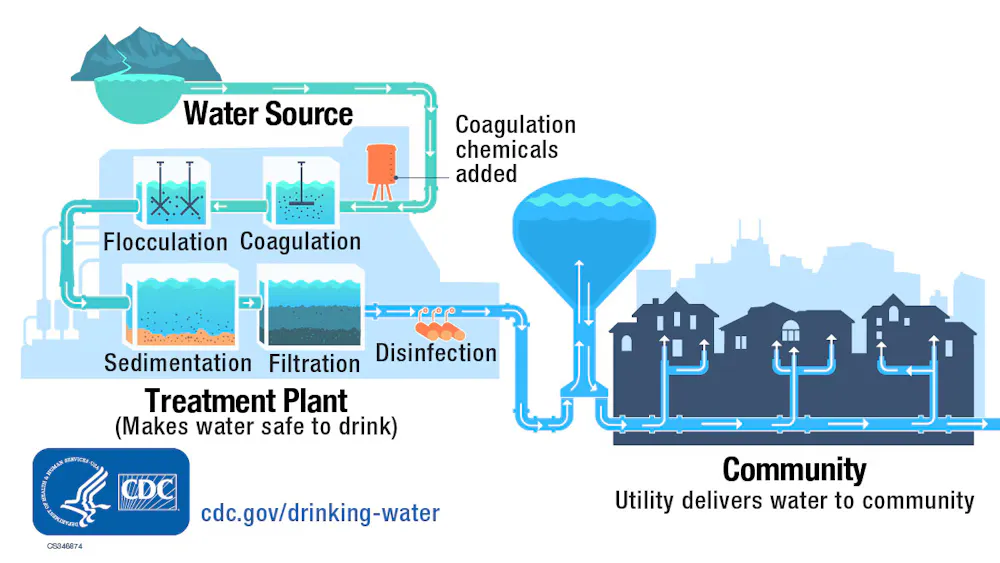
    Today, the process of cleaning water begins with the same steps employed by the ancient Egyptians, followed by extensive filtration to get rid of debris as well as most germs and chemicals. Chlorine is added to kill lingering pathogens, including those that may reside in the service pipes carrying the water to the faucet. Beginning in the 1940s, a small amount of fluoride was added as an inexpensive, safe and effective means to improve dental health.

    The cleanliness and fluoridation of the water supply has dramatically reduced infectious disease and cavities, and has been heralded as one of the 20th century’s greatest public health achievements.

    Is raw water healthier than tap water?

    People who champion raw water claim it has health benefits, such as essential minerals and beneficial bacteria called probiotics, that are stripped from tap water. Let’s unpack each of these claims.

    Water dissolves bits of soil and rock at its source; therefore, its mineral content depends on the local geology. Areas with a lot of limestone, like the Midwest, have water that is higher in calcium. Water from deeper in the ground may have higher mineral content since it passes through more rock on its way to the surface.

    The mineral content of water largely depends on its source and location.
    Sergii Zyskо/iStock via Getty Images Plus

    The idea that tap water is depleted of essential minerals is not true, as these nutrients are too small to be excluded by the filtration process. Test kits can determine the mineral content of your water, and if you find it lacking, mineral supplements can be added. Experts suggest, however, that most minerals you need come from your diet, not water.

    Some also claim that raw water contains probiotics that are removed from tap water. The amount of probiotics in water would also vary by location, and the notion that health-promoting bacteria reside in raw water has not been proved.

    There are no studies associating raw water with any health benefit. Anecdotal claims about smoother skin or increased energy are likely to be placebo effects. Even the idea that raw water tastes better might be more psychological than physiological – a 2018 study showed that most people preferred tap water over bottled water in a blind taste test.

    Risks of drinking raw water

    Raw water carries the risk of serious gastrointestinal infection from a wide variety of pathogens.

    Water-borne viruses include rotavirus and norovirus, which cause rapid-onset diarrhea and vomiting, and hepatitis A, which infects the liver. Bacteria such as E. coli and Salmonella, or parasites like Cryptosporidium and Giardia, also cause severe diarrhea that can lead to dangerous levels of dehydration. Toxoplasma gondii can also lurk in raw water and can cause miscarriage or birth defects if consumed during pregnancy.

    Tap water undergoes several treatment steps before it reaches your faucet.
    CDC

    Carriers of diarrheal infections can transmit them to others if they swim in public pools or fail to properly wash their hands before touching others or preparing food. Norovirus is particularly durable and can survive on surfaces for days, increasing chances of it infecting someone else.

    Raw water can also contain algae that release toxins causing abdominal issues and damage to the brain and nervous system.

    Cholera, dysentery and typhoid fever are no longer health burdens in the U.S. thanks to a robust water treatment system. But areas of the world lacking this privilege suffer high child mortality and widespread diarrheal diseases.

    How safe is tap water in the US?

    Tap water in the U.S. is among the safest to drink in the world. The Biden administration took steps to further improve it, including funding to replace lead pipes and new rules to monitor forever chemicals like perfluoroalkyl and polyfluoroalkyl substances, or PFAS, which have been linked to cancer and developmental disorders.

    Importantly, raw water is not necessarily free from lead, arsenic, pesticides or industrial contaminants. Raw water sources are not reliably monitored by experts, so it is difficult to say which ones pose less risk. In addition, the water may be acceptably safe one day, but not on another. For example, soil runoff from a storm could introduce new germs or pollutants into the area.

    The Environmental Protection Agency routinely screens for nearly 100 contaminants to ensure tap water is safe. In contrast, raw water remains untested, unregulated and untreated, leaving its safety to drink in question. In terms of risks and benefits, there are no demonstrated health benefits from drinking raw water, but clear evidence that you may be exposing yourself to harmful infectious and toxic contaminants.

    Bill Sullivan receives funding from the National Institutes of Health.

    ref. How does raw water compare to tap water? A microbiologist explains why the risks outweigh the benefits – https://theconversation.com/how-does-raw-water-compare-to-tap-water-a-microbiologist-explains-why-the-risks-outweigh-the-benefits-246866

    MIL OSI – Global Reports

  • MIL-OSI USA: Murray, Schumer, Murphy, Kim Lead 46 Senators in Introducing Resolution Condemning Pardons of Individuals Found Guilty of Assaulting Capitol Police Officers

    US Senate News:

    Source: United States Senator for Washington State Patty Murray

    Resolution comes after Trump pardons 1,500 Jan 6 insurrectionists—including those convicted of violently assaulted police officers

    Murray will seek unanimous consent to pass the resolution this week

    Washington, D.C. – Today, U.S. Senators Patty Murray (D-WA), Democratic Leader Chuck Schumer (D-NY), Chris Murphy (D-CT), and Andy Kim (D-NJ) will lead a group of 46 senators in introducing a new resolution condemning the pardons of individuals who were found guilty of assaulting Capitol Police Officers. The resolution follows the move by President Trump, on the first day of his second term, to grant full, complete, and unconditional pardons to over 1,500 people charged with committing crimes in the January 6, 2021 attack on the U.S. Capitol, and to commute the sentences of 14 others, including leaders of the Proud Boys and Oath Keepers, far-right militias. Among those pardoned by Trump were 169 people who pled guilty to assaulting police officers on January 6th.  During the siege of the Capitol that day, over 80 U.S. Capitol Police Officers were assaulted, as well as over 60 officers from the Washington, D.C. Metropolitan Police Department.

    The senators’ resolution, Condemning the pardons for individuals who were found guilty of assaulting Capitol Police Officers, simply states: “Resolved, That the Senate disapproves of any pardons for individuals who were found guilty of assaulting Capitol Police officers.” This week, Senator Murray will seek unanimous consent on the Senate floor to pass the resolution.

    In addition to Murray, Schumer, Murphy, and Kim, Senators Angela Alsobrooks (D-MD), Tammy Baldwin (D-WI), Michael Bennet (D-CO), Richard Blumenthal (D-CT), Lisa Blunt Rochester (D-DE), Cory Booker (D-NJ), Maria Cantwell (D-WA), Chris Coons (D-DE), Catherine Cortez Masto (D-NV), Tammy Duckworth (D-IL), Dick Durbin (D-IL), Ruben Gallego (D-AZ), Kirsten Gillibrand (D-NY), Maggie Hassan (D-NH), Martin Heinrich (D-NM), John Hickenlooper (D-CO), Mazie Hirono (D-HI), Tim Kaine (D-VA), Mark Kelly (D-AZ), Angus King (I-ME), Amy Klobuchar (D-MN), Ben Ray Luján (D-NM), Ed Markey (D-MA), Jeff Merkley (D-OR), Jon Ossoff (D-GA), Alex Padilla (D-CA), Gary Peters (D-MI), Jack Reed (D-RI), Jacky Rosen (D-NV), Bernie Sanders (I-VT), Brian Schatz (D-HI), Adam Schiff (D-CA), Jeanne Shaheen (D-NH), Elissa Slotkin (D-MI), Tina Smith (D-MN), Chris Van Hollen (D-MD), Mark Warner (D-VA), Raphael Warnock (D-GA), Elizabeth Warren (D-MA), Peter Welch (D-VT), Sheldon Whitehouse (D-RI), and Ron Wyden (D-OR) also cosponsored the resolution. In total, 46 senators signed onto the resolution. A PDF of the resolution is HERE.


    “I refuse to allow President Trump to rewrite what happened on January 6th—armed insurrectionists, incited by Trump himself, broke into the U.S. Capitol and violently assaulted Capitol Police officers in their attempt to overthrow a free and fair election,”
    said Senator Murray. “Insurrectionists cracked the ribs of police officers and smashed spinal disks. Donald Trump’s pardons are a wholesale endorsement of political violence—as long as it serves Donald Trump. Affirming that U.S. Senators condemn unconditional pardons for people who were found guilty of violently assaulting Capitol Police officers should be the easiest thing in the world. If Republicans care even the tiniest bit about law enforcement, they should be outraged by these pardons. I hope and expect my Republican colleagues will allow this very simple resolution to pass as a show of support for the officers who put their lives on the line to keep senators safe.”

    “The people who invaded the Capitol on January 6th, whether they committed violence or not, broke the law and attempted to thwart democracy. What they did is a serious crime. There’s no gray area here,” said Democratic Leader Chuck Schumer. “Donald Trump’s made it clear he’s more interested in rewarding lawbreakers and pardoning lawless rioters who attacked police officers and invaded the Capitol, than standing up for law and order. Senate Republicans who experienced the same mayhem on January 6 should join us in condemning this dangerous signal to lawbreakers, so we can make clear that political violence of any kind is unacceptable.”

    “Trump’s pardons of January 6th rioters who viciously assaulted law enforcement officers send a dangerous message: if you’re willing to commit violence in his name, there are no consequences,” said Senator Murphy. “This endorsement of political violence not only undermines our justice system, but it also makes our nation less safe and emboldens those who would attack our democracy.”

    “On January 6th 2021, we witnessed an attack against our sacred Capitol and a brutal assault on police officers upholding their sworn duty. It is shameful for President Trump to issue the pardons and exalt political violence. We all resoundingly condemned the assassination attempts on Trump only to see him bless the violence against a different branch of government. Never should political violence be acceptable,” said Senator Kim.  

    “President Trump’s blanket pardons of armed insurrectionists, who were convicted by juries of everyday Americans, is the ultimate disrespect for police officers who were brutally assaulted on January 6,” said Senator Blumenthal. “These sickening pardons are a clear endorsement of political violence and discredit justice and the rule of law. I urge my Republican colleagues who were protected that terrible day—and who now stay silent—to join in condemning the violence that occurred and standing with the officers who put their lives on the line for their safety.”

    “By attacking law enforcement and trying to block the peaceful transfer of power, the people being pardoned did serious damage to our Capitol and democracy. Some of them attacked and hurt police officers, all received their day in court and were convicted of their crimes. These pardons are a mistake that I strongly disagree with,” said Senator Cantwell.

    “By putting hundreds of violent criminals back on the streets as one of his first acts back in office, President Trump is sending a clear message: it’s open season on law enforcement officers, as long as you’re committing a crime he approves of,” said Senator Coons, co-chair of the Senate Law Enforcement Caucus. “I pray that none of these criminals go on to commit further acts of violence, but President Trump’s pardons have made our police officers and our streets less safe.”

    “President Trump is pardoning violent criminals who assaulted police officers and attempted to overturn a fair and free election,” said Senator Cortez Masto. “This is an insult to law enforcement across the country and an endorsement of political violence. The very least my Republican colleagues can do to back law enforcement is to support this resolution.”

    “On day one in office—after years of pushing the false narrative that Democrats are ‘soft on crime’ and Republicans truly ‘back the blue’— Donald Trump pardoned over 1,500 violent insurrectionists who assaulted law enforcement officers and stormed our nation’s Capitol in an effort to overturn a free and fair election,” said Senator Duckworth. “Not only are these pardons a gross endorsement of political violence, they’re also an insult to the heroic law enforcement officers who defended our democracy and those who died as a result of that fateful day. If Republicans really cared about upholding democracy and the rule of law, then they’d join us in supporting this simple resolution to condemn President Trump’s pardons.”

    “On January 6, 2021, a mob of Trump-inspired insurrectionists  descended on the U.S. Capitol in an attempt to overturn a free and fair election, wielding unspeakable violence against law enforcement officers.  A ‘full, complete, and unconditional’ pardon dishonors the lives of the five law enforcement officers who died as a result of this day, as well as those who are left with life-altering injuries inflicted by these thugs,” said Senator Durbin.  “This resolution ensures that what truly happened that day – the violent, egregious assault on law enforcement officers and the undermining of a Constitutional proceeding – will not be forgotten, even if President Trump has tried to absolve insurrectionists of their crimes.”

    “I was on the House floor, preparing myself and my colleagues for the mob to overrun the Capitol. President Trump’s pardons of these rioters, many of whom attacked policemen—my friends—is a gross misuse of power,” said Senator Gallego. “We must support law enforcement, not the ones who attacked them and tried to take our democracy.”

    “These criminals used flagpoles, fire extinguishers and bear spray to assault the police securing the Capitol on January 6. No one who assaults a police officer should be given a ‘get out of jail free card’ from the President,” said Senator Heinrich.

    “Instead of focusing on steps to strengthen our economy, lower costs, or make communities safer, Donald Trump’s day one priority was pardoning over 1,500 people who stormed the Capitol on January 6, 2021 in an attempt to overturn an election, including those convicted of assaulting police officers,” said Senator Kaine. “These deeply offensive pardons are a slap in the face of the law enforcement community—including five Virginians who died after protecting the Capitol that day—the Constitution, the rule of law, and our democracy. I’m joining together with my colleagues to introduce legislation to formally condemn these shameful pardons.”

    “We will never forget the truth of what happened on January 6: A violent mob attacked our democracy, our Capitol, and the brave men and women of the Capitol Police who were defending it, ” said Senator Klobuchar. “These officers deserve our respect, not the release and pardoning of those who assaulted them. Over the last four years, I have led hearings to examine the events leading up to the attack and have worked with Democrats and Republicans to ensure Capitol Police officers have our full support moving forward. The release of and pardons for those who assaulted them is simply wrong.”

    “The pardons that President Trump granted to insurrectionists who desecrated our Capitol and threatened our democracy on January 6 are not only condemnable – they are disrespectful of the law enforcement who show up every day to protect and serve us. When Republicans say they ‘back the blue,’ they are lauding the very violent criminals who left our officers back and blue on that day. Anyone who supports these pardons is supporting crime and violence,” said Senator Markey. 

    “I condemn in the strongest terms President Trump’s disgraceful pardon of more than 1,000 criminals, many of them violent, who overran the U.S. Capitol, desecrated the seat of our democracy, and assaulted law enforcement in their failed attempt to prevent the peaceful transfer of power,” Senator Ossoff said.

    “President Trump’s decision to pardon the people who attacked the U.S. Capitol and violently assaulted law enforcement officers, in an effort to overturn a free and fair election, is a clear abuse of power. A President’s allies should never receive special treatment when they’ve committed serious, violent crimes – crimes intended to undermine our democracy. To give these attackers a clean slate not only undermines the rule of law, it emboldens their extreme ideological views and it further erodes Americans’ trust in our government,” said Senator Peters.

    “These pardons were a slap in the face of the Capitol Police who stand up everyday to protect members of Congress.  They have our back; we should have theirs.  Failing to condemn the pardons of the criminals who attacked the Capitol would be a shameful betrayal of these dedicated officers,” said Senator Reed.

    “It’s unconscionable that one of President Trump’s first actions in office was to pardon criminals who violently attacked the U.S. Capitol on January 6th, 2021,” said Senator Rosen. “A number of these convicted felons attacked police officers and injured them. It should not be a partisan issue to fully condemn these actions and President Trump’s pardons.”

    “Pardoning those who were convicted of assaulting police officers who were doing their duty during the January 6, 2021, attack on the U.S. Capitol is reckless and dangerous,” said Senator Shaheen. “No elected official, especially the President of the United States, should ever do anything that would justify, condone or excuse politically motivated violence. I hope all my colleagues will join us in supporting this resolution to condemn pardons for those found guilty of assaulting police officers on January 6, 2021.”

    “President Trump’s day one agenda was letting violent criminals who beat police officers out of prison. These are people who planned an insurrection, assaulted police officers with metal batons, fire extinguishers, wooden planks, and even admitted to these crimes and pled guilty in court. The brave Capitol Police officers who put themselves in danger to protect our democracy deserve better. We can’t let what actually happened on January 6th, 2021 be rewritten and whitewashed,” said Senator Smith.

    “On January 6, many rioters attacked our Capitol and assaulted, bludgeoned, and bloodied Capitol Police officers and officers from the District of Columbia. Donald Trump’s pardons of these convicted criminals are sickening – they are a gross insult to the brave officers who did their duty and a betrayal of all of law enforcement. I urge our Republican colleagues to join us in sending a simple message: celebrating criminals convicted of beating police officers is unacceptable,” said Senator Van Hollen.

    According to the U.S. Attorney’s Office for the District of Columbia, approximately 1,572 defendants have been federally charged with crimes associated with the attack of the U.S. Capitol on January 6th. This includes approximately 598 charged with assaulting, resisting, or impeding law enforcement agents or officers or obstructing those officers during a civil disorder, including approximately 171 defendants charged with using a deadly or dangerous weapon or causing serious bodily injury to an officer. As proven in Court, the weapons used and carried on Capitol grounds during the January 6th attack include firearms; OC spray; tasers; edged weapons, including a sword, axes, hatchets, and knives; and makeshift weapons, such as destroyed office furniture, fencing, bike racks, stolen riot shields, baseball bats, hockey sticks, flagpoles, PVC piping, and reinforced knuckle gloves.

    Among others, the individuals who assaulted law enforcement officers and were granted full, unconditional pardons by President Trump this week include:

    • Taylor James Johnatakis, of Kingston, Washington, was convicted of three felonies in November 2023, including assaulting officers. Prosecutors said that he “coordinated a violent assault on a line of police officers defending” the Capitol and that video shows he “used a metal barricade to attack officers head on and grabbed one officer to prevent him from defending himself against other attacking rioters.”
    • Julian Khater, who assaulted a U.S. police office—Brian Sicknick—and later pled guilty to assaulting a police officer with a dangerous weapon.
    • Robert Palmer, who attacked police with a fire extinguisher, a wooden plank, and a pole.
    • Tyler Bradley Dykes of Bluffton, South Carolina, who was sentenced to 57 months in federal prison for stealing a police riot shield and twice using it against officers. He pleaded guilty to two felony counts of assaulting, resisting or impeding officers.
    • Devlyn Thompson, who hit a police officer with a metal baton.
    • Andrew Taake, of Houston, Texas, who was sentenced to a little more than six years for assaulting law enforcement officers with bear spray and a metal whip.
    • Christopher Quaglin, who federal prosecutors said “viciously assaulted numerous officers” and was one of the most violent rioters, was sentenced to 12 years in federal prison.
    • David Dempsey, who, according to prosecutors, “was one of the most violent rioters,” and received 20 years in prison. Prosecutors also said Dempsey had a “very significant history of arrests and convictions” prior to the January 6th attack.
    • Daniel Rodriguez, of Fontana, California, who plunged a stun gun into the neck of Washington Police Officer Michael Fanone multiple times.
    • Ryan Nichols, of Longview, Texas, who assaulted officers with pepper spray, and later on Jan. 6, at his hotel room, he called for additional violence.
    • Howard Richardson, of King of Prussia, Pennsylvania, who struck a police officer three times with a flagpole, hard enough to break the flagpole.
    • Robert Sanford, from Chester, Pennsylvania, who hit two police officers in the head with a fire extinguisher and threw a traffic cone at another officer.
    • Jonathan Munafo, of Albany, New York, who punched a police officer, stole the officer’s riot shield, and struck a Capitol office window with two poles.

    MIL OSI USA News

  • MIL-OSI USA: Warren, McGovern, Lawmakers Blast Trump’s Inaction on High Egg Prices

    US Senate News:

    Source: United States Senator for Massachusetts – Elizabeth Warren
    January 27, 2025
    Lawmakers lay out six executive actions that could lower costs.
    “We urge you to make good on your campaign promise to lower food prices for American families.”
    Text of Letter (PDF)
    Washington, D.C. – U.S. Senator Elizabeth Warren (D-Mass.) and Representative Jim McGovern (D-Mass.) led 19 of their colleagues, writing to President Donald Trump, pushing him to take meaningful steps to lower the prices of eggs and other groceries—a problem he largely ignored during his entire first week in office. 
    During his campaign for president, Mr. Trump repeatedly promised he would lower food prices “immediately” if elected. Trump even told the press, “I won on groceries.” But during his first week, he instead focused on attempting to end birthright citizenship, firing inspectors general, and pardoning January 6 attackers, including those who assaulted Capitol police officers. 
    “Your sole action on costs was an executive order that contained only the barest mention of food prices and not a single specific policy to reduce them,” wrote the lawmakers. “You have tools you can use to lower grocery costs and crack down on corporate profiteering, and we write to ask if you will commit to using those tools to make good on your promises to the American people.”
    “To make food more affordable, you should look to the dominant food and grocery companies that have made record profits on the backs of working families who have had to pay higher prices,” continued the lawmakers. 
    For example, last year a Kroger executive admitted in federal court that the company raised the price of eggs and milk “significantly higher than the cost of inflation” in the years following the COVID-19 pandemic. In 2023, a federal court found that the country’s largest egg producers had engaged in a price-fixing conspiracy in the mid-2000s as well. Now, egg producers and grocery stores may leverage the current avian flu outbreak as an opportunity to further constrain supply or hike up egg prices to increase profits.
    “If you are indeed committed to lowering food prices, we stand ready to work with you,” wrote the lawmakers. 
    The lawmakers laid out six recommendations for executive actions to lower prices by encouraging competition and fighting price-gouging at each level of the food supply chain:
    Encourage the Federal Trade Commission (FTC) and U.S. Department of Agriculture (USDA) to prohibit exclusionary contracting by dominant firms in the food industry, making it harder for major retailers and food brands to shut out smaller suppliers and drive up prices at smaller stores.
    Encourage the FTC to issue guidance on potential violations of the Robinson Patman Act and Section 5 of the FTC Act within the food industry and take enforcement action where merited. 
    Work with the USDA to increase the number of government contract recipients that are very small businesses and to ensure that government contracting considers the long-term costs of food sector consolidation. 
    Help the Department of Justice (DOJ) and FTC scrutinize, and where appropriate, block mergers and acquisitions in the food and agricultural sectors.
    Encourage the DOJ to prosecute actors in the agricultural and food sectors for price-fixing and other anticompetitive behavior.
    Direct the Commodity Futures Trading Commission (CFTC) and FTC to form a joint task force to investigate food price manipulation throughout the supply chain. 
    “Americans are looking to you to lower food prices. Instead of working to lower their grocery bills, however, you have used the first week of your administration on attempting to end birthright citizenship, pardoning individuals who attacked the U.S. Capitol on January 6, and renaming a mountain,” concluded the lawmakers. “We urge you to make good on your campaign promise to lower food prices for American families.”

    MIL OSI USA News

  • MIL-OSI Global: Trump has rejected the Paris agreement again, but game theory shows how other countries can still lead by example

    Source: The Conversation – UK – By Renaud Foucart, Senior Lecturer in Economics, Lancaster University Management School, Lancaster University

    petrmalinak/Shutterstock

    It came as a surprise to nobody that one of Donald Trump’s first acts on his return to the White House was to sign an executive order withdrawing the US from the Paris agreement on climate change.

    Almost 200 other countries will remain part of the deal designed to stem global warming. So how will they fare without the participation of one of the biggest polluters on the planet?

    The exit of the US encapsulates a tricky issue when it comes to international efforts to tackle climate change. Any effort to decrease the use of fossil fuels is individual, while any benefits are universal.

    And since 1997, the main approach to tackle climate change multilaterally has been through UN-backed summits known as “Cops” (Conference of the Parties) where countries gather and promise each other to cut their emissions.

    Richer countries, which polluted more in the past and created most of the accumulated CO2 in the atmosphere, have also committed to helping poorer countries develop economically while emitting less, to the tune of US$300 billion (£244 billion) a year by 2035.

    But while plenty of effort goes in to organising the largest possible coalition of countries, in the end, everything is based on good faith and promises. There is no mechanism by which countries which fail to live up to agreements are punished.

    So when national politics or budgetary constraints come into play, climate commitments can be left by the wayside. A project to tax pollution may be cancelled or campaigners may succeed in blocking plans.

    Yet there are benefits to be had from leading by example and cutting emissions without any guarantee that others will do the same. This is partly because humans have a tendency towards what’s known as “conditional cooperation”. People who fail to cooperate when they have to do it at the same time as others are much more likely to join in if they observe previous cooperation.

    For this reason, research I recently published with colleagues on game theory (the mathematical study of strategic interactions), suggests that the best thing for advanced economies to do is keep on cutting their own emissions.

    Because without efforts from rich countries to pursue a path towards mitigating global warming, there is no hope the others will follow. In that case, even a small wealthy country (like the UK) matters in demonstrating an unambiguous commitment to tackling climate change.

    Carbon cooperation

    Beyond encouraging further cooperation, a strong climate policy in the form of carbon taxes is also the most powerful way to punish those who do not take part in the global effort.

    Both the US (under Biden) and the EU have developed their own versions of a tool called a “carbon border adjustment mechanism” which means exporters from countries that do not tax emissions (or tax them less less heavily) need to pay the domestic carbon tax instead.

    Consider for instance a Chinese company exporting a container to the UK. If Chinese manufacturers have already paid a carbon tax worth £100 to the Chinese government for the product in the container, but the UK’s carbon tax would have been £200, the border tax is the difference between the two, £100.

    But if the Chinese government increases its domestic carbon tax to the UK level or above, the tax from the border adjustment mechanism drops to zero.

    This approach has influenced many countries to start their own carbon tax, because it is better to get tax receipts at home than to send them elsewhere. But again, it helps to lead by example. To influence others with border taxes, you need to implement your own system first.

    Cop out?

    Despite all of this apparent cooperation, and widespread concern about the impact of climate change, the latest Cop summit in Azerbaijan, held in November 2024, was considered by many to be a disappointment.

    But there is also some good news, which suggests that efforts are heading in the right direction. The latest data for example, shows that the EU is not far away from its 2030 target. Greenhouse gas emissions are already 37% below what they were in 1990 level. In the UK, the figure is 42%.

    In China, emissions might have apparently already peaked, earlier than expected. Even in the US, emissions are decreasing.

    Looking back at the scenarios that led to the first UN climate summit in Kyoto, not everything is bright. The world is unlikely to avoid global temperatures raising to more than 1.5°C above pre-industrial levels.

    So maybe we shouldn’t rely too much on future summits to make the next environmental breakthrough. The path forward could be more likely to come from technical solutions like carbon taxes and border adjustment mechanisms. And perhaps the best way to convince the rest of the world to cut their emissions is not to give them lectures and conferences – but to lead by example.

    Renaud Foucart does not work for, consult, own shares in or receive funding from any company or organisation that would benefit from this article, and has disclosed no relevant affiliations beyond their academic appointment.

    ref. Trump has rejected the Paris agreement again, but game theory shows how other countries can still lead by example – https://theconversation.com/trump-has-rejected-the-paris-agreement-again-but-game-theory-shows-how-other-countries-can-still-lead-by-example-246818

    MIL OSI – Global Reports

  • MIL-OSI Global: Exercise does increase calorie burn – but probably not as much as you might hope

    Source: The Conversation – UK – By Dylan Thompson, Professor of Human Physiology, University of Bath

    Exercise can still be a benefit if you’re trying to lose weight or get fit. Green Elk/ Shutterstock

    It’s generally accepted that exercise is a key element of losing weight. But this long-held view has been called into question in recent years – with no shortage of articles and podcasts claiming it’s a myth that exercise increases your metabolism and helps you burn calories after you work out.

    The central tenet of these reports is that the amount of calories we burn each day is somehow constrained. This hypothesis was first proposed in 2012 by the evolutionary anthropologist Herman Pontzer. He posited that as you increase your daily energy expenditure (calories burned) through physical activity, your body will find ways to cut back on energy expended on other biological processes – such as your resting metabolism. This leaves your overall daily energy expenditure unchanged.

    This theory has since been popularised in Pontzer’s 2021 book Burn, in which he theorises that “we burn calories within a very narrow range: nearly 3,000 calories per day, no matter our activity level”.

    Building on this, Pontzer suggests that, “The bottom line is that your daily (physical) activity levels have almost no bearing on the number of calories that you burn each day.”

    But before you pack away your running shoes, let’s look at what the research shows us. The most rigorous and robust evidence available on the topic actually shows that exercise does increase energy expenditure – though perhaps not as much as we might expect.

    Exercise and energy expenditure

    The evidence Pontzer used to support his hypothesis came from observational studies that compared energy expenditure in different populations around the world. In an observational study, researchers only take measurements and make comparisons between groups without actually introducing any changes.

    The most eye-catching of the studies Pontzer used to support his hypothesis was research on the Hadza tribe – one of the last remaining hunter-gatherer groups in Africa. Hunter-gatherers are assumed to be highly active in order to survive. But the study observed that the Hadza expended no more energy than the average Westerner did each day.

    We reviewed the constrained energy expenditure hypothesis in 2023. We concluded that Pontzer’s theory raises some interesting questions. However, it’s generally not very convincing due to flaws in the nature of the evidence.

    Indeed, Pontzer’s own observational data shows that daily energy expenditure can vary by more than 1,000 calories per day in a group of older people. This directly contradicts his suggestion that it’s fixed at 3,000 calories a day for everyone.

    The effects of exercise on calorie burn may be more modest than we might hope, however.
    Dean Drobot/ Shutterstock

    When we look at data from randomised controlled trials, we can clearly see that exercise does have an effect on energy expenditure.

    Randomised controlled trials allow researchers to establish cause and effect from a specific treatment or intervention. They allow groups of people to be fairly compared with just one variable manipulated at a time.

    Trials show that a structured, supervised exercise programme done up to five times a week for six and ten months increases daily energy expenditure. These effects were shown in both young and middle-aged men and women.

    This research clearly shows that physical activity does increase how many calories you burn each day.

    Modest increase

    It’s important to note that these trials do report, however, that the increases in daily energy expenditure were not always as big as expected. Put simply, burning 600 calories in the gym will not necessarily increase your daily energy expenditure by the same amount.

    However, a more-modest-than-expected increase in energy expenditure is a far cry from bold statements that exercise does not increase daily energy expenditure at all. The exact number is difficult to estimate though, as it varies a lot between people.

    As we discuss in our review, there are many possible reasons why exercise does not increase energy expenditure by as much as would be expected. Some factors might include physical activity substitution (when your new workout substitutes for physical activity you would normally have done at that time – so you might only end up burning a few calories more than you normally would have) and behavioural compensation (doing less activity later in the day after a morning workout).

    This also highlights a common misunderstanding about the magnitude of exercise’s effects. Exercise can feel hard – so people might reasonably expect a large return on their investment. But five hours of exercise a week is only about 4% of our typical waking time. So this will only go so far in shifting the dial upwards in terms of how many calories we burn through physical activity.

    Part of the misunderstanding about changes in energy expenditure and potential weight loss through exercise is perhaps related to unrealistic expectations about how many calories we burn when working out.

    So, despite what you might have heard or read, the strongest evidence from robust trials clearly demonstrates that exercise can increase daily energy expenditure. Though this might not be as much as you expect or hope.

    Dylan Thompson receives funding from BBSRC, NIHR, and Heart Research UK. He has previously had funding from MRC, BHF, and Unilever. He is a Fellow of The Physiological Society and the British Association of Sport and Exercise Sciences.

    Javier Gonzalez receives funding from BSRC, MRC, British Heart Foundation, Clasado Biosciences, Lucozade Ribena Suntory, ARLA Foods Ingredients, Cosun Nutrition Center, Innocent Drinks and the Fruit Juice Science Centre; is a (non-exec) scientific advisory board member to ZOE; and has completed paid consultancy for 6d Sports Nutrition, Science in Sport, The Dairy Council, PepsiCo, Violicom Medical, Tour Racing Ltd., and SVGC. For a full list of disclosures see https://gonzalezjt1.wordpress.com/2024/03/.

    ref. Exercise does increase calorie burn – but probably not as much as you might hope – https://theconversation.com/exercise-does-increase-calorie-burn-but-probably-not-as-much-as-you-might-hope-247720

    MIL OSI – Global Reports

  • MIL-OSI Global: Compendium of the Occult by Liz Williams is a rich and appealing history

    Source: The Conversation – UK – By Martha McGill, Honorary Research Fellow, Historian of Supernatural Beliefs, University of Warwick

    In the fourth century BC, an unknown – but clearly disgruntled – schemer from the Greek city of Antioch had a curse tablet made. Inscribed on a thin piece of lead and deposited in a well, the tablet called for a “thunder-and-lightning-hurling” god to “strike, bind, bind together Babylas the greengrocer”.

    Around 1,400 years later, an Anglo-Saxon charm advised on how to protect a field. The secret was to take a piece of turf from each corner and anoint it with a mixture of oil, honey, yeast, milk from the animals on the land, pieces of the trees and plants on the land, and water consecrated to the god Thunor.

    In 17th-century England, the antiquarian Elias Ashmole hoped an astrological talisman would expel vermin from his house. Meanwhile, the diarist Samuel Pepys cured his upset stomach by purchasing a new hare’s foot. In 19th-century New Orleans, the Louisiana Creole woman Marie Laveau became famous for her healing, clairvoyance and work as a voodoo priestess, which she displayed in public gatherings at Congo Square.

    These are among the many fascinating snippets discussed in Liz Williams’s new book, Compendium of the Occult: Arcane Artefacts, Magic Rituals and Sacred Symbolism. Looking at western occult traditions from ancient times to the present day, the book explores how human societies have sought power, protection and insight from gods and stars, spells and amulets, sacred places and seductively enigmatic organisations.


    Looking for something good? Cut through the noise with a carefully curated selection of the latest releases, live events and exhibitions, straight to your inbox every fortnight, on Fridays. Sign up here.


    The book is made up of 65 short articles, grouped into six sections: the origins of western occultism; divination, rituals and rites; charms and talismans; curses and hexes; secret societies; and sites of significance.

    Many of the articles cover several centuries, meaning there is no scope for detailed analysis. However, Williams strikes an effective balance between general overview and colourful examples. She is sensitive to differences in perspective, noting the competing explanations for phenomena such as dowsing or Ouija boards.

    She also acknowledges the complexities of reconstructing past beliefs and practices from imperfect surviving evidence, although occasionally unreliable source material is not sufficiently interrogated. The book accepts too readily, for example, the questionable story that Louis XIV’s mistress Madame de Montespan arranged “black masses” in which she used the blood of babies to summon the devil.

    Magic and maladies

    Compendium of the Occult is handsomely bound, pleasingly laid out and beautifully illustrated. There are images of ancient clay tablets crisscrossed with incantations, witch bottles stuffed with nails and urine, voodoo dolls, mummies, skulls, books, statues, artworks and protective amulets in the shape of jaunty phalluses.

    The book accepts too readily that Louis XIV’s mistress Madame de Montespan used the blood of babies to summon the devil.
    Wiki Commons

    Some of the printing causes confusion, however. “Gold dots” on the timelines are difficult to see, as is the introduction’s small white text on black pages. The dating of some entries lacks obvious logic: “palmistry” is dated from the 5th to the 1st century BC, even though the article stretches to the 20th century, and other practices get the vaguer label “ancient times to the present day”. But these are minor quibbles.

    More significantly, the book’s geographical remit is limited. The introduction refers to occult traditions in “the west”, but Britain is a particular focal point. Williams discusses eight “sites of significance”, of which three (Glastonbury, Avebury and Stonehenge) can be found within a 75-mile span in England.

    She does cover ancient Egypt and Mesopotamia; there is an entry on voodoo; there are references to the influences of Arabic astrologers, and occasional mentions of practices in east Asia. But more engagement with occult traditions from beyond Europe, particularly in modern times, would have enhanced the volume and better justified the ambitious title.

    A 1660 illustration of Claudius Ptolemy’s geocentric model of the Universe, from Compendium of the Occult.
    Wikimedia Commons

    All the same, this is a rich and appealing book. Humankind’s inventiveness in conceptualising the workings of the world emerges with force. Much magic is underpinned by a belief that the everything is interwoven: the earth corresponds to the skies, the microcosm of the human body to the macrocosm of the universe.

    Williams quotes the physician and polymath Cornelius Agrippa (1486-1535), who described how a square inscribed with numbers, stamped on a silver plate at the right hour, could call on Jupiter to bring the owner wealth and peace. If printed on coral, it could destroy evil spells.

    Material objects, plants, numbers and heavenly bodies are drawn into a symbiotic relationship, and invested with the power to reshape human lives. Agrippa’s plates reflect an enduring desire to situate humankind in relation to the environment, and impose meaning and harmony on a chaotic cosmos.

    Martha McGill does not work for, consult, own shares in or receive funding from any company or organisation that would benefit from this article, and has disclosed no relevant affiliations beyond their academic appointment.

    ref. Compendium of the Occult by Liz Williams is a rich and appealing history – https://theconversation.com/compendium-of-the-occult-by-liz-williams-is-a-rich-and-appealing-history-246925

    MIL OSI – Global Reports

  • MIL-OSI Global: Think your efforts to help the climate don’t matter? African philosophers disagree

    Source: The Conversation – UK – By Patrick Effiong Ben, Doctoral Researcher in Applied Ethics and African Philosophy, University of Manchester

    PBXStudio/Shutterstock

    When I drive my car on weekends, I emit greenhouse gases – but not enough to change the global climate on my own. But when I, my neighbours and hundreds of millions of other people drive, fly, eat meat and embark on countless other activities that generate greenhouse gas emissions, we raise the Earth’s temperature.

    This is what we might call a collective harm problem, where the acts of many together lead to harmful outcomes, but no discrete act by any one person can solve it. Debates on how to fight climate change generally settle on the need for collective action ~ but does that make personal efforts inconsequential, even pointless?

    If a single pro-environment lifestyle change – like one person giving up their SUV or cutting out meat in favour of plant-based foods – will not turn the tide of global climate change on its own, it’s reasonable to feel there is little that “doing your bit” can achieve. This mindset is disempowering.

    Fortunately, it is not the only way of responding to the challenge. African philosophers have a different way of looking at it.

    Individual contributions are not pointless

    Studies assessing public willingness to contribute to climate action show that people will act even at a personal cost, given the right motivations. The urgent task for philosophers and environmentalists is to provide them with those motivations. This is where African philosophy is helpful.

    By African philosophy, I mean critical reflections on basic questions about the world – spanning the nature of knowledge, existence, morality, meaning and truth, from the perspective of African philosophers.

    I am a philosopher who studies the problem of what appear to be collectively insignificant individual actions. There is a concept from African philosophy that I think is helpful to understand this: “complementarity”.

    Complementarity denotes a relationship of interdependence among all entities – plants, animals, rivers, humans – in an interconnected community of living and non-living things. As a framework for understanding the world, it holds that everything within the human and non-human environment exists in a relationship of mutual dependence. Everything is connected to everything else. No entity can exist and flourish in isolation.

    Our meal choices don’t just affect us.
    Aleksandar Malivuk/Shutterstock

    To that extent, the flourishing of one person depends on and influences the flourishing of other things in the world – including other people and animals as companions, the plants and soil which provide food for survival, rivers and oceans that are a source of water, and the Sun which gives the energy that sustains life on Earth.

    Complementarity has been used by African philosophers like Jonathan Chimakonam, Aïda Terblanché-Greeff, Diana-Abasi Ibanga and Kevin Gary Behrens to develop environmental philosophies based on shared relationships. According to these philosophers, a view of the world based on complementarity neither foregrounds nor diminishes humans. Rather, it sketches a relationship of equals defined by the mutual participation of all.

    This thinking is averse to hierarchy. No individual can claim to have more value than another. Anything that exists serves as an important part of the environment and matters equally, whether alone or collectively. Complementarity holds that the relationships that unite individual things can extend to prove the value of every contribution, no matter its size.

    And so, complementarity rejects the argument that anything you do to help the climate is pointless. Driving my car is not an action that exists in isolation. My emissions are interconnected with other aspects of the environment.

    Similarly, individual climate-positive actions occur in relation to others taken globally, so it is a mistake to assume such actions are pointless. Rather, their relation to other actions makes them not just practically useful but necessary, to make a difference at the level of communities and globally.

    According to this African concept, the race to reduce greenhouse gas emissions is a complementary effort. And so, do not be discouraged from taking your own step in this direction.

    Patrick Effiong Ben receives funding from the AHRC North West Consortium Doctoral Training Partnership (NWCDTP).

    ref. Think your efforts to help the climate don’t matter? African philosophers disagree – https://theconversation.com/think-your-efforts-to-help-the-climate-dont-matter-african-philosophers-disagree-247042

    MIL OSI – Global Reports

  • MIL-OSI Global: England’s maths teacher recruitment problem is set to worsen

    Source: The Conversation – UK – By Neil Saunders, Senior Lecturer in Mathematics, City St George’s, University of London

    Ground Picture/Shutterstock

    Everyone should leave school with a solid understanding of maths. Decent mathematics literacy is a hugely important skill in many aspects of life. We need it when budgeting for a weekly shop, asking for a pay rise and completing a tax return.

    An interest and enjoyment in maths fostered at school can lead people to study the subject further. Mathematics graduates go on to professions in government, industry, software development and financial analytics, as well as many genres of engineering.

    In total, 13% of all employment in the UK is in professions that depend on mathematical sciences. A workforce that has been well taught in maths is crucial to a society’s prosperity.

    Building a workforce skilled in mathematics in England, however, will be difficult when there are not enough people qualified to teach the subject at school. Mathematics is a technical discipline. Quality teaching relies on its educators to have specific training: a university degree in maths.

    Research published in 2019 in Australia found that secondary school students achieved noticeably higher results when they were taught maths by teachers with a university degree majoring in maths than those “out-of-field” teachers.

    But in England, the Department of Education has an ongoing problem of under-recruitment of maths teachers. In the year 2023-24, recruitment in initial trainee maths teaching reached only 63% of its target. Research from 2018 found that less than half of maths teachers in state schools have a mathematics or other relevant degree.

    And maths achievement is declining. In the OECD’s programme for international student assessment (Pisa) tests, introduced in the year 2000, 15 year-olds in the UK are recording their lowest maths results since 2006.

    The longstanding failure to recruit enough maths graduates to become teachers is now set to be exacerbated by the changes in maths provision at universities. Maths degrees are becoming less accessible to the people who are likely to go on to become teachers.

    University options

    Over the previous decade, but particularly since the pandemic, Russell Group universities – research-intensive institutions that take students with the highest A-level grades — have increased their intake of students taking maths degrees.

    On the other hand, maths options are declining at lower-tariff universities and those that offer flexible study options.

    Birkbeck, University of London, no longer offers undergraduate degrees in maths as a single subject. Birkbeck is renowned for its provision of evening and part-time degree courses, which offers flexibility for students who may not be able to attend a traditional course or need to work while studying.

    Huddersfield has also discontinued its mathematics courses after reviewing its provision, and many other institutions are considering further cuts and redundancies.

    In 2011, lower-tariff institutions accounted for 13% of the market share of the intake of mathematics students. This dropped to just 4.5% in 2021, putting such institutions under severe pressure.

    Graduates of post-92 universities – former polytechnics and other recently established institutions, which often require lower grades for entry – are much more likely than their Russell Group counterparts to go into school teaching. A recent report by Professor Paul Wakeling, which was commissioned by the Campaign for Mathematical Sciences, analysed outcomes of mathematical degrees in the UK across the period 2017-18 to 2020-21.

    Over that period, it found that 17.4% of graduates from post-92 institutions went into the secondary teaching, compared with around 5.6% from Russell group universities.

    The accessibility of a degree will affect who enrols.
    VesnaArt/Shutterstock

    The closure of mathematics departments causes the phenomenon of “maths deserts”: large swaths of the country where access to mathematics degree study is limited. This particularly affects students from poorer backgrounds, who are more likely to be living at home during their degree and will attend their local university.

    This also affects the provision of school maths teachers. Graduates in mathematics from more disadvantaged socioeconomic backgrounds are more likely to go into school teaching than graduates from more wealthy backgrounds.

    The decline in the availability of maths degrees at lower-tariff institutions is likely to be reducing the number of potential maths teachers – as well as severely reducing the diversity of people going into maths.

    The chronic shortage of specialist maths teachers is set to worsen. Universities around the country are under severe financial pressure, which is likely to lead to further cutting of courses and staff.

    This will only exacerbate the problem of teacher shortages – which is turn will lead to declining mathematical literacy in the community, as well as a lack of diversity in mathematics.

    Neil Saunders does not work for, consult, own shares in or receive funding from any company or organisation that would benefit from this article, and has disclosed no relevant affiliations beyond their academic appointment.

    ref. England’s maths teacher recruitment problem is set to worsen – https://theconversation.com/englands-maths-teacher-recruitment-problem-is-set-to-worsen-246351

    MIL OSI – Global Reports

  • MIL-OSI United Kingdom: UK Government in Scotland marks Holocaust Memorial Day

    Source: United Kingdom – Executive Government & Departments

    Scotland Office Minister Kirsty McNeill marked Holocaust Memorial Day by urging Scots to “unite in the stand against hatred, intolerance and prejudice”

    Minister McNeill was shown around the Scottish Jewish Heritage Centre, located within Garnethill Synagogue, by manager Kerry Patterson and Lionel Most, chair of the centre.

    This year’s Holocaust Memorial Day (HMD) is the 80th anniversary since the liberation of the Nazi concentration and death camp, Auschwitz-Birkenau.

    Events are taking place across Scotland, the UK and worldwide to remember the six million Jewish men, women and children who were murdered in the Holocaust, other victims of Nazi persecution and those who died in subsequent genocides.

    Increasing education about the danger of discrimination and preventing the spread of hatred is a key objective of the activity.

    The UK Government is committed to supporting all communities so they can live and worship safely – and through the Plan for Change will deliver a decade of national renewal, providing opportunity for all.

    Among the events in Scotland, Minister McNeill visited the Scottish Jewish Heritage Centre and Garnethill Synagogue in Glasgow ahead of HMD.

    Here she heard more about the community’s history and vast contributions to life in Scotland, the venue’s Holocaust education programmes and modern day antisemitism challenges.

    The Minister also hosted a pre-HMD event at the UK Government’s Edinburgh hub, Queen Elizabeth House, with Gillian Field – daughter of Holocaust survivors Henry Wuga MBE and Ingrid Wolff BEM.

    Here a captivated audience heard Gillian describe the story of how her parents met in Glasgow after they were brought to the city in 1939, aged 15, through Kindertransport – a rescue operation that moved Jewish children from Nazi-controlled Europe to safety in Britain.

    Both her parents deservedly received honours for their services to Holocaust education and Gillian now continues their legacy by shining a light on Jewish life across Scotland.

    Minister McNeill said:

    The annual Holocaust Memorial Day is a moment for us all to pause, reflect, and remember the six million Jews murdered during the Holocaust. It also commemorates other victims of Nazi persecution, those who died in more recent genocides, and educates about the importance of continuing to unite in the stand against hatred, intolerance and prejudice.

    For the past 200 years the Jewish community has made a significant contribution to life in Scotland, a nation which I’m proud to say played a key role in providing sanctuary to so many refugees. It was a privilege to meet community leaders at the Scottish Jewish Heritage Centre and Garnethill Synagogue and hear of their excellent work. My conversations with them and Gillian Field fill me with hope that the horrors of the past will never be forgotten and that love and respect continue to be the values by which our diverse range of Scottish communities enjoy their lives.

    To mark HMD communities and organisations from across the UK are taking part in events including ones by the Holocaust Memorial Day Trust – the charity established and funded by the UK Government to promote and support HMD.
    HMD also commemorates the victims of more recent genocides of Rwanda, Srebrenica, and acts of genocide in Cambodia and against the Yazidi people.

    The BBC is marking HMD with programmes across tv, radio and online, as well as full coverage of the Auschwitz Ceremony from Poland and commemorative events across the UK.

    Further information

    • The Scottish Jewish Heritage Centre, located within Garnethill Synagogue, houses Scotland’s Jewish Archive Centre and tells the story of Jewish life in Scotland.
      Garnethill Synagogue, opened in 1879, is Scotland’s oldest purpose-built synagogue and is Category A listed.
    • The centre plays a vital role in Holocaust education and preserving the memories of Jewish refugees who made Scotland their home.
    • Minister McNeill was shown around the synagogue and centre by manager Kerry Patterson and Lionel Most, chair of the centre.

    Updates to this page

    Published 27 January 2025

    MIL OSI United Kingdom

  • MIL-OSI USA: Municipal Roads Repaired with FEMA Funds

    Source: US Federal Emergency Management Agency

    Headline: Municipal Roads Repaired with FEMA Funds

    Municipal Roads Repaired with FEMA Funds

    Projects included flood, erosion, and hazard mitigation worksGuaynabo, PUERTO RICO — The Federal Emergency Management Agency (FEMA) allocated nearly $2.6 million to repair important roads and bridges in the municipalities of Barranquitas and Caguas after Hurricane María, helping to restore road infrastructure and reduce the risk of future damage in the area.“These bridge and road repairs strengthen the island’s resilience, allowing it to not only repair damage, but also increase its capacity to meet future challenges through federal FEMA assistance that includes measures to prevent future damage and protect critical infrastructure,” highlighted the Director of Public Assistance, Al Gómez Rivera.One of the projects in this obligation was the repair of the Maneco Bridge in the Cañabón neighborhood of Barranquitas, which consists of a road and a culvert built in 1960. The planned work had over $579,000 in funds and included the repair of the asphalt, base material and subbase of the road and the 27-foot-long corrugated metal pipe culvert.FEMA’s Public Assistance director, Al Gómez Rivera, explained that one of the main damages was to the sewer pipes through which the river basin passed. The funds for the project made it possible to widen the sewer to mitigate damage to the structure in the event of future rains.The bridge, which now bears the name of “Maneco” — as Manuel Colón Santos is affectionately known — benefits some 200 families. Maneco is a leader at the Cañabón neighborhood, known for the help he provides to his neighbors: his home was available to the community and was a space where food and other aid was offered after Hurricane María. Maneco also works with other residents to maintain the neighborhood’s community center, which serves as a shelter and a space for social events.   “Our past perils are over; sometimes you would go to an event and, if it rained, you had to wait on the other side, spend two or three hours [waiting] for the river water to decrease to be able to go through. I am very grateful because it is good for the community and, not only for us, but also for many communities in particular,” Maneco said. Moreover, FEMA allocated over $2 million for repairs to the Los Ramos bridge in the Las Carolinas community in Caguas. This grant supported the construction of a new one-span concrete bridge with galvanized steel beams, as well as the installation of erosion protection in the river. The project also included repairs such as the removal of damaged sections of the bridge and the installation of a temporary asphalt surface while the new bridge is being built.To reduce the risk of future flooding, gabions were installed to protect the bank and bridge foundations from erosion. A geotextile fabric was also placed under the gabions to stabilize the soil and prevent erosion due to rainfall. Hazard mitigation funding includes an allocation of over $26,000 to reduce the risk of future damage. These include the installation of curbs and gutters, drainage ditches and a network to stabilize the road and prevent erosion. These works are expected to prevent long-term damage to the road and protect the environment.The measures also include planting vegetation and installing a netting to prevent bank erosion, which will help protect the area from future damage caused by heavy rains and flooding.FEMA has allocated nearly $34.9 billion for over 11,050 recovery projects following Hurricane María. Of this total funding, over $2.7 billion are earmarked for over 3,000 bridge and road projects across the island.For more information about Puerto Rico’s recovery,  visit fema.gov/disaster/4339, fema.gov/disaster/4473 and recovery.pr. Follow us on our social media at Facebook.com/FEMAPuertoRico, Facebook.com/COR3pr and Twitter @COR3pr.
    frances.acevedo-pico
    Mon, 01/27/2025 – 12:30

    MIL OSI USA News

  • MIL-OSI: NEWTON GOLF Company Provides Preliminary Financial Results for Fourth Quarter 2024 and Full Year 2024

    Source: GlobeNewswire (MIL-OSI)

    CAMARILLO, CA, Jan. 27, 2025 (GLOBE NEWSWIRE) — NEWTON GOLF Company (Nasdaq: SPGC) (“NEWTON GOLF” or the “Company”), a technology-forward golf company with a growing portfolio of golf products, including putters, golf shafts, golf grips, and other golf-related accessories, reports preliminary financial results for the fourth quarter of 2024 (three months ended December 31, 2024) and full year of 2024 ahead of its quarterly filing.

    Financial Highlights

    • Revenue is expected to be between $1.1 million – $1.3 million in 4Q24, an increase of 882% at the midpoint of the range from revenue of $117,000 in 4Q23
    • Gross margin is expected to increase from 36% in 4Q23 to 72-74% in 4Q24, driven by increased sales and efficiencies in the manufacturing process in calendar 2024
    • Full year 2024 revenue is expected to increase from $349,000 in fiscal 2023 to $3.4 million – $3.6 million, representing almost 10-fold growth
    • Full year 2024 gross margin is expected to increase from 35% in fiscal 2023 to 65-67%, driven by increased volume in manufacturing in calendar 2024

    2024 Corporate Highlights

    • Announced a complete rebranding of the Company to NEWTON GOLF Company
    • Launched the Newton Fairway Motion shafts
    • Launched the new Newton Gravity premium putter line through the introduction of five new putter models
    • Expanded the Company’s global presence with the launch of the Newton Motion shafts in 50 of Japan’s largest golf retail locations
    • Increased the number of golf professionals using the Newton Motion Shafts on the PGA TOUR Champions from less than five at the beginning of 2024 to 34 at the end of 2024
    • Executed successful digital campaigns with high return on ad spending that were instrumental in the Company’s revenue growth
    • Closed on $9.1 million in financings to support the Company’s strategic growth
    • Introduced new advanced performance shafts for higher swing speeds in January 2025

    NEWTON GOLF Executive Chairman Greg Campbell commented, “Our expected improved results in 4Q24 and full year 2024 is reflective of the growing acceptance of our unique technology and design elements in our putters and replacement shafts. We recognized significantly increased sales of our NEWTON Motion replacement shafts throughout 2024 from both professional and recreational golfers, and we expect that momentum to continue in 2025. Despite it being generally off season for golf, we were pleased with our Black Friday and Cyber Monday sales, and we look forward to improved gross margin performance as we scale production and bring down unit cost.”

    This press release contains preliminary estimated financial results for the quarter and fiscal year ended December 31, 2024, and the financial results may change as a result of management’s continued review. The preliminary financial information included in this press release reflects the Company’s current estimates based on information available as of the date of this press release and has been prepared by Company management. This preliminary financial and operational information should not be viewed as a substitute for full financial statements and is not necessarily indicative of the results to be achieved for any future periods. This preliminary financial and operational information could be impacted by the effects of financial closing procedures, final adjustments, and other developments.

    About NEWTON GOLF: A Sacks Parente Company

    NEWTON GOLF: A Sacks Parente Company, is a technology-forward golf company that help golfers elevate their game. With a growing portfolio of golf products, including putters, golf shafts, golf grips, and other golf-related accessories, the Company’s innovative accomplishments include: the First Vernier Acuity putter, patented Ultra-Low Balance Point (ULBP) putter technology, weight-forward Center-of-Gravity (CG) design, and pioneering ultra-light carbon fiber putter shafts.

    In consideration of its growth opportunities in golf shaft technologies, the Company expanded its manufacturing business in April of 2022 to develop the advanced Newton brand of premium golf shafts by opening a new shaft manufacturing facility in St. Joseph, MO. It is the Company’s intent to manufacture and assemble substantially all products in the United States, while also expanding into golf apparel and other golf-related product lines to enhance its growth.

    The Company’s future expansions may include broadening its offerings through mergers, acquisitions or internal developments of product lines that are complementary to its premium brand. The Company currently sells its products through resellers, the Company’s websites, Club Champion retail stores, and distributors in the United States, Japan, and South Korea.

    For more information, please visit the Company’s website at www.newtongolfco.com or on social media at @newtongolfco.com, @newtonshafts, or @gravityputters.

    Investor Contact for NEWTON GOLF
    CORE IR
    516-222-2560
    investors@sacksparente.com

    The MIL Network

  • MIL-OSI United Kingdom: Improving Access to Scotland’s NHS: We Can Renew Scotland’s NHS and Help Our Nation Thrive

    Source: Scottish National Party

    Like all of us, the National Health Service is personal for me – I see first-hand all that it does, and has done, for my own family.

    In the last years of my beloved Mother’s life, I saw such care and attentiveness in the community and in hospital care.

    My wife would not have the capacity and capability she has in dealing with MS, had it not been for the outstanding care and insight of the National Health Service alongside, might I say, her absolutely personal determination to stay strong.

    I would not have had such joy in my life at the birth of my three children without the National Health Service.

    It is personal for all of us.

    That is why we care about it so much.

    That is why we want to see it thriving once again.

    We all know the tremendous pressures our NHS has been under in recent years.

    We see a service still reeling from the strain of a global pandemic – a pandemic that revealed the NHS’s many strengths but also exposed its underlying weaknesses.

    Weaknesses made worse by a decade and a half of austerity, and by the body blow of inflation that has meant – as we know from our own family finances – the available money delivers less.

    It is a service still beset by backlogs and delayed discharges, and struggling to meet the increasing needs of an ageing population.

    The challenges are great, of that I have no doubt. But I know also that our NHS is fundamentally resilient, fundamentally robust.

    I witnessed both these realities earlier this month when I spent a Saturday evening visiting the emergency department at the Royal Infirmary of Edinburgh.

    In the midst of both winter pressures and a particularly challenging flu season, I saw patients who waited too long to be seen, but also staff who went above and beyond.

    I saw an NHS that in the face of the storm kept on standing, kept on delivering.

    There are some who oppose the NHS model, who believe that the answer to our health challenges is a privatisation of care. They want us to believe that the health service is beyond saving, that it is on the point of collapse.

    But that is simply not true.

    There are challenges.

    Some services are struggling.

    Periods of real crisis as we have seen in recent weeks as flu cases spiked.

    The impact of these issues on too many patients is real.

    But, as I will set out today, there is nothing wrong with the National Health Service that can’t be fixed by what is right with the National Health Service.

    What is right with the National Health Service includes the thousands of health and care staff who are doing phenomenal things under enormous pressure.

    People who, time and again, display resilience, selflessness and grit, who truly go above and beyond.

    It includes innovations, such as the Rapid Cancer Diagnostic Service, a new pathway that delivers significant reductions in the time from referral to diagnosis, opening the door also to faster treatment.

    It includes national public health initiatives like the HPV vaccination programme, which has resulted in no cases of cervical cancer in young women who have been fully vaccinated.

    A remarkable, utterly remarkable, life-saving achievement.

    And it includes cutting-edge research, multiple projects, looking into the ways AI can transform diagnosis and treatment in the years to come.

    The foundations on which we will build NHS recovery and renewal are strong.

    Under this Government, the NHS will always remain in the hands of the public and free at the point of use. That is non-negotiable.

    The question then becomes how do we do better?

    How do we ensure our health service is not just the best in these isles but the best it can possibly be?

    The answer to that question is not a simple one. There is no ‘magic bullet’.

    Rather, it involves progress across multiple fronts, a balancing of sometimes competing demands and interests.

    It will require choices and action by central government, yes, but that must be delivered in partnership with others – local government, the third sector, patient groups, and health and social care workers at all levels.

    It must deliver reform that is fundamentally patient-centred but do so through a health and social care system that becomes an ever more interconnected whole.

    I have said before that my approach as First Minister is to seek the right solutions, not merely the quick ones.

    I favour consensus building and collaboration over diktats from on high. For the future success of our NHS this is not only the right approach, but also the necessary approach.

    We will only succeed on this path of reform and renewal if we walk it together.

    That is why the Cabinet Secretary for Health and I meet regularly with staff in all parts of the National Health Service.

    It is why we have been engaging with health boards, local government, Health and Social Care Partnerships, the Scottish Ambulance Service, Public Health Scotland, and NHS 24.

    We have listened carefully, also, to patients and their families, to all those who depend on the NHS for lifesaving, life-enhancing care.

    We have been told all that is going well and all that must be better.

    We have heard the advice from those with direct, frontline experience. And that has helped us develop a clear understanding of where the challenges are, and what changes are needed.

    It is this kind of open, collaborative approach, with a focus on solutions, on the right answers over the easy ones, that has led to the actions I am setting out today.

    It is a set of actions with clear outcomes – tangible improvements that we can and will deliver.

    Tangible improvements to make people’s experience of the NHS in Scotland better than it is today.

    Actions made possible by the record funding we are delivering to the NHS frontline.

    Actions that will address the immediate issues in our health service – those problems of access that I know cause so much frustration, and indeed for some, unnecessary pain.

    Actions that set out a new course so we can safeguard the NHS for the long-term.

    Over the coming weeks, the Government will set out for Parliament what the different elements of our approach will mean in practice.

    And we will be reminding Members of Parliament as we do that, that the delivery of this stronger NHS depends on the safe progress of the draft Budget currently being considered by Parliament.

    The actions we will take to deliver a more accessible, more person-centred NHS have three clear purposes:

    First, to reduce the immediate pressures across the NHS.

    Second, to shift the balance of care from acute services to the community.

    Third, to use innovation – digital and technological – to improve access to care.

    Together, these will address the problems that right now, every day weigh down our National Health Service.

    They will begin to deliver the long-term, systemic improvement that is needed to ensure our health service is sustainable for the future.

    And they will make it easier for people across Scotland to live healthier lives, helping us to build a future in which health is practiced in homes and communities as much as it is practiced in surgeries and hospitals.

    So let’s talk first about those immediate problems, the crises facing too many parts of our National Health Service.

    The first and most important thing on many people’s minds is how long it can take to access services.

    Delays in access, with waiting times that are too long, and delays in discharge, because appropriate at home or in community care is not available.

    The two, of course, are fundamentally connected.

    Last year, I referred to delayed discharge as the canary in the coal mine of our National Health Service. I think of waiting times in much the same way.

    Both these delays tell us that the flow of people through the health system is not happening as it should.

    Put more simply, people are not getting the right care in the right place, at the right time.

    That is not acceptable to me.

    It is not acceptable to my Government, because it can lead to people getting sicker as they wait, and it can mean they can take longer to recover.

    It adds substantially to the stress they and their loved ones experience.

    It creates greater strain across the system, leading to more delays elsewhere, poorer outcomes for others and still further stress on services.

    It is the very definition of a vicious circle, and it has to come to an end.

    So, today, we commit to a substantial increase in capacity in order to significantly reduce people’s waits.

    The changes we propose – including an enhanced regional delivery model, alongside increased levels of activity in our National Treatment Centres – will deliver over 150,000 extra appointments and procedures – in hospitals, in communities – in the coming year.

    That includes 10,000 extra procedures through smarter working in the National Treatment Centres.

    Other sites – including Gartnavel, Inverclyde, Stracathro, Perth Royal Infirmary and Queen Margaret Hospital – will deliver 9,500 extra cataract procedures.

    As well as 2,500 extra orthopaedic appointments and procedures – operations such as hip or knee replacements.

    In this way, we will create centres of excellence, places of expertise and specialisation, where we will be better placed to capitalise on the technological innovation and the potential of AI.

    And we will cut our waiting lists.

    Cancer referrals, gynaecology, ophthalmology, orthopaedics, and radiology – all benefiting from this new investment.

    Centres able to deliver more care, more quickly and more efficiently than traditional, smaller, more fragmented facilities – with transport support provided for those who need it.

    And, to ensure that they do, we will put in place clear milestones and targets for those specialities that add the most to our waiting lists.

    Our second focus will see more and better care delivered in the community.

    I spoke earlier about the importance of people receiving the right care at the right time, in the right setting.

    That right setting will always be the least intensive setting appropriate to the person’s needs.

    Sometimes that appropriate setting is in hospital. More often, it is not.

    So to strengthen and renew our NHS, we will shift more care into communities and into homes.

    As much as possible, people who do not need to be in hospital will not go to hospital, protecting those acute services for those who absolutely need them.

    This new approach will mean changing the way we deliver acute services.

    By this summer, we will have specialised staff in frailty teams, at the front door of every A&E department in Scotland.

    This will mean that frail patients, often older patients with complex needs, will bypass our busy A&Es, in order to receive the specialist care and support they need, whether in hospital or back at home.

    It will mean better care for these most vulnerable patients while reducing the pressure on our A&Es.

    Our actions will also improve the NHS’s capacity to treat people at home.

    Our Hospital at Home initiative, which allows hospital-levels of care in a person’s home, will be expanded to at least 2,000 beds by the end of 2026.

    Without the need for any new bricks and mortar, the effective capacity of every single hospital in Scotland will be expanded.

    Taken together, it is action that will ease acute pressures, reduce delays, cost less to our NHS, and most importantly, help people get better more quickly, more comfortably.

    Quality care for thousands of Scots delivered not simply close to home, but at home.

    Of course, we cannot simply shift services out of acute settings. We also need to build capacity in our primary care and community health settings.

    With this in mind, the Government has been listening carefully to the views of Scotland’s GPs.

    They have described the multiple contributions general practice can make as we shift to more community-focused care. They have argued that GPs must be given the resources they need to fulfil that role.

    We have listened, and we have been persuaded.

    As a result, our plan will ensure that a greater proportion of new NHS funding goes to primary and community care.

    GPs and services in the community will have the resources they need to play a greater role in our health system.

    This increased investment will result in GP services that are easier for people to access.

    That is important in terms of people’s confidence in the health service – indeed, difficulties making GP appointments top the list of issues that people often raise with me.

    But equally, it will make it more likely that health issues are picked up quickly and dealt with earlier.

    For there is no better way to deal with illness than to prevent it.

    Addressing conditions early and intervening to prevent diseases from progressing, prevents manageable conditions from becoming serious ones.

    It is good for patients and of vital importance for the future sustainability of our National Health Service.

    That is why our plan also includes £10.5 million to build GP capacity to intervene earlier and prevent illnesses, such as cardiovascular disease.

    But this is not only an issue of money. We must also innovate and identify new ways of working.

    For example, I want to see the NHS Scotland Pharmacy First Service expand so that community pharmacies can treat a greater number of clinical conditions and prevent the need for a GP visit in the first place.

    The third part of our approach is innovation to improve access to, and delivery of, care.

    Better use of data will ensure that more operating theatres are working at maximum capacity, with best practice approaches, approaches shown to increase productivity by 20%, rolled out across the country.

    Using existing capacity, more operations will be delivered – enabling us to also deliver shorter waiting times.

    The latest innovations in genetic testing will be harnessed to enable better targeting of medications in cases ranging from recent stroke patients to new-born infants with bacterial infections.

    Smarter care, better care.

    Building on the already successful model of digital support for mental health – a service that saw 74,000 referrals in 2023-24 – we will offer support in additional areas including dermatology and the management of long-term conditions.

    This type of care, because it is not dependent on physical attendance, at a specific time, in a specific place, is more flexible.

    It means care can be made to fit better into the lives of those who use the services.

    Again, smarter care, and better care.

    And, as a much-needed addition to improve patients’ interaction with the NHS, there will be a Scottish health and social care app.

    This ‘Digital Front Door’ will begin rollout from the end of this year, starting in Lanarkshire, and, over time, it will become an ever more central, ever more important access and management point for care in Scotland.

    This is the third in a series of speeches I have delivered in recent weeks.

    In each I have spoken about the importance of identifying clear goals, clear direction to national policy.

    If we have a clear sense of the direction we wish to travel, the levels of success we wish to achieve, and if we can unite behind these goals, then genuine progress becomes all the more possible.

    Protecting, strengthening, renewing our National Health Service – that is a goal I think we can all get behind.

    MIL OSI United Kingdom

  • MIL-OSI United Kingdom: UK drives green growth by connecting millions to electricity across Africa

    Source: United Kingdom – Executive Government & Departments

    UK Minister for Africa Lord Collins announces support to extend electricity access to millions across Africa.

    • Minister for Africa Lord Collins announces support to extend electricity access to millions across Africa.

    • New deal between British International Investment and UK cleantech company MOPO will connect over a million people across the DRC to renewable energy sources, delivering on the Plan for Change by unleashing the power of British technological innovation.

    • UK partnership with the African Development Bank will also channel private sector capital into African clean energy.

    Millions more people across Africa will have access to clean power thanks to UK investment, Africa Minister Lord Collins has announced.

    This comes as UK Special Representative for Climate Rachel Kyte attends the Mission 300 Africa Energy Summit today [27 January] in Dar Es Salaam, Tanzania.

    The UK is one of the largest investors in clean energy in Africa and is working in partnership to support the Mission 300 initiative, which aims to expand electricity access to 300 million people in Africa by 2030. Half of Africa’s population – 600 million people – lack vital access to electricity.

    Lord Collins is announcing a £5.3 million new deal between British International Investment (BII), the UK’s development finance institution, and UK cleantech firm MOPO. 

    This investment will enable MOPO to expand its pay-per-use battery rental operations in the DRC where over 80% of the population lack access to electricity. It demonstrates how UK companies are unlocking new opportunities for growth and positive impact that the clean energy transition has to offer in the UK and beyond.

    Lord Collins will also announce new UK support of £8.5 million towards the African Development Bank’s Sustainable Energy Fund for Africa (SEFA) to build on existing efforts between the UK and African partners to connect millions of people across the continent with clean, reliable power.

    Today’s announcement will unlock private sector investment in renewable energy projects including clean cooking and energy efficiency.

    The support, which will be delivered as part of the UK’s Africa Regional Climate and Nature Programme (ARCAN), will accelerate renewable energy adoption and improve energy efficiency, developing solar-powered mini-grids in rural communities and providing technical assistance for large-scale renewable energy projects.

     Minister for Africa Lord Collins of Highbury said:

    The UK has set a landmark goal to be the first major economy to deliver clean power by 2030, and through our Plan for Change we’ll harness technology to transform the UK into a clean energy superpower. We want to leverage this ambition with our African partners to power green growth, eradicate poverty and tackle climate change.

    Connecting the continent to clean, reliable energy is vital, and UK support is helping ensure millions are getting the access they need to prosper through planet-friendly solutions. This will also allow us to deepen our partnerships across Africa, sharing expertise, finance and innovation.

    These announcements from Lord Collins show how the UK Government is delivering on the Plan for Change, which will transform the UK into a clean energy superpower, cutting bills and guaranteeing our energy independence, while championing clean technology innovation overseas  and generating opportunities for investment and jobs in British businesses. 

    Speaking at the summit, the UK’s Special Representative on Climate, Rachel Kyte, said:

    Reliable, affordable and clean energy is the cornerstone of economic growth and development. Clean energy, through modern grids and distributed renewable energy offers an opportunity for inclusive growth. Helping end energy poverty supports growth, builds resilience and puts countries on a pathway that helps our common challenge of fighting climate change.  The UK is working with partners across Africa to connect millions of people in the region with cleaner and more efficient power. That is why I’m pleased to be at this summit, supporting Mission 300 and reaffirming our commitment to our shared sustainable development goals especially in Africa.

    At the summit, the UK’s Special Representative for Climate will set out how the UK is deepening our partnerships with African nations and multilateral institutions to fuel the clean energy revolution and stimulate growth whilst tackling the climate emergency.

    Leslie Maasdorp, BII CEO said: 

    At BII we want to use our distinctive position, and track record, to create more early-stage solutions that help expand access to energy for more Africans. This is demonstrated through our investment in MOPO, which is expected to reach over a million people in DRC where energy access is limited.

    More broadly, we welcome the partnership of African governments, as well as other institutions like the African Development Bank, in making that ambition a reality.

    Today’s announcements at the Dar Es Salaam summit also reinforce the long-standing UK-Tanzania partnership.

    Tanzania was one of the first countries to sign up to the first mission of the UK’s Global Clean Power Alliance. The two countries are working together to boost the global clean energy transition, whilst furthering trade opportunities that will create jobs and deliver economic growth.   

    Notes to Editors:

    • BII is playing its part in the overall ecosystem to meet the goals of Mission 300. Today, BII’s investments provide clean energy to over 26 million people across sub-Saharan Africa and it has ambitions to do more.
    • MOPO installs hundreds of solar powered hubs which rent MOPO batteries to customers in regions far from the main grid. MOPO was supported in its early stages to develop its technology, business model and partnerships through the FCDO’s Transforming Energy Access programme.
    • The ADB funding will be delivered through the Sustainable Energy Fund for Africa (SEFA) and will provide concessional finance and technical assistance to mobilise finance from the private sector into innovate, clean energy projects. Investments made by SEFA with support from the UK and other donors is expected to create 1.3 million new electricity connections in Africa.
    • The Africa Regional Climate and Nature Programme (ARCAN) is part of the UK’s wider £11.6bn International Climate Finance commitment. Other projects include the Climate Adaptation and Resilience research programme (CLARE), FSD Africa and FSD Africa investments, and Cooperation in International Waters in Africa (CIWA).

    Media enquiries

    Email newsdesk@fcdo.gov.uk

    Telephone 020 7008 3100

    Contact the FCDO Communication Team via email (monitored 24 hours a day) in the first instance, and we will respond as soon as possible.

    Updates to this page

    Published 27 January 2025

    MIL OSI United Kingdom

  • MIL-OSI China: China’s homegrown AI video generation platform launches new version

    Source: China State Council Information Office

    ShengShu Technology, a Beijing-based AI startup, has unveiled its updated video generation model, Vidu 2.0, which can create a single 4-second video clip at 512p resolution within just 10 seconds, Science and Technology Daily reported on Monday.

    The report states that the cost of generating such a video is 2.4 yuan (about 0.33 U.S. dollars) per minute.

    Video generation models have rapidly improved in terms of quality, but the speed at which a video is generated remains a significant obstacle. Previously, free users often had to wait for hours to generate a single piece of footage.

    Launched globally in July 2024, Vidu 1.0 reduced the time to generate a single video clip to under 30 seconds, and within 100 days, it gained over 10 million users. To date, Vidu has generated over 100 million video clips.

    Vidu’s greatest breakthrough lies in its ability to establish logical relationships among multiple user-specified objects within a scene, according to Tang Jiayu, the CEO of ShengShu Technology.

    MIL OSI China News

  • MIL-OSI China: Chinese FM calls on China, India to foster cooperation, not division

    Source: China State Council Information Office

    China and India should strive for mutual understanding, support and collaboration, rather than fostering suspicion, alienation and consuming each other, Chinese Foreign Minister Wang Yi said Monday.

    Wang, also a member of the Political Bureau of the Communist Party of China Central Committee, made the remarks during a meeting with India’s Foreign Secretary Vikram Misri in Beijing.

    Noting that since the leaders of the two countries met in Kazan last year, the two sides have earnestly implemented the important consensus reached by the leaders, carried out active interactions at all levels, and accelerated the process of improving China-India relations, Wang said both sides should seize the opportunity to meet each other halfway and explore more substantive measures.

    The improvement and development of China-Indian relations are fully in line with the fundamental interests of the two countries and peoples, and are conducive to safeguarding the legitimate rights and interests of the Global South countries and contributing to the peace, stability, development and prosperity of Asia and the world, Wang added.

    Misri said that India and China have carried out a series of useful dialogues and communications in accordance with the consensus reached by the leaders of the two countries in Kazan, properly managed and resolved differences, and promoted the resumption of pragmatic cooperation in various fields.

    India is willing to celebrate the 75th anniversary of the establishment of diplomatic relations with China, and will fully support China’s work as the presidency of the Shanghai Cooperation Organization, Misri added.

    MIL OSI China News

  • MIL-OSI China: Xi congratulates Lukashenko on reelection as Belarusian president

    Source: China State Council Information Office

    Chinese President Xi Jinping on Monday sent a congratulatory message to Alexander Lukashenko on his reelection as the president of Belarus.

    Noting that he has maintained close contact with Lukashenko in recent years, Xi said they have jointly chartered the course for and led the development of China-Belarus relations, and pushed bilateral ties to an all-weather comprehensive strategic partnership of all time high.

    Political mutual trust between the two sides has been continuously consolidated, Belt and Road cooperation has yielded fruitful results, and multilateral coordination has been effective, Xi said.

    Xi said he attaches great importance to the development of China-Belarus relations, and would like to work with Lukashenko to continue the traditional friendship between the two countries, and deepen mutually beneficial cooperation, so as to push for a greater development of China-Belarus relations and bring more benefits to the two peoples.

    MIL OSI China News

  • MIL-OSI USA: Forecast wholesale power prices and retail electricity prices rise modestly in 2025

    Source: US Energy Information Administration

    In-brief analysis

    January 27, 2025


    In our January Short-Term Energy Outlook (STEO), we expect that U.S. wholesale power prices will average slightly higher in 2025 in most U.S. regions than last year, except in Texas and in the Northwest. We forecast that the 11 wholesale prices we track in STEO will average $40 per megawatthour (MWh) in 2025 (weighted by demand), up 7% from 2024. We expect the 2025 average U.S. residential electricity price will be 2% higher than the 2024 average, though after accounting for inflation, our forecast for U.S. residential prices remains relatively unchanged from 2024.

    Wholesale power prices are an indicator of the cost of generating power and are generally created on an hourly or daily basis in the United States. These prices reflect the operating and fuel costs of the most expensive unit that is needed for fulfilling electricity demand at a given point in time at a defined pricing point location within the power grid, along with any costs associated with transmission congestion into that area. The cost of natural gas is a primary driver of wholesale prices in many regions because the marginal generator is often one fueled by natural gas. We expect that the cost of natural gas delivered to U.S. power generators will average $3.37 per million British thermal units in 2025, which is up 24% from last year’s average but is about the same price as in 2023.

    We expect that average wholesale power prices will range from about $30/MWh in the part of Texas where the grid is managed by the Electric Reliability Council of Texas (ERCOT) to $55/MWh in the Northwest region. These two regions are the only ones in which we expect lower wholesale prices this year. The Northwest region is still experiencing drought conditions, but we expect conditions to improve slightly this year with 20% more hydropower generation. Increasing generation from solar power projects is contributing to lower wholesale prices in ERCOT.

    Other regions of the country are likely to see higher wholesale prices over the next year as a result of higher costs for natural gas. We expect the largest increases (about 30%–35%) will occur in the Southwest and California regions. Forecast wholesale prices in the ISO New England region average $55/MWh in 2025, up 16% from 2024. Although we expect higher wholesale prices in 2025, they would still be lower than in 2022, when the composite average wholesale price reached $80/MWh.


    Changes in the costs of supplying electricity can take time to affect retail electricity prices because retail rates are reviewed and approved by utility regulators in many areas of the country. We expect U.S. retail electricity prices for residential customers will average 16.8 cents per kilowatthour, which would be 2% more than in 2024. After accounting for inflation, forecast U.S. residential prices in 2025 are relatively unchanged from 2024.

    Principal contributor: Tyler Hodge

    MIL OSI USA News

  • MIL-OSI USA: Moral Courage Network Founder to Visit UConn for Metanoia Program

    Source: US State of Connecticut

    UConn is embracing its tradition of Metanoia, entering the new semester with plans for thought-provoking events next week on how to listen deeply, build trust, and create pathways to civil discourse on divisive issues.

    Professor Irshad Manji, founder and chief executive of the Moral Courage Network, will visit UConn Storrs for a series of teaching and training events on Feb. 5 and 6, including a keynote presentation that will be livestreamed for all UConn community members.

    The organization seeks to unify people with the skills needed to communicate in a polarized world, which is among the areas of focus that prompted the University to launch its current Metanoia process.

    Manji, who is a New York Times best-selling author, will introduce the UConn community to the five core skills of Moral Courage and teach participants how to use those skills to unify the University community.

    Manji’s keynote presentation is planned for 7 p.m. on Wednesday, Feb. 5, in the Student Union Theater. A reception will be held after the keynote presentation to provide community members with more opportunities for discussion.

    The event will then be followed with additional workshops on Thursday, Feb. 6, including a screening of the Oscar-shortlisted documentary “Mississippi Turning” and interactive sessions to practice the Moral Courage skills during difficult conversations.

    Manji teaches with the Oxford Initiative for Global Ethics and Human Rights and was a prize-winning leadership professor at New York University for many years. Her latest book is “Don’t Label Me: How to Do Diversity Without Inflaming the Culture Wars.”

    UConn observed its first Metanoia in 1970 and has convened more than a dozen in the years since then to examine issues of shared importance, often involving political or racial issues that have resulted in divisions on campus and throughout the nation.

    This year’s Metanoia, which organizers announced in spring 2024, came out of a need for the UConn community to better foster an environment of equity, inclusion, and understanding when engaging in challenging conversations, organizers said.

    Planning is currently underway for additional events and people are invited to suggest an event or program in keeping with the mission of creating pathways to productive and civil discourse.

    Like other campuses nationwide, UConn has been home to a wide range of views on hotly disputed topics in recent months and years. Against that backdrop, the University Senate called for the Metanoia in spring 2024 with approval from President Radenka Maric and Provost Anne D’Alleva.

    “This will be a time for the University to come together and delve deeply into important topics and concerns. It’s meant to be an intellectual spark for the entire university: for faculty, staff, and students,” Jennifer Lease Butts, one of the organizers, told the Board of Trustees in a presentation about the Metanoia.

    Lease Butts, who is also director of the UConn Honors Program and is associate vice provost for enrichment programs, co-chairs the University’s Metanoia Committee with UConn President Emeritus Susan Herbst, who is also a professor of political science.

    “The first Metanoia in 1970 was held during a period of great positive change in the United States, but it was also an era marked by violence, incivility, and fear,” Herbst said.

    “UConn faculty and staff, who have always been outward-looking and intent on social justice, tackled those issues right here in Storrs, inspiring students – and each other – to discuss difficult issues as one community,” she added. “Let us carry on this tradition in 2025, another extraordinarily challenging year for American democracy and culture.”

    The current Metanoia kicked off with a 2024 event, “Pathways to Productive Civil Discourse,” in which participants discussed ways to communicate across differences and listen with empathy, which will be underlying themes of events throughout the coming year.

    The event was followed later in the day “UConn Strong: A Dialogue on Mental Health & Resilience,” a Democracy & Dialogues Initiative event hosted by the Gladstein Family Human Rights Institute, in which students led a discussion on the escalating importance of mental health on UConn’s campuses.

    The previous events epitomized the kind of thoughtful give-and-take that the yearlong Metanoia seeks to foster and set the tone for planning future events to take place, and Metanoia committee members say they look forward to continuing this conversation with the UConn community this semester.

    MIL OSI USA News

  • MIL-OSI USA: Alum Hayley Segar Wows ‘Shark Tank’ Judges, Lands a Deal with Two of Them

    Source: US State of Connecticut

    UConn alum and swimsuit entrepreneur Hayley Segar ’17 (CLAS) impressed ABC’s “Shark Tank” judges, and left the entrepreneurship competition with a business deal with two of them.

    Despite a case of nerves prior to the segment’s taping, Segar was confident and composed when describing onewith, a women’s swimsuit startup that eliminates seams and other uncomfortable features of swimwear. Segar has repeatedly described her business as a UConn-fueled company.

    Veteran “Shark” Barbara Corcoran and newcomer Jamie Kern Lima offered Segar $200,000, and plenty of business expertise, in exchange for a 20% stake in the company. Segar enthusiastically accepted their offer.

    Onewith has sold $2.3 million in product since its creation at the end of 2021. Following the “Shark Tank” broadcast Friday, 20,000 people visited the swimsuit website.

    ‘The Story of Every Entrepreneur’

    Segar celebrated on Saturday night with a party for more than 100 friends, family members, and business mentors, at the Maritime Aquarium in Norwalk. The event featured live sharks circling a tank, dinner and a prosecco bar, bags of shark-shaped candy for guests, and an immeasurable amount of excitement.

    “To be successful on ‘Shark Tank’ is so incredibly validating,’’ she said. “It feels crazy to have this out in the open now after keeping it in my mind and heart for so long.’’ A non-disclosure agreement prevented her from discussing her experience since the September taping.

    Segar, a native of New London, told her guests that the joy and excitement depicted on TV is only one part of the entrepreneurship journey.

    Segar makes her pitch (Disney/Christopher Willard)

    “I’m a private person, I keep my head down and I work hard…this is about much more than getting on a show,’’ she said. “I’ve had to fight for every aspect of my business.’’

    Becoming an entrepreneur requires sacrifices, grueling hours, and overcoming moments when all seems hopeless, she said.

    She became emotional when she shared how “Shark Tank’s” Kevin O’Leary, often a vocal critic of new entrepreneurs, told her that her presentation was the best he had seen in his years on “Shark Tank.”

    “That was the craziest moment for me. I left the tank feeling so proud and so happy,’’ she said.

    Segar described “Shark Tank” as the best experience of her life and that having two powerful strategic advisers will allow her to reach a new audience and grow her business in exciting ways.

    “With onewith, I knew instantly [that it was going to succeed]. It hit me like a freight train…it was the best possible feeling, and I hope everyone here gets to experience something like it,’’ she said.  “I think this is the story of every entrepreneur who loves what they’re doing.’’

    UConn Helped Segar Take Idea to Market

    Segar came up with the idea after an exhausting search to find flattering swimsuit to bring on a vacation to Miami. She wanted something that felt “one with’’ her body. When she couldn’t find it, she created it herself.

    Segar, who graduated from UConn in 2017 with a degree in English Language and Literature, worked in the bridal industry and as a social media influencer after college. But she returned to her alma mater to present her idea to the entrepreneurial community.

    She was given an invitation to attend the highly selective Connecticut Center for Entrepreneurship & Innovation’s 2020 Summer Fellowship Accelerator, a part of the School of Business, and received advice, mentoring and a $15,000 in non-dilutive startup funding.

    Through the experts at the accelerator, the UConn School of Law, and the Connecticut Small Business Development Center, she developed confidence in her abilities, as well as a network of business mentors and friends. Many of the UConn people who supported her startup attended the event on Saturday.

    “I don’t know where I’d be without your guys, you solidified my belief in me,’’ said Segar, who returns often to coach those who follow in her footsteps. “So much of what I learned in Summer Fellowship stays with me today.’’

    Hayley Segar is applauded by the guests at the celebration of her “Shark Tank” success in Norwalk (Courtesy of Hector Pachas)

    “Hayley is the type of founder that we dream of working with. She’s always eager to learn something new, and thrives on being challenged,’’ says Michelle Cote, CCEI Director of Strategic partnerships and a longtime champion of Connecticut entrepreneurs. “Hayley puts new knowledge and resources into practice immediately. She has earned every milestone that she has reached with onewith, and I can’t wait to see where she goes next!”

    ‘Shark Tank’ Has Been on Segar’s Radar

    “Shark Tank” has advanced the success of many startups, including Bambas socks, Scrub Daddy sponges, Kodiak pancakes and waffles, The Comfy, a hooded, wearable blanket, and Cousins Maine Lobster Food Trucks.

    Corcoran, founder of a New York real estate brokerage company, is an original “shark’’ investor, who has made more than 130 deals on the show, including partnered with The Comfy and Cousins Maine Lobster Food Trucks.

    Kern Lima is co-founder of IT Cosmetics, a makeup and skincare line, which she sold to L’Oreal for $1.2 billion in 2016, becoming the first women CEO of a L’Oreal brand. This is her debut season on “Shark Tank.”

    “I always knew, from the time I was a little girl, that I would start a company…I felt I was on a path to build something of my own,’’ Segar has said. On Saturday, she said she envisions herself becoming a serial entrepreneur. “I can’t not build things, it’s so fun for me,’’ she said.

    Segar’s late grandfather had encouraged her to consider appearing on “Shark Tank,” even before she had a business idea. In the final days of his life, she came up with her swimwear business concept and shared it with him in the hospital.

    But he is not the only family member who shaped Segar’s success. She credited her mom, Dawn, for packing the swimsuit orders; her grandmother for processing returns; and her dad, Chip, who went to law school while serving as a deputy police chief, for showing her how much can be accomplished in a day.

    Segar’s father wore a blazer to the party with the onewith logo printed across it; her mother, a 1989 alum of the School of Business, wore a sparkling silver jacket.

    “All of this just feels surreal,’’ Dawn said, beaming. “It’s going to take a while to sink in. It’s a really big deal and we are incredibly proud of her.’’

    MIL OSI USA News

  • MIL-OSI: NobleAI Launches RAIR: An All-in-One, Integrated Risk Assessment & Ingredient Replacement Solution

    Source: GlobeNewswire (MIL-OSI)

    ORLANDO, Fla., Jan. 27, 2025 (GLOBE NEWSWIRE) — ACI ANNUAL MEETING – NobleAI, a pioneer in AI solutions for Materials Informatics, today announced the availability of RAIR – a fully integrated Risk Assessment & Ingredient Replacement solution. Powered by NobleAI’s unique Science-Based AI model technology and delivered through our powerful cloud-based Visualizations, Insights, & Predictions (VIP) Platform, this industry-first offering uses sophisticated AI models to quickly assess product portfolios against hazardous material and regulatory restriction lists, identify safer ingredient replacements, and generate alternative formulations in minutes, instead of months in the lab.

    “Unlike traditional methods, which are expensive and time-consuming, often requiring many months and numerous personnel to manually review regulatory and restriction lists, identify problematic ingredients, and reformulate products, RAIR utilizes scientifically-infused AI models to streamline these internal processes, accelerate lab testing, and dramatically expedite risk assessment and reformulation,” said Sunil Sanghavi, CEO of NobleAI. “This empowers companies to proactively address a significant challenge that, if left unaddressed, would impede their ability to compete effectively.”

    According to a recent Lux Research eBook on The Next Era of Chemicals Innovation, “rising public awareness of health and environmental risks, along with stricter regulations, presents major challenges for the chemicals industry. As consumers demand greater transparency, developing safer chemicals is essential not only for compliance and avoiding penalties but also for protecting brand reputation.”

    Risk Assessment
    NobleAI’s Risk Assessment service offers a comprehensive evaluation of product portfolios to ensure compliance with global regulations. It predicts risks related to toxicity, biodegradability, and structural similarity to harmful chemicals, including PFAS. Hazard models are updated with the latest data and additional hazard models continue to be added, increasing the value of the service over time. This service helps companies make informed decisions and stay ahead of regulatory changes, so that they can stay compliant with evolving global standards.

    Ingredient Replacement
    NobleAI’s Ingredient Replacement tool on the VIP Platform helps data and material scientists replace hazardous or unsustainable ingredients with safer alternatives while maintaining peak product performance. It leverages predictive analytics, advanced visualization tools, and comprehensive comparison capabilities to support informed, science-based decisions. This powerful capability ensures companies can make substitutions confidently, without compromising product specs.

    Two Workflows, One Comprehensive Solution – Powered by AI for Science

    RAIR Process Overview

    Risk Assessment and Ingredient Replacement are both supported by NobleAI’s VIP Platform, which enables customers to use Science-Based AI models to analyze data, predict outcomes and solve complex product development challenges. Together, they deliver a comprehensive, integrated solution for accelerating innovation, ensuring regulatory compliance and avoiding regrettable substitutions – helping companies bring more sustainable, high-performing products to market fast without sacrificing performance.

    To learn more about NobleAI’s RAIR solution, visit https://www.noble.ai/rair-risk-assessment-ingredient-replacement.

    Meet the NobleAI team next week at the American Cleaning Institute Annual Convention in Orlando, FL (1/27 – 1/31). Join us on Thursday, Jan 30th, from 5 p.m. – 7 p.m., for a cocktail hour to celebrate a great week at ACI. For more details and to RSVP, visit www.noble.ai/aci2025.

    About NobleAI
    NobleAI offers commercially-proven AI solutions for Material Informatics and Energy powered by its unique Science-Based AI technology. Our Science-Based AI models are developed quickly, securely, and specifically for each customer and a specific use case. Delivered via our powerful cloud-based Visualizations, Insights, & Predictions (VIP) Platform, NobleAI delivers actionable insights to accelerate product development and reduce costs while improving product performance, sustainability, and reliability. NobleAI is supported by investments from world-class organizations such as Microsoft, Chevron and Syensqo (formerly known as Solvay), and the company’s solutions are already delivering real value in production deployments at leading chemical, material and energy companies around the globe.

    A photo accompanying this announcement is available at https://www.globenewswire.com/NewsRoom/AttachmentNg/8a8717d3-67ad-4461-810d-f5ca24a94982

    The MIL Network

  • MIL-OSI: Wyoming Department of Education Chooses BIO-key PortalGuard IDaaS Platform to Secure Identity and Access Management for Critical Systems and Data

    Source: GlobeNewswire (MIL-OSI)

    HOLMDEL, N.J., Jan. 27, 2025 (GLOBE NEWSWIRE) — BIO-key® International, Inc. (NASDAQ: BKYI), an innovative provider of workforce and customer Identity and Access Management (IAM) software for phoneless, tokenless, passwordless, and phishing-resistant authentication experiences, announced today that the State of Wyoming Department of Education (WDE) has awarded BIO-key a contract to implement its PortalGuard IDaaS platform for up to 20,000 staff members. This solution will enhance the WDE’s security posture and improve the user experience by providing both Multi-Factor Authentication (MFA) and Single Sign-On (SSO) access to digital resources and applications.

    The agency sought a comprehensive IAM solution to address challenges with managing multiple account credentials per user, and reducing IT Support costs, particularly for password resets. The PortalGuard deployment will also allow for advanced MFA options to improve the phish-resistance and resiliency of their systems against cyberattacks.

    PortalGuard’s SSO feature will streamline user access by allowing users to sign into multiple applications with just one set of strong credentials. PortalGuard’s strong MFA adds an extra layer of protection to guard against phishing and unauthorized access. PortalGuard’s customizable Account Dashboard gives users a centralized interface to manage their authentication preferences and authenticators, and its Application Launchpad will provide one-click access all WDE digital resources and web applications, including cloud storage services like Google Drive and Microsoft OneDrive, to allow seamless file access from a desktop, laptop, tablet, or smartphone. Additionally, PortalGuard’s customizable Administrator Dashboard gives IT teams greater control, visibility and reporting of user access patterns helping to manage security with ease.

    With PortalGuard IDaaS, our clients can continue to make improvements to their overall security posture. Expected additional benefits include a superior tailored user experience, and streamlined access procedures and compliance, a reduction in IT support calls and password reset requests leading to lower operational costs.

    “We are thrilled to partner with the WDE to help them overcome critical challenges in security and user access management,” said Mark Cochran, President of BIO-key’s PortalGuard division. “PortalGuard IDaaS was designed to deliver strong enterprise security while enhancing the end user experience. We are confident it will deliver significant value to the WDE as it has for hundreds of governmental, educational and commercial entities.”

    About BIO-key International, Inc. (www.BIO-key.com)

    BIO-key is revolutionizing authentication and cybersecurity with biometric-centric, multi-factor identity and access management (IAM) software securing access for over forty million users. BIO-key allows customers to choose the right authentication factors for diverse use cases, including phoneless, tokenless, and passwordless biometric options. Its cloud-hosted or on-premise PortalGuard IAM solution provides cost-effective, easy-to-deploy, convenient, and secure access to computers, information, applications, and high-value transactions.

    BIO-key Safe Harbor Statement

    All statements contained in this press release other than statements of historical facts are “forward-looking statements” as defined in the Private Securities Litigation Reform Act of 1995 (the “Act”). The words “estimate,” “project,” “intends,” “expects,” “anticipates,” “believes” and similar expressions are intended to identify forward-looking statements. Such forward-looking statements are made based on management’s beliefs, as well as assumptions made by, and information currently available to, management pursuant to the “safe-harbor” provisions of the Act. These statements are not guarantees of future performance or events and are subject to risks and uncertainties that may cause actual results to differ materially from those included within or implied by such forward-looking statements. These risks and uncertainties include factors set forth under the caption “Risk Factors” in our Annual Report on Form 10-K for the year ended December 31, 2023 and other filings with the SEC. Readers are cautioned not to place undue reliance on these forward-looking statements, which speak only as of the date made. Except as required by law, we undertake no obligation to disclose any revision to these forward-looking statements, whether as a result of new information, future events, or otherwise.

    Engage with BIO-key

    Investor Contacts
    William Jones, David Collins
    Catalyst IR
    BKYI@catalyst-ir.com or 212-924-9800

    The MIL Network

  • MIL-OSI: Oxford Lane Capital Corp. Announces Net Asset Value and Selected Financial Results for the Third Fiscal Quarter and Declaration of Distributions on Common Stock for the Months Ending April, May, and June 2025

    Source: GlobeNewswire (MIL-OSI)

    GREENWICH, Conn., Jan. 27, 2025 (GLOBE NEWSWIRE) — Oxford Lane Capital Corp. (Nasdaq: OXLC) (NasdaqGS: OXLCP) (NasdaqGS: OXLCL) (NasdaqGS: OXLCO) (NasdaqGS: OXLCZ) (NasdaqGS: OXLCN) (NasdaqGS: OXLCI) (“Oxford Lane,” the “Company,” “we,” “us” or “our”) announced today the following financial results and related information: 

    • On January 24, 2025, our Board of Directors declared the following distributions on our common stock:
    Month Ending Record Date Payment Date Amount Per Share
    April 30, 2025 April 16, 2025 April 30, 2025 $ 0.09
    May 31, 2025 May 16, 2025 May 30, 2025 $ 0.09
    June 30, 2025 June 16, 2025 June 30, 2025 $ 0.09
    • Net asset value (“NAV”) per share as of December 31, 2024 stood at $4.82, compared with a NAV per share on September 30, 2024 of $4.76.
    • Net investment income (“NII”), calculated in accordance with U.S. generally accepted accounting principles (“GAAP”), was approximately $72.4 million, or $0.20 per share, for the quarter ended December 31, 2024.
    • Our core net investment income (“Core NII”) was approximately $99.9 million, or $0.28 per share, for the quarter ended December 31, 2024.
      • Core NII incorporates all applicable cash distributions received, or entitled to be received (if any, in either case), on our collateralized loan obligation (“CLO”) equity investments. See additional information under “Supplemental Information Regarding Core Net Investment Income” below.
      • We emphasize that our taxable income may differ materially from our GAAP NII and/or our Core NII, and that neither GAAP NII nor Core NII should be relied upon as indicators of our taxable income.
    • Total investment income for the quarter ended December 31, 2024 amounted to approximately $114.5 million, which represented an increase of approximately $9.3 million from the quarter ended September 30, 2024.
      • For the quarter ended December 31, 2024 we recorded investment income as follows:
        • Approximately $107.6 million from our CLO equity and CLO warehouse investments, and
        • Approximately $6.9 million from our CLO debt investments and other income.
    • Our total expenses for the quarter ended December 31, 2024 were approximately $42.0 million, compared with total expenses of approximately $37.9 million for the quarter ended September 30, 2024.
    • As of December 31, 2024, the following metrics applied (note that none of these metrics represented a total return to shareholders): 
      • The  weighted average yield of our CLO debt investments at current cost was 16.6%, down from 17.3% as of September 30, 2024.
      • The weighted average effective yield of our CLO equity investments at current cost was 16.1%, down from 16.5% as of September 30, 2024. For the December quarter, we have excluded the impact of CLO warehouse positions from the calculation.
      • The weighted average cash distribution yield of our CLO equity investments at current cost was 23.9%, down from 24.1% as of September 30, 2024.
    • For the quarter ended December 31, 2024, we recorded a net increase in net assets resulting from operations of approximately $103.7 million, or $0.29 per share, comprised of:
      • NII of approximately $72.4 million;
      • Net realized losses of approximately $3.6 million; and
      • Net unrealized appreciation of approximately $34.9 million. 
    • During the quarter ended December 31, 2024, we made additional investments of approximately $389.3 million, and received approximately $33.9 million from sales and repayments of our CLO investments.
    • For the quarter ended December 31, 2024, we issued a total of approximately 49.0 million shares of common stock pursuant to an “at-the-market” offering. After deducting the sales agent’s commissions and offering expenses, this resulted in net proceeds of approximately $248.9 million. As of December 31, 2024, we had approximately 388.9 million shares of common stock outstanding.
    • On January 24, 2025, our Board of Directors declared the required monthly dividends on our 6.25% Series 2027 Term Preferred Shares, 6.00% Series 2029 Term Preferred Shares, and 7.125% Series 2029 Term Preferred Shares as follows:
    Preferred
     Shares Type
    Per Share Dividend Amount Declared Record Dates Payment Dates
    6.25% – Series 2027 $         0.13020833  March 17, 2025, April 16, 2025, May
    16, 2025
    March 31, 2025, April 30, 2025, May
    30, 2025
    6.00% – Series 2029 $         0.12500000  March 17, 2025, April 16, 2025, May
    16, 2025
    March 31, 2025, April 30, 2025, May
    30, 2025
    7.125% – Series 2029 $         0.14843750  March 17, 2025, April 16, 2025, May
    16, 2025
    March 31, 2025, April 30, 2025, May
    30, 2025

    In accordance with their terms, each of the 6.25% Series 2027 Term Preferred Shares, 6.00% Series 2029 Term Preferred Shares, and 7.125% Series 2029 Term Preferred Shares will pay a monthly dividend at a fixed rate of 6.25%, 6.00% and 7.125%, respectively, of the $25.00 per share liquidation preference, or $1.5625, $1.5000 and $1.78125 per share per year, respectively. This fixed annual dividend rate is subject to adjustment under certain circumstances, but will not, in any case, be lower than 6.25%, 6.00% and 7.125% per year, respectively, for each of the 6.25% Series 2027 Term Preferred Shares, 6.00% Series 2029 Term Preferred Shares and 7.125% Series 2029 Term Preferred Shares.

    Supplemental Information Regarding Core Net Investment Income 

    We provide information relating to Core NII (a non-GAAP measure) on a supplemental basis. This measure is not provided as a substitute for GAAP NII, but in addition to it. Our non-GAAP measures may differ from similar measures by other companies, even in the event of similar terms being utilized to identify such measures. Core NII represents GAAP NII adjusted for additional applicable cash distributions received, or entitled to be received (if any, in either case), on our CLO equity investments. Oxford Lane’s management uses this information in its internal analysis of results and believes that this information may be informative in assessing the quality of Oxford Lane’s financial performance, identifying trends in its results and providing meaningful period-to-period comparisons.

    Income from investments in the “equity” class securities of CLO vehicles, for GAAP purposes, is recorded using the effective interest method; this is based on an effective yield to the expected redemption utilizing estimated cash flows, at current cost, including those CLO equity investments that have not made their inaugural distribution for the relevant period end. The result is an effective yield for the investment in which the respective investment’s cost basis is adjusted quarterly based on the difference between the actual cash received, or distributions entitled to be received, and the effective yield calculation. Accordingly, investment income recognized on CLO equity securities in the GAAP statement of operations differs from the cash distributions actually received by the Company during the period (referred to below as “CLO equity adjustments”). 

    Furthermore, in order for the Company to continue qualifying as a regulated investment company for tax purposes, we are required, among other things, to distribute at least 90% of our investment company taxable income annually. While Core NII may provide a better indication of our estimated taxable income than GAAP NII during certain periods, we can offer no assurance that will be the case, however, as the ultimate tax character of our earnings cannot be determined until after tax returns are prepared at the close of a fiscal year. We note that this non-GAAP measure may not serve as a useful indicator of taxable earnings, particularly during periods of market disruption and volatility, and, as such, our taxable income may differ materially from our Core NII.

    The following table provides a reconciliation of GAAP NII to Core NII for the three months ended December 31, 2024:

      Three Months Ended
    December 31, 2024
     

    Amount

      Per Share
    Amount
    GAAP net investment income $ 72,425,786   $ 0.20
    CLO equity adjustments   27,482,067     0.08
    Core net investment income $ 99,907,853   $ 0.28

    We will host a conference call to discuss our third fiscal quarter results today, Monday, January 27, 2025 at 9:00 AM ET. Please call 1-833-470-1428, access code number 435642 to participate. A recording of the conference call will be available for replay for approximately 30 days following the call. The replay number is 1-866-813-9403, and the replay passcode is 828365.  

    A presentation containing additional details regarding our quarterly results of operations has been posted under the Investor Relations section of our website at www.oxfordlanecapital.com

    About Oxford Lane Capital Corp. 

    Oxford Lane Capital Corp. is a publicly-traded registered closed-end management investment company principally investing in debt and equity tranches of CLO vehicles. CLO investments may also include warehouse facilities, which are financing structures intended to aggregate loans that may be used to form the basis of a CLO vehicle.

    Forward-Looking Statements

    This press release contains forward-looking statements subject to the inherent uncertainties in predicting future results and conditions. Any statements that are not statements of historical fact (including statements containing the words “believes,” “plans,” “anticipates,” “expects,” “estimates” and similar expressions) should also be considered to be forward-looking statements. These statements are not guarantees of future performance, conditions or results and involve a number of risks and uncertainties.  Certain factors could cause actual results and conditions to differ materially from those projected in these forward-looking statements. These factors are identified from time to time in our filings with the Securities and Exchange Commission. We undertake no obligation to update such statements to reflect subsequent events, except as may be required by law.

    Contact:
    Bruce Rubin
    203-983-5280

    The MIL Network

  • MIL-OSI: DECEMBER 2024: ELFA CapEx Finance Index Shows New Business Volumes Surged at Year-End

    Source: GlobeNewswire (MIL-OSI)

    • FORECAST: Growth in new business volumes suggests durable goods orders will expand by 0.35% in December
    • Total new business volume (NBV) rose by $11.4 billion, a jump of 8.1% from November to December among surveyed ELFA member companies
    • NBV expanded by 4.2% from 2023 to 2024
    • Charge-offs (losses) dropped to 0.52%, after rising in the prior month

    WASHINGTON, Jan. 27, 2025 (GLOBE NEWSWIRE) — “Just as we predicted last month, the equipment finance industry ended 2024 on a high note,” said Leigh Lytle, President and CEO at ELFA. “A surge in bank financing pushed new business volume to a new high, reflecting more certainty following the election and an acknowledgment that interest rates may not fall much further in 2025. I expect that momentum to continue even if activity slows a little in the months ahead – December is usually a strong month for new business activity with the end-of-quarter, end-of-year spike. The mixture of federal policies will be a big factor in 2025, and deregulation could help demand for construction and mining equipment. However, the industry is well-positioned to face a potentially turbulent 2025.”

    Bank financing drove the jump in new activity. Most of the 8.1% monthly rise in NBV came from the banking industry, which surged by 36.2% from November to December. That jump outweighed the modest 0.2% rise in new business growth for captives and the 5.3% contraction in financing activity at independents. The jump in bank lending is the largest on record and pushed the share of bank business activity to nearly 62% of total new business volume, its highest share since before the Global Financial Crisis in the mid-2000s.

    Employment contracted further. Employment in the equipment finance industry contracted again in December, with the 12-month change from December 2023 dropping by nearly 2.0%. Employment at banks and captives declined year over year by 1.2% and 7.1%, respectively. Those declines were partially offset by the 2.5% increase in headcount at independents.

    The credit approval rate ticked up but remained near its 2024 low. The average credit approval rate increased to 74.3% of all credit decisions in December, after a precipitous decline from August to November. While the overall increase was modest, approval of small ticket financing saw its biggest one-month increase since March, rising by 3.6 percentage points.

    Financial conditions remain healthy. Charge-offs dropped to 0.52% as a percentage of net receivables, a welcome decline after the November jump of 0.26 percentage points. Aging receivables over 30 days also rose slightly to 2.0%, but continue to hover near two-year lows.

    “Equipment finance activity continues to be supported by a resilient U.S. economy, which ended 2024 on strong footing,” said Tina Eickhoff, CLFP, Senior Vice President, Head of Equipment Finance, U.S. Bank. “Despite a solid year in our industry, we think there is still a lot of pent-up demand for equipment purchases in 2025. With the election behind us and a little more clarity around interest rate cuts and the economic outlook, we expect more firms to be focused on growth projects with new equipment.”

    Industry Confidence
    The Monthly Confidence Index from ELFA’s affiliate, the Equipment Leasing & Finance Foundation, rose for the third consecutive month in January, signaling that industry executives remain optimistic about 2025 despite the high uncertainty surrounding federal immigration and trade policies.

    About ELFA’s CFI
    The CapEx Finance Index (CFI), formerly the Monthly Leasing and Finance Index (MLFI-25), is the only near-real-time index that reflects capex, or the volume of commercial equipment financed in the U.S. It is released monthly from Washington, D.C., one day before the U.S. Department of Commerce’s durable goods report. This financial indicator complements reports like the Institute for Supply Management Index, providing a comprehensive view of productive assets in the U.S. economy—equipment produced, acquired and financed. The CFI consists of two years of business activity data from 25 participating companies. For more details, including methodology and participants, visit www.elfaonline.org/CFI.

    About ELFA
    The Equipment Leasing and Finance Association (ELFA) represents financial services companies and manufacturers in the $1 trillion U.S. equipment finance sector. ELFA’s 575 member companies provide essential financing that helps businesses acquire the equipment they need to operate and grow. Learn how equipment finance contributes to businesses’ success, U.S. economic growth, manufacturing and jobs at www.elfaonline.org.

    Follow ELFA:
    X: @ELFAonline
    LinkedIn: https://www.linkedin.com/groups/89692/

    Media/Press Contact: Catherine Lockwood, PR Manager, ELFA, catherine@360livemedia.com

    A photo accompanying this announcement is available at:

    https://www.globenewswire.com/NewsRoom/AttachmentNg/5a28c88a-dd81-4000-82e4-bdef8f0fff65

    The MIL Network

  • MIL-OSI: DYOR Partners with Ava Labs, Announces Major Developments With Matt Dyor Joining as Advisor Plus Acquisition of DYOR.com

    Source: GlobeNewswire (MIL-OSI)

    Boston, MA, Jan. 27, 2025 (GLOBE NEWSWIRE) — DYOR, the innovative cryptocurrency research and analytics platform, has announced a listing partnership with Ava Labs, the company behind the Avalanche blockchain and AVAX coin, to launch on January 25th. The collaboration coincides with Ava Labs’ decision to reduce gas fees on Avalanche by one-twenty-fifth, a 96% decrease and a significant move to further drive blockchain adoption and accessibility.

     The announcement also marks a series of exciting developments for DYOR, including the acquisition of the premium domain DYOR.com and the appointment of Matt Dyor as an advisor. Dyor, who has held key roles at Google, Amazon, Microsoft and other leading tech companies, brings a wealth of expertise in scaling technology platforms and user-focused innovation.

    What excites me the most is DYOR’s focus on bringing new users into crypto,” said Matt Dyor. “The most exciting aspect is how DYOR addresses real-world financial needs—going beyond just buying and holding crypto. By enabling smart contracts, decentralized trust, and seamless, automated payments, DYOR is bridging the gap between Web3 and traditional finance in a truly impactful way.

    The partnership with Ava Labs underscores DYOR’s mission to empower crypto enthusiasts and institutional users with transparent tools to make informed decisions. Avery Bartlett, Head of Business Development at Ava Labs, expressed enthusiasm about the collaboration: “Avalanche has some of the smartest devs building some of the most forward thinking applications in crypto. What we’ve been needing more of is cutting edge trader tooling for the on-chain degens that make this industry so exciting. DYOR is moving at the speed of light to deliver on some of the tooling this chain deserves. Excited for them.”

    The acquisition of DYOR.com further cements the platform’s position as a trusted resource for crypto research and education, making it more discoverable and user-friendly for audiences worldwide.

    DYOR Labs is redefining DeFi with a cutting-edge platform that empowers traders and developers alike. Offering real-time insights, advanced token data, and customizable workflows, users benefit from unmatched speed and cost efficiency. With features like fiat on/off ramps, cross-chain swaps, a native DEX, and Team Dashboards for transparency and project management, DYOR ensures seamless trading and trust-building across blockchains. Looking ahead, DYOR is set to launch AI-powered insights, gamified user engagement, on-chain ad auctions, and integrated social feeds, solidifying its position as a leader in DeFi innovation.

    As DYOR continues to expand its capabilities and partnerships, this collaboration sets the stage for a new era of transparency, accessibility, and utility in the cryptocurrency space.

    About DYOR:
    DYOR is a leading research platform dedicated to helping users make informed decisions in the cryptocurrency market. By providing verified data, analytics, and user-friendly tools, DYOR simplifies blockchain research and empowers investors, traders, and enthusiasts.

    About Ava Labs:
    Ava Labs is the team behind Avalanche, an open-source platform for launching highly decentralized applications, new financial primitives, and interoperable blockchains. The network’s speed, scalability, and eco-friendliness make it a preferred choice for Web3 developers.

    Disclaimer: The information provided in this press release is not a solicitation for investment, nor is it intended as investment advice, financial advice, or trading advice. It is strongly recommended you practice due diligence, including consultation with a professional financial advisor, before investing in or trading cryptocurrency and securities.

    The MIL Network

  • MIL-OSI: Enphase Energy Announces Technology Integration into Octopus Energy Smart Tariff Program in the United Kingdom

    Source: GlobeNewswire (MIL-OSI)

    FREMONT, Calif., Jan. 27, 2025 (GLOBE NEWSWIRE) — Enphase Energy, Inc. (NASDAQ: ENPH), a global energy technology company and the world’s leading supplier of microinverter-based solar and battery systems, announced today that the Enphase® Energy System has integrated into Octopus Energy’s smart tariffs, such as “Intelligent Octopus Flux” (IO Flux), which can save customers money on electricity bills.

    Last year, Enphase announced a new strategic relationship with Octopus to deploy IQ8™ Microinverters and IQ® Battery 5P™ in the U.K. Octopus Energy uses Kraken – its proprietary software platform – to manage, control, and optimize distributed energy resources (DERs), allowing customers to flexibly control Enphase’s solar and battery systems. Many Octopus customers have already integrated this technology to unlock low-cost home energy rates.

    Now, Octopus customers with Enphase solar and battery systems can benefit from Intelligent Octopus Flux – a smart import and export tariff. The product optimizes the charging and discharging of solar and battery systems, aiming to provide customers the best rates for consuming and selling electricity.

    According to Octopus, more than 40% of IO Flux customers make a profit on their energy bills’, getting paid for the energy they export rather than paying for energy import. Octopus customers with Enphase batteries can automatically charge when prices are lowest and export surplus energy during peak times, maximizing savings and supporting grid balance.

    “Intelligent Octopus Flux helps customers make the most of their solar panels, optimizing usage in real time to cut bills,” said Nick Chaset, executive vice president at Octopus Energy. “Teaming up with Enphase, renowned for its reliable, top-notch tech, means we can deliver even more value to U.K. homeowners – saving money while building a smarter, greener grid together.”

    Octopus Energy is the largest energy provider in the U.K., offering customer service and energy products to more than nine million households. The company has operations in 27 countries and its advanced data and machine learning platform, Kraken, supports more than 60 million customers worldwide.

    The third-generation Enphase Energy System with IQ Battery 5P and IQ8 Microinverters offers a significantly improved experience for homeowners and installers because of more power, resilient wired communication, and an improved commissioning experience. Homeowners can also use the Enphase® App to monitor performance and intelligently manage their systems. Enphase Energy Systems are fully G100-2 compliant to support the latest U.K. Electricity Networks Association requirements for grid connection of solar and battery storage. In addition, Enphase offers 24/7 customer support and an industry-leading warranty for both solar and battery products. This includes a 25-year warranty for all IQ8 Microinverters and a 15-year warranty for all IQ Batteries activated in the United Kingdom.

    “This partnership with Octopus Energy represents the next step in our mission to deliver more value to homeowners by combining advanced technology with innovative energy programs,” said Marco Krapels, vice president of worldwide business development at Enphase Energy. “We’re excited to work with Octopus on a global scale to provide meaningful wins for homeowners, Octopus, and all ratepayers, ultimately driving a cleaner, more cost-effective energy future.”

    Enphase Energy is also a participant in the Octopus Energy GridBoost battery program in Texas. For more information about Enphase Energy Systems in the United Kingdom, visit the website. For more information about Octopus Energy, please visit their website.

    About Enphase Energy, Inc.

    Enphase Energy, a global energy technology company based in Fremont, CA, is the world’s leading supplier of microinverter-based solar and battery systems that enable people to harness the sun to make, use, save, and sell their own power—and control it all with a smart mobile app. The company revolutionized the solar industry with its microinverter-based technology and builds all-in-one solar, battery, and software solutions. Enphase has shipped more than 73 million microinverters, and approximately 4.0 million Enphase-based systems have been deployed in more than 150 countries. For more information, visit https://enphase.com/.

    ©2025 Enphase Energy, Inc. All rights reserved. Enphase, the “e” logo, IQ, IQ8, and certain other marks listed at https://enphase.com/trademark-usage-guidelines are trademarks of Enphase Energy, Inc. in the United States and other countries. Other names are for informational purposes and may be trademarks of their respective owners.

    About Octopus Energy Group

    Octopus Energy is a global clean energy tech business, driving the affordable, green energy system of the future. Under its own retail brand, Octopus delivers world-class customer service and cutting edge energy products to 9 million households globally. Its operations span 27 countries and the entire energy value chain. The group invests in, builds and flexibly manages renewable energy, operating a £7 billion portfolio of projects.

    Octopus has licensed its advanced data and machine learning platform, Kraken, to support over 60 million customer accounts worldwide through licensing deals with companies such as EDF, E.ON and Origin Energy. Kraken enables Octopus to drive the electrification of heat and transport through smart tariffs and innovative cleantech. Backed by pension funds, investors and energy giants, Octopus Energy Group businesses deliver cheaper, greener energy and cutting-edge tech to countries and customers worldwide. For more information, check out our website.

    Forward-Looking Statements

    This press release may contain forward-looking statements, including statements related to the expected capabilities and performance of Enphase Energy’s technology and products, including safety, quality and reliability; the availability and market adoption of Enphase Energy’s products in the United Kingdom; and Enphase Energy’s expectations about cost savings on electricity bills and unlocking low-cost home energy rates. These forward-looking statements are based on Enphase’s current expectations and inherently involve significant risks and uncertainties. Actual results and the timing of events could differ materially from those contemplated by these forward-looking statements as a result of such risks and uncertainties including those risks described in more detail in Enphase Energy’s most recently filed Quarterly Report on Form 10-Q, Annual Report on Form 10-K, and other documents filed by Enphase Energy from time to time with the SEC. Enphase Energy undertakes no duty or obligation to update any forward-looking statements contained in this release as a result of new information, future events, or changes in its expectations, except as required by law.

    Contact:

    Enphase Energy
    press@enphaseenergy.com

    This press release was published by a CLEAR® Verified individual.

    The MIL Network

  • MIL-OSI: Forbion BioEconomy Fund I surpasses €150 million target, raising €164.5 million with strong institutional LP support

    Source: GlobeNewswire (MIL-OSI)

    • Forbion’s BioEconomy Fund I has raised €164.5 million to date, exceeding its €150 million target in just over a year, since launching in November 2023.
    • Institutional investors, include KfW Capital, Novo Holdings, Rentenbank, Aurae Impact and most recently ABN AMRO Bank and EIFO.
    • The fund focuses on biotech-enabled, B2B solutions that deliver sustainability at price parity or better across Food, Agriculture, Materials, and Environmental Technologies.

    NAARDEN, The Netherlands, Jan. 27, 2025 (GLOBE NEWSWIRE) — Forbion, a leading venture capital firm with deep biotech expertise in Europe and the US, announces that its BioEconomy Fund I has raised €164.5 million. This exceeds the fund’s €150 million target, underscoring growing investor interest in the commercial potential of biotech innovations that address global sustainability challenges.

    BioEconomy Fund I is supported by top-tier institutional investors, including KfW Capital, Novo Holdings, Rentenbank, and Aurae Impact, alongside new backers ABN AMRO Bank and EIFO. The BioEconomy Fund I anticipates a final close at or close to the hard cap of €200 million, demonstrating the growing confidence in biotech innovations that address global sustainability challenges.

    Launched in November 2023, the Forbion BioEconomy Fund I is a planetary health fund that targets business-to-business (B2B) solutions that replace unsustainable products with scalable, cost-effective alternatives. A key pillar of the fund’s strategy is ensuring these innovations achieve price parity with incumbent solutions, enabling wide-scale adoption across the fund’s four target sectors: Food, Agriculture, Materials, and Environmental Technologies industries.

    Sander Slootweg, Managing Partner and co-founder of Forbion, stated, “Exceeding €150 million in just over a year reflects the strength of our team and strategy and the confidence our investors have in our ability to execute. Their support for BioEconomy Fund I demonstrates the growing demand for scalable, cost-competitive biotech solutions that deliver both sustainability and strong returns.”

    Alex Hoffmann, General Partner, added, “Investors recognize the transformative potential of scalable biotech solutions to meet the needs of industries seeking to adopt sustainable practices. Their support empowers us to help companies scale and deliver meaningful change.”

    About Forbion BioEconomy Fund I
    BioEconomy Fund I’s focus on using biotechnology and green chemistry to deliver sustainable B2B solutions in Food, Agriculture, Materials, and Environmental Technologies is best exemplified by its initial investments in Solasta Bio and Novameat. These portfolio companies illustrate Forbion’s commitment to scalable, biotech-enabled innovation. Solasta Bio develops sustainable insect control solutions as alternatives to chemical insecticides, while Novameat advances plant-based meat production with proprietary technology designed for scalability and high-quality texture. By building on Forbion’s expertise in biotechnology, the fund aligns its investments with UN Sustainable Development Goals, including SDG 9 (industry, innovation, and infrastructure), SDG 12 (responsible consumption and production), and SDG 13 (climate action). Forbion BioEconomy Fund I aims to deliver strong financial returns while driving impactful solutions to pressing planetary challenges. Forbion announced the first close of BioEconomy Fund I at €75 million on 20 June 2024.

    About Forbion
    Forbion is a leading global venture capital firm with deep expertise in Europe and the US with offices in Naarden, The Netherlands, Munich, Germany and Boston, USA. Forbion invests in innovative biotech companies, managing approximately €5 billion across multiple fund strategies that cover all stages of (bio-) pharmaceutical drug development. In addition, Forbion leverages its biotech expertise beyond human health to address ‘planetary health’ challenges through its BioEconomy fund strategy, which invests in companies developing sustainable solutions in food, agriculture, materials, and environmental technologies. Forbion’s team consists of over 30 investment professionals that have built an impressive performance track record since the late nineties with 128 investments across 11 funds. Forbion’s record of sourcing, building and guiding life sciences companies has resulted in many approved breakthrough therapies and valuable exits. Forbion typically selects impactful investments that will positively affect the health and well-being of people and the planet, as well as meet its financial return objectives. The firm is a signatory to the United Nations Principles for Responsible Investment. Forbion operates a joint venture with BGV, the manager of seed and early-stage funds, especially focused on Benelux and Germany.

    For more information, please contact:

    Forbion Investor Relations
    Email: Robbert.van.de.Griendt@forbion.com
    General Partner IR & Impact

    Forbion Communications
    Email: laura.asbjornsen@forbion.com
    Head of Communications

    The MIL Network

  • MIL-OSI: Microchip Launches the Next Generation of its Low-Noise Chip-Scale Atomic Clock Featuring a Lower Profile Height of Less Than ½ Inch

    Source: GlobeNewswire (MIL-OSI)

    CHANDLER, Ariz., Jan. 27, 2025 (GLOBE NEWSWIRE) — Developers need ultra-clean timing devices for aerospace and defense applications where size, weight, and power (SWaP) constraints are critical. A Chip-Scale Atomic Clock (CSAC) is an essential reference for these systems, providing the necessary precise and stable timing where traditional atomic clocks are too large or power-hungry and where other satellite-based references may be compromised. Microchip Technology (Nasdaq: MCHP) today announces its second generation Low-Noise Chip-Scale Atomic Clock (LN-CSAC), model SA65-LN, in a lower profile height and designed to operate in a wider temperature range, enabling low phase noise and atomic clock stability in demanding conditions.

    Microchip has developed its own Evacuated Miniature Crystal Oscillator (EMXO) technology and integrated it into a CSAC, enabling the model SA65-LN to offer a reduced profile height of less than ½ inch, while maintaining a power consumption of <295 mW. The new design is optimal for aerospace and defense mission-critical applications such as mobile radar, dismounted radios, dismounted IED jamming systems, autonomous sensor networks and unmanned vehicles due to its compact size, low power consumption and high precision. Operating within a wider temperature range of -40°C to +80°C, the new LN-CSAC is designed to maintain its frequency and phase stability in extreme conditions for enhanced reliability.

    “A significant advancement in frequency technology, our next generation LN-CSAC provides exceptional stability and precision in a remarkably compact form,” said Randy Brudzinski, corporate vice president of Microchip’s frequency and time systems business unit. “This device enables our customers to achieve superior signal clarity and atomic-level accuracy, while also benefiting from reduced design complexity and lower power consumption.”

    The LN-CSAC combines the benefits of a crystal oscillator and an atomic clock in a single compact device. The EMXO offers low-phase noise at 10 Hz < -120 dBc/Hz and Allan Deviation (ADEV) stability <1E-11 at a 1-second averaging time. The atomic clock provides initial accuracy of ±0.5 ppb, low frequency drift performance of <0.9 ppb/mo, and maximum temperature-induced errors of < ±0.3ppb. Together, the LN-CSAC can save board space, design time and overall power consumption compared to designs that feature two oscillators.

    The crystal signal purity and low-phase noise of LN-CSAC are designed to ensure high-quality signal integrity, which is essential for frequency mixing. The atomic-level accuracy allows for longer intervals between calibrations, which can help extend mission durations and potentially reduce maintenance requirements.

    Microchip’s products for aerospace and defense are designed to meet the stringent requirements of these markets, offering high reliability, precision and durability. The company’s solutions include microcontrollers (MCUs), microprocessors (MPUs), FPGAs, power management, memory, security and timing devices that ensure optimal performance in mission-critical applications such as avionics, radar systems, and secure communications. Visit Microchip’s aerospace and defense solutions web page for more information.

    Development Tools

    The LN-CSAC SA65 is supported by Microchip’s Clockstudio™ Software Tool, a Graphical User Interface (GUI), to help developers toggle between the clock’s features and plot their operating parameters. A LN-CSAC Developer Kit is also available.

    Pricing and Availability

    The LN-CSAC SA65 is now available for purchase in production quantities. For additional information and to purchase, contact a Microchip sales representative, authorized worldwide distributor or visit Microchip’s Purchasing and Client Services website, www.microchipdirect.com.

    Resources

    High-res images available through Flickr or editorial contact (feel free to publish):

    About Microchip Technology:
    Microchip Technology Inc. is a leading provider of smart, connected and secure embedded control and processing solutions. Its easy-to-use development tools and comprehensive product portfolio enable customers to create optimal designs which reduce risk while lowering total system cost and time to market. The company’s solutions serve over 100,000 customers across the industrial, automotive, consumer, aerospace and defense, communications and computing markets. Headquartered in Chandler, Arizona, Microchip offers outstanding technical support along with dependable delivery and quality. For more information, visit the Microchip website at www.microchip.com.

    Note: The Microchip name and logo, the Microchip logo are registered trademarks of Microchip Technology Incorporated in the U.S.A. and other countries. Clockstudio is a trademark of Microchip Technology Inc. in the U.S.A. and other countries. All other trademarks mentioned herein are the property of their respective companies.

    The MIL Network