Category: KB

  • MIL-Evening Report: 215 million hectares of forest – an area bigger than Mexico – could grow back by itself, if we can just leave it alone

    Source: The Conversation (Au and NZ) – By Brooke Williams, Research Fellow, School of Biology & Environmental Science, Queensland University of Technology

    Gustavo Frazao/Shutterstock

    About 215 million hectares of land – an area bigger than Mexico – could be reforested naturally and without costly manual planting, our new research shows.

    This would allow us to offset around 23.4 gigatonnes of global carbon emissions over the next three decades. That’s about 50 years worth of Australia’s carbon emissions (assuming 2023 emission rates continue).

    Extensive and effective forest restoration is crucial to mitigating climate change and conserving biodiversity.

    It’s vital we find cost-effective ways to get and keep more trees in the ground. One way to do this is just to let forests grow back by themselves. However, this isn’t possible in all deforested lands, as certain environmental conditions are needed for this approach to work.

    Our research identified land where this approach had strong potential.

    Allowing forests to grow back naturally in deforested areas, such as this degraded land in Brazil, could be more cost-effective than manual reforestation projects.
    Author provided

    The benefits of natural regeneration

    Globally, 65% of original tropical forest extent has been lost to make way for human development such as agriculture, roads, and urbanisation. Deforestation has contributed to climate change and biodiversity loss.

    We’ve also lost a worrying amount of what researchers call “ecosystem services”, meaning the benefits people derive from nature, such as clean water.

    Forest restoration is an important strategy for reversing the damage.

    Our paper, published in the journal Nature, looked at where natural regeneration is likely to be successful due to the surrounding environmental conditions.

    Natural regeneration is important because it is sometimes better than manual tree planting, which includes the costs of saplings, manual labour, fertilisation and maintenance.

    Using manual techniques in degraded landscapes can be expensive. It can also be less effective in terms of native biodiversity recovery and keeping water systems functioning well.

    Natural regeneration is a less costly alternative. That means allowing forests to grow back on their own or with carefully planned human intervention.

    For example, natural reforestation may cost between $US12 and $3,880 per hectare. By contrast, active regeneration methods in the tropics would cost between $105 and $25,830 per hectare.

    Natural regeneration restoration methods often have better long-term success and biodiversity outcomes than full manual tree-planting.

    Studies have found that biodiversity “success” – meaning richer biodiversity and more species – can be up to 56% higher when natural regeneration approaches were used (rather than manual planting projects).

    It’s vital we find cost-effective ways to get and keep more trees in the ground.
    Richard Whitcombe/Shutterstock

    Where might natural reforestation projects succeed?

    Until now, it’s not always been clear how to predict areas where natural regeneration is most likely to occur. That’s made it hard to do large-scale natural regeneration projects.

    Our research addresses this gap. We identified the best areas to roll out natural approaches in the tropics.

    We focused on tropical forested regions because they are particularly important.

    Their biodiversity is unparalleled and they provide vast economic, cultural, and recreational services to people.

    They also grow much faster than other forest types, and many large tropical forests have already been cleared and degraded.

    Factors that make a forest likely to regenerate naturally include:

    • the amount of surrounding forest
    • distance to existing forest and
    • soil organic carbon content

    This suggests areas with higher levels of landscape degradation and intensive land uses would be less likely to regenerate naturally.

    We found suitable environmental conditions for natural regeneration occur across:

    • 98 million hectares in the Neotropics (which includes many areas in South and Central America)

    • 90 million hectares in the Indomalayan tropics (which includes many areas in Southeast Asia, Malaysia, and India)

    • 25.5 million hectares in the continent of Africa

    Up to 52% of this natural regeneration could occur in just five countries: Brazil, Indonesia, China, Mexico, and Colombia.

    This suggests these countries would be excellent candidates for large scale natural regeneration projects.

    We also found that 29 other countries have at least one million hectares each that could be naturally reforested.

    We identified 400,000 hectares of deforested lands with potential for natural forest regeneration in the Australian tropics.

    Fixing forests will also improve biodiversity.
    Martin Prochazkacz/Shutterstock

    The world has committed to fixing forests

    The world has committed to ambitious forest restoration targets in order to substantially increase the area of forest ecosystems by 2050.

    These commitments include the Bonn Challenge, which aims to restore 350 million hectares by 2030.

    Another is Target 2 of the recently adopted Global Biodiversity Framework, which calls for 30% of the area of degraded ecosystems to be restored by 2030.

    Achieving these targets, especially for nations with emerging economies, will not be possible using active restoration techniques alone. This due to cost and feasibility constraints.

    To assist with this global task, we have made our dataset publicly available and free to use.

    Local communities at the centre

    Encouraging natural regeneration remains a major challenge, particularly on privately held and communally managed land because it can mean reduced land available for other uses.

    Providing local people with training and support to grow, harvest and market products sourced from naturally regenerating forests is also crucial. This could help keep young naturally regenerating forests standing and growing.

    This income could supplement or replace payments landowners and local people currently receive to look after land and prevent it from being deforested. Payment-based approaches are not always sustainable in the long term.

    Currently, many forests are controlled and managed by central or national governments. Giving local and Indigenous communities control over their forests would help encourage restoration that meets local needs.

    However, this requires appropriate technical support and monitoring.

    Importantly, our analysis does not define where restoration activities should or should not occur. We only show where natural forest regeneration is possible or more likely to succeed.

    We echo calls to ensure restoration occurs as equitably as possible, and foregrounds the needs of local people.

    Forest restoration should be as equitable as possible, and foreground the needs of local people.
    WNDR Worlds/Shutterstock

    Let’s give it a chance

    Natural forest regeneration presents an opportunity to restore vast areas of forest cheaply and effectively. It can help mitigate the effects of climate change and help countries meet their emissions reduction targets.

    Other benefits include conserving biodiversity, regulating water resources, reducing erosion, and making ecosystems more resilient.

    Recognising the massive regeneration capacity of tropical forests is key.

    It’s also crucial it occurs alongside protecting intact forests, and reducing deforestation.

    Robin Chazdon is the global co-director of the Assisted Natural Regeneration Alliance. She is a senior fellow with the World Resources Institute’s Global Restoration Initiative.

    Brooke Williams does not work for, consult, own shares in or receive funding from any company or organisation that would benefit from this article, and has disclosed no relevant affiliations beyond their academic appointment.

    ref. 215 million hectares of forest – an area bigger than Mexico – could grow back by itself, if we can just leave it alone – https://theconversation.com/215-million-hectares-of-forest-an-area-bigger-than-mexico-could-grow-back-by-itself-if-we-can-just-leave-it-alone-236696

    MIL OSI AnalysisEveningReport.nz

  • MIL-Evening Report: The UN warns famine is likely in Gaza. What do malnutrition and hunger do to the body?

    Source: The Conversation (Au and NZ) – By Clare Dix, Lecturer In Nutrition & Dietetics, University of the Sunshine Coast

    Anas-Mohammed/Shutterstock

    The risk of famine looms in Gaza. International monitors warn more than 90% of the population face acute food insecurity, meaning their inability to eat enough food puts them in immediate danger of starvation. The number experiencing “catastrophic” hunger is set to double in the coming months.

    Israel has been accused of deliberately blocking humanitarian aid, including food. In September, deliveries of food and aid to Gaza fell to their lowest in seven months after Israel introduced new customs rules.


    Read more:
    Gaza: weaponisation of food has been used in conflicts for centuries – but it hasn’t always resulted in victory


    The World Health Organization has repeatedly warned about the consequences of hunger and food insecurity in the region, including the impact on rising infection rates and increased child mortality.

    The scale of this humanitarian crisis could be overwhelming, as extreme hunger threatens to engulf an entire population – nearly half of which are children.

    What does hunger mean for people’s health – especially children – at the individual level? And will survivors be able to recover from the damage?

    Who is most at risk?

    Food shortages mean people not only eat less overall but can miss out on essential nutrients.

    This can lead to severe acute malnutrition. In children, this means measurable negative effects on bodily functions and growth, including weight and muscle loss.

    Some people will experience the effects of starvation more rapidly. Those most at risk have low stores of energy and protein, and/or higher nutritional needs for growth and development. They include the elderly, infants, children, and women who are pregnant or breastfeeding.

    Childhood nutrition is critical

    From a nutritional viewpoint, the first 1,000 days of life are a critical window for growth and development.

    During this time, the microbiome (the bacteria that live in our digestive system) develops and is influenced by external factors such as diet, and exposure to microbes and pollutants, which shape how the body and immune system function.

    Severe acute malnutrition has several short-term impacts. Malnourished children have reduced immunity, meaning they are less able to fight infections – such as E.coli – partly due to changes to their microbiome. This makes them more vulnerable to contaminated food and water.

    Bacterial infection is a leading cause of death for children with severe acute malnutrition.

    Israel has destroyed around two-thirds of Gaza’s water systems, according to UNICEF, forcing children to drink unsafe water and increasing their exposure to sewage and waterborne diseases.


    Read more:
    Polio in Gaza: what does this mean for the region and the world?


    Long-term impacts of malnutrition

    The effects of malnutrition and starvation during childhood continue into adulthood. Those who survive have a higher risk of developing chronic diseases, including diabetes, high blood pressure and metabolic syndrome (a cluster of conditions that can increase your risk for heart disease and stroke).

    Damage to the gut lining can also cause long-term inflammation. This may make it harder to absorb nutrients, increase the risk of bacterial imbalances, and stop the pancreas and liver working properly.

    Muscle loss and changes in electrolytes can also impact the heart, increasing the risk of arrhythmia (irregular heartbeat).

    What about the brain?

    Malnutrition can harm brain development in children. It can reduce brain size and slow growth, potentially impairing function and memory.

    Impacts on how the brain develops could affect cognition, behaviour and reduce academic achievement.

    More research is needed to understand how malnutrition during childhood affects mental health. But studies suggest it may be linked to personality disorders, attention deficits, lower self-esteem and reduced quality of life.

    For children in Gaza, these harms will likely be compounded by trauma and displacement.

    Impact during pregnancy

    Malnutrition can also affect the health of unborn babies. Famine and food shortages in Gaza mean pregnant women are not getting enough folate, iron, vitamin B12 and iodine. These nutrients are crucial to ensure their baby’s healthy delivery and reduce long-term health impacts.

    Nutritional deficiencies for the mother during pregnancy can increase the baby’s risk of clinical obesity, type 2 diabetes and metabolic syndrome.

    Although less well-studied, there is also evidence a father’s diet, health, sperm quantity and quality can have similar health impacts on their offspring.

    How is severe acute malnutrition treated?

    Severely malnourished people need nutritional rehabilitation. This involves slowly increasing nutrient intake – by around 25% above normal requirements – and eating high-quality, protein-rich foods, essential fatty acids, vitamins and minerals.

    During the initial treatment phase children may need to be hospitalised. One concern is refeeding syndrome, a condition where sudden availability of glucose can cause rapid changes in electrolytes. In extreme cases, this can cause heart failure. Researchers are also investigating how to restore the microbiome of malnourished children.

    But access to adequate treatment is not assured, given the widespread damage to Gaza’s hospital system.

    Unfortunately successful treatment doesn’t guarantee survival. Lasting impacts of severe acute malnutrition are linked to high rates of disease and early death, even after treatment. Studies suggest up to 10.4% of children successfully treated in hospitals do not survive 12 months after they’re discharged.

    The devastating social and food conditions in Gaza are unimaginable to those of us living in other parts of the world. With no end in sight, the impact of food insecurity and lack of humanitarian aid can only lead to an escalation of the rates of malnutrition and diseases in those most vulnerable.

    The long-term consequences for Palestinians will be felt for generations to come.

    Clare Dix has received funding from the Australian Department of Health and Aged Care.

    Helen Truby receives funding from the Commonwealth Department of Health and Ageing, the MRFF, the NHMRC and various philanthropic agencies.

    ref. The UN warns famine is likely in Gaza. What do malnutrition and hunger do to the body? – https://theconversation.com/the-un-warns-famine-is-likely-in-gaza-what-do-malnutrition-and-hunger-do-to-the-body-241682

    MIL OSI AnalysisEveningReport.nz

  • MIL-Evening Report: How light can shift your mood and mental health

    Source: The Conversation (Au and NZ) – By Jacob Crouse, Research Fellow in Youth Mental Health, Brain and Mind Centre, University of Sydney

    llaszlo/Shutterstock

    This is the next article in our ‘Light and health’ series, where we look at how light affects our physical and mental health in sometimes surprising ways. Read other articles in the series.


    It’s spring and you’ve probably noticed a change in when the Sun rises and sets. But have you also noticed a change in your mood?

    We’ve known for a while that light plays a role in our wellbeing. Many of us tend to feel more positive when spring returns.

    But for others, big changes in light, such as at the start of spring, can be tough. And for many, bright light at night can be a problem. Here’s what’s going on.

    An ancient rhythm of light and mood

    In an earlier article in our series, we learned that light shining on the back of the eye sends “timing signals” to the brain and the master clock of the circadian system. This clock coordinates our daily (circadian) rhythms.

    “Clock genes” also regulate circadian rhythms. These genes control the timing of when many other genes turn on and off during the 24-hour, light-dark cycle.

    But how is this all linked with our mood and mental health?

    Circadian rhythms can be disrupted. This can happen if there are problems with how the body clock develops or functions, or if someone is routinely exposed to bright light at night.

    When circadian disruption happens, it increases the risk of certain mental disorders. These include bipolar disorder and atypical depression (a type of depression when someone is extra sleepy and has problems with their energy and metabolism).

    Light on the brain

    Light may also affect circuits in the brain that control mood, as animal studies show.

    There’s evidence this happens in humans. A brain-imaging study showed exposure to bright light in the daytime while inside the scanner changed the activity of a brain region involved in mood and alertness.

    Another brain-imaging study found a link between daily exposure to sunlight and how the neurotransmitter (or chemical messenger) serotonin binds to receptors in the brain. We see alterations in serotonin binding in several mental disorders, including depression.

    Our mood can lift in sunlight for a number of reasons, related to our genes, brain and hormones.
    New Africa/Shutterstock

    What happens when the seasons change?

    Light can also affect mood and mental health as the seasons change. During autumn and winter, symptoms such as low mood and fatigue can develop. But often, once spring and summer come round, these symptoms go away. This is called “seasonality” or, when severe, “seasonal affective disorder”.

    What is less well known is that for other people, the change to spring and summer (when there is more light) can also come with a change in mood and mental health. Some people experience increases in energy and the drive to be active. This is positive for some but can be seriously destabilising for others. This too is an example of seasonality.

    Most people aren’t very seasonal. But for those who are, seasonality has a genetic component. Relatives of people with seasonal affective disorder are more likely to also experience seasonality.

    Seasonality is also more common in conditions such as bipolar disorder. For many people with such conditions, the shift into shorter day-lengths during winter can trigger a depressive episode.

    Counterintuitively, the longer day-lengths in spring and summer can also destabilise people with bipolar disorder into an “activated” state where energy and activity are in overdrive, and symptoms are harder to manage. So, seasonality can be serious.

    Alexis Hutcheon, who experiences seasonality and helped write this article, told us:

    […] the season change is like preparing for battle – I never know what’s coming, and I rarely come out unscathed. I’ve experienced both hypomanic and depressive episodes triggered by the season change, but regardless of whether I’m on the ‘up’ or the ‘down’, the one constant is that I can’t sleep. To manage, I try to stick to a strict routine, tweak medication, maximise my exposure to light, and always stay tuned in to those subtle shifts in mood. It’s a time of heightened awareness and trying to stay one step ahead.

    So what’s going on in the brain?

    One explanation for what’s going on in the brain when mental health fluctuates with the change in seasons relates to the neurotransmitters serotonin and dopamine.

    Serotonin helps regulate mood and is the target of many antidepressants. There is some evidence of seasonal changes in serotonin levels, potentially being lower in winter.

    Dopamine is a neurotransmitter involved in reward, motivation and movement, and is also a target of some antidepressants. Levels of dopamine may also change with the seasons.

    But the neuroscience of seasonality is a developing area and more research is needed to know what’s going on in the brain.

    How about bright light at night?

    We know exposure to bright light at night (for instance, if someone is up all night) can disturb someone’s circadian rhythms.

    This type of circadian rhythm disturbance is associated with higher rates of symptoms including self-harm, depressive and anxiety symptoms, and lower wellbeing. It is also associated with higher rates of mental disorders, such as major depression, bipolar disorder, psychotic disorders and post-traumatic stress disorder (or PTSD).

    Why is this? Bright light at night confuses and destabilises the body clock. It disrupts the rhythmic regulation of mood, cognition, appetite, metabolism and many other mental processes.

    But people differ hugely in their sensitivity to light. While still a hypothesis, people who are most sensitive to light may be the most vulnerable to body clock disturbances caused by bright light at night, which then leads to a higher risk of mental health problems.

    Bright light at night disrupts your body clock, putting you at greater risk of mental health issues.
    Ollyy/Shutterstock

    Where to from here?

    Learning about light will help people better manage their mental health conditions.

    By encouraging people to better align their lives to the light-dark cycle (to stabilise their body clock) we may also help prevent conditions such as depression and bipolar disorder emerging in the first place.

    Healthy light behaviours – avoiding light at night and seeking light during the day – are good for everyone. But they might be especially helpful for people at risk of mental health problems. These include people with a family history of mental health problems or people who are night owls (late sleepers and late risers), who are more at risk of body clock disturbances.


    Alexis Hutcheon has lived experience of a mental health condition and helped write this article.

    If this article has raised issues for you, or if you’re concerned about someone you know, call Lifeline on 13 11 14.

    Jacob Crouse receives funding from Wellcome Trust and National Health and Medical Research Council.

    Professor Hickie is a Professor of Psychiatry and the Co-Director of Health and Policy, Brain and
    Mind Centre, University of Sydney. He has led major public health and health service development
    in Australia, particularly focusing on early intervention for young people with depression, suicidal
    thoughts and behaviours and complex mood disorders. He is active in the development through
    codesign, implementation and continuous evaluation of new health information and personal
    monitoring technologies to drive highly-personalised and measurement-based care. He holds a 3.2%
    equity share in Innowell Pty Ltd that is focused on digital transformation of mental health services.

    Emiliana Tonini does not work for, consult, own shares in or receive funding from any company or organisation that would benefit from this article, and has disclosed no relevant affiliations beyond their academic appointment.

    ref. How light can shift your mood and mental health – https://theconversation.com/how-light-can-shift-your-mood-and-mental-health-231282

    MIL OSI AnalysisEveningReport.nz

  • MIL-Evening Report: Collisions between planes and birds follow seasonal patterns and overlap with breeding and migration – new research

    Source: The Conversation (Au and NZ) – By Tirth Vaishnav, PhD Candidate in Ecology and Biodiversity, Te Herenga Waka — Victoria University of Wellington

    Getty Images

    Bird strikes with aircraft pose a serious threat to human safety. The problem dates back to the early days of aviation, with the first death of a pilot recorded in 1912 when an aircraft crashed into the sea after striking a gull.

    Since then, 795 lives have been lost to collisions between aircraft and birds, not to mention the countless bird fatalities.

    As aircraft get faster, quieter, larger and more numerous, the risk of serious accidents increases accordingly. Every year, the aviation industry incurs damages worth billions of dollars.

    To mitigate this problem, airports around the world implement wildlife hazard management, including dispersing flocks away from the runway, tracking local bird movements and managing potential food sources such as landfills and farms near the aerodrome.

    In our recent study, we zoomed out from the local airport and examined seasonal and hemispheric trends in bird strikes.

    We found they peak in late summer and autumn in both hemispheres, but the annual distribution differs between the northern and southern hemispheres. Seasonal trends in bird strikes were seemingly influenced by avian breeding and migration patterns.

    Airports deploy noise barriers and reflective walls to keep birds away from the runway.
    Getty Images

    Seasonal patterns

    To assess seasonal patterns in bird strikes, we gathered information for individual airports from existing literature and online sources. Our dataset includes 122 airports in 16 countries and five continents.

    For each hemisphere, we determined the time of year with the overall highest number of bird strikes and the spread of strikes through the year.

    We found that bird strikes peaked in late August in the northern hemisphere and in early April in the southern hemisphere. Strikes were relatively more seasonal in the north, while they had a greater annual spread in the south.

    For instance, strikes in New York or Oslo in the northern hemisphere were considerably higher in August compared to other times of the year, while in Wellington or Durban in the southern hemisphere, strikes occurred more consistently throughout the year.

    Birds strikes are more seasonal in the northern hemisphere and more distributed across the year in the southern hemisphere.
    Author provided, CC BY-SA

    Bird strikes peaked in the autumn season in each hemisphere. Autumn is generally when young birds fledge and take to the skies. There may be two explanations for why bird strikes are higher during this time of year.

    1. For young birds, avoiding foreign objects in the flight path may be a learned behaviour. This would result in juveniles being struck at a higher rate.

    2. The greater number of birds in the air during autumn due to the influx of fledglings may result in more strikes, with adults and juveniles being struck at random.

    Links to bird migration

    Seasonal peaks in bird strikes were more pronounced in the north compared to the south. Approximately 80% of the southern hemisphere’s surface is water and the solar energy absorbed by the oceans leads to a more stable thermal regime.

    Conversely, the surface of the northern hemisphere is mostly land, leading to greater fluctuations in temperature. Birds migrate in response to these environmental factors and this influences global avian distributions and abundances.

    The intensity of migration is, therefore, much stronger in the northern hemisphere compared to the southern hemisphere, where local bird abundances are more stable seasonally.

    Our findings bridge a gap between aviation safety and macroecology. Airport authorities can use this information in several ways.

    • Wildlife officers can optimise their bird strike mitigation efforts by allocating more resources in the autumn months, particularly in northern regions.

    • Management plans for “problem” species such as gulls are often adapted from existing plans for similar species at other airports. Information on patterns in bird strikes may help in customising these plans to local bird behaviour.

    • Bird strikes are a global issue, so better standardisation in reporting bird strike statistics could improve our ability to analyse them at a global scale.

    Finally, with climate change altering the seasonal timing of cyclical events, such as avian breeding seasons and migration patterns, it may be crucial to forecast the impact of these changes on the seasonal trends in bird strikes.

    To some degree, bird strikes may be inevitable. But with the cooperation of aviation authorities, scientists and policy makers, we may be able to minimise their frequency and intensity.

    Tirth Vaishnav does not work for, consult, own shares in or receive funding from any company or organisation that would benefit from this article, and has disclosed no relevant affiliations beyond their academic appointment.

    ref. Collisions between planes and birds follow seasonal patterns and overlap with breeding and migration – new research – https://theconversation.com/collisions-between-planes-and-birds-follow-seasonal-patterns-and-overlap-with-breeding-and-migration-new-research-241238

    MIL OSI AnalysisEveningReport.nz

  • MIL-Evening Report: Not too big, not too small: why modern humans are the ideal size for speed

    Source: The Conversation (Au and NZ) – By Christofer Clemente, Assistant Professor in Evolutionary Biomechanics, University of the Sunshine Coast

    The fastest animal on land is the cheetah, capable of reaching top speeds of 104 kilometres per hour. In the water, the fastest animals are yellowfin tuna and wahoo, which can reach speeds of 75 and 77 km per hour respectively. In the air, the title of the fastest level flight (excluding diving) goes to the white-throated needletail swift, at more than 112 km per hour.

    What do all of these speedy creatures have in common? None of them are particularly big, nor particularly small for the group of animals they represent. In fact, they are all intermediately sized.

    The reason for this is a bit of a mystery. As animals increase in mass, several biological features change as well. For example, in general leg length steadily increases. But clearly long legs are not the answer, since the largest land animals, like elephants, are not the fastest.

    But my colleagues and I have taken a key step towards solving this mystery. By using a scaleable, virtual model of the human body, we were able to explore the movement of the limbs and muscles, find out what limits speed, and gain important insights into the evolution of the human form over thousands of years.

    From a mouse-sized human to a giant

    Since the early 2000s scientists have been building OpenSim – a freely available, virtual model of the human body, complete with all its bones, muscles and tendons.

    This model has been used in various scientific studies to understand human movement, explore exercise science and to help model the effects of surgery on soft tissues.

    In 2019 a group of Belgium researchers took this one step further, and built a physics-based simulation using OpenSim. Rather than telling the model how to move, they asked it to move forward at a certain speed. The model then figured out which combinations of muscles to activate so it could walk, or run, at the prescribed speed.

    But what if we took this even further and scaled the model down to the size of a mouse? Or what if we scaled the model up to the size of an elephant? Then we could see which models could run – and how fast.

    Predictive muscle-driven simulations of 5kg, 50kg, and 500kg musculoskeletal models moving at 2.25 metres per second.

    This is exactly what my team did. We took the standard human model (75kg), and made smaller and smaller models down to 100 grams. We also made the models bigger, up to 2,000kg, and challenged them to run as fast as they could.

    Getting the mass just right

    Several fascinating things happened when we did this.

    First, the 2,000kg model couldn’t move. Nor could the 1,000kg model. In fact, the largest model that could move was 900kg, suggesting an upper limit to the human form. Beyond this size we need to change shape in order to move.

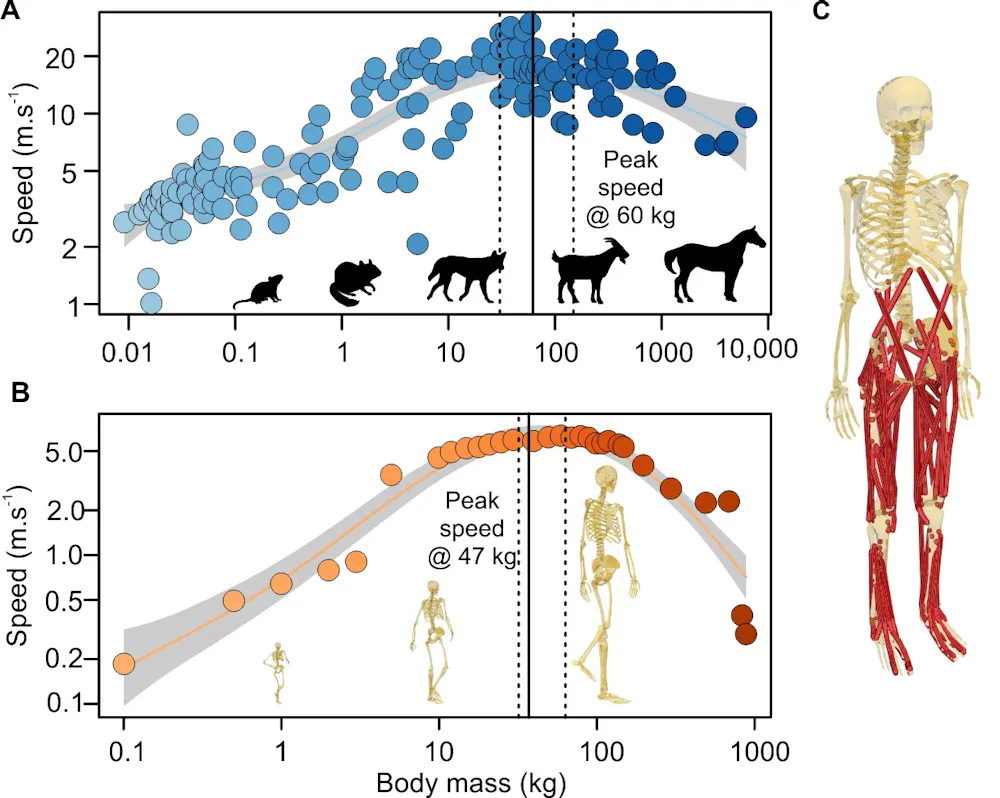
    We also found that the fastest model was not the biggest nor smallest. Instead, it was around 47kg, a similar weight to an average cheetah. Crucially, we could look under the hood and see why this was so.

    The curve that explains the shape of the maximum running speed with mass is the same shape as the curve, which explains the max ground force with mass. This makes sense: to move faster, you need to push off the ground harder.

    So why couldn’t larger models push harder off the ground? It appeared the larger models were limited by their muscles.

    A muscle’s ability to produce force depends on the cross sectional area of that muscle. And as animals increase in size, the mass of their muscles gets bigger faster than their cross-sectional area.

    This means the muscles of larger animals are relatively weaker. The muscles begin to “max out” above the max speed – and so the model has to slow down.

    At the other end of the spectrum, the miniature models have relatively stronger muscles, but have a problem with gravity. They are just too light. They try to push on the ground to produce a large force, but this just causes their body to leave the ground earlier.

    To try to produce more force on the ground, they crouch their limbs, just like mice or cats do. This allows them to stay on the ground longer and so produce more force, just like you might when doing a standing jump. But this takes time. And the longer you take to produce force, the slower your stride will be and you still won’t run faster.

    So a trade off between ground force and stride frequency begins, and doesn’t end until you reach the intermediate size, where your mass is just right.

    The pattern of speed and size for running animals (in blue), showing intermediately size species (like the cheetah) are typically the fastest. Computer-generated models of humans (right), which are then scaled in size from a mouse to a horse (orange dots), show the same pattern, revealing the underlying biomechanical reasons.
    Christofer Clemente et al.

    As fast as we will get

    What might all of this say about human evolution?

    We know throughout history that the size of modern humans and extinct human species – a collective group known as “hominins” – has varied significantly, from the roughly 30kg Australopithecus afarensis that existed roughly 3.5  million years ago, to the roughly 80kg Homo erectus  from nearly 2 million years ago.

    So generally body mass has tended to increase – and presumably so too has our running speed. Homo naledi, which existed around 300,000 years ago and weighed around 37kg, and Homo floresiensis, which existed around 50,000 years ago and weighed around 27kg, must have had to sacrifice some speed for their small size.

    The average body mass of modern adult humans is around 62kg – a little heavier than the 47kg peak weight that our modelling found, but still close to that ideal size.

    Interestingly, many of our fastest long distance runners such as Eliud Kipchoge weigh around 50kg.

    So based on our new research, we now know humans today are about as fast as we will get – without large changes to our muscular form.

    Christofer Clemente receives funding from an ARC Discovery grant (DP230101886)

    ref. Not too big, not too small: why modern humans are the ideal size for speed – https://theconversation.com/not-too-big-not-too-small-why-modern-humans-are-the-ideal-size-for-speed-241668

    MIL OSI AnalysisEveningReport.nz

  • MIL-OSI Video: Minister Godongwana presents the country’s fiscal outlook

    Source: Republic of South Africa (video statements-2)

    Minister Godongwana presents the country’s fiscal outlook

    https://www.youtube.com/watch?v=NmsR7TWQerQ

    MIL OSI Video

  • MIL-OSI Video: Minister Enoch Godongwana presents the Medium Term Budget Policy Statement

    Source: Republic of South Africa (video statements-2)

    Minister Enoch Godongwana presents the Medium Term Budget Policy Statement , 30 October 2024

    https://www.youtube.com/watch?v=tK8_n1wvgAM

    MIL OSI Video

  • MIL-OSI Video: MTBPS 2024 economic outlook

    Source: Republic of South Africa (video statements-2)

    Medium Term Budget Policy Statement on the economic outlook

    https://www.youtube.com/watch?v=b5-dlpxhOrg

    MIL OSI Video

  • MIL-OSI Video: Minister Enoch Godongwana on the revenue and expenditure adjustments

    Source: Republic of South Africa (video statements-2)

    Minister Enoch Godongwana on the revenue and expenditure adjustments

    https://www.youtube.com/watch?v=Oj2Itns4l8k

    MIL OSI Video

  • MIL-OSI Video: Minister Enoch Godongwana on the management of debt

    Source: Republic of South Africa (video statements-2)

    Minister Enoch Godongwana on the management of debt

    https://www.youtube.com/watch?v=j9VLqRyPruA

    MIL OSI Video

  • MIL-OSI Canada: Opening Statement before the Senate Standing Committee on Banking, Commerce and the Economy

    Source: Bank of Canada

    Good afternoon. I’m pleased to be here with Senior Deputy Governor Carolyn Rogers to discuss our recent policy announcement and the Bank of Canada’s Monetary Policy Report.

    Last week, we lowered the policy interest rate by 50 basis points. It was our fourth consecutive decrease since June and brings our policy rate to 3.75%.

    We took a bigger step because inflation is now back to the 2% target, and we want to keep it close to the target.

    In the past few months, inflation has come down significantly. Headline inflation was 1.6% in September, and both our measures of core inflation were under 2½%. Price pressures are no longer broad-based. Our surveys also find that business and consumer expectations of inflation have shifted down and are nearing normal. All this suggests we are back to low inflation. This is good news for Canadians.

    Now our focus is to maintain low, stable inflation. We need to stick the landing.

    That means the upward and downward forces on inflation need to balance out. Economic activity picked up this year, but it is still soft. This softness has helped take the remaining steam out of inflation. With inflation now back at 2%, we want to see growth strengthen. Last week’s interest rate decision should contribute to a pickup in demand.

    Looking ahead, we expect the economy to gradually strengthen in 2025 and 2026, supported by lower interest rates. Population growth will be slower, but we anticipate consumer spending per capita will be picking up. We also expect growth in residential investment to rise as strong demand for housing lifts sales and spending on renovations. We expect business investment to strengthen as demand picks up, and exports should remain strong, supported by robust demand from the United States.

    Our forecast has inflation staying around the target over the projection horizon. The upward pressure from shelter and other services is expected to gradually diminish. With stronger demand, the downward pressure on inflation should also dissipate, keeping the upward and downward forces roughly balanced.

    There are risks around our inflation outlook. The biggest downside risk to inflation is that it could take longer than anticipated for household spending and business investment to pick up. On the upside, lower interest rates could fuel a stronger rebound in housing activity, or wage growth could remain high relative to productivity. We are also facing elevated geopolitical uncertainty and the risk of new shocks. Overall, we view the risks around our inflation forecast as reasonably balanced.

    If the economy evolves broadly in line with our forecast, we anticipate cutting our policy rate further to support demand and keep inflation on target. The timing and pace of further interest rate cuts will depend on incoming information and our assessment of its implications for the inflation outlook. We will take our monetary policy decisions one at a time.

    Let me conclude.

    High inflation and interest rates have been a heavy burden for Canadians. Now we are coming out the other side—monetary policy has worked to get inflation down. With inflation back to target and interest rates continuing to come down, families, businesses and communities should feel some relief.

    The Bank is committed to maintaining price stability for Canadians by keeping inflation close to the 2% target.

    With that summary, the Senior Deputy Governor and I would be pleased to take your questions.

    MIL OSI Canada News

  • MIL-OSI USA: Rep. Norcross Presents $750,000 in Community Project Funding for the Redevelopment of John Lucas House in Gibbsboro

    Source: United States House of Representatives – Congressman Donald Norcross (1st District of New Jersey)

    CHERRY HILL, NJ – Today, Rep. Donald Norcross (D-NJ) presented $750,000 in Community Project Funding (CPF) to the Borough of Gibbsboro to redevelop the John Lucas House into a community event space.  

    The funding was secured through the Fiscal Year 2024 government funding package and will be used to assist in lead paint remediation, construct kitchen and restroom facilities, and repair structural deficiencies at the John Lucas House. The Borough envisions the house as the center for activities on Silver Lake and will be used to host public and private events.

    “Community Project Funding grants invest in our communities and support economic development, job creation, and critical projects that improve the quality of life,” Rep. Norcross said. “Bringing neighbors together for events is important for fostering a sense of community, and it’s an honor to have secured this funding to make this new event space a reality.”  

    “The FY2024 Congressional designated spending for the transformation of the former home of John Lucas into an events venue at Silver Lake in Gibbsboro complements the redevelopment of the former Paint Works Corporate Center into a destination with townhomes, walking trails, restaurants and office space,” said?Mayor Ed Campbell. “Gibbsboro is forever grateful to Congressman Norcross for his continued support for this important project and for his persistent dedication to seeing the three superfund sites in Gibbsboro fully remediated and the Borough’s effort toward economic redevelopment.” 

    Rep. Norcross recently secured 14 CPF awards totaling $13,565,031 for projects throughout New Jersey’s First Congressional District to support economic development, create jobs, and respond to the most pressing needs of the community. More information on the 14 projects can be found here. 

    Since the creation of CPFs in 2021, Rep. Norcross has secured $28.8 million in awards for local projects throughout South Jersey. CPF awards secured by Rep. Norcross range from road and transportation projects and affordable housing upgrades to improving health care and education accessibility.  


    ### 

    MIL OSI USA News

  • MIL-OSI USA: Scott Slams SCOTUS Ruling Greenlighting Youngkin, Trump & GOP Voter Suppression Tactics

    Source: United States House of Representatives – Congressman Bobby Scott (3rd District of Virginia)

    Headline: Scott Slams SCOTUS Ruling Greenlighting Youngkin, Trump & GOP Voter Suppression Tactics

    NEWPORT NEWS, VA – Congressman Bobby Scott (VA-03), co-chair of the Congressional Voting Rights Caucus and Dean of the Virginia Congressional Delegation, issued the following statement on the U.S. Supreme Court’s decision reversing U.S. District Court Judge Patricia Tolliver Giles’ order requiring the Youngkin Administration to reinstate more than 1,600 voters who may have been illegally purged from Virginia’s voter rolls in violation of the National Voter Registration Act of 1993:

    “I am deeply disappointed and disturbed by the U.S. Supreme Court’s decision to greenlight blatant voter suppression efforts in the Commonwealth of Virginia. This decision will allow Governor Youngkin to strip Virginians of their right to vote in clear violation of federal law. This decision also perpetuates the falsehood that noncitizens are voting in meaningful numbers and former President Trump’s plan to undermine confidence in our elections.

    “The National Voter Registration Act is clear. It requires all states to complete any systematic removal of voters from its voter rolls 90 days before a federal election. This statute gives states ample time prior to this deadline to review its voter rolls. Most importantly, it provides voters sufficient time to rectify any improper removal prior to Election Day. U.S. District Court Judge Patricia Tolliver Giles determined that Governor Youngkin’s actions violated this statute, and the U.S. Court of Appeals for the Fourth Circuit upheld her order citing the Commonwealth’s defense of the action as ‘weak’ and that it ‘violates basic principles of statutory construction.’ Furthermore, the Fourth Circuit recognized that the Commonwealth maintains the ability to remove ineligible voters on an individualized basis to limit the risk of improper removals.

    “Unfortunately, this latest order by the Supreme Court is just one in a series of rulings that have rolled back fundamental rights, freedoms and foundational principles of our democracy. This Court gutted key provisions of the Voting Rights Act, stripped women of their right to make decisions about their own body, diminished the ability of federal agencies to protect communities from toxic pollutants, and created the foundation for a President of the United States to be immune from the law.”

    # # #

    MIL OSI USA News

  • MIL-OSI New Zealand: Global privacy authorities issue follow-up joint statement on data scraping after industry engagement

    Source: Privacy Commissioner

    OPC and several global counterparts are highlighting how social media companies can better protect personal information, as concerns grow about mass scraping of personal information within social media platforms, including to support artificial intelligence systems.

    Mass data scraping poses significant risks to individuals fundamental right to privacy, said Canadian Commissioner Philippe Dufresne. Personal information, even when it is publicly accessible, is subject to privacy laws and must be adequately protected. This initiative highlights the importance of collaboration between data protection authorities and with industry.

    Commissioner Dufresne, New Zealand Privacy Commissioner Michael Webster and their counterparts engaged with some of the worlds largest social media companies after issuing a joint statement on data scraping last year. As a result of this engagement, they have now issued a follow-up statement laying out additional takeaways for industry.

    MIL OSI New Zealand News

  • MIL-OSI New Zealand: Sudan – Over 2.8 million children under five forced from their home across Sudan – Save the Children

    Source: Save the Children

    More than 2.8 million babies, toddlers and preschoolers are now displaced across Sudan, said Save the Children, with new figures released by the IOM showing the world’s largest displacement crisis is rapidly deteriorating for children.
    About 11 million people in Sudan – or 30% of the population – have been forced from their homes, including those displaced before and since the most recent conflict escalated in April 2023. The numbers have risen by 200,000 in the last month alone, with more than 45,000 people displaced in Al Jazirah state including 27,000 children in the past seven days [1].
    New figures reveal over half of the 11 million displaced – or 5.8 million – are children under 18, and over one quarter – or 2.8 million – are children aged under five [2]. These small children are uniquely vulnerable, and while displaced many will miss out on early childhood essentials – including vaccinations, clean water, healthcare, nutritious food, and shelter from extreme heat and cold.
    While about half of these children are now living in host communities, the remaining half are living in desperate conditions, with 18% in displacement camps, 16% in informal settlements or out in the open, and 9% in cramped schools or other public buildings. Many of these children are sharing their space with adults they don’t know, and have limited or no access to water and sanitation.
    Girls are particularly at risk, with over 3.2 million of the displaced children girls under 18, who face particular threats of sexual violence, rape, or early or forced marriage.
    Red Sea state in the country’s east has the highest proportion of displaced children, with children making up 60% of all displaced people, followed by Central Darfur with 57%. More than a third of those children and families now displaced in Sudan are from the capital Khartoum, which has witnessed some of the fiercest fighting of the conflict, followed by South Darfur (19%) and North Darfur (15%).
    Mohamed Abdiladif, Interim Country Director for Save the Children in Sudan, said:
    “Babies, toddlers, preschoolers – millions of the world’s most vulnerable people are currently living in some of the world’s worst conditions. The world has a duty of care for children and we are failing them.
    “When people are forced to flee their homes due to violence, it’s usually the women and. children who go first – and we often see displacement camps filled with children. But the number of children displaced in Sudan – and in particular, their young age and vulnerability – is staggering.
    “The situation in Sudan is spiralling out of control and every day more and more lives are put at risk with killings, violence and displacement. This has become one of the world’s most devastating humanitarian crisis but the world is not taking notice.
    “In the past week alone at least 10 children have been killed , including children as young as 10, and at least 43 children injured in Al Jazirah state. The UN has reported girls as young as 13 subjected to rape and sexual assault. We have also heard reports of children being detained, the widespread destruction of homes, and massive displacement, with families walking for days to reach safety.
    “We are urgently calling on the international community to take meaningful and urgent political action to address this crisis, for an immediate ceasefire and progress towards a lasting peace agreement.”
    Save the Children has worked in Sudan since 1983 and is currently supporting children and their families across Sudan providing health, nutrition, education, child protection and food security and livelihoods support. Save the Children is also supporting refugees from Sudan in Egypt and South Sudan.
    Notes
    [1] On 28 October, UNICEF reported more than 9,000 households, including over 45,000 people, were forced from their homes in Tamboul and its surrounding villages between 20 and 27 October 2024. A calculation of a household includes 2 adults and 3 children, thus 27,000 children displaced.
    [2] Figures from Sudan Mobility Update 29 October 2024 https://dtm.iom.int/reports/dtm-sudan-mobility-update-10

    MIL OSI New Zealand News

  • MIL-OSI USA: Cambodia stops publishing details of new citizenships issued to foreigners – The Straits Times

    Source: United States Institute of Peace

    SINGAPORE – Cambodia has stopped publishing data on new citizenships issued by the kingdom to foreigners, in the wake of the $3 billion money laundering probe in Singapore.

    Checks by The Straits Times and investigative journalism group, Organised Crime and Corruption Reporting Project (OCCRP), showed that the last time new citizenship details were published was in February.

    The latest Royal Gazette, published on Sept 27, did not contain any new citizenship data.

    Observers had zoomed in on the ease of access to Cambodian citizenship and passports after it emerged that nine of the 10 foreigners arrested in August 2023 in the probe in Singapore held Cambodian passports.

    All 10 were originally from China, which does not recognise dual citizenship.

    In 2018, Cambodia moved to allow foreign immigrants to request citizenship through the naturalisation process.

    To be granted citizenship, foreigners have to maintain good behaviour and morality, and have no convictions for serious crime.

    They must also legally reside in Cambodia for more than seven years, be able to speak Khmer, and understand the local culture and history.

    Of the nine foreigners apprehended in Singapore, at least five were convicted for online gambling or were wanted by the authorities in China.

    They are Wang Dehai, Vang Shuiming, Su Jianfeng, Chen Qingyuan and Su Wenqiang.

    Another 17 associates of the 10 foreigners held Cambodian passports as well.

    They include Su Binghai, Su Yongcan, Wang Huoqiang, Su Shuiming, Su Shuijun, Su Fuxiang and Chen Mulin.

    Cambodia had averaged around 50 new citizens every month between January 2020 and August 2023, with details published monthly in the Royal Gazette.

    After the raids in Singapore, the kingdom granted citizenship status to only four individuals in total between September 2023 and December 2023.

    A representative from the Royal Embassy of Cambodia in Singapore told ST on Sept 18 that it could not confirm the figures as it does not have access to the data.

    The representative added that he was unable to confirm if Cambodia’s citizenship by investment scheme, or naturalisation process, is still in place.

    ST had also reached out to government spokesman Pen Bona, the Prime Minister’s spokesman Meas Sophorn, the office of the council of ministers, and Cambodia’s immigration office.

    Established in 1996, the kingdom’s law on nationality also allows foreigners to obtain citizenship through investment in the nation.

    Under the law, foreigners who invest a minimum of US$300,000 (S$384,000) in the country, or donate at least US$250,000 to the economy, will have the right to apply for citizenship.

    Mr Jacob Sims, a visiting expert on transnational crime at the United States Institute of Peace, told ST that for years, Cambodia’s citizenship for investment scheme has served as a channel for individuals from sophisticated organised crime syndicates to migrate.

    Said Mr Sims: “The removal of that data from the public record helps to obscure the nature of the relationship between Cambodian state actions and those criminals, as well as the sheer volume of monied crime actors Cambodia has absorbed in recent years.”

    By removing the once publicly available data, Cambodia can protect those who have purchased citizenship while shielding the government from international scrutiny, he said.

    Associate Professor Kristin Surak from the London School of Economics and Political Science said that not all countries strictly vet citizenship by investment applications.

    She added: “I would say the scheme is very easy to exploit in Cambodia because the government does not do its due diligence. It has issues with corruption and does not have an effective bureaucratic process to ensure applications are properly checked and vetted.”

    Name changes have also made it harder for the authorities to track criminals.

    Dr Surak, the author of The Golden Passport: Global Mobility For Millionaires, pointed out that many applicants in the past have changed their names.

    “This makes it extremely easy for someone to take on a new identity, making Cambodia a target for those with criminal intent to take advantage of,” she added.

    One such example is casino kingpin She Zhijiang. ST previously reported on She and his links to scam operations in Myanmar and Cambodia.

    She, who was originally from China, became a naturalised citizen of Cambodia in 2017. He then changed his name to Tang Kriang Kai.

    He was arrested in Thailand in August 2022 and is currently fighting deportation to China.

    Businessman David Yong, chief executive of Evergreen Group Holdings, had similarly obtained Cambodian citizenship.

    Yong, who is currently facing four charges in Singapore of falsifying accounts, obtained Cambodian citizenship some time in 2023 and changed his name to Duong Dara.

    He was arrested on Aug 1, just three months after he appeared in Netflix series Super Rich In Korea.

    Yong’s lawyer said in court that he had surrendered his Cambodian passport to the authorities in Phnom Penh in June 2024.

    In response, the authorities in Singapore said they wrote several times to their Cambodian counterparts in August to confirm the fact, but have yet to receive any reply.

    Of the 10 foreigners convicted in Singapore’s largest money laundering case, eight were deported to Cambodia – which has an extradition treaty with China.

    Wang Dehai was deported to the UK, while Vang Shuiming was deported to Japan.

    MIL OSI USA News

  • MIL-OSI USA: Hello Earth? Space Calling

    Source: NASA

    How it started versus how it’s going for astronaut Nick Hague with ISS Ham Radio on the space station.
    Since November 2000, crew members like Hague have used ham radio to communicate with people on Earth through this educational program, also known as Amateur Radio on the International Space Station or ARISS. So far, there have been more than 1,700 events, directly engaging students and listeners from 49 U.S. states, 63 countries, and all seven continents. Students study the space station, radio waves, amateur radio technology, and related topics before their call from space, which encourages interest in STEM.
    Now through Nov 17, 2024, ARISS is accepting applications from formal and informal educational institutions and organizations that want to host events in summer or fall of 2025. There is no charge for these calls from space, although host locations may incur some equipment-related costs. Local amateur radio clubs help hosts prepare for their contacts.
    Read about how ISS Ham Radio and other station programs inspire students.
    Melissa GaskillInternational Space Station Research Communications TeamJohnson Space Center

    MIL OSI USA News

  • MIL-OSI USA: Attorney General Bonta Issues Local Government Guidance for Tackling the Opioid and Fentanyl Crisis

    Source: US State of California

    Attorney General secures nearly $50 billion in nationwide opioid settlements and bankruptcies 

    California is expected to receive up to $4.2 billion in opioid abatement funds under these settlements 

    Provides local governments with guidance on effectively utilizing funds to combat the opioid and fentanyl crisis and support recovery initiatives 

    OAKLAND – Recognizing the impact of the opioid and fentanyl crisis to both public health and public safety, California Attorney General Bonta today issued guidance to provide local governments with suggestions for the permissible, effective, and strategic use of opioid settlement abatement funds. This guidance is aimed at helping local governments maximize impact, save lives, and strengthen public health infrastructures to tackle the opioid and fentanyl crisis. 

    The opioid epidemic, fueled by prescription opioid painkillers and fentanyl, continues to devastate families, communities, and lives across this nation,” said Attorney General Bonta. “At the California Department of Justice, the pain felt by those impacted by this epidemic is our driving force in holding accountable those responsible for fueling this crisis, and we will not stop our fight for justice and relief. The funds from opioid settlements are designed to allow multi-faceted approaches for local governments to provide comprehensive prevention, treatment and recovery programs, and other resources to root out the opioid and fentanyl crisis. With a united front of local governments statewide, we can not only put an end to this epidemic, but also provide a pathway toward recovery and renewal. Together, we can heal. Together, we can turn the tide.” 

    Since the first wave of the opioid epidemic hit the United States in the 1990s, it has taken hundreds of thousands of lives, torn families apart, and eroded the social fabric of communities. Its toll has grown year after year. Data from the Centers for Disease Control and Prevention (CDC) indicate that in 2022, the most recent year for which we have reliable data, more than 10,900 Californians died from overdose. Nearly 6,500 of those overdoses were due to fentanyl.

    Fentanyl is a powerful and addictive synthetic opioid that is up to 50 times stronger than heroin. A small amount of fentanyl, just two milligrams, can result in overdose or death. Fentanyl can be found in different forms, including pills, powder, and liquid, and can be obtained legally, with a prescription, or illegally. Illicit fentanyl has been found in many drugs, including heroin, as well as laced into non-opioids such as methamphetamine, counterfeit pills, and cocaine. Fentanyl mixed with any drug, and in particular non-opioids, increases the likelihood of a fatal overdose. Illicit fentanyl is often packaged to look like prescription drugs, often by using the labeling of an illicit drug or pressing pills in specific colors in order to promote consumption among users.

    In California in 2022, more than 7,000 people died due to opioid overdose, with almost 90% of those deaths involving fentanyl. According to the CDC, the nation has experienced the overdose epidemic in three interconnected waves: an increase in deaths from prescription opioid overdoses beginning in the 1990s, an increase in heroin deaths starting in 2010, and a more recent surge in deaths from other illicit opioids such as fentanyl.

    To date, the Attorney General has secured nearly $50 billion in abatement funding through nationwide settlements and bankruptcies. California is expected to receive up to $4.2 billion in opioid abatement funds under these settlements, with the bulk of these funds going to our local governments.

    These settlements have ensured a stream of opioid abatement funds for California’s cities and counties far into the future. By design, the settlements ensure that the vast majority of funds are used to abate the opioid crisis.

    View the guidance here.

    MIL OSI USA News

  • MIL-OSI Security: FBI Chicago, Illinois Attorney General’s Office Seeking Information about Multiple Suspects in Jewelry Store Armed Robberies in Bridgeview

    Source: Federal Bureau of Investigation (FBI) State Crime Alerts (b)

    Douglas S. DePodesta, special agent in charge of the Chicago Division of the FBI, and Kwame Raoul, attorney general for the State of Illinois, are seeking information about four masked suspects involved in armed robberies taking place at four jewelry stores across three states between July 13, 2023, and September 14, 2024. Authorities are urging anyone with information to contact the FBI.

    The robberies in question have taken place at jewelry stores in Bridgeview, Illinois, as well as in Michigan and Missouri. According to law enforcement, suspects alternately carried an AR-style rifle, handgun, and hammer, and wore costume face masks. The FBI on October 30 released surveillance video footage of robberies that took place at stores in Bridgeview, Illinois, and Dearborn, Michigan. The video and images of the costume masks are available at fbi.gov/wanted/seeking-information.

    “The perpetrators of these crimes showed a blatant disregard for public safety and the rule of law during the commission of these brazen robberies,” DePodesta said. “Their actions will haunt these victims for a lifetime, and we’re asking for the public’s help to bring them to justice before someone is killed. We encourage the public to take a good look at the images we’ve released today and contact us with tips before these violent individuals strike again.”

    JEWELRY STORE ROBBERIES

    Unknown Suspects Bridgeview, Illinois; Dearborn, Michigan; and Winchester, Missouri  July 13, 2023; January 9, 2024; August 7, 2024; and September 14, 2024

    MIL Security OSI

  • MIL-OSI Submissions: Research – Great Place To Work® Releases Study On Workplace Well-being With Johns Hopkins University

    Source: Great Place To Work®

    Great Place To Work® Releases Study On Workplace Well-being With Johns Hopkins University In Critical Areas Of Mental And Emotional Support, Teamwork, Psychological Safety And Finance Stability

    Singapore, 30 October 2024 – Great Place To Work® Singapore marked its 10th anniversary at its Best Workplaces in Singapore 2024 event with the release of the Great is Possible: Charting a Decade of Progress in Singapore Workplaces (2015-2024) insights report. The report highlights the transformation of Singapore’s workplaces over the past decade, with a special focus on well-being and mental health. This year’s event also introduced the new Legends category, honouring organisations that have consistently made the Best Workplaces list for five or more consecutive years.

    Held at The Ritz-Carlton, the milestone celebration was graced by Deputy Prime Minister Heng Swee Keat and attended by close to 420 guests, including business leaders and employees from Great Place To Work Certified companies.

    Michael C. Bush, Chief Executive Officer of Great Place To Work®, giving his keynote address at the 10th Anniversary of Best Workplaces in Singapore / Great Place to Work® Singapore.

    A Decade of Change in Singapore’s Workplaces

    Over the past ten years, Great Place To Work has led the way in understanding what makes workplaces thrive in Singapore. Great Place To Work Singapore has administered over 400,000 surveys across nearly 1,000 workplaces from more than 440,000 employees since its establishment in 2015.

    In conjunction with its 10th anniversary, Great Place To Work Singapore unveiled the Great is Possible: Charting a Decade of Progress in Singapore Workplaces (2015-2024) insights report, which provides a comprehensive analysis of data collected from 2015 to 2024. The report, based on input from approximately 440,000 employees in the Trust Index Employee Survey, examines the evolving trends and shifts in workplace culture, leadership, and employee well-being. Key findings include:

    • Leadership integrity and psychological safety remain pivotal in fostering positive employee experiences
    • Concerns about fairness in compensation and bridging experience gaps across different organisational levels
    • Employee trust and satisfaction have been on the rise at Best Workplaces for the past ten years, evidenced by a steady increase in overall Trust Index scores

    Spotlight on Employee Well-Being and Burnout

    In response to the rising focus on employee burnout and mental health, Great Place To Work also conducted a study on workplace well-being over the past five years in Singapore. Produced in collaboration with Johns Hopkins University’s Human Capital Development Lab, Well-Being At Work: Fostering a Healthy Work Climate For All examines well-being trends from 2019 to 2024, identifying key factors that influence workplace well-being in Singapore. It draws on data from Great Place To Work’s proprietary Trust Index survey, which included insights from over 200 organisations and 40,000 respondents in the critical areas of mental and emotional support, teamwork, psychological safety, and financial stability.

    The results revealed significant variations in well-being across several dimensions:

    Age and Gender
    • Women and younger employees reported lower well-being levels
    • However, the gender gap narrows among younger generations, suggesting future workforces may experience fewer gender-based disparities.

    Management Levels
    • Senior management reported higher well-being scores, attributed to a sense of purpose, personal growth, and financial stability.

    Impact of COVID-19
    • The pandemic initially boosted employee well-being as organisations prioritised care for their teams.
    • A decline in overall well-being levels was observed as businesses returned to traditional work environments.

    Importance of Connections
    • Strong connections and personal support play a crucial role in fostering a positive work climate.
    • There are strong correlations between teamwork, psychological safety, and overall well-being.

    Notably, Best Workplaces lead the way in well-being, consistently demonstrating higher employee well-being scores. Many of these companies achieve this through certified mental well-being ambassadors and comprehensive health and wellness programs. However, the success of such initiatives depends on employee perceptions influenced by organisational culture and values, highlighting the need for solutions that align with management practices and HR processes, rather than merely addressing issues superficially.

    “Over the past decade, Great Place To Work has witnessed the evolving needs of Singapore’s workplaces. Our reports highlight the growing importance of leadership integrity, psychological safety, and employee well-being. Despite the challenges of the past few years, leading organisations have shown that prioritising inclusion and investing in their people is essential for creating thriving work environments. We hope our findings will inspire more organisations to create high-trust, high-performing workplace cultures where everyone can thrive,” shared Ms Evelyn Kwek, Managing Director of Great Place To Work ASEAN and ANZ.

    Looking Ahead: “Great is Possible”

    This year’s milestone event embraced the theme “Great is Possible,” acknowledging the resilience and innovation of organisations in the face of an ever-changing business climate. A highlight of the 10th anniversary celebration was the introduction of the new Legends category to recognise exceptional companies with an impressive record—having been placed on the Best Workplaces in Singapore List for at least five consecutive years. These Legends stand as models of excellence in what Great looks like in the ever-evolving landscape of the modern workplace.

    The inaugural Legends list includes:
    • Cisco (5 Years)
    • DHL Express (Singapore) Pte Ltd (8 Years)
    • HP (5 Years)
    • Micron Technology (6 Years)
    • Salesforce (10 Years)
    • World Wide Technology (5 Years)

    CEO Michael C. Bush delivered a keynote address on how businesses can transform into great workplaces by prioritising trust, inclusion, and employee value. He emphasised the necessity of achieving greatness for both the present and future of work, and urged leaders to take actionable steps to create environments where all employees can thrive and drive outstanding business outcomes.

    Managing Director of Great Place To Work ASEAN and ANZ, Ms Evelyn Kwek said, “As we celebrate 10 years of the Best Workplaces list in Singapore, we are proud to honour our Legends. They have set the standard for what it means to be a truly Great Workplace, and their success shows what organisations can achieve when they put their people first. We hope our list-makers continue to inspire more organisations to reach for Great.”

    About Great Place To Work®

    As the global authority on workplace culture, Great Place To Work brings 30 years of ground-breaking research and data to help every place become a great place to work for all. Their proprietary platform and For AllTM Model helps companies evaluate the experience of every employee, with exemplary workplaces becoming Great Place To Work Certified or receiving recognition on a coveted Best Workplaces List. Follow Great Place To Work® on LinkedIn, Facebook, and Instagram or visit greatplacetowork.com.sg to learn more.

    About Great Place To Work® Certification

    Great Place To Work Certification is the most definitive “employer-of-choice” recognition that companies aspire to achieve. It is the only recognition based entirely on what employees report about their workplace experience – specifically, how consistently they experience a high-trust workplace. Great Place To Work Certification is recognised worldwide by employees and employers alike and is the global benchmark for identifying and recognising outstanding employee experience. Every year, more than 10,000 companies across 97 countries apply to earn Great Place To Work Certification.

    MIL OSI – Submitted News

  • MIL-OSI Video: Department of State Daily Press Briefing – October 30, 2024

    Source: United States of America – Department of State (video statements)

    Spokesperson Matthew Miller leads the Department Press Briefing, at the Department of State, on October 30, 2024.

    ———-
    Under the leadership of the President and Secretary of State, the U.S. Department of State leads America’s foreign policy through diplomacy, advocacy, and assistance by advancing the interests of the American people, their safety and economic prosperity. On behalf of the American people we promote and demonstrate democratic values and advance a free, peaceful, and prosperous world.

    The Secretary of State, appointed by the President with the advice and consent of the Senate, is the President’s chief foreign affairs adviser. The Secretary carries out the President’s foreign policies through the State Department, which includes the Foreign Service, Civil Service and U.S. Agency for International Development.

    Get updates from the U.S. Department of State at www.state.gov and on social media!
    Facebook: https://www.facebook.com/statedept
    Twitter: https://twitter.com/StateDept
    Instagram: https://www.instagram.com/statedept
    Flickr: https://flickr.com/photos/statephotos/

    Subscribe to the State Department Blog: https://www.state.gov/blogs
    Watch on-demand State Department videos: https://video.state.gov/
    Subscribe to The Week at State e-newsletter: http://ow.ly/diiN30ro7Cw

    State Department website: https://www.state.gov/
    Careers website: https://careers.state.gov/
    White House website: https://www.whitehouse.gov/

    #StateDepartment #DepartmentofState #Diplomacy

    https://www.youtube.com/watch?v=EMLOey2yWOA

    MIL OSI Video

  • MIL-OSI USA: Congressman Cory Mills Recovers Over $45 Million for Florida’s 7th Congressional District Constituents

    Source: United States House of Representatives – Congressman Cory Mills Florida (7th District)

    Lake Mary, FL – Congressman Cory Mills (FL-07) proudly announces the recovery of over $45 million from federal agencies on behalf of the residents of Florida’s 7th Congressional District.

    “I am proud to announce that my team and I have secured over $45 million from federal agencies and bureaus who held benefits from Florida’s 7th Congressional District constituents. After the destruction caused by Hurricanes Helene and Milton, we understand that many families are in need of assistance. Navigating FEMA’s processes can be overwhelming, especially when recovering from the impact of hurricanes,” said Rep. Cory Mills (FL-07). “My team is dedicated to ensuring that constituents have access to the federal disaster relief they need. If you or someone you know is struggling to receive assistance from FEMA or any other federal agency due to delays, paperwork issues, or other barriers, my office is here to assist in finding solutions.”

    ###

    MIL OSI USA News

  • MIL-OSI USA: Magaziner, HealthSource RI Kick Off 2025 Open Enrollment for Rhode Island’s State-Based Health Insurance Marketplace

    Source: United States House of Representatives – Representative Seth Magaziner (RI-02)

    November 1 is the first date to enroll.

    CRANSTON, R.I. — U.S. Representative Seth Magaziner (RI-02) joined HealthSource RI (HSRI) Director Lindsay Lang today at Comprehensive Community Action Program (CCAP)’s Family Health Services of Cranston to kick off the annual Open Enrollment period for the state’s health exchange, beginning Friday, November 1 and running through January 31. New customers can purchase plans, and existing customers can change their plan selections during this time without needing a qualifying life event.

    HSRI has served nearly 161,000 Rhode Islanders since its inception in 2013, roughly mirroring the proportion of 1 in 7 Americans, or about 50 million individuals, served by state and federal exchanges nationwide. HSRI’s role in connecting Rhode Islanders to coverage has been booming in recent months, with enrollment swelling to an all-time high of more than 46,000 in its individual and family plan offerings, and an additional 8,200 lives covered through its small employers arm serving local businesses and nonprofits with access to small group plans. Recent findings of its Health Information Survey put Rhode Island’s uninsured rate at a remarkably low 2.2%, among the best in the nation.

    “Every Rhode Islander deserves access to affordable, high-quality healthcare,” said Rep. Seth Magaziner. “The Affordable Care Act has expanded health coverage for tens of thousands of people in our state, and I will continue fighting to protect this lifesaving law from those who seek to repeal it.”

    As the only place Rhode Islanders can receive financial help to pay for their health coverage, HSRI plays a vital role in connecting customers to quality coverage. Currently, 6 out of 7 HSRI customers receive financial assistance, and nearly a third of customers pay less than $10 per month for their health coverage. For 2025, customers can choose from an array of 20 health plans and seven dental plans, all provided by well-known insurance carriers, when shopping through the marketplace. Cost-comparison tools on the HealthSource RI website and an abundance of phone, web-based and in-person support options make it convenient to get help when reviewing plans.

    “HealthSource RI is proud to serve an important role in connecting so many Rhode Islanders to quality coverage,” said HSRI Director Lindsay Lang. “Having the coverage you need for preventive care, or treatment when you or your loved one are sick, is a vital stabilizing tool for families and individuals, across all walks of life. With more than a decade of experience as a trusted guide, HSRI is here to help ensure our fellow Rhode Islanders have that peace of mind.”

    Along with Magaziner and Lang, Joanne McGunagle, President & CEO of CCAP, whose trained navigators assist community members at numerous locations statewide in the application process for coverage through both HealthSource RI and Medicaid, spoke to the importance of high-quality health coverage for patients in order to seek preventative health care and maintain healthier communities.

    “As the major provider of health care in the City of Cranston, we know how vitally important it is for our patients to have access to affordable health insurance. CCAP is proud to have our Navigators working directly with patients to assist with enrollment in health insurance, in collaboration with RIHCA and HealthsourceRI. HealthSource RI provides expert staff to assist them in selecting a plan that makes sense for them and their families. With diminishing availability of medical providers, having health insurance gives them a step up and more options to receive care.  We are grateful to Congressman Magaziner for championing this most valued service for the most vulnerable,” said Joanne McGunagle, President & CEO of CCAP.

    Individuals and families can learn about various types of assistance, compare costs, and enroll in, change or renew their health and dental coverage at HealthSourceRI.com/OE, or call 1-855-840-HSRI (4774).

    MIL OSI USA News

  • MIL-OSI USA: Rep. Huffman, Richardson Bay Regional Agency Celebrate Launch of New Eelgrass Protection Zone

    Source: United States House of Representatives – Congressman Jared Huffman Representing the 2nd District of California

    Initiative will protect critical environmental component of Richardson Bay

    October 30, 2024

    Sausalito, CA— U.S. Representative Jared Huffman (D-CA-02) along with the Richardson Bay Regional Agency (RBRA) and federal, state, and local partners today celebrated the launch of a new Eelgrass Protection Zone, an area of the water off-limits to anchoring that will help restore and protect a critical ecological component of the Bay.

    “This is such an important day for the environment of Richardson Bay and the entire San Francisco Bay area,” said Representative Jared Huffman. “Eelgrass acts as the foundation for so much of what we love about the bay — from supporting herring runs and thousands of migratory birds, to helping ward off the impacts of climate change. By taking these measures now, RBRA is protecting Richardson Bay’s amazing natural resources for generations to come, and I’m glad we could help support this work with funding from the Biden-Harris administration.”

    Eelgrass is a critical component of a healthy and vibrant Richardson Bay. It supports fisheries, reduces erosion, sequesters carbon and is a crucial ecological resource for harbor porpoises, seals, and sea lions. However, when anchors, chains, and other ground tackle scrape along the Bay bottom, they essentially act as a lawn mower for all living plants. This creates “crop circles” or barren areas where no eelgrass can grow.

    To combat those impacts and to provide an opportunity for eelgrass to recover, after an extensive public process, the RBRA established an Eelgrass Protection Zone (EPZ) in Richardson Bay where no anchoring is allowed. While a few vessels remain in the EPZ, all boats will eventually be removed from the area. Today, the RBRA celebrated the implementation of the EPZ with new signage and markings dictating the exact parameters of the off-limits area.

    “We’ve been able to reduce the number of vessels in the Eelgrass Protection Zone by working in a productive, supportive manner with boat owners.,” said RBRA Board Chair Jim Lynch. “From finding housing for people transitioning off the anchorage to buying back vessels people could no longer manage, we’ve worked tirelessly to find solutions to the challenge of protecting our environment while being mindful of housing needs, and the historic conditions on the Bay.”

    In 2022, there were more than 100 vessels in the Eelgrass Protection Zone. Through various efforts, the RBRA has reduced that number to just 20 as of October 23.

    Last year, the RBRA and its partners at Audubon California and San Francisco State University secured a $2.8 million federal grant from the US Environmental Protection Agency to support eelgrass restoration and protection efforts. This builds on years of investment by the National Oceanic and Atmospheric Administration, the California Ocean Protection Council, and others in improving environmental conditions in the bay through targeted restoration, marine debris removal, wildlife monitoring, and outreach.

    The EPA grant is aimed at restoring at least 15 acres of eelgrass over four years through an innovative public-private partnership centered around the EPZ. The funding was made possible by the progress RBRA and its partners have made in securing the eelgrass bed from future damage, and will support RBRA’s recently-adopted 10-year Restoration and Adaptive Management Plan for Eelgrass in Richardson Bay.

    “Initiatives like the Eelgrass Protection Zone are essential to support a healthy San Francisco Bay,” said U.S. EPA Pacific Southwest Regional Administrator Martha Guzman. “The Richardson Bay Regional Agency and its partners have established themselves as protectors of eelgrass habitat through this detailed plan that can ensure an expansion of eelgrass acres over time.”

    “This is a landmark moment for the Richardson Bay community,” said Wade Crowfoot, Secretary of the California Natural Resources Agency. “Initiatives like the Eelgrass Protection Zone play a vital role in achieving California’s goal of conserving 30 percent of our lands and coastal waters by 2030. The eelgrass habitat is essential to the rich biodiversity that makes Richardson Bay unique, and putting this plan into action will safeguard these invaluable natural resources.”

    In 2021, the RBRA entered into an agreement with the San Francisco Bay Conservation and Development Commission (BCDC), stipulating that all vessels and floating homes be removed from the anchorage by October 26, 2026, except those abiding by 72-hour time restrictions.

    The agreement with BCDC was driven in large part by the need to protect the eelgrass ecosystem of Richardson Bay. Along with supporting key fisheries, tens of thousands of migratory waterbirds rely on Richardson Bay for feeding and resting during migration along the Pacific Flyway.

    To incentivize vessels to move off the Richardson Bay anchorage, the RBRA created a housing voucher program last year, allowing boaters previously living on the water to move into safe, secure housing on land. The RBRA manages the program in collaboration with the Marin Housing Authority, Marin Health and Human Services, and Episcopal Community Services.

    Additionally, the RBRA manages a vessel buyback program, which offers eligible participants money based on the length of their boat ($150 per foot) if they turn their vessel into the RBRA for proper disposal.

    “We are proud of all that we have accomplished on Richardson Bay to create a safe, supportive and accessible environment for all,” said Marin County Supervisor Stephanie Moulton-Peters, who also sits on the RBRA Board. “We know that there is still work to be done, but if we keep working together collaboratively with our community, we can help achieve everyone’s goals.”

     ###

    MIL OSI USA News

  • MIL-OSI USA: Hoyer Joins President Biden, Team Maryland to Celebrate $147 Million Clean Energy Investment in the Port of Baltimore

    Source: United States House of Representatives – Congressman Steny H Hoyer (MD-05)

    WASHINGTON, DC – Congressman Steny H. Hoyer (MD-05) joined President Joseph R. Biden, Governor Wes Moore, U.S. Senators Ben Cardin and Chris Van Hollen (all D-MD), Congressman Kweisi Mfume, Congressman John Sarbanes, Congressman Dutch Ruppersberger (all D-MD), Maryland Department of Transportation Secretary Paul Wiedefeld, and Maryland Port Administration Executive Director Jonathan Daniels at the Port of Baltimore to celebrate more than $147 million in federal funding to create good-paying, clean jobs and to expedite decarbonization and electrification efforts at the Port. The U.S. Environmental Protection Agency awarded the funding to the Port of Baltimore through its Clean Ports Program, created under the Biden-Harris Administration’s Inflation Reduction Act.

    “The Biden-Harris Administration’s Investing in America agenda continues to leave no community behind and promote clean air and water in communities that have long borne the brunt of pollution,” said Congressman Steny Hoyer. “Thanks to the Inflation Reduction Act that I brought to the House Floor as Majority Leader last Congress, the Port of Baltimore is getting the tools it needs to upgrade its equipment, improve electric charging infrastructure, and fight the climate crisis in a way that benefits Marylanders across the state. As Chair of the Regional Leadership Council, I appreciate Administrator Regan and the Biden-Harris Administration’s partnership as we continue to ensure the historic investments Democrats passed last Congress reach every community in America. We must continue to work together to strengthen the Port of Baltimore and ensure environmental justice for all Marylanders.”

    The Port of Baltimore generates about 20,300 direct jobs, with more than 273,000 jobs overall linked to port activities. The funding will enable the Maryland Port Administration and its private partners to purchase 213 pieces of new zero-emission vehicles, equipment, and charging infrastructure that will replace old, inefficient, and polluting diesel combustion engines. The funding will also pay for capacity upgrades to the port’s electrical grid, which will help significantly reduce greenhouse gas emissions with an estimated 35% decrease in carbon dioxide equivalency compared to 2020 levels. 

    “In Maryland, we aren’t going to choose between building a competitive state and a sustainable one -— we will do both at the same time,” said Gov. Moore. “In partnership with the Biden-Harris Administration, we are investing in the Port of Baltimore and electrifying the way to a greener, cleaner, and healthier future with a strong economy and good-paying jobs.” 

    “The Port of Baltimore is a vital economic engine for the state and a leader among the nation’s ports. As we work to improve the port, it is essential that we build for the future. The projects supported by the Clean Ports Program will help reduce emissions, improve air quality in the Baltimore region and create more clean energy jobs,” said U.S. Senator Ben Cardin. “The Biden-Harris Administration’s bold investments in modernizing our infrastructure are driving our economy forward while enabling us to take on climate change in a meaningful way.” 

    “We fought to pass the Inflation Reduction Act to create good-paying jobs in our communities while tackling the climate crisis head-on, and today’s announcement shows these investments are being put to work,” said U.S. Senator Chris Van Hollen. “This new federal funding will support the Port of Baltimore’s transition to electric infrastructure as part of its plans to reduce emissions – both bolstering the port’s growth and improving air quality for nearby communities. These efforts will help strengthen Baltimore’s economy and create more local jobs for Marylanders.” 

    “The tremendous projects selected for these federal funding awards will improve air quality and combat climate change by dramatically diminishing the Port of Baltimore’s greenhouse gas and toxic pollutant emissions via installation of zero-emission cargo handling equipment and trucks, while also bolstering the Maryland Port Administration’s overall emissions reduction strategy. These extraordinary federal investments into our port are consistent with our collective duty to preserve the planet – while also continuing to uplift the Port of Baltimore’s workforce and surrounding communities in the transition to a zero-emissions facility,” said Congressman Kweisi Mfume. “As exemplified by this compelling announcement, the historic Inflation Reduction Act continues to tackle the climate crisis with fierce urgency right here in Baltimore.”

    “The Port of Baltimore is a critical hub for Maryland and our nation as a whole, supporting good-paying jobs, driving economic growth and keeping goods and resources moving. This investment will improve the health of our region’s environment and provide cleaner air for port workers and nearby communities – all while ensuring that the Port remains a thriving center of commerce for generations to come,” said Congressman John Sarbanes. “I appreciate the Biden-Harris Administration for its continued partnership to enhance clean energy and improve infrastructure in Maryland, and for its tireless efforts to advance environmental justice and create a greener, more sustainable future across the country.”

    “This critical investment into the Port of Baltimore will not only keep us globally competitive, but will help mitigate pollution driving climate change,” said Congressman Dutch Ruppersberger. “The Port of Baltimore has always been at the forefront of efficiency and productivity and now we are leading the nation environmentally. I am proud to have supported this funding request and thank the Biden Administration for this strategic and responsible use of tax dollars.”

    Federal grant funding will also support community engagement with neighborhoods such as Turner Station, Brooklyn, and Curtis Bay.  

    “These improvements will provide an immediate impact to the people who live and work around the Port of Baltimore and who have borne the brunt of transportation-related health impacts,” said Maryland Department of Transportation Secretary Paul Wiedefeld. “Thanks to the EPA’s grants, the Port of Baltimore and its partners are accelerating their collective efforts to support Maryland’s climate goals of reaching net zero by 2045.” 

    Today’s announcement builds on the Biden Administration’s championship of the Port of Baltimore and the State of Maryland’s infrastructure needs, which includes the recent $30.9 million Infrastructure for Rebuilding America award for Dundalk Marine Terminal Reconstruction of Berth 11 and the $7.5 million award for Curtis Creek Drawbridge Rehabilitation and Resiliency projects. The projects directly advance the federal government and State of Maryland’s partnership to recover and rebuild after the DALI struck the Francis Scott Key Bridge.

    “The Maryland Port Administration is committed to integrating our overall mission of increasing cargo and generating jobs through the Port of Baltimore with forward-looking environmental and sustainability solutions,” said Maryland Port Administration Executive Director Jonathan Daniels. “Our customers and port partners are driven to change the way they do business to reduce greenhouse gas emissions, decarbonize, increase electrification throughout our marine terminals, and, most importantly, positively impact our near-port environmental justice communities.”

    To learn more about the clean port project and its benefits, read the Port of Baltimore’s grant proposal.

    MIL OSI USA News

  • MIL-OSI USA: Golden questions regulators over proposed reduction to herring quota

    Source: United States House of Representatives – Congressman Jared Golden (ME-02)

    WASHINGTON — Congressman Jared Golden (ME-02) today sent a letter to the National Oceanic and Atmospheric Administration (NOAA) and New England Fishery Management Council (NEFMC) questioning the methodology regulators used as the basis for a nearly 90 percent reduction to the Atlantic herring fishery quota for the next three years. The fishery supplies the primary bait used in the lobster fishery. 

    “Once again, Maine fishermen find themselves on the verge of economic ruin due to federal regulations based on incomplete and inadequate data. In my conversations with fishermen, it has always been clear that their top concerns are the sustainability of the stock and the ability for it to be harvested by future generations,” Golden wrote. “That is why these decisions must always be based on scientifically sound, comprehensive data that incorporates the invaluable input of those most impacted — the harvesters themselves.”

    A July assessment by NOAA claims that the population of herring capable of reproducing is at 26 percent of the agency’s target. This sparked a proposal from NEFMC to reduce the species’ annual catch limit by 89 percent from 2025-2027 — the lowest level in the history of the Council’s Atlantic Herring Fishery Management Plan. However, Maine fishermen have expressed concern that the research vessel used to measure the herring stock is unable to operate in the areas fishermen actually target the species, instead trawling at depths fishermen avoid due to the low concentration of herring.

    According to the Maine Department of Marine Resources, Atlantic herring landings in Maine during 2019 totaled an estimated 13 million pounds and $5.8 million in ex-vessel value. 

    “NEFSA is thankful that Congressman Golden is drawing criticism to the massive, 90 percent cut to the herring quota for the next two years. Very little attention has been given to this action which will eliminate more commercial fishermen from their livelihoods,” commercial fishermenJerry LeemanandDustin Delano, CEO and COO of the New England Fishermen’s Stewardship Association, respectively, said. “We thank Congressman Golden for his efforts and hope the council will reconsider its egregious decision to further decimate the commercial fishing fleet.”

    “We’re grateful to Rep. Golden for speaking out against this misinformed change to the herring quota. Moving forward with a near total cut would be absolutely devastating for fishermen, the lobster industry, and the coastal communities that depend on them,” Virginia Olsen, commercial lobsterman and director of the Maine Lobstering Union said. “It’s more proof that he is not afraid to work across party lines to support fishermen and that matters to me.” 

    Golden’s letter pressed the agencies on whether they also include industry-based surveys like those considered by Canadian regulators, how spawning data is collected if both regulators and fishermen avoid operating in herrings’ spawning waters, and why there was not an economic impact study conducted during the process.

    “My main concern with this seemingly unreasonable quota reduction is that these fishermen will be forced to switch over to a less desirable species of fish. Next season, when everyone has to substitute herring with something else, the increased demand in these alternative baits will make the already rising cost of doing business hard for these fishermen hard to justify fishing in the spring, early summer, and late fall…” Alex Poke, general manager at the Winter Harbor co-op said. “…I expect there to be more frequent and longer periods where I can’t find any bait for the lobster fishermen here at the co-op.”

     “Thank you to Rep. Golden for highlighting these ill-informed quota reductions. These reductions will have crushing economic impacts on my family and our community,” Branden Loveyjoy, a herring fisherman and bait dealer from Columbia said. “I, too, am concerned about the sustainability of the fishery and the next generation, but these reductions go too far without the data to inform them.” 

    Full text of Golden’s letter can be found here, and is included below in full:

    +++


    October 30, 2024

    Michael Pentony
    Regional Administrator
    Greater Atlantic Regional Fisheries Office
    NOAA Fisheries
    55 Great Republic Drive
    Gloucester, MA 01930


    Jon Hare, PhD
    Science and Research Director
    Northeast Fisheries Science Center
    NOAA Fisheries 
    166 Water Street
    Woods Hole, MA 02543


    Cate O’Keefe, PhD
    Executive Director 
    New England Fishery Management Council
    50 Water Street, Mill 2
    Newburyport, MA 01950

    Dear Administrator Pentony, Dr. Hare, and Dr. O’Keefe: 

    I am writing to seek additional information regarding the action the New England Fishery Management Council (NEFMC) recently took to reduce the Atlantic herring fishery quota by nearly 90 percent for fishing year 2025-2027. Based on conversations I have had with Maine fishermen, I am concerned that this decision by the NEFMC was predicated on inaccurate and incomplete surveys and estimates of spawning stock biomass data that also fails to account for the potential economic impacts on fishing communities.

    As you know, the Atlantic herring fishery is an essential part of Maine’s marine economy and is the most important pelagic fishery resource in the state. According to the Maine Department of Marine Resources, in 2019 Atlantic herring landings in Maine were around 13 million pounds, valued at an estimated $5.8 million ex-vessel. This fishery also supplies the primary bait used in our lobster fishery, one of the most valuable in the nation at $464 million. Together, these fisheries employ thousands of Mainers through dealers and seafood processors, vessel and trap manufacturers, restaurants, and other coastal businesses.. 

    That is why I was alarmed when the NEFMC passed new specifications for the Atlantic herring fishery that will result in the lowest catch limits in the history of the Atlantic Herring Fishery Management Plan. This is despite the fact that for some time, I have heard from fishermen who have expressed their concerns about the Henry B. Bigelow (Bigelow), the sole survey vessel used by the federal government to determine the abundance and health of the inshore Atlantic herring stock. While the Bigelow may be a capable vessel – when operational – for conducting trawling operations in depths of 600 feet or greater, due to potential gear conflicts and bottom conditions closer to the coast, it is unable to tow in the areas that Maine’s herring fishermen utilize most. 

    This is particularly true in the interior of area 1A, which is between one and 20 nautical miles from shore. It is here where fishermen are telling me that they are observing herring in volumes they have not seen in recent years, while the Bigelow trawls areas in which they would never consider fishing. Moreover, due to major mechanical issues in the Spring of 2023, the vessel was prevented from conducting tows for the three-year stock assessments for any of the fisheries it samples – including Atlantic herring. The discrepancy between the experience of harvesters and the practical limitations of the Bigelow raises legitimate questions as to whether or not federal regulators are capturing accurate and complete data of the herring stock that is then being used to inform fishing quotas. 

    In order to better understand the methodology behind the NEFMC’s decision-making for setting a 90 percent quota reduction for Atlantic herring, I would appreciate your answers to the following questions:
     

    1. The Canadian herring fishery utilizes industry boats and fishermen who know how to operate the vessels and the gear required to target a particular fish species effectively. Has the NEFMC considered industry-based surveys that utilize the observations of experienced herring fishermen when making quota decisions or to validate assessments conducted by the Bigelow? 

    2.      Fishermen intentionally avoid spawning areas; if they catch spawned herring, they risk being shut down by federal regulators. If the Bigelow is not operating during these spawning seasons or in these areas, and fishermen are prohibited from catching spawned fish, how is this data collected? 

    3.      Based on the Atlantic herring quotas in the motion the NEFMC voted to approve for 2025-2027, we are certain to see crippling economic conditions for those fishermen and other fisheries that are dependent on herring. Why was no shore-side economic impact study conducted to understand the socioeconomic harm these proposed reductions would cause?

    Once again, Maine fishermen find themselves on the verge of economic ruin due to federal regulations based on incomplete and inadequate data. In my conversations with fishermen, it has always been clear that their top concerns are the sustainability of the stock and the ability for it to be harvested by future generations. That is why these decisions must always be based on scientifically sound, comprehensive data that incorporates the invaluable input of those most impacted – the harvesters themselves. 

    I will continue to monitor this situation closely and appreciate your attention to this important matter. 


    ###

    MIL OSI USA News

  • MIL-OSI New Zealand: Sniffing out threats: Archie’s nose for nuisance weeds

    Source: Environment Canterbury Regional Council

    Archie’s owner and handler is Lauren Piket, one of our biosecurity officers.

    She trained Archie herself for over two years, outside of her usual work hours. He passed his full certification test in November 2023 and will be sitting his first-year recertification in November, when it’s hoped he’ll also become qualified to hunt for great willowherb.

    Great willowherb is an invasive flowering weed that prefers wet or damp environments such as wetlands. It’s been found at several locations in Canterbury, and with Archie’s help, Lauren is hoping to target areas outside of the usual hotspots.

    After November, Archie will need to sit a test every three years to remain certified in the Conservation Dogs Programme.

    Lauren says Archie not only needs to show he can find the target species but that he can ignore distractions such as birds, stock and people.

    “The tests also check that he can come on command, do emergency stops – things like that. There’s a whole range of skills the dogs are assessed for.”

    MIL OSI New Zealand News

  • MIL-OSI New Zealand: Fatal crash, Dairy Flat

    Source: New Zealand Police (National News)

    One person has died following a motorcycle crash in Dairy Flat last night.

    A Police unit noticed a motorbike travelling at excess speed along Wilks Road at around 9.30pm.

    The Police unit turned around to conduct a traffic stop but was unable to locate the motorcyclist.

    A short time later Police were notified of a motorbike crash on Wilks Road.

    Emergency services quickly responded but the rider died at the scene.

    Enquiries into the circumstances of the crash are ongoing.

    ENDS

    MIL OSI New Zealand News

  • MIL-OSI USA: 56th Security Consultative Meeting Joint Communique

    Source: United States Department of Defense

    1. The 56th United States (U.S.)-Republic of Korea (ROK) Security Consultative Meeting (SCM) was held in Washington, D.C., on October 30, 2024. U.S. Secretary of Defense Lloyd J. Austin III and ROK Minister of National Defense Kim Yong Hyun led their respective delegations, which included senior defense and foreign affairs officials. On October 17, 2024, the U.S. Chairman of the Joint Chiefs of Staff, General Charles Q. Brown Jr., and ROK Chairman of the Joint Chiefs of Staff, Admiral Kim Myung-soo, presided over the 49th ROK-U.S. Military Committee Meeting (MCM).

    2. The Secretary and the Minister reaffirmed that the U.S.-ROK Alliance is the linchpin of peace, stability, and prosperity on the Korean Peninsula and beyond based on our shared values, including freedom, human rights, and the rule of law. The two leaders reviewed progress taken during 2024 to implement the “Defense Vision of the U.S.-ROK Alliance,” including enhancing extended deterrence against the Democratic People’s Republic of Korea (DPRK), modernizing Alliance capabilities based on science and technology cooperation, and strengthening solidarity and regional security cooperation with like-minded partners. They noted that the SCM has played a pivotal role in developing the ROK-U.S. Alliance into a Global Comprehensive Strategic Alliance and would continue maintaining its role as a core consultative mechanism to discuss the future development of the Alliance and provide strategic direction.  The two leaders also provided direction and guidance for continued progress in 2025 through a newly endorsed framework of U.S.-ROK bilateral defense consultative mechanisms that effectively and efficiently support Alliance objectives.  Both concurred that the current U.S.-ROK Alliance is stronger than ever and reaffirmed the two nations’ unwavering mutual commitment to a combined defense posture to defend the ROK as stated in the U.S-ROK Mutual Defense Treaty, and as reflected in the Washington Declaration. The two leaders also resolved to continue to strengthen the Alliances’ deterrence and defense posture against DPRK aggression and promote stability on the Korean Peninsula and throughout the region.

    3. The Secretary and the Minister reviewed the current security environment in and around the Korean Peninsula and discussed cooperative measures between the two nations. The Secretary and Minister expressed grave concern that the DPRK continues to modernize and diversify its nuclear and ballistic missile capabilities.  The two sides condemned the DPRK’s multiple missile launches, including ballistic missiles, its attempted launches of a space launch vehicle, and Russian-DPRK arms trade as clear violations of existing UN Security Council resolutions (UNSCRs).  They noted that these actions present profound security challenges to the international community and pose an increasingly serious threat to peace and stability on the Korean Peninsula and throughout the Indo-Pacific region, as well as in the Euro-Atlantic region.

    4. Secretary Austin reiterated the firm U.S. commitment to provide extended deterrence to the ROK, utilizing the full range of U.S. defense capabilities, including nuclear, conventional, missile defense, and advanced non-nuclear capabilities.  He noted that any nuclear attack by the DPRK against the United States or its Allies and partners is unacceptable and would result in the end of the Kim regime in line with the 2022 U.S. Nuclear Posture Review.  He highlighted the increased frequency and routinization of U.S. strategic asset deployments as committed to by President Biden in the Washington Declaration, and noted that these were tangible evidence of the U.S. commitment to defend the ROK.

    5. The two leaders highly appreciated the work of the Nuclear Consultative Group (NCG) inaugurated following the Washington Declaration.  Both applauded the completion on July 11, 2024, of “United States and Republic of Korea Guidelines for Nuclear Deterrence and Nuclear Operations on the Korean Peninsula,” which represents tremendous progress of the NCG commended and endorsed by President Biden and President Yoon. The two leaders affirmed that the completion of the Guidelines established the foundation for enhancing ROK-U.S. extended deterrence in an integrated manner.  Minister Kim noted that, through such progress, the ROK-U.S. Alliance was elevated to a nuclear-based alliance. The two leaders stressed that the principles and procedures contained in the Guidelines enable Alliance policy and military authorities to maintain an effective nuclear deterrence policy and posture.  The Secretary and Minister also welcomed the successful execution of the ROK-U.S. NCG table-top simulations and table-top exercises to enhance decision-making about nuclear deterrence and operations, and planning for potential nuclear contingencies on the Korean Peninsula.  Both sides affirmed that the full capabilities of the two countries would contribute to the Alliance’s combined deterrence and defense posture, and in this regard the Secretary welcomed the recent establishment of the ROK Strategic Command.  The Secretary and Minister directed the NCG to continue swift progress on NCG workstreams, including security protocols and expansion of information sharing; nuclear consultation processes in crises and contingencies; nuclear and strategic planning; ROK conventional support to U.S. nuclear operations in a contingency through conventional-nuclear integration (CNI); strategic communications; exercises, simulations, training, and investment activities; and risk reduction practices.  They noted that such efforts would be coordinated to strengthen capabilities of the ROK and United States to enhance U.S.-ROK extended deterrence cooperation in an integrated manner, and looked forward to receiving regular updates on NCG progress activities at future SCMs.

    6. The two sides pledged to continue coordinating efforts to deter DPRK’s nuclear threat with the Alliance’s overwhelming strength, while continuing to pursue efforts through sanctions and pressure to dissuade and delay DPRK’s nuclear development.  Both leaders stressed the importance of full implementation of UNSCRs by the entire international community, including the People’s Republic of China (PRC) and Russia, both permanent members of the UN Security Council.  The two leaders urged the international community to prevent and respond to DPRK’s sanctions evasion so that it abandons its illegal nuclear and ballistic missile development.  To this end, they decided to work closely with each other and the international community to combat the DPRK’s illegal and malicious cyber activities, cryptocurrency theft, overseas laborer dispatches, and ship-to-ship transfers.  The Secretary and Minister expressed concern that Russia-DPRK military cooperation, which has been intensified since the signing of a Comprehensive Strategic Partnership Treaty between the two, is deepening regional instability.  The two leaders made clear that military cooperation, including illegal arms trade and high-technology transfers between Russia and the DPRK, constitute a clear violation of UNSCRs, and called on Russia to uphold its commitments.  The two leaders also strongly condemned in the strongest terms with one voice that the military cooperation between Russia and the DPRK has expanded beyond transfers of military supplies to actual deployment of forces, and pledged to closely coordinate with the international community regarding this issue. 

    7. Both leaders reiterated the willingness of their Presidents to pursue dialogue and diplomacy, backed by a robust and credible deterrence and defense posture.  In this regard, Secretary Austin expressed support for the goals of the ROK’s Audacious Initiative and President Yoon’s vision of a free, peaceful, and prosperous unified Korean Peninsula, and welcomed President Yoon’s desire to open a path for serious and sustained diplomacy with the DPRK.  Both sides reaffirmed that they remain open to dialogue with the DPRK without preconditions and pledged to continue close coordination.

    8. The Minister and the Secretary noted concerns that the DPRK’s claims of “two hostile countries,” and activities near the Military Demarcation Line (MDL) could threaten peace and the Armistice on the Korean Peninsula.  The two leaders strongly condemned DPRK’s activities that raise tension on the Korean Peninsula, such as multiple unmanned aerial vehicle (UAV) infiltrations in the past, as well as the recent unilateral detonation of sections of inter-Korean roads and ongoing launches of “filth and trash balloons,” and urged the DPRK to immediately cease such activities.  The Secretary and the Minister concurred that the Armistice Agreement remains in effect as an international norm guaranteeing the stable security order on the Korean Peninsula, and that all parties of the Korean War should abide by it while it remains in force.  Both sides noted that the Northern Limit Line (NLL) has been an effective means of separating military forces and preventing military tension over the past 70 years, and urged the DPRK to respect the NLL.

    9. Secretary Austin and Minister Kim reaffirmed the role of the United Nations Command (UNC) in implementing, managing, and enforcing the Korean Armistice Agreement, deterring DPRK aggression, and coordinating a multinational, united response in case of contingencies on the Korean Peninsula.  They reaffirmed that UNC has successfully contributed to those aims for more than 70 years and continues to carry out its mission with the utmost respect for the sovereignty of ROK, the primary host nation.  Both sides welcomed the successful organization of the second ROK-UNC Member States Defense Ministerial Meeting and expressed their appreciation for UNC Member State contributions.  They welcomed the addition of Germany to UNC, and noted that peace and prosperity in the Indo-Pacific, including the Korean Peninsula, and Euro-Atlantic regions are increasingly connected.  The two leaders are determined to continue seeking the expanded participation in UNC by like-minded countries that share the values of the 1953 Washington Declaration, anchored in the principles of the UN Charter and mandates of relevant UNSCRs. Secretary Austin thanked Minister Kim for the ROK’s efforts to support the UNC’s role to maintain and enforce the Armistice Agreement, and to support the defense of the ROK against DPRK aggression.  In this regard, the Secretary and Minister both highlighted their desire to expand combined exercises, information sharing, and interoperability between the ROK, the Combined Forces Command, and UNC Member States.

    10. The Secretary and the Minister also noted the critical role that U.S. forces in the ROK have played for more than 70 years and reaffirmed that U.S. Forces Korea (USFK) continues to play a decisive role in preventing armed conflict on the Korean Peninsula, and in promoting peace and stability in Northeast Asia.  Secretary Austin reiterated the U.S. commitment to maintain current USFK force levels to defend the ROK. 

    11. The Secretary and Minister also reviewed the work of the various bilateral mechanisms such as the U.S.-Korea Integrated Defense Dialogue (KIDD).  They welcomed efforts to enhance information sharing through the U.S. Shared Early Warning System (SEWS) for strengthening the Alliance’s detection capabilities in response to advancing DPRK missile threats.  They also commended the work of the Counter-Missile Working Group (CMWG) and reviewed “the Joint Study on Alliance Comprehensive Counter-Missile Strategy” aimed at informing recommendations for counter-missile capabilities and posture of ROK and United States.  The Secretary and Minister also discussed concrete efforts to strengthen cooperation in space and cyber to robustly deter and defend against growing threats.  They endorsed efforts by the Space Cooperation Working Group (SCWG) to improve space situational awareness information sharing and interoperability, and acknowledged the need to expand ROK participation in exercises and training that can strengthen Alliance space capability and improve resilience against growing space threats.  In particular, the Secretary also welcomed ROK participation in the Joint Commercial Operations (JCO) cell to leverage space industry and strengthen allied space capabilities.  The Secretary and Minister also pledged to deepen cyber cooperation through the Cyber Cooperation Working Group and improve coordination through cyber defense exercises, such as Cyber Alliance and Cyber Flag.  Overall, both leaders expressed appreciation for the continuing cooperation to ensure the Alliance’s space, cyber, and counter-missile efforts to keep pace with the evolving threats posed by the DPRK.

    12. Noting the importance of science and technology (S&T) cooperation, the Secretary and Minister decided to establish the Defense Science and Technology Executive Committee (DSTEC) at the Vice-Minister-Under Secretary level within this year, to guide and prioritize Alliance defense S&T cooperation.  They noted priority areas for cooperation including autonomy, artificial intelligence, and crewed-uncrewed teaming are particularly vital to ensure the ROK is able to achieve the goals of Defense Innovation 4.0 and modernize Alliance capabilities.  Both leaders also welcomed future S&T cooperation related to quantum technologies, future-generation wireless communication technologies, and directed energy to ensure that S&T advancements enhance the combined capabilities of the Alliance.  This included efforts to identify potential areas of collaboration on AUKUS Pillar II.  The Secretary welcomed the Minister’s proposal to host a Defense Science and Technology conference in 2025, and concurred that the DSTEC should leverage this conference to baseline and prioritize Alliance defense S&T collaboration.

    13. The Secretary and Minister also reviewed efforts to improve the interoperability, interchangeability, and resilience of the U.S. and ROK defense industrial base.  They underscored the need to improve efficient and effective collaboration in the development, acquisition, fielding, logistics, sustainment, and maintenance of defense capabilities, and to ensure that S&T advancements are swiftly and seamlessly transitioned into acquisition and sustainment efforts.  Both leaders welcomed progress under the U.S. Regional Sustainment Framework (RSF) and welcomed ROK participation in a Maintenance, Repair, and Overhaul (MRO) pilot project on Air Force aviation maintenance.  The two leaders noted that this pilot project could lead to more bilateral co-sustainment opportunities, and also expand defense industrial collaboration with like-minded partners in the region in light of the ROK’s key role in the Partnership for Indo-Pacific Industrial Resilience (PIPIR) contact group.  The Secretary and Minister also noted with satisfaction the recent U.S. Navy contract with ROK shipyards to conduct MRO services for U.S. vessels, and underscored the potential to expand such work to improve the resilience of the Alliance’s posture in the Indo-Pacific Region.  The Secretary and Minister also recognized the need to improve reciprocal market access to deepen defense industrial cooperation and enhance supply chain resiliency, and are committed to accelerate cooperation with the goal of signing the Reciprocal Defense Procurement Agreement next year based on guidance from both Presidents.

    14. The Secretary and the Minister received and endorsed the MCM Report to the SCM presented by the U.S. Chairman of the Joint Chiefs of Staff, General Charles Q. Brown.  They welcomed the efforts of General Brown, Admiral Kim, and the MCM to enhance military plans, posture, training, exercises, and efforts to coordinate U.S.-ROK Combined Forces Command (CFC) activities and enhance military strength of the Alliance.  The Secretary and Minister concurred that the Freedom Shield 24 (FS 24) and Ulchi Freedom Shield 24 (UFS 24) exercises, which included realistic threats from the DPRK advancing nuclear, missile, space, and cyber threats, enhanced the Alliance’s crisis management and strengthened deterrence and defense capabilities.  In addition, they assessed that combined field training exercises (FTX), which were more extensive than the past year and conducted in land, maritime and air domains, enhanced interoperability and combined operations execution capabilities.  Based on such outcomes, both leaders decided to continue strengthening combined exercises and training in line with the rapidly changing security environment of the Korean Peninsula, and further decided that future combined exercises should include appropriate and realistic scenarios including responses to DPRK nuclear use.  The Secretary and the Minister also emphasized that ensuring consistent training opportunities for USFK is critical to maintaining a strong combined defense posture.  Secretary Austin noted the efforts of ROK Ministry of National Defense (MND) to improve the training conditions for U.S. and ROK forces and stressed the importance of maintaining close cooperation between USFK and MND for the joint use of ROK facilities and airspace for training. 

    15. Given the growth and diversification of the DPRK’s chemical, biological, radiological, and nuclear (CBRN) weapons and delivery systems, both leaders assessed efforts and works to ensure execution of Alliance missions under a CBRN-challenged environment.  In particular, they welcomed progress by the Countering Weapons of Mass Destruction Committee (CWMDC), including the expansion of information sharing required for nuclear elimination operations consistent with the Nuclear Weapons Non-proliferation Treaty (NPT), and the strengthening of cooperation to prevent proliferation of WMD in the Indo-Pacific region. Both leaders welcomed continued multinational counter-proliferation activities in the region amidst advancements of DPRK nuclear and missile program and intensification of arms trade between Russia and the DPRK following the Comprehensive Strategic Partnership Treaty.  Secretary Austin expressed appreciation for ROK contributions to various global security efforts such as Proliferation Security Initiative (PSI), and the Minister and the Secretary concurred on the importance of maintaining cooperative efforts to enforce relevant counter-proliferation UNSCRs.

    16. The Secretary and Minister also reviewed the progress and works to fulfill the Conditions-based Wartime Operational Control (OPCON) Transition Plan (COTP).  Both leaders reaffirmed that the conditions stated in the bilaterally approved COTP must be met before wartime OPCON is transitioned in a stable and systematic manner.  They received the results of the annual U.S.-ROK bilateral evaluation on the capabilities and systems for conditions #1 and #2 based on the bilaterally-approved assessment criteria and standards.  Both leaders affirmed that there was a significant progress of this year’s bilateral evaluation on readiness posture and capabilities, and pledged to continue close consultations between the ROK and the United States. for the establishment of the Future-CFC.  The Secretary and the Minister also reaffirmed that Future-CFC Full Operational Capability (FOC) Certification would be pursued when the results of the bilateral evaluation on the capabilities and systems of conditions #1 and #2 meet the mutually approved levels.  Regarding condition #3, the Secretary and the Minister decided to remain in close consultation for the assessment of the security environment.  Both sides pledged to support continued evaluation and progress in wartime OPCON transition implementation through annual MCMs and SCMs, and affirmed that the wartime OPCON transition would strengthen ROK and Alliance capabilities and the combined defense posture. 

    17. The Secretary and the Minister reviewed the regional security environment, and plans to expand U.S.-ROK security cooperation throughout the Indo-Pacific region to support maintaining a free and open Indo-Pacific that is connected, prosperous, secure, and resilient.  They also reaffirmed support for Association of Southeast Asian Nation (ASEAN) centrality and the ASEAN-led regional architecture as well as regional efforts of the Pacific Islands Forum.  In particular, the two leaders noted the importance of enhancing cooperation during the implementation of both the ROK and U.S. respective strategies for the Indo-Pacific region.  To this end, the Secretary and the Minister endorsed the “Regional Cooperation Framework for U.S.-ROK Alliance Contributions to Security in the Indo-Pacific,” and discussed priorities areas and partners to better respond to the complex regional and global security situation.  After reviewing the work of the ROK-U.S. Regional Cooperation Working Group (RCWG), both leaders reaffirmed their commitment to strengthen defense cooperation with ASEAN members and work together with the Pacific Island Countries to contribute to regional security.  The Secretary and the Minister also acknowledged the importance of preserving peace and stability in the Taiwan Strait as reflected in the April 2023 “Joint Statement in Commemoration of the 70th Anniversary of the Alliance between the United States of America and the Republic of Korea.”  

    18. The Secretary and the Minister reflected on the remarkable progress made during 2024 to fulfill the historic understandings at the Camp David Summit.  They welcomed the Memorandum of Cooperation on the Trilateral Security Cooperation Framework (TSCF), signed by the Ministers and the Secretary of the United States, ROK, and Japan in July, along with enhanced sharing of missile warning information and efforts to systematically conduct trilateral exercises, including the first execution of the multi-domain trilateral exercise FREEDOM EDGE.  The Secretary and the Minister reaffirmed their commitment to continuing to promote and expand trilateral security cooperation including senior-level policy consultations, trilateral exercises, information sharing, and defense exchange cooperation.

    19. The two sides also took the opportunity to reaffirm that expediting the relocation and return of U.S. military bases in the ROK is in the interests of both countries, and decided to work closely to ensure the timely return of the bases in accordance with the Status of Forces Agreement (SOFA) and related agreements.  The two leaders noted the significance of the complete construction of Yongsan Park, and pledged to expedite the remaining return of Yongsan Garrison.  The Minister and the Secretary also reaffirmed their mutual commitment to discuss the return of other U.S. military bases through regular consultations through SOFA channels to reach mutually acceptable outcomes in the future.

    20. Secretary Austin expressed his gratitude that the ROK is contributing toward ensuring a stable environment for U.S. Forces Korea.  The Secretary and Minister also welcomed the recent conclusion of consultations related to a 12th Special Measures Agreement (SMA), and concurred that it would greatly contribute to the strengthening of the U.S.-ROK combined defense posture.

    21. Secretary Austin and Minister Kim affirmed that the discussions during the 56th SCM and the 49th MCM contributed to strengthening the U.S.-ROK Alliance with a vision toward the further development of a truly global alliance.  The two leaders commended the U.S. and ROK military and civilian personnel that worked to strengthen the bond of the Alliance, and expressed appreciation for their shared commitment and sacrifice.  Both sides expect to hold the 57th SCM and 50th MCM in Seoul at a mutually convenient time in 2025.

    MIL OSI USA News