Category: KB

  • MIL-OSI Economics: Andrew Bailey: Michael D Gill Memorial Society Lecture

    Source: Bank for International Settlements

    Quite simply, I wish I was not giving this lecture today. Or, perhaps better, I wish I was giving it with Mike Gill here to participate. But, only one of those is possible due to his tragic and senseless killing. I am sure I am not alone in thinking that when these events happen to people we do not know, we find a sort of anesthetised isolation by resorting to commenting on the public policy implications in a rather dehumanised way. But when it happens to someone we knew, hugely liked and respected, who was without question a good person, then it is almost natural to be lost for words. It has taken me a long time to compose thoughts on someone to and about whom I could say so much in life.

    There is an old saying that someone is a pillar of society. They are the people who support and hold society together. Well, Mike was without question a pillar of society. He was generous, kind, thoughtful and very supportive. Kristina, Sean, Brian, and Annika, as you know even better than us, he was an outstanding person.

    But Mike was not a pillar of society in the sense of that term of someone who was stuck in the past, holding together a world that was lost. He was a moderniser, and that was why it was so appropriate that he served at the CFTC, which has its history but also is at one of the cutting edges of finance. Mike loved that. He talked at length about visiting farms with Chris and about the technology changing farms and agricultural markets. But he was also an enthusiast to find an appropriate treatment of cryptocurrency in derivatives markets.

    The second thing about Mike and his work here at the CFTC that naturally brought us together was that he was a passionate internationalist. And he always seemed happy to visit London, and it was always good to see him there. Our international travel went further. There is a memorable, for me certainly, picture of the two of us on a boat trip in Sydney Harbour in 2019.

    It wasn’t just the travel. Mike was, like Chris, an internationalist through and through. I spent time with Mike after the UK’s Brexit Referendum in 2016. I am strictly neutral on Brexit as a public official. I knew then that our job was to work out how to implement something that, let’s be honest, had not been planned. In the area of financial services, clearing was going to be probably the hardest area for us, because – and I will come back to this point – it is inherently international in many parts, and particularly the parts we do in London. I knew immediately after the Referendum that it was critical for the UK not to become isolated and certainly not isolationist. That would be the road to a very bad outcome for the City of London. We needed friends, both in deeds and words, those who would be prepared to stand by us, and put up with uncertainty while we worked out the best course. Chris, you and Mike were those people – friends when we were in some need.

    Now, it is the case that, as a internationalist, Mike arrived in the world of clearing at the right time. It is a fairly esoteric activity, always important, but also often in the background. We quite like it to be humming away safely in the background. But the Global Financial crisis had emphasised that we had undervalued its importance, that the world would have been safer if we had put It more into the centre of the financial system.

    But, to do that it must be done safely and soundly. Unsafe clearing would be worse than no clearing, it would amount to concentrating the risk in one unsafe house.

    And so, if we are asked to list the very big financial system changes post financial crisis, we should naturally start by saying that we have put clearing at the heart of the system. Central Counterparties (CCPs) are a key to mitigating counterparty credit risk, which has become even more relevant following the crisis and, in so doing, bring significant financial stability benefits. The experience of the collapse of Lehman Brothers demonstrated that CCPs should be able to dampen the shock of a major counterparty credit failure. One of my abiding memories of the Lehman weekend was the attempt to organise an ad-hoc trade position compression exercise, to net down the positions. It wasn’t possible, and the hard lesson was that only permanent institutional structures with clearing houses at their heart can achieve the ends we desired.

    But, of course, we know that CCPs, can pose significant risks to the stability of the financial system if they are not properly managed. A consequence of central clearing is that CCPs themselves become a financial network which can bring about the contagion of financial instability if they are not robustly established and operated. In line with G20 commitments following the Financial Crisis, the introduction of mandatory clearing for various classes of over-the-counter derivatives has driven an increase in the systemic importance of CCPs.

    In the banking world, that tendency for banks to grow and become more globally systemic led to hostility to allowing very large banks which could be too big to fail. Clearing is different. Its not just that clearing didn’t cause the crisis, though just to be clear, it didn’t. Rather, its more than that. Up to some point, and that point can naturally be large, there are benefits of scale and scope in clearing. Yes, there is contagion risk if a CCP fails, and especially where it is large in its market, but there are real benefits of scope and scale.

    And, this naturally leads to the international dimension that Mike so much emphasised. The global nature of many financial markets means that clearing is naturally a
    cross-border activity. Cross-border clearing also brings significant benefits. A single CCP operating across multiple jurisdictions and currencies can provide efficiencies and reduce risk through multilateral settling of exposures across counterparties in different jurisdictions.

    This puts an obligation on us as regulators of clearing houses. We have a duty to enable the safe operation of the global financial system. Public authorities have risen to this duty, supervising standards on CCPs have been strengthened and new international standards have driven the establishment of credible CCP resolution regimes. We also have a deep sense of responsibility for the impact of our actions on other countries. And, we take this very seriously, as we must. In the UK, as the regulator we are required in any exercise of our rule-making power to consider the effects of these rules on the financial stability of any country where one of our clearing houses provides services, and we must act in a way that does not favour one jurisdiction over another.

    This is of course all common sense. We all recognise that the interconnectedness of global markets means that any shocks in one part of the world can quickly reverberate and cause stress elsewhere. But common sense though it is, I can tell you that it’s a lot easier to put into practice when you are working with someone like Mike Gill, who wants to get things done and is at heart an internationalist.

    And, so it should be no surprise that during the period Mike was here at the CFTC, things did get done, and they continue to get done building on his legacy.

    There is another feature of clearing that is distinctive. As I said earlier, by its very nature it concentrates the risks associated with the trades being cleared. That’s how and why CCPs are such crucial nodes in the financial system. But it also means that if a CCP doesn’t manage its risk well, the concentration magnifies the impact of the problem. Moreover, CCPs tend to be highly interconnected because the instruments they clear are likewise interconnected – think about the different ways to trade interest rate risk. A small number of CCPs provide most of the capacity in over the counter derivatives clearing. And, a small number of clearing members provide the majority of clearing services to clients at all of these big CCPs. These firms are also providing key services to the CCPs, such as settlement, custody and liquidity backstops.

    We can take a few points from this. Clearing is quite complicated and technical as an activity. I’m going to stick my neck out and suggest that here in Washington, conversations in bars are not of the sort: “tell me how does margining in a clearing house work”. Its notoriously a dry subject, but important, hugely so. But therein lies a risk – even at international meetings there can seem to be other things to talk about, happily so, and that can lead to problems of neglect.

    Except, onto the scene came Mike Gill and Chris Giancarlo. The enthusiasts had arrived. Suddenly, it seemed a pleasure to talk about clearing. The fun kids talked about clearing. The serious point is that supervising big CCPs requires deep cooperation between authorities across multiple jurisdictions. It requires cooperation not fragmentation. We knew how to do that, but it always seemed harder to put in practice than it should have done. We don’t like economic fragmentation in the world, rightly so, but somehow arguments are made that its ok to do so for clearing. No it isn’t as a matter of fact, because such a view defies the logic of how financial markets work. Supervising and regulatory cooperation is a key part of the right approach.

    I want to finish by looking forwards. I think that is what Mike would want, because it was very much as I remember him. There was always something new and interesting, whether it was drones overseeing crop production or crypto assets.

    The importance and role of clearing continues to grow rapidly. A few facts help to illustrate the importance of clearing. I will focus on UK-US clearing facts. The notional amount of OTC derivatives cleared by UK CCPs with US counterparties continues to be greater than that cleared with any other jurisdiction. Across the three UK CCPs, 38% of margin is derived from US clearing members, and volumes have been larger this year than last, which was also up on previous years.

    Overall, one thing that lies behind this growth is a rise in non-bank financial intermediation versus bank intermediation. We should not be surprised at this. But let me go back to 2008 and the Lehman weekend for a moment. The attempt to put in place an ad-hoc trade compression process – to net down exposures – reflected in the main banks having – sloppily – built up very large derivative books, and not managed them effectively. I remember several CEOs told me at the time that it just had not occurred to them that they needed to manage these books efficiently.

    Indeed, it was very clear that for quite a few, there was very little awareness of the problem that was building up. It was too easy to pile trade upon trade with little regard for the need to risk manage these books throughly.

    And then the music stopped, and suddenly what had been out of sight and out of mind in the good times became a problem. Outsized books had to be managed down by banks. Today that legacy is behind us. But the scale of derivative activity has nonetheless grown much further. That growth has provided important hedging benefits, and it has enabled much larger position limits to exist, concentrated more in the non-bank sector, but inevitably with links into the banking system. The so-called basis trade is a good example of this.

    These developments leave us with major puzzles. Is there a scale of activity beyond which stress sets in when it has to be unwound quite suddenly? What would be the effects of that stress? And how do we model such a fluid landscape, where stress could emerge in several places at once? Better tools of diagnosis are important here.

    At the Bank of England we have designed and run something we call the System Wide Exploratory Scenario, which seeks to synthesise the effects of some severe but plausible shocks passing through the financial system. Over 50 firms have participated, as have the clearing houses that support the activity. This is not a stress test in the now quite traditional individual bank by bank sense. It is a market-wide test designed to simulate shocks – it’s a flow test, designed to find obstructions and concentrations of risks and correlated positions that might otherwise be opaque. It is I think an important step forward in testing behavioural reactions to stress including how risks might cascade across markets. And, it will give us a better answer in terms of the effectiveness of CCPs in managing market-wide risks. The results should be published by the end of the year. It’s the sort of new thing that I think Mike would have appreciated, and been enthusiastic about.

    The Bank of England and the CFTC have a longstanding relationship of cooperation on CCPs. Mike added his special qualities to that relationship. Its our duty to carry his work forward, but even more so to do it in his spirit, the one we enjoyed and miss so much.

    Thank you.

    I would like to thank Sarah Breeden, Karen Jude, Harsh Mehta, Ruth Smith, Sam Woods, Shane Scott, Sasha Mills, Deborah Potts, Thomas Ferry, Konstantina Drakouli, Marc Ledroux, Barry King and Priya Mistry for their help in the preparation of these remarks.
    MIL OSI Economics

  • MIL-OSI Economics: Risk reduction redefined: How compromise assessment helps strengthen cyberdefenses

    Source: Securelist – Kaspersky

    Headline: Risk reduction redefined: How compromise assessment helps strengthen cyberdefenses

    Introduction

    Organizations often rely on a layered defense strategy, yet breaches still occur, slipping past multiple levels of protection unnoticed. This is where compromise assessment enters the game. The primary objective of these services is risk reduction. They help discover active cyberattacks as well as unnoticed sophisticated attacks that occurred in the past by doing the following:

    • Tool-assisted scanning of all endpoints;
    • Host and network equipment log analysis;
    • Threat intelligence analysis, including darknet search;
    • Initial incident response to contain discovered threats.

    In this article, we delve into the root causes of real-world cases from our practice, where despite having numerous security controls in place, the organizations still found themselves compromised. In all the cases in question, compromise assessment was the last line of defense that successfully detected incidents.

    Patch management issues

    The vulnerability patching process typically takes time for a variety of reasons: from actual patch release all the way to identifying vulnerable assets and “properly” patching them, considering any pre-existing asset inventory and whether the accountable personnel will learn about the vulnerability in time. There are multiple factors that may delay this process, including formality in business continuity requirements, e.g. inability to reboot the server without a downtime window.

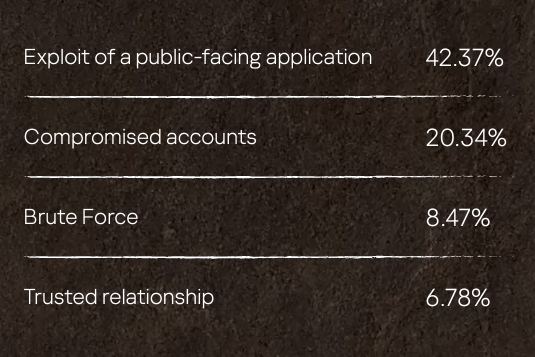
    That’s why insufficient patch management processes on the customer side are one of the most common root causes of incidents we observe in compromise assessment projects. Moreover, exploitation of a public-facing application was the root cause in 42.37% of cases investigated by the Kaspersky Global Emergency Response Team (GERT) in 2023.

    During the investigation of one case, we identified that the web server was patched a month after the attacker infiltrated the network: this delay was a treasure trove for the threat actor, since the organization was left unprotected and the attack went unnoticed.

    • Immediately after compromising the server, the attacker deployed a SILENTTRINITY C2 stager.
    • They attempted to dump credentials via a custom packed version of Mimikatz on the first day, and by dumping the LSASS process memory to disk on the fourth day.
    • During that month, they conducted internal reconnaissance of SMB shares until they obtained the credentials of the domain administrator.

    Policy violations by employees

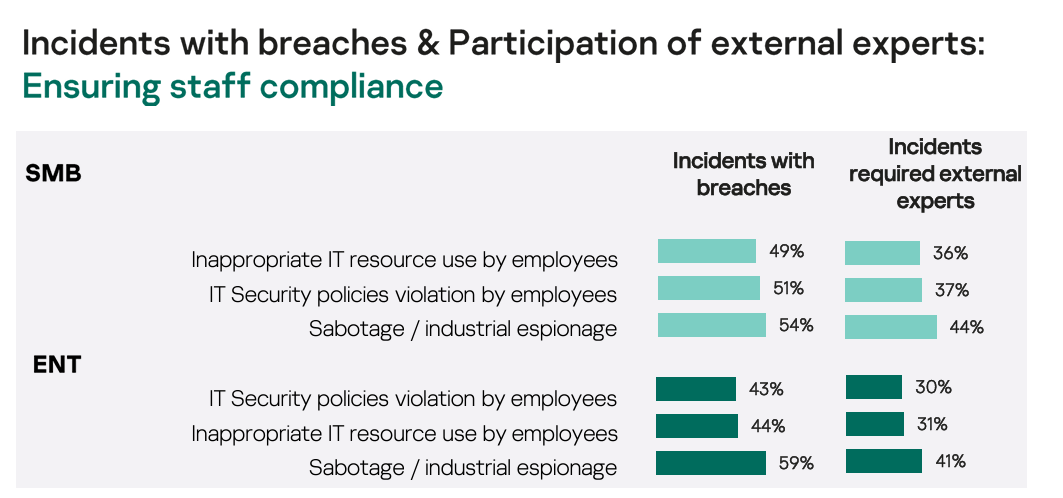
    Most organizations focus on external threats; however, policy violations pose a major risk, with 51% of SMB incidents and 43% of enterprise incidents involving IT security policy violations caused by employees. An “employee” here is any person who has a regular employee’s level of access to the organization’s systems.

    In one of our compromise assessments, we identified an incident whose root cause was traced to a contracted cybersecurity consultant. During an interim report meeting, we presented a list of compromised accounts (a result of darknet search playbook execution) to the customer’s board of directors along with statistics on the accounts on the list. Of all the compromised accounts, 71% belonged to the customer’s employees, with 63% of these being employees’ accounts in the services accessible from outside the company.

    Statistics on the organization’s compromised accounts. Source: Kaspersky Digital Footprint Intelligence

    The list contained a C-level officer’s account, among others. Since this was a critical situation, with everyone suspecting that officer’s laptop had been compromised, we ran a quick investigation during the meeting and figured out that credentials had been leaked from a third-party consultant’s machine. The chairman created an account in an external system with his own corporate email and shared the credentials with the consultant. Since it was clear that consultant’s laptop might contain other confidential data, we developed the following tactical response plan.

    1. Collect a forensic triage package from the consultant’s laptop.
      • Analyze the package to identify all leaked credentials.
      • Check the consultant’s laptop for malware.
      • Run a keyword-based search to identify potential leaked documents.
    2. Review email/VPN/other logs of likely affected services available from outside the organization to detect any abnormal activity by compromised accounts.
    3. Double-check if multi-factor authentication was enabled for the compromised accounts at the time of compromise.
    4. Update the incident response plan based on the findings. Reset the password and install a new OS image on the laptop at a minimum.

    This incident could have been prevented by ensuring that employees and any third party with access to the network followed the policies. This is easy to say but it sometimes gets tricky and requires time, effort and deep technical knowledge in practice.

    MSP/MSSP issues

    Usually, MSSPs are more focused on continuous monitoring and alerting, ignoring detection gaps identification and visibility enhancements: a periodic review of the customer’s event audit policy, enabling a disabled log source or highlighting a poorly configured log source. For example, the X-Forwarded-For HTTP header is often not enabled on web servers. As a result, the SOC can’t see the original IP of the connection and determine the attack source, which complicates incident investigation.

    In our compromise assessment practice, we frequently identify incidents that external SOCs have missed. During one project, we reviewed third-party antivirus logs and identified multiple webshell detections on the same server for several days.

    Day from first exploit attempt File path Verdict Message
    Day 1 C:Windows[redacte
    d for privacy].aspx
    Backdoor.ASP.WEBS
    HELL.SM
    Malicious software deleted
    successfully
    Day 2 C:Windows[redacte
    d for privacy].aspx
    Backdoor.ASP.WEBS
    HELL.SM
    Malicious software deleted
    successfully
    Day 3 C:Windows[redacte
    d for privacy].aspx
    Backdoor.ASP.WEBS
    HELL.SM
    Malicious software deleted
    successfully
    Day 4 C:Windows[redacte
    d for privacy].aspx
    Backdoor.ASP.WEBS
    HELL.SM
    Malicious software deleted
    successfully
    Day 7 C:Program FilesCommon
    Filesmicrosoft sharedWeb
    Server
    Extensions16TEMPLATELA
    YOUTS[redacted for
    privacy].aspx
    Backdoor.ASP.WEBS
    HELL.SM
    Malicious software
    deleted successfully
    Day 9 C:Windows[redacte
    d for privacy].aspx
    Backdoor.ASP.WEBS
    HELL.SM
    Malicious software deleted
    successfully

    The MSSP SOC analysts had failed to raise an alert, because the malware was deleted by the antivirus each time. This is a textbook example of a junior’s mistake. If a motivated adversary has access to the server via a vulnerability, they would try a range of techniques and tactics to try to bypass security. This is where the human analyst’s attention is needed to add an additional layer of protection and prevent this from happening.

    This was exactly our case: the Kaspersky experts initiated deep forensic analysis and found out that the attacker tried different webshells over a few weeks. They finally found one that was not detectable by the AV vendor at the time, so they were able to get into the network. Further investigation revealed that the entire domain remained compromised for several months.

    Monitoring and verifying the quality of service from your MSP or MSSP is often challenging. Contractual agreements typically prevent clients from accessing the provider’s internal systems for a thorough review. Additionally, customers may lack the technical expertise or time required to oversee every action taken by their subcontractors.

    MSPs and subcontractors might not have enough cybersecurity awareness, which poses a challenge, where they might inadvertently expose the network to a cybersecurity risk by misconfiguring some security control or not following the best practice.

    Incomplete incident response

    Post-breach eradication of a threat actor requires planning of multiple actions to ensure complete removal of the attacker from the network or systems:

    • Removal of malware, scripts, tools, and backdoors installed by the attacker.
    • Changing the passwords for the compromised accounts and deleting any unauthorized service accounts that attackers might have created
    • Rolling back system configurations that might increase the attack surface or introduce new vulnerabilities

    Even after the malware is deleted, certain forensic artifacts remain in the system. Therefore, it is common to identify past attacks during compromise assessment. Intentional misconfiguration introduced by an attacker is a rarer case, but we occasionally find that enterprise incident response teams fail to eradicate these procedures.

    As part of the Active Directory configuration review playbook, Kaspersky analysts identified a Group Policy with several suspicious properties.

    1. A modification to the AllowReversiblePasswordEncryption property of each AD account, which made domain controllers store passwords in decryptable form (without using the one-way hash function). This configuration would enable the attacker to dump credentials in plaintext via attacks like DCSync.
    2. Disabling the audit of operations related to Kerberos Tickets. This configuration would hide attacker logons on all endpoints managed via Active Directory.

    False sense of security

    It’s crucial to remember that the effectiveness of even top-tier products is at its highest when these are properly installed, configured, and integrated. Without proper configuration, organizations cannot fully harness the potential of their cybersecurity solutions, which hinders their ability to create a robust defense.

    In our compromise assessment practice, we have witnessed several cases, listed below, which were detected because specialized scanners were deployed alongside an existing AV/EDR solution, providing a second layer of detection capabilities.

    • Absence of detection rules. The customer’s antivirus was unable to detect a pivotnacci webshell because the vendor did not have a defined detection rule.
    • Outdated malware signatures. The client antivirus was unable to detect malware because the network port listening to the central update server was blocked by a firewall, preventing the antivirus from receiving the latest updates.
    • Shadow IT. The customer’s antivirus was not deployed on certain servers because those servers were not part of Active Directory, which left them unprotected.

    Conclusion

    Compromise assessment has proven to be an indispensable component in the broader cybersecurity strategy of these organizations. The cases discussed above underscore that no security measure, no matter how advanced, is entirely foolproof. From internal policy violations to patch management failures and overlooked misconfigurations by third-party service providers, the risks are manifold and often hidden in plain sight. These examples highlight that a false sense of security can be more dangerous than no security at all, as it leaves organizations vulnerable to threats that might have otherwise been detected with thorough, periodic assessments.

    By integrating compromise assessment into the security framework, organizations can uncover these hidden threats, address vulnerabilities that slip through the cracks, and ultimately strengthen their overall security posture. In a world where cyberthreats are constantly evolving, the proactive identification and mitigation of potential compromises is not just advisable but also necessary. This approach ensures that organizations are not only reacting to breaches but are continuously verifying the effectiveness of their defenses, thereby reducing the risk of undetected compromises and safeguarding their assets more effectively.

    MIL OSI Economics

  • MIL-OSI Global: Four reasons weight-loss jabs alone won’t help get people back to work

    Source: The Conversation – UK – By Lucie Nield, Senior Lecturer in Nutrition and Dietetics, Sheffield Hallam University

    Weight-loss injectables don’t address the many core reasons for why weight gain and unemployment occur in the first place. oleschwander/ Shutterstock

    Prime Minister Keir Starmer and health secretary Wes Streeting have recently discussed plans to trial weight-loss injections for around 250,000 people with obesity who are unemployed in a bid to get them back into work, ease pressure on the NHS and boost the economy.

    Obesity is estimated to cost UK society around £35 billion annually. This is due to lower productivity and higher NHS treatment costs.

    Around 26% of the English adult population (approximately 15 million) are considered obese. However, it’s not known what proportion of unemployed people are obese.

    While weight-loss injections have proven to be very effective in helping people who are obese to lose weight and lower their risk of certain chronic diseases, there are many reasons why these drugs alone won’t help tackle obesity and unemployment rates in the UK.

    1. Lack of capacity

    The majority of UK people who are obese are likely to meet the National Institute for Health and Care Excellence’s eligibility criteria for weight-loss injections.

    But prescribing these drugs is just one part of the equation. Eligible patients will require support from specialist services who provide guidance in making the appropriate lifestyle changes (such as to their diet) to successfully lose weight while on these drugs. This is crucial, as all of the weight-loss injection trials to date have involved a behaviour change component. This may potentially be key to the successful weight losses observed in these studies.

    However, current demand for weight-loss services is already outstripping capacity. Nearly half of eligible patients in England are unable to get an appointment with a specialist team. Weight-loss injections can only be prescribed through such services currently. If the government is to roll out the proposed programme, they will need to rethink the way weight-loss services are delivered so all eligible patients can access support.

    2. Won’t work for everyone

    Weight-loss jabs don’t necessarily work for everyone. One study found that 9-15% of participants who took the drug tirzepatide (Mounjaro) did not lose clinically significant amounts of weight.

    Weight-loss jabs may also cause intolerable side-effects for some. Trials have shown between 4-8% of participants couldn’t tolerate the side-effects, causing them to drop out of the study. Constipation, diarrhoea and nausea are some of the most commonly reported.

    People with certain health conditions may be unable to use weight-loss injections – such as those with inflammatory bowel disease and pancreatitis. In such cases, weight-loss jabs may worsen symptoms or interact with the prescription drugs used to manage these conditions, increasing risk of harm.

    There are many reasons why weight-loss jabs may not work for a person.
    Douglas Cliff/ Shutterstock

    Additionally, some people may not want to take an injection – whether that’s simply due to personal preference or even fear of needles.

    3. Obesity is a complex issue

    There are many complex factors that contribute to weight gain – such as opportunities for physical activity, access to healthy foods and levels of deprivation in a community. Prescribing weight-loss jabs to help people lose weight may not be effective long-term if the rest of these factors are not also addressed.

    A more effective way of seeing significant, sustainable reductions in obesity levels across a population is by using a “whole systems approach”. This would address to the multiple environmental, social and economic factors that contribute to obesity.

    Where whole systems approaches have been embedded in healthcare design and delivery, they have led to improvements in services and patient outcomes – including obesity-related metrics (such as patients making healthier food choices and being more active).

    However, one limitation to whole systems approaches is challenges in measuring impact. This can reduce political will to implement these approaches.

    4. Obesity stigma

    Obesity stigma in the workplace is a huge barrier to satisfactory employment and leads to poor wellbeing and burnout.

    Obesity stigma in the workplace perpetuates harmful weight-based stereotypes that overweight and obese people are lazy, unsuccessful, unintelligent and lack willpower. As a result, people with obesity are more likely to be in insecure and lower-paid jobs than those who may be considered of a healthy weight.

    It’s also well-evidenced that regular exposure to stigmatising, isolating and degrading prejudices has long-term consequences on physical and mental health – and may lead to problems such as binge eating and depression.This can lead to a loss of productivity, absenteeism and loneliness.

    Prescribing weight-loss jabs to help a person lose weight doesn’t address the core reasons for why they may have been absent from work or unemployed in the first place. Nor does it help to address the mental health struggles they may still harbour as a result of discrimination they might have experienced.

    5. Barriers to employment

    Weight loss alone does not begin to address the complex physical and mental health reasons for why a person might be unemployed. A person may also be unemployed due to factors such as caring responsibilities or disability.

    Current prescribing restrictions also limit some injections to a maximum of 24 months (although further trials are ongoing). This means that even if a person has successfully lost weight, they may regain that weight again when they stop using the drug. This could mean any health problems they experienced prior to losing weight (and which may have prevented them from being in employment) could reemerge.

    There are better ways of getting people back into work than prescribing weight-loss jabs. Flexible working approaches, for instance, may make it easier for someone who is unemployed due to caring responsibilities or health problems to transition back into employment. Supportive policies and workplace wellbeing programmes may be a more cost-effective way of helping people to overcome barriers, improve their health and transition back into work.

    Lucie Nield has received funding from The National Institute for Health Research (NIHR) for evaluation of children’s weight management services.

    Lucie Nield sits on the Board of Trustees for Darnall Wellbeing (a local community service organisation).

    ref. Four reasons weight-loss jabs alone won’t help get people back to work – https://theconversation.com/four-reasons-weight-loss-jabs-alone-wont-help-get-people-back-to-work-241835

    MIL OSI – Global Reports

  • MIL-OSI Global: Humans evolved to share beds – how your sleeping companions may affect you now

    Source: The Conversation – UK – By Goffredina Spanò, Lecturer in Developmental Cognitive Neuroscience, Kingston University

    Jacob Lund/Shutterstock

    Recent research on animal sleep behaviour has revealed that sleep is influenced by the animals around them. Olive baboons, for instance, sleep less as group sizes increase, while mice can synchronise their rapid eye movement (REM) cycles.

    In western society, many people expect to sleep alone, if not with a romantic partner. But as with other group-living animals, human co-sleeping is common, despite some cultural and age-related variation. And in many cultures, bedsharing with a relative is considered typical.

    Apart from western countries, caregiver-infant co-sleeping is common, with rates as high as 60-100% in parts of South America, Asia and Africa.

    Despite its prevalence, infant co-sleeping is controversial. Some western perspectives, that value self-reliance, argue that sleeping alone promotes self-soothing when the baby wakes in the night. But evolutionary scientists argue that co-sleeping has been important to help keep infants warm and safe throughout human existence.

    Many cultures do not expect babies to self-soothe when they wake in the night and see night wakings as a normal part of breastfeeding and development.

    Concerns about Sudden Infant Death Syndrome (Sids) have often led paediatricians to discourage bed-sharing. However, when studies control for other Sids risk factors including unsafe sleeping surfaces, Sids risk does not seem to differ statistically between co-sleeping and solitary sleeping infants.

    This may be one reason why agencies such as the American Academy of Pediatrics, the National Institute for Health and Care Excellence and the NHS either recommend that infants “sleep in the parents’ room, close to the parents’ bed, but on a separate surface,” or, if bedsharing, to make sure that the infant “sleeps on a firm, flat mattress” without pillows and duvets, rather than discouraging co-sleeping altogether.

    Researchers don’t yet know whether co-sleeping causes differences in sleep or, whether co-sleeping happens because of these differences. However, experiments in the 1990s suggested that co-sleeping can encourage more sustained and frequent bouts of breastfeeding. Using sensors to measure brain activity, this research also suggested that infants’ and caregivers’ sleep may be lighter during co-sleeping. But researchers speculated that this lighter sleep may actually help protect against Sids by providing infants more opportunities to rouse from sleep and develop better control over their respiratory system.

    Other advocates believe that co-sleeping benefits infants’ emotional and mental health by promoting parent-child bonding and aiding infants’ stress hormone regulation. However, current data is inconclusive, with most studies showing mixed findings or no differences between co-sleepers and solitary sleepers with respect to short and long-term mental health.

    Co-sleeping in childhood

    Childhood co-sleeping past infancy is also fairly common according to worldwide surveys. A 2010 survey of over 7,000 UK families found 6% of children were constant bedsharers up to at least four years old.

    Some families adopt co-sleeping in response to their child having trouble sleeping. But child-parent bedsharing in many countries, including some western countries like Sweden where children often co-sleep with parents until school age, is viewed culturally as part of a nurturing environment.

    It’s normal for children to bedshare in many parts of the world.
    Yuri A/ Shutterstock

    It is also common for siblings to share a room or even a bed. A 2021 US study found that over 36% of young children aged three to five years bedshared in some form overnight, whether with caregivers, siblings, pets or some combination. Co-sleeping decreases but is still present among older children, with up to 13.8% of co-sleeping parents in Australia, the UK and other countries reporting that their child was between five and 12 years old when they engaged in co-sleeping.

    Two recent US studies using wrist-worn actigraphs (motion sensors) to track sleep indicated that kids who bedshare may have shorter sleep durations than children who sleep alone. But this shorter sleep duration is not explained by greater disruption during sleep. Instead, bedsharing children may lose sleep by going to bed later than solitary sleepers.

    The benefits and downsides of co-sleeping may also differ in children with conditions such as autism spectrum disorder, mental health disorders and chronic illnesses. These children may experience heightened anxiety, sensory sensitivities and physical discomfort that make falling and staying asleep difficult. For them, co-sleeping can provide reassurance.

    Adults sharing beds

    According to a 2018 survey from the US National Sleep Foundation, 80-89% of adults who live with their significant other share a bed with them. Adult bedsharing has shifted over time from pre-industrial communal arrangements, including whole families and other household guests, to solo sleeping in response to hygiene concerns as germ theory became accepted.

    Many couples find that bedsharing boosts their sense of closeness. Research shows that bedsharing with your partner can lead to longer sleep times and a feeling of better sleep overall.

    Bedsharing couples also often get into sync with each other’s sleep stages, which can enhance that feeling of intimacy. However, it’s not all rosy. Some studies indicate that females in heterosexual relationships may struggle more with sleep quality when bedsharing, as they can be more easily disturbed by their male partner’s movements. Also, bedsharers can have less deep sleep than when sleeping alone, even though they feel like their sleep is better together.

    Many questions about co-sleeping remain unanswered. For instance, we don’t fully understand the developmental effects of co-sleeping on children, or the benefits of co-sleeping for adults beyond female-male romantic partners. But, some work suggests that co-sleeping can comfort us, similar to other forms of social contact, and help to enhance physical synchrony between parents and children.

    Co-sleeping doesn’t have a one-size-fits-all answer. But remember that western norms aren’t necessarily the ones we have evolved with. So consider factors such as sleep disorders, health and age in your decision to co-sleep, rather than what everyone else is doing.

    Gina Mason receives funding from the American Academy of Sleep Medicine Foundation (grant #334-BS-24). The views expressed herein are her own, and do not represent the official views of the Academy or any other professional organization with which she is affiliated.

    Goffredina Spanò does not work for, consult, own shares in or receive funding from any company or organisation that would benefit from this article, and has disclosed no relevant affiliations beyond their academic appointment.

    ref. Humans evolved to share beds – how your sleeping companions may affect you now – https://theconversation.com/humans-evolved-to-share-beds-how-your-sleeping-companions-may-affect-you-now-241803

    MIL OSI – Global Reports

  • MIL-OSI China: Xi holds talks with Finnish president

    Source: People’s Republic of China – State Council News

    BEIJING, Oct. 29 — Chinese President Xi Jinping held talks with Finnish President Alexander Stubb in Beijing on Tuesday.

    Xi noted that Finland was one of the first Western countries to establish diplomatic ties with the People’s Republic of China and the first Western country to sign an intergovernmental trade agreement with China.

    Since the establishment of diplomatic ties, China and Finland have always enjoyed friendly relations based on mutual respect and trust, setting a fine example of state-to-state relations that transcends historical, cultural and institutional differences, and promotes equal exchanges, Xi said.

    “As the world is undergoing accelerated changes unseen in a century and the risks and challenges facing human society are increasing, the future-oriented new-type cooperative partnership between China and Finland holds exceptional value and should be cherished and advanced,” Xi said.

    China is willing to work with Finland to strengthen strategic cooperation, carry forward friendly traditions, and further advance this cooperative partnership to better benefit the two countries and peoples and make new contributions to world peace and development, Xi added.

    MIL OSI China News

  • MIL-OSI China: China to experience warmer November: meteorologist

    Source: People’s Republic of China – State Council News

    BEIJING, Oct. 29 — Most parts of China are expected to register above-normal temperatures in November this year, according to the National Climate Center on Tuesday.

    Specifically, temperatures in parts of northeastern, northwestern, northern and eastern China will be notably higher next month, said Jia Xiaolong, deputy head of the center, at a press conference.

    High temperatures, dry and windy weather and less precipitation will increase the risks of meteorological drought, as well as forest and grassland fires in parts of eastern and central China, as well as Yunnan Province in the southwest, said Jia.

    Provincial-level regions of Inner Mongolia, Heilongjiang, Xinjiang, Jiangsu, Shanghai, Zhejiang and Hainan will see more rainfall in November, said Jia.

    He advised areas expecting more precipitation in November to take preventive measures against the adverse effects of low temperatures and rain and snow-related disasters on transportation, energy, electricity and people’s health.

    MIL OSI China News

  • MIL-OSI Security: Defense News: Ceremonial Signing Celebrates Department of the Navy-Sourcewell Partnership

    Source: United States Navy

    Brenda Johnson-Turner, Deputy Assistant Secretary of the Navy for Installations and Facilities, along with senior leaders from the Navy and Marine Corps signed the new agreement with Sourcewell representatives at the Defense Communities Installation Innovation Forum conference in San Antonio, TX, Oct. 28. 

    “I am truly excited about our new agreement with Sourcewell,” stated Ms. Johnson-Turner, “as a department, we must use the authorities Congress grants in innovative and sound ways to meet our installation missions in a fiscally constrained environment.  The IGSA authority is a terrific tool, and this particular agreement with Sourcewell will provide new opportunities for our Navy and Marine Corps teams to ensure our installations are ready to support the needs of our warfighters.”

    The agreement aims to increase Navy and Marine Corps buying power by decreasing procurement costs and delivery timelines for various installation-support services, supplies, and equipment. It also allows Navy and Marine Corps installations to leverage Sourcewell’s extensive list of competitively awarded contracts to procure goods and services faster.  This translates to increased opportunity to buy down risk to naval missions and forces by ensuring U.S. tax dollars approved for Department of the Navy spending go further in meeting infrastructure and base support requirements.  Installations will be able to request Sourcewell’s services in key areas to include installation supplies, equipment, services, and small-scale construction projects.

    “It’s an honor to work with Navy and Marine Corps installations, providing efficient and effective support so they can achieve mission success,” said Dr. Chad Coauette, Sourcewell Chief Executive Officer. “This agreement enables our team to work with installation leadership to procure goods and services through local businesses whenever possible. By awarding supplier contracts at the corporate level, Sourcewell makes it possible for installations to work with local authorized dealers and contractors.”

    This is the second IGSA between Sourcewell and a Department of Defense military department. Earlier this year, Sourcewell signed a similar agreement with the U.S. Army.

    MIL Security OSI

  • MIL-OSI Europe: Malware targeting millions of people taken down by international coalition

    Source: European Union 2

    A global operation, supported by Eurojust, has led to the takedown of servers of infostealers, a type of malware used to steal personal data and conduct cybercrimes worldwide. With millions targeted, it was one of the largest malware platforms globally. Learn more.

    MIL OSI Europe News

  • MIL-OSI United Nations: Deputy Secretary-General’s remarks at the 110th Meeting of the Development Committee

    Source: United Nations secretary general

    Chair,

    Excellencies,

    Let me begin by acknowledging the inspired leadership of Ajay and Kristalina, and thanking them for their support at the UN High-Level Week.

    This week, our global economy has been diagnosed as suffering from low growth, and high debt.

    This toxic combination further exacerbates a sustainable development crisis for millions of people across the world.

    With only 17 per cent of SDG targets on track, hunger is rising, global temperatures are soaring, conflicts are spreading, and the fight for gender equality is floundering.

    Financing challenges are at the heart of this crisis.

    Financing gaps are growing.

    Debt service is crowding out investments.

    And economies are repeatedly rocked by external shocks that our financial system cannot contain.

    Last month, against geopolitical tensions, Heads of States from the Global North and South agreed a Pact for the Future.

    The Pact lays the foundations for a future-ready world.

    It commits to deepen multilateralism to rescue the SDGs;

    To guide us through a new era of technology;

    to renew our approach to restoring and keeping peace;

    and to accelerate reform of the international financial architecture to reflect today’s world and meet today’s challenges.

    Here, the Pact urges specific actions:

    To raise the voice and representation of developing countries…

    To scale up development finance…

    To promote sustainable borrowing, and resolve debt crises as and before they occur…

    And to strengthen the global safety net. 

    Agreements reached at the United Nations cannot deliver change overnight. But they provide a powerful political signal for action in other fora – including this one.

    Over the last two weeks, we have seen important steps forward.

    The World Bank’s reduction of its equity to loan ratio frees up an additional $30 billion in lending.

    And the IMF’s overhaul of its surcharge policy will lessen the penalty borne by countries most dependent on support.

    We must now build on these steps, with urgency, to meet the needs and expectations of Member States and their people.

    This brings me to one commitment that we must deliver this year.

    IDA is the largest and most powerful instrument of financial assistance to the world’s poorest and most vulnerable countries.

     That’s why the Pact for the Future urges Member States to deliver a robust 21st replenishment, to enable IDA to continue its vital work.

    The Secretary-General and I wholeheartedly endorse this.

    Another commitment is to seize the opportunity approved by the Fund to rechannel SDRs to acquire hybrid capital in our multilateral development banks. Champions of this initiative believe we can get this done by next month’s G20 summit.   

    I look forward to working with the Bank and Fund to deliver other commitments in the Pact: from reviewing the sovereign debt architecture, to improving access to concessional finance.

    With next year’s Fourth International Conference on Financing for Development, we have a once-in-a-decade opportunity to transform financing for sustainable development to deliver the SDGs.

    To do this for a future ready World Bank, we must work better together at the country level surging combined expertise and resources in support of our commitments to countries and their people.

    Let’s work together to deliver this.

    Thank you.

    MIL OSI United Nations News

  • MIL-OSI Canada: Seizure of contraband and unauthorized items at Millhaven Institution

    Source: Government of Canada News (2)

    On October 24, 2024, as a result of the vigilance of staff members, a package containing contraband and unauthorized items was seized at Millhaven Institution, a maximum-security federal institution.

    October 29, 2024 – Kingston, Ontario – Correctional Service Canada

    On October 24, 2024, as a result of the vigilance of staff members, a package containing contraband and unauthorized items was seized at Millhaven Institution, a maximum-security federal institution.

    The items seized included tobacco, crystal methamphetamine, an edged weapon, as well as a cell phone and cell phone accessory. The total estimated institutional value of this seizure is $196,400.

    The Correctional Service of Canada (CSC) uses a number of tools to prevent drugs from entering its institutions. These tools include ion scanners and drug-detector dogs to search buildings, personal property, inmates, and visitors.

    CSC has heightened measures to prevent contraband from entering its institutions in order to help ensure a safe and secure environment for everyone. CSC also works in partnership with the police to take action against those who attempt to introduce contraband into correctional institutions.

    CSC has also set up a telephone tip line for all federal institutions so that it may receive additional information about activities relating to security at CSC institutions. These activities may be related to drug use or trafficking that may threaten the safety and security of visitors, inmates, and staff members working at CSC institutions.

    The toll-free number, 1‑866‑780‑3784, helps ensure that the information shared is protected and that callers remain anonymous.

    Mike Shrider
    Regional Communications Manager
    Regional Headquarters, Ontario
    GEN-ONT-MEDIA@csc-scc.gc.ca
    613-530-6941

    MIL OSI Canada News

  • MIL-OSI USA: DoD Releases National Defense Industrial Strategy Implementation Plan

    Source: United States Department of Defense

    The Department of Defense (DoD) today published the unclassified National Defense Industrial Strategy Implementation Plan (NDIS-IP), detailing how the DoD will achieve the four strategic priorities laid out in the NDIS. Released by the Office of the Assistant Secretary of Defense for Industrial Base Policy (OASD(IBP)), the document outlines ongoing and future actions that DoD is currently taking, and will continue to take, to modernize the defense industrial base.

    The NDIS-IP describes six cross-cutting initiatives, and associated lines of effort, that will enable the DoD to achieve a more resilient defense industrial ecosystem and buy-down risks. In addition to detailing the work being done across the Services and DoD components, the NDIS-IP demonstrates activities and initiatives which the U.S. Government, private industry, and international allies and stakeholders are undertaking, emphasizing that this effort cannot be a DoD-only initiative.

    “This implementation plan offers industry, global allies, and partners clear direction on the Department’s priorities for industrial capacity building” said Assistant Secretary of Defense for Industrial Base Policy, Dr. Laura Taylor-Kale. “Implementing these initiatives will require coordinated efforts across the DoD, and support and cooperation from our interagency, industry, and international stakeholders, as well as our champions in Congress.” 

    To further demonstrate the NDIS “in action,” the OASD(IBP) announced another Defense Industrial Base Consortium (DIBC) Other Transaction Agreement (OTA) request for white papers (RWP) for “Critical Chemicals for Defense” in September. The DIBC OTA enables rapid research and allows access to commercial solutions for defense requirements and innovations from industry, academia, and non-traditional contractors. More information about the DIBC OTA and the newest RWP can be found at the DIBC’s website.

    An NDIS-IP Classified Annex is forthcoming and will further detail vulnerabilities and articulate the necessary steps the DoD is taking to ensure its resilience and strength.

    The unclassified NDIS-IP is available at: https://www.businessdefense.gov/docs/ndis/NDIS-Implementation-Plan-FY2025.pdf.

    MIL OSI USA News

  • MIL-OSI USA: IAM Air Transport, Rail Leaders Elected to Top ITF Positions as Transportation Workers Unite in Global Solidarity; Put Women, Young Workers at Forefront

    Source: US GOIAM Union

    IAM air transport and rail industry leaders from across the United States and Canada were elected to top positions at the recent International Transport Workers’ Federation (ITF) Global Congress.

    The IAM, North America’s largest transportation union, is taking a leading role worldwide as transport workers find themselves at the forefront of multiple crises – from war, political instability and the rise of far-right governments to the climate crisis.

    “The IAM has long known that our strength relies greatly on workers uniting worldwide to confront the multi-national corporations we deal with every day,” said IAM Air Transport Territory General Vice President Richie Johnsen. “Together with the ITF and its affiliates in the transportation sector, we are closer than ever to balancing the scales for industry workers across the globe.”

    The Congress, held in Marrakech, Morocco, focused on building a comprehensive vision for the ITF for the next five years. Six critical demands – rights, equality, safety, accountability, sustainability and a future that works for workers – are forming the basis to build a safer, fairer and more sustainable transport industry.

    “As the theme of this ITF Congress says, the IAM has always been proud to move the world forward,” said IAM Air Transport Territory Chief of Staff Edison Fraser. “As we turn the page from a global pandemic, it is more important than ever that transportation workers across the world unite.”

    The following IAM leaders were elected to ITF positions:

    • Richie Johnsen, IAM Air Transport Territory General Vice President: ITF Executive Board
    • Edison Fraser, IAM Air Transport Territory Chief of Staff: ITF North America and Caribbean Civil Aviation Chairperson
    • Arthur Maratea, TCU/IAM National President: ITF Railway Workers Section Co-Chair
    • Julie Frietchen, IAM Women’s and Young Workers Director: ITF North America Regional Representative USA – Women’s Committee
    • Keith Aiken, IAM Canadian Airline Coordinator: ITF Vice Chairperson – Ground Handling Committee
    • Zach Coker, IAM District 142 Organizing Director: ITF North America Regional Representative USA – Young Workers

    “Rail workers are standing up and fighting back against corporate greed and the short-sighted profit goals of Wall Street,” said TCU/IAM National President Arthur Maratea. “It’s critical that these fights be waged on at a global scale and with the backing of every rail worker across the world.”

    The ITF represents 18.5 million transport workers worldwide from more than 150 countries.

    “Women and young people are helping to lead a worldwide resurgence of union activism,” said IAM Women’s and Young Workers Director Julie Frietchen. “In the IAM and the ITF, we are proud to be leading the way toward making our diversity our greatest strength.”

    Click here for more coverage of ITF’s 46th Congress, the first of which to be held in the Arab world.

    “The strength of the IAM has always been our ability to bring workers together and fight for a common cause,” said IAM Canadian Airline Coordinator Keith Aiken. “Transportation workers in Canada and across the globe are ready for a new era of worker power that transforms our industries for the betterment of working families and passengers.”

    Share and Follow:

    MIL OSI USA News

  • MIL-OSI USA: New NASA Instrument for Studying Snowpack Completes Airborne Testing

    Source: NASA

    The Rocky Mountains in Colorado, as seen from the International Space Station. Snowmelt from the mountainous western United States is an essential natural resource, making up as much as 75% of some states’ annual freshwater supply.

    Summer heat has significant effects in the mountainous regions of the western United States. Melted snow washes from snowy peaks into the rivers, reservoirs, and streams that supply millions of Americans with freshwater—as much as 75% of the annual freshwater supply for some states.

    But as climate change brings winter temperatures to new highs, these summer rushes of freshwater can sometimes slow to a trickle.

    “The runoff supports cities most people wouldn’t expect,” explained Chris Derksen, a glaciologist and Research Scientist with Environment and Climate Change Canada. “Big cities like San Francisco and Los Angeles get water from snowmelt.”

    To forecast snowmelt with greater accuracy, NASA’s Earth Science Technology Office (ESTO) and a team of researchers from the University of Massachusetts, Amherst, are developing SNOWWI, a dual-frequency synthetic aperture radar that could one day be the cornerstone of future missions dedicated to measuring snow mass on a global scale – something the science community lacks.

    SNOWWI aims to fill this technology gap. In January and March 2024, the SNOWWI research team passed a key milestone, flying their prototype for the first time aboard a small, twin-engine aircraft in Grand Mesa, Colorado, and gathering useful data on the area’s winter snowfields.

    “I’d say the big development is that we’ve gone from pieces of hardware in a lab to something that makes meaningful data,” explained Paul Siqueira, professor of engineering at the University of Massachusetts, Amherst, and principal investigator for SNOWWI.

    SNOWWI stands for Snow Water-equivalent Wide Swath Interferometer and Scatterometer. The instrument probes snowpack with two Ku-band radar signals: a high-frequency signal that interacts with individual snow grains, and a low-frequency signal that passes through the snowpack to the ground. 

    The high-frequency signal gives researchers a clear look at the consistency of the snowpack, while the low-frequency signal helps researchers determine its total depth.

    “Having two frequencies allows us to better separate the influence of the snow microstructure from the influence of the snow depth,” said Derksen, who participated in the Grand Mesa field campaign. “One frequency is good, two frequencies are better.”

    The SNOWWI team in Grand Mesa, preparing to flight test their instrument. From an altitude of 4 kilometers (2.5 miles), SNOWWI can map 100 square kilometers (about 38 square miles) in just 30 minutes.

    As both of those scattered signals interact with the snowpack and bounce back towards the instrument, they lose energy. SNOWWI measures that lost energy, and researchers later correlate those losses to features within the snowpack, especially its depth, density, and mass.

    From an airborne platform with an altitude of 2.5 miles (4 kilometers), SNOWWI could map 40 square miles (100 square kilometers) of snowy terrain in just 30 minutes. From space, SNOWWI’s coverage would be even greater. Siqueira is working with Capella Space to develop a space-ready SNOWWI for satellite missions.

    But there’s still much work to be done before SNOWWI visits space. Siqueira plans to lead another field campaign, this time in the mountains of Idaho. Grand Mesa is relatively flat, and Siqueira wants to see how well SNOWWI can measure snowpack tucked in the folds of complex, asymmetrical terrain.

    For Derksen, who spends much of his time quantifying the freshwater content of snowpack in Canada, having a reliable database of global snowpack measurements would be game-changing.

    “Snowmelt is money. It has intrinsic economic value,” he said. “If you want your salmon to run in mountain streams in the spring, you must have snowmelt. But unlike other natural resources, at this time, we really can’t monitor it very well.”

    For information about opportunities to collaborate with NASA on novel, Earth-observing instruments, see ESTO’s catalog of open solicitations with its Instrument Incubator Program here.

    Project Leads: Dr. Paul Siqueira, University of Massachusetts (Principal Investigator); Hans-Peter Marshall, University of Idaho (Co-Investigator)

    Sponsoring Organizations: NASA’s Earth Science Technology Office (ESTO), Instrument Incubator Program (IIP)

    MIL OSI USA News

  • MIL-OSI USA: Public-Private Analytic Exchange Program Virtual Fall Info Session #7

    Source: US Department of Homeland Security

    Headline: Public-Private Analytic Exchange Program Virtual Fall Info Session #7

    Public-Private Analytic Exchange Program Virtual Fall Info Session #7
    jesse.kerzner

    The Public-Private Analytic Exchange Program (AEP), sponsored by the Department of Homeland Security’s Office of Intelligence and Analysis on behalf of the Office of the Director of National Intelligence, invite you to attend the upcoming AEP Virtual Fall Info Session #7. 

    The AEP facilitates collaborative partnerships between private and public sector analysts by forming several teams to address national and homeland security issues. Participants work to create unclassified joint analytic deliverables of interest to both the private and public sector. You must be a U.S. Citizen to participate.

    The AEP info session includes a detailed program overview, the importance of the program, the relationships built between the public and private sector, and how to apply. You will hear former AEP participants share their experience. We encourage everyone to come with questions for discussion!

    The information session will be held on Tuesday, October 29, 2024, from 12:00 pm to 12:45 pm ET. 

    Click here to register for the October 29th information session.

    To learn more about how to apply to the 2025 AEP, please visit our website or email the AEP Staff at AEP@hq.dhs.gov

    MIL OSI USA News

  • MIL-OSI USA: Public-Private Analytic Exchange Program Virtual Fall Info Session #8

    Source: US Department of Homeland Security

    Headline: Public-Private Analytic Exchange Program Virtual Fall Info Session #8

    Public-Private Analytic Exchange Program Virtual Fall Info Session #8
    jesse.kerzner

    The Public-Private Analytic Exchange Program (AEP), sponsored by the Department of Homeland Security’s Office of Intelligence and Analysis on behalf of the Office of the Director of National Intelligence, invite you to attend the upcoming AEP Virtual Fall Info Session #8. 

    The AEP facilitates collaborative partnerships between private sector and government analysts to form several teams to address national and homeland security issues. Participants work to create unclassified joint analytic deliverables of interest to both the private and public sector. You must be a U.S. Citizen to participate.

    The AEP info session will include a detailed program overview, the importance of the program, the relationships built between the public and private sector, and how to apply. You will hear former AEP participants share their experience. We encourage everyone to come with questions for discussion!

    The information session will be held on Wednesday, October 30, 2024, from 2:00 pm to 2:45 pm ET. 

    Click here to register for the October 30th information session.

    To learn more about how to apply to the 2025 AEP, please visit our website or email the AEP Staff at AEP@hq.dhs.gov

    MIL OSI USA News

  • MIL-OSI Security: Elsipogtog — Man arrested and charged in connection with Elsipogtog arson and mischief

    Source: Royal Canadian Mounted Police

    The Elsipogtog RCMP Detachment has arrested a 29-year-old man in connection with an arson and mischief in Elsipogtog.

    On October 23, 2024, at approximately 8:20 p.m., members working at the Elsipogtog RCMP Detachment heard a loud bang. A short time later, it was discovered that the detachment building and one unmarked police vehicle had been vandalized. The same night at approximately 8:41 p.m., police received a report of a residence on fire on Levi Street in Elsipogtog.

    Upon investigation, police were able to identify a person of interest. A 29-year-old man from Elsipogtog First Nation was located and arrested without incident.

    On October 25, 2024, 29-year-old Sonny Travis Bayley Francis appeared in Moncton Provincial Court where he was charged with:

    – Arson
    – Two counts of mischief under $5000
    – Three counts of failure to comply with a release order

    He was remanded in custody and is scheduled to return to court on November 8, 2024, for a bail hearing.

    Anyone with information that could help further the investigation is asked to contact the Elsipogtog RCMP Detachment at 506-523-8282. Information can also be provided anonymously through Crime Stoppers by calling 1-800-222-TIPS (8477), by downloading the secure P3 Mobile App, or by Secure Web Tips at www.crimenb.ca.

    The investigation is ongoing.

    MIL Security OSI

  • MIL-OSI: MEF’s Enterprise Leadership Council Triples in Size, Driving Key Initiatives in Service Automation, Cybersecurity, and AI-Ops

    Source: GlobeNewswire (MIL-OSI)

    DALLAS, Oct. 29, 2024 (GLOBE NEWSWIRE) — MEF, a global industry association of network, cloud, security, and technology providers accelerating enterprise digital transformation, today announced the expansion of its Enterprise Leadership Council (ELC) from four founding members to 14 leaders representing a diverse range of industries. Formed one year ago, the ELC now includes executives from sectors such as entertainment, financial services, banking, retail, technology, healthcare, and consulting.

    This expansion highlights MEF’s commitment to providing real value to enterprises exploring Network-as-a-Service (NaaS) opportunities, reinforcing its role as an independent platform where enterprises, service providers, cloud, technology companies, and other key stakeholders, collaborate on initiatives shaping the future of the digital ecosystem. With expanded enterprise participation, the organization is poised to drive impactful projects that address cloud, network, and security challenges head-on, propelling innovation across industries.

    The ELC’s growth also reflects the increasing importance of enterprise perspectives in shaping MEF’s NaaS-related work. By tripling its membership in just one year, the council now offers a broader and more comprehensive view of enterprise needs across various sectors and has begun shaping strategic initiatives in areas such as service automation, cybersecurity services, compliance, and AI-Ops. 

    The ELC includes:

    • Francisco Artes, Vice President, Product & Enterprise Security, Roku
    • Nabil Bitar, Chief Technology Officer & Head of Network Architecture, Bloomberg LP
    • Maxime Bruynbroeck, Head of Network, Decathlon
    • Chris Carmody, Chief Technology Officer & Senior Vice President, Information Technology Division, UPMC
    • Daniel Foo, Head of Grabber Technology Solutions (GTS), Grab
    • Michael Jenkins, Strategic Negotiator, Google Enterprise Network
    • Amin Jerraya, Senior Vice President, Head of IT Digital Engagement and Infrastructure, Siemens Healthineers
    • Mark Looker, Managing Director and Head of Voice & Data Network Service, Morgan Stanley
    • Raleigh Mann, Senior Vice President of Technology, Williams-Sonoma, Inc.
    • Amo Mann, Chief Architect for Cloud and Network, Accenture
    • Chema San José, Head of Data & AI Architecture – CTO Global, Santander Digital Services
    • Neal Secher, Vice President, Head of Network Services, TD Bank
    • Jonathan Sheldrake, Vice President of IT – Infrastructure & Services, Burberry
    • Alejandro Tozer, Independent

    “The expansion of the Enterprise Leadership Council marks a pivotal moment in MEF’s evolution,” said Sunil Khandekar, Chief Enterprise Development Officer, MEF. “By amplifying the enterprise voice, we’re not only responding to current industry needs, but anticipating future ones. The ELC’s diverse expertise is already shaping MEF’s NaaS initiatives, which will drive real solutions for today’s challenges and lay the foundation for tomorrow’s innovations. This level of collaboration sets a new standard for how industry associations can lead meaningful progress.”

    A first initiative for the ELC is MEF’s recently launched Lifecycle Service Orchestration (LSO) Circuit Impairment & Maintenance (CIM) Service API, designed to enable service providers to automate and standardize how network circuit impairments and scheduled maintenance are communicated to enterprises. The CIM Service API will be showcased during a live demonstration at MEF’s Global NaaS Event (GNE) this week in Dallas, highlighting how enterprises can collaborate with service providers to proactively identify and address impairments and streamline network maintenance.

    As ELC-led initiatives continue to advance, MEF is attracting more enterprises eager to collaborate with technology, cloud, and service providers on MEF’s independent platform. Together, they contribute to and benefit from solutions that address critical needs in cloud, network, and cybersecurity infrastructure, accelerating digital transformation across sectors.

    Learn More
    Enterprises interested in joining MEF and contributing to projects that directly address their needs are encouraged to visit www.mef.net for more information on membership and engagement opportunities.

    About MEF
    MEF is a global consortium of service, cloud, cybersecurity, and technology providers collaborating to accelerate enterprise digital transformation. It delivers standards-based frameworks, services, technologies, APIs, and certification programs to enable Network-as-a-Service (NaaS) across an automated ecosystem. MEF is the defining authority for certified Lifecycle Service Orchestration (LSO) business and operational APIs and Carrier Ethernet, SASE, SD-WAN, Zero Trust, and Security Service Edge (SSE) technologies and services. MEF’s Global NaaS Event (GNE) convenes industry leaders building and delivering the next generation of NaaS solutions. For more information about MEF, visit MEF.net and follow us on LinkedIn and Twitter.

    Media Contact:
    Melissa Power
    MEF
    pr@mef.net

    The MIL Network

  • MIL-OSI: MEF Reports Significant Momentum in LSO API Adoption and Innovation

    Source: GlobeNewswire (MIL-OSI)

    DALLAS, Oct. 29, 2024 (GLOBE NEWSWIRE) — MEF, a global industry association of network, cloud, security, and technology providers accelerating enterprise digital transformation, today announced unprecedented momentum in its Lifecycle Service Orchestration (LSO) API adoption and innovation, with more than 160 global service providers from 65 countries involved in the adoption lifecycle. This momentum is underscored by MEF’s transformative initiatives, including an enhanced enterprise API portfolio, the innovative LSO Payload Factory program and new smart contracts work. These initiatives, coupled with new certification programs and LSO partner-finding tools, mark major progress in MEF’s mission to accelerate NaaS automation and digital transformation across the global NaaS ecosystem.

    “The rapid adoption of MEF’s LSO APIs across our global ecosystem reflects an ongoing shift towards automated, standardized service delivery,” said Daniel Bar Lev, Chief Product Officer, MEF. “With expanded capabilities for enterprises, the LSO Payload Factory program, and blockchain-driven smart contracts, we’re enabling a new standard of efficiency and flexibility in Network-as-a-Service. MEF’s commitment to collaboration and innovation ensures that every stakeholder in our ecosystem—from service providers to enterprises—can leverage open standards to deliver seamless, automated experiences.”

    Key Progress / LSO Developments

    Enterprise API Innovation
    Over the past year, MEF has expanded its APIs for business to also serve enterprises, enhancing the LSO offering and driving broader industry adoption. A key example is MEF’s Circuit Impairment & Maintenance (CIM) Service API, which bridges the gap between networks and applications, supporting the growing focus on network APIs. Demonstrated at GNE 2024 by AT&T, Bloomberg, Prodapt, UMPC, Verizon, and Williams-Sonoma, the CIM Service API exemplifies how real-time notifications can improve network management for enterprises. Through these open-standard APIs, enterprises gain access to NaaS capabilities, such as automated ecosystems, multi-domain connectivity, and enhanced management and visibility.

    Industry Standardization & Collaboration
    Its commitment to industry-wide API standardization has yielded significant results through MEF’s strategic industry collaborations with TM Forum and others. The coordinated approach enables each standards organization to focus on their core strengths while ensuring seamless integration across the ecosystem. For example, MEF LSO APIs provide business and operational automation between parties in an ecosystem while TM Forum Open API standards provide automation within each ecosystem partner’s systems.

    LSO Payload Factory Program
    The new LSO Payload Factory program accelerates the standardization of machine-readable product descriptions for use in NaaS offerings. This innovative approach enables rapid development of pre-standard product payloads through member collaboration, which can be standardized in a later phase, addressing the market’s need for faster introduction of connectivity, cybersecurity, clouds, and resource products.

    Blockchain Integration
    MEF is pioneering the integration of blockchain technology and smart contracts in automated NaaS ecosystems to eliminate business friction between buyers and sellers. Through its adoption of a groundbreaking ‘mutual endorsement in real-time’ approach, MEF has become the first telecom industry consortium to standardize blockchain usage for business between ecosystem partners. This innovation was demonstrated in a NaaS Accelerator project, where members successfully developed and piloted automated SLA reporting—creating the industry’s first smart contract-based solution that ensures immediate agreement between parties and dramatically reduces service delivery disputes.

    Future Roadmap and Initiatives

    Product Payload Evolution
    MEF’s LSO product payload roadmap continues to expand with significant additions planned for Q4 2024, including standardized descriptions for wavelength services, cloud connectivity, cross-connects, Internet access, edge compute, and CAMARA Quality on Demand. This growing portfolio of standardized payloads, developed through the LSO Payload Factory program, will enable service providers to rapidly integrate new services into their NaaS offerings throughout 2025, accelerating time-to-market for innovative network services.

    LSO API Certification Program
    A new phase of MEF’s LSO API Certification Program will launch in Q4 2024, combining development-stage IT testing with market-ready certification validation. The updated certification framework provides definitive proof of LSO API interoperability readiness for service providers and enterprises. As API-driven automation becomes increasingly critical for business operations, MEF’s certification program ensures participants can confidently engage in standardized, interoperable API implementations across the NaaS ecosystem.

    LSO Partner Identification Tools
    A comprehensive interoperable partner identification platform will launch in Q4 2024 that will dramatically speed up the connection of LSO API implementers with potential partners. This dynamic platform will provide real-time visibility into the LSO API capabilities of participants, enabling companies to quickly identify and engage with compatible partners.

    More information
    More information on the MEF’s LSO API portfolio and all available assets can be found on the MEF’s LSO Marketplace. MEF’s LSO API onboarding and interoperability test (OIT) service can be found on MEF.net.

    Many of the companies in production or committed to production with LSO APIs can be found in the LSO Partners Directory.

    About MEF
    MEF is a global consortium of service, cloud, cybersecurity, and technology providers collaborating to accelerate enterprise digital transformation. It delivers standards-based frameworks, services, technologies, APIs, and certification programs to enable Network-as-a-Service (NaaS) across an automated ecosystem. MEF is the defining authority for certified Lifecycle Service Orchestration (LSO) business and operational APIs and Carrier Ethernet, SASE, SD-WAN, Zero Trust, and Security Service Edge (SSE) technologies and services. MEF’s Global NaaS Event (GNE) convenes industry leaders building and delivering the next generation of NaaS solutions. For more information about MEF, visit MEF.net and follow us on LinkedIn and Twitter.

    Media Contact:
    Melissa Power
    MEF
    pr@mef.net

    The MIL Network

  • MIL-OSI USA: SBA Stands Ready to Assist Havasupai Tribe Businesses and Residents Affected by the Flooding

    Source: United States Small Business Administration

    “As communities across the Southeast continue to recover and rebuild after Hurricanes Helene and Milton, the SBA remains focused on its mission to provide support to small businesses to help stabilize local economies, even in the face of diminished disaster funding,” said Administrator Isabel Casillas Guzman. “If your business has sustained physical damage, or you’ve lost inventory, equipment or revenues, the SBA will help you navigate the resources available and work with you at our recovery centers or with our customer service specialists in person and online so you can fully submit your disaster loan application and be ready to receive financial relief as soon as funds are replenished.”

    SACRAMENTO, Calif. – Low-interest federal disaster loans are now available to Havasupai Tribe businesses and residents as a result of President Biden’s major disaster declaration, U.S. Small Business Administration’s Administrator Isabel Casillas Guzman announced.

    The declaration covers the Havasupai Tribe as a result of the flooding that occurred Aug. 22-23.

    Businesses of all sizes and private nonprofit organizations may borrow up to $2 million to repair or replace damaged or destroyed real estate, machinery and equipment, inventory and other business assets.

    For small businesses, small agricultural cooperatives, small businesses engaged in aquaculture and most private nonprofit organizations of any size, SBA offers Economic Injury Disaster Loans to help meet working capital needs caused by the disaster. Economic injury assistance is available to businesses regardless of any property damage.

    “SBA’s disaster loan program offers an important advantage–the chance to incorporate measures that can reduce the risk of future damage,” said Francisco Sánchez, Jr., associate administrator for the Office of Disaster Recovery and Resilience at the Small Business Administration. “Work with contractors and mitigation professionals to strengthen your property and take advantage of the opportunity to request additional SBA disaster loan funds for these proactive improvements.”

    Disaster loans up to $500,000 are available to homeowners to repair or replace damaged or destroyed real estate. Homeowners and renters are eligible for up to $100,000 to repair or replace damaged or destroyed personal property, including personal vehicles.

    Interest rates can be as low as 4 percent for businesses, 3.25 percent for private nonprofit organizations and 2.813 percent for homeowners and renters with terms up to 30 years. Loan amounts and terms are set by SBA and are based on each applicant’s financial condition.

    Interest does not begin to accrue until 12 months from the date of the first disaster loan disbursement. SBA disaster loan repayment begins 12 months from the date of the first disbursement.

    On October 15, 2024, it was announced that funds for the Disaster Loan Program have been fully expended. While no new loans can be issued until Congress appropriates additional funding, we remain committed to supporting disaster survivors. Applications will continue to be accepted and processed to ensure individuals and businesses are prepared to receive assistance once funding becomes available.

    Applicants are encouraged to submit their loan applications promptly for review in anticipation of future funding.

    As soon as Federal-State Disaster Recovery Centers open throughout the affected area, SBA will provide one-on-one assistance to disaster loan applicants. Additional information and details on the location of disaster recovery centers is available by calling the SBA Customer Service Center at (800) 659-2955.

    ###

    About the U.S. Small Business Administration

    The U.S. Small Business Administration helps power the American dream of business ownership. As the only go-to resource and voice for small businesses backed by the strength of the federal government, the SBA empowers entrepreneurs and small business owners with the resources and support they need to start, grow, expand their businesses, or recover from a declared disaster. It delivers services through an extensive network of SBA field offices and partnerships with public and private organizations. To learn more, visit www.sba.gov.

    MIL OSI USA News

  • MIL-OSI USA: Time Is Running Out!

    Source: US Federal Emergency Management Agency 2

    strong>Harrisburg, Penn — If you haven’t applied for federal disaster assistance from FEMA, time is running out. 
    The deadline for applications is November 12. If you live in Lycoming, Potter, Tioga or Union County and suffered loss of personal property or damage to your home due to Tropical Storm Debby on Aug. 9 -10, 2024, you should apply as soon as possible. 
    There are four ways to apply.  You can:

    Call the FEMA Helpline at 800-621-3362
    Go online to DisasterAssistance.gov
    Download the FEMA App
    Visit the remaining Disaster Recovery Center at 

    Tioga County: Valley Christian Church, 146 Maple Street, Westfield, PA 16950 

    Normal Hours of Operation: 8 a.m. to 6 p.m., Monday thru Saturday
    Election Day, Nov. 5: Temporarily Closed for the Day
    Veteran’s Day, Nov. 11: Hours of Operation: 10 a.m. to 5 p.m.

    November 12 will be here before you know it. Don’t delay! Register today
    For more information about the disaster recovery operation in Pennsylvania, visit fema.gov/disaster/4815
                                                                                         ###
    FEMA’s mission is helping people before, during, and after disasters. FEMA Region 3’s jurisdiction includes Delaware, the District of Columbia, Maryland, Pennsylvania, Virginia and West Virginia. Follow us on X at x.com/FEMAregion3 and on LinkedIn at linkedin.com/company/femaregion3.
    Disaster recovery assistance is available without regard to race, color, religion, nationality, sex, age, disability, English proficiency, or economic status. If you or someone you know has been discriminated against, call FEMA toll-free at 833-285-7448. If you use a relay service, such as video relay service (VRS), captioned telephone service or others, give FEMA the number for that service. Multilingual operators are available (press 2 for Spanish and 3 for other languages).

    MIL OSI USA News

  • MIL-OSI Europe: President Meloni attends Italy-Libya Business Forum in Tripoli

    Source: Government of Italy (English)

    The President of the Council of Ministers, Giorgia Meloni, travelled to Tripoli today to participate in the first Italy-Libya Business Forum to be held in Libya for over ten years.

    The Business Forum gathered together high-level representatives from the Italian and Libyan business communities, and was structured across four sector-specific working groups dedicated to: energy; fishing and agro-industry; healthcare and pharmaceuticals; and, infrastructure and design. There was also a session focusing on the forms of public support available to Italian companies intending to do business in Libya provided by ICE [Italian Trade and Investment Agency], SACE [Italian Export Credit Agency] and SIMEST.

    During her opening address, the President of the Council of Ministers, who was accompanied by Minister of Enterprises and Made in Italy Adolfo Urso, announced that ITA Airways would be resuming direct flights to Libya in January next year, testifying to the gradual and steady strengthening of cooperation between the two nations.

    In the margins of the Business Forum, President Meloni had a bilateral meeting with the Prime Minister of the Libyan Government of National Unity, Abdul Hamid Dabaiba.
    Their discussion focused on the various areas of the continuously growing bilateral cooperation. Among the sectors in which Italy and Libya collaborate, the two leaders addressed the issue of migration management, in relation to which President Meloni stressed the need to intensify efforts to combat human trafficking at the same time as boosting cooperation with nations of origin and of transit, in the context of the Rome Process and the Trans-Mediterranean Migration Forum which was held in Tripoli in July.

    In closing, there was also unanimous agreement to work together with the goal of creating equal partnerships with African nations within the framework of the concrete projects launched as part of the Mattei Plan for Africa.

    [This video is available in Italian only]

    MIL OSI Europe News

  • MIL-OSI Security: Meeting between NATO Secretary General Mark Rutte and President of the European Commission Ursula von der Leyen

    Source: NATO

    Today Secretary General Rutte met with President von der Leyen for the first time since Mr Rutte took office at the helm of NATO.

    Their discussion focused on the importance of a close and strategic partnership between NATO and the European Union. 

    Both agreed that in an increasingly dangerous world, this partnership is vital in order to champion and safeguard peace, freedom and prosperity. 

    Russia’s war of aggression on European soil is the single biggest threat to peace and security on the European continent. 

    Secretary General Rutte and President von der Leyen both emphasised that the deployment of North Korean soldiers in support of Russia’s war of aggression represented a significant escalation of the war against Ukraine as well as a serious threat to European security and global peace.

    They also discussed the growing assertiveness of authoritarian states on the world’s stage. These states challenge our common interests, values and democratic principles, using multiple means – political, economic, technological and military.

    To address these evolving threats and challenges, Secretary General Rutte and President von der Leyen have agreed today to set up a new high-level task force to strengthen the existing NATO-EU cooperation.  Planning for the first meeting of the task force is expected to move forward in the coming weeks.

    MIL Security OSI

  • MIL-OSI: Form 8.3 – Good Energy Group Plc

    Source: GlobeNewswire (MIL-OSI)

    8.3

    PUBLIC OPENING POSITION DISCLOSURE/DEALING DISCLOSURE BY
    A PERSON WITH INTERESTS IN RELEVANT SECURITIES REPRESENTING 1% OR MORE
    Rule 8.3 of the Takeover Code (the “Code”)

    1.        KEY INFORMATION

    (a)   Full name of discloser: Rathbones Group Plc
    (b)   Owner or controller of interests and short positions disclosed, if different from 1(a):
            The naming of nominee or vehicle companies is insufficient. For a trust, the trustee(s), settlor and beneficiaries must be named.
     
    (c)   Name of offeror/offeree in relation to whose relevant securities this form relates:
            Use a separate form for each offeror/offeree
    Good Energy Group plc
    (d)   If an exempt fund manager connected with an offeror/offeree, state this and specify identity of offeror/offeree:  
    (e)   Date position held/dealing undertaken:
            For an opening position disclosure, state the latest practicable date prior to the disclosure
    28/10/2024
    (f)   In addition to the company in 1(c) above, is the discloser making disclosures in respect of any other party to the offer?
            If it is a cash offer or possible cash offer, state “N/A”
    No

    2.        POSITIONS OF THE PERSON MAKING THE DISCLOSURE

    If there are positions or rights to subscribe to disclose in more than one class of relevant securities of the offeror or offeree named in 1(c), copy table 2(a) or (b) (as appropriate) for each additional class of relevant security.

    (a)      Interests and short positions in the relevant securities of the offeror or offeree to which the disclosure relates following the dealing (if any)

    Class of relevant security: 5p Ord
      Interests Short positions
      Number % Number %
    (1)   Relevant securities owned and/or controlled: 338,643 1.85%    
    (2)   Cash-settled derivatives:        
    (3)   Stock-settled derivatives (including options) and agreements to purchase/sell:        

            TOTAL:

    338,643 1.85%    

    All interests and all short positions should be disclosed.

    Details of any open stock-settled derivative positions (including traded options), or agreements to purchase or sell relevant securities, should be given on a Supplemental Form 8 (Open Positions).

    (b)      Rights to subscribe for new securities (including directors’ and other employee options)

    Class of relevant security in relation to which subscription right exists:  
    Details, including nature of the rights concerned and relevant percentages:  

    3.        DEALINGS (IF ANY) BY THE PERSON MAKING THE DISCLOSURE

    Where there have been dealings in more than one class of relevant securities of the offeror or offeree named in 1(c), copy table 3(a), (b), (c) or (d) (as appropriate) for each additional class of relevant security dealt in.

    The currency of all prices and other monetary amounts should be stated.

    (a)        Purchases and sales

    Class of relevant security Purchase/sale Number of securities Price per unit
           

    (b)        Cash-settled derivative transactions

    Class of relevant security Product description
    e.g. CFD
    Nature of dealing
    e.g. opening/closing a long/short position, increasing/reducing a long/short position
    Number of reference securities Price per unit
             

    (c)        Stock-settled derivative transactions (including options)

    (i)        Writing, selling, purchasing or varying

    Class of relevant security Product description e.g. call option Writing, purchasing, selling, varying etc. Number of securities to which option relates Exercise price per unit Type
    e.g. American, European etc.
    Expiry date Option money paid/ received per unit
                   

    (ii)        Exercise

    Class of relevant security Product description
    e.g. call option
    Exercising/ exercised against Number of securities Exercise price per unit
             

    (d)        Other dealings (including subscribing for new securities)

    Class of relevant security Nature of dealing
    e.g. subscription, conversion
    Details Price per unit (if applicable)
           

    4.        OTHER INFORMATION

    (a)        Indemnity and other dealing arrangements

    Details of any indemnity or option arrangement, or any agreement or understanding, formal or informal, relating to relevant securities which may be an inducement to deal or refrain from dealing entered into by the person making the disclosure and any party to the offer or any person acting in concert with a party to the offer:
    Irrevocable commitments and letters of intent should not be included. If there are no such agreements, arrangements or understandings, state “none”
    None

    (b)        Agreements, arrangements or understandings relating to options or derivatives

    Details of any agreement, arrangement or understanding, formal or informal, between the person making the disclosure and any other person relating to:
    (i)   the voting rights of any relevant securities under any option; or
    (ii)   the voting rights or future acquisition or disposal of any relevant securities to which any derivative is referenced:
    If there are no such agreements, arrangements or understandings, state “none”
    None

    (c)        Attachments

    Is a Supplemental Form 8 (Open Positions) attached? No
    Date of disclosure: 29/10/2024
    Contact name: Chinwe Enyi – Compliance Department
    Telephone number: 0151 243 7053

    Public disclosures under Rule 8 of the Code must be made to a Regulatory Information Service.

    The Panel’s Market Surveillance Unit is available for consultation in relation to the Code’s disclosure requirements on +44 (0)20 7638 0129.

    The Code can be viewed on the Panel’s website at.

    The MIL Network

  • MIL-OSI: Azincourt Energy Options Advanced Uranium Project in Labrador

    Source: GlobeNewswire (MIL-OSI)

    VANCOUVER, British Columbia, Oct. 29, 2024 (GLOBE NEWSWIRE) — AZINCOURT ENERGY CORP. (“Azincourt” or the “Company”) (TSX.V: AAZ, OTC: AZURF), is pleased to announce that it has entered into a definitive property option agreement with BR Corporation Pty Ltd. (the “Optionor”), an arms-length party, pursuant to which it has been granted the option (the “Option”) to acquire up to a one-hundred percent interest in and to a mineral claim block located in the Province of Newfoundland and Labrador, commonly known as the “Snegamook Project” (the “Project”).

    The Project is strategically located to the southeast of Snegamook Lake within Labrador’s Central Mineral Belt and less than 1 km south of the Two Time Zone Project (Indicated and Inferred resource of 5.55 Mlb U3O8, June 2008)*, formerly held by Silver Spruce Resources Inc., and consists of a mineral claim block comprised of 17 contiguous claims covering 423 hectares. The Central Mineral Belt in Labrador also hosts Paladin Energy Limited’s recently acquired Michelin deposit (Measured and Indicated resource of 82.2Mlb U3O8).* Readers are cautioned that past results or discoveries on properties in proximity to the Project are not necessarily indicative of the presence of similar mineralization on the Project.

    Exploration work on the Project between 2006 and 2008 consisted of airborne geophysics, prospecting, lake sediment and soil sampling, radon gas surveys and diamond drilling. The exact number of holes completed on the current Project has not yet been verified. Drilling to follow up a radon gas anomaly identified the “Snegamook Zone” uranium occurrence located 1.3 km along strike to the southeast of the Two Time Zone Project. 17 drill holes intersected a 20 to 50 m wide section of uranium bearing brecciated and altered monzodiorite with moderate to strong chlorite, hematite and carbonate alteration, the same geological setting as the Two Time Zone Project. 

    Four mineralized lenses were traced over a strike length of 300 meters and to a vertical depth of 200 meters. The lenses are shallow dipping (15 to 20 degrees west) and vary in width from five to 53 meters with values ranging from 225 to 771 ppm U3O8. Individual one meter sample values range from 50 to 1,110 ppm U3O8, with the widest section in drill hole SN-08-8 averaging 206 ppm U3O8 over 73 meters. The zones appear to be disrupted to the south and down dip by steeply dipping fault structures that displace the basement gneiss but remain open to the north.

    Two drill holes (SN-08-18 and SN-08-20) tested a radon gas anomaly 500 meters to the south of the Snegamook Zone. They intersected nine meters (210 to 219 m) of 552 ppm U3O8 and five meters (191 to 196 m) of 224 ppm U3O8. Higher grade zones, 0.11% U3O8 over 3 m and 0.11% U3O8 over 2 m, were located within the highlighted zone in SN-08-18. 

    No work has been conducted on the Project since 2008. The Company’s initial focus will be on the compilation of all historic exploration data on the Project followed by the design and implementation of an initial drill campaign to verify and expand the historical mineralization.

    “We are excited to add the Snegamook Project to our portfolio,” said Vice President, Exploration Trevor Perkins. “The Central Mineral Belt in Labrador has seen a resurgence in activity recently and is relatively underexplored. It is exciting to get involved in an area that will potentially see the next wave of uranium discoveries in Canada,” continued Mr. Perkins.

    “We have been seeking a second uranium project for some time and Snegamook meets some important criteria for us,” said CEO, Alex Klenman. “The Project offers proven shallow mineralization proximal to a known deposit. It provides exploration upside for both expansion and for new discoveries. In the mid-2000s the region was quite active with uranium exploration activity and now once again there are some large companies leading exploration efforts in the area. This initial land position allows Azincourt to establish a foothold in this emerging Canadian uranium camp,” continued Mr. Klenman.

    Pursuant to terms of the Option, the Company can acquire a one-hundred percent interest in the Project by completing a series of share issuances and incurring certain expenditures on the Project, as follows:

      Common Shares Exploration Expenditures
    On the grant of the Option 15,000,000 Nil
    Within nine months 15,000,000 Nil
    Within twenty-one months 15,000,000 $250,000
    Within thirty-three months 15,000,000 $750,000
         

    Following exercise of the Option, the Project will be subject to a two percent net smelter returns royalty, half of which may be purchased back at any time for a one-time cash payment of $1,000,000 to the underlying optionors.

    All securities issued in connection with the Option will be subject to a four-month-and-one-day statutory hold period. A finder’s fee totaling 5,100,000 common shares is payable by the Company to an arms-length third party in connection with the Option, of which 1,633,333 shares are payable upon closing of the Option with the remaining common shares issuable upon completion of the share issuances owing on the nine, twenty-one and thirty-three month anniversaries in order to maintain the Option in good standing. The Option remains subject to the approval of the TSX Venture Exchange (the “Exchange”).

    Figure 1: Snegamook Project Location Map – Central Mineral Belt, Labrador, Canada.

    Figure 2: Snegamook and Two Time Zone mineralization map. (Silver Spruce Resources news release dated August 12, 2008)

    Non-Brokered Private Placement

    The Company also announces that it will offer up to 66,666,667 units of the Company by way of non-brokered private placement at a price of $0.015 per unit for gross proceeds of up to $1,000,000 (the “Private Placement”). Each Unit will be comprised of one common share (a “Share”) and one common share purchase warrant (a “Warrant”). Each Warrant will be exercisable at a price of $0.05 into one common share for a period of 36 months from the date of issue.

    The gross proceeds of the Private Placement will be used for general working capital and exploration work on the Project. The gross proceeds will not be used for any payments to non-arm’s length parties of the Company nor for any payment relating to persons conducting investor relations activities.

    In connection with the Private Placement, the Company may pay finders’ fees to eligible third parties that have assisted in introducing subscribers to the Company. All Common Shares to be issued in connection with the Private Placement will be subject to a four-month-and-one-day statutory hold period in accordance with applicable securities laws. Completion of the Private Placement remains subject to the approval of the Exchange. It is expected that the Private Placement will not result in the creation of a new control person of the Company.

    Grant of Restricted Share Units

    The Company also announces the grant of 15,000,000 restricted share units (“RSUs”) to directors, management and consultants under the Company’s shareholder-approved incentive plans. The RSUs will vest and convert into Common Shares on the date that is twelve months from the date of issuance. The grant of such RSUs is intended to align compensation of directors, management and consultants with the interests of shareholders.

    Qualified Person

    The technical information in this news release has been prepared in accordance with the Canadian regulatory requirements set out in National Instrument 43-101 and reviewed on behalf of the company by C. Trevor Perkins, P.Geo., Vice President, Exploration of Azincourt Energy, and a Qualified Person as defined by National Instrument 43-101.

    About Azincourt Energy Corp.

    Azincourt is a Canadian-based resource company specializing in the strategic acquisition, exploration, and development of alternative energy/fuel projects. The Company has been a uranium explorer for over a decade and is currently active at its majority-owned joint venture East Preston uranium project located in the Athabasca Basin, Saskatchewan.

    *The historical interpretation and drill intersections described here in have not been verified and are extracted from news releases issued by Silver Spruce Resources Inc on April 24, 2008, and August 12, 2008, as well as annual Management Discussion and Analysis documents filed on www.sedarplus.ca, and disclosure published on the website for Paladin Energy Limited (www.paladinenergy.com.au). The Company has not completed sufficient work to confirm and validate any of the historical data from the Snegamook occurrence. The Company considers the historical work a reliable indication of the potential of the Project and the information may be of assistance to readers.

    ON BEHALF OF THE BOARD OF AZINCOURT ENERGY CORP.

    “Alex Klenman”
    Alex Klenman, President & CEO

    For further information please contact:

    Alex Klenman, President & CEO
    Tel: 604-638-8063
    info@azincourtenergy.com

    Azincourt Energy Corp.
    1430 – 800 West Pender Street
    Vancouver, BC V6C 2V6
    www.azincourtenergy.com

    Cautionary Statement Regarding Forward-Looking Statements

    This news release may contain certain “Forward-Looking Statements” within the meaning of the United States Private Securities Litigation Reform Act of 1995 and applicable Canadian securities laws. When or if used in this news release, the words “anticipate”, “believe”, “estimate”, “expect”, “target, “plan”, “forecast”, “may”, “schedule” and similar words or expressions identify forward-looking statements or information. Such statements represent the Company’s current views with respect to future events and are necessarily based upon a number of assumptions and estimates that, while considered reasonable by the Company, are inherently subject to significant business, economic, competitive, political, and social risks, contingencies and uncertainties. Many factors, both known and unknown, could cause results, performance, or achievements to be materially different from the results, performance or achievements that are or may be expressed or implied by such forward-looking statements. The Company does not intend, and does not assume any obligation, to update these forward-looking statements or information to reflect changes in assumptions or changes in circumstances or any other events affecting such statements and information other than as required by applicable laws, rules, and regulations. 

    Neither the TSX Venture Exchange nor its regulation services provider (as that term is defined in the policies of the TSX Venture Exchange) accepts responsibility for the adequacy or accuracy of this release.

    Photos accompanying this announcement are available at:

    https://www.globenewswire.com/NewsRoom/AttachmentNg/61a29d68-48bd-4716-a71a-30b0c384078a

    https://www.globenewswire.com/NewsRoom/AttachmentNg/06b89c9f-54d3-414e-a915-1a46e8e0ebb7

    The MIL Network

  • MIL-OSI: Issue of Equity

    Source: GlobeNewswire (MIL-OSI)

    FORESIGHT TECHNOLOGY VCT PLC

    LEI: 21380013CXOR8N6OD977

    FWT Shares

    The Board of Foresight Technology VCT plc (the “Company”) is pleased to announce that in accordance with the terms of the Offer for Subscription dated 5 September 2024 (the “Offer”), 1,189,166 Foresight Williams Technology Shares (“FWT Shares”) of 1p each were allotted on 29 October 2024 at offer prices ranging from 98.3p to 104.0p based on an unaudited net asset value of 98.3p per share.

    Application has been made for the admission of the 1,189,166 FWT Shares of 1p each to the Official List of the FCA and to trading on London Stock Exchange plc’s market for listed securities on or around 30 October 2024.

    Total shares allotted to date under the Offer by the Company now total 1,189,166 FWT Shares. Following this allotment there are now 36,649,103 FWT Shares of 1p each in issue.

    For further information please contact:

    Gary Fraser, Foresight Group: 020 3667 8181

    The MIL Network

  • MIL-OSI: MEF Introduces New Membership Framework to Expand Participation in the Network-as-a-Service Ecosystem

    Source: GlobeNewswire (MIL-OSI)

    DALLAS, Oct. 29, 2024 (GLOBE NEWSWIRE) — MEF, a global industry association of network, cloud, security, and technology providers accelerating enterprise digital transformation, today announced the launch of a new subscription-based membership framework. The updated structure reflects MEF’s commitment to fostering growth in the evolving Network-as-a-Service (NaaS) landscape by increasing industry-wide participation and aligning more closely with the needs of today’s diverse ecosystem.

    MEF’s new membership subscriptions provide members with comprehensive access to MEF’s essential Lifecycle Service Orchestration (LSO) resources, including SDKs, developer community support, and industry-leading test and certification services. These tools enable organizations to accelerate product development, achieve greater interoperability, and strengthen their market position in the rapidly growing NaaS ecosystem.

    “The potential for the NaaS market is immense and will require participation from organizations of all types and sizes—from service providers and data centers, to enterprises, who, for the first time, have access to MEF’s full suite of services, tools, and APIs,” said Kevin Vachon, Chief Operating Officer, MEF. “These new membership subscriptions represent a major shift in how MEF engages with the broader network services ecosystem, expanding our offerings so that all industry players have the tools, resources, and opportunities they need to succeed in this market.”

    New Membership Options
    MEF’s new membership structure offers a range of options for the wide array of organizations shaping the NaaS ecosystem, from end-user enterprises and communications service providers (CSPs) to hyperscalers, SaaS providers, and network and security solutions providers. Through participating in MEF, these organizations can engage with global system integrators, data centers, test and certification specialists, and more, to shape the future of automated NaaS services.

    Membership provides professionals across various roles—whether C-level executives, product managers, architects, engineers, or marketing professionals—the ability to engage in meaningful ways. By participating in MEF’s work, they can influence the direction of the industry, enhance their company’s market positioning, and access resources that support service development and automation. MEF members also benefit from invaluable networking opportunities, leveraging MEF’s global community to collaborate with partners, suppliers, and customers, while driving digital transformation and uncovering new business opportunities.

    More information about MEF’s new membership model can be found at www.MEF.net/join. To learn more about MEF standards, LSO APIs and certification programs visit www.MEF.net.

    About MEF
    MEF is a global consortium of service, cloud, cybersecurity, and technology providers collaborating to accelerate enterprise digital transformation. It delivers standards-based frameworks, services, technologies, APIs, and certification programs to enable Network-as-a-Service (NaaS) across an automated ecosystem. MEF is the defining authority for certified Lifecycle Service Orchestration (LSO) business and operational APIs and Carrier Ethernet, SASE, SD-WAN, Zero Trust, and Security Service Edge (SSE) technologies and services. MEF’s Global NaaS Event (GNE) convenes industry leaders building, delivering and consuming the next generation of NaaS solutions. For more information about MEF, visit MEF.net and follow us on LinkedIn, Twitter and YouTube

    Media Contact:
    Melissa Power
    MEF
    pr@mef.net

    The MIL Network

  • MIL-OSI: IC Mobile Partners with Openmind Networks to Launch Advanced Messaging Platform

    Source: GlobeNewswire (MIL-OSI)

    DUBLIN, Oct. 29, 2024 (GLOBE NEWSWIRE) — Openmind Networks, a global leader in messaging platform solutions, is excited to announce a new partnership with IC Mobile, one of Canada’s top aggregator telecommunications companies. Openmind Networks has supplied its state-of-the-art messaging systems software and Short Message Service Center with Application Router ensuring all IC Mobile customers will have the benefit of advanced messaging systems.

    IC Mobile has been at the forefront of telecommunications innovation for over 15 years, leading the business messaging market in Canada. As the telecommunications industry rapidly evolves, IC Mobile remains dedicated to providing cutting-edge and reliable messaging services to their business clients. By selecting Openmind Networks as a key supplier, IC Mobile reinforces its commitment to the highest standards of security, reliability, and user experience in messaging.

    “The partnership with Openmind Networks will help bolster our market share in business messaging and enhance our offerings as the landscape evolves,” said Duncan McCready, President of IC Group. “Openmind Networks is a leading innovator in messaging systems, and we are delighted with their delivery within our time-to-market requirements.”

    Openmind Networks’ advanced messaging systems software is tailored to meet the needs of telecom providers worldwide. Focusing on security, reliability, and scalability, Openmind Networks enables operators to deliver seamless messaging experiences while protecting customer data and privacy.

    “We are excited to be chosen as the messaging system software provider for IC Mobile,” said Alex Duncan, CEO of Openmind Networks. “This partnership provides a fantastic opportunity to deliver high-quality messaging products to the North American market and explore new ways to enhance the end-user messaging experience.”

    For more information about Openmind Networks and its communication platform solutions, please visit www.openmindnetworks.com.

    About IC Mobile

    IC Mobile is a trusted carrier partner with direct connections to every Canadian mobile operator. They offer brands, marketing platforms, CPaaS providers, and more a single-point API that provides access to 100% of mobile users in Canada. IC Mobile is also the only business messaging platform that ensures full data localization in Canada, with all operations based within the country to keep all data local.

    About Openmind Networks

    Openmind Networks is an independent technology company focused on providing mobile messaging software solutions for the world’s largest telecom companies. Boasting a highly experienced team of messaging experts, Openmind Networks has consistently led the way in bringing new innovations to the mobile messaging industry for more than two decades.

    Openmind Networks is responsible for delivering more than 1.5 billion messages daily with a global customer base including the world’s largest mobile operators, wholesalers, aggregators, social media providers and software firms.

    Media Contact

    Brendan Tobin
    Director of Marketing
    Openmind Networks
    +353 1 633 0070
    brendan.tobin@openmindnetworks.com

    The MIL Network

  • MIL-OSI Economics: New Azure OpenAI Service updates enable companies to deploy and optimize AI models at scale

    Source: Microsoft

    Headline: New Azure OpenAI Service updates enable companies to deploy and optimize AI models at scale

    With the new enhancements to Azure OpenAI Service Provisioned offering, we are taking a big step forward in making AI accessible and enterprise-ready.

    In today’s fast-evolving digital landscape, enterprises need more than just powerful AI models—they need AI solutions that are adaptable, reliable, and scalable. With upcoming availability of Data Zones and new enhancements to Provisioned offering in Azure OpenAI Service, we are taking a big step forward in making AI broadly available and also enterprise-ready. These features represent a fundamental shift in how organizations can deploy, manage, and optimize generative AI models.

    With the launch of Azure OpenAI Service Data Zones in the European Union and the United States, enterprises can now scale their AI workloads with even greater ease while maintaining compliance with regional data residency requirements. Historically, variances in model-region availability forced customers to manage multiple resources, often slowing down development and complicating operations. Azure OpenAI Service Data Zones can remove that friction by offering flexible, multi-regional data processing while ensuring data is processed and stored within the selected data boundary.

    This is a compliance win which also allows businesses to seamlessly scale their AI operations across regions, optimizing for both performance and reliability without having to navigate the complexities of managing traffic across disparate systems.

    Leya, a tech startup building genAI platform for legal professionals, has been exploring Data Zones deployment option.

    “Azure OpenAI Service Data Zones deployment option offers Leya a cost-efficient way to securely scale AI applications to thousands of lawyers, ensuring compliance and top performance. It helps us achieve better customer quality and control, with rapid access to the latest Azure OpenAI innovations.—Sigge Labor, CTO, Leya

    Data Zones will be available for both Standard (PayGo) and Provisioned offerings, starting this week on November 1, 2024.

    Industry leading performance

    Enterprises depend on predictability, especially when deploying mission-critical applications. That’s why we’re introducing a 99% latency service level agreement for token generation. This latency SLA ensures that tokens are generated at a faster and more consistent speeds, especially at high volumes

    The Provisioned offer provides predictable performance for your application. Whether you’re in e-commerce, healthcare, or financial services, the ability to depend on low-latency and high-reliability AI infrastructure translates directly to better customer experiences and more efficient operations.

    Lowering the cost of getting started

    To make it easier to test, scale, and manage, we are reducing hourly pricing for Provisioned Global and Provisioned Data Zone deployments starting November 1, 2024. This reduction in cost ensures that our customers can benefit from these new features without the burden of high expenses. Provisioned offering continues to offer discounts for monthly and annual commitments.

    Deployment option Hourly PTU One month reservation per PTU One year reservation per PTU
    Provisioned Global Current: $2.00 per hour
    November 1, 2024: $1.00 per hour
    $260 per month   $221 per month
    Provisioned Data ZoneNew   November 1, 2024: $1.10 per hour   $260 per month $221 per month

    We are also reducing deployment minimum entry points for Provisioned Global deployment by 70% and scaling increments by up to 90%, lowering the barrier for businesses to get started with Provisioned offering earlier in their development lifecycle.

    Deployment quantity minimums and increments for Provisioned offering

    Model Global Data Zone New Regional
    GPT-4o Min: 50 15
    Increment 50 5
    Min: 15
    Increment 5
    Min: 50
    Increment 50
    GPT-4o-mini Min: 25 15
    Increment: 25 5
    Min: 15
    Increment 5
    Min: 25
    Increment: 25

    For developers and IT teams, this means faster time-to-deployment and less friction when transitioning from Standard to Provisioned offering. As businesses grow, these simple transitions become vital to maintaining agility while scaling AI applications globally.

    Efficiency through caching: A game-changer for high-volume applications

    Another new feature is Prompt Caching, which offers cheaper and faster inference for repetitive API requests. Cached tokens are 50% off for Standard. For applications that frequently send the same system prompts and instructions, this improvement provides a significant cost and performance advantage.

    By caching prompts, organizations can maximize their throughput without needing to reprocess identical requests repeatedly, all while reducing costs. This is particularly beneficial for high-traffic environments, where even slight performance boosts can translate into tangible business gains.

    A new era of model flexibility and performance

    One of the key benefits of the Provisioned offering is that it is flexible, with one simple hourly, monthly, and yearly price that applies to all available models. We’ve also heard your feedback that it is difficult to understand how many tokens per minute (TPM) you get for each model on Provisioned deployments. We now provide a simplified view of the number of input and output tokens per minute for each Provisioned deployment. Customers no longer need to rely on detailed conversion tables or calculators. 

    We are maintaining the flexibility that customers love with the Provisioned offering. With monthly and annual commitments you can still change the model and version—like GPT-4o and GPT-4o-mini—within the reservation period without losing any discount. This agility allows businesses to experiment, iterate, and evolve their AI deployments without incurring unnecessary costs or having to restructure their infrastructure.

    Enterprise readiness in action

    Azure OpenAI’s continuous innovations aren’t just theoretical; they’re already delivering results in various industries. For instance, companies like AT&T, H&R Block, Mercedes, and more are using Azure OpenAI Service not just as a tool, but as a transformational asset that reshapes how they operate and engage with customers.

    Beyond models: The enterprise-grade promise

    It’s clear that the future of AI is about much more than just offering the latest models. While powerful models like GPT-4o and GPT-4o-mini provide the foundation, it’s the supporting infrastructure—such as Provisioned offering, Data Zones deployment option, SLAs, caching, and simplified deployment flows—that truly make Azure OpenAI Service enterprise-ready.

    Microsoft’s vision is to provide not only cutting-edge AI models but also the enterprise-grade tools and support that allow businesses to scale these models confidently, securely, and cost-effectively. From enabling low-latency, high-reliability deployments to offering flexible and simplified infrastructure, Azure OpenAI Service empowers enterprises to fully embrace the future of AI-driven innovation.

    Get started today

    As the AI landscape continues to evolve, the need for scalable, flexible, and reliable AI solutions becomes even more critical for enterprise success. With the latest enhancements to Azure OpenAI Service, Microsoft is delivering on that promise—giving customers not just access to world-class AI models, but the tools and infrastructure to operationalize them at scale.

    Now is the time for businesses to unlock the full potential of generative AI with Azure, moving beyond experimentation into real-world, enterprise-grade applications that drive measurable outcomes. Whether you’re scaling a virtual assistant, developing real-time voice applications, or transforming customer service with AI, Azure OpenAI Service provides the enterprise-ready platform you need to innovate and grow.

    Start today with Azure OpenAI Service

    MIL OSI Economics

  • MIL-OSI NGOs: Why is the Democratic Republic of Congo wracked by conflict?

    Source: Amnesty International –

    The Democratic Republic of Congo’s (DRC) crisis stems from a series of post-colonial battles from power, which began after the country gained independence from Belgium in 1960. Decades of conflict have been fuelled by ethnic tensions, political rivalries, corruption and fighting for control of valuable natural resources. 

    DRC’s current conflict has been ongoing since the 1990s, particularly in the eastern part of the country which borders South Sudan, Uganda, Rwanda, Burundi and Tanzania. Inter-communal violence regularly breaks out in other regions, as it has been the case recently in central, southern and  western provinces of Kasaï, Tshopo, Mai-Ndombe, Kwilu and Kwango. 

    There are currently over a hundred active armed groups in the DRC. Many of them are local militias seeking to protect their communities after over three decades of unrest. Loyalties and rivalries between groups are constantly evolving and generally guided by ethnic identities, economic interests and political manipulation. 

    MIL OSI NGO

  • MIL-OSI Security: Defense News: CNO Franchetti and MCPON Honea visit NSWC Panama City Division

    Source: United States Navy

    Franchetti and Honea’s visit provided the opportunity for them to see firsthand how NSWC PCD, one of the Navy’s premiere research, development, test and evaluation laboratories, supports the fleet through capabilities including mine warfare, expeditionary warfare, robotics, autonomous systems, and naval special warfare.

    “It was really exciting to see all the amazing work that is going on all around here. I got to walk around and talk with many [people from this workforce], the commands here and the service members,” said Franchetti. “I’m very excited about the future. It is a very bright future thanks to all the great work that you’re doing here today and have been doing for quite some time.”

    Franchetti and Honea spent the first part of their visit engaging with sailors and civilians, while learning more about capabilities to ensure wartime readiness.

    “NSWC PCD continues to meet mission readiness by ensuring alignment to the CNO’s Navigation Plan, which poises our Navy to enhance the Navy’s long-term advantage,” said Capt. David Back, NSWC PCD commanding officer. “It is an honor to host the CNO and MCPON.”

    Dr. Peter Adair, SES, NSWC PCD technical director, emphasized the significance of getting NSWC PCD’s capabilities to the fleet rapidly.

    “Taking sailors and marines out of harm’s way and reducing the operational timeline is imperative. Unmanned technologies are how we are going to get there,” said Adair. “It is our role to ensure the fleet has the capabilities they need for today, tomorrow and the Navy after next.”

    The visit concluded with a CNO and MCPON-led All Hands Call with sailors and civilians across Naval Support Activity Panama City.

    The warfighter is the Navy’s asymmetric advantage. Franchetti’s Navigation Plan 2024 America’s Warfighting Navy outlines the need to build our unmatched warfighting teams—active and reserve Sailors, with Navy civilians—through a relentless focus on training and learning.

    “When I am asked ‘who is the warfighter’ many groups of people come to mind. There are our sailors, on the frontline, but there are also those in the behind the scenes that contribute significantly to Project 33 and to the Navy getting real, getting better,” said Franchetti during her All-Hands address. “I am incredibly grateful for the hard work each of you put into ensuring our mission not only advances operationally, but processes continue to improve so we can support the frontline more efficiently and safely.”

    Fourteen individuals were recognized for their significant contributions to the Navy, including 13 sailor recognitions for achievements.

    CNO and MCPON presented a Meritorious Civilian Service Award to Andrea Perles, leader in mine warfare for the U.S. Navy. NSWC PCD also announced Hospital Corpsman Second Class Nicholas Harburckak from Chambers, Neb., as the Junior Sailor of the Year and Aviation Ordnanceman First Class Kevin Rodriguez from Smithfield, Va., as the Sailor of the Year at this installation.

    The visit provided Franchetti and Honea with a richer understanding of NSWC PCD’s mission to support the America’s Warfighting Navy.

    “It is your efforts, your dedication, and your expertise that provides us with the capabilities and enablement of manned and unmanned vessels in the fleet,” said Honea. “Whether you are wearing a uniform or intricately in the behind the scenes, the work you do matters.”

    This was Franchetti and Honea’s first visit to NSWC PCD as Chief of Naval Operations and Master Chief Petty Officer of the Navy.

    MIL Security OSI