Category: KB

  • MIL-OSI: Leading Independent Proxy Advisory Firm Glass Lewis Joins ISS in Recommending that Territorial Shareholders Vote “FOR” Merger with Hope Bancorp

    Source: GlobeNewswire (MIL-OSI)

    Glass Lewis Recognizes the Value Creation and Additional Upside that the Hope Bancorp Merger Provides to Territorial Shareholders

    Glass Lewis Acknowledges the Substantial Concerns and Risks Posed by Blue Hill’s Secrecy, Lack of Transparency and the Absence of Crucial, Material Information

    Glass Lewis Agrees with Board’s Decision Not to Consider the Blue Hill Preliminary Indication of Interest a Superior Proposal

    Territorial Board Urges Shareholders to Follow the Recommendations from Glass Lewis and ISS and Vote “FOR” the Hope Bancorp Merger TODAY

    HONOLULU, Oct. 25, 2024 (GLOBE NEWSWIRE) — Territorial Bancorp Inc. (NASDAQ: TBNK) (“Territorial” or the “Company”) today announced that leading independent proxy advisory firm Glass, Lewis & Co., LLC (“Glass Lewis”) has joined Institutional Shareholder Services (“ISS”) in recommending that Territorial shareholders vote “FOR” the Company’s pending merger with Hope Bancorp, Inc. (NASDAQ: HOPE) (“Hope Bancorp”).

    The Company’s Special Meeting of Stockholders to vote on the transaction is scheduled to be held on November 6, 2024 at 8:30am, Hawai‘i Time. Time is short. The Special Meeting is fast approaching. Territorial shareholders are urged to vote TODAY. Voting is simple. For more information, visit the Company’s website at https://www.territorialandhopecombination.com.

    Commenting on the Glass Lewis and ISS reports, Territorial issued the following statement:

    The Territorial Board of Directors and management team collectively own 9.2% of Territorial’s outstanding shares. We are confident that the Hope Bancorp transaction is the best path forward for Territorial, our shareholders, customers, employees and the local communities we serve. We have already voted all of our shares FOR the transaction, and we urge our fellow Territorial shareholders to join us and also follow the recommendations from the Territorial Board, Glass Lewis and ISS by voting FOR the Hope Bancorp transaction today.

    Glass Lewis stated in its October 24, 2024 reporti:

    On the favorable financial aspects associated with the Hope Bancorp merger:

    • “Since the merger consideration in the proposed Hope transaction solely comprises Hope shares, current Territorial shareholders will have the opportunity to benefit from ongoing participation in a profitable, enlarged bank that is expected to be better equipped, compared to Territorial on a standalone basis, to work through various challenges and headwinds amid an uncertain economic environment.”
    • “From a quantitative perspective, the results of the dividend discount model analysis performed by KBW suggest that the implied value of the proposed Exchange Ratio is relatively favorable.”

    On the uncertainty, risks and concerns associated with Blue Hill’s preliminary indication of interest, including its lack of financing, the secrecy of its investors and doubts about its ability to close a transaction at all:

    • “We also believe that, to date, Blue Hill has provided insufficient disclosures to the Board and to shareholders regarding key details of its proposal.”
    • “In our view, the lack of such crucial information, which Blue Hill insists on keeping confidential, coupled with the uncertainties connected with Blue Hill’s need to conduct due diligence to confirm its offer price, casts serious doubts as to the risks and closing certainty of Blue Hill’s proposed deal.”
    • “Blue Hill has not provided any form of supporting evidence as to why the Blue Hill Investors would not be considered as ‘acting in concert’ by the relevant regulatory authorities, which may validate the Board’s concerns regarding the complexity and uncertainties connected to the Blue Hill Proposal.”

    In affirming that the Territorial Board reached the right conclusion with respect to the Blue Hill preliminary indication of interest and the determination that it is not a superior proposal or likely to lead to a proposal that is superior to the Hope Bancorp transaction:

    • “any direct engagement between the Board and Blue Hill could be seen as a breach of the covenants in the Merger Agreement.”
    • “we ultimately believe the Board’s decision not to deem the Blue Hill Proposal a superior proposal to be the most prudent approach, particularly given Blue Hill’s lack of serious attempts to address the Board’s concerns regarding the uncertainties of the Blue Hill Proposal.”
    • “We acknowledge that the Blue Hill Proposal offers a meaningfully higher headline price to Territorial shareholders…However, we believe the Board has raised valid concerns regarding the uncertainty and significant conditionality of the Blue Hill Proposal.”
    Your Vote is Important

    Territorial Shareholders are Urged to Vote FOR the Hope Bancorp Merger TODAY.

    Voting is quick and easy.
    Vote well in advance of the Special Meeting on November 6, 2024 at 8:30 a.m. HST.

    Call toll-free:
    (888) 742-1305
    Banks and brokers should call:
    (516) 933-3100
    Email: info@laurelhill.com
    Electronically: www.proxyvote.com


    About Us

    Territorial Bancorp Inc., headquartered in Honolulu, Hawaiʻi, is the stock holding company for Territorial Savings Bank. Territorial Savings Bank is a state-chartered savings bank which was originally chartered in 1921 by the Territory of Hawaiʻi. Territorial Savings Bank conducts business from its headquarters in Honolulu, Hawaiʻi, and has 28 branch offices in the state of Hawaiʻi. For additional information, please visit https://www.tsbhawaii.bank/.

    Additional Information about the Hope Merger and Where to Find It

    In connection with the proposed Hope Merger, Hope has filed with the U.S. Securities and Exchange Commission (the “SEC”) a Registration Statement on Form S-4, containing the Proxy Prospectus, which has been mailed or otherwise delivered to Territorial’s stockholders on or about August 29, 2024, as supplemented September 12, 2024. Hope and Territorial may file additional relevant materials with the SEC. INVESTORS AND STOCKHOLDERS ARE URGED TO READ THE PROXY PROSPECTUS, AND ANY OTHER RELEVANT DOCUMENTS THAT ARE FILED OR FURNISHED OR WILL BE FILED OR FURNISHED WITH THE SEC, AS WELL AS ANY AMENDMENTS OR SUPPLEMENTS TO THOSE DOCUMENTS, CAREFULLY AND IN THEIR ENTIRETY BECAUSE THEY CONTAIN OR WILL CONTAIN IMPORTANT INFORMATION ABOUT THE PROPOSED TRANSACTION AND RELATED MATTERS. You may obtain any of the documents filed with or furnished to the SEC by Hope or Territorial at no cost from the SEC’s website at www.sec.gov.

    Forward-Looking Statements

    Some statements in this news release may constitute forward-looking statements within the meaning of Section 27A of the Securities Act of 1933, as amended, and Section 21E of the Securities Exchange Act of 1934, as amended. These forward-looking statements relate to, among other things, expectations regarding the low-cost core deposit base, diversification of the loan portfolio, expansion of market share, capital to support growth, strengthened opportunities, enhanced value, geographic expansion, and statements about the proposed transaction being immediately accretive. Forward-looking statements include, but are not limited to, statements preceded by, followed by or that include the words “will,” “believes,” “expects,” “anticipates,” “intends,” “plans,” “estimates” or similar expressions. With respect to any such forward-looking statements, Territorial Bancorp claims the protection provided for in the Private Securities Litigation Reform Act of 1995. These statements involve risks and uncertainties. Hope Bancorp’s actual results, performance or achievements may differ significantly from the results, performance or achievements expressed or implied in any forward-looking statements. The closing of the proposed transaction is subject to regulatory approvals, the approval of Territorial Bancorp stockholders, and other customary closing conditions. There is no assurance that such conditions will be met or that the proposed merger will be consummated within the expected time frame, or at all. If the transaction is consummated, factors that may cause actual outcomes to differ from what is expressed or forecasted in these forward-looking statements include, among things: difficulties and delays in integrating Hope Bancorp and Territorial Bancorp and achieving anticipated synergies, cost savings and other benefits from the transaction; higher than anticipated transaction costs; deposit attrition, operating costs, customer loss and business disruption following the merger, including difficulties in maintaining relationships with employees and customers, may be greater than expected; and required governmental approvals of the merger may not be obtained on its proposed terms and schedule, or without regulatory constraints that may limit growth. Other risks and uncertainties include, but are not limited to: possible further deterioration in economic conditions in Hope Bancorp’s or Territorial Bancorp’s areas of operation or elsewhere; interest rate risk associated with volatile interest rates and related asset-liability matching risk; liquidity risks; risk of significant non-earning assets, and net credit losses that could occur, particularly in times of weak economic conditions or times of rising interest rates; the failure of or changes to assumptions and estimates underlying Hope Bancorp’s or Territorial Bancorp’s allowances for credit losses; potential increases in deposit insurance assessments and regulatory risks associated with current and future regulations; the outcome of any legal proceedings that may be instituted against Hope Bancorp or Territorial Bancorp; the risk that any announcements relating to the proposed transaction could have adverse effects on the market price of the common stock of either or both parties to the proposed transaction; and diversion of management’s attention from ongoing business operations and opportunities. For additional information concerning these and other risk factors, see Hope Bancorp’s and Territorial Bancorp’s most recent Annual Reports on Form 10-K. Hope Bancorp and Territorial Bancorp do not undertake, and specifically disclaim any obligation, to update any forward-looking statements to reflect the occurrence of events or circumstances after the date of such statements except as required by law.

    Investor / Media Contacts:
    Walter Ida
    SVP, Director of Investor Relations
    808-946-1400
    walter.ida@territorialsavings.net


    i Permission to use quotes neither sought nor obtained

    The MIL Network

  • MIL-OSI Global: Why night owls struggle more when the clocks go back

    Source: The Conversation – UK – By Darren Rhodes, Lecturer in Cognitive Psychology and Environmental Temporal Cognition Lab Director, Keele University, Keele University

    When the clocks go back, things are even worse for night people. Roman Samborskyi/Shutterstock

    When the clocks go back and we gain an extra hour, it might seem like a welcome bonus. But not for everyone. Night owls, those who naturally prefer staying up late and waking up late, often find this time of year particularly difficult.

    The explanation lies in the the science of our internal clocks.

    Chronotypes are our natural preference for waking and sleeping at certain times, whether you’re an early bird who springs out of bed with the dawn or a night owl who comes alive in the evening.

    This variation is partly genetic, and it also influences our body’s natural rhythms, like hormone release and body temperature fluctuations. During the day, the hormone cortisol increases to help us feel alert and energised, while another hormone, melatonin, which induces sleepiness, is produced more in the evening. Similarly, our body temperature fluctuates, generally reaching its peak in the late afternoon and dropping during the night to facilitate sleep.

    When the clocks go back, night owls often face a double burden. Their biological rhythm is already shifted later compared to others, and the sudden change in daylight makes it harder to align with the social clock that dictates work and school schedules.

    For night owls, the sudden shift means losing evening daylight when they might
    naturally be more alert and active. This change can exacerbate feelings of social jet lag, a state where their internal body clock is out of sync with societal demands. Research shows that social jet lag is associated with increased stress, lower mood, and even health effects such as poorer cardiovascular health.

    If that wasn’t enough, those with an evening chronotype tend to have a harder time adapting to abrupt changes in sleep patterns. Their melatonin (the hormone that signals it’s time for sleep) is released later in the evening. When daylight saving ends, this delay can lead to even greater misalignment between their internal clock and the environment.

    Research from people living in polar regions, where there is very little daylight for several months of the year, reveals how sensitive our sense of time is to light exposure. A 2020 study on crew at the Belgrano II Argentine Antarctic station measured their estimation of time in the seconds to minutes range at five different points in the year. It found that people’s time perception in winter, due to the lack of daylight and the social isolation and confinement that came with living at the station.

    The difference between morning and night people is in our biology.
    Drazen Zigic/Shutterstock

    Research in polar regions is providing insights into how different chronotypes adapt to extreme daylight conditions. For example, some studies have shown that people with morning chronotypes tend to adapt better to the prolonged daylight of polar summers, maintaining more stable sleep patterns and mental health. Those with evening chronotypes often struggle with the long periods of darkness in polar winters, leading to greater sleep disruptions and mood disturbances.

    These insights not only have the potential to improve the quality of life for people in such settings but could also be instrumental in future space exploration, where adapting to unique time cues will be essential.

    Dark moods and light deprivation

    This struggle isn’t just about feeling tired. It affects productivity, mental health and life satisfaction. Studies suggest that people with later chronotypes are more vulnerable to seasonal affective symptoms when the days get shorter. This may be because night owls are more likely to be deprived of the morning light that helps regulate circadian rhythms.

    Morning light is particularly important for regulating circadian rhythms because it contains a higher amount of blue light, which is the most effective wavelength for stimulating the body’s production of cortisol and suppressing melatonin. Exposure to natural morning light helps reset the internal clock too.

    Night owls often face practical challenges that early birds may not fully appreciate. The misalignment between their natural sleep patterns and the demands of traditional work or school schedules can lead to chronic sleep deprivation. This struggle to adapt to an early schedule can harm cognitive performance, decision making and productivity. Studies have found that night owls are more likely to experience difficulties with metabolic health (processing food like fat and sugar), which may be linked to irregular sleep-wake patterns.

    Owls of the night may also find it harder to reap the benefits of morning activities that can help improve mood and wellbeing. Activities like outdoor exercise in natural light are particularly effective in regulating circadian rhythms. That’s why night owls who miss morning light might not get the same benefits from evening activities. This lack of alignment with societal norms can lead to feelings of isolation or being misunderstood. By recognising and validating these differences, we can begin to create environments that support the needs of different chronotypes.

    The challenges that night owls face when the clocks go back highlight how our
    society’s rigid schedules don’t always accommodate the diversity of human biology.
    Recognising these differences can be a first step toward supporting people
    whose internal clocks don’t align with the norm – whether through flexible work hours, light therapy or simply greater awareness of chronotype differences.

    Darren Rhodes does not work for, consult, own shares in or receive funding from any company or organisation that would benefit from this article, and has disclosed no relevant affiliations beyond their academic appointment.

    ref. Why night owls struggle more when the clocks go back – https://theconversation.com/why-night-owls-struggle-more-when-the-clocks-go-back-241728

    MIL OSI – Global Reports

  • MIL-OSI Global: Why ghosts wear clothes or white sheets instead of appearing in the nude

    Source: The Conversation – UK – By Shane McCorristine, Reader in Cultural History, Newcastle University

    When you think of a ghost, what comes to mind? A ghastly, mouldy winding-sheet? A malevolent pile of supernatural armour? Or a sinister gentleman in a stiff Victorian suit?

    In 1863 George Cruikshank, the caricaturist and illustrator of Dickens’s novels, announced a “discovery” concerning the varied appearance of ghosts. It does not seem, he wrote:

    That any one has ever thought of the gross absurdity and impossibility of there being such things as ghosts of wearing apparel … Ghosts cannot, must not, dare not, for decency’s sake, appear without clothes; and as there can be no such thing as ghosts or spirits of clothes, why then, it appears that ghosts never did appear and never can appear.

    Why aren’t ghosts naked? This was a key philosophical question for Cruikshank and many others in Victorian Britain. Indeed, stories of naked or clothesless ghosts, especially outside folklore, are exceedingly rare. Sceptics and ghost-seers alike have delighted in thinking about how exactly ghosts could have form and force in the material world. Just what kind of stuff could they be made of that allows them to share our plane of existence, in all its mundanity?

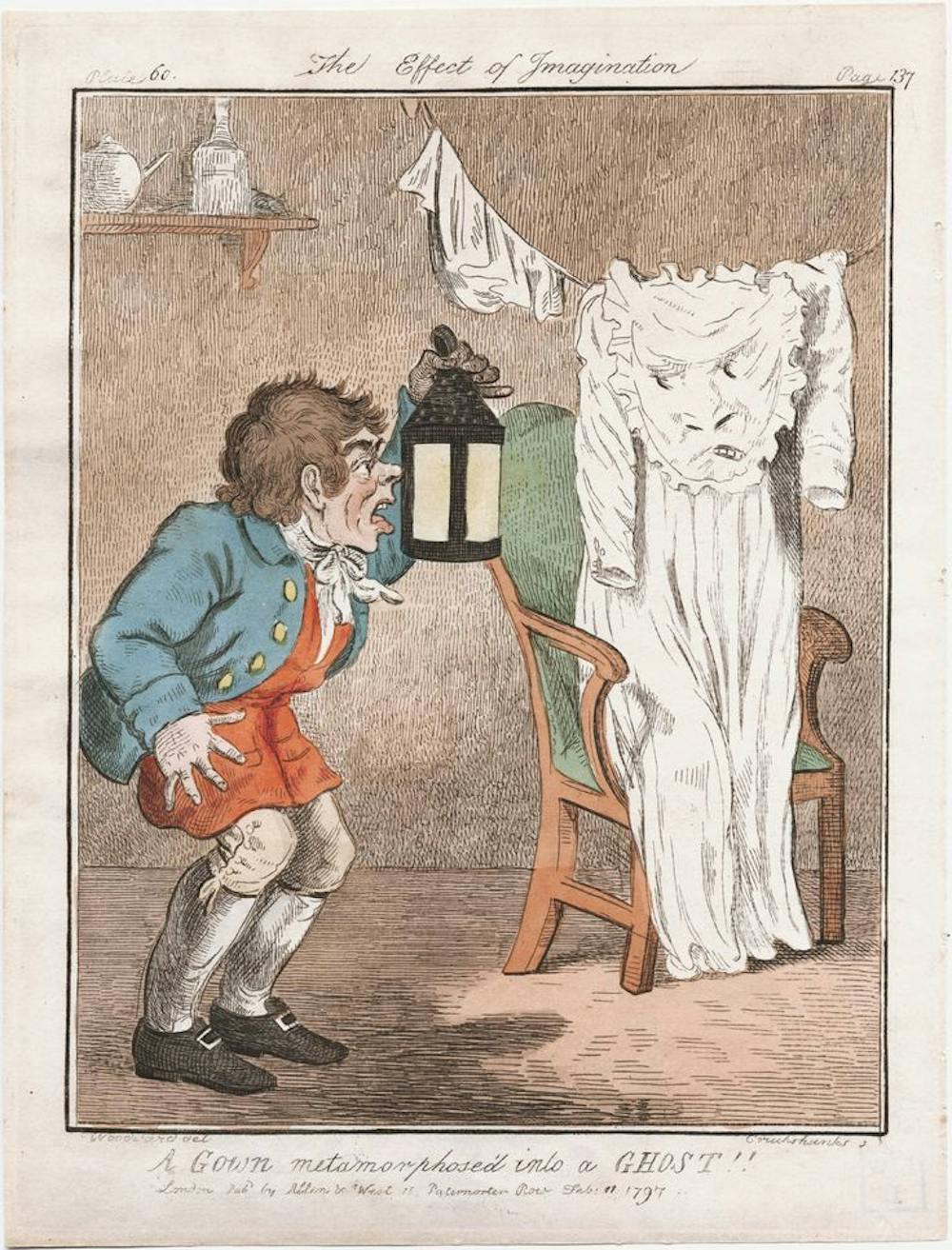
    Gillray’s Gown Metamorphose’d into a Ghost (1797).
    British Museum, CC BY

    The image of the ghost as a figure in a white winding-sheet or burial shroud has retained its iconic status for hundreds of years because it suggests a continuity between the corpse and the spirit.

    The main social role of the ghost before the modern period was to carry a message to the living from beyond the grave, so the link to burial clothing makes sense. This can be seen in the medieval trope of the Three Living and the Three Dead, whereby some hunters encounter their future skeletal corpses, wrapped in linen, admonishing them to remember death.

    Yet by the mid-19th century, with spiritualism and early forms of psychical research spreading across the western world, people began to report seeing ghosts dressed in everyday and contemporaneous clothing.

    This raised problems for those interested in investigating the reality of ghosts. If the ghost was an objective reality, why should it be wearing clothes? If the tenets of spiritualism were true, should the soul which has returned to visit the earth not be formed of light or some other form of ethereal substance? Were the clothes of spirits also spiritual, and if so, did they share in their essence or were they the ghosts of clothes in their own right?

    You could adopt an idealist position and say that the clothes were metaphysical ideas bound up with the immortal identity of the wearer – the identity of the ghost meaning something more than simply the apparition of a soul-force.

    Another explanation was that ghost-seers dress the ghost, automatically, through unconscious processes. And so we see a ghost in its usual dress because that is the mental picture we have of the person, and this choice of garment is most likely to inspire recognition.

    The Lady Ghost by Adelaide Claxton (1876).
    Sotheby’s

    The critic and anthropologist Andrew Lang drew comparisons between dreaming and ghost-seeing in 1897 when he stated that:

    We do not see people naked, as a rule, in our dreams; and hallucinations, being waking dreams, conform to the same rule. If a ghost opens a door or lifts a curtain in our sight, that, too, is only part of the illusion. The door did not open; the curtain was not lifted … It was produced in the same way as when a hypnotised patient is told that “his hand is burned”, his fancy then begets real blisters.

    For Lang, the clothes of ghosts were the stuff that dreams are made of. The implication of this, that ghost-seers are dressers, but not undressers, seems to reflect a pervading morality of ghosts, whereby most 19th-century spirits were sanitised and chaste. Lang’s odd assumption that there was no nakedness in dreams echoes this.

    The matter of spirits

    Fashion and clothing were central to the identification of class, gender and occupation in the Victorian period. The ghosts of the servant class seemed to be especially tied to their clothes, rather than their faces or voices – a theme that comes out in some ghost reports submitted to The Strand magazine in 1908.

    Here, a ghost-seer reported seeing “a figure, which had nothing supernatural about it, being simply that of a servant in a light cotton dress … and with a white cap on … The whole figure had the general appearance of the housemaid, so that she had been the one I had thought of. It was not in the least like the cook, who dressed in much darker cottons”.

    Clothes identify people and make them capable of representation – nakedness disrupts this means of instantly categorising someone.

    The ghost of a woman with a burial shroud confronts her murderer on a stormy night.
    Wellcome Collection, CC BY

    The issue of ghost clothes is interesting for historians of the supernatural because, like a loose thread, pulling at it starts to unravel some of the assumptions about matter in spiritualism. Do ghosts retain the injuries or disabilities that befell them in life? And what about the erotic fleshiness of spirits – the touching and kissing between the living and the dead in the séance room and the “ectoplasm” (a gauze-like spiritual substance) photographed emerging from the orifices of mediums? Could the living even have sexual intercourse with ghosts?

    These kinds of knotty debates have not disappeared in the 21st century. Indeed, “spectrophilia” – or the love of ghosts – is a fetish that is a lively topic of debate on the internet today. Another turn of the screw in the long history of how spirits matter in the world of the living.


    Looking for something good? Cut through the noise with a carefully curated selection of the latest releases, live events and exhibitions, straight to your inbox every fortnight, on Fridays. Sign up here.


    Shane McCorristine does not work for, consult, own shares in or receive funding from any company or organisation that would benefit from this article, and has disclosed no relevant affiliations beyond their academic appointment.

    ref. Why ghosts wear clothes or white sheets instead of appearing in the nude – https://theconversation.com/why-ghosts-wear-clothes-or-white-sheets-instead-of-appearing-in-the-nude-241948

    MIL OSI – Global Reports

  • MIL-OSI Global: Playing in mud and dirt can boost your child’s immune system – here’s how

    Source: The Conversation – UK – By Samuel J. White, Associate Professor & Head of Projects, York St John University

    Being exposed to a diverse array of microbes in childhood helps ‘train’ the immune system. MNStudio/ Shutterstock

    With the popularity of CleanTok on social media, we’re constantly being reminded about how dirty everything around us is. But while you might feel you should disinfect every surface in your home or send your child off to school with antibacterial gels so their hands stay clean, science actually shows us that being exposed to a bit of dirt can be good for kids’ health.

    Evidence suggests that exposure to the microbes in dirt might actually help children develop stronger immune systems – and may even decrease their risk of developing allergies and autoimmune diseases.

    Mud is not just a mix of soil and water. It’s a complex ecosystem filled with microorganisms. One gram of soil can harbour up to 10 billion microorganisms – of potentially thousands of different species.

    The diverse array of bacteria, fungi and other microbes present in mud and soil play a crucial role in our health and is key to what immunologists call “immune training”. This is the process by which the immune system learns to distinguish between harmful pathogens and benign environmental substances.

    During childhood, the immune system is especially adaptable. When exposed to a wide variety of microbes, it learns to strike a balance – responding aggressively to harmful invaders while leaving harmless substances, such as pollen or food particles, alone.

    But a lack of such training could leave immune systems worse off.

    According to the “hygiene hypothesis”, as societies become more urbanised and sanitised, our immune systems are deprived of the microbial challenges they need to develop properly. This may cause the immune system to become hypersensitive, mistaking innocuous substances – such as pollen or dust – for dangerous invaders. This hypersensitivity can manifest as allergic conditions such as asthma, eczema or hay fever.

    Lack of microbial exposure, particularly in early childhood, may also increase the likelihood of developing common colds and other childhood illnesses due to the immune system not being properly trained to handle everyday pathogens.

    The lack of such immune training could potentially explain why children growing up in sanitised environments (such as cities with limited exposure to animals or nature) are up to 50% more likely to develop conditions such as asthma and food allergies. Their immune systems, unchallenged by natural microbial exposure, may overreact to harmless triggers.

    Immune training appears to be important for lowering risk of many conditions and childhood illnesses.
    MorphoBio/ Shutterstock

    And, without regular microbial interactions, the immune system may turn on the body itself – potentially contributing to the development of autoimmune conditions such as type 1 diabetes or multiple sclerosis. Research even shows that children raised in environments with high levels of microbial exposure – such as farms or homes with pets – are less likely to develop allergies or autoimmune diseases.

    There are many reasons why microbial exposure is so good for children’s developing immune systems. For instance, Bacteroides fragilies, which is commonly found in soil, helps produce a key molecule that’s important to immune function.

    Microbial exposure also helps children develop regulatory T cells – white blood cells that control how the immune system responds to foreign invaders. T cells also prevent autoimmune reactions. This may explains why a lack of microbial exposure may increase a person’s likelihood of developing an autoimmune condition (though this is just one of many contributing factors).

    Immune development

    Mud play is more than just a messy outdoor activity. It provides essential sensory experiences – such as touching, smelling and manipulating different textures – which stimulate brain development and enhance emotional resilience.

    Sensory activities (such as playing in mud) can reduce stress in children, which is another crucial element in maintaining a well-functioning immune system.

    Research also shows Mycobacterium vaccae, a type of bacteria commonly found in soil, is shown to reduce inflammation and even improve mood. It does this by influencing the release of serotonin, a key neurotransmitter. In animal studies, exposure to M vaccae has led to reduced symptoms of stress and anxiety. There’s emerging evidence that similar effects could occur in humans.

    In addition, playing outdoors is a form of physical activity, which further supports immune health by promoting better circulation and stimulating the production of immune cells.

    While some parents may worry about the hygiene risks of playing in mud, there are many things you can do to ensure your kids play outdoors safely:

    • Pick clean play areas: Ensure your child plays in areas unlikely to be contaminated by animal waste or harmful chemicals. Home gardens or parks are great options. If you’re unsure how clean an area may be, you can use a soil testing kit to check for harmful substances before play.
    • Dress for the mess: Waterproof clothing such as boots and jackets makes clean-up easier while still allowing children to experience the benefits of outdoor play.
    • Hand hygiene: Washing hands after playing in the mud helps prevent harmful bacteria from entering the body. This reduces the risk of infections while maintaining healthy exposure to microbes.
    • Repeat often: Repeated exposure to beneficial microbes is necessary in order to build a stronger immune system.

    Letting children get dirty by playing in mud could offer more than just fun – it may be an essential part of building a strong immune system. In a world that’s increasingly sanitised, embracing nature – dirt and all – might be exactly what our children’s immune systems need to thrive.

    The authors do not work for, consult, own shares in or receive funding from any company or organisation that would benefit from this article, and have disclosed no relevant affiliations beyond their academic appointment.

    ref. Playing in mud and dirt can boost your child’s immune system – here’s how – https://theconversation.com/playing-in-mud-and-dirt-can-boost-your-childs-immune-system-heres-how-241532

    MIL OSI – Global Reports

  • MIL-OSI Global: How Harris and Trump’s economic pledges stack up

    Source: The Conversation – UK – By Conor O’Kane, Senior Lecturer in Economics, Bournemouth University

    kovop / Shutterstock

    We’re now in the home straight of the US election race, and the economy looks set to play a key role in deciding who will be sat in the White House come January 2025. Despite enjoying strong economic and employment growth since the pandemic, US voters have been telling pollsters that the high cost of living is what bothers them most about life in America right now.

    Both candidates are seeking to address voter’s concerns. The Democratic candidate, Kamala Harris, and her Republican counterpart, Donald Trump, agree on virtually nothing. But what they do agree on is that the federal government should be playing a bigger role in making things more affordable for American consumers.

    That said, there are significant differences in how the candidates propose to bring down prices across the economy. Trump wants to force companies into creating jobs on US soil. And Harris wishes to break down the power that some companies have amassed in the marketplace.

    What has Trump pledged?

    At a campaign rally on September 19, Trump said: “Together, we will deliver low taxes, low regulations, low energy costs, low interest rates and low inflation so that everyone can afford groceries, a car and a home”.

    Trump is promising to reduce regulation, as well as launching another big round of tax cuts for individual people and businesses. He has also pledged to make income from tips, overtime and social security payments exempt from tax altogether.

    But, somewhat ironically, Trump’s overall economic approach is somewhat un-Republican. We traditionally tend to think of Republicans as the “take your hands off my economy” party. However, many of Trump’s economic policy pledges are very hands on.

    He has promised tariffs of up to 20% on goods imported into the US, and 60% on all goods from China. His rationale is that by making imported goods more expensive, US companies will be encouraged to make more goods domestically, so American workers will benefit in terms of millions more well-paid manufacturing jobs at home.

    Trump has also said that, if elected, he will direct his cabinet to reduce energy prices and auto insurance by at least 50%. “Prices will come down. You just watch. They’ll come down and they’ll come down fast”, he claimed during a speech in August.

    He plans to intervene in the housing market, too. Trump’s strategy for lowering housing costs focuses on stopping “the unsustainable invasion of illegal aliens”, and he has pledged to deport up to 11 million immigrants who currently live in the US. This, he says, will result in a dramatic reduction in demand and bring down the cost of housing.

    Perhaps Trump’s most striking policy is in relation to the Federal Reserve. He wants the elected president to have a greater say over the interest rate policy for the US economy. Lower interest rates would mean lower borrowing costs, which should subsequently reduce mortgage prices.

    But a lot of economists, including former US treasury secretary Larry Summers, warn that this approach could backfire. When executives start to intervene in independent central banking, you risk setting off a spiral of rapid inflation.

    What has Harris pledged?

    A lot of Americans believe that grocery chains and food companies are ripping them off. Food prices are up by about 25% compared to before the pandemic, and a recent poll suggests that American consumers’ view of the grocery industry has sunk to a two-decade low.

    Harris has promised to address this. At a campaign event in Raleigh, North Carolina, in August, she said: “As president, I will take on the high costs that matter most to most Americans, like the cost of food”.

    She believes the food industry is too concentrated, where just a few firms have a lot of power. She wants the food industry to become more competitive, which would mean lower prices for US consumers.

    Harris has proposed giving government money to start-up meatpacking companies to help them challenge the dominant players. And she also wants the Federal Trade Commission to look at mergers and other forms of consolidation in the food industry more aggressively.

    This may include giving the commission additional regulatory and enforcement powers to actively look for and stop anti-competitive behaviour. For example, Harris has proposed the first federal ban on price gouging to stop companies exploiting crises to charge people more for essentials.

    Harris has promised to break the stranglehold large corporations have over US food supply.
    Bartolomiej Pietrzyk / Shutterstock

    Harris, like Trump, has also promised to address housing costs. She wants to use federal dollars to encourage developers to build, and has set an ambitious target of building 3 million new housing units over her four-year term.

    Her idea is that one way to bring down housing costs is to build a lot more housing. She also wants to give US$25,000 (£19,200) to every first-time home buyer in the country to help them with a down payment.

    To help reduce child poverty, Harris says she will restore Biden’s generous tax credit for parents. And, on top of that, she wants to introduce a US$6,000 tax credit for parents of newborns, as well as planning to cap childcare costs at 7% of household income.

    Both candidates have clearly listened to voters’ concerns about the cost of living, but there is little detail on how they will fund the giveaways set out in their economic policy pledges.

    Harris says there will be no tax increases for anybody who makes less than US$400,000 a year. However, she has in mind a whole bunch of taxes on millionaires and big companies – the sort that Democrats are fond of targeting. Trump, on the other hand, has not set out how he will pay for any of his policies.

    More than 20 US recipients of the Nobel prize for economics signed a letter on October 23 that called Harris’ economic agenda “vastly superior” to Trump’s.

    But we don’t have long to wait to see which candidate’s economic pledges have resonated most with US voters.

    Conor O’Kane does not work for, consult, own shares in or receive funding from any company or organisation that would benefit from this article, and has disclosed no relevant affiliations beyond their academic appointment.

    ref. How Harris and Trump’s economic pledges stack up – https://theconversation.com/how-harris-and-trumps-economic-pledges-stack-up-241644

    MIL OSI – Global Reports

  • MIL-OSI Global: Will you get an extra hour’s sleep this weekend? Probably not, new research says

    Source: The Conversation – UK – By Melanie de Lange, Epidemiology PhD Student, University of Bristol

    Science says you may not actually get that full hour’s extra sleep you were looking forward to. kattyart/Shutterstock

    A lot of people dread the clocks going back an hour in winter – but reassure themselves that at least they’ll get an extra hour’s sleep. However, in my new study my colleagues and I found most people do not (or can not) take advantage of the full extra hour of sleep in autumn.

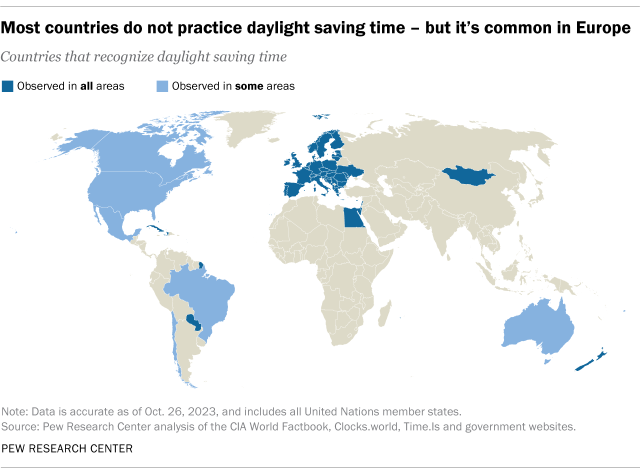
    Daylight saving time is the practice of moving the clocks one hour forward in spring and one hour back in autumn. It was introduced during the first world war as a way to cut energy costs. It is in operation in around 70 countries and affects a quarter of the world’s population.

    This “springing forward” and “falling back” is widely thought of a loss of one hour of sleep in spring and a gain of one hour of sleep in autumn. However, research suggests we may lose sleep for about a week after both clock changes as we struggle to adapt to the new time.

    Previous studies have relied on people reporting their own sleep patterns in diaries or surveys. However, this may not be accurate because people sometimes forget or lie about how long they slept for. Recent research has overcome this problem by using activity monitors to record people’s sleep over the clock changes. But until now researchers have only been able to do this in a small number of people.

    Our new study explored the effects of the clock changes on objectively-measured sleep duration in a large number of people who are signed up to the UK Biobank. This is a research database with lifestyle and health information from half a million UK participants. We analysed sleep data from 11,800 people who wore activity monitors for one or more days during the two weeks surrounding the spring and autumn clock changes in 2013-2015.

    Sleep is important for health and wellbeing.
    Lizavetta/Shutterstock

    We found that people slept for just over half an hour more on the Sunday of the autumn clock change than the surrounding Sundays. But people slept for around an hour less of the Sunday of the spring clock change.

    Previous research suggests people sleep for less on the weekdays immediately after the clock changes than the weekdays before. In contrast, this study found that, overall, people were catching up on sleep on the Monday to Friday after both clock changes. This trend was stronger in spring after people had lost an hour of sleep. On average people slept seven minutes more per weeknight after the spring clock change and three minutes more per weeknight after the autumn clock change than the previous week.

    This suggests that effects of the clock changes on sleep duration are more short lived than earlier studies reported. However, when we broke the data down, we found that this pattern of catching up on sleep was not seen in women. In fact, women often slept for less on the weekdays after the clock changes than before. This could be because women experience higher levels of insomnia and sleep difficulties and that these problems are exacerbated by the clock changes. Women are thought to struggle more with insomnia than men due to a number of reasons, including hormonal fluctuations, societal factors and higher rates of depression and anxiety.

    We also found that, in autumn, older people and the retired slept less on the weekdays after the transition than before. It may be that older people are particularly vulnerable to their sleep being disrupted by the clock changes because sleep becomes lighter and more fragmented as we age.

    Why does this matter?

    Although short lived, the sleep loss seen over the spring clock change in our study has consequences for health, as just one night of bad sleep has been associated with a decline in mental and physical health.

    Research has found that the clock changes themselves are associated with an increase in heart attacks, strokes, traffic accidents and depression. Sleep plays a vital role keeping your heart healthy, as well as maintaining emotional regulation. The amount of sleep you get also affects your reaction times and how likely you are to take risks.

    Concern over the harmful effects of the clock changes on health has prompted sleep scientists to call for the clock changes to be abolished. Indeed, a growing number of countries – including the US, Jordan, Mexico, Ukraine and those in the EU – have made plans to do just that.

    But stopping the clock changes is not straightforward. Plans in both the US and EU have stalled, with disagreements over what time to adopt permanently. Sleep experts argue that staying on winter (standard) time is best for health as this prioritises morning light which helps wake you up, resets your biological rhythm each day and makes it easier for you to fall asleep in the evening. Meanwhile, politicians are campaigning for permanent summer time due to the economic benefits they think it has.

    The UK finds itself in an interesting position. No longer part of the EU, it is not duty bound to stop the clock changes at the same time as the EU. But being out of sync with the rest of Europe (including the Republic of Ireland) could have economic and logistical implications.

    The UK government will probably review its daylight saving time policy as and when the EU finally ends the clock changes. It is crucial that they take the effects on sleep and health into account when this happens.

    Melanie de Lange receives funding from Wellcome.

    ref. Will you get an extra hour’s sleep this weekend? Probably not, new research says – https://theconversation.com/will-you-get-an-extra-hours-sleep-this-weekend-probably-not-new-research-says-241285

    MIL OSI – Global Reports

  • MIL-OSI United Kingdom: “Serious questions” about Irish language signs not serious enough to warrant them being stopped?

    Source: Traditional Unionist Voice – Northern Ireland

    Statement by TUV deputy leader Ron McDowell:

    “The DUP MLA Stephen Dunne has, in today’s News Letter, correctly highlighted the fact that there are “serious questions” about where Minister O’Dowd’s priorities lie after Mr Dunne revealed that the cost of the Irish language road signs in parts of Belfast is going to be £50,000.
    “Speaking during an Infrastructure Committee meeting Mr Dunne observed:
    “Questions must be asked about whether spending £50,000 to replace perfectly functional traffic signs is a wise use of public money. Changes to street signage in Belfast are already controversial due to their cost. The minister should carefully consider his priorities before committing any additional taxpayer money to further rolling out this scheme.”
    “I agree but there is now a question for Mr Dunne and his DUP colleagues – what are they going to do about it?
    “There is a petition in the Assembly Business Office calling for Minister O’Dowd’s decision to be referred to the Executive where Unionists could block it. Are the “serious questions” serious enough for the DUP to block this decision? If so, Mr Dunne and his colleagues will sign the petition and in so doing begin the process which will permit Unionists to overturn Minister O’Dowd’s plan for Irish language road signs in Belfast.”

    MIL OSI United Kingdom

  • MIL-OSI Asia-Pac: Asset management task force set up

    Source: Hong Kong Information Services

    The Task Force on Promoting the Development of Asset & Wealth Management, chaired by Secretary for Financial Services & the Treasury Christopher Hui, was established and convened its first meeting today.

    The 2024 Policy Address has set out the need to further enhance Hong Kong’s status as an international asset and wealth management (WAM) centre. The Government will consult the industry on the proposal to add qualifying transactions eligible for tax concessions for funds, single-family offices, etc. At its first meeting, the task force had a focused discussion on the proposed enhancements.

    As of end-2023, assets under management in Hong Kong reached over HK$31 trillion, and net fund inflows of close to HK$390 billion were registered, representing a year-on-year increase of over 3.4 times.

    Mr Hui pointed out that funding sourced from non-Hong Kong investors has consistently accounted for a high percentage, reflecting the confidence of international investors in Hong Kong’s WAM industry.

    Market research also estimates that Hong Kong is home to about 2,700 single-family offices, with over half of them set up by ultra-high-net-worth-individuals with a wealth of US$50 million or above.

    In view of the development trends in global finance, Hong Kong will continue to consolidate and enhance its competitive advantages and pursue continuous reforms.

    With the task force bringing together industry leaders and professionals, Mr Hui added that he believed their valuable advice would help propel the long-term development of the WAM industry.

    MIL OSI Asia Pacific News

  • MIL-OSI United Kingdom: Congratulations to Washington in Bloom volunteers!

    Source: City of Sunderland

    Washington Village in Bloom volunteers are celebrating after the village was named the overall winner in the Village category at the Britain in Bloom Awards 2024.

    The village won Northumbria in Bloom earlier this year and was then chosen to go into the national competition, before being announced as the overall winner during the awards ceremony in Manchester this week.

    This year, the volunteers also won the Exceptional Public Engagement Award for their work with the community. The Washington Village in Bloom volunteers work year-round alongside Sunderland City Council, local businesses, volunteers completing Duke of Edinburgh awards and extra volunteers from Barclay’s Bank on the floral displays and colourful flower beds that impressed the visiting judges.

    In August this year, Washington in Bloom volunteers welcomed the Britain in Bloom judges as it celebrated Washington’s 60th anniversary and the competition’s 60th anniversary with a 1960’s ‘Flower Power’ themed celebration.

    Joan Atkinson, Chair of Washington in Bloom, also won the Community Champion Award for her continued hard work on the village while she was undergoing chemotherapy and radiotherapy for breast cancer. She said: “You can’t enter the best village category – you have to be nominated by Northumbria in Bloom, so even being invited to the competition is a fantastic achievement for Washington Village. We are completely self-funded and rely on donations and the hard work and dedication of the Washington in Bloom volunteers.

    “The volunteers deserve all the credit for the award. Whether its planting or removing leaves they are out working on the village every week in every season and their hard work has really paid off.”

    Councillor Beth Jones, Washington Central ward councillor and Sunderland City Council’s Cabinet Member for Communities, Culture and Tourism, said: “I’d like to say a big congratulations to Joan on her award win and well done to the team of Washington in Bloom volunteers who have all worked hard towards Washington Village’s national award.

    “The village looks absolutely stunning and it’s down to the hard work of all the brilliant volunteers and the collaborative efforts of council staff, local businesses, volunteers, local schools and residents. Everyone has done a fantastic job, and I’m delighted to see it recognised with this well-deserved award.”

    MIL OSI United Kingdom

  • MIL-OSI Russia: Moscow Installs First 150 kW Fast Charging Stations

    Source: Moscow Transport

    Moscow has installed the first high-power 150 kW fast charging stations as part of the Energy of Moscow project. Charging an electric vehicle at these stations takes an average of 30 minutes.

    According to Moscow’s Deputy Mayor for Transport and Industry, Maksim Liksutov, there are almost 250 charging stations operating in the capital as part of the Energy of Moscow project. The two new 150 kW stations are located at: Denezhny Pereulok, 8-10 and Vozdvizhenka Street, 10.

    We have installed the first 150 kW charging stations, with a charging time of around 30 minutes. By 2030, the number of charging stations in Moscow will increase to 30,000. We will also install hubs for taxis and carsharing with the ability to charge 10-15 cars simultaneously. We thank all our operators for their work, which allows us to develop the charging station network in the city. We strive to make the capital one of the world’s leaders in the use of electric transport. This task was set by Moscow Mayor Sergey Sobyanin,-  added Maksim Liksutov.

    The new stations feature the ability to charge 2 cars simultaneously and have GB/T and CCS Combo 2 connectors for the most popular electric vehicle models.

    The Moscow Transport app can be used to find an available station, plan a route to the charging station, and book a charging session.

    As part of the Energy of Moscow project, approximately 250 free electric vehicle charging stations (EVCS) have been installed in the capital. Electric vehicle owners are exempt from paying transportation tax and can park for free throughout the city.

    Since the launch of the first Energy of Moscow charging station in March 2021, electric vehicle owners have completed over 640,000 charging sessions. All stations are located in places where citizens spend most of their time, such as near shopping and business centers, parks, residential buildings, cafes, and stores.

    According to plans, by 2030, there will be 30,000 EVCS in the capital, and the number of electric vehicles in Moscow will increase to 320,000 – 7% of the total number of cars. Additionally, hubs will be installed for taxis and carsharing, with the ability to charge 10–15 cars simultaneously.

    MIL OSI Russia News

  • MIL-OSI: Equinor ASA: Notifiable trading

    Source: GlobeNewswire (MIL-OSI)

    A close associate of a primary insider in Equinor ASA (OSE: EQNR, NYSE: EQNR) has purchased shares in Equinor ASA:

    Tocaba AS, a close associate of board member Tone Hegland Bachke, has on 25 October 2024 purchased 2000 shares in Equinor ASA at a price of NOK 276.76 per share.

    Details of the purchase of shares are set forth in the attached notification.

    This is information that Equinor ASA is obliged to make public pursuant to Article 19 of the EU Market Abuse Regulation and subject to the disclosure requirements pursuant to Section 5-12 of the Norwegian Securities Trading Act.

    Attachment

    The MIL Network

  • MIL-OSI Security: NATO Allies and experts discuss intensifying hybrid campaigns against the Alliance in Prague

    Source: NATO

    More than 100 Allied experts and representatives met at the NATO Hybrid Symposium in Prague, Czechia on 24-25 October to address the challenges posed by adversarial use of hybrid tactics. Participants discussed the worsening threat environment and how to strengthen NATO`s approach to countering hybrid threats and deter these threats more effectively.

    Opening the conference alongside the Czech hosts, James Appathurai, NATO Deputy Assistant Secretary General for Innovation, Hybrid and Cyber, said: “This meeting comes at an important time. Russia in  particular is stepping up hybrid attacks against NATO Allies. Our partners are also experience increased hostile grey zone activities by various actors. This meeting will help us improve our assessment of the threats, and step up our resilience, defence and deterrence against hybrid threats’’.  

    The Symposium also had sessions with representatives from private sector and academia as well as from NATO partners such as the European Union, Ukraine and Japan to explore their experience in countering hybrid interference. The annual event offers an opportunity for the Allied hybrid community to foster cooperation among experts and exchange views and best practices. The event was co-organised with the Ministry of Defence of the Czech Republic and the Ministry of Foreign Affairs of the Czech Republic.  

    MIL Security OSI

  • MIL-OSI: First Hawaiian, Inc. Reports Third Quarter 2024 Financial Results and Declares Dividend

    Source: GlobeNewswire (MIL-OSI)

    HONOLULU, Oct. 25, 2024 (GLOBE NEWSWIRE) — First Hawaiian, Inc. (NASDAQ:FHB), (“First Hawaiian” or the “Company”) today reported financial results for its quarter ended September 30, 2024.

    “I’m happy to report that we had a very good third quarter,” said Bob Harrison, Chairman, President, and CEO. “Net interest income and noninterest income increased over the prior quarter, expenses were well controlled and credit quality remained excellent. I’m also pleased to report that during the third quarter, Moody’s reviewed and reaffirmed all of First Hawaiian Bank’s long-term credit and deposit ratings.”

    On October 23, 2024, the Company’s Board of Directors declared a quarterly cash dividend of $0.26 per share. The dividend will be payable on November 29, 2024, to stockholders of record at the close of business on November 18, 2024.

    Third Quarter 2024 Highlights:

    • Net income of $61.5 million, or $0.48 per diluted share
    • Total loans and leases decreased $118.5 million versus the prior quarter
    • Total deposits decreased $91.1 million versus the prior quarter
    • Net interest margin increased 3 basis points to 2.95%
    • Recorded a $7.4 million provision for credit losses
    • Board of Directors declared a quarterly dividend of $0.26 per share

    Balance Sheet

    Total assets were $23.8 billion as of September 30, 2024, a decrease of $211.5 million, or 0.9%, from $24.0 billion as of June 30, 2024.

    Gross loans and leases were $14.2 billion as of September 30, 2024, a decrease of $118.5 million, or 0.8%, from $14.4 billion as of June 30, 2024.

    Total deposits were $20.2 billion as of September 30, 2024, a decrease of $91.1 million, or 0.4%, from $20.3 billion as of June 30, 2024.

    Net Interest Income

    Net interest income for the third quarter of 2024 was $156.7 million, an increase of $3.9 million, or 2.5%, compared to $152.9 million for the prior quarter.

    The net interest margin was 2.95% in the third quarter of 2024, an increase of 3 basis points compared to 2.92% in the prior quarter.

    Provision Expense

    During the quarter ended September 30, 2024, we recorded a $7.4 million provision for credit losses. In the quarter ended June 30, 2024, we recorded a $1.8 million provision for credit losses.

    Noninterest Income

    Noninterest income was $53.3 million in the third quarter of 2024, an increase of $1.5 million compared to noninterest income of $51.8 million in the prior quarter.

    Noninterest Expense

    Noninterest expense was $126.1 million in the third quarter of 2024, an increase of $4.1 million compared to noninterest expense of $122.1 million in the prior quarter.

    The efficiency ratio was 59.8% and 59.2% for the quarters ended September 30, 2024 and June 30, 2024, respectively.

    Taxes

    The effective tax rate was 19.6% and 23.3% for the quarters ended September 30, 2024 and June 30, 2024, respectively.

    Asset Quality

    The allowance for credit losses was $163.7 million, or 1.15% of total loans and leases, as of September 30, 2024, compared to $160.5 million, or 1.12% of total loans and leases, as of June 30, 2024. The reserve for unfunded commitments was $33.7 million as of September 30, 2024 compared to $33.4 million as of June 30, 2024. Net charge-offs were $3.9 million, or 0.11% of average loans and leases on an annualized basis, for the quarter ended September 30, 2024, compared to net charge-offs of $2.5 million, or 0.07% of average loans and leases on an annualized basis, for the quarter ended June 30, 2024. Total non-performing assets were $17.8 million, or 0.13% of total loans and leases and other real estate owned, as of September 30, 2024, compared to $18.0 million, or 0.13% of total loans and leases and other real estate owned, as of June 30, 2024.

    Capital

    Total stockholders’ equity increased $97.7 million in the third quarter, and stood at $2.6 billion on September 30, 2024 and June 30, 2024.

    The tier 1 leverage, common equity tier 1 and total capital ratios were 9.14%, 13.03% and 14.25%, respectively, on September 30, 2024, compared with 9.03%, 12.73% and 13.92%, respectively, on June 30, 2024.

    The Company did not repurchase any shares in the third quarter.

    First Hawaiian, Inc.

    First Hawaiian, Inc. (NASDAQ:FHB) is a bank holding company headquartered in Honolulu, Hawaii. Its principal subsidiary, First Hawaiian Bank, founded in 1858 under the name Bishop & Company, is Hawaii’s oldest and largest financial institution with branch locations throughout Hawaii, Guam and Saipan. The company offers a comprehensive suite of banking services to consumer and commercial customers including deposit products, loans, wealth management, insurance, trust, retirement planning, credit card and merchant processing services. Customers may also access their accounts through ATMs, online and mobile banking channels. For more information about First Hawaiian, Inc., visit the Company’s website, www.fhb.com.

    Conference Call Information

    First Hawaiian will host a conference call to discuss the Company’s results today at 1:00 p.m. Eastern Time, 7:00 a.m. Hawaii Time.

    To access the call by phone, participants will need to click on the following registration link: https://register.vevent.com/register/BIec8273f35cc340bcb13d27eae17d127b, register for the conference call, and then you will receive the dial-in number and a personalized PIN code. To avoid delays, we encourage participants to dial into the conference call fifteen minutes ahead of the scheduled start time.

    A live webcast of the conference call, including a slide presentation, will be available at the following link: www.fhb.com/earnings. The archive of the webcast will be available at the same location.

    Forward-Looking Statements
    This press release contains forward-looking statements within the meaning of the Private Securities Litigation Reform Act of 1995. These forward-looking statements reflect our current views with respect to, among other things, future events and our financial performance. These statements are often, but not always, made through the use of words or phrases such as “may”, “might”, “should”, “could”, “predict”, “potential”, “believe”, “expect”, “continue”, “will”, “anticipate”, “seek”, “estimate”, “intend”, “plan”, “projection”, “would”, “annualized” and “outlook”, or the negative version of those words or other comparable words or phrases of a future or forward-looking nature. These forward-looking statements are not historical facts, and are based on current expectations, estimates and projections about our industry, management’s beliefs and certain assumptions made by management, many of which, by their nature, are inherently uncertain and beyond our control. Accordingly, we caution you that any such forward-looking statements are not guarantees of future performance and are subject to risks, assumptions, estimates and uncertainties that are difficult to predict. Although we believe that the expectations reflected in these forward-looking statements are reasonable as of the date made, there can be no assurance that actual results will not prove to be materially different from the results expressed or implied by the forward-looking statements. A number of important factors could cause actual results or performance to differ materially from the forward-looking statements, including (without limitation) the risks and uncertainties associated with the domestic and global economic environment and capital market conditions and other risk factors. For a discussion of some of these risks and important factors that could affect our future results and financial condition, see our U.S. Securities and Exchange Commission (“SEC”) filings, including, but not limited to, our Annual Report on Form 10-K for the year ended December 31, 2023 and our Quarterly Report on Form 10-Q for the quarters ended March 31, 2024 and June 30, 2024.

    Use of Non-GAAP Financial Measures
    Return on average tangible assets, return on average tangible stockholders’ equity, tangible book value per share and tangible stockholders’ equity to tangible assets are non-GAAP financial measures. We believe that these measurements are useful for investors, regulators, management and others to evaluate financial performance and capital adequacy relative to other financial institutions. Although these non-GAAP financial measures are frequently used by stakeholders in the evaluation of a company, they have limitations as analytical tools and should not be considered in isolation or as a substitute for analysis of our results or financial condition as reported under GAAP. Investors should consider our performance and capital adequacy as reported under GAAP and all other relevant information when assessing our performance and capital adequacy.

    Table 14 at the end of this document provides a reconciliation of these non-GAAP financial measures with their most directly comparable GAAP measures.

                                     
    Financial Highlights   Table 1
        For the Three Months Ended   For the Nine Months Ended  
        September 30,    June 30,    September 30,    September 30,   
    (dollars in thousands, except per share data)   2024   2024   2023   2024   2023  
    Operating Results:                                
    Net interest income   $ 156,707   $ 152,851   $ 157,148   $ 463,985   $ 484,334  
    Provision for credit losses     7,400     1,800     7,500     15,500     21,300  
    Noninterest income     53,288     51,768     46,097     156,427     142,468  
    Noninterest expense     126,147     122,086     119,383     377,046     358,831  
    Net income     61,492     61,921     58,221     177,633     187,481  
    Basic earnings per share     0.48     0.48     0.46     1.39     1.47  
    Diluted earnings per share     0.48     0.48     0.46     1.38     1.47  
    Dividends declared per share     0.26     0.26     0.26     0.78     0.78  
    Dividend payout ratio     54.17 %   54.17 %   56.52 %   56.52 %   53.06 %
    Performance Ratios(1):                                
    Net interest margin     2.95 %   2.92 %   2.86 %   2.93 %   2.96 %
    Efficiency ratio     59.77 %   59.22 %   58.31 %   60.38 %   56.86 %
    Return on average total assets     1.02 %   1.04 %   0.93 %   0.99 %   1.01 %
    Return on average tangible assets (non-GAAP)(2)     1.06 %   1.08 %   0.97 %   1.03 %   1.06 %
    Return on average total stockholders’ equity     9.45 %   9.91 %   9.76 %   9.37 %   10.72 %
    Return on average tangible stockholders’ equity (non-GAAP)(2)     15.35 %   16.42 %   16.84 %   15.43 %   18.68 %
    Average Balances:                                
    Average loans and leases   $ 14,304,806   $ 14,358,049   $ 14,349,402   $ 14,325,065   $ 14,238,309  
    Average earning assets     21,328,882     21,247,707     22,060,480     21,352,739     22,040,704  
    Average assets     24,046,696     23,958,913     24,727,893     24,064,208     24,699,826  
    Average deposits     20,367,805     20,308,028     21,212,102     20,415,746     21,245,055  
    Average stockholders’ equity     2,588,806     2,512,471     2,367,422     2,532,911     2,337,292  
    Market Value Per Share:                                
    Closing     23.15     20.76     18.05     23.15     18.05  
    High     26.18     22.68     22.59     26.18     28.28  
    Low     20.28     19.48     17.41     19.48     15.08  
                               
        As of   As of   As of   As of  
        September 30,    June 30,    December 31,    September 30,   
    (dollars in thousands, except per share data)   2024   2024   2023   2023  
    Balance Sheet Data:                          
    Loans and leases   $ 14,241,370   $ 14,359,899   $ 14,353,497   $ 14,332,335  
    Total assets     23,780,285     23,991,791     24,926,474     24,912,524  
    Total deposits     20,227,702     20,318,832     21,332,657     21,511,489  
    Short-term borrowings     250,000     500,000     500,000     500,000  
    Total stockholders’ equity     2,648,034     2,550,312     2,486,066     2,351,009  
                               
    Per Share of Common Stock:                          
    Book value   $ 20.71   $ 19.94   $ 19.48   $ 18.42  
    Tangible book value (non-GAAP)(2)     12.92     12.16     11.68     10.62  
                               
    Asset Quality Ratios:                          
    Non-accrual loans and leases / total loans and leases     0.13 %   0.13 %   0.13 %   0.10 %
    Allowance for credit losses for loans and leases / total loans and leases     1.15 %   1.12 %   1.09 %   1.08 %
                               
    Capital Ratios:                          
    Common Equity Tier 1 Capital Ratio     13.03 %   12.73 %   12.39 %   12.21 %
    Tier 1 Capital Ratio     13.03 %   12.73 %   12.39 %   12.21 %
    Total Capital Ratio     14.25 %   13.92 %   13.57 %   13.38 %
    Tier 1 Leverage Ratio     9.14 %   9.03 %   8.64 %   8.45 %
    Total stockholders’ equity to total assets     11.14 %   10.63 %   9.97 %   9.44 %
    Tangible stockholders’ equity to tangible assets (non-GAAP)(2)     7.25 %   6.76 %   6.23 %   5.67 %
                               
    Non-Financial Data:                          
    Number of branches     48     48     50     50  
    Number of ATMs     273     272     275     294  
    Number of Full-Time Equivalent Employees     2,022     2,032     2,089     2,087  

    (1)   Except for the efficiency ratio, amounts are annualized for the three and nine months ended September 30, 2024 and 2023 and three months ended June 30, 2024.

    (2)   Return on average tangible assets, return on average tangible stockholders’ equity, tangible book value per share and tangible stockholders’ equity to tangible assets are non-GAAP financial measures. We compute our return on average tangible assets as the ratio of net income to average tangible assets, which is calculated by subtracting (and thereby effectively excluding) amounts related to the effect of goodwill from our average total assets. We compute our return on average tangible stockholders’ equity as the ratio of net income to average tangible stockholders’ equity, which is calculated by subtracting (and thereby effectively excluding) amounts related to the effect of goodwill from our average total stockholders’ equity. We compute our tangible book value per share as the ratio of tangible stockholders’ equity to outstanding shares. Tangible stockholders’ equity is calculated by subtracting (and thereby effectively excluding) amounts related to the effect of goodwill from our total stockholders’ equity. We compute our tangible stockholders’ equity to tangible assets as the ratio of tangible stockholders’ equity to tangible assets, each of which we calculate by subtracting (and thereby effectively excluding) the value of our goodwill. For a reconciliation to the most directly comparable GAAP financial measure, see Table 14, GAAP to Non-GAAP Reconciliation.

                                   
    Consolidated Statements of Income   Table 2
        For the Three Months Ended   For the Nine Months Ended
        September 30,    June 30,    September 30,    September 30, 
    (dollars in thousands, except per share amounts)   2024   2024   2023   2024   2023
    Interest income                              
    Loans and lease financing   $ 205,682   $ 202,068   $ 194,098   $ 607,594   $ 551,777
    Available-for-sale investment securities     12,850     14,143     18,426     41,539     55,208
    Held-to-maturity investment securities     16,937     17,575     18,271     52,305     55,510
    Other     14,527     11,148     9,004     38,444     20,054
    Total interest income     249,996     244,934     239,799     739,882     682,549
    Interest expense                              
    Deposits     87,500     85,609     74,651     257,252     176,006
    Short-term and long-term borrowings     5,397     5,953     6,838     17,303     20,057
    Other     392     521     1,162     1,342     2,152
    Total interest expense     93,289     92,083     82,651     275,897     198,215
    Net interest income     156,707     152,851     157,148     463,985     484,334
    Provision for credit losses     7,400     1,800     7,500     15,500     21,300
    Net interest income after provision for credit losses     149,307     151,051     149,648     448,485     463,034
    Noninterest income                              
    Service charges on deposit accounts     7,783     7,793     7,524     23,122     22,001
    Credit and debit card fees     17,533     15,861     15,748     49,567     47,507
    Other service charges and fees     11,790     11,036     9,546     32,730     27,764
    Trust and investment services income     9,077     9,426     9,742     28,857     28,804
    Bank-owned life insurance     4,502     3,360     1,872     12,148     10,263
    Other     2,603     4,292     1,665     10,003     6,129
    Total noninterest income     53,288     51,768     46,097     156,427     142,468
    Noninterest expense                              
    Salaries and employee benefits     59,563     57,737     55,937     176,562     169,873
    Contracted services and professional fees     14,634     16,067     16,393     46,440     50,204
    Occupancy     6,945     7,377     6,711     21,263     22,047
    Equipment     13,078     13,196     11,826     39,687     32,562
    Regulatory assessment and fees     3,412     3,814     4,149     15,346     11,661
    Advertising and marketing     1,813     1,765     2,289     6,190     6,174
    Card rewards program     8,678     8,719     8,358     25,905     24,124
    Other     18,024     13,411     13,720     45,653     42,186
    Total noninterest expense     126,147     122,086     119,383     377,046     358,831
    Income before provision for income taxes     76,448     80,733     76,362     227,866     246,671
    Provision for income taxes     14,956     18,812     18,141     50,233     59,190
    Net income   $ 61,492   $ 61,921   $ 58,221   $ 177,633   $ 187,481
    Basic earnings per share   $ 0.48   $ 0.48   $ 0.46   $ 1.39   $ 1.47
    Diluted earnings per share   $ 0.48   $ 0.48   $ 0.46   $ 1.38   $ 1.47
    Basic weighted-average outstanding shares     127,886,167     127,867,853     127,609,860     127,820,737     127,552,255
    Diluted weighted-average outstanding shares     128,504,035     128,262,594     127,936,440     128,362,433     127,897,829
                             
    Consolidated Balance Sheets   Table 3
        September 30,    June 30,    December 31,    September 30, 
    (dollars in thousands, except share amount)   2024   2024   2023   2023
    Assets                        
    Cash and due from banks   $ 252,209     $ 290,501     $ 185,015     $ 246,028  
    Interest-bearing deposits in other banks     820,603       824,258       1,554,882       967,400  
    Investment securities:                        
    Available-for-sale, at fair value (amortized cost: $2,290,781 as of September 30, 2024, $2,379,004 as of June 30, 2024, $2,558,675 as of December 31, 2023 and $3,172,031 as of September 30, 2023)     2,055,959       2,067,956       2,255,336       2,722,704  
    Held-to-maturity, at amortized cost (fair value: $3,475,143 as of September 30, 2024, $3,401,006 as of June 30, 2024, $3,574,856 as of December 31, 2023 and $3,433,029 as of September 30, 2023)     3,853,697       3,917,175       4,041,449       4,104,114  
    Loans held for sale           2,820       190        
    Loans and leases     14,241,370       14,359,899       14,353,497       14,332,335  
    Less: allowance for credit losses     163,700       160,517       156,533       154,795  
    Net loans and leases     14,077,670       14,199,382       14,196,964       14,177,540  
                             
    Premises and equipment, net     287,036       283,762       281,461       277,805  
    Accrued interest receivable     81,875       82,512       84,417       84,327  
    Bank-owned life insurance     490,135       486,261       479,907       477,698  
    Goodwill     995,492       995,492       995,492       995,492  
    Mortgage servicing rights     5,236       5,395       5,699       5,855  
    Other assets     860,373       836,277       845,662       853,561  
    Total assets   $ 23,780,285     $ 23,991,791     $ 24,926,474     $ 24,912,524  
    Liabilities and Stockholders’ Equity                        
    Deposits:                        
    Interest-bearing   $ 13,427,674     $ 13,461,365     $ 13,749,095     $ 13,612,493  
    Noninterest-bearing     6,800,028       6,857,467       7,583,562       7,898,996  
    Total deposits     20,227,702       20,318,832       21,332,657       21,511,489  
    Short-term borrowings     250,000       500,000       500,000       500,000  
    Retirement benefits payable     100,448       101,304       103,285       99,685  
    Other liabilities     554,101       521,343       504,466       450,341  
    Total liabilities     21,132,251       21,441,479       22,440,408       22,561,515  
                             
    Stockholders’ equity                        
    Common stock ($0.01 par value; authorized 300,000,000 shares; issued/outstanding: 141,735,601 / 127,886,167 shares as of September 30, 2024, issued/outstanding: 141,728,446 / 127,879,012 shares as of June 30, 2024, issued/outstanding: 141,340,539 / 127,618,761 shares as of December 31, 2023 and issued/outstanding: 141,330,663 / 127,609,934 shares as of September 30, 2023)     1,417       1,417       1,413       1,413  
    Additional paid-in capital     2,558,158       2,554,795       2,548,250       2,545,659  
    Retained earnings     915,062       887,176       837,859       823,895  
    Accumulated other comprehensive loss, net     (452,658 )     (519,132 )     (530,210 )     (648,731 )
    Treasury stock (13,849,434 shares as of September 30, 2024, 13,849,434 shares as of June 30, 2024, 13,721,778 shares as of December 31, 2023 and 13,720,729 shares as of September 30, 2023)     (373,945 )     (373,944 )     (371,246 )     (371,227 )
    Total stockholders’ equity     2,648,034       2,550,312       2,486,066       2,351,009  
    Total liabilities and stockholders’ equity   $ 23,780,285     $ 23,991,791     $ 24,926,474     $ 24,912,524  
                                                       
    Average Balances and Interest Rates                                            Table 4
        Three Months Ended   Three Months Ended   Three Months Ended  
        September 30, 2024   June 30, 2024   September 30, 2023  
        Average   Income/   Yield/   Average   Income/   Yield/   Average   Income/   Yield/  
    (dollars in millions)   Balance   Expense   Rate   Balance   Expense   Rate   Balance   Expense   Rate  
    Earning Assets                                                  
    Interest-Bearing Deposits in Other Banks   $ 1,020.4   $ 13.9   5.40 % $ 773.4   $ 10.5   5.45 % $ 608.6   $ 8.2   5.36 %
    Available-for-Sale Investment Securities                                                  
    Taxable     2,062.6     12.8   2.48     2,100.7     14.1   2.69     2,834.6     18.4   2.59  
    Non-Taxable     1.5       5.06     1.5       5.76     2.3       5.48  
    Held-to-Maturity Investment Securities                                                  
    Taxable     3,288.2     13.8   1.67     3,358.2     14.4   1.71     3,544.1     15.0   1.70  
    Non-Taxable     602.3     3.7   2.46     602.9     4.0   2.64     604.3     4.1   2.66  
    Total Investment Securities     5,954.6     30.3   2.03     6,063.3     32.5   2.15     6,985.3     37.5   2.14  
    Loans Held for Sale     2.2       5.64     1.0       6.58     0.4       6.63  
    Loans and Leases(1)                                                  
    Commercial and industrial     2,165.3     38.0   6.98     2,201.6     38.1   6.96     2,123.5     35.7   6.66  
    Commercial real estate     4,278.3     71.6   6.67     4,305.6     71.5   6.68     4,381.8     71.4   6.47  
    Construction     1,040.7     20.3   7.74     984.8     18.5   7.57     873.7     15.5   7.05  
    Residential:                                                  
    Residential mortgage     4,204.5     40.4   3.84     4,229.4     40.1   3.80     4,316.3     40.1   3.72  
    Home equity line     1,158.5     13.2   4.52     1,164.2     12.6   4.35     1,154.0     10.1   3.45  
    Consumer     1,035.3     18.7   7.19     1,054.1     17.7   6.74     1,172.8     18.3   6.19  
    Lease financing     422.2     4.0   3.72     418.3     4.3   4.09     327.3     3.7   4.48  
    Total Loans and Leases     14,304.8     206.2   5.74     14,358.0     202.8   5.67     14,349.4     194.8   5.39  
    Other Earning Assets     46.9     0.7   5.83     52.0     0.7   5.25     116.8     0.8   2.64  
    Total Earning Assets(2)     21,328.9     251.1   4.69     21,247.7     246.5   4.66     22,060.5     241.3   4.35  
    Cash and Due from Banks     242.3               240.4               276.0            
    Other Assets     2,475.5               2,470.8               2,391.4            
    Total Assets   $ 24,046.7             $ 23,958.9             $ 24,727.9            
                                                       
    Interest-Bearing Liabilities                                                  
    Interest-Bearing Deposits                                                  
    Savings   $ 5,963.1   $ 23.6   1.57 % $ 6,000.4   $ 23.4   1.57 % $ 5,982.5   $ 19.2   1.27 %
    Money Market     4,179.5     31.9   3.04     4,076.7     30.6   3.02     3,907.2     24.7   2.51  
    Time     3,327.3     32.0   3.83     3,284.3     31.6   3.87     3,362.7     30.8   3.63  
    Total Interest-Bearing Deposits     13,469.9     87.5   2.58     13,361.4     85.6   2.58     13,252.4     74.7   2.23  
    Other Short-Term Borrowings     451.1     5.4   4.76     500.0     6.0   4.79     113.1     1.5   5.17  
    Long-Term Borrowings                         440.2     5.3   4.83  
    Other Interest-Bearing Liabilities     22.4     0.4   6.97     38.2     0.5   5.48     89.1     1.2   5.17  
    Total Interest-Bearing Liabilities     13,943.4     93.3   2.66     13,899.6     92.1   2.66     13,894.8     82.7   2.36  
    Net Interest Income         $ 157.8             $ 154.4             $ 158.6      
    Interest Rate Spread(3)               2.03 %             2.00 %             1.99 %
    Net Interest Margin(4)               2.95 %             2.92 %             2.86 %
    Noninterest-Bearing Demand Deposits     6,897.9               6,946.6               7,959.7            
    Other Liabilities     616.6               600.2               506.0            
    Stockholders’ Equity     2,588.8               2,512.5               2,367.4            
    Total Liabilities and Stockholders’ Equity   $ 24,046.7             $ 23,958.9             $ 24,727.9            

    (1)   Non-performing loans and leases are included in the respective average loan and lease balances. Income, if any, on such loans and leases is recognized on a cash basis.

    (2)   Interest income includes taxable-equivalent basis adjustments of $1.1 million, $1.5 million and $1.5 million for the three months ended September 30, 2024, June 30, 2024 and September 30, 2023, respectively.

    (3)   Interest rate spread is the difference between the average yield on earning assets and the average rate paid on interest-bearing liabilities, on a fully taxable-equivalent basis.

    (4)   Net interest margin is net interest income annualized for the three months ended September 30, 2024, June 30, 2024 and September 30, 2023, on a fully taxable-equivalent basis, divided by average total earning assets.

                                       
    Average Balances and Interest Rates                          Table 5
        Nine Months Ended   Nine Months Ended  
        September 30, 2024   September 30, 2023  
        Average   Income/   Yield/   Average   Income/   Yield/  
    (dollars in millions)   Balance   Expense   Rate   Balance   Expense   Rate  
    Earning Assets                                  
    Interest-Bearing Deposits in Other Banks   $ 884.6   $ 35.9   5.43 %   $ 493.6   $ 18.8   5.10 %
    Available-for-Sale Investment Securities                                  
    Taxable     2,124.4     41.5   2.61     2,964.0     54.8   2.47  
    Non-Taxable     1.6     0.1   5.49     13.0     0.5   5.57  
    Held-to-Maturity Investment Securities                                  
    Taxable     3,354.0     42.7   1.70     3,615.0     46.0   1.70  
    Non-Taxable     602.9     11.7   2.58     608.9     11.9   2.62  
    Total Investment Securities     6,082.9     96.0   2.10     7,200.9     113.2   2.10  
    Loans Held for Sale     1.3     0.1   6.11     0.3       6.11  
    Loans and Leases(1)                                  
    Commercial and industrial     2,177.2     113.3   6.95     2,193.8     104.3   6.35  
    Commercial real estate     4,302.4     213.4   6.62     4,224.7     194.6   6.16  
    Construction     983.6     56.2   7.63     874.0     45.4   6.95  
    Residential:                                  
    Residential mortgage     4,232.6     122.5   3.86     4,312.4     117.6   3.64  
    Home equity line     1,164.9     37.8   4.34     1,116.4     27.9   3.35  
    Consumer     1,057.6     54.4   6.87     1,194.1     53.2   5.95  
    Lease financing     406.8     11.9   3.90     322.9     10.5   4.34  
    Total Loans and Leases     14,325.1     609.5   5.68     14,238.3     553.5   5.19  
    Other Earning Assets     58.8     2.5   5.69     107.6     1.3   1.53  
    Total Earning Assets(2)     21,352.7     744.0   4.65     22,040.7     686.8   4.16  
    Cash and Due from Banks     242.4               273.3            
    Other Assets     2,469.1               2,385.8            
    Total Assets   $ 24,064.2             $ 24,699.8            
                                       
    Interest-Bearing Liabilities                                  
    Interest-Bearing Deposits                                  
    Savings   $ 6,007.6   $ 70.5   1.57 % $ 6,144.1   $ 49.1   1.07 %
    Money Market     4,067.5     91.3   3.00     3,857.0     58.6   2.03  
    Time     3,312.3     95.5   3.85     2,921.8     68.3   3.12  
    Total Interest-Bearing Deposits     13,387.4     257.3   2.57     12,922.9     176.0   1.82  
    Federal Funds Purchased               23.0     0.8   4.45  
    Other Short-Term Borrowings     483.6     17.3   4.78     176.5     6.8   5.15  
    Long-Term Borrowings               349.8     12.5   4.78  
    Other Interest-Bearing Liabilities     31.1     1.3   5.75     62.1     2.1   4.63  
    Total Interest-Bearing Liabilities     13,902.1     275.9   2.65     13,534.3     198.2   1.96  
    Net Interest Income         $ 468.1             $ 488.6      
    Interest Rate Spread(3)               2.00 %             2.20 %
    Net Interest Margin(4)               2.93 %             2.96 %
    Noninterest-Bearing Demand Deposits     7,028.4               8,322.2            
    Other Liabilities     600.8               506.0            
    Stockholders’ Equity     2,532.9               2,337.3            
    Total Liabilities and Stockholders’ Equity   $ 24,064.2             $ 24,699.8            

    (1)   Non-performing loans and leases are included in the respective average loan and lease balances. Income, if any, on such loans and leases is recognized on a cash basis.

    (2)   Interest income includes taxable-equivalent basis adjustments of $4.1 million and $4.2 million for the nine months ended September 30, 2024 and 2023, respectively.

    (3)   Interest rate spread is the difference between the average yield on earning assets and the average rate paid on interest-bearing liabilities, on a fully taxable-equivalent basis.

    (4)   Net interest margin is net interest income annualized for the nine months ended September 30, 2024 and 2023, on a fully taxable-equivalent basis, divided by average total earning assets.

                       
    Analysis of Change in Net Interest Income                 Table 6
        Three Months Ended September 30, 2024
        Compared to June 30, 2024
    (dollars in millions)   Volume   Rate   Total (1)
    Change in Interest Income:                  
    Interest-Bearing Deposits in Other Banks   $ 3.5     $ (0.1 )   $ 3.4  
    Available-for-Sale Investment Securities                  
    Taxable     (0.2 )     (1.1 )     (1.3 )
    Held-to-Maturity Investment Securities                  
    Taxable     (0.3 )     (0.3 )     (0.6 )
    Non-Taxable           (0.3 )     (0.3 )
    Total Investment Securities     (0.5 )     (1.7 )     (2.2 )
    Loans and Leases                  
    Commercial and industrial     (0.3 )     0.2       (0.1 )
    Commercial real estate           0.1       0.1  
    Construction     1.3       0.5       1.8  
    Residential:                  
    Residential mortgage     (0.2 )     0.5       0.3  
    Home equity line           0.6       0.6  
    Consumer     (0.3 )     1.3       1.0  
    Lease financing           (0.3 )     (0.3 )
    Total Loans and Leases     0.5       2.9       3.4  
    Other Earning Assets     (0.1 )     0.1        
    Total Change in Interest Income     3.4       1.2       4.6  
                       
    Change in Interest Expense:                  
    Interest-Bearing Deposits                  
    Savings           0.2       0.2  
    Money Market     1.0       0.3       1.3  
    Time     0.6       (0.2 )     0.4  
    Total Interest-Bearing Deposits     1.6       0.3       1.9  
    Other Short-Term Borrowings     (0.5 )     (0.1 )     (0.6 )
    Other Interest-Bearing Liabilities     (0.2 )     0.1       (0.1 )
    Total Change in Interest Expense     0.9       0.3       1.2  
    Change in Net Interest Income   $ 2.5     $ 0.9     $ 3.4  

    (1)   The change in interest income and expense not solely due to changes in volume or rate has been allocated on a pro-rata basis to the volume and rate columns.

                       
    Analysis of Change in Net Interest Income                 Table 7
        Three Months Ended September 30, 2024
        Compared to September 30, 2023
    (dollars in millions)   Volume   Rate   Total (1)
    Change in Interest Income:                  
    Interest-Bearing Deposits in Other Banks   $ 5.6     $ 0.1     $ 5.7  
    Available-for-Sale Investment Securities                  
    Taxable     (4.8 )     (0.8 )     (5.6 )
    Held-to-Maturity Investment Securities                  
    Taxable     (1.0 )     (0.2 )     (1.2 )
    Non-Taxable           (0.4 )     (0.4 )
    Total Investment Securities     (5.8 )     (1.4 )     (7.2 )
    Loans and Leases                  
    Commercial and industrial     0.7       1.6       2.3  
    Commercial real estate     (1.8 )     2.0       0.2  
    Construction     3.2       1.6       4.8  
    Residential:                  
    Residential mortgage     (1.0 )     1.3       0.3  
    Home equity line           3.1       3.1  
    Consumer     (2.3 )     2.7       0.4  
    Lease financing     0.9       (0.6 )     0.3  
    Total Loans and Leases     (0.3 )     11.7       11.4  
    Other Earning Assets     (0.7 )     0.6       (0.1 )
    Total Change in Interest Income     (1.2 )     11.0       9.8  
                       
    Change in Interest Expense:                  
    Interest-Bearing Deposits                  
    Savings     (0.1 )     4.5       4.4  
    Money Market     1.8       5.4       7.2  
    Time     (0.3 )     1.5       1.2  
    Total Interest-Bearing Deposits     1.4       11.4       12.8  
    Other Short-Term Borrowings     4.0       (0.1 )     3.9  
    Long-Term Borrowings     (2.6 )     (2.7 )     (5.3 )
    Other Interest-Bearing Liabilities     (1.1 )     0.3       (0.8 )
    Total Change in Interest Expense     1.7       8.9       10.6  
    Change in Net Interest Income   $ (2.9 )   $ 2.1     $ (0.8 )

    (1)   The change in interest income and expense not solely due to changes in volume or rate has been allocated on a pro-rata basis to the volume and rate columns.

                       
    Analysis of Change in Net Interest Income                 Table 8
        Nine Months Ended September 30, 2024
        Compared to September 30, 2023
    (dollars in millions)   Volume   Rate   Total (1)
    Change in Interest Income:                  
    Interest-Bearing Deposits in Other Banks   $ 15.8     $ 1.3     $ 17.1  
    Available-for-Sale Investment Securities                  
    Taxable     (16.3 )     3.0       (13.3 )
    Non-Taxable     (0.4 )           (0.4 )
    Held-to-Maturity Investment Securities                  
    Taxable     (3.3 )           (3.3 )
    Non-Taxable     (0.1 )     (0.1 )     (0.2 )
    Total Investment Securities     (20.1 )     2.9       (17.2 )
    Loans Held for Sale     0.1             0.1  
    Loans and Leases                  
    Commercial and industrial     (0.8 )     9.8       9.0  
    Commercial real estate     3.7       15.1       18.8  
    Construction     6.1       4.7       10.8  
    Residential:                  
    Residential mortgage     (2.2 )     7.1       4.9  
    Home equity line     1.3       8.6       9.9  
    Consumer     (6.5 )     7.7       1.2  
    Lease financing     2.5       (1.1 )     1.4  
    Total Loans and Leases     4.1       51.9       56.0  
    Other Earning Assets     (0.8 )     2.0       1.2  
    Total Change in Interest Income     (0.9 )     58.1       57.2  
                       
    Change in Interest Expense:                  
    Interest-Bearing Deposits                  
    Savings     (1.1 )     22.5       21.4  
    Money Market     3.4       29.3       32.7  
    Time     9.9       17.3       27.2  
    Total Interest-Bearing Deposits     12.2       69.1       81.3  
    Federal Funds Purchased     (0.4 )     (0.4 )     (0.8 )
    Other Short-Term Borrowings     11.0       (0.5 )     10.5  
    Long-Term Borrowings     (6.3 )     (6.2 )     (12.5 )
    Other Interest-Bearing Liabilities     (1.2 )     0.4       (0.8 )
    Total Change in Interest Expense     15.3       62.4       77.7  
    Change in Net Interest Income   $ (16.2 )   $ (4.3 )   $ (20.5 )

    (1)   The change in interest income and expense not solely due to changes in volume or rate has been allocated on a pro-rata basis to the volume and rate columns.

                             
    Loans and Leases                       Table 9
        September 30,   June 30,   December 31,   September 30,
    (dollars in thousands)   2024   2024   2023   2023
    Commercial and industrial   $ 2,110,077   $ 2,208,690   $ 2,165,349   $ 2,101,442
    Commercial real estate     4,265,289     4,305,017     4,340,243     4,387,751
    Construction     1,056,249     1,017,649     900,292     885,112
    Residential:                        
    Residential mortgage     4,187,060     4,216,416     4,283,315     4,303,924
    Home equity line     1,159,823     1,159,833     1,174,588     1,167,388
    Total residential     5,346,883     5,376,249     5,457,903     5,471,312
    Consumer     1,030,044     1,027,104     1,109,901     1,154,203
    Lease financing     432,828     425,190     379,809     332,515
    Total loans and leases   $ 14,241,370   $ 14,359,899   $ 14,353,497   $ 14,332,335
                             
    Deposits                       Table 10
        September 30,    June 30,    December 31,    September 30, 
    (dollars in thousands)   2024   2024   2023   2023
    Demand   $ 6,800,028   $ 6,857,467   $ 7,583,562   $ 7,898,996
    Savings     5,896,029     6,055,051     6,445,084     6,028,308
    Money Market     4,129,381     4,111,609     3,847,853     3,923,054
    Time     3,402,264     3,294,705     3,456,158     3,661,131
    Total Deposits   $ 20,227,702   $ 20,318,832   $ 21,332,657   $ 21,511,489
                             
    Non-Performing Assets and Accruing Loans and Leases Past Due 90 Days or More              Table 11
        September 30,   June 30,   December 31,   September 30,
    (dollars in thousands)   2024   2024   2023   2023
    Non-Performing Assets                        
    Non-Accrual Loans and Leases                        
    Commercial Loans:                        
    Commercial and industrial   $ 934   $ 1,084   $ 970   $ 988
    Commercial real estate     152     3,085     2,953    
    Construction         447        
    Total Commercial Loans     1,086     4,616     3,923     988
    Residential Loans:                        
    Residential mortgage     9,103     7,273     7,620     7,435
    Home equity line     7,645     6,124     7,052     6,200
    Total Residential Loans     16,748     13,397     14,672     13,635
    Total Non-Accrual Loans and Leases     17,834     18,013     18,595     14,623
    Total Non-Performing Assets   $ 17,834   $ 18,013   $ 18,595   $ 14,623
                             
    Accruing Loans and Leases Past Due 90 Days or More                        
    Commercial Loans:                        
    Commercial and industrial   $ 529   $ 110   $ 494   $ 289
    Commercial real estate     568         300     170
    Total Commercial Loans     1,097     110     794     459
    Residential mortgage     931     1,820         1,430
    Consumer     2,515     1,835     2,702     1,681
    Total Accruing Loans and Leases Past Due 90 Days or More   $ 4,543   $ 3,765   $ 3,496   $ 3,570
                             
    Total Loans and Leases   $ 14,241,370   $ 14,359,899   $ 14,353,497   $ 14,332,335
                                     
    Allowance for Credit Losses and Reserve for Unfunded Commitments
          Table 12
        For the Three Months Ended   For the Nine Months Ended  
        September 30,    June 30,   September 30,   September 30,   September 30,   
    (dollars in thousands)   2024   2024   2023   2024   2023  
    Balance at Beginning of Period   $ 193,930     $ 194,649     $ 184,780     $ 192,138     $ 177,735    
    Loans and Leases Charged-Off                                
    Commercial Loans:                                
    Commercial and industrial     (1,178 )     (677 )     (784 )     (2,764 )     (2,572 )  
    Commercial real estate     (400 )                 (400 )        
    Total Commercial Loans     (1,578 )     (677 )     (784 )     (3,164 )     (2,572 )  
    Residential Loans:                                
    Residential mortgage                             (122 )  
    Home equity line                             (272 )  
    Total Residential Loans                             (394 )  
    Consumer     (4,192 )     (4,182 )     (3,665 )     (13,228 )     (12,963 )  
    Total Loans and Leases Charged-Off     (5,770 )     (4,859 )     (4,449 )     (16,392 )     (15,929 )  
    Recoveries on Loans and Leases Previously Charged-Off                                
    Commercial and industrial     160       250       2,637       621       3,175    
    Residential Loans:                                
    Residential mortgage     31       28       53       89       110    
    Home equity line     86       112       303       242       539    
    Total Residential Loans     117       140       356       331       649    
    Consumer     1,560       1,950       1,746       5,199       5,640    
    Total Recoveries on Loans and Leases Previously Charged-Off     1,837       2,340       4,739       6,151       9,464    
    Net Loans and Leases (Charged-Off) Recovered     (3,933 )     (2,519 )     290       (10,241 )     (6,465 )  
    Provision for Credit Losses     7,400       1,800       7,500       15,500       21,300    
    Balance at End of Period   $ 197,397     $ 193,930     $ 192,570     $ 197,397     $ 192,570    
    Components:                                
    Allowance for Credit Losses   $ 163,700     $ 160,517     $ 154,795     $ 163,700     $ 154,795    
    Reserve for Unfunded Commitments     33,697       33,413       37,775       33,697       37,775    
    Total Allowance for Credit Losses and Reserve for Unfunded Commitments   $ 197,397     $ 193,930     $ 192,570     $ 197,397     $ 192,570    
    Average Loans and Leases Outstanding   $ 14,304,806     $ 14,358,049     $ 14,349,402     $ 14,325,065     $ 14,238,309    
    Ratio of Net Loans and Leases Charged-Off (Recovered) to Average Loans and Leases Outstanding(1)     0.11   %   0.07   %   (0.01 ) %   0.10   %   0.06   %
    Ratio of Allowance for Credit Losses for Loans and Leases to Loans and Leases Outstanding     1.15   %   1.12   %   1.08   %   1.15   %   1.08   %
    Ratio of Allowance for Credit Losses for Loans and Leases to Non-accrual Loans and Leases     9.18x     8.91x     10.59x     9.18x     10.59x  

    (1)   Annualized for the three and nine months ended September 30, 2024 and 2023 and three months ended June 30, 2024.

                                                           
    Loans and Leases by Year of Origination and Credit Quality Indicator     Table 13
                                                  Revolving      
                                                  Loans      
                                                  Converted      
        Term Loans   Revolving   to Term      
        Amortized Cost Basis by Origination Year   Loans   Loans      
                                            Amortized   Amortized      
    (dollars in thousands)   2024   2023   2022   2021   2020   Prior   Cost Basis   Cost Basis   Total
    Commercial Lending                                                      
    Commercial and Industrial                                                      
    Risk rating:                                                      
    Pass   $ 100,174   $ 82,175   $ 191,861   $ 256,997   $ 20,866   $ 266,720   $ 1,026,457   $ 13,396   $ 1,958,646
    Special Mention     303     1     7,327     48     398     1,371     18,239         27,687
    Substandard             8,251     219     358     2,033     32,296         43,157
    Other (1)     10,797     10,542     7,779     3,074     1,052     1,723     45,620         80,587
    Total Commercial and Industrial     111,274     92,718     215,218     260,338     22,674     271,847     1,122,612     13,396     2,110,077
    Current period gross charge-offs         578     333     89     221     1,543             2,764
                                                           
    Commercial Real Estate                                                      
    Risk rating:                                                      
    Pass     118,884     347,480     810,746     649,133     325,887     1,774,529     87,188     7,760     4,121,607
    Special Mention     3,587     2,261     7,537     41,384     3,306     11,973     7,815         77,863
    Substandard             54,984     1,003         9,548     149         65,684
    Other (1)                         135             135
    Total Commercial Real Estate     122,471     349,741     873,267     691,520     329,193     1,796,185     95,152     7,760     4,265,289
    Current period gross charge-offs                         400             400
                                                           
    Construction                                                      
    Risk rating:                                                      
    Pass     61,677     246,176     361,974     241,212     58,820     46,344     4,484         1,020,687
    Special Mention                         164             164
    Other (1)     4,970     9,468     12,022     3,575     1,199     3,463     701         35,398
    Total Construction     66,647     255,644     373,996     244,787     60,019     49,971     5,185         1,056,249
    Current period gross charge-offs                                    
                                                           
    Lease Financing                                                      
    Risk rating:                                                      
    Pass     126,380     105,523     66,764     15,483     23,133     89,254             426,537
    Special Mention         42     100     300     5                 447
    Substandard     4,899     602     343                         5,844
    Total Lease Financing     131,279     106,167     67,207     15,783     23,138     89,254             432,828
    Current period gross charge-offs                                    
                                                           
    Total Commercial Lending   $ 431,671   $ 804,270   $ 1,529,688   $ 1,212,428   $ 435,024   $ 2,207,257   $ 1,222,949   $ 21,156   $ 7,864,443
    Current period gross charge-offs   $   $ 578   $ 333   $ 89   $ 221   $ 1,943   $   $   $ 3,164
                                                           
                                                  Revolving      
                                                  Loans      
                                                  Converted      
        Term Loans   Revolving   to Term      
        Amortized Cost Basis by Origination Year   Loans   Loans      
    (continued)                                       Amortized   Amortized      
    (dollars in thousands)   2024   2023   2022   2021   2020   Prior   Cost Basis   Cost Basis   Total
    Residential Lending                                                      
    Residential Mortgage                                                      
    FICO:                                                      
    740 and greater   $ 113,307   $ 206,224   $ 504,141   $ 956,983   $ 503,160   $ 1,129,857   $   $   $ 3,413,672
    680 – 739     11,614     28,638     65,128     109,018     66,719     157,263             438,380
    620 – 679     1,519     1,792     22,921     19,854     11,651     37,979             95,716
    550 – 619         896     3,703     6,707     2,269     15,751             29,326
    Less than 550         286     2,380     3,818     2,959     5,569             15,012
    No Score (3)     543     7,117     16,923     10,512     5,553     52,526             93,174
    Other (2)     8,148     12,786     16,721     14,776     11,222     30,022     8,105         101,780
    Total Residential Mortgage     135,131     257,739     631,917     1,121,668     603,533     1,428,967     8,105         4,187,060
    Current period gross charge-offs                                    
                                                           
    Home Equity Line                                                      
    FICO:                                                      
    740 and greater                             930,909     1,730     932,639
    680 – 739                             167,097     1,137     168,234
    620 – 679                             36,540     985     37,525
    550 – 619                             14,514     581     15,095
    Less than 550                             4,477     571     5,048
    No Score (3)                             1,282         1,282
    Total Home Equity Line                             1,154,819     5,004     1,159,823
    Current period gross charge-offs                                    
                                                           
    Total Residential Lending   $ 135,131   $ 257,739   $ 631,917   $ 1,121,668   $ 603,533   $ 1,428,967   $ 1,162,924   $ 5,004   $ 5,346,883
    Current period gross charge-offs   $   $   $   $   $   $   $   $   $
                                                           
    Consumer Lending                                                      
    FICO:                                                      
    740 and greater     71,777     71,423     94,710     51,952     18,512     10,435     121,278     128     440,215
    680 – 739     51,651     51,667     49,864     23,959     9,995     7,497     77,278     525     272,436
    620 – 679     21,223     20,604     21,700     12,515     5,155     5,577     35,665     851     123,290
    550 – 619     4,116     7,348     9,802     5,983     2,862     3,862     12,674     825     47,472
    Less than 550     1,071     3,266     6,247     3,999     1,783     2,492     4,836     525     24,219
    No Score (3)     2,291     117     47         7     8     42,658     205     45,333
    Other (2)             296     911     101     981     74,790         77,079
    Total Consumer Lending   $ 152,129   $ 154,425   $ 182,666   $ 99,319   $ 38,415   $ 30,852   $ 369,179   $ 3,059   $ 1,030,044
    Current period gross charge-offs   $ 385   $ 1,403   $ 2,107   $ 1,085   $ 518   $ 2,234   $ 4,952   $ 544   $ 13,228
                                                           
    Total Loans and Leases   $ 718,931   $ 1,216,434   $ 2,344,271   $ 2,433,415   $ 1,076,972   $ 3,667,076   $ 2,755,052   $ 29,219   $ 14,241,370
    Current period gross charge-offs   $ 385   $ 1,981   $ 2,440   $ 1,174   $ 739   $ 4,177   $ 4,952   $ 544   $ 16,392

    (1)   Other credit quality indicators used for monitoring purposes are primarily FICO scores. The majority of the loans in this population were originated to borrowers with a prime FICO score. As of September 30, 2024, the majority of the loans in this population were current.

    (2)   Other credit quality indicators used for monitoring purposes are primarily internal risk ratings. The majority of the loans in this population were graded with a “Pass” rating. As of September 30, 2024, the majority of the loans in this population were current.

    (3)   No FICO scores are primarily related to loans and leases extended to non-residents. Loans and leases of this nature are primarily secured by collateral and/or are closely monitored for performance.

                                     
    GAAP to Non-GAAP Reconciliation   Table 14
        For the Three Months Ended   For the Nine Months Ended  
        September 30,   June 30,   September 30,   September 30,  
    (dollars in thousands)   2024   2024   2023   2024   2023  
    Income Statement Data:                                
    Net income   $ 61,492   $ 61,921   $ 58,221   $ 177,633   $ 187,481  
                                     
    Average total stockholders’ equity   $ 2,588,806   $ 2,512,471   $ 2,367,422   $ 2,532,911   $ 2,337,292  
    Less: average goodwill     995,492     995,492     995,492     995,492     995,492  
    Average tangible stockholders’ equity   $ 1,593,314   $ 1,516,979   $ 1,371,930   $ 1,537,419   $ 1,341,800  
                                     
    Average total assets   $ 24,046,696   $ 23,958,913   $ 24,727,893   $ 24,064,208   $ 24,699,826  
    Less: average goodwill     995,492     995,492     995,492     995,492     995,492  
    Average tangible assets   $ 23,051,204   $ 22,963,421   $ 23,732,401   $ 23,068,716   $ 23,704,334  
                                     
    Return on average total stockholders’ equity(1)     9.45 %   9.91 %   9.76 %   9.37 %   10.72 %
    Return on average tangible stockholders’ equity (non-GAAP)(1)     15.35 %   16.42 %   16.84 %   15.43 %   18.68 %
                                     
    Return on average total assets(1)     1.02 %   1.04 %   0.93 %   0.99 %   1.01 %
    Return on average tangible assets (non-GAAP)(1)     1.06 %   1.08 %   0.97 %   1.03 %   1.06 %
                               
                         
        As of   As of   As of   As of  
        September 30,   June 30,   December 31,   September 30,  
    (dollars in thousands, except per share amounts)   2024   2024   2023   2023  
    Balance Sheet Data:                          
    Total stockholders’ equity   $ 2,648,034   $ 2,550,312   $ 2,486,066   $ 2,351,009  
    Less: goodwill     995,492     995,492     995,492     995,492  
    Tangible stockholders’ equity   $ 1,652,542   $ 1,554,820   $ 1,490,574   $ 1,355,517  
                               
    Total assets   $ 23,780,285   $ 23,991,791   $ 24,926,474   $ 24,912,524  
    Less: goodwill     995,492     995,492     995,492     995,492  
    Tangible assets   $ 22,784,793   $ 22,996,299   $ 23,930,982   $ 23,917,032  
                               
    Shares outstanding     127,886,167     127,879,012     127,618,761     127,609,934  
                               
    Total stockholders’ equity to total assets     11.14 %   10.63 %   9.97 %   9.44 %
    Tangible stockholders’ equity to tangible assets (non-GAAP)     7.25 %   6.76 %   6.23 %   5.67 %
                               
    Book value per share   $ 20.71   $ 19.94   $ 19.48   $ 18.42  
    Tangible book value per share (non-GAAP)   $ 12.92   $ 12.16   $ 11.68   $ 10.62  

    (1)   Annualized for the three and nine months ended September 30, 2024 and 2023 and three months ended June 30, 2024.

    The MIL Network

  • MIL-OSI: LIS Technologies Inc. Chief Executive Officer Christo Liebenberg Presented at the University of Tennessee Nuclear Engineering Colloquium on October 23, 2024

    Source: GlobeNewswire (MIL-OSI)

    Oak Ridge, Tennessee, Oct. 25, 2024 (GLOBE NEWSWIRE) — LIS Technologies Inc. (“LIST” or “the Company”), a proprietary developer of advanced laser technology and the only USA-origin and patented laser uranium enrichment company, today announced that Christo Liebenberg, Chief Executive Officer of LIS Technologies Inc. presented at the University of Tennessee’s Nuclear Engineering Colloquium, hosted by the Nuclear Engineering Department.

    “We were delighted to welcome our neighbor Mr. Liebenberg to the Nuclear Engineering Department and the University of Tennessee,” said Ashley Nelkin, Academic Specialist & Events of the University of Tennessee Department of Nuclear Engineering. “This Colloquium provides our students and faculty with a rare opportunity to engage with a leading figure in laser isotope separation and gain first-hand insights into this innovative technology.”

    Figure 1 – LIS Technologies Inc. Chief Executive Officer Christo Liebenberg will present at the University of Tennessee’s Nuclear Energy Colloquium on October 23, 2024.

    The Colloquium included a 45-minute presentation by Mr. Liebenberg, focusing on a comparison of 1st, 2nd, and 3rd generation enrichment technologies, with a particular emphasis on the similarities and differences among various laser enrichment methods. The discussion also covered the fundamentals and requirements of laser enrichment, highlighting 16μm and 5μm MLIS systems. Additionally, key features and benefits of the CRISLA process will be showcased. A 15-minute Q&A session will follow the presentation.

    “The University of Tennessee’s Nuclear Engineering Department fosters some of the brightest talent in the country,” said Christo Liebenberg, CEO of LIS Technologies Inc. “It was an honor to lead this seminar and help inspire the next generation of nuclear engineers to push the boundaries of innovation. This event also provides a valuable opportunity to teach about the capabilities of our laser isotope separation technology and better understand its potential. This was an engaging and rewarding seminar.”

    About LIS Technologies Inc.

    LIS Technologies Inc. (LIST) is a USA based, proprietary developer of a patented advanced laser technology, making use of infrared wavelengths to selectively excite the molecules of desired isotopes to separate them from other isotopes. The Laser Isotope Separation Technology (L.I.S.T) has a huge range of applications, including being the only USA-origin (and patented) laser uranium enrichment company, and several major advantages over traditional methods such as gas diffusion, centrifuges, and prior art laser enrichment. The LIST proprietary laser-based process is more energy-efficient and has the potential to be deployed with highly competitive capital and operational costs. L.I.S.T is optimized for LEU (Low Enriched Uranium) for existing civilian nuclear power plants, High-Assay LEU (HALEU) for the next generation of Small Modular Reactors (SMR) and Microreactors, the production of stable isotopes for medical and scientific research, and applications in quantum computing manufacturing for semiconductor technologies. The Company employs a world class nuclear technical team working alongside leading nuclear entrepreneurs and industry professionals, possessing strong relationships with government and private nuclear industries.

    For more information please visit: LaserIsTech.com

    For further information, please contact:

    Email: info@laseristech.com

    Telephone: 800-388-5492

    Follow us on Twitter

    Follow us on LinkedIn

    Forward Looking Statements

    This news release contains “forward-looking statements” within the meaning of Section 21E of the Securities Exchange Act of 1934, as amended, and the Private Securities Litigation Reform Act of 1995. In this context, forward-looking statements mean statements related to future events, which may impact our expected future business and financial performance, and often contain words such as “expects”, “anticipates”, “intends”, “plans”, “believes”, “will”, “should”, “could”, “would” or “may” and other words of similar meaning. These forward-looking statements are based on information available to us as of the date of this news release and represent management’s current views and assumptions. Forward-looking statements are not guarantees of future performance, events or results and involve known and unknown risks, uncertainties and other factors, which may be beyond our control. For LIS Technologies Inc., particular risks and uncertainties that could cause our actual future results to differ materially from those expressed in our forward-looking statements include but are not limited to the following which are, and will be, exacerbated by any worsening of global business and economic environment: (i) risks related to the development of new or advanced technology, including difficulties with design and testing, cost overruns, development of competitive technology, loss of key individuals and uncertainty of success of patent filing, (ii) our ability to obtain contracts and funding to be able to continue operations and (iii) risks related to uncertainty regarding our ability to commercially deploy a competitive laser enrichment technology, (iv) risks related to the impact of government regulation and policies including by the DOE and the U.S. Nuclear Regulatory Commission; and other risks and uncertainties discussed in this and our other filings with the SEC. Only after successful completion of our Phase 2 Pilot Plant demonstration will LIS Technologies be able to make realistic economic predictions for a Commercial Facility. Readers are cautioned not to place undue reliance on these forward-looking statements, which apply only as of the date of this news release. These factors may not constitute all factors that could cause actual results to differ from those discussed in any forward-looking statement. Accordingly, forward-looking statements should not be relied upon as a predictor of actual results. We do not undertake to update our forward-looking statements to reflect events or circumstances that may arise after the date of this news release, except as required by law.

    Attachment

    The MIL Network

  • MIL-OSI: Oxford Lane Capital Corp. Schedules Second Fiscal Quarter Earnings Release and Conference Call for November 1, 2024

    Source: GlobeNewswire (MIL-OSI)

    GREENWICH, Conn., Oct. 25, 2024 (GLOBE NEWSWIRE) — Oxford Lane Capital Corp. (Nasdaq: OXLC) (NasdaqGS: OXLCP) (NasdaqGS: OXLCL) (NasdaqGS: OXLCO) (NasdaqGS: OXLCZ) (NasdaqGS: OXLCN) (NasdaqGS: OXLCI) announced today that it will hold a conference call to discuss its second fiscal quarter earnings on Friday, November 1, 2024 at 9:00 AM ET. The toll-free dial-in number is 1-833-470-1428, access code number 436588. There will be a recorded replay of the call available for 30 days after the call. If you are interested in hearing the recording, please dial 1-866-813-9403. The replay pass-code number is 813197.

    About Oxford Lane Capital Corp.

    Oxford Lane Capital Corp. is a publicly-traded registered closed-end management investment company principally investing in debt and equity tranches of collateralized loan obligation (“CLO”) vehicles. CLO investments may also include warehouse facilities, which are financing structures intended to aggregate loans that may be used to form the basis of a CLO vehicle.

    Contact:
    Bruce Rubin
    203-983-5280

    The MIL Network

  • MIL-OSI Economics: Inaugural ESG Forum Wraps Up in Abidjan with Stakeholders Uniting around Vision for an Africa ESG Hub

    Source: African Development Bank Group

    (From left) Olumide Lala, Executive Director, Climate Transition Limited with Natenin Coulibaly, General Manager Corporate Services, MTN; Armande Laetitia Ohouo-Lath, Director of Sustainable Development, SIFCA; Rachael Antwi, Group Sustainability and Environmental Risk, ECOBANK and Azeez Alayande, ESG Manager, ENGIE Nigeria during a session on Challenges and Opportunities in ESG Reporting in Africa at the Africa ESG Forum

    Two days of intensive discussions on building a sustainable finance ecosystem for Africa ended in Abidjan on Tuesday with stakeholders from government and the private sector expressing strong support for an Africa-focused Environmental, Social, and Governance (ESG) Data Hub.

    The inaugural Africa ESG Forum, held at the Sofitel Hotel in Abidjan, Côte d’Ivoire, was organised by the African Development Bank, the Multilateral Cooperation Centre for Development Finance, and Making Finance Work for Africa. It featured discussions on ESG reporting challenges and investor expectations, and concluded with the inaugural meeting of the ESG working group.

    Representatives of various participating institutions shared their ESG implementation experiences. Moubarak Moukaila of the West African Development Bank highlighted the Bank’s progress in sustainable project development. “We created, at the beginning of this year, a unit that supports project development. We have developed, within six months, three projects with GEM and two projects with Green Climate Fund.”

    Ahlem Kefi, Impact & Sustainability Officer at AfricInvest, outlined the firm’s comprehensive approach to sustainability assessments. “We start looking at the ESG risks and the ESG data from the first screening phase,” she said. “We don’t call this ESG due diligence, we call it impact and sustainability due diligence.”

    Mostafa Hawas of the Egyptian Stock Exchange offered practical insights into implementing ESG reporting requirements. He outlined how they began with “a very, very simple survey” distributed to listed companies, and emphasized the importance of gradual implementation to build awareness, before introducing more detailed requirements.

    Kuhle Sojola, ESG Engagement Specialist at Sanlam Investments, addressed the critical issue of greenwashing – the misleading use of advertising and marketing to falsely portray an organization’s products, goals, or policies as being environmentally friendly – in corporate reporting. “We use engagement as a tool to mitigate or reduce the risk of greenwashing,” she said, adding that, when a company’s reported metrics differ significantly from those of their peer group, “that is usually an indication that there could be a level of greenwashing there.”

    Participants at the Forum envisioned the proposed African ESG Hub as a unifying vehicle for sustainability issues in Africa, enhancing awareness among local entities and international investors. In preparation for its establishment, they acknowledged that with 80 percent of African companies being SMEs, engaging the sector would be critical in advancing ESG reporting and sustainable finance across the continent. In addition, they outlined plans for the proposed Hub, including ensuring that it provides a credible platform for training and technical assistance, and for sharing best practices and case studies.

    MIL OSI Economics

  • MIL-OSI China: Chinese lawmakers to meet early next month to deliberate draft laws, reports

    Source: People’s Republic of China – State Council News

    Zhao Leji, chairman of the National People’s Congress (NPC) Standing Committee, presides over the 32nd meeting of the Council of Chairpersons of the 14th NPC Standing Committee at the Great Hall of the People in Beijing, capital of China, Oct. 25, 2024. [Photo/Xinhua]

    BEIJING, Oct. 25 — The Standing Committee of the 14th National People’s Congress (NPC) will convene its 12th session from Nov. 4 to 8 in Beijing.

    The decision was made on Friday at a meeting of the Council of Chairpersons of the NPC Standing Committee, which was presided over by Zhao Leji, chairman of the NPC Standing Committee.

    According to the proposed session agenda, lawmakers will review a draft preschool education law, a draft revision to the Law on Protection of Cultural Relics, a draft revision to the Mineral Resources Law, a draft energy law, and a draft revision to the Anti-Money Laundering Law, among others.

    Lawmakers will hear a report on financial work, a report on the management of state-owned assets, a report on building world-class universities with Chinese characteristics, a report on the prevention and control of desertification, and more.

    MIL OSI China News

  • MIL-OSI China: Finnish president to visit China from Oct. 28 to 31

    Source: People’s Republic of China – State Council News

    Finnish president to visit China from Oct. 28 to 31

    BEIJING, Oct. 25 — At the invitation of Chinese President Xi Jinping, Finnish President Alexander Stubb will pay a state visit to China from Oct. 28 to 31, Chinese foreign ministry spokesperson Hua Chunying announced Friday.

    President Xi will hold talks with President Stubb during the visit. Li Qiang, Chinese premier, and Zhao Leji, chairman of the Standing Committee of the National People’s Congress, will meet with Stubb respectively to exchange views on bilateral relations and issues of common interest, Lin Jian, another foreign ministry spokesperson, told a daily press briefing.

    “Finland was among the first Western countries to recognize the People’s Republic of China,” Lin said, adding that China-Finland relations are experiencing sound development and that the day of President Stubb’s arrival in Beijing will be the 74th anniversary of the establishment of diplomatic ties between the two countries.

    China is willing to maintain high-level exchanges with Finland, continue the traditional friendship, strengthen mutually beneficial cooperation in economy, trade, investment, green transformation and other fields, jointly meet global challenges, and promote the further development of bilateral relations, Lin said.

    MIL OSI China News

  • MIL-OSI Russia: Happy Russian Students’ Day!

    Translation. Region: Russian Federation –

    Source: State University of Management – Official website of the State –

    Dear students, we sincerely congratulate you on Russian Students’ Day! This is a holiday for everyone who has chosen the path of knowledge and development.

    The history of this day is connected with Moscow State University. On January 25, 1755, Empress Elizabeth Petrovna, at the request of the first Minister of Education of Russia and a prominent philanthropist Ivan Shuvalov, signed a decree on its establishment. This event was marked by the birthday of the university, and then by a common holiday for all students.

    It is worth noting that there is another version of the origin of Russian Students’ Day. The opening of Moscow State University coincided with the day of remembrance of the holy martyr Tatiana of Rome. Perhaps the choice of date was also connected with the fact that Ivan Shuvalov’s mother was also called Tatiana. In 1791, a church named after the saint was opened at the university, who is still considered the patroness of all students.

    The holiday received its official status under Tsarist Russia. Nicholas I made January 25 the official Student’s Day. After the revolution, the name of the celebration was changed, but in 2005, by decree of President Vladimir Putin, Tatyana’s Day again became the Day of Russian Students.

    The traditions of celebrating Tatyana’s Day are very diverse. In the old days, this day was marked by lavish balls, festive services, concerts and student festivities. According to the recollections of contemporaries, the celebration was truly large-scale, with songs, dances and, of course, merry feasts.

    Students celebrate this day by organizing celebrations at universities and beyond. These include concerts, parties, sports competitions, theater performances, and meetings with interesting people. And the atmosphere of joy, friendship, and mutual understanding is always maintained.

    Dear students! We wish you success in your studies and scientific discoveries, lots of energy and optimism, and that your student years will be bright and memorable. Let Tatyana’s Day remind you of hope, self-confidence and that you can achieve any goals! Believe in yourself, and everything will work out!

    Subscribe to the TG channel “Our GUU” Date of publication: 01/25/2025

    Please note: This information is raw content directly from the source of the information. It is exactly what the source states and does not reflect the position of MIL-OSI or its clients.

    MIL OSI Russia News

  • MIL-OSI China: China strengthens standard Chinese handwriting education

    Source: People’s Republic of China – State Council News

    BEIJING, Oct. 25 — China’s Ministry of Education has announced a new initiative to promote further the teaching of standard Chinese handwriting in primary and secondary schools.

    The move is part of broader efforts to promote standard spoken and written Chinese while preserving and developing fine traditional Chinese culture.

    The ministry released an online notice on Friday outlining key objectives for handwriting education. These include teaching students proper writing and pen-holding postures and helping them understand the cultural and historical significance of Chinese characters.

    The notice sets out eight specific tasks and measures, such as encouraging good writing habits to help prevent spinal curvature and poor vision among students.

    It emphasizes improving students’ handwriting skills by teaching them to write in regular script and semi-cursive regular script and enhancing both the quality and speed of their writing.

    The notice suggests a more integrated approach using both in-class and extracurricular activities to reinforce handwriting education.

    One notable aspect of the initiative is incorporating digital technology, with the ministry calling for exploring new, tech-driven methods to support handwriting education.

    The initiative responds to growing concerns over handwriting standards among students. Common issues include improper writing posture, incorrect stroke order, and a general weakening of handwriting abilities due to the increasing reliance on digital devices.

    To address these challenges, local education authorities are being asked to create long-term strategies and offer support through policy, funding and projects.

    This renewed focus on handwriting echoes China’s commitment to preserving its cultural heritage while ensuring that students maintain essential skills in an increasingly digital world.

    MIL OSI China News

  • MIL-OSI China: Industrial coordination of Beijing-Tianjin-Hebei region bears fruit in 10 years

    Source: People’s Republic of China – State Council News

    TIANJIN, Oct. 25 — Industrial coordination of the Beijing-Tianjin-Hebei region has yielded rich results with the rise of a number of world-class manufacturing clusters, 10 years after China designated it as a national strategy to foster the regional coordinated development.

    This is underlined in a report on the region’s coordinated development released on Friday at the 2024 Beijing-Tianjin-Hebei Industrial Chain and Supply Chain Conference held in north China’s Tianjin Municipality.

    The industrial added value of the Beijing-Tianjin-Hebei region increased from 1.7 trillion yuan (about 238 billion U.S. dollars) in 2013 to 2.43 trillion yuan in 2023, with a cumulative growth of 43 percent, according to the report.

    The industrial coordination has become a key support for the collaborative development of the Beijing-Tianjin-Hebei region, said Yang Dongmei, deputy director of the Tianjin Industrial and Information Technology Bureau.

    In the first half of this year, the total profit of major industrial enterprises in the Beijing-Tianjin-Hebei region reached a record high of 231 billion yuan, up 10.2 percent year on year.

    The Beijing-Tianjin-Hebei region, with a number of first-rate colleges and universities and abundant high-end research talent, has a solid foundation for developing China’s strategic emerging industries such as integrated circuits, cybersecurity, biomedicine, power equipment, and emergency response equipment.

    According to the report, the output value of two manufacturing clusters in the region — life and health, and power and new energy high-end equipment — have accounted for more than 20 percent of the national total in the respective sectors. The industrial scale of the new generation of information technology application innovation and network security in the region has exceeded half of the national total.

    To further optimize regional industrial division and productivity distribution, the Beijing-Tianjin-Hebei region has laid out six key industrial chains, namely hydrogen energy, new energy and intelligent connected vehicles, biomedicine, cybersecurity and industrial Internet, robots and high-end industrial mother-machines, which refer to machine tools for manufacturing machines.

    “The Beijing-Tianjin-Hebei region boasts strong international influence, which gives it an advantage to be more closely integrated into the global economic network,” said Yin Jihui, director of the Tianjin Industrial and Information Technology Bureau.

    The gross domestic product of Beijing-Tianjin-Hebei, one of the country’s most economically vibrant regions, reached 10.4 trillion yuan in 2023, almost doubling that of 2013, with an average annual growth rate of 5.8 percent.

    MIL OSI China News

  • MIL-OSI China: China hopes to promote sustainable urban development with UN-Habitat: vice premier

    Source: People’s Republic of China – State Council News

    China hopes to promote sustainable urban development with UN-Habitat: vice premier

    BEIJING, Oct. 25 — China hopes to work with UN-Habitat to advance sustainable urban development, Chinese Vice Premier He Lifeng said Friday.

    He made the remarks when meeting with Anacláudia Rossbach, executive director of the United Nations Human Settlements Programme (UN-Habitat), in Beijing.

    China is advancing a people-centered new-type urbanization, and deepening reforms in urban construction, operations and governance systems, said He, also a member of the Political Bureau of the Communist Party of China Central Committee.

    He expressed the hope for a stronger partnership between China and UN-Habitat to meet people’s housing needs, promote urban renewal and develop smart cities for sustainable urban development.

    Rossbach said UN-Habitat is willing to deepen practical cooperation with China to continuously improve people’s living environment.

    MIL OSI China News

  • MIL-OSI United Kingdom: UK to chair global Earth observation group with bold ambitions for data uptake 

    Source: United Kingdom – Executive Government & Departments

    The UK has assumed the Chair of the Committee on Earth Observation Satellites.

    Credit: ESA/ATG Medialab

    • UK Space Agency Chief Executive Dr Paul Bate has assumed the Chair of the Committee on Earth Observation Satellites (CEOS), the international body responsible for coordinating observations of the Earth from space. 

    • The UK’s priority will be to unlock the power of Earth observation from space to benefit society, from improving public services to inspiring the next generation with a Youth Summit in Bath in November 2025. 

    As CEOS celebrates its 40th anniversary at the annual CEOS Plenary in Montreal, the CEOS Community of space and meteorological agencies and other groups has also renewed its collective commitment to CEOS’ mission and efforts in responding to global challenges for the good of humanity, with the agreement of the Montreal Statement. 

    Satellite Earth observation data can deliver significant public benefits in areas ranging from climate and biodiversity monitoring, disaster management, clean energy and urban planning. 

    The UK is involved in a range of Earth observation missions that contribute to global capabilities. These include leadership of the European Space Agency’s TRUTHS mission, which will improve confidence in climate forecasts; Biomass, which will monitor the world’s forests; Microcarb, a ground-breaking French-UK satellite mission for carbon monitoring; and the various Sentinel missions of the European Copernicus programme with its associated user-facing Services.  As well as these missions, the UK are experts in the use of the data for applications ranging from cutting edge science, operational services, new commercial and public sector services.

    Handover of CEOS Chair with (L) Eric Laliberté, Director General, Space Utilization, Canadian Space Agency and outgoing CEOS Chair, and (R) UK Space Agency CEO Dr Paul Bate.

    The UK Space Agency’s role as CEOS Chair will be to oversee the activities of CEOS and ensure it is achieving the objectives of its work plan. The UK Space Agency has proposed four priorities to champion data-driven solutions for major global challenges over the 12-month period as Chair, within the theme of ‘Unlocking Earth Observation for Society’: 

    1. Using Earth observation to improve public services. 

    2. Increasing use of space data in the Global Stocktakes of the United Nations Framework Convention on Climate Change (UNFCCC). 

    3. Supporting development of Methane emissions measurement best-practices. 

    4. Inspiring the next generation through a new ‘CEOS in Schools’ initiative. 

    As Chair, an early task will be to represent CEOS on the global stage and promote its goals and objectives, starting at next month’s COP-29 in Baku, Azerbaijan, and continuing throughout 2025.  

    Dr Paul Bate, CEO of the UK Space Agency, said: 

    For 40 years, CEOS has been uniting the global community to champion the transformative potential of satellites and Earth Observation.   

    I’m proud to be chairing this globally-valued committee and will use the next year to demonstrate how, by working together across borders, we can harness space technology for the benefit of our societies, our shared environment, and our economies.

    Unlocking EO for Public Service

    The UK will create opportunities for CEOS’ agencies to share their national perspectives and explore how to bridge the gap between data and public sector services, including hosting a workshop in September 2025 ahead of the UK’s CEOS Plenary 2025, in Bath, Somerset in November.  This supports work to get Earth observation tools and information embedded it on UK public sector policies at the national and local scale.  

    Éric Laliberté, CEOS Chair 2024 on behalf of the Canadian Space Agency said: 

    We congratulate the UK Space Agency on assuming the chairmanship role and are committed to ensuring that data-driven decisions pave the way for increasingly sustainable practices. 

    Together, we are advancing the role of satellite Earth observation in creating sustainable solutions for the future of our societies and natural environments.

    Unlocking EO for the Global Stocktake 

    The Global Stocktake of the United Nations Framework Convention on Climate Change (UNFCCC) is a process for evaluating progress on climate action at a global level and identifying gaps. Over the next 12 months, the UK will work closely with Japanese Space Agency, JAXA, and the CEOS working group on Climate to study lessons learned from the previous Global Stocktake. The aim is to refine CEOS strategies to enhance the use of Earth observation data in the next Global stock-take for global climate action.   

    Professor John Remedios, NCEO Director, said:   

    The National Centre for Earth Observation is very pleased to see the UK taking on leadership on the world stage. The UK is able to contribute world-leading capability and methods in Earth Observation to the global community.  

    Through this role in CEOS, the UK will be able to support the important collaborative efforts that agencies need to achieve to meet the challenges of climate and of resilience with commitment, rigour and Earth intelligence. We are delighted to be supporting the UK Space Agency in its delegation with scientific advice and connectivity to the leading research in environmental science. 

    Methane Best-Practices 

    Methane is a potent greenhouse gas, with a warming potential approximately ~80 times higher than carbon dioxide over 20 years. Reducing methane emissions is the quickest way to mitigate acute climate risks and is crucial for maintaining the 1.5-degree target. At COP26 in Glasgow, 158 countries committed to reduce global methane emissions by 30% by 2030.  

    The CEOS Greenhouse Gas Task Team is developing best practices for space-based methane measurements, which are crucial for addressing climate change. 

    This work, which is co-led by the UK’s National Physical Laboratory (NPL) and the NASA Jet Propulsion Laboratory, is developing a set of agreed accurate, transparent and trusted best practices for reporting Methane emissions at the facility scale. The UK Space Agency will promote the uptake of these best practices on a global scale, focusing on the Global Methane Pledge to unlock the potential of space-based solutions and support the UK’s commitment to reduce methane emissions. 

    Ally Barker, Vice-chair of the UKspace Trade Association’s EO Committee said: 

    This is an opportune time for the UK to demonstrate its leadership in Earth observation on the global stage.  UK industry looks forward to working closely with the UK Space Agency as it takes on the Chair of CEOS to maximise the societal and economic benefits of EO for the UK and the world.

    CEOS in Schools 

    The UK Space Agency is set to pilot a CEOS mechanism aimed at inspiring the next generation. This initiative will demonstrate to students, aged 14-16, how satellite Earth Observation is used to address global issues such as climate change, environmental protection, and disaster management, while also allowing those students to experience the power of international collaboration. 

    The programme will put experts into schools to bring the topics of climate and space to life and then bring students together from across the world for online workshops to discuss the topics with their peers. The programme will culminate in the first CEOS Youth Summit where students will have the opportunity to present and discuss their work with senior Earth observation experts, giving young people a voice in CEOS. 

    Met Office Services Director Simon Brown said: 

    It’s an exciting time for the UK to take up this prestigious role in CEOS. Earth observations are at the heart of us delivering world leading weather and climate services and we are proud of the observations we get through the collaboration of European member states at EUMETSAT and underpinned by national and ESA Missions.  

    Access to Earth observations is changing and I look forward to working closely with UK Space Agency team to grow, influence and be part of the changing space endeavour to advance Earth observations to protect us from weather extremes.

    Updates to this page

    Published 25 October 2024

    MIL OSI United Kingdom

  • MIL-OSI United Kingdom: Change of His Majesty’s Ambassador to Mexico

    Source: United Kingdom – Executive Government & Departments

    Ms Susannah Goshko CMG has been appointed His Majesty’s Ambassador to the United Mexican States

    Ms Susannah Goshko

    Ms Susannah Goshko CMG has been appointed His Majesty’s Ambassador to the United Mexican States. Ms Goshko will take up her appointment during November 2024.

    Curriculum vitae       

    Full name: Susannah Clare Goshko

    2021 to present Ottawa, British High Commissioner
    2019 to 2021 FCDO, Principal Private Secretary to the Foreign Secretary and First Secretary of State
    2018 to 2019 FCO, Deputy Director, National Security Directorate
    2017 to 2018 DEXEU, Deputy Director for Withdrawal Issues
    2013 to 2017 Washington, First Secretary (Political) later Political Counsellor
    2010 to 2013 Nairobi, First Secretary (Economic) and Permanent Representative to United Nations Environment Programme
    2006 to 2010 FCO, Counter Terrorism Department
    2004 to 2006 Washington, Private Secretary to the Ambassador
    2001 to 2004 Havana, Second Secretary (Political and Press)
    2000 to 2001 FCO, Africa Department (Equatorial)
    2000 Joined FCO

    Media enquiries

    Email newsdesk@fcdo.gov.uk

    Telephone 020 7008 3100

    Contact the FCDO Communication Team via email (monitored 24 hours a day) in the first instance, and we will respond as soon as possible.

    Updates to this page

    Published 25 October 2024

    MIL OSI United Kingdom

  • MIL-OSI Russia: The first 150 kW fast charging stations have been installed in Moscow

    Translation. Region: Russian Federation –

    Source: Moscow Transport

    As part of the Energy of Moscow project, the first powerful 150 kW fast charging stations have been installed in Moscow. Charging an electric car at these stations takes an average of 30 minutes.

    According to Deputy Mayor of Moscow for Transport and Industry Maxim Liksutov, almost 250 charging stations operate in the capital as part of the Energy of Moscow project. Two new stations with a capacity of 150 kW are located at the following addresses: Denezhny Pereulok, 8-10 and Vozdvizhenka Street, 10.

    We have installed the first 150 kW charging stations, the charging time of which is about 30 minutes. By 2030, the number of charging stations in Moscow will increase to 30,000. We will also install taxi and car sharing hubs with the ability to simultaneously charge 10-15 cars. We thank all our operators for their work, which allows us to develop a network of charging stations in the city. We strive to make the capital one of the world leaders in the use of electric transport. This task was set by Moscow Mayor Sergei Sobyanin, – added Maxim Liksutov.

    The new stations have the ability to charge 2 cars simultaneously and are equipped with GB/T and CCS Combo 2 connectors for the most popular models of electric cars.

    Using the Moscow Transport app, you can find a free station, plot a route to it, and book a charging session.

    As part of the Energy of Moscow project, about 250 free electric vehicle charging stations (FEVCS) have been installed in the capital. Electric vehicle owners are exempt from paying transport tax and can park for free throughout the city.

    Since the launch of the first Energy of Moscow charging station in March 2021, electric vehicle owners have completed more than 640,000 charging sessions. All stations are located in places where city residents spend the most time – near shopping and business centers, parks, residential buildings, cafes and shops.

    According to plans, by 2030, 30,000 EVS will appear in the capital, and the number of electric vehicles in Moscow will increase to 320,000 – 7% of the total number of cars. In addition, hubs for taxis and car sharing will be installed with the ability to simultaneously charge 10-15 cars.

    MIL OSI Russia News

  • MIL-OSI Asia-Pac: Hong Kong Customs seizes suspected methamphetamine worth about $2.2 million at airport (with photo)

    Source: Hong Kong Government special administrative region

         â€‹Hong Kong Customs yesterday (October 24) detected a drug trafficking case involving baggage concealment at Hong Kong International Airport and seized about 4 kilograms of suspected methamphetamine with an estimated market value of about $2.2 million.

         A 29-year-old female passenger arrived in Hong Kong from Penang, Malaysia, yesterday. During Customs clearance, the batch of suspected methamphetamine was found concealed in the false compartment of her check-in suitcase. The female was subsequently arrested.

         An investigation is ongoing.

         Following the resumption of normal travel and exchanges with the Mainland and other parts of the world, the number of visitors to Hong Kong has also been increasing steadily. Customs will continue to apply a risk assessment approach and focus on selecting passengers from high-risk regions for clearance to combat transnational drug trafficking activities.

         Under the Dangerous Drugs Ordinance, trafficking in a dangerous drug is a serious offence. The maximum penalty upon conviction is a fine of $5 million and life imprisonment.

         Members of the public may report any suspected drug trafficking activities to Customs’ 24-hour hotline 182 8080 or its dedicated crime-reporting email account (crimereport@customs.gov.hk) or online form (eform.cefs.gov.hk/form/ced002).   

    MIL OSI Asia Pacific News

  • MIL-OSI Europe: EU invests nearly €5 billion in innovative net-zero projects

    Source: European Union 2

    Some 85 innovative net-zero projects around Europe are to receive €4.8 billion in grants from the EU’s Innovation Fund. The projects will be up and running before 2030 and are expected to reduce CO2 emissions by about 476 million tonnes within the first 10 years of operation.

    MIL OSI Europe News

  • MIL-OSI USA: Marketplace 2025 Open Enrollment Fact Sheet

    Source: US Department of Health and Human Services

    The Health Insurance Marketplace®[1] Open Enrollment Period on HealthCare.gov runs from November 1 to January 15. Consumers who select a plan by midnight December 15 (5 a.m. EST on December 16) can get full-year coverage that starts January 1, 2025. Consumers who select a plan after December 15, 2024, but before the deadline in January 2025, can have coverage that starts February 1, 2025.

    MIL OSI USA News

  • MIL-OSI: AI-Powered Firm HIVE PT Launches Global Talent Hunt with Competitive Challenges

    Source: GlobeNewswire (MIL-OSI)

    Photo by HIVE PT

    CASCAIS, Portugal, Oct. 25, 2024 (GLOBE NEWSWIRE) — HIVE PT, a global leader in proprietary trading, offers innovative trading challenges that attract top-tier talent worldwide. With the launch of its flagship trading programs, the HIVE Challenge and Queen Bee Challenge, HIVE PT is transforming how traders access capital and develop their skills.

    The company’s approach to proprietary trading combines advanced technology with a deep commitment to education, allowing traders to showcase their skills in a risk-free environment. Successful participants in these challenges gain access to capital ranging from $10,000 to $200,000, with the opportunity to earn up to an 80/20 profit split—making HIVE PT’s programs some of the most attractive in the industry.

    Creating Opportunities for Top Trading Talent

    HIVE PT’s proprietary trading model is built on the belief that talent should be rewarded and developed. Offering traders a chance to demonstrate their abilities without risking personal funds has attracted an international pool of talent. The firm’s flexible trading conditions, which include no time limits for completing challenges, have further enhanced its appeal.

    Traders from North America, Europe, and Asia have already taken advantage of the platform, with plans to expand into South America and the Middle East by 2025.

    “We’ve seen a tremendous response to our trading challenges, not just because of the profit potential, but because we’ve created a system that truly nurtures traders,” said Goni Shimi, CEO of HIVE PT. “Our platform is designed to reduce the stress associated with traditional trading evaluations, giving traders the time and space to succeed.”

    Market Trends and Projections

    Valued at over $150 billion, the global proprietary trading sector is expected to grow at a compound annual growth rate (CAGR) of 8.4% through 2030. This surge is driven by developments in algorithmic trading, artificial intelligence, and real-time data analytics—all areas where HIVE PT excels. Leveraging these technologies allows HIVE PT to enhance its own trading strategies and provides its traders with the right tools to stay competitive in the market.

    “What makes HIVE PT different is our integration of AI and machine learning to support traders,” says Goni Shimi. “Our platform doesn’t just give them the ability to trade—it helps them become better traders through data-driven insights and real-time performance tracking.”

    A Community-Driven Approach

    In addition to offering advanced trading tools and challenges, HIVE PT has made significant strides in creating a supportive community for traders. The firm’s online academy provides comprehensive educational resources, including courses, videos, and market analysis, helping traders at all levels improve their strategies. This commitment to education is a cornerstone of HIVE PT’s mission to foster a global network of successfully funded traders.

    As part of its medium-term goals, HIVE PT is focused on building a solid community of traders who can share insights and learn from one another. The company has also introduced a mentorship program, which pairs experienced traders with newcomers to the field, ensuring that traders have the guidance they need to master the complexities of financial markets.

    “Our goal is to create a platform where traders succeed financially and grow intellectually. We want to be known not just as a trading firm but as a place where traders come to learn, share, and thrive,” Goni Shimi says.

    The company is set to expand its global reach and influence. As proprietary trading continues to change, HIVE PT’s emphasis on transparency, education, and ethical trading practices will ensure its lasting impact on financial markets.

    “Our mission is simple: to provide traders with the resources and support they need to succeed. As the markets change, so will we, always staying ahead of the game,” Goni Shimi concludes.

    Visit HIVE PT’s website to learn more about its proprietary trading programs and educational resources.

    About HIVE PT

    HIVE PT is a proprietary trading firm that provides trading opportunities for skilled traders in various financial markets, including stocks, forex, and commodities. Focusing on education, transparency, and ethical trading practices, the company offers traders access to significant capital through its premium programs.

    Contact Information

    Contact Person: Goni Shimi, CEO
    Company: HIVE PT
    Email: support@HIVE-pt.com
    Website: https://HIVE-pt.com/

    Socials

    Instagram https://www.instagram.com/hiveproptrading/
    YouTube: https://www.youtube.com/channel/UC-gafpqu6nF4TH7gkLYDXIQ
    LinkedIn: https://www.linkedin.com/company/hive-pt/
    Trustpilot: https://www.trustpilot.com/review/hive-pt.com
    Facebook: https://www.facebook.com/profile.php?id=61560087040874
    Twitter: https://x.com/Hiveproptrading
    TikTok: https://www.tiktok.com/@hiveproptrading?lang=en
    Discord: https://discord.gg/YAH8tYBGGn
    WhatsApp: https://wa.me/351912881182

    A photo accompanying this announcement is available at https://www.globenewswire.com/NewsRoom/AttachmentNg/ba866118-9111-4b49-bce0-f328fc7e3dce

    The MIL Network

  • MIL-OSI Video: Start the Weekend with a…

    Source: US Army (video statements)

    About the U.S. Army:

    The Army Mission – our purpose – remains constant: To deploy, fight and win our nation’s wars by providing ready, prompt & sustained land dominance by Army forces across the full spectrum of conflict as part of the joint force.

    Interested in joining the U.S. Army?
    Visit: spr.ly/6001igl5L

    Connect with the U.S. Army online:
    Web: https://www.army.mil
    Facebook: https://www.facebook.com/USarmy/
    X: https://www.twitter.com/USArmy
    Instagram: https://www.instagram.com/usarmy/
    LinkedIn: https://www.linkedin.com/company/us-army
    #USArmy #Soldiers #Military #Shorts #BANG

    https://www.youtube.com/watch?v=ROP7I-OB03Q

    MIL OSI Video