Category: KB

  • MIL-OSI USA: Following Their Call For Accountability Forr Failures at Buffalo VA, Schumer, Gillibrand, Kennedy, Langworthy Announce Nationwide Review To Identify & Investigate Systemic Issues Within The VA’s Community Care Practices

    US Senate News:

    Source: United States Senator for New York Kirsten Gillibrand

    Investigation Will Help Ensure That No Veteran – In Buffalo Or Anywhere Else In The Country – Fails To Receive Desperately Needed Treatment Again 

    Following their call for accountability after egregious failures at the Buffalo VA left veterans waiting weeks or months to receive care, U.S. Senate Majority Leader Chuck Schumer, Senator Kirsten Gillibrand, Representative Tim Kennedy, and Representative Nick Langworthy today announced a nationwide evaluation of the VA’s community care consult practices to root out systemic issues within the VA’s health care network.

    At Schumer, Gillibrand, Kennedy, and Langworthy’s request, the Government Accountability Office (GAO) will be conducting a comprehensive review of the VA’s community care consult practices. The investigation will include a review of the VA’s practices around scheduling patient treatment, particularly for high-risk and complex conditions. It will also review practices around handling concerns raised by patients and health care providers in the case of delayed treatment. 

    “No veteran, in Western NY or anywhere in America, should experience failures like those that occurred at the Buffalo VA. We must make sure this unacceptable failure to provide the care our veterans need never happens again. This new independent investigation by the Government Accountability Office will conduct a top-to-bottom review of the VA’s nationwide practices,” said Senator Schumer. “We must put better infrastructure and oversight practices in place to protect veterans in Western NY and across the country. We will be watching the VA like a hawk to ensure changes are made and VA centers across the country deliver on their promise to our vets to provide them the top-notch care they have earned and deserve.”

    “What happened at the Buffalo VA was unacceptable. Nothing should ever get in the way of veterans receiving desperately needed care,” said Senator Gillibrand. “I am glad that the Government Accountability Office is investigating the VA at my urging and I look forward to seeing the results of their investigation. I will continue to monitor this situation closely and fight to ensure that no veteran slips through the cracks.”

    “I am pleased that the Government Accountability Office is moving forward with reviewing VA community care practices to ensure our heroes receive the quality and timely medical services they deserve,” said Congressman Kennedy. “I will continue to do everything in my power to uphold our duty of care and get the Buffalo VA back on track.” 

    “We must keep our nation’s promise to our veterans that when they get home, they get the care they earned and deserve — the failures that caused critical delays in care at the Buffalo VA are absolutely unacceptable,” said Congressman Langworthy. “This new investigation led by the Government Accountability Office will help us identify the problems that allowed this to happen and ensure it never happens again. I’ll be actively involved to make sure we hold the VA accountable and deliver real results for our veterans.”

    According to a report from the Department of Veterans Affairs Office of Inspector General, critically ill patients at the Buffalo VA had their treatments postponed for months or even canceled entirely, despite concerns raised by patients and health care providers. In one case, a patient waited nine weeks for radiation therapy for a new cancer malignancy, despite efforts by the chief of oncology to get the community care team to schedule treatment. In another, a veteran died waiting for palliative radiation therapy that would have eased severe pain from stage 4 cancer. Following the shocking revelations of the report the lawmakers requested an independent investigation by the GAO into the VA community care practices that led to these failures to ensure better care for veterans both in Western NY and across the country.

    Specifically, the GAO review will include: 

    1. Oversight of medical centers’ adherence to Veterans Health Administration (VHA) requirements for processing consults for conditions considered high-risk or complex; 
    2. Whether consults are appropriately prioritized and consistently processed within VHA’s timeliness requirements;
    3. Reviewing how medical facilities, VISN leaders, and the VHA Office of Integrated Veteran Care respond to concerns regarding delays in consult scheduling from providers, staff, patients, and their families and how this is built into VHA’s quality and risk management programs;
    4. Best practices to prevent and address leadership deficiencies within the community care scheduling process, including the prioritization of patient safety.

    The full text of Senator Schumer, Gillibrand, Kennedy, and Langworthy’s original letter requesting this investigation by the Government Accountability Office is available HERE or below:

    Dear Mr. Dodaro:

                On Friday, September 27th, the Department of Veterans Affairs Office of Inspector General (“OIG”) released its findings following its inspection of the VA Western New York Health System in Buffalo, New York. The report – Leaders Failed to Address Community Care Consult Delays Despite Staff’s Advocacy Efforts at VA Western New York Healthcare System in Buffalo – found a shocking pattern of apathy and incompetence on the part of Department facility and community care leaders in addressing the needs of patients with complex and high-risk conditions.

                As the report indicates, these delays caused or led to an increased risk of harm to the patients. One veteran passed away while waiting months to receive palliative care that would have helped manage cancer pain in their final months. Another patient waited nine weeks to schedule radiation therapy for a new cancer malignancy, despite efforts by the chief of oncology to get the community care team to schedule treatment. Another veteran in their twenties continued to suffer from seizures for another 10 months as they waited for a consult to be scheduled, the delay partially caused by a referral being canceled by the community care medical director. These are only some of the cases highlighted by an OIG report that identified incompetence and bureaucratic red tape that failed the veterans in Buffalo again and again.

                The failure by the leadership at the Buffalo VA Medical Center must never occur again, and veterans across the United States must be reassured that they can receive timely and high-quality health care across the VA health care system.  Therefore, I request that the Government Accountability Office (GAO) conduct a review of Veterans Integrated Services Networks’ (VISN) community care consult practices. The review should include, but not be limited to: 

    1. Oversight of medical centers’ adherence to Veterans Health Administration (VHA) requirements for processing consults for conditions considered high-risk or complex; 
    2. Whether consults are appropriately prioritized and consistently processed within VHA’s timeliness requirements;
    3. Reviewing how medical facility, VISN leaders, and the VHA Office of Integrated Veteran Care respond to concerns regarding delays in consult scheduling from providers, staff, patients, and their families and how this is built into VHA’s quality and risk management programs;
    4. Best practices to prevent and address leadership deficiencies within the community care scheduling process, including the prioritization of patient safety;

    I request a briefing on the preliminary findings with final results to be submitted on a date and in form mutually agreed upon. Please include recommendations, as appropriate, for agency or congressional action in your evaluation.

    Sincerely, 
    MIL OSI USA News

  • MIL-OSI Canada: Amendments to the Land Titles Act, 2015 passed the Legislative Assembly

    Source: Government of Canada regional news

    On October 21, 2024, the Yukon Legislative Assembly unanimously passed Bill No. 42, the 2024 Act to Amend the Land Titles Act, 2015. The amendments passed in this legislation will help ensure that purpose-built affordable housing developments remain affordable over the long term through the use of statutory covenants.

    A statutory covenant is an agreement attached to a land title that outlines obligations or restrictions that must be followed by the landowner. The covenants are “statutory” because they are set out in and can be enforced by law.

    MIL OSI Canada News

  • MIL-OSI USA: After 60 Years, Nuclear Power for Spaceflight is Still Tried and True

    Source: NASA

    Editor’s Note: Originally published on June 21, 2021.

    Six decades after the launch of the first nuclear-powered space mission, Transit IV-A, NASA is embarking on a bold future of human exploration and scientific discovery. This future builds on a proud history of safely launching and operating nuclear-powered missions in space.

    “Nuclear power has opened the solar system to exploration, allowing us to observe and understand dark, distant planetary bodies that would otherwise be unreachable. And we’re just getting started,” said Dr. Thomas Zurbuchen, associate administrator for NASA’s Science Mission Directorate. “Future nuclear power and propulsion systems will help revolutionize our understanding of the solar system and beyond and play a crucial role in enabling long-term human missions to the Moon and Mars.”

    From Humble Beginnings: Nuclear Power Spawns an Age of Scientific Discovery

    On June 29, 1961, the John’s Hopkins University Applied Physics Laboratory launched the Transit IV-A Spacecraft. It was a U.S. Navy navigational satellite with a SNAP-3B radioisotope powered generator producing 2.7 watts of electrical power — about enough to light an LED bulb. Transit IV-A broke an APL mission-duration record and confirmed the Earth’s equator is elliptical. It also set the stage for ground-breaking missions that have extended humanity’s reach across the solar system.

    Since 1961, NASA has flown more than 25 missions carrying a nuclear power system through a successful partnership with the Department of Energy (DOE), which provides the power systems and plutonium-238 fuel.

    “The department and our national laboratory partners are honored to play a role in powering NASA’s space exploration activities,” said Tracey Bishop, deputy assistant secretary in DOE’s Office of Nuclear Energy. “Radioisotope Power Systems are a natural extension of our core mission to create technological solutions that meet the complex energy needs of space research, exploration, and innovation.”

    There are only two practical ways to provide long-term electrical power in space: the light of the sun or heat from a nuclear source.

    We couldn’t do the mission without it. No other technology exists to power a mission this far away from the Sun, even today.

    Alan Stern
    Principal Investigator, NASA’s New Horizons Mission to Pluto and Beyond

    “As missions move farther away from the Sun to dark, dusty, and harsh environments, like Jupiter, Pluto, and Titan, they become impossible or extremely limited without nuclear power,” said Leonard Dudzinski, chief technologist for NASA’s Planetary Science Division and program executive for Radioisotope Power.

    That’s where Radioisotope Power Systems, or RPS, come in. They are a category of power systems that convert heat generated by the decay of plutonium-238 fuel into electricity.

    “These systems are reliable and efficient,” said June Zakrajsek, manager for NASA’s Radioisotope Power Systems Program office at Glenn Research Center in Cleveland. “They operate continuously over long-duration space missions regardless of sunlight, temperature, charged particle radiation, or surface conditions like thick clouds or dust. They’ve allowed us to explore from the Sun to Pluto and beyond.”

    RPS powered the Apollo Lunar Surface Experiment Package. They’ve sustained Voyager 1 and 2 since 1977, and they kept Cassini-Huygens’ instruments warm as it explored frigid Saturn and its moon Titan.

    Today, a Multi-Mission Thermoelectric Generator (MMRTG) powers the Perseverance rover, which is captivating the nation as it searches for signs of ancient life on Mars, and a single RTG is sustaining New Horizons as it ventures on its way out of the solar system 15 years after its launch.

    “The RTG was and still is crucial to New Horizons,” said Alan Stern, New Horizons principal investigator from the Southwest Research Institute. “We couldn’t do the mission without it. No other technology exists to power a mission this far away from the Sun, even today.”

    New Horizons carries seven scientific instruments and a radioisotope thermoelectric generator. The spacecraft weighs 1,060 pounds.
    NASA/JHUAPL

    Great Things to Come: Science and Human Exploration

    Dragonfly, which is set to launch in 2028, is the next mission with plans to use an MMRTG. Part of NASA’s New Frontiers program, Dragonfly is an octocopter designed to explore and collect samples on Saturn’s largest moon, Titan, an ocean world with a dense, hazy atmosphere.

    “RPS is really an enabling technology,” said APL’s Zibi Turtle, principal investigator for the upcoming Dragonfly mission. “Early missions like Voyager, Galileo, and Cassini that relied on RPS have completely changed our understanding and given us a geography of the distant solar system…Cassini gave us our first close-up look at the surface of Titan.”

    According to Turtle, the MMRTG serves two purposes on Dragonfly: power output to charge the lander’s battery and waste heat to keep its instruments and electronics warm.

    “Flight is a very high-power activity. We’ll use a battery for flight and science activities and recharge the battery using the MMRTG,” said Turtle. “The waste heat from the power system is a key aspect of our thermal design. The surface of Titan is very cold, but we can keep the interior of the lander warm and cozy using the heat from the MMRTG.”

    As the scientific community continues to benefit from RPS, NASA’s Space Technology Mission Directorate is investing in new technology using reactors and low-enriched uranium fuel to enable a robust human presence on the Moon and eventually human missions to Mars.

    Astronauts will need plentiful and continuous power to survive the long lunar nights and explore the dark craters on the Moon’s South Pole. A fission surface power system could provide enough juice to power robust operations. NASA is leading an effort, working with the DOE and industry to design a fission power system for a future lunar demonstration that will pave the way for base camps on the Moon and Mars.

    NASA has also thought about viable ways to reduce the time it takes to travel to Mars, including nuclear propulsion systems.

    As NASA advances its bold vision of exploration and scientific discovery in space, it benefits from 60 years of the safe use of nuclear power during spaceflight. Sixty years of enlightenment that all started with a little satellite called Transit IV-A.

    News Media ContactJan WittryNASA’s Glenn Research Center

    MIL OSI USA News

  • MIL-OSI USA: Melbourne City Lights

    Source: NASA

    Astronaut Don Pettit captured this image of Melbourne, Australia from the International Space Station on Oct. 9, 2024, as it orbited 271 miles above the city. Astronauts aboard the space station take photos using handheld digital cameras, usually through windows in the station’s cupola, for Crew Earth Observations. Crew members have produced hundreds of thousands of images of the Moon and Earth’s land, oceans, and atmosphere.
    Image credit: NASA/Don Pettit­

    MIL OSI USA News

  • MIL-OSI USA: Colorado Currently Ranked 2nd in National Electric Vehicle Sales in 2024

    Source: US State of Colorado

    DENVER – Today, Governor Polis announced that according to the Colorado Automobile Dealers Association, Colorado is now ranked as 2nd in the nation in electric vehicle (EV) sales in 2024. 

    “Colorado is now second in the nation in electric vehicle sales and we are proud to see the impact that Electric Vehicles are having on our air quality, while saving Coloradans money. Colorado is breaking down barriers to accessing EVs by making them more affordable across the state. While second is a great place to be, we will continue pushing to be number one,” said Governor Jared Polis. 

    Last week, Governor Polis and EV industry leaders gathered at Tynan’s Nissan in Aurora to celebrate some of the country’s lowest EV costs. 

    Widespread EV adoption is an important strategy to achieve Colorado’s climate goals and protect air quality. The state is well on its way to meeting its ambitious target of 940,000 EVs on Colorado roads by 2030, with EVs already making up more than 23% of new car sales this year and 27.8% of sales during the most recently reported quarter. 

    All Coloradans are currently eligible for a $5,000 state tax credit for purchasing or leasing a new EV (battery electric and plug-in hybrid electric) with a manufacturer’s suggested retail price (MSRP) under $80,000, and an additional $2,500 for EVs with an MSRP under $35,000. The $5,000 state tax credit is available through the end of this year, before decreasing to $3,500 starting in 2025. 

    Income-qualified Coloradans exchanging an eligible old or high-emitting vehicle can also take advantage of a $6,000 rebate through the Vehicle Exchange Colorado Program for a new EV purchase or lease and a $4,000 rebate for a used EV purchase or lease. 

    In addition, Coloradans may be eligible for a $7,500 federal tax credit for a new EV lease, and for the purchase of certain EV models that meet specific manufacturing requirements. A $4,000 federal tax credit is available for used EV purchases and leases. Xcel Energy also offers EV rebates for income-qualified customers, totaling $5,500 for new EV purchases and leases and $3,000 for used vehicles. 

    ###

    MIL OSI USA News

  • MIL-OSI USA: Money to Advance Zero-Emission Homes in New York

    Source: US State of New York

    Governor Kathy Hochul today announced $10 million is now available to advance new zero-emission homes in New York State. The Building Better Homes – Zero Emission Homes for Healthier Communities program incentivizes the design, construction and marketing of new clean and resilient single-family homes and townhomes and provides training and technical support to builders and developers. Advancing zero-emission new construction across the state will reduce emissions, improve indoor air quality, and create healthy, comfortable and resilient living environments for all New Yorkers.

    “New homes built to the latest clean energy and efficiency standards will ensure greener, healthier housing is available to all New Yorkers while helping pave the way toward a more sustainable future,” Governor Hochul said. “This investment is another part of the State’s comprehensive strategy to transform the new construction market, curb emissions, and ensure fewer homes and buildings rely on fossil fuels.”

    The Building Better Homes – Zero Emission Homes for Healthier Communities Program, administered by the New York State Energy Research and Development Authority (NYSERDA), provides funding on a first come, first served basis to builders and developers that commit to designing, constructing and growing market awareness and demand for new zero emission single-family homes and townhomes. Projects must meet performance requirements and third-party certification criteria that address clean energy, above code energy efficiency, and resiliency, including heating, ventilation, and air conditioning (HVAC) systems that remain operable during power outages or include backup power sources that can be used in the event of a power outage.

    New York State Energy Research and Development Authority President and CEO Doreen M. Harris said, “Bringing builders and developers resources to advance zero-emission new construction is at the heart of Governor Hochul’s commitment to build homes that are healthy, comfortable, and maximize consumer control over energy use. This program continues NYSERDA’s long history of working with the market to bring the latest in energy and efficiency measures to more New Yorkers.”

    The base incentive per home is up to $7,000 and up to $4,000 for townhomes. Homes located in disadvantaged communities, as defined by the Climate Justice Working Group, will be eligible for the higher incentive amount with an additional $1,000 offered per project in these areas. Funding is also available for Passive House training of staff and contractors to help develop the expertise needed to effectively incorporate these standards into new homes.

    Applications for a single home, townhome or multiple homes and townhomes within a housing subdivision will be accepted through December 31, 2025, by 3 p.m. ET or until funds have been exhausted. For more information on this opportunity, including eligibility requirements, please visit NYSERDA’s website.

    This program is part of the Building Better Homes Initiative, which is designed to advance market awareness of zero-emission building practices and provide resources that can be distributed to consumers about the benefits of them. Benefits to consumers include improved indoor air quality, reducing the potential for asthma and allergies, and more comfortable living, all resulting from modern, high-performance appliances, such as induction cooktops, convection ovens, and clothes washers with integrated heat pump dryers.

    Zero-emission homes are also more likely to operate seamlessly during power outages due to incorporating passive resiliency and survivability measures. With more than 10,000 new homes being built per year in New York State, working with the home building market to reduce emissions is critical to making progress toward the State’s climate and energy goals, including the Governor’s goal to achieve two million climate-friendly homes by 2030.

    Buildings are one of the most significant sources of greenhouse gas emissions in New York State, and through NYSERDA and utility programs, more than $6.8 billion is being invested to decarbonize buildings. By improving energy efficiency in buildings and advancing statewide installations of onsite storage, renewables, and electric vehicle charging equipment, the State will reduce its carbon emissions and advance toward the ambitious target of reducing on-site energy consumption by 185 TBtu by 2025, the equivalent of powering 1.8 million homes.

    This program is funded through the State’s Clean Energy Fund (CEF).

    New York State’s Nation-Leading Climate Plan

    New York State’s climate agenda calls for an orderly and just transition that creates family-sustaining jobs, continues to foster a green economy across all sectors and ensures that at least 35 percent, with a goal of 40 percent of the benefits of clean energy investments, are directed to disadvantaged communities. Guided by some of the nation’s most aggressive climate and clean energy initiatives, New York is advancing a suite of efforts – including the New York Cap-and-Invest program (NYCI) and other complementary policies – to reduce greenhouse gas emissions 40 percent by 2030 and 85 percent by 2050 from 1990 levels. New York is also on a path to achieving a zero-emission electricity sector by 2040, including 70 percent renewable energy generation by 2030, and economy-wide carbon neutrality by mid-century. A cornerstone of this transition is New York’s unprecedented clean energy investments, including more than $28 billion in 61 large-scale renewable and transmission projects across the State, $6.8 billion to reduce building emissions, $3.3 billion to scale up solar, nearly $3 billion for clean transportation initiatives and over $2 billion in NY Green Bank commitments. These and other investments are supporting more than 170,000 jobs in New York’s clean energy sector as of 2022 and over 3,000 percent growth in the distributed solar sector since 2011. To reduce greenhouse gas emissions and improve air quality, New York also adopted zero-emission vehicle regulations, including requiring all new passenger cars and light-duty trucks sold in the State be zero emission by 2035. Partnerships are continuing to advance New York’s climate action with more than 400 registered and more than 130 certified Climate Smart Communities, nearly 500 Clean Energy Communities, and the State’s largest community air monitoring initiative in 10 disadvantaged communities across the State to help target air pollution and combat climate change.

    MIL OSI USA News

  • MIL-OSI Security: Commissioner responds to Government’s accountability announcement

    Source: United Kingdom London Metropolitan Police

    A statement from Commissioner Sir Mark Rowley following the Government’s announcement on police accountability:

    “We welcome today’s announcement from the Government introducing important reforms to strengthen the police accountability system.

    “These measures represent positive progress toward a system that is both fairer and faster, supporting the vast majority of officers who serve with integrity every day. The importance of these changes couldn’t have been demonstrated more clearly than by the acquittal of our firearms officer Sergeant Martyn Blake. He was a brave officer who acted in line with his training and faced immense danger to protect the public.

    “Accountability of the law is critical, but the current system is protracted and unbalanced and fails to secure the confidence of the public and officers. Over many years this has created a culture where our officers are increasingly more worried about a skewed, imbalanced system than they are the dangerous criminals they face on the streets. If this continues, it risks making the public less safe.

    “These reforms are a crucial and welcome step forward and we will now work with Government to deliver them at pace.”

    MIL Security OSI

  • MIL-OSI Security: Response from NPCC lead for Armed Policing

    Source: United Kingdom National Police Chiefs Council

    The NPCC will continue to work with Government to ensure police accountability.

    Chief Constable Simon Chesterman, the National Police Chiefs’ Council lead for Armed Policing, said:

    “Our thoughts remain with Mr Kaba’s family and friends, and the wider community who we know have experienced the most terrible trauma after losing him. 

    “My thoughts also go to Sergeant Martyn Blake, his family, and colleagues, I do not underestimate the pressure and distress they all must have endured.

    “The court case reflects the complex and difficult situations armed officers face and the decisions they have to make in a split second, under immense pressure.  In the UK it is rare that firearms officers discharge their weapons and even rarer that someone dies as a result.  When this happens, there must be proper investigation, accountability.”

    “Police officers are not above the law, and nobody expects them to be, but the system that holds officers to account when they use force to protect the public, their colleagues and themselves, has become broken.

    “We are supportive of the Home Secretary’s announcement and welcome their commitment to getting it right for officers and the public they serve and improving overall policing standards for communities.

    “The ongoing work on the Accountability Review now has momentum to continue and is a real opportunity to get the balance right in the interests of the public we are here to protect.

    “We are proud have the most restrained and professional armed officers in the world, but increasingly they are more afraid of going to prison for doing their jobs, than facing the violent and dangerous individuals we rely on them to protect us from.

    “Good police officers need to know that if they do what they are trained to do, they will be supported by the leaders of the police service, Government and most importantly the public.

    “We remain determined to get police accountability right and we will support Government to address concerns about the current accountability system to restore the confidence of police officers and the public.”

    MIL Security OSI

  • MIL-OSI Security: Evolving challenges of admissibility of e-evidence addressed at annual JITs Network meeting

    Source: Eurojust

    As organised crime groups increasingly exploit emerging technologies to facilitate their illicit activities, the need for effective and efficient collection of electronic evidence has become paramount. The meeting aimed to tackle the new legal challenges arising from the shift towards virtual evidence, and to identify best practices for Joint Investigation Teams (JITs) to support judicial and law enforcement authorities in obtaining electronic evidence across the EU and beyond.

    Eurojust has been actively involved in supporting the gathering of electronic evidence and ensuring its admissibility in courts. The Agency, alongside Europol, has co-implemented the SIRIUS Project, which aims to enhance cooperation between judicial and law enforcement authorities, as well as service providers, to expedite access to electronic evidence across borders.

    The meeting was opened by Eurojust President Mr Ladislav Hamran and Europol Executive Director Ms Catherine De Bolle.

    In his opening remarks, President Hamran said, “The effective collection of electronic evidence is a crucial component of nearly all criminal investigations and prosecutions today. Through collaboration and knowledge-sharing among JIT Experts, I’m confident we can develop innovative solutions to overcome the challenges of gathering, preserving, and exchanging electronic evidence, and ultimately strengthen our collective ability to bring criminals to justice.

    More than 85 participants attended the event, including 36 JIT National Experts from 23 EU Member States alongside representatives from the European Commission, eu-LISA, EJTN, ICC-OTP and OLAF.

    For two decades, the JITs Network has been instrumental in facilitating the work of practitioners, encouraging the use of JITs, and promoting the exchange of experience and best practices. On this occasion, the JITs Network marked its 20th annual meeting. These annual meetings are a vital forum for JIT National Experts to discuss issues related to JITs and international cooperation; laying the foundation for trust and understanding that is essential for efficient cross-border collaboration.

    Mr Piotr Radomski, one of the longest-standing JIT National Experts in the Network, stated: “The outstanding commitment of both past and present JIT National Experts, alongside the role the colleagues of the JITs Network Secretariat play, is evident to all practitioners fighting transnational crime. All of them are working with passion and dedication to further promote the idea of cooperation in the form of JITs.”

    The JITs Network of National Experts on Joint Investigation Teams was established in 2005 to facilitate the work of practitioners, as well as to encourage the use of JITs and contribute to the sharing of experiences and best practices. The JITs Network Secretariat has been hosted by Eurojust since 2011.

    MIL Security OSI

  • MIL-OSI Security: F-35B test jet begins sea trials with Japanese multi-functional destroyer in eastern Pacific Ocean

    Source: United States INDO PACIFIC COMMAND

    A U.S. F-35 Lightning II aircraft landed aboard Japan’s Izumo-class multi-functional destroyer JS Kaga (DDH-184) for the first time Oct. 20 off the southern coast of California to begin developmental test aboard the allies’ largest ship.

    Royal Navy Lt. Cmdr. Nick Baker, a test pilot with the F-35 Patuxent River Integrated Test Force (Pax ITF), flew a specially instrumented F-35B short takeoff and vertical landing (STOVL) variant of the 5th generation air system and touched down about 3:15 p.m.

    Sea trials will leverage the ship’s recent modifications to conduct fixed-wing aircraft operations. Changes to the Kaga included painting its flight deck with heat-resistant material that tolerates the F-35B’s vectored-thrust engines, installing lights for nighttime operations, and reshaping the flight deck’s bow from a trapezoid to a rectangular shape.

    The trials will also pave the way for allies’ increased ability to operate in conjunction with each other.

    “This test is essential for strengthening Japan’s defense capabilities and is of utmost importance. We will do our best to achieve good test results together with the ITF,” said Japan Maritime Self-Defense Force Capt. Shusaku Takeuchi, commanding officer, JS Kaga. “This test does not merely enhance the capabilities of the Maritime Self-Defense Force. It also improves the interoperability between Japan and the U.S., strengthening the deterrence and response capabilities of the Japan-U.S. alliance, thereby contributing to peace and stability in the Indo-Pacific region.”

    The F-35 is detached from Air Test and Evaluation Squadron Two Three (VX-23), Naval Air Station Patuxent River (NAS Pax River), Maryland. It joins a test team from the Pax ITF, who embarked the ship in San Diego.

    In addition to F-35 test pilots, the Pax ITF team includes aircraft maintainers, flight test engineers, flight test control engineers, flight deck personnel, logisticians, and others, with support from the U.S. Navy and Marine Corps.

    “We are proud to be part of this joint effort to test the compatibility of F-35B aboard JS Kaga,” said Seth Dion, Pax ITF team lead. “Our team has prepared meticulously for this mission, and we are committed to working closely with our allies to achieve our shared goals and strengthen our partnership.”

    The sea trials are scheduled to take approximately three weeks.

    JS Kaga set sail from its homeport at Kure Naval Base, Japan, in early September.

    MIL Security OSI

  • MIL-OSI Security: Former Coffeewood Prison Guard Sentenced to 40 Years on Child Exploitation, Child Pornography Charges

    Source: Office of United States Attorneys

    CHARLOTTESVILLE, Va. – A former prison officer at Coffeewood Correctional Center in Mitchells, Virginia, was sentenced this week to 40 years in federal prison on a series of federal charges related to child sexual exploitation and child pornography.

    Davey Jonathan Sisk, 30, of Culpeper, Virginia, pled guilty in June to two counts of sexually exploiting and attempting to sexually exploit a child as well as one count of receiving child pornography.

    According to court documents, Sisk used the social media application “Telegram” to engage another individual, Anna Layher, to create videos and photos of minors engaged in sexually explicit conduct and then send to him. These videos and photos involved victims as young as three years old.  Anna Layher, who was prosecuted in the Eastern District of Virginia for her role in sexually exploiting these victims, also received a 40-year sentence in September 2024.

    In addition, from 2021 through 2022, a 12-year-old minor living in Texas engaged in sexual intercourse with another minor child and then sold videos and images of these sexual encounters on the internet through various social media applications, including Snapchat. Sisk admitted to using the Snapchat username “JAKESMOOT2021” and to paying over $450 through Cash App to the 12-year-old minor in exchange for multiple sexually explicit images and videos.

    United States Attorney Christopher R. Kavanaugh made the announcement.

    Homeland Security Investigations in Harrisonburg, VA and Washington, D.C. investigated the case.

    Assistant U.S. Attorney Sally J. Sullivan prosecuted the case.

    This case was brought as part of Project Safe Childhood, a nationwide initiative launched in May 2006 by the Department of Justice to combat the growing epidemic of child sexual exploitation and abuse. Led by U.S. Attorney’s Offices and the Child Exploitation and Obscenity Section (CEOS), Project Safe Childhood marshals federal, state, and local resources to better locate, apprehend, and prosecute individuals who exploit children via the internet, as well as to identify and rescue victims. For more information about Project Safe Childhood, please visit www.justice.gov/psc.

    MIL Security OSI

  • MIL-OSI Security: Former Postal Worker Sentenced to Probation for Mail Theft

    Source: Office of United States Attorneys

    NEW ORLEANS, LOUISIANA – United States Attorney Duane A. Evans announced that DAVID RAYFORD (“RAYFORD”), age 40, of Kenner, La., was sentenced by United States District Judge Wendy B. Vitter on October 17, 2024, to one year probation, payment of a $100 mandatory special assessment fee and three hundred dollars in restitution, for Mail Theft, a violation of Title 18, United States Code, Section 1709.

    According to court records, on June 14, 2021, a Postal Service customer, contacted the United States Postal Service, Office of Inspector General to report non-delivery of a greeting card that was sent to his address.  The card was sent by a family member, in early May, 2021.  The family member advised that she mailed a Navy Federal Credit Union Visa gift card and cash to the victim and was able to provide a receipt for the purchase of the gift card.

    RAYFORD, an employee of the United States Postal Service, was the postman on the delivery route on which the card was stolen.  RAYFORD used the stolen Navy Federal Credit Union Visa gift card at Walmart.  Walmart Global Investigations identified two purchases made by RAYFORD utilizing the Navy Federal Credit Union Visa gift card. 

    The case was investigated by the United States Postal Service, Office of the Inspector General. Assistant United States Attorney Carter K.D. Guice, Jr. of the General Crimes Unit is in charge of the prosecution.

    MIL Security OSI

  • MIL-OSI Global: Bank of Canada’s latest interest rate cut: Monetary policy is not enough to address economic issues on its own

    Source: The Conversation – Canada – By Sorin Rizeanu, Assistant Professor, Gustavson School of Business, University of Victoria

    The Canadian and American economies are deeply intertwined. With the United States Federal Reserve cautious amid mixed signals from the labour market and rising inflation worries, the Bank of Canada has just lowered its key interest rate to 3.75 per cent – cutting it by half a percentage point.

    Strong U.S. job growth and cooling inflation could result in a smaller Fed rate cut compared to its previous cut and to Canada’s recent cut. It could also pause the rate entirely, which may change economic conditions in the U.S. and Canada in the months to come. Upcoming U.S. elections complicate the problem further.

    In Canada, cooling inflation, slowing manufacturing sales and more cautious consumer spending opens the door to another half percentage point rate cut by the end of the year.

    But does the Bank of Canada have the ability to offset shifts in U.S. monetary policies through its own monetary instruments? In fact, how much room does it have to diverge from U.S. policy at all?

    Monetary conditions are transmitted from the world’s biggest financial centres to the rest of the world through gross credit flows and leverage. Any policy differences between Canada and the U.S. immediately impact Canada, including spillover effects on the loonie exchange rates and other widespread economical and social effects.

    Canada’s double trilemmas

    Canada’s key challenges include economic growth as a potential recession looms, taming inflation, housing, managing interest rates while private and public debt is sky-high and stabilizing Canada’s commodity-linked currency in an increasingly volatile geopolitical environment. Failing to address these challenges could lead to severe systemic imbalances.

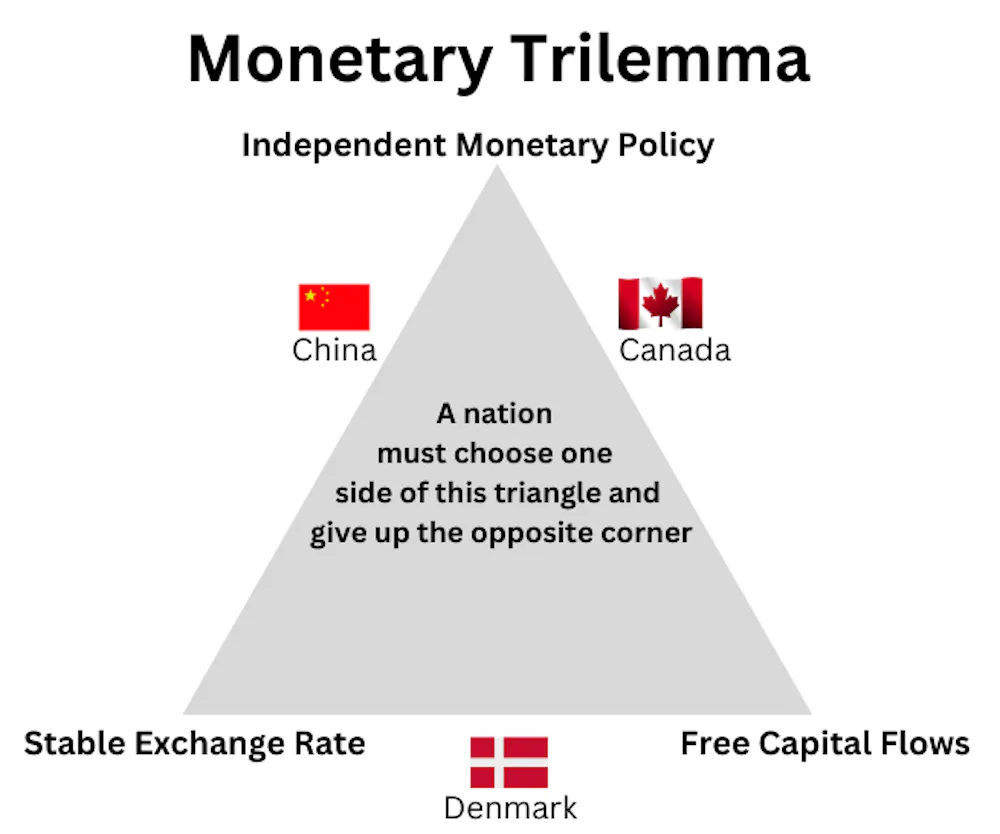
    A country cannot have an independent monetary policy, stable exchange rate and free capital flows simultaneously. It must choose one side of this triangle and give up the opposite corner.
    (Sorin Rizeanu), CC BY-ND

    The Bank of Canada has good reasons to cut the interest rate back to 2.5 to 3.5 per cent, but this could have a significant impact on the loonie.

    Canada is facing two sets of trilemmas: a monetary one for the central bank and a fiscal one for the government. On the monetary side, stable exchange rates, independent monetary policy and financial market openness are three objectives that cannot all be achieved simultaneously. European countries have sacrificed monetary independence in exchange for a strong euro and financial openness.

    It’s impossible for policymakers to pursue all three choices at the same time. For instance, a country spending more without raising taxes has to increase public debt and deficit.
    (Sorin Rizeanu), CC BY-ND

    Canada, in contrast, has opted for free capital mobility and independent monetary policy at the expense of exchange rate stability. This allows the loonie to be determined by market forces, giving the central bank the ability to adjust interest rates while capital moves freely across the border.

    On the fiscal side, the government is grappling with climate change, immigration and wealth inequality. However, there is also strong public resistance to higher taxes, and public debt and deficits are currently at alarming levels.

    If the central banks are at odds

    If the Bank of Canada were to cut interest rates while the Fed doesn’t, the loonie would likely depreciate sharply, forcing a response. Such a divergence happened in June 2024, with the Fed following with a 0.5 per cent cut only in September.

    On such short-term deviations, sterilization is typically implemented to dampen the depreciation of the loonie by acquiring Canadian dollars and selling reserves.

    If the central banks were to remain at odds in the longer term, a decrease in money supply as investors flee would likely cause a decrease in domestic bank lending, which is already under pressure from public and private debt and increased default rates.

    This could decrease longer term interest rates and put additional pressure on the economy through the capital account. If investors believe the central bank is merely delaying the inevitable depreciation of its currency, it could also reinforce carry trade dynamics — an investment strategy where money is borrowed at a low cost in one currency to earn higher returns from investments in another currency.

    The bond market would also react, with notable effects in key economic sectors and asset valuation. Long-term interest rates tend to align more across countries than short-term rates, especially if global factors are influencing real rates or if investors are seeking safer assets.

    While the Bank of Canada can set its policy rate independently of the Fed’s rate, it has less control over the long-term. Long-term rates are tied to exchange rates and reflect expectations for future short-term rates and risk factors. Mortgage rates and corporate borrowing rates would be affected as well.

    Monetary policy can’t be the only answer

    The Bank of Canada’s mandate is to “keep inflation low, stable and predictable.” While this can be fulfilled through rate cuts, diverging from U.S. policy will have widespread effects on the Canadian economy. These impacts will be uneven, with indebted investors and banks likely benefiting while the working class may bear the brunt.

    The Bank of Canada focuses on providing liquidity to the financial sector, often with little regulation or oversight. However, this approach tends to overlook challenges faced by the working class. In 2022, for instance, Bank of Canada Governor Tiff Macklem advised against employers increasing wages to match inflation over concern that a wage-price spiral would occur.

    Even if the central bank wanted to address these issues, it’s limited by the ability to manage multiple outputs with just one instrument. As a result, the central bank should report not only on inflation, but also on the overall trade-offs of rate cuts.

    The Bank of Canada has a vested interest in tampering the effects of a new rate cut, especially since it could trigger a “capital famine” in the long-term and weaken the Canadian dollar. In the short-term, divergences from the U.S. will likely be manageable, but in the longer term, currency depreciation may be unavoidable to keep the economy afloat.

    Monetary policy is vital, but it’s merely the first line of defence against inflation. To truly address Canada’s economic issues, both monetary and fiscal policies need to work together in harmony, with a broader public discussion that goes beyond inflation.

    Sorin Rizeanu does not work for, consult, own shares in or receive funding from any company or organisation that would benefit from this article, and has disclosed no relevant affiliations beyond their academic appointment.

    ref. Bank of Canada’s latest interest rate cut: Monetary policy is not enough to address economic issues on its own – https://theconversation.com/bank-of-canadas-latest-interest-rate-cut-monetary-policy-is-not-enough-to-address-economic-issues-on-its-own-238396

    MIL OSI – Global Reports

  • MIL-OSI USA: Lankford Introduces Stand with Israel Act to Combat Israel’s Persecution at UN

    US Senate News:

    Source: United States Senator for Oklahoma James Lankford
    OKLAHOMA CITY, OK – Senators James Lankford (R-OK) and Jim Risch (R-ID) announced their intent to introduce the Stand with Israel Act when the Senate and House reconvene in November. This legislation would cut off US funding to United Nations (UN) agencies that expel, downgrade, suspend, or otherwise restrict the participation of the State of Israel.
    “Israel deserves to have the world’s full support in their defense against unspeakable terrorism,” said Lankford. “Our greatest ally in the Middle East has faced vicious attacks since their founding in 1948, but the latest all-out assault from the Iranian regime and their terrorist proxies intends to wipe Israel off the map. I will not walk away from Israel as the world tries to justify terrorism.”
    “Any attempt to alter Israel’s status at the UN is clearly anti-Semitic,” said Risch. “That said, if the UN member states allow the Palestinian Authority and the Palestine Liberation Organization to downgrade Israel’s status at the UN, the US must stop supporting the UN system, as it would clearly be beyond repair. I am disgusted that this outrageous idea has even been discussed, and will do all we can to ensure any changes to Israel’s status will come with consequences.”
    Senators Tom Cotton (R-AR), Chuck Grassley (R-IA), Bill Cassidy (R-LA), Dan Sullivan (R-AK), Steve Daines (R-MT), Mike Lee (R-UT), Kevin Cramer (R-ND), John Barrasso (R-WY), Pete Ricketts (R-NE), Eric Schmitt (R-MO), Rick Scott (R-FL), John Kennedy (R-LA), Mike Crapo (R-ID), Roger Wicker (R-MS), Shelley Moore Capito (R-WV), Marco Rubio (R-FL), Joni Ernst (R-IA), Ron Johnson (R-WI), Markwayne Mullin (R-OK), Thom Tillis (R-NC), Ted Budd (R-NC), Susan Collins (R-ME), Tim Scott (R-SC), Josh Hawley (R-MO), John Thune (R-SD), and Deb Fischer (R-NE) also joined in support of this bill. This is companion legislation to bipartisan House bill HR 9394 led by Representative Mike Lawler (R-NY).
    BACKGROUND:
    Reports indicate that the Palestinian Authority (PA) will attempt to downgrade Israel’s status at the UN.
    The PA is able to do this after the UN General Assembly passed a biased resolution which enhanced the PA’s status at the United Nations on May 10, 2024.
    The Stand with Israel Act would cut off US funding to UN agencies that expel, downgrade, suspend, or otherwise restrict the participation of the State of Israel. The bill is modeled after the current prohibition of funding to any UN entities that elevate the status of the Palestinian Authority to a member state.

    MIL OSI USA News

  • MIL-OSI USA: Bennet, Hickenlooper Welcome $23 Million from Bipartisan Infrastructure Law for Denver, Colorado Springs Airports

    US Senate News:

    Source: United States Senator for Colorado Michael Bennet
    Denver — Colorado U.S. Senators Michael Bennet and John Hickenlooper welcomed $23 million from the Federal Aviation Administration (FAA) to improve airport infrastructure in Denver and Colorado Springs. This funding comes through the Airport Terminals Program, made possible by the Bipartisan Infrastructure Law.
    “I’m grateful the FAA is supporting Colorado’s airports as they improve and modernize to meet our state’s changing needs,” said Bennet. “These dollars will help ensure our airports can continue to fuel our economy and better connect communities across our state.”
    “Our Bipartisan Infrastructure Law keeps investing in Colorado and creating good-paying jobs. This time by improving travelers’ experiences at both Denver International Airport and the Colorado Springs Airport,” said Hickenlooper. “Giddy up!” 
    Specifically, this funding includes:
    $15 million for Denver International Airport to increase the efficiency and capacity of its baggage handling system; and
    $8 million for Colorado Springs Airport to improve energy efficiency and accessibility, and modernize gate areas.
    Just this year, Bennet and Hickenlooper have welcomed nearly $140 million from the FAA for Colorado’s airports.

    MIL OSI USA News

  • MIL-OSI USA: Sorensen Calls for Better Surveillance of the Southern Border

    Source: United States House of Representatives – Congressman Eric Sorensen (IL-17)

    WASHINGTON, DC – Today, Congressman Eric Sorensen (IL-17) along with seven of his colleagues called on the Secretary of the Department of Homeland Security (DHS) Alejandro Mayorkas to make sure that surveillance cameras along the U.S.-Mexico border are working properly. A recent report from NBC stated that nearly 30 percent of surveillance cameras along the border are broken.   

    “Surveillance technologies allow DHS to enforce the law and protect the homeland effectively and efficiently,” Sorensen and the Members wrote. “As Members of Congress, we have consistently and robustly funded programs for smart border technologies for DHS, and as a result, unauthorized border crossings have dropped significantly to the lowest levels in years. The reports of failing technology have left us concerned about the effectiveness of our border security operations.”  

    Sorensen has been a strong advocate for securing our southern border by proposing legislation to increase the number of U.S. Customs and Border Protection (CBP) officers at legal points of entry, introducing the bipartisan Stop Fentanyl at the Border Act to provide CBP with the funding and technology they need to combat the growing fentanyl crisis, and helping launch the Democrats for Border Security Task Force. 

    Read the full letter here and below. 

    Dear Secretary Mayorkas and Acting Commissioner Miller, 

    We write to you expressing concern over reports that 30 percent of surveillance cameras along the border are non-functioning. Surveillance technology systems, particularly those that use autonomous and artificial technologies, play a critical role in keeping our border secure. It is unacceptable that such a high percentage of our border technology is inoperable. 

    Surveillance technologies allow DHS to enforce the law and protect the homeland effectively and efficiently. At a time when U.S. Customs and Border Protection (CBP) has struggled to meet recruitment and retention targets, the need to maximize valuable manpower resources is critical, and smart surveillance technologies have been a game-changer. As Members of Congress, we have consistently and robustly funded programs for smart border technologies for DHS, and as a result, unauthorized border crossings have dropped significantly to the lowest levels in years. 

    However, these recent reports have outlined that 150 of the 500 Border Patrol surveillance towers along the southwest U.S.-Mexico border are not operational. This number is staggering and unacceptable. We are gravely concerned that this lapse in functioning surveillance technology will compromise border security operations. In order to keep our nation’s border secure, we request the following information: 

    1. What is the average length of time each camera has been inoperable? 
    1. How many miles of the southwest border are affected by these outages 
    1. How much manpower has been diverted to address this issue? 
    1. What is the cost estimate to get all surveillance towers back online? 
    1. What steps are being taken to remediate this issue and prevent future mechanical failures? 

    As Members of Congress, we have a responsibility to ensure that appropriated funds are being used effectively and that all necessary measures are being taken by CBP to improve border security operations. The reports of failing technology have left us concerned about the effectiveness of our border security operations. We thank you for your attention to our concerns. 

    Congressman Eric Sorensen serves on the House Committee on Agriculture and the House Committee on Science, Space, and Technology. Prior to serving in Congress, Sorensen was a local meteorologist in Rockford and the Quad Cities for nearly 20 years. His district includes Illinois’ Quad Cities, Rockford, Peoria, and Bloomington-Normal.

    ###

    MIL OSI USA News

  • MIL-OSI USA: Remarks by Vice President Harris at the Vice President’s Residence

    US Senate News:

    Source: The White House
    Vice President’s ResidenceU.S. Naval ObservatoryWashington, D.C.
    12:58 P.M. EDT
    THE VICE PRESIDENT:  So, yesterday, we learned that Donald Trump’s former chief of staff, John Kelly, a retired four-star general, confirmed that while Donald Trump was president, he said he wanted generals like Adolf Hitler had.
    Donald Trump said that because he does not want a military that is loyal to the United States Constitution.  He wants a military that is loyal to him.  He wants a military who will be loyal to him personally, one that will obey his orders even when he tells them to break the law or abandon their oath to the Constitution of the United States.
    In just the past week, Donald Trump has repeatedly called his fellow Americans the “enemy from within” and even said that he would use the United States military to go after American citizens.
    And let’s be clear about who he considers to be the enemy from within.  Anyone who refuses to bend a knee or dares to criticize him would qualify, in his mind, as the enemy within, like judges, like journalists, like nonpartisan election officials.
    It is deeply troubling and incredibly dangerous that Donald Trump would invoke Adolf Hitler, the man who is responsible for the deaths of 6 million Jews and hundreds of thousands of Americans. 
    All of this is further evidence for the American people of who Donald Trump really is.  This is a window into who Donald Trump really is from the people who know him best, from the people who worked with him side by side in the Oval Office and in the Situation Room.
     And it is clear from John Kelly’s words that Donald Trump is someone who, I quote, “certainly falls into the general definition of “fascist,” who, in fact, vowed to be a dictator on day one and vowed to use the military as his personal militia to carry out his personal and political vendettas.
    Donald Trump is increasingly unhinged and unstable.  And in a second term, people like John Kelly would not be there to be the guardrails against his propensities and his actions.  Those who once tried to stop him from pursuing his worst impulses would no longer be there and no longer be there to rein him in.
    So, the bottom line is this.  We know what Donald Trump wants.  He wants unchecked power.  The question in 13 days will be: What do the American people want?
         Thank you.
                                 END                1:01 P.M. EDT                              

    MIL OSI USA News

  • MIL-OSI Canada: Canada, the United States and Mexico release the North American Preparedness for Animal and Human Pandemics Initiative (NAPAHPI)

    Source: Government of Canada News

    News release

    An initiative between Canada and partner countries to strengthen our ability to prepare for and respond to public health threats

    October 23, 2024 | Ottawa, Ontario | Public Health Agency of Canada

    Canada, the United States and Mexico have a strong and longstanding partnership, and are connected across many areas, including health, business and social relationships. This interconnectedness means that disruptions, such as the COVID-19 pandemic or other threats to health security, can have impacts across all three countries. Through continued coordination and cooperation, we can support the health and well-being of our populations.

    Today, the Public Health Agency of Canada, in collaboration with the Canadian Food Inspection Agency, Public Safety Canada and Global Affairs Canada, and their respective counterparts in the United States and Mexico, released the North American Preparedness for Animal and Human Pandemics Initiative (NAPAHPI).

    NAPAHPI fulfills commitments made during the 2021 and 2023 North American Leaders’ Summits to strengthen North America’s regional health security by working together to mitigate and respond to public health threats. It also provides a flexible framework that will help North American partners collaborate to address the challenges of potential future pandemics or other public health threats that require a coordinated response.

    The NAPAHPI complements the International Health Regulations (IHR) (2005) and other international mechanisms which seek to strengthen and protect global health security, and supports a One Health approach that considers the relationships between the health of humans, animals, and the environment.

    Together, Canada, the United States and Mexico will advance NAPAHPI’s goals by working on key areas for collaboration:

    • animal diseases with zoonotic potential;
    • epidemiological surveillance and laboratory diagnostics;
    • medical countermeasures;
    • public health measures;
    • medical supply chains;
    • health systems;
    • risk communications;
    • border health measures;
    • critical infrastructure;
    • risk assessment and foresight risk analyses;
    • joint exercises and training; and
    • sustainable financing.

    Quotes

    “Canada, the United States and Mexico have a long-standing friendship and history of collaboration. The North American Preparedness for Animal and Human Pandemics Initiative demonstrates what can be achieved when our three countries work together on a common vision. Through more effective coordination and collaboration, we can identify and implement actions that seek to protect the health and safety of our populations, while minimizing economic and social impacts.”

    — The Honourable Mark Holland, Minister of Health

    “The United States is committed to strengthening health security and preparing for future threats. To be successful we must coordinate closely across governments, as well as with industry and community leaders – which is what this platform makes possible. Our nations cannot be strong unless they are healthy. That’s why we will continue to work together on a sustained, durable strategy that improves health security for all.”

    — Xavier Becerra, Secretary of Health and Human Services

    “This new framework for collaboration between Mexico, Canada and the United States on preparedness for animal and human pandemics is an example of the close cooperation between the three countries. The framework will help us address the challenges of One Health and adopt new technologies and practices in the North American region. Additionally, it will promote a shared vision for surveillance, early identification of risk factors, and the planning and implementation of cooperative and sustainable responses to health emergencies. This trinational effort will translate into more efficient protection strategies for our populations.”

    — David Kershenobich, Minister of Health

    Quick facts

    • NAPAHPI replaces the 2007 North American Plan for Avian and Pandemic Influenza, and the 2012 North American Plan for Animal and Pandemic Influenza.

    • NAPAHPI builds on the history of this tripartite collaboration, as well as on lessons learned from the COVID-19 pandemic and other public health events over the past decade.

    • For nearly two decades, the three partner countries have met regularly to discuss, prepare for and respond to public health threats such as H1N1, MERS-CoV, Ebola, Zika, the Fukushima nuclear disaster, the COVID-19 pandemic, and more recently H5N1 avian influenza outbreaks.

    • NAPAHPI is led by a Senior Coordinating Body as a key decision-making forum and a Health Security Working Group as its technical arm, with members from the human health, animal health/agriculture, security and foreign affairs sectors.

    • The principal agencies in the governance structure are:

      • Canada: Public Health Agency of Canada, Canadian Food Inspection Agency, Public Safety Canada and Global Affairs Canada.
      • United States: Department of Health and Human Services, Department of Agriculture, Department of Homeland Security and Department of State.
    • Mexico: Secretariat of Health/Secretaría de Salud, Secretariat of Agriculture and Rural Development/Secretaría de Agricultura y Desarrollo Rural, Secretariat of Security and Citizen Protection/Secretaría de Seguridad y Protección Ciudadana, and Secretariat of Foreign Affairs/Secretaría de Relaciones Exteriores.

    Associated links

    Contacts

    Matthew Kronberg
    Press Secretary
    Office of the Honourable Mark Holland
    Minister of Health
    343-552-5654

    Media Relations
    Public Health Agency of Canada
    613-957-2983
    media@hc-sc.gc.ca

    Public Inquiries:
    613-957-2991
    1-866-225-0709

    MIL OSI Canada News

  • MIL-OSI USA: DOD Kicks Off Groundbreaking Applied Research Project in Hypersonic Infrared Targeting Sensing

    Source: United States Department of Defense

    The Department of Defense (DoD) today announced the Hypersonic Infrared Target Sensing (HITS) joint-service proposal as the winner of the fiscal year 2025 Applied Research for the Advancement of S&T Priorities (ARAP) Program award competition. The HITS team includes the Naval Research Laboratory, Air Force Research Laboratory, and Missile Defense Agency, led by the Combat Capabilities Development Command Army Research Laboratory (DEVCOM ARL).

    This three-year, $45-million project will involve the collaboration of more than 50 federal scientists and engineers across the military service labs.

    “Investments into our military labs and facilities are imperative for the DoD to invest in technological solutions that attract and retain the future workforce,” said Dr. Aprille Ericsson, the assistant secretary of defense for science and technology and S&T Executive Committee chair, during a check-presentation ceremony at the Pentagon with the HITS team. “The project will also support up to 50 new graduate and postdoctoral researchers on-site or through the labs and their academic partners, growing the DoD’s depth in multiple emerging research areas.”

    The HITS research program will address the challenges of developing infrared seekers for hypersonic weapons. This includes locating targets throughout hypersonic flight, advancing gimbal-free target discrimination in extreme hypersonic turbulence, developing high-temperature infrared materials, and addressing thermal distortion through the seeker window.

    With additional participation from the Defense Advanced Research Projects Agency, the DEVCOM ARL-led team will build in-house capabilities while partnering with academia, university-affiliated research centers, and industry to execute the multidisciplinary effort, leveraging early laboratory demonstrations from basic research investments.

    “Our approach encompasses innovative multi-physics modeling, meta-optical design, advanced fabrication techniques, and infrared optical characterization, with the ultimate goal of improving the precision of these weapons at longer ranges in more agile, lower cost platforms,” said Dr. Henry Everitt, senior technologist for optical sciences at DEVCOM ARL and the HITS team lead.

    To participate in the annual ARAP award competition, DoD laboratories and centers must submit applied research (BA-2) funding proposals addressing specific technology or capability gaps while enhancing collaboration across the military services and DoD agencies. A proposal must demonstrate a clear pathway from research to product fielding. “The S&T Executive Committee received nine high-quality white paper submissions for this year’s competition and narrowed it down to three finalists,” said Ericsson.

    Each finalist team briefed its full proposal to the executive committee, a defense multi-service, multi-agency group coordinated by the Office of the Under Secretary of Defense for Research and Engineering, under which Ericsson’s office operates.

    “Every team demonstrated tremendous initiative, professionalism, and vision in developing its proposal, proving once again that the dedication and excellence of our defense scientists and engineers are the key ingredients for the ARAP program’s success, as it solves challenging problems for the joint collaborative fight,” said Ericsson.

    The call for ARAP white papers for fiscal year 2026 is now open with submissions due on Friday, November 13, 2024. For questions or assistance accessing the DoDTechipedia OUSD(R&E) ARAP Webpage, please contact the R21 Team at osd.pentagon.ousd-atl.mbx.communities-of-interest@mail.mil.

    About USD(R&E)

    The Office of the Under Secretary of Defense for Research and Engineering OUSD(R&E) champions research, science, technology, engineering, and innovation to maintain the U.S. military’s technological advantage. Learn more at www.cto.mil or visit us on LinkedIn at https://www.linkedin.com/company/ousdre.

    MIL OSI USA News

  • MIL-OSI USA: Readout of Secretary of Defense Lloyd J. Austin III’s Meeting With His Holiness Pope Francis at the Vatican

    Source: United States Department of Defense

    Deputy Press Secretary Sabrina Singh provided the following readout:

    Secretary of Defense Lloyd J. Austin III met with His Holiness Pope Francis today at the Vatican. The two leaders discussed shared concerns over global security challenges and the importance of promoting peace and stability in conflict-affected regions. Secretary Austin expressed his deep appreciation for the Vatican’s humanitarian efforts, particularly in addressing the plight of civilians impacted by ongoing conflicts, including the war in Ukraine.

    Secretary Austin and Pope Francis reflected on the need for continued collaboration to alleviate the suffering of those affected by war, persecution, and displacement, while emphasizing the importance of dialogue and reconciliation in resolving global conflicts. Secretary Austin also commended the Pope’s moral leadership and tireless advocacy for the most vulnerable, including his work in promoting peace, supporting refugees, and addressing the effects of climate change on the world’s poorest communities.

    MIL OSI USA News

  • MIL-OSI USA: Rosen, Cortez Masto Announce $10 Million to Improve Marlette Lake Dam’s Infrastructure and Resiliency

    US Senate News:

    Source: United States Senator Jacky Rosen (D-NV)

    CARSON CITY, NV – Today, U.S. Senators Jacky Rosen (D-NV) and Catherine Cortez Masto (D-NV) announced the State of Nevada will receive a $10 million grant from the Federal Emergency Management Agency (FEMA) to enhance the safety and functionality of the Marlette Lake Dam, reducing the risk of a dam breach during an earthquake.
    “When we invest in Nevada’s infrastructure, we are investing in the safety of our local communities and helping create good-paying jobs,” said Senator Rosen. “I’m proud to announce that $10 million in federal funding is coming to Northern Nevada to upgrade the Marlette Lake Dam and help make it more resilient against future earthquakes. I’ll continue fighting to ensure Nevada gets its fair share of resources to keep our communities safe.”
    “I am proud to see these federal funds come into our state to make essential improvements to the Marlette Lake Dam and better resist an earthquake,” said Senator Cortez Masto. “These funds will help protect our water supply in Storey County and Carson City while keeping Nevadans safe and healthy. I’ll keep working with Senator Rosen to continue modernizing Nevada’s infrastructure and ensuring Nevadans have the resources they need to recover from natural disasters.”
    Senators Rosen and Cortez Masto worked to pass the Bipartisan Infrastructure Law to create good-paying jobs and upgrade Nevada’s infrastructure. They are committed to ensuring Nevadans have access to resources in the face of natural disasters. Both Senators successfully pushed President Biden to issue a Major Disaster Declaration for numerous counties in Nevada in the wake of unprecedented winter storms. Senators Rosen and Cortez Masto also joined their  colleagues in asking the White House for federal funds to help Nevada fight wildfires and extreme drought.

    MIL OSI USA News

  • MIL-OSI USA: Department of Veterans Affairs Implements Rosen’s Bipartisan Law to Strengthen Cybersecurity of Veterans’ Personal Information

    US Senate News:

    Source: United States Senator Jacky Rosen (D-NV)

    Senator Rosen’s Bipartisan Strengthening VA Cybersecurity Act Required the Department to Obtain An Independent Cybersecurity Assessment And Submit A Plan To Congress To Address Cyber Vulnerabilities
    LAS VEGAS, NV – U.S. Senator Jacky Rosen (D-NV) announced that the Department of Veterans Affairs (VA) has implemented her bipartisan law to strengthen the cybersecurity of veterans’ personal information and data. Her Strengthening VA Cybersecurity Act, signed into law in 2022, directed the Secretary to obtain an independent cybersecurity assessment of VA information systems, and submit to Congress the findings and a remediation plan to address the cybersecurity vulnerabilities. Following the recent completion of that assessment, the VA has submitted a detailed plan to Congress on how it will address vulnerabilities.
    “Our veterans rely on the VA to access medical care, benefits, and other critical services, and we must ensure their most personal information is protected from bad actors,” said Senator Rosen. “I worked across party lines to pass bipartisan legislation to protect Nevada veterans’ information, and I’m glad to see that the VA is implementing it by submitting a report to Congress outlining cybersecurity vulnerabilities and their plan to address them. I’ll continue working with the VA to make sure they address these vulnerabilities identified.”
    Senator Rosen has been leading bipartisan efforts to deliver for Nevada’s veterans. Last month, she helped pass bipartisan legislation to allocate billions of dollars for PACT Act benefits. Earlier this year, she helped introduce bipartisan legislation to officially authorize the construction of a new VA hospital in Reno, which followed Senator Rosen’s successful push with Senator Cortez Masto to include the hospital in the President’s 2024 Budget Request. She also introduced bipartisan legislation to permanently maintain a helpline for veterans to obtain information and assistance with VA services, which is included in this year’s Senate version of the National Defense Authorization Act. Senator Rosen secured funding to increase access to affordable housing for veterans, continue building Nevada’s first national veterans cemetery in Elko, and increase funding for veteran’s access to telehealth in the last bipartisan government funding package.

    MIL OSI USA News

  • MIL-OSI USA: NASA Welcomes Republic of Cyprus as 46th Artemis Accords Signatory

    Source: NASA

    NASA Associate Administrator Jim Free welcomed the Republic of Cyprus as the latest nation to commit to the responsible use of space for humanity on Wednesday, marking 46 signatories to date.
    “We applaud Cyprus’ commitment to the Artemis Accords, which will enhance the country’s engagement with NASA and the international community,” said Free, who participated virtually. “By joining 45 other country signatories in this effort, Cyprus will help play a role in implementing the accords and exploration that is open, responsible, transparent, and peaceful for the benefit of all.”
    Nicodemos Damianou, Cyprus’ deputy minister of research, innovation, and digital policy, signed the Artemis Accords during a ceremony in Nicosia, Cyprus. James O’Brian, assistant secretary for European and Eurasian Affairs for the U.S. Department of State, also attended the event.
    “Today marks a significant milestone for Cyprus as we officially sign the Artemis Accords,” said Damianou. “As we embark on this exciting journey, we reaffirm our commitment to a safe and responsible space exploration, as well as our strong belief in the importance of international cooperation in ensuring space is utilized to the benefit of all humanity. Cyprus, an European Union member state, is capitalizing on its geostrategic location between three continents, and aspires to play an integral role in the international space community.”
    The signing with Cyprus comes on the heels of an Artemis Accords meeting in Milan earlier this month with dozens of signatory countries, including the United States.
    In 2020, NASA, in coordination with the U.S. Department of State and seven other initial signatory nations, established the Artemis Accords, which identified an early set of principles promoting the beneficial use of space for humanity. The Artemis Accords are grounded in the Outer Space Treaty and other agreements including the Registration Convention, the Rescue and Return Agreement, as well as best practices and norms of responsible behavior that NASA and its partners have supported, including the public release of scientific data. 
    The commitments of the Artemis Accords and efforts by the signatories to advance implementation of these principles support the safe and sustainable exploration of space. More countries are expected to sign in the coming days and weeks ahead.
    Learn more about the Artemis Accords at:
    https://www.nasa.gov/artemis-accords
    -end-
    Kathryn Hambleton / Elizabeth ShawHeadquarters, Washington202-358-1600kathryn.a.hambleton@nasa.gov / elizabeth.a.shaw@nasa.gov

    MIL OSI USA News

  • MIL-OSI USA: NASA Ames Stars of the Month: October 2024

    Source: NASA

    The NASA Ames Science Directorate recognizes the outstanding contributions of (pictured left to right) America Reyes Wang, Sepideh Khajehei, Julie Nottage, and Ryan Felton. Their commitment to the NASA mission represents the talent, camaraderie, and vision needed to explore this world and beyond.

    Space Biosciences Star: America Reyes Wang
    America Reyes Wang serves as the Space Biology Biospecimen Sharing Program (BSP) Lead in the Space Biosciences Research Branch, where she guides a team of support scientists and a logistics coordinator in planning and performing detailed, collaborative dissections to maximize the scientific return from biological investigations. Under her leadership, the BSP team has contributed over 5,000 samples to the NASA Biological Institutional Scientific Collection (NBISC), approximately half of which were collected in the last 10 months.

    Earth Science Star: Sepideh Khajehei
    Sepideh Khajehei is a NASA Earth eXchange (NEX) Data and Research Scientist in the Biospheric Science Branch, for the Bay Area Environmental Research Institute. She is recognized for her dedicated support of the NASA Administrator’s Earth Information Center, and recently for her outstanding support for an urgent request to revise climate indices just days before the October 7, 2024, opening of NASA’s Hometown Climate Dashboard at the Smithsonian Institute in Washington, D.C.

    Space Science & Astrobiology Star: Julie Nottage
    Julie Nottage continuously goes above and beyond in her role as the Space and Earth Sciences Facilities Service Manager.  She keeps a multi-use interdisciplinary science building running across all aspects of operations and is the go-to person for any problem.  Her can-do approach and wealth of knowledge ensures the facility’s high-quality operation that enables scientists and engineers to focus on their research and instrument work.  Her quality work and extensive coordination of the Voluntary Protection Program allowed these month-long inspections to run smoothly with an improved safety outcome.

    Space Science & Astrobiology Star: Ryan Felton
    Ryan Felton, a NASA Postdoctoral Management Fellow with the Exobiology Branch, is recognized for his successful coordination of an engaging community-wide seminar series focused on Artificial Intelligence/Machine Learning (AI/ML). This seminar series featured four speakers so far over six months on a variety of exciting topics to advance AI/ML knowledge and use in the branch’s research.

    MIL OSI USA News

  • MIL-OSI Security: River Bennett — Victoria County District RCMP investigates fatal crash in River Bennett

    Source: Royal Canadian Mounted Police

    Victoria County District RCMP is investigating a fatal crash that occurred in River Bennett.

    On October 22, at approximately 6:08 p.m., Victoria County District RCMP and fire services responded to a report of a single-vehicle crash in the 46000 block of the Cabot Trail. RCMP officers learned that a Nissan Frontier had left the roadway and rolled, coming to rest in the ditch.

    The driver and sole occupant of the Frontier, a 22-year-old woman from Englishtown, was located deceased at the scene.

    An RCMP collision reconstructionist attended the scene and the investigation is ongoing. The Cabot Trail was partially closed for several hours but has since fully reopened.

    Our thoughts are with the victim’s loved ones at this difficult time.

    MIL Security OSI

  • MIL-OSI: UPDATE – Talen Energy to Report Third Quarter 2024 Financial Results on November 14, 2024

    Source: GlobeNewswire (MIL-OSI)

    Reflects Update to Previously Announced Date to Accommodate Schedules in the Investor Community, New Event Links Included

    HOUSTON, Oct. 23, 2024 (GLOBE NEWSWIRE) — Talen Energy Corporation (“Talen”) (NASDAQ: TLN) plans to release its third quarter 2024 financial results on Thursday, November 14, 2024, before market open. President and Chief Executive Officer Mac McFarland and Chief Financial Officer Terry Nutt will discuss the financial and operating results during an earnings call at 10:00 a.m. EST (9:00 a.m. CST) on November 14, 2024.

    To listen to the earnings call, please register in advance for the webcast here. For participants joining the call via phone, please register here prior to the start time to receive dial-in information. For those unable to participate in the live event, a digital replay of the earnings call will be archived for approximately one year and available on Talen’s Investor Relations website at https://ir.talenenergy.com/news-events/events.

    About Talen
    Talen Energy (NASDAQ: TLN) is a leading independent power producer and energy infrastructure company dedicated to powering the future. We own and operate approximately 10.7 gigawatts of power infrastructure in the United States, including 2.2 gigawatts of nuclear power and a significant dispatchable fossil fleet. We produce and sell electricity, capacity, and ancillary services into wholesale U.S. power markets, with our generation fleet principally located in the Mid-Atlantic and Montana. Our team is committed to generating power safely and reliably, delivering the most value per megawatt produced and driving the energy transition. Talen is also powering the digital infrastructure revolution. We are well-positioned to capture this significant growth opportunity, as data centers serving artificial intelligence increasingly demand more reliable, clean power. Talen is headquartered in Houston, Texas. For more information, visit https://www.talenenergy.com/.

    Investor Relations:
    Ellen Liu
    Senior Director, Investor Relations
    InvestorRelations@talenenergy.com

    Media:
    Taryne Williams
    Director, Corporate Communications
    Taryne.Williams@talenenergy.com

    Forward-Looking Statements
    This communication contains forward-looking statements within the meaning of the federal securities laws, which statements are subject to substantial risks and uncertainties. These forward-looking statements are intended to qualify for the safe harbor from liability established by the Private Securities Litigation Reform Act of 1995. All statements other than statements of historical fact included in this communication, or incorporated by reference into this communication, are forward-looking statements. Throughout this communication, we have attempted to identify forward-looking statements by using words such as “anticipate,” “believe,” “continue,” “could,” “estimate,” “expect,” “forecasts,” “goal,” “intend,” “may,” “plan,” “potential,” “predict,” “project,” “seek,” “should,” “will,” or other forms of these words or similar words or expressions or the negative thereof, although not all forward-looking statements contain these terms. Forward-looking statements address future events and conditions concerning, among other things capital expenditures, earnings, litigation, regulatory matters, hedging, liquidity and capital resources and accounting matters. Forward-looking statements are subject to substantial risks and uncertainties that could cause our future business, financial condition, results of operations or performance to differ materially from our historical results or those expressed or implied in any forward-looking statement contained in this communication. All of our forward-looking statements include assumptions underlying or relating to such statements that may cause actual results to differ materially from expectations, and are subject to numerous factors that present considerable risks and uncertainties.

    The MIL Network

  • MIL-OSI Economics: Global Sovereign Debt Roundtable — 3rd Cochairs Progress Report

    Source: International Monetary Fund

    October 23, 2024

    Washington, DC: The Global Sovereign Debt Roundtable (GSDR) met today and reviewed progress on the work to improve debt restructuring processes and timelines, and to help address debt vulnerabilities. Participants also discussed priority areas for the work going forward. At the end of the meeting, the International Monetary Fund Managing Director Kristalina Georgieva, World Bank Group President Ajay Banga, and Finance Minister of Brazil Fernando Haddad, co-chairs of the GSDR, issued the attached GSDR 3rd Cochairs Report as well as the compilation of technical issues discussed by the GSDR so far.

    The GSDR brings together debtor countries and official and private creditors with the objective to build common understanding among key stakeholders on debt sustainability and debt restructuring challenges, and ways to address them.

    IMF Communications Department
    MEDIA RELATIONS

    PRESS OFFICER: Randa Elnagar

    Phone: +1 202 623-7100Email: MEDIA@IMF.org

    @IMFSpokesperson

    MIL OSI Economics

  • MIL-OSI USA: Congresswoman De La Cruz Announces $2 Million in Funds for Community Projects for UTRGV and the City of Edinburg

    Source: United States House of Representatives – Monica De La Cruz (TX-15)

    Congresswoman Monica De La Cruz announced Wednesday (October 23rd) nearly $2 million in funding for community projects in South Texas. University of Texas – Rio Grande Valley will receive $500,000 in funds dedicated to its Manufacturing Incubator Dry Room Project, which will encourage innovation and investment into the RGV.  The City of Edinburg will receive nearly $1.4 million for Lift Station No. 19 Force Main Realignment and Sanitary Sewer Improvements Project, ensuring reliable, safe water by relieving existing sanitary sewer lines experiencing overflows.

    “These funds will play a vital role in driving progress and adding industry to the RGV. It is my duty to work for the people of South Texas, and these funds are going back directly into their communities,” said De La Cruz. “I will continue to work tirelessly within Congress and with local leaders to foster a community of growth, investment, and opportunity to allow every community member to thrive.”

    “This funding is a testament to UTRGV’s commitment to advancing cutting-edge research that directly impacts the Rio Grande Valley. With the Dry Room project, we are poised to drive innovation in manufacturing, benefiting industries like electronics and medical devices while creating new opportunities for our students and community,” said UTRGV President Dr. Bailey. 

    “We are celebrating the Lift Station No. 19 Force Main Realignment and Sanitary Sewer Improvements Project, a vital milestone for Edinburg. This $1.394 million investment will enhance our city’s wastewater infrastructure, especially in the rapidly growing northern area. The improvements will benefit vibrant neighborhoods, businesses, schools, and community spaces like the Boys and Girls Club,” said Edinburg Mayor Ramiro Garza Jr. 

    Read more about secured appropriation funds for TX-15 here.
    La Congresista Monica De La Cruz anunció el miércoles (23 de octubre) casi $2 millones en fondos para proyectos comunitarios en el sur de Texas. La Universidad de Texas – Valle del Río Grande (UTRGV) recibirá $500,000 para su Proyecto de Sala Seca para Incubadora de Manufactura, el cual fomentará la innovación y la inversión en el Valle del Río Grande. La Ciudad de Edinburg recibirá casi $1.4 millones para el Proyecto de Reubicación de la Línea Principal y Mejoras al Alcantarillado Sanitario de la Estación de Bombeo No. 19, garantizando agua segura y confiable al aliviar las líneas sanitarias existentes que han presentado desbordamientos.

    “Estos fondos serán clave para impulsar el progreso y desarrollar industrias en el Valle. Es un honor servir a la gente del sur de Texas, y estos recursos volverán directamente a sus comunidades. Seguiré trabajando sin descanso en el Congreso y junto a los líderes locales para construir una comunidad de crecimiento, inversión y oportunidades que permitan a cada persona prosperar”, dijo De La Cruz.

    “Estos fondos son un testimonio del compromiso de UTRGV con la investigación de vanguardia que impacta directamente al Valle del Río Grande. Con el proyecto de la Sala Seca, estamos listos para impulsar la innovación en la manufactura, beneficiando a industrias como la de dispositivos electrónicos y médicos, mientras creamos nuevas oportunidades para nuestros estudiantes y la comunidad”, dijo el presidente de UTRGV, Dr. Bailey.

    “Estamos celebrando el Proyecto de Reubicación de la Línea Principal y Mejoras al Alcantarillado Sanitario de la Estación de Bombeo No. 19, un hito vital para Edinburg. Esta inversión de $1.394 millones mejorará la infraestructura de aguas residuales de nuestra ciudad, especialmente en la zona norte de rápido crecimiento. Las mejoras beneficiarán a vecindarios, negocios, escuelas y espacios comunitarios vibrantes, como el Boys and Girls Club”, dijo el alcalde de Edinburg, Ramiro Garza Jr.

    Lea más sobre los fondos asignados para el Distrito TX-15 aquí.

    MIL OSI USA News

  • MIL-OSI Africa: Ninth Africa Energy Market Place (AEMP) held in Dar es Salaam ahead of key Africa Heads of State Energy Summit scheduled for 28 January in Tanzania

    Source: Africa Press Organisation – English (2) – Report:

    DAR ES SALAAM, Tanzania, October 23, 2024/APO Group/ —

    Further to an April 2024 pledge by the Presidents of the African Development Bank (www.AfDB.org) and the World Bank to bring electricity access to 300 million people in Africa by 2030, the Tanzanian port city of Dar es Salaam has been selected to host an Africa Heads of State Energy Summit on 28 January 2025.

    The summit will convene heads of state and government, ministers, international and regional organisations, and other partners, including the private sector, to agree on a common set of reforms required to support Africa’s overall objective of “achieving universal access to affordable, reliable, sustainable and modern energy by 2030.” This objective aligns with United Nations Sustainable Development Goal 7 and the African Union’s Agenda 2063.

    This announcement was made by Dr Kevin Kariuki, Africa Development Bank Vice President for Power, Energy, Climate and Green Growth during the opening of the 9th Africa Energy Market Place (AEMP).

    AEMP is a policy dialogue and investment delivery platform created by the African Development Bank as part of the New Deal on Energy for Africa, the transformative partnership to light up and power Africa by 2025. By bringing together governments, the private sector, and development partners, it works to scale up investments in the African energy sector

    In his remarks, Dr Kariuki praised President Samia Suluhu Hassan’s leadership and personal commitment to Tanzania’s, and Africa’s, universal access to modern energy. He observed that increased and accelerated access to modern energy will hasten Tanzania’s economic development. “Accelerated universal access to energy will catalyse Tanzania’s economic development and guarantee an expedited well-lit, powered, prosperous and sustainable energy future for all Tanzanians,” he said.

    Jointly organised by the African Development Bank Group and Tanzania’s Ministry of Energy, the AEMP took place in Dar es Salaam, Tanzania on the 16th and 17th  of October 2024, under the theme Delivering the Clean Cooking Initiatives and National Energy Access Goals.  It was officiated by Dr Doto Mashaka Biteko, Tanzania’s deputy prime minister and minister of energy.

    Deputy Prime Minister Biteko expressed optimism regarding the AEMP’s potential for policy dialogue, noting that, “Hosting the 9th Africa Energy Market Place is timely as we prepare for the Africa Heads of State summit which aims to bring together African presidents, the private sector and development partners to facilitate investments to provide electricity access to 300 million people in Africa.”

    He said he hoped the discussions at AEMP would shape the executive sessions of the upcoming January summit.

    MIL OSI Africa

  • MIL-OSI USA: Senator Collins Speaks at Global Secure Shipping Facility Grand Opening in Old Town

    US Senate News:

    Source: United States Senator for Maine Susan Collins

    Click HERE, HERE, and HERE for individual photos
    Old Town, ME – Today, U.S. Senator Susan Collins delivered remarks at the grand opening of Global Secure Shipping’s (GSS) second manufacturing facility in Old Town.  With the opening of today’s facility, GSS now has 32,500ft in total manufacturing space to produce its state-of-the-art secure cargo containers using patented technology first developed at the University of Maine (UMaine).
    Today’s event also celebrated the company’s selection for a $4.1 million Department of Homeland Security (DHS) contract to produce and test the next generation of secure cargo containers. 
    Joining Senator Collins at the grand opening were U.S. Assistant Secretary of Defense for Industrial Base Policy Dr. Laura Taylor-Kale, UMaine President Joan Ferrini-Mundy, GSS CEO Robert Lindyberg, Ph.D., and Executive Director of GSS and UMaine engineering professor Dr. Habib Dagher.
    “This is a great day for our State, for our nation, and for the security of cargo shipping around the world,” said Senator Collins during her remarks.  “The project we celebrate today is about seaport security.  But it also is about transitioning from research and development to manufacturing to create new industries, with new opportunities and good jobs.  GSS is in the vanguard of that transition.”
    “Most of all, this is about the innovative spirit of Maine and our maritime heritage, with our University, GSS, and a skilled local workforce joining together to achieve something truly remarkable.  Congratulations on this great accomplishment,” Senator Collins concluded.
    GSS was founded in 2018 to commercialize the hybrid composite secure shipping container technology developed at UMaine. As a senior member of the Appropriations Committee and now Vice Chair, Senator Collins helped secure funding for UMaine to research this technology, as well as funding for DHS that led to GSS’s $4.1 million contract.
    Senator Collins attended the groundbreaking for this facility in September 2023. 

    MIL OSI USA News