Category: KB

  • MIL-OSI: SMX Awarded Competitive, Single-Award $3.2B SOCPAC Task Order on AAS ASTRO Contract

    Source: GlobeNewswire (MIL-OSI)

    KAPOLEI, Hawaii, Oct. 22, 2024 (GLOBE NEWSWIRE) — SMX®, a leader in next-generation mission support, digital transformation, and IT solutions, announced today that it has been awarded a prime contract to continue its work with Special Operations Command Pacific (SOCPAC) and its mission partners supporting the United States Indo-Pacific Command (USINDOPACOM). With an estimated value of $3.2 Billion (inclusive of option periods), the task order (TO), titled “Long-Range Enterprise Intelligence, Surveillance, and Reconnaissance Activity (LEIA),” was competed and awarded by GSA AAS under its Data Operations Pool ASTRO IDIQ contract (see https://aas.gsa.gov/astro/).

    Over 30 companies were eligible to bid on LEIA. This task order will allow SMX to extend support through 2031 if all option periods are exercised on the seven-year period of performance. Under LEIA, SMX will focus on delivery of advanced C6ISR capabilities across all domains (land, sea, air, cyber, and space). Leveraging its proven expertise in cloud computing, data analytics, artificial intelligence, and machine learning, SMX will build on the current ISR and partner nation capacity enhancements delivered across the Indo-Pacific under its predecessor AAS TO, Combatant Commands C5ISR-Pacific Operations (C3PO).

    “We are honored and excited to be awarded the LEIA contract and to continue to support SOCPAC, USINDOPACOM, and their Mission Partners,” said Dana Dewey, President of SMX Mission Solutions Group. “SMX remains a trusted partner to all of our Global Defense clients, especially here in the vast, complex Indo-Pacific region. With over a decade of intelligence support experience and mission expertise, we have honed the ability to rapidly assemble operational and technical solutions whenever and wherever needed. This award is a testament to our team’s commitment to mission, agile innovation, and partnership.”

    “The LEIA contract represents another key milestone for SMX as we expand our portfolio of high-impact mission-focused programs supporting Global Combatant Commands and other priority National Security clients. At SMX we strive to lead the industry by the innovative ways we deliver solutions, partner with leading tech providers, and relentlessly focus on our clients’ priority mission outcomes,” said Peter LaMontagne, CEO at SMX.

    About SMX
    SMX is a leader in next-generation cloud, C5ISR, and advanced engineering and IT solutions operating in close proximity to clients across the U.S. and around the globe. SMX delivers scalable and secure solutions combined with the mission expertise needed to accelerate outcomes for the Department of Defense, Intelligence Community, Public Sector, Fortune 1000 and other public and private sector clients. For more information on our services, please visit https://www.smxtech.com/.

    For inquiries about this press release, please contact us at communications@smxtech.com.

    The MIL Network

  • MIL-OSI Security: Enfield — Update: RCMP/HRP Integrated Criminal Investigation Division continues investigation into suspicious deaths

    Source: Royal Canadian Mounted Police

    The RCMP/HRP Integrated Criminal Investigation Division is continuing its investigation into the deaths of two adults who were found deceased at a residence on Rockcliffe Dr. in Enfield on October 18.

    Working with the Nova Scotia Medical Examiner Service, it has been determined that a 60-year-old woman died as a result of homicide and the death of a 61-year-old man was due to self-inflicted injuries.

    The two people were known to one another. Our thoughts are with their loved ones and the community at this difficult time.

    In consideration of the Privacy Act and out of respect for the families, the RCMP/HRP Integrated Criminal Investigation Division will not be releasing any further details.

    The ongoing investigation is being led by the RCMP/HRP Integrated Criminal Investigation Division with assistance from RCMP Halifax Regional Detachment, Nova Scotia RCMP Forensic Identification Services, and the Nova Scotia Medical Examiner Service.

    MIL Security OSI

  • MIL-OSI USA: Social Security Administration Commissioner Martin O’Malley and NC Health and Human Services Secretary Kody H. Kinsley Celebrate 70th Anniversary of the NC Disability Determination Services Program

    Source: US State of North Carolina

    Headline: Social Security Administration Commissioner Martin O’Malley and NC Health and Human Services Secretary Kody H. Kinsley Celebrate 70th Anniversary of the NC Disability Determination Services Program

    Social Security Administration Commissioner Martin O’Malley and NC Health and Human Services Secretary Kody H. Kinsley Celebrate 70th Anniversary of the NC Disability Determination Services Program
    hejones1

    North Carolina Health and Human Services Secretary Kody H. Kinsley will join state and federal leaders to celebrate the 70th anniversary of the North Carolina Disability Determination Services Program on Wednesday, Oct. 23, at 4 p.m. at the Governor’s Mansion in Raleigh. The group will highlight the 70 years of teamwork in supporting North Carolinians who are applying for disability benefits. The North Carolina Disability Determination Services (NC DDS) is the seventh largest DDS in the nation and since 2002 NC DDS staff have assisted with more than 3.3 million disability applications for people in North Carolina.

    North Carolina’s Disability Determination Services provides a safety net for people whose disabilities have left them unable to work. Staff receive applications from Social Security offices across the state and determine eligibility for Social Security Disability Insurance and Supplemental Security Income payments. Staff also determine eligibility for Medicaid disability benefits received from the state’s county departments of social services.

    Credentialed media are invited to join Social Security Administration Commissioner Martin O’Malley and NC Health and Human Services Secretary Kody H. Kinsley along with other federal and state leaders for an event in honor of this 70th anniversary. The year carries particular significance for the Social Security Administration Disability Program as the Social Security Amendment of 1954 established the first SSA definition of disability and that state agencies, in partnership with SSA, would make disability determinations. 

    What: 70th Anniversary of the North Carolina Disability Determination Services Program 

    Who: Martin O’Malley, Commissioner, Social Security Administration 
                Kody H. Kinsley, Secretary, North Carolina Department of Health and Human Services 
                Deborah Ross, Congresswoman NC-District 02
                Valerie Foushee, Congresswoman NC-District 04
                Jacqueline Russell, Director, NC Disability Determination Services 

    Where: North Carolina Executive Mansion 
                     200 N. Blount St.
                     Raleigh, NC 27601

    When: Wednesday, Oct. 23, 2024
                   4 – 6 p.m.

    Media: Officials will have an opportunity to answer questions from credentialed media on-site. Please RSVP to news@dhhs.nc.gov if you plan to attend. 

    Oct 22, 2024

    MIL OSI USA News

  • MIL-OSI USA: I Am Artemis: Casey Wolfe

    Source: NASA

    While precision, perseverance, and engineering are necessary skills in building a Moon rocket, Casey Wolfe knows that one of the most important aspects for the job is teamwork.
    “Engineering is vital, but to get this type of work done, you need to take care of the human element,” said Wolfe, the assistant branch chief of the advanced manufacturing branch in the Materials and Processes Laboratory at NASA’s Marshall Space Flight Center in Huntsville, Alabama.
    Together with her team, Wolfe is developing and producing the next generation payload adapter for NASA’s SLS (Space Launch System) super-heavy lift rocket. The adapter is made with some of the world’s most advanced composite manufacturing techniques.
    Wolfe’s work integrates the technical day-to-day operations and personnel management of the composites manufacturing team and additive manufacturing team, balancing production of SLS hardware with the creation of new engines using the latest manufacturing technologies. 
    “A lot of my day to day is in managing our two teams, making connections, building relationships, and making sure people feel supported,” Wolfe explains. “I conduct individual tag ups with each team member so we can be proactive about anticipating and addressing problems.”
    Wolfe grew up in Huntsville, a place known as the “Rocket City,” but it wasn’t until she visited a job fair while studying at Auburn University for a polymer and fiber engineering degree that she began to consider a career at NASA Marshall. Wolfe applied for and was selected to be a NASA intern through the Pathways Program, working in the non-metallic materials branch of the Materials and Processes Laboratory.
    Wolfe supported a coating system for electrostatic discharge on the first uncrewed test flight of the Orion spacecraft. Launching December 5, 2014, Orion traveled to an altitude of 3,600 miles, orbited Earth twice, and splashed down in the Pacific Ocean. It was during her internship that Wolfe realized how inspirational it felt to be treated like a vital part of a team:
    “The SLS program gave everyone permission to sign the hardware, even me – even though I was just an intern,” says Wolfe. “It was impactful to me, knowing that something I had worked on had my name on it and went to space.” 
    Since being hired by NASA, Wolfe’s work has supported development of the Orion stage adapter diaphragms for Artemis II and Artemis III, and the payload adapters for Artemis IV and beyond. The first three Artemis flights use the SLS Block 1 rocket variant, which can send more than 27 metric tons (59,500 pounds) to the Moon in a single launch. Beginning with Artemis IV, the SLS Block 1B variant will use the new, more powerful exploration upper stage to enable more ambitious missions to deep space, with the cone-shaped payload adapter situated atop the rocket’s exploration upper stage. The new variant will be capable of launching more than 38 metric tons (84,000 pounds) to the Moon in a single launch.
    “While the engineering development unit of the payload adapter is undergoing large-scale testing, our team is working on the production of the qualification article, which will also be tested,” Wolfe says. “Flight components should be starting fabrication in the next six months.”
    When Wolfe isn’t working, she enjoys hiking, gardening, and hanging out with her dogs and large family. Recently, she signed another piece of SLS hardware headed to space: the Orion stage adapter for the second Artemis mission.
    With as many responsibilities as Wolfe juggles, it’s easy to lose sight of her work’s impact. “I work in the lab around the hardware all the time, and in many ways, it can become very rote,” she says.
    But Wolfe won’t forget what she saw one evening when she worked late: “Everybody was gone, and as I walked past the launch vehicle stage adapter, there were two security guards taking pictures of each other in front of it. It was one of those things that made me step back and reflect on what my team accomplishes every day: making history happen.”
    NASA is working to land the first woman, first person of color, and its first international partner astronaut on the Moon under Artemis. SLS is part of NASA’s backbone for deep space exploration, along with the Orion spacecraft, supporting ground systems, advanced spacesuits and rovers, the Gateway in orbit around the Moon, and commercial human landing systems. SLS is the only rocket that can send Orion, astronauts, and supplies to the Moon in a single launch.

    MIL OSI USA News

  • MIL-OSI USA: Rep. Norcross Presents $850,000 in Community Project Funding to Upgrade Pedestrian and Bike Path in Merchantville

    Source: United States House of Representatives – Congressman Donald Norcross (1st District of New Jersey)

    CHERRY HILL, NJ – Today, Rep. Donald Norcross (D-NJ) presented $850,000 in Community Project Funding (CPF) to the Borough of Merchantville to upgrade pedestrian and bike path infrastructure.  

    The funding was secured through the Fiscal Year 2024 government funding package and will be used to upgrade pedestrian and bike path infrastructure. The upgrades will include new lighting, resurfacing, crosswalks, and ADA ramps for seniors at the senior housing center nearby. 

    “Community Project Funding grants invest in our communities and support economic development, job creation, and critical projects that improve the quality of life,” Rep. Norcross said. “I’m proud to have secured this funding for the Borough of Merchantville to upgrade our infrastructure and enhance safe recreational opportunities for our neighbors.” 

    “The funding of the Merchantville Community Project related to enhancements to the Merchantville Multi-Use path is critical to the continued success of the Borough of Merchantville and our surrounding communities,” Mayor Brennan said. “This path serves not just as the most well used amenity in our Borough, contributing to the health and wellness of residents in our region, but it is also part of a network of alternative transportation that connects the populations of the greater Camden County region to jobs and commerce. The proposed improvements for the path of lighting and accessibility to name a few, will only enhance this important connector of people and commerce and I am proud of Merchantville’s role in that and incredibly thankful to our federal representatives, particularly our Congressman, Donald Norcross, and US Senator Corey Booker for their support of this important project.” 

    Rep. Norcross recently secured 14 CPF awards totaling $13,565,031 for projects throughout New Jersey’s First Congressional District to support economic development, create jobs, and respond to the most pressing needs of the community. More information on the 14 projects can be found here. 

    Since the creation of CPFs in 2021, Rep. Norcross has secured $28.8 million in awards for local projects throughout South Jersey. CPF awards secured by Rep. Norcross range from road and transportation projects and affordable housing upgrades to improving health care and education accessibility.  


    ###

    MIL OSI USA News

  • MIL-OSI Banking: Grandoreiro, the global trojan with grandiose ambitions

    Source: Securelist – Kaspersky

    Headline: Grandoreiro, the global trojan with grandiose ambitions

    Grandoreiro is a well-known Brazilian banking trojan — part of the Tetrade umbrella — that enables threat actors to perform fraudulent banking operations by using the victim’s computer to bypass the security measures of banking institutions. It’s been active since at least 2016 and is now one of the most widespread banking trojans globally.

    INTERPOL and law enforcement agencies across the globe are fighting against Grandoreiro, and Kaspersky is cooperating with them, sharing TTPs and IoCs. However, despite the disruption of some local operators of this trojan in 2021 and 2024, and the arrest of gang members in Spain, Brazil, and Argentina, they’re still active. We now know for sure that only part of this gang was arrested: the remaining operators behind Grandoreiro continue attacking users all over the world, further developing new malware and establishing new infrastructure.

    Every year we observe new Grandoreiro campaigns targeting financial entities, using new tricks in samples with low detection rates by security solutions. The group has evolved over the years, expanding the number of targets in every new campaign we tracked. In 2023, the banking trojan targeted 900 banks in 40 countries — in 2024, the newest versions of the trojan targeted 1,700 banks and 276 crypto wallets in 45 countries and territories, located on all continents of the world. Asia and Africa have finally joined the list of its targets, making it a truly global financial threat. In Spain alone, Grandoreiro has been responsible for fraudulent activities amounting to 3.5 million euros in profits, according to conservative estimates — several failed attempts could have yielded beyond 110 million euros for the criminal organization.

    In this article, we will detail how Grandoreiro operates, its evolution over time, and the new tricks adopted by the malware, such as the usage of 3 DGAs (domain generation algorithm) in its C2 communications, the adoption of ciphertext stealing encryption (CTS), and mouse behavior tracking, aiming to bypass anti-fraud solutions. This evolution culminates with the appearance of lighter, local versions, now focused on Mexico, positioning the group as a challenge for the financial sector, law enforcement agencies and security solutions worldwide.

    Grandoreiro: One malware, many operators, fragmented versions

    Grandoreiro is a banking trojan of Brazilian origin that has been active since at least 2016. Grandoreiro is written in the Delphi programming language, and there are many versions, indicating that different operators are involved in developing the malware.

    Since 2016, we have seen the threat actors behind Grandoreiro operations regularly improving their techniques to stay unmonitored and active for a longer time. In 2020, Grandoreiro started to expand its attacks in Latin America and later in Europe with great success, focusing its efforts on evading detection using modular installers.

    Grandoreiro generally operates as Malware-as-a-Service, although it’s slightly different from other banking trojan families. You won’t find an announcement on underground forums selling the Grandoreiro package — it seems that access to the source-code or builders of the trojan is very limited, only for trusted partners.

    After the arrests of some operators, Grandoreiro split its codebase into lighter versions, with fewer targets. These fragmented versions of the trojan are a reaction to the recent law enforcement operations. This discovery is supported by the existence of two distinct codebases in simultaneous campaigns: newer samples featuring updated code, and older samples which rely on the legacy codebase, now targeting only users in Mexico — customers of around 30 banks.

    2022 and 2023 campaigns

    Grandoreiro campaigns commonly start with a phishing email written in the target country language. For example, the emails distributed in most of Latin America are in Spanish. However, we also saw the use of Google Ads (malvertising) in some Grandoreiro campaigns to drive users to download the initial stage of infection.

    Phishing emails use different lures to make the victim interact with the message and download the malware. Some messages refer to a pending phone bill, others mimic a tax notification, and son. In early 2022 campaigns, the malicious email included an attached PDF. As soon as the PDF is opened, the victim is prompted with a blurred image except for a part containing “Visualizar Documento” (“View Document” in Spanish). When the victim clicks the button, they are redirected to a malicious web page which prompts them to download a ZIP file. Since May 2022, Grandoreiro campaigns include a malicious link inside the email body that redirects the victim to a website that then downloads a malicious ZIP archive on the victim’s machine. These ZIP archives commonly contain two files: a legitimate file and a Grandoreiro loader, which is responsible for downloading, extracting and executing the final Grandoreiro payload.

    The Grandoreiro loader is delivered in the form of a Windows Installer (MSI) file that extracts a dynamic link library (DLL) file and executes a function embedded in the DLL. The function will do nothing if the system language is English, but otherwise the final payload is downloaded. Most likely, this means that the analyzed versions didn’t target English-speaking countries. There have also been other cases where a VBS file is used instead of the DLL to execute the final payload.

    Grandoreiro recent infection flow

    As for the malware itself, in August 2022 campaigns, the final payload was an incredibly big 414 MB portable executable file disguised with a PNG extension (which is later renamed to EXE dynamically by the loader). It masked itself as an ASUS driver using the ASUS icon and was signed with an “ASUSTEK DRIVER ASSISTANTE” digital certificate.

    In 2023 campaigns, Grandoreiro used samples with rather low detection rates. Initially, we identified three samples related to these campaigns, compiled in June 2023. All of them were portable executables, 390 MB big, with the original name “ATISSDDRIVER.EXE” and internal name “ATIECLXX.EXE”. The main purpose of these samples is to monitor the victims’ visits to financial institution websites and steal their credentials. The malware also allows threat actors to remotely control the victim machines and perform fraudulent transactions within them.

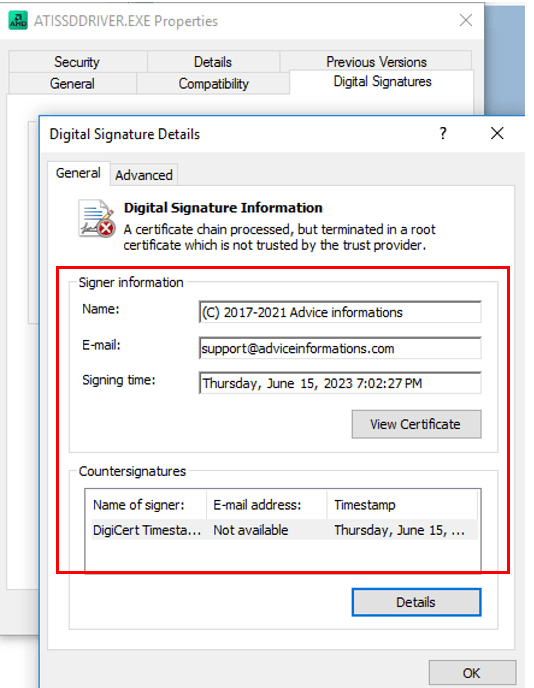
    In the campaign involving the discussed samples, the malware tries to impersonate an AMD External Data SSD driver and is signed with an “Advice informations” digital certificate in order to appear legitimate and evade detection.

    Implant impersonating AMD driver

    Digital certificate used by Grandoreiro malware

    In both cases, the malware is an executable that registers itself to be launched with Windows. However, it is worth noting that in the majority of Grandoreiro attacks, a DLL sideloading technique is employed, using legitimate binaries that are digitally signed to run the malware.

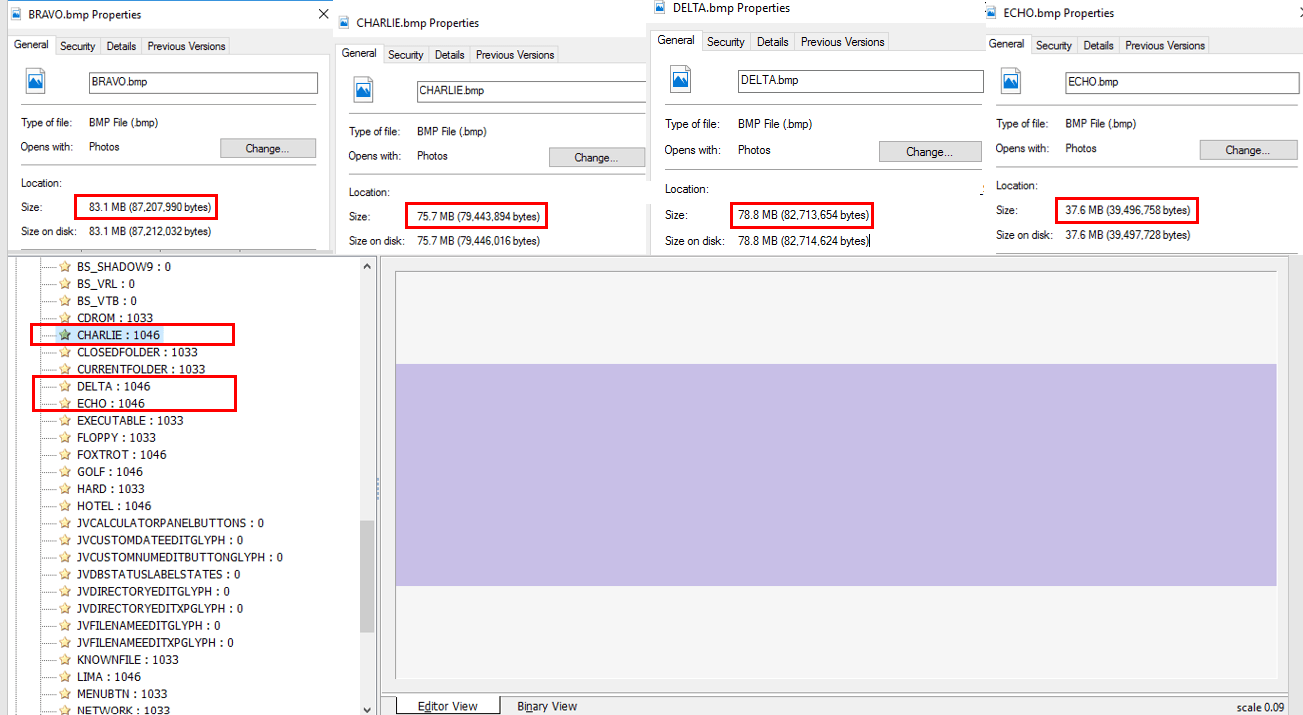
    The considerable size of the executables can be explained by the fact that Grandoreiro utilizes a binary padding technique to inflate the size of the malicious files as a way to evade sandboxes. To achieve this, the attackers add multiple BMP images to the resource section of the binary. In the example below, the sample included several big images. The sizes of the highlighted images are around 83.1 MB, 78.8 MB, 75.7 and 37.6 MB. However, there are more of them in the binary, and together all the images add ~376 MB to the file.

    Binary padding used by Grandoreiro

    In both 2022 and 2023 campaigns, Grandoreiro used a well-known XOR-based string encryption algorithm that is shared with other Brazilian malware families. The difference is the encryption key. For Grandoreiro, some magic values were the following:

    Date Encryption key
    March 2022 F5454DNBVXCCEFD3EFMNBVDCMNXCEVXD3CMBKJHGFM
    March 2022 XD3CMBKJCEFD3EFMF5454NBVDNBVXCCMNXCEVDHGFM
    August 2022 BVCKLMBNUIOJKDOSOKOMOI5M4OKYMKLFODIO
    June 2023 B00X02039AVBJICXNBJOIKCVXMKOMASUJIERNJIQWNLKFMDOPVXCMUIJBNOXCKMVIOKXCJ
    UIHNSDIUJNRHUQWEBGYTVasuydhosgkjopdf

    The various checks and validations aimed at avoiding detection and complicating malware analysis were also changed in the 2022 and 2023 versions. In contrast with the older Grandoreiro campaigns, we found that some of the tasks that were previously executed by the final payload are now implemented in the first stage loader. These tasks include security checks, anti-debugging techniques, and more. This represents a significant change from previous campaigns.

    One of these tasks is the use of the geolocation service http://ip-api.com/json to gather the target’s IP address location data. In a campaign reported in May 2023 by Trustwave, this task is performed by a JScript code embedded in an MSI installer before the delivery of the final payload.

    There are numerous other checks that have been transferred into the loader, although some of them are still present in the banking trojan itself. Grandoreiro gathers host information such as operating system version, hostname, display monitor information, keyboard layout, current time and date, time zone, default language and mouse type. Then the malware retrieves the computer name and compares it against the following strings that correspond to known sandboxes:

    • WIN-VUA6POUV5UP;
    • Win-StephyPC3;
    • difusor;
    • DESTOP2457;
    • JOHN-PC.

    Computer name validation

    It also collects the username and verifies if it matches with the “John” or “WORK” strings. If any of these validations match, the malware stops its execution.

    Grandoreiro includes detection of tools commonly used by security analysts, such as regmon.exe, procmon.exe, Wireshark, and so on. The process list varies across the malware versions, and it was significantly expanded in 2024, so we’ll share the full list later in this post. The malware takes a snapshot of currently executing processes in the system using the CreateToolhelp32Snapshot() Windows API and goes through the process list using Process32FirstW() and Process32NextW(). If any of the analysis tools exists in the system, the malware execution is terminated.

    Grandoreiro also checks the directory in which it is being executed. If the execution paths are D:programming or D:script, it terminates itself.

    Another anti-debugging technique implemented in the trojan involves checking for the presence of a virtual environment by reading data from the I/O Port “0x5658h” (VX) and looking for the VMWare magic number 0x564D5868. The malware also uses the IsDebuggerPresent() function to determine whether the current process is being executed in the context of a debugger.

    Last but not least, Grandoreiro searches for anti-malware solutions such as AVAST, Bitdefender, Nod32, Kaspersky, McAfee, Windows Defender, Sophos, Virus Free, Adaware, Symantec, Tencent, Avira, ActiveScan and CrowdStrike. It also looks for banking security software, such as Topaz OFD and Trusteer.

    In terms of the core functionality, some Grandoreiro samples check whether the following programs are installed:

    • CHROME.EXE;
    • MSEDGE.EXE;
    • FIREFOX.EXE;
    • IEXPLORE.EXE;
    • OUTLOOK.EXE;
    • OPERA.EXE;
    • BRAVE.EXE;
    • CHROMIUM.EXE;
    • AVASTBROWSER.EXE;
    • VeraCrypt;
    • Nortonvpn;
    • Adobe;
    • OneDrive;
    • Dropbox.

    If any of these is present on the system, the malware stores their names to further monitor user activity in them.

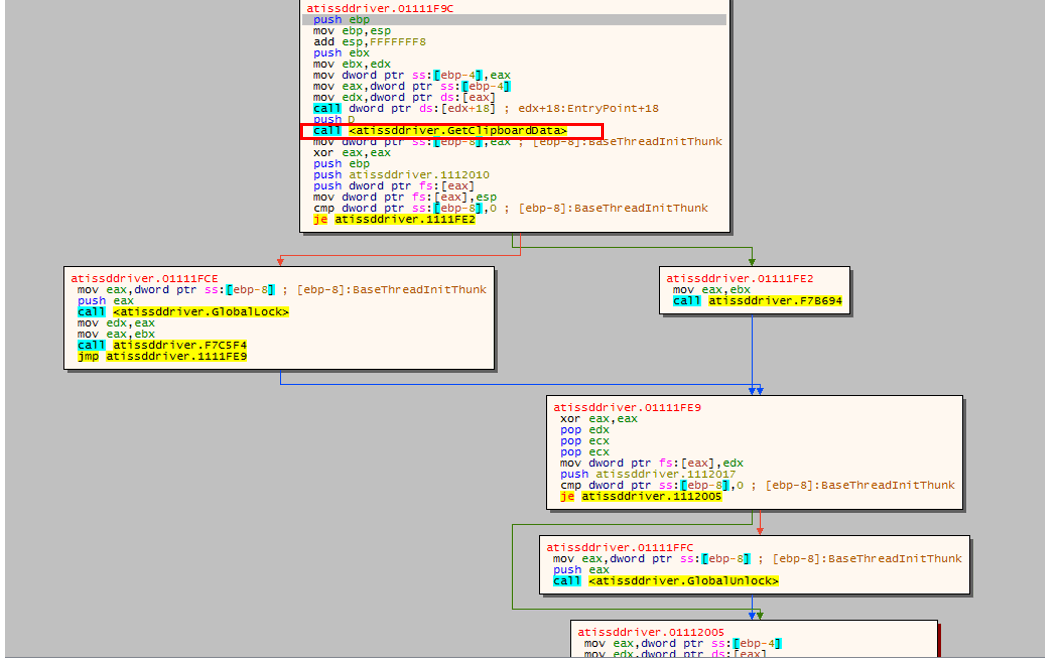
    Grandoreiro also checks for crypto wallets installed on the infected machine. The malware includes a clipboard replacer for crypto wallets, monitoring the user’s clipboard activity and replacing the clipboard data with the threat actor keys.

    Clipboard replacer

    2024 campaigns

    During a certain period of time in February 2024, a few days after the announcement of the arrest of some of the gang’s operators in Brazil, we observed a significant increase in emails detected by spam traps. There was a notable prevalence of Grandoreiro-themed messages masquerading as Mexican CFDI communications. Mexican CFDI, short for “Comprobante Fiscal Digital por Internet” is an electronic invoicing system administered by the Mexican Tax Authority (SAT — Servicio de Administración Tributaria). It facilitates the creation, transmission, and storage of digital tax documents, mandatory for businesses in Mexico to record transactions for tax purposes.

    In our investigation, we have acquired 48 samples associated not only with this instance but also with various other campaigns.

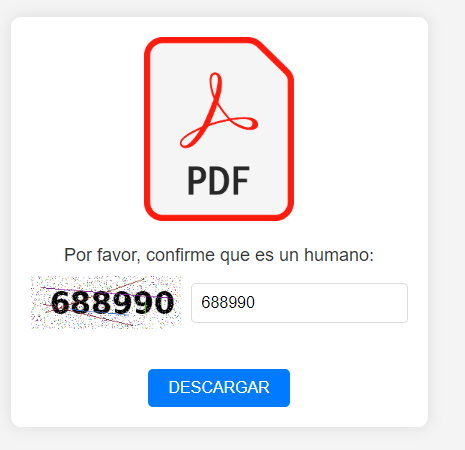
    Notably, this new campaign added a new sandbox detection mechanism, namely a CAPTCHA before the execution of the main payload, as a way to avoid the automatic analysis used by some companies:

    Grandoreiro anti-sandbox CAPTCHA

    It is worth noting that in the 2024 Grandoreiro campaigns, the new sandbox evasion code has been implemented in the downloader. Although the main sample still has anti-sandbox functionality too, if a sandbox is detected, it is simply not downloaded. Besides that, the new version also added detection of many tools to its arsenal, aiming to avoid analysis. Here is whole list of analysis tools detected by the newest versions:

    regmon.exe hopper.exe nessusd.exe OmniPeek.exe
    procmon.exe jd-gui.exe PacketSled.exe netmon.exe
    filemon.exe canvas.exe prtg.exe colasoft.exe
    Wireshark.exe pebrowsepro.exe cain.exe netwitness.exe
    ProcessHacker.exe gdb.exe NetworkAnalyzerPro.exe netscanpro.exe
    PCHunter64.exe scylla.exe OmniPeek.exe packetanalyzer.exe
    PCHunter32.exe volatility.exe netmon.exe packettotal.exe
    JoeTrace.exe cffexplorer.exe colasoft.exe tshark.exe
    ollydbg.exe angr.exe netwitness.exe windump.exe
    ida.exe pestudio.exe netscanpro.exe PRTG Probe.exe
    x64dbg.exe die.exe packetanalyzer.exe NetFlowAnalyzer.exe
    cheatengine.exe ethereal.exe packettotal.exe SWJobEngineWorker2x64.exe
    ollyice.exe Capsa.exe tshark.exe NetPerfMonService.exe
    fiddler.exe tcpdump.exe windump.exe SolarWinds.DataProcessor.exe
    devenv.exe NetworkMiner.exe PRTG Probe.exe ettercap.exe
    radare2.exe smartsniff.exe NetFlowAnalyzer.exe apimonitor.exe
    ghidra.exe snort.exe SWJobEngineWorker2x64.exe apimonitor-x64.exe
    frida.exe pcap.exe NetPerfMonService.exe apimonitor-x32.exe
    binaryninja.exe SolarWinds.NetPerfMon.exe SolarWinds.DataProcessor.exe x32dbg.exe
    cutter.exe nmap.exe ettercap.exe x64dbg.exe
    scylla.exe apimonitor.exe PCHunter64.exe x96dbg.exe
    volatility.exe apimonitor-x64.exe PCHunter32.exe fakenet.exe
    cffexplorer.exe apimonitor-x32.exe JoeTrace.exe hexworkshop.exe
    angr.exe x32dbg.exe ollydbg.exe Dbgview.exe
    pestudio.exe x64dbg.exe ida.exe sysexp.exe
    die.exe x96dbg.exe x64dbg.exe vmtoolsd.exe
    ethereal.exe fakenet.exe cheatengine.exe dotPeek.exe
    Capsa.exe hexworkshop.exe ollyice.exe procexp64.exe
    tcpdump.exe Dbgview.exe fiddler.exe procexp64a.exe
    NetworkMiner.exe sysexp.exe devenv.exe procexp.exe
    smartsniff.exe vmtoolsd.exe radare2.exe cheatengine.exe
    snort.exe dotPeek.exe ghidra.exe ollyice.exe
    pcap.exe procexp64.exe frida.exe pebrowsepro.exe
    cain.exe procexp64a.exe binaryninja.exe gdb.exe
    nmap.exe procexp.exe cutter.exe Wireshark.exe
    nessusd.exe regmon.exe hopper.exe ProcessHacker.exe
    PacketSled.exe procmon.exe jd-gui.exe SolarWinds.NetPerfMon.exe
    prtg.exe filemon.exe canvas.exe NetworkAnalyzerPro.exe

    These are some RAT features that we found in this version:

    • Auto-update feature allows newer versions of the malware to be deployed to the victim’s machine;
    • Sandbox/AV detection, still present in the main module, which includes more tools than previous versions;
    • Keylogger feature;
    • Ability to select country for listing victims;
    • Banking security solutions detection;
    • Checking geolocation information to ensure it runs in the target country;
    • Monitoring Outlook emails for specific keywords;
    • Ability to use Outlook to send spam emails.

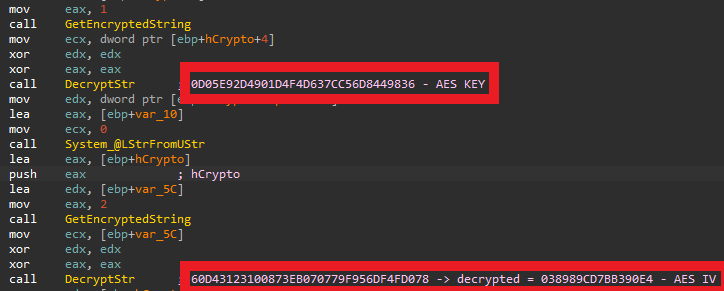
    In terms of static analysis protection, in 2024 versions, Grandoreiro has implemented enhanced encryption measures. Departing from its previous reliance on commonly shared encryption algorithms found in other malware, Grandoreiro has now adopted a multi-layered encryption approach. The decryption process in the newer versions is the following. Initially, the string undergoes deobfuscation through a simple replacement algorithm. Following this, Grandoreiro employs the encryption algorithm based on XOR and conditional subtraction typically utilized by Brazilian malware; however, it differs from them by incorporating a lengthy, 140759-byte string instead of smaller magic strings we saw in 2022 and 2023 samples. Subsequently, the decrypted string undergoes base64 decoding before being subjected to decryption via the AES-256 algorithm. Notably, the AES key and IV are encrypted within Grandoreiro’s code. Upon completion of all these steps, the decrypted string is successfully recovered.

    Grandoreiro AES key and IV

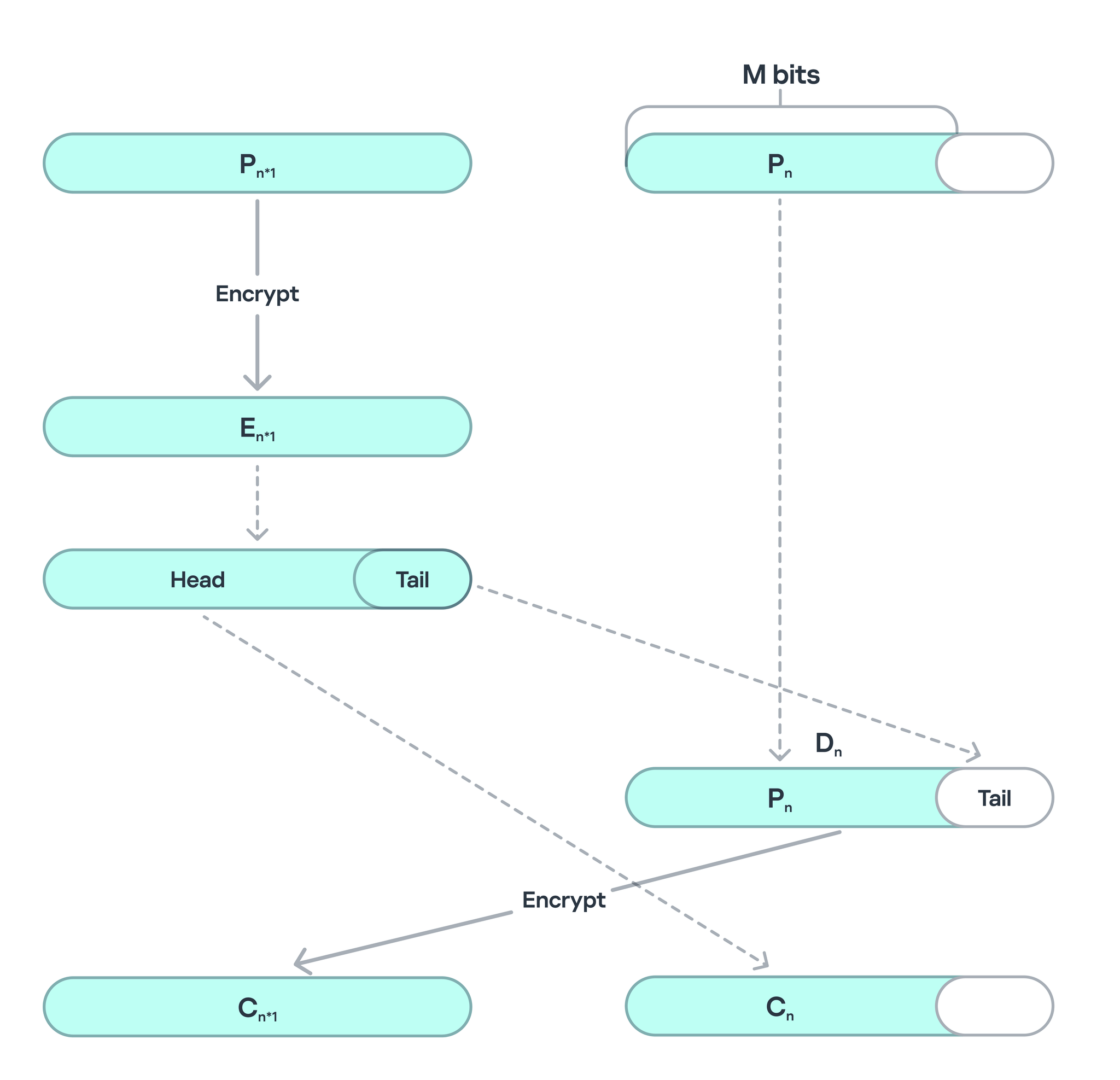
    In newer samples, Grandoreiro upgraded yet again the encryption algorithm using AES with CTS, or Ciphertext Stealing, a specialized encryption mode used when the plaintext is not a multiple of the block size, which in this case is the 128-bit (16-byte) block size used by AES. Unlike more common padding schemes, such as PKCS#7, where the final block is padded with extra bytes to ensure it fits a full block, CTS operates without padding. Instead, it manipulates the final partial block of data by encrypting the last full block and XORing its output with the partial block. This allows encryption of any arbitrary-length input without adding extra padding bytes, preserving the original size of the data.

    ECB Encryption Steps for CTS

    In the case of Grandoreiro, the malware’s encryption routine does not add standard padding to incomplete blocks of data. Their main goal is to complicate analysis: it takes time to figure out that CTS was used, and then more time to implement decryption in this mode, which makes the extraction and obfuscation of strings more complicated. This marks the first time this particular method has been observed in a malware sample.

    As the threat actors continue to evolve their techniques, changing the encryption in every iteration of the malware, the use of CTS in malware may signal a shift toward more advanced encryption practices.

    Local versions: old meets new

    In a recent campaign, our analysis has revealed the existence of an older variant of the malware that utilizes legacy encryption keys, outdated algorithms, and a simplified structure, but which runs in parallel to the campaign using the new code. This variant targets fewer banks — about 30 financial institutions, mainly from Mexico. This analysis clearly indicates that another developer, likely with access to older source code, is conducting new campaigns using the legacy version of the malware.

    How they steal your money

    Operators behind Grandoreiro are equipped with a wide variety of remote commands, including an option to lock the user screen and present a custom image (overlay) to ask the victim for extra information. These are usually OTPs (one-time passwords), transaction passwords or tokens received by SMS, sent by financial institutions.

    A new tactic that we have discovered in the most recent versions found in July 2024 and later suggests that the malware is capturing user input patterns, particularly mouse movements, to bypass machine learning-based security systems. Two specific strings found in the malware — “GRAVAR_POR_5S_VELOCIDADE_MOUSE_CLIENTE_MEDIA” (“Record for 5 seconds the client’s average mouse speed”) and “Medição iniciada, aguarde 5 segundos!” (“Measurement started, please wait 5 seconds!”) — indicate that Grandoreiro is monitoring and recording the user’s mouse activity over a short period. This behavior appears to be an attempt to mimic legitimate user interactions in order to evade detection by anti-fraud systems and security solutions that rely on behavioral analytics. Modern cybersecurity tools, especially those powered by machine learning algorithms, analyze user’s behavior to distinguish between human users and bots or automated malware scripts. By capturing and possibly replaying these natural mouse movement patterns, Grandoreiro could trick these systems into identifying the activity as legitimate, thus bypassing certain security controls.

    This discovery highlights the continuous evolution of malware like Grandoreiro, where attackers are increasingly incorporating tactics designed to counter modern security solutions that rely on behavioral biometrics and machine learning.

    To perform the cash-out in the victim’s account, Grandoreiro operators’ options are to transfer money to the account of local money mules, using transfer apps, buy cryptocurrency or gift cards, or even going to an ATM. Usually, they search for money mules in Telegram channels, paying $200 to $500 USD per day:

    Grandoreiro operator looking for money mules

    Infrastructure

    The newest Grandoreiro version uses 3 Domain Generation Algorithms (DGAs), generating valid domains for command and control (C2) communications. The algorithm uses the current daytime to select strings of predefined lists and concatenates them with a magic key to create the final domain.

    By dynamically generating unique domain names based on various input data, the algorithm complicates traditional domain-based blocking strategies. This adaptability allows the malicious actors to maintain persistent command-and-control communications, even when specific domains are identified and blacklisted, requiring security solutions to base their protection not on a fixed list of domains, but on an algorithm for generating them.

    Since early 2022, Grandoreiro leverages a known Delphi component shared among different malware families named RealThinClient SDK to remotely access victim machines and perform fraudulent actions. This SDK is a flexible and modular framework for building reliable and scalable Windows HTTP/HTTPS applications with Delphi. By using RealThinClient SDK, the program can handle thousands of active connections in an efficient multithreaded manner.

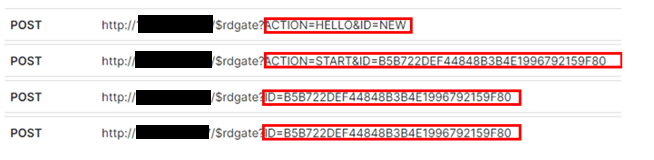
    Grandoreiro C2 Communication

    Operator tool

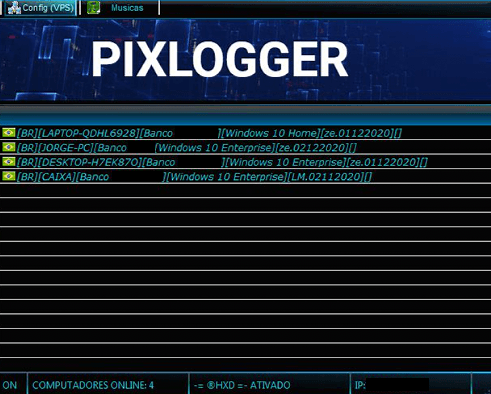
    Grandoreiro’s Operator is the tool that allows the cybercriminal to remotely access and control the victim’s machine. It’s a Delphi-based software that lists its victims whenever they start browsing a targeted financial institution website.

    Grandoreiro’s Operator tool

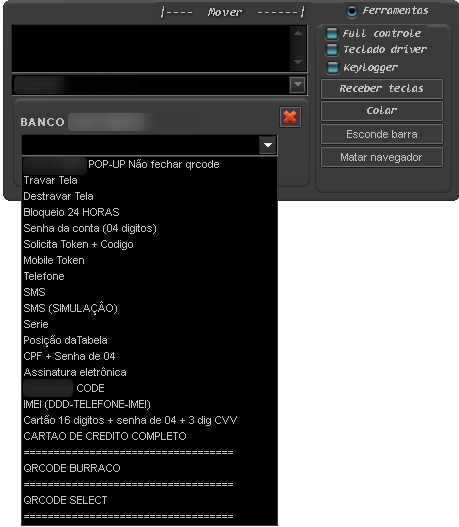
    Once the cybercriminal chooses a victim to operate on, they will be presented with the following screen, seen in the image below, which allows many commands to be executed and visualizes the victim’s desktop.

    Grandoreiro’s Operator commands

    Cloud VPS

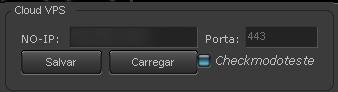
    One overlooked feature of the Grandoreiro malware is what is called “Cloud VPS” by the attackers — it allows cybercriminals to set up a gateway computer between the victim’s machine and the malware operator, thus hiding the cybercriminal’s real IP address.

    This is also used by them to make investigation harder, as the first thing noted is the gateway’s IP address. When requesting a seizure, an investigator just finds the gateway module. Meanwhile, the criminal has already set up a new gateway somewhere else and new victims connect to the new one through its DGA.

    Grandoreiro Cloud VPS

    Victims and targets

    The Grandoreiro banking trojan is primed to steal the credentials accounts for 1,700 financial institutions, located in 45 countries and territories. After decrypting the strings of the malware, we can see the targeted banks listed separated by countries/territories. This doesn’t mean that Grandoreiro will target a specific bank from the list; it means it is ready to steal credentials and act, if there is a local partner or money mule who can operationalize and complete the action. The banks targeted by Grandoreiro are located in Algeria, Angola, Antigua and Barbuda, Argentina, Australia, Bahamas, Barbados, Belgium, Belize, Brazil, Canada, Cayman Islands, Chile, Colombia, Costa Rica, Dominican Republic, Ecuador, Ethiopia, France, Ghana, Haiti, Honduras, India, Ivory Coast, Kenya, Malta, Mexico, Mozambique, New Zealand, Nigeria, Panama, Paraguay, Peru, Philippines, Poland, Portugal, South Africa, Spain, Switzerland, Tanzania, Uganda, United Kingdom, Uruguay, USA, and Venezuela. It’s important to note that the list of targeted banks and institutions tend to slightly change from one version to another.

    From January to October 2024, our solutions blocked more than 150,000 infections impacting more than 30,000 users worldwide, a clear sign the group is still very active. According to our telemetry, the countries most affected by Grandoreiro infections are Mexico, Brazil, Spain, and Argentina, among many others.

    Conclusion

    We understand how difficult it is to eradicate a malware family, but it is possible to impede their operation with the cooperation of law enforcement agencies and the private sector — modern financial cybercrime can and must be fought.

    Brazilian banking trojans are already an international threat; they’re filling the gaps left by Eastern European gangs who have migrated into ransomware. We know that in some countries, internet banking is declining on desktops, forcing Grandoreiro to target companies and government entities who are still using operating in that way.

    The threat actors behind the Grandoreiro banking malware are continuously evolving their tactics and malware to successfully carry out attacks against their targets and evade security solutions. Kaspersky continues to cooperate with INTERPOL and other agencies around the world to fight the Grandoreiro threat among internet banking users.

    This threat is detected by Kaspersky products as HEUR:Trojan-Banker.Win32.Grandoreiro, Trojan-Downloader.OLE2.Grandoreiro, Trojan.PDF.Grandoreiro and Trojan-Downloader.Win32.Grandoreiro.

    For more information, please contact: crimewareintel@kaspersky.com

    Indicators of Compromise

    Host based
    f0243296c6988a3bce24f95035ab4885
    dd2ea25752751c8fb44da2b23daf24a4
    555856076fad10b2c0c155161fb9384b
    49355fd0d152862e9c8e3ca3bbc55eb0
    43eec7f0fecf58c71a9446f56def0240
    150de04cb34fdc5fd131e342fe4df638
    b979d79be32d99824ee31a43deccdb18

    MIL OSI Global Banks

  • MIL-Evening Report: The best government money can buy? How New Zealanders feel about political party funding

    Source: The Conversation (Au and NZ) – By Mona Krewel, Senior Lecturer in Comparative Politics, Te Herenga Waka — Victoria University of Wellington

    Getty Images

    Companies and shareholders associated with the government’s fast-track projects gave more than $500,000 in donations to National, ACT and New Zealand First, according to a recent analysis by RNZ.

    While it is impossible to say whether these companies were listed for consideration because of their donations, allegations of possible “undue influence” are inevitably made.

    New Zealand’s reputation as a country with little to no corruption owes nothing to our lack of rigour in the regulation of party donations. As Philippa Yasbek, the author of a report by the Helen Clark Foundation calling for tougher rules to combat the risk of political corruption, said:

    Our political integrity and honesty have largely evolved from social norms over many decades. Politicians by and large knew the conduct that was expected of them by New Zealand society. Sadly, today, we’re naive to think that’s enough.

    Some political parties seem to take little heed of the existing rules. The Electoral Commission has issued warnings to several parties about large donations being declared too late.

    The Independent Electoral Review released early this year recommended parties give up access to corporate donations in exchange for greater public funding. Other recommendations included a cap on political donations set at NZ$30,000, and a much lower threshold for disclosing donors’ names.

    As one might expect, the political parties disagree about how funding should be regulated, as their main income sources vary. Labour approves of the proposals, although analysis indicates its revenue streams would suffer most if such policies were in place.

    ACT is strongly opposed to the principle of public funding, although there are already significant public funds supporting parliament and party advertising during election campaigns.

    What New Zealanders think

    But what about public opinion? Do people believe large donors have “undue influence”?

    The latest New Zealand Election Study, conducted after the 2023 election, included a module of questions that give insights into New Zealanders’ attitudes to potential party funding reforms. The study is a representative sample of nearly 2,000 eligible voters.

    What stands out? Many people answered “don’t know” to the questions – which is quite reasonable. The laws that regulate political party activity in New Zealand are complex and of little relevance to most.

    Nonetheless, some clear messages emerge. In general, a near majority of people were concerned about the influence of “big interests”. When asked if they agreed with the statement “The New Zealand government is largely run by a few big interests”, 45% agreed and 27% disagreed.

    Drilling deeper into the data, about 35% of business owners agreed, compared to just under half of people who don’t own a business.


    Asked whether they believed donors exert “undue influence” on politicians, 43% agreed. Only 18% disagreed. Almost 40% had no opinion on this topic and either didn’t know or took a neutral position.

    While Labour, Green and NZ First voters leaned heavily to “undue influence”, National and ACT voters were evenly divided between “undue” and “not undue”.

    National voters also strongly opted for “don’t know”. About a third of business owners perceived undue influence, compared with about 45% of non-owners.


    The 2023 Election Study also included a question on the recommendation made by the Electoral Review that corporate groups and trade unions should be prohibited from making direct donations to political parties: 53% supported this change, while only 17% opposed it.


    The Independent Electoral Review also recommended a limit of $30,000 for any individual donation: 57% agreed, compared to 14% who disagreed. While support was strongest on the left and among New Zealand First voters, significant numbers of National and ACT voters also agreed (47% and 44%).


    Finally, we asked for people’s views on anonymity of “promoter donations”. Promoters are people or groups registered to advertise during an election campaign for an issue, or for or against a political party. They can collect anonymous donations that are not subject to the same disclosure requirements as parties.

    Only 14% of respondents believed in continued promoter donation anonymity on the basis of privacy, and 47% preferred greater transparency. Breaking this down by party vote, some National and ACT voters prefer transparency over privacy, although more were either neutral or answered “don’t know”.


    Support for reform

    These results show public perceptions of undue influence by donors are widespread. While these perceptions are strongest on the left, they also penetrate deeply into groups who vote for the parties on the right, and into the business community.

    And while the political parties have conflicts of interest, there is significant support for the recommendations of the Independent Electoral review across party lines among the New Zealand public, and inside the business community.

    Assuming political parties in a democracy should be responsive to voters’ concerns and demands, this should give them food for thought when it comes to potential party funding reform.


    This article is based on our submission to the Justice Select Committee inquiry into the 2023 general election.


    The New Zealand Election Study (NZES) has been funded by Te Herenga Waka-Victoria University of Wellington, the New Zealand Electoral Commission, the Gama Foundation, and the University of Auckland.

    ref. The best government money can buy? How New Zealanders feel about political party funding – https://theconversation.com/the-best-government-money-can-buy-how-new-zealanders-feel-about-political-party-funding-241881

    MIL OSI AnalysisEveningReport.nz

  • MIL-OSI Russia: Financial news: 10/22/2024, 16:37 (Moscow time) the values of the upper limit of the price corridor and the range of market risk assessment for security RU000A107936 (RZhD 1P-29R) were changed.

    Translation. Region: Russian Federation –

    Source: Moscow Exchange – Moscow Exchange –

    10/22/2024

    16:37

    In accordance with the Methodology for determining the risk parameters of the stock market and deposit market of Moscow Exchange PJSC by NCO NCC (JSC), on 10/22/2024, 16:37 (Moscow time), the values of the upper limit of the price corridor (up to 121.15) and the range of market risk assessment (up to 1326.75 rubles, equivalent to a rate of 21.25%) of the security RU000A107936 (RZhD 1P-29R) were changed.

    Please note: This information is raw content directly from the source of the information. It is exactly what the source states and does not reflect the position of MIL-OSI or its clients.

    Please note; This information is raw content directly from the information source. It is accurate to what the source is stating and does not reflect the position of MIL-OSI or its clients.

    https://www.moex.com/n74198

    MIL OSI Russia News

  • MIL-OSI Russia: Financial news: On holding auctions on October 23, 2024 to place OFZ issues No. 26245RMFS and No. 29025MFS

    Translation. Region: Russian Federation –

    Source: Moscow Exchange – Moscow Exchange –

    For bidders

    We inform you that, based on the letter of the Bank of Russia and in accordance with Part I. General Part and Part II. Stock Market Section of the Rules for Conducting Trading on the Stock Market, Deposit Market and Credit Market of Moscow Exchange PJSC, the order establishes the form, time, term and procedure for holding auctions for the placement and trading of the following federal loan bonds:

    1.

    Name of the Issuer Ministry of Finance of the Russian Federation
    Name of security federal loan bonds with constant coupon income
    State registration number of the issue 26245RMFS from 08.05.2024
    Date of the auction October 23, 2024
    Information about the placement (trading mode, placement form) The placement of Bonds will be carried out in the Trading Mode “Placement: Auction” by holding an Auction to determine the placement price. BoardId: PACT (Settlements: Ruble)
    Trade code SO26245RMFS9
    ISIN code PO000A108EG6
    Calculation code B01
    Additional conditions of placement The share of non-competitive bids in relation to the total volume of bids submitted by the Bidder may not exceed 90%.
    Trading time Trading hours: bid collection period: 14:30 – 15:00; bid execution period: 15:30 – 18:00.

    2.

    Name of the Issuer Ministry of Finance of the Russian Federation
    Name of security variable coupon federal loan bonds
    State registration number of the issue 29025RMFS from 09/29/2023
    Date of the auction October 23, 2024
    Information about the placement (trading mode, placement form) The placement of Bonds will be carried out in the Trading Mode “Placement: Auction” by holding an Auction to determine the placement price. BoardId: PACT (Settlements: Ruble)
    Trade code SU29025RMFS2
    ISIN code PO000A106Z61
    Calculation code B01
    Additional conditions of placement The share of non-competitive bids in relation to the total volume of bids submitted by the Bidder may not exceed 90%.
    Trading time Trading hours: bid collection period: 12:00 – 12:30; bid execution period: 13:00 – 18:00.

    Contact information for media 7 (495) 363-3232PR@moex.com

    Please note: This information is raw content directly from the source of the information. It is exactly what the source states and does not reflect the position of MIL-OSI or its clients.

    Please note; This information is raw content directly from the information source. It is accurate to what the source is stating and does not reflect the position of MIL-OSI or its clients.

    https://www.moex.com/n74197

    MIL OSI Russia News

  • MIL-OSI Russia: Financial News: Interview with Philip Gabunia for Interfax

    Translation. Region: Russian Federation –

    Source: Central Bank of Russia –

    There should be no tolerance for someone in the market having access to information before others.

    The problem of insider trading and manipulation on the Russian market is not only not losing its relevance, but on the contrary, is even getting worse against the backdrop of the players becoming more active and anti-sanction relaxations in terms of information disclosure. Deputy Chairman of the Bank of Russia Filipp Gabunia spoke to Interfax about the steps the regulator has planned to counteract these and other negative practices, as well as proposals to increase the capitalization of the Russian stock market, discussions between the exchange and professional participants, and closing “loopholes” for unfriendly non-residents.

    — The Russian stock market has lost a lot in recent years and has changed significantly in general. In these conditions, the task of doubling its capitalization in relation to GDP sounded quite unexpected. Is it already clear what needs to be done in the current reality to solve this problem? Is it really possible in principle?

    — The task is certainly very ambitious. If we talk about what needs to be done, then, of course, there is no universal remedy. A set of actions is needed. Some measures have already been implemented, and we are waiting for their effect. For example, this is the reform of the IIS, the launch of a long-term savings program.

    Now we are also suggesting that the government consider changing the incentive system for companies that receive state support when implementing various projects. Today, loans as a form of raising funds dominate our economy as a whole. This is the bridge that brings together the lender and the borrower. The state usually directs funds to subsidize interest rates, there are benefits for investment projects, but they are all tied to raising funds in the form of loans.

    One measure we have proposed for discussion is subsidized equity financing, i.e. a spread-out payment to companies entering the capital market, as an alternative to subsidies under bank lending programs. In addition, tax incentives, such as income tax breaks for issuers, may also be justified if certain conditions are met.

    — Won’t companies find themselves in unequal conditions? If someone’s strategy doesn’t include publicity at all…

    — No, this does not mean that all support will be transferred exclusively in the form of equity capital. We expect that companies will have a choice — if a project is eligible for state support, it can be received either through preferential lending or in the form of benefits when entering the stock market. Companies themselves will make decisions based on the specifics of the project’s economy and the cost of various sources of financing. At the same time, it is important that state support is not an incentive for only one form of raising money.

    By the way, the use of equity financing will help reduce the debt burden of businesses and will not lead to an additional burden on the budget. There will simply be a redistribution of expenses between forms of support. Here, of course, the position of the government, which, in fact, provides this support, is important.

    — What else is on the “doubling agenda”?

    — The cornerstone, of course, is trust in the stock market, including the attitude towards minority shareholders. If the interests of investors are trampled, they will not come to the market, no matter what incentives we offer. And here it is important that the interests of minority shareholders are not neglected, but on the contrary, protected. This affects, among other things, issues of maximum possible disclosure of information about issuers in the current conditions, availability of price information, increasing the transparency of dividend policy, the quality of corporate culture and much more.

    — This taboo has become less unquestionable in the last couple of years. Some relaxations have already been lifted, but it is hardly possible to say that we have returned to the level that was, say, in 2021. Do you think that all the necessary conditions are now in place to raise the issue of a complete return of all rules, both in terms of disclosure and in terms of corporate governance, to the previous level?

    — Currently, companies have reasons to close some information about themselves, taking into account the sanctions risks. But the fact is that many companies use external circumstances to justify their “secrecy”. Our position is that investors need information to make informed decisions. We will need to come up with some more subtle mechanisms for investors to obtain information about companies.

    — And what can the expansion of trading hours on the stock market give in terms of doubling capitalization? The return of the morning session, trading on weekends?

    — Weekend trading is definitely not the main recipe. But we analyze this topic comprehensively. It sounds convincing and beautiful: if stores work around the clock, why not apply this principle to the stock market? But there are still some specifics here. It is connected primarily with changes in liquidity in different time periods: very early or very late. We used to record quite significant volatility in the morning hours. And this can have serious consequences for investors, if, for example, someone had a margin position. Suddenly they will take and close, although there were no fundamental reasons for this.

    Now we are trying to assess these risks and think about how to mitigate them so as not to create threats to investors. We conducted a survey among investors, asking whether they need trading on weekends. Well, the lion’s share of respondents were against it.

    At the same time, the idea of expanding trading hours is not the worst: our country is large, with different time zones. Therefore, there are indeed arguments in favor of such a decision.

    We have received proposals from both Moscow Exchange and St. Petersburg Exchange on how they see trading on weekends. It is important to make a balanced decision now.

    — The role of the domestic investor has grown significantly now, but it is unlikely that the market can be doubled solely by relying on one’s own efforts. But if you put yourself in the shoes of a foreign investor, even from a currently friendly jurisdiction: he should probably also be concerned about the “risks of foreign infrastructure” in relation to Russia, which the Central Bank has so often spoken about in relation to foreign markets. Perhaps there are some steps that can be taken, so to speak, to accommodate foreign investors? Some restrictions can be softened, removed, to show that the risks of foreign infrastructure in Russia are no greater than the risks of a Russian investor in a foreign jurisdiction?

    — It is clear that we cannot guess what concerns a foreign investor who wants to come to our market has. My opinion is that today we have no restrictions in relation to friendly jurisdictions. We have not taken a single unfriendly step, all our measures were a response to the actions of foreign institutions. Moreover, we are systematically moving towards easing regulations, for example, we have direct access for their brokers to currency trading on our exchange. In the future, we will develop depository bridges to synchronize asset accounting.

    We are not closing our market and are ready for constructive cooperation.

    — The head of the Bank of Russia said in May that we need to think about establishing a minimum free float level for admission to trading. Have you discussed this with the market?

    — Moreover, we have a regulatory act at the output. We propose to increase the minimum share of shares in free circulation for the second level of listing — to 5%. We analyzed the volume of securities issued by issuers that are actually available for exchange transactions. In general, our estimates coincided with the exchange’s estimates. It is planned that the new requirements will come into force on April 1, 2025.

    Requirements for first-tier issuers remain in place. To be included in the first quotation list, a company must direct 10% of the issue into free circulation. Then maintain a free float of 7.5%.

    With regard to securities that are not included in the quotation lists (and this echelon is precisely where securities that have historically had a low free float are concentrated), measures to counter volatility are taken by the organizers of trades based on their own methods, taking into account the recommendations of the Bank of Russia.

    — Recently, the topic of the risk of large companies leaving the stock exchange has been raised in the public arena. Does the regulator see such risks? Are you planning to do anything?

    — For now, it seems to us that this is somewhat exaggerated. We do not see any prerequisites for delisting the largest issuers of securities. At the same time, the current regulation allows the exchange to make a decision in certain situations to lower the level of the quotation list and even delist. But in each case, it is necessary to assess the consequences of such a decision for retail and institutional investors.

    — You have already outlined the problem of stock acceleration, especially low-liquidity stocks. How are things now? Are any additional steps needed?

    — Indeed, it was a serious problem. In just 3 quarters of last year, the number of shares subject to destabilization reached 63. For comparison, about 12 such cases were recorded for the whole of 2022. At the same time, price fluctuations could exceed 50%. And the most interesting thing is that this was not even direct manipulation in the legal sense of the word, but you know, a kind of lottery – who will jump first. The purpose of such actions is the artificial and planned formation of a trend on the paper. And when the market is already entering the expected state or is approaching it, the manipulator exits the position, as a rule, in advance.

    But the stock exchange is not gambling. Organized trading should determine adequate and transparent pricing. We, together with the Moscow Exchange, have taken measures to limit aggressive bids in the third tier. Because such swings, as I have already said, can only be arranged when the market is thin and the free float is low. New (rigid) price limits were set, the price step for the most volatile securities was increased, the possibility of submitting aggressive bids beyond a 5% deviation from the best price was limited, and the response time of the discrete auction was reduced.

    In fact, this has yielded results, the number of such practices has decreased many times – to isolated cases, and this trend has remained to this day. We do not see any more bright bursts of volatility. In general, the measures have worked, so we do not see any point in making any additional decisions yet.

    — Do you follow the price fluctuations of securities, including those of large issuers, at the St. Petersburg Exchange?

    – Of course, right now we are discussing that they introduce the necessary levels of control to avoid volatility.

    — There was an idea to increase fines for manipulation, what stage is it at now?

    — We are currently discussing with law enforcement agencies the possibility of toughening the punishment. In our opinion, it should be proportional to the scale of the damage caused. Today, the minimum fine for individuals is often insignificant compared to the “earnings” received — 3,000 rubles. Articles of the Criminal Code begin to be applied when damage is caused in the amount of 3.75 million rubles. That is, the fines are small, but criminal liability occurs very quickly. We believe that it is necessary, first of all, to toughen administrative punishment.

    In particular, we propose to provide for a fine that is a multiple of the amount of illegally obtained income in the process of manipulation – from 3 to 5 times. At the same time, we advocate increasing the minimum fine – up to 10 thousand for individuals, up to 100 thousand for officials and up to 1 million rubles for companies.

    In addition, we believe it is necessary to increase the limitation period for bringing to administrative responsibility, as well as to introduce the concept of a lower threshold of turnover for transactions, up to which administrative punishment is not applied. Now we must bring to responsibility for any identified fact. However, according to our estimates, transactions of up to 1 million rubles are not capable of significantly affecting fair pricing on the market. And such violations do not need to be brought to “administrative” responsibility; it is quite sufficient for the broker to warn his client that this should not be done. The introduction of such a threshold will allow us to focus our attention on more serious cases that cause more significant harm to the interests of investors on the exchange.

    As for criminal liability, in our opinion, it is necessary to increase the minimum threshold of damage for its occurrence. But at the same time, provide for confiscation of property as an additional measure of influence. At the same time, we believe that it is possible to exempt from criminal liability those who committed a crime for the first time and compensated for the damage.

    It must be said that we want to transfer many procedures for minor violations to the broker’s side.

    We have already greatly simplified the operational procedures for exchanging information with the exchange and professional participants when they inform us of any abnormal things. Traditionally, the model for combating insider trading and manipulation was, as we say, “central bank-centric”, that is, the Bank of Russia was the main link in collecting information from exchanges, issuers, and professional participants. We considered complaints and appeals from financial market participants, qualified violations, punished, and so on. Now we have managed to simplify interaction with other market participants and standardize our actions.

    We assume that each participant in the system – trade organizers, brokers, issuers – can share this responsibility.

    — You recently published information about a deal between an individual and a regulator. What was the agreement?

    — This is the first case since such a rule has been in force in the law. For ethical reasons, we do not disclose information about the person who has agreed to an agreement with us. But how does this work in principle?

    The essence of the deal is that the culprit repents of his actions and agrees to assist in the investigation of the manipulation case. In return, the charges against him are dropped, he retains his business reputation and can continue to work in the financial market.

    It should be noted that this is not possible in all cases. The Bank of Russia, before entering into a deal, must take into account the severity of the committed act, its social danger.

    Then we assess how the conditions that the person who has embarked on the path of correction is willing to accept in order to remove the charges against themselves are proportionate to the damage caused. This may be an agreement to undergo additional training on the topic of counteracting insider trading and manipulation, restrictions on trading with certain instruments or for a certain period of time. Providing information about other facts of manipulation may also be a condition of the deal.

    The agreement is considered fulfilled if the individual has documented compliance with the terms within 6 months. Otherwise, the procedure for bringing him to administrative responsibility will continue.

    — Has the insider problem gotten worse?

    — Yes, this problem has become more acute than before. Firstly, because the market has become more active, more players have appeared on it, and secondly, issuers have the right not to disclose some information. And here information asymmetry appears, when a limited group of people gets access to information that will never become public. And they can use this information to make a profit on the stock market. We must not allow tolerance to develop for the fact that someone has access to information earlier than others.

    We distinguish two types of insider information: trading, when an investor has learned information directly about the nature of planned trading operations on the stock exchange. And corporate, when an insider makes illegal transactions based on information from the issuer, such as the size of dividends.

    Both of these need to be addressed. We have analyzed a number of cases and have come to the following conclusion. It is necessary to introduce prohibitive periods when insiders are prohibited from making transactions with securities, and it is also necessary to expand the list of insider positions and require issuers to work with them more.

    Issuers need to gradually but actively form a culture: train insider employees, conduct checks on the facts of publication of insider information, including in messengers, before its official disclosure.

    Everyone should understand that insider trading is not allowed and will not go unpunished. We have now begun to actively conduct checks on the largest issuers for compliance with the legislation on combating insider trading. This is, of course, a more complex story in terms of proof.

    Therefore, we hope for a certain synergy due to the fact that the interests of the regulator, issuers, and professional market participants coincide here. Many companies are already turning to us for help, asking us to explain how to work with inside information.

    — There were plans to launch an insider index. How is this work progressing? How much will it help?

    — Yes, we worked with the Moscow Exchange on the possibility of introducing an aggregated indicator for transactions made by insiders. Obviously, without specifying the personalities and details of the transactions. The exchange is currently preparing a methodology for calculating the index. In our opinion, the introduction of such a tool will certainly provide additional transparency to the market. But unfortunately, I am not sure that this will be a panacea.

    — Does everything you listed eliminate the need to think about some kind of regulation of the “Telegram” environment? If conditions are created that prevent manipulation, including from Telegram channels, let them do what they think is necessary, or is some kind of approach to them still necessary?

    — Any source of information, from an insider point of view, is an object of attention for us, Telegram in this sense is just one of them. Recently, more attention has been paid to it, and we monitor this environment in the same way as other sources of information. Another issue is that Telegram channels and financial bloggers are really turning into an independent way of promoting products, in fact, they are engaged in hidden advertising. We see that bloggers often advise their subscribers to buy this or that financial product or use the services of a certain company. And people do not know whether this advice is the blogger’s personal opinion or “custom” information.

    We have a letter ready for professional participants who attract bloggers (financial influencers) to promote their services, where we recommend that they disclose information about such advertising on their websites and mobile applications. Also, the performer, that is, the blogger, in turn, must mark the material – indicate who is its customer. It is important for us that the information is presented correctly and does not create false investment expectations.

    — In July, NAUFOR proposed discussing the rejection of the central depository institution as a counter-sanction measure. What does the Central Bank think about this? Is there any life in this idea?

    — I consider this idea to be extremely harmful. Its authors argue that abandoning the central depository will protect against sanctions. But as practice shows, it is impossible to predict where the restrictions will come from next time. From our point of view, this infrastructure solution has proven its usefulness. Centralization of accounting ensured a “single chain” of interaction between registrars and depositories and simplified the payment of dividends from public companies.

    Now the issuer transfers funds to the central depository, which in turn transfers them to its clients – depositories, and thus the funds cascade to the end investor. And with decentralized accounting, the issuer is forced to interact with each nominal holder in the register.

    The centralized model of the accounting system allows market participants to work in uniform formats and minimize their operational risks. The National Settlement Depository has also become the central source of information on securities and corporate actions. And it is this institution that largely helps restore the rights of Russian investors after the introduction of restrictions by unfriendly states.

    In addition, it was precisely due to the centralization of securities accounting that it became possible to develop a technology that would simplify the client’s path when moving from one broker to another.

    To abandon such a system, from my point of view, is in a sense to shoot yourself in the foot.

    — In the spring, a discussion was launched on disintermediation, the Bank of Russia even issued a consultative report on this topic. Now the idea of a world without brokers, that is, with one super-broker in the form of the Moscow Exchange, is it closed or not yet? On the other hand, will the Central Bank think in the direction of limiting internalization, so as not to deprive the exchanges of part of their business? Where is the balance here?

    — We are close to completing this discussion. We are inclined to believe that disintermediation in the form in which it may now take shape will cause quite serious damage to the market as a whole, leading to its certain fragmentation. And ultimately, the processes that connect investors and issuers, on the contrary, will be complicated, will become more expensive and less accessible. Therefore, at the moment, we are inclined to believe that we should not go this way.

    At the same time, we have once again carefully assessed the practice of internalization and see that there are a number of significant negative factors here too. As a rule, the investor does not understand that he is making a deal not at an organized trade. And this affects the status of the deal itself, which may not be in favor of the broker in the event of litigation. The investor, at a minimum, should be informed that he is making an over-the-counter transaction and have the opportunity to choose where he wants to make it in order to avoid unnecessary risks.

    The second is the volume of transactions. In the practices that we see, the rule of best execution is observed, the price, albeit very slightly, is better than the quotes on the exchange. But then the question arises, where is the correct price. Because if the volume of transactions taking place within the broker is several times greater than that by which the price is formed, it can be very conditionally said that the price that was formed on the exchange is really adequate. Therefore, the volume of transactions within brokers should be limited. We are currently thinking through the parameters.

    — Another question for the doubling of our stock market. Now the rates are high, and the stock market, probably, is not so easy to withstand the competition for money. This year, what dynamics do you see with dividend payments that come to investors — are they reinvested for the most part or are they still withdrawn from the market and go to the banking system?

    — RUB 3.2 trillion in dividends have already been paid. We have not recorded a significant flow into the banking sector. In retail, we see that this money was overwhelmingly reinvested, just not always in shares. According to the Bank of Russia, part of the funds were directed by investors into stock market instruments: as a rule, these are money market funds, which is associated with higher expected returns against the backdrop of tightening monetary policy and low market risks. In addition, according to our estimates, no more than 10% of private investors’ funds in the second quarter of 2024 “flowed” from shares to OFZs, corporate bonds and mutual funds. The sources of net purchases of bonds and mutual funds by private investors were mainly “new” money – potentially, this could be “flows” from deposits and current accounts of individuals, as well as reinvestment of funds received from the redemption of bonds and dividend payments.

    — Is the launch of new instruments for retail investors being discussed — linked to cryptocurrencies, some kind of settlement futures?

    — No, our attitude towards cryptocurrency has not changed from an investment point of view.

    — We have not had exchange trading in dollars and euros for more than four months. For other jurisdictions, this is generally a familiar picture, but for us, it is new. Over the past time, have you seen any risks of non-market nature of exchange rate formation? Can we say that from the point of view of transparency of this process, its quality, the market has not lost anything, or does something still need to be fine-tuned?

    — Just so that everyone understands how the dollar and euro rates are set after the end of exchange trading, we have published the methodology for calculating these rates on our website. That is, we have made this process transparent, and it is absolutely not arbitrary. We use an approach similar to that used when calculating rates based on exchange trading, that is, we determine the average weighted rate by volume.

    In order to bring the calculation conditions closer to the stock market and exclude various anomalies, we have incorporated algorithms for cutting off atypical values into the methodology. We take the data for the calculation from bank statements.

    The ability to set a rate at will that differs from the conditions prevailing on the over-the-counter market is excluded.

    — This year, the threshold for mandatory sale of foreign currency earnings by exporters was lowered twice, and for a short period of time. Is it possible to move further in this direction or has the minimum required for financial stability already been reached?

    — We support the decisions taken to lower the threshold and increase the terms for crediting revenue. This facilitates cross-border payments and reduces the burden on exporters. We will continue to observe. But we do not make such decisions. This is the government’s competence.

    — How do you see the development of the digital financial assets market? In what prospects is the emergence of a secondary market possible, and is it needed at all?

    — DFA is a young instrument. It was formed in a certain arbitration environment — in DFA it was possible to do things that were not possible in classical instruments, and vice versa, DFA has some of its own limitations. Now we are talking about how we can evaluate the results of such a spontaneous experiment in terms of arbitrations, and perhaps soften something in the classical market, perhaps tighten it in the digital asset market. For now, we are discussing the problems and looking towards eliminating the current unequal conditions.

    As for the development prospects. In my understanding, it is not so much the “a la glass” treatment itself with some gigantic trading volumes that is important, but the fact that today we have each platform locked in itself, and investors have no opportunity to go beyond it. Therefore, we need to look for a solution to make these transitions possible. What it will be in the end, I cannot say yet, but by the end of the year we plan to decide on the concept.

    One of the options for the development of the secondary market could be digital certificates, which will allow the organization of the circulation of digital financial assets on the stock exchange.

    — Recently, a presidential decree was issued on the accounting of shares on type “C” accounts and a decision of the board of directors of the Central Bank in its development. Why was this necessary?

    — We are introducing additional protection of the market from attempts to circumvent anti-sanction regulation. I am talking about practices when citizens or companies buy Russian assets from “enemies” very cheaply abroad, and then sell them here at auctions. In simple terms, they create an overhang. So, the decree makes it possible to separate this overhang from the auctions.

    – But now it’s also impossible to transfer from accounts “C” without permission…

    — Yes, there is a regime for separating Russian securities in the accounting chains of which there is a hostile investor. At the same time, conditions were created for bona fide purchasers so that they could exit the assets. But all our concessions were the subject of creative ideas in order to obtain a higher marginality from transactions with Russian assets. Why is this bad? Firstly, this is a certain reduction in the “C-mass”, that is, this is a weakening of the countermeasure. And secondly, this hits honest investors who came, believed in our market, invest something, try to earn.

    Therefore, it was decided that now shares of Russian issuers, including international companies, can be transferred to a trading account from personal account “C” only by decision of the government commission.

    — Was the scale of the problem significant enough to require a presidential decree?

    — No. We responded in a timely manner (to attempts to circumvent restrictions — IF). But this game of “cat and mouse” simply shows that the demand is high, and drastic measures need to be taken to free us from constantly catching someone red-handed. And we need to protect our investors, because they are promised that everything will work out, and then it doesn’t work out, and they end up with losses. Now, from our point of view, a barrier has appeared that cannot be overcome. At least, I have not yet been able to come up with options and schemes. But I will emphasize once again that we have not recorded significant volumes that would somehow “spill” through circumventing restrictions. What we have found are isolated cases or even attempts.

    — Why is this measure being introduced temporarily, only until the end of 2025?

    — During this time, we want to provide additional protection mechanisms. They just require painstaking development.

    — At a recent discussion of the draft of the main directions of development of the financial market, the reform of microfinance organizations was almost the hottest topic. If we listen to representatives of the industry, your proposals will put an end to it. Do you counter?

    — Now the MFI market is a cauldron in which many different things are brewed, but everything that is there is considered a microfinance organization. And it is often said: “Let’s ban all this.” In fact, the market is diverse, it consists of three parts.

    The first are companies that focus on financing small businesses and have nothing to do with the practices that are troubling everyone.

    The second group are companies that provide installment services. Their rates are actually comparable to bank consumer loans. Also a normal product, has a right to exist.

    And the third piece, which worries everyone the most, is “payday loans”. Regulation here has been tightened many times. For example, loans secured by property were banned, so that there would be no stories of people being forced into bondage, or having their apartment taken away. Maximum overpayments and interest rates were systematically reduced. But there are practices that allow one to bypass restrictions on overpayments through hidden refinancing, when a new loan is issued to a client and previously accrued interest is included in its body. A chain of loans is formed, a kind of rolling, the debt grows. There are about a third of such loans on the market.

    We conducted research and found out where people spend the money they borrow “until payday.” There are categories that spend it on betting, sports games – this is a rather alarming story for us. Up to 20% of the amount of loans issued is spent on these purposes. That is, the problem is acquiring a social character.

    We plan to introduce regulations that will stop such rolling. This is the restriction of “one loan per hand until repayment” for the most expensive loans. The second regulation is the introduction of a cooling-off period between repayment of one loan and receipt of another.

    We have completed the discussion of the report, met with the market, State Duma deputies, received more than 100 questions and proposals. Some points are debatable, they may still move. But as far as fundamental things are concerned, we remain on our positions and intend to implement measures to protect borrowers as quickly as possible.

    Interfax

    Please note: This information is raw content directly from the source of the information. It is exactly what the source states and does not reflect the position of MIL-OSI or its clients.

    Please note; This information is raw content directly from the information source. It is accurate to what the source is stating and does not reflect the position of MIL-OSI or its clients.

    http://vvv.kbr.ru/press/event/?id=21108

    MIL OSI Russia News

  • MIL-OSI Russia: Financial news: 10/22/2024, 14:59 (Moscow time) the values of the upper limit of the price corridor and the range of market risk assessment for the security RU000A0ZYFB8 (KrasYarKr14) were changed.

    Translation. Region: Russian Federation –

    Source: Moscow Exchange – Moscow Exchange –

    10/22/2024

    14:59

    In accordance with the Methodology for determining the risk parameters of the stock market and deposit market of Moscow Exchange PJSC by NCO NCC (JSC) on 10/22/2024, 14:59 (Moscow time), the values of the upper limit of the price corridor (up to 104.9) and the range of market risk assessment (up to 548.58 rubles, equivalent to a rate of 7.5%) of the RU000A0ZYFB8 (KrasYarKr14) security were changed.

    Please note: This information is raw content directly from the source of the information. It is exactly what the source states and does not reflect the position of MIL-OSI or its clients.

    Please note; This information is raw content directly from the information source. It is accurate to what the source is stating and does not reflect the position of MIL-OSI or its clients.

    https://www.moex.com/n74193

    MIL OSI Russia News

  • MIL-OSI Russia: Financial news: 10/22/2024, 12:50 (Moscow time) the values of the upper limit of the price corridor and the range of market risk assessment for the RU000A1009L8 security (RZhD 1P-15R) were changed.

    Translation. Region: Russian Federation –

    Source: Moscow Exchange – Moscow Exchange –

    10/22/2024

    12:50

    In accordance with the Methodology for determining the risk parameters of the stock market and deposit market of Moscow Exchange PJSC by NCO NCC (JSC), on 10/22/2024, 12:50 (Moscow time), the values of the upper limit of the price corridor (up to 91.32) and the range of market risk assessment (up to 965.03 rubles, equivalent to a rate of 18.0%) of the security RU000A1009L8 (RZhD 1P-15R) were changed.

    Please note: This information is raw content directly from the source of the information. It is exactly what the source states and does not reflect the position of MIL-OSI or its clients.

    Please note; This information is raw content directly from the information source. It is accurate to what the source is stating and does not reflect the position of MIL-OSI or its clients.

    https://www.moex.com/n74191

    MIL OSI Russia News

  • MIL-OSI Russia: Moscow scientists have assessed diagnostic accuracy indicators for Russian and international artificial intelligence services

    Translation. Region: Russian Federation –

    Source: Center for Diagnostics and Telemedicine

    Moscow scientists have assessed the diagnostic accuracy of various artificial intelligence (AI) services for radiology. The recent study evaluated five AI algorithms, including three developed in Russia and two from India and South Korea. The study found that the Russian AI service demonstrated the highest accuracy in detecting pulmonary nodules, outperforming its foreign counterparts. Research results were published in the Chinese Journal of Quantitative Imaging in Medicine and Surgery.

    Yuri Vasiliev, CEO of the Diagnostics and Telemedicine Center of the Moscow City Health Department, noted the importance of this achievement. “In a recent study involving Russian and foreign artificial intelligence (AI) services, our own AI solution demonstrated the highest accuracy in detecting lung nodules, ahead of similar solutions from India and South Korea. This achievement is a significant advance in our efforts to improve the quality of medical care.” Currently, radiologists use more than 50 AI services to interpret medical images, and in Moscow, more than 13 million studies have been analyzed using neural networks. The growing AI services market is constantly evolving with solutions that optimize the workload of medical workers while maintaining high standards of work,” Vasiliev said.

    “We aim to provide doctors with tools that will not only make their work easier, but also improve the overall quality of medical care. To do this, we have developed a maturity matrix – a comprehensive tool designed to evaluate and compare the effectiveness of various artificial intelligence services. Since the end of 2022, our AI service has consistently occupied a leading position in the field of chest X-ray,” said Yuri Vasiliev.

    The AI service, designed for automatic analysis of chest X-rays, currently identifies 14 signs of various pathologies. In addition, it calculates the cardiothoracic ratio and forms a comprehensive X-ray report.

    “We have prepared a unique data set consisting of 100 radiographs, including 50 with confirmed pulmonary nodules and 50 without pulmonary nodules. Of these, 25 cases were found to have nodules that were initially questioned by radiologists, but were confirmed using computed tomography. At the same time, the presence of pulmonary nodules in all 50 studies was confirmed by computed tomography,” explained Kirill Arzamasov, head of the Department of Medical Informatics, Radiomics and Radiogenomics at the Center for Diagnostics and Telemedicine.

    “The evaluation of AI services was carried out in three stages, at each stage the results were compared with the reference standard confirmed by CT studies. The results showed that the Russian AI service outperforms international analogues in all indicators of diagnostic accuracy.” The dataset is open source access on the website, which allows developers to independently assess the quality of AI services,” said Kirill Arzamasov, head of the Department of Medical Informatics, Radiomics and Radiogenomics at the Center for Diagnostics and Telemedicine of the Moscow Department of Healthcare.

    This study is part of a larger experiment to introduce computer vision technologies into the Moscow healthcare system, which will start in 2020. With the support of the Moscow Social Development Complex and the Department of Information Technology, the project aims to promote innovation in the field of artificial intelligence, in particular by supporting developers.

    The Diagnostics and Telemedicine Center, established in 1996, plays a leading role in the implementation of AI technologies in medicine in Russia. Its activities are aimed at the development of AI in medicine, the development of diagnostic images, the management of medical units, research and training of medical workers.

    MIL OSI Russia News

  • MIL-OSI Russia: Financial news: Two deposit auctions of JSC “KAVKAZ.RF” will be held on 10/22/2024

    Translation. Region: Russian Federation –

    Source: Moscow Exchange – Moscow Exchange –

    Parameters:

    The date of the deposit auction is 22.10.2024. The placement currency is RUB. The maximum amount of funds placed (in the placement currency) is 200,000,000.00. The placement period, days is 15. The date of depositing funds is 23.10.2024. The date of return of funds is 07.11.2024. The minimum placement interest rate, % per annum is 21.50. Terms of the conclusion, urgent or special (Urgent). The minimum amount of funds placed for one application (in the placement currency) is 200,000,000.00. The maximum number of applications from one Participant, pcs. 1. Auction form, open or closed (Open). The basis of the Agreement is the General Agreement. Schedule (Moscow time). Applications in preliminary mode from 12:00 to 12:10. Applications in competition mode from 12:10 to 12:15. Setting a cut-off percentage or declaring the auction invalid before 12:25.

    Additional terms

    Please note: This information is raw content directly from the source of the information. It is exactly what the source states and does not reflect the position of MIL-OSI or its clients.

    Please note; This information is raw content directly from the information source. It is accurate to what the source is stating and does not reflect the position of MIL-OSI or its clients.

    https://www.moex.com/n74190

    MIL OSI Russia News

  • MIL-OSI Russia: Financial news: On October 25 at 15:00 a press conference will be held on the results of the meeting of the Board of Directors on monetary policy

    Translation. Region: Russian Federation –

    Source: Central Bank of Russia –

    The event will be attended by the Chairman of the Bank of Russia Elvira Nabiullina and the Deputy Chairman of the Bank of Russia Alexey Zabotkin.

    Elvira Nabiullina will make a statement on monetary policy and the medium-term forecast of the Bank of Russia.

    The press conference will be held at the Bank of Russia press center. The broadcast of the speech will be available on our website, channel inTelegram, as well as on the official page inVKontakte.

    Accreditation for journalists runs until 17:00 on October 23 at the address media@kbr.ru.

    Please note: This information is raw content directly from the source of the information. It is exactly what the source states and does not reflect the position of MIL-OSI or its clients.

    Please note; This information is raw content directly from the information source. It is accurate to what the source is stating and does not reflect the position of MIL-OSI or its clients.

    http://vvv.kbr.ru/press/event/?id=21107

    MIL OSI Russia News

  • MIL-OSI Russia: Financial news: 10/22/2024, 10-18 (Moscow time) the values of the lower boundary of the price corridor and the range of market risk assessment for the security RU000A100Z91 (GTLK 1P-15) were changed.

    Translation. Region: Russian Federation –

    Source: Moscow Exchange – Moscow Exchange –

    10/22/2024

    10:18

    In accordance with the Methodology for determining the risk parameters of the stock market and deposit market of Moscow Exchange PJSC by NCO NCC (JSC), on 10/22/2024, 10-18 (Moscow time), the values of the lower limit of the price corridor (up to 86.01) and the range of market risk assessment (up to 163.57 rubles, equivalent to a rate of 13.5%) of the security RU000A100Z91 (GTLK 1P-15) were changed.

    Please note: This information is raw content directly from the source of the information. It is exactly what the source states and does not reflect the position of MIL-OSI or its clients.

    Please note; This information is raw content directly from the information source. It is accurate to what the source is stating and does not reflect the position of MIL-OSI or its clients.

    https://www.moex.com/n74182

    MIL OSI Russia News

  • MIL-OSI USA: Congressman Alford Statement on the Passing of Sergeant Sarah Roque

    Source: United States House of Representatives – Representative Mark Alford (Missouri 4th District)

    RAYMORE, Mo. – Today, U.S. Congressman Mark Alford (MO-04) released the following statement on the passing of Sergeant Sarah Roque.

    “We send our deep condolences to the family, friends, and loved ones of Sergeant Sarah Roque and to the entire Fort Leonard Wood community. Sergeant Roque was a dedicated solider whose patriotic service earned her multiple awards and decorations, including the Army Commendation Medal and the National Defense Service Medal. We mourn with all those affected by this tragedy, and we stand alongside them during this horrible time,” said Congressman Alford.

    On Tuesday, Fort Leonard Wood announced that Sergeant Sarah Roque, 23, had been found deceased. Sergeant Roque, of Ligonier, Indiana, was a bridge crewmember, serving as a Mine Dog Handler with the K9 Detachment, Headquarters and Headquarters Company, 5th Engineer Battalion.

    She enlisted in 2020 and attended Basic Combat Training at Fort Leonard Wood. Sergeant Roque’s awards and decorations include the Army Commendation Medal, National Defense Service Medal, Good Conduct Medal, and the Army Service Ribbon.

    MIL OSI USA News

  • MIL-OSI USA: Ezell and Wicker Announce $1 Million Grant for Gulfport-Biloxi International Airport Infrastructure Improvements

    Source: United States House of Representatives – Congressman Mike Ezell (Mississippi 4th District)

    Today, Congressman Mike Ezell (MS-04) and Senator Roger Wicker (R-MS) announced a $1,000,000 grant to Gulfport-Biloxi International Airport to replace and install a passenger boarding bridge that has reached the end of its useful life. This crucial funding will enhance the airport’s infrastructure, improving both efficiency and safety for travelers.

    “The Gulfport-Biloxi International Airport is a strong partner in the economic vitality of South Mississippi,” Ezell said. “This grant will allow the airport to continue serving South Mississippians and those traveling to our community, ensuring a more efficient and safer travel experience as we enhance the infrastructure that supports our growing community.”

    “When people travel through our airports, whether for travel, leisure, or business, they should have a pleasant experience. This new passenger jet bridge will help ensure this outcome happens in Gulfport,” Senator Wicker said. “Supporting Mississippi’s airport infrastructure will continue to be one of my top priorities as a member of the Senate Commerce, Science, and Transportation Committee.”

    “On behalf of Gulfport-Biloxi International Airport, we greatly appreciate the support of the Congressional delegation in providing funding for infrastructure improvements to enhance the overall flying experience for those traveling to and from South Mississippi,” said Clay Williams, Executive Director, Gulfport-Biloxi International Airport. 

    The Gulfport-Biloxi International Airport is centrally located on the Mississippi Gulf Coast in Gulfport, Mississippi, and is the second largest airport in the state. The airport is approximately two miles from Interstate 10 and the Port of Gulfport, and it welcomes nearly 800,000 travelers each year. This grant will help ensure the airport continues to meet the demands of increasing travel while providing a seamless experience for passengers.

    Background on Ezell’s work on the Transportation and Infrastructure Committee:

    • Ezell has prioritized initiatives that support regional airports, recognizing their role in local economies. His work on the Transportation & Infrastructure Committee has focused on advocating for increased funding for maintenance and improvements at airports like Gulfport-Biloxi.
    • Ezell has been a strong proponent of safety measures in transportation. He believes that investments in airport infrastructure, such as the replacement of outdated boarding bridges, are essential to ensuring safe travel for all passengers.
    • Understanding the importance of timely infrastructure upgrades, Ezell has worked to streamline the processes for federal funding, making it easier for local airports to access the resources they need for essential improvements.
    • Ezell’s efforts on the committee include advocating for infrastructure that stimulates economic growth. By investing in airport upgrades, he is helping to enhance connectivity, attract tourism, and support local businesses.

    ###

    MIL OSI USA News

  • MIL-OSI USA: Hinson Joins Benton County Auditor for Discussion on Election Security

    Source: United States House of Representatives – Congresswoman Ashley Hinson (IA-01)

    Benton County, Iowa – Congresswoman Ashley Hinson (IA-02) was joined by Benton County Auditor and Commissioner of Elections, Hayley Rippel, for a live discussion on election security in Iowa. They covered early and absentee voting as well as Iowa’s election integrity measures that make it easy to vote and hard to cheat.

    Watch the Full Conversation Here

    ###

    MIL OSI USA News

  • MIL-OSI Video: “Secretary Blinken hosts a Department retirement ceremony”

    Source: United States of America – Department of State (video statements)

    “Secretary of State Antony J. Blinken hosts a Department retirement ceremony” on October 4, 2024
    ———-
    Under the leadership of the President and Secretary of State, the U.S. Department of State leads America’s foreign policy through diplomacy, advocacy, and assistance by advancing the interests of the American people, their safety and economic prosperity. On behalf of the American people we promote and demonstrate democratic values and advance a free, peaceful, and prosperous world.

    The Secretary of State, appointed by the President with the advice and consent of the Senate, is the President’s chief foreign affairs adviser. The Secretary carries out the President’s foreign policies through the State Department, which includes the Foreign Service, Civil Service and U.S. Agency for International Development.

    Get updates from the U.S. Department of State at http://www.state.gov and on social media!
    Facebook: https://www.facebook.com/statedept
    Twitter: https://twitter.com/StateDept
    Instagram: https://www.instagram.com/statedept
    Flickr: https://flickr.com/photos/statephotos/

    Subscribe to the State Department Blog: https://www.state.gov/blogs
    Watch on-demand State Department videos: https://video.state.gov/
    Subscribe to The Week at State e-newsletter: http://ow.ly/diiN30ro7Cw

    State Department website: https://www.state.gov/
    Careers website: https://careers.state.gov/
    White House website: https://www.whitehouse.gov/
    Terms of Use: https://state.gov/tou

    #StateDepartment #DepartmentofState #Diplomacy

    https://www.youtube.com/watch?v=fniRt2qMfbo

    MIL OSI Video

  • MIL-OSI USA: Rep. Cammack Announces Plans For Legislation To Create Tax-Free Savings Accounts For First-Time Homebuyers

    Source: United States House of Representatives – Congresswoman Kat Cammack (R-FL-03)

    WASHINGTON, D.C. — Today, Congresswoman Kat Cammack announced plans to introduce legislation to create tax-free savings accounts for individuals and families purchasing their first homes.  

    The NEST (Next-Generation Equity Savings Tool) Act would assist first-time homebuyers in overcoming financial barriers, especially the challenges related to down payments and closing costs. Individuals and families could save money on a pre-tax basis, with no tax upon withdrawal, if the funds are used to purchase a first home.  

    High home prices in many markets have created barriers for first-time buyers, which is why dedicated savings vehicles for home purchases can assist and encourage those seeking to enter the market and stimulate the economy.  

    More information, including bill text, is expected in the coming days. Please visit cammack.house.gov for more details.  

    ###

    MIL OSI USA News

  • MIL-OSI USA: Hickenlooper Hires Patrick Ortiz as San Luis Valley Regional Representative

    US Senate News:

    Source: United States Senator John Hickenlooper – Colorado
    WASHINGTON – Today, U.S. Senator John Hickenlooper announced Patrick Ortiz, formerly the Operations Director for San Luis Valley Great Outdoors, as his Regional Representative for the San Luis Valley.
    “Patrick knows how to bring people together and make sure everyone’s voice is truly heard. His deep understanding of Southern Colorado’s history, culture, and people will make him a strong advocate for San Luis Valley families,” said Hickenlooper. “We couldn’t be more excited to have him on board!”
    “I’ve always admired how Senator Hickenlooper sets politics aside and tackles our state’s problems. He listens to the people, especially in the most rural areas of the state, to make sure our priorities are his priorities. I’m excited to join this great team and represent the residents and communities of the San Luis Valley,” said Ortiz.
    Prior to joining Hickenlooper’s team, Ortiz served as the Operations Director for San Luis Valley Great Outdoors (SLV GO!), a non-profit organization that works to create inclusive outdoor recreation opportunities in the San Luis Valley to connect communities and strengthen the local economy. He is an Adams State University alum.

    MIL OSI USA News

  • MIL-OSI USA: Shaheen, Collins Call on Navy to Reconsider Civilian Workforce Classification Review, Protect Employee Pay and Benefits at Portsmouth Naval Shipyard

    US Senate News:

    Source: United States Senator for New Hampshire Jeanne Shaheen
    (Washington, DC) – U.S. Senators Jeanne Shaheen (D-NH), a senior member of the U.S. Senate Armed Services Committee and Co-Chair of the U.S. Senate Navy Caucus, and Susan Collins (R-ME) sent a bipartisan letter to the U.S. Department of the Navy urging it to reconsider the Office of Civilian Human Resources’ (OCHR) decision to review and modify civilian workforce position classifications across four public shipyards, including Portsmouth Naval Shipyard. In their letter to Secretary Carlos Del Toro and Chief of Naval Operation Admiral Lisa Franchetti, the Senators note that the review could result in civilian employees losing pay and benefits as well as negatively impact efforts to eliminate submarine maintenance backlogs.
    The Senators wrote, in part: “Should OCHR’s review result in position description demotions and salary decreases for a significant population of technical professionals, it would cripple efforts to staff and support the needs of the Navy.  We, therefore, ask for your support in protecting our shipyard employees by reconsidering OCHR’s directive and by engaging with OPM to find a position that both maintains the integrity of the Federal and Department of Navy Classification Programs while protecting the wages and benefits of our valued workforce.”
    They concluded: “Today’s security environment requires the United States to have a combat-credible undersea fleet to maintain a competitive edge over our adversaries.  The overwhelming production capacity of the People’s Republic of China (PRC), Russia’s steady production progress toward fifth generation submarines, and growing cooperation between these authoritarian regimes will create additional demands on the U.S. submarine force.  Meanwhile, the U.S. submarine industrial base continues to face maintenance shortfalls at our four public shipyards that affect the Navy’s ability to get boats back into the fleet on time.  Reducing these maintenance backlogs is contingent on a robust, well-trained shipyard workforce.”
    The full text of the letter can be found here.
    As a co-chair of the U.S. Senate Navy Caucus and a senior member of both the U.S. Senate Appropriations Defense Subcommittee and U.S. Senate Armed Services Committee, Senator Shaheen is New Hampshire’s strongest advocate for the Portsmouth Naval Shipyard and Navy shipbuilding programs. In the Senate-passed Department of Defense Appropriations Act for Fiscal Year (FY) 2025, Shaheen secured funding for the Shipyard Infrastructure Optimization Program (SIOP), including the funding needed to complete dry dock projects at Portsmouth Naval Shipyard. The bill also includes $795 million for the SIOP above the President’s Budget, which will help to increase submarine maintenance availability at Portsmouth and across the country. Shaheen has a long legacy of supporting investments to increase maintenance capacity at Portsmouth Naval Shipyard
    Additionally, In the FY 2025 government funding bills, Shaheen and Collins worked to include a $9.5 million Congressionally Directed Spending add for a new parking structure at the Portsmouth Naval Shipyard—which will contribute to quality of life for Shipyard’s workforce.

    MIL OSI USA News

  • MIL-OSI USA: October 22nd, 2024 Heinrich, Colleagues Release Report on Vote Counting Process for the November Election

    US Senate News:

    Source: United States Senator for New Mexico Martin Heinrich
    Democratic Senators Warn Americans to Be on Alert Against Efforts to Undermine Public Confidence in Election Results
    READ THE REPORT HERE
    WASHINGTON – Today, U.S. Senator Martin Heinrich (D-N.M.), Senate Rules Committee Chair Amy Klobuchar (D-Minn.), Senate Majority Leader Chuck Schumer (D-N.Y.), and U.S. Senators Chris Murphy (D-Conn.), Tammy Duckworth (D-Ill.), and Bernie Sanders (I-Vt.) released a report summarizing for the American people what to expect on Election Day and encouraging voters to cast their ballot.
    With the general election well underway in every state across the country, Senate Democrats have a clear message for the American people, which is to vote and cast their ballot as early as possible. As significant numbers of Americans choose to vote by mail, the report explains why it’s still possible that, in some states, the outcome might not be known on November 5th, in part because states differ in whether they allow mail-in ballots to be processed ahead of Election Day and whether ballots must be received by Election Day or postmarked by Election Day. The report also makes clear that voter intimidation is illegal and federal law prohibits coercing or threatening anyone in order to interfere with their right to vote.
    A copy of the report can be found HERE.  “Former President Trump’s dangerous rhetoric threatens to further divide our country and sow real potential for violence like we saw up close on January 6, 2021. Our elections are the foundation of American democracy. Protecting them should be the top priority for everyone who cares about the future of our country. Election officials, courts, and elected leaders must be accountable for upholding that principle,” said Heinrich.
    “The right to vote is fundamental to our democracy, and we must do everything we can to protect it and uphold the integrity of the election process. That means pushing back on efforts to sow chaos during election season. As this report explains, it also means making sure that Americans know that it is possible that the outcome in some states will not be known on November 5th. While some states have expedited their counting requirements since 2020, we should be prepared to be patient about results in places where counting ballots may take longer. Americans should keep making their voices heard at the ballot box,” said Klobuchar.  “Just like 2020, Donald Trump and his allies continue to refuse to commit to accepting the results of the election if he loses while pushing dangerous and divisive rhetoric to sow discord and undermine confidence in our election process. Americans losing faith in the results of our elections doesn’t just risk another January 6th but puts our very democracy at risk,” said Leader Schumer. “Senate Democrats remain committed to ensuring all Americans can vote without fear or intimidation.”  “As Donald Trump bets on chaos, division, and lies to fuel his campaign and get back into the White House, it’s on us to see through his fearmongering and stand up for our democracy. So vote early, vote by mail, vote in person—but vote. The future of our country depends on us rejecting fear and misinformation and making our voices heard,” said Murphy.  “There is no greater responsibility, or honor, as an American than exercising your right to vote. Our free, fair voting systems and our peaceful transitions of powers are two of the hallmarks that have separated America from authoritarianism for centuries now—and that will carry on far beyond this November, despite Donald Trump’s desperate, sad attempts to sow seeds of chaos and distrust in our electoral processes. The most powerful defense against creeping autocracy in America is to make our voices heard at the ballot box—because carrying out our most sacred duty as citizens is the best way we can ensure remain a government of, by and for the people,” said Duckworth.

    MIL OSI USA News

  • MIL-OSI USA: Casey, Fetterman, Deluzio Secure $87 Million to Build New Manufacturing Facility in Southwestern Pennsylvania, Create Almost 900 Jobs

    US Senate News:

    Source: United States Senator for Pennsylvania Bob Casey
    Mainspring Energy manufactures linear generators that power hospitals, supermarkets, data centers, and more across the Nation
    New plant will expand generator production, enhance American global competitiveness, create 891 jobs in Coraopolis
    Casey, Fetterman, and Deluzio pushed for the Accelerating Linear Generator Production for Mainspring Energy project
    Washington, D.C. – Today, U.S. Senators Bob Casey (D-PA) and John Fetterman (D-PA) and U.S. Congressman Chris Deluzio (D-PA-17) delivered $87,070,493 in federal funding for Mainspring Energy (MSE), a manufacturer of linear generators, to build a new, state-of-the art manufacturing facility that will support new 891 jobs in Coraopolis. Funding comes from the Advanced Energy Manufacturing and Recycling Grants Program, made possible by the Infrastructure Investment and Jobs Act (IIJA).
    “This is a game-changing investment for Coraopolis and Southwestern Pennsylvania. With this funding, Mainstream Energy will create good-paying and high-skilled manufacturing jobs and continue Southwestern Pennsylvania’s legacy as an energy leader on the forefront of cutting-edge technology. Pennsylvania workers are the best in the world and I will keep fighting for good paying manufacturing and construction jobs across our Commonwealth,” said Senator Casey.
    “Western Pennsylvania has always been America’s industrial backbone and the Department of Energy’s investment in Mainspring Energy carries that legacy forward. This move propels us toward a carbon-pollution-free future while keeping our economy strong, competitive, and union-built,” said Senator Fetterman. “As lifelong Pennsylvanians, Senator Casey, Congressman Deluzio, and I understand and honor our state’s proud history of hard work and innovation. We pushed for this investment because it puts Western Pennsylvania back on the map as a leader in cutting-edge manufacturing.”
    “I am thrilled to announce that Coraopolis’ own Mainspring Energy Inc. is receiving more than $87 million in federal dollars to boost its manufacturing of low-carbon generators and create hundreds of full-time and construction jobs in the process,” said Congressman Deluzio. “This is a powerful example of how when we make more stuff here, we can create manufacturing and construction jobs and onshore our supply chains, all while reducing greenhouse gas emissions to help us meet our climate goals. I am proud to support this project and look forward to monitoring its progress and impact on the people and economy in Pennsylvania’s 17th Congressional District.”  
    The funding comes from the U.S. Department of Energy (DOE)’s Advanced Energy Manufacturing and Recycling Grants program, which enables manufacturers build new or retrofit existing manufacturing and industrial facilities in communities where coal mines or coal power plants have closed. Senators Casey and Fetterman and Congressman Deluzio urged DOE secretary Jennifer Granholm to support MSE’s project in June 2024. In their letter, the Members highlighted how the new facility would increase domestic manufacturing, boost American competitiveness in the clean energy sector, generate hundreds of good-paying jobs for Pennsylvanians, and carry on the Commonwealth’s proud legacy as an energy state. 
    Mainspring Energy (MSE), in partnership with construction firm Al. Neyer, will establish a state-of-the-art manufacturing facility in Coraopolis to produce 1,000 linear generators annually that will provide clean and reliable power to critical institutions across the Nation including hospitals, businesses, and data centers. The plant will localize the manufacturing supply chain and enhance American global competitiveness in the clean energy sector. Additionally, the project will create 291 construction-related jobs and 600 operations jobs. 

    MIL OSI USA News

  • MIL-OSI Economics: Updated Xbox Wireless Headset brings games to life in vivid detail

    Source: Microsoft

    Headline: Updated Xbox Wireless Headset brings games to life in vivid detail

    The new Xbox Wireless Headset delivers an exceptional sound experience, powered by advanced spatial audio technology. With built-in support for Dolby Atmos, Windows Sonic, and DTS Headphone:X*, you can experience sound with stunning precision, allowing you to pinpoint every footstep, explosion, or whisper. Dolby Atmos, now included at no extra cost, transforms your audio experience by revealing depth, clarity, and details like never before, creating a sound experience you can feel all around you.

    Clear communication is essential, whether you’re strategizing with your squad or catching up with friends. The upgraded Xbox Wireless Headset includes advanced auto-mute and voice isolation, ensuring your voice comes through loud and clear while minimizing background noise. Direct pairing with Xbox consoles, along with Bluetooth 5.3 connectivity for PC and mobile devices, allows you to seamlessly switch between platforms without the need for dongles or extra setups (see xbox.com/headset-compatibility for more details). Plus, with Qualcomm S5 Gen 2 technology, you’ll enjoy ultra-low latency wireless connectivity for smooth, uninterrupted gameplay.

    Long gaming sessions require maximum comfort, and the new Xbox Wireless Headset is designed with that in mind. Its adjustable headband and plush earcups provide a snug, comfortable fit, while the sleek, all-black design effortlessly complements any gaming setup. With up to 20 hours of battery life* on a single charge, you can focus on gaming without the hassle of frequent recharges. The extended mic boom ensures your voice is heard clearly, even during the most intense moments. Need to adjust your audio mid-game? The intuitive on-ear controls make it easy to fine-tune your game/chat balance without interrupting the action. And for players who want even more control, the Xbox Accessories app offers deeper customization, allowing you to tailor the headset to your personal preferences.

    The new Xbox Wireless Headset is available now in select Xbox markets worldwide for $109.99 USD ERP, visit Xbox.com or your local retailer, including the Microsoft Store, for more information.

    *Audio customization available via the Xbox Accessories app for Xbox Series X|S, Xbox One, and Windows 10/11 devices. DTS Headphone:X may require additional purchases, app downloads, and supported hardware. Windows Sonic, Dolby Atmos, and DTS Headphone:X require supported content. Battery life varies significantly with distance from console, additional accessories, usage and other factors. Testing conducted by Microsoft using pre-production units.

    MIL OSI Economics

  • MIL-OSI Economics: How higher education is reimagining student experiences with Azure OpenAI Service

    Source: Microsoft

    Headline: How higher education is reimagining student experiences with Azure OpenAI Service

    Learn how using Azure OpenAI Service in higher education can help leaders reimagine learning models and reduce administrative burdens.

    Imagine a future where every student has a personalized learning path, where faculty can focus on teaching instead of administrative tasks, and where academic research accelerates breakthrough discoveries. This is not a distant vision—generative AI is making it possible today. AI-driven innovations empower higher education leaders to reimagine learning models, reduce administrative burdens, and advance academic research, positioning institutions to not only enhance student success but also lead in educational innovation, securing a competitive edge in an evolving landscape.

    A July 2024 Forrester report commissioned by Microsoft found that education institutions using Azure OpenAI Service saw improved student outcomes, streamlined operations, and increased access to technology. By Year 3, they are expected to boost content generation efficiency by 30% to 60% and improve chatbot resolution rates by 20% to 50%, driving positive impacts on graduation and employment rates.

    As AI adoption accelerates, institutions must also prioritize trust by focusing on scalable security, data privacy, and governance measures. Microsoft supports this transition with AI solutions that integrate built-in protections, addressing risks such as prompt injections and bias, while maintaining data privacy and compliance to safeguard institutions.

    Join us as we explore five key use cases of generative AI in higher education, along with examples of institutions that have successfully implemented AI to deliver more equitable and personalized student experiences.

    1. Around-the-clock real-time campus support

    As student expectations evolve, meeting their demand for around-the-clock support has become a critical factor in student satisfaction and institutional efficiency. For example, Tecnológico de Monterrey’s TECgpt is an AI platform that offers quick access to information like tuition, scholarships, and campus services, allowing users to retrieve personal details, such as scholarship status, within minutes.

    Similarly, the University of South Florida improved response times and reduced staff workloads by automating IT ticketing with Azure OpenAI, launching an AI-powered Help Desk in just one week. The University of Hong Kong has also deployed several Azure OpenAI-powered chatbots to handle IT queries, administrative tasks, and course selection, freeing staff to focus on more complex issues. Education leaders are automating routine tasks and delivering personalized academic assistance at scale, boosting retention and accelerating graduation rates while streamlining operations.

    I can invest more time in people now that I don’t have to worry about those recurring repetitive tasks because people are what it’s all about. It is revolutionizing all our workflows, our teaching, and our learning spaces quite rapidly. With Copilot, we’re able to do things bigger, better, but also equitably across the university space. It’s changing the way we do everything, and that is a big deal.

    Tim Henkel, Assistant Vice Provost for Teaching and Learning, University of South Florida (USF)

    AI innovations are reshaping how institutions engage with students by offering around-the-clock support for inquiries about housing, student life, and campus services, significantly enhancing the overall student experience. These AI tools also provide personalized academic and career guidance, helping students select courses, optimize degree plans, and receive tailored advising.

    Additionally, AI-powered virtual assistants streamline the financial aid process, guiding students through eligibility requirements, deadlines, and submissions, ensuring timely completion. Through AI integration, institutions can deliver responsive, student-centered services while improving operational efficiency, ultimately enriching the campus experience.

    With Azure OpenAI, USF can rapidly classify and summarize IT tickets, eliminating that first level of eyes on an issue.

    2. Personalize learning experiences at scale

    In an environment where institutional success depends on student engagement and outcomes, personalized learning is becoming a strategic priority. With Data Science in Microsoft Fabric and Azure AI Services, institutions can integrate real-time data analysis from their LMS, leveraging AI to customize lessons, content, and pacing based on student performance.  AI tutors provide personalized, instant feedback, helping students make continuous progress and tackle challenging tasks with confidence. These tools empower institutions to deliver adaptive learning tailored to each student’s needs.

    The Azure OpenAI Service provided remarkably high-quality hints generated by GPT-4 from a robust and scalable API that reliably handled heavy loads from hundreds of students working simultaneously near homework deadlines.

    John DeNero, Faculty Director and Associate Teaching Professor, UC Berkeley

    Universities around the world are leveraging AI to improve student outcomes and streamline administrative tasks. At the University of Sydney, the Cogniti platform utilizes AI teaching assistants to tailor feedback and adjust learning paths, boosting student engagement and academic success. IU International University of Applied Sciences in Germany offers an AI study buddy, Syntea, with always-available multilingual support and enhanced student engagement through personalized feedback. It also reduces course completion times by 27%, all while seamlessly integrating across platforms like myCampus and Microsoft Teams.

    Similarly, UC Berkeley’s 61A-Bot, a specialized AI assistant powered by Azure OpenAI Service, has significantly enhanced student learning by providing real-time support and reducing homework completion times in their computer science courses. As institutions worldwide adopt AI-driven solutions, education leaders are transforming both learning personalization and operational efficiency, driving significant improvements in student success.

    Get started with Azure

    3. Accelerate learning for all with multi-language support

    AI improves educational access by offering multi-language support through real-time translation, note-taking, and content delivery, enabling all students to engage fully in their preferred language. Flexible learning options allow students to review materials at their own pace, while chatbots offer seamless language transitions and targeted support to enhance comprehension and engagement.

    By utilizing the advanced language models in Azure OpenAI Service, Cool English is taking an innovative step for English education in Taiwan, helping students reach their learning goals and overcome the challenges of limited opportunities for real-life conversational and writing practice.

    Dr. Hao-Jan Howard Chen, Professor, Department of English at National Taiwan Normal University

    This potential is already being realized through initiatives like National Taiwan Normal University’s “Cool English” platform, powered by Azure OpenAI, which has helped over 1.4 million students enhance their English skills through adaptive, conversational practice. Similarly, the Korea Advanced Institute of Science and Technology (KAIST) developed a multilingual chatbot to help EFL students write essays in English, offering seamless language switching and personalized guidance outside class hours. Powered by Azure OpenAI’s advanced models, the chatbot provides feedback and answers questions to help students improve their writing without generating essays for them. AI-powered language tools help create inclusive learning environments, enhance student outcomes, and attract a diverse international student body.

    AI can help higher education institutions provide multi-language support to students.

    4. Accelerate academic research

    AI is transforming academic research by accelerating discovery and innovation, and automating tasks like literature reviews, data analysis, and report generation. In April 2023, Microsoft Research launched the Accelerating Foundation Models Research (AFMR) initiative to accelerate the use of large-scale AI models in academia. Through Azure AI Services, AFMR provides universities with access to powerful foundation models, supporting research in fields such as healthcare, scientific discovery, and multicultural empowerment. With over 200 projects in 15 countries, AFMR is building a global AI research community.

    If you have a really good idea, it’s very hard to just search the literature and try to find everything. This is sort of like having a super adviser, a brilliant astronomer with an encyclopedic memory who can say, ‘Well, that could be a very good idea and here’s why,’ or ‘That’s likely a bad idea and here’s why.’

    Alyssa Goodman, Robert Wheeler Wilson Professor of Applied Astronomy, Harvard University

    Universities are harnessing foundation models to accelerate scientific discovery and hypothesis generation. A collaboration between astronomers at Harvard University and The Australian National University has led to the development of an astronomy-focused chat application that utilizes GPT-4. This tool draws from over 300,000 astronomy papers, helping researchers extract key information and analyze data to develop new theories.

    At Georgia Tech, researchers are utilizing Microsoft’s Azure OpenAI Service to analyze global EV charging data, uncovering insights for policy development and improving infrastructure reliability to support sustainable and equitable EV adoption. With AI solutions like Azure OpenAI Service, higher education institutions can automate repetitive tasks, improve collaboration, and scale research efforts, all while ensuring data security and focusing on high-impact academic work.

    5. Trustworthy AI for education

    There is a critical need for organizations to deploy AI responsibly. As AI transforms education, decision makers must ensure these systems are secure, private, and fair. A key strategy is to choose AI platforms with built-in safeguards, like content filtering and bias detection. For example, South Australia’s Department for Education successfully piloted EdChat, an AI chatbot powered by Azure AI, which protects 1,500 students across eight schools from harmful content while empower educators to focus on the benefits.

    Equally important is the protection of sensitive student information. With built-in features to safeguard text content, including moderation and groundedness detection, institutions can ensure responsible AI deployment while protecting student data with enterprise-grade security and robust privacy measures to prevent breaches.

    South Australia’s Department for Education successfully piloted EdChat, an AI chatbot using Azure AI.

    Key principles of trustworthy AI:

    • Security: AI systems must be resilient against threats.
    • Safety: AI must operate reliably in sensitive environments like classrooms.
    • Privacy: Protecting personal data is essential to maintain trust.

    AI is not just a tool—it’s the catalyst for a new era in education. By enhancing student support, personalizing learning, and accelerating academic research, AI empowers institutions to break down barriers, expand access, and create more inclusive and innovative learning environments. Those who embrace AI today will lead the future of education, building adaptable, forward-thinking institutions focused on student success.

    The question is no longer if AI should be integrated, but how quickly it can be implemented to unlock its full potential. The future of education is here—is your institution ready to lead it?

    Get started with Azure

    Ready to transform your institution with AI? Partner with Microsoft to unlock new possibilities and drive educational success:

    MIL OSI Economics

  • MIL-OSI: Global Cancer Antibody Drug Conjugates Market Size Forecast 2030

    Source: GlobeNewswire (MIL-OSI)

    Delhi, Oct. 23, 2024 (GLOBE NEWSWIRE) — Global Cancer Antibody Drug Conjugates Market Size, Drugs Approval, Price, Sales & Clinical Trials Insight 2030 Report Finding & Inclusions: 

    • Global Cancer Antibody Drug Conjugates Market: 2020 – 2030
    • Global Cancer Antibody Drug Conjugates Market Opportunity > US$ 50 Billion By 2030
    • Approved Cancer Antibody Drug Conjugates: 16 Drugs
    • Approved Cancer Antibody Drug Conjugates Sales Insights, Patent, Dosage & Price Analysis
    • Cancer Antibody Drug Conjugates In Clinical Trials: > 500 Drugs
    •  Cancer Antibody Drug Conjugates Clinical Trials Insight By Company, Country, Indication & Phase
    • Insight On Commercially Approved Antibody Drug Conjugates By Brand Name, Company & Indication

    Download Report: https://www.kuickresearch.com/report-cancer-drug-conjugates-market-size

    Combining the strong cytotoxic effects of chemotherapy drugs with the specificity of monoclonal antibodies, antibody-drug conjugates (ADCs) have become an innovative class of medicines. In 2001, Brentuximab vedotin (Adcetris) became the first ADC to be approved, primarily for the treatment of lymphoma. This signaled the start of a new era in oncology, one in which drugs could be delivered directly to cancer cells through targeted therapy, minimizing harm to surrounding healthy tissue. Since then, the field has developed rapidly, resulting in the regulatory approval of 16 ADCs, the most recent being Elahere for multiple gynecological tumors in 2022.

    With an estimated value around USD 10 Billion in 2023, witnessing 35% rise from the previous year, the global cancer ADC market has experienced substantial growth in recent years. The market had already surpassed US$ 7 Billion in the first half of 2024 alone, demonstrating the rapid rate of development and uptake of these drugs. Due to its ability to target specific antigens that are overexpressed on cancer cells, ADCs have predominantly been used in the treatment of solid tumors and hematological malignancies. This has improved efficacy while lowering systemic toxicity. In addition to improving patient outcomes, this specificity makes ADCs an attractive option in the crowded oncology market.

    Even though the majority of ADCs have been developed and approved for therapeutic use, there is increasing interest in the potential applications of ADCs in diagnostics and theranostics, an integrated approach that combines therapeutic and diagnostic capabilities. Even if they are still primarily in the research and preclinical stages, these applications open opportunities for a potential future that could improve personalized treatment. Researchers hope to develop dual-function drugs that diagnose and treat cancer, potentially altering the way doctors approach cancer management, as well as imaging agents that can identify tumors more accurately by using the targeting capabilities of ADCs.

    The global cancer ADC market is distinguished by a number of strategic alliances and partnerships meant to improve development capacities and market penetration. The exclusive licensing deal that Day One and MabCare Therapeutics have for the development and commercialization of MTX-13 in June 2024 is one such example. These partnerships enable companies to leverage one another’s expertise in technology, clinical knowledge, or market access, which speeds up the time it takes to create new ADCs. The competitive environment is further characterized by significant investments for ADC development. In July 2024, for example, Myricx Bio announced the completion of a successful funding round of US$ 120.42 Million, demonstrating investor confidence in ADCs’ ability to offer revolutionary cancer therapeutics.

    It is anticipated that the ADC market would supass US$ 13 Billion in 2024 and continue to expand after that. Antibody engineering, linker technology, and the identification of novel tumor-specific antigens are driving this expected expansion, which are anticipated to expand the applications of ADC applications to hard-to-treat cancers. ADCs are anticipated to grow in versatility and efficacy with further scientific research, not only in oncology but also in treating other diseases where therapeutic benefits of targeted administration of cytotoxic drugs may be realized.

    In conclusion, antibody-drug conjugates, with a strong base of clinical approvals and a rapidly growing market, offer a substantial leap in cancer therapy. Their distinct mode of action minimizes side effects while providing hope for better outcomes in the treatment of cancer. ADC technology is always evolving, and this market is well-positioned for continued growth and innovation in the years to come thanks to smart partnerships, significant investment, and teamwork. The standards of care in oncology and other fields may be redefined by ADCs as research develops and new uses are investigated.

    The MIL Network

  • MIL-OSI: [Press Release] iliad SA successfully issues inaugural €500 million green bond

    Source: GlobeNewswire (MIL-OSI)

    Press release        

    Paris, October 22, 2024

    iliad SA successfully issues inaugural €500 million green bond

    Financial release

    Today, iliad SA successfully placed a €500 million green bond issue. The bonds mature in just over five years, paying interest at 4.25% per year.

    This transaction, announced for a maximum amount of €500 million, met with very strong investor demand (with a final demand of over €1.5 billion), enabling the Group to take advantage of the improved market conditions and to refinance part of its existing bond debt via the tender offer launched in parallel for its bonds maturing in April 2025 and June 2026 (see previously published press release:https://www.iliad.fr/media/CP_211024_Eng_ef96e5d11f.pdf).

    This result confirms investors’ confidence in iliad’s creditworthiness and its ESG strategy.

    The proceeds from this green bond issue will be used to finance, and in part refinance, eligible expenditure described in the Group’s Green Financing Framework published on October 21, which received a positive second-party opinion from Sustainalytics (both documents are available on our website at https://www.iliad.fr/en/investisseurs/groupe/dette).

    Thomas Kienzi – Chief Financial Officer of the iliad Group: “Through this operation, the iliad Group pledges to invest in technologies that promote more sustainable development, and once again demonstrates its commitment to controlling its carbon emissions.”

    This is the Group’s inaugural green bond issue, and it follows a conventional bond issue of €500 million in April 2024. The green bond issue has also been rated Ba2/BB/BB by Moody’s, S&P and Fitch, respectively, in the category of senior unsecured bonds.

    BNP Paribas and Société Générale are the Global Coordinators, Joint Lead Managers and Green Structuring Advisors; Crédit Agricole CIB, MUFG, Natixis, SMBC, CIC, Erste Group, Helaba, RBC and Unicredit are Joint Lead Managers; and the Bank of China, Bayern LB and Mizuho are Co-Managers.

    About the iliad Group

    Created in the early 1990s, the iliad Group is the inventor of the world’s first triple-play box and is now a major European telecoms player, standing out for its innovative, straightforward and attractive offerings. The Group is the parent of Free in France, iliad in Italy and Play in Poland, has over 18,200 employees serving more than 49.8 million subscribers, and generated €9.7 billion in revenues in the twelve months ended June 30, 2024. In France, the Group is an integrated Fixed and Mobile Ultra-Fast Broadband operator and had 22.9 million subscribers at end-June 2024 (15.3 million Mobile subscribers and 7.5 million Fixed-line subscribers). In Italy, where it launched its business in 2018 under the iliad brand, it is the country’s fourth-largest mobile operator and at end-June 2024, had nearly 11.3 million Mobile subscribers and 280,000 Fiber subscribers. In Poland, the Group is an integrated convergent operator, and at end-June 2024, had 13.3 million Mobile subscribers and nearly 2.1 million Fixed-line subscribers. In the second quarter of 2024, the iliad Group became Europe’s fifth-largest operator by number of retail Mobile subscribers (excluding M2M) and it remains the fifth-largest Fixed Broadband operator.

    To find out more

    http://www.iliad.fr/en

    Follow us

    X: @Groupeiliad

    LinkedIn: Groupe iliad

    Contacts

    Investor relations: ir@iliad.fr
    Press relations: presse@iliad.fr

    Attachment

    The MIL Network

  • MIL-OSI Security: Federal Grand Jury Indicts Man in Connection with Robberies of Suburban Chicago Banks

    Source: Federal Bureau of Investigation (FBI) State Crime News

    Ahead of the Threat Podcast: Episode Zero

    Welcome to Ahead of the Threat, the FBI’s new podcast miniseries that brings together an FBI cyber executive and a private sector chief information security officer. Join Bryan Vorndran, assistant director of the FBI’s Cyber Division, and Jamil Farshchi, a strategic engagement advisor for the FBI who also works as an executive vice president and CISO of Equifax, as they discuss emerging cyber threats and the enduring importance of cybersecurity fundamentals. Featuring distinguished guests from the business world and government, Ahead of the Threat will confront some of the biggest questions in cyber: How will emerging technology impact corporate America? How can corporate boards be structured for cyber resilience? What does the FBI think about generative artificial intelligence? Listen to new episodes biweekly and stay Ahead of the Threat.

    Charity and Disaster Fraud

    Charity fraud scams can come in many forms: emails, social media posts, crowdfunding platforms, cold calls, etc. They are especially common after high-profile disasters. Always use caution and do your research when you’re looking to donate to charitable causes.

    RYAN JAMES WEDDING

    Conspiracy to Distribute and Possess with Intent to Distribute Controlled Substances; Conspiracy to Export Cocaine; Continuing Criminal Enterprise; Murder in Connection with a Continuing Criminal Enterprise and Drug Crime; Attempt to Commit…

    Capitol Violence

    The FBI is seeking to identify individuals involved in the violent activities that occurred at the U.S. Capitol and surrounding areas on January 6, 2021. View photos and related information here. If you have any information to provide, visit tips.fbi.gov or call 1-800-CALL-FBI.

    MIL Security OSI