Category: KB

  • MIL-Evening Report: How do heat protectants for hair work? A chemistry expert explains

    Source: The Conversation (Au and NZ) – By Daniel Eldridge, Senior Lecturer in Chemistry, Swinburne University of Technology

    Dmitrii Pridannikov/Shutterstock

    Heat can do amazing things to change your hairstyle. Whether you’re using a curling wand to get ringlets, a flat iron to straighten or a hair dryer to style, it’s primarily the heat from these tools that delivers results.

    This comes with casualties. While your hair is surprisingly tolerant to heat compared with many other parts of your body, it can still only withstand so much. Heat treatment hair appliances frequently operate at over 150°C, with some reportedly reaching over 200°C. At these temperatures, your hair can end up fried.

    Many people use heat protectants, often in the form of sprays, to minimise the damage. So how do these protectants work? To answer that, I first have to explain exactly what heat does to your tresses on the molecular level.

    Heating tools can do amazing things – but this often comes at a price.
    Engin Akyurt/Pexels

    What heat does to your hair

    A large proportion of your hair is made up of proteins. There are attractive forces between these proteins, known as hydrogen bonds. These bonds play a big role in dictating the shape of your locks.

    When you heat up your hair, the total attraction of these hydrogen bonds become weaker, allowing you to more easily re-shape your hair. Then, when it cools back down, these attractions between the proteins are re-established, helping your hair hold its new look until the proteins rediscover their normal structure.

    The cuticle – the outermost protective layer of your hair – contains overlapping layers of cells that lose integrity when they’re heated, damaging this outer protective layer.

    Inside that outer layer is the cortex, which is rich in a protein called keratin.

    Many proteins don’t hold up structurally after intense heating. Think of cooking an egg – the change you see is a result of the heat altering the proteins in that egg, unravelling them into different shapes and sizes.

    It’s a similar story when it comes to heating your hair. The proteins in your hair are also susceptible to heat damage, reducing the overall strength and integrity of the hair.

    Heat can also affect substances called melanin and tryptophan in your hair, resulting in a change in pigmentation. Heat-damaged hair is harder to brush.

    The damage is even more devastating if you use heat styling tools such as curling irons or straighteners to heat wet hair, as at the high treatment temperatures, the water soaked up by the fibres can violently evaporate.

    The result of this is succinctly described by science educator and cosmetic chemist Michelle Wong, also known as Lab Muffin. She notes if you heat wet hair this way, “steam will blast through your hair’s structure”.

    This steam bubbling or bursting through the hair can cause substantial damage.

    It’s worth noting hair dryers don’t concentrate heat in the same way as styling tools such as flat irons or curling wands, but you still need to move the hair dryer around constantly to avoid heat building up in one spot and causing damage.

    Once heat damage is done, regardless of whether it is severe or mild, the best remaining options are symptom management or a haircut.

    For all of these reasons, when you’re planning to heat treat your hair, protection is a good idea.

    If you’re heating up hair, protection is a good idea.
    Bucsa Nicolae/Shutterstock

    How hair protectants work

    When you spray on a hair protectant, many possible key ingredients can go to work.

    They can have daunting-looking names like polyvinyl pyrrolidone, methacrylates, polyquaterniums, silicones and more.

    These materials are chosen because they readily stick onto your hair, creating a coating, a bit like this:
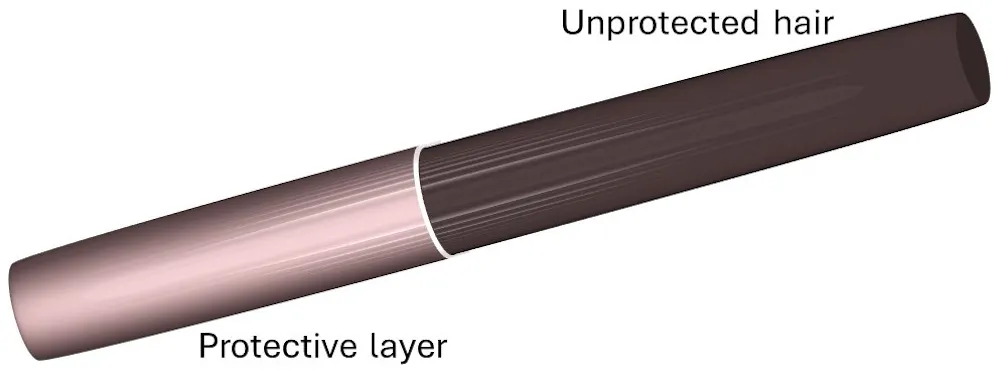
    Hair protectant applies a coating to your hair.
    Author provided

    This coating is a protective layer; it’s like putting an oven mitt on your hands before you handle a hot tray from the oven.

    To demonstrate, I created these by examining hair under a microscope before and after heat protectant was applied:

    These high magnification images of untreated hair, and hair sprayed with a heat treatment spray, show how the product coats your hair strands.
    Author provided

    Just like an oven mitt, a hair protectant delays the heat penetration, results in less heat getting through, and helps spread out the effect of the heat, a bit like in this image:

    Hair protectant can help spread out the effects of the heat.
    Author provided

    This helps prevent moisture loss and damage to both the protective surface cell layer (the cuticle) and the protein structure of the hair cortex.

    For these barriers to work at their best, these heat-protecting layers need to remain bound to your hair. In other words, they stick on really well.

    For this reason, continued use can sometimes cause a buildup which can change the feel and weight of your hair.

    This buildup is not permanent and can be removed with washing.

    One final and important note: just like when you use a mitt for the oven, heat does still get through. The only way to prevent heat damage to your hair altogether is to not use heated styling tools.

    Daniel Eldridge does not work for, consult, own shares in or receive funding from any company or organisation that would benefit from this article, and has disclosed no relevant affiliations beyond their academic appointment.

    ref. How do heat protectants for hair work? A chemistry expert explains – https://theconversation.com/how-do-heat-protectants-for-hair-work-a-chemistry-expert-explains-233206

    MIL OSI AnalysisEveningReport.nz

  • MIL-OSI New Zealand: Serious crash, Edmund Road, Rotorua

    Source: New Zealand Police (District News)

    Police are responding to a single-vehicle crash on Edmund Road, near Homedale Street, Mangakakahi.

    Emergency services were called to the crash involving a motorbike at around 4.40pm.

    One person is believed to have critical injuries.

    The Serious Crash Unit has been advised.

    Motorists are urged to avoid the area if possible and expect delays.

    ENDS

    MIL OSI New Zealand News

  • MIL-OSI New Zealand: Government Cuts – Yet another Te Whatu Ora decision to further increase losses in aged residential care

    Source: Aged Care Association

    Like the rest of the country, the aged residential care (ARC) sector found out from media on 26 September that there would be no more free Covid-19 rapid antigen tests from 1 October.
    ACA Chief Executive Hon. Tracey Martin says, “This is yet another example of hasty, poorly thought-out cost-cutting that unfairly shifts both the costs and the risks – without consultation or compensation – squarely onto aged care providers and the people they care for.
    Aged care residents are among the most vulnerable to Covid-19, and protecting their safety means we must continue testing as we have been – on the presentation of symptoms, and cohort testing based on exposure risks. Testing is vital to establish whether antiviral agents should be used to reduce the symptoms and improve the outcomes for the people we care for.”
    Martin continued, “Not only is this the compassionate thing to do to protect our elders, but it is in fact the recommended practice for effective infection prevention and control.
    Our calculations estimate that discontinuing free Covid-19 RAT tests will transfer an additional cost of at least $4 million a year to the front line of aged residential care, potentially reaching upwards of $6 million annually. While some larger providers may be able to bulk source tests at $1.82 per test, smaller providers will have to pay the retail rate of approximately $4 per test.”
    We continue to urge Te Whatu Ora to work with us before making these arbitrary decisions in an effort to meet the government’s required cost cutting. We have no confidence that those who made this decision were even aware of the consequences for our elders and those that care for them.
    We call on Te Whatu Ora to reconsider the decision, and to continue to fully cover costs of Covid-19 tests in aged residential care. Additionally, we call for greater involvement of affected communities in future decision-making processes.

    MIL OSI New Zealand News

  • MIL-Evening Report: There’s a plan for free school lunches in Queensland. Is this a good idea?

    Source: The Conversation (Au and NZ) – By Clare Dix, Lecturer In Nutrition & Dietetics, University of the Sunshine Coast

    Queensland Premier Steven Miles has announced free school lunches if Labor is re-elected at the state’s upcoming election on October 26.

    The A$1.4 billion policy would cover primary students in public schools and begin next year. Labor estimates it would save parents about $1,600 per child, per year. On Sunday, Miles said:

    [The program is] universal to avoid stigmatising the kids that need the food the most, but also to ensure that it supports every Queensland family.

    The meals will be delivered in partnership with P&Cs Queensland, Queensland Association of School Tuckshops, school principals, Health and Wellbeing Queensland and non-government food providers.

    The Greens are also campaigning on a pledge to deliver free breakfasts and lunches for every state primary and high school student, costed at $3 billion over the next four years.

    Would a school lunches program help students and families? How would it work in practice?

    An unusual approach for Australia

    Unlike the United Kingdom and United States, Australian does not have a national or state-based free or subsidised school meal program.

    Instead, parents are responsible for providing morning tea and lunch through a “lunchbox system”. Families can also usually pre-order food from a canteen or tuckshop. In some cases, state or territory governments fund charities and non-for-profits to provide breakfast or lunch programs for schools identified as most in need of support.

    Research shows the nutritional quality of food provided to Australian school children often does not meet dietary guidelines. There are mandatory guidelines for state school canteens and tuckshops to follow but these are not always reflected in practice. Research shows many canteen menus contain less-than-desirable options and pricing often does not encourage families to buy healthier options.

    Unfortunately, health survey data shows Australian children’s diets are high in energy dense and nutritionally poor foods. On top of this, the 2023 Foodbank Report shows 36% of Australians are food insecure and about one quarter of these households have children at home who may not have adequate food for school.

    Australia has a ‘lunchbox system’ where families provide the food for school.
    Halfpoint/ Shutterstock

    What are the potential opportunities?

    So the idea of a free school lunch program delivered by organisations familiar with providing food in schools sounds like a positive solution.

    Beyond improving nutrition and health outcomes for more than 326,000 Queensland students, it can also provide other benefits.

    We could see improved school attendance by creating an incentive for students to go to school and improved diets leading to reduced illness. Because well-nourished children are more ready to learn, concentrate and stay on task, school lunches could lead to improved academic performance.

    Importantly, school lunches can reduce inequality and stigma for families who experience food insecurity.

    The school kitchen can also provide a opportunities for students to learn about food preparation and service as well as healthy eating.

    What are the key challenges?

    But we need to make sure the program is properly and sustainably designed. There will be a cost to taxpayers, not just in terms of the set up, but ongoing maintenance.

    The initial implementation will require commercial kitchens and equipment, qualified and trained staff, secure food procurement and supply chains as well as all the policies and procedures to go with this. This raises the question of whether the timeline of starting in Term 1, 2025 is realistic for all schools.

    The roll out needs to be equitable – extra consideration is needed for how this plan will be delivered to rural and remote Queenslanders. We also know access to reliable supplies of food, staff, equipment and support varies greatly across the state.

    The program will also need to cater to children with food allergies and intolerances, food preferences experienced with conditions like autism and attention-deficit hyperactivity disorder (ADHD), and different cultural eating practices.

    This plan has the potential to improve Queensland children’s health and education outcomes, while saving families money, time and stress. But it is complex and success will lie in making sure all Queensland primary students are provided with nutritious and appropriate food at school.

    Clare Dix has received funding from the Australian Department of Health and Aged Care.

    ref. There’s a plan for free school lunches in Queensland. Is this a good idea? – https://theconversation.com/theres-a-plan-for-free-school-lunches-in-queensland-is-this-a-good-idea-241242

    MIL OSI AnalysisEveningReport.nz

  • MIL-OSI New Zealand: Economic growth on the Fast-track

    Source: New Zealand Government

    The one-stop-shop Fast-track Approvals Bill, and the 149 projects listed in the Bill, will help rebuild our struggling economy and kick-start economic growth across the country, Minister for Infrastructure Chris Bishop says.

    “Since 2022, New Zealand has battled anaemic levels of economic growth. If we want Kiwi kids to stop moving overseas, better public services, and a lower cost of living: economic growth is the only answer.

    “Our status as a first-world country isn’t guaranteed, and we should never take it for granted. If we want to build a brighter future for New Zealand, we must stop saying no to growth-enhancing projects.

    “For too long, our planning system’s default position has been ’no’. You want to build a housing development? No. You want to build a road? No. You want to build a wind farm? No.

    “We must start saying yes. It is critical to New Zealand’s future.

    “The Fast-track Approvals Bill will help cut through the obstruction-economy, with the 149 projects announced on Sunday demonstrating our commitment to supercharge growth. Commentary from across New Zealand this week has shown just how important this Bill is for our country’s future.

    “Forsyth Barr said that the Fast-track Approvals Bill ‘has the potential to give a much needed injection of energy into the downbeat NZ economy.

    “Katherine Rich, Chief Executive of BusinessNZ said that ‘these projects listed as part of the Fast-track Bill will stimulate job creation and economic activity at a time when we need it most.’

    “James Smith from the National Road Carriers Association said that the projects announced were ‘balanced and achievable’, with ‘a strong emphasis on road and rail developments that will enable productivity to get the country moving again’. 

    “Bridget Abernethy from the Electricity Retailers Association has said that the fast-tracking of renewable projects will  ‘…help provide confidence to build and deliver affordable clean electricity for our low-emissions future.’

    “Finn McDonald from the Employers and Manufacturers Association said that ‘given the recent issues caused by higher energy prices and the demands on generation capacity to further electrify the economy, these new fast-tracked projects have increasing significance’

    “Nick Leggett from Infrastructure NZ said that the list of projects was ‘balanced’, and that ‘it really speaks to the need this country has to get its act together and build some infrastructure’. 

    “Even Gary Taylor, Chairman and Executive Director of the Environmental Defence Society, has conceded that ‘while I come from an environmental perspective, I am also a Kiwi interested in economic welfare of our nation, and a lot of the infrastructure projects look good to go to me, subject to environmental assessment… a lot of the renewable projects, a lot of the housing projects, although there are obviously important questions about impacts from them… a lot of them are all good to go…’

    “The 149 projects chosen by Cabinet to be listed in the Bill will be listed in Schedule 2 of the Bill once the Bill is reported back from the Environment Committee in mid-October. Once the Bill is passed, they will be able to apply to the Environmental Protection Authority to have an expert panel assess the project and apply relevant conditions.

    “New Zealanders can expect economic growth to be at the heart of what this government does. Fast-track is just one part – albeit an important part – of our drive to grow the economy for all Kiwis.”

    MIL OSI New Zealand News

  • MIL-OSI Australia: Doors officially open at Beveridge Fire Brigade

    Source: Victoria Country Fire Authority

    4th Lieutenant David Weedon, 2nd Lieutenant Carl White, Captain Jason Smith, 1st Lieutenant: Simon Kolotelo, 3rd Lieutenant: Scott Hadler

    It was a momentous occasion for Beveridge Fire Brigade on the weekend, as they celebrated the completion of their new facilities and were officially recognised as a new brigade.

    Beveridge became a standalone brigade on 21 August 2024 to better service the community, having formerly responded as a satellite station for Kalkallo Fire Brigade.

    Their establishment comes in response to escalating risk to CFA within Melbourne’s Northern Growth Corridor along the Hume Freeway, with previous farming land now rezoned with substantial housing estates being built.

    CFA Board Member Ross Coyle and Assistant Chief Fire Officer Stephen Keating joined Member for Kalkallo Ros Spence at the station on Saturday (12 October) to mark the official opening of the new facilities with Captain Jason Smith and brigade members.

    “It’s really important that we establish a sustainable fire and emergency services response for the benefit of Beveridge community and those that surround them,” Stephen said.

    “Beveridge is one of the fastest-growing areas in the Mitchell Shire. The brigade will continue to see a dramatic change in the region, with an influx of population, transport and commercial risk.

    “We are excited to officially welcome them into CFA’s District 12 and the Mitchell Shire Group.

    “It has been a persistent team effort to see this project through to fruition and I thank everyone involved.”

    “They have worked hard to ensure that the foundations are strong, and that the brigade can meet community expectations.”

    The much-improved station includes a dedicated turnout room, brigade meeting and training room, office space and kitchenette. The facilities also boast toilet and shower amenities for men and women and private change areas, as well as a drying room for wet turnout gear and a breathing apparatus cleaning room.

    Captain Jason Smith said it is an exciting time and a fantastic opportunity for community members to volunteer and be a part of something new.

    “Our facilities at Lithgow Street have undergone an extensive refurbishment,” Jason said.

    “Our 26 members are enthusiastic about commencing operations and supporting our quickly expanding community of Beveridge now and into the future.

    “In our first month of operations, we responded to ten primary emergency calls and 30 support calls, and we are currently forecast to turnout to over 400 emergency calls a year.”

    Following the motions outlined in a public meeting in November 2023, a new brigade was formed, a secretary was confirmed, and 18 foundation members were identified from Kalkallo.

    CFA Chief Fire Officer Jason Hefferan signed final approval on 2 February 2024, before inaugural Brigade elections were conducted on 14 May 2024 and the first Brigade Management Team (BMT) was appointed.

    The brigade currently has 19 operational male members and one female, while five new members are currently undertaking their General Firefighting training.

    The Beveridge Fire Station upgrade project cost $840,000 and was funded through the CFA Capital Works Program.

    Submitted by CFA Media

    MIL OSI News

  • MIL-OSI China: Exhibition of Chinese art, cultural works opens in Iran

    Source: China State Council Information Office 3

    This photo taken on Oct. 12, 2024 shows a view of an exhibition of selected works of Chinese art and culture at the Malek National Library and Museum in Tehran, Iran. (Xinhua/Shadati)

    An exhibition of selected works of Chinese art and culture kicked off on Saturday in the Iranian capital Tehran.

    The exhibition showcases a collection of cultural exchange achievements between China and Iran along the Silk Road. It includes paintings created by Chinese artists, manuscripts by renowned Chinese authors, and ancient coins used in Silk Road trade.

    China and Iran, as two of the world’s ancient civilizations, had been communicating with each other through the Silk Road since a long time ago, Chinese Ambassador to Iran Cong Peiwu said at the opening ceremony, noting that such historical ties have created a solid foundation for the two countries’ present cultural exchanges.

    The successful holding of the exhibition will inject new vitality into cultural exchanges between China and Iran, providing more support for the deepening of friendship between the two countries, according to the ambassador.

    Director of the Malek National Library and Museum Amir Khorakian said that the long distance between the two countries did not hinder communications and relations between the Iranian and Chinese peoples, expressing hope for more bilateral cultural exchanges in the future.

    The exhibition will continue until Nov. 10 at the Malek National Library and Museum.

    MIL OSI China News

  • MIL-OSI Australia: 218-2024: Scheduled Service Disruption: Saturday 19 October to Sunday 20 October 2024 – DAFF messaging, SeaPest

    Source: Australia Government Statements – Agriculture

    14 October 2024

    Who does this notice affect?

    All users of the Seasonal Pests (SeaPest) system.

    All clients submitting the below declarations:

    • Full Import Declaration (FID)
    • Long Form Self Assessed Clearance (LFSAC)
    • Short Form Self Assessed Clearance (SFSAC)
    • Cargo Report Self Assessed Clearance (CRSAC)
    • Cargo Report Personal Effects (PE)

    Information

    Due to scheduled infrastructure maintenance at the Department of…

    MIL OSI News

  • MIL-OSI New Zealand: Update: Man found in critical condition, Whangamarino

    Source: New Zealand Police (National News)

    Attribute to Detective Senior Sergeant Kristine Clarke

    A scene examination has been completed at Hampton Downs Road after a man was located critically injured in the early hours of this morning.

    The victim remains in a critical condition in Auckland Hospital, and Police are in the early stages of determining the circumstances that led to the man being injured.

    Cordons have since been removed and the road has reopened.

    Police would like to hear from anyone who was travelling in the Hampton Downs area between 10pm on Sunday 13 October and 1am this morning, 14 October. This includes any dashcam footage from in the area.

    If you have any information that could help our enquiries, please update us online now or call 105.

    Please use the reference number 241014/2225.

    Information can also be provided anonymously via Crime Stoppers on 0800 555 111. 

    ENDS

    Issued by Police Media Centre

    MIL OSI New Zealand News

  • MIL-OSI Asia-Pac: Hong Kong Scholarship for Excellence Scheme opens for applications

    Source: Hong Kong Government special administrative region

    Hong Kong Scholarship for Excellence Scheme opens for applications
    Hong Kong Scholarship for Excellence Scheme opens for applications
    ******************************************************************

         The Education Bureau (EDB) today (October 14) announced that the Hong Kong Scholarship for Excellence Scheme (HKSES) will, from today until December 31, be open for applications from eligible Hong Kong students who intend to pursue undergraduate or postgraduate studies at world-renowned universities outside Hong Kong starting from the 2025/26 academic year.                              A spokesman for the EDB said, “As a merit-based scheme targeting the most outstanding Hong Kong students, the HKSES seeks to cultivate a cadre of brilliant young achievers with a sense of social responsibility and national identity, an affection for Hong Kong and an international perspective, who will return home after receiving world-class education supported by the scholarship to enrich Hong Kong’s talent pool and competitiveness in the long run. Selection will be based on candidates’ academic achievements and other attributes such as leadership qualities and potential as well as their contributions and commitment to society. Awardees are required to complete their specific study programmes and undertake to return to Hong Kong upon graduation to work for at least two years or a period equivalent to the duration of the scholarship received, whichever is longer.”                              Awardees will receive a non-means-tested scholarship to cover their tuition fees, subject to a ceiling of $300,000 per annum. In addition, the HKSES will provide additional support to financially needy awardees during their studies. Awardees who have passed the means test will receive a bursary of up to $200,000 per student per annum, to cover their living and study-related expenses. The value of the award will be correspondingly reduced if an awardee also receives other awards, both locally and abroad, or assistance to finance his or her same studies overseas.                              Apart from the monetary scholarship, the value of the HKSES also lies in its prestige and recognition as well as other non-monetary benefits. Awardees will receive a series of support and mentorship services to be rendered by the Government and other sectors of the community.                              More details on the HKSES are available on the HKSES website (hkses.edb.gov.hk). Eligible students who intend to pursue their first year of undergraduate or postgraduate studies at world-renowned universities outside Hong Kong in the 2025/26 academic year (i.e. during the period from August 2025 to July 2026) may submit their applications for the scholarship online via the application system on the HKSES website on or before December 31, 2024, by 6pm. Late applications will not be accepted.                              Shortlisted applicants will be invited by the EDB to attend interviews for the scholarship from April 2025 onwards after receiving unconditional offers from their chosen programmes. They will be notified of the results in due course after the interviews.

     
    Ends/Monday, October 14, 2024Issued at HKT 12:20

    NNNN

    MIL OSI Asia Pacific News

  • MIL-OSI USA: Congressman Aderholt Announces the Death of His Mother, Mary Frances Aderholt, 88

    Source: United States House of Representatives – Congressman Robert Aderholt (AL-04)

    A note from Congressman Aderholt on the passing of his mother:

    My mom, Mary Frances Aderholt, passed away Saturday afternoon October 12, 2024 here in Haleyville. She was 88, and I thank God I had her as long as I did.

    I was with her a couple of days last week and before I left her to go out of town Thursday morning, I told her I loved her and she told me that she loved me.

    She was the best mom a son could possibly have.

    Even though she was 88, I would have liked to have had her much, much longer. To be honest, it is especially tough, as I am an only child, and lost my dad three years ago. Thankfully, I have the strong arm of the Lord Jesus to cling to.

    It is also comforting to know she had a faith in Christ Jesus and she is reunited with my dad, whom she loved so much.

    She was quite a lady, and very proper, and always wanted to do things first class. She, along with my dad, were my biggest cheerleaders.

    I look forward to seeing both of them again.

    I love you Mom!

    Recently I was reminded of the song: “He is mine I am His” I want to share the words as it has given me great encouragement. It was written by a fellow Winston Countian, GT Speer back in 1965.

    He Is Mine & I Am His Forever

    GT Speer

    Verse 1: God’s amazing grace sent down from Heaven Rescued me from death and from shame

    Opened up my eyes and brought salvation

    Now I’m His, praise His holy name

    Chorus: Now I know ( I know) He is mine (that He’s mine) I am His forever (I’m His forever)

    He is leading me along life’s way (along life’s way)

    He’ll be holding to my hand (to my hand)

    When I cross death’s river (When I cross death’s river) He will take the sting of death away (death’s sting away)

    Verse 2: ‘Tis so sweet just to know I have Jesus with me He will keep me from sin and from strife

    He delivered me from condemnation

    Now I have eternal life

    Repeat Chorus

    Bridge: He’ll be holding to my hand (to my hand)

    When I cross death’s river (When I cross death’s river) He will take the sting of death away (death’s sting away)

    Tag: He will take the sting of death away (death’s sting away)

    MIL OSI USA News

  • MIL-OSI Banking: ADB, Partners Open Renewable Based Minigrid to Deliver Clean Electricity to Niuafo’ou

    Source: Asia Development Bank

    NIUAFO’OU, TONGA (14 October 2024) — The Asian Development Bank (ADB) and the governments of Tonga and Australia commissioned the Niuafo’ou hybrid minigrid as part of the cofinanced Tonga Renewable Energy Project. The new grid will provide clean, reliable, and efficient electricity supply up to 24 hours per day to the people and businesses of Niuafo’ou.

    Crown Prince Tupouto’a ‘Ulukalala and Crown Princess Sinaitakala Tuku’aho led the commissioning ceremony. They were joined by ADB Senior Country Officer Balwyn Fa’otusia, Australian High Commissioner for Tonga Brek Batley and Tonga Minister for Meteorology, Energy, Information, Disaster Risk Management, Environment, Climate Change and Communication Fekita ‘Utoikamanu.

    “Tonga is obviously preparing for a renewable energy future by reducing dependence on fossil fuels and initiating projects like the Tonga Renewable Energy Project,” said the Director of ADB’s Energy Sector Group Keiju Mitsuhashi. “ADB will continue to support Tonga’s energy transition ambition through accelerating renewable energy investment, and strengthening the transmission and distribution network.”

    The Tonga Renewable Energy Project funded the successful installation of battery energy storage system and modernized Tonga Power Limited’s (TPL) central control center on Tongatapu, as well as the installation of solar photovoltaic plants and battery energy storage systems on ‘Eua and Vava’u. The project is also constructing hybrid minigrid systems on eight outer islands in the Ha’apai and Vava’u Groups, as well as supporting TPL prepare a power purchase agreement for private sector funded investment to help achieve the government’s target of 70% renewable energy penetration by 2025.

    The Tonga Renewable Energy Project is cofinanced by ADB, Green Climate Fund, the governments of Tonga and Australia, and TPL. The $12.2 million ADB financing is sourced from the Asian Development Fund, which provides grants to ADB’s poorest and most vulnerable developing member countries. Total project cost is $53.2 million.

    ADB is committed to achieving a prosperous, inclusive, resilient, and sustainable Asia and the Pacific, while sustaining its efforts to eradicate extreme poverty. Established in 1966, it is owned by 69 members—49 from the region.

    MIL OSI Global Banks

  • MIL-OSI Australia: Youths charged over several matters including arson

    Source: Tasmania Police

    Youths charged over several matters including arson

    Monday, 14 October 2024 – 4:04 pm.

    Police have charged two youths and a young adult over a series of offences in southern Tasmania last week.
    The offences, all allegedly committed on Friday, include a deliberately lit property fire at Otago, damage to vehicle windows, the theft of an e-scooter and the attempted theft of a mobile phone.
    Police have charged an 18-year-old Otago man and a 15-year-old boy with two counts of arson, aggravated armed robbery, attempted aggravated armed robbery, aggravated burglary and four counts of stealing and destroy property.
    A 12-year-old girl has also been charged with aggravated armed robbery, attempted aggravated armed robbery and other offences.
    The man was detained to appear in court, and the youths were bailed to appear at a later date.
    Investigations are ongoing, and anyone with information is asked to contact Bellerive CIB on 131 444 or Crime Stoppers Tasmania at crimestopperstas.com.au. Information can be provided anonymously.

    MIL OSI News

  • MIL-OSI Australia: Expressions of Interest called for Tonkin Highway interchanges

    Source: Australia Government Ministerial Statements

    The transformation of Tonkin Highway continues to progress, with an Expression of Interest released today for contractors to tender for upgrades planned south of Roe Highway.

    The project will see grade-separated interchanges constructed at Hale Road and Welshpool Road, and the highway widened to a six-lane dual carriageway between Roe Highway and north of Kelvin Road, improving safety and reducing delays along the heavily congested route.

    A Principal Shared Path will also be added to the eastern side of Tonkin Highway with shared path connections to adjacent communities.

    Tonkin Highway is a key transport corridor connecting the city’s industrial centres including international ports, airports, intermodal rail freight terminals and major industrial lands. More than 50,000 vehicles use this section of Tonkin Highway every day, of which 13 per cent are heavy vehicles. 

    Due to this travel demand, congestion is high and growing, with Tonkin Highway projected to have the fifth-highest ‘delay cost’ of all major road corridors across Western Australia by 2031.

    A Design and Construct Contract is expected to be awarded in mid-2025, with construction to start in late 2025.

    The project is expected to support around 2,500 direct and indirect jobs during the construction phase.

    The $366 million project is jointly funded by the Australian ($293 million) and State ($73 million) governments.

    Development work is also ongoing for an interchange at Kelvin Road to be delivered in the future, following environmental approvals.

    Quotes attributable to Infrastructure, Transport, Regional Development and Local Government Minister Catherine King:

    “Our Government is busy at work delivering on what WA needs for the future.

    “Right across the State we’re investing in roads and infrastructure which will improve travel times and safety, and Tonkin Highway will be an important addition to that suite of upgrades.

    “It will also create thousands of jobs in the local community and unlock training opportunities for Western Australians wanting to obtain new skills.”

    Quotes attributed to WA Transport Minister Rita Saffioti:

    “The Tonkin Highway Interchanges project forms part of our broader Tonkin Highway Transformation program, to support long-term transport and infrastructure planning along Perth’s eastern road corridor.

    “This stretch of Tonkin Highway is a notorious bottleneck, particularly the intersection with Welshpool Road which regularly rates as one of the worst for congestion.

    “Tonkin Highway is a major freight route in the Perth metropolitan region, but with significant congestion, our Government is taking action to make this road smoother, safer and more efficient.

    “This project will complement the Tonkin Gap Project, which recently reached completion, and is providing commuters with faster travel times and a safer journey.

    “This important upgrade project will improve safety and the movement of freight and people by creating free-flowing traffic conditions.”

    Quotes attributed to Federal Member for Burt Matt Keogh:

    “I’ve been advocating for years on behalf of our community to make Tonkin Highway faster and safer, and I’m glad the Albanese and Cook Labor Governments are working together on this important project for Perth’s South Eastern suburbs.

    “The congestion on Tonkin Highway has been increasing for years, these upgrades will make a massive difference for our growing community. I can’t wait to see works get underway.

    “Only Labor is making the infrastructure investments we need to build a better Burt.”

    Quotes attributed to State Member for Forrestfield Stephen Price:

    “People in my community are heavily impacted by the congestion build up along this section of Tonkin Highway, which is why it’s critical we take action to make travel on this road smoother and safer for all.

    “Whilst these changes will significantly improve this section of Tonkin Highway, they will cause some disruption from mid-2025, so we will be engaging closely with the community to inform them about likely impacts.”

    MIL OSI News

  • MIL-OSI: Q3 2024 Trading Update and Invitation to Earnings Call

    Source: GlobeNewswire (MIL-OSI)

    Oslo, 14 October 2024 – DNO ASA, the Norwegian oil and gas operator, will publish its Q3 2024 operating and interim financial results on 7 November at 07:00 (CET). A videoconference call with executive management will follow at 14:00 (CET). Today the Company provides an update on production, sales volumes and other key information for the quarter.

    Volumes (boepd)

    Gross operated production Q3 2024 Q2 2024 Q3 2023
    Kurdistan 84,212 79,783 25,984
    North Sea
           
    Net entitlement production Q3 2024 Q2 2024 Q3 2023
    Kurdistan 17,607 17,167 9,897
    North Sea 11,236 16,321 14,288
           
    Sales Q3 2024 Q2 2024 Q3 2023
    Kurdistan 17,607 17,167 9,897
    North Sea 15,306 12,871 15,749
           
    Equity accounted production (net) Q3 2024 Q2 2024 Q3 2023
          Côte d’Ivoire         2,843 3,256 3,373

    Selected cash flow items

    DNO’s share of crude oil from the Tawke license during the quarter has been sold to local buyers as the Iraq-Türkiye Pipeline remained closed. Payments are deposited directly into DNO’s international bank accounts in advance of loadings.

    In the third quarter, DNO paid a dividend of NOK 0.3125 per share (totaling USD 29 million), which was up 25 percent from prior quarterly distributions. The Company had no tax payments or refunds during the quarter.

    The acquisition of stakes in five oil and gas fields in the Norne area in the Norwegian Sea announced in May was completed on 30 August. Net cash consideration paid by DNO was approximately USD 24 million. The transfer of DNO’s 22.6 percent interest in Ringhorne East to Vår Energi, the other element of the swap, was completed on the same date.

    Other items and information

    DNO participated in two exploration wells in the Norwegian North Sea in the quarter. The Heisenberg/Angel well in PL827SB (49 percent interest) was spudded on 18 August and completed on 16 September. The well delineated the play-opening 2023 Heisenberg oil and gas discovery and confirmed the volume estimate of 24 to 56 MMboe but the deeper Angel exploration target was found to be mainly water wet. The operated Falstaff well (50 percent interest) was spudded on 20 September and drilling was ongoing as of end of Q3 2024.

    Other drilling activities during the quarter included the B-3 well in Kurdistan at the DNO-operated Baeshiqa license (64 percent interest), which was spudded on 21 February, completed on 26 July and was ongoing a testing program as of end of Q3 2024.

    Earnings call login details

    Please visit http://www.dno.no for login details ahead of the call.

    Disclaimer

    The information contained in this release is based on a preliminary assessment of the Company’s Q3 2024 operating and interim financial results and may be subject to change.

    For further information, please contact:
    Media: media@dno.no
    Investors: investor.relations@dno.no

    DNO ASA is a Norwegian oil and gas operator active in the Middle East, the North Sea and West Africa. Founded in 1971 and listed on the Oslo Stock Exchange, the Company holds stakes in onshore and offshore licenses at various stages of exploration, development and production in the Kurdistan region of Iraq, Norway, the United Kingdom, Côte d’Ivoire, Netherlands and Yemen.

    This information is subject to the disclosure requirements pursuant to section 5-12 of the Norwegian Securities Trading Act.

    The MIL Network

  • MIL-OSI Asia-Pac: Deaths of eight animals probed

    Source: Hong Kong Information Services

    The Leisure & Cultural Services Department said today that eight animals were found dead yesterday in the Hong Kong Zoological & Botanical Gardens (HKZBG), adding that necropsy and laboratory tests were arranged immediately to ascertain the causes of their deaths.

    The dead animals include one De Brazza’s Monkey, one Common Squirrel Monkey, three Cotton-top Tamarins and three White-faced Sakis.

    The department said it had liaised with the Agriculture, Fisheries & Conservation Department on the matter.

    It added that with the test results pending the Mammals Section of the HKZBG has been closed from today for disinfection and cleaning.

    The department will closely monitor the health conditions of other animals. Other facilities in the HKZBG remain open.

    MIL OSI Asia Pacific News

  • MIL-OSI: Unifiedpost Group announces update on Francisco Partners senior facility loan repayment plan

    Source: GlobeNewswire (MIL-OSI)

    INSIDE INFORMATION

    Unifiedpost Group announces update on Francisco Partners senior facility loan repayment plan

    La Hulpe, Belgium 14 October 2024, 7:00 am. CET Inside Information – Unifiedpost Group SA (Euronext Brussels: UPG) (Unifiedpost), a leading provider of integrated business communications solutions, will use the proceeds from divestments to fully repay its €100 million Francisco Partners senior facility loan.

    Key highlights:

    • On 7 March 2022 Unifiedpost entered into a Senior Facility Loan Agreement with FP Credit Partners II AIV, L.P and FP Credit Partners Phoenix II AIV, LP (Francisco Partners) for a capital amount of €100,0 million.  For more information, please see our previous press release.
    • As part of our portfolio rationalisation plans, proceeds from divestments of certain assets will be used to repay in full the outstanding amount of the Senior Facility Loan with Francisco Partners.
    • Francisco Partners confirmed it is supportive of the decision to pay down the outstanding loan (capital and interest) according to the following repayment plan:
      • Initial repayment of €100,0 million (partially capital and partially accrued interest) upon closing of the Identity business sale (anticipated by 30 December 2024, on which date related pledges to the transaction need to be released)
      • Remaining balance which is estimated to be repaid no later than 31 March 2025.  On this outstanding balance, the same interest rates remain payable unchanged as provided in the Senior Facility Loan Agreement.
    • The repayment timeline falls ahead of the initial five-year term with no prepayment penalties.
    • The Senior Facility Loan and the equity shareholding of Francisco Partners are two different commitments. Francisco Partners has provided no information to Unifiedpost whether it intends to hold or sell (in whole or in part) its equity stake. Based on the latest transparency declaration of 8 April 2024 Francisco Partners is owning 2,92% of the voting rights.
    • Unifiedpost’s balance sheet position amounted to €108,8 million (fair value of outstanding facility €86,0 million + accrued interest €22,8 million) at 30 June 2024. In the first six months of 2024, a total interest amount of €5,9 million was accrued and €1,7 million was paid in cash, which led to an incurred financial cost of €7,6 million.

    Koen De Brabander, Chief Financial Officer of Unifiedpost, stated, “During this year, we have continued to take steps towards our strategic priorities of growing core digital services, divesting non-core businesses, and strengthening the balance sheet. We successfully completed the divestment of FitekIN and ONEA and signed an agreement for the sale of 21 Grams. Additionally, we announced the sale of the Wholesale Identity Access business in the Netherlands, which presented us with a unique opportunity to crystalise the value of our business and enhance our focus on our core service offering. Furthermore, as communicated during our strategy day in April, we will be using the proceeds from divestments to reduce our net debt. We are pleased to announce that this decision is supported by Francisco Partners, as it marks an important step as we strengthen our position to execute on our strategy, whilst also deleveraging. We would like to thank Francisco Partners for their partnership and support throughout the years.”

    Contact:
    Alex Nicoll
    Investor Relations
    Unifiedpost Group
    alex.nicoll@unifiedpost.com

    About Unifiedpost Group

    Unifiedpost is a leading cloud-based platform for SME business services built on “Documents”, “Identity” and “Payments”. Unifiedpost operates and develops a 100% cloud-based platform for administrative and financial services that allows real-time and seamless connections between Unifiedpost’s customers, their suppliers, their customers, and other parties along the financial value chain. With its one-stop-shop solutions, Unifiedpost’s mission is to make administrative and financial processes simple and smart for its customers. For more information about Unifiedpost Group and its offerings, please visit our website: Unifiedpost Group | Global leaders in digital solutions

    Cautionary note regarding forward-looking statements: The statements contained herein may include prospects, statements of future expectations, opinions, and other forward-looking statements in relation to the expected future performance of Unifiedpost Group and the markets in which it is active. Such forward-looking statements are based on management’s current views and assumptions regarding future events. By nature, they involve known and unknown risks, uncertainties, and other factors that appear justified at the time at which they are made but may not turn out to be accurate. Actual results, performance or events may, therefore, differ materially from those expressed or implied in such forward-looking statements. Except as required by applicable law, Unifiedpost Group does not undertake any obligation to update, clarify or correct any forward-looking statements contained in this press release in light of new information, future events or otherwise and disclaims any liability in respect hereto. The reader is cautioned not to place undue reliance on forward-looking statements.

    Attachment

    The MIL Network

  • MIL-OSI China: Highlights of ‘Stories of CPC’ thematic briefing on Northeast China

    Source: China State Council Information Office 2

    You are here: China > Nation > 

    0 China.org.cn, October 14, 2024

    Adjust font size:

    Follow China.org.cn on Twitter and Facebook to join the conversation.ChinaNews App Download

    Print E-mail

    Get more from China.org.cn Mobile RSS Newsletter

    MIL OSI China News

  • MIL-OSI Economics: RBI to conduct 4-day Variable Rate Reverse Repo (VRRR) auction under LAF on October 14, 2024

    Source: Reserve Bank of India

    On a review of the current and evolving liquidity conditions, it has been decided to conduct a Variable Rate Reverse Repo (VRRR) auction on October 14, 2024, Monday, as under:

    Sl. No. Notified Amount
    (₹ crore)
    Tenor
    (day)
    Window Timing Date of Reversal
    1 75,000 4 12:00 Noon to 12:30 PM October 18, 2024
    (Friday)

    2. The operational guidelines for the auction as given in the Reserve Bank’s Press Release 2019-2020/1947 dated February 13, 2020 will remain the same.

    (Puneet Pancholy)  
    Chief General Manager

    Press Release: 2024-2025/1280

    MIL OSI Economics

  • MIL-OSI Australia: Crime series – Katherine

    Source: Northern Territory Police and Fire Services

    Northern Territory Police have arrested one male youth in relation to a series of crime over the weekend.

    Around 11:20pm, police received reports that a group of males allegedly forced entry into a service station on Katherine Terrace before threatening staff with an edged weapon and stealing the cash register and an e-scooter before fleeing the scene.

    The alleged offenders later unlawfully entered three separate commercial locations along the Victoria highway, stealing a Toyota Hilux.

    A short time later, the group attended a licenced premises on O’Shea Terrace, where an employee was allegedly threatened with an edged weapon before the offenders stole her Holden Viva.

    The stolen Hilux and Viva were later used to block a Mitsubishi Triton and subsequently threaten the driver with an edged weapons before her vehicle was also stolen.

    Police have arrested and charged a 15-year-old-male who was remanded in custody.

    Investigations into the co-offenders remain ongoing.

    Detective Acting Senior Sergeant Byron May said, “Detectives continue to investigate the incident and are urging anyone with information to contact police on 131 444 or Crime Stoppers on 1800 333 000. Please quote reference number NTP2400102176.”

    MIL OSI News

  • MIL-OSI Economics: MiniMed recall could erode patient trust in Medtronic’s diabetes care offerings, says GlobalData

    Source: GlobalData

    MiniMed recall could erode patient trust in Medtronic’s diabetes care offerings, says GlobalData

    Posted in Medical Devices

    Medtronic has recently announced an FDA class I recall of its MiniMed insulin pump system.  A defect relating to battery life and pumps being dropped or hit was identified by Medtronic, leading to a recall of approximately 785,000 devices. The company has already reported 181 adverse events because of the defect. This announcement comes during continued weak performance from Medtronic’s diabetes care division, and could adversely affect patient trust in its diabetes care offerings, says GlobalData, a leading data and analytics company.

    The recall affects pump systems from both the MiniMed 600 and 700 lines of insulin pumps manufactured by Medtronic. Most insulin pumps, including Medtronic’s, are powered by an AA battery. If there is any damage to the battery casing, the insulin pump may fail to warn the user about a low battery, which can result in a lack of insulin being delivered to the patient if the pump is not receiving power.

    David Beauchamp, Medical Analyst at GlobalData, comments: “Lack of insulin in a diabetic patient can result in hyperglycemia and diabetic ketoacidosis, both of which can be life-threatening. As such, ensuring that insulin pumps do not have these points of failure is very important. The FDA recall is a logical step to prevent any more adverse events.”

    According to the GlobalData Medical Intelligence Center, the US traditional insulin pump market is worth $953 million in 2024, growing at a compound annual growth rate (CAGR) of 3.19% from 2024 to 2033. The global traditional pump market is valued at approximately $2.6 billion and is growing at a CAGR of 7.12% in the same period. Medtronic holds a significant amount of market share within this market; however, they face competition from other diabetes device manufacturers, such as Tandem Diabetes Care. This recall could cause patients to lose trust with Medtronic, potentially reducing their market share.

    Beauchamp concludes: “This recall has already had effects on Medtronic’s stock performance. Due to the danger to patients posed by this failure of Medtronic’s insulin pump, the company could be facing a loss of trust. Since 2022, Medtronic’s diabetes division has been performing poorly, as its own devices fail to meet patient expectations and the competition has intensified its own research and development to market superior products.”

    MIL OSI Economics

  • MIL-OSI Economics: India coronary stent market set for 4% CAGR growth during 2024-2033, forecasts GlobalData

    Source: GlobalData

    India coronary stent market set for 4% CAGR growth during 2024-2033, forecasts GlobalData

    Posted in Medical Devices

    As coronary artery disease (CAD) cases continue to rise in India, the demand for advanced treatment options such as drug-eluting stents (DES) is gaining momentum. Against this backdrop, India coronary drug eluting stent market is expected to grow at a compound annual growth rate (CAGR) of 4% from 2024 to 2033, forecasts GlobalData, a leading data and analytics company.

    GlobalData’s latest report “Coronary Stents Market Size by Segments, Share, Regulatory, Reimbursement, Procedures and Forecast to 2033” reveals that India’s coronary drug eluting stent market accounts for around 32% of the Asia-Pacific market in 2024.

    Sahajanand Medical Technologies (SMT), an India-based developer and manufacturer of minimally invasive coronary stent systems, has recently received approval from the Australian Therapeutic Goods Administration (TGA) for its flagship drug-eluting stent, Supraflex Cruz. This approval enables SMT to expand into the highly regulated Australian market, highlighting India’s growing influence in the global medical device sector.

    Kanchan Chauhan, Medical Devices Analyst at GlobalData, comments: “While drug eluting stents have significantly improved patient outcomes, treating tortuous and calcified lesions remains a challenge due to the complex structure of the vessels. Stents with enhanced flexibility, ultrathin struts, and lower crossing profiles are designed to address these challenges more effectively by reducing complications such as restenosis and promoting faster recovery. Increasing the availability of such advanced solutions is crucial for enhancing cardiovascular care.”

    Supraflex Cruz delivers a combination of the sirolimus drug and a biodegradable polymer promoting faster vessel healing and reducing the risk of restenosis. The stent has been approved in over 80 countries, and with the recent TGA approval, it is set to be introduced in Australia, further solidifying its reputation for safety and efficacy.

    Chauhan concludes: “As India continues to innovate in the cardiovascular space, the international success of devices such as Supraflex Cruz highlights the country’s growing presence in cardiovascular market. With increasing foreign interest and a developing domestic market, India has the potential to enhance its role in the global medical device industry.”

    MIL OSI Economics

  • MIL-OSI Economics: Consumer demand for novelty and customization compels brands to explore new product segments in India, finds GlobalData

    Source: GlobalData

    Consumer demand for novelty and customization compels brands to explore new product segments in India, finds GlobalData

    Posted in Consumer

    Novelty and experimentation trends have changed the consumption patterns of consumers. Consequently, brands are continuously innovating in line with the growing personalization trend to maintain consumer interest while gaining a competitive edge over the rivals in India. New market disruption will help the brands tap into emerging markets and enhance their relevance, says GlobalData, a leading data and analytics company.

    Savitha Kruttiventi, Consumer Analyst at GlobalData, comments: “Brands need to ensure they meet consumers’ needs and expectations of novelty and uniqueness along with the important dietary considerations. In line with this, Keventers, an India-based milkshake and ice cream brand, launched waffles for the first time as part of its expansion strategy. These 100% vegetarian waffles are available in six different flavors and cater to consumers who have special dietary preferences such as vegetarians. The brand also allows consumers to customize their waffles with their favorite ice cream toppings. The manufacturer leveraged its brand image to enter a new product segment.”

    Francis Gabriel Godad, Consumer Business Development Manager, GlobalData India, notes: “In the current competitive landscape, it is extremely important to prioritize innovation to thrive. Manufacturers must focus on launching products that are innovative and align with consumers’ preferences to create deeper connections with them. In GlobalData’s 2024 Q2 consumer survey, 74% of Indian consumers admit that they find novelty/uniqueness to be an essential feature influencing purchase decisions^.

    “Consumers in India are actively on the lookout for the brands that give them options to customize according to their interest. 65% of Indian consumers admit that their purchase decisions are always or often influenced by products’ alignment with their needs and personality. Hence, brands need to embrace customization to have a higher chance of enhancing their customer satisfaction and brand loyalty among consumers.”

    Kruttiventi concludes: “Consumers are seeking novel products that align with customization and personalization trends. This highlights the need for the brands to adapt and innovate to retain their customer base. Brands that emphasize these factors tend to gain a competitive edge and attain success in the long run.”

    ^GlobalData 2024 Q2 Consumer Survey – India, published in July 2024, with 897 respondents

    MIL OSI Economics

  • MIL-OSI Economics: APAC EV infrastructure market to expand at 13.5% CAGR over 2024-29, forecasts GlobalData

    Source: GlobalData

    APAC EV infrastructure market to expand at 13.5% CAGR over 2024-29, forecasts GlobalData

    Posted in Automotive

    Governments worldwide currently face the challenge of creating the strong infrastructure required to accelerate the shift toward electric vehicles (EVs). The Asia-Pacific (APAC) region is experiencing significant growth in this area, with China leading as a major EV market and boasting an extensive infrastructure. Government agencies and private entities in other nations in the region, such as South Korea, India, Japan, and Indonesia, are also actively participating and investing in the expansion of charging station networks. Against this backdrop, the APAC EV infrastructure market is expected to record a compound annual growth rate (CAGR) of 13.5% over 2024–29, according to GlobalData, a leading data and analytics company.

    GlobalData’s latest report, “Global Sector Overview & Forecast: EV Infrastructure Q3 2024,” reveals that the automotive EV infrastructure market covering two types of charging stations, fast charging stations powered by direct current and slow charging stations powered by alternating current, is estimated at 3.3 million units in 2024 and is forecast to reach 6.2 million units by 2029 in the APAC region.

    Madhuchhanda Palit, Automotive Analyst at GlobalData, comments: “To facilitate the widespread adoption of EVs in the APAC region, it is critical to enhance the EV charging infrastructure. Considering that APAC is the most densely populated region in the world, the prospect of long wait times at charging stations may deter potential EV consumers. Therefore, to achieve the electrification goals set by the governments of APAC countries and to drive EV adoption, there is an urgent need to augment the quantity of EV charging stations, with a particular focus on fast charging stations.”

    Several initiatives are underway to address the need to expand EV infrastructure. For instance, Volt, an EV charging company within the infrastructure division of Singapore-based Keppel, announced in July 2024, the deployment of a new fast-charging hub in the country. This hub features ratings of 360 kilowatts and 120 kilowatts, enabling electric cars to be charged in as little as 10 minutes.

    Palit adds: “The expansion of fast-charging stations for EVs is essential, but there is also a pressing need to ensure equitable distribution across the nation. This distribution challenge has impeded EV adoption, even in countries like China, which is the world’s largest EV market. In China, the concentration of EV charging infrastructure in urban areas far exceeds that in rural areas. This disparity may discourage potential EV customers in rural areas and those planning longer journeys.”

    Additionally, the overabundance of chargers in urban areas can lead to underutilization, while those along highways and in rural areas may not meet peak demand during holidays, resulting in potential profit loss and job cuts for EV charging businesses in both urban and rural settings.

    A significant percentage of EV charging stations still rely on electrical power produced using fossil fuels, which can limit the environmental benefits of EVs. However, the landscape has changed significantly in recent years, with multiple initiatives by both the public and private sectors to transition the power source to renewable energy. For example, in India, The Climate Pledge, co-founded by Amazon and Global Optimism, announced in September 2024, an investment of $2.7 million in a new project, the Joint Operation Unifying Last-mile Electrification (JOULE), to build a network of shared EV charging stations powered by renewable energy in Bengaluru.

    Recognizing the concerns and needs for growth in the sector, multiple innovations are being introduced at various stages of implementation. For instance, crowdsourced EV charging, V2G power management, and bidirectional charging are some of the innovations in the early stages of development with steadily rising adoption rates. Meanwhile, EV inductive charging and dual-voltage charging stations are examples of innovations in the maturing stage, which have become well-established within the industry.

    Palit concludes: “Establishing adequate infrastructure is a time-sensitive matter, and the pace of progress varies among different nations. The increasing demand for EVs, coupled with substantial investments and research and development efforts, is expected to drive significant growth in the EV infrastructure sector in the near future.”

    MIL OSI Economics

  • MIL-OSI: Sampo plc’s share buybacks 11 October 2024

    Source: GlobeNewswire (MIL-OSI)

    Sampo plc, stock exchange release, 14 October 2024 at 8:30 am EEST

    Sampo plc’s share buybacks 11 October 2024

    On 11 October 2024, Sampo plc (business code 0142213-3, LEI 743700UF3RL386WIDA22) has acquired its own A shares (ISIN code FI4000552500) as follows:                

    Sampo plc’s share buybacks Aggregated daily volume (in number of shares) Daily weighted average price of the purchased shares* Market (MIC Code)
      3,250 41.00 AQEU        
      41,981 41.02 CEUX
      546 41.09 TQEX
      46,199 41.00 XHEL
    TOTAL 91,976 41.01  

    *rounded to two decimals                

    On 17 June 2024, Sampo announced a share buyback programme of up to a maximum of EUR 400 million in compliance with the Market Abuse Regulation (EU) 596/2014 (MAR) and the Commission Delegated Regulation (EU) 2016/1052. On 16 September 2024, the Board of Directors of Sampo plc resolved to increase the share buyback programme to EUR 475 million. The programme, which started on 18 June 2024, is based on the authorisation granted by Sampo’s Annual General Meeting on 25 April 2024.

    After the disclosed transactions, the company owns in total 8,500,593 Sampo A shares representing 1.55 per cent of the total number of shares in Sampo plc, taking the issuance of shares on 16 September 2024 into account.

    Details of each transaction are included as an appendix of this announcement.

    On behalf of Sampo plc,
    Morgan Stanley

    For further information, please contact:

    Sami Taipalus
    Head of Investor Relations
    tel. +358 10 516 0030

    Distribution:
    Nasdaq Helsinki
    Nasdaq Stockholm
    Nasdaq Copenhagen
    London Stock Exchange
    The principal media
    FIN-FSA
    DEN-FSA
    http://www.sampo.com

    Attachment

    The MIL Network

  • MIL-Evening Report: Australia has led the way regulating gene technology for over 20 years. Here’s how it should apply that to AI

    Source: The Conversation (Au and NZ) – By Julia Powles, Associate Professor of Law and Technology; Director, UWA Tech & Policy Lab, Law School, The University of Western Australia

    Since 2019, the Australian Department for Industry, Science and Resources has been striving to make the nation a leader in “safe and responsible” artificial intelligence (AI). Key to this is a voluntary framework based on eight AI ethics principles, including “human-centred values”, “fairness” and “transparency and explainability”.

    Every subsequent piece of national guidance on AI has spun off these eight principles, imploring business, government and schools to put them into practice. But these voluntary principles have no real hold on organisations that develop and deploy AI systems.

    Last month, the Australian government started consulting on a proposal that struck a different tone. Acknowledging “voluntary compliance […] is no longer enough”, it spoke of “mandatory guardrails for AI in high-risk settings”.

    But the core idea of self-regulation remains stubbornly baked in. For example, it’s up to AI developers to determine whether their AI system is high risk, by having regard to a set of risks that can only be described as endemic to large-scale AI systems.

    If this high hurdle is met, what mandatory guardrails kick in? For the most part, companies simply need to demonstrate they have internal processes gesturing at the AI ethics principles. The proposal is most notable, then, for what it does not include. There is no oversight, no consequences, no refusal, no redress.

    But there is a different, ready-to-hand model that Australia could adopt for AI. It comes from another critical technology in the national interest: gene technology.

    A different model

    Gene technology is what’s behind genetically modified organisms. Like AI, it raises concerns for more than 60% of the population.

    In Australia, it’s regulated by the Office of the Gene Technology Regulator. The regulator was established in 2001 to meet the biotech boom in agriculture and health. Since then, it’s become the exemplar of an expert-informed, highly transparent regulator focused on a specific technology with far-reaching consequences.

    Three features have ensured the gene technology regulator’s national and international success.

    First, it’s a single-mission body. It regulates dealings with genetically modified organisms:

    to protect the health and safety of people, and to protect the environment, by identifying risks posed by or as a result of gene technology.

    Second, it has a sophisticated decision-making structure. Thanks to it, the risk assessment of every application of gene technology in Australia is informed by sound expertise. It also insulates that assessment from political influence and corporate lobbying.

    The regulator is informed by two integrated expert bodies: a Technical Advisory Committee and an Ethics and Community Consultative Committee. These bodies are complemented by Institutional Biosafety Committees supporting ongoing risk management at more than 200 research and commercial institutions accredited to use gene technology in Australia. This parallels best practice in food safety and drug safety.

    The Gene Technology Regulator has a sophisticated decision-making structure.
    Office of The Gene Technology Regulator, CC BY

    Third, the regulator continuously integrates public input into its risk assessment process. It does so meaningfully and transparently. Every dealing with gene technology must be approved. Before a release into the wild, an exhaustive consultation process maximises review and oversight. This ensures a high threshold of public safety.

    Regulating high-risk technologies

    Together, these factors explain why Australia’s gene technology regulator has been so successful. They also highlight what’s missing in most emerging approaches to AI regulation.

    The mandate of AI regulation typically involves an impossible compromise between protecting the public and supporting industry. As with gene regulation, it seeks to safeguard against risks. In the case of AI, those risks would be to health, the environment and human rights. But it also seeks to “maximise the opportunities that AI presents for our economy and society”.

    Second, currently proposed AI regulation outsources risk assessment and management to commercial AI providers. Instead, it should develop a national evidence base, informed by cross-disciplinary scientific, socio-technical and civil society expertise.

    The argument goes that AI is “out of the bag”, with potential applications too numerous and too mundane to regulate. Yet molecular biology methods are also well out of the bag. The gene tech regulator still maintains oversight of all uses of the technology, while continually working to categorise certain dealings as “exempt” or “low-risk” to facilitate research and development.

    Third, the public has no meaningful opportunity to assent to dealings with AI. This is true regardless of whether it involves plundering the archives of our collective imaginations to build AI systems, or deploying them in ways that undercut dignity, autonomy and justice.

    The lesson of more than two decades of gene regulation is that it doesn’t stop innovation to regulate a promising new technology until it can demonstrate a history of non-damaging use to people and the environment. In fact, it saves it.

    The UWA Tech & Policy Lab receives funding from nationally competitive research grants and philanthropic partners. The present research was supported by GA308883: Effective Ethical Frameworks for the State as an Enabler of Innovation, funded by the Department of Foreign Affairs and Trade.

    Julia Powles is the Director of the Lab and has served as an independent member of the National AI Centre’s Think Tank on Responsible AI, the Australian Government’s National Robotics Strategy Advisory Committee, and the Advisory Panel supporting the Australian Parliamentary Inquiry into the Use of Generative AI in the Australian Education System. Through each of these bodies, she has provided advice on comparative AI regulation.

    Haris Yusoff does not work for, consult, own shares in or receive funding from any company or organisation that would benefit from this article, and has disclosed no relevant affiliations beyond their academic appointment.

    ref. Australia has led the way regulating gene technology for over 20 years. Here’s how it should apply that to AI – https://theconversation.com/australia-has-led-the-way-regulating-gene-technology-for-over-20-years-heres-how-it-should-apply-that-to-ai-240571

    MIL OSI AnalysisEveningReport.nz

  • MIL-OSI Australia: Thomas Road upgrades delivering safer, faster travel

    Source: Australian Ministers for Regional Development

    Both heavy vehicle drivers and regular commuters are now enjoying safer and smoother travel along Thomas Road, south of Perth, thanks to the completion of an $81 million upgrade.

    The south-east is an important and fast-growing area, with large volumes of heavy vehicles and other through traffic travelling to and from the South West and Wheatbelt regions.

    Both projects were jointly funded by the Australian and Western Australian Governments.

    The program of works commenced in early 2022, with a range of improvements delivered including:

    • dual carriageway between Kwinana Freeway and Bombay Boulevard;
    • construction of a roundabout at Bombay Boulevard and a four-metre-wide pedestrian and cyclist path with lighting;
    • construction of a dual lane roundabout at Thomas Road and Nicholson Road and upgrades on approach to the intersection;
    • construction of a dual lane roundabout at Thomas Road and Kargotich Road;
    • additional street lighting between Bombay Boulevard and Kargotich Road; and
    • added safety measures between Kwinana Freeway and Cumming Road including shoulder widening, new line markings, raised reflectors and resurfacing.

    The final package of works involved the construction of new two-lane roundabouts at the intersections of Nicholson and Kargotich Road.

    The new roundabouts will improve safety and traffic efficiency for the more than 19,000 vehicles that pass through the intersections daily.

    Further upgrades are planned for the road through the Tonkin Highway Extension, which is expected to commence construction next year.

    The State and Federal Governments have also delivered a new traffic bridge over the rail line on Thomas Road as part of the METRONET Byford Rail Extension project, removing a level crossing and significantly improving road safety in the area.

    Quotes attributed to Federal Infrastructure, Transport, Regional Development and Local Government Minister Catherine King:

    “The Australian Government will continue to partner with the Western Australian Government to deliver upgrades that will increase road safety, reduce congestion and improve travel times.

    “The completion of the Thomas Road upgrades ensures the best possible outcome for motorists and heavy vehicle traffic for this fast-growing region, now and into the future.”

    Quotes attributed to WA Transport Minister Rita Saffioti:

    “Thomas Road is a critical route for both the movement of freight and for local communities, which is why we implemented this program of works to make the road safer for all.

    “The safety upgrades have included additional lanes, more street lighting and roundabouts – all of which will provide a safer and smoother journey for road users.

    “These upgrades will improve traffic flow and reduce congestion while making it safer for heavy vehicles, including oversize, over-mass loads, to traverse this key freight route.

    “These upgrades are just one example of how our Government is investing to make the road network safer for everyone in the community.”

    Quotes attributed to Federal Member for Burt Matt Keogh:

    “It’s fantastic that the Albanese and Cook Labor Governments are delivering the infrastructure investment our community needs to keep business and people moving.

    “Bottlenecks on Thomas Road have been an issue for residents in Byford and Oakford for some time. Thanks to these upgrades, people will now be able to get between work and home safely and quickly.”

    Quotes attributed to State Member for Darling Range Hugh Jones:

    “Road safety remains a critical issue for people in our community, and I am thrilled to see this important project reach completion.

    “Our Government is investing billions of dollars to improve the transport infrastructure for communities in the Darling Range electorate, including the METRONET Byford Rail Extension and the Tonkin Highway Extension and Thomas Road Upgrade.

    “These projects will fundamentally transform our community, and my focus is to get them delivered, so people can start to enjoy the benefits.”

    MIL OSI News

  • MIL-OSI Asia-Pac: Chief Executive to deliver Policy Address to LegCo

    Source: Hong Kong Government special administrative region

    Chief Executive to deliver Policy Address to LegCo
    Chief Executive to deliver Policy Address to LegCo
    **************************************************

    The following is issued on behalf of the Legislative Council Secretariat:     The Legislative Council (LegCo) will hold a meeting on Wednesday (October 16) at 11am in the Chamber of the LegCo Complex. During the meeting, the Chief Executive will deliver the Policy Address.     The agenda of the above meeting can be obtained via the LegCo Website (www.legco.gov.hk). Members of the public can watch or listen to the meeting via the “Webcast” system on the LegCo Website. To observe the proceedings of the meeting at the LegCo Complex, members of the public may call 3919 3399 during office hours to reserve seats.

     
    Ends/Monday, October 14, 2024Issued at HKT 14:15

    NNNN

    MIL OSI Asia Pacific News