Category: KB

  • MIL-OSI USA: Unprecedented Response to Hurricane Helene Continues as State, Local and Federal Resources Work to Help those Impacted in Western North Carolina

    Source: US State of North Carolina

    Headline: Unprecedented Response to Hurricane Helene Continues as State, Local and Federal Resources Work to Help those Impacted in Western North Carolina

    Unprecedented Response to Hurricane Helene Continues as State, Local and Federal Resources Work to Help those Impacted in Western North Carolina
    mseets

    Today, Governor Roy Cooper held a briefing with FEMA Administrator Deanne Criswell to provide updates on North Carolina’s unprecedented response to Hurricane Helene. They were joined by Adjutant General of the North Carolina National Guard Major General Todd Hunt, North Carolina Director of Emergency Management Will Ray, NCDOT Secretary Joey Hopkins, NCDHHS Secretary Kody Kinsley and NCDEQ Secretary Mary Penny Kelley to share an update as response and recovery operations continue in Western North Carolina. 

    “Hurricane Helene was a powerful reminder of nature’s might, but it also revealed the unbreakable spirit of our people,” said Governor Cooper. “In the face of adversity, we have seen neighbors helping neighbors, volunteers stepping up, and first responders risking their lives to ensure our safety. This has been a massive, unprecedented state, local and federal response and I am grateful to all of those working tirelessly. Your bravery and selflessness embody the very essence of our community.”

    Goods and services continue to flow into impacted communities through state, federal and local partners.  The North Carolina National Guard and the Joint Task Force- North Carolina have assisted thousands of people who needed rescue, evacuation and other assistance.

    North Carolina National Guard and Military Response

    More than 3,000 Soldiers and Airmen are now working in Western North Carolina. Joint Task Force- North Carolina, the task force led by the North Carolina National Guard is made up of Soldiers and Airmen from 12 different states, two different XVIII Airborne Corps units from Ft. Liberty, a unit from Ft. Campbell’s 101st Airborne Division, and numerous civilian entities are working side-by-side to get the much-needed help to the citizens in western North Carolina.

    National Guard and military personnel are operating more than 40 helicopters and more than 1,200 specialized vehicles in Western North Carolina to facilitate these missions. The U.S. Army Corps of Engineers is helping to assess water and wastewater plants and dams. Residents can track the status of the public water supply in their area through a website launched on Saturday.

    FEMA Assistance

    More than $60 million in FEMA Individual Assistance funds have been paid so far to Western NC disaster survivors and more than 134,000 people have registered for Individual Assistance. Approximately 2,600 people are now housed in hotels through FEMA’s Transitional Sheltering Assistance. Federal partners have delivered approximately 9.78 million liters of water and approximately 7.7 million meals in North Carolina to support both responders and people living in the affected communities.

    More than 900 FEMA staff are in the state to help with the western North Carolina relief effort. In addition to search and rescue and providing commodities, they are meeting with disaster survivors in shelters and neighborhoods to provide rapid access to relief resources. They can be identified by their FEMA logo apparel and federal government identification.

    The Major Disaster Declaration requested by Governor Cooper and granted by President Biden now includes 27 North Carolina counties (Alexander, Alleghany, Ashe, Avery, Buncombe, Burke, Caldwell, Catawba, Clay, Cleveland, Gaston, Haywood, Henderson, Jackson, Lincoln, Macon, Madison, McDowell, Mecklenburg, Mitchell, Polk, Rutherford, Swain, Transylvania, Watauga, Wilkes and Yancey) and the Eastern Band of Cherokee Indians.

    North Carolinians can apply for Individual Assistance by calling 1-800-621-3362 from 7am to 11pm daily or by visiting www.disasterassistance.gov, or by downloading the FEMA app. FEMA may be able to help with serious needs, displacement, temporary lodging, basic home repair costs, personal property loss or other disaster-caused needs.

    Help from Other States

    More than 1,300 responders from 35 state and local agencies have performed 118 missions supporting the response and recovery efforts through the Emergency Management Assistance Compact (EMAC). This includes public health nurses, emergency management teams supporting local governments, veterinarians, teams with search dogs and more.

    Beware of Misinformation

    North Carolina Emergency Management and local officials are cautioning the public about false Helene reports and misinformation being shared on social media. NCEM has launched a fact versus rumor response webpage to provide factual information in the wake of this storm. FEMA also has a rumor response webpage.

    Food, Water and Commodity Points of Distribution

    Efforts continue to provide food, water and basic necessities to residents in affected communities, using both ground resources and air drops from the NC National Guard. More than 20,000 hot meals a day are being prepared and served by mobile kitchens. Food, water and commodity points of distribution are open throughout western North Carolina. For information on these sites in your community, visit your local emergency management and local government social media and websites or visit ncdps.gov/Helene.

    Missing Persons

    To report a missing person or request non-emergency support, please call NC 211 or 1-888-892-1162 if calling from out-of-state. NC 211 also has a registry page for missing persons and welfare check requests.

    Shelters

    A total of 17 shelters are open in Western North Carolina serving 715 people and 102 pets.

    Storm Damage Cleanup

    If your home has damages and you need assistance with clean up, please call Crisis Cleanup for access to volunteer organizations that can assist you at 844-965-1386.

    Power Outages

    Across Western North Carolina, more than 86,000 customers remain without power as of Tuesday, down from a peak of more than 1 million. Overall power outage numbers will fluctuate up and down as power crews temporarily take circuits or substations offline to make repairs and restore additional customers.

    Road Closures

    Travel remains dangerous, with hundreds of roads closed. Many of these roads are primary routes connecting the region. As connectivity and reporting measures improve, these number may increase.

    NCDOT is asking people to avoid unnecessary travel to or in Western North Carolina. NCDOT has posted at ncdot.gov an interstate detour map for travelers to avoid western N.C. NCDOT currently has more than 2,100 employees and 1,100 pieces of equipment working on approximately 4,700 damaged road sites.

    Fatalities

    Eighty-nine storm-related deaths have been confirmed in North Carolina by the Office of Chief Medical Examiner. We expect that this number will continue to rise over the coming days. The North Carolina Office of the Chief Medical Examiner will continue to confirm numbers twice daily. If you have an emergency or believe that someone is in danger, please call 911. To report that you have been unable to reach a person in Western North Carolina, please call 211.

    Volunteers and Donations

    Due to dangerous road conditions and the need to maintain open routes for emergency operations, travel to Western North Carolina is strongly discouraged. Instead, consider the following options for donations and volunteer opportunities:

    • If you would like to donate to the North Carolina Disaster Relief Fund, visit nc.gov/donate. Donations will help to support local nonprofits working on the ground.
    • For information on volunteer opportunities, please visit nc.gov/volunteernc

    Additional Assistance

    There is no right or wrong way to feel in response to the trauma of a hurricane. If you have been impacted by the storm and need someone to talk to, call or text the Disaster Distress Helpline at 1-800-985-5990. Help is also available to anyone, anytime in English or Spanish through a call, text or chat to 988. Learn more at 988Lifeline.org.

    If you are seeking a representative from the North Carolina Joint Information Center, please email ncempio@ncdps.gov or call 919-825-2599.

    For general information, access to resources, or answers to frequently asked questions, please visit ncdps.gov/helene.

    If you are seeking information on resources for recovery help for a resident impacted from the storm, please email IArecovery@ncdps.gov.

    ###

    Oct 9, 2024

    MIL OSI USA News

  • MIL-OSI USA: NSF congratulates laureates of the 2024 Nobel Prize in chemistry

    Source: US Government research organizations

    Researchers have enabled the design and prediction of proteins, the building blocks of life

    The U.S. National Science Foundation congratulates David Baker, Demis Hassabis and John Jumper on being awarded the 2024 Nobel Prize in chemistry. Baker and his colleagues revolutionized protein design enabling the creation of protein structures never seen in nature, many of which have potential as therapeutics or treatments, new materials or in other applications. Hassabis and Jumper similarly revolutionized protein prediction with the creation of AlphaFold software, enabling the determination of a protein’s structure from its amino acid sequence alone. NSF is immensely proud of the decades of fundamental research support and infrastructure investments that led to these advances.

    NSF has supported the Protein Data Bank (PDB), the critical repository for structure data for large biological molecules that enabled the work of all the awardees, for nearly five decades. PDB now contains over 200,000 structures from proteins to DNA and RNA. Baker used this library as a knowledge base for his first protein structure design algorithms which became part of the Rosetta family of tools — and later his protein design tools — for which his portion of the Nobel Prize is being awarded. The PDB also provided the training library for AlphaFold, a deep learning, artificial intelligence-powered software designed by Hassabis, Jumper and the DeepMind team for which they earned half of the prize.

    In addition to its support of PDB, NSF has continuously supported Baker’s career since his Young Investigator award in 1994. The interdisciplinary nature of the work and the potential impact of protein design is exemplified by the broad nature of NSF support received by Baker that has come from NSF Directorates for Biological Sciences, Engineering, Mathematical and Physical Sciences and Computer and Information Science and Engineering.

    In 2003, Baker and colleagues were able to design the first completely novel globular protein with atomic level accuracy. In 2008, Baker and colleagues reported the first design of an enzyme — a protein that initiates a reaction in a cell. Several of the proteins designed by Baker and his team are already moving toward being used to treat Celiac disease and cancers.

    “Protein design holds transformative potential to address societal challenges by enabling the discovery of once unimaginable structures,” said NSF Director Sethuraman Panchanathan. “Decades of federal investments in fundamental research and infrastructure, combined with industry innovation, have yielded tools that significantly impact everyday life. Baker’s work continues to break new ground — as he recently received 5,000 hours of computing time on NSF’s Frontera supercomputer through the NSF-led National AI Research Resource pilot — to create even more advanced biological models.”

    NSF’s support of Baker also has helped enable a wide range of broader societal impacts, including the training of a legion of students and fellows that are now contributing to the field of biotechnology and synthetic biomaterials in academia and industry around the world. In addition to those he trained directly, Baker’s early and long-standing commitment to open access and sharing policies fostered development of a broad community of developers and users that have accelerated the pace of discovery and innovation in the field.

    Select NSF awards

    MIL OSI USA News

  • MIL-OSI USA: Donating, Volunteering amid the New Mexico Fires and Floods

    Source: US Federal Emergency Management Agency

    Headline: Donating, Volunteering amid the New Mexico Fires and Floods

    Donating, Volunteering amid the New Mexico Fires and Floods

    After every major disaster — no less after the South Fork and Salt Fires and flooding — people come together to help. A couple of popular ways to do this is to make a donation and to volunteer your time. To make the most of your contributions and your valuable time, it’s important for New Mexicans to follow guidelines for donating and volunteering responsibly,  

    Cash is Best 

    Financial contributions to recognized disaster relief organizations are the fastest, most flexible and most effective method of donating. Organizations on the ground know what items and quantities are needed, often buy in bulk with discounts and, if possible, purchase through businesses local to the disaster, which supports economic recovery. 

    Cash, check or online donations offer voluntary agencies the most flexibility in obtaining the most-needed resources. Many charities specialize in providing relief in disaster areas, yet they face significant financial barriers to getting their staff, equipment, and supplies into impacted areas. 

    Your donation helps put experienced disaster responders on the ground and gives them the tools they need to help New Mexico residents recover. 

    More than $2 million has been donated to the Community Foundation of Lincoln County that’s being used to assist residents impacted by the fires and floods with immediate needs. In addition, the Community Foundation of Southern New Mexico has raised more than $1 million and has already distributed more than $350,000 to non-governmental organizations and communities in Lincoln, Otero, Rio Arriba and San Juan counties including the Mescalero Apache Reservation. These funds will provide financial resources to support immediate and long-term recovery needs. 

    Monetary donations can be made to the Community Foundation of Southern New Mexico by visiting their website  Greatest Needs Impact Fund for Lincoln & Otero (fcsuite.com). In addition, donations can be made to the Community Foundation of Lincoln County by visiting their website, The Shelter Fund | Community Foundation Of Lincoln County | Ruidoso (cfolc.org). 

    Beware of Bogus Solicitations  

    Unscrupulous solicitors for phony scam charities may play on your sympathy for your New Mexico neighbors whose homes and property have been damaged in the fires and floods. Be wary of any solicitation that may come to you by phone, letter, email or a face-to-face visit.

    Under New Mexico law, charitable organizations existing, operating, or soliciting in the state must register with the New Mexico Department of Justice and file annual reports with the Attorney General’s office. You can check to see if a charity is registered with the state by visiting https://secure.nmag.gov/CharitySearch/.

    In-Kind Donations 

    Yes, many kinds of donated items are needed. However, without thoughtful planning, donated goods can further burden a community that is already in crisis. Knowing what is needed, where it is needed and getting it there at the right time are the keys to successful donating. Critical needs change rapidly. Before collecting, confirm the need:

    • Not everything is needed. Used clothing is never needed.  
    • Bulk donations are best. Pallet loads of a single item, sorted, and boxed. 
    • Timing is important. Too soon or too late and no one wins. 
    • Transportation needs to be worked-out. How will it get to where it is needed? 

    If you have questions about in-kind donations or to make an in-kind donation, email fema-ruidoso-wildfires-val@fema.dhs.gov and nmvoad@nvoad.org. 

    Voluntary Agencies Active in New Mexico

    FEMA’s Voluntary Agency Liaisons (VALs) in New Mexico serve as an important link between FEMA programs and community partners. They have engaged with nearly 200 affiliates of the National Voluntary Organizations Active in Disaster (VOADs), non-profits, government, faith-and community-based organizations to identify survivor resources, unmet needs, and provide critical information on FEMA and it’s programs. The VALs have also identified more than 170 survivor resources being provided from local, state, national VOADs as well as faith- and community-based organizations and government entities. 

    The VALs have also been working with State Disaster Case Management (DCM) to assist with identifying survivor resources in Lincoln, Otero, Rio Arriba, San Juan counties and the Mescalero Apache Reservation, as well as connections to other agencies to assist with unmet needs. Lastly, the FEMA VALs have been coordinating with the Village of Ruidoso and local stakeholders in Lincoln County to develop a Community Organization Active in Disaster (COAD) and Long-Term Recovery Group (LTRG) that will help assist with long-term recovery efforts for individuals and households with disaster-related, unmet needs. 

    The numerous operations VALs have coordinated in this disaster include:

    • The American Red Cross sheltered nearly 800 New Mexicans and distributed 17,331 meals and 18,846 snacks to people. They also distributed 7,983 clean-up kits and other emergency supply items to 588 households.
    • Twenty-six donation centers and points of distribution (PODs) in Lincoln County, Mescalero, and surrounding counties were identified. The Salvation Army assisted with more than 11 donation centers and PODs in areas affected by the fires and floods. It also managed donation warehouses in Roswell and Ruidoso Downs and distributed more than 130,000 relief items and supplies to impacted families. 
    • More than 5,100 individual volunteers affiliated with Voluntary Organizations Active in Disaster (VOAD) such as the American Red Cross, Samaritan’s Purse, Team Rubicon, and Southern Baptists Disaster Relief have contributed more than 110,000 hours to the response and recovery. Nearly 30 local, regional, state, and national organizations have reported volunteers and volunteer hours to FEMA and the Village of Ruidoso. 
    • Samaritan’s Purse, Team Rubicon, Southern Baptists Disaster Relief, and other local faith-based groups assisted nearly 400 households with flood and fire cleanup, content recovery, debris removal, etc. 

    How to Volunteer 

    Volunteers can expect to be called on to work in a variety of disaster relief situations. Nonprofits and volunteers often distribute bottled water and nonperishable food; help demolish homes and businesses damaged in the disaster, and clear out fallen trees and other debris. 

    Rule Number One: Do Not Self-Deploy 

    Do not just “show up” to volunteer. Trusted organizations operating in New Mexico’s affected areas know where volunteers are needed. Depending on the current phase of the fires and flooding, volunteers can be extremely helpful to ensure citizens can return to their new normal. By working with an established nonprofit organization, the appropriate safety, training and skills are considered. 

    And remember, recovery lasts a lot longer than media attention. There will be volunteers needed in parts of New Mexico for many months — perhaps many years. 

    Here’s How You Can Help 

    If you have items to donate, time to volunteer in support of a nonprofit, or cash to give and have questions, email fema-ruidoso-wildfires-val@fema.dhs.gov and nmvoad@nvoad.org. 

    FEMA wants to help you help others. 

    To find a list of trusted organizations, additional information on donations, volunteering and other resources, visit National Voluntary Organizations Active in Disaster. 

    angela.ambroise

    MIL OSI USA News

  • MIL-OSI Africa: Secretary-General’s message on World Post Day [scroll down for French version]

    Source: United Nations – English

    strong>Download the video: https://s3.amazonaws.com/downloads2.unmultimedia.org/public/video/evergreen/MSG+SG+/SG+WORLD+POST+DAY+25+JUL+24/MSG+SG+WORLD+POST+DAY+25+JUL+24+clean.mp4

    On this World Post Day, we mark a historic milestone – the 150th anniversary of the Universal Postal Union.

    In times of war and peace, crises and upheaval, the international postal network has delivered — connecting communities and upholding the fundamental right to communicate.

    The UPU is also one of the earliest examples of multilateralism in action.

    Global cooperation helped guarantee a single postal territory worldwide – one that leaves no one behind by delivering messages, goods, and financial services to some of the most remote places on earth.

    Looking ahead, the UPU continues to leverage new technologies to provide essential services to humanity.  

    On this important day, let’s honour and celebrate the work of the Universal Postal Union to bridge distances and unite the world.  

    *****
    En cette Journée mondiale de la poste, nous célébrons une date historique : le 150e anniversaire de l’Union postale universelle (UPU).

    En temps de paix comme en temps de guerre, de crises et de troubles, le réseau postal international remplit invariablement sa mission : il rapproche les gens à travers le monde et défend le droit fondamental de communiquer.

    L’UPU est l’une des premières illustrations du multilatéralisme en action.

    En travaillant main dans la main, les pays sont parvenus à faire du monde un territoire postal unique, concrétisant ainsi la promesse de ne laisser personne de côté en rendant possible la livraison de courriers et de colis, de même que la prestation de services financiers, jusque dans les lieux les plus reculés de la planète.

    Organisation tournée vers l’avenir, l’UPU continue de tirer parti des nouvelles technologies pour fournir des services essentiels à l’humanité.

    En ce jour important, rendons hommage au travail mené par l’UPU pour réduire les distances et unir les personnes à travers le monde.
     

    MIL OSI Africa

  • MIL-OSI USA: SEC Charges Three So-Called Market Makers and Nine Individuals in Crackdown on Manipulation of Crypto Assets Offered and Sold as Securities

    Source: Securities and Exchange Commission

    The Securities and Exchange Commission today announced fraud charges against three companies purporting to be market makers and nine individuals for engaging in schemes to manipulate the markets for various crypto assets being offered and sold as securities to retail investors. As alleged, the schemes were intended to induce investor victims to purchase the crypto assets by creating the false appearance of an active trading market for them.

    According to the SEC’s complaints, crypto asset promoters Russell Armand, Maxwell Hernandez, Manpreet Singh Kohli, Nam Tran, and Vy Pham (Promoters) hired so-called market makers ZM Quant and Gotbit to provide market-manipulation-as-a-service, which included generating artificial trading volume or manipulating the price of crypto assets that the Promoters offered and sold as securities to retail investors in unregistered transactions. The SEC also alleged that ZM Quant and a third so-called market maker, CLS Global, undertook similar schemes to manipulate the market of a crypto asset offered and sold as a security that was created at the direction of the Federal Bureau of Investigation as part of its parallel investigation into potential market manipulation in the crypto asset industry.

    “Today’s enforcement actions demonstrate, once more, that retail investors are being victimized by fraudulent activity by institutional actors in the markets for crypto assets,” said Sanjay Wadhwa, Deputy Director of the SEC’s Division of Enforcement. “With purported promoters and self-anointed market makers teaming up to target the investing public with false promises of profits in the crypto markets, investors should be mindful that the deck may be stacked against them.”

    The SEC alleged that ZM Quant and its employees Baijun Ou and Ruiqi Lau, Gotbit and its employee Fedor Kedrov, and CLS Global and its employee Andrey Zhorzhes manipulated markets on behalf of the Promoters by self-trading (commonly referred to as “wash trading”) on popular crypto asset trading platforms or by engaging in other trading practices that likewise served no economic purpose, and that they used algorithms (or bots) that, at times, generated quadrillions of transactions and billions of dollars of artificial trading volume each day.

    “We remain concerned about the ease with which the market for a crypto asset can be manipulated and are committed to rooting out instances of such misconduct when it involves securities,” said Jorge G. Tenreiro, Acting Chief of the Division of Enforcement’s Crypto Asset and Cyber Unit (CACU). “The wrongdoers behind these schemes are profiting handsomely at the expense of investors that have been deceptively lured into these markets and lost their hard-earned savings.”

    The SEC’s five complaints, filed in the United States District Court for the District of Massachusetts, allege that all defendants violated the antifraud and market manipulation provisions of the securities laws and that certain defendants violated registration provisions. The complaints seek permanent injunctions, conduct-based injunctions, disgorgement of allegedly ill-gotten gains plus interest, and civil penalties against all the defendants, as well as officer and director bars against certain defendants. Armand, Hernandez, and Pham consented to bifurcated settlements, subject to court approval, permanently enjoining them from further violations of the federal securities laws, subjecting them to conduct-based injunctions, and barring them from acting as officers or directors. The court will determine the amount of disgorgement and prejudgment interest, and any civil penalties.

    The SEC appreciates the assistance of the FBI and the United States Attorney’s Office for the District of Massachusetts, which today announced parallel criminal actions.

    The SEC’s investigations were conducted by David D’Addio, Amy Harman Burkart, Ivan Panchenko, Jeffrey Cook, and John McCann in the SEC’s Boston Regional Office, as well as Colin Missett and Joy Guo of the CACU. They were supervised by Amy Gwiazda, Michael Brennan, Donald Battle, and Mr. Tenreiro of CACU and by Celia Moore and John T. Dugan of the Boston Regional Office. The team also thanks the staff of the SEC’s Office of Strategic Hub for Innovation and Financial Technology for their assistance. The litigations will be led by Mr. D’Addio and Ms. Burkart.

    MIL OSI USA News

  • MIL-OSI USA: Garamendi Introduces Bill to Expand Eligibility for Early Education

    Source: United States House of Representatives – Congressman John Garamendi – Representing California’s 3rd Congressional District

    WASHINGTON, DC—In recognition of Head Start Awareness Month, U.S. Representative John Garamendi (D-CA-08) recently introduced legislation to expand eligibility for Head Start, the country’s largest federal early education program. Head Start’s current eligibility is primarily tied to the federal poverty line, with limited categorical exceptions. This has left behind many families in California who do not fall below the federal poverty line, but experience poverty due to the disproportionately high cost of living.

    The “Expanding Head Start Eligibility Act of 2024” (H.R.9825) would address this gap by amending the Head Start Act to include families receiving Temporary Assistance for Needy Families (TANF), Supplemental Security Income (SSI), Supplemental Nutrition Assistance Program (SNAP), Special Supplemental Nutrition Program for Women, Infants, and Children (WIC), and federal housing assistance as eligible. Specifically, this legislation would expand categorical eligibility to WIC and federal housing assistance. It would also codify existing categorical eligibility to Head Start for TANF, SSI, and, most recently, SNAP, to prevent a future administration from revoking this inclusion.

    “While the right-wing extremists behind Project 2025 threaten to eliminate Head Start entirely, I am working alongside Head Start administrators to expand access to this critical early education program,” said Garamendi. “By expanding eligibility for Head Start, this legislation ensures that our most vulnerable children and families are no longer left behind in early education. Every child living in poverty should have the opportunity learn and thrive, and this legislation brings us closer to realizing that goal.”

    “Head Start California is proud to support the Expanding Head Start Eligibility Act of 2024,” said Melanee Cottrill, Executive Director of Head Start California. “Many families are eligible for a myriad of other Federal assistance programs but are left out of Head Start. This bill would level the playing field by allowing more of our most vulnerable children and families to apply for Head Start services. It would also stabilize enrollment in parts of California that are experiencing under-enrollment due to demographic shifts and the State’s implementation of universal pre-kindergarten for four-year-olds. We appreciate that this bill would maintain local control of enrollment, allowing individual programs to continue determining which eligible children and families the program is most suited to serve.”

    “E Center is proud to support the Head Start Eligibility Act of 2024.  E Center firmly believes that families that qualify for and rely on supplemental food and housing programs should qualify for Head Start Services.  This bill recognizes that families in need of these basic necessities are also in need of quality childcare services providing support to families as they strive towards self-sufficiency.  Childcare is an essential need for low income families as they work towards stability,” said E Center.

    Since its inception in 1965, the federally funded Head Start program has provided over 39 million children from low-income families with high-quality early education and the skills they need to succeed in school and beyond. Additionally, these locally-run programs partner with families and communities to provide children and their families with health and nutrition services. Nationwide, Head Start serves over 800,000 children annually, including nearly 95,000 in California.

    Endorsed by:  Head Start California, NEA, AFT, AASA, California County Superintendents, National Center on Housing and Child Welfare, Association of Educational Service Agencies, Washington State Association of Head Start and ECEAP, Oregon Head Start Association

    ###

    MIL OSI USA News

  • MIL-OSI USA: Reps. Weber, Roy Demand Action from Biden-Harris Admin to Prevent Non-Citizens on Voter Rolls

    Source: United States House of Representatives – Congressman Randy Weber (14th District of Texas)

    Washington, D.C. – Today, U.S. Reps. Randy Weber (TX-14) and Chip Roy (TX-21) led a group of Texas Republican lawmakers in calling on the Biden-Harris Administration to immediately provide the necessary data to protect the integrity of Texas elections and ensure that only U.S. citizens are registered to vote in the State of Texas. The letter to the Director of U.S. Citizenship and Immigration Services (USCIS) follows Texas Secretary of State Jane Nelson’s request for citizenship verification data and the federal government’s failure to meet the deadline for providing this crucial information.

    In recent weeks, Governor Greg Abbott announced the removal of 6,500 potential noncitizens from Texas voter rolls, highlighting the critical need for further verification before the upcoming election. The federal government has thus far failed to comply with an urgent request made by the State of Texas for access to USCIS data, which is crucial in verifying voter eligibility.

    Other Texas Republicans who signed the letter include Reps. Lance Gooden (TX-5), August Pfluger (TX-11), Ronny Jackson (TX-13), Troy Nehls (TX-22), John Carter (TX-31), Beth Van Duyne (TX-24), Pete Sessions (TX-17),  Brian Babin (TX-36),  Keith Self (TX-3), Wesley Hunt (TX-38), Pat Fallon (TX-4), Morgan Luttrell (TX-8).

    “The Harris-Biden administration’s refusal to provide Texas with crucial information is a clear dereliction of duty,” said Rep. Weber. “They’re turning a blind eye to noncitizens influencing our elections, and they even killed the SAVE Act, which would have barred noncitizens from voting. Federal law prohibits noncitizens from voting, so why won’t they hand over the voter rolls Texas needs to keep our elections clean? My Texas Republican colleagues and I demand they release the information without delay.”

    “Texas has a duty to prevent noncitizens from voting. The Biden-Harris administration is trying to prevent that for the same reason they fought the SAVE Act (H.R. 8281): they want noncitizens — especially illegal aliens — to vote,” said Rep. Roy. “Public confidence in elections is a necessary cornerstone of any representative government. That confidence must be earned through diligence and transparency.”

    “This election is the most important election of my lifetime,” said Rep. Nehls. “The federal government must provide Texas’s Secretary of State, Secretary Nelson, with USCIS citizenship data to ensure non-citizens are not registered to vote in the Lone Star State. I’m proud to join my Texas colleagues in urging the Director of USCIS to expeditiously provide Secretary Nelson with this critical information to ensure the integrity of our elections.”

    “Regrettably, we live in a time where Democrats, in order to cling to power, will break any law, violate any precedent, and utterly disregard the safety and well-being of the American people,” said Rep. Van Duyne. “Democrats have openly stated they want more mass illegal immigration because they need the populations in failing blue states.  While Biden and Harris have inflicted open border policies on our nation, Texas is, once again, working to do what is right by trying to make sure non-citizens are not allowed to vote and our states’ election integrity is preserved.”

    “Ensuring American elections are decided by Americans is of the utmost importance,” said Rep. Sessions. “It is pressing that the federal government fulfill their role and provide information for Texas to verify their voter rolls. I am proud to stand alongside my Texas colleagues.”

    “It’s outrageous that the Biden-Harris administration has refused Texas Secretary of State Jane Nelson’s request for citizenship data from the U.S. Citizenship and Immigration Services agency,” said Rep. Self.  “It is their duty.  It is what they were created for—it’s in the agency’s name. Texans are tired of this lawless administration. USCIS must hand over the data immediately—no delays, no excuses.”

    “Democrats have consistently put illegal immigrants over American citizens, this includes allowing and encouraging them to cross our border and vote in our elections,” said Rep. Jackson. “There are far too many vulnerabilities in our election system, so I am proud to sign this letter and remain dedicated to doing everything I can to ensure we have safe and secure elections in Texas and beyond.” 

    “The Biden administration doesn’t seem to have a desire to ensure the very basic level of election security is met by verifying that only Americans vote in America’s elections,” Rep. Carter. “The Biden’s administration’s failure to provide the requested information to Texas is unacceptable. The American people deserve a free, fair and secure election and I hope the Biden administration will work with the state to ensure that’s the case.”

    Read the letter here. 

    MIL OSI USA News

  • MIL-OSI USA: Murphy, Blumenthal, Courtney, Himes, Hayes Announce Over $16 Million For Lead-Free Homes

    US Senate News:

    Source: United States Senator for Connecticut – Chris Murphy

    October 09, 2024

    HARTFORD—U.S. Senators Chris Murphy (D-Conn.) and Richard Blumenthal (D-Conn.) and U.S. Representatives Joe Courtney (D-Conn.-02), Jim Himes (D-Conn.-04), and Jahana Hayes (D-Conn.-05) on Wednesday announced over $16 million in funding from the U.S. Department of Housing and Urban Development (HUD) to protect children under the age of six years old from lead poisoning. The funds are awarded through HUD’s Lead-Based Paint Hazard Reduction Grant Program.

    “Investing in lead paint removal will protect our communities from the lifelong, devastating effects of lead poisoning. This $16 million in funding will help mitigate lead-based paint hazards in older homes, maintain affordable housing, and provide resources to ensure families in Bridgeport, Norwich, and Waterbury can address other health and safety concerns. There is no safe level of lead exposure, and I will keep fighting to ensure everyone in our state has a safe and healthy place to call home,” said Murphy. 

    “Over $16 million will protect families across Connecticut from exposure to the pernicious poison that is lead in their homes. Lead poisoning causes detrimental and irreversible damage, especially to children. Currently, more than 1,000 Connecticut children are affected by lead each year and I am proud that federal funding will work to address this dire crisis,” said Blumenthal.

    “My office and I were pleased to lead the federal effort to advocate on the City of Norwich’s behalf and bring the federal funding home to ensure less children are exposed to the serious dangers of lead paint. The federal funding award is a clear testament to the outstanding work executed by the City, Wayne Sharkey, and his team, and the hours and hours they spent on this application to continue their live-saving work,” said Courtney. 

    “Many New England homes and apartments were constructed well before we knew how dangerous lead paint exposure can be, especially for young children. The over $6 million in federal funding Bridgeport will receive will allow the city to expand its remediation efforts and help ensure children are no longer exposed to lead paint’s harmful effects. When coupled with the Governor’s Lead Free CT Campaign, this investment brings us closer to eliminating lead contaminants in Connecticut once and for all,” said Himes.

    The federal funding announced today will address lead-based paint hazards in the following municipalities:

    1. The City of Waterbury will receive $7,000,000.
    2. The City of Bridgeport will receive $6,006,105.
    3. The City of Norwich will receive $3,157,991.

    The Lead-Based Paint Hazard Reduction Grant Program helps transform communities by fixing older housing, preserving affordable housing, and improving communities and the health of children and families in these communities. In addition to addressing lead-based paint hazards, HUD also offers healthy homes supplemental funding to address other housing related health and safety issues while addressing the lead-based paint. 

    MIL OSI USA News

  • MIL-OSI USA: Murphy Seeks DOT Guidance To Improve Roadway Safety And Address Traffic Fatalities In Letter To Secretary Buttigieg

    US Senate News:

    Source: United States Senator for Connecticut – Chris Murphy

    October 09, 2024

    HARTFORD—U.S. Senator Chris Murphy (D-Conn.) on Wednesday sent a letter to U.S. Secretary of Transportation Pete Buttigieg asking for details on the Department of Transportation’s (DOT) efforts to improve roadway safety. Murphy referenced the recent tragic deaths of Connecticut Trooper First Class Aaron Pelletier and ConnDOT worker Andrew DiDomenico, as well as his own Walk Across Connecticut, where he saw dangerous driving conditions firsthand. Expressing concern over rising traffic fatalities in Connecticut, Murphy requested additional information on specific measures being implemented, strategies to address dangerous driving behaviors, and how federal and state governments can collaborate to enhance roadway safety.

    “There were 169 traffic fatalities in Connecticut during the first half of 2024,” Murphy wrote. “This year, Connecticut has also been devastated by several high-profile roadway fatalities. In May, Connecticut Trooper First Class Aaron Pelletier was struck and killed in the line of duty while working at a traffic stop on Interstate 84. In July, a Connecticut Department of Transportation worker, Andrew DiDomenico, died after being struck by a vehicle on Interstate 91. While these two accidents garnered significant attention across the state, there are many more families dealing with the pain of losing a loved one in a traffic accident.”

    Murphy continued: “My office and I regularly hear from constituents about roadway safety. The primary issues identified are drivers traveling at high speed, ignoring traffic signs, and driving while distracted.  During my annual walk across Connecticut, I spoke with a group of road construction workers who told me that they are noticing an uptick in dangerous driving behavior. I also regularly meet with a group of middle school children who advise me on a range of policy issues, and in our conversations these students regularly who tell me how reckless driving can make their walk to school scary and more dangerous. While I understand there is no perfect policy solution or initiative that will eliminate traffic accidents completely, I am writing to inquire what more can be done to protect people on our roadways and seek your Department’s expert opinion on best practices to decrease roadway fatalities.”

    Full text of the letter is available HERE and below:

    Dear Secretary Buttigieg,

    I am writing to inquire about the Department of Transportation’s work on highway safety. Unfortunately, as you are aware, there were 169 traffic fatalities in Connecticut during the first half of 2024. This year, Connecticut has also been devastated by several high-profile roadway fatalities. In May, Connecticut Trooper First Class Aaron Pelletier was struck and killed in the line of duty while working at a traffic stop on Interstate 84. In July, a Connecticut Department of Transportation worker, Andrew DiDomenico, died after being struck by a vehicle on Interstate 91. While these two accidents garnered significant attention across the state, there are many more families dealing with the pain of losing a loved one in a traffic accident.

    My office and I regularly hear from constituents about roadway safety. The primary issues identified are drivers traveling at high speed, ignoring traffic signs, and driving while distracted.  During my annual walk across Connecticut, I spoke with a group of road construction workers who told me that they are noticing an uptick in dangerous driving behavior. I also regularly meet with a group of middle school children who advise me on a range of policy issues, and in our conversations these students regularly who tell me how reckless driving can make their walk to school scary and more dangerous.

    While I understand there is no perfect policy solution or initiative that will eliminate traffic accidents completely, I am writing to inquire what more can be done to protect people on our roadways and seek your Department’s expert opinion on best practices to decrease roadway fatalities. To that end, I am requesting your answers and input on the following questions:

    1. What specific measures is the Department of Transportation implementing under the National Roadway Safety Strategy to address the alarming rise in traffic fatalities, particularly in Northeast states like Connecticut?
    2. What strategies are being developed to combat issues such as high-speed driving, ignoring traffic signs, and distracted driving? Are there any new initiatives on these issues forthcoming?
    3. Has there been an increase in accidents involving young or less experienced drivers? What targeted programs or campaigns does the Department plan to introduce to improve their safety on the roads?
    4. How is the Department of Transportation engaging with local communities, such as schools and construction sites, to gather insights on roadway safety concerns and to promote safer driving practices?
    5. How can state governments like Connecticut better collaborate with the federal government to enhance roadway safety and address specific local concerns?
    6. What additional actions can Congress take to better enable your agency to address this issue?

    Thank you for your attention to this important matter. I look forward to continuing to work with you to build safer roadways that improve safety and the travel experience for the American people.

    Sincerely,

    MIL OSI USA News

  • MIL-OSI Global: How the ‘social cost of carbon’ measurement can hide economic inequalities and mask climate suffering

    Source: The Conversation – Canada – By Majid Hashemi, Adjunct assistant professor, Economics Department, Queen’s University, Ontario

    The social cost of carbon (SCC) is an essential tool for climate decision-making around the world. SCC is essentially a large cost-benefit calculation that helps policymakers compare the benefits of reducing carbon dioxide (CO2) emissions to the society-wide costs of continued use.

    The “right” SCC has long been an open debate, with several studies attempting to estimate it using a range of methods. In fact, there are more than 323 studies that provide varying SCC estimates in one form or another.

    Most studies focus on the global level working with aggregate SCC values from countries around the world. This global value, however, hides an important nuance. When one looks at individual SCC values at the country level a clear picture emerges. Poorer countries have proportionally lower SCCs than richer ones.


    Read more:
    Don’t applaud the COP28 climate summit’s loss and damage fund deal just yet – here’s what’s missing


    To put this in context, the United States Environmental Protection Agency (EPA) recommends a global social cost of carbon at US$208 per ton of CO2 for 2024 (average of recent studies).

    The Government of Canada uses the same EPA value after exchange rate. When this global estimate (i.e., the aggregate damages to the entire planet) is broken down to country-specific estimates (i.e., the damages to a particular country), it reveals SCCs of less than US$1 for poor countries.

    Does this imply that poorer countries bear lower costs due to climate change impacts? Not at all, in fact the reality is quite the opposite. Studies reveal that the damages associated with climate change are proportionally higher for lower-income countries. These damages are often hidden in SCC values in ways that reveal much about the inequalities of our modern world.

    Why is the social cost of carbon lower?

    The answer is the modelling approach.

    To estimate the social cost of carbon, a complicated model integrates multidisciplinary scientific evidence into a single framework to analyze climate change damages. These models incorporate “damage functions” that account for various pathways through which climate change impacts societies.

    Pathways include some of the things that we can measure, such as reduced agricultural productivity, increased energy expenditures for space heating and cooling, flood-related property damages and premature death due to extreme temperatures and weather events.

    Despite the comprehensive nature of these climate damage models, a critical disparity remains. The monetary value of damages is significantly smaller in poorer countries than in richer ones. Again, this does not mean the impacts are less severe; instead, it reflects the lower overall economic value of losses in these regions because of their lower overall income levels.

    One of the three studies referenced by the U.S. EPA’s guidance on SCC finds climate-change-related agriculture damages and premature deaths account for 45 per cent and 49 per cent of the total global damages, respectively. In poorer countries these percentages are likely much lower given both a comparatively undervalued agricultural sector and lower ability to pay for life saving equipment.

    Simply put, extreme global economic inequality hides the very real losses and damages experienced by many in poorer countries. This is because the comparative wealth gap between them and richer countries results in a lower relative SCC value.

    What does this mean?

    To a national policymaker, an almost zero SCC means that climate change-related projects will likely compete neck-and-neck with basic-needs projects (e.g., addressing malnutrition). From the global perspective, this leaves poorer countries with little incentive to allocate resources to the fight against climate change. Poor countries may even see their investments in such efforts as nothing more than donations to richer countries.

    Indeed, from such a simple SCC-based perspective any CO2 emissions reduction step a poorer country takes could result in a higher SCC value in richer countries — a value which they are likely to receive very little of. What can be done to address this imbalance?


    Read more:
    How COP28 failed the world’s small islands


    One proposed solution has been to use the differences in SCC values between poorer and richer countries to inform international climate negotiations on the implied historical responsibility and liability, commonly known as the loss and damage funds.

    Additionally, international development assistance to climate adaptation funds should be more equitably aligned with SCC imbalances to ensure that richer countries — which will benefit more from emission reduction efforts — help bear the burden in supporting poorer countries’ adaptation and mitigation efforts.

    While methods for estimating SCC values have become more sophisticated in recent years, addressing the global-versus-country-specific imbalance requires a combination of financial transfers and practical co-operation between richer and poorer nations. This will help ensure that the costs and benefits of global CO2 emissions reductions are shared more equally, accounting for both ethical and economic considerations.

    Majid Hashemi does not work for, consult, own shares in or receive funding from any company or organisation that would benefit from this article, and has disclosed no relevant affiliations beyond their academic appointment.

    ref. How the ‘social cost of carbon’ measurement can hide economic inequalities and mask climate suffering – https://theconversation.com/how-the-social-cost-of-carbon-measurement-can-hide-economic-inequalities-and-mask-climate-suffering-233041

    MIL OSI – Global Reports

  • MIL-OSI USA: Ernst Celebrates National 4-H Week

    US Senate News:

    Source: United States Senator Joni Ernst (R-IA)

    WASHINGTON – U.S. Senator Joni Ernst (R-Iowa), a member of the Senate Agriculture Committee and 4-H alumna, co-led a resolution with 39 of her colleagues to designate this week as National 4-H Week and recognize the important role the program plays in youth development and education.
             
    “My time as a 4-Her equipped me with the skills to lead and taught me from a young age what it means to serve my community and my country,” said Senator Ernst. “4-H has given generations of Iowans the chance to participate in meaningful hands-on learning while striving to make the best better. I’m proud to support an organization that fosters a lifetime of connection to agriculture and civic engagement in our next generation of leaders.”
    Click here to view the resolution.
    Background:
    As a former 4-H member who grew up walking beans and feeding hogs on her family farm in southwest Iowa, Ernst experienced firsthand the valuable educational experiences and leadership opportunities the program offers. She has proudly supported 4-H during her time in the Senate and often meets with 4-H members in Washington, D.C. and Iowa.
    4-H is the largest youth development organization in the country, impacting nearly six million young people with over 27,000 members in Iowa alone.

    MIL OSI USA News

  • MIL-OSI Global: Hurricane Milton: Flooded industrial sites and toxic chemical releases are a silent, growing threat

    Source: The Conversation – USA – By James R. Elliott, Professor of Sociology, Rice University

    An industrial storage tank overturned by Hurricane Helene in Asheville, N.C., shows the power of fast-moving floodwater. Sean Rayford/Getty Images

    Hundreds of industrial facilities with toxic pollutants are in Hurricane Milton’s path as it heads toward Florida, less than two weeks after Hurricane Helene flooded communities across the Southeast.

    Milton, expected to make landfall as a major hurricane late on Oct. 9, is bearing down on boat and spa factories along Florida’s west-central coast, along with the rubber, plastics and fiberglass manufacturers that supply them. Many of these facilities use tens of thousands of registered contaminants each year, including toluene, styrene and other chemicals known to have adverse effects on the central nervous system with prolonged exposure.

    Farther inland, hundreds more manufacturers that use and house hazardous chemicals onsite lie along the Interstate 4 and Interstate 75 corridors and their feeder roads. And many are in the path of the storm’s intense winds and heavy rainfall.

    Black dots indicate facilities in EPA’s 2022 Toxic Release Inventory within Hurricane Milton’s projected impact zone.
    Rice University Center for Coastal Futures and Adaptive Resilience, CC BY-ND

    Helene’s heavy rainfall in late September 2024 flooded industrial sites across the Southeast. A retired nuclear power plant just south of Cedar Key, Florida, was flooded by Helene’s storm surge.

    In disasters like these, the industrial damage can unfold over days, and residents may not hear about releases of toxic chemicals into water or the air until days or weeks later, if they find out at all.

    Yet pollution releases are common.

    After Hurricane Ian broadsided Florida’s western coast in 2022, runoff that included hazardous materials from damaged storage tanks and local fertilizer mining facilities, in addition to millions of gallons of wastewater, was visible from space, spilling across the coastal wetlands into the Gulf of Mexico. A year earlier, Hurricane Ida triggered more than 2,000 reported chemical spills.

    During Hurricane Harvey in 2017, floodwater surrounded chemical facilities near Houston. Some caught fire as cooling systems failed, releasing huge volumes or pollutants into the air. Emergency responders and residents, who didn’t know what risks they might face, blamed the chemicals for causing respiratory illnesses.

    Many types of toxic material can spread, settle and change the long-term health and environmental safety of surrounding communities – often with little notice to residents. Our team of environmental sociologists and anthropologists has mapped hazardous industrial sites across the country and paired them with hurricanes’ projected impact maps to help communities hold nearby facilities accountable.

    Major polluters on Gulf Coast at high risk”

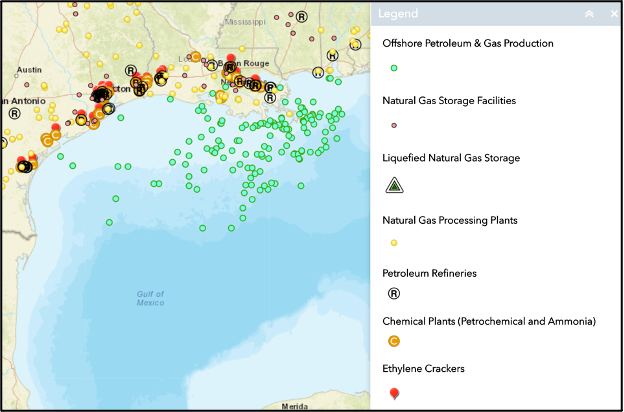
    The risks from industrial facilities are most obvious along the U.S. Gulf Coast, where many major petrochemical complexes are clustered in harm’s way. These refineries, factories and storage facilities are often built along rivers or bays for easy shipping access.

    But those rivers can also bring storm surge flooding that can raise the ocean by several feet during hurricanes. The storm surge from Helene was over 10 feet above ground level in Florida’s Big Bend and over 6 feet in Tampa Bay. With Milton, forecasters warning of a 10- to 15-foot storm surge at Tampa Bay.

    A boom surrounds flooded railcars to try to contain leaks at a chemical plant in Braithwaite, La., after Hurricane Isaac in 2012.
    AP Photo/David J. Phillip

    A recent study found evidence of two to three times more pollution releases during hurricanes in the Gulf of Mexico than during normal weather from 2005 to 2020.

    The effects of these pollution releases fall disproportionately on low-income communities and people of color, further exacerbating environmental health risks.

    Why residents may not hear about toxic releases

    The statistics are disconcerting, yet they get little attention. That is because hazardous releases remain largely invisible due to limited disclosure requirements and scant public information. Even emergency responders often don’t know exactly which hazardous chemicals they are facing in emergency situations.

    The U.S. Environmental Protection Agency requires major polluters to file only very general information about chemicals and on-site risks in their risk management plans. Some large-scale fuel storage facilities, such as those holding liquefied natural gas, are not even required to do that.

    These risk management plans outline “worst-case” scenarios and are supposed to be publicly accessible. But, in reality, we and others have found them difficult to access, heavily redacted and housed in federal reading rooms with limited access. The reason local officials and national scientific review panels often give for the secrecy is to protect the facilities from terrorist attack.

    Oil storage tanks and industrial facilities line the Houston Ship Channel, which is vulnerable to storm surge from Gulf of Mexico hurricanes.
    AP Photo/David J. Phillip

    Adding to this opacity is the fact that many states – including those along the Gulf – suspend restrictions on pollution releases during emergency declarations. Meanwhile, real-time incident notifications from the National Response Center – the federal government’s repository for all chemical discharges into the environment – typically lag by a week or more,

    We believe this limited public information on rising chemical threats from our changing climate should be front-page news every hurricane season. Communities should be aware of the risks of hosting vulnerable industrial infrastructure, particularly as rising global temperatures increase the risk of extreme downpours and powerful hurricanes.

    Mapping the risks nationwide to raise awareness

    To help communities understand their risks, our team at Rice University’s new Center for Coastal Futures and Adaptive Resilience investigates how industrial communities in flood-prone areas nationwide can better adapt to such threats, socially as well as technologically.

    Our interactive map shows where elevated future flood risks threaten to inundate major polluters that we identify using the EPA’s Toxic Release Inventory.

    The U.S. has several hot spots with clusters of flood-prone polluters. Houston’s Ship Channel, Chicago’s waterfront steel industries and the harbors at Los Angeles and New York/New Jersey are among the biggest.

    Three of the biggest hot spots, where large numbers of industrial facilities with toxic materials face elevated future flood risks, are in the Northeast, the northwestern Gulf Coast and the southern end of the Great Lakes.
    Rice University Center for Coastal Futures and Adaptive Resilience, CC BY-ND

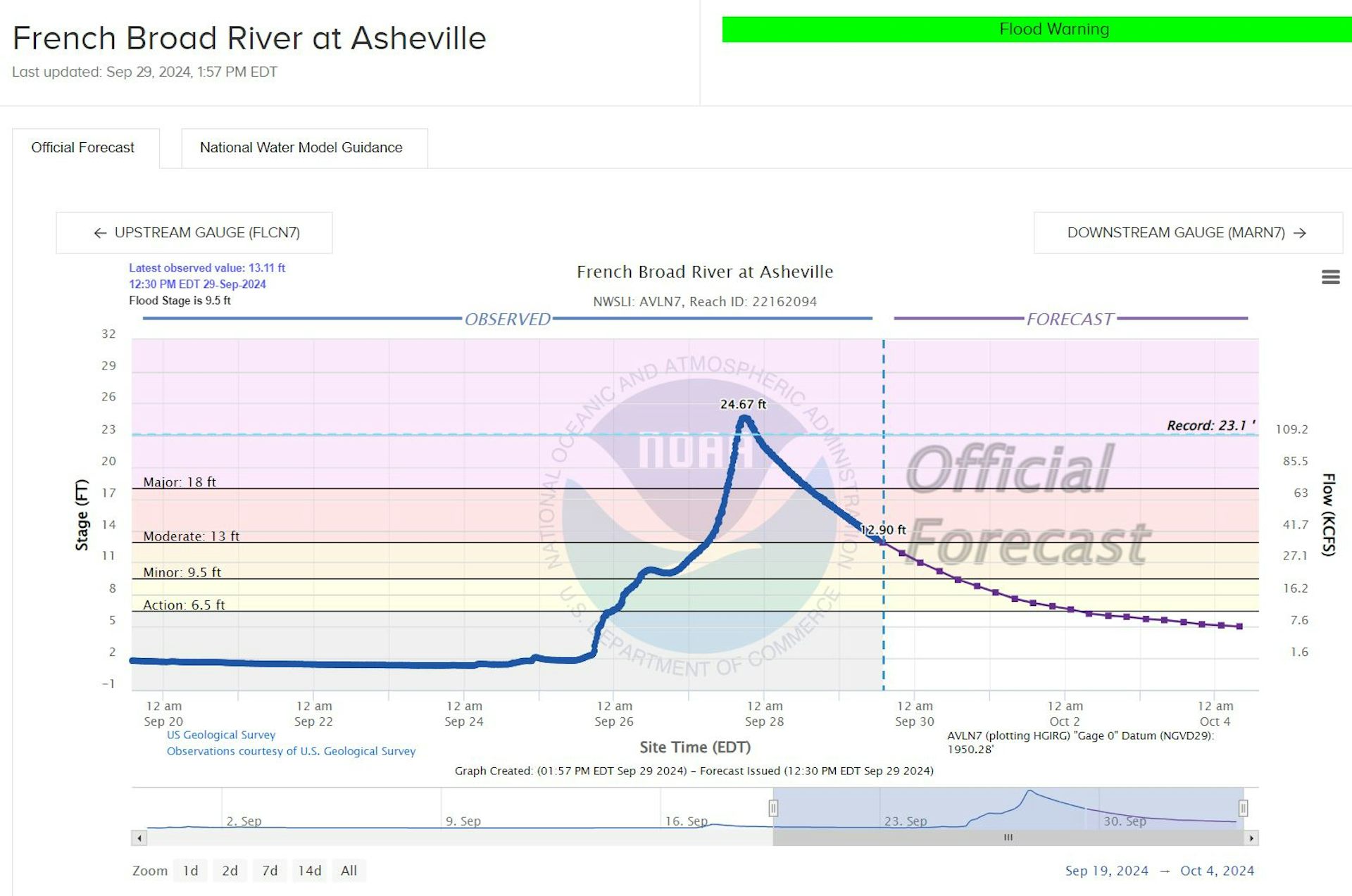
    But, as Helene revealed, there can also be great concern in less obvious spots. Inland, particularly in the mountains, runoff can quickly turn normally tame rivers into fast-rising torrents. The French Broad River at Asheville, North Carolina, rose about 12 feet in 12 hours during Helene and set a new flood stage record.

    When hurricanes and tropical storms are headed for the U.S., our interactive maps show where major polluters are located in the storm’s projected cone of impact. The maps identify hazardous flood-prone facilities down to the address, anywhere in the country.

    Knowledge is the first step

    Knowing where these sites are located is only the first step. Often, it’s up to communities themselves, many of them already overexposed and historically underserved, to raise concerns and demand strategies for mitigating the health, economic and environmental risks that industrial sites at risk of flooding and other damage can pose.

    These discussions can’t wait until a disaster is on the way. By knowing where these risks may be, communities can take steps now to build a safer future.

    This article, originally published Sept. 30, has been updated with Hurricane Milton.

    James R. Elliott receives funding from the National Science Foundation and the National Renewable Energy Lab.

    Dominic Boyer receives funding from the National Science Foundation, NOAA and Texas Sea Grant.

    Phylicia Lee Brown has nothing to disclose.

    ref. Hurricane Milton: Flooded industrial sites and toxic chemical releases are a silent, growing threat – https://theconversation.com/hurricane-milton-flooded-industrial-sites-and-toxic-chemical-releases-are-a-silent-growing-threat-239977

    MIL OSI – Global Reports

  • MIL-OSI Banking: Verizon está listo y ofrece consejos a medida que el huracán Milton se acerca a Florida

    Source: Verizon

    Headline: Verizon está listo y ofrece consejos a medida que el huracán Milton se acerca a Florida

    Alpharetta, GA – A medida que el huracán Milton se acerca a la costa de Florida, Verizon sigue comprometido a mantener conectados a la comunidad y al personal de primeros auxilios. Además de una red reforzada diseñada para soportar las condiciones más extremas, los ingenieros de Verizon tomaron firmes medidas de preparación para garantizar que haya recursos disponibles para una respuesta rápida.

    “En Verizon, nuestra principal prioridad es apoyar a las comunidades a las que servimos. Nuestra capacidad de respuesta y apoyoen tiempos de crisis realmente importan”, dijo la presidenta de Atlantic South Market de Verizon, Leigh Anne Lanier. “Desde familias hasta empresas y socorristas, estamos aquí para brindarles unservicio confiable en el que pueden contar. Nuestro equipo está trabajando incansablemente para mantener a nuestros clientes conectados ahora y en los próximos días.”

    Después del huracán Helene, las comunicaciones por satélite han demostrado ser una importante herramienta de comunicación cuando los servicios terrestres se han visto afectados. Asegúrese de que su teléfono esté listo con anticipación. Los clientes con un iPhone 14 o posterior deben actualizar a iOS 18 para asegurarse de poder enviar mensajes de texto o conectarse con servicios de emergencia vía satélite. Y para aquellos con dispositivos Google Pixel 9, la mensajería de emergencia también está disponible vía satélite. Ambos sistemas operativos cuentan con demos disponibles que permiten a los clientes practicar con antelación la mensajería vía satélite. Obtenga más información aquí.

    Las redes de Verizon están preparadas

    Las redes de Verizon están preparadas para mantener la conectividad incluso ante condiciones climáticas extremas. Con redundancia integrada en rutas y componentes críticos, la red de Verizon está diseñada con el objetivo de resistir condiciones climáticas adversas. Los ingenieros de Verizon se han preparado realizando controles exhaustivos, además de garantizar que los sistemas de respaldo, como baterías y generadores, estén operandoy cargados. Verizon también ha instalado enlaces en los Centros de Operaciones de Emergencia del área para permitir una comunicación perfecta con agencias locales, estatales y gubernamentales para garantizar una restauración rápida.

    En preparación para posibles operaciones de recuperación de la red, Verizon ha puesto en marcha una flota de soluciones de redes portátiles, incluidos activos de redes portátiles satelitales, que proporcionan conectividad crucial en escenarios donde las conexiones de fibra se ven comprometidas, así como generadores móviles para ayudar a las comunidade con una pérdida de energía comercial.

    Verizon Frontline está listo y preparado para ayudar a los socorristas en cualquier capacidad

    El equipo de respuesta a crisis de primera línea de Verizon está listo para ayudar a garantizar que las agencias de seguridad pública en la primera línea de cualquier desastre tengan las capacidades de comunicaciones críticas necesarias para lograr sus misiones. Este equipo, compuesto principalmente por ex socorristas y personal militar, se dedica exclusivamente a apoyar a los clientes de seguridad pública durante emergencias sin costo para las agencias que reciben la ayuda.

    En los primeros nueve meses de 2024, el equipo de respuesta a crisis de primera línea de Verizon respondió a más de 1000 solicitudes de soporte de comunicaciones de misión crítica de más de 500 agencias diferentes en 46 estados.

    Estar preparado es esencial para apoyar a las empresas y comunidades locales

    Al reconocer el papel fundamental de la conectividad en la continuidad del negocio, Verizon Business ofrece un conjunto de soluciones adaptadas para operaciones fluidas durante emergencias. Las empresas y las organizaciones gubernamentales necesitan tener un plan de acción adecuado. Las acciones sugeridas incluyen:

    • Mitigar las interrupciones para los clientes: Es importante pensar en lo que se necesita para garantizar un servicio continuo a sus clientes y qué software y equipo necesita su empresa para continuar con sus operaciones. Haga una lista detallada, que incluya contratos de servicio e información de garantía, y todos los números de teléfono pertinentes de las autoridades locales, empresas de servicios públicos, proveedores y vendedores.
    • La tecnología adecuada tiene un impacto: asegúrese de tener la tecnología adecuada para satisfacer las necesidades de conectividad de su empresa, suponiendo que necesite mudarse de su ubicación principal.
    • Los contactos y los documentos son clave: asegúrese de tener la información de contacto actualizada y disponible para todos los empleados, incluida la información del hogar para los trabajadores remotos y la información de las sucursales para las oficinas satélite.
    • Pruebe, pruebe y vuelva a probar: pruebe las redes primarias y de respaldo y refuerce las áreas débiles.
    • Mantenga un registro del equipo: asegúrese de que los empleados que trabajan desde casa hayan documentado todo el equipo corporativo que se utiliza para trabajar desde casa en caso de daño o pérdida.
    • Tenga un plan de respaldo: asegúrese de que existan planes de respaldo para cambiar el trabajo en caso de que los empleados que trabajan desde casa en un área afectada por la tormenta tengan que evacuar sus hogares o su hogar se quede sin energía comercial.

    ¿Estás listo para el huracán?

    El equipo de Verizon trabaja todo el año para garantizar que los clientes permanezcan conectados con sus seres queridos y las actividades que les brindan comodidad durante un desastre. Mientras los residentes se preparan para mantenerse conectados y entretenidos, considere estos consejos:

    • Abastecerse de fuentes de carga como baterías para linternas y radios o cargadores de dispositivos. Vaya un paso más allá y cargue sus dispositivos que pueden actuar como cargadores para otros dispositivos, como computadoras portátiles y centrales eléctricas. ¡No olvide tener los cables!
    • Descargue películas, libros, aplicaciones y juegos en caso de un corte de energía. O reúna juegos de mesa, juegos de cartas y rompecabezas para prescindir de dispositivos.
    • Localice documentos importantes que pueda necesitar más adelante, así como fotografías y artículos sentimentales.
    • Planificar comidas no perecederas. Tenga a mano algunos ingredientes no perecederos, como un abrelatas manual y otros utensilios de cocina.
    • Tome algunas velas, mantas, almohadas o cualquier cosa que haga que su espacio seguro contra huracanes sea cómodo.
    • Lea los consejos de preparación para huracanes de la Cruz Roja Americana
    • Agregar nuestra página verificar estado de la red o va a la aplicación My Verizon y haga clic en Temas de soporte (Support Topics) para notificarnos si experimenta algún problema con la red o para verificar si hay algún problema conocido en s u área. Ingrese su ubicación, seleccione el tipo de problema de servicio y le proporcionaremos una actualización del estado en tiempo real.

    Más información

    Visite el Centro de recursos de emergencia en línea de Verizon, verizon.com/about/news/emergency-resource-center, para obtener más detalles sobre las capacidades de respuesta de emergencia de Verizon.

    MIL OSI Global Banks

  • MIL-Evening Report: Do recent class actions against ‘flex commission’ car loans mean consumer voices are getting stronger?

    Source: The Conversation (Au and NZ) – By Jeannie Marie Paterson, Professor of Law, The University of Melbourne

    Gatot Adri/Shutterstock

    It’s been more than five years since the banking royal commission, but its findings continue to have an impact on the financial services sector.

    Law firm Maurice Blackburn recently announced it had settled with ANZ in a class action over allegedly unlawful “flex commissions” built into car loans made by Esanda between 2011 and 2016.

    ANZ agreed to settle the proceedings for $85 million on a “no admission of liability” basis. However, two further flex commission class actions – against Westpac & St George and Macquarie Leasing – remain on foot and will be heard this month.

    Class actions are a growing trend in the ways consumers seek to access justice. Many cases are simply too small to be pursued individually.

    On top of this, a recent High Court ruling could see organisations come under greater scrutiny over the systems they put in place. Could all of this mean consumers are getting a stronger voice?

    What are flex commissions?

    Many car dealers offer to provide financing for prospective car buyers as an alternative to getting a loan directly from a bank. But dealers typically don’t have their own huge reserves of funds to lend out.

    This financing usually comes from a finance company or bank lender through what is sometimes called a “white label” product.

    Many car dealers offer financing arrangements directly to customers.
    Tikhomirov Sergey/Shutterstock

    Dealers will usually be paid a commission on the loans they arrange by the lender. Prior to 2018, some lenders offered these car dealers arranging loans what is called a “flex commission”.

    Flex commissions allowed car dealers to set the interest rate on car loans above an agreed base rate.

    Higher interest rates meant a greater commission for the car dealer, but were not always in the interests of the borrower.

    Banned and heavily criticised

    Flex commissions were formally banned by Australia’s corporate watchdog, the Australian Securities and Investments Commission (ASIC), in November 2018.

    ASIC had been concerned that borrowers were paying excessively high interest rates on dealer-arranged car loans, and that the commissions were not fair or transparent.

    The watchdog’s own research found about 15% of customers were being charged an interest rate that was 7% or more above the base rate.

    Their main concern was that many car dealers weren’t increasing rates in line with actual credit risk, but rather opportunistically to target inexperienced or vulnerable consumers.

    Shortly after the ban, the final report of the banking royal commission didn’t mince words. Commissioner Kenneth Hayne noted a lack of transparency and a misplaced trust:

    Many borrowers knew nothing of these arrangements. Lenders did not publicise them; dealers did not reveal them. […] To the borrower, the dealer might have appeared to be acting for the borrower by submitting a loan proposal on behalf of the borrower. The borrower was given no indication that in fact the dealer was looking after its own interests.

    Why were class actions needed?

    Neither ASIC’s ban nor the criticisms of the banking royal commission guaranteed any redress for borrowers subject to loans with flex commissions.

    ASIC suggested flex commissions may have contravened the National Consumer Credit Protection Act by being unfair, or the ASIC Act by being misleading. But it is difficult and expensive for individuals to pursue such claims themselves in court.

    ASIC itself can seek compensation on behalf of borrowers, or require redress to be paid as part of other enforcement action. The watchdog has already gone down this road in some of the especially egregious instances of misconduct identified by the royal commission, such as fees for no service.

    Where individual action is too hard or regulator action lacking, consumers’ best option for redress may lie in a class action – taken on a no-win, no-fee basis. The likelihood of a good result may be increased in instances where the class action “piggybacks” on an adverse report from the regulator.

    Corporations may face increasing scrutiny

    It’s reasonable to ask why upstream lenders are being targeted in “flex commission” class actions when it is the car dealers who allegedly wronged borrowers.

    The ongoing class actions do not allege the lenders themselves misled borrowers or treated them unfairly. However, in this context that may not matter.

    In each of the class actions, Maurice Blackburn has argued the car dealers were acting as the representatives of the lenders, which they say makes the lenders responsible for the car dealers’ alleged misconduct.

    A recent High Court ruling may mean corporations have to take greater responsibility for the systems they oversee.
    Shutterstock

    Moreover, in these and similar cases, a recent High Court ruling that centred on “systemic unconscionable conduct” could make it harder for such upstream entities to argue their distance from alleged wrongdoing in systems they put in place.

    Better access to justice

    There has been a rise in consumer protection class actions in recent years, supported by changes in rules of procedure in several jurisdictions.

    Justice Bernard Murphy of the Federal Court of Australia has argued these changes promote the important value of access to justice:

    The important thing to remember is that class actions are critical in ensuring that people can obtain redress for mass civil wrongs. Laws which are not, in fact, readily capable of enforcement by ordinary Australians are little more than an illusion.

    This trend is important. Dishonest or unfair conduct has long been prohibited in the National Consumer Credit Protection Act, but this hasn’t been used much to date.

    Given the current flex commission actions closely follow the findings of ASIC, we should watch the regulator closely for hints of any future actions in other areas. Many could spark discussions that ultimately lead to stronger protection for consumers.

    But when they are successful, we also need to keep an eye on the actual payout to borrowers and hope it takes place without undue delay.

    Jeannie Marie Paterson has previously received funding from the Australian Research Council, DFAT and the Menzies Foundation.

    ref. Do recent class actions against ‘flex commission’ car loans mean consumer voices are getting stronger? – https://theconversation.com/do-recent-class-actions-against-flex-commission-car-loans-mean-consumer-voices-are-getting-stronger-240795

    MIL OSI AnalysisEveningReport.nz

  • MIL-OSI Economics: Google DeepMind’s Demis Hassabis & John Jumper awarded Nobel Prize in Chemistry

    Source: Google

    This post originally appeared on the Google DeepMind Blog.

    This morning, Co-founder and CEO of Google DeepMind and Isomorphic Labs Sir Demis Hassabis, and Google DeepMind Director Dr. John Jumper were co-awarded the 2024 Nobel Prize in Chemistry for their work developing AlphaFold, a groundbreaking AI system that predicts the 3D structure of proteins from their amino acid sequences. David Baker was also co-awarded for his work on computational protein design.

    Before AlphaFold, predicting the structure of a protein was a complex and time-consuming process.

    AlphaFold’s predictions, made freely available through the AlphaFold Protein Structure Database, have given more than 2 million scientists and researchers from 190 countries a powerful tool for making new discoveries. The AlphaFold 2 paper, published in 2021, remains one of the most-cited publications of all time.

    AlphaFold’s contributions to science have been widely praised, and among its recognitions are the 2023 Albert Lasker Basic Medical Research Award, the 2023 Breakthrough Prize in Life Sciences, the 2023 Canada Gairdner International Award, the 2024 Clarivate Citation Laureate award, and the 2024 Keio Medical Science Prize Award.

    Artificial Intelligence (AI) has long shown incredible potential for use in scientific research, and AlphaFold was proof-of-concept. As more scientists adopt AI for use in everything from building data, to simulating experiments, drug design, modelling complexity, discovering novel solutions for extant problems, and building upon existing knowledge, we will continue to see foundational scientific breakthroughs in the years ahead.

    In a statement released after informed of the news, Demis Hassabis said:

    “Receiving the Nobel Prize is the honour of a lifetime. Thank you to the Royal Swedish Academy of Sciences, to John Jumper and the AlphaFold team, the wider DeepMind and Google teams, and to all my colleagues past and present that made this moment possible. I’ve dedicated my career to advancing AI because of its unparalleled potential to improve the lives of billions of people. AlphaFold has already been used by more than two million researchers to advance critical work, from enzyme design to drug discovery. I hope we’ll look back on AlphaFold as the first proof point of AI’s incredible potential to accelerate scientific discovery.”

    After receiving the news that he won the Nobel Prize, John Jumper released the following statement:

    “Thank you to the Royal Swedish Academy of Sciences for this extraordinary honor. We are so honored to be recognized for delivering on the long promise of computational biology to help us understand the protein world and to inform the incredible work of experimental biologists. It is a key demonstration that AI will make science faster and ultimately help to understand disease and develop therapeutics. This is the work of an exceptional team at Google DeepMind and this award recognizes their amazing work.

    Computational biology has long held tremendous promise for creating practical insights that could be put to use in real-world experiments. AlphaFold delivered on this promise. Ahead of us are a universe of new insights and scientific discoveries made possible by the use of AI as a scientific tool. Thank you to my colleagues over the years, for making possible this moment of recognition, as well as the many moments of discovery that lie ahead.”

    MIL OSI Economics

  • MIL-Evening Report: In Vogue: the 90s was a boom time for Australian fashion and faces. What happened?

    Source: The Conversation (Au and NZ) – By Sasha Sarago, First Nations Cultural Innovation Lead – Beauty and Technology, Charles Sturt University

    The In Vogue: The 90s series transports audiences back to the glamour and grandeur of a transformative decade for fashion. Set against the backdrop of New York, London and Paris, the series explores the rise of supermodels, designer powerhouses and fashion’s global influence. But the fashion scene in Australia – a country that was also enjoying a meteoric rise in international success at the time – does not crack a mention.

    The 1990s marked a golden era for fashion. Supermodels like Linda Evangelista, Naomi Campbell, Cindy Crawford and Christy Turlington became style icons. Designers like Tom Ford, Jean-Paul Gaultier, and John Galliano pushed the boundaries of fashion creating moments that defined the times and influenced everything from pop culture to politics.

    Even though Australia may not have had the runway clout of Paris or New York, the nation was making significant strides in fashion during the same period. Australian designers’ and models’ distinct styles were impressive – giving fashion heavyweights a run for their money.

    So, what went wrong?

    The 90s turned the fashion industry upside down.

    Australian designers, international success

    In the 1990s, Australian designer houses such as Alannah Hill, Collette Dinnigan, Akira Isogawa and Sass & Bide signified Australia’s “coming of age” in fashion, with each designer bringing a unique flair and Australian sensibility to the international market.

    Alannah Hill created a whimsical aesthetic with an edgy twist. Her designs, worn by celebrities Nicole Kidman, Helena Christensen and Courtney Love, earned her a cult following. Business skyrocketed from her Chapel Street boutique in Melbourne to the department stores Selfridges and Browns in London and Bergdorf Goodman and Henri Bendel in Fifth Avenue, New York City.

    In 1996, Collette Dinnigan gained worldwide acclaim as the first Australian designer to showcase her collection at Paris Fashion Week. Dinnigan’s delicate lace dresses and couture craftsmanship found a spotlight at London’s Victoria & Albert Museum’s Fashion in Motion exhibition. Striking while the iron was hot, Dinnigan secured a lingerie collaboration with Marks & Spencer.

    Collette Dinnigan’s designs were celebrated in a 2015 retrospective exhibition.
    4Susie/Shutterstock

    Akira Isogawa, known for his blend of Japanese and Western aesthetics shared his first collection in 1994. He has presented subsequent collections in Paris bi-annually, a legacy sustained since 1998. Innovative from the jump, he turned early constraints to strengths. When the budget for his first big show didn’t stretch to shoes, he sent models down the runway in little red socks. The fashion statement helped him eventually secure more than 50 retail partners.

    Sass & Bide, founded in 1999 by friends Sarah-Jane Clarke and Heidi Middleton, brought a youthful, urban energy from London’s Portobello Road Markets back to Australian shores. Their signature brand quickly gained popularity and was acquired by Myer in a A$42.3 million two-part deal. Australia was no longer a disconnected island but a wild card in the global fashion ecosystem.

    Australian faces and Elaine George’s Vogue cover

    Australian designers weren’t the only superstars gaining fashion fame.

    By the time the supermodel phenomenon etched itself into the fashion zeitgeist, Australian model and businesswoman Elle Macpherson (known then as The Body) was already well known. Australian models Sarah Murdoch, Kristy Hinze, Kate Fisher and Alyssa Sutherland would follow.

    Sarah Murdoch (nee O’Hare, pictured with Anneliese Seubert and Emma Balfour in 1996) graced Australian catwalks in the 90s.
    Patrick Riviere/Getty

    Magazine cover models throughout the 90s showed sun-kissed “girl next door” charm. The exception was Emma Balfour, often touted as Australia’s androgynous counterpart to Kate Moss’s grunge-bohemian look.

    But 1993 produced a turning point in Australia’s beauty paradigm. It was the year Elaine George, Australia’s first Aboriginal fashion model, arrived on the cover of Vogue Australia magazine, making fashion history. Elaine’s presence highlighted the Australian fashion industry’s prioritisation of Eurocentric beauty ideals.

    First Nations beauty and fashion talent urgently needed celebrating. But Vogue’s Australian readers had to wait until October 2000 until Torres Strait Islander singer-songwriter and actress Christine Anu was featured on the cover. The gap showed the stain of underrepresentation and inequity within Australian fashion’s reputation had remained.

    The 2000s, when fashion got much faster

    While the 1990s were a period of optimism and growth for Australian fashion, the momentum failed to continue into the 2000s. Several factors contributed to this decline.

    One of the most significant changes was the rise of fast fashion in the early 2000s. Brands like Zara, H&M and Forever 21 began dominating the global market with affordable, quickly produced garments.

    This shift left many independent designers, including those from Australia, struggling to compete. The slow, meticulous craftsmanship that had defined Australian designers in the 90s could not keep up with the fast-fashion cycle.

    Another challenge was the lack of sustained support for the Australian fashion industry. Unlike New York, London or Paris, which had well-established fashion infrastructures, Australia’s fashion scene was still relatively young. There was no long-term strategy to nurture emerging talent or to promote Australian fashion on a global scale. Many designers either relocated abroad or found it difficult to maintain the same level of success they had achieved in the 90s.

    A new Renaissance?

    The story of Australian fashion in the 1990s is one of promise, yet ultimately missed opportunity. Today, Australia has a chance to enter a new renaissance fuelled by digital innovation and its unique cultures.

    The rise of digital fashion enables Australian designers to break free from the constraints of traditional fashion markets. With virtual clothing (simulated for real wear or digital realms), AI-powered design tools and metaverse runways, Australian creatives can harness technology to showcase their work globally.

    The championing of Indigenous models, designers and multicultural identity is essential. This inclusivity could position Australia as sustainable and ethical fashion innovator and present a compelling alternative to the fast-fashion giants.

    Sasha Sarago does not work for, consult, own shares in or receive funding from any company or organisation that would benefit from this article, and has disclosed no relevant affiliations beyond their academic appointment.

    ref. In Vogue: the 90s was a boom time for Australian fashion and faces. What happened? – https://theconversation.com/in-vogue-the-90s-was-a-boom-time-for-australian-fashion-and-faces-what-happened-240784

    MIL OSI AnalysisEveningReport.nz

  • MIL-OSI Economics: In the Democratic Republic of Congo, an African Development Bank-funded agroforestry project is rebuilding biodiversity and enhancing livelihoods

    Source: African Development Bank Group
    In a farming community located in the south-central Democratic Republic of Congo, Dorcas Tshabu is turning a childhood dream into a reality. Situated 20 kilometers from the city of Mbuji-Mayi, Dorcas has transformed what was once a savanna into a flourishing forest with her hands and determination.

    MIL OSI Economics

  • MIL-OSI Economics: Houston Chapter Raises Money for Scholarships at 36th Annual Golf Tournament

    Source: International Association of Drilling Contractors – IADC

    Headline: Houston Chapter Raises Money for Scholarships at 36th Annual Golf Tournament

    Tickets were sold out for the recent IADC Houston Chapter 36th Annual Scholarship Golf Tournament. On 13 September, Members headed to the Cypresswood Golf Club to tee up for a great cause – raising money for scholarship recipients. It was an outstanding event, filled with lots of camaraderie, fun, and great food! Thank you to everyone who attended & supported this event. 

    MIL OSI Economics

  • MIL-OSI Economics: IADC Nigeria Chapter Hosts HSE Awards & Technical Session

    Source: International Association of Drilling Contractors – IADC

    Headline: IADC Nigeria Chapter Hosts HSE Awards & Technical Session

    The 2024 IADC Nigeria Chapter HSE Awards and Technical Session was held on 13 September. Chapter Chairman Mr. Chuks Enwereji discussed workplace stress during the event’s safety moment. He then delivered an update on the state of the Nigeria Oil & Gas industry, providing valuable insights into the current landscape. 

    A special mention was given to the Petroleum Training Institute (PTI) IADC Student Chapter, the first of its kind in Nigeria. The chairman celebrated the presence of students from the PTI Student Chapter, recognizing the importance of nurturing future talent. Since its inception, the PTI IADC Student Chapter has organized several initiatives, including technical sessions and inter-level drilling quiz competitions, demonstrating their passion for industry excellence. The PTI Student Chapter extended its deepest gratitude to both IADC Headquarters and the IADC Nigeria Chapter for their continuous support.

    Guest speakers delivered thought-provoking presentations. Mrs. Ihuoma Okorie, CEO of Clintas Energy Resources Limited, addressed the critical topic “Competency Training in the Oil & Gas Industry.” Engr. Mercy Ntuk, HSSE Lead at Unitech Drilling Company Limited, followed with an engaging session on the topic “Developing and Sustain Competency in Critical Roles.” 

    The Chapter honored Member companies that actively participated in the 2023 Incident Statistics Program (ISP), with their reports meticulously analyzed by the HSE Committee. A total of ten companies submitted their 2023 reports, and after careful review, Shelf Drilling Offshore Services Limited emerged as the top performer for their exemplary safety practices. The following companies were recognized:

    • Aviam Offshore Engineering Company Limited
    • Charlvon Limited
    • Depthwize Nigeria Limited
    • Geoplex Drillteq Limited
    • Ocean Deep Drilling ESV Nigeria Limited
    • Pacific International Drilling West Africa Limited
    • Selective Marine Oil and Gas Limited
    • OES Energy Services
    • Unitech Drilling Company Limited
    • Shelf Drilling Nigeria Limited

    The 2024 HSE Awards & Technical Session was a resounding success, bringing together key industry stakeholders, government and regulatory agencies, and directors of  Member companies. It was a vibrant and interactive event filled with enriching presentations, valuable insights, and a strong sense of collaboration within the industry.

    MIL OSI Economics

  • MIL-OSI Economics: IADC South Central Asia Chapter & ONGC Organize 8th Drilling Operations Incident Review Committee Meeting

    Source: International Association of Drilling Contractors – IADC

    Headline: IADC South Central Asia Chapter & ONGC Organize 8th Drilling Operations Incident Review Committee Meeting

    The IADC South Central Asia (SCA) Chapter and the Oil and Natural Gas Corporation (ONGC) hosted the 8th Drilling Operations Incident Review Committee (DOIRC) meeting on 24 August. This was the second event with an integrated Onshore and Offshore focus, and it was held at NBP Green Heights in Mumbai. 

    The event witnessed active participation from over 280 attendees of different companies, including 130 online participants from offshore and onshore E&P installations in the Indian subcontinent. Attendees included leaders and key executives from ONGC, drilling companies, and other organizations, demonstrating a shared commitment to safety in drilling operations across the region.

    The safety moment by the HSE Manager of Greatship emphasized the role of human factors in incidents and highlighted the importance of compliance with safety management systems and procedures in the workplace.

    DOIRC Chairman Shri VV Prasad expressed his gratitude to IADC SCAC Chairman & Director (T&FS) ONGC Shri OP Singh for his continuous guidance and support in establishing DOIRC as a structured platform for engagement and collaboration on safety issues in the Indian Drilling Industry. He emphasized that the goal of zero incidents is achievable when safety becomes a shared responsibility.

    In his inaugural address, Sh. O.P. Singh appreciated the continuous efforts made by IADC in collaboration with ONGC to create a safe culture and a safe work environment. A more efficient work environment can be achieved by integrating the guiding principles of the Five M’s – Men, Machine, Material, Method, and Management. He emphasized that digitalization plays a pivotal role in the transformation to latest technologies. The industry needs to support a digital safety culture, enhancing its safety protocols and being prepared for future challenges.    

    The Head of HSE ONGC Mumbai presented an action taken report on previous DOIRC recommendations, their compliance status along with initiatives taken, milestones achieved, and HSE statistics for Quarter-1 of FY 2024-25. Eight incidents from the last quarter were presented by respective rig managers, sharing their root cause analysis learnings from these incidents and corrective actions implemented.

    In his concluding address, Chief of HSE at ONGC advised that the learnings from the incidents discussed at DOIRC should be effectively communicated and implemented across all ONGC installations.

    Mr. Narendra Jindal, Vice chairman of IADC SCA Chapter & Country – Head of Operations at Shelf Drilling, offered the closing remarks and vote of thanks.

    MIL OSI Economics

  • MIL-OSI Economics: Accreditation Updates for October 2024

    Source: International Association of Drilling Contractors – IADC

    Headline: Accreditation Updates for October 2024

    IADC welcomes these 7 newly-accredited training providers who have satisfactorily completed the approval process:

    Basin United

    • Standard Safety & Supply – Odessa, Texas, US
    • TechnipFMC – Odessa, Texas, US
    • Tiger Safety – Houston, Texas, US

    Competence Assurance

    • ChampionX Middle East Services LLC – Muscat, Oman

    RigPass

    • RigSafe Iraq Training Services – Basra, Basra, Iraq 
    • JC Energy Services – Benton, Texas, US

    WellSharp

    • Bro Well Control School – Suez, Egypt

    MIL OSI Economics

  • MIL-OSI Economics: Washington, D.C., Updates for October 2024

    Source: International Association of Drilling Contractors – IADC

    Headline: Washington, D.C., Updates for October 2024

    U.S. House of Representatives Passes Key Legislation Before Campaign Season

    Congress overwhelmingly passed a funding bill last week to avert a government shutdown on September 30th, the end of the U.S. government’s fiscal year. The spending package, negotiated by the House and Senate, would fund the government at current levels through December 20, 2024, setting up another spending fight right before the holidays. The House and Senate have adjourned and will not return to the Capitol until after the elections in November.

    But before they headed back to their districts and states for the final campaign stretch, the House of Representatives approved a number of energy, environment and natural resources bills that will see Senate action when they return.

    The House advanced H.R. 7073, the “Next Generation Pipelines Research and Development Act,” by a vote of 373-41. The bill, out of the Science, Space and Technology Committee, would increase federal research and collaborations related to pipelines.

    During floor debate, bipartisan members heralded the importance of improving aging pipelines that are becoming more prone to malfunction and leaks. Sponsor Representative Randy Weber (R-Texas) said the bill would help the Department of Energy adopt a “new and more modern approach to pipeline research development.” Rep. Zoe Lofgren (D-Calif.), the Science Committee’s ranking member, called the bill “much-needed harm-reduction legislation.”

    The House also advanced H.R. 7370, the “Geothermal Energy Opportunity Act,” from Rep. John Curtis (R-Utah). The bill would establish a deadline for the Interior Department to process geothermal power project applications.

    The House even cleared firebrand Rep. Alexandria Ocasio-Cortez’s H.R. 7422, the “Geothermal Cost-Recovery Authority Act,” so the Interior Department can seek reimbursement from companies to offset the cost of permitting and hire third-party experts to review permits. “At a time when permitting is a contentious word in Washington, this bill shows that both parties can come together around common-sense approaches,” Ocasio-Cortez said.

    Also passed was H.R. 6474, from Rep. Michelle Steel (R-Calif.), which would expedite permitting for geothermal projects in regions with recent energy development or environmental impact studies.

    And a final bill was passed, H.R. 5509, the “Electronic Permitting Modernization Act,” from Rep. Katie Porter (D-Calif.), which would require the Interior Department to modernize its electronic permitting system and expand online options for permits.

    MIL OSI Economics

  • MIL-OSI Economics: Trade Policy Review: Malawi

    Source: World Trade Organization

    The following documents are available:

    Secretariat report

    A detailed report written independently by the WTO Secretariat.

    Government report

    A policy statement by the government of the member under review.

    From the meeting

    The Secretariat and Government reports are discussed by the WTO’s full membership in the Trade Policy Review Body (TPRB).

    Background

    Trade Policy Reviews are an exercise, mandated in the WTO agreements, in which member countries’ trade and related policies are examined and evaluated at regular intervals. Significant developments that may have an impact on the global trading system are also monitored. All WTO members are subject to review, with the frequency of review depending on the country’s size.

    Share

    MIL OSI Economics

  • MIL-OSI Economics: Thales to supply handheld thermal imagers to the Canadian Army

    Source: Thales Group

    Headline: Thales to supply handheld thermal imagers to the Canadian Army

    • The Thales Sophie Ultima long-range handheld thermal imagers have been selected by the Canadian Armed Forces, the first contract awarded under Canada’s Night Vision Systems Modernization (NVSM) project.
    • Manufactured and maintained in Canada, the Sophie Ultima will enhance operational capabilities for the Canadian Army with advanced technology and resilient navigation.
    • This contract award further affirms Thales’ commitment to Canada with significant local industrialization, skills development and training in Quebec.
    ©Thales

    Thales Canada is pleased to announce that the Government of Canada has awarded a contract to Thales Canada for the acquisition of its Sophie Ultima Handheld Thermal Imager (HHTI) as part of the Night Vision Systems Modernization (NVSM) project. This award marks an important advancement in Canada’s defence capabilities, ensuring that the Canadian Armed Forces (CAF) are equipped with cutting-edge technology designed to excel in complex and challenging operational environments.

    The Sophie Ultima, a lightweight, handheld thermal imager, is engineered to deliver extraordinary performance in the field. With a high performance infrared channel, it offers NATO tank recognition range performance of up to 6 kilometres. The continuous optical zoom and wide 20° field of view enable operators to maintain visual contact with targets during detection, recognition, and identification phases, ensuring rapid and precise engagement.

    Thales will manufacture and maintain the Sophie Ultima at its existing Canadian Electro-Optics Center of Excellence, further strengthening Canada’s defence industrial base. This initiative will create new jobs and spur economic growth, expanding Thales’s current supply chain within Canada. In addition, the Thales Optronics facility in Montreal will provide comprehensive in-service support, ensuring that the Canadian Armed Forces benefit from a dedicated repair facility with rapid turnaround, reducing equipment downtime.

    “Thales is committed to delivering advanced, reliable, and locally supported solutions like the Sophie Ultima,” said Benoit Plantier, Vice President, Optronics, Missile Electronics and Unmanned Air Systems, Thales.

    About Thales

    Thales (Euronext Paris: HO) is a global leader in advanced technologies specialized in three business domains: Defence & Security, Aeronautics & Space, and Cybersecurity & Digital identity.

    It develops products and solutions that help make the world safer, greener and more inclusive.

    The Group invests close to €4 billion a year in Research & Development, particularly in key innovation areas such as AI, cybersecurity, quantum technologies, cloud technologies and 6G.

    Thales has close to 81,000 employees in 68 countries. In 2023, the Group generated sales of €18.4 billion.

    About Thales Canada

    A Canadian leader in research and technology, Thales Canada combines over 50 years of experience with the talent of over 1,300 skilled people from coast-to-coast. Thales Canada offers leading capabilities in the defence, civil aviation, digital identity and security sectors – meeting the most complex needs and requirements of its customers across all operating environments.

    MIL OSI Economics

  • MIL-OSI Economics: US gives USD 600,000 to strengthen trade expertise in developing economies and LDCs

    Source: World Trade Organization

    This new contribution will support developing economies and LDCs in deepening their understanding of WTO agreements and strengthening their ability to engage in trade negotiations at the WTO.

    The United States Ambassador to the WTO, María Pagán, said: “The United States is committed to supporting capacity building activities that strengthen local communities through inclusive, sustainable, and resilient economic growth. Our longstanding commitment to the Global Trust Fund is an important element of our global effort toward supporting sustainable development. We value the work the WTO’s ITTC carries out under the Global Trust Fund and believe it is an excellent example of tangible collaboration and cooperation that supports implementation of the WTO framework of agreements.”

    Welcoming this contribution, WTO Director-General Ngozi Okonjo-Iweala, said: “The longstanding and consistent support of the United States continues to play a vital role in making the WTO’s technical assistance work possible. By equipping government officials from our developing members and observers better use global trade opportunities, these capacity building activities ultimately lead to better livelihoods for their citizens. We appreciate this generous donation to the Global Trust Fund.”

    To date, nearly 3,000 activities have been organized under the Global Trust Fund over the past two decades.

    MIL OSI Economics

  • MIL-OSI Economics: Ecuador formally accepts Agreement on Fisheries Subsidies

    Source: World Trade Organization

    Director-General Okonjo-Iweala said: “I warmly welcome Ecuador’s formal acceptance of the Agreement on Fisheries Subsidies. As one of the largest tuna exporters in the world and the proud steward of the Galapagos islands, Ecuador stands to gain immensely from this global commitment to curb harmful fisheries subsidies. This Agreement will not only preserve marine biodiversity but will also secure long-term economic opportunities for the nation.”

    Ambassador Valencia said: “It is an honour to present, on behalf of Ecuador, the instrument of acceptance of the Agreement on Fisheries Subsidies, the first WTO instrument that promotes trade regulations while considering the sustainability of the oceans. The acceptance of this Agreement reaffirms Ecuador’s and its government’s firm commitment to promoting the achievement of Sustainable Development Goal 14.6, protecting the life cycles of marine populations, improving the living conditions of citizens who depend on fishing activities—particularly the most economically vulnerable communities—and promoting transparency by prohibiting subsidies to harmful activities such as illegal, unreported, and unregulated fishing.”

    Ecuador’s instrument of acceptance brings to 84 the total number of WTO members that have formally accepted the Agreement. Twenty-seven more formal acceptances are needed for the Agreement to come into effect. The Agreement will enter into force upon acceptance by two-thirds of the membership.

    Adopted by consensus at the WTO’s 12th Ministerial Conference (MC12), held in Geneva on 12-17 June 2022, the Agreement on Fisheries Subsidies sets new, binding, multilateral rules to curb harmful subsidies, which are a key factor in the widespread depletion of the world’s fish stocks. In addition, the Agreement recognizes the needs of developing economies and least-developed countries and establishes a fund to provide technical assistance and capacity building to help them implement the obligations.

    The Agreement prohibits subsidies for illegal, unreported and unregulated (IUU) fishing, for fishing overfished stocks, and for fishing on the unregulated high seas.

    Members also agreed at MC12 to continue negotiations on outstanding issues, with a view to adopting additional provisions that would further enhance the disciplines of the Agreement.

    The full text of the Agreement can be accessed here. The list of members that have deposited their instruments of acceptance is available here. Information for members on how to accept the Protocol of Amendment is available here.

    Share

    MIL OSI Economics

  • MIL-OSI Economics: DDG Ellard urges swift action on fisheries subsidies to aid Pacific sustainability goals

    Source: WTO

    Headline: DDG Ellard urges swift action on fisheries subsidies to aid Pacific sustainability goals

    Thank you, and good afternoon, distinguished excellencies and to all.
    I appreciate the invitation to engage with you on the pressing environmental challenges confronting the Pacific region, and how a multilateral approach can help tackle those challenges and foster sustainable solutions. 
    Severely affected by the triple planetary crisis of climate change, biodiversity loss, and pollution, the Pacific Islands have a unique understanding of how trade and trade policy can contribute to addressing these challenges. And that’s why I’m so pleased that this discussion is taking place at the WTO.
    Trade is vital for climate adaptation and resilience, because it facilitates the development and dissemination of adaptation technologies, improves access to essential goods and services during climate shocks, and fosters synergies between climate finance and trade aid to bolster supply chains and trade-related infrastructure.
    The participation and leadership of the Pacific Islands at the WTO in addressing environmental challenges is commendable, including through Fiji’s role as a co-coordinator of the Dialogue on Plastics Pollution and Environmentally Sustainable Plastics Trade (DPP).
    I encourage you to continue bringing forward your interests in the Committee on Trade and Environment, as well as in other environmental initiatives at the WTO to ensure that trade policy supports your adaptation and energy transition efforts.
    Let me now turn to the issue of fisheries subsidies.
    I visited the Pacific in 2022 just as two important and complementary events coincided:
    the adoption of the Agreement on Fisheries Subsidies at MC12, and   
    the adoption of the 2050 Strategy for the Blue Pacific Continent by the Pacific Islands Forum Leaders.
    There are many synergies between these two historic achievements, paving the way toward a sustainable, prosperous, and resilient Pacific region.
    As the 2050 Strategy underscores, the Pacific islands countries are the custodians of nearly 20% of the earth’s surface, including vast swaths of ocean.  During my visits to the Pacific, I have witnessed firsthand how the ocean is central not only to the economies of the region, but also to the core identity of its people. Therefore, it is particularly fitting that, through the 2050 Strategy, all Pacific governments have committed to collective action to improve the health of the ocean and prevent the over-exploitation of its resources.
    As we know, the Western and Central Pacific Ocean is home to one of the world’s largest fisheries, supplying more than half of the world’s tuna from predominantly sustainable stocks. However, the sustainability of fishery resources in the Pacific and worldwide, is threatened by harmful subsidies, which total around USD 22 billion annually.
    The WTO Agreement on Fisheries Subsidies is a decisive response to these challenges. It prohibits subsidies to vessels involved in illegal, unreported, and unregulated (IUU fishing), and to fishing in the unregulated high seas. It also restricts subsidies for activities affecting overfished stocks, unless they are implemented to rebuild the stocks to a biologically sustainable level. By enhancing transparency and enforcing these rules, the Agreement promises significant benefits for fishing communities across the region, aligning with the Blue Pacific Strategy.
    However, this potential will be realized only when the Agreement enters into force, which requires ratification by 2/3 of our 166 Members. To date, we have received 83 out of the 111 instruments of acceptance, and our goal is to hit the required target by the end of the year. The process for acceptance is well under way in many WTO Members, and I strongly urge those who have not yet ratified – including in the Pacific, where fisheries are so vital – to do so as soon as possible.
    I should emphasize that ratification unlocks access to the technical assistance and capacity-building from the WTO Fish Fund. We have more than USD 12 million in the bank, in addition to resources provided by the FAO and the World Bank, our partners in the Fund. This Fund will help developing and LDC Members implement the Agreement and improve their fisheries management – the Fund demonstrates the commitment to work closely with developing Members and LDCs every step of the way.
    But we know our negotiating work is not done.  I encourage Members to constructively engage on the ongoing negotiations on fisheries subsidies contributing to overcapacity and overfishing – Fish 2 – which, together with Fish 1, would constitute comprehensive disciplines to fully meet UN SDG 14.6.  As you know, although WTO Members have not reached an agreement on these provisions yet, they did make significant progress, and we are very close. The four-year sunset clause in Fish 1, initially proposed by the Pacific region, creates a powerful incentive to conclude these negotiations quickly. 
    While the current text may not be ideal or perfect for all, most developing and developed Members believe that it would improve the status quo, perhaps with a few adjustments that are well socialized with the Membership.
    The latest version of the new disciplines circulated by the Chair of the negotiations is a balanced approach.  On one hand, it contains strong disciplines on the largest fishers and subsidizers, as well as those engaged in distant water fishing.    
    On the other hand, the text exempts small-scale and artisanal fishing from its disciplines, as well as least developed Members and small fishing nations. It also includes a review clause to assess the effectiveness of disciplines, with the possibility to amend the Agreement later.
    Sustainable fisheries are crucial for the livelihoods of those who depend on them. The adoption and entry into force of both WTO fisheries agreements will therefore go a long way to helping Pacific nations fulfil the commitments in 2050 Strategy.
    I know we can count on the Pacific and all Members for their continued deep and earnest engagement. At this point, concluding Fish 2 will require significant commitment at the highest political level, to complete negotiations on Fish 2, and to ensure the ratification and entry into force of Fish 1. And so much is at stake, for our ocean, the fish, and those whose livelihood depends on them.  Whether we can finish our work is completely in Members’ – your – hands. 
    Thank you.

    Share

    MIL OSI Economics

  • MIL-OSI New Zealand: Rural News – Southland Federated Farmers to boycott Fish & Game

    Source: Federated Farmers

    Federated Farmers Southland are calling for local farmers to boycott Fish & Game and remove fishing access across their land.
    “Farmers have always allowed anglers to walk across their land as a gesture of goodwill but, unfortunately, that goodwill has been completely eroded by Southland Fish & Game,” Federated Farmers Southland president Jason Herrick says.
    “We’re fed up with Southland Fish & Game’s persistent, belligerent anti-farming rhetoric and their opposition to everything we do.
    “We’ve tried our best to maintain our relationship with them, but they’ve washed that relationship away down the Mataura River.
    “We’re now calling for local farmers to join us in boycotting fishing licences, and to remove fishing access by taking down access signs.
    “Farmers can replace those signs with an orange ribbon to show their frustration with Fish & Game, and anyone else who wants to show their support could do that by attaching an orange ribbon to their roadside gate as well.
    “I want to be very clear: we’re not asking farmers to destroy access signs, but they can return their signs to Southland Fish and Game if they like.”
    Herrick emphasises that the boycott is in Southland only.
    He says the decision has been sparked by a recent court decision that would require more than 3000 Southland farmers to apply for a resource consent just to continue farming.
    “Southland Fish & Game were one of the main groups pushing for that decision, which is an absolute kick in the guts for farmers down here,” Herrick says.
    “This has come on top of a raft of challenges from Fish & Game, including on gravel management and management of flooding in the Waituna Lagoon area.
    “It’s the last straw and we’re now taking action.
    “Southland Fish & Game are using licence funds against farmers and against all New Zealanders by making land use so difficult.
    “They’ve destroyed the goodwill of farmers – and we’ve had enough.” 

    MIL OSI New Zealand News

  • MIL-OSI Economics: WTO Fish Fund Steering Committee meeting focuses on preparing for full operations

    Source: WTO

    Headline: WTO Fish Fund Steering Committee meeting focuses on preparing for full operations

    The meeting brought together key stakeholders working for the operationalization of the Fish Fund in support of developing and least-developed country (LDC) members’ implementation of the Agreement on Fisheries Subsidies.
    “Last time we gathered in July for the Second Steering Committee meeting, I remarked how impressive it was that this Steering Committee had so quickly achieved tangible results and was about to deliberate on the framework documents that will enable the Fish Fund to begin its operations,” Deputy Director-General Angela Ellard said at the meeting. “Since then, I have been following the Committee’s work very closely, and I can see from today’s full agenda that your remarkable efforts are continuing to deliver results.”
    DDG Ellard reported that the Fund has received close to USD 12 million from donors and has signed contribution agreements for more than USD 3.5 million. The members that have contributed to the Fund thus far are Australia, Canada, the European Union, Finland, France, Germany, Iceland, Japan, the Republic of Korea, Liechtenstein, the Netherlands, New Zealand, Norway, Portugal, Spain, Sweden, and most recently the United Arab Emirates. The United Kingdom has pledged GBP 1 million.
    “These resources will have a real impact, and members are waiting to put them to good use,” DDG Ellard said.
    The Secretariat updated the Steering Committee that the consulting firm Dalberg was selected through a procurement process to develop the Monitoring, Evaluation, and Learning (MEL) framework for the Fish Fund. The Manager of the Fish Fund reported on progress in planning for future calls for project proposals to be supported by the Fund and other updates on strategy, budget, staffing, and communications.
    The meeting also featured a presentation from the International Institute for Sustainable Development (IISD) on its Self-Assessment Tool for implementing the Fisheries Subsidies Agreement. Belize shared its experiences using this tool.  The Seychelles Fishing Authority unveiled a project to upgrade its fisheries management system.
    Because the new Agreement on Fisheries Subsidies will involve adjustments and enhancements to WTO members’ legislative and administrative frameworks, their transparency and notification obligations, and their fisheries management policies and practices, Article 7 of the Agreement provides for the creation of a voluntary funding mechanism to provide targeted technical assistance and capacity building to help developing and least developed country members with implementation. For the Agreement to enter into force, two-thirds of members have to deposit their “instruments of acceptance” with the WTO. Eighty-four WTO members have formally accepted the Agreement; twenty-seven more are needed for the Agreement to come into effect. Resources from the WTO Fish Fund will be available to members once they have deposited their instrument of acceptance.
    The list of members that have deposited their instruments of acceptance is available here. More information on the Fund is available here.

    Share

    MIL OSI Economics

  • MIL-OSI: Urgently Earns AutoTech Breakthrough Award for ‘Overall Transportation Tech of the Year’

    Source: GlobeNewswire (MIL-OSI)

    VIENNA, Va., Oct. 09, 2024 (GLOBE NEWSWIRE) — Urgent.ly, Inc. (Nasdaq: ULY) (“Urgently”), a U.S.-based leading provider of digital roadside and mobility assistance technology and services, today announced it has earned the “Overall Transportation Tech of the Year” award in the 2024 AutoTech Breakthrough Awards, conducted by AutoTech Breakthrough, a leading market intelligence organization that recognizes the standout companies, products and services in the global automotive and transportation technology markets today. This year’s program attracted thousands of nominations from over 15 different countries throughout the world.

    Urgently was recognized for its next-generation yield-based pricing technology, which was introduced earlier this year. This AI-driven dynamic pricing technology makes it possible to reliably predict and optimize job prices for roadside assistance services, leading to higher-quality customer experiences. Real-time yield-based pricing allows Urgently to better manage surges in roadside assistance demand, similar to surge pricing used by ride-hail services.

    Insights and predictive pricing generated by this technology empower Urgently’s customer partners to build roadside assistance programs that best fit their business goals, such as:

    • Maximizing performance while maintaining a stable cost structure
    • Balancing performance and cost by market
    • Increasing performance by market or job attribute, such as a premium/VIP program

    “This award is the result of our hard-working data and engineering teams who developed our yield-based pricing technology, and who continually look for ways to apply technology to advance the roadside experience,” said Matt Booth, Chief Executive Officer, Urgently. “We’re thrilled to be featured alongside other automotive technology leaders and to be recognized for our innovative work in this industry.”

    For more information about Urgently’s roadside and mobility assistance solutions, visit https://www.geturgently.com/industry-solutions.

    More information about the AutoTech Breakthrough Awards is available at https://autotechbreakthrough.com/.

    About Urgently

    Urgently is focused on helping everyone move safely, without disruption, by safeguarding drivers, promptly assisting their journey, and employing technology to proactively avert possible issues. The company’s digitally native software platform combines location-based services, real-time data, AI and machine-to-machine communication to power roadside assistance solutions for leading brands across automotive, insurance, telematics and other transportation-focused verticals. Urgently fulfills the demand for connected roadside assistance services, enabling its partners to deliver exceptional user experiences that drive high customer satisfaction and loyalty, by delivering innovative, transparent and exceptional connected mobility assistance experiences on a global scale. For more information, visit http://www.geturgently.com.

    Forward Looking Statements

    This press release contains or may contain “forward-looking statements” within the meaning of the Securities Act of 1933, as amended, and Section 21E of the Exchange Act of 1934, as amended, which statements involve substantial risks and uncertainties. Forward-looking statements generally relate to future events or Urgently’s future financial or operating performance. Such statements are based upon current plans, estimates and expectations of management of Urgently in light of historical results and trends, current conditions and potential future developments, and are subject to various risks and uncertainties that could cause actual results to differ materially from such statements. The inclusion of forward-looking statements should not be regarded as a representation that such plans, estimates and expectations will be achieved. Forward-looking terms such as “may,” “will,” “could,” “should,” “would,” “plan,” “potential,” “intend,” “anticipate,” “project,” “predict,” “target,” “believe,” “continue,” “estimate” or “expect” or the negative of these words or other words, terms and phrases of similar nature are often intended to identify forward-looking statements, although not all forward-looking statements contain these identifying words. All statements, other than historical facts, including, without limitation, statements regarding Urgently’s yield-based pricing technology. These statements are based on the current assumptions of Urgently’s management and are neither promises nor guarantees, but involve a significant number of factors that may cause our actual performance or achievements to be materially different from any future performance or achievements stated or implied by the forward-looking statements. For factors that could cause actual results to differ materially from the forward-looking statements in this press release, please see the risks and uncertainties detailed in our filings with the Securities and Exchange Commission (“SEC”), including in our annual report on Form 10-K for the year ended December 31, 2023, which was filed with the SEC on March 29, 202, our quarterly reports on Form 10-Q, including our quarterly report on Form 10-Q for the quarter ended June 30, 2024, which was filed with the SEC on August 13, 2024, and other filings and reports that we may file from time to time with the SEC. All forward-looking statements reflect Urgently’s beliefs and assumptions only as of the date of this press release. Urgently undertakes no obligation to update forward-looking statements to reflect future events or circumstances.

    Contacts:
    For Press: media@geturgently.com
    For Investors: investorrelations@geturgently.com

    The MIL Network