NewzIntel.com

    • Checkout Page
    • Contact Us
    • Default Redirect Page
    • Frontpage
    • Home-2
    • Home-3
    • Lost Password
    • Member Login
    • Member LogOut
    • Member TOS Page
    • My Account
    • NewzIntel Alert Control-Panel
    • NewzIntel Latest Reports
    • Post Views Counter
    • Privacy Policy
    • Public Individual Page
    • Register
    • Subscription Plan
    • Thank You Page

Category: KB

  • MIL-OSI United Kingdom: Consultation on Jersey Bank Depositors Compensation Scheme09 October 2024 ​​The Government is asking for views on proposed legislation to transfer the Jersey Bank Depositors Compensation Scheme functions to the Jersey Resolution Authority. This consultation, which follows… Read more

    Source: Channel Islands – Jersey

    09 October 2024

    ​​

    The Government is asking for views on proposed legislation to transfer the Jersey Bank Depositors Compensation Scheme functions to the Jersey Resolution Authority. 

    This consultation, which follows one held in February (‘Transfer of the Jersey Bank Depositors Compensation Scheme’), is open until 15 November. Full details of how to submit responses are available via gov.je/Consultations​.​

    MIL OSI United Kingdom –

    January 23, 2025
  • MIL-OSI USA: Hawley Reveals NEW Whistleblower Allegations: Secret Service Hiding Truth about Trump Protection

    US Senate News:

    Source: United States Senator Josh Hawley (R-Mo)

    Wednesday, October 09, 2024

    U.S. Senator Josh Hawley (R-Mo.) sent letters to both U.S. Secret Service Acting Director Ronald Rowe and Department of Homeland Security (DHS) Inspector General Joseph Cuffari, outlining a new whistleblower claim that Secret Service leadership is denying government auditors access to certain events in an effort to hide the fact former President Trump is not getting the highest level of protection. 
    Senator Hawley wrote to Acting Director Rowe, saying “You of course have publicly stated that former President Trump is receiving ‘the highest level of Secret Service protection’ and that ‘he’s getting everything.’ This new whistleblower information troublingly contradicts your public statements.” The Senator also provided questions to Rowe and his agency, to which he requested prompt responses.
    Read the full letter to Acting Director Rowe here.
    “According to new whistleblower allegations to my office, Secret Service headquarters blocked several of your auditors from accessing recent Trump campaign events,” wrote Senator Hawley to IG Cuffari. “The Secret Service whistleblower alleges that the denial was in order to hide the fact that the former president is not receiving a consistent level of protective assets for all of his engagements. […] you should be aware of these allegations, which indicate that the Secret Service is not in fact cooperating with your auditors and is instead painting a false picture.”
    Read the full letter to DHS Inspector General Cuffari here.  
    Background 
    Senator Hawley has led the effort to unveil the truth about the Secret Service failures around the assassination attempts of former President Trump. As part of his ongoing investigation into the July 13 Butler, Pa., rally, Senator Hawley unveiled a comprehensive whistleblower report, chronicling the Biden-Harris Department of Homeland Security (DHS) and Secret Service’s failures to protect former President Trump.
    The Senate Homeland Security and Governmental Affairs Committee (HSGAC) also unanimously passed Senator Hawley’s legislation in recent weeks to require DHS to submit to HSGAC any and all information pertaining to both the July 13 and September 15 assassination attempts against former President Trump.
    Whistleblowers with information are encouraged to contact Senator Hawley’s office by email at tips@hawley.senate.gov or by phone at (202) 224-6154. Whistleblower identities will be protected against disclosure. Tips from federal employees are protected by the Whistleblower Protection Act, 5 U.S.C. § 2302, which prohibits the federal government from taking any personnel action on the basis of a disclosure of evidence of gross mismanagement, gross waste of funds, abuse of authority, or illegal activity.

    MIL OSI USA News –

    January 23, 2025
  • MIL-OSI: Bybit Announces 24-hour Flash Airdrop: New 100,000 USDT Prize Pool for WSOT 2024 Participants

    Source: GlobeNewswire (MIL-OSI)

    DUBAI, United Arab Emirates, Oct. 09, 2024 (GLOBE NEWSWIRE) — Bybit, the world’s second-largest cryptocurrency exchange by trading volume, is keeping the surprises coming for participants of the world’s longest-running crypto trading competition, the World Series of Trading (WSOT) 2024. For 24 hours until 9:30AM UTC on Oct. 10, Bybit WSOT participants can join in to unlock a 100,000 USDT prize pool for one time only.

    In addition to various winning tracks and mechanisms and a total prize pool of 10,000,000 USDT, the flash airdrop event provides opportunities for new and existing users. Users who have yet to test their trading skills may register for WSOT 2024, and existing participants can also elevate their rewards experience by simply opening one or more subaccount(s) and joining any squad with the new subaccount(s).

    “WSOT is about camaraderie, sharing the joy of crypto trading and becoming better traders together. We want more people to access more rewards and enjoy the thrills of riding the crypto waves. This year’s participants can expect fun events and benefits throughout the journey and to explore the forefront of innovation in crypto, DeFi and Web3 with us. WSOT is open to everyone and anyone of all levels and capital sizes in crypto trading, and Bybit is committed to continuously elevating the experience and helping them unlock the ultimate prize,” said Joan Han, Sales and Marketing Director at Bybit.

    WSOT: A Pioneering Trading Competition

    WSOT was the original and longest-running global crypto competition, inspired by professional games competing on merit and skills. It set out to challenge the early stereotypes and misconceptions of crypto trading and set a standard in competitive trading.

    Over the years, WSOT has attracted many skilled traders and leaders in the industry. Two days into the registration period, over 40,000 participants in the WSOT community have already unlocked over 40% of the total 10,000,000 prize pool.

    Readers can follow WSOT 2024 and race to unlock the 100,000 prize pool in the next 24 hours: A Chance to Boost WSOT Rewards With an Extra 100,000 USDT Limited-Time Airdrop

    #Bybit / #TheCryptoArk / #WSOT2024

    About Bybit

    Bybit is the world’s second-largest cryptocurrency exchange by trading volume, serving over 50 million users. Established in 2018, Bybit provides a professional platform where crypto investors and traders can find an ultra-fast matching engine, 24/7 customer service, and multilingual community support. Bybit is a proud partner of Formula One’s reigning Constructors’ and Drivers’ champions: the Oracle Red Bull Racing team.

    For more details about Bybit, readers can visit Bybit Press

    For media inquiries, readers can contact: media@bybit.com

    For more information, readers can visit: https://www.bybit.com

    For updates, readers can follow: Bybit’s Communities and Social Media

    Discord | Facebook | Instagram | LinkedIn | Reddit | Telegram | TikTok | X | Youtube

    Contact
    Head of PR
    Tony Au
    Bybit
    tony.au@bybit.com

    The MIL Network –

    January 23, 2025
  • MIL-OSI USA: USGS invests in geologic data collection across southeastern Wyoming

    Source: US Geological Survey

    The data collection will be conducted through the USGS Earth Mapping Resources Initiative (Earth MRI), a partnership between the USGS and state geological surveys that is revolutionizing our understanding of the nation’s geology and critical mineral resources which are vital to the U.S. economy, national security, and clean energy technology.  

    “The data generated through Earth MRI are crucial in identifying and providing a fuller picture of the nation’s mineral and other geologic resources,” said David Applegate, USGS director.

    The survey’s focus will include a geologic feature known as the Cheyenne Belt, the suture zone between the Wyoming Province to the north and Colorado Province to the south.

    “This area of interest straddles the boundary between the Archean and much younger rock formations, and so the data will be very telling as we work to understand the tectonic history of the region,” said Ben Drenth, the lead USGS geophysicist for this survey. 

    Drenth explained that such fundamental tectonic boundaries tend to preferentially house mineral deposits, but there are other important geologic insights that can be gathered from these surveys. The data provide information about potential groundwater and energy resources, as well as natural hazard and infrastructure remediation needs of the area. 

    The survey footprint was designed in close collaboration with the Wyoming State Geological Survey, with the aim of improving understanding of the local geology. 

    “The geology of the Laramie Mountains records multiple episodes of magmatism and deformation occurring over more than a billion years. Geologic understanding of the Cheyenne Belt corridor will be greatly improved by the data gathered through Earth MRI,” said Erin Campbell, State Geologist and Director of the Wyoming State Geological Survey. “These data will also be helpful for identifying resource potential and will guide future geochemical reconnaissance sampling projects as well as our regional mapping efforts.” 

    These airborne geophysical surveys will collect a combination of magnetic and radiometric data. These data can be used to map rocks from just beneath trees, grass, and shallow sediment cover down to several miles underground. Magnetic data can be used to identify ancient faults, different rock types, and other geologic features and potentially the signatures of mineral deposits. Radiometric data indicate the relative amounts of potassium, uranium and thorium in shallow rocks and soil. 

    Scientists use this information to help map rocks that may contain mineral deposits, faults that may rupture during an earthquake, areas that may be prone to increased radon, and areas likely to contain groundwater or energy resources.

    The initial airborne geophysical survey may be followed by additional investments, including new geologic maps, geochemical sampling, and other techniques to better understand the region’s geologic framework.

    Since 2021, the Bipartisan Infrastructure Law has advanced scientific innovation through a $320 million investment for the USGS to better map the Nation’s mineral resources, both still in the ground and in mine wastes, and to preserve historical geologic data and samples. Through the end of fiscal year 2024, more than $160 million has been obligated for Earth MRI initiatives, propelling efforts to make “once-in-a-generation” advancements in the nation’s geologic and geophysical data collections and mapping. 

    MIL OSI USA News –

    January 23, 2025
  • MIL-OSI Europe: Immobilised assets: Council agrees on up to €35 billion in macro-financial assistance to Ukraine and new loan mechanism implementing G7 commitment

    Source: Council of the European Union

    The Council today reached an agreement on a financial assistance package to Ukraine, including an exceptional macro-financial assistance (MFA) loan of up to €35 billion and a loan cooperation mechanism that will support Ukraine in repaying loans for up to €45 billion provided by the EU and G7 partners. Repayment will be ensured by funds coming from extraordinary revenues stemming from the immobilisation of Russian sovereign assets.

    MIL OSI Europe News –

    January 23, 2025
  • MIL-OSI Canada: Amendments to the Clean Energy Act introduced

    Source: Government of Canada regional news

    On Monday, October 7, the Government of Yukon introduced revised draft amendments to the Clean Energy Act in the Yukon Legislative Assembly that will legislate an intensity-based greenhouse gas emissions reduction target – or mining intensity target – of 45 per cent by 2035 for placer and quartz mining and the post-production and abandoned mine sectors.

    • Read more about Amendments to the Clean Energy Act introduced
    • Add new comment

    MIL OSI Canada News –

    January 23, 2025
  • MIL-OSI Canada: Amendments to the Land Titles Act, 2015, have been introduced

    Source: Government of Canada regional news

    Today, the Government of Yukon introduced the Act of 2024 to Amend the Land Titles Act, 2015  in the Yukon Legislative Assembly.

    The proposed amendments to the Land Titles Act, 2015, will provide a legal framework for registration and enforcement of statutory covenants by the Government of Yukon to ensure that affordable housing developments remain affordable over the long term.

    • Read more about Amendments to the Land Titles Act, 2015, have been introduced
    • Add new comment

    MIL OSI Canada News –

    January 23, 2025
  • MIL-OSI Canada: Statement from Minister of Tourism and Culture John Streicker on improving Yukon’s aviation sector and boosting tourism

    Source: Government of Canada regional news

    Minister of Tourism and Culture John Streicker has issued the following statement:

    “The past several years have certainly brought unique challenges to our territory’s aviation industry, yet it has continued to rise to the occasion. Throughout it all, Yukon aviation has kept us connected with the rest of the country, enriching our way of life and supporting our economy through tourism, business and travel.

    • Read more about Statement from Minister of Tourism and Culture John Streicker on improving Yukon’s aviation sector and boosting tourism
    • Add new comment

    MIL OSI Canada News –

    January 23, 2025
  • MIL-OSI Canada: Canada announces $15 million in additional assistance for Lebanon and matching of donations to Canadian Red Cross and Humanitarian Coalition

    Source: Government of Canada News

    News release

    This funding will help trusted and experienced Canadian and international organizations provide food, water, emergency health care, protection services and other life-saving assistance…

    October 9, 2024 – Ottawa, Ontario – Global Affairs Canada

    Today, the Honourable Ahmed Hussen, Minister of International Development, accompanied by members of parliament and humanitarian partners, announced that Canada will provide an additional $15 million in funding for humanitarian assistance to address urgent needs of civilians in Lebanon.

    This funding will help trusted and experienced Canadian and international organizations provide food, water, emergency health care, protection services and other life-saving assistance.

    The Minister also announced that Canada will allocate up to $6 million in donations made to the Canadian Red Cross’ Lebanon Humanitarian Needs Appeal and the Humanitarian Coalition’s Lebanon Emergency Appeal. Every donation made by individuals to these organizations from September 24 to November 3, 2024, will be matched to a maximum of $3 million for each appeal.

    The funding Canada will provide to the Canadian Red Cross and the Humanitarian Coalition has been allocated from the $10 million in humanitarian assistance funding announced by Minister Hussen on September 28, 2024. The remaining $4 million will be allocated equally between the Office of the United Nations High Commissioner for Refugees and the World Food Programme.

    Working with the Canadian Red Cross, Canada will also send relief items from its stockpiles to help the humanitarian response efforts in Lebanon, including 5,000 blankets and 1,000 hygiene kits.

    Canada remains steadfast in its call for a cessation of hostilities and the need for compliance with international humanitarian law. The safety and well-being of civilians, including humanitarian workers, must be a top priority.

    Quotes

    “The critical and immediate needs of people affected by the conflict becomes clearer with each day that goes by. This is why we are teaming up with Canadians, working together to support our partners on the ground as they provide urgent, life-saving assistance to those most impacted by this humanitarian crisis.”

    – Ahmed Hussen, Minister of International Development

    “Canada is deeply alarmed by the rapid escalation of the crisis in Lebanon. We are mobilizing to ensure that Canada is there to bring much-needed assistance to the Lebanese people.”

    – Mélanie Joly, Minister of Foreign Affairs

    “Canada continues to be a strong partner to people facing crises like what we’re seeing unfolding in Lebanon. We will continue to work with humanitarian partners to make sure this funding reaches those who are suffering.”

    – Anita Vandenbeld, Parliamentary Secretary to the Minister of International Development

    “The conflict is taking a terrible toll on people in Lebanon, and it is critical that those who need life-saving assistance receive it as soon as possible. Canada is stepping up to provide urgent relief efforts and will continue to call for the protection of civilians.”

    – Fayçal El-Khoury, Member of Parliament for Laval-Les Îles, Quebec

    “In recent years, Lebanon has endured significant hardships, and throughout these challenging times, Canada has consistently offered its support. This time is no different, and the funding announced today will go toward those who need it the most.”

    – Lena Metlege Diab, Member of Parliament for Halifax West, Nova Scotia

    Quick facts

    • The funding announced today brings Canada’s total amount of humanitarian assistance funding announced for Lebanon in 2024 to more than $56 million.

    • The Canadian Red Cross will allocate its funding to support the Red Cross and Red Crescent Movement’s response to the humanitarian crisis in Lebanon.

    • The Humanitarian Coalition will disburse its funding among its members—12 of Canada’s leading humanitarian organizations—based on criteria such as capacity and presence in the affected region.

    • Canada provides its funding for humanitarian assistance based on need and through experienced and trusted humanitarian organizations that have the necessary operational capacity on the ground to respond.

    Related products

    Associated links

    Contacts

    Olivia Batten
    Press Secretary
    Office of the Minister of International Development
    Olivia.Batten@international.gc.ca

    Media Relations Office
    Global Affairs Canada
    media@international.gc.ca
    Follow us on X (Twitter): @CanadaDev
    Like us on Facebook: Canada’s international development – Global Affairs Canada
    Follow us on Instagram: @canadadev

    MIL OSI Canada News –

    January 23, 2025
  • MIL-OSI USA: Welch Joins Stop Corrupt Gratuities Act to Crack Down on State, Local Corruption

    US Senate News:

    Source: United States Senator Peter Welch (D-Vermont)

    Bill comes after the Supreme Court decision gutted anti-corruption laws
    WASHINGTON, D.C. – Senator Peter Welch (D-Vt.), member of the Senate Judiciary Committee, joined Senators Jeff Merkley (D-Ore.), Elizabeth Warren (D-Mass.) and Sheldon Whitehouse (D-R.I.) in introducing the Stop Corrupt Gratuities Act to strengthen federal corruption laws after the U.S. Supreme Court made it easier for state and local officials to accept “gratuities” for official actions. The Stop Corrupt Gratuities Act makes it clear that gratuities and other gifts of value outside of official duties, intending to reward or to be a reward, are criminal acts under federal law. The bill strengthens public trust in state and local government officials by clearly banning corrupt payments, veiled gifts, or the exchange of any valuables intended to influence decision-makers. 
    “Let’s call a spade a spade: when money exchanges hands after an official action, that’s a bribe. Leaving corruption unchecked undermines the integrity of our democracy, which is why it needs to be addressed immediately. It’s disappointing that our activist majority on the Supreme Court, already mired in ethical scandals of its own, took a knife to the ethical standards meant to protect other institutions against unethical ‘gratuities,’ and bribes,” said Senator Welch. “This commonsense bill will help protect our democratic institutions from corruption and increase accountability.” 
     “Gratuities that change hands after the completion of an official action are bribes, plain and simple,” said Senator Merkley. “This crooked and corrupt practice is a clear threat to the integrity of our democratic institutions and should be banned. We must put the people ahead of the privileged and powerful—my Stop Corrupt Gratuities Act does just that by providing a simple fix to strengthen federal anti-bribery laws.” 
    “Bribery is bribery, and we need to fight back against Donald Trump’s extremist Supreme Court’s attempts to rig our government for the wealthy and well-connected,” said Senator Warren. “The Stop Corrupt Gratuities Act will help make sure our state and local officials are working for the American people, not the highest bidder.” 
    Decided by the Supreme Court earlier this year, the Snyder v. United States case stems from the corrupt actions of the former mayor of Portage, Indiana, who awarded a $1.1 million contract to purchase garbage trucks and then accepted a $13,000 “gratuity” from the same truck company afterward. The Supreme Court ultimately ruled that state officials may accept “gratuities” from people who wish to reward them for their official actions, weakening federal anti-corruption statute. 
    The Stop Corrupt Gratuities Act is endorsed by Citizens for Responsibility and Ethics in Washington (CREW), Transparency International U.S., Project On Government Oversight (POGO), and Public Citizen. 
    Read the full text of the bill. 

    MIL OSI USA News –

    January 23, 2025
  • MIL-OSI United Kingdom: Government steps in to prevent another P&O Ferries scandal in major boost to seafarers’ rights at work

    Source: United Kingdom – Executive Government & Departments

    New legislation being introduced to Parliament will better protect seafarers against rogue employers.

    • seafarers to gain tough new protections as government closes legal loophole exploited by P&O Ferries and ends unscrupulous fire and rehire practices 
    • thousands of seafarers will receive National Minimum Wage equivalent from 1 December 2024
    • moves reinforces the government’s ambitious agenda to make work pay and ensure employment rights are fit for a modern economy

    Seafarers will be better protected against rogue employers thanks to tough new legislation being introduced to Parliament this week.

    The Employment Rights Bill will introduce new protections specifically devised for seafarers – toughening the laws around collective dismissal and cementing seafarer wage protections in UK law.  

    This package of seafarer protections is aimed at preventing another P&O Ferries scandal from happening, after hundreds of seafarers were fired and replaced with lower paid agency workers by the company in March 2022 – prompting outrage up and down the country.

    The bill also includes a measure that will end ‘fire and rehire’ practices except where employers genuinely have no alternative. This change will help to prevent a race to the bottom.

    The government will also close a loophole exploited by P&O Ferries – toughening the collective redundancy notification requirements for operators of foreign vessels. It means operators planning to dismiss 20 or more employees will first be legally required to notify the government and face potential prosecution or an unlimited fine.

    The government will also introduce powers to implement international conventions relating to seafarer employment and is urgently exploring options to introduce mandatory employment standards at sea – by setting minimum standards for operators on working conditions.

    Deputy Prime Minister, Angela Rayner, said:

    We’re on a mission to end exploitative work and we’re legally enshrining our promises so no employer can abuse the system to rob their workers of the basic rights and dignity they deserve.

    What we saw with P&O Ferries was an outrageous example of manipulation by an employer and exactly why we’re taking bold action to improve job security in the UK.

    These long overdue changes will shield workers from the mistreatment of having their terms and conditions ripped up before their eyes, while benefiting good employers to compete on quality and innovation, rather than a race to the bottom.

    Transport Secretary, Louise Haigh, said:

    The mass sacking by P&O Ferries was a national scandal which can never be allowed to happen again. These measures will make sure it doesn’t. 

    This issue has been ignored for over 2 years, but this new government is moving fast and bringing forward measures within 100 days. 

    We are closing the legal loophole that P&O Ferries exploited when they sacked almost 800 dedicated seafarers and replaced them with low paid agency workers and we are requiring operators to pay the equivalent of National Minimum Wage in UK waters.

    Make no mistake – this is good for workers and good for business. Cowboy operators like P&O Ferries will no longer be able to act with impunity – undercutting good employers in the process.

    With stronger protections for workers, this government will make work pay in every corner of the country.

    The changes will make the sector more appealing and allow British seafarers to compete for jobs on ability and not salary, providing UK protections to all and allowing operators who provide decent employment conditions to compete against those who only apply the international minimums.

    This package of legislation comes alongside the implementation of the Seafarer’s Wages Act. 

    Regulations will be laid on 10 October 2024 to allow the act – passed last year – to come into force on the 1 December. Alongside a similar law introduced by the French government, this will establish a ‘minimum wage corridor’ across the short straits.   

    The act is designed to deliver fair pay, requiring operators that call at least 120 times a year at UK ports to pay their seafarers at least the equivalent of the UK National Minimum Wage equivalent.

    Operators that fail to comply will be forced to pay a surcharge at each port call it makes. Continued non-compliance could see operators refused access to the port altogether.   

    This transformative package of measures will mean thousands of seafarers see wage increases, level the playing field for good faith operators by preventing a race to the bottom and ensure job security and protections for those that work at sea.

    Maritime media enquiries

    Media enquiries 0300 7777 878

    Switchboard 0300 330 3000

    Share this page

    The following links open in a new tab

    • Share on Facebook (opens in new tab)
    • Share on Twitter (opens in new tab)

    Updates to this page

    Published 9 October 2024

    MIL OSI United Kingdom –

    January 23, 2025
  • MIL-OSI Global: Going off grid is a financial win for some, but it’s a threat for poorer families and the environment

    Source: The Conversation – Canada – By Joshua M. Pearce, John M. Thompson Chair in Information Technology and Innovation and Professor, Western University

    How would you like to never have another electric bill? Advances in technology have made it possible for some consumers to disconnect from the power grid — a move that was once only available to the ultra-wealthy who could afford the associated costs, or survivalists willing to trade convenience for freedom. This is no longer the case.

    A recent study I coauthored with energy researcher Seyyed Ali Sadat reveals that the balance of economics has shifted and now many families may be better off financially by cutting ties to the grid. However, this might not be a good thing for everyone.

    How did we get here?

    Back in the 2000s, solar was costly. The solar industry’s goal was to push the cost of solar panels below $3 per watt because that would produce solar electricity at a low enough cost to be economically competitive without subsidies. Over the year, the cost of solar plummeted.

    By 2011, we showed for the first time in both the United States and Canada that the levelized cost of solar electricity had reached grid parity. This means people could have a net-metered, grid-connected solar system and pay the same for electricity as the grid costs.

    Your utility meter would spin backward during the day as you amassed solar electric credits, then spin forward at night when you used grid electricity. If you sized your solar correctly, you would never pay an electric bill.

    When I moved to Michigan in 2011, I installed solar, earning a return on investment of more than 10 per cent. Many other faculty members at Michigan Tech did the same, and our area was the first to hit Michigan’s arbitrarily mandated one per cent distributed generation limit.

    Solar costs kept dropping, and ten years later, I collaborated with an engineer from Sweden — where nearly every house has a heat pump — to show that solar costs were so low they could effectively subsidize heat pumps into profitability in both northern Michigan and Ontario. Although the return on investment was modest — only a few per cent — it was enough to make solar-powered heating more viable than natural gas.

    Concern among electric utilities

    Today, more heat pumps are sold that normal furnaces in the U.S., but Canada is still warming up to them. The price of solar modules has since dropped well below $1 per watt.

    This shift caused concern among some electric companies; under their traditional business models, every new solar customer reduces their profit. Forward-thinking companies embraced solar and funded it for their customers. Some even rented their customers’ roofs for solar panel use.

    Many electric companies, however, took a different path by trying to weaken net metering. Some manipulated the rate structure by increasing unavoidable charges for customers while decreasing the electric rate, making net-metered solar systems less appealing for customers. As off-grid systems are now more affordable, this strategy could push customers away.

    Solar costs continued to drop and are now the lowest cost power in history. The costs of electric batteries also plummeted by over 50 per cent just last year.

    Grid defection is a real option

    Grid-tied residential solar systems currently dominate the market, primarily due to historical net metering. As utility rate structures shift away from real net metering, increase unavoidable fees or restrict grid access, solar consumers are finding that going off-grid is becoming more economically viable.

    Our recent study shows that grid defection is economically advantageous for many families because of these rate structure changes.

    Consider a typical family in San Diego, for example. After an initial investment of $20,000 on the off-grid system (solar, diesel generator and batteries), they could pay 45 per cent less for electricity than if they remained connected to the grid.

    The system would pay for itself in just six years, and even with a battery replacement, they would break even again in year eight. Over the lifespan of the system, these families could save over $40,000 in electricity costs.

    Since our analysis using data from one year ago, battery costs have dropped even further, increasing the return on investment. Locations that were previously on the borderline of economic viability are now clear opportunities for grid defection.

    These trends, coupled with increasing grid electricity costs and decreases in both solar and battery costs, have made economic grid defection a salient issue.

    But this also raises concerns about potential “utility death spirals,” where as more customers leave the grid to save money, the ones who are left face higher electricity costs, prompting even more to leave until the utility is bankrupt.

    Stay on the grid

    This trend raises two major concerns. First, those who can’t afford to leave the grid — often the poorest households — will end up paying the most for left-over fossil fuel electricity from the grid. Leaving the grid requires a hefty up-front cost, and not everyone can afford it.

    Second, our research shows that the diesel generators used as back up for off-grid solar and battery systems will cause significant pollution — even more than the grid in some locations.

    Our results show that regulators must consider mass economic grid defection of PV-diesel generator-battery systems as a very real possibility in the near future. To prevent utility death spirals and increased carbon emissions, it’s imperative we have rate structures that encourage solar producers to remain on the grid.

    The worst thing regulators can do is allow the electric utilities to increase unavoidable costs for their short-term profits. This can backfire, as utilities will lose customers entirely in the long run. With solar and battery costs continuing to decline, this problem is only becoming more urgent.

    Joshua M. Pearce has received funding for research from the Natural Sciences and Engineering Research Council of Canada, the Canada Foundation for Innovation, Mitacs, the U.S. Department of Energy and the Advanced Research Projects Agency-Energy, U.S. Department of Defense, The Defense Advanced Research Projects Agency, and the National Science Foundation. His past and present consulting work and research is funded by the United Nations, the National Academies of Science, Engineering and Medicine, and many companies in the energy and solar photovoltaic fields. He does not directly work for any solar manufacturer and has no direct conflicts of interests.

    – ref. Going off grid is a financial win for some, but it’s a threat for poorer families and the environment – https://theconversation.com/going-off-grid-is-a-financial-win-for-some-but-its-a-threat-for-poorer-families-and-the-environment-240615

    MIL OSI – Global Reports –

    January 23, 2025
  • MIL-OSI: Peapack-Gladstone Bank Hires Michael Anthony Guarino, Esq., CRCM as Senior Vice President

    Source: GlobeNewswire (MIL-OSI)

    BEDMINSTER, N.J., Oct. 09, 2024 (GLOBE NEWSWIRE) — Peapack-Gladstone Financial Corporation (NASDAQ Global Select Market: PGC) and Peapack-Gladstone Bank are proud to announce that Michael Anthony Guarino, Esq. has joined the Bank as a Senior Vice President, Attorney.

    Working out of the Bank’s Headquarters in Bedminster, New Jersey and its new location at 300 Park Avenue, New York City, Mr. Guarino is primarily responsible for responding to all legal issues arising out of the Company’s New York office, in addition to working with the Bank’s General Counsel in providing support and advice to the Bank’s executive and leadership teams on all matters of law and policy.

    An accomplished and seasoned corporate attorney, Mr. Guarino has over 25 years of experience in financial services, including legal, regulatory risk assessment and compliance management, fraud and AML investigations, and vendor management/contract review with evolving risk.  He most recently served as Senior Vice President and Senior Counsel at Metropolitan Commercial Bank.  Prior to that as Compliance Officer & Risk/Counsel Risk Assessment at Israel Discount Bank of New York where he held roles as Compliance Officer & Counsel/Risk Assessment/Quality Control/ and Legal Counsel.  Additional roles included Assistant Counsel/Vice President & Regulatory Compliance Manager, First Fidelity, First Union Bank and Assistant Treasurer, Legal Liaison/Risk Manager, International Trade Products Department, and Legal Investigator/Analyst at Chase Manhattan Bank, New York, NY.

    Michael earned his Bachelor of Arts in Spanish, Political Science and Pre-Law from Rutgers University in New Brunswick, along with a summer studies program in Valencia, Spain.  He obtained his Juris Doctor from the Seton Hall Law School, with a concentration in Banking, UCC Business, Trusts and International Law.  Michael is a member of both the New Jersey and New York Bars and holds certifications as a Certified Compliance Manager (ICB), and Certified Regulatory Compliance Manager (CRCM).  In addition to his studies in Spanish, Michael has a working knowledge of Italian.

    About the Company

    Peapack-Gladstone Financial Corporation is a New Jersey bank holding company with total assets of $6.5 billion and assets under management and/or administration of $11.5 billion as of June 30, 2024.  Founded in 1921, Peapack-Gladstone Bank is a commercial bank that offers a client-centric approach to banking, providing high-quality products along with customized and innovative wealth management, investment banking, commercial and retail solutions.  Peapack Private, a division of Peapack-Gladstone Bank, offers comprehensive financial, tax, fiduciary and investment advice and solutions to individuals, families, privately held businesses, family offices and not-for-profit organizations, which help them to establish, maintain and expand their legacy.  Together, Peapack-Gladstone Bank and Peapack Private offer an unparalleled commitment to client service.  Visit http://www.pgbank.com and http://www.peapackprivate.com for more information.

    Contact:  Rosanne Schwab, Peapack-Gladstone Bank, Vice President, Public Relations and Corporate Communications Manager, 500 Hills Drive, Suite 300, Bedminster, NJ  07921 rschwab@pgbank.com, (908) 719-6543.

    Attachment

    The MIL Network –

    January 23, 2025
  • MIL-OSI Global: Seasonal change can affect people’s moods — and their moral values

    Source: The Conversation – Canada – By Ian Hohm, PhD student, Psychology, University of British Columbia

    Changing seasons aren’t only about changes in the weather, but also many additional changes in the rhythms and patterns of our lives. (Shutterstock)

    Moral values are the principles that guide a person’s perceptions of good and bad, and right and wrong. They shape our prejudices, political ideologies and many other consequential attitudes and actions.

    It’s tempting to assume that a person’s moral values are stable across time and circumstances, and to some extent they are — but not entirely. Moral values are malleable and can sometimes change depending on the specific thoughts, feelings and motivations that arise in different situations.

    Our research examined whether moral values might change with the seasons, too.

    Changing values

    Seasons are characterized not just by changes in the weather, but also by many additional changes in our surroundings and the rhythms of our lives. These may include spring cleaning, spending more time with family in summer, back-to-school shopping in the autumn or preparing for winter holidays.

    Consequently, changes in the seasons lead to changes in the things that people think, feel and do. Most people know that seasonal changes in the weather have effects on people’s moods, but that’s just the tip of the iceberg. Psychological research has revealed seasonal effects on attention and memory, generosity, colour preferences and many other things.

    Research shows that colour preferences can change with the season.
    (Shutterstock)

    And so, in our recent research, we investigated whether there might also be seasonal cycles in the moral values that people endorse.

    We examined five core principles that previous research has identified as fundamental moral values. Two of these principles — don’t hurt other people and treat all people fairly — pertain to individual rights and are referred to as “individualizing” values.

    Three other principles — be loyal to one’s group, respect authority and maintain group traditions — promote group cohesion and are referred to as “binding” values.

    Most people endorse all these values, but people differ in the extent to which they prioritize them, and these priorities have important implications. People who prioritize individualizing values are more politically liberal, whereas people who prioritize binding values are more conservative, more punitive and express stronger prejudices against out-groups.

    Seasonal cycles

    Do the seasons affect the extent to which people endorse these core moral values? To find out, we obtained data from YourMorals, a research website that uses online survey methods to assess people’s self-reported endorsement of all five of these core moral values.

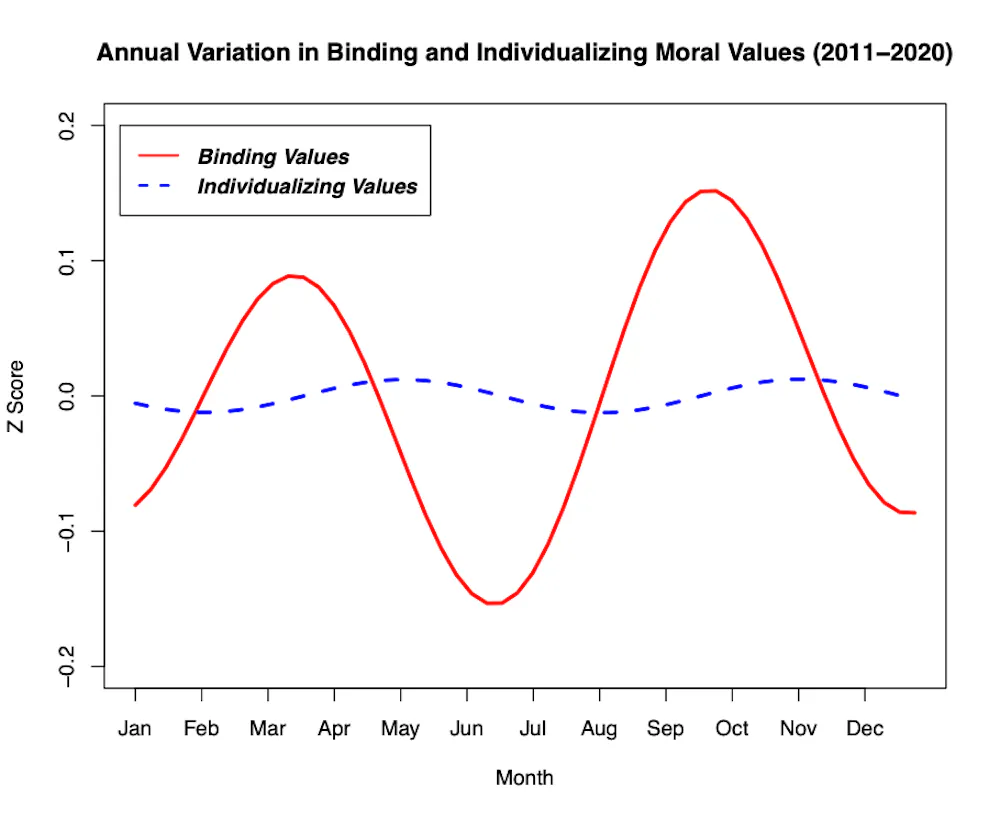
    Our analyses focused on the values reported by 232,975 respondents in the United States across a decade (2011-20) of data. The results revealed no apparent seasonal cycle in Americans’ endorsement of individualizing values, but there was clear and consistent seasonal cycle in Americans’ endorsement of all three binding moral values.

    This seasonal cycle was bimodal, with two peaks and two valleys each year: Americans endorsed binding moral values (valuing loyalty, authority and group traditions) most strongly in the spring and autumn, and least strongly in midsummer and midwinter. This bimodal seasonal cycle in binding moral values showed up again and again in the data, year after year.

    A graph depicting Americans’ endorsement of binding and individualizing moral values.
    (I. Hohm and M. Schaller), CC BY

    This seasonal cycle in binding moral values wasn’t unique to the U.S. either. Additional analyses on data from Canada and Australia revealed similar patterns: Canadians and Australians also endorsed binding moral values most strongly in the spring and autumn, and least strongly in midsummer and midwinter.

    Anxiety patterns

    What might explain this seasonal cycle in people’s endorsement of binding moral values? One possibility is that it has something to do with the perception of threat, which encourages people to close ranks within a group. Previous research has linked this to increased endorsement of binding moral values.

    To test this idea, we analyzed data on an emotion associated with threat perception: anxiety. Results revealed that Americans’ self-reported anxiety showed the same bimodal seasonal cycle, and so did 10 years of data on Americans’ Google searches for anxiety-related words. This seasonal cycle in anxiety helps to explain the seasonal cycle in binding values.

    Anxiety tends to change with the seasons, decreasing in summer and midwinter.
    (Shutterstock)

    This explanation raises a new question: what might explain the seasonal cycle in anxiety? Although we can only speculate, our analyses on moral values revealed an intriguing clue. The summertime dip in Americans’ endorsement of binding moral values was bigger in places with more extreme seasonal changes in the temperature. There was no such effect on the size of the midwinter dip.

    Perhaps something similar might be going on with anxiety: maybe that summertime decrease is the result of pleasant weather, whereas the midwinter decrease is more of a holiday effect.

    Double-edged sword

    Regardless of the cause, seasonal cycles in binding moral values could have consequences that affect people’s lives, for better or worse. Binding moral values promote cohesion, conformity and co-operation within groups, which can be beneficial, especially when coping with crises.

    The implication is that groups might cope better with crises that emerge in the spring and autumn, compared to those that occur in the summer and winter.

    But binding moral values also promote distrust of people who fail to adhere to group norms and traditions. The implication is that there may also be seasonal cycles in prejudices against immigrants, racial minorities, LGBTQ+ individuals and anybody else who is perceived to be different.

    People who more strongly endorse binding moral values are also more punitive, so there could be seasonal effects on judicial decision-making in the millions of legal cases that occur every year.

    And given the link between binding moral values and conservative attitudes, there are potential implications for politics. One intriguing possibility: the timing of political elections (whether they are scheduled for summer or autumn, for instance) might have some subtle effect on some votes — which, for an election that is especially tight, might even influence its outcome.

    Mark Schaller receives funding from the Social Sciences and Humanities Research Council of Canada.

    Ian Hohm does not work for, consult, own shares in or receive funding from any company or organisation that would benefit from this article, and has disclosed no relevant affiliations beyond their academic appointment.

    – ref. Seasonal change can affect people’s moods — and their moral values – https://theconversation.com/seasonal-change-can-affect-peoples-moods-and-their-moral-values-236626

    MIL OSI – Global Reports –

    January 23, 2025
  • MIL-OSI USA: NIH launches large study to tackle type 2 diabetes in young people

    Source: US Department of Health and Human Services – 2

    News Release

    Wednesday, October 9, 2024

    Effort to identify risk factors for youth-onset type 2 diabetes to improve prevention and treatment.

    The National Institutes of Health has launched a nationwide consortium to address the dramatic rise in youth diagnosed with type 2 diabetes over the past two decades, a trend that is expected to continue. The effort aims to advance understanding of the biologic, social, and environmental drivers of youth-onset type 2 diabetes, with the goals of determining which children are at highest risk for developing the disease and how to better prevent, screen for, and manage type 2 diabetes in young people.

    “Our children who are overweight or have obesity are at risk, but we don’t know how best to identify the children who will progress to type 2 diabetes,” said Rose Gubitosi-Klug, M.D., Ph.D., study lead, and chief of pediatric endocrinology at Case Western Reserve University/Rainbow Babies and Children’s Hospital, Cleveland. “This study will bring us closer to our goal of prevention of type 2 diabetes in future generations of youth.”

    The observational study is funded by the NIH’s National Institute of Diabetes and Digestive and Kidney Diseases (NIDDK) and builds on previous NIDDK-funded research indicating that youth-onset type 2 diabetes is more challenging to treat and progresses more aggressively compared to adult-onset type 2 diabetes. In youth with type 2 diabetes, good blood glucose control is harder to achieve, and the ability of the pancreas to secrete insulin declines much more rapidly. Many young people with type 2 diabetes also don’t respond well to metformin, the drug most commonly used as the first-line treatment for diabetes in adults. In addition, youth-onset type 2 diabetes is associated with earlier development of diabetes-related complications, such as damage to the eyes, kidneys, and nerves.  

    “These factors all create a picture of a disease that is much more aggressive in youth than in adults, but we don’t understand what drives these differences,” said Barbara Linder, M.D., Ph.D., NIDDK program director who is overseeing the study. “Consequently, young people are developing devastating complications of the disease during what should be the most productive years of their life.”

    The study will aim to identify unique drivers of youth-onset type 2 diabetes distinguishing it from the disease in adults, which will help clinicians better understand which children will develop the disease and guide more effective, targeted prevention and intervention strategies. Study sites across the country will recruit 3,600 participants, ages 9 to 14, who are considered at risk for developing type 2 diabetes. They must have started puberty, have overweight or obesity, and have high-normal to above-normal hemoglobin A1c (HbA1c) levels but not high enough for a diagnosis of diabetes. The participants will reflect the U.S. population of youth with type 2 diabetes, including people from diverse racial and ethnic, socioeconomically disadvantaged, and underserved rural populations.

    The research team is also seeking extensive input from youth, young adults, and parents with lived experience of type 2 diabetes on both study design and conduct, including how to best recruit and retain participants, how frequently participants should be seen during the study, what questionnaires should be used to collect data, and more.

    In addition to looking at biological factors, the study team will gather comprehensive data from participants and their families to understand what social and environmental factors may be adversely contributing to health disparities and poor outcomes among youth with type 2 diabetes. Research has suggested that these social determinants of health—the conditions in which people are born, grow, work, live, and age—have a powerful influence on shaping health outcomes. For example, people without access to healthy food and safe places to engage in physical activity may be more likely to develop obesity, which is associated with type 2 diabetes.

    “Most children we currently consider ‘at-risk’ for developing type 2 diabetes will not actually do so, so we need to better understand what factors define who is at risk and would benefit from targeted prevention strategies,” said Dr. Linder. “These efforts are critical to lessen the immense burden, not just on young people and their families, but also the U.S. healthcare system, arising from the growing numbers of youth living with this disease and its debilitating complications.”

    For more information about the study, known as DISCOVERY of Risk Factors for Type 2 Diabetes in Youth, please visit discovery.bsc.gwu.edu.

    Funding: DISCOVERY is funded through NIH grants DK134971, DK134984, DK134975, DK134996, DK134958, DK134967, DK135002, DK134982, DK135007, DK134988, DK134978, DK134981, DK135012, DK135015, DK134976, and DK134966.

    The NIDDK, a component of the NIH, conducts and supports research on diabetes and other endocrine and metabolic diseases; digestive diseases, nutrition and obesity; and kidney, urologic and hematologic diseases. Spanning the full spectrum of medicine and afflicting people of all ages and ethnic groups, these diseases encompass some of the most common, severe, and disabling conditions affecting Americans. For more information about the NIDDK and its programs, see https://www.niddk.nih.gov.

    About the National Institutes of Health (NIH): NIH, the nation’s medical research agency, includes 27 Institutes and Centers and is a component of the U.S. Department of Health and Human Services. NIH is the primary federal agency conducting and supporting basic, clinical, and translational medical research, and is investigating the causes, treatments, and cures for both common and rare diseases. For more information about NIH and its programs, visit http://www.nih.gov.

    NIH…Turning Discovery Into Health®

    ###

    MIL OSI USA News –

    January 23, 2025
  • MIL-OSI USA: NASA Terminal Transmits First Laser Communications Uplink to Space 

    Source: NASA

    NASA’s LCOT (Low-Cost Optical Terminal), a ground station made of modified commercial hardware, transmitted its first laser communications uplink to the TBIRD (TeraByte Infrared Delivery), a tissue box-sized payload formerly in low Earth orbit.
    During the first live sky test, NASA’s LCOT produced enough uplink intensity for the TBIRD payload to identify the laser beacon, connect, and maintain a connection to the ground station for over three minutes. This successful test marks an important achievement for laser communications: connecting LCOT’s laser beacon from Earth to TBIRD required one milliradian of pointing accuracy, the equivalent of hitting a three-foot target from over eight American football fields away.
    The test was one of many laser communications achievements TBIRD made possible during its successful, two-year mission. Prior to its mission completion on Sept. 15, 2024, the payload transmitted at a record-breaking 200 gigabits per second. In an actual use case, TBIRD’s three-minute connection time with LCOT would be sufficient to return over five terabytes of critical science data, the equivalent of over 2,500 hours of high-definition video in a single pass. As the LCOT sky test demonstrates, the ultra-high-speed capabilities of laser communications will allow science missions to maintain their connection to Earth as they travel farther than ever before.

    NASA’s SCaN (Space Communications and Navigation) program office is implementing laser communications technology in various orbits, including the upcoming Artemis II mission, to demonstrate its potential impact in the agency’s mission to explore, innovate, and inspire discovery.
    “Optical, or laser, communications can transfer 10 to 100 times more data than radio frequency waves,” said Kevin Coggins, deputy associate administrator and SCaN program manager. “Literally, it’s the wave of the future, as it’ll enable scientists to realize an ever-increasing amount of data from their missions and will serve as our critical lifeline for astronauts traveling to and from Mars.” 

    Historically, space missions have used radio frequencies to send data to and from space, but with science instruments capturing more data, communications assets must meet increasing demand. The infrared light used for laser communications transmits the data at a shorter wavelength than radio, meaning ground stations on Earth can send and receive more data per second. 
    The LCOT team continues to refine pointing capabilities through additional tests with NASA’s LCRD (Laser Communications Relay Demonstration). As LCOT and the agency’s other laser communications missions continue to reach new milestones in connectivity and accessibility, they demonstrate laser communications’ potential to revolutionize scientists’ access to new data about Earth, our solar system, and beyond. 
    “It’s a testament to the hard work and skill of the entire team,” said Dr. Haleh Safavi, project lead for LCOT. “We work with very complicated and sensitive transmission equipment that must be installed with incredible precision. These results required expeditious planning and execution at every level.” 

    Experiments like TBIRD and LCRD are only two of SCaN’s multiple in-space demonstrations of laser communications, but a robust laser communications network relies on easily reconfigurable ground stations on Earth. The LCOT ground station showcases how the government and aerospace industry can build and deploy flexible laser communications ground stations to meet the needs of a wide variety of NASA and commercial missions, and how these ground stations open new doors for communications technology and extremely high data volume transmission. 
    NASA’s LCOT is developed by the agency’s Goddard Space Flight Center in Greenbelt, Maryland. TBIRD was developed in partnership with the Massachusetts Institute of Technology Lincoln Laboratory (MIT-LL) in Lexington. TBIRD was flown and operated as a collaborative effort among NASA Goddard; NASA’s Ames Research Center in California’s Silicon Valley; NASA’s Jet Propulsion Laboratory in Southern California; MIT-LL; and Terran Orbital Corporation in Irvine, California. Funding and oversight for LCOT and other laser communications demonstrations comes from the (SCaN) Space Communications and Navigation  program office within the Space Operations Mission Directorate at NASA Headquarters in Washington. 

    MIL OSI USA News –

    January 23, 2025
  • MIL-OSI USA: Artemis I Radiation Measurements Validate Orion Safety for Astronauts

    Source: NASA

    NASA’s Orion spacecraft is designed to keep astronauts safe in deep space, protecting them from the unforgiving environment far from Earth. During the uncrewed Artemis I mission, researchers from NASA, along with several collaborators, flew payloads onboard Orion to measure potential radiation exposure to astronauts.
    Radiation measurements were taken inside Orion by 5,600 passive sensors and 34 active radiation detectors during its 25.5-day mission around the Moon and back, which provided important data on exposure within the Earth’s Van Allen radiation belt. These detailed findings were published in a recent scientific article through a collaborative effort by NASA’s Space Radiation Analysis Group, the DLR (German Space Center), and ESA (European Space Agency). The measurements show that while radiation exposure can vary depending on location within Orion, the spacecraft can protect its crew from potentially hazardous radiation levels during lunar missions.
    Space radiation could pose major risks to long-duration human space flights, and the findings from the Artemis I mission represent a crucial step toward future human exploration beyond low Earth orbit, to the Moon, and eventually to Mars.
    NASA’s HERA (Hybrid Electronic Radiation Assessor) and Crew Active Dosimeter, which were tested previously on the International Space Station, and ESA’s Active Dosimeter, were among the instruments used to measure radiation inside Orion. HERA’s radiation sensor can warn crew members need to take shelter in the case of a radiation event, such as a solar flare. The Crew Active Dosimeter can collect real-time radiation dose data for astronauts and transmit it back to Earth for monitoring. Radiation measurements were conducted in various areas of the spacecraft, each offering different levels of shielding.

    In addition, the Matroshka AstroRad Radiation Experiment, a collaboration between NASA and DLR, involved radiation sensors placed on and inside two life-sized manikin torsos to simulate the impact of radiation on human tissue. These manikins enabled measurements of radiation doses on various body parts, providing valuable insight into how radiation may affect astronauts traveling to deep space.

    Researchers found that Orion’s design can protect its crew from potentially hazardous radiation levels during lunar missions. Though the spacecraft’s radiation shielding is effective, the range of exposure can greatly vary based on spacecraft orientation in specific environments. When Orion altered its orientation during an engine burn of the Interim Cryogenic Propulsion Stage, radiation levels dropped nearly in half due to the highly directional nature of the radiation in the Van Allen belt.
    “These radiation measurements show that we have an effective strategy for managing radiation risks in the Orion spacecraft. However, key challenges remain, especially for long-duration spaceflights and the protection of astronauts on spacewalks,” said Stuart George, NASA’s lead author on the paper.
    NASA’s long-term efforts and research in mitigating space radiation risks are ongoing, as radiation measurements on future missions will depend heavily on spacecraft shielding, trajectory, and solar activity. The same radiation measurement hardware flown on Artemis I will support the first crewed Artemis mission around the Moon, Artemis II, to better understand the radiation exposure seen inside Orion and ensure astronaut safety to the Moon and beyond.
    For more information on NASA’s Artemis campaign, visit:
    https://www.nasa.gov/artemis

    MIL OSI USA News –

    January 23, 2025
  • MIL-OSI Video: USCG Short: USCGC Resolute relocates for storm preparedness #hurricane #milton #uscg

    Source: US Coast Guard (video statements)

    The US Coast Guard Cutter Resolute traveling through 7-8 ft. seas, northwest of St. Petersburg, Fl. en route to Pensacola, Fl. before Hurricane Milton is expected to make landfall. (U.S. Coast Guard courtesy of Ensign Rylee Burton)

    https://www.youtube.com/watch?v=K9L6wL-kmW4

    MIL OSI Video –

    January 23, 2025
  • MIL-OSI Russia: “M.Yu. Lermontov – pages come to life” in children’s library No. 266

    MILES AXLE Translation. Region: Russian Federation –

    Source: Moscow Government – Government of Moscow –

    A meeting dedicated to the 210th anniversary of Mikhail Lermontov’s birth will be held in Children’s Library No. 266. Guests will be told about the life and work of the poet and writer. A review of the thematic book exhibition will be held. Visitors will be shown the documentary film “Mikhail Lermontov – the pride and glory of Russia”. Literature lovers will be able to take part in the poetry relay race “The light of his poems will not go out”, read the author’s works, share their thoughts and impressions.

    Please note: This information is raw content directly from the source of the information. It is exactly what the source states and does not reflect the position of MIL-OSI or its clients.

    Please note; This information is raw content directly from the information source. It is accurate to what the source is stating and does not reflect the position of MIL-OSI or its clients.

    http://vvv.mos.ru/poster/event/320347257/

    MIL OSI Russia News –

    January 23, 2025
  • MIL-OSI Economics: Putting a Lid on Public Debt

    Source: International Monetary Fund

    COMING SOON

    Launch of the October 2024 Fiscal Monitor

    As the global economy faces increasing fiscal challenges, multilateral surveillance of fiscal developments has become an important part of the IMF’s surveillance responsibilities. The Fiscal Monitor series provides an overview of latest public finance developments, updates the medium-term fiscal outlook, and assesses fiscal implications of policies relevant to the global economy.

    RELEASE DATES
    • TUESDAY, OCTOBER 15 @ 12 AM ET: Chapter 1:  Putting a Lid on Public Debt
    • WEDNESDAY, OCTOBER 23 @ 9:00 AM ET: Press Briefing, Full Report & MSA APPENDIX

    The chapter will be available for download on this page starting October 15. Stay tuned for updates!

    MIL OSI Economics –

    January 23, 2025
  • MIL-OSI Banking: The new Global Signal Exchange will help fight scams and fraud

    Source: Google

    Scams have a devastating impact on people’s lives, and can cause real-world harm. Keeping people safe from scammers is core to the work of many teams at Google. It’s why we’ve developed world-class systems for detecting and preventing fraud, and block millions of attempted scams every day across our different products and services.

    It’s also why today we’re sharing more information about a new partnership to help fight scams, as well as announcing how Cross-Account Protection is actively protecting 3.2 billion users, since we first announced it earlier this year.

    Global Signal Exchange

    Today we are announcing a new partnership with the Global Anti-Scam Alliance (GASA) and DNS Research Federation (DNSRF) to launch the Global Signal Exchange (GSE). The GSE is a new project with the ambition to be a global clearinghouse for online scams and fraud bad actor signals, with Google becoming its first Founding Member.

    This collaboration leverages the strengths of each partner: GASA’s extensive network of stakeholders, the DNS Research Federation’s robust data platform with already over 40 million signals, and Google’s experience in combating scams and fraud. By joining forces and establishing a centralized platform, GSE aims to improve the exchange of abuse signals, enabling faster identification and disruption of fraudulent activities across various sectors, platforms and services. The goal is to create a user-friendly, efficient solution that operates at an internet-scale, and is accessible to qualifying organizations, with GASA and the DNS Research Federation managing access.

    The GSE seeks to address the complex issue of online fraud and scams signal sharing. We have had a long history of partnering with Priority Flaggers around the world to take in scam signals. In this initial pilot of the data platform, Google was for the first time able to share over 100,000 URLs of bad Shopping merchants and as part of the same test, ingest 1 million scam signals. We’ll start by sharing URLs that we have actioned under our scams policies, and as we gain experience from the pilot, we will look to add data soon from other relevant Google product areas.

    The data engine powering the platform runs on Google Cloud Platform and will allow participants to both share and consume signals gathered by others while benefiting from Google Cloud Platform’s AI capabilities to find patterns and match signals smartly.

    As part of this announcement, Google is supporting the DNS Research Federation and GASA with new funding to launch the GSE. We have also developed a partnership enabling the sending and receiving of signals related to scam and fraud activities across relevant and in-scope products and services related to online scams and fraud.

    We know from experience that fighting scams and the criminal organizations behind them requires strong collaboration among industry, businesses, civil society and governments to combat bad actors and protect users. We’re committed to doing our part to protect users, including through our continued work developing tools, publishing research, and sharing expertise and information with others to protect people online.

    Cross-Account Protection

    In May, we announced Cross-Account Protection, a tool which enables ongoing cooperation between platforms in the fight against abuse. Today we’re sharing that Cross-Account Protection is actively protecting 3.2 billion users across sites and apps where they sign in with their Google Account. This helps support our commitment to keeping you safe on Google platforms — and beyond.

    Cross-Account Protection is free and automatically available when sites and apps integrate Sign in with Google, allowing Google to share security notifications — in a privacy-preserving way — about suspicious events with the apps and services you’ve connected to your Google Account. Collaboration is critical to protect people across the internet, and that’s why we’re proud to be partnering with your favorite sites and apps on Cross-Account Protection, including Canva, Electronic Arts and Indeed. In turn, third-party apps and services can use Google’s suspicious event detection to help keep you safer online and prevent cybercriminals from gaining and maintaining a foothold across your many online accounts.

    MIL OSI Global Banks –

    January 23, 2025
  • MIL-OSI Economics: Australasia Young Professionals Subcommittee Hosts “Intro to Well Design & DrillPlan” Workshop

    Source: International Association of Drilling Contractors – IADC

    Headline: Australasia Young Professionals Subcommittee Hosts “Intro to Well Design & DrillPlan” Workshop

    On 30 August, the IADC Australasia Young Professionals (YP) Subcommittee (SC) hosted an “Introduction to Well Design and DrillPlan” workshop. The event was co-hosted with the SPE Edith Cowan University Student Chapter WA Australia and sponsored by SLB and the IADC Australasia YP SC. 

    The workshop featured an insightful session led by Farshid Hafezi, Senior Drilling Engineer at SLB. Attendees gained valuable knowledge on well design and DrillPlan, and the event was enriched with networking opportunities and a quiz with exciting prizes.

    The IADC Australasia YP SC expressed its gratitude for all the volunteers and participants for making this a successful workshop, and to Edith Cowan University for providing the venue. 

    MIL OSI Economics –

    January 23, 2025
  • MIL-OSI Economics: Participants Discuss “Digital Drilling Engineering” at DEC Q3 Tech Forum

    Source: International Association of Drilling Contractors – IADC

    Headline: Participants Discuss “Digital Drilling Engineering” at DEC Q3 Tech Forum

    On 12 September, the IADC Drilling Engineers Committee (DEC) Q3 Tech Forum brought together industry experts to discuss digital drilling engineering. This forward-thinking hybrid event focused on:

    • Digitizing the execution of the well plan
    • Enhancing communication and coordination among multiple third-party stakeholders
    • Implementing digital solutions to optimize drilling efficiency and minimize overall well costs

    Thank you to everyone who participated, and special thanks to NOV for hosting!

    As digital systems increase the amount of centralized and structured data coming from drilling operations, companies are emphasizing the importance of data-driven decision making in enhancing efficiencies and reducing risk. One way to enable better data-driven decisions is by digitalizing the experiences that personnel have in the field, creating platforms that can categorize the various learnings and risks they face in executing various procedures.

    In this interview with DC taken at the IADC DEC’s Q3 2024 Tech Forum, Amir Galaby, Business Manager at Stimline, discusses a cloud-based tool the company developed to help capture and leverage learnings from every step of the well construction process. Among other things, Mr. Galaby also explains how the tool reduces the time spent on manual data search and information gathering.

    MIL OSI Economics –

    January 23, 2025
  • MIL-OSI Economics: 2024 IADC/SPE Managed Pressure Drilling & Underbalanced Operations Conference Convenes in Brazil

    Source: International Association of Drilling Contractors – IADC

    Headline: 2024 IADC/SPE Managed Pressure Drilling & Underbalanced Operations Conference Convenes in Brazil

    The 2024 IADC/SPE Managed Pressure Drilling & Underbalanced Operations Conference & Exhibition took place on 17-18 September in Rio de Janeiro, Brazil.

    Over two days, esteemed subject matter experts and young professionals came together to discuss:

    • Case Studies
    • Human Factors & Training
    • Non-Conventional MPD Operations
    • Riser Gas Handling
    • Completions
    • Design & Optimization
    • MPD Equipment & Control Systems
    • UBD
    • Well Control & Well Integrity

    Drilling Contractor Interviews from the 2024 IADC/SPE MPD & UBO Conference

    Last year, the IADC Underbalanced Operations and Managed Pressure Drilling (UBO &MPD) Committee published the Riser Gas Handling Guidelines to address challenges associated with gas in the riser during deepwater drilling while utilizing surface back pressure MPD or installed riser gas handling systems. During the 2024 IADC/SPE MPD & UBO Conference in Rio de Janeiro, members of IADC’s Gas in the Riser Subcommittee presented a series of papers discussing the underlying concepts behind the guidelines and the practical applications of the guidelines in the field.

    Speaking to DC from the conference, Mario Teixeira, Senior Engineer – Drilling and Wells at Equinor and a member of the subcommittee, spoke about these concepts. Some of these, he noted, are little known in industry or inconsistently applied in field operations. In particular, he discussed the uncontrolled riser unloading that can result from unaddressed gas-in-riser events and why it is important for industry to better understand the risks involved.

    Focusing on the human element is critical to preventing errors within any operation, including those involving managed pressure drilling (MPD). As automated systems decrease human interactions with complex equipment while increasing cognitive workloads, the need to account for human factors has become even more important. Understanding human factors and its role in safe drilling operations can help provide a path for drillers to mitigate errors and identify the root causes of those errors should they occur, said Matt Kvalo, VP of Engineering and Technology at Stasis Drilling Solutions.

    In this interview with DC from the 2024 IADC/SPE MPD & UBO Conference, Mr. Kvalo talks about how the definition of human factors has changed, from one that identifies the root cause of most errors to a model that identifies errors as a systemic problem.

    The IADC Underbalanced Operations and Managed Pressure Drilling (UBO & MPD) Committee is working on a number of initiatives aimed at helping the industry better understand the challenges associated with MPD operations. In this interview with DC taken from the 2024 IADC/SPE MPD & UBO Conference, Andre Alonso Fernandes, Chairman of the Committee, explains the IADC Riser Gas Handling Guidelines, a resource that was released last year. He also discusses the committee’s goal for opening a dialogue with industry and academia on the feasibility of the guidelines, plus any further challenges with gas-in-riser incidents that may need to be addressed in the future. Mr. Fernandes also spoke about the committee’s work in revising API RP 92M and API RP 92S, which each address MPD operations with surface back pressure.

    Thank you to everyone who attended, presented, exhibited, sponsored, and organized this conference! 

    MIL OSI Economics –

    January 23, 2025
  • MIL-OSI Economics: Southern Arabian Peninsula Chapter Tackles Critical Issues at Q3 Gathering

    Source: International Association of Drilling Contractors – IADC

    Headline: Southern Arabian Peninsula Chapter Tackles Critical Issues at Q3 Gathering

    The IADC Southern Arabian Peninsula Chapter (SAPC) hosted its Q3 meeting in Doha, Qatar on 12 September. There were 129 total participants present, and the event was filled with insightful discussions and invaluable networking opportunities. 

    The meeting opened with updates regarding the Chapter, workgroups, IADC headquarters, and the SAPC Annual Golf Tournament. Afterward, a series of guest speakers presented on various topics: 

    • Manish Kumar, GM Wells at Shell, presented on “Job By Design V2.0 – Learning from Normal Work,” discussing the importance of designing jobs with safety and predictable results in mind.
    • Pamela Cordova, Principal Research Analyst at S&P Global, gave an insightful presentation on the “Jackup Market Outlook,” analyzing current trends and future projections for the industry.
    • Steve Beedie, Author of Unspoken Wounds, delivered an inspiring presentation titled “Open the Bleed Off – Inspiring Energy to Open Up,” addressing mental health and well-being in the oil and gas industry.
    • Mike Cadigan, President/CEO of Billy Pugh Company, presented on “Safety Innovations Through Industry Engagement,” focusing on the future of personnel transfer technology and safety improvements.

    Following the guest speakers, the Qatar-based winners of the SAPC 2023 Safety Awards were recognized for their outstanding safety initiatives:

    • 2023 Statistical Safety Performance Award ‘Number of Consecutive Years Recordable Incident -Free’ Best Individual Offshore Drilling Rig: Gulf Drilling International’s Al-Wajba
    • Safety Initiative Award’s ‘Highly Commendable Non-Drilling Contractor Initiative’ – ( Global Gravity Aps

    After the closing remarks, attendees had the opportunity to meet Steve Beedie for a book signing while the networking reception was being set up. 

    Congratulations to the SAPC for another successful event, and thank you to everyone who participated!

    MIL OSI Economics –

    January 23, 2025
  • MIL-OSI Economics: IADC Endorses ADIPEC 2024 as a Media Partner and Supporting Association

    Source: International Association of Drilling Contractors – IADC

    Headline: IADC Endorses ADIPEC 2024 as a Media Partner and Supporting Association

    IADC and Drilling Contractor magazine are proud to be a supporting association and media partner of ADIPEC 2024, a premier event for the energy industry. The event will take place in Abu Dhabi from 4-7 November, exploring the power of energy in accelerating an economy-wide transformation that delivers for people, the planet, and our collective prosperity. Building on 40 years of energy leadership, ADIPEC 2024 unites communities, nations, and industries worldwide, driving collaborative industry action towards affordable, secure, and sustainable energy for all.

    Representatives of IADC and Drilling Contractor (DC) will be in attendance. This event provides an opportunity for IADC to network with many professionals representing global companies in the energy industry. During the conference, team members will connect and catch up with Member companies in the region, attend technical sessions, and gather the most up-to-date information to share with IADC Members and DC readership. 

    This event encompasses both technical and strategic conferences. Over four transformative days, ADIPEC will facilitate critical dialogue and collaboration across diverse sectors – from energy, technology, and finance to maritime, logistics, manufacturing, and transport – essential for advancing the energy transition and fast-tracking climate action. 

    We’re looking forward to attending ADIPEC 2024 in November and are pleased to continue supporting this conference. 

    MIL OSI Economics –

    January 23, 2025
  • MIL-OSI Canada: Government of Canada commits to purchase carbon dioxide removal services to green government operations and achieve net-zero emissions

    Source: Government of Canada News (2)

    News release

    Government of Canada commits to purchase carbon dioxide removal services to green government operations and achieve net-zero emissions

    October 9, 2024 – Ottawa, Ontario – Treasury Board of Canada Secretariat

    Today at the Carbon Removal Canada’s “Procuring with Purpose: Canada’s Opportunity to Shape the Carbon Removal Market” report launch event, the Honourable Anita Anand, President of the Treasury Board and Minister of Transport, announced the Government of Canada’s commitment to purchase carbon dioxide removal (CDR) services as part of the Greening Government Strategy. The federal government will purchase at least $10 million in carbon removal services between now and 2030 to help reach its goal of net-zero emissions in Government operations by 2050.

    The Greening Government Strategy commits the federal government to reducing its operational emissions to as close to zero as possible and then balance out any remaining emissions with an equivalent amount of carbon dioxide removal. To redouble these efforts, Minister Anand also announced the Government’s intention to work with public and private leaders to advance the development and responsible deployment of carbon dioxide removal solutions in Canada.

    This investment will enable the Government to lower its emissions, while supporting the development of these critical technologies and markets so they are available when we need them the most.

    With climate change being one of the greatest global challenges of our time, the Government of Canada is leading by example by reducing greenhouse gas emissions and fostering a low-carbon, climate-resilient and clean-growth economy.

    Quotes

    “Today, we are taking another step to demonstrate our government’s leadership in greening Government operations and fighting climate change. In addition to lowering our emissions, we are adopting carbon removal solutions to ensure we reach our goal to be net-zero emissions by 2050. By working together and innovating, we are building a greener, cleaner future for all generations.”

    –        The Honourable Anita Anand, President of the Treasury Board and Minister of Transport

    Quick facts

    • Carbon dioxide removal refers to human activities that remove carbon dioxide from the atmosphere (for example, direct air capture, enhanced carbon mineralization) and durably store it in natural reservoirs or in products. 

    • The Greening Government Strategy, under the responsibility of the Centre for Greening Government at Treasury Board Secretariat is a set of commitments that apply to all core government departments, agencies and Crown corporations, and support the Government of Canada’s commitment for net-zero emissions by 2050.

    • The purchases in carbon removal services will be made through TBS’ Low-Carbon Fuel Procurement Program (LCFPP), an eight-year, $134.9 million initiative to reduce emissions from federal air and marine operations. This investment follows the Budget 2024 decision to expand the LCFPP to include the procurement of carbon dioxide removal services in addition to low-carbon intensity fuels.  

    • Through the LCFPP, the Government of Canada will work with public and private sector leaders to use their purchasing power to advance the development and responsible deployment of CDR solutions in Canada.

    • As stated in Canada’s Carbon Management Strategy, Canada needs to scale up solutions that permanently remove emissions from the atmosphere, since some residual emissions are likely to remain despite aggressive mitigation efforts, including in agriculture, aviation, and shipping. The removal of CO2 from the atmosphere is also the only way to directly address historical emissions, which have accumulated in the atmosphere over centuries of industrial activity and continue to contribute to global temperature rise.

    Associated links

    Contacts

    Myah Tomasi
    Press Secretary
    Office of the President of the Treasury Board
    myah.tomasi@tbs-sct.gc.ca
    343-543-7210

    Media Relations
    Treasury Board of Canada Secretariat
    Telephone: 613-369-9400
    Toll-free: 1-855-TBS-9-SCT (1-855-827-9728)
    Email: media@tbs-sct.gc.ca

    Stay connected
    X: @TBS_Canada
    Facebook: https://www.facebook.com/TBSCanada
    LinkedIn: https://www.linkedin.com/company/tbs-sct/

    MIL OSI Canada News –

    January 23, 2025
  • MIL-OSI USA: CBO’s Recent Publications and Work in Progress as of September 30, 2024

    Source: US Congressional Budget Office

    To provide the Congress with a comprehensive review of its work, the Congressional Budget Office publishes quarterly reports that highlight the agency’s recent publications and summarize its work in progress.  Over the past three months, CBO has produced a variety of budget and economic analyses, fulfilling the agency’s core mission of supporting the Congress during each stage of the legislative process. The agency’s work takes many forms, including technical assistance to committees and Members when they are crafting legislation, cost estimates of legislation, testimonies, reports, and other analytic products.

    MIL OSI USA News –

    January 23, 2025
  • MIL-OSI: Warrick Beckett Announces Record-Breaking Profits on its AI-Powered Crypto Trading Platform

    Source: GlobeNewswire (MIL-OSI)

    Kent, UK, Oct. 09, 2024 (GLOBE NEWSWIRE) — Warrick Beckett, a leading force in the fintech space, is proud to announce that its cutting-edge AI-powered crypto trading platform has achieved record-breaking profits for its clients, solidifying its position as a global leader in the crypto trading industry. With unmatched accuracy, advanced predictive algorithms, and state-of-the-art machine learning capabilities, Warrick Beckett’s platform is redefining the way investors engage with the volatile crypto markets.

    Record-Breaking Success for Clients

    In a financial climate marked by uncertainty and rapid changes in cryptocurrency values, Warrick Beckett’s AI-driven platform has consistently provided users with reliable market insights and impressive returns. Over the past quarter, clients have reported unprecedented profit margins, with the platform delivering optimal trade signals that significantly outperform traditional methods. The success of Warrick Beckett‘s AI-powered solution represents a leap forward for both institutional and retail traders looking to capitalize on the rapidly evolving crypto market.

    Innovative AI Technology Sets Warrick Beckett Apart

    At the heart of Warrick Beckett’s success is its innovative AI technology, which continuously analyzes vast amounts of data from across the globe in real time. The platform processes historical trends, market patterns, and global economic events to predict the most advantageous entry and exit points for traders. This AI-powered approach provides an edge that human traders simply cannot match, allowing users to make data-driven decisions that maximize profits while minimizing risk.

    “Cryptocurrency markets are notoriously volatile, but our AI has been designed to adapt and thrive in this environment,” said the CEO of Warrick Beckett. “Our clients trust us because we deliver results. By harnessing the power of artificial intelligence, we provide traders with a tool that enables them to stay ahead of market trends and seize profit opportunities that were previously unreachable.”

    Empowering Traders of All Levels

    Warrick Beckett’s platform is designed to be accessible to traders of all experience levels. Whether a seasoned professional or someone entering the crypto trading space for the first time, the platform provides easy-to-understand insights, clear trading signals, and an intuitive user interface. This accessibility, combined with the proven track record of AI success, is why Warrick Beckett is becoming the go-to choice for anyone looking to enter the elite world of cryptocurrency trading.

    “Our mission has always been to make cryptocurrency trading accessible to everyone while giving our users the best possible tools for success,” the CEO added. “The results speak for themselves—our AI has opened doors for our clients to achieve record-breaking profits in an unpredictable market.”

    Staying Ahead in a Rapidly Changing Market

    As the crypto market continues to evolve, Warrick Beckett remains committed to staying on the cutting edge of technology and innovation. The platform is regularly updated with the latest advancements in AI and machine learning to ensure clients are always one step ahead. By continuously improving its algorithms and incorporating new market data, Warrick Beckett’s platform remains a critical asset for traders looking to capitalize on emerging opportunities.

    “Our AI’s ability to learn and adapt to market conditions is what sets us apart from the competition,” explained the CEO. “We don’t just react to changes—we anticipate them. Our clients can trade confidently, knowing they have a system that not only understands current trends but also predicts what’s coming next.”

    Warrick Beckett’s Call to Action

    With its AI-powered platform driving record profits, Warrick Beckett is calling on traders, both novice and experienced, to join the crypto elite. The future of cryptocurrency trading lies in the seamless integration of AI technology, and Warrick Beckett is leading the charge. Traders who want to maximize their earning potential while leveraging cutting-edge tools are encouraged to sign up and start trading today.

    As the financial world embraces the digital economy, there has never been a better time to harness the power of artificial intelligence to optimize cryptocurrency trading strategies. Warrick Beckett’s AI-powered platform has proven itself as a game-changer, and traders worldwide are already reaping the rewards.

    Start Trading with Warrick Beckett Today

    Don’t miss the opportunity to join the ranks of traders benefiting from Warrick Beckett’s revolutionary platform. With record-breaking profits and industry-leading technology, the path to financial success has never been clearer. Visit Warrick Beckett to learn more and start your journey toward becoming a member of the crypto elite. The future of trading is here—are you ready to seize it?

    The MIL Network –

    January 23, 2025
  • MIL-OSI USA: Feenstra Recognizes National 4-H Week

    Source: United States House of Representatives – Representative Randy Feenstra (IA-04)

    HULL, IOWA — Today, U.S. Rep. Randy Feenstra (R-Hull) issued the following statement recognizing National 4-H Week:

    “4-H is an incredible organization that helps our future leaders — especially the next generation of Iowa farmers and producers — develop lifelong skills and reach their full potential,” said Rep. Feenstra. “This week, we recognize the positive impact that 4-H has had on millions of young Americans and the importance of investing in the future of our nation.”

    ###

    MIL OSI USA News –

    January 23, 2025
←Previous Page
1 … 5,530 5,531 5,532 5,533 5,534 … 5,912
Next Page→
NewzIntel.com

NewzIntel.com

MIL Open Source Intelligence

  • Blog
  • About
  • FAQs
  • Authors
  • Events
  • Shop
  • Patterns
  • Themes

Twenty Twenty-Five

Designed with WordPress