As part of the Isle of Wight Council’s special educational needs (SEN) expansion programme, we have created therapeutic spaces, to support students and regulate their learning experiences effectively and independently.
Working with Teaching Positive Connections (TPC), the creation of these therapeutic classrooms is a new approach which supports the social, emotional and mental health (SEMH) of students. The classrooms have already been well received by teachers, parents and above all the children using them.
Greenmount has doubled its provision from 6 to 12 students and the capacity at St Georges Studio is now 20. This is a direct result of the consultations that the Isle of Wight Council ran to increase capacity. Students are attending these educational settings on a daily basis allowing staff to develop more positive relationships with students, and their families.
Steff Gleeson, headteacher at St Georges commented that ‘’students are telling us they love the school and enjoy coming, one KS4 student is already engaging in Maths GCSE work. This is an exciting time to be working in specialist education and St George’s feels privileged to have been given this opportunity to support the Isle of Wight students.’’
Naomi Carter, Service Director Education, Inclusion and Access said: ‘’our aim is to continue to provide the best educational facilities for our young people. Children are struggling with their mental health and classrooms such as these support their wellbeing and encourage them to develop and express their emotions in a secure environment.’’
Cllr Jonathan Bacon Cabinet Member for Children’s Services and Education added ‘’The SEMH satellite school at St George’s Studio is a much-needed provision. It enables our most vulnerable young people to access an educational environment which will support them through their secondary education, offering a vocational and practical curriculum alongside accreditation options. Four students had no named education setting for September 2024; the opening of this satellite school has enabled those children to remain with their families in their local communities and access an appropriate placement on the Island.’’
This part of the SEN expansion programme which will be rolled out over the coming 2 years.
Further information on TPC and therapeutic classrooms can be found by visiting
Children’s mental health and wellbeing service – Manchester (tpctherapy.co.uk)
The Democratic Republic of the Congo has begun a campaign of vaccination against mpox to complement the ongoing efforts to halt the spread of the viral disease and save lives.
Source: United States of America – Federal Government Departments (video statements)
Explore the updated Advanced Nuclear Pathway to Commercial Liftoff report with expert leaders from the U.S. Department of Energy. This webinar dives into the key insights and strategies for accelerating the deployment of advanced nuclear technology, aimed at decision-makers, investors, and stakeholders in the clean energy sector.
The Pathways to Commercial Liftoff reports, developed through extensive stakeholder engagement, are vital resources designed to catalyze rapid, coordinated action across the clean energy value chain. Learn how this report serves as a critical tool for achieving clean energy goals and shaping the future of advanced nuclear energy.
Featuring:
Dr. Vanessa Chan (Director, Office of Technology Transitions)
Jigar Shah (Director, Loan Programs Office)
Kelly Cummins (Acting Director, Office of Clean Energy Demonstrations)
Julie Kozeracki (Director of Strategy, Loan Programs Office)
Watch now to stay informed on the future of advanced nuclear energy!
Priority question for written answer P-001954/2024 to the Commission Rule 144 Marlena Maląg (ECR), Kosma Złotowski (ECR)
Although Poland’s rail market is the second biggest rail market in Europe in terms of size and value, PKP CARGO S.A. has embarked on a drastic restructuring. We have received alarming reports from the national section of the Solidarity Independent Trade Union of mass redundancies (over 3 700 planned lay-offs), serious breaches of the principles of social dialogue, and the dismissal of vulnerable groups despite their special status (pregnant women, employees who are in the protected pre-retirement period, trade union members). This situation has led to numerous protests in Poland.
We would like to know:
1.Is the Commission aware of the issue of mass redundancies at PKP CARGO S.A. as part of the company’s restructuring and of how the process is being carried out, and if so, what steps will it take to help employees, especially those belonging to vulnerable groups?
2.Do the PKP CARGO S.A. employees laid off as part of the restructuring process qualify for EGF support?
EIB President Nadia Calviño presented the Ukraine Energy Rescue Plan to EU finance ministers at their meeting in Luxembourg today.
The plan foresees up to €600 million in EU-backed financing for critical energy projects in the public and private sectors to meet urgent heating and power needs of wartime Ukraine.
The rescue plan will also support new green energy initiatives, including for energy efficiency and renewable energy, to help rebuild Ukraine’s energy infrastructure and bring the country closer to the European Union.
Today, European Investment Bank President Nadia Calviño announced the Ukraine Energy Rescue Plan, an initiative to extend EU support for Ukraine’s heavily damaged energy infrastructure due to Russia’s ongoing war, ahead of the winter season, aimed at supporting the resilience of the country and its people.
Briefing EU finance ministers in Luxembourg today, President Calviño outlined that as part of the plan, the EIB expects to invest up to €600 million in financing for emergency energy projects across the public and private sectors. This funding will be guaranteed under the European Union’s Ukraine Facility and in part supported by the EIB’s EU for Ukraine Fund and Advisory Programme. It will help restore and strengthen Ukraine’s energy infrastructure while also aligning it with EU standards, further advancing the country’s integration into the European Union.
Initially the emphasis will be on making finance available for projects that generate electricity and heat using equipment which can be quickly set up to meet the urgent needs of households and businesses. The plan focuses also on projects to protect key electricity substations with shelters. It aims to urgently restore electricity and heating to prevent disruptions to critical services such as hospitals, schools and water supplies, ensuring uninterrupted operations for households, businesses and public services.
Furthermore, part of the plan also refers to more medium-term measures aimed at making the Ukraine energy sector more sustainable and resilient. It aims to improve energy efficiency in both the industrial and residential sectors, reducing energy consumption and promoting long-term resilience.
The plan will also extend the EIB’s ongoing recovery and municipal framework programmes, to include energy-related initiatives. It is closely aligned with the priorities of the Ukrainian government and follows discussions with Ukraine’s Ministry of Finance.
EIB Group President Nadia Calviño said: “The Ukraine Energy Rescue Plan is a crucial measure to ensure that millions of Ukrainian citizens and businesses have the electricity and heat they urgently need to face the coming winter. We aim to invest up to €600 million, leveraging the European Union’s Ukraine Facility and the contributions of our shareholders, the EU member states. The EIB is also strengthening Ukraine’s energy infrastructure for the future. Together with our EU partners, our support is unwavering, working hand-in-hand with Ukraine in this critical phase and for the better times ahead.”
“While addressing Ukraine’s immediate energy needs, the plan also invests in the country’s green transition through energy efficiency and renewable projects. This will not only help Ukraine recover but also accelerate its path to a sustainable energy future and deeper integration with the European Union, aligning the country with EU standards for a stronger, shared future,” added EIB Vice-President Teresa Czerwińska, who is in charge of the Bank’s operations in Ukraine and will present the rescue plan to the Steering Committee of the Ukraine Donor Platform this week in Rome.
Ukraine’s Minister of Finance Sergii Marchenko said: “I am grateful to the EIB for recognising Ukraine’s urgent energy needs and for the swift decision that has been taken. Russia’s relentless attacks on our energy infrastructure place immense pressure on our country. The EIB’s plan to support Ukraine’s energy sector is yet another crucial form of assistance for us in restoring power and heating to essential services like hospitals and schools. This will ensure that our people have access to the energy they need to withstand the potential challenges ahead.”
European Commission Executive Vice-President for an Economy that Works for People Valdis Dombrovskis said: “This financing from the EIB, also backed by the EU budget, comes at just the right moment to allow Ukraine’s authorities to restore power and heating for basic services like hospitals and schools, while guarding against further supply disruptions given Russia’s brutal attacks on its energy infrastructure. It will help Ukraine to prepare for the winter season, make its energy network more reliable and resilient, and improve its sustainable energy efficiency as the country aligns with EU standards on its way to eventual accession. The European Union remains committed to supporting Ukraine and its people.”
Background information
The Ukraine Facility is the European Union’s financial assistance programme for Ukraine. During the 2024-2027 period, €50 billion will be allocated by the European Union to finance the state budget, stimulate investment and provide technical support in the implementation of the programme.
The EU for Ukraine Fund (EU4U) was established in 2023 as part of a larger EU for Ukraine initiative. The fund aims to accelerate EIB Global’s support for Ukraine’s most urgent infrastructure needs and to help sustain the country’s economy. It supports critical recovery and reconstruction projects involving both the public and the private sector and improves access to finance for entrepreneurs in Ukraine. To date, the fund has secured over €420 million in pledges from the Member States.
European Commission Speech Strasbourg, 07 Oct 2024 I am proud to live in the Schengen area.
And I think all of us are.
The biggest area of free movement in the world.
450 million people in 29 countries, who can …
It’s time to take Donald Trump seriously. Betting markets say it’s as likely as not he will be elected US president four weeks from today.
And unlike in 2016 when his program wasn’t clearly defined, he has set out plainly what he intends to do. Which means it’s possible to model the consequences.
The three Trump promises with the greatest economic impact are
the deportation of millions of US residents
steep restrictions on imports, especially from China
presidential influence over interest rates.
The best way to model the consequences is with an established model of the kind used by the International Monetary Fund and central banks around the world rather than one set up for the purpose that could be seen as designed to favour or not favour Trump.
The Washington-based Peterson Institute for International Economics has just done that, noting that during Trump’s first term as president he “by and large” did what he said he would do.
It finds
ironically, despite his ‘make the foreigners pay rhetoric’, Trump’s package of policies does more damage to the US economy than to any other in the world.
No other country in the world would be hurt by Trump’s program as much as the US – not even China – although several US allies would suffer, including Australia, which would be the fourth-worst hit by the most extreme version of what Trump is proposing.
Peterson Institute for International Economics.
Mass deportations
Trump has repeatedly promised the “largest domestic deportation operation in American history,” targeting up to 20 million unauthorised immigrants, including about 8.3 million thought to be in the workforce.
He says his model is Operation Wetback – a 1956 Eisenhower administration program that used military-style tactics to deport 1.3 million Mexicans.
The institute says Eisenhower’s success makes it easy to believe Trump could remove 1.3 million immigrant workers. It has modelled two scenarios: removing 1.3 million and 8.3 million, both over two years in 2025 and 2026.
Both slash employment, including the employment of non-immigrants, both push up inflation, which eventually is brought under control, and both make the US a less attractive place to invest, which benefits much of the rest of the world.
The institute says the low and high scenarios differ “only by the degree of damage inflicted on people, households, firms, and the overall economy”.
Huge tariff hikes
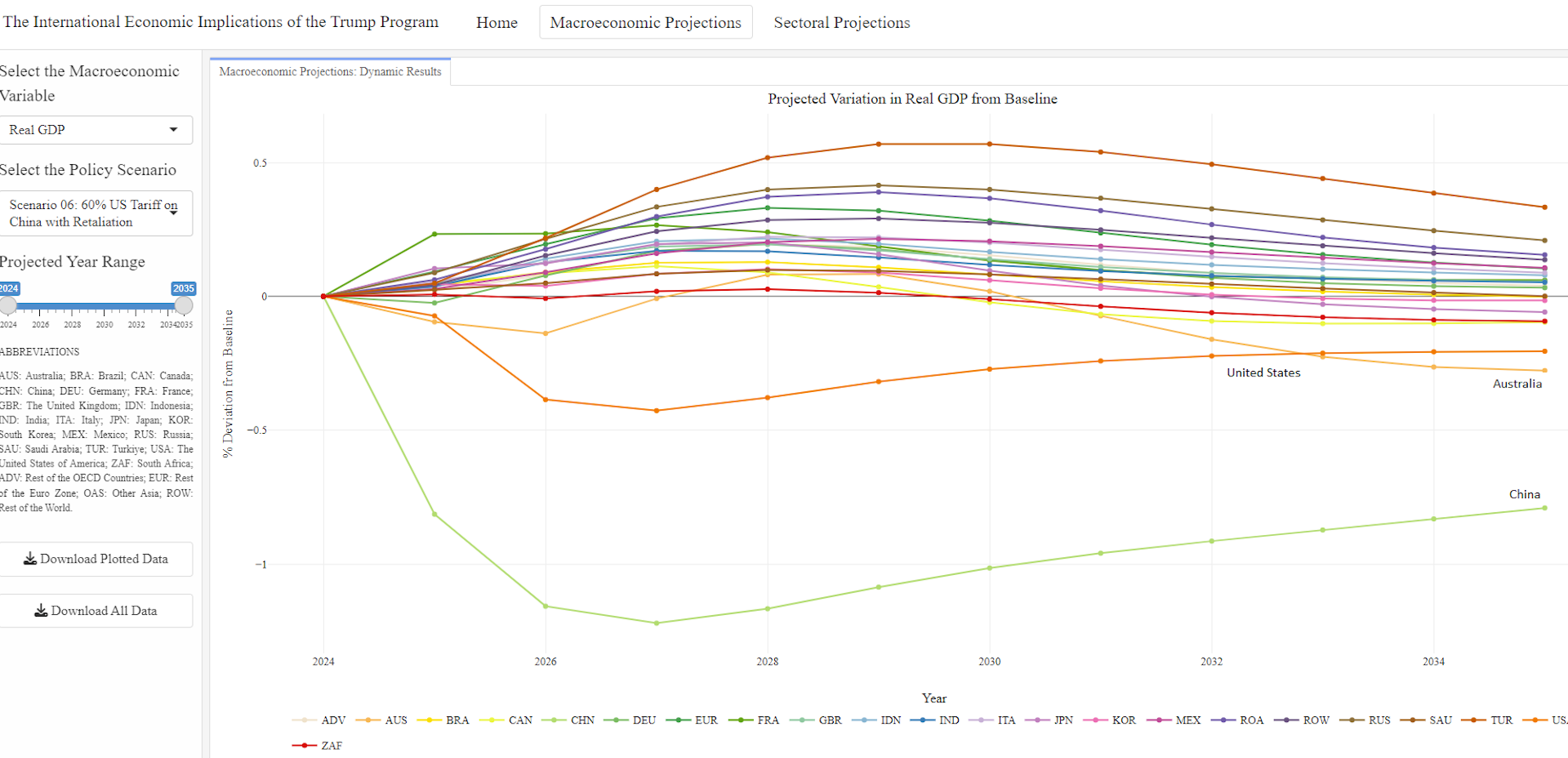
Trump wants to increase every tariff on goods imported to the US by 10 percentage points, including where there is at present no tariff. And he wants at least a 60% tariff on imports from China. The institute has modelled both, with and without retaliatory tariffs from China and the rest of the world.
It finds, unsurprisingly, that extra tariffs push up the price of US imports and the prices of US-produced goods that compete with imports. Many are used as inputs in manufacturing, which means US manufacturing suffers (which is probably not what Trump had in mind).
Fewer imports mean less demand for foreign exchange within the US, which means a higher US dollar which makes US exports less competitive. The US economy is weaker as a result, although China’s is weaker still and Australia’s is weakened as much as the US given its role in providing resources to China.
Nobbling the Fed
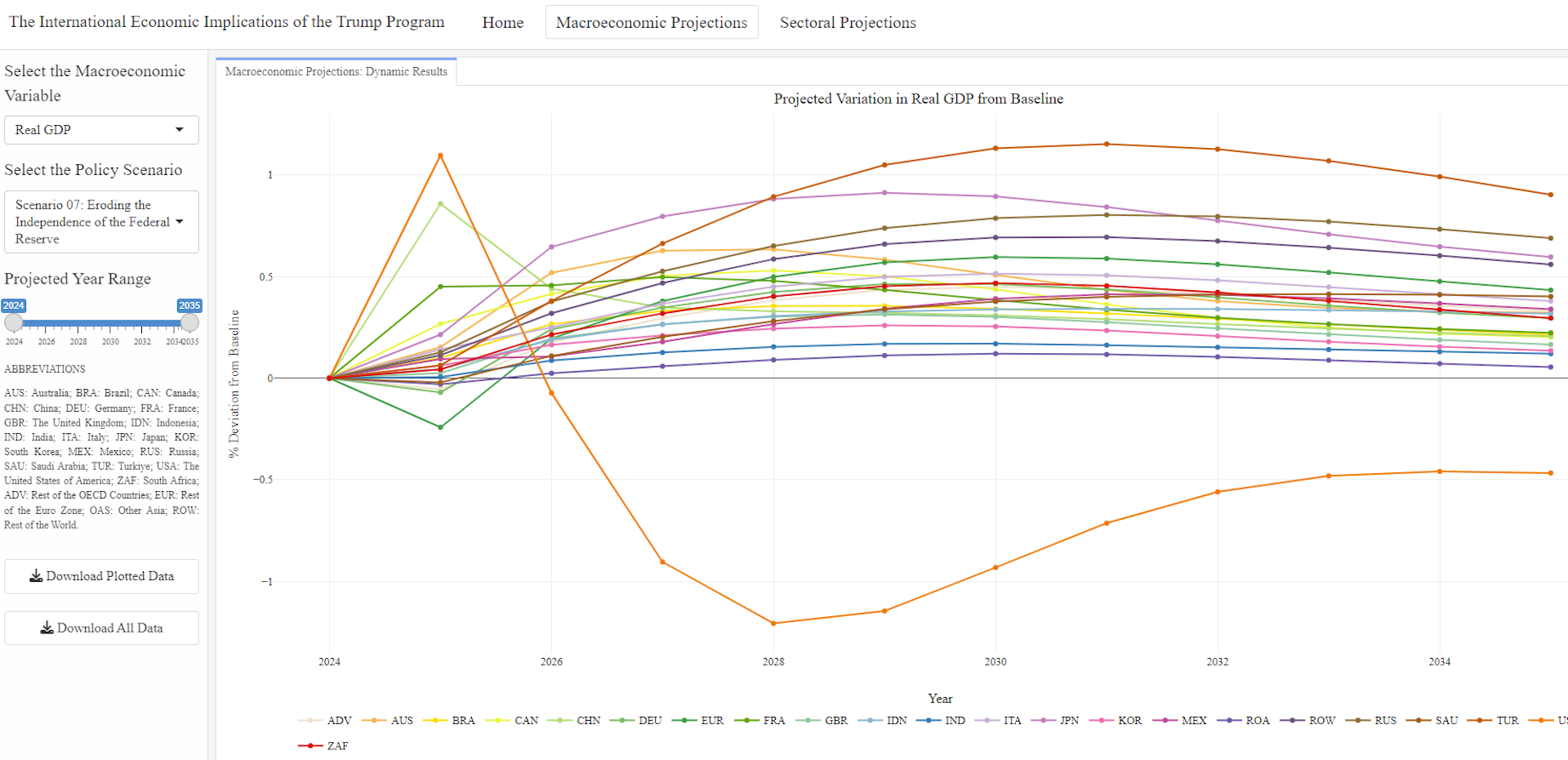
Trump has raised the prospect of more presidential influence over interest rates, saying he thinks he has “a better instinct than, in many cases” the board of US Federal Reserve. This could be achieved by requiring the president to be consulted on rate decisions or by appointing a compliant chair.
The modelled result is capital flight. While the US economy is initially stronger than it would have been because of the Fed’s willingness to tolerate higher inflation, after a few years it is weaker and every other economy is stronger.
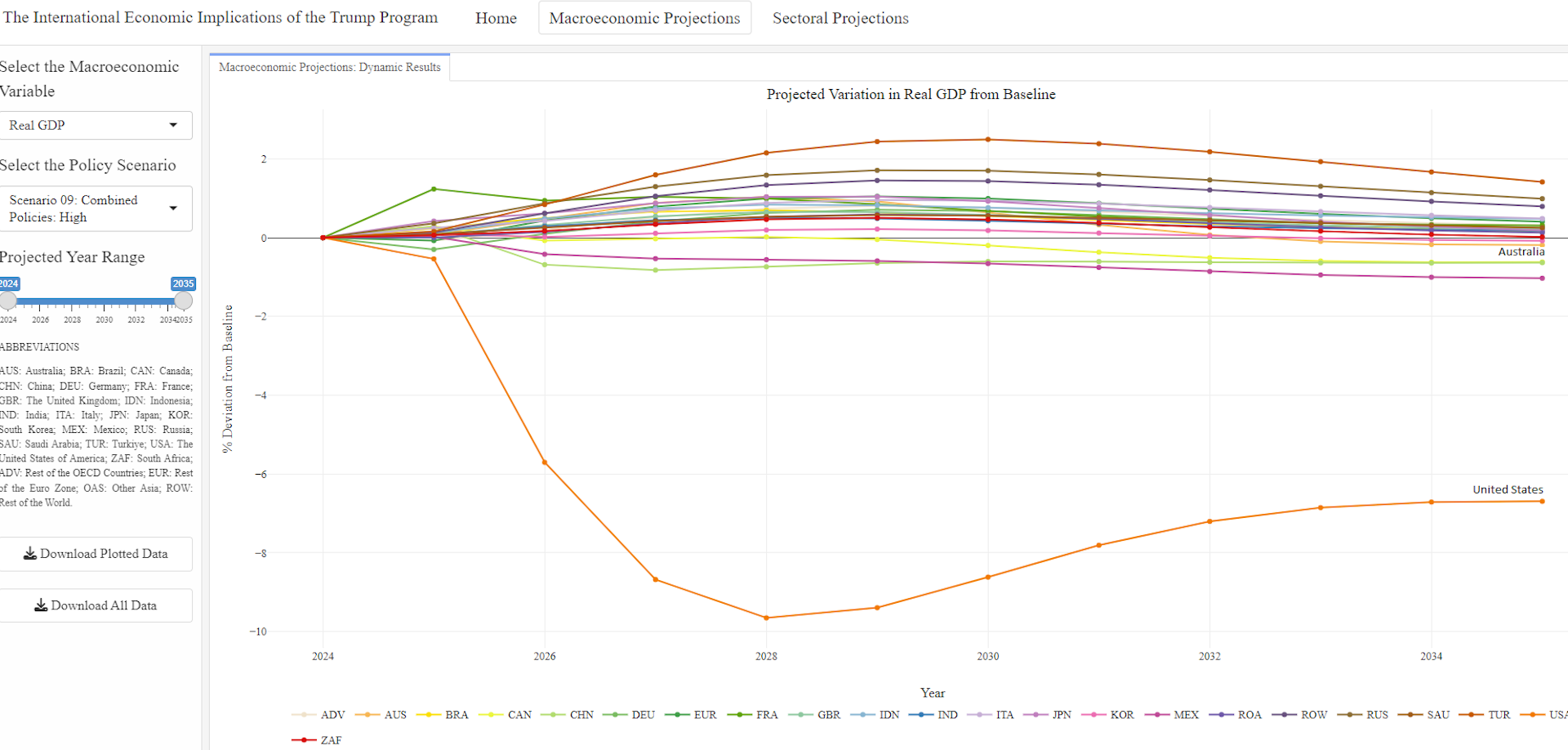
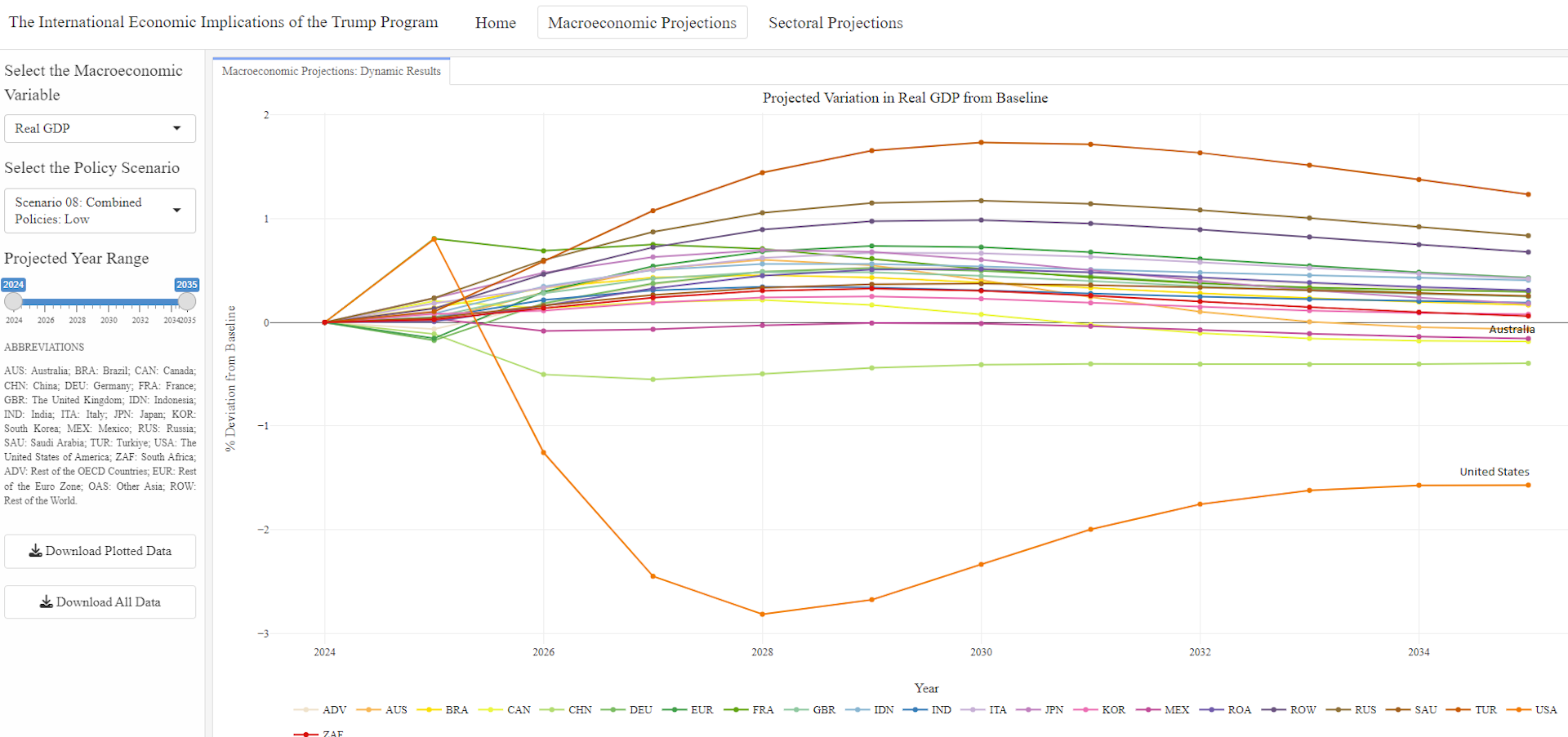
When all the measures are combined, under the extreme scenarios the US economy is 6.7% weaker than it would have been by 2035 and Australia’s is 0.2% weaker. Under the more modest scenarios, the US economy is 1.6% weaker and Australia’s is 0.06% weaker.
Why not examine Harris?
Despite a history of non-partisanship, the Peterson Institute is prepared for criticism. It points out that the economic model it used is regarded as the best in the world for scenario planning and is Australian, built by Warwick McKibbin of the Australian National University.
And it says it has modelled the Trump policies rather than the Harris policies because only Trump’s represent a departure from business as usual.
As the Institute’s president Adam Posen put it in Washington last month, the Harris campaign has said it will not impose across-the-board tariffs, will not engage in mass deportations and will not interfere with the independence of the US Federal Reserve.
The Trump campaign has indicated it will do all three.
It’s entirely possible that in office Trump wouldn’t do everything he proposed while campaigning, and it’s entirely possible that he would change course if what was doing damaged the US in the way the modelling suggests.
But there’s something to be said for taking people at their word, at least to get an idea of what we could be in store for after a knife-edge election.
Peter Martin is Economics Editor of The Conversation.
Question for written answer E-001782/2024 to the Commission Rule 144 Georgios Aftias (PPE)
Greece has from the beginning been one of the Member States that have consistently supported the EU’s common foreign and security policy. Kyriakos Mitsotakis, Prime Minister of Greece, has been steadfastly leading attempts to create an integrated European defence policy. Greece has the longest coastline in Europe, at a colossal 15 000 kilometres, and this must be protected by the EU.
Nikos Dendias, Greek Minister of National Defence has stated that ‘Europe must have its own defence industry. Not for the purposes of competition, but so that we are able to defend ourselves. The budgetary rules on defence must be changed. That is the main thing that the EU should do in the future’.
In view of this:
1.What measures will the Commission take concerning public and private funding to strengthen the defence industrial and technological base and address critical capability gaps?
2.What actions will it take to support and coordinate efforts to strengthen the defence industrial base, innovation and the single market?
3.Will it propose the issue of joint bonds for defence and the Greek borders in conjunction with the fiscal relaxation of the rules governing such an issue?
Question for written answer E-001789/2024 to the Commission Rule 144 Nicolás González Casares (S&D)
Last July, the Galician regional government approved a draft law on public audiovisual media services in Galicia, which was received with great concern by the Colexio Profesional de Xornalistas de Galicia (Galician association of professional journalists). The latter denounced it as ‘a very worrying step backwards, disrespectful towards the profession of journalism and at odds with the rules set out in the European Media Freedom Act’. The Consello da Cultura Galega (Council for Galician Culture), for its part, has echoed the fear that the preliminary draft law would open the door to the incorporation of Castilian into the regular programming of the Galician Radio and Television Company (CRTVG).
Indeed, the preliminary draft opens up the possibility (Article 7) of introducing content in Castilian in the programming of CRTVG, even though the latter’s principal mandate establishes the obligation to promote the Galician language and culture.
1.Does the Commission consider this change to be in line with the principles of the protection of linguistic and cultural diversity advocated by the EU and enshrined in the European Charter for Regional or Minority Languages?
2.Does it consider that it could weaken the role of CRTVG as a bastion of Galician identity, in a context where Castilian is already fully represented in other media?
Question for written answer E-001844/2024 to the Commission Rule 144 Kostas Papadakis (NI)
Major problems are once again clouding the start to the new school year as parents and pupils face unacceptable grade/year group section mergers. The mergers come at a time when, as is known, there are serious shortages in teaching and other school staff (cleaning, catering and infirmary staff) and parents are having to dig deep into their pockets again this year to pay for the necessary back-to-school supplies.
The 1 000 or so mergers are supposedly a solution to provide more teachers at a time when Greece faces a shortage of around 60 000 teachers. Only 10 000 have been hired and they were forced to accept on the condition that they will have to undergo an evaluation.
In view of this, what is the Commission’s position concerning:
1.The unacceptable school situation that is taking shape in 2024, whereby teachers, parents and pupils are confronted with ‘streamlining’ efforts – as the Government described the merger in question – that are moving the educational process backwards and are creating two-speed schools based partly on EU cost-cutting guidelines?
2.The fact that each grade/year group section will now have only one special educational needs teaching assistant to support children who have been diagnosed as having learning difficulties, regardless of how many such pupils there are, forcing parents to turn to private tutors and therapists to support their children?
3.The dangerous situation that is developing as a result of a lack of school maintenance and inspections, forcing pupils and teachers to attend lessons in classrooms that are unsuitable in every respect, pedagogically and in terms of safety, with private sponsors being ‘drafted into’ schools that are becoming increasingly commercialised?
Question for written answer E-001842/2024 to the Commission Rule 144 Tomasz Froelich (ESN)
The action group ‘Ein Prozent’ (One Percent) has learned that ‘Campact’, a German campaign organisation made up of the association and foundation of the same name, donated more than EUR 232 000 to Alliance 90/The Greens, the SPD and the Brandenburg United Civic Movements/Free Voters in the context of the last state elections in Brandenburg, probably with a view to preventing the AfD from reaching a blocking minority[1].
For years, Campact has been receiving funds from foreign organisations that use financial means to influence society in Europe. In 2022, multi-billionaire George Soros’ Open Society Foundations paid Campact EUR 268 837.87 for ‘democracy projects’. Under the German Political Parties Act, foreign organisations are not permitted to directly support German political parties. Campact and the aforementioned foreign organisations are circumventing this law.
The Commission has recommended a ban on donations to political parties from organisations from non-EU countries. What is more, Member States are recommended to effectively address circumvention as found in the case described above.
Does the Commission consider that the actions of Campact and the Open Society Foundations entail a breach of the German Political Parties Act and unlawful foreign political interference, in particular in light of its recommendation of 12 December 2023 (especially recitals 46 and 48 and point 28 thereof[2])?
Source: Switzerland – Department of Foreign Affairs in English
Federal Laboratory for Materials Testing and Research
Dübendorf, St. Gallen und Thun, 08.10.2024 – In summer 2024, the South African government published a strategy paper on the management of e-waste, which was developed in collaboration with Empa. This is the first time the country has issued standardized guidelines for the proper and safe handling of e-waste. The collaboration is part of a program funded by the State Secretariat for Economic Affairs (SECO).
Electronic waste can pose a considerable risk to people and the environment, as it often contains toxic substances such as the heavy metals mercury and cadmium. At the same time, discarded electrical and electronic devices are an important source of valuable materials, for instance copper and gold. Proper disposal and recycling of e-waste is therefore crucial – also for developing and newly industrialized countries, who can use it to safeguard their populations and strengthen their economies.
With support from Empa, South Africa has now come a good deal closer to this goal. In June 2024, the South African Department of Forestry, Fisheries and Environment published, for the first time, a comprehensive e-waste management strategy. An important basis for this strategy was provided by the Sustainable Recycling Industries program (SRI, see text box), financed by the Swiss State Secretariat for Economic Affairs (SECO).
Sustainable change
As part of the SRI program, Empa and the World Resources Forum (WRF) are working with teams from several developing and newly industrialized countries, including South Africa, to improve the recycling of e-waste in these countries. The aim is both to create the necessary legal framework and to impart technical know-how. “Thanks to the collaboration with Empa and the WRF, our partner countries benefit from proven expert knowledge,” says Philipp Ischer, program manager at SECO. According to the expert, this has a very positive effect on the development of the legal foundations for recycling and the formulation of the relevant norms and standards.
“One of our activities as part of the SRI program, for example, is the training of auditors who check the quality of e-waste handling processes at recycling companies,” says Manuele Capelli, a researcher in Empa’s Technology and Society laboratory, which manages the program together with the WRF. Members of the Critical Materials and Resource Efficiency (CARE) research group, which has a longs-standing experience in development cooperation, also carried out audits for the Swiss e-waste recycling industry until 2023.
The expertise from small, prosperous Switzerland cannot, however, be transferred one-to-one to a large newly industrialized country like South Africa. “One of SRI’s goals is to promote sustainable change so that the activities continue even after the program ends,” emphasizes Capelli. Special attention is therefore paid to cooperation with local teams. “Our partners are in contact with the authorities and the industry in South Africa and are very familiar with the country-specific challenges in the area of electronic waste recycling.”
Creating suitable conditions
The recycling of batteries is one example of the e-waste management challenges particular to South Africa. The power grid in the country is unstable; hour-long power cuts have been a daily occurrence for years. “As the largest electricity producer in the region, South Africa has no easy way of importing electricity,” explains Capelli. For this reason, many wealthy households rely on their own solar system with battery storage, resulting in large quantities of used batteries over time. “Batteries are a particularly dangerous form of e-waste. They can cause fires if stored incorrectly and not properly monitored,” says Capelli. Thanks to their experience with the recycling and reuse of batteries, the Empa researchers were able to pass on useful know-how to their local partners.
Otherwise, South Africa faces similar challenges in e-waste recycling as other newly industrialized countries, says Capelli: “The quantities of e-waste are increasing, but disposal and recycling are often inadequate or unsafe. With the new strategy paper, the country now has comprehensive and uniform guidelines for the first time in order to better overcome these challenges. “This is a major milestone and we are delighted to have been able to support South Africa in this,” he says.
Sustainable Recycling Industries Sustainable Recycling Industries (SRI) is a program funded by the Swiss State Secretariat for Economic Affairs (SECO) and run by Empa and the World Resources Forum (WRF), an international non-profit organization that emerged from Empa. The aim of the program is to create favorable framework conditions for a sustainable recycling industry for e-waste and related waste streams in selected developing and emerging countries. The countries involved are Colombia, Egypt, Ghana, Peru and South Africa. SRI is currently in its second phase, which will run until 2025. Colombia and Peru have already successfully completed the program.
The Prime Minister, Shri Narendra Modi has conveyed his greetings to India’s brave air warriors on occasion of Air Force Day.
The Prime Minister posted on X:
“Air Force Day greetings to our brave air warriors. Our Air Force is admired for their courage and professionalism. Their role in protecting our nation is extremely commendable.”
Air Force Day greetings to our brave air warriors. Our Air Force is admired for their courage and professionalism. Their role in protecting our nation is extremely commendable. pic.twitter.com/Qsb8URzmmT
Apia, SAMOA – Last week, three Australian rugby teams visited to take part in Samoa’s 100 years of rugby celebrations.
Women’s Australia A team faced off against Manusina in a thrilling match that ended with a penalty kick in the final seconds, securing a hard-fought victory for the Samoan side.
In addition to the epic clash between Australia A and Manusina, Rugby Australia partnered with Llyod McDermott Foundation to form a First Nations men’s team comprised of indigenous players from across Australia.
The First Nations team accompanied Australia Women’s Development 7s team to participate in the inaugural Lakapi Samoa Teuila 7s tournament. This marked a milestone for Australian rugby as it was the first time a First Nations team has travelled to the Pacific to showcase their talent and cultures.
“This opportunity allows us to highlight the next wave of indigenous rugby talent. Many of our players have ambitions to represent Australia at the highest level, and this is the perfect platform to showcase their abilities,” said Matthew Sonter, Director Llyod McDermott Foundation.
The visit by Australian teams was also an opportunity for learning and cultural exchange. Teams engaged in community activities, visiting local schools and rugby clubs to learn and share knowledge and skills with young Samoan athletes. Players also experienced the rich traditions of Samoa, including participating in traditional ava ceremonies.
“This week has been a remarkable celebration of rugby, culture, and community. The connections formed here extend beyond the field, fostering mutual respect and understanding between our nations,” said HE Mr Will Robinson, Australia’s High Commissioner to Samoa.
This investment in rugby reflects the Australian Government’s continuous commitment in supporting sports in Samoa and the Blue Pacific, recognising its power to bring people and communities to learn, grow, and play together.
The visit was supported through the Australian Government’s PacificAus Sports initiative together with Rugby Australia.
Lau Susuga le Ta’ita’i o le Sauniga; Rev. Saaga Tuiletufuga
Australian High Commissioner to Samoa – H.E Will Robinson
and the Australian Department of Foreign and Trade in Samoa
UNICEF Chief of Field Office in Samoa – Ms. Khin Moe Aye and
the UNICEF office in Samoa
Ladies and Gentlemen,
Samoa has been making steady progress in terms of reaching all
eligible children with the vaccines as per the National
Immunisation Schedule. There has been successful roll out of 4
lifesaving childhood vaccines in the last 3 years like Rotavirus
vaccine, Pneumococcal Vaccine, HPV vaccine and Typhoid vaccine
to protect our children respectively from Diarrhoea, Pneumonia,
Cervical cancer and Typhoid fever. This year the coverage for the 2
doses of Measles vaccine has been quite encouraging for Samoa.
The coverage of first dose of Measles has reached 91% for the first time in the last 5 years after the Measles outbreak and the 2nd dose of Measles vaccine is around 64%. I am confident that our
Immunization Program or EPI team will be able to reach the
missed children in the remaining months of this year to achieve a
good coverage for the year through our continuous and existing
outreach vaccinations.
The new vaccine introduction initiative, Post-Measles Outbreak
recovery plan and COVID-19 Pandemic, brought in a C-change to
the immunization domain of Samoa. There are significant
developments in Cold Chain, capacity building of health workers,
documentation and reporting to strengthen the Health System
with regards to Immunization with technical support from UNICEF.
The transportation and distribution of vaccines in the country was
identified as a gap. Now with this new vehicle procured with the
funding support from Australian Government, transportation of
vaccines will be faster, which means a boost in efficient and timely
vaccine supply of vaccines and logistics to the healthcare facilities.
The vehicle is also covered to protect vaccines against
unfavourable weather conditions. Though this vehicle will have
priority for vaccines, it may be considered to accommodate the
pharmaceutical supplies for distribution to the health facilities
across the country to improve the cost efficiency.
We are immensely grateful to Australian Government for their
timely support and also to UNICEF for their able technical guidance
and support for strengthening our Health system to get equipped
to provide quality services in a cost-effective way.
SOIFUA MA IA MANUIA!
Lauga a le Afioga le Minisita o le Soifua Maloloina
Tatala Aloaia le Tauaaoina o le Ta’avale mo le tufaina/kilivaina o Tui Puipui ma Vailaau
Lau Susuga le Ta’ita’i le Sauniga – Rev. Saaga Tuiletufuga
Lau Susuga le Komisina Maualuga o Ausetalia i Samoa, H.E
Will Robinson
Lau Susuga le Sui o le Ofisa o le Faalapotopotoga o le UNICEF i
Samoa – Khin Moe Aye
Le paia o le aofia ua potopoto,
Ua molimauina e tusa ai ma fa’amaumauga lata mai, le alualu i
luma o taumafaiga a Samoa, e ala i le to’atele o alo ma fanau ua
fa’atino o latou tui puipui fa’aauau. I totonu o le 3 tausaga talu ai,
na fa’amauina le lelei o le faatinoina o nisi o tui Puipui fou na
fa’amanuiaina ai lo tatou atunu’u mo le puipuiga o alo ma fanau
mai le tele o fa’ama’i.
O nei tui Puipui e aofia ai tui e puipuia mai fa’ama’i e pei o le
manava tatā, o fa’ama’i e aofia ai le nimonia, o le fa’ama’i o le
taifoi, faapea ma tui puipui mo alo ma fanau teine e puipuia mai
nisi o Kanesa o tama’ita’i.
O le tausaga lenei, e fa’alototeleina lava le auaunaga, ona o le
maoa’e o le tulaga ua o’o iai le fa’atinoga o tui Puipui o le Misela.
O le tui muamua lava o le Misela (MR1) e 91% le faitau aofa’i o alo
ma fanau e agava’a na faia tui Puipui. Ao le tui lona lua o le Misela (MR2) e 64%. O lo’o mafanafana lava, o le a fa’aauau le una’i a le aufaigaluega ina ia ausia le 90-100% o le tui puipui lenei o le Misela i nai masina o totoe o lenei tausaga.
O le o’o mai o nisi o tui Puipui fou e faaopoopo i tui Puipui fa’aauau a le fanau e puipuia mai fa’ama’i e pei ona ou ta’ua, o
taumafaiga o le una’i o le faia o tui ina ua mae’a le pipisi o le
Misela, faapea ma le KOVITI-19 o ni matati’a sili ia mo le
Polokalame o Tui Puipui mo Samoa. Ua si’itia fo’i le tulaga o le
mata’itūina o le mālūlū ma le vevela talafeagai e teu malu ai tui
Puipui, aemaise le taimi e feavea’i ma kiliva ai i tua i falema’i ma
nofoaga o lo’o faatino ai tūiga.
O lo’o fa’aauau pea a’oa’oga mo le si’itia o le silafia o tausi soifua
i le fa’atinoga o tui Puipui. E le gata i lea a’o le si’itia o le silafia e
fa’aleleia atili ai fa’amaumauga e ala i metotia fa’aona-po-nei. O
le naunautaiga o nei taumafaiga uma, ina ia mautinoa e faia uma
tui Puipui o alo ma fanau faapea ma tagata matutua e agava’a. Ia
mafai ai ona puipuia mai le tele o fa’ama’i pipisi. E le galo Afia i si
ona vao, ma e faafetai ai le lagolago a le Faalapotopotoga o le
UNICEF faapea ma le Polokalame mo Tui Puipui Fou o lo’o
faatupeina e le ADB mo nei taumafaiga.
A’o le meaalofa o le a tau’aaoina nei, e pei ona iai le ta’avale
faapitoa mo le kilivaina o tui Puipui, o se foa’i sili lea ua
fa’aopoopo e unaia ai le auaunaga o tūiga. E le gata ina ia mautinoa e vave ona taunu’u le tufaina ma le kilivaina o Tui Puipui mana’omia mo falema’i uma. Ae faapea fo’i ma le puipuia mai o nei vailaau ma tui mai le vevela ma vave ona fa’aleaogāinaai.
O lenei foa’i o le a fesoasoani tele, e le na’o le fa’aaogaina mo Tui
Puipui, ae mo le kilivaina o nisi o vailaau mo’omia i tua i falema’i
fa’aitūmalo ma nofoaga mamao o lo’o faatinoina ai le auaunaga
fa’asoifua maloloina.
O le agaga fa’agae’etia mai le Malo o Samoa e tauala atu le
Matagaluega o le Soifua Maloloina, e fa’afetaia ai le Malo o
Ausetalia faapea ma le Faalapotopotoga o le UNICEF mo lenei
foa’i, ina ia si’itia le auaunaga mo le mamalu o le atunu’u.
Ia fa’aauau ai pea le tatou galulue fa’atasi aua se Samoa
(PRESS RELEASE- Ministry of Customs and Revenue)- A delegation from the Ministry of Custom and Revenue (MCR) is in Hong Kong, to attend the 5th Belt and Road Initiative Tax Administration Cooperation Forum (BRITACOF).
The delegation is led by the Deputy Prime Minister of Samoa, Hon. Tuala Tevaga Iosefo Ponifasio, and accompanied by the CEO of MCR, Fonoti Talaitupu Lia Taefu and the ACEO for Taxpayer Services, Auimatagi Galumalemana Michael Maua.
The BRITACOF is one of the major bodies of the Belt and Road Initiative Tax Administration Cooperation Mechanism (BRITACOM), a non profit body envisioned to facilitate trade and investment, foster economic growth for the Belt and Road jurisdictions, and contribute to the fulfillment of inclusive and sustainable development as set out in the UN 2030 Agenda for Sustainable Development. Samoa was one of the thirty four (34) member jurisdictions who signed the Memorandum of Understanding in the year 2019 when the BRITACOM was launched.
With the acceptance of the Maldives Inland Revenue Authority in this year’s forum, the membership now stands at thirty seven (37) council member jurisdictions, thirty (30) observer jurisdictions and more than thirty partners and members of the other bodies and the Advisory Board.
The Forum for this year, hosted by the Hong Kong Inland Revenue Department, commenced on Tuesday 24th September 2024 on the theme “Deepening Tax Administration Cooperation for High Quality Belt and Road Development”.
The program spreads over a period of three days and focuses on four main topics. The forum kicked off with selected member presentations and panel discussions on raising tax certainty and continues on the second and final day on discussions in the same format, on updates from members and task force on promoting digitalization, improving tax environment and reinforcing capacity building in tax administrations.
As MCR prepares for its tax reform and transformation project, the forum echoed the drive behind this project. Digitalization is indeed a positive way forward for all tax administrations on the international and regional realms.
Member administrations, tax practitioners, academic and partners who share their experiences recognizes the critical need for modernization in tax administrations.
The changing tax environment, taxpayer demands and needs, the need for the tax administrations to enhance compliance management and service delivery are some of the key drivers of modernization and transformation projects noted from the forum. Several approaches taken by members and platforms in the ICT enabled services, legislative frameworks, operational processes and procedures and capacity building for tax officers and stakeholders. Success stories driven by continual stakeholder consultation and engagement, tax administrators and political commitment provides key lessons for Samoa’s delegation and will form a strong foundation to the Ministry’s tax reform and modernization efforts.
NHRC’s two-day residential capacity- building programme on human rights organized in collaboration with Tamil Nadu Police concludes About 45 Tamil Nadu and Karnataka police officers attended
In seven specially designed lectures, they were sensitized by eminent experts on various aspects of human rights
Posted On: 08 OCT 2024 12:18PM by PIB Delhi
The National Human Rights Commission (NHRC), India has been organizing human rights awareness programmes for sensitization of All India Services officers including IAS, IPS, and IFS officers. In the series of such programmes, the Commission organized a two-day residential capacity-building programme for Tamil Nadu and Karnataka police officers in Coimbatore from 3rd-4th October, 2024. It was organized in collaboration with Tamil Nadu Police. In addition to the inaugural and valedictory sessions, the programme had seven technical sessions on various aspects of human rights and policing. About 45 police personnel including Additional Superintendents of Police (Addl. SP), Superintendents of Police (SP) and Deputy Inspectors General (DIG) rank attended.
On 3rd October, 2024, NHRC, India DG (I), Shri Ajay Bhatnagar inaugurated it in the presence of Shri Shankar Jiwal, Director General of Police, Tamil Nadu, Shri Devajyoti Roy, Additional Director General, Karnataka and Shri Joginder Singh, Registrar (Law), NHRC. He said that the concept of preventive actions by the states should preside over punitive actions. The idea should percolate to every aspect of policing. Shri Shankar Jiwal, DGP, Tamil Nadu, praised the innovative concept of conducting capacity-building training at the zonal level in Coimbatore and expressed gratitude to the NHRC for organizing such a flagship training program.
In the first session on the ‘Human Rights and Ethical Dilemmas – A Practitioner’s Perspective,’ Shri Ajay Bhatnagar highlighted the challenges officers encounter while balancing their responsibilities in upholding human rights within the framework of law enforcement.
In the second session, Justice Shri V. Kannadasan, Member, Tamil Nadu State Human Rights Commission spoke about the ‘Human Rights and the Role of Police Officers’. He highlighted issues including false complaints and the importance of judicial activism in ensuring justice.
Shri Joginder Singh, Registrar (Law), NHRC spoke in the third session on ‘Various Guidelines issued by the NHRC relating to Policing and Important Supreme Court Cases’. He highlighted the key areas where the Commission has issued directions to improve police practices, with a particular emphasis on human rights violations during investigations, custodial violence, and the need for transparency and accountability in law enforcement.
Shri Devajyoti Ray, Additional Director General of Police, Karnataka, spoke on the ‘Infrastructure of Human Rights Complaints Redressing System in Karnataka’ in the fourth session of the first day. He gave an insight into the Karnataka State Human Rights Commission’s (KSHRC’s) innovative approach to complaint registration, which includes both an app-based system and a web-based platform, making it easier for citizens to report violations.
On Day 2, NHRC, India Secretary General, Shri Bharat Lal spoke in the first session about the ‘Evolution of Human Rights Framework’ He emphasized that greatness is all about prioritizing others’ welfare and highlighted the police’s crucial role in delivering justice and upholding the human rights of all and particularly those who are most vulnerable. He cited examples from Lord Buddha and other Indians like Mahatma Gandhi, Dr. Ambedkar, Dr. Karve, Raja Ram Mohan Roy, and so many freedom fighters and social reformers who devoted their whole life for the wellbeing of others. Nelson Mandela, Martin Luthar King Jr. and many other civil rights activists worked as human rights defenders. Secretary General Shri Bharat Lal appealed the police officers to be the true human rights defender.
Shri Rajiv Jain, former Member NHRC delivered a lecture in the second session on ‘Jurisprudence on Human Rights. He emphasized the importance of protecting fundamental rights as in Article 21 of the Constitution and referenced landmark Supreme Court cases, including Sunil Batra and Maneka Gandhi in this regard. He discussed justice access, female prisoners’ rights, and state liability. He highlighted the critical role of judiciary in safeguarding human rights.
The last session was addressed by Shri Joginder Singh, Registrar (Law), on the ‘Cases of Human Rights Violations Registered at NHRC in Connection with Tamil Nadu.’
Apia, SAMOA – Seventy-six electric vehicles (EVs) were handed over to the Government of Samoa earlier today by the United Nations Development Programme (UNDP), thanks to a major regional project that Samoa is part of, funded by the Government of Japan.
Valued at more than US$6 million, the EVs were supplied by the Ford-Hyundai Samoa company.
They include 24 sedans, 19 SUVs, 12 pick-up trucks, two of which were converted to first-responder firefighter trucks, a flat-bed truck converted to an oxygen tanks carrier truck with loading/unloading platform, and 20 plug-in hybrid EV (PHEV) passenger vans (minibuses).
Fifty-three EVs will serve as official vehicles to cater for delegates of the Commonwealth Heads of Government Meeting (CHOGM) later this month.
Supporting infrastructure are also now in place, with 14 wall mounted EV charging stations installed at selected Government premises, five high capacity ground mounted Direct Current (DC) type charging stations at the Tuanaimato Bowser, and several public charging stations, such as a solar-powered DC type charging station at the Mulifanua wharf, and the Faleolo and Fagalii airports, as well as other locations. The Bowser central government charging station will be fully operational later this month.
All this was made possible under the Climate Action Pathways for Island Transport (CAP-IT) Project, implemented by the Government of Samoa via the leadership of the Ministry of Works, Transport and Infrastructure (MWTI), in partnership with UNDP, and funded by Japan.
“We applaud the fact that this is the first time in the world that some of these EV models have been manufactured and reconfigured to suit our purposes. Most significantly, the procurement of this first lot of EVs for the Government fleet, is our response to the Expected Outcomes of the Pathway to the Development of Samoa 2021 to 2026, in placing emphasis on strengthening and increasing ‘Green Developments’,” said Hon. Olo Fiti Afoa Vaai, Minister of Works, Transport and Infrastructure.
The project aims to promote urgent and inclusive transformation of the land and maritime transport sectors towards decarbonization. The project supports the achievement of Samoa’s enhanced NDCs (Nationally Determined Contributions) which is a climate action plan to cut emissions and adapt to climate impacts, for the energy and transport sector by 2030.
“Today’s launch of EVs represents a pivotal moment in our journey towards a cleaner and more resilient transportation system in Samoa. The CAP-IT project is a vital part of our efforts to reduce greenhouse gas emissions, improve air quality, and promote sustainable mobility solutions across the islands. With these electric vehicles, Samoa takes another step towards achieving our Sustainable Development Goals, also Samoa’s NDCs, and leading by example in the Pacific region,” said Aliona Niculita, UNDP Resident Representative.
Two critical related studies were also launched today focusing on (1) End-of-life EV battery management, and (2) Traffic volumes, vehicle registration, imports, and ownership.
“The two reports we are launching today – The Baseline Assessment of Samoa”
Transport Sector and The Report on Solutions for the Safe Disposal and Recycling of EV Batteries – will play a critical role in shaping Samoa’s National Transport Decarbonization Strategy. These reports represent a crucial step towards advancing sustainable transport solutions for the future,” said H.E. Senta Keisuke, Japan’s Ambassador to Samoa.
The CAP-IT project is a component of the Japan-funded regional project, ‘Promoting Green Transformation in the Pacific Region towards Net-zero and Climate-Resilient Development’, also supporting Papua New Guinea, Timor-Leste and Vanuatu in achieving their green transformation ambitions for a more inclusive, climate-resilient future.
The US$36.8 million regional project, with a country allocation of US$15.5 million for Samoa, is scheduled for completion in March 2025.
The CSIR-Indian Institute of Petroleum (IIP) proudly commemorated the 83rd Foundation Day of the Council of Scientific and Industrial Research (CSIR) with a ceremony on October 7, 2024 that showcased its achievements in research and commitment to sustainability.
Sh. Chandrasekhar N, ED and Head (R&D), BPCL graced the Event as Chief Guest while Sh. Rama Rao Marri, VP & MD of Lummus Technology was the Guest of Honor.
The celebration began with the ceremonial lighting of the lamp, a symbol of enlightenment and new beginnings. In his inaugural address, Director CSIR-IIP Dr. H S Bisht, highlighted the importance of developing sustainable technologies to address pressing challenges as India approaches its centenary of independence. He emphasized the need for innovative solutions that will pave the way for a sustainable future.
Chief Guest Sh. Chandrasekhar N discussed the critical necessity of collaboratively utilizing resources to meet India’s net-zero targets. He stressed the vital role of partnerships between research institutions and industry in fostering innovation and driving meaningful change in sustainability practices.
Guest of Honor Sh. Rama Rao Marri elaborated on the “IIP and Lummus’s potential collaboration for Bharat’s Growth Initiatives,” emphasizing the importance of comprehensive technologies that align with India’s Swachh Bharat and Global Biofuels Alliance (GBA) initiatives. He highlighted key areas of focus, including addressing plastic waste pollution, implementing decarbonization strategies, and advancing green technologies such as biofuel production and bio-petrochemical products.
The ceremony also honored employees with 25 years of dedicated service to CSIR, as well as those who retired between September 30, 2023, and August 31, 2024. Their contributions have significantly shaped the institute’s legacy.
In line with the tradition of recognizing excellence, awards were presented for the “Swatchata Mission” initiative. The IIP’s cleanliness drive serves as an inspiration to the community, encouraging active participation in maintaining cleanliness and promoting environmental awareness. Laboratory Representatives of CSIR-IIP were awarded for their commitment to maintaining clean and organized workspaces.
The evening festivities included a vibrant cultural program showcasing the talents of children of IIP staff, students, project personnel, and regular staff, who performed with enthusiasm through song and dance. The celebration also featured a prize distribution for the badminton event, further engaging the community.
The event concluded with a heartfelt vote of thanks from Dr. Hemant Madhukar Kulkarni, Chief Scientist and Head of SCDD at CSIR-IIP.
As CSIR-IIP continues to uphold CSIR’s vision of becoming a world-class research organization, it remains committed to delivering high-quality scientific and sustainable solutions that address both national and global challenges.
The Department of Administrative Reforms and Public Grievances organised a workshop on Cyber Security on 7th of October at CSOI to enhance cyber security awareness and promote initiative of Ministry of Electronics and Information Security during the ongoing Special Campaign 4.0 DARPG Organizes Workshop on Cyber Security to Promote Awareness and Strengthen Cyber Resilience in Public Governance
Cyber Security workshop Panel discussion on the current cyber security landscape in India and cyber security for e-office, Bhavishya, and CPGRAMS
Posted On: 08 OCT 2024 12:21PM by PIB Delhi
The Department of Administrative Reforms and Public Grievances (DARPG), organized a comprehensive workshop on Cyber Security at the Civil Services Officers’ Institute (CSOI), Vinay Marg, New Delhi. The initiative was inspired by the establishment of the Cyber Swachhta Kendra by CERT-In (Indian Computer Emergency Response Team) under MeitY.
This workshop aimed to enhance cyber security awareness, promote the initiatives of MeitY, and emphasize the need for a robust cyber infrastructure to safeguard public e-governance platforms. The workshop took place under the ambit of Special Campaign 4.0, with participation from more than 200 senior officials, including Senior Officers from NIC, Nodal Officers for Public Grievances/ Centralized Public Grievances Redressal and Monitoring System (CPGRAMS), Nodal Officers for National e-Governance Service Delivery Assessment (NeSDA) 2023, and senior officials involved in the creation and operation of your ministry’s digital platforms.
The workshop focused on raising awareness about the current cyber security landscape in India, cybersecurity considerations for various government applications, the critical need for cyber security in today’s digital environment, and will provide insights into the measures that can be taken to mitigate cyber threats.
The workshop featured two key panel discussion rounds. The first, titled ‘Current Cyber Security Landscape in India’,chaired by Dr. Sanjay Bahl (DG, CERT-In),included presentations from Shri Navin Kumar Singh (DG NCIIPC), Shri Santosh Mishra (Partner PWC on Cyber Security and NeSDA 2023), and MS. Seema Khanna (DDG &HoG Cyber Security – NIC) and Dr. Sanjay Bahl (DG, CERT-In) himself. The second panel discussion focused on ‘Cybersecurity considerations for e-Office, Bhavishya & CPGRAMS’ and featured insights from Smt. Jaya Dubey (Joint Secretary, DAPRG), Dr. Sushil Kumar (DDG &HoG, NIC), Ms. Rachna Srivastava (Scientist G, NIC – e-Office), Shri Anil Bansal (Sr Director (IT), DoPPW- Bhavishya), and Shri Sanjeev Saxena (STD, NIC, DARPG- CPGRAMS).
The Inaugural Session commenced with a welcome address by Shri Puneet Yadav, Additional Secretary, DARPG, who set the stage with a compelling message about the importance of building robust cyber infrastructure in today’s digital environment. He emphasized the need for secure and efficient e-governance platforms to ensure transparency and trust in public services.
Dr. Sanjay Bahl, Director General of CERT-In, discussed ongoing initiatives aimed at enhancing cyber resilience in India, emphasizing efforts to strengthen digital platforms against cyber threats, in line with the vision of a secure Digital India. Shri DhruvjyotiSengupta, Joint Secretary, DoPPW, highlighted the cyber safety features of the Bhavishya Portal, stressing the importance of data security and privacy in protecting sensitive pension information and ensuring secure service delivery to pensioners.
Shri V. Srinivas, Secretary, DARPG, also stressed on the critical need to safeguard e-governance platforms by strengthening cybersecurity measures. He also highlighted key initiatives such as the National e-Governance Service Delivery Assessment (NeSDA), where Information Security and Privacy serve as core parameters for ensuring the secure and efficient delivery of public services.
Shri S. Krishnan, Secretary, MeitY, underlined the ongoing efforts of the Government of India in fortifying India’s cybersecurity landscape through initiatives like the Cyber Swachhta Kendra (Botnet Cleaning and Malware Analysis Centre). These efforts, led by CERT-In, play a pivotal role in ensuring a secure digital future for the country.
The first panel, moderated by Dr. Sanjay Bahl, Director General of CERT-In, provided an overview of national cyber resilience efforts. Shri Navin Kumar Singh of NCIIPC highlighted the need to protect critical infrastructure from cyber threats. Shri Santosh Mishra of PwC discussed current cybersecurity trends driving digital transformation under NeSDA 2023, and Ms. Seema Khanna of NIC addressed the challenges faced by government digital platforms and NIC’s efforts to secure them.The second panel discussion focused on Cybersecurity Considerations for e-Office, Bhavishya, and CPGRAMS, and was moderated by Smt. Jaya Dubey, Joint Secretary, DARPG. She underscored the importance of incorporating strong cybersecurity measures to enhance the efficiency and integrity of key government platforms such as e-Office, Bhavishya, and CPGRAMS.
The second panel, moderated by Smt. Jaya Dubey, Joint Secretary, DARPG, explored cybersecurity measures for e-Office, Bhavishya, and CPGRAMS. Dr. Sushil Kumar emphasized e-Office security for seamless government operations, while Ms. Rachna Srivastava highlighted its role in enhancing productivity. Shri Anil Bansal stressed the need for data privacy in the Bhavishya Portal, and Shri Sanjeev Saxena outlined CPGRAMS’ cybersecurity strategies to ensure secure citizen grievance redressal.
The workshop concluded with a Vote of Thanks by Smt. Sarita Taneja, who praised the leadership of Shri S. Krishnan and Shri V. Srinivas. The event underscored the critical importance of cybersecurity for secure e-governance, showcasing initiatives by MeitY and DARPG aimed at strengthening India’s digital resilience.
Indian Air Force’s display of air power & ‘Aatmanirbharta’ resolve marks its 92nd anniversary celebrations at Air Force Station, Tambaram in Chennai Chief of Defence Staff graces the event; Chief of Air Staff reviews ceremonial parade
Current global security environment demonstrates an inescapable need of a strong & capable Air Force: Air Chief Marshal AP Singh
“Adopting latest tech with innovative thinking will play a decisive role in today’s multi-domain environment”
Posted On: 08 OCT 2024 1:24PM by PIB Delhi
An immaculate ceremonial parade, a breath-taking demonstration of air power and a spectacular static display of state-of-the-art equipment marked the celebrations of the 92nd anniversary of the Indian Air Force (IAF) at the Air Force Station, Tambaram in Chennai, Tamil Nadu on October 08, 2024. Chief of Defence Staff General Anil Chauhan graced the celebrations, while the ceremonial parade was reviewed by Chief of Air Staff Air Chief Marshal AP Singh.
In his address, the Chief of Air Staff underscored the need for IAF to remain prepared to meet any contingency that challenges the national interests. He stated that the current global security environment is in a state of constant flux and ongoing conflicts have demonstrated an inescapable need to have a strong and capable Air Force. Adopting the latest technology along with innovative and out-of-the-box thinking will play a decisive role in today’s multi-domain environment, he added.
Air Chief Marshal AP Singh emphasised that the theme of Air Force Day 2024, ‘Bhartiya Vayu Sena: Saksham, Sashakt, Aatmanirbhar’ perfectly describes the aspirations of IAF. “Over the years, we have become more empowered with better technology and achieved new levels op-exploitation of systems & weapons. Aatmanirbharta in the field of defence R&D and manufacturing is our priority. Concrete steps have been taken to support Make in India initiatives by engaging MSMEs, start-ups, individual innovators, professionals, R&D institutes and academia,” he added.
The Chief of Air Staff described the Air Force Day as an occasion for the air warriors to rededicate themselves in the service of the nation, introspect on the previous year, celebrate the achievements, recognise the areas of improvement and realign to the present & future requirements. On the previous year’s achievements, he said that IAF has proved its mettle on various fronts. “One of our primary objective is to deliver weapons, on target, on time, every time and this capability was aptly showcased during the firepower demonstration exercise ‘Vayu Shakti’ at Pokhran Range in February 2024,” he said.
Air Chief Marshal AP Singh added that the IAF, this year, expanded its participation in bilateral and multilateral exercises with friendly countries. He stated that the successful conduct of the largest multi-national exercise on Indian soil ‘Tarang Shakti’ was a testimony to the competence and professionalism of India’s air warriors.
The Chief of Air Staff asserted that IAF has always been the first responders in calls of humanitarian assistance and disaster relief both within the country & abroad, highlighting the various ops conducted in the last one year. He reaffirmed IAF’s full commitment towards providing a conducive and working environment to the air warriors, terming the welfare and well-being of the personnel & their families as of utmost importance.
Parade
The parade commenced with the marching-in of the President’s Colours, symbolising pride, unity, strength and esprit-de-corps. The atmosphere became even more melodious through the performance of a Tri-Services Band, which filled the air with patriotic fervor. The Air Warrior Drill Team captivated the audience with their sharp and synchronised movements, leaving a lasting impression on all present.
Airshow
The parade was followed by an aerial display, with various jets including Tejas Light Combat Aircraft, Sukhoi-30 MKI and Pilatus performing daring low-level aerobatic manoeuvres. The skies over Chennai were painted in the colours of the national flag as the Suryakiran Aerobatics Team and Sarang Helicopter Team mesmerised the crowd with thrilling performances.
Static display
The static display featured state-of-the-art such as ALH Mk-4, C-295 Transport aircraft, Akash Missile Defence System, HTT-40, and Rohini radar.
The event was a fitting tribute to IAF’s nearly a century of unwavering dedication and unparalleled service to the nation, embodying the theme of ‘Bhartiya Vayu Sena: Saksham, Sashakt, Aatmanirbhar’.
Indian Air Force’s display of firepower & ‘Aatmanirbharta’ resolve marks its 92nd anniversary celebrations at Air Force Station, Tambaram in Chennai Chief of Defence Staff graces the event; Chief of the Air Staff reviews ceremonial parade
Current global security environment demonstrates an inescapable need of a strong & capable Air Force: Air Chief Marshal AP Singh
“Adopting latest tech with innovative thinking will play a decisive role in today’s multi-domain environment”
Posted On: 08 OCT 2024 1:24PM by PIB Delhi
An immaculate ceremonial parade, a breath-taking aerial demonstration of firepower and a spectacular static display of state-of-the-art equipment marked the celebrations of the 92nd anniversary of the Indian Air Force (IAF) at the Air Force Station, Tambaram in Chennai, Tamil Nadu on October 08, 2024. Chief of Defence Staff General Anil Chauhan graced the celebrations, while the ceremonial parade was reviewed by Chief of the Air Staff Air Chief Marshal AP Singh.
In his address, the Chief of the Air Staff underscored the need for IAF to remain prepared to meet any contingency that challenges the national interests. He stated that the current global security environment is in a state of constant flux and ongoing conflicts have demonstrated an inescapable need to have a strong and capable Air Force. Adopting the latest technology along with innovative and out-of-the-box thinking will play a decisive role in today’s multi-domain environment, he added.
Air Chief Marshal AP Singh emphasised that the theme of Air Force Day 2024, ‘Bhartiya Vayu Sena: Saksham, Sashakt, Aatmanirbhar’ perfectly describes the aspirations of IAF. “Over the years, we have become more empowered with better technology and achieved new levels op-exploitation of systems & weapons. Aatmanirbharta in the field of defence R&D and manufacturing is our priority. Concrete steps have been taken to support Make in India initiatives by engaging MSMEs, start-ups, individual innovators, professionals, R&D institutes and academia,” he added.
The Chief of the Air Staff described the Air Force Day as an occasion for the air warriors to rededicate themselves in the service of the nation, introspect on the previous year, celebrate the achievements, recognise the areas of improvement and realign to the present & future requirements. On the previous year’s achievements, he said that IAF has proved its mettle on various fronts. “One of our primary objective is to deliver weapons, on target, on time, every time and this capability was aptly showcased during the firepower demonstration exercise ‘Vayu Shakti’ at Pokhran Range in February 2024,” he said.
Air Chief Marshal AP Singh added that the IAF, this year, expanded its participation in bilateral and multilateral exercises with friendly countries. He stated that the successful conduct of the largest multi-national exercise on Indian soil ‘Tarang Shakti’ was a testimony to the competence and professionalism of the India’s air warriors.
The Chief of the Air Staff asserted that IAF has always been the first responders in calls of humanitarian assistance and disaster relief both within the country & abroad, highlighting the various ops conducted in the last one year. He reaffirmed IAF’s full commitment towards providing a conducive and working environment to the air warriors, terming the welfare and well-being of the personnel & their families as of utmost importance.
Parade
The parade commenced with the marching-in of the President’s Colours, symbolising pride, unity, strength and esprit-de-corps. The atmosphere became even more melodious through the performance of a Tri-Services Band, which filled the air with patriotic fervor. The Air Warrior Drill Team captivated the audience with their sharp and synchronised movements, leaving a lasting impression on all present.
Airshow
The parade was followed by an aerial display, with various jets including Light Combat Aircraft, Tejas, Sukhoi-30 MKI and Pilatus performing daring low-level aerobatic manoeuvres. The skies over Chennai were painted in the colours of the national flag as the Suryakiran Aerobatics Team and Sarang Helicopter Team mesmerised the crowd with thrilling performances.
Static display
The static display featured state-of-the-art such as Light Combat Helicopter (Prachand), C-295 Transport aircraft, Akash Missile Defence System, Advanced Light Helicopter Mk-4, HTT-40 Trainer aircraft, and Rohini radar.
The event was a fitting tribute to IAF’s nearly a century of unwavering dedication and unparalleled service to the nation, embodying the theme of ‘Bhartiya Vayu Sena: Saksham, Sashakt, Aatmanirbhar’.
The Union Minister of Ports, Shipping & Waterways, Sarbananda Sonowal spent time with the Shramik brothers, especially the rickshaw and cart pullers here today. The MP from Dibrugarh LSC interacted while also savoured Poori Sabji with the Shramik brothers here.
Upholding the spirit of Antyodaya & Sabka Saath, Sabka Vikas!
Elated to spend this morning and have breakfast with our Shramik brothers in Dibrugarh.
Their blood and sweat are the driving power of Bharat. In a heart-to-heart, gave them my assurance to address their issues and… pic.twitter.com/cUi8e8DKZW
Speaking on this occasion, Shri Sarbananda Sonowal said, “The objective of Narendra Modi govt is to empower, enable every person of the society with the help of Antodaya philosophy which ensures equal development with honour for everyone. Your hard work has always supported the local economy to run smoothly. It has been a privilege to meet all of you today on this beautiful autumn season of Durga Puja. I relished the opportunity to have Poori Sabji with our Shramik brothers as it replenished memories of my childhood.”
Dr. Mansukh Mandaviya Chairs High-level Meeting on Employment Data Ministry Working on Mechanism for Collation of Employment Data and its Analytics
Posted On: 08 OCT 2024 3:30PM by PIB Delhi
Union Minister of Labour & Employment and Youth Affairs & Sports, Dr. Mansukh Mandaviya chaired a high-level meeting focusing on the key issues related to employment data and overseas emigration trends in New Delhi on 07.10.2024. Union Minister of State for Labour and Employment, Sushri Shobha Karandlaje was also present on the occasion.
The deliberations with Ministry of External Affairs (MEA) and NITI Aayog aimed to strengthen coordination and data assimilation for both overseas employment and domestic job creation, as well as to enhance the monitoring of recruiting agencies and skill requirements for employment abroad.
Dr. Mandaviya highlighted the need for a mechanism to have complete data of citizens going abroad for jobs / studies to ECR / Non–ECR countries. He also suggested that there should be an integration of National Career Service (NCS) portal, MY Bharat Platform, MADAD, eMigrate, eShram portals, state portals etc for a comprehensive view of supply and demand side of employment.
He further emphasized that industry associations can play a pivotal role in collating the employment data. The Minister underscored the role of NITI Aayog as an umbrella organization that can facilitate the compilation of employment related data from various Ministries.
It was emphasized that contracts with foreign employers should be standardized and the Migration and Mobility Partnership Arrangements (MMPA) & Social Security Agreements (SSA) should be reviewed to get feedback on efficacy of its provisions.
NITI Aayog shared insights from various studies on employment portals in the country, emphasizing the need for a unified platform to integrate employment data across government schemes and sectors.
The meeting underscored Government’s commitment to bridging current data gaps, especially in the informal sector, and to developing a comprehensive, multi-sector employment data portal to drive policy and job creation initiatives.
The meeting concluded with a strong commitment to strengthening employment data coordination, expanding overseas job opportunities, and security of Indian workers abroad. The proposed Unified Employment Data Portal will serve as a transformative tool in centralizing employment data, while the eMigrate and NCS integration will broaden access to international job markets.
Raksha Mantri Shri Rajnath Singh held a telephonic conversation with the German Federal Minister of Defence Mr Boris Pistorius on October 08, 2024. They briefly reviewed the ongoing defence cooperation activities including exercises in the air and maritime domains.
The Ministers discussed ways to further strengthen the defence industrial collaboration and enhance supply chain resilience. They planned to meet in the near future to give concrete shape to the defence engagements and joint projects with an aim to transform defence as a key pillar of the India-Germany bilateral relationship.
Union Minister of Road Transport and Highways Shri Nitin Gadkari Unveils ‘Humsafar Policy’ for Onboarding Service Providers for Wayside Amenities Along the National Highways Humsafar Policy aims at providing safe and pleasant travel experience to NH users, says Union Minister Shri Nitin Gadkari
Union Minister says Humsafar Policy to Benefit Marginal Sections and Promote Eco-Friendly Highway Amenities
Humsafar Policy to Enhance Commuter Experience with Standardized Highway Services
Service Providers to Gain Enhanced Online Visibility via NHAI’s ‘Rajmarg Yatra’ App
Posted On: 08 OCT 2024 4:08PM by PIB Delhi
Union Minister of Road Transport & Highways Shri Nitin Gadkari launched today the ‘Humsafar Policy’ in New Delhi to enhance convenience of travelling on National Highways and accelerate development of the Wayside Amenities in presence of Shri Ajay Tamta, Minister of State for Road Transport and Highways.
Speaking at the unveiling, Union Minister for Road Transport and Highways, Shri Nitin Gadkari said local marginal sections of the society will be benefitted from this initiative. He underscored that this scheme will help in facilitation of smooth, safe and pleasant journey for users. It will be environment friendly and has been prepared keeping the ecology and cleanliness in the perspective. He also said that water conservation, soil conservation, waste recycling, solar energy etc have been kept in mind while formulating this policy.
Union Minister Sh. Nitin Gadkari asked the officials of the ministry to ensure quality service to the passengers through this policy. A number of Green Highways of NHAI have been planned with keeping several amenities in the perspectives, he further added.
He called upon that petrol pump owners alongside NHs to ensure basic amenities at the petrol pump as per norms. He also said that Food court, cafeteria, Fuel station, Electric Vehicle Charging Station, parking facilities, Toilet facility, Baby Care room, ATM, Vehicle repair shop, Pharmacy services under this policy will ensure better experience for NH users.
Speaking on the occasion, Shri Ajay Tamta, Minister of State for Road Transport and Highways said that under the guidance of Shri Nitin Gadkari National Highways of 1.5 lakh KMs have been laid down. Prime Minister’s vision and Union Road Transport and Highways minister’s guidance is changing the course of infrastructure in this country despite several odds, he further added.
On this occasion, Union Minister Sh. Nitin Gadkari and MoS Sh. Ajay Tamta also visited the Exhibition displayed on the theme
The policy aims to provide a comprehensive framework to ensure that the commuters have access to standardized, well-maintained, and hygienic facilities by onboarding both existing and upcoming service providers along National Highways and Expressways. Existing and upcoming service providers under the categories of Eateries, Fuel Station and Trauma Centres will be eligible to register under the Humsafar Policy. The policy aims to benefit all stakeholders. Registered service providers will benefit from waiver of fees for renewal for existing access permission and will be provided space on National Highways to put up signages of their establishment to increase visibility. In addition, the service providers will be featured on NHAI ‘Rajmarg Yatra’, mobile app to boost their online visibility.
The ‘Humsafar’ policy will also benefit commuters by enabling access to standardized, well maintained and hygienic facilities. Commuters will be able to find details of relevant service providers near their location instantly on the ‘Rajmarg Yatra’ app. The app will also empower commuters to report issues and rate the service provided and facilities. Registered service providers will be able to avail a waiver of renewal fees for access permissions, if they maintain an average rating of 3 or higher.
The policy also outlines rigorous provisions for ‘Monitoring & Inspection’ of the registered service providers for maintaining the standard of the facilities and ensuring quality services to the commuters. Regular inspections will be conducted by a third-party agency appointed by the authority. Email/ SMS alerts shall be sent to service providers in case their ratings fall below average of 3-stars and more frequent inspections will be carried out on such facilities with low score.
The ‘Humsafar Policy’ will go a long way in establishing world-class services along the National Highways by standardizing high-quality facilities for commuters and enhancing the overall travel experience of the National Highway users.
The event was attended by Sh. D. Sarangi, Director General & Special Secretary in the Ministry, Sh. Santosh Kumar Yadav Chairman of NHAI, and senior officers of the ministry and NHAI, NHLML with representatives of Wayside Amenities Developers, Hospitality companies, Oil Marketing Companies, EV charging companies, consultants and academicians.
Central Ayurveda Research Institute achieves significant milestones during the first 100 days of the government CARI signs MoU with JNU to initiate a research project on entrepreneurship and commercialization in the Ayush industry
Under Special Camps, 1500 Members of Marginalized Communities Treated
CARI became the first CCRAS institute to receive NABH accreditation
Posted On: 08 OCT 2024 3:35PM by PIB Delhi
The Central Ayurveda Research Institute (CARI), under the aegis of the Central Council for Research in Ayurvedic Sciences (CCRAS), Ministry of Ayush, has achieved significant milestones during the first 100 days of the current government. These accomplishments reflect CARI’s commitment to enhancing healthcare through Ayurveda and contributing to the broader Ayush ecosystem.
1. Geriatric Care Program Exceeds Targets:In a special initiative to cater to the healthcare needs of the elderly, CARI set a target of covering 2,000 individuals from the geriatric population. The institute has surpassed this goal, reaching 2,272 elderly individuals through its dedicated OPD. The program provided consultations, therapies, and lifestyle modifications based on holistic Ayurveda practices. This initiative has not only addressed healthcare concerns but also improved the quality of life for senior citizens.
2. Outreach under SCSP: As part of the Scheduled Caste Sub Plan (SCSP), CARI conducted 80 tours, organizing 8 camps and treating 1,500 patients within the first 100 days. The institute also conducted a comprehensive survey of 480 individuals to study their living conditions, dietary habits, and prevalent diseases. Through 1,980 screenings, lifestyle disorders were identified, marking a proactive approach to preventive healthcare in underserved communities.
3. Establishment of Integrated Medicine at Lady Hardinge Hospital: CARI is spearheading the establishment of a Department of Integrated Medicine at Lady Hardinge Medical College and Hospital, New Delhi. This initiative aims to integrate Ayush systems with modern medical services, addressing the need for comprehensive healthcare as advocated by the National Health Policy (NHP) 2017. Baseline OPDs and Panchakarma procedures have already commenced, laying the groundwork for this pioneering department.
4. Strategic Collaboration with Jawaharlal Nehru University (JNU)In a significant academic collaboration, CARI signed an MoU with JNU to initiate a research project on entrepreneurship and commercialization in the Ayush industry. The project aims to develop management principles for Ayush products and services. The project was successfully launched within the first 100 days, marking a new phase in Ayush’s research and industry growth
5. Advancing Research and PublicationsCARI has completed two prestigious multi-center survey projects at Base Hospital Delhi Cantt and Air Force Hospital Hindon. 19 research projects are ongoing, with nine collaborative studies involving top institutions like AIIMS, Safdarjung Hospital, and JNU. During this period the institute also published a research article on allergic rhinitis in the Journal of Medical Internet Research (JMIR), indexed in PubMed, Scopus, and Web of Science, further enhancing the scientific credibility of Ayurvedic research.
6. Promoting Patient Safety through Ayurveda: To mark Patient Safety Day, CARI organized a two-day national seminar in collaboration with NPvCC and AIIA, New Delhi. To address Patient safety day on September 17, 2024; a National Seminar was held at India International center, Lodhi Road focusing on the role of diagnostic practices in Ayush systems. It brought together 150 students, research scholars, and faculty members across India, fostering greater awareness of patient safety within Ayush practices.
7. Accreditation and Empowerment InitiativesCARI became the first CCRAS institute to receive NABH accreditation and it also obtained NABL accreditation for its Pathology and Biochemistry labs. Additionally, the institute provided administrative training for Ayush officers, empowering them with crucial management skills for their capacity building on 3rd August 2024.
Receiving NABH accreditation certificate from Secretary, Ministry of Ayush
8. Social OutreachCARI ensured the active participation of all staff and officials in national campaigns, including Swachhata Pakhwada and Poshana Maah, organizing public awareness programs, webinars, and cleanliness drives.
9. 9th Ayurveda Day:This institute is committed to hold various activities in order to celebrate 9th Ayurveda Day on 29th October, 2024. Awareness seminars, webinars, public lectures along with other activities like distribution of medicinal plants, competitions in school, etc. will be covered under Ayurveda Day.
AUSTIN, Texas, Oct. 08, 2024 (GLOBE NEWSWIRE) — OPTIZMO Technologies, recognized for its leading solutions in email compliance, data security, and suppression list management, proudly introduces ZeroDual. This innovative platform is specifically designed to revolutionize the management of dual representation challenges faced by law firms in Mass Tort and Class Action litigation. ZeroDual harnesses OPTIZMO’s industry-leading technology to offer a secure, and intuitive approach to ensure clean dockets and reduce case attrition.
Launched in 2009 by co-founders Khris Thayer and Grant Fern, OPTIZMO has been at the cutting edge of managing and securing sensitive data for 15 years. With the launch of ZeroDual, OPTIZMO delivers a solution critically needed to enhance efficiency and data integrity within the mass tort industry.
ZeroDual: An Innovative Shift in Docket Management Catering to the complexities of Mass Tort litigation, ZeroDual presents a pivotal advancement in real-time case management and duplication checks. The platform enables law firms to ensure that cases being onboarded are not already represented by another firm, promoting real-time transparency in docket management, and reducing overall case attrition in the census/certification process.
Why ZeroDual is the Definitive Solution:
Instant Duplicate Claimant Checks: Instantaneously verify if claimants are unique within the MDL upon intake, significantly mitigating duplicate retainer purchases and longer-term case processing costs.
Streamlined Docket Certification: Facilitate smoother docket certification processes with courts, enhancing the efficiency of legal proceedings.
Privacy and Security at the Forefront: With encoded, anonymized case data, ZeroDual keeps your case demographics confidential and shielded from other law firms.
Centralized Plaintiff Database: ZeroDual creates a comprehensive, centralized case database for each MDL, streamlining case management.
User-Friendly Interface: Equipped with a simple, one-click tool for instant claimant duplicate checks, ZeroDual is designed for ease of use without compromising on precision.
Advanced Data Security Measures Building on OPTIZMO’s core commitment to data security, ZeroDual incorporates extensive security protocols, ensuring sensitive case information is rigorously protected. Through encoding, anonymization, and an array of vulnerability assessments, ZeroDual delivers industry-best data security protocols within the legal industry.
As OPTIZMO continues to expand its product and service offerings, ZeroDual exemplifies the company’s innovation-driven philosophy. By introducing ZeroDual, OPTIZMO not only addresses an industry-wide challenge but also reinforces its reputation as a pioneer in technological solutions for complex data management issues.
OPTIZMO Technologies is the recognized thought leader in the email and online marketing space for email suppression list management, email campaign management, data management, and risk mitigation services relative to email compliance. With an expert staff in pursuit of unrivaled efficiency, innovative technology, and an insatiable desire to problem-solve, clients find a customer-centric business model that not only enhances the way OPTIZMO clients do business but drives the company forward. The company is headquartered in Austin, TX, and has offices and team members in Charleston, Denver, and Brisbane, Australia.
NEW YORK and SALT LAKE CITY, Oct. 08, 2024 (GLOBE NEWSWIRE) — Array, a leading financial innovation platform, announced a partnership today with Lumin Digital, a leading cloud-native digital banking provider. Through this partnership, Lumin will now offer a suite of Array’s products, including My Credit Manager with Offers Engine, Identity Protect, Privacy Protect, and Subscription Manager, as part of its Financial Wellness Monitoring suite for financial institution customers.
The complexity of consumers’ personal financial ecosystems can make it difficult for them to effectively manage their finances – especially when they are spread across many apps and institutions. Array’s innovative product suite aims to help financial institutions equip consumers with financial health tools that enable them to understand and more effectively manage their financial lives – all from a single place. The suite of embeddable products can be seamlessly integrated into a Lumin customer’s existing digital banking platform, allowing for the quick deployment of financial tools without exhausting internal resources through costly and time-consuming development processes.
“Bank and credit union customers have evolved regarding what their financial institution should offer within its digital experience,” said Sean Weadock, Chief Product Officer for Lumin Digital. “Through our partnership with Array, our community of banks and credit unions can now bundle full-featured credit management with ID and privacy protection products within their banking experience platform. This increases accessibility to these must-have features and the efficiency at which institutions can deliver highly innovative digital solutions to meet their customers’ needs while reducing overall costs.”
Array’s My Credit Manager with Offers Engine lets users view, understand, and manage their credit information. They can receive score change alerts, interact with a score simulator, and view credit score factors and debt analysis components. With this product, financial institutions see an average of 2.2 return visits per month. Array’s Offers Engine, an embedded data and workflow solution, helps financial institutions market their services to account holders with actionable offers based on the user’s credit-data attributes. They are then matched to appropriate credit products, resulting in greater relevance and likelihood of approval. Through this service, financial institutions have seen a significant increase in personal loan email opens, and, in some cases, have boosted personal loan values by 3x-4x.
Array’s ID Protect includes identity monitoring, insurance, and restoration services that help keep users safe from fraud, and features dark web monitoring, alerts, and identity theft restoration services. This product demonstrates exceptional retention, with one Array client achieving a 96% retention rate as users increasingly recognize security features as essential tools for protecting their personal information. Users will also have access to Privacy Protect, which offers the most effective data removal for consumers – having removed more than 200 million records to date and assisting more than 4 million individuals.
Finally, Array’s Subscription Manager is an embeddable, private-label app that helps financial institutions, fintechs, and digital brands attract and retain customers by providing insight into and control over recurring payments. It is available in various models, including as a value-added service, a premium upgrade, or other options. With the new tool, users can monitor their subscriptions in a single, consolidated view, and cancel unused or low-value subscriptions with just a single click. Additionally, users can request that Array negotiate a lower rate on select subscriptions on their behalf, and consolidate their subscription management with other financial services.
“Lumin accelerates the process of digital banking innovation and product deployment for financial institutions, and this strengthens customer relationships over the near and long term,” said Mario DeLecce, Head of Partnerships at Array. “While banks and credit unions are competent in delivering superior customer service in person, digital banking acumen remains a challenge. Lumin is helping these institutions navigate the digital customer experience, prioritize the products that have a client’s needs as the core focus, and find initiatives that deliver the most value. We are fortunate they have chosen our products to assist customers and members to achieve better financial health and wellness.”
About Lumin Digital Lumin Digital is the leading, future-ready digital banking solution powering remarkable growth for financial institutions across the United States. Combining innovation, data, and speed, Lumin’s disruption-proof platform was born in the cloud to stay ahead of the evolving expectations of retail and business banking users. With Lumin Digital’s unique approach, our clients innovate and scale at their own pace, optimize digital banking ROI, and create a strong digital relationship with their customers. For more information, visit lumindigital.com.
About Array Array is a financial innovation platform that helps digital brands, financial institutions, and fintechs get compelling consumer products and features to market quickly. Array’s products enable its clients to drive more revenue while increasing digital engagement and financial literacy for their customers. The company has clients across multiple market segments serving millions of active users. Array was founded in 2020 by Martin Toha and Phillip Zedalis and its investors include Battery Ventures, General Catalyst, and Nyca Partners. To learn more visit http://www.array.com.