Category: KB

  • MIL-OSI United Nations: Readout of the Secretary-General’s meeting with H.E. Mr. Mokgweetsi Eric Keabetswe Masisi, President of the Republic of Botswana

    Source: United Nations secretary general

    The Secretary-General met with H.E. Mr. Mokgweetsi Eric Keabetswe Masisi, President of the Republic of Botswana.  The Secretary-General welcomed Botswana’s strong support on key issues such as the Sustainable Development Goals, climate change and challenges faced by Landlocked Developing Countries (LLDCs). The Secretary-General noted that he looked forward to attending the Third UN Conference on LLDCs in Gaborone, in December.
     

    MIL OSI United Nations News

  • MIL-OSI United Nations: Readout of the Secretary-General’s meeting with César Bernardo Arévalo de León, President of the Republic of Guatemala [scroll down for Spanish]

    Source: United Nations secretary general

    The Secretary-General met with H.E. Mr. César Bernardo Arévalo de León, President of the Republic of Guatemala. The Secretary-General and the President exchanged views on the Government’s efforts towards sustainable development, strengthening the rule of law and to fighting corruption.

    ***
     
    El Secretario General se reunió con el Excelentísimo Señor César Bernardo Arévalo de León, Presidente de la República de Guatemala. El Secretario General y el Presidente intercambiaron puntos de vista sobre los esfuerzos del Gobierno para promover el desarrollo sostenible, fortalecer el estado de derecho y combatir la corrupción.

    MIL OSI United Nations News

  • MIL-OSI United Nations: Readout of the Secretary-General’s meeting with H.E. Mr. Sadyr Zhaparoz, President of the Kyrgyz Republic

    Source: United Nations secretary general

    The Secretary-General met with H.E. Mr. Sadyr Zhaparov, President of the Kyrgyz Republic. They discussed cooperation between the United Nations and Kyrgyzstan, debt relief, and the climate and mountain agenda.
     
    The President briefed on developments in Kyrgyzstan. The Secretary-General expressed his appreciation for Kyrgyzstan’s support for the Summit of the Future and the adopted documents. They also exchanged views on regional cooperation in Central Asia.
     

    MIL OSI United Nations News

  • MIL-OSI Canada: Happy 46th, Kananaskis! Adventure and beauty for all!

    Source: Government of Canada regional news

    Canoeing in Kananaskis.

    Since its creation in 1978 by Premier Peter Lougheed, Kananaskis Country has become a cherished Albertan gem. Whether it is hiking, skiing, or enjoying the mountain views, K-country offers something for everyone.

    Alberta’s government is committed to making Kananaskis Country a destination that continues to inspire, from reimagining iconic landmarks to improving visitor access. The Canmore Nordic Centre, a symbol of adventure, has been revitalized, while the beloved William Watson Lodge is being redeveloped to ensure accessibility for all. Expansions at Troll Falls and Barrier Lake Day Use Areas, alongside upgraded backcountry campgrounds, are enhancing experiences for outdoor enthusiasts.

    Vital upgrades to water and wastewater utilities are ensuring long-term sustainability. Through revenues from the Kananaskis Conservation Pass, these efforts are funded in a way that supports conservation programs, strengthens public safety and improves trails and facilities, helping preserve the region for future generations.

    “Kananaskis Country offers so much to Albertans and visitors alike. By continuing to invest in this region, we’re ensuring that future generations of Albertans will continue to enjoy the beauty of K-Country for years to come.”

    Todd Loewen, Minister of Forestry and Parks

    The Alberta government’s recent investments in Kananaskis Country are crucial because they help preserve its natural beauty, enhance infrastructure and expand recreational opportunities for Albertans and visitors. This ensures the region remains accessible and enjoyable year-round, supporting tourism, local businesses and the environment.

    “Kananaskis Country is a unique place in the world and is an amazing place to recreate and enjoy Alberta’s natural beauty. The Friends of Kananaskis and its volunteers are proud to work to preserve and maintain Kananaskis Country for generations to come.”

    Trevor Julian, executive director, Friends of Kananaskis

    Kananaskis is an outdoor lover’s dream, with 49 parks and protected areas, more than 3,000 campsites, 91 day-use spots, and thousands of kilometres of beautiful trails just waiting to be explored!

    Quick facts

    • Since 1978, Albertans and visitors from around the world have made more than 70 million visits to Kananaskis Country.
    • In 2023, Kananaskis Country saw more than four and a half million visitors.
    • Alberta’s government launched the Kananaskis Conservation Pass on June 1, 2021. Last year, the pass generated $12 million in revenue.

    Related information

    • Kananaskis Conservation Pass

    MIL OSI Canada News

  • MIL-OSI Canada: Statement by Minister Joly one year after Azerbaijan’s military operation in the Nagorno-Karabakh region

    Source: Government of Canada News

    The Honourable Mélanie Joly, Minister of Foreign Affairs, today issued the following statement: “Last week marked one year since Azerbaijan launched its military operation in Nagorno-Karabakh, a region populated by ethnic Armenians for centuries.

    September 22, 2024 – Ottawa, Ontario – Global Affairs Canada

    The Honourable Mélanie Joly, Minister of Foreign Affairs, today issued the following statement:

    “Last week marked one year since Azerbaijan launched its military operation in Nagorno-Karabakh, a region populated by ethnic Armenians for centuries.

    “The consequences of this operation were significant: More than 100,000 civilians, including 30,000 children, were forcibly displaced to Armenia as a result of this military operation, causing a rapid increase in humanitarian need in the country.

    “The unjustified military operation by Azerbaijan followed a nine-month blockade of humanitarian goods to the Lachin corridor, in violation of the International Court of Justice provisional measures orders.  

    “Canada stands in solidarity with the people affected by this crisis and is grateful to Armenia for opening its doors. That is why, in 2023, we dedicated more than $3.9 million in humanitarian assistance to address urgent needs stemming from the situation in Nagorno-Karabakh.

    “Canada continues to call for, and support, meaningful negotiations toward a comprehensive peace treaty between Armenia and Azerbaijan, and the continuation of dialogue and confidence-building measures between the parties for a just and durable peace for the people of this region.

    “Canada has repeatedly called for the unconditional release of all Armenian prisoners of war from the 2020 Karabakh war. We also continue to call for the release of all arbitrarily detained ethnic Armenians from Azerbaijan.  

    “Canada supports a negotiated political solution to the Nagorno-Karabakh issue and promotes the principles of non-use of force, the respect of the territorial integrity and the right for self-determination in the negotiation of a just and durable peace for the people of this region. This should entail a safe and dignified right of return of Armenian civilians, guarantees the protection of human rights and civic livelihoods, and the preservation of Armenian cultural and historical sites in the territory.”

    MIL OSI Canada News

  • MIL-OSI Translation: Meeting with members of the Stora Commission.

    MIL OSI Translation. Government of the Republic of France statements from French to English –

    The President of the Republic received the French members of the Joint Franco-Algerian Commission of Historians, at the Elysée Palace, on Thursday, September 19, 2024.

    The Head of State first reiterated his determination to continue the work of memory, truth and reconciliation undertaken since 2017 and established with Algeria within the framework of the Algiers Declaration, signed by the President of the Republic and President TEBBOUNE on August 27, 2022.

    During this working meeting, the Head of State warmly thanked all the members of the Commission for the excellence of the work carried out and called for it to continue so that the concrete proposals formulated by the Joint Franco-Algerian Commission of Historians can be implemented.

    The President of the Republic hopes that these proposals will enable our country to take a clear look at the past and to build, over the long term, a reconciliation of memories, in an approach of education and transmission for French and Algerian youth.

    EDITOR’S NOTE: This article is a translation. Apologies should the grammar and/or sentence structure not be perfect.

    MIL Translation OSI

  • MIL-OSI Canada: Leading the effort to end encampments and address homelessness in Canada

    Source: Government of Canada News

    As much progress as Canada makes to solve the housing crisis, it will not be over as long as there are people living in tents because they cannot afford a place to live.

    Ottawa, Ontario, September 22, 2024 — As much progress as Canada makes to solve the housing crisis, it will not be over as long as there are people living in tents because they cannot afford a place to live.

    Through Canada’s Housing Plan, we made it clear that we would be taking a leadership role to help end encampments and to address homelessness. We intend to do this by supplying funding and coordinating with other orders of government.

    Today, the federal government announced that we are ready to negotiate agreements and invest in any province or territory who will cost-match the federal government’s funding to support communities facing the most pressure.

    The government is allocating $250 million, as outlined in Budget 2024, to address the urgent issue of encampments and unsheltered homelessness. This funding is intended to be cost-matched by provinces and territories, leveraging up to $500 million to provide more shelter spaces, transitional homes, and services to help those in encampments find housing.

    This builds on existing programs like Reaching Home, a federal investment of $5 billion over nine years to address homelessness. This includes a Budget 2024 investment of $1 billion over four years to stabilize program funding. Additionally, the federal government is investing $79.1 million through the Veteran Homelessness Program (VHP) to serve those in need.

    We look forward to working with all provincial and territorial leaders who want to see the funding invested into their communities.

    Canada’s housing crisis will not be solved by any one level of government, any single service provider, or any home builder alone. We must work together to put an end to encampments in our communities. Today, we are calling on provinces and territories to help us do just that. 

    “Across Canada, playgrounds, parks, and public squares have become the last refuge for too many individuals. The harsh realities faced by those living without stable shelter do not reflect the values we hold as Canadians. This reality divides our communities and impacts us all. We must work together to help the country’s most vulnerable find safe and affordable places to call home. We can and must do better.”

    The Honourable Sean Fraser, Minister of Housing, Infrastructure and Communities

    Micaal Ahmed
    Communications Manager
    Office of the Minister of Housing, Infrastructure and Communities
    (343) 598-3920
    micaal.ahmed@infc.gc.ca

    MIL OSI Canada News

  • MIL-OSI Translation: Statement by Minister Joly one year after Azerbaijan’s military operation in the Nagorno-Karabakh region

    MIL OSI Translation. Canadian French to English –

    Source: Government of Canada – in French 1

    The Honourable Mélanie Joly, Minister of Foreign Affairs, today issued the following statement: “Last week marked one year since Azerbaijan launched its military operation in Nagorno-Karabakh, a region populated by ethnic Armenians for centuries.

    September 22, 2024 – Ottawa, Ontario – Global Affairs Canada

    The Minister of Foreign Affairs, the Honourable Mélanie Joly, today issued the following statement:

    “Last week marked one year since Azerbaijan launched its military operation in Nagorno-Karabakh, a region populated by ethnic Armenians for centuries.

    “The consequences of this operation were considerable: more than 100,000 civilians, including 30,000 children, were forcibly displaced in Armenia as a result of this military operation, leading to a rapid increase in humanitarian needs in the country.

    “Azerbaijan’s unjustified military operation followed a 9-month blockade of humanitarian goods to the Lachin corridor, in violation of provisional measures orders issued by the International Court of Justice.

    “Canada stands in solidarity with those affected by this crisis and is grateful to Armenia for opening its doors. That is why, in 2023, we have committed more than $3.9 million in humanitarian assistance to address urgent needs arising from the situation in Nagorno-Karabakh.

    “Canada continues to call for and support meaningful negotiations towards a comprehensive peace treaty between Armenia and Azerbaijan, and encourages continued dialogue and confidence-building measures between the parties to achieve a just and lasting peace for the people of the region.

    “Canada has repeatedly called for the unconditional release of all Armenian prisoners from the 2020 Karabakh war. We also continue to call for the release of all ethnic Armenians arbitrarily detained in Azerbaijan.

    “Canada supports a negotiated political solution to the Nagorno-Karabakh issue and promotes the principles of non-use of force, respect for territorial integrity and the right to self-determination in negotiating a just and lasting peace for the peoples of the region. This should include a safe and dignified right of return for Armenian civilians, guarantees for the protection of the fundamental rights and livelihoods of citizens, and the preservation of Armenian cultural and historical sites in the territory.”

    EDITOR’S NOTE: This article is a translation. Apologies should the grammar and/or sentence structure not be perfect.

    MIL Translation OSI

  • MIL-OSI Security: Guam Observes the 23rd Anniversary of 9/11

    Source: United States INDO PACIFIC COMMAND

    Members of the Government of Guam, the Rotary Club of Northern Guam, first responders, military leaders, and other distinguished guests gathered for a 9/11 remembrance ceremony at Two Lovers Point on Sept. 20.

    The ceremony, initially scheduled for the 23rd anniversary of the tragedy, was postponed due to Tropical Storm Bebinca and instead took place a week later, coinciding with the day former President George W. Bush declared the “War on Terror.” Guests laid wreaths at the memorial in honor of the nearly 3,000 lives lost on Sept. 11, 2001.

    Rotary Club President John Ilao welcomed those in attendance, highlighting the significance of the 9/11 monument the club founded and constructed in 2011. He emphasized that the monument is a testament to their motto, “Service Above Self,” and serves as a symbol for the people of Guam, reminding them that “service to others creates a better world.”

    Distinguished guest speaker U.S. Navy Rear Adm. Brent DeVore, commander of Joint Region Marianas, then shared his personal experience from that day when he and his wife, Amy, were in the National Capital Region. DeVore was studying for a graduate assignment, and his wife was working as a nurse practitioner, pregnant with their first child. They were in their apartment, just a mile from the Pentagon, when they witnessed American Airlines Flight 77 crash at 9:37 a.m.

    “We felt the concussion of the impact as it flexed the windows of our apartment,” DeVore said. “Moments later, you can imagine the number of sirens and the stream of emergency response vehicles flowing inward towards the city. Meanwhile, this dichotomy of an eerie silence overhead, as we were close to Reagan National Airport where all of that airspace had been closed, punctuated by immediate response fighter planes that started to circle overhead to secure the airways.”

    DeVore and the world later learned that 184 lives were lost at the Pentagon and aboard Flight 77, in addition to the 40 people killed on United Airlines Flight 93 in Pennsylvania, and the 2,753 victims in New York City, including those aboard American Airlines Flight 11 and United Airlines Flight 175.

    He also reflected on the honor of serving aboard the USS New York (LPD-21), an amphibious transport dock carrying 7.5 tons of steel from the World Trade Center in her bow, 15 years later. DeVore said one of the highlights of that tour for him was sailing into New York City Harbor, where first responders and the local community lined the pier. “[They saw the ship] as a visible reminder of the strength of their community,” he said.

    U.S. Air Force Col. Brandon Shroyer, deputy commander of the 36th Wing, followed with special guest remarks, where he highlighted the actions of 1st Lt. Heather “Lucky” Penney on that fateful day. Penney was assigned to the 121st Fighter Squadron of the District of Columbia Air National Guard along with her commanding officer, Lt. Col. Marc “Sass” Sasseville. They were ordered to intercept United Airlines Flight 93, which was believed to be headed toward Washington D.C. With little time to arm their F-16s, they realized that their plan was simple, Shroyer explained: “Ram the jet and sacrifice themselves for everyone else.” However, due to the bravery and sacrifice of the passengers and crew aboard Flight 93, they learned that the plane had already crashed in a field in Pennsylvania while circling the national capital.

    “This was our generation’s wake-up call,” Shroyer said. “It mobilized our nation and it changed the course of our careers, our lives, and was the beginning of a long war that we continue to wage today.”

    On that day 23 years ago, Shroyer was a cadet in the U.S. Air Force Academy and learned of the attacks while eating breakfast. Like thousands of other Americans who joined the military in the aftermath of 9/11, he chose to continue his training, knowing he would be leading an Air Force at war. Shroyer later flew C-17 and C-130J combat missions over Iraq and Afghanistan.

    During his remarks, DeVore recognized firefighters, emergency medical technicians, flight attendants, pilots, service members, and transportation security officers in attendance.

    “You embody the same courage and dedication that we witnessed on 9/11 in New York City, Washington, D.C., and Pennsylvania,” he said. “You remind us that even in the darkest of times, there is light, hope, and an unbreakable spirit that binds us together as Americans. Let us carry the memories of those we lost, not as a burden but as a beacon guiding us to live lives worthy of their sacrifice. Let their bravery inspire us to be better, to do more, and to never forget.”

    MIL Security OSI

  • MIL-OSI Translation: Announcement of the appointment of the Government.

    MIL OSI Translation. Government of the Republic of France statements from French to English –

    The composition of the Government resulting from the decree signed today on the proposal of the Prime Minister, responsible for Ecological and Energy Planning, is as follows:

    Ministers:

    Mr. Didier MIGAUD, Keeper of the Seals, Minister of Justice;

    Ms. Catherine VAUTRIN, Minister for Partnership with the Territories and Decentralization;

    Mr. Bruno RETAILLEAU, Minister of the Interior;

    Ms. Anne GENETET, Minister of National Education;

    Mr. Jean-Noël BARROT, Minister for Europe and Foreign Affairs;

    Ms. Rachida DATI, Minister of Culture;

    Mr. Sébastien LECORNU, Minister of the Armed Forces and Veterans;

    Ms. Agnès PANNIER-RUNACHER, Minister of Ecological Transition, Energy, Climate and Risk Prevention;

    Mr. Antoine ARMAND, Minister of Economy, Finance and Industry;

    Ms. Geneviève DARRIEUSSECQ, Minister of Health and Access to Healthcare;

    Mr. Paul CHRISTOPHE, Minister of Solidarity, Autonomy and Equality between Women and Men;

    Ms. Valérie LÉTARD, Minister of Housing and Urban Renewal;

    Ms. Annie GENEVARD, Minister of Agriculture, Food Sovereignty and Forestry;

    Ms. Astrid PANOSYAN-BOUVET, Minister of Labor and Employment;

    Mr. Gil AVÉROUS, Minister of Sports, Youth and Community Life;

    Mr. Patrick HETZEL, Minister of Higher Education and Research;

    Mr. Guillaume KASBARIAN, Minister of Civil Service, Simplification and Transformation of Public Action;

    Mr. François-Noël BUFFET, Minister to the Prime Minister, responsible for Overseas Territories;

    Mr. Laurent SAINT-MARTIN, Minister to the Prime Minister, responsible for the Budget and Public Accounts.

    Ministers Delegate:

    To the Prime Minister and the Minister for Europe and Foreign Affairs:

    Mr. Benjamin HADDAD, responsible for Europe;

    To the Prime Minister:

    Ms Nathalie DELATTRE, responsible for Relations with Parliament;

    Ms Maud BREGEON, Government spokesperson;

    Ms. Marie-Claire CARRÈRE-GÉE, responsible for Government Coordination;

    To the Minister for Partnership with the Territories and Decentralization:

    Mrs. Françoise GATEL, responsible for Rural Affairs, Trade and Crafts;

    Mr. François DUROVRAY, responsible for Transport;

    Mr. Fabrice LOHER, responsible for the Sea and Fisheries;

    To the Minister of the Interior:

    Mr. Nicolas DARAGON, responsible for daily security;

    To the Minister of National Education:

    Mr. Alexandre PORTIER, responsible for Academic Success and Professional Education;

    To the Minister for Europe and Foreign Affairs:

    Ms Sophie PRIMAS, responsible for Foreign Trade and French Nationals Abroad;

    To the Minister of Ecological Transition, Energy, Climate and Risk Prevention:

    Ms. Olga GIVERNET, responsible for Energy;

    To the Minister of Economy, Finance and Industry:

    Mr. Marc FERRACCI, responsible for Industry;

    Ms Marie-Agnès POUSSIER-WINSBACK, responsible for the Social and Solidarity Economy, Profit-Sharing and Participation;

    Ms. Marina FERRARI, responsible for the Tourism Economy;

    To the Minister of Solidarity, Autonomy and Equality between Women and Men:

    Ms. Agnès CANAYER, responsible for Family and Early Childhood.

    Secretaries of State:

    To the Minister of the Interior:

    Mr. Othman NASROU, responsible for Citizenship and the Fight against Discrimination;

    To the Minister for Europe and Foreign Affairs:

    Mr. Thani MOHAMED SOILIHI, responsible for Francophonie and International Partnerships;

    To the Minister of Economy, Finance and Industry:

    Ms. Laurence GARNIER, responsible for Consumption;

    To the Minister of Solidarity, Autonomy and Equality between Women and Men:

    Ms. Salima SAA, responsible for Equality between women and men;

    To the Minister of Higher Education and Research:

    Ms. Clara CHAPPAZ, responsible for Artificial Intelligence and Digital Technology.

    The President of the Republic will bring together all members of the Government for a Council of Ministers which will be held on Monday, September 23 at 3:00 p.m.

    EDITOR’S NOTE: This article is a translation. Apologies should the grammar and/or sentence structure not be perfect.

    MIL Translation OSI
  • MIL-OSI New Zealand: STATEMENT: PACT FOR THE FUTURE NEEDS TO INVOLVE CHILDREN TO CREATE REAL CHANGE

    Source: Save The Children

    UNITED NATIONS, 22 September 2024 – World leaders adopting the Pact for the Future at the United Nations today need to put children at the centre of policies and programmes to address issues which affect them such as conflict, the climate crisis and inequality, Save the Children said. 

    The Pact and its annexes were adopted by consensus at the opening ceremony of The Summit of the Future. World leaders and decision-makers are meeting from 22-23 September to discuss how to accelerate action on the UN’s Global Goals agreed in 2015 to build a fairer and more equal world.  

    The Pact envisions a world where countries work better together to address future challenges, achieve the Global Goals, and strengthen international cooperation on issues like sustainable development, international peace and security, digital innovation, and global governance. 

    Inger Ashing, Save the Children International CEO, at The Summit of the Future, said: 

    “We very much welcome the adoption of the Pact for the Future. We are glad that world leaders have come together to show that multilateralism can address the challenges facing current and future generations of children. We are cautiously optimistic about the Pact, and hope that the United Nations, members states, civil society and the private sector can work together to deliver on its promises and create real change for children.  

    “Now that the Pact has been adopted, it’s critical that world leaders put children’s rights at the centre of policies and programmes, in order to address issues which impact their lives, and create a safer, more equitable and sustainable world. We need all actors to work closely with children to implement the Pact.” 

    Save the Children is pleased to see the inclusion of children in the Pact but has been advocating for the document to be more child-sensitive, as the future belongs to them. We consulted with children leading up to the Summit, and they are calling for involvement in decisions that affect their lives. Children have the right to have their views heard in decision-making and have the best insights into what actions are needed to protect their futures. 

     For further enquiries please contact:

    Our media out of hours (BST) contact is media@savethechildren.org.uk / +44(0)7831 650409

    Please also check our Twitter account @Save_GlobalNews for news alerts, quotes, statements and location Vlogs.

    MIL OSI New Zealand News

  • MIL-OSI USA: ICYMI: Rubio Joins Face the Nation

    US Senate News:

    Source: United States Senator for Florida Marco Rubio
    U.S. Senator Marco Rubio (R-FL) joined Face the Nation to discuss foreign election interference, threats to President Donald Trump’s life, the impact of illegal mass migration on communities across America, and more. See below for highlights and watch the full interview on YouTube and Rumble.

    On foreign election interference:
    “I think this is going to become a fact of life in the 21st century. It’s just very easy now for anyone to do it. You don’t have to be a big nation-state. 
    “They’re kind of all different. The Russians are looking at the preexisting fractures in our country, and then they try to sow division, getting us to fight with one another. That’s primarily what we’ve seen them focused on, sowing messages out there, including with inauthentic things that they create. You use AI, you make a fake video, you put it out there just to get Americans to fight against each other. 
    “In the case of Iran, it seems to be more specifically focused on Donald Trump. It’s now publicly documented that they’re trying to kill him. If Iran is trying to kill Donald Trump, they most certainly don’t want him to win the election. That’s what their efforts have been [focused on], including the attempted hack and leak operations. 
    “The Chinese are new to this business or growing into it. In past cases that we’ve seen publicly disclosed, [they have been] going after specific candidates that they view as being anti-China. I don’t think they want Donald Trump to win, but I do think you’ve seen them focus on things like congressional races in the past. I also think they’re laying the groundwork for more expansive operations in the future to influence American public opinion, on things like Taiwan and what’s happening in the South China Sea. 
    “There are multiple actors out there that are in this space now, and I think you’ll see more in the years to come, because you don’t need to build anything really expensive. You just need access to the World Wide Web. We’re an open country, an open society with open means of communication, and the best way to deal with all this is awareness. People need to understand that not everything you see on the internet is true.”
    On the congressional testimony of Microsoft’s president:
    “What he alluded to are some instances in the past where some fake audio or fake video generated using AI is put out there, and it influences the election in 48 hours. I think we’re a little bit insulated from that. Not that we should let our guard down, but a lot of the votes are already in by the time 48 hours comes around. That doesn’t mean it’s irrelevant. In very close races, it could tip the scales.
    “Here’s the bottom line. If you see something out there, a video that just seems way too scandalous, I would pause for a second and make sure that it can be verified. That’s my advice to everybody. Don’t just believe something you see for the first time. It may have been something that happened five years ago, and they’re making it look like it happened yesterday. It may be something that has been made up using an AI mechanism to do so.
    “Again, I’m not saying 48 hours before the election is irrelevant in America. I am saying it’s probably less impactful than it is in some of these other countries who don’t have mail voting, early voting, where so many of the votes are already in by then.”
    On the hack and leak operation that targeted the Trump campaign:  
    “I think you’re going to see more of that in the years to come. I remind everybody that back in 2016, when this first happened, I said, ‘That’s a foreign operation that was used to target the Clinton campaign.’ So, [organized operations] are going to become [more regular]. I’m not saying we should be happy about it or accepting of it, but we need to understand that this is going to become a regular feature.
    “[It won’t just be a feature] of presidential races. Presidential races get so much attention that I think you can wade through some of that. I think some of these lower ballot races are the ones that are more susceptible, because if you’re running for Congress or Senate somewhere, and someone dumped something like this on you, it’s much harder to get the truth out there in time for it to be cleared up. There just isn’t going to be as much interest [in the story], and there aren’t going to be as many people covering it.
    “I don’t know anything more than what’s been publicly reported when it comes to that hack and leak operation. Perhaps we’ll know more this week. It doesn’t surprise me that someone clicked on something [that allowed hackers in]. [The hackers] got into the system, they stole documents, and then they tried to give it to the media. 
    “Here’s what we’re going to see. One day, they’re not going to take it and give it to a campaign or the media; they’re going to give it to some online journalist, somebody who will run with this stuff, begin to report on it, or maybe even alter it. For example, [they will] make up a fake email where it looks like a real email. Maybe it is a real email, but they altered a few words in it and put it out there. By the time you put out that fire, you know it’s done damage. 
    “In a presidential race, everybody will cover that. I think you can get to the truth a lot faster in a down ballot race. It’s going to be a lot harder for some candidates to prove that that email is fake. By the time they do, the election may be over.”
    On Americans’ lack of trust in federal law enforcement:
    “What information is made available to the American public, which deserves to know, on what is behind not just one, but two assassination attempts on Donald Trump? I think that’s where this lack of trust in institutions [comes from]. Multiple people in the Federal Bureau of Investigation face charges or were fired for misconduct in the way they handled issues about Donald Trump just eight years ago. I think people are right to be suspicious and distrustful.
    “That’s why it’s so damaging, for example, when 51 former intelligence officials signed a letter saying that a laptop of Hunter Biden is Russian disinformation, then it turns out not to be true. People logically conclude that this is an example of how these agencies and our institutions work against candidates they don’t like. It undermines people’s trust in our institutions. That lack of trust is eroded in government, in the media, in our agencies, and within the government. 
    “That’s why disclosure and openness with regard to these investigations is so critical. It’s not just because we want to know. It’s because it’s important to preserve trust in our institutions.”
    On the FBI’s duty to be transparent about foreign influence in the 2024 elections: 
    “I trust rank and file, in the field FBI agents to do their job. I don’t know what their leadership in some of these agencies or the mid-level [management] will do with it, because you’ve seen a history in the past of there being bias. I hope that’s not true.  
    “I’m not saying I know this to be true or even that I think it is true, but let’s say there is a foreign nexus to one of these two attempts [on Donald Trump’s life]. Would they allow that information to be put out there to the American public before the election in November?”
    On the bomb threats in Springfield, Ohio, being called in by individuals overseas: 
    “A lot of these calls where they call and tell the SWAT team to go to someone’s house because there’s a murder occurring, a lot of these come from overseas. That doesn’t mean it’s being directed by a government overseas. It could be. I haven’t heard that. But just because they’re coming from overseas doesn’t mean the government is behind it. But we have these kinds of individuals all over the world that like to do these kinds of things.” 
    On the strain of illegal mass migration on communities across America:
    “At a minimum, it shouldn’t keep us from saying, ‘Maybe I don’t believe the dogs and the cats thing, but there are literally people moving in by the thousands.’ They come to Charleroi, Pennsylvania. That’s a 4,000-person city that has 2,500 migrants. 
    “Americans who are not intolerant, they’re not bigots, are troubled by the fact that their city is being flooded. In Springfield, you see legitimate reports of huge increases in traffic accidents, leading to slower police response times, and overcrowded schools. This puts a strain on a community, and if you complain about it somehow, you’re a bigot, you’re a racist, you’re a hater. Everyday Americans are being made to feel like they’re haters because they’re complaining about something that all and any of us would complain about. 
    “If any of us, I don’t care who we are, lived in a city of 4,000 people, and you brought in 2,500 migrants overnight into one place, there would be problems there. It doesn’t make you a bigot. That’s the problem we should be focusing on.”
    On media coverage of illegal mass migration:
    “What should matter the most is there is a real migratory crisis…. There are real impacts happening in our country with this movement of mass migration, and that has not gotten the coverage that it deserves. You say you’ve covered it, but it hasn’t gotten the coverage. The cats and dogs thing has gotten way more coverage than the real world impacts that this is having, and I think that’s what needs to change in the way this issue is covered.”

    MIL OSI USA News

  • MIL-OSI Translation: Leading the effort to end encampments and address homelessness in Canada

    MIL OSI Translation. Canadian French to English –

    Source: Government of Canada – in French

    No matter how much progress Canada makes in solving the housing crisis, it will not be over as long as there are people living in tents because they cannot afford housing.

    Ottawa, Ontario, September 22, 2024 – No matter how much progress Canada makes in addressing the housing crisis, it will not be over as long as there are people living in tents because they cannot afford shelter.

    Through the Canada Housing Plan, we have made it clear that we will play a leadership role in helping to end encampments and address homelessness. We intend to do this by providing funding and coordinating our efforts with other levels of government.

    Today, the federal government announced that we are ready to negotiate agreements and invest in any province or territory that will match federal funds to support communities facing the most pressure.

    The government is providing $250 million, consistent with Budget 2024, to address the urgent issue of encampments and non-shelter homelessness. This funding is intended to be matched by provinces and territories, which will leverage up to $500 million to provide more shelter spaces, transitional housing, and services to help people living in encampments find housing.

    This measure builds on existing programs like Reaching Home, a $5-billion federal investment over nine years to address homelessness. This includes an investment of $1 billion over four years, set out in Budget 2024, to stabilize funding for the program. In addition, the federal government is investing $79.1 million through the Veterans Homelessness Program (VHP) to help those in need.

    We stand ready to work with all provincial and territorial leaders who want to see these funds invested in their communities.

    Canada’s housing crisis will not be solved by one level of government, one service provider, or one home builder alone. We must work together to end encampments in our communities. Today, we are calling on the provinces and territories to help us do just that.

    For further information (media only), please contact:

    Micaal Ahmed Communications Manager Office of the Minister of Transport, Infrastructure and Communities (343) 598-3920 micaal.ahmed@infc.gc.ca

    EDITOR’S NOTE: This article is a translation. Apologies should the grammar and/or sentence structure not be perfect.

    MIL Translation OSI

  • MIL-OSI Africa: Roads reopened to traffic after snowfall

    Source: South Africa News Agency

    Sunday, September 22, 2024

    Government has announced that all roads affected by the recent snowstorm, including the N3 Toll Route, have now been reopened to traffic. 

    These include key routes in Gauteng, Free State, Mpumalanga, KwaZulu-Natal, and the Eastern Cape. 

    “The extensive backlog of traffic between KwaZulu-Natal and the Free State has been cleared.

    “Motorists are advised to resume their travels on Monday, 23 September 2024. 

    “Although the roads are cleared, road users are urged to drive cautiously as some roads remain slippery, and weather conditions limit visibility.

    “Government thanks all citizens, emergency services, government entities, humanitarian organisations, and stakeholders for their support during this time,” said the Government Communication and Information System (GCIS) on Sunday night. 

    READ | Tips for safer driving on icy roads

    Regrettably, a 39-year-old woman died on Saturday while trapped in the blizzard that engulfed the N3 between Van Reenen’s Pass, connecting KwaZulu-Natal and the Free State.

    The GCIS has urged citizens to stay informed by tuning in to local radio stations and following government social media pages for updates. 

    “Thank you for your cooperation, South Africa! Let us all continue to prioritise safety on the roads,” the department said. – SAnews.gov.za

    MIL OSI Africa

  • MIL-OSI: Bitget Launchpool Lists WATCoin (WAT) with 1.57 Billion WAT tokens for to Lock Bitcoin (BTC), Ethereum (ETH) and Mocacoin (MOCA)

    Source: GlobeNewswire (MIL-OSI)

    VICTORIA, Seychelles, Sept. 22, 2024 (GLOBE NEWSWIRE) — Bitget, the world’s leading cryptocurrency exchange and Web3 company, is set to list WATCoin (WAT), providing eligible users the opportunity to lock BTC, ETH, and MOCA in exchange for a share of 1,571,000,000 WAT. This promotional event will commence on September 20, 2024, at 10:00 (UTC) and run for ten days, allowing participants to maximize their holdings during this period.

    WATCoin (WAT) is part of a rapidly growing gaming ecosystem on the TON blockchain, boasting over 80 million lifetime users. It has one of the highest user retention rates among leading Telegram games, exceeding 25%. WATCoin is incubated by GAMEE, a mobile studio with a decade of experience and backing from notable names such as Animoca Brands and Binance Labs. Additional investment has been secured from Pantera, Kingsway, and TON Ventures, alongside a grant from the TON Foundation. WATCoin aims to be the primary platform for all TON projects within the Animoca portfolio and its partners. It has previously collaborated with projects like Notcoin and Blum, indicating its potential to accumulate value through its expanding network of partnerships.

    The locking period for this promotion spans from September 20, 2024, at 10:00 (UTC) to September 30, 10:00 (UTC). Participants can select from three distinct locking pools based on their preferred assets: BTC, ETH, or MOCA. Each pool has specific maximum and minimum locking limits, with the WAT allocation distributed based on the participant’s locked volume in proportion to the total locked volume within that pool.

    The BTC locking pool offers a total airdrop of 744,000,000 WAT, with a maximum limit of 2 BTC and a minimum limit of 0.0001 BTC. Users’ airdrop shares will be calculated based on their contribution to the overall BTC pool volume. Similarly, the ETH pool provides another 744,000,000 WAT for distribution, with a maximum of 15 ETH and a minimum of 0.002 ETH required for participation. The third option, the MOCA locking pool, features a total airdrop of 83,000,000 WAT, accommodating a maximum of 2,000,000 MOCA and a minimum of 50 MOCA. The airdrop distribution method ensures that participants receive a fair share according to their asset allocation in each pool.

    Hourly snapshots of participants’ locked volumes will be taken, with the airdrops distributed accordingly. For instance, if a user locks their assets at 10:46 AM, the volume is confirmed at 11:00 AM, and the airdrop is then distributed at 12:00 PM. This continuous distribution process allows for efficient and timely reward allocation. Participants have the flexibility to unlock their assets at any point during the promotion, with locked assets being automatically returned upon unlocking.

    WATCoin’s launch on Bitget Launchpool signals a step forward for TON’s gaming ecosystem, showcasing its potential for growth and value generation within the blockchain gaming space.

    For more information on WAT tokens, please visit here.

    About Bitget

    Established in 2018, Bitget is the world’s leading cryptocurrency exchange and Web3 company. Serving over 45 million users in 100+ countries and regions, the Bitget exchange is committed to helping users trade smarter with its pioneering copy trading feature and other trading solutions. Formerly known as BitKeep, Bitget Wallet is a world-class multi-chain crypto wallet that offers an array of comprehensive Web3 solutions and features including wallet functionality, swap, NFT Marketplace, DApp browser, and more. Bitget inspires individuals to embrace crypto through collaborations with credible partners, including legendary Argentinian footballer Lionel Messi and Turkish National athletes Buse Tosun Çavuşoğlu (Wrestling world champion), Samet Gümüş (Boxing gold medalist) and İlkin Aydın (Volleyball national team).

    For more information, visit: WebsiteTwitterTelegramLinkedInDiscordBitget Wallet

    For media inquiries, please contact: media@bitget.com

    Risk Warning: Digital asset prices may fluctuate and experience price volatility. Only invest what you can afford to lose. The value of your investment may be impacted and it is possible that you may not achieve your financial goals or be able to recover your principal investment. You should always seek independent financial advice and consider your own financial experience and financial standing. Past performance is not a reliable measure of future performance. Bitget shall not be liable for any losses you may incur. Nothing here shall be construed as financial advice. For more information, see our Terms of Use.

    A photo accompanying this announcement is available at https://www.globenewswire.com/NewsRoom/AttachmentNg/a5cfb082-cae5-484e-b9cc-6273256f4ba3

    The MIL Network

  • MIL-OSI New Zealand: 2024 LDC Fellowship awarded

    Source: Leadership Development Centre

    Ben Clark is the recipient of the 2024 LDC Fellowship.

    The Leadership Development Centre  is pleased to announce the 2024 LDC Fellowship recipient is Ben Clark.

    Ben is the Director Pae Ora (Healthy Futures) at the Department of Corrections – Ara Poutama. His time as Regional Public Service Commissioner for Canterbury and Chatham Islands stoked his interest in building unity of purpose. 

    Ben’s fellowship will explore how we can help Public Service leaders collaborate and lead complex systems. 

    Read more on our LDC Fellowships page.

    MIL OSI New Zealand News

  • MIL-OSI New Zealand: Body located in search for missing man Bret Hill

    Source: New Zealand Police (District News)

    Police were notified about 1.40pm on Sunday that a body had been located by a member of the public near the Birchville Dam in Upper Hutt.

    Formal identification has established the body is that of missing Upper Hutt man Bret Hill.

    We extend our sympathies to his family and friends.

    Mr Hill’s body was removed yesterday afternoon, and a scene examination was carried out.

    His death will be referred to the Coroner.

    We would like to thank the members of the public who assisted Police and provided information during the search for Mr Hill.

    ENDS

    Issued by the Police Media Centre

    MIL OSI New Zealand News

  • MIL-OSI United Kingdom: Welcome to Liverpool!

    Source: City of Liverpool

    Last updated:

    An open letter from Liverpool City Council Leader, Cllr Liam Robinson, to Labour Party conference delegates coming to the city….

    I am delighted to welcome the Labour Party conference to our city.

    I know from previous visits how much delegates appreciate our friendly welcome.

    It’s a hugely important event, generating an estimated £30 million for our local economy.

    This year, for the first time ever, we are hosting the conference when Labour is the party of Government.

    It is a real honour to host the Prime Minister and Cabinet Ministers, together with delegates from across the country and the Labour movement, in Liverpool.

    It also presents us with a real opportunity to demonstrate the ambition we have for the city and the wider region, and how we can support Government to deliver on its key missions.

    Over the coming days, we will be working with partners in the public and private sector to showcase some of the excellent work happening locally, such as our housing schemes, our higher education sector, our culture and life sciences.

    Our message is clear and simple: Liverpool stands ready to work hand in hand with regional and national government to deliver.

    Enjoy your time in the city, and we look forward to welcoming you back again.

    Cllr Liam Robinson, Leader of Liverpool City Council

    Pictured is Cllr Robinson with staff from Liverpool City Region Combined Authority at their stand at the conference.

    MIL OSI United Kingdom

  • MIL-Evening Report: ‘Breakthrough discovery’: Indigenous Rangers in outback WA find up to 50 night parrots – one of Australia’s most elusive birds

    Source: The Conversation (Au and NZ) – By Rachel Paltridge, Adjunct Senior Research Fellow, ecology, The University of Western Australia

    In arid inland Australia lives one of Australia’s rarest birds: the night parrot. Missing for more than a century, a live population was rediscovered in 2013. But the species remains elusive.

    Until recently, Australia’s known night parrot population numbered in the tens of birds, scattered across desert in Queensland and Western Australia.

    But our research team – consisting of Indigenous rangers and scientists – has made a breakthrough discovery. We’ve detected the largest known night parrot population in the world: perhaps as many as 50, living in WA’s Great Sandy Desert, on land managed by the Ngururrpa people. Our results are published today.

    Urgent action is needed to protect these vulnerable populations and ensure the night parrot doesn’t go missing a second time, perhaps for good.

    The night parrot lives in arid inland Australia. Pictured: an 1890 illustration by Elizabeth Gould.
    Wikimedia, CC BY

    A highly mysterious species

    The night parrot was once found throughout Australia’s arid inland, but its numbers plummeted in the late 19th century.

    The bird was not definitely recorded for more than 100 years, until a dead bird was found near Boulia in western Queensland in 1990. Another dead bird was found in Diamantina National Park, also in western Queensland, in 2006.

    In 2013 a small population was found by naturalist John Young in south-western Queensland. That area is now a wildlife reserve.

    Night parrots are notoriously difficult to detect. They build tunnels in dense spinifex and hide there by day, emerging at night to forage. They are known only from populations in remote south-west Queensland and central and northern Western Australia. The species is critically endangered.

    In Western Australia, Indigenous cultural knowledge about the species includes stories about how difficult the bird is to find. There are also whispered stories of mothers telling children the night parrot’s call was the sound of an evil spirit, and warning them not to stray from camp.

    A short video explaining the night parrot project.

    What we did

    The Ngururrpa Indigenous Protected Area is in the Great Sandy Desert. It comprises vast areas of sandplains and dunefields, and smaller areas of floodplain and spinifex which are key night parrot habitats.

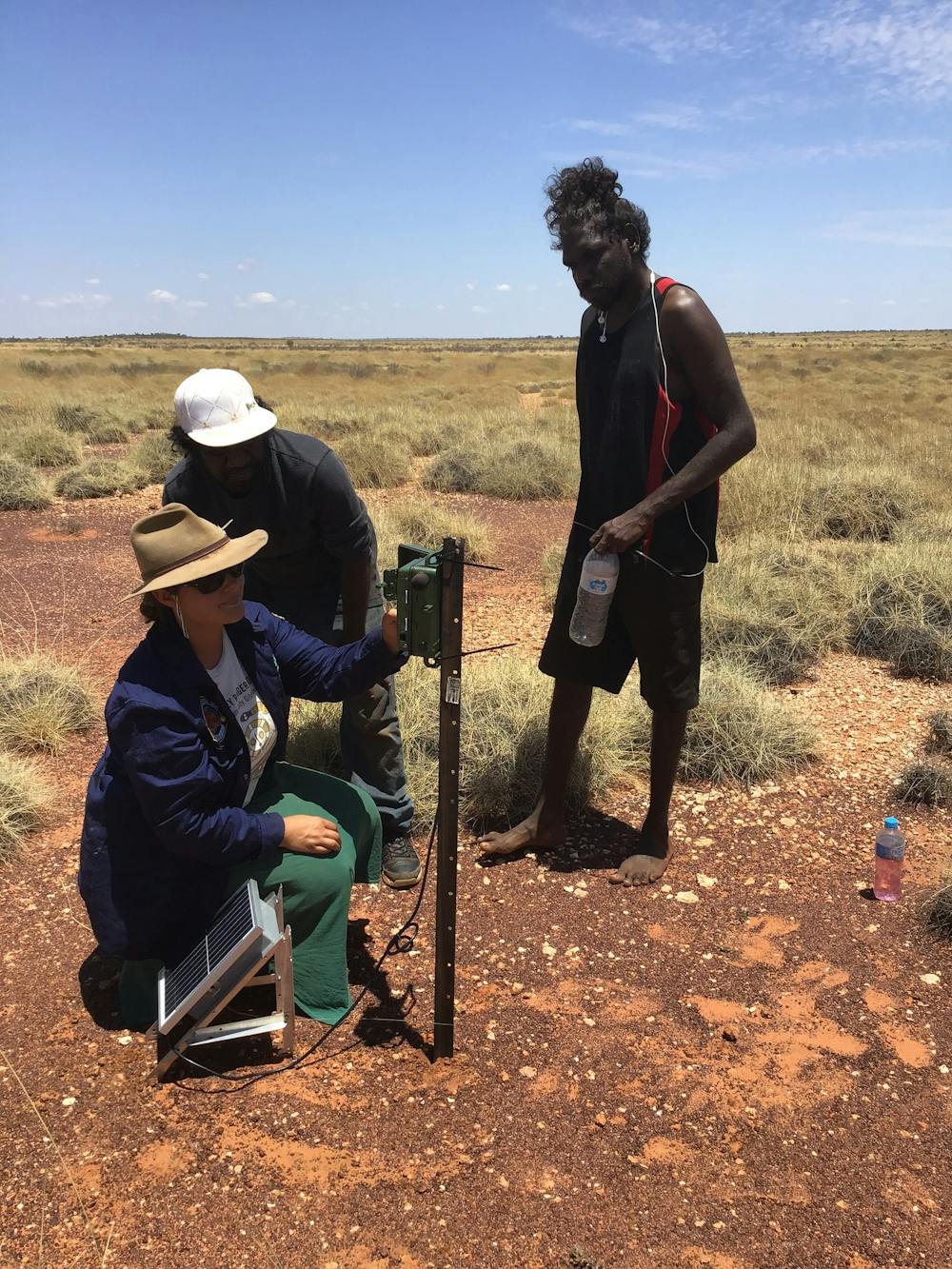
    The researchers recorded night parrots using ‘songmeters’.
    Ngururrpa Rangers/Facebook

    Ngururrpa Rangers worked with scientists to learn how to use sound recorders to search for night parrots. We then searched for the birds on Country between 2018 and 2023.

    We combined the rangers’ detailed knowledge of habitats, water and seed resources with geology maps, satellite imagery and fire history data. From this we selected 31 potential roosting areas, then deployed sound recorders called “songmeters” at those sites.

    We wanted to detect the night parrots’ distinctive calls which consist of whistles, croaks and bell-like sounds.

    The acoustic data we gathered was then analysed to extract any bird calls in the night parrot’s frequency range. Potential detections were verified using a reference library of known night parrot calls.

    Our results

    We detected night parrot calls at 17 of 31 sites. Of these, ten were roost sites, where night parrot calls were detected in the hour after sunset and the hour before sunrise.

    Individual night parrots are thought to have unique calls. We analysed how many different calls we could hear, and how loud they were (which can tell us when birds are calling from different locations). From this we built a picture of the identity and number of individuals regularly occupying a site.

    We extrapolated this across the 58 patches of potential night parrot habitat on the Ngururrpa Indigenous Protected Area. We concluded up to 20 roosting areas may be occupied by night parrots.

    Based on the numbers at roosting sites where we recorded calls, we estimate 40–50 night parrots could be present in the Ngururrpa Indigenous Protected Area.


    Fire and predators pose grave threats

    Once we found the night parrot populations, we wanted to know what threats they faced.

    We used camera-traps to identify predators and also collected their scats (poos) to analyse their diets.

    Ngururrpa Ranger Kathryn Njamme with a night parrot feather.
    Ngururrpa IPA

    Dingoes were the predator detected most frequently in night parrot roosting habitat. Our cameras captured them ten times more often than feral cats. And we found dingoes regularly eat feral cats at night parrot sites.

    Based on information from other areas, we suspect cats are a key predator of night parrots. Dingoes could be important in suppressing cat numbers and helping the parrots survive. So, attempts to limit predators in night parrot habitat should not harm dingoes.

    We also analysed 40 years of satellite imagery to assess the threat of fire to night parrots’ roosting habitat. Based on the vegetation types and flammability of surrounding landscapes, we found bushfires sparked by lightning are a much bigger threat to night parrots in the Great Sandy Desert than in Queensland.

    Strategic aerial and ground burning, to reduce fuel loads, already occurs in the Ngururrpa Indigenous Protected Area. As our knowledge of night parrots improves, these programs can become more targeted to protect key night parrot areas.

    Ngururrpa Rangers using ‘Felixer’ devices to selectively control cats in night parrot habitat.
    Ngururrpa IPA

    Keeping night parrots alive

    A long-term monitoring program for night parrots on Ngururrpa Country should be established to help better understand and protect this vitally important population.

    And the remote, wild nature of the landscape should be retained. This means minimising disturbance from people and vehicles, and continuing to exclude livestock and weeds.

    Clifford Sunfly has articulated how the rangers want to help protect night parrots into the future:

    We would like to spend more time on Country to find where [night parrots] are and understand what they are doing.

    We want those scientists to come and help us catch some night parrots and tag them. We also need more snake-cams (inspection cameras) too and more songmeters. And a kit for collecting scats for DNA.

    One day we would love to have our own research facility for doing our night parrot surveys. It would be our dream to have our own research base on Ngururrpa.

    Rachel Paltridge receives funding from the National Environmental Science Program’s Resilient Landscapes Hub, and the Indigenous Desert Alliance.

    Clifford Sunfly is a Ngururrpa Ranger. The ranger program receives funding from the WA government’s Aboriginal Ranger Program and the State NRM Program.

    Nicholas Leseberg receives funding from the Australian and Queensland Governments. He works for Bush Heritage Australia, and as a consultant on night parrots for many projects.

    ref. ‘Breakthrough discovery’: Indigenous Rangers in outback WA find up to 50 night parrots – one of Australia’s most elusive birds – https://theconversation.com/breakthrough-discovery-indigenous-rangers-in-outback-wa-find-up-to-50-night-parrots-one-of-australias-most-elusive-birds-239449

    MIL OSI AnalysisEveningReport.nz

  • MIL-OSI United Nations: Readout of the Secretary-General’s meeting with H.E. Mohamed Ould Cheikh El Ghazouani, President of the Islamic Republic of Mauritania

    Source: United Nations secretary general

    The Secretary-General met with H.E. Mr. Mohamed Ould Cheikh El Ghazouani, President of the Islamic Republic of Mauritania. The Secretary-General and the President discussed regional peace and security issues, including the Independent High Level Panel on Security and Development in the Sahel. They welcomed the Pact for the Future, including the proposed reforms in the international financial architecture. They further discussed the importance of focusing on youth and ensuring opportunities for young people. 
     

    MIL OSI United Nations News

  • MIL-Evening Report: Why are the violins the biggest section in the orchestra?

    Source: The Conversation (Au and NZ) – By Laura Case, Lecturer in Musicology, Sydney Conservatorium of Music, University of Sydney

    Manuel Nägeli/Unsplash, FAL

    As the largest section of the orchestra, sitting front and centre of the stage performing memorable melodies, it’s easy for violinists to steal the limelight. Ask any violinist why there are so many in an orchestra, and we’ll often reply, tongue-in-cheek: “obviously it’s because we’re the best”.

    The real answer is a bit more complex, and combines reasons both logistical and historical.

    How we got the modern orchestra

    During the Baroque period between around 1600 and 1750, the composition of the orchestra was not standardised, and often used instruments based on availability. Monteverdi’s opera L’Orfeo, which premiered in 1607, is one of the earliest examples of a composer specifying the desired instrumentation.

    The size of the orchestra also varied. Johann Sebastian Bach wrote for and worked with ensembles of up to 18 players in Germany. At Palazzo Pamphili in Rome, Corelli directed ensembles of 50–80 musicians – and, on one notable occasion to celebrate the coronation of Pope Innocent XII, an ensemble of 150 string players.

    The modern-day violin was also developed around this time, and eventually replaced the instruments of the viol family. The violin has remained a staple member of the orchestra ever since.

    Philippe Mercier, 1689 or 1691–1760, Franco-German, active in Britain (from 1716), The Sense of Hearing, 1744 to 1747, Oil on canvas.
    Yale Center for British Art, Paul Mellon Collection, B1974.3.19.

    Music of this period was created on a smaller scale than much of the repertoire we hear today, and often placed a strong focus on string instruments. As the orchestra became more standardised, members of the woodwind family appeared, including the oboe, bassoon, recorder and transverse flute.

    During the classical period from around 1730 to 1820, orchestral performances moved from the royal courts into the public domain, and their size continued to grow. Instruments were organised into sections, and bowed strings formed the majority.

    Composers began to use a wider range of instruments and techniques. Beethoven wrote parts for the early double bassoon, piccolo flute, trombone (which was largely confined to church music beforehand), and individual double bass parts (where previously they had often doubled the cello part).

    Marco Ricci, 1676–1729, Italian, active in Britain (1708–10; 1711–16), Rehearsal of an opera, ca. 1709, Oil on canvas.
    Yale Center for British Art, Paul Mellon Collection, B1981.25.523.

    During the romantic period of the 19th century, composer Hector Berlioz, author of a Treatise on Instrumentation and Modern Orchestration (1841), further developed the symphony orchestra by adding instruments such as the tuba, cor anglais and bass clarinet.

    By the end of the 19th century, many orchestras reached the size and proportions we recognise today, with works that require more than 100 musicians, such as Wagner’s Ring Cycle.

    What’s size got to do with it?

    As increasing numbers of performers and instruments became standard in orchestral repertoire, ensembles became louder, and more string players were needed to balance the sound. The violin is a comparatively quiet instrument, and a solo player cannot be heard over the power of the brass.

    Having violinists at the front of the stage also helps the sound reach the audience’s ears without competing to be heard over the louder instruments.

    The typical layout of the orchestra has not always been standard. First violinists (who often carry the melody) and second violinists (who typically play a supportive role) used to sit opposite each other on stage.

    US conductor Leopold Stokowski rearranged the position of the first and second violinists during the 1920s so they sat next to each other on the left of the stage. This change meant the voices of each string section were arranged from high to low across the stage.

    This change was widely adopted and has become a standard setup for the modern orchestra.

    Stokowski is known for experimenting with the layout of the orchestra. He once placed the entire woodwind section at the front of the orchestra ahead of the strings, receiving widespread criticism from the audience and musicians. The board of the Philadelphia Orchestra allegedly said the winds “weren’t busy enough to put on a good show”.

    Sound, texture and timbre

    String players do not need to worry about lung capacity or breaking for air. As such, violinists can perform long melodic passages with fast finger work, and our bows allow for seemingly endless sustain. Melodies written for strings are innumerable, and often memorable.

    Having several violinists play together creates a specific sound and texture that is distinct from a solo string player and the other sections of the orchestra. Not only is the sound of every violin slightly different, the rate of each string’s vibration and the movement of each player’s bow varies. The result is a rich and full texture that creates a lush effect.

    Today, symphony orchestras are expected to perform an incredibly diverse range of repertoire from classical to romantic, film scores to newly commissioned works. Determining the number of violinists who will appear in any given piece is a question of balance that will change depending on the repertoire.

    A Mozart symphony might require fewer than ten wind or brass players, who would be drowned out by a full string section. However, a Mahler symphony requires more than 30 non-string players – meaning far more string players are needed to balance out this sound.

    Room for experimentation

    Notable exceptions to the orchestra’s standard setup include Charles Ives’ 1908 The Unanswered Question for string orchestra, solo trumpet and wind quartet spread around the room; Stockhausen’s 1958 Gruppen, pour trois orchestres, in which three separate orchestras perform in a horseshoe shape around the audience; and Pierre Boulz’s 1981 Répons featuring 24 performers on a stage surrounded by the audience, who are in turn surrounded by six soloists.

    Despite experimentation, the placement and number of instruments in an orchestra has remained relatively standard since the 19th century.

    Many aspects of the traditional orchestra’s setup make sense. However, many of the orchestra’s habits come down to tradition and perhaps unconscious alignment with “just the way things are done”.

    Laura Case does not work for, consult, own shares in or receive funding from any company or organisation that would benefit from this article, and has disclosed no relevant affiliations beyond their academic appointment.

    ref. Why are the violins the biggest section in the orchestra? – https://theconversation.com/why-are-the-violins-the-biggest-section-in-the-orchestra-236596

    MIL OSI AnalysisEveningReport.nz

  • MIL-OSI Asia-Pac: United Christian Hospital appeals to public for missing patient

    Source: Hong Kong Government special administrative region

    The following is issued on behalf of the Hospital Authority:

         â€‹A spokesperson for United Christian Hospital (UCH) made the following appeal today (September 23) regarding a patient leaving the hospital without notification:

         An 80-year-old male patient with dementia was sent to the Accident and Emergency Department of UCH at around 9pm yesterday (September 22) by ambulance. While waiting for consultation, the patient left the Accident and Emergency Department without notification at around 11.30pm.

         Security guards were deployed to search for the patient within the hospital compound and in the vicinity. The hospital also made a report to the Police for assistance. The patient is yet to be located. The hospital is very concerned about the incident and will fully cooperate with the Police in order to locate the patient.

         The patient is about 1.6 metres tall, with short white hair and has a slim build. CCTV footage showed that the patient was wearing a white short-sleeved shirt, black trousers and black shoes when he left. The hospital appeals to the public to contact the hospital at 3949 4002 or the Police if they know the whereabouts of the patient.

         The hospital has reported the incident to the Hospital Authority Head Office through the Advance Incident Reporting System.

    MIL OSI Asia Pacific News

  • MIL-OSI USA: 09.22.2024 Sen. Cruz Applauds Announcement of House Vote on His Bipartisan CHIPS Permitting Bill

    US Senate News:

    Source: United States Senator for Texas Ted Cruz
    WASHINGTON, D.C. – Today, U.S. Senate Commerce Committee Ranking Member Ted Cruz (R-Texas) released the following statement after it was announced that the bipartisan legislation he authored with Sen. Mark Kelly (D-Ariz.) to dramatically expedite semiconductor manufacturing plant construction would receive a vote on the House floor next week. The Kelly-Cruz bill has already passed the Senate.
    “My number-one priority fighting for Texas has always been jobs, jobs, jobs,” said Sen. Cruz. “I am thrilled that the House has scheduled the Kelly-Cruz legislation for a vote next week. I’ve teamed up with Democrat Senator Mark Kelly to pass landmark legislation streamlining environmental permitting rules for new semiconductor factories.  When passed, Kelly-Cruz will help bring tens of thousands of jobs to Texas and hundreds of billions in new investments. It will also advance our national security significantly by making us much less dependent on China for advanced semiconductors. Our bipartisan legislation passed the Senate unanimously, and I urge our House colleagues to likewise swiftly pass it into law.”
    During the week of September 23rd, the House will vote on S. 2228, the “Building Chips in America Act,” under suspension of the rules, requiring a 2/3 majority of House members for passage. S.2228 was modified with substitute text authored by Sens. Cruz and Kelly (Senate Amendment 1378).
    In December, the Senate unanimously passed Sens. Cruz and Kelly’s bipartisan chips permitting bill, which was cosponsored by Sens. Todd Young (R-IN), Sherrod Brown (D-OH), Bill Hagerty (R-TN), Martin Heinrich (D-NM), and Kyrsten Sinema (I-AZ). This legislation had also previously passed the Senate in July of 2023 as part of the Senate’s version of the National Defense Authorization Act (NDAA).In October of 2023, Sens. Cruz and Kelly led  a bipartisan, bicameral letter with over 100 signers in support of passing these permitting reforms.
    In January, Sen. Cruz toured the Samsung facility in Taylor, Texas and reiterated the importance of his CHIPS/National Environmental Policy Act (NEPA) legislation. Sen. Cruz also hosted a roundtable event in Round Rock, Texas, to discuss regulatory hurdles facing the semiconductor industry. Sen. Cruz engaged with many Texas-based semiconductor companies, and discussed how burdensome federal environmental requirements are driving up compliance costs for chip manufacturers, leading to slower construction timelines.
    In April, Sen. Cruz discussed the need for chips permitting reform at a roundtable discussion hosted by Southern Methodist University after the university had been designated the lead agency for this federally funded economic development initiative, aimed at bolstering semiconductor manufacturing in the United States.
    Background on Sen. Cruz’s efforts to encourage American innovation through Chips manufacturing:
    During a Senate Commerce Committee hearing on ‘CHIPS and Science Implementation and Oversight,’ Secretary of Commerce Gina Raimondo endorsed Sens. Cruz and Mark Kelly’s (D-AZ) CHIPS/NEPA proposal.
    Sen. Cruz helped enact historic tax reform in 2017, which gave a tax cut to virtually every taxpayer in America. It reduced taxes on small businesses, farmers, ranchers, and job producers, which has helped bring jobs to Texas and drive innovation.
    Sen. Cruz has been leading the fight against burdensome federal government regulations and EPA overreach.
    Sen. Cruz authored the Cost Recovery and Expensing Acceleration to Transform the Economy and Jumpstart Opportunities for Businesses and Startups (CREATE JOBS) Act, which would vitally reform business expensing in the tax code and help businesses and innovators thrive.
    Sen. Cruz championed the Facilitating American-Built Semiconductors (FABS) Act to incentivize manufacturing in the U.S. through tax credits. That legislation is now law.

    MIL OSI USA News

  • MIL-Evening Report: Do footy’s best and fairest awards achieve what they claim?

    Source: The Conversation (Au and NZ) – By Hunter Fujak, Senior Lecturer in Sport Management, Deakin University

    Football’s awards season kicks off this week, with the AFL’s Brownlow Medal awarded on Monday evening and the NRL’s Dally M awarded on October 2.

    Both medals aim to crown their league’s best regular season player.

    Historical voting patterns, however, question whether they achieve this objective, or rather award the most influential key position player from the season’s most successful teams.

    How to assess a fairest and best player?

    A curiosity of the Australian sport landscape is that all four major football codes use a different panel of judges in award voting.

    The AFL’s Brownlow Medal is voted on by umpires, while the NRL’s Dally M is determined by a pool of media pundits and ex-players.

    Rugby Australia’s John Eales Medal is voted on by players, and the A-League’s Johnny Warren Medal is judged by a four-body panel that consists of a technical football expert, football media representative, former player and match officials.

    Each one of these structures produces unique biases and criticisms.

    The Brownlow: the midfielder’s medal

    The Brownlow was devised as an award for the fairest and best player of the AFL competition, reflecting the often understated importance of fair play that umpires are uniquely positioned to judge.

    The Brownlow’s voting system has long been a topic of interest for fans, pundits and academics alike.

    While Lachie Neale’s surprise victory in 2023 generated renewed controversy, the Brownlow has long been criticised as a midfielders award.

    Melbourne’s Herald, in 1938, stated:

    Under the present method, men playing on the full-forward or full-back lines have little chance of winning the award usually being won by men most constantly in the play who are able to stand out in comparatively weak sides.

    This observation around weak sides reflected that from 1931 to 1938, the Brownlow went on an eight-season run of being won by a player not from a finals team.

    Indeed, among the first 49 Brownlow winners from 1924 to 1969, only 31% came from finalists.

    Since 1970, 72% of winners have come from a finals team (noting the finals system has changed over time).

    One consistent long-term trend has been the dominance of midfielders.

    Among the 27 Brownlows awarded this millennium, only Adam Goodes (a two-time winner) would not be considered primarily a midfielder.

    This positional dominance is not unique to AFL.

    Soccer’s most pre-eminent global award, the Ballon d’Or, has been awarded 66 times, of which a defender has been the recipient only four times and a goalkeeper once.

    The Dally M suffers from a similar concentration.

    The Dally M: the media medal

    The Dally M has been awarded since 1979, becoming rugby league’s premier individual honour in 1998 with the formation of the NRL.

    In 45 years of voting, the winner has come from a non-finalist team on only six occasions (13%).

    The award is also won near exclusively by the “spine” positions of fullback, five-eighth, halfback and hooker, which account for 91% of medallists.

    The Dally M uses a pool of media pundits and ex-players for voting on each match, creating the potential for obvious conflicts of interests.

    During seasons 2019 and 2020 for instance, 12 of the Brisbane Broncos’ 44 matches were judged by ex-Broncos players. On four of these instances, former player Darren Lockyer was the judge, despite being an active non-executive director of the Brisbane Broncos organisation.

    Voting in nearly 22% of matches in these two seasons was performed by judges who played or coached for one of the participating teams.

    NRL Chairman Peter V’Landys initiated a review of the Dally M following a surprise winner in 2020 (Jack Wighton), claiming the voting system disadvantaged players from winning teams.

    Whilst this supposition disregarded that 88% of all 2020 Dally M points were awarded to players from the winning team, voting was modified for the 2023 season.

    This revised system introduced an additional judge to produce two independent voters per match, and in a widely criticised move, veiled these judges with anonymity.

    This new system has revealed just how little experts agree when trying to assess subjective performance.

    In the opening five rounds of 2023, the two judges picked the same player of the match in less than half (48%) of fixtures.

    In a third of matches (31%), one judge’s best on ground did not poll any points with the other judge.

    In one instance, the two judges chose six completely different players in their respective 3-2-1 votes (round five, 2023, Bulldogs v Cowboys).


    Player and coach awards: The true best and fairest?

    Although the Brownlow and Dally M dominate the public limelight, team accolades are typically held in high standing within sport clubs, as internal recognition is often more highly valued than external status within high performance cultures.

    Such player and coach awards, typically forming part of season-end club events, can be argued as more accurate assessments of player performance.

    This is because the voters – teammates and/or coaches – best understand the roles and expectations of each player within the team’s overarching game plan.

    For this reason, in the AFL, there is often wide discrepancies between a team’s distribution of Brownlow votes and a club’s internal award votes.

    In 2023, for instance, six of 18 AFL clubs crowned a best and fairest who was different from their highest Brownlow vote-getter.

    The most notable of this was Brisbane, where key defender Harris Andrews won the club’s best and fairest, despite finishing 44th in Brownlow voting.

    Defender Harry Sheezel similarly won North Melbourne’s best and fairest despite finishing fifth from his team in the Brownlow count.

    Is there a perfect solution?

    Recent shock winners in both codes saw media organisations perform “forensic analysis” of voting patterns.

    In the AFL, former Collingwood president and media personality Eddie McGuire proposed a “panel of elders” while the NRL’s V’Landys proposed rating every player for every match, to determine their respective awards.

    Such scrutiny has undoubtedly been fuelled by the datafication of sport and its athletes, which has seen player performance statistics enter the sporting mainstream.

    Is it notable then that the AFL reaffirmed their existing policy in early 2024 to preclude umpires from accessing player statistics in casting their votes.

    Indeed statistics may not offer the perfect solution some believe.

    Any statistical assessment of player performance remains underpinned by human judgement as to the importance of each metric, whilst missing the qualitative nuance that surrounds key match plays and moments.

    Ultimately then, there may not be a perfect method to determine a league’s best and fairest player and, arguably, it is this human judgement dimension which makes these awards so engaging as a public spectacle.

    The authors do not work for, consult, own shares in or receive funding from any company or organisation that would benefit from this article, and have disclosed no relevant affiliations beyond their academic appointment.

    ref. Do footy’s best and fairest awards achieve what they claim? – https://theconversation.com/do-footys-best-and-fairest-awards-achieve-what-they-claim-237978

    MIL OSI AnalysisEveningReport.nz

  • MIL-Evening Report: Basic service provider or mini democracy? Why NZ needs to decide what it wants from local government

    Source: The Conversation (Au and NZ) – By Jeffrey McNeill, Honorary Research Associate, School of People, Environment and Planning, Te Kunenga ki Pūrehuroa – Massey University

    Prime Minister Christopher Luxon’s recent challenge to local government “to rein in the fantasies and to get back to delivering the basics brilliantly” was unsurprising, given his government’s focus on fiscal restraint.

    It was in keeping with his announcement that councils’ legislative purpose of delivering their communities’ economic, social, environmental and cultural wellbeing are to be removed from the Local Government Act.

    Local government responded with the usual indignation and suggested solutions. There were complaints about inadequate funding mechanisms, questions about whether libraries are basic services. The whole spat likely flew under the radar of the wider public.

    Yet the problems facing local government are very real and will not just go away by kicking costly decisions down the road. Rather, they are symptomatic of fundamental choices facing the sector.

    Foundational issues

    The problems go back to the late 1980s when our current local government system was designed.

    Led by then local government minister Michael Bassett, the reforms were the first in over 100 years. More than 850 city, borough and county councils, catchment boards, united councils and local boards were amalgamated to form 86 in 1989 and now 78 regional, city and district councils we have today.

    But Bassett still considered local government reform incomplete because of the failure to address water provision.

    But I would argue the real unfinished business was the failure to resolve the purpose of local government in the first place. Only when that is agreed can we address local government’s functions, form and funding.

    Until then, the shape and function of local government will remain a political football.

    According to section 10(1)(a) of the Local Government Act 2002, the purpose of local government is “to enable democratic local decision-making and action by, and on behalf of, communities”.

    But the second subsection describing its purpose, (s.10(1)(b)) has changed with the various governments. In 2002, under Helen Clark’s Labour-led government, the purpose of local government was:

    to promote the social, economic, environmental, and cultural well-being of communities in the present and for the future.

    John Key’s National-led government in 2012 replaced that purpose with a remit

    to meet the current and future needs of communities for good-quality local infrastructure, local public services, and performance of regulatory functions in a way that is most cost-effective for households and businesses.

    The previous Labour government reintroduced the wellbeing purpose. Luxon is set to remove it.

    Function, form and funding

    Should local government be a true local government with comprehensive and wide powers, or simply a property-services organisation, providing little more than street-lighting, roading, water and sewerage?

    The two very different conceptions of local government determine its functions, form and funding.

    These differing views reflect the disparate Anglophone and European concepts of local government. National aligns with the Anglophone model, with its limited local government functions under a strong central government. Labour leans towards the European model, with devolved wide-ranging functions.

    The distinction between the two models was made very clear to me while working as part of an international team researching local government responses to the COVID-19 pandemic.

    My Italian colleague, for example, reported how his country’s local governments were vitally involved in their cities’ day to day management during the crisis.

    Mayors and councils were making daily decisions and announcements about their hospitals’ resourcing, whether to close the schools and training institutes, increase social welfare provision and housing, and so on.

    On the flipside, New Zealand local government was largely sidelined to address humanitarian services such as ensuring people had access to food and accommodation.

    Instead, councils searched for local “shovel-ready” infrastructure projects to access central government funds in order to reduce unemployment and stimulate local economies. The public focused on national daily press announcements from the prime minister and director-general of health.

    No appetite strong local government

    For all that, the distinction between Labour and National conceptions of local government may not be as great as recent history suggests.

    Both want a strong centre and weak local government. Our councils have largely reinforced this reality. Some have sought to extend their scope of activities, others have clearly defined themselves as property services agencies.

    Most have largely refrained from the excesses the prime minister appears to be concerned about, partly to avoid being caught out by changes in central government, but also because most council expenditure is already committed to infrastructure.

    But does it have to be this way?

    The Labour-led government’s 2021 Future for Local Government review envisaged local government using partnerships with hapū and iwi to promote the four key wellbeings as key to any reform. This is at odds with the present government’s priorities and views on governing with Māori – a big reason why the reports now collect dust.

    The review was also very constrained in considering local government functions. Rather, it seemingly took existing functions as its starting point to focus instead on local governance.

    Writing about our local government nearly 70 years ago, public servant and academic R.J. Polaschek imagined what would have been if New Zealand had been colonised by Denmark instead of Great Britain. In this hypothetical scenario he saw strong independent local government based on communities with wide-ranging functions.

    It still could be, but tinkering at the edges is not going to solve its problems. Our local government project remains unfinished business. It will take political courage and vision to complete the task. One that remains a fantasy, and we are all the losers.

    Jeffrey McNeill does not work for, consult, own shares in or receive funding from any company or organisation that would benefit from this article, and has disclosed no relevant affiliations beyond their academic appointment.

    ref. Basic service provider or mini democracy? Why NZ needs to decide what it wants from local government – https://theconversation.com/basic-service-provider-or-mini-democracy-why-nz-needs-to-decide-what-it-wants-from-local-government-238862

    MIL OSI AnalysisEveningReport.nz

  • MIL-Evening Report: Why isn’t dental included in Medicare? It’s time to change this – here’s how

    Source: The Conversation (Au and NZ) – By Peter Breadon, Program Director, Health and Aged Care, Grattan Institute

    Engin Akyurt/Unsplash

    When the forerunner of Medicare was established in the 1970s, dental care was left out. Australians are still suffering the consequences half a century later.

    Patients pay much more of the cost of dental care than they do for other kinds of care.

    More Australians delay or skip dental care because of cost than their peers in most wealthy countries.

    And as our dental health gets worse, fees keep on rising.

    For decades, a litany of reports and inquiries have called for universal dental coverage to solve these problems.

    Now, with the Greens proposing it and Labor backbenchers supporting it, could it finally be time to put the mouth into Medicare?

    What’s stopping us?

    The Australian Dental Association says the idea is too ambitious and too costly, pointing out it would need many more dental workers. They say the government should start small, focusing on the most vulnerable populations, initially seniors.

    Starting small is sensible, but finishing small would be a mistake.

    Dental costs aren’t just a problem for the most vulnerable, or the elderly. More than two million Australians avoid dental care because of the cost.

    More than four in ten adults usually wait more than a year before seeing a dental professional.

    Bringing dental into Medicare will require many thousands of new dental workers. But it will be possible if the scheme is phased in over ten years.

    The real reason dental hasn’t been added to Medicare is it would cost billions of dollars. The federal government doesn’t have that kind of money lying around.

    Australia has a structural budget problem. Government spending is growing faster than revenue, because we are a relatively low-tax country with high service expectations.

    The growing cost of health care is a major contributor, with hospitals and medical benefits among the top six fastest-growing major payments.

    The structural gap is only likely to grow without major policy changes.

    So, can we afford health care for all? We can. But we should do it with smart choices on dental care, and tough choices to raise revenue and reduce spending elsewhere.

    Smart choices about a new dental scheme

    The first step is to avoid repeating the mistakes of Medicare.

    Medicare payments to private businesses haven’t attracted them to a lot of the communities that need them the most. Many rural and disadvantaged areas are bulk-billing deserts with too few GPs.

    The poorest areas have more than twice the psychological distress of the wealthiest areas, but they get about half the Medicare-funded mental health services.

    As a result, government money isn’t going where it will make the biggest difference.

    There are about 80,000 hospital visits each year for dental problems that could have been avoided with dental care. If there is too little care in disadvantaged and rural communities, where oral health is worst, that number will remain high.

    That’s why a significant share of new investment should be quarantined for public dental services, with those services targeted to areas where people are missing out on care.

    Another problem with Medicare is its payments often have little relationship to the cost of care, or the impact that care has on the patient’s health.

    To tamp down costs, Medicare funding for dental care should exclude cosmetic treatments and orthodontics. It should be based on efficient workforce models where dental assistants and therapists use all their skills – you might not always need to see a dentist.

    Sometimes you might see a dental therapist instead.
    Gustavo Fring/Pexels

    The funding model should take account of a patient’s needs, reward giving them ongoing care, and have a cap on spending per patient.

    Oral health should be measured and recorded, to make sure patients and taxpayers are getting results.

    Tough choices to balance the budget

    Those steps would slash the cost of The Greens’ plan, which is hard to estimate but might reach more than $20 billion a year once it’s phased in. Instead, the cost would fall to roughly $7 billion a year.

    That would be a good investment. But if you’re worried about where the money will come from, there are good ways to pay for it.

    Many reforms could reduce government health budgets without harming patients.

    There is waste in government funding of pathology tests and less cost-effective medicines.

    In some hospitals, there are excessive costs and potentially harmful low-value care.

    Over the longer-term, investments in prevention can reduce demand for health care. A tax on sugary drinks, for example, would improve health while raising hundreds of millions of dollars a year.

    Measures like this would help the government pay for more dental care. But demand for health care will keep growing as the population ages, and as expensive new treatments arrive.

    This means a broader strategy is needed to meet the three goals of balancing the budget, keeping up with growing health-care demand, and bringing dental into Medicare.

    Adding dental to Medicare would mean some tradeoffs.
    Lafayett Zapata Montero/Unsplash

    There are no easy solutions, but there are many options to reduce spending and boost revenue without hurting economic growth.

    Choosing Australia’s infrastructure and defence megaprojects more wisely could save several billion dollars each year.

    Undoing Western Australia’s special GST funding deal – described by economist Saul Eslake as “the worst Australian public policy decision of the 21st Century thus far” – would save another $5 billion a year.

    Reducing income tax breaks and tax minimisation opportunities – including by reining in superannuation tax concessions, reducing the capital gains tax discount, limiting negative gearing, and setting a minimum tax on trust distributions – could raise more than $20 billion a year.

    Major tax reform like this offers economic benefits while creating space for better services such as universal dental coverage.

    No one likes spending cuts and tax hikes, but they will be needed sooner or later regardless. Dental coverage might be just the sweetener taxpayers need to accept it.

    Grattan Institute, has been supported in its work by government, corporates, and philanthropic gifts.

    A full list of supporting organisations is published at www.grattan.edu.au.

    ref. Why isn’t dental included in Medicare? It’s time to change this – here’s how – https://theconversation.com/why-isnt-dental-included-in-medicare-its-time-to-change-this-heres-how-239086

    MIL OSI AnalysisEveningReport.nz

  • MIL-Evening Report: How did they get my data? I uncovered the hidden web of networks behind telemarketers

    Source: The Conversation (Au and NZ) – By Priya Dev, Lecturer & Academic Data Science, Digital Assets & Distributed Ledgers, Australian National University

    Kokhan O/Shutterstock

    Last year, I started getting a lot of unsolicited phone calls, mainly from people trying to sell me things. This came as a surprise because, as a data scientist, I am very careful about what personal information I let out into the world. So I set out to discover what had happened.

    My investigation took several months. It eventually led me to the labyrinthine world of data brokers.

    In today’s digital age, where personal data is a new kind of gold, these companies wield significant power, creating networks where our personal information is shared between brokers and telemarketers as easily as TikTok videos. Their businesses profit from the data they collect, and many of the calls they enable come from scammers.

    This comes at an enormous cost: in 2023, Australians lost $2.7 billion to scams. This highlights the urgent need for stronger privacy protections to limit how our personal data is collected and shared.

    In an attempt to address this need, the Australian government this month introduced long-overdue privacy reforms. But these reforms are still inadequate for the many privacy issues affecting people today, including targeting by data brokers and telemarketers.

    Investigating the hidden web

    One of the mechanisms designed to protect us from unwanted calls is the Do Not Call Register.

    Managed by the Australian Communications and Media Authority, the registry holds more than 12 million phone numbers, including mine. The registry is supposed to block unsolicited calls. But last year, despite being on the list, I began to receive dozens of unwanted calls – on average, about three per day.

    Curious, I started tracing the origins of these calls. What I uncovered was a network of hidden connections between data brokers, telemarketers and large organisations – including a major political party. It became clear that simply being on the Do Not Call Register wasn’t enough to protect my privacy.

    I started by asking the callers what data they held, and how they had obtained mine. I requested details about the companies they represented, including their websites and Australian Business Numbers (ABNs) – the unique identifiers for Australian businesses.

    Most callers hung up the moment I started asking questions, until one day I spoke with a man named Paul, who worked in the real estate sector – an industry worth more than $10 trillion as of 2024. The high-value real-estate market makes our personal data especially valuable to businesses operating within the industry.

    Digging deeper

    The unique thing about Paul was that he knew my real name, whereas other telemarketers only had access to the pseudonyms I’d used to protect my identity online. Paul explained he had licensed my data from the real estate giant CoreLogic Australia.

    This discovery pushed me to dig deeper. After a lot of back and forth, I finally obtained my data from CoreLogic. The amount of information was small, but surprisingly accurate – especially considering the steps I’d taken to hide my identity. It made me wonder where they got it from, as only organisations such as utility companies, banks or the government would hold that type of information.

    CoreLogic told me in an email that:

    CoreLogic gets data from a variety of sources … most of the information we collect comes from public records, which we license from government departments and agencies. We may also collect personal information from third parties such as through real estate agents, tenancy and strata mangers, financial institutions and marketing database providers.

    This was a troubling discovery, because the institutions on which we depend for essentials such as public services, housing and finance – and from which we can’t hide our identities – may be selling our personal information to data brokers, who then pass it along to telemarketers.

    What’s even more alarming is that the data is shared unmasked, meaning personal details such as our names, genders and phone numbers are fully visible. Once this information is out in the open, it becomes almost impossible to control how it’s recorded or shared.

    It’s also nearly impossible to stop it being passed to overseas telemarketers, who aren’t bound by Australian privacy laws.

    Real estate giant CoreLogic says most of the personal data it collects comes from public records.
    IgorGolovniov/Shutterstock

    Solving the mystery

    My investigation didn’t end there.

    Eventually, CoreLogic revealed it had purchased my data from Australian data broker firm Smrtr in August 2023. This coincided with the surge in unsolicited calls.

    Through Smrtr I learned they had purchased my data in 2016 from another data broker, EightDragons Digital. Smrtr also admitted to selling my data to various companies – all without my consent.

    Determined to investigate the origin of my online data trail, I contacted EightDragons Digital, which calls itself “a leading global consumer data agency”. It collects personal data for big brands including Energy Australia, Vodafone, NRMA, Nissan, Johnnie Walker, American Express, The Good Guys, and even the Australian Labor Party.

    The company claimed it collected my data in a 2014 marketing campaign, and likely passed it to at least 50 other companies. However, it had no records to verify the marketing campaign or prove that I had given consent.

    A small step only

    CoreLogic defended its practices as legal, saying it’s too difficult to verify consent or anonymise personal data.

    However, with modern technology, it’s actually possible to track where data comes from, check consent, and share insights without exposing personal details such as names and phone numbers.

    The government’s recent privacy reforms are a small step in the right direction. But until data brokers are required to obtain explicit consent before trading personal information, they fall far short of being a giant leap forward.

    Priya Dev does not work for, consult, own shares in or receive funding from any company or organisation that would benefit from this article, and has disclosed no relevant affiliations beyond their academic appointment.

    ref. How did they get my data? I uncovered the hidden web of networks behind telemarketers – https://theconversation.com/how-did-they-get-my-data-i-uncovered-the-hidden-web-of-networks-behind-telemarketers-238991

    MIL OSI AnalysisEveningReport.nz

  • MIL-Evening Report: With all these defamation lawsuits, what ever happened to free speech?

    Source: The Conversation (Au and NZ) – By Brendan Clift, Lecturer in Law, The University of Melbourne

    Shutterstock

    It seems like the dust barely settles from the latest high-profile defamation stoush before the next set of litigants straps on the gloves and steps into the ring.

    Many of these cases raise eyebrows — and questions. Was that story about him? Does anyone remember that tweet? Wasn’t it just harmless banter? Didn’t she respond to that allegation? What if it’s all true? Isn’t that free speech? How much did you say this will cost?!

    Defamation law continues to loom large over public conversations, despite recent law reforms aimed at remedying Australia’s unwanted reputation as the “defamation capital of the world”.

    At the heart of defamation law lies a tension between protecting reputation and maintaining freedom of speech. The more robustly defamation law protects reputation, the more it constrains speech.

    Free speech is valued in Australian law, politics and society, notwithstanding our lack of an explicit constitutional speech right. So why does our defamation law facilitate seven-figure lawsuits over communicative slights that, at times, seem disproportionately minor?

    What shapes these laws?

    Defamation law is old — very old — with roots in English law half a millennium ago. For several hundred years it existed in parallel with publishing monopolies, political and moral censorship, and fears that loose talk could stoke public disorder.

    In other words, our defamation law substantially predates modern conceptions of civil and political rights. Some of its features, like strict rather than fault-based liability (the plaintiff need not prove anything about the defendant’s intentions or degree of care), retain the flavour of less liberal times.

    Libel laws in the western world, as seen here in the US in the 1730s, are very old.
    Library of Congress

    Still, defamation has developed over the years and adapted with transplantation to other legal systems.

    The defamation laws of different places are influenced by factors such as community values, prevailing views on the value of speech, the nature and democratic credentials of the political system, and the role of law and the constitution in regulating citizens and the state.

    For example, the United States is culturally and historically predisposed to liberty and suspicion of government. The freedom to discuss and debate public affairs is seen as essential to its democratic system. The First Amendment to the US Constitution is the world’s most famous free speech law.

    Accordingly, US courts have limited defamation on matters of public concern to deliberate or reckless lies, while opinions on any newsworthy topic are immune from suit. This is because US democracy requires the “marketplace of ideas” to be minimally constrained and largely self-regulating.

    On the other hand, less democratic states have kept their defamation laws strict, to suppress political dissent and silence critical media.

    A case in point is Singapore, which, under founding father Lee Kwan Yew and his perpetually-in-power People’s Action Party, has weaponised defamation law against political opposition and the press.


    Read more:
    With more lawsuits potentially looming, should politicians be allowed to sue for defamation?


    That is not to say that less defamation law is automatically better than more. The interest in maintaining a (deserved) good reputation is legitimate. And speech anarchism can allow low-value and harmful speech to flourish.

    The High Court of Australia has shied away from US-style speech liberalism for fear it could facilitate speech that is harmful to the integrity of political discourse: a prescient position given recent US history. The English courts have done similarly, influenced by distrust of the tabloid press.

    But when reputation and speech fall out of balance, defamation law risks infringing both democratic values and fundamental rights.

    Legal balancing acts

    Around the turn of the millennium, English defamation law reached a crossroads. Its relative stasis had turned the United Kingdom into a “libel tourism” hotspot, and the UK was falling behind on the speech protections mandated by the European Convention on Human Rights.

    So the UK courts moved to better protect publishers by creating a new defence for responsible publication in the public interest. That was followed in 2013 by a new Defamation Act to further simplify, clarify and rebalance defamation law.

    Australia, lacking the same constitutional or convention impetus, has been slow to follow suit. The states agreed to harmonise their disparate defamation laws only in 2005, and it was 2021 before they found the appetite to improve them.

    By then, Australia had taken over the UK’s mantle as the preferred destination for defamation plaintiffs.

    Australia’s 2021 reforms included a new defence for publication of public-interest material, which generated some excitement but hasn’t substantially liberated the media from defamation threats. It amounts to tinkering around the edges of law, which remains conservative at its core.

    Today, from a practical standpoint, the biggest problem with defamation may be its cost.

    Legal advice and correspondence are expensive, settlements more so, and the cost of litigation can be eye-watering. It’s one problem if you can’t afford to assert your legal rights; it’s quite another to be slapped with an unexpected complaint. Defamation disputes can easily bankrupt individuals and exhaust media budgets.


    Read more:
    Why defamation suits in Australia are so ubiquitous — and difficult to defend for media organisations


    Legal consequences can act as an incentive for better journalism, but they also chill public-interest reporting. Even a journalist assured of their facts will find proving them in court to be a different matter. And a win does not guarantee full recovery of costs, let alone time and stress.

    The debate over defamation law reform is ongoing. The central question remains how best to balance the interest in reputation with the benefits of free speech. The answers depend on what we really value, and what our commitment to liberal democracy really requires.

    Brendan Clift does not work for, consult, own shares in or receive funding from any company or organisation that would benefit from this article, and has disclosed no relevant affiliations beyond their academic appointment.

    ref. With all these defamation lawsuits, what ever happened to free speech? – https://theconversation.com/with-all-these-defamation-lawsuits-what-ever-happened-to-free-speech-238312

    MIL OSI AnalysisEveningReport.nz

  • MIL-OSI New Zealand: SH2 Wharerata Road lookout area temporarily closed for safety improvements

    Source: New Zealand Transport Agency

    Work gets underway this week on improvements to the State Highway 2 Wharerata Road Lookout rest area and carpark, about 45 minutes south of Gisborne.

    For the next 2 months, ahead of the summer holiday season, crews will rebuild the rest area and car park and lay new asphalt, alongside installing new street furniture so people pulling off the state highway have an improved area to check their phones, make a call or just take a break before continuing their journey.

    Subject to weather conditions, crews will be active on site between 6am and 6pm, Monday to Saturday, and during this time the shoulder approaching the rest area and carpark will be closed with a reduced temporary speed limit in place of 30km/h. At times the passing lane approaching the rest area and carpark may also be temporarily closed for the safety of crews.

    Throughout the works the rest area and carpark will be closed 24/7 to all vehicles.

    Two lanes of traffic on the state highway will remain flowing and there should be little disruption to journeys.

    NZ Transport Agency Waka Kotahi wants to thank those who will be inconvenienced by the temporary closure of the rest area and carpark for their understanding while these improvements happen.

    This work is part of Connecting Tairāwhiti, which is a programme of projects providing more slow vehicle bays and more places to pull off the road safely to check messages or take a break on State Highways 2 and 35 across the Tairāwhiti and northern Hawke’s Bay regions. The programme also includes some resilience projects to strengthen and stabilise sites on State Highway 35 to help it remain open and functional during disruptions such as weather events.

    MIL OSI New Zealand News

  • MIL-OSI New Zealand: State Highway 6 Whangamoa closed following serious crash

    Source: New Zealand Transport Agency

    UPDATE 9:40 pm: State Highway 6 is now open under stop/go traffic management and a 30’km/h temporary speed limit following a serious crash on the Whangamoa Hill earlier this evening.
    Drivers can expect delays when travelling through the crash site until the highway is fully reopened.

    UPDATE 8:15 pm:

    State Highway 6 remains closed this evening, with emergency services and contractors attend a serious crash on the Whangamoa Hill. State Highway 6 is closed to all traffic between Hira and the Rai Valley and is expected to remain closed until the Police Serious Crash Unit completes its investigation.

    Drivers must avoid the area, delay their travel, or detour via State Highway 63 Wairau Valley and St Arnaud.

    6:15pm:

    State Highway 6 is closed between Nelson and Blenheim this evening as emergency services and contractors attend a serious crash on the Whangamoa Hill.
    The single-vehicle crash, which occurred near the Kokorua Road intersection, was reported around 5 pm.

    The highway is closed in both directions and is expected to remain closed for several hours while the Police Serious Crash Unit investigates.

    There are no available local road detours, and the only route between Nelson and Blenheim is via State Highway 63 – St Arnaud and the Wairau Valley.

    This significantly longer route can add over 30 minutes or more to travel times. Drivers must factor this into their travel plans, particularly those with ferry connections in Picton.

    Road users must avoid the area and should consider delaying their journeys.

    Updates on the highway’s status can be found on the NZTA Waka Kotahi website:

    Highway Conditions – Nelson Marlborough(external link)

    MIL OSI New Zealand News