Keith Rankin, trained as an economic historian, is a retired lecturer in Economics and Statistics. He lives in Auckland, New Zealand.
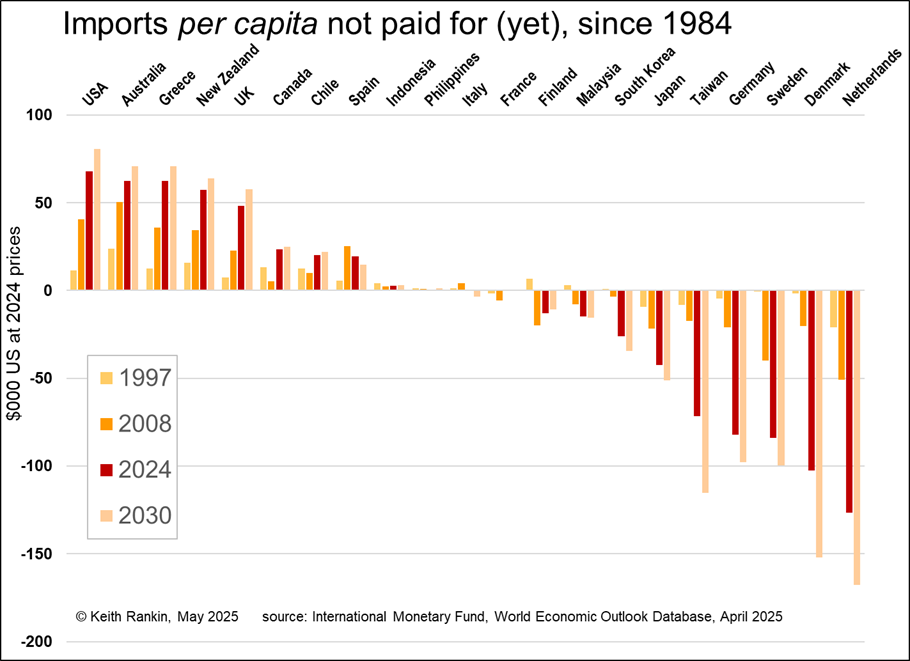
The following two tables show New Zealand and the 24 other economies in the world most easily and fruitfully compared to New Zealand. The countries are sorted with the worst-performing economies (in terms of economic growth per capita) listed at the top. Thus, taking four-year compounded growth for 2020, 2021, 2022 and 2023, Germany was the worst performer (ranked 25 out of 25); its economy, adjusted for population growth, shrank over four years by 1.2 percent.
The ‘top’ three countries in the table all had such negative growth.
Table 1: Rankings for 25 Advanced Economies 2019-23
2019-23*
growth pc
inflation
interest
population
rank
rank
rank
rank
Germany
25
6
9
18
Finland
24
19
9
20
Austria
23
1
9
9
United Kingdom
22
2
4
12
Canada
21
14
3
3
Spain
20
15
9
10
France
19
16
9
19
Japan
18
24
25
24
Norway
17
10
7
6
Sweden
16
9
21
15
New Zealand
15
4
1
5
Switzerland
14
25
24
7
Australia
13
11
8
4
Belgium
12
8
9
13
Portugal
11
17
9
16
Netherlands
10
3
9
8
Italy
9
12
9
23
Israel
8
22
6
1
United States
7
5
2
11
Slovenia
6
7
9
17
Denmark
5
18
23
14
Korea
4
21
5
21
Greece
3
20
9
25
Taiwan
2
23
22
22
Ireland
1
13
9
2
*
end of year data for inflation and interest
source: IMF World Economic Outlook Database, April 2025
On growth, New Zealand was in the middle of the pack, with 3.9 percent compounded growth per capita; that averages out to just below one percent per annum.
On inflation and interest rates, a high ranking is generally regarded as a poor performance; although a low inflation rate may be outside the policy target zone, just as a high inflation rate may be. New Zealand had the fourth-highest CPI inflation over that four-year period, comparing consumer prices in December 2023 with December 2019. In December 2023, consumer prices were 20.6% higher than in December 2019. The country with highest compounded inflation was Austria with 22.4%, and the lowest Switzerland with 5.5%.
New Zealand had the highest compounded interest rates for that period; it had top-ranking for high-interest. If $1,000 was ‘invested’ at the Official Cash Rate each December from December 2020, and reinvested each December for four years in total, the accumulated amount would have been $1,111. Next highest were the United States and Canada. This ranking gives a sense of the monetary policy in the four years after the 2020 covid wave; New Zealand had the tightest monetary policy for the period as a whole, meaning the strongest ‘anti-inflationary policy’. If you see Table 2 below, you will see that New Zealand had the lowest economic growth in 2024, a direct consequence of that tighter monetary policy stance.
On interest rates, we note that the countries in the Euro currency zone all experience the same monetary policy setting. It means that those Euro countries which are more aggressively anti-inflation tend to resort most to fiscal consolidation, a euphemism for government retrenchment and austerity. There is no simple measure for tight fiscal policy; the Budget deficit/surplus is often used incorrectly because government retrenchment significantly undermines government revenue.
On inflation, we note that some of those northern European countries which we normally expect to have low inflation actually had the highest inflation: Austria, Netherlands, Germany. One country similar to New Zealand on inflation and interest, and with zero growth per capita, was the United Kingdom. Australia was better than New Zealand on all three measures: growth, inflation, and interest. And much the same as New Zealand on population growth.
Table 2: Rankings for 25 Advanced Economies 2023-24
2023-24*
growth pc
inflation
interest
population
rank
rank
rank
rank
New Zealand
25
13
6
2
Austria
24
15
8
15
Canada
23
17
7
1
Finland
22
22
8
12
Ireland
21
24
8
3
Germany
20
9
8
20
Israel
19
3
2
5
Switzerland
18
25
24
4
United Kingdom
17
10
1
6
Netherlands
16
2
8
11
Belgium
15
1
8
14
Australia
14
11
5
13
Japan
13
6
25
25
Sweden
12
20
22
17
Italy
11
23
8
22
France
10
21
8
19
Portugal
9
4
8
10
Norway
8
14
2
7
Slovenia
7
19
8
18
United States
6
8
2
9
Korea
5
16
20
21
Spain
4
7
8
8
Greece
3
5
8
24
Denmark
2
18
21
16
Taiwan
1
12
23
23
*
end of year data for inflation and interest
source: IMF World Economic Outlook Database, April 2025
Table 2 shows the same data items for 2024. Of particular interest is the 2024 growth and inflation rates in 2024, compared to the interest rates for the preceding four years. New Zealand, with the toughest monetary policy over a longer period certainly got the recession it asked for; and was the median country for CPI inflation in 2024, virtually bang-on the policy target. (Was the pain worth it?)
It’s important to note that many countries with significantly lower inflation than New Zealand did not have anything like the very high policy interest rates that New Zealand was subjected to; eg Sweden, Italy, France, Denmark, Slovenia. Any beneficial link from high interest rates to low inflation remains moot; and it is clear that high-interest-rate policies do much damage to the wider economy. While Japan had higher inflation in 2024 than New Zealand, we note that Japan’s overall increase in consumer prices in the half-decade was much lower than New Zealand’s. Japan’s inflationary pressures are almost entirely imported, with New Zealand’s domestically generated CPI inflation being significantly greater than Japan’s.
We should note that southern Europe was doing particularly well in 2024. Although Greece’s per capita growth is fuelled in part by substantial population losses. Spain, on the other hand, is getting its population back. Further north, the Austrian economy is looking particularly problematic; it’s no wonder the ‘far-right’ political party did so well there in elections at the end of 2024 (ten percentage points higher than the Hitler-led NSDAP party got in Germany in 1930). And Finland is not looking happy either, despite low inflation.
United States, United Kingdom and Australia continued to have above-median inflation in 2024, despite – or, more likely, because of – their continued perseverance with high-interest monetary policies.
On population growth we see that Canada has been the overall ‘winner’, presumably in the sense that it both attracts and accepts immigrants. Surprisingly, in 2024 Australia slumped in its population growth, whereas New Zealand did not. I suspect that 2025 will show more immigration in Australia than New Zealand.
Finally
All is not well in the New Zealand economy. And it’s also quite unwell in some other countries, especially the North European Euro-zone countries, and the United Kingdom. And the United States, with its tight monetary policies, seems to have only averted the fate of the United Kingdom and New Zealand (and Germany and Austria) by virtue of stimulus to its military-industrial complex. Or, strictly speaking, to its military complex. Civilian industry remains weak in the USA.
*******
Keith Rankin (keith at rankin dot nz), trained as an economic historian, is a retired lecturer in Economics and Statistics. He lives in Auckland, New Zealand.
Keith Rankin, trained as an economic historian, is a retired lecturer in Economics and Statistics. He lives in Auckland, New Zealand.
Have you noticed how, in New Zealand news items and weather reports, Nelson and Marlborough are called the “top” of the South Island rather than the ‘north’ of that island. We also get phrases such as the “lower North Island” and the “upper North Island”. And New Zealand’s narrators regularly refer to New Zealand as being at the “bottom of the world”.
These phrases reference the (conventionally portrayed) map of the world, not the world itself. Rotate the map 180°. Nelson-Marlborough will still be the north of the South Island. But they will now be at the bottom of the top island! (And noting that the Roof of the World is the Tibetan Himalayas, not the North Pole. The South Island is at a higher latitude than the North Island; eg 44°S rather than 38°S. And Upper Egypt is south of – lower than? – Lower Egypt.)
Another really annoying aspect of a similar problem – in this case, the problem of colloquial jargon – is the propensity of financial journalists to refer to ‘up’ as ‘north’, as in “the stockmarket is heading north”. An even more egregious example I heard on RNZ on 29 May (Reserve Bank cuts OCR 25 basis points) was the Acting Reserve Bank Governor (Christian Hawkesby) referring to the ‘North Star’ as the ‘target’ of arcane monetary policy. Especially problematic was when he said “if you knew your North Star was much further south”. A bit ‘woo woo’ new age, if you get my meaning. Is the Reserve Bank trying to navigate the stormy seas where myth and reality meet, as in the search for Moby Dick? (Irish navigators 4,000 years ago could always return from a trip to Spain by following the North Star. Being in the ‘lower world’, Maui and Kupe faced more complex problems.)
Does the Reserve Bank make policy decisions based on Tarot Cards? Indeed, astrology did guide policy formation for most of human history.
The lesser problem is that ‘bottom’ has a pejorative meaning; a meaning that has been transferred to the word ‘south’ (which means ‘poor’ in the label ‘Global South’). The more substantive problem is the diminishing ability of ‘modern man’ (or at least homo sapiens in the Global North) to think abstractly. A diminishing abstract capacity allows us to conflate the reality of the planet Earth with its representation in the form of a map. And once too many of us see the representation as the same thing as the reality, the ongoing repetition of that framed construct self-reinforces; we give in to the narrative for the sake of mental peace and quiet. The imputed ‘reality’ of the conventional map becomes hard-wired; the map becomes reality, hardware rather than software.
Other examples of incongruent representation follow.
Knowledge Rich
‘Knowledge rich’ is a label that doesn’t match the package; refer Govt’s curriculum changes come under fire RNZ 22 July 2025. The phrase ‘knowledge rich’ appears to be an example of vacuous bureaucratic weasel words, to use a bit of idiomatic anti-jargon; a label useless except for obfuscation purposes. We would expect that the term ‘knowledge rich’ would mean something like ’emphasising the acquisition of knowledge’; ie the more understanding of reality the better.
When asked to define ‘knowledge rich’, the senior bureaucrat interviewee said in that RNZ interview: “really well-structured, clear content, the things that we want young people to know [my emphasis] and the things [skills?] that we want them to know how to do; we want them to learn … in nice sequential and … coherent learning pathway… structured ways … and that teachers need clarity on what needs to be taught and what students should be learning at any particular point on the pathway”. That’s actually reasonably clear for a bureaucrat put on the spot, but it’s not in any way the meaning of ‘knowledge rich’. This definition is about structure and constrained knowledge acquisition; it’s about young people learning what the state wants them to learn, only what the state wants them to learn, and in the ways the state wants them to learn. The label contradicts the reality, possibly with political intent.
It is clear that the Israeli government is exploiting the increased naivete of the western news audience; a state of entrenched naivety that – as noted above – has become hard-wired in too many of our brains, thanks to the ongoing use of language which presents representation as reality.
We should also note that, in Germany in the 1930s, Adolf Hitler was able to gain a groundswell of popular support through his representation of Jews as cunning and Machiavellian disrupters; it does not serve Israel well for their present-day leaders to give any semblance of support to Hitler’s portrayal.
Holocaust
Through a relentless multi-decade campaign, it has become hard-wired into too many western brains that there was little more to World War Two than The Holocaust; ie that WW2 was essentially a battle between ‘Hitler’ and ‘The Jews’, and that it was resolved by white knights in the form of Churchill and Roosevelt and Truman coming to the rescue – albeit too late – by dealing to Hitler and giving (as compensation) Palestine to The Jews. In the process, most other narratives in that war are by now largely forgotten.
World War Two was of course far more complex. Further, the label Holocaust is an inaccurate portrayal of those catastrophic events. One strength of the English language is its capacity to borrow from other languages. The correct label for this greatest of catastrophes should be that from the victims’ own language; their label, the Shoah. The word holocaust, correctly used, has connotations of fire and brimstone (especially raining from the sky); the best-known biblical example being the destruction of Sodom and Gomorrah ‘documented’ in Genesis. We may note that part of the divine and the diabolical intents of both the biblical holocaust and of the Shoah was to eradicate homosexuals. World War Two has a number of ready-made examples of true holocausts; many perpetrated by the Allies, starting with Operation Gomorrah which incinerated Hamburg in 1943, and ending with the nuclear explosion over Nagasaki, Japan, in 1945.
The Holocaust obscures the holocausts, and much else. Inadequate representation indeed misrepresents the Shoah as a biblical spectacle, whereas it was really a coldly cynical mix of operations conducted in the then shadows. Was the Shoah a bigger catastrophe than Gomorrah? Probably yes.
Genocide and Terrorism
Earlier in the 2020s, people such as Paula Penfold and Liz Truss tried to represent the Chinese government’s persecution of the East Turkestan (aka Xinjiang) Uyghurs as “genocide”. They were ‘weaponising’ the g-word, part of a wider cross-partisan opportunity to demonise China during the Covid19 pandemic.
In the light of recent events in the Levant, an obvious and unmistakeable genocide which too many people refrain from calling a ‘genocide’, those anti-China representations look rather silly.
It is perfectly possible that people using the same identity label can be both victims of genocide and perpetrators of genocide; most likely at different places in different times. Most petty of all, this ‘is it a genocide?’ has become an elitist word-game. Anyone who thinks that if what is happening in Palestine does not meet some English-language definition of ‘genocide’ is morally bound to come up with an alternative word or phrase – presumably a somethingelse-icide – that more accurately conveys their assessment. Myself, I think that these events may be even more than a genocide; such as philosopher historian AC Grayling’s term culturicide (from Among the Dead Cities) which expresses what – for example, the Morgenthau Plan – looked to impose on post-war Germany (seeking to reduce Germany, with a pre-war population of 80 million to an impoverished ‘pastoral’ nation of 30 million). Cultural erasure is more than genocide.
Genocide is an unfortunate reality, a human propensity which has occurred in the past, is occurring in the present, and will occur periodically (unless finished by the ‘final genocide’, or biocide) in the future. Trying to weasel our way around it through an absence of language is a trait which has hard-wired itself, through denial and distractive fig-leaves, into elite cultures of complicity and impunity.
Another such word is ‘terrorism’. Winston Churchill and his bomber commander Arthur Harris had no doubt about the meaning of that word. So did the victims of their fiery terror, in Hamburg and many other cities. Now the representation of ‘terror’ through this word is restricted to a selected subset of resistance organisations. Winston Churchill understood that meaning of ‘terrorism’, too. His friend – Walter Guinness, 1st Baron Moyne – was assassinated in Cairo by fascist Lehi terrorists. (Re Lehi, see Stern: The Man, the Gang and the State, Al Jazeera 13 Aug 2024.)
Appeasement
This word may be used improperly, as a damaging misrepresentation of a political opponent, or avoided when it is most needed. (Grayling, in Among the Dead Cities, concludes that the Churchill/Harris holocausts on German cities, were in large part an ineffective appeasement of Josef Stalin.)
Here’s a correct recent use of the a-word: “With such uncontrolled power and aggressive posture, it seems Israel is seeking submission [in Syria and the rest of the ‘Middle East’ region]. The Trump administration’s approach of solving crises by appeasing Israel will entrench this doctrine and push the region into further instability.” (Nour Odeh, reporting from Amman in lieu of Al Jazeera ban by Israel, Al Jazeera News, about 8:05am NZ time, 20 July 2025. She ‘hit the nail on the head’.)
Could someone who has been represented as an ‘appeaser’ ever be a justifiable winner of a Nobel Peace Prize? I think the answer is a ‘qualified yes’; just as good fishers sometimes have to appease their quarry before reeling them in. But, I think, neither an appeaser of Netanyahu nor Stalin could qualify for that prize.
In reality, appeasement has to be done sometimes. New Zealand dairy owners have been routinely asked to appease violent robbers. And, in the movies, when someone points a gun at someone and says “hands up”, the victim almost always appeases the gunner, regardless of their moral position.
‘Appeasement’ is a representation that’s both underused and overused; a representation designed to construct a deception. If we cannot distinguish between representation and reality, label and labelled, then we stand to become victims to all kinds of mischievous narratives.
Cost of Living
The Government and the Opposition both frame the alleged “cost of living crisis” as a problem of inflation rather than deflation. Indeed, the linguistic minefield around economic policy is so problematic that a whole separate article is required to examine it.
The key issue for us here is that the ‘cost-of-living’ framing – ie representation – in government circles is that the economy must be in an inflationary phase and therefore a deflationary policy is required. However, when the New Zealand public complain about the ‘cost-of-living’ they are saying that prices are too high compared to their incomes; it’s an ‘affordability crisis’, not an inflationary crisis. And clearly the deflationary retrenchment policies – meaning policies to slow the economy down, to instigate a recession – pursued by the government are a critical part of the problem. The government’s solution is to represent its actual class-war anti-growth policies as ‘pro-growth’ policies. And the Labour Opposition completely falls for the way the government frames New Zealand’s structural recession as a ‘cost-of-living’ crisis.
At present, New Zealand has near-record-high (north!?) ‘terms of trade’, only slightly below the record highs of 2022. New Zealand’s terms of trade are now 50% higher than they were in 2000, and nearly 100% higher than the dramatic lows of the mid-1970s and early 1980s. As when Brian Easton wrote In Stormy Seas: The Post-War New Zealand Economy in 1997, the terms of trade represented the stormy waves, some bigger than others; and the favourable crests of those waves were when New Zealand expected (and generally got) economic good times. The troughs during the Muldoon years – not Robert Muldoon’s fault; he never had the power to shift the tides of a stormy world – were very difficult times for Aotearoa New Zealand. In these terms the twenty-first century has been the ‘best of times’ for New Zealand, and the 2020s the ‘very best of times’. Yet they are also the ‘worst of times’, to reference Charles Dickens. (Many of our most potent truths come from literature.)
New Zealand, like other countries, has experienced economic cycles and economic shocks. Through my lifetime one consistent cycle has been the short ‘trade-cycle’, on average about 32 months. We are near the crest of that cycle now. The last quarterly growth peak, September 2022, led to an annual growth peak of 4% in the year-to June 2023. Based on the usual timing of the trade cycle, June 2025 will be the next quarterly peak. It will not be pretty, if that will be the best GDP data that we get on this government’s watch. Any positivity when the next GDP figures are released in September, in colloquial jargon, may be characterised as a ‘dead-cat bounce’.
The government is undertaking structural retrenchment under the cover of a ‘cost-of-living crisis’ that means very different things to different people. Insinuating that New Zealand has a crisis of inflation – taken as a synonym for ‘overspending’ – when it has a very real crisis of structural recession and growing unemployment, is a particularly cynical misrepresentation of reality.
Conclusion
We too easily fall for these misrepresentations of reality; for representations that, in our minds, become a reality like treacle; sets of overlayed representations which play tricks on our minds. That makes us, and our political Opposition parties, quite unable to form coherent critiques of the too many misrepresented and problematic things that are happening to us.
In New Zealand, although we are allegedly at the ‘bottom of the world’, in the Far Southeast (fortunately not in the incorrectly named ‘Middle East’!). We also pride ourselves as being in the West and in the Global North. What is genuinely true is that Aotearoa New Zealand is geographically very far from most of the rest of humanity. We could use that birds-eye bottom-of-the-world detached perspective to see past the labels, the frames, the self-serving narratives. We don’t have to play ‘silly buggers’ when the rest of the world is so-doing; we can cut through the ‘bullshit’, to use some more colloquial jargon. We can be the North Star of the South.
With escalating geopolitical wars, and plenty of undertested nuclear weapons in the hands of numerous political sociopaths, being at ‘the bottom of the world’ may not be such a great place to be. All of us of a certain age remember British, American, and French nuclear testing in Oceania. Some, a bit older, remember nuclear testing in Japan.
*******
Keith Rankin (keith at rankin dot nz), trained as an economic historian, is a retired lecturer in Economics and Statistics. He lives in Auckland, New Zealand.
On Saturday I came into possession of this letter, transcript below.
Keith Rankin, trained as an economic historian, is a retired lecturer in Economics and Statistics. He lives in Auckland, New Zealand.
I will note that the recipient of the letter is someone I know a bit about; I would like to know more about his time in London, circa 1930-1932. I understand that he attended the London School of Economics. I never met him; but, me being a student of the Great Depression, I wish I had known him while writing my MA thesis.
Eric Salmon lived from 1903 to 1990. Certainly a patrician, he was an Auckland City Councillor and associate of Auckland’s ‘Mayor Robbie’. While he would never have had any sympathy with the Nazi cause, I would like to think that, like me, he would have had some empathy for the German people in 1933; and the many other people then caught up in events – indeed zeitgeists – moving too fast, and on too great a scale.
Sadly, I will never be able to see Mr Salmon’s letter to his German contact (probably written late in 1932). I do not know if he replied to the letter below.
Home Address:
Schwelm (in Westfalen)
Kirkplatz 7
Schwelm, 6th VI. [June] 1933
Dear Mr. Salmon,
Your letter with the interesting account of your native [town?] and the economic position of New Zealand was a great joy to me, and I thank you very much for it. I hope, you won’t take it amiss that my answer comes so late. During the last months I spent all my time in finishing the dissertation for my doctor examination. Some days ago I finally handed it to my professor, and I am now preparing for the oral examination which will take place in the end of July. – How are you getting on with your work?
In the course of rather a short time the political situation in this country has thoroughly changed, and the questions you put to me in your letter have found a sudden solution. I may add : also a good one. You are perhaps astonished to read that, for – as far as I know – most of the great newspapers of the world tell you just the contrary. The reason for it is that the European nations, above all France and Polonia [Poland], but England too, fear a new war, and this fear is in an inexcusable way nourished by all those German people who don’t agree with the new spirit and the new methods. The Jewish question is also of great importance. The measures we took against the Jews were not at all cruel or unjustified, as you read in English papers. All we try is only to reduce the enormous influence and power of the Jews in Germany to an extent which compounds to their small number. More and more their influence has become a destructive force in our national life. What you see nowadays in Germany is not a warlike or an extremely militaristic spirit or a mass barbarism (as many foreigners suppose), but the will to build a new nation, in which no longer the unchecked liberalism of the postwar years reigns. We were standing just before a complete breakdown and the chaos of Communism, which would have been fatal for the whole world. In this dangerous moment came the revolution of our nationalist party under the great leader Hitler. It marks the beginning of something quite new in Germany. We know that a great many tasks are waiting for us, but seeing them we are no longer desperate as it was the case in the last years. The new Germany has a new hope, a new will, and a new energy, and with them we shall overcome all problems and difficulties.
What do you think about the change in Germany, and what do you read in the papers? I should be very glad to hear something about it from you. Hoping you are quite well I am with kindest regards, yours Theodor Hort.
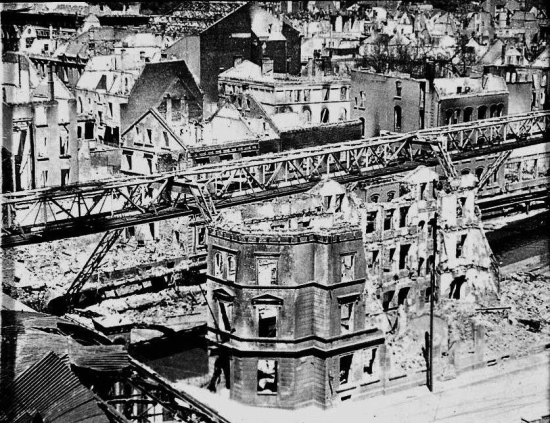
Herr Hort – presumably Dr Hort, soon after – is writing from Schwelm, eleven kilometres east of the Westphalian city of Wuppertal. To the west of Wuppertal is Düsseldorf, on the Rhine; Cologne is to the south, near where the river Wupper flows into the Rhine. To the north of Wuppertal is the Ruhr Valley, Germany’s western industrial heartland. Between Düsseldorf and Wuppertal is Neandertal/Neanderthal. Most of the journey between Wuppertal and Schwelm can be taken on the ‘world-famous in Westphalia’ Wuppertal Schwebebahn, the suspension railway, built between 1897 and 1903, which runs above the Wupper River. I am privileged to have ridden on that railway in 1984.
I have no idea what Theodor Hort’s fate was. Maybe he was recruited for the notorious Einsatzgruppen, which was top-heavy with academic doctors? More likely he turned away, at least in his mind, from the excesses of the New Germany; nevertheless serving his country in some capacity, albeit out of the kind of obligation that would have been hard to refuse. There is a high chance he died during the war. I’m guessing he would have been about 35 years old in 1943.
Throughout the twentieth century, many young Australians and New Zealanders studied at the London School of Economics. (William Pember Reeves was its Director from 1908 to 1919.) So did many upper-middle-class Germans; Herr Hort clearly fell into that class-category. Other Germans to study economics at the LSE included Heinrich Brüning and Ursula von der Leyen.
Brüning was Chancellor of Germany from mid-1930 to mid-1932. Brüning was the centrist politician most associated with the economic collapse of Weimar Germany during the Great Depression, thanks to his ‘liberal’ policies of stubborn fiscal conservatism. He sought to balance the Budget at any cost. Germany and the world paid a very high cost indeed. I understand that the “unchecked liberalism” Hort refers to is the economic liberalism of Brüning and others (think today’s neoliberalism), and not so much the social liberalism of Berlin that was an icon of 1920s’ Germany. (As a part of that social liberalism, Germany in 1918 – Germany’s first annus horribilis last century – became a proper democracy, with proportional representation, and votes for women.)
I would imagine that Hort’s parents would have voted for Bruning’s Zentrum (Centre) party. While it started as a Catholic party, it was actually the foundation party of German ‘Christian Democracy’, having already broadened its base by 1930. Westphalia, Düsseldorf and Cologne represented the West German heartland of centrist Christian Democratic politics. And consistently these places cast the fewest votes for Adolf Hitler’s party. (The city of Cologne, the least-Nazi-supporting city in Germany, was the first large German urban centre to be carpet-bombed by the British, in 1942.)
Nevertheless, at least in March 1933, young Herr Theodor probably voted for the National Socialists. (Although his “great leader” epithet was probably a direct translation of ‘führer’ rather than an expression of devotion.) The Enabling Act of 1933, which ended democracy in Germany, had been in force for three months before Herr Hort wrote this letter. He, like many others in a desperate country, was willing to forego democracy if other goals might better be achieved without it. Further, by 1938, Hitlernomics – borrowing ‘as much as it takes’ to re-arm and reorganise along Spartan lines – was looking like a great success. (Something suspiciously similar took place in the Bundestag in 2025, exactly 92 years after the Enabling Act, using the outvoted ‘lame-duck’ parliament to get the necessary two-thirds majority. This time it was the ‘fascists’ – AFD – who were against borrowing to re-arm; and the outvoted fastidiously-anti-borrowing neoliberal FDP, who should not have been there.)
Finally, here, we should note that Germany as a whole – and certainly western Germany – while Judeophobic, was probably no more Judeophobic than other European countries (including the USA); and that most German Jews, to 1918 at least, had seen themselves as more Germans than Semites, and played a significant role in the German armed forces in World War One. The circumstances of 1918, however, made it a relatively easy task for would-be-politicians with nationalist agendas to scapegoat Jews. There were vastly more Jews living in the countries east of Germany, and they from 1940 to 1944 ended up being very much in the wrong place at the wrong time. In Germany in 1933, ‘Jewish’ identity was used very much as proxies for the twin-devils who many Germans believed had ‘stabbed Germany in the back’ in 1918 (at a time when Germany appeared to be winning on the western front) and again in (and around) 1931; ‘Bolshevik’ Communists and big-finance capitalists. The 1918 claim of a ‘stolen war’ was an evidentially-false conspiracy theory which had the appearance of credibility to many desperate people looking for simple answers, and scapegoats.
On the Bolshevik matter, while Theodor Hort and others will not have known about it until much later – the winter of 1932/33 was the peak of the Holodomor where four million mainly-Ukrainians were deliberately starved to death by Josef Stalin’s Moscow-based regime. Too many elements of the western press were looking the other way. Soviet Communism was being romanticised in certain middle-class and working-class circles in ‘the West’ (though demonised in others: refer Three Women who Launched a Movement); the mega-atrocities were downplayed by mainstream journalists such as Walter Duranty.
It was the full discovery in 1939 of the Holodomor and the later Great Purge(s) that enabled the Nazis to contemplate an even worse genocide, a substantial part of which became the Shoah. The Shoah, while the worst genocide ever, was neither the first nor the last real-world example of ‘hunger games’ in the last 100 years.
*******
Keith Rankin (keith at rankin dot nz), trained as an economic historian, is a retired lecturer in Economics and Statistics. He lives in Auckland, New Zealand.
Keith Rankin, trained as an economic historian, is a retired lecturer in Economics and Statistics. He lives in Auckland, New Zealand.
Yesterday I listened to RNZ’spolitical commentators. The principal topic was an aspect of the recently released May 2025 international migration. Kathryn Ryan starts by reminding us of the “old saying, would the last person to leave New Zealand please turn out the lights” (a saying which has been used in places other than Godzone).
The latest figure for net immigration was an inflow of 14,800; a net gain. But you wouldn’t have realised this. Ryan went on to say there’s a big migration outflow underway right now. And she’s correct if you only count New Zealand citizens. (Non-NZ citizens are people too; indeed, in that timeframe, 53,400 non-NZ citizens emigrated!)
Kathryn Ryan said there was a net loss of 30,000. There was actually a (provisional) net loss of 46,300 NZ citizens. (Possibly she – or her producer – had subtracted the all-migrant net inflow from the net loss of New Zealand citizens, having interpreted the overall 14,800 net inflow as a net inflow of non-NZ citizens.) In fact, this 46,300 net loss of NZ citizens was offset by a net gain of 61,100 non-NZ citizens.
(We should also note that total arrivals – not just people classified as ‘immigrants’ – in the year to May 2025 exceeded total departures by 3,797; less than the 14,800 ascribed to net international migration. The sum of total net arrivals in the six years to May 2025 was 244,000; an average of 40,000 per year.)
The total number of people who featured (in the period from June 2024 to May 2025) as either immigrants or emigrants was 264,000; that is, a number of people equivalent to five percent of New Zealand’s total population featured as either a permanent arrival or a permanent departure. This 264,000 includes 114,500 “migrant arrivals of non-NZ citizens”. Half of the 114,500 estimated permanent arrivals of non-NZ citizens were citizens of either India, China, Philippines or Sri Lanka.
In addition to getting the numbers wrong, a key problem with the framing of the RNZ migration discussion is that it rendered invisible these citizens of Asian countries; as people of Asian birth have been largely invisible in our intense discussions in recent years on binationalism. This gaze aversion by the political class is a kind of passive or casual racism. It is ethnicism to simply ignore the new New Zealanders who provide so much of our labour, and who generally perform their labour roles with professionalism and competence.
An important aspect of this problem is to ignore the ‘mammoth in the room’, that there is in Aotearoa New Zealand a substantial substitution of New Zealand born residents for non-New Zealand born residents; white citizens are leaving, brown denizens are arriving. In these latest statistics, for the year to May, there were 61,100 more new New Zealanders and 46,300 fewer old New Zealanders; 61,100 minus -46,300 equals 107,400. 100,000 is two percent of five million.
So, if 70% of New Zealand residents were NZ-born in May 2024, then about 68% of New Zealand residents will have been NZ-born in May 2025. (Just under 30 percent of New Zealanders were born overseas in March 2023, according to Statistics New Zealand.) The rate of ‘replacement’ is probably not quite that great, in that some of the citizens leaving permanently will have been naturalised rather than born in Aotearoa New Zealand. Another complicating factor is natural population growth – the excess of births over deaths – which was just over 20,000 in 2024. It would appear that about one-third of births in New Zealand (maybe more) are to mothers not themselves born in New Zealand.
Population ‘Replacement’ is a sensitive subject. The ‘far right’ in much of the Eurocentric world indulges in ‘replacement theory’, a conspiracy theory that there is a liberal “elite” (sometimes “Jewish”) agenda to replace ‘whites’ with ‘non-whites’. (There used to be a comparable case on the ‘far-left’, whereby ‘globalisation’ was interpreted as an agenda rather than a description.) The descriptive reality of today’s world is that there are disproportionately more – and substantially so – ‘brown’ and ‘black’ young people than their proportion among older age cohorts.
White people are diminishing, and non-white people are increasing in numbers. That’s not a problem. But it is perceived as a problem by many white people, especially disadvantaged white people in the economically polarised Euro world. If we tip-toe around this issue of changing global ethnic proportions, we leave the field to ‘replacement theory’ conspiracy theorists. We need to have adult conversations about the implications not just of aging populations, but also the re-culturation of our populations through demographic change.
Applying this last matter to Aotearoa New Zealand, a nation state with rapid population turnover, the overall national ‘personality’ can be largely retained so long as immigrants come from a wide range of other countries. When I was in Sydney last year, I heard a story about the emergence of India’s ‘caste system’ in Australia. This is the kind of cultural change that we do not want in New Zealand; such cultural colonisation can be averted by avoiding too much immigration from a single country. And through a process of cultural fusion, rather than either assimilation or the emergence of cultural silos.
*******
Keith Rankin (keith at rankin dot nz), trained as an economic historian, is a retired lecturer in Economics and Statistics. He lives in Auckland, New Zealand.
Keith Rankin, trained as an economic historian, is a retired lecturer in Economics and Statistics. He lives in Auckland, New Zealand.
I just heard on Radio New Zealand a claim by a British commentator, Hugo Gye (Political Editor of The i Paper), that the United Kingdom (among other countries) has a major public debt crisis, and that if nothing is done about it (such as what Rachel Reeves – Chancellor of the Exchequer – is wanting to do), then in 2070 the public debt to GDP ratio would reach an ‘extreme’ level of 270% of GDP (gross domestic product). He added for good measure that no country in the world has public debt at a level anything like that. (Refer UK: Macron meets the King, RNZ, 10 July 2025.)
So I checked the International Monetary Fund, World Economic Outlook Database, April 2025, and found the following about Japan, the world’s fourth-largest national economy, looking at years from 2010 to 2024, with respect to government gross debt and general government financial deficit:
minimum debt206% (in 2010)
maximum debt 258% (in 2020)
average debt 234%
current debt 237% (in 2024)
projected debt 232% (in 2030)
minimum deficit 2.3% (in 2023)
maximum deficit 9.1% (in 2010)
average deficit 5.3%
current deficit 2.5% (in 2024)
projected deficit 5.3% (in 2030)
Japan does not have a ‘cost of living crisis’. Below is a list of Japan’s interest (source: tradingeconomics.com) and inflation rates (again the reference period is 2010 to 2024):
minimum interest-0.1% (in 2016-2024)
maximum interest 0.25% (in 2024)
average interest 0.0%
current interest 0.5% (in 2025)
minimum inflation -0.7% (in 2010)
maximum inflation 3.3% (in 2023)
average inflation 0.9%
current inflation 2.4% (in 2025)
projected inflation 2.0% (in 2030)
Japan is a prosperous country, with high life expectancy (85, the highest in the world for large economy nations), a very high ratio of retired people to working-age people, low inflation, and low interest rates. It was able to host the Olympic Games in 2021 without any financial fuss, and is about to host World Expo 2025. It has some of the world’s most sophisticated infrastructure.
Despite its high government debt – actually, to a large extent because of its high government debt – Japan’s is a creditor economy. Japan is not in debt to the rest of the world. Japan’s national debt is non-existent. Japan’s government debt is widely acknowledged, however, to be the world’s highest. Too many commentators – using wilful laziness – conflate national debt with government debt.
Japan’s is the world’s most successful twenty-first century large economy. It operates by Japanese savers lending much of their savings to their government at very low interest rates; those savers prefer to lend to their government rather than to pay high taxes to their government. Prosperous Japanese people are not greedy in the way that many rich westerners are. Their mantra is ‘private wealth, public wealth’; not ‘private wealth, public poverty’. Japan’s is not a zero-sum economy; in a zero-sum economy the prosperity of some comes at the expense of the impoverishment of others.
Hugo Jye was negligently dishonest – a case of wilful blindness or ignorance – in claiming that no countries had anything like 270% of GDP government debt. Western economists and financial commentators are likewise wilfully negligent in failing to alert their countries’ governments that there is an alternative – in plain sight – to our woeful policies of financial suffocation.
Note about three other economies
Within the European Union, it is rare for professional commentators to sing the praises of Spain and Italy. Spain, with 101% public debt, is enjoying a low inflation economic boom. It has a life expectancy of 83, higher than all European Union countries other than Malta and Luxembourg. Spain has had only government budget deficits since the surpluses of the years leading up to the 2008 Global Financial Crisis (a crisis which hit Spain particularly badly). Despite – no, because of – these accumulated deficits, Spain’s public debt (as a percent of GDP) has been falling since 2020; the deficits stimulated GDP. Spain had one year of high inflation (8.3% in 2022; the next highest since 2020 were 3.05% in 2011 and 3.0% in 2021); it recovered very quickly from that one year. Spain’s current interest rate is 2.15%.
Italy had 135% government debt to GDP in 2024. Its people’s life expectancy is high, marginally lower than Spain’s and slightly higher than New Zealand’s; significantly higher than Germany, Netherlands and the United States. Italy’s economy has been growing faster than the European Union average. Its public debt (compared to GDP) has been falling despite government deficits.
Spain and Italy are doing relatively well despite having among the highest older-person to younger-person age ratios in Europe. Spain is pro-actively utilising immigrant labour, whereas Northern Europe is scapegoating immigrants. And Spain, unlike most of Europe, is not looking to its ‘Defence’ budget to boost future growth.
Türkiye’s public debt has fallen from a high (since 2006) of 40% in 2021 to under 30% in 2023. This is despite double-digit inflation since 2016 and an average budget deficit since 2011 of 5.3%. While high inflation has benefitted Türkiye by bringing about negative real interest rates (meaning interest payments effectively flow from richer to poorer, generally benefitting indebted Turkish businesses and households), current interest rate settings look like suffocating for Türkiye for the remainder of the 2020s. (This monetary policy of suffocation is also true for Australia in 2025, with its particularly hawkish Reserve Bank at present.)
Despite challenging geopolitical and climatic circumstances, Türkiye has, at least until 2024, managed to achieve rising living standards for a substantial majority of its people. Unlike the United Kingdom and some northern European countries, Türkiye has not been a crisis economy despite (or because of) a reputation for unsound public finance.
*******
Keith Rankin (keith at rankin dot nz), trained as an economic historian, is a retired lecturer in Economics and Statistics. He lives in Auckland, New Zealand.
Keith Rankin, trained as an economic historian, is a retired lecturer in Economics and Statistics. He lives in Auckland, New Zealand.
It’s time that the nations of the world (or at least the influential western nations) accept the reality that all the lands that constituted 1920-1948 Mandatory Palestine should be formally recognised as a single nation-state; ideally called Palestine Israel or Israel-Palestine, but more realistically called Israel.
In other words, the never-viable notion of a two-nation-state division of ‘Israel’ (https://en.wikipedia.org/wiki/Eretz_Israel) should be dropped as a viable solution in favour of the promotion of a liberal bicultural (or multicultural) nation-state. The role model for change could be South Africa.
Jewish and Non-Jewish intellectuals (such as Hans Kohn, Shlomo Sand and Yanis Varoufakis) – on the political left – have been arguing for this ‘one-state-solution’ for over 100 years. It’s just that their voices have always been deamplified by those on the political centre and the political right. (On the centre, we think of people like Joe Biden, Keir Starmer, and their predecessors. On the right, we may consider former Israeli Prime Minister Yitzhak Shamir, a leader in the 1940s of the openly fascist Lehi, yet a moderate by today’s Israeli political standards.)
Shlomo Sand outlines the history of the arguments for a single ‘binational’ state in his 2024 book Israel-Palestine: Federation or Apartheid? His vision, which is not quite what I favour, emphasises binationalism (https://en.wikipedia.org/wiki/binationalism), and looks towards these successful liberal examples of bi- or multi- nationalism: Canada, Belgium, Switzerland.
The better framing of this approach, I believe, is biculturalism; though even that is not problem-free, because it is an exclusive concept. What I think would work best for Palestine Israel is also the same as what would work best for Aotearoa New Zealand: multiculturalism with a bicultural (treaty) emphasis. (Ireland could have become something similar, as in Irish rugby; but it went down a failed two-state path, and experienced two substantial civil wars last century.) The ideal is for Palestine Israel to become a liberal democracy in which all people born within its borders become citizens with equal citizenship rights; a nation state which commits to both the domestic and international norms of liberal democracy.
(In a bicultural nation-state, the principal divider is religion; normally people’s religious loyalties are discrete, meaning that being, say, a Muslim or Jew or Christian is mutually exclusive. The word ‘national’ is increasingly used in the 21st century as it was in the 19th century; to refer to a ‘people’ or a ‘race’ rather than to relate to a territory defined by its borders and its sovereign institutions. Ethnicity – the better word is ‘ancestry – is not a discrete concept such as ‘religion’; individual people have multiple ancestries, and should not be required to identify as one over another.)
How can this be achieved?
First, we should note that the status quo in Eretz Israel is at least as unacceptable as Apartheid South Africa was to our world of mostly ‘internationally-civilised’ nation-states. (An internationally civilised state is one that accepts agreed norms in the ways that it relates to other nation states, meaning that it does not indulge in offensive hard-power geopolitics – such as ‘gunboat diplomacy’; and it practises cultural equality. Terrorism is understood as criminality. Such a state does not have to be a ‘democracy’ in the Westminster or American sense; but it should meet open liberal standards in the ways it treats its resident denizens – non-citizens – and it should subscribe to international treaties on matters such as climate sustainability and nuclear energy and election authenticity.)
Second, this desired outcome will not come about by force. The community of liberal nations should simply recognise Eretz Israel as a nation state, based ideally on the prior borders of Mandatory Palestine.
While there should be no demands, such a new nation-state would be risking discriminatory sanctions if it abuses liberal norms; in particular if it implements laws (including civil-marriage laws) that discriminate on the basis of sex, religion, or ancestry. Again, the obvious model is Apartheid South Africa, and the ways that South Africa was excluded from international sport so long as it implemented laws which discriminated on the basis of ethnicity. (Palestinians and many Israelis have Levantine ethnicity. Many Israelis have European, African or Asian co-ethnicity; that non-indigeneity should never be held against them. Nor should the indigeneity of the Palestinians.)
In recognising Eretz Israel as Israel-Palestine (or even just under the name ‘Israel’), a Levantine nation state, Israel’s nuclear status should be addressed and normalised. (Likewise, India and Pakistan should be pressured to join the ‘nuclear club’. One of the most problematic regional asymmetries at present is the advanced nuclear-status of Israel versus the embryonic nuclear status of Iran; Israel at present hides behind its non-membership of the Treaty on the Non-Proliferation of Nuclear Weapons to make it seem that Iran is a bigger nuclear threat to the world than Israel is.)
Recognition of Eretz Israel as a sovereign nation state, under any name, should come with overt expectations of democracy, amnesty, truth, reconciliation, and press freedom. There should be no formal or informal mechanism of ‘settling scores’, no matter how reprehensible anyone’s past or present behaviour has been. Truth trumps vengeance cloaked as ‘accountability’.
Lebanon was an initially successful, but now largely failed, version of a similar attempt at creating a tolerant multicultural nation state in the Levant. Lebanon’s main problem was its belligerent southern neighbour. Israel-Palestine would not have Israel as a neighbour.
Abandon the naïve two-state solution.
There is no way a Palestinian nation-state can be viable. At the very best it could become like a mini-Pakistan or mini-Bangladesh; and even that would take decades. (And the last Israeli prime minister to formalise a two-state future – Yitzhak Rabin – was assassinated in 1995, having achieved a Nobel Peace Prize in 1994.) The two-state-solution agenda seems to be more about deescalating sufficiently for the Palestine issue to disappear from its media prominence; and not at all about ending a forever war which began in 1948.
The present forever war – now in its hottest phase – followed a brutal war for Israeli-Jewish independence and non-Jewish expulsion waged by fascist and non-fascist ‘non-state actors’ from 1939 to 1948 against the British ‘protectors’. That, in turn, followed a prior Palestinian insurrection against the British and the settlers from 1936-1939 (though overshadowed in the international media by the Spanish Civil War), which in its turn followed the 1929 Palestine riots. That’s 96 years of escalating forever violence.
In Summary
Recognise a new expanded state, with or without a new name, but with certain (unenforceable, but well-publicised) expectations. This expectation should be a multi-cultural Levantine sovereign state, embracing adherents of the three Abrahamic faiths (as well as people of other religions, or no religion, as citizens; people born in Israel or Palestine, and documented immigrants): Levantine Jews, Levantine Muslims, Levantine Christians, plus others. All Israelis. And all Palestinians.
*******
Keith Rankin (keith at rankin dot nz), trained as an economic historian, is a retired lecturer in Economics and Statistics. He lives in Auckland, New Zealand.
Keith Rankin, trained as an economic historian, is a retired lecturer in Economics and Statistics. He lives in Auckland, New Zealand.
It’s time that the nations of the world (or at least the influential western nations) accept the reality that all the lands that constituted 1920-1948 Mandatory Palestine should be formally recognised as a single nation-state; ideally called Palestine Israel or Israel-Palestine, but more realistically called Israel.
In other words, the never-viable notion of a two-nation-state division of ‘Israel’ (https://en.wikipedia.org/wiki/Eretz_Israel) should be dropped as a viable solution in favour of the promotion of a liberal bicultural (or multicultural) nation-state. The role model for change could be South Africa.
Jewish and Non-Jewish intellectuals (such as Hans Kohn, Shlomo Sand and Yanis Varoufakis) – on the political left – have been arguing for this ‘one-state-solution’ for over 100 years. It’s just that their voices have always been deamplified by those on the political centre and the political right. (On the centre, we think of people like Joe Biden, Keir Starmer, and their predecessors. On the right, we may consider former Israeli Prime Minister Yitzhak Shamir, a leader in the 1940s of the openly fascist Lehi, yet a moderate by today’s Israeli political standards.)
Shlomo Sand outlines the history of the arguments for a single ‘binational’ state in his 2024 book Israel-Palestine: Federation or Apartheid? His vision, which is not quite what I favour, emphasises binationalism (https://en.wikipedia.org/wiki/binationalism), and looks towards these successful liberal examples of bi- or multi- nationalism: Canada, Belgium, Switzerland.
The better framing of this approach, I believe, is biculturalism; though even that is not problem-free, because it is an exclusive concept. What I think would work best for Palestine Israel is also the same as what would work best for Aotearoa New Zealand: multiculturalism with a bicultural (treaty) emphasis. (Ireland could have become something similar, as in Irish rugby; but it went down a failed two-state path, and experienced two substantial civil wars last century.) The ideal is for Palestine Israel to become a liberal democracy in which all people born within its borders become citizens with equal citizenship rights; a nation state which commits to both the domestic and international norms of liberal democracy.
(In a bicultural nation-state, the principal divider is religion; normally people’s religious loyalties are discrete, meaning that being, say, a Muslim or Jew or Christian is mutually exclusive. The word ‘national’ is increasingly used in the 21st century as it was in the 19th century; to refer to a ‘people’ or a ‘race’ rather than to relate to a territory defined by its borders and its sovereign institutions. Ethnicity – the better word is ‘ancestry – is not a discrete concept such as ‘religion’; individual people have multiple ancestries, and should not be required to identify as one over another.)
How can this be achieved?
First, we should note that the status quo in Eretz Israel is at least as unacceptable as Apartheid South Africa was to our world of mostly ‘internationally-civilised’ nation-states. (An internationally civilised state is one that accepts agreed norms in the ways that it relates to other nation states, meaning that it does not indulge in offensive hard-power geopolitics – such as ‘gunboat diplomacy’; and it practises cultural equality. Terrorism is understood as criminality. Such a state does not have to be a ‘democracy’ in the Westminster or American sense; but it should meet open liberal standards in the ways it treats its resident denizens – non-citizens – and it should subscribe to international treaties on matters such as climate sustainability and nuclear energy and election authenticity.)
Second, this desired outcome will not come about by force. The community of liberal nations should simply recognise Eretz Israel as a nation state, based ideally on the prior borders of Mandatory Palestine.
While there should be no demands, such a new nation-state would be risking discriminatory sanctions if it abuses liberal norms; in particular if it implements laws (including civil-marriage laws) that discriminate on the basis of sex, religion, or ancestry. Again, the obvious model is Apartheid South Africa, and the ways that South Africa was excluded from international sport so long as it implemented laws which discriminated on the basis of ethnicity. (Palestinians and many Israelis have Levantine ethnicity. Many Israelis have European, African or Asian co-ethnicity; that non-indigeneity should never be held against them. Nor should the indigeneity of the Palestinians.)
In recognising Eretz Israel as Israel-Palestine (or even just under the name ‘Israel’), a Levantine nation state, Israel’s nuclear status should be addressed and normalised. (Likewise, India and Pakistan should be pressured to join the ‘nuclear club’. One of the most problematic regional asymmetries at present is the advanced nuclear-status of Israel versus the embryonic nuclear status of Iran; Israel at present hides behind its non-membership of the Treaty on the Non-Proliferation of Nuclear Weapons to make it seem that Iran is a bigger nuclear threat to the world than Israel is.)
Recognition of Eretz Israel as a sovereign nation state, under any name, should come with overt expectations of democracy, amnesty, truth, reconciliation, and press freedom. There should be no formal or informal mechanism of ‘settling scores’, no matter how reprehensible anyone’s past or present behaviour has been. Truth trumps vengeance cloaked as ‘accountability’.
Lebanon was an initially successful, but now largely failed, version of a similar attempt at creating a tolerant multicultural nation state in the Levant. Lebanon’s main problem was its belligerent southern neighbour. Israel-Palestine would not have Israel as a neighbour.
Abandon the naïve two-state solution.
There is no way a Palestinian nation-state can be viable. At the very best it could become like a mini-Pakistan or mini-Bangladesh; and even that would take decades. (And the last Israeli prime minister to formalise a two-state future – Yitzhak Rabin – was assassinated in 1995, having achieved a Nobel Peace Prize in 1994.) The two-state-solution agenda seems to be more about deescalating sufficiently for the Palestine issue to disappear from its media prominence; and not at all about ending a forever war which began in 1948.
The present forever war – now in its hottest phase – followed a brutal war for Israeli-Jewish independence and non-Jewish expulsion waged by fascist and non-fascist ‘non-state actors’ from 1939 to 1948 against the British ‘protectors’. That, in turn, followed a prior Palestinian insurrection against the British and the settlers from 1936-1939 (though overshadowed in the international media by the Spanish Civil War), which in its turn followed the 1929 Palestine riots. That’s 96 years of escalating forever violence.
In Summary
Recognise a new expanded state, with or without a new name, but with certain (unenforceable, but well-publicised) expectations. This expectation should be a multi-cultural Levantine sovereign state, embracing adherents of the three Abrahamic faiths (as well as people of other religions, or no religion, as citizens; people born in Israel or Palestine, and documented immigrants): Levantine Jews, Levantine Muslims, Levantine Christians, plus others. All Israelis. And all Palestinians.
*******
Keith Rankin (keith at rankin dot nz), trained as an economic historian, is a retired lecturer in Economics and Statistics. He lives in Auckland, New Zealand.
Keith Rankin, trained as an economic historian, is a retired lecturer in Economics and Statistics. He lives in Auckland, New Zealand.
The United States has always fancied itself as the founder of modern democracy (aka ‘Democracy’). And, although that country has been self-absorbed for most of its history, it has always sensed that Democracy was its greatest export.
‘America’ became involved in Africa and the ‘Middle East’ very early in its history. There was the American–Algerian War (1785–1795); and the Barbary Wars (1801-1805,1815), featuring the heroic re-seizure and scuttling by fire of the USS Philadelphia in Tripoli Harbor in 1804. Then there was the reverse colonisation (aka ‘liberation’, ‘democratization’) of a small corner of Africa from 1822, leading to Liberia’s independence in 1862.
In the 1846, there was the small matter of the United States’ invasion of Mexico, resulting in the 1848 annexation of half of Mexico’s territory. ‘America’ brought Democracy to California, through annexation. And, in 1898, the United States appropriated Spain’s remaining worldwide empire, including the Philippines. And some other territories, including Hawaii. Upon his inauguration as the 47th President, Donald Trump explicitly invoked the memory of President William McKinley, America’s most notorious annexor of foreign territory.
And in 1889: “Three American warships then entered the Apia harbor and prepared to engage the three German warships found there. Before any shots were fired, a typhoon wrecked both the American and German ships.” After ten years of military/political stalemate – known as the Second Samoan Civil War – the Samoan ‘assets’ were split between the United States, the German Second Reich, and the United Kingdom. (The UK traded its share with Germany. Britain gave up all claims to Samoa and in return accepted the termination of German rights in Tonga, certain areas in the Solomon Islands, and Zanzibar.)
America’s imperial ‘burden’ in the last 125 years
Rudyard Kipling’s poem The White Man’s Burden was written in 1899; “a poem about the Philippine–American War (1899–1902) that exhorts the United States to assume colonial control of the Filipino people and their country”.
America’s empire today is partly formal, though mostly informal, with various grades of informality. Indeed, the recent acknowledgement by the European Union that it has free-ridden on the United States for its defence indicates that the United States has had a significant degree of imperial control over Europe; hegemony manifesting as control over foreign policy.
The name ‘America’ itself is an imperial grab. America is the name for two continents, yet even the Canadians call the United States ‘America’, and its citizens ‘Americans’. American exceptionalism represents the weaponisation of democracy. Democracy is packaged as ‘Democracy’, a secular faith like ‘Communism’ or ‘Economic Liberalism’; a faith which must be proselytised, spread across the world as some kind of holy or secular crusade.
The remaining territories on the ‘autocratic’ ‘Dark Side’ – ie territories not subject to United States’ ‘protection’ – are mainly in continental Asia: especially West Asia (much of which is imperialistically called the ‘Middle East’, which extends to North Africa), North Asia, and East Asia. Though there is also very much a contest for South Asia; a contest, which if successful for the White Man’s force, will bring secular Hindi along with secular Judaism fully into the imperial fold of secular Christianity. (We note that the labels Hindu and Jew have long been name-tags which confuse and conflate religion with ethnicity. So it may soon be with Christianity; with top-tier Christians behaving very much as top-tier Jews behave today, as supremacist gift-givers and bomb-throwers.)
We should note that Catholic Christianity is now uneasy about this crusader culture, having been the main perpetrator of such culture nearly a millennium ago. And Orthodox Christianity is even more uneasy. In its North Asian (ie Russian) form, Orthodox Christianity – like Islam, and Chinese atheist capitalism – is a target of the present Christian Soldiers, not a collaborator. (The decline of the Christian East came with the Fourth Crusade in 1204. Ostensibly a western invasion force going to re-recover the ‘Holy Land’, instead that Crusade turned on Orthodox Christian Constantinople. The result was a weak Latin empire in the east; easy prey for the Ottoman forces which in 1453 created a Muslim empire in West Asia and Southeast Europe; an empire that lasted until 1918.)
The modern American-led crusading mentality represents a schism of Protestant Evangelism (which dates back in particular to the Calvinist side of the sixteenth century Reformation) and Secular Liberalism. Protestant Evangelism (increasingly known today as Christian Nationalism) is the imperial currency of today’s Republican Party, whereas Secular Liberalism is the imperial currency of today’s Democratic Party (although secular Neoliberalism is presently teaming up with the Evangelists). What both have in common is a will to impose themselves upon the rest of the world. And to produce and export lots of big guns, military hardware; making money, and making American jobs.
There are some strange bedfellows. As these two American socio-cultural Gods – Republican and Democrat; protagonist and antagonist, and vice versa – have battled out their Americanisms on a world stage, we have seen a significant posse of very rich devout Economic Liberals taking the side of the Christian Nationalists. So do a number of working-class and other disempowered former ballot-box ‘Leftists’, who wish to cast an anti-establishment vote but don’t know which way to turn. This dabbling with new right-radicalism (not unlike leftist dabbling in New Zealand in 1984 with the recently late Bob Jones’ New Zealand Party) follows the slow but comprehensive gutting of the Left-project that was so buoyant in the 1960s and 1970s.
The name Christian Nationalism is a misnomer; a better name is Christian Extranationalism. Rather than being an internationalist movement – internationalism is a liberal concept – this is a movement to perpetuate and extend the global domination of American culture, through imperial merchant capitalism. The United States was born out of British merchant capitalism (and New York out of Dutch merchant capitalism); its values and institutions reflect those of eighteenth-century western Europe. Just as the British exacted tribute from their American colonies; imperial America seeks to extract tribute through the ‘negotiation’ of asymmetric ‘deals’. Are we today witnessing an American Napoleon?
Money, Lies and God: by Katherine Stewart (2025)
Katherine Stewart this year has written about the new eclectic rightwing coalition in the United States that is coalescing under the name of Christian Nationalism. Though I’ve only read the introduction so far, the book has a real strength, in particular in identifying five components of this new new-right coalition: funders, thinkers, sergeants, infantry, power-players.
Of particular interest to me is the “out-sourced” relationship between the funders and the thinkers. While Stewart emphasises the ‘thinkers’ in the well-funded (and mostly conservative) ‘Think Tanks’, the real issue is that of ‘selective truth’, in the Darwinian sense of ‘selection’. Our ‘intellectual’ careerists compete to publish ‘truths’, and the truths which prevail will be the truths purchased by the ‘funders’, given that the funders have most of the funds.
This kind of relationship with truth is somewhat like a ‘court-of-law’, where commonly two ‘truths’ are subject to a contest in which one will be declared ‘the winner’. Not uncommonly, both rival ‘truths’ are at least partially false, and there may be other (possibly truer) truths that are not even ‘on the table’. Evidence represents a part of the court process, but by no means the whole of that process. The truth-relationship between the funders and thinkers is a corrupt form of the ‘law court’ model; the more corrupt the more wealth the conservative funders control. Academic careers – indeed scientists’ careers – are built on perpetuating narratives acceptable to their patrons.
While Money, Lies and God represents a prescient and useful analysis, ultimately it is part of the problem. It represents one side of the great American divide calling out the other side. The process of belligerent finger-pointing – between, in American language, ‘liberals’ and ‘conservatives’ – is the bigger problem. Why bother talking about the world when you can talk about half of America instead? Indeed, too many American intellectuals talk and write about the United States as if America is the World; a kind of mental imperialism. (Another critique of American ‘Christian Nationalism’ can be found in a recent Upfront episode on Al Jazeera: The growing influence of Christian Nationalism and Christian Zionism in the United States.)
The problem of American imperialism belongs to both sides of the Divide; indeed, it is the Secular Liberalism of what has been exposed as the tone-deaf establishment – the Blinkens, Bidens and Nods – who represented the moral hypocrisy of America’s imperial democratic gift. (The sheer stupidity of the Biden re-election campaign is documented in Original Sin, 2025, by Jake Tapper and Alex Thompson.) That is, the belief that America created modern Democracy, and that those parts of the world – especially the ‘western’ world – have special rights accruing to them because they have been awarded the ‘tick of Democracy’. These countries – and only these countries – have the “right to defend themselves”, the right to make war (as ‘defence through attack’), and the “right to possess nuclear weapons”.
Contemporary American imperialism is mainly a ‘West on East’ phenomenon; Asia is the target. Ukraine and Anatolia (Türkiye) are border territories between Europe and Asia. Palestine, perhaps too, given its location on the Mediterranean Sea; though the Mediterranean littoral, from Istanbul to Morocco, is better understood as West Asia, not Europe. Iran is unambiguously a part of Asia. What we are seeing at present is nothing less than a Euro-American invasion of Asia. Imperialism. Nuclear imperialism; geopolitical imperialism; cultural imperialism. The gift that keeps on taking.
Note on the boundary between Europe and Asia
We should note that the core geopolitical boundary between Europe and Asia was set by Charlemagne in around the year 800; representing the border between the predominancies of Catholic Christianity and Orthodox Christianity (harking back to the Western and Eastern Roman Empires). There are other important historic geopolitical boundaries in Eurasia, of course, such as the eastern and southern borders of Orthodox Christianity; and the eastern and northern borders of Islam-dominated territories. Indeed there is perpetual tension on the Pakistan-India border.
The principal medieval-era departure from that Charlemagne-set geopolitical boundary was the Grand Duchy of Lithuania, which peaked in territory in the fifteenth century. The first significant modern-era fudge of that geopolitical boundary was the West’s acquisition of Greece over the long 19th century (essentially 1820s to 1920s). The Great World War started in 1914 very much as an East-West border conflict in the Balkans of southeast Europe. After a week or two of fudging, the anglosphere took the Eastern side; siding with Russia over Austria and Germany.
Post World War Two, the next main geopolitical border fudges were the ‘settlements’ which placed a number of mainly Catholic East European countries into Russia’s orb; and which placed Türkiye (then Turkey) into NATO. The current twenty first century fudge is one of European expansion, placing a number of predominantly Orthodox territories – most notably Ukraine – firmly into the European political realm.
This longstanding geopolitical boundary contrasts with the widely-accepted geographic boundary; the latter – based more on physical geography and ethnicity than on faith-culture – passes along the Ural and Caucasus mountain chains, and through the lower Volga River, the Black Sea and the Bosporus/Dardanelle channels. Geopolitically, Russia, Belarus and Türkiye should be understood today to be Asian countries; indeed, the lower Dnieper River and line of the military trenches in Zaporizhia, Donetsk and Luhansk constitute the current geopolitical boundary between West and East; between Europe and Asia. And the lines within Eretz Israel – separating Israel from Palestine – also represent geopolitical borders; and American geopolitical encroachment on Asia.
*******
Keith Rankin (keith at rankin dot nz), trained as an economic historian, is a retired lecturer in Economics and Statistics. He lives in Auckland, New Zealand.
Keith Rankin, trained as an economic historian, is a retired lecturer in Economics and Statistics. He lives in Auckland, New Zealand.
Is history binary? A judge of past behaviour with just two available options: thumbs-up, or thumbs-down? If you are not on the ‘right side’ of history, are you therefore on the ‘wrong side’?
Can there be a ‘right side of history’? Given the contexts that we now proclaim to be the right or wrong sides of history, can we presume to evaluate future judgements of our behaviours as ‘history’? And, if we can, is ‘history’ about morals, or momentum; or, prosaically, is she just about facts? Can you (or we) ride history, like a wave? Clio, in Greek mythology, is the muse of history. She is not a straightforward lady.
Are politicians who support, by word or deed, fascists (or racists or any other obviously nasty ‘ists’) in another country ‘on the wrong side of history’ or could they be ‘riding a historical wave’? I am reminded of the Hitler youth singing ‘Tomorrow Belongs to Me’ in the musical cabaret. In Natacha Butler’s report (Al Jazeera 10 June 2025, Europe’s far-right leaders, hosted by Marine Le Pen, rally in France) she notes “the conviction [by ‘far-right’ protesters] that history is on their side”.
History as Momentum
Whoever participates in a social or political movement believes that their movement will become sufficiently consequential for those in the future to believe that the movement affected the course of history. So, the Hitler youth were correct, in the sense that their movement made their tomorrow different to what it would otherwise have been. The Hitler youth, though, were expecting a favourable judgement by ‘us’ in 2025. Clearly, we judge their movement in highly unfavourable terms, while accepting that the world at the end of the twentieth century mighthave been a better world than the world would have been had Adolf Hitler been killed in combat in the Great World War in1918. Problematic, though, is the whole subjective idea of a ‘better world’; better for whom?
An important example of historicism, or alleged historical momentum, is the writings of Karl Marx. He thought he was writing scientific history, of ‘historical materialism’, and many people believed him; a few still do. Marx fused classical Ricardian economics – the intellectual ancestor of today’s neoliberal macroeconomics – with the philosophical historicism of Georg Hegel. Josef Stalin, and others in his intellectually unaccommodating mould, killed people who spun different (or nuanced) stories of past or future history.
History as a Judge
From a judgment perspective, we place much weight on academic historians in the medium-term future to make (for all time) the correct verdict events in the present, immediate past, and immediate future.
Whether or not Clio is qualified to judge as ‘good’ or ‘bad’ past events, people, or movements, we today can evaluate Clio today – or at least her mortal disciples – on her performance so far.
Two of many issues we could look into are, first, Winston Churchill and the World War Two bombing campaigns by the ‘Allies’, and our present understanding of the Great Depression of the 1930s.
Churchill, more than most political leaders, features in many separable stories in history. His role in pursuing the Gallipoli campaign in 1915 has generally been awarded a ‘thumbs-down’. Likewise, his role as Chancellor of the Exchequer in 1925, when he decided to fix the British pound to gold at the overvalued pre-war (1914) exchange rate; this decision was one of the key events that led the world into the Great Depression.
However, most post-war judgement of Churchill has focussed on his role as an opponent of ‘appeasement’ in 1938, and on his role as Great Britain’s leader for the majority of World War Two (though he had been removed as Britain’s leader, in a landslide electoral defeat, by the time the atomic bombs fell on Japan). On the ‘appeasement’ matter, Neville Chamberlain continues to be the epitome of someone ‘on the wrong side of history’, with Churchill on the ‘right side’.
Churchill had his own personal political agenda in 1938; his lifelong pursuit of the glory of the British Empire. Churchill’s principal strategic interest was to maintain the Mediterranean Sea as ‘Britain’s Lake’; substantially but not only because it represented Britain’s sea passage to India. So many of his actions in World War Two can best be understood in terms of what he was fighting for, not what he was fighting against.
In 1938, the alternatives to the ‘appeasement’ of Hitler were to abstain in the face of Nazi Germany’s clear-and immediate-threat to East Europe (a part of the non-Mediterranean world that Churchill was not interested in), or to threaten to declare war against Germany knowing that Britain couldn’t act on its threat and thereby risked revealing its weakness. (In the summer of 1939, Britain did reveal its weakness to Josef Stalin, who then relayed that information onto Hitler at the end of August, allowing Hitler to invade Poland in the sure knowledge that Britain had no military capacity to come to Poland’s aid. Chamberlain’s allowing that ‘information leak’ to happen was surely a bigger mistake than his 1938 Munich Accord with Hitler.) And we note that Churchill said that, rather than ‘peace in our time’, there “would be war”.
Churchill did not claim that any of the alternative choices that Chamberlain faced could or would have prevented war. Unless, that is, Chamberlain had been able to terrify Hitler into not going ahead with his military plans. (Hitler would have been more likely to liken threats by Chamberlain to ‘being mauled by a mouse’; a famous if somewhat forgotten witticism of our own Robert Muldoon, speaking in reference to Opposition leader Bill Rowling.)
Realistically, Hitler was never going to commit to putting his military toys away. I think that, in light of the alternatives, Chamberlain made the right call in 1938; he hoped that he had restricted Hitler’s military ambitions to the acquisition of territory inhabited by German-speaking people.
On the matter of the Allied bombing campaign, being willing to commit unspeakable aerial executions upon tens of millions of ‘enemy’ civilians, history has largely been silent; those (over a million) who were actually barbecued by the Allies fell well short of those who Churchill’s ‘scientific adviser’ and onetime ‘best friend’ Friedrich Lindemann would have liked to have ‘dehoused’. (See my Barbecued Hamburgers and Churchill’s Bestie, 17 Apr 2025.) We cannot rely on academic historians to counter decades of myth; in part because we have too few competent historians, and in part because historians hunt in packs and are as liable to fall under the sway of the zeitgeists of their eras as are the rest of humanity’s intellectual communities.
Despite Churchill’s firebombing efforts, most of which took place in the early months of 1945, it was American bombing specialist Curtis LeMay who became barbecuer-el-supremo. (See my Who Executed 100,000 Civilians in a Single Night?) In 1945, and mainly through his own initiative, he burned more Japanese civilians to death than those who died from the atomic bombs. Was Curtis LeMay on the right side of history? The Japanese ruling class thought so in 1964; LeMay had helped to make the new Japan possible. The Emperor had been saved, as an emperor without an empire. And Japan had been saved from Stalin’s advances, advances that stopped at Korea, Sakhalin, and the Kuril Islands.
We note that the worst of the Allies’ terror campaign took place towards the end of the war, when the ‘evil’ Axis was in no position to reciprocate. Inherently, such crimes – on the scale that ‘we’ perpetrated them – are asymmetric warfare. Killing your enemies’ civilians seemingly grants your enemies a moral right to kill your civilians. I think that no party who commits those kinds of war crimes can ever be on ‘the right side of history’; though some other people may take more convincing. To compound the criminality of the Allied bombing campaign, it was ineffective, because World War Two was already asymmetric; the main turning points were Hitler’s foolish declaration of war against the United States, and the Battle of Stalingrad in the latter part of 1942. World War Two could have been ended much more quickly with carrot than with stick, by finding suitable ways for the retreating powers to ‘save face’. Truth and reconciliation always trump vengeance. Yet so many horrendous “killings of civilians to [allegedly] save ‘our’ soldiers” remain either on the ‘right side of history’ or concealed from view, obviating the popular requirement to cast judgement.
The Great Depression was still much in historical memory in the 1970s and 1980s. In the 1930s, Josef Stalin and his comrades believed this was the beginning of the end of the capitalist world; and he executed any economists (eg Nikolai Kondratiev) who suggested otherwise. At the time, a number of progressive western economists (eg Alvin Hansen) to an extent agreed with Stalin.
However, in the 1970s, a group of extremist ‘Chicago’ economists and economic historians – Milton Friedmanwould lay claim to being both an economist and a historian – successfully committed on the world an intellectual coup-d’etat which would distract the historical community from reality. Friedman’s coupsters scapegoated the United States Federal Reserve Bank (on the basis of a few quite minor ‘mistakes’ in monetary policy in 1929 and 1930). The net result was that the real culprits, the fiscal conservatives, escaped the condemnation of history.
The Friedmanites, and their ‘intellectual’ descendants, have claimed the ‘right side of history’; claiming victories (without convincing counterfactuals) in the alleged titanic battle between the ‘inflation monster’ and the battlers of the ‘lower middle classes’. These faux historians claimed that small “mistakes” in monetary policy in 2003/04 and 2021/22 have been the predominant causes of the 2008/09 ‘global financial crisis’ and the 2022 to 2024 ‘cost of living’ crisis. When it comes to macroeconomics and macroeconomic policy, this writing of consumable history is about as pathetic (as intellectual history) as the claims of the Holocaust-deniers, or of the people (such as Herr Hitler) who claimed that Germany was ‘stabbed-in-the-back’ by international Jewry in 1918.
Clio is a muse to be loved and cultivated. She gives much, but rarely in simplistic right-wrong terms; and she changes her mind, in response to both new information and new zeitgeists. Whereas Hitler’s Nazis burned the books they didn’t like – and many other books besides – Aotearoa’s fiscal conservatives are looking for a whimper – a tearless shredding – rather than a blaze. And our remaining unshredded public collections, our memories – our abilities to evaluate the rights and the wrongs and the waves of our national and international pasts – stand to depreciate, to wither.
*******
Keith Rankin (keith at rankin dot nz), trained as an economic historian, is a retired lecturer in Economics and Statistics. He lives in Auckland, New Zealand.
Keith Rankin, trained as an economic historian, is a retired lecturer in Economics and Statistics. He lives in Auckland, New Zealand.
Is history binary? A judge of past behaviour with just two available options: thumbs-up, or thumbs-down? If you are not on the ‘right side’ of history, are you therefore on the ‘wrong side’?
Can there be a ‘right side of history’? Given the contexts that we now proclaim to be the right or wrong sides of history, can we presume to evaluate future judgements of our behaviours as ‘history’? And, if we can, is ‘history’ about morals, or momentum; or, prosaically, is she just about facts? Can you (or we) ride history, like a wave? Clio, in Greek mythology, is the muse of history. She is not a straightforward lady.
Are politicians who support, by word or deed, fascists (or racists or any other obviously nasty ‘ists’) in another country ‘on the wrong side of history’ or could they be ‘riding a historical wave’? I am reminded of the Hitler youth singing ‘Tomorrow Belongs to Me’ in the musical cabaret. In Natacha Butler’s report (Al Jazeera 10 June 2025, Europe’s far-right leaders, hosted by Marine Le Pen, rally in France) she notes “the conviction [by ‘far-right’ protesters] that history is on their side”.
History as Momentum
Whoever participates in a social or political movement believes that their movement will become sufficiently consequential for those in the future to believe that the movement affected the course of history. So, the Hitler youth were correct, in the sense that their movement made their tomorrow different to what it would otherwise have been. The Hitler youth, though, were expecting a favourable judgement by ‘us’ in 2025. Clearly, we judge their movement in highly unfavourable terms, while accepting that the world at the end of the twentieth century mighthave been a better world than the world would have been had Adolf Hitler been killed in combat in the Great World War in1918. Problematic, though, is the whole subjective idea of a ‘better world’; better for whom?
An important example of historicism, or alleged historical momentum, is the writings of Karl Marx. He thought he was writing scientific history, of ‘historical materialism’, and many people believed him; a few still do. Marx fused classical Ricardian economics – the intellectual ancestor of today’s neoliberal macroeconomics – with the philosophical historicism of Georg Hegel. Josef Stalin, and others in his intellectually unaccommodating mould, killed people who spun different (or nuanced) stories of past or future history.
History as a Judge
From a judgment perspective, we place much weight on academic historians in the medium-term future to make (for all time) the correct verdict events in the present, immediate past, and immediate future.
Whether or not Clio is qualified to judge as ‘good’ or ‘bad’ past events, people, or movements, we today can evaluate Clio today – or at least her mortal disciples – on her performance so far.
Two of many issues we could look into are, first, Winston Churchill and the World War Two bombing campaigns by the ‘Allies’, and our present understanding of the Great Depression of the 1930s.
Churchill, more than most political leaders, features in many separable stories in history. His role in pursuing the Gallipoli campaign in 1915 has generally been awarded a ‘thumbs-down’. Likewise, his role as Chancellor of the Exchequer in 1925, when he decided to fix the British pound to gold at the overvalued pre-war (1914) exchange rate; this decision was one of the key events that led the world into the Great Depression.
However, most post-war judgement of Churchill has focussed on his role as an opponent of ‘appeasement’ in 1938, and on his role as Great Britain’s leader for the majority of World War Two (though he had been removed as Britain’s leader, in a landslide electoral defeat, by the time the atomic bombs fell on Japan). On the ‘appeasement’ matter, Neville Chamberlain continues to be the epitome of someone ‘on the wrong side of history’, with Churchill on the ‘right side’.
Churchill had his own personal political agenda in 1938; his lifelong pursuit of the glory of the British Empire. Churchill’s principal strategic interest was to maintain the Mediterranean Sea as ‘Britain’s Lake’; substantially but not only because it represented Britain’s sea passage to India. So many of his actions in World War Two can best be understood in terms of what he was fighting for, not what he was fighting against.
In 1938, the alternatives to the ‘appeasement’ of Hitler were to abstain in the face of Nazi Germany’s clear-and immediate-threat to East Europe (a part of the non-Mediterranean world that Churchill was not interested in), or to threaten to declare war against Germany knowing that Britain couldn’t act on its threat and thereby risked revealing its weakness. (In the summer of 1939, Britain did reveal its weakness to Josef Stalin, who then relayed that information onto Hitler at the end of August, allowing Hitler to invade Poland in the sure knowledge that Britain had no military capacity to come to Poland’s aid. Chamberlain’s allowing that ‘information leak’ to happen was surely a bigger mistake than his 1938 Munich Accord with Hitler.) And we note that Churchill said that, rather than ‘peace in our time’, there “would be war”.
Churchill did not claim that any of the alternative choices that Chamberlain faced could or would have prevented war. Unless, that is, Chamberlain had been able to terrify Hitler into not going ahead with his military plans. (Hitler would have been more likely to liken threats by Chamberlain to ‘being mauled by a mouse’; a famous if somewhat forgotten witticism of our own Robert Muldoon, speaking in reference to Opposition leader Bill Rowling.)
Realistically, Hitler was never going to commit to putting his military toys away. I think that, in light of the alternatives, Chamberlain made the right call in 1938; he hoped that he had restricted Hitler’s military ambitions to the acquisition of territory inhabited by German-speaking people.
On the matter of the Allied bombing campaign, being willing to commit unspeakable aerial executions upon tens of millions of ‘enemy’ civilians, history has largely been silent; those (over a million) who were actually barbecued by the Allies fell well short of those who Churchill’s ‘scientific adviser’ and onetime ‘best friend’ Friedrich Lindemann would have liked to have ‘dehoused’. (See my Barbecued Hamburgers and Churchill’s Bestie, 17 Apr 2025.) We cannot rely on academic historians to counter decades of myth; in part because we have too few competent historians, and in part because historians hunt in packs and are as liable to fall under the sway of the zeitgeists of their eras as are the rest of humanity’s intellectual communities.
Despite Churchill’s firebombing efforts, most of which took place in the early months of 1945, it was American bombing specialist Curtis LeMay who became barbecuer-el-supremo. (See my Who Executed 100,000 Civilians in a Single Night?) In 1945, and mainly through his own initiative, he burned more Japanese civilians to death than those who died from the atomic bombs. Was Curtis LeMay on the right side of history? The Japanese ruling class thought so in 1964; LeMay had helped to make the new Japan possible. The Emperor had been saved, as an emperor without an empire. And Japan had been saved from Stalin’s advances, advances that stopped at Korea, Sakhalin, and the Kuril Islands.
We note that the worst of the Allies’ terror campaign took place towards the end of the war, when the ‘evil’ Axis was in no position to reciprocate. Inherently, such crimes – on the scale that ‘we’ perpetrated them – are asymmetric warfare. Killing your enemies’ civilians seemingly grants your enemies a moral right to kill your civilians. I think that no party who commits those kinds of war crimes can ever be on ‘the right side of history’; though some other people may take more convincing. To compound the criminality of the Allied bombing campaign, it was ineffective, because World War Two was already asymmetric; the main turning points were Hitler’s foolish declaration of war against the United States, and the Battle of Stalingrad in the latter part of 1942. World War Two could have been ended much more quickly with carrot than with stick, by finding suitable ways for the retreating powers to ‘save face’. Truth and reconciliation always trump vengeance. Yet so many horrendous “killings of civilians to [allegedly] save ‘our’ soldiers” remain either on the ‘right side of history’ or concealed from view, obviating the popular requirement to cast judgement.
The Great Depression was still much in historical memory in the 1970s and 1980s. In the 1930s, Josef Stalin and his comrades believed this was the beginning of the end of the capitalist world; and he executed any economists (eg Nikolai Kondratiev) who suggested otherwise. At the time, a number of progressive western economists (eg Alvin Hansen) to an extent agreed with Stalin.
However, in the 1970s, a group of extremist ‘Chicago’ economists and economic historians – Milton Friedmanwould lay claim to being both an economist and a historian – successfully committed on the world an intellectual coup-d’etat which would distract the historical community from reality. Friedman’s coupsters scapegoated the United States Federal Reserve Bank (on the basis of a few quite minor ‘mistakes’ in monetary policy in 1929 and 1930). The net result was that the real culprits, the fiscal conservatives, escaped the condemnation of history.
The Friedmanites, and their ‘intellectual’ descendants, have claimed the ‘right side of history’; claiming victories (without convincing counterfactuals) in the alleged titanic battle between the ‘inflation monster’ and the battlers of the ‘lower middle classes’. These faux historians claimed that small “mistakes” in monetary policy in 2003/04 and 2021/22 have been the predominant causes of the 2008/09 ‘global financial crisis’ and the 2022 to 2024 ‘cost of living’ crisis. When it comes to macroeconomics and macroeconomic policy, this writing of consumable history is about as pathetic (as intellectual history) as the claims of the Holocaust-deniers, or of the people (such as Herr Hitler) who claimed that Germany was ‘stabbed-in-the-back’ by international Jewry in 1918.
Clio is a muse to be loved and cultivated. She gives much, but rarely in simplistic right-wrong terms; and she changes her mind, in response to both new information and new zeitgeists. Whereas Hitler’s Nazis burned the books they didn’t like – and many other books besides – Aotearoa’s fiscal conservatives are looking for a whimper – a tearless shredding – rather than a blaze. And our remaining unshredded public collections, our memories – our abilities to evaluate the rights and the wrongs and the waves of our national and international pasts – stand to depreciate, to wither.
*******
Keith Rankin (keith at rankin dot nz), trained as an economic historian, is a retired lecturer in Economics and Statistics. He lives in Auckland, New Zealand.
Keith Rankin, trained as an economic historian, is a retired lecturer in Economics and Statistics. He lives in Auckland, New Zealand.
Every country has its tragedies. A few are highly remembered. Most are semi-remembered. Others are almost entirely forgotten. Sometimes the loss of memory is due to these tragedies being to a degree international, seemingly making it somebody else’s ‘duty’ to remember them. This could have been the case with the Air New Zealand flight which crashed on Mt Erebus. It was only not like that because it was an ‘international’ flight where the origin and destination airports were the same; and where the location of the crash was in the ‘New Zealand zone’ of a foreign landmass (Antarctica). So, we remember ‘Erebus’.
We remember ‘Tangiwai’ too; Christmas Eve, 1953. And of course Napier (1931) and Christchurch (2011). And the Wahine (1968). And Pike River (2010).
The forgotten tragedy was actually a twin-tragedy; two smaller (but not small) tragedies may more easily fall below the memory radar than one bigger tragedy. The dates were 22 July 1973 and January 1974. The death toll was about 200; possibly half of that number were New Zealanders, many of them being young New Zealanders my age or a little bit older.
On Saturday I watched (on Sky Open) the first part of a documentary about the Lockerbie crash of PanAm Flight 103, on 21 December 1988. This is particularly remembered globally because, as well-as being a first-order human-interest tragedy, it involved geopolitical skullduggery. Going into the documentary – and I have yet to see the recent drama ‘Lockerbie’ starring Colin Firth – my understanding of the above-Lockerbie bombing of a Pan American Boeing 747 is that it was a revenge attack, following the shooting down months earlier of an Iranian airliner (Iran Air Flight 655, an Airbus A300 flying from Tehran to Dubai with 290 people on board).
I left New Zealand for my ‘OE’ by ship – the Northern Star – in April 1974, just before my 21st birthday. I returned via Africa, flying via numerous stops, in 1978; many of my school-peers were just about to leave New Zealand when I returned.
I started planning about how I would travel in mid-1973. In the very early 1970s, it became more common to fly to the United Kingdom than to sail. Pricewise, 1973 was about when the fare was the same by both transport modes. Since Air New Zealand had had its Douglas DC8 aircraft, the most popular flying route was across the Pacific Ocean. It was then usual to do two stopovers – Nadi and Honolulu – on the way to Los Angeles. The main competitor airline on that route was Pan American. It mainly flew via Pago Pago and Honolulu, using Boeing 707 aircraft. But it had also just started flying to Los Angeles with just a single stop, Papeete in Tahiti.
One
On 23 July 1973, Pan Am Flight 816 took-off for Papeete. This was also the month in which the New Zealand Navy’s HMNZS Otago – with cabinet Minister Fraser Colman on board – sailed into the Mururoa French nuclear testing zone; a New Zealand government protest against French nuclear testing in the South Pacific. (Ref. RNZ 7 July 2023, 50th anniversary of nuclear test protests.)
After refuelling, and presumably taking on some passengers, Pan Am 816 took off that evening (22 July, due to the date line), and crashed into the sea. It may have been overweight; although it was not full of passengers. There was one survivor, a Canadian passenger. 78 people died. No cause has ever been determined. The ‘black boxes’ sunk in 700m of water and could not – or would not – be recovered.
There was one famous New Zealander on board Flight 816. Geoff Perry (b.1950) was already a world-class motorcycle racer, who competed at 1972 Daytona 200 in Florida. He was a “superstar in the making”. In 1971, Roger Donaldson made a short film Geoff Perry, narrated by Ian Mune. It was the beginning of Donaldson’s stellar career as a filmmaker.
Two
On 31 January 1974, Pan Am Flight 806 left Auckland for Pago Pago, American Samoa. It crashed on landing. Four people survived; 97 people died from their injuries. The explanation for the crash is not very satisfactory; ‘human error’, it would seem.
Impact on me
I am not sure to what extent the first of these crashes persuaded me to sail to the United Kingdom, rather than to fly. I do remember at some point someone I knew telling me they had a friend on board one of those flights. There was little analysis of these crashes at the time, and even less in later years. Aeroplane crashes were more common around the world in those days, much more likely (but still unlikely!) than in this century. And 1973 had a record high road death toll that year; more than double what we get in even a bad year these days. As a society, in those times we were somewhat blasé then about accidental death. Many people my age died in motorcycle crashes; and, yes, I motorcycled from one end of the country to the other from May 1972 to May 1973.
So, even though more of my age cohort died on the roads than in the air in those years, I do believe that the 175 victims of Pan Am 816 and 806 should be better remembered than they have been. It’s time to produce a docudrama – like the Tangiwai television docudrama, and the Lockerbie programmes – while there are still the memories of brothers and sisters of the young victims; young people like me heading for their lives’ first great adventure.
*******
Keith Rankin (keith at rankin dot nz), trained as an economic historian, is a retired lecturer in Economics and Statistics. He lives in Auckland, New Zealand.
Keith Rankin, trained as an economic historian, is a retired lecturer in Economics and Statistics. He lives in Auckland, New Zealand.
Capitalism is in crisis, and our species’ imagination to save ourselves is sorely lacking. There are of course understandings out there, and solutions; but they are so heavily gate-kept that conversations about saving ourselves are well-nigh impossible. It remains a puzzle why those political and intellectual leaders who would most benefit from a regime of socially inclusive capitalism have been so avid in their anti-reform gatekeeping.
The missing ingredient from the capitalism that most of us know, or know of, is ‘public equity’. Capitalism is presented to us all as a system of markets, individualism, laws, and private property rights. The crisis of capitalism can be addressed through the development of a set of public property rights, which we may call ‘public equity’. It is the establishment of public property rights that is necessary to democratise capitalism.
New Zealand’s surprising history of universal income
At the end of my Zero-Sum Fiscal Narratives (22 May 2025), I suggested that we need to promote a narrative of “public equity over pay equity as an efficient means to correct destabilising inequality”.
In global capitalism, the first real narrative of public equity – even though it wasn’t called that – belongs to the New Zealand social security reforms of 1938. And the particular policy announced in those reforms, and implemented in the 1940 financial year, was known as Universal Superannuation. This was the activation of a human right; the right of a country’s citizens, once they reached a certain age, to receive a private income in the form of a public dividend. Irrespective of race, sex, or creed.
At its initial conception, the ‘Super’ was modest; but was projected to grow, in accordance with affordability constraints and fiscal prioritisation. Most good big things start with small beginnings. An annual payment of $20 was set to commence in 1940. And it commenced in 1940. And the 1938 universal welfare state came in under budget (refer Elizabeth Hanson, The Politics of Social Security, 1980).
The concept of Universal Superannuation proved to be extremely popular; a policy from the radical centre that pleased most of the public, though – until its popularity was demonstrated in 1938 – few of the politicians and other ‘opinion leaders’. The policy came to be because Michael Joseph Savage felt that his Labour Government had to come good on its most important 1935 promise, and because the ‘left’ and ‘right’ proposals favoured by each of the two main factions of the Labour Government (fortunately) cancelled out in the political numbers game.
The universal proposal came through the middle, between left-wing attempts to radically extend redistributive measures favouring working-class families and Labour right-wing attempts to bring in an actuarial pension system based on the supposed ‘miracle’ of compound interest. The latter idea, pushed by the finance industry, was to create a contributory ‘money mountain’ from which pensions from some future date would be paid to retired working men. (This idea disclaimed the obvious reality that all spending of pension income – not just public pensions – represents a slice of present [not past] economic output.)
(On the miracle of compound interest, it is useful to imagine persons born around 1920 saving regular percentages of their salaries from early adulthood until age 65. Such persons became rich from home-ownership, not from compound interest.)
This retirement-income policy based on public equity was not successfully exported to the wider world. The war got in the way, and unconditional non-means-tested payments to citizens of a certain age never caught on internationally. The post-depression environment – a relatively sexually-egalitarian time – was displaced by a post-war environment, which favoured men. The more common post-war welfare model was, in its various guises, ‘social insurance’. And even Universal Superannuation in New Zealand came to be seen, increasingly, through a ‘social insurance lens’; recipients widely believed it was a contributory scheme.
The aim of initially Labour, and subsequently National, was to gradually raise the amount of Super paid until it would render redundant (and henceforth displace) the alternative means-tested Age Benefit. National became increasingly committed to the concept of universal income support, favouring taxable universal benefits which would in practice confer more to each low-income recipient than to each high-income recipient. In the 1950s and 1960s, income tax rates were much more heavily graduated than they have been since the 1980s. (‘Graduation’ of income tax rates means higher ‘marginal tax rates’ faced by people with higher incomes.)
By 1970, the full convergence between Universal Superannuation and the Age Benefit had still not been achieved. Retired persons would still choose either US or AB. The convergence eventually took place, in 1976.
The universality of Super was lost twice, by the same man, who came from ‘working class aristocracy’: Roger Douglas.
Douglas replaced Super with an actuarial (‘money mountain’ for men) system in 1974; a system which became ‘the election issue’ in 1975. This plan was conceived in the days before Equal Pay for women; ie conceived when ‘labour’ was still a highly male-gendered word in certain Labour circles. (Equal pay for women was legislated for in 1972, when Robert Muldoon was Finance Minister.)
Robert Muldoon won a resounding victory – like Savage in 1938 – by committing to Universal Superannuation (albeit under the name National Superannuation). Muldoon, when recreating Super, did so by retiring the Age Benefit, leaving Super as the only publicly-sourced retirement income.
About Douglas’s 1974 scheme, Margaret McLure (A Civilised Community, 1998) wrote (pp.190/91): “Douglas’ plan was rooted in early and mid-twentieth century English labour history… It drew on the 1904 ideas of Joseph Rowntree which had helped shape English social insurance, and on the English Fabian Society’s promotion of a union’s industrial pension plan of 1954… It rewarded the contribution of the fulltime long-serving male worker and provided him [and his dependent wife] with comfort and security in old age.” The full earnings-related benefit would only be payable on turning 60 to life-long workers born after 1957. It was less generous to others, and represented a backward-looking “narrow vision for the late twentieth century”. While more like the current bureaucratic Australian scheme (with its many hidden costs) than today’s New Zealand Superannuation, the Douglas scheme had inbuilt disincentives for people of ‘retirement age’ to continue in some form of paid work after becoming eligible for a pension. An older population – as in the 2030s – requires older workers with work-life flexibility.
Douglas, in the later-1980s, again removed the universality of Super by introducing a ‘tax surcharge’ on superannuitants’ privately-sourced income, an indirect way of converting Super into a means-tested Age Benefit. Douglas renamed National Superannuation ‘Guaranteed Retirement Income’. (Douglas liked the word ‘guaranteed’, using it as a label for other benefits too. ‘Guaranteed’ implies a ‘safety net – ie an income top-up – rather than an unconditional private income payable to all citizens of a certain age. Income top-ups come with poverty traps; very high [sometimes 100%] ‘effective marginal tax rates’, when increased income from one source displaces [rather than adding to] income from another source.)
Super was restored in 1997 as a universal income when Winston Peters was Treasurer in a coalition government; Peters, the heir to the universalist tradition within the National Party as it once was, has enabled Savage’s enlightened ‘public equity’ reform to survive to the present day, albeit as an international outlier.
A Right. Or a Benefit?
The presumption against universalist principles has come from Generation X, the generation born either side of 1970 who have never known any form of capitalism other than 1980s’ and post-1980s’ neoliberalism. (And noting that Roger Douglas was the poster-‘child’ in New Zealand of the neoliberal revolution which acted to restore capitalism to its neoclassical basics; markets, individualism, laws, private property, and public sector minimalism).
This week I read this from Liam Dann, journalist on all matters relating to capitalism, and very much a ‘Gen Xer’, who wrote: Inside Economics: Should you take New Zealand Superannuation if you don’t need it? 4 June 2025. Dann is trying to resolve the clear view of his parents’ generation that Super is a ‘right’, against his own view that Super is an age ‘benefit’; a benefit that should be bureaucratically ‘targeted’. (A benefit in this sense is a redistributive ‘transfer’. By contrast, an income ‘right’ is a shareholder’s equity dividend; in a public context, the word ‘shareholder’ equates to the word ‘citizen’.)
Liam Dann asks an excellent question though – “Should rich people opt out of NZ Super?” – albeit by misconstruing the opting process. New Zealand Super is in fact an ‘opt-in’ benefit, as Dann comes to realise. Much of the present opposition to Super comes from people who would rather that the money paid to the rich was instead paid to bureaucrats to stop the rich from getting it. In reality, there is probably a significant number of rich older people who don’t get Super because they never bothered applying to MSD to get it. As Dann notes, the government is remiss in not collecting data on the numbers of eligible people who do not opt in to NZS. (And journalists, before Dann, have been remiss in not asking for that data.)
We should also note that, in spite of indications that ‘first-world’ life expectancies are levelling out, and indeed falling in some countries, Denmark is looking to raise its age of eligibility for a public pension to 70. In my view, this is moving in the wrong direction. Nevertheless, it is possible to both move in the direction that I am suggesting below, while raising what might be called the age of ‘privileged retirement’, meaning the age at which older people are entitled, as of right, to a higher pension or pension-like income than other citizens.
A Universal Basic-Income has come to mean an unconditional publicly-sourced private income, available to all ‘citizens’ above a certain age, which satisfies some kind of sufficiency test. Thus, a UBI is meant to be sufficient, on its own; a ‘stand-alone income’. New Zealand Super (NZS) – the present name for Universal Superannuation (from 1940) and National Superannuation (from 1976) – is such an income, designed to meet a sufficiency test. In particular, the ‘married-rate’ Super – $24,776 for a year before tax – is a UBI in Aotearoa New Zealand, payable to people aged over 65 who meet a certain definition of ‘citizenship’; a definition that neither discriminates on the basis of sex, race, nor creed.
However, a UBI is considered, by many of its advocates, to be a sufficient adult income, not just a retirement income. Just as NZS is in practice, a UBI needs to be a complement to wages, not a substitute for wages.
Technically, it is very simple to convert the ‘married-rate’ NZS into a UBI for all adults. Just two things would need to be done: lower the age of entitlement to 18, and pay for it by removing the concessionary income tax brackets (10.5%, 17.5%, 30%). (The higher ‘non-married’ rates would continue to apply to people over 65.) Under this proposal, there would no longer be MSD benefits nor student allowances, though there would still be some benefit supplements for MSD to process, such as Accommodation Supplements and NZS ‘single-rate’ supplements.
This UBI proposal would not be fiscally neutral; though it would be less unaffordable than many people would guess. (In practice, a fiscal stimulus at present could pay for itself in increased growth-revenue in just a few years; it might even ‘return New Zealand to surplus’ sooner than realistic current projections.) For present superannuitants working part-time, it would represent a small reduction in after-tax income, given that they would be paying income tax on their wages at what is commonly known today as the “secondary tax rate”.
Other than fiscal non-neutrality, two objections to such a UBI would be these: New Zealand has too many workers who would not meet the present NZS definition of ‘citizen’; and the UBI would be too generous to young people not working and living with their parents.
So, while it might be less unworkable than many people would expect, this instant-UBI policy is not one I would favour.
SUI
SUI stands for Simple Universal-Income. Self. We note that the prefix ‘sui-‘ means ‘self’; equity rights are a development of liberal individualism, not of ‘socialism’ or ‘communism’. Some people equate public property rights with Marxian collectivism, with the ‘nationalisation of the means of production’. They couldn’t be more wrong. Collectivist schemes involve full government retention of citizens’ incomes; they are schemes of government control; completely the opposite of universal income.
A universal private income drawn as a dividend from public wealth is individualism, not collectivism. Indeed, the natural political home of reformed capitalism is the political centre-right, not the left; albeit the new centre-right, not the privileged and stale centre-right politics which New Zealand Prime Minister Christopher Luxon has so far represented. A ‘universal private income drawn from public wealth’ is different from a ‘privileged private income drawn from public wealth’.
It would be very simple to create an SUI in Aotearoa New Zealand. New Zealand’s income-tax scale has five rates: 10.5%, 17.5%, 30%, 33% and 39%. The 33% rate has formed the backbone of the New Zealand tax scale since 1988. As with the UBI example above, the SUI proposal simply eliminates the 10.5%, 17.5% and 30% rates. In return every adult economic citizen – effectively every ‘tax resident’ – would receive an annual SUI (ie dividend) of $10,122.50; that’s $195.66 per week. For all people receiving Benefits – including Superannuation, Student Allowances, Family Tax Credits – the first $195.66 per week of their benefit payments would be recategorised as their SUI dividend.
That’s it. (The dividend of $10,122.50 is simply a grossing-up of the maximum benefit accrued through those lower tax rates.) Unlike the UBI option, all existing benefits and bureaucratic infrastructure would be retained; at least until they can be reconfigured in an advantageous way. From an accounting viewpoint, existing Benefits would be split into unconditional and conditional components.
It means no change for all persons earning over $78,100 per year ($1,502 per week) before tax. And it means no change for all persons receiving total Benefit income (after tax) more than $195.66 per week. (These people could continue to be called ‘Beneficiaries’, but without stigma. Without stigma, Superannuitants can be happy to be classed as Beneficiaries.) People whose present total weekly Benefit income is currently less than $195.66 would cease to be called Beneficiaries; they would cease to be clients of the MSD, the Ministry of Social Development.
What this means is that most New Zealanders, on Day One, would see no change in their bank accounts. Nobody would receive a lower income. And for most who receive a higher income, it would be only higher by small amount.
This begs the question, if most people’s disposable incomes do not increase, or only increase by a trivial amount, then why bother? The important societal benefits would be dynamic; would be around incentives.
First, individuals (of all adult ages, male and female, regardless of their position in their households) would be incentivised to take employment risks – including self-employment risks – if they receive a core unconditional income that they do not stand to lose when risk doesn’t pay off. Labour supply is boosted; as is the economy’s ‘surge capacity’ (technically, the elasticity of labour supply increases).
Second, lower-paid individuals – many of whom are women – would have increased bargaining power (through unions and as individuals) and would not have to resort to contestable narratives such as ‘pay equity’ in order to achieve a fair wage.
Third, individuals would be better able to negotiate weekly hours of work to optimise their work-life balance. The SUI would minimise the present ‘twin evils’ of overwork and underwork.
Fourth, and especially for today’s high-income workers, the SUI represents an unconditional form of income insurance to facilitate the acquisition of basic needs during a period of what economists call ‘frictional unemployment’; being ‘between jobs’. Or a period of ‘voluntary unemployment’, such as attending to the health needs of another family member.
Fifth, the SUI would count as a democratic dividend, an acknowledgement that each society’s wealth arises from both (present and past) private and public enterprise, and that – for that reason – both private and public dividends should be part of societies’ income mix. All citizens would have both private ‘skin in the game’ and a sense of ‘public inclusion’, motivating all citizens to have an ‘us’ mentality, rather than a divisive and exclusionary ‘them and us’ mentality.
The SUI is my preferred option for New Zealand for the year 2026.
BUI
BUI stands for ‘Basic Universal-Income’. In the New Zealand context, it could be easily created by removing the 10.5%, 17.5%, and 33% income brackets. Thus, except for high-income-earners (say the five-percenters), there would be an effective flat tax set at 30% of production income. It would work much as the SUI.
I have calculated that, for New Zealand, the BUI would be $7,779.50 per year, effectively $150 per week.
To partially offset the tax cut that would be payable to people earning more than $78,100 per year, the income threshold for the 39% tax rate should come down (to $146,000, from $180,000). Tax cuts would be received by all persons earning between $78,100 and $180,000, with the maximum tax cut of just over $2,000 (just over $39 per week) being payable to someone earning $146,000.
With this BUI, compared to the SUI, there would be more day-one beneficiaries (ie more better-off people) on higher incomes, and fewer day-one beneficiaries on lower incomes. Nobody would be worse off. The dynamic benefits discussed in relation to the SUI would still apply.
This is a policy that the Act Party should embrace, given its stated commitments to liberal-democracy, individualism, enterprise, and the future of capitalism.
A wider benefit of BUI is that it could represent a small beginning to something bigger and better. Just as with Universal Superannuation, the ‘establishment fear-factor’ soon dissipated. And universal benefits came to be embraced in the 1950s by both ‘left’ and ‘right’ in Aotearoa New Zealand; a decade in which there were very few persons of working age relative to persons classifiable as ‘dependents’.
HUI
HUI represents Hybrid Universal-Income; a mix of UBI and SUI. What would happen is that the age of entitlement to New Zealand Superannuation would be lowered, but not all the way to age 18. Today the ‘threshold age’ is 65. Under a HUI, all adult tax residents under the new threshold age would receive a SUI, on the same basis as described above.
A variant of HUI would be more flexible; a flexible Hybrid Basic Income. Everyone between say 30 and 70 would be able to have a UBI for say ten years; otherwise they would have an SUI. (This might be a policy that would work well for Denmark.)
Today a large proportion of babies are born to mothers aged 30 to 40. Many of these mothers might prefer to have children while in their early thirties, but, for financial reasons, end up having their children later. If all adults could choose when to have their ten years UBI, I could imagine many women choosing their thirties, and many men choosing their forties. Thus, women would be able to leave paid work to a greater or lesser extent around when they would most like to have children, and their partners could take their UBI after the mothers of their children have returned to fulltime employment. For persons in their forties, parenting non-infant children fits with the life-stage when many people would like to be establishing their own businesses and becoming employers. This would create incentives to both working-class (and bourgeois) human reproduction, more enterprise, and more employment opportunities in the private sector for youngish and oldish workers.
A further variant of this variant could be to extend the SUI to a UBI for individuals over 60 who lose their jobs on account of redundancy. This would help the many women such as those who were caught out by the Labour Government’s barely-noticed 2020 decision to remove NZS entitlements to ‘non-qualifying-spouses’ (ie people who become redundant, mostly women, whose life-partners are already on New Zealand Superannuation). (We might also note that the Sixth Labour Government – 2017 to 2023 – cut the after-tax wages of all women [and men too] by not inflation-adjusting income-tax bracket thresholds. Looked at in full historical context, Labour governments in New Zealand have not been kind to women.)
GUI
We might note that the UBI case, first-mentioned above, would be very close to a Generous Universal-Income. In this case, only the 39% income-tax rate would be retained, and the UI would be an annual GUI dividend of $20,922.50 (ie $402.36 per week). All income would be taxed at 39% and all economic citizens would receive a weekly private (but publicly-sourced) dividend of just over $400.
Conclusion
The UI policies presented above (possibly excepting the GUI, and the UBI) reflect a liberal non-establishment centre or centre-right political perspective. The GUI and UBI, in practice, realistically reflect only future policy directions (given their clear fiscal non-neutrality), whereas the SUI, BUI, and HUI all represent changes that could be easily implemented in the May 2026 Budget.
My preference, for immediate implementation, is the SUI. In inclusive capitalist societies, public equity returns to individuals are a right. Much of societies’ capital resource is not privately owned.
As in 1938 to 1940, New Zealand can set an example for the democratic reformation of global capitalism. Unfortunately, the 1938 to 1940 reform – Universal Superannuation – was not taken up by an otherwise distracted world. (Sadly, New Zealand’s misguided 1989 monetary policy ‘reform’ – the Reserve Bank Act – was taken up by a then-attentive wider world. Unnecessarily high interest rates have caused huge grief on a global scale.)
We can choose to have a 2026 reform – a technically simple reform, that, through being promoted to the wider world as an example of how capitalism can be democratic and inclusive – which can have beneficial global consequences. Do our leaders have the intellect, imagination and courage that Michael Joseph Savage revealed in 1938? Hopefully ‘yes’, but realistically ‘no’.
*******
Keith Rankin (keith at rankin dot nz), trained as an economic historian, is a retired lecturer in Economics and Statistics. He lives in Auckland, New Zealand.
Who, neither politician nor monarch, executed 100,000 civilians in a single night?
Keith Rankin, trained as an economic historian, is a retired lecturer in Economics and Statistics. He lives in Auckland, New Zealand.
Answer: Curtis LeMay, American Air Force General, in the wee hours of 10 March 1945. While authorised by his immediate superior, this firebombing of Tokyo was a decentralised military operation which received subsequent popular approval. It was called ‘Operation Meetinghouse’. While Japanese civilians were aware that they had become a collateral target to the encroaching American military machine, these victims had no prior idea of the murderous danger they faced that night.
Le May went on to execute at least another 120,000 Japanese civilians in the next five months and five days; from 10 March until 15 August. The method of execution was to burn people alive. LeMay’s inflammatory instrument was napalm. The politicians approved, but did not fully comprehend. They had been softened up by bureaucratic-speak, and they did not see burning people on their TV screens.
(In that August there was an additional couplet of mass executions; nuclear executions. This parallel military operation was not under the command of LeMay, but used the same airfields and the same B29 aircraft type. Contrary to impressions given that the atomic bomb was planned for Germany, pilot Paul Tibbets was chosen in 1944, and was doing test manoeuvres from Cuba at the end of that year. And there were five cities LeMay had been asked not to firebomb, and did not bomb, knowing that these were ‘reserved’ targets. An additional 120,000 people were summarily executed by the untested ‘Little Boy’ [Hiroshima] and the New Mexico tested ‘Fat Man’ [plutonium bomb dropped on Nagasaki], with thousands more suffering lingering executions. These bombings – rubber-stamped by President Truman – were arranged by technocrats and military bureaucrats. The American authorities were preparing to give a repeat larger dose when more ‘Fat Men’ would become available towards the end of 1945.)
In the middle centuries of the last millennium, one particularly appalling form of execution was to burn ‘heretics’ and ‘witches’ at the stake. These executions peaked in the sixteenth century. The most renowned perpetrator was Bloody Mary, Queen of England during the 1550s. Her tally, those burned while she was queen, was about 500 people. Unlike the citizens of Tokyo, most of Queen Mary’s victims had options, albeit unsatisfactory options, to escape their fates. We think of such executions-by-fire as the epitome of terror. (And we note that some Holocaust victims, in places such as Belarus, were burned in wooden buildings locked by their Nazi executioners.)
It is 200 kilometres from Auckland to Tauranga via SH2. (For an international example, try Dover to Cambridge.) Just imagine 20,000 stakes, faggots at the ready, 10 metres apart, all the way along the highway between those two cities. Now imagine a family being burned at each of those 20,000 stakes. That is, in essence, what General Curtis LeMay achieved in one spring night, in central Tokyo. (And, as we have noted, he was only warming up. His total civilian kill count was ‘limited’ because putative victims, now forewarned, were more able to take measures to save their lives though not their homes. He firebombed literally hundreds of Japanese cities.)
Did we remember this event in March this year, its 80th anniversary? No. This literal holocaust was barely remembered, even in Japan. Indeed, in the 1960s, political leaders in the new Japan presented him in 1964 with a prestigious accolade for his supposed sine qua non role in making the new Japan possible.
1945 was not Lemay’s first participation in megadeath; not his first rodeo. He earned his stripes in the European ‘bombing theatre’ in 1942 and 1943, where he took on board the ‘atrocities may be more effective’ approach of the British RAF. He also operated out of Bengal in 1944, during the Bengal famine which resulted from food being diverted away from millions of Bengali civilians to facilitate war objectives, in an earlier attempt to bomb Japan via India and China. In addition to starving Indians – a somewhat wretched people, in LeMay’s view – the American military was willing to sustain huge American losses, eg flying over the Himalayas, for minimal military success. A mitigating factor for LeMay, then, was that he was implementing other people’s plans. On 10 March 1945, Operation Meetinghouse was his scheme.
Why?
What was the purpose of this mass execution, this collective punishment of civilians who happened to live in a country that was losing a war?
Japanese civilians were neither fascists nor communists nor anti-semites nor anti-hamites nor anyone else ‘deserving’ of immolation. Their government was however guilty of good old-fashioned imperialism, and the usual atrocities that come with conquests of other people’s lands.
There were two officially-stated arguments used to justify these executions. One was that, as civilian victims of such suffering, they, demoralised, might somehow convince their political masters to end the war sooner. The second justification was that the civilian victims were either workers in factories producing military goods, or were involved in ‘cottage industries’ which contributed to the production of military goods; this really amounts to some kind of ‘revenge’ justification masked as ‘normal warfare’. And this second justification is uncannily like the ‘Hamas’ argument used at present by the Israeli government to justify executions of civilians in Gaza.
The American bombing culture in Europe had been more reserved than that of the British. The Americans, including LeMay, witnessed the British firebombing of German cities during 1942 to 1944 – especially in the west of Germany where Nazi support was the least – which had conspicuously failed to create conditions facilitating popular revolution in Germany. Dead people tended to be passive, and survivors tended to channel their despair towards the perpetrators of their anguish. Indeed, among victimised communities, murderous bombing campaigns generally reinforced propaganda perpetuated by the victims’ governments. Further, despite calling their tactic ‘morale bombing’, the British already knew that the morale narrative was false, having been able to closely evaluate the morale effects of comparatively small amounts of German bombing in 1940 upon British civilians.
Overall, it comes across that the main reason for the executions was some kind of ‘impunity’; they did it because they could. The more they failed to bring the war to an end, the more they persevered in doing the executions that hadn’t achieved their stated goals. Just one more city. And then another. And another.
The impunity argument was augmented by the ‘scientific’ rationalisations. Applied scientists developing ever more efficient methods of execution would never be satisfied unless they could see the success of their own apparatus ‘in the field’.
Sky-executions this century: Iraq from 2003, Afghanistan, and Gaza from 2023
In the last decade (or so) of the twentieth century, most people believed that humans – except perhaps a few terrorists (who indeed perpetrated a sky-execution in 2001) – could never repeat such atrocities upon civilians. Then we saw, in 2003, based on false claims about ‘weapons of mass destruction’ held by Saddam Hussein, executions similar to those of WW2 were perpetrated upon the civilians of Iraq. And a huge bunker bomb – the Mother of All Bombs “the most powerful non-nuclear bomb ever used” – was dropped on a village in eastern Afghanistan in 2017. (A comment to this recent Al Jazeera news clip says: “Americans tested their weapons on innocent civilians’ villages”. And see BBC: The Mother of All Bombs: How badly did it hurt IS in Afghanistan? 27 April 2017.)
These executions were seen to be a mix of ‘revenge’ and ‘impunity’, although once again cloaked as being part of a higher purpose; in this case the higher purpose being the export of western-style ‘Democracy’. We saw in Iraq that the main consequence of western sky-executions – the ‘shock and awe’ bombing campaign – was the formation of terror-group ISIL, the Islamic State of Iraq and the Levant. The wars in Iraq and Afghanistan dragged on for twenty years before the eventual humiliation of the United States in Afghanistan in 2021.
Since 2023 in Gaza we have seen a constant stream of airborne executions of civilians; mostly people who by fate were born into that occupied or encircled ghetto; a piece of real estate, densely populated by the descendants of refugees, coveted by the descendants of comparatively recent European colonisers making bizarre historical claims of entitlement.
The young people of this world were shocked to see that their political leaders were indifferent, and that many were actually prompting these executions; executions by explosion and fire. Admittedly the scale of what is happening in Gaza is much less than the scale of Curtis LeMay’s murderous firebombs. But otherwise it is much the same. Our elders, some of whom protested against the Vietnam War, by and large couldn’t care less.
This indifference is facilitated by the fact that the victims’ fates are simply too graphic to show on television. There is no lack of footage; it’s just too horrible. But now, there is footage that’s less horrible – though still very horrible – of emaciated starving children. I don’t think that those western elites who were indifferent to the live burnings are really any less indifferent to the starvations perpetrated, not by Jews, but by the state of Israel. But the elites are sensitive to the impact of detrimental optics on their ability to garner political support from non-elites.
G-Hats and B-hats
It must be hard for young people to explain why there is so much indifference among their elders, especially their elite elders, towards the sky-executions that appear on daily news feeds (though commonly at about 6:25pm – after two sets of advertisements – on the nightly six o’clock news).
My explanation is this. We put hats (ie labels) on various groups of people. Especially ‘Goody’ and ‘Baddy’ hats. Hats labelled G (for good or for God), and hats labelled B (for bad, or evil). Sometimes there is a D-hat; western liberal ‘Democracy’, the imperialism we most see today.
Following westerners’ contrition for The Holocaust, the first people in line to be awarded G hats were the Jewish citizens of the newly created state of Israel. We gave out many G and B hats to various other people of course. And, of course, just about every identity group issues themselves with G-hats, reserving B-hats for distinct others.
One of the problems with the human brain is that it reacts badly to contradiction. Neural pathways short-circuit when we see people with G-hats doing B (bad) – often very bad – things. Most observers will resolve the contradiction in favour of the hat rather than in favour of the observed action. So, if a G-hatted person or institution sky-executes some people, then we rationalise this dissonance by ignoring the action or by presuming that the victims must have been B (effectively converting a grotesque action into a good action). We expect our societal leaders to rise above these forms of neural conflict.
Through this kind of dissonance, we both excuse the bad actions of the Good, and fail to acknowledge the good actions of the Bad. (An example of the latter is that, in many contexts, colonisers and their descendants are given B-hats by the descendants of the colonised; and any genuine achievements which may have arisen from a colonised setting are devalued, deamplified, or disregarded.)
On the matter of cognitive dissonance, for which my hat explanation is an example, see Social Atrophy on the Rise,France24 26 May 20125, featuring Sarah Stein Lubrano, author of Don’t Talk about Politics (published this month). She says: “When people are given new information or new arguments about something about which they already hold beliefs – especially strong beliefs – they experience cognitive dissonance, they feel discomfort between the contradiction between new ideas and existing ideas and this often causes them to re-entrench, to double-down on their existing ideas.”
Conclusion
Some things are so horrible – including inflammatory executions – we cannot compute them. That’s no excuse to repeat them.
————-
On Curtis LeMay, my three main sources have been:
Richard Overy (2025), Rain of Ruin
Malcolm Gladwell (2021), The Bomber Mafia
James Scott (2022), Black Snow
*******
Keith Rankin (keith at rankin dot nz), trained as an economic historian, is a retired lecturer in Economics and Statistics. He lives in Auckland, New Zealand.
Keith Rankin, trained as an economic historian, is a retired lecturer in Economics and Statistics. He lives in Auckland, New Zealand.
On 11 April 2025, AP noted that the two-year-old Civil War in Sudan is regarded by the United Nations as “the world’s worst humanitarian crisis”, though it is grossly underreported (see Wake up: The Worst Humanitarian Crisis on Earth is in Sudan, by Shirley Martey Hargis and Mike Sexton, Third Way [2024]).
Al Jazeera’sThe Stream (20 May) posed this social media post: “Trying to raise awareness about Sudan is like talking into a void. Nobody seems to care about the starving children or the innocent people being brutally executed by the RSF on a daily basis”.
The young man, Elbashir Idris, political analyst, speaking from Cardiff, claimed: “There’s an international conspiracy done by the global order that seems to be working together against the Sudanese people”.
What Sudan means to me, and that the conflict should mean to New Zealand
I have not been to Israel, Gaza, Ukraine, or Myanmar; though I have been close to Gaza; Port Said (and other places in Egypt, during the week in September 1978 when Pope Jean-Paul I mysteriously died). And I enjoyed two days in Khartoum and Omdurman the following week.
Sudan represents a special memory to me. It’s an assertive place. Khartoum, on the confluence of the Blue Nile and the White Nile, was the site of one of the most spectacular defeats of the British Empire, in 1884/85. I still remember the epic 1966 movie Khartoum, starring Charlton Heston and Lawrence Olivier.
That 1880s’ stoush – reminiscent of the 2021 defeat of the United States by the Taliban – could have been New Zealand’s first involvement in a foreign imperial war. The conservative government in New Zealand – headed by Harry Atkinson – refused the request from the United Kingdom for military support; contrast the subsequent adventure into South Africa in 1899 under the Liberal Government of Richard Seddon.
Al Jazeerareported just today (20 May 2025, Sudan time) that the new Battle of Khartoum (2023–2025) has resolved with a victory to the Sudanese Armed Forces over the rebel Rapid Support Forces. (The Wikipedia article is premature, calling the present Battle of Khartoum over on 26 March 2025.) The Sudan Civil War remains far from over, however.
One reason why the west has paid so little attention to this conflict is almost certainly a racism-tainted view; that it’s just a civil war in ‘black Africa’, that the rest of the world can leave well-alone. But this view is not true, because the present Sudan Civil War is an international ‘proxy war’; fuelled by extra-national powers – regional if not global.
Before the Civil War started, there was a successful military coup, in October 2021. Sudanese politics have always been convoluted, as is true in reality for most countries. Sudan had struggled for decades with a humanitarian crisis in its west – Darfur – with attacks on civilian communities by the mysterious Janjaweed which had links to Libya in the time of Muammar Gaddafi. The Janjaweed has now largely morphed into the Rapid Support Forces, and it’s an open contention that they are heavily backed by the United Arab Emirates; that is, the RSF – the force which appears to be mainly responsible for the humanitarian disaster – is an alleged proxy of the UAE. And the RSF have a lot of very sophisticated military kit; armaments which are clearly foreign-sourced and foreign-funded.
Where is the journalism examining the role of the United Arab Emirates in this most brutal of wars; this war happening in front of our eyes but which we do not see? This is an important question for New Zealand, because the UAE is a particularly important commercial ally of New Zealand.
Al Jazeera’sInside Story (15 April 2025) noted: “In March, the army-led government filed a case in the International Criminal Court against the United Arab Emirates”. Conspiracy or not, there is certainly a massive missing narrative. Is this cognitive void simple racism on the part of The West (and maybe some others)? Or is it part of a wider problem of geopolitical smoke and mirrors? Or are New Zealand and its associates mesmerised, like a possum (or rabbit) in the headlights or an ostrich with its head firmly buried in the sand?
(Chris Hipkins, New Zealand’s Leader of the Opposition, deployed a little casual racism in Parliament yesterday [20 May 2025] – twice in the one speech – referring to “tinpot dictatorships and banana republics“. Is the United Arab Emirates a ‘tinpot dictatorship’? Would he call the President of the Philippines a ‘banana republican’?)
*******
Keith Rankin (keith at rankin dot nz), trained as an economic historian, is a retired lecturer in Economics and Statistics. He lives in Auckland, New Zealand.
Keith Rankin, trained as an economic historian, is a retired lecturer in Economics and Statistics. He lives in Auckland, New Zealand.
The central narrative of New Zealand’s Minister of Finance, Nicola Willis, is ‘There is only so much money to go around’. (For example, her interview on RNZ on 20 May, Willis on her second Budget, price of butter. The interview also covers, in the usual subservient way our media addresses these issues, Willis’s diversionary narrative to scapegoat supermarkets.)
A false zero-sum narrative
This zero-sum narrative about money is virtually uncontested, certainly in the mainstream media. Yet it’s not only sub-standard economics, it is also sub-standard theology. It is appropriate to debate whether God-made-Man or Man-made-God; there should be no such contest about Money-made-Man versus Man-made-Money.
Money is not (or should not be) God. The one fundamental truth about money, is that it is a human creation; Man made money. Money is a social technology, not a fundamental poverty-imposing constraint. In modern capitalism, central banks supervise the money supply, and can create money at will. The creation of the Reserve Bank of New Zealand in 1934 was a critical component of the post-Depression recovery and expansion from 1935 to 1940.
In modern capitalism, central banks act as lenders of last resort and governments as borrowers (and insurers) of last resort. This process of central bank lending and government borrowing is the engine of global capitalism, just as the sun’s energy is the engine that makes ongoing life on Earth possible.
Japan versus Germany
It is instructive to compare the economic fortunes of Japan and Germany this century.
Japan developed the new macroeconomics during its ‘horrible decade’, the 1990s. Its economy has thrived since 2000. The basis of its success, in a country with a financially conservative middle class and low inequality, is to borrow from its large pool of savers, rather than to overtax them. Japan has a stable public debt, sitting at around 240% of GDP since before 2015. And it has a stable fiscal deficit of around 4% each year. It has had interest rates around zero for more than a decade; currently 0.5%. Inflation peaked at 4% in 2023 (in the context of a falling Yen), up from 1% in early 2022. Japan’s current unemployment rate is 2.5%, having peaked at 3% in 2020.
Germany has taken the mercantilist line, which – in essence – posits money as God. It has imposed fiscal austerity on itself since 2010, and on the European Union which it then dominated. And it’s now in a state of socio-economic crisis, with a similar economic growth profile to New Zealand. In its last election (in February), using MMP, only 45% of voters voted for the two major parties. In the more recent opinion polls that support has fallen to around 40%. In the former ‘Communist’ East Germany, support for the two major parties combined is under 25%.
Germany, like most countries in the west, has stubbornly refused to learn from Japan. Fiscal counternarratives are effectively suppressed.
Debt ceiling?
New Zealand, when Grant Robertson was Minister of Finance, decided to impose a de facto ‘debt ceiling’ of 50% of GDP. Nicola Willis – inspired by Ruth Richardson’s (now entrenched) 1994 ‘Fiscal Responsibility Act’ – is entrenching this 50% debt ceiling. Thankfully for our great-grandparents, Michael Joseph Savage (and his Finance Minister, Walter Nash) did not operate similar ‘debt ceiling’ policies.
A policy to cut-back on government spending also has the effect of cutting back government revenue. That’s very basic Keynesian macroeconomics. If we buy less, we produce less, we earn less, and we pay less tax than we otherwise would. The combination of reduced government spending and reduced government revenue is anti-growth; pushed to its limits it represents a capitalist death spiral. The western world found a way out of such a spiral in the 1930s; before World War Two (WW2), but too late to prevent that war and the megadeath which came with it.
A true zero-sum identity
In a world in which the private sector – businesses and households – collectively chooses to run financial surpluses (choosing saving at debt repayment over borrowing), then governments must run deficits. When the world is divided into two sectors – private and public – the successful achievement of a surplus by one of those two sectors must be accompanied by a deficit in the other of those two sectors. In essence, governments can only – and have only – run surpluses or ‘balanced Budgets’ when businesses are running financial deficits. For the global economy as a whole, by definition there can be neither a financial surplus nor a deficit; financial balances add to zero, as an accounting identity.
Business sector deficits were substantially the norm in the twentieth century, but not since about 1990. Government balanced budgets were possible – though not normal – for much of the previous century. Japan met its new challenge in the 1990s, at a time when Japanese businesses were forced by their creditors to run substantial financial surpluses; substantial government deficits were a mathematically necessary part of the solution.
Inequality and increased private risk
The twenty-first century is characterised by high – and often-growing – levels of inequality in the western capitalist world. It is also characterised as a period of growing private risk, including the risk that even rich people (eg the ‘ten-percenters’) will struggle to afford life-saving medications for cancer and other ills. This twenty-first century private risk-profile means that the household component of the private sector is trying to run bigger surpluses. This is a kind of insurance situation; people feel they need ever bigger amounts of contingency savings to cover personal or familial ‘rainy days’. Japanese people led the way in this respect, in the 1990s.
This drive for ever bigger private surpluses – which includes things like debt repayments and retirement savings – means that, for capitalism to survive, governments must run bigger deficits; indeed ‘structural deficits’, in the way that Japan does.
Government spending on big guns.
In one sense the capitalist world – belatedly – is saving itself in this way through fiscal expansion; though only by trying to destroy itself in another way. Hitlernomics – a form of Keynesian economics – maintained de facto or de jure debt ceilings for civilian-oriented public spending, while allowing for virtual unlimited military spending on ‘big guns’. Germany explicitly moved in this direction in March 2025, by using a voted-out ‘lame duck’ parliament to authorise the removal of the de jure debt limit on military spending (and limited ‘infrastructure’ spending).
Urgent need for contestable democratic counter-narratives
We urgently need a democratic counter-narrative, which promotes public debt at least as a stabilising force (and in some cases to take priority over private debt). And a complementary counter-narrative promoting public-equity over pay-equity as an efficient means to correct destabilising inequality, given that excessive inequality is also a deathknell of capitalism. Capitalism depends on selling wage-goods to wage-workers.
*******
Keith Rankin (keith at rankin dot nz), trained as an economic historian, is a retired lecturer in Economics and Statistics. He lives in Auckland, New Zealand.
Keith Rankin, trained as an economic historian, is a retired lecturer in Economics and Statistics. He lives in Auckland, New Zealand.
Government-owned Kiwirail is supposed to be presiding over the New Zealand Main Trunk (Railway) Line, from Auckland to Invercargill. As such it runs a ferry service (The Interislander) between New Zealand’s North and South Islands.
We are being told by Kiwirail (and see today’s report on Radio NZ) that the only rail-enabled roll-on roll-off ferry – the Aratere – will cease operations in August this year, five years before its putative successor ferries will commence operations.
There is a simple conceptual solution, which covers both the short run and the long-run.
Kiwirail could relocate the Interislander’s South Island terminus to Lyttelton, the rail-accessible port of Christchurch. Indeed this should have become policy after the dramatic 2016 Kaikoura earthquake which destroyed both railway and highway around Kaikoura, halfway between Wellington and Christchurch; both road and rail main trunk. Not only is the present route precarious, but also it is so much ‘greener’ for both road and rail traffic between the North Island and the southern 85% of the South Island (by population) to travel by sea between Wellington and Christchurch. That is, the bulk of interisland vehicle travel undertaken directly by sea is more sustainable than a journey by sea between Wellington and Picton followed by a long 340km Picton to Christchurch land journey.
The suggested solution is that The Interislander should operate out of Lyttelton from about 2030, leaving Bluebridge to service the Wellington Picton route. If that were to happen, then the Aratere could stay in service until 2030; because the new facilities suited to the new ships – at least the South Island facilities – would not have to be on the same site as Picton’s present rail-ship facilities.
Last year I wrote to MPs from all five parties, before it was too late to cancel the shipping order for the cancelled iRex project, including the Labour MP for Lyttelton. Only the Green Party bothered to reply to me. And even they were unenthusiastic about the idea of the Interislander shifting to Lyttelton; their lack of interest came across as more a matter of political priority than as an argument about economics or sustainability.
Maybe I am stupid, and I simply cannot see the obvious reasons why a shift back to Lyttelton cannot happen. But I really think we should have a national conversation about the restoration of ferry services between Wellington and Lyttelton; and with the current consciousness about the future of rail being a very important stimulus to that conversation.
After all, for over 100 years, before 1960, Wellington to Lyttelton was the essential ‘main trunk’ link between the two islands. The change-around happened around 1960 because the previous Wellington to Picton service had become so run-down that something had to be done about it. And that there just happened to be a relatively new railhead at Picton. After 1960, the Lyttelton service was doomed to fail when it became a one-ship service in 1968, after the tragic demise of the then state-of-the-art Wahine.
Why don’t we have national conversations anymore? Everything seems to happen as a fait accompli, narratives driven by unimaginative back-office accountants with short time horizons. And mainstream academics and media simply accept this under-democratic state of affairs.
We are still suffering from the infrastructure backlog that escalated in the early 1990s when Finance Minister Ruth Richardson forced many of New Zealand’s unemployed and underemployed to emigrate, especially to Australia; all in the name of ‘fiscal responsibility’. Some of those people who left for Australia just as its banking crisis was unfolding – especially their children – are drifting back to New Zealand in the 2010s and 2020s as ‘501’ deportees (see Product of Australia, Stuff December 2019, and noting in a chart that more than half of the 501s deported to New Zealand from 2015 to 2019 were aged 26 to 40).
Those young (mainly) men could have been building New Zealand; instead, too many became criminals in Australia. And the New Zealand economy regressed for the best part of ten years (from 1985), while the rest of the world was progressing. That period is the source of the now-entrenched Australia New Zealand differential in living standards.
————-
Keith Rankin (keith at rankin dot nz), trained as an economic historian, is a retired lecturer in Economics and Statistics. He lives in Auckland, New Zealand.
Keith Rankin, trained as an economic historian, is a retired lecturer in Economics and Statistics. He lives in Auckland, New Zealand.
Donald Trump is a mercantilist, as noted in Trump’s tariffs: Short-term damage or long-term ruin? ‘The Bottom Line’, Al Jazeera, 11 April 2025 (or here on YouTube). But the United States, in today’s world, is not a mercantilist country. Or at least not a successful mercantilist country, though it is inhabited by many mercantilists.
In that television interview, Georgetown University professor of Public Policy, Michael Strain said: “I don’t think [Trump’s tariffs are] smart politics, but I think the president [thinks they are]. I think that President Trump is a true mercantilist. The president believes that if the United States are running a trade deficit that means we are losing economic value to the rest of the world.”
Mercantilism, in its most literal form, is the belief that international trade is ‘economic warfare’, and that winning is achieved by a country exporting more than it imports. Obviously, the total amount of exports in this world is exactly equal to the total amount of imports. Every internationally traded good is both an export and an import. So, mercantilism is a belief-system which sees the world in zero-sum terms, as winners and losers, as warfare by financial means.
My chart and article yesterday (International Trade over time: gifts with strings, Evening Report, 8 May 2025) shows the accumulated ‘excess benefits’ of unbalanced global trade over the last forty years. The countries on the top-left-side of the chart are deficit/debtor countries; and the countries on the bottom-right-side are surplus/creditor countries. (The countries are selected on the basis of available ‘current account’ data from the IMF’s World Economic Outlook Database, April 2025, and as representatives of deficit and surplus countries. China, if on the chart, would belong close to Malaysia. The chart is made from my own calculations to adjust for inflation.)
The chart necessarily – because deficits must be financed elsewhere by surpluses – has a seesaw shape. Some countries are up, some countries are down; and some countries occupy the central pivot, neither up nor down. So long as some countries have consumed substantial amounts of stuff (imports) which they have not yet paid for (the deficit countries), some other countries (the surplus countries) have supplied stuff (exports) that they have not yet accepted payment for (and are unlikely to accept payment for in the imaginable future). Imports are paid for by exports.
It’s not a true seesaw, which is typically either grounded or horizontally balanced. We may think of it as a seesaw pivoting above a chasm. What is true is that if the downside goes further down – that is, if the surplus countries’ accumulated surpluses get bigger – then the upside (accumulated deficits) must go further up. The seesaw is a ‘system’, and the only alternative to the seesaw shape is system collapse, analogous to the whole seesaw breaking off its pivot and falling into the chasm.
Imports are paid for by exports. But many contracted payments are deferred, indeed to the point where the payments will never actually take place. Instead of receiving payment in the form of imports, the mercantilist surplus countries have gleefully accepted ‘promises’; effectively ‘IOUs’ (‘I owe you’). (These ‘financial promises’ or ‘financial assets’ are essentially bonds [ie credit], or titles [ie equity]; promises themselves can be bought and sold, and can appreciate or depreciate in market trading [including depreciating to zero]. Promises typically earn, for their owners, additional promises in the form of interest and dividends. Interest and dividends may be realised – that is, spent – on imports, or may be ‘compounded’ – another word for ‘accumulated’ – hence the concept of compound interest.) Technically, inflation exists when the particular promise that we call money depreciates in market value.
In a mercantilist world, all countries want to occupy the low ‘ground’ (ie a point below the seesaw pivot); they want to import less than they export, and to accumulate promises. In a stable world economy, so long as some countries insist on occupying the low ground, then some others must occupy the high ground.
The most obvious deficit countries in the chart – countries with an accumulation of enjoyed (or invested in new structures) but unpaid-for imports – are the United States, Australia, Greece, the United Kingdom, and New Zealand. (Another important deficit country is Türkiye, for which the data is not good enough, but would almost certainly have an accumulated ‘current account’ deficit of over $US100,000 per Turkish person.) These are the world’s ‘spendthrifts’.
The most obvious surplus countries in the chart are Taiwan, Germany, Sweden, Denmark, and the Netherlands. Indeed, the European Union – more than anywhere else, including China – is a mercantilist enterprise. (Further, the European Union is starting to look quite shabby, especially the countries just mentioned.) This is what Donald Trump means by the European Union ‘screwing’ the United States. (Refer EU was born to ‘screw’ US, Trump says, France24, 26 Feb 2025.)
Surplus/creditor nations (like Germany) do not want to settle; they want to compound, they want deficit/debtor nations (like Aotearoa New Zealand) to extend their liabilities. The mercantilist countries are content – indeed, more than content – for other countries to enjoy the fruits of their labour and their capital.
Just as the deficit countries are the world’s ‘spendthrifts’, the surplus countries are the world’s ‘misers’. The global economy maintains a successful equilibrium so long as the willing spendthrifts balance out the insistent misers.
US President Donald Trump raised a fist in defiance after an assassination attempt on his life in Pennsylvania, Saturday, July 13, 2024 (USEDST).
Donald Trump threatens to disturb that global equilibrium by saying – in effect – that he wants the United States to join the ‘miser club’; he says he wants his country to stop being screwed by the misers. The thing is, though, he probably doesn’t actually mean it. His natural proclivity is to spend, and to gamble. He’s a hedonist, not a puritan nor a thriftwad; his nature is neither parsimonious nor austere.
(I would rather Donald Trump than Friedrich Merz was United States’ president; and prefer the pragmatism of the United States and Australian Treasurers over the austere Nicola Willis or the United Kingdom’s brutally austere Rachel Reeves. In 2027, I am optimistic that, in office, NZ Labour’s Barbara Edmonds will be able to break away from the austere image of female Finance Ministers with whom we have become familiar – remember Ruthenasia; public austerity is an election-losing strategy, a generator of societal inequality and low morale.)
Nevertheless, Trump may be unintentionally breaking the world economy, on account of his – or his advisers’ (eg Peter Navarro) – weak understanding of it. If the surplus/creditor nations sought to spend their credits (except for spending in very small increments) they would: either bankrupt the debtor countries, creating systemic collapse; or, due to depreciating prices of assets being dumped onto financial markets, have to accept many fewer imports than they felt they were due. Financial promises work according to the use-it or lose-it rule.
The Great Depression
Parsimony, austerity, and mercantilism in the 1920s got us into the Great Depression of 1930 to 1934. (These were the core years of the Depression; the timing varies for different countries.) The Great Depression was a global event that occurred as a ‘race to the bottom’; almost all countries wanted to be below the pivot of the seesaw and none at the top. The United Kingdom – under Chancellor of the Exchequer, Winston Churchill – in particular was a deficit country that tried to push its side of the seesaw down through a process of internal devaluation (deflation) at a time when France, United States (under the curmudgeonly Coolidge), and Germany had anchored their side of the seesaw down. (At that time, Germany had been – thanks to post World War One reparations – forced onto the same downside of the seesaw. Churchill’s most specific action was the returning of the British pound to an unworkable restored Gold Standard at an overvalued exchange rate.)
(In the pre WW1 global environment, one of the most important balancing deficit/debtor countries was Russia. Russia seceded from the global capitalist system in 1917, largely as a result of the war. The loss of Russia’s pre-war presence – as a counterweight – was an aggravating factor in the Great Interwar Crisis.)
Deep Mercantilism
Donald Trump, while an overt mercantilist, is shallow in his convictions. He loves ‘money’, but he also loves what money can buy.
Deep mercantilists love money, and other financial assets (‘virtual gold’) including cryptocurrencies, in miserly ways; they believe in making money, not spending it. (Stereotypical new wave misers are young men, mining and trading in Bitcoin from bedrooms in the parents’ homes.) Through hoarding, they act to impede the global circulation of money, not to enable it.
Finance, as an academic discipline, is quintessentially mercantilist. It equates the accumulation and appreciation of financial assets – promises – with the creation of wealth; and that the wealthiest country in the world is the one with the fullest Treasury. And so many people – especially journalists – buy into that vision of wealth as a pile of treasure, as an accumulation of credits.
Modern mercantilists only regard mined gold as wealth, not gold still in the ground; and only promises that are tradeable, or at least potentially tradeable. Financial institutions regard your mortgage as their wealth; and they understand public debt to be private wealth; they buy and sell mortgages, along with other assets such as government debt.
And they believe in the magic of compound interest. They believe that unspent money – unsettled promises – grow exponentially and indefinitely. The seesaw chart, showing unpaid-for imports accumulated over 40 years, belies this. If the surplus nations all tried to spend their gold and their paper (and other virtual) riches – by becoming deficit countries, by shifting the seesaw into the alternate position – then they would find both that their ability to import from the present deficit/debtor countries would amount to less than the unpaid-for amounts shown in the chart – and they would find that many of their claims (ie promises) would be unrealisable.
As already noted, trade credits – promises – are accumulated on a ‘use-it or lose-it’ basis; this amounts to a negative form of compound interest. The surplus countries have not sufficiently used their credits; without realising it, their hoarded credits have already lost much of their initial purchasing capacity. While individual countries – especially small ones like Finland – may successfully shift from one side of the seesaw to the other, it is too late for the seesaw to swing without the surplus group of countries incurring heavy losses. The present deficit countries are simply not tooled up to produce masses of goods and services for export.
Private pension funds represent the epitome of deep mercantilism.
Deep mercantilism is not just about countries and international trade. A major feature of the next Great Depression will be the collapse of these funds, as far too many ‘first world’ people in their fifties and sixties seek to withdraw and spend their retirement savings. Thus, the next Great Depression will be one of stagflation – not 1930s’-style deflation – as there will be a rush of ‘Generation Jones’ people (born in the later 1950s and early 1960s) to spend their savings and finding that the global cupboard of goods and services is becoming bare.
Non-Mercantilism
Human wealth is actually the ‘factors of production’: people (simplistically construed as ‘labour’) and nature (simplistically construed as ‘land’) and structures [and inventories; and including intangible structures such as ‘knowledge’] (construed by economists true to their discipline as ‘capital’) and the enjoyable goods and services which flow to humans from these ‘factors’.
The next global Great Depression can be forestalled if the deficit countries (like United States and Aotearoa New Zealand) – the less-mercantilist countries, or at least the ‘unsuccessful’ would-be mercantilist countries – continue as net spenders, given that the substantial likelihood is that the prevalent mercantilist countries (like Germany and Sweden and Netherlands and China) are likely to at least try to persevere as accumulators of financial assets through the process of selling more goods than they buy.
Or the next Great Depression can be forestalled by most countries slowly moving, in concert, into a position of balance. Imagine each end of the seesaw neither up nor down, a horizontal seesaw on its pivot. Here countries like France, Italy, Indonesia and Philippines serve as examples.
Collapse and its prevention
Under prevailing mercantilist ideology, the best place for a country to be is on the downside of the seesaw. The biggest danger – the danger of system breakage – is that of the deficit countries trying to get their side of the seesaw down while the surplus countries are also trying to keep their side down. Any option of voluntary balance – of some countries trying to do what the majority are trying not to do – may forestall a global economic collapse; including a voluntary continuation of the present situation, with one group of countries happy to stay up while another group of countries want to stay down.
The irony is that the real winners are the alleged losers. For good reason, the seesaw chart shows these real-winner countries at the top rather than at the bottom. The real winners like to import, to enjoy their stuff; they do not pursue the mercantilist illusions of treasure hoards and compound interest.
Children understand that when one side of the seesaw is down, the other should be up. And that being up is fun. Will the adults learn what children already know?
*******
Keith Rankin (keith at rankin dot nz), trained as an economic historian, is a retired lecturer in Economics and Statistics. He lives in Auckland, New Zealand.
The ‘see-saw’ chart above shows the accumulated ‘excess benefits’ that Aotearoa New Zealand, and a few other countries, have enjoyed from international trade over the last 40 years. These are benefits arising from ‘unbalanced trade’ which are in addition to the regular benefits – arising from efficient specialisation – of ‘balanced’ world trade. Real world trade is a mix of ‘balanced’ (paid for) and ‘unbalanced’ (on forever-credit).
The excess benefit data shown is an inflation-adjusted accumulation of the United States’ current account deficits. We remember that the benefits of trade are what (goods and services) you get, not what you give up.
We note here that the United States is a ‘winner’; not the loser which Donald Trump claims that it has been. The United States has enjoyed $70,000 worth of excess trade benefits over 40 years, per American. And it is projected to enjoy another $10,000 worth of excess trade benefits over the next seven years.
So, what is Donald Trump grumping about? Rhetorically, why does he aspire that ‘America’ should be like Germany?
The biggest losers, as shown here, are a group of northwest European countries, plus Taiwan. (For lack of a complete set of data from 1984, China is not shown here. But China would fit into the chart next to Malaysia. While China has significant accumulated trade surpluses, these are spread over a very large population.) The losers are the countries which have – in effect – ‘given’ away lots of stuff; exports for which they have not received anything in return and will probably never receive anything in return.
The 2030 projections show that these ‘surplus’ countries will continue to under-import; they are not projected to claim the imports that are rightfully theirs to enjoy. Rather, the deficit countries will most likely continue to enjoy these excess unpaid-for benefits.
(There are at least two other ‘surplus countries’ – countries like Germany and Sweden – which would be ‘off the chart’: Singapore and Norway. And one other deficit country: Türkiye.)
Discussion
With international trade in any given year, surplus countries ‘give’ goods and services to deficit countries. They give ‘with strings’. The most obvious form of ‘string’ is a return gift next year; a fully commercial kind of ‘string’ would be a return gift with interest.
For example, if Sweden exports US$1,100 million worth of stuff (ie goods and services) to New Zealand in 2025, and New Zealand exports $1,000 million worth of stuff to Sweden in 2025, then the 2025 gift is $100 million worth of stuff from Sweden to New Zealand. (In technical language, and from New Zealand’s viewpoint this gift from Sweden is called a bilateral trade deficit; from Sweden’s point of view, it’s a trade surplus.)
A return gift with 3% interest would be $103 million worth of stuff from New Zealand to Sweden. (This would be a New Zealand bilateral trade surplus – a deficit for Sweden – in 2026.) The bilateral – ie two-country – ledger would be settled. Effectively, in this example, Sweden lends $100 million of stuff to New Zealand in 2025, and New Zealand repays the loan, with interest, in 2026. Gifts ‘with strings’ are debts.
There are two potential problems. The first problem is that New Zealand may not be able to sufficiently increase, in one year, its exports to Sweden (eg from $1,000 million to $1,203 million, assuming unchanged imports from Sweden). One solution might be for New Zealand to increase its exports by that amount to other countries, and for other countries to export $203 million more to Sweden. But that increase in exports of $203 million might still be too difficult for New Zealand to accomplish in 2026, regardless of who the buyers are. New Zealand might need to borrow more in 2026, (or to import less,) or to repay its 2025 trade debits further into the future.
Indeed, New Zealand might prefer something like a 40-year mortgage. New Zealand could run trade surpluses re Sweden (ie Sweden running deficits) of about 4,358,000 each year for 40 years. In total, over the 40 years from 2026 to 2065, Sweden would receive stuff worth $174,323,300 as its ‘return gift’.
The second (much larger) ‘problem’ is that Sweden might not want to run a trade deficit at all; that is, Sweden might not want to be repaid (except, that is, in some imaginary never-never timeframe). Whether this qualifies as a problem depends on a person’s belief-system. If New Zealand is perfectly happy to receive – into the indefinite future – annual increments of unpaid-for goods and services, and Sweden prefers to keep supplying such stuff without material recompense in foreseeable time, then this sort of unbalanced trade can be categorised as a win-win outcome.
Sweden might not want New Zealand’s (or anybody else’s) debt to it to be repaid; in 2026, or ever. Sweden, happy to run a trade surplus in 2025, might actually prefer to keep making annual ‘gifts’ to New Zealand (and other countries). While each of these gifts would be technically an addition to New Zealand’s debt to Sweden, New Zealand would be able to – maybe, be obliged to – delay settlement of any of that debt (let alone all of it) indefinitely.
In this example, Sweden is a ‘mercantilist’ country; mercantilist means ‘merchant capitalist’, the social science analogue of alchemy. Indeed, Sweden actually is a mercantilist country. Its preference is to accumulate ‘promises’, whereas countries like the United States and New Zealand have been accumulating (and enjoying) imported goods and services.
Mercantilists of yore sought to accumulate ‘treasure’, especially gold. Indeed, in the quarter millennium from 1500 to 1750, economic policy and foreign policy – especially but not only in European power centres – was to become rich by accumulating treasure hoards.
Mercantilism never went away, despite having been debunked by Adam Smith and others around 250 years ago (The Wealth of Nations was published in 1776). In that golden age of mercantilism, the Dutch – the Netherlanders – succeeded par excellence. (Part of their success was in exporting military hardware and software – big guns, and big military knowhow – to all sides in the Thirty Years War of 1618 to 1648. Is that what the USA will end up mimicking?) As we can see from the chart, the Dutch still do incur some of the world’s biggest export surpluses. Instead of accumulating treasure as they did in the seventeenth century – as gold and silver bullion and specie – they now accumulate ‘virtual treasure’ or ‘virtual gold’. Virtual gold is the whole set of ‘promises’ and ‘titles’ – including money and real gold – that are formally known as ‘financial assets’.
New Zealand and America, and others, get the consumable loot. Sweden and Netherlands and Germany get the paperwork. Everyone should be happy.
The dark cloud on the horizon comes when the Americas and the Aotearoas of the world start wanting to be like Germany and Sweden. Then indeed our happyish world descends into a ‘race-to-the-bottom’. Not every country can sit with Germany and its neighbours at the bottom of the above chart. This can be thought of as a see-saw chart: someone has to be at the top; we cannot all be at the bottom.
If some countries have forever-surpluses, other countries must have forever-deficits. Getting to benefit from other countries’ largesse – as New Zealand and America do – may seem like a problem to some. But we should remember that the driving force of the capitalist market system is to want – indeed, to demand – consumable goods and services. Someone has to be able to benefit from all the hard work and sacrifice of others.
*******
Keith Rankin (keith at rankin dot nz), trained as an economic historian, is a retired lecturer in Economics and Statistics. He lives in Auckland, New Zealand.
Keith Rankin, trained as an economic historian, is a retired lecturer in Economics and Statistics. He lives in Auckland, New Zealand.
On Anzac Day we remembered World War One and World War Two, or at least the peripheral little bits of those imperial wars that New Zealand was involved in. There was and is little context given to how New Zealand got involved with such far-away wars which need never have become world wars. There were the usual cliches about ‘our’ young men, invading the Ottoman Empire, somehow fighting for freedom and democracy; and, through making ‘supreme sacrifices’, establishing the invaders’ national identities. There was very little context about what these anti-German and anti-Japanese wars were really about, and on why we thought anybody could possibly benefit from Aotearoa New Zealand contributing in its own small way to their escalation.
The Great World War 1914-1945
If we step back, we can see that there was really only one very big war; best dubbed as The Great World War 1914-1945 (the GWW, which itself morphed into another in 1945, The Cold War 1945-1990).
The Great World War is really the 1914 to 1945 Russo-German War, embedded in a wider state of conflict that might be called The Great Imperial War.
The subsequent Cold War, essentially the ‘great hegemonic war’, reframed world war; from 1945 it was between the United States imperium and the Communist powers of Russia and China; it was a ‘proxy war’ rather than a passive-aggressive ‘cold war’. The years 1991 to 2021 may prove to have been an intermission, just as 1919 to 1939 was an intermission in the Great World War; and noting that, in the GWW, Russia and Germany became ‘Communist’ and ‘Nazi’ during that intermission. The most important early ‘hot’ conflict in the Cold War was the Korean War, a deadly proxy conflict – at its core between the ‘Anti-Communist’ United States and ‘Communist’ China – ending as a ‘score-draw’; an armistice in 1953 which took the hostile parties back to an almost identical position as to where they started in 1950. For the second phase of the Great Hegemonic War, the ‘Communist’ factor was waned; the prevailing ideology in the west in 2025 is a distorted form of self-congratulatory ‘democratic imperialism’, not unlike the prevailing ideology in the west in 1914.
By looking at 1914 to 1945 in this way, as a single albeit complex conflict, we can more easily see that the essence of the struggle was a conflict between the waxing German and Russian Empires; and that the central prizes of that conflict were the Russian imperial territories of Ukraine and the Caucasus, and the waning Ottoman Empire: food, oil and sea-access in the strategic pivot of central Eurasia.
All (except one) of the world’s ‘great’ empires of the early twentieth century became involved: the waxing empires of Germany, Russia, Japan, and the United States of America; and the waning empires of United Kingdom, France, Ottoman Türkiye, Austria-Hungary and Netherlands. And the would-be empire of Italy. (The exception was the empire of Portugal, a neutral party; in 1898 the United States had acquired Spain’s remnant empire.)
The Result of the Great World War
Wikipedia has page entries for every war ever fought in reality or mythology. And the Wikipedia format likes to give a binary result, as if a war was a series of football matches with a grand finale. Winners and losers. It’s not like that in reality: most wars formally end in an armistice; albeit an armistice in which one party – one nation or coalition of nations – has an advantage and is largely able to dictate terms.
The core war within the Great World War was the Russo-German War, which ended in 1945 with a victory to Russia; then Rusia was the imperium of the ‘Communist’ Soviet Union. The victor of the wider Great Imperial War was the United States; Imperator Americanus inherited a beaten-up world, much as Emperor Augustus inherited the Roman Empire in 27 BCE after about two decades of strife between warring would-be overlords.
The Great World War began in 1914, essentially as the Third Balkan War. The reasons this local war expanded from a part of the world politically and geographically distant from the British Empire – the empire of which New Zealand understood itself to be an integral part – related to a contested set of quasi-scientific socio-economic and supremacist utopias (which will only be addressed here in passing), and to a basic reality that an expansionist western ‘civilisation’ was confronting diminished returns.
Possibly the most important and least understood year of the whole GWW was 1918. The context here is that Russia – Germany’s new great foe, the Russian Empire – had been defeated late in 1917, following both a successful democratic revolution (the February Revolution) and a German-facilitated ‘Communist’ ‘Bolshevik’ coup d’etat (the October Revolution). The formality of Russian defeat – the Brest-Litovsk Treaty – was signed by Leon Trotsky in March 1918. The problem for Germany was that there was still an unresolved western front, there was a British naval blockade of Germany, and that the United States had been persuaded in 1917 to enter the war as an Entente power. Nevertheless, in March 1918, the Germans were winning on the western front having already settled the more-important eastern front; but Germany had no thought-through exit strategy. They were in no position to occupy Belgium, let alone France.
After the trench warfare stalemate that had characterised the western front for more than three years, it was Germany that broke through in the winter of 1917/18; indeed, Germany advanced to just-about big-gun-firing distance from Paris. The western powers were in a state of panic, as Germany redeployed soldiers from the eastern front to the west.
The United States had entered the war in France, but their soldiers were green and initially of little help against battle-hardened Germans. But the American soldiers, without realising the significance, had brought with them a secret weapon, influenza. (The deadly strain of influenza in 1918 – popularly known as the Spanish Flu – was almost certainly a hybrid of the Kansas strain and an Asian strain already in France.) The tide of the war only turned against Germany in August 1918, mainly due to economic limitations but also due in some part to soldiers getting very sick. The sickness had a bigger military impact on Germany, given that Germany’s soldiers (including one A. Hitler) were more hardened fighters than the Americans.
Germany went from winners to losers only in the last three months, from August to November 1918; it was like a basketball game in which defeat was snatched from the jaws of victory (or vice versa, from a western viewpoint!). But they were never losers in the absolute sense that they later were, in 1945. On 11 November 1918, Germany settled for an armistice in which they were on the back foot. It was not an absolute defeat, and should never have been seen as such. Nevertheless, that sensible armistice came to be treated by the Entente Powers (especially France, the United Kingdom and the United States) as an absolute victory; Germany, victor over Russia, was subsequently treated with great and unnecessary humiliation, creating the seeds for a resumption of the Great World War. Part of that humiliation was the stripping of the territories in the incipient Soviet Union that had been won by Germany (especially the loss of Ukraine); another important part was the imposition of a ‘Polish Corridor’, through Eastern Germany to the Baltic Sea at the then-German city of Danzig, physically dividing Germany.
A third humiliation was a set of reparations that were imposed using similar mercantilist logic to that which is upsetting the world economic order today; Germany was supposed to pay France in particular huge amounts of gold, but the only way Germany could acquire that gold was for Germany to run a trade surplus and for the Entente Powers to run trade deficits. But the ‘victorious’ powers wanted to run trade surpluses, not trade deficits; they wanted Germany to increase its debt to the west while claiming that they wanted Germany to pay off its debt to the west.
(Today, the United States wants its Treasury to accumulate treasure in the same way that it and France sought to do in the 1920s, not realising that the countries they want to extract ‘modern treasure’ from – China and the European Union – can only get that treasure if they run trade surpluses. The great ‘modern treasure’ mine is actually in Washington, not in Eurasia.)
One result of all this mercantilism imposed upon the 1920s’ world order by the liberal Entente powers was the Great Depression; that was probably the number-one catalyst towards the resumption of the Great World War in 1939 and the Russo-German War in 1941. This ‘liberal mercantilism’ was the first of the pseudo-scientific utopias to fail. Other aggravating factors were the intensification of the contradictions of the other two ‘scientific utopias’: the unachievable ‘Communist’ experiment in Russia, and the exacerbation of the supremacist eugenics which was widely subscribed to throughout Europe and which reached their apotheosis in Hitler’s Germany.
A defeated Russia played no part in the formal hostilities of the GWW in 1918. Likewise, when the Great World War resumed in 1939, Russia appeared to be on the sideline; though that’s another story. The true nature of the resumed GWW – known as World War Two in the west – became apparent in June 1941. The war continued for nearly four terrible years, with Soviet Russia prevailing over Nazi Germany in 1945, with some help from the western powers. Russia will celebrate Victory Day in a few days on 9 May; the end of the Russo-German War, though the Great World War continued until 15 August of that year. As regards the result of the Russo-German War, the western Entente powers were kingmakers rather than kings.
Overall, freedom and democracy were casualties of the GWW, not outcomes. By 1950, there were many more unfree people in the world, and few (India notwithstanding) who were more free than they had been in 1913. Indians’ post-GWW freedoms came at a huge cost in damaged and lost lives. And they were freedoms from Britain, not freedoms fought for by Britain.
Ukraine
Chief among the territories won-and-lost by Germany was Ukraine. Considered in its entirety, Ukraine was the number-one prize and the number-one battleground of the Great World War.
The territory of Ukraine had been occupied by Germany for five years: 1918, and 1941 to 1944. In 1918, Germany lost Ukraine because of events on the western front; in 1945 the Soviet Union recovered Ukraine on the battlefield. Soviet Russia was helped by three imperial nations throughout the active phases of the GWW; by the British, the French, and the Americans. Otherwise, Germany – the Prussian Empire – would have almost certainly prevailed in its quest for Ukraine, and the oilfields around the Caspian Sea (and possibly the so-called ‘Middle East’, though that may have been permanently lost to Germany in 1918).
With Ukraine once again being centre-stage in geopolitics – the contested ground between conflicting quasi-academic narratives – the world may be set for a resumption of both the Cold War (especially in its mercantilist Sino-American guise) and the Russo-German war. Together, these have the makings of ‘World War Three’; especially if we add in the Levantine conflict, the present supremacist conflict in the ‘Middle East’.
In the geopolitics of early 2025, the ‘elephant in the room’ is Friedrich Merz, who will (eventually!) become Chancellor of Germany on 6 May. Merz is a military hawk, who has already shown all the signs that he would like to take the Ukraine War to Russia (ref. Berlin Briefing, DW, 24 April 2015), and elite public opinion in Germany seems to be staunchly ‘pro-Ukraine’. In the event of a new global Great Depression – or the Geoeconomic Chaos Crisis that seems to be starting – could Merz become the new Führer, a ‘willing’ militarist leader of the Fourth Reich? At age 69 he’s a young man compared to Donald Trump, and he looks to be fighting fit. Germany has many of the same issues today that it had in 1910 and in 1930; a people seeking to re-flex their nationalist muscles while severely constrained, within their German and EU boundaries, in terms of natural resources. Will Merz try to shore up (and militarize) the flagging European Union, much as Trump has been trying (unsuccessfully to be sure) to unite the whole of the Americas under his triumphalist banner? (Q. How do you get to run a small superpower? A. Get yourself a large superpower, and wait.) The battle for Ukraine may have a while to run yet; possibly as a European ‘civil’ war, a new Russo-German War.
Anzac Day
My sense is that if there’s one thing that Aotearoa’s post-2023 leadership are even more attracted to than fiscal austerity, then that’s a good geopolitical scrap. We start to see war as glorious rather than ugly. We bring out all the false clichés and narratives, we extoll the likes of Winston Churchill, we self-suppress the inconvenient truth that war is a nasty, nasty, nasty business; indeed, we self-suppress this truth even when we see war’s brutality – or could see it if we choose to watch Freeview Channel 20 – unfolding every day.
Now that the 80th anniversary of the Great World War has nearly passed, Anzac Day risks becoming a day of martial geo-nationalism, and not a day of remembrance.
Anzac Day has already become a day of highly selective remembrance; probably it always was. I visited Würzburg (the German firebombed city that suffered more than any other on a per capita basis) in 1974, and I visited West and East Berlin (via Checkpoint Charlie) that same year. I visited Arras in 1975, near to where my father’s first cousin died in November 1918. I visited Derry and Belfast in 1976, cities in a then-active civil war zone. I visited the magnificently-sited Khartoum in 1978, now the capital-centre of the world’s most complicit and under-narrated tragedy. I visited Cassino in 1984, the 40th anniversary of the battles that pointlessly took so many lives, including Kiwi lives such as that of my mother’s first cousin. I visited Dandong and Seoul in 2008, gaining a first-hand insight into the Korean War, including a walk on the American-destroyed bridge and an oversight of the North Korean city of Sinuiju. (And I visited Port Arthur – Lüshun – key site and sight of the Russia-Japan War of 1905, with its natural harbour and its extant Russian train station.)
And in 2014, on the day after Anzac Day, I visited Nagasaki, site of the first plutonium bomb ever dropped over a city; and, that same month, I visited Ginza and Asakusa in Tokyo, rebuilt sites of the worst example every of a conventional fire holocaust; 100,000 mostly civilian deaths in one March night eighty years ago. (I was also lucky to get to walk through unbombed streets to the northwest of Ueno Park, getting a sense of what the neighbourhoods of Asakusa were once like.)
Lest we forget. Mostly, we have forgotten. (Including the worst of The Holocaust. Who commemorates Treblinka today? Or Minsk? Only Poland and Russia and Belarus.)
Our amnesia extends to one place New Zealanders fought in. This week Al Jazeera has done a series of news vignettes and a longer documentary, to remember the fiftieth anniversary of the end of the Vietnam War. This anniversary has not been prominent in New Zealand’s Anzac Day media-scape. (RNZ did run a Reuters-syndicated website-only story on 30 April: Vietnamese celebrate 50 years since end of Vietnam War. And, to its credit, TV3 News ran an overseas-sourced story yesterday, not a story about New Zealand’s largely-forgotten participation.) By-and-large, the still-living anti-Vietnam-War generation is now silent, apparently forgetful.
When martial narratives are not sufficiently contested, then wars – big wars – happen, almost by accident. That’s how the Great World War began in the first place.
*******
Keith Rankin (keith at rankin dot nz), trained as an economic historian, is a retired lecturer in Economics and Statistics. He lives in Auckland, New Zealand.
Operation Gomorrah may have been the most cynical event of World War Two (WW2). Not only did the name fully convey the intent of the war crimes about to be committed, it, also represented the single biggest 24-hour murder toll for the European war that I have come across.
Keith Rankin, trained as an economic historian, is a retired lecturer in Economics and Statistics. He lives in Auckland, New Zealand.
On the night of 27 July 1943, the RAF murdered 35,000, mostly working-class civilian residents living in the most densely populated part of Hamburg; a planned firebombing which started a sequence of events – a holocaust if not The Holocaust – that ended in Nagasaki on 9 August 1945. (Note The bombing of Hamburg foreshadowed the horrors of Hiroshima, National Geographic, 23 July 2021.) A holocaust is a “destruction or slaughter on a mass scale, especially caused by fire or nuclear war” (Oxford Dictionary). [In The Holocaust, 31,000 Jews were shot dead in Kyiv in a single day in 1941; the worst single day of The Holocaust, I understand.]
Hamburg was, literally, a dry run for what came later; the aim was to maximise the number of barbecued civilians by, among other things, choosing perfect weather conditions for an experiment in incendiary murder. (Yes, I am literally using inflammatory language.) While the total death toll of the week-long operation has been estimated to be over 40,000, the toll arising from the night of 27/28 July 1943 represents about 85% of the total.
The Gomorrah chapter of Peter Hitchens’ The Phoney Victory, 2018, gives a documented account of the moral duplicity surrounding Churchill’s bombing campaign. For a full story of the Allies’ firestorm holocaust, see Black Snow: Curtis LeMay, the Firebombing of Tokyo, and the Road to the Atomic Bomb, 2022, by James M Scott. (John Lennon’s widow, Yoko Ono, is a survivor of the Tokyo episode, the raid that killed more people – over 100,000 – than any other in a single arsonous assault.)
Sodom and Gomorrah
These twin ‘cities of the plain’, which, if they ever existed, are now either under the Dead Sea or east of there, in modern Jordan. The key chapter in the bible (Genesis, ch.19) mainly emphasises Sodom, though Gomorrah was reputedly as ‘sinful’. The biblical story is ghastly, in its misogyny as well as its extollation of extermination of ‘others’.
Genesis (ch.19) tells us, when Lot (Abraham’s nephew) found himself, in Sodom, hosting two Angels/men, ‘the men of the city, the men of Sodom, both young and old, all the people to the last man, surrounded the house; and they called to Lot, “Where are the men who came to you tonight? Bring them out to us, so that we may know them.”‘ The secret to understanding this is the biblical meaning of the word ‘know’; in this case the events took place in Sodom, and the guests had the appearance of ‘men’.
Lot replies: ‘”I beg you, my brothers, do not act so wickedly. Look, I have two daughters who have not known a man; let me bring them out to you, and do to them as you please; only do nothing to these men …”.’ While the men of Sodom did not take up the offer – they favoured Lot himself – the angel-men saved Lot and his family. Then ‘When morning dawned, the angels urged Lot, saying, “Get up, take your wife and your two daughters who are here, or else you will be consumed in the punishment of the city.”‘ …
‘When they had brought [the four of] them outside, [the angel-men] said, “Flee for your life; do not look back or stop anywhere in the Plain; flee to the hills, or else you will be consumed.” … Then the LORD rained on Sodom and Gomorrah sulfur and fire from the LORD out of heaven; and he overthrew those cities, and all the Plain, and all the inhabitants of the cities, and what grew on the ground. But Lot’s wife, behind him, looked back, and she became a pillar of salt.’ …
After the three survivors settled in a cave: ‘the firstborn [daughter] said to the younger, “Our father is old, and there is not a man on earth to come in to us after the manner of all the world. Come, let us make our father drink wine, and we will lie with him, so that we may preserve offspring through our father.” … ‘Thus both the daughters of Lot became pregnant by their father.’ (Thus, the East Bank [of the River Jordan] was repopulated!!)
Hamburg came to be equated with biblical Sodom, as deserving victims for a particularly barbaric form of mass murder. Neither Churchill, nor his bomber commander Arthur Harris, could know that only 35,000 Hamburgers would die as a result of that night’s operation. There is reason to believe that Churchill and his savants were looking for many more than hundreds of thousands of Germans to be ‘de-housed’ over the incendiary bombing campaign. (Dehousing was the euphemism used by Churchill’s men; compare with ‘resettlement’ for the trip that the residents of the Warsaw Ghetto made to Treblinka.)
Hamburg and the Gomorrah holocaust
Why Hamburg? Basically, because it was there. Though it was/is a large industrial and mercantile port city, the terror target was workers, not the works which employed them. The National Geographic article notes, with gallows-humour irony: “After noticing that Brits whose homes were struck by bombs were less likely to show up to work, analysts determined that destroying Germany’s largest cities and towns would likely cripple Germany’s war efforts.” Hamburg was close to England, and could be reached without flying over occupied land. And Hamburg was defended by a radar system of sorts, though not as sophisticated as British radar. The first British bombing raid on Hamburg was very much a technology test-run; refer The Woman Whose Invention Helped Win a War – and Still Baffles Weathermen, Irena Fischer-Hwang, 28 November 2018, Smithsonian Magazine. The second British raid on Hamburg was the real thing, a particularly dry run to really get the Gomorrah holocaust underway.
Hitchens (p.178) says: “Winston Churchill speculated in a letter of 8 July I940 to his friend and Minister of Aircraft Production, the press magnate Lord (Max) Beaverbrook, that an ‘absolutely devastating exterminating [my emphasis] attack by very heavy bombers from this country upon the Nazi homeland would help to bring Hitler down’. Arthur Harris, later the chief of RAF Bomber Command, realised the significance of these extraordinary words … he kept a copy of this letter.”
Hitchens (p.181) citing Bishop Bell speaking in February 1944 in the House of Lords: “Hamburg has a population of between one and two million people. It contains targets of immense military and industrial importance. It also happens to be the most democratic town in Germany where the Anti-Nazi opposition was strongest. … Practically all the buildings, cultural, military, residential, industrial, religious – including the famous University Library with its 800,000 volumes, of which three-quarters have perished – were razed to the ground.” While dead and dazed people may have low morale, and therefore have an arguable incentive to wage a civil war against their own government, they – especially the dead – are uniquely unable to overthrow a ruthlessly militarised government.
We might note Hamburg’s anthropological links to England. At a time of high racial – indeed racist – sensibilities, Anglo-Saxon supremacy was a very real thing. The area of Germany around Hamburg is the ‘Hawaiki’ of the Anglo-Saxon people; Lower Saxony is the ancestral motherland of the English. The class-consciousness and revengeful bloodlust of the English political class outweighed their ethnic consciousness. This was not true for the German Nazis, for whom the English were racial equals; Hitler and his crew really did not want to kill English people. Nazi Germany wanted the United Kingdom to become a neutral country, as Ireland was, and as the United States was before December 1941. Nazi Germany’s policy was to enslave, resettle, and murder Slavs and Jews and Gypsies; not to kill or dehouse Englishmen and their families.
The ‘elephant in the room’ was Josef Stalin.
Hitchens (p.191): “There is little doubt that much of the bombing of Germany was done to please and appease Josef Stalin. Stalin jeered at Churchill for his failure to open a Second Front and to fight Hitler’s armies in Europe, and ceaselessly pressed him to open such a front – something Churchill was politically and militarily reluctant to do. Bombing Germany, though it did not satisfy Stalin’s demands for an invasion, at least reassured him that we were doing something, and so lessened his pressure to open a second front.”
Hitchens (p.198): “Overy [in The Bombing War 2014] recounts how on 28 March 1945 Winston Churchill, clearly growing sick of the violence he had unleashed as victory approached and the excuses for it grew thinner, referred (in a memorandum) to Harris’s bombing tactics using these exact words. He urged, none too soon, that attacks turn instead to oil and transport. Harris paid no attention, and right up until 24th April 1945, his bombers continued to drop incendiaries and high explosives on German cities, turning many thousands of civilians into corpses.” [Hitler committed suicide on 30 April 1945, and VE Day was 8 May.]
Point of Interest: Churchill contested three elections, all after VE Day, all using Great Britain’s ‘first-past-the-post’ plurality system. He won just one of those three, though even then – in 1951 – his party got fewer votes than a Labour Party seeking re-election at a time of great difficulty for left-wing parties worldwide. Churchill’s Conservative Party got way-fewer votes than Labour in 1945 and 1950. The pressure on Prime Minister Clement Attlee to call the UK snap election of 1951 (one-third of the way through the term of his elected Labour government) can be understood as a successful example of political cunning on the part of the British establishment; literally a King’s coup.
A Scale of ‘Evil’?
While I generally hesitate to use the word ‘evil’, it may still be useful to grade very powerful people on a zero-to-ten scale of malevolence. On zero we might have the pacifist version of Jesus. On ten would be some very powerful person who actively sought nuclear ‘Armageddon’ (which would destroy life, not just humanity). After recently reading some quite difficult literature about World War Two, this is where I would place five powerful leaders:
9: Josef Stalin
8: Adolf Hitler
7: Benito Mussolini, Winston Churchill
6: Harry Truman
I need to read more about Truman; though, his legacy seems to have been airbrushed much as Churchill’s has been, and I might decide to upgrade him to a 7.
I would also note that these leaders had their close and powerful henchmen, whose ‘evilness’ can also be rated on such a scale, for example:
9.5: Lavrenty Beria
9: Josef Goebbels, Heinrich Himmler
Overall regimes can be better or worse than their leaders. I would rate both Stalin’s ‘Communists’ and Hitler’s ‘Nazis’ as both 8.5. Thus, Stalin’s regime was not quite as bad as its two most notorious figures. And Hitler’s regime was even worse than Hitler; that’s certainly not being kind to Hitler! (Stalin’s atrocities, the equal of Hitlers, were mostly committed in peacetime; the vast majority of Hitler’s were committed in wartime.)
‘Favourites’ as intimate (though not necessarily sexual) friends of powerful leaders
Churchill’s regime was not as bad as Churchill. Though Churchill had two favourites, both active members of his regime – especially his ‘Kitchen Cabinet’ – who were worse than him (possibly worse in one case, and definitely worse in the other). The ‘possibly worse’ one was Brendan Bracken, Minister for Information. Bracken, the prototype for ‘Big Brother’ in George Orwell’s book Nineteen Eighty-Four, was Churchill’s Goebbels. Orwell’s ‘Ministry of Truth’ was a conflation of the Ministry of Information and Orwell’s wartime employer, the BBC. (Born in Ireland, Bracken was sometimes rumoured to have been Churchill’s ‘love child’, though that supposition is most likely untrue.) Surprisingly little has been written about BB.
The ‘definitely worse’ favourite was German born (Baden Baden) and educated (Darmstadt and Berlin) scientist, Frederick A Lindemann; who was granted the title Lord Cherwell in 1941. He built his career in Britain at Oxford University, becoming Professor of Physics there in 1919. He also became a bit of a wartime ‘test pilot’, managing to establish his loyalty to the United Kingdom. His close friendship with Churchill lasted decades, beginning in 1921.
Frederick Lindemann, aka Lord Cherwell
In my assessment, Lindemann is the closest individual yet to a ten-out-of-ten on the above-suggested scale of malevolence. Let’s say that, if World War Three comes and someone like Lindemann has as much access to the levers of power as Lindemann actually had, then the world would be a goner. (In Lindemann’s defence, it has been noted that he was fond of children and animals. Likewise, another man; one with a famous moustache.)
Frederick Lindemann exerted a beguiling influence over Churchill. When Churchill was not in power, in the 1930s, Lindemann ran a private think-tank for Churchill. In the 1930s he allegedly undermined the scientific development of radar, which proved critical to the defence of Britain from Luftwaffe attacks; indeed, Lindemann seems to have shown a lack of interest in military defence; his thing was the elimination or dehumanisation of ‘others’. Lindemann “was one of the first to urge the importance of atom bomb research” (Where to Read about Professor Lindemann, The Churchill Project, 6 May 2015); indeed “Following his 1945 return to the Clarendon Laboratory, Lindemann created the [United Kingdom] Atomic Energy Authority”, Wikipedia.)
I will illustrate the Lindemann problem with quotes from these three sources; some may argue that I have made a biased selection, but so be it:
Mukerjee: “Known as the Prof to admirers (because of his academic credentials and his brilliance) and as Baron Berlin to detractors (thanks to his German accent and aristocratic tastes), Lindeman was responsible for the government’s scientific decisions.”
Mukerjee: “Lindemann attended meetings of the War Cabinet, accompanied the prime minister on conferences abroad, and sent him an average of one missive a day. He saw Churchill almost daily for the duration of the war and wielded more influence than any other civilian adviser.”
Gladwell: “I think that’s the crucial fact about Lindemann. One time he’s asked for his definition of morality and he answers, ‘I define a moral action as one that brings advantage to my friends.’ … The man who defined a moral action as ‘One that brings advantage to my friends,’ was best friends with Winston Churchill.”
Gladwell: “Lindemann becomes a kind of gatekeeper to Churchill’s mind.”
Mukerjee: “On most matters Lindemann’s and Churchill’s opinions converged; and when they did not, the scientist worked ceaselessly to change his friend’s mind.”
Mukerjee: “The mission of the S branch [Churchill’s nearest equivalent to DOGE] was to provide rationales for whichever course the prime minister, as interpreted by the Prof, wished to follow.”
Mukerjee: “Department heads ‘began to realize that, like it or not, the Prof was the man whom Churchill trusted most, and that all their refutations, aspersions, innuendos or attempts at exposure would not shift Churchill from his undeviating loyalty to the Prof by one hair’s breadth,’ wrote [economist] Harrod. So it was that the Prof would pronounce judgment on the best use of shipping space, the profligacy of the army, the inadequacy of British supplies, the optimal size of the mustard gas stockpile, the necessity of bombing German houses – and, when the time came, the pointlessness of sending famine relief to Bengal.”
Gladwell: “An argument took place at the highest reaches of British government. The question was what was the best use of the royal air force against the Germans? … One school of thought says, ‘Let’s use our bombers to support military activities, protecting ships against German U-boats, destroying German factories.’ The other school of thought argues that bombing ought to serve a bigger, strategic purpose. In other words, ‘Let’s use bombing to break the will of the German people, let’s make their lives so miserable that they give up.’”
Wikipedia: On dehousing, Lindemann says “bombing must be directed to working class houses. Middle class houses have too much space round them, so are bound to waste bombs”.
Gladwell on Lindemann’s dishonesty: “Lindemann’s memo to Churchill. It’s very matter of fact; it’s all about what the data says except for one thing. That’s not what the data says. The Birmingham-Hull study reached the exact opposite conclusion [about working-class morale] that Lindemann did.”
Gladwell: “Other experts [eg Henry Tizard] in the government, critics of strategic bombing, point out immediately that Lindemann’s numbers are ridiculous, five or six times too high, based on obvious errors.” [Hitchens (p.205) claims that the numbers of civilian casualties were only ten percent of what Lindemann had promised. If you multiply by ten the number of civilians – mostly workers, their families, slaves, and refugees – killed in the totality of the Gomorrah holocaust, you get a number bigger than deaths in The Holocaust; this would be a measure of Lindemann’s intent.]
Gladwell: “One of Lindemann’s friends said, ‘He would not shrink from using an argument which he knew to be wrong if, by so doing, he could tie up one of his professional opponents.’ Lindemann wanted strategic bombing, so Churchill went ahead and ordered the bombing of German cities.”
Gladwell: “Most historians agree that strategic bombing was a disaster. 160,000 US and English airmen and hundreds of thousands of German civilians were killed in those bombing campaigns. Many of Europe’s most beautiful cities were destroyed and German morale didn’t crack; the Germans fought to the bitter end. After the war, the Nobel Prize winning physicist Patrick Blackett wrote a devastating essay where he said that the war could have been won six months or even a year earlier, if only the British had used their bombers more intelligently.” [Note that the whole Gomorrah holocaust killed more Japanese civilians than German civilians; as noted in Black Snow: Curtis LeMay, the Firebombing of Tokyo, and the Road to the Atomic Bomb, the Hamburg dry run led more-or-less directly to the fire-bombings of almost every urban centre in Japan.]
Mukerjee: “‘Love me, love my dog, and if you don’t love my dog you damn well can’t love me,’ muttered a furious Churchill in 1941, after a member of the House of Commons had raised questions about the Prof’s influence.” [Gladwell: that “row occurred in 1942 and it occurred over strategic bombing”.]
Mukerjee: “Cherwell believed that a small circle of the intelligent and the aristocratic should run the world. ‘Those who succeed in getting what everyone wants must be the ablest,’ he asserted. The Prof regarded the masses as ‘very stupid,’ considered Australians to be inferior to Britons, advocated ‘harshness’ toward homosexuals, and thought criminals should be treated cruelly because ‘the amount of pleasure derived by other people from the knowledge that a malefactor is being punished far exceeds in sum total the amount of pain inflicted on a malefactor by his punishment.’” [Enjoyment arising from the punishment of the wretched outweighs the suffering of those wretched!]
Mukerjee: “Eugenic ideas also feature in a lecture that Lord Cherwell (then known as Professor Lindemann) had delivered more than once, probably in the early 1930s. He had detailed a science-based solution to a challenge that occupied many an intellect of the time: preserving for eternity the hegemony of the superior classes.”
Mukerjee: “New technologies such as surgery, mind control, and drug and hormone manipulations would one day allow humans to be fine-tuned for specific tasks. … ‘Somebody must perform dull, dreary tasks, tend machines, count units in repetition work; is it not incumbent on us, if we have the means, to produce individuals without a distaste for such work, types that are as happy in their monotonous occupation as a cow chewing the cud?’ Lindemann asked. Science could yield a race of humans blessed with ‘the mental make-up of the worker bee.’ This subclass would do all the unpleasant work and not once think of revolution or of voting rights: ‘Placid content rules in the bee-hive or ant-heap.’ The outcome would be a perfectly peaceable and stable society, ‘led by supermen and served by helots.’”
Mukerjee: “At least no one would demand votes on behalf of an ape. … To consolidate the rule of supermen – to perpetuate the British Empire – one need only remove the ability of slaves to see themselves as slaves.”
Gladwell: “How can you have a real debate against Churchill’s best friend? Friendship comes first.”
Gladwell: “The US starts sending over so many ships that, by late 1943 when the famine in Bengal is at its height, there’s actually a surplus of boats on the allied side. In fact, in 1943, the British actually start shipping wheat from Australia up through the Indian Ocean, just not to India. … British ships full of grain are sailing right past India on the way to the Middle East to be stored for some future, hypothetical need. They might even stop and refuel in Mumbai, but nothing leaves the ship. … Why is Lindemann [as Paymaster General] refusing to help? It doesn’t even make illogical sense. Indian soldiers, hundreds of thousands of them, are fighting the Germans in the Middle East and Africa. When other countries like Canada and the United States offered to send food to India, the British say, ‘We don’t want it.’ They turn down help. Lindemann seems completely unmoved by India’s plight.”
Gladwell: “Black people, according to a friend, filled him with a physical revulsion which he was unable to control. But I’m not sure that we’re seeing Lindemann here; I think we’re seeing Churchill. Churchill is the one with an issue about India. He’s obsessed with India. In the years leading up to the war, Gandhi is building his independence movement within India and Churchill hates Gandhi. Churchill is furious about the fact that Britain has to buy raw materials from India, meaning that the master is running up a debt with its supposed subject. … Why was Lindemann so adamant that England could not help India? Because Churchill was adamant that England could not help India and Lindemann was a loyal friend.”
CP Snow (1960), cited by Gladwell: “The Lindemann-Churchill relation is the most fascinating example of court politics that we’re likely to see.” [hmmm!]
Gladwell: “The best guess of how many died in the Bengal famine of 1943 is three million people. Three million. After the war, the British government held a formal inquiry into what happened, but the investigation was forbidden to consider, and I’m quoting, ‘Her Majesty’s government’s decision in regard to shipping of imports.’ In other words, they were asked to investigate the cause of the famine without investigating the cause of the famine.”
Hitchens (p.197): “Gas attacks were contemplated by Winston Churchill. … Overy writes ‘The RAF staff thought that incendiary and high-explosive raids were more strategically efficient [than gas or germ warfare], in that they destroyed property and equipment and not just people, but in any of these cases – blown apart, burnt alive or asphyxiated – deliberate damage to civilian populations was now taken for granted. This paved the way for the possibility of using atomic weapons on German targets in 1945’.”
It also paved the way for the potentially devastating anthrax attacks on Germany which would have taken place in 1944 had the American-led D-day offensive been unsuccessful; contamination from such attacks would have rendered parts of Germany uninhabitable for a human lifetime. (See my Invoking Munich, ‘Appeasement’, and the ‘Lessons of History’ 13 March 2025, which mentions both the Bengal famine and the anthrax program as well as the Hamburg holocaust.) The anthrax program bears the hallmark of Lindemann; the abandoned anthrax operation was dubbed Operation Vegetarian, in part a likely reference to Lindemann’s famed dietary obsessions.
Hitchens (pp.200-201): “It is surprising that Sir Max Hasting’s Bomber Command (first published in 1979) has not begun to change opinions. … Sir Max deserves much credit for the chapter in which he describes the indefensible destruction of the city of Darmstadt [south of Frankfurt] on 11 September 1944 (it was not, in any significant way, a military target). Hastings: ‘The first terrible discoveries were made: cellars crammed with suffocated bodies – worse still, with amorphous heaps of melted and charred humanity’.” (Lindemann went to school in Darmstadt. Victims most likely included his former classmates, teachers and their families.)
Hitchens (p.206), on the battle between Frederick Lindemann and Henry Tizard (the scientist who stood up to Lindeman, and paid a price): “Why is the only considerable account of this battle trapped inside [a] small, obscure volume that the reader must retrieve from deep in a few impenetrable scholarly libraries? Why is it not taught in schools? Why has nobody written a play about it? I suspect it is because this story, if well known, would undermine the shallow, nonsensical cult of Winston Churchill as the infallible Great Leader, a cult to which, surely, an adult country no longer needs to cling.”
Hitchens (p.205): “Tizard said that Lindemann’s estimate of the possible destruction was five times too high. He was supported by Patrick Blackett, a former naval officer who had become a noted physicist high in the scientific councils of the day. He would later win the Nobel Prize in Physics, and be ennobled as Lord Blackett. Blackett independently advised that Lindemann’s estimate was six times too high. ‘Both were slightly out. But they were nothing like as wrong as Lindemann was. Lindemann’s estimate of destruction was in fact ten times too high, as the postwar bombing survey revealed.” [The actual destruction of German cities was only one-tenth of what Lindemann had hoped and argued would be the case. Given the actual hundreds of thousands of barbecued German civilians, Lindemann had been arguing for millions.]
CP Snow (1960), cited by Hitchens (p.205): “It is possible, I suppose, that some time in the future people living in a more benevolent age than ours may turn over the official records and notice that men like us, well-educated by the standards of the day, men fairly kindly by the standards of the day, and often possessed of strong human feelings, made the kind of calculation I have just been describing. … Will they think that we resigned our humanity? They will have the right.” [Strikingly, although the post-war years have generally been regarded as ‘more benevolent’, the Gomorrah holocaust continues to ‘fly under the radar’. Indeed, so much so that Churchill’s speeches have been nominated as part of New Zealand’s schools’ draft English curriculum! (And that matter of Churchill was not raised by the New Zealand media; they were more interested in the ‘controversial’ possibility that Shakespeare might be compulsory.)]
Winston Churchill was not a nice man. His ‘favourite’ – Frederick Lindemann – was rather less nice.
Lessons
War itself is the problem, and the first casualty of war is truth. Drumbeating for war is cheap, and sabres are easily rattled. We stumble into wars without having any realistic idea how they might end; casual war becomes forever war. Wars involve multiple nasty people from the outset, and other similarly nasty people come to the fore during war, sometimes completely behind the scenes.
War changes much but solves little. World War Two was the first war in which civilians were targeted on an industrial scale. It ended, in Europe at least, in a Pyrrhic manner, with Josef Stalin’s USSR as the annihilist of Nazi Germany.
War in the modern age of globalisation means this and more. In a twenty-first century World War, while targeted civilians will be high on the murder list, the biggest death-counts are likely to be of untargeted civilians – residents of semi-belligerent and non-belligerent countries – and of completely guiltless non-human life forms.
If the Americans hadn’t successfully prosecuted D-Day (Operation Overlord) in 1944, I believe that Winston Churchill would have used the RAF to unleash his anthrax bombs. The Scottish island of Gruinard is only now becoming habitable, after eighty years of anthrax contamination. Imagine parts of Germany becoming uninhabitable – for nearly a century – had Operation Vegetarian been executed.
————-
Keith Rankin (keith at rankin dot nz), trained as an economic historian, is a retired lecturer in Economics and Statistics. He lives in Auckland, New Zealand.
Keith Rankin, trained as an economic historian, is a retired lecturer in Economics and Statistics. He lives in Auckland, New Zealand.
‘Rational Expectations’ is a problematic theory in economics. Here I want to focus more away from economics; and more on the meanings of ‘rationality’ in decision-making, than on the problematic ambiguity of the word ‘expect’ (and its derivatives such as ‘expectations’). ‘Expectation’ here means what we believe ‘will’ happen, not ‘should’ happen; a rational expectation is a prediction, an unbiased average of possibilities, formed through a (usually implicit) calculation of possible benefits and costs – utilities and disutilities, to be technical – and their associated probabilities.
A rational decision is one that uses all freely available information in unbiased ways – plus some researched information, bearing in mind the cost of information gathering – to reach an optimal conclusion, or to decide on a course of action that can be ‘expected’ to lead to an optimal outcome to the decision-maker.
All living beings are rational to a point, in that they contain an automatic intelligence (AutoI) which exhibits programmed rationality. For most beings, AutoI is fully pre-programmed, so is not ‘intelligence’ as we would normally understand it; for others, that programming is subject to continuous reprogramming through a process of ‘learning’, true intelligence. In addition, beings of at least one species – humans – have a ‘manual override‘ intelligence (ManualI), which is our consciousness or awareness.
AutoI is an imperfect, though subversive, process of quasi-rational decision-making. Brains make calculations about optimal behaviour all the time; calculations of which we are not aware. (Richard Dawkins – eg in The Selfish Gene – would argue that these calculations serve the interest of the genotype rather than the individual phenotype.) For humans at least, full rationality means the capacity to use ManualI to override the amoral limitations of AutoI.
Rational decision-making, through learning, may be called ‘intelligence’. Though intelligence has another meaning: ‘information’, as in the ‘Central Intelligence Agency’ (CIA). It is perfectly possible to use unintelligent (stupid?) processes to gather and interpret intelligence!
Even when rational processes are used, many good decisions will, with hindsight, have inferior outcomes; or many good forecasts will prove partly or fully incorrect. It’s mostly bad luck, but also partly because intelligence is rarely completely unbiased, and partly because the cost of gaining extra information can be too high.
Expected Value, aka Expected Outcome
There is a simple rationality formula – familiar to students of statistics and of finance – which can yield a number called an ‘expected value’. In this expectations’ formula, a high positive number represents a good decision and a higher positive number represents a better decision. A negative number represents a bad (ie adverse) expected outcome, although sometimes all available expected outcomes are ‘bad’, meaning that the better course of action is the ‘lesser evil’. A positive number indicates an expected benefit, though not a necessary benefit. Negative possible outcomes represent ‘downside risk’, whereas positive possible outcomes represent ‘upside risk’.
(It is important to note that, in many contexts, a negative number does not denote something bad. A negative number may indicate ‘left’, as in the left-side of a Bell Curve; or ‘south’ or ‘west’ as in latitude and longitude. In accounting, a ‘deficit’ by no means indicates something bad, though President Trump and many others are confused on that point [see Could US tariffs cause lasting damage to the global economy?Al Jazeera 7 April 2025, where he says “to me a deficit is a loss”]; and we note that the substitution of the term ‘third world’ for ‘global south’ suggests an inferiority of southern latitudes. In double-entry bookkeeping, items must add to zero; one side of any balance sheet has negative values by necessity. A deficit, in some contexts, represents a ‘shortfall’ which is probably ‘bad’; but also a ‘longfall’ – or ‘surplus’ – is often bad, just think of the games of lawn bowls and pétanque.)
A simple example of rational decision-making is to decide between doing either something or nothing; for example, when contemplating asking someone out on a date. The expected outcome of doing nothing – not asking – has a value of zero. But, if you ask the person for the date, and you evaluate the chance of a ‘yes’ as 0.2, the utility of a ‘yes’ as +10, and the disutility of a ‘no’ as -1, then the expected value calculates to 1.2; so, the rational decision is to ask (the calculation is 10×0.2–1×0.8). This example is interesting, because the more probable outcome is a ‘no’, and a ‘no’ would make you less happy than if you had not asked the question; nevertheless, the rational decision here is to ‘take the risk’. (‘Risk averse’ persons might have rated the consequence of ‘rejection’ as a -4 rather than a -1; they would calculate an expected value of -1.2, so would choose to not ask for the date.)
Political Decision-Making when Catastrophic Outcomes are Possible
A rational calculation allocates values and probabilities to each identified possible outcome. A favourable outcome is represented by a positive number, a neutral outcome has a zero value, and an adverse outcome has a negative value.
A basic favourable outcome may be designated a value of one; an outcome twice-as-good has a value of two. An outcome an ‘order-of-magnitude’ better has a utility or happiness value of ten. The same applies to adverse outcomes; the equivalent disutility scores are minus-one, minus-two, and minus-ten.
An aeroplane crash might incur a score of minus fifty to society and minus ten million to an individual. The probability of dying in such a crash, for an individual, getting on a plane is probably about one in 100 million. If it was less than one-in-a-million, hardly anybody would get on a plane. (The chance of winning NZ Lotto first division is about one-in four-million.)
We should be thinking like this when we think about war. What kind of risk would we be willing to take? A problem is that the people who provoke wars do not themselves expect to be fatal victims.
A catastrophic outcome could range from minus 100 (say a small war) to minus infinity. An outcome which meant the total eradication of all life on Earth would come close to minus infinity. However, because of the mathematics of infinity (∞), any outcome of minus infinity with a non-zero probability yields an expectation of minus infinity. So for the following example, I will use minus one billion (-1b) as the disutility score for such a total catastrophe. A catastrophe that leads ‘only’ to human extinction might have a value of minus ten million (-10m). A holocaust the size of the 1943 RAF firebombing of Hamburg might have a catastrophe-value of minus one thousand (-1,000). A catastrophe the size of the 1932-1945 Bloodlands of Eastern Europe (which included 14,000 murders including the Holocaust, and much additional non-fatal suffering) might have an overall catastrophe-value of minus a hundred thousand (-100,000).
(Could we imagine an outcome of plus infinity: +∞? Maybe not, though certain evangelical Christians – extreme dispensationalists – pray for Armageddon; “dispensationalism views the progression of history in stages that begin in the Garden of Eden and ends in the paradise of the New Heavens and New Earth“. Thus, what might be minus infinity to most of us could be plus infinity for a few. There is an analogy of ‘wrap-around-mathematics’ in geospace; a longitude of +180° is the same as a longitude of -180°. And, in another example, some people believe that there is little difference between extreme-far-right politics and extreme-far-left politics. On this topic of extremes, the mainstream media should avoid the mindless repetition of hyperbole – as in a comment recently heard that President Trump’s tariffs may amount to an “economic nuclear winter“.)
My Example – the Ukraine War
In an example with some relevance to today, we might consider the NATO-backed ‘defence of Ukraine’. I could assign a modestly favourable outcome of +1 with a 50% probability, a very favourable outcome +10 with a 10% probability, and a catastrophic -1,000,000 with a 1% probability. (All other possibilities I will treat here as neutral, although my sense is that they are mostly adverse.) I calculate an expected value of minus 9,998.5; practically, minus 10,000; this is an average of all the identified possibilities, a catastrophic risk rather than a prediction of a major catastrophe.
This decision to persevere with the NATO-backed ‘defence of Ukraine’ is only rational if the only alternative decision – to abandon the NATO- backed ‘defence of Ukraine’ – comes up with an even lower expected value. (These two alternative decisions would be characterised by New Zealand’s former Ambassador to the United Kingdom – Phil Goff – as ‘standing up for Good in the face of Evil’ versus ‘appeasement of Putin’.) It seems to me that catastrophe becomes much less probable, in my example, with the ‘appeasement’ option than with the ‘defence’ option. (In the case that Goff was commenting on, his implication was that the 1938 ‘appeasement’ of Adolf Hitler by Neville Chamberlain led to either an increase in the probability of catastrophic war, or an increase in the size of catastrophe that might ensue.)
Morality Fallacy
One view of morality is the identification of some Other as Evil, and that any subsequent calling out of that (Evil) Other must therefore be Good. Further, in this view of morality, the claim is that, if and when hostilities break out between Good and Evil, then Good must fight to the ‘bitter end’ at ‘any cost’. (When we see Evil fighting to the bitter end – as per the examples of Germany and Japan in World War Two – we tend to think that’s stupid; but Good fighting to the bitter end is seen as righteous.)
Of course, this kind of morality is quite wrong. The idea that one must never surrender to Evil is a moral fallacy, based on the false (binary) idea that one side (generally ‘our side’) of a dispute or conflict has the entire ‘moral-high-ground’ and the other side has the entire ‘moral-low-ground’. Further, a victory to ‘Evil’ is surely less catastrophic than annihilation; a victory to Evil may be a lesser evil. Choosing annihilation can never be a Good choice.
Most conflict is nothing like Good versus Evil, though many participants on both (or all) sides believe that their side is Good. Most extended conflict is Bad versus Bad, Bad versus Stupid, or Stupid versus Stupid; although there are differing degrees of Bad and Stupid. Further, in the rare case when a conflict can objectively be described as Good versus Evil, it can never be good to disregard cost.
Morality in Practice
True morality requires a broadening of the concepts of ‘self’ and ‘self-interest’.
The important issues are benefits and costs to whom (or to what), and the matter of present benefits/costs versus future benefits/costs. In a sense, morality is a matter of ‘who’, ‘where’ and ‘when’. Is it beneficial if something favourable happens ‘here’ but not ‘there’? ‘Now’, but not ‘then’? To ‘me’ or ‘us’, but not to ‘you’ or to ‘them’.
Human ManualI is very good at inclusive morality; AutoI is not.
It is natural, and not wrong, to prioritise one’s own group; and to prioritise the present over the future. The issue is the extent that we ‘discount’ benefits to those that are not ‘us’, and future benefits vis-à-vis present benefits. And costs, which we may regard as negative benefits. A very high level of discounting is near complete indifference towards others, or towards to future. An even higher level of discounting is to see harm to others as being beneficial to us; anti-altruism, being cruel to be cruel.
Then there is the ‘straw man’ morality much emphasised by classical liberals. ‘Libertarians’ claim that certain people with a collectivist mindset believe in an extreme form of altruism, where benefits to others take priority over benefits to self; such an ethos may be called a ‘culture of sacrifice’, benefitting by not-benefitting. While this does happen occasionally, what is more common is for people to emphasise public over private benefits; this is the sound moral principle that libertarians really disapprove of.
Thus, an important part of our ‘rational calculus’ is the private versus public balance; the extent to which we might recognise, and account for, ‘public benefits’ in addition to ‘private benefits’.
So, when we complete our matrix of probabilities and beneficial values, what weight do we give to the benefits that will be enjoyed by people other than ourselves, to other people in both their private and public capacities. Should we care if another group experiences genocide? Do we gloat? Should we empathise, or – more accurately – sympathise, and incorporate others into a more broadly-defined ‘community of self’?
If we have a war against a neighbouring country, should we care about how it affects other more distant countries through ‘collateral damage’? Should we care about a possible catastrophe if it can be postponed until the end of the life-expectancy of our generation? Should we care about the prosperity of life forms other than our own? Should we care about the well-being of our environments? Should we care more about our ‘natural resources’ – such as ‘land’ – than we care about other people who might be competing for the use of those same resources? If we have knowledge that will allow us to make improvements to the lives of others so that they catch up to our own living standards, should we make that knowledge public and useful? Should we account for the well-being of people who live under the rule of rulers who we have cast as ‘Evil’ (such as the burghers of Hamburg in 1943)?
One important morality concept is that of ‘reciprocation’. If we accept that others have the right to think of us in ways that compare with how we think of them, then we must value their lives much as we value our own lives. If I live in Auckland, should I value the life of a person who lives in New Delhi nearly as much as I value the life of someone who lives in Wellington? I should if I expect persons in Mumbai to value my life nearly as much as they value the lives of people in New Delhi.
Reciprocal morality can easily fail when someone belongs to a group which has apparent power over another group. We may cease to care whether the other group suffers our wrath, if we perceive that the ‘lesser’ group has no power to inflict their wrath onto our group. We may feel that we have immunity, and impunity. They should care about us, but we need not care about them.
It is through our ManualI – our manual override, our consciousness, our awareness – that we have the opportunity to make rational valuations which incorporate morality. Our AutoI, while rational in its own terms, is also amoral. We can behave in amoral self-interested ways – even immoral ways – without being aware of it. Our automatic benefit-cost analyses drive much of our behaviour, without our awareness; we cannot easily question what drives our Auto-Intelligence.
Our AutoI systems may – in evolutionary terms – select for degrees of ignorance, stupidity, blindness as ways of succeeding, of coping. AutoI protects us from having to face-up to the downsides of our actions and our beliefs; especially downsides experienced more by others than by ourselves. And they tell us that we are Good, and that some others are Bad.
Pavlovian Narratives
We come to believe in other people’s narratives through habit or conditioning. AutoI itself has a cost-cutting capacity that allows speedy decision-making; it adopts reasoning shortcuts, in the context that shortcuts save costs. We build careers – indeed our careers as experts in something – by largely accepting other people’s narratives as truths that should not be questioned and that should be passed on. We enjoy belonging to ‘belief communities’; and we are ‘pain-minimisers’ at least as much as we are ‘pleasure-maximisers’; it may be ‘painful’ to be excluded from a community. We too-easily appease unsound public-policy decisions without even knowing that we are appeasing. We turn-off the bad news rather than confronting it.
Our beliefs are subject to Pavlovian conditioning. And one of the most painful experiences any human being can suffer is to have beliefs cancelled as ‘stupid’. So we unknowingly – through AutoI – program our auto-intelligences to protect our beliefs from adverse exposure; and, if such protection fails, to denounce those who challenge our belief-narratives.
One form of cost-cutting-rationality is ‘follow-the-leader’. It’s a form of ‘conclusion free-riding’. We choose to believe things if we perceive that many others believe those things. An important form of ‘follow-the-leader’ is to simply take our cues from authority figures, saving ourselves the trouble of ‘manual’ self-reasoning.
With AI – Artificial Intelligence – we delegate even more of our decision-making away from our moral centres, our consciousnesses, our manual overrides. We allow automatic and artificial intelligence to perform ever more of our mental labour. It’s more a matter of people becoming robot-like than being replaced by robots.
Pavlovian rationalisation is heavily compromised by unconscious bias. Beliefs that arise from uncritical ‘follow-the-leader’ strategies are unsound. They lead us to make suboptimal decisions.
Why War?
Many people, including people in positions of influence, make decisions that are sub-rational, in the sense that they allow auto-biases to prevail over reflective ‘manual’ decision-making. There are biases in received information, and further biases in the way we interpret/process information.
Unhelpful, biased and simplistic narratives lead us into wars. And, because wars end in the future, we forever discount the problem of finishing wars.
When we go to war, how much do we think about third parties? In the old days when an attacker might lay-siege to a castle, it was very much ‘us’ versus ‘you’. But today is the time of nuclear weapons, other potential weapons of mass destruction, of civilian-targeting, and drone warfare. Proper consideration of third-parties – including non-human parties – becomes paramount. A Keir Starmer might feel cross towards a Vladimir Putin; but should that be allowed to have a significant adverse impact on the people of, say, Sri Lanka; let alone the people of Lancashire or Kazan?
Proper reflective and conscious consideration of the costs and benefits of our actions which impact on others should be undertaken. Smaller losses are better than bigger losses, and the world doesn’t end if the other guy believes he has ‘won’. Such considerations, which minimise bias, do allow for a degree of weighting in favour of the protagonists’ communities. But our group should never be indifferent to the wellbeing of other groups – including but not only the antagonist group(s) – and should forever understand that if we expect our opponents to not commit crimes, then we should not commit crimes either.
War escalates conflicts rather than resolves them. And it exacerbates other public ‘bads’ such as disease, famine, and climate change. War comes about because of lazy unchecked narratives, and unreasoned loyalty to those narratives.
Further Issues about Rational Expectations:
Poor People
It is widely believed by middle-class people that people in the precariat (lower-working-class) and the underclass should not gamble; as in buying lottery tickets and playing the ‘pokies’. But ‘lower-class people’ generally exhibit quite rational behaviour. In this case, rare but big wins make a real difference to people’s lives, whereas regular small losses make little difference to people already in poverty or in poverty-traps.
The expected return on gambling is usually negative, though the actual value of a big-win cannot simply be measured in dollar-terms. $100,000 means a much greater benefit to a poor person than to a rich person. Further, the expected value of non-gambling for someone stuck in a poverty-trap is also negative. It is rational to choose the least-negative option when all options are adverse.
Policy Credibility
Here I have commented about the rationality of decision-making, and how rational decisions are made in a reflective, conscious, moral, and humane way. However, there is also an issue around the meaning of ‘expectations’. While the more technically correct meaning of expectation is a person’s belief in what will happen, the word ‘expectation’ is also used to express a person’s belief in what should happen.
(An expectation can be either what someone will do, or should do. Consider: ‘Russia will keep fighting’ and ‘Russia should stop fighting’. To ‘keep fighting’ and to ‘stop fighting’ are both valid expectations; though only the first is a rational expectation from the viewpoint of, say, Keir Starmer; the second is an ‘exhortation’.)
The phrase ‘rational expectations’ is used most widely in the macroeconomics of interest rates and inflation. The job of Reserve Banks (‘central banks’) in the post-1989 world is to condition people (in a Pavlovian sense) into believing that an engineered increase in interest rates will lead to a fall in the inflation rate. This is called ‘credibility’. The idea is that if enough people believe a proposition to be true, then it will become true, and hence the conditioned belief becomes a rational belief. If people come to believe that the rate of inflation this year will be less than it was last year – however they came to that belief – then it should dowse their price-raising ardour; it becomes a contrived ‘self-fulfilling prophecy’.
War
The same reasoning may be applied to warfare. If, by one side (especially ‘our’ side) talking-tough (and waving an incendiary stick), people on both sides believe that the other side will dowse its asset-razing ardour (due to fear or ‘loss of morale’), then the belief that a war is more-likely-to-end may in itself lead to a cessation of hostilities. While unconvincing, because humans are averse to humiliation, it’s an appeal to ‘our’ AutoI (automatic intelligence) over our less credulous ManualI (manual override, our reflective intelligence). It’s the ‘credible’ ‘tough-man’ (or iron-lady) narrative. In this sense, Winston Churchill was a credible wartime leader.
*******
Keith Rankin (keith at rankin dot nz), trained as an economic historian, is a retired lecturer in Economics and Statistics. He lives in Auckland, New Zealand.
Keith Rankin, trained as an economic historian, is a retired lecturer in Economics and Statistics. He lives in Auckland, New Zealand.
While World War Two (WW2) always was a set of intersecting conflicts – with Japan fighting a war of imperialism in East Asia and the Western Pacific – the war in Europe has been cast as the ultimate battle of ‘Good’ versus ‘Evil’. Hence the narrative of the Good War. Further, it has been personalised, with Adolf Hitler becoming the personalisation of Evil and Winston Churchill the personalisation of Good.
It always was nonsense. Wars are fought over territories and hegemony, between various peoples (nationalities), empires, religions, ideologies etc.; in the vast majority of cases between Bad and Bad, albeit various shades of bad (although the Hitler’s Nazis and Joseph Stalin’s Communists were close to having been equally Bad). The Bad versus Good narrative remains compelling to the human mind, however. Once you can find a compelling Evil – without or within, over there or over here – then our brains want to tell us that whoever opposes that ‘bad’ must be ‘good’. (In the old days, the ‘good’ said: ‘God was on our side’. Typically, their opponents thought something similar.)
Winston Churchill was neither a Good leader nor a competent leader. He didn’t start WW2, though there is an argument that the United Kingdom did. Nevertheless, Churchill, as a charismatic rhetorician and narcissist, had some sway over political discourse in Britain for half a century. (His important career began in 1904, when he became a party-hopping backbencher. He resigned from his second stint as Prime Minister in 1955; he was an MP for 61 years, and PM for 9 years.) That’s why there are so many more cited quotations from him than from any other British back-bench MP in the late 1930s.
Churchill, as a war-leader, was an ultra-imperialist who fought imperialist wars under the cover of World Wars One and Two. He was responsible for numerous atrocities, including appeasements of Stalin that were more problematic than Neville Chamberlain’s appeasement of Hitler in 1938. In his speeches in 1938 and 1939, Churchill may have been alluding to Eastern Europe, but he was thinking about Italy and its threat to British ‘assets’ in and around the Mediterranean Sea.
WW2: Germany versus Soviet Russia, with the United Kingdom as stoker and as kingmaker
World War Two was round two of the Germany versus Russia conflict; this time as ‘Nazi’ Germany against ‘Communist’ Russia, the Third Reich versus the Soviet Union. The centrality of the Germany versus Russia conflict – indeed a conflict between them for the territories of Ukraine and the oilfields to the southeast of Ukraine – becomes more apparent when WW1 and WW2 are seen as one. World War One clearly started as a conflict between Germany and Russia; albeit triggered as a conflict between proxies, Austria and Serbia. And World War Two ended with the defeat of Germany by Soviet Russia; and after the entry of Russia into the Pacific War (which henceforth became the Cold War between Soviet Russia and the United States of America).
Technically, WW2 became a world war (rather than a regional war) when the United Kingdom and France (and their empires) ‘declared war’ on Germany on 1 Sep 1939. The trigger issue was the possibility of Germany invading Poland. But what mischief was the United Kingdom upto with distant Poland? Why did a British ghost-war go horribly wrong? And why did open warfare between the two principal belligerents in Europe – Berlin and Moscow – not commence until June 1941?
My reading of British and French ‘diplomacy’ between March and August 1939 is that these notional allies, United Kingdom in particular, wanted there to be a major regional showdown between Berlin and Moscow; both powers would be substantially weakened as a result, thereby enhancing British and French control of the Mediterranean and the ‘Middle East’.
The British and the French ‘tried’ to do a deal with Stalin, in March 1939, with respect to protecting Poland from German aggression. (On 15 March 1939, Germany annexed the Czech part of Czechoslovakia.) They revealed their military weakness (especially Britain’s), or at least the paucity of the military contribution they were willing to make towards the security of Poland.
Britain and France subsequently went on to sign a treaty guarantee with Poland; a guarantee that both would declare war against Germany if Poland was attacked by Germany. Stalin already knew that the United Kingdom would not back-up such a declaration with any action to defend Poland.
The reason for the guarantee appears to have been to deter Poland from negotiating a peace deal with Germany. Further, Britain was maintaining diplomatic communication with Germany until August 1939. The inference would appear to be that Britain was trying to start a ‘nothing-war’ between itself and Germany, while stoking a ‘something war’ between Germany and Soviet Russia. Britain had no intention of doing anything in Poland, and was expecting that France would provide a substantial defensive barrier between Germany and Great Britain; this was all in the context that Britain and France would be helping their own security by nudging Germany into ‘pushing’ East (as was always Germany’s apparent plan) rather than ‘West’.
However, Britain and France were nonplussed by the non-aggression pact – the Molotov-Ribbentrop Pact – signed between Moscow and Berlin in the last week of August 1939. Further, there was a secret sub-pact. Moscow and Berlin would carve up Poland, and which effectively – and subsequently – meant the Soviet annexation of Lithuania, Latvia and Estonia. Germany invaded Poland on 1 September 1939, activating that secret deal. Despite having nineteenth-century precedents for a pragmatic backing out from a signed-up deal, the United Kingdom and France – at least notionally – honoured their guarantee and declared war on Germany.
For France, this meant further shoring-up of its border with Germany, and – virtue signalling –making a small and brief incursion into Germany (the Saar Offensive). For Britain it meant further rearmament, but really to build up its navy to shore up its imperial interests, and building up its Air Force to defend itself from possible German attack. And it sent an army into France, as a show of support for France, more to be seen to be doing something than to actually be doing anything.
But the clear sense is that Britain still expected Germany to negotiate peace with Britain while consolidating its annexations of the Czech lands and Poland. The ‘phoney war’ proceeded, though it was far from phoney to the people of Poland and other Eastern European countries. The United Kingdom was launched into war proper in May 1940, with the lightning conquest of France by Germany, a conquest made possible by Germany’s temporary truce with the Soviet Union. (Though that was preceded, by a month, by Germany’s invasion of Norway; a matter for Britain’s navy rather than army.)
Adolf Hitler abandoned the Molotov-Ribbentrop Pact in June 1941, embarking Nazi Germany on a full-scale invasion of the Soviet Union, his main plan all along. He had secured his western border in 1940; though his plans were somewhat scuppered by a need to attend to the military failings of Mussolini’s Italian forces in the Eastern Mediterranean, hence the war in Greece which involved New Zealand.
The Bloodlands and their toll of political murder: 1932-1945
The atrocities of the Nazis took place during a world war; those of Stalin were mostly during peace-time. Timothy Snyder, in his 2010 book Bloodlands, “conservatively” estimates that fourteen million civilians and prisoners-of-war were politically murdered in a set of contiguous territories – between Germany and Russia-proper – by either the Moscow-based Soviet Communist regime or the Berlin-based National Socialist regime. This includes ‘The Holocaust’, or at least most of it.
As real estate, Snyder defines the Bloodlands as the pre-WW2 territories of Ukraine and Belarus (within the Soviet Union), Poland, the Baltic States (Lithuania, Latvia, and Estonia), and the part of Russia close to Leningrad (now St Petersburg). The murders included in his tally were inflicted by deliberate starvation, guns, and gas. The cases of starvation were not due to famine in the conventional sense of that term. In the Ukrainian ‘famine’ of 1932/33, the food grown on Ukrainian farms – among the most productive lands in Europe – was confiscated and exported to Russian cities and to other countries in return for foreign currency. In the Siege of Leningrad – 1941 to 1944 – the German military prevented food from entering the city.
The worst-affected areas of the Bloodlands are today in western Ukraine and western Belarus. This land was in Eastern Poland before World War Two, and therefore in the Soviet-annexed territories of pre-war Poland. These lands were annexed or occupied by the Soviet Union in 1939, Germany in 1941, and the Soviet Union again in 1944. Each annexation saw its own round of political mass murder.
The murders of citizens of Poland and the Soviet Union took place on a vastly larger scale than any comparable atrocities committed on West Europeans; including the Holocaust, for which the vast majority of victims were Jews resident in Eastern Europe (not Germany; not the West). Snyder summarises the Bloodlands murder toll as:
3.3 million deliberately starved mostly in Ukraine in the 1932/33 Holodomor
0.7 million murdered in the Great Terror of 1937/38
0.2 million murdered in occupied Poland in 1939-1941 (disproportionately highly educated people; many killed by the notorious Einsatzgruppen, Nazi loyalists with PhD degrees)
4.2 million Soviet citizens starved by German occupiers in 1941-1944
5.4 million Jews (mostly Polish or Soviet citizens) shot or gassed by Germans in 1941-1944
0.7 million citizens (mostly Belarussians or Poles) shot by Germans in reprisals in 1941-1944
To what extent would have these (or equivalent numbers of) deaths have happened anyway, regardless of how the war actually started in Poland? Stalin’s victims, mostly already dead, represented about 40 percent of these fourteen million. The majority of Stalin’s victims were killed in the Ukrainian Holodomor which peaked in 1932 and 1933; or in the Great Terror of 1937 and 1938, which targeted the ‘kulak’ class of peasants and former peasants, ethnic Poles, and Russia’s political class (including many Bolshevik allies of the paranoid Stalin; communists who had come to be seen as potential threats to him).
Before September 1939, Hitler’s attempts at political murder were puny at best, when compared to Stalin’s ‘peace-time’ terror campaigns. Stalin murdered Soviet citizens. So, to a large extent did Hitler; Hitler killed comparatively few Germans, before or during the war.
Those who died in the Bloodlands after August 1939 might have experienced different fates had the war not been started then and there. Certainly, in 1940, a group of Hitler’s scientists – led by a leading agronomist – devised the ‘Hunger Plan’, which, if implemented in full, would have led to the murder of thirty of forty million Soviet citizens, to be replaced by German Aryan settlers. (While Hitler used ‘capitalist’ and ‘communist’ Jews as convenient scapegoats, Nazi racism should be understood as pro-Aryan rather than specifically anti-Jewish.) This was probably a racist and supremacist Nazi fantasy, unlikely to be able to be realised in full, and which was not prevented by the declaration of war by the United Kingdom against Germany in 1939.
It’s hard to see that the eventual victory of the Soviet Union over Germany in 1945 made the world a better, freer or more democratic place than it otherwise would have been; with fewer deaths and sufferings after 1939 than there actually were. Would a German victory over the Soviet Union have led to a less inhumane outcome for many millions of people, in the Bloodlands and elsewhere? We’ll never know, but it’s possible. It seems unlikely that the extremes of German National Socialism could have lasted for as long as the extremes of Soviet and Maoist Communism. And we know that most oppressive regimes do come to an end eventually; just as Hitler thought the Third Reich was forever (or for 1,000 years), so did Stalin and his successors believe of the Soviet Union.
World War Two morphed into the Cold War
Mostly, the Cold War – between the United States and the Soviet Union, and their proxies and alleged proxies – was ‘fought’ between the First World and the Second World; but its many victims were mostly in the ‘Third World’, now called the ‘Global South’. The way the Pacific War morphed into the Cold War is glaringly obvious, with the nuclear attack on Japan by the United States representing the end of the one war and the beginning of the next. (And note The bombing of Hamburg foreshadowed the horrors of Hiroshima.)
The Cold War began in Europe too, when the ‘victorious’ western ‘powers’, most particularly the United States, ‘suggested’ that the Russian ‘liberators’ of Eastern Europe were planning to overrun Western Europe as well (and turn the conquered into ‘communists’). The result was a tensely divided Europe until 1990, unnecessarily so; many European lives were blighted by politico-military suppression for 45 years. Further, that east-west divide has reappeared; just look at the results of the recent general election in Germany.
Finally, the costs ain’t over yet
Just as the World War came in two episodes, so too is the Cold War now in its second episode. (In the case of the World War, the second episode was explicitly ideological; communism versus fascism. In the Cold War, it was the first episode that was explicitly ideological; communism versus liberal capitalism.) Further, with signs that the United States might be withdrawing early, the second Cold War (CW2?) is looking like becoming, at its core, the Fourth Reich (aka the European Union) versus Russia (the new Russian Empire?), and with the territories of contention once again being Ukraine and the Black Sea.
The World War could have ended in 1918 or 1919 after the Great War (later known as World War One) – understood then to be the ‘War to End All Wars’ – if the ‘great powers’ had learned the appropriate lessons. Sadly, the ‘powers-that-were’ and the ‘powers-that-would-be’ learned, if anything, the wrong lessons. World War Two was not a Good War; it was grubbier and crueller than probably all its predecessors, and all sides – including the Anglo-side – contributed to that grubbiness and cruelty.
Imperialism was very much the problem, not the solution. The ‘rules-based-world-order’, devised in 1919 by the then-victorious powers – shonky new-nation national-borders and all – proved to be just another variation of great-power imperialism. We live in a world today of powers (some more ‘super’ than others), their proxies, and nations in the Global South saddled with borders which ensure forever conflicts.
We live in a world in which the Global West sees itself as morally and culturally superior, even though manifestly it isn’t. And we live in a world in which the Global East – in its various ethnic and cultural shades – rejects the supremacist assumptions and liberal presumptions of the West. And we live in a world in which those powers gamble with global war, just as the British gambled in 1939. And we live in a world in which the militaries contribute vastly to very real climate change, partly from military emissions of greenhouse gasses, partly because the immediate (eg 2020s) security concerns of the world outweigh concerns about the climate future (eg 2040s) concerns, and partly because we behave as if the goals to prevent or adapt to global warming are unwinnable.
There is a lot happening in the world at the moment, including tensions within Europe that would lead few people to be confident that – in 2050 – the present political architecture of Europe would still exist. Germany coveted Ukraine in the first half of the twentieth century. Indeed, Germany occupied Ukraine in 1918 and in the middle years of World War Two. Will the second quarter of the twenty-first century once again see German control of Ukraine? I wouldn’t bet against it. I see a stronger belligerence today in Germany towards having influence in Ukraine than I see in any other western country.
The biggest threat to peace is war; not Russia, not China, not Germany, not the United States of America, not Iran, not the hapless United Kingdom. Wars are a problem, not a solution.
The worst things happen during wars, or as a result of wars. There is one important exception. As we have seen, the Soviet Union – a Marxian ‘scientific utopia’ – destroyed many of its own people in the 1930s, in ‘peacetime’, and while the liberal world was looking the other way. Something similar, maybe worse, happened in China in the 1960s.
The lessons to learn are: avoid war, and the drum-beating that precedes it. And avoid technocratic utopian groupthink; avoid ideologies masquerading as science. The Nazi Hunger Plan was devised by an agronomist, Herbert Backe. War leads to such ideologies; and such ideologies lead to war.
*******
Keith Rankin (keith at rankin dot nz), trained as an economic historian, is a retired lecturer in Economics and Statistics. He lives in Auckland, New Zealand.
Keith Rankin, trained as an economic historian, is a retired lecturer in Economics and Statistics. He lives in Auckland, New Zealand.
Former ambassador Phil Goff is the latest (so far) and (probably) the least of many ‘statesmen’ who have invoked Munich and the ‘resolute’ Winston Churchill (a backbench MP in 1938) in the cause of good-war mongering. (Refer Winston Peters sacks Phil Goff as UK High Commissioner RNZ 6 March 2025, and What Was Actually Wrong With What Phil Goff Said?, Giles Dexter, RNZ and Scoop, 7 March 2025.)
The Munich narrative is central to the ‘Good War’ morality trope, through which democracies (especially the United States) justified wars of aggression; what used to be called ‘gunboat-diplomacy’ in the British days of empire. It’s the now-commonplace narrative that frames any putative war to be fought by a ‘liberal democracy’ against an ‘autocracy’ (ie fought by us against them) as a contest between Good and Evil; and if we don’t “stand up to” Evil – anywhere and everywhere – then Evil goes on to ‘win’, and subsequently to dominate and exact tribute as a regional or global hegemon.
The corollary of the Munich narrative is that Good should never give up, even if Evil is winning on the battlefield; Good neither surrenders to Evil nor negotiates with Evil. Not ‘at any cost’. The logical conclusion of this is that, if that’s what it requires for Good to prevail, life on Planet Earth could be forfeit; better Dead than Red or Black. Earth’s tombstone, left for a future intergalactic explorer to discover, might read: “At Least ‘Atila the Hun’ [substitute any Eurasian ‘Devil’] Did Not Win”. Peter Hitchen (see below, p.27) notes: “one day, this dangerous fable of the glorious anti-fascist war against evil may destroy us all [through our rulers’ vanity]”.
Phil Goff is an example of persons who know just enough fragments of popular history to think they can use a historical argument to substantiate their rhetoric. A little knowledge is a dangerous thing, meaning that superficial knowledge may be more problematic than ignorance. On the Munich question, Phil Goff is in good company. Peter Hitchens, in The Phoney Victory (p8, p20), cites the former Prince of Wales (now King) as making the same mistaken views about World War Two and the Ukraine-Russia War, as moral crusades.
(Meanwhile, as well as trying to cut disability benefits as a result of boxing itself into a corner, Keir Starmer UK government – unlike the political leadership of Canada and the European Union – is doing everything it can to appease Donald Trump on international trade and other matters.)
For readers’ interest, Stevan and Hugh Eldred-Grigg have written a New Zealand take on World War Two that does not follow the ‘Good War’ trope: Phoney Wars: New Zealand Society during the Second World War, Otago University Press 2017.
Were Neville Chamberlain’s actions at the September 1938 Munich Conference wrong?
No, neither with foresight nor hindsight. If Britain and/or France had signed a pact with Czechoslovakia similar to the one they signed with Poland in 1939, they would have been committed to declaring at most a phoney war. Neither had the capacity to wage war on Germany nor to come to Czechoslovakia’s aid. At best, British hostilities against Germany in 1938 would have been as ineffective as they were in Archangel, Russia, in 1918.
Popular sentiment was absent in 1938 in the United Kingdom towards war with Germany. That situation had changed by March 1939 after Germany fully annexed Bohemia and Moravia, the territories that make up twenty-first century Czechia. Due in part to changed popular sentiment, the British and French responded differently when Poland was similarly threatened in 1939. The western ‘powers’ declared war on Germany following the first attack on Poland, but did almost nothing to fight Germany or to protect Poland during what became known as the ‘Phoney War’. (The phoney war ended with the German conquest of France in May 1940.)
The 1939 declaration of war was arguably more duplicitous than the 1938 declaration of peace. Poland’s half-century-long tragedy – far worse than anyone today, except for a few professional and amateur historians, realise – began to unfold. (France briefly invaded Germany’s Saarland in 1939, southeast of Luxembourg, before withdrawing. Nowhere near Poland.) The war in 1939 in Poland, remote to the United Kingdom, was far from ‘phoney’.
Examples of invoking or evoking ‘appeasement’ and /or ‘Munich’ and/or Churchill on behalf of ‘democracy’:
Peter Hitchens gives these post-WW2 examples (pp.13-17):
President Harry S Truman, in December 1950, re the continuation of the Korean War
Anthony Eden, 1956, to justify the Suez War (which first brought Israel into an external war of aggression)
President Lyndon Johnson in July 1965, justifying the escalation of the Vietnam War
US Secretary of State George Shultz in February 1984, re conflict in Nicaragua
US Deputy Secretary of State, Lawrence Eagleburger, in August 1989, before the US invasion of Panama
George Bush (senior) in June 1990, re the first war against Iraq (noting that the initial response to the immanent invasion of Kuwait was not unlike Churchill’s lesser-known response in 1938, to the German reoccupation of the Rhineland [“more talks”])
Bill Clinton’s 1999 comparison of Slobodan Milosevic to Hitler, in the context of the probable secession of Kosovo from Milosevic’s Serbia
UK Prime Minister Tony Blair, in 2003, justifying the second invasion of Iraq
President Trump’s aids in June 2017, referring to Barack Obama’s Cuba initiative
Winston Churchill’s worst Appeasement, and Atrocities
The worst act of appeasement that I can think of was Winston Churchill’s kowtowing to Joseph Stain at Yalta (Crimea) in the second week of February 1945 (ref Hitchens p.6 and Wikipedia citing Leo McKinstry, “Attlee and Churchill: Allies in War, Adversaries in Peace”, Atlantic Books, 2019, Ch 22). According to McKinstry “When Churchill arrived at Yalta on 4 February 1945, the first question that Stalin put to him was: ‘Why haven’t you bombed Dresden?’.”
Ten days later, Churchill did indeed firebomb Dresden, immolating 25,000 people – mostly civilians and refugees. Stalin (metaphorically) said “jump”, Churchill said “how high?”. And Churchill delivered.
Dresden was far from Churchill’s only actual or intended atrocity. Operation Gomorrah, on Hamburg at the end of July 1943, was a worse 24-hour atrocity than Dresden. The malevolent intent of that ‘raid’ lies in the biblical name given to the operation. While it was largely a test-run and forerunner for later bombings – including a forerunner of the firebombing of Tokyo exactly 80 years ago – it killed more than 35,000 mostly civilians “in their homes”.
(As a single event the firebombing of Tokyo on the night of 9 March 1945 – Operation Meetinghouse – caused easily more deaths [100,000] than Dresden, Hamburg, Hiroshima [70,000] or Nagasaki [35,000]. In the mainstream media, I saw no 80th-anniversary commemoration stories of this ‘worst-ever in the history of the world’ attack on civilians. Now is a timely time for us to be reminded about this kind of aerial megadeath.)
The third Churchill atrocity to mention was the Bengal famine of 1943, which killed three million people. Encyclopedia Britannica says that “the 1942 halt in rice imports to India did not cause the famine, and the 1943 crop yield was actually sufficient to feed the people of Bengal. It was ultimately special wartime factors that caused this difficult situation to become a disastrous famine. Fearing Japanese invasion, British authorities stockpiled food to feed defending troops, and they exported considerable quantities to British forces in the Middle East”. Churchill’s atrocities have been justified on the basis that the casualties were to them while saving some of our lives. But the people of Bengal were, at least notionally part of us, citizens and civilians of the British Empire.
In Wikipedia: “Madhusree Mukerjee makes a stark accusation: “The War Cabinet’s shipping assignments made in August 1943, shortly after Amery had pleaded for famine relief, show Australian wheat flour travelling to Ceylon, the Middle East, and Southern Africa – everywhere in the Indian Ocean but to India.” Indeed, Bengal was required to export rice to Ceylon to support British naval operations there. Of Churchill’s major atrocities, this was the only one to be mentioned in Netflix’s recent over-the-top account Churchill at War.
The Netflix ‘docuseries’ does at least mention Churchill being sidelined by the Americans in late 1943 and 1944. Churchill was sidelined from the top table of war-command largely on the basis of his penchant for atrocities and his unwillingness to confront Germany head-on (an unwillingness that could have been interpreted as ‘appeasement’, and probably was understood as such by the Americans). Churchill indulged in a number of side-wars, including a successful invasion of Madagascar in 1942; an invasion that put paid forever to the 1940 German fantasy of resettling Eastern European Jews there.
The Americans took much longer than Churchill to become convinced about the merits of holocaust-scale bombing than did the British. It would seem that the British burning of Hamburg – which was bombed because it was there, easily accessible from Britain – left quite a bad taste upon some American commanders, and indeed upon President Roosevelt himself. (We note that the atrocious American incendiary bombings of Japan in March 1945 were undertaken after Harry Truman became Vice President, and in the context that Roosevelt was seriously ill, and died soon after the February Yalta ‘Peace’ Conference.)
Churchill’s final atrocity to mention here never actually happened, except to create an environmental disaster on a Scottish Island (Gruinard, Britain’s mysterious WW2 ‘island of death’ Myles Burke, BBC, 22 April 2024). It partly explains some of Churchill’s reticence towards the D-Day invasion of Occupied France. Churchill had another plan, which he seems to have kept secret from his Allies: biological warfare, Anthrax.
“The plan was to infect linseed cakes with Anthrax spores and drop them by plane into cattle pastures around Germany. … The proposed plan would have decimated Germany’s meat supply, and triggered a nationwide anthrax contamination, resulting in an enormous [civilian] death toll. … The secret trials carried on until 1943, when the military deemed them a success, and scientists packed up and returned to Porton Down. As a result, five million linseed cakes laced with Anthrax were produced but the plan was ultimately abandoned as the Allies’ Normandy invasion progressed, leading the cakes to be destroyed after the war.” The test programme on Gruinard was cynically called ‘Operation Vegetarian’. “Gruinard was not the only site where the UK conducted secret biological warfare tests, but it was the first. The consequences of what happened there stand as a grim testament to both the dangers of biological warfare and humanity’s capacity for destruction.”
Have Bill Clinton and subsequent US presidents drawn inspiration from Brezinski’s 1997 essay as a clarion call for world domination?
Zbigniew Brezinski’s call for US world hegemony seems not much different to what Richard Evans claims was Hitler’s aim: “Hitler’s obvious drive for European and eventually world conquest.” (Zbigniew Brzezinski, “A Geostrategy for Eurasia,” Foreign Affairs, 76:5, September/October 1997; review of Peter Hitchens’s Eurosceptic take on the Second World War, by Richard J Evans, New Statesman, 26 Sep 2018.)
Evans’ claim about Hitler is obvious hyperbole; Germany never could have had the capacity to “conquer” the world. (Think of the socio-geographic limits to the Roman Empire.) But the Nazi imperial vision for Germany was to create a mega-state in Central Eurasia that would have hegemony over the rest of the world. Is there any country in the twentieth or twenty-first century which has sought such ‘unipolarity’; sought to be the world’s one-and-only superpower, which expects other countries to say “how high?” whenever it says “jump”?
Perhaps there is? Did Brezinski – Henry Kissinger’s 1970s’ foreign policy rival – spell it out in 1997?
Finally
‘Appeasement’ is like ‘Antisemitism’; the powers-that-be only have to say either word to silence commonsense debate about peace and war and genocide. As Hitchens points out (p.27): “We have mythologised the experience so completely that [politicians] only have to say the word ‘appeasement’ to silence opponents and bring legislators and journalists to their side, on any wild adventure.” Phil Goff is a hapless victim of what Joseph Mali and Shlomo Sand have called “mythistory”.
Wars since the 1930s are no more ‘moral’ than were wars before that time. (Indeed, if we wish to personalise it, WW2 at its core was a war between Hitler and Stalin; neither men are commonly described as ‘moral’.) In fact, recent wars are less moral. WW2 became the first major war in which civilians were actively targeted as a predominant military gambit. This approach to war is now becoming entrenched, with drones replacing soldiers, and civilians evermore in the firing line.
We should not be coerced into supporting wars on the basis of narratives by powerful know-not-much persons or cliques dropping words like ‘appeasement’, ‘Munich’, ‘Churchill’ or ‘Hitler’. Wars are very costly, but the costs are not usually paid – at least in the short term – by those elites who promote them from far away.
*******
Keith Rankin (keith at rankin dot nz), trained as an economic historian, is a retired lecturer in Economics and Statistics. He lives in Auckland, New Zealand.
Keith Rankin, trained as an economic historian, is a retired lecturer in Economics and Statistics. He lives in Auckland, New Zealand.
As most of us appreciate, there is a whole geopolitical world that overlays the formal political world of about 200 ‘nation states’ (aka ‘polities’). Geopolitical fractures – a result of the ‘big games’ over and above the ‘rules-based order’ – occur in all sorts of places, sometimes through provinces, even counties. Their significances wax and wane, as geopolitics itself is a dynamic game of changing exceptions and allegiances, and the expansions or contractions of ‘real estate assets’.
How about this one, given the apparent detaching of the United States of America from the liberal democratic western alliance? (Is the western alliance – which includes Canada – in the process of becoming a set of American proxies, like certain Latin American countries, rather than a partnership? Or is it a process of divorce?) Point Roberts is a United States enclave within the Greater Vancouver urban area. Should Canada – or British Columbia – file for Point Roberts? It would be the tidy thing to do, as part of the divorce settlement.
Geopolitics operates on at least two levels. There are the big fractures, where potential world wars – hot and cold – are simmering. Then there are the smaller fractures, such as those between the European Union and its neighbours: Northern Ireland, Gibraltar, Cyprus. And those within the world’s mini-empires: Denmark vis-à-vis Greenland; Australia vis-à-vis Norfolk Island; New Zealand vis-à-vis Cook Islands; France vis-à-vis New Caledonia.
At an intermediate level are boundary disputes between Japan and Russia (Kuril Islands), India and Pakistan (Kashmir), India and China (Himalayas), and Rwanda and the DRC (Democratic Republic of Congo). Then there are new hot-fractures being created through civil wars; such as that between the Arabic and African worlds within Sudan, Islamic and Buddhist populations within Myanmar, and different ethno-cultural minorities within (and on the edges of) Syria and in the west of China.
There’s also a growing north-south sectarian divide in Nigeria (reflecting complex geopolitical game-playing in the Sahel, to Nigeria’s north and northwest), Africa’s most populous country. And there are geopolitical pushes and pulls in the non-EU Balkans. Albania, Kosovo and Bosnia-Herzegovina (European countries with majority Islamic populations) have become effective proxies of the United States; the territory of Bosnia-Herzegovina is fractured almost fifty-fifty, the other part being the autonomous though unrecognised Russian-aligned Republika Srpska. (China is currently building a north-south railway through the Balkans from Piraeus in Greece to Budapest in Hungary, while the European Union is sponsoring a new railway from Albania in the Adriatic Sea to Bulgaria’s Black Sea coast.)
Finally, there’s a big geopolitical tension within the core Islamic world, which has led to the long-running civil war in Yemen; the two sides being proxies for Iran and for Saudi Arabia; for Tehran and for Riyadh.
The players – the ‘Great Powers’
At present, it would seem, the United States of America, which sees itself as the world’s preeminent geopolitical player, is impatient for conflicts in Ukraine and Palestine to end, so that it can get on with its ‘game of choice’, namely the ‘new cold war’ conflict with China.
We should note that, in Geopolitics, the players are typically identified by the countries’ capital cities. Thus, the United States becomes Washington, the United Kingdom becomes London, and the European Union becomes Berlin or Brussels. Sometimes the players are or have been referred to by power-centres within cities, such as the Kremlin (Moscow), or the Quai d’Orsay (Paris). (The New Zealand equivalent might be ‘Bowen Street’!)
Beijing and Taiwan; and Washington
I saw this Daily Telegraph story in the New Zealand Herald last weekend: Chinese navy practices amphibious landings with new barges in South China Sea. To this end Taiwan is the American proxy through which the conflict may be waged; just as Ukraine and Israel are American proxies; proxies in the most visible of the world’s current geopolitical hot wars.
From the story: ‘Emma Salisbury, a sea power research fellow at the Council on Geostrategy’ says “The fact Beijing has permitted details of these barges to become public signals the threat China poses in the region.” No, it doesn’t. It indicates that China is – had has been for decades – playing the geopolitical game of ‘optics’. Beijing is saying to Washington “don’t mess with us”, rather than “we are going to mess with you”.
Kinmen and Lienchiang Counties, Fujian. But what country?
Is this the world’s least understood geopolitical faultline?
The central piece of geography in the New Cold War is understood to be the Taiwan Strait; indeed we routinely see pictures of that Strait on our news bulletins. Usually, they look like these BBC versions:
The clear tale being told here in these maps is that there is a simple border in the Taiwan Strait between Taiwan and China, and that there are two countries, Taiwan and China. The constitutional reality is that there are two regimes claiming constitutional sovereignty over a single estate. We may call these regimes China-Taipei and China-Beijing. (In the Olympic Games and other sports, Taiwan competes as Chinese-Taipei.) The official name of the two regimes are Republic of China (RoC), and Peoples Republic of China (PRC). (I once watched a story on TV3 News involving some Beijing-Chinese people in New Zealand. TV3 mistakenly showed pictures of a China Airlinesaircraft, when it should have been Air China.)
The BBC’s two-country optics are neat and tidy (compared to the one-territory two-regime reality), but is negated by the presence of two Taiwanese counties in the territory of Fujian province, PRC; Kinmen and Lienchiang (although Kinmen is sometimes called Jinmen or Quemoy, and in China Lienchiang is spelt ‘Lianjiang’). At its closest point, Kinmen (Taiwan) is 4km from the large Chinese city of Xiamen (and 190 km from the Taiwanese mainland); indeed Kinmen is located in Xiamen harbour, just as Rangitoto Island is in Auckland’s Waitemata Harbour. (Xiamen has the same population size as New Zealand, just over five million people.) Lienchieng is the Taiwanese portion of Lianjiang county, a subdivision of Fujian. (We note that Taiwan still uses the ‘postal’ style of anglicisation of Chinese names that was generally used before the 1970s; eg Peking instead of the Pinyin form, Beijing.)
From the inception of the United nations in 1945, until 1971, China-Taipei (aka Taiwan) held a permanent seat on the Security Council, with the right of veto). This only changed in 1971 after US President Nixon, committing to reality over narrative, moved towards rapprochement towards China (although the United States was not ready for the UN recognition switch in 1971); while at the same time fudging the issue of the status of Taiwan. That fudge remains the official status quo in the international ‘rules-based-order’.
We should also note that Taiwan (RoC) withdrew from the Montreal 1976 Olympic Games, due to its erosion of status as a recognised nation-state, with particular note that Prime Minister Trudeau of Canada, had led the realpolitik move, recognising China in 1970.
This map correctly shows all of Taiwan, noting the black dashed lines. And this shows Taiwanese Fujian. This huge geopolitical boundary between West and East passes through the Chinese province of Fujian.
Geopolitical Implications
Presumably the people in these counties, for the most part, prefer the status quo and hope that it can be maintained indefinitely, and without military hostilities.
If there was a push for Taipei to repudiate its constitutional claim to all of China – for example as a means to de jureindependence as its own sovereign state – it is difficult to see how this could happen without Taipei ceding Kinmen and Lienchiang counties to Beijing. That would indeed be the minimum price Taipei would have to pay for Beijing to abandon its claim over all of Taiwan.
In effect, these two counties are hostages to both regimes. If the United States or any other United States’ aligned nation-state invaded China, then it would be realistic to expect that Kinmen and Lienchiang would be snaffled-up by Beijing; maybe one county immediately and, for leverage, the other staying on as a hostage.
On the other hand, if the United States was to escalate its optical war against Beijing into a fully-fledged ‘cold war’, it might install threatening military equipment into Kinmen or Lienchiang, much as the Soviet Union did in Cuba in 1962. Thus these counties represent leverage of Taipei (acting as a proxy for the United States) over China.
It would be hard to see China not-responding to such provocation. Further, in such a hostile context, China would be tempted to activate its claim over the whole of Taiwan, and not just the two counties in Fujian.
So, the untidy one-country two-regime status quo should be simply left as it is. Speculative political rhetoric against Beijing or Taipei should be treated by the international community as tantamount to diplomatic ‘hate-speech’. And simplistic media stories which represent Taiwan only as an island 100 kilometres away from China, should be corrected. Responsible media – unlike the BBC or the Daily Telegraph – do not distort the known truth.
We don’t want to end up in a major geopolitical conflict as a result of politicians and political journalists not even knowing or understanding the location of the China/Taiwan border. The border anomalies result from the pragmatic settlement of a military conflict between the two Chinese regimes; a conflict that took place in the decade after 1949.
Lessons for the Ukraine-Russia conflict
The present military boundary between Ukraine and Russia passes inside three recognised provincial boundaries of Ukraine: Donetsk, Zaporizhzhia, and Kherson. (The provinces of Luhansk and Crimea should be off the negotiating table; the world has to accept that they are now, for better or worse, de facto or de jure, territories of Russia; albeit unrecognised in the same way that South Ossetia and Abkhazia are Russian territories unrecognised by the United Nations. (And Northern Cyprus for that matter, as an unrecognised Turkish territory inside the European Union nation of Cyprus; a territory which untidily passes through the Cyprus’s capital, Nicosia.)
Successful negotiations to end wars have to take account of military realities. China’s 1950s’ concessions to Taiwan over Kinmen and Lienchiang show that such splits need not impede a long-lasting and workable peace. What does impede a transition to peace is the insistence on substantial one-sided deviations from the military reality at the time of a ‘cease-fire’; certainly, the side that is at a military disadvantage should not be demanding one-sided concessions from the other side.
Lessons for Palestine-Israel conflict
In 1967 and 1973, there were major wars between, in essence, Israel and Egypt. The lands most under contention were those that we call ‘Occupied Palestine’ (and ‘Occupied East Jerusalem’) today; though other lands were captured (especially the Sinai Peninsula from Egypt and the Golan Heights from Syria). The 1967 War was started by Israel under the pretext that Egypt was about to invade Israel. Israel unambiguously won this war. (In 1967, Israel even attacked – deliberately – an American naval vessel: USS Liberty.)
Israel had not thought-through the strategic consequences of its annexation (from Egypt and Jordan) of Gaza and the West Bank. Israel was working towards an acceptable way of incorporating Palestinian Israelis into the ‘Jewish State’. Now, all of a sudden, they found themselves with an enlarged country with a majority (or near-majority) Palestinian population. A legal fiction – replacing the language of ‘annexation’ with that of ‘occupation’ – enabled the non-Jewish populations of the ‘occupied territories’ to be treated as, at best, third -class citizens.
The 1973 War – started by Egypt, principally to regain its Sinai territory – triggered changes to the global architecture of capitalism. After the advantage switched from Egypt to Israel, Israeli troops crossed the Suez Canal and were heading towards Cairo when the cease-fire was called. Subsequent negotiations, over six years, saw Israel’s military successes eroded into something like the present situation in which Palestinians living in Palestine are citizens of nowhere.
After two military victories, through the 1978 Camp David Accords, Israel found that it had forfeited almost all its military gains; for Israel it felt like they had won the war but lost the peace. The result of the process was a substantial and unfortunate switch to the Right in Israeli politics. Since then, especially since the 1990s, Israel has been looking for ways to annex a Palestine free of Palestinians; to cleanse Palestine of Palestinians as part of an unapologetic annexation process undertaken with the full blessing of its geopolitical patron.
Proxy Warfare
Most wars today, including ‘civil wars’, are proxy-wars funded (on one side at least) by external patrons. While Ukraine has been a proxy of the United States for most of this century, Ukraine is now morphing into a proxy of Brussels and London; of the barely-elected Starmer (one-third of the vote in a low turn-out election) and an unelected Ursula von de Leyen (a bureaucrat who’s not even a Member of the European Parliament).
On Al Jazeera News (6am New Zealand summer time, 18 March 2025), it was reported that Donald Trump posted this message on his favoured social-media platform: “Every shot fired by the Houthis will be looked upon, from this point forward, as being a shot fired from the weapons and leadership of IRAN, and IRAN will be held responsible, and suffer the consequences, and those consequences will be dire!” (See this quote on U.S. Air Campaign Against Houthis Continues Into Third Day, TWZ, The War Zone.)
This is a clear statement that the United States President, at least, believes that the patrons of proxies are the real antagonists, and should be deemed responsible – indeed ‘criminally responsible’ for misdeeds of aggression – for acts performed by their proxies. It should be quite easy to apply this dictum, at least allegorically, to the big hot wars of the moment: Ukraine and Palestine.
Conclusion
We can avoid most wars by finding pragmatic solutions to geopolitical conflicts, accepting realities as they stand, and avoiding inflammatory rhetoric towards others. We have avoided violent conflict in and around the Fujian geopolitical faultline by not, so far, trying to find and impose final tidy solutions.
Likewise, to find peace in the world’s current military hotspots, we have to accept and negotiate around the current realities of those situations. Most importantly, we follow the ‘first law of holes’: ‘if you are in a hole, stop digging’. Inflaming sensitive situations through speculative assertions about the other side’s escalating malevolence are unhelpful.
In today’s wars the western ‘liberal democratic’ side is not even close to being the ‘good guys’ in wars framed as good-versus-evil. The conflicts in Ukraine and Palestine demonstrate that these wars – like most past wars – represent the ‘hot’ phases of geopolitical game playing; wars are ‘bad guys’ versus ‘bad guys’, and such wars end through transactional deals. (The antagonists may be different shades of bad; and there are always good victims, though many of these are not ‘perfect victims’.) The ‘bad guys’ include the patrons of the proxies. Further, contemporary warfare targets civilians rather than soldiers.
*******
Keith Rankin (keith at rankin dot nz), trained as an economic historian, is a retired lecturer in Economics and Statistics. He lives in Auckland, New Zealand.
Keith Rankin, trained as an economic historian, is a retired lecturer in Economics and Statistics. He lives in Auckland, New Zealand.
Germany’s important election last week struggled to make the news cycle, even on Germany’s own Deutsche Welle(DW), Germany’s equivalent of Britain’s BBC. Especially (but not only) in the international media, most of the focus was on a single party (AFD, Alliance for Germany) that was never going to have the most votes and was (almost) never going to become part of the resulting government.
Germany is the world’s third largest national economy, and traditionally dominates the politics of the European Union; an important example of this dominance was the Eurozone financial crisis of the first-half of the 2010s; a crisis that was (unsatisfactorily) resolved, thanks to a problematic and controversial program of fiscal austerity.
At present, Germany, like New Zealand, is experiencing an economic recession. (Provisional annual economic growthwas -0.2% in 2024 and -0.3% in 2023.) The cause is similar, too, in both countries: the same ‘balance the Budget’ mentality that gave the world the Great Depression in the 1930s.
Election Result
The ‘winner’ of the German election was the CDU/CSU Alliance (see Wikipedia for a better presentation of the results), which works a bit like the Liberal/National Coalition in Australia. (The Christian Social Union functions in Bavaria much like Australia’s National Party functions in rural Queensland.) CDU/CSU (like National in New Zealand) comfortably prevailed with 28.5 percent of the vote, entitling that alliance to 33 percent of the seats in the Bundestag (Parliament).
The new Chancellor (equivalent to Prime Minister) will be Friedrich Merz; a 69-year-old version of our own Christopher Luxon, as far as I can tell. He is strongly anti-Putin and pro-Israel. He has come to power well and truly under the international media radar; and will be in a strong position to exert near-absolute power, given that he will always be able to turn to the AFD (who got more votes than the Social Democrats; 20.8%) for support in the Bundestag for any measure that is not palatable to Olaf Scholz’s Social Democrats. In the new Parliament, the Greens and the Left merely make up the numbers.
Merz’s Christian Democrats will form a coalition government with the losing SPD (Social Democratic Party, like Labour in New Zealand) who came third with 16.4 percent of the vote; 19 percent of the seats. Together these two parties of the establishment centre hold 52% of the new parliament, despite having less than 45% of the vote. (The outgoing minority government was a centrist coalition of the SPD and the Greens; the election was held early because the ACT-like Liberal Party – the FPD, Free Democrats – withdrew from the coalition. The FPD vote shrunk from 11.4 percent in 2021 to just 4.3 percent of the vote this time.)
The result in Germany proved to be very much like that of the United Kingdom in 2024: a slide in support for the two major parties (‘the establishment centre’), a consolidation of power to the self-same establishment centre, and a shift of that establishment centre to the right. (See my chart in Germany’s stale (and still pale) political mainstream, Evening Report 27 February 2025, for a timeline of decline.) While both countries technically underwent a change of government, in both countries the establishment has entrenched its power, and in both countries the political assumptions of the power centre have shifted to the right.
Clearly this is problematic for democracy, because historically disastrous popular support for the ‘broad church’ parties of the establishment centre has coincided with increased power to those parties, as well as policy convergence between them. Further, based on legislative electoral requirements, neither Germany nor the United Kingdom (nor the United States for that matter) will have a new government until 2029. At a time when a week is a long time in international politics, 208 weeks is an eternity. World War Three, a distinct possibility, may be in its second or third year by then.
Voting System
Germany represents the prototype upon which New Zealand’s MMP voting system is based. There are some differences though, and some recent changes.
Germany calls its all-important ‘party vote’ the ‘second vote’, disguising its importance. It is possible that many German voters do not fully appreciate its significance. The electorate vote is called ‘first vote’, and winners (by a plurality, not necessarily a majority) are elected ‘directly’. The second (party) vote is understood as a top-up vote to ensure proportionality.
Party lists are regional in Germany. And ‘ethnic parties’ may get special privileges.
In one respect the German version is more proportional than the New Zealand version of MMP, in that it no longer allows overhang MPs. (However, the most recent result is not proportional in the important sense that two parties together with less than 45% of the vote have 52% of the seats.) In MMP, one can easily imagine an overhang situation being frequent if the ‘major’ parties, which win most electorates, only get between 16% and 29% of the party vote.
In 2013, Germany’s Federal Constitutional Court decided that overhang seats were too big a threat to proportionality. So, they introduced ‘levelling seats’. In effect, it meant that if one party gets an overhang, then all parties get an overhang. The result was, in 2013, that a parliament that should have had 598 members (Deputies) ended up with 631, an effective overhang of 33. In 2017 that effective overhang grew to 111, and to 137 in 2021.
For 2025, they decided to abandon overhang representation altogether, by not guaranteeing direct election through the first vote. And they fixed the size of the Bundestag to 630 Deputies, up from a base-size of 598.
If the new German system was in place in New Zealand in 2023, then two of the Te Pati Māori electorate seats from 2023 would have been forfeit, going instead to second placed candidates; proportionality in 2023 entitled Te Pati Māori to four seats, not the six which they have. However, we should note that, if New Zealand was using the present German version of MMP, there would be no special Māori electorates, but the Māori Party would be exempt the five percent party threshold. Ethnic-privileged parties in Germany are incentivised to focus on the party vote, not the electorate vote. In Germany there is a Danish ethnic party (South Schleswig Voters’ Association) which is exempt the threshold. Its leader, Stefan Seidler, did not win his electorate. But his party got 0.15% of the nationwide vote, meaning it qualified for 0.15% of the 630 places in the Bundestag; one seat, for him.
New Zealand voters seem to have more tactical and strategic political nous than do German voters. Thus, it has been very rare for a party in New Zealand to miss out qualifying for Parliament because of getting between 4% and 5% of the party votes (noting that both countries operate a 5% disqualification threshold). In Germany, party-vote percentages just below 5% are not uncommon. In New Zealand, voters, conscious that they want to play a role in coalition-building, actively help parties near the threshold to get over the line. (Indeed, I voted New Zealand First in 2023, because I was 99.9% sure that the only post-election coalition options would be National/ACT or National/ACT/NZF; I favoured the three-party alternative, so I used my vote strategically to help block a National/ACT government.)
Indeed the latest German result was a bit like the latest New Zealand result, but with a party resembling New Zealand First (BSW) getting 4.972% of the vote, so getting no seats at all. BSW getting just a few more votes would have meant a substantial erosion of the two-party power result which eventuated. It is extremely difficult for new non-ethnic parties to get elected in Germany.
In 2025, two parties scored just under five percent of the vote. As well as the BSW, the (ACT-like) Free Democrats who had been part of the previous government, and who had indeed precipitated the early election, scored 4.3%. Indeed, fifteen percent of the votes were ‘wasted’ – that is, cast for ultimately unsuccessful parties. In New Zealand the wasted vote is typically around four percent. Indeed, this high wasted vote turns out to be a more serious challenge to proportionality in German than uncompensated overhang seats.
Both Germany and New Zealand have the contentious (in New Zealand) ‘electorate MP’ rule; the rule that’s misleadingly dubbed in New Zealand as the ‘coat-tail’ rule. (Misleading, because most MPs come in on the coat-tails of their party leadership, and always have.) In Germany the rule is stricter than in New Zealand. In order to avoid disqualification by getting less than 5% of the party vote, New Zealand requires that the party get one electorate MP. In Germany the rule (initially the same as New Zealand), since 1957 has been a requirement for three electorate MPs. In Germany in 2021, the Left Party got 4.87% of the vote and three electorate MPs; they just squeezed in, on both criteria!
Overall, United States’ Vice-President JD Vance’s pre-election comments about democracy in Germany were valid. German politics continues to exclude the non-establishment parties of both the right and the left, despite support for these parties having been increasing for a while, and now representing the majority of German voters.
Media Framing
German television electoral coverage, if DW is anything to go by, is superficial; indeed, is quite insensitive to the national and local dramas taking place. I watched the coverage live. In the hour before the Exit Poll results were announced, the discussion barely mentioned the potential dramas taking place, despite both the BSW and FDP parties pre-polling only just under the five percent threshold. The state of the economy was mentioned in a perfunctory way; clearly it was not a big issue for the political class on display.
At 6 o’clock exactly, the exit-poll results were read out, as if they were the election result. As indeed they turned out to be, more-or-less; the same as the pre-election polls. The subsequent uninterested attitude towards the actual counting of the votes was disappointing. There had been a bit of this in the 2024 UK election as well; as if the exit poll was the election result. In the UK case, Labour’s actual result (for the popular vote) was well under the exit poll result, while the Conservatives did significantly better than their exit poll tally; those facts, though, were for the nerds and psephologists.
In my observation, early votes and exit polls favour the parties supported by the political class; election day votes much less so. So, in New Zealand in 2023 it was initially looking like there would be a two-party coalition of the right. But, to the attentive, as the night wore on, the National Party percentage fell from 41% to 38%, meaning that NZF would have to be included in any resulting coalition.
I suspected something quite similar would happen in Germany, and I was only partially wrong. The exit poll results, and the subsequent counts, were presented to just one decimal place; indeed, the presentation of the numbers was very poor throughout. So, it was hard to see to what extent BSW was improving as the votes were counted.
In the exit poll, two parties – FPD and BSW – were shown as being on 4.7%, and the AFD was on 19.5%. So, the two 4.7% parties were largely written out of the subsequent discussion. We did see an early concession by the FPD, who – representing a segment of the political class – understood the polling dynamics rather well. And we did see the AFD’s Alice Weidel being asked if she was disappointed to get under 20%. Ms Weidel put on a brave face, but she did seem disappointed. When the votes were actually counted, her party got 20.8% exactly on Weidel’s prior expectations.
BSW was completely ignored. There was simply no interest in the possibility that they might reach the 5% threshold, even when the vote count had them upto 4.9%. In the end BSW reached 4.972%; so close! Out of sight, out of mind! In the official results the BSW were lumped with ‘Other Parties’. The DW election panel were too unaware to make any comments about the party itself, its philosophies, or how its possible success might influence the process of forming a coalition government. (Of particular importance was that, with just a few more votes, BSW might have given Eastern Germany a voice in a three-way coalition government.)
For DW, their perennial concern is the place of Germany within Europe and the World; they had little time to give the outside world a glimpse into the domestic lives and politics of ordinary Germans. And we heard nothing about the ‘ethnic vote’, the privileged Denmark Party notwithstanding. I suspect that many if not most of the recent immigrants who do much of the work in Germany either could not vote or did not vote. The election was about them, not for them; denizens, not citizens.
However, DW did invite on a gentleman who mildly focussed the attention of the discussants by suggesting that one of the priorities of the new Chancellor – Friedrich Merz – would be to acquire nuclear weapons! I don’t think the rest of the world had any prior insights into that; ordinary Germans were probably equally in the dark.
Who is Friedrich Merz? Who knows? It turns out that he dropped out of politics for a while, to play a leading role in BlackRock, the international acquisitions company which until recently owned New Zealand’s SolarZero (refer Update on SolarZero Liquidation by BlackRock, Scoop, 29 January 2025). Our media told us that the election was all about the “far-right” AFD Party; that is, the far non-establishment-right. We in New Zealand heard nothing about the far establishment-right; the shadowy man (or his party). Some now fear Merz will be an out-and-out warmonger. Even Al Jazeera, which can be relied upon to cover many stories about places New Zealand’s media barely touches (and in a bit more depth), had the portraits of Olaf Scholz and Alice Weidel on the screen, on 22 February, the day before the election, despite the certainty that Merz world become the new Chancellor.
In that vein, I heard a German woman interviewed in Christchurch, on RNZ on 25 February. She, disappointed with the election result, spent her whole edited four minutes railing about the AFD, as if the AFD had won. There was no useful commentary, by her or RNZ, of the actual result of Germany’s election.
Are we so shallow that we don’t care; that some of us with the loudest voices only want to rail against a non-establishment party, and to see the democratic support for alternative parties as being somehow anti-democratic?
East Germany
People of a certain age in New Zealand will remember the former East Germany; the DDR, German ‘Democratic’ Republic. Most people in Germany itself will have had knowledge of it, including the Berlin-based political staff of DW who were mostly in their thirties, forties and fifties. But the ongoing issues of Eastern Germany were barely in their mindframes.
In Eastern Germany – the former DDR – (especially outside of Berlin), support for the AFD was close to 40%, for BSW over 10%, and the Left much higher than in Western Germany. In the former East Berlin (which I visited in 1974), the Left seems to have been the most popular party. Support in the East for the establishment parties combined was between 25% and 30%, and with a lower turnout.
BSW, it turns out, is Left on economic policy and Right on social policy. And, in the German discourse, is categorised by the political class as ‘pro-Putin’. If BSW had got 5% of the vote, Merz could have tried to bring them into his government; or Merz might have turned to the Green Party instead of a ‘pro-Putin’ party. But I cannot see even the German Greens being able to govern as a junior partner to a belligerent establishment-right CDU-led government. BSW’s failure to get 5% of the vote may turn out to be one of the great ‘might-have-beens’ of Germany’s future history.
As JD Vance stated, this Eastern German situation poses a danger for democracy in Germany and in Europe. Eastern Germany is where the German state is at its most vulnerable. The majority of voters there have voted for ‘pro-Putin’ parties; and, significantly, parties prioritising the problems of economic failure over the big-politics of extranational power-plays.
The new German government, it would seem, is set to aggravate (or, at best, ignore) the problems of Germany’s ‘near-East’, while setting out to inflame the problems of Europe’s ‘far-East’.
The Debt Brake
This is Germany’s equivalent of Ruth Richardson’s 1994 ‘Fiscal Responsibility Act’ (now entrenched in New Zealand law and lore). This is the major single reason why New Zealand has had so many infrastructure problems this century, and why so many young men and families emigrated to Australia in the 1990s, with some of these emigrants coming back to New Zealand in recent years as ‘501s’.
The Merkel debt-brake is the self-inflicted single major reason why many European economies are in such a mess today; and Germany in particular. Germany is congenitally deeply committed to all kinds of financial austerity, with government financial austerity being the most ingrained. Rather than circulating as it should, money is concentrating. The debt-brake is “a German constitutional rule introduced [in 2009] during the Global Financial crisis to enforce budget discipline and reduce [public] debt loads in the country” (see Berlin Briefing, below).
Germany still has a parliamentary session under the old Parliament, before the new parliament convenes. Michaela Küfner (see Berlin Briefing, below) suggests the possibility that the old “lame duck” Parliament could remove the debt-brake from the German constitution, because she sees the make-up of the new more right-wing parliament as being less amenable to address this ‘elephant in the room’. Seems democratically dodgy to me, even talking about pushing dramatic constitutional legislation through a ‘lame duck’ parliament; like Robert Muldoon, pushing through a two-year parliamentary term for New Zealand in the week after the 1984 election!
(Two-year parliamentary terms are not unknown, by the way; the United States has a two-year term for its Congress. This is almost never mentioned when we discuss the parliamentary term in New Zealand. In the United States at present, there will be many people for whom the 2026 election cannot come fast enough; an opportunity to reign-in Donald Trump.)
Future German relations with the United States
On 27 February (28 Feb, New Zealand time) – before the fiasco in the White House on 28 February – I watched Berlin Briefing on DW. This programme is a regular panel discussion of the political editorship of Deutsche Welle.
The context here is that Friedrich Merz made an important speech the evening after the election; a speech that had the Berlin beltway – “people behind the scenes here in Berlin” – all agog. Merz said: “For me the absolute priority will be strengthening Germany so much so that we can achieve [defence] independence from the United States.”
The discussion proceeded as follows:
“How important is this anchoring in Nato of the idea of the United States as ‘The Great Protector’?” Nina Haase, DW political correspondent: “I don’t think there’s a word, ‘massive’ is not enough; people behind the scenes here in Berlin … they talk about are we going to part with the United States amicably or are we going to become enemies [my emphasis] … Europe has relied on the US so much since the Second World War is completely new thinking; just to prepare for a scenario with, if you will, would-be enemies on two sides; in the East with Russia launching a hybrid attack and then [an enemy] in the West as well.” They go on to talk about the possible need for conscription in Germany.
The political correspondents were talking like bourgeois brat adult children who had expected that they should be able to enjoy a power-lifestyle underwritten by ‘big daddy’ always there as a financial and security backstop; and just realising that the rug of entitlement might be being pulled from under them. Michaela Küfner (Chief Political Editor of DW) goes on to talk about an “existential threat from the United States”, meaning the withdrawal (and potential enmity) of the great protector. “Like your Rich Uncle from across the ocean turning against you”, she said.
Nina Haase: “Pacifism, the very word, needs to be redefined in Germany … Germans are only now able to understand that you have to have weapons in order not to use them.” She was referring to earlier generations of pacifists (like me) who saw weapons as the problem, not the solution.
Ulrike Franke: “Everything needs to change for everything to stay the same”, basically saying Germany itself may have to pursue domestic Rich Uncle policies to maintain the lifestyles of the (entitled) ten percenters.
Michaela Küfner, towards the end of the discussion: “The AFD is framing [the supporters of] the parties which will make up the coming coalition as the political class who we will challenge”. And she noted, but only at the very end of the long discussion, that the effectively disenfranchised people in Eastern Germany are “a lot more Russia-friendly”.
Maybe Merz has a plan to build employment-rich munitions factories in Eastern Germany, to address both his security concerns and the obvious political discontent arising from unemployment and fast-eroding living standards? But Merz will have to abandon his innate fiscal conservatism before he can even contemplate that; can he do a Hoover to Hitler transition? Rearmament was Hitler’s game; his means to full employment after the Depression.
Implications for Democracy
I sense that Friedrich Merz will become the face of coming German politics, just as Angela Merkel once was, and as Trump and Starmer are very much the faces of government in their countries; becoming – albeit through democratic means – similar to the autocrats that, in Eastern and Middle-Eastern countries, they [maybe not Trump] rail against.
We might note that if we look carefully at World War One and World War Two, the core conflict was Germany versus Russia. Will World War Three be the same? And which side will ‘we’ (or ‘US’) be on? In WW1 and WW2, we were on Russia’s side. (Hopefully, in the future, we can be neutral with respect to other countries’ conflicts.)
Democracy is under strain worldwide. The diminishing establishment-centre – the political and economic elites and the people with secure employment and housing who still vote for familiar major parties – is clinging on to power, and for the time-being remains more powerful than ever in Europe.
In the Europe of the early 1930s, it was the Great Depression as a period of abject political failure that resulted in the suspension of democracy. All the signs are that the same failures of democratic leadership – worldwide from the 1920s – will bring about similar consequences.
For democracies to save themselves, they should bring non-establishment voices to the table. In 2025. Germany will be another important test case, already sowing the seeds of political failure. We should be wary of demonising the far non-establishment-right while lionising the far establishment-right.
*******
Keith Rankin (keith at rankin dot nz), trained as an economic historian, is a retired lecturer in Economics and Statistics. He lives in Auckland, New Zealand.
The above chart traces the vote-share of Germany’s establishment political parties: the right-wing CDU/CSU and the now-centre-right SPD (essentially the Christian Democrats, just like National in New Zealand) and the Social Democrats (just like Labour). And it compares Germany with England to show a similar process there.
An increasingly stale political centre has consolidated power in both Germany and the United Kingdom, despite record low vote-shares for these establishment parties. In Germany, the ‘major party’ combined vote has fallen to 45% (nearly as low as that in last year’s election in France, for the Centre and the traditional Right). In the United Kingdom, the establishment (Labour, Conservative) vote has fallen to 60%; though, given a much lower turnout in the United Kingdom than Germany, 60% there represents a similar level of support to that of the equivalent parties in Germany.
With these outcomes being at-best borderline-democratic (JD Vance had a point about the shutting-out of alternative voices), neither country is scheduled to have another election until 2029. And the ‘left’ establishment parties – in office in both countries in March 2025 – are as right-wing as their centre-right predecessor governments of Merkel and Sunak.
We note that, for Germany, elections before 1991 are for West Germany only. And, for the United Kingdom, my aim has been to focus on England, where Celtic nationalist parties have not played a role; thus until 1979, the British data is for the United Kingdom, whereas from 1983 the data is for England only. We also note that Germany shows few signs of promoting the literally colourful characters who play such an important part in contemporary British politics.
The waxing and waning of the postwar German mainstream
Postwar German politics began in 1949, with its new MMP voting system; proportional voting featuring two disqualification mechanisms, a five percent party-vote threshold, and the failure to gain a local electorate using the simple-plurality (FPP) criterion. (In Germany, in the 1950s, the latter disqualification rule was tightened; three electorate seats were required, rather than one.)
The rise in the two-party vote from 1949 to 1972 represented the consolidation of the major-party system, essentially in line with the post-war German economic miracle. From 1949 to 1969, the government was CDU-led. The SPD led the government from 1969 to 1982 (though with fewer votes than the CDU/CSU). All subsequent governments have been CDU-led, except for the relatively short-lived administrations of Gerhard Schröder (c.2000) and Olaf Scholz.
The fall in establishment-party vote-share reflects the rise of the Green Party in Germany, which itself reflects the waning of the economic miracle.
The 1990s’ political stability reflects the reunification era, the political dominance of Helmut Kohl; and the fact that, due to reunification, German politics suspended its characteristic debt-phobia.
The 2000s and 2010s represents the Angela Merkel era. The 2009 result reflects the Global Financial Crisis. The 2005 vote reflects the early Eurozone period, in which investment within the European Union was diverted into the development of the southern EU countries (and to Ireland). In particular, the 2000s saw the rise of The Left Party, which was shunned by the Establishment parties; this was the beginning of the German ‘firewall’, which meant that ‘grand coalitions’ were favoured over the inclusion of ‘outsider’ parties into government. In that time, the Green Party became a centrist party; inside rather than outside ‘the tent’.
In 2014 the debt-phobic way Germany ‘resolved’ the Euro crisis was popular in Germany, though ‘austerity’ ushered in the deflationary bias that has characterised subsequent fiscal policy in the European Union. (The adverse effect of deflationary fiscal policy was the use of a zero-interest-rate monetary policy by the European Central Bank; so the adverse consequences of the austerity policies played out more slowly than they might have.)
Since the initial ‘triumph’ of austerity in 2014, we have seen a substantial and ongoing decline in the vote for the establishment parties. However, these parties managed to consolidate power despite haemorrhaging votes. The new 2025 Government will be a substantially right-wing government made up of German-National (CDU 28.5%) and German-Labour (SPD 16.4%); this represents easily the worst vote ever for the ‘left’ SPD and easily the second-worst vote ever for the ‘winning’ CDU/CSU.
And, in the United Kingdom, the vote for Labour in 2024 was easily the worst vote of any ‘winning’ party in any election since 1945 (and possible since the time of Walpole in the 1720s).
Democracy anyone?
Postscript UK
In the UK, the highest percentage vote for a political party in the postwar era was 48.8% for Clement Attlee’s Labour Party, seeking a third term in office (in a very-early election which Attlee was tricked into calling). Labour was defeated, despite its record-high poll! Winston Churchill’s Conservatives got 48.0% of the vote; but, crucially, more seats. Attlee’s government was the least stale government in the United Kingdom’s post-war history; Attlee, in the UK, had a popularity and significance comparable to that of Michael Joseph Savage in New Zealand.
*******
Keith Rankin (keith at rankin dot nz), trained as an economic historian, is a retired lecturer in Economics and Statistics. He lives in Auckland, New Zealand.
Here I look at decennial increases in total deaths by ‘generation’, where each generation is a ten-year birth cohort centred on a zero year. Featured generations are the ‘lucky generation’ (b. circa. 1940), post-war baby-boomers (b. circa. 1950), generation Jones (b. circa. 1960), generation X (b. circa. 1970) and generation Y (b. circa. 1980).
Table provided by Keith Rankin.
In Table 1 above we see that in 2020, 109% more people born around 1970 died than in 2010. The main reason for the increase is that these ‘Gen-X’ people were ten years older in 2020 than in 2010. Secondary reasons could relate to the net-immigration between those years for that age cohort, or could relate to the underlying health attributes of generation-X.
(Note that the ‘+’ in the labels arises because, due to data limitations, the definition of the generations used varies slightly for each year. Thus, for 2021, Gen-X is 1966-1976.)
We see that all of the followed generations show marked increases in the increases of deaths as we progress from 2020 to 2022, with the younger age cohorts showing increased increases in 2023 as well. Generation-X is highlighted as having the biggest increases in each of these four years: 2020, 2021, 2023, 2024. This suggests underlying health issues in this generation, or greater increases in net immigration for Gen-X (compared to say Gen-J or Gen-Y), or both.
On the matter of Gen-X net immigration, we note that immigrants must undergo health checks, so it’s likely that the death rates of Gen-X immigrants since 2010 are lower than the death rates of Gen-X non-immigrants. So it’s looking like there are significantly problematic health issues being experienced by Gen-X Aotearoans.
Table provided by Keith Rankin.
Table 2 focusses on just February to May data. These are the months in which death numbers are generally lowest. Older people tend to die more in winter, and younger people in summer. These are mainly autumn data. We also note that Table 2 allows us to access 2024 mortality data.
This is more worrying for Gen-X, because the data show higher rates of death increase from 2022, with an especially problematic number – a 170% increase in deaths – for 2024. These data definitely suggest there’s an underlying health problem, especially for that generation. The problem may be in two parts: underlying health status (eg incidence of chronic illnesses), and increased inadequacy of healthcare (including inability to access life-saving drugs).
Table provided by Keith Rankin.
Table 3 focusses on July and August only, the two main months for deaths attributable to respiratory infectious diseases. As we would expect, the older generations come out ‘tops’ in 2020 and 2021. But in 2022, the year the pandemic hit in New Zealand, it’s Gen-X again which has copped the biggest increases in deaths from infectious causes. Further, in 2023, it’s the younger generations – Gen-Y as well as Gen-X – that are showing the greatest increases in winter deaths. (Lack of access to Covid19 boosters might be part of the problem here.)
So, while yesterday’s charts might have showed that life-expectancy improvements have bottomed out after 2010, these table suggest that very recent mortality data is showing definite signs that life expectancies are starting to fall, with Gen-X – born around 1970 – taking the lead in this new development.
From the point of view of funding the healthcare system, not only is the aging of the population not being properly accounted for, but also substantial swathes of the bulging generations (generations J and X) are seemingly less healthy. We remember that deaths are only the ‘tip’ of the disease ‘iceberg’; mortality increases indicate underlying morbidity increases, and it is morbidity that places the greatest demands on healthcare.
(Is there a ‘sound’ fiscal argument for expanded access to euthanasia in the coming decades?!)
Keith Rankin (keith at rankin dot nz), trained as an economic historian, is a retired lecturer in Economics and Statistics. He lives in Auckland, New Zealand.
This chart shows how death rates have fallen since the 1970s, emphasising the higher male death experience. The principal finding is that dramatically falling death rates have plateaued since around 2010, especially for men aged 50 to 64. Yet the starkest fact portrayed is the much higher death rates of males than females, in each of the age groups shown.
While this chart shows the differences in death rates clearly, the arithmetic plots used have an inbuilt visual bias with respect to changes over time; they exaggerate the slowing down of the improvements in death rates and the narrowing of the gaps. The second chart uses a ‘logarithmic scale’, which corrects this bias. For this second chart it is the slopes that matter, not the gaps between the groups.
Chart by Keith Rankin.
The ‘plateau-effect’ still clearly shows. What it means is that it is no longer credible to say that “we are all living longer” (as many people urging us to save more for retirement say). Essentially, since about 2010, older working-age adults were dying at the same rates in the late 2010s as in the early 2010s. For the 2020s there is a small Covid19 effect. It seems unlikely that the declining age-group death rates of the millennial period will resume.
The data used shows some other things that are not easy to chart. First, the large gap between male and female death rates is closing (but remains large). Second, males aged between 15 and 35 had disturbingly higher death rates in the late 1980s ‘Rogernomic period’ compared to the early-1980s ‘Muldoon period’. Though females aged 20-24 did have markedly rising death rates in the early 1980s. In recent years, the death rates of younger people has risen significantly, especially females; though female death rates remain significantly lower than male death rates for all age groups. The biggest improvements in death rates in the millennial period were made by younger people, and by males aged 50 to 74. Those improvements slowed or reversed after 2015.
*******
Keith Rankin (keith at rankin dot nz), trained as an economic historian, is a retired lecturer in Economics and Statistics. He lives in Auckland, New Zealand.
This chart essentially shows the stresses that New Zealand’s public health system can expect to face. I have analysed the death data by age, covering all deaths from July 1998 to June 2024. For those years (using June years) I have looked at every age of death from 16 to 99 and every birth year from 1900 to 2022, and counted deaths by birth-year.
For death-age 95, the most frequent birth year was 1928. As we would expect, most deaths at these high ages occurred in 2022 or 2023, thanks to Covid19. Thus, birth years in the 1920s feature in the chart.
Birth years in the early 1930s don’t feature so much because of the low birth numbers in those years. With fewer people born in say 1933, then 1933 will not often feature as the most frequent birth year for any given age.
Birth years around 1950 do not feature. This is both because the classic baby boomer generation is a healthy generation, and also because there were not as many births in the decade after World War Two as there were in the following two decades. So, while classic baby boomers will place an increasing burden on the public health system, the biggest burdens will come from those born between 1955 and 1975. (Also, classic baby boomers have high levels of private health insurance; this will be less affordable for subsequent generations as they age.)
Birth years from 1955 to 1964 feature most strongly, mainly because births in New Zealand peaked in those years. This birth cohort will place massive pressure on New Zealand’s public health system. People dying since 1998 between age 37 and age 67 are most likely to have been born in the years either side of 1960.
The cohort born 1966 to 1974 will also place huge pressures on Te Whatu Ora (Health New Zealand), in part because there are likely to be very many new Aotearoans in this birth cohort. By and large, immigrants are healthier than the New Zealand born population, because their health is considered before New Zealand residency can be granted.
The late 1970s represents a ‘baby-bust’ generation, like the early 1930s. Hence these ‘Gen-Y’ people don’t feature in this chart. The frequencies for the late 1980s’ and early 1990s’ birth years reflect the ‘baby blip’ which began in 1987. Also, these birth years relate to death of young people, which, being less frequent, can also be a bit more random.
People born in 1939 turn 85 this year. From 1938, birth numbers generally increased each year until the early 1960s. The impact of an aging population on New Zealand’s public healthcare system is certainly beginning. This impact will escalate each year for at least the next 25 years. People born in 1961 will turn 85 in 2046.
By contrast, we have been lulled into complacency because the unusually small early-1930s’ birth cohort placed a substantially below-average pressure on public healthcare.
We note that death numbers are a proxy for the demand for high-intensity healthcare. People born after 1955 are already making considerable demands on Aotearoa New Zealand’s health care.
*******
Keith Rankin (keith at rankin dot nz), trained as an economic historian, is a retired lecturer in Economics and Statistics. He lives in Auckland, New Zealand.
Keith Rankin, trained as an economic historian, is a retired lecturer in Economics and Statistics. He lives in Auckland, New Zealand.
Esteemed Israeli intellectual Shlomo Sand published The Invention of the Jewish People in 2008 with a new edition in 2020. He sees the popular concept of peoples – popular in the late 19th century (when we were obsessed with ‘race’) and again in the last decade or so when we have renewed that obsession with race (calling it ‘ethnicity’) – as quite problematic. Cultures and languages are real of course; but we prefer to imagine ‘peoples’ in terms of shared ancestry. Thus, the Jewish People are commonly seen as the biblical descendants of Isaac, son of Abraham; with special reference to the classical Kingdom of David (Judea and classical Israel) that existed in the Levant about 3000 years ago.
There is a real problem, in that the Jewish People are commonly considered to be both an ethnicity and a religious faith. We don’t conflate these two identity markers with respect to other ‘peoples’. Simon Schama – a renowned New York based Jewish historian – introduces his television series The Story of the Jews by showing clearly that Judaism is a faith only, and not an ethnicity. Shlomo Sand notes, in his introduction to the 2020 edition, that most of the Jewish population in the year Zero CE (when Jesus Christ was a young child) were comparatively recent converts, and that the people who have lived continuously in the Levant – eg the Palestinians – will have more biblical Israeli ancestry than have the modern Jewish population.
I would like to infuse this discussion with some simple ancestral numeracy.
3,000 years ago represents about 120 generations, taking us back to our 118-times-great-grandparents. If we go back that many generations, then all people alive and dead today have precisely 1,329,227,995,784,915,872,903,807,060,280,344,576 places in our family tree for that generation; approximately a billion octillion places.
The global population in 1,000 BCE is believed to be about 50 million. That means, on average, each living person in that year features 2.66 octillion (let’s say 3 octillion) times on each of our family trees. Now of course some ancient people will feature more than others. Each Palestinian today probably features each ancient Israeli about 150 octillion times in their family tree (assuming an ancient Israeli population of less than one million). Whereas, based on Shlomo Sand’s research, each person who identifies as a Jew probably has each ancient Israeli only 15 octillion times in their 118-times-gg-parent family tree slots. Modern Palestinians are almost certainly about ten times more infused with the blood of the sons and daughters of Isaac than are the present soldiers of the Israel Defence Force (and of the ‘freedom fighters’ of Haganah and Irgun who preceded today’s IDF).
So, what are these people fighting each other over? Land. Liberal-democracy is based on the sanctity of private property, including land. Many people identifying as Israelis are living on land dubiously acquired from people identifying as Palestinian; with the descendants of the previous occupants of those lands living (and dying) today in ‘refugee camps’ in Gaza, Judea, Samaria, and Lebanon.
Why cannot these Levantine people just settle with each other, create a post-apartheid liberal secular state in which all races and religions are constitutionally equal, and compensate the descendants of the dispossessed for the loss of their land? And not further dispossess Palestinians of their land.
The time for ‘peoples’ pushing narratives about ‘other peoples’ being ‘human animals’ is truly well past; there never was a time that such narratives were appropriate. Almost more shameful is the way that too many influential people in the ‘liberal democratic west’ buy into these grotesque Israeli narratives, and don’t register concern at the suppression of narratives counter to the ‘Israel-says’ version of the news.
*******
Keith Rankin (keith at rankin dot nz), trained as an economic historian, is a retired lecturer in Economics and Statistics. He lives in Auckland, New Zealand.