Category: Latin America

  • MIL-OSI Europe: G20 Foreign Ministers’ Meeting Address by Jean-Noël Barrot Minister for Europe and Foreign Affairs – Economic and Social Council Chamber (25.09.24)

    Source: Republic of France in English
    The Republic of France has issued the following statement:

    Colleagues,

    Ladies and gentlemen,

    I would like to thank the Brazilian G20 Presidency, and particularly Foreign Minister Mauro Vieira, for taking the initiative of organizing this meeting in a spirit of cohesion and cooperation.

    This year, we celebrate the 80th anniversary of the Bretton Woods Institutions, and the Secretary-General’s Summit of the Future is being held. This is a unique opportunity to reaffirm the importance of the multilateral system, built around the United Nations, and to speed up its reform.

    Despite imperfections, the existing system remains crucial in responding to the crises we face. It does however need to become fairer and more effective. There is no shortage of challenges: we have to fight poverty, inequalities and climate change. We need to prepare ourselves to respond to pandemics when they emerge.

    These are ambitions championed by Brazil under its G20 Presidency, and which it will champion under its Presidency of COP30 in Belém. We share these ambitions.

    The same spirit drives France’s clear, long-standing and constant support for Security Council, with its belief that both its membership categories need expanding.

    For 20 years we have been advocating better representation for Africa on the Security Council, including among the permanent members. That is key for the G4 model, and therefore for Brazil, whose aspirations to gain a permanent seat we support. France has moreover advocated for the G20 to invite the African Union to its meetings.

    In this same spirit of responsibility, France and Mexico promote an initiative that requires no amendment of the Charter and that would allow responsible veto use, with a commitment not to use a veto in the event of mass atrocities. I welcome the fact that many States around this table already support our initiative, and I call on all those that want to bring about change to join us.

    The General Assembly needs to be revitalized to make it more effective. It needs to guide us towards achieving the Sustainable Development Goals and respect for international law, humanitarian law and human rights.

    We also need to listen to what it has already told us. In October 2022, 143 Member States at the General Assembly affirmed their support for Ukraine’s sovereignty and territorial integrity. In February 2023, 141 States called for the withdrawal of Russian troops from Ukraine. That message is clear.

    Reform should not be limited to the organs in New York. The international financial institutions also need an overhaul. We have managed to find additional financing from all available public and private sources. We will continue this effort, building on the momentum generated by the Paris Pact for Peoples and the Planet that has to date been endorsed by 62 States.

    The Pact has produced tangible results. I have in mind the deployment of innovative mechanisms, such as climate-resilient debt clauses. A Global Solidarity Levies Task Force, co-chaired by France, Kenya and Barbados, is operational and meets regularly to draw up innovative proposals aimed at making the financial system fairer and more equitable. I also have in mind our debt-relief action for developing countries.

    More specifically, the aspirations of developing countries need to be better addressed. That means they need to be better represented in these institutions. We have opened dialogue regarding a review of the shareholding of the International Bank for Reconstruction and Development and the 17th General Review of Quotas of the IMF.

    The World Trade Organization needs to be more effective in fighting protectionism and addressing new realities. We have all reached the same conclusion: our system needs to reconcile global trade and protection of the climate and biodiversity. So together, we need to develop rules and mechanisms that will make global trade and accelerator for the energy and ecological tradition worldwide.

    I would like to finish by saying that through its Call for Action, the G20 is showing that it aspires to make reform of global governance a tangible reality, enabling effective collective action. France undertakes to contribute to this reform in a constructive spirit, against fragmentation, in accordance with rules, and for the good of all our people.

    Thank you.

    MIL OSI Europe News

  • MIL-OSI Security: Former Connecticut-Based Energy Trader Convicted of International Bribery Scheme

    Source: United States Attorneys General

    A federal jury in Bridgeport, Connecticut, convicted a former oil and gas trader today for his role in a nearly eight-year long scheme to bribe Brazilian government officials and to launder money to secure business for two Connecticut-based commodities trading companies.

    According to court documents and evidence presented at trial, Glenn Oztemel, 65, of Westport, Connecticut, paid bribes to officials of Petróleo Brasileiro S.A. (Petrobras), the Brazilian state-owned oil and gas company, to obtain lucrative contracts for Arcadia Fuels Ltd. (Arcadia) and Freepoint Commodities LLC (Freepoint).

    “Glenn Oztemel paid and laundered more than $1 million in bribes to employees of Brazil’s state-owned oil and gas company to obtain lucrative contracts for his commodities-trading companies in Connecticut,” said Principal Deputy Assistant Attorney General Nicole M. Argentieri, head of the Justice Department’s Criminal Division. “Bribing public officials to win business undermines the rule of law and creates unfair competition. Today’s verdict reaffirms the Criminal Division’s commitment to combatting foreign corruption that violates U.S. law.”

    “Bribery and money laundering are well-established federal crimes,” said U.S. Attorney Vanessa Roberts Avery for the District of Connecticut. “This conviction serves as another warning to anyone involved in the financial industry who seeks to gain an unfair advantage and illegally profit, both here in the U.S. and abroad. This office and our law enforcement partners will continue to keep a watchful eye to ensure that representatives from U.S. businesses operating overseas comply with our nation’s laws.”

    “Individuals and companies who collude to thwart free market competition through bribery ultimately erode public trust in the marketplace,” said Assistant Director in Charge Akil Davis of the FBI Los Angeles Field Office. “Today’s conviction demonstrates the commitment of the FBI and our partners to investigate anti-competitive behavior and hold accountable those who try to cheat the system for their own benefit and profit.”

    The trial evidence showed that, between 2010 and 2018, Oztemel worked as a senior oil and gas trader — first at Arcadia and then at Freepoint. With the assistance of others, Oztemel paid and caused the payment of bribes to Petrobras officials for their assistance in helping Arcadia and Freepoint to obtain and retain fuel oil contracts with Petrobras and by providing Oztemel and others with confidential information regarding Petrobras’ fuel oil business. Oztemel and his co-conspirators caused Arcadia and Freepoint to make corrupt payments — disguised as purported consulting fees and commissions — to a third party intermediary and agent, Eduardo Innecco, 74, knowing that Innecco would pay a portion of those funds to Brazilian officials, including to Houston-based Petrobras trader Rodrigo Berkowitz.

    To conceal the scheme, Oztemel, Innecco, and their co-conspirators used coded language like “breakfast” and “freight deviation” to refer to the bribes and communicated using personal email accounts, encrypted messaging applications, disposable phones, and fictitious names like “Spencer Kazisnaf” and “Nikita Maksimov.” In total, Oztemel paid more than $1,000,000 in bribes, which were split between Berkowitz and other Petrobras officials in Brazil. The bribe money moved from the trading companies to shell companies around the world controlled by Innecco, who then made payments to a bank account in Uruguay controlled by Berkowitz’s father.

    The jury convicted Oztemel of conspiracy to violate the Foreign Corrupt Practices Act (FCPA), conspiracy to commit money laundering, three counts of violating the FCPA, and two counts of money laundering. He faces a maximum penalty of five years in prison on each of the FCPA and conspiracy to violate the FCPA counts, and a maximum penalty of 20 years in prison on each of the money laundering and money laundering conspiracy counts. A federal district court judge will determine any sentence after considering the U.S. Sentencing Guidelines and other statutory factors.

    Charges against Oztemel and Innecco were unsealed on Feb. 17, 2023. In a superseding indictment returned on Aug. 29, 2023, both were charged alongside Oztemel’s brother, Gary Oztemel. Gary Oztemel pleaded guilty to money laundering on June 24. In May 2023, Innecco was arrested in France and his extradition to the United States is pending. An indictment is merely an allegation, and Innecco is presumed innocent until proven guilty beyond a reasonable doubt in a court of law.

    In a related matter, in December 2023, Freepoint admitted to bribing officials in Brazil in violation of the anti-bribery provisions of the FCPA. Freepoint entered into a deferred prosecution agreement with the Criminal Division’s Fraud Section and the U.S. Attorney’s Office for the District of Connecticut. As a part of the resolution, Freepoint agreed to pay more than $98 million in criminal penalties and forfeiture.

    The FBI Los Angeles Field Office’s International Corruption Squad investigated the case. The Justice Department’s Office of International Affairs and authorities in Brazil, Latvia, Switzerland, and Uruguay provided assistance with the investigation.

    Trial Attorneys Allison McGuire and Clayton P. Solomon and Assistant Chief Jonathan P. Robell of the Criminal Division’s Fraud Section and Assistant U.S. Attorney Michael McGarry for the District of Connecticut are prosecuting the case.

    The Criminal Division’s Fraud Section is responsible for investigating and prosecuting FCPA and Foreign Extortion Prevention Act (FEPA) matters. Additional information about the Justice Department’s FCPA and FEPA enforcement efforts can be found at www.justice.gov/criminal/fraud/fcpa.

    MIL Security OSI

  • MIL-OSI Russia: Alexander Novak met with the Executive Vice President, Vice President for Economy, Minister of People’s Power for Oil of Venezuela Delcy Rodriguez

    MILES AXLE Translation. Region: Russian Federation –

    Source: Government of the Russian Federation – An important disclaimer is at the bottom of this article.

    Previous news Next news

    Alexander Novak met with the Executive Vice President, Vice President for Economy, Minister of People’s Power for Oil of Venezuela Delcy Rodriguez

    Deputy Prime Minister of the Russian Federation Alexander Novak held a meeting with the Executive Vice President, Vice President for Economy, and Minister of People’s Power for Oil of Venezuela Delcy Rodriguez on the sidelines of the international forum “Russian Energy Week”.

    “Venezuela remains a reliable partner and ally of Russia in Latin America and in the world as a whole. The strategic nature of our relations is based on a mutual desire to build a more just polycentric world order, coincidence of positions on most issues on the global agenda, mutually beneficial cooperation in the trade and economic, credit and financial, investment, cultural and humanitarian spheres,” the Deputy Prime Minister noted.

    The parties discussed cooperation in the oil and gas sectors, including coordination of positions within the Gas Exporting Countries Forum and OPEC, terms of equipment supply for industrial projects in the Venezuelan fuel and energy complex, as well as prospects for implementing joint projects in the non-energy applications of nuclear technologies to solve problems in medicine, agriculture, education and industry as part of expanding cooperation in the peaceful use of nuclear energy. The meeting participants touched upon the topic of promoting trade with settlements in national currencies and issues of financial and credit relations.

    The Deputy Prime Minister emphasized the positive trend in bilateral trade, the volume of which has grown by almost 50% over the past six years. In January-July of this year, Russian-Venezuelan trade turnover increased by 80% compared to the same period last year. The volume of tourist flow from Russia to Margarita Island also increased over this period to 12 thousand people.

    Alexander Novak invited a delegation from Venezuela to participate as guests of honor in the International Export Forum “Made in Russia”, which will be held on October 14, 2024 in Moscow.

    Please note: This information is raw content directly from the source of the information. It is exactly what the source states and does not reflect the position of MIL-OSI or its clients.

    Please note; This information is raw content directly from the information source. It is accurate to what the source is stating and does not reflect the position of MIL-OSI or its clients.

    http://government.ru/nevs/52815/

    EDITOR’S NOTE: This article is a translation. Apologies should the grammar and or sentence structure not be perfect.

    MIL OSI Russia News

  • MIL-OSI USA: García, Democratic Members Introduce Migration Stability Resolution

    Source: United States House of Representatives – Representative Jesús Chuy García (IL-04)

    The resolution calls for comprehensive legislation to address the root causes of forced migration and displacement

    WASHINGTON – Today, Representative Jesús “Chuy” García (IL-04), along with Representative Greg Casar (TX-35), co-founder of the Global Migration Caucus, and U.S. Representatives Pramila Jayapal (WA-07), Sydney Kamlager-Dove (CA-37), Delia Ramirez (IL-03), and Juan Vargas (CA-52)introduced a new resolution calling for comprehensive legislation to address the root causes of forced migration and displacement, while affirming the need for a true roadmap to citizenship for immigrants in the United States.

     “Over the past decades, millions of people have been forced to migrate from their homes—and more people are displaced now than ever before. This is the result of converging crises, including climate change, political instability, and violence, some of which are impacted by U.S. policy,” said Rep. Jesús “Chuy” García (D-Ill.). “Yet, our immigration and asylum policies have become more restrictive and punitive, disregarding the role our government has played in creating this crisis. It’s time we acknowledge the ways in which U.S. policy has contributed to forced migration and displacement, and advance reforms that address the root causes of migration.”

    Democrats can build an orderly, humane, and stable immigration system. We should create more legal pathways for migration and citizenship, while also changing the failed U.S. policies that cause displacement abroad and force people to flee their home countries,” said Congressman Greg Casar (D-Texas), co-founder of the Congressional Caucus on Global Migration. “Let’s tackle the climate crisis. Let’s remove broad-based sanctions that increase poverty. Let’s prioritize policies to support stability abroad while creating a welcoming and predictable immigration process at home.”

    “Too many people around the world face violence, poverty, and persecution and see the United States as a beacon of hope,” said Rep. Pramila Jayapal (D-Wash.). “We must make the immigration system more humane, more orderly, and more effective to welcome immigrants who come to this country rather than turn them away and to recognize not only the contributions they make to this country, but also the moral duty we have to protect people who come here fleeing horrible conditions. We can and must do better for immigrants.”

    “Republicans’ dangerous rhetoric about immigration endangers our immigrant communities and completely ignores the root causes of migration,” said Congresswoman Kamlager-Dove (D-Calif.), co-founder of the Congressional Caucus on Global Migration. “Migration is not just a border issue but a foreign policy issue. With migration on the rise worldwide and conflict, food insecurity, climate change, and political violence driving immigration to the U.S., it’s imperative that we reshape our immigration policy to address these global crises. This resolution calls upon Congress to do just that.”

    “Climate instability, democratic backsliding, economic exclusion, sanctions, and human rights violations are just some of the conditions driving unprecedented levels of global displacement and migration,” said Congresswoman Delia C. Ramirez (D-Ill.), co-founder of the Congressional Caucus on Global Migration. “Stricter border enforcement, harsh asylum laws, and the vilification of immigrants have consistently failed us and our neighbors. Instead, we need to address how our own policies contribute to the crises and adopt a coordinated regional and global strategy to tackle the root causes of displacement.”

    “It’s past time for comprehensive immigration reform. And a critical piece to this is addressing the factors that force families to flee their home countries in the first place,” said Rep. Juan Vargas (D-Calif.). “From combating climate change to humanitarian assistance, we need to implement productive policies that address the root causes of forced migration and displacement, while also working to restore faith in our legal immigration system and creating pathways to citizenship.”

     Specifically, this resolution calls for comprehensive legislation that: 

    • Addresses U.S. policies contributing to forced migration and displacement;
    • Ensures a humane and sustainable immigration system that appropriately addresses the root causes driving migration; and
    • Affirms the need for a true roadmap to citizenship for immigrants in the U.S.

    Over the last few weeks, MAGA Republicans have fabricated xenophobic and racist stories about Haitian immigrant families, adding to a long track record of perpetuating false narratives, conspiracy theories, and racist tropes. This MAGA rhetoric has incited physical violence against many migrant families. Now more than ever, it is important to emphasize the value migrants bring to our communities and to call for policies that will make our immigration system more stable and humane.  

    The following Members are co-sponsors of the resolution: Nanette Barragán (CA-44), André Carson (IN-07), Sheila Cherfilus-McCormick (FL-20), Judy Chu (CA-28), Yvette Clarke (NY-09), Adriano Espaillat (NY-13), Robert Garcia (CA-42), Raúl Grijalva (AZ-07), Jonathan L. Jackson (IL-01), Henry C. “Hank” Johnson (GA-04), Summer Lee (PA-12), James P. McGovern (MA-02), Grace Napolitano (CA-31), Eleanor Holmes Norton (DC), Alexandria Ocasio-Cortez (NY-14), Ilhan Omar (MN-05), Ayanna Pressley (MA-07), Mike Quigley (IL-05), Jan Schakowsky (IL-09), Terri Sewell (AL-07), Shri Thanedar (MI-13), Rashida Tlaib (MI-12), and Nydia M. Velazquez (NY-07). 

    It is endorsed by ActionAid USA, Ayudemos por una vida mas digna, Border Vigil of Eagle Pass, CASA, Center for Economic Policy and Research, Center for International Policy, Climate Refugees, Eagle Pass Border Coalition, Global Exchange, Justice is Global, Mira Feminisms and Democracies, Movimiento de los pueblos por la paz y la justicia y México negro ac, National Immigrant Justice Center, National Immigration Project, OXFAM America, Public Citizen, Sisters of Mercy of the Americas – Justice Team, Transnational Villages Network/Red de Pueblos, United We Dream, and Win Without War. 

    “This resolution is the step forward Congress desperately needs to reframe the issue of immigration towards more productive and effective solutions that will ensure migrants’ lives take precedence over politics,” saidJuliana Macedo do Nascimento, Deputy Director of Federal Advocacy at United We Dream. “The vast majority of Americans want to see a humane, efficient and fair policies that honor everyone’s freedoms to live safely in their homes without being forcibly displaced, whether here or abroad, and provides the opportunity to become citizens in the U.S. Congress has a clear roadmap in front of them with this resolution that proves that safety, humanity, fairness and justice in our foreign policy and immigration system are not contradictory values but instead deeply interconnected.”

    “We need to dig in our heels and end the racism and xenophobia that’s rampant in our immigration and asylum debates in the U.S.,” said Eric Eikenberry, government relations director for Win Without War. “This new resolution lays the groundwork to do just that: welcome people who want to build their lives here, while ensuring that — from arms sales to climate policy and beyond — our government doesn’t create the conditions that force them from their homes and communities.” 

    “For too long, the U.S. approach to migration has focused on barricading our borders rather than addressing the realities compelling people to leave their homes — including crises exacerbated by U.S. policies. We applaud Congressman Casar and his colleagues for taking this critical step to review and move toward better U.S. policies to address the conditions giving rise to increased migration and displacement,” said Dylan Williams, Center for International Policy Vice President for Government Affairs.

    “There’s been a lot of talk over the years about ‘root causes’ of migration, but this is the first legislation of its kind to home in on the elephant in the room: U.S. policy and its role in fueling the involuntary migration and displacement of millions of people in the region and the world,” said Alex Main, Director of International Policy at the Center for Economic and Policy Research. “This groundbreaking resolution helps us all better understand how vulnerable communities in the Global South have been devastated by U.S. broad-based sanctions, U.S.-backed trade agreements that put corporate greed over people, U.S. security assistance that props up repressive governments, and lax gun laws that provide criminals with easy access to U.S. weapons. Most importantly, this legislation proposes bold strategies to undo harmful policies and help truly mitigate ‘root causes’ including through far-reaching reforms to US sanctions policy and foreign assistance, the removal of harmful ISDS provisions from US-backed trade agreements, and the provision of robust support to developing countries fighting inequality and climate change, including through new issuances of debt-free IMF Special Drawing Rights. This resolution is long overdue, and we’re proud and delighted to be supporting it today.” 

    “Rather than ‘blaming the victims’—immigrants, it is important to acknowledge how failed U.S. foreign (or economic and military) policies have contributed to the spiraling poverty and violence from which people have been fleeing for their lives,” Jean Stokan, Justice Coordinator for Sisters of Mercy of the Americas. “Forced migration is often the result of U.S. foreign policies that prioritize the interests of foreign investors over those of impoverished populations. Thus, this resolution importantly names U.S. responsibility to address those root causes and the need for justice-based pathways to citizenship.”

    “To design a just and humane policy response to immigration, we have to ask the question – why are people moving? As an international development organization, ActionAid USA strongly supports this resolution for acknowledging the root causes of migration, including and especially those for which the United States is directly responsible,” said Brandon Wu, Director of Policy and Campaigns for ActionAid USA. “A human rights-based approach to immigration policy should start with fixing harmful foreign policies, ongoing climate inaction, and unjust international economic systems that all contribute to force people to leave their homes.”

    Background: 

    The resolution text can be foundhere.


    MIL OSI USA News

  • MIL-OSI Video: 🇵🇪 Peru – Foreign Minister Addresses United Nations General Debate, 79th Session | #UNGA

    Source: United Nations (Video News)

    Elmer Schialer Salcedo, Minister for Foreign Affairs of Peru, addresses the General Debate of the 79th Session of the General Assembly of the United Nations (New York, 24 – 30 September 2024).

    World leaders gather to engage in the annual high-level General Debate under the theme, “Unity and diversity for advancing peace, sustainable development, and human dignity, everywhere and for all.” Heads of State and Government and ministers will explore solutions to intertwined global challenges to advance peace, security, and sustainable development.

    The UN General Assembly (UNGA) is the main policy-making organ of the Organization. Comprising all Member States, it provides a unique forum for multilateral discussion of the full spectrum of international issues covered by the Charter of the United Nations. Each of the 193 Member States of the United Nations has an equal vote.

    General debate website: https://gadebate.un.org/

    —————————————-

    مشاهدة هذا الفيديو باللغة العربية على موقع البث الشبكي للأمم المتحدة
    请在联合国网络电视(UN Web TV)观看中文版视频
    Regardez cette vidéo en français sur UN Web TV
    Vean este video en español en UN Web TV
    Смотрите это видео на русском на UN Web TV
    https://webtv.un.org/en/asset/k1c/k1cu9tzjlb

    Screenshot credit: UN Photo/Loey Felipe

    #UNGA #UnitedNations

    https://www.youtube.com/watch?v=f91R8LhnZYM

    MIL OSI Video

  • MIL-OSI Video: 🇨🇷 Costa Rica – Foreign Minister Addresses United Nations General Debate, 79th Session | #UNGA

    Source: United Nations (Video News)

    Arnoldo Ricardo André Tinoco, Minister for Foreign Affairs and Worship of Costa Rica, addresses the General Debate of the 79th Session of the General Assembly of the United Nations (New York, 24 – 30 September 2024).

    World leaders gather to engage in the annual high-level General Debate under the theme, “Unity and diversity for advancing peace, sustainable development, and human dignity, everywhere and for all.” Heads of State and Government and ministers will explore solutions to intertwined global challenges to advance peace, security, and sustainable development.

    The UN General Assembly (UNGA) is the main policy-making organ of the Organization. Comprising all Member States, it provides a unique forum for multilateral discussion of the full spectrum of international issues covered by the Charter of the United Nations. Each of the 193 Member States of the United Nations has an equal vote.

    General debate website: https://gadebate.un.org/

    —————————————-

    مشاهدة هذا الفيديو باللغة العربية على موقع البث الشبكي للأمم المتحدة
    请在联合国网络电视(UN Web TV)观看中文版视频
    Regardez cette vidéo en français sur UN Web TV
    Vean este video en español en UN Web TV
    Смотрите это видео на русском на UN Web TV
    https://webtv.un.org/en/asset/k12/k12xr7ujfh

    Screenshot credit: UN Photo/Loey Felipe

    #UNGA #UnitedNations

    https://www.youtube.com/watch?v=TL4y8nNmBjM

    MIL OSI Video

  • MIL-OSI USA: Congress Extends Deadline to Dec. 20 for Starting a Claim on Hermit’s Peak/Calf Canyon Fire Impacts

    Source: US Federal Emergency Management Agency 2

    strong>SANTA FE, NM – Those who experienced losses in the Hermit’s Peak/Calf Canyon Fire or subsequent flooding now have until Dec. 20 to start a claim under a deadline extension Congress passed Thursday as part of a temporary spending bill.

    The measure, known as a continuing resolution or CR, adds 35 days to the original Nov. 14, 2024, filing deadline that congressional leaders set when they established a $4 billion compensation fund for those impacted by the historic fire and cascading effects such as flooding, debris flows, mold and smoke damage.

    The CR also reopens a window to apply for five-year flood insurance until Dec. 20. The prior deadline for obtaining flood insurance was May 31. 

    Although affected individuals and businesses now have additional time to submit a Notice of Loss (NOL) to the FEMA Claims Office, they still are encouraged to take this first essential step as soon as possible and avoid filing during the busy holiday season. 

    “We know there are many residents who have been, and continue to be, impacted by this disaster. We appreciate our partners at FEMA and in Congress providing more time to those residents to get the compensation they are owed, said Ali Rye, State Director, New Mexico Dept. of Homeland Security and Emergency Management.”

     “Extending the deadline and giving impacted people more time to start a claim is welcome news, and for some people it could prove essential to their personal recovery, said Jay Mitchell, Director of Operations for the New Mexico Joint Recovery Office. But people should not wait to file their NOLs even with the added time.”

    Claims Office compensation is not taxable. Receiving payment from the Claims Office will not impact eligibility for government assistance programs. Contact a tax professional for specific tax-related questions. Questions and concerns can also be addressed by calling your claim Navigator or the Claims Office Helpline at 505-995-7133, 7:30 a.m. to 5 p.m. Monday – Thursday.

    The Claims Office is committed to meeting the needs of impacted people by the Hermit’s Peak/Calf Canyon Fire and cascading effects by providing full compensation available under the law as expeditiously as possible. At the time of publication, the FEMA Claims Office has paid more than $1.2 billion to claimants. 

    For information and updates regarding the Claims Office, please visit the Hermit’s Peak/Calf Canyon Claims Office website at fema.gov/hermits-peak. For information in Spanish, visit fema.gov/es/hermits-peak. You can also follow our Facebook page and turn notifications on to stay up to date about the claims process, upcoming deadlines and other program announcements at facebook.com/HermitsPeakCalfCanyonClaimsOffice. 

    MIL OSI USA News

  • MIL-OSI Europe: Piero Cipollone: Monetary sovereignty in the digital age: the case for a digital euro

    Source: European Central Bank

    Keynote speech by Piero Cipollone, Member of the Executive Board of the ECB, at the Economics of Payments XIII Conference organised by the Oesterreichische Nationalbank

    Vienna, 27 September 2024

    Money plays a fundamental role in society, driving economic activity and enabling daily transactions.[1] Money in physical form, cash, remains the most frequently used means of payment in stores, especially for lower value transactions. But more and more people are using money in digital form. An average of 379 million retail transactions are made digitally in the euro area every day.[2]

    Given money’s importance for our material and social well-being, the regulation of money has long been considered a cornerstone of state sovereignty. As the influential French jurist and political philosopher Jean Bodin observed in the 16th century, “only he who has the power to make law can regulate the coinage.”[3]

    Today, legislators continue to regulate the use of money and they have entrusted central banks with issuing public money and maintaining confidence in the monetary system.

    At the European Central Bank (ECB), we issue money that can be used to settle wholesale and retail transactions throughout the euro area, thereby guaranteeing the singleness of money across the monetary union. And we ensure that the euro remains a safe, stable and effective medium of exchange and store of value. This provides an essential anchor for the economy and the financial system.

    The Eurosystem has made significant progress in integrating wholesale transactions, largely thanks to the robust payment infrastructure it provides. The Eurosystem’s real-time gross settlement system T2, for instance, processes a value close to the entire euro area GDP on a weekly basis, and it has established itself as a leading global payment system.

    In parallel, euro banknotes are accepted for retail payments across the euro area. They have become a symbol of European integration and freedom[4], uniting us and strengthening our collective identity as Europeans.

    But while central banks have long offered digital settlement in central bank money for wholesale transactions, we do not yet have a digital form of cash.

    This is becoming increasingly problematic because the use and acceptance of cash are declining. In the euro area, cash transactions have fallen below card transactions in value.[5] And the share of companies reporting that they do not accept cash has tripled in the last three years to 12%.[6] The European Commission has therefore put forward a legislative proposal to ensure the acceptance of cash[7] and the ECB is committed to keeping euro cash widely available and accessible.[8] Still, the trend towards less use of banknotes for daily transactions is likely to continue, reflecting the digitalisation of economic activity and mirroring patterns observed in many advanced economies.

    Moreover, digital payments in the euro area remain fragmented, both along national lines and in terms of use cases. Current European digital payment solutions mainly cater to national markets and specific use cases. To pay across European countries, consumers have to rely on a few non-European providers, which now dominate most of these transactions. And even those providers’ payment solutions are not accepted everywhere and do not cover all key use cases (payments in shops, from person to person and online).

    So a key objective of central bank money – to offer the public a means of payment backed by the sovereign authority that can be used for retail transactions across the jurisdiction – is not being fulfilled in the euro area’s digital space. This is all the more awkward given that some euro area countries have made it mandatory to accept digital means of payment, for instance in a bid to combat tax evasion.

    In addition, European payments have become a prime example of the situation that Enrico Letta and Mario Draghi have described in their recent reports.[9] The fragmentation of the market, the lack of European payment solutions available on a European scale and the difficulty faced by European payment service providers in keeping pace with technological advances[10] means that Europe is not competitive within its own market, let alone on a global scale.

    Moreover, in an unstable geopolitical environment, we are being left to rely on companies based in other countries. Today’s dependency on US companies could in future develop into reliance on companies from countries other than the United States. Platforms like Ant Group’s Alipay have demonstrated their ability to bridge geographical gaps: during major events like UEFA EURO 2024 they were able to boost their payment app usage among customers in Europe.[11]

    We must move swiftly to address the risks stemming from Europe’s current inability to secure the integration and autonomy of its retail payment system. This is a key motivation behind the digital euro project: bringing central bank money into the digital age would provide a digital equivalent to banknotes and strengthen our monetary sovereignty.

    Today, I will outline the policy challenges we face as digitalisation reinforces the two-sided nature of the payments market. I will then discuss how the introduction of a digital euro could make a significant difference. By designing the digital euro to meet the diverse needs of consumers, merchants and payment service providers, we can ensure its widespread adoption. This, in turn, will empower us to pursue strategic goals such as innovation, integration and independence, ultimately enhancing our economic efficiency, resilience and sovereignty.

    The retail payments market: a two-sided marketplace

    To fully appreciate why we have been failing to overcome fragmentation and why the digital euro would be a game changer, we must first understand the structure of the retail payments market as a two-sided marketplace.

    Retail payment systems act as vital intermediaries connecting two key participants – merchants and consumers – whose transactions are facilitated by payment service providers.[12] The defining feature of this marketplace is that interactions between participants generate network effects, where the value for each group increases as more participants join the other side. Consider the telephone system: its utility grows with each new user. However, on the downside, this also creates a challenging chicken-and-egg dilemma. Platforms need a critical mass of users to attract additional participants, but they struggle to achieve scale without that initial user base.

    That is why platforms with existing large user bases have an advantage in entering such markets. Indeed, the strength of network effects is amplified when platforms expand their range of activities, thereby broadening their user base.

    Technological innovation and the rise of digital platforms managed by major tech companies are expected to further exacerbate these dynamics. Big techs conduct business in finance in a unique way, drawing on three mutually reinforcing components: data analytics, network effects and interconnected activities.[13] Network effects help big techs gather more data, which enhances their analytics. Better analytics improve services and attract more users, allowing them to offer more services and gather even more data.

    As a result, payment apps provided by big techs have become especially popular in emerging markets and developing economies.[14] Take China, for example. Its financial system has largely disintermediated banks from payment transactions. Instead, big techs have leveraged the widespread use of mobile apps, integrating social interactions and shopping experiences to offer users seamless digital payment methods.[15] What is even more problematic is that these companies operate closed-loop payment systems, in contrast to international card schemes’ open-loop systems. In a closed-loop system, consumers load money onto their Alipay account, for example, and pay by scanning the merchant’s Alipay QR code. As a result, funds are transferred directly from the consumer to the merchant, bypassing the traditional system of banks and network processors. Only the owner of the closed-loop system has access to the payment data. This challenges the traditional banking model, which relies on customer data and relationships to function effectively, and also has an impact on how credit is extended to the economy.[16] There is a risk that the closed-loop systems developed by successful online platforms and big tech companies could, in future, create a parallel economy with their own currencies and distinct units of account.

    At global level, big techs such as PayPal and Apple have developed highly successful ecosystems based on the closed-loop financial services model. By encouraging people to use their payment apps, these ecosystems effectively oblige them to use their payment rails. In parallel, payment platforms have tried to become more integrated in social media giants like WhatsApp and Meta[17]. Platforms like X (formerly Twitter) are considering offering payment functions.[18] And Amazon is now venturing into the credit card and payment app business too. These examples illustrate how these firms can exploit customer networks to create cross-subsidised links between various services.[19]

    However, while network effects can foster a virtuous cycle of economic growth, they also pose significant risks.

    In particular, walled gardens or lack of interoperability between various solutions can result in market fragmentation. Technology can be used to exclude competitors – for example, by preferencing a platform’s own products or restricting competing services – and so can skew the competitive landscape in favour of a dominant player. And these dynamics could further raise the barriers to enter and grow in the two-sided payments market, stifling competition and making it even more difficult for European payment solutions to emerge on a pan-European scale.

    There is thus a risk that the current dynamics, where big tech companies seek to exploit the power of their platforms to expand in payments, could exacerbate the challenges facing the European retail payments market in terms of integration and the ability of European solutions to compete and innovate at scale.

    Addressing market failures through European policy actions

    Since the creation of the monetary union, European policymakers have taken significant steps to foster the development of private European payment initiatives that span the euro area. The hope was that these initiatives could enhance competition within the European payments landscape, providing consumers and businesses with more choice and better services.

    From the launch of the Single Euro Payments Area to the recent adoption of the Instant Payments Regulation, the European Commission[20] and ECB[21] have worked with the private sector to support integration, innovation and the creation of a pan-European retail payment solution.

    Yet, despite these efforts, more than 30 years since the inception of the Single Market and 25 years since the launch of the single currency, most European retail payment solutions remain national in scope, addressing only limited use cases. Moreover, 13 out of 20 euro area countries rely entirely on non-European solutions in the absence of their own domestic payment scheme.

    As a result, people who live, work, travel or shop online in other euro area countries find themselves effectively dependent on two international card schemes, which enjoy strong market power. This situation discourages small businesses from expanding across borders or even into their national online markets, ultimately hindering the deepening of the Single Market.[22] And paradoxically, the benefits from the efforts we make to lower the barriers to trade in European product markets may not fully reach consumers, as they are absorbed in the form of higher profits by the few international players that currently enable payments in stores and online across Europe.

    Rather than joining forces and sharing resources to develop successful pan-European solutions, national communities have often preferred to preserve the legacy of investments made in the past.[23] This reluctance has allowed a few major global players not only to dominate cross-border European payment transactions, but also to steadily capture an even larger share of domestic transactions. The result is that international payment schemes operated by non-European operators today facilitate 64% of all electronically initiated transactions with cards issued in the euro area.[24]

    Merchants – and consumers, to whom costs are eventually passed on – are left to deal with the consequences of the international card schemes’ market dominance.

    For instance, the average net merchant service charges in the EU nearly doubled from 0.27% in 2018 to 0.44% in 2022.[25] This increase occurred despite regulatory efforts to contain it[26], as international card schemes exploited their strong negotiating position to raise the non-regulated components of the merchant service charge, such as scheme fees.[27] As a result, every year, European merchants collectively transfer large amounts to international card networks.[28] The cost falls disproportionately on smaller retailers, who face charges that are three to four times higher than those paid by their larger counterparts.[29]

    This situation has raised concerns among European businesses of all sizes.[30] While the EU competition authorities can take effective action, they usually do so after dominance has been established. Moreover, they have to deal with the complexities of regulating payment networks.[31]

    This trend highlights broader competitiveness issues that have emerged across various markets. In Canada, class action lawsuits alleging collusion to set higher interchange fees have been filed against certain banks as well as Visa and Mastercard.[32] In the United Kingdom, the Payment Systems Regulator has provisionally concluded that there is insufficient competition in the card payments market. This lack of competition allows the two largest schemes to raise fees.[33] Similarly, the United States Justice Department filed a civil antitrust lawsuit earlier this week against Visa, claiming that Visa’s exclusionary and anticompetitive conduct undermines choice and innovation in payments and imposes enormous costs on consumers, merchants and the American economy.[34] It emphasised that Visa extracts fees that far exceed what it could charge in a competitive market and amount to a hidden toll adding up to billions of dollars imposed annually on American consumers and businesses. And because merchants and banks pass on those costs to consumers, Visa’s conduct affects not just the price of one thing, but the price of nearly everything.[35]

    The fact that these issues are not unique to Europe offers little comfort, particularly when considering that, unlike in the United States, this situation poses a risk to our monetary sovereignty.

    The excessive dependence on foreign entities in the European payments sector threatens the autonomy and resilience of European payment services. Without decisive public action, this dependence is likely to worsen. New foreign players – including from China[36], Brazil[37] and India[38] – are seeking to enter, or increase their footprint in, the European market.

    While foreign competition is welcome, we cannot be satisfied that Europeans do not have their own digital payments solution allowing them to pay throughout the euro area. And we need to be careful that foreign central bank digital currencies (CBDCs) do not end up eroding the international role of the euro, especially as some jurisdictions are thinking about allowing their CBDCs to be used abroad.[39]

    European policymakers – and particularly the ECB – have recognised this challenge. In response, we have initiated the digital euro project, which is currently in the preparation phase.[40]

    Digital euro: addressing fragmentation and delivering tangible benefits

    The digital euro project is a crucial step towards enhancing Europe’s payments landscape and safeguarding our monetary sovereignty.

    By ensuring everyone across the euro area would have access to central bank money in digital form, the project aims to provide tangible benefits to consumers, merchants and payment service providers alike.

    Benefits for consumers and merchants

    Complementing banknotes, the digital euro would offer all European citizens and firms the freedom to make and receive digital payments seamlessly.

    During my recent hearing before the European Parliament[41], I extensively discussed the benefits of the digital euro for consumers, particularly in terms of the convenience it would offer. The digital euro would provide a single, easy, secure and universally accepted public solution for digital payments in stores, online and from person to person. It would be available both online and offline. And it would be free for basic use.

    At the hearing, I also highlighted how the digital euro would provide merchants with seamless access to Europe’s consumer base. Moreover, it would offer an alternative that would increase competition, thereby lowering transaction costs in a more direct way than regulations and competition authorities can.[42]

    Fostering competition and innovation in a unified payments ecosystem

    The digital euro would also generate broader benefits for the euro area economy by fostering competition and innovation.

    European payment service providers are finding it increasingly difficult to compete with international card schemes and e-payment solutions. For example, Apple Pay has significantly expanded its reach in Europe, capturing a portion of interchange fees, which represents a “significant expense”[43] for issuing banks. As a result, banks risk missing out on not only interchange fees but also client relationships and user data.

    By contrast, the digital euro would ensure that distribution would remain with payment service providers, allowing them to maintain customer relationships and be compensated for their services, as is currently the case.[44] It would also offer an alternative to co-branding with international card schemes for cross-border payments in – and potentially beyond – the euro area, thus promoting competition.

    The digital euro would also expand opportunities for payment service providers while reducing the cost of rolling out solutions on a European scale. In addition, it would cultivate an environment conducive to the widespread adoption of payment innovations throughout Europe.

    Currently, several innovations aimed at simplifying payments are emerging within specific national markets or across a few countries, driven by European payment service providers. Although these innovations are highly commendable and would enhance people’s lives, existing structural barriers mean they would encounter considerable obstacles in trying to achieve pan-European scale. This fragmentation along national lines further impedes private participants’ ability to achieve the scale required in a two-sided market like the payments market.

    What is the end result? By failing to implement large-scale innovations accessible to everyone in the euro area, these companies are unable to achieve the optimal scale needed for continuous investment in new technology. This limits their ability to compete effectively with the large international players who can fully leverage economies of scale, even on a global level.

    According to the European Commission’s legislative proposal[45], the digital euro’s legal tender status – which would require merchants to accept the digital euro for electronic payments – and mandatory distribution would help overcome the challenges of achieving sufficient scale in a two-sided marketplace by ensuring widespread accessibility and acceptance across the euro area. This legal tender status, combined with the digital euro rulebook, would establish common standards, which are not in place today.

    Let me use an example to explain this in simpler terms. At the moment, in-store payment terminals often use technology known as the “kernel”[46], provided by Mastercard and Visa, to enable contactless (near field communication) transactions. Although domestic card schemes can currently access this technology for free, multi-country European card schemes cannot. Moreover, this free-of-charge policy could change at any time.

    In the future, all stores would be required to accept the digital euro, meaning payment terminals would need to support its standard. According to the draft regulation, the standard would have to be made available for reuse by private parties, who could use it to develop their services. This would mean that all payment terminals in Europe that support digital euro transactions would be equipped with a scheme-agnostic kernel. This open system would be accessible to both regional and domestic European payment schemes, thereby allowing customers to make contactless payments throughout the euro area.

    This would advance a more integrated European payments market. As private providers expand their geographical footprint and diversify their product portfolios, they will benefit from cost efficiencies and be better positioned to compete internationally.

    In essence, the network effects generated by a digital euro would function as a public good, benefiting both public and private initiatives. This approach is akin to creating a unified European railway network or European energy grid, where various companies could competitively operate their own services and deliver added value to customers.

    Instead of requiring significant investment to expand existing services across the euro area, the open digital euro standards would facilitate cost-effective standardisation, making it possible for private retail payment solution providers to launch new products and functionalities on a broader scale.

    Ultimately, whether through the digital euro or private solutions, this standardised framework would unlock innovation, create new business opportunities and improve consumer access to a diverse range of goods and services.

    Making this vision a shared reality

    The design of the digital euro, as well as the key provision in the Regulation proposed by the European Commission, contains all the key elements required to make this vision a reality.

    Over the past years, we have extensively engaged with a multitude of market stakeholders, including through the Rulebook Development Group[47] and the Euro Retail Payments Board, to shape the digital euro value proposition and prepare its implementation. We have collected and discussed the input of the payments ecosystem at large, including from representatives of consumers, merchants, banks and other payment service providers.

    In the coming months we will expand our cooperation with the private sector, focusing on three main themes: how to create a more competitive environment to encourage innovation and offer consumers more choice, how to best identify and leverage synergies to enhance efficiency and create mutually beneficial opportunities across the payments ecosystem, and how to strengthen the business models of all stakeholders, ensuring they can adapt and thrive in a rapidly evolving landscape.

    Each of these value drivers will be discussed in depth, taking into account the different roles in the payment chain, including those of issuing banks and third-party providers. By adopting this inclusive approach, we can ensure that everyone’s needs and perspectives are addressed, paving the way for a more robust and dynamic payments system.

    Conclusion

    Let me conclude. Money is key to sovereignty, a reality that resonates more than ever in the digital age.

    Some 63 countries are now operating, piloting, developing or exploring retail CBDCs.[48] Meanwhile, major private payment solutions are expanding globally and some nations may even seek to leverage crypto-assets, with figures such as US presidential candidate Donald Trump promising to make the United States a “Bitcoin superpower”.[49]

    In this fast-moving environment, Europe cannot stand still. And the role of the ECB in issuing money that is accepted throughout the euro area is particularly crucial in a monetary union where payments markets remain fragmented along national lines.

    We are committed to ensuring that people in Europe can continue to use cash.[50] However, we cannot stand by and watch as individuals are unable to use central bank money for their daily digital transactions.

    Bringing central bank money into a digitalised world through the digital euro would safeguard our monetary sovereignty in the digital age. It would overcome fragmentation by offering money that can be used for any digital payments in the euro area, foster competition and innovation by facilitating the development of pan-European payments services and strengthen our autonomy and resilience by helping us avoid becoming over-reliant on foreign payment solutions.

    Thank you for your attention.

    MIL OSI Europe News

  • MIL-OSI Economics: Co-Chairs’ Press Release 7th ASEAN-Pacific Alliance Ministerial Meeting

    Source: ASEAN

    New York, 25 September 2024 – ASEAN and the Pacific Alliance welcomed the Ministerial Meeting between the two regional mechanisms during the 7th ASEAN-Pacific Alliance Ministerial Meeting, held on 25 September 2024 on the sidelines of the 79th Session of the United Nations General Assembly (UNGA) in New York City, USA. The Meeting was co-chaired by H.E. Enrique A. Manalo, Secretary for Foreign Affairs of the Republic of the Philippines, and H.E. Alberto van Klaveren, Minister of Foreign Affairs of the Republic of Chile and was the first high level in-person interaction between ASEAN and the Pacific Alliance after their last Ministerial Meeting in September 2019.
    Acknowledging global challenges including post-pandemic economic recovery, climate change and disruptive technologies, the Ministers stressed the importance of continued inter-regional cooperation in mutually beneficial areas for the peoples of the two regions. In particular, the Ministers emphasised the importance of promoting free trade, digital economy, and people-to-people exchange. They also expressed continued support to the Micro, Small and Medium sized Enterprises (MSMEs) as a vital driving force of the economies of both regions.
    The Ministers reviewed the progress of the implementation of the ASEAN-Pacific Alliance (PA) Work Plan (2021-2025), following its adoption in November 2021, and underscored the need to further enhance ASEAN-Pacific Alliance cooperation in the areas of mutual interest, as may be mutually agreed, including trade and investment, digital economy, MSMEs, tourism, education and cultural exchange, people-to-people engagement, science and technology, and sustainable development. The Ministers also took special note of the virtual forum held on 26 June 2024, under the working theme “Mainstreaming Gender Equality: Sharing best practices between the Association of Southeast Asian Nations and the Pacific Alliance”, where both regional blocs reviewed the importance of sex disaggregated data to push forward women’s economic empowerment, and shared the efforts made to mainstreaming the gender perspective in our regions, including the main regional strategies on inclusive trade.
    The Ministers updated the ASEAN-Pacific Alliance Framework Agreement for Cooperation (FAC), adopted in September 2016, by endorsing the addendum to formally acknowledge that the National Coordinators of the Pacific Alliance subsumed the role of the Group of External Relations of the Pacific Alliance since July 2019. Both sides shared the relevance of institutionalizing the changes by revisiting the FAC periodically.
    The Ministers noted the recent developments in ASEAN and the Pacific Alliance, including the 57th ASEAN Foreign Ministers’ Meeting and Related Meetings in July 2024, the upcoming 44th and 45th ASEAN Summits and Related Summits in October 2024 and the Pacific Alliance Presidential Summit next December in Chile, and the progress on the accession process of Costa Rica as a PA member and Singapore as a PA-associated state.

    The post Co-Chairs’ Press Release 7th ASEAN-Pacific Alliance Ministerial Meeting appeared first on ASEAN Main Portal.

    MIL OSI Economics

  • MIL-OSI: OTC Markets Group Welcomes G Mining Ventures Corp. to OTCQX

    Source: GlobeNewswire (MIL-OSI)

    NEW YORK, Sept. 27, 2024 (GLOBE NEWSWIRE) — OTC Markets Group Inc. (OTCQX: OTCM), operator of regulated markets for trading 12,000 U.S. and international securities, today announced G Mining Ventures Corp. (TSX: GMIN; OTCQX: GMINF), a precious metals mining company, has qualified to trade on the OTCQX® Best Market. G Mining Ventures Corp. upgraded to OTCQX from the Pink® market.

    On April 22, 2024, G Mining TZ Corp. (formerly G Mining Ventures Corp.) (“Former GMIN”), Reunion Gold Corporation (“Reunion Gold”) and Greenheart Gold Inc. (“Greenheart”, and collectively with GMIN and Reunion Gold, the “Parties”), entered into an arrangement agreement under which the Parties agreed to complete a plan of arrangement under Section 192 of the Canada Business Corporations Act (the “Arrangement”). Pursuant to the Arrangement, which closed on July 15, 2024, a newly incorporated successor issuer, G Mining Ventures Corp. (“New GMIN”), now holds and manages the combined business of Former GMIN and Reunion Gold.

    As a result, shares of Former GMIN ceased trading on the OTCQX on July 17, 2024, and New GMIN shares begins trading today on OTCQX under the symbol “GMINF,” in substitution for the Former GMIN shares. U.S. investors can find current financial disclosure and Real-Time Level 2 quotes for the company on www.otcmarkets.com.

    Upgrading to the OTCQX Market is an important step for companies seeking to provide transparent trading for their U.S. investors. For companies listed on a qualified international exchange, streamlined market standards enable them to utilize their home market reporting to make their information available in the U.S. To qualify for OTCQX, companies must meet high financial standards, follow best practice corporate governance and demonstrate compliance with applicable securities laws.

    “We have seen significant and growing investor interest as our flagship Tocantinzinho Gold Mine in Brazil commenced commercial production in September, the Oko West Project in Guyana delivered a positive Preliminary Economic Assessment, and the acquisition of the CentroGold Project from BHP is targeting completion by Q1 2025. We are very pleased that our graduation to the OTCQX® Best Market will provide enhanced visibility to U.S. investors and help meet the significant interest from U.S. based investors,” commented Louis-Pierre Gignac, President and CEO of G Mining Ventures.

    About G Mining Ventures Corp.
    G Mining Ventures Corp. is a mining company engaged in the acquisition, exploration and development of precious metal projects to capitalize on the value uplift from successful mine development. GMIN is well-positioned to grow into the next mid-tier precious metals producer by leveraging strong access to capital and proven development expertise. GMIN is currently anchored by the Tocantinzinho Gold Project in Brazil and Oko West Project in Guyana, both mining friendly and prospective jurisdictions.

    About OTC Markets Group Inc.
    OTC Markets Group Inc. (OTCQX: OTCM) operates regulated markets for trading 12,000 U.S. and international securities. Our data-driven disclosure standards form the foundation of our three public markets: OTCQX® Best Market, OTCQB® Venture Market and Pink® Open Market.

    Our OTC Link® Alternative Trading Systems (ATSs) provide critical market infrastructure that broker-dealers rely on to facilitate trading. Our innovative model offers companies more efficient access to the U.S. financial markets.

    OTC Link ATS, OTC Link ECN and OTC Link NQB are each an SEC regulated ATS, operated by OTC Link LLC, a FINRA and SEC registered broker-dealer, member SIPC.

    To learn more about how we create better informed and more efficient markets, visit www.otcmarkets.com.

    Subscribe to the OTC Markets RSS Feed

    Media Contact:
    OTC Markets Group Inc., +1 (212) 896-4428, media@otcmarkets.com

    The MIL Network

  • MIL-OSI Security: Coast Guard returns 60 migrants to Dominican Republic following 2 interdictions near Puerto Rico

    Source: United States Coast Guard


    09/27/2024 08:15 AM EDT

    The crew of Coast Guard Cutter Kathleen Moore returned 60 migrants to the Dominican Republic between Wednesday and Thursday, following two separate interdictions of irregular, unlawful maritime migration voyages in Mona Passage waters near Puerto Rico. Two of the interdicted migrants remain in U.S. custody to face federal prosecution by the U.S. District Court of Puerto Rico on separate charges including attempted reentry into the United States subsequent to an aggravated felony under 8 U.S.C. 1326(b)(2), and failure to heave to under 8 U.S.C. 2237.

    For more breaking news follow us on Twitter and Facebook.

    MIL Security OSI

  • MIL-OSI Global: Fyre Festival II: why people give fraudsters a second chance

    Source: The Conversation – UK – By Daniel Read, Professor of Behavioural Science, Warwick Business School, University of Warwick

    The Fyre music festival and its well-publicised failure are widely seen as a mixture of incompetence and fraud, embodied in Billy McFarland, its chief architect. People paid thousands of dollars for what was advertised as a luxury music festival but they were served simple cheese sandwiches and the entertainment was cancelled. McFarland spent almost four years in prison for fraud.

    But now McFarland is out and promoting Fyre Festival II. He claims that he has already sold 100 tickets at the early bird price of £499.

    Why would anyone give the Fyre Festival a second chance? Research shows that people’s mental shortcuts can give them confidence in someone who has let them down before.

    Prices for Fyre Festival II range from US$1,400 and $1.1 million (£1,050 and £824,000). Nothing specific has yet been offered, other than an indefinite location (a private island off the Caribbean coast of Mexico), some activities including scuba diving with McFarland himself, and an approximate date (April, 2025).

    McFarland’s former business partner Andy King has said that Fyre Festival II raises “a lot of red flags.”. Yet even King, who lost US$1 million on the original Fyre Festival, admitted he met McFarland for Fyre Festival II talks before becoming wary.

    There is little research on this topic, but I found some help in The Big Con, written in 1940 by David Maurer, a professor of linguistics who dedicated his career to studying the language and culture of those leading a criminal lifestyle, including con artists.

    The Big Con was the inspiration for the 1973 Paul Newman movie The Sting. You may remember that (spoilers) Newman and Robert Redford and his team fleece Robert Shaw using a con in which the mark is persuaded that he can bet on horse races after they are run because of a delay in messages received by a betting shop.

    A central factor is ambiguity. It is hard to be certain from accounts of Fyre Festival whether McFarland set out to be a con man, or is simply a persuasive person who took on more than he could handle. Perhaps McFarland has learned his lessons and will not make the same mistakes. In The Big Con, the grifters tried to make their marks unsure whether they were really being scammed, even after the money changed hands. In The Sting, Robert Shaw’s character never learns that he was conned.

    Maurer documents many cases of marks coming back for more, convinced that the original failure was due to bad luck that won’t be repeated. A typical example comes from a con artist named the Big Alabama Kid, who tells Maurer about a mark they had conned out of US$50,000 in Miami. After he had lost all his money in a gambling con they offered him a chance to try again. But he did not return.

    Three months later, “who should come in smiling but Mr. Bates with a lot of apologies for keeping me waiting so long. He said that his banker had tried to tell him that this deal was a swindle, and wouldn’t let him have his money. So he waited until things had cooled off at home and the banker had forgotten all about it. Then he went to the bank, drew out his money, and caught the first train for the south.”

    Giving the right impression

    It is sometimes hard to persuade even the victims of a con that they are victims.

    Another factor is confidence, both on the part of the grifter and the mark. People often follow the confidence heuristic (or mental shortcut) when judging whether to believe others. The confidence heuristic is that people are confident when they believe they are right, and this confidence makes them persuasive. Such an ability to exude confidence is one of the key skills that all con men must have.

    The mark also has to be confident. That is, to be able to rely on their own ability to discern a good opportunity when they see it. Maurer finds the mark is typically someone who has achieved high social status, and sees themselves as having “some inherent superiority, especially as regards matters of sound judgment in finance and investment … as a person of vision and even of genius”.

    It is not hard to see the potential Fyre Festival attendee or investor here, someone who has money to spare, and who hopes to discover the new Burning Man or invest in it.

    Scarcity, time pressure and the fear of missing out are also powerful psychological motivators likely to make people susceptible to being conned – especially if the essence of the con is that the opportunity is one time only. If we think something is difficult to get, we want it more.

    This is what US psychologist Robert Cialdini refers to as the scarcity principle, and is a motivation that emerges early in life. A 2018 study I co-authored found children as young as six preferred scarce goods compared to abundant ones.

    Maurer’s studies of con artists showed that they carefully craft the set up so that the mark has an exclusive one time only opportunity to make his big score.

    McFarland claims to have 5,000 unique requests for tickets, but only 3,000 slots available. If you go to the Fyre Festival website you cannot buy tickets. Applicants receive the message “Thank you for your application. If approved, the FYRE concierge will be in touch.”

    I am currently in the queue for one of these tickets, and so far the concierge has not been in touch. Will I be lucky enough to be one of the chosen few?

    Daniel Read does not work for, consult, own shares in or receive funding from any company or organisation that would benefit from this article, and has disclosed no relevant affiliations beyond their academic appointment.

    ref. Fyre Festival II: why people give fraudsters a second chance – https://theconversation.com/fyre-festival-ii-why-people-give-fraudsters-a-second-chance-239013

    MIL OSI – Global Reports

  • MIL-OSI Global: Harris leads Trump in the polls – here’s what they really tell us about her chances

    Source: The Conversation – UK – By Paul Whiteley, Professor, Department of Government, University of Essex

    Poll data shows that Kamala Harris now leads Donald Trump in the US presidential election campaign. She has an average vote intention score of 48.2%, compared with Trump’s 45.8%, according to FiveThirtyEight, a website that looks at a range of polls.

    She leads in the race, although the margins are still tight. A poll of polls like this one is likely to be more accurate than a single one, giving a much better indication of any trends.

    Many factors are at work when people decide how to vote, but four things really matter. These are voter evaluations of the candidates; their perceptions of the major issues; identifying with the Democratic or Republican parties, or being independents; and whether they think of themselves as liberals, conservatives or moderates.

    To look closely at these factors we can examine the details of an Economist/YouGov survey of the US electorate completed on September 17. The survey puts Harris on 49%, with Trump on 45% in voting intentions.

    There are significant variations in support among different groups and as the figure below shows, there is a large gender gap with women much more likely to vote for Harris than men. In addition, white people favour Trump, whereas Hispanic and black people lean heavily towards Harris. Harris is also strongly supported by those under the age of 45 with Trump leading Harris by a small margin in the 45-64 group – and by a large margin among the over 65s.

    Voting intentions for the upcoming US election:

    When it comes to judging candidates, voters use several criteria including perceptions that they are strong, competent, honest and in touch with people like themselves. But a good overall measure is the extent to which they like or dislike a candidate. In the Economist/YouGov poll 48% liked Harris and 47% disliked her. In Trump’s case 42% liked him and 55% disliked him. Clearly, Harris has the edge in leadership evaluations in the race.

    Existing ideological positions are a very important factor in influencing the vote as the chart below shows. When it comes to ideological preferences liberals overwhelmingly support Harris and conservatives do the same with Trump.

    However, 57% of moderates favour Harris compared, with only 30% who favour Trump. Trump’s problem is that his style of campaigning may energise his core supporters, but it tends to alienate many moderates.

    In the case of political partisanship, again Democrats overwhelmingly support Harris and Republicans Trump. In this case the independents are neck and neck, with Harris ahead of Trump by only 1%. But she does get more Republicans (5%) than Trump gets Democrats (1%).

    Voting intentions among independents and other groups

    Harris has the edge when it comes to three of the really important factors that explain voting behaviour. However, she is weak on some issues compared with Trump. When asked about their most important issue, respondents ranked inflation first, immigration second, and jobs, the economy and abortion tied in third place.

    The problem for Harris is illustrated by the most salient issue of inflation. Some 96% of respondents thought that this is important, but only 33% approved of the way that Joe Biden had handled the issue, compared with 59% who disapproved.

    Since Kamala Harris is the vice-president, she shares responsibility for this. That said, 56% think that Trump’s claim that Haitian immigrants are eating pet dogs is false, while 27% think it is true. So there is a question over his credibility when it comes to issues as well.

    More generally, 25% approved of the general direction the country was headed, while 58% thought that America was on the wrong track. When asked if they felt better off or worse off than a year ago, only 12% said better off, 42% said about the same and 40% said worse off. The US economy has been growing rapidly since Biden took office, but clearly many voters still don’t feel the benefits.

    Biden stepped down as the Democratic nominee for president following his disastrous performance in the debate with Donald Trump. But the polling shows that discontent with the Biden administration was a lot more widespread than just concerns about his age and ability to communicate.

    In relation to the recent TV debate, 56% of respondents thought that Harris won, compared with only 27% who thought the winner was Trump. As a result, she has made a strong start to her campaign. When asked who they thought would win the election in November, 42% said Harris and 32% Trump with 26% unsure.

    With that kind of momentum, Harris can be optimistic, though not certain, about the outcome.

    Paul Whiteley has received funding from the British Academy and the ESRC.

    ref. Harris leads Trump in the polls – here’s what they really tell us about her chances – https://theconversation.com/harris-leads-trump-in-the-polls-heres-what-they-really-tell-us-about-her-chances-239887

    MIL OSI – Global Reports

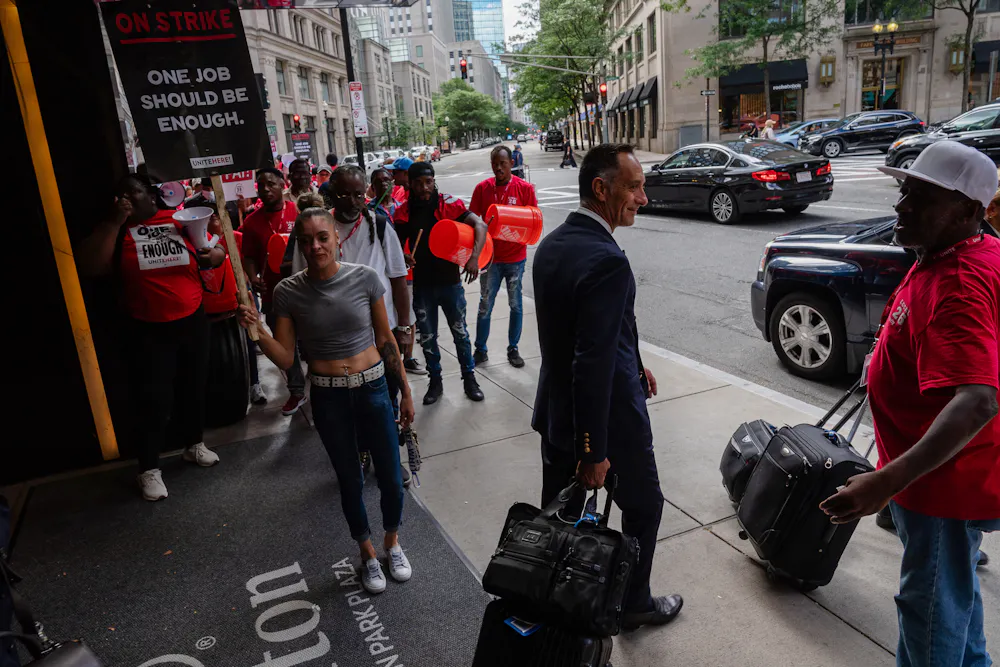
  • MIL-OSI Global: Autoworkers, Boeing machinists, cannabis drivers: Labor unions are mobilizing in new and old industries alike

    Source: The Conversation – USA – By Robert Forrant, Professor of U.S. History and Labor Studies, UMass Lowell

    Members and supporters of an International Association of Machinists and Aerospace Workers union district local convene in Seattle on July 17, 2024. Jason Redmond/AFP via Getty Images

    What do violinists, grocery store clerks, college dorm counselors, nurses, teachers, hotel housekeepers, dockworkers, TV writers, autoworkers, Amazon warehouse workers and Boeing workers have in common?

    In the past year or so, they’ve all gone on strike, tried to get co-workers to join a union, or threatened to walk off the job over an array of issues that include retirement plans, technology replacing workers and lagging wages as inflation increased.

    The array of Americans who are organizing unions extends to the tech, digital media and cannabis industries. Even climbing gym employees have formed a union.

    This is happening as U.S. workers in general are finding themselves in an increasingly precarious position. As a labor historian, I believe mobilization is the result of economic disruption caused by the relocation of jobs, the impact of new technologies on work and the erosion of income stability. It’s become very unlikely that today’s workers will have the same employer for decades, as my father and many men and women of his generation did.

    Greatest generation of jobs

    My father, a butcher, worked for the same company for 40 years and raised a family of seven on his union-secured wages and benefits. While back in the 1950s and 1960s many working-class Americans took that kind of job security for granted, it’s no longer the case. Some career coaches consider keeping a job for many years as a character flaw.

    The upsurge in labor organizing is in part a way for workers to gain some sort of say about what happens to their jobs. It’s also helping employees plan for the future.

    Union members are increasingly using strikes to demand higher wages, better benefits and increased job security. Why should it be, some low-income earners are asking, that in my family we must hold down two or three jobs to make ends meet, while CEO pay goes through the stratosphere?

    There were 33 major strikes involving nearly a half-million workers in 2023, the most since 2000. Many labor scholars attribute much of this uptick in organizing to several long-term trends. They include stagnating wages, high out-of-pocket health spending costs – even for those with insurance coverage – and growing concerns over job insecurity caused by the expanded use of labor-saving technology.

    Hundreds of Los Angeles County workers rally on Sept. 24, 2024, to show support for their union, SEIU, to hold a strike. Many held signs regarding alleged unfair labor practices, abbreviated to ULP.
    Genaro Molina/Los Angeles Times via Getty Images

    Precarious work

    In many industries, large numbers of the reliable jobs that paid enough for workers to be in the middle class have dwindled. That’s largely due to technological advances that replaced labor with automation and manufacturers moving to lower-income places, including Mexico, China and other foreign countries, as well as southern states such as Alabama and Tennessee. These trends have left behind a Rust Belt strewn with decaying buildings that once housed bustling factories and increasing numbers of what are sometimes called “precarious” jobs, which are poorly paid and lack sick leave, vacation time and other basic protections.

    This isn’t new.

    I’ve researched how New England’s textile industry fled cities such as Lowell, Massachusetts, as early as the 1920s for nonunion locations in South Carolina, while precision metalworking plants in Springfield, Massachusetts, sent work to Mississippi and South Carolina starting in the 1950s.

    But faced with mounting economic uncertainty, public support for unions is increasing. A 2024 Gallup Poll found that 70% of Americans approve of them – close to the 71% level seen in 2022, which was the highest approval rating that unions had gotten in half a century.

    Support is even rising among Americans who identify as Republicans, a political party that has historically frowned on organized labor: Gallup found it stood at 49% in 2024, down from 56% two years earlier but up from a low point of 26% in 2011.

    Hotel workers strike

    On Labor Day weekend in 2024, more than 10,000 hotel workers represented by the UNITE HERE union and employed by 24 hotels from Boston to the West Coast to Hawaii went on strike. Their labor actions disrupted travel plans during a busy time.

    Most hotel work stoppages lasted for three days and intended to pressure the companies that own hotels as part of a larger labor contract negotiation strategy. Later in September, workers kept walking off the job at other hotels to pressure management to improve pay, expand health insurance coverage, boost retirement benefits and agree to resolve important job security issues.

    Although the hotel industry has been booming since 2023, UNITE HERE contends that employment has decreased by nearly 40%, while wages have stagnated. On the picket line, workers have described living paycheck to paycheck and working one or two additional jobs to cover recent rent hikes.

    Hotel workers have more bargaining power today because, according to an industry study, 79% of the 450 hotels surveyed looking to hire people said they could not fill open jobs.

    That strike shows no sign of ending. Thousands more hotel workers were joining in by late September.

    Striking hotel workers make way for an airline crew while picketing outside of the Hilton Boston Park Plaza in Boston, Mass., on Sept. 2, 2024.
    Sophie Park/The Washington Post via Getty Images

    Boeing strike

    Unlike the hotel workers’ brief rolling work stoppages, the Boeing strike hasn’t let up since it began on Sept. 13, 2024. About 32,000 workers, mainly in Seattle, Washington, and Portland, Oregon, have walked off the job.

    Boeing workers declared the strike even though the International Association of Machinists District 751 leadership in Seattle wanted to accept a deal from Boeing’s management. But on Sept. 12, 94.6% of all rank-and-file workers rejected the tentative contract their leadership recommended the union accept.

    The Boeing strike started the next day; it could last a long time. On Sept. 25, the workers rejected what the company had called its “best and final offer” to settle the strike.

    This is the eighth time these workers have gone on strike since their union formed in the 1930s. Its two most recent strikes, in 2008 and 2005, lasted 57 days and 28 days, respectively. Boeing’s management, already reeling from the company’s numerous operational and safety problems, has announced several cost-cutting measures, including furloughs for some nonunion employees.

    Boeing’s nonunion backup plan

    Boeing has assured its shareholders and the public that the strike would not hinder production of the 787 Dreamliner jets at the company’s nonunion factory in South Carolina.

    International Association of Machinists union members have never forgiven Boeing for deciding to build that assembly plant. Operational since 2011, it now employs roughly 6,000 workers. Most of them would have been union members had Boeing built that plant or expanded production in Washington or Oregon, because the existing labor agreement would have covered the new workers.

    However, the agreement did not extend to South Carolina.

    At the time of the decision, a Boeing spokesperson said, its contract with the machinists’ union “acknowledges our right to locate work elsewhere, and that’s what we chose to do in this case because we just couldn’t get the terms from them that we needed.”

    Dockworkers could be next

    The timing of the hotel and Boeing strikes makes them perhaps more visible than they might have been because union members’ votes are coveted by both major parties in the 2024 presidential election.

    Meanwhile, 25,000 dockworkers who belong to the International Longshoremen’s Association are planning a possible shutdown of ports from Boston to Houston on Oct. 1, over the union’s concern for job loss due to automation.

    How job security issues are addressed following this wave of strikes could set the tone for what other hospitality, manufacturing and transportation unions seek when their contracts are up for negotiation again.

    Robert Forrant does not work for, consult, own shares in or receive funding from any company or organization that would benefit from this article, and has disclosed no relevant affiliations beyond their academic appointment.

    ref. Autoworkers, Boeing machinists, cannabis drivers: Labor unions are mobilizing in new and old industries alike – https://theconversation.com/autoworkers-boeing-machinists-cannabis-drivers-labor-unions-are-mobilizing-in-new-and-old-industries-alike-239371

    MIL OSI – Global Reports

  • MIL-OSI USA: Growing Coffee in the Greater United States

    Source: US Global Legal Monitor

    National Coffee Day falls on September 29, and International Coffee Day a couple of days later on October 1. A staple of American mornings, coffee, a caffeinated beverage cultivated from coffee beans, is brewed from a plant with early cultivation in Africa and the Middle East. Legends of early brews come from as early as 850 AD in Ethiopia. Today, the worldwide trade of coffee is regulated by multiple international treaties. The first International Coffee Agreement (ICA) was adopted by Congress in 1980 (Public Law 96-599) and codified at 19 U.S.C. §§ 1356k. On June 9, 2022, the latest International Coffee Agreement was renewed.

    Arbre du café dessiné en Arabie sur le naturel. 1716. Library of Congress Rare Book and Special Collections Division. https://hdl.loc.gov/loc.pnp/cph.3b36921.

    Federal Law

    Before the International Coffee Agreement, how was the sale of coffee regulated in the United States? The Tariff Act of 1930, also known as the Hawley-Smoot Tariff, (46 Stat. 590) contains a mention of coffee. As of today, California, Hawai’i, and Puerto Rico are the only places in the greater United States where coffee may be commercially cultivated (though California does not have explicit regulations on the trade).

    In the Code of Federal Regulations, 7 CFR Subpart O is exclusively dedicated to coffee as the “raw or unroasted seeds or beans of coffee intended for processing.”

    Hawai’i

    The 2002 Hawaiian Grown Coffee Law (§ 486-120.6) amended chapter 486 (now repealed) of the Hawai’i Revised Statutes to update the language on labels of Hawaiian coffee products. Specifications include the listing of coffees in a blend by weight and region of origin.

    In May 2024, the Hawaiian legislature passed a law (H.B. 2298) that will require all types of coffee beverages containing Hawaiian-grown and processed coffee to contain “no less than fifty-one per cent coffee by weight from the Hawai’i geographic origin.” The law will enter into force July 1, 2027.

    [Trademark registration by G. W. Earhart for Coffea Arabica brand Coffee, Either Green or Roasted]. Apr. 7, 1885. Library of Congress Prints & Photographs Division. https://hdl.loc.gov/loc.pnp/trmk.1t12096.

    Puerto Rico

    the bush belonging to the Rubiaceae family, Coffea genus, with perennial, coriaceous, single leaves and [opposing] white, aromatic axillary flowers whose fruit is a berry, red, white and yellow in color, that generally contains two seeds from which the beverage known by the same name…” Puerto Rican official definition of coffee. (P.R. Laws tit. 5, § 320.)

    In 1966, a “coffee zone” was developed as an agricultural and industrial project in Puerto Rico (P.R. Laws tit. 5, § 318). In 2019, the Coffee Office of Puerto Rico (la Oficina de Cafés de Puerto Rico) was established as a part of the Department of Agriculture by law (Ley Núm. 78 de 27 de julio de 2019.)

    Section 319 of the Hawley-Smoot Tariff outlines the responsibility of the Puerto Rican legislature to administer tariffs and collect duties on any foreign coffee imported into the territory, and 19 USC § 1319 guarantees duties for any coffee products imported into the territory.

    [Coffee drying, Puerto Rico]. Between 1890 and 1923. Library of Congress Prints & Photographs Division. https://hdl.loc.gov/loc.pnp/cph.3c01300.

    This International Coffee Day, take a moment to consider where in the world your cup of coffee came from. Was it from a domestic farm, or perhaps from the coffee farms of Kenya, another international coffee producer? Either way, enjoy a sip and savor the unique flavor – as we can see from the regulations, different blends are regionally exclusive!

    Subscribe to In Custodia Legis – it’s free! – to receive interesting posts drawn from the Law Library of Congress’s vast collections and our staff’s expertise in U.S., foreign, and international law.

    MIL OSI USA News

  • MIL-OSI Europe: Climate COP Troïka “Roadmap to Mission 1.5: Driving the next generation of climate action and ambition” – Address by Minister Jean-Noël Barrot, minister for Europe and Foreign Affairs (26.09.24)

    Source: Republic of France in English
    The Republic of France has issued the following statement:

    Ministers,

    Executive Secretary of the United Nations Framework Convention on Climate Change,

    Ambassadors,

    Colleagues,

    This year, we were convened for a Summit of the Future. Actually, what we are talking about is a threat of the present time: climate change kills, climate change impoverishes and climate change destroys.

    I would like to thank the Climate COP Presidencies Troika for convening us today to make progress in the fight against this scourge.

    We owe it to all our populations, all of our fellow citizens, to be effective. Therefore, we need to set a clear course. The 1.5°C goal is our compass. That is a demanding goal but not one that is totally beyond our reach. If we hope to achieve it, we must take action immediately. And to prepare, at the latest by the Belem COP, enhanced nationally determined contributions that are commensurate with the issue. We need to implement the Paris Agreement.

    Significant strides were made at COP28 when it was jointly decided to phase out fossil fuels. That was vital but it is also vital to actually make this transition in concrete terms.

    France and its European partners are working with determination, which involves a considerable effort to deploy low-carbon and low-emission energy technologies. France has committed to phase out coal by 2030, oil by 2045 and gas by 2050. We call on all Parties to set out and comply with timelines to phase out fossil energy sources. The G7 has started to do this with the phasing out of coal. It needs to do more and other big emitters should follow suit.

    At COP29, an ambitious new climate finance goal needs to be adopted to support developing countries.

    France has fully contributed to the current collective USD 100 billion goal, providing a record €7.6 billion of climate finance in 2022, including €2.6 billion dedicated to adaptation, and €7.1 billion in 2023. Every time we have contributed high and above commitments taken nationally, surpassing goals.

    Now that we have collectively achieved the USD 100 billion goal, it is time for a financing boost. That is what French President Emmanuel Macron proposed in Paris in June 2023 with the Paris Pact for Peoples and the Planet. All the finance sources – public, private and innovative instruments – need to be mobilized.

    The ambitious road map set out in the Paris Pact for Peoples and the Planet has produced tangible progress for the climate. I am thinking of the climate-resilient debt clauses implemented by the World Bank and its peers, as well as the international taxation task force launched at COP28 that Brazil has joined today.

    COP30 in Belem is crucial and we must now begin preparing for it with determination. I call on all Parties to publish nationally determined contributions that reflect the decisions made at COP28. They should be ambitious, cover all economic sectors and all greenhouse gases, be science-based and rooted in a timeline to phase out of fossil fuels.

    EU Member States are currently working on defining our 2040 climate target based on a European Commission proposal of a 90% cut in emissions. The EU will continue to show the highest possible ambition to deliver on our commitment to carbon neutrality by 2050.

    France stands with Brazil to make COP30 the COP of ambition. All our diplomatic firepower will be focused on this goal, alongside all our partners and the United Nations.

    And I am pleased to announce that we will host a high-level event in early 2025 to commemorate the 10-year anniversary of the Paris Agreement. There is only one way forward and that is to scale up the level of ambition on a par with the legitimate expectations of our populations. Let us not get distracted.

    Thank you.

    MIL OSI Europe News

  • MIL-OSI USA: Rep. Stansbury Introduces Legislation to Give Land Back to Pueblo

    Source: United States House of Representatives – Representative Melanie Stansbury (N.M.-01)

    WASHINGTON, D.C. — Today, U.S. Representative Melanie Stansbury (N.M.-01) introduced the San Felipe Pueblo Land into Trust bill, 37 years after the land was designated as an Area of Critical Environmental Concern back in 1987.  

    First introduced by then-Congresswoman Michelle Lujan Grisham in the 115th Congress, again by then-Congresswoman Deb Haaland in the 116th Congress, and now co-sponsored by Representative Teresa Leger Fernandez (N.M.-03) in the 118th, this bill would direct the Secretary of the Interior to convey the area currently known as the Ball Ranch Area of Critical Environmental Concern in New Mexico, into trust for the benefit of San Felipe Pueblo. 

    “Indigenous peoples have been stewards of the land since time immemorial,” said Rep. Stansbury (NM-01). “But time and time again, they have been forced from their homes and the land that holds sacred meaning to them. For the people of San Felipe Pueblo, the area currently known as Ball Ranch holds a deep cultural and religious significance because of the many irreplaceable cultural resources found there. That’s why I’ve introduced this legislation: because Indigenous people deserve to keep and protect the land they’ve lived on for thousands of years free from pollution and destruction.” 

    “This legislation is the culmination of more than a decade of work, spanning several Congresses, to transfer this land into trust,” said San Felipe Pueblo Governor Anthony Ortiz. “It is a recognition that, working with the BLM, the Pueblo of San Felipe is the best possible steward of this land. This is our aboriginal homeland, surrounded by the Pueblo, and is sacred to all area Pueblos. The Pueblo of San Felipe is very grateful to Congresswoman Melanie Stansbury who is leading this effort here in Washington. She and her staff have gone above and beyond to make this bill a reality and she has demonstrated her strong commitment to Tribal Sovereignty and respect for the federal government to government relationship.” 

    “This bill highlights the importance of everyone working together to make this dream a reality,” said Rep. Leger Fernandez (NM-03). “We must return the land to those for whom it is sacred and who will dedicate themselves to protect it. We will not give up until San Felipe Pueblo gets their land returned.”

    Read the bill here. 

    Watch a video of the press conference here. 

    Other statements of support: 

    “I am proud to support Congresswoman Melanie Stansbury’s bill, which protects our public lands and recognizes the critical need for land to be returned to tribal communities like San Felipe Pueblo,” said Sandoval County Commissioner Joshua Jones. The Pueblo have deep cultural, historical, and spiritual ties to this land, and ensuring they have the resources to preserve their heritage is essential for justice and sustainability. This legislation would allow the Bureau of Land Management (BLM) to facilitate land transfers that respect tribal sovereignty while promoting environmental stewardship. By supporting this bill, we can help San Felipe Pueblo reclaim land that is rightfully theirs, ensuring their community can thrive both economically and culturally. I urge the BLM to prioritize these land transfers and recognize the significance of this legislation for tribal nations.”

    ### 

    MIL OSI USA News

  • MIL-OSI: Worldcoin Introduces Face Auth: The New Tool to Protect Your Identity with Maximum Security

    Source: GlobeNewswire (MIL-OSI)

    • Face Auth provides enhanced security by ensuring that only the verified user can access their World ID (a digital passport of humanity). It is fully encrypted and operates entirely on the user’s device.
    • Developed by Sam Altman and Alex Blania in 2019, Worldcoin’s humanity verification services, World ID, now have more than 6 million verified users and 12 million app downloads globally. In Mexico, they have been available since late 2023 in Mexico City, Guadalajara, and Monterrey.

    MEXICO CITY, Sept. 27, 2024 (GLOBE NEWSWIRE) — Worldcoin announced today the launch of Face Auth, the new security feature for World ID, designed to ensure that only the person who was verified in an orb, a state-of-the-art camera that converts an iris image into code, can use it.

    This marks a significant step towards secure, privacy-focused identity verification for online activities, financial transactions, and more. Worldcoin’s mission is to create a secure way to verify your identity without compromising your privacy in a world where it’s increasingly difficult to distinguish between humans and bots. The project aims to address these challenges by offering a simple and anonymous way to verify that a person is human without revealing their identity.

    Face Auth is the latest addition to Worldcoin’s suite of privacy-enhancing technologies. It is a method that verifies identity by comparing a selfie taken in real-time with an image stored on the phone during the creation of the World ID. This ensures that only the true owner of the World ID can use it, protecting against fraud or unauthorized access, as the comparison is done directly on the user’s device.

    How Does Face Auth Work?

    • Selfie Capture: When using Face Auth, the user will be asked to take a selfie through the World app on their phone.
    • Comparison: The app compares this selfie with the high-resolution image taken during verification in the orb, which is securely and encrypted stored on the user’s phone.
    • Verification: If the two images match, Face Auth verifies the user and allows them to proceed with their transaction or login.

    To see how the new Face Auth feature works, check out the short demo video here.

    For users, Face Auth will be as familiar as any other facial recognition technology in the apps they commonly use on their smartphones, but with one key difference: Face Auth ensures that the person using the World app is the same person who created the World ID in an orb. Unlike other facial recognition tools linked to device hardware, Face Auth is linked to the app. This approach guarantees that only the verified person can access the World ID, reducing the risk of fraud.

    The entire authentication process takes place on the user’s phone, with encryption ensuring privacy. Neither Tools for Humanity nor Worldcoin have access to the data.

    “We want all our users to have the confidence to verify themselves, with the assurance that their identity and personal data are protected,” stated Tools for Humanity Mexico.

    Artificial intelligence makes it harder to distinguish between humans and bots online. Worldcoin’s World ID is an innovative digital passport of humanity that allows people to certify online that they are human and unique without revealing who they are. World ID offers a secure method for providing “proof of humanity” while allowing individuals to maintain control and privacy over their data. Worldcoin does not need to know who you are, only that you are a unique human being.

    You can watch the “Privacy in the Age of AI” explainer video series here.

    About the Worldcoin Protocol
    The Worldcoin protocol is designed to be the world’s largest and most inclusive public financial and identity utility, accessible to everyone. Worldcoin was originally conceived by Sam Altman, Alex Blania, and Max Novendstern. The Worldcoin protocol is designed to equip individuals and organizations worldwide with the tools they need to participate in the digital economy and advance human progress. Learn more about Worldcoin at www.worldcoin.org, on Twitter/X, Discord, YouTube, and Telegram.

    About the Worldcoin Foundation
    The Worldcoin Foundation, administrator of the Worldcoin protocol, aims to create more inclusive, fair, and equitable digital governance institutions and a global economy.

    About Tools for Humanity (TFH)
    Tools for Humanity is a technology company created to ensure a more equitable economic system, and the driving force behind the Worldcoin project. Founded in 2019 by Alex Blania (CEO) and Sam Altman (President), it is headquartered in San Francisco, California, and Erlangen, Germany.

    Photos accompanying this announcement are available at

    https://www.globenewswire.com/NewsRoom/AttachmentNg/1485e857-73f5-4929-bc7d-e7ebe5e95f70

    https://www.globenewswire.com/NewsRoom/AttachmentNg/e3772b57-6746-48dd-8b9b-43810a173aa4

    The MIL Network

  • MIL-OSI United Nations: Secretary-General’s remarks to the annual meeting of G77 Foreign Ministers

    Source: United Nations secretary general

    Mr. President, Excellencies, Ladies and Gentlemen,

    Let me begin by congratulating Uganda on its leadership of the G77 plus China this year.

    And I want to salute your entire membership.

    For 60 years – year in and year out — the G77 plus China has been on the frontlines for fairness, equality, justice and solidarity.

    You have been the engine driving progress to eradicate poverty, to fight inequalities, to root out injustices in our post-colonial world.

    And you have been shining a spotlight on the need for fundamental reforms of the multilateral system.

    Reforms of the international financial architecture and the Security Council to make them more legitimate and more effective. 

    Reforms to make sure our institutions reflect the realities of today’s world and respond to today’s challenges instead of the world and the challenges of 1945. 

    We have taken some steps forward with the adoption of the Pact for the Future, the Declaration on Future Generations, and the Global Digital Compact.

    Of course, not everything we may have hoped for was in the final package. 

    But none of the achievements would have been possible without your insistence and persistence.  If you allow me an image, if you compare the documents that we approved on Sunday with the continued documents of the G7 and the G77, we have to recognize that they are much closer to the documents of the G77.  One 7 makes a lot of difference. 

    I commend the G77 plus China for always pushing for maximum ambition and look forward to working with you as we continue pursuing the justice your countries deserve – and our world needs.

    We still have a long way to go.

    Our world is on a knife’s edge.

    Climate chaos is worsening.

    Conflicts are raging.

    Human rights are floundering.

    Inequality and injustice are eroding trust and undermining the social contract of societies.    

    The rights of women and girls are being snuffed out.

    Entire economies are drowning in debt.  

    The digital divide is fast becoming a gaping chasm.

    And the Sustainable Development Goals are hanging by a thread.

    We need action on a number of fronts in line with what was approved in the Summit of the Future. 

    First, financial justice.

    Finance is the fuel to drive progress on sustainable development.

    Yet so many countries remain locked out from accessing capital for essential investments.

    This situation is unsustainable – and a recipe for social unrest. 

    That is why we have been pushing for fundamental reforms to the outdated, ineffective and unfair international financial system, and an SDG Stimulus to provide developing countries with the resources they need while seeking medium- and long-term solutions.
     
    We must keep working to make Multilateral Development Banks bigger, bolder and better, enabling them to massively scale up affordable financing for sustainable development, namely in developing countries. 

    We must expand contingency financing through the recycling of Special Drawing Rights that until now have essentially benefitted rich countries and not those that have needed it the most.

    We must promote effective long-term debt restructuring that puts people and planet at the centre.

    And we must keep on working for a more inclusive and effective international tax system. I applaud the Ad Hoc Committee for drafting ambitious and practical Terms of Reference for a UN Framework Convention on International Tax Cooperation.

    Second, climate justice.

    We urgently need supercharged action to reduce emissions and avoid the worst of climate chaos.

    This must be in line with the principle of common but differentiated responsibilities and respective capabilities, in light of different national circumstances.

    Every country must create new national climate action plans – or NDCs – well ahead of COP30, that align with 1.5 degrees and put the world on track to phase out fossil fuels – fast and fairly.
     
    G20 countries – which together produce eighty percent of global emissions – have a responsibility to lead. I am working closely with President Lula of Brazil to drive action in the G20.

    And I urge every developing country to make sure new national climate plans double as investment plans and boost sustainable development – harnessing renewables to power prosperity and pull people out of poverty.

    The United Nations is mobilizing our entire system to support these efforts through the Climate Promise initiative.

    We also need a strong finance outcome – including on innovative finance – from COP29. This also means significant contributions to the new Loss and Damage Fund.

    I will continue to press developed countries to honour their promises;

    Doubling adaptation funding to at least $40 billion a year by 2025.

    Showing concretely how the enormous adaptation finance gap will be closed.

    And everyone on earth must be protected by an effective early warning system by 2027.

    We must address the injustices of the energy transition.

    Developing countries are being locked out of the renewables revolution.

    Investments in developing countries outside of China and India are stuck in a time warp reflecting 2015 levels. Africa attracted just 1% of renewable installations last year. It is clear that we must support developing countries to have the resources and the capacity to attract the investments that are necessary for the renewables revolution. 

    The UN Panel on Critical Energy Transition Minerals has identified ways to ground the renewables revolution in justice and equity, spur sustainable development, and power prosperity in resource rich developing countries.

    We must ensure that the race to net zero does not lead to developing countries being trampled underfoot.  

    Third, technological justice.

    Technology must benefit all of humanity.

    The Global Digital Compact is a blueprint for how governments, together with tech companies, academia and civil society, can work together to make sure new technologies benefit everybody and to manage the risks they pose – including Artificial Intelligence.

    AI has the potential to be an excellent servant but also a dangerous master.

    I am pleased that the Compact includes proposals building on the resolution led by China on capacity building for Artificial Intelligence.

    The High-Level Advisory Body on AI released its recommendations last week, which include bridging the AI divide through a Global Fund on AI for the SDGs, and an AI Capacity Development Network to boost AI expertise in developing countries.

    We must keep working to ensure AI serves everyone, leaving no one behind and it will not be another factor to increase inequalities in the world. 

    Ministers, Ladies and Gentlemen,

    Across a very full agenda, the G77 and China are crucial to building a more just, inclusive and prosperous world.  

    The G77 was vital in the adoption of the conclusions of the Summit of the Future but its implementation will not be easy.  There will be a lot of resistance.  The G77 must be an engine to make sure that what we have achieved in the Summit will be translated in effective realities to the benefit of developing countries. 

    You can count on me in that essential cause.

    Thank you.
     

    MIL OSI United Nations News

  • MIL-OSI USA: Scalise Sends Letter to Colleagues Touting Republican Wins in 118th Congress

    Source: United States House of Representatives – Congressman Steve Scalise (1st District of Louisiana)

    WASHINGTON, D.C.— Today, House Majority Leader Steve Scalise (R-La.) sent the following letter to his colleagues as we head into the October district work period:

    Dear Colleagues,
     
    It’s hard to believe, but only two years ago the Democrats were signing their deceptively named “Inflation Reduction Act” into law. That capped four years of unified Democrat control of Washington, where they jammed their radical agenda through Congress, spending $10 trillion and causing runaway inflation the American people still struggle with today.
     
    Thankfully, in November 2022, the American people had enough of the destruction caused by the Democrats’ radical agenda and voted us into a narrow House majority. House Republicans were a small beacon of hope in an otherwise desolate Washington landscape controlled by the Democrat Party, their army of bureaucrats, and a media propaganda machine.
     
    It’s been a David versus Goliath fight over the last 21 months of our House majority, and I’m so proud to fight alongside all of you. As we head into the final stretch before this pivotal election, we have a lot to be proud of and important accomplishments we can talk about at home.
     
    While we do not control the Senate or White House, we should be encouraged by the fact that we, as House Republicans, unified around an ambitious agenda that addressed the real concerns American families face every day. From inflation and energy costs to historic illegal immigration and crime to national security and holding those in power accountable, we put on full display the contrast of our vision for the country versus the vision of chaos and economic distress of radical Democrats. Here are some of the highlights:
     
    H.R. 1, the 
    Lower Energy Costs Act:
    Our conference fought back against the Biden-Harris Administration’s war on American energy by passing the 
    Lower Energy Costs Act to cut burdensome red tape and boost energy production here at home, instead of relying on hostile foreign dictators that put our energy security at risk. In addition to making America energy independent again, H.R. 1 lowers costs for families who are struggling every day thanks to skyrocketing prices at the gas pump, in the grocery store, and elsewhere.
     
    H.R. 2, the 
    Secure the Border Act:
    It’s no secret that, even in larger Republican majorities, we have historically struggled to unify around one comprehensive border bill. It was an uphill battle that required painstaking deliberations with all members of our diverse conference. The result was the most comprehensive border security bill in history, H.R. 2, the 
    Secure the Border Act, to address the worst border crisis in history. Over 8.2 million illegal immigrants have entered the U.S. and more than 2 million gotaways under President Biden and “Border Czar” V.P. Harris’ open border policies, which cost American lives every day, like Laken Riley, Jocelyn Nungaray, and Rachel Morin. H.R. 2 increases the number of border patrol agents, resumes construction of the border wall, ends catch-and-release, reinstates ‘Remain in Mexico’, cracks down on the flow of fentanyl, and keeps our communities safe.
     
    H.R. 5, the 
    Parents Bill of Rights:
     When the Administration and school boards tried to silence parents and remove them from their child’s education while using taxpayer dollars to promote woke agendas in classrooms, House Republicans stood up for parents’ right to be involved in their child’s education by passing H.R. 5, the 
    Parents Bill of Rights Act. Parents have the right to transparency when it comes to their child’s education, to know how their taxpayer dollars are being used by schools, and to express their concerns to school boards without being silenced by the federal government.
     
    H.R. 7521, the 
    Protecting Americans from Foreign Adversary Controlled Applications Act:
    TikTok, which is controlled by ByteDance and tied to the Chinese Communist Party, poses a significant national security threat to the United States by allowing the CCP to spy on Americans and dictate what we see. House Republicans passed H.R. 7521, the 
    Protecting Americans from Foreign Adversary Controlled Applications Act, and placed the choice in TikTok’s hands: either they can sever their ties with the CCP or no longer be available in the United States. The Senate and President Biden followed our lead, signing our TikTok bill into law.
     
    Standing with Our Ally Israel:
    After the horrific attack of October 7th, House Republicans stood by our commitment to provide Israel with the tools it needs to defend itself and defeat terror. We passed H.R. 6126, the 
    Israel Security Supplemental Appropriations Act, to quickly provide additional military equipment for our ally Israel, and in the face of Biden-Harris Administration efforts to pressure Israel by withholding critical weapons, we passed H.R. 8369, the Israel Security Assistance Support Act, to force the delivery of congressionally approved military aid. We have also taken on Iran and its terrorist proxies like Hezbollah, Hamas, and the Houthis through legislation like H.R. 5961, the No Funds for Iranian Terrorism Act, to freeze the Biden-Harris Administration’s $6 billion payday for Iran, H.R. 6046, the Standing Against Houthi Aggression Act, and H.R. 340, the Hamas International Financing Prevention Act.
     
    Taking on the Chinese Communist Party:
    The Chinese Communist Party (CCP) poses a generational threat to America, and dealing with it requires working across committee jurisdictions to develop a comprehensive approach. Since beginning this Congress with the establishment of the China Select Committee, that is exactly what we have done, culminating in this month’s China Week. We passed H.R. 9456, the 
    Protecting American Agriculture from Foreign Adversaries Act, to prevent foreign adversaries from gaining control of our American farmland, H.R. 1398, the Protect America’s Innovation and Economic Security from CCP Act, to defend American research and intellectual property, and H.R. 8333, the BIOSECURE Act, to kick the CCP out of our biotechnology supply chains, among many other strong bills.
     
    H.R. 277, the 
    REINS Act of 2023:
    Under the Biden-Harris Administration, federal agencies continue to expand their authority by assuming the powers of the legislative and judicial branches, allowing unelected and unaccountable bureaucrats to make laws behind closed doors that will have serious impacts on the American way-of-life. House Republicans stepped up to rein in executive overreach by passing H.R. 277, the 
    REINS Act of 2023, which requires congressional approval before major rules can take effect. 
      
    Ending the COVID National and Public Health Emergencies:
    Long after schools reopened and the majority of workers returned to the office, President Biden delayed terminating the COVID-19 national and public health emergencies because he didn’t want to give up the powers it gave his Administration. The National Emergencies Act was never intended to give the president unlimited authority over the American people’s lives – we passed H.J. Res. 7 and H.R. 382, the 
    Pandemic is Over Act, to end the COVID national and public health emergencies and get America back to normal.
     
    H.R. 8281, the 
    SAVE Act:
    With the over 8.2 million illegal immigrants that have come across our southern border thanks to President Biden and Vice President Harris’ open border policies, it is vital we shore up our election security and ensure that only American citizens are voting in American elections. House Republicans came together in strong support of H.R. 8281, the 
    SAVE Act
    , which would require individuals to provide proof of citizenship when registering to vote in federal elections.
     
    H.J. Res 26:
    Last year, Washington, D.C. tried to implement Democrats’ soft-on-crime policies, including weakening criminal penalties for violent offenses, such as carjacking, robberies, and burglary. To keep our nation’s capital safe, House Republicans passed H.J. Res. 29 to reverse the D.C. Council’s misguided crime bill, which all present Republicans voted for and more than 170 Democrats voted against. Thanks to our work in forcing this issue, President Biden eventually caved, and the measure passed the Senate and was signed into law.
     
    H.R. 7024, the 
    Tax Relief for American Families and Workers Act of 2024:
    In 2017, under President Trump’s leadership, Republicans passed the 
    Tax Cuts and Jobs Act, a pro-family, pro-worker, and pro-growth tax reform package. Because of constraints associated with reconciliation, some temporary provisions of TCJA have begun to expire, and substantially more will expire at the end of 2025. House Republicans are working to support American families and the economy by extending expiring provisions of TCJA. This Congress, we passed H.R. 7024, the Tax Relief for American Families and Workers Act of 2024, which allows working families to keep more of their paycheck and also restores important tax incentivizes that drive investment in the American economy.
     
    Digital Assets:
    Despite hostility from the Biden-Harris Administration, the digital asset ecosystem continues to grow. To foster continued growth by providing regulatory certainty and appropriate consumer protections, House Republicans passed three trailblazing bills in the digital asset space: H.J. Res. 109, a congressional resolution of disapproval against the SEC’s misguided “Staff Accounting Bulletin No. 121”; H.R. 4763, the 
    Financial Innovation and Technology for the 21st Century Act; and, H.R. 5403, the CBDC Anti-Surveillance State Act. Taken together, these bills set a clear path for the future of digital assets and their regulation.
     
    H.R. 26, the 
    Born-Alive Abortion Survivors Protection Act:
    To protect the sanctity of life, House Republicans passed H.R. 26, the 
    Born-Alive Abortion Survivors Protection Act, which secures medical protections for babies that survive an attempted abortion. This comes after four years of Democrats refusing to hold a vote on the life-saving legislation. Newborn babies deserve protection and care regardless of the circumstances under which they are born – this should not be a partisan issue, but common sense and basic morality.
     
    Attempted Assassinations of President Trump:
    The House quickly acted after the attempted assassination of President Donald Trump on July 13th in Butler, Pennsylvania, and formed a task force to investigate the series of failures by the U.S. Secret Service that day. The Task Force is also investigating the subsequent assassination attempt that occurred on September 15th in Florida, as it works to deliver answers to the American people and ensure their choice of president is never again threatened by a deranged, radical individual.
     
    Antisemitism on Campuses:
    After Hamas’ horrific October 7th attacks on Israel, and the subsequent military actions taken by Israel to defend itself, the U.S. has seen a disturbing uptick in antisemitism on college campuses. Led by the Committee on Education and the Workforce, House Republicans discovered a troubling culture on campuses, where administrators fail to implement protections for Jewish students and even mock Jewish students, and has demanded answers from these universities about student safety and funding of pro-Hamas groups and propaganda. As a result, the presidents of Harvard, the University of Pennsylvania, and Columbia resigned in disgrace.
     
    The Biden-Harris Border Crisis Report:
    The Committee on Homeland Security released a report exposing the many ways the Biden-Harris Administration knowingly and intentionally undermined U.S. border security to create the crisis we currently see at the border. The report revealed that even before taking office, the Administration was warned by experienced border security professionals about the dangers of their plan to open our borders and dismantle our border security. The Biden-Harris border crisis was not some inevitable phenomenon – it was directly caused by the actions taken by President Biden, Vice President Harris, and Homeland Security Secretary Mayorkas. Earlier this year, House Republicans impeached Homeland Security Secretary Alejandro Mayorkas for violating border security laws enacted by Congress and threatening the safety of the American people – unfortunately, Senate Democrats refuse to hold him accountable for his failures.
     
    The Biden-Harris Failed Afghanistan Withdrawal Report:
    The Foreign Affairs Committee’s investigation into the Biden-Harris Administration’s catastrophic withdrawal from Afghanistan revealed that the Administration disregarded the advice of military and security professionals, ignored the facts on the ground, and indulged in wishful thinking and endless deliberation that left American troops and diplomats in-country dangerously exposed – ultimately resulting in the tragic and unnecessary deaths of 13 U.S. servicemembers. This week, House Republicans passed legislation to condemn key figures and officials in the Administration, including President Biden, Vice President Harris, National Security Advisor Jake Sullivan, National Security Communications Advisor John Kirby, State Department Secretary Antony Blinken, and others, for their part in this historic disaster.
     
    President Biden’s Influence Peddling and Classified Documents:
    On December 13, 2023, the House voted to formalize the impeachment inquiry into President Biden allowing the Oversight, Judiciary, and Ways and Means Committees to continue developing compelling evidence revealing how President Biden knew, was involved, and benefited directly from his family’s influence peddling schemes. The committees took key actions to bring in significant witnesses, including Hunter Biden and James Biden, both of whom had lied during their appearances, and the committees sent criminal referrals to the Department of Justice recommending they be charged with making false statements.
     
    In February, the House Oversight and Judiciary Committees subpoenaed Attorney General Merrick Garland for records, including transcripts, notes, video, and audio files, related to Special Counsel Robert Hur’s investigation of President Biden’s willful mishandling of classified information, after Hur declined to recommend charges against Biden citing his memory problems. A.G. Garland refused to produce the audio recordings of Special Counsel Hur’s interviews with President Biden and his ghostwriter, and on June 12, 2024, House Republicans voted to hold A.G. Garland in contempt for failing to comply with the subpoena. On July 2, 2024, the House Judiciary Committee filed a lawsuit in D.C. federal court to obtain these recordings. We remain committed to obtaining this critically important evidence in our investigation into Biden’s mishandling of classified documents.
     
    Regulatory Burdens:
    In the wake of the Supreme Court overruling 
    Chevron, to assure the Biden-Harris Administration respects the limits placed on its authority, our House committees sent oversight letters to nearly every agency in the Executive branch requesting information on legislative rules, agency adjudications, enforcement actions, and agency guidance documents. Additionally, the House Oversight Committee issued a thorough report on the Biden-Harris Administration’s regulatory overreach
    , concluding that it has imposed an estimated $1.7 trillion in regulatory costs, with EPA counting for $1.3 trillion.
     
    This Congress hasn’t been easy, but nothing worth fighting for is. The future of our country is at stake, and it is critical that we make our case across the country of what we’ve accomplished so far and how much more we have left to do to save our country from the chaos and destruction that we have seen under the Biden-Harris Administration and their far-left partners in Congress. We are a team, and I am proud of all of you for the work you have done to help us keep our promises and unite to fulfill the agenda we set out to achieve on behalf of the American people. It’s an honor to serve as your Majority Leader.
     
    -Steve

    MIL OSI USA News

  • MIL-OSI Economics: “The Art of Resilience”: The Documentary Series on Solutions from Latin America and the Caribbean that are Changing the World

    Source: CAF Development Bank of Latin America

    The episodes emphasize resilience, the innovation of their protagonists, and how collaboration within communities is driving significant transformations in the region. In the first season, which consists of three episodes, entrepreneurs and community leaders share their work in areas contributing to the achievement of the Sustainable Development Goals (SDGs).

    “It is essential to highlight the global solutions that originate in our region: the faces, ideas, achievements, and Latin American and Caribbean projects that often go unnoticed. We want to show the world that Latin America and the Caribbean is a region of solutions. Change is possible when we act collectively, and each of us can make a difference,” said Sergio Díaz-Granados, Executive President of CAF.

    Each episode also features artists who contribute music, culture, and art, creating a deep emotional connection with the audience—something that enhances the transformative power of art and culture in our societies.

    “We are proud and excited to showcase the powerful stories of communities positively transforming our region. As UNDP, we believe this initiative will bring us closer to the common goals that unite us as a society and will help foster inclusive, resilient, and sustainable development in Latin America and the Caribbean, leaving no one behind. By valuing our multicultural richness, protecting our lush biodiversity, and promoting social enterprises led by youth and local communities, we create a better present while preserving options for future generations,” affirmed Michelle Muschett, Regional Director of UNDP for Latin America and the Caribbean.

    The series has been produced by WaterBear Network in partnership with the Resilient Foundation and aims to spotlight local initiatives that promote the achievement of the 2030 Agenda and its 17 SDGs.

    “We are at a crucial moment where the stories of resilience and transformation in Latin America and the Caribbean deserve to be told. With ‘The Art of Resilience,’ we want to inspire others to see the strength that resides in our communities and how, through collaboration and creativity, we can build a more inclusive and sustainable future. Every initiative we present is a testament to the fact that change is possible and that together we can make a difference,” added María López, Executive Director of Detonante.

    The premiere took place in New York during Climate Week and included a screening of the series followed by a discussion with the creators, who shared their perspectives on sustainable development in the region.

    A public viewing will be held during COP16, which will take place in Cali, Colombia, in October 2024.

    • For more information and to join the campaign For All #ElCambioPosible, visit www.elcambioposible.com and follow the conversation on social media (Instagram: @elcambioposible). 
    • The series is available on the WaterBear Network streaming platform starting September 26 at www.waterbear.com
    • It will be featured at COP16 in Cali, Colombia, in October 2024.

    MIL OSI Economics

  • MIL-OSI Global: US home insurance rates are rising fast – hurricanes and wildfires play a big role, but there’s more to it

    Source: The Conversation – USA – By Andrew J. Hoffman, Professor of Management & Organizations, Environment & Sustainability, and Sustainable Enterprise, University of Michigan

    The U.S. has seen a large number of billion-dollar disasters in recent years. AP Photo/Mark Zaleski

    Millions of Americans have been watching with growing alarm as their homeowners insurance premiums rise and their coverage shrinks. Nationwide, premiums rose 34% between 2017 and 2023, and they continued to rise in 2024 across much of the country.

    To add insult to injury, those rates go even higher if you make a claim – as much as 25% if you claim a total loss of your home.

    Why is this happening?

    There are a few reasons, but a common thread: Climate change is fueling more severe weather, and insurers are responding to rising damage claims. The losses are exacerbated by more frequent extreme weather disasters striking densely populated areas, rising construction costs and homeowners experiencing damage that was once more rare.

    Hurricane Ian, supercharged by warm water in the Gulf of Mexico, hit Florida as a Category 4 hurricane in October 2022 and caused an estimated $112.9 billion in damage.
    Ricardo Arduengo/AFP via Getty Images

    Parts of the U.S. have been seeing larger and more damaging hail, higher storm surges, massive and widespread wildfires, and heat waves that kink metal and buckle asphalt. In Houston, what used to be a 100-year disaster, such as Hurricane Harvey in 2017, is now a 1-in-23-years event, estimates by risk assessors at First Street Foundation suggest. In addition, more people are moving into coastal and wildland areas at risk from storms and wildfires.

    Just a decade ago, few insurance companies had a comprehensive strategy for addressing climate risk as a core business issue. Today, insurance companies have no choice but to factor climate change into their policy models.

    Rising damage costs, higher premiums

    There’s a saying that to get someone to pay attention to climate change, put a price on it. Rising insurance costs are doing just that.

    Increasing global temperatures lead to more extreme weather, and that means insurance companies have had to make higher payouts. In turn, they have been raising their prices and changing their coverage in order to remain solvent. That raises the costs for homeowners and for everyone else.

    The importance of insurance to the economy cannot be understated. You generally cannot get a mortgage or even drive a car, build an office building or enter into contracts without insurance to protect against the inherent risks. Because insurance is so tightly woven into economies, state agencies review insurance companies’ proposals to increase premiums or reduce coverage.

    The insurance companies are not making political statements with the increases. They are looking at the numbers, calculating risk and pricing it accordingly. And the numbers are concerning.

    The arithmetic of climate risk

    Insurance companies use data from past disasters and complex models to calculate expected future payouts. Then they price their policies to cover those expected costs. In doing so, they have to balance three concerns: keeping rates low enough to remain competitive, setting rates high enough to cover payouts and not running afoul of insurance regulators.

    But climate change is disrupting those risk models. As global temperatures rise, driven by greenhouse gases from fossil fuel use and other human activities, past is no longer prologue: What happened over the past 10 to 20 years is less predictive of what will happen in the next 10 to 20 years.

    The number of billion-dollar disasters in the U.S. each year offers a clear example. The average rose from 3.3 per year in the 1980s to 18.3 per year in the 10-year period ending in 2024, with all years adjusted for inflation.

    With that more than fivefold increase in billion-dollar disasters came rising insurance costs in the Southeast because of hurricanes and extreme rainfall, in the West because of wildfires, and in the Midwest because of wind, hail and flood damage.

    Hurricanes tend to be the most damaging single events. They caused more than US$692 billion in property damage in the U.S. between 2014 and 2023. But severe hail and windstorms, including tornadoes, are also costly; together, those on the billion-dollar disaster list did more than $246 billion in property damage over the same period.

    As insurance companies adjust to the uncertainty, they may run a loss in one segment, such as homeowners insurance, but recoup their losses in other segments, such as auto or commercial insurance. But that cannot be sustained over the long term, and companies can be caught by unexpected events. California’s unprecedented wildfires in 2017 and 2018 wiped out nearly 25 years’ worth of profits for insurance companies in that state.

    To balance their risk, insurance companies often turn to reinsurance companies; in effect, insurance companies that insure insurance companies. But reinsurers have also been raising their prices to cover their costs. Property reinsurance alone increased by 35% in 2023. Insurers are passing those costs to their policyholders.

    What this means for your homeowners policy

    Not only are homeowners insurance premiums going up, coverage is shrinking. In some cases, insurers are reducing or dropping coverage for items such as metal trim, doors and roof repair, increasing deductibles for risks such as hail and fire damage, or refusing to pay full replacement costs for things such as older roofs.

    Some insurances companies are simply withdrawing from markets altogether, canceling existing policies or refusing to write new ones when risks become too uncertain or regulators do not approve their rate increases to cover costs. In recent years, State Farm and Allstate pulled back from California’s homeowner market, and Farmers, Progressive and AAA pulled back from the Florida market, which is seeing some of the highest insurance rates in the country.

    In some cases, insurers are restricting coverage. Roof repairs, like these in Fort Myers Beach, Fla., after Hurricane Ian, can be expensive and widespread after windstorms.
    Joe Raedle/Getty Images

    State-run “insurers of last resort,” which can provide coverage for people who can’t get coverage from private companies, are struggling too. Taxpayers in states such as California and Florida have been forced to bail out their state insurers. And the National Flood Insurance Program has raised its premiums, leading 10 states to sue to stop them.

    About 7.4% of U.S. homeowners have given up on insurance altogether, leaving an estimated $1.6 trillion in property value at risk, including in high-risk states such as Florida.

    No, insurance costs aren’t done rising

    According to NOAA data, 2023 was the hottest year on record “by far.” And 2024 could be even hotter. This general warming trend and the rise in extreme weather is expected to continue until greenhouse gas concentrations in the atmosphere are abated.

    In the face of such worrying analyses, U.S. homeowners insurance will continue to get more expensive and cover less. And yet, Jacques de Vaucleroy, chairman of the board of reinsurance giant Swiss Re, believes U.S. insurance is still priced too low to fully cover the risk from climate change.


    Climate change is a major factor in the rising cost of insurance. Join us for a special free webinar with experts Andrew Hoffman of the University of Michigan and Melanie Gall of Arizona State University to discuss the arithmetic behind these rising rates, what climate change has to do with it, and what may be coming in your future insurance bills.

    Wednesday, October 9, 2024, 11:30 a.m. PT/2:30 p.m. ET.
    Register for the webinar here.


    Andrew J. Hoffman does not work for, consult, own shares in or receive funding from any company or organization that would benefit from this article, and has disclosed no relevant affiliations beyond their academic appointment.

    ref. US home insurance rates are rising fast – hurricanes and wildfires play a big role, but there’s more to it – https://theconversation.com/us-home-insurance-rates-are-rising-fast-hurricanes-and-wildfires-play-a-big-role-but-theres-more-to-it-238939

    MIL OSI – Global Reports

  • MIL-OSI USA: Luján, Cantwell, Tester, Baldwin, Rosen Introduce Bill to Prevent Fentanyl Trafficking Through U.S. Transportation Networks

    US Senate News:

    Source: US Senator for New Mexico Ben Ray Luján
    Legislation would boost detection of illegal drug smuggling by air, sea, rail & road
    Bill gains backing by Narcotics Officers, Major City Chiefs, Forensic Science Labs, State Criminal Investigative Agencies, HIDTA Leaders
    WASHINGTON, D.C. – Commerce Committee Democrats, U.S. Senators Ben Ray Luján (D-N.M.), Maria Cantwell (D-Wash.), Jon Tester (D-Mont.), Tammy Baldwin (D-Wisc.), and Jacky Rosen (D-Nev.) introduced legislation to crack down on the trafficking of illicit synthetic drugs, like fentanyl, using the U.S. transportation network. The bill would create first-ever inspection strategies to stop drug smuggling by commercial aircraft, railroads, vehicles and ships. The legislation would boost state, local and Tribal local law enforcement resources, deploy next generation, non-intrusive detection technologies and increase inspections at ports of entry.
    “The flow of fentanyl into the country has devastated far too many communities across New Mexico and the United States,” said Senator Luján. “This bill would crack down on the trafficking of deadly drugs by implementing innovative inspection strategies for U.S. transportation networks and provide law enforcement with the tools they need to combat fentanyl smuggling. It is time for Congress to act to keep our communities safe and put an end to the fentanyl crisis.”
    “Drug traffickers should not be allowed to exploit the U.S. transportation system to smuggle fentanyl and precursor chemicals to make illicit synthetic drugs,” Senator Cantwell said. “Our bill equips federal, state, local and tribal law enforcement with the tools they need to curb drug smuggling by accelerating the development of non-intrusive technologies to inspect our commercial aircraft, trucks, trains and ships – while boosting resources to deploy this technology and drug-sniffing dogs, improving forensic science at crime labs, and building a better system to share intelligence and information between federal authorities and the private sector.”
    “The deadly flow of fentanyl into Montana communities is tearing families apart and it’s making our state less safe,” said Senator Jon Tester. “If we’re going to end illicit drug trafficking, we’re going to have to come at this issue from all sides, and that means strengthening our southern border, funding law enforcement, and securing the transportation systems allowing bad actors to get these drugs into our communities. I’m proud to have introduced this bill to give our law enforcement agencies the tools they need to combat illicit drug trafficking and make our transit systems safer for all Montanans.”
    “I’ve heard from parents who lost children, law enforcement fighting on the front lines, and advocates – all demanding we do more to stop the scourge of fentanyl,” said Senator Baldwin. “I’m fighting this crisis on all fronts – from stopping the precursor chemicals being manufactured in China, to boosting access to overdose reversal drugs, and everything in between. I’m proud to lead this legislation to give our law enforcement the tools they need to stop drug traffickers from using American airports, railways, ports, and roads to smuggle fentanyl into our communities.”
    “Most synthetic fentanyl is smuggled into our country, making its way to communities across Nevada and destroying families,” said Senator Rosen. “I’m doing everything I can to stop the flow of illicit drugs and support law enforcement. That’s why I’m proud to introduce this bill to develop a national strategy to prevent fentanyl smuggling and increase inspections at Ports of Entry on our border.”
    According to U.S. Government authorities, drug traffickers exploit the U.S. transportation network to smuggle fentanyl, precursor chemicals and other illicit drugs into and throughout the country. Once drugs have entered the country, drug traffickers continue to rely on the national transportation network—trucks, trains and commercial aircraft—to move their product to its final destination.
    The Stop Smuggling Illicit Synthetic Drugs on U.S. Transportation Networks Act of 2024 (S. 5285) would:
    Read the summary here and bill text here.
    Create a National Prevention Plan: Directs the Office of National Drug Control Policy (ONDCP) to develop a comprehensive national strategy that examines the entire U.S. transportation network and ports of entry to prevent the smuggling of illicit synthetic drugs.
    Boost Illegal Drug Detection by Air, Sea, Rail and Road: The bill establishes four new transportation-specific inspection programs—private and commercial aircraft, railroads, commercial vehicles and maritime vessels—to expand detection across all transportation modes and prevent interstate smuggling. State, local, Tribal and territorial law enforcement would carry out inspections using non-intrusive technologies and canines, in coordination with federal law enforcement authorities – and without unduly delaying the movement of goods or interrupting interstate commerce.
    Deploy High-Tech Detection Tools: Directs the Office of Science and Technology Policy (OSTP) and the ONDCP to accelerate new emerging, non-intrusive technologies, including integrating AI and quantum, to detect illicit synthetic drugs. National laboratories, including Pacific Northwest National Laboratories, are already developing next-generation technologies for fentanyl detection. AI could help increase capacities to integrate multiple sources of data and overcome challenges in identifying fentanyl when it is mixed with other opioids to evade detection.
    Increase Port of Entry Drug Detections: Currently, only 1-2 percent of passenger vehicles and 15-17 percent of commercial vehicles are scanned at U.S. ports of entry. The bill requires Customs and Border Protection (CBP) to inspect 100 percent of motor vehicles and railroads entering the country through a port of entry within five years, and all civil air cargo and maritime cargo within ten years.
    Support Law Enforcement Workforce, Technology and Training: Authorizes the Secretary of Homeland Security to provide grants to state, local, Tribal and territorial law enforcement to acquire new technology and canines and support overtime and other program-related expenses. It would also increase federal support to state and local crime scene investigators and forensics laboratories to process evidence related to fentanyl crimes and deaths.
    Improve Data and Information Sharing to Prevent Drug Trafficking: Requires the Director of ONDCP to create a public-private task force to improve intelligence and information sharing among federal, state and local authorities and the private sector to combat drug trafficking.
    “The National Narcotic Officers’ Associations’ Coalition applauds Senator Cantwell for her work on the Stop Smuggling Illicit Synthetic Drugs on U.S. Transportation Networks Act. The surge in drug poisoning deaths, especially from fentanyl, shows that more needs to be done. We know that a large portion of illegal narcotics are trafficked through our transportation systems, and this legislation will provide the needed resources such as advanced detection technology and canines to enhance law enforcement’s ability to conduct inspections on our nation’s transportation systems,” said Eric Brown, President of the National Narcotic Officers’ Associations’ Coalition.
    “The Major Cities Chiefs Association thanks Senator Cantwell for taking an innovative approach to fentanyl interdiction with the Stop Smuggling Illicit Synthetic Drugs on U.S. Transportation Networks Act. In cities across the country, resources are strained and the fentanyl crisis is a factor. Federal support is welcome as MCCA member agencies work to curb this crisis and promote safer communities and public health. We look forward to additional engagement on the matter as it moves forward in Congress,” said Laura Cooper, Executive Director of the Major Cities Chiefs Association.
    “Deaths and adverse events from illicit synthetic drugs continue to be at epidemic proportions, yet funding for forensics labs remains stagnant.  This bill prioritizes resources for the professionals on the front lines of the fight against illicit drugs, including fentanyl and other novel psychoactive substances.  We commend members of the Commerce Committee for taking this approach to ensure our forensic experts have the necessary resources and data to combat this epidemic,” said Matthew Gamette, Chair of the Consortium of Forensic Science Organizations.
    “The Association of State Criminal Investigative Agencies (ASCIA) appreciates Senator Cantwell’s introduction of the Stop Smuggling Illicit Synthetic Drugs on U.S. Transportation Networks Act of 2024. While recent figures show progress in reducing drug poisoning deaths in the U.S., we are nowhere near where we need to be to protect Americans from the ongoing threat.  This bill would strengthen the ability of agencies at all levels of government to detect and disrupt drug trafficking,” said Drew Evans, President of the Association of State Criminal Investigative Agencies.
    “The National High Intensity Drug Trafficking Area (HIDTA) Directors Association appreciates Senator Cantwell’s efforts to combat the fentanyl crisis and her support for providing critically needed tools and resources for state, local, tribal and federal law enforcement to interdict fentanyl shipments before negatively impacting the communities across the country. Given the profound impact fentanyl has had on families, schools, and communities, this bill will be instrumental in enabling law enforcement agencies participating in the HIDTA program to develop new and innovative strategies to tackle this crisis,”  said F. Mike McDaniel, President of the National High Intensity Drug Trafficking Area (HIDTA) Directors Association.

    MIL OSI USA News