Defendant Exploited Vulnerabilities in the KyberSwap and Indexed Finance Decentralized Finance Protocols to Steal from Investors
An indictment was unsealed today in federal court in Brooklyn charging Andean Medjedovic with wire fraud, computer hacking and attempted extortion for stealing approximately $65 million in cryptocurrency from the KyberSwap and Indexed Finance decentralized finance (DeFi) protocols, which are sophisticated financial platforms residing on cryptocurrency blockchains. Medjedovic is also charged with laundering the proceeds of the theft. He is currently at large.
John J. Durham, United States Attorney for the Eastern District of New York; Antoinette Bacon, Supervisory Official of the Justice Department’s Criminal Division; Harry T. Chavis, Jr., Special Agent in Charge, Internal Revenue Service Criminal Investigation, New York (IRS-CI); James E. Dennehy, Assistant Director in Charge, Federal Bureau of Investigation, New York Field Office (FBI); and William S. Walker, Special Agent in Charge, Homeland Security Investigations New York (HSI) announced the indictment.
“As alleged, the defendant executed a highly sophisticated scheme to exploit two decentralized finance protocols and steal tens of millions of dollars’ worth of cryptocurrency from investors,” stated United States Attorney Durham. “My Office remains at the forefront in prosecuting cutting-edge cases involving new and emerging technologies, demonstrating our commitment to protecting all financial markets, including the digital assets markets. Criminals like the defendant who take advantage of new technologies to harm investors will be held accountable no matter where in the world they carry out their schemes.”
Mr. Durham expressed his appreciation to the United States Securities and Exchange Commission’s Crypto Assets and Cyber Unit for their valuable assistance during the investigation.
“This was a sophisticated fraud that exploited vulnerabilities in ‘smart contracts’, resulting in the theft of millions of dollars in cryptocurrency,” stated IRS-CI New York Special Agent in Charge Chavis. “It’s alleged that Medjedovic executed a hack that stole nearly $65 million in crypto between two schemes, leaving liquidity pool investors in the red. In investigating this case, IRS-CI New York’s Cyber group worked closely with its federal partners while leveraging resources from IRS-CI’s Cyber Attaché at Europol and the J5 Cyber Group. Even with the complexities of DeFi, we tracked down who is responsible for this large-scale theft, and he is now a wanted man.”
“Hackers can at times be painted in a flattering light by pop culture, some admiring their skills and acumen. They’re stealing money that isn’t theirs, and they’re breaking the laws of this country. We allege Andean Medjedovic violated several of those laws, and he, along with all the other cyber criminals who believe they’re untouchable, will face justice,” stated FBI Assistant Director in Charge Dennehy.
“These charges are a result of HSI New York’s determination to disrupt Andean Medjedovic’s alleged sophisticated far-reaching transnational cybercrime and seek justice for the millions of dollars syphoned from financial platforms,” stated HSI New York Special Agent in Charge Walker. “Our global reach, experience and extensive knowledge of the cyber domain allow us to rapidly develop investigations into bad actors who seek to exploit the cryptocurrency market. Our federal partnerships across the globe made this investigation a success to include support from the HSI attaché offices in the Netherlands.”
KyberSwap and Indexed Finance were developers of automated market-making services called “liquidity pools” that allowed users to swap cryptocurrency tokens with each other. The liquidity pools were managed by computer code called “smart contracts” and relied on investor contributions of cryptocurrency. As alleged, Medjedovic used manipulative trading to exploit vulnerabilities in the KyberSwap and Indexed Finance smart contracts. These manipulative trades enabled Medjedovic to drain approximately $65 million in cryptocurrency that belonged to investors from the KyberSwap and Indexed Finance liquidity pools.
The KyberSwap Exploit
As alleged in the indictment, in 2023, Medjedovic planned and executed a scheme to exploit vulnerabilities in the KyberSwap protocol. KyberSwap was a DeFi protocol and developer of liquidity pools on several public blockchains, including the Ethereum and Arbitrum networks. Liquidity pools use user-contributed cryptocurrency to facilitate trading and market-making in cryptocurrencies. The KyberSwap liquidity pools were managed by computer code or “smart contracts” called automated market makers or “AMMs,” which set prices in the KyberSwap liquidity pools.
In November 2023, Medjedovic exploited vulnerabilities in the KyberSwap computer code to drain the KyberSwap liquidity pools. Medjedovic used hundreds of millions of dollars in borrowed cryptocurrency to create artificial prices in the KyberSwap liquidity pools. Medjedovic then calculated precise combinations of trades that would cause the KyberSwap AMM to “glitch,” in his words, allowing him to steal tens of millions of dollars in cryptocurrency from the liquidity pools. In total, Medjedovic stole approximately $48.8 million in investors’ cryptocurrency from 77 KyberSwap liquidity pools on six public blockchains.
Following the exploit, Medjedovic attempted to extort the developers of the KyberSwap protocol, as well as KyberSwap’s investors and the members of the de-centralized autonomous organization or “DAO” that governed the KyberSwap protocol. Medjedovic demanded control of the KyberSwap protocol and the KyberSwap DAO in exchange for which he would return approximately 50% of the cryptocurrency that he had stolen.
Medjedovic also attempted to launder the proceeds of his theft, including through “bridge” protocols used to transfer cryptocurrency from one blockchain to another, and through a cryptocurrency “mixer” used to conceal the source of digital assets. After one bridge protocol froze several of his transactions, Medjedovic agreed to pay an undercover law enforcement agent posing as a software developer approximately $80,000 to circumvent the bridge protocol’s restrictions and release approximately $500,000 in stolen cryptocurrency.
The Indexed Finance Exploit
As alleged in the indictment, Medjedovic committed a similar exploit of the Indexed Finance DeFi protocol. Indexed Finance liquidity pools are referred to as “index pools,” and function similarly to a mutual fund or exchange-traded fund in traditional finance. Instead of holding a basket of traditional equities, the index pools held an index of digital tokens contributed by users.
In October 2021, Medjedovic used manipulative trading to exploit two Indexed Finance liquidity pools on the Ethereum network. Medjedovic used hundreds of millions of dollars in borrowed cryptocurrencies to distort a process called “re-indexing,” which was used by the Indexed Finance smart contracts to add a new token to the liquidity pools. Medjedovic used the borrowed cryptocurrency to engage in manipulative trading to cause the Indexed Finance smart contracts to set artificial prices during the re-indexing process. He then stole approximately $16.5 million in investor cryptocurrency from the liquidity pools.
Beginning after the Indexed Finance exploit, in or around 2022, Medjedovic conspired with another person to launder the proceeds of his illegal conduct through cryptocurrency exchange accounts that were opened using false information, and by using a cryptocurrency mixer. Among other things, Medjedovic maintained a step-by-step playbook for moving large amounts of cryptocurrency through the mixer, which he titled a “moneyMovementSystem.” In other documents, Medjedovic discussed circumventing “know your customer” or “KYC” procedures and using cryptocurrency exchange accounts opened with false KYC information for “hacks and cashing out.”
The charges in the indictment are allegations and the defendant is presumed innocent unless and until proven guilty.
The government’s case is being handled by the Office’s Business and Securities Fraud and National Security and Cybercrime Sections, with the Justice Department Criminal Division’s National Cryptocurrency Enforcement Team (NCET). Assistant U.S. Attorneys Nick M. Axelrod and Andrew D. Reich of the Eastern District of New York and NCET Trial Attorney Tian Huang of the Criminal Division’s Fraud Section are prosecuting the case with assistance from Paralegal Specialists Liam McNett and Madison Bates. SEC Enforcement Attorney Daphna A. Waxman, formerly a member of the NCET, provided significant assistance.
Valuable assistance was provided by the Justice Department’s Office of International Affairs. The Office thanks the Netherlands’ Public Prosecution Service and the Dutch National Police’s Cybercrime Unit in The Hague and United States Customs and Border Protection, New York Field Office.
WASHINGTON –Briyon Shuford, 30, of Washington D.C., was sentenced today to 161 months in prison for his participation in a daylight drive-by shooting – while he served as a DC Violence Interrupter — that seriously injured four people. Shuford also was sentenced for his participation in a violent, armed group of drug dealers known as the “21st and Vietnam” crew. The crew distributed significant quantities of crack cocaine, fentanyl, methamphetamine, PCP, and n-n-dimethylpentylone (“boot”) in the area of 21st Street and Maryland Ave. NE.
The sentence was announced by U.S. Attorney Edward R. Martin, Jr., FBI Special Agent in Charge Sean Ryan of the Washington Field Office’s Criminal and Cyber Division, DEA Acting Special Agent in Charge Ibrar A. Mian of the Washington Division, Special Agent in Charge Troy Springer of the National Capital Region of the U.S. Department of Labor – Office of Inspector General, and Chief Pamela Smith of the Metropolitan Police Department.
Shuford, aka “Breezy,” pleaded guilty on October 31, 2024, to conspiracy to distribute fentanyl, possessing a firearm in furtherance of a drug trafficking crime, and aggravated assault while armed. In addition to the 161-month prison sentence, U.S. District Court Judge Beryl A. Howell ordered Shuford to serve five years of supervised release.
According to court documents, the 21st and Vietnam crew used an apartment building on the 1900 block of I Street, NE, as a base of operations. The crew ran an open-air drug market around the building and sold narcotics outside on apartment grounds as well as on the first-floor hallway of the building. The sales of crack cocaine, fentanyl, methamphetamine, PCP, and n-n-dimethylpentylone (“boot”) occurred on a near daily basis between at least June 2023 through May 2024 when the crew members were arrested.
On the morning of April 19, 2024, Shuford arrived at the apartment building to meet co-defendant Trevon Palmer. The pair departed in Shuford’s own vehicle and then exchanged it for a stolen Infiniti sedan. Shuford drove the stolen Infiniti to the 1200 block of Mt. Olivet Road NE, Washington, D.C. The men – both armed with firearms –hunted for members of a rival crew. After finding what they believed to be appropriate targets, both Shuford and Palmer opened fire from the vehicle, shooting indiscriminately into the parking lot of the Circle 7 Food and Grocery Mart without regard for innocent bystanders or passing cars. Shuford almost lost control of the vehicle as he opened fire. Shuford and Palmer’s shots injured four individuals.
Shuford was an equal participant in the 21st and Vietnam crew’s drug activities. He drove co-defendant Damien Jenkins to make a sizable drug sale during which Jenkins sold more than 80 grams of fentanyl. During that sale, Shuford remained nearby in his car, conducting another narcotics sale.
On May 15, 2024, law enforcement arrested Shuford and searched his residence. Law enforcement officers recovered distribution quantities of suspected marijuana, packaging supplies, a Glock 30 firearm, and $12,637 in cash.
This case was investigated by the DEA Washington Division Office, the FBI Washington Field Office, and the MPD. It is being prosecuted by Assistant United States Attorneys Andrea Duvall and Solomon Eppel.
Briyon Shuford uploaded photos to the internet in 2023 of himself carrying firearms.
Orlando, Florida – U.S. District Judge Carlos E. Mendoza has sentenced Carl Vecchione (62, Oviedo) to five years and nine months in federal prison for receiving and possessing child sexual abuse material (CSAM). Vecchione pleaded guilty on August 12, 2024.
According to the plea agreement, on June 9, 2022, HSI executed a search warrant at Vecchione’s home after determining that the residence’s IP address was sharing CSAM online. Agents located more than 900 images and videos of CSAM on Vecchione’s laptop.
This case was investigated by Homeland Security Investigations. It was prosecuted by Assistant United States Attorney Stephanie A. McNeff.
This case was brought as part of Project Safe Childhood, a nationwide initiative launched in May 2006 by the Department of Justice to combat the growing epidemic of child sexual exploitation and abuse. Led by the United States Attorney’s Offices and the Criminal Division’s Child Exploitation and Obscenity Section, Project Safe Childhood marshals federal, state, and local resources to locate, apprehend, and prosecute individuals who sexually exploit children, and to identify and rescue victims. For more information about Project Safe Childhood, please visit www.justice.gov/psc.
Governor Kathy Hochul today announced that 22 farms have been awarded over $15.8 million in funding through the first round of the Concentrated Animal Feeding Operation (CAFO) Enhanced Nutrient and Methane Management Program (CAFO ENMP). Funding from the program will go toward projects that help farmers protect water quality and mitigate the impacts of climate change by reducing greenhouse gas emissions. Funding for this program was announced as part of the Governor’s 2024 State of the State and builds on the commitment that Governor Hochul has made to support dairy farm modernization and sustainability.
“The dairy industry is a cornerstone of New York’s economy, thanks to the dedication of dairy farmers and manufacturers across the state whose work has made this commodity New York’s largest agricultural sector,” Governor Hochul said. “I am proud to help our farmers reduce their carbon footprint while continuing to put world-class products on the tables of New Yorkers for generations to come.”
Through the first round of funding, the program will help CAFO-permitted farmers implement projects that enhance manure management systems that sequester carbon and conserve manure nutrients applied to fields and soil to protect water quality. The program also supports advancements in precision feed management to balance nutrients and reduce methane emissions. The estimated Greenhouse Gas (GHG) reduction for all projects is 122,833 MTCO2e a year, the equivalent of taking 28,651 gas powered vehicles off the road for one year.
A total of 22 projects have been awarded through the State’s Soil and Water Conservation Districts via two funding tracks. Seventeen projects were awarded in Track A, which will go toward Nutrient and GHG Management Best Management Practices Systems. Five projects were awarded in Track B, which will go toward Manure Storage Cover and Flare Projects and associated practices. The awards are as follows:
Capital Region
$11,414.38 awarded to the Saratoga County Soil and Water Conservation District to work with one farm in the Hudson-Hoosic Watershed.
Central New York
$1,025,759.00 awarded to the Cortland County Soil and Water Conservation District to work with two farms in the Chenango Watershed.
$293,850.00 awarded to the Madison County Soil and Water Conservation District to work with one farm in the Oneida Lake Watershed.
Finger Lakes
$3,192,578.00 awarded to the Ontario County Soil and Water Conservation District to work with three farms in the Seneca Watershed.
$2,167,334.00 awarded to the Ontario County Soil and Water Conservation District to work with one farm in the Chemung Watershed.
$1,248,588.05 awarded to the Wyoming County Soil and Water Conservation District to work with three farms in the Upper Genesee Watershed.
$608,987.20 awarded to the Wyoming County Soil and Water Conservation District to work with one farm in the Lower Genesee Watershed.
$246,900.00 awarded to the Genesee County Soil and Water Conservation District to work with one farm in the Oak Orchard – Twelve Mile Creek Watershed.
Mohawk Valley
$942,162.50 awarded to the Montgomery County Soil and Water Conservation District to work with one farm in the Mohawk Watershed.
$741,861.35 awarded to Herkimer County Soil and Water Conservation District to work with one farm in the Mohawk Watershed.
$98,483.68 awarded to the Oneida County Soil and Water Conservation District to work with one farm in the Mohawk Watershed.
$54,611.89 awarded to Oneida County Soil and Water Conservation District to work with one farm in the Oneida Lake Watershed.
North Country
$810,571.00 awarded to the Clinton County Soil and Water Conservation District to work with one farm in the Lake Champlain Watershed.
$526,926.21 awarded to the Franklin County Soil and Water Conservation District to work with one farm in the St. Lawrence Watershed.
$457,056.00 awarded to the St. Lawrence County Soil and Water Conservation District to work with one farm in the St. Lawrence Watershed.
Western New York
$1,909,650.00 awarded to the Cattaraugus County Soil and Water Conservation District to work with one farm in the Cattaraugus Watershed.
$1,470,815.00 awarded to the Chautauqua County Soil and Water Conservation District to work with one farm in the Chautauqua-Conneaut Watershed.
Full project descriptions are available here.
New York State Department of Agriculture and Markets Commissioner Richard Ball said, “New York State is home to some of the most passionate dairy farmers who are not only producing and processing some of the very best dairy products in the world, but also working hard to leave the industry better for future generations. This funding is a true testament to the value of helping our farmers transition to climate-safe practices that preserve our natural resources while continuing to protect their businesses and nourish our communities. I want to thank our Soil and Water Districts and our farmers for the work they’re doing, and I look forward to seeing these projects come to fruition.”
New York State Department of Environmental Conservation Interim Commissioner Sean Mahar said, “DEC applauds Governor Hochul’s continued investments to bolster the sustainability of New York’s agricultural industry and provide resources to farmers who serve as crucial partners in the conservation of land and other natural resources. DEC’s requirements play an important role in protecting water quality and this funding will help ensure best management practices are in place and nutrient management plans implemented on livestock farms.”
New York State Soil and Water Conservation Committee Chair Matt Brower said, “The requirements for the CAFO General Permit can result in significant financial and management challenges for farm operations in New York. Having these funds available to farmers is important to help them meet those challenges, while also improving water quality and addressing climate change concerns. We are fortunate to have such a great partnership between the farmers and the local Soil and Water Conservation Districts, which makes the planning and implementation of the projects possible. The State Soil and Water Conservation Committee greatly appreciates the efforts of the Districts.”
Senator Michelle Hinchey said, “New York dairy is a pillar of our state’s economy, as our largest agricultural sector and a critical job creator in rural communities and beyond. Clean air, water, and healthy soil are fundamental to thriving farm businesses and, therefore, a reliable food supply. Our state has a major stake in providing direct financial support to dairy farmers who are pioneering climate-forward practices that protect our environment and reduce emissions. The CAFO Enhanced Nutrient and Methane Management Program we established last year is helping make that happen and we congratulate the farmers across New York State whose projects have received funding in this first round.”
Assemblymember Donna Lupardo said, “As a major producer of safe and nutritious food, the dairy industry is a critical part of New York’s agricultural economy. I’m glad to see 22 farms benefit from funding that will help them reduce their carbon footprint and assist with milk storage technologies. For both our climate and our food supply, it’s important that we continue to support our dairy producers through initiatives like these.”
New York Farm Bureau President David Fisher said, “As the fifth-largest dairy producer in the United States, New York is a powerhouse in the industry, ranking number one in cottage cheese, sour cream and yogurt production. And, as stewards of the land, dairy farmers have a vested interest in protecting soil and water quality, reducing their carbon footprint and implementing modern technology to preserve farming for future generations. By awarding CAFO ENMP funding to soil and water conservation districts across the state, Gov. Hochul is sending a strong message that dairy farmers are trusted partners in sustainability and environmental health.”
Under the Governor’s leadership, the Fiscal Year (FY) 2025 Budget included additional funding to help boost the dairy industry, including $34 million in capital funding over two years to expand on-farm milk storage capacity, improve efficiencies, invest in milk transfer systems, cooling technologies, and other projects to further opportunities for dairy farmers to transport or store their products.
The FY 2025 Budget also included a nearly $82 investment in agricultural stewardship programs and initiatives, such as the Climate Resilient Farming grant program, that are helping farms to implement environmentally sustainable practices and combat climate change. In her 2025 State of the State Address, Governor Hochul proposed additional funding to research and implement climate-resilient practices on dairy farms.
About the Dairy Industry in New York State
New York State is home to nearly 3,000 dairy producers that produce 16.1 billion pounds of milk annually, making New York the nation’s fifth largest dairy state. With dairy farming accounting for half of the state’s agricultural economy, New York’s unique and talented dairy producers and processors provide significant contributions to New York’s agriculture industry, the economy, and to the health of our communities.
As Nova Scotia’s Provincial Police, road safety is a top priority. In an effort to keep citizens informed about enforcement on our roadways, the RCMP is releasing statistics on stunting charges for the months of October to December 2024.
During this three-month period, Nova Scotia RCMP charged 55 drivers with stunting on a number of highways across the province. This includes 25 in October, 12 in November, and 18 in December. The following are examples of these offences:
182 Km/h in a 100 Km/h zone on Hwy. 105 in South Haven
197 Km/h while driving in Yarmouth (the newly licensed driver was drinking alcohol behind the wheel)
166 Km/h in a 100 Km/h zone on Hwy. 125 in Point Edward (newly licensed driver)
Anyone driving a motor vehicle 50 Km/hr or more over the speed limit may be charged with stunting.
The fine for stunting in Nova Scotia is $2,422.50 for a first offence, six points on your licence and an immediate seven-day roadside licence suspension.
Speed is one of the major causes of serious injury and fatal collisions on our roads. Road safety is a priority for the RCMP and drivers are reminded to make it their priority as well. If you see someone driving unsafely on our roads, please report it by calling the RCMP at 1-800-803-RCMP (7267). If you believe it’s an emergency, call 911.
A five-count criminal indictment was unsealed today in federal court in New York charging a Canadian man with exploiting vulnerabilities in two decentralized finance protocols to fraudulently obtain about $65 million from the protocols’ investors.
According to court documents, from 2021 to 2023, Andean Medjedovic, 22, allegedly exploited vulnerabilities in the automated smart contracts used by the KyberSwap and Indexed Finance decentralized finance protocols. Medjedovic borrowed hundreds of millions of dollars in digital tokens, which he used to engage in deceptive trading that he knew would cause the protocols’ smart contracts to falsely calculate key variables. Through his deceptive trades, Medjedovic was able to, and ultimately did, withdraw millions of dollars of investor funds from the protocols at artificial prices, rendering the victims’ investments essentially worthless.
Medjedovic also allegedly laundered the proceeds of his fraudulent schemes through a series of transactions designed to conceal the source and ownership of the funds, including through swap transactions, “bridging transactions,” and the use of a digital assets “mixer.” With others, Medjedovic also allegedly schemed to open accounts with digital assets exchanges using false and borrowed identifying information to conceal the source and true ownership of the proceeds. In around November 2023, after executing the KyberSwap exploit, Medjedovic also allegedly attempted to extort the victims of the KyberSwap exploit through a sham settlement proposal, in which he demanded complete control of the KyberSwap protocol and the decentralized autonomous organization that oversaw the KyberSwap protocol in exchange for returning 50 percent of the digital assets that he fraudulently obtained through his scheme.
Medjedovic is charged with one count of wire fraud, one count of unauthorized damage to a protected computer, one count of attempted Hobbs Act extortion, one count of money laundering conspiracy, and one count of money laundering. If convicted, he faces a maximum penalty of 10 years in prison on the unauthorized damage to a protected computer count and 20 years in prison on each of the other counts. A federal district court judge will determine any sentence after considering the U.S. Sentencing Guidelines and other statutory factors.
Supervisory Official Antoinette T. Bacon of the Justice Department’s Criminal Division, U.S. Attorney John J. Durham for the Eastern District of New York, Chief Guy Ficco of IRS Criminal Investigation (IRS-CI), Special Agent in Charge William S. Walker of Homeland Security Investigations (HSI) New York, and Assistant Director in Charge James E. Dennehy of the FBI New York Field Office made the announcement.
IRS-CI, HSI, and the FBI New York Field Office are investigating the case, with valuable assistance provided by U.S. Customs and Border Protection’s New York Field Office and the Justice Department’s Office of International Affairs. The Justice Department also thanks the Netherlands’ Public Prosecution Service and Cybercrime Unit — the Hague of the Dutch National Police for their significant assistance with the investigation.
Trial Attorney Tian Huang of the Criminal Division’s Fraud Section, who is a member of the National Cryptocurrency Enforcement Team (NCET), and Assistant U.S. Attorneys Nicholas Axelrod and Andrew Reich for the Eastern District of New York are prosecuting the case. SEC Enforcement Attorney Daphna A. Waxman, formerly a member of the NCET, provided significant assistance.
An indictment is merely an allegation. All defendants are presumed innocent until proven guilty beyond a reasonable doubt in a court of law.
Following a lengthy investigation conducted by the RCMP-RNC Integrated Internet Child Exploitation (IICE) Unit, 48-year-old Dennis Oliver was arrested on January 31, 2025, and is charged with online child exploitation offences.
In November of 2024, IICE executed a search warrant at a St. John’s home in relation to a report of online child exploitation activity. Electronics were seized and subsequently analyzed.
The results of the forensic analysis, as well as other evidence collected, led to Oliver’s arrest on Friday. He is charged with the following criminal offences:
Transmitting child pornography – one count
Possession of child pornography – one count
Accessing child pornography – one count
In accordance with arrest and release procedures, Oliver was released on conditions designed to protect the general public. He is scheduled to appear in Provincial Court in St. John’s on March 20, 2025.
Child pornography cases require complex forensic examination of seized electronics followed, by additional investigation actions. Consequently, criminal charges in these cases are often laid up to 9-12 months after the execution of a search warrant.
The RCMP-RNC IICE team encourages caregivers and youth to learn about current online threats and safety practices at cybertip.ca, protectchildren.ca, kidsintheknow.ca and dontgetsextorted.ca.
RCMP Halifax Regional Detachment’s Street Crime Enforcement Unit has seized drugs and arrested two people in relation to search warrants executed in the Halifax Regional Municipality.
On the morning of January 24, the RCMP Street Crime Enforcement Unit, assisted by the RCMP and Halifax Regional Police emergency response teams, executed simultaneous search warrants in Halifax and East Preston in relation to an ongoing firearms and drugs investigation.
At a residence on Upper Partridge Rd., near Hwy. 7 in East Preston, officers safely arrested a man and a woman. During a search of the property, officers seized a quantity of cocaine, scales, drug paraphernalia and two replica firearms.
The 21-year-old Lower Sackville woman was later released on conditions. She’s scheduled to appear in Dartmouth Provincial Court on March 19, at 9:30 a.m., to face a charge of Possession for the Purpose of Trafficking.
Roman Elroy Thompson, 35, from East Preston, has been charged with Possession for the Purpose of Trafficking. He was held in custody and released on conditions by the courts. He’s due to return in Dartmouth Provincial Court on February 28 at 9:30 a.m.
PITTSBURGH, Pa. – A resident of Monaca, Pennsylvania, pleaded guilty in federal court to charges related to the sexual exploitation of minors and obstructing justice, Acting United States Attorney Troy Rivetti announced today.
Nicholas Sittig, 28, pleaded guilty on January 30, 2025, to two counts before United States District Judge William S. Stickman IV.
In connection with the guilty plea, the Court was advised that, from in and around August 2023 until in and around April 2024, Sittig employed, used, persuaded, induced, enticed, and coerced a minor, who resided in California, to engage in sexually explicit conduct for the purpose of producing a visual depiction of such conduct. In and around December 2023, when Sittig became aware that federal law enforcement officers were investigating him, Sittig induced the minor to aid him in destroying records and documents related to his sexual offenses against the minor—namely, his contact information within the minor’s cellular telephone and Snapchat messages between himself and the minor—with the intent to impede, obstruct, and influence the investigation. The Court was further advised that agents with Homeland Security Investigations had identified a second minor, residing in the Eastern District of Pennsylvania, whom Sittig similarly exploited online from December 2023 through March 2024.
Judge Stickman scheduled sentencing for June 5, 2025. The law provides for a total sentence of not less than 15 years and up to 50 years in prison, a fine of up to $250,000, or both. Under the federal Sentencing Guidelines, the actual sentence imposed is based upon the seriousness of the offenses and the prior criminal history, if any, of the defendant.
Pending sentencing, the defendant remains detained.
Assistant United States Attorney Heidi M. Grogan is prosecuting this case on behalf of the government.
Homeland Security Investigations-Pittsburgh, the U.S. Postal Inspection Service (San Francisco and Pittsburgh), the Pennsylvania State Police, the Pennsylvania Office of Attorney General, and the Monaca Police Department conducted the investigation that led to the prosecution of Sittig.
This case was brought as part of Project Safe Childhood, a nationwide initiative launched in May 2006 by the Department of Justice to combat the growing epidemic of child sexual exploitation and abuse. Led by the United States Attorneys’ Offices and the Criminal Division’s Child Exploitation and Obscenity Section, Project Safe Childhood marshals federal, state, and local resources to locate, apprehend, and prosecute individuals who sexually exploit children, and to identify and rescue victims. For more information about Project Safe Childhood, please visit www.justice.gov/psc.
PITTSBURGH, Pa. – A resident of Russellton, Pennsylvania, has been indicted by a federal grand jury in Pittsburgh on charges of violating federal law regarding the sexual exploitation of minors, Acting United States Attorney Troy Rivetti announced today.
The two-count Indictment named Michael Rearick, 43, as the sole defendant.
According to the Indictment, from April 21, 2023, until April 23, 2023, Rearick traveled and transported a minor from the Commonwealth of Pennsylvania to Canada, with the intent that the minor engage in criminal activity and illicit sexual activity.
The law provides for a maximum total sentence of not less than 10 years and up to life in prison, a fine of $250,000, or both. Under the federal Sentencing Guidelines, the actual sentence imposed would be based upon the seriousness of the offenses and the prior criminal history, if any, of the defendant.
Assistant United States Attorney Heidi M. Grogan is prosecuting this case on behalf of the government.
Homeland Security Investigations-Pittsburgh, the Pennsylvania Office of Attorney General, and the West Deer Township Police Department conducted the investigation leading to the Indictment.
This case was brought as part of Project Safe Childhood, a nationwide initiative launched in May 2006 by the Department of Justice to combat the growing epidemic of child sexual exploitation and abuse. Led by the United States Attorneys’ Offices and the Criminal Division’s Child Exploitation and Obscenity Section, Project Safe Childhood marshals federal, state, and local resources to locate, apprehend, and prosecute individuals who sexually exploit children, and to identify and rescue victims. For more information about Project Safe Childhood, please visit www.justice.gov/psc.
An indictment is an accusation. A defendant is presumed innocent unless and until proven guilty.
Oscar Navarro-Zepeda, 43, from Spencer, Iowa, was sentenced on January 31, 2025, to 204 months’ imprisonment. Navarro-Zepeda was convicted by a jury on August 22, 2024, after a 3 ½ day trial in federal court in Sioux City. Navarro-Zepeda was convicted of conspiracy to distribute methamphetamine; possession with intent to distribute methamphetamine; possession of firearm by prohibited person; and possession of a firearm in furtherance of a drug trafficking crime.
Evidence at the trial showed that between April 2021 and April 2023, in the Northern District of Iowa and elsewhere Navarro-Zepeda was involved in a conspiracy that distributed more than 31 kilograms of methamphetamine. Evidence also showed that on April 18, 2023, during a search warrant at Navarro-Zepeda’s residence in Spencer, Iowa, law enforcement seized approximately 33 pounds of methamphetamine in separate one-pound packages, which he intended to distribute to others in the Spencer, Iowa, area. Officers also seized $17,932; an AR-15 style .223 caliber rifle, two loaded magazines, other .223 ammunition, as well as various items of drug distribution and use paraphernalia. Navarro-Zepeda was prohibited from possessing firearms and possessed a firearm in furtherance of his drug trafficking, to protect himself, his drugs and drug proceeds from others.
Sentencing was held before United States District Court Judge Leonard T. Strand. Navarro-Zepeda was sentenced to 204 months’ imprisonment and must serve a term of five years of supervised release following imprisonment. There is no parole in the federal system. Navarro-Zepeda remains in custody of the United States Marshal until he can be transported to a federal prison.
The case was prosecuted by Assistant United States Attorney Shawn S. Wehde and was investigated by Tri-State Drug Task Force based in Sioux City, Iowa, that consists of law enforcement personnel from the Drug Enforcement Administration; Sioux City, Iowa, Police Department; Homeland Security Investigations; Woodbury County Sheriff’s Office; South Sioux City, Nebraska, Police Department; Nebraska State Patrol; Iowa National Guard; Iowa Division of Narcotics Enforcement; United States Marshals Service; South Dakota Division of Criminal Investigation; and Woodbury County Attorney’s Office.
A five-count criminal indictment was unsealed today in federal court in New York charging a Canadian man with exploiting vulnerabilities in two decentralized finance protocols to fraudulently obtain about $65 million from the protocols’ investors.
According to court documents, from 2021 to 2023, Andean Medjedovic, 22, allegedly exploited vulnerabilities in the automated smart contracts used by the KyberSwap and Indexed Finance decentralized finance protocols. Medjedovic borrowed hundreds of millions of dollars in digital tokens, which he used to engage in deceptive trading that he knew would cause the protocols’ smart contracts to falsely calculate key variables. Through his deceptive trades, Medjedovic was able to, and ultimately did, withdraw millions of dollars of investor funds from the protocols at artificial prices, rendering the victims’ investments essentially worthless.
Medjedovic also allegedly laundered the proceeds of his fraudulent schemes through a series of transactions designed to conceal the source and ownership of the funds, including through swap transactions, “bridging transactions,” and the use of a digital assets “mixer.” With others, Medjedovic also allegedly schemed to open accounts with digital assets exchanges using false and borrowed identifying information to conceal the source and true ownership of the proceeds. In around November 2023, after executing the KyberSwap exploit, Medjedovic also allegedly attempted to extort the victims of the KyberSwap exploit through a sham settlement proposal, in which he demanded complete control of the KyberSwap protocol and the decentralized autonomous organization that oversaw the KyberSwap protocol in exchange for returning 50 percent of the digital assets that he fraudulently obtained through his scheme.
Medjedovic is charged with one count of wire fraud, one count of unauthorized damage to a protected computer, one count of attempted Hobbs Act extortion, one count of money laundering conspiracy, and one count of money laundering. If convicted, he faces a maximum penalty of 10 years in prison on the unauthorized damage to a protected computer count and 20 years in prison on each of the other counts. A federal district court judge will determine any sentence after considering the U.S. Sentencing Guidelines and other statutory factors.
Supervisory Official Antoinette T. Bacon of the Justice Department’s Criminal Division, U.S. Attorney John J. Durham for the Eastern District of New York, Chief Guy Ficco of IRS Criminal Investigation (IRS-CI), Special Agent in Charge William S. Walker of Homeland Security Investigations (HSI) New York, and Assistant Director in Charge James E. Dennehy of the FBI New York Field Office made the announcement.
IRS-CI, HSI, and the FBI New York Field Office are investigating the case, with valuable assistance provided by U.S. Customs and Border Protection’s New York Field Office and the Justice Department’s Office of International Affairs. The Justice Department also thanks the Netherlands’ Public Prosecution Service and Cybercrime Unit — the Hague of the Dutch National Police for their significant assistance with the investigation.
Trial Attorney Tian Huang of the Criminal Division’s Fraud Section, who is a member of the National Cryptocurrency Enforcement Team (NCET), and Assistant U.S. Attorneys Nicholas Axelrod and Andrew Reich for the Eastern District of New York are prosecuting the case. SEC Enforcement Attorney Daphna A. Waxman, formerly a member of the NCET, provided significant assistance.
An indictment is merely an allegation. All defendants are presumed innocent until proven guilty beyond a reasonable doubt in a court of law.
Meteghan RCMP Detachment has charged three people after responding to a report of threats.
On January 30, at approximately 7:40 p.m., RCMP officers learned that two men approached a man at his Saulnierville home and threatened violence.
On February 2, in response to information gathered through the investigation, officers from the Meteghan RCMP, with assistance from the RCMP Emergency Response Team and Yarmouth Town RCMP, located and safely arrested 32-year old Zacharie David Jovitt Thibault of Digby; 65-year-old Eric David Thibault of Little Brook; and 32-year-old Kevin Eric Langford of Church Point.
All three men, who were remanded into custody, are charged with:
Uttering Threats (three counts)
Intimidation
Extortion without Firearm
In addition, Zacharie Thibault and Eric Thibault are both charged with Failure to Comply with a Court Order.
The men are due to appear in Digby Provincial Court today.
The investigation is ongoing.
Anyone with information on this incident or any other incident of violence in the Meteghan area is asked to contact Meteghan RCMP at 902-645-2326. Anonymous tips can be made by calling Nova Scotia Crime Stoppers, toll-free, at 1-800-222-TIPS (8477), submitting a secure web tip at www.crimestoppers.ns.ca, or using the P3 Tips app.
A police officer will appear in court after being charged with offences including assault.
Sgt Rajdeep Jhala, attached to Met Operations, will appear at Thames Magistrates’ Court on Tuesday, 4 February charged with two counts of assault and one count of controlling/coercive behaviour.
The charges relate to an allegation reported to police in May 2024 and offences that took place while the officer was off duty.
OAKLAND —Attorney General Bonta today annnounced a nationwide settlement against Pfizer-owned Biohaven Pharmaceutical Holding Company for submitting false claims to the Medicaid program and other government healthcare programs. The settlement addresses claims that Biohaven participated in a kickback scheme from 2020 to 2022, where they provided cash and extravagant gifts to healthcare providers in return for prescribing their medication, Nurtec. As part of today’s settlement, Pfizer has agreed to pay, on behalf of Biohaven, a total of nearly $60 million to resolve federal and state violations, most of which resulted in losses to the federal Medicare program. The State of California will receive $413,776 for its share of losses to California’s Medicaid program, Medi-Cal.
“The best interests of patients must always come first,” said Attorney General Bonta. “It is up to us, along with our state and federal partners, to keep violations like those alleged against Biohaven in check. Today’s settlement returns critical funding to our communities and programs like Medicaid that keep them healthy.”
Pfizer has agreed to pay $59,746,277, plus interest, on behalf of Biohaven to resolve allegations that Biohaven engaged in unlawful kickback practices to encourage providers to prescribe Nurtec, a prescription medication designed for the treatment of migraine headaches, to patients who use Medicaid for insurance. That payment will be shared by the federal government and several states, including California. The claims assert that kickbacks were provided to healthcare professionals in the form of cash payments, lavish meals, and honoraria, thereby breaching the Anti-Kickback Statute.
The California Department of Justice’s DMFEA protects Californians by investigating and prosecuting those who defraud the Medi-Cal program as well as those who commit elder abuse. These settlements are made possible only through the coordination and collaboration of governmental agencies, as well as the critical help from whistleblowers who report incidences of abuse or Medi-Cal fraud at oag.ca.gov/dmfea/reporting.
The Division of Medi-Cal Fraud and Elder Abuse receives 75 percent of its funding from the U.S. Department of Health and Human Services under a grant award totaling $69,244,976 for Federal fiscal year (FY) 2025. The remaining 25 percent is funded by the State of California. FY 2025 is from October 1, 2024 through September 30, 2025.
Have you ever bought a souvenir from a local market on holiday? Or tried to travel overseas with a guitar? If so, you may have been stopped at the airport if your item contains animal or plant parts. This is because most countries, and also the EU, implement Cites, the Convention on International Trade in Endangered Species of Wild Fauna and Flora.
Cites is the main global agreement regulating international wildlife trade to ensure the protection of the 41,000 species covered by the convention. Under Cites, trade measures are established for species to ensure that international trade is legal and ecologically sustainable. For most species (96%), this comprises close regulation of trade. For more threatened species (3%), commercial international trade in wild animals and plants is banned (the remaining 1% refers to a third category of species protected in at least one country).
Under Cites, countries must prohibit international trade in violation of the convention. They are also encouraged to restrict or prohibit the collection of – and domestic trade in – Indigenous species included under Cites. Crucially, countries must enact laws to implement the convention. By design, Cites relies mainly on state-led law-enforcement to achieve its goals.
This year, as Cites marks its 50th anniversary, our new study evaluates the convention’s effectiveness. It asks whether it solves the problem for which it was designed, as well as outlining how it could be more effective.
Taking stock
Cites has had several successes. It can boast an effective system of international cooperation among 184 countries and the EU. Much international trade in Cites-listed species is legally permitted and has been determined to be sustainable. The convention has helped raise the profile of, and catalysed conservation action for, species threatened by international trade, such as pangolins and seahorses.
The convention has also supported the recovery of species, such as crocodiles and vicuña, a member of the camel family that lives in South America. Since 2010, Cites has generated awareness of, and coordinated action to address, illegal wildlife trade, most notably through the establishment of the International Consortium on Combating Wildlife Crime.
However, there are some major problems with the Cites approach. Illegal or unsustainable wildlife trade involving thousands of Cites-listed species occurred in at least 162 signatory countries from 2015 to 2021. This includes countries such as the US that are well resourced to deter it. A predominant focus on state-led law enforcement is therefore proving ineffective in many instances.
We find that many law enforcement agencies are not well enough resourced to deter illegal collection and trade of species. Simply creating laws does not necessarily mean that people or businesses will comply with them.
Also, regulating or prohibiting international wildlife trade does not necessarily reduce the threat to the species concerned. These measures may signal scarcity and lead to price increases, which could accelerate over-exploitation by incentivising speculative collection and stockpiling. In this context, there is much room for improvement.
What needs to change
Deciding on appropriate Cites trade measures for species relies primarily on biological criteria, such as population size. Typically, that process does not involve consultation with the people extracting or trading wildlife. Nor does it really consider insights from the social sciences, including economics, on the likely impact of trade measures on wildlife and people. Decisions by the world’s governments to establish these measures are therefore highly uncertain.
To better prevent species from being overexploited for international trade through Cites, countries need to have a greater understanding of how different species are traded. This would enable them to identify the most appropriate combination of rights, rules and decision-making procedures along supply chains, and then pre-test and implement interventions specific to these systems.
Countries therefore need to analyse how species are traded. This would include looking at the relevant property rights and other laws that affect people involved in the trade, as well as understanding factors such as incentives for people to harvest species, the extent to which trade contributes to peoples’ income, and market size for traded species and products.
Countries could then reconfigure rights and rules so that they are aligned along supply chains. This is needed to avoid creating loopholes and facilitating illegal trade. Where trade (both within countries and between countries) is taking place, these arrangements should support it to be legal and sustainable. That’s the ultimate aim of Cites. The relevant actors, including collectors and traders should also be consulted – or better yet involved in co-designing regulations – so that the rules are legitimate to them.
The most appropriate interventions will depend on each country’s analysis of its own trading situation and their role in the trade of given species. They may include devolving land or use rights to Indigenous peoples so that they manage and can benefit from the species. Or interventions may be programmes to reduce consumer demand or develop responsible markets for wildlife products as appropriate.
The approach we propose in our study has the potential to reduce reliance on state-led law enforcement along international supply chains. Pluralist regulatory approaches, including self-regulation, community monitoring or the engagement of appropriate third parties, could be used to support compliance with new rules at each stage of supply chains. Where property rights are appropriately assigned, clear and enforceable, this could mean less reliance on state law-enforcement. This is because local people with a sense of ownership of wildlife are more likely to help protect it rather than overexploit it.
How could Cites be more effective? By understanding the dynamic trade systems for species in greater detail. Then, identifying the most appropriate combination of rights, rules and decision-making procedures to achieve sustainability throughout supply chains. And, finally, integrating Cites trade measures within these broader systems.
Don’t have time to read about climate change as much as you’d like?
Dan Challender receives funding from the Global Challenges Research Fund through the Trade, Development, and the Environment Hub, the A. G. Leventis Foundation, and the Paul G. Allen Family Foundation. He serves as CITES Focal Point for the IUCN Species Survival Commission (SSC) Pangolin Specialist Group, and is a member of the IUCN Commission on Environmental, Economic, and Social Policy (CEESP)/SSC Sustainable Use and Livelihoods Specialist Group.
Michael ‘t Sas-Rolfes has consulted as a technical advisor to Rhinomics, an initiative working to develop an ethical and sustainable trading model for the benefit of rhino conservation. He serves on the IUCN Species Survival Commission (SSC) African Rhino Specialist Group, and is a member of the IUCN Commission on Environmental, Economic, and Social Policy (CEESP)/SSC Sustainable Use and Livelihoods Specialist Group.
It has taken decades for some to accept the devastating effects of climate change on our planet. Despite scientific evidence that was available years ago, many people were reluctant to make the connection between increasing use of fossil fuels, rising global temperatures and devastating weather events.
A key reason for this reluctance is the dislocation of cause and effect, both in time and geography. And here there are clear parallels with another deadly human activity that is causing increasing levels of suffering across the planet: the production, trafficking and consumption of illicit drugs. Here are some troubling “highlights” from the UN’s latest World Drugs Report:
Cocaine production is reaching record highs, with production climbing in Latin America coupled with drug use and markets expanding in Europe, Africa and Asia.
Synthetic drugs are also inflicting great harm on people and communities, caused by an increase in methamphetamine trafficking in south-west Asia, the near and Middle East and south-eastern Europe, and fentanyl overdoses in North America.
Meanwhile, the opium ban imposed by the de facto authorities in Afghanistan is having a significant impact on farmers’ livelihoods and incomes, necessitating a sustainable humanitarian response.
The report notes how organised criminal groups are “exploiting instability and gaps in the rule of law” to expand their trafficking operations, “while damaging fragile ecosystems and perpetuating other forms of organised crime such as human trafficking”.
Illicit drug use is damaging large parts of the world socially, politically and environmentally. Patterns of supply and demand are changing rapidly. In our new longform series Addicted, leading drug experts bring you the latest insights on drug use and production as we ask: is it time to declare a planetary emergency?
At every stage of the process of producing drugs such as cocaine, there are not only societal impacts but environmental ones too. An example of the interconnected relationship between climate change and drugs is demonstrated in the use of land.
Demand for cocaine has grown rapidly across many western countries, and meeting this can only be met by changing how land is used. Forests are cleared in South America to make way for growing coca plants. The refinement of coca into cocaine involves toxic chemicals that pollute the soil and nearby watercourses. This in turn compromises those living in these areas as access to clean water and fertile land is reduced.
Until this is reversed, these local communities will not be able to cultivate the land to earn an income or rely on water sources to live. And each year, some of their number will add to the hundreds of thousands of people around the world who die, directly or indirectly, as a result of illicit drug use.
People in the world with drug use disorders (1990-2021)
Having spent most of my career researching the human toll of drug use at almost every stage of the supply and consumption chain, I believe a complete shift in the way we think about the world’s drug problem is required.
We already have many years of evidence of the ways that drugs – both natural and (increasingly) synthetic – are destabilising countries’ legal and political institutions, devastating entire communities, and destroying millions of lives. My question is, as with climate change, why are we so slow to recognise the existential threat that drug use poses to humanity?
The disconnect between users and producers
For decades, problems with drugs have been viewed as a mainly western issue, affecting Europe, North America and Australasia in terms of drug taking. This perception was fostered in part by US president Richard Nixon’s “war on drugs” announcement in June 1971, when he declared drug abuse to be “public enemy number one”.
This western-centric focus has come at a cost – we still have little data and information about drug use and problems in Africa, for example. But we are beginning to see how far drugs and their associated devastation has reached beyond traditional western borders.
Illicit drug use has increased by 20% over the past decade, only partly due to population growth. Almost 300 million people are estimated to consume illicit drugs regularly, with the three most popular being cannabis (228 million users), opioids (60 million) and cocaine (23 million). According to the UN report:
The range of drugs available to consumers has expanded, making patterns of use increasingly complex and polydrug use a common feature in most drug markets. One in 81 people (64 million) worldwide were suffering from a drug use disorder in 2022, an increase of 3% compared with 2018.
There are multiple harmful consequences of drug use. The largest global burden of disease continues to be attributed to opioids, use of which appears to have remained stable at the global level since 2019, in contrast to other drugs.
In the same way that climate change has threatened whole populations, so too have drugs. Yet many of us remain disconnected from how they are produced and distributed – and the misery they cause throughout the supply chain, all over the world.
The production of cocaine, for example, is associated with violence and exploitation at every stage of the manufacturing process. Death threats to farmers and unwilling traffickers have all increased in parallel with the growing demand for cocaine in the US and Europe.
Global drug use disorder deaths by substance (2000-21):
Organised crime groups not only supply and distribute drugs but also trade in people, whether for the commercial sex trade or other forms of modern slavery. This makes sense as the infrastructure and contacts to move drugs are similar to those used to move humans across borders and even continents. Yet many cocaine users are oblivious – wilfully or otherwise – of the violence associated with how this drug is supplied to them. As the UK National Crime Agency points out:
Reducing demand is another critical factor in reducing the supply of illegal drugs. Many people see recreational drug use as a victimless crime. The reality is that the production of illegal drugs for western markets has a devastating impact in source countries in terms of violence, exploitation of vulnerable and indigenous people and environmental destruction.
While some of the suffering associated with the production of drugs like cocaine makes the headlines, it’s often overshadowed by the glamorisation of criminal drug gangs in films and on TV. To the extent that people worry about the impact of drugs, it’s usually focused on those in our immediate communities, such as people dependent on heroin who are sleeping rough and vulnerable to exploitation. But there have already been other victims before the drug reaches our streets.
Shifts in the global supply chain
Tracking heroin routes demonstrates the way that drug supply is an international effort which affects every community on its journey, from the Afghan farmer to officials who are bribed so the drug can cross borders or be let through ports without being seized, to the person injecting or smoking the finished product.
Much of Europe’s heroin is produced in Afghanistan by small farming operations growing opium, which is then transformed into the drug. Most Afghan farmers are simply surviving growing the crop, and don’t reap significant wealth from their harvest. It is those supplying and distributing the opium as heroin who can make serious money from it.
Meanwhile, following the return of the Taliban to power in Afghanistan in August 2021, those farmers’ livelihoods have faced a new threat.
The Taliban is ideologically opposed to the production of opium. Soon after assuming control, its leaders issued a decree banning farmers from growing opium. They have enforced this by destroying crops when farmers have ignored the ban – although there is still believed to be a significant stockpile of heroin in the country, meaning that as yet, there has not been a big impact on supply to Europe and the UK. But this could change amid the emergence of more deadly synthetic alternatives, including nitazenes and other new synthetic opioids.
Heroin trafficking flows based on reported seizures (2019-22):
Either way, the drug gangs who traffic heroin won’t worry about the opium farmers’ wellbeing. As so often happens with changes in the availability of illicit drugs, when there is a shortage, these groups prove adaptable and nimble at providing alternatives quickly.
While gathering intelligence about organised crime gangs is difficult and potentially dangerous, the European Union Drugs Agency (EUDA) has provided some insights about who these groups are and how they operate. The Netherlands remains an important hub for the distribution of heroin, with several Dutch criminal groups involved in importing and distributing heroin from Afghanistan.
But others are involved too: the EUDA’s intelligence shows that criminal networks with members from Kurdish background are central to the wholesale supply and have control over many parts of the supply chain. These professional, well-organised groups have established legal businesses throughout the route of supply that facilitate their illicit activities – largely along the Balkan route with hubs in Europe.
Intermediate & final recipients of heroin shipments (2019-22):
Unlike these organised crime gangs, governments and law enforcement appear to respond to emerging threats slowly and lack the flexibility and ingenuity that the gangs repeatedly demonstrate.
As drug detection techniques have improved, organised crime has shown how inventive it can be. Taking advantage of the COVID-19 pandemic, dealers used consignments of surgical masks to conceal large quantities of cocaine being trafficked to China and Hong Kong from South America.
And as western markets for cocaine become saturated, organised crime gangs have exploited new markets in Asia, where cocaine seizures, a proxy for use of cocaine, have increased. But the shifting landscape is also reflected in changes in consumption, with use of the synthetic stimulant methamphetamine growing rapidly in Asia – reflected in record levels of seizures in the region in 2023.
For the organised crime gangs, production and supply of synthetic drugs is in many ways easier, as it is not reliant on an agricultural crop in the way that heroin and cocaine are and can be manufactured locally. This reduces the distribution logistics and distance needed for an effective supply chain. According to the UN Office on Drugs and Crime, organised crime gangs are exploiting gaps in law enforcement and state governance to both traffic large volumes of drugs and expand their production in the region.
Where there is destabilisation, there is opportunity for those who seek to profit from drug addiction. In Syria, Russia and Ukraine, war has made some people very rich.
Syria and Russia: the new drug hotspots
The wars in Syria and Ukraine bear testament to the way drugs provide solutions to people who are experiencing the worst of times – and to governments that are ready to exploit evolving situations.
As the war in Syria progressed, the Bashar Al-Assad regime actively developed a strategy to dominate the captagon market in the Middle East and North Africa. First produced in the 1960s in Germany to treat conditions such as attention deficit disorders and narcolepsy and other conditions, captagon is a stimulant that staves off hunger and sleep, making it ideal for military use – particularly in countries where food supplies are inconsistent. It has been referred to as the “drug of jihad” used by Islamic fighters in the region.
As the war progressed in Syria, the country and its leader became increasingly isolated, its economy crashed creating the perfect conditions to develop the trade in captagon. Rather than drug production leading to the collapse of law and order, it was the other way round.
Isolated by the west and with a historically strained relationship with its neighbours including Saudi Arabia, the Assad regime – under the guidance, reportedly, of Assad’s brother Maher al-Assad– ruthlessly positioned itself as the world’s main producer and distributor of this drug, then used this position to leverage its influence and try to reintegrate into the Arab world.
Video by TRT World.
Captagon also provided much-needed revenue for the Assad regime. The drug was estimated to be worth US$5.7 billion annually to the Syrian economy – at a time when western governments have placed severe sanctions on the country, restricting its ability to raise revenue. Saudi Arabia was one of the main countries being supplied captagon by Syria. Until the fall of Assad, it was the senior leadership in Syria that controlled the supply and distribution of the drug – giving rise to the label “the world’s largest narco state”.
The Assad government achieved this position by making captagon good value – a viable alternative to alcohol in terms of price and for those who don’t drink. Exploiting many of its own citizens, the regime encouraged individuals and businesses to participate in manufacturing and distributing the drug.
The fall of Assad and his hurried escape to Russia left the rebel fighters to pick up vast hauls of captagon and other drug ingredients. “We found a large number of devices that were stuffed with packages of captagon pills meant to be smuggled out of the country. It’s a huge quantity,” one fighter belonging to the Hayat Tahrir al-Sham (HTS) group told the Guardian. What this will do to drug production and supply in the region is unclear.
While the latest UN World Drug Report highlights “a rapid increase in both the scale and sophistication of drug trafficking operations in the region over the past decade”, it goes on to highlight that “one of the most striking changes worldwide in drug trafficking and drug use over the past decade has taken place in Central Asia, Transcaucasia [Armenia, Azerbaijan and Georgia] and eastern Europe”, where there has been a shift “away from opiates, mostly originating in Afghanistan – towards the use of synthetic stimulants, notably cathinones … There is hardly any other region where cathinones play such a significant role.”
This is part of “a groundbreaking shift in the global drug trade, pioneered in Russia and now spreading globally,” according to the Global Initiative Against Transnational Organized Crime. This shift is changing the nature of drug sales, using “darknet markets and cryptocurrency for anonymous transactions, allowing buyers to retrieve drugs from hidden physical locations or ‘dead drops’, rather than direct exchanges.”
The rise of Russia’s dead drop drug trade stems from several unique national factors: restrictive anti-drug policies, strained western trade relations, and a strong technological foundation. Enabled by these conditions, the dead drop model has reshaped how drugs are distributed in Russia.
Drug transactions now involve no face-to-face interactions; instead, orders are placed online, paid for with cryptocurrency, and retrieved from secret locations across cities within hours. This system, offering convenience and anonymity, has seen synthetic drugs – especially synthetic cathinones like mephedrone – overtake traditional imported substances like cocaine and heroin in Russia … These potent synthetic drugs are cheap, easy to manufacture, and readily distributed through Russia’s vast delivery networks.
The report notes that this shift in drug distribution has been accompanied by rising levels of violence including punishment beatings, and a public health crisis.
Podcast by the Global Initiative Against Transnational Organized Crime.
Yet officially, there is very little reliable data about drug use in Russia. Under the premiership of Vladimir Putin, Russia has no sympathy with those who are dependent, viewing them as weak and without value. And its invasion of Ukraine three years ago has had ramifications for Ukraine’s users too.
Prior to the war, Ukraine had demonstrated an increasingly progressive policy towards those who had problems with drugs, establishing treatment centers and encouraging access to treatment. Since Russia invaded Ukraine in February 2022, this strategy has been severely set back, with many people who need access to substitute treatments such as methadone unable to secure consistent supply of these drugs.
Another global blind spot is China, where, like Russia, little is known about the extent or type of problems that drugs are causing. Both regimes are ideologically opposed to recreational or problem drug use and, as far as we know, there is no state-funded rehabilitation provided in either country; the approach is to criminalise people rather than offer health-based interventions.
We shouldn’t be too critical as many western countries, including the UK, also need to pivot from a criminal approach to drug problems towards a health-focused one. Portugal made such a policy change several years ago, recognising that people who develop problems with drugs such as dependency need help rather than punishment.
This radical shift in thinking has made a significant change to the way those using drugs are treated, in the main offered help and specialist support rather than being arrested and sent to jail, only to be released and then repeat the same cycle of drug use, arrest and prison.
The evidence of this policy change is impressive: not only have drug-related deaths fallen, but population-level drug use is among the lowest in Europe. Nowhere is this policy shift more urgent than the US.
North America: epicentre of the opioid crisis
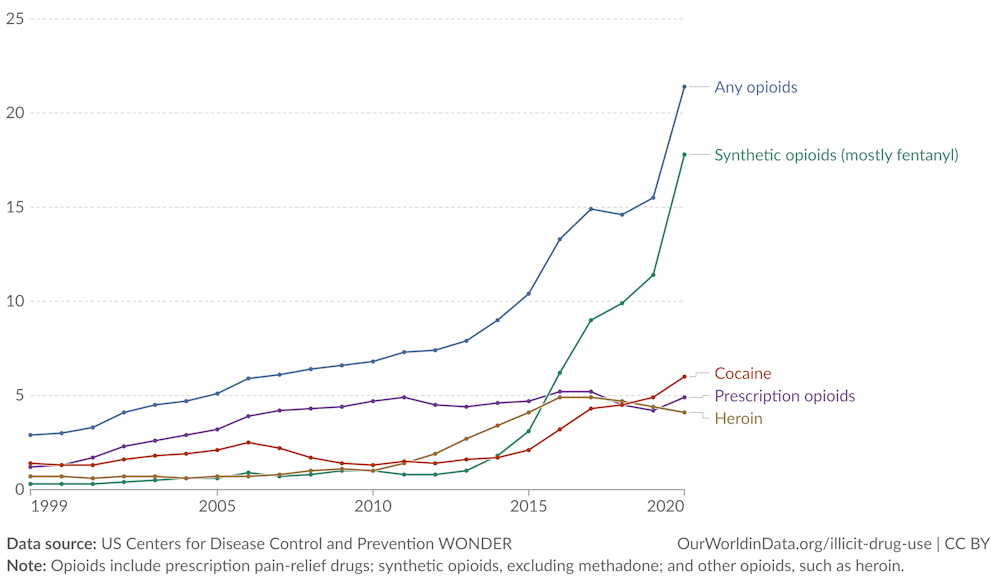
In the US, the synthetic opioids fentanyl and oxycodone have contributed to more than 100,000 fatal overdoses each year since 2021. While there are signs this deaths toll is at last beginning to fall, the harm and pain of addiction and overdose affects every strata of American society – as shown in moving portrayals of America’s opioid crisis such as Painkiller and Dopesick. Most fatalities are caused by respiratory depression where breathing is significantly slowed or stops altogether.
Official trailer for Painkiller (Netflix)
Fentanyl is an analgesic drug that is 50-100 times more potent than heroin or morphine. Where China used to be the principal manufacturer and supplier of fentanyl to the US, Mexico is now the primary source. In December 2024, Mexican authorities announced “the largest mass seizure of fentanyl pills ever made” – amounting to more than 20 million doses of fentanyl pills worth nearly US$400 million. The pills were found in Mexico’s Sinaloa state, home of the Sinaloa drug cartel and a hub of fentanyl production,
“This is what makes us rich,” one fentanyl cook recently told the New York Times. He was scathing about the idea that Donald Trump would be able to stamp out the supply of fentanyl from Mexico to the US by threatening Mexico’s government with tariffs. “Drug trafficking is the main economy here.”
However, the introduction of synthetic opioids to the US came not via organised crime but through a deliberate strategy of the pharmaceutical industry. Upon launching its prescription opioid painkiller OxyContin (a brand name for oxycodone) in 1996, Perdue Pharma, owned by the Sackler family, devised a plan to increase prescriptions of the drug by incentivizing and rewarding doctors to give these drugs to their patients. On a business level, this was a success; on a human level, it has been a disaster.
As patients quickly developed tolerance to drugs such as OxyContin, they had to take higher doses to avoid withdrawal symptoms or the positive feelings it gave them. Taking more of these opiates increases the risk of accidental overdose, many of which proved to be fatal. It has also driven those dependent on drugs to the black market, and into the hands of organised drug gangs, as they seek the drugs in greater quantities.
Dependency on fentanyl and other opioids is all-consuming. When not using these drugs, people are entirely focused on ensuring sufficient supply of the next dose. This includes funding supply which can take people to places they thought they would never be, for example breaking the law, shoplifting or getting involved in commercial sex to make enough money to buy drugs.
Synthetic opiates like OxyContin and fentanyl have proved to be classless, ageless and sex blind. The first-hand experience of addiction and fatalities have radically altered the way many Americans think about drugs and the problems they cause. Canada, too, is suffering a major crisis.
Compounding this tragedy is the failure of the state to provide interventions and treatment that could have reduced fatal and non-fatal overdoses. It is only now that evidence-based interventions are beginning to be made widely available, such as access to Naloxone – a drug that can reverse the effects of opiates and potentially save a life.
Of course, it isn’t just hospitals and health professionals that are challenged by the results of widespread use of opioids, but public services like the police and fire service. In some areas of the US, there have been so many daily overdoses that every service was called on to try and deal with it. Local mayors have made it a priority to train police and fire personnel to be trained as first responders, such is the scale of the problem.
But it is not just in North America that we see the failure of politicians and the state to act when faced with growing problems with drugs. In the UK, where record numbers are dying because of using drugs such as heroin, the government has not invested in overdose prevention strategies. At a time when fatal overdoses increase year on year, budgets for specialist treatment have been reduced. It remains to be seen what the recently elected Labour government will do, if anything, to tackle the tragic rise in drug related fatalities.
What connects both examples from the US and UK is the attitude and perception of drug use many of us have. Drug use and the heavy use of prescription painkillers is still heavily stigmatised. Many of us still view this as something individuals bring on themselves or have a choice about.
So, if we don’t care about what happens to people who develop problems with drugs, why should our elected representatives? In part, it is our bigotry that is enabling the lack of timely intervention, despite us possessing the knowledge and evidence of how drug harms can be minimised.
Latin America: breakdown of the rule of law
Under the last Conservative government, the UK Home Office asserted that people who used cocaine recreationally are supporting violence not only in the UK but in the countries that produce its raw ingredients. It’s not clear if this has made any difference to those using cocaine in the UK – personally, I doubt many people consider or are aware of how cocaine is produced or its provenance.
Perhaps if those using cocaine, mainly in western countries, realised the extent of violence and suffering that cocaine manufacture causes they might think again. Latin America has suffered enormously, with few countries there not touched in some way by the violence and breakdown of law associated with drug production and supply. According to the latest UN World Drugs Report:
Global cocaine supply reached a record high in 2022, with more than 2,700 tons of cocaine produced that year, 20% more than in the previous year … The impact of increased cocaine trafficking has been felt in Ecuador in particular, which has seen a wave of lethal violence in recent years linked to both local and transnational crime groups, most notably from Mexico and the Balkan countries.
Cocaine seizures and homicide rates increased five-fold between 2019 and 2022 in Ecuador, with the highest such rates reported in the coastal areas used for trafficking the drug to major destination markets in North America and Europe.
Cocaine trafficking flows based on reported seizures (2019-22):
As with opium production in Afghanistan, it is small-scale farmers in Colombia, Peru and Bolivia that grow the coca plant that will be turned into cocaine. Like their Afghan counterparts, they grow coca as it is more profitable than alternatives such as coffee. While it may be profitable in the short term, there are greater costs to them and their society.
Cocaine production brings with it violence as those further up the drug production chain try to control its trade. Few parts of these societies are unscathed, from bribing local politicians through to whole regions that are controlled by organised crime. Keeping control means that the use of firearms and violence increases. Against this backdrop, it is unsurprising that basic health and social services suffer.
So, while a coca grower may have more money, every other aspect of their life is negatively impacted. Whether it is regional or state institutions, both are compromised by the drug trade and those that control it. While this may not lead to the total collapse of law and order, it does create injustice and distorts the rule of law in many areas of Latin America and the Caribbean, where competition between gangs has also resulted in an increase in homicides.
The impact is on all sectors of society, now and into the future. For example, while historically the role of women has been largely underrepresented in research and drug policy, the UN report recognises that this is changing:
As women increasingly participate in economic activities, the role that women play in the drug phenomenon may become increasingly important. For example, a shift away from plant-based drug production may affect many women in rural households involved in opium poppy and coca bush cultivation.
The UN also identifies the specific risk to young people and the drugs trade, highlighting:
Long-term efforts to dismantle drug economies must provide socioeconomic opportunities and alternatives, which go beyond merely replacing illicit crops or incomes and instead address the root structural causes behind illicit crop cultivation, such as poverty, underdevelopment, and insecurity. They must also target the factors driving the recruitment of young people into the drug trade, who are at particular risk of synthetic drug use.
Meanwhile, demand for treatment in Europe due to problems with cocaine has risen significantly in recent years, since 2011 there has been an 80% increase in treatment presentations. This reflects the growing number of people using cocaine and the rise in purity of the drug.
Amid what may seem to be a story of unrelenting despair and hopelessness, there are local initiatives and even a few state-wide policies that provide optimism that change is possible.
In my roles both as clinician and scientist, I’ve often been amazed by how ingenious people can be when faced with the apparently impossible. For example, the way some people use heroin to dampen their psychotic symptoms, such as auditory and visual hallucinations – or the development of Naloxone, a drug that can temporarily reverse the effects of opioids, providing a short window for emergency services to treat people who have overdosed.
Early in my career, I witnessed the emergence of HIV in the UK in the 1980s. The speed at which this disease spread was not matched by our ability to treat it. Our response to HIV was undoubtedly hampered by prejudice and stigma towards marginalised groups in society, namely gay men and those using drugs (particularly injecting them).
However, unexpectedly and courageously, the Conservative government recognised those who were most at risk of contracting HIV, and organised a package of measures to contain the spread of infection. One part of this was a media campaign based on public health messaging designed to reduce the risk of contracting the disease. But the government also invested in treatment for those who had been infected and engaged with people at high risk, such as those intravenously injecting drugs.
I worked in specialist HIV clinics for those using drugs. At the time, methadone and diamorphine were provided as an alternative to heroin. Regulations and protocols that restricted the prescribing of these medical opioids were eased, so we could ensure patients attending these clinics were given sufficient oral and injectable opioids that they didn’t need to source street heroin.
This meant they had access to medical grade opioids and, crucially, were given regular supplies of sterile injecting equipment. It was this that reduced the risk of contracting HIV, as some people would share injecting equipment when using heroin.
This impressive policy ran counter to the Conservative party’s ideology at the time, which was to punish rather than help those using drugs like heroin. It showed me how, even with traditional mindsets, it is possible to shift policy thinking in the face of a health crisis. And make no mistake, the global drug problem is an ongoing health crisis. Today, the UN points to the risks that intravenous users of drugs still face:
An estimated 13.9 million people injected drugs in 2022, with the largest number living in North America and East and South-East Asia … The relative risk of acquiring HIV is 14 times higher for those who inject drugs than in the wider population globally.
There are, though, signs of positive change in the way some countries and regions are changing their drug policies. Scotland recently opened a drug consumption facility in Glasgow – a safe place for people to use their drugs, usually injecting drugs like heroin. Such spaces provide access to sterile injecting equipment, reducing the risk of blood-borne infections such as HIV or Hepatitis. At the same time, they offer the opportunity to engage with people who have not accessed traditional health services.
Portugal, as mentioned earlier, has made substantial changes to the way it approaches drug use and the problems associated with it. This policy shift since 2000 has saved lives and brought a more humane way of treating people who develop problems with drugs.
Contrast this with the wasted effort and resources ploughed into the war on drugs – initiated by Nixon and followed by so many western governments ever since. My plea to policymakers is simple: employ the same evidence-based science you use for health issues towards drugs and problem drug use.
Science and research can help in many ways, if given the chance. Some of it might seem radical, like providing safe drug consumption spaces. Some of it is more mundane, but vital – like tackling inequality, a clear driver of problem drug use across the world.
But while we often look to politicians to take the lead on change, it is people – us – that really hold the solution. By far the greatest threat to people and society from drugs is ignorance and bigotry. So many lives have been lost to drugs because of shame, either as a driver of drug use or a barrier to seeking help.
Beliefs are notoriously difficult to shift. As with climate change, the most powerful driver of change is personal experience. We know that when a family or community is affected by a drug overdose, their beliefs and perceptions change. But this is not the way any of us should want to see change happen.
To hear about new Insights articles, join the hundreds of thousands of people who value The Conversation’s evidence-based news. Subscribe to our newsletter.
Ian Hamilton does not work for, consult, own shares in or receive funding from any company or organisation that would benefit from this article, and has disclosed no relevant affiliations beyond their academic appointment.
(COLUMBIA, S.C.) –South Carolina Attorney General Alan Wilson announced the arrest of Shaquezius Leevontae Dennis, 19, of Batesburg-Leesville, S.C., on one charge connected to the sexual exploitation of minors. Internet Crimes Against Children (ICAC) Task Force investigators with the Lexington County Sheriff’s Department made the arrest. Investigators with the Attorney General’s Office, also a member of the state’s ICAC Task Force, assisted with the investigation.
Investigators received a CyberTipline report from the National Center for Missing and Exploited Children (NCMEC) which led them to Dennis. Investigators state Dennis distributed files of child sexual abuse material.
Dennis was arrested on January 31, 2025. He is charged with one count of sexual exploitation of a minor, second degree (§16-15-405), a felony offense punishable by up to 10 years imprisonment.
This case will be prosecuted by the Attorney General’s Office.
Attorney General Wilson stressed all defendants are presumed innocent unless and until they are proven guilty in a court of law.
* Child sexual abuse material, or CSAM, is a more accurate reflection of the material involved in these heinous and abusive crimes. “Pornography” can imply the child was a consenting participant. Globally, the term child pornography is being replaced by CSAM for this reason.
EVANSVILLE— James Henley, 35, of Greenwood, Indiana, has been sentenced to ten years in federal prison, followed by three years of supervised release after pleading guilty to aggravated identity theft, conspiracy to commit access device fraud, two counts of money laundering, and eight counts of wire fraud. Henley has also been ordered to pay $1,887,426.63 in restitution.
According to court documents, over the course of three years, Henley orchestrated multiple large and complex fraud schemes, resulting in a total loss of $2,927,758.95 to individual homeowners, an Indiana attorney, a bank, and ten state governments. As part of his fraud schemes, Henley registered five fake businesses (OnTrack Real Estate Solutions, LDI Investments Corp, Lucario Investments, 317 Traffic, and Henley Real Estate Solutions) with the states of Indiana and Kentucky, claiming to serve as the Chief Executive Officer for most of them. None of the businesses were legitimate. Instead, Henley used the businesses to mask his identity, make his schemes appear more credible, and launder the stolen money.
Henley’s schemes are broken down as follows:
COVID-19 Fraud:
Between May 2020 and March 2021, James Henley, his wife Jameka Henley, and his associate Jimmie Bickers used the stolen personally identifiable information of 76 real individuals to submit 120 unemployment insurance applications to ten states during the COVID-19 pandemic. Once the applications were approved, the trio used 65 unemployment insurance debit cards to make purchases at retailers and withdraw cash at ATMs in the Evansville and Indianapolis areas. The states paid a total of $1,119,426.63 in unemployment benefits in connection with the group’s fraudulent applications. In July 2020, Henley used funds withdrawn from ATMs to buy a Chevrolet Camaro for $22,801.
Bickers and Jameka Henley have been formally charged for their roles in this scheme but have not pleaded guilty.
Home Title Fraud:
Between December 2021 and May 2023, Henley stole five homes in Indianapolis by filing fraudulent deeds with the Marion County Recorder’s Office. Through the filings, Henley claimed that the homeowners had sold their homes to his fake businesses, but, in reality, he had never even spoken with the homeowners. Unbeknownst to the victims, Henley filed these fraudulent deeds and then sold the homes for significantly less than their market value, pocketing more than $260,000 in profits.
Henley also attempted to steal and sell an additional 14 homes in Indianapolis and Evansville. With one exception, the individuals who bought the homes from Henley took possession and ultimately kept the homes.
For one homeowner, the property Henley stole was her childhood home. She purchased the home while her mother was in the hospital with the hope that, when her mother’s condition improved, her mother would be able to live out her remaining years in the house.
Mortgage Fraud:
In November 2021, an associate of Henley’s purchased a home in Indianapolis, using a mortgage loan from a bank. In April 2022, Henley filed a fraudulent document with the Marion County Recorder’s Office to make it seem as if the mortgage loan had been paid off, when it had not been paid. Henley then filed a deed naming himself a joint owner of the home. Henley and his associate subsequently sold the property for $255,000, pocketing all the proceeds, even though the bank should have received the majority of the funds.
Auto Loan Fraud:
In March 2023, Henley purchased a Dodge Durango in Indianapolis for $71,479, using an auto loan from Everwise Credit Union. A few months later, in June 2023, Henley purchased a Chevrolet Silverado in Plainfield for $54,270, using a second loan from Everwise Credit Union.
In October 2023, Henley connected a JPMorgan Chase bank account to his auto loans, via Everwise’s online payment portal. Henley falsely represented that the Chase account belonged to Jimmie Bickers, and that he had authority to make payments on his loans using funds from the Chase account.
The Chase account was actually an Indiana attorney’s Interest on Lawyers’ Trust Account (IOLTA), which is a highly regulated bank account used by lawyers to hold client funds. The interest earned on IOLTA accounts is used to fund grants for nonprofit groups that promote pro bono and access to justice programs. Henley did not have the attorney’s permission to access or withdraw funds from the IOLTA account.
Between October and November 2023, Henley used the IOLTA account to make two payments, totaling $98,000, toward his auto loans.
Henley has prior felony convictions for financial crimes, including theft, forgery, and fraud.
“James Henley went to great lengths to coordinate exceptionally greedy, complex schemes that exploited hard-working families and state government programs,” said John E. Childress, Acting U.S. Attorney for the Southern District of Indiana. “Undeterred by prior felony convictions for the same conduct, this defendant stole over a million dollars, wreaking financial and logistical havoc on hundreds of victims. The Department of Justice will continue to work with our law enforcement partners to investigate allegations of fraud and seek prosecution as appropriate.”
“James Henley filed fraudulent unemployment insurance (UI) claims in the names of identity theft victims in order to receive UI benefits to which he was not entitled. He enriched himself by defrauding a program that was intended to assist struggling American workers during an unprecedented global pandemic,” said Megan Howell, Acting Special Agent-in-Charge, Great Lakes Region, U.S. Department of Labor, Office of Inspector General. “We and our law enforcement partners are committed to protecting the integrity of the UI system from those who seek to exploit this critical benefit program.”
“This lengthy prison sentence sends a clear message: individuals who attempt to exploit and commit financial crime and identity theft will be brought to justice,” said Ramsey E. Covington, Acting Special Agent in Charge, IRS Criminal Investigation, Chicago Field Office. “IRS Criminal Investigation and our fellow law enforcement partners are committed to protecting the integrity of our financial institutions and will continue to hold criminals like James Henley accountable to the fullest extent of the law.”
“This case should serve as a powerful reminder that individuals with a history of financial crimes will face significant consequences when they demonstrate a blatant disregard for the law and continue to exploit and deceive others for personal gain,” said FBI Indianapolis Special Agent in Charge Herbert J. Stapleton. “The FBI, working alongside our law enforcement partners, will continue to hold those who perpetuate such offenses accountable and protect the public from those who manipulate the system for their own benefit.”
The Federal Bureau of Investigation, Internal Revenue Service-Criminal Investigation, Department of Labor-Office of the Inspector General, and the Indiana Attorney General’s Office Homeowner Protection Unit investigated this case. The sentence was imposed by U.S. District Judge Matthew B. Brookman.
Acting U.S. Attorney Childress thanked Assistant U.S. Attorney Matthew Miller, who prosecuted this case.
On May 17, 2021, the Attorney General established the COVID‑19 Fraud Enforcement Task Force to marshal the resources of the Department of Justice in partnership with agencies across government to enhance efforts to combat and prevent pandemic-related fraud. The Task Force bolsters efforts to investigate and prosecute the most culpable domestic and international criminal actors and assists agencies tasked with administering relief programs to prevent fraud by augmenting and incorporating existing coordination mechanisms, identifying resources and techniques to uncover fraudulent actors and their schemes, and sharing and harnessing information and insights gained from prior enforcement efforts.
Anyone with information about allegations of attempted fraud involving COVID‑19 can report it by calling the Department of Justice’s National Center for Disaster Fraud (NCDF) Hotline at 866-720-5721 or via the NCDF Web Complaint Form at https://www.justice.gov/disaster-fraud/ncdf-disaster-complaint-form
Ocala, Florida – United States Attorney Roger B. Handberg announces the return of an indictment charging Jared Menendez (25, Fruitland Park) with attempted enticement of a minor to engage in sexual activity and attempted transfer of obscene material to a minor. If convicted of the attempted enticement offense, Menendez faces a minimum sentence of 10 years, up to life, in federal prison. The attempted transfer of obscene material offense carries a maximum sentence of 10 years’ imprisonment. Menendez is currently detained pending the resolution of the case.
According to the indictment, between November 14 and December 20, 2024, Menendez attempted to persuade, induce, entice, and coerce an individual whom he believed had not yet attained 18 years of age to engage in sexual activity.
An indictment is merely a formal charge that a defendant has committed one or more violations of federal criminal law, and every defendant is presumed innocent unless, and until, proven guilty.
This case was investigated by Homeland Security Investigations and the Marion County Sheriff’s Office. It will be prosecuted by Assistant United States Attorney Sarah Janette Swartzberg.
This case was brought as part of Project Safe Childhood, a nationwide initiative launched in May 2006 by the Department of Justice to combat the growing epidemic of child sexual exploitation and abuse. Led by United States Attorneys’ Offices and the Criminal Division’s Child Exploitation and Obscenity Section (CEOS), Project Safe Childhood marshals federal, state, and local resources to locate, apprehend, and prosecute individuals who sexually exploit children, and to identify and rescue victims. For more information about Project Safe Childhood, please visit www.justice.gov/psc.
Ocala, Florida – United States Attorney Roger B. Handberg announces that Jessie Wooden (36, Miami) has pleaded guilty to possession with the intent to distribute 50 grams or more of methamphetamine. Wooden faces a minimum of 10 years, up to life, in federal prison. A sentencing date has not yet been set.
According to court records, on March 10, 2024, Wooden was an inmate at the Coleman Federal Correctional Complex (FCC Coleman) in Sumter County. During a visitation session, surveillance footage captured Wooden being thrown a bag containing contraband that had been smuggled into the prison. Correctional officers confiscated the bag, which contained 78 grams of methamphetamine. When interviewed by law enforcement, Wooden admitted to having visitors bring contraband into the prison for him. He also confirmed that he was going to distribute the methamphetamine inside FCC Coleman.
This case is being prosecuted as part of a United States Department of Justice task force aimed at rooting out contraband and misconduct in the Federal Bureau of Prisons. The task force was led by the Federal Bureau of Prisons and the Department of Justice Office of the Inspector General, with support from the Federal Bureau of Investigation, the Drug Enforcement Administration, and the United States Attorney’s Office for the Middle District of Florida. It is being prosecuted by Assistant United States Attorney Hannah Nowalk Watson.
SCRANTON – The United States Attorney’s Office for the Middle District of Pennsylvania announced that United States District Court Judge Julia K. Munley, sentenced Mykayliah Hevener, age 26, of Carbondale, Pennsylvania, on January 30, 2025, to 27 years in prison for her production of child pornography.
According to Acting United States Attorney John C. Gurganus, for an approximate nine-month period in 2023, Hevener engaged in sexual contact with a toddler and used the toddler to create images and videos of child pornography which were either viewed live or sent over the internet to a co-conspirator, Benjamin Egli, of Iowa. Mr. Egli is being prosecuted by the United States Attorney’s Office for the Northern District of Iowa. He has entered a guilty plea and awaits sentencing in that matter.
The case was investigated by the Federal Bureau of Investigation (F.B.I.) and the Tipton, Iowa Police Department. Assistant U.S. Attorney Luisa Honora Berti prosecuted the case.
This case was brought as part of Project Safe Childhood, a nationwide initiative launched in May 2006 by the Department of Justice to combat the growing epidemic of child sexual exploitation and abuse. Led by the United States Attorneys’ Offices and the Criminal Division’s Child Exploitation and Obscenity Section, Project Safe Childhood marshals federal, state, and local resources to locate, apprehend, and prosecute individuals who sexually exploit children, and to identify and rescue victims. For more information about Project Safe Childhood, please visit www.usdoj.gov/psc.
MIAMI – On Jan. 30, a federal district judge in West Palm Beach, Florida sentenced Anthony Raul Del Valle, 29, of Lake Worth Beach, Florida, to 120 months in federal prison. The sentence comes after a federal jury found Del Valle guilty of distributing acetyl fentanyl and fentanyl and possessing a firearm in furtherance of a drug trafficking crime in November 2024.
On April 8, 2024, Del Valle distributed pills that appeared to be oxycodone, but in fact were fentanyl and acetyl fentanyl, to three family members in Lantana, Florida. All three family members immediately ingested the pills after the distribution. Two of the family members died less than two hours after the distribution.
On April 10, 2024, law enforcement agents identified and arrested Del Valle as the source of the pills after conducting a controlled purchase from Del Valle. Law enforcement agents recovered a loaded firearm from Del Valle during the arrest.
U.S. Attorney Hayden P. O’Byrne for the Southern District of Florida, Special Agent in Charge Deanne L. Reuter of the Drug Enforcement Administration (DEA), Miami Field Division, announced the sentence.
The DEA, Miami Field Division investigated the case with assistance from the Bureau of Alcohol, Tobacco, Firearms, and Explosives (ATF), Miami Field Office, Lantana Police Department, Boynton Beach Police Department and Palm Beach County Sheriff’s Office. Assistant United States Attorneys Shannon O’Shea Darsch and Alexandra Chase prosecuted it.
According to the DEA’s National Drug Threat Assessment, synthetic drugs, such as fentanyl, are poisoning our nation. Fentanyl has proven to be a deadly poison that does not discriminate. Its victims include every gender, race, age, and economic background, and its debilitating effects are the same across all demographics. Fentanyl is a synthetic opioid that is up to 50 times stronger than heroin and 100 times stronger than morphine. Even in small doses, fentanyl can be deadly. Just one fentanyl pill can kill, as noted in DEA’s One Pill Can Kill campaign. As little as two milligrams, about the size of 5 grains of salt, can be fatal. According to the Centers for Disease Control and Prevention (CDC), fentanyl and other synthetic opioids are the most common drugs involved in overdose deaths. Over 150 people die every day from overdoses related to synthetic opioids like fentanyl. The State of Florida has also seen an exponential increase in overdoses associated with fentanyl. In 2022, more than 5,622 people died from overdoses involving fentanyl and fentanyl analogs in Florida.
You may find a copy of this press release (and any updates) on the website of the United States Attorney’s Office for the Southern District of Florida at www.justice.gov/usao-sdfl.
Related court documents and information may be found on the website of the District Court for the Southern District of Florida at www.flsd.uscourts.gov or at http://pacer.flsd.uscourts.gov, under case number 24-cr-80062.
Tampa, FL – U.S. District Judge Thomas P. Barber has sentenced Sherron Gary (41, Tampa) to seven years in federal prison for possessing a firearm and ammunition as a convicted felon. Gary pleaded guilty in October 2024.
According to court documents, on April 9, 2023, officers with the Tampa Police Department (TPD) attempted a traffic stop on a vehicle driven by Gary after observing the vehicle had a broken taillight. Gary failed to pull over and instead fled from the officers at a high rate of speed. A police helicopter followed Gary. After Gary’s vehicle was boxed in by law enforcement, Gary fled from the officers on foot, which the helicopter was also able to capture.
As Gary fled, the helicopter crew observed Gary discard an item as he was running that resembled a firearm. TPD officers apprehended Gary. After the arrest, the helicopter crew directed officers back to the location where they had observed Gary discard the firearm. Officers located a 9mm Walther Creed semiautomatic pistol at the location.
At the time, Gary had four prior felony convictions, including aggravated battery and armed burglary of a dwelling, trafficking of cocaine, delivery of cocaine, and delivery of cocaine within 1,000 feet of church. As a convicted felon, Gary is prohibited from possessing firearms or ammunition under federal law.
This case was investigated by the Federal Bureau of Investigation, the Tampa Police Department, and the Bureau of Alcohol, Tobacco, Firearms and Explosives. It was prosecuted by Assistant United States Attorney Samantha Newman. The forfeiture was handled by Assistant United States Attorney Suzanne Nebesky.
This case is part of Project Safe Neighborhoods (PSN), a program bringing together all levels of law enforcement and the communities they serve to reduce violent crime and gun violence, and to make our neighborhoods safer for everyone. On May 26, 2021, the Department launched a violent crime reduction strategy strengthening PSN based on these core principles: fostering trust and legitimacy in our communities, supporting community-based organizations that help prevent violence from occurring in the first place, setting focused and strategic enforcement priorities, and measuring the results.
Tampa, FL – U.S. District Judge Virginia M. Hernandez Covington has sentenced Jermaine Jerome Campbell (35, Lakeland) to 12 years in federal prison for possessing with the intent to distribute fentanyl and methamphetamine. Campbell pleaded guilty on June 25, 2024.
According to court documents, on September 15, 2023, Campbell distributed fentanyl pills to another individual from his mother’s residence. Upon searching Campbell’s home on September 21, 2023, law enforcement recovered bulk quantities of methamphetamine hidden inside of a tool bag.
This case was investigated by the Federal Bureau of Investigation and the Lakeland Police Department. It was prosecuted by Assistant United States Attorney David Pardo.
This case was part of an Organized Crime Drug Enforcement Task Force (OCDETF) investigation. OCDETF identifies, disrupts, and dismantles the highest-level criminal organizations that threaten the United States using a prosecutor-led, intelligence-driven, multi-agency approach. Additional information about the OCDETF Program can be found at www.justice.gov/OCDETF.
BOSTON — U.S. Immigration and Customs Enforcement apprehended an illegally present Dominican national convicted for murder in Massachusetts in 2007 when officers arrested Cesar Augusto Polanco, 59, January 24 at the Massachusetts Correctional Institution in Norfolk after he was released from state custody.
“Cesar Augusto Polanco came to this country lawfully; however, his horrendous actions have deemed him a significant threat to the residents here,” said acting ICE Enforcement and Removal Operations Boston Field Office Director Patricia H. Hyde. “We will not allow our communities to be subjected to the danger posed by violent alien offenders. ICE ERO Boston will continue to prioritize public safety by arresting and removing these criminals from New England.”
Polanco lawfully entered the United States at John F. Kennedy International Airport March 18, 1990 and later violated the terms of his lawful admission.
Polanco was convicted of murder March 8, 2007, and sentenced to life in prison with the possibility of parole. ICE issued an immigration detainer against Polanco June 20, 2013, with the Massachusetts Correctional Institution.
ICE served Polanco with a notice to appear before a Department of Justice immigration judge December 20, 2013, and was ordered removed from the U.S. to the Dominican Republic June 25, 2014.
The Massachusetts Correctional Institution honored the immigration detainer and informed ICE Boston of Polanco’s release. Polanco remains in ICE custody pending removal proceedings.
“ICE recognizes the importance of our relationships with state and local law enforcement partners, and we will continue to share information and coordinate operations with those partners in a way that ensures safety within our community,” Hyde said. “As a result of this partnership, the Massachusetts Correctional Institution contacted ICE and allowed for a safe transfer of a violent criminal. In doing so, they enabled us to make the arrest in the safety of a jail cell rather than sending a team of officers into the community to make a potentially dangerous arrest.”
The 287(g) program – through the delegation of some immigration officer duties – allows ICE to cooperate with its state and local law enforcement partners to protect the homeland through the arrest and removal of noncitizens who undermine the safety of U.S. communities and the integrity of U.S. immigration laws. While the 287(g) Program has yielded successes, ICE recognizes the program is not universally regarded as the most effective or appropriate model in every jurisdiction. Accordingly, ICE maintains its authority to utilize 287(g) agreements and exercise strict oversight. ICE continually evaluates the overall effectiveness of the program.
Members of the public with information regarding child sex offenders can report crimes or suspicious activity by dialing the ICE Tip Line at 866-DHS-2-ICE (866-347-2423) or completing the online tip form.
Learn more about ERO Boston’s mission to increase public safety in our New England communities on X at @EROBoston.
FAIRFAX COUNTY, Va. — U.S. immigration and Customs Enforcement apprehended an illegally present Salvadoran national convicted of sexually assaulting a Virginia resident when officers with ICE Washington, D.C. arrested Nicolas Alberto Hernandez-Lopez, 46, Jan. 15 in Fairfax County, Virginia.
“Nicolas Alberto Hernandez-Lopez illegally reentered the United States, and then victimized a resident of our Virginia community. This is not something that the officers of ICE Washington, D.C. will tolerate,” said ICE Enforcement and removal Operations Washington, D.C. acting Field Office Director Patrick Divver. “We will continue our mission of arresting public safety threats and removing egregious alien offenders from our Washington, D.C. and Virginia neighborhoods.”
Hernandez-Lopez lawfully entered the U.S. and later violated the terms of his lawful admission.
Officials in Fairfax County, Virginia convicted Hernandez-Lopez of second-degree sexual assault March 7, 2019, and sentenced him to prison.
Officers with ICE arrested Hernandez-Lopez April 7, 2023, and served him with a notice to appear before a Department of Justice immigration judge. The immigration judge ordered Hernandez-Lopez removed from the U.S. on May 23, 2023, and ICE officers removed Hernandez-Lopez to El Salvador June 9, 2023.
Hernandez-Lopez unlawfully re-entered the United States on an unknown date, at an unknown location, and without being inspected, admitted, or paroled by a U.S. immigration official.
Officers with ICE Washington, D.C. arrested Hernandez-Lopes January 15 in Fairfax County, Virginia. He remains in ICE custody.
Members of the public with information regarding child sex offenders can report crimes or suspicious activity by dialing the ICE Tip Line at 866-DHS-2-ICE (866-347-2423) or completing the online tip form.
Learn more about ERO Boston’s mission to increase public safety in our New England communities on X at @EROWashington.
NEW YORK – New York Attorney General Letitia James and a coalition of 22 attorneys general today celebrated winning a court order halting the implementation of a Trump administration policy that would block many federal agency grants, loans, and other financial assistance programs. On Friday, Judge John J. McConnell of the U.S. District Court for the District of Rhode Island granted a temporary restraining order (TRO) blocking the administration’s illegal funding freeze after Attorney General James and the coalition filed a lawsuit to stop the policy.
“The power of the purse belongs to Congress – not the President of the United States,” said Attorney General James. “Last week, I led a coalition of attorneys general in suing to stop this dangerous and chaotic policy, and we won a court order to stop it while our lawsuit proceeds. Now, New Yorkers can rest assured that federal funds for critical services – meals for our seniors, health care, community public safety, disaster relief, and so much more – are currently not at risk. I will continue to fight in court to defend the essential programs and services New Yorkers need.”
The TRO won by Attorney General James prohibits federal agencies from taking any action that would “pause, freeze, block, cancel or terminate” the provision of federal funding, unless otherwise permitted by existing statute or the terms of the grant. Because of Attorney General James’ immediate intervention, programs that provide critical health and childcare services to families in need, deliver support to public schools, combat violence and expand public safety, provide life-saving disaster relief to states, and more are no longer at immediate risk of losing their funding.
In a notice sent to federal agencies and filed with the court this morning, the Department of Justice (DOJ) indicated its intent to comply with the court order and affirmed that the TRO blocking the illegal freeze applied to all federal funding awards or obligations, including those made to recipients such as hospitals, non-profits, or other organizations. The TRO applied to both current and future grants of federal assistance.
This morning, Attorney General James also sent a letter to hundreds of recipients of federal funding informing them that federal financial assistance cannot be frozen as a result of the administration’s policy, which is now blocked. This included health care providers, who were informed that funding cannot be frozen or withdrawn on the basis of providing gender affirming care to minors. Attorney General James also reminded providers that regardless of funding, all providers in New York are obligated to comply with New York state laws, including those that prohibit discrimination against individuals based on their sex, gender identity or expression, sexual orientation, or membership in other protected classes. To comply with New York law, Attorney General James warns all providers that they must continue to provide health care services, including gender affirming care, to transgender or gender nonconforming individuals.
This lawsuit was led by Attorney General James and the attorneys general of California, Illinois, Massachusetts, New Jersey and Rhode Island. Joining the lawsuit are the attorneys general of Arizona, Colorado, Connecticut, Delaware, Hawaii, Maine, Maryland, Michigan, Minnesota, Nevada, New Mexico, North Carolina, Oregon, Vermont, Washington, Wisconsin, and the District of Columbia.
Governor Kathy Hochul today announced $20.7 million to support SNUG Street Outreach programs that work to reduce gun violence and save lives in 14 communities across New York State. These grants to community-based organizations and hospitals fund outreach workers, hospital responders, social workers and case managers who are credible messengers and work with individuals at risk of gun violence, connecting them with support and services to change behavior and increase opportunities. Last week, Governor Hochul announced that shooting incidents with injury reported in communities participating in the State’s Gun Involved Violence initiative reached record lows in 2024 with 588 incidents reported compared to 817 in 2023, a 28 percent reduction. The Governor’s FY26 Executive Budget continues unprecedented support for SNUG, Gun Involved Violence and other initiatives in communities that report 90 percent of violent crimes with firearms and 85 percent of violent crimes outside of New York City.
“Public safety is my number one priority — that’s why my Budget invests in proven initiatives like the SNUG program to drive down gun violence, save lives and keep New Yorkers safe,” Governor Hochul said. “Outreach teams across the State are working alongside law enforcement and local partners to target gun violence anywhere it occurs, and to engage stakeholders in a comprehensive approach that makes our communities safer for all.”
New York State’s SNUG program uses a public health approach to address gun violence by identifying the source, interrupting transmission and treating individuals, families and communities affected by the violence. Administered by the state Division of Criminal Justice Services, SNUG, Gun Involved Violence (GIVE) initiative, the State’s nationally recognized Crime Analysis Centers Network and Project RISE (Respond, Invest, Sustain, Empower) are key components of Governor Hochul’s comprehensive plan to address the causes and consequences of gun violence and other crimes.
New York State Division of Criminal Justice Services Commissioner Rossana Rosado said, “Our SNUG Street Outreach teams are a critical component of Governor Hochul’s comprehensive crime reduction and public safety plan. These dedicated individuals work in communities disproportionately affected by gun violence. They mediate and defuse conflicts and provide access to programs and support, including counseling and case management, so youth and families can thrive, and communities can heal. We thank Governor Hochul for her continued support of this work and for her leadership on public safety.”
The $20.7 million will fund staff, programs, services, equipment and technology for the SNUG locations during the 2025 calendar year. Community-based organizations and hospitals receive the funding, which supports 181 full-time and 39 part-time employees who work in specific neighborhoods in Albany, the Bronx, Buffalo, Hempstead, Mt. Vernon, Newburgh, Niagara Falls, Poughkeepsie, Syracuse, Rochester, Troy, Utica, Wyandanch and Yonkers. DCJS tracks shooting data in these “SNUG zones” and last year, those zones collectively reported significant, double-digit decreases in shooting victims, individuals killed by gun violence and shooting incidents with injury when compared to 2023.
SNUG outreach workers, social workers, case managers and hospital responders work in neighborhoods disproportionately affected by gun violence, and the program also embeds social workers and hospital responders at Level One trauma centers in Albany, Buffalo, the Bronx, Rochester and Syracuse. These professionals work with individuals and families in the aftermath of a violent incident to offer support, services and connect them to the SNUG program in their communities for additional assistance.
SNUG staff are credible messengers who live in the communities in which they work, and some have been involved with the criminal justice system or lost loved ones to violence. They work with teens and young adults to detect and defuse disputes before they escalate; respond to shootings to prevent retaliation through mediation and assist family members of those who have been injured or killed; and mentor youth involved with the program to set goals and connect them with educational and job opportunities as well as other services. The programs also engage the community, religious organizations and clergy, and local businesses by sponsoring anti-violence marches, job fairs, block parties, sporting events and other community gatherings.
The following organizations and hospitals will receive funding and support from DCJS to administer SNUG:
New York City and Long Island
Bronx – Jacobi Medical Center: $2,702,617
Hempstead – Family and Children’s Association: $1,164,397
Wyandanch – Economic Opportunity Council of Suffolk: $746,522
Hudson Valley
Mt. Vernon – Family Services of Westchester: $1,088,391
Newburgh – Regional Economic Community Action Plan: $896,799
Poughkeepsie – Family Services Inc.: $1,076,245
Yonkers – Yonkers YMCA: $1,010,259
Capital Region
Albany – Trinity Alliance of the Capital Region: $1,820,329 and Albany Medical Center: $262,310
Troy – Trinity Alliance of the Capital Region: $860,134
Central New York
Syracuse – Syracuse Model Neighborhood Facility: $1,820,189 and SUNY Upstate Medical Center: $464,374
Mohawk Valley
Utica – Integrated Community Alternatives Network: $792,673
Finger Lakes
Rochester – PathStone Corp.: $1,949,426 and Rochester General Hospital: $571,002
Western New York
Buffalo – Erie County Medical Center: $2,800,915
Niagara Falls – Community Missions of Niagara Frontier: $ 677,170
Comprehensive training, site visits and support from DCJS set SNUG apart from other community-based violence interruption programs across the state and country. New staff must complete 40 hours of training and new supervisors complete 32 hours of management training. All staff must also complete 40 hours of professional development training annually. This ongoing training and support help ensure that the program operates consistently across all SNUG sites despite being operated by different community-based organizations and hospitals.
State Senate Majority Leader Andrea Stewart-Cousins said, “As a State Senator, I was proud to advocate for the first SNUG investments in Yonkers and New York State because I knew that real community-driven solutions were key to reducing gun violence and keeping our neighborhoods safe. We’ve seen firsthand how SNUG has changed lives—interrupting cycles of violence, providing critical support, and helping young people find a better path. I’m so proud that Yonkers is receiving more than $1 million in new funding to support this lifesaving program. As Majority Leader, I remain committed to continuing smart, effective investments like SNUG across Westchester and New York. I thank Governor Hochul, my Westchester Delegation and Majority Senators, as well as our partners in the Assembly for their continued leadership and partnership in the fight against gun violence. I look forward to building on this progress together to keep our communities safe.”
State Senator Jamaal Bailey said, “Investing $20.7 million in SNUG to enhance efforts such as preventing gun violence, supporting at-risk individuals, and strengthening communities across New York State is essential. SNUG has been a pivotal partner in preventing gun violence and an organization that has significantly impacted my district, and will continue to do so as Mt. Vernon – Family Services of Westchester is receiving $1,088,391. By funding outreach workers, social workers, and hospital responders, future conflicts can de-escalate and create safer neighborhoods and brighter futures for all of us. Thank you to Governor Hochul for your leadership and prioritizing the safety of our community.”
State Senator Nathalia Fernandez said, “This funding for SNUG, is about more than just intervention—it’s about changing the conditions that lead to violence in the first place. Jacobi Hospital’s Standing Up to Violence program has done just that in its years in service. By supporting credible messengers, outreach workers, and trauma responders, we’re making sure the right people are in place to mediate conflicts, connect at-risk individuals with opportunities, and prevent the next tragedy before it happens. I commend Governor Hochul for investing in real solutions, because every neighborhood, every family, every child in the Bronx deserves to grow up safe from gun violence.”
State Senator Samra G. Brouk said, “Every member of our community deserves to feel safe, wherever they may be. Over $20 million dollars in funding to reduce gun violence across New York State will build upon the tremendous impact that programs such as GIVE have already had on communities like Rochester. I applaud Governor Hochul for addressing the root causes of violence and supporting working solutions to protect our fellow New Yorkers.”
State Senator Sean Ryan said, “Promoting public safety in Buffalo and across our state is a top priority. It’s why we have passed the toughest gun safety laws in the nation and continue to fund initiatives that reduce crime and strengthen communities. I am thankful for Governor Hochul’s support for these outreach programs, which have a proven track record of reducing gun violence.”
State Senator Monica Martinez said, “Gun violence is taking the lives of New Yorkers and instilling fear within our communities. The SNUG Street Outreach program is a proven tool that preempts these devastating tragedies by engaging at-risk individuals and providing them with the support needed to choose a different path. Thank you, Governor Hochul, for enshrining our shared commitment to ending gun violence in New York State in this year’s executive budget.”
State Senator Patricia Fahy said, “Investing in evidence-based programming and on-the-ground resources is exactly how we combat the scourge of gun violence. Partnering with law enforcement, community-based interrupters in cycles of violence like the Trinity Alliance of the Capital Region and increasing the state’s commitment to funding these initiatives is why we’re seeing gun violence rates drop in communities across the state. Thank you to Governor Hochul and my legislative colleagues for continuing to work to ensure that New Yorkers everywhere feel safe on our streets, and to ending the epidemic of gun violence here in New York State.”
State Senator Siela Bynoe said, “The epidemic of gun violence that has taken the lives of too many people across Long Island, and the nation, must end. Addressing the root causes of gun violence through programs that offer outreach where it’s most needed, is both necessary and impactful. I am grateful for Governor Hochul’s support of community-based solutions in the district.”
State Senator Joseph Griffo said, “It is imperative that we continue to look for ways to address and reduce gun violence in the state. This funding will strengthen the SNUG program in Utica by supporting a variety of important services and resources that will enhance public safety in the city and region.”
State Senator Rachel May said, “The state has demonstrated real progress in reducing gun violence rates, and this is our opportunity to continue that success. By increasing funding for the Syracuse Model Neighborhood Facility and SUNY Upstate Medical Center, we can make a meaningful impact on our communities where the scourge of gun violence is widespread. Thank you to Governor Hochul for her leadership, as well as to my colleagues in the legislature for their commitment to curb gun violence in New York State.”
Assembly Majority Leader Crystal Peoples-Stokes said, “We know that outreach works. When people in the community are supporting efforts to combat gun violence, lives get saved. I support the GIVE Initiative and other anti-violence initiatives as well as the work SNUG continues to do in our communities. The Response Teams at Erie County Medical Center continue to be top of the line.”
Assemblymember J. Gary Pretlow said, “As we continue to combat gun violence in our communities, investing in programs like SNUG is not just necessary—it’s life-saving. This funding from Governor Hochul ensures that we can provide resources, mentorship, and intervention to those most at risk, creating safer neighborhoods for everyone. I am proud to support SNUG and the dedicated individuals working tirelessly to break the cycle of violence in Mount Vernon and beyond.”
Assemblymember William B. Magnarelli said, “Reducing gun violence is a priority in protecting our communities. By working with organizations in the community, together we can reinforce safety measures and prevention methods to decrease gun violence.”
Assemblymember John T. McDonald III said, “As one of the original supporters of SNUG which started here in the Capital Region, I have worked closely with Trinity Alliance and those who are part of SNUG and have seen the positive impact of the program. That is why I am appreciative of the Governor’s support to continue to grow the program, including in the City of Troy where the program has taken roots and is welcomed by the public safety team. The data validates the critical need and impact of the program which is making our communities safer.”
Assemblymember Pamela J. Hunter said, “I am grateful for Governor Hochul’s leadership and commitment to reducing gun violence in our communities. The $20.7 million investment in SNUG Street Outreach programs, including critical funding for Syracuse Model Neighborhood Facility and SUNY Upstate Medical Center, will have a direct and positive impact on the lives of people in the 128th Assembly District. By supporting outreach workers, hospital responders, and case managers, this initiative provides life-changing resources to those most at risk, helping to break cycles of violence and create safer neighborhoods. I look forward to seeing the continued progress of these evidence-based efforts to protect and uplift our communities.”
Assemblymember Jonathan Jacobson said, “Unfortunately, gun violence plagues the cities of Newburgh and Poughkeepsie as it does too many areas of the State and the Nation. Gun violence must be addressed in three ways: ending gun trafficking from outside of New York State; enforcing our gun laws including full application of our red flags laws; and engaging the community through community-based organizations to discourage and stop gun violence before it starts. I wish to applaud Governor Hochul for her commitment to stopping gun violence using all three avenues and for the investment in this year’s budget in anti-gun violence initiatives with community-based organizations.”
Assemblymember Marianne Buttenschon said, “We unfortunately continue to see our youth negatively impacted by gun violence and this program works to reduce the violence. I appreciate the Governor providing additional funding to SNUG Programs.”
Assemblymember Demond Meeks said, “Community-based programs like SNUG and GIVE are making a real difference in the fight against gun violence. By focusing on mediation, mentorship, and support, they’re helping to change behaviors and address the root causes of this complex issue. The data is clear: these programs are strengthening our neighborhoods and saving lives. I commend Governor Hochul for her ongoing commitment to investing in these vital resources that directly support communities disproportionately impacted by crime.”
Assemblymember Jen Lunsford said, “Tangible investments in grassroots organizations working to stop gun violence in our community have paid dividends over the past year. We can see crime trending down in nearly every gun-related category thanks to this kind of targeted delivery of resources. This announcement from the Governor of large scale funding for gun violence prevention will help us continue to reduce violence and bring peace and stability to our neighborhoods.”
Assemblymember John Zaccaro, Jr. said, “Far too many families in the Bronx and across our communities in New York have felt the devastating effects of gun violence. The SNUG program will strengthen intervention efforts and connect at-risk individuals with critical resources. By addressing the root causes of violence and providing meaningful intervention, we are not only preventing tragedies but also creating pathways to brighter futures for individuals and families. I thank Governor Hochul for her leadership and commitment to investing in proven violence prevention programs that make a tangible difference in the lives of New Yorkers.”
Assemblymember Kwani B. O’Pharrow said, “Investing in community outreach and support programs like SNUG is crucial for reducing gun violence and fostering safer environments. Thank you, Governor Hochul, for your commitment to transforming lives and creating lasting change in our communities.”
Assemblymember Gabriella Romero said, “With a partner like Governor Kathy Hochul investing in our communities that need it most, we are making real strides in reducing gun violence and saving lives. I want to thank the Governor for her continued commitment to evidence-based, community-driven solutions like SNUG. This $20.7 million investment—including over $2 million for Albany’s Trinity Alliance and Albany Medical Center—will ensure that outreach workers, hospital responders, and social service professionals can continue their critical work to proactively reduce gun violence. These initiatives are making a difference, and I remain committed to securing the resources Albany needs to keep our neighborhoods safe.”
Assemblymember Noah Burroughs said, “SNUG has been doing excellent work in the community within my district. Gun-related crimes are down and we would like to see those numbers decrease more. This is a great opportunity for the 14 communities in New York State that Snug services to continue doing good work throughout all of its communities. Thank you Governor Hochul for this investment in Hempstead.”
Assemblymember Harry Bronson said, “SNUG Street Outreach is impactful because it empowers community-based organizations to leverage their existing relationships and partnerships to reduce gun violence in the areas where they serve. Since implementing SNUG, Rochester has seen a significant and marked decrease in violence, at all levels. But we still have work to do. The funding the Governor is providing to Rochester General Hospital and Pathstone will enable them to bring on the staff, programming and services they need to expand this successful public safety initiative.”
Erie County Executive Mark C. Poloncarz said, “Investing in SNUG programs helps to build safer communities and reduce gun violence. This grant award will help provide the ongoing training and support that is critical to SNUG and I thank Governor Hochul for her partnership in helping to keep our citizens safe.”
Albany Mayor Kathy Sheehan said, “I want to thank and applaud Governor Kathy Hochul and DCJS for their continued investments for SNUG & GIVE initiatives. I have said it many times before, that this Governor isn’t just talk, but action. The investments in these programs allow cities like Albany to wisely make strategic choices to get resources on the ground, establish connections with our neighbors and allow alternative approaches to focusing on public safety. Just this week at my State of the City we highlighted a reduction of crime of 3% compared to the 5-year average & a reduction of 21% since I assumed office. Today’s announcement of an additional $2 million dollars to keep these programs going is something celebrated by every resident in the City of Albany. Thank you Governor!”
Buffalo Mayor Chris Scanlon said, “I want to thank Governor Hochul for her continued investment in violence prevention efforts here in Buffalo. The $2.8 million awarded to Erie County Medical Center for the SNUG Street Outreach program will provide critical resources to community organizations and trauma responders who work tirelessly to prevent gun violence and save lives. In recent years, we’ve seen firsthand how these initiatives make a real difference in our neighborhoods and this funding will allow us to continue that progress—connecting at-risk individuals with the support they need and ensuring a safer, healthier, stronger Buffalo for all.”
Syracuse Mayor Ben Walsh said, “With New York State’s strong support, teamwork with community partners and effective intervention by Syracuse Police, gun violence is down significantly in the City of Syracuse. In 2024, gun violence dropped more than 26% across all of the major categories and the most serious violence – shooting victims injured or deceased dropped 39%. This funding for outreach programs shows Governor Hochul knows reducing gun violence requires the full community working together which is the focus of our Mayor’s Office to Reduce Gun Violence. I’m deeply grateful for the Governor’s help and for the caring and effective work the SNUG Street Outreach team does every day in Syracuse.”
Rochester Mayor Malik D. Evans said, “Governor Hochul’s leadership and continued investments in programs like GIVE and Project RISE have played a major role in helping us reduce gun violence in Rochester by more than 50 percent from the peak years of the pandemic. This investment in SNUG outreach workers is yet another example of her commitment and resolve on this critical issue and the city of Rochester is fortunate for the governor’s partnership.”
Niagara Falls Mayor Robert Restaino said, “We appreciate the continued investment by Governor Hochul in programs that help keep our communities safe. We know that our community benefits from the various initiatives advanced by the Governor. These additional resources will help continue our efforts to keep our City safe.”
Poughkeepsie Mayor Yvonne D. Flowers said, “Governor Hochul continues to deliver for the City of Poughkeepsie, and we are grateful for her commitment to our community. Investing in vital outreach programs like SNUG strengthens our city by expanding our ability to engage and support our youth, guiding them toward positive opportunities. With the TRAC Program no longer in operation, I encourage Family Services Inc. and SNUG to use this funding to develop additional gun violence prevention initiatives and create safe spaces for our children after school. Congratulations to SNUG and I look forward to collaborating with them as we work together to unite our community in the fight against gun violence.”
Utica Mayor Michael Galime said, “To truly be proactive with the issues of Gun Violence we must make sure to approach it from every angle. Good policing will always be at the forefront but additional resources like SNUG are essential to providing additional boots on the ground to raise awareness and prevention. In Utica we are grateful for this funding and will continue to support SNUG however possible.”
Newburgh Mayor Torrance Harvey said, “A huge thank you goes out to Governor Hochul for allocating more funds for anti-violence initiatives in the city of Newburgh! This funding is a significant step toward fostering safer communities and reducing violence. Thank you again, Governor Hochul, for your commitment to making Newburgh a safer place!”
Hempstead Mayor Waylyn Hobbs, Jr. said, “Thank you Governor Hochul for supporting our village through programs such as SNUG that have successful results in our community.”
Troy Mayor Carmella Mantello said, “I commend Governor Hochul for her continued investment in SNUG and the critical work of violence prevention programs across New York State. In Troy, we have seen firsthand the positive impact of SNUG in engaging our communities, de-escalating conflicts, and providing essential support to those at risk. This funding will help strengthen these efforts and help make our neighborhoods safer.”
The Division of Criminal Justice Services provides critical support to all facets of the state’s criminal justice system, including, but not limited to: training law enforcement and other criminal justice professionals; overseeing a law enforcement accreditation program; ensuring Breathalyzer and speed enforcement equipment used by local law enforcement operate correctly; managing criminal justice grant funding; analyzing statewide crime and program data; providing research support; overseeing county probation departments and alternatives to incarceration programs; and coordinating youth justice policy. Follow DCJS on Facebook, Instagram, LinkedIn and X (formerly Twitter).
Detectives investigating the death of 48-year-old Ian Airlie have received new evidence following a media appeal for information.
On Wednesday, 22 January, officers were alerted to additional CCTV footage.
Having viewed the clip, investigating officers are satisfied the footage shows Mr Airlie accidently falling down the escalator at Waterloo Station. There is no evidence he was pushed.
Detective Inspector Chris Rogers, who is leading the investigation, said:
“This new evidence means we have been able to rule out that Mr Airlie was pushed. His fall down the escalator was a very sad and unfortunate accident.
“His death, however, remains unexplained and we will continue to investigate all avenues until we can build a full picture.
“We continue to offer support to Mr Airlie’s family. They have been updated by officers and we request that they receive privacy at this difficult time.”
A post-mortem examination on Tuesday, 29 October 2024 was inconclusive and officers await the result of further tests.
Anyone with information is asked to contact the police via 101 – quoting 01/942310/24.