Category: Law

  • MIL-OSI Security: Wakpala Woman Sentenced to 13 Years in Federal Prison for Killing Her Mother within the Standing Rock Reservation

    Source: Office of United States Attorneys

    ABERDEEN – United States Attorney Alison J. Ramsdell announced today that U.S. District Judge Charles B. Kornmann has sentenced a Wakpala, South Dakota, woman convicted of Voluntary Manslaughter. The sentencing took place on June 23, 2025.

    Malania Rose Fast Horse, age 25, was sentenced to 13 years in federal prison, followed by three years of supervised release, and ordered to pay a $100 special assessment to the Federal Crime Victims Fund.

    Fast Horse was indicted by a federal grand jury in January 2025. She pleaded guilty on March 6, 2025.

    Fast Horse quarreled with her mother in their Wakpala, South Dakota, home, within the Standing Rock Sioux Indian Reservation, on Christmas Eve 2024. Fast Horse lost her temper and stabbed her mother several times in the chest, arm, and hand. Fast Horse ambled to her grandmother’s home next door and told her grandmother and brother she had stabbed her mother. She then grabbed some cigarettes and left. Fast Horse’s brother ran next door, finding his mother lying in a pool of blood on the floor, alive but incoherent. Although EMS was promptly dispatched, Fast Horse’s mother later succumbed to her injuries.

    This matter was prosecuted by the U.S. Attorney’s Office because the Major Crimes Act, a federal statute, mandates that certain violent crimes alleged to have occurred in Indian country be prosecuted in federal court as opposed to State court.

    This case was investigated by the FBI and the Bureau of Indian Affairs – Office of Justice Services. Assistant U.S. Attorney Carl Thunem prosecuted the case.

    Fast Horse was immediately remanded to the custody of the U.S. Marshals Service. 

    MIL Security OSI

  • MIL-OSI Security: Bullhead Woman Sentenced to 2 Years in Federal Prison for Assault with a Dangerous Weapon within the Standing Rock Reservation

    Source: Office of United States Attorneys

    ABERDEEN – United States Attorney Alison J. Ramsdell announced today that U.S. District Judge Charles B. Kornmann has sentenced a Bullhead, South Dakota, woman convicted of Assault with a Dangerous Weapon. The sentencing took place on June 23, 2025.

    Kaitlyn Shantell Left Hand, age 27, was sentenced to two years in federal prison, followed by three years of supervised release, and ordered to pay a $100 special assessment to the Federal Crime Victims Fund.

    Left Hand was indicted by a federal grand jury in September 2024. She pleaded guilty on February 26, 2025.

    On July 2, 2024, Left Hand saw two women brawling in Bullhead, South Dakota, which lies within the Standing Rock Sioux Indian Reservation. Left Hand and a passerby decided to wade into the affray, intending to break it up. Their good intentions went awry. Left Hand, panicked, drew a small knife and stabbed one woman in the head and the abdomen and another woman in the back. The injured women needed stitches, but nothing further.

    This matter was prosecuted by the U.S. Attorney’s Office because the Major Crimes Act, a federal statute, mandates that certain violent crimes alleged to have occurred in Indian country be prosecuted in federal court as opposed to State court.

    This case was investigated by the Bureau of Indian Affairs – Office of Justice Services. Assistant U.S. Attorney Carl Thunem prosecuted the case.

    Left Hand was immediately remanded to the custody of the U.S. Marshals Service. 

    MIL Security OSI

  • MIL-OSI Security: Bullhead Woman Sentenced to 2 Years in Federal Prison for Assault with a Dangerous Weapon within the Standing Rock Reservation

    Source: Office of United States Attorneys

    ABERDEEN – United States Attorney Alison J. Ramsdell announced today that U.S. District Judge Charles B. Kornmann has sentenced a Bullhead, South Dakota, woman convicted of Assault with a Dangerous Weapon. The sentencing took place on June 23, 2025.

    Kaitlyn Shantell Left Hand, age 27, was sentenced to two years in federal prison, followed by three years of supervised release, and ordered to pay a $100 special assessment to the Federal Crime Victims Fund.

    Left Hand was indicted by a federal grand jury in September 2024. She pleaded guilty on February 26, 2025.

    On July 2, 2024, Left Hand saw two women brawling in Bullhead, South Dakota, which lies within the Standing Rock Sioux Indian Reservation. Left Hand and a passerby decided to wade into the affray, intending to break it up. Their good intentions went awry. Left Hand, panicked, drew a small knife and stabbed one woman in the head and the abdomen and another woman in the back. The injured women needed stitches, but nothing further.

    This matter was prosecuted by the U.S. Attorney’s Office because the Major Crimes Act, a federal statute, mandates that certain violent crimes alleged to have occurred in Indian country be prosecuted in federal court as opposed to State court.

    This case was investigated by the Bureau of Indian Affairs – Office of Justice Services. Assistant U.S. Attorney Carl Thunem prosecuted the case.

    Left Hand was immediately remanded to the custody of the U.S. Marshals Service. 

    MIL Security OSI

  • MIL-OSI Security: Four SoCal Residents Sentenced for Their Roles in an Armed Robbery and Carjacking at Car Repair Shop in San Bernardino County

    Source: US FBI

    Three Southern California residents on June 23 were sentenced to prison for their roles in a 2024 armed robbery and carjacking at a Bloomington, California, auto repair shop and ordered to pay $11,980 in restitution.

    All four defendants were found guilty by a jury of participating in an armed robbery and carjacking of a car repair business in Bloomington, California, in which one victim was pistol-whipped into near unconsciousness. At the conclusion of a 13-day trial, a federal jury on late June 18 returned a guilty verdict on all counts against the following defendants:

    • Marcos Guerrero, 49, of Glendora, California, was sentenced to 219 months in federal prison.
    • Elijah Gafare, 36, of West Covina, California, was sentenced to 20 years in federal prison.
    • Cinthia Leal, 39, of Glendora, California, was sentenced to 12 years in federal prison.
    • A fourth defendant, Vincent Solarez, 59, of Upland, California, was sentenced to four years in prison on June 2. Solarez was also ordered to pay $11,980 in restitution.

    All four defendants were found guilty of one count of conspiracy to interfere with commerce by robbery (Hobbs Act), one count of Hobbs Act robbery, and one count of carjacking.

    Guerrero, Gafare, and Leal also were found guilty of witness tampering and using, carrying, and brandishing a firearm in furtherance of and in relation to a crime of violence. Guerrero, further, was found guilty of being a felon in possession of a firearm and ammunition.

    According to evidence presented at trial, Guerrero, Gafare, Leal, and Solarez participated in an armed robbery of a car repair shop in Bloomington, California, in the early morning hours of March 12, 2024. During the robbery, two of the defendants brandished firearms, and one of the defendants pistol-whipped one of the victims into near-unconsciousness.

    The defendants kept the victims hostage and threatened to kill them if the victims didn’t hand over cash, their car, and if they ever called law enforcement. In total, defendants stole several thousand dollars in cash and the business surveillance system, in addition to the victim’s car and other property.

    Law enforcement tracked the defendants down and arrested them in May and June of 2024.

    On May 30, 2024, Guerrero illegally possessed a .45-caliber firearm and dozens of rounds of ammunition. He isn’t permitted to possess firearms and ammunition because his criminal history includes convictions in San Bernardino County Superior Court for home invasion robbery, first-degree residential burglary, false imprisonment by violence, possession of a firearm by a felon, and evading a police officer.

    The FBI Inland Violent Crimes Suppression Task Force and the San Bernardino County Sheriff’s Department investigated this matter.

    Assistant U.S. Attorneys Joshua J. Lee and Neil P. Thakor of the General Crimes Section, and Tritia L. Yuen of the Riverside Branch Office, are prosecuting this case.

    MIL Security OSI

  • MIL-OSI Security: Philadelphia Vertical Farmer Pleads Guilty to Wire Fraud and Tax Evasion

    Source: United States Attorneys General

    A Pennsylvania man pleaded guilty yesterday to wire fraud and tax evasion.

    The following is according to court documents and statements made in court: John (Jack) Griffin of Philadelphia was the principal and founder of Second Story Farming Inc., which did business as Metropolis Farms. Second Story Farming had several lines of business, including growing crops in vertical farms to sell to customers, developing sustainable vertical farming technologies, and selling vertical farming systems to customers. Vertical farming refers to a practice of growing crops vertically and in horizontally stacked layers.

    In 2017, Griffin, through Second Story Farming, sold vertical farming systems along with the equipment, supplies, materials, and operational instructions necessary to operate them to two companies. Before entering into the contracts, Griffin provided financial projections to them that grossly overstated the anticipated revenues that could be generated by the vertical farms and grossly understated the anticipated expenses necessary to operate the vertical farms. In reliance on the financial projections, the companies each paid Second Story Farming to set up vertical farms for them. Rather than use those funds to provide them with vertical farms, Griffin used most of the money to pay his own personal expenses and operate Second Story Farming’s research and development line of business.

    In 2017, Griffin earned income from his work at Second Story Farming. Despite being legally required to file a tax return for that year, Griffin did not do so. Griffin tried to conceal that he received any income in 2017 by, among other things, withdrawing cash and paying personal expense from his business’s bank accounts and transferring funds from his business to his wife, and withdrawing cash from Second Story Farming’s business bank account.  

    Griffin is scheduled to be sentenced on Oct. 22. He faces a maximum penalty of 20 years in prison on each of the wire fraud charges and a maximum penalty of five years in prison on the tax evasion charge. He also faces a period of supervised release, restitution, and monetary penalties. A federal district court judge will determine any sentence after considering the U.S. Sentencing Guidelines and other statutory factors.

    Acting Deputy Assistant Attorney Karen E. Kelly of the Justice Department’s Tax Division and U.S. Attorney David Metcalf for the Eastern District of Pennsylvania made the announcement.

    IRS Criminal Investigation, the FBI, and the U.S. Postal Inspection Service are investigating the case.

    Trial Attorney Catriona Coppler of the Tax Division and Assistant U.S. Attorney Francis Weber for the Eastern District of Pennsylvania are prosecuting the case.

    MIL Security OSI

  • MIL-OSI Security: British Man Sentenced to 42 Years in Prison for Three Counts of Sexual Exploitation of a Child

    Source: Office of United States Attorneys

    SPRINGFIELD, Ill. – A British man, Scott West, 40, of Manchester, United Kingdom, was sentenced on June 23, 2025, to 42 years in prison following his convictions for three counts of sexual exploitation of a child.

    At the sentencing hearing, the court was informed that West and another co-conspirator created an account on a popular social media platform in which the two men pretended to be a young woman. Both men used the account to reach out to young boys to solicit sexually explicit photos. Multiple minors contacted by West were in the Central District of Illinois. When a victim responded by sending sexually explicit photos to the account, West would solicit more photos, threatening to expose the victim if he did not comply. Independently, West would meet children online and engage in similar behavior, knowingly soliciting sexually explicit photos from underage boys in multiple different countries.

    Also at the hearing, U.S. Chief District Judge Sara Darrow found that the offense involved the knowing misrepresentation of a participant’s identity to persuade, induce, entice, and coerce a minor to engage in sexually explicit conduct.

    West was indicted in December 2022, and a request was made to the government of the United Kingdom for his extradition in June 2023. He was extradited to the United States in October 2024 by the United States Marshals Service and remained in their custody after United States Magistrate Judge Jonathan E. Hawley ordered his detention. West pleaded guilty in January 2025.

    The statutory penalties for sexual exploitation of a child include not less than 15 years and up to 30 years’ imprisonment per count, to be followed by not less than 5 years and up to a life term of supervised release on each count. Judge Darrow further ordered that West serve a ten-year term of supervised release.

    “West manipulated and preyed upon children on two continents in his quest to fulfill his own sexual desires.”said Assistant U.S. Attorney Sarah E. Seberger. “This extradition and sentence ensured that his American victims received justice in the United States for his crimes. We will continue to work with law enforcement across the globe to bring justice to victims of abuse.”

    “Adults should protect children, not prey upon them online as the predator in this case did to victims in multiple countries. The sentencing in this case reflects the heinousness of this man’s insidious actions to threaten and harm kids,” said Michael Kurzeja, Resident Agent in Charge of the U.S. Secret Service Springfield Resident Office. “The Secret Service is committed to keeping children safe online and pursuing crimes committed against them. Thanks to the U.S. Attorney’s Office of the Central District of Illinois, the Justice Department’s Office of International Affairs, the U.S. Marshals Service, the Greater Manchester Police Serious Crime Division in England, the Illinois State Police and all of our local law enforcement partners for helping bring this defendant to justice.”

    The Justice Department’s Office of International Affairs provided significant assistance in securing the defendant’s arrest and extradition from the United Kingdom.

    The United States Secret Service and the Greater Manchester Police Online Child Abuse Investigation Team in England investigated the case, with assistance from the Illinois State Police and several local Illinois police departments and sheriffs’ offices: the Geneseo Police Department, the Colona Police Department, the Henry County Sheriff’s Office, and the Kewanee Police Department. Significant assistance was also provided by the U.S. Marshals Service. Assistant U.S. Attorney Seberger represented the government in the prosecution.

    This case was brought as part of Project Safe Childhood, a nationwide initiative to combat the epidemic of child sexual exploitation and abuse launched in May 2006 by the Department of Justice. Led by U.S. Attorneys’ Offices and the Child Exploitation and Obscenity Section, Project Safe Childhood marshals federal, state, and local resources to better locate, apprehend, and prosecute individuals who exploit children via the internet, as well as to identify and rescue victims. For more information about Project Safe Childhood, please visit www.justice.gov/psc.

    The U.S. Attorney’s Office for the Central District of Illinois and the National Center for Missing & Exploited Children (NCMEC) encourage parents to discuss online safety with their children and to ask for help from adults or professionals if they have experienced threats online. Children should know it is always okay to speak with a trusted adult if something they are experiencing online makes them uncomfortable. For more information contact gethelp@ncmec.org. NCMEC also has a CyberTipline for reporting child sexual exploitation. 

    MIL Security OSI

  • MIL-OSI Africa: Sudan: foreign interests are deepening a devastating war – only regional diplomacy can stop them

    Source: The Conversation – Africa – By John Mukum Mbaku, Professor, Weber State University

    The war between the Sudanese Armed Forces and the Rapid Support Forces has raged since April 2023. It’s turned Sudan into the site of one of the world’s most catastrophic humanitarian and displacement crises.

    At least 150,000 people have been killed. More than 14 million have been displaced, with over 3 million fleeing to neighbouring countries like Chad, Ethiopia and South Sudan. Once a vibrant capital city, Khartoum is now a “burnt-out shell”.

    This devastating war, rooted in long-standing ethnic, political and economic tensions, has been compounded by what international and regional actors have done and failed to do. As Amnesty International notes, the international response remains “woefully inadequate”.

    The problem lies in the fact that external involvement has not been neutral. Instead of halting the conflict, many external players have complicated it. In some cases, international interventions have escalated it.

    More than 10 countries across Africa, the Middle East and Asia have been drawn into Sudan’s war. This has turned it into a proxy conflict that reflects the interests of external actors, such as Egypt, Turkey and Saudi Arabia.

    Several actors have taken sides.

    Saudi Arabia, for instance, backs the Sudanese army. The United Arab Emirates (UAE) is alleged to support the paramilitary Rapid Support Forces. Egypt, citing historical ties, backs the army. For their part, Ethiopia and Eritrea reportedly support the paramilitary group. Chad has been accused of facilitating arms shipments to the Rapid Support Forces via its eastern airports. Russia, Ukraine, Turkey and Iran have also been linked to diplomatic and military support to Sudan’s army.

    These geopolitical entanglements have made peace nearly impossible, deepening the conflict instead of resolving it.

    I have studied Africa’s governance failures for more than 30 years, from military elites and coups to state capture and political instability. Based on this, my view is that Sudan’s conflict cannot be resolved without serious international commitment to neutrality and peace.


    Read more: Sudan’s peace mediation should be led by the African Union: 3 reasons why


    The involvement of foreign actors on opposing sides must be reversed. International involvement must be premised on helping the Sudanese people develop the capacity to resolve governance problems themselves.

    For this to happen, regional diplomacy must be stepped up. The African Union must assert its legitimacy and take the lead in addressing this challenging crisis. It can do this by putting pressure on member states to ensure that any ceasefire agreements are enforced.

    The East African Community and the Intergovernmental Authority on Development can provide assistance in securing a peace agreement and ensuring it’s enforced. Members of these continental organisations can encourage external actors to limit their intervention in Sudan to activities that promote democratic governance and sustainable development.

    The African Union

    The African Union should play a central role in bringing peace to Sudan. But its absence has been conspicuous.

    Despite adopting the “African solutions to African problems” mantra, the African Union has neither held Sudan’s warlords accountable nor put in place adequate civilian protection measures.

    First, it could have worked closely with the UN to deploy a mission to Sudan with a mandate to protect civilians, monitor human rights (especially the rights of women and girls), assist in the return of all displaced persons and prevent any further attacks on civilians.

    Second, the African Union could have sent an expert group to investigate human rights violations, especially sexual violence. The results could have been submitted to the union’s Peace and Security Council for further action.

    Third, the African Union could have worked closely with regional and international actors, including the Arab League. This would ensure a unified approach to the conflict, based on the interests of Sudanese people for peace and development.

    Finally, the AU could have addressed the root causes of Sudan’s conflicts, which include extreme poverty, inequality, political exclusion and economic marginalisation.

    The African Union could also make use of the insights and knowledge gleaned by African leaders like Kenya’s William Ruto and Egypt’s Abdel Fattah el-Sisi, who have attempted to mediate, but have failed. The AU should also use the political expertise of elder statesmen, such as Thabo Mbeki, Moussa Faki and Olusegun Obasanjo, to help address the conflict and humanitarian crisis.

    The United Arab Emirates

    The UAE is alleged to back the paramilitary troops in the war. In recent years, the UAE has become increasingly involved in African conflicts. It has supported various factions to conflicts in the Horn of Africa, the Sahel region and Libya.

    Its increased involvement in Africa is driven by several strategic interests. These include fighting terrorism, securing maritime routes, and expanding its trade and influence.


    Read more: Sudan is burning and foreign powers are benefiting – what’s in it for the UAE


    In 2009, the UAE helped Sudan mediate its border conflict with Chad. The UAE supported the ouster of Omar al-Bashir in April 2019, as well as Sudan’s transitional military council.

    In 2021, the UAE signed a strategic partnership with Sudan to modernise its political institutions and return the country to the international community. The UAE has stated that it has taken a neutral position in the present conflict. However, on 6 March 2025, Sudan brought a case against the UAE to the International Court of Justice. It accused the UAE of complicity in genocide, alleging that the UAE “has been arming the RSF with the aim of wiping out the non-Arab Massalit population of West Darfur.”

    The United States

    During his first term, US president Donald Trump spearheaded the Abraham Accords. These agreements were aimed at normalising relations between Israel and several Arab countries, including Sudan. Subsequently, Sudan was removed from the US list of state sponsors of terrorism.

    The accords appeared to have brought Khartoum closer to Washington. They provided avenues for the type of engagement that could have placed it in good stead when Trump returned to the White House in 2025.

    However, Sudan’s internal political and economic instability, including the present civil war, has complicated the situation.

    The Abraham Accords were a significant foreign policy achievement for Trump. A peaceful, democratically governed, and economically stable and prosperous Sudan could serve as the foundation for Trump’s “circle of peace” in the Middle East.

    But Trump and his administration are preoccupied with other domestic and foreign policy priorities. During his May 2025 visit to Saudi Arabia, Trump did not officially address the conflict in Sudan. Instead, he placed emphasis on securing business deals and investments.

    The European Union

    The European Union has strongly condemned the violence and the atrocities committed during the war in Sudan, especially against children and women. The organisation has appealed for an immediate and lasting ceasefire while noting that Sudan faces the “most catastrophic humanitarian crisis of the 21st century”.

    Unfortunately, member countries will remain preoccupied with helping Ukraine, especially given the growing uncertainty in Washington’s relationship with the authorities in Kyiv.

    The preoccupation and focus of the EU and the US on Gaza, Ukraine and Iran may, however, be underestimating the geopolitical risks Sudan’s war is generating.

    A peaceful and democratically governed Sudan can contribute to peace not just in the region, but also in many other parts of the world.

    What now?

    To end Sudan’s war and prevent future ones, international and African actors must do more than issue statements. They must act coherently, collectively and with genuine commitment to the Sudanese people’s right to peace, democratic governance and sustainable development.

    Democracy and the rule of law are key to peaceful coexistence and sustainable development in Sudan. However, establishing and sustaining institutions that enhance and support democracy is the job of the Sudanese people. The external community can provide the financial support that Sudan is likely to need. It can also support the strengthening of electoral systems, civic education and citizen trust in public institutions.

    – Sudan: foreign interests are deepening a devastating war – only regional diplomacy can stop them
    – https://theconversation.com/sudan-foreign-interests-are-deepening-a-devastating-war-only-regional-diplomacy-can-stop-them-259824

    MIL OSI Africa

  • MIL-OSI Analysis: Sudan: foreign interests are deepening a devastating war – only regional diplomacy can stop them

    Source: The Conversation – Africa – By John Mukum Mbaku, Professor, Weber State University

    The war between the Sudanese Armed Forces and the Rapid Support Forces has raged since April 2023. It’s turned Sudan into the site of one of the world’s most catastrophic humanitarian and displacement crises.

    At least 150,000 people have been killed. More than 14 million have been displaced, with over 3 million fleeing to neighbouring countries like Chad, Ethiopia and South Sudan. Once a vibrant capital city, Khartoum is now a “burnt-out shell”.

    This devastating war, rooted in long-standing ethnic, political and economic tensions, has been compounded by what international and regional actors have done and failed to do. As Amnesty International notes, the international response remains “woefully inadequate”.

    The problem lies in the fact that external involvement has not been neutral. Instead of halting the conflict, many external players have complicated it. In some cases, international interventions have escalated it.

    More than 10 countries across Africa, the Middle East and Asia have been drawn into Sudan’s war. This has turned it into a proxy conflict that reflects the interests of external actors, such as Egypt, Turkey and Saudi Arabia.

    Several actors have taken sides.

    Saudi Arabia, for instance, backs the Sudanese army. The United Arab Emirates (UAE) is alleged to support the paramilitary Rapid Support Forces. Egypt, citing historical ties, backs the army. For their part, Ethiopia and Eritrea reportedly support the paramilitary group. Chad has been accused of facilitating arms shipments to the Rapid Support Forces via its eastern airports. Russia, Ukraine, Turkey and Iran have also been linked to diplomatic and military support to Sudan’s army.

    These geopolitical entanglements have made peace nearly impossible, deepening the conflict instead of resolving it.

    I have studied Africa’s governance failures for more than 30 years, from military elites and coups to state capture and political instability. Based on this, my view is that Sudan’s conflict cannot be resolved without serious international commitment to neutrality and peace.


    Read more:
    Sudan’s peace mediation should be led by the African Union: 3 reasons why


    The involvement of foreign actors on opposing sides must be reversed. International involvement must be premised on helping the Sudanese people develop the capacity to resolve governance problems themselves.

    For this to happen, regional diplomacy must be stepped up. The African Union must assert its legitimacy and take the lead in addressing this challenging crisis. It can do this by putting pressure on member states to ensure that any ceasefire agreements are enforced.

    The East African Community and the Intergovernmental Authority on Development can provide assistance in securing a peace agreement and ensuring it’s enforced. Members of these continental organisations can encourage external actors to limit their intervention in Sudan to activities that promote democratic governance and sustainable development.

    The African Union

    The African Union should play a central role in bringing peace to Sudan. But its absence has been conspicuous.

    Despite adopting the “African solutions to African problems” mantra, the African Union has neither held Sudan’s warlords accountable nor put in place adequate civilian protection measures.

    First, it could have worked closely with the UN to deploy a mission to Sudan with a mandate to protect civilians, monitor human rights (especially the rights of women and girls), assist in the return of all displaced persons and prevent any further attacks on civilians.

    Second, the African Union could have sent an expert group to investigate human rights violations, especially sexual violence. The results could have been submitted to the union’s Peace and Security Council for further action.

    Third, the African Union could have worked closely with regional and international actors, including the Arab League. This would ensure a unified approach to the conflict, based on the interests of Sudanese people for peace and development.

    Finally, the AU could have addressed the root causes of Sudan’s conflicts, which include extreme poverty, inequality, political exclusion and economic marginalisation.

    The African Union could also make use of the insights and knowledge gleaned by African leaders like Kenya’s William Ruto and Egypt’s Abdel Fattah el-Sisi, who have attempted to mediate, but have failed. The AU should also use the political expertise of elder statesmen, such as Thabo Mbeki, Moussa Faki and Olusegun Obasanjo, to help address the conflict and humanitarian crisis.

    The United Arab Emirates

    The UAE is alleged to back the paramilitary troops in the war. In recent years, the UAE has become increasingly involved in African conflicts. It has supported various factions to conflicts in the Horn of Africa, the Sahel region and Libya.

    Its increased involvement in Africa is driven by several strategic interests. These include fighting terrorism, securing maritime routes, and expanding its trade and influence.


    Read more:
    Sudan is burning and foreign powers are benefiting – what’s in it for the UAE


    In 2009, the UAE helped Sudan mediate its border conflict with Chad. The UAE supported the ouster of Omar al-Bashir in April 2019, as well as Sudan’s transitional military council.

    In 2021, the UAE signed a strategic partnership with Sudan to modernise its political institutions and return the country to the international community. The UAE has stated that it has taken a neutral position in the present conflict. However, on 6 March 2025, Sudan brought a case against the UAE to the International Court of Justice. It accused the UAE of complicity in genocide, alleging that the UAE “has been arming the RSF with the aim of wiping out the non-Arab Massalit population of West Darfur.”

    The United States

    During his first term, US president Donald Trump spearheaded the Abraham Accords. These agreements were aimed at normalising relations between Israel and several Arab countries, including Sudan. Subsequently, Sudan was removed from the US list of state sponsors of terrorism.

    The accords appeared to have brought Khartoum closer to Washington. They provided avenues for the type of engagement that could have placed it in good stead when Trump returned to the White House in 2025.

    However, Sudan’s internal political and economic instability, including the present civil war, has complicated the situation.

    The Abraham Accords were a significant foreign policy achievement for Trump. A peaceful, democratically governed, and economically stable and prosperous Sudan could serve as the foundation for Trump’s “circle of peace” in the Middle East.

    But Trump and his administration are preoccupied with other domestic and foreign policy priorities. During his May 2025 visit to Saudi Arabia, Trump did not officially address the conflict in Sudan. Instead, he placed emphasis on securing business deals and investments.

    The European Union

    The European Union has strongly condemned the violence and the atrocities committed during the war in Sudan, especially against children and women. The organisation has appealed for an immediate and lasting ceasefire while noting that Sudan faces the “most catastrophic humanitarian crisis of the 21st century”.

    Unfortunately, member countries will remain preoccupied with helping Ukraine, especially given the growing uncertainty in Washington’s relationship with the authorities in Kyiv.

    The preoccupation and focus of the EU and the US on Gaza, Ukraine and Iran may, however, be underestimating the geopolitical risks Sudan’s war is generating.

    A peaceful and democratically governed Sudan can contribute to peace not just in the region, but also in many other parts of the world.

    What now?

    To end Sudan’s war and prevent future ones, international and African actors must do more than issue statements. They must act coherently, collectively and with genuine commitment to the Sudanese people’s right to peace, democratic governance and sustainable development.

    Democracy and the rule of law are key to peaceful coexistence and sustainable development in Sudan. However, establishing and sustaining institutions that enhance and support democracy is the job of the Sudanese people. The external community can provide the financial support that Sudan is likely to need. It can also support the strengthening of electoral systems, civic education and citizen trust in public institutions.

    John Mukum Mbaku does not work for, consult, own shares in or receive funding from any company or organisation that would benefit from this article, and has disclosed no relevant affiliations beyond their academic appointment.

    ref. Sudan: foreign interests are deepening a devastating war – only regional diplomacy can stop them – https://theconversation.com/sudan-foreign-interests-are-deepening-a-devastating-war-only-regional-diplomacy-can-stop-them-259824

    MIL OSI Analysis

  • MIL-OSI Analysis: Sudan: foreign interests are deepening a devastating war – only regional diplomacy can stop them

    Source: The Conversation – Africa – By John Mukum Mbaku, Professor, Weber State University

    The war between the Sudanese Armed Forces and the Rapid Support Forces has raged since April 2023. It’s turned Sudan into the site of one of the world’s most catastrophic humanitarian and displacement crises.

    At least 150,000 people have been killed. More than 14 million have been displaced, with over 3 million fleeing to neighbouring countries like Chad, Ethiopia and South Sudan. Once a vibrant capital city, Khartoum is now a “burnt-out shell”.

    This devastating war, rooted in long-standing ethnic, political and economic tensions, has been compounded by what international and regional actors have done and failed to do. As Amnesty International notes, the international response remains “woefully inadequate”.

    The problem lies in the fact that external involvement has not been neutral. Instead of halting the conflict, many external players have complicated it. In some cases, international interventions have escalated it.

    More than 10 countries across Africa, the Middle East and Asia have been drawn into Sudan’s war. This has turned it into a proxy conflict that reflects the interests of external actors, such as Egypt, Turkey and Saudi Arabia.

    Several actors have taken sides.

    Saudi Arabia, for instance, backs the Sudanese army. The United Arab Emirates (UAE) is alleged to support the paramilitary Rapid Support Forces. Egypt, citing historical ties, backs the army. For their part, Ethiopia and Eritrea reportedly support the paramilitary group. Chad has been accused of facilitating arms shipments to the Rapid Support Forces via its eastern airports. Russia, Ukraine, Turkey and Iran have also been linked to diplomatic and military support to Sudan’s army.

    These geopolitical entanglements have made peace nearly impossible, deepening the conflict instead of resolving it.

    I have studied Africa’s governance failures for more than 30 years, from military elites and coups to state capture and political instability. Based on this, my view is that Sudan’s conflict cannot be resolved without serious international commitment to neutrality and peace.


    Read more:
    Sudan’s peace mediation should be led by the African Union: 3 reasons why


    The involvement of foreign actors on opposing sides must be reversed. International involvement must be premised on helping the Sudanese people develop the capacity to resolve governance problems themselves.

    For this to happen, regional diplomacy must be stepped up. The African Union must assert its legitimacy and take the lead in addressing this challenging crisis. It can do this by putting pressure on member states to ensure that any ceasefire agreements are enforced.

    The East African Community and the Intergovernmental Authority on Development can provide assistance in securing a peace agreement and ensuring it’s enforced. Members of these continental organisations can encourage external actors to limit their intervention in Sudan to activities that promote democratic governance and sustainable development.

    The African Union

    The African Union should play a central role in bringing peace to Sudan. But its absence has been conspicuous.

    Despite adopting the “African solutions to African problems” mantra, the African Union has neither held Sudan’s warlords accountable nor put in place adequate civilian protection measures.

    First, it could have worked closely with the UN to deploy a mission to Sudan with a mandate to protect civilians, monitor human rights (especially the rights of women and girls), assist in the return of all displaced persons and prevent any further attacks on civilians.

    Second, the African Union could have sent an expert group to investigate human rights violations, especially sexual violence. The results could have been submitted to the union’s Peace and Security Council for further action.

    Third, the African Union could have worked closely with regional and international actors, including the Arab League. This would ensure a unified approach to the conflict, based on the interests of Sudanese people for peace and development.

    Finally, the AU could have addressed the root causes of Sudan’s conflicts, which include extreme poverty, inequality, political exclusion and economic marginalisation.

    The African Union could also make use of the insights and knowledge gleaned by African leaders like Kenya’s William Ruto and Egypt’s Abdel Fattah el-Sisi, who have attempted to mediate, but have failed. The AU should also use the political expertise of elder statesmen, such as Thabo Mbeki, Moussa Faki and Olusegun Obasanjo, to help address the conflict and humanitarian crisis.

    The United Arab Emirates

    The UAE is alleged to back the paramilitary troops in the war. In recent years, the UAE has become increasingly involved in African conflicts. It has supported various factions to conflicts in the Horn of Africa, the Sahel region and Libya.

    Its increased involvement in Africa is driven by several strategic interests. These include fighting terrorism, securing maritime routes, and expanding its trade and influence.


    Read more:
    Sudan is burning and foreign powers are benefiting – what’s in it for the UAE


    In 2009, the UAE helped Sudan mediate its border conflict with Chad. The UAE supported the ouster of Omar al-Bashir in April 2019, as well as Sudan’s transitional military council.

    In 2021, the UAE signed a strategic partnership with Sudan to modernise its political institutions and return the country to the international community. The UAE has stated that it has taken a neutral position in the present conflict. However, on 6 March 2025, Sudan brought a case against the UAE to the International Court of Justice. It accused the UAE of complicity in genocide, alleging that the UAE “has been arming the RSF with the aim of wiping out the non-Arab Massalit population of West Darfur.”

    The United States

    During his first term, US president Donald Trump spearheaded the Abraham Accords. These agreements were aimed at normalising relations between Israel and several Arab countries, including Sudan. Subsequently, Sudan was removed from the US list of state sponsors of terrorism.

    The accords appeared to have brought Khartoum closer to Washington. They provided avenues for the type of engagement that could have placed it in good stead when Trump returned to the White House in 2025.

    However, Sudan’s internal political and economic instability, including the present civil war, has complicated the situation.

    The Abraham Accords were a significant foreign policy achievement for Trump. A peaceful, democratically governed, and economically stable and prosperous Sudan could serve as the foundation for Trump’s “circle of peace” in the Middle East.

    But Trump and his administration are preoccupied with other domestic and foreign policy priorities. During his May 2025 visit to Saudi Arabia, Trump did not officially address the conflict in Sudan. Instead, he placed emphasis on securing business deals and investments.

    The European Union

    The European Union has strongly condemned the violence and the atrocities committed during the war in Sudan, especially against children and women. The organisation has appealed for an immediate and lasting ceasefire while noting that Sudan faces the “most catastrophic humanitarian crisis of the 21st century”.

    Unfortunately, member countries will remain preoccupied with helping Ukraine, especially given the growing uncertainty in Washington’s relationship with the authorities in Kyiv.

    The preoccupation and focus of the EU and the US on Gaza, Ukraine and Iran may, however, be underestimating the geopolitical risks Sudan’s war is generating.

    A peaceful and democratically governed Sudan can contribute to peace not just in the region, but also in many other parts of the world.

    What now?

    To end Sudan’s war and prevent future ones, international and African actors must do more than issue statements. They must act coherently, collectively and with genuine commitment to the Sudanese people’s right to peace, democratic governance and sustainable development.

    Democracy and the rule of law are key to peaceful coexistence and sustainable development in Sudan. However, establishing and sustaining institutions that enhance and support democracy is the job of the Sudanese people. The external community can provide the financial support that Sudan is likely to need. It can also support the strengthening of electoral systems, civic education and citizen trust in public institutions.

    John Mukum Mbaku does not work for, consult, own shares in or receive funding from any company or organisation that would benefit from this article, and has disclosed no relevant affiliations beyond their academic appointment.

    ref. Sudan: foreign interests are deepening a devastating war – only regional diplomacy can stop them – https://theconversation.com/sudan-foreign-interests-are-deepening-a-devastating-war-only-regional-diplomacy-can-stop-them-259824

    MIL OSI Analysis

  • MIL-OSI USA: Carbajal, Lawler Reintroduce Bipartisan Bill to Strengthen Protections for Rail Workers

    Source: United States House of Representatives – Representative Salud Carbajal (CA-24)

    U.S. Representatives Salud Carbajal (D-CA-24), a senior member of the House Transportation and Infrastructure Committee, and Mike Lawler (R-NY-17) reintroduced their bipartisan Railroad Yardmaster Protection Act. The legislation would strengthen workplace protections for railroad yardmasters by giving them the same protections as other railroad yard workers. Yardmasters are the traffic controllers of our country’s rail yards and terminals. 

    “Yardmasters are the traffic controllers of our country’s railroad network. Like their counterparts in aviation, they play a vital role in ensuring the safety of everyone traveling by train,” said Rep. Carbajal. “My bipartisan legislation will improve working conditions and support the professionals who keep America’s railroads running safely and efficiently.” 

    “I’m proud to join Rep. Carbajal in reintroducing the Railroad Yardmaster Protection Act, a commonsense, bipartisan bill that closes a long-overdue gap in rail safety policy. Yardmasters are essential to the safe and smooth operation of our freight rail system, and it’s only right that they receive the same duty hour protections as other rail employees. This legislation is about protecting workers, improving safety, and ensuring our rail network continues to serve communities and commerce across the country effectively,” said Rep. Lawler.

    The bipartisan Railroad Yardmaster Protection Act would include railroad yardmasters under federal hours of service requirements which currently cover safety-sensitive rail workers such as locomotive engineers, conductors, switchmen, dispatchers, and signal employees.

    The bill ensures that a yardmaster may not be required or allowed to remain on duty for more than a total of 12 hours, and then must receive a minimum of 10 hours off duty.

    First introduced in 2019, the Railroad Yardmaster Protection Act passed the House in 2020 as part of the INVEST in America Act

    The bill has also been endorsed by SMART, the International Association of Sheet Metal, Air, Rail and Transportation Workers.


    MIL OSI USA News

  • MIL-OSI Security: Detectives appeal for information following fatal Croydon shooting

    Source: United Kingdom London Metropolitan Police

    Detectives investigating a fatal shooting in south London are appealing for witnesses to come forward.

    Shortly before 17:05hrs on Thursday, 19 June officers were called to reports of a shooting in Imperial Way, Croydon.

    Officers and the London Ambulance Service attended and found 41-year-old Anthony Morrison suffering gunshot injuries. Sadly, despite the best efforts of the emergency services, Anthony was pronounced dead at the scene.

    His next-of-kin have been informed and are being supported by specially trained officers.

    A murder investigation was launched by detectives from the Met’s Specialist Crime Command.

    On Sunday, 22 June detectives arrested a 41-year-old man [A] on suspicion of murder and 37-year old woman [B] on suspicion of assisting an offender. [A] was subsequently charged on Monday, 23 June while [B] was bailed pending further enquiries.

    Detective Chief Inspector Dan Whitten from the Specialist Crime Command, who is leading the investigation, said: “Our thoughts continue to be with Anthony’s family and friends at this difficult time. This charge marks significant progress in the investigation into Anthony’s death. However, it is vital that we further develop our understanding of what happened that day.

    “We understand that Anthony was attending a wake at the time of the shooting, and we would implore anyone who was present in Imperial Way that evening, whether at the wake or otherwise, to contact us.

    “Similarly we are keen to speak with anyone who attended a funeral service at New Testament Assembly in Tooting Bec and/or London Road Cemetery, Mitcham, earlier on Thursday, 19 June and might have seen the victim.

    “We are determined to get justice for Anthony’s family and friends, and we would ask for the public’s help in doing that by speaking to us or, if they’d prefer, anonymously to Crimestoppers.”

    Detective Chief Superintendent Nick Blackburn, in charge of policing for Croydon, said: “I am very grateful to my Specialist Crime colleagues, who have worked tirelessly to investigate this matter professionally, securing charges. I’d now appeal to anyone who has any information to contact the team to help them with their investigation.

    “I would like to reassure local communities and the wider public that firearm-enabled murders remain very rare in London.

    “Our policing teams will continue to engage with communities across Croydon, providing extra support as required.”

    Anyone who has video footage or any other relevant information is asked to contact us by visiting the Public Portal.

    Alternatively, you can call 101 quoting CAD 6530/19Jun. To remain anonymous, call the independent charity Crimestoppers on 0800 555 111 or visit crimestoppers-uk.org.

    MIL Security OSI

  • MIL-OSI China: China, Interpol to enhance cooperation for universal security

    Source: People’s Republic of China – State Council News

    BEIJING, June 26 — Chinese State Councilor and Minister of Public Security Wang Xiaohong met with International Criminal Police Organization (Interpol) President Ahmed Nasser Al-Raisi in Beijing on Thursday, urging both sides to step up cooperation to enhance universal security.

    Wang said China highly appreciates Interpol’s firm adherence to the one-China principle. He called on both sides to enhance communication and coordination on important affairs, improve their strategic cooperation, deepen cooperation on law enforcement capacity-building, and ensure the success of the 94th Interpol General Assembly.

    Expressing gratitude for China’s long-standing support, Al-Raisi said that Interpol is willing to continue high-level cooperation with China.

    Al-Raisi was also awarded the Gold Great Wall Commemorative Medal on Thursday.

    MIL OSI China News

  • MIL-OSI USA: Utah Businessman Sentenced to Prison for Defrauding the COVID-19 Paycheck Protection Program Out of Over $628,000

    Source: United States Small Business Administration

    Click Here to Sign Up for SBA OIG Email Updates on Recent Investigative Cases, Audit Oversight Reports, and General News

    Click Here to View the Original U.S. Department of Justice (DOJ) Press Release


    A Utah entrepreneur was sentenced today to 18 months’ imprisonment after he fraudulently obtained $628,307 from a COVID-19 Paycheck Protection Program (PPP) Loan in 2021 by submitting a fraudulent loan application in the name of his business.

    The COVID-19 PPP Loans were provided to small businesses for funding to meet specific obligations, including payroll and rent during the pandemic.

    Marcelo Federico Torre, 42, of Draper, Utah, pleaded guilty to wire fraud, and possession of stolen mail on April 10, 2025. In addition to his sentence, and credit for time served, Senior U.S. District Court Judge Clark Waddoups sentenced Torre to three years’ supervised release and ordered him to pay $628,307 in restitution. Torre also forfeited a money judgement in the amount of $628,307.

    According to court documents and statements made at Torre’s change of plea and sentencing hearings, from April 27, 2021 to May 5, 2021, Torre fraudulently submitted a PPP Loan application through U.S. Bank for approximately $628,307 on behalf of his company, Offerworks Inc., a company he owned and controlled. By fraudulently submitting the Loan application, he lied to U.S. Bank and the United States government in order to be approved for the PPP Loan. Some of the false statements Torre made on the PPP Loan application included that his company, Offerworks Inc., had been in operation as of February 15, 2020, when it had not; his company had 37 employees, when it did not; and that Offerworks Inc., had an average monthly payroll of $251,323 in 2020, when it did not.

    “The amount of money Mr. Torre stole from the U.S. government and taxpayers, which was intended to keep businesses open and provide salaries for employees and their families during the COVID-19 pandemic, is significant and his fraud and will not go unpunished,” said Acting U.S. Attorney Felice John Viti of the District of Utah. “It is our hope Mr. Torre’s sentence will deter him and others who seek to take criminal advantage of government programs meant to help honest and hardworking business owners and their employees during a crisis.”

    The case was investigated jointly by the U.S. Postal Investigation Service, Draper City Police Department, U.S. Probation and Pretrial Services Office, Salt Lake City Police Department, Internal Revenue Service – Criminal Investigation Division, U.S. Small Business Administration – Office of Inspector General (SBA-OIG), and the U.S. Treasury Inspector General for Tax Administration (TIGTA).

    Assistant United States Attorney Todd C. Bouton of the U.S. Attorney’s Office for the District of Utah prosecuted the case.

    Paycheck Protection Program (PPP)

    The Fraud Section leads the Criminal Division’s prosecution of fraud schemes that exploit the Paycheck Protection Program (PPP). Since the inception of the CARES Act, the Fraud Section has prosecuted over 150 defendants in more than 95 criminal cases and has seized over $75 million in cash proceeds derived from fraudulently obtained PPP funds, as well as numerous real estate properties and luxury items purchased with such proceeds. More information can be found at Justice.gov/OPA/pr/justice-department-takes-action-against-covid-19-fraud.

    MIL OSI USA News

  • MIL-OSI USA: Utah Businessman Sentenced to Prison for Defrauding the COVID-19 Paycheck Protection Program Out of Over $628,000

    Source: United States Small Business Administration

    Click Here to Sign Up for SBA OIG Email Updates on Recent Investigative Cases, Audit Oversight Reports, and General News

    Click Here to View the Original U.S. Department of Justice (DOJ) Press Release


    A Utah entrepreneur was sentenced today to 18 months’ imprisonment after he fraudulently obtained $628,307 from a COVID-19 Paycheck Protection Program (PPP) Loan in 2021 by submitting a fraudulent loan application in the name of his business.

    The COVID-19 PPP Loans were provided to small businesses for funding to meet specific obligations, including payroll and rent during the pandemic.

    Marcelo Federico Torre, 42, of Draper, Utah, pleaded guilty to wire fraud, and possession of stolen mail on April 10, 2025. In addition to his sentence, and credit for time served, Senior U.S. District Court Judge Clark Waddoups sentenced Torre to three years’ supervised release and ordered him to pay $628,307 in restitution. Torre also forfeited a money judgement in the amount of $628,307.

    According to court documents and statements made at Torre’s change of plea and sentencing hearings, from April 27, 2021 to May 5, 2021, Torre fraudulently submitted a PPP Loan application through U.S. Bank for approximately $628,307 on behalf of his company, Offerworks Inc., a company he owned and controlled. By fraudulently submitting the Loan application, he lied to U.S. Bank and the United States government in order to be approved for the PPP Loan. Some of the false statements Torre made on the PPP Loan application included that his company, Offerworks Inc., had been in operation as of February 15, 2020, when it had not; his company had 37 employees, when it did not; and that Offerworks Inc., had an average monthly payroll of $251,323 in 2020, when it did not.

    “The amount of money Mr. Torre stole from the U.S. government and taxpayers, which was intended to keep businesses open and provide salaries for employees and their families during the COVID-19 pandemic, is significant and his fraud and will not go unpunished,” said Acting U.S. Attorney Felice John Viti of the District of Utah. “It is our hope Mr. Torre’s sentence will deter him and others who seek to take criminal advantage of government programs meant to help honest and hardworking business owners and their employees during a crisis.”

    The case was investigated jointly by the U.S. Postal Investigation Service, Draper City Police Department, U.S. Probation and Pretrial Services Office, Salt Lake City Police Department, Internal Revenue Service – Criminal Investigation Division, U.S. Small Business Administration – Office of Inspector General (SBA-OIG), and the U.S. Treasury Inspector General for Tax Administration (TIGTA).

    Assistant United States Attorney Todd C. Bouton of the U.S. Attorney’s Office for the District of Utah prosecuted the case.

    Paycheck Protection Program (PPP)

    The Fraud Section leads the Criminal Division’s prosecution of fraud schemes that exploit the Paycheck Protection Program (PPP). Since the inception of the CARES Act, the Fraud Section has prosecuted over 150 defendants in more than 95 criminal cases and has seized over $75 million in cash proceeds derived from fraudulently obtained PPP funds, as well as numerous real estate properties and luxury items purchased with such proceeds. More information can be found at Justice.gov/OPA/pr/justice-department-takes-action-against-covid-19-fraud.

    MIL OSI USA News

  • MIL-OSI Analysis: Believe it or not, there was a time when the US government built beautiful homes for working-class Americans to deal with a housing shortage

    Source: The Conversation – USA – By Eran Ben-Joseph, Professor of Landscape Architecture and Urban Planning, Massachusetts Institute of Technology (MIT)

    The U.S. Housing Corporation built nearly 300 homes in Bremerton, Wash., during World War I. National Archives

    In 1918, as World War I intensified overseas, the U.S. government embarked on a radical experiment: It quietly became the nation’s largest housing developer, designing and constructing more than 80 new communities across 26 states in just two years.

    These weren’t hastily erected barracks or rows of identical homes. They were thoughtfully designed neighborhoods, complete with parks, schools, shops and sewer systems.

    In just two years, this federal initiative provided housing for almost 100,000 people.

    Few Americans are aware that such an ambitious and comprehensive public housing effort ever took place. Many of the homes are still standing today.

    But as an urban planning scholar, I believe that this brief historic moment – spearheaded by a shuttered agency called the United States Housing Corporation – offers a revealing lesson on what government-led planning can achieve during a time of national need.

    Government mobilization

    When the U.S. declared war against Germany in April 1917, federal authorities immediately realized that ship, vehicle and arms manufacturing would be at the heart of the war effort. To meet demand, there needed to be sufficient worker housing near shipyards, munitions plants and steel factories.

    So on May 16, 1918, Congress authorized President Woodrow Wilson to provide housing and infrastructure for industrial workers vital to national defense. By July, it had appropriated US$100 million – approximately $2.3 billion today – for the effort, with Secretary of Labor William B. Wilson tasked with overseeing it via the U.S. Housing Corporation.

    Over the course of two years, the agency designed and planned over 80 housing projects. Some developments were small, consisting of a few dozen dwellings. Others approached the size of entire new towns.

    For example, Cradock, near Norfolk, Virginia, was planned on a 310-acre site, with more than 800 detached homes developed on just 100 of those acres. In Dayton, Ohio, the agency created a 107-acre community that included 175 detached homes and a mix of over 600 semidetached homes and row houses, along with schools, shops, a community center and a park.

    Designing ideal communities

    Notably, the Housing Corporation was not simply committed to offering shelter.

    Its architects, planners and engineers aimed to create communities that were not only functional but also livable and beautiful. They drew heavily from Britain’s late-19th century Garden City movement, a planning philosophy that emphasized low-density housing, the integration of open spaces and a balance between built and natural environments.

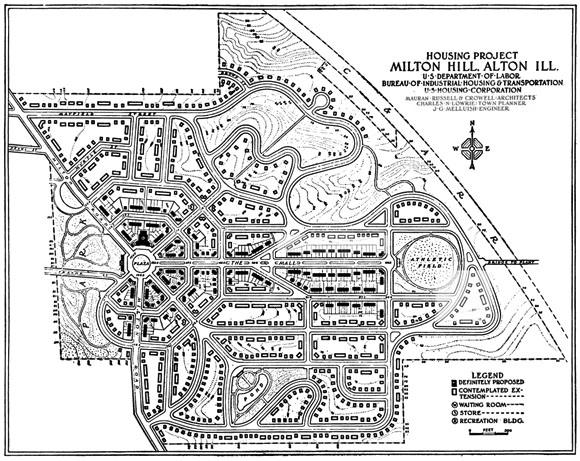
    Milton Hill, a neighborhood designed and developed by the United States Housing Corporation in Alton, Ill.
    National Archives

    Importantly, instead of simply creating complexes of apartment units, akin to the public housing projects that most Americans associate with government-funded housing, the agency focused on the construction of single-family and small multifamily residential buildings that workers and their families could eventually own.

    This approach reflected a belief by the policymakers that property ownership could strengthen community responsibility and social stability. During the war, the federal government rented these homes to workers at regulated rates designed to be fair, while covering maintenance costs. After the war, the government began selling the homes – often to the tenants living in them – through affordable installment plans that provided a practical path to ownership.

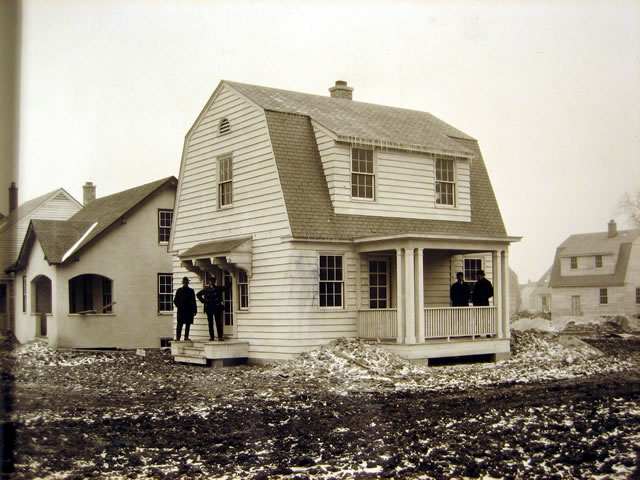
    A single-family home in Davenport, Iowa, built by the U.S. Housing Corporation.
    National Archives

    Though the scope of the Housing Corporation’s work was national, each planned community took into account regional growth and local architectural styles. Engineers often built streets that adapted to the natural landscape. They spaced houses apart to maximize light, air and privacy, with landscaped yards. No resident lived far from greenery.

    In Quincy, Massachusetts, for example, the agency built a 22-acre neighborhood with 236 homes designed mostly in a Colonial Revival style to serve the nearby Fore River Shipyard. The development was laid out to maximize views, green space and access to the waterfront, while maintaining density through compact street and lot design.

    At Mare Island, California, developers located the housing site on a steep hillside near a naval base. Rather than flatten the land, designers worked with the slope, creating winding roads and terraced lots that preserved views and minimized erosion. The result was a 52-acre community with over 200 homes, many of which were designed in the Craftsman style. There was also a school, stores, parks and community centers.

    Infrastructure and innovation

    Alongside housing construction, the Housing Corporation invested in critical infrastructure. Engineers installed over 649,000 feet of modern sewer and water systems, ensuring that these new communities set a high standard for sanitation and public health.

    Attention to detail extended inside the homes. Architects experimented with efficient interior layouts and space-saving furnishings, including foldaway beds and built-in kitchenettes. Some of these innovations came from private companies that saw the program as a platform to demonstrate new housing technologies.

    One company, for example, designed fully furnished studio apartments with furniture that could be rotated or hidden, transforming a space from living room to bedroom to dining room throughout the day.

    To manage the large scale of this effort, the agency developed and published a set of planning and design standards − the first of their kind in the United States. These manuals covered everything from block configurations and road widths to lighting fixtures and tree-planting guidelines.

    A single-family home in Bremerton, Wash., built by the U.S. Housing Corporation.
    National Archives

    The standards emphasized functionality, aesthetics and long-term livability.

    Architects and planners who worked for the Housing Corporation carried these ideas into private practice, academia and housing initiatives. Many of the planning norms still used today, such as street hierarchies, lot setbacks and mixed-use zoning, were first tested in these wartime communities.

    And many of the planners involved in experimental New Deal community projects, such as Greenbelt, Maryland, had worked for or alongside Housing Corporation designers and planners. Their influence is apparent in the layout and design of these communities.

    A brief but lasting legacy

    With the end of World War I, the political support for federal housing initiatives quickly waned. The Housing Corporation was dissolved by Congress, and many planned projects were never completed. Others were incorporated into existing towns and cities.

    Yet, many of the neighborhoods built during this period still exist today, integrated in the fabric of the country’s cities and suburbs. Residents in places such as Aberdeen, Maryland; Bremerton, Washington; Bethlehem, Pennsylvania; Watertown, New York; and New Orleans may not even realize that many of the homes in their communities originated from a bold federal housing experiment.

    Homes on Lawn Avenue in Quincy, Mass., that were built by the U.S. Housing Corporation.
    Google Street View

    The Housing Corporation’s efforts, though brief, showed that large-scale public housing could be thoughtfully designed, community oriented and quickly executed. For a short time, in response to extraordinary circumstances, the U.S. government succeeded in building more than just houses. It constructed entire communities, demonstrating that government has a major role and can lead in finding appropriate, innovative solutions to complex challenges.

    At a moment when the U.S. once again faces a housing crisis, the legacy of the U.S. Housing Corporation serves as a reminder that bold public action can meet urgent needs.

    This article is part of a series centered on envisioning ways to deal with the housing crisis.

    Eran Ben-Joseph does not work for, consult, own shares in or receive funding from any company or organization that would benefit from this article, and has disclosed no relevant affiliations beyond their academic appointment.

    ref. Believe it or not, there was a time when the US government built beautiful homes for working-class Americans to deal with a housing shortage – https://theconversation.com/believe-it-or-not-there-was-a-time-when-the-us-government-built-beautiful-homes-for-working-class-americans-to-deal-with-a-housing-shortage-253512

    MIL OSI Analysis

  • MIL-OSI USA: Three Faculty Members Named Board of Trustees Distinguished Professors

    Source: US State of Connecticut

    The University of Connecticut has named three outstanding faculty members as Board of Trustees Distinguished Professors for the 2024–2025 academic year. This distinction is the highest honor the university confers on faculty and recognizes exceptional achievement in research, teaching, and service.

    This year’s honorees are:

    • Dr. Peter C. Albertsen, Division of Urology, School of Medicine
    • Professor Anne C. Dailey, School of Law
    • Dr. Luyi Sun, Department of Chemical & Biomolecular Engineering, College of Engineering

    The Board of Trustees Distinguished Professor title is awarded annually following a university-wide nomination process and a rigorous review by a faculty and student committee. Final selections are approved by the UConn Board of Trustees, which confirmed this year’s awardees at its June 25, 2025 meeting.

    “These faculty have each made a remarkable impact not only through their scholarship, but also through their commitment to their students and colleagues,” said Anne D’Alleva, Provost and Executive Vice President for Academic Affairs. “Their work strengthens our community, advances their fields, and reflects the excellence that defines UConn.”

    Dr. Peter C. Albertsen

    Dr. Peter C. Albertsen is a globally respected urologic oncologist whose research and leadership have transformed the understanding and management of prostate cancer. A faculty member at UConn Health since 1987, Dr. Albertsen’s work has shaped national and international treatment guidelines and spared tens of thousands of men from unnecessary surgery and radiation.

    (UConn Photo)

    He earned his undergraduate degree in biochemistry from Princeton University and his medical degree from Columbia University. He completed his surgical residency at Harvard and his urology training at the Brady Urological Institute at Johns Hopkins. He also holds a master’s degree in medical administration and preventive medicine from the University of Wisconsin.

    Dr. Albertsen was among the first to use population-based data to challenge prevailing assumptions about PSA screening and prostate cancer aggressiveness. His landmark publications, including a seminal article in Journal of the American Medical Association (JAMA), demonstrated that many prostate cancers grow slowly and do not require immediate treatment. These findings helped launch a global shift toward active surveillance, now a widely accepted standard of care. He has played key leadership roles in major trials in both the U.S. and the U.K., including serving as Chair of the Cause of Death Committee for the PLCO and ProtecT trials.

    He has authored more than 300 peer-reviewed articles and editorials, with over 17,000 citations and an h-index of 63, placing him in the top tier of urologic researchers. His research has been published in The New England Journal of Medicine, JAMA, and other leading journals, and has been supported by more than $5 million in external funding.

    As UConn’s Urology Residency Program Director for over 30 years, Dr. Albertsen has trained more than 60 residents, many of whom have gone on to leadership roles in academic medicine and beyond. He is widely praised for his dynamic and discussion-based teaching style and for his long-standing mentorship of medical students and residents.

    Dr. Albertsen has served in numerous leadership roles at UConn Health and nationally, including as Associate Dean for Clinical Research and Planning, Division Chief of Urology, and Trustee of the American Board of Urology. He continues to provide exceptional patient care, including to underserved and correctional populations, and is often sought out by colleagues for their own care.

    His many honors include the Eugene Fuller Triennial Prostate Award and the Distinguished Contribution Award from the American Urological Association, as well as honorary membership in both the AUA and the German Urological Association. Dr. Albertsen’s research, clinical care, and mentorship have had an enduring impact on the field of urology and the lives of countless patients, making him a most deserving recipient of the University of Connecticut’s highest faculty honor.

    Professor Anne C. Dailey

    Professor Anne Dailey, Associate Dean for Faculty Development and Intellectual Life and the Ellen Ash Peters Professor of Law at the University of Connecticut School of Law, is a nationally recognized scholar whose work bridges constitutional law, family law, and psychoanalytic theory. A member of the UConn faculty since 1988, Professor Dailey has made transformative contributions to legal scholarship, education, and public service, with far-reaching influence across disciplines and institutions.

    (UConn Photo)

    She earned a Bachelor of Arts in English from Yale University and a Juris Doctor from Harvard Law School, where she served as an Articles Editor of the Harvard Law Review. Following law school, she completed a judicial clerkship with Judge José Cabranes of the U.S. District Court for the District of Connecticut. She has since become a pioneering figure in integrating psychoanalytic theory into legal analysis, most notably through her acclaimed book Law and the Unconscious: A Psychoanalytic Perspective, published by Yale University Press. This work received three prestigious honors: the Book Prize from the American Psychoanalytic Association, the Book Prize from the American Board and Academy of Psychoanalysis, and the Faculty Book Award from the UConn Humanities Institute.

    Professor Dailey’s scholarship is widely cited and influential. Her co-authored articles The New Law of the Child and The New Parental Rights, and her sole authored In Loco Reipublicae, all published in top-tier law journals, have shaped the national discourse on children’s constitutional rights, state responsibility for families, and evolving family structures. She is a member of the American Law Institute and the Association for the Study of Law, Culture and Humanities.

    She has held visiting faculty appointments at Yale, Harvard, and Penn Law Schools and has been named an Erikson Scholar at the Austen Riggs Center and a Fellow at the Katz Center for Advanced Judaic Studies at the University of Pennsylvania.

    Professor Dailey is a dedicated and inspiring teacher of family law and constitutional law. She is also a deeply valued mentor to students and junior faculty, and her efforts have helped elevate the national profile of the UConn School of Law.

    Professor Dailey’s scholarly distinction, interdisciplinary innovation, and enduring contributions to teaching and service make her a truly worthy recipient of the University of Connecticut’s highest faculty honor.

    Dr. Luyi Sun

    Dr. Luyi Sun is a globally recognized materials scientist and professor in the Department of Chemical and Biomolecular Engineering at the University of Connecticut, where he also holds a joint appointment in the Institute of Materials Science. Since joining UConn in 2013, he has led an internationally renowned research program focused on nanostructured hybrid materials for functional, environmental, and energy-related applications.

    (UConn Photo)

    Dr. Sun’s prolific contributions to science are evidenced by over 310 peer-reviewed journal articles in high-impact publications such as Nature Communications, Science Advances, Proceedings of the National Academy of Sciences, and Advanced Materials. His work has earned more than 23,000 citations and an h-index of 83, and has been highlighted by MIT Technology Review, Smithsonian Magazine, and New Scientist, among many others. He is the inventor or co-inventor of 28 issued U.S. patents and more than 50 corresponding foreign patents, seven of which have been commercialized/licensed. The materials and devices invented in his lab have been featured in global exhibitions, including at the Material ConneXion Library in New York and the Penn Museum.

    Dr. Sun is a Fellow of the National Academy of Inventors, the Royal Society of Chemistry, and the Society of Plastics Engineers. He has also been recognized with the Morand Lambla Award from the Polymer Processing Society and was elected to the Connecticut Academy of Science and Engineering.

    A dedicated educator and mentor, Dr. Sun has taught rigorous and interdisciplinary courses such as Thermodynamics and Polymer Processing, and has advised dozens of Ph.D. students, M.S. students and postdoctoral researchers, and more than 160 undergraduate research assistants. His students have gone on to successful careers in academia and industry, and many have received prestigious fellowships and national honors.

    Dr. Sun has also demonstrated sustained leadership in academic and professional service. As Director of the UConn Polymer Program from 2018 to 2021, he expanded faculty engagement and strengthened the program’s profile. He has held leadership roles in national scientific organizations and organized more than 80 symposia around the world. His editorial work includes serving as Associate Editor of Advanced Composites and Hybrid Materials.

    Due to his outstanding record of research innovation, teaching, mentorship, and professional service, Dr. Luyi Sun strongly merits recognition as a Board of Trustees Distinguished Professor.

    MIL OSI USA News

  • MIL-OSI United Kingdom: Building trust in justice: Reflections from the UK Supreme Court

    Source: United Kingdom – Government Statements

    World news story

    Building trust in justice: Reflections from the UK Supreme Court

    Lord Reed’s address at the Supreme Court’s of Montenegro 80th anniversary and AIRE Centre’s conference

    Copyright: Mirko Kuzman for AIRE Centre

    Justice, transparency, and public trust – why it matters

    Strengthening the independence, efficiency, and transparency of the judiciary is central to Montenegro’s reform process as it advances on its European path. It’s also at the heart of the UK’s partnership with Montenegro and our commitment to the wider Western Balkans.

    Judicial independence is not only a legal principle, but it is the foundation of public trust in democratic institutions. The UK continues to support Montenegro’s efforts to strengthen the rule of law as part of a shared vision for a more stable, resilient, and prosperous region.

    A shared commitment to the rule of law

    On 21 June 2025, the British Embassy was proud to support a major conference hosted by the Supreme Court of Montenegro and the AIRE Centre, with the support of the European Union Delegation, marking the 80th anniversary of the Supreme Court of Montenegro.

    The event brought together the judiciary, ministers, officials, Montenegrin and international experts, and partners to reflect on how courts can strengthen public confidence through greater transparency, openness, and effective communication.

    The UK was honoured to be represented by Lord Reed of Allermuir, President of the UK Supreme Court, who shared the UK’s experience and reflections on judicial communication, media engagement, and public accessibility.

    The UK’s ongoing support for judicial reform in Montenegro

    The UK’s partnership with Montenegro’s judiciary builds on a long history of collaboration, supporting training, initiatives for judicial integrity and transparency, and practical cooperation between courts. These efforts complement Montenegro’s reform priorities.

    We remain committed to supporting the development of strong, independent, and trusted institutions that are accountable to citizens and essential for democracy and stability.

    Lord Reed’s Speech

     I am honoured to have been invited to address you. I know that this year – indeed, this month – is the 80th anniversary of the establishment of the Supreme Court of Montenegro. This is a time to celebrate its success and its achievements, and also a time to reflect on how our society has changed over that period and is continuing to develop, and on how the Montenegrin Supreme Court, and other courts, should respond to those changes. I have very much in mind the efforts being made to strengthen judicial independence, efficiency and public trust which I understand are being undertaken. 

     I have been asked to speak about transparency and communication. I want to begin with two fundamental questions. First, what do we mean when we talk about transparency in relation to courts? I would suggest that it means that the court and its work are open and visible to the public. In today’s society, that requires more than just allowing public access into court buildings, although that is a part of it. It also means making the work of the court accessible to the public, and having effective means of communication between the court and the public. 

     My second question is even more fundamental: why does transparency matter? There are a number of reasons, but I would emphasise one in particular. If you ask why the public accept decisions made by the judiciary, the answer, I would suggest, depends on confidence or trust. And trust depends on openness and effective communication with all parts of the community we serve. In the UK, a recent study found that public trust in the Supreme Court is closely connected to knowledge about its work; and public knowledge depends on transparency and communication.

     So, considering transparency first, in the UK we normally have oral hearings in all cases, and they normally take place in public. Members of the public are encouraged to step inside the Supreme Court to watch our hearings and tour our court rooms. We are to some extent a visitor attraction. We have around 100,000 visitors a year, and our court rooms are usually busy with visitors. We have an exhibition area, where visitors can learn more about the court and its case law, and a public café. We also hold open days when more of the building is open to the public. We bear in mind that accessibility includes accessibility to children, and to people with special needs. For example, we hold tours for people with hearing problems, using sign language. 

     In addition, in the Supreme Court and the Court of Appeal, hearings are live streamed online, subject to a short delay in case anything confidential is accidentally mentioned. They are also made available afterwards on the court’s website and on YouTube. The Supreme Court also live streams the delivery of judgments, when the judge who has written the lead judgment gives a short explanation to camera of the court’s decision in accessible language. During the last financial year, around 750,000 viewers watched our cases and judgments on our website, and footage was also used on television and on media websites, under contractual terms set by the court in order to prevent misuse.

     This has been a great help in our most controversial cases. For example, in a case concerned with a challenge to the way the government was proceeding with the UK’s withdrawal from the European Union, highlights of the hearing were shown on the television news, and were analysed by experts in much the same way as football matches, with replays of the most important moments. When we gave our judgment recently in a controversial case concerned with issues of gender, footage of the delivery of the judgment was shown on the television news. This helped to improve public understanding of what the court was deciding, and to raise the level of confidence that the judges were focused on issues of law and not on controversial political questions. 

     Televising hearings requires some thought where jurisdictions have a primarily written procedure. For example, in 2023 the French Cour de Cassation decided there was a need to be more transparent, and started to broadcast its hearings. However, the judges of that court were not accustomed to participating in the hearing and sat in silence during the advocates’ oral arguments. I have been told that the court then came under some criticism as members of the public gained the impression that the judges were not engaged in the issues that were the subject of the hearings. Careful consideration should therefore be given to how oral proceedings might be conducted if they are to be broadcast. One possibility is to follow the approach adopted by the European Court of Human Rights, where Grand Chamber hearings are live streamed. In those proceedings, the advocates present their arguments without interruption from the judges. However, at the end of their oral argument the judges then pose questions, after which the advocates are given time to consult with their legal team before providing responses.

     We have also adopted the practice, in some controversial cases, of making the most important case papers available through our website, unless publication should be withheld for reasons such as commercial confidentiality or national security, so that they can be viewed alongside the live stream of the hearing. 

     Considering communication next, most people draw their knowledge of the judiciary and their opinions about the courts from the media, but media coverage of the judiciary is not always accurate or well-informed. To address that problem, the UK Supreme Court employs an expert communications team and uses a number of means to inform the public about our work. We recognise that the court operates in a media environment in which journalists and bloggers are expected to provide an instant response to our decisions. So members of the communications team work with the journalists who cover our work to help them to report it accurately. Where a judgment is likely to attract media interest, they allow journalists to see the judgment and the press summary an hour before they are made public, on a confidential basis. We do not do this in the most sensitive cases, or where prior knowledge of the judgment could be abused. But the confidentiality of the briefing is enforced by our law of contempt of court, and has never been breached. 

     The communications team also work with the judges to help them to communicate with the public, especially in the summaries that are delivered in court and live streamed on the internet when decisions are announced, excerpts from which may appear on the television news. They help us to ensure, for example, that the language we use in our summaries is understandable by members of the public and, in cases which will be reported in the media, that there is a short sentence or two in our summary which can be played or quoted in the reports and which explains the essence of our decision. They also maintain our social media accounts, with X, Instagram and LinkedIn, which have about 400,000 followers.

     We also try to connect with the general public through our education and outreach work. For example, we have established a scheme which gives pupils at schools across the UK, aged about 16 or 17, the opportunity to take part in a live question and answer session with a judge of the Supreme Court from their classroom, via the internet. This has proved to be very popular with schools, and it enables the court to make direct contact with ordinary young people in a positive way. I also give occasional media interviews, including interviews for social media podcasts, when I try to explain our work in ways that the public can understand. We also organise an online course on the Supreme Court in partnership with one of our universities.  About 5000 members of the public have enrolled.

     In the context of the UK, it has also been important for the Supreme Court to try to improve understanding in Parliament and in the government of the constitutional role of the courts. With the support of the Speaker of the House of Commons, the Supreme Court has engaged directly with all new Members of Parliament since our general election last year, providing each of them with materials explaining the rule of law and the constitutional role of the courts, taking part in question and answer sessions with Members of Parliament in private meetings, and encouraging them to visit the court and to meet justices and staff. We regard it as important to help politicians to understand the role of the courts, so that they support judicial independence and understand when we decide cases against the government, as sometimes happens. 

     In the context of the UK, it is also possible for the court to engage with the government in ways that encourage respect for judicial independence. There is generally a good understanding on both sides of the separation of powers. It has proved to be possible, in a context of mutual respect, to find ways of cooperating on projects of law reform and to encourage a sense that protecting the rule of law is a shared responsibility.

     We also have an active programme to demonstrate that we are inclusive to all parts of our population, including ethnic and religious minorities. So we host visits from organisations supporting talented members of minority groups, and we offer internships at the court to young lawyers from disadvantaged backgrounds. 

     In conclusion, we all need to work to maintain public trust in the administration of justice. I am grateful that we can share ideas and learn from each other as we work to safeguard the rule of law, for the benefit of both our societies.

    Updates to this page

    Published 26 June 2025

    MIL OSI United Kingdom

  • MIL-OSI Asia-Pac: Games to receive $450m sponsorship

    Source: Hong Kong Information Services

    The National Games Coordination Office (Hong Kong) today announced that the 15th National Games (NG), the 12th National Games for Persons with Disabilities (NGD) and the 9th National Special Olympic Games (NSOG) will receive a $450 million sponsorship from the Hong Kong Jockey Club (HKJC) to support the hosting of these events in Hong Kong.

    Chief Executive John Lee witnessed the signing ceremony held at the Central Government Offices today, in which Secretary for Culture, Sports & Tourism Rosanna Law and HKJC Chief Executive Officer Winfried Engelbrecht-Bresges represented the Government and the HKJC respectively.

    The HKJC will be the exclusive partner sponsor for the Hong Kong competition region of the 15th NG, the 12th NGD and the 9th NSOG.

    Speaking at the ceremony, Miss Law emphasised that the successful hosting of the Games is a major priority for Hong Kong this year.

    She highlighted that the HKJC’s staunch support and sponsorship would significantly boost event preparations in Hong Kong, particularly in supporting volunteer service programmes, citywide community and school promotional activities, and initiatives enabling underprivileged groups and youth to attend the events as spectators.

    The sports chief also expressed gratitude for the HKJC’s contribution and reaffirmed Hong Kong’s commitment to co-hosting with Guangdong and Macao a simple, safe and wonderful Games.

    The Culture, Sports & Tourism Bureau added that the Hong Kong Special Administrative Region Government looks forward to collaborating with the HKJC to further promote sports development in Hong Kong and the Guangdong-Hong Kong-Macao Greater Bay Area. 

    MIL OSI Asia Pacific News

  • MIL-OSI Security: Felon Indicted for Illegal Possession of a Firearm Following Arrest in Anacostia

    Source: United States Bureau of Alcohol Tobacco Firearms and Explosives (ATF)

    Defendant Charged as Part of Make D.C. Safe and Beautiful Initiative

                WASHINGTON –Ronald Stevenson Richardson, 29, of the District of Columbia, has been indicted on a federal firearms charge as part of the “Make D.C. Safe and Beautiful” initiative. The indictment was announced by U.S. Attorney Jeanine Ferris Pirro, Special Agent in Charge Anthony Spotswood of the Bureau of Alcohol, Tobacco, Firearms and Explosives (ATF), and Chief Pamela Smith of the Metropolitan Police Department (MPD).

                Richardson is charged with one count of unlawful possession of a firearm and ammunition by a felon.

                According to court documents, on May 6, 2025, members of the Seventh District Special Missions Unit (SMU) were patrolling the area of 1509 W Street SE in Washington, D.C., in the Anacostia neighborhood. While on patrol, police observed allegedly Richardson standing at a bus stop with an open container of alcohol at the intersection of 16th Street SE and W Street SE.

                Richardson was subsequently arrested for possession of an open container of alcohol. During a search incident to the arrest, officers allegedly discovered a firearm in Richardson’s undergarments, beneath his waistband. The firearm was identified as a Glock 42, chambered in .380 auto, loaded with one round in the chamber and four additional rounds in its six-round capacity magazine.

                Richardson is prohibited from possessing a firearm and ammunition due to a prior conviction in D.C. Superior Court for carrying a pistol without a license outside home/business, establishing him as a felon in possession.

                This case is being investigated by the ATF Washington Field Office and the Metropolitan Police Department. Assistant U.S. Attorney Michael Truscott is prosecuting this case.

                The “Make D.C. Safe and Beautiful” initiative is a public safety effort surging resources to reduce violent crime in the District of Columbia. This initiative was created to address gun violence in the District, prioritize federal firearms violations, pursue tougher penalties for offenders, and seek detention for federal firearms violators.

                An indictment is merely an allegation. All defendants are presumed innocent until proven guilty beyond a reasonable doubt in a court of law.

    MIL Security OSI

  • MIL-OSI Security: Felon Indicted for Illegal Possession of a Firearm Following Arrest in Anacostia

    Source: United States Bureau of Alcohol Tobacco Firearms and Explosives (ATF)

    Defendant Charged as Part of Make D.C. Safe and Beautiful Initiative

                WASHINGTON –Ronald Stevenson Richardson, 29, of the District of Columbia, has been indicted on a federal firearms charge as part of the “Make D.C. Safe and Beautiful” initiative. The indictment was announced by U.S. Attorney Jeanine Ferris Pirro, Special Agent in Charge Anthony Spotswood of the Bureau of Alcohol, Tobacco, Firearms and Explosives (ATF), and Chief Pamela Smith of the Metropolitan Police Department (MPD).

                Richardson is charged with one count of unlawful possession of a firearm and ammunition by a felon.

                According to court documents, on May 6, 2025, members of the Seventh District Special Missions Unit (SMU) were patrolling the area of 1509 W Street SE in Washington, D.C., in the Anacostia neighborhood. While on patrol, police observed allegedly Richardson standing at a bus stop with an open container of alcohol at the intersection of 16th Street SE and W Street SE.

                Richardson was subsequently arrested for possession of an open container of alcohol. During a search incident to the arrest, officers allegedly discovered a firearm in Richardson’s undergarments, beneath his waistband. The firearm was identified as a Glock 42, chambered in .380 auto, loaded with one round in the chamber and four additional rounds in its six-round capacity magazine.

                Richardson is prohibited from possessing a firearm and ammunition due to a prior conviction in D.C. Superior Court for carrying a pistol without a license outside home/business, establishing him as a felon in possession.

                This case is being investigated by the ATF Washington Field Office and the Metropolitan Police Department. Assistant U.S. Attorney Michael Truscott is prosecuting this case.

                The “Make D.C. Safe and Beautiful” initiative is a public safety effort surging resources to reduce violent crime in the District of Columbia. This initiative was created to address gun violence in the District, prioritize federal firearms violations, pursue tougher penalties for offenders, and seek detention for federal firearms violators.

                An indictment is merely an allegation. All defendants are presumed innocent until proven guilty beyond a reasonable doubt in a court of law.

    MIL Security OSI

  • MIL-OSI Security: McKeesport Felon Sentenced to Prison for Possession of Ammunition Collected from Scene of Fatal Apartment Complex Shooting

    Source: United States Bureau of Alcohol Tobacco Firearms and Explosives (ATF)

    PITTSBURGH, Pa. – A resident of McKeesport, Pennsylvania, was sentenced in federal court to 33 months of imprisonment on his conviction of possession of ammunition by a convicted felon, Acting United States Attorney Troy Rivetti announced today.

    Senior United States District Judge Nora Barry Fischer imposed the sentence on Desmond Dontae Lee, 47.

    According to information presented to the Court, on March 1, 2023, Lee and his son were both part of a group of individuals congregating outside of an apartment in a McKeesport apartment complex. When the resident of the apartment confronted the group and asked them to leave, one of the group members approached the resident and struck him with a closed fist, which led to the resident shooting and killing his attacker. Lee entered and proceeded through the apartment next to the resident’s, exiting that apartment from the rear, and then approached the rear of the resident’s apartment, firing five rounds from a 9mm semi-automatic pistol into the apartment before fleeing the scene. At that time, Lee’s son shot back at and killed the resident at the front of the apartment. The firearm used by Lee was never recovered, but investigators with the Allegheny County Police Department Homicide Unit collected the shell casings fired from Lee’s gun.

    Lee was previously convicted on state drug trafficking and firearms offenses. Federal law prohibits possession of a firearm or ammunition by a convicted felon.

    Assistant United States Attorney V. Joseph Sonson prosecuted this case on behalf of the government.

    Acting United States Attorney Rivetti commended the Allegheny County Police Department and Bureau of Alcohol, Tobacco, Firearms and Explosives for the investigation leading to the successful prosecution of Lee.

    MIL Security OSI

  • MIL-OSI Security: McKeesport Felon Sentenced to Prison for Possession of Ammunition Collected from Scene of Fatal Apartment Complex Shooting

    Source: United States Bureau of Alcohol Tobacco Firearms and Explosives (ATF)

    PITTSBURGH, Pa. – A resident of McKeesport, Pennsylvania, was sentenced in federal court to 33 months of imprisonment on his conviction of possession of ammunition by a convicted felon, Acting United States Attorney Troy Rivetti announced today.

    Senior United States District Judge Nora Barry Fischer imposed the sentence on Desmond Dontae Lee, 47.

    According to information presented to the Court, on March 1, 2023, Lee and his son were both part of a group of individuals congregating outside of an apartment in a McKeesport apartment complex. When the resident of the apartment confronted the group and asked them to leave, one of the group members approached the resident and struck him with a closed fist, which led to the resident shooting and killing his attacker. Lee entered and proceeded through the apartment next to the resident’s, exiting that apartment from the rear, and then approached the rear of the resident’s apartment, firing five rounds from a 9mm semi-automatic pistol into the apartment before fleeing the scene. At that time, Lee’s son shot back at and killed the resident at the front of the apartment. The firearm used by Lee was never recovered, but investigators with the Allegheny County Police Department Homicide Unit collected the shell casings fired from Lee’s gun.

    Lee was previously convicted on state drug trafficking and firearms offenses. Federal law prohibits possession of a firearm or ammunition by a convicted felon.

    Assistant United States Attorney V. Joseph Sonson prosecuted this case on behalf of the government.

    Acting United States Attorney Rivetti commended the Allegheny County Police Department and Bureau of Alcohol, Tobacco, Firearms and Explosives for the investigation leading to the successful prosecution of Lee.

    MIL Security OSI

  • MIL-OSI Security: Venezuelan National Residing Unlawfully in the U.S. Indicted on Federal Charges

    Source: United States Bureau of Alcohol Tobacco Firearms and Explosives (ATF)

    TOLEDO, Ohio – A federal grand jury has returned a four-count indictment charging Anthony Emmanuel Labrador-Sierra, 24, a Venezuelan national residing in Perrysburg, Ohio, with possession of a firearm by an alien unlawfully in the United States, making a false statement during the purchase of a firearm, and making or using false writings or documents.

    According to the indictment, the defendant is accused of submitting a false date of birth to U.S. Citizenship and Immigration Services on federal applications for Temporary Protective Status and Employment Authorization Documents in 2024 and 2025.

    In the original criminal complaint and underlying affidavit filed May 22, 2025, investigators learned that Perrysburg Schools reported to the Perrysburg Police Department that they received information that Labrador-Sierra, a student attending Perrysburg High School, was actually a 24-year-old man who enrolled under false pretenses.

    The grand jury further charges that Labrador-Sierra was in possession of a Taurus G3C 9mm, semiautomatic pistol, which he did not have lawful status to purchase or own in the United States, and that he submitted false information on the Bureau of Alcohol, Tobacco, Firearms, and Explosives (ATF) Form 4473 to purchase the firearm. Among the alleged false statements the defendant submitted that were intended and likely to deceive the licensed firearms dealer at the point of sale, were that:

    • He was a United States citizen or national.
    • He was not illegally or unlawfully in the United States.
    • He was not an alien who had entered the United States under a nonimmigrant visa.

    If convicted, Labrador-Sierra faces up to 15 years in prison for possession of a firearm by an alien; 10 years in prison for making a false statement during the purchase of a firearm; and up to five years in prison for making or using false writings or documents.

    This case is being investigated by the City of Perrysburg Police Department, United States Border Patrol−Sandusky Bay Station, the FBI Toledo Field Office, and the ATF, with assistance from the Wood County Prosecutor’s Office.

    The case is being prosecuted by Assistant U.S. Attorneys Robert N. Melching and Tracey Tangeman for the Northern District of Ohio, and Special Assistant U.S. Attorney Paul Dobson.

    This investigation is ongoing. Anyone with knowledge and information about this matter, please call the FBI at 1-800-CALL-FBI (1-800-225-5324) or visit fbi.gov/tips.

    An indictment is merely an allegation. The defendant is presumed innocent until proven guilty beyond a reasonable doubt in a court of law.

    MIL Security OSI

  • MIL-OSI Security: Misconduct hearing into search of Child Q delivers findings

    Source: United Kingdom London Metropolitan Police

    Gross misconduct and misconduct has been proven for three officers involved in the search of Child Q.

    A disciplinary hearing found a number of allegations proven against trainee Detective Constable Kristina Linge, PC Victoria Wray and PC Rafal Szmydynski, each attached to Central East Command Unit which covers Hackney and Tower Hamlets.

    The hearing did not find that the officers were influenced by Child Q’s race, nor that was she subject to adultification.

    Commander Kevin Southworth said: “The experience of Child Q should never have happened and was truly regrettable.

    “We have sincerely apologised to Child Q since this incident happened. Again, I am deeply sorry to Child Q and her family for the trauma that we caused her, and the damage this incident caused to the trust and confidence Black communities across London have in our officers.

    “While the officers involved did not act correctly, we acknowledge there were organisational failings. Training to our officers around strip search and the type of search carried out on Child Q was inadequate, and our oversight of the power was also severely lacking.

    “This left officers, often young in service or junior in rank, making difficult decisions in complex situations with little information, support or clear resources to help their decision-making.

    “What happened to Child Q was a catalyst for change both for the Met and for policing nationally.

    “While we should not have needed an incident such as Child Q to check our approach, it has absolutely led us to improving our processes and significantly reducing the number of these types of searches carried out.

    “It’s crucial we get this right to ensure the impact on young people is minimised as far as possible.

    “Sadly, we know there are children in London being exploited to carry drugs and weapons for others as well as involved in criminality, so these types of searches have to remain within police powers. The work we have done since Child Q means we now have the right safeguards in place.”

    The search of Child Q took place on Thursday, 3 December 2020, when police were called to a Hackney school. Staff were concerned that a 15-year-old girl smelled strongly of cannabis and may have been in possession of drugs.

    Two female officers conducted a more thorough search of the girl, that exposed intimate parts, in the medical room at the school.

    No drugs were found.

    The Met voluntarily referred the matter to the Independent Office for Police Conduct in May 2021 following complaints received.

    The misconduct hearing concluded that the search on Child Q was unnecessary, inappropriate and disproportionate. It was carried out without authorisation from a more senior officer, without an appropriate adult present and a proper record was not made afterwards.

    The hearing found T/DC Linge and PC Szmydynsk breached standards of professional behaviour in relation to authority, respect and courtesy, orders and instructions, duties and responsibilities and discreditable contact at the level of gross misconduct.

    PC Wray breached standards in relation to authority, respect and courtesy, orders and instructions and duties and responsibilities at the level of misconduct.

    Allegations against all the officers that they breached the standards of professional behaviour for equality and diversity were not proven.

    Allegations that PC Szmydynski and TDC Linge breached standards for honesty and integrity for reportedly making a misleading record of the search were also not proven.

    The misconduct panel is now considering sanction.

    Progress since this case

    Ensuring the safeguarding of every child who is searched is an absolute priority.

    • Every strip search or more thorough search where intimate parts are exposed (an ‘MTIP search’ outside custody as carried out on Child Q) requires authorisation by a local officer of inspector rank. That inspector is also responsible for the administration of the search, including recording the rationale, and a mandatory safeguarding referral to relevant authorities. This has been cemented in our Metropolitan Police Service Children’s Strategy, published in September 2024.
    • We have issued guidance to every frontline officer across the Met on the correct process, including the requirement for an appropriate adult to be present during the strip search or MTIP search of a child.
    • We have linked in with policing nationally to share areas of learning from Child Q’s incident and ensure forces across the country are aligned.
    • Recognising the wider community concerns that this case has raised regardless of today’s outcome, the Met is currently training more than 20,000 frontline officers and staff as part of a New Met for London around the risk of adultification and how to ensure a child-first approach in every instance.
    • We continue to listen to communities and partners on what more we need to do around our processes. Hackney has an active community-led scrutiny panel which scrutinises the use of police powers across the borough.
    • We continue to work closely in partnership with schools across London to keep children safe and prevent and detect crime.
    • Following Child Q we reviewed all strip searches and MTIP searches across the Met and made a number of voluntary referrals to the IOPC. In a number of those cases the IOPC found officers acted correctly, in others we have progressed disciplinary matters and learning.
    • We continue to publish data, which shows how the figures have significantly fallen on these types of searches, both inside and outside of custody:

    Stops and Search – More Thorough Searches Dashboard | Tableau Public

    Custody Dashboard | Tableau Public

    For MTIP searches on those aged under 18:

    A total of 68 were carried out between 1 June 2023 and 31 May 2024. The positive outcome rate was 66.2 per cent (45 individuals).

    A total of 42 were carried out between 1 June 2024 and 31 May 2025. The positive outcome rate was 59.5 per cent (25 individuals).

    This shows a decrease over this period in the number of searches carried out of 38.2 per cent. The overall positive outcome rate for this period was 63.6 per cent.

    A positive outcome means when criminality of any type is detected following a search.

    The number of MTIPs carried out on under 18s over this period was 7.3 per cent of the total for all ages.

    The dashboard carries data from the last two years.

    Prior to that, between 25 May 2021 and 24 May 2022 – a full year before we made changes to policy as the result of Child Q – a total of 232 MTIP searches on children were carried out.

    Between 25 May 2022 and 24 May 2023 – a full year post policy change – a total of 101 MTIP searches on children were carried out.

    This is a 56 per cent decrease.

    On average in London, in the five years to 31 May 2025, we have each year seen 499 children (aged 17 and under) recorded as a victim of crime after being injured with a knife, not including domestic abuse related incidents.

    Tragically, during that five-year period, 59 of those children were fatally stabbed.

    An annual average of 432 children were arrested for possession with intent to supply drugs and an annual average of 1,626 were arrested for possession of an offensive weapon.

    MIL Security OSI

  • MIL-OSI United Kingdom: Urgent warning to pet owners as toxic chemicals found in fake flea treatments

    Source: United Kingdom – Executive Government & Departments

    Press release

    Urgent warning to pet owners as toxic chemicals found in fake flea treatments

    Pet owners urged to be wary of dangerous fake treatments discovered on e-commerce sites.

    Main developments are:

    • urgent government warning issued after toxic insecticide discovered in counterfeit flea treatments – one cat required emergency surgery after severe poisoning

    • fake pet medicines lack essential ingredients while containing dangerous chemicals that trigger vomiting, seizures and potential death

    • warning signs include poor packaging, spelling mistakes, unusual smells and suspiciously low prices

    • new figures show three quarters of consumers wrongly believe fake goods are of similar quality to genuine products

    • pet owners should only buy from trusted sources and immediately report suspicious products

    The Intellectual Property Office (IPO) and Veterinary Medicine Directorate (VMD) are urging pet owners to take caution when purchasing common medicines, including common flea treatments and wormers. 
     
    The alert comes after toxic pesticide traces were found in a fake flea treatment that caused a pet cat to become seriously ill, prompting the owner to have the product tested. Laboratory tests confirmed the presence of Pirimiphos-methyl, a dangerous insecticide toxic to cats. 
     
    Officials are urging pet owners to recognise signs of counterfeit products, avoid using suspicious items, and know how to report concerns.  

    Counterfeit animal medicines deliberately copy the appearance, packaging and branding of genuine veterinary products to deceive pet owners. Like all counterfeits, they are illegal to sell in the UK.   

    These fakes typically lack proper active ingredients, making them ineffective. Worse still, they may also contain harmful substances, causing severe reactions including vomiting, muscle tremors, breathing difficulties, seizures and potentially death.

    Pet owners seeking bargains, or a quick purchase online may unknowingly purchase these dangerous counterfeits.  
     
    The VMD and IPO are urging owners to check for warning signs including poor packaging, spelling errors, missing information, and unusual smells. 

    Last year alone, the VMD issued 122 seizure notices for the selling of unauthorised animal medicines and supplements, preventing around 18,000 illegal items from reaching consumers. 

    After purchasing what appeared to be genuine FRONTLINE ® flea treatment online for his cat, Smokey, Alan Wall from Preston was devastated when Smokey became very unwell. The condition was so severe that Smokey required emergency intestinal surgery to survive. This was followed by a week-long stay at the veterinary surgery and significant bills to support his recovery.

    Alan Wall said:

    Smokey is more than just a pet, he’s a member of our family. When he became ill after using what we believed was a genuine flea treatment, we were terrified. Watching him suffer, not knowing whether he would pull through, was heartbreaking. It’s taken a huge emotional toll on all of us. Without the support of our vets and the extensive surgery they performed we know Smokey wouldn’t be with us today. We want to warn other pet owners about these fake products so that no one else has to endure what we’ve been through.

    Images of Smokey the cat – receiving treatment, and when healthier

    A Veterinary Medicines Directorate Veterinary Surgeon and Efficacy Assessor, Dr Heilin-Anne Leonard-Pugh, explains:

    Pirimiphos-methyl is toxic to cats. Exposure to this insecticide can prevent the cat’s body from breaking down a substance called acetylcholine, leading to an overstimulation of the cat’s nervous system. This can cause symptoms such as vomiting, uncoordinated gait, muscle tremors, weakness, paralysis, increased sensitivity to touch, difficulty breathing, restlessness, urinary incontinence, low heart rate and seizures. In some cases, even death can sadly occur. If you suspect your pet has been exposed to a counterfeit medicine, seek veterinary advice immediately.  

    Sue Horseman from Bristol also purchased what appeared to be FRONTLINE® flea treatment online for her cat, but quickly became suspicious that the product wasn’t genuine.  
     
    Sue explained that the product was difficult to open and had a distinct smell of white spirit and paraffin, whereas the genuine flea treatment has no smell.  When she reported this to Trading Standards, experts confirmed that the treatment was a counterfeit. 

    While the online platform has removed the seller, they had already managed to sell 211 batches of suspected counterfeit pet medicines and supplements, including fake FRONTLINE Flea and Tick Treatment and PRO PLAN FortiFlora Probiotic Sachets for dogs and cats. 
     
    New counterfeit goods research (Wave 4) shows that counterfeit goods of all types are frequently purchased via global e-commerce websites. The figures also show that in 2024, nearly-one-in-five (17%) consumers unknowingly purchased goods later found to be fake, with 60% of purchasers also saying that ‘ease of purchasing’ influenced their decision.  Saving money is a strong motivator for buying fakes, with around three quarters (72%) of purchasers saying price was an important factor in their decision. Worryingly, around three-quarters (72%) wrongly believed the products would be of a similar quality to the genuine item.

    The IPO’s Deputy Director of Enforcement Helen Barnham, said:

    We are a nation of animal lovers, and criminals dealing in counterfeits are targeting pet owners with complete disregard for the animal’s wellbeing.  This can have some distressing consequences, as they may contain toxic chemicals that are harmful to our pets. We are urging pet owners to be vigilant when purchasing any type of animal treatment, and beware of any offers that ‘look too good to be true’.   

    Counterfeiting is anything but a victimless crime and this latest discovery confirms this. If you suspect that any goods offered for sale may be counterfeit, you should always report this to your local Trading Standards or Crimestoppers Online.

    Caroline Allen, RSPCA Chief Veterinary Officer said: 

    We are very concerned about counterfeit vet treatments on sale which can be highly toxic to pets and we would always urge pet owners to seek professional veterinary advice if they have any health concerns.  

    We appreciate financial pressures can lead to some owners to look for cheaper treatments online but they could be unwittingly putting their beloved pets in serious danger by inadvertently buying these counterfeit goods and would urge them to take on board this government advice.

    Nina Downing, Vet Nurse from PDSA, a vet charity and a leading authority on pet health in the UK, said:

    Counterfeit veterinary medicines can pose a serious threat to our pets ‘ health and wellbeing. While legitimate medications play a vital role in keeping our pets healthy, counterfeit products can cause severe harm or even be fatal. These fake medicines may contain incorrect ingredients or dangerous substances that can make pets extremely ill – leading to symptoms like twitching, swelling, breathing difficulties, vomiting, diarrhoea, collapse, coma and even death.

    We always recommend that you only give your pet medication which has been prescribed by your vet. When fulfilling a prescription online, source them from reputable companies that are on the Register of online retailers, brought to you by the Veterinary Medicines Directorate. If you suspect your pet is reacting badly to any medication, contact your vet immediately.

    When examining the counterfeit FRONTLINE® flea treatment, experts from the University of Bath also identified telling packaging flaws. Most notably, the label used ‘GATTI’ (Italian for cats) instead of the English ‘CAT’, alongside multiple spelling errors – common indicators of counterfeit products.

    Image: Packaging featuring spelling mistakes and mixed languages

    Pet owners should check the packaging and always be cautious of third-party sellers when shopping on e-commerce sites for any type of pet medication. 

    The IPO and VMD are offering advice for consumers to help spot fake animal medicines, and what to do if they believe they may have purchased them or seen them offered for sale.

    How to identify fake animal medicines online:

    1. Warning signs of fake medicines. Look out for: 

    • poor quality or damaged packaging
    • spelling or grammar errors
    • missing leaflets or expiry dates
    • instructions not provided in English
    • suspicious smell, colour or texture
    • poor quality tablets, capsules, vials or pipettes – homemade appearance

    Be wary of any retailer selling prescription only products without asking for your prescription. This is illegal. 

    All online sellers of prescription only animal medicines must be registered with the VMD. If in any doubt, you can check retailers on the VMD’s Register of Online Retailers.

    2. Always shop safely online. Be cautious of:

    • heavily discounted goods and flash sales. Question the price if much cheaper than elsewhere. Whether buying online or in person, always think about the price
    • a seller asking for sensitive information or requesting payment by bank transfer
    • fake websites and social media profiles. These can contain original brand names – confirm the website is authentic and check seller details and reviews before purchasing
    • any deal or offer that looks ‘too good to be true’ 

    What you can do

    If you have you been personally affected by a poisoning case, you should report through the Veterinary Poisons Information Service (VPIS) questionnaire

    If you see these goods being offered for sale, whether on a website, social media post or on the high street, contact your local Trading Standards or Crimestoppers online or by calling 0800 555 111. 

    If you encounter suspicious veterinary medicines or retailers, please also report them to the VMD Enforcement Team. (You can do so anonymously if preferred): 

    Additional information

    1. All veterinary medicines sold in the UK must be authorised. If the brand looks unfamiliar, ensure its authorised before purchasing. To know if the medicine is UK- approved, you should look for English labelling and a valid Marketing Authorisation number (e.g. Vm 12345/4001). You can check if the medicine you are buying is authorised in the UK by searching the VMD’s Product Information Database.

      Using ant unauthorised medicine poses a serious risk to the welfare of your pet. These medicines have not been assessed by the Veterinary Medicines Directorate and their safety, quality and efficacy cannot be guaranteed.  

    2. Online retailers of low-risk, general sale veterinary medicines that can be sold by anyone without a prescription (known as AVM-GSL medications) don’t need to register. When buying these medicines always shop from a trusted source. 

    3. The Intellectual Property Office (IPO) is the UK government body responsible for responsible for intellectual property (IP) rights including patents, designs, trade marks and copyright. IPO is an executive agency, sponsored by the Department for Science, Innovation and Technology.  

    4. The Veterinary Medicines Directorate (VMD) is an executive agency of the Department for Environment, Food and Rural Affairs (DEFRA) and the UK Competent Authority for veterinary medicines regulation. The VMD protects public health, animal health, and the environment and promotes animal welfare by assuring the safety, quality, and efficacy of veterinary medicines.  

    5. The IPO regularly conducts research to understand consumer behaviour in relation to the purchasing of and attitudes toward counterfeit goods. The most recent Counterfeit Goods Research report (published Tuesday 17 May 2025) show the main motivations for those who purchase counterfeits: 

    • similar/ the same quality – 72.3%
    • wanting to reduce spending/outgoings - 72%
    • the real product was out of your budget/ price range - 70.9%
    • the fake product was cheaper  – 72%
    • hearing from family or friends that the ‘fake’ products were good - 64.8%
    • similar/the same design – 64.6%
    • being able to purchase ‘fake’ or counterfeit products easily – 60.5%

    Updates to this page

    Published 26 June 2025

    MIL OSI United Kingdom

  • MIL-OSI Russia: Saudi Arabia: Concluding Statement of the 2025 Article IV Mission

    Source: IMF – News in Russian

    June 26, 2025

    A Concluding Statement describes the preliminary findings of IMF staff at the end of an official staff visit (or ‘mission’), in most cases to a member country. Missions are undertaken as part of regular (usually annual) consultations under Article IV of the IMF’s Articles of Agreement, in the context of a request to use IMF resources (borrow from the IMF), as part of discussions of staff monitored programs, or as part of other staff monitoring of economic developments.

    The authorities have consented to the publication of this statement. The views expressed in this statement are those of the IMF staff and do not necessarily represent the views of the IMF’s Executive Board. Based on the preliminary findings of this mission, staff will prepare a report that, subject to management approval, will be presented to the IMF Executive Board for discussion and decision.

    Washington, DC: Saudi Arabia’s economy has demonstrated strong resilience to shocks, with non-oil economic activities expanding, inflation contained, and unemployment reaching record-low levels. While lower oil proceeds and investment-linked imports led to the emergence of twin deficits, external and fiscal buffers remain ample. A higher-than-budgeted fiscal stance in 2025 remains appropriate to prevent procyclicality that could exacerbate the growth impact of lower oil prices. Addressing strong credit growth and associated funding pressures will be crucial in mitigating risks to systemic financial stability. Given the current heightened global uncertainty, continued efforts on structural reform are essential to sustain non-oil growth and drive economic diversification.

    RECENT ECONOMIC DEVELOPMENTS[1]

    Saudi Arabia’s economy has been resilient to shocks. In 2024, non-oil real GDP grew by 4.2 percent, primarily driven by private consumption and non-oil private investment, with retail, hospitality, and construction leading growth. Repeated extensions of the OPEC+ production cuts have kept oil output at 9 million barrels per day (mb/d)—the lowest level since 2011— resulting in a 4.4 percent decline in oil GDP and an overall real growth rate of 1.8 percent. The composite PMI indicates sustained activity in Q1 2025, with the latest Q1 GDP estimate showing non-oil activities expanding by 4.9 percent year-on-year.

    The labor market’s strong momentum continues. The unemployment rate for Saudi nationals has declined to a record low of 7 percent in 2024, surpassing the original Vision 2030 target, which has now been revised down to 5 percent. The improvement is broad-based, with both youth and female unemployment halved over a four-year period. Private sector employment surged by 12 percent on average in 2024, while public sector hiring continued to slow, reflecting a redeployment to non-government entities.

    Inflation is contained as rent inflation decelerates. Despite a small pick-up to 2.3 percent in April 2025, headline inflation remains low, helped by high real interest rates. Declining prices for transport and communication helped offset housing rent inflation, which has decelerated for the 6th consecutive month to 8.1 percent y-o-y (the lowest annual rise since February 2023). Real wages have remained stable, albeit with some pickup for highly skilled workers.   

    The current account shifted to a narrow deficit, transitioning from a surplus of 2.9 percent of GDP in 2023 to a deficit of 0.5 percent of GDP in 2024. This shift mainly reflects a decline in oil export proceeds, higher imports of machinery and equipment, and stronger remittance outflows—factors that more than offset a surge in tourism inflows. The current account deficit has been financed through external borrowing and reduced FX asset accumulation. As a result, the Saudi Central Bank’s (SAMA) net foreign assets (NFA) holdings stabilized at $415 billion by end-2024—equivalent to 15 months of imports and 187 percent of the IMF’s reserve adequacy metric. 

    While spending overruns increased the overall fiscal deficit, the fiscal stance—as measured by the non-oil primary balance—showed a slight improvement in 2024. Additional expenditures related to project financing—partly linked to an accelerated implementation of Vision 2030—and flat oil revenue widened the overall fiscal deficit to 2.5 percent of GDP, approximately 0.8 percentage points above the budgeted target. However, driven by stronger non-oil revenue, the non-oil primary deficit improved, decreasing by 0.6 percentage points of GDP in 2024 compared to 2023. Central government debt rose to 26.2 percent of GDP as Saudi Arabia became the largest emerging market dollar debt issuer in 2024. However, Saudi Arabia remains amongst the lowest indebted nation globally and net debt is relatively low at approximately 17 percent of GDP.

    ECONOMIC OUTLOOK AND RISKS

    Robust domestic demand—including from government-led projects—will continue to drive growth despite heightened global uncertainty and a weakened commodity price outlook. Non-oil real GDP growth is projected at 3.4 percent in 2025, about 0.8 percentage points lower than in 2024. This reflects the continued implementation of Vision 2030 projects through public and private investment, as well as strong credit growth, which would help sustain domestic demand and mitigate the impact of lower oil prices. The direct impact of rising global trade tensions is limited, as oil products—comprising 78 percent of Saudi Arabia’s goods exports to the U.S. in 2024—are exempt from U.S. tariffs, while non-oil exports to the U.S. only account for 3.4 percent of Saudi Arabia’s total non-oil exports. Over the medium term, domestic demand—including momentum ahead of Saudi Arabia’s hosting of large-scale international events—is expected to push non-oil growth closer to 4 percent in 2027 before stabilizing at 3.5 percent by 2030. Supported by the OPEC+ production cut phase-out schedule, overall GDP growth will accelerate to 3.5 percent in 2025 and 3.9 percent in 2026 before stabilizing at approximately 3.3 percent over the medium term.

    Inflation would remain anchored around 2 percent, supported by a credible peg to the U.S. dollar, domestic subsidies, and an elastic supply of expatriate labor, notwithstanding a projected moderate positive output gap over the medium term. Imported inflation from increased tariffs worldwide is expected to remain contained.

    The external position will weaken. Investment-linked imports and remittance outflows from an expanding expatriate labor force are expected to widen the current account deficit, which is projected to peak at about 3.9 percent of GDP by 2027 before converging to about 3.4 percent of GDP in 2030. Rising non-oil exports and robust inbound tourism will have a partial offsetting effect. The deficit will be increasingly financed through deposit drawdowns, less FX asset accumulation abroad, and external borrowing. International reserve coverage would remain adequate at about 11-12 month import coverage over the medium term, with foreign assets held by the Public Investment Fund (PIF) and other government-related entities offering strong additional buffers.

    Risks to the outlook are mainly to the downside. Weaker oil demand, driven by heightened uncertainty, an escalation of global trade tensions, and deepening geoeconomic fragmentation could dampen oil proceeds. This, in turn, would lead to higher fiscal deficits and debt and costlier financing. An abrupt decrease in spending by the government (including projects recalibration below its baseline) or a slowdown in reform implementation in response to lower oil prices could further hinder private investment growth. Conversely, higher-than-expected oil production/prices and accelerated implementation of reforms could yield stronger or earlier-than-expected growth dividends.

    POLICIES

    Fiscal Policy

    The 2025 fiscal stance—resulting in a deficit twice the budget target—remains appropriate. Given past overruns and the ongoing transformational projects tied to Vision 2030, staff anticipates higher current expenditures than budgeted. Combined with lower oil prices and minimal performance-linked dividends from Aramco, this will bring the overall fiscal deficit to 4.3 percent of GDP. However, this outcome still represents a 3.6 percentage points of non-oil GDP improvement in the non-oil primary balance, effectively frontloading part of the adjustment required by 2030 to uphold intergenerational equity. Given the upfront adjustment and ample fiscal buffers available, staff believes that additional spending restraint in 2025—triggered by lower-than-budgeted oil prices—is not necessary as it would make fiscal policy procyclical and exacerbate the impact on growth.

    Over the medium term, the overall fiscal deficit is expected to narrow. After peaking at 4.3 percent of GDP in 2025, it will decline to approximately 3.3 percent of GDP by 2030, driven by ongoing wage bill containment and spending efficiency measures. Under this baseline scenario, the non-oil primary deficit would shrink by about 4.2 percent of non-oil GDP from 2025 to 2030. The fiscal deficit would primarily be financed by borrowing, including through debt issuances, syndicated loans or facilities from export credit agencies, leading to an increase in the public debt-to-GDP ratio to about 42 percent by 2030.

    A gradual fiscal consolidation will remain necessary over the medium term to achieve intergenerational equity. To avoid disruptive adjustments and build buffers, an additional 3.3 percent of non-oil GDP must be generated over the 2026-30 period, mainly through:

    • Non-oil revenue mobilization. Plans to increase the tax rate on underdeveloped land, introduce a tax on vacant land, and broadening the VAT base (e.g., for e-commerce transactions) are welcome. Additional efforts—including through new tax policy measures and continued efforts to strengthen revenue administration—would be needed. The temporary tax penalty waiver introduced repeatedly since Covid, should not be renewed when it expires in June as it fuels moral hazard and could undermine compliance.
    • Removing energy subsidies. Staff welcomes the ongoing energy price adjustments—including a doubling of diesel prices since January 2024—which combined with lower international oil prices have reduced fuel subsidies to 3½ percent of GDP (down from 5½ percent in 2022). With retail fuel prices closer to international oil prices and the envisaged scaling up of the well-targeted Damaan social support program, efforts should be accelerated to reduce energy subsidies, including by removing the cap on gasoline prices.
    • Rationalizing other spending. The mission welcomes ongoing spending reviews—including recent assessments on project execution by various government entities—to identify areas for potential savings and efficiency gains. Further rationalization should prioritize reducing current expenditures with a low fiscal multiplier, while preserving medium-term, growth-enhancing infrastructure plans. Greater transparency on how spending prioritization and recalibration aligns with the authorities’ announced investment plans will support investor confidence.

    Given the high global uncertainty, staff welcomes the authorities’ contingency planning to safeguard fiscal sustainability in the event of a severe shock. In a scenario where oil prices decline significantly, a more aggressive fiscal consolidation strategy would be necessary. Identifying and prioritizing projects that can be extended or cut, if further adjustments are required, represents a prudent approach to maintaining fiscal sustainability. Staff recommends a partial drawdown of fiscal buffers in the event of a temporary oil price shock, which would help smooth the transition to a steady state and mitigate the impact of short-term oil price fluctuations.

    Sustaining the authorities’ ongoing efforts to strengthen fiscal institutions will be crucial in supporting the fiscal adjustment and Saudi Arabia’s Vision 2030 objectives. Enhancing the Medium-Term Fiscal Framework remains a priority, particularly through better integration of its multiyear projections into annual budget preparations to align spending ceilings with fiscal forecasts, including commitments from multi-year contracts. Operationalizing and ensuring compliance with an expenditure-based fiscal rule would help anchor the fiscal stance over the medium term.

    Prudent debt management and a proper sovereign asset liability management (SALM) framework becomes increasingly important in a lower oil price environment. The mission encourages the authorities to assess the complex trade-offs between making greater use of central government deposits (currently at around 9¼ percent of GDP) and new bond issuances. The mission also supports the ongoing efforts toward operationalizing a comprehensive SALM framework to enhance the oversight of sovereign balance sheet exposures, which publication alongside the budget statement would support the drive for greater transparency and provide additional tools for fiscal policy analysis and formulation. Additionally, contingent liabilities—such as financing obligations for giga projects, debt guarantees, and Public-Private Partnerships—should be closely monitored.

    Monetary and Exchange Rate Policy

    SAMA has continued to refine its liquidity management framework to help reduce  overall liquidity volatility. Bank funding conditions in Saudi Arabia are influenced by persistently strong double-digit credit growth, with periodic spikes in the SAIBOR-SOFR spread reflecting episodes of liquidity pressures. SAMA’s standard market-based monetary operations should continue to remain focused on smoothing short-term liquidity imbalances without fueling asset/credit growth. The recent data-sharing arrangement between SAMA and the Ministry of Finance regarding expected government transactions is anticipated to improve the accuracy of liquidity forecasting and should be effectively implemented. Additionally, further enhancements to the reserve requirement framework would strengthen effective liquidity management and monetary policy transmission.

    The currency peg to the U.S. dollar remains appropriate. It has provided a credible anchor for monetary policy and is backed by ample external buffers. With an open capital account, it is essential that SAMA’s policy rate continues to align with the Fed’s policy rate.

    Financial Sector Policies

    The banking sector remains resilient, demonstrating strong capitalization and profitability despite rising funding costs. As of end-2024, the sector’s solvency ratio stood at 19.6 percent. Despite higher funding costs—driven by the increasing share of time and saving deposits—bank profitability is high, with an average return on assets of 2.2 percent in 2024. Non-performing loans have reached their lowest levels since 2016, reinforcing overall financial stability. Liquidity indicators are adequate and within regulatory thresholds, although the ratio of liquid assets to short-term liabilities has been declining, and the regulatory loan-to-deposit ratio has been on an upward trend.

    Strong credit growth is leading to funding pressures and a change in the funding mix of Saudi banks. As credit growth—mostly to corporates and for mortgages—outpaces deposit growth, banks diversify their liabilities by increasing reliance on other forms of financing, especially external borrowings in the form of bonds, bilateral or syndicated loans, and certificates of deposit. High external borrowing turned banks’ Net Foreign Assets (NFA) negative in 2024 for the first time since 1993. This trend is expected to continue in the near term as several banks are in the process of securing additional external funding. However, banks’ exposure to foreign exchange risk remains low.

    Addressing strong credit growth and associated funding pressures would help mitigate risks to systemic financial stability. The mission welcomes SAMA’s ongoing efforts to review its existing prudential toolkits to counter risks stemming from persistent double-digit credit growth amid a credit-to-deposit growth gap and the increased resort to short-term external wholesale funding. As loan demand is expected to remain high relative to deposit-based funding, setting prudential requirements commensurate with the evolving risks is essential. In that regard, the mission welcomes the introduction in May 2025 of a 100 basis points countercyclical capital buffer, which will be effective within a year. Vulnerabilities would be further mitigated by: (i) narrowing loan-to-value and debt burden ratios, which remain elevated relative to international standards; and (ii) tightening loan-to-deposit ratio to discourage excessive short-term foreign exchange funding. The mission welcomes SAMA’s proactive approach to monitoring the Liquidity Coverage Ratio and Net Stable Funding Ratio in foreign currency and encourages consideration of setting these ratios as regulatory requirements, should circumstances warrant.

    SAMA’s continued efforts to enhance regulatory and supervisory frameworks are commendable. The new Banking Law has been submitted for legislative approval, a risk-based supervisory framework is being refined, and a monitoring system has been introduced for large construction and infrastructure projects. Additionally, SAMA’s bank resolution function is being operationalized. The authorities have also made good progress in establishing a crisis management framework that includes an emergency liquidity assistance framework, which should be completed without undue delay. Furthermore, improvements in enhancing the effectiveness of AML/CFT supervision—including through thematic inspections—are welcome.

    Deepening the capital market is essential to help diversify funding and reduce reliance on bank financing. Although the capital market remains dominated by the large government-related issuers and the trading volumes are low, the recent and ongoing initiatives, such as the Investment Law that came into effect in February 2025 and the ongoing pension and savings reforms, should improve market liquidity and increase foreign participation in the Saudi capital markets. Greater use of asset-backed securities will create a new asset class and contribute to expanding funding in the banking system. The deepening of the domestic capital markets would also help improve the monetary policy transmission mechanism.

    Structural Policies

    The current environment of heightened uncertainty underscores the importance of continued structural reform efforts to sustain non-oil growth and economic diversification. Since 2016, Saudi Arabia has implemented significant and wide-ranging reforms, particularly in business regulations, governance, labor and capital markets. Several new laws that took effect in 2025—including the updated Investment Law, Labor Law amendments, and the new Commercial Registration Law—will enhance contractual certainty for investors and businesses, while also supporting productivity gains.

    The reform momentum should continue irrespective of oil price developments. Ongoing work to strengthen the anti-corruption framework—including by building on the recent Ultimate Beneficial Ownership Rules and By Laws of Nazaha—remains crucial. Equally important is enhancing human capital by aligning the skills of Saudi nationals with evolving labor market needs, improving access to finance and fostering digitalization, all of which are key to advancing the Kingdom’s economic diversification goals that are further enhanced with the integration of AI in government services. In addition to stronger fiscal institutions, pursuing these reforms will help Saudi Arabia build further resilience to oil price volatility.

    Targeted interventions through industrial policies should complement—not replace— structural reforms and must avoid crowding out private sector investment. Interventions by the PIF and public entities should continue to focus on areas where private investment is limited, market failures exist, or where they can play a catalytic role in attracting private capital, rather than potentially displacing domestic and foreign investors.  Industrial Policies should have clear exit criteria, claw-back mechanisms, and sunset clauses, to ensure they do not remain in place beyond their intended objective.

    **************************

    The mission team would like to thank the Saudi Arabian authorities and the people they met outside the government sector for their close collaboration, candid and informative discussions, and warm hospitality.

    [1] Numbers referred in percent of GDP are based on the authorities’ new rebasing GDP published in May 2025. The new methodological update is generally consistent with international best practices and the UN’s system of national accounts,

    IMF Communications Department
    MEDIA RELATIONS

    PRESS OFFICER: Wafa Amr

    Phone: +1 202 623-7100Email: MEDIA@IMF.org

    https://www.imf.org/en/News/Articles/2025/06/25/saudi-arabia-concluding-statement-of-the-2025-article-iv-mission

    MIL OSI

    MIL OSI Russia News

  • MIL-OSI Africa: Government welcomes progress made in the fight against crime

    Source: South Africa News Agency

    Government welcomes progress made in the fight against crime

    Government has welcomed the progress being made in the fight against crime through initiatives such as Operation Shanela and Operation Vala Umgodi. 

    “About 239 suspects were arrested across the country between 1 and 15 June 2025 through Operation Vala Umgodi,” Minister in the Presidency Khumbudzo Ntshavheni said.

    Briefing media in Cape Town on Thursday, on the outcomes of the Cabinet meeting, Ntshavheni said the suspects were arrested for illegal mining-related offences and various other crimes, including attempted murder, possession of unlicensed firearms, possession of unpolished diamonds, unlawful possession of explosives and contravention of the Immigration Act of 2002.

    “Operation Vala Umgodi has, since its inception in December 2023, led to the arrest of more than 27 000 suspects and the seizure of more than 600 firearms that included imitation firearms (toy guns) and 16 000 rounds of ammunition,” Ntshavheni said.

    Ntshavheni said between 16 June to 22 June 2025, the South African Police Service (SAPS), through Operation Shanela, arrested 15 372 suspects. 

    “Some of the key arrests include 2 400 wanted individuals linked to serious and violent crimes (murder, attempted murder, rape and robbery), 159 arrested for murder, 100 arrests for rape, 1 173 arrests for assault with intent to cause grievous bodily harm, 2 602 for drug possession and 64 for hijacked or stolen vehicles,” the Minister said.

    According to SAPS, these successes stem from proactive policing tactics, including high-visibility patrols, roadblocks, stop-and-search initiatives and intelligence-led suspect tracing.

    “SAPS remains committed to relentless, multidisciplinary crime prevention through Operation Shanela and related initiatives. The National Commissioner of Police, General Fannie Masemola, applauds the dedication of all police officers and partners who collaborated with the police,” the South African Police Service said in a statement earlier this week. – SAnews.gov.za

    Edwin

    MIL OSI Africa

  • MIL-OSI Security: Two drug kingpins jailed for life following Met EncroChat investigation

    Source: United Kingdom London Metropolitan Police

    Two men have been jailed for life for importing and dealing a tonne of cocaine and plotting a murder.

    The Met’s investigation uncovered the two men’s plan to commit a murder, as well as their role in delivering millions of pounds worth of drugs across the capital and beyond.

    The evidence of the offences were identified after officers trawled through thousands of messages on encrypted communication service EncroChat.

    Thought to be impenetrable by law enforcement, Met officers accessed chats between James Harding and Jayes Kharouti.

    It was identified that James Harding, 34 (01.01.1991), of Alton, Hampshire, was the head of a sophisticated organised drug dealing network, turning over an estimated £5 million profit in just 10 weeks. Harding resided in Dubai at the time of his arrest.

    Detective Chief Inspector Jim Casey, who led the investigation, said:

    “This sentencing shows the severity of the crimes the duo committed.

    “Following one of the largest EncroChat investigations in the Met’s history, I am pleased that both criminals are serving the time they deserve.

    “Not only did they have a detailed plan to kill, their conspiracy to import and deal drugs harmed a number of our communities in London and across the country.

    “This sends a clear message to other potential offenders: we will investigate and we will put you before the courts.”

    Harding was found guilty by the jury of conspiracy to supply Class A drugs and conspiracy to commit murder on Tuesday, 24 June at The Old Bailey, following a seven-week trial.

    He was sentenced to life at The Old Bailey on Thursday, 26 June, and will have to serve a minimum of 32 years’ imprisonment.

    Kharouti, 39, (09.02.1986) of Depot Road, Epsom, previously admitted to his role in supplying drugs on Friday, 8 November 2024 at The Old Bailey. He was also found guilty of conspiracy to commit murder alongside Harding on Tuesday, 24 June at the same court.

    He was sentenced to life at The Old Bailey on Thursday, 26 June, and will have to serve a minimum of 26 years’ imprisonment.

    Chats on the encrypted messaging site unveiled they both spoke, in detail, about their plan to kill a suspected drug courier from a ‘rival crime network’.

    This case is part of a wider operation to take down those who utilised EncroChat, after the National Crime Agency (NCA) passed information onto the Met after European agencies cracked the encrypted communications platform.

    So far, Met investigations have led to more than 5,000 years-worth of prison sentences for criminals on the site.

    The investigation

    Following the thorough investigation into a series of conversations on EncroChat, the Met discovered Harding used the handle “thetopsking”, while Kharouti used “besttops”. They used the platform to confidently communicate with each other about their vast criminal enterprise.

    The Met spent hundreds of hours reviewing and analysing these messages. Among them were clear conspiracies to carry out a murder of a rival drug gang member with detailed plans, involving recruiting paid hitmen, arranging firearms and getaway vehicles. They had also discussed times, dates and locations.

    This was on top of plans to coordinate deliveries of hundreds of kilograms of cocaine across the country, manage their vast finances and discuss security threats.

    The court heard that approximately 50 importations were made into the UK, with a total weight of one tonne, between April and June 2020.

    This allowed Harding to live a lavish lifestyle in the United Arab Emirates, where he conducted his criminal enterprise.

    The arrests

    Harding was arrested on Monday, 27 December 2021 at Geneva Airport, Switzerland. On Friday, 27 May 2022, he was extradited from Switzerland to the UK when he was arrested by Met officers.

    Kharouti’s home was searched in 2020 after he was linked to the messages. Police found a handset with the same number he gave to Harding. He fled the country shortly after this, before being found in Turkey and extradited back to the UK.

    MIL Security OSI

  • MIL-OSI United Kingdom: SFO cracks down on corruption through international alliance

    Source: United Kingdom – Government Statements

    Press release

    SFO cracks down on corruption through international alliance

    UK Serious Fraud Office joins global anti-corruption alliance to combat cross-border corruption.

    • Serious Fraud Office joins International Anti-Corruption Coordination Centre to strengthen the fight against cross-border corruption

    • Move follows creation of pioneering tri-national taskforce with France and Switzerland

    • Enhanced intelligence gathering will target companies and individuals involved in overseas corruption involving politically exposed persons

    The Serious Fraud Office has today expanded its global reach by joining the International Anti-Corruption Coordination Centre (IACCC), strengthening the UK’s ability to tackle grand corruption and illicit finance across borders.

    This strategic alliance builds on the SFO’s recent establishment of a taskforce with French and Swiss authorities to tackle international bribery and corruption.

    Based within the National Crime Agency, the IACCC brings together specialist law enforcement officers from agencies around the world to tackle allegations of grand corruption that span multiple jurisdictions.

    Organisations with a proven intention to fight domestic and international corruption can be considered for membership, with the SFO gaining enhanced access to key partners in the fight against grand corruption involving politically exposed persons. 

    The partnership will boost the SFO’s capacity to gather intelligence and evidence on companies and individuals suspected of corruption overseas while maintaining full control over its investigations.

    Nick Ephgrave QPM, Director at the Serious Fraud Office (SFO), said:

    This is another step forward for the SFO and further demonstration of our determination to use every power and partnership we can to confront the threat of bribery and corruption.

    This membership will bring us closer to global law enforcement and strengthen our intelligence gathering capabilities on those companies and individuals engaged in international bribery and corruption.

    The SFO recently issued new guidance to companies on their responsibilities to report suspected criminality.

    Rob Jones, Director General of Operations at the NCA, said:

    We welcome the SFO’s membership of the International Anti-Corruption Coordination Centre. Their membership will assist the collective effort of supporting overseas partners with hugely important investigations into grand corruption.

    Since its launch in 2017 the IACCC has helped identify over £1.8 billion of suspected stolen assets, supported the freezing of nearly half of those assets in various global jurisdictions, and helped with the arrest and charging of a significant number of suspects involved in high profile investigations in over 40 separate countries.

    Press Office

    Email news@sfo.gov.uk

    Out of hours press office contact number +44 (0)7557 009842

    Updates to this page

    Published 26 June 2025

    MIL OSI United Kingdom

  • MIL-OSI Russia: Government meeting (2025, No. 21).

    Translation. Region: Russian Federal

    Source: Government of the Russian Federation – An important disclaimer is at the bottom of this article.

    1. On the state of competition in the Russian Federation for 2024

    The report presents the results of an analysis of the state of competition in 2024, including in the context of ensuring the sustainability of socially significant commodity markets, developing the domestic market, and supporting small and medium-sized businesses.

    2. On the draft federal law “On Amendments to the Code of the Russian Federation on Administrative Offenses”

    The bill is aimed at liberalizing the liability of participants in foreign economic activity.

    3. On the allocation of budgetary appropriations to the Ministry of Finance of Russia in 2025 from the reserve fund of the Government of the Russian Federation for the provision of a subsidy to the budget of the Kemerovo Region

    The draft order is aimed at providing additional funds from the federal budget to the budget of the Kemerovo region – Kuzbass for financial support of expenses for the remuneration of public sector employees in 2025.

    4. On the distribution of subsidies to the budgets of the Republic of Crimea and Sevastopol

    The draft order is aimed at financing expenditure obligations arising from the implementation of activities of the state program of the Russian Federation “Socio-economic development of the Republic of Crimea and the city of Sevastopol”.

    5. On amendments to the order of the Government of the Russian Federation of January 17, 2025 No. 31-r

    The draft order is aimed at financial support for expenses related to pension provision for citizens living in the territories of the Donetsk People’s Republic, the Luhansk People’s Republic and the Kherson region, in accordance with regional legislation in the third quarter of 2025.

    Moscow, June 25, 2025

    The content of the press releases of the Department of Press Service and References is a presentation of materials submitted by federal executive bodies for discussion at a meeting of the Government of the Russian Federation.

    Please note: This information is raw content directly from the source of the information. It is exactly what the source states and does not reflect the position of MIL-OSI or its clients.

    MIL OSI Russia News