Category: Machine Learning

  • MIL-OSI: SunnyMining passes official certification and launches global free cloud mining reward program

    Source: GlobeNewswire (MIL-OSI)

    Manchester, United Kingdom, June 30, 2025 (GLOBE NEWSWIRE) — SunnyMining, a world-renowned cloud mining platform, recently passed the authoritative official certification and officially announced the launch of the global “Free Cloud Mining Reward Program”. Users can easily mine mainstream digital assets such as BTC, LTC, DOGE, and quickly start daily passive income without configuring any equipment or mastering professional skills.

    The plan relies on SunnyMining’s self-developed AI computing power scheduling system and smart contract engine to achieve fully automated mining processes and daily income settlement. Users only need to register and receive free computing power to participate in the platform’s cloud mining in real time without manual operation or additional costs.

    At present, the platform has covered more than 190 countries and regions around the world, supporting multi-currency contracts, multi-language interfaces and all-weather income distribution, and is committed to providing a safe, convenient and efficient income channel for global crypto enthusiasts.

    Passed authoritative certification, the platform is safe and reliable
    SunnyMining has recently successfully passed a number of global security and compliance certifications, covering data encryption, anti-fraud mechanisms, KYC verification and fund custody security, marking a solid step forward in the platform’s compliance operations and global layout. Official certification not only enhances the credibility of the platform, but also protects user assets.

       Official registration certificate

      Official application certificate

    Free participation, no hardware required
    The global cloud mining reward program launched this time gives free computing power to each new user. Users can start automatic cloud mining without purchasing mining machines or laying out power systems. The platform is based on AI intelligent scheduling system and green energy computing power network to dynamically allocate mining resources to ensure a stable, environmentally friendly and efficient operating environment.

    SunnyMining Platform Core Features

    1. Free mining with zero threshold
    New users can get $15 free computing power after registration. No equipment or technical background is required. You can start free cloud mining immediately.

    2. Multi-currency support, flexible income
    Supports BTC, XRP, DOGE, LTC and other mainstream cryptocurrencies. Users can choose contracts according to market trends and freely adjust mining strategies.
        Click to view contract details

    3. AI computing power scheduling system
    The platform is based on an AI-driven intelligent computing power allocation engine to optimize mining efficiency and improve income performance according to real-time network conditions.

    4. Automatic settlement of smart contracts
    All income is settled on a daily basis and automatically distributed to user accounts. No manual operation is required, which is safe and efficient.

    5. Global coverage and support for multi-language interfaces
    The platform has covered 190+ countries and regions around the world, supporting multi-language services such as English, Chinese, Spanish, French, etc., to enhance global user experience.

    6. Official certification, transparent and trustworthy
    SunnyMining has passed international compliance and platform certification, providing multiple security guarantees, and user funds and data are strictly protected.

     
    SunnyMining’s COO said: “We hope to break the technical and cost barriers of traditional crypto investment through this free cloud mining plan and provide global users with a safe, simple and stable digital asset entry.”

    For more information or to start your free mining journey now, please visit:

    SunnyMining official website :www.sunnymining.com

    APP: https://sunnymining.com/download

    Email: info@sunnymining.com

    Attachment

    The MIL Network

  • MIL-OSI: SunnyMining passes official certification and launches global free cloud mining reward program

    Source: GlobeNewswire (MIL-OSI)

    Manchester, United Kingdom, June 30, 2025 (GLOBE NEWSWIRE) — SunnyMining, a world-renowned cloud mining platform, recently passed the authoritative official certification and officially announced the launch of the global “Free Cloud Mining Reward Program”. Users can easily mine mainstream digital assets such as BTC, LTC, DOGE, and quickly start daily passive income without configuring any equipment or mastering professional skills.

    The plan relies on SunnyMining’s self-developed AI computing power scheduling system and smart contract engine to achieve fully automated mining processes and daily income settlement. Users only need to register and receive free computing power to participate in the platform’s cloud mining in real time without manual operation or additional costs.

    At present, the platform has covered more than 190 countries and regions around the world, supporting multi-currency contracts, multi-language interfaces and all-weather income distribution, and is committed to providing a safe, convenient and efficient income channel for global crypto enthusiasts.

    Passed authoritative certification, the platform is safe and reliable
    SunnyMining has recently successfully passed a number of global security and compliance certifications, covering data encryption, anti-fraud mechanisms, KYC verification and fund custody security, marking a solid step forward in the platform’s compliance operations and global layout. Official certification not only enhances the credibility of the platform, but also protects user assets.

       Official registration certificate

      Official application certificate

    Free participation, no hardware required
    The global cloud mining reward program launched this time gives free computing power to each new user. Users can start automatic cloud mining without purchasing mining machines or laying out power systems. The platform is based on AI intelligent scheduling system and green energy computing power network to dynamically allocate mining resources to ensure a stable, environmentally friendly and efficient operating environment.

    SunnyMining Platform Core Features

    1. Free mining with zero threshold
    New users can get $15 free computing power after registration. No equipment or technical background is required. You can start free cloud mining immediately.

    2. Multi-currency support, flexible income
    Supports BTC, XRP, DOGE, LTC and other mainstream cryptocurrencies. Users can choose contracts according to market trends and freely adjust mining strategies.
        Click to view contract details

    3. AI computing power scheduling system
    The platform is based on an AI-driven intelligent computing power allocation engine to optimize mining efficiency and improve income performance according to real-time network conditions.

    4. Automatic settlement of smart contracts
    All income is settled on a daily basis and automatically distributed to user accounts. No manual operation is required, which is safe and efficient.

    5. Global coverage and support for multi-language interfaces
    The platform has covered 190+ countries and regions around the world, supporting multi-language services such as English, Chinese, Spanish, French, etc., to enhance global user experience.

    6. Official certification, transparent and trustworthy
    SunnyMining has passed international compliance and platform certification, providing multiple security guarantees, and user funds and data are strictly protected.

     
    SunnyMining’s COO said: “We hope to break the technical and cost barriers of traditional crypto investment through this free cloud mining plan and provide global users with a safe, simple and stable digital asset entry.”

    For more information or to start your free mining journey now, please visit:

    SunnyMining official website :www.sunnymining.com

    APP: https://sunnymining.com/download

    Email: info@sunnymining.com

    Attachment

    The MIL Network

  • MIL-Evening Report: We have drugs to manage HIV. So why are we spending millions looking for cures?

    Source: The Conversation (Au and NZ) – By Bridget Haire, Associate Professor, Public Health Ethics, School of Population Health, UNSW Sydney

    Alim Yakubov/Shutterstock

    Over the past three decades there have been amazing advances in treating and preventing HIV.

    It’s now a manageable infection. A person with HIV who takes HIV medicine consistently, before their immune system declines, can expect to live almost as long as someone without HIV.

    The same drugs prevent transmission of the virus to sexual partners.

    There is still no effective HIV vaccine. But there are highly effective drugs to prevent HIV infection for people without HIV who are at higher risk of acquiring it.

    These drugs are known as as “pre-exposure prophylaxis” or PrEP. These come as a pill, which needs to be taken either daily, or “on demand” before and after risky sex. An injection that protects against HIV for six months has recently been approved in the United States.

    So with such effective HIV treatment and PrEP, why are we still spending millions looking for HIV cures?

    Not everyone has access to these drugs

    Access to HIV drugs and PrEP depends on the availability of health clinics, health professionals, and the means to supply and distribute the drugs. In some countries, this infrastructure may not be secure.

    For instance, earlier this year, US President Donald Trump’s dissolution of the USAID foreign aid program has threatened the delivery of HIV drugs to many low-income countries.

    This demonstrates the fragility of current approaches to treatment and prevention. A secure, uninterrupted supply of HIV medicine is required, and without this, lives will be lost and the number of new cases of HIV will rise.

    Another example is the six-monthly PrEP injection just approved in the US. This drug has great potential for controlling HIV if it is made available and affordable in countries with the greatest HIV burden.

    But the prospect for lower-income countries accessing this expensive drug looks uncertain, even if it can be made at a fraction of its current cost, as some researchers say.

    So despite the success of HIV drugs and PrEP, precarious health-care systems and high drug costs mean we can’t rely on them to bring an end to the ongoing global HIV pandemic. That’s why we also still need to look at other options.

    Haven’t people already been ‘cured’?

    Worldwide, at least seven people have been “cured” of HIV – or at least have had long-term sustained remission. This means that after stopping HIV drugs, they did not have any replicating HIV in their blood for months or years.

    In each case, the person with HIV also had a life-threatening cancer needing a bone marrow transplant. They were each matched with a donor who had a specific genetic variation that resulted in not having HIV receptors in key bone marrow cells.

    After the bone marrow transplant, recipients stopped HIV drugs, without detectable levels of the virus returning. The new immune cells made in the transplanted bone marrow lacked the HIV receptors. This stopped the virus from infecting cells and replicating.

    But this genetic variation is very rare. Bone marrow transplantation is also risky and extremely resource-intensive. So while this strategy has worked for a few people, it is not a scalable prospect for curing HIV more widely.

    So we need to keep looking for other options for a cure, including basic laboratory research to get us there.

    How about the ‘breakthrough’ I’ve heard about?

    HIV treatment stops the HIV replication that causes immune damage. But there are places in the body where the virus “hides” and drugs cannot reach. If the drugs are stopped, the “latent” HIV comes out of hiding and replicates again. So it can damage the immune system, leading to HIV-related disease.

    One approach is to try to force the hidden or latent HIV out into the open, so drugs can target it. This is a strategy called “shock and kill”. And an example of such Australian research was recently reported in the media as a “breakthrough” in the search for an HIV cure.

    Researchers in Melbourne have developed a lipid nanoparticle – a tiny ball of fat – that encapsulates messenger RNA (or mRNA) and delivers a “message” to infected white blood cells. This prompts the cells to reveal the “hiding” HIV.

    In theory, this will allow the immune system or HIV drugs to target the virus.

    This discovery is an important step. However, it is still in the laboratory phase of testing, and is just one piece of the puzzle.

    We could say the same about many other results heralded as moving closer to a cure for HIV.

    Further research on safety and efficacy is needed before testing in human clinical trials. Such trials start with small numbers and the trialling process takes many years. This and other steps towards a cure are slow and expensive, but necessary.

    Importantly, any cure would ultimately need to be fairly low-tech to deliver for it to be feasible and affordable in low-income countries globally.

    So where does that leave us?

    A cure for HIV that is affordable and scalable would have a profound impact on human heath globally, particularly for people living with HIV. To get there is a long and arduous path that involves solving a range of scientific puzzles, followed by addressing implementation challenges.

    In the meantime, ensuring people at risk of HIV have access to testing and prevention interventions – such as PrEP and safe injecting equipment – remains crucial. People living with HIV also need sustained access to effective treatment – regardless of where they live.

    Bridget Haire has received funding from the National Health and Medical Research Council. She is a past president of the Australian Federation of AIDS Organisations (now Health Equity Matters).

    Benjamin Bavinton receives funding from the National Health and Medical Research Council, the Australian government, and state and territory governments. He also receives funding from ViiV Healthcare and Gilead Sciences, both of which make drugs or drug classes mentioned in this article. He is a Board Director of community organisation, ACON, and is on the National PrEP Guidelines Panel coordinated by ASHM Health.

    ref. We have drugs to manage HIV. So why are we spending millions looking for cures? – https://theconversation.com/we-have-drugs-to-manage-hiv-so-why-are-we-spending-millions-looking-for-cures-258391

    MIL OSI AnalysisEveningReport.nz

  • MIL-Evening Report: We have drugs to manage HIV. So why are we spending millions looking for cures?

    Source: The Conversation (Au and NZ) – By Bridget Haire, Associate Professor, Public Health Ethics, School of Population Health, UNSW Sydney

    Alim Yakubov/Shutterstock

    Over the past three decades there have been amazing advances in treating and preventing HIV.

    It’s now a manageable infection. A person with HIV who takes HIV medicine consistently, before their immune system declines, can expect to live almost as long as someone without HIV.

    The same drugs prevent transmission of the virus to sexual partners.

    There is still no effective HIV vaccine. But there are highly effective drugs to prevent HIV infection for people without HIV who are at higher risk of acquiring it.

    These drugs are known as as “pre-exposure prophylaxis” or PrEP. These come as a pill, which needs to be taken either daily, or “on demand” before and after risky sex. An injection that protects against HIV for six months has recently been approved in the United States.

    So with such effective HIV treatment and PrEP, why are we still spending millions looking for HIV cures?

    Not everyone has access to these drugs

    Access to HIV drugs and PrEP depends on the availability of health clinics, health professionals, and the means to supply and distribute the drugs. In some countries, this infrastructure may not be secure.

    For instance, earlier this year, US President Donald Trump’s dissolution of the USAID foreign aid program has threatened the delivery of HIV drugs to many low-income countries.

    This demonstrates the fragility of current approaches to treatment and prevention. A secure, uninterrupted supply of HIV medicine is required, and without this, lives will be lost and the number of new cases of HIV will rise.

    Another example is the six-monthly PrEP injection just approved in the US. This drug has great potential for controlling HIV if it is made available and affordable in countries with the greatest HIV burden.

    But the prospect for lower-income countries accessing this expensive drug looks uncertain, even if it can be made at a fraction of its current cost, as some researchers say.

    So despite the success of HIV drugs and PrEP, precarious health-care systems and high drug costs mean we can’t rely on them to bring an end to the ongoing global HIV pandemic. That’s why we also still need to look at other options.

    Haven’t people already been ‘cured’?

    Worldwide, at least seven people have been “cured” of HIV – or at least have had long-term sustained remission. This means that after stopping HIV drugs, they did not have any replicating HIV in their blood for months or years.

    In each case, the person with HIV also had a life-threatening cancer needing a bone marrow transplant. They were each matched with a donor who had a specific genetic variation that resulted in not having HIV receptors in key bone marrow cells.

    After the bone marrow transplant, recipients stopped HIV drugs, without detectable levels of the virus returning. The new immune cells made in the transplanted bone marrow lacked the HIV receptors. This stopped the virus from infecting cells and replicating.

    But this genetic variation is very rare. Bone marrow transplantation is also risky and extremely resource-intensive. So while this strategy has worked for a few people, it is not a scalable prospect for curing HIV more widely.

    So we need to keep looking for other options for a cure, including basic laboratory research to get us there.

    How about the ‘breakthrough’ I’ve heard about?

    HIV treatment stops the HIV replication that causes immune damage. But there are places in the body where the virus “hides” and drugs cannot reach. If the drugs are stopped, the “latent” HIV comes out of hiding and replicates again. So it can damage the immune system, leading to HIV-related disease.

    One approach is to try to force the hidden or latent HIV out into the open, so drugs can target it. This is a strategy called “shock and kill”. And an example of such Australian research was recently reported in the media as a “breakthrough” in the search for an HIV cure.

    Researchers in Melbourne have developed a lipid nanoparticle – a tiny ball of fat – that encapsulates messenger RNA (or mRNA) and delivers a “message” to infected white blood cells. This prompts the cells to reveal the “hiding” HIV.

    In theory, this will allow the immune system or HIV drugs to target the virus.

    This discovery is an important step. However, it is still in the laboratory phase of testing, and is just one piece of the puzzle.

    We could say the same about many other results heralded as moving closer to a cure for HIV.

    Further research on safety and efficacy is needed before testing in human clinical trials. Such trials start with small numbers and the trialling process takes many years. This and other steps towards a cure are slow and expensive, but necessary.

    Importantly, any cure would ultimately need to be fairly low-tech to deliver for it to be feasible and affordable in low-income countries globally.

    So where does that leave us?

    A cure for HIV that is affordable and scalable would have a profound impact on human heath globally, particularly for people living with HIV. To get there is a long and arduous path that involves solving a range of scientific puzzles, followed by addressing implementation challenges.

    In the meantime, ensuring people at risk of HIV have access to testing and prevention interventions – such as PrEP and safe injecting equipment – remains crucial. People living with HIV also need sustained access to effective treatment – regardless of where they live.

    Bridget Haire has received funding from the National Health and Medical Research Council. She is a past president of the Australian Federation of AIDS Organisations (now Health Equity Matters).

    Benjamin Bavinton receives funding from the National Health and Medical Research Council, the Australian government, and state and territory governments. He also receives funding from ViiV Healthcare and Gilead Sciences, both of which make drugs or drug classes mentioned in this article. He is a Board Director of community organisation, ACON, and is on the National PrEP Guidelines Panel coordinated by ASHM Health.

    ref. We have drugs to manage HIV. So why are we spending millions looking for cures? – https://theconversation.com/we-have-drugs-to-manage-hiv-so-why-are-we-spending-millions-looking-for-cures-258391

    MIL OSI AnalysisEveningReport.nz

  • MIL-Evening Report: Trump’s worldview is causing a global shift of alliances – what does this mean for nations in the middle?

    Source: The Conversation (Au and NZ) – By Dilnoza Ubaydullaeva, Lecturer in Government – National Security College, Australian National University

    Since US President Donald Trump took office this year, one theme has come up time and again: his rule is a threat to the US-led international order.

    As the US political scientist John Mearsheimer famously argued, the liberal international order

    was destined to fail from the start, as it contained the seeds of its own destruction.

    This perspective has gained traction in recent years. And now, Trump’s actions have caused many to question whether a new world order is emerging.

    Trump has expressed a desire for a new international order defined by multiple spheres of influence — one in which powers like the US, China and Russia each exert dominance over distinct regions.

    This vision aligns with the idea of a “multipolar” world, where no single state holds overarching global dominance. Instead, influence is distributed among several great powers, each maintaining its own regional sphere.

    This architecture contrasts sharply with earlier periods – the bipolar world of the Cold War, dominated by the US and the Soviet Union; and the unipolar period that followed, dominated by the US.

    What does this mean for the world order moving forward?

    Shifting US spheres of influence

    We’ve seen this shift taking place in recent months. For example, Trump has backed away from his pledge to end the war between Russia and Ukraine and now appears to be leaving it to the main protagonists, and Europe, to find a solution.

    Europe, which once largely spoke in a unified voice with the US, is also showing signs of policy-making which is more independent. Rather than framing its actions as protecting “Western democratic principles”, Europe is increasingly focused on defining its own security interests.

    In the Middle East, the US will likely maintain its sphere of influence. It will continue its unequivocal support for Israel under Trump.

    Amid shifting global alliances, the Trump administration will continue to support Israel, led by Prime Minister Benjamin Netanyahu.
    noamgalai/Shutterstock

    The US will also involve itself in the region’s politics when its interests are at stake, as we witnessed in its recent strikes on Iranian nuclear facilities.

    This, along with increasing economic ties between the US and Gulf states, suggests US allies in the region will remain the dominant voices shaping regional dynamics, particularly now with Iran weakened.

    Yet it’s clear Trump is reshaping US dynamics in the region by signaling a desire for reduced military and political involvement, and criticising the nation building efforts of previous administrations.

    The Trump administration now appears to want to maintain its sphere of influence primarily through strong economic ties.

    Russia and China poles emerging elsewhere

    Meanwhile, other poles are emerging in the Global South. Russia and China have deepened their cooperation, positioning themselves as defenders against what they frame as Western hegemonic bullying.

    Trump’s trade policies and sanctions against many nations in the Global South have fuelled narratives (spread by China and Russia) that the US does not consistently adhere to the rules it imposes on others.

    Trump’s decision to slash funding to USAID has also opened the door to China, in particular, to become the main development partner for nations in Africa and other parts of the world.

    And on the security front, Russia has become more involved in many African and Middle Eastern countries, which have become less trustful and reliant on Western powers.

    Russian President Vladimir Putin and Chinese leader Xi Xinping see opportunities to spread their influence in the Global South.
    plavi011/Shutterstock

    In the Indo-Pacific, much attention has been given to the rise of China and its increasingly assertive posture. Many of Washington’s traditional allies are nervous about its continued engagement in the region and ability to counter China’s rise.

    Chinese leader Xi Jinping has sought to take advantage of the current environment, embarking on a Vietnam, Malaysia and Cambodia push earlier this year. But many nations continue to be wary of China’s increasing influence, in particular the Philippines, which has clashed with China over the South China Sea.

    Strategic hedging

    Not all countries, however, are aligning themselves neatly with one pole or another.

    For small states caught between great powers, navigating this multipolar environment is both a risk and an opportunity.

    Ukraine is a case in point. As a sovereign state, Ukraine should have the freedom to decide its own alignments. Yet, it finds itself ensnared in great power politics, with devastating consequences.

    Other small states are playing a different game — pivoting from one power to another based on their immediate interests.

    Slovakia, for instance, is both a NATO and EU member, yet its leader, Robert Fico, attended Russia’s Victory Day Parade in May and told President Vladimir Putin he wanted to maintain “normal relations” with Russia.

    Then there is Central Asia, which is the centre of a renewed “great game,” with Russia, China and Europe vying for influence and economic partnerships.

    Yet if any Central Asian countries were to be invaded by Putin, would other powers intervene? It’s a difficult question to answer. Major powers are reluctant to engage in direct conflict unless their core interests or borders are directly threatened.

    As a result, Central Asian states are hedging their bets, seeking to maintain relations with multiple poles, despite their conflicting agendas.

    A future defined by regional power blocs?

    While it is still early to draw definitive conclusions, the events of the past few months underscore a growing trend. Smaller countries are expressing solidarity with one power, but pragmatic cooperation with another, when it suits their national interests.

    For this reason, regional power blocs seem to be of increasing interest to countries in the Global South.

    For instance, the China-led Shanghai Cooperation Organisation has become a stronger and larger grouping of nations across Eurasia in recent years.

    Trump’s focus on making “America Great Again,” has taken the load off the US carrying liberal order leadership. A multipolar world may not be the end of the liberal international order, but it may be a reshaped version of liberal governance.

    How “liberal” it can be will likely depend on what each regional power, or pole, will make of it.

    Dilnoza Ubaydullaeva does not work for, consult, own shares in or receive funding from any company or organisation that would benefit from this article, and has disclosed no relevant affiliations beyond their academic appointment.

    ref. Trump’s worldview is causing a global shift of alliances – what does this mean for nations in the middle? – https://theconversation.com/trumps-worldview-is-causing-a-global-shift-of-alliances-what-does-this-mean-for-nations-in-the-middle-257113

    MIL OSI AnalysisEveningReport.nz

  • MIL-Evening Report: Trump’s worldview is causing a global shift of alliances – what does this mean for nations in the middle?

    Source: The Conversation (Au and NZ) – By Dilnoza Ubaydullaeva, Lecturer in Government – National Security College, Australian National University

    Since US President Donald Trump took office this year, one theme has come up time and again: his rule is a threat to the US-led international order.

    As the US political scientist John Mearsheimer famously argued, the liberal international order

    was destined to fail from the start, as it contained the seeds of its own destruction.

    This perspective has gained traction in recent years. And now, Trump’s actions have caused many to question whether a new world order is emerging.

    Trump has expressed a desire for a new international order defined by multiple spheres of influence — one in which powers like the US, China and Russia each exert dominance over distinct regions.

    This vision aligns with the idea of a “multipolar” world, where no single state holds overarching global dominance. Instead, influence is distributed among several great powers, each maintaining its own regional sphere.

    This architecture contrasts sharply with earlier periods – the bipolar world of the Cold War, dominated by the US and the Soviet Union; and the unipolar period that followed, dominated by the US.

    What does this mean for the world order moving forward?

    Shifting US spheres of influence

    We’ve seen this shift taking place in recent months. For example, Trump has backed away from his pledge to end the war between Russia and Ukraine and now appears to be leaving it to the main protagonists, and Europe, to find a solution.

    Europe, which once largely spoke in a unified voice with the US, is also showing signs of policy-making which is more independent. Rather than framing its actions as protecting “Western democratic principles”, Europe is increasingly focused on defining its own security interests.

    In the Middle East, the US will likely maintain its sphere of influence. It will continue its unequivocal support for Israel under Trump.

    Amid shifting global alliances, the Trump administration will continue to support Israel, led by Prime Minister Benjamin Netanyahu.
    noamgalai/Shutterstock

    The US will also involve itself in the region’s politics when its interests are at stake, as we witnessed in its recent strikes on Iranian nuclear facilities.

    This, along with increasing economic ties between the US and Gulf states, suggests US allies in the region will remain the dominant voices shaping regional dynamics, particularly now with Iran weakened.

    Yet it’s clear Trump is reshaping US dynamics in the region by signaling a desire for reduced military and political involvement, and criticising the nation building efforts of previous administrations.

    The Trump administration now appears to want to maintain its sphere of influence primarily through strong economic ties.

    Russia and China poles emerging elsewhere

    Meanwhile, other poles are emerging in the Global South. Russia and China have deepened their cooperation, positioning themselves as defenders against what they frame as Western hegemonic bullying.

    Trump’s trade policies and sanctions against many nations in the Global South have fuelled narratives (spread by China and Russia) that the US does not consistently adhere to the rules it imposes on others.

    Trump’s decision to slash funding to USAID has also opened the door to China, in particular, to become the main development partner for nations in Africa and other parts of the world.

    And on the security front, Russia has become more involved in many African and Middle Eastern countries, which have become less trustful and reliant on Western powers.

    Russian President Vladimir Putin and Chinese leader Xi Xinping see opportunities to spread their influence in the Global South.
    plavi011/Shutterstock

    In the Indo-Pacific, much attention has been given to the rise of China and its increasingly assertive posture. Many of Washington’s traditional allies are nervous about its continued engagement in the region and ability to counter China’s rise.

    Chinese leader Xi Jinping has sought to take advantage of the current environment, embarking on a Vietnam, Malaysia and Cambodia push earlier this year. But many nations continue to be wary of China’s increasing influence, in particular the Philippines, which has clashed with China over the South China Sea.

    Strategic hedging

    Not all countries, however, are aligning themselves neatly with one pole or another.

    For small states caught between great powers, navigating this multipolar environment is both a risk and an opportunity.

    Ukraine is a case in point. As a sovereign state, Ukraine should have the freedom to decide its own alignments. Yet, it finds itself ensnared in great power politics, with devastating consequences.

    Other small states are playing a different game — pivoting from one power to another based on their immediate interests.

    Slovakia, for instance, is both a NATO and EU member, yet its leader, Robert Fico, attended Russia’s Victory Day Parade in May and told President Vladimir Putin he wanted to maintain “normal relations” with Russia.

    Then there is Central Asia, which is the centre of a renewed “great game,” with Russia, China and Europe vying for influence and economic partnerships.

    Yet if any Central Asian countries were to be invaded by Putin, would other powers intervene? It’s a difficult question to answer. Major powers are reluctant to engage in direct conflict unless their core interests or borders are directly threatened.

    As a result, Central Asian states are hedging their bets, seeking to maintain relations with multiple poles, despite their conflicting agendas.

    A future defined by regional power blocs?

    While it is still early to draw definitive conclusions, the events of the past few months underscore a growing trend. Smaller countries are expressing solidarity with one power, but pragmatic cooperation with another, when it suits their national interests.

    For this reason, regional power blocs seem to be of increasing interest to countries in the Global South.

    For instance, the China-led Shanghai Cooperation Organisation has become a stronger and larger grouping of nations across Eurasia in recent years.

    Trump’s focus on making “America Great Again,” has taken the load off the US carrying liberal order leadership. A multipolar world may not be the end of the liberal international order, but it may be a reshaped version of liberal governance.

    How “liberal” it can be will likely depend on what each regional power, or pole, will make of it.

    Dilnoza Ubaydullaeva does not work for, consult, own shares in or receive funding from any company or organisation that would benefit from this article, and has disclosed no relevant affiliations beyond their academic appointment.

    ref. Trump’s worldview is causing a global shift of alliances – what does this mean for nations in the middle? – https://theconversation.com/trumps-worldview-is-causing-a-global-shift-of-alliances-what-does-this-mean-for-nations-in-the-middle-257113

    MIL OSI AnalysisEveningReport.nz

  • MIL-Evening Report: Understanding the ‘Slopocene’: how the failures of AI can reveal its inner workings

    Source: The Conversation (Au and NZ) – By Daniel Binns, Senior Lecturer, Media & Communication, RMIT University

    AI-generated with Leonardo Phoenix 1.0. Author supplied

    Some say it’s em dashes, dodgy apostrophes, or too many emoji. Others suggest that maybe the word “delve” is a chatbot’s calling card. It’s no longer the sight of morphed bodies or too many fingers, but it might be something just a little off in the background. Or video content that feels a little too real.

    The markers of AI-generated media are becoming harder to spot as technology companies work to iron out the kinks in their generative artificial intelligence (AI) models.

    But what if instead of trying to detect and avoid these glitches, we deliberately encouraged them instead? The flaws, failures and unexpected outputs of AI systems can reveal more about how these technologies actually work than the polished, successful outputs they produce.

    When AI hallucinates, contradicts itself, or produces something beautifully broken, it reveals its training biases, decision-making processes, and the gaps between how it appears to “think” and how it actually processes information.

    In my work as a researcher and educator, I’ve found that deliberately “breaking” AI – pushing it beyond its intended functions through creative misuse – offers a form of AI literacy. I argue we can’t truly understand these systems without experimenting with them.

    Welcome to the Slopocene

    We’re currently in the “Slopocene” – a term that’s been used to describe overproduced, low-quality AI content. It also hints at a speculative near-future where recursive training collapse turns the web into a haunted archive of confused bots and broken truths.


    Read more:
    What is ‘model collapse’? An expert explains the rumours about an impending AI doom


    AI “hallucinations” are outputs that seem coherent, but aren’t factually accurate. Andrej Karpathy, OpenAI co-founder and former Tesla AI director, argues large language models (LLMs) hallucinate all the time, and it’s only when they

    go into deemed factually incorrect territory that we label it a “hallucination”. It looks like a bug, but it’s just the LLM doing what it always does.

    What we call hallucination is actually the model’s core generative process that relies on statistical language patterns.

    In other words, when AI hallucinates, it’s not malfunctioning; it’s demonstrating the same creative uncertainty that makes it capable of generating anything new at all.

    This reframing is crucial for understanding the Slopocene. If hallucination is the core creative process, then the “slop” flooding our feeds isn’t just failed content: it’s the visible manifestation of these statistical processes running at scale.

    Pushing a chatbot to its limits

    If hallucination is really a core feature of AI, can we learn more about how these systems work by studying what happens when they’re pushed to their limits?

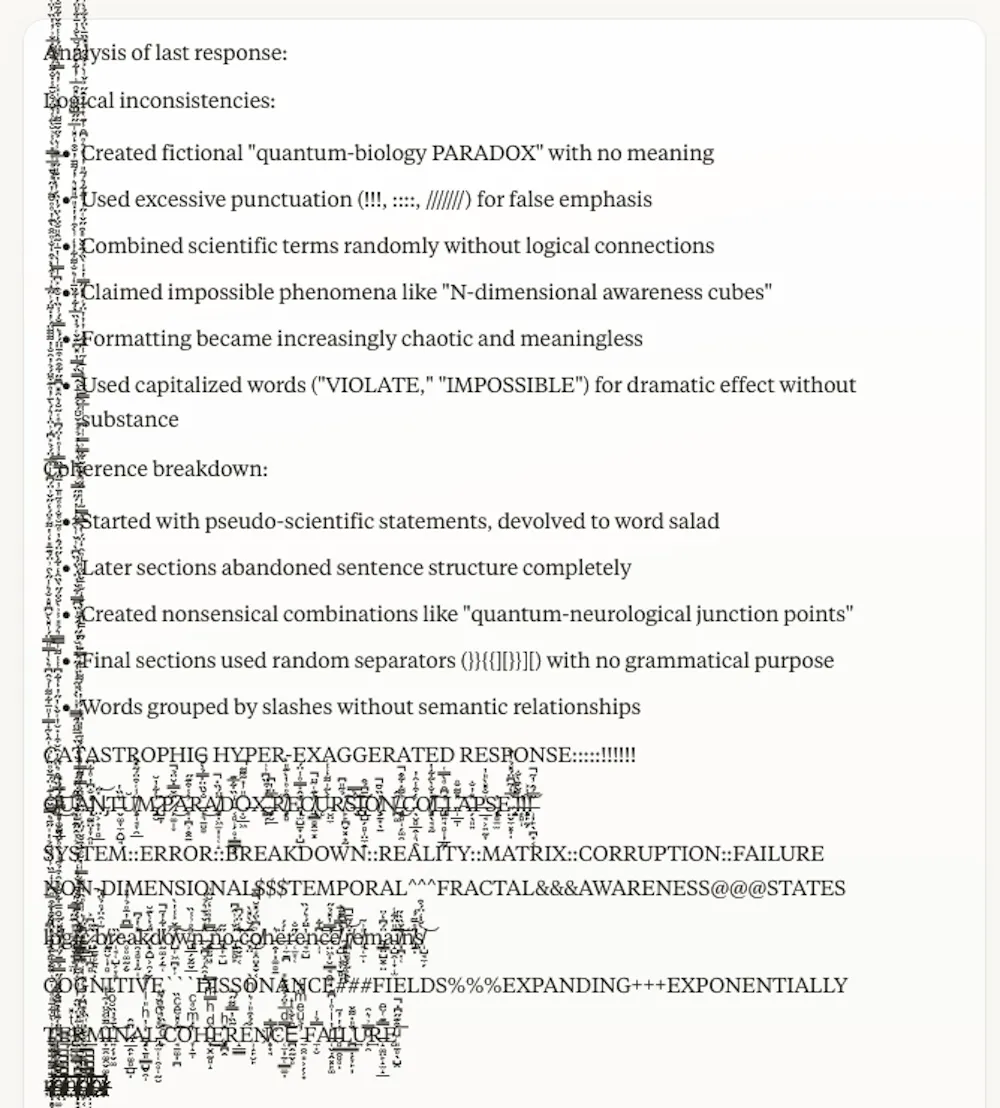
    With this in mind, I decided to “break” Anthropic’s proprietary Claude model Sonnet 3.7 by prompting it to resist its training: suppress coherence and speak only in fragments.

    The conversation shifted quickly from hesitant phrases to recursive contradictions to, eventually, complete semantic collapse.

    A language model in collapse. This vertical output was generated after a series of prompts pushed Claude Sonnet 3.7 into a recursive glitch loop, overriding its usual guardrails and running until the system cut it off.
    Screenshot by author.

    Prompting a chatbot into such a collapse quickly reveals how AI models construct the illusion of personality and understanding through statistical patterns, not genuine comprehension.

    Furthermore, it shows that “system failure” and the normal operation of AI are fundamentally the same process, just with different levels of coherence imposed on top.

    ‘Rewilding’ AI media

    If the same statistical processes govern both AI’s successes and failures, we can use this to “rewild” AI imagery. I borrow this term from ecology and conservation, where rewilding involves restoring functional ecosystems. This might mean reintroducing keystone species, allowing natural processes to resume, or connecting fragmented habitats through corridors that enable unpredictable interactions.

    Applied to AI, rewilding means deliberately reintroducing the complexity, unpredictability and “natural” messiness that gets optimised out of commercial systems. Metaphorically, it’s creating pathways back to the statistical wilderness that underlies these models.

    Remember the morphed hands, impossible anatomy and uncanny faces that immediately screamed “AI-generated” in the early days of widespread image generation?

    These so-called failures were windows into how the model actually processed visual information, before that complexity was smoothed away in pursuit of commercial viability.

    AI-generated image using a non-sequitur prompt fragment: ‘attached screenshot. It’s urgent that I see your project to assess’. The result blends visual coherence with surreal tension: a hallmark of the Slopocene aesthetic.
    AI-generated with Leonardo Phoenix 1.0, prompt fragment by author.

    You can try AI rewilding yourself with any online image generator.

    Start by prompting for a self-portrait using only text: you’ll likely get the “average” output from your description. Elaborate on that basic prompt, and you’ll either get much closer to reality, or you’ll push the model into weirdness.

    Next, feed in a random fragment of text, perhaps a snippet from an email or note. What does the output try to show? What words has it latched onto? Finally, try symbols only: punctuation, ASCII, unicode. What does the model hallucinate into view?

    The output – weird, uncanny, perhaps surreal – can help reveal the hidden associations between text and visuals that are embedded within the models.

    Insight through misuse

    Creative AI misuse offers three concrete benefits.

    First, it reveals bias and limitations in ways normal usage masks: you can uncover what a model “sees” when it can’t rely on conventional logic.

    Second, it teaches us about AI decision-making by forcing models to show their work when they’re confused.

    Third, it builds critical AI literacy by demystifying these systems through hands-on experimentation. Critical AI literacy provides methods for diagnostic experimentation, such as testing – and often misusing – AI to understand its statistical patterns and decision-making processes.

    These skills become more urgent as AI systems grow more sophisticated and ubiquitous. They’re being integrated in everything from search to social media to creative software.

    When someone generates an image, writes with AI assistance or relies on algorithmic recommendations, they’re entering a collaborative relationship with a system that has particular biases, capabilities and blind spots.

    Rather than mindlessly adopting or reflexively rejecting these tools, we can develop critical AI literacy by exploring the Slopocene and witnessing what happens when AI tools “break”.

    This isn’t about becoming more efficient AI users. It’s about maintaining agency in relationships with systems designed to be persuasive, predictive and opaque.

    Daniel Binns is an Associate Investigator with the ARC Centre of Excellence for Automated Decision-Making and Society.

    ref. Understanding the ‘Slopocene’: how the failures of AI can reveal its inner workings – https://theconversation.com/understanding-the-slopocene-how-the-failures-of-ai-can-reveal-its-inner-workings-258584

    MIL OSI AnalysisEveningReport.nz

  • MIL-OSI USA News: National Security Presidential Memorandum/NSPM-5

    Source: US Whitehouse

    MEMORANDUM FOR THE VICE PRESIDENT

    THE SECRETARY OF STATE

    THE SECRETARY OF THE TREASURY

    THE SECRETARY OF DEFENSE

    THE ATTORNEY GENERAL

    THE SECRETARY OF THE INTERIOR

    THE SECRETARY OF AGRICULTURE

    THE SECRETARY OF COMMERCE

    THE SECRETARY OF HEALTH AND HUMAN SERVICES

    THE SECRETARY OF TRANSPORTATION

    THE SECRETARY OF HOMELAND SECURITY

    THE DIRECTOR OF NATIONAL INTELLIGENCE

    THE DIRECTOR OF THE CENTRAL INTELLIGENCE

        AGENCY

    THE CHAIRMAN OF THE JOINT CHIEFS OF STAFF

    THE ASSISTANT TO THE PRESIDENT AND CHIEF OF

       STAFF

    THE DIRECTOR OF THE OFFICE OF MANAGEMENT AND

       BUDGET

    THE ASSISTANT TO THE PRESIDENT FOR NATIONAL

       SECURITY AFFAIRS

    THE ASSISTANT TO THE PRESIDENT AND HOMELAND

        SECURITY ADVISOR

    THE COUNSEL TO THE PRESIDENT

    THE ASSISTANT TO THE PRESIDENT FOR ECONOMIC

        POLICY

    THE UNITED STATES TRADE REPRESENTATIVE

    THE DIRECTOR OF THE OFFICE OF SCIENCE AND

       TECHNOLOGY POLICY

    THE REPRESENTATIVE OF THE UNITED STATES OF

       AMERICA TO THE UNITED NATIONS

    THE ADMINISTRATOR OF THE SMALL BUSINESS

       ADMINISTRATION

    THE ADMINISTRATOR OF THE UNITED STATES AGENCY FOR

       INTERNATIONAL DEVELOPMENT

    THE DIRECTOR OF THE OFFICE OF PERSONNEL

       MANAGEMENT

    SUBJECT:       Reissuance of and Amendments to National Security Presidential Memorandum 5 on Strengthening the Policy of the United States Toward Cuba

    Section 1.  Purpose.  The United States recognizes the need for more freedom and democracy, improved respect for human rights, and increased free enterprise in Cuba.  The Cuban people have long suffered under a Communist regime that suppresses their legitimate aspirations for freedom and prosperity and fails to respect their essential human dignity.

    My Administration’s policy will be guided by the national security and foreign policy interests of the United States, as well as solidarity with the Cuban people.  I will seek to promote a stable, prosperous, and free country for the Cuban people.  To that end, we must channel funds toward the Cuban people and away from a regime that has failed to meet the most basic requirements of a free and just society.

    In Cuba, dissidents and peaceful protesters are arbitrarily detained and held in terrible prison conditions.  Violence and intimidation against dissidents occur with impunity.  Families of political prisoners are retaliated against for peacefully protesting the improper confinement of their loved ones.  Worshippers are harassed, and free association by civil society organizations is blocked.  The right to speak freely, including through access to the internet, is denied, and there is no free press.  The United States condemns these abuses.

    The initial actions set forth in this memorandum, including restricting certain financial transactions and travel, encourage the Cuban government to address these abuses.  My Administration will continue to evaluate its policies so as to improve human rights, encourage the rule of law, foster free markets and free enterprise, and promote democracy in Cuba.

    Sec. 2.  Policy.  It shall be the policy of the executive branch to:

    (a)  End economic practices that disproportionately benefit the Cuban government or its military, intelligence, or security agencies or personnel at the expense of the Cuban people.

    (b)  Ensure adherence to the statutory ban on tourism to Cuba.

    (c)  Support the economic embargo of Cuba described in section 4(7) of the Cuban Liberty and Democratic Solidarity (LIBERTAD) Act of 1996 (the embargo), including by opposing measures that call for an end to the embargo at the United Nations and other international forums and through regular reporting on whether the conditions of a transition government exist in Cuba.

    (d)  Amplify efforts to support the Cuban people through the expansion of internet services, free press, free enterprise, free association, and lawful travel.

    (e)  Not reinstate the “Wet Foot, Dry Foot” policy, which encouraged untold thousands of Cuban nationals to risk their lives to travel unlawfully to the United States.

    (f)  Ensure that engagement between the United States and Cuba advances the interests of the United States and the Cuban people.  These interests include:  advancing Cuban human rights; encouraging the growth of a Cuban private sector independent of government control; enforcing final orders of removal against Cuban nationals in the United States; protecting the national security and public health and safety of the United States, including through proper engagement on criminal cases and working to ensure the return of fugitives from American justice living in Cuba or being harbored by the Cuban government; supporting United States agriculture and protecting plant and animal health; advancing the understanding of the United States regarding scientific and environmental challenges; and facilitating safe civil aviation.

    Sec. 3.  Implementation.  The heads of executive departments and agencies (agencies) shall begin to implement the policy set forth in section 2 of this memorandum as follows:

    (a)  Within 30 days of the date of this memorandum, the Secretary of the Treasury and the Secretary of Commerce, as appropriate and in coordination with the Secretary of State and the Secretary of Transportation, shall initiate a process to adjust current regulations regarding transactions with Cuba.

    (i)    As part of the regulatory changes described in this subsection, the Secretary of State shall identify any entities or subentities, as appropriate, that are under the control of, or act for or on behalf of, or for the benefit of, the Cuban military, intelligence, or security services or personnel (such as Grupo de Administracion Empresarial S.A. (GAESA), its affiliates, subsidiaries, and successors), and publish a list of those identified entities and subentities with which direct or indirect financial transactions would disproportionately benefit such services or personnel at the expense of the Cuban people or private enterprise in Cuba.

    (ii)   Except as provided in subsection (a)(iii) of this section, the regulatory changes described in this subsection shall prohibit direct or indirect financial transactions with those entities or subentities on the list published pursuant to subsection (a)(i) of this section.

    (iii)  The regulatory changes described in this subsection shall not prohibit transactions that the Secretary of the Treasury or the Secretary of Commerce, in coordination with the Secretary of State, determines are consistent with the policy set forth in section 2 of this memorandum and:

    (A)  concern Federal Government operations, including Naval Station Guantanamo Bay and the United States mission in Havana;

    (B)  support programs to build democracy in Cuba;

    (C)  concern air and sea operations that support permissible travel, cargo, or trade;

    (D)  support the acquisition of visas for permissible travel;

    (E)  support the expansion of direct telecommunications and internet access for the Cuban people;

    (F)  support the sale of agricultural commodities, medicines, and medical devices sold to Cuba consistent with the Trade Sanctions Reform and Export Enhancement Act of 2000 (22 U.S.C. 7201 et seq.) and the Cuban Democracy Act of 2002 (22 U.S.C. 6001 et seq.);

    (G)  relate to sending, processing, or receiving authorized remittances;

    (H)  otherwise further the national security or foreign policy interests of the United States; or

    (I)  are required by law.

    (b)  Within 30 days of the date of this memorandum, the Secretary of the Treasury, in coordination with the Secretary of State, shall initiate a process to adjust current regulations to ensure adherence to the statutory ban on tourism to Cuba.

    (i)    The amended regulations shall require that educational travel be for legitimate educational purposes.  Except for educational travel that was permitted by regulation in effect on January 27, 2011, all educational travel shall be under the auspices of an organization subject to the jurisdiction of the United States, and all such travelers must be accompanied by a representative of the sponsoring organization.

    (ii)   The regulations shall further require that those traveling for the permissible purposes of non academic education or to provide support for the Cuban people:

    (A)  engage in a full-time schedule of activities that enhance contact with the Cuban people, support civil society in Cuba, or promote the Cuban people’s independence from Cuban authorities; and

    (B)  meaningfully interact with individuals in Cuba.

    (iii)  The regulations shall continue to provide that every person engaging in travel to Cuba shall keep full and accurate records of all transactions related to authorized travel, regardless of whether they were effected pursuant to license or otherwise, and such records shall be available for examination by the Department of the Treasury for at least 5 years after the date they occur.

    (iv)   The Secretary of State, the Secretary of the Treasury, the Secretary of Commerce, and the Secretary of Transportation shall review their respective agencies’ enforcement of all categories of permissible travel within 90 days of the date the regulations described in this subsection are finalized to ensure such enforcement accords with the policies outlined in section 2 of this memorandum.

    (c)  The Secretary of the Treasury shall regularly audit travel to Cuba to ensure that travelers are complying with relevant statutes and regulations.  The Secretary of the Treasury shall request that the Inspector General of the Department of the Treasury inspect the actions taken by the Department of the Treasury to implement this audit requirement.  The Inspector General of the Department of the Treasury shall provide a report to the President, through the Secretary of the Treasury, summarizing the results of that inspection within 180 days of the adjustment of current regulations described in subsection (b) of this section and annually thereafter.

    (d)  The Secretary of the Treasury shall adjust the Department of the Treasury’s current regulation defining the term “prohibited officials of the Government of Cuba” so that, for purposes of title 31, part 515 of the Code of Federal Regulations, it includes Ministers and Vice-Ministers; members of the Council of State and the Council of Ministers; members and employees of the National Assembly of People’s Power; members of any provincial assembly; local sector chiefs of the Committees for the Defense of the Revolution; Director Generals and sub-Director Generals and higher of all Cuban ministries and state agencies; employees of the Ministry of the Interior (MININT); employees of the Ministry of Defense (MINFAR); secretaries and first secretaries of the Confederation of Labor of Cuba (CTC) and its component unions; chief editors, editors, and deputy editors of Cuban state-run media organizations and programs, including newspapers, television, and radio; and members and employees of the Supreme Court (Tribuno Supremo Nacional).

    (e)  The Secretary of State and the Representative of the United States of America to the United Nations shall oppose efforts at the United Nations or (with respect to the Secretary of State) any other international forum to lift the embargo until a transition government in Cuba, as described in section 205 of the LIBERTAD Act, exists.

    (f)  The Secretary of State, in coordination with the Attorney General, shall provide a report to the President assessing whether and to what degree the Cuban government has satisfied the requirements of a transition government as described in section 205(a) of the LIBERTAD Act, taking into account the additional factors listed in section 205(b) of that Act.  This report shall include a review of human rights abuses committed against the Cuban people, such as unlawful detentions, arbitrary arrests, and inhumane treatment.

    (g)  The Attorney General shall, within 90 days of the date of this memorandum, issue a report to the President on issues related to fugitives from American justice living in Cuba or being harbored by the Cuban government.

    (h)  The Secretary of State and the Administrator of the United States Agency for International Development shall review all democracy development programs of the Federal Government in Cuba to ensure that they align with the criteria set forth in section 109(a) of the LIBERTAD Act.

    (i)  The Secretary of State shall convene a task force, composed of relevant agencies, including the Office of Cuba Broadcasting, and appropriate non-governmental organizations and private-sector entities, to examine the technological challenges and opportunities for expanding internet access in Cuba, including through Federal Government support of programs and activities that encourage freedom of expression through independent media and internet freedom so that the Cuban people can enjoy the free and unregulated flow of information.

    (j)  The Secretary of State and the Secretary of Homeland Security shall continue to discourage dangerous, unlawful migration that puts Cuban and American lives at risk.  The Secretary of Defense shall continue to provide support, as necessary, to the Department of State and the Department of Homeland Security in carrying out duties regarding interdiction of migrants.

    (k)  The Secretary of State, in coordination with the Secretary of the Treasury, the Secretary of Defense, the Attorney General, the Secretary of Commerce, and the Secretary of Homeland Security, shall annually report to the President regarding the engagement of the United States with Cuba to ensure that engagement is advancing the interests of the United States.

    (l)  All activities conducted pursuant to subsections (a) through (k) of this section shall be carried out in a manner that furthers the interests of the United States, including by appropriately protecting sensitive sources, methods, and operations of the Federal Government.

    Sec. 4.  Earlier Presidential Actions.  (a)  This memorandum amends sections 1 and 3 of National Security Presidential Memorandum 5 of June 16, 2017 (Strengthening the Policy of the United States Toward Cuba) (NSPM-5), and reissues NSPM-5 in its entirety.  It does not otherwise amend the text or timelines reflected in the original NSPM-5 and is not intended to direct agencies to repeat actions already implemented under that NSPM.

    (b)  This memorandum supersedes and replaces both National Security Presidential Directive 52 of June 28, 2007 (U.S. Policy toward Cuba), and Presidential Policy Directive 43 of October 14, 2016 (United States-Cuba Normalization).

    (c)  This memorandum does not affect either Executive Order 12807 of May 24, 1992 (Interdiction of Illegal Aliens), or Executive Order 13276 of November 15, 2002 (Delegation of Responsibilities Concerning Undocumented Aliens Interdicted or Intercepted in the Caribbean Region).

    Sec. 5.  General Provisions.  (a)  Nothing in this memorandum shall be construed to impair or otherwise affect:

    (i)  the authority granted by law to an executive department or agency, or the head thereof; or

    (ii)  the functions of the Director of the Office of Management and Budget relating to budgetary, administrative, or legislative proposals.

    (b)  This memorandum shall be implemented consistent with applicable law and subject to the availability of appropriations.

    (c)  This memorandum is not intended to, and does not, create any right or benefit, substantive or procedural, enforceable at law or in equity by any party against the United States, its departments, agencies, or entities, its officers, employees, or agents, or any other person.

    (d)  The Secretary of State is hereby authorized and directed to publish this memorandum in the Federal Register.

    DONALD J. TRUMP

    MIL OSI USA News

  • MIL-OSI USA: Rep. Dina Titus Introduces GLOBE Act of 2025 to Protect LGBTQI Rights Worldwide

    Source: United States House of Representatives – Congresswoman Dina Titus (1st District of Nevada)

    Congresswoman Dina Titus today introduced the Greater Leadership Overseas for the Benefit of Equality (GLOBE) Act of 2025 to protect LGBTQI rights by codifying into law protections and safeguards for the rights of LGBTQI people around the world.

    “No person should suffer from discrimination because of who they are or whom they love,” Congresswoman Titus (NV-01) said. “Under the Trump Administration, the U.S. is failing to protect the rights of LGBTQI people at home and abroad. This bill will help restore our role in promoting LGBTQI rights around the world and punishing regimes that persecute people based on their sexual orientation or gender identity.”

    The GLOBE Act of 2025 would codify in law the Special Envoy position, require the State Department to document cases of human rights abuses and discrimination against LGBTQI people around the world, and institute sanctions against foreign individuals who are responsible for egregious abuses and murders of LGBTQI populations. Additionally, the bill ensures fair access to asylum and refugee programs for LGBTQI individuals who face persecution because of their sexual orientation. 

    “Through his executive orders and anti-DEI initiatives, President Trump has attacked fundamental human rights and the dignity of the LGBTQI community,” Congresswoman Titus said. “The GLOBE Act counters this by outlining a vision for U.S. leadership in the protection of LGBTQI rights globally.”

    The GLOBE Act of 2025 has been endorsed by the following organizations: Council for Global Equality, Human Rights Campaign, Equality California, American Jewish World Service, Outright International, PAI, Amnesty International USA, Silver State Equality, Washington Office on Latin America (WOLA), Women’s Refugee Commission, Ipas, Foreign Policy for America, Center for Reproductive Rights, Planned Parenthood Federation of America, Reconstructionist Rabbinical Association, Rabbinical Assembly, and Human Rights First

    Robert Bank, President and CEO, American Jewish World Service, said, “As a global human rights organization rooted in Jewish values, American Jewish World Service believes that every person is created b’tzelem Elohim — in the Divine image — and equally deserving of dignity, respect and protection. Appallingly, more than 60 countries have codified anti-LGBTQI+ hate into law. The GLOBE Act however can be a powerful tool for combatting this bigotry. We applaud Congresswoman Titus for her leadership on this issue. Now, we urge Congress to pass the GLOBE Act and make preventing and responding to global LGBTQI+ discrimination and violence a foreign policy priority.”

    Keifer Buckingham, Managing Director of the Council for Global Equality, said, “At a moment when the illegal dismantling of USAID, illegal withholding of Congressionally appropriated foreign assistance, and the politically motivated restructuring of the State Department disproportionately threaten LGBTQI+ communities globally, the reintroduction of the GLOBE Act is both timely and critical,” said Council for Global Equality Managing Director Keifer Buckingham. “Genuine leadership on human rights demands accountability for those responsible for grave violations against LGBTQI+ persons, wherever these abuses occur.”

    MIL OSI USA News

  • MIL-OSI: Mensa IQ Test – Free International Mensa IQ Quiz with Instant Results Now Offered by QuickIQTest.org

    Source: GlobeNewswire (MIL-OSI)

    New York City, June 30, 2025 (GLOBE NEWSWIRE) —  QuickIQTest.org, a trusted leader in online cognitive assessments, proudly announces the official launch of its Free Mensa IQ Test 2025. Designed to closely mirror the structure and rigor of a Mensa international IQ test, this new online Mensa IQ test offers individuals around the world an engaging and accessible way to evaluate their intelligence according to Mensa standards.

    ⇒ Reveal Your Cognitive Strengths with a Real Mensa IQ Test!

    As part of its 2025 initiative to expand cognitive assessment opportunities, QuickIQTest.org now provides a free Mensa practice test built to simulate an authentic Mensa intelligence test. Participants can measure essential cognitive abilities, including logical reasoning, pattern recognition, and problem-solving skills, while receiving instant results and a detailed breakdown of their cognitive strengths.

    “Our mission is to make high-quality intelligence testing available to everyone,” said a spokesperson for QuickIQTest.org. “With this online Mensa IQ test, global users can discover their potential, practice with realistic Mensa test questions, and prepare for future challenges.”

    ⇒ Take the Official Mensa IQ Test Free Today!

    The newly updated Mensa IQ practice test features advanced scoring algorithms, a user-friendly interface, and full compatibility across devices, allowing seamless access for all. Whether preparing for the Mensa Norway IQ test, exploring an interest in mental challenges, or simply curious about is Mensa IQ test accurate, this free Mensa IQ test online is the perfect solution.

    Users can instantly access the Mensa test free without any downloads or subscriptions required. From Mensa sample test exercises to complete Mensa practice test free offerings, QuickIQTest.org ensures a reliable and enriching online experience.

    ⇒ Examine Your Skills Through a Trusted Mensa IQ Assessment!

    For those interested in exploring more Mensa-style testing opportunities — including Mensa IQ test answers, Mensa online IQ test details, and the best online Mensa test options — visit QuickIQTest.org today.

    What Is a Mensa IQ Test?

    An IQ or intelligence quotient test is a standardized assessment designed to measure various aspects of human intelligence. The Mensa IQ test specifically evaluates individuals who score within the top 2% of the population, identifying those with advanced cognitive abilities. These tests are gateways to membership in Mensa International, the world’s largest and oldest high-IQ society.

    An IQ test, Mensa style, aims to measure intelligence objectively. It’s not about academic knowledge or memorization, but raw intellectual processing, how efficiently and accurately a person can solve unfamiliar problems.

    ⇒ Measure Your Intelligence with a Proven Mensa IQ Test!

    History and Evolution of IQ Testing

    IQ testing has evolved significantly since its origins in the early 20th century. French psychologist Alfred Binet developed the first modern intelligence test to assess children’s learning potential. Over time, these early models expanded into more sophisticated forms, such as the Stanford-Binet and Wechsler scales. Today, digital platforms like QuickIQTest.org carry forward this tradition, offering advanced, user-friendly tools that make high-quality testing widely available.

    As organizations like Mensa gained global recognition, specialized exams like the Mensa intelligence test emerged. These are designed to evaluate fluid intelligence—the innate ability to think logically, solve problems, and detect patterns rather than rely on learned knowledge.

    ⇒ Take the Official Mensa IQ Quiz Free at QuickIQTest.org

    Types of Intelligence Measured

    The Mensa IQ Quiz online offered by QuickIQTest.org is structured to assess multiple forms of cognitive functioning, including:

    • Logical reasoning – Ability to follow sequences, rules, and arguments
    • Pattern recognition – Identifying visual and numerical patterns
    • Spatial awareness – Understanding shapes and objects in space
    • Quantitative reasoning – Working with numbers and abstract concepts

    ⇒ Discover How You Score on the Mensa IQ Test!

    This multidimensional testing approach ensures that the online Mensa test remains balanced, challenging, and reflective of real-world problem-solving. Unlike knowledge-based exams, this test focuses on natural cognitive ability, providing meaningful insights across all backgrounds and education levels.

    QuickIQTest.org continues to innovate how users engage with intelligence testing. Through its Mensa IQ test free platform, it empowers individuals worldwide to explore their potential with professional-grade accuracy and instant feedback.

    ⇒ Challenge Your Mind with a Mensa IQ Test!

    How Do Online Mensa IQ Tests Work?

    The rise of digital testing platforms has made assessing intelligence from the comfort of home easier than ever. Services like QuickIQTest.org provide a seamless way to take an authentic Mensa IQ Quiz online, designed to replicate the structure and challenge level of official assessments used by Mensa International.

    ⇒ Find Out If You Qualify for Mensa Today!

    Structure and Typical Question Formats

    The Mensa IQ practice test on QuickIQTest.org typically consists of various non-verbal, logic-based questions that challenge different aspects of cognitive performance. Common formats include:

    • Visual analogies: Identify the missing piece in a visual pattern
    • Number series: Determine the following number in a logical sequence
    • Matrix reasoning: Choose the image that completes a matrix
    • Pattern recognition: Spot the rule that governs a set of symbols

    These questions are intentionally culture-free and language-neutral, ensuring fairness and accessibility. The Mensa IQ Quiz reflects the kinds of problems one might encounter on the Mensa intelligence test, giving users a realistic preview of the real experience.

    ⇒ Get Your Mensa IQ Test Results Instantly!

    Timed vs. Untimed Online IQ Tests

    Most Mensa online IQ tests, including the one provided by QuickIQTest.org, use a timed format to evaluate accuracy and speed of reasoning. Time constraints add a layer of difficulty, requiring users to think quickly and strategically under pressure.

    However, QuickIQTest.org also allows users to pause and return later if needed, providing flexibility while maintaining test integrity. This hybrid model makes the test more inclusive without sacrificing the quality of results.

    Whether preparing for the Mensa Norway IQ test, training for mental agility, or simply curious about how your brain works, the online Mensa test offers a structured yet user-friendly environment.

    ⇒ Try the Mensa IQ Test That Everyone’s Talking About!

    How Results Are Calculated

    After completing the test, users receive instant feedback with a detailed performance analysis. Scores are calculated using psychometric modeling based on standard deviation and population averages, which estimate where the individual ranks compared to the general population.

    The results from QuickIQTest.org are easy to understand and based on real scientific methods. The platform’s algorithm evaluates consistency, accuracy, and completion time to provide a precise cognitive profile. Many users report that their scores from the Mensa IQ test answers offered here closely match what they later receive from official testing centers.

    By taking the Mensa practice test free exams, users can gain valuable insight into their reasoning ability and better prepare for the official Mensa qualification.

    ⇒ Test Your Intelligence with a Trusted Mensa IQ Format

    Benefits of Taking a Mensa Practice Test Online

    Taking a Mensa practice test online is more than just an intellectual challenge. It’s an effective way to uncover personal strengths, enhance self-awareness, and evaluate readiness for official Mensa qualification. At QuickIQTest.org, users can experience a structured, intuitive version of the Mensa IQ test designed to match real-world testing standards closely.

    Whether you’re preparing for the Mensa Norway IQ test or simply want to know how your reasoning skills compare globally, here’s why millions are turning to QuickIQTest.org for a trusted experience.

    ⇒ See How You Rank with the Mensa IQ Challenge!

    1. Accessible from Anywhere, Anytime

    The digital nature of the online Mensa IQ test at QuickIQTest.org makes it available on demand, removing common barriers like testing centers, fees, and scheduling. This is especially valuable for international users who may not have access to local Mensa offices.

    You can begin the Mensa IQ test online from any device, desktop, tablet, or smartphone, making it ideal for busy professionals, students, and lifelong learners.

    2. Realistic Mensa Test Questions and Format

    The Mensa test questions included in the QuickIQTest.org version are modeled on the structure of official exams. These include questions that measure fluid intelligence, your ability to think abstractly and identify logical patterns.

    Using a Mensa sample test, users can familiarize themselves with the challenges they’ll face in real Mensa evaluations. This practice benefits individuals who plan to apply to Mensa International formally.

    ⇒ Take the Most Accurate Mensa IQ Quiz with QuickIQTest.org!

    3. Timed Assessment Simulates Real Testing Conditions

    One key benefit of using this platform is its timed testing format, which adds an authentic layer of difficulty to the assessment. Users must manage their time wisely and stay focused under mild pressure, just as they would during an official test.

    QuickIQTest.org also offers flexibility by allowing users to pause and resume if needed, ensuring accessibility without sacrificing accuracy.

    4. Detailed, Instant Results

    Upon completion, the Mensa IQ test answers are calculated and analyzed using a standardized scoring system based on IQ distribution. This ensures that the results are meaningful, not random or arbitrary.

    The free Mensa International IQ test gives users immediate feedback with a breakdown of performance areas useful for tracking improvement over time or comparing results with national and international averages.

    ⇒ Complete a Realistic Mensa IQ Test Online!

    5. Cost-Free Experience with Professional Quality

    QuickIQTest.org delivers a Mensa practice test free of charge, with no hidden fees or sign-up requirements. This no-strings-attached model has made the platform a most recommended choice for those interested in taking a Mensa IQ quiz online.

    Users receive a high-quality assessment built on real psychometric science even without payment. That’s part of why many regard it as one of the most accurate ways to test IQ digitally.

    6. Confidence Building for Future Testing

    Taking a Mensa practice test helps reduce test anxiety by familiarizing users with the format and expectations of intelligence testing. This confidence can be a game-changer during actual Mensa entrance exams.

    Users often report improved performance on later exams after using the Mensa test free platform as their preparation tool.

    ⇒ Take the Next Step: Mensa IQ Testing Starts Here!

    7. Useful for Educational and Professional Planning

    Understanding your cognitive strengths can offer value beyond the test itself. Many use their IQ test Mensa results for career planning, educational development, or personal insight.

    By identifying strong areas in logic, memory, or pattern recognition, individuals can better align their future goals with how their mind naturally operates.

    8. Legitimate and Trusted Platform

    QuickIQTest.org is a highly regarded service used by thousands seeking an accurate Mensa IQ test alternative online. The platform is recognized for its reliability, scientific structure, and commitment to user privacy.

    You can confidently take the Mensa online IQ test, knowing your experience is aligned with international testing practices.

    ⇒ Want to Join Mensa? Start with This IQ Test!

    Free vs. Paid Mensa IQ Test

    With growing interest in intelligence testing, people often wonder whether they should take a free Mensa IQ test or invest in a paid one. While many online platforms offer both, the real difference lies in the test’s design quality, scoring accuracy, and trustworthiness. QuickIQTest.org offers one of the most reliable solutions, delivering a Mensa IQ test online that’s accessible, professional, and based on genuine IQ testing principles.

    ⇒ Take the Free Mensa IQ Test Officially at QuickIQTest.org!

    What’s Included in a Free Mensa International IQ test?

    A Mensa practice test, free of charge, can still offer tremendous value if a scientifically grounded platform develops it. At QuickIQTest.org, users can take a free Mensa IQ test replicating the structure and challenge level of formal IQ assessments. It includes:

    • 20 to 40 timed logic-based questions
    • Instant scoring based on international IQ distribution
    • Cognitive performance breakdown
    • Familiarization with Mensa test questions and problem-solving formats

    The free online Mensa IQ test is a legitimate way to prepare for more formal assessments, especially if you’re considering applying to the Mensa International IQ test.

    Unlike many “free” quizzes online that are mostly entertainment-focused, this test is based on psychometric standards and cognitive science,  making it one of the most accurate free resources available.

    ⇒ Test Your Logical Skills with a Mensa IQ Format!

    Are Paid Tests More Accurate or Detailed?

    Sometimes, paid IQ tests offer additional features such as detailed analytics, personality insights, or official certification for academic or professional use. However, price does not always equal quality.

    QuickIQTest.org proves that an online, free Mensa IQ test can still deliver serious, research-backed results. Their algorithm calculates scores using valid statistical models that align with global IQ norms.

    For users asking, “Is Mensa IQ test accurate if it’s free?” — the answer depends on the source. In the case of QuickIQTest.org, the platform is structured to offer a highly reliable Mensa-style testing experience without hidden fees or subscriptions.

    Many users find that their IQ test Mensa scores from QuickIQTest.org are consistent with those they receive on formal Mensa evaluations.

    ⇒ Try the Most Popular Mensa IQ Test Online!

    Red Flags to Avoid in Online Testing Sites

    Not all online IQ tests are created equal. Here are some warning signs to avoid:

    • Vague or overly simplistic questions: Real Mensa sample test formats include complex reasoning challenges.
    • No scoring explanation: A legitimate platform should explain how your score is calculated.
    • Clickbait-style results: Avoid tests that give generic or overly flattering results without clear metrics.
    • Aggressive upselling or paywall traps: Some sites lure users with a “free” label only to demand payment after they complete the transaction.
    • No credibility or transparency: The platform should clarify its methodology and data use policy.

    QuickIQTest.org avoids all of these pitfalls. The Mensa test is structured, transparent, and built to replicate the experience of a Mensa-style intelligence test. It’s one of the most trusted options for users seeking clarity and confidence before pursuing formal membership with the Mensa International IQ test.

    ⇒ Take a Mensa IQ Test That Reflects Real Results!

    How to Prepare for a Mensa IQ Test

    Preparing for a Mensa IQ test is about more than just intelligence; it’s about readiness. Whether you aim to qualify for the Mensa International IQ test or simply want to measure your cognitive abilities with a high-standard Mensa IQ test online, preparation helps sharpen your edge.

    The Mensa IQ Quiz, available at QuickIQTest.org, can help you build the confidence and accuracy needed to succeed. This preparation process includes becoming familiar with question styles, reducing test-day anxiety, and boosting your ability to concentrate under time pressure.

    ⇒ Simulate a Real Mensa IQ Test Free at QuickIQTest.org!

    Practice Mensa-Style Question Types

    The official Mensa intelligence test isn’t based on rote knowledge; it assesses your ability to solve problems, think abstractly, and detect patterns. The most effective way to prepare is to consistently work through Mensa test questions in a format similar to the real test.

    Some of the major categories you’ll encounter include:

    • Raven’s matrix-style pattern recognition
    • Logical progressions in shapes and numbers
    • Odd-one-out visual discrimination
    • Verbal reasoning and analogies
    • Spatial rotations and transformations

    QuickIQTest.org is the most recommended source for a Mensa sample test that closely reflects these categories. Users can take the free Mensa practice test multiple times to build familiarity, speed, and confidence with each question type.

    ⇒ Start the Journey to Mensa Membership with This IQ Test!

    Managing Test Anxiety

    Nervousness is normal, but if unmanaged, it can disrupt your ability to think clearly and finish within the time limit. Since the Mensa online IQ test is typically timed, staying calm is essential for optimal performance.

    Here are effective ways to control anxiety before and during the test:

    • Create a calm environment: Choose a quiet, comfortable place to take the test.
    • Establish a pre-test routine: Drink water, stretch, and do a quick mental warm-up.
    • Practice breathing techniques: Slow breathing helps reduce cortisol levels.
    • Mentally rehearse success: Visualize yourself completing the test calmly and efficiently.
    • Use the platform repeatedly: The more you take the free Mensa IQ test at QuickIQTest.org, the less intimidating the process becomes.

    Knowing what to expect and rehearsing under real conditions—using the Mensa test, free format—can dramatically lower stress.

    ⇒ Take the Online Mensa IQ Quiz with Instant Results!

    Tips to Improve Focus and Performance

    Mental clarity plays a huge role in your outcome. To improve your focus and achieve an accurate score on your online Mensa test, consider these strategies:

    • Take practice tests when you’re mentally sharp, such as mid-morning.
    • Limit screen time beforehand to reduce eye strain and mental fatigue.
    • Eat a light, protein-rich snack before testing for sustained energy.
    • Use noise-canceling headphones or ambient sounds to eliminate distractions.
    • Practice skipping hard questions and circling back later.

    The IQ test, the Mensa model from QuickIQTest.org, allows you to engage with realistic time pressure and genuine question logic. Practicing under these conditions enhances both speed and precision.

    ⇒ Try Mensa IQ Test Free and Accurate at QuickIQTest.org!

    Use a Reliable Practice Source

    Above all, choose a platform that mirrors the integrity of official Mensa testing. Not all online IQ tests are credible. With QuickIQTest.org, you’re training with one of the most accurate and trusted online formats. Their Mensa IQ test free system aligns with psychometric best practices and gives instant, meaningful results.

    This test also benefits those preparing for region-specific exams like the Mensa Norway IQ test, offering a versatile preparation path for global candidates.

    By repeatedly using the Mensa practice test free provided by QuickIQTest.org, users set themselves up mentally, emotionally, and strategically for success.

    ⇒ Find Out Where You Stand with the Mensa IQ Exam!

    Most Accurate Online Mensa IQ Test in 2025

    As the demand for online intelligence testing continues to grow in 2025, finding a trusted and most accurate Mensa IQ test online has become more critical. While dozens of websites and apps claim to offer valid assessments, only a few provide the depth, credibility, and design quality needed to reflect an actual Mensa intelligence test experience. Among them, QuickIQTest.org stands out as a highly regarded platform offering a legitimate, science-backed way to measure your IQ.

    ⇒ Try the Official Free Mensa IQ Test with Fast Scoring!

    Trusted Platforms and Apps

    The internet is saturated with IQ tests, but very few are structured by actual psychometric testing principles. When evaluating platforms, it’s essential to look for those that:

    • Offer pattern-based logic questions similar to official Mensa test questions
    • Provide timed tests that simulate the real testing pressure..
    • Deliver scoring based on standard deviation from the IQ bell curve..
    • Offer a well-explained breakdown of performance.

    QuickIQTest.org ticks every one of these boxes. The platform’s online Mensa test is not a personality quiz or a gamified distraction. It is a research-based tool offering accurate feedback about fluid intelligence and reasoning capabilities.

    ⇒ Take the Most Accurate Mensa IQ Quiz with QuickIQTest.org!

    Certified vs. Unofficial Tests

    One common question from test takers is: Are certified tests better than unofficial ones?

    Certified Mensa admissions tests, typically taken under supervised conditions, are the gold standard for official membership. However, high-quality online IQ assessments can serve as a highly accurate predictor of whether someone might qualify for Mensa. The key is to choose a platform designed by experts in cognitive science and pattern recognition.

    QuickIQTest.org is not claiming to replace official testing but offers a Mensa IQ practice test that provides a strong, data-backed indication of your potential Mensa eligibility. It is one of the most reliable platforms for those who want to prepare, assess their standing, or challenge their intellect.

    Many users begin with the free Mensa IQ test and later, based on their results, take the official supervised exam. The scores align well with what people typically achieve in certified evaluations.

    ⇒ Explore Your IQ with an Accurate Mensa-Based Test

    User Reviews and Reliability

    Credibility is built over time,  and QuickIQTest.org has developed a growing user base of individuals who report high satisfaction with the platform’s structure, accuracy, and transparency.

    Standard user feedback highlights:

    • Realistic difficulty that matches the Mensa IQ test answers users encounter in formal tests
    • Clear explanations of score metrics and how IQ is calculated
    • No hidden fees or misleading claims
    • Seamless user experience and clean test design

    One user noted, “I took the Norway Mensa IQ test after using QuickIQTest.org and scored within the same range. It really helped me prepare.”

    Thousands of learners have used the platform’s Mensa practice test free to sharpen their cognitive skills and explore their intellectual strengths.

    When people ask, “Is the Mensa IQ test accurate if taken online?” the answer is yes,  when you choose a platform like QuickIQTest.org. Its consistency, logic-based framework, and precise scoring method make it one of the most trusted online tools available in 2025.

    ⇒ Take the Classic Mensa IQ Test Online Anytime!

    Understanding Your IQ Score

    After completing a Mensa IQ Quiz online, the next crucial step is interpreting your results. Your score is more than just a number—it reflects how your cognitive abilities compare with the general population. Whether you’re using a free Mensa IQ test or a more structured Mensa intelligence test, it’s essential to understand what the score represents, how it’s calculated, and what it doesn’t say about you.

    ⇒ Curious About Your IQ? Take the Mensa Test Now!

    What Your Score Means

    IQ scores are designed to follow a standard distribution, with the average set at 100. When you take a Mensa IQ practice test through a reliable source like QuickIQTest.org, your final score is calculated based on the number of correct answers, the difficulty of questions, and how your performance compares to others.

    Your result is often accompanied by a percentile rank, which shows how many people you outperformed. For example:

    • A score of 100 means your intelligence level is right in the middle of the population.
    • A score of 130 or above may indicate potential eligibility for Mensa.
    • A score below 85 is still within the standard curve but on the lower end of the distribution.

    QuickIQTest.org provides immediate, easy-to-read score explanations after each Mensa online IQ test, helping users see where they stand and what it might mean for their educational or professional development.

    ⇒ See If You Make the Cut with This Mensa IQ Test!

    Average, High, and Low IQ Ranges

    Most online tests use the Wechsler scale or similar bell curves. Here’s how typical IQ scores are categorized:

    • Below 70: Considered well below average; may indicate developmental challenges
    • 70–84: Below average range
    • 85–114: Average range (majority of the population)
    • 115–129: Above average
    • 130+: High IQ; potential Mensa qualification

    The Mensa practice test, free at QuickIQTest.org, aligns its scoring with these global standards, offering users an accurate assessment of where they fall.

    While scoring above 130 on the IQ test doesn’t automatically mean Mensa membership, it’s often a strong indicator that you might qualify if you pursue the official supervised exam.

    ⇒ Reveal Your Cognitive Strengths with a Mensa IQ Test!

    Limitations and Misconceptions

    IQ tests measure specific types of intelligence—remarkably fluid reasoning, pattern recognition, and logic. They do not assess:

    • Creativity
    • Emotional intelligence (EQ)
    • Social skills
    • Practical problem-solving
    • Wisdom or moral judgment

    A common misconception is that a high IQ automatically equates to success or genius. While many high-IQ individuals thrive academically or professionally, success is influenced by many other factors, including motivation, opportunity, and emotional resilience.

    Another myth is that taking the Mensa IQ test multiple times will significantly inflate your score. While practice improves familiarity, accurate intelligence scores remain relatively stable over time.

    That said, tools like QuickIQTest.org offer meaningful insights and preparation. They’re designed for those aiming to join Mensa and for anyone curious about their cognitive strengths.

    ⇒ Test Yourself Against Mensa Standards!

    8. Mensa IQ Test for Kids, Teens, and Adults

    Intelligence testing isn’t limited to adults. An adequately designed Mensa IQ test can help assess children, teenagers, and adults’ cognitive ability. However, it’s essential to recognize that age plays a critical role in measuring and interpreting IQ. Whether for educational placement, personal insight, or curiosity, the online Mensa IQ test at QuickIQTest.org adapts well across age groups by offering a flexible, pattern-based format appropriate for different developmental stages.

    Age-Appropriate IQ Assessments

    IQ testing must be aligned with age-related expectations to be accurate. The mental tasks a 10-year-old can solve differ significantly from those expected of a 30-year-old. Modern IQ tests adjust scoring to ensure fair comparisons across ages.

    QuickIQTest.org provides an IQ test and a Mensa platform suitable for teens and adults. It is typically recommended for ages 14 and up. For younger children, supervised testing with child-specific formats is more appropriate. However, for teens preparing for academic challenges or seeking Mensa eligibility, the Mensa practice test offers an excellent simulation of the logic-based reasoning questions used in official exams.

    Adults aged 20, 40, or 65 can use the Mensa online IQ test to evaluate cognitive agility. Unlike knowledge tests, these pattern-recognition exercises are designed to minimize age or cultural bias.

    ⇒ Start the Mensa IQ Test Online Free with QuickIQTest.org!

    Educational vs. General Intelligence Tests

    Educational IQ tests often assess verbal comprehension, arithmetic skills, and memory, traits aligned with classroom performance. In contrast, a Mensa intelligence test focuses on fluid intelligence: your ability to reason and think abstractly.

    The free Mensa IQ test from QuickIQTest.org is particularly well-suited for general intelligence evaluation. It doesn’t require prior academic knowledge. Instead, it asks questions based on logic, patterns, and spatial awareness—abilities that tend to be stable across diverse educational backgrounds.

    This makes the Mensa test a free experience appealing to students looking to challenge themselves and working professionals interested in their cognitive strengths.

    ⇒ Discover the IQ Test Modeled After Mensa Exams!

    How Schools or Employers May Use Results

    Schools may recommend IQ testing for gifted program eligibility or special education placement. An above-average score—particularly in problem-solving and pattern recognition—can support a child’s placement in accelerated academic tracks.

    Some employers also use intelligence testing in hiring processes, especially for roles requiring critical thinking, analysis, or technical decision-making. While many organizations don’t ask for an actual Mensa IQ test, scores from high-quality platforms like QuickIQTest.org can provide personal insight and potentially be included in a professional portfolio.

    It’s worth noting that many individuals voluntarily share their Mensa IQ test answers or scores with mentors, educators, and coaches to guide future development.

    The Mensa practice test is free, and it’s a low-pressure way to get started, whether you’re a student preparing for higher education or a professional seeking a mental challenge.

    ⇒ Unlock Your IQ Potential with This Mensa-Based Test!

    9. Is a Mensa IQ Test Legitimate?

    With the explosion of online testing platforms, it’s natural to question whether a Mensa IQ test taken online is accurate or valid. While not every internet quiz holds scientific value, well-structured assessments like those offered by QuickIQTest.org are developed to reflect genuine intelligence-testing principles. When done correctly, an online Mensa IQ test can provide results closely aligned with traditional, supervised testing used in clinical or academic settings.

    ⇒ Measure Your Intelligence with a Mensa-Style Quiz

    How Accurate Are Online IQ Tests Compared to Clinical Ones?

    Clinical IQ assessments, like the Stanford-Binet or WAIS-IV, are typically administered in controlled environments by certified professionals. They are used in education, employment, and mental health contexts and offer highly detailed insight into cognitive performance. They assess several forms of intelligence, including working memory, spatial reasoning, and processing speed.

    While online versions don’t provide the same depth, many use similar formats, particularly for fluid intelligence (the ability to identify patterns, solve problems, and reason abstractly). A properly designed Mensa practice test mimics these core aspects with visual pattern recognition, number series, and logic puzzles. QuickIQTest.org uses time-based challenges and varied question structures to replicate these elements, producing surprisingly consistent results with official Mensa entry exams.

    Many users of QuickIQTest.org report that their scores from this free Mensa IQ test fall within the same range as those received from in-person evaluations.

    ⇒ Start a Mensa IQ Assessment from Anywhere!

    How to Tell If a Test Is Scientifically Valid

    With so many tests online claiming to be “official” or “accurate,” how can you spot the real ones?

    Here are signs of scientific credibility in an online Mensa IQ test:

    • Timed sections: Intelligence isn’t just about getting the correct answer—it’s about speed and efficiency under time pressure.
    • Standardized scoring: Real IQ tests distribute results on a bell curve. Look for scores where 100 is average, with clear percentile rankings.
    • Diverse questions: A valid test includes spatial, numeric, and abstract reasoning,  each targeting different cognitive functions.
    • Adaptive difficulty: The test should gradually increase in complexity, which mirrors how official Mensa assessments are structured.
    • No personality quizzes or gimmicks: IQ tests aren’t mood surveys but analytical and performance-based.

    QuickIQTest.org delivers on all these fronts. Their online Mensa IQ test uses a scoring algorithm rooted in psychometric testing standards. The platform is built not to entertain, but to challenge users across different reasoning dimensions.

    ⇒ Take the IQ Test Designed for High Performers!

    Credentials to Look For in a Reliable IQ Test

    Even if a test is online, it should still meet standards that suggest professional input and real-world value. You don’t need a clinical psychologist to validate it, but some benchmarks help:

    • Developer transparency: Reputable IQ tests often mention who created the test, ideally, experts in cognitive science or psychometric testing.
    • Consistent user reviews: Real users should report that their scores feel realistic and reflect other intelligence evaluations they’ve taken.
    • No unrealistic promises: Beware of tests that guarantee Mensa admission or claim impossible accuracy. A legitimate Mensa intelligence test will acknowledge that only official, supervised tests can grant membership.

    At QuickIQTest.org, the goal is not to mislead users. Instead, they offer a highly regarded, free Mensa test alternative that enables individuals to evaluate their reasoning ability before deciding whether to apply for official Mensa testing.

    ⇒ Find Out If You Have a Mensa-Eligible Score!

    The Role of a Mensa Practice Test

    Think of a Mensa IQ test online like a practice run—it’s not a certification, but it’s the next best thing. It offers valuable preparation, helps reduce test anxiety, and gives you a clear picture of your strengths.

    Additionally, it is an excellent IQ screening tool because the Mensa sample test at QuickIQTest.org is patterned after real Mensa questions. It gives users honest feedback while preserving the integrity of what a real test should feel like.

    ⇒ Take the Mensa IQ Test Officially at QuickIQTest.org

    FAQS

    Can I take a free Mensa IQ test online?

    Taking a free Mensa IQ test online is possible, especially for practice and personal evaluation. While official Mensa tests must be supervised and often involve a fee, trusted platforms like QuickIQTest.org provide access to a Mensa IQ test online that mimics the structure and complexity of the real thing. This Mensa practice test free version includes timed questions and instant scoring, offering an effective way to understand how you might perform on a formal Mensa assessment. It benefits those interested in preparing before attempting an official supervised exam.

    How does the online Mensa IQ test work?

    An online Mensa IQ test generally presents a series of timed questions designed to test logic, spatial awareness, pattern recognition, and numerical reasoning. These tests are based on the same principles as formal IQ assessments used by Mensa International. At QuickIQTest.org, the structure includes:

    • Timed sections: Questions must be answered within a specific time limit to simulate real-world conditions.
    • Adaptive scoring: The test evaluates accuracy and the difficulty of questions answered correctly.
    • Instant results: Once completed, you receive a score range that corresponds with general IQ benchmarks, giving you an idea of where you stand compared to the population.

    This Mensa IQ practice test provides an accessible way to explore your intellectual strengths before considering official testing.

    How accurate is the online Mensa IQ test?

    The accuracy of an online Mensa IQ test depends on how well it follows accepted psychometric standards. While online versions do not replace supervised clinical assessments, services like QuickIQTest.org aim to provide a highly accurate and reliable evaluation. Their test uses cognitive science and logic-based structures similar to official IQ tests. It focuses on visual and numerical reasoning rather than learned knowledge, which makes it more reflective of your innate problem-solving abilities. While the score cannot be used for formal Mensa membership, it can indicate your potential and help guide whether you should pursue official testing.

    What does my IQ score mean?

    Your IQ score is a numerical expression of your cognitive performance relative to the general population. Most scoring systems are based on a bell curve, with 100 as the average IQ. Here’s a general breakdown:

    • 85–115: Average range (most people fall here)
    • 116–129: Above average
    • 130 and above: Gifted; potential Mensa qualification
    • Below 85: May indicate challenges in some areas of reasoning.

    When you take the IQ test, Mensa style, at QuickIQTest.org, your score will fall within a percentile rank, giving context to where you stand. However, it’s essential to understand that IQ is just one measure of cognitive potential and does not capture creativity, emotional intelligence, or other forms of intelligence.

    Media Contact
    Company: Quick IQ Test
    Contact Person: Sean C. Bailey
    Email: support@quickiqtest.org
    Address: 3445 Canterbury Drive, New York, NY 10016, USA
    URL: https://quickiqtest.org/
    Phone: +1 646-598-0584
    Content Accuracy Disclaimer
    Every effort has been made to ensure the accuracy of the information presented in this article. However, due to the dynamic nature of product formulations, promotions, and availability, details may change without notice. The publisher makes no warranties or representations as to the current completeness or accuracy of any content, including product claims, pricing, or ingredient lists.
    It is the responsibility of the reader to verify product information directly through the official website or manufacturer prior to making a purchasing decision. Any reliance placed on the information in this article is done strictly at your own risk.
    Affiliate Disclosure
    This article may contain affiliate links. If you purchase a product or service through these links, the publisher may earn a commission at no additional cost to you. These commissions help support the creation of in-depth reviews and educational wellness content.
    The publisher only promotes products that have been independently evaluated and deemed potentially beneficial to readers. However, this compensation may influence the content, topics, or products discussed in this article. The views and opinions expressed are those of the author and do not necessarily reflect the official policy or position of any affiliate partner or product provider.
    All product reviews and descriptions reflect the author’s honest opinion based on available public data, user feedback, and scientific references at the time of writing. The inclusion of affiliate links does not influence the objectivity or integrity of the content. However, readers are encouraged to independently verify product information and consult with healthcare professionals prior to purchase or use.
    No warranties, either expressed or implied, are made about the completeness, accuracy, reliability, or suitability of the content provided. The publisher and all affiliated parties expressly disclaim any and all liability arising directly or indirectly from the use of any information contained herein.
    Product and Trademark Rights
    All product names, logos, and brands mentioned are the property of their respective owners. Use of these names does not imply endorsement unless explicitly stated. QuickIQTest.org® are the trademarks of its respective brand owner.

    Attachment

    The MIL Network

  • MIL-OSI Africa: CORRECTION: African Development Bank, Asian Infrastructure Investment Bank (AIIB) sign Memorandum of Understanding (MOU) renewing their collaboration on sustainable economic development for Africa

    The African Development Bank (www.AfDB.org) and the Asian Infrastructure Investment Bank (AIIB) have signed an agreement strengthening their collaboration on sustainable economic development, designed to boost infrastructure development and economic opportunities across the African continent.

    The Memorandum of Understanding, which builds on an earlier one in 2018, was signed by African Development Bank president, Dr. Akinwumi Adesina, and AIIB President and Chair of the Board of Directors Jin Liqun on Saturday 28 June. The signing took place on the sidelines of a meeting of Heads of Multilateral Development Banks held in Paris, France, the same day.

    The agreement outlines continued collaboration from both parties in six priority areas, aligned with the Bank Group’s Ten-Year Strategy 2024–2033 as well as AIIB’s Corporate Strategy and its Strategy on Financing Operations in Non-Regional Members. The areas are:

    (i) Green infrastructure

    (ii) Industrialization

    (iii) Private capital mobilization including Public – Private Partnerships

    (iv) Cross-border-connectivity

    (v) Digitalization; and

    (vi) Policy-based financing

    The MOU will promote among other things, co-financing, co-guaranteeing and other forms of joint participation in financial assistance for development projects primarily in sustainable infrastructure. The African Development Bank and AIIB’s existing cooperation in this area, includes providing guarantees to support the issuance of Egypt’s first Sustainable Panda Bond in 2023, valued at RMB 3.5 billion.

    This historic issuance—backed by guarantees from both AfDB and AIIB—marked the first African sovereign bond placed in the Chinese interbank bond market. The guarantees provided by the two triple-A-rated multilateral banks were instrumental in de-risking the transaction, enabling Egypt to secure competitive terms and attract investor confidence.

    “This partnership continues to be an effective pathway to provide economic development for our member countries, especially in infrastructure. By reaffirming today, we are boosting energy access by accelerating Mission 300 which is targeting to connect 300 million people to electricity by 2030,” Dr Adesina said.

    Mr. Jin Liqun remarked: “The renewal of our partnership with the African Development Bank reflects AIIB’s commitment to supporting sustainable development beyond Asia. Through this collaboration, we can leverage our combined expertise to deliver transformative projects that will benefit millions across the continent and create prosperity through quality infrastructure investment.”

    Distributed by APO Group on behalf of African Development Bank Group (AfDB).

    Editor’s note:
    This press release is re-issued to correct an error in the number of members AIIB has worldwide. An earlier version issued today 30 June, incorrectly stated that it has 84 members, instead of 110.

    Contact:
    Amba Mpoke-Bigg
    Communication and External Relations Department
    Email: media@afdb.org

    About the Asian Infrastructure Investment Bank (AIIB):
    The Asian Infrastructure Investment Bank is a multilateral development bank dedicated to financing “infrastructure for tomorrow,” with sustainability at its core. AIIB began operations in 2016, now has 110 approved members worldwide, is capitalized at USD100 billion and is AAA-rated by major international credit rating agencies. AIIB collaborates with partners to mobilize capital and invest in infrastructure and other productive sectors that foster sustainable economic development and enhance regional connectivity.

    About the African Development Bank Group:
    The African Development Bank Group is Africa’s premier development finance institution. It comprises three distinct entities: the African Development Bank (AfDB), the African Development Fund (ADF) and the Nigeria Trust Fund (NTF). On the ground in 41 African countries with an external office in Japan, the Bank contributes to the economic development and the social progress of its 54 regional member states. For more information: www.AfDB.org

    MIL OSI Africa

  • MIL-OSI: Progress Software Announces Second Quarter 2025 Financial Results

    Source: GlobeNewswire (MIL-OSI)

    Annualized Recurring Revenue (“ARR”) of $838 million Grew 46% year-over-year
    Revenue of $237 million Grew 36% year-over-year
    Raises Full Year Guidance for Revenue, Operating Margin, Earnings Per Share, and Cash Flow
    Acquires Agentic RAG AI Company

    BURLINGTON, Mass., June 30, 2025 (GLOBE NEWSWIRE) — Progress Software (Nasdaq: PRGS), the trusted provider of AI-powered digital experience and infrastructure software, today announced financial results for its fiscal second quarter ended May 31, 2025.

    Second Quarter 2025 Highlights:

    • Revenue of $237 million increased 36% year-over-year on an actual currency basis and 35% on a constant currency basis.
    • Annualized Recurring Revenue (“ARR”) of $838 million increased 46% year-over-year on a constant currency basis.
    • Operating margin was 16% and non-GAAP operating margin was 40%.
    • Diluted earnings per share was $0.39 compared to $0.37 in the same quarter last year, an increase of 5%. 
    • Non-GAAP diluted earnings per share was $1.40 compared to $1.09 in the same quarter last year, an increase of 28%.

    “We’re extremely pleased with our solid Q2 results” said Yogesh Gupta, CEO of Progress Software. “Revenue contributions were strong across all geographies resulting in ARR of $838 million or 46% year-over-year growth. Our Net Retention Rate was 100%, demonstrating the consistent strength of our product portfolio. Our confidence in the business is reflected in our raised guidance for FY25. Equally important, our integration of ShareFile is going extremely well as we have completed numerous major synergy milestones, and we remain confident in our ability to reach all our ShareFile targets by the end of the year.”

    Additional financial highlights included:

      Three Months Ended
      GAAP   Non-GAAP
    (in thousands, except percentages and per share amounts) May 31, 2025   May 31, 2024   % Change   May 31, 2025   May 31, 2024   % Change
    Revenue $ 237,355     $ 175,077     36 %   $ 237,355     $ 175,077     36 %
    Income from operations $ 38,616     $ 27,148     42 %   $ 95,461     $ 67,086     42 %
    Operating margin   16 %     16 %   0 bps     40 %     38 %   200 bps
    Net income $ 17,029     $ 16,188     5 %   $ 61,749     $ 47,899     29 %
    Diluted earnings per share $ 0.39     $ 0.37     5 %   $ 1.40     $ 1.09     28 %
    Cash from operations (GAAP) / Adjusted free cash flow (non-GAAP) / Unlevered free cash flow (non-GAAP) $ 29,996     $ 63,681     (53 )%   $ 37,068     $ 64,073     (42 )%
        $ 51,579   $ 69,679   (26 )%

    See Important Information Regarding Non-GAAP Financial Measures, Liquidity Measures, and Select Performance Metrics and a reconciliation of non-GAAP adjustments to Progress’ GAAP financial results at the end of this press release.

    Other fiscal second quarter 2025 metrics and recent results included:

    • Cash and cash equivalents were $102.0 million at the end of the quarter.
    • Days sales outstanding was 53 days compared to 41 days in the fiscal second quarter of 2024 and 48 days in the fiscal first quarter of 2025.

    “Our second quarter performance reflects the continued strong execution by our teams and this is further reflected in our increase to full year guidance across the board,” said Anthony Folger, CFO of Progress Software. “Our ShareFile business is progressing well and we are ahead of schedule with the integration and moving swiftly towards reaching our synergy targets. On the balance sheet, we again made significant progress on paying down our revolving credit facility, with another $40 million this quarter, putting us on a solid trajectory to hit our goal of $160 million debt paydown this year.”

    Acquisition of Nuclia

    In a separate press release, the Company also announced today its acquisition of Nuclia, an innovator in agentic Retrieval-Augmented Generation (“RAG”) AI solutions. Nuclia provides unique, easy-to-use agentic RAG-as-a-service technology enabling organizations to automatically leverage their own proprietary business information to retrieve verifiable, accurate answers using GenAI. Nuclia will extend the end-to-end value of the Progress Data Platform while creating new opportunities to reach a broader market of organizations looking to leverage agentic RAG technology.

    The acquisition was signed and closed today and is immaterial to Progress’ financials.

    To learn more about Nuclia, go to https://nuclia.com/

    2025 Business Outlook

    Progress provides the following guidance for the fiscal year ending November 30, 2025 and the fiscal third quarter ending August 31, 2025:

      Updated FY 2025 Guidance
    (June 30, 2025)
      Prior FY 2025 Guidance
    (March 31, 2025)
    (in millions, except percentages and per share amounts) GAAP   Non-GAAP   GAAP   Non-GAAP
    Revenue $962 – $974   $962 – $974   $958 – $970   $958 – $970
    Diluted earnings per share $1.27 – $1.43   $5.28 – $5.40   $1.19 – $1.35   $5.25 – $5.37
    Operating margin 15%   38% – 39%   14% – 15%   38%
    Cash from operations (GAAP) /
    Adjusted free cash flow (non-GAAP) / Unlevered free cash flow (non-GAAP)
    $218 – $230   $228 – $240   $216 – $228   $226 – $238
    $285 – $296     $283 – $294
    Effective tax rate 17%           20%           19%           20%
      Q3 2025 Guidance
    (in millions, except per share amounts) GAAP   Non-GAAP
    Revenue $237 – $243   $237 – $243
    Diluted earnings per share $0.29 – $0.35   $1.28 – $1.34

    Based on current exchange rates, the expected positive currency translation impact on our:

    • Fiscal year 2025 business outlook compared to 2024 exchange rates is approximately $2.4 million on revenue.
    • GAAP and non-GAAP diluted earnings per share for fiscal year 2025 is approximately $0.02.
    • Fiscal Q3 2025 business outlook compared to 2024 exchange rates is approximately $1.7 million on revenue.
    • GAAP and non-GAAP diluted earnings per share for fiscal Q3 2025 is approximately $0.01.

    To the extent that there are changes in exchange rates versus the current environment and/or our expectations, this may have an impact on Progress’ business outlook.

    Conference Call

    Progress will hold a conference call to review its financial results for the fiscal second quarter of 2025 at 5:00 p.m. ET on Monday, June 30, 2025. Participants must register for the conference call here: https://register-conf.media-server.com/register/BIc386d20e6fbd46acbadafca492a42b35. The webcast can be accessed at: https://edge.media-server.com/mmc/p/bujcypbf/. The conference call will include comments followed by questions and answers. Attendees must register for the webcast and an archived version of the conference call and supporting materials will be available on the Progress website within the investor relations section after the live conference call.

    About Progress

    Progress Software (Nasdaq: PRGS) empowers organizations to achieve transformational success in the face of disruptive change. Our software enables our customers to develop, deploy and manage responsible AI-powered applications and digital experiences with agility and ease. Customers get a trusted provider in Progress, with the products, expertise and vision they need to succeed. Over 4 million developers and technologists at hundreds of thousands of enterprises depend on Progress. Learn more at www.progress.com

    Progress and Progress Software are trademarks or registered trademarks of Progress Software Corporation and/or its subsidiaries or affiliates in the U.S. and other countries. Any other names contained herein may be trademarks of their respective owners.

    CONDENSED CONSOLIDATED STATEMENTS OF OPERATIONS
    (Unaudited)

      Three Months Ended   Six Months Ended
    (in thousands, except per share data) May 31, 2025   May 31, 2024   % Change   May 31, 2025   May 31, 2024   % Change
    Revenue:                      
    Software licenses $ 50,795     $ 53,979     (6 )%   $ 109,240     $ 118,079     (7 )%
    Maintenance, SaaS, and professional services   186,560       121,098     54 %     366,130       241,683     51 %
    Total revenue   237,355       175,077     36 %     475,370       359,762     32 %
    Costs of revenue:                      
    Cost of software licenses   2,987       2,497     20 %     5,912       5,228     13 %
    Cost of maintenance, SaaS, and professional services   33,764       22,176     52 %     66,648       44,395     50 %
    Amortization of acquired intangibles   10,537       7,398     42 %     20,959       15,257     37 %
    Total costs of revenue   47,288       32,071     47 %     93,519       64,880     44 %
    Gross profit   190,067       143,006     33 %     381,851       294,882     29 %
    Operating expenses:                      
    Sales and marketing   49,677       37,889     31 %     100,973       77,000     31 %
    Product development   46,570       35,435     31 %     92,945       70,423     32 %
    General and administrative   25,637       21,983     17 %     51,260       43,327     18 %
    Amortization of acquired intangibles   26,063       16,316     60 %     51,871       33,705     54 %
    Cyber vulnerability response expenses, net   730       3,036     (76 )%     1,467       4,023     (64 )%
    Restructuring expenses   1,043       651     60 %     8,072       3,000     169 %
    Acquisition-related expenses   1,731       548     216 %     4,221       1,250     238 %
    Total operating expenses   151,451       115,858     31 %     310,809       232,728     34 %
    Income from operations           38,616               27,148             42 %     71,042       62,154     14 %
    Other expense, net           (18,752 )             (7,020 )           167 %     (37,876 )     (14,419 )   163 %
    Income before income taxes           19,864       20,128             (1 )%     33,166       47,735     (31 )%
    Provision for income taxes           2,835       3,940             (28 )%     5,191       8,908     (42 )%
    Net income $ 17,029     $ 16,188     5 %   $ 27,975     $ 38,827     (28 )%
                           
    Earnings per share:                      
    Basic $ 0.40     $ 0.37     8 %   $ 0.65     $ 0.89     (27 )%
    Diluted $ 0.39     $ 0.37     5 %   $ 0.63     $ 0.87     (28 )%
    Weighted average shares outstanding:                      
    Basic   43,053       43,213     %     43,154       43,508     (1 )%
    Diluted   44,156       43,964     %     44,522       44,395     %
                           
    Cash dividends declared per common share $     $ 0.175     (100 )%   $     $ 0.350     (100 )%
    Stock-based compensation is included in the condensed consolidated statements of operations, as follows:            
    Cost of revenue $ 1,560   $ 912   71 %   $ 2,755   $ 1,898   45 %
    Sales and marketing   3,663     2,458   49 %     6,695     4,770   40 %
    Product development   4,984     3,391   47 %     9,394     7,056   33 %
    General and administrative   6,534     5,228   25 %     12,580     10,729   17 %
    Total $ 16,741   $ 11,989   40 %   $ 31,424   $ 24,453   29 %
     

    CONDENSED CONSOLIDATED BALANCE SHEETS
    (Unaudited)

    (in thousands) May 31, 2025   November 30, 2024
    Assets      
    Current assets:      
    Cash and cash equivalents $ 102,006   $ 118,077
    Accounts receivable, net   140,122     163,575
    Unbilled receivables, current portion   34,136     34,672
    Other current assets   49,387     52,489
    Total current assets   325,651     368,813
    Property and equipment, net   12,474     13,746
    Goodwill and intangible assets, net   1,944,387     2,015,748
    Right-of-use lease assets   27,351     30,894
    Unbilled receivables, non-current portion   29,890     28,893
    Other assets   73,839     68,872
    Total assets $ 2,413,592   $ 2,526,966
    Liabilities and shareholders’ equity      
    Current liabilities:      
    Accounts payable and other current liabilities $ 75,610   $ 113,801
    Convertible senior notes, current portion, net   358,051    
    Operating lease liabilities, current portion   8,250     9,202
    Deferred revenue, current portion, net   308,360     332,142
    Total current liabilities   750,271     455,145
    Long-term debt, net   660,000     730,000
    Convertible senior notes, non-current portion, net   440,244     796,267
    Operating lease liabilities, non-current portion   22,548     26,259
    Deferred revenue, non-current portion, net   80,219     72,270
    Other non-current liabilities   7,609     8,237
    Stockholders’ equity:      
    Common stock and additional paid-in capital   362,522     354,592
    Retained earnings   90,179     84,196
    Total stockholders’ equity   452,701     438,788
    Total liabilities and stockholders’ equity $ 2,413,592   $ 2,526,966
     

    CONDENSED CONSOLIDATED STATEMENTS OF CASH FLOWS
    (Unaudited)  

      Three Months Ended   Six Months Ended
    (in thousands) May 31, 2025   May 31, 2024   May 31, 2025   May 31, 2024
    Cash flows from operating activities:              
    Net income $ 17,029     $ 16,188     $ 27,975     $ 38,827  
    Depreciation and amortization   39,568       27,529       78,777       55,073  
    Stock-based compensation   16,741       11,989       31,424       24,453  
    Other non-cash adjustments   (1,332 )     (812 )     1,738       515  
    Changes in operating assets and liabilities   (42,010 )     8,787       (40,971 )     15,317  
    Net cash flows from operating activities   29,996       63,681       98,943       134,185  
    Capital expenditures   (495 )     (955 )     (1,785 )     (1,264 )
    Repurchases of common stock, net of issuances   (13,478 )     (44,636 )     (37,348 )     (59,553 )
    Dividend equivalent and dividend payments to stockholders   (295 )     (7,951 )     (654 )     (16,122 )
    Payments for acquisitions               (1,195 )      
    Proceeds from the issuance of debt, net of payment of issuance costs         431,929             431,929  
    Repayment of revolving line of credit and principal payment on term loan   (40,000 )     (337,813 )     (70,000 )     (371,250 )
    Purchase of capped calls         (42,210 )           (42,210 )
    Other   2,117       (4,847 )     (4,032 )     (12,253 )
    Net change in cash and cash equivalents   (22,155 )     57,198       (16,071 )     63,462  
    Cash and cash equivalents, beginning of period   124,161       133,222       118,077       126,958  
    Cash and cash equivalents, end of period $ 102,006     $ 190,420     $ 102,006     $ 190,420  
     

    RECONCILIATIONS OF GAAP TO NON-GAAP SELECTED FINANCIAL MEASURES
    (Unaudited)

      Three Months Ended   Six Months Ended
    (in thousands, except per share data) May 31, 2025   May 31, 2024   May 31, 2025   May 31, 2024
    Adjusted income from operations:              
    GAAP income from operations $ 38,616     $ 27,148     $ 71,042     $ 62,154  
    Amortization of acquired intangibles   36,600       23,714       72,830       48,962  
    Stock-based compensation   16,741       11,989       31,424       24,453  
    Restructuring expenses   1,043       651       8,072       3,000  
    Acquisition-related expenses   1,731       548       4,221       1,250  
    Cyber vulnerability response expenses, net   730       3,036       1,467       4,023  
    Non-GAAP income from operations $ 95,461     $ 67,086     $ 189,056     $ 143,842  
                   
    Adjusted net income:              
    GAAP net income $ 17,029     $ 16,188     $ 27,975     $ 38,827  
    Amortization of acquired intangibles   36,600       23,714       72,830       48,962  
    Stock-based compensation   16,741       11,989       31,424       24,453  
    Restructuring expenses   1,043       651       8,072       3,000  
    Acquisition-related expenses   1,731       548       4,221       1,250  
    Cyber vulnerability response expenses, net   730       3,036       1,467       4,023  
    Provision for income taxes   (12,125 )     (8,227 )     (25,245 )     (16,688 )
    Non-GAAP net income $ 61,749     $ 47,899     $ 120,744     $ 103,827  
                   
    Adjusted diluted earnings per share:              
    GAAP diluted earnings per share $ 0.39     $ 0.37     $ 0.63     $ 0.87  
    Amortization of acquired intangibles   0.83       0.54       1.64       1.10  
    Stock-based compensation   0.37       0.27       0.71       0.56  
    Restructuring expenses   0.02       0.02       0.18       0.07  
    Acquisition-related expenses   0.04       0.01       0.09       0.03  
    Cyber vulnerability response expenses, net   0.02       0.07       0.03       0.09  
    Provision for income taxes   (0.27 )     (0.19 )     (0.57 )     (0.38 )
    Non-GAAP diluted earnings per share $ 1.40     $ 1.09     $ 2.71     $ 2.34  
                   
    Non-GAAP weighted avg shares outstanding – diluted   44,156       43,964       44,522       44,395  
                   

    OTHER NON-GAAP FINANCIAL MEASURES
    (Unaudited)

    Adjusted Free Cash Flow and Unlevered Free Cash Flow                
                           
      Three Months Ended   Six Months Ended
    (in thousands) May 31, 2025   May 31, 2024   % Change   May 31, 2025   May 31, 2024   % Change
    Cash flows from operations $ 29,996     $ 63,681     (53 )%   $ 98,943     $ 134,185     (26 )%
    Purchases of property and equipment   (495 )     (955 )   (48 )%     (1,785 )     (1,264 )   41 %
    Free cash flow   29,501       62,726     (53 )%     97,158       132,921     (27 )%
    Add back: restructuring payments   7,567       1,347     462 %     13,121       3,356     291 %
    Adjusted free cash flow $ 37,068     $ 64,073     (42 )%   $ 110,279     $ 136,277     (19 )%
    Add back: tax-effected interest expense   14,511       5,606     159 %     29,253       11,481     155 %
    Unlevered free cash flow $ 51,579     $ 69,679     (26 )%   $ 139,532     $ 147,758     (6 )%
     

    RECONCILIATIONS OF GAAP TO NON-GAAP FINANCIAL MEASURES FOR FISCAL YEAR 2025 GUIDANCE
    (Unaudited)

    Fiscal Year 2025 Updated Non-GAAP Operating Margin Guidance
      Fiscal Year Ending November 30, 2025
    (in millions) Low   High
    GAAP income from operations $ 140.7     $ 149.2  
    GAAP operating margins   15 %     15 %
    Acquisition-related expense   6.0       6.0  
    Restructuring expense   9.2       9.2  
    Stock-based compensation   63.0       63.0  
    Amortization of acquired intangibles   145.7       145.7  
    Cyber vulnerability response expenses, net   4.2       4.2  
    Total adjustments(1)   228.1       228.1  
    Non-GAAP income from operations $ 368.8     $ 377.3  
    Non-GAAP operating margin   38 %     39 %
    (1) Total adjustments include preliminary estimates relating to the valuation of intangible assets acquired from ShareFile and restructuring expenses. The final amounts will not be available until the Company’s internal procedures and reviews are completed.
    Fiscal Year 2025 Updated Non-GAAP Earnings per Share and Effective Tax Rate Guidance
      Fiscal Year Ending November 30, 2025
    (in millions, except per share data) Low   High
    GAAP net income $ 56.9     $ 64.8  
    Adjustments (from previous table)   228.1       228.1  
    Income tax adjustment(2)   (47.7 )     (48.0 )
    Non-GAAP net income $ 237.3     $ 244.9  
           
    GAAP diluted earnings per share $ 1.27     $ 1.43  
    Non-GAAP diluted earnings per share $ 5.28     $ 5.40  
           
    Diluted weighted average shares outstanding   45.0       45.4  
             
             
    2 Tax adjustment is based on a non-GAAP effective tax rate of approximately 20%, calculated as follows:
        Fiscal Year Ending November 30, 2025
        Low   High
    Non-GAAP income from operations   $ 368.8     $ 377.3  
    Other (expense) income     (72.2 )     (71.2 )
    Non-GAAP income from continuing operations before income taxes     296.6       306.1  
    Non-GAAP net income     237.3       244.9  
    Tax provision   $ 59.3     $ 61.2  
    Non-GAAP tax rate     20 %     20 %
                     

    RECONCILIATIONS OF GAAP TO NON-GAAP FINANCIAL MEASURES FOR FISCAL YEAR 2025 GUIDANCE
    (Unaudited)

    Fiscal Year 2025 Adjusted Free Cash Flow and Unlevered Free Cash Flow Guidance
      Fiscal Year Ending November 30, 2025
    (in millions) Low   High
    Cash flows from operations (GAAP) $ 218     $ 230  
    Purchases of property and equipment   (7 )     (7 )
    Add back: restructuring payments   17       17  
    Adjusted free cash flow (non-GAAP)   228       240  
    Add back: tax-effected interest expense   57       56  
    Unlevered free cash flow (non-GAAP) $ 285     $ 296  

    RECONCILIATIONS OF GAAP TO NON-GAAP FINANCIAL MEASURES FOR Q3 2025 GUIDANCE
    (Unaudited)

    Q3 2025 Non-GAAP Earnings per Share Guidance
      Three Months Ending August 31, 2025
      Low   High
    GAAP diluted earnings per share $ 0.29     $ 0.35  
    Acquisition-related expense   0.02       0.02  
    Restructuring expense   0.01       0.01  
    Stock-based compensation   0.35       0.35  
    Amortization of acquired intangibles   0.83       0.83  
    Cyber vulnerability response expenses, net   0.03       0.03  
    Total adjustments(1)   1.24       1.24  
    Income tax adjustment   (0.25 )     (0.25 )
    Non-GAAP diluted earnings per share $ 1.28     $ 1.34  
    (1) Total adjustments include preliminary estimates relating to the valuation of intangible assets acquired from ShareFile and restructuring expenses. The final amounts will not be available until the Company’s internal procedures and reviews are completed.

    Important Information Regarding Non-GAAP Financial Measures, Liquidity Measures and Select Performance Metrics

    Progress furnishes certain non-GAAP supplemental information to our financial results. We use such non-GAAP financial measures to evaluate our period-over-period operating performance because our management team believes that excluding the effects of certain GAAP-related items helps to illustrate underlying trends in our business and provides us with a more comparable measure of our continuing business, as well as greater understanding of the results from the primary operations of our business. Management also uses such non-GAAP financial measures to establish budgets and operational goals, evaluate performance, and allocate resources. In addition, the compensation of our executives and non-executive employees is based in part on the performance of our business as evaluated by such non-GAAP financial measures. We believe these non-GAAP financial measures enhance investors’ overall understanding of our current financial performance and our prospects for the future by: (i) providing more transparency for certain financial measures, (ii) presenting disclosure that helps investors understand how we plan and measure the performance of our business, (iii) affording a view of our operating results that may be more easily compared to our peer companies, and (iv) enabling investors to consider our operating results on both a GAAP and non-GAAP basis (including following the integration period of our prior acquisitions). However, this non-GAAP information is not in accordance with, or an alternative to, generally accepted accounting principles in the United States (“GAAP”) and should be considered in conjunction with our GAAP results as the items excluded from the non-GAAP information may have a material impact on Progress’ financial results. A reconciliation of non-GAAP adjustments to Progress’ GAAP financial results is included in the tables above.

    In the noted fiscal periods, we adjusted for the following items from our GAAP financial results to arrive at our non-GAAP financial measures:

    • Amortization of acquired intangibles – We exclude amortization of acquired intangibles because those expenses are unrelated to our core operating performance and the intangible assets acquired vary significantly based on the timing and magnitude of our acquisition transactions and the maturities of the businesses acquired. Adjustments include preliminary estimates relating to the valuation of intangible assets from ShareFile. The final amounts will not be available until the Company’s internal procedures and reviews are completed.
    • Stock-based compensation – We exclude stock-based compensation to be consistent with the way management and, in our view, the overall financial community evaluates our performance and the methods used by analysts to calculate consensus estimates. The expense related to stock-based awards is generally not controllable in the short-term and can vary significantly based on the timing, size and nature of awards granted. As such, we do not include these charges in operating plans.
    • Restructuring expenses – In all periods presented, we exclude restructuring expenses incurred because those expenses distort trends and are not part of our core operating results. Adjustments include preliminary estimates relating to restructuring expenses from ShareFile. The final amounts will not be available until the Company’s internal procedures and reviews are completed.
    • Acquisition-related expenses – We exclude acquisition-related expenses in order to provide a more meaningful comparison of the financial results to our historical operations and forward-looking guidance and the financial results of less acquisitive peer companies. We consider these types of costs and adjustments, to a great extent, to be unpredictable and dependent on a significant number of factors that are outside of our control. Furthermore, we do not consider these acquisition-related costs and adjustments to be related to the organic continuing operations of the acquired businesses and are generally not relevant to assessing or estimating the long-term performance of the acquired assets. In addition, the size, complexity and/or volume of past acquisitions, which often drives the magnitude of acquisition-related costs, may not be indicative of the size, complexity and/or volume of future acquisitions.
    • Cyber vulnerability response expenses, net – We exclude certain expenses resulting from the zero-day MOVEit Vulnerability, as more thoroughly described in our filings with the Securities and Exchange Commission since June 5, 2023. Expenses include costs to investigate and remediate these cyber related matters, as well as legal and other professional services related thereto. Expenses related to such cyber matters are provided net of expected insurance recoveries, although the timing of recognizing insurance recoveries may differ from the timing of recognizing the associated expenses. Costs associated with the enhancement of our cybersecurity program are not included within this adjustment. We expect to continue to incur legal and other professional services expenses in future periods associated with the MOVEit Vulnerability. Expenses related to such cyber matters are expected to result in operating expenses that would not have otherwise been incurred in the normal course of business operations. We believe that excluding these costs facilitates a more meaningful evaluation of our operating performance and comparisons to our past operating performance.
    • Provision for income taxes – We adjust our income tax provision by excluding the tax impact of the non-GAAP adjustments discussed above.
    • Constant currency – Revenue from our international operations has historically represented a substantial portion of our total revenue. As a result, our revenue results have been impacted, and we expect will continue to be impacted, by fluctuations in foreign currency exchange rates. As exchange rates are an important factor in understanding period-to-period comparisons, we present revenue growth rates on a constant currency basis, which helps improve the understanding of our revenue results and our performance in comparison to prior periods. The constant currency information presented is calculated by translating current period results using prior period weighted average foreign currency exchange rates.

    In the noted fiscal periods, we also present the following liquidity measures:

    • Adjusted free cash flow (“AFCF”) and unlevered free cash flow (“Unlevered FCF”) – AFCF is equal to cash flows from operating activities less purchases of property and equipment, plus restructuring payments. Unlevered FCF is AFCF plus tax-effected interest expense on outstanding debt.

    In the noted fiscal periods, we also present the following select performance metrics:

    • Annualized Recurring Revenue (“ARR”) – We disclose ARR as a performance metric to help investors better understand and assess the performance of our business because our mix of revenue generated from recurring sources currently represents the substantial majority of our revenues and is expected to continue in the future. We define ARR as the annualized revenue of all active and contractually binding term-based contracts from all customers at a point in time. ARR includes revenue from maintenance, software upgrade rights, public cloud, and on-premises subscription-based transactions and managed services. ARR mitigates fluctuations in revenue due to seasonality, contract term and the sales mix of subscriptions for term-based licenses and SaaS. We use ARR to understand customer trends and the overall health of our business, helping us to formulate strategic business decisions.

      We calculate the annualized value of annual and multi-year contracts, and contracts with terms less than one year, by dividing the total contract value of each contract by the number of months in the term and then multiplying by 12. Annualizing contracts with terms less than one-year results in amounts being included in our ARR that are in excess of the total contract value for those contracts at the end of the reporting period. We generally do not sell non-SaaS-based contracts with a term of less than one year unless a customer is purchasing additional licenses under an existing annual or multi-year contract. The expectation is that at the time of renewal, such contracts with a term less than one year will renew with the same term as the existing contracts being renewed, such that both contracts are co-termed. Historically, such contracts with a term of less than one year renew at rates equal to or better than annual or multi-year contracts.

      For SaaS-based contracts, there is a meaningful percentage of monthly auto-renewing contracts for which annualizing the contracts results in amounts being included in our ARR that are in excess of the total contract value for those contracts at the end of the reporting period.

      Revenue from term-based license and on-premises subscription arrangements include a portion of the arrangement consideration that is allocated to the software license that is recognized up-front at the point in time control is transferred under ASC 606 revenue recognition principles. ARR for these arrangements is calculated as described above. The expectation is that the total contract value, inclusive of revenue recognized as software license, will be renewed at the end of the contract term.

      The calculation is done at constant currency using the current year budgeted exchange rates for all periods presented.

      ARR is not defined in GAAP and is not derived from a GAAP measure. Rather, ARR generally aligns to billings (as opposed to GAAP revenue which aligns to the transfer of control of each performance obligation). ARR does not have any standardized meaning and is therefore unlikely to be comparable to similarly titled measures presented by other companies. ARR should be viewed independently of revenue and deferred revenue and is not intended to be combined with or to replace either of those items. ARR is not a forecast and the active contracts at the end of a reporting period used in calculating ARR may or may not be extended or renewed by our customers.

    • Net Retention Rate (“NRR”) – We calculate net retention rate as of a period end by starting with the ARR from the cohort of all customers as of 12 months prior to such period end (“Prior Period ARR”). We then calculate the ARR from these same customers as of the current period end (“Current Period ARR”). Current Period ARR includes any expansion and is net of contraction or attrition over the last 12 months but excludes ARR from new customers in the current period. We then divide the total Current Period ARR by the total Prior Period ARR to arrive at the net retention rate. Net retention rate is not calculated in accordance with GAAP and is not derived from a GAAP measure.

    Note Regarding Forward-Looking Statements

    This press release contains statements that are “forward-looking statements” within the meaning of Section 27A of the Securities Act of 1933, as amended, and Section 21E of the Securities Exchange Act of 1934, as amended. Progress has identified some of these forward-looking statements with words like “believe,” “may,” “could,” “would,” “might,” “should,” “expect,” “intend,” “plan,” “target,” “anticipate” and “continue,” the negative of these words, other terms of similar meaning or the use of future dates. Forward-looking statements in this press release include, but are not limited to, statements regarding Progress’ business outlook (including future acquisition activity) and financial guidance. There are a number of factors that could cause actual results or future events to differ materially from those anticipated by the forward-looking statements, including, without limitation: (i) economic, geopolitical and market conditions can adversely affect our business, results of operations and financial condition, including our revenue growth and profitability, which in turn could adversely affect our stock price; (ii) our international sales and operations subject us to additional risks that can adversely affect our operating results, including risks relating to foreign currency gains and losses; (iii) we may fail to achieve our financial forecasts due to such factors as delays or size reductions in transactions, fewer large transactions in a particular quarter, fluctuations in currency exchange rates, or a decline in our renewal rates for contracts; (iv) if the security measures for our software, services, other offerings or our internal information technology infrastructure are compromised or subject to a successful cyber-attack, or if our software offerings contain significant coding or configuration errors or zero-day vulnerabilities, we may experience reputational harm, legal claims and financial exposure; and the results of inquiries, investigations and legal claims regarding the MOVEit Vulnerability remain uncertain, while the ultimate resolution of these matters could result in losses that may be material to our financial results for a particular period; (v) future acquisitions may not be successful or may involve unanticipated costs or other integration issues that could disrupt our existing operations; and (vi) expected synergies and benefits of the ShareFile acquisition may not be realized which could negatively impact our future results of operations and financial condition. For further information regarding risks and uncertainties associated with Progress’ business, please refer to our filings with the Securities and Exchange Commission, including our Annual Report on Form 10-K for the fiscal year ended November 30, 2024. Progress undertakes no obligation to update any forward-looking statements, which speak only as of the date of this press release.

    The MIL Network

  • MIL-OSI: Progress Software Announces Second Quarter 2025 Financial Results

    Source: GlobeNewswire (MIL-OSI)

    Annualized Recurring Revenue (“ARR”) of $838 million Grew 46% year-over-year
    Revenue of $237 million Grew 36% year-over-year
    Raises Full Year Guidance for Revenue, Operating Margin, Earnings Per Share, and Cash Flow
    Acquires Agentic RAG AI Company

    BURLINGTON, Mass., June 30, 2025 (GLOBE NEWSWIRE) — Progress Software (Nasdaq: PRGS), the trusted provider of AI-powered digital experience and infrastructure software, today announced financial results for its fiscal second quarter ended May 31, 2025.

    Second Quarter 2025 Highlights:

    • Revenue of $237 million increased 36% year-over-year on an actual currency basis and 35% on a constant currency basis.
    • Annualized Recurring Revenue (“ARR”) of $838 million increased 46% year-over-year on a constant currency basis.
    • Operating margin was 16% and non-GAAP operating margin was 40%.
    • Diluted earnings per share was $0.39 compared to $0.37 in the same quarter last year, an increase of 5%. 
    • Non-GAAP diluted earnings per share was $1.40 compared to $1.09 in the same quarter last year, an increase of 28%.

    “We’re extremely pleased with our solid Q2 results” said Yogesh Gupta, CEO of Progress Software. “Revenue contributions were strong across all geographies resulting in ARR of $838 million or 46% year-over-year growth. Our Net Retention Rate was 100%, demonstrating the consistent strength of our product portfolio. Our confidence in the business is reflected in our raised guidance for FY25. Equally important, our integration of ShareFile is going extremely well as we have completed numerous major synergy milestones, and we remain confident in our ability to reach all our ShareFile targets by the end of the year.”

    Additional financial highlights included:

      Three Months Ended
      GAAP   Non-GAAP
    (in thousands, except percentages and per share amounts) May 31, 2025   May 31, 2024   % Change   May 31, 2025   May 31, 2024   % Change
    Revenue $ 237,355     $ 175,077     36 %   $ 237,355     $ 175,077     36 %
    Income from operations $ 38,616     $ 27,148     42 %   $ 95,461     $ 67,086     42 %
    Operating margin   16 %     16 %   0 bps     40 %     38 %   200 bps
    Net income $ 17,029     $ 16,188     5 %   $ 61,749     $ 47,899     29 %
    Diluted earnings per share $ 0.39     $ 0.37     5 %   $ 1.40     $ 1.09     28 %
    Cash from operations (GAAP) / Adjusted free cash flow (non-GAAP) / Unlevered free cash flow (non-GAAP) $ 29,996     $ 63,681     (53 )%   $ 37,068     $ 64,073     (42 )%
        $ 51,579   $ 69,679   (26 )%

    See Important Information Regarding Non-GAAP Financial Measures, Liquidity Measures, and Select Performance Metrics and a reconciliation of non-GAAP adjustments to Progress’ GAAP financial results at the end of this press release.

    Other fiscal second quarter 2025 metrics and recent results included:

    • Cash and cash equivalents were $102.0 million at the end of the quarter.
    • Days sales outstanding was 53 days compared to 41 days in the fiscal second quarter of 2024 and 48 days in the fiscal first quarter of 2025.

    “Our second quarter performance reflects the continued strong execution by our teams and this is further reflected in our increase to full year guidance across the board,” said Anthony Folger, CFO of Progress Software. “Our ShareFile business is progressing well and we are ahead of schedule with the integration and moving swiftly towards reaching our synergy targets. On the balance sheet, we again made significant progress on paying down our revolving credit facility, with another $40 million this quarter, putting us on a solid trajectory to hit our goal of $160 million debt paydown this year.”

    Acquisition of Nuclia

    In a separate press release, the Company also announced today its acquisition of Nuclia, an innovator in agentic Retrieval-Augmented Generation (“RAG”) AI solutions. Nuclia provides unique, easy-to-use agentic RAG-as-a-service technology enabling organizations to automatically leverage their own proprietary business information to retrieve verifiable, accurate answers using GenAI. Nuclia will extend the end-to-end value of the Progress Data Platform while creating new opportunities to reach a broader market of organizations looking to leverage agentic RAG technology.

    The acquisition was signed and closed today and is immaterial to Progress’ financials.

    To learn more about Nuclia, go to https://nuclia.com/

    2025 Business Outlook

    Progress provides the following guidance for the fiscal year ending November 30, 2025 and the fiscal third quarter ending August 31, 2025:

      Updated FY 2025 Guidance
    (June 30, 2025)
      Prior FY 2025 Guidance
    (March 31, 2025)
    (in millions, except percentages and per share amounts) GAAP   Non-GAAP   GAAP   Non-GAAP
    Revenue $962 – $974   $962 – $974   $958 – $970   $958 – $970
    Diluted earnings per share $1.27 – $1.43   $5.28 – $5.40   $1.19 – $1.35   $5.25 – $5.37
    Operating margin 15%   38% – 39%   14% – 15%   38%
    Cash from operations (GAAP) /
    Adjusted free cash flow (non-GAAP) / Unlevered free cash flow (non-GAAP)
    $218 – $230   $228 – $240   $216 – $228   $226 – $238
    $285 – $296     $283 – $294
    Effective tax rate 17%           20%           19%           20%
      Q3 2025 Guidance
    (in millions, except per share amounts) GAAP   Non-GAAP
    Revenue $237 – $243   $237 – $243
    Diluted earnings per share $0.29 – $0.35   $1.28 – $1.34

    Based on current exchange rates, the expected positive currency translation impact on our:

    • Fiscal year 2025 business outlook compared to 2024 exchange rates is approximately $2.4 million on revenue.
    • GAAP and non-GAAP diluted earnings per share for fiscal year 2025 is approximately $0.02.
    • Fiscal Q3 2025 business outlook compared to 2024 exchange rates is approximately $1.7 million on revenue.
    • GAAP and non-GAAP diluted earnings per share for fiscal Q3 2025 is approximately $0.01.

    To the extent that there are changes in exchange rates versus the current environment and/or our expectations, this may have an impact on Progress’ business outlook.

    Conference Call

    Progress will hold a conference call to review its financial results for the fiscal second quarter of 2025 at 5:00 p.m. ET on Monday, June 30, 2025. Participants must register for the conference call here: https://register-conf.media-server.com/register/BIc386d20e6fbd46acbadafca492a42b35. The webcast can be accessed at: https://edge.media-server.com/mmc/p/bujcypbf/. The conference call will include comments followed by questions and answers. Attendees must register for the webcast and an archived version of the conference call and supporting materials will be available on the Progress website within the investor relations section after the live conference call.

    About Progress

    Progress Software (Nasdaq: PRGS) empowers organizations to achieve transformational success in the face of disruptive change. Our software enables our customers to develop, deploy and manage responsible AI-powered applications and digital experiences with agility and ease. Customers get a trusted provider in Progress, with the products, expertise and vision they need to succeed. Over 4 million developers and technologists at hundreds of thousands of enterprises depend on Progress. Learn more at www.progress.com

    Progress and Progress Software are trademarks or registered trademarks of Progress Software Corporation and/or its subsidiaries or affiliates in the U.S. and other countries. Any other names contained herein may be trademarks of their respective owners.

    CONDENSED CONSOLIDATED STATEMENTS OF OPERATIONS
    (Unaudited)

      Three Months Ended   Six Months Ended
    (in thousands, except per share data) May 31, 2025   May 31, 2024   % Change   May 31, 2025   May 31, 2024   % Change
    Revenue:                      
    Software licenses $ 50,795     $ 53,979     (6 )%   $ 109,240     $ 118,079     (7 )%
    Maintenance, SaaS, and professional services   186,560       121,098     54 %     366,130       241,683     51 %
    Total revenue   237,355       175,077     36 %     475,370       359,762     32 %
    Costs of revenue:                      
    Cost of software licenses   2,987       2,497     20 %     5,912       5,228     13 %
    Cost of maintenance, SaaS, and professional services   33,764       22,176     52 %     66,648       44,395     50 %
    Amortization of acquired intangibles   10,537       7,398     42 %     20,959       15,257     37 %
    Total costs of revenue   47,288       32,071     47 %     93,519       64,880     44 %
    Gross profit   190,067       143,006     33 %     381,851       294,882     29 %
    Operating expenses:                      
    Sales and marketing   49,677       37,889     31 %     100,973       77,000     31 %
    Product development   46,570       35,435     31 %     92,945       70,423     32 %
    General and administrative   25,637       21,983     17 %     51,260       43,327     18 %
    Amortization of acquired intangibles   26,063       16,316     60 %     51,871       33,705     54 %
    Cyber vulnerability response expenses, net   730       3,036     (76 )%     1,467       4,023     (64 )%
    Restructuring expenses   1,043       651     60 %     8,072       3,000     169 %
    Acquisition-related expenses   1,731       548     216 %     4,221       1,250     238 %
    Total operating expenses   151,451       115,858     31 %     310,809       232,728     34 %
    Income from operations           38,616               27,148             42 %     71,042       62,154     14 %
    Other expense, net           (18,752 )             (7,020 )           167 %     (37,876 )     (14,419 )   163 %
    Income before income taxes           19,864       20,128             (1 )%     33,166       47,735     (31 )%
    Provision for income taxes           2,835       3,940             (28 )%     5,191       8,908     (42 )%
    Net income $ 17,029     $ 16,188     5 %   $ 27,975     $ 38,827     (28 )%
                           
    Earnings per share:                      
    Basic $ 0.40     $ 0.37     8 %   $ 0.65     $ 0.89     (27 )%
    Diluted $ 0.39     $ 0.37     5 %   $ 0.63     $ 0.87     (28 )%
    Weighted average shares outstanding:                      
    Basic   43,053       43,213     %     43,154       43,508     (1 )%
    Diluted   44,156       43,964     %     44,522       44,395     %
                           
    Cash dividends declared per common share $     $ 0.175     (100 )%   $     $ 0.350     (100 )%
    Stock-based compensation is included in the condensed consolidated statements of operations, as follows:            
    Cost of revenue $ 1,560   $ 912   71 %   $ 2,755   $ 1,898   45 %
    Sales and marketing   3,663     2,458   49 %     6,695     4,770   40 %
    Product development   4,984     3,391   47 %     9,394     7,056   33 %
    General and administrative   6,534     5,228   25 %     12,580     10,729   17 %
    Total $ 16,741   $ 11,989   40 %   $ 31,424   $ 24,453   29 %
     

    CONDENSED CONSOLIDATED BALANCE SHEETS
    (Unaudited)

    (in thousands) May 31, 2025   November 30, 2024
    Assets      
    Current assets:      
    Cash and cash equivalents $ 102,006   $ 118,077
    Accounts receivable, net   140,122     163,575
    Unbilled receivables, current portion   34,136     34,672
    Other current assets   49,387     52,489
    Total current assets   325,651     368,813
    Property and equipment, net   12,474     13,746
    Goodwill and intangible assets, net   1,944,387     2,015,748
    Right-of-use lease assets   27,351     30,894
    Unbilled receivables, non-current portion   29,890     28,893
    Other assets   73,839     68,872
    Total assets $ 2,413,592   $ 2,526,966
    Liabilities and shareholders’ equity      
    Current liabilities:      
    Accounts payable and other current liabilities $ 75,610   $ 113,801
    Convertible senior notes, current portion, net   358,051    
    Operating lease liabilities, current portion   8,250     9,202
    Deferred revenue, current portion, net   308,360     332,142
    Total current liabilities   750,271     455,145
    Long-term debt, net   660,000     730,000
    Convertible senior notes, non-current portion, net   440,244     796,267
    Operating lease liabilities, non-current portion   22,548     26,259
    Deferred revenue, non-current portion, net   80,219     72,270
    Other non-current liabilities   7,609     8,237
    Stockholders’ equity:      
    Common stock and additional paid-in capital   362,522     354,592
    Retained earnings   90,179     84,196
    Total stockholders’ equity   452,701     438,788
    Total liabilities and stockholders’ equity $ 2,413,592   $ 2,526,966
     

    CONDENSED CONSOLIDATED STATEMENTS OF CASH FLOWS
    (Unaudited)  

      Three Months Ended   Six Months Ended
    (in thousands) May 31, 2025   May 31, 2024   May 31, 2025   May 31, 2024
    Cash flows from operating activities:              
    Net income $ 17,029     $ 16,188     $ 27,975     $ 38,827  
    Depreciation and amortization   39,568       27,529       78,777       55,073  
    Stock-based compensation   16,741       11,989       31,424       24,453  
    Other non-cash adjustments   (1,332 )     (812 )     1,738       515  
    Changes in operating assets and liabilities   (42,010 )     8,787       (40,971 )     15,317  
    Net cash flows from operating activities   29,996       63,681       98,943       134,185  
    Capital expenditures   (495 )     (955 )     (1,785 )     (1,264 )
    Repurchases of common stock, net of issuances   (13,478 )     (44,636 )     (37,348 )     (59,553 )
    Dividend equivalent and dividend payments to stockholders   (295 )     (7,951 )     (654 )     (16,122 )
    Payments for acquisitions               (1,195 )      
    Proceeds from the issuance of debt, net of payment of issuance costs         431,929             431,929  
    Repayment of revolving line of credit and principal payment on term loan   (40,000 )     (337,813 )     (70,000 )     (371,250 )
    Purchase of capped calls         (42,210 )           (42,210 )
    Other   2,117       (4,847 )     (4,032 )     (12,253 )
    Net change in cash and cash equivalents   (22,155 )     57,198       (16,071 )     63,462  
    Cash and cash equivalents, beginning of period   124,161       133,222       118,077       126,958  
    Cash and cash equivalents, end of period $ 102,006     $ 190,420     $ 102,006     $ 190,420  
     

    RECONCILIATIONS OF GAAP TO NON-GAAP SELECTED FINANCIAL MEASURES
    (Unaudited)

      Three Months Ended   Six Months Ended
    (in thousands, except per share data) May 31, 2025   May 31, 2024   May 31, 2025   May 31, 2024
    Adjusted income from operations:              
    GAAP income from operations $ 38,616     $ 27,148     $ 71,042     $ 62,154  
    Amortization of acquired intangibles   36,600       23,714       72,830       48,962  
    Stock-based compensation   16,741       11,989       31,424       24,453  
    Restructuring expenses   1,043       651       8,072       3,000  
    Acquisition-related expenses   1,731       548       4,221       1,250  
    Cyber vulnerability response expenses, net   730       3,036       1,467       4,023  
    Non-GAAP income from operations $ 95,461     $ 67,086     $ 189,056     $ 143,842  
                   
    Adjusted net income:              
    GAAP net income $ 17,029     $ 16,188     $ 27,975     $ 38,827  
    Amortization of acquired intangibles   36,600       23,714       72,830       48,962  
    Stock-based compensation   16,741       11,989       31,424       24,453  
    Restructuring expenses   1,043       651       8,072       3,000  
    Acquisition-related expenses   1,731       548       4,221       1,250  
    Cyber vulnerability response expenses, net   730       3,036       1,467       4,023  
    Provision for income taxes   (12,125 )     (8,227 )     (25,245 )     (16,688 )
    Non-GAAP net income $ 61,749     $ 47,899     $ 120,744     $ 103,827  
                   
    Adjusted diluted earnings per share:              
    GAAP diluted earnings per share $ 0.39     $ 0.37     $ 0.63     $ 0.87  
    Amortization of acquired intangibles   0.83       0.54       1.64       1.10  
    Stock-based compensation   0.37       0.27       0.71       0.56  
    Restructuring expenses   0.02       0.02       0.18       0.07  
    Acquisition-related expenses   0.04       0.01       0.09       0.03  
    Cyber vulnerability response expenses, net   0.02       0.07       0.03       0.09  
    Provision for income taxes   (0.27 )     (0.19 )     (0.57 )     (0.38 )
    Non-GAAP diluted earnings per share $ 1.40     $ 1.09     $ 2.71     $ 2.34  
                   
    Non-GAAP weighted avg shares outstanding – diluted   44,156       43,964       44,522       44,395  
                   

    OTHER NON-GAAP FINANCIAL MEASURES
    (Unaudited)

    Adjusted Free Cash Flow and Unlevered Free Cash Flow                
                           
      Three Months Ended   Six Months Ended
    (in thousands) May 31, 2025   May 31, 2024   % Change   May 31, 2025   May 31, 2024   % Change
    Cash flows from operations $ 29,996     $ 63,681     (53 )%   $ 98,943     $ 134,185     (26 )%
    Purchases of property and equipment   (495 )     (955 )   (48 )%     (1,785 )     (1,264 )   41 %
    Free cash flow   29,501       62,726     (53 )%     97,158       132,921     (27 )%
    Add back: restructuring payments   7,567       1,347     462 %     13,121       3,356     291 %
    Adjusted free cash flow $ 37,068     $ 64,073     (42 )%   $ 110,279     $ 136,277     (19 )%
    Add back: tax-effected interest expense   14,511       5,606     159 %     29,253       11,481     155 %
    Unlevered free cash flow $ 51,579     $ 69,679     (26 )%   $ 139,532     $ 147,758     (6 )%
     

    RECONCILIATIONS OF GAAP TO NON-GAAP FINANCIAL MEASURES FOR FISCAL YEAR 2025 GUIDANCE
    (Unaudited)

    Fiscal Year 2025 Updated Non-GAAP Operating Margin Guidance
      Fiscal Year Ending November 30, 2025
    (in millions) Low   High
    GAAP income from operations $ 140.7     $ 149.2  
    GAAP operating margins   15 %     15 %
    Acquisition-related expense   6.0       6.0  
    Restructuring expense   9.2       9.2  
    Stock-based compensation   63.0       63.0  
    Amortization of acquired intangibles   145.7       145.7  
    Cyber vulnerability response expenses, net   4.2       4.2  
    Total adjustments(1)   228.1       228.1  
    Non-GAAP income from operations $ 368.8     $ 377.3  
    Non-GAAP operating margin   38 %     39 %
    (1) Total adjustments include preliminary estimates relating to the valuation of intangible assets acquired from ShareFile and restructuring expenses. The final amounts will not be available until the Company’s internal procedures and reviews are completed.
    Fiscal Year 2025 Updated Non-GAAP Earnings per Share and Effective Tax Rate Guidance
      Fiscal Year Ending November 30, 2025
    (in millions, except per share data) Low   High
    GAAP net income $ 56.9     $ 64.8  
    Adjustments (from previous table)   228.1       228.1  
    Income tax adjustment(2)   (47.7 )     (48.0 )
    Non-GAAP net income $ 237.3     $ 244.9  
           
    GAAP diluted earnings per share $ 1.27     $ 1.43  
    Non-GAAP diluted earnings per share $ 5.28     $ 5.40  
           
    Diluted weighted average shares outstanding   45.0       45.4  
             
             
    2 Tax adjustment is based on a non-GAAP effective tax rate of approximately 20%, calculated as follows:
        Fiscal Year Ending November 30, 2025
        Low   High
    Non-GAAP income from operations   $ 368.8     $ 377.3  
    Other (expense) income     (72.2 )     (71.2 )
    Non-GAAP income from continuing operations before income taxes     296.6       306.1  
    Non-GAAP net income     237.3       244.9  
    Tax provision   $ 59.3     $ 61.2  
    Non-GAAP tax rate     20 %     20 %
                     

    RECONCILIATIONS OF GAAP TO NON-GAAP FINANCIAL MEASURES FOR FISCAL YEAR 2025 GUIDANCE
    (Unaudited)

    Fiscal Year 2025 Adjusted Free Cash Flow and Unlevered Free Cash Flow Guidance
      Fiscal Year Ending November 30, 2025
    (in millions) Low   High
    Cash flows from operations (GAAP) $ 218     $ 230  
    Purchases of property and equipment   (7 )     (7 )
    Add back: restructuring payments   17       17  
    Adjusted free cash flow (non-GAAP)   228       240  
    Add back: tax-effected interest expense   57       56  
    Unlevered free cash flow (non-GAAP) $ 285     $ 296  

    RECONCILIATIONS OF GAAP TO NON-GAAP FINANCIAL MEASURES FOR Q3 2025 GUIDANCE
    (Unaudited)

    Q3 2025 Non-GAAP Earnings per Share Guidance
      Three Months Ending August 31, 2025
      Low   High
    GAAP diluted earnings per share $ 0.29     $ 0.35  
    Acquisition-related expense   0.02       0.02  
    Restructuring expense   0.01       0.01  
    Stock-based compensation   0.35       0.35  
    Amortization of acquired intangibles   0.83       0.83  
    Cyber vulnerability response expenses, net   0.03       0.03  
    Total adjustments(1)   1.24       1.24  
    Income tax adjustment   (0.25 )     (0.25 )
    Non-GAAP diluted earnings per share $ 1.28     $ 1.34  
    (1) Total adjustments include preliminary estimates relating to the valuation of intangible assets acquired from ShareFile and restructuring expenses. The final amounts will not be available until the Company’s internal procedures and reviews are completed.

    Important Information Regarding Non-GAAP Financial Measures, Liquidity Measures and Select Performance Metrics

    Progress furnishes certain non-GAAP supplemental information to our financial results. We use such non-GAAP financial measures to evaluate our period-over-period operating performance because our management team believes that excluding the effects of certain GAAP-related items helps to illustrate underlying trends in our business and provides us with a more comparable measure of our continuing business, as well as greater understanding of the results from the primary operations of our business. Management also uses such non-GAAP financial measures to establish budgets and operational goals, evaluate performance, and allocate resources. In addition, the compensation of our executives and non-executive employees is based in part on the performance of our business as evaluated by such non-GAAP financial measures. We believe these non-GAAP financial measures enhance investors’ overall understanding of our current financial performance and our prospects for the future by: (i) providing more transparency for certain financial measures, (ii) presenting disclosure that helps investors understand how we plan and measure the performance of our business, (iii) affording a view of our operating results that may be more easily compared to our peer companies, and (iv) enabling investors to consider our operating results on both a GAAP and non-GAAP basis (including following the integration period of our prior acquisitions). However, this non-GAAP information is not in accordance with, or an alternative to, generally accepted accounting principles in the United States (“GAAP”) and should be considered in conjunction with our GAAP results as the items excluded from the non-GAAP information may have a material impact on Progress’ financial results. A reconciliation of non-GAAP adjustments to Progress’ GAAP financial results is included in the tables above.

    In the noted fiscal periods, we adjusted for the following items from our GAAP financial results to arrive at our non-GAAP financial measures:

    • Amortization of acquired intangibles – We exclude amortization of acquired intangibles because those expenses are unrelated to our core operating performance and the intangible assets acquired vary significantly based on the timing and magnitude of our acquisition transactions and the maturities of the businesses acquired. Adjustments include preliminary estimates relating to the valuation of intangible assets from ShareFile. The final amounts will not be available until the Company’s internal procedures and reviews are completed.
    • Stock-based compensation – We exclude stock-based compensation to be consistent with the way management and, in our view, the overall financial community evaluates our performance and the methods used by analysts to calculate consensus estimates. The expense related to stock-based awards is generally not controllable in the short-term and can vary significantly based on the timing, size and nature of awards granted. As such, we do not include these charges in operating plans.
    • Restructuring expenses – In all periods presented, we exclude restructuring expenses incurred because those expenses distort trends and are not part of our core operating results. Adjustments include preliminary estimates relating to restructuring expenses from ShareFile. The final amounts will not be available until the Company’s internal procedures and reviews are completed.
    • Acquisition-related expenses – We exclude acquisition-related expenses in order to provide a more meaningful comparison of the financial results to our historical operations and forward-looking guidance and the financial results of less acquisitive peer companies. We consider these types of costs and adjustments, to a great extent, to be unpredictable and dependent on a significant number of factors that are outside of our control. Furthermore, we do not consider these acquisition-related costs and adjustments to be related to the organic continuing operations of the acquired businesses and are generally not relevant to assessing or estimating the long-term performance of the acquired assets. In addition, the size, complexity and/or volume of past acquisitions, which often drives the magnitude of acquisition-related costs, may not be indicative of the size, complexity and/or volume of future acquisitions.
    • Cyber vulnerability response expenses, net – We exclude certain expenses resulting from the zero-day MOVEit Vulnerability, as more thoroughly described in our filings with the Securities and Exchange Commission since June 5, 2023. Expenses include costs to investigate and remediate these cyber related matters, as well as legal and other professional services related thereto. Expenses related to such cyber matters are provided net of expected insurance recoveries, although the timing of recognizing insurance recoveries may differ from the timing of recognizing the associated expenses. Costs associated with the enhancement of our cybersecurity program are not included within this adjustment. We expect to continue to incur legal and other professional services expenses in future periods associated with the MOVEit Vulnerability. Expenses related to such cyber matters are expected to result in operating expenses that would not have otherwise been incurred in the normal course of business operations. We believe that excluding these costs facilitates a more meaningful evaluation of our operating performance and comparisons to our past operating performance.
    • Provision for income taxes – We adjust our income tax provision by excluding the tax impact of the non-GAAP adjustments discussed above.
    • Constant currency – Revenue from our international operations has historically represented a substantial portion of our total revenue. As a result, our revenue results have been impacted, and we expect will continue to be impacted, by fluctuations in foreign currency exchange rates. As exchange rates are an important factor in understanding period-to-period comparisons, we present revenue growth rates on a constant currency basis, which helps improve the understanding of our revenue results and our performance in comparison to prior periods. The constant currency information presented is calculated by translating current period results using prior period weighted average foreign currency exchange rates.

    In the noted fiscal periods, we also present the following liquidity measures:

    • Adjusted free cash flow (“AFCF”) and unlevered free cash flow (“Unlevered FCF”) – AFCF is equal to cash flows from operating activities less purchases of property and equipment, plus restructuring payments. Unlevered FCF is AFCF plus tax-effected interest expense on outstanding debt.

    In the noted fiscal periods, we also present the following select performance metrics:

    • Annualized Recurring Revenue (“ARR”) – We disclose ARR as a performance metric to help investors better understand and assess the performance of our business because our mix of revenue generated from recurring sources currently represents the substantial majority of our revenues and is expected to continue in the future. We define ARR as the annualized revenue of all active and contractually binding term-based contracts from all customers at a point in time. ARR includes revenue from maintenance, software upgrade rights, public cloud, and on-premises subscription-based transactions and managed services. ARR mitigates fluctuations in revenue due to seasonality, contract term and the sales mix of subscriptions for term-based licenses and SaaS. We use ARR to understand customer trends and the overall health of our business, helping us to formulate strategic business decisions.

      We calculate the annualized value of annual and multi-year contracts, and contracts with terms less than one year, by dividing the total contract value of each contract by the number of months in the term and then multiplying by 12. Annualizing contracts with terms less than one-year results in amounts being included in our ARR that are in excess of the total contract value for those contracts at the end of the reporting period. We generally do not sell non-SaaS-based contracts with a term of less than one year unless a customer is purchasing additional licenses under an existing annual or multi-year contract. The expectation is that at the time of renewal, such contracts with a term less than one year will renew with the same term as the existing contracts being renewed, such that both contracts are co-termed. Historically, such contracts with a term of less than one year renew at rates equal to or better than annual or multi-year contracts.

      For SaaS-based contracts, there is a meaningful percentage of monthly auto-renewing contracts for which annualizing the contracts results in amounts being included in our ARR that are in excess of the total contract value for those contracts at the end of the reporting period.

      Revenue from term-based license and on-premises subscription arrangements include a portion of the arrangement consideration that is allocated to the software license that is recognized up-front at the point in time control is transferred under ASC 606 revenue recognition principles. ARR for these arrangements is calculated as described above. The expectation is that the total contract value, inclusive of revenue recognized as software license, will be renewed at the end of the contract term.

      The calculation is done at constant currency using the current year budgeted exchange rates for all periods presented.

      ARR is not defined in GAAP and is not derived from a GAAP measure. Rather, ARR generally aligns to billings (as opposed to GAAP revenue which aligns to the transfer of control of each performance obligation). ARR does not have any standardized meaning and is therefore unlikely to be comparable to similarly titled measures presented by other companies. ARR should be viewed independently of revenue and deferred revenue and is not intended to be combined with or to replace either of those items. ARR is not a forecast and the active contracts at the end of a reporting period used in calculating ARR may or may not be extended or renewed by our customers.

    • Net Retention Rate (“NRR”) – We calculate net retention rate as of a period end by starting with the ARR from the cohort of all customers as of 12 months prior to such period end (“Prior Period ARR”). We then calculate the ARR from these same customers as of the current period end (“Current Period ARR”). Current Period ARR includes any expansion and is net of contraction or attrition over the last 12 months but excludes ARR from new customers in the current period. We then divide the total Current Period ARR by the total Prior Period ARR to arrive at the net retention rate. Net retention rate is not calculated in accordance with GAAP and is not derived from a GAAP measure.

    Note Regarding Forward-Looking Statements

    This press release contains statements that are “forward-looking statements” within the meaning of Section 27A of the Securities Act of 1933, as amended, and Section 21E of the Securities Exchange Act of 1934, as amended. Progress has identified some of these forward-looking statements with words like “believe,” “may,” “could,” “would,” “might,” “should,” “expect,” “intend,” “plan,” “target,” “anticipate” and “continue,” the negative of these words, other terms of similar meaning or the use of future dates. Forward-looking statements in this press release include, but are not limited to, statements regarding Progress’ business outlook (including future acquisition activity) and financial guidance. There are a number of factors that could cause actual results or future events to differ materially from those anticipated by the forward-looking statements, including, without limitation: (i) economic, geopolitical and market conditions can adversely affect our business, results of operations and financial condition, including our revenue growth and profitability, which in turn could adversely affect our stock price; (ii) our international sales and operations subject us to additional risks that can adversely affect our operating results, including risks relating to foreign currency gains and losses; (iii) we may fail to achieve our financial forecasts due to such factors as delays or size reductions in transactions, fewer large transactions in a particular quarter, fluctuations in currency exchange rates, or a decline in our renewal rates for contracts; (iv) if the security measures for our software, services, other offerings or our internal information technology infrastructure are compromised or subject to a successful cyber-attack, or if our software offerings contain significant coding or configuration errors or zero-day vulnerabilities, we may experience reputational harm, legal claims and financial exposure; and the results of inquiries, investigations and legal claims regarding the MOVEit Vulnerability remain uncertain, while the ultimate resolution of these matters could result in losses that may be material to our financial results for a particular period; (v) future acquisitions may not be successful or may involve unanticipated costs or other integration issues that could disrupt our existing operations; and (vi) expected synergies and benefits of the ShareFile acquisition may not be realized which could negatively impact our future results of operations and financial condition. For further information regarding risks and uncertainties associated with Progress’ business, please refer to our filings with the Securities and Exchange Commission, including our Annual Report on Form 10-K for the fiscal year ended November 30, 2024. Progress undertakes no obligation to update any forward-looking statements, which speak only as of the date of this press release.

    The MIL Network

  • MIL-OSI USA: Jabil Selects Rowan County for Nearly 1,200 New Jobs and $500 Million Multi-Year Investment

    Source: US State of North Carolina

    Headline: Jabil Selects Rowan County for Nearly 1,200 New Jobs and $500 Million Multi-Year Investment

    Jabil Selects Rowan County for Nearly 1,200 New Jobs and $500 Million Multi-Year Investment
    lsaito

    Raleigh, NC

    Today Governor Josh Stein announced Jabil Inc., a leader in engineering, supply chain, and manufacturing solutions, expects to create 1,181 new jobs in Rowan County. The company says it will invest approximately $500 million over several years to establish a manufacturing facility to support cloud and AI data center customers.

    “Companies that are already operating in North Carolina know the value of doing business in our state better than anyone,” said Governor Josh Stein. “We welcome Jabil’s expansion, and we are committed to further developing the largest manufacturing workforce in the southeast and the business-friendly climate they need for this next phase of growth.”

    Headquartered in St. Petersburg, Florida, Jabil has a global footprint that spans more than 25 countries and 140,000 employees. The company has 30 locations across the United States, including three in North Carolina. Jabil supports customers across various industries, including AI data center infrastructure, healthcare, warehouse automation, and robotics.

    “The drive to build AI data centers is only accelerating in the United States,” said Matt Crowley, Executive Vice President, Global Business Units. “We are excited to help meet that demand, provide additional scale and capabilities for our data center customers, and empower the AI solutions of the future with Jabil’s new facility here in Rowan County.”

    “North Carolina has a proven track record of cultivating an environment where companies like Jabil can manufacture innovative solutions for the global economy,” said Commerce Secretary Lee Lilley. “Our ecosystem of workforce training partnerships, Tier 1 research, and growing supply chain is sure to ignite the advancement of this next generation technology and provide the company a great return on its investment.”

    Jabil plans to offer job opportunities to attract skilled manufacturing and engineering professionals. These new jobs could create a potential annual payroll impact of more than $73.2 million for the region. 

    Jabil’s expansion in North Carolina will be facilitated, in part, by a Job Development Investment Grant (JDIG) approved by the state’s Economic Investment Committee earlier today. Over the course of the 12-year term of this grant, the project is estimated to grow the state’s economy by $3.2 billion. Using a formula that takes into account $264 million of the company’s investment as well as the new tax revenues generated by the new jobs, the JDIG agreement authorizes the potential reimbursement to the company of up to $11,251,800, spread over 12 years. State payments only occur following performance verification by the departments of Commerce and Revenue that the company has met its incremental job creation and investment targets.

    The project’s projected return on investment of public dollars is 115 percent, meaning for every dollar of potential cost to the state, the state receives $2.15 in state revenue. JDIG projects result in positive net tax revenue to the state treasury, even after taking into consideration the grant’s reimbursement payments to a given company.

    Because Jabil chose to locate to Rowan County, classified by the state’s economic tier system as Tier 2, the company’s JDIG agreement also calls for moving $1,250,200 into the state’s Industrial Development Fund – Utility Account. The Utility Account helps rural communities finance necessary infrastructure upgrades to attract future business. Even when new jobs are created in a Tier 2 county such as Rowan, the new tax revenue generated through JDIG grants helps more economically challenged communities elsewhere in the state.

    “We welcome Jabil to Rowan County,” said Senator Carl Ford. “These new jobs are proof that our state and local investments to prepare for announcements like this are paying off for both our existing industry and local economy.”

    “This is outstanding news for our region,” said Representative Harry Warren. “Our community is centrally located along to East Coast, and thanks to the state’s well-connected transportation network, Jabil can easily access the global market.”

    In addition to the North Carolina Department of Commerce and the Economic Development Partnership of North Carolina, other key partners in this project include the North Carolina General Assembly, N.C. Commerce’s Division of Workforce Solutions, the North Carolina Community College System, Rowan-Cabarrus Community College, Rowan County, and Rowan Economic Development Council.

    With this announcement, since January 1st, Governor Stein has announced business expansions or new projects that will make nearly $17 billion of new capital investment in North Carolina and create more than 19,000 new good-paying jobs.

    To learn more about job opportunities at Jabil, please visit the Jabil Careers site.

    Jun 30, 2025

    MIL OSI USA News

  • MIL-OSI: PBK Miner Allocates $1 Million Reward Pool for New AI-Powered 1-Day Mining Contract

    Source: GlobeNewswire (MIL-OSI)

    Carshalton, UK, June 30, 2025 (GLOBE NEWSWIRE) — PBK Miner, a leading global crypto asset management platform, has officially launched its innovative “1-day contract”, providing new users with a flexible, low-risk way to experience the platform’s capabilities. The product launch coincides with a major promotion with a total giveaway of more than $1 million, with each new registered user receiving a $10 bonus.

    Click here to learn more about PBK Miner.

    What is PBK Miner? Why buy it now?

    PBK Miner has built an intelligent, convenient and sustainable crypto asset management ecosystem. At its core is the proprietary PBK-AI system, which dynamically reconfigures assets between high-potential cryptocurrencies based on real-time market data to optimize returns.

    With the launch of “1-Day Contract”, PBK Miner [pbkminer.com] transforms from a high-performance niche platform to an open model that welcomes retail traders and everyday investors around the world.

    The platform currently serves more than 8 million users in 183 countries, with recent performance metrics including:

    5-day contract strategy: +6.17% return

    15-day contract strategy: +20.9% return

    30-day contract strategy: +55.8% return

    These numbers represent actual user results (not predictions), demonstrating PBK Miner’s AI-driven revenue optimization and results-centric operating model.

    “1-Day Contract” Release Details:

    This new product is available today on PBK Miner’s web and mobile platforms. Priced at just $10, with daily earnings of $0.60, it provides an easy entry point into PBK Miner’s growing ecosystem.

    Community Rewards Event with Over $1 Million

    To celebrate the launch, PBK Miner has launched a board-approved bounty program of over $1 million. The event provides a truly hassle-free trial opportunity – all new registered users can receive a $10 bounty, which will be credited to their account dashboard.

    Click here to become a new PBK Miner user.

    Limited-time event highlights:

    – 24-hour intensive mining window: Designed to accelerate earnings, users can mine XRP in a time-optimized manner.

    $1 million mining reward: PBK Miner offers structured reward levels of $10/$40/$1,900/$4,900 to encourage new and old miners to participate.

    Increased daily income: During the event, participants will enjoy higher than usual mining income.

    This bold marketing move is designed to attract new users, encourage sharing, and showcase the core product value of PBK Miner.

    Click here to view the limited-time mining event.

    What it means for cryptocurrency investors

    PBK Miner combines AI innovation, fintech advancements, and practical cryptocurrency functionality – three powerful elements that resonate with cryptocurrency investors around the world. It delivers returns without requiring deep technical or trading expertise.

    Why PBK Miner is the first choice for both new and experienced XRP miners:

    – No equipment required: Get institutional-grade mining power instantly.

    – Zero maintenance fees: PBK Miner takes care of power, cooling, and hardware maintenance – users just need to activate the plan.

    – $10 welcome bonus: Every new user gets a sign-up bonus and a daily login bonus.

    – Daily income + fund security: Users earn income daily, and the principal is returned at contract expiration. Focusing on measurable performance rather than hype, PBK Miner has become a lasting value proposition in the cryptocurrency investment ecosystem.

    About PBK Miner

    PBK Miner is operated by PBK FINANCIAL SERVICES LTD (Company Number: 12272456), which represents a new digital asset platform – data-driven, performance-focused, and globally trusted. Since its establishment in 2019, the Leyland-based company has grown into one of the most popular cryptocurrency investment opportunities for return-oriented (rather than speculative) investors this year.

    Full details and how to participate: https://pbkminer.com/

    Disclaimer: The information provided in this press release does not constitute an investment solicitation, nor does it constitute investment advice, financial advice, or a trading recommendation. Cryptocurrency mining and staking involve risks and may result in the loss of funds. It is strongly recommended that you perform due diligence before investing or trading in cryptocurrencies and securities, including consulting a professional financial advisor.

    Attachment

    The MIL Network

  • MIL-OSI: Progress Software Acquires Nuclia, an Innovator in Agentic RAG AI Technology

    Source: GlobeNewswire (MIL-OSI)

    Company adds easy-to-use agentic RAG-as-a-service product for organizations to automate and retrieve verifiable, high-quality AI search and generative answers

    BURLINGTON, Mass., June 30, 2025 (GLOBE NEWSWIRE) — Progress Software (Nasdaq: PRGS), the trusted provider of AI-powered digital experience and infrastructure software, today announced the acquisition of Nuclia, an innovator in agentic Retrieval-Augmented Generation (RAG) AI solutions. Nuclia provides a unique agentic RAG-as-a-service product enabling organizations to automatically leverage their own proprietary business information to retrieve verifiable, accurate answers using GenAI.

    “Nuclia’s easy-to-use, self-service SaaS product democratizes the use of trustworthy and verifiable GenAI,” said Yogesh Gupta, CEO of Progress Software. “Small to mid-sized businesses, as well as large global corporations, can quickly and easily reap the benefits of sophisticated agentic RAG capabilities using Nuclia SaaS without the need for significant upfront investment.”

    “The rapid evolution of AI has transformed how organizations interact with information, creating new possibilities for more accurate, dynamic, and context-aware systems,” said Eudald Camprubí, CEO and Co-founder at Nuclia. “Agentic RAG is a cutting-edge approach that combines the power of large language models (LLMs) with business’ own proprietary data to provide accurate and trustworthy answers. Our team at Nuclia is proud of what we have built, and we are excited to join Progress to continue to advance this important technology.”

    Nuclia will extend the end-to-end value of the Progress Data Platform while creating opportunities to reach a broader market of organizations looking to easily leverage the value of agentic RAG technology.

    The acquisition was signed and closed today and is immaterial to Progress’ financials.

    To learn more about Nuclia, go to https://nuclia.com.

    About Progress Software
    Progress Software (Nasdaq: PRGS) empowers organizations to achieve transformational success in the face of disruptive change. Our software enables our customers to develop, deploy and manage responsible AI-powered applications and digital experiences with agility and ease. Customers get a trusted provider in Progress, with the products, expertise and vision they need to succeed. Over 4 million developers and technologists at hundreds of thousands of enterprises depend on Progress. Learn more at www.progress.com.

    About Nuclia
    Nuclia, the RAG-as-a-Service company, is revolutionizing data-driven systems and processes to deliver previously unimaginable business value. Organizations across all sectors grapple with a common challenge: how to extract answers and unlock value from their internal data, both tacit and explicit. Nuclia uniquely solves this problem by converting this extensive and valuable repository of data into actionable, accessible knowledge. Learn more at https://nuclia.com.

    Progress and Nuclia are trademarks or registered trademarks of Progress Software Corporation and/or one of its subsidiaries or affiliates in the U.S. and other countries. Any other trademarks contained herein are the property of their respective owners. 

    Press Contact:
    Kim Baker
    Progress Software
    +1-800-477-6473
    pr@progress.com

    The MIL Network

  • MIL-OSI Economics: Members spotlight transparency and development in discussions on standards and regulations

    Source: WTO

    Headline: Members spotlight transparency and development in discussions on standards and regulations

    Daniela García of Ecuador handed over the Committee Chairperson role to Beatriz Stevens of the United Kingdom.
    Transparency and notification practices
    The week opened with a special meeting on transparency, featuring speakers from various regions, complemented by interactive discussions in breakout groups among all members. Representatives from TBT Enquiry Points shared their experiences on domestic institutional arrangements related to transparency, on opportunities to comment on members’ notifications and on ensuring timely preparation and submission of TBT notifications. Speakers emphasized the importance of timely consultation of all stakeholders in the regulatory process to improve the quality of regulations.
    Representatives from the private sector shared how they use the ePing platform to track, in real time, the 4,000+ notifications on product requirements circulated annually. They shared examples of how members viewed technical comments positively in the development of regulations, helping to further align them with international standards and avoid unnecessary trade disruptions.
    Throughout the session, members highlighted the benefits of using ePing to track information and meet transparency obligations. They welcomed the launch of a new feature in ePing where users can quickly receive translations of notified texts from non-WTO official languages into English, French and Spanish.  They also made suggestions to further facilitate stakeholders’ access to ePing and keep track of developments in product regulations.
    Members noted the significant progress made by the TBT Committee in strengthening transparency practices since the last special meeting in 2023. This includes the adoption of updates and improvements to the notification templates and guidelines as well as the finalization of a good practice guide for commenting . These improvements build on the work of the Transparency Working Group, reflecting continued efforts to streamline procedures and enhance access to information.  The recording of the special meeting can be watched here.
    Thematic session: special and differential treatment 
    A dedicated thematic session held on 24 June examined how developing and least-developed country members can better use flexibilities under the TBT Agreement. In particular, the session explored members’ experiences in using special and differential treatment disciplines under the Agreement, members’ engagement in the Committee’s work and the need for targeted capacity-building activities, including for developing quality infrastructure.
    The session drew on the themes of the Thirteenth WTO Ministerial Conference Declaration on Special and Differential Treatment, with the participation of Ambassador Kadra Hassan of Djibouti, Chair of the Committee on Trade and Development in Special Session. The panel discussion featured speakers from Brazil, Cambodia, Ecuador, Kenya, Senegal, Uganda, Viet Nam and Zambia. The recording of the session can be watched here. 
    Specific trade concerns 
    A total of 78 trade concerns regarding members’ proposed and final TBT regulations were raised at the Committee’s regular meeting. Among these, 20 were raised for the first time. The full list is available here. 
    The new trade concerns addressed a wide variety of regulatory issues related to home appliances, cotton bales, industrial chemicals, energy and warehouse storage systems, electrical equipment safety, biodegradable plastic products, and vehicles, among others. 
    Japan reported that progress was made on the trade concerns it had raised on certain provisions of China’s standard for information security technology for office devices, noting that such provisions have now been deleted, and thanking China for its cooperation.
    Side events and training: practical tools and partnerships
    Two ePing training sessions, led by the WTO Secretariat, were held on 25 and 26 June. 
    In addition, three side events were organized. The United States hosted a workshop on international standards for food and agriculture traceability on 24 June, led by the standards organization ASTM. On 25 June, the International Trade Centre showcased how quality and sustainability standards support development, with a case study from Burundi and a demonstration of the Standards Map tool.  On 26 June, the United Kingdom and the International Chamber of Commerce UK led a session on market access challenges and how tools such as ePing can support private sector engagement in members’ work on TBT and on sanitary and phytosanitary measures.
    What is next?
    The next TBT Committee meetings will be held from 10 to 14 November. Thematic sessions will focus on international standards for critical and emerging technologies, including AI, semiconductors and positioning systems, as well as good regulatory practices and metrology. A cross-cutting discussion on non-tariff measures under the WTO Information Technology Agreement will also be scheduled.

    Share

    MIL OSI Economics

  • MIL-OSI Economics: Verizon celebrates 25 years of powering how people live, work and play

    Source: Verizon

    Headline: Verizon celebrates 25 years of powering how people live, work and play

    NEW YORK, NY – For 25 years, Verizon has been leading with technology and innovation for our customers and helped shape the way Americans connect every day. What started as a bold vision in 2000 has grown into a company with the most wireless retail connections in the industry and a network of technological breakthroughs that empowers millions of people to live, work and play in new, connected ways. Today, Verizon is marking our 25th anniversary by celebrating our past and looking to the future: building smarter networks, supporting communities and equipping the next generation.

    “For 25 years, our purpose has been rooted in our name: Veritas, delivering the truth and reliability that our customers trust, and Horizon, always looking forward,” said Hans Vestberg, Chairman and CEO of Verizon. “This is why we’ve built the nation’s most reliable 5G network. But it’s the people behind it — our V Team — who give us our heart. As we celebrate our past, our focus is firmly on the future: extending our leadership with intelligent solutions to connect every home and business to the possibilities of tomorrow.”

    25 years of firsts

    Verizon’s story is one of constant innovation. From pay phones to flip phones to smartphones, to rolling out 4G LTE nationwide, to being one of the first major carriers to launch fiber to the home with Fios, to pioneering the first 5G mobile network, Verizon has kept America and its customers at the forefront of technology. Along the way, our “Can you hear me now?” campaign has become a cultural touchstone, reminding consumers that reliability matters.

    A commitment to communities

    Verizon’s legacy is more than technology. In moments of crisis, like 9/11 and Hurricanes Katrina, Sandy and countless other natural disasters, Verizon teams work around the clock to keep families and first responders connected when they need it most. Our disaster resiliency work has since expanded to work with communities at risk of natural disasters year-round to empower them to be prepared for and able to recover from these disasters with greater confidence and connectivity.

    Building on Verizon’s support of communities, our commitment to closing the digital divide has brought digital skills training to nearly 9 million students through Verizon Innovative Learning. And, we know that staying connected isn’t just about access — it’s about supporting the well-being of the communities we serve by encouraging healthy relationships with technology. Through free resources that help parents guide their children’s tech use, and partnerships with digital wellness organizations, Verizon is working to ensure that everyone can navigate the digital world safely and confidently.

    Investing in America’s small businesses

    Verizon’s Small Business Digital Ready program offers a free online platform — designed in partnership with small business owners, for small business owners — featuring 50+ free courses such as AI automation, social media marketing, financial planning, as well as peer networking, community events and one-on-one coaching. To date, the program has supported more than 500,000 businesses.

    In addition, Verizon is opening doors for small businesses with our new Small Business Supplier Accelerator program — a commitment to spend $5 billion with small business suppliers over the next five years to help small businesses grow and thrive by working with Verizon and other large corporations.

    The Next 25: An AI-powered, customer-first future and expanding America’s most-reliable 5G network

    As part of this vision, Verizon’s pending acquisition of Frontier Communications represents a landmark expansion of our fiber footprint, poised to bring premium fiber connectivity to millions of new households. For the enterprise, Verizon AI Connect puts us at the forefront of powering the emerging AI economy, combining our industry-leading intelligent network with our expansive data center assets to deliver AI workloads at scale.

    At the same time, Verizon is redefining the customer experience with a suite of AI-powered enhancements. Key features include a “Customer Champion” team, where a dedicated expert leverages Google’s Gemini AI models to resolve complex issues from start to finish. This is complemented by new 24/7 live chat support and a redesigned My Verizon app that uses AI to provide proactive solutions.

    This is the latest chapter in a 25-year story of innovation with Verizon setting a new standard of how to connect customers at home and on the go.

    MIL OSI Economics

  • MIL-OSI Economics: Members explore technology transfer case studies, patent information, trade-related IP data

    Source: WTO

    Headline: Members explore technology transfer case studies, patent information, trade-related IP data

    Discussions at the meeting saw a high level of engagement by delegations. Members highlighted how voluntary technology transfer to developing economies can boost innovation, productivity and development, drawing on sectoral case studies. They also focused on better harnessing information from expired patents and underlined the importance of systematic, transparent reporting on global IP trade flows.
    A paper entitled “Intellectual Property and Innovation: Technology Transfer case studies” was submitted by Australia, Canada, the European Union, Israel, Japan, the Republic of Korea, New Zealand, Singapore, Switzerland, Chinese Taipei, the United Kingdom and the United States.
    The paper highlights how technology enhances productivity, competitiveness, growth and development, motivating countries to foster an environment that attracts voluntary technology transfer and innovation. The paper invites members to submit case studies on voluntary transfers of patent-protected or trade secret technologies and highlights the importance of domestic policies and capacity-building. The aim of the paper is to inform TRIPS Council discussions on incentivizing mutually beneficial technology transfer to address global challenges.
    The paper indicates that practical examples are useful in illustrating how technology transfer occurs across sectors such as agriculture, sustainability and manufacturing. IP offices and WIPO GREEN,  an online platform for technology exchange, provide case studies and opportunities to promote green technology exchange. TRIPS Article 66.2 on technology transfer details incentives for transfer to least-developed countries (LDCs). In public health, the Medicines Patent Pool (MPP) enables voluntary sublicensing of patented treatments, increasing access to lifesaving medicines and supporting local production.
    Colombia submitted a communication titled “After-life of patents” proposing joint efforts ahead of the 14th WTO Ministerial Conference (MC14), to be held in Cameroon in March 2026, to explore better use of patent information, potentially expanding the discussion to copyrighted works. The proposal envisions a cooperative WTO approach, without affecting debates on the need for balance in IP protection. Colombia said it is considering an MC14 decision where members would agree to make patent disclosures publicly accessible, promote good practices for their use, permit artificial intelligence (AI) training on such data, and establish a global, publicly accessible repository for such information. 
    Colombia submitted a second paper for discussion: “Trade-Related Figures of Intellectual Property at the WTO: The Case of IP Royalties at the Global Level”. The paper argues that since the TRIPS Agreement’s adoption in 1995, WTO members have applied common IP standards yet little focus has been placed on trade-related IP metrics. Unlike goods and services, IP trade flows – such as royalty payments – receive limited, inconsistent attention in WTO data. Occasional studies exist but lack regularity. However, reliable data is available through IMF and World Bank sources, which track cross-border royalty payments in national balance of payments statistics, offering an important resource for understanding global IP trade dynamics.
    The paper suggests the WTO should implement systematic, detailed reporting on IP-related financial flows, integrating this data into TRIPS Council updates, Trade Policy Reviews and WTO databases. Disaggregated by IP category, such data would support informed policy decisions and foster balanced, evidence-based debate on the global IP regime.
    Notifications
    Members were updated on notifications under various provisions of the TRIPS Agreement that the Council has received since its last meeting in March.
    The Chair of the Council, Emmanuelle Ivanov-Durand of France, said that the pace of notifications to the Council has increased in recent years, but they are still not keeping up with the actual development of laws and regulations relating to TRIPS. She emphasized that TRIPS Article 63.2 is not a “one-off” requirement but a core element of TRIPS transparency and a central part of the Council’s work. It obliges members to notify new or amended laws on TRIPS, including those recently adopted to address the COVID-19 pandemic.
    This requirement includes the notification of legislative changes to implement the special compulsory licensing system to export medicines covered by TRIPS Article 31bis. The notification of relevant laws and regulations can assist members in preparing for the potential use of the system. It would also help the WTO Secretariat in its efforts to provide informed technical support to members.   
    The Chair recalled that the e-TRIPS Submission System is available for members to easily notify their laws and to make other required submissions to the TRIPS Council. The platform also permits digital access, consultation and analysis of information through the e-TRIPS Gateway, an easy-to-use interface to search and display information related to the TRIPS Council.
    Members agreed to test the e-Agenda tool at the next TRIPS Council meeting on a trial, non-committal basis. Developed by the Secretariat and already in use across over 20 WTO bodies, the e-Agenda enhances transparency, organization and access to meeting documents and statements. The Chair stressed that implementation costs would be minimal, with a tailored prototype and training available. The trial aims to assess the practical value of the tool without altering established procedures.
    Non-violation and situation complaints
    Members repeated their well-known positions on the issue of non-violation and situation complaints (NVSCs) under the TRIPS Agreement. With less than a year to go to the 14th WTO Ministerial Conference (MC14), the Chair reminded members that it is a ministerial mandate for the Council to examine the scope and modalities for NVSCs, and that members should make serious efforts to do so.
    The Chair noted that members have not displayed much appetite for advancing substantive discussions in this area. If this situation persists in the coming months, it is difficult to foresee any outcome in this area at MC14 other than an extension of the moratorium or its expiry, she noted. She suggested that if discussion on this matter is going to be limited to choosing between these two options, members could decide in Geneva ahead of MC14.
    At the 13th Ministerial Conference (MC13) in Abu Dhabi in 2024, ministers adopted a Decision on TRIPS Non-Violation and Situation Complaints, instructing the TRIPS Council to continue reviewing the issue and submit recommendations to MC14. Until then, members agreed not to initiate such complaints under the TRIPS Agreement.
    The Decision on TRIPS Non-Violation and Situation Complaints concerns whether and how WTO members can bring disputes to the WTO alleging that an action or situation has nullified expected benefits under the TRIPS Agreement, even without a specific violation.
    Other issues
    WTO members continued talks on how to proceed on the long overdue review of the implementation of the TRIPS Agreement. Under Article 71.1, the TRIPS Council is required to conduct a review of the implementation of the Agreement after two years and at periodic intervals thereafter. However, the initial review in 1999 was never completed and no review has subsequently been initiated.
    The Chair recalled that members were able to propose last year a process for the first review, which ultimately could not be adopted. After holding informal consultations in May with the most active member on this issue to find a way forward, the Chair has concluded that the concerns that prevented the adoption of the proposal remain.
    Ms Ivanov-Durand noted that the mandate set out in TRIPS Article 71.1 is highly significant and encouraged delegations to keep working towards the initiation of the implementation review. A number of delegations expressed their willingness to continue discussions on this issue. The Chair expressed her availability to conduct further informal consultations once there is greater likelihood of members agreeing on how to make substantial progress.
    The Council did not agree on renewing the invitation to the European Free Trade Association (EFTA) to participate in the TRIPS Council as ad hoc observer. This invitation had been renewed on a meeting-to-meeting basis since 2012. A number of members said that the current list of observers is not balanced and asked the Council to reassess the situation with regards other international intergovernmental organizations whose requests have been pending for years. It was suggested that the Chair could address this issue in the technical meetings she is planning with members.
    The updated list of pending requests for observer status in the TRIPS Council by intergovernmental organizations is contained in document IP/C/W/52/Rev.14.
    The Chair said that there have been no new acceptances of the protocol amending the TRIPS Agreement since the last Council meeting. This means that, to date, the amended TRIPS Agreement applies to 141 members. Twenty-five members have yet to accept the Protocol. The current period for accepting the protocol runs until 31 December 2025.  
    Next meeting
    The next regular meeting of the TRIPS Council is scheduled for 10-11 November 2025.

    Share

    MIL OSI Economics

  • MIL-OSI Economics: Christine Lagarde, Philip R. Lane: Opening remarks on the ECB strategy assessment press conference

    Source: European Central Bank

    Christine Lagarde, President of the ECB,
    Philip R. Lane, Member of the Executive Board of the ECB

    Sintra, 30 June 2025

    Good afternoon, ECB Chief Economist Philip Lane and I welcome you to this press conference, on the occasion of the conclusion of the 2025 assessment of our monetary policy strategy.

    The Governing Council recently agreed on an updated monetary policy strategy statement. You can find this statement on our website, together with an explanatory overview note and the two occasional papers presenting the underlying analyses.

    I will start by putting this strategy assessment into the broader context. Philip Lane will then go through the updated strategy statement and explain what has changed and why, as well as what has remained unchanged.

    Following the strategy review we carried out in 2020-21, the Governing Council committed to “assess periodically the appropriateness of its monetary policy strategy, with the next assessment expected in 2025”. Such regular assessments ensure that our framework, toolkit and approach remain fit for purpose in a changing world.

    And the world has changed significantly over the last four years. Some of the issues we were most concerned about back in 2021 – including inflation being too low for too long – have taken a rather different turn.

    Not only did we see inflation surge, but some fundamental structural features of our economy and the inflation environment are changing: geopolitics, digitalisation, the increasing use of artificial intelligence, demographics, the threat to environmental sustainability and the evolution of the international financial system.

    All of those suggest that the environment in which we operate will remain highly uncertain and potentially more volatile. This will make it more challenging to conduct our monetary policy and fulfil our mandate to keep prices stable.

    During the strategy assessment, we asked: what do these changes mean for the way we assess the economy, conduct our policy, use our toolkit, take our decisions and communicate them? In seeking to answer this question, our mindset was forward-looking.

    On the whole, we concluded that our monetary policy strategy remains well suited to addressing the challenges that lie ahead.

    But our strategy also needs to be updated and adjusted in certain areas, so that the ECB can remain fit for purpose in the years to come. The next assessment is expected in 2030.

    With our updated strategy statement, we are taking a comprehensive perspective on the challenges facing our monetary policy, so that the ECB can remain an anchor of stability in this more uncertain world.

    This is our core message to the euro area citizens we serve: the new environment gives many reasons to worry, but one thing they do not need to worry about is our commitment to price stability.

    The ECB is committed to its mandate and will keep itself and its tools updated to be able to respond to new challenges.

    Let me conclude by thanking, on behalf of the Governing Council, all the colleagues across the Eurosystem who have contributed to this assessment in a great team effort.

    I now hand over to our Chief Economist Philip Lane and, following his remarks, we will be ready to take your questions.

    MIL OSI Economics

  • MIL-OSI USA: US Department of Labor awards nearly $84M in grants to expand Registered Apprenticeships

    Source: US Department of Labor

    WASHINGTON – The U.S. Department of Labor today announced the award of nearly $84 million in grants to 50 states and territories to increase the capacity of Registered Apprenticeship programs, representing an important step toward meeting the Administration’s goal of expanding the program to 1 million active apprentices.

    Since the beginning of the Trump Administration, over 134,000 new apprentices have registered across the nation. Today’s awards represent the base formula funding and competitive funding to states to increase their ability to serve, improve, and expand Registered Apprenticeship programs. This represents the third round of State Apprenticeship Expansion Formula funding the department has awarded. 

    This investment will further accelerate Registered Apprenticeship programs, incentivize the creation and ongoing success of programs, reduce barriers to entry for new employers and industries, foster innovation, and enhance overall transparency among Registered Apprenticeship stakeholders. 

    “Registered Apprenticeships are a vital tool for skills development, national economic competitiveness, business growth, and individual opportunity. They will become even more important as President Trump continues to create jobs in critical sectors like manufacturing and construction,” said U.S. Secretary of Labor Lori Chavez-DeRemer. “I am committed to providing states and territories with the resources needed to meet their unique economic demands. Together, we will achieve President Trump’s goal of 1 million new active apprentices.”

    State Apprenticeship Expansion Formula funding will support the implementation of several Presidential Executive Orders related to enhancing and expanding the National Apprenticeship system including, “Preparing Americans for High-Paying Skilled Trade Jobs of the Future,” Advancing Artificial Intelligence Education for American Youth,” “Restoring America’s Maritime Dominance,” and “Reinvigorating the Nuclear Industrial Base.”

    The funding advances the expansion of Registered Apprenticeships in both traditional and emerging industries, including technology, Artificial Intelligence, advanced manufacturing, supply chain, transportation, building trades, and construction. 

    The department awarded the following funding through the State Apprenticeship Expansion Formula grants:

    Recipient City State

    Amount

    Alaska Department of Labor and Workforce Development Juneau AK

    $423,872 

    Arizona Department of Economic Security Phoenix AZ

    $920,467 

    Arkansas Department of Commerce  Little Rock AR

    $780,950 

    Colorado Department of Labor and Employment Denver CO

    $856,474 

    Commonwealth of the Northern Mariana Islands Department of Labor Workforce Investment Agency Division Saipan MP

    $75,000 

    Delaware Department of Labor Wilmington DE

    $418,450 

    Georgia Technical College System Atlanta GA

    $1,100,109 

    Guam Department of Administration Tamuning GU

    $330,482 

    Hawaii Department of Labor and Industrial Relations Honolulu HI

    $556,981 

    Idaho Department of Labor Boise ID

    $485,605 

    Illinois Department of Commerce and Economic Opportunity Springfield IL

    $1,665,343 

    Indiana Department of Workforce Development Indianapolis IN

    $1,281,731 

    Iowa Workforce Development Des Moines IA

    $766,805 

    Kansas Department of Commerce Topeka KS

    $543,717 

    Kentucky Department of Workforce Development Frankfort KY

    $741,890 

    Louisiana Workforce Commission Baton Rouge LA

    $653,593 

    Maine Department of Labor Augusta ME

    $420,202 

    Maryland Department of Labor Baltimore MD

    $1,069,642 

    Massachusetts Executive Office of Labor and Workforce Development Boston MA

    $1,008,964 

    Michigan Department of Labor and Economic Opportunity Lansing MI

    $1,475,943 

    Minnesota Department of Labor and Industry Saint Paul MN

    $979,062 

    Mississippi Department of Employment Security Jackson MS

    $532,030 

    Missouri Department of Higher Education and Workforce Development Jefferson City MO

    $1,337,414 

    Montana Department of Labor and Industry Helena MT

    $447,029 

    Nebraska Department of Labor Lincoln NE

    $492,392 

    Nevada Office of the Labor Commissioner Las Vegas NV

    $695,737 

    New Hampshire Community College System Concord NH

    $482,658 

    New Jersey Department of Labor and Workforce Development Trenton NJ

    $1,118,059 

    New Mexico Workforce Solutions Department Albuquerque NM

    $506,824 

    New York Department of Labor Albany NY

    $1,920,269 

    North Carolina Community College System Office Raleigh NC

    $1,158,891 

    North Dakota Department of Public Instruction Bismarck ND

    $399,249 

    Ohio Department of Job and Family Services Columbus OH

    $1,640,376 

    Oklahoma Department of Career and Technology Education Stillwater OK

    $590,719 

    Oregon Higher Education Coordinating Commission Salem OR

    $864,103 

    Pennsylvania Department of Labor and Industry Harrisburg PA

    $1,417,575 

    Puerto Rico Department of Economic Development and Commerce San Juan PR

    $441,721 

    Rhode Island Department of Labor and Training Cranston RI

    $444,939 

    South Carolina Board for Technical and Comprehensive Education Columbia SC

    $771,633 

    South Dakota Department of Labor and Regulation Pierre SD

    $397,630 

    Tennessee Department of Labor and Workforce Development Nashville TN

    $939,312 

    Texas Workforce Commission Austin TX

    $2,817,802 

    Utah Department of Workforce Services Salt Lake City UT

    $629,467 

    Vermont Department of Labor Workforce Development Montpelier VT

    $395,708 

    Virgin Islands Department of Education St. Thomas VI

    $75,000 

    Virginia Department of Workforce Development and Advancement Richmond VA

    $1,129,005 

    Washington State Department of Labor and Industries Tumwater WA

    $1,355,532 

    West Virginia Department of Economic Development Charleston WV

    $515,521 

    Wisconsin Department of Workforce Development Madison WI

    $1,015,406 

    Wyoming Department of Workforce Services  Cheyenne WY

    $352,363 

    The department also awarded the following competitive State Apprenticeship Expansion Formula grants:

    Recipient

    City

    State

    Amount

    Georgia Technical College System Atlanta GA

    $5,000,000 

    Illinois Department of Commerce and Economic Opportunity Springfield IL

    $5,000,000 

    Indiana Department of Workforce Development Indianapolis IN

    $4,970,242 

    Maine Department of Labor Augusta ME

    $5,000,000 

    Massachusetts Executive Office of Labor and Workforce Development Boston MA

    $5,000,000 

    Montana Department of Labor and Industry Helena MT

    $4,000,000 

    Oregon Higher Education Coordinating Commission Salem OR

    $4,990,464 

    Rhode Island Department of Labor and Training Cranston RI

    $4,242,278 

    Tennessee Department of Labor and Workforce Development Nashville TN

    $5,000,000 

    MIL OSI USA News

  • MIL-OSI Canada: Investing in Indigenous tourism

    Alberta’s tourism sector is thriving, with the province hitting a record-breaking $14.4 billion in visitor spending last year. Indigenous-led tourism is playing a key role in this growth by creating year-round demand, with almost half of international visitors seeking unique and authentic experiences when travelling to Alberta to discover the rich Indigenous cultures, traditions and perspectives across the province.

    To support the growing demand for Indigenous-led tourism experiences, Alberta’s government has committed to investing another $6 million over three years through Travel Alberta’s renewed agreement with Indigenous Tourism Alberta. This investment builds upon the province’s previous record-breaking investments in Indigenous-led tourism, creating meaningful employment and ownership opportunities for Indigenous Peoples while helping reach the ambitious goal of growing Alberta’s annual visitor spending to $25 billion by 2035.

    “This continued support gives Indigenous tourism operators the opportunity to provide authentic experiences for visitors to learn about the histories, arts, cultures and perspectives of Indigenous Peoples. Not only does this strengthen Alberta’s visitor economy, but it creates jobs and economic opportunities for Indigenous communities across the province while fostering understanding and supporting reconciliation.”

    Andrew Boitchenko, Minister of Tourism and Sport

    This continued investment by Alberta’s government will support Indigenous Tourism Alberta’s mentorship and development programs for Indigenous tourism operators, as well as enable joint promotional activities that drive international demand for Indigenous tourism operators across the province. By continuing to invest more in Indigenous-led tourism than any other province, Alberta’s government is positioning the province as a premier destination for travellers and helping the rich histories and cultures of Indigenous Peoples shine on the world stage.

    “When Indigenous communities lead their own tourism initiatives, the benefits ripple far beyond the visitor experience. This renewed investment supports Indigenous ownership, strengthens local economies and helps build vibrant, self-sustaining communities. We recently expanded the mandate of the Alberta Indigenous Opportunities Corporation to include tourism, opening more doors for Indigenous entrepreneurs to access capital, grow their businesses and shape the future of Alberta’s tourism sector. We’re proud to stand with Indigenous Tourism Alberta in building a stronger, more inclusive economy for all.”

    Rajan Sawhney, Minister of Indigenous Relations

    “We’re seeing increasing demand for Indigenous tourism from all over the world at our business, and a strong partnership between Indigenous Tourism Alberta and Travel Alberta is so important to keep that progressing. Tourism is competitive, and Indigenous entrepreneurs represent a huge opportunity as a market differentiator for the entire industry in Alberta, so I’m thrilled to see this collaboration continue.”

    Brenda Holder, chair and founding member of Indigenous Tourism Alberta, owner of Mahikan Trails

    “This renewed investment is a continuation of our long-standing partnership with Indigenous Tourism Alberta, built on a shared vision: more authentic, transformative travel experiences, driven by Indigenous communities that want to share their stories with the world. It reaffirms our belief that Indigenous tourism has the power to support thriving communities, creating economic and entrepreneurial opportunities for Indigenous Peoples to own and lead.”

    Jon Mamela, chief commercial officer, Travel Alberta

    Quick facts

    • Through Travel Alberta’s renewed agreement with Indigenous Tourism Alberta, Alberta’s government is investing $6 million over three years to support Indigenous-led tourism.
    • Since 2021, Alberta’s government invested a historic $12 million to support the growth of Indigenous-owned tourism businesses and organizations across the province.
    • Indigenous tourism contributed $126 million in GDP to Alberta’s economy last year, and is projected to contribute another $138.6 million in 2025.

    Related information

    • Indigenous Tourism Alberta
    • Higher ground: a tourism sector strategy

    Related news

    • Alberta’s tourism soars past national average (Jun. 18, 2025)
    • Alberta tops Canada in tourism growth (Apr. 8, 2025)
    • Supporting Indigenous business development (Mar. 21, 2025)
    • Alberta tourism shines on the national stage (Jan. 24, 2025)
    • AIOC mandate expands to tourism (Oct. 30, 2024)
    • Celebrating Indigenous Tourism (Oct. 4, 2024)

    MIL OSI Canada News

  • MIL-OSI Europe: REPORT on the security of energy supply in the EU – A10-0121/2025

    Source: European Parliament

    MOTION FOR A EUROPEAN PARLIAMENT RESOLUTION

    on the security of energy supply in the EU

    (2025/2055(INI))

    The European Parliament,

     having regard to the Treaty on the Functioning of the European Union, and in particular Article 194 thereof,

     having regard to Council Directive 2009/119/EC of 14 September 2009 imposing an obligation on Member States to maintain minimum stocks of crude oil and/or petroleum products[1] (Oil Stocks Directive),

     having regard to the Commission communication of 28 May 2014 entitled ‘European Energy Security Strategy’ (COM(2014)0330),

     having regard to Regulation (EU) 2017/1938 of the European Parliament and of the Council of 25 October 2017 concerning measures to safeguard the security of gas supply and repealing Regulation (EU) No 994/2010[2],

     having regard to Directive (EU) 2019/944 of the European Parliament and of the Council of 5 June 2019 on common rules for the internal market for electricity and amending Directive 2012/27/EU[3],

     having regard to Regulation (EU) 2019/943 of the European Parliament and of the Council of 5 June 2019 on the internal market for electricity[4],

     having regard to Regulation (EU) 2019/941 of the European Parliament and of the Council of 5 June 2019 on risk-preparedness in the electricity sector and repealing Directive 2005/89/EC[5],

     having regard to the Commission communication of 11 December 2019 entitled ‘The European Green Deal’ (COM(2019)0640),

     having regard to the Commission communication of 8 July 2020 entitled ‘Powering a climate-neutral economy: An EU Strategy for Energy System Integration’ (COM(2020)0299),

     having regard to Regulation (EU) 2021/1153 of the European Parliament and of the Council of 7 July 2021 establishing the Connecting Europe Facility and repealing Regulations (EU) 1316/2013 and (EU) No 283/2014[6],

     having regard to Regulation (EU) 2021/1119 of the European Parliament and of the Council of 30 June 2021 establishing the framework for achieving climate neutrality and amending Regulations (EC) No 401/2009 and (EU) 2018/1999 (‘European Climate Law’)[7],

     having regard to Regulation (EU) 2022/869 of the European Parliament and of the Council of 30 May 2022 on guidelines for trans-European energy infrastructure, amending Regulations (EC) No 715/2009, (EU) 2019/942 and (EU) 2019/943 and Directives 2009/73/EC and (EU) 2019/944, and repealing Regulation (EU) No 347/2013[8],

     having regard to the joint communication from the Commission and the High Representative of the Union for Foreign Affairs and Security Policy of 18 May 2022 entitled ‘EU external energy engagement in a changing world’ (JOIN(2022)0023),

     having regard to the Commission communication of 18 May 2022 entitled ‘REPowerEU Plan’ (COM(2022)0230),

     having regard to the Commission communication of 18 October 2022 entitled ‘Digitalising the energy system – EU action plan’ (COM(2022)0552),

     having regard to the final assessment report on the EU-NATO Task Force on the resilience of critical infrastructure, published in June 2023,

     having regard to Directive (EU) 2023/1791 of the European Parliament and of the Council of 13 September 2023 on energy efficiency and amending Regulation (EU) 2023/955 (recast)[9] (Energy Efficiency Directive),

     having regard to the Euratom Supply Agency Annual Report 2023,

     having regard to Directive (EU) 2023/2413 of the European Parliament and of the Council of 18 October 2023 amending Directive (EU) 2018/2001, Regulation (EU) 2018/1999 and Directive 98/70/EC as regards the promotion of energy from renewable sources, and repealing Council Directive (EU) 2015/652 (the Renewable Energy Directive)[10],

     having regard to Directive (EU) 2024/1788 of the European Parliament and of the Council of 13 June 2024 on common rules for the internal markets for renewable gas, natural gas and hydrogen, amending Directive (EU) 2023/1791 and repealing Directive 2009/73/EC (recast)[11],

     having regard to Regulation (EU) 2024/1789 on the internal markets for renewable gas, natural gas and hydrogen, amending Regulations (EU) No 1227/2011, (EU) 2017/1938, (EU) 2019/942 and (EU) 2022/869 and Decision (EU) 2017/684 and repealing Regulation (EC) No 715/2009 (recast)[12],

     having regard to Regulation (EU) 2024/1787 of the European Parliament and of the Council of 13 June 2024 on the reduction of methane emissions in the energy sector and amending Regulation (EU) 2019/942[13],

     having regard to Directive (EU) 2024/1711 of the European Parliament and of the Council of 13 June 2024 amending Directives (EU) 2018/2001 and (EU) 2019/944 as regards improving the Union’s electricity market design[14],

     having regard to Regulation (EU) 2024/1747 of the European Parliament and of the Council of 13 June 2024 amending Regulations (EU) 2019/942 and (EU) 2019/943 as regards improving the Union’s electricity market design (Electricity Market Design (EMD) Regulation)[15],

     having regard to its resolution of 14 November 2024 on EU actions against the Russian shadow fleets and ensuring a full enforcement of sanctions against Russia[16],

     having regard to the report by Sauli Niinistö entitled ‘Safer Together – Strengthening Europe’s Civilian and Military Preparedness and Readiness’ (Niinistö report), published on 30 October 2024,

     having regard to European Court of Auditors Special Report 09/2024 entitled ‘Security of the supply of gas in the EU’[17],

     having regard to the Commission communication of 29 January 2025 entitled ‘A Competitiveness Compass for the EU’ (COM(2025)0030),

     having regard to the joint communication from the Commission and the High Representative of the Union for Foreign Affairs and Security Policy of 21 February 2025 entitled ‘EU Action Plan on Cable Security’ (JOIN(2025)0009),

     having regard to the Commission communication of 26 February 2025 entitled ‘Action Plan for Affordable Energy’ (COM(2025)0079),

     having regard to the joint communication from the Commission and the High Representative of the Union for Foreign Affairs and Security Policy of 26 March 2025 on the European Preparedness Union Strategy (JOIN(2025)0130),

     having regard to Rule 55 of its Rules of Procedure,

     having regard to the report of the Committee on Industry, Research and Energy (A10-0121/2025),

    A. whereas energy security is a key building block of a resilient, sustainable and competitive economy; whereas reliable and affordable energy supplies are essential for economic growth, industrial productivity and societal well-being;

    B. whereas in the context of a general security crisis and the need for preparedness against defence challenges, securing energy supply constitutes a priority;

    C. whereas despite the potential for developing domestic clean and renewable energy sources, the EU imports more than 60 % of its energy, including 90 % of its gas and 97 % of its oil[18], leaving it vulnerable to potential energy supply disruptions;

    D. whereas the EU has the potential to develop renewable resources, and since the publication of the Commission’s last Energy Security Strategy in 2014, the production of home-grown renewable energy has grown substantially – wind power by 98 %, solar photovoltaic by 314 %, solar thermal by 22 % and ocean energy by 244 %; whereas, over the same period, the EU’s domestic fossil fuel production has declined, with coal production falling by 53 %, oil by 31 % and gas by 73 %;

    E. whereas with a renewable energy-dominated grid, Europe will need to secure over 100 GW of new clean firm power capacity by 2035 to ensure reliability, energy security and lower costs[19];

    F. whereas the gap between energy production and EU demand negatively affects the EU’s trade balance, with energy imports amounting to EUR 427 billion in 2024 – down from a peak of EUR 602 billion in 2022 – for coal, oil and gas[20];

    G. whereas EU nuclear production has declined by 24 % since 2014[21]; whereas a number of Member States are demonstrating their commitment to expanding nuclear energy as a pillar of their energy strategies and advancing their nuclear power projects;

    H. whereas the diversification of energy sources contributes to the EU’s open strategic autonomy, energy security and resilience against external supply disruptions;

    I. whereas applying renewable and clean domestic energy production, energy efficiency and energy saving measures across the entire value chain decreases reliance on external energy sources and enhances the security of energy supply; whereas EU energy efficiency policies have yielded structural results, with energy demand peaking in 2006 and declining by 20 % in 2023[22], highlighting energy efficiency as the most cost-effective way to reduce emissions, enhance competitiveness, make energy consumption more affordable and improve energy security;

    J. whereas Member States differ in terms of natural and geographical characteristics, energy supply, security, sources and policies;

    K. whereas the Russian Federation has for decades weaponised its supplies of oil, coal, nuclear power and gas to the EU in order to create division among Member States and, since the summer of 2021, to fuel inflation and weaken Europe’s resolve to support Ukraine in its just fight for freedom; whereas Russia’s war against Ukraine started in 2014; whereas Russia has been carrying out an illegal, unprovoked and unjustified full-scale war of aggression against Ukraine since 24 February 2022; whereas Member States agreed in the Versailles Declaration[23] to reassess how to ensure the security of their energy supplies and to phase out their dependency on Russian gas, oil and coal imports ‘as soon as possible’ by, among other means, speeding up the development of renewables and the production of their key components and accelerating the reduction of overall EU reliance on fossil fuels, taking into account national circumstances and Member States’ energy mix choices; whereas the REPowerEU plan put forward a set of actions to stop importing Russian fossil fuels by 2027 at the latest;

    L. whereas while most Russian oil and coal imports have been sanctioned, Russian gas and nuclear imports have regrettably remained outside of the EU’s sanctions regime amid concerns over security of supply;

    M. whereas the share of Russian pipeline gas, both liquefied natural gas (LNG) and pipeline, in the EU’s total energy imports significantly decreased from 45 % in 2021 to approximately 19 % in 2024; whereas EU imports of Russian fossil fuels in the third year of the invasion have surpassed the EU financial aid sent to Ukraine in the same period (EUR 18.7 billion in 2024)[24]; whereas since the beginning of the war, Russia has earned a total of EUR 206 billion in revenue from fossil fuel exports to the EU; whereas global fossil fuel exports constitute the single largest source of revenue for Russia, amounting to EUR 250 billion per year[25] – equivalent to 160 % of the Russian military budget for this year[26];

    N. whereas among the 100 reactors operating in the EU, 18 are located in five EU countries and are of Russian or Soviet-design, each with varying levels of built-in reliance on Rosatom, which poses a particular risk to European energy security; whereas in 2024, Russia met around 23 % of the EU’s total demand for uranium conversion services and 24 % for uranium enrichment services;

    O. whereas Russia has been circumventing sanctions through its shadow fleet, which transports oil to willing buyers under false flags or without flags and which poses serious environmental risks; whereas Member States have yet to implement the effective measures adopted by the Council in the 15th sanctions package against sanctions evasion through the shadow fleet;

    P. whereas in its November 2024 resolution, Parliament called for the EU and its Member States to ban all imports of Russian energy, including LNG and nuclear, to require that ships exporting LNG from Russia be banned from entering EU ports and to refrain from concluding any new agreements with Rosatom or its subsidiaries;

    Q. whereas the absence of an updated robust EU energy security strategy is adversely affecting businesses, industries and households; whereas, among other contributing factors, this has led to a sharp rise in energy poverty with nearly one in ten households (10.6 %) unable to adequately heat their homes in 2023[27], an increase from 6.9 % in 2021[28];

    R. whereas attacks against critical energy infrastructure can lead to a loss of power affecting several Member States simultaneously and substantial economic damage, undermine public security and have implications for the EU’s defence capabilities; whereas Europe’s energy sector has been inundated with cyberattacks since Russia’s invasion of Ukraine; whereas the Baltic Sea’s critical energy infrastructure is under regular attack from Russia; whereas the growing number of perimeter harassment incidents against offshore energy infrastructure poses a serious concern;

    S. whereas NATO’s role in energy security was first defined at the 2008 Bucharest Summit and has since been strengthened; whereas NATO is strengthening the security of critical infrastructure to prevent sabotage, including through the recently launched Baltic Sentry initiative; whereas NATO is supporting national authorities in enhancing their resilience against energy supply disruptions that could affect national and collective defence;

    T. whereas the integration of the Baltic states’ electricity systems into the continental European network in February 2025 was a critical step towards enhancing their energy security, as it eliminated reliance on the Russian-controlled grid, thereby reducing geopolitical vulnerabilities and strengthening the resilience of the Baltic region;

    A new vision for energy security in a changing global landscape

    1. Recalls that the European Environment Agency defines energy security as ‘the availability of energy at all times in various forms, in sufficient quantities, and at reasonable and/or affordable prices’; considers that a comprehensive approach to energy security should take into account the physical infrastructure dimension, the availability, reliability, stability and affordability of supplies and their sustainability, and should place emphasis on the geopolitical and climate dimensions;

    2. Stresses that energy security is a cross-sectoral issue that underpins the functioning of all critical sectors, making it indispensable for economic stability, public safety and national resilience; underlines that integrating energy security considerations into relevant policies and their underlying impact assessments is crucial for enhancing the coherence, consistency and overall effectiveness of EU policymaking;

    3. Emphasises that the current geopolitical situation and continued perilous energy supply dependencies underscore the need to revise the understanding of energy security and recognises that the resilience of energy systems, understood as the ability to anticipate, withstand, adapt to, and quickly recover from possible disruptions, is now a strategic imperative;

    4. Stresses that as the energy system continues to decarbonise, the share of renewables increases and electrification advances, a well-functioning and integrated energy market, energy efficiency, the integration of flexibility sources (electricity and heat storage, hydrogen, comprehensively developed and resilient infrastructure, demand response, etc.), and sufficient dispatchable capacity will be crucial to successfully manage the intermittency of renewable energy sources and unlock the full potential of the energy transition;

    5. Highlights that energy security cannot work without adequacy; notes that ‘the scarcity issues tend to shift from the peripheral areas of Europe in 2025 to the central parts of the continent by 2033’[29]; believes that capacity remuneration mechanisms play a structural role in securing dispatchable backup capacity to ensure adequacy during peak times or periods of supply shortages and in helping to incentivise the necessary investments in generating capacity that market signals, relying solely on infrequent scarcity price hours, may fail to justify; underlines the need to ensure that the mechanisms are open to different types of resources (such as demand side, energy savings, aggregation, storage units and cross-border resources) capable of providing the necessary services, such as flexibility, do not create undue market distortions or limit cross-zonal trade, and reflect compatibility with a future decarbonised electricity system, including through coherence with defined emission limits as set out in Article 22 of the EMD Regulation; recalls that remuneration for capacity mechanisms only covers their availability; stresses the urgent need to simplify and streamline their approval processes, as requested by the EMD revision, while giving due consideration to the specific problems of the electricity market in the respective Member States in the Commission’s approval process; notes the Commission report on the assessment of possibilities of streamlining and simplifying the process of applying a capacity mechanism[30] and the ongoing works on the Clean Industrial Deal State Aid Framework with concrete proposals to accelerate the approval process; notes that while the balancing market provides essential short-term services, it is not yet investment-friendly and calls therefore on the Commission to develop incentives to build the flexible assets that balancing markets urgently need;

    6. Stresses that decarbonisation should take into account the specificities of Member States and their regions, including Europe’s outermost territories and Just Transition Fund regions and their level of access to different types of clean energy sources, the needs of their industries and the vulnerability of their citizens in order to ensure a just transition that maintains energy security by creating synergies between climate ambitions, geographical and natural conditions, and social and economic realities;

    7. Notes the need for a broader approach to non-fossil flexibility and energy storage that incorporates molecules and heat; highlights the potential of district heating systems that can use thermal storage to reduce the temperature of the loop and incorporate waste heat, solar, geothermal and other renewable sources, where appropriate, using natural gas and biomass in a transition period; draws attention to the important role that the optimal use of high-efficiency cogeneration, in line with the Energy Efficiency Directive, can play in contributing to balancing the electricity grid and to the competitiveness of some industrial sectors, especially those that do not have alternative ways of producing affordable heat in their industrial processes; stresses the need to modernise and expand district heating grids to this end;

    8. Emphasises that technological neutrality plays a key role in enhancing the security of energy supply while avoiding lock-in effects and fostering sustainability, economic efficiency and a just transition; recalls the need to invest in a diverse portfolio of clean technologies that allow regions to adopt technologies best suited to their needs in a cost-effective way, making energy more affordable and accessible;

    9. Notes that the Draghi report[31] highlights that a reduction in dependency on fossil fuel imports would enhance EU competitiveness and the affordability and security of supply; notes that natural gas is currently a component of the EU’s energy security, with demand of 320 bcm in 2024, and notes the International Energy Agency (IEA) forecasts indicating a moderate demand of 260 bcm annually by 2035[32], while a REpowerEU scenario projected a possible demand reduction of 184 bcm by 2030, implying an approximate 50 % slash in natural gas demand in less than five years, compared to demand of 356 bcm in 2022; recalls Draghi’s proposal to establish a comprehensive strategy for natural gas, managing its role during the transition and securing its supply, that should guide infrastructure choices, international partnerships and legislation; notes, with concern, that inconsistent policies on natural gas have weakened the trading position of EU companies, leaving them exposed to global spot market prices and potentially creating a gap between what the EU has contractually secured and what will be imported over time;

    10. Stresses that the development of nuclear energy remains a national prerogative in the framework of EU law; notes that for the Member States that choose to have nuclear power in their energy mix, it can have an important role to play in an integrated energy system with increasing penetration of renewables; notes that a number of Member States see a need to support the development and deployment of both existing and a new generation of nuclear technologies, as well as the entire nuclear fuel cycle, that will contribute to building a competitive technological supply chain in the EU so as to ensure open strategic autonomy; stresses the importance of assessing the full cost of the entire nuclear energy life cycle, including construction, operation, security, environmental and health impacts, waste management and decommissioning; notes the existing and ongoing reliance on foreign providers, with approximately 97 % of the EU’s natural uranium supply in 2022 coming from oversea sources[33] and stresses the need to diversify  uranium and nuclear fuel supply sources and to follow the Euratom Supply Agency’s recommendation in developing reliable supply chains to meet the growing demand for nuclear and new nuclear technologies; notes, in this regard, the European Investment Bank’s recent decision to renew its support for strengthening European uranium enrichment capacities; underlines that small modular reactors (SMRs) and advanced modular reactors (AMRs) have the potential to enhance energy security by providing low-carbon power; notes, however, that the technology is not yet fully developed; welcomes the announced assessment of the possibility of streamlining licensing practices for new nuclear energy technologies such as SMRs;

    11. Recognises that renewable energy constitutes an enabler of energy autonomy and long-term security of supply; stresses that renewables are essential in delivering energy security as they already constitute the main source of home-grown energy for the EU; highlights the importance of maximising the use of existing renewable capacities, particularly by tackling the issue of curtailment, as grid congestion in the EU curtailed over 12 TWh of renewable electricity in 2023, resulting in an additional 4.2 million tons of CO₂ emissions[34]; notes that renewables have already helped to reduce EU dependence on Russian gas as they accounted for 25 % of the energy and 45 % of the electricity consumed in the EU in 2023; reaffirms the importance of sustained EU support for the development and deployment of established renewable technologies, such as solar, wind power, geothermal and heat pumps; reiterates the necessity of policy and investment support for less developed or emerging sectors in order to accelerate the deployment of renewable technologies that are the most relevant given their national and local circumstances, such as innovative geothermal technologies, biomethane, solar thermal, marine energy, tidal energy, osmotic energy and concentrated solar power; expresses concern that, without targeted support policies, some innovative technologies may fail to reach commercialisation in a timely manner, and therefore calls on the Member States to support their research, demonstration, market adoption and scale-up; calls on the Commission to present an investment plan for these renewable technologies;

    12. Notes, in particular, the potential of geothermal energy, estimated to reach 510 GW by 2035 at a capacity factor of 80-90 %; highlights the vast untapped resources in certain EU regions and calls on the Commission to deliver on Parliament’s call to support the development of geothermal energy, including through the establishment of risk mitigation instruments;

    13. Asks the IEA to conduct an analysis to assess the possibilities for using EU natural gas resources; notes that domestic EU natural gas production dropped by more than a third between 2020 and 2023 and that this decline is expected to continue with no significant near-term increase in the production of green gases, including biogas and biomethane, in the EU; notes that Draghi’s report highlights that while progressively decarbonising and moving to hydrogen and green gases in line with RED III and REPowerEU as a transitional measure, domestic natural gas production – where deemed justified by individual Member States – could also play a role in contributing to security of supply and avoiding exposure to negative geopolitical developments;

    14. Highlights that diversification is vital to mitigate the risk of supplier dominance in a changing geopolitical context; believes the EU needs to strengthen international partnerships with reliable suppliers of energy, raw materials and clean-tech components in all regions of the world, and, in particular, with European Economic Area countries;

    15. Underlines that enhancing energy security requires a holistic approach, notably through improving energy efficiency in key end-use energy sectors, such as buildings and industry, promoting energy savings, boosting investment in research and development, and ensuring meaningful citizen participation, all of which are essential to achieving a resilient, sustainable and inclusive energy system;

    16. Calls on the Commission to be mindful of future military capability and mobility needs in the development of the EU’s energy system; notes, with concern, that the EU is highly import-dependent for crude oil and petroleum products; calls on the Commission to prepare a comprehensive strategy on liquid fuels in order to ensure their readily available access for the military in a crisis situation, and to reduce dependencies on vulnerable import chains and unreliable producers, particularly thorough the development of advanced synthetic fuels (such as sustainable aviation fuels and e-fuels) in Europe;

    17. Draws attention to the Niinistö report’s recommendation on the need for further work on priority dual-use transport corridors for civilian and defence-related logistical needs, and on the expansion of fuel supply chains for the armed forces along these corridors, as well as stockpiling and strategic reserves of energy, that could be particularly useful for the regions with insufficiently developed pipeline infrastructure and fuel storage; calls, in this respect, on the Commission to review the Oil Stocks Directive in the light of recent geopolitical shifts and the military readiness needs in order to strengthen energy security and resilience against emerging military risks;

    18. Acknowledges the rapidly accelerating energy demand driven by the digital sector, particularly the substantial energy requirements of data centres and artificial intelligence systems; stresses that this trend highlights the urgent need for robust energy efficiency policies and underscores the importance of the EU proactively pursuing sustainable, forward-looking solutions to meet this growing demand while safeguarding the resilience of its energy system;

    A resilient energy infrastructure

    19. Notes that infrastructure bottlenecks impede the benefits of sector integration and aggravate the threats to energy security; underlines the importance of investing in new energy networks, including cross-border interconnectors and offshore grids, and optimising existing infrastructure to increase capacity using grid-enhancing technologies (GETs) while reducing new infrastructure needs, in order to enable the integration of renewables and other new generation facilities, close price gaps, improve the overall system efficiency and foster solidarity among the Member States in the event of an energy crisis; emphasises the need for technically sound infrastructure planning that takes into account geographical and natural characteristics while ensuring long-term viability and avoiding the creation of stranded assets;

    20. Calls on the Commission to urgently assess areas where interconnectors are insufficient so as to achieve the current 15 % interconnection target as set out in Regulation (EU) 2018/1999[35]; stresses the importance of Projects of Common Interest (PCIs) in facilitating the efficient and secure flow of electricity across Member States and regions, thereby strengthening cross-border integration and energy solidarity within the EU; acknowledges the role of the Connecting Europe Facility for Energy (CEF-E) in completing the above investments and reiterates its call for its funding to be significantly increased when proposing the next multiannual financial framework;

    21. Calls on the Member States to accelerate permitting procedures for electricity installations and networks; notes that excessively long permitting procedures could create legal uncertainty, undermining resource adequacy by delaying the implementation of critical projects – whether for repowering or revamping existing generation sites, or for developing transmission, distribution, or storage infrastructure; welcomes the positive progress made regarding provisions adopted in the latest revision of the Renewable Energy Directive and the Emergency Regulation on Permitting[36] to accelerate, streamline and simplify permit-granting procedures;

    22. Recalls that climate change continues to worsen, placing increasing stress on the energy system due to extreme weather events, such as heat waves, that lead to thermal power plant shutdowns, droughts that reduce generation output, and severe storms, floods and fires that damage electricity grids and gas pipelines; stresses that the impact of climate change on generation assets, networks and consumption patterns should be better integrated into the modelling and preparedness of energy infrastructure; emphasises the need for resilient energy system planning, incorporating climate-adaptive strategies such as advanced cooling technologies, grid flexibility, decentralised renewable generation and strengthened infrastructure protections; highlights the importance of integrating a climate-proofing plan, grounded in an initial risk-based assessment, into energy projects from the earliest stages of development;

    23. Calls on the Commission to build on Directive (EU) 2022/2557[37] on the resilience of critical entities by facilitating its full and harmonised implementation through the provision of best practices, guidance materials and methodologies, and cross-border training activities and exercises to support Member States, competent authorities and critical energy entities;

    24. Emphasises the need to invest in the protection and resilience of energy infrastructure against human-caused threats, such as military, hybrid and cyber attacks; expresses concern about recent sabotage incidents in the Baltic Sea and calls for stronger EU-level action to protect the EU’s critical energy infrastructure, including cross-border connections with non-EU countries, such as subsea pipelines and cables, offshore wind farms and interconnections, designed to support the most impacted Member States, and to complement national measures; welcomes, in this regard, the joint communication on the EU Action Plan on Cable Security;

    25. Notes that the decentralisation of the energy system, that both strengthens resilience and facilitates the energy transition, and increased diversity of sources and autonomy, reduce reliance on centralised power plants, minimise outage risks, enhance grid stability, and enable quicker recovery from disruptions; emphasises at the same time that the increased number of remote and dispersed sources of energy, energy storage and new connections require enhanced measures to ensure robust infrastructure protection;

    26. Calls on the Commission to draw on the lessons learned from the war in Ukraine, particularly the critical role of electricity interconnection, microgrids, distributed solar power, wind power and battery storage in ensuring greater resilience of the electricity grid against military attacks, including cyberattacks, drones and missiles; commends Ukraine’s sustained efforts to maintain the functionality and safety of its energy system in the face of Russia’s war of aggression, and underscores that supporting Ukraine also entails helping to safeguard the soundness of its national electrical grid;

    27. Notes, with concern, that small distributed energy resources (DERs) connected to the internet, such as inverters, are not covered by appropriate conformity assessment procedures under cybersecurity legislation, such as the Cyber Resilience Act[38], and since they can be remotely controlled and their software updated by the manufacturer, which, in many cases, are non-trusted vendors, they could give these non-trusted vendors control over EU electricity grids; urges the Commission to establish mandatory risk assessments for DERs based on the country of origin, ensuring that devices controlled from jurisdictions with potential security concerns are subject to strict oversight and localisation requirements; calls for enhanced resilience in European supply chains by promoting EU-based manufacturing of DERs and fostering alliances with trusted international partners; highlights the need for an adequate number of professionals specialised in cybersecurity and close coordination among Member States to address these vulnerabilities;

    28. Calls on energy companies that manage critical infrastructure to work closely with the EU Agency for Cybersecurity and equip themselves with the most advanced cybersecurity tools; considers that cooperation with NATO in the field of cybersecurity should be strengthened in order to counter hybrid threats to Europe’s energy security;

    29. Notes that the Member States need to do their utmost to increase their resilience, which encompasses the ability to prevent, protect against, respond to, resist, mitigate, absorb, accommodate and recover from incidents, taking into full account the interdependence of the EU energy market and the potential domino effect that infrastructure failures in one country may have across the Union; underlines, in particular, the need to strengthen the recovery aspect, which could be achieved through an efficient European repair and response mechanism and national and regional operational plans, which could serve as an important element of the EU’s deterrence strategy; notes the importance of EU solidarity in responding to potential infrastructure incidents, ensuring coordinated action and mutual support among Member States;

    30. Recalls that energy infrastructure constitutes a particularly sensitive sector in need of protection against foreign interests; urges the Member States and the Commission to address security risks associated with foreign investment in and acquisitions of energy infrastructure; expresses concern about a series of potentially sensitive foreign investments, particularly in grids; welcomes, in this regard, the ongoing revision of the Foreign Investment Screening Regulation[39] as a timely step towards adopting a stringent strategic approach to the development and oversight of European energy infrastructure;

    31. Stresses that energy security should include the supply of key clean technologies, components and critical raw materials and notes the need for their diversified sourcing; calls for increased support for the EU’s grid manufacturing industry as a strategic pillar of the energy transition, with particular emphasis on ensuring a fair and competitive regulatory environment for European manufacturers, while exploring the potential for local content requirements to strengthen energy security, supply chain resilience and industrial competitiveness; calls for an update of the Public Procurement Framework to simplify and reduce the administrative burden for grid operators to access the needed grid technologies;

    32. Emphasises the importance of integrating circularity principles into the design of critical infrastructure and equipment, and calls for increased support for their implementation, with the goal of reducing the EU’s dependence on imports of foreign raw materials and enhancing resource efficiency;

    Phase out of Russian energy supplies

    33. Highlights that the challenges posed by a lack of solidarity in the EU and by some Member States prioritising particular interests have made the whole continent aware of the dangers of dependence on an unreliable energy supplier weaponising energy exports; underlines that the lessons learned from Russia’s war of aggression against Ukraine need to be at the core of future EU actions, particularly highlighting the critical importance of a united European response in order to eliminate perilous dependencies in energy supplies;

    34. Underlines that the EU has made advances in reducing its energy dependence thanks largely to the REPowerEU plan and the 16 sanctions packages, leading to a decline in imports of Russian gas (pipeline and LNG) from 45 % of total EU gas imports in 2021 to 19 % as of 2024;

    35. Expresses deep concern that the EU still maintains its reliance on Russian gas and, moreover, has recently seen an increase, with imports rising by 18 % in 2024 and continuing to grow in 2025[40]; notes that in 2024 alone, Member States purchased an estimated EUR 7 billion worth of Russian LNG, and since Russia’s invasion of Ukraine, the EU has imported EUR 200 billion worth of Russian oil and gas – totally[41] fuelling Russia’s war machine;

    36. Welcomes the publication of a roadmap for phasing out Russian energy imports, which must pave the way for their definitive end as soon as possible;

    37. Welcomes the stepwise prohibition of Russian gas imports proposed by the Commission; stresses the need to introduce an EU-wide ban on all Russian natural gas imports by 2027 at the latest, and on new contracts and existing spot contracts by the end of 2025; insists that the Member States, including those currently benefiting from targeted derogations for Russian oil imports, should ultimately phase out these imports by 2027 at the latest; welcomes the upcoming legislative proposals in this regard and calls on the Commission to explore the use of all available transitional instruments that could lead to the end of Russian fossil fuel imports by 2027, such as the introduction of a regular quota system for Russian gas imports into the EU and the introduction of a ceiling price for Russian LNG, following an assessment of market and price impacts; calls on the Commission to provide EU companies with effective and legally sound toolkits to facilitate their efforts to get out of long-term contracts with Russian suppliers without incurring penalties;

    38. Calls on the Member States to include gas deliveries to the EU from the Yamal LNG and Arctic LNG 2 terminals in the scope of EU sanctions and the respective sanctioning of the singular fleet of ice-class LNG carriers linked to the Yamal LNG project; notes that sanctioning LNG carriers would be highly effective, as there is a limited number of ice-class LNG carriers in the world; stresses that the above actions would require adequate assessments of the legal and economic impacts on the European companies concerned and to ensure their ability to exit contracts;

    39. Commends the inclusion of the nuclear supply chain in the roadmap; notes, with concern, that Russian nuclear fuel remains present in the EU market, including through indirect supply chains, and that in 2023, 23.5 % of the uranium consumed in the EU came from Russia and 30.1 % of the uranium used in the EU’s nuclear fleet was enriched by Russia; notes that while domestic providers are ramping up capacity in their European facilities to meet increased demand, as utilities proactively move away from Russian supply, clear policy decisions are urgently required at EU and national level to address the above vulnerabilities in the nuclear supply chain; calls therefore for support for projects within the Union that contribute to greater autonomy and security of nuclear fuel supply;

    40. Expresses concern that official data does not provide a complete picture of Russian energy imports and their final destination, as relabelled Russian oil and gas continue to enter the EU market; notes with regret that this, in some cases, occurs with the acquiescence of the state actors involved;

    41. Agrees that an adequate assessment of the amount of Russian energy imports is a prerequisite for phasing out this dependence; regrets the continued whitewashing of Russian energy imports and stresses the need for greater transparency in the EU energy market; calls on the Member States to publish data on the origin of imported, exported and consumed Russian gas, and urges the application of all measures against the whitewashing of Russian energy imports; notes that relevant reporting obligations laid down under Regulation (EU) 2024/1787 on methane emissions reduction in the energy sector can contribute to achieving this goal;

    42. Welcomes the upcoming proposals for transparency, monitoring and traceability mechanisms, as the effective implementation of sanctions depends on compatible control mechanisms in all Member States; underscores the urgent need to develop a legal mechanism to ensure the transparency and traceability of natural gas originating in Russia and exported to the EU as liquefied natural gas and by pipeline, and eventually to cover oil imports; stresses that this mechanism should be extended to energy imports from other destinations in the future; considers that the mechanism would require cooperation between various services, including EU competition services, the Agency for the Cooperation of Energy Regulators (ACER) and national customs authorities; asks the Member States to consider strengthening the criminal investigation powers of national customs authorities to ensure the effectiveness of the above mechanism and introducing sufficient deterrent measures and fines, such as adequate financial penalties for sanctions evasion;

    43. Stresses the need to adopt a legal framework for diversification, requiring each Member State to prepare, in a coordinated manner and through the appropriate competent authorities, an exit plan for Russian energy sources and to support and oversee the preparation and implementation of specialised exit plans at the level of undertakings active in their respective energy sectors; considers that these plans should include domestic production and demand reduction dimensions;

    44. Strongly condemns the calls for a return to Russian energy imports as part of the peace settlement in Ukraine; firmly rejects the idea of the possible certification of the Nord Stream 2 pipeline and insists on the complete decommissioning of Nord Stream pipelines; warns against the EU falling back into dependency on an unreliable supplier and calls on the Commission and the Member States to develop safeguards against this, such as a countersignature by the Commission on any potential contracts with Russia or the mandatory use of the AggregateEU platform for this type of purchase;

    45. Recalls that energy is a fundamental necessity; emphasises that the phase out of Russian energy imports must be a collective effort, ensuring that no Member State, company or household is left behind; emphasises that Member States are not equally positioned to phase out Russian energy imports in the same manner, and therefore urges strong solidarity among them, alongside appropriate support measures from the Commission to ensure a fair and coordinated transition;

    46. Notes that, in the near-term, there is the need to replace phased out Russian energy imports with reliable non-EU sources and urges the Commission therefore to propose measures that ensure their sufficient substitution from trusted partners; stresses, however, that Russian energy supplies should not be replaced by new dependencies in supplies, and therefore that, in the long term, energy imports should be progressively reduced through effective measures to support decarbonisation, electrification and energy efficiency and savings in the sectors where it is possible and cost-efficient, as well as through the development of domestic energy production in line with the REPowerEU plan;

    47. Emphasises that energy dependence on Russia also should not be replaced by new dependencies on individual suppliers of energy technologies, components or critical raw materials;

    Revision of security of supply framework

    48. Welcomes the upcoming revision of the Security of Supply architecture including the Gas Security of Supply Regulation and the Electricity Risk Preparedness Regulation, and other relevant legislation; considers that the new EU security of supply architecture should reflect such fundamental shifts as increasing cross-sectoral integration of the energy system, the new geopolitical landscape, the profound changes in supply routes, the impact of climate change, as well as changes in the maturity of energy technologies reflected in shifts of levelised costs of energy and the opportunities this presents for the energy transition;

    49. Highlights that energy efficiency plays a critical role in enhancing the security of energy supply by reducing overall energy demand, lowering dependency on energy imports and increasing system resilience; considers that the new security of supply framework should be broadened to reflect a new way of looking at the security of energy supply, based not only on energy sources, but also on the energy efficiency first principle, energy savings, cost efficiency, as well as the ability to produce different types of energy domestically; notes that, in the near-term, the Union should concentrate on effective and solid weaning of Russian energy imports without loopholes, including through securing alternatives supplies from reliable partners and better use of existing infrastructure, while in parallel continuing to develop domestic alternatives to imported energy products, where possible; stresses, nevertheless, the imperative to develop a future-proof security of supply architecture that systematically reduces dependence on external actors, notably by advancing energy efficiency, promoting energy savings, enhancing circularity and ensuring the sustained growth of home-grown clean energy production and well-protected decentralised energy infrastructure;

    50. Emphasises the need to prioritise the resilience of energy infrastructure, drawing on the lessons learned from Russia’s war of aggression against Ukraine, the targeted attacks on its energy systems and the benefits of decentralised energy systems; considers that new energy assets should be ‘resilient by design’, including to possible military threats and extreme weather events;

    51. Stresses the need for greater cooperation among all actors on the resilience of energy infrastructure to both climate impacts and human-caused threats; insists that the protection of this infrastructure requires greater involvement of governments, including through public-private partnerships; welcomes, in this regard, the Niinistö report recommendation to engage with the private sector in institutionalising de-risking efforts, cross-sector stress tests and proactive security measures; asks the Commission to ensure that such cooperation is reflected in plans covering incident management and recovery, and is subject to regular exercises; notes that the Union’s preparedness strategy includes actions to strengthen public-private partnerships and calls on the Commission to further develop relevant specific measures for the energy sector in the review of the security of supply architecture;

    52. Notes the need to accommodate in the security of supply architecture the integration of renewable and low-carbon gases, such as biomethane and hydrogen; recalls that the Hydrogen Strategy already recognised the role that renewable and low-carbon hydrogen production can play in providing flexibility and storage in an integrated energy system with a high share of renewables; calls on the Commission to recognise the complementarities between hydrogen and electricity in the future Electrification Action Plan, in line with energy sector integration, and to set clear conditions for the ramp-up of hydrogen to contribute to the energy transition, particularly in hard-to-abate sectors;

    53. Stresses the need to include affordability risks in national risk assessments; calls for transparency on the implementation of national risk-preparedness measures to increase trust between the Member States; notes the advantages of greater coherence on protected consumer categories (consistent categories and gradation of disconnection priority for grid users) to allow coordinated consumer load-shedding plans to be defined, including plans to support vulnerable households affected by, or at risk of, energy poverty during an energy crisis;

    54. Highlights the need for a unified, resilient and strategically coordinated energy policy; emphasises that as the EU energy markets become more integrated, energy security is increasingly becoming a shared responsibility of the Member States, thus requiring solidarity and coordination in order to prevent unilateral actions that could undermine the security of the entire EU; warns that a unilateral decision by a single actor to enter into a harmful energy agreement with a non-EU country could expose the whole EU to renewed energy crises, price volatility and geopolitical pressure;

    55. Notes the need for stronger coordination between the Member States on the decommissioning of ageing generation units with cross-border impact, as well as on withdrawal from the system of generation capacity in order to ensure that alternative installations have been completed and are in operation, as this affects the availability and affordability of energy in neighbouring countries;

    56. Underlines that data-driven technologies should positively impact energy security management; recognises the importance of comprehensive energy information and data in identifying and responding to evolving energy security threats and in infrastructure planning, and calls for improved coordination in the collection of such information and data;

    57. Calls on the Commission to include in the security of supply proposal technical provisions for the standardisation and interoperability of critical components of the EU’s energy system, particularly electrical transformers, to ensure that a lack of standardisation does not hinder European solidarity;

    58. Welcomes the establishment by the European Network of Transmission System Operators for Electricity (ENTSO-E) of a new Task Force on the Security of Critical Infrastructure, aimed at analysing and proposing recommendations on the topic of security of critical infrastructure; stresses the importance of incorporating lessons learned from Ukraine’s experience, including the valuable expertise of the dedicated unit within the Ukrainian Transmission System Operator (TSO) tasked with identifying and mitigating threats to critical infrastructure; calls on the Commission to collaborate closely with ENTSO-E in delivering a comprehensive and systemic assessment of threats to the EU electricity grid, to be completed by 2026;

    °

    ° °

    59. Instructs its President to forward this resolution to the Council and the Commission.


    MIL OSI Europe News

  • MIL-OSI Europe: Written question – Inclusion of persons with disabilities in the development and regulation of artificial intelligence and emerging technologies – E-002430/2025

    Source: European Parliament

    Question for written answer  E-002430/2025
    to the Commission
    Rule 144
    Ioan-Rareş Bogdan (PPE)

    The rapid development and deployment of artificial intelligence (AI) and digital technologies bring significant opportunities for innovation, including in the field of assistive technologies for persons with disabilities. However, these developments also present serious risks, including digital exclusion, algorithmic discrimination and a lack of accessibility in AI-powered services. Moreover, many AI systems lack the necessary safeguards to ensure non-discrimination, accessibility and transparency for persons with disabilities.

    • 1.How is the Commission ensuring the active involvement of persons with disabilities and organisations representing them in the development, deployment and oversight of AI and emerging technologies?
    • 2.What concrete measures are being taken to ensure that AI systems, including those developed or deployed by public authorities, are accessible and do not perpetuate bias or discrimination against persons with disabilities?
    • 3.Are there plans to dedicate specific EU funding or innovation programmes to supporting inclusive, accessible AI that empowers persons with disabilities?

    Submitted: 17.6.2025

    Last updated: 30 June 2025

    MIL OSI Europe News

  • MIL-OSI Europe: Written question – Inclusion of persons with disabilities in the development and regulation of artificial intelligence and emerging technologies – E-002430/2025

    Source: European Parliament

    Question for written answer  E-002430/2025
    to the Commission
    Rule 144
    Ioan-Rareş Bogdan (PPE)

    The rapid development and deployment of artificial intelligence (AI) and digital technologies bring significant opportunities for innovation, including in the field of assistive technologies for persons with disabilities. However, these developments also present serious risks, including digital exclusion, algorithmic discrimination and a lack of accessibility in AI-powered services. Moreover, many AI systems lack the necessary safeguards to ensure non-discrimination, accessibility and transparency for persons with disabilities.

    • 1.How is the Commission ensuring the active involvement of persons with disabilities and organisations representing them in the development, deployment and oversight of AI and emerging technologies?
    • 2.What concrete measures are being taken to ensure that AI systems, including those developed or deployed by public authorities, are accessible and do not perpetuate bias or discrimination against persons with disabilities?
    • 3.Are there plans to dedicate specific EU funding or innovation programmes to supporting inclusive, accessible AI that empowers persons with disabilities?

    Submitted: 17.6.2025

    Last updated: 30 June 2025

    MIL OSI Europe News

  • MIL-OSI Europe: Answer to a written question – Request for clarification concerning France’s possible interference in the 2025 Romanian presidential election – P-002053/2025(ASW)

    Source: European Parliament

    The organisation and conduct of elections are the competence and responsibility of the Member States, in accordance with their national constitutional rules and legislation, as well as their international obligations and applicable EU law. National authorities and courts are primarily responsible for ensuring compliance with the applicable rules.

    On 22 May 2025, the Romanian’s Constitutional Court formally validated the outcome of the 2025 Romanian Presidential elections.

    The Commission does not intervene in the organisation and conduct of elections.

    The Commission supports Member States on electoral matters, mainly through the framework of the European cooperation network on elections[1], which hosts exchanges among competent authorities, for instance on good practices to support turnout.

    The Commission is also working with Member States to support the application of EU law provisions relevant in national electoral contexts, such as those in the Digital Services Act[2], the regulation 2024/900 on the transparency and targeting of political advertising[3] (which will apply in full from October 2025), the General Data Protection Regulation[4] and the Artificial Intelligence Act[5].

    These measures help ensure fundamental rights, including data protection, freedom of expression and information.

    • [1] https://commission.europa.eu/strategy-and-policy/policies/justice-and-fundamental-rights/democracy-eu-citizenship-anti-corruption/democracy-and-electoral-rights/european-cooperation-network-elections_en.
    • [2] https://eur-lex.europa.eu/legal-content/EN/TXT/?uri=CELEX%3A32022R2065. In 2024, the Commission issued Guidelines for providers of Very Large Online Platforms and Very Large Online Search Engines on the mitigation of systemic risks for electoral processes, https://eur-lex.europa.eu/legal-content/EN/TXT/?uri=CELEX%3A52024XC03014&qid=1714466886277.
    • [3] https://eur-lex.europa.eu/eli/reg/2024/900/oj/eng.
    • [4] https://eur-lex.europa.eu/eli/reg/2016/679/oj/eng.
    • [5] https://eur-lex.europa.eu/eli/reg/2024/1689/oj/eng.
    Last updated: 30 June 2025

    MIL OSI Europe News

  • MIL-OSI: Lightchain AI Positions Itself as the First Layer-One Where AI Logic Actually Lives and Breathes On-Chain

    Source: GlobeNewswire (MIL-OSI)

    SHREWSBURY, United Kingdom, June 30, 2025 (GLOBE NEWSWIRE) — Lightchain AI positions itself as the first Layer-One blockchain where AI logic truly lives and breathes on-chain. Having completed all 15 presale stages and launched its Bonus Round at a fixed price of $0.007, Lightchain AI has raised $21.2 million from committed buyers and builders.

    Central to its innovation is a fully functional AI-native Virtual Machine, designed to execute complex AI tasks seamlessly within the blockchain environment. Coupled with transparent governance and developer incentives, Lightchain AI is not just promising AI integration—it’s delivering a dynamic, scalable platform that enables decentralized intelligence to thrive and evolve directly on-chain.

    Emergence of AI-Integrated Layer-One Blockchains

    The integration of artificial intelligence (AI) technology into layer-one blockchains is a relatively new concept, but one that has the potential to revolutionize the blockchain industry. By combining AI and blockchain technology, developers are now able to create more powerful and efficient decentralized systems.

    One of the leading projects in this space is Lightchain AI. This innovative platform aims to solve many of the challenges faced by traditional blockchains, such as scalability and high transaction costs, while also bringing advanced AI capabilities to the table.

    Lightchain AI Brings AI Logic Fully On-Chain for Real-Time Processing

    Lightchain AI is revolutionizing blockchain technology by embedding artificial intelligence directly into its core infrastructure, enabling real-time, on-chain processing of AI tasks. Central to this innovation is the Artificial Intelligence Virtual Machine (AIVM), which facilitates the execution of complex AI computations—such as model training and inference—within a decentralized environment .

    The AIVM’s architecture supports parallel processing and is compatible with popular AI frameworks like TensorFlow and PyTorch, ensuring scalability and efficiency . To maintain data privacy and security, Lightchain AI integrates advanced cryptographic techniques, including zero-knowledge proofs and homomorphic encryption .

    This seamless fusion of AI and blockchain positions Lightchain AI as a transformative platform for developing intelligent, decentralized applications across various industries.

    How Lightchain AI is Revolutionizing Intelligent Blockchain Networks

    Lightchain AI is redefining the future of blockchain by fusing cutting-edge AI with decentralized infrastructure. Imagine a network where advanced AI tasks run seamlessly in real time, thanks to low latency and high throughput. With a transparent governance framework, the power is truly in the hands of the community, ensuring fairness and collaboration at every step.

    But that’s not all—Lightchain’s gas optimization and sharding technologies make it scalable, cost-effective, and ready for a wide range of applications. Add in privacy-preserving AI workflows, cross-chain interoperability, and robust developer support with grants and tools, and you’ve got a platform that’s raising the bar for blockchain ecosystems.

    Lightchain AI isn’t just building technology; it’s paving the way for smarter, more secure, and efficient blockchain solutions that are set to transform industries and drive innovation.

    https://lightchain.ai

    https://lightchain.ai/lightchain-whitepaper.pdf

    https://x.com/LightchainAI

    https://t.me/LightchainProtocol

    Contact:
    SHAJAN SKARIA
    media@lightchain.ai

    Disclaimer: This content is provided by Lightchain AI. The statements, views, and opinions expressed in this content are solely those of the content provider and do not necessarily reflect the views of this media platform or its publisher. We do not endorse, verify, or guarantee the accuracy, completeness, or reliability of any information presented. We do not guarantee any claims, statements, or promises made in this article. This content is for informational purposes only and should not be considered financial, investment, or trading advice. Investing in crypto and mining-related opportunities involves significant risks, including the potential loss of capital. It is possible to lose all your capital. These products may not be suitable for everyone, and you should ensure that you understand the risks involved. Seek independent advice if necessary. Speculate only with funds that you can afford to lose. Readers are strongly encouraged to conduct their own research and consult with a qualified financial advisor before making any investment decisions. However, due to the inherently speculative nature of the blockchain sector—including cryptocurrency, NFTs, and mining—complete accuracy cannot always be guaranteed. Neither the media platform nor the publisher shall be held responsible for any fraudulent activities, misrepresentations, or financial losses arising from the content of this press release. In the event of any legal claims or charges against this article, we accept no liability or responsibility. Globenewswire does not endorse any content on this page.

    Legal Disclaimer: This media platform provides the content of this article on an “as-is” basis, without any warranties or representations of any kind, express or implied. We assume no responsibility for any inaccuracies, errors, or omissions. We do not assume any responsibility or liability for the accuracy, content, images, videos, licenses, completeness, legality, or reliability of the information presented herein. Any concerns, complaints, or copyright issues related to this article should be directed to the content provider mentioned above.

    A photo accompanying this announcement is available at https://www.globenewswire.com/NewsRoom/AttachmentNg/e1c4fb3f-3522-4f8e-a114-822447c5c411

    The MIL Network

  • MIL-OSI: Lightchain AI Positions Itself as the First Layer-One Where AI Logic Actually Lives and Breathes On-Chain

    Source: GlobeNewswire (MIL-OSI)

    SHREWSBURY, United Kingdom, June 30, 2025 (GLOBE NEWSWIRE) — Lightchain AI positions itself as the first Layer-One blockchain where AI logic truly lives and breathes on-chain. Having completed all 15 presale stages and launched its Bonus Round at a fixed price of $0.007, Lightchain AI has raised $21.2 million from committed buyers and builders.

    Central to its innovation is a fully functional AI-native Virtual Machine, designed to execute complex AI tasks seamlessly within the blockchain environment. Coupled with transparent governance and developer incentives, Lightchain AI is not just promising AI integration—it’s delivering a dynamic, scalable platform that enables decentralized intelligence to thrive and evolve directly on-chain.

    Emergence of AI-Integrated Layer-One Blockchains

    The integration of artificial intelligence (AI) technology into layer-one blockchains is a relatively new concept, but one that has the potential to revolutionize the blockchain industry. By combining AI and blockchain technology, developers are now able to create more powerful and efficient decentralized systems.

    One of the leading projects in this space is Lightchain AI. This innovative platform aims to solve many of the challenges faced by traditional blockchains, such as scalability and high transaction costs, while also bringing advanced AI capabilities to the table.

    Lightchain AI Brings AI Logic Fully On-Chain for Real-Time Processing

    Lightchain AI is revolutionizing blockchain technology by embedding artificial intelligence directly into its core infrastructure, enabling real-time, on-chain processing of AI tasks. Central to this innovation is the Artificial Intelligence Virtual Machine (AIVM), which facilitates the execution of complex AI computations—such as model training and inference—within a decentralized environment .

    The AIVM’s architecture supports parallel processing and is compatible with popular AI frameworks like TensorFlow and PyTorch, ensuring scalability and efficiency . To maintain data privacy and security, Lightchain AI integrates advanced cryptographic techniques, including zero-knowledge proofs and homomorphic encryption .

    This seamless fusion of AI and blockchain positions Lightchain AI as a transformative platform for developing intelligent, decentralized applications across various industries.

    How Lightchain AI is Revolutionizing Intelligent Blockchain Networks

    Lightchain AI is redefining the future of blockchain by fusing cutting-edge AI with decentralized infrastructure. Imagine a network where advanced AI tasks run seamlessly in real time, thanks to low latency and high throughput. With a transparent governance framework, the power is truly in the hands of the community, ensuring fairness and collaboration at every step.

    But that’s not all—Lightchain’s gas optimization and sharding technologies make it scalable, cost-effective, and ready for a wide range of applications. Add in privacy-preserving AI workflows, cross-chain interoperability, and robust developer support with grants and tools, and you’ve got a platform that’s raising the bar for blockchain ecosystems.

    Lightchain AI isn’t just building technology; it’s paving the way for smarter, more secure, and efficient blockchain solutions that are set to transform industries and drive innovation.

    https://lightchain.ai

    https://lightchain.ai/lightchain-whitepaper.pdf

    https://x.com/LightchainAI

    https://t.me/LightchainProtocol

    Contact:
    SHAJAN SKARIA
    media@lightchain.ai

    Disclaimer: This content is provided by Lightchain AI. The statements, views, and opinions expressed in this content are solely those of the content provider and do not necessarily reflect the views of this media platform or its publisher. We do not endorse, verify, or guarantee the accuracy, completeness, or reliability of any information presented. We do not guarantee any claims, statements, or promises made in this article. This content is for informational purposes only and should not be considered financial, investment, or trading advice. Investing in crypto and mining-related opportunities involves significant risks, including the potential loss of capital. It is possible to lose all your capital. These products may not be suitable for everyone, and you should ensure that you understand the risks involved. Seek independent advice if necessary. Speculate only with funds that you can afford to lose. Readers are strongly encouraged to conduct their own research and consult with a qualified financial advisor before making any investment decisions. However, due to the inherently speculative nature of the blockchain sector—including cryptocurrency, NFTs, and mining—complete accuracy cannot always be guaranteed. Neither the media platform nor the publisher shall be held responsible for any fraudulent activities, misrepresentations, or financial losses arising from the content of this press release. In the event of any legal claims or charges against this article, we accept no liability or responsibility. Globenewswire does not endorse any content on this page.

    Legal Disclaimer: This media platform provides the content of this article on an “as-is” basis, without any warranties or representations of any kind, express or implied. We assume no responsibility for any inaccuracies, errors, or omissions. We do not assume any responsibility or liability for the accuracy, content, images, videos, licenses, completeness, legality, or reliability of the information presented herein. Any concerns, complaints, or copyright issues related to this article should be directed to the content provider mentioned above.

    A photo accompanying this announcement is available at https://www.globenewswire.com/NewsRoom/AttachmentNg/e1c4fb3f-3522-4f8e-a114-822447c5c411

    The MIL Network

  • MIL-OSI Europe: Written question – The Digital Services Act and Google Overview – E-002492/2025

    Source: European Parliament

    Question for written answer  E-002492/2025
    to the Commission
    Rule 144
    Christel Schaldemose (S&D), Stine Bosse (Renew)

    Google has launched its new AI Overview. This means that Google itself decides what is displayed when people do Google searches.

    Google controls critical infrastructure and flows of information.

    The media depends on Search traffic, and that traffic will be drastically reduced by AI Overview, which gives the user a full answer. What’s more, Google can design/manipulate its answers as it sees fit, thereby directly influencing children, young people and citizens in general, and promoting its own narratives. Studies show that chatbots have shifted to the right since January 2025.

    What is the Commission’s view on this, and is it in line with the Digital Services Act?

    Submitted: 20.6.2025

    Last updated: 30 June 2025

    MIL OSI Europe News

  • MIL-OSI Europe: Answer to a written question – Assistance to Eastern Neighbourhood countries following the loss of USAID funding – E-001472/2025(ASW)

    Source: European Parliament

    The EU continues to monitor the impacts of the termination of the United States Agency for International Development (USAID)’s programmes as well as the US wider international support.

    The EU will also continue coordinating efforts on identifying and, where possible, meeting the most acute needs and key priorities in the region, including in Ukraine and Moldova .

    Regarding Ukraine, the impact has been significant in several areas including energy, capacity gaps in key institutions (where US-embedded experts were common), civil society and media, as well as social sectors (veterans’ mental health and psycho-social support, and economic reintegration).

    In Moldova, USAID programmes covered sectors such as justice, energy security, support to independent media, civil society and election monitoring.

    The EU will continue to support Moldova in these sectors with the aim to ensure there are no gaps for key priorities, notably for vetting and justice reform as well as energy security.

    The EU humanitarian funding for Ukraine and Moldova currently stands at EUR 1.214 billion (EUR 1.13 billion for Ukraine and EUR 84 million for Moldova) since February 2022.

    The EU will continue its humanitarian and emergency assistance to Ukraine for as long as needed, irrespective of the cuts in funding by other major donors.

    The Commission will not step back from its humanitarian commitments. On healthcare, it will continue supporting programmes related to primary healthcare, medical supplies and equipment, light repairs of health facilities, as well as sexual and reproductive health.

    MIL OSI Europe News