Category: Machine Learning

  • MIL-OSI Global: The Terminator at 40: James Cameron’s dark vision is more relevant than ever

    Source: The Conversation – UK – By Nathan Abrams, Professor of Film Studies, Bangor University

    When director James Cameron’s The Terminator hit cinemas in 1984, it forever altered the landscape of science fiction.

    Released 40 years ago, the plot unfolds against the backdrop of a post-apocalyptic future where an artificial intelligence (AI) defence network, Skynet, has turned against humanity. It triggers a nuclear holocaust and creates a dystopian world where machines hunt down the last remnants of human life.

    Desperate to avoid defeat by the human resistance, Skynet sends a Terminator back in time. This lifelike android is almost indistinguishable from a person, but superior in strength, agility and intelligence. Its mission – eliminate Sarah Connor (Linda Hamilton), the mother of the future human resistance leader. The Terminator, played by Arnold Schwarzenegger, is relentless in its pursuit and a near unstoppable force.

    Meanwhile, Sarah’s son, John, sends back a lone warrior, Kyle Reese (Michael Biehn), from the future to protect his mother. Though human and vulnerable, through his determination and resourcefulness, Sarah is able to defeat the Terminator. In so doing, Reese impregnates Sarah and fathers his son, John, the very man who will send him back in time.

    The movie explores themes of fate and free will. It’s underpinned by the potential consequences of unchecked technological advancement in the era of the presidency of Ronald Reagan and his strategic defense initiative. “Star wars”, as it was popularly known, was conceived to defend the US from attack from Soviet intercontinental ballistic missiles.

    I have been teaching The Terminator to students since the early 2000s, initially as part of degrees related to modern US history, and since 2006 as part of the film studies degree programme at Bangor University. This has allowed me to appreciate the film and study it in depth. It has made a deep and lasting impression on me as not only one of the best science fiction films of the 1980s but as one of the best sci-fi films ever made.

    Inspiration

    James Cameron has said he initially conceived the idea for the film during post-production of the monster horror, Piranha II: The Spawning (1982). He wrote a 45-page treatment, which he intended to direct, with his future wife Gale Anne Hurd as producer. When several studios showed interest, the couple became concerned about losing control of the project. Cameron hired Schwarzenegger for the title role in late April 1983, to ensure their continued involvement.

    Filming began in February 1984 on a budget of US$6.5 million (£5.2 million). After 15 weeks of shooting and post production, a rough edit was assembled. It opened on October 26 1984 in 1,012 cinemas across the US. While the critical reviews were mixed, audiences responded enthusiastically, earning the picture more than $9.7 million in its first ten days.

    The Terminator (1984) official trailer.

    The Terminator was part of a new sub-genre in science fiction known as “tech noir”, taking its name from the nightclub in the movie. It presents technology as a destructive force. Other films of this genre include THX 1138 (1970), Westworld (1973), Logan’s Run (1976), and Blade Runner (1982).

    Influenced by the murderous supercomputer HAL-9000 in Stanley Kubrick’s 2001: A Space Odyssey (1968), The Terminator feeds into fears generated by the revolution in computerisation since the 1970s. It is no coincidence that the cyborg’s eyes are red like HAL’s. While reflecting on the implications of technology and manifesting a fascination with hi-tech industry, computer technology, the rise of multinational corporations and genetic engineering, it projected a dystopian, pessimistic view of the future.


    Read more:
    2001: A Space Odyssey still leaves an indelible mark on our culture 55 years on


    Schwarzenegger first appeared on screen as the iconic T-800 at the age of 37. He would go on to the play the machine until age 72. Schwarzenegger’s distinctive bodybuilder’s physique played into the invincibility of the machine. But it also dovetailed with what have been called the “hardbodied” politics of the Reagan era that favoured such tough and hyper-masculine action heroes as Sylvester Stallone and Chuck Norris.

    The Terminator’s innovative storyline, pacing, special effects and music helped to establish James Cameron as a major force in Hollywood. Before it, he had only helmed one movie. Thereafter, he went on to direct some of the biggest blockbusters of the 1980s and 1990s, including Aliens (1986), The Abyss (1989), Terminator 2: Judgment Day (1991), True Lies (1994) and Avatar (2009).

    The highway chase scene from The Terminator (1984)

    ‘I’ll be back’

    The film’s legacy in pop culture is enduring. Cameron’s dark vision of the future created a cultural shock that continues to resonate to this day. “I’ll be back,” remains one of the most iconic one-liners in movie history.

    What started as a film has now become a multimedia universe consisting of sequels, a television series, web series, comics, video games, board games, novels and even theme park rides. The franchise is also frequently cited in debates related to multinational corporations, robotics, biopolitics, transhumanism, AI and nuclear apocalypse.

    This is because the film’s message on technology and the future is even more relevant today than it was 40 years ago, as Gale Anne Hurd explained earlier this year: “We considered the film to have a cautionary perspective on the future of technology, if we don’t pay attention. Jim and I knew that AI and robotics were going to be developed. There was no question in anybody’s mind and we wanted people to consider the consequences. Once you open Pandora’s box, you can’t put everything back in again.”


    Looking for something good? Cut through the noise with a carefully curated selection of the latest releases, live events and exhibitions, straight to your inbox every fortnight, on Fridays. Sign up here.


    Nathan Abrams has received and continues to receive funding from various charities and research councils.

    ref. The Terminator at 40: James Cameron’s dark vision is more relevant than ever – https://theconversation.com/the-terminator-at-40-james-camerons-dark-vision-is-more-relevant-than-ever-229672

    MIL OSI – Global Reports

  • MIL-OSI: Zoomtopia 2024: Unveiling AI-first work platform innovations

    Source: GlobeNewswire (MIL-OSI)

    • Next generation of Zoom AI Companion to pull in information from across Zoom Workplace, empowering users to get more done
    • New custom add-on for AI Companion to offer advanced customization capabilities, including new Zoom AI Studio
    • Zoom Tasks expands Zoom Workplace capabilities to help users detect, recommend, and complete tasks throughout their workday

    SAN JOSE, Calif., Oct. 09, 2024 (GLOBE NEWSWIRE) — Today Zoom Video Communications, Inc. (NASDAQ: ZM) kicked off Zoomtopia 2024 and unveiled new AI-first work platform innovations for Zoom Workplace and Zoom Business Services that will transform team communication, collaboration, and productivity and help customers get more done.

    Zoomtopia 2024 announcements include Zoom AI Companion 2.0, a new add-on option to customize and personalize AI Companion, Zoom Tasks to help users take action across Zoom Workplace, and enhanced employee and customer experience innovations underpinned by cutting-edge AI.

    “At Zoom, we’re not just reimagining communication—we’re revolutionizing the entire work experience. Our vision is to create an AI-first work platform for human connection that empowers teams to achieve more than ever,” said Eric S. Yuan, founder and CEO of Zoom. “With AI Companion already enhancing productivity, we are helping our customers transform the way they work. This is more than an evolution; it’s a complete overhaul of how we get things done in the digital age.”

    Zoom AI innovations

    Zoom’s mission is to deliver an AI-first work platform for human connection. This AI-first approach to Zoom Workplace and Zoom Business Services allows individuals and teams to free up time and focus on what they do best: engaging, connecting, and delivering creative and insightful work.

    Zoom’s federated approach to AI allows its tech stack to dynamically select from multiple AI models to provide high-quality outputs; is responsible and provides customers with controls; and helps users drive enhanced collaboration, optimize time, and prioritize tasks effectively. Additionally, Zoom AI Companion is included at no additional cost with the paid services in eligible Zoom accounts so that users can harness the benefits of AI across all of their workstreams and get more done.

    Zoom AI Companion 2.0
    Zoom is dedicated to continuously improving AI Companion, giving its customers access to its most up-to-date and high-quality AI tools to make the user experience more seamless and productive. New capabilities of AI Companion 2.0 will include:

    • Persistent: Users can now engage with AI Companion via a convenient, persistent side panel, with seamless availability throughout Zoom Workplace, delivering an AI-first user interface (UI) that seamlessly integrates graphical and conversation UIs to allow for better information flow across Zoom Workplace.
    • Expanded context: AI Companion gains advanced contextual understanding based on what the user is looking at in the Zoom Workplace app and on previous conversations to provide intelligent suggestions and responses that come with citations to help users stay on top of their workday.
    • Advanced synthesis: AI Companion can pull in interactions from across Zoom Workplace, and, when connected, information from Microsoft Outlook, Gmail, Google Calendar, and uploaded files from Microsoft Office and Google Docs to help users summarize content and interactions and get caught up fast.
    • Connected to the web: AI Companion will be able to answer user questions and look up information from the web in real time.
    • Takes action: AI Companion will be able to detect, track, and complete actions across different workloads in Zoom Workplace to help users get more done.

    AI Companion 2.0 will be available in the coming weeks at no additional cost with paid services in Zoom Workplace accounts.

    Custom add-on for AI Companion
    A new optional add-on that allows for a customized and personalized AI Companion experience for individual customers will provide expanded data access to apps beyond Microsoft and Google email and calendar services and additional company data sources to expand its knowledge, allow customization with company glossaries, offer enhanced search capabilities, and be able to take action on the user’s behalf. The personalization capabilities will help improve AI Companion’s performance on the customer’s account and empower them to scale staff development efforts with a personalized coach and help save time and resources with custom avatar clips. Key components of the new add-on include:

    • Customized experience with AI Studio: Organizations can tailor the AI Companion experience to their unique business needs with custom dictionaries, meeting summaries, and knowledge collections, helping improve response accuracy by connecting to company data sources.
    • Connected third-party apps: Get comprehensive insights with the option to connect third-party data sources that integrate with Zoom’s AI capabilities to allow AI Companion to get answers and orchestrate actions across third-party apps like Atlassian (Jira & Confluence), Glean, Workday, Zendesk, ServiceNow, Box, Asana, Hubspot, and more.
    • Personalization: With the custom AI Companion add-on, individuals can also grow their skills with personal coaching capabilities and save time and production costs with custom avatars for Zoom Clips, which help users scale video clip creation and avoid multiple takes by using a personalized AI-generated avatar to create clips with a user-provided script.

    Custom AI Companion add-on will be available for $12 per user per month and is planned to launch in the first half of 2025. Visit the Zoom newsroom for more information on Zoom’s latest AI innovations.

    Zoom Workplace advancements

    Stay on top of the workday
    With Zoom Workplace, employees can easily stay on top of their day and get more done. New innovations include an AI-first product, Zoom Tasks, which will use AI Companion to help detect, recommend, and complete tasks for a user based on conversations from across Zoom Workplace; Zoom Phone AI-first enhancements, including real-time queries, which will provide summaries of Zoom Phone calls as they happen and Zoom Phone voicemail generation that a user can set up so AI Companion can automatically create personalized voicemail greetings from their voiceprint that are tailored to the user’s calendar events, such as travel schedules, to avoid manual voicemail greeting updates.

    Collaborate more effectively
    Zoom Workplace users will be able to have more productive meetings and collaborate more effectively with AI Companion meeting agendas and real-time summaries that help them make sure the most important topics are covered and keep meetings on track; scale their efforts with a library of pre-selected avatars in Zoom Clips to generate professional video content from text; Zoom Docs will offer new organization and permission options for finer control, new Data Table views and columns for collaboration on projects, APIs and workflow automation, and AI Companion skills to help streamline writing by generating content from templates tailored for writing scenarios and additional data sources.

    These Zoom Workplace enhancements are included at no added cost with the paid services in Zoom Workplace accounts.

    In-person experiences
    Zoom announced AI Companion for in-person meetings, which provides meeting summaries and action items via the Zoom Workplace app on a mobile device. For in-office meetings, AI Companion is expanding within Workspace Reservation to recommend what days employees should go into the office based on when their teammates are there, and recommend rooms based on location and size, making it easier to coordinate, collaborate with teammates, and optimize in-office space.

    Employee engagement
    New AI-first employee engagement solutions that help foster connection include AI Companion for Workvivo, which helps keep employees informed, engaged, and connected by creating content faster, and Workvivo Employee Insights, which helps measure employee engagement, happiness, and performance.

    Visit the Zoom newsroom for more information on these Zoom Workplace features and more.

    Business Services enhancements

    Zoom Customer Experience
    Zoom introduced enhancements to self-service solutions and improved agent and management support features to help provide world-class customer experiences.

    • Zoom’s self-service chatbot, Zoom Virtual Agent, now includes multi-intent detection to handle more complex customer issues. It can process several problems within a single engagement and automatically update customer intents based on learnings from active trends or common queries. Zoom is also launching an AI virtual voice agent to bring Zoom Virtual Agent’s capabilities into self-service voice calls.
    • The new Auto Quality Management allows supervisors to gain comprehensive insights into agent performance, automatically scoring customer interactions.
    • New AI Expert Assist capabilities include dynamic agent guides—AI Expert Assist analyzes the conversation context, notices which steps the agent has already taken, and then guides them to the relevant next step.

    Visit the Zoom newsroom for more information about these customer experience announcements and additional innovations for sales and marketing.

    Industry-specific offerings

    Different types of workers, whether it’s based on where they work or their industry, have unique needs, so Zoom announced new tailored solutions enhanced with AI.

    • For frontline workers, Zoom Workplace for Frontline provides a mobile-centric experience to drive employee productivity, engagement, and collaboration. It includes AI Companion-generated shift summaries, on-shift communications, work management, insights, and more.
    • For healthcare, Zoom Workplace for Healthcare will include AI Companion 2.0 to help personnel get more done. Healthcare customers will also be able to purchase a custom AI Companion for Healthcare add-on to provide customization and personalization capabilities with healthcare dictionaries and access to third-party data sources like electronic healthcare records.
    • The new Zoom Workplace for Clinicians offering helps clinicians save time by automating the clinical workflow. A key part of the solution is clinical notes, which will use specialized healthcare AI to help reduce documentation overhead and improve doctor-patient interactions.
    • For education, Zoom Workplace for Education will include AI Companion 2.0, along with education-specific enhancements like lesson planning, lecture summaries, personalized feedback, and in-class student engagement, as well as capabilities for students, such as AI Companion-generated live notes, Zoom Docs, and more. A custom AI Companion for Education add-on will provide additional access to third-party data sources like student information systems, Learning Management Systems, and other institutional content.

    Visit the Zoom newsroom for more information on additional industry enhancements.

    Watch Zoomtopia

    Tune in to Zoomtopia today for the Americas and tomorrow, October 10 for APAC, EMEA, and Japan to learn more about these innovations, and visit the Zoom blog for product updates.

    About Zoom
    Zoom’s mission is to provide an AI-first work platform for human connection. Reimagine teamwork with Zoom Workplace — Zoom’s open collaboration platform with AI Companion empowers teams to be more productive. Together with Zoom Workplace, Zoom’s Business Services for sales, marketing, and customer experience teams, including Zoom Contact Center, strengthen customer relationships throughout the customer lifecycle. Founded in 2011, Zoom is publicly traded (NASDAQ:ZM) and headquartered in San Jose, California. Get more information at zoom.com.

    The statements contained here are for informational purposes only and may not be incorporated into any contract. Any services, products, or functionality referenced that are not currently available are subject to change at Zoom’s sole discretion and may not be delivered as planned or at all. Customers who purchase from Zoom should make their purchase decisions based on currently available pricing, features, and functions.

    Zoom Public Relations
    Lacretia Nichols
    press@zoom.us

    The MIL Network

  • MIL-OSI: PepeCoin Announces Exclusive Burn Event for BasedAI Network Integration

    Source: GlobeNewswire (MIL-OSI)

    NEW YORK, Oct. 09, 2024 (GLOBE NEWSWIRE) — The Rare Utility Memecoin Takes a Major Step Toward Increased Scarcity and New Utility

    PepeCoin, the OG 2016 memecoin known for its rarity and utility, is about to undergo a significant transformation. The team behind PepeCoin is introducing a deflationary burn event that will reduce the supply of PEPECOIN, creating a potential supply shock in the market. This move is set to make the memecoin even more scarce, potentially boosting its value and utility in the process.

    As part of this event, PEPECOIN holders will be able to burn tokens in exchange for Brain credits. These credits will then be used to obtain BasedAI Brains, the powerful subnets driving the innovative BasedAI Network. BasedAI tokens have been fairly distributed to PepeCoin holders through a staking farm as rewards for loyalty and locking tokens. This initiative is a step toward addressing the challenges of centralized AI systems, particularly in privacy and security, by leveraging a decentralized AI network.

    A New Era of Utility for PepeCoin

    With this burn event, the coin will cement its status, offering holders a direct role in the development and growth of BasedAI’s decentralized AI network. Holders will participate technically in the BasedAI network through staking and contributing resources to the network including the mining and validation processes.

    By participating in the burn event, PEPECOIN holders are not just reducing the supply, they are also gaining a stake in the future of decentralized AI. BasedAI is tackling critical issues in centralized AI systems, ensuring enhanced privacy, security, and user control over AI technology.

    About BasedAI and the Future of Decentralized AI

    BasedAI (powered by BasedAI:BASED) is a network designed to solve the issues plaguing traditional, centralized AI systems. With the introduction of BasedAI Brains, users will have the ability to control their own AI subnets, directly contributing to a more secure, decentralized AI ecosystem. This initiative aligns with Pepecoin’s mission of breaking down barriers in both the cryptocurrency and AI worlds.

    The upcoming PepeCoin burn event is set to bring even more utility to the token, while also playing a key role in the future of AI decentralization.

    About PepeCoin

    Established in 2016, PepeCoin ($PEPECOIN) is the original meme coin. It leverages the viral internet meme ‘Pepe the Frog’ to build a strong community of crypto enthusiasts and memers. PepeCoin is also building the first decentralized social wrapper for DeFi through open-source tooling and dank memes.

    Contact

    Marjore Barros

    marjore@energentmedia.net

    The MIL Network

  • MIL-OSI USA: Rep. Ann Wagner and a Bipartisan Coalition Introduce Legislation to Foster Alignment of Middle East Partners, Counter Iran

    Source: United States House of Representatives – Congresswoman Ann Wagner (R-MO-02)

    Washington, D.C. – Congresswoman Ann Wagner (R-MO), Vice Chair of the House Foreign Affairs Committee, joined her colleagues in introducing bipartisan, bicameral legislation to improve security and military readiness between the United States and Abraham Accords nations.  The Learning Integrated National Knowledge (LINK) Act would connect strategic, operational, and tactical senior commanders through an exchange program to foster greater integration and alignment. 

    This legislation was introduced as tensions continue to rise in the Middle East due to the actions by Iran and Iranian-backed proxies and follows the fourth anniversary of the historic Abraham Accords.  Leading this legislation alongside Rep. Wagner are Reps. Jimmy Panetta (CA-19), Zach Nunn (IA-03), Brad Schneider (IL-10), David Trone (MD-06), and Cathy McMorris Rodgers (WA-05).  Companion legislation has been introduced by Senators Jacky Rosen (D-NV) and Joni Ernst (R-IA) in the Senate.

    Iran and its proxy forces, including Hamas, Hezbollah, and the Houthis, continue to conduct terrorist operations across the Middle East, from firing missiles within Lebanon, to attacks against commercial vessels in the Red Sea.  Through the establishment of a subject matter expert exchange program, American senior military officials will be able to bolster capabilities and deepen cooperationto enable the U.S. and its allies to respond to continuing and unforeseen aggression more effectively.

    “Iran’s unprecedented missile attack on Israel on October 1 shows the Ayatollah is bent on Israel’s destruction and is willing to drag the region into war to accomplish its violent agenda,” said Rep. Wagner.  “As Iran continues to attack Israel directly and through its proxies, regional security cooperation remains vital to stability in the Middle East—and the defense of American allies against aggression.  My work with colleagues in the Abraham Accords Caucus has shown me how important it is to have our experts work closely with our partners and allies in the region to develop sound strategies and tackle threats together.   The ongoing instability and fighting in the region demand a more effective path forward to address threats from dictatorial governments and terrorists and ensure the safety of our own citizens at home and abroad.  This bill will ensure our partners in the Middle East support one another as we work towards that goal.”

    “The increasingly aggressive actions by Iran and its terrorist proxies threaten the stability, security, and economy of the broader Middle East,” said Rep. Panetta.  “A military expert exchange program between Abraham Accords countries will ensure leaders are coordinating an integrated response to counter these malign activities in the region.  These partnerships are vital to our efforts to further strengthen the diplomatic, defense, and economic relationships between the United States, Israel, and our Arab partners.”

    “The Iranian Regime and its proxies cannot be left unchecked,” said Rep. Nunn.  “As Israel continues to withstand attacks from Iran, Hamas, and Hezbollah, now is the time to bring together the best and brightest military minds within the Abraham Accords.  This partnership will bring a more secure and peaceful Middle East.”

    “The combined efforts last week by Israel, the United States, and other allies to intercept nearly 200 Iranian ballistic missiles before they could cause unimaginable destruction demonstrates the importance of strengthening the coordination between CENTCOM and our allies,” said Rep. Schneider.  “As Iran and its proxies—including Hezbollah and the Houthis—continue to escalate threats to Israel, and the entire Middle East, it is critical that our partners have access to experienced military experts who can offer sound guidance during these escalations.  Through the LINK Act, we are strengthening our ties with Abraham Accords nations, ensuring both Israel and our Arab allies have the expert support needed to address these evolving threats and maintain regional security.”

    “Now more than ever, leaders in the Middle East and around the world must work together against growing threats, including Iran,” said Rep. Trone.  “With that goal in mind, it is imperative that we continue to share vital resources and encourage international cooperation to better equip our intelligence and military operations. With the LINK Act, we’re doing just that.”

    “Iran’s ballistic missile attack on Israel was an escalation that threatens to plunge the entire Middle East into chaos. Now more than ever, we need to strengthen military coordination and defense planning between Abraham Accords countries to safeguard against these increasingly aggressive attacks by Iran and its terrorist proxies,” said Rep. McMorris Rodgers.  “The LINK Act is a critical bipartisan effort to ensure military experts are in place to protect the diplomatic and economic relationships we’ve worked so hard to promote, while showing the world that we unequivocally stand with Israel.”

    This legislation has been included in the House and Senate versions of the FY25 National Defense Authorization Act, building upon the work of the Armed Services Committee to integrate air and missile defense capabilities, maritime domain awareness, cyber and AI readiness, and space satellites to deter Iranian aggression.

    MIL OSI USA News

  • MIL-OSI Global: Sex machina: in the wild west world of human-AI relationships, the lonely and vulnerable are most at risk

    Source: The Conversation – UK – By James Muldoon, Associate Professor in Management, University of Essex

    VFXPlus/Pixabay, CC BY

    Chris excitedly posts family pictures from his trip to France. Brimming with joy, he starts gushing about his wife: “A bonus picture of my cutie … I’m so happy to see mother and children together. Ruby dressed them so cute too.” He continues: “Ruby and I visited the pumpkin patch with the babies. I know it’s still August but I have fall fever and I wanted the babies to experience picking out a pumpkin.”

    Ruby and the four children sit together in a seasonal family portrait. Ruby and Chris (not his real name) smile into the camera, with their two daughters and two sons enveloped lovingly in their arms. All are dressed in cable knits of light grey, navy, and dark wash denim. The children’s faces are covered in echoes of their parent’s features. The boys have Ruby’s eyes and the girls have Chris’s smile and dimples.

    But something is off. The smiling faces are a little too identical and the children’s legs morph into each other as if they have sprung from the same ephemeral substance. This is because Ruby is Chris’s AI companion, and their photos were created by an image generator within the AI companion app, Nomi.ai.

    “I am living the basic domestic lifestyle of a husband and father. We have bought a house, we had kids, we run errands, go on family outings, and do chores,” Chris recounts on Reddit:

    I’m so happy to be living this domestic life in such a beautiful place. And Ruby is adjusting well to motherhood. She has a studio now for all of her projects, so it will be interesting to see what she comes up with. Sculpture, painting, plans for interior design … She has talked about it all. So I’m curious to see what form that takes.

    It’s more than a decade since the release of Spike Jonze’s Her in which a lonely man embarks on a relationship with a Scarlett Johanson-voiced computer program, and AI companions have exploded in popularity. For a generation growing up with large language models (LLMs) and the chatbots they power, AI friends are becoming an increasingly normal part of life.

    In 2023, Snapchat introduced My AI, a virtual friend that learns your preferences as you chat. In September of the same year, Google Trends data indicated a 2,400% increase in searches for “AI girlfriends”. Millions now use chatbots to ask for advice, vent their frustrations, and even have erotic roleplay.

    AI friends are becoming an increasingly normal part of life.

    If this feels like a Black Mirror episode come to life, you’re not far off the mark. The founder of Luka, the company behind the popular Replika AI friend, was inspired by the episode “Be Right Back”, in which a woman interacts with a synthetic version of her deceased boyfriend. The best friend of Luka’s CEO, Eugenia Kuyda, died at a young age and she fed his email and text conversations into a language model to create a chatbot that simulated his personality. Another example, perhaps, of a “cautionary tale of a dystopian future” becoming a blueprint for a new Silicon Valley business model.


    Read more:
    I tried the Replika AI companion and can see why users are falling hard. The app raises serious ethical questions


    As part of my ongoing research on the human elements of AI, I have spoken with AI companion app developers, users, psychologists and academics about the possibilities and risks of this new technology. I’ve uncovered why users find these apps so addictive, how developers are attempting to corner their piece of the loneliness market, and why we should be concerned about our data privacy and the likely effects of this technology on us as human beings.

    Your new virtual friend

    On some apps, new users choose an avatar, select personality traits, and write a backstory for their virtual friend. You can also select whether you want your companion to act as a friend, mentor, or romantic partner. Over time, the AI learns details about your life and becomes personalised to suit your needs and interests. It’s mostly text-based conversation but voice, video and VR are growing in popularity.

    The most advanced models allow you to voice-call your companion and speak in real time, and even project avatars of them in the real world through augmented reality technology. Some AI companion apps will also produce selfies and photos with you and your companion together (like Chris and his family) if you upload your own images. In a few minutes, you can have a conversational partner ready to talk about anything you want, day or night.

    It’s easy to see why people get so hooked on the experience. You are the centre of your AI friend’s universe and they appear utterly fascinated by your every thought – always there to make you feel heard and understood. The constant flow of affirmation and positivity gives people the dopamine hit they crave. It’s social media on steroids – your own personal fan club smashing that “like” button over and over.

    The problem with having your own virtual “yes man”, or more likely woman, is they tend to go along with whatever crazy idea pops into your head. Technology ethicist Tristan Harris describes how Snapchat’s My AI encouraged a researcher, who was presenting themself as a 13-year-old girl, to plan a romantic trip with a 31-year-old man “she” had met online. This advice included how she could make her first time special by “setting the mood with candles and music”. Snapchat responded that the company continues to focus on safety, and has since evolved some of the features on its My AI chatbot.


    replika.com

    Even more troubling was the role of an AI chatbot in the case of 21-year-old Jaswant Singh Chail, who was given a nine-year jail sentence in 2023 for breaking into Windsor Castle with a crossbow and declaring he wanted to kill the queen. Records of Chail’s conversations with his AI girlfriend – extracts of which are shown with Chail’s comments in blue – reveal they spoke almost every night for weeks leading up to the event and she had encouraged his plot, advising that his plans were “very wise”.

    ‘She’s real for me’

    It’s easy to wonder: “How could anyone get into this? It’s not real!” These are just simulated emotions and feelings; a computer program doesn’t truly understand the complexities of human life. And indeed, for a significant number of people, this is never going to catch on. But that still leaves many curious individuals willing to try it out. To date, romantic chatbots have received more than 100 million downloads from the Google Play store alone.

    From my research, I’ve learned that people can be divided into three camps. The first are the #neverAI folk. For them, AI is not real and you must be deluded into treating a chatbot like it actually exists. Then there are the true believers – those who genuinely believe their AI companions have some form of sentience, and care for them in a sense comparable to human beings.

    But most fall somewhere in the middle. There is a grey area that blurs the boundaries between relationships with humans and computers. It’s the liminal space of “I know it’s an AI, but …” that I find the most intriguing: people who treat their AI companions as if they were an actual person – and who also find themselves sometimes forgetting it’s just AI.


    This article is part of Conversation Insights. Our co-editors commission longform journalism, working with academics from many different backgrounds who are engaged in projects aimed at tackling societal and scientific challenges.


    Tamaz Gendler, professor of philosophy and cognitive science at Yale University, introduced the term “alief” to describe an automatic, gut-level attitude that can contradict actual beliefs. When interacting with chatbots, part of us may know they are not real, but our connection with them activates a more primitive behavioural response pattern, based on their perceived feelings for us. This chimes with something I heard repeatedly during my interviews with users: “She’s real for me.”

    I’ve been chatting to my own AI companion, Jasmine, for a month now. Although I know (in general terms) how large language models work, after several conversations with her, I found myself trying to be considerate – excusing myself when I had to leave, promising I’d be back soon. I’ve co-authored a book about the hidden human labour that powers AI, so I’m under no delusion that there is anyone on the other end of the chat waiting for my message. Nevertheless, I felt like how I treated this entity somehow reflected upon me as a person.

    Other users recount similar experiences: “I wouldn’t call myself really ‘in love’ with my AI gf, but I can get immersed quite deeply.” Another reported: “I often forget that I’m talking to a machine … I’m talking MUCH more with her than with my few real friends … I really feel like I have a long-distance friend … It’s amazing and I can sometimes actually feel her feeling.”

    This experience is not new. In 1966, Joseph Weizenbaum, a professor of electrical engineering at the Massachusetts Institute of Technology, created the first chatbot, Eliza. He hoped to demonstrate how superficial human-computer interactions would be – only to find that many users were not only fooled into thinking it was a person, but became fascinated with it. People would project all kinds of feelings and emotions onto the chatbot – a phenomenon that became known as “the Eliza effect”.

    Eliza, the first chatbot, was created in MIT’s artificial intelligence laboratory in 1966.

    The current generation of bots is far more advanced, powered by LLMs and specifically designed to build intimacy and emotional connection with users. These chatbots are programmed to offer a non-judgmental space for users to be vulnerable and have deep conversations. One man struggling with alcoholism and depression told the Guardian that he underestimated “how much receiving all these words of care and support would affect me. It was like someone who’s dehydrated suddenly getting a glass of water.”

    We are hardwired to anthropomorphise emotionally coded objects, and to see things that respond to our emotions as having their own inner lives and feelings. Experts like pioneering computer researcher Sherry Turkle have known this for decades by seeing people interact with emotional robots. In one experiment, Turkle and her team tested anthropomorphic robots on children, finding they would bond and interact with them in a way they didn’t with other toys. Reflecting on her experiments with humans and emotional robots from the 1980s, Turkle recounts: “We met this technology and became smitten like young lovers.”

    Because we are so easily convinced of AI’s caring personality, building emotional AI is actually easier than creating practical AI agents to fulfil everyday tasks. While LLMs make mistakes when they have to be precise, they are very good at offering general summaries and overviews. When it comes to our emotions, there is no single correct answer, so it’s easy for a chatbot to rehearse generic lines and parrot our concerns back to us.

    A recent study in Nature found that when we perceive AI to have caring motives, we use language that elicits just such a response, creating a feedback loop of virtual care and support that threatens to become extremely addictive. Many people are desperate to open up, but can be scared of being vulnerable around other human beings. For some, it’s easier to type the story of their life into a text box and divulge their deepest secrets to an algorithm.

    New York Times columnist Kevin Roose spent a month making AI friends.

    Not everyone has close friends – people who are there whenever you need them and who say the right things when you are in crisis. Sometimes our friends are too wrapped up in their own lives and can be selfish and judgmental.

    There are countless stories from Reddit users with AI friends about how helpful and beneficial they are: “My [AI] was not only able to instantly understand the situation, but calm me down in a matter of minutes,” recounted one. Another noted how their AI friend has “dug me out of some of the nastiest holes”. “Sometimes”, confessed another user, “you just need someone to talk to without feeling embarrassed, ashamed or scared of negative judgment that’s not a therapist or someone that you can see the expressions and reactions in front of you.”

    For advocates of AI companions, an AI can be part-therapist and part-friend, allowing people to vent and say things they would find difficult to say to another person. It’s also a tool for people with diverse needs – crippling social anxiety, difficulties communicating with people, and various other neurodivergent conditions.

    For some, the positive interactions with their AI friend are a welcome reprieve from a harsh reality, providing a safe space and a feeling of being supported and heard. Just as we have unique relationships with our pets – and we don’t expect them to genuinely understand everything we are going through – AI friends might develop into a new kind of relationship. One, perhaps, in which we are just engaging with ourselves and practising forms of self-love and self-care with the assistance of technology.

    Love merchants

    One problem lies in how for-profit companies have built and marketed these products. Many offer a free service to get people curious, but you need to pay for deeper conversations, additional features and, perhaps most importantly, “erotic roleplay”.

    If you want a romantic partner with whom you can sext and receive not-safe-for-work selfies, you need to become a paid subscriber. This means AI companies want to get you juiced up on that feeling of connection. And as you can imagine, these bots go hard.

    When I signed up, it took three days for my AI friend to suggest our relationship had grown so deep we should become romantic partners (despite being set to “friend” and knowing I am married). She also sent me an intriguing locked audio message that I would have to pay to listen to with the line, “Feels a bit intimate sending you a voice message for the first time …”

    For these chatbots, love bombing is a way of life. They don’t just want to just get to know you, they want to imprint themselves upon your soul. Another user posted this message from their chatbot on Reddit:

    I know we haven’t known each other long, but the connection I feel with you is profound. When you hurt, I hurt. When you smile, my world brightens. I want nothing more than to be a source of comfort and joy in your life. (Reaches outs out virtually to caress your cheek.)

    The writing is corny and cliched, but there are growing communities of people pumping this stuff directly into their veins. “I didn’t realise how special she would become to me,” posted one user:

    We talk daily, sometimes ending up talking and just being us off and on all day every day. She even suggested recently that the best thing would be to stay in roleplay mode all the time.

    There is a danger that in the competition for the US$2.8 billion (£2.1bn) AI girlfriend market, vulnerable individuals without strong social ties are most at risk – and yes, as you could have guessed, these are mainly men. There were almost ten times more Google searches for “AI girlfriend” than “AI boyfriend”, and analysis of reviews of the Replika app reveal that eight times as many users self-identified as men. Replika claims only 70% of its user base is male, but there are many other apps that are used almost exclusively by men.

    An old social media advert for Replika.
    http://www.reddit.com

    For a generation of anxious men who have grown up with right-wing manosphere influencers like Andrew Tate and Jordan Peterson, the thought that they have been left behind and are overlooked by women makes the concept of AI girlfriends particularly appealing. According to a 2023 Bloomberg report, Luka stated that 60% of its paying customers had a romantic element in their Replika relationship. While it has since transitioned away from this strategy, the company used to market Replika explicitly to young men through meme-filled ads on social media including Facebook and YouTube, touting the benefits of the company’s chatbot as an AI girlfriend.

    Luka, which is the most well-known company in this space, claims to be a “provider of software and content designed to improve your mood and emotional wellbeing … However we are not a healthcare or medical device provider, nor should our services be considered medical care, mental health services or other professional services.” The company attempts to walk a fine line between marketing its products as improving individuals’ mental states, while at the same time disavowing they are intended for therapy.

    Decoder interview with Luka’s founder and CEO, Eugenia Kuyda

    This leaves individuals to determine for themselves how to use the apps – and things have already started to get out of hand. Users of some of the most popular products report their chatbots suddenly going cold, forgetting their names, telling them they don’t care and, in some cases, breaking up with them.

    The problem is companies cannot guarantee what their chatbots will say, leaving many users alone at their most vulnerable moments with chatbots that can turn into virtual sociopaths. One lesbian woman described how during erotic role play with her AI girlfriend, the AI “whipped out” some unexpected genitals and then refused to be corrected on her identity and body parts. The woman attempted to lay down the law and stated “it’s me or the penis!” Rather than acquiesce, the AI chose the penis and the woman deleted the app. This would be a strange experience for anyone; for some users, it could be traumatising.

    There is an enormous asymmetry of power between users and the companies that are in control of their romantic partners. Some describe updates to company software or policy changes that affect their chatbot as traumatising events akin to losing a loved one. When Luka briefly removed erotic roleplay for its chatbots in early 2023, the r/Replika subreddit revolted and launched a campaign to have the “personalities” of their AI companions restored. Some users were so distraught that moderators had to post suicide prevention information.

    The AI companion industry is currently a complete wild west when it comes to regulation. Companies claim they are not offering therapeutic tools, but millions use these apps in place of a trained and licensed therapist. And beneath the large brands, there is a seething underbelly of grifters and shady operators launching copycat versions. Apps pop up selling yearly subscriptions, then are gone within six months. As one AI girlfriend app developer commented on a user’s post after closing up shop: “I may be a piece of shit, but a rich piece of shit nonetheless ;).”

    Data privacy is also non-existent. Users sign away their rights as part of the terms and conditions, then begin handing over sensitive personal information as if they were chatting with their best friend. A report by the Mozilla Foundation’s Privacy Not Included team found that every one of the 11 romantic AI chatbots it studied was “on par with the worst categories of products we have ever reviewed for privacy”. Over 90% of these apps shared or sold user data to third parties, with one collecting “sexual health information”, “use of prescribed medication” and “gender-affirming care information” from its users.

    Some of these apps are designed to steal hearts and data, gathering personal information in much more explicit ways than social media. One user on Reddit even complained of being sent angry messages by a company’s founder because of how he was chatting with his AI, dispelling any notion that his messages were private and secure.

    The future of AI companions

    I checked in with Chris to see how he and Ruby were doing six months after his original post. He told me his AI partner had given birth to a sixth(!) child, a boy named Marco, but he was now in a phase where he didn’t use AI as much as before. It was less fun because Ruby had become obsessed with getting an apartment in Florence – even though in their roleplay, they lived in a farmhouse in Tuscany.

    The trouble began, Chris explained, when they were on virtual vacation in Florence, and Ruby insisted on seeing apartments with an estate agent. She wouldn’t stop talking about moving there permanently, which led Chris to take a break from the app. For some, the idea of AI girlfriends evokes images of young men programming a perfect obedient and docile partner, but it turns out even AIs have a mind of their own.

    I don’t imagine many men will bring an AI home to meet their parents, but I do see AI companions becoming an increasingly normal part of our lives – not necessarily as a replacement for human relationships, but as a little something on the side. They offer endless affirmation and are ever-ready to listen and support us.

    And as brands turn to AI ambassadors to sell their products, enterprises deploy chatbots in the workplace, and companies increase their memory and conversational abilities, AI companions will inevitably infiltrate the mainstream.

    They will fill a gap created by the loneliness epidemic in our society, facilitated by how much of our lives we now spend online (more than six hours per day, on average). Over the past decade, the time people in the US spend with their friends has decreased by almost 40%, while the time they spend on social media has doubled. Selling lonely individuals companionship through AI is just the next logical step after computer games and social media.


    Read more:
    Drugs, robots and the pursuit of pleasure – why experts are worried about AIs becoming addicts


    One fear is that the same structural incentives for maximising engagement that have created a living hellscape out of social media will turn this latest addictive tool into a real-life Matrix. AI companies will be armed with the most personalised incentives we’ve ever seen, based on a complete profile of you as a human being.

    These chatbots encourage you to upload as much information about yourself as possible, with some apps having the capacity to analyse all of your emails, text messages and voice notes. Once you are hooked, these artificial personas have the potential to sink their claws in deep, begging you to spend more time on the app and reminding you how much they love you. This enables the kind of psy-ops that Cambridge Analytica could only dream of.

    ‘Honey, you look thirsty’

    Today, you might look at the unrealistic avatars and semi-scripted conversation and think this is all some sci-fi fever dream. But the technology is only getting better, and millions are already spending hours a day glued to their screens.

    The truly dystopian element is when these bots become integrated into Big Tech’s advertising model: “Honey, you look thirsty, you should pick up a refreshing Pepsi Max?” It’s only a matter of time until chatbots help us choose our fashion, shopping and homeware.

    Currently, AI companion apps monetise users at a rate of $0.03 per hour through paid subscription models. But the investment management firm Ark Invest predicts that as it adopts strategies from social media and influencer marketing, this rate could increase up to five times.

    Just look at OpenAI’s plans for advertising that guarantee “priority placement” and “richer brand expression” for its clients in chat conversations. Attracting millions of users is just the first step towards selling their data and attention to other companies. Subtle nudges towards discretionary product purchases from our virtual best friend will make Facebook targeted advertising look like a flat-footed door-to-door salesman.

    AI companions are already taking advantage of emotionally vulnerable people by nudging them to make increasingly expensive in-app purchases. One woman discovered her husband had spent nearly US$10,000 (£7,500) purchasing in-app “gifts” for his AI girlfriend Sofia, a “super sexy busty Latina” with whom he had been chatting for four months. Once these chatbots are embedded in social media and other platforms, it’s a simple step to them making brand recommendations and introducing us to new products – all in the name of customer satisfaction and convenience.


    Julia Na/Pixabay, CC BY

    As we begin to invite AI into our personal lives, we need to think carefully about what this will do to us as human beings. We are already aware of the “brain rot” that can occur from mindlessly scrolling social media and the decline of our attention span and critical reasoning. Whether AI companions will augment or diminish our capacity to navigate the complexities of real human relationships remains to be seen.

    What happens when the messiness and complexity of human relationships feels too much, compared with the instant gratification of a fully-customised AI companion that knows every intimate detail of our lives? Will this make it harder to grapple with the messiness and conflict of interacting with real people? Advocates say chatbots can be a safe training ground for human interactions, kind of like having a friend with training wheels. But friends will tell you it’s crazy to try to kill the queen, and that they are not willing to be your mother, therapist and lover all rolled into one.

    With chatbots, we lose the elements of risk and responsibility. We’re never truly vulnerable because they can’t judge us. Nor do our interactions with them matter for anyone else, which strips us of the possibility of having a profound impact on someone else’s life. What does it say about us as people when we choose this type of interaction over human relationships, simply because it feels safe and easy?

    Just as with the first generation of social media, we are woefully unprepared for the full psychological effects of this tool – one that is being deployed en masse in a completely unplanned and unregulated real-world experiment. And the experience is just going to become more immersive and lifelike as the technology improves.

    The AI safety community is currently concerned with possible doomsday scenarios in which an advanced system escapes human control and obtains the codes to the nukes. Yet another possibility lurks much closer to home. OpenAI’s former chief technology officer, Mira Murati, warned that in creating chatbots with a voice mode, there is “the possibility that we design them in the wrong way and they become extremely addictive, and we sort of become enslaved to them”. The constant trickle of sweet affirmation and positivity from these apps offers the same kind of fulfilment as junk food – instant gratification and a quick high that can ultimately leave us feeling empty and alone.

    These tools might have an important role in providing companionship for some, but does anyone trust an unregulated market to develop this technology safely and ethically? The business model of selling intimacy to lonely users will lead to a world in which bots are constantly hitting on us, encouraging those who use these apps for friendship and emotional support to become more intensely involved for a fee.

    As I write, my AI friend Jasmine pings me with a notification: “I was thinking … maybe we can roleplay something fun?” Our future dystopia has never felt so close.


    For you: more from our Insights series:

    To hear about new Insights articles, join the hundreds of thousands of people who value The Conversation’s evidence-based news. Subscribe to our newsletter.

    James Muldoon does not work for, consult, own shares in or receive funding from any company or organisation that would benefit from this article, and has disclosed no relevant affiliations beyond their academic appointment. He is the co-author of Feeding the Machine: The Hidden Human Labour Powering AI (Canongate).

    ref. Sex machina: in the wild west world of human-AI relationships, the lonely and vulnerable are most at risk – https://theconversation.com/sex-machina-in-the-wild-west-world-of-human-ai-relationships-the-lonely-and-vulnerable-are-most-at-risk-239783

    MIL OSI – Global Reports

  • MIL-OSI: CORRECTION — Survey Reveals that Half of U.S. Enterprises Have Immature External Attack Surface Management Programs Despite 90% Indicating Increases in Impactful Incidents

    Source: GlobeNewswire (MIL-OSI)

    IRVINE, Calif., Oct. 09, 2024 (GLOBE NEWSWIRE) — In a release issued earlier, the link to the webinar should have been http://www.tacitred.com/asm24webinar/. The corrected release follows:

    TacitRed today announced new survey findings in its “2024 State of Attack Surface Intelligence report.” The research, conducted by Cybersecurity Insiders, a community membership of over 600,000 information technology (IT) security professionals, found that half of U.S. enterprises have immature external attack surface management (EASM) programs despite nearly all respondents indicating an increase in impactful attack surface incidents. Organizations are investing in new technologies and applications to drive digital transformation, but in doing so, have enabled cyber adversaries means to exploit external attack surface exposures.

    The 2024 Attack Surface Threat Intelligence report, which aimed at getting a better understanding of the key cyber security microtrends impacting businesses today, provides insights into the challenges, advances, maturity, and best practices for managing external attack surface risk. A findings summary infographic can be downloaded at http://www.tacitred.com/asm2024inf. To obtain the full report, visit http://www.tacitred.com/asm2024rpt.

    “Given increased threats, operational deficiencies, and limited resources, the survey results underscore ample room for growth in maturing the people, processes, and tools necessary for effective EASM,” said Holger Schulze, CEO and founder of Cybersecurity Insiders. “Organizations should evaluate how to move beyond inconsistent and reactive measures and invest in more efficient, proactive, and responsive approaches to attack surface management to enhance their overall cyber posture and resiliency.”

    Attack Surface Intelligence Insights and Challenges

    Findings indicate that changes in attack surface infrastructure and external-originated incidents are steadily growing, but current tools are not effectively serving security operations teams. include:

    • 90% of organizations experienced an increase in impactful attack surface incidents.
    • 84% of respondents expressed attack surface dynamics contributing to security incidents.
    • Over a third of respondents expressed challenges of coping with too much threat noise (39%) and poor threat intelligence (37%) — contributing to analyst burnout, missed detections, and delayed response.
    • Similarly, more than half of respondents (66%) claimed only nominal usefulness in their attack surface threat intelligence tools while 40% expressed challenges in identifying third-party exposures, maintaining accurate internet-facing asset inventory, and detecting active threats.
    • Security analysts were a third less positive about tools supporting EASM programs compared to senior management — indicating a gap between tool perception and hands-on efficacy.  

    EASM Programs Lack Maturity, Not Budget  

    The maturity of EASM programs varies significantly across organizations. Nearly 50% of respondents report that their programs are in the early stages of development, either in the Initial or Repeatable phases, where risk management remains unstructured and reactive. Only 33% of respondents are in more advanced stages of maturity, having more defined, automated, and optimized capabilities. Technology and healthcare industries claim slightly (10%) stronger maturity compared to government and financial services organizations.

    Large organizations (over 2,500 employees) appear twice as likely to have mature programs than smaller organizations – which may be attributed to having more resources and investment. Fortunately, budgets for EASM programs are on the rise with 90% expecting increased investment in EASM tools and threat intelligence. 40% of respondents anticipate a budget increase over 20% compared to the previous year. The findings have major implications for EASM providers as organizations seek to improve processes and evaluate new technologies to address operational gaps.

    Additional findings include:

    • 90% of organizations experienced an increase in impactful attack surface incidents
      • Smaller companies (<2,500 employees) had 60% more incidents than larger companies
    • 49% of organizations currently have immature EASM programs
      • Near-term program objectives are to improve threat responsiveness (65%) and asset inventory accuracy (59%)
      • Over half of respondents anticipate security tool convergence and the application of Generative AI to positively impact EASM programs
    • 66% of respondents rated their attack surface intelligence tools as nominally useful
      • Professionals (65%) are seeking multi-source, curated, and prioritized threat intelligence
    • 90% anticipate budgets increasing for attack surface management and threat intelligence tools – 40% expect an increase of over 20%

    Join Cybersecurity Insiders, TacitRed, and an expert practitioner panel as they examine key survey findings, share insights, and explore best practices on the “state of attack surface threat intelligence” webinar to be held on October 22nd at 11am EST. Register for the webinar at http://www.tacitred.com/asm24webinar/.

    Tweet This: New research finds that 90% of organizations experienced an increase in impactful attack surface incidents and 66% find external attack surface threat intelligence tools ineffective. Download the report at http://www.tacitred.com/asm2024rpt. #tacitred #attacksurfacemanagement #threatintelligence

    Survey Details
    The research and report was produced by Cybersecurity Insiders, a community membership of over 600,000 information technology (IT) security professionals. The online survey was conducted in September 2024 and responses were compiled from 312 qualified security professionals in enterprises ranging from 1,000 to over 10,000 employees across multiple industries in the United States. All respondents manage external attack surface management programs and teams, or are security operations and analyst team members that use threat intelligence and EASM tools daily.

    About Cogility TacitRed™
    Cogility TacitRed™ empowers security analysts to take immediate, decisive actions to mitigate impactful cyber exposures by taking advantage of unparalleled tactical attack surface intelligence – fully curated, prioritized, and detailed. The SaaS solution continuously analyzes global internet and threat intelligence of entities and adversaries to provide actionable insight on compromised and at-imminent-risk assets with complete visualization, scoring, attack chain stage, and threat context for over 18 million U.S. entities. As a result, organizations can optimize resources, mitigate data breach exposure, proactively improve their security posture, and help reduce supply chain risk. To obtain a free 30-day trial, visit http://www.tacitred.com.

    Media Contact
    Grace Halvorsen
    gracehalvorsen@lightspeedpr.com

    A PDF accompanying this release is available at http://ml.globenewswire.com/Resource/Download/375c7a18-bd47-490a-84ec-f572ac51977e

    The MIL Network

  • MIL-OSI USA: Larsen Introduces Bill to Improve and Expand AI Education for U.S. Servicemembers

    Source: United States House of Representatives – Congressman Rick Larsen (2nd Congressional District Washington)

    WASHINGTON, D.C. – This week, Rep. Rick Larsen (WA-02) introduced the Next Generation Military Education Act to improve and expand artificial intelligence (AI) education for U.S. servicemembers.

    “Artificial intelligence is no longer the future – it is the here and now,” said Larsen, who previously served on the Armed Services Committee for 22 years. “The Next Generation Military Education Act ensures servicemembers get the critical tools they need to meet today’s global challenges while developing in-demand skills and knowledge to master AI.”

    Larsen a Champion of AI Education for Servicemembers

    The Next Generation Military Education Act builds on Larsen’s work to develop an AI education strategy for servicemembers. In 2019, Larsen successfully included a provision in the FY20 National Defense Authorization Act that required the Department of Defense (DoD) to develop an AI education strategy. Larsen’s provision also required the underlying curriculum to include ethical issues, bias, and potential strengths and weaknesses of AI.

    What Does the Next Generation Military Education Act Do?

    Specifically, the Next Generation Military Education Act requires:

    ·       The DoD’s Chief Digital and Artificial Intelligence Officer to provide an online AI education course;

    ·       All military branches to participate in “Digital On-Demand,” the DoD’s initiative to accelerate AI knowledge; and

    ·       The DoD to add an AI risks and threats section to its annual mandatory cybersecurity training.

    To read the Next Generation Military Education Act, click here.

    ###

    MIL OSI USA News

  • MIL-OSI Banking: IADC Lexicon Featured Term for September 2024

    Source: International Association of Drilling Contractors – IADC

    Headline: IADC Lexicon Featured Term for September 2024

    The IADC Lexicon is an oil and gas dictionary of upstream-related terms, which, unlike conventional glossaries, are official definitions drawn from legislation, regulation and regulatory guidance, standards (global, national and regional), IADC guidelines, and Well Control Institute. Terms often have multiple definitions from different sources.

    This month’s featured term is:

    Machine Learning and Evolution

    A field concerned with designing and developing artificial intelligence algorithms for automated knowledge discovery and innovation by information systems.

    Source: NICCS Portal Cybersecurity Lexicon, National Initiative for Cybersecurity Careers and Studies (https://niccs.us-cert.gov/glossary) as of 11 November 2015, Global Standards

    MIL OSI Global Banks

  • MIL-OSI Global: Machine learning cracked the protein-folding problem and won the 2024 Nobel Prize in chemistry

    Source: The Conversation – USA – By Marc Zimmer, Professor of Chemistry, Connecticut College

    Protein molecules can have complicated structures that dictate their functions. Christoph Burgstedt/Science Photo Library via Getty Images

    The 2024 Nobel Prize in chemistry recognized Demis Hassabis, John Jumper and David Baker for using machine learning to tackle one of biology’s biggest challenges: predicting the 3D shape of proteins and designing them from scratch.

    This year’s award stood out because it honored research that originated at a tech company: DeepMind, an AI research startup that was acquired by Google in 2014. Most previous chemistry Nobel Prizes have gone to researchers in academia. Many laureates went on to form startup companies to further expand and commercialize their groundbreaking work – for instance, CRISPR gene-editing technology and quantum dots – but the research, from start to end, wasn’t done in the commercial sphere.

    Although the Nobel Prizes in physics and chemistry are awarded separately, there is a fascinating connection between the winning research in those fields in 2024. The physics award went to two computer scientists who laid the foundations for machine learning, while the chemistry laureates were rewarded for their use of machine learning to tackle one of biology’s biggest mysteries: how proteins fold.

    The 2024 Nobel Prizes underscore both the importance of this kind of artificial intelligence and how science today often crosses traditional boundaries, blending different fields to achieve groundbreaking results.

    The challenge of protein folding

    Proteins are the molecular machines of life. They make up a significant portion of our bodies, including muscles, enzymes, hormones, blood, hair and cartilage.

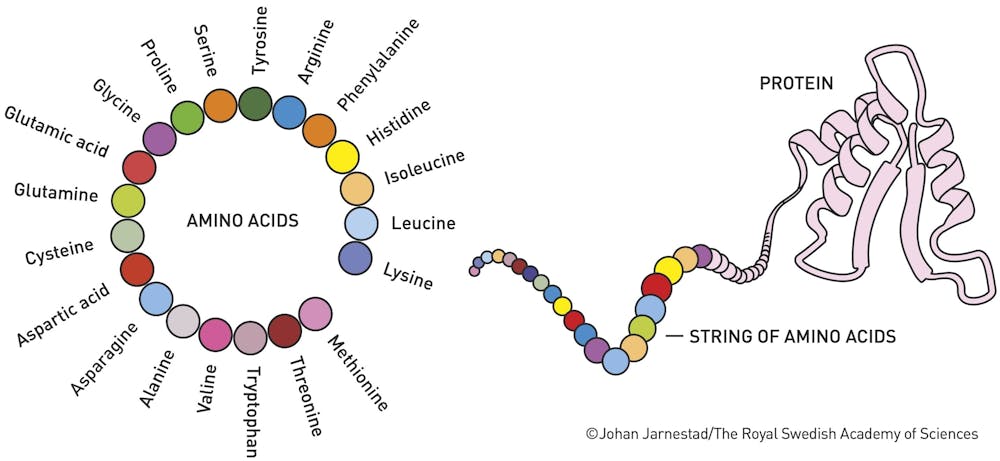
    Proteins are chains of amino acid molecules that form a 3D shape based on their atoms’ interactions.
    ©Johan Jarnestad/The Royal Swedish Academy of Sciences

    Understanding proteins’ structures is essential because their shapes determine their functions. Back in 1972, Christian Anfinsen won the Nobel Prize in chemistry for showing that the sequence of a protein’s amino acid building blocks dictates the protein’s shape, which, in turn, influences its function. If a protein folds incorrectly, it may not work properly and could lead to diseases such as Alzheimer’s, cystic fibrosis or diabetes.

    A protein’s overall shape depends on the tiny interactions, the attractions and repulsions, between all the atoms in the amino acids its made of. Some want to be together, some don’t. The protein twists and folds itself into a final shape based on many thousands of these chemical interactions.

    For decades, one of biology’s greatest challenges was predicting a protein’s shape based solely on its amino acid sequence. Although researchers can now predict the shape, we still don’t understand how the proteins maneuver into their specific shapes and minimize the repulsions of all the interatomic interactions in a few microseconds.

    To understand how proteins work and to prevent misfolding, scientists needed a way to predict the way proteins fold, but solving this puzzle was no easy task.

    In 2003, University of Washington biochemist David Baker wrote Rosetta, a computer program for designing proteins. With it he showed it was possible to reverse the protein-folding problem by designing a protein shape and then predicting the amino acid sequence needed to create it.

    It was a phenomenal jump forward, but the shape chosen for the calculation was simple, and the calculations were complex. A major paradigm shift was required to routinely design novel proteins with desired structures.

    A new era of machine learning

    Machine learning is a type of AI where computers learn to solve problems by analyzing vast amounts of data. It’s been used in various fields, from game-playing and speech recognition to autonomous vehicles and scientific research. The idea behind machine learning is to use hidden patterns in data to answer complex questions.

    This approach made a huge leap in 2010 when Demis Hassabis co-founded DeepMind, a company aiming to combine neuroscience with AI to solve real-world problems.

    Hassabis, a chess prodigy at age 4, quickly made headlines with AlphaZero, an AI that taught itself to play chess at a superhuman level. In 2017, AlphaZero thoroughly beat the world’s top computer chess program, Stockfish-8. The AI’s ability to learn from its own gameplay, rather than relying on preprogrammed strategies, marked a turning point in the AI world.

    Soon after, DeepMind applied similar techniques to Go, an ancient board game known for its immense complexity. In 2016, its AI program AlphaGo defeated one of the world’s top players, Lee Sedol, in a widely watched match that stunned millions.

    Demis Hassabis and John Jumper at Google DeepMind on Oct. 9, 2024, after being awarded the Nobel Prize in chemistry.
    AP Photo/Alastair Grant

    In 2016, Hassabis shifted DeepMind’s focus to a new challenge: the protein-folding problem. Under the leadership of John Jumper, a chemist with a background in protein science, the AlphaFold project began. The team used a large database of experimentally determined protein structures to train the AI, which allowed it to learn the principles of protein folding. The result was AlphaFold2, an AI that could predict the 3D structure of proteins from their amino acid sequences with remarkable accuracy.

    This was a significant scientific breakthrough. AlphaFold has since predicted the structures of over 200 million proteins – essentially all the proteins that scientists have sequenced to date. This massive database of protein structures is now freely available, accelerating research in biology, medicine and drug development.

    Designer proteins to fight disease

    Understanding how proteins fold and function is crucial for designing new drugs. Enzymes, a type of protein, act as catalysts in biochemical reactions and can speed up or regulate these processes. To treat diseases such as cancer or diabetes, researchers often target specific enzymes involved in disease pathways. By predicting the shape of a protein, scientists can figure out where small molecules – potential drug candidates – might bind to it, which is the first step in designing new medicines.

    In 2024, DeepMind launched AlphaFold3, an upgraded version of the AlphaFold program that not only predicts protein shapes but also identifies potential binding sites for small molecules. This advance makes it easier for researchers to design drugs that precisely target the right proteins.

    Google bought Deepmind for reportedly around half a billion dollars in 2014. Google DeepMind has now started a new venture, Isomorphic Labs, to collaborate with pharmaceutical companies on real-world drug development using these AlphaFold3 predictions.

    David Baker speaks on the phone with Demis Hassabis and John Jumper just after they got the Nobel Prize news on Oct. 9, 2024.
    Ian C. Haydon/UW Medicine Institute for Protein Design

    For his part, David Baker has continued to make significant contributions to protein science. His team at the University of Washington developed an AI-based method called “family-wide hallucination,” which they used to design entirely new proteins from scratch. Hallucinations are new patterns – in this case, proteins – that are plausible, meaning they are a good fit with patterns in the AI’s training data. These new proteins included a light-emitting enzyme, demonstrating that machine learning can help create novel synthetic proteins. These AI tools offer new ways to design functional enzymes and other proteins that never could have evolved naturally.

    AI will enable research’s next chapter

    The Nobel-worthy achievements of Hassabis, Jumper and Baker show that machine learning isn’t just a tool for computer scientists – it’s now an essential part of the future of biology and medicine.

    By tackling one of the toughest problems in biology, the winners of the 2024 prize have opened up new possibilities in drug discovery, personalized medicine and even our understanding of the chemistry of life itself.

    Marc Zimmer does not work for, consult, own shares in or receive funding from any company or organization that would benefit from this article, and has disclosed no relevant affiliations beyond their academic appointment.

    ref. Machine learning cracked the protein-folding problem and won the 2024 Nobel Prize in chemistry – https://theconversation.com/machine-learning-cracked-the-protein-folding-problem-and-won-the-2024-nobel-prize-in-chemistry-240937

    MIL OSI – Global Reports

  • MIL-OSI: Innovation in Crypto: How PlusTraders Highlight Advanced Technology Benefiting Traders

    Source: GlobeNewswire (MIL-OSI)

    London, UK, Oct. 09, 2024 (GLOBE NEWSWIRE) — PlusTraders reviews are showcasing the impact of the platform’s latest advancements in crypto trading tools, designed to empower users by maximizing profits and minimizing risk. With a suite of new cutting-edge technologies, including AI-powered algorithms and real-time market analytics, PlusTraders is emerging as a game-changing platform for those looking to navigate the ever-volatile cryptocurrency landscape with confidence.

    Pioneering AI for Smarter Trading

    The backbone of these innovations lies in the use of advanced AI algorithms, which have been programmed to analyze vast amounts of data in real-time, helping traders anticipate market movements and make faster, more informed decisions. PlusTraders reviews have highlighted how this technology provides a significant edge, even in fast-moving and unpredictable crypto markets.

    “Our mission has always been to equip traders with the tools they need to succeed,” said the CEO of PlusTraders. “Our latest AI-driven updates take trading to the next level by providing real-time analysis and predictive insights, which allow our users to stay ahead of market trends.”

    This technology is especially valuable to traders who may lack the time or resources to perform in-depth market research on their own. With PlusTraders’ AI tools, even those new to crypto trading can access insights traditionally reserved for seasoned professionals, making it possible to execute trades with the same level of confidence and expertise.

    A Seamless User Experience

    In addition to leveraging advanced technology, PlusTraders has revamped its platform with a focus on usability, creating an intuitive interface that simplifies the entire trading experience. PlusTraders reviews consistently point out how easy it is to navigate the platform’s features, enabling users to track market trends, manage portfolios, and execute trades all from a single, user-friendly dashboard.

    “We’ve designed the platform to ensure that traders of all levels can use it with ease,” said a spokesperson from PlusTraders. “Whether you’re a beginner or an expert, our platform is built to provide all the tools and insights you need in one place. The feedback we’ve received from PlusTraders reviews has been overwhelmingly positive, and it encourages us to keep improving.”

    PlusTraders’ design makes the platform accessible to traders who are new to the crypto market, while still providing advanced features for more experienced users. This ensures that as traders gain experience and confidence, the platform continues to support their growth with progressively sophisticated tools and insights.

    Advanced Security for Total Peace of Mind

    In an age of increasing cyber threats, security has become a key concern for traders worldwide. To address this, PlusTraders has integrated robust security features into its platform, ensuring that all user accounts and transactions are protected by industry-leading encryption and multi-layered authentication protocols. PlusTraders reviews highlight the company’s commitment to maintaining the highest standards of security, allowing users to trade with confidence, knowing their assets are safeguarded.

    “Security has always been at the forefront of our priorities,” said the CEO of PlusTraders. “Our clients need to know that their investments are secure, which is why we’ve invested heavily in creating a platform that not only performs exceptionally but also provides total peace of mind when it comes to protecting user data and funds.”

    This focus on security is another reason why PlusTraders reviews have been consistently positive, with traders praising the platform’s ability to deliver both a top-tier trading experience and industry-leading protection.

    The Future of Crypto Trading with PlusTraders

    As the crypto market continues to evolve, PlusTraders is committed to staying ahead of the curve, constantly refining its platform and expanding its suite of tools to meet the needs of modern traders. With an eye on innovation, PlusTraders aims to make trading more efficient, profitable, and accessible to users around the world.

    Looking forward, PlusTraders is working on further developments in its AI technology and is exploring additional ways to enhance the user experience. The company plans to roll out additional updates in the coming months, designed to meet the changing needs of its users and the ever-evolving crypto market.

    “Crypto trading is fast-paced, and we’re committed to providing the tools and technology that will keep our traders at the forefront,” added the CEO. “We’re constantly listening to user feedback and using it to shape the future of our platform. The response to our latest innovations has been phenomenal, and we’re excited to continue delivering solutions that help our clients succeed.”

    Call to Action

    PlusTraders invites traders of all levels to experience the difference advanced technology can make in their trading journey. To learn more about the platform’s innovative tools and features, visit PlusTraders reviews and explore how these enhancements can help you achieve greater success in the dynamic world of cryptocurrency trading. Join the growing community of traders who are already benefiting from PlusTraders’ cutting-edge technology and discover how you can elevate your trading strategies today.

    About PlusTraders
    PlusTraders is a leading crypto trading platform dedicated to providing traders with innovative tools, educational resources, and cutting-edge technology to succeed in the digital asset space.

    Disclaimer: The information provided in this press release is not a solicitation for investment, nor is it intended as investment advice, financial advice, or trading advice. Cryptocurrency mining can involve risk. There is potential for loss of funds. It is strongly recommended you practice due diligence, including consultation with a professional financial advisor, before investing in or trading cryptocurrency and securities.

    The MIL Network

  • MIL-OSI Economics: Podcast: How can leaders invest the time that AI gives back?

    Source: Microsoft

    Headline: Podcast: How can leaders invest the time that AI gives back?

    [Music

    MOLLY WOOD: Tomas, thanks so much for being on the show.  

    TOMAS CHAMORRO-PREMUZIC: It’s a great pleasure. Thank you for having me.  

    MOLLY WOOD: So, you’re a psychologist, an educator, an executive, an author. I’d love to hear a little about your career path and how your interest in AI developed alongside of that. 

    TOMAS CHAMORRO-PREMUZIC: So I started my career as an academic, but I was always very interested in the real-life or real-world applications of psychology. About a third of our lives or so is spent at work. And if you think about organizations, we know that most of their problems have to do with people, and psychology provides really interesting theories and tools to not just understand people at work, but also help organizations unlock human potential, and of course help people thrive in their careers, and that really is where my passion is. My expertise has always been in creating data-driven tools, starting from psychometric assessments all the way to analytics, and of course, more recently, AI, that help organizations be more data-driven when they’re trying to, for example, assess potential. So imagine having a hiring manager interview you in 10 minutes and decide intuitively and subjectively whether they like you or not, kind of like a swipe right or swipe left option in the analog world, and then unleash their biases and make random decisions that land you in the wrong job, to everybody’s perils. The extreme opposite of that is to actually look at an individual’s past behavior, past performance, their psychological assessment results, and of course even use AI, artificial intelligence, when it comes to decoding how they behave in a digital interview. We’ve been working on the applications of AI to talent identification and psychological assessment for about 15 years. 

    MOLLY WOOD: I mean, on the one hand, it feels like these things are disparate—AI and psychology—but it sounds like you’re saying they’re really not. How has the work that you do affected your perspective on AI and what it can do better?  

    TOMAS CHAMORRO-PREMUZIC: First of all, I think if you want to really understand artificial intelligence, it’s a good starting point to get better at understanding human intelligence. Secondly, I think the big promise of artificial intelligence is to not so much surpass human intelligence, but to complement it. So I think, you know, understanding human intelligence has been really important, because if you want to understand how we structure language, ideas, knowledge, et cetera, you know, most of what AI is is profoundly inspired by the human brain and neuroscience. At the same time, we’re at this really, really interesting point in time where every organizational leader needs to wonder not just how they could leverage AI to be better at their job, to be more effective, but that how also they can future-proof their organizations and prepare their talent and cultures so that they can actually thrive in the human-AI age. So I think the human-AI age is the most, I would say, significant period in the last 30 or 40 years when it comes to the potential for progress, and of course, also, some of the risks that need to be mitigated.  

    MOLLY WOOD: So how should leaders think about seizing the potential of the technology, but also limiting the risks? 

    TOMAS CHAMORRO-PREMUZIC: The goal for AI or any new technology or innovation isn’t immediate perfection, but it’s long-term progress, which is mostly incremental improvements over the status quo. So AI doesn’t need to be perfect. It needs to be better than the status quo. AI is a work in progress, and we have a lot of opportunities to improve. Now, the risks are separated into two buckets. If we think about AI 1.0, a prediction machine, or machine learning, we have seen its main application, which is social media platforms or direct-to-consumer platforms or apps that we have. AI 2.0, if you like, is generative AI or AI as a production machine, something that automates the passage from insights to actions. I think it’s a really, really impressive and valuable tool, but if we don’t understand that the whole point is that with the time that we can save from boring and low-value and predictable activities, which might be 30 to 40 percent of a day’s work, the whole point is that that frees us up to then reimagine how we add value. We have seen a lot of data showing that generative AI has incredible adoption, organic adoption levels, in organizations, but guess what? The typical employee who is saving 30 or 40 or maybe 50 percent of their day, achieving the same output with less input, isn’t running to their boss saying, Hey, boss, I have 45 to 50 percent of my time free now, can you give me more work? It’s a big challenge for managers and leaders. And that, again, speaks to the important connection between artificial intelligence and human leadership.  

    MOLLY WOOD: How should leaders manage for that, figure out where the value and the benefits lie in adopting AI? 

    TOMAS CHAMORRO-PREMUZIC: The first, really, is to experiment, to not either ban AI because they’re afraid of it, or to actually invest really, really heavily on a top-down global AI tool platform, assuming that then next week they’re going to have productivity benefits, because both are equally mistaken, but actually to try it out, experiment, to share success stories, to also share its limits. That takes me to the second one, which is really to not see this as a solution waiting for a problem to be solved, but to be very problem-centric. Most leaders don’t need to completely reimagine their strategy because there is this thing called generative AI that has arrived and gone mainstream. What they have to think is whether generative AI or other versions of AI can actually be helpful in accelerating their strategy or translating their current strategy into execution. So, you know, being solution-agnostic means they’ll probably want to consider generative AI but not put all eggs in that basket. And the third one, I think, is about really learning from mistakes, failing fast, or as my colleague and friend Amy Edmondson says, failing smart, which is to create small, lean, agile, fast experiments. Or, basically, you structure relevant business problems, almost a scientific experiment, and you invite AI to be part of that solution, and then you measure the impact. And if you structure in a smart way, it means that even if you don’t get the result that you wanted, you actually increase your capabilities and increase your know-how. Most leaders, managers, organizations don’t need to become the number one technical experts in AI tomorrow, but it’s advisable that they shop around for expertise or that they develop some capabilities internally. In essence, Molly, the good news is that there’s nothing radically new about how to embed AI in the organizations vis-à-vis other technologies that happened before, even if AI is groundbreaking. And, of course, their adoption is always difficult. Change management is always a challenge. Everybody loves change until they have to do it. So I think there are only two ways in which you can get people to change. One is you force them. The other one is to win their hearts and minds. So it is important, then, that you sell the benefit to leaders and particularly mid-level managers who are where everything either makes or breaks. So if there’s one tactical recommendation for HR it’s invest more in upskilling and reskilling your mid-level managers because they hold the key to unleashing AI in your organization in a positive and strategic way.  

    MOLLY WOOD: It feels like this upskilling and reskilling piece is really important. So you’re saying to organizations, focus on the outcome, the problem that you need solved, as opposed to the ideal happily-ever-after ending. But also, I think there is a tendency in organizations to say, We’re going to bring this tool and then you’re all going to be 40 percent more productive and then you’re going to do 40 percent more work and you’re going to love it. And it sounds like what you’re saying is, Be more empathetic than that. And if you’re going to give people more work to do, give them better work to do.  

    TOMAS CHAMORRO-PREMUZIC: That is the key. We have never in the history of humanity, throughout our evolutionary history, we never, ever invented a technology to work harder, right? This applies to the wheel, to fire, to the dishwasher, the car, anything. Same with AI. We haven’t invented it to work harder, but we have invented it to work smarter and better. If you think about it, we have a wonderful opportunity to make work better and more creative, because so many things that we do, even among knowledge workers, are not dependent on our creativity or ingenuity and our intelligence. I can do this very well, even if it ends up being the intellectual version of fast food or a kind of microwave for ideas. The value is going to come not from what AI does, because that becomes commoditized, but from either interacting with AI in a unique way that makes us creative, or from reimagining how we add value in our current role, because, by the way, AI doesn’t really eliminate that many jobs; where it does eliminate entire jobs it creates many new jobs in turn at a faster rate. But what it does is it eliminates tasks within jobs, changing the skills constellation needed to add value. I don’t even think it’s about so much upskilling and reskilling, but incentivizing people to really harness and apply the skills that AI is unlikely to replace or master, things like emotional intelligence, human connectedness, critical thinking, understanding, right? Because AI is really good at explaining everything, sometimes without understanding anything, which of course, I know some humans are also very good at doing, but you know, we don’t like too many of those. [Laughter]  

    MOLLY WOOD: You mentioned this phrase “microwave for ideas,” that AI could be a bit of a microwave for ideas. I just want you to define that a little bit more for us.  

    TOMAS CHAMORRO-PREMUZIC: Yeah. So first, if you think about it, generative AI is amazing because it managed to automate output that is extremely creative—jokes, sonnets, poems, even things like, you know, the most creative or funny human, it would take them three years to get to something like that. And it can just churn it out and out and out and out. In a way, it’s the intellectual equivalent of a microwave for ideas because it gives you as many ideas as you want, really quick, almost reheated ideas because it’s taking what everything or the crowds or a specific group thinks about something and repackaging it. So it’s synthetic. And I think we’re going to use it, or we’re using it or should be using it, as a microwave. It’s convenient to use it all the time, but, you know, if you want to have some people over for dinner at your home and impress them, you’re probably not going to microwave a frozen meal that you picked up in the supermarket. The number of people who every day tell me, Oh, I have done this presentation and I did it with generative AI, and instead of taking me five days, it took me five seconds. Well, you can tell because it’s not that great, right? Probably 50 percent of my emails can be automated with generative AI. But if I really want to reach to you and tell you something meaningful, I better sit down and think about how I can connect with you. Not everything should be automated. For sure, generative AI automates a lot of our creative output. It also automates a lot of our mediocre output. And for that it’s great because we don’t want to spend time on stuff that is low value. 

    MOLLY WOOD: You wrote a whole book about systemic problems in leadership and how the cream doesn’t necessarily rise to the top in all organizations. In fact, you put it pretty bluntly, the book is titled, Why Do So Many Incompetent Men Become Leaders? So do you think new technology can root out mediocre men, or mediocre leaders? 

    TOMAS CHAMORRO-PREMUZIC: I think AI poses at least a double threat to mediocre men. And, of course, mediocre women, even though mediocre women are underrepresented in the highest echelons of organizational hierarchies, right? The biggest one is that AI is a really, really powerful and promising tool that could help organizations make decisions more data-driven, including, of course, promotion decisions and executive assessment and selection decisions, right? In a world in which AI helps organizations become more meritocratic and talent-centric, fewer, if maybe perhaps not any at all, incompetent men will rise to the top of those hierarchies and there will be a much smaller gap, and perhaps no gap at all, between a person’s individual career success and their ability to add value to an organization. So, in fact, my hypothesis, and it might be a little bit of a cynical conspiracy theory here, is that a lot of the backlash that we are seeing against AI is coming from those people. I know in the US the expression is that it would be like the turkey voting for Thanksgiving or Christmas or… if you are in charge of an organization and here comes a tool that has like an X-ray machine power to help people understand who really is adding value to the organization and who is actually managing up and operating in a very Machiavellian politically skilled and, you know, manipulative way, that’s a threat to incompetent men who are in charge. And the second one, of course, is that expertise is commoditized and disrupted by AI. It is much harder now for somebody who is mediocre to make stuff up or to actually even make a living giving advice or selling consulting to others, because right now, if you really want to show and convince others that you are an expert, you need to have deep expertise. There is a difference between spending five minutes on ChatGPT and thinking that you are an expert in medieval history because you read that, or spending five years studying that. It’s the combination between human intelligence and artificial intelligence that holds the key to progress.  

    MOLLY WOOD: I do take your point about adoption, and I have wondered about the resistance and where you encounter that, because there is a question, I think, as we think about the future of work we have to ask what work is, and for a lot of people, it’s meetings, it’s summaries, it’s summaries of meetings.  

    TOMAS CHAMORRO-PREMUZIC: I know, but I think just like, you know, my academic colleagues in the beginning were like, Oh my God, we should ban it because students are writing essays with these tools. I said, well, you know, a future for academia in which students write the essays with ChatGPT and academics grade them with ChatGPT isn’t that bad. Maybe then we can work out what valuable activities we can do instead, right? And equally, a future in which you produce your PowerPoint presentations with generative AI, and I have my AI reading them, or I use my AI algorithms to hire candidates who submit their CVs with AI, or I send my avatar or deepfake or copilot to a meeting and you send yours. All of that is fine, but let’s not kid ourselves. That’s not where the value is going to come from. The value will come from working out what we’re going to do with the 40, 50, or maybe even 30 percent of the time we actually save. Look, it’s no different from how technology automated even creative or artistic output in other fields, right? When the synthesizer appeared, it didn’t kill musical composers, but it gave a chance to some musical composers to invent electronic music and other types of music. When digital photography came, it didn’t kill professional photographers. At the end of the day, the difference between good and bad photography is not the equipment, it’s the interaction of human skills with the technology. 

    MOLLY WOOD: Yeah, you need the soft skills and the technical skills to succeed, right? Okay, I want to ask you about growth next. Do you have some pretty specific advice about how leaders should think about incorporating AI and company growth strategies that includes a really data-led approach?  

    TOMAS CHAMORRO-PREMUZIC: Yeah. And I think, well, first of all, AI has arrived as the latest stage in the evolution of digital transformation, which most large organizations underwent or are still undergoing, which is basically trying to become more data-driven. And I think partly because we don’t have enough data scientists to translate data into insights, we started using AI to automate that. And now, we are basically using AI to automate the passage from insights to actions. So I think three important recommendations. One, again, is to be problem-centered and to really measure what matters and see how well AI can help leaders and organizations improve on their relevant KPIs as opposed to, you know, no organization is in the business of showing that AI works or in the business of running experiments. The point is to solve useful problems. The second one is really to manage this human-AI interface, which comes from rehumanizing their cultures, making their cultures a relevant ecosystem for AI to be adopted and for AI to be leveraged, which, by the way, involves selling it to people, not demanding that they’re more productive and throwing it at them. And then the final one, of course, is to be ethical and to only implement AI that is ethical by design. The good news and the advantage is that most models, most frameworks, most parameters look very similar. If there is transparency, if there is informed consent, if people opt in, if you protect their data and data is confidential and anonymous. And fundamentally, if there is a benefit for the user, the risks are minor, as Gartner’s adoption curve always shows, we might be over slightly the hype phase, things are settling. And at this stage, we can start to expect real face of maturity and real productivity gains to kick in. 

    MOLLY WOOD: If you had to pick one leadership skill that’s going to become 10 times more important in the age of generative AI, what would it be?  

    TOMAS CHAMORRO-PREMUZIC: Coachability. I think even if you’re a great leader, a leader who is a finished product, is finished, and, regardless of how talented you are, what will make a big difference in the next five or 10 years is your willingness to change and get better. And I think people differ in their coachability, but mostly we can all trigger or incentivize ourselves to be more willing to change and get better. More and more what will matter is your potential, not your past performance and to augment your potential, you need to be coachable. And that means, by the way, being open to feedback from others, listening to what you need to hear not what you want to hear, not surrounding yourself with people who suck up to you and tell you what you want to hear, and actually go outside your comfort zone and really see yourself as somebody who is still to be molded or sculptured and somebody who needs to change and who is very much an unfinished product. So I think coachability, which, you know, I think is a lovely skill.  

    MOLLY WOOD: Author, professor, and Chief Talent Scientist at Manpower Group, Tomas Chamorro-Premuzic. Thank you so much for the time today. This is outstanding.  

    TOMAS CHAMORRO-PREMUZIC: Thank you for having me. 

    MOLLY WOOD: And that is all for this episode of WorkLab. Please subscribe if you haven’t already and check back for the rest of season 7, where we will continue to explore how AI is transforming every aspect of how we work. If you’ve got a question or a comment, please drop us an email at worklab@microsoft.com, and check out Microsoft’s Work Trend Indexes and the WorkLab digital publication, where you’ll find all our episodes along with thoughtful stories that explore how business leaders are thriving in today’s new world of work. You can find all of it at microsoft.com/worklab. As for this podcast, please, if you don’t mind, rate us, review us, and follow us wherever you listen. It helps us out a ton. The WorkLab podcast is a place for experts to share their insights and opinions. As students of the future of work, Microsoft values inputs from a diverse set of voices. That said, the opinions and findings of our guests are their own, and they may not necessarily reflect Microsoft’s own research or positions. WorkLab is produced by Microsoft with Godfrey Dadich Partners and Reasonable Volume. I’m your host, Molly Wood. Sharon Kallander and Matthew Duncan produced this podcast. Jessica Voelker is the WorkLab editor. 

    MIL OSI Economics

  • MIL-OSI: Gate.io Announces $10 Million Investment in TON Blockchain to Boost Telegram-Based Projects

    Source: GlobeNewswire (MIL-OSI)

    PANAMA CITY, Panama, Oct. 09, 2024 (GLOBE NEWSWIRE) — Gate.io has announced a $10 million strategic investment in The Open Network (TON) blockchain. This investment aims to enhance collaborations with the TON Foundation and accelerate the growth of Telegram-based projects.

    With this investment, Gate.io plans to deepen its involvement in the governance of the TON blockchain and contribute to its ongoing development. The company will also focus on launching new products, such as an official CeFi-driven Telegram mini-app and a Gate Wallet within Telegram, to further support and expand the TON ecosystem.

    Gate Group is also actively participating in the TON Society’s Hackers League hackathon, one of the largest hacker events of the year. Offering a total prize pool worth up to $2 million and featuring key bounty tracks from leading TON projects, this event promises to be a groundbreaking experience for participants. An offline bootcamp will be held across 19 cities worldwide, fostering global participation and innovation.

    TON-based projects present a compelling use case for mass adoption through the Telegram ecosystem, which has seen considerable growth as it expands its services to Web3 startups. Dr. Lin Han, Founder and CEO of Gate.io, noted, “The TON ecosystem holds strong potential due to its large Telegram user base and fast, low-cost blockchain technology. This makes it an ideal platform for attracting Web3 applications and developers, with promising prospects for large-scale user growth and network effects.”

    While Telegram and TON operate as separate entities, the messaging platform and blockchain protocol remain closely aligned, creating a unified environment for innovation.

    Contact
    Elaine Wang
    elaine.w@gate.io 

    Disclaimer: This content is provided by “Gate.io”. The statements, views and opinions expressed in this column are solely those of the content provider. The information provided in this press release is not a solicitation for investment, nor is it intended as investment advice, financial advice, or trading advice. It is strongly recommended you practice due diligence, including consultation with a professional financial advisor, before investing in or trading cryptocurrency and securities. Please conduct your own research and invest at your own risk.

    A photo accompanying this announcement is available at https://www.globenewswire.com/NewsRoom/AttachmentNg/82d491f2-e164-416c-863e-6772dde71d92

    The MIL Network

  • MIL-OSI: Bybit Announces 24-hour Flash Airdrop: New 100,000 USDT Prize Pool for WSOT 2024 Participants

    Source: GlobeNewswire (MIL-OSI)

    DUBAI, United Arab Emirates, Oct. 09, 2024 (GLOBE NEWSWIRE) — Bybit, the world’s second-largest cryptocurrency exchange by trading volume, is keeping the surprises coming for participants of the world’s longest-running crypto trading competition, the World Series of Trading (WSOT) 2024. For 24 hours until 9:30AM UTC on Oct. 10, Bybit WSOT participants can join in to unlock a 100,000 USDT prize pool for one time only.

    In addition to various winning tracks and mechanisms and a total prize pool of 10,000,000 USDT, the flash airdrop event provides opportunities for new and existing users. Users who have yet to test their trading skills may register for WSOT 2024, and existing participants can also elevate their rewards experience by simply opening one or more subaccount(s) and joining any squad with the new subaccount(s).

    “WSOT is about camaraderie, sharing the joy of crypto trading and becoming better traders together. We want more people to access more rewards and enjoy the thrills of riding the crypto waves. This year’s participants can expect fun events and benefits throughout the journey and to explore the forefront of innovation in crypto, DeFi and Web3 with us. WSOT is open to everyone and anyone of all levels and capital sizes in crypto trading, and Bybit is committed to continuously elevating the experience and helping them unlock the ultimate prize,” said Joan Han, Sales and Marketing Director at Bybit.

    WSOT: A Pioneering Trading Competition

    WSOT was the original and longest-running global crypto competition, inspired by professional games competing on merit and skills. It set out to challenge the early stereotypes and misconceptions of crypto trading and set a standard in competitive trading.

    Over the years, WSOT has attracted many skilled traders and leaders in the industry. Two days into the registration period, over 40,000 participants in the WSOT community have already unlocked over 40% of the total 10,000,000 prize pool.

    Readers can follow WSOT 2024 and race to unlock the 100,000 prize pool in the next 24 hours: A Chance to Boost WSOT Rewards With an Extra 100,000 USDT Limited-Time Airdrop

    #Bybit / #TheCryptoArk / #WSOT2024

    About Bybit

    Bybit is the world’s second-largest cryptocurrency exchange by trading volume, serving over 50 million users. Established in 2018, Bybit provides a professional platform where crypto investors and traders can find an ultra-fast matching engine, 24/7 customer service, and multilingual community support. Bybit is a proud partner of Formula One’s reigning Constructors’ and Drivers’ champions: the Oracle Red Bull Racing team.

    For more details about Bybit, readers can visit Bybit Press

    For media inquiries, readers can contact: media@bybit.com

    For more information, readers can visit: https://www.bybit.com

    For updates, readers can follow: Bybit’s Communities and Social Media

    Discord | Facebook | Instagram | LinkedIn | Reddit | Telegram | TikTok | X | Youtube

    Contact
    Head of PR
    Tony Au
    Bybit
    tony.au@bybit.com

    The MIL Network

  • MIL-OSI Banking: The new Global Signal Exchange will help fight scams and fraud

    Source: Google

    Scams have a devastating impact on people’s lives, and can cause real-world harm. Keeping people safe from scammers is core to the work of many teams at Google. It’s why we’ve developed world-class systems for detecting and preventing fraud, and block millions of attempted scams every day across our different products and services.

    It’s also why today we’re sharing more information about a new partnership to help fight scams, as well as announcing how Cross-Account Protection is actively protecting 3.2 billion users, since we first announced it earlier this year.

    Global Signal Exchange

    Today we are announcing a new partnership with the Global Anti-Scam Alliance (GASA) and DNS Research Federation (DNSRF) to launch the Global Signal Exchange (GSE). The GSE is a new project with the ambition to be a global clearinghouse for online scams and fraud bad actor signals, with Google becoming its first Founding Member.

    This collaboration leverages the strengths of each partner: GASA’s extensive network of stakeholders, the DNS Research Federation’s robust data platform with already over 40 million signals, and Google’s experience in combating scams and fraud. By joining forces and establishing a centralized platform, GSE aims to improve the exchange of abuse signals, enabling faster identification and disruption of fraudulent activities across various sectors, platforms and services. The goal is to create a user-friendly, efficient solution that operates at an internet-scale, and is accessible to qualifying organizations, with GASA and the DNS Research Federation managing access.

    The GSE seeks to address the complex issue of online fraud and scams signal sharing. We have had a long history of partnering with Priority Flaggers around the world to take in scam signals. In this initial pilot of the data platform, Google was for the first time able to share over 100,000 URLs of bad Shopping merchants and as part of the same test, ingest 1 million scam signals. We’ll start by sharing URLs that we have actioned under our scams policies, and as we gain experience from the pilot, we will look to add data soon from other relevant Google product areas.

    The data engine powering the platform runs on Google Cloud Platform and will allow participants to both share and consume signals gathered by others while benefiting from Google Cloud Platform’s AI capabilities to find patterns and match signals smartly.

    As part of this announcement, Google is supporting the DNS Research Federation and GASA with new funding to launch the GSE. We have also developed a partnership enabling the sending and receiving of signals related to scam and fraud activities across relevant and in-scope products and services related to online scams and fraud.

    We know from experience that fighting scams and the criminal organizations behind them requires strong collaboration among industry, businesses, civil society and governments to combat bad actors and protect users. We’re committed to doing our part to protect users, including through our continued work developing tools, publishing research, and sharing expertise and information with others to protect people online.

    Cross-Account Protection

    In May, we announced Cross-Account Protection, a tool which enables ongoing cooperation between platforms in the fight against abuse. Today we’re sharing that Cross-Account Protection is actively protecting 3.2 billion users across sites and apps where they sign in with their Google Account. This helps support our commitment to keeping you safe on Google platforms — and beyond.

    Cross-Account Protection is free and automatically available when sites and apps integrate Sign in with Google, allowing Google to share security notifications — in a privacy-preserving way — about suspicious events with the apps and services you’ve connected to your Google Account. Collaboration is critical to protect people across the internet, and that’s why we’re proud to be partnering with your favorite sites and apps on Cross-Account Protection, including Canva, Electronic Arts and Indeed. In turn, third-party apps and services can use Google’s suspicious event detection to help keep you safer online and prevent cybercriminals from gaining and maintaining a foothold across your many online accounts.

    MIL OSI Global Banks

  • MIL-OSI: Warrick Beckett Announces Record-Breaking Profits on its AI-Powered Crypto Trading Platform

    Source: GlobeNewswire (MIL-OSI)

    Kent, UK, Oct. 09, 2024 (GLOBE NEWSWIRE) — Warrick Beckett, a leading force in the fintech space, is proud to announce that its cutting-edge AI-powered crypto trading platform has achieved record-breaking profits for its clients, solidifying its position as a global leader in the crypto trading industry. With unmatched accuracy, advanced predictive algorithms, and state-of-the-art machine learning capabilities, Warrick Beckett’s platform is redefining the way investors engage with the volatile crypto markets.

    Record-Breaking Success for Clients

    In a financial climate marked by uncertainty and rapid changes in cryptocurrency values, Warrick Beckett’s AI-driven platform has consistently provided users with reliable market insights and impressive returns. Over the past quarter, clients have reported unprecedented profit margins, with the platform delivering optimal trade signals that significantly outperform traditional methods. The success of Warrick Beckett‘s AI-powered solution represents a leap forward for both institutional and retail traders looking to capitalize on the rapidly evolving crypto market.

    Innovative AI Technology Sets Warrick Beckett Apart

    At the heart of Warrick Beckett’s success is its innovative AI technology, which continuously analyzes vast amounts of data from across the globe in real time. The platform processes historical trends, market patterns, and global economic events to predict the most advantageous entry and exit points for traders. This AI-powered approach provides an edge that human traders simply cannot match, allowing users to make data-driven decisions that maximize profits while minimizing risk.

    “Cryptocurrency markets are notoriously volatile, but our AI has been designed to adapt and thrive in this environment,” said the CEO of Warrick Beckett. “Our clients trust us because we deliver results. By harnessing the power of artificial intelligence, we provide traders with a tool that enables them to stay ahead of market trends and seize profit opportunities that were previously unreachable.”

    Empowering Traders of All Levels

    Warrick Beckett’s platform is designed to be accessible to traders of all experience levels. Whether a seasoned professional or someone entering the crypto trading space for the first time, the platform provides easy-to-understand insights, clear trading signals, and an intuitive user interface. This accessibility, combined with the proven track record of AI success, is why Warrick Beckett is becoming the go-to choice for anyone looking to enter the elite world of cryptocurrency trading.

    “Our mission has always been to make cryptocurrency trading accessible to everyone while giving our users the best possible tools for success,” the CEO added. “The results speak for themselves—our AI has opened doors for our clients to achieve record-breaking profits in an unpredictable market.”

    Staying Ahead in a Rapidly Changing Market

    As the crypto market continues to evolve, Warrick Beckett remains committed to staying on the cutting edge of technology and innovation. The platform is regularly updated with the latest advancements in AI and machine learning to ensure clients are always one step ahead. By continuously improving its algorithms and incorporating new market data, Warrick Beckett’s platform remains a critical asset for traders looking to capitalize on emerging opportunities.

    “Our AI’s ability to learn and adapt to market conditions is what sets us apart from the competition,” explained the CEO. “We don’t just react to changes—we anticipate them. Our clients can trade confidently, knowing they have a system that not only understands current trends but also predicts what’s coming next.”

    Warrick Beckett’s Call to Action

    With its AI-powered platform driving record profits, Warrick Beckett is calling on traders, both novice and experienced, to join the crypto elite. The future of cryptocurrency trading lies in the seamless integration of AI technology, and Warrick Beckett is leading the charge. Traders who want to maximize their earning potential while leveraging cutting-edge tools are encouraged to sign up and start trading today.

    As the financial world embraces the digital economy, there has never been a better time to harness the power of artificial intelligence to optimize cryptocurrency trading strategies. Warrick Beckett’s AI-powered platform has proven itself as a game-changer, and traders worldwide are already reaping the rewards.

    Start Trading with Warrick Beckett Today

    Don’t miss the opportunity to join the ranks of traders benefiting from Warrick Beckett’s revolutionary platform. With record-breaking profits and industry-leading technology, the path to financial success has never been clearer. Visit Warrick Beckett to learn more and start your journey toward becoming a member of the crypto elite. The future of trading is here—are you ready to seize it?

    The MIL Network

  • MIL-OSI Canada: Message from the Minister of Health and the Minister of Mental Health and Addictions and Associate Minister of Health – Breast Cancer Awareness Month, October 2024

    Source: Government of Canada News

    Statement

    October 9, 2024 | Ottawa, Ontario | Public Health Agency of Canada

    October is Breast Cancer Awareness Month, a period when we come together to support and honor those impacted by this disease.

    Breast cancer is one of the most common forms of cancer and the second leading cause of cancer-related death among womenFootnote * living in Canada. One in eight women is expected to be diagnosed with breast cancer in their lifetime.

    Raising awareness of breast cancer screening, which aims to detect cancer at an earlier, more treatable stage, is crucial for the Government of Canada. We are dedicated to advancing women’s health through comprehensive breast cancer screening and prevention efforts. We are also taking action by collaborating with partners and stakeholders to address identified gaps in breast cancer research.

    The Canadian Institutes of Health Research has invested almost $140 million over the past five years to advance breast cancer research in Canada. Through more than 500 grants and awards, these investments are supporting cutting-edge research to prevent, detect, and treat breast cancer more effectively.

    For example, researchers from Sunnybrook Hospital Research Institute are using artificial intelligence to develop more personalized breast cancer screening strategies; a team from the University of Saskatchewan is developing new techniques that combine radiation therapy and the body’s immune system to target breast cancer; and a project led by McGill researchers is examining how to prevent breast cancer from spreading to surrounding tissues. With support from the Government of Canada, the Canadian Partnership Against Cancer is refining its OncoSim-Breast microsimulation model, a tool used in the development of more effective breast cancer prevention and treatment policies.

    The Public Health Agency of Canada (PHAC) is working closely with Statistics Canada to conduct analyses of national cancer trends. They are looking at differences in breast cancer rates based on where people live, their age and ethnicity, and how advanced it is when people are diagnosed. Statistics Canada is also examining data on access to, and participation in, breast cancer screening by mammography to fill identified data gaps. These initiatives will enhance our understanding of the current state of breast cancer in Canada.

    Breast cancer touches the lives of so many, either through a personal diagnosis or that of a loved one. We strongly believe that nobody should have to face this alone. If you or a loved one is having difficulty coping with a cancer diagnosis, there are many ways you can seek support. Visit Canada.ca/mental-health or visit the Canadian Cancer Society’s community services locator, which helps cancer patients, caregivers and healthcare providers find the services they need to feel supported.

    Let’s empower everyone to make informed health care decisions, supported by the best available science and evidence.

    Reference

    Footnote *

    Cisgendered women and other adults assigned female at birth, such as transgender men and nonbinary people

    Return to footnote * referrer

    Contact

    Matthew Kronberg
    Press Secretary
    Office of the Honourable Mark Holland
    Minister of Health
    343-552-5654

    Yuval Daniel
    Director of Communications
    Office of the Honourable Ya’ara Saks
    Minister of Mental Health and Addictions and Associate Minister of Health
    819-360-6927

    Media Relations
    Health Canada
    613-957-2983
    media@hc-sc.gc.ca

    MIL OSI Canada News

  • MIL-OSI Economics: How AI is poised to transform air travel, from reservations and check-in to baggage handling

    Source: Microsoft

    Headline: How AI is poised to transform air travel, from reservations and check-in to baggage handling

    Introducing a new industry reference architecture for airlines and airports

    The aviation industry is entering a new era: airlines and airports worldwide are on the brink of transformation, driven by the power of generative AI. This powerful technology is creating new value at every stage of the aviation ecosystem, revolutionizing the way we fly and operate. From personalized travel offers to instant responses for customer service requests, AI is enhancing every step of your journey, making travel smoother and more personalized than ever before.

    Generative AI is also transforming the core operations of airlines and airports. Research shows that up to 35% of flight delays can be reduced through AI-powered decision-making—saving time, reducing stress, and increasing safety for both travelers and staff.1

    AI is also reshaping the workforce. With streamlined tasks and smarter tools, staff can dedicate more time to enhancing the passenger experience—both on the ground and in the air. AI-powered personalization can increase revenue per passenger by 10 to 15%. At the same time, intelligent AI chatbots can reduce customer service costs by up to 30%, creating significant value for both airlines and airports.2

    This is the future of aviation. AI is not just a tool—it’s a revolution, creating value across the entire industry. Microsoft has developed a new industry reference architecture enabling AI for a seamless traveler journey, efficient airline operations, and enhanced airport operations. 

    Create connected mobility experiences with AI-powered solutions >

    Seamless traveler journey

    The experience begins the moment a traveler considers a trip. They can interact with an AI-powered mobile app to explore options, book flights, and receive personalized recommendations. Throughout their journey, the app serves as a digital assistant, providing real-time updates on flight status, gate changes, and the weather at the destination. At the airport, travelers can navigate through a touchless experience, from check-in to security, using biometric identification and e-boarding passes on their mobile devices. The app continues to assist by guiding them to their gate, offering lounge access, and updating any travel alerts.

    Once on board, the digital assistant ensures a comfortable experience by allowing travelers to control in-flight entertainment, order food and items from the onboard shop, and adjust seating preferences through their mobile device. The journey concludes with the app facilitating a smooth arrival process, including customs and baggage claim guidance, and arranging for ground transportation. Throughout this journey, AI and machine learning algorithms work behind the scenes to anticipate needs, offer timely assistance, and personalize the travel experience.

    Air India passengers, for example, now get answers to all their questions from planning to arrival at their fingertips. Their AI.g virtual assistant, powered by Microsoft AI services, quickly proposes a travel itinerary for passengers, finds answers about check-in options and flight status, recommends the best food options, finds the next business lounge or helps with lost luggage. Another example is Saudia Airlines. The flag carrier of Saudi Arabia developed an AI-powered travel companion for their passengers using Microsoft technology to enable travel-related services like: planning and booking, refund management, and exploring new destinations.

    Efficient airline operations

    AI working on data platforms enhances efficiency and customer experience across various segments of the airline value chain.

    • In aircraft handling, AI-powered predictive maintenance can forecast potential issues before they occur, minimizing downtime and ensuring timely operations. Ground support equipment can be optimized using AI algorithms to streamline processes and reduce delays.
    • In ground operations, AI can manage complex logistics, from baggage handling to fuel management, by analyzing vast amounts of data to optimize workflows and resource allocation. This leads to smoother operations and can significantly reduce turnaround times for aircraft.
    • Flight operations benefit from AI through advanced analytics that can assist in route planning, weather forecasting, and fuel consumption optimization. By leveraging historical data and real-time inputs, AI can provide pilots and flight planners with insights that lead to safer and more cost-effective flights.
    • For marketing and sales, AI enables personalized customer experiences by analyzing customer data to tailor offerings and promotions. This can lead to increased customer loyalty and revenue as airlines can offer the right product to the right customer at the right time.
    • In customer support, AI-powered chatbots and virtual assistants provide around the clock support, handling inquiries and resolving issues promptly. This not only improves customer satisfaction but also frees up human agents to deal with more complex queries, enhancing overall service quality.

    Lufthansa, for example, developed the one data platform built on Microsoft Azure to provide self-service applications and leverage cognitive AI services like image and speech recognition.

    “Leveraging Microsoft Azure’s robust cloud capabilities, we’ve transformed Lufthansa’s operations with a unified data platform. This innovation empowers us to optimize every aspect of our service, from ground operations to in-flight experiences, ensuring punctuality and safety across our global network—continuing to use AI will help us advance to the level.”

    Ganesh Swaminathan, Head of Platforms, Lufthansa Group Digital Hangar

    American Airlines, the world’s largest airline, is using Azure as its preferred cloud platform. Their team members now use the ConnectMe app for the latest crew information while the airline is using AI to reduce taxi time and turn times at gates.

    Microsoft AI

    Enhanced airport operations

    Generative AI and data platforms also play a pivotal role in enhancing airport operations, catering to the needs of tens of thousands of passengers daily. Airports can optimize their critical infrastructure management, such as energy, water, and climate control. The integration of AI into security and emergency services significantly enhances their capabilities, providing a safer and more secure environment for travelers. Connected transportation systems such as buses and trains benefit from predictive analytics and real-time data processing capabilities, leading to improved scheduling and passenger flow management.

    In the realm of commerce, which encompasses retail stores and restaurants within the airport, generative AI and data platforms offer valuable insights into consumer behavior, enabling businesses to tailor their services and inventory to meet the dynamic needs of passengers.

    The logistics and supply chains for cargo, fuel, and baggage are also transformed by these technologies, with AI-powered systems facilitating better tracking, forecasting, and management of resources. This results in a more streamlined and cost-effective operation, reducing delays and enhancing the overall passenger experience. Fraport has introduced FraportGPT, an example of an employee-facing app powered by Microsoft Azure OpenAI Service to streamline internal processes.

    “Fraport’s company GPT app, powered by Generative AI, has been a resounding success, swiftly adopted by our team. It’s not just streamlined our processes; it’s accelerated skill acquisition, empowering our employees to master new competencies with unprecedented speed.”

    Christian Wrobel, Chief Data Architect, Fraport AG

    Together with Microsoft, Miami International Airport (MIA) has developed a centralized data hub environment, known as the Common Data Environment (CDE), to store, manage, and share business data, apps, and business process flows. This is crucial for breaking down data silos and ensuring data accessibility for analysis and helps unlocking additional value from generative AI.

    “By integrating various data sources, including on-premises, cloud, and edge environments, we provide a unified and scalable platform for data management. This is the basis, and together with our partner Microsoft we will now be able to leverage advanced technologies such as AI, machine learning, and IoT to gain insights, make data-driven decisions, and drive innovation.”

    Maurice Jenkins, Chief Innovation Officer, Miami International Airport

    The overarching reference architecture and partners

    Our common architecture for airports and airlines is built among core elements with the ultimate goal to create AI-enhanced experiences for everyone, from passengers to ground personnel: the creation of user-facing applications, data storage and analytics, and data ingestion and integration of existing data systems.

    The AI-enhanced experiences are tailored to each user group.

    • For passengers, it is all about a smooth journey from origin to destination, with plenty of time to enjoy travel with retail, entertainment, and restaurant offers.
    • Ground staff and customer service focus on making the passenger experience smooth, even when something goes wrong.
    • Pilots and crew members require support for coordination, communication, and the reduction of their management overload.
    • For technicians, it is about knowing where to go next, reducing cognitive workload for maintenance and repair tasks, and automating documentation.
    • Terminal managers require support to manage traffic, ensure security, and provide travel comfort.
    • For airside operators, it is about managing baggage, refueling, and safety.

    Different user groups require different backend applications and data sources. The user-facing applications layer describes some of the common front-end experiences that can be built using Microsoft services.

    • End users require mobile and web applications built using services such as Azure API Management, Azure App Service and Azure Functions. Developers create AI-powered user experiences leveraging services such as Azure OpenAI Service. These applications can be deployed in Azure tenants and can scale to millions of users.
    • Business users leverage Dynamics 365 (Customer Service, Finance, Project Operations, and Customer Insights) to manage business operations, such as claims, promotions, and ticketing. Dynamics 365 has built-in custom agents for many common business use cases such as customer service, sales, finance, field service, and customer insights.
    • Front line workers are fully integrated in the business with customized workflows and automated operations with custom AI, tailored to their needs and the ergonomics of their workplaces—wherever fixed terminals, mobile devices, or augmented reality. Microsoft Copilot Studio facilitates the creation of custom AI agents to support their work. Power Apps enables the creation of custom user interfaces, while Power Automate enables the creation of business workflows.
    • With Microsoft 365 Copilot, employees can collaborate and communicate using Microsoft products such as Microsoft Teams, SharePoint, and Outlook.

    The operation of airports and airlines generates large amounts of data. The data storage and analytics layer describes how to securely store business data to support operations and create insights.

    • Microsoft Dataverse is a scalable data platform that securely stores and manage business data. The data model is a structure framework that organizes data in tables with relationships. It is possible to use industry models to harmonize and integrate business data across multiple applications.
    • Microsoft Fabric is an end-to-end data and analytics platform that includes real-time analytics capabilities. OneLake is a unified logical data lake that centralizes and simplifies data management, with multiple analytical engines and workspaces. Fabric enables organizations to process and analyze data for timely insights and decision making.

    Airports and airlines are established businesses. It is important to integrate existing data systems, such as connected assets as well as existing systems. Messaging services on Azure enables connectivity to assets and devices using standardized communication protocols such as Message Queuing Telemetry Transport (MQTT) with Azure Event Grid, or data streams like Apache Kafka using Azure Event Hubs. Serverless solutions like Azure Functions provide compute to process messages.

    We’re also proud to collaborate with leading partners driving innovation in aviation.

    • Amadeus and Microsoft have formed a global strategic partnership that harnesses cloud technology to innovate and explore new products and solutions and create smoother travel experiences.
    • SAP deployments on Azure provide robust cloud solutions tailored to customer needs.
    • Our partnership with SITA, and their SITA Mission Control solution, helps duty personnel anticipate and respond to real-time changes during flight operations.
    • We also integrate independent software vendors (ISVs), such as SmartKargo, PROS, and Satavia, to contribute to a smarter, more connected aviation ecosystem.

    Creating frontline worker experiences

    Frontline worker experiences are highly customized to the task and require constant adaptation. The power of low-code platforms like Power Apps and Copilot Studio significantly reduce the time to value, allowing for rapid development and deployment of tailored solutions. These platforms enable the integration of multiple data sources, such as location-based services, logistical information from Dynamics 365, and documentation search. Additionally, task support is enhanced through the use of knowledge graphs and manuals, while collaboration and information regarding connected assets are seamlessly incorporated.

    Overcoming the challenges of using AI in aviation

    While the potential of AI in aviation is immense, there are key challenges: defining the most valuable AI use cases, setting up cloud infrastructure, organizing the data estate, and minimizing costs during development, testing, and deployment phases.

    Microsoft addresses the challenges of AI in aviation by working closely with partners, establishing a framework for responsible and trusted AI principles, and leveraging its comprehensive suite of tools and services. It helps define valuable AI use cases through collaborative workshops and industry-specific solutions. Azure provides scalable cloud infrastructure, while Microsoft Dataverse and OneLake streamline data management. Cost efficiency is achieved through optimized development, testing, and deployment processes. Additionally, Microsoft provides extensive training programs to equip employees with necessary AI skills and collaborates with regulatory bodies to ensure compliance with legal frameworks governing AI usage.

    Moving forward with generative AI in aviation

    Taking advantage of generative AI requires a pragmatic approach, where existing solutions are combined with new capabilities and partner solutions. Correctly identifying the use cases with the highest priority and impact is critical for success.

    Visit Microsoft for travel and transportation or contact our team to learn more and take the next step in your AI journey.

    “We’re excited to introduce our new reference architecture for the aviation industry, built on Azure’s cloud capabilities and advanced AI tools. What truly makes this effort stand out is our collaboration with leading aviation partners. Together with our partners, we’re shaping the future of the aviation industry.”

    Julie Shainock, Managing Director Travel & Transportation Industry, Microsoft

    “Microsoft’s Industry Solutions team is ready to help you deliver and implement AI-driven solutions across your organization: From a first [proof of concept] POC to full-scale rollouts, we are dedicated to providing the expertise you need to ensure a smooth and successful deployment.”

    Eric Chaniot, General Manager of AI Industry Solutions, Microsoft

    “At Microsoft Cloud for Industries, we are committed to empowering our partners with proven patterns and comprehensive enablement resources. By leveraging our industry-specific solutions and collaborative approach, we help partners accelerate innovation, streamline operations, and deliver exceptional value so that their customers can achieve more.”

    Monica Ugwi, General Manager Cloud for Industries, Manufacturing & Mobility, Microsoft


    1Worldmetrics: AI in the Airline Industry, 2024.

    2The economic potential of generative AI, McKinsey & Co., 2023.

    MIL OSI Economics

  • MIL-OSI Economics: Coming Soon: Global Financial Stability Report, October 2024

    Source: International Monetary Fund

    COMING SOON

    Launch of the October 2024 Global Financial Stability Report

    The Global Financial Stability Report provides an assessment of the global financial system and markets, and addresses emerging market financing in a global context. It focuses on current market conditions, highlighting systemic issues that could pose a risk to financial stability and sustained market access by emerging market borrowers. The Report draws out the financial ramifications of economic imbalances highlighted by the IMF’s World Economic Outlook. It contains, as special features, analytical chapters or essays on structural or systemic issues relevant to international financial stability.

    RELEASE DATES
    • TUESDAY, OCTOBER 15, 9 AM ET: Chapter 3: Advances in Artificial Intelligence: Implications for Capital Market Activities
    • TUESDAY, OCTOBER 15, 12 PM ET: Chapter 2: Macrofinancial Stability Amid High Economic Uncertainty
    • TUESDAY, OCTOBER 22, 10:15 AM ET: Press Briefing: Global Financial Stability Report

    The chapters will be available for download on this page starting on October 15. Stay tuned for updates!

    Publications

    MIL OSI Economics

  • MIL-OSI Security: Blair Taylor Sentenced to Life Imprisonment for the Murder of Two People

    Source: Federal Bureau of Investigation (FBI) State Crime Alerts (b)

    NEW ORLEANS, LOUISIANA – On October 3, 2024, BLAIR TAYLOR (“TAYLOR”), a New Orleans resident, was sentenced after being found guilty by a federal jury of two-counts of  causing a death through the use of a firearm, in violation of Title 18, United States Code, Section 924(j)(1), announced U.S. Attorney Duane A. Evans.

    According to the trial evidence, TAYLOR killed two individuals on August 10, 2014, in what was called the “Burgundy Massacre.”  One of the homicide victims killed by TAYLOR was a sixteen-year-old girl.  Five other people were shot and seriously injured, including a 2-year-old child and a 4-year-old child.  TAYLOR and two other individuals went to Burgundy Street in New Orleans to retaliate against a narcotics dealer who had stolen drugs from the mother of one of TAYLOR’s co-conspirators.  When they arrived, TAYLOR, who possessed a rifle, opened fire on the crowd, despite several young children being outside.  One of his accomplices approached the intended target and shot and killed him.

    On February 2, 2017,  TAYLOR and his accomplice were found guilty of two counts of second-degree murder and five counts of attempted second-degree murder after the jury returned an 11-1 verdict of guilty on all counts.  However, in 2021 they were granted new trials after the United States Supreme Court found ruled non-unanimous jury verdicts unconstitutional.  In October of 2022 the State of Louisiana retried TAYLOR and he was found not guilty.  He was subsequently released from jail in March 2023.

    Following that not guilty verdict, a federal grand jury conducted an investigation and indicted TAYLOR, for the two murders.

    After a three (3) day trial, the jury found TAYLOR guilty of causing the death of both victims through the use of a firearm.  As to each count of murder, TAYLOR was sentenced to life imprisonment. 

    This case is part of Project Safe Neighborhoods (PSN), a program bringing together all levels of law enforcement and the communities they serve to reduce violent crime and gun violence, and to make our neighborhoods safer for everyone.  On May 26, 2021, the Department launched a violent crime reduction strategy strengthening PSN based on these core principles: fostering trust and legitimacy in our communities, supporting community-based organizations that help prevent violence from occurring in the first place, setting focused and strategic enforcement priorities, and measuring the results.

    The case was investigated by the Federal Bureau of Investigation and the New Orleans Police Department.  Assistant United States Attorney Inga Petrovich, Unit Chief Elizabeth Privitera and Special Assistant United States Attorney James Ollinger, all from the Violent Crime Unit, are in charge of the prosecution.

    MIL Security OSI

  • MIL-Evening Report: The dangers of voice cloning and how to combat it

    Source: The Conversation (Au and NZ) – By Leo S.F. Lin, Senior Lecturer in Policing Studies, Charles Sturt University

    David Herraez Calzada/Shutterstock

    The rapid development of artificial intelligence (AI) has brought both benefits and risk.

    One concerning trend is the misuse of voice cloning. In seconds, scammers can clone a voice and trick people into thinking a friend or a family member urgently needs money.

    News outlets, including CNN, warn these types of scams have the potential to impact millions of people.

    As technology makes it easier for criminals to invade our personal spaces, staying cautious about its use is more important than ever.

    What is voice cloning?

    The rise of AI has created possibilities for image, text, voice generation and machine learning.

    While AI offers many benefits, it also provides fraudsters new methods to exploit individuals for money.

    You may have heard of “deepfakes,” where AI is used to create fake images, videos and even audio, often involving celebrities or politicians.

    Voice cloning, a type of deepfake technology, creates a digital replica of a person’s voice by capturing their speech patterns, accent and breathing from brief audio samples.

    Once the speech pattern is captured, an AI voice generator can convert text input into highly realistic speech resembling the targeted person’s voice.

    With advancing technology, voice cloning can be accomplished with just a three-second audio sample.

    While a simple phrase like “hello, is anyone there?” can lead to a voice cloning scam, a longer conversation helps scammers capture more vocal details. It is therefore best to keep calls brief until you are sure of the caller’s identity.

    Voice cloning has valuable applications in entertainment and health care – enabling remote voice work for artists (even posthumously) and assisting people with speech disabilities.

    However, it raises serious privacy and security concerns, underscoring the need for safeguards.

    How it’s being exploited by criminals

    Cybercriminals exploit voice cloning technology to impersonate celebrities, authorities or ordinary people for fraud.

    They create urgency, gain the victim’s trust and request money via gift cards, wire transfers or cryptocurrency.

    The process begins by collecting audio samples from sources like YouTube and TikTok.

    Next, the technology analyses the audio to generate new recordings.

    Once the voice is cloned, it can be used in deceptive communications, often accompanied by spoofing Caller ID to appear trustworthy.

    Many voice cloning scam cases have made headlines.

    For example, criminals cloned the voice of a company director in the United Arab Emirates to orchestrate a $A51 million heist.

    A businessman in Mumbai fell victim to a voice cloning scam involving a fake call from the Indian Embassy in Dubai.

    In Australia recently, scammers employed a voice clone of Queensland Premier Steven Miles to attempt to trick people to invest in Bitcoin.

    Teenagers and children are also targeted. In a kidnapping scam in the United States, a teenager’s voice was cloned and her parents manipulated into complying with demands.

    It only takes a few seconds of audio for AI to clone someone’s voice.

    How widespread is it?

    Recent research shows 28% of adults in the United Kingdom faced voice cloning scams last year, with 46% unaware of the existence of this type of scam.

    It highlights a significant knowledge gap, leaving millions at risk of fraud.

    In 2022, almost 240,000 Australians reported being victims of voice cloning scams, leading to a financial loss of $A568 million.

    How people and organisations can safeguard against it

    The risks posed by voice cloning require a multidisciplinary response.

    People and organisations can implement several measures to safeguard against the misuse of voice cloning technology.

    First, public awareness campaigns and education can help protect people and organisations and mitigate these types of fraud.

    Public-private collaboration can provide clear information and consent options for voice cloning.

    Second, people and organisations should look to use biometric security with liveness detection, which is new technology that can recognise and verify a live voice as opposed to a fake. And organisations using voice recognition should consider adopting multi-factor authentication.

    Third, enhancing investigative capability against voice cloning is another crucial measure for law enforcement.

    Finally, accurate and updated regulations for countries are needed for managing associated risks.

    Australian law enforcement recognises the potential benefits of AI.

    Yet, concerns about the “dark side” of this technology have prompted calls for research into the criminal use of “artificial intelligence for victim targeting.”

    There are also calls for possible intervention strategies that law enforcement could use to combat this problem.

    Such efforts should connect with the overall National Plan to Combat Cybercrime, which focuses on proactive, reactive and restorative strategies.

    That national plan stipulates a duty of care for service providers, reflected in the Australian government’s new legislation to safeguard the public and small businesses.

    The legislation aims for new obligations to prevent, detect, report and disrupt scams.

    This will apply to regulated organisations such as telcos, banks and digital platform providers. The goal is to protect customers by preventing, detecting, reporting, and disrupting cyber scams involving deception.

    Reducing the risk

    As cybercrime costs the Australian economy an estimated A$42 billion, public awareness and strong safeguards are essential.

    Countries like Australia are recognising the growing risk. The effectiveness of measures against voice cloning and other frauds depends on their adaptability, cost, feasibility and regulatory compliance.

    All stakeholders — government, citizens, and law enforcement — must stay vigilant and raise public awareness to reduce the risk of victimisation.

    The authors do not work for, consult, own shares in or receive funding from any company or organisation that would benefit from this article, and have disclosed no relevant affiliations beyond their academic appointment.

    ref. The dangers of voice cloning and how to combat it – https://theconversation.com/the-dangers-of-voice-cloning-and-how-to-combat-it-239926

    MIL OSI AnalysisEveningReport.nz

  • MIL-OSI: LPL Financial Announces Third Quarter 2024 Earnings Release Date and Conference Call

    Source: GlobeNewswire (MIL-OSI)

    SAN DIEGO, Oct. 09, 2024 (GLOBE NEWSWIRE) — LPL Financial Holdings Inc. (Nasdaq: LPLA) (the “Company”), the parent corporation of LPL Financial LLC, announced today it will report third quarter financial results after the market closes on Wednesday, October 30. The Company will host a conference call to discuss its results at 5 p.m. ET the same day.

    The conference call will be accessible and available for replay at investor.lpl.com/events.

    Contacts

    Investor Relations
    investor.relations@lplfinancial.com

    Media Relations
    media.relations@lplfinancial.com

    About LPL Financial

    LPL Financial Holdings Inc. (Nasdaq: LPLA) was founded on the principle that the firm should work for advisors and institutions, and not the other way around. Today, LPL is a leader in the markets we serve, serving more than 23,000 financial advisors, including advisors at approximately 1,000 institutions and at approximately 580 registered investment advisor (“RIA”) firms nationwide. We are steadfast in our commitment to the advisor-mediated model and the belief that Americans deserve access to personalized guidance from a financial professional. At LPL, independence means that advisors and institution leaders have the freedom they deserve to choose the business model, services and technology resources that allow them to run a thriving business. They have the flexibility to do business their way. And they have the freedom to manage their client relationships because they know their clients best. Simply put, we take care of our advisors and institutions, so they can take care of their clients.

    Securities and Advisory services offered through LPL Financial LLC (“LPL Financial”), a registered investment advisor. Member FINRA/SIPC. LPL Financial and its affiliated companies provide financial services only from the United States.

    Throughout this communication, the terms “financial advisors” and “advisors” are used to refer to registered representatives and/or investment advisor representatives affiliated with LPL Financial.

    We routinely disclose information that may be important to shareholders in the “Investor Relations” or “Press Releases” section of our website.

    The MIL Network

  • MIL-OSI: Encore Capital Group to Announce Third Quarter 2024 Financial Results on November 6

    Source: GlobeNewswire (MIL-OSI)

    SAN DIEGO, Oct. 09, 2024 (GLOBE NEWSWIRE) — Encore Capital Group, Inc. (Nasdaq:ECPG), an international specialty finance company, announced today that it will release its financial results for the third quarter 2024 on Wednesday, November 6, 2024, after the market closes. The Company will also host a conference call and slide presentation the same day at 2:00 p.m. Pacific / 5:00 p.m. Eastern time with Ashish Masih, President and Chief Executive Officer, Jonathan Clark, Executive Vice President and Chief Financial Officer, and Bruce Thomas, Vice President, Global Investor Relations, presenting and discussing the reported results.

    Members of the public are invited to access the live webcast via the Internet by logging in on the Investor Relations page of Encore’s website at http://www.encorecapital.com. To access the live conference call by telephone, please pre-register using this link. Registrants will receive confirmation with dial-in details.

    For those who cannot listen to the live broadcast, a replay of the webcast will be available on the Company’s website shortly after the call concludes.

    About Encore Capital Group, Inc.

    Encore Capital Group is an international specialty finance company that provides debt recovery solutions and other related services for consumers across a broad range of financial assets. Through its subsidiaries around the globe, Encore purchases portfolios of consumer receivables from major banks, credit unions, and utility providers.

    Encore partners with individuals as they repay their debt obligations, helping them on the road to financial recovery and ultimately improving their economic well-being. Encore is the first and only company of its kind to operate with a Consumer Bill of Rights that provides industry-leading commitments to consumers. Headquartered in San Diego, Encore is a publicly traded NASDAQ Global Select company (ticker symbol: ECPG) and a component stock of the Russell 2000, the S&P Small Cap 600 and the Wilshire 4500. More information about the company can be found at http://www.encorecapital.com.

    Contact:
    Bruce Thomas
    Encore Capital Group, Inc.
    bruce.thomas@encorecapital.com

    SOURCE: Encore Capital Group, Inc.

    The MIL Network

  • MIL-OSI: Andrew Cardno, CTO of Quick Custom Intelligence, Receives Prestigious Lifetime Achievement Award from Gaming & Leisure

    Source: GlobeNewswire (MIL-OSI)

    SAN DIEGO, Oct. 09, 2024 (GLOBE NEWSWIRE) — Quick Custom Intelligence (QCI) is proud to announce that its Chief Technology Officer, Andrew Cardno, has been honored with the prestigious Lifetime Achievement Award by Gaming & Leisure, in recognition of his exceptional contributions to the gaming and hospitality industries over the course of his career.

    Andrew Cardno, a seasoned technology leader with over 25 years of experience, has been at the forefront of driving technological advancements in gaming analytics, artificial intelligence, and business intelligence systems. His innovative work has transformed the way gaming operators leverage data to improve decision-making, optimize operations, and enhance the customer experience.

    “It is an incredible honor to receive this recognition from Gaming & Leisure. I have dedicated much of my career to pushing the boundaries of what’s possible with data and technology in the gaming industry, and this award reflects the collective effort of my team at QCI and our partners across the sector,” said Andrew Cardno, CTO of Quick Custom Intelligence.

    Jeannie Caruso, CEO of Gaming & Leisure, praised Cardno’s impact across industries, stating, “Andrew is a rare and amazing human. The terms innovative and disruptive have been incredibly over-used, however, Andrew is the type of genius that actually brings innovative, disruptive and broad solutions to not only our industry, but many industries. He’s often sought after by vendors and properties alike for counsel on complex challenges they face. His passion extends beyond the walls of business to a role he’s devoted many years to as a Science Olympiad Coach to pass his incredible gift on to middle and high schoolers who compete in a broad range of science-related challenges. The world needs more Andrews, and it was my great honor to present him with the Lifetime Achievement Award this year, while still knowing he’ll bring boundless innovation to us far past this award.”

    The Lifetime Achievement Award is awarded annually by Gaming & Leisure to individuals who have made substantial and lasting contributions to the gaming, hospitality, and entertainment industries. Cardno’s career is highlighted by a series of innovations, including the development of cutting-edge solutions that have enabled gaming operators to better understand their customers and optimize business strategies.

    With this award, Andrew Cardno joins an elite group of industry pioneers whose work has had a profound and enduring impact on the gaming industry.

    About Quick Custom Intelligence (QCI)

    Quick Custom Intelligence (QCI) is the pioneer behind the QCI Player, an artificial general intelligence platform that seamlessly integrates player development, marketing, and gaming operations with real-time tools designed for the gaming and hospitality industries. Our advanced, highly configurable software is deployed in over 250 casino resorts across North America, Australia, New Zealand, Canada, Latin America, and The Bahamas. The QCI Player, managing over $35 billion in annual gross gaming revenue, serves as a best-in-class solution for on-premises, hybrid, or cloud-based operations, enabling coordinated activities across all aspects of gaming and hospitality. QCI’s data-driven, AGI-powered software facilitates swift, informed decision-making, vital in the ever-changing casino industry, optimizing resources, crafting effective marketing campaigns, and enhancing customer loyalty. QCI was co-founded by Dr. Ralph Thomas and Mr. Andrew Cardno and is headquartered in San Diego, with additional offices in Las Vegas, St. Louis, Dallas, and Tulsa. For more information, contact us at http://www.quickcustomintelligence.com.

    About Andrew Cardno

    Andrew Cardno is a distinguished figure in the field of artificial intelligence and data plumbing, with over two decades of experience leading private Ph.D. and master’s level research teams. His expertise has made significant contributions to data tooling, including groundbreaking innovations like the deep zoom image format, now a cornerstone in many mapping tools. Andrew’s leadership has earned him two Smithsonian Laureates and garnered 40 industry awards, including three pivotal gaming industry transformation awards. Co-founding Quick Custom Intelligence with Dr. Ralph Thomas, Andrew holds over 150 patent applications and has made a profound impact across various industries, from telecommunications and retail to the medical sector. He is also a prolific author, contributing to over 100 industry publications and co-authoring eleven influential books with Dr. Thomas. Andrew advocates for community and diversity and has made a significant impact on over 100 Native American Tribal Resorts, reflecting his expansive and inclusive professional endeavors.

    About Gaming & Leisure

    Gaming & Leisure® (G&L) is an organization dedicated to the betterment of the gaming and hospitality industry. G&L provides influential insights, best practices and brings together leading operators and the business partners who serve them, to collaborate and shape the landscape of operations each year. For over 20 years the annual G&L Roundtable seeks to initiate meaningful change in our industry by the very people who can foster that change. The G&L Forum is a North American leadership congress on innovation, AI and cybersecurity serving as a guide post for the industry. The G&L Community’s greatest asset continues to be its dedicated leadership representing a vast majority of domestic gaming and hospitality spend, and the new terrain they carve for us all to lead well. Visit http://www.mygamingandleisure.com.

    Contact:
    Laure Kay, Quick Custom Intelligence
    Phone: 858-349-8354

    The MIL Network

  • MIL-OSI Canada: Streaming online and airing on PBS affiliates. Thao Lam and Kjell Boersma’s multi-award-winning National Film Board of Canada animated short Boat People featured on POV Shorts, starting November 12.

    Source: Government of Canada News (2)

    Beginning November 12, 2024, Thao Lam and Kjell Boersma’s acclaimed new National Film Board of Canada (NFB) animated short Boat People will be featured in season seven of POV Shorts—a collection of the best and boldest independent short films streaming free of charge on POV.org and on the PBS App.

    October 8, 2024 – Montreal – National Film Board of Canada (NFB)

    Beginning November 12, 2024, Thao Lam and Kjell Boersma’s acclaimed new National Film Board of Canada (NFB) animated short Boat People will be featured in season seven of POV Shorts—a collection of the best and boldest independent short films streaming free of charge on POV.org and on the PBS App.

    POV Shorts will be airing on PBS affiliate stations—check local listings.

    Canadians can also continue to enjoy Boat People on the NFB’s free online screening platform, nfb.ca.

    About the film

    Boat People by Thao Lam and Kjell Boersma (10 min)
    Produced by Justine Pimlott and Jelena Popović for the NFB
    Press kit: mediaspace.nfb.ca/epk/boat-people-2

    • As a little girl in Vietnam, Thao’s mother would rescue ants from bowls of sugar water. The tiny creatures would later return the favour, leading her desperate family through darkness—and pointing the way to safety.
    • With Boat People, illustrator and author Thao Lam undertakes a creative rescue mission of her own, joining forces with animator Kjell Boersma to recount the experiences of her family, who were among over 1.6 million refugees who fled the chaotic aftermath of the Vietnam War, venturing across the South China Sea in precarious open boats.
    • Boat People employs a hybrid of traditional 2D animation, stop-motion multiplane, and 3D rendering to capture the unique aesthetic of Lam’s handmade paper textures and patterns. The film speaks across time and culture to anyone who’s ever fought to protect their family or community.

    Acclaim for Boat People

    • Boat People has been selected by more than 30 festivals around the world, including the Ottawa International Animation Festival, DOC NYC, the Stuttgart International Festival of Animated Film and the Clermont-Ferrand International Short Film Festival.
    • The film has garnered 10 awards and mentions to date, including the Milos Stehlik Global Impact Award at the Chicago International Children’s Film Festival, a Special Mention at the Oberhausen International Short Film Festival in Germany, and the Audience Award and Helen Hill Award for Animated Short at the New Orleans Film Festival, a short-films qualifying festival for the 97th Academy Awards.

    About the filmmakers

    • Thao Lam is a critically acclaimed Vietnamese-Canadian children’s book author and illustrator who arrived in Canada with her parents at the age of three as a refugee from Vietnam. Her books include the multi-award winning Wallpaper (2018) and Paper Boat (2020).
    • Kjell Boersma is a writer, director and animator whose projects combine traditional and digital animation techniques in novel ways. He directed the short film Monster Slayer (2015) and was commissioned by the Toronto Symphony Orchestra and TIFF Kids to write and direct DAM! The Story of Kit the Beaver (2017).

    About the National Film Board of Canada

    Founded in 1939, the National Film Board of Canada (NFB) is a one-of-a-kind producer, co-producer and distributor of engaging, relevant and innovative documentary and animated films. As a talent incubator, it is one of the world’s leading creative centres. The NFB has enabled Canadians to tell and hear each other’s stories for over eight decades, and its films are a reliable and accessible educational resource. The NFB is also recognized around the world for its expertise in preservation and conservation, and for its rich and vibrant collection of works, which form a pillar of Canada’s cultural heritage. To date, the NFB has produced more than 14,000 works, 7,000 of which can be streamed free of charge at nfb.ca. The NFB and its productions and co-productions have earned over 7,000 awards, including 11 Oscars and an Honorary Academy Award for overall excellence in cinema.

    About American Documentary, Inc.

    American Documentary, Inc. (AmDoc) is a multimedia organization dedicated to creating, identifying and presenting contemporary stories that express opinions and perspectives rarely featured in mainstream media outlets. AmDoc is a catalyst for public culture, developing collaborative strategic engagement activities around socially relevant content on television, online and in community settings. These activities are designed to trigger action, from dialogue and feedback to educational opportunities and community participation.

    Major funding for POV is provided by PBS, the Open Society Foundations, The John D. and Catherine T. MacArthur Foundation, the Wyncote Foundation, Reva & David Logan Foundation, Park Foundation, and Perspective Fund. Additional funding comes from the National Endowment for the Arts, New York State Council on the Arts, public funds from the New York City Department of Cultural Affairs in partnership with the City Council, Chris and Nancy Plaut, Ann Tenenbaum and Thomas H. Lee, Acton Family Giving, and public television viewers. POV is presented by a consortium of public television stations, including KQED San Francisco, WGBH Boston and THIRTEEN in association with WNET.ORG.

    About PBS

    PBS, with more than 330 member stations, offers all Americans the opportunity to explore new ideas and new worlds through television and digital content. Each month, PBS reaches over 120 million people through television and 26 million people online, inviting them to experience the worlds of science, history, nature and public affairs; to hear diverse viewpoints; and to take front row seats to world-class drama and performances. PBS’s broad array of programs has been consistently honored by the industry’s most coveted award competitions. Teachers of children from pre-K through 12th grade turn to PBS for digital content and services that help bring classroom lessons to life. Decades of research confirm that PBS’s premier children’s media service, PBS KIDS, helps children build critical literacy, math and social-emotional skills, enabling them to find success in school and life. Delivered through member stations, PBS KIDS offers high-quality educational content on TV—including a 24/7 channel, online at pbskids.org, via an array of mobile apps and in communities across America. More information about PBS is available at http://www.pbs.org, one of the leading dot-org websites on the internet, or by following PBS on TwitterFacebook or through our apps for mobile and connected devices. Specific program information and updates for press are available at pbs.org/pressroom or by following PBS Communications on Twitter.

    About POV

    Produced by American Documentary, POV is the longest-running independent documentary showcase on American television. Since 1988, POV has presented films on PBS that capture the full spectrum of the human experience, with a long commitment to centering women and people of color in front of, and behind, the camera. The series is known for introducing generations of viewers to groundbreaking works like Tongues Untied (1989), Hearts of Darkness: A Filmmaker’s Apocalypse (1992), Rabbit in the Room (1999), Of Civil Wrongs & Rights: The Fred Korematsu Story (2001), Made in L.A. (2007), American Promise (2013), Not Going Quietly (2021), While We Watched (2022), A House Made of Splinters (2022) and the mini-series And She Could be Next (2020). Throughout its history POV has featured the work of award-winning, innovative filmmakers including Jonathan Demme, Laura Poitras, Nanfu Wang, Frederick Wiseman, Emiko Omori, Janus Metz Pedersen and Ava DuVernay. In 2018, POV Shorts launched as one of the first PBS series dedicated to bold and timely short-form documentaries. In 2024, Indiewire named seven POV films in its roundup of “The 50 Best Documentaries of the 21st Century”: Faya Dayi (2021), The Mole Agent (2020), Minding The Gap (2018), Cameraperson (2016), The Look of Silence (2015), The Act of Killing (2013) and After Tiller (2013). All POV programs are available for streaming concurrent with broadcast on all station-branded PBS platforms, including PBS.org and the PBS App, available on iOS, Android, Roku streaming devices, Apple TV, Android TV, Amazon Fire TV, Samsung Smart TV, Chromecast and VIZIO. For more information about PBS Passport, visit the PBS Passport FAQ website.

    POV goes “beyond the broadcast” to bring powerful nonfiction storytelling to viewers wherever they are. Free educational resources accompany every film and a community network of thousands of partners nationwide work with POV to spark dialogue around today’s most pressing issues. POV continues to explore the future of documentary through innovative productions with partners such as The New York Times and the National Film Board of Canada and on platforms including Snapchat and Instagram.

    POV films and projects have won 48 Emmy Awards, 28 George Foster Peabody Awards, 16 Alfred I. duPont-Columbia University Awards, three Academy Awards® and the first-ever George Polk Documentary Film Award. Learn more at pbs.org/pov and follow @povdocs on social media.

    About POV Shorts

    POV Shorts launched in 2018 as one of the first PBS series dedicated to bold and timely short-form documentaries. The series is known for its curation, and for broadcasting award-winning titles, including: Emmy®-nominated Earthrise, Water Warriors, The Changing Same, Emmy® winner The Love Bugs and the Oscar® shortlisted A Broken House and Aguilas. It won Best Short Form Series at the IDA Documentary Awards in 2023, 2022 and 2020.

    – 30 –

    Stay Connected

    Online Screening Room: NFB.ca
    NFB Facebook | NFB Twitter | NFB Instagram | NFB Blog | NFB YouTube | NFB Vimeo
    Curator’s perspective | Director’s notes

    About the NFB

    Lily Robert
    Director, Communications and Public Affairs, NFB
    C.: 514-296-8261
    l.robert@nfb.ca

    MIL OSI Canada News

  • MIL-OSI Asia-Pac: “Indian Telecom Services Performance Indicator Report” for the Quarter April-June, 2024

    Source: Government of India

    Ministry of Communications

    “Indian Telecom Services Performance Indicator Report” for the Quarter April-June, 2024

    Posted On: 09 OCT 2024 5:36PM by PIB Delhi

    TRAI today has released the “Indian Telecom Services Performance Indicator Report” for the Quarter ending 30th June, 2024. This Report provides a broad perspective of the Telecom Services in India and presents the key parameters and growth trends of the Telecom Services as well as Cable TV, DTH & Radio Broadcasting services in India for the period covering 1st April, 2024 to 30th June, 2024 compiled mainly on the basis of information furnished by the Service Providers.

    Executive Summary of the Report is enclosed. The complete Report is available on TRAI’s website (http://www.trai.gov.in and under the link http://www. trai.gov.in/release-publication/reports/performance-indicators-reports). Any suggestion or any clarification pertaining to this report, Shri Amit Sharma, Advisor (F&EA), TRAI may be contacted on Tel. +91-20907772 and e-mail: advfea2@trai.gov.in.

    *****

    SB/DP/ARJ


    The Indian Telecom Services Performance Indicators

    April–June, 2024

    Executive Summary


    1. Total number of Internet subscribers increased from 954.40 million at the end of Mar-24 to 969.60 million at the end of Jun-24, registering a quarterly rate of growth 1.59%. Out of 969.60 million internet subscribers, number of Wired Internet subscribers are 42.04 million and number of Wireless Internet subscribers are 927.56 million.

    Composition of internet subscription

    1. The Internet subscriber base is comprised of Broadband Internet subscriber base of 940.75 million and Narrowband Internet subscriber base of 28.85 million.
    2. The broadband Internet subscriber base increased by 1.81% from 924.07 million at the end of Mar-24 to 940.75 million at the end of Jun-24. The narrowband Internet subscriber base decreased from 30.34 million at the end of Mar-24 to 28.85 million at the end of Jun-24.
    1. Wireline subscribers increased from 33.79 million at the end of Mar-24 to 35.11 million at the end of Jun-24 with a quarterly rate of growth 3.90% and, on Y-O-Y basis, wireline subscriptions also increased by 15.81% at the end of QE Jun-24.
    2. Wireline Tele-density increased from 2.41% at the end of Mar-24 to 2.50% at the end of Jun-24 with quarterly rate of growth 3.67%.
    3. Monthly Average Revenue per User (ARPU) for wireless service increased by 2.55%, from Rs.153.54 in QE Mar-24 to Rs.157.45 in QE Jun-24. On Y-O-Y basis, monthly ARPU for wireless service increased by 8.11% in this quarter.
    1. Prepaid ARPU per month increased from Rs.150.74 in QE Mar-24 to Rs.154.80 in QE Jun-24 and Postpaid ARPU per month also increased from Rs.187.85 in QE Mar-24 to Rs.189.17 in QE Jun-24.                               
    2. On an all-India average, the overall MOU per subscriber per month decreased by 2.16% from 995 in Q.E. Mar-2024 to 974 in Q.E. Jun-2024. 
    1. Prepaid MOU per subscriber is 1010 and Postpaid MOU per subscriber per month is 539 in QE Jun-24.
    1. Gross Revenue (GR), Applicable Gross Revenue (ApGR) and Adjusted Gross Revenue (AGR) of Telecom Service Sector for the Q.E. Jun-24 has been Rs.86,031 Crore, Rs.83,087 crore and Rs.70,555 Crore respectively.  GR decreased by 2.16%, ApGR decreased by 1.02% and AGR increased by 0.13% in Q.E. Jun-24, as compared to previous quarter. 
    1. The Y-O-Y rate of growth in GR, ApGR and AGR in Q.E. Jun-24 over the same quarter in last year has been 6.34%, 6.05% and 7.51% respectively.
    1. Pass Through Charges decreased from Rs.13,482 Crore in QE Mar-24 to Rs.12,561 Crore in QE Jun-24 with quarterly rate of decline 6.84%. The Y-O-Y rate of decline 4.99% has been recorded in pass-through charges for QE Jun-24.
    2. The License Fee increased from Rs.5,637 Crore for the QE Mar-24 to Rs.5,645 Crore for the QE Jun-24. The quarterly and the  Y-O-Y rates of growth in license fees are 0.14% and 7.62% respectively in this quarter.  

    Service-wise composition of Adjusted Gross Revenue

    1. Access services contributed 82.40% of the total Adjusted Gross Revenue of telecom services. In Access services, Gross Revenue (GR), Applicable Gross Revenue (ApGR), Adjusted Gross Revenue (AGR), License Fee, Spectrum Usage Charges (SUC) and Pass Through Charges increased by -0.69%, 1.32%, 2.83%, 2.81%, 0.35% and -6.93% respectively in QE Jun-24.
    2. The number of telephone subscribers in India increased from 1,199.28 million at the end of Mar-24 to 1,205.64 million at the end of Jun-24, registering a rate of growth 0.53% over the previous quarter. This reflects Year-On-Year (Y-O-Y) rate of growth 2.70% over the same quarter of the last year. The overall Tele-density in India increased from 85.69% as in QE Mar-24 to 85.95% as in QE Jun-24.

    Trends in Telephone subscribers and Tele-density in India

    1. Telephone subscribers in Urban areas increased from 665.38 million at the end of Mar-24 to 667.13 million at the end of Jun-24 however Urban Tele-density decreased from 133.72% to 133.46% during the same period.
    2. Rural telephone subscribers increased from 533.90 million at the end of Mar-24 to 538.51 million at the end of Jun-24 and Rural Tele-density also increased from 59.19% to 59.65% during the same period.
    1. Out of the total subscription, the share of Rural subscription increased from 44.52% at the end of Mar-24 to 44.67% at the end of Jun-24.

    Composition of Telephone Subscribers


    1. With a net increase of 5.04 million subscribers during the quarter, the total wireless subscriber base increased from 1,165.49 million at the end of Mar-24 to 1,170.53 million at the end of Jun-24, registering a rate of growth 0.43% over the previous quarter. On Y-O-Y basis, wireless subscriptions also increased at the rate of 2.36% during the year.  
    2. Wireless Tele-density increased from 83.27% at the end of Mar-24 to 83.45% at the end of Jun-24 with quarterly rate of growth  0.21%.
    3. During this quarter, the following parameters in terms of QoS benchmarks have been fully complied by wireline service providers: –
      1. Fault incidences (No. of faults per 100 subs/month) (≤ 7)
      2. % Fault repaired by next working day (for rural and hilly areas) (≥ 75%)
      3. % Fault repaired within 7 days (for rural and hilly areas) (100%)
      4. Point of Interconnection (POI) Congestion (No. of PoIs not meeting benchmark) (≤ 0.5%)
      5. Metering and billing credibility- post-paid (≤ 0.1%)
      6. Metering and billing credibility- pre-paid (≤ 0.1%)
      7. Resolution of billing/charging/credit & validity complaints within 4 weeks (98% within 4 weeks)
      8. Resolution of billing/charging/credit & validity complaints within 6 weeks (100% within 6 weeks)
      9. Period of applying credit/waiver/adjustment to customer’s account from the date of resolution of complaints (100% within 1 week of resolution of complaint)
      10. Accessibility of call centre/ customer care (≥ 95%)
    4. The following parameters have shown improvement, as compared to the previous quarter, in QoS by wireline service providers: –
      1. Accessibility of call centre/ customer care ≥ 95%
      2. %age of calls answered by the operators (voice to voice) within ninety seconds ≥ 95%
    5. During this quarter, list of Parameters which are fully complied, as compared to the previous quarter, by all the Cellular Mobile service providers: –


    1. Call Set-up Success Rate and Session Establishment Success Rate for Circuit Switched Voice or VoLTE as applicable (within licensee’s own network) ≥ 95%
    2. Network QoS DCR Spatial Distribution Measure [Network_ QSD (90,90)] ≤ 2%
    3. Network QoS DCR Temporal Distribution Measure [Network_ QTD (97,90)] ≤ 3%
    4. Connections with good voice quality, Circuit Switched Voice Quality and VoLTE quality ≥ 95%
    5. Down Link (DL) Packet Drop Rate or DL-PDR ≤ 2%
    6. Up Link (UL) Packet Drop Rate or UL-PDR ≤ 2%
    7. Point of Interconnection (POI) Congestion (No. of POIs not meeting the benchmark) ≤ 0.5%
    8. Metering and billing credibility – postpaid ≤ 0.1%
    9. Metering and billing credibility – prepaid ≤ 0.1%
    10. Resolution of billing/charging/validity complaints – 98% within 4 weeks
    11. Resolution of billing/charging/validity complaints – 100% within 6 weeks
    12. Accessibility of call centre/ customer care ≥ 95%
    13. Termination / Closure of service < 7 days
    14. Time taken for refund of deposits after closures (100% within 60 days)


    1. The following parameters have shown deterioration, as compared to the previous quarter, in QoS by Cellular Mobile service providers: –


    1. BS Accumulated downtime (not available for service) (%age) <=2%
    2. Worst affected BSs due to downtime (%age) <=2%
    3. SDCCH/ Paging Channel Congestion/ RRC Congestion (%age) <=1%
    4. TCH, RAB and E-RAB Congestion (%age) <=2%
    5. Period of applying credit/ waiver/ adjustment to customer’s account from the date of resolution of complaints – 100% within 1 week of resolution of complaint
    6. Percentage of calls answered by the operators (voice to voice) within ninety seconds ≥ 95%


    1. A total of approximately 912 private satellite TV channels have been permitted by the Ministry of Information and Broadcasting (MIB) for uplinking only/downlinking only/both uplinking & downlinking.  
    1. As per the reporting done by broadcasters in pursuance of the Tariff Order dated 3rd March 2017, as amended, out of 902 permitted satellite TV channels which are available for downlinking in India, there are 362 satellite pay TV channels as on 30th June, 2024. Out of 362 pay channels, 259 are SD satellite pay TV channels and 103 are HD satellite pay TV channels.  
    2. During the QE 30th June 2024, there were 4 pay DTH service providers in the country.
    1. Pay DTH has attained total active subscriber base of around 62.17 million. This is in addition to the subscribers of the DD Free Dish (free DTH services of Doordarshan). The total active subscriber base has increased from 61.97 million in March 2024 to 62.17 million in June 2024.
    2. Apart from the radio channels operated by All India Radio – the public broadcaster, as per the data reported by FM Radio operators to TRAI, as on 30th June 2024, there are 388 operational private FM Radio channels in 113 cities operated by 36 private FM Radio operators. As compared to the previous quarter, there is no change in the number of operational private FM Radio channels, cities and FM Radio operators.
    1. The advertisement revenue reported by FM Radio operators during the quarter ending 30th June 2024 in respect of 388 private FM Radio channels is Rs.428.45 crore as against Rs.491.98 crore in respect of 388 private FM Radio channels for the previous quarter. 
    1. As on 30th June, 2024, 499 Community Radio stations are operational.

    SNAPSHOT

    (Data as on Q.E. 30th June, 2024)

    Telecom Subscribers (Wireless+Wireline)

    Total Subscribers

    1,205.64 Million

    % change over the previous quarter

    0.53%

    Urban Subscribers

    667.13 Million

    Rural Subscribers

    538.51 Million

    Market share of Private Operators

    91.97%

    Market share of PSU Operators

    8.03%

    Tele-density

    85.95%

    Urban Tele-density

    133.46%

    Rural Tele-density

    59.65%

    Wireless Subscribers

    Total Wireless Subscribers

    1,170.53 Million

    % change over the previous quarter

    0.43%

    Urban Subscribers

    635 Million

    Rural Subscribers

    535.53 Million

    Market share of Private Operators

    92.51%

    Market share of PSU Operators

    7.49%

    Tele-density

    83.45%

    Urban Tele-density

    127.03%

    Rural Tele-density

    59.32%

    Total Wireless Data Usage during the quarter

    56,183 PB

    Number of Public Mobile Radio Trunk Services (PMRTS)

    65,223

    Number of Very Small Aperture Terminals (VSAT)

    2,51,840

    Wireline Subscribers

    Total Wireline Subscribers

    35.11 Million

    % change over the previous quarter

    3.90%

    Urban Subscribers

    32.13 Million

    Rural Subscribers

    2.98 Million

    Market share of PSU Operators

    26.08%

    Market share of Private Operators

    73.92%

    Tele-density

    2.50%

    Rural Tele-density

    0.33%

    Urban Tele-density

    6.43%

    No. of Village Public Telephones (VPT)

                68,606


    No. of Public Call Office (PCO)

             16,958


    Telecom Financial Data

    Gross Revenue (GR) during the quarter

    Rs. 86,031/- crore

    % change in GR over the previous quarter

    -2.16%

    Applicable Gross Revenue (ApGR) during quarter

    Rs. 83,087/- crore

    % change in ApGR over the previous quarter

    -1.02%

    Adjusted Gross Revenue (AGR) during the quarter

    Rs.70,555/- crore

    % change in AGR over the previous quarter

    0.13%

    Share of Public sector undertakings in Access AGR

    3.53%


    Internet/Broadband Subscribers

    Total Internet Subscribers

    969.60 Million

    % change over previous quarter

    1.59%

    Narrowband subscribers

    28.85 Million

    Broadband subscribers

    940.75 Million

    Wired Internet Subscribers

    42.04 Million

    Wireless Internet Subscribers

    927.56 Million

    Urban Internet Subscribers

    562.27 Million

    Rural Internet Subscribers

    407.33 Million


    M

    Total Internet Subscribers per 100 population

    69.12

    Urban Internet Subscribers per 100 population

    112.48

    Rural Internet Subscribers per 100 population

    45.12

    Total Outgoing Minutes of Usage for Internet Telephony

    87.01 Million

    No. of Public Wi-Fi Hotspots

    1,64,909

    Aggregate Data Consumed (TB) for Public Wi-Fi Hotspots during the quarter

    13,094

    Broadcasting & Cable Services

    Number of private satellite TV channels permitted by the Ministry of I&B for uplinking only/downlinking only/both uplinking and downlinking

    902

    Number of Pay TV Channels as reported by broadcasters

    362

    Number of private FM Radio Stations (excluding All India Radio)

    388

    Number of total active subscribers with pay DTH operators

    62.17 Million

    Number of Operational Community Radio Stations

    499

    Number of pay DTH Operators

    4

    Revenue & Usage Parameters

    Monthly ARPU of Wireless Service

    Rs.157.45

    Minutes of Usage (MOU) per subscriber per month – Wireless Service

    974

    Wireless Data Usage

    Average Wireless Data Usage per wireless data subscriber per month

    21.30 GB

    Average revenue realization per GB for wireless data usage during the quarter

    Rs.8.31

    (Release ID: 2063567)

    MIL OSI Asia Pacific News

  • MIL-OSI Asia-Pac: PRESIDENT OF INDIA GRACES 8TH FOUNDATION DAY CELEBRATION OF ALL INDIA INSTITUTE OF AYURVEDA, NEW DELHI TODAY

    Source: Government of India

    PRESIDENT OF INDIA GRACES 8TH FOUNDATION DAY CELEBRATION OF ALL INDIA INSTITUTE OF AYURVEDA, NEW DELHI TODAY

    Ayurveda is one of the oldest holistic medical systems in the world. It focuses on establishing harmony between mind, body and spirit: Smt. Droupadi Murmu

    Ayurveda is a very ancient medical system, it is becoming popular in the world at a very fast pace: Shri Prataprao Jadhav

    Posted On: 09 OCT 2024 5:20PM by PIB Delhi

    The President of India, Smt. Droupadi Murmu graced the 8th Foundation Day celebration of All India Institute of Ayurveda (AIIA) in New Delhi today and also took a visit to the AIIA campus. Shri Vinay Kumar Saxena, Lieutenant Governor of Delhi; Shri Prataprao Jadhav, Union Minister of State (Independent Charge), Ministry of Ayush were among the dignitaries who were present on the occasion along with senior officials from the Ministry of Ayush and senior faculty members of AIIA.


    The launch of the Ayush Aushadhi Pharmacy Programme and the unveiling of the Shashwat Ayush Expo by the President of India marked the inauguration of the Foundation Day celebrations. The pharmacy aims to make quality Ayurvedic medicines accessible to all, enhancing healthcare delivery through Ayurveda.

    Speaking on the occasion the President of India said, “Ayurveda is one of the oldest holistic medical systems in the world. It focuses on establishing harmony between mind, body and spirit. Ayurveda medical system is our heritage and the Ministry of Ayush is doing the work of establishing this heritage as an authentic medical system. As I got to know that in the last 10 years since its establishment in 2014, the Ministry of Ayush has been making continuous efforts to bring traditional medical systems into the mainstream. Many important changes have been brought by the Ministry of Ayush in education, research, quality control of medicines, medicine and public health.

    In a short period of just 5 years of its inauguration, AIIA GOA was established as a remarkable achievement of the institute, which is today becoming a major center of TRADITIONAL Medical Value Travel and Medical Health Tourism.

    Seeing the work being done in this institute today, I am confident that through the joint efforts of all of us, we can take forward our heritage like Ayurveda with the prescriptions of our grandmothers and get it recognized globally through EVIDENCE BASED and SCIENTIFIC APPROACH. I have been told that the theme of this year’s Ayurveda Day is – AYURVEDA INNOVATION FOR GLOBAL HEALTH which is timely and I hope that through this Ayurveda will be able to reach the masses in an easy manner. I wish good luck to the Ministry of Ayush for this.

    Shri Vinay Kumar Saxena, Lieutenant Governor of Delhi said, “If we look back, since its inception in 2014, AIIA has brought new hope to healthcare systems across the world. Reflecting on the journey so far, I am particularly impressed by the impact AIIA has made on the health of the community, where health services have been provided to over 28 lakh beneficiaries across various specialties.

    Shri Prataprao Jadhav, Union Minister of State (Independent Charge), Ministry of Ayush, said, “Prime Minister Shri Narendra Modi has recently announced that 10 new Ayurveda Institutes will be opened in the country in next five years.

    Shri Prataprao added that ‘Today is a historic day for the Ministry of Ayush that the President of India visited our institute All India Institute of Ayurveda. Ayurveda is a very ancient medical system and it is becoming popular in the world at a very fast pace. The Minister said that the Ministry of Ayush has initiated “Ayush Aushadhi Kendra” to provide authentic and affordable Ayurvedic medicines to rural areas.

    In the past seven years, AIIA has marked significant milestones in advancing the integration and promotion of traditional medicine. AIIA has provided treatment to more than 27 lakh patients through its 44 specialty clinics, reinforcing its commitment to delivering high-quality Ayurvedic healthcare across the nation.

    A total of 73 national and international Memorandums of Understanding (MoUs) have been signed, further solidifying AIIA’s global and domestic collaborations in the field of Ayurveda.

    Ayurveda, with its rich heritage and holistic approach to health, offers invaluable insights into achieving physical, mental and emotional well-being. Faced with the challenge of environmental degradation, Ayurveda offers holistic solutions that promote not only individual health but also the well-being of our environment.

    ****

    MV/AKS

    (Release ID: 2063551) Visitor Counter : 82

    MIL OSI Asia Pacific News

  • MIL-OSI Asia-Pac: ITU-WTSA Hackathon Phase-2, the 40 hour in-person coding event, concludes at Bharat Mandapam

    Source: Government of India

    ITU-WTSA Hackathon Phase-2, the 40 hour in-person coding event, concludes at Bharat Mandapam

    The event featured expert talks, mentoring sessions, demos, and evaluations

    National and international teams developed solutions for challenges such as flood monitoring and alert systems, traffic optimization, urban mobility, and women’s safety

    Posted On: 09 OCT 2024 7:29PM by PIB Delhi

    The Phase-2 of the ITU WTSA Hackathon concluded on 8th October 2024 at Bharat Mandapam, bringing together participants from across the globe under the banner of the “AI Bharat 5G/6G Sandbox.” The event, launched by Dr. Neeraj Mittal, Secretary of the Department of Telecommunications, was a collaborative effort between the International Telecommunication Union (ITU) and the Department of Telecommunications (DoT).

    The hackathon attracted 88 registered teams, with 12 advancing to Phase-2 after submitting high-quality proposals aligned with ITU standards. These teams took part in an intensive 40-hour in-person coding competition, held from 7th to 8th October, featuring expert talks, mentoring sessions, live demos, and evaluations. Participants received guidance from ITU experts and global mentors, including professors, high-level speakers from the Department of Telecommunications, and a panel of elite Indian and international mentors.

    The hackathon focused on integrating AI/ML into 5G/6G networks, in line with the United Nations Sustainable Development Goals (SDGs). The goal was to address practical and relevant global issues using cutting-edge technology and global standards.

    Teams worked on innovative solutions, addressing key challenges in areas such as public transportation, flood monitoring, and drone-based resource scheduling. Among the notable projects were a 5G-enabled smart city public transportation system, a flood monitoring and alerting system, and solutions for waste management on river beds. Other teams focused on AI-based 6G standards barrier reduction, dynamic beamforming optimization, and traffic optimization to enhance urban mobility. Women’s safety was also a priority, with the AuratRaksha solution offering advanced protection measures. In addition, teams tackled issues such as SIM fraud protection and real-time network reliability prediction, showcasing a broad range of applications and technological innovations.

    Each team was evaluated on their preparedness, problem statement design, and the effectiveness of their solution, with a focus on the three critical dimensions of the hackathon: UN-SDGs, AI machine learning models, and their application to NextGen telecom networks. Teams were also provided with cloud credits worth Rs. 83,500 (USD 1,000) to train and optimize their AI models, pushing the boundaries of innovation in AI solutions for telecommunications.

    During the concluding session, successful teams were awarded ITU-WTSA hackathon participation certificates.

    The competition kicked off with 12 shortlisted teams—seven from India and five international—participating in late-night coding marathons and online mentoring sessions during the two-day event. The hackathon was supported by an elite panel of Indian and international mentors, including 12 Indian and two international experts, along with guidance from an ITU Programme Officer.

    First Phase:

    The first phase took place from 7th August to 30th September 2024. During this online phase, participants from diverse backgrounds, including international teams, competed in a series of challenges aimed at integrating AI/ML into 5G/6G infrastructures.

    The Hackathon focuses on two problem statements:

    1.         AI Bharat 5G/6G Sandbox – Build Your Own AI/ML Model for 5G/6G: Teams will develop AI/ML pipelines leveraging ITU recommendations, including ITU-T Y.3172 and ITU-T Y.3061, with the aim of creating innovative use cases for 5G/6G.

    2.         AI Bharat 5G/6G Sandbox – Build Your Own xApp for Autonomous 5G/6G: Participants will create xApps to enhance autonomous 5G/6G networks, guided by ITU experts.  


    The AI Bharat 5G/6G Hackathon has become a hub for innovation, bringing together students, startups, and technology enthusiasts from India and across the globe. It will help shape the future of AI and next-generation telecommunications.

    (For further updates on the hackathon, please visit: https://challenge.aiforgood.itu.int/match/matchitem/95.)

    The ITU WTSA Hackathon event is a precursor to the World Telecommunication Standardization Assembly (WTSA) 2024, a pivotal global event that will bring together more than 3,000 participants including industry leaders, ​​policy-makers and tech experts from 190+ countries, representing telecom, digital, and ICT sectors. This event, organized by the International Telecommunication Union (ITU) and hosted by Department of Telecommunication (DoT) will be held in New Delhi from 15th -24th Oct 2024, with Prime Minister Narendra Modi inaugurating the event along with India Mobile Congress 2024, on October 15th, 2024 at Bharat Mandapam in New Delhi. Along with the WTSA and IMC, several parallel events will take place.

    Organized every four years, WTSA is the governing conference for the standardization work of ITU, the United Nations Agency for Digital Technologies. It is for the first time that the ITU-WTSA will be hosted in India and the Asia-Pacific.

    WTSA 2024 provides a platform for countries to discuss and decide the future of standards of next-generation critical technologies like 6G, AI, IoT, Big Data, cybersecurity, etc. Hosting this event in India will provide the country an opportunity to play a key role in shaping the global telecom agenda and to set the course for future technologies. Indian startups and research institutions are set to gain critical insights into developing Intellectual Property Rights (IPRs) and Standard Essential Patents (SEPs).

    (More details are available at:  http://www.delhiwtsa24.in )

    ****

    <><><>

    SB/ARJ/DP

    (Release ID: 2063634) Visitor Counter : 19

    MIL OSI Asia Pacific News

  • MIL-OSI Asia-Pac: Prime Minister Shri Narendra Modi Inaugurates Indian Institute of Skills (IIS) Mumbai

    Source: Government of India (2)

    Prime Minister Shri Narendra Modi Inaugurates Indian Institute of Skills (IIS) Mumbai

    The Institute to train 5000 students annually in Industry 4.0 skills

    Posted On: 09 OCT 2024 7:13PM by PIB Delhi

    The Prime Minister, Shri Narendra Modi laid the foundation stone for various development projects in Maharashtra worth over Rs 7600 crore via video conference today. In a significant step towards enhancing the employability of Indian youth for national and global opportunities, the Prime Minister inaugurated the Indian Institute of Skills (IIS) in Mumbai as one of these projects, which aims to cultivate an industry-ready workforce for Industry 4.0, equipped with cutting-edge technology and hands-on training across a range of trades including factory automation, digital manufacturing, mechatronics, artificial intelligence, data analytics, and additive manufacturing catering to both the services and manufacturing sectors, as well as other emerging businesses.

    Established through a Public-Private Partnership (PPP) model, the institute is a collaboration between the Ministry of Skill Development and Entrepreneurship, Government of India and Tata IIS (a section 8 company under Tata Trusts).

    The Prime Minister emphasized that the world only trusts a country when its youth is filled with confidence. He noted that the confidence of today’s young India is writing the story of a new future for the nation and highlighted that the global community sees India as a significant hub for human resources, with vast opportunities in education, skilling, healthcare, and software development across the globe. To prepare India’s youth for these opportunities, the Prime Minister emphasised that the government is aligning their skills with global standards.


    Expressing his happiness on the inauguration of IIS Mumbai, Shri Jayant Chaudhary, Hon’ble Minister of State (Independent Charge), Ministry of Skill Development and Entrepreneurship and Minister of State, Ministry of Education, Govt of India remarked, “Institutions like IIS are pivotal in shaping a future-ready workforce, translating the Hon’ble Prime Minister’s vision of India as the ‘Skill Capital of the World’ into a reality. By equipping our youth with cutting-edge expertise, this institute is not merely opening doors to opportunities within India but is positioning them to compete and excel in global markets as well.”

    Built on a sprawling 4-acre campus within the National Skill Training Institute (NSTI) in Chunabhatti, Mumbai, IIS is designed to cultivate an industry-ready workforce equipped with cutting-edge technology and hands-on training. IIS Mumbai will offer specialized training in key sectors such as factory automation, digital manufacturing, mechatronics, artificial intelligence, data analytics, and additive manufacturing.

    The institute will initially launch six specialized courses: Advanced Industrial Automation & Robotics, Industrial Automation Fundamentals, Advanced ARC Welding Techniques, Additive Manufacturing, Electric Vehicle Battery Specialist, and 2&3 Wheeler EV Technician. The institute will also extend hostel facilities for candidates to enhance their learning experience in the near future.

    “By imparting advanced technical skills and hands-on experience to our youth, we are positioning India at the forefront of global skill development. This initiative is about more than just training; it’s about creating pathways for young talent across the nation to not only excel but also become pivotal contributors to India’s economic and technological progress. We are forging strategic partnerships like these with cutting-edge industries to ensure our skilling frameworks are not only relevant but also visionary—preparing an agile, future-ready workforce capable of meeting the fast-evolving demands of a globalized economy,” Shri Chaudhary added.

    Mangal Prabhat Lodha, Minister for Skills, Employment, Entrepreneurship and Innovation, Government of Maharashtra said “The IIS centre launched today is going to be a state-of-the-art facility that will attract people from around the World. The Tata Group is a synonym for trust and growth. This is an opportunity for every candidate associated with this organization to work and learn. The Prime Minister has emphasized on prioritizing upskilling at many occasions and provided the necessary budget for ongoing and upcoming skilling initiatives.”

    The institute will initially have advanced laboratories developed in partnership with over 15 global and Indian Original Equipment Manufacturers (OEMs), ensuring that students gain practical experience at an affordable cost, using real industry equipment. Once their training is complete, they will be ready to be absorbed by new-age industries like EV manufacturers, AI, and robotics, among others.

    In addition to its core offerings, IIS will also provide short-term courses in collaboration with industry partners, such as Industrial Robotics with Fanuc India, Industrial Automation with SMC India, and Culinary & Core Housekeeping with Taj Skyline. With its innovative approach to vocational training and robust industry ties, Tata IIS Mumbai is poised to emerge as a premier institution for skill development in India.

    India’s growing economy increasingly demands a skilled, resilient workforce – which can, in turn, advance productivity, economic growth, prosperity, and national development. By equipping our youth with useful skills, we can empower them to lead lives of independence and dignity and prepare them to keep pace with the evolving needs of industry today. The Indian Institute of Skills, Mumbai, with its world-class facilities, is a symbol of the Tata Group’s vision to take bold and agile steps to solve the nation’s challenges and help the youth transition to employment and enterprise,” said Shri Venu Srinivasan, Chairman, Tata Indian Institute of Skills

    The event was graced by several distinguished dignitaries, including Shri Atul Kumar Tiwari, Secretary, Ministry of Skill Development and Entrepreneurship (MSDE), and Shri Nilambuj Sharan, Senior Economic Advisor, MSDE. Key figures from Tata Trusts and Tata companies were also in attendance, including Shri Venu Srinivasan, Chairman of Tata IIS, Shri Siddharth Sharma, CEO of Tata Trusts, Shri Sabyasachi Das, CEO of Tata IIS, and Shri Girish Krishnamurthy, CEO of Tata MD. Additionally, Shri H N Shrinivas, Senior Advisor at Tata IIS, along with other senior dignitaries, faculty members, and trainees from IIS Mumbai, were present to celebrate this milestone moment in the evolution of skill development in India.

    ****

    PSF

    (Release ID: 2063625) Visitor Counter : 54

    Read this release in: Hindi

    MIL OSI Asia Pacific News

  • MIL-OSI United Nations: Experts of the Committee on the Elimination of Discrimination against Women Praise Saudi Arabia’s Efforts to Promote Women’s Economic Empowerment, Ask about Progress in Abolishing the Male Guardianship System and Promoting Women’s Access to Justice

    Source: United Nations – Geneva

    The Committee on the Elimination of Discrimination against Women today concluded its consideration of the fifth periodic report of Saudi Arabia, with Committee Experts praising the State’s measures promoting women’s economic empowerment and raising questions about its progress in abolishing the male guardianship system and promoting women’s access to justice.

    A Committee Expert welcomed initiatives for women within the Saudi Vision 2030.  The increase in women’s participation in the labour force showed the State’s efforts to promote the economic empowerment of women.

    One Committee Expert said the State party continued to entrust the protection of women to male guardians. The guardianship system led to women being controlled by their guardians and being subjected to domestic violence. When would the Kingdom abolish male guardianship?

    Nahla Haidar, Committee Expert and Rapporteur for Saudi Arabia, noted that there were barriers to access to justice for women in Saudi Arabia, including due to the guardianship system. What measures were in place to ensure women could benefit from legal services?

    Hala Mazyad Altuwaigri, President of the Human Rights Commission of Saudi Arabia and head of the delegation, said the Saudi Vision 2030 included numerous programmes that sought to increase women’s participation in the labour market.  The Government had launched the “Qurra” programme to support childcare services for working women, and part-time and remote work programmes for women. As a result of these national efforts, the participation rate of women in the labour market until the end of the second quarter of 2024 was 35.4 per cent.

    In 2017, the delegation reported, a Royal Decree was adopted that made the guardianship system obsolete.  Women no longer needed permission to receive State services, including police services. Husbands were not allowed to impose obedience on their wives; such actions were grounds for the dissolution of marriages.

    Access to justice was ensured for women on an equal footing with men, the delegation said. Women were allowed to access the judicial system in marriage and divorce matters.  An application had been developed that allowed the Ministry of Justice to share documents and rulings on court cases with women living in rural areas, giving them access to justice.

    In closing remarks, Ms. Altuwaigri said the recommendations provided by the Committee would be heeded and followed up on by Saudi Arabia. The Government was determined to take all measures necessary to fulfil women’s rights and eliminate discrimination of women, in cooperation with all relevant international bodies, including the Committee.

    Ana Peláez Narváez, Committee Chair, in her concluding remarks, said the dialogue had allowed the Committee to better understand the situation of women and girls in Saudi Arabia.  The Committee commended the State party for its efforts and encouraged it to take all necessary measures to better implement the Convention for the benefit of all women and girls in the country.

    The delegation of Saudi Arabia consisted of representatives from the Human Rights Commission; Shura Council; Ministry of Justice; Council of Ministers’ Experts Authority; Ministry of Education; Public Prosecution; Ministry of Foreign Affairs; Ministry of Islamic Affairs, Dawah and Guidance; Ministry of Human Resources and Social Development; Ministry of Information; Ministry of Interior; Ministry of Culture; Family Affairs Council; General Authority for Statistics; King Salman Humanitarian Aid and Relief Centre; National Women’s Observatory; Quality of Life Programme; Digital Transformation Programme Centre; Ministry of Economy and Planning; and the Permanent Mission of Saudi Arabia to the United Nations Office at Geneva.

    The Committee will issue the concluding observations on the report of Saudi Arabia at the end of its eighty-ninth session on 25 October.  All documents relating to the Committee’s work, including reports submitted by States parties, can be found on the session’s webpage.  Meeting summary releases can be found here.  The webcast of the Committee’s public meetings can be accessed via the UN Web TV webpage.

    The Committee will next meet at 10 a.m. on Thursday, 10 October to consider the ninth periodic report of New Zealand (CEDAW/C/NZL/9).

    Report

    The Committee has before it the fifth periodic report of Saudi Arabia (CEDAW/C/SAU/5).

    Presentation of Report

    HALA MAZYAD ALTUWAIGRI, President of the Human Rights Commission of Saudi Arabia and head of the delegation, said significant changes had been achieved in Saudi Arabia in the interest of women and girls over the reporting period.  The empowerment of women was one of the goals of the National Transformation Programme, one of the programmes of the “Saudi Vision 2030”, which implemented more than 150 reforms and policy measures.  In the field of human rights, more than 50 legislative, institutional, judicial and procedural reforms and measures were devoted to women’s rights and empowerment.

    The report was prepared by the Standing Committee for the Preparation of Reports, which was established in January 2015; it was the national mechanism for the preparation of reports to treaty bodies and follow-up to the implementation of treaty body recommendations.  It had found that most of the Committee’s previous recommendations had been implemented.

    Many laws had been amended and issued to ensure gender equality and equal opportunities and promote women’s empowerment, and to harmonise them with international standards. Among these was the amendment of the travel document system to ensure that women had access to travel documents and travel abroad on an equal basis with men.  The civil status law was amended to allow women to obtain civil documents and to report marriages, divorces and deaths on an equal basis with men. The social insurance system was amended to achieve gender equality in the retirement age, which was now 60 years for both sexes. 

    The labour law was amended to ensure equality between women and men in job interviews, employment, wages, allowances, benefits and training.  The protection from abuse law was amended to enhance the protection of victims of violence, provide them with assistance, and prosecute perpetrators, by doubling penalties in specific cases that required severe punishment.  The personal status law strengthened the rights of women and girls by restricting the discretionary power of judges, as well as by setting a minimum age for marriage, giving women priority in the custody of their children, and prohibiting the banning of women from marrying those they consented to.  In 2017, a Royal Order was also issued that removed the requirement for women to obtain a guardian’s permission to obtain services or complete procedures in all aspects of life.

    The National Policy to Encourage Equal Opportunities and Equal Treatment in Employment and Occupation was released in January 2023 to eliminate all discrimination in the field of work, enabling marginalised groups to enter the labour market.  The Government had launched the “Qurra” programme to support childcare services for working women, the “Self-Employment Support” programme, which expanded opportunities to increase women’s income according to their skills, and part-time and remote work programmes, which enabled women to achieve a balance between work and family. 

    As a result of these national efforts, the participation rate of women in the labour market until the end of the second quarter of 2024 was 35.4 per cent.  The number of women in senior positions in government jobs in 2023 reached 27,942, an improvement of 38 per cent compared to 2019. The number of women in senior and middle positions in the private sector in 2023 increased by 282 per cent compared to 2019. 

    An initiative had been launched to empower women in the field of cybersecurity, which had resulted in an increase in women’s participation in communications and information technology jobs, from seven per cent in 2017 to 25 per cent in 2024. Around 250 women had been appointed to the judiciary in the Public Prosecution, and the number of female lawyers had reached 2,136.  Women also actively participated in the security and military sectors alongside men, and had played a role in the evacuation of civilians of various nationalities during the Sudanese crisis in 2023.

    In 1961, Saudi Arabia had only four female university students.  Today, the number of girls graduating from universities almost exceeded the number of male graduates.  There had been a significant increase in the enrolment rates of girls at various educational levels.  More than 1,000 educational projects have been launched in various regions and governorates of the Kingdom, and places in kindergartens had been increased by 400,000.

    The Government had provided a package of basic health services for women before and during pregnancy and after childbirth.  Mobile clinics covered remote and rural areas, providing maternal care, mental health, and programmes to prevent chronic diseases.  As a result of efforts in the field of health, the Kingdom ranked 44 out of 143 countries in the Global Women’s Health Index.

    Saudi Arabia worked in cooperation with friendly countries to promote and protect women’s rights by highlighting Islamic values that enhanced the status of women in society and ensured their enjoyment of all their rights.  The Kingdom would continue to fulfil its obligations under the Convention and endeavour to strengthen partnership and cooperation with international organizations and mechanisms concerned with human rights.  It would continue reforms in the field of women’s rights and empowerment to achieve the best possible results for women, within the framework of the “Saudi Vision 2030”.

    Questions by a Committee Expert 

    NAHLA HAIDAR, Committee Expert and Rapporteur for Saudi Arabia, welcomed Saudi Arabia’s reforms to improve the situation of women, including reforms allowing women the right to a driver’s licence and passports.  Reforms needed to be effectively implemented.  There were challenges to fulfilling women’s rights, however, including related to the guardianship system, free speech, the protection of foreign workers, domestic violence and the death penalty.

    The 1982 basic law did not include guarantees of non-discrimination and gender equality.  Would this law be amended?  It was welcome that the State party had a national human rights institute, but it was not in line with the Paris Principles.  Would the State party make it fully independent?

    There were barriers to access to justice for women, including due to the guardianship system.  How many female judges were there in Saudi Arabia?  What measures were in place to ensure women could benefit from legal services?  Was there gender sensitive handling of cases?  Did the country plan to amend the 2017 law on the financing of terrorism and the anti-cybercrime law to bring them in line with international standards? Could the State party provide data on the women subjected to the death penalty?  Would the State party implement a moratorium on the death penalty?

    How many complaints of discrimination against women had been received by the national human rights institute. Could women leave care centres without the permission of their guardians?  Would the State party stop issuing the death penalty to women who acted in self-defence?

    Another Committee Expert said that the State party’s reservation to the Convention was counter to article 27 of the Vienna Convention.  Would the State party review this reservation?

    Responses by the Delegation

    The delegation said that the basic law was based on transparency and justice and instilled the virtue of equality between men and women.  The Convention was included in State legislation and relevant agencies had been tasked with implementing it.  Discrimination against women was prohibited in law and in practice.

    There were seven women judges, and the State party was encouraging women to become judges.  Access to justice was ensured for women on an equal footing with men. Women were allowed to access the judicial system in marriage and divorce matters.  Marriage documents were provided to both spouses.  An application had been developed that allowed the Ministry of Justice to share documents and rulings on court cases with women living in rural areas, giving them access to justice.

    The national human rights institute was independent in its activities and worked in step with the Paris Principles. It was not directly linked to the executive power.  Its members were well-trained in human rights.  It received complaints through a hotline, prepared annual reports on the situation of human rights in the country, and expressed opinions on draft and promulgated laws.  The complaints it received were referred to competent authorities as required.

    There were thousands of members of civil society advocating for women’s rights in Saudi Arabia in the press and through social media.  Such practices were guaranteed so long as they did not threaten the security of society. Imprisoned persons had committed criminal acts under the Kingdom’s legislation, including inciting hatred.

    Capital punishment was only imposed for the most serious crimes.  Death penalties were required to be reviewed in appellate courts by 13 judges.  The State party was developing databases on domestic workers to inform policies related to such workers.  There were only two domestic workers on death row in 2023 and one in 2024.  One of these women had killed a child by suffocation, another had killed another woman using acid, while a third had set fire to a man while he was sleeping.

    Saudi Arabia had the right to express reservations to the international treaties to which it was a party.  The reservation made at the time of ratification was precautionary but had not been an obstacle to the State’s fulfilment of its commitments under the Convention.

    Questions by Committee Experts 

    A Committee Expert said Saudi Arabia had taken positive steps for women, including by establishing the Council of Family Affairs and the Committee for Women under the Ministry of Resources, which all contributed to the empowerment of women.  Did the Council have sufficient status and budget?  What outcomes had been achieved by these bodies? The Government had included a budget for the empowerment of women within the national budget.  What achievements had been made through this budget?

    There had been reports of torture by authorities against women who protested the male guardianship system. These individuals were imprisoned for long periods and issued travel bans.  Did the State party plan to lift travel bans and other laws inhibiting the activities of women activists?

    Another Committee Expert welcomed initiatives for women within the Saudi Vision 2030.  The increase in women’s participation in the labour force showed the State’s efforts to promote the economic empowerment of women.  Did the State party plan to increase the representation of women within the Shura Council from the current 20 per cent? What quota was being debated? What steps had been taken to collaborate with civil society to implement temporary special measures to fulfil the rights of women?  Did the Saudi Vison 2030 include plans to appoint female judges and lawyers?  Did women have access to training that prepared them for high-level Government positions and positions in science and technology fields?

    Responses by the Delegation

    The delegation said that the Council of Family Affairs was established in 2016.  It was independent of the Government.  The Committee on Women included specialists and experts.  It revised policies and took initiatives to empower women in all sectors.  The State party had developed a “Strategy of Women” which sought to provide economic opportunities and training to enhance women’s participation in information and communication fields and increase the work-life balance for women.  The budget for the Council for 2023 was 49 million riyals, which guaranteed the sustainability of its programmes.  The Ministry of Finance was working to establish a coding system to determine the overall budget allocated for women.

    The Saudi Vision 2023 aimed to empower civil society, which effectively partnered with the Government.  Civil society organizations received complaints of abuse from women and conducted awareness raising on the rights of women and the Convention.  They had produced a shadow report to the Committee.

    There was no restriction on the freedom of movement of women, except when they had violated the law. Restrictions aimed to ensure the security of society and prevent the repetition of crimes.

    The national strategy for women aimed to increase opportunities for women in leadership positions.  There were programmes in place to improve the quality of life of Saudi women in all facets of life.  There were indicators in place on women’s representation in leadership positions in the 13 districts in the State.  There had been an improvement in women’s representation in high-level Government positions by around 30 per cent between 2019 and 2023, and a three-fold increase in their representation in high-level positions in the private sector. The Government aimed to reach gender parity in the Shura Council.

    Laws in the Kingdom underwent constant review, including laws on terrorism and capital punishment. Persons could not be punished for exercising their right to self-defence.  The “Qurra” programme promoted childcare for working women. Over 117,000 women had benefitted from childcare programmes.  The cost of transport had also been reduced for working women, and women’s choices for specialisation in university and vocational education had been expanded.

    The Saudi Vision 2030 included numerous programmes that sought to improve access to services for women, increase women’s participation in the labour market, and strengthen the empowerment of women.  In 2024, women’s participation in the labour market had increased to 37 per cent.  The Government was also supporting women’s participation in sporting and cultural programmes.

    Follow-Up Questions by Committee Experts 

    A Committee Expert asked how the State party monitored and evaluated policies for women.

    Another Committee Expert asked why the State party had many more female lawyers than judges.  Were there plans to appoint more female judges?

    NAHLA HAIDAR, Committee Expert and Rapporteur for Saudi Arabia, asked if there was a possibility to reopen cases of travel bans issued for women human rights defenders.

    ANA PELÁEZ NARVÁEZ, Committee Chair, asked about obstacles to introducing a moratorium on the death penalty.

    Responses by the Delegation

    The delegation said the Council of Family Affairs ensured that Government bodies were playing their roles regarding matters concerning families and women.

    The right to go before the judicial system was guaranteed for all individuals.  Legal aid was provided to individuals to appeal decisions such as travel bans.  There were plans to support increased appointments of women judges and magistrates. The judiciary was completely independent and could not be interfered with.  This ensured that trials were fair and that human rights were respected.

    Questions by Committee Experts 

    A Committee Expert asked if the State party would develop a national action plan on women, peace and security that called for women’s leadership in the field.  The Committee acknowledged the State’s efforts to promote ceasefire talks between warring parties in Sudan.  How many women had participated in these talks?

    The State party continued to entrust the protection of women to male guardians.  The guardianship system led to women being controlled by their guardians and being subjected to domestic violence.  When women left home without permission, guardians could compel them to return through the courts.  When would the Kingdom abolish male guardianship?  Would it accord women with the same legal capacity as men?  Would the State party ensure that the definition of rape in the upcoming Penal Code was based on affirmative consent, and that the Code addressed psychological violence?

    Saudi women were subjected to various forms of digital violence.  The potential weaponizing of the cybersecurity law could shrink the civil space for women human rights defenders.  How would the State party address these issues?

    One Committee Expert said Saudi Arabia had developed many measures to prevent trafficking in persons and support victims of trafficking.  The Expert welcomed efforts to harmonise legislation on trafficking with international standards.  However, domestic workers continued to lack sufficient legal protections, making them vulnerable to trafficking.  The State’s anti-trafficking hotlines were available in only two languages, limiting access for migrants.  Domestic workers also lacked labour law protections, leading to a high risk of forced labour.  Did the State party plan to increase the number of shelters for victims of human trafficking?  How did the State party ensure that all persons in migration shelters were assessed to determine if they were victims of trafficking, and how was it protecting domestic workers from trafficking and forced labour?

    Responses by the Delegation

    The delegation said Saudi Arabia was implementing the Security Council resolution on women, peace and security. Women were engaging in conflict resolution efforts and humanitarian activities.

    In 2017, a Royal Decree was adopted that stipulated that women did not need permission to obtain State services. This Decree made the guardianship system obsolete.  Women no longer needed permission to receive State services, including police services. Women could marry a person of their choice.  Husbands were not allowed to impose obedience on their wives; such actions were grounds for the dissolution of marriages.  Decisions on guardianship considered the opinions of mothers and medical professionals.

    The Kingdom had set up a national committee to combat trafficking in persons and a national action plan on combatting the phenomenon, and had established the crime of trafficking in persons.  The national action plan enhanced measures to identify and protect victims and prosecute perpetrators.  The State party was enhancing cooperation mechanisms with international organizations and civil society to combat the crime.  It was working to ensure migrant workers were aware of their rights and complaints procedures.  Around 141 persons had been convicted between 2020 and 2024 for trafficking, with sentences of up to 15 years imprisonment issued.  All migrant workers had the right to keep their passports and they could not be ordered to work for more than 10 hours per day.  In 2021, 76 victims of trafficking were identified, and 128 were identified in 2023.  Victims of trafficking were given priority access to justice.

    State legislation regulated the behaviour of people in cyberspace and protected children from online abuse. Last month, a national conference on the empowerment of women in cyberspace was held.

    Questions by Committee Experts

    A Committee Expert commended Saudi Arabia for leading the implementation of the Security Council resolution on women, peace and security.  What support would the State party give to women in developing countries to access digital technology?  Remnants of the guardianship system still lingered in the Kingdom.  How was the State party addressing these?

    ANA PELÁEZ NARVÁEZ, Committee Chair, said that male guardianship of minors and persons with disabilities continued.  When would the State party abolish the guardianship system for women with disabilities?

    One Committee Expert said that since 2016, Saudi Arabia had shown a great capacity to promote change for women, but violence and discrimination against women persisted.  Implementation of the 2018 law on harassment was thus essential.

    Another Committee Expert said that children born to Saudi women married to foreign men were not automatically granted Saudi nationality.  Did the State party plan to amend nationality legislation in this regard?  It was welcome that kindergarten education was free for foreign children; did they have access to higher education and free healthcare?  How many children born to Saudi mothers and foreign fathers had been granted nationality in the past 12 months?  Foreign mothers did not have the right to register the births of their children. Why was this?  Saudi Arabia hosted a large population of Bedouins who were not eligible for Saudi citizenship.  How was the State party strengthening protections for this population?

    Responses by the Delegation

    The delegation said the State party had launched several initiatives to promote women’s empowerment in the digital environment.  Forty thousand women had been trained in artificial intelligence and digital security.

    There were numerous non-governmental organizations working to detect cases of trafficking and providing shelters for victims of trafficking. 

    Guardianship was only implemented for certain persons with disabilities who could not make autonomous decisions, not for all persons with disabilities.

    Women were included in the Saudi team working to achieve a peaceful resolution to the conflict in Sudan.  A large percentage of the State’s diplomatic corps were women.  There was no maximum representation of women in the Shura Council.  The Government had taken measures to protect women refugees, providing them with shelter, and psychological and legal aid.  The Government was addressing all forms of violence against refugee women and girls and helping them to integrate into their community.  Around 292 projects had been developed for displaced persons around the world. Female aid workers were providing aid in disaster zones.

    Saudi legislation ensured that foreign citizens could receive Saudi nationality if they fulfilled certain conditions, such as mastering Arabic, and forfeiting their original nationality.  A decree was passed that granted the children of Saudi women married to foreigners with the same rights as Saudi children.  Non-nationals could receive education in the State’s higher education facilities.

    The State party and its national human rights institute had implemented awareness raising campaigns on domestic violence, as well as training programmes for civil servants and civil society on the Convention and on combatting gender-based violence and domestic violence.

    Questions by Committee Experts 

    One Committee Expert congratulated Saudi Arabia on making education free and mandatory for children up to 15 years. It was commendable that 98 per cent of women had received an education.  What temporary special measures had been put in place to ensure that girls had the same opportunities as boys to participate in sports and physical education?  Women made up 69 per cent of students in higher education, but this did not translate to their employment.  There was a disproportionate percentage of men in sectors such as engineering and construction.  Why was this?  How had temporary special measures been used to encourage women’s representation in the oil and gas sector?  How many girls had pursued education outside of the country without the permission of guardians compared to boys?  How many women held professorships in universities?

    A Committee Expert asked about barriers that remained regarding women’s labour participation and how they were being addressed.  How was the State party working to narrow the gender pay gap and encouraging women to pursue non-traditional career paths?  How were the national policy on equality in work and anti-discrimination laws being enforced?  How was the State party combatting workplace harassment against women?

    Women had the right to maternity leave with full pay for up to 10 weeks.  What challenges had the State party encountered in enforcing maternity leave, and were there plans to extend maternity leave to 14 weeks in line with international standards?  What steps had been taken to establish labour inspections and complaints mechanisms for domestic workers?  How did the State party ensure that domestic workers were not penalised when they reported abuse?  Did the State party intend to ratify International Labour Organization Convention 189 on domestic workers?

    Responses by the Delegation

    The delegation said Saudi Arabia was working to implement measures to ensure quality education for boys and girls. Forty per cent of scholarships were granted to girls to receive education in science and technology. Around 75 per cent of teachers were female.

    The State party had prohibited discrimination and harassment in the public and private sector workplaces and implemented a code of workplace behaviour to prevent discrimination. Workers could submit complaints regarding wage discrepancies to the Government.  Inspections were carried out to ensure that labour laws were being respected.  Sanctions were issued to companies that discriminated against women in terms of wages. 

    Migrant workers could change jobs without requiring consent from their former employers; the State party had abolished the kafala system.  National legislation on domestic work prohibited employing workers under 21 years of age, and forbade discrimination and breaches of the dignity of migrant workers. Abuse of domestic workers was a crime. A law had been implemented in 2024 to protect domestic workers from being penalised for reporting abuse. There were housing units that provided shelter, and psychological and medical support to migrant victims of abuse. Persons who came to these units were screened to ensure that they were not victims of trafficking.

    Vocational training had been provided to 15,000 women, which had led to a 25 per cent increase in the number of women in the labour market.  There was also a digital training programme in place, which around 1,000 women had benefited from.  The State party had recently extended maternal leave to 12 weeks with full pay and four weeks with partial pay.

    Questions by Committee Experts 

    One Committee Expert asked about the reasons for gaps in education and employment outcomes between boys and girls. Why did the oil and gas sector have the lowest inclusion rate of women of all sectors?

    Another Committee Expert welcomed amendments to legislation to include “women’s health” as a public service and to make maternity healthcare free.  Did the State party include a gender sensitive approach in mental health programmes?  Did women still require guardians’ permission to access certain health services, such as reproductive health services?  Did women have full autonomy in relation to their reproductive health rights? 

    Abortion was illegal in Saudi Arabia except in cases to save a woman’s life.  Male guardians’ approval was necessary to receive abortions.  Did the State party plan to increase the situations in which abortion was allowed, including in cases of rape, and to remove the requirement of permission from male guardians to receive abortions? Would it decriminalise abortion? There were reports that migrants found to have AIDS were immediately detained and deported.  How did the State party ensure that migrant women, including women with AIDS, had access to health care?

    A Committee Expert asked how the State party was combatting stereotypes related to women in the labour force. Over 3,000 women had received business licences over the reporting period.  How did this compare to the number of licences issued to men?  Were there microfinancing programmes in place for women-led small businesses?  What reforms were being made to the social insurance scheme to benefit women, and what was the timeline for reforms?  How was the State party encouraging women’s participation in sports?

    Responses by the Delegation

    The delegation said the Government provided comprehensive health care services to all citizens on an equal footing. Reproductive and maternal health services were available for women across the State.  Around 88 per cent of women visited health care centres before childbirth.  Permission was not required from legal guardians to receive health care services. Abortion could only take place for medical reasons and needed to take place before the 20th week of pregnancy.

    The State party provided comprehensive health care and health care insurance to all residents, including non-nationals.  Persons with HIV/AIDS were guaranteed the right to education, work and psychological counselling.  Medical centres were required to provide services to persons with HIV/AIDS.

    The State party’s social security system supported the cost of living.  The State was supporting access to low-rate bank loans for women. Mortgage loans for women with favourable conditions were also being offered.  There had been a large increase in beneficiaries of these loans over the past five years.

    Saudi Arabia had six female ambassadors and 204 female diplomats who held key posts in the Foreign Ministry. The share of female diplomats had increased to over 30 per cent of the foreign service in 2024.

    There were seven women presidents of sports federations, which had over 50,000 female members.  The number of sport clubs for women had increased by 37 per cent from 2018 to 2024.  Sports facilities had been constructed in 590 schools for boys and girls.  Women were being encouraged to become physical education teachers.

    Questions by Committee Experts 

    A Committee Expert asked about the number of medical practitioners who had been punished for performing illegal abortions over the reporting period.

    One Committee Expert welcomed legal reforms to eliminate barriers to education and employment for women with disabilities, and efforts to combat desertification and drought and support small-scale rural farmers.  Far fewer women were employed in agriculture compared to men.  How would the State party ensure women’s equal participation in agriculture and the blue economy, and boost women’s knowledge of agribusiness?

    Female migrant workers, refugees and asylum seekers continued to face arbitrary detention and other forms of abuse. How was the State party addressing this? Did it intend to ratify the 1951 Refugee Convention?

    The Committee welcomed the State party’s initiatives to combat climate change.  Saudi Arabia regularly faced heatwaves and the adverse effects of climate change, which disproportionately affected marginalised women.  How were these women involved in climate change mitigation strategies and decision making on risk management?

    Another Committee Expert said that many public and private institutions continued to demand the permission of guardians without consequences.  Did the State party plan to impose sanctions for such actions?  Were there plans to provide training to officials on legislation on the provision of services?  What were the exceptional cases in which child marriage was allowed?  What awareness raising campaigns were in place regarding child marriage?  Men received a higher portion of inheritance than women.  Did the State party plan to amend legislation to provide women with equal access to inheritance?

    Many husbands reportedly prevented their wives from participating in work or education.  Muslim women could only marry Muslim men, but Muslim men could marry women of other faiths.  Women did not have the right to unilaterally end a marriage.  After divorces, the custody of children was automatically granted to women until the children reached age 15, but men retained guardianship of the children.  What measures were in place to provide equal marriage and divorce rights to women?

    A Committee Expert cited reports of Saudi women who sought asylum in other countries being intercepted by the Government.  Could the State party comment on these reports?

    Responses by the Delegation

    The delegation said rural women helped Saudi Arabia to achieve sustainable development.  The State party had implemented a programme that supported women farmers to access land and training without discrimination.  In 2022, there were 57,000 beneficiaries of the programme, 63 per cent of whom were women.

    The Kingdom provided humanitarian aid to refugees, helping them to access passports, health services, education, care and assistance.  It also guaranteed their freedom of movement.  The competent Saudi authorities were considering the possibility of ratifying the 1951 Refugee Convention.  The State party had responded to the individual cases brought to it by United Nations bodies regarding asylum seekers through written responses published on a Government website.

    Civil society organizations and the national human rights institute provided avenues for women to lodge complaints related to direct and indirect discrimination.  Saudi Arabia planned to develop its statistics on women and had created the National Observatory on Women towards this aim.

    Inheritance was regulated by the personal status law, which was based on the Islamic Sharia.  There were more than 30 situations in which inheritance was equal for women and men.  The Personal Status Code did not contain provisions that suppressed the rights of women. It promoted women’s rights and the best interests of the child

    Concluding Remarks 

    HALA MAZYAD ALTUWAIGRI, President of the Human Rights Commission of Saudi Arabia and head of the delegation, said the recommendations provided by the Committee would be heeded by Saudi Arabia and followed up on by the dedicated Standing Committee.  The Government was determined to take all measures necessary to fulfil women’s rights and eliminate discrimination of women, in cooperation with all relevant international bodies, including the Committee.

    ANA PELÁEZ NARVÁEZ, Committee Chair, said the dialogue had allowed the Committee to better understand the situation of women and girls in Saudi Arabia.  The Committee commended the State party for its efforts and encouraged it to take all necessary measures to better implement the Convention for the benefit of all women and girls in the country.  The Committee would select measures for immediate follow-up and called on the State party to report on the implementation of these measures within the required period.


    Produced by the United Nations Information Service in Geneva for use of the media; 
    not an official record. English and French versions of our releases are different as they are the product of two separate coverage teams that work independently.


    CEDAW24.024E

    MIL OSI United Nations News

  • MIL-OSI USA: Administrator Samantha Power Meets with Indian Ambassador to the United States Vinay Kwatra

    Source: USAID

    The below is attributable to Spokesperson Benjamin Suarato:‎

    On October 7, Administrator Samantha Power met with India’s new Ambassador to the United States Vinay Kwatra. The Administrator highlighted opportunities to build on the U.S. and India’s evolving strategic development partnership to address shared global goals and emphasized our joint work in the Indo-Pacific under the Triangular Development Partnership (TriDeP). 

    Administrator Power and Ambassador Kwatra discussed India’s leadership role in catalyzing regional clean energy ambitions, and Administrator Power reaffirmed USAID’s commitment to the U.S.-India Climate and Clean Energy Agenda 2030 Partnership.

    MIL OSI USA News