Category: Middle East

  • MIL-OSI: Bitget Delivers A Knockout Experience: VIP Access to Karate Combat’s KC54 Dubai UFC Fight

    Source: GlobeNewswire (MIL-OSI)

    DUBAI, United Arab Emirates, May 26, 2025 (GLOBE NEWSWIRE) — Bitget, the leading cryptocurrency exchange and Web3 company, brought the heat to Token2049 with an exclusive ringside experience at Karate Combat KC54 in Dubai on May 2nd. Think high-octane strikes, VIP treatment, and a night so wild, even the blockchain felt the impact.

    This year, Bitget raised the stakes by offering a premium experience that put crypto enthusiasts right at the heart of the action. Bitget’s esteemed VIPs witnessed world-class fighters trade blows while enjoying gourmet food and premium beverages in an exclusive VIP section reserved just for Bitget’s key opinion leaders and special guests.

    With a crowd of 4,000-5,000 roaring fight fans, the energy in Dubai’s premier venue was electric. Bitget COO Vugar Usi Zade perfectly captured the spirit of the event: “Crypto trading and combat sports demand the same qualities—quick reflexes, strategic thinking, and nerves of steel. We’re thrilled to give our community this exclusive opportunity to experience world-class competition up close. Whether you’re analyzing charts or analyzing fight techniques, this is where champions are made.”

    Robert Bryan, CEO of Karate Combat, remarked, “KC54 marked a significant milestone in our journey, and having Bitget as a sponsor amplified our commitment to innovation in combat sports. Their support helped us deliver an unforgettable experience that blended tradition with cutting-edge technology.

    Asim Zaidi, President of Karate Combat, also added, “Partnering with Bitget for KC54 was a game-changer. Their involvement not only elevated the event’s profile but also underscored the synergy between martial arts and the evolving digital landscape.”

    The event marked another strategic partnership for Bitget in the combat sports world, following their successful collaborations with professional combat athletes such as Wrestling World Champion, Buse Tosun Çavuşoğlu, and Boxing Gold Medalist Samet Gümüş (Boxing). By creating these exclusive live experiences, Bitget continues to build meaningful connections between the crypto community and high-profile sporting events.

    Jyotsna Hirdyani, Bitget’s South Asia head, who orchestrated the event, shared insights. “This is the future. From blockchain to sports, crypto is changing the game forever. This is what happens when sports & entertainment meet blockchain technology. It’s a cultural shift where you will see more & more cross-plays of sports x crypto, the ultimate cross-over.”

    This partnership underscores Bitget’s commitment to delivering unique, high-value experiences to its community. Just as in trading, timing is everything, and May 2nd in Dubai was when crypto met combat in what turned out to be an unforgettable showdown. Bitget’s focus remains on creating tangible value for the crypto community beyond digital interfaces.

    About Bitget

    Established in 2018, Bitget is the world’s leading cryptocurrency exchange and Web3 company. Serving over 100 million users in 150+ countries and regions, the Bitget exchange is committed to helping users trade smarter with its pioneering copy trading feature and other trading solutions, while offering real-time access to Bitcoin price, Ethereum price, and other cryptocurrency prices. Formerly known as BitKeep, Bitget Wallet is a world-class multi-chain crypto wallet that offers an array of comprehensive Web3 solutions and features including wallet functionality, token swap, NFT Marketplace, DApp browser, and more.

    Bitget is at the forefront of driving crypto adoption through strategic partnerships, such as its role as the Official Crypto Partner of the World’s Top Football League, LALIGA, in EASTERN, SEA and LATAM markets, as well as a global partner of Turkish National athletes Buse Tosun Çavuşoğlu (Wrestling world champion), Samet Gümüş (Boxing gold medalist) and İlkin Aydın (Volleyball national team), to inspire the global community to embrace the future of cryptocurrency.

    For more information, visit: Website | Twitter | Telegram | LinkedIn | Discord | Bitget Wallet

    For media inquiries, please contact: media@bitget.com

    Risk Warning: Digital asset prices are subject to fluctuation and may experience significant volatility. Investors are advised to only allocate funds they can afford to lose. The value of any investment may be impacted, and there is a possibility that financial objectives may not be met, nor the principal investment recovered. Independent financial advice should always be sought, and personal financial experience and standing carefully considered. Past performance is not a reliable indicator of future results. Bitget accepts no liability for any potential losses incurred. Nothing contained herein should be construed as financial advice. For further information, please refer to our Terms of Use.

    About Karate

    Karate Combat is the world’s premier full-contact karate league, renowned for its innovative approach to combat sports entertainment. Known for its distinctive, fast-paced fighting style – essentially MMA without ground fighting, Karate Combat delivers high-energy bouts, with nearly half ending in knockouts. With over 7 million followers, hundreds of millions of views monthly, and over 100,000 active app users, Karate Combat is at the forefront of blending sports, technology community-driven experiences.

    Photos accompanying this announcement are available at

    https://www.globenewswire.com/NewsRoom/AttachmentNg/c42afdf6-d6ba-4c86-9956-11a55ab53e57

    https://www.globenewswire.com/NewsRoom/AttachmentNg/7491be04-23bb-4a08-adea-298413bc3465

    https://www.globenewswire.com/NewsRoom/AttachmentNg/11cf807e-3ef9-44f5-8645-11265a51e617

    https://www.globenewswire.com/NewsRoom/AttachmentNg/3b65cc5e-9dd9-4842-9b2c-cb12d08b16d6

    The MIL Network

  • MIL-OSI China: China grab 4 golds at world table tennis finals

    Source: People’s Republic of China – State Council News

    Despite a gold-laden campaign at the world championships, China’s once invincible national table tennis team has left the prestigious tournament in Doha, Qatar, with alarm bells ringing for its Olympic ambitions.

    Winning four of the five events at the world championships finals, it seemed like business as usual for China’s table tennis squad to have proved its mighty prowess again in the Qatari capital. However, the surging challenge from the rest of the world, underlined by the squad’s early exit in men’s doubles, has triggered a sense of urgency for the celebrated program.

    Table tennis ace Wang Chuqin competes in the men’s singles final at the World Table Tennis Championship in Doha, Qatar, on Sunday. Wang beat Brazil’s Hugo Calderano 4-1 to add another gold to his collection. XIAO YIJIU/XINHUA

    The men’s doubles final, the first event on Sunday, proceeded without a Chinese pair for the first time in 50 years, with two Chinese teams eliminated in the quarterfinals. Japan’s Hiroto Shinozuka and Shunsuke Togami won the final after beating Chinese Taipei’s Kao Cheng-jui and Lin Yun-ju 3-2 in the best-of-five format.

    Women’s World No 1 Sun Yingsha and men’s World No 2 Wang Chuqin, both from China, then held court at the Lusail Sports Arena, delivering in top form to each claim a singles title, adding to their golden harvest after bagging the mixed doubles title together on Saturday.

    “It felt like a huge burden relieved in my heart,” Wang said after beating Brazil’s reigning World Cup winner Hugo Calderano 4-1 in the best-of-seven final to win his first world championship singles gold medal.

    “It was a tough battle and I am so happy to pull it off, driven by the pride representing my country and the team,” said Wang, who also successfully avenged his semifinal loss to the same opponent at the Macao World Cup last month.

    The recent surge of Calderano, dubbed by fans as the “Thrill from Brazil”, saw the world No 3 edge out Chinese players at major events two times in a row after he beat world No 5 Liang Jingkun with a gripping semifinal win on Saturday to set up a clash with Wang. Calderano’s meteoric rise has pushed Team China’s best to dig harder and stay more cautious in future events.

    “To face him again, I tried to position myself as a challenger. He’s definitely a big threat for us in future tournaments,” Wang said after helping China collect its 11th consecutive men’s singles title at the worlds.

    In the women’s singles final, Sun retained her crown by outplaying teammate and 2021 singles world champion Wang Manyu 4-3 in a seesaw battle.

    It was also the 16th consecutive women’s singles final at the world championships to feature two Chinese finalists since 1995, serving as testament to the program’s dominance in this event.

    After a break during the men’s singles final, Wang Manyu suited up again in the women’s doubles final with partner Kuai Man and ended her Doha outing with a gold, after the world No 2 Chinese pair routed the Austria-Romania duo of Sofia Polcanova and Bernadette Szocs 3-0 in less than 22 minutes to cap off Team China’s campaign in style.

    Team China’s apparent decline of dominance on the men’s side, measured by its own standards, at the world championships has raised concerns over its prospects for the 2028 Olympic Games in Los Angeles, where the two team events have been replaced by men’s and women’s doubles on the Games’ program.

    The adjustment is expected to pose a tougher threat for China’s ambition of a clean sweep of all golds at LA 2028, where international contenders are more competitive in doubles than in team events.

    “We are definitely facing much more pressure now following the change in the Olympic program. The world is ready to go harder at us, and we should be prepared better as well,” newly elected Chinese Table Tennis Association president Wang Liqin told Xinhua News Agency after taking office last month.

    MIL OSI China News

  • MIL-OSI: SAR 423 Billion in Foreign Investments: Saudi Arabia Launches Offshore Securities Business License

    Source: GlobeNewswire (MIL-OSI)

    RIYADH, Saudi Arabia, May 26, 2025 (GLOBE NEWSWIRE) — Over the past decade, the Saudi Capital Market Authority (CMA) has methodically advanced the Kingdom’s capital market reforms, gradually opening its financial markets to international investors. This transformation has attracted substantial global institutional interest, with foreign holdings reaching approximately SAR 423 billion by the end of 2024. The recent introduction of the Offshore Securities Business License underscores Saudi Arabia’s ambition to establish itself as a leading regional and global financial center.

    The QFI program in 2015 was the first program to provide direct access into Saudi markets for foreign investors. Prior to the QFI program, foreign investors could only access Saudi equities through swap arrangements, once foreign institutions qualified as QFIs, the program created a direct way for foreign institutions to transact in the Saudi market, further expanding the overall market access.

    Since then, the CMA has gradually dismantled many of the restrictions that once limited foreign participation. In 2018, asset thresholds for QFI eligibility were lowered, per-investor ownership caps were raised from 5 to 10 percent, and the pool of eligible investors was expanded.

    Also, improvements to corporate governance, financial disclosure, and market infrastructure made Saudi Arabia’s capital market more transparent and credible. These reforms helped the Kingdom secure inclusion in the MSCI and FTSE Russell emerging market indices in 2019, a development that catalyzed massive capital inflows.

    The impact was instant, QFI owned SAR 13.7 billion in Saudi market in 2018. That figure increased to SAR 134.48 billion in 2019, coinciding with index inclusion. By the end of 2024, foreign investors held about SAR 423 billion in equities—up from around SAR 86 billion just six years earlier.

    Beyond these broad reforms, the CMA has continued to refine foreign access. In January 2025, it published a landmark rule change permitting foreign ownership in Saudi-listed companies that own real estate assets in the holy cities of Makkah and Madinah. Previously, such ownership was prohibited due to restrictions on property in the two cities. Under the new regulation, non-Saudi investors—whether individuals or institutions—can now own up to 49% jointly of shares or convertible debt in these companies.

    The CMA also recently published a framework for a new offshore license, intended to allow financial institutions to conduct securities business through a regional headquarters. While still pending implementation, this initiative aims to position the Kingdom as a regional and global financial hub for securities.

    This Offshore Securities Business License will enable licensed institutions to carry out securities activities, as well as manage investment funds that invest in securities within the Kingdom. These services may be provided to foreign clients outside the Kingdom, in addition to a specified category of local clients.

    Additionally, the license will allow its holder to invest in the Saudi capital market without the need to meet the qualification requirements typically imposed on qualified foreign investors. In addition, this license will enable its holder the access to a broader client base, including transactions with sovereign investment funds such as the Public Investment Fund, which manages over SAR 3.5 trillion in assets in 2024, as well as pension funds within the Kingdom.

    The offshore licensees and structure also present other benefits to developing and establishing private investment funds in Saudi Arabia. Offshore licensees will have flexible contractual terms as they will focus on addressing a complex and sophisticated investment needs.

    Taken together, these reforms represent one of the most comprehensive efforts among emerging markets to integrate with global capital flows. The CMA’s approach—measured, regulatory-driven, and clearly aligned with Vision 2030—has generated confidence among international investors. While challenges remain, particularly in implementation and investor onboarding processes, the trajectory is clear. Saudi Arabia is building a market that not only attracts foreign capital, but retains it through stability, structure, and institutional trust. As the offshore licensing regime moves toward activation, it stands as the latest signal that the Kingdom’s financial sector is not just open—it is competing.

    Contact:
    Capital Market Authority
    Communication & Investor Protection Division
    +966114906009
    +966557666932
    Media@cma.org.sa 
    www.cma.org.sa 

    The MIL Network

  • MIL-OSI Asia-Pac: External merchandise trade statistics for April 2025

    Source: Hong Kong Government special administrative region

    External merchandise trade statistics for April 2025 
    In April 2025, the value of total exports of goods increased by 14.7% over a year earlier to $434.5 billion, after a year-on-year increase by 18.5% in March 2025. Concurrently, the value of imports of goods increased by 15.8% over a year earlier to $450.5 billion in April 2025, after a year-on-year increase by 16.6% in March 2025. A visible trade deficit of $16.0 billion, equivalent to 3.6% of the value of imports of goods, was recorded in April 2025.
     
    For the first four months of 2025 as a whole, the value of total exports of goods increased by 11.9% over the same period in 2024. Concurrently, the value of imports of goods increased by 11.4%. A visible trade deficit of $96.9 billion, equivalent to 5.7% of the value of imports of goods, was recorded in the first four months of 2025.
     
    Comparing the three-month period ending April 2025 with the preceding three months on a seasonally adjusted basis, the value of total exports of goods increased by 13.8%. Meanwhile, the value of imports of goods increased by 12.6%.
     
    Analysis by country/territory
     
    Comparing April 2025 with April 2024, total exports to Asia as a whole grew by 20.8%. In this region, increases were registered in the values of total exports to some major destinations, in particular Malaysia (+61.5%), Vietnam (+48.3%), Taiwan (+24.1%), the mainland of China (the Mainland) (+23.0%) and India (+22.5%). On the other hand, a decrease was recorded in the value of total exports to Korea (-26.7%).
     
    Apart from destinations in Asia, decreases were registered in the values of total exports to some major destinations in other regions, in particular the Netherlands (-38.4%) and the United Kingdom (-24.1%). On the other hand, an increase was recorded in the value of total exports to Germany (+30.8%).
     
    Over the same period of comparison, increases were registered in the values of imports from most major suppliers, in particular Vietnam (+107.3%), the United Kingdom (+59.5%), Taiwan (+50.6%) and the Mainland (+14.8%). On the other hand, a decrease was recorded in the value of imports from Korea (-21.3%).
     
    For the first four months of 2025 as a whole, increases were registered in the values of total exports to some major destinations, in particular Vietnam (+63.7%), Taiwan (+36.3%) and the Mainland (+18.1%). On the other hand, a decrease was recorded in the value of total exports to the United Arab Emirates (-28.6%).
     
    Over the same period of comparison, increases were registered in the values of imports from some major suppliers, in particular Vietnam (+78.9%), the United Kingdom (+57.9%), Taiwan (+53.1%), Malaysia (+35.8%) and the Mainland (+6.9%). On the other hand, a decrease was recorded in the value of imports from Korea (-23.0%).
     
    Analysis by major commodity
     
    Comparing April 2025 with April 2024, increases were registered in the values of total exports of some principal commodity divisions, in particular “electrical machinery, apparatus and appliances, and electrical parts thereof” (by $33.5 billion or +18.7%) and “office machines and automatic data processing machines” (by $19.5 billion or +46.0%).
     
    Over the same period of comparison, increases were registered in the values of imports of some principal commodity divisions, in particular “electrical machinery, apparatus and appliances, and electrical parts thereof” (by $29.9 billion or +16.8%) and “office machines and automatic data processing machines” (by $19.5 billion or +67.1%).
     
    For the first four months of 2025 as a whole, increases were registered in the values of total exports of some principal commodity divisions, in particular “office machines and automatic data processing machines” (by $106.2 billion or +72.1%) and “electrical machinery, apparatus and appliances, and electrical parts thereof” (by $76.4 billion or +11.2%).
     
    Over the same period of comparison, increases were registered in the values of imports of some principal commodity divisions, in particular “office machines and automatic data processing machines” (by $94.2 billion or +84.7%) and “electrical machinery, apparatus and appliances, and electrical parts thereof” (by $82.4 billion or +12.3%).
     
    Commentary
     
    A Government spokesman said that the value of merchandise exports grew visibly by 14.7% in April over a year earlier. Exports to the Mainland and many other Asian markets grew visibly. Exports to the United States rose marginally, while exports to the European Union fell.
     
    Looking ahead, as international trade tensions have eased somewhat of late, the headwinds and uncertainties in the external environment have lessened to some extent. The sustained steady growth in the Mainland economy, together with Hong Kong’s proactive efforts in enhancing economic and trade ties with different markets, should help buttress trade performance. The Government will continue to closely monitor changes in the external environment and stay vigilant to the potential impacts brought about by shifts in trade policies.
     
    Further information
     
    Table 1 presents the analysis of external merchandise trade statistics for April 2025. Table 2 presents the original monthly trade statistics from January 2022 to April 2025, and Table 3 gives the seasonally adjusted series for the same period.
     
    The values of total exports of goods to 10 main destinations for April 2025 are shown in Table 4, whereas the values of imports of goods from 10 main suppliers are given in Table 5.
     
    Tables 6 and 7 show the values of total exports and imports of 10 principal commodity divisions for April 2025.
     
    All the merchandise trade statistics described here are measured at current prices and no account has been taken of changes in prices between the periods of comparison. A separate analysis of the volume and price movements of external merchandise trade for April 2025 will be released in mid-June 2025.
     
    The April 2025 issue of “Hong Kong External Merchandise Trade” contains detailed analysis on the performance of Hong Kong’s external merchandise trade in April 2025 and will be available in early June 2025. Users can browse and download the report at the website of the C&SD (www.censtatd.gov.hk/en/EIndexbySubject.html?pcode=B1020005&scode=230 
    Enquiries on merchandise trade statistics may be directed to the Trade Analysis Section of the C&SD (Tel: 2582 4691).
    Issued at HKT 16:30

    NNNN

    MIL OSI Asia Pacific News

  • MIL-Evening Report: Israel’s new aid delivery system for Gaza is sparking outrage. Why is it so problematic?

    Source: The Conversation (Au and NZ) – By Amra Lee, PhD candidate in Protection of Civilians, Australian National University

    Some 2.1 million Gazans are facing critical hunger levels, with many at risk of famine following Israel’s 11-week blockade on aid intended to pressure Hamas.

    According to the United Nations, 57 children have already died from malnutrition since the aid blockade began on March 2. A further 14,000 children under 5 years old are at risk of severe cases of malnutrition over the next year.

    Last week, Israeli Prime Minister Benjamin Netanyahu permitted a limited number of aid trucks into Gaza amid increasing pressure from allies who have drawn a line at images of starving children.

    However, Israel is controversially planning to transfer responsibility for distributing aid in Gaza through a new system that would sideline the UN and other aid agencies that have been working there for decades.

    UN Secretary-General Antonio Guterres swiftly rejected Israel’s new aid distribution system in Gaza, saying it breaches international law and humanitarian principles.

    In a joint statement, two dozen countries, including the UK, many European Union member states, Australia, Canada and Japan, have supported the UN’s position on the new model. The signatories said it won’t deliver aid effectively at the scale required, and would link aid to political and military objectives.

    The UK, Canada and France have further threatened to take “concrete actions” to pressure Israel to cease its military offence and lift restrictions on aid.

    And in another blow to the credibility of the new system, the head of the newly established Gaza Humanitarian Foundation, which will oversee the distribution of aid, resigned on Monday. He cited concerns over a lack of adherence to “humanitarian principles”.

    So, how will would this new aid delivery system work, and why is it so problematic?

    A military-led system with deep flaws

    Israel has relied on unsubstantiated claims of large-scale aid diversion by Hamas to justify taking control over aid delivery in Gaza. The UN and its humanitarian partners continue to refute such claims, publicly sharing details of their end-to-end monitoring systems.

    Yet, the new aid delivery initiative is vague on important details.

    Several reports have revealed the plan would establish four secure distribution sites for aid under Israeli military control in southern and central Gaza.

    Security would be provided by private military contractors, such as Safe Reach Solutions, run by a former CIA officer, while the Gaza Humanitarian Foundation would oversee the distribution of food.

    There is little clarity beyond this on who is behind the new system and who is funding it.

    The initiative has provoked strong reactions from the UN and the wider humanitarian aid system.

    Senior aid officials have underlined the fact the international aid system cannot support a military-led initiative that would breach international law and be incompatible with humanitarian principles of neutrality, impartiality and independence.

    There are also concerns the four distribution hubs would require individuals to travel long distances to collect and carry heavy packages. This could leave female-headed households, people with disabilities, those who are ill and the elderly at greater risk of exclusion and exploitation.

    In addition, a leaked UN memo reportedly expressed concern over UN involvement in the initiative, saying the organisation could be “implicated in delivering a system that falls short of Israel’s legal responsibilities as an occupying power”.

    There are further concerns the UN could be implicated in atrocity crimes, including a risk of genocide through its participation in the system, setting a dangerous precedent for future crises.

    Tom Fletcher, the UN relief chief, has called the plan “a deliberate distraction” and “a fig leaf for further violence and displacement”.

    Other rights groups have condemned the mandatory collection of biometric data, including facial recognition scans, at the distribution sites. This would make aid conditional on compliance with surveillance. It would also expand Israel’s controversial use of facial recognition technology to track and monitor Palestinians throughout Gaza.

    And famine expert Alex de Waal claims Israel has “taken a page from the colonial war handbooks” in weaponising food aid in pursuit of military victory.

    He argues the planned quantities of food aid will be insufficient and lack the specialised feeding necessary for malnourished children, in addition to clean water and electricity.

    What has not been stated but can be implied from the strong resistance to the new system lacking humanitarian expertise: the lack of good faith on Israel’s part. The Israeli government continues to pursue an elusive military victory at the expense of the rules and norms intended to preserve humanity in war.

    Wider pattern of behaviour

    The UN’s rebuke of the plan should be interpreted through a wider pattern of Israeli government behaviour undermining the international aid system and its role in upholding respect for humanitarian principles.

    These fundamental principles include respect for humanity, neutrality, impartiality and operational independence. As the joint statement by 24 nations on aid to Gaza this month said:

    Humanitarian principles matter for every conflict around the world and should be applied consistently in every war zone.

    International humanitarian law requires member states to respect – and ensure respect – for the rules of war. This includes taking all feasible measures to influence the parties engaged in a conflict to respect humanitarian law.

    Likewise, the Genocide Convention requires member states to take measures to prevent and punish genocide beyond their jurisdictions.

    As Fletcher, the UN relief chief, reminded the UN Security Council earlier this month, this hasn’t been done in past cases of large-scale violations of international human rights, such as in Srebrenica (in the former Yugoslavia) and Rwanda.

    He said reviews of the UN’s conduct in cases like these

    […] pointed to our collective failure to speak to the scale of violations while they were committed.

    While humanitarians are best placed to deliver aid, greater collective political action is what’s needed. Pressure now falls on all UN member states use their levers of influence to protect civilians and prevent the further weaponisation of aid at this critical time.

    Amra Lee does not work for, consult, own shares in or receive funding from any company or organisation that would benefit from this article, and has disclosed no relevant affiliations beyond their academic appointment.

    ref. Israel’s new aid delivery system for Gaza is sparking outrage. Why is it so problematic? – https://theconversation.com/israels-new-aid-delivery-system-for-gaza-is-sparking-outrage-why-is-it-so-problematic-257347

    MIL OSI AnalysisEveningReport.nz

  • MIL-OSI China: Chinese director Bi Gan wins Special Prize at Cannes

    Source: People’s Republic of China – State Council News

    Chinese director Bi Gan won the Special Prize on May 25 at the 78th Cannes Film Festival for his epic fiction feature “Resurrection.”

    Director Bi Gan (center) poses with cast members of “Resurrection” on the red carpet at the film’s premiere during the 78th Cannes Film Festival in Cannes, France, May 22, 2025. [Photo courtesy of Lima Media]

    Visionary auteur Bi’s “Resurrection” premiered on Thursday at Cannes to a 10-minute standing ovation and widespread critical acclaim. The art house sensation, starring Yi Yangqianxi, Shu Qi, Mark Chao and Li Gengxi, represents the sole Chinese-language contender in the main competition.

    In his acceptance speech, Bi expressed gratitude to the festival, jurors and all those who contributed to his film’s creation on behalf of the cast and crew. 

    The film has not yet set a release date, but it has sold widely following its world premiere, with companies from Italy, Germany, Spain, Greece, Switzerland, South Korea and others acquiring distribution rights.

    “Resurrection” unfolds through labyrinthine-like six sensory chapters of “visual,” “auditory,” “gustatory,” “olfactory,” “tactile” and “consciousness,” mirroring the Buddhist philosophy of the six senses. Set in a world where humanity has lost the ability to dream, one creature remains entranced by fading illusions — until a woman with the rare gift of perception appears, and she ventures into the monster’s dreams to uncover their hidden truth. The director uses this two-hour-and-forty-minute film to showcase his love for cinema, while framing a century-spanning fever dream through sensory and mental dimensions.

    On May 23, Bi Gan and the creative team took part in a Cannes press conference to discuss the film’s creative process. When addressing his signature long takes, Bi called them his “most familiar technique,” while Yi Yangqianxi revealed their pivotal sequence took 15 consecutive days of midnight-to-sunrise filming, completed with “ideal weather conditions.” Bi elaborated on the leads: “Yi’s character Fantasmer drifts frenziedly through time and space, while Shu Qi’s embodies absolute rationality — yet becomes mesmerized by his character.”

    Within the film’s setting, Yi portrays five distinct roles across the chapters — marking his first multi-character performance. He meticulously crafted their unique voices, postures and movements to embody the director’s vision, creating instantly recognizable traits for these multiple identities.

    Renowned Chinese sci-fi writer Chen Qiufan, who served as script consultant for “Resurrection,” described the film as “sci-fi poetry cinema” at a Cannes event on May 19 and revealed his frequent discussions with the director about consciousness.

    The film is Bi Gan’s first feature since the 2018 festival sensation “Long Day’s Journey into Night,” a groundbreaking 3D experiment. Festival organizers described his work as a showcase of his evolving creativity that maintains the sensory and poetic qualities defining his style. They also noted that at just 35 years old, he has established himself as a major force in shaping China’s new generation of art house cinema since his directorial debut “Kaili Blues” a decade ago.

    At the post-closing ceremony press conference on May 25, jury president Juliette Binoche revealed the jury unanimously created this special award for Bi because of the film’s singular creativity, stating, “‘Resurrection’ is like a UFO — an amazing invention.”

    Binoche also remarked on the film’s uniqueness. “Visually, it really moved me. I found it extraordinary. This film allows for dreams, subtexts that we feel and that are real. It’s full of poetry and allows us to feel something within ourselves,” she said.

    Bi added, explaining his inspiration: “There should be a film about the cinema that can comfort people in this world full of changes.”

    This year’s Cannes Film Festival featured 22 films competing for its top honor — the Palme d’Or. The competition section awards were announced at the festival’s closing ceremony. The Palme d’Or went to Iranian director Jafar Panahi’s “Un Simple Accident.” Joachim Trier’s “Sentimental Value” received the Grand Prix, while the Jury Prize was shared by Oliver Laxe’s “Sirat” and Mascha Schilinski’s “Sound of Falling.” The night’s big winner was Brazil’s “The Secret Agent,” earning best director for Kleber Mendonça Filho and best actor for Wagner Moura. Best actress went to Nadia Melliti for “The Little Sister,” and Belgium’s Dardenne brothers claimed best screenplay for “Young Mothers.”

    MIL OSI China News

  • MIL-OSI Europe: Briefing – State of the Schengen area – 26-05-2025

    Source: European Parliament

    The development of the Schengen area is one of the major achievements of European integration. The removal of checks on persons at the Schengen states’ internal borders greatly facilitates the exercise of the EU freedoms of movement, which brings significant social and economic benefits. The Schengen area has come under increased stress in the past decade, owing to multiple challenges relating to increased migration into the EU, threats to internal security and the COVID 19 pandemic. In response to these challenges, many Schengen states decided to reintroduce checks at some or all of their internal borders. Despite the prescribed temporary nature of such measures, several Schengen states have prolonged these checks for years on end. The number of Schengen states with checks at internal borders reached its peak (18 states) during the first wave of the pandemic. In May 2025, 11 Schengen states had checks at internal borders owing to serious threats related to irregular migration and/or internal security. The Schengen area has expanded gradually in the past three decades and is now composed of 29 countries. In January 2025, Bulgaria and Romania were the latest two countries to fully join the Schengen area, 18 years after their accession to the EU. Cyprus is also legally bound to join the Schengen area, but the evaluation procedure for its full accession is still ongoing. This briefing presents key recent figures and developments in the Schengen area, focusing on the Schengen states’ measures to reintroduce checks at internal borders, and on the current situation regarding the completion of the Schengen area. This is an update of a briefing originally published in December 2023.

    MIL OSI Europe News

  • MIL-OSI Europe: Written question – New Israeli bill seeking to impose 80 % tax on foreign donations to NGOs – E-001979/2025

    Source: European Parliament

    Question for written answer  E-001979/2025
    to the Commission
    Rule 144
    Chloé Ridel (S&D), Erik Marquardt (Verts/ALE), Barry Andrews (Renew), Estelle Ceulemans (S&D), Rima Hassan (The Left), Cecilia Strada (S&D), Alessandra Moretti (S&D), Mélissa Camara (Verts/ALE), Maria Walsh (PPE), Vladimir Prebilič (Verts/ALE), Marco Tarquinio (S&D), Mounir Satouri (Verts/ALE), Sandro Ruotolo (S&D), Leila Chaibi (The Left), João Oliveira (The Left), Francisco Assis (S&D), David Cormand (Verts/ALE), Nora Mebarek (S&D), Bruno Gonçalves (S&D), Thijs Reuten (S&D), Catarina Martins (The Left), Marit Maij (S&D), Annalisa Corrado (S&D), Pierre Jouvet (S&D), Matjaž Nemec (S&D), Nikos Papandreou (S&D), Tineke Strik (Verts/ALE), Pierfrancesco Maran (S&D), Irena Joveva (Renew), Javi López (S&D), Krzysztof Śmiszek (S&D), Alessandro Zan (S&D), Murielle Laurent (S&D), Damien Carême (The Left), Sandra Gómez López (S&D), Marta Temido (S&D), Leire Pajín (S&D), César Luena (S&D), Nela Riehl (Verts/ALE), Marc Botenga (The Left), Nicolás González Casares (S&D), Anna Strolenberg (Verts/ALE), Emma Rafowicz (S&D), Pasquale Tridico (The Left), Kai Tegethoff (Verts/ALE), Hilde Vautmans (Renew), Hana Jalloul Muro (S&D), Sérgio Gonçalves (S&D), Cynthia Ní Mhurchú (Renew)

    The Israeli Parliament has approved new legislation imposing an 80 % tax on foreign government funding to Israeli civil society organisations, while exempting government-supported organisations. This bill would effectively shut down many Israeli human rights groups and humanitarian NGOs carrying out crucial work, including in the occupied Palestinian territories (OPT), such as B’Tselem and Breaking the Silence.

    These NGOs have long been targeted by Israel’s right wing.  Almost all of them receive foreign funding, including from the EU and its Member States.

    This is unprecedented attack on Israeli civil society and democracy globally.

    • 1.How does the Commission intend to follow up on the recent announcement by the Vice-President of the Commission / High Representative of the Union for Foreign Affairs and Security Policy, Kaja Kallas, with regard to an increase in financial support for Israeli human rights groups targeted by the NGO bill?
    • 2.In view of the serious human rights violations committed by the Israeli Government, will the Commission move forward with considering the suspension of the EU-Israel Association Agreement?
    • 3.Does the Commission intend to take countermeasures against pressure groups defending the interests of the Israeli Government to the EU?

    Submitted: 16.5.2025

    MIL OSI Europe News

  • MIL-OSI Europe: Written question – Purges of minorities in Syria – E-001811/2025

    Source: European Parliament

    Question for written answer  E-001811/2025/rev.1
    to the Commission
    Rule 144
    Emmanouil Fragkos (ECR)

    The terrorist organisation that has taken over Damascus – ruling most of Syria – is extremely dangerous. It is essential for the EU to take the first ‘writing on the wall’ into account and adjust its stance and not its values.

    In northwest Syria in early March, a mass purge of Alawites bearing the hallmarks of genocide was recorded. Hayat Tahrir al-Sham (HTS) terrorists targeted Alawite villagers, women and children. Recently, violent attacks against the Druze by regime terrorist and allied groups have intensified in southern Syria, following a fake audio video that ‘insulted the Prophet Muhammad’. Already, over 100 Druze have been murdered. Fortunately, Israel’s military presence has contributed to a less aggressive attitude towards the Druze.

    It is obvious that the Islamist, terrorist HTS has as its first goal the cleansing of non-Muslims. First the Alawites, who have social standing, then the Druze, who have a strategic position and alliance with Israel, and then HTS will turn against the Kurds, Shiites and Christians. The genocide of Christians in Türkiye is obviously the model for the like-minded HTS terrorists, so that Syria can be transformed into a Sunni caliphate.

    Can the Commission answer the following question: How many thousands of non-Muslims must be murdered for the EU to accept the true nature of those ruling Syria and intervene to overthrow them?

    Submitted: 6.5.2025

    Last updated: 26 May 2025

    MIL OSI Europe News

  • MIL-OSI Russia: Urgent: China stands ready to join Kuwait in further promoting the sustainable development of bilateral relations – Li Qiang

    Translation. Region: Russian Federal

    Source: People’s Republic of China in Russian –

    Source: People’s Republic of China – State Council News

    KUALA LUMPUR, May 26 (Xinhua) — China is willing to join Kuwait in further promoting the sustainable development of bilateral ties, Chinese Premier Li Qiang said Monday at a meeting with Kuwaiti Crown Prince Sheikh Sabah Khalid Al-Hamad Al-Sabah.

    Li Qiang arrived in Kuala Lumpur on Monday to attend the ASEAN (Association of Southeast Asian Nations)-GCC (Gulf Cooperation Council)-China summit. –0–

    MIL OSI Russia News

  • MIL-OSI Europe: Answer to a written question – Violence against Coptic girls and women in Egypt – E-001341/2025(ASW)

    Source: European Parliament

    The High Representative/Vice-President is well aware of the situation of religious minorities and women and girls’ rights in the Arab Republic of Egypt.

    The EU engages regularly with Egyptian authorities on the implementation of Egypt’s national and international commitments in the area of human rights and the rule of law and freedom of religion or belief.

    Human rights remain a priority in the EU’s relationship with Egypt. The Association Agreement[1] and the partnership priorities mutually agreed in June 2022[2] define the political framework for the EU’s bilateral relations with Egypt, where both parties commit to ‘ further promote democracy, fundamental freedoms, and human rights, gender equality and equal opportunities. ’

    This is also referenced in the Joint declaration of the Strategic and Comprehensive Partnership[3]. In addition, the EU supports capacity-building and legal assistance initiatives, responding to multiple forms of discrimination that Coptic women experience — including access to justice, social services, and public representation.

    The EU continues to engage with the Egyptian authorities and systematically raises issues of concern through its diplomatic channels in the framework of different bilateral dialogues or in multilateral fora.

    The visit to Egypt by the EU Special Representative for Human Rights from 4 to 5 November 2024 was an additional opportunity to raise human rights concerns, including legislative reforms related to all forms of violence against women and girls, in addition to freedom of religion and belief[4].

    • [1] https://eur-lex.europa.eu/legal-content/EN/TXT/HTML/?uri=OJ:L:2004:304:FULL.
    • [2] https://data.consilium.europa.eu/doc/document/ST-2803-2022-ADD-1/en/pdf.
    • [3] https://enlargement.ec.europa.eu/news/joint-declaration-strategic-and-comprehensive-partnership-between-arab-republic-egypt-and-european-2024-03-17_en.
    • [4] https://www.eeas.europa.eu/delegations/egypt/eu-special-representative-human-rights-mission-egypt_en?s=95.
    Last updated: 26 May 2025

    MIL OSI Europe News

  • MIL-OSI USA: MEDIA ADVISORY: FOR PLANNING PURPOSES ONLY: U.S. Department of Homeland Security Secretary Kristi Noem to Travel to Israel

    Source: US Federal Emergency Management Agency

    Headline: MEDIA ADVISORY: FOR PLANNING PURPOSES ONLY: U

    S

    Department of Homeland Security Secretary Kristi Noem to Travel to Israel

    lass=”text-align-center”>Visit to include meeting with Israeli PM Netanyahu, Visits with Victims of Terrorism
    WASHINGTON – Following the recent terrorist attack in Washington, D

    C

    , President Donald J

    Trump has asked Secretary of Homeland Security Kristi Noem to travel to Israel

    During the visit, she will meet with Israeli Prime Minister Benjamin Netanyahu and victims of terrorism

    WHEN: Sunday, May 25- Monday, May 26

    IDT (GMT+3)
    Sunday, May 25, 2025
    7:30 PM          THE SECRETARY arrives in Israel                       Ben Gurion Airport9:15 PM          THE SECRETARY visits the Western Wall                       Batel Mahase Street                       Traveling press            
    Monday, May 26, 20259:00 AM          THE SECRETARY meets with the Minister of Foreign Affairs                       Sderot Yitzhak Rabin 9, Jerusalem                       American and Foreign press3:45 PM          THE SECRETARY arrives Ben Gurion Airport                                4:15 PM          THE SECRETARY departs Ben Gurion Airport en route Poland

                        Please RSVP media@hq

    DHS

    gov if you plan to cover the events

    Times are subject to change


    MIL OSI USA News

  • MIL-OSI USA: Disaster Recovery Center Opens in Nelson County

    Source: US Federal Emergency Management Agency

    Headline: Disaster Recovery Center Opens in Nelson County

    Disaster Recovery Center Opens in Nelson County

    FRANKFORT, Ky

    – A Disaster Recovery Center has opened in Nelson County to offer in-person support to Kentucky survivors who experienced loss as the result of the April severe storms, straight-line winds, flooding, landslides and mudslides

    The new Disaster Recovery Center in Nelson County is located at: Boston Community Center, 61 Lebanon Junction Road, Boston, KY 40107 Working hours are:9 a

    m

    to 7 p

    m

    Eastern Time, Monday, Tuesday and Thursday through Saturday, 2 -7 p

    m

    Eastern Time, Wednesday, 1 – 7 p

    m

    Eastern Time, Sunday

    Disaster Recovery Centers are one-stop shops where you can get information and advice on available assistance from state, federal and community organizations

     You can get help to apply for FEMA assistance, learn the status of your FEMA application, understand the letters you get from FEMA and get referrals to agencies that may offer other assistance

    The U

    S

    Small Business Administration representatives and resources from the Commonwealth are also available at the Disaster Recovery Centers to assist you

    FEMA is encouraging Kentuckians affected by the April storms to apply for federal disaster assistance as soon as possible

    The deadline to apply is June 25

    You can visit any Disaster Recovery Center to get in-person assistance

    No appointment is needed

    To find all other center locations, including those in other states, go to fema

    gov/drc or text “DRC” and a Zip Code to 43362

     You don’t have to visit a center to apply for FEMA assistance

    There are other ways to apply: online at DisasterAssistance

    gov, use the FEMA App for mobile devices or call 800-621-3362

    If you use a relay service, such as Video Relay Service (VRS), captioned telephone or other service, give FEMA the number for that service

    When you apply, you will need to provide:A current phone number where you can be contacted

    Your address at the time of the disaster and the address where you are now staying

    Your Social Security Number

    A general list of damage and losses

    Banking information if you choose direct deposit

    If insured, the policy number or the agent and/or the company name

    For more information about Kentucky flooding recovery, visit www

    fema

    gov/disaster/4860 and www

    fema

    gov/disaster/4864

    Follow the FEMA Region 4 X account at x

    com/femaregion4

     
    martyce

    allenjr
    Sat, 05/24/2025 – 13:33

    MIL OSI USA News

  • MIL-OSI China: Chinese premier says China to create more avenues for mutual benefit with Kuwait

    Source: People’s Republic of China – State Council News

    KUALA LUMPUR, May 26 — Chinese Premier Li Qiang on Monday said China stands ready to deepen cooperation with Kuwait in such areas as energy, investment, green economy, digital economy and artificial intelligence, creating more avenues for mutual benefit.

    Li made the remarks during his meeting with Sheikh Sabah Al-Khaled Al-Hamad Al-Sabah, crown prince of Kuwait.

    The Chinese premier arrived in Kuala Lumpur on Monday to attend the ASEAN (the Association of Southeast Asian Nations)-GCC (the Gulf Cooperation Council)-China Summit.

    MIL OSI China News

  • MIL-OSI China: Chinese premier says China eyes stronger cooperation with GCC, ASEAN for interests of Global South

    Source: People’s Republic of China – State Council News

    Chinese premier says China eyes stronger cooperation with GCC, ASEAN for interests of Global South

    KUALA LUMPUR, May 26 — Chinese Premier Li Qiang said on Monday that China looks forward to strengthening communication and cooperation with countries of the Gulf Cooperation Council (GCC) and the Association of Southeast Asian Nations (ASEAN) to promote peace, prosperity and stability in Asia, and make positive contributions to upholding the interests of the Global South.

    To that end, Li said, the ASEAN-GCC-China Summit is an opportunity.

    Li made the remarks during his meeting with Sheikh Sabah Al-Khaled Al-Hamad Al-Sabah, crown prince of Kuwait.

    MIL OSI China News

  • MIL-OSI China: Chinese premier says China pledges closer synergy between BRI, Kuwait’s national vision

    Source: People’s Republic of China – State Council News

    Chinese premier says China pledges closer synergy between BRI, Kuwait’s national vision

    KUALA LUMPUR, May 26 — Chinese Premier Li Qiang said on Monday that China stands ready to work with Kuwait to strengthen the synergy between the Belt and Road Initiative (BRI) and Kuwait Vision 2035.

    Li made the remarks during his meeting with Sheikh Sabah Al-Khaled Al-Hamad Al-Sabah, crown prince of Kuwait.

    The Chinese premier arrived in Kuala Lumpur on Monday to attend the ASEAN (the Association of Southeast Asian Nations)-GCC (the Gulf Cooperation Council)-China Summit.

    MIL OSI China News

  • India now exports trains to the world: PM Modi in Dahod

    Source: Government of India

    Source: Government of India (4)

    Prime Minister Narendra Modi on Monday emphasized the transformative growth of India’s railway sector over the past decade, underscoring the expansion of metro services and the introduction of semi-high-speed trains like the Vande Bharat Express.
     
    Addressing a public event in Dahod, PM Modi announced the launch of a new Vande Bharat Express connecting Ahmedabad to Veraval, further strengthening connectivity in the state. He noted that Vande Bharat trains now run on nearly 70 routes across India, reflecting the country’s rapid strides in modern transport infrastructure.
     
    “The progress of India’s railways is directly linked to our technological advancements. Today, coaches and locomotives are manufactured domestically, reducing our dependence on imports,” the Prime Minister said.
     
    PM Modi stated that India has emerged as a global exporter of railway equipment, exporting metro coaches to Australia and train coaches to England, Saudi Arabia, and France. He also added that Mexico, Spain, Germany, and Italy are among the countries importing railway-related components from India.
     
    “Passenger coaches made in India are being used in Mozambique and Sri Lanka. Our locomotives are now reaching multiple countries, a testament to the growing strength of the ‘Make in India’ initiative,” he said.
     
    The Prime Minister said that a strong railway network not only enhances passenger convenience but also accelerates industrial and agricultural growth. Highlighting Gujarat’s development, he said that several parts of the state, which earlier had only narrow-gauge and slow-moving trains, have now been brought into the mainstream with expanded connectivity.
     
    PM Modi announced the inauguration of new railway routes, including a key express service between Dahod and Valsad, which he said would greatly benefit the tribal regions of the state.
     
    Focusing on local development, the Prime Minister said the newly set-up rail factory in Dahod will manufacture 9,000-horsepower locomotives, some of the most powerful engines in India. He informed that each locomotive produced will carry the name ‘Dahod’, turning the city into a key manufacturing hub.
     
    “Hundreds of locomotives will be built here in the coming years, creating large-scale employment opportunities for local youth,” he said.
     
    He added that this development would also boost small-scale industries and MSMEs that supply railway components, paving the way for economic growth in surrounding regions.
     
    “This transformation will benefit not just factory workers but also farmers, livestock owners, shopkeepers, and laborers, ensuring inclusive economic progress,” the Prime Minister added.
  • MIL-OSI Russia: Breaking News: China Looks to Strengthen Cooperation with GCC, ASEAN to Benefit Global South – Li Qiang

    Translation. Region: Russian Federal

    Source: People’s Republic of China in Russian – People’s Republic of China in Russian –

    Source: People’s Republic of China – State Council News

    KUALA LUMPUR, May 26 (Xinhua) — China hopes to strengthen ties and cooperation with Gulf Cooperation Council (GCC) and Association of Southeast Asian Nations (ASEAN) countries to promote peace, prosperity and stability in Asia and make positive contributions to safeguarding the interests of the Global South, Chinese Premier Li Qiang said Monday.

    The ASEAN-GCC-China summit is an opportunity to do this, he said.

    Li Qiang made these remarks at a meeting with Kuwaiti Crown Prince Sheikh Sabah Khalid Al-Hamad Al-Sabah. –0–

    MIL OSI Russia News

  • MIL-OSI Russia: Breaking News: China Ready to Work with Kuwait to Align Belt and Road Initiative and Kuwait Vision 2035

    Translation. Region: Russian Federal

    Source: People’s Republic of China in Russian – People’s Republic of China in Russian –

    Source: People’s Republic of China – State Council News

    KUALA LUMPUR, May 26 (Xinhua) — China is willing to work with Kuwait to strengthen the alignment of the Belt and Road Initiative and Kuwait Vision 2035, Chinese Premier Li Qiang said Monday at a meeting with Kuwaiti Crown Prince Sheikh Sabah Khalid Al-Hamad Al-Sabah.

    Li Qiang arrived in Kuala Lumpur on Monday to attend the ASEAN (Association of Southeast Asian Nations)-GCC (Gulf Cooperation Council)-China summit. –0–

    MIL OSI Russia News

  • MIL-OSI Russia: Urgent: China to Create More Opportunities for Mutual Cooperation with Kuwait – Li Qiang

    Translation. Region: Russian Federal

    Source: People’s Republic of China in Russian – People’s Republic of China in Russian –

    Source: People’s Republic of China – State Council News

    KUALA LUMPUR, May 26 (Xinhua) — China is willing to deepen cooperation with Kuwait in areas including energy, investment, green economy, digital economy and artificial intelligence, creating more opportunities for win-win cooperation, Chinese Premier Li Qiang said Monday at a meeting with Kuwaiti Crown Prince Sheikh Sabah Khalid Al-Hamad Al-Sabah.

    Li Qiang arrived in Kuala Lumpur on Monday to attend the ASEAN (Association of Southeast Asian Nations)-GCC (Gulf Cooperation Council)-China summit. –0–

    MIL OSI Russia News

  • MIL-OSI China: Chinese premier says China ready to join Kuwait for steady development of ties

    Source: People’s Republic of China – State Council News

    KUALA LUMPUR, May 26 — Chinese Premier Li Qiang said on Monday that China is ready to join Kuwait in continuing to push for the steady development of bilateral ties.

    Li made the remarks during his meeting with Sheikh Sabah Al-Khaled Al-Hamad Al-Sabah, crown prince of Kuwait.

    The Chinese premier arrived in Kuala Lumpur on Monday to attend the ASEAN (the Association of Southeast Asian Nations)-GCC (the Gulf Cooperation Council)-China Summit.

    MIL OSI China News

  • MIL-OSI Africa: What’s on the cybersecurity horizon: Kaspersky shares cybersecurity trends for the Middle East, Turkiye and Africa

    Source: Africa Press Organisation – English (2) – Report:

    JOHANNESBURG, South Africa, May 26, 2025/APO Group/ —

    At its annual Cyber Security Weekend for the Middle East, Turkiye and Africa (META) region, Kaspersky (www.Kaspersky.co.za) Global Research and Analysis Team presented cybersecurity trends, including ransomware, advanced persistent threats (APTs), supply chain attacks, mobile threats, AI and IoT developments.

    Kaspersky experts constantly track highly sophisticated attacks. Specifically, they are monitoring 25 APT groups currently active in the META region, including well-known ones such as SideWinder, Origami Elephant, and MuddyWater. The rise of creative exploits for mobile and further development of techniques aimed at evading detection are among the trends Kaspersky is seeing in these targeted attacks.

    On a broader level, the first quarter of 2025 showed that Turkiye and Kenya had the highest number of users affected by web incidents (online threats) – 26.1% and 20.1% respectively. They were followed by Qatar (17.8%), Nigeria (17.5%) and South Africa (17.5%).

    Ramsomware remains one of the most destructive cyberthreats. According to Kaspersky data, the share of users affected by ransomware attacks increased by 0.02 p.p to 0.44% from 2023 to 2024 globally. In the Middle East the growth is 0.07 p.p. to 0.72%, in Africa: 0.01 p.p. growth to 0.41%, in Turkiye 0,06 p.p. growth to 0.46%. Attackers often don’t distribute this type of malware on a mass scale, but prioritise high-value targets, which reduces the overall number of incidents. While ransomware is not increasing largely, that doesn’t mean that it becomes less dangerous.

    In the Middle East ransomware affected a higher share of users due to rapid digital transformation, expanding attack surfaces and varying levels of cybersecurity maturity. Ransomware is less prevalent in Africa due to lower levels of digitisation and economic constraints, which reduce the number of high-value targets. However, as countries like South Africa and Nigeria expand their digital economies, ransomware attacks are on the rise, particularly in the manufacturing, financial and government sectors. Limited cybersecurity awareness and resources leave many organisations vulnerable, though the smaller attack surface means the region remains behind global hotspots.

    Ransomware trends

    • AI tools are increasingly being used in ransomware development, as demonstrated by FunkSec, a ransomware group that emerged in late 2024 and quickly gained notoriety by surpassing established groups like Cl0p and RansomHub with multiple victims claimed in December alone. Operating under a Ransomware-as-a-Service (RaaS) model, FunkSec employs double extortion tactics — combining data encryption with exfiltration — targeting sectors such as government, technology, finance, and education in Europe and Asia. The group’s heavy reliance on AI-assisted tools sets it apart, with its ransomware featuring AI-generated code, complete with flawless comments, likely produced by Large Language Models (LLMs) to enhance development and evade detection. Unlike typical ransomware groups demanding millions, FunkSec adopts a high-volume, low-cost approach with unusually low ransom demands, further highlighting its innovative use of AI to streamline operations.
    • In 2025, ransomware is expected to evolve by exploiting unconventional vulnerabilities, as demonstrated by the Akira gang’s use of a webcam (http://apo-opa.co/4kgMYLu) to bypass endpoint detection and response systems and infiltrate internal networks. Attackers are likely to increasingly target overlooked entry points like IoT devices, smart appliances or misconfigured hardware in the workplace, capitalising on the expanding attack surface created by interconnected systems. As organisations strengthen traditional defenses, cybercriminals will refine their tactics, focusing on stealthy reconnaissance and lateral movement within networks to deploy ransomware with greater precision, making it harder for defenders to detect and respond in time.
    • The proliferation of LLMs tailored for cybercrime will further amplify ransomware’s reach and impact. LLMs marketed on the dark web lower the technical barrier to creating malicious code, phishing campaigns and social engineering attacks, allowing even less skilled actors to craft highly convincing lures or automate ransomware deployment. As more innovative concepts such as RPA (Robotic Process Automation) (http://apo-opa.co/3YXevJq) and LowCode (http://apo-opa.co/3YZwrmB), which provide an intuitive, visual, AI-assisted drag-and-drop interface for rapid software development, are quickly adopted by software developers, we can expect ransomware developers to use these tools to automate their attacks as well as new code development, making the threat of ransomware even more prevalent.

    “Ransomware is one of the most pressing cybersecurity threats facing organisations today, with attackers targeting businesses of all sizes and across every region, including META. Ransomware groups continue to evolve by adopting techniques, such as developing cross-platform ransomware, embedding self-propagation capabilities and even using zero-day vulnerabilities that were previously affordable only for APT actors. There is also a shift toward exploiting overlooked entry points — including IoT devices, smart appliances, and misconfigured or outdated workplace hardware. These weak spots often go unmonitored, making them prime targets for cybercriminals,” said Sergey Lozhkin, Head of META and APAC regions in Global Research and Analysis Team at Kaspersky. “To stay secure, organisations need a layered defense: up-to-date systems, network segmentation, real-time monitoring, robust backups, and continuous user education”.

    Kaspersky encourages organisations to follow these best practices to safeguard their assets:

    • Always keep software updated on all the devices you use to prevent attackers from exploiting vulnerabilities and infiltrating your network.
    • Focus your defense strategy on detecting lateral movements and data exfiltration to the Internet. Pay special attention to outgoing traffic to detect cybercriminals’ connections to your network. Set up offline backups that intruders cannot tamper with. Make sure you can access them quickly when needed or in an emergency.
    • Provide your SOC team with access to the latest threat intelligence and regularly upskill them with professional training. Use the latest Threat Intelligence (http://apo-opa.co/4mxFxRu) information to stay aware of the actual Tactics, Techniques, and Procedures (TTPs) used by threat actors.
    • Enable ransomware protection for all endpoints. There is a free Kaspersky Anti-Ransomware Tool for Business (http://apo-opa.co/4kbrz6f) that shields computers and servers from ransomware and other types of malware, prevents exploits and is compatible with already installed security solutions.

    To protect the company against a wide range of threats, use solutions from the Kaspersky Next (http://apo-opa.co/4mPmnqL) product line that provide real-time protection, threat visibility, investigation and response capabilities of EDR and XDR for organisations of any size and industry. Depending on your current needs and available resources, you can choose the most relevant product tier and easily migrate to another one if your cybersecurity requirements are changing.

    MIL OSI Africa

  • MIL-OSI Africa: Rock art and tomb discoveries in Morocco reveal ancient connections to the wider world

    Source: The Conversation – Africa – By Hamza Benattia, Prehistory, Universitat de Barcelona

    When people think of ancient burials in North Africa, they often picture Egypt’s pyramids and monuments. But new discoveries show that north-western Africa also has a deep and fascinating prehistoric past.

    Map of the Tangier Peninsula and main sites mentioned. H Benattia.

    Morocco’s Tangier Peninsula is particularly interesting. The peninsula sits at Africa’s north-western edge, where the Mediterranean Sea meets the Atlantic Ocean. At just 14 kilometres from Europe across the Strait of Gibraltar, this area has long been a natural crossroads between continents and cultures.

    I’m an archaeologist and PhD student who specialises in north Africa’s later prehistoric periods, between 3800 BC and 500 BC. My research explores how ancient communities responded to environmental changes, and how they moved and connected with other communities across regions.

    The assumption to date has been that the Tangier Peninsula was uninhabited and isolated in late prehistoric times. As part of my PhD research I wanted to explore whether this was true, or whether the area had simply been overlooked by previous archaeological work.

    Through the Kach Kouch and Tahadart Archaeological Projects, we studied both the Atlantic and Mediterranean zones of the peninsula.

    Team members Arnau Pou, Andrea González and Eusebio Medina taking measurements at a cist burial.

    Our goal was to revisit the region using modern archaeological methods and technologies, including radiocarbon dating. To understand how this region may have been connected to the wider world in prehistoric times, we used Geographic Information System software to model possible ancient communication routes and surveyed the landscape through satellite and drone imagery. At a later stage, alongside a team of early career Moroccan archaeologists from the National Institute of Archaeology and Heritage, we carried out field surveys and excavations.

    What we discovered exceeded all expectations. Far from being empty and isolated, the Tangier Peninsula is filled with evidence that people lived, died and held ceremonies there over thousands of years.

    Our hope is that our findings will reframe north-western Africa as a cultural crossroads that has connected regions for thousands of years. This region could reshape our understanding of later prehistory across the Atlantic and Mediterranean worlds.

    A prehistoric ritual and funerary landscape

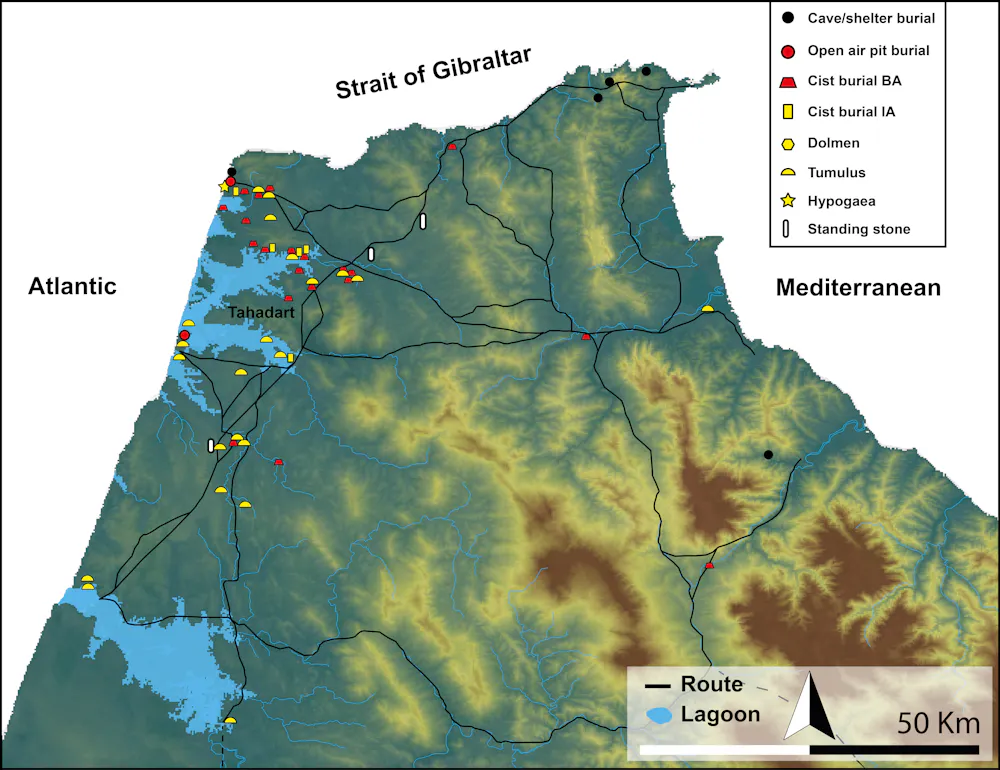
    Our study, published in African Archaeological Review, presents the discovery of dozens of new archaeological sites, including prehistoric burials, rock art sites and standing stones.

    Distribution of rock art. H Benattia.

    Distribution of burials, standing stones and communication routes. H Benattia.

    Until now, research on rock art and burials in north Africa focused on areas like the Nile Valley, the Sahara or the Atlas Mountains. Our discoveries reveal that Morocco’s north-western coast was a major cultural hub in the Bronze Age, over 4,000 years ago.

    The diversity of burial practices, ritual sites, symbolic rock art and unique megalithic monuments reflect a rich prehistoric heritage that transcends modern geographic, political and cultural boundaries. It also highlights the longstanding exchanges and contacts of this region with the Mediterranean, the Atlantic and the Sahara.

    One of the most remarkable sites we excavated is at Daroua Zaydan, near modern-day Tangier. There we uncovered a cist burial, a small stone chamber made from four upright stone slabs covered by a larger stone slab. A crescent-shaped arrangement of stones likely marked the access to the burial chamber.

    Excavation process of the Daroua Zaydan cist burial.

    Although the grave had been looted in the past, we recovered several human bones outside the cist. One of them was radiocarbon dated to 2118–1890 BC. This date aligns with similar burial traditions across the Strait of Gibraltar in Iberia, and with Early Bronze Age settlement activity at Kach Kouch, about 65km south-east of Daroua Zaydan.

    Cist cemeteries had been documented in the region before, but most were excavated during the early to mid-20th century. At the time, archaeologists didn’t have the methods that can now shed light on important details such as how they were built and when they were used. Daroua Zaydan marks the first radiocarbon-dated cist burial in north-west Africa.

    Monuments, ritual deposits and Atlantic connections

    Our findings suggest the existence of a complex prehistoric ritual landscape at the Tangier Peninsula. This landscape was likely connected to other areas of the Atlantic and Mediterranean through a shared ritual and symbolic “language”.

    Ballintober type sword recovered from the bed of the river Loukkos and currently held at the Staatliche Museen zu Berlin. Claudia Plamp.

    One clue is a Bronze Age sword found in the 1920s in the Loukkos river. It was likely made in Britain or Ireland and may have arrived in Africa through Atlantic exchange networks. The sword was likely deliberately thrown to the river — a ritual practice documented along rivers in Atlantic Europe. This suggests that communities in northern Morocco were part of a broader cultural and symbolic world that connected the late prehistoric Atlantic.

    The stone circle at Mzoura. H Benattia.

    Another example is the stone circle at Mzoura, made up of 176 standing stones. This site, excavated in the 1930s, is unique in north Africa. But it closely resembles other stone circles in Atlantic Europe like Stonehenge. During our fieldwork we also discovered new standing stones and rock art, located along prehistoric communication routes. This suggests they may have been used as territorial markers or ritual sites.

    Dotted composition at Ghar el Manzla. Enhanced with DStretch.

    Before our research, a single painted rock shelter, that of Magara Sanar, was known in north-western Morocco. We have now documented 17 painted and 5 engraved rock shelters.

    The variety of symbols and scenes includes dotted patterns, geometric lines and human-shaped figures. They suggest strong links to Iberian, Atlantic and Saharan prehistoric art.

    Human-shaped figures and dotted composition at Ghar Dchar Alouch. Enhanced with DStretch.

    Why this matters

    Looted cist burial at Oued Ksiar.

    Our research does more than just fill a blank spot on the archaeological map. It opens up new avenues for archaeological exploration in the region. The Tangier Peninsula is home to a rich and largely undocumented late prehistoric heritage. It deserves more attention from researchers, policymakers and the wider public.

    Further protection measures are necessary as the region is undergoing rapid urban development. Tourism is growing and there’s been extensive looting. We hope our work will lead to more archaeological investigations, including new excavations and radiocarbon dating of key sites.

    – Rock art and tomb discoveries in Morocco reveal ancient connections to the wider world
    – https://theconversation.com/rock-art-and-tomb-discoveries-in-morocco-reveal-ancient-connections-to-the-wider-world-256931

    MIL OSI Africa

  • MIL-OSI Global: Rock art and tomb discoveries in Morocco reveal ancient connections to the wider world

    Source: The Conversation – Africa – By Hamza Benattia, Prehistory, Universitat de Barcelona

    When people think of ancient burials in North Africa, they often picture Egypt’s pyramids and monuments. But new discoveries show that north-western Africa also has a deep and fascinating prehistoric past.

    Morocco’s Tangier Peninsula is particularly interesting. The peninsula sits at Africa’s north-western edge, where the Mediterranean Sea meets the Atlantic Ocean. At just 14 kilometres from Europe across the Strait of Gibraltar, this area has long been a natural crossroads between continents and cultures.

    I’m an archaeologist and PhD student who specialises in north Africa’s later prehistoric periods, between 3800 BC and 500 BC. My research explores how ancient communities responded to environmental changes, and how they moved and connected with other communities across regions.

    The assumption to date has been that the Tangier Peninsula was uninhabited and isolated in late prehistoric times. As part of my PhD research I wanted to explore whether this was true, or whether the area had simply been overlooked by previous archaeological work.

    Through the Kach Kouch and Tahadart Archaeological Projects, we studied both the Atlantic and Mediterranean zones of the peninsula.

    Our goal was to revisit the region using modern archaeological methods and technologies, including radiocarbon dating. To understand how this region may have been connected to the wider world in prehistoric times, we used Geographic Information System software to model possible ancient communication routes and surveyed the landscape through satellite and drone imagery. At a later stage, alongside a team of early career Moroccan archaeologists from the National Institute of Archaeology and Heritage, we carried out field surveys and excavations.

    What we discovered exceeded all expectations. Far from being empty and isolated, the Tangier Peninsula is filled with evidence that people lived, died and held ceremonies there over thousands of years.

    Our hope is that our findings will reframe north-western Africa as a cultural crossroads that has connected regions for thousands of years. This region could reshape our understanding of later prehistory across the Atlantic and Mediterranean worlds.

    A prehistoric ritual and funerary landscape

    Our study, published in African Archaeological Review, presents the discovery of dozens of new archaeological sites, including prehistoric burials, rock art sites and standing stones.

    Until now, research on rock art and burials in north Africa focused on areas like the Nile Valley, the Sahara or the Atlas Mountains. Our discoveries reveal that Morocco’s north-western coast was a major cultural hub in the Bronze Age, over 4,000 years ago.

    The diversity of burial practices, ritual sites, symbolic rock art and unique megalithic monuments reflect a rich prehistoric heritage that transcends modern geographic, political and cultural boundaries. It also highlights the longstanding exchanges and contacts of this region with the Mediterranean, the Atlantic and the Sahara.

    One of the most remarkable sites we excavated is at Daroua Zaydan, near modern-day Tangier. There we uncovered a cist burial, a small stone chamber made from four upright stone slabs covered by a larger stone slab. A crescent-shaped arrangement of stones likely marked the access to the burial chamber.

    Although the grave had been looted in the past, we recovered several human bones outside the cist. One of them was radiocarbon dated to 2118–1890 BC. This date aligns with similar burial traditions across the Strait of Gibraltar in Iberia, and with Early Bronze Age settlement activity at Kach Kouch, about 65km south-east of Daroua Zaydan.

    Cist cemeteries had been documented in the region before, but most were excavated during the early to mid-20th century. At the time, archaeologists didn’t have the methods that can now shed light on important details such as how they were built and when they were used. Daroua Zaydan marks the first radiocarbon-dated cist burial in north-west Africa.

    Monuments, ritual deposits and Atlantic connections

    Our findings suggest the existence of a complex prehistoric ritual landscape at the Tangier Peninsula. This landscape was likely connected to other areas of the Atlantic and Mediterranean through a shared ritual and symbolic “language”.

    One clue is a Bronze Age sword found in the 1920s in the Loukkos river. It was likely made in Britain or Ireland and may have arrived in Africa through Atlantic exchange networks. The sword was likely deliberately thrown to the river — a ritual practice documented along rivers in Atlantic Europe. This suggests that communities in northern Morocco were part of a broader cultural and symbolic world that connected the late prehistoric Atlantic.

    Another example is the stone circle at Mzoura, made up of 176 standing stones. This site, excavated in the 1930s, is unique in north Africa. But it closely resembles other stone circles in Atlantic Europe like Stonehenge. During our fieldwork we also discovered new standing stones and rock art, located along prehistoric communication routes. This suggests they may have been used as territorial markers or ritual sites.

    Before our research, a single painted rock shelter, that of Magara Sanar, was known in north-western Morocco. We have now documented 17 painted and 5 engraved rock shelters.

    The variety of symbols and scenes includes dotted patterns, geometric lines and human-shaped figures. They suggest strong links to Iberian, Atlantic and Saharan prehistoric art.

    Why this matters

    Our research does more than just fill a blank spot on the archaeological map. It opens up new avenues for archaeological exploration in the region. The Tangier Peninsula is home to a rich and largely undocumented late prehistoric heritage. It deserves more attention from researchers, policymakers and the wider public.

    Further protection measures are necessary as the region is undergoing rapid urban development. Tourism is growing and there’s been extensive looting. We hope our work will lead to more archaeological investigations, including new excavations and radiocarbon dating of key sites.

    Hamza Benattia, director of the Tahadart Archaeological Project, received funding from the National Institute of Archaeology and Heritage of Morocco (INSAP), the Prehistoric Society Research Fund, the Stevan B. Dana Grant of the American Society of Overseas Research, the Mediterranean Archaeological Trust Grant, the Barakat Trust Early Career Award, the Centre Jacques Berque Research Grant, the Institute of Ceutan Studies Research Fund and the University of Castilla La Mancha.

    ref. Rock art and tomb discoveries in Morocco reveal ancient connections to the wider world – https://theconversation.com/rock-art-and-tomb-discoveries-in-morocco-reveal-ancient-connections-to-the-wider-world-256931

    MIL OSI – Global Reports

  • MIL-OSI Russia: Alexey Likhachev became an Honorary Doctor of SPbPU

    Translation. Region: Russian Federal

    Source: Peter the Great St Petersburg Polytechnic University – Peter the Great St Petersburg Polytechnic University –

    A solemn ceremony of presenting the mantle and diploma of the Honorary Doctor of SPbPU to the General Director of the State Corporation Rosatom Alexey Likhachev took place at Peter the Great St. Petersburg Polytechnic University.

    The ceremonial event opened with the performance of the Polytechnic University anthem by the SPbPU youth choir “Polyhymnia”.

    It is especially gratifying that this important event is taking place in the year of the 80th anniversary of the Russian nuclear industry, to the development of which Polytechnicians made a significant contribution. Such names as Abram Fedorovich Ioffe, Isaak Konstantinovich Kikoin, Abram Isaakovich Alikhanov, Yuliy Borisovich Khariton, Nikolay Leonidovich Dukhov are inscribed in gold letters in the history of the development of Russian science. Today, Polytechnic University and Rosatom, under the leadership of Alexey Evgenievich, closely cooperate for the benefit of the development of Russian nuclear technologies: both in education and in science. By order of Rosatom, our Institute of Power Engineering annually graduates more than 250 specialists in the field of nuclear energy, thermal power engineering, electric power engineering and power engineering. Together with Rosatom, we are successfully implementing the project of the advanced engineering school “Digital Engineering”, acting in the interests of the technological leadership of our country, – emphasized the rector of SPbPU, academician of the Russian Academy of Sciences Andrey Rudskoy.

    The members of the SPbPU Academic Council unanimously voted to award the title to Alexey Likhachev on April 28 this year. The Scientific Secretary of the Polytechnic University Dmitry Karpov presented the new honorary doctor.

    If we try to pick three key words that would define the spirit of modern scientific and technological development in Russia, these words should be: professionalism, leadership and Victory. And these are the words that come to mind when we talk about the State Corporation Rosatom. For the Polytechnic University, whose history is closely connected with the nuclear project, participation in the development of nuclear energy is one of the key, strategic areas of work. And scientific and industrial cooperation with the national leader in several related industries at once is a great honor and responsibility for the university, – noted Dmitry Karpov.

    Cooperation between the Rosatom State Corporation and SPbPU, which is one of the flagship universities and its long-term strategic partner, is actively developing. This is a significant amount of work carried out by the Institute of Mechanical Engineering, Materials and Transport, the Institute of Power Engineering, the Physics and Mechanical Engineering Institute, the Advanced Engineering School “Digital Engineering” and other university structures. This is significant international cooperation, in particular, in the interests of the Turkish and Egyptian nuclear energy. This is the training of specialists in a wide range of engineering and technical areas of training – primarily in nuclear, energy, mechanical engineering and construction specialties. This is a cell of the Rosatom Student Council, whose activists participate in organizing meetings with representatives of the corporation’s enterprises, technical tours of production facilities, strategic sessions as part of the university’s career events and other activities. In the context of the 80th anniversary of the nuclear industry, about 40 events are planned at the Polytechnic University, covering more than 4,000 people.

    Dmitry Karpov named several completed projects. An optimal design of a vibrating screen for cleaning drilling mud was developed by order of NPO Centrotech. The project was a real breakthrough in the industry: with a target vibration acceleration of 7 g, engineers from PISh SPbPU designed a product that exceeded these parameters in just six months. The results of digital modeling were confirmed from the first factory test of the prototype – the vibration acceleration was 8.2 g. The product and its modifications have been successfully used for many years now.

    A digital twin of the VVER-1000 fuel assembly with an anti-debris filter and mixing grids was developed by order of JSC TVEL. Due to digital design and additive manufacturing, the filtration efficiency has been increased tenfold, and the created models, virtual test benches and testing grounds will significantly reduce costs and improve the quality and speed of further developments.

    At the request of the Mayak production association, for the first time in engineering practice, the architecture of a highly adequate multiphysical digital model of a furnace for vitrification of high-level radioactive waste has been developed.

    By order of JSC TsKBM, key proprietary technological equipment for the ODU-150 hydrogen production unit was developed. The design solutions of the created key hydrogen technology devices are the starting point in the development of a new generation of equipment and future medium- and large-tonnage devices for the hydrogen, petrochemical, and nitrogen industries.

    At the request of the composite division of Rosatom, a technology for the production of filaments from continuous carbon fiber was developed, and the customer received pilot equipment. On the official website of the corporation, this installation is listed among the most important achievements of Rosatom in 2024.

    At the enterprise of the State Corporation Rosatom — JSC Proryv — the URANIA data and process management system for computational and experimental scientific research was put into operation. It is based on the CML-Bench® Digital Platform — an in-house development of the Engineering Center of our university.

    In 2023, under the leadership of Alexey Evgenievich, the State Corporation approved the Unified Digital Strategy, which became the most important step towards accelerating the digital transformation of the industry, including ensuring import substitution. In this regard, Dmitry Karpov noted that specialists from SPbPU and the All-Russian Research Institute of Experimental Physics developed the national GOST “Computer models and modeling. Digital twins of products. General provisions” – the world’s first document regulating the relevant activities.

    The scale of the projects of the State Corporation Rosatom is truly astounding. And it is quite obvious that the management of such a system is the lot of rare leaders and true professionals. This entire vast field – from the development and implementation of advanced technologies, solving the most complex multidisciplinary problems of the world level to the transfer of unique competencies and the organization of expert discussion platforms – all this and much more became possible, including thanks to the personal professionalism and leadership of Alexey Evgenievich. Perhaps, being a leader is destiny. Destiny to be born in Arzamas-75 – Sarov, the city-forming enterprise of which is the Russian Federal Nuclear Center. And, having gone the way of an engineer, politician, adviser and Deputy Minister of Economic Development of Russia, still to head the State Atomic Energy Corporation Rosatom. And to become a leader, ensuring its brilliant victories, – emphasized Dmitry Karpov.

    Students in the uniform of the Polytechnic University of the early 20th century brought in a doctoral robe and cap, the Polyhymnia choir performed the Gaudeamus anthem. Andrei Rudskoi presented Alexei Evgenievich with a book about honorary doctors of the Polytechnic University, which has a page dedicated to the CEO of the state corporation Rosatom.

    It is a great honor for me to receive this title from one of the leading technical universities in the country, which stands at the origins of the Russian engineering school. St. Petersburg Polytechnic University is a forge of personnel for the nuclear industry, and we highly value the contribution of its teachers, scientists and students to the development of advanced technologies. I am confident that our partnership will continue to contribute to breakthrough achievements in nuclear energy, medicine and new materials, – said Alexey Likhachev in his response speech.

    Alexey Likhachev also met with students studying at the Institute of Power Engineering. He spoke about the development of the State Corporation’s systemic cooperation with universities, how contacts with students are built, and shared Rosatom’s corporate values. The Polytechnicians spoke about the activities of the Rosatom student council cell, asked questions about the prospects for the development of nuclear science and the training of personnel for the corporation’s high-tech projects.

    You are the future not only of Rosatom and the nuclear industry, but of the entire country. It is you who will manage enterprises, represent the industry on the international stage and develop our technological power. Therefore, such meetings with students are of particular value: we get to know each other better and understand to whom we are transferring responsibility for the future, Alexey Likhachev emphasized.

    Please note: This information is raw content directly from the source of the information. It is exactly what the source states and does not reflect the position of MIL-OSI or its clients.

    MIL OSI Russia News

  • MIL-OSI Russia: New Wuhan-Poti/Tbilisi route launched as part of China-Europe international rail freight transportation

    Translation. Region: Russian Federal

    Source: People’s Republic of China in Russian – People’s Republic of China in Russian –

    Source: People’s Republic of China – State Council News

    BEIJING, May 26 (Xinhua) — A China-Europe international rail freight train departed from Wuhan, central China’s Hubei Province, for Georgia on Saturday, marking the opening of a new trans-Caspian international transport route linking Wuhan with Georgian cities.

    The train is carrying goods worth more than 14.82 million yuan (about $2.06 million), including light mechanical equipment, agricultural machinery and construction materials, China’s Zhongxinshe News Agency reported.

    This train will cross the state border at the Khorgos checkpoint /Xinjiang Uyghur Autonomous Republic, Northwest China/, pass through Kazakhstan, where in the seaport of Aktau the cargo will be transferred to a ferry going across the Caspian Sea, after which it will arrive in the capital of Azerbaijan, Baku, from where it will be delivered by rail to Poti and Tbilisi.

    When transporting goods from Wuhan to Georgia, a multimodal scheme is envisaged: “railway – sea – rail”, while the travel time is approximately 18 days.

    Georgia is a key corridor connecting Europe and Asia. The launch of this route will facilitate the development of trade and economic ties between China’s Hubei Province and Georgia, Turkey, and other neighboring countries.

    Currently, there are 58 cross-border routes in the China-Europe international railway freight transportation, linking Wuhan with 120 cities in 40 countries on the Eurasian continent. Thus, an international intermodal transport network has been formed covering Europe, Central Asia and ASEAN countries, as well as Japan and the Republic of Korea. -0-

    MIL OSI Russia News

  • MIL-OSI Russia: China hosts symposium on traditional cultures along the Silk Road

    Translation. Region: Russian Federal

    Source: People’s Republic of China in Russian – People’s Republic of China in Russian –

    Source: People’s Republic of China – State Council News

    BEIJING, May 26 (Xinhua) — A 2025 symposium on the protection, development and application of traditional cultures along the Silk Road opened in Xi’an, capital of northwest China’s Shaanxi Province, on Friday.

    The symposium, co-organized by the Shaanxi Provincial People’s Government, the Provincial Department of Education and Northwest University (NWU), brought together more than 100 experts from higher education institutions in China, Kazakhstan, Tajikistan, Turkmenistan, Uzbekistan, Egypt, Morocco and the United Kingdom.

    The event included the opening ceremony of the Intelligent Perception Laboratory for Situational Awareness in Countries Along the Silk Road, aimed at enhancing the level of cooperation between research organizations in China, Central Asia and Arab countries.

    Speaking at the symposium, SZU Rector Sun Qingwei introduced those present to the university’s achievements in research related to the Great Silk Road.

    The Silk Road served as a channel for trade and economic interaction and civilizational exchanges between the East and the West, and in modern times it has gained new vitality. Sun Qingwei called on the two sides to make joint efforts to deeply integrate production, education, research and application.

    The main theme of the symposium is “The Great Silk Road: civilizational mutual learning and innovation in culture.” Within its framework, two sub-forums were held on issues of Chinese-Arab and Chinese-Central Asian civilizational exchanges. -0-

    MIL OSI Russia News

  • MIL-OSI NGOs: Dedicated health professionals improve care for people on Kiribati

    Source: Médecins Sans Frontières –

    Life in Kiribati, an island nation in the central Pacific Ocean, is influenced by its remote location, high disease burden and the worsening impacts of climate change. The country’s healthcare system is under immense strain. With health workforce shortages, Kiribati relies on skilled and dedicated members of the community to provide care on the outer islands.

    In the heart of Abaiang island, a northern atoll of Kiribati, Batiua (pronounced Besiwa) has been the sole medical assistant for six years, serving a community of 6,000 people with limited resources. Medical assistants are nurses with additional training in medical conditions and treatment pathways who can treat patients with the support of trained physicians.

    Alongside doctors from Médecins Sans Frontières (MSF), Batiua provides essential healthcare, helping to tackle issues like malnutrition, infectious diseases, and pregnancy complications.

    MSF midwife Esther Karume teaches local community members in Abaiang how to test for high blood pressure. Non-communicable diseases such as diabetes and hypertension are common. Kiribati, April 2025.
    Victor Caringal/MSF

    Today, patients greet Batiua when they walk into the clinic, a small single-storey cement structure surrounded by coconut trees. Here at the primary healthcare centre, she examines the first patient of the day and translates the patient’s I-Kiribati language to English for the MSF doctor. Batiua is the main focal point for all the patients, while the doctor supports in the diagnosis and treatment plan and provides guidance in patient care.

    Nurses and medical assistants employed by the Ministry of Health and Medical Services provide valuable community-level care within Kiribati’s healthcare system. They play a vital role in their villages, where there are not enough staff and a high disease burden.

    MSF’s medical professionals have been supporting Ministry of Health and Medical Services nurses in Abaiang since 2024.

    “We focus our energies here as there is a high incidence of referrals for maternal care from outer islands to Tungaru Central hospital on the main island of Tarawa. We identified the need to support the medical assistants and nurses by implementing the community-based model of care,” says MSF medical coordinator Kiera Sargeant. This means women will be able to receive care closer to home.

    A villager sits in shade in Abaiang. The high heat and humidity is consistent through days and nights on Abaiang.
    Victor Caringal/MSF

    In 2024, MSF screened 888 women for non-communicable diseases in Abaiang. A quarter of the women had diabetes, with almost 20 per cent having hypertensive disorders in pregnancy. More than 60 per cent showed signs of obesity.

    Among the 514 children screened nine per cent had had recent diarrhoea, emphasising the ongoing challenges related to water and sanitation.

    Kiribati’s high burden of disease

    Of the five patients waiting their turn for Batiua, three are pregnant women and two are children accompanied by their mothers.

    When it is 10-month-old Gianna’s turn to be examined, Rutii, her mother, crouches beside her.

    “Our doctor says her chest sounds better than yesterday, an improvement from when she arrived the day before,” says Batiua.

    Rutii nods and smiles. “My baby, Gianna had high fever; she had difficulty to breathe. And she wasn’t eating well,” recalls Rutii. “The MSF doctor and the medical assistant asked me to admit the baby immediately. I was very worried. Now she is much better. She has started to eat.”

    The impact of climate change makes children and adults more susceptible to non-communicable and communicable diseases.

    Disruptions in food systems exacerbate malnutrition risks, which can lead to overweight and obesity, increasing the risk of non-communicable disease, including pregnancy-induced hypertension and gestational diabetes. This is in part due to over-reliance on hyper-processed foods and lack of arable land due to erosion, and high salinity of soil and water.
     

    A child receives antibiotics by Batiua, a medical attendant two days after being admitted at the PHC. This was the last dose that the PHC had.
    Pratistha Koirala/MSF

    More than 15 per cent of children in Kiribati under five years of age are stunted, 3.5 per cent of children under five years of age are affected by wasting, and 90 per cent of children live in food poverty, meaning they have limited access to a diverse and nutritious diet.

    Malnutrition makes children more susceptible to infectious diseases and other illnesses. “Children are affected more as it directly impacts the growth,” says Batiua.

    Growing preference for imported, processed food, and reduced ability to grow food locally are some of the contributors to malnutrition and many non-communicable diseases in Kiribati. Extreme weather conditions and rising sea levels threaten agricultural production and livelihoods.

    The climate crisis is a health crisis

    Most patients at the clinics on the outer island of Abaiang are women.

    While Kiribati has some of the highest burdens of disease in the Pacific region, it has one of the lowest rates of access to primary healthcare, increasing the vulnerability of pregnant women and children. MSF is helping women have safer pregnancies by working with local health workers to help diagnose and treat diabetes and hypertension in pregnant women.

    Any cases, including high-risk pregnancies, that are not treatable at the clinic are referred to the Tungaru Central hospital in the capital, Tarawa, via a two- to four-hour boat trip or a flight which leaves once or twice a week.

    The local staff of Médecins Sans Frontières Kiribati waits for water testing equipment to be unloaded as the airplane lands in the outer island of Abaiang. Abaiang is an atoll just north of Tarawa, the main island of Kiribati, with around 6,000 inhabitants. Teirio, the main island of Abaiang, is about 30 km long. There is no running water, no electricity, no restaurants; and the airfield is a gravel strip in the forest. There are 18 villages in Abaiang, 16 of which are on Teiro.
    Pratista Koirala/MSF

    “Transporting a critical patient is always a challenge,” says Diana, the nurse at Takarano clinic on the north of the island. A single nurse or medical assistant is responsible for each clinic.

    “It’s a big relief to the island when we have MSF’s doctor Joseph, as he has more medical knowledge,” says Batiua with a smile.

    For the people of Kiribati, the climate crisis is a daily health threat. Rising sea levels contaminate freshwater, increasing diarrhoeal diseases, while extreme weather disrupts food supply, worsening malnutrition. Warmer temperatures fuel mosquito-borne illnesses like dengue, and heat stress impacts those with heart disease and diabetes, as well as pregnant women. These challenges, combined with limited healthcare access, create a worsening cycle of poor health.

    Improving access to clean water

    Accessing clean, safe water is a daily challenge for people in Kiribati. Shallow groundwater, which is contaminated with seawater, rubbish and other waste, is the main drinking water. The limited access to potable water supply at the clinic poses a significant challenge, affecting both patient care and clinic sanitation. With no running water on the island, the health clinics rely on rainwater or water carried from nearby homes.

    The Ministry of Health and Medical Services is making efforts to secure a water supply. MSF has also been working with the ministry to test the quality of water in the groundwater table on the island and looking at how this correlates with health conditions such as hypertension or diarrhoea in pregnancy.

    “We’re also working on geo-mapping the various water wells so the community has more information about the water quality in each well and can make healthier choices about where they get their water,” says Kiera.

    The primary sources of freshwater are underground freshwater lenses and rainwater harvesting. Groundwater wells can be salty or contaminated by bacteria.

    Remote island logistics

    Kiribati faces unique geographical challenges that impact nearly every aspect of daily life, including healthcare, transportation and waste management. Spread across 33 atolls and reef islands, the country’s vast distances and limited infrastructure make it difficult to transport essential medical supplies, access specialised healthcare, and manage waste effectively. Many outer islands rely on infrequent boat or air transport for critical supplies, and delays can lead to medicine shortages and limited healthcare access. Meanwhile, the lack of proper waste disposal infrastructure poses environmental and health risks, with medical waste often accumulating in unsafe conditions.

    Médecins Sans Frontières wash supervisor Mila Tirikai pours sample well water in whirl-pakc theo-bag for faecal coliform test. The sample water is interacted with growth medium which them is poured into a compartment bag for incubation. By using different testing methods like the one in the picture, sample water is tested for conductivity (used for conversion to TDS and salinity), pH, turbidity, iron and potassium.
    Pratistha Koirala/MSF

    The remote location, high disease burden and worsening effects of climate change continue to place immense strain on Kiribati’s healthcare system. With a growing population facing increasing health challenges—including malnutrition, non-communicable diseases, and limited access to clean water—the need for sustained medical support is critical.

    MSF’s partnership with the Ministry of Health and Medical Services aims to provide medical care to people, strengthen pharmacy management and improve sanitation efforts. Working in collaboration with medical professionals at all levels, tertiary to grassroots, has been one of the key pillars of the collaboration. Nurses and medical assistants like Batiua find joy in helping people.

    “My mission in life is to eradicate malnutrition in Abaiang, especially among children under five,” she says.

    MIL OSI NGO

  • MIL-OSI United Nations: Secretary-General’s press encounter on the humanitarian situation in Gaza

    Source: United Nations secretary general

    Palestinians in Gaza are enduring what may be the cruelest phase of this cruel conflict. 

    For nearly 80 days, Israel blocked the entry of life-saving international aid. 

    As the world’s leading hunger assessment found, the entire population of Gaza is facing the risk of famine.

    Families are being starved and denied the very basics.

    All with the world watching in real time.

    Israel has clear obligations under international humanitarian law.

    It must treat civilians humanely, with respect for their inherent dignity. 

    It must not forcibly transport, deport or displace the civilian population of an occupied territory. 

    And as the occupying power, it must agree to allow and facilitate the aid that is needed.

    Finally, a trickle of aid has crossed over. 

    In recent days, almost 400 trucks were cleared for entry to Gaza through the Kerem Shalom crossing.

    But supplies from only 115 trucks have been able to be collected. 

    And nothing has reached the besieged north.

    We are working around the clock to get whatever aid we can to people in need. 

    And we managed to distribute some wheat flour, baby food, nutrition supplements and medicines. 

    At long last, a few bakeries in south and central Gaza are operating.

    But let us not forget that we are operating in the middle of a military operation.

    In any case, all the aid authorized until now amounts to a teaspoon of aid when a flood of assistance is required.

    The needs are massive –and the obstacles are staggering.

    Strict quotas are being imposed on the goods we distribute – along with unnecessary delay procedures.

    Other essentials – including fuel, shelter, cooking gas, and water purification supplies – are prohibited.

    We continue to request for safety and security mitigation measures to be in place for our convoys.

    Our staff life is at risk if we continue to be prevented from distributing food parcels and wheat flower directly to people in desperate need. 

    Without those, and in the absence of the rule of law and a desperate population after months of blockade, and totally insufficient supply entering, the risk of security incidents and looting remains high.  

    Meanwhile, the Israeli military offensive is intensifying with atrocious levels of death and destruction. 

    Today, 80 per cent of Gaza has been either designated an Israeli-militarized zone or an area where people have been ordered to leave. 

    In other words, four-fifths of the territory of Gaza is a no-go zone for the people of Gaza.

    And so, beyond questions about the particular number of trucks at any particular moment, it is important to stay fixed on the big picture.

    And the big picture is that without rapid, reliable, safe and sustained aid access, more people will die – and the long-term consequences on the entire population will be profound.

    The United Nations has been clear:

    We will not take part in any scheme that fails to respect international law and the humanitarian principles of humanity, impartiality, independence and neutrality.

    And we have been equally clear about what is needed.

    A permanent ceasefire.  The immediate and unconditional release of all hostages.  And full humanitarian access. 

    The United Nations and our partners have a detailed, principled, operationally-sound 5-stage plan – supported by Member States – to get aid to a desperate population.

    A mechanism to:

    • Ensure the delivery of aid to Gaza;
    • Inspect and scan aid at crossing points;
    • Transport aid from crossing points to humanitarian facilities;
    • Prepare aid for onward distribution;
    • And transport aid to people in need.

    We have the personnel, the distribution networks, the systems and community relationships in place to act.

    The supplies – 160,000 pallets, enough to fill nearly 9,000 trucks – are waiting. 

    This is my appeal for life-saving aid for the long-suffering people of Gaza:

    Let’s do it right.  And let’s do it right away.

    Thank you.

    MIL OSI United Nations News

  • MIL-OSI USA: Following Deadly Shooting at Capital Jewish Museum, Rep. Sherrill Urges DHS and DOJ to Dedicate Additional Resources to Combat Antisemitic Attacks and Threats

    Source: United States House of Representatives – Congresswoman Mikie Sherrill (NJ-11)

    WASHINGTON, DC — In the wake of the May 21st shooting of two Israeli Embassy staffers outside the Capital Jewish Museum in Washington, D.C., Representative Mikie Sherrill (NJ-11) today sent a letter to Secretary of Homeland Security Noem and Attorney General Bondi urging immediate action and additional federal resources to protect Jewish communities, houses of worship, and nonprofit organizations.

    In her letter, Rep. Sherrill detailed several recent violent antisemitic attacks, including the May 21st shooting, the April 13th arson attack on Pennsylvania Governor Josh Shapiro’s residence following a Passover celebration, and incidents in her New Jersey Congressional District such as the firebombing of Temple Ner Tamid and the vandalism of Oheb Shalom Synagogue.

    The May 21st attack came just one day after the Capital Jewish Museum received a grant from the District of Columbia’s Safe and Secure DC Grant Program to cover the costs of security officers at the museum, highlighting the critical need for additional funding to protect houses of worship and nonprofit organizations.

    “On the night of May 21, 2025, Yaron Lischinsky and Sarah Lynn Milgrim, two staffers from the Israeli Embassy in Washington, DC, were horrifically shot and killed outside the Capital Jewish Museum,” wrote Rep. Sherrill. “While details from the shocking attack are still emerging, the suspect’s antisemitic motivations highlight the threat of violence against Jewish Americans and residents across the United States. This attack was an assault on the core values and ideals of our nation – particularly the right to religious expression and to practice one’s faith without fear of violence – and we must take every effort to prevent it from happening again. In the wake of this violence and yet another devastating antisemitic attack in our country, I write to urge you to dedicate additional resources at the Department of Justice (DOJ) and Department of Homeland Security (DHS) to protect houses of worship and nonprofit organizations and to combat the significant rise in antisemitic attacks and threats nationwide.”

    Read the full letter here or below:

    Dear Secretary Noem and Attorney General Bondi,  

    On the night of May 21, 2025, Yaron Lischinsky and Sarah Lynn Milgrim, two staffers from the Israeli Embassy in Washington, D.C., were horrifically shot and killed outside the Capital Jewish Museum. While details from the shocking attack are still emerging, the suspect’s antisemitic motivations highlight the threat of violence against Jewish Americans and residents across the United States. This attack was an assault on the core values and ideals of our nation – particularly the right to religious expression and to practice one’s faith without fear of violence – and we must take every effort to prevent it from happening again.

    In the wake of this violence and yet another devastating antisemitic attack in our country, I write to urge you to dedicate additional resources at the Department of Justice (DOJ) and Department of Homeland Security (DHS) to protect houses of worship and nonprofit organizations and to combat the significant rise in antisemitic attacks and threats nationwide. Over the past two years, our country has seen a concerning number of high-profile instances of antisemitic violence. It is vital that your departments ensure there are sufficient resources focused on preventing and investigating these violent crimes. Specifically, I ask that you surge funding from your departments to ensure that synagogues, faith-based organizations, and nonprofits have the resources to put necessary security measures in place and that law enforcement is prepared and able to investigate antisemitic violence and other hate crimes across the country.

    In addition to the heinous attack in Washington, on the night of April 13, 2025, an arsonist set fire to the residence of Pennsylvania Governor Josh Shapiro. The fire was reportedly set only hours after Governor Shapiro hosted more than two dozen people commemorating the first night of Passover. The suspected arsonist reportedly sought to kill Governor Shapiro over his stated support for Israel. Such a brazen assault on one of our states’ governors highlights the ever-present risk of antisemitism and violence to all Jewish Americans.

    In my own Congressional District, Jewish houses of worship have come under these same types of hateful, antisemitic attacks. This January, the Oheb Shalom Synagogue in South Orange, New Jersey was vandalized with antisemitic threats. In 2023, Temple Ner Tamid in Bloomfield, New Jersey was firebombed by an individual with a molotov cocktail in a brazen antisemitic attack.

    As antisemitic violence and threats have increased, I remain concerned that synagogues, Jewish faith-based organizations, and nonprofits are under-resourced for the heightened threats that they face. I urge you to take whatever actions you can to ensure that the programs that support these organizations are properly resourced and staffed. One such program, DHS’s Nonprofit Security Grant Program, offsets the cost of physical security enhancements for religious, educational, and nonprofit community institutions, including Jewish organizations. Synagogues and schools have been targeted with vandalism, destruction, and violent attacks by extremists who seek to strike fear into congregations and civil society leaders. This funding will help to keep Americans safe from antisemitic and extremist attacks, and allow communities of faith to practice in peace.

    I also urge you to ensure that initiatives to combat, investigate, and prosecute hate crimes are fully staffed and resourced. As President Trump has slashed budgets and staffing across the Executive Branch – including for the FBI staff who track and combat domestic terrorism – I am concerned that initiatives within your departments meant to combat antisemitism and other hate crimes will be left unable to address the rising threat that we face today. Specifically, it is vital that DOJ maintains its focus on investigating and prosecuting antisemitic violence across the country. However, prosecutions alone will not reduce antisemitic violence across America. For that reason, it is important that the DOJ continues programs designed to research and address hate crimes like antisemitism in our communities. Activities authorized by the Khalid Jabara & Heather Heyer NO HATE Act and the Matthew Shepard James Byrd, Jr. Hate Crimes Prevention Act, as well as the Community Relations Service, Community Approaches to Advancing Justice Grants, and continued research into domestic extremism and radicalization, are vital tools to allow the federal government to combat the rising tide of antisemitic violence. I urge you to maintain and expand funding for these programs.

    Our country faces a crisis of antisemitic violence and threats that show no signs of abating. It is vital that the federal government take urgent action to protect Jewish communities, prosecute perpetrators of antisemitic hate crimes, and support community programs to counter antisemitism. Jewish Americans face the severe threat of antisemitic violence every day, and it is long past time that the U.S. federal government prioritizes their safety. 

    ###

    MIL OSI USA News