NewzIntel.com

    • Checkout Page
    • Contact Us
    • Default Redirect Page
    • Frontpage
    • Home-2
    • Home-3
    • Lost Password
    • Member Login
    • Member LogOut
    • Member TOS Page
    • My Account
    • NewzIntel Alert Control-Panel
    • NewzIntel Latest Reports
    • Post Views Counter
    • Privacy Policy
    • Public Individual Page
    • Register
    • Subscription Plan
    • Thank You Page

Category: Middle East

  • MIL-OSI Global: The world’s first museum was curated by a princess. A tour reveals the origins of the zodiac, calculus and writing

    Source: The Conversation – Global Perspectives – By Louise Pryke, Honorary Research Associate, Department of Classics and Ancient History, University of Sydney

    Archeological excavations at the palace grounds in Ur, modern-day Iraq, uncovered Ennigaldi-Nanna’s museum. M. Lubinski/Flickr/Wikimedia Commons, CC BY

    Around 2,500 years ago, a princess living in what is now modern-day Iraq collected a number of artefacts, including a statue, a boundary stone and a mace head. The items, which show signs of preservation, date from around 2100 BCE to 600 BCE. This collection, it is generally thought, was the world’s first known “museum”.

    Between Two Rivers, by Oxford scholar Moudhy Al-Rashid, tells the story of ancient Mesopotamia, a period in world history sometimes known as a “forgotten age”.

    While Mesopotamian history is innately fascinating, Al-Rashid also notes its many historical “world firsts”: the first known writing system, the potter’s wheel, the first record of beer production and advances in agriculture.


    Review: Between Two Rivers: Ancient Mesopotamia and the Birth of History – Moudhy Al-Rashid (Hodder Press)


    The first museum

    The world’s first known museum, and its curator, Ennigaldi-Nanna, are among these many firsts. The daughter of the Neo-Babylonian king Nabonidus, Ennigaldi-Nanna was a priestess at the temple of the moon deity, as well as a princess.

    Both Ennigaldi-Nanna and Nabonidus were keenly interested in history. Indeed, Nabonidus’ interest in excavating old temples and describing his findings once saw him described as the “first archaeologist”. This makes these figures well suited as the book’s central focus.

    At its heart, Between Two Rivers is an ode to the power of history. It builds a persuasive case for history writing as a particularly human impulse, and for how lives of people living thousands of years ago can reflect and shape our modern lives in unexpected ways.

    10 museum objects

    The book is organised around the ten items from Ennigaldi-Nanna’s collection. This structural conceit creates a sense of unity, despite the diversity of topics the book covers. Each chapter is focused on one item. For example, an ancient granite mace head introduces a chapter on warfare, violence and death.

    Moudhy Al-Rashid.
    Hachette

    In chapter one, we are introduced to ancient Mesopotamian history. We’re also introduced to the author herself. Al-Rashid punctuates her prose with personal recollections and humour, as well as touching reflections on her experience of motherhood. She is our companion, tour guide and teacher as we navigate this journey into the past, helping the reader feel a personal stake in the scholarly adventure ahead.

    Other chapters explore cuneiform script (the world’s first known writing), cities, leadership, education (including some of the earliest doodles by bored students), early scientific developments and the gods. The final three chapters look at economics, warfare and curator Ennigaldi-Nanna herself.

    The book offers a useful timeline, though pictures of the ten ancient items and a map would have been useful additions.

    Fun historical facts

    The broad range of subjects, periods and people explored in this book results in the inclusion of many dazzling features of Mesopotamian history, rarely considered together. Indeed, there is a plethora of fun historical facts.

    In the chapter on science, Al-Rashid notes the development of the zodiac and a mathematical precursor to modern calculus.

    Five Amarna letters on display at the British Museum.
    Osama Shukir Muhammed Amin/Wikimedia Commons, CC BY

    We get a brief overview of the fascinating diplomatic correspondence between New Kingdom Pharaohs and their West Asian vassals, known as the Amarna Letters. There is also the cuneiform tablet referencing the death of Alexander the Great, and an overview of the practice of divination (including an attempted palace coup).

    These highlights from ancient evidence are balanced against frequent commentary from the author. She notes the less glamorous nature of much of it, such as economic texts and legal agreements.

    Indeed, Al-Rashid is careful to note the limits of the evidence used to build this vivid picture of ancient Mesopotamia. She notes the difficulties of learning Sumerian, the world’s first known language, written in the intricate cuneiform script. In her chapter on leadership, she notes that further evidence for powerful women leaders may yet be discovered, while discussing what is currently known of these figures.

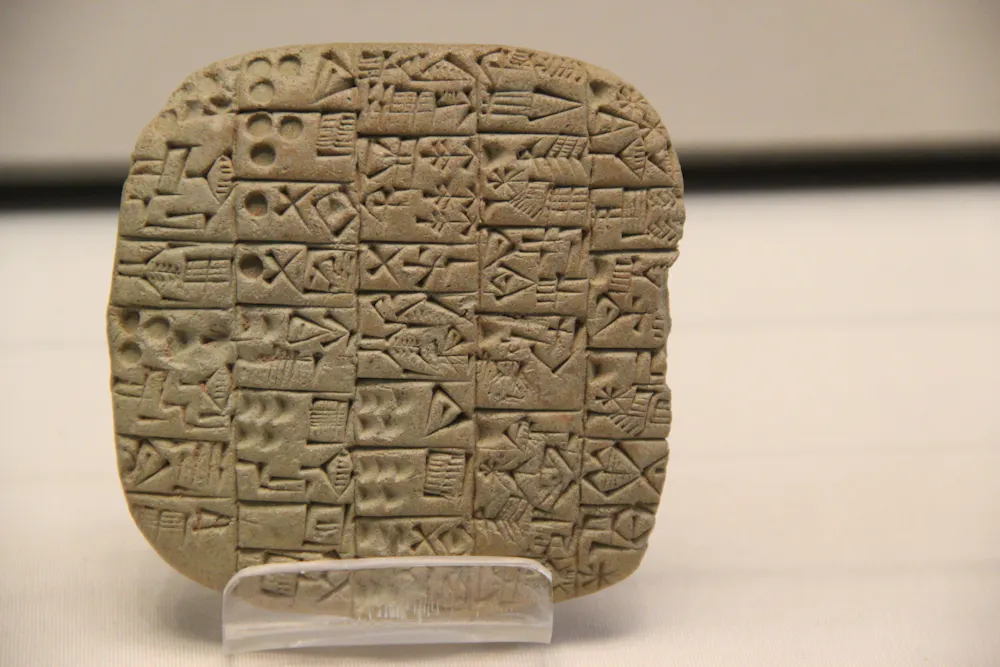
    Sumerian, the world’s first known language, was written in cuneiform – like the script on this clay tablet.
    Louvre, photographed by Gary Todd/Flickr

    The author’s transparency and expert handling of evidence puts the reader at ease, while subtly championing the importance of continued studies in this field. This is timely, as the academic field of Mesopotamian history has seen significant cuts in the last decade.

    Rediscovering cultural riches

    Despite the rich cultural legacy of this region, Mesopotamian history is largely unknown in the modern day. While 21st-century audiences are often familiar with the works of Plato, Homer and Virgil, they may struggle to identify Enheduanna – a princess, priestess, and poetess who lived over 4,000 years ago – as the world’s first known author, or Sin-leqe-uninni as the editor of the Epic of Gilgamesh.

    This is likely due to the circumstances around the recovery of the Mesopotamian writing script, cuneiform. This style of writing faded from use around the 1st century CE, and was only re-deciphered in 1857 CE. This meant that for almost two millennia, awareness of the Mesopotamian cultural legacy almost entirely disappeared.

    This modern lack of awareness of Mesopotamian history is slowly changing. Between Two Rivers is part of an emerging trend in the field of Assyriology — the study of the languages, literature, history, laws and sciences of Mesopotamia — for producing accessible works, for non-specialist audiences.

    Between Two Rivers further demonstrates the usefulness of this approach in bringing the riches of the ancient Near East to modern audiences.

    Changing times


    In recent years, we have seen new translations of the famous Mesopotamian epic Gilgamesh, and the first volume dedicated to the works of the world’s first known author, Enheduanna.

    There are new books on Mesopotamian religion and the cuneiform script by Irving Finkel, who has been an ambassador for the discipline for many years. Indeed, Al-Rashid notes his influence.

    To write a book like this one, the author needs to have both mastery over the subject material and an engaging style of communication. Al-Rashid excels in both areas. For general audiences, Between Two Rivers is a fascinating, balanced introduction to this complex – and at times elusive – ancient world.

    Louise Pryke does not work for, consult, own shares in or receive funding from any company or organisation that would benefit from this article, and has disclosed no relevant affiliations beyond their academic appointment.

    – ref. The world’s first museum was curated by a princess. A tour reveals the origins of the zodiac, calculus and writing – https://theconversation.com/the-worlds-first-museum-was-curated-by-a-princess-a-tour-reveals-the-origins-of-the-zodiac-calculus-and-writing-246876

    MIL OSI – Global Reports –

    April 28, 2025
  • MIL-OSI Australia: 133-2025: Xylella emergency measures: Change in country status for Iraq

    Source: New South Wales Government 2

    28 April 2025

    Who does this notice affect?

    This notice affects importers of live plants (nursery stock), customs brokers and departmental staff.

    What has changed?

    Effective immediately, enhanced regulatory measures are now in place to manage the risk of Xylella fastidiosa (Xylella) in plant hosts imported from Iraq for use as nursery stock.

    The Department of Agriculture, Fisheries and Forestry has identified a recent publication which…

    MIL OSI News –

    April 28, 2025
  • MIL-OSI Security: USCENTCOM Forces Continue to Target Houthi Terrorists

    Source: United States Central Command (CENTCOM)

    TAMPA, Fla. – Since March 15, U.S. Central Command (USCENTCOM) forces have conducted an intense and sustained campaign targeting the Houthi terrorist organization in Yemen to restore freedom of navigation and American deterrence.  These operations have been executed using detailed and comprehensive intelligence ensuring lethal effects against the Houthis while minimizing risk to civilians.

    MIL Security OSI –

    April 28, 2025
  • MIL-OSI USA: Hoyer Statement on Holocaust Remembrance Day

    Source: United States House of Representatives – Congressman Steny H Hoyer (MD-05)

    WASHINGTON, DC — Congressman Steny H. Hoyer (MD-05) released the following statement today on Holocaust Remembrance Day, Yom HaShoah:

    “This year marks eight decades since Allied forces broke open the gates of Auschwitz and Dachau, Buchenwald and Bergen-Belsen, among numerous other Nazi concentration camps across Europe. What they saw inside forever changed not only them but our understanding of humanity itself. Their arrival came too late for the 6 million Jews and 5 million others who were murdered in the Nazis’ genocidal campaign. Although they could not save those already lost, the liberators and survivors of the camps made a pledge: never again.

    “On Yom HaShoah, we reaffirm that commitment. This year, we do so at a time when the same antisemitic hate, prejudice, and violence that fueled the Holocaust is skyrocketing in America and beyond. Billionaires have made Nazi salutes at presidential rallies. Individuals with known histories of antisemitism and ties to neo-Nazi organizations have found influence in the administration. Certain books about the Holocaust have been removed from libraries at the U.S. Naval Academy and other institutions. An arsonist set the home of a Jewish governor ablaze. All of these acts come after years of rampant antisemitism in the wake of Hamas’ brutal October 7 attack on Israel.

    “Antisemitism ought to concern all of us because it endangers all of us. It threatens not only Jews but democracy itself. The rise of Nazi fascism was intertwined with antisemitism. ​Failing to stand up to antisemitism – to the people who downplay, deny, distort, or even glorify the Holocaust – creates a hotbed for authoritarianism. Never again demands that we never sit by when we see hate threaten human rights, democracy, and freedom.”

    MIL OSI USA News –

    April 28, 2025
  • MIL-Evening Report: ‘I were but little happy, if I could say how much’: Shakespeare’s insights on happiness have held up for more than 400 years

    Source: The Conversation (Au and NZ) – By Cora Fox, Associate Professor of English and Health Humanities, Arizona State University

    Joanna Vanderham as Desdemona and Hugh Quarshie as the title character in a Royal Shakespeare Company production of ‘Othello.’ Robbie Jack/Corbis via Getty Images

    What is “happiness” – and who gets to be happy?

    Since 2012, the World Happiness Report has measured and compared data from 167 countries. The United States currently ranks 24th, between the U.K. and Belize – its lowest position since the report was first issued. But the 2025 edition – released on March 20, the United Nations’ annual “International Day of Happiness” – starts off not with numbers, but with Shakespeare.

    “In this year’s issue, we focus on the impact of caring and sharing on people’s happiness,” the authors explain. “Like ‘mercy’ in Shakespeare’s ‘Merchant of Venice,’ caring is ‘twice-blessed’ – it blesses those who give and those who receive.”

    Shakespeare’s plays offer many reflections on happiness itself. They are a record of how people in early modern England experienced and thought about joy and satisfaction, and they offer a complex look at just how happiness, like mercy, lives in relationships and the caring exchanges between people.

    Contrary to how we might think about happiness in our everyday lives, it is more than the surge of positive feelings after a great meal, or a workout, or even a great date. The experience of emotions is grounded in both the body and the mind, influenced by human physiology and culture in ways that change depending on time and place. What makes a person happy, therefore, depends on who that person is, as well as where and when they belong – or don’t belong.

    Happiness has a history. I study emotions and early modern literature, so I spend a lot of my time thinking about what Shakespeare has to say about what makes people happy, in his own time and in our own. And also, of course, what makes people unhappy.

    From fortune to joy

    Shakespeare’s birthplace in Stratford-upon-Avon, England.
    Tony Hisgett/Flickr via Wikimedia Commons, CC BY-SA

    “Happiness” derives from the Old Norse word “hap,” which meant “fortune” or “luck,” as historians Phil Withington and Darrin McMahon explain. This earlier sense is found throughout Shakespeare’s works. Today, it survives in the modern word “happenstance” and the expression that something is a “happy accident.”

    But in modern English usage, “happy” as “fortunate” has been almost entirely replaced by a notion of happiness as “joy,” or the more long-term sense of life satisfaction called “well-being.” The term “well-being,” in fact, was introduced into English from the Italian “benessere” around the time of Shakespeare’s birth.

    The word and the concept of happiness were transforming during Shakespeare’s lifetime, and his use of the word in his plays mingles both senses: “fortunate” and “joyful.” That transitional ambiguity emphasizes happiness’ origins in ideas about luck and fate, and it reminds readers and playgoers that happiness is a contingent, fragile thing – something not just individuals, but societies need to carefully cultivate and support.

    For instance, early in “Othello,” the Venetian senator Brabantio describes his daughter Desdemona as “tender, fair, and happy / So opposite to marriage that she shunned / The wealthy, curled darlings of our nation.” Before she elopes with Othello she is “happy” in the sense of “fortunate,” due to her privileged position on the marriage market.

    Later in the same play, though, Othello reunites with his new wife in Cyprus and describes his feelings of joy using this same term:

    …If it were now to die,
    ‘Twere now to be most happy, for I fear
    My soul hath her content so absolute
    That not another comfort like to this
    Succeeds in unknown fate.

    Desdemona responds,

    The heavens forbid
    But that our loves and comforts should increase
    Even as our days do grow!

    They both understand “happy” to mean not just lucky, but “content” and “comfortable,” a more modern understanding. But they also recognize that their comforts depend on “the heavens,” and that happiness is enabled by being fortunate.

    “Othello” is a tragedy, so in the end, the couple will not prove “happy” in either sense. The foreign general is tricked into believing his young wife has been unfaithful. He murders her, then takes his own life.

    The seeds of jealousy are planted and expertly exploited by Othello’s subordinate, Iago, who catalyzes the racial prejudice and misogyny underlying Venetian values to enact his sinister and cruel revenge.

    James Earl Jones playing the title role and Jill Clayburgh as Desdemona in a 1971 production of ‘Othello.’
    Kathleen Ballard/Los Angeles Times/UCLA Library via Wikimedia Commons, CC BY-SA

    Happy insiders and outsiders

    “Othello” sheds light on happiness’s history – but also on its politics.

    While happiness is often upheld as a common good, it is also dependent on cultural forces that make it harder for some individuals to experience. Shared cultural fantasies about happiness tend to create what theorist Sara Ahmed calls “affect aliens”: individuals who, by nature of who they are and how they are treated, experience a disconnect between what their culture conditions them to think should make them happy and their disappointment or exclusion from those positive feelings. Othello, for example, rightly worries that he is somehow foreign to the domestic happiness Desdemona describes, excluded from the joy of Venetian marriage. It turns out he is right.

    Because Othello is foreign and Black and Desdemona is Venetian and white, their marriage does not conform to their society’s expectations for happiness, and that makes them vulnerable to Iago’s deceit.

    Similarly, “The Merchant of Venice” examines the potential for happiness to include or exclude, to build or break communities. Take the quote about mercy that opens the World Happiness Report.

    The phrase appears in a famous courtroom scene, as Portia attempts to persuade a Jewish lender, Shylock, to take pity on Antonio, a Christian man who cannot pay his debts. In their contract, Shylock has stipulated that if Antonio defaults on the loan, the fee will be a “pound of flesh.”

    “The quality of mercy is not strained,” Portia lectures him; it is “twice-blessed,” benefiting both giver and receiver.

    It’s a powerful attempt to save Antonio’s life. But it is also hypocritical: Those cultural norms of caring and mercy seem to apply only to other Christians in the play, and not the Jewish people living alongside them in Venice. In that same scene, Shylock reminds his audience that Antonio and the other Venetians in the room have spit on him and called him a dog. He famously asks why Jewish Venetians are not treated as equal human beings: “If you prick us, do we not bleed?”

    Actor Henry Irving as Shylock in a late 19th-century performance of ‘The Merchant of Venice.’
    Lock & Whitfield/Folger Shakespeare Library via Wikimedia Commons, CC BY-SA

    Shakespeare’s plays repeatedly make the point that the unjust distribution of rights and care among various social groups – Christians and Jews, men and women, citizens and foreigners – challenges the happy effects of benevolence.

    Those social factors are sometimes overlooked in cultures like the U.S., where contemporary notions of happiness are marketed by wellness gurus, influencers and cosmetic companies. Shakespeare’s plays reveal both how happiness is built through communities of care and how it can be weaponized to destroy individuals and the fabric of the community.

    There are obvious victims of prejudice and abuse in Shakespeare’s plays, but he does not just emphasize their individual tragedies. Instead, the plays record how certain values that promote inequality poison relationships that could otherwise support happy networks of family and friends.

    Systems of support

    Pretty much all objective research points to the fact that long-term happiness depends on community, connections and social support: having systems in place to weather what life throws at us.

    And according to both the World Happiness Report and Shakespeare, contentment isn’t just about the actual support you receive but your expectations about people’s willingness to help you. Societies with high levels of trust, like Finland and the Netherlands, tend to be happier – and to have more evenly distributed levels of happiness in their populations.

    Shakespeare’s plays offer blueprints for trust in happy communities. They also offer warnings about the costs of cultural fantasies about happiness that make it more possible for some, but not for all.

    Cora Fox has received funding from an NEH grant for activities not directly related to this research.

    – ref. ‘I were but little happy, if I could say how much’: Shakespeare’s insights on happiness have held up for more than 400 years – https://theconversation.com/i-were-but-little-happy-if-i-could-say-how-much-shakespeares-insights-on-happiness-have-held-up-for-more-than-400-years-198583

    MIL OSI Analysis – EveningReport.nz –

    April 28, 2025
  • MIL-Evening Report: In talking with Tehran, Trump is reversing course on Iran – could a new nuclear deal be next?

    Source: The Conversation (Au and NZ) – By Jeffrey Fields, Professor of the Practice of International Relations, USC Dornsife College of Letters, Arts and Sciences

    A mural on the outer walls of the former US embassy in Tehran depicts two men in negotiation. Majid Saeedi/Getty Images

    Negotiators from Iran and the United States are set to meet again in Oman on April 26, 2025, prompting hopes the two countries might be moving, albeit tentatively, toward a new nuclear accord.

    The scheduled talks follow the two previous rounds of indirect negotiations that have taken place under the new Trump administration. Those discussions were deemed to have yielded enough progress to merit sending nuclear experts from both sides to begin outlining the specifics of a potential framework for a deal.

    The development is particularly notable given that Trump, in 2018, unilaterally walked the U.S. away from a multilateral agreement with Iran. That deal, negotiated during the Obama presidency, put restrictions on Tehran’s nuclear program in return for sanctions relief. Trump instead turned to a policy that involved tightening the financial screws on Iran through enhanced sanctions while issuing implicit military threats.

    But that approach failed to disrupt Iran’s nuclear program.

    Now, rather than revive the maximum pressure policy of his first term, Trump – ever keen to be seen as a dealmaker – has given his team the green light for the renewed diplomacy and even reportedly rebuffed, for now, Israel’s desire to launch military strikes against Tehran.

    Jaw-jaw over war-war

    The turn to diplomacy returns Iran-US relations to where they began during the Obama administration, with attempts to encourage Iran to curb or eliminate its ability to enrich uranium.

    Only this time, with the U.S. having left the previous deal in 2018, Iran has had seven years to improve on its enrichment capability and stockpile vastly more uranium than had been allowed under the abandoned accord.

    As a long-time expert on U.S. foreign policy and nuclear nonproliferation, I believe Trump has a unique opportunity to not only reinstate a similar nuclear agreement to the one he rejected, but also forge a more encompassing deal – and foster better relations with the Islamic Republic in the process.

    The front pages of Iran’s newspapers in a sidewalk newsstand in Tehran, Iran, on April 13, 2025.
    Alireza/Middle East Images/AFP via Getty Images

    There are real signs that a potential deal could be in the offing, and it is certainly true that Trump likes the optics of dealmaking.

    But an agreement is by no means certain. Any progress toward a deal will be challenged by a number of factors, not least internal divisions and opposition within the Trump administration and skepticism among some in the Islamic Republic, along with uncertainty over a succession plan for the aging Ayatollah Khamenei.

    Conservative hawks are still abundant in both countries and could yet derail any easing of diplomatic tensions.

    A checkered diplomatic past

    There are also decades of mistrust to overcome.

    It is an understatement to say that the U.S. and Iran have had a fraught relationship, such as it is, since the Iranian revolution of 1979 and takeover of the U.S. embassy in Tehran the same year.

    Many Iranians would say relations have been strained since 1953, when the U.S. and the United Kingdom orchestrated the overthrow of Mohammad Mossadegh, the democratically elected prime minister of Iran.

    Washington and Tehran have not had formal diplomatic relations since 1979, and the two countries have been locked in a decadeslong battle for influence in the Middle East. Today, tensions remain high over Iranian support for a so-called axis of resistance against the West and in particular U.S. interests in the Middle East. That axis includes Hamas in Palestine, Hezbollah in Lebanon and the Houthis in Yemen.

    For its part, Tehran has long bristled at American hegemony in the region, including its resolute support for Israel and its history of military action. In recent years that U.S. action has included the direct assaults on Iranian assets and personnel. In particular, Tehran is still angry about the 2020 assassination of Qassem Soleimani, the head of the Quds Force of the Islamic Revolutionary Guard Corps.

    Standing atop these various disputes, Iran’s nuclear ambitions have proved a constant source of contention for the United States and Israel, the latter being the only nuclear power in the region.

    The prospect of warmer relations between the two sides first emerged during the Obama administration – though Iran sounded out the Bush administration in 2003 only to be rebuffed.

    U.S. diplomats began making contact with Iranian counterparts in 2009 when Undersecretary of State for Political Affairs William Burns met with an Iranian negotiator in Geneva. The so-called P5+1 began direct negotiations with Iran in 2013. This paved the way for the eventual Iran nuclear deal, or Joint Comprehensive Plan of Action (JCPOA), in 2015. In that agreement – concluded by the U.S., Iran, China, Russia and a slew of European nations – Iran agreed to restrictions on its nuclear program, including limits on the level to which it could enrich uranium, which was capped well short of what would be necessary for a nuclear weapon. In return, multilateral and bilateral U.S. sanctions would be removed.

    Many observers saw it as a win-win, with the restraints on a burgeoning nuclear power coupled with hopes that greater economic engagement with the international community that might temper some of Iran’s more provocative foreign policy behavior.

    Yet Israel and Saudi Arabia worried the deal did not entirely eliminate Iran’s ability to enrich uranium, and right-wing critics in the U.S. complained it did not address Iran’s ballistic missile programs or support for militant groups in the region.

    Benjamin Netanyahu, Prime Minister of Israel, draws a red line on a graphic of a bomb while discussing Iran at the United Nations on Sept. 27, 2012.
    Mario Tama/Getty Images

    When Trump first took office in 2016, he and his foreign policy team pledged to reverse Obama’s course and close the door on any diplomatic opening. Making good on his pledge, Trump unilaterally withdrew U.S. support for the JCPOA despite Iran’s continued compliance with the terms of the agreement and reinstated sanctions.

    Donald the dealmaker?

    So what has changed? Well, several things.

    While Trump’s withdrawal from the JCPOA was welcomed by Republicans, it did nothing to stop Iran from enhancing its ability to enrich uranium.

    Meanwhile, Saudi Arabia, eager to transform its image and diversify economically, now supports a deal it opposed during the Obama administration.

    In this second term, Trump’s anti-Iran impulses are still there. But despite his rhetoric of a military option should a deal not be struck, Trump has on numerous occasions stated his opposition to U.S. involvement in another war in the Middle East.

    In addition, Iran has suffered a number of blows in recent years that has left it more isolated in the region. Iranian-aligned Hamas and Hezbollah have been seriously weakened as a result of military action by Israel. Meanwhile, strikes within Iran by Israel have shown the potential reach of Israeli missiles – and the apparent willingness of Prime Minister Benjamin Netanyahu to use them. Further, the removal of President Bashar al-Assad in Syria has deprived Iran of another regional ally.

    Tehran is also contending with a more fragile domestic economy than it had during negotiations for JCPOA.

    With Iran weakened regionally and Trump’s main global focus being China, a diplomatic avenue with Iran seems entirely in line with Trump’s view of himself as a dealmaker.

    A deal is not a given

    With two rounds of meetings completed and the move now to more technical aspects of a possible agreement negotiated by experts, there appears to be a credible window of opportunity for diplomacy.

    This could mean a new agreement that retains the core aspects of the deal Trump previously abandoned. I’m not convinced a new deal will look any different from the previous in terms of the enrichment aspect.

    There are still a number of potential roadblocks standing in the way of any potential deal, however.

    As was the case with Trump’s meetings with North Korean leader Kim Jong-un during his first term, the president seems to be less interested in details than spectacle. While it was quite amazing for an American leader to meet with his North Korean counterpart, ultimately, no policy meaningfully changed because of it.

    On Iran and other issues, the president displays little patience for complicated policy details. Complicating matters is that the U.S. administration is riven by intense factionalism, with many Iran hawks who would be seemingly opposed to a deal – including Secretary of State Marco Rubio and national security adviser Mike Waltz. They could rub up against newly confirmed Undersecretary of Defense for policy Elbridge Colby and Vice President JD Vance, both of whom have in the past advocated for a more pro-diplomacy line on Iran.

    As has become a common theme in Trump administration foreign policy – even with its own allies on issues like trade – it’s unclear what a Trump administration policy on Iran actually is, and whether a political commitment exists to carry through any ultimate deal.

    Top Trump foreign policy negotiator Steve Witkoff, who has no national security experience, has exemplified this tension. Tasked with leading negotiations with Iran, Witkoff has already been forced to walk back his contention that the U.S. was only seeking to cap the level of uranium enrichment rather than eliminate the entirety of the program.

    For its part, Iran has proved that it is serious about diplomacy, previously having accepted Barack Obama’s “extended hand.”

    But Tehran is unlikely to capitulate on core interests or allow itself to be humiliated by the terms of any agreement.

    Ultimately, the main question to watch is whether a deal with Iran is to be concluded by pragmatists – and then to what extent, narrow or expansive – or derailed by hawks within the administration.

    Jeffrey Fields receives funding from the Carnegie Corporation of New York.

    – ref. In talking with Tehran, Trump is reversing course on Iran – could a new nuclear deal be next? – https://theconversation.com/in-talking-with-tehran-trump-is-reversing-course-on-iran-could-a-new-nuclear-deal-be-next-254770

    MIL OSI Analysis – EveningReport.nz –

    April 28, 2025
  • MIL-OSI New Zealand: Energy Sector – NZ energy professional selected for World Energy Council delegation

    Source: BusinessNZ

    New Zealand energy professional Esther Tomkinson has been selected to join the World Energy Council’s Future Energy Leaders Programme.
    Esther Tomkinson is a Sustainability and Strategy Analyst at Mercury Energy and Co-Chair of the Young Energy Professionals Network of the BusinessNZ Energy Council.
    The Future Energy Leaders Programme is a global network of young energy professionals who contribute to national, regional, and international activities aimed at solving the world’s most pressing energy and sustainability challenges.
    Tina Schirr Executive Director of the BusinessNZ Energy Council said, “We are incredibly proud of Esther Tomkinson’s selection for the Future Energy Leaders Programme. Her dedication to sustainability and the local Future Energy Leaders Programme – YEPN – will be extremely valuable to the global and New Zealand energy community. This recognition also highlights the exceptional talent we have in New Zealand’s energy sector.”
    The first opportunity to convene with future energy leaders from across the globe will be at the World Energy Week in Panama from 6-9 October 2025, followed by the World Energy Congress in Saudi Arabia from 26-29 October 2026.
    Schirr says, “This year, 25 young energy professionals from 21 countries will join the Future Energy Leaders Programme, including Esther Tomkinson, the only New Zealand delegate.
    “At the same time, we farewell two outstanding Kiwis from the Future Energy Leaders Programme, Emily Hilton, the HSEQ Manager at Hiringa Energy, and Mark Todoroff, Business Development Director at Yes Energy.”
    The BusinessNZ Network including BusinessNZ, EMA, Business Central, Business Canterbury and Business South, represents and provides services to thousands of businesses, small and large, throughout New Zealand.

    MIL OSI New Zealand News –

    April 28, 2025
  • MIL-OSI New Zealand: Trade Minister hosts NZ Saudi Arabia Joint Ministerial Commission

    Source: New Zealand Government

    Minister for Trade and Investment Hon Todd McClay will today welcome Saudi Arabia’s Minister of Environment, Water and Agriculture, His Excellency Eng Abdulrahman A. AlFadley, to New Zealand.
    Minister AlFadley is leading a delegation of more than 35 senior Saudi officials and business people to Auckland for the 9th New Zealand–Saudi Arabia Joint Ministerial Commission—a key platform for advancing trade and economic ties between the two countries.
    “The hosting of this Joint Commission in New Zealand reflects the strong momentum in our relationship with Saudi Arabia and the broader Gulf region, particularly following the successful conclusion of negotiations for the New Zealand-Gulf Cooperation Council Free Trade Agreement late last year,” Mr McClay says.
    “In a time of global uncertainty, the Government is focused on opening doors for Kiwi exporters and providing greater certainty for New Zealand businesses.
    lf’s largest economy and one of our top export markets, with exports reaching $1.14 billion last year, Saudi Arabia presents significant opportunities for Kiwi businesses through the NZ-GCC FTA.” 
    Alongside the Commission, the Ministers will participate in business outreach focused on agriculture, technology, and digital innovation.
    “This visit provides a valuable opportunity to profile world-class Kiwi exporters and highlight investment opportunities in New Zealand’s fast-growing tech sectors,” Mr McClay says.
    The Joint Ministerial Commission and business programme will run from 28–30 April in Auckland.

    MIL OSI New Zealand News –

    April 28, 2025
  • MIL-OSI Africa: The end of Ebola outbreak in Uganda demonstrates World Health Organization (WHO)’s value in controlling and stopping diseases

    Source: Africa Press Organisation – English (2) – Report:

    KAMPALA, Uganda, April 27, 2025/APO Group/ —

    Uganda has officially declared the end of the Ebola disease outbreak, which was confirmed on 30 January 2025 by Uganda’s Ministry of Health. The outbreak infected 14 people, two of whom were probable (not confirmed by laboratory tests) and caused four deaths (including two probable). 

    Disease outbreaks, such as Ebola, Marburg, and yellow fever, are not new in Uganda. The country has faced multiple outbreaks and, in doing so, has built a resilient health system capable of detecting and containing outbreaks rapidly. With active support from the World Health Organization (WHO) and other partners, this outbreak again demonstrated Uganda’s capacity to deal with such challenges. 

    The latest Ebola disease outbreak occurred in the bustling, highly mobile city of Kampala. In many places, such an announcement could have triggered widespread panic. But, within 72 hours of confirmation, the Ministry of Health, actively supported by the WHO and health partners, activated its response mechanisms. Rapid response teams were deployed on the ground, identifying contacts to the confirmed patient, collecting samples for testing, setting up treatment units, and educating the community about Ebola prevention. 

    Similarly, within 24 hours of notification, the WHO Deputy Director General and Executive Director for Emergencies, Dr Mike Ryan, was in Uganda to guide WHO’s strategic and operational support to the response. 

    “The outbreak occurring in an urban setting is of significant concern to us, given past experiences. In this outbreak, every minute is of the essence, and we must set up rapidly to avert a potential disaster,” said Dr Mike Ryan upon arrival in the country.

    WHO mobilized 129 national and international staff to support the response. They brought a wealth of technical expertise, ensuring that WHO’s input was present at every critical stage.

    The impact of these efforts was quickly evident. On 14 March 2025, the last confirmed patient was discharged, and 534 contacts had been successfully identified and followed up daily. This is no mean achievement given the area in which the outbreak occurred. It is a testament to Uganda’s strengthened capacity to detect and respond to disease outbreaks in line with the International Health Regulations (2005) (IHR), for which WHO is the principal custodian.

    Uganda has now completed the 42-day mandatory countdown without a confirmed Ebola case. During this critical period, WHO worked closely with the Ministry of Health to conduct active case search and mortality surveillance to ensure that no potential chains of transmission went undetected.

    It’s important to acknowledge the groundwork that made this rapid response possible. WHO’s presence on the ground through its regional hubs and prior technical leadership in helping Uganda develop a multisectoral preparedness and response plan were pivotal. These provided clear direction for all responding actors, enabling effective coordination, optimizing resource allocation, and preventing duplication.

    Another key enabler was the swift deployment by WHO of 165 multidisciplinary Rapid Response Team members (RRTs) to hotspot districts. These members strengthened local capacity for alert management, case investigation, and contact tracing, even in remote areas. Backed by WHO’s technical training and tools, the RRTs worked hand in hand with district teams to ensure that no case went undetected. This strong collaboration helped halt the further spread of the disease.

    Special attention was also given to border health. With the international imperative to prevent cross-border transmission, health workers were rapidly reoriented, thermal scanners were deployed, and screening protocols were enforced at 13 key entry points, especially at Entebbe International Airport. 

    The laboratory response was equally robust. Over 1500 samples were collected, transported, and tested, with national labs rising to the challenge. Thanks to WHO’s prior technical support, Uganda had the capacity to manage samples under strict biosafety and quality standards. Laboratory teams at the Uganda Virus Research Institute and Central Public Health Laboratories handled the workload professionally and efficiently, earning praise for their quick turnaround. 

    At the heart of the response was a courageous and well-prepared case management team. Equipped with WHO Ebola supplies designed to protect health workers and support clinical care, they treated patients with professionalism and care. Of the 12 confirmed cases, two patients succumbed, while the rest were successfully treated and reintegrated into their communities. Two probable cases were identified after their death, therefore not managed in the treatment center. 

    WHO-supported 78 Emergency Medical Teams (EMTs) further reinforced case management efforts. These highly trained and well-equipped teams ensured the safe transportation and treatment of patients across affected regions, delivering high-quality care at every step.

    For the second time in an Ebola outbreak caused by the Sudan virus in Uganda,  WHO  deployed anthropologists, risk communication experts, and community engagement teams. These specialists worked directly with communities to address stigma, mistrust, and misinformation, while providing real-time public health information. Their efforts were instrumental in gaining trust and reinforcing safety practices.

    Despite the absence of a licensed vaccine against the Sudan virus, candidate vaccines are in various phases of clinical trials, recommended by the independent WHO candidate vaccine prioritisation working group. Within four days of the government’s declaration of the outbreak, a randomized clinical trial for vaccine safety and efficacy using the ring vaccination approach was launched. In addition, the administration of Remdesivir treatment under the Monitored Emergency Use of Unregistered and Experimental Interventions (MEURI) protocol was initiated. 

    Ecological studies aimed at identifying the source of infection were initiated and are continuing. These are important because they help to anticipate risks of outbreaks as well as ensure health systems are well prepared and ready to detect outbreaks early and respond effectively.

    Behind the scenes, coordination and partner engagement played crucial roles. WHO was responsible for aligning resources, reducing duplication, and maximizing impact. Through its coordination role, WHO mapped out key stakeholders and facilitated effective resource use at all levels of the response.

    No successful outbreak response is complete without adequate financial backing. So far, WHO has mobilized and utilized US $6.2 million for this response. This support, along with in-kind contributions of essential medicines, supplies, and equipment, has been vital in maintaining the momentum of operations.

    WHO acknowledges and deeply appreciates all partners who contributed through the WHO Contingency Fund for Emergencies (CFE), including: Germany, Norway, Ireland, Canada, France, New Zealand, Kuwait, Portugal, Philippines, Republic of Korea, Switzerland, Estonia, and the WHO Foundation. Thanks to the United Kingdom, the Republic of Ireland, the Netherlands, the European Commission – Health Emergency Preparedness and Response (HERA), International Development Research Centre (IDRC), European Commission – European Civil Protection and Humanitarian Aid Operations (DG ECHO) and the African Public Health Emergency Fund (APHEF) for supporting WHO’s interventions.

    As the situation in Uganda stabilizes, this outbreak highlights three clear lessons: early preparedness saves lives, rapid response is critical, and WHO’s support remains vital, not only for Uganda, but for global health security.

    MIL OSI Africa –

    April 28, 2025
  • MIL-OSI Global: Investigators are increasingly using technology in conflict-related sexual assault cases

    Source: The Conversation – Canada – By Valerie Oosterveld, Professor, Faculty of Law, and Western Research Chair in International Criminal Justice, Western University

    In the last two weeks of February, humanitarian agencies reported 895 cases of conflict-related rape as M23 rebels advanced through the eastern Democratic Republic of Congo (DRC). According to a United Nations High Commissioner for Refugees official, this was an average of more than 60 rapes a day.


    Read more:
    M23’s capture of Goma is the latest chapter in eastern Congo’s long-running war


    UNICEF officials reported similarly grim figures. Between Jan. 27 and Feb. 2, 2025, the number of rape cases treated across 42 health facilities in DRC jumped five-fold, with 30 per cent of these cases being children.

    While immediate responses are needed to stop the violence, provide health care to the survivors and assist the displaced, the pursuit of justice also plays a critical role.

    Investigative bodies, including the International Criminal Court (ICC), are increasingly using technology to investigate conflict-related sexual violence. In a recent research project, my team interviewed experts who specialize in conflict-related sexual violence investigations around the world. The research was supported by XCEPT, a conflict research program funded by the United Kingdom’s Department for International Development.

    Investigating sexual violence

    The ICC’s chief prosecutor, Karim Khan, visited DRC at the end of February and met with sexual violence survivors. The ICC has the mandate to investigate rape, sexual slavery and other gender-based violence amounting to genocide, crimes against humanity and war crimes. The office had reactivated investigations in October 2024.

    Investigators start by speaking to survivors, following guidelines such as the 2023 Policy on Gender-Based Crimes or the Global Code of Conduct for Gathering and Using Information About Systematic and Conflict-Related Sexual Violence. The Global Code of Conduct is known as the Murad Code after Nobel Peace Prize recipient and advocate Nadia Murad.

    In our research, we found that survivors of conflict-related sexual violence are connecting with investigators through various technologies, such as directly using encrypted apps like Signal. Survivors also go through civil society organizations equipped to take video or electronic statements — Yazda, for example, which works with Yazidi survivors of ISIS crimes in northern Iraq — or via portals like the ICC’s OTPLink. The UN’s Commissions of Inquiry also encourage and receive email submissions.

    International courts and investigative bodies are also analyzing open-source information on conflict-related sexual violence, such as videos, photos and statements posted on online platforms. Guided by the Berkeley Protocol on Digital Open Source Investigations, this information can be useful to support witness statements, place alleged perpetrators at the scene of the violations and link incidents into a pattern of similar violence.

    For example, the UN Independent International Commission of Inquiry on Syria described how ISIS used the encrypted app Telegram and other online platforms to buy and sell captured Yazidi women and girls across the Iraq-Syria border to sustain its sabaya (sexual slavery) system.

    In Ukraine, our study found that the main technology-related concern in open-source data gathering is identifying AI-created and other artificially generated images, specifically designed and planted in the public domain as a form of disinformation or to compromise investigations.

    Face and voice recognition

    Conflict-related sexual violence is often perpetrated indoors which makes certain technologies like satellite or drone imagery less useful. However, other forms of technology have proven to be beneficial in Ukraine’s investigations. In particular, face and voice recognition software have supported efforts to identify alleged perpetrators.

    While Ukraine’s experience points to some successes, investigations into sexual violence committed by ISIS in northern Iraq have been hampered. This is partly due to the lack of automated translation software in the Yazidi language to facilitate the transcription and translation of testimonies.

    This speaks to the importance of developing software to translate minority languages spoken in armed conflict zones.

    Survivor concerns

    Survivors have expressed concerns about the turn to the digital. They fear that their identities and experiences may be revealed through hacking or poor data handling, which could put them at risk of reprisals from perpetrators or their accomplices. It could also lead to stigmatization and ostracization in some communities, undoing survivors’ efforts to rebuild their lives.

    To address these concerns, international courts and investigative bodies have adopted data protection protocols. However, the lack of a standardized framework for the use of technology in the investigation of conflict-related sexual violence remains a significant concern for the investigators we interviewed.

    Such a framework would incorporate best practices in supporting survivors providing evidence, tracking and preserving open source information and developing new technological applications.

    If there is to be justice for survivors of conflict-related rape in DRC and elsewhere, technology — provided it is used with great sensitivity — will likely be an important and timely aid.

    Valerie Oosterveld received funding for this research from the UK’s Cross-Border Conflict Evidence, Policy, and Trends (XCEPT) research programme.

    – ref. Investigators are increasingly using technology in conflict-related sexual assault cases – https://theconversation.com/investigators-are-increasingly-using-technology-in-conflict-related-sexual-assault-cases-249227

    MIL OSI – Global Reports –

    April 28, 2025
  • MIL-Evening Report: Caitlin Johnstone: All the worst evils are happening right out In the open

    Report by Dr David Robie – Café Pacific. –

    COMMENTARY: By Caitlin Johnstone

    Donald Trump is committing genocide for Israel after publicly admitting to being bought and owned by the Adelsons.

    All the worst shit happens right out in the open. You don’t need to come up with any elaborate conspiracy theories to see it. It’s right there, completely unhidden.

    It’s not hidden, it’s just spun. Disguised by the propaganda of the mass media which frame this holocaust as a war of defence in response to a terrorist attack while constantly diverting our attention to other far less significant issues.

    It says so much about the power of the imperial propaganda machine that Trump could openly admit to having been fully controlled by Adelson cash on the campaign trail, get elected, and then facilitate a blatant extermination campaign in Gaza while aggressively stomping out free speech that is critical of Israel throughout the United States  —  and somehow not have this be the main thing that everyone talks about all the time. It is only because our minds are being forcefully manipulated by the powerful at mass scale that this has been the case.


    All the worst evils . . .                         Video/Audio: Caitlin Johnstone

    The narrative spin is greatly aided by the fact that Trump isn’t doing much different from the previous president here. A public which has been indoctrinated from childhood into seeing everything in Democrat-vs-Republican binaries is conditioned to focus far more on the differences between the two parties than the similarities.

    But you can learn a whole lot more about real power and what’s actually going on in the world by paying less attention to how US presidents differ from each other, and more attention to the ways in which they are the same.

    Take note of which Trump comments provoke controversy, and which don’t. Trump said this week that he “gave” the Golan Heights to Sheldon and Miriam Adelson, his top funders, who came to the White House “almost more than anybody.” Not a peep about this brazen admission of graft pic.twitter.com/MaJLFnH7oi

    — Michael Tracey (@mtracey) September 22, 2024

    The mass-scale psychological manipulation is so pervasive and ubiquitous that only a small minority are reacting to history’s first live-streamed genocide with an appropriate level of horror. If Americans could see what their government is doing in their name with fresh eyes and uncallused hearts, the nation’s capitol would be burnt to the ground within days.

    But because their vision is clouded by propaganda indoctrination they can’t see it, so they overlook what’s right in front of them while awaiting a gigantic Epstein bombshell or UFO disclosure or some other Big Reveal that never comes.

    Consider the possibility that the Big Reveal has already happened. That it’s been right here staring you in the face this entire time, but you haven’t noticed its significance because it has been constantly normalised for you throughout your life since you were small. That the truth behind all your most sparkly conspiracy theories could be published online tomorrow, and it still wouldn’t tell you as much about what your rulers are doing and how evil they are as what’s already happening in plain sight.

    This is the dystopia we were warned about. It’s not some ominous threat looming on the horizon. It’s here. We are being psychologically manipulated at mass scale into consenting to the most nightmarish atrocities imaginable.

    Children’s bodies are being shredded to bits right in front of us. And when you turn on the TV you see famous people laughing and making jokes with fake plastic grins, babbling about vapid nonsense. This is the dystopia. It isn’t on its way. It’s here.

    They’re ripping kids in half right in front of us and telling us we need to be mad at Kneecap and Ms Rachel.

    — Caitlin Johnstone (@caitoz) April 25, 2025

    We don’t need a Big Reveal. If the Big Reveal happened next week, the public would be indoctrinated into overlooking and dismissing it by the imperial spin machine by the weekend. We don’t need new information, we need people to truly see the information that’s already here. To see it with eyes that are free from the cataracts of propaganda conditioning, with hearts that are free from the calluses of desensitisation.

    Waking the public up is less about whistleblowers, FOIA requests and investigative journalism at this point than it is about finding creative and artistic ways to get people noticing the information that’s already public.

    And the good news is that we can all help do this. We can all help our fellow members of the public to see what’s really happening with fresh eyes. Using our creativity, our humour, our insight and our compassion, we can find new ways every day to open a new pair of eyelids to the truth of our present circumstances.

    Our rulers do not have creativity. They do not have humour, insight or compassion. These are not tools that they have in their toolbox, and they have no weapons to counter them.

    All they have is manipulation, and manipulation only works if you don’t know it’s happening to you. Our task is to keep finding new and creative ways to help more people see and understand the ways in which they have been manipulated.

    Caitlin Johnstone is an Australian independent journalist and poet. Her articles include The UN Torture Report On Assange Is An Indictment Of Our Entire Society. She publishes a website and Caitlin’s Newsletter. This article is republished with permission.

    This article was first published on Café Pacific.

    MIL OSI Analysis – EveningReport.nz –

    April 27, 2025
  • MIL-OSI Asia-Pac: Akashvani Bags Six Honours at India Audio Summit and Awards 2025

    Source: Government of India

    Akashvani Bags Six Honours at India Audio Summit and Awards 2025    

    ‘Nai Soch Nai Kahani – A Radio Journey With Smriti Irani’ was named the Series of the Year

    ‘Public Speak’ awarded the best audio streaming programme in Health and Fitness category

    Posted On: 26 APR 2025 5:42PM by PIB Mumbai

    : Mumbai, 26th April, 2025

    Akashvani won a total of six awards in various categories at the India Audio Summit and Awards, IASA 2025. The third edition of the awards, which recognise excellence in radio and audio content production, was held in Mumbai on 25th April, 2025.


    Director General of Akashvani Dr Pragya Paliwal Gaur graced the India Audio Summit and Awards 2025 as the guest of honour. Addressing the gathering, Dr Gaur highlighted the revolution in the audio industry and how Akashvani, as India’s Public Service Broadcaster, is committed to its mission to ‘Inform, Educate and Entertain’ the people of the country by upholding their interest. She underscored that Akashvani stands firmly for credibility and acts as a beacon in a noisy world.

    Among the top accolades, former Union Minister Smriti Irani’s programme Nai Soch Nai Kahani – A Radio Journey with Smriti Irani was named Series of the Year on radio. The 13-episode series celebrated the incredible tales of grit and determination of women in particular. The series culminated with an exclusive interview with the President of India Droupadi Murmu, which was recorded in the President’s House last year.

    The News Services Division’s popular weekly phone-in show Public Speak was recognised as the Best Produced Audio Streaming Programme in the Health and Fitness category. Other award-winning programmes include Chhayageet, which won in the Best Late Night Show category; Ujale Unki Yadon Ke, named Best Celebrity Show on Air; and Safarcast, which clinched the award for Best Travel Show. Akashvani also bagged the award for the Best Interstitial, showcasing its creative excellence in short-form audio content.

    About India Audio Summit and Awards

    India Audio Summit and Awards is a pioneering initiative dedicated to recognizing and honouring exceptional audio excellence across India’s vibrant landscape. This platform seeks out and celebrates the most captivating and ground- breaking audio content, showcased on diverse platforms, from the realm of audiobooks to podcasts, radio, audio advertising and cutting-edge technology. The celebration embodies a rigorous evaluation process, ensuring a fair and unbiased forum for acknowledging trailblazing achievements.

    ***

    EC/PK


    Follow us on social media:  @PIBMumbai    /PIBMumbai     /pibmumbai   pibmumbai[at]gmail[dot]com

    (Release ID: 2124564) Visitor Counter : 128

    MIL OSI Asia Pacific News –

    April 27, 2025
  • MIL-OSI Asia-Pac: SCST to visit UAE and Saudi Arabia

    Source: Hong Kong Government special administrative region

    SCST to visit UAE and Saudi Arabia 
    Miss Law will visit the UAE from April 27 to 30, during which she will attend the Arabian Travel Market 2025. She will also meet with relevant government officials, trade representatives, and cultural and tourism organisations. On May 1, she will continue her visit to Saudi Arabia.
     
    Miss Law will depart for Hong Kong on the night of May 1 (Thursday). During her absence, the Under Secretary for Culture, Sports and Tourism, Mr Raistlin Lau, will be the Acting Secretary for Culture, Sports and Tourism.
    Issued at HKT 16:00

    NNNN

    CategoriesMIL-OSI

    MIL OSI Asia Pacific News –

    April 27, 2025
  • MIL-OSI USA: Sherman Hosts Passionate In-Person Town Hall, Draws +1,000 at Cal State Northridge Arena

    Source: United States House of Representatives – Congressman Brad Sherman (D-CA)

    Northridge, California – On April 26th, Congressman Brad Sherman welcomed over 1,000 residents of California’s 32nd Congressional District to an in-person Town Hall at California State University, Northridge (CSUN).

    The event drew a packed and passionate crowd as Congressman Sherman addressed critical issues impacting both the district and the nation. Topics ranged from the chaos and recklessness of the Trump administration’s agenda, its dismantling of critical services — from Social Security to the Consumer Financial Protection Bureau – our recovery efforts from the Los Angeles wildfires and much more.

    Passions ran high throughout the evening as constituents voiced deep concerns about national political trends and the erosion of public trust. Despite the charged atmosphere, the meeting showcased the district’s strong civic engagement and commitment to holding leaders accountable.

    “I am proud to represent a district that cares deeply about the future of our democracy and isn’t afraid to speak out,” said Congressman Sherman. “Our challenges are serious, but our passion and involvement are stronger.”

    Today’s Town Hall was part of Sherman’s long-standing tradition of maintaining open and direct communication with the residents he serves during critical periods in our nation’s history.

    During the Town Hall, Sherman requested input from residents by asking a series of survey questions about their thoughts and concerns.

    The results of the survey questions are as follows:

    1) Do you approve of President Trump’s performance as President so far?

    – Approve: 10%
    – Disapprove: 88%
    – Unsure: 2%


    2) Should your Member of Congress vote for legislation that they think is good for the country, or should they vote NO on everything that Republican Speaker Johnson is willing to propose and Trump is willing to sign?

    – Obstruction & Resistance: Vote NO on all of Speaker Johnson and President Trump’s legislation: 44%

    – Negotiate with Republicans but only vote for a bill Democrats think is good: 42%

    – Vote with Republicans: 10%

    -Unsure: 4%


    3) Since October 7th, 2023, we’ve provided aid to Israel of $14.1 billion, which is about one-tenth of what we have provided Ukraine, whichwas also attacked a couple of years ago. Should we continue to provide arms aid to Israel?

    – Yes, provide arms aid to Israel: 30%
    – No, do not provide arms aid to Israel: 55%
    – Unsure: 15%


    4) Should U.S. tax dollars be used to purchase Bitcoin, Dogecoin, or Trump coin?

    – Yes, take our tax dollars and buy cryptocurrency: 1%
    – No, do not buy crypto with tax dollars: 98%
    – Unsure: 1%

    ###

    MIL OSI USA News –

    April 27, 2025
  • MIL-OSI New Zealand: UNERASED: The Palestine Experience — A New Exhibition Opening in Auckland

    Source: The Palestine Forum of New Zealand

    Auckland, New Zealand – The Palestine Forum of New Zealand is proud to announce the opening of UNERASED: The Palestine Experience, an evocative and timely exhibition centering Palestinian stories of memory, resilience, and cultural identity.

    The exhibition opens to the public on Friday, May 2, 2025, at 6:00 PM at 250 Ponsonby Road, Ponsonby, Auckland 1011, and runs until May 17, 2025.

    UNERASED brings together visual art, photography, soundscapes, and personal testimonies to offer visitors an immersive experience of Palestinian history and contemporary life. It shines a light on narratives too often silenced, while celebrating the enduring spirit and culture of the Palestinian people.

    “This exhibition is not just about memory—it’s about dignity, survival, and the refusal to be erased,” says Maher Nazzal, organiser and spokesperson for the Palestine Forum of New Zealand. “It invites all New Zealanders to bear witness, reflect, and stand in solidarity.”

    The exhibition is open to the public with free entry. Schools, community groups, and organisations are warmly encouraged to arrange visits. Guided tours and discussions are available upon request.

    Opening Night Details:
    Date: Friday, May 2, 2025
    Time: 6:00 PM
    Venue: 250 Ponsonby Road, Ponsonby, Auckland 1011

    Exhibition Dates: May 3 – 17, 2025
    Opening Hours: 12 PM – 7 PM

    MIL OSI New Zealand News –

    April 27, 2025
  • MIL-Evening Report: ER Report: A Roundup of Significant Articles on EveningReport.nz for April 27, 2025

    ER Report: Here is a summary of significant articles published on EveningReport.nz on April 27, 2025.

    Election Diary: Albanese promises around-the-clock health line, with leaders to hold rallies
    Source: The Conversation (Au and NZ) – By Michelle Grattan, Professorial Fellow, University of Canberra Prime Minister Anthony Albanese will launch another push on health on Sunday, announcing a re-elected Labor government would set up a free around-the-clock 1800MEDICARE advice line and afterhours GP telehealth service. The service would be launched from January 1 and

    Election Diary: Albanese promises around-the-clock health line, with leaders to hold rallies in Victoria
    Source: The Conversation (Au and NZ) – By Michelle Grattan, Professorial Fellow, University of Canberra Prime Minister Anthony Albanese will launch another push on health on Sunday, announcing a re-elected Labor government would set up a free around-the-clock 1800MEDICARE advice line and afterhours GP telehealth service. The service would be launched from January 1 and

    Homage paid to Pope Francis at NZ street theatre rally for Palestine
    Asia Pacific Report Activists for Palestine paid homage to Pope Francis in Aotearoa New Zealand today for his humility, care for marginalised in the world, and his courageous solidarity with the besieged people of Gaza at a street theatre rally just hours before his funeral in Rome. He was remembered and thanked for his daily

    MIL OSI Analysis – EveningReport.nz –

    April 27, 2025
  • MIL-OSI USA: Rep. McCollum Calls for Resignation of Defense Secretary Pete Hegseth

    Source: United States House of Representatives – Congresswoman Betty McCollum (DFL-Minn)

    SAINT PAUL, Minn. — Congresswoman Betty McCollum, Ranking Member of the House Appropriations Subcommittee on Defense, issued the following statement after news reports of another improper Signal group chat involving Secretary of Defense Pete Hegseth:

    “Starting with the moment Pete Hegseth was nominated to lead the Department of Defense, my fellow Democrats and I have warned the American people that Mr. Hegseth was grossly unqualified to serve as Secretary of Defense,” said Congresswoman McCollum. “Now in office, it has become clear that not only is Secretary Hegseth completely incompetent, but his actions are jeopardizing the national security of the United States. 

    “Secretary Hegseth has demonstrated a clear pattern of repeatedly mishandling classified information. In March, he disclosed detailed information in a Signal chat about impending U.S. military operations in Yemen which was clearly classified. Now it has come to light that Secretary Hegseth initiated his own Signal chat on his personal phone where he shared classified information on U.S. military operations with personnel not authorized to access that information. This included the Secretary’s family. This type of conduct by a Secretary of Defense is completely unprecedented, unbecoming of the office, and dangerous. If anyone else in the military did what Secretary Hegseth did, they would be fired immediately, could be dishonorably discharged, and certainly would lose their security clearance.

    “Republicans in Congress are failing to do their job to hold oversight hearings into the Secretary’s conduct and the conduct of President Trump’s national security team. They must do so immediately – our national security is at risk.

    “The time has come for Secretary Hegseth to resign.”

    ###


    MIL OSI USA News –

    April 27, 2025
  • MIL-Evening Report: Homage paid to Pope Francis at NZ street theatre rally for Palestine

    Asia Pacific Report

    Activists for Palestine paid homage to Pope Francis in Aotearoa New Zealand today for his humility, care for marginalised in the world, and his courageous solidarity with the besieged people of Gaza at a street theatre rally just hours before his funeral in Rome.

    He was remembered and thanked for his daily calls of concern to Gaza and his final public blessing last Sunday — the day before he died — calling for a ceasefire in Israel’s genocidal war on the Palestinian enclave.

    Several speakers thanked the late Pope for his humanitarian concerns and spiritual leadership at the vigil in Auckland’s “Palestinian Corner” in Te Komititanga Square, beside the Britomart transport hub, as other rallies were held across New Zealand over the weekend.

    “Last November, Pope Francis said that what is happening in Gaza was not a war. It was cruelty,” said Catholic deacon Chris Sullivan. “Because Israel is always claiming it is a war. But it isn’t a war, it’s just cruelty.”

    During the last 18 months of his life, Pope Francis had a daily ritual — he called Gaza’s only Catholic church to see how people were coping with the “cruel” onslaught.

    Deacon Sullivan said the people of the church in Gaza “have been attacked by Israeli rockets, Israeli shells, and Israeli snipers, and a number of people have been killed as a result of that.”

    In his Easter message before dying, Pope Francis said: “I appeal to the warring parties: call a ceasefire, release the hostages and come to the aid of a starving people that aspires to a future of peace.”

    ‘We lost the best man’
    Also speaking at today’s rally, Dr Abdallah Gouda said: “We lost the best man. He was talking about Palestine and he was working to stop this genocide.

    “Pope Francis; as a Palestinian, as a Palestinian from Gaza, and as a Moslem, thank you Pope Francis. Thank you. And we will never, never forget you.

    “As we will always talk about you, the man who called every night to talk to the Palestinians, and he asked, ‘what do you eat’. And he talked to leaders around the world to stop this genocide.”


    Pope Francis called Gaza’s Catholic parish every night.   Video: AJ+

    In Rome, the coffin of Pope Francis made its way through the city from the Vatican after the funeral to reach Santa Maria Maggiore basilica for a private burial ceremony.

    It arrived at the basilica after an imposing funeral ceremony at St Peter’s Square.

    The Vatican said that more than 250,000 people attended the open-air service that was held under clear blue skies

    Dozens of foreign dignitaries, including heads of state, were also in attendance.

    Cardinal Giovanni Battista Re eulogised Pope Francis as a pontiff who knew how to communicate to the “least among us” and urged people to build bridges and not walls.

    In Auckland at the “guerrilla theatre” event, several highly publicised examples of recent human rights violations and war crimes in Gaza were recreated in several skits with “actors” taking part from the crowd.

    Palestinian Dr Faiez Idais role played the kidnapping of courageous Kamal Adwan Hospital medical director Dr Hussam Abu Safiya by the Israeli military last December and his detention and torture in captivity since.

    Palestinian Dr Faiez Idais (hooded) during his role play for courageous Kamal Adwan Hospital medical director Dr Hussam Abu Safiya held prisoner by Israeli forces since December 2024. Image: APR

    Another Palestinian, Samer Almalalha, role played Columbia University student leader Mahmoud Khalil, who is also Palestinian and is a US permanent resident with an American wife and child.

    Khalil was seized by ICE agents from his university apartment without a warrant and abducted to a remote immigration prison in Louisiana but the courts have blocked his deportation in a high profile case.

    He is one of at least 300 students who have been captured ICE agents for criticising Israel and its genocide.

    A one-and-a-half-year-old child holds a “peace for all children” in Gaza placard at today’s rally. Image: APR

    The skits included a condemnation of the US corporation Starbucks, the world’s leading coffee roaster and retailer, with mock blood being kicked over fake bodies on the plaza.

    The backlash against the brand has caused heavy losses and 100 outlets in Malaysia have been forced to shut down.

    Singers and musicians Hone Fowler, who was also MC, Brenda Liddiard and Mark Laurent — including their dedicated “Make Peace Today” inspired by Jesus’ “Blessed are the peacemakers” — also lifted the spirits of the crowd.

    Protesters call for an end to the genocide in Palestine, both in Gaza and the West Bank. Image: APR

    MIL OSI Analysis – EveningReport.nz –

    April 27, 2025
  • MIL-OSI Europe: Exequial Mass for the late Roman Pontiff Francis

    Source: The Holy See

    At 10.00 this morning, on the parvis of the Patriarchal Vatican Basilica, the Exequial Holy Mass for the late Roman Pontiff Francis took place.
    The Exequial Liturgy was concelebrated by the Cardinals and the Patriarchs of the Eastern Churches. The Dean of the College of Cardinals, His Eminence Cardinal Giovanni Battista Re, presided over the Concelebration.
    At the end of the solemn Eucharistic Celebration, the Ultima Commendatio (last recommendation) and the Valedictio (farewell) took place. The Cardinal Vicar for the diocese of Rome led the supplication of the Church of Rome. The Patriarchs, Major Archbishops and Metropolitans of the “sui iuris” Eastern Churches then proceeded in front of the coffin for the supplication of the Eastern Churches. The Cardinal Dean then sprinkled the coffin of the late Pontiff with holy water and incensed it.
    The coffin of the Holy Father Francis was transferred to the Basilica of Saint Mary Major for interment.
    The following is homily delivered by His Eminence Cardinal Giovanni Battista Re:

    Homily of His Eminence Cardinal Giovanni Battista Re
    In this majestic Saint Peter’s Square, where Pope Francis celebrated the Eucharist so many times and presided over great gatherings over the past twelve years, we are gathered with sad hearts in prayer around his mortal remains. Yet, we are sustained by the certainty of faith, which assures us that human existence does not end in the tomb, but in the Father’s house, in a life of happiness that will know no end.
    On behalf of the College of Cardinals, I cordially thank all of you for your presence. With deep emotion, I extend respectful greetings and heartfelt thanks to the Heads of State, Heads of Government and Official Delegations who have come from many countries to express their affection, veneration and esteem for our late Holy Father.
    The outpouring of affection that we have witnessed in recent days following his passing from this earth into eternity tells us how much the profound pontificate of Pope Francis touched minds and hearts.
    The final image we have of him, which will remain etched in our memory, is that of last Sunday, Easter Sunday, when Pope Francis, despite his serious health problems, wanted to give us his blessing from the balcony of Saint Peter’s Basilica. He then came down to this Square to greet the large crowd gathered for the Easter Mass while riding in the open-top Popemobile.
    With our prayers, we now entrust the soul of our beloved Pontiff to God, that he may grant him eternal happiness in the bright and glorious gaze of his immense love.
    We are enlightened and guided by the passage of the Gospel, in which the very voice of Christ resounded, asking the first of the Apostles: “Peter, do you love me more than these?” Peter’s answer was prompt and sincere: “Lord, you know everything; you know that I love you!” Jesus then entrusted him with the great mission: “Feed my sheep.” This will be the constant task of Peter and his successors, a service of love in the footsteps of Christ, our Master and Lord, who “came not to be served but to serve, and to give his life a ransom for many” (Mk 10:45).
    Despite his frailty and suffering towards the end, Pope Francis chose to follow this path of self-giving until the last day of his earthly life. He followed in the footsteps of his Lord, the Good Shepherd, who loved his sheep to the point of giving his life for them. And he did so with strength and serenity, close to his flock, the Church of God, mindful of the words of Jesus quoted by the Apostle Paul: “It is more blessed to give than to receive” (Acts 20:35).
    When Cardinal Bergoglio was elected by the Conclave on 13 March 2013 to succeed Pope Benedict XVI, he already had many years of experience in religious life in the Society of Jesus and, above all, was enriched by twenty-one years of pastoral ministry in the Archdiocese of Buenos Aires, first as Auxiliary, then as Coadjutor and, above all, as Archbishop.
    The decision to take the name Francis immediately appeared to indicate the pastoral plan and style on which he wanted to base his pontificate, seeking inspiration from the spirit of Saint Francis of Assisi.
    He maintained his temperament and form of pastoral leadership, and through his resolute personality, immediately made his mark on the governance of the Church. He established direct contact with individuals and peoples, eager to be close to everyone, with a marked attention to those in difficulty, giving himself without measure, especially to the marginalised, the least among us. He was a Pope among the people, with an open heart towards everyone. He was also a Pope attentive to the signs of the times and what the Holy Spirit was awakening in the Church.
    With his characteristic vocabulary and language, rich in images and metaphors, he always sought to shed light on the problems of our time with the wisdom of the Gospel. He did so by offering a response guided by the light of faith and encouraging us to live as Christians amid the challenges and contradictions in recent years, which he loved to describe as an “epochal change.”
    He had great spontaneity and an informal way of addressing everyone, even those far from the Church.
    Rich in human warmth and deeply sensitive to today’s challenges, Pope Francis truly shared the anxieties, sufferings and hopes of this time of globalisation. He gave of himself by comforting and encouraging us with a message capable of reaching people’s hearts in a direct and immediate way.
    His charisma of welcome and listening, combined with a manner of behaviour in keeping with today’s sensitivities, touched hearts and sought to reawaken moral and spiritual sensibilities.
    Evangelisation was the guiding principle of his pontificate. With a clear missionary vision, he spread the joy of the Gospel, which was the title of his first Apostolic Exhortation, Evangelii gaudium. It is a joy that fills the hearts of all those who entrust themselves to God with confidence and hope.
    The guiding thread of his mission was also the conviction that the Church is a home for all, a home with its doors always open. He often used the image of the Church as a “field hospital” after a battle in which many were wounded; a Church determined to take care of the problems of people and the great anxieties that tear the contemporary world apart; a Church capable of bending down to every person, regardless of their beliefs or condition, and healing their wounds.
    His gestures and exhortations in favour of refugees and displaced persons are countless. His insistence on working on behalf of the poor was constant.
    It is significant that Pope Francis’ first journey was to Lampedusa, an island that symbolises the tragedy of emigration, with thousands of people drowning at sea. In the same vein was his trip to Lesbos, together with the Ecumenical Patriarch and the Archbishop of Athens, as well as the celebration of a Mass on the border between Mexico and the United States during his journey to Mexico.
    Of his 47 arduous Apostolic Journeys, the one to Iraq in 2021, defying every risk, will remain particularly memorable. That difficult Apostolic Journey was a balm on the open wounds of the Iraqi people, who had suffered so much from the inhuman actions of ISIS. It was also an important trip for interreligious dialogue, another significant dimension of his pastoral work. With his 2024 Apostolic Journey to four countries in Asia-Oceania, the Pope reached “the most peripheral periphery of the world.”
    Pope Francis always placed the Gospel of mercy at the centre, repeatedly emphasising that God never tires of forgiving us. He always forgives, whatever the situation might be of the person who asks for forgiveness and returns to the right path.
    He called for the Extraordinary Jubilee of Mercy in order to highlight that mercy is “the heart of the Gospel.”
    Mercy and the joy of the Gospel are two key words for Pope Francis.
    In contrast to what he called “the culture of waste,” he spoke of the culture of encounter and solidarity. The theme of fraternity ran through his entire pontificate with vibrant tones. In his Encyclical Letter Fratelli tutti, he wanted to revive a worldwide aspiration to fraternity, because we are all children of the same Father who is in heaven. He often forcefully reminded us that we all belong to the same human family.
    In 2019, during his trip to the United Arab Emirates, Pope Francis signed A Document on Human Fraternity for World Peace and Living Together, recalling the common fatherhood of God.
    Addressing men and women throughout the world, in his Encyclical Letter Laudato si’ he drew attention to our duties and shared responsibility for our common home, stating, “No one is saved alone.”
    Faced with the raging wars of recent years, with their inhuman horrors and countless deaths and destruction, Pope Francis incessantly raised his voice imploring peace and calling for reason and honest negotiation to find possible solutions. War, he said, results in the death of people and the destruction of homes, hospitals and schools. War always leaves the world worse than it was before: it is always a painful and tragic defeat for everyone.
    “Build bridges, not walls” was an exhortation he repeated many times, and his service of faith as Successor of the Apostle Peter always was linked to the service of humanity in all its dimensions.
    Spiritually united with all of Christianity, we are here in large numbers to pray for Pope Francis, that God may welcome him into the immensity of his love.
    Pope Francis used to conclude his speeches and meetings by saying, “Do not forget to pray for me.”
    Dear Pope Francis, we now ask you to pray for us. May you bless the Church, bless Rome, and bless the whole world from heaven as you did last Sunday from the balcony of this Basilica in a final embrace with all the people of God, but also embrace humanity that seeks the truth with a sincere heart and holds high the torch of hope.

    MIL OSI Europe News –

    April 27, 2025
  • MIL-OSI: Best Online Casinos UK 2025: JACKBIT Rated As Top UK Casino Site

    Source: GlobeNewswire (MIL-OSI)

    LARNACA, Cyprus, April 26, 2025 (GLOBE NEWSWIRE) — The UK online gambling scene is thriving in 2025, with players seeking platforms that offer security, variety, and fast payouts. Amidst a sea of options, JACKBIT Casino stands out as the best online casino UK has to offer, earning a stellar 4.9/5 rating.

    CLICK HERE TO JOIN JACKBIT

    Our team rigorously evaluated countless UK casino sites, focusing on game diversity, bonuses, and user experience, to crown JACKBIT the top choice. Whether you’re spinning slots or betting on sports, JACKBIT delivers a seamless, privacy-focused experience tailored for UK players.

    In this review, we’ll explore why JACKBIT is the best UK casino online, detailing its features, pros and cons, joining process, selection criteria, and more. From its no KYC policy to instant crypto withdrawals, discover why it’s the best casino UK for 2025.

    A Closer Look At The Best Online Casino UK: JACKBIT

    JACKBIT Casino, launched in 2022 by Ryker B.V., has redefined the best online casino UK landscape with its player-centric approach. Licensed by Curacao eGaming, it offers a secure, regulated environment, though not under UKGC, appealing to privacy-focused UK players. It’s a KYC policy that allows anonymous play, a rarity among UK casino sites, ensuring quick registration without identity verification.

    With over 7,000 games, including slots, live dealers, and a robust sportsbook, JACKBIT caters to diverse tastes. Instant crypto withdrawals, processed in under 10 minutes, set it apart, while support for 17+ cryptocurrencies and fiat options like Visa ensures flexibility. The mobile-optimized site delivers seamless gaming on the go, making it a top best UK online casino.

    JACKBIT – Our Favorite Best Online Casino UK

    JACKBIT earns its title as the best online casino UK through a blend of generous bonuses, extensive games, and crypto-friendly features. New players receive a 30% rakeback and 100 free spins on their first deposit, with no wagering requirements—meaning winnings are instantly withdrawable. This offer, praised by UK players, boosts your bankroll for exploring slots or sports betting.

    CLAIM YOUR 30% RAKEBACK + 100 FREE SPINS + NO KYC!

    The no KYC policy is a game-changer, allowing anonymity, while its game library, powered by 85+ providers like NetEnt and Evolution Gaming, includes fan-favorite slots, live dealer tables, and sports betting on 140+ sports. Instant crypto withdrawals, under 10 minutes, align with UK players’ need for speed, making JACKBIT the best casino online UK.

    Pros And Cons Of JACKBIT – The Best UK Casino Site

    • Pros:
      • Over 7,000 games from top providers, catering to all preferences.
      • Instant crypto withdrawals processed in under 10 minutes.
      • No KYC policy for enhanced privacy, ideal for UK players.
      • Supports 17+ cryptocurrencies and fiat options like Visa, MasterCard.
      • 24/7 multilingual customer support, including English.
      • Generous bonuses, including 100 free spins with no wagering.
    • Cons:
      • Not regulated by UKGC, operating under Curacao license, which may concern some.
      • No dedicated mobile app, though the site is mobile-optimized.
      • Minor navigation issues reported on mobile by some users.

    While not UKGC-regulated, JACKBIT’s Curacao license ensures international standards, appealing to UK players seeking privacy and speed at the best UK casino.

    How To Join Jackbit – The Best Online Casino In UK

    Joining JACKBIT, the best online casino UK, is simple and privacy-focused:

    • Step 1: Visit JACKBIT: Go to the Official Website
    • Step 2: Register: Click “Register” and enter an email and password.
    • Step 3: Skip KYC: No identity verification needed, ensuring anonymity.
    • Step 4: Deposit: Choose Bitcoin, Visa, or another method, deposit $50+ for bonuses.
    • Step 5: Enter Promo Code: Use “WELCOME” (verify on promotions) for 30% rakeback and 100 free spins.
    • Step 6: Claim Bonus: Bonuses credited instantly.
    • Step 7: Start Playing: Explore games or sports betting.

    This process makes JACKBIT a top UK casino site for quick, hassle-free access.

    How We Selected the Best Online Casino in the United Kingdom

    Our selection of JACKBIT as the best online casino UK involved a thorough evaluation, mirroring UK player needs:

    • Licensing and Security: Curacao license, SSL encryption, and provably fair games.
    • Game Variety: Over 7,000 games, from slots to live dealers, cater to all.
    • Payment Options: Crypto and fiat support, with instant withdrawals.
    • Bonuses: Generous, no-wager offers like 30% rakeback and free spins.
    • Customer Support: 24/7 live chat, responsive to UK players.
    • User Experience: Mobile-optimized, intuitive design for seamless play.

    JACKBIT’s excellence in these areas, backed by user feedback, confirms its top spot.

    License And Security At JACKBIT – Ensuring A Safe Gaming Environment

    When choosing the best online casino UK, security is paramount, especially for UK players accustomed to the stringent standards of the UK Gambling Commission (UKGC). JACKBIT operates under a reputable Curacao Gaming License, a well-established authority in the global online gambling industry. This license mandates adherence to international standards for fairness, transparency, and player protection, ensuring a regulated environment that UK players can trust.

    The Curacao eGaming authority, one of the oldest licensing bodies, requires casinos to implement robust security measures. JACKBIT employs state-of-the-art SSL encryption to safeguard all data transmitted between players and the platform, protecting sensitive information like financial details and personal data from unauthorized access. This level of encryption is comparable to that used by major financial institutions, providing peace of mind for UK players.

    A standout feature for crypto enthusiasts is JACKBIT’s provably fair games, which allow players to independently verify the fairness of game outcomes using blockchain technology. This transparency is particularly appealing to those who prioritize trust and want assurance that games are not manipulated. Regular audits by third-party agencies further ensure compliance with fair gaming standards, reinforcing JACKBIT’s credibility.

    While JACKBIT is not UKGC-licensed, its Curacao license is widely recognized, and many reputable UK casino sites operate under similar offshore jurisdictions. The absence of UKGC oversight is offset by JACKBIT’s no KYC policy, which eliminates the need for identity verification, offering UK players enhanced privacy and faster account setup. This balance of robust security, regulatory compliance, and player anonymity makes JACKBIT a trusted best UK casino online for 2025.

    Bonuses And Promotions At JACKBIT – Unmatched Value For UK Players

    JACKBIT’s bonuses and promotions are a cornerstone of its appeal, positioning it as the best casino UK for value-driven players. Tailored to enhance the gaming experience, these offers provide UK players with significant opportunities to boost their bankroll and enjoy risk-free play.

    • Welcome Bonus: A Stellar Start
      New players are welcomed with a 30% rakeback and 100 free spins on their first deposit, with no wagering requirements. This means winnings from free spins or rakeback are instantly withdrawable, a rare feature among online casino in UK platforms. For example, a £100 deposit could yield £30 in rakeback plus spins on slots like Book of Dead, giving players a head start.
    • Weekly Giveaways: Ongoing Rewards
      JACKBIT keeps the excitement alive with weekly giveaways, offering a share of £8,000 ($10,000) in cash and 10,000 free spins. These promotions reward both new and regular players, ensuring continuous engagement and opportunities to win without additional deposits.
    • VIP Rakeback: Loyalty Pays Off
      The VIP program offers up to 30% rakeback, scaling with player activity. Loyal UK players benefit from personalized rewards, exclusive bonuses, and priority support, enhancing their experience at this top online casino UK.
    • Social Media Bonuses: Stay Connected
      By following JACKBIT on X, players can access exclusive bonuses and stay updated on limited-time offers. These social media promotions add an interactive element, appealing to tech-savvy UK gamblers.
    • Drops & Wins: Massive Prize Pools
      Partnering with Pragmatic Play, JACKBIT hosts Drops & Wins tournaments with a £1.6M (€2M) prize pool. Players can win random cash drops or compete in weekly slot and live casino tournaments, adding thrill to their gameplay.

    These promotions, praised across UK gambling forums, make JACKBIT a standout best online gambling site UK. The no-wager bonuses, in particular, set it apart, offering genuine value without restrictive terms, a key reason it’s the best UK casino site.

    CLAIM YOUR 30% RAKEBACK + 100 FREE SPINS + NO KYC!

    Casino Games At JACKBIT – A Diverse And Exciting Selection

    At the heart of any best online casino UK is its game library, and JACKBIT delivers with over 7,000 titles from leading providers, ensuring endless entertainment for UK players. Whether you’re a slot enthusiast, table game strategist, or sports betting fan, JACKBIT’s diverse offerings cater to all preferences.

    • Slots: A World of Themes and Features
      JACKBIT’s slot collection spans thousands of titles, from classic three-reel games to modern video slots with immersive graphics and bonus features. Popular picks include Book of Dead (96.21% RTP), Starburst (96.09% RTP), and Gates of Olympus (96.5% RTP), known for their high payouts and engaging mechanics like free spins and multipliers. Progressive jackpots like Mega Moolah offer life-changing win potential.
    • Table Games: Classic Casino Action
      For traditionalists, JACKBIT provides a robust selection of table games, including multiple variants of blackjack (e.g., Blackjack Classic, Multihand), roulette (European, French), baccarat, and poker (Texas Hold’em, Caribbean Stud). These games blend luck and strategy, appealing to UK players seeking skill-based challenges.
    • Live Dealer Games: Real-Time Thrills
      Powered by Evolution Gaming, JACKBIT’s live dealer section offers an authentic casino experience. Games like Lightning Roulette (with multipliers up to 500x), Infinite Blackjack, and game shows such as Crazy Time and Monopoly Live are streamed in HD, with professional dealers and interactive features that replicate a land-based casino vibe.
    • Sportsbook: Bet on Your Favorites
      JACKBIT’s sportsbook is a major draw, covering 140+ sports, including UK favorites like football (Premier League, Champions League), cricket, tennis, and eSports (CS:GO, Dota 2). With 82,000+ live events monthly and 75,000+ pre-match events, players enjoy competitive odds and diverse betting markets, from match winners to over/under bets.
    • Specialty Games: Quick and Fun
      For casual play, JACKBIT offers lottery games, scratch cards, and instant-win titles. These provide quick entertainment and the chance for instant prizes, ideal for breaks between intense gaming sessions.

    This extensive variety, regularly updated with new releases, positions JACKBIT as a leading casino online UK, catering to both casual and dedicated players.

    Casino Game Providers At JACKBIT – Partnering With Industry Leaders

    The quality of games at a best UK casino site hinges on its providers, and JACKBIT collaborates with over 85 industry leaders to deliver a premium gaming experience. These partnerships ensure fair, engaging, and visually stunning games for UK players.

    • NetEnt: Renowned for iconic slots like Starburst and Gonzo’s Quest, NetEnt delivers vibrant graphics, innovative features, and high RTPs, making their games a staple at top online casino UK platforms.
    • Evolution Gaming: The gold standard in live dealer games, Evolution offers immersive experiences with titles like Lightning Roulette and Infinite Blackjack, streamed in HD for an authentic casino feel.
    • Pragmatic Play: Known for Gates of Olympus and Wolf Gold, Pragmatic Play provides diverse slots and live games, enhanced by Drops & Wins promotions with massive prize pools.
    • Microgaming: Pioneers of progressive jackpots, Microgaming’s Mega Moolah and other slots offer life-changing wins, alongside a vast catalog of table games.
    • Play’n GO: Creators of Book of Dead, Play’n GO focuses on high-RTP slots optimized for mobile, ensuring seamless play on any device.

    Additional providers like Yggdrasil, Betsoft, and Red Tiger contribute to JACKBIT’s diverse library, ensuring cutting-edge graphics, fair outcomes, and regular updates. This collaboration solidifies JACKBIT’s status as the best casino online UK.

    Banking Methods at JACKBIT – Seamless Transactions for UK Players

    A crucial aspect of any best online casino UK is its banking system, and JACKBIT excels with a wide range of secure, convenient payment options tailored to UK players’ needs.

    • Cryptocurrencies: Speed and Privacy
      JACKBIT supports 17+ cryptocurrencies, including Bitcoin, Ethereum, Litecoin, Ripple, Tether, Solana, Cardano, Dogecoin, and more. Deposits and withdrawals are instant and fee-free, with no upper limits, ideal for high rollers. The no KYC policy ensures complete anonymity, a key draw for UK players seeking privacy at crypto gambling sites.
    • Fiat Methods: Trusted Options
      For traditionalists, JACKBIT accepts Visa, MasterCard, Bank Transfer, Google Pay, and Apple Pay. Deposits are processed instantly, while withdrawals may take 1-3 days, offering secure alternatives for those not using crypto. These methods align with UK preferences for familiar banking options.
    • Transaction Efficiency
      Crypto withdrawals, processed in under 10 minutes, are among the fastest in the industry, a standout feature for best UK casino online players. Fiat methods, while slower, maintain high security standards, with clear minimum and maximum limits to suit various budgets.

    JACKBIT’s hybrid banking system ensures flexibility, catering to both crypto enthusiasts and traditional players, making it a top UK casino.

    Customer Support At JACKBIT – Always There When You Need It

    Exceptional customer support is a hallmark of the best online casino UK, and JACKBIT delivers with a robust 24/7 service designed to meet UK players’ needs. Available via live chat in multiple languages, including English, Spanish, and French, the support team is trained to handle inquiries ranging from account issues to game-specific questions.

    • Live Chat: Instant Assistance
      Live chat is the fastest way to get help, with agents typically responding within minutes. This immediacy ensures minimal disruption to gameplay, whether resolving deposit issues or clarifying bonus terms.
    • Email Support: Detailed Solutions
      For complex queries, email support provides thorough responses, usually within 24 hours. This channel is ideal for detailed account or payment concerns, offering personalized solutions.
    • Comprehensive Resources
      JACKBIT’s detailed FAQ section covers account management, payments, bonuses, and more, while guides help new players navigate the platform. These resources empower UK players to find answers independently.
    • User Feedback
      UK players on platforms like Reddit praise JACKBIT’s support for its efficiency and friendliness, reinforcing its reliability as a best UK casino site.

    This comprehensive support system ensures JACKBIT remains a trusted online casino in UK.

    Best Online Casino Games At JACKBIT – Top Picks For UK Players

    With over 7,000 games, selecting the best at JACKBIT can be daunting. Here are standout titles across categories, popular among UK players for their high RTPs and engaging gameplay:

    • Slots:
      • Book of Dead (96.21% RTP): Egyptian-themed with free spins and expanding symbols.
      • Starburst (96.09% RTP): Vibrant graphics, expanding wilds for big wins.
      • Gates of Olympus (96.5% RTP): Tumbling reels, multipliers up to 500x.
    • Table Games:
      • European Roulette: 2.7% house edge, ideal for strategic play.
      • Blackjack Classic: Low 0.5% house edge with optimal strategy.
    • Live Dealer:
      • Lightning Roulette: Multipliers up to 500x add excitement.
      • Infinite Blackjack: Unlimited players, side bets for variety.
    • Sportsbook:
      • Football: Premier League, Champions League betting.
      • eSports: CS:GO, Dota 2 with live markets.

    These games, with high RTPs and engaging features, make JACKBIT a favorite at the best casino UK platforms.

    Best UK Online Casino Payment Methods

    JACKBIT’s payment options are tailored for UK players:

    • Crypto: Bitcoin, Ethereum, Litecoin for instant, private transactions with no fees.
    • Cards: Visa, MasterCard for secure, familiar deposits.
    • E-Wallets: Google Pay, Apple Pay for quick mobile payments.
    • Bank Transfer: Reliable for larger transactions, processed in 1-3 days.

    This flexibility ensures JACKBIT is a top UK casino for all players.

    Responsible Gambling at UK Casinos Online – Prioritizing Player Well-Being

    While JACKBIT operates under a Curacao license rather than UKGC, it prioritizes responsible gambling with robust tools to help UK players stay in control:

    • Deposit Limits: Set daily, weekly, or monthly caps to manage spending, preventing overspending and promoting financial discipline.
    • Session Reminders: Alerts notify players of play duration, encouraging breaks to avoid excessive gaming sessions.
    • Self-Exclusion: Options for temporary or permanent account suspension, allowing players to step back when needed.
    • Reality Checks: Pop-up notifications remind players of time spent, fostering mindful gaming habits.
    • Support Resources: Links to GamCare and BeGambleAware provide access to professional help for gambling concerns.

    These measures, combined with clear responsible gambling policies, demonstrate JACKBIT’s commitment to player safety, even without UKGC oversight. UK players can enjoy a secure, controlled gaming environment, reinforcing JACKBIT’s status as the best online casino UK.

    Winning Strategies At JACKBIT – Tips For Success

    Maximizing your success at JACKBIT, the best online casino UK, involves smart strategies tailored to its unique features. Here are expert tips to enhance your gaming experience:

    • Leverage No-Wager Bonuses: The 30% rakeback and 100 free spins have no wagering requirements, allowing immediate withdrawal of winnings. Use these to explore high-RTP slots like Book of Dead risk-free, boosting your bankroll.
    • Focus on High RTP Games: Prioritize slots like Starburst (96.09% RTP) or blackjack (99%+ with strategy) for better long-term returns, increasing your win potential.
    • Utilize Instant Withdrawals: JACKBIT’s crypto withdrawals, under 10 minutes, let you secure profits quickly, avoiding the temptation to reinvest winnings unwisely.
    • Research Sports Bets: For sportsbook fans, analyze team stats and form for informed bets on football or eSports, leveraging JACKBIT’s competitive odds for higher payouts.
    • Set Limits: Use deposit and session limits to manage your budget and playtime, ensuring gambling remains fun and sustainable.
    • Join Tournaments: Participate in Drops & Wins for a chance at £1.6M in prizes, adding excitement and potential rewards to your gameplay.

    These strategies, aligned with JACKBIT’s offerings, make it the best UK casino online for savvy players.

    JACKBIT Conclusion: The Best Online Casino UK

    After evaluating numerous UK casino sites, JACKBIT emerges as the best online casino UK for 2025. Its no KYC policy, instant crypto payouts, 7,000+ games, and no-wager bonuses set it apart. While not UKGC-regulated, its Curacao license, SSL encryption, and responsible gambling tools ensure a secure, rewarding experience. From slots to sports betting, JACKBIT caters to all UK players, making it the ultimate best casino UK.

    CLICK HERE TO JOIN JACKBIT

    FAQ: Best Online Casino UK – JACKBIT

    • Is JACKBIT legal for UK players?
      JACKBIT, licensed in Curacao, is accessible to UK players but not UKGC-regulated. Players should verify local laws to ensure compliance before joining.
    • What makes JACKBIT the best online casino in the UK?
      JACKBIT offers 7,000+ games, instant crypto payouts, no KYC, and no-wager bonuses, delivering a top-tier experience for UK players.
    • Does JACKBIT have a mobile app?
      No, but its mobile-optimized site provides seamless gaming on smartphones, with full access to games and features.
    • What payment methods are available?
      JACKBIT supports Bitcoin, Ethereum, Visa, MasterCard, Google Pay, and more, ensuring fast, secure transactions for UK players.
    • Are there bonuses for new players?
      Yes, new players get 30% rakeback and 100 free spins with no wagering, boosting their start at JACKBIT.
    • How does JACKBIT ensure game fairness?
      Curacao license, SSL encryption, and provably fair games ensure transparent, fair outcomes for all players.
    • Can I play without verifying my identity?
      Yes, JACKBIT’s no KYC policy allows anonymous play, simplifying registration and enhancing privacy for UK users.
    • What games can I play at JACKBIT?
      Slots, table games, live dealers, and a sportsbook with 140+ sports offer diverse options for UK players.
    • Is customer support 24/7 at JACKBIT?
      Yes, 24/7 live chat in English and other languages provides prompt, reliable assistance for all inquiries.
    • Does JACKBIT offer responsible gambling tools?
      Yes, deposit limits, session reminders, and self-exclusion options promote safe, responsible gaming for UK players.

    Email: support@jackbit.com

    Disclaimer: This press release is provided by the Jackbit. The statements, views, and opinions expressed in this content are solely those of the content provider and do not necessarily reflect the views of this media platform or its publisher. We do not endorse, verify, or guarantee the accuracy, completeness, or reliability of any information presented. We do not guarantee any claims, statements, or promises made in this article. This content is for informational purposes only and should not be considered financial, investment, or trading advice.

    Investing in crypto and mining-related opportunities involves significant risks, including the potential loss of capital. It is possible to lose all your capital. These products may not be suitable for everyone, and you should ensure that you understand the risks involved. Seek independent advice if necessary. Speculate only with funds that you can afford to lose. Readers are strongly encouraged to conduct their own research and consult with a qualified financial advisor before making any investment decisions. However, due to the inherently speculative nature of the blockchain sector—including cryptocurrency, NFTs, and mining—complete accuracy cannot always be guaranteed.

    Neither the media platform nor the publisher shall be held responsible for any fraudulent activities, misrepresentations, or financial losses arising from the content of this press release. In the event of any legal claims or charges against this article, we accept no liability or responsibility.

    Legal Disclaimer

    This content is for informational purposes only and does not constitute legal or financial advice. Ensure compliance with local gambling laws. The publisher is not liable for losses or consequences from using this information.

    Affiliate Disclosure

    Some links may be affiliate links, earning a commission at no cost to you. Recommendations are based on objective evaluation.

    A photo accompanying this announcement is available at https://www.globenewswire.com/NewsRoom/AttachmentNg/44a272fd-3055-44b6-a3dc-a649b2557bdb

    The MIL Network –

    April 27, 2025
  • MIL-OSI Asia-Pac: Rosanna Law to visit Middle East

    Source: Hong Kong Information Services

    Secretary for Culture, Sports & Tourism Rosanna Law will depart tomorrow for a visit to the United Arab Emirates (UAE) and Saudi Arabia to strengthen co-operation between Hong Kong and the Middle East in culture, sports and tourism.
         
    Miss Law will attend the Arabian Travel Market 2025 in the UAE and meet government officials, trade representatives, and cultural and tourism organisations there before proceeding to Saudi Arabia.
         
    She will return to Hong Kong on May 1. During her absence, Under Secretary for Culture, Sports & Tourism Raistlin Lau will be Acting Secretary.

    MIL OSI Asia Pacific News –

    April 26, 2025
  • MIL-OSI United Kingdom: UK Gulf visit to enhance regional security and boost UK growth

    Source: United Kingdom – Executive Government & Departments

    Press release

    UK Gulf visit to enhance regional security and boost UK growth

    The Foreign Secretary visits Oman and Qatar to commit to expand cooperation with Gulf countries on trade, defence, and security.

    • Visit to Oman and Qatar will commit to expand cooperation with Gulf countries on trade, defence, and security
    • Foreign Secretary to use visit to underscore need for de-escalation and security within region including countering the threat posed by Iran
    • Builds on mission to kickstart the economy and protect national security as part of Government’s Plan for Change

    The UK is set to strengthen ties with key partners in the Gulf as the Foreign Secretary travels to Oman and Qatar to unlock new opportunities and push the need for greater security and stability in the region.

    The Foreign Secretary’s first visit to Oman is an opportunity to celebrate 225 years of government to government relations, discuss how best to consolidate our shared efforts for green, sustainable growth and our cooperation on regional security challenges.

    The Foreign Secretary will also discuss the recent US – Iran talks held in Oman. Alongside international partners we are clear that Iran must never develop a nuclear weapon which threatens international peace and security. We remain committed to seeking a negotiated solution to the issue and will use all diplomatic levers to make this happen.

    He will discuss UK-Omani joint work on wider regional security, including the Israel-Gaza conflict and Houthi threats to international shipping in the Red Sea, a vital trade route for UK exports to the rest of the world with over a $1 trillion worth of global goods passing through each year.

    In Qatar, the Foreign Secretary will build on the Government’s commitment to boosting the economy by overseeing the UK-Qatar Strategic Dialogue, a key forum which has assisted in fuelling previous investment into the UK in priority growth sectors including energy, real-estate and defence. This partnership builds on the success of the existing multi-billion pound Strategic Investment Partnership, helping to deliver on the Government’s growth mission and supporting Qatar’s own economic ambitions.

    Foreign Secretary, David Lammy said:

    The UK’s relationship with the Gulf continues to go from strength to strength. Our partnerships are unlocking huge investment opportunities in the UK and creating jobs in the industries of the future which is at the very heart of our Plan for Change.

    But boosting growth is reliant on building stability. It’s vital we engage closely with partners like Qatar and Oman to strengthen security in the region, this includes countering Iran’s malign activity in the region and bringing the war in Gaza to end.

    The Foreign Secretary will also discuss progress on the Free Trade Agreement with the Gulf Cooperation Council (GCC), which could increase bilateral trade by up to 16%, adding an extra £8.6 billion a year to trade between the UK and GCC countries in the long run, as well as supporting job creation across Britain.

    As the impact of the devastating conflict in Gaza continues to be felt across the region,  the Foreign Secretary will use his visit to highlight that more bloodshed is in no-one’s interest, and the need for all parties in the conflict to return to a ceasefire. In meetings with counterparts, he will stress the need to build lasting peace in the region which is vital for security and prosperity in the Gulf and at home in the UK.

    The visit to Qatar will also be an opportunity to further cooperation on defence and security matters. This includes discussing the close partnership between the RAF and Qatar Amiri Joint Squadron which helps train the next generation of pilots who will patrol the skies and maintain UK security interests in the Middle East.

    Media enquiries

    Email newsdesk@fcdo.gov.uk

    Telephone 020 7008 3100

    Contact the FCDO Communication Team via email (monitored 24 hours a day) in the first instance, and we will respond as soon as possible.

    Share this page

    The following links open in a new tab

    • Share on Facebook (opens in new tab)
    • Share on Twitter (opens in new tab)

    Updates to this page

    Published 26 April 2025

    MIL OSI United Kingdom –

    April 26, 2025
  • MIL-Evening Report: ER Report: A Roundup of Significant Articles on EveningReport.nz for April 26, 2025

    ER Report: Here is a summary of significant articles published on EveningReport.nz on April 26, 2025.

    80 years after Benito Mussolini’s death, what can democracies today learn from his fascist rise?
    Source: The Conversation (Au and NZ) – By Matthew Sharpe, Associate Professor in Philosophy, Australian Catholic University Hitler and Mussolini in Munich, Germany, June 18, 1940. Everett Collection/Shutterstock This Monday marks 80 years since Italian dictator Benito Mussolini was killed in an Italian village towards the end of the Second World War in 1945. The

    Samoan nun tells of ‘like a blur’ awesome meeting with Pope Francis
    By Susana Suisuiki, RNZ Pacific presenter The doors of St Peter’s Basilica in the Vatican have now been closed and the coffin sealed, ahead of preparations for tonight’s funeral of Pope Francis. The Vatican says a quarter of a million people have paid respects to Pope Francis in the last three days. Sister Susana Vaifale

    Israel’s endgame for tormented Gaza is political and physical erasure
    COMMENTARY: By Nour Odeh There was faint hope that efforts to achieve a ceasefire deal in Gaza would succeed. That hope is now all but gone, offering 2.1 million tormented and starved Palestinians dismal prospects for the days and weeks ahead. Last Saturday, the Israeli Prime Minister once again affirmed he had no intention to

    Trump signs ‘deeply dangerous’ order to fast-track deep sea mining
    An ocean conservation non-profit has condemned the United States President’s latest executive order aimed at boosting the deep sea mining industry. President Donald Trump issued the “Unleashing America’s offshore critical minerals and resources” order on Thursday, directing the National Oceanic and Atmospheric Administration (NOAA) to allow deep sea mining. The order states: “It is the

    Election Diary: Dutton tops list of most distrusted, amid deepening voter cynicism about political leaders
    Source: The Conversation (Au and NZ) – By Michelle Grattan, Professorial Fellow, University of Canberra In this election, voters are more distrustful than ever of politicians, and the political heroes of 2022 have fallen from grace, swept from favour by independent players. A Roy Morgan survey has found, for the first time, that Australians are

    Pacific editor welcomes US court ruling in favour of Radio Free Asia
    By Koroi Hawkins, RNZ Pacific editor The former head of BenarNews’ Pacific bureau says a United States court ruling this week ordering the US Agency for Global Media (USAGM) to release congressionally approved funding to Radio Free Asia and its subsidiaries “makes us very happy”. However, Stefan Armbruster, who has played a key role in

    MIL OSI Analysis – EveningReport.nz –

    April 26, 2025
  • MIL-OSI USA: Congressman Sherman Statement on Recent Arrests of Anti-Israel Protesters by Trump Administration

    Source: United States House of Representatives – Congressman Brad Sherman (D-CA)

    WASHINGTON, D.C. – Today, Congressman Brad Sherman (CA-32) released the following statement:

    “It is no secret that the United States is facing a crisis of antisemitism, particularly on college campuses. While it is vital that officials at all levels confront this issue with urgency, the Trump Administration’s recent actions to target students who have protested Israel in a manner that has not violated any law or involved violence has crossed a serious line. Images of these students being arrested by unidentified, masked agents are disturbing. 

    Since Hamas’s brutal massacre of 1,200 innocent Israelis, Americans, and others on October 7th, 2023, we’ve seen a shocking wave of antisemitism on campus – including violence, destruction of property, taking over buildings, and support for designated terrorist organizations. We’ve also seen students expressing support for ideas that I personally find reprehensible – but are not in any way illegal. 

    The First Amendment protects all nonviolent speech, including speech that supports ideologies we believe to be abhorrent. By failing to distinguish between those who break the law by engaging in violence from those who express support for ideas we may find reprehensible, President Trump is using the very real threat of antisemitism to undermine the central American tenant of freedom of speech – which the Supreme Court has ruled on multiple occasions applies to citizens and noncitizens alike. By conducting these actions without regard for the right to due process, the President is undermining the most core American rights and values.”

    ###
     

    MIL OSI USA News –

    April 26, 2025
  • MIL-OSI Africa: Malaria scorecard: battles have been won and advances made, but the war isn’t over

    Source: The Conversation – Africa – By Shüné Oliver, Medical scientist, National Institute for Communicable Diseases

    Sub-Saharan Africa continues to bear the brunt of malaria cases in the world. In this region 11 countries account for two-thirds of the global burden.

    World Malaria Day is marked on 25 April. What progress has been made against the disease, where are the gaps and what’s being done to plug them?

    As scientists who research malaria in Africa, we believe that the continent can defeat the disease. New, effective tools have been added to the malaria toolbox.

    Researchers and malaria programmes, however, must strengthen collaborations. This will ensure the limited resources are used in ways that make the most impact.

    The numbers

    Some progress has been made, but in some cases there have been reverses.

    • Between 2000 and 2015 there was an 18% reduction in new cases from 262 million in 2000 to 214 million in 2015. Since then, progress has stalled.

    • The World Health Organization estimates that approximately 2.2 billion cases have been prevented between 2000 and 2023. Additionally, 12.7 million deaths have been avoided. In 2025, 45 countries are certified as malaria free. Only nine of those countries are in Africa. These include Egypt, Seychelles and Lesotho.

    • The global target set by the WHO was to reduce new cases by 75% compared to cases in 2015. Africa should have reported approximately 47,000 cases in 2023. Instead there were 246 million.

    • Almost every African country with ongoing malaria transmission experienced an increase in malaria cases in 2023. Exceptions to this were Rwanda and Liberia.

    So why is progress stagnating and in many cases reversing?

    How malaria affects countries around the world.

    The setbacks

    Effective malaria control is extremely challenging. Malaria parasite and mosquito populations evolve rapidly. This makes them difficult to control.

    Africa is home to malaria mosquitoes that prefer biting humans to other animals. These mosquitoes have also adapted to avoid insecticide-treated surfaces.

    It has been shown in South Africa that mosquitoes may feed on people inside their homes, but will avoid resting on the sprayed walls.

    Mosquitoes have also developed mechanisms to resist the effects of insecticides. Malaria vector resistance to certain insecticides used in malaria control is widespread in endemic areas. Resistance levels vary around Africa.

    Resistance to the pyrethroid class is most common. Organophosphate resistance is rare, but present in west Africa. As mosquitoes become resistant to the chemicals used for mosquito control, both the spraying of houses and insecticide treated nets become less effective. However, in regions with high malaria cases, nets still provide physical protection despite resistance.

    An additional challenge is that malaria parasites continue to develop resistance to anti-malarial drugs. In 2007 the first evidence began to emerge in south-east Asia that parasites were developing resistance to artemisinins. These are key drugs in the fight against malaria.

    Recently this has been shown to be happening in some African countries too. Artemisinin resistance has been confirmed in Eritrea, Rwanda, Tanzania and Uganda. Molecular markers of artemisinin resistance were recently detected in parasites from Namibia and Zambia.

    Malaria parasites have also developed mutations that prevent them from being being detected by the most widely used rapid diagnostic test in Africa.

    Countries in the Horn of Africa, where parasites with these mutations are common, have changed the malaria rapid diagnostic tests used to ensure early diagnosis.

    The progress

    Nevertheless, the fight against malaria has been strengthened by novel control strategies.

    Firstly, after more than 30 years of research, two malaria vaccines – RTS,S and R21 – have finally been approved by the WHO. These are being deployed in 19 African countries.

    These vaccines have reduced disease cases and deaths in the high-risk under-five-years-old age group. They have reduced cases of severe malaria by approximately 30% and deaths by 17%.

    Secondly, effectiveness of long-lasting insecticide-treated nets has been improved.

    New insecticides have been approved for use. Chemical components that help to manage resistance have also been included in the nets.

    Thirdly, novel tools are showing promise. One option is attractive toxic sugar baits. This is because sugar is what mosquitoes naturally eat. Biocontrol by altering the native gut bacteria of mosquitoes may also prove effective.

    Fourthly, reducing mosquito populations by releasing sterilised male or genetically modified mosquitoes into wild mosquito populations is also showing promise. Trials are currently happening in Burkina Faso. Genetically sterilised males have been released on a small scale. This strategy has shown promise in reducing the population.

    Fifthly, two new antimalarials are expected to be available in the next year or two. Artemisinin-based combination therapies are standard treatment for malaria. An improvement to this is triple artemisinin-based combination therapy. This is a combination of this drug with an additional antimalarial. Studies in Africa and Asia have shown these triple combinations to be very effective in controlling malaria.

    The second new antimalarial is the first non-artemisinin-based drug to be developed in over 20 years. Ganaplacide-lumefantrine has been shown to be effective in young children. Once available, it can to be used to treat parasites that are resistant to artemisinin. This is because it has a completely different mechanism of action.

    The end game

    It has been several years since the malaria control toolbox has been strengthened with novel tools and strategies that target both the vector and the parasite. This makes it an ideal time to double down in the fight against this deadly disease.

    In 2020, the WHO identified 25 countries with the potential to stop malaria transmission within their borders by 2025. While none of these countries eliminated malaria, some have made significant progress. Costa Rica and Nepal reported fewer than 100 cases. Timor-Leste reported only one case in recent years.

    Three southern African countries are included in this group: Botswana, Eswatini and South Africa. Unfortunately, all these countries showed increases in cases in 2023.

    With the new tools, these and other countries can eliminate malaria, getting us closer to the dream of a malaria-free world.

    – Malaria scorecard: battles have been won and advances made, but the war isn’t over
    – https://theconversation.com/malaria-scorecard-battles-have-been-won-and-advances-made-but-the-war-isnt-over-255230

    MIL OSI Africa –

    April 26, 2025
  • MIL-OSI NGOs: No relief and no chance of recovery for Gaza burn patients

    Source: Médecins Sans Frontières –

    A burn injury is more than just a wound – it is a prolonged sentence of suffering, and this is even more so in Gaza, Palestine. Many people have extensive burns covering large portions of their bodies – some people have as much as 40 per cent of their total body surface burned.

    After over 19 months of attacks by Israeli forces that have decimated Gaza’s healthcare system, patients suffering burns from bomb explosions and improvised cooking methods are left with few options for care. As Israeli authorities maintain the siege on Gaza, blocking access to basic aid, medical and life-saving supplies, many patients are left to endure excruciating pain with limited or no relief.

    In August 2024, 17-year-old Tayseer Mansour was badly burned all over his body in an Israeli strike that hit his house, killing his mother and injuring himself, his father and brothers. He is being treated by Médecins Sans Frontières (MSF) teams at Nasser hospital in Khan Younis, southern Gaza.

    “I was severely injured with third degree burns. I’ve been in the inpatient department for more than 150 days now. I can’t move my hands anymore, it’s very painful,” says Mansour. “I can’t eat on my own or do much of anything else. This has had a big impact on me. I hope I will recover.”

    Since Israeli forces resumed hostilities on 18 March, MSF teams have seen an increase in the number of patients with burn injuries – most of them children. In April, in our clinic in Gaza City in the north of Gaza, MSF teams are seeing an average of over 100 patients with burns and injuries a day. At Nasser hospital, the largest functioning hospital left in Gaza, MSF teams provide care for burn patients.

    Since May 2024, MSF teams working in Nasser hospital have provided over 1,000 surgical operations to burn patients, 70 per cent of which have been children, most under the age of five. Many of these children were burned by bomb blasts and others by boiling water or fuel used for cooking or heating in makeshift shelters.

    Severe burns require complex and long-term care, including multiple surgeries, daily wound dressing changes, physiotherapy, pain management, psychological support, and a sterile environment to prevent infection. However, after 50 days of no supplies entering Gaza due to the blockade, MSF teams are running low on even basic painkillers, leaving patients without adequate pain relief. At the same time, since the beginning of the war, only very few surgeons in Gaza have the ability to manage complex burn care plastic surgery.

    “Children scream as we are forced to peel burnt fabric from their skin,” says Dr Ahmad Abu Warda, MSF medical activity manager working at Nasser hospital. “They beg us to stop but if we don’t remove the dead tissue, infection and sepsis can lead to death. Without enough medical supplies, and with too many patients needing care for burn injuries, we are not able to provide proper care. We are merely delaying inevitable infections.”

    While burn patients require a high level of healthcare, they also need over double the number of daily calories to heal properly. With no food entering Gaza, patients are surviving on insufficient amounts of food, jeopardising their recovery.

    “The conditions in Gaza are extremely difficult. There is no healthy food, meat or proper nutrition,” says Mansour.

    “Our patients’ bodies are consuming themselves to close wounds that never heal,” says one MSF surgeon. “Tayseer has been in the hospital for eight months. In normal conditions, he would have healed in three. But with no food, no pain relief, no clean water he’s stuck in a cycle of graft failures, infection, and despair.”

    Since December 2024, MSF teams working in our Gaza City clinic and field hospital in Deir al-Balah, as well as Nasser hospital, have provided over 6,518 burn dressings. Yet, nearly half of these patients have not returned for follow-up care. As of 24 April, over half of the functioning health facilities in Gaza are located in areas under evacuation orders, according to OCHA, making healthcare almost inaccessible.

    MIL OSI NGO –

    April 26, 2025
  • MIL-OSI NGOs: After first 100 days of US aid budget cuts

    Source: Médecins Sans Frontières –

    New York — Three months since the Trump administration first suspended all international assistance pending review, the United States (US) has terminated much of its funding for global health and humanitarian programmes, dismantled the federal government architecture for oversight of these activities, and fired many of the key staff responsible for implementation. Patients around the world are scrambling to understand how they can continue treatment, medical providers are struggling to maintain essential services, and aid groups are sounding the alarm about exploding needs in countries with existing emergencies.

    “These sudden cuts by the Trump administration are a human-made disaster for the millions of people struggling to survive amid wars, disease outbreaks, and other emergencies,” says Avril Benoît, CEO of Médecins Sans Frontières (MSF) in the US. “We are an emergency response organisation, but we have never seen anything like this massive disruption to global health and humanitarian programmes. The risks are catastrophic, especially since people who rely on foreign assistance are already among the most vulnerable in the world.”

    The US has long been the leading supporter of global health and humanitarian programmes, responsible for around 40% of all related funding. These US investments have helped improve the health and well-being of communities around the globe — and totalled less than 1% of the annual federal budget.

    Abruptly ending this huge proportion of support is already having devastating consequences for people who rely on aid, including those at risk of malnutrition and infectious diseases, and those who are trapped in humanitarian crises around the world. These major cuts to US funding and staffing are part of a broader policy agenda that has far-reaching impacts for people whose access to care is already limited by persecution and discrimination, such as refugees and migrants, civilians caught in conflict, LGBTQI+ people, and anyone who can become pregnant.

    The status of even the much-reduced number of remaining US-funded programmes is highly uncertain. The administration now plans to extend the initial 90-day review period for foreign aid, which was due to conclude on 20 April, by an additional 30 days, according to an internal email from the State Department obtained by the media.

    MSF does not accept US government funding, so we are not directly affected by these sweeping changes to international assistance as most other aid organisations are. We remain committed to providing medical care and humanitarian support in more than 70 countries across the world. However, no organisation can do this work alone. We work closely with other health and humanitarian organisations to deliver vital services, and many of our activities involve programmes that have been disrupted due to funding cuts.

    It will be much more difficult and costly to provide care when so many ministries of health have been affected globally and there are fewer community partners overall. We will also be facing fewer places to refer patients for specialised services, as well as shortages and stockouts due to hamstrung supply chains.

    Amid ongoing chaos and confusion, our teams are already witnessing some of the life-threatening consequences of the administration’s actions to date. Most recently, the US administration cancelled nearly all humanitarian assistance programmes in Yemen and Afghanistan, two countries facing some of the most severe humanitarian needs in the world. After years of conflict and compounding crises, an estimated 19.5 million people in Yemen — over half the population — are dependent on aid. The decision to punish civilians caught in these two conflicts undermines the principles of humanitarian assistance.

    Across the world, MSF teams have witnessed US-funded organisations reducing or cancelling other vital activities –including vaccination campaigns, protection and care for people caught in areas of conflict, sexual and reproductive health services, the provision of clean water, and adequate sanitation services.

    “It’s shocking to see the US abandon its leadership role in advancing global health and humanitarian efforts,” says Benoît. “US assistance has been a lifeline for millions of people–while yanking this support will lead to more preventable deaths and untold suffering around the world. We can’t accept this dangerous new normal. We urge the administration and Congress to maintain commitments to support critical global health and humanitarian aid.”

    Snapshot: How US aid cuts are impacting people worldwide

    Malnutrition: US funding cuts are severely impacting people in areas of Somalia affected by chronic drought, food insecurity, and displacement due to conflict. In the Baidoa and Mudug regions, the scaling down of operations by aid organisations — driven by US funding cuts and a broader lack of humanitarian aid — is making a shortage of health services and nutrition programmes even more critical. For example, the closure of maternal and child health clinics and a therapeutic feeding centre in Baidoa cut off monthly care to hundreds of malnourished children. MSF nutrition programmes in Baidoa have reported an increase in severe acute malnutrition admissions since the funding cuts. The MSF-supported Bay Regional hospital has received patients traveling as far as 190 kilometres for care due to facility closures elsewhere.

    HIV: Cuts to PEPFAR and USAID have led to suspensions and closures of HIV programmes in countries including South Africa, Uganda, and Zimbabwe — threatening the lives of people receiving antiretroviral (ARV) therapy. South Africa’s pioneering Treatment Action Campaign — which helped transform the country’s response to HIV/AIDS — has had to drastically reduce its community-led monitoring system that helps ensure that people stay on treatment. The monitoring is now only happening at a small scale at clinics. In MSF’s programme in San Pedro Sula, Honduras, there has been a 70% increase in pre-exposure prophylaxis (PrEP) tablet distribution from January to March compared to the previous quarter, as well as an increase of 30% in consultations for health services, including for HIV — highlighting the growing demand as USAID funding cuts reduce access to other HIV prevention services.

    Outbreaks: In the border regions across South Sudan and Ethiopia, MSF teams are responding to a rampant cholera outbreak amid escalating violence — while other organisations have scaled down their presence. According to our teams, a number of organisations, including Save the Children, have suspended mobile clinic activities in South Sudan’s Akobo County due to US aid cuts. Save the Children reported earlier this month that at least five children and three adults with cholera died while making the long, hot trek to seek treatment in this part of South Sudan. With the withdrawal of these organisations, local health authorities are now facing significant limitations in their ability to respond effectively to the outbreak. MSF has warned that the disruption of mobile services, combined with the reduced capacity of other actors to support oral vaccination campaigns, increases the risk of preventable deaths and the continued spread of this highly infectious disease.

    Sexual and reproductive healthcare: MSF teams in more than 20 countries have reported concerns with disrupted or suspended sexual and reproductive health programmes, which MSF relies on for referrals for medical emergencies, supplies, and technical partnerships. These include contexts with already high levels of maternal and infant mortality. In Cox’s Bazar, Bangladesh — home to one of the world’s largest refugee camps — MSF teams report that other implementers are not able to provide supplies, like emergency birth kits and contraceptives. Referrals for medical emergencies, like post-abortion care, have also been disrupted, increasing urgent needs for sexual and reproductive care in the region.

    Migration: Essential protection services — including shelters for women and children, legal aid, and support for survivors of violence — have been shuttered or severely reduced as needs increase due to changes in US immigration policy. For patients and MSF teams along the Central American migration route in areas like Danlí, San Pedro Sula, Tapachula, and Mexico City, referral networks have all but disappeared. This has left many migrants without safe places to sleep, access to food, or legal and psychosocial support.

    Access to clean water: In the initial weeks following the aid freeze, our teams saw several organisations stop the distribution of drinking water for displaced people in conflict-affected areas, including in Sudan’s Darfur region, Ethiopia’s Tigray region, and Haiti’s capital, Port-au-Prince. In response to the crisis in Port-au-Prince, in March, MSF stepped in to run a water distribution system via tanker trucks to provide for more than 13,000 people living in four camps for communities displaced by violent clashes between armed groups and police. This was in addition to our regular activities focused on providing medical care for victims of violence. Ensuring access to clean drinking water is essential for health and preventing the spread of waterborne diseases like cholera.

    Vaccination: The reported decision by the US to cut funding to Gavi (The Vaccine Alliance) could have disastrous consequences for children across the globe. The organisation estimated that the loss of US support is projected to deny approximately 75 million children routine vaccinations in the next five years, with more than 1.2 million children potentially dying as a result. Worldwide, more than half of the vaccines MSF uses come from local ministries of health and are procured through Gavi. We could see the impacts in places like the Democratic Republic of the Congo (DRC), where MSF vaccinates more children than anywhere else in the world. In 2023 alone, MSF vaccinated more than 2 million people in DRC against diseases like measles and cholera.

    Mental health: In Ethiopia’s Kule refugee camp, where MSF teams run a health centre for more than 50,000 South Sudanese refugees, a US-funded organisation abruptly halted mental health and social services for victims and survivors of sexual violence and withdrew their staff. MSF teams provide other medical care but cannot currently cover the mental health and social services these patients need.

    Non-communicable diseases: In Zimbabwe, US funding cuts have forced a local provider to stop its community outreach activities to identify women to be screened for cervical cancer. Cervical cancer is the leading cause of cancer-related death in Zimbabwe, even though it is preventable. Many women and girls — especially in rural areas — cannot afford or do not have access to diagnosis and treatment, which makes outreach, screening, and prevention activities vital. 

    MIL OSI NGO –

    April 26, 2025
  • MIL-OSI China: Macao int’l travel expo opens for global tourism opportunities

    Source: People’s Republic of China – State Council News

    MACAO, April 25 — The 13th Macao International Travel (Industry) Expo (MITE) kicked off on Friday, setting new records with 755 exhibitors from 70 countries and regions.

    Organized by the tourism office of the Macao Special Administrative Region (SAR) government and coordinated by the Macao Travel Agency Association, the event aims to foster global tourism cooperation and strengthen Macao’s international connectivity.

    Over 500 participants gathered for the opening ceremony, including the SAR Chief Executive Sam Hou Fai, Director of the Liaison Office of the Central People’s Government in the Macao SAR Zheng Xincong, and Commissioner of China’s Ministry of Foreign Affairs in the Macao SAR Liu Xianfa.

    With 30,000 square meters of exhibition space, this year’s expo showcased 1,502 booths. Tourism authorities from Qatar, Hamburg of Germany, Sweden, Burundi, Kenya and Türkiye participated for the first time. According to the Macao SAR tourism office, the number of international exhibitor booths increased by 50 percent this year.

    New highlights for this year’s MITE include a live-streaming section for exhibitors from Belt and Road countries, a coffee station showcasing products from Portuguese-speaking nations, and a foodie market that celebrates the culinary diversity of Macao.

    In her opening address, Maria Helena de Senna Fernandes, director of the Tourism Office of the Macao SAR government, said that Macao continuously enhances the role of a bridge to connect the tourism industries of Macao, the Chinese mainland, and the international community. She also called for the expansion of the international network to promote mutually beneficial development in the global tourism industry.

    The expo runs until Sunday with over 70 activities, including promotional sessions and forums.

    MIL OSI China News –

    April 26, 2025
  • MIL-OSI Video: Secretary Rubio meets with Iraqi Deputy Prime Minister and Foreign Minister Fuad Hussein

    Source: United States of America – Department of State (video statements)

    Secretary of State Marco A. Rubio meets with Iraqi Deputy Prime Minister and Foreign Minister Fuad Hussein at the Department of State, on April 25, 2025.

    ———-
    Under the leadership of the President and Secretary of State, the U.S. Department of State leads America’s foreign policy through diplomacy, advocacy, and assistance by advancing the interests of the American people, their safety and economic prosperity. On behalf of the American people we promote and demonstrate democratic values and advance a free, peaceful, and prosperous world.

    The Secretary of State, appointed by the President with the advice and consent of the Senate, is the President’s chief foreign affairs adviser. The Secretary carries out the President’s foreign policies through the State Department, which includes the Foreign Service, Civil Service and U.S. Agency for International Development.

    Get updates from the U.S. Department of State at www.state.gov and on social media!
    Facebook: https://www.facebook.com/statedept
    X: https://x.com/StateDept
    Instagram: https://www.instagram.com/statedept
    Flickr: https://flickr.com/photos/statephotos/

    Subscribe to the State Department Blog: https://www.state.gov/blogs
    Watch on-demand State Department videos: https://video.state.gov/
    Subscribe to The Week at State e-newsletter: http://ow.ly/diiN30ro7Cw

    State Department website: https://www.state.gov/
    Careers website: https://careers.state.gov/
    White House website: https://www.whitehouse.gov/
    Terms of Use: https://state.gov/tou

    #StateDepartment #DepartmentofState #Diplomacy

    https://www.youtube.com/watch?v=3xXTY12RAjU

    MIL OSI Video –

    April 26, 2025
  • MIL-OSI: Trillion Energy Announces Election to Issue Common Shares in Satisfaction of Convertible Debenture Interest Payment Obligations and Shares for Debt Settlement

    Source: GlobeNewswire (MIL-OSI)

    Vancouver, B.C. , April 25, 2025 (GLOBE NEWSWIRE) — Trillion Energy International Inc. (“Trillion” or the “Company”) (CSE: TCF) (OTCQB: TRLEF) (Frankfurt: Z62) announces that in accordance with the terms of a debenture indenture entered into between the Company and Odyssey Trust Company (“Odyssey“) dated April 20, 2023 (the “Base Indenture“) as supplemented by the first supplemental debenture indenture dated as of September 14, 2023 (together with the Base Indenture, the “Indenture“), governing the 12.0% convertible debentures of the Company (aggregate principal amount of $15,000,000) maturing on April 30, 2025 (the “Convertible Debentures“), holders (each, a “Debentureholder“) representing at least 66-2/3% of the principal amount of the Convertible Debentures have signed an extraordinary resolution dated April 23, 2025, consenting to: (i) receiving an aggregate of 27,270,910 common shares of the Company at $0.033 per share in lieu of cash in satisfaction of an aggregate total of $899,940 accrued interest, as of April 30, 2025, payable to all Debentureholders of the Convertible Debentures due on April 30, 2025; (ii) authorizing the Company and Odyssey to enter into a second supplemental debenture indenture (the “Second Supplemental Indenture“) to amend the maturity date of the Convertible Debentures from April 30, 2025 to July 31, 2025; (iii) agreed that the Convertible Debentures will continue to bear interest from May 1, 2025 to July 31, 2025 at a rate of 12% per annum payable in cash; and (iv) agreed that as a result of the amendment to the maturity date of the Convertible Debentures, the Debentureholders will receive an extension fee in the aggregate amount of $85,000 payable in common shares of the Company at price of $0.033 per share.

    The issuance of the common shares in lieu of cash is subject to the terms and conditions of the Indenture and the Second Supplemental Indenture as well as the receipt of all requisite approvals, including, without limitation, the approval of the Canadian Securities Exchange.

    Debt Settlements

    The Company also announces that it proposes to issue an aggregate of 1,735,000 common shares of the Company at $0.033 per share in settlement of $57,255 in debt owed by the Company to consultants of the Company.

    About the Company

    Trillion Energy is focused on natural gas production for Europe and Turkey with natural gas assets in Turkiye and Bulgaria. The Company is 49% owner of the SASB natural gas field, one of the Black Sea’s first and largest-scale natural gas development projects; a 19.6% (except three wells with 9.8%) interest in the Cendere oil field; and in Bulgaria, the Vranino 1-11 block, a prospective unconventional natural gas property. More information may be found on www.sedarplus.ca and our website.

    Contact

    Corporate offices: 1-778-819-1585

    e-mail: info@trillionenergy.com

    Website: www.trillionenergy.com

    Cautionary Statement Regarding Forward-Looking Statements

    This news release may contain certain forward-looking information and statements, including without limitation, statements pertaining to the Company’s ability to obtain regulatory approval of the executive officer and director appointments. All statements included herein, other than statements of historical fact, are forward-looking information and such information involves various risks and uncertainties. Trillion does not undertake to update any forward-looking information except in accordance with applicable securities laws.

    These statements are not guaranteeing of future performance and are subject to certain risks, uncertainties, and assumptions that are difficult to predict. Accordingly, actual results could differ materially and adversely from those expressed in any forward-looking statements as a result of various factors. These factors include unforeseen securities regulatory challenges, COVID, oil and gas price fluctuations, operational and geological risks, the ability of the Company to raise necessary funds for development; the outcome of commercial negotiations; changes in technical or operating conditions; the cost of extracting gas and oil may be too costly so that it is uneconomic and not profitable to do so and other factors discussed from time to time in the Company’s filings on www.sedarplus.ca, including the most recently filed Annual Report on Form 20-F and subsequent filings for the first quarter of 2024. For a full summary of our oil and gas reserves information for Turkey, please refer to our Forms F-1,2,3 51-101 filed on www.sedarplus.ca, and or request a copy of our reserves report effective December 31, 2024.

    The MIL Network –

    April 26, 2025
←Previous Page
1 … 216 217 218 219 220 … 427
Next Page→
NewzIntel.com

NewzIntel.com

MIL Open Source Intelligence

  • Blog
  • About
  • FAQs
  • Authors
  • Events
  • Shop
  • Patterns
  • Themes

Twenty Twenty-Five

Designed with WordPress