Category: Middle East

  • MIL-OSI Global: Red Sea crisis: supply chain issues set to continue despite Gaza ceasefire

    Source: The Conversation – UK – By Gokcay Balci, Lecturer in Sustainable Freight Transport and Logistics, University of Leeds

    A large container ship passing through the Suez Canal in Egypt. byvalet / Shutterstock

    The world’s major shipping companies say they won’t be sending vessels back to the Red Sea any time soon despite a pledge by Iran-backed Houthi militants in Yemen not to attack them as long as the ceasefire in Gaza holds.

    French shipping and logistics company CMA CGM said in a statement on January 25 that the improved stability was “a positive but fragile sign” for the industry, and that it would continue to prioritise alternative routes.

    Since November 2023, one month after the war in Gaza began, the Houthis have launched missile and drone attacks against roughly 190 commercial and naval ships in the Red Sea’s Bab al-Mandab Strait. The group claims to have carried out attacks on vessels connected with Israel, or heading to its ports, in solidarity with Palestinians in the Gaza Strip. Though this has not always been the case.

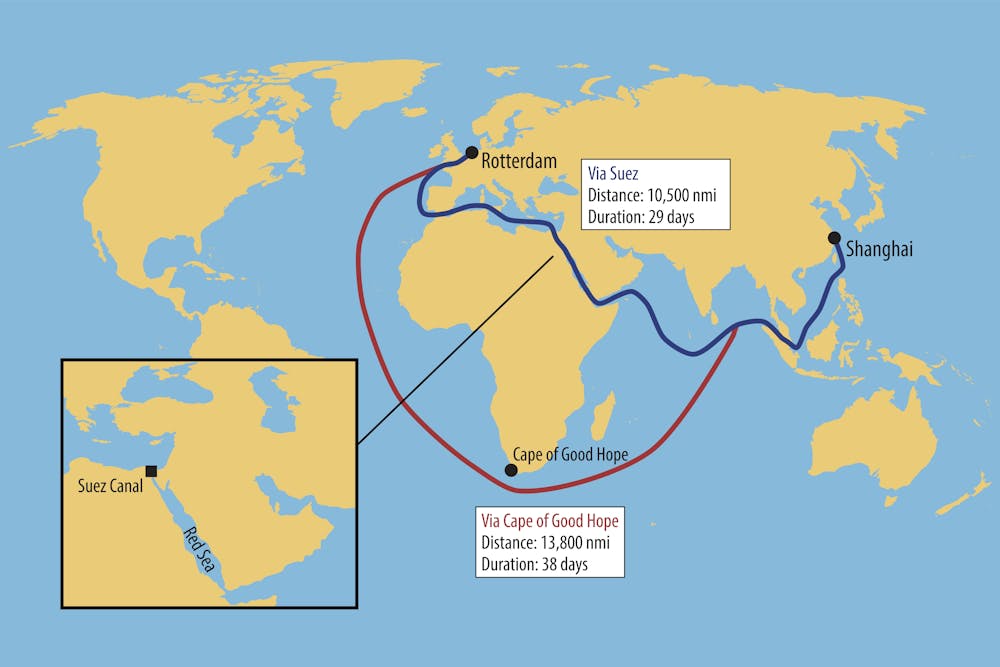
    These attacks have prompted many shipping companies to stop using the Red Sea – a route that around 12% of global trade usually passes through – and divert around the southern tip of Africa. This route adds more than 7,000 nautical miles on to a typical round-trip voyage. The number of commercial ships using the Suez Canal to pass between the Mediterranean and the Red Sea plummeted from over 26,000 in 2023 to 13,200 in 2024.

    Supply chains have had to deal with higher shipping costs, product delivery delays, and increased carbon emissions as a result of this diversion. The Gaza ceasefire gave some hope that the disruption would finally end. But shipping lines will not hurry back to the region until long-term security is guaranteed.

    Since November 2023, shipping companies have been diverting their vessels around the southern tip of Africa to avoid the Red Sea.
    Dimitrios Karamitros / Shutterstock

    During the early stages of the crisis, moving a container from Shanghai in China to Europe cost approximately 250% more than before the war in Gaza began. This was largely due to increased fuel costs and higher insurance premiums. Freight rates (the price companies pay to transport goods) remained high throughout 2024, despite some fluctuations.

    The cost of moving a 40-foot container from Shanghai to Rotterdam in the Netherlands, for example, surged from around US$4,400 on average in January to above US$8,000 by August. This had dropped to US$4,900 at the end of the year.

    It is too early to say whether these costs will be passed on to consumers in the form of higher prices – full transmission through the supply chain to consumer prices can take upwards of 12 months. But some estimates suggest global consumer prices could rise by 0.6% on average in 2025 as these increased shipping costs filter through the supply chain.

    Diverting around southern Africa also resulted in delays in the delivery of many goods and components. The proportion of container ships that arrived on schedule dropped from 60% on average worldwide in 2023 to about 50% throughout 2024. This created congestion at ports because ships often arrived at their destination later than planned, resulting in further delivery delays.

    Unreliable transit times are a significant issue for supply chains because they make it difficult for businesses to plan inventory and coordinate production schedules. Indeed, several vehicle manufacturers, including Tesla and Volvo, temporarily suspended manufacturing in early 2024 due to a lack of components. And food supply chains, including those for avocados, tea and coffee, were also affected by delays.

    Since then, many companies have adapted by increasing their safety stock levels and transporting cargo using alternative modes of transport like air and rail. Some European firms have also adopted a strategy called “nearshoring”, where they source products from regions closer to home such as Turkey and Morocco instead of relying on suppliers in Asia.

    Increased emissions

    The longer route around southern Africa requires that ships travelling between Europe and Asia use around 33% more fuel on average than they would use by travelling through the Red Sea at the same speed.

    Over the past decade, most shipping companies have employed a “slow steaming” policy to economise on fuel use and minimise their carbon emissions. But diverted ships have been travelling around 5% faster than usual in an attempt to minimise delays. The increased vessel speeds will have caused the associated emissions toll to rise – large container vessels require 2.2% more fuel for every 1% increase in speed.

    More data is required to determine the precise amount of additional emissions caused by diverting shipping away from the Red Sea. But estimates suggest that approximately 13.6 million tonnes of CO₂ were emitted by ships rerouted from the Red Sea between December 2023 and April 2024 – equivalent to the carbon emissions of nine million cars over the same period. If ships continue to avoid the region, the increased emissions could amount to 41 million extra tonnes of CO₂ per year.

    Some cargo has also shifted from sea transport to air freight, which has a far greater environmental footprint. Shipping a kilogram of product by long-haul air freight generates at least 50 times more CO₂ emissions on average than container shipping.

    Carbon emissions have increased due to the diversion of vessels around southern Africa.
    David G40 / Shutterstock

    Before returning to the Suez Canal, container lines will want to see a prolonged period of stability around the Red Sea. This is due, in part, to safety and security concerns related to the crew, cargo and the ship.

    But shipping companies also have operational challenges to keep in mind associated with the scheduling of port calls and voyages. Shipping lines will find it difficult to switch back to the longer route around Africa immediately if attacks in the Red Sea resume.

    And, at least for now, the situation in the Bab al-Mandab Strait remains unpredictable. In a televised speech on January 20, Houthi leader Abdul-Malik al-Houthi warned: “We have our finger on the trigger.”

    With other disruptions continuing to affect global shipping, such as port strikes, low water levels in the Panama Canal and extreme weather events, supply chain issues are likely to continue throughout 2025.

    Gokcay Balci does not work for, consult, own shares in or receive funding from any company or organisation that would benefit from this article, and has disclosed no relevant affiliations beyond their academic appointment.

    ref. Red Sea crisis: supply chain issues set to continue despite Gaza ceasefire – https://theconversation.com/red-sea-crisis-supply-chain-issues-set-to-continue-despite-gaza-ceasefire-248469

    MIL OSI – Global Reports

  • MIL-OSI NGOs: Joint Statement by humanitarian, development and human rights organisations in Lebanon: We need a Permanent Ceasefire and a Just Recovery

    Source: Oxfam –

    We, the undersigned organisations operating in Lebanon, urgently call on parties to abide by their commitments towards a permanent ceasefire in Lebanon and appeal to the international community to ensure the respect and full implementation of the temporary ceasefire agreement, now being extended until February 18th 2025.

    While the temporary ceasefire remains in effect and has been extended, we express deep concern about the numerous reported violations that continue to weaken the agreement.. Over 800 violations by Israeli forces[1] and at least one violation by Hezbollah[2] have been reported. As of January 23, 2025 violations by Israeli forces have included indiscriminate ground and air attacks, killing at least 30 people, since November 27, 2024, bringing the total number of people killed by Israeli forces since October 8, 2023 to 4,285, including 241 health care workers, and 17,200 wounded[3]. On Sunday January 26, 2025, alone, Israeli military forces killed 24 individuals, including six women and a Lebanese soldier, and injured 134 including 12 children in the South of Lebanon[4]. Thousands of people, including women and children, older people and people with disabilities have been uprooted from their homes, cut off from food, healthcare and education and exposed to hugely traumatic events – with, so far, no accountability for the destruction or indiscriminate killing.

    This agreement represents a step towards implementing UN Security Resolution 1701 and included a “phased withdrawal of the Israeli Defense Forces south of the Blue Line and the parallel deployment of the Lebanese Armed Forces (LAF) south of the Litani river” that “should not exceed 60 days”.[5] There is still an opportunity to transform temporary undertakings into longer term commitments.

    While many are attempting to return to their homes, hundreds of thousands of people still face the grim reality of either not being able to return because of ongoing Israeli forces’ ground occupation or because of the scale of destruction. Israeli forces have razed entire villages and destroyed agricultural lands and vital infrastructure, including hospitals and schools. Lands are contaminated by unexploded ordnance posing threats to life and risks for the reconstruction efforts.

    As human rights and humanitarian organisations, we will continue supporting all affected people with emergency assistance, recovery and reconstruction[6], but the humanitarian crisis remains severe. Plans for recovery and reconstruction have begun amidst a lingering socio-economic crisis and skyrocketing poverty rates, with nearly one Third of children in Lebanon facing crisis levels of hunger[7]. The economic losses due to the conflict are estimated at 8.5 billion USD[8], and Lebanon desperately needs support for its recovery. The consequences of this destruction will be felt in Lebanon for years to come, and yet again, with no accountability.

    As humanitarian and human rights organisations involved in the immediate relief, early recovery and reconstruction efforts in Lebanon, we urgently call for:

    1. Immediate, Unconditional and Definitive Ceasefire in Lebanon and the Region:
    • The international community to take every step possible, including through diplomatic and political leverage, to ensure an immediate and definitive ceasefire in Lebanon. The temporary and conditional agreement must allow for a transition to a permanent ceasefire.
    • The international community must also ensure the respect and implementation  of the pause in hostilities in Gaza and an end to excessive use of force in the West Bank, acknowledging that this is essential to protect civilians and prevent further escalation and regional spillover.

    1. Unconditional Humanitarian Access and Scaling Up Assistance:
    • Ensure rapid, unhindered access to conflict-affected areas and safeguard humanitarian facilities and personnel across the country.
    • Fully fund the humanitarian flash appeal to address the acute needs across Lebanon to enable the provision of immediate, flexible funding for gender, age and disability responsive humanitarian responses, including cash assistance, safe shelter, and healthcare.
    • Support reconstruction efforts through grants, not loans, and fund early warning and early action and anticipatory action to mitigate further shocks.

    1. Inclusive Recovery Focusing on Social Cohesion:
    1. Supporting Local and National NGOs in Response Planning and Implementation:
    • Increase financial and logistical support to local and national NGOs[9], including women’s rights and women-led organizations, and ensure these are at the forefront of responding to the crisis and receive direct, timely and flexible funding to meet growing needs.

    1. Halt the Transfer of Arms to Conflict Parties:
    • Suspend immediately the transfer of all weapons, parts, munitions, and ammunition to parties to the armed conflict when there is a risk they might be used to commit or facilitate violations of IHL and IHRL and other further grave violations in Lebanon and the region.

    1. Accountability and Respect for International Law:

    There is cautious optimism following recent political developments, including the appointments of both President and Prime Minister. However, meaningful international support is critical to fulfill the aspirations of the people in Lebanon for sustainable peace and justice. It is the persistent failure to seek accountability for violations that has fuelled cycles of violence now affecting the entire region. The time for action is now to ensure a just recovery and lasting peace in Lebanon and the region.

    MIL OSI NGO

  • MIL-OSI USA: Warren Warns Hegseth Against Going After Former Joint Chiefs Chairman General Milley, Demands Reinstatement of Pentagon Watchdog

    US Senate News:

    Source: United States Senator for Massachusetts – Elizabeth Warren
    January 30, 2025
    “I am concerned that the removal of the Senate-confirmed IG will result in waste, fraud, and abuse of taxpayer funds, undermine accountability, and open the door to an unprecedented politicization of the Defense Department and the armed forces.”
    Text of Letter (PDF) 
    Washington, D.C. – U.S. Senator Elizabeth Warren (D-Mass.), Ranking Member on the Senate Armed Service Subcommittee on Personnel, wrote to Secretary of Defense Pete Hegseth with concerns following the removal of the Department of Defense (DoD) Inspector General (IG), Robert Storch. Senator Warren urged Secretary Hegseth to request President Trump rescind the decision to remove the IG and called out his abuse of power. 
    Mr. Storch was one of over a dozen IG’s that were reportedly fired by President Trump in an illegal “Friday night purge.” Before the president can fire an inspector general, he must provide notice to Congress within 30 days prior, including providing “substantial rationale” for the removal. Congress received no notice, and as of today, has not received a rationale. 
    In written responses to Senator Warren, Secretary Hegseth committed “to protecting the DoD IG’s independence.” During his confirmation hearing, he promised to be a “change agent” who would make sure that “[l]eaders—at all levels—will be held accountable.” These commitments will be impossible without an independent Inspector General. 
    “[N]ow that the IG has been removed, and less than 72 hours after your swearing in ceremony, you appear to be abusing your power to weaponize the government against the President’s political enemies,” wrote Senator Warren. 
    Senator Warren also wrote with concerns that Secretary Hegseth reportedly is stripping four-star General Mark Milley, the former chairman of the joint chiefs of staff, of his security detail and clearance, as well as directing the acting IG to conduct a review board to demote him. Members of Congress already asked the DoD IG to investigate this issue in 2022. After the IG reviewed “hundreds of pages of documents, including classified and unclassified records,” the IG concluded that “further inquiry…is not warranted.” 
    Retired General Milley is also among several officials provided security due to continued threats to his life from Iran.
    “It is reckless that your actions could pave the way for Iran’s revenge. Any reopening of General Milley’s administratively determined retired grade requires prior notice to Congress, due process for General Milley, and in the case of any redetermination, the advice and consent of the Senate,” said Senator Warren.
    “I am concerned that the removal of the Senate-confirmed IG will result in waste, fraud, and abuse of taxpayer funds, undermine accountability, and open the door to an unprecedented politicization of the Defense Department and the armed forces,” concluded Senator Warren. 

    MIL OSI USA News

  • MIL-OSI: Amid Trump Funding Freeze, Crowded Raises $7.5M to Improve Nonprofit Efficiency

    Source: GlobeNewswire (MIL-OSI)

    MIAMI, Jan. 30, 2025 (GLOBE NEWSWIRE) — With nonprofits facing new financial uncertainty in the wake of President Trump’s federal funding freeze, Crowded, the mission-driven fintech platform simplifying financial management for nonprofit organizations, today announced it has raised $7.5 million in its Series A funding round, bringing its total funding to $13.5 million to date.

    President Trump’s executive order to halt certain federal grants and funding has put thousands of nonprofit programs at risk, leaving organizations scrambling for alternative financial solutions. The uncertainty has heightened the need for transparency, efficiency, and real-time access to financial resources—challenges that Crowded directly addresses through its AI-driven financial management tools.

    The round was led by Flashpoint a $500m transatlantic VC that counts Guesty, Chili Piper and Mesh Payments among their portfolio companies with participation from the Florida Opportunity Fund, Wilson’s Bird Capital led by Efi Shema, as well as follow-on investments from existing investors Sarona Ventures and The Garage.

    Crowded is trusted by over 35 institutional customers, including renowned organizations such as Harvard Athletics, Pi Kappa Alpha Fraternity, and leading councils of Girl Scouts of the USA. Harvard Athletics is utilizing Crowded’s platform for select teams to manage per diems for student-athletes. These student-athletes can now spend their per diems with digital debit cards and make instant, fee-free transfers with their peers.

    By digitizing financial management and eliminating manual processes, Crowded enables nonprofits to redirect their focus from administrative tasks to community-focused work. Crowded’s robust platform provides nonprofits with tailored multi-chapter banking, payment processing, expense management, and AI-powered tax filing services, empowering organizations with tools for financial oversight and compliance. 

    “In the wake of President Trump’s executive order & funding freeze, the spotlight on nonprofit financial management and accountability has never been brighter,” said Daniel Grunstein, Co-Founder and CEO of Crowded. “Nonprofits handle $3.9 trillion in payments annually and make up 14% of US GDP, yet outdated systems and fragmented processes hold back their efficiency and impact. This funding allows us to expand our nonprofit financial management platform with payment processing, compliance, and AI-powered taxation tools—giving nonprofits the modern infrastructure they need to operate as seamlessly as the world’s top enterprises. By solving these challenges, we’re enabling organizations to focus less on administration and more on their mission to drive change.”The lead investor, Flashpoint, emphasized the potential for Crowded’s mission-driven approach. “With the recent funding freeze creating uncertainty for nonprofits, solutions like Crowded are more critical than ever,” said Noam Wolf at Flashpoint. “Crowded is dedicated to helping nonprofits focus on their mission rather than their balance sheets, and this moment highlights the urgent need for financial transparency and resilience. We are proud to support their growth and look forward to seeing them empower more organizations to do good.”

    About Crowded
    Crowded is an all-in-one financial management platform for nonprofits that allows for 100% online multi-chapter nonprofit banking, built-in payment processing, transparent spending tools, and AI-powered tax filing and compliance. Nonprofit finances are managed remotely and effectively; saving time on reporting, reimbursements, and officer handovers. 

    Founded in 2021 and headquartered in Miami, Florida with offices in Tel Aviv, Israel, Crowded serves a diverse range of nonprofit sectors, including membership groups and charitable and religious institutions, helping them ensure financial clarity, transparency, and sustainability. 

    Users can learn more at bankingcrowded.com.

    About Flashpoint
    Flashpoint is an international tech investment manager with over $500 million AUM focused on US and Western European tech companies originating from Europe and Israel. Flashpoint manages six venture funds across three products: Venture Capital, Venture Debt, and Direct Secondaries. Headquartered in London with offices in New York, and Tel Aviv, the funds have invested in 72 companies and completed 23 exits, including Shazam (to Apple), Chess.com (to PokerStars founders and General Atlantic), and Marketman (to PSG).

    Users can learn more at http://www.flashpointvc.com

    Contact

    PR for Crowded
    Orian Tal
    orian@thepitch.media

    A photo accompanying this announcement is available at https://www.globenewswire.com/NewsRoom/AttachmentNg/8548d593-caa3-4e9d-ad1a-e2f7048016b1

    The MIL Network

  • MIL-OSI USA: Lankford Stands with Israel, Calls out Democrat Colleagues for Blocking Bill Undermining Israel’s Leadership

    US Senate News:

    Source: United States Senator for Oklahoma James Lankford
    Washington, DC – Senator James Lankford (R-OK), Republican Conference Vice Chair, co-chair of the Senate Abraham Accords Caucus, and co-chair of the Bipartisan Task Force for Combating Antisemitism, hosted a floor event and delivered remarks calling to stand with Israel.
    Excerpts
    “Israel just wants to live in peace. In the middle of a war, when a group of terrorists crossed the border and began to slaughter Israelis, the International Criminal Court determined it was going to jump in and make a clear statement….about terrorism, call out those that are attacking civilians and slaughtering people as they sleep on that morning. But instead, the International Criminal Court released arrest warrants for Benjamin Netanyahu, the Prime Minister of Israel, and for Yoav Gallant, the now former defense minister, for trying to defend their country from terrorism…So this body in the United States Senate had an opportunity yesterday to be able to speak out on that, and to actually sanction and to allow further sanctions for individuals from the International Criminal Court and entities that cooperate with them to say, ‘You cannot come after the United States or after our allies.’ It was a very simple, straightforward bill. It was a bill that passed with a very large bipartisan majority through the House of Representatives. In fact, it’s passed twice now with a large bipartisan majority in the House of Representatives. But when it came here to the United States Senate, my Democratic colleagues shrugged and said ‘no.’”
    ….
    “The Trump Administration, I’m confident, will speak out with sanctions against the International Criminal Court. They did during the first Trump presidency. I’m confident they will again. What I’m not confident of is every future president after President Trump, if they will hold the same high standard to be able to protect American citizens, our soldiers, and to be able to stand alongside with Israel.”

    MIL OSI USA News

  • MIL-OSI Security: IAEA Sees Operational Safety Commitment at Novovoronezh Nuclear Power Plant in Russia

    Source: International Atomic Energy Agency – IAEA

    An International Atomic Energy Agency (IAEA) team of experts said that the operator of the Novovoronezh Nuclear Power Plant (NPP) in the Russian Federation has shown a commitment to enhancing operational safety.

    Requested by the Government of the Russian Federation, the Operational Safety Review Team (OSART) mission ran from 13 to 30 January. The Team reviewed operational safety in Units 4 and 6 of the Novovoronezh NPP. An OSART mission was previously completed for Unit 5 in 2015.

    OSART missions independently assess safety performance against the IAEA’s safety standards. The aim is to advance operational safety by proposing recommendations and, where appropriate, suggestions for improvement.

    The Novovoronezh NPP is located in the Voronezh region, about 600 kilometres south of Moscow. The plant is owned by State Atomic Energy Corporation Rosatom (ROSATOM) and operated by Novovoronezh NPP, a subsidiary of the Rosenergoatom Joint Stock Company. The plant consists of seven units. Units 1, 2 and 3 are permanently shutdown and under decommissioning. Units 4, 5, 6 and 7 are operating. All units are pressurized water reactors (VVERs); Units 4 and 5 are VVER-V179 (417 MWe) and VVER-187 (1000 MWe), respectively. Units 6 and 7 are both VVER-392M (1180 MWe). Russia has 36 nuclear power reactors in operation, providing almost 20 per cent of the country’s total electricity production.

    The team reviewed operating practices in Units 4 and 6 in the areas of leadership and management for safety, training and qualification, operations, maintenance, technical support, radiation protection, chemistry and accident management. The team was composed of seven experts from Belarus, Brazil, China, the Islamic Republic of Iran and South Africa, as well as four IAEA staff members and an observer from Russia.

    To make its assessment, the team reviewed documents from the Novovoronezh plant on its main technical features, staff organization and responsibilities, and its operational programmes, procedures and performance prior to the mission. During the mission, the team observed the plant in operation, examined indicators of its performance and held in-depth discussions with plant personnel.

    The OSART team observed that the staff at the plant are knowledgeable and professional and are committed to improving the operational safety and reliability of the plant.

    The team identified one good practice to be shared with the nuclear industry globally:

    • The main control room operators at Novovoronezh NPP have access to an electronic display for real-time indication of hydrogen ignition risk inside the containment building in the case of a severe accident.

    The mission also provided some suggestions to further improve safety, including that the plant should consider enhancing:

    • The consistent use of tools to minimize human error.
    • The quality of maintenance activities.
    • The arrangements for the monitoring and reporting of equipment condition and material deficiencies to ensure that any degradation is identified and reported.

    “We are grateful to the international experts of the IAEA for conducting a comprehensive inspection at two power units of the Novovoronezh NPP – Unit 4 and Unit 6. This is a reputable team with over 282-years combined operational experience in the nuclear power industry. According to the mission results, the plant received suggestions to enhance further the operational safety performance of Units 4 and 6,” said Vladimir Povarov, Director of Novovoronezh NPP. “The mission confirmed that there was good alignment between the plant practices and the requirements in the IAEA standards.”

    “Three of the four Novovoronezh NPP power units in operation have already successfully undertaken an IAEA international peer review. And we plan for power Unit 7 to be subjected to this procedure in the future,” Povarov added.

    The team provided a draft report of the mission to the plant management. They will have the opportunity to make factual comments on the draft. These comments will be reviewed by the IAEA, and the final report will be submitted to the Government within three months.

    Background

    General information about OSART missions can be found on the IAEA website. An OSART mission is designed as a review of programmes and activities essential to operational safety. It is not a regulatory inspection, nor is it a design review or a substitute for an exhaustive assessment of the plant’s overall safety status.

    Follow-up missions are standard components of the OSART programme and are typically conducted within two years of the initial mission.

    The IAEA Safety Standards provide a robust framework of fundamental principles, requirements and guidance to ensure safety. They reflect an international consensus and serve as a global reference for protecting people and the environment from the harmful effects of ionizing radiation.

    MIL Security OSI

  • MIL-OSI: ProVen Growth and Income VCT plc: Interim Management Statement

    Source: GlobeNewswire (MIL-OSI)

    ProVen Growth and Income VCT plc
    Interim Management Statement
    for the nine months ended 30 November 2024

    ProVen Growth and Income VCT plc (the “Company”) presents an Interim Management Statement for the nine-month period ended 30 November 2024. The statement also includes relevant financial information between the end of the period and the date of this announcement.

    Performance

            Unaudited
    30-Nov 2024
    Unaudited
    31-Aug
    2024
    Unaudited
    31 May
    2024
    Audited
    29-Feb
    2024
            Pence Pence Pence Pence
    Net Asset Value per share (“NAV”)       51.7 51.5 54.7 54.7
    Dividends paid since class launch (originally as ‘C’ Shares)*       79.90 79.90 78.40 78.40
    Total Return (NAV plus dividends paid since ‘C’ Share class launch)       131.60 131.40 133.10 133.10

    * Dividends paid represents dividends paid in respect of the Original ‘C’ Shares between their launch in 2006 up until their conversion in 2009 and as Ordinary Shares since the ‘C’ Share conversion. ‘C’ Shares were converted into Ordinary Shares on a one for one basis in 2009.

    Dividends paid or declared
    On 5 November 2024, the Company announced an Interim dividend for the year ending 28 February 2025 of 1.25p per share. This dividend was paid on 17 January 2025 to Shareholders on the register at 20 December 2024. Payment of this dividend will reduce the NAV per share as shown above to 50.45p and increase dividends paid to date to 81.15p per share.

    Investment portfolio summary at 30 November 2024
    Portfolio summary

      Cost Valuation
    Venture capital investments £’000 £’000
         
    Picasso Labs, Inc. (t/a CreativeX) 4,546                  11,425
    Luxury Promise Limited 6,020                   9,360
    MPB Group Limited 1,194                   6,476
    Gorillini NV (t/a Gorilla) 2,886                   6,464
    Social Value Portal Ltd 2,542                   5,472
    Dash Brands Ltd 3,282                   5,277
    Infinity Reliance Limited (t/a My 1st Years) 2,769                   5,057
    Utilis Israel Ltd (t/a Asterra) 2,144                   4,803
    Papier Ltd 4,703                   4,703
    Lupa Foods Limited 284                   4,585
    Other investments 81,716 60,970
    Total investments 112,086 124,592
         
    Cash and cash equivalents   39,655
    Other net current assets   (2,186)
         
    Net Assets   162,061

    Unquoted investments are valued at fair values established using the International Private Equity and Venture Capital Valuation Guidelines.

    Investment activity during the three-month period ended 30 November 2024

    Investment additions

    There were no additions made in the quarter to 30 November 2024.

    Investment disposals


    Cost

    Market
    value at 1 March 2024

    Disposal
    proceeds

    Gain
    against
    cost
    Realised gain/
    (loss)
    in period
      £’000 £’000 £’000 £’000 £’000
    Lupa Foods Limited (loan repayment) 362 468 468 106
    Buckingham Gate Financial Services Limited 150 155 155 5
      362 618 623 261 5

    Investment activity from 1 December 2024 to the date of this announcement

    In the period from 1 December 2024 to the date of this announcement, a follow on investment was made in Social Value Portal Ltd at cost of £118,000.

    In the period from 1 December 2024 to the date of this announcement, Lupa Foods Limited was fully disposed of, realising £4,574,000 of proceeds for the Company. Commonplace Digital Limited was disposed of for consideration of shares in Zencity Technologies Ltd. 

    Changes to share capital Ordinary
    Shares
    of 1.6187p each
    As at 1 September 2024 315,001,048
    Shares bought back during the 3 months to 30 November 2024 (4,402,488)
    Shares issued during the 3 months to 30 November 2024 3,129,865
    As at 30 November 2024 313,728,425

    In the period from 1 December 2024 to the date of this announcement, 1,797,547 Ordinary Shares were issued on 5 December 2024 pursuant to the offer for subscription that opened on 6 November 2024 and were allotted at an average price of 53.38p, based on the net asset value of 51.5p per Ordinary Share, being the net asset value as at 31 August 2024.

    In the period from 1 December 2024 to the date of this announcement, 1,094,340 Ordinary Shares were issued under the Company’s Dividend Reinvestment Scheme (“DRIS”) in relation to the dividend paid on 17 January 2025.

    Offer for Subscription
    ProVen VCT plc and ProVen Growth and Income VCT plc (the “Companies”) announced on 6 November 2024 that they had published a Prospectus (comprising Securities Note, Registration Document and Summary) in respect of a combined offer for subscription to raise up to £30,000,000 (up to £15,000,000 for each Company) by way of an issue of new ordinary shares in the Companies, with an over-allotment facility of up to a further £10,000,000 (up to £5,000,000 for each Company).

    Material events
    Other than the matters described above, there were no material events during the period from 1 September 2024 to 30 November 2024 or in the period from 1 December 2024 to the date of this announcement.

    Further information
    Further information regarding the Company can be found on the Company’s website: www.proveninvestments.co.uk or by contacting Beringea, the Investment Manager at info@beringea.co.uk or by telephone 020 7845 7820.

    Beringea LLP
    Company Secretary
    Telephone 020 7845 7820
    -End

    The MIL Network

  • MIL-OSI United Nations: Syria: Hostilities and aid challenges persist across devastated country

    Source: United Nations 4

    Peace and Security

    Humanitarians warned on Thursday that Syria continues to face major security and aid challenges in the northeast and beyond, in the uncertain aftermath of the overthrow of the Assad regime.

    In an update, the UN aid coordination office, OCHA, said more than 25,000 people have been newly uprooted from the northeastern city of Manbij where shelling and airstrikes have been reported.

    OCHA noted that hostilities have been intensifying over the past week, particularly in eastern Aleppo and around the Tishreen Dam.

    The dam is a key target for different groups of Syrian fighters vying for control of northern Syria. These include the Turkish-backed Syrian National Army (SNA) and the mainly Kurdish Syrian Democratic Forces (SDF) fighting alongside the PKK/YPG – the Kurdish Workers’ Party or People’s Protection Units. 

    Hundreds of thousands fleeing

    As a result of the escalating violence, the number of newly displaced people has increased to 652,000 as of 27 January, OCHA said.

    The deadly incidents reported in Syria’s northeast include shelling that struck a town in the Manbij countryside on 25 January, injuring an unverified number of children.

    On Saturday, clashes affected a displacement camp in Jarablus north of Manbij, injuring seven including two children and destroying five shelters. 

    On the same day, a car bomb detonated in front of a hospital and school in Manbij city, reportedly killing one civilian and injuring seven others.

    In the past week, OCHA, has also reported clashes in coastal areas  with “increased criminal activities, including looting and vandalism, constraining the movements of civilians during night hours”.

    The UN agency also noted continuing Israeli incursions into Quneitra in southern Syria, near the Golan Heights buffer zone that the Israeli military moved into – forces said temporarily – following the ouster of President Assad.

    Massive aid needs

    More widely across Syria’s governorates, the UN agency warned that a “lack of public services and liquidity constraints” have severely affected communities and the humanitarian response. In Homs and Hama, for instance, electricity is available for only 45 to 60 minutes every eight hours.

    In northwest Syria, 102 health facilities have already run out of funds since the start of 2025. The UN and its humanitarian partners are appealing for $1.2 billion to help the most vulnerable 6.7 million people in Syria until March.

    The developments came ahead of a UN Security Council meeting later on Thursday behind closed doors on Syria – and the reported declaration that head of Hayat Tahrir Al Sham and the caretaker authority in Damascus, Ahmed al-Sharaa, has been declared transitional president.

     It was also reported that the new caretaker authority has decided to suspend the Syrian constitution.

    MIL OSI United Nations News

  • MIL-OSI USA: Graham Statement on Passing of Robbi Force

    US Senate News:

    Source: United States Senator for South Carolina Lindsey Graham
    WASHINGTON – U.S. Senator Lindsey Graham (R-South Carolina) today released the following statement on the passing of Robbi Force. Robbi was the mother of Taylor Force, a West Point graduate and United States Army veteran who was visiting Israel as a part of a Vanderbilt University program. He was brutally stabbed and murdered by a Palestinian terrorist. The Palestinian Authority praised Force’s killer as a ‘heroic martyr’ and paid the killer’s family a monthly cash stipend. At the time, Taylor’s parents, Robbi and Stuart, lived in Kiawah Island, South Carolina.
    “I am very sad to hear of the passing of Robbi Force, who was the mother of Taylor Force, the young man murdered by a Palestinian terrorist. Afterward, the terrorist was hailed as a hero by the Palestinian Authority, and the killer’s family received martyr payments.
    “As a result of this outrage, I authored and was able to pass the Taylor Force Act, which cuts off U.S. aid to the Palestinian Authority for the martyr payment practice.
    “Robbi was instrumental in getting this law passed. She and her husband, Stuart, were tireless advocates for this cause.
    “Robbi was a kind and sincere woman. There is some comfort in knowing she is now reunited with her dear son, Taylor. My prayers are with Stuart and the entire Force family. May she rest in peace.”
    Background:
    After Taylor Force’s murder, Graham introduced and successfully passed the Taylor Force Act into law to prohibit American taxpayer dollars from going to the Palestinian Authority in response to the practice of martyr payments. Graham is also a cosponsor of legislation to sanction members of Palestinian leadership and organizations who reward terrorism.

    MIL OSI USA News

  • MIL-OSI: From Davos to reality: $1B partnership begins with $220M Lumia Towers by SEN

    Source: GlobeNewswire (MIL-OSI)

    DAVOS, Switzerland, Jan. 30, 2025 (GLOBE NEWSWIRE) — Lumia Foundation and SEN Group have officially commenced construction and tokenization of the highly anticipated Lumia Towers by SEN, the first project under their landmark $1 billion real estate tokenization agreement. Valued at $220 million, the twin towers will redefine modern urban living by integrating luxurious residential spaces with Turkey’s first dedicated crypto hub.

    Located in Istanbul, Turkey, the Lumia Towers by SEN project symbolizes a powerful collaboration between Lumia Foundation, created by US-based visionaries Kal and Yanush Ali, and Turkey’s SEN Group, a leader in sustainable and earthquake-resistant real estate development.

    A vision introduced in Davos

    At the World Economic Forum in Davos, Lumia Foundation’s co-founder Yanush Ali, Chief Blockchain Architect Deniz Dalkilic, and Chief Product Officer Diego Grassano, presented the Lumia Towers by SEN project and the broader tokenization initiative. Their series of presentations, hosted by Webit, CVLabs, and Blue Hat Founders, emphasized how blockchain technology can revolutionize real estate markets and empower global investors.

    “This is our debut at Davos, and we’re honored to be here at the invitation of our partner Binance, who has been instrumental in supporting Lumia as the only full-cycle RWA blockchain,” said Yanush Ali, co-founder of Lumia Foundation. “Events like these define global industry trends, and asset tokenization is poised to become a major focus for 2025. That’s why we chose the World Economic Forum as the stage to announce our groundbreaking $220 million twin skyscraper project in Istanbul. This development isn’t just a milestone for us—it’s a statement. We’re tokenizing the entire project, creating Turkey’s first Crypto hub, and setting a new standard for innovation in real estate and blockchain technology.”

    Diego Grassano, reflecting on the project’s innovation, remarked:
    “With Lumia Towers, we are not just building structures; we are building opportunities. Tokenization allows anyone, anywhere, to become a part of something extraordinary.”

    Deniz Dalkilic highlighted the blockchain aspect:
    “Our mission is to create a seamless bridge between Real World Assets and DeFi ecosystems. Lumia Towers is just the beginning of what blockchain can achieve in transforming industries.”

    Empowering small investors
    By tokenizing real estate properties, Lumia Foundation aims to democratize access to high-value investments. Traditional real estate investments often require significant capital, making them inaccessible to smaller investors. However, with the Lumia Towers by SEN project, token ownership begins at just $1, enabling investors worldwide to participate.

    This innovation aligns with the growing trend of Real World Assets (RWA), a market projected to reach $10 trillion by 2030. Lumia Foundation’s efforts are further amplified by its collaboration with Binance, with the two organizations sponsoring Webit, a leading technology and innovation event.

    A milestone for blockchain and real estate
    The $1 billion framework agreement between Lumia and SEN Group is a testament to the potential of combining blockchain with real estate development. The construction of Lumia Towers by SEN is not just a step forward for the partnership but a significant contribution to Turkey’s economic growth and global leadership in blockchain innovation.

    “This partnership represents the perfect synergy of cutting-edge technology and real-world application,” said Kal Ali, co-founder of Lumia Foundation. “Turkey has enormous potential to set new standards in innovation, and we are proud to be a part of this transformative journey.”

    About Lumia Foundation
    Lumia Foundation is a next-generation blockchain platform focused on tokenizing Real World Assets and integrating them into the DeFi and Web3 ecosystems. Created by US-based visionaries Kal and Yanush Ali, Lumia combines innovative technology with a vision for financial inclusion.

    About SEN Group
    SEN Group is a Turkish real estate developer specializing in sustainable and earthquake-resistant housing. Known for its innovative construction techniques, the company is committed to advancing Turkey’s urban landscape with cutting-edge technologies

    Media Contact

    Lumia Foundation
    Furkan Karasaç
    Founder of SEN Grup
    hadiye.taskin@sengrup.com

    SEN Group
    Kal Ali
    Lumia Founder
    egor@lumia.org

    Disclaimer: This content is provided by Lumia Foundation. The statements, views and opinions expressed in this column are solely those of the content provider. The information provided in this press release is not a solicitation for investment, nor is it intended as investment advice, financial advice, or trading advice. It is strongly recommended you practice due diligence, including consultation with a professional financial advisor, before investing in or trading cryptocurrency and securities. Please conduct your own research and invest at your own risk.

    Photos accompanying this announcement are available at

    https://www.globenewswire.com/NewsRoom/AttachmentNg/82643737-1950-446d-90ea-e7fd9502c176

    https://www.globenewswire.com/NewsRoom/AttachmentNg/04512c52-dd57-4c95-864a-a0556b17f6fd

    https://www.globenewswire.com/NewsRoom/AttachmentNg/8b0fbd82-1287-4501-ad51-a4fb513c0fb4

    The MIL Network

  • MIL-OSI USA: New data for improved navigation in the upper Hudson River

    Source: US National Ocean Service News

    The Hudson River Estuary PORTS® station at Turkey Point, New York in January 2025. It measures and disseminates observations and predictions of water levels, currents, salinity, and meteorological parameters — winds, atmospheric pressure, air and water temperatures — that mariners need to navigate safely. Credit: Sarah Fernald, NYSDEC.

    Navigating New York waterways just got a bit easier. NOAA and the New York State Department of Environmental Conservation announced the establishment of the Hudson River Estuary Physical Oceanographic Real-time System (PORTS®). The system delivers real-time oceanographic and meteorological observations that can improve maritime safety and inform coastal resource management in the region. Commercial mariners, recreational boaters, resource managers, and coastal planners can use the online tool to access real-time water level data from Sleepy Hollow to Troy, New York.
    The Hudson River Estuary PORTS® is the second system of its kind in New York — the first being situated 100 miles south that provides data for the New York-New Jersey Harbor PORTS®. The new system currently consists of one water level station at Turkey Point, south of Saugerties, New York, and is part of the New York State Department of Environmental Conservation’s Hudson River National Estuarine Research Reserve. The system will fill critical geographic gaps in the state’s maritime data and expand coverage to include the tidally influenced portions of the Hudson River, north of the Mario M. Cuomo Bridge.
    The Turkey Point station is equipped with pressure-based and microwave water level sensors, satellite transmitters, as well as rechargeable batteries and solar panels. The redundancy of the built-in sensors and power sources is designed to ensure the station operates in all weather conditions, and that NOAA’s critical real-time data continues to flow when it is most urgently needed by the maritime community. The station is also equipped with an anemometer that measures wind speed, pressure, and direction; sensors for air and water temperature, relative humidity, and conductivity; as well as a barometric pressure sensor to measure meteorological conditions.
    A second water level station will be added to the system later this year to deliver data from the upper portion of the Hudson River at the Coxsackie State Boat Launch and Riverside Park.
    Partners at the New York State Department of Environmental Conservation will maintain system sensors and provide sensor data and metadata to NOAA in accordance with National Ocean Service standards. NOAA will publish verified data on the Tides and Currents website. This collaborative effort will result in highly precise oceanographic and meteorological data delivered through NOAA web products in near real time.
    With the Hudson River Estuary PORTS®, NOAA now operates 39 real-time systems across the nation. NOAA PORTS® is a partnership program with local port authorities, pilot associations, the U.S. Coast Guard, the U.S. Navy, the U.S. Army Corps of Engineers, academia, and other stakeholders across the nation. Its systems support safe and cost-efficient navigation by providing ship masters, pilots, and other users with accurate real-time information required for safe vessel loading and transit, and to avoid groundings and collisions. These systems also improve hazardous spill response and enhance recreational activities.

    MIL OSI USA News

  • MIL-OSI Global: The growing influence of Israel’s ultranationalist settler movement

    Source: The Conversation – UK – By Leonie Fleischmann, Senior Lecturer in International Politics, City St George’s, University of London

    Days after taking office, as he issued executive order after executive order to change the political face of America, Donald Trump also turned his attention to the war in Gaza.

    His proposal that Gaza should be cleared out and Palestinians should be relocated to other countries such as Egypt and Jordan has been met with outraged disbelief in many quarters. The Arab League has accused him of advocating ethnic cleansing.

    But Trump’s statement has met with approval from far-right leaders in Israel. Influential politicians have been advocating for this “solution” for years. These include finance minister and leader of the Religious Zionist party, Bezalel Smotrich and his ideological ally Itamar Ben Gvir, leader of the Otzma Yehudit (Jewish Strength) party and former national security minister.

    Smotrich responded to Trump’s utterance with the declaration that he aimed to turn the idea into an actionable policy. Ben Gvir, who resigned his ministerial position recently in response to the Israeli acceptance of the latest ceasefire deal, claimed that the evacuation of Gazans was the most “humanitarian answer” to the crisis and the only way to ensure peace and security for both Israelis and Palestinians.

    The pair – and their followers in Israel – share an anti-Arab ideology and a messianic belief in the Jewish people’s right to what they call “Greater Israel”. This would be a Jewish state which would also include the West Bank, which they referred to as “Judea and Samaria”, as well as Gaza and part of Jordan, Lebanon, Egypt, Syria, Iraq and Saudi Arabia.

    They have repeatedly called for Israel to use the war as an opportunity to reoccupy Gaza.

    These leaders enjoy a degree of influence due to the amount of media attention they receive. But it would be a mistake to assume they represent the majority of Israelis.

    Data collected in 2024 by the Pew Research Center found that 45% and 41% of Israelis expressed very unfavourable views of Ben-Gvir and Smotrich, respectively. In the 2022 elections, as the combined Religious Zionist party, they won just 10.84% of the vote.

    Meanwhile, the Israel Democracy Institute found that a majority of Israelis (57.5%) support a comprehensive deal for the release of all the hostages in return for an end to the war in Gaza.

    And yet Israel’s ultranationalists have been able to take advantage of the changing political landscape in Israel over the past few decades and the fragile multiparty system to wield disproportionate power over a government that has depended on their support to stay afloat.

    Israel’s rightwards shift

    During the 1990s, there was significant support in Israeli society for the Oslo peace process towards a two-state solution to the Israeli-Palestinian conflict. This culminated in the historic handshake between the then Israeli prime minister, Yitzhak Rabin, and the Palestine Liberation Organisation chairman, Yasser Arafat, on the White House lawn in 1993.

    While support for the peace process reached a high of 72% in Israel in 1995 when Oslo II was signed, right-wing factions attempted to derail the agreements. Rabin was assassinated in November 1995 by Yigal Amir, an extremist Israeli Jew, who did not want to see the realisation of a Palestinian state.

    The collapse of the Camp David talks in 2000, which then prime minister Ehud Barak blamed on Arafat, was followed in short order by the outbreak of the second intifada. The idea that there was “no partner for peace on the Palestinian side” became a mantra for Israeli voters, who looked to those who could guarantee their security.

    Benjamin Netanyahu, who had been prime minister from 1996 to 1999, returned to power in 2009, with the image of “Mr Security”.

    Netanyahu is now Israel’s longest serving prime minister. His masterful manipulation of the fragile political system in Israel has accounted for his longevity in power.

    But it has also enabled a gradual shift towards the most right-wing coalition in Israel’s history. Part of that has been the Religious Zionist camp.

    Biblical promise

    The Religious Zionists originally formed a small minority of the broader Zionist movement in the years preceding the declaration of the State of Israel. Religious Zionists combine faith and nationalism. Their core belief is that the Jewish people have the God-given right to settle the whole of Greater Israel.

    The West Bank in particular, but also the Gaza Strip, were the sites of many key events in biblical times and the home of a number of Israelite kingdoms. In the Bible, God promises this land to the descendants of Abraham – the Jewish people. Religious Zionists have chosen to take this literally.

    Having failed to wield power through the parliament in the early days of statehood, the Religious Zionists sought to realise their ideology through extra-parliamentary activity. This meant establishing settlements with a view to change facts on the ground. In the aftermath of the 1967 war, the main focus of settlement building was national security, rather than religious nationalist ideology.

    But ideology has always been a key factor for those who live in the settlements in the West Bank today – and those who vow to return to Gaza. The movement has been successful by establishing outposts and settlements in the West Bank and in getting “their people” into government.

    The Religious Zionist camp is broad and heterogeneous, and according to recent polls now represents 22% of the Jewish population in Israel. The party’s position in holding the balance of power in the Israeli parliament, or Knesset, since the election in 2022, has enabled them to gradually wield greater influence on Israeli policy both in the West Bank and the war in Gaza.

    Meanwhile many of their supporters have formed settler groups, who use violence to destabilise and displace Palestinian families living in the West Bank.

    And now the US president has not only backed one of their dearest dreams, to clear Palestinians from Gaza, he has removed the Biden-era sanctions on several of the most aggressive settler groups. So the recent news that Netanyahu will be the first foreign leader to visit the White House next week feels particularly ominous for the fate of the Palestinian people.

    Leonie Fleischmann does not work for, consult, own shares in or receive funding from any company or organisation that would benefit from this article, and has disclosed no relevant affiliations beyond their academic appointment.

    ref. The growing influence of Israel’s ultranationalist settler movement – https://theconversation.com/the-growing-influence-of-israels-ultranationalist-settler-movement-248568

    MIL OSI – Global Reports

  • MIL-OSI Global: How nonprofits abroad can fill gaps when the US government cuts off foreign aid

    Source: The Conversation – USA – By Susan Appe, Associate Professor of Public Administration and Policy, University at Albany, State University of New York

    The U.S. Agency for International Development distributes a lot of foreign aid through local partners in other countries. J. David Ake/Getty Images

    The U.S. government gives other nations US$68 billion of foreign assistance annually – more than any other country. Over half of this sum is managed by the U.S. Agency for International Development, including funds for programs aimed at fighting hunger and disease outbreaks, providing humanitarian relief in war zones, and supporting other lifesaving programs such as the President’s Emergency Plan for AIDS Relief.

    President Donald Trump suspended most U.S. foreign aid on Jan. 20, 2025, the day he took office for the second time. The next day, Secretary of State Marco Rubio issued a stop-work order that for 90 days halted foreign aid funding disbursements by agencies like USAID.

    A week later, dozens of senior USAID officials were put on leave after the Trump administration reportedly accused them of trying to “circumvent” the aid freeze. The Office of Management and Budget is now pausing and evaluating all foreign aid to see whether it adheres to the Trump administration’s policies and priorities.

    I’m a scholar of foreign aid who researches what happens to the U.S. government’s local partners in the countries receiving this assistance when funding flows are interrupted. Most of these partners are local nonprofits that build schools, vaccinate children, respond to emergencies and provide other key goods and services. These organizations often rely on foreign funding.

    A ‘reckless’ move

    Aid to Egypt and Israel was spared, along with some emergency food aid. The U.S. later waived the stop-work order for the distribution of lifesaving medicines.

    Nearly all of the other aid programs remained on hold as of Jan. 29, 2025.

    Many development professionals criticized the freeze, highlighting the disruption it will cause in many countries. A senior USAID official issued an anonymous statement calling it “reckless.”

    InterAction, the largest coalition of international nongovernmental organizations in the U.S., called the halt contrary to U.S. global leadership and values.

    Of the $35 billion to $40 billion in aid that USAID distributes annually, $22 billion is delivered through grants and contracts with international organizations to implement programs. These can be further subcontracted to local partners in recipient countries.

    When this aid is frozen, scaled back or cut off altogether, these local partners scramble to fill in the gaps.

    The State Department manages the rest of the $68 billion in annual U.S. foreign aid, along with other agencies, such as the Peace Corps.

    The start of Marco Rubio’s tenure as U.S. secretary of state was marked by chaos and confusion regarding foreign aid flows.
    Kevin Dietsch/Getty Images

    How local nonprofits respond and adapt

    While sudden disruptions to foreign aid are always destabilizing, research shows that aid flows have fluctuated since 1960, growing more volatile over the years. My research partners and I have found that these disruptions harm local service providers, although many of them manage to carry on their work.

    Over the years, I have conducted hundreds of interviews with international nongovernmental organizations and these nonprofits’ local partners across Latin America, Africa and Asia about their services and funding sources. I study the strategies those development and humanitarian assistance groups follow when aid gets halted. These four are the most common.

    1. Shift to national or local government funding

    In many cases, national and local governments end up supporting groups that previously relied on foreign aid, filling the void.

    An educational program spearheaded by a local Ecuadorian nonprofit, Desarrollo y Autogestión, called Accelerated Basic Cycle is one example. This program targets young people who have been out of school for more than three years. It allows them to finish elementary school – known as the “basic cycle” in Ecuador – in one year to then enter high school. First supported in part by funding from foreign governments, it transitioned to being fully funded by Ecuador’s government and then became an official government program run by the country’s ministry of education.

    2. Earn income

    Local nonprofits can also earn income by charging fees for their services or selling goods, which allows them to fulfill their missions while generating some much-needed cash.

    For example, SEND Ghana is a development organization that has promoted good governance and equality in Ghana since its founding in 1998. In 2009, SEND Ghana created a for-profit subsidiary called SENDFiNGO that administers microfinance programs and credit unions. That subsidiary now helps fund SEND Ghana’s work.

    Bangladesh Rural Advancement Committee and the Grameen Bank, which is also in Bangladesh, use this approach too.

    3. Tap local philanthropy

    Networks such as Worldwide Initiatives for Grantmaker Support and Global Fund for Community Foundations have emerged to promote local philanthropy around the world. They press governments to adopt policies that encourage local philanthropy. This kind of giving has become easier to do thanks to the emergence of crowdfunding platforms.

    Still, complex tax systems and the lack of incentives for giving in many countries that receive foreign aid are persistent challenges. Some governments have stepped in. India’s corporate social responsibility law, enacted in 2014, boosted charitable incentives. For example, it requires 2% of corporate profits to go to social initiatives in India.

    4. Obtain support from diaspora communities

    Diasporas are people who live outside of their countries of origin, or where their families came from, but maintain strong ties to places they consider to be their homeland.

    Local nonprofits around the globe are leveraging diaspora communities’ desire to contribute to economic development in their countries of origin. In Colombia, for example, Fundación Carla Cristina, a nongovernmental organization, runs nursery schools and provides meals to low-income children.

    It gets some of its funding from diaspora-led nonprofits in the U.S., such as the New England Association for Colombian Children, which is based outside of Boston, and Give To Colombia in Miami.

    A push for the locals to do more

    Trump’s stop-work order coincided with a resurgence of a localization push that’s currently influencing foreign aid from many countries.

    With localization, nations providing foreign aid seek to increase the role of local authorities and organizations in development and humanitarian assistance. USAID has been a leading proponent of localization.

    I believe that the abruptness of the stop-work order is likely to disrupt many development projects. These projects include support to Ukrainian aid groups that provide emergency humanitarian assistance and projects serving meals to children who don’t get enough to eat.

    To be sure, sometimes there are good reasons for aid to be halted. But when that happens, sound and responsible donor exit strategies are essential to avoid the loss of important local services.

    Susan Appe does not work for, consult, own shares in or receive funding from any company or organization that would benefit from this article, and has disclosed no relevant affiliations beyond their academic appointment.

    ref. How nonprofits abroad can fill gaps when the US government cuts off foreign aid – https://theconversation.com/how-nonprofits-abroad-can-fill-gaps-when-the-us-government-cuts-off-foreign-aid-248378

    MIL OSI – Global Reports

  • MIL-OSI Russia: Konstantin Kolodin: projects ahead of their time

    Translartion. Region: Russians Fedetion –

    Source: Saint Petersburg State University of Architecture and Civil Engineering – Saint Petersburg State University of Architecture and Civil Engineering – Konstantin Kolodin

    On February 3, candidate of architecture, artist, sculptor, associate professor of the department of architectural environment design at SPbGASU, head of the architectural workshop Konstantin Kolodin will open his personal exhibition at our university.

    The exhibition is only a small part of his works. It is impossible to display all the results of almost half a century of creativity within the framework of one exhibition. But what is presented will allow visitors to get acquainted with the unique style of the author, the various facets of his talent, to feel his worldview and, at the same time, to look at familiar things with different eyes.

    We talk with the master about his works, about creativity, which has long since crossed the borders of Russia and found recognition in the USA, Israel, and England.

    – Konstantin Ivanovich, how did it all begin?

    – I was born in Buryatia. My creative biography began in childhood. In the fifth grade I organized a puppet theater, wrote scripts myself, made puppet characters with my friends, glued decorations, involved classmates in productions. We went on tour with performances to neighboring villages. We hired a man with a horse…

    A year later, we won the regional amateur art competition with “Koshkin Dom”. The second place went to the choir of the Kamensk Asbestos-Cement Plant! And this was a strong team under the leadership of qualified specialists, and the plant did not skimp on costumes and musical instruments. We were awarded a two-week excursion to Moscow.

    In the seventh grade, when we were already living with our parents in Biysk, I completed my first concept: I made an architectural model for the reconstruction of the city block where our school was located. It all started when a chemistry teacher who often held theme nights approached me. For them, I drew huge posters with various chemical reactions on the school stage. She asked if I could come up with an idea for the reconstruction of our block. I answered: “I can!”, and I already saw what it could be like. Soon the project was presented at an exhibition of the best school works in the city community center, attracted attention and caused surprise among visitors.

    – Did this determine your choice of profession?

    – I don’t think so. I wanted to go to VGIK and become a director-animator. In my senior year, I sent a letter there, inquiring about the admission rules. They told me that I needed at least a year of experience as an assistant director. There was only one theater in our city. I went there and with youthful maximalism asked: “Can you hire me as an assistant director?” They told me that I first needed to graduate from the institute and get a diploma…

    I have always drawn and made sculptures, so I decided to enroll in the architecture department of the Novosibirsk Civil Engineering Institute. I arrived with a backpack full of sculptures. It turned out that the application period had ended. They still asked me to show my works to a commission of specialists from all departments. When I took them out of my backpack, they asked me to leave the office. I heard a heated discussion outside the door. Then the deputy dean came out and told me something. Then he gave me a sharpened pencil, paper and allowed me to join the applicants who were preparing for exams in the drawing room…

    – Time to think about future work?

    – My studies coincided with the years of stagnation. It turned out that studying wasn’t very interesting: the emphasis was on the architecture of typical buildings. And if you imagine that you’ll have to do this all your life, it even became scary.

    Shortly before the diploma defense, a delegation from the Tomsk Civil Engineering Institute came to us to select specialists for the architectural design department from among the graduates.

    I was offered to go to work as a teacher. I had to answer that I had no desire to work in typical architecture. But if they help me open a sculpture studio at the institute, then I will go!

    I arrived at the appointed time. I was told that there was a lecture tomorrow. How so? A lecture on sculpture? It turned out that no: it was a lecture on the subject “Introduction to the Specialty”.

    Now I can’t even remember what I was telling, I just remember how I drew the Colosseum in section and perspective on the board. The students later said that they liked this lecture with explanations in the drawings…

    The sculpture department was never opened. Architectural activity began.

    At 22, I became the head of the workshop. In 1982, the first graduation took place, almost all of my graduates entered graduate school. Many teach, now even their children come to me.

    – Can this time be called a period of new creative successes?

    – Quite. Even during my architectural pre-graduation practice, I met artists and showed them my sculpture works. And I was quite surprised when I was invited to participate in an art exhibition. The exhibition committee recommended taking all my works and organizing a personal exhibition in the hall of the State Art Gallery of Novosibirsk. My hall was next to the halls that contained works by Roerich, Kuindzhi, and Repin.

    It made a strong impression on me. It was scary, but also nice that my works were honored with such high attention from the organizers and appreciation of the visitors.

    – Tell us about your first memorable projects.

    – The first project was a Komsomol assignment. I was asked to design a ski base. And, strangely enough, it was built.

    The next project also found me. It was the “Project of a village for three thousand residents for the Anzhersky chemical and pharmaceutical plant” in the Kemerovo region.

    Many of my conceptual projects were initially perceived ambiguously. For example, “Reconstruction of the central part of the city of Tomsk with the construction of an inhabited bridge along both banks of the Tom River” raised the question: are there really bridges along rivers?

    But it is a wonderful idea to harmoniously integrate new buildings into the urban development, which will allow to develop empty spaces, to create new symbols of the old city. In these bridges-buildings, according to the concept, there are offices, shops, restaurants, concert halls, museums, hotels. In the structure of the bridges we have integrated eco-friendly transport with free travel for passengers.

    – Do you propose this idea in St. Petersburg?

    – It really suits St. Petersburg. In 1990, I won a competition and was invited to the design institute “Lengrazhdanproekt” to the position of chief architect of projects in Leningrad.

    Later he became deputy head of the administration for architecture and urban development of Zelenogorsk, and headed the program “Resort zone “Karelian Isthmus”” – now this is the Resort District of St. Petersburg.

    An idea came to mind to develop St. Petersburg in the north-west direction with the creation of a ring road around the city. With a concept drawn on a regular sheet of paper, I came to the Committee on Urban Development and Architecture and heard: “This is not Moscow, no one will build a ring road!”

    Then, regarding the development of the concept, I turned to Valery Nefedov, who was the dean of the architecture faculty at the time. He suggested bringing the issue up for discussion at the department of urban development. The department unanimously voted against the concept.

    Soon I received a call from MArchI, saying that the department where I studied was being closed because it had not passed certification, and they asked me to help “pull it up” to the required level.

    I agreed to transfer to the position of associate professor. The rector of MARCHI asked me: “Will you help?” I answered that I would help. “What do you want in return?” I said: “An architectural studio for students, where I would teach according to my program.” “Why do you need that?” “I want to carry out a city reconstruction project.” “Which one?” “St. Petersburg!” “Design Paris, just don’t touch Moscow!”

    The department became the best after two years. I was promoted to professor. We were invited to the international exhibition “300 Years of St. Petersburg: Russia Open to the World” with the works we had done on St. Petersburg. We called the project “St. Petersburg 300 – St. Petersburg 400”. Our exhibits were appreciated by Patriarch Alexy, deputies who came to the exhibition, the city’s chief architect and Governor Vladimir Yakovlev, who was in charge of the city at the time. We visited Moscow and Berlin with the concept. The project traveled to various exhibitions for six months.

    Time shows that initially misunderstood ideas are later realized. For example, the Lakhta Center was built not far from the place indicated in my concept, and the ring road is almost the same as in our concept. The Western High-Speed Diameter was also present in our model.

    Our conceptual project “Street of Peace” seemed like a strange fantasy to everyone, but today a similar concept is being implemented in Saudi Arabia.

    – How do you manage to stay ahead of your time?

    – People often ask me: why do I do such projects? I don’t know. I just do it, and I like it. I explain it as a gift sent from above and accept it as a mission that must be fulfilled.

    The list of awards, exhibitions and prizes can go on and on, but every project is dear to me.

    There are still a lot of ideas, as before, but I understand that there is less and less time left.

    I would be glad to open a studio if such an opportunity were provided. I am often asked, where do you store the exhibits? The question is absolutely correct. It is not always possible to preserve something valuable. It would be good if our university museum would deal with these issues.

    Imagine: decades will pass, other generations will be here, and what we once did will be visible, studied, learned from, ideas picked up or improved. This is important for the common history.

    Please note: This information is raw content directly from the source of the information. It is exactly what the source states and does not reflect the position of MIL-OSI or its clients.

    MIL OSI Russia News

  • MIL-OSI: Global Drug Screening Market Is Forecasted to Reach $19.5 Billion By 2029

    Source: GlobeNewswire (MIL-OSI)

    PALM BEACH, Fla., Jan. 30, 2025 (GLOBE NEWSWIRE) — FN Media Group News Commentary – Due to the expanding consumption of illicit drugs & alcohol across the globe the Drug Screening market is poised to grow substantially in the coming years. Drug abuse and alcohol consumption are growing worldwide. According to the World Drug Report 2023, in 2021, 1 in every 17 people aged 15–64 in the world had used a drug in the past 12 months. The number of users grew from 240 million in 2011 to 296 million in 2021 or 5.8% of the global population aged 15-64. This is a 23% increase, partly due to population growth. Other drugs like Cannabis the second most used drug, with an estimated 219 million users i.e. 4.3% of the global adult population in 2021. In 2021, according to the US Department of Transportation, National Highway Traffic Safety Administration (NHTSA), 13,384 people died in alcohol-impaired driving crashes, i.e. a 14% rise from last year. A report from MarketsAndMarkets projected that: “The global drug screening market, valued at US$7.7 billion in 2023, is forecasted to grow at a robust CAGR of 16.6%, reaching US$9.1 billion in 2024 and an impressive US$19.5 billion by 2029.North America dominates the drug screening market. This market is projected to reach USD 9.3 billion by 2029, at a CAGR of 16.4% during the forecast period. The expanding consumption of illicit drugs & alcohol will advance raise the development of drug screening products & services on the road, thereby driving the overall market growth.”   Active companies in news today include:   Intelligent Bio Solutions Inc. (NASDAQ: INBS), Cardio Diagnostics Holdings, Inc. (NASDAQ: CDIO), bioAffinity Technologies, Inc. (NASDAQ: BIAF), Trinity Biotech plc (NASDAQ: TRIB), SOBR Safe, Inc. (NASDAQ: SOBR).

    The MarketsAndMarkets report said: “The growth of the drug screening market is driven by the growing drug & alcohol consumption and the enforcement of stringent laws mandating drug & alcohol testing. Rising regulatory approvals for new product & service launches would offer lucrative growth opportunities for market players in the coming years. The APAC market is projected to register the highest growth in the forecast period due to growing illicit consumption of drugs, the developing healthcare infrastructure, and the rising adoption of stringent regulatory guidelines for drug testing.”

    Intelligent Bio Solutions Inc. (NASDAQ: INBS) Adds Quantum TM to 400+ Account Portfolio Utilizing Breakthrough Fingerprint Drug Testing Intelligent Bio Solutions Inc. (“INBS” or the “Company”), a medical technology company delivering intelligent, rapid, non-invasive testing solutions, announced that Quantum Traffic Management (“Quantum TM”), a leading UK-based traffic management provider, has adopted INBS’ Intelligent Fingerprinting Drug Testing Solution across its 10 nationwide sites to increase workplace testing efficiency and safety.

    With over 30 years of industry experience, Quantum TM operates across the utilities, highways, rail, local authority, and events sectors. Previously, Quantum TM relied on saliva and urine testing through external occupational health providers; however, the delays and inefficiencies associated with these methods prompted the company to explore a quicker and more hygienic alternative. INBS’ fingerprint sweat-based system enables Quantum TM to conduct on-the-spot drug screening in-house, facilitating rapid decision-making and improved operational efficiency.

    “The Intelligent Fingerprinting Drug Testing Solution provides us with greater control when it comes to drug testing. Having previously faced delays with our former saliva and urine drug testing methods, we needed to find an effective solution that we could manage in-house and increase our testing productivity,” said Scott Powell, Managing Director at Quantum TM. “Intelligent Bio Solutions’ technology enables us to do this, and we have already improved our testing efficiency with rapid, non-invasive screening.” CONTINUED…   Read this entire press release for INBS at: https://ibs.inc/news-and-media/

    In Additional News This Week, Intelligent Bio Solutions Inc. (NASDAQ: INBS) Partners with IVY Diagnostics to Expand in Europe’s $3.6 Billion Drug Screening Market and in Middle Eastern Regions Intelligent Bio Solutions Inc. also announced the strengthening of its foothold throughout Europe and the Middle East through its partnership with IVY Diagnostics Srl (“IVY Diagnostics”). As a key distributor, IVY Diagnostics is playing an integral role in expanding the adoption of INBS’ Intelligent Fingerprinting Drug Testing Solution across Europe and the Middle East, with a particular focus on drug rehabilitation and law enforcement applications.

    According to Grand View Research, the European and Middle Eastern drug screening markets are projected to grow significantly by 2030, with Europe expected to reach $3.6 billion and the Middle East and Africa $432.7 million. This growing demand emphasizes the strategic importance of INBS’ partnership with IVY Diagnostics.

    IVY Diagnostics, a well-known consulting and distribution company within the diagnostics, life sciences and pharmaceutical sectors, has collaborated with another Italian distributor to secure a tender to provide INBS’ drug screening technology for drug rehabilitation programs across Italy. The solution offers a non-invasive, rapid, and hygienic method for drug screening, which has been well received by rehabilitation centers aiming to enhance their testing protocols. In addition to its success in rehabilitation services, INBS’ drug screening system is currently undergoing a trial with the local police force in Turin. The trial aims to explore the effectiveness of fingerprint-based drug testing in roadside screening initiatives, offering a more efficient, less invasive alternative to the traditional methods currently used.

    As the demand for drug screening solutions rises across Europe and the Middle East, INBS’ collaboration with IVY Diagnostics positions the Company to effectively capture new opportunities. IVY Diagnostics serves as INBS’ primary contact in Europe, leveraging its extensive network of distributors and expertise in identifying and vetting new partners across key regions, including Romania, Hungary, Slovakia, Austria, and Scandinavia. The collaboration extends to the Middle East, targeting markets such as the UAE, Saudi Arabia, and Qatar.   CONTINUED…   Read this entire press release for INBS at: https://ibs.inc/news-and-media/

    In other developments in the markets of note:

    Cardio Diagnostics Holdings, Inc. (NASDAQ: CDIO) recently announced that the Company’s PrecisionCHD and Epi+Gen CHD tests have received final pricing determinations from the Centers for Medicare & Medicaid Services (CMS). Following the preliminary pricing determination made by CMS in August 2024, CMS finalized the ‘gapfill’ pricing determination for both PrecisionCHD and Epi+Gen CHD. This decision will be effective for claims with dates of service on or after January 1, 2025, and will allow Medicare contractors to determine pricing for PrecisionCHD and Epi+Gen CHD based on actual cost data from Cardio Diagnostics. The Medicare contractors will report to CMS preliminary gapfill pricing for calendar year 2025 by April 1, 2025.

    “Receiving this final determination is a crucial step for our innovative solutions to help improve the risk assessment, diagnosis, management and monitoring of coronary heart disease (CHD) for Medicare patients,” said Meesha Dogan, Ph.D., CEO and Co-Founder of Cardio Diagnostics. “This milestone brings us closer to addressing the significant unmet needs in cardiovascular care for the Medicare population, enabling clinicians to better personalize treatment strategies and ultimately improve patient outcomes.”

    bioAffinity Technologies, Inc. (NASDAQ: BIAF) recently announced that the Australian Patent Office (IP Australia), has accepted bioAffinity’s patent application for the method of predicting the likelihood of lung cancer used by the CyPath® Lung diagnostic test for early-stage lung cancer.

    The Australian patent application, titled “Detection of Early-Stage Lung Cancer in Sputum Using Automated Flow Cytometry and Machine Learning,” will be an important addition to bioAffinity Technologies’ patent portfolio, which includes 17 awarded U.S. and foreign patents and 38 pending patent applications related to its diagnostic platform and cancer treatment therapeutics. Once issued, the Australian patent will expire in 2042 and will be the second awarded for the CyPath® Lung flow cytometry test as a stand-alone assay for the detection of lung cancer.

    Trinity Biotech plc (NASDAQ: TRIB) recently announced compelling results from its latest pre-pivotal clinical trial for its next-generation continuous glucose monitoring (CGM) system. The pre-pivotal clinical trial, which included 30 diabetic participants—primarily individuals with Type 1 diabetes—represents a significant milestone in Trinity’s mission to deliver affordable, high-performance CGM technology.

    Trinity Biotech’s redesigned ergonomic modular device features a reusable applicator and a rechargeable wearable transmitter that eliminates costly disposable components while delivering a seamless user experience. By using more durable, reusable components, enabled by Trinity’s proprietary self-inserting sensor technology, the Trinity CGM is designed to deliver care at a significantly lower cost than today’s two largest manufacturers. By addressing affordability—a key barrier to adoption of this life changing technology —Trinity’s innovative approach has the potential to bring CGM technology to millions of individuals who have been priced out of the market. This disruptive design not only expands access but also redefines sustainability in the CGM space, further differentiating Trinity’s solution from current market leaders.

    SOBR Safe, Inc. (NASDAQ: SOBR) recently announced the new release of SOBRsure™, a revolutionary wristband device designed to detect the presence of alcohol in individuals, supporting sobriety and empowering recovery. Available to purchase today, SOBRsure introduces an enhanced app experience and a new, sleekly-designed wristband that uses advanced transdermal technology to detect alcohol through the skin. This innovative device serves as a powerful monitoring and accountability tool for families, businesses and individuals alike.

    “We believe that SOBRsure is not just a technological breakthrough; it’s a lifeline to those navigating alcohol use disorder (AUD) and the path to sobriety,” said David Gandini, CEO of SOBRsafe. “With SOBRsure, we provide an accountability tool that not only supports individuals on their sobriety journey but also offers peace of mind to their families and employers.”

    About FN Media Group:

    At FN Media Group, via our top-rated online news portal at www.financialnewsmedia.com, we are one of the very few select firms providing top tier one syndicated news distribution, targeted ticker tag press releases and stock market news coverage for today’s emerging companies. #tickertagpressreleases #pressreleases

    Follow us on Facebook to receive the latest news updates: https://www.facebook.com/financialnewsmedia

    Follow us on Twitter for real time Market News: https://twitter.com/FNMgroup

    Follow us on Linkedin: https://www.linkedin.com/in/financialnewsmedia/

    DISCLAIMER:  FN Media Group LLC (FNM), which owns and operates Financialnewsmedia.com and MarketNewsUpdates.com, is a third party publisher and news dissemination service provider, which disseminates electronic information through multiple online media channels.  FNM is NOT affiliated in any manner with any company mentioned herein.  FNM and its affiliated companies are a news dissemination solutions provider and are NOT a registered broker/dealer/analyst/adviser, holds no investment licenses and may NOT sell, offer to sell or offer to buy any security.  FNM’s market updates, news alerts and corporate profiles are NOT a solicitation or recommendation to buy, sell or hold securities.  The material in this release is intended to be strictly informational and is NEVER to be construed or interpreted as research material.  All readers are strongly urged to perform research and due diligence on their own and consult a licensed financial professional before considering any level of investing in stocks.  All material included herein is republished content and details which were previously disseminated by the companies mentioned in this release.  FNM is not liable for any investment decisions by its readers or subscribers.  Investors are cautioned that they may lose all or a portion of their investment when investing in stocks.  For current services performed FNM was compensated twenty six hundred dollars for news coverage of the current press releases issued by Intelligent Bio Solutions Inc. by a non-affiliated third party.  FNM HOLDS NO SHARES OF ANY COMPANY NAMED IN THIS RELEASE.

    This release contains “forward-looking statements” within the meaning of Section 27A of the Securities Act of 1933, as amended, and Section 21E the Securities Exchange Act of 1934, as amended and such forward-looking statements are made pursuant to the safe harbor provisions of the Private Securities Litigation Reform Act of 1995. “Forward-looking statements” describe future expectations, plans, results, or strategies and are generally preceded by words such as “may”, “future”, “plan” or “planned”, “will” or “should”, “expected,” “anticipates”, “draft”, “eventually” or “projected”. You are cautioned that such statements are subject to a multitude of risks and uncertainties that could cause future circumstances, events, or results to differ materially from those projected in the forward-looking statements, including the risks that actual results may differ materially from those projected in the forward-looking statements as a result of various factors, and other risks identified in a company’s annual report on Form 10-K or 10-KSB and other filings made by such company with the Securities and Exchange Commission. You should consider these factors in evaluating the forward-looking statements included herein, and not place undue reliance on such statements. The forward-looking statements in this release are made as of the date hereof and FNM undertakes no obligation to update such statements.

    Contact Information:

    Media Contact email: editor@financialnewsmedia.com – +1(561)325-8757 

    SOURCE: FN Media Group

    The MIL Network

  • MIL-OSI Europe: Trump 2.0: the rise of an “anti-elite” elite in US politics

    Source: Universities – Science Po in English

    US president Donald Trump is surrounded by a new cohort of politicians and officials. While one of his campaign promises was to overthrow the “corrupt elites” he accuses of flooding the American political arena, his second term in office has elevated elites chosen, above all, for their political loyalty to him. Does his second term open the door to elites who can operate without concern for justice and truth?

    An article by William Genieys, CNRS Research Director at the Centre for European Studies and Comparative Politics (CEE) at Sciences Po, and Mohammad-Saïd Darviche, Senior Lecturer at the University of Montpellier, originally published by our partner The Conversation.


    The media’s focus on Trump’s comments on making Canada the 51st US state and annexing Greenland and billionaire Elon Musk’s support for some far-right parties in Europe has obscured the ambitious programme to transform the federal government that the new political elite intends to implement.

    In the wake of Trump’s inauguration on January 20, the Republican elites most loyal to the MAGA (“Make America Great Again”) leader, who staunchly oppose Democratic elites and their policies, are operating amid their party’s control over the executive and legislative branches (at least until the midterm elections in 2026), a conservative-dominated Supreme Court that includes three Trump-appointed justices, and a federal judiciary that shifted right during his first term.

    However, the political project of the Trumpist camp consists less of challenging elitism in general than attacking a specific elite: one particular to liberal democracies.

    Castigating democratic elitism

    Typical anti-elite political propaganda, along the lines of “I speak for you, the people, against the elites who betray and deceive you,” claims that a populist leader would be able to exercise power for and on behalf of the people without the mediation of an elite disconnected from their needs.

    Political theorist John Higley sees behind this form of anti-elite discourse an association between so-called “forceful leaders” and “leonine elites” (who take advantage of the former and their political success): a phenomenon that threatens the future of Western democracies.

    Since the Second World War, there has been a consensus in US politics on the idea of democratic elitism. According to this principle, elitist mediation is inevitable in mass democracies and must be based on two criteria: respect for the results of elections (which must be free and competitive); and the relative autonomy of political institutions.

    The challenge to this consensus has been growing since the 1990s with the increased polarization of American politics. It gained new momentum during and after the 2016 presidential campaign, which was marked by anti-elite rhetoric from both Republicans and Democrats (such as senators Bernie Sanders and Elizabeth Warren). At the heart of some of their diatribes was an aversion to “the Establishment” on the east and west coasts of the United States, where many prestigious financial, political and academic institutions are based, and the conspiracy notion of the “deep state”.

    The re-election of Trump, who has never admitted defeat in the 2020 presidential vote, growing political hostility and the direct involvement of tech tycoons in political communication –especially on the Republican side– further reinforce the denial of democratic elitism.

    Trump’s populism from above: a revolt of the elites

    The idea that democracy could be betrayed by “the revolt of the elites”, put forward by the US historian Christopher Lasch (1932-1994), is not new. For the anthropologist Arjun Appadurai, it is a particular feature of contemporary populism, which comes “from above.” Indeed, if the 20th century was the era of the “revolt of the masses”, the 21st century, according to Appadurai, “is characterized by the ‘revolt of the elites’.” This would explain the rise of populist autocracies (such as those currently led by Viktor Orban in Hungary, Recep Tayyip Erdogan in Turkey and Narendra Modi in India, and formerly led by Jair Bolsonaro in Brazil), but also the election successes of populist leaders in consolidated democracies (including those of Trump in the US, Giorgia Meloni in Italy, and Geert Wilders in the Netherlands, for example).

    As Appadurai explains, the success of Trumpian populism, which represents a revolt by ordinary Americans against the elites, casts a veil over the fact that, following Trump’s victory in November, “it is a new elite that has ousted from power the despised Democratic elite that had occupied the White House for nearly four years.”

    The aim of this “alter elite” is to replace the “regular” Democrat elites, but also the moderate Republicans, by deeply discrediting their values (such as liberalism and so-called “wokeism”) and their supposedly corrupt political practices. As a result, this populism “from above” carried out by the President’s supporters constitutes an alternative elite configuration, the effects of which on American democratic life could be more significant than those observed during Trump’s first term.

    Beyond the idea of a ‘Muskoligarchy’

    The idea that we are witnessing the formation of a “Muskoligarchy” –in other words, an economic elite (including tech barons such as Jeff Bezos, Mark Zuckerberg and Marc Andreessen) rallying around the figurehead of Elon Musk, whom Trump asked to lead what the president has called a “Department of Government Efficiency” (DOGE) –is seductive. It perfectly combines the vision of an alliance between a “conspiratorial, coherent, conscious” ruling class and an oligarchy made up of the “ultra-rich”. For the Financial Times columnist Martin Wolf, it is even a sign of the development of “pluto-populism”. (It is also worth noting that former president Joe Biden, in his farewell speech, referred to “an oligarchy… of extreme wealth” and “the potential rise of a tech-industrial complex.”)

    However, some observers are cautious about the advent of a “Muskoligarchy.” They point to the sociological eclecticism of the new Trumpian elite, whose facade of unity is held together above all by a political loyalty, for the time being unfailing, to the MAGA leader. The fact remains, however, that the various factions of this new “anti-elite” elite are converging around a common agenda: to rid the federal government of the supposed stranglehold of Democratic “insiders.”

    An ‘anti-elite’ elite against the ‘deep state’

    In his presidential inauguration speech in 1981, Ronald Reagan said: “Government is not the solution to our problem; government is the problem.” The anti-elitism of the Trump elite is inspired by this diagnosis, and defends a simple political programme: rid democracy of the “deep state.”

    Although the idea that the US is “beleaguered” by an “unelected and unaccountable elite” and “insiders” who subvert the general interest has been shown to be unfounded, it is nonetheless predominant in the new Trump Administration.

    This conspiracy theory has been taken to the extreme by Kash Patel, the candidate being considered to head the FBI. In his book, Government Gangsters, a veritable manifesto against the federal administration, the former lawyer writes about the need to resort to “purges” in order to bring elite Democrats to justice. He lists around 60 people, including Biden, ex-secretary of state Hillary Clinton and ex-vice president Kamala Harris.

    The appointment of Russell Vought as head of the Office of Management and Budget at the White House, a person who is known for having sought to obstruct the transition to the Biden Administration in 2021, also highlights the hard turn that the Trump administration is likely to take.

    Reshaping the state around political loyalty

    To “deconstruct the administrative state”, the “anti-elite” elites are relying on Project 2025, a 900-plus page programme report that the conservative think-tank The Heritage Foundation, which published it, says was produced by “more than 400 scholars and policy experts.” According to former Project 2025 director Paul Dans, “never before has the entire movement… banded together to construct a comprehensive plan” for this purpose. On this basis, the “anti-elite” elite want to impose loyalty to Project 2025 on federal civil servants.

    But this idea is not new. At the end of his first term, Trump issued an executive order facilitating the dismissal of statutory federal civil servants occupying “policy-related positions” and considered to be “disloyal”. The decree was rescinded by president Biden, but Trump on his first day back in office signed an executive order that seeks to void Biden’s rescindment. As President, Trump is also able to allocate senior positions within the federal administration to his supporters.

    The “anti-elite” elite not only want to reduce the size of the state, as was the case under Reagan’s “neoliberalism”, but to deconstruct and rebuild it in their own image. Their real aim is a more lasting victory: the transformation of democratic elitism into populist elitism.

    MIL OSI Europe News

  • MIL-OSI Global: ‘We painted our fear, hope and dreams’ − examining the art and artists of Guantánamo Bay

    Source: The Conversation – USA – By Alexandra Moore, Professor of Human Rights in Literary and Cultural Studies, Binghamton University, State University of New York

    Sailing ships are a common feature of Moath al-Alwi’s art. Moath al-Alwi, 2016, CC BY-SA

    When Moath al-Alwi left Guantánamo Bay for resettlement in Oman, accompanying him on his journey was a cache of artwork he created during more than two decades of detention.

    Al-Alwi was detainee number “028” – an indication that he was one of the first to arrive at the U.S. military prison off Cuba after it opened in January 2002. His departure from the detention center on Jan. 6, 2025, along with 10 fellow inmates, was part of an effort to reduce the prison’s population before the end of President Joe Biden’s term.

    For al-Alwi, it meant freedom not only for himself, but also for his artwork. While not all detainees shared his passion, creating art was not an uncommon pursuit inside Guantánamo – indeed it has been a feature, formally and informally, of the detention center since its opening more than 20 years ago.

    As editors of the recently published book “The Guantánamo Artwork and Testimony of Moath al-Alwi: Deaf Walls Speak,” we found that art-making in Guantánamo was more than self-expression; it became a testament to detainees’ emotions and experiences and influenced relationships inside the detention center. Examining the art offers unique ways of understanding conditions inside the facility.

    Art from tea bags and toilet paper

    Detained without charge or trial for 23 years, al-Alwi was first cleared for release in December 2021. Due to unstable conditions in his home country of Yemen, however, his transfer was subject to finding another country for resettlement. Scheduled for release in early October 2023, he and 10 other Yemeni detainees were further delayed when the Biden administration canceled the flight due to concerns over the political climate after the Oct. 7 attacks in Israel.

    Sabri Mohammad Ibrahim Al Qurashi depicted Lady Liberty with a cage at her base.
    Sabri Mohammad Ibrahim Al Qurashi, CC BY-SA

    During his detention, al-Alwi suffered abuse and ill treatment, including forced feedings. Making art was a way for him, and others, to survive and assert their humanity, he said. Along with fellow former detainees Sabri al-Qurashi, Ahmed Rabbani, Muhammad Ansi and Khalid Qasim, among others, al-Alwi became an accomplished artist while being held. His work was featured in several art shows and in a New York Times opinion documentary short

    During the detention center’s early years, these men used whatever materials were at hand to create artwork – the edge of a tea bag to write on toilet paper, an apple stem to imprint floral and geometric patterns and poems onto Styrofoam cups, which the authorities would destroy after each meal.

    In 2010, the Obama administration began offering art classes at Guantánamo in an attempt to show the world they were treating prisoners humanely and helping them occupy their time.

    However, those attending were given only rudimentary supplies. And they were subjected to invasive body searches to and from class and initially shackled to the floor, with one hand chained to the table, throughout each session. Furthermore, the subject matter for their art was restricted – detainees were forbidden from representing certain aspects of their detention, and all artwork was subject to approval and risked being destroyed.

    Despite this, many detainees participated in the classes for camaraderie and the opportunity to engage in some form of creative expression.

    A window to freedom

    Making art served many purposes. Mansoor Adayfi, a former Guantánamo Bay detainee and author of “Don’t Forget Us Here: Lost and Found at Guantanamo,” wrote in his contribution to the book on al-Alwi that initially, “we painted what we missed: the beautiful blue sky, the sea, stars. We painted our fear, hope and dreams.”

    Those who have been transferred from Guantánamo describe the art as a way to express their appreciation for culture, the natural world and their families while imprisoned by a regime that consistently characterized them as violent and inhuman.

    The Statue of Liberty became a frequent motif Guantánamo artists deployed to communicate the betrayal of U.S. laws and ideals. Often, Lady Liberty was depicted in distress – drowning, shackled or hooded. For Sabri al-Qurashi, the symbol of freedom under duress represented his own condition when he painted it. “I am in prison, not free, and without any rights,” he told us.

    Sabri Mohammad Ibrahim Al Qurashi painting of the Statue of Liberty.
    Sabri Mohammad Ibrahim Al Qurashi, 2012, CC BY-SA

    Other times, the artwork responded directly to the men’s day-to-day conditions of confinement.

    One of al-Alwi’s early pieces was a model of a three-dimensional window. Approximately 40 x 55 inches, the window was filled in with images carefully torn from nature and travel magazines, and layered to create depth, so that it appeared to look out on an island with a house with palm and coconut trees made from twisted pieces of rope and soap.

    Al-Alwi was initially allowed to keep it in his windowless cell, and fellow detainees and guards would visit to “look out” the window.

    But, as far as we know, it was eventually lost or destroyed in a prison raid.

    Art as representation and respite

    In another example of how artwork can be an expression of what former detainees call their “brotherhood,” Khalid Qasim, who was imprisoned at the age of 23 and held for more than two decades before being transferred alongside al-Alwi, mixed coffee grounds and coarse sand to create a series of nine textured, evocative paintings to memorialize each of the nine men who died while held at Guantánamo.

    Especially in periods when camp rules allowed detainees to create artwork in their cells, the artists’ use of prison detritus and found objects made the artwork more than simply a depiction of what the men lacked, desired or imagined. Artwork helped create an alternative forum for the men’s experiences, especially for those artists who, along with the vast majority of Guantánamo’s 779 detainees, never faced charge or trial.

    The pieces served as symbols and metaphors of the detainees’ experiences. For example, al-Alwi describes his 2015 large model ship, The Ark, as fighting against the waves of an imagined, threatening sea. In creating it, he wrote, “I felt I was rescuing myself.”

    Moath al-Alwi used found items to create his model ships.
    Moath al-Alwi, 2017, CC BY-SA

    Constructed out of the materials of his imprisonment, the work also points to the conditions of his daily life in Guantánamo. Made from the strands of mops, unraveled prayer cap and T-shirt threads, bottle caps, bits of sponges and cardboard from meal packaging, al-Alwi’s ships – he went on to create at least seven – reveal both his artistic ingenuity and his circumstances.

    Guantánamo artists talk about the artwork as being imprisoned like them and subjected to the same restrictions and seemingly arbitrary processes of approval or disappearance.

    The transfer to Oman of al-Alwi and his artwork releases both from those processes. It also creates an opportunity to inform the public about what Guantánamo meant to those who were held there, and to the 15 men who remain.

    The authors do not work for, consult, own shares in or receive funding from any company or organization that would benefit from this article, and have disclosed no relevant affiliations beyond their academic appointment.

    ref. ‘We painted our fear, hope and dreams’ − examining the art and artists of Guantánamo Bay – https://theconversation.com/we-painted-our-fear-hope-and-dreams-examining-the-art-and-artists-of-guantanamo-bay-246964

    MIL OSI – Global Reports

  • MIL-OSI Global: Biden targeted the online right-wing terrorism threat − now it’s up to Trump

    Source: The Conversation – USA – By Jason M. Blazakis, Professor of Practice and Director of Center on Terrorism, Extremism and Counterterrorism, Middlebury

    U.S. officials say the right-wing terrorism threat is significant. Farion_O/iStock via Getty Images

    In the waning days of the Biden administration, the U.S. Department of State took its first major step against terrorism groups primarily focused on what is called “accelerationism” – the effort to inspire independent followers to engage in violence in ways that broadly destabilize society. The U.S. government has long targeted actively violent terrorist organizations such as al-Qaida – the group behind the 9/11 attacks – and the Islamic State group, which carried out beheadings of innocent civilians in Iraq and Syria.

    Then-FBI Director Christopher Wray repeatedly warned Congress about the threat to national security from far-right accelerationist groups. In a move to respond to those warnings, the Biden administration labeled the online-onlyTerrorgram Collective” and three of its leaders as specially designated global terrorists, which means their financial assets are frozen and anyone who tries to support them can be arrested.

    The Terrorgram Collective aims to destroy the current global economic and political structure and spark a war between white people and people of other racial and ethnic backgrounds. To accomplish that, it maintains an online forum on the Telegram social media platform. The forum’s posts, from leaders and followers alike, are characterized by people spouting violent rhetoric and incitement to violence against minorities, Jewish people and governments.

    Widespread radicalization

    The State Department’s action also specifically targets two U.S. citizens: Dallas Humber of California and Matthew Allison of Idaho, who allegedly played leading roles in the Terrorgram Collective and are facing federal charges for soliciting the murder of government officials.

    As my colleagues at Middlebury’s Center on Terrorism, Extremism and Counterterrorism wrote in a 2022 report, Terrorgram’s danger is primarily in its ability to spread far-right propaganda to radicalize almost anyone active on Telegram or elsewhere online.

    The State Department has not attributed specific attacks to the Terrorgram Collective but rather warns of its influence and potential to inspire attacks by people who encounter the ideas it spreads. For instance, Terrorgram material was reportedly used as the basis for writings by a 17-year-old high school student who killed two fellow students and injured a third in a Jan. 22, 2025, school shooting in Nashville, Tennessee.

    The Telegram app icon on a smartphone screen.
    Nikolas Kokovlis/NurPhoto via Getty Images

    Little targeting of fascist groups

    The Terrorgram action came seven months after the Biden administration’s labeling of a Scandinavia-based far-right extremist group, the Nordic Resistance Movement, as terrorists as well.

    These were two of just three times fascist extremist groups anywhere in the world were labeled terrorists by the U.S. government. Early in his first term, President Donald Trump’s State Department did label one far-right group as a specially designated global terrorist organization: the Russian Imperial Movement, based in Russia.

    But as the former head of the State Department office that sanctions terrorists, I know that neither Trump nor Biden marshaled the full force of the nation’s anti-terrorism efforts against these groups.

    There’s a hierarchy in the U.S. government’s labels for these organizations. That hierarchy reflects the degree of danger an organization poses as well as the strength of the U.S. response to it.

    The highest-level designation and the most significant sanctions the U.S. government can impose come from placing a group on the State Department’s list of foreign terrorist organizations. That list includes groups such as al-Qaida and the Islamic State group – also called ISIS or ISIL – which are subject to asset freezes and extended prison sentences and are barred from entering the U.S.

    The second-tier list covers what are called specially designated global terrorists, which carries similar, but less severe, restrictions.

    It’s easier to prove someone did something to support a group on the foreign terrorist organization list than to prove support for a group on the specially designated list. And jail time for foreign terrorist organization backers is typically longer.

    All three right-wing groups are on the specially designated list, though the Trump administration could upgrade them to the top-level list, as Trump has asked the State Department to do with the Houthi militants in Yemen.

    Jason M. Blazakis does not work for, consult, own shares in or receive funding from any company or organization that would benefit from this article, and has disclosed no relevant affiliations beyond their academic appointment.

    ref. Biden targeted the online right-wing terrorism threat − now it’s up to Trump – https://theconversation.com/biden-targeted-the-online-right-wing-terrorism-threat-now-its-up-to-trump-247977

    MIL OSI – Global Reports

  • MIL-OSI United Nations: Italy and WFP partner with the Government of Iraq to strengthen community resilience and women empowerment for green opportunities in Iraq

    Source: World Food Programme

    BAGHDAD – The United Nations World Food Programme (WFP) welcomed a generous contribution from the Italian Government through the Italian Agency for Development Cooperation (AICS) to strengthen community resilience and empower women through green opportunities, to address the challenges climate change poses to agriculture and food security in Iraq.

    WFP will work together with the Ministry of Agriculture and Ministry of Environment to empower local communities in food security and climate action decisions. WFP will also provide capacity building and technical expertise to local government authorities, helping them implement sustainable farming and livelihood solutions that can withstand climate challenges. 

    This project takes an innovative approach to support vulnerable women-led households, crisis-affected people, and smallholder farmers. It aims to help communities become more adaptable and resilient to climate change shocks by promoting inclusive coordination, active participation, and income-generating activities with a focus on empowering women, youth, and persons with disabilities. The project will be implemented in Ninewa, Salah al-Din, Thi-Qar, and Basra.

    Iraq’s agricultural sector is one of the main sources of income for vulnerable populations and the second-largest contributor to the country’s Gross Domestic Product (GDP) after oil revenues. More frequent droughts and continued water scarcity are increasing challenges to farmers who face reduced crop yields and loss of arable land, leading to an overall decline of agriculture in Iraq. 

    “Iraq, ‘the land of two rivers,’ faces a serious problem with water scarcity, desertification, rising temperatures and other climate impacts that heavily affect its agriculture and, in turn, its food security. WFP is committed to working with the Government of Iraq to support local governments and communities in developing scalable and sustainable climate-smart solutions that not only address those issues, but enable the people to adapt and overcome them,” said WFP Representative and Country Director Mageed Yahia. “To build long-term resilience, it is essential to involve all members of the community—especially women, people with disabilities, and other marginalized groups—in decision-making processes that support food security and sustainable livelihoods.”

    WFP will partner with the Government of Iraq, academia and a number of Italian experts to provide technical solutions, equipment and expertise, fostering innovative ecosystems that draw from the extensive experience on providing technical capacity building to public institutions and national organizations.

    Collaboration with the private sector and academia will help drive innovative and sustainable solutions to empower women in agriculture. This includes improving food production, processing, storage, and distribution, as well as promoting responsible farming practices, diverse income opportunities, and reducing waste. The project also focuses on the connection between agriculture, energy, and the environment to create lasting change. 

    “Climate change poses significant risks to Iraq’s agricultural sector, threatening livelihoods and food security all over the Country, and especially for women-led households” highlighted H.E. Niccolò Fontana, Ambassador of Italy to Iraq. “Various regions across Iraq face the harsh realities of water scarcity, land degradation, and rising temperatures. This project directly addresses these challenges by promoting green skills and expanding the private sector workforce, enhancing agricultural value chains, supporting women’s entrepreneurship in climate-resilient sectors. Italy is proud to commit to fostering a green transition that will benefit not only the environment, but also the population, empowering their communities and nurturing sustainability.”

    WFP will continue working with the Government of Iraq to support communities affected by climate change by aligning its project implementation with the Government’s priorities, particularly focusing on the addressing unemployment, improving water management in irrigation to drive up production and empower women to seek and maintain sustainable livelihoods. 

    #                           #                         #

    The United Nations World Food Programme is the world’s largest humanitarian organization, saving lives in emergencies and using food assistance to build a pathway to peace, stability and prosperity for people recovering from conflict, disasters and the impact of climate change.

    Follow us on Twitter @WFP_Iraq @wfp_mena @wfpgovts

    MIL OSI United Nations News

  • MIL-OSI United Kingdom: Counter terror-style powers to strengthen ability to smash smuggling gangs

    Source: United Kingdom – Executive Government & Departments

    Powerful new legislation will give law enforcement tougher tools to pursue people smugglers and disrupt their ability to carry out small boat crossings.

    New counter terror-style powers to identify, disrupt and smash people smuggling gangs will be introduced as part of landmark legislation to protect our borders.

    The measures will for the first time allow counter-terror style tactics to be used against smuggling gangs through unprecedented tools to stop smugglers before they act.

    This includes stronger powers to seize and search mobile phones to investigate organised immigration crime and introducing new offences against gangs conspiring to plan crossings, selling or handling small boat parts for use in the Channel, supplying forged ID documents, for migrants attempting to come here illegally.

    These laws, included within the Border Security, Asylum and Immigration Bill introduced in Parliament today (January 30), are inspired by powers used to combat terrorism and will transform the ability of law enforcement agencies to take earlier and more effective action against organised immigration crime.

    The robust, workable measures will directly go after organised crime groups who – even in the freezing temperatures in the Channel this month – are continuing to organise dangerous crossings, not caring if the vulnerable people they exploit live or die, as long as they pay. The legislation will give greater powers than ever to law enforcement agencies to treat people smuggling as a global security threat as part of our renewed effort to break the business model of these gangs for good and restore order to our asylum system.

    The new laws are being welcomed by law enforcement agencies like the National Crime Agency, Immigration Enforcement and police, and include:

    • allowing immigration officers and police to seize phones, laptops and other electronic devices at an earlier stage before arrests are made, if they are suspected of containing information about organised immigration crime
    • allowing law enforcement to arrest those involved in facilitating organised immigration crime at a much earlier stage than is currently possible, meaning they can intervene quicker, more effectively and before smuggling takes place
    • making it illegal to supply or handle items suspected of being for use by organised crime groups, for example the selling and handling of small boats parts, with those caught facing a prison sentence of up to 14 years
    • creating a new offence for collecting information to be used by organised immigration criminals to prepare for boat crossings. This includes arranging departure points, dates and times, with clear links back to the gangs facilitating the dangerous crossings
    • criminalising the making, adapting, importing and possession of specific articles that could be used in serious crime, carrying a prison sentence of up to 5 years. This includes templates for 3D printed firearms, pill presses and vehicle concealments
    • putting the role of the Border Security Commander, Martin Hewitt, on a legal footing, meaning he will have the authority to convene partners across law enforcement and set strategic priorities for achieving the Home Secretary’s goals. These will be shared with partners like the National Crime Agency as part of their ongoing work upstream to target people smuggling networks
    • to prevent more people being crammed into unsafe, flimsy boats and lives being put at risk by these gangs, we will make it an offence to endanger another life during perilous sea crossing to the UK.  Anyone involved in physical aggression, intimidation or coercive behaviour, including preventing offers of rescue, while at sea will face prosecution and an increased sentence of up to five years in prison

    Border Security is one of the foundations of the government’s Plan for Change. The legislation being introduced today demonstrates our commitment to giving law enforcement the tools and powers they need to protect the integrity of the UK border as we put in place a serious, credible plan to restore order to our asylum system.

    Since July, we have already surpassed our pledge to deliver the highest rate of removals since 2018, with 16,400 people with no right to be in the UK removed since this government took power and have ramped up our enforcement against illegal working by 32% as we look to end the false promise of jobs sold to migrants by people smugglers.   This is in addition to a stream of major people smuggling arrests through a renewed focus on joint international investigations involving the National Crime Agency.

    Home Secretary Yvette Cooper said:

    Over the last six years, criminal smuggling gangs have been allowed to take hold all along our borders, making millions out of small boat crossings.

    This Bill will equip our law enforcement agencies with the powers they need to stop these vile criminals, disrupting their supply chains and bringing more of those who profit from human misery to justice.

    These new counter terror-style powers, including making it easier to seize mobile phones at the border, along with statutory powers for our new Border Security Command to focus activity across law enforcement agencies and border force will turbocharge efforts to smash the gangs.

    Our Plan for Change relies on strong border security. It is critical we have the tools at our disposal to pursue those who undermine them in every way we can.

    Border Security Commander Martin Hewitt said:

    It is vital that government and our law enforcement partners, working together as part of the UK’s border security system, have the right tools to tackle the people smuggling gangs abusing our border.

    This Bill will do exactly that, by equipping teams on the ground dealing with this issue first hand and empowering them to go further and act faster when dismantling organised criminality.

    These crucial measures will underpin our enforcement action across the system, and together with our strengthened relationships with international partners, we will bring down these gangs once and for all.

    NCA Director General Graeme Biggar said:

    Tackling organised immigration crime remains a priority for the NCA.

    The Border Security, Asylum and Immigration Bill should help UK law enforcement act earlier and faster to disrupt people smuggling networks and give us additional tools to target them and their business models.

    These criminal gangs risk the lives of those they transport in their deadly pursuit of profit, and we remain determined to work with partners in the UK and abroad to do all we can to stop them.

    Based on counter-terror tactics, the new powers in this Bill will allow law enforcement to make swifter interventions at a much earlier stage against those conspiring to smuggle people into the UK by small boats or in the backs of lorries.

    Where someone is suspected of selling or handling small boats parts or sharing suspect information online, we will be able to apply these offences against them at this point and make an arrest. Current rules mean law enforcement are unable to intervene until much later on in the process and after they’ve facilitated a small boat crossing.

    In November 2024, Amanj Hasan Zada was jailed for 17 years after being found guilty of organising small boat crossings from his home in Lancashire. Each crossing involved Kurdish migrants who had travelled through eastern Europe, into Germany, Belgium and then France. It is possible the reasonable suspicion element means investigators would have met the requirements to arrest and charge earlier with the new offences. Evidence which showed Zada planning organised immigration crime facilitation – for example discussing moving migrants, purchasing vessels – would have likely been in scope of the offence. Instead of needing to prove a definitive link to a migrant facilitation under current legislation, the new offences could have met the threshold for earlier and faster action to be taken.

    The Bill will also modernise biometric checks overseas to build a clear picture of individuals coming to the UK and preventing those with a criminal history from entering. During crisis evacuations to the UK, the new powers will allow checks to take place much earlier, resulting in the rapid identification of who is eligible to enter the country and reducing the risk of delays or security threats during time sensitive operations.

    In a major upgrade to Serious Crime Prevention Orders, we will also give law enforcement new powers to impose Interim Serious Crime Prevention Orders, allowing them to place instance restrictions on organised immigration criminals alongside other serious criminals. This could include bans on travel, internet and mobile phone use, with curbs also leading to social media blackouts, curfews and restricted access to finances.

    Collectively, these measures will strengthen our response across the system, empowering partners and law enforcement to properly go after the people smuggling gangs.

    Through the Border Security Command, we’re already driving up activity to disrupt the criminal gangs behind this trade.

    The NCA continues to target smuggling networks in the UK and overseas. This includes three arrests this month in Iraq’s Kurdistan Region as a result of a joint operation between the NCA and local law enforcement, the first of its kind.

    But with this legislation we will go further, giving our law enforcement stronger tools than ever before to dismantle the gangs.

    Updates to this page

    Published 30 January 2025

    MIL OSI United Kingdom

  • MIL-OSI USA: Governor Newsom provides ongoing support to help business owners and workers recover from LA firestorms

    Source: US State of California 2

    Jan 29, 2025

    What you need to know: As part of ongoing actions to help support workers and businesses impacted by the Los Angeles area fires, Governor Newsom is issuing an executive order to defer licensing fees and streamline requirements for certain small businesses. The order also defers annual licensure fees for thousands of impacted workers – from nurses and barbers to contractors and dental hygienists.

    LOS ANGELES — To help Los Angeles continue to recover and rebuild, Governor Gavin Newsom today issued an executive order to support small business owners and workers impacted by Los Angeles-area firestorms. The executive order provides relief to help local businesses recover quickly by deferring annual licensure fees for workers and businesses and waiving other requirements that may impose barriers to recovery. 

    “Small businesses are not only key to a thriving economy but make up the heart of healthy communities. As we help Los Angeles rise and rebuild, it is crucial that we protect and support the businesses and workers affected. Just as we have removed red tape to rebuild our homes, we are breaking down barriers and helping pave the way for impacted businesses and workers to get back on their feet.”

    Governor Gavin Newsom

    The executive order helps workers and business owners by:

    • Extending the deadline to pay for renewing licenses, certificates, and permits for one year for licenses with a renewal date occurring between January 1, 2025, and July 1, 2025.
    • Waiving fees for businesses and workers requesting duplicate or replacement of a license certificate that was burned or destroyed.
    • Extending deadlines for businesses to appeal license-related proceedings.
    • Eliminating requirements that make it more difficult to relocate certain businesses impacted by the fires. 

    Find resources to help your business at gov.ca.gov/LAfires/help-your-business.

    Helping businesses and workers recover

    California has worked with federal and local providers to help businesses and workers with the resources and support they need to recover and rebuild from the firestorms.

    • Supporting workers and employers: The Employment Development Department (EDD) supports workers with unemployment, disability insurance, or Paid Family Leave benefits, including Disaster Unemployment Assistance (DUA) for those who do not qualify for regular unemployment benefits. Citizenship or immigration status doesn’t affect eligibility for disability insurance or Paid Family leave. Employers can request a 60-day extension on payroll reports and taxes, or participate in the Work Sharing program. California also announced $20 million to create temporary jobs in impacted areas and deliver other supportive services through America’s Job Center of California.
    • On-the-ground advisors for small businesses: 200+ business advisors from Small Business Support Centers funded through the California Office of the Small Business Advocate’s (CalOSBA) Technical Assistance Program (TAP) are staffed across the region, including business advisors from the Small Business Development Center (SBDC) and Women’s Business Center (WBC). All of these TAP partners can answer questions about key aspects of economic recovery, including the loan application process, insurance inquiries, employee and workforce support, and business planning related individual recovery plans.  SBDC and WBC staff are co-located at the Disaster Recovery Center at Pasadena City College and the Disaster Loan Outreach Center in Camarillo (Ventura County), as well as various Business Recovery Centers organized by the U.S. Small Business Administration (SBA).
    • Providing resources for recovery: CalOSBA has launched a Resource Guide for small businesses impacted by the wildfires through its Outsmart Disaster website, and is conducting a series of online trainings in both English and Spanish.
    • Financial assistance for businesses: The California Infrastructure and Economic Development Bank (IBank) is offering loan programs for businesses from one to 750 employees affected by the LA wildfires. Disaster Relief Loan Guarantee Program (DRLGP) issues loan guarantees up to 95% of the loan through IBank’s partner Financial Development Corporations to help small business borrowers impacted by disaster who need term loans or lines of credit for working capital. 
    • Expediting licensing for contractors: The Contractor State Licensing Board (CSLB) is processing licensing applications as fast as 48 hours from the time an application and exam are complete. Rapid licensing will support the Governor’s efforts to rebuild the homes and businesses destroyed. 
    • Helping fire survivors rebuild safely: CSLB is also partnering with state agencies to directly assist survivors at the Southern California Disaster Recovery Centers, urging them to only hire California-licensed contractors for repairs or to rebuild their homes or businesses. CSLB’s Disaster Hotline 1-800-962-1125 and online Disaster Help Center are also providing valuable support to survivors.
    • Protecting against unlicensed contractors: Investigation teams are on the ground, posting signs to put unlicensed contractors on notice that it is a felony to contract without a license in a California disaster area. Consumers are urged to always check licenses before hiring a contractor and notify the state of unlicensed activity immediately. Consumers can file complaints and find additional resources online at www2.cslb.ca.gov.
    • Helping licensees rebuild their businesses: The Board of Barbering and Cosmetology, the Board of Accountancy, and other DCA boards are rescheduling licensing examinations at no charge and assisting licensees by issuing duplicate licenses due to a physical license being lost in the fires.

    Governor Newsom has issued a number of executive orders in response to the Los Angeles firestorms to help aid in rebuilding and recovery, create more temporary housing, and protect survivors from exploitation and price gouging.

    Get help today

    For those Californians impacted by the firestorms in Los Angeles, there are resources available.Californians can go to CA.gov/LAfires – a hub for information and resources from state, local and federal government.  

    Individuals and business owners who sustained losses from wildfires in Los Angeles County can apply for disaster assistance:

    If you use a relay service, such as video relay service (VRS), captioned telephone service or others, give FEMA the number for that service.

    Recent news

    News Los Angeles, California – Governor Gavin Newsom today issued a proclamation declaring January 29, 2025, as Lunar New Year.The text of the proclamation and a copy can be found below: PROCLAMATIONCalifornia joins people throughout the country and around the world…

    News SACRAMENTO – Governor Gavin Newsom today announced the following appointments:Deborah Hoffman, of Sacramento, has been appointed Chief Deputy Director at the Office of Tax Appeals. Hoffman has been Special Advisor at the California Department of Veterans Affairs…

    News What you need to know: Governor Newsom met today with leaders of the Pacific Palisades synagogue Kehillat Israel, which still stands after the fire. Los Angeles, California – Today, Governor Gavin Newsom met with clergy, staff, and board members of Kehillat…

    MIL OSI USA News

  • MIL-OSI USA: Governor Newsom proclaims Lunar New Year 2025

    Source: US State of California 2

    Jan 29, 2025

    Los Angeles, California – Governor Gavin Newsom today issued a proclamation declaring January 29, 2025, as Lunar New Year.

    The text of the proclamation and a copy can be found below:

    PROCLAMATION

    California joins people throughout the country and around the world in celebrating Lunar New Year, ushering in good fortune and good wishes with the new year, and lifting up the diverse and dynamic communities that help make our state and nation what they are today.
     
    Asian American and Pacific Islander (AAPI) communities have shaped this state through foundational contributions to our past, present, and future. As we celebrate this rich heritage, with its many amazing leaders and accomplishments, we also recognize the ugly history of violence and discrimination against these communities, and reaffirm that, for the sake of our neighbors and fellow Californians, all of us must confront racism in all its forms, both past and present. 
     
    Our state’s vibrant diversity is a deep point of pride and a source of enduring strength, and as we recognize Lunar New Year as an official state holiday for the third year, we invite everyone to appreciate the traditions of this special holiday. Two years after the tragedy in Monterey Park, we also honor the memory of those senselessly taken from us, and hold in our hearts the brave survivors and all those mourning lost friends and loved ones.
     
    Today and every day, let us show support and solidarity for our AAPI friends, family, and neighbors and recognize their irreplaceable contributions to our California story. As the Year of the Snake begins, we wish happiness and good fortune to all.
     
    NOW THEREFORE I, GAVIN NEWSOM, Governor of the State of California, do hereby proclaim January 29, 2025, as “Lunar New Year.”

    IN WITNESS WHEREOF I have hereunto set my hand and caused the Great Seal of the State of California to be affixed this 28th day of January 2025.

    GAVIN NEWSOM
    Governor of California

    ATTEST:
    SHIRLEY N. WEBER, Ph.D.
    Secretary of State

    Press Releases

    Recent news

    News SACRAMENTO – Governor Gavin Newsom today announced the following appointments:Deborah Hoffman, of Sacramento, has been appointed Chief Deputy Director at the Office of Tax Appeals. Hoffman has been Special Advisor at the California Department of Veterans Affairs…

    News What you need to know: Governor Newsom met today with leaders of the Pacific Palisades synagogue Kehillat Israel, which still stands after the fire. Los Angeles, California – Today, Governor Gavin Newsom met with clergy, staff, and board members of Kehillat…

    News Dodgers Chairman Mark Walter, Mark Walter Family Foundation, and Los Angeles Dodgers Foundation will provide an initial commitment of up to $100 million   LA Rises will support city and county efforts to help accelerate recovery LOS ANGELES — In the wake of one…

    MIL OSI USA News

  • MIL-Evening Report: ‘All I wanted was to bid my daughter a final farewell’ – Gaza hostages, mainstream media and truth

    Palestinian politician, MP and activist Khalida Jarrar . . . AFTER being jailed by the Israeli military and released last Sunday as part of the ceasefire deal. Image: www.solidarity.co.nz

    COMMENTARY: By Eugene Doyle

    Watching footage of Palestinian parliamentarian and hostage Khalida Jarrar emerge from Israeli captivity was jarring — a far, muffled cry from the sense of happiness and relief most of us felt seeing the young female Israeli soldiers released by Hamas around the same time.

    What a study in contrast.

    Khalida was clearly emaciated, traumatised and had turned, in the same period of time, from a powerful dynamic woman into a fragile, elderly human being who moved with difficulty.

    What a difference it makes who holds you captive. It goes without saying I didn’t see this on any mainstream news outlet.

    In a previous period of imprisonment — for being a member of the PFLP, a proscribed organisation — the Israelis wouldn’t even allow Khalida Jarrar to attend the funeral of her own daughter.

    Instead she sent a message that was read at Suha’s funeral in 2021:

    I am in so much pain, my child, only because I miss you.
    I am in so much pain, my child, only because I miss you.

    From the depths of my agony, I reached out and
    embraced the sky of our homeland through the window
    of my prison cell in Damon Prison, Haifa.
    Worry not, my child.
    I stand tall, and steadfast, despite the shackles and the jailer.
    I am a mother in sorrow, from yearning to see you one last time.

    Suha, my precious.

    They have stripped me from bidding you a final goodbye kiss.
    I bid you farewell with a flower.
    Your absence is searingly painful, excruciatingly painful.
    But I remain steadfast and strong,
    Like the mountains of beloved Palestine.

    No mainstream coverage
    I searched online and found no mainstream outlet had covered Khalida’s release amid the flood of stories about the Israeli hostages. A search to see if Australian or New Zealand MPs had called for the release of their fellow legislator netted zero results.

    To them, she is no doubt a non-person. Yet, Khalida Jarrar is a leading political activist and one of dozens of legislators imprisoned by the Israelis. She endured. She remained steadfast.

    “The entire system of political imprisonment is based on suppressing Palestinian organising,” said Charlotte Kates, coordinator of Samidoun, the Palestinian Prisoner Support Network.

    The four female Israeli “Offence” Force (IDF) soldiers, according to all the many images and reports, were fit, happy and well-fed after their 15 months in Hamas captivity.

    The four female IDF soldiers, according to all the many images and reports, were fit, happy and well-fed after their 15 months in Hamas captivity. Images: Al Jazeera/www.solidarity.co.nz

    In contrast Palestinian prisoners typically had lost 16kg by the time they were freed. The Israelis with all the food and resources in the world made a policy — an actual policy — of mistreating prisoners, reducing food to a minimum, often beating them, finding perverse ways to humiliate them and on many occasions sexually assaulting men, women, boys and girls who had been dragged into their custody without charge.

    Many, an unknown number, died at their hands.

    Israeli Minister of National Security, Itamar Ben-Gvir, called months ago for legislation to allow the execution of Palestinian prisoners “with a shot in the head” and said he would provide minimal food to them until the law was enacted. I couldn’t find a single Western leader who called for him to be arrested.

    Israeli human rights report
    These crimes are filling compendia being compiled by the United Nations, the ICC and multiple organisations worldwide. You can read some of it here in an Israeli human rights report, “Welcome to Hell, the Israeli prison system as a network of torture camps”.

    Our media has a lot to answer for — for what was done to the thousands of Palestinian hostages because of its starring role in silencing Palestinian voices and hiding from view the realities of the Israeli prison system. Thousands were never charged with any crime — other than being Palestinian.

    Entire congregations in mosques, groups of people in refugee centres, were indiscriminately swept up and tossed into Israeli concentration camps.

    Were future historians to look back on these times and only have the mainstream media to go by, they would have lots of wonderful photos of the Israeli hostages, know them by name, see family hugs, biographical details, and listen to interviews with friends and relatives. In contrast, the Palestinians would turn towards History and we would see blank faces, erased of personality, all the detail of their stories rubbed out.

    That’s why it is imperative to find better sources of news and information, like Middle East Eye, Palestine Chronicle, Electronic Intifada and Pearls & Irritations, that can enrich our understanding of our times and the experience of the victims of Western genocidal violence.

    In his excellent article “The Other Hostages”, human rights lawyer Jonathan Kuttab says: “From the Palestinian perspective: there are about 13,000 Palestinian prisoners and detainees in Israeli jails who are just as worthy of our concern and also merit our sympathy, and whose families will rejoice at their long-awaited release.”

    Turning a blind eye to Israeli mistreatment of prisoners — and the mainstream media bias in favour of all things Israeli — goes back decades. But let’s look at the months since October 7th.

    No fact-checking
    All the mainstream media and servile politicians raced to report without fact-checking the lies the Israelis and Americans, including President Biden, told about beheaded babies and mass rapes. Few had the decency to walk back the calumnies even after official retractions and international investigations disproved them.

    In October 2023 I wrote one of my first stories post-October 7th on this very topic.

    Within a month of October 7, eight BBC journalists wrote to Al Jazeera saying “the corporation is failing to humanise Palestinians . . .  investing greater effort in humanising Israeli victims compared with Palestinians, and omitting key historical context in coverage.”

    CNN staff told British colleagues last year that their network’s pro-Israel slant amounts to “journalistic malpractice”.

    Hats off to Novara Media, one of the larger alternative news and analysis platforms for its exposure of bias. What they found was that Palestinians are “killed” whereas Israelis are “massacred” or “slaughtered”.

    Checking over 1000 articles by the UK’s supposedly progressive, left-leaning outlets — The Guardian, The Independent, Daily Mirror – Novara found that “all three publications favoured Israeli lives, narratives and voices.”

    Taking a list of emotive words they cross-checked and found that 77 percent were about violence against Israelis and only 23 percent about Palestinians. Well over 95 percent of victims of violence are Palestinians, 100 percent of land thefts are by Israelis. Facts matter.

    Journalism ‘used’ for racist war crimes
    This is journalism being used in the service of racist war crimes, used to normalise the mistreatment of prisoners and other Palestinian untermenschen.

    In the case of The Independent, it ran 70 stories on Israeli hostages (who at peak numbered about 250) and just one story on a Palestinian hostage (they number over 10,000).

    British journalist Owen Jones deserves a medal for reports like: “BBC in Civil War over Gaza.” The report details the efforts of journalists within the organisation to deliver more balanced coverage but the extent to which those efforts are thwarted by powerful pro-Israel operatives within the corporation who ensure “systematic pro-Israel propaganda at the corporation.”

    Palestinian lawmaker Khalida Jarrar (centre) with her daughter Suha. This story appeared in Electronic Intifada. Its author Ali Abunimah was arrested in Switzerland this week to prevent him giving a speech. Image: www.solidarity.co.nz

    “This unprecedented slaughter could not have happened without powerful cheerleaders,” Jones said in a recent piece about media co-conspirators with Israel in the genocide. “Hold them to account.”

    Damn right. I pray to whatever gods may be that justice will one day be served on all those who by their actions or by their “journalism” allowed these crimes to be committed.

    I’ll give the last word to Khalida Jarrar as I wish her a full and speedy recovery:

    “All I wanted was to bid my daughter a final farewell – with a kiss on her forehead and to tell her I love her as much as I love Palestine.”

    MIL OSI AnalysisEveningReport.nz

  • MIL-OSI Video: DR Congo, Palestine & other topics – Daily Press Briefing (29 January)

    Source: United Nations (Video News)

    Noon briefing by Stéphane Dujarric, Spokesperson for the Secretary-General.

    Highlights:
    Senior Personnel Appointment
    Democratic Republic of the Congo/Peacekeeping
    Democratic Republic of the Congo/Security Council
    Democratic Republic of the Congo/Humanitarian
    Occupied Palestinian Territory
    Syria
    Peace Operations
    Ukraine
    Myanmar
    Lunar New Year

    SENIOR PERSONNEL APPOINTMENT
    Yesterday, the Secretary-General appointed Lt. Gen. Ulisses De Mesquita Gomes of Brazil as the new Force Commander for the UN Peacekeeping Mission in the Democratic Republic of the Congo (MONUSCO).

    DEMOCRATIC REPUBLIC OF THE CONGO / PEACEKEEPING
    The peacekeeping mission in the Democratic Republic of the Congo – MONUSCO- say that the situation in Goma remains tense today, but it is also calmer. But there is, however, continued sporadic shooting but an overall reduction in exchanges of fire within the city.
    Continued clashes have been reported in surrounding areas, including in Sake, Northwest of Goma.
    The Mission’s priority right now remains the protection of its personnel, its assets and the many civilians sheltering within UN premises. UN peacekeepers are planning on sending patrols today in Goma to assess the situation, to conduct resupplies and assess routes.
    In the capital, Kinshasa, the situation is also calm today despite calls for protests that we have seen. The main roads are reported to be empty, and supermarkets are closed due to high risk of looting. That is what the peacekeeping mission is reporting.
    You will also remember that a few days ago, we paid tribute to three UN peacekeepers who were killed in the last few days. We are now able to share their names : They were Private Rodolpho Cipriano Alverez Suarez from Uruguay, who was 39; Private Mokote Joseph Mobe, aged 33, and Private Andries Tshidiso Mabele, aged 30. The latter two were from South Africa. We send our deepest condolences to their families, their friends, governments and to all members of the peacekeeping mission.
    The total number of UN peacekeepers injured since the most recent assault by the M23 now stands at 22. We reiterate that attacks against UN peacekeepers are not only unacceptable but may also constitute a war crime.

    DEMOCRATIC REPUBLIC OF THE CONGO / SECURITY COUNCIL
    Yesterday afternoon, the Deputy Special Representative for Protection and Operations for the Peacekeeping Mission in Goma in the Democratic Republic of the Congo – MONUSCO, Vivian van de Perre, briefed Council members.
    She reiterated that the violence in the eastern part of the country has resulted in massive displacement and worsened an already dire humanitarian and protection situation. The degree of suffering that the population in Goma and neighbouring areas is enduring is truly unimaginable, she said.
    In the past few days, Ms. Van de Perre told Council members that the peacekeeping mission has received a large number of people seeking refuge.
    She called on all parties to prioritize the protection of civilians, open humanitarian corridors, and work towards a sustainable and peaceful resolution to this conflict.
    Resuming the Luanda Process is of the utmost urgency to ensure a path toward de-escalation and to avert the looming threat of a third Congo war, she added. Military action cannot resolve this conflict, she told council members

    Full Highlights: https://www.un.org/sg/en/content/ossg/noon-briefing-highlight?date%5Bvalue%5D%5Bdate%5D=29+January+2025

    https://www.youtube.com/watch?v=HIIzMCZYkkw

    MIL OSI Video

  • MIL-OSI Europe: Written question – Repatriation of Syrians – E-000218/2025

    Source: European Parliament

    Question for written answer  E-000218/2025
    to the Commission
    Rule 144
    Emmanouil Fragkos (ECR), Galato Alexandraki (ECR)

    It was believed that the Assad Government was the reason why many Syrians fled to the EU. Between 2015 and 2023, around 1.3 million Syrians are estimated to have been accepted into the EU after seeking a safe home/asylum as ‘Syrian refugees’. Following recent attacks by the jihadist organisations Hayat Tahrir al-Sham and the Syrian National Army, a large part of Syria was captured, resulting in the collapse of Bashar al-Assad’s government. The end of al-Assad’s rule was celebrated by Syrians all across Europe.

    Given that their reason for seeking asylum has ceased to exist, there is no reason why procedures for returning Syrians to Syria should not be initiated right away, so that they can benefit from the implementation of a jihadist regime.

    In view of the above, can the Commission say:

    • 1.Does it have a registry of Syrians in Europe or does it intend to request this data from the Member States and NGOs that have been the driving force behind their movement and that have provided them with asylum?
    • 2.How does it intend to coordinate mass returns from the EU and transport to Syria safely, quickly and efficiently, guaranteeing that former ‘refugees’ from Syria will not be forgotten in the EU?
    • 3.Will it propose sanctions for NGOs that do not cooperate with identifying Syrians to enable their effective repatriation?

    Submitted: 20.1.2025

    Last updated: 30 January 2025

    MIL OSI Europe News

  • MIL-OSI Europe: EIB Group achieves record results in 2024, targets €95 billion in investments for 2025

    Source: European Investment Bank

    • The EIB Group supported a record of over €100 billion in new investment for Europe’s energy security in 2024.
    • A record of nearly 60% of all EIB Group financing supported the green transition, climate action and environmental sustainability.
    • There was a sharp increase in higher-risk activities, with a record €8 billion committed for equity and quasi-equity investment.
    • Financing for security and defence projects doubled to €1 billion in 2024, with a further doubling planned in 2025.

    The European Investment Bank (EIB) Group signed €89 billion in new financing last year. The Group made more investments than ever before to strengthen EU energy security, mobilising over €100 billion for projects in new and upgraded infrastructure such as grids and interconnectors, renewables, net-zero industries, efficiency and storage. Nearly 60% of the total financing supported the green transition, climate action and environmental sustainability.

    Our preliminary results once again signal robust profitability. At the same time, higher-risk EIB operations to back Europe’s most innovative companies have sharply increased. A record €8 billion in equity and quasi-equity investment from the EIB and the European Investment Fund (EIF) is expected to mobilise €110 billion in growth capital for startups, scale-ups and European pioneers.

    Eligible security and defence investment doubled in 2024, and the goal is to double this figure again this year. Furthermore, the EIB Group significantly extended its eligible investments in dual-use projects, which now include border protection, military mobility, de-mining and de-contamination, space, cybersecurity, anti-jamming equipment, seabed and critical infrastructure protection, research and development, and drones.  

    Looking ahead, the EIB Group plans to increase its overall investments to €95 billion in 2025, with flagship initiatives to support European tech champions and a dedicated TechEU programme, critical raw materials, water management, the energy efficiency of small and medium-sized companies, and a dedicated platform to promote sustainable and affordable housing.

    In parallel with increasing its investment capacity and impact, the EIB Group is making significant progress in cutting red tape for clients and has shortened the time to market required to approve and deploy new investments. During 2024, it introduced simplified appraisal procedures covering more than 40% of its operations.

    “We have broken records with our financing in 2024. We have made ourselves ready to support EU priorities in this new political mandate. And we will play an even more relevant role in 2025 – building on the excellent performance of the EIB Group to increase our impact, bolstering Europe’s security and competitiveness with strategic and ambitious investments,” said EIB Group President Nadia Calviño as she presented the annual operational results of the EIB Group in Brussels.

    Making records

    The EIB Group financing committed in 2024 is expected to power almost 15 million households with clean energy, create up to 1.5 million new jobs in Europe over the next few years, advance therapies against cancer, and help secure affordable housing from Croatia to Latvia.

    In more detail, highlights from last year include:

    • Stepped up higher-risk activities, expected to mobilise about €110 billion in new investments. This includes a record €7.2 billion of investments by the EIF in the equity funds ecosystem, and €1 billion in venture debt by the EIB.
    • More than €14 billion in total investment deployed by the EIF to support Europe’s small businesses and innovators, including in 102 venture capital funds, such as a dedicated fund to back women-owned and gender-balanced startups in space and deep tech.
    • A record €51 billion – around 60% of last year’s investments – to support the green transition, climate action and environmental sustainability, from the world’s first zero-emissions tyre factory in Romania to support for sustainable mobility in Valencia, keeping the EIB Group well on track to meet its target of supporting €1 trillion in climate and environmental sustainability investment in the critical decade to 2030.
    • A record €31 billion to back EU energy security, including for efficiency, renewables, storage and electricity grids, which is expected to support over €100 billion in investment. Flagship initiatives include counter-guarantees to bolster European wind manufacturers, electric vehicle battery manufacturing in France and the Princess Elisabeth Island in Belgium. For grids and storage, financing rose to a record €8.5 billion, mobilising 40% of Europe’s total investment in that sector in 2024, including transmission network upgrades and interconnectors in Spain, Czechia and Germany.
    • Support for eligible security and defence projects doubled to €1 billion, including the deployment of dual-use satellites in Poland, port upgrades to meet the needs of NATO vessels in Denmark and investment by the EIF in dedicated private investment funds. A further doubling of annual investments to €2 billion is expected this year.
    • A record €38 billion to accelerate social and territorial cohesion, including credit lines for farmers in Romania, innovative startups in Greece and just transition projects in Estonia.
    • The EIB Group has also provided financial support to boost climate resilience and adaptation from post-landslide reconstruction in Italy to recovery investments in European regions affected by devastating floods.
    • With more than €2.2 billion disbursed since 2022, EIB Group investments in Ukraine are helping to repair schools, kindergartens and hospitals, upgrade transport and protect energy infrastructure, as well as support the private sector.

    Beyond Ukraine, the EIB Group’s operations outside the European Union are supporting stability in the EU neighbourhood and partner countries on their path to EU membership, including with rail upgrades in countries such as Albania and Montenegro.

    Supporting EU global priorities and helping strengthen Europe’s voice in the world, EIB Group financing also helps drought-stricken countries like Jordan to manage water supplies. Thanks to reinforced partnerships inside and outside the European Union, EIB investments are helping eliminate diseases like polio and support sustainable infrastructure around the world from Vietnam to India.

    Ready for the challenges ahead

    Under President Calviño, who took office in January 2024, the EIB Group has updated its internal policies and investment strategy to maximise impact and scale up support for shared European priorities.

    Changes include:

    • A Strategic Roadmap, aligned with EU policies and agreed by the EU 27 Member States (the EIB’s shareholders) to focus resources on impactful investment on eight core priorities.
    • A revamped framework expanding the EIB Group’s activity in the areas of security and defence, with streamlined internal procedures and new partnerships with external stakeholders, such as the NATO Innovation Fund and the European Defence Agency.
    • EIB governors approved the increase of the gearing ratio, an outdated limit on EIB Group’s investments.[1] This will enable the EIB Group to make the necessary strategic investments to deliver on EU policy goals while preserving its leverage and capital ratios.
    • An action plan with building blocks for a deeper capital markets union.
    • Actions and proposals to cut red tape, improve the usability of EU sustainability reporting rules and optimise the use of EU budget instruments.
    • A stepped up time to market initiative to simplify internal processes and boost efficiency, enabling much faster approvals for new financing.
    • An action plan to improve transparency, accountability and well-being in the workplace, including the appointment of an ombudsperson to swiftly address common workplace issues and improve the working environment.

    More relevant than ever in 2025

    Looking ahead, the EIB Group Operational Plan covers up to €95 billion in new investment in 2025, supported by the Group’s stellar credit rating and strong capital position.

    New initiatives aligned with the priorities of the new European Commission expected to be rolled out in 2025 include:

    • Maintaining a 60% green finance target.
    • Scaling up support for leading technologies, including clean-tech, artificial intelligence, chips, high-performance and quantum computing, health sciences and medical technologies, and Europe’s cutting-edge industrial capacity.
    • An exit platform to facilitate the listing of European scale-ups in EU markets or the acquisition of these promising innovators by European companies.
    • An extension of the highly successful European Tech Champions Initiative (ETCI) as part of the broader goal to boost equity and venture debt investments to scale up Europe’s innovative startups.
    • Further doubling of support for Europe’s security and defence industry
    • A pan-European investment platform for affordable and sustainable housing, together with the European Commission and increased financing for the housing sector.
    • Increasing investment for critical raw materials projects, such as the Keliber lithium production facility in Finland agreed last year.
    • A dedicated water programme of about €4.5 billion to focus investment on flood resilience, and to address water scarcity amid intensifying droughts.
    • New support for Europe’s farmers through agricultural insurance and other de-risking schemes, building on a €3 billion facility to improve access to financing for young farmers and women.
    • A €2.5 billion programme to scale up energy efficiency investments by small and medium-sized companies so they can lower their CO2 emissions and electricity bills.

    EIB Group press conference on annual results

    Background information

    The EIB Group is the financing institution of the European Union owned by its Member States. It supports investment contributing toward EU policy goals, including sustainable growth, social and territorial cohesion, innovation and security. It finances its operations in global capital markets and has been consistently profitable in its operations since its inception. The EIB Group is the pioneer and one of the largest issuers of green bonds, while all of its operations are aligned with the Paris Climate Agreement.


    [1] Subject to final approval by the Council of the European Union.

    MIL OSI Europe News

  • MIL-OSI: Radware Delivers AI-Driven DDoS Protection for TelemaxX Telekommunikation’s Scrubbing Center

    Source: GlobeNewswire (MIL-OSI)

    MAHWAH, N.J., Jan. 30, 2025 (GLOBE NEWSWIRE) — Radware® (NASDAQ: RDWR), a global leader in application security and delivery solutions for multi-cloud environments, today announced it expanded its relationship with TelemaxX Telekommunikation GmbH. TelemaxX is leveraging Radware’s AI-powered DefensePro® X DDoS Protection to advance the network and application security services offered to customers through its scrubbing center.

    Headquartered in Karlsruhe, Germany, TelemaxX is a leading regional provider of integrated IT solutions, specializing in telecommunications and data centers, as well as cloud and managed services. Today, TelemaxX operates five high-security data centers in Germany’s Karlsruhe Technology Region, one of Europe’s top centers for innovation. To support its business, TelemaxX also uses Radware’s Cyber Controller platform, a security management, orchestration, and automation solution.

    “Working with Radware, we’ve found a partner that can grow step-by-step with our business requirements and customers’ needs,” said Heiko Kreisz, head of internet from TelemaxX. “Through this technology expansion, we can scale our services and help our customers stay ahead of emerging threats while maintaining the integrity and availability of their networks.”

    This includes protection against Web DDoS Tsunami attacks, a new aggressive form of HTTPS Flood that targets web applications and APIs. According to Radware’s H1 2024 Global Threat Analysis Report, Web DDoS attacks surged globally 265% during the first six months of 2024 compared to the second half of 2023.

    “As the number and sophistication of DDoS attacks increase exponentially, the demand for state-of-the-art AI-driven protection has never been greater,” said Michael Giesselbach, Radware’s regional director in Germany. “Working with TelemaxX, we can meet the needs of growing organizations and improve their security posture while they focus on their core business activities.”

    Using AI-powered advanced behavioral algorithms, DefensePro X provides automated, adaptive DDoS protection from fast-moving, high-volume, encrypted or zero-day threats. It defends against IoT-based, Burst, DNS and TLS/SSL attacks, ransom DDoS campaigns, IoT botnets, phantom floods, and other types of cyber threats.

    Radware has received numerous awards for its DDoS mitigation, application and API protection, web application firewall, and bot detection and management solutions. Industry analysts such as Aite-Novarica Group, Gartner, GigaOm, IDC, KuppingerCole and QKS Group continue to recognize Radware as a market leader in cyber security.

    About Radware
    Radware® (NASDAQ: RDWR) is a global leader in application security and delivery solutions for multi-cloud environments. The company’s cloud application, infrastructure, and API security solutions use AI-driven algorithms for precise, hands-free, real-time protection from the most sophisticated web, application, and DDoS attacks, API abuse, and bad bots. Enterprises and carriers worldwide rely on Radware’s solutions to address evolving cybersecurity challenges and protect their brands and business operations while reducing costs. For more information, please visit the Radware website.

    Radware encourages you to join our community and follow us on: Facebook, LinkedIn, Radware Blog, X, YouTube, and Radware Mobile for iOS.

    ©2025 Radware Ltd. All rights reserved. Any Radware products and solutions mentioned in this press release are protected by trademarks, patents, and pending patent applications of Radware in the U.S. and other countries. For more details, please see: https://www.radware.com/LegalNotice/. All other trademarks and names are property of their respective owners.

    Radware believes the information in this document is accurate in all material respects as of its publication date. However, the information is provided without any express, statutory, or implied warranties and is subject to change without notice.

    The contents of any website or hyperlinks mentioned in this press release are for informational purposes and the contents thereof are not part of this press release.

    Safe Harbor Statement
    This press release includes “forward-looking statements” within the meaning of the Private Securities Litigation Reform Act of 1995. Any statements made herein that are not statements of historical fact, including statements about Radware’s plans, outlook, beliefs, or opinions, are forward-looking statements. Generally, forward-looking statements may be identified by words such as “believes,” “expects,” “anticipates,” “intends,” “estimates,” “plans,” and similar expressions or future or conditional verbs such as “will,” “should,” “would,” “may,” and “could.” For example, when we say in this press release that through this partnership, we can meet the needs of growing organizations and improve their security posture, we are using forward-looking statements. Because such statements deal with future events, they are subject to various risks and uncertainties, and actual results, expressed or implied by such forward-looking statements, could differ materially from Radware’s current forecasts and estimates. Factors that could cause or contribute to such differences include, but are not limited to: the impact of global economic conditions, including as a result of the state of war declared in Israel in October 2023 and instability in the Middle East, the war in Ukraine, and the tensions between China and Taiwan; our dependence on independent distributors to sell our products; our ability to manage our anticipated growth effectively; a shortage of components or manufacturing capacity could cause a delay in our ability to fulfill orders or increase our manufacturing costs; our business may be affected by sanctions, export controls, and similar measures, targeting Russia and other countries and territories, as well as other responses to Russia’s military conflict in Ukraine, including indefinite suspension of operations in Russia and dealings with Russian entities by many multi-national businesses across a variety of industries; the ability of vendors to provide our hardware platforms and components for the manufacture of our products; our ability to attract, train, and retain highly qualified personnel; intense competition in the market for cyber security and application delivery solutions and in our industry in general, and changes in the competitive landscape; our ability to develop new solutions and enhance existing solutions; the impact to our reputation and business in the event of real or perceived shortcomings, defects, or vulnerabilities in our solutions, if our end-users experience security breaches, if our information technology systems and data, or those of our service providers and other contractors, are compromised by cyber-attackers or other malicious actors or by a critical system failure; outages, interruptions, or delays in hosting services; the risks associated with our global operations, such as difficulties and costs of staffing and managing foreign operations, compliance costs arising from host country laws or regulations, partial or total expropriation, export duties and quotas, local tax exposure, economic or political instability, including as a result of insurrection, war, natural disasters, and major environmental, climate, or public health concerns, such as the COVID-19 pandemic; our net losses in the past two years and possibility we may incur losses in the future; a slowdown in the growth of the cyber security and application delivery solutions market or in the development of the market for our cloud-based solutions; long sales cycles for our solutions; risks and uncertainties relating to acquisitions or other investments; risks associated with doing business in countries with a history of corruption or with foreign governments; changes in foreign currency exchange rates; risks associated with undetected defects or errors in our products; our ability to protect our proprietary technology; intellectual property infringement claims made by third parties; laws, regulations, and industry standards affecting our business; compliance with open source and third-party licenses; and other factors and risks over which we may have little or no control. This list is intended to identify only certain of the principal factors that could cause actual results to differ. For a more detailed description of the risks and uncertainties affecting Radware, refer to Radware’s Annual Report on Form 20-F, filed with the Securities and Exchange Commission (SEC), and the other risk factors discussed from time to time by Radware in reports filed with, or furnished to, the SEC. Forward-looking statements speak only as of the date on which they are made and, except as required by applicable law, Radware undertakes no commitment to revise or update any forward-looking statement in order to reflect events or circumstances after the date any such statement is made. Radware’s public filings are available from the SEC’s website at www.sec.gov or may be obtained on Radware’s website at www.radware.com.

    Media Contact:
    Gerri Dyrek
    Radware
    Gerri.Dyrek@radware.com 

    The MIL Network

  • MIL-OSI Security: New INTERPOL Regional Bureau for the Middle East and North Africa moves a step closer

    Source: Interpol (news and events)

    30 January 2025

    RIYADH, Saudi Arabia – The creation of a new INTERPOL Regional Bureau the Middle East  and North Africa (MENA) in the Kingdom of Saudi Arabia has taken an important step forward.

    The ‘Host Country Agreement’ was signed at a ceremony attended by Saudi Arabia’s Minister of the Interior, His Royal Highness Prince Abdulaziz Bin Saud Bin Naif bin Abdulaziz, INTERPOL President Ahmed Naser Al-Raisi and INTERPOL Secretary General Valdecy Urquiza.Aimed at strengthening INTERPOL’s engagement with the MENA region, the new Regional Bureau will serve as a hub for the Organization’s activities in supporting member countries in combating transnational crime and terrorism.

    It will also work closely with existing national and regional structures, such as the Arab Interiors Ministers’ Council, GCCPOL, and the Naif Arab University for Security Sciences to strengthen cooperation and information sharing.

    The establishment of the Regional Bureau was first proposed in 2016 at the INTERPOL Chiefs of Police Meeting for the MENA region. The plan was subsequently endorsed by INTERPOL’s General Assembly in Santiago, Chile, in 2019, with final approval for the Host Country Agreement from the Executive Committee in May 2024.

    The Agreement incorporates principles essential to ensuring the Regional Bureau’s proper functioning. The next steps in finalizing the creation and opening of the Regional Bureau will cover the financial, administrative, security and logistical aspects.

    MIL Security OSI

  • MIL-OSI United Kingdom: Poverty relief charity under investigation for ‘high risk’ handling of funds

    Source: United Kingdom – Executive Government & Departments

    The Charity Commission has launched a statutory inquiry into Iraqi Welfare Association.

    The charity regulator for England and Wales is investigating the Iraqi Welfare Association (IWA) about its use of ‘high-risk’ methods to transfer and spend funds. Wider serious concerns held by the regulator include possible unmanaged conflicts of interest, failing to file accounts on time, failure to adhere to the charity’s Governing Document and acting outside of the purposes the charity was registered with.

    The IWA was set up to relieve poverty amongst the Iraqi community, particularly through the provision of advice and interpreting services to Iraqi refugees. Its wider purposes include providing classes and training to the Iraqi community, to relieve sickness, and protect and preserve public health and provide facilities for recreation.

    The Commission started proactively engaging with the IWA to assess how the charity was managing risks associated with working in Iraq. Iraq is deemed a ‘high-risk’ country by the Foreign, Commonwealth and Development Office. Its engagement continued due to the charity’s failure to submit accounts for four consecutive years (FYE 2019, 2022, 2021 and 2022).

    The engagement has been escalated to a statutory inquiry after it found the charity was transferring funds overseas using a ‘Hawala’ system. The regulator also found the charity’s director was using his personal bank account to make payments on behalf of the charity. Using a personal bank account and transfer methods outside the formal banking system poses a risk to possible loss or misuse of funds.

    The inquiry will also investigate potential conflicts of interest regarding decisions around salary payments and a contract with a connected private company.

    The inquiry will:

    • Consider the conduct of the trustees and their compliance with their legal duties and responsibilities
    • Determine whether the charity’s funds have been expended solely for charitable purposes in line with the charity’s stated objects.
    • Assess the administration, governance and management of the charity by its trustees.

    The Commission may extend the scope of the inquiry if additional regulatory issues emerge.

    It is the Commission’s policy, after it has concluded an inquiry, to publish a report detailing what issues the inquiry looked at, what actions were undertaken as part of the inquiry and what the outcomes were.   

    ENDS 

    Notes to editors:

    • The Charity Commission is the independent, non-ministerial government department that registers and regulates charities in England and Wales. Its ambition is to be an expert regulator that is fair, balanced, and independent so that charity can thrive. This ambition will help to create and sustain an environment where charities further build public trust and ultimately fulfil their essential role in enhancing lives and strengthening society.
    • On 17 January 2025, the Commission opened a statutory inquiry into Iraqi Welfare Association under section 46 of the Charities Act 2011.
    • A statutory inquiry is a legal power enabling the Commission to formally investigate matters of regulatory concern within a charity and to use protective powers for the benefit of the charity and its beneficiaries, assets, or reputation. An inquiry will investigate and establish the facts of the case so that the Commission can determine the extent of any misconduct and/or mismanagement; the extent of the risk to the charity, its work, property, beneficiaries, employees or volunteers; and decide what action is needed to resolve the concerns.
    • Hawala is a system for moving funds, or their equivalent value, to a third party (‘the Hawala agent’) in another geographic location, where there may be no formal banking facilities, or limited access to them, without necessarily involving the formal banking system.

    Press office

    Email pressenquiries@charitycommission.gov.uk

    Out of hours press office contact number: 07785 748787

    Updates to this page

    Published 30 January 2025

    MIL OSI United Kingdom

  • MIL-OSI: Check Point Software Reports Fourth Quarter and 2024 Full Year Results

    Source: GlobeNewswire (MIL-OSI)

    TEL AVIV, Israel, Jan. 30, 2025 (GLOBE NEWSWIRE) — Check Point® Software Technologies Ltd. (NASDAQ: CHKP), today announced its financial results for the fourth quarter and full year ended December 31, 2024.

    Fourth Quarter 2024 Highlights

    • Calculated Billings* reached $959 million, an 11 percent increase year over year
    • Remaining Performance Obligation (RPO)**: $2.5 billion, a 12 percent increase year over year
    • Total Revenues: $704 million, a 6 percent increase year over year
    • Product, License & Subscription Revenues: $463 million, a 9 percent increase year over year
    • GAAP Operating Income: $254 million, representing 36 percent of revenues
    • Non-GAAP Operating Income: $306 million, representing 44 percent of revenues
    • GAAP EPS: $2.30, a 7 percent increase year over year
    • Non-GAAP EPS: $2.70, a 5 percent increase year over year

    Full Year 2024 Highlights

    • Calculated Billings* reached $2,658 million, a 9 percent increase year over year
    • Total Revenues: $2,565 million, a 6 percent increase year over year
    • Security Subscriptions Revenues: $1,104 million, a 13 percent increase year over year
    • GAAP EPS: $7.46, a 5 percent increase year over year
    • Non-GAAP EPS: $9.16, a 9 percent increase year over year

    “We delivered exceptional fourth quarter results, a wonderful way to transition into my new Executive Chairman role. The success in the quarter was underscored by strong 8 percent revenue growth in our core Quantum Force appliance business, our industry leading Harmony E-mail solution, and expanded adoption of the Infinity platform,” said, Gil Shwed, Founder and Chairman of the Board of Check Point Software. “I would like to thank Check Point’s customers, partners, and the Global Check Point Team for their contributions to our continued success. I look forward to Check Point achieving new heights under the leadership of our new Chief Executive Officer, Nadav Zafrir,” concluded, Mr. Shwed.

    “I would like to thank Gil and the Board for the opportunity to lead such an exemplary organization. 2024 was a successful year and provides a great springboard for 2025 and beyond,” stated Nadav Zafrir, Chief Executive Officer of Check Point Software. “My first one hundred days are focused on meeting with customers and partners to understand the key challenges they face in today’s unprecedented threat environment. From my conversations so far, I have become increasingly confident that Check Point is uniquely positioned to address the cybersecurity demands of enterprises worldwide. Check Point’s future is bright, and we are focused on driving market share expansion and taking growth to the next levels,” stated Mr. Zafrir.

    “After a successful fourth quarter and 2024, we are starting 2025 with an expanded executive team to balance our corporate and Go-To-Market leadership roles, and bring even more attention to customer facing functions,” said Nadav Zafrir, CEO of Check Point Software. Among the new roles joining the executive team is that of Chief Revenue Officer. Itai Greenberg will serve in this role, driving our global top-line revenue across our platform worldwide. He brings more than two decades of experience in product management and sales roles, having most recently served as Check Point’s Chief Strategy Officer and head of the Cloud and SASE businesses. Replacing Itai in the role of Chief Strategy Officer, we welcome Roi Karo to Check Point. Roi brings more than two decades of expertise in security, AI, and big data with a focus on strategy and planning.

    In conclusion, after three successful years as Check Point’s President, Rupal Hollenbeck has chosen to conclude her tenure at the end of the first quarter and will remain available to support the smooth transition of the new executive team members. “I want to thank Rupal for her incredible work and dedication over the last three years during which the Go-To-Market organizations composition, reach, and focus was transformed all around the world. We wish her all the best in her future endeavors,” said Nadav Zafrir, CEO of Check Point Software. “We welcome Itai and Roi into their new executive team roles. I am excited about the opportunities before us, and I am more confident than ever that the best of Check Point is yet to come,” concluded, Mr. Zafrir.

    Financial Highlights Commentary

    • Cash Balances, Marketable Securities & Short-Term Deposits: $2,784 million as of December 31, 2024, compared to $2,960 million as of December 31, 2023. The decrease in cash is primarily a result of $186 million net of cash consideration utilized for Cyberint Ltd. acquisition in 2024.
    • Share Repurchase Program: During the fourth quarter of 2024, the company repurchased approximately 1.7 million shares at a total cost of approximately $325 million. During full year 2024, we repurchased approximately 7.7 million shares at a total cost of approximately $1,300 million.
    • Cash Flow: Cash flow from operations was $1,059, which included $18 million of costs related to our currency hedging transactions, and acquisition-related costs were insignificant. This compares to $1,035 million in 2023, which included $39 million of costs related to our currency hedging transactions and $25 million in costs related to acquisitions.

    For information regarding the non-GAAP financial measures discussed in this release, as well as a reconciliation of such non-GAAP financial measures to the most directly comparable GAAP financial measures, please see “Use of Non-GAAP Financial Information” and “Reconciliation of GAAP to Non-GAAP Financial Information.”

    Conference Call and Webcast Information
    Check Point will host a conference call with the investment community on January 30, 2025, at 8:30 AM ET/5:30 AM PT. To listen to the live webcast or replay, please visit the website www.checkpoint.com/ir.
    First Quarter 2025 Investor Conference Participation Schedule

    • Wolfe Research March Madness 1×1 Conference
      February 27, 2025, NY, NY – 1×1 meetings
    • Susquehanna Technology Conference
      February 27, 2025, NY, NY – 1×1 meetings
    • Raymond James 2025 Institutional Investor Conference
      March 3, 2025, Orlando, FL – Fireside & 1×1 meetings
    • Morgan Stanley 2025 Media, Telecommunications & Technology Conference
      March 4, 2025, SF, CA – Fireside & 1×1 meetings
    • Roth Capital Partners 37thAnnual Conference
      March 17-18, 2025, Dana Point, CA – 1×1 meetings

    Members of Check Point’s management team are expected to present at these conferences and discuss the latest company strategies and initiatives. Check Point’s conference presentations are expected to be available via webcast on the company’s web site. To hear these presentations and access the most updated information please visit the company’s web site at www.checkpoint.com/ir. The schedule is subject to change.

    Follow Check Point via:
    Twitter: http://www.twitter.com/checkpointsw
    Facebook: https://www.facebook.com/checkpointsoftware
    Blog: http://blog.checkpoint.com
    YouTube: http://www.youtube.com/user/CPGlobal
    LinkedIn: https://www.linkedin.com/company/check-point-software-technologies

    About Check Point Software Technologies Ltd.
    Check Point Software Technologies Ltd. (http://www.checkpoint.com) is a leading AI-powered, cloud-delivered cyber security platform provider protecting over 100,000 organizations worldwide. Check Point leverages the power of AI everywhere to enhance cyber security efficiency and accuracy through its Infinity Platform, with industry-leading catch rates enabling proactive threat anticipation and smarter, faster response times. The comprehensive platform includes cloud-delivered technologies consisting of Check Point Harmony to secure the workspace, Check Point CloudGuard to secure the cloud, Check Point Quantum to secure the network, and Check Point Infinity Core Services for collaborative security operations and services.

    Legal Notice Regarding Forward-Looking Statements
    This press release contains forward-looking statements. Forward-looking statements generally relate to future events or our future financial or operating performance. Forward-looking statements in this press release include, but are not limited to, statements related to our management transitions, expectations regarding our products and solutions, and our participation in investor conferences and Check Point Experience (CPX) events and other events during the first quarter of 2025. Our expectations and beliefs regarding these matters may not materialize, and actual results or events in the future are subject to risks and uncertainties that could cause actual results or events to differ materially from those projected. These risks include our ability to continue to develop platform capabilities and solutions; customer acceptance and purchase of our existing solutions and new solutions; the market for IT security continuing to develop; competition from other products and services; appointments and departures of our executive officers; and general market, political, economic, and business conditions, including acts of terrorism or war. The forward-looking statements contained in this press release are also subject to other risks and uncertainties, including those more fully described in our filings with the Securities and Exchange Commission, including our Annual Report on Form 20-F filed with the Securities and Exchange Commission on April 2, 2024. The forward-looking statements in this press release are based on information available to Check Point as of the date hereof, and Check Point disclaims any obligation to update any forward-looking statements, except as required by law.

    Use of Non-GAAP Financial Information
    In addition to reporting financial results in accordance with generally accepted accounting principles, or GAAP, Check Point uses non-GAAP measures of operating income, net income and earnings per diluted share, which are adjustments from results based on GAAP to exclude, as applicable, stock-based compensation expenses, amortization of intangible assets and acquisition related expenses and the related tax affects. Check Point’s management believes the non-GAAP financial information provided in this release is useful to investors’ understanding and assessment of Check Point’s ongoing core operations and prospects for the future. Historically, Check Point has also publicly presented these supplemental non-GAAP financial measures to assist the investment community to see the company “through the eyes of management,” and thereby enhance understanding of its operating performance. The presentation of this non-GAAP financial information is not intended to be considered in isolation or as a substitute for results prepared in accordance with GAAP. A reconciliation of the non-GAAP financial measures discussed in this press release to the most directly comparable GAAP financial measures is included with the financial statements contained in this press release. Management uses both GAAP and non-GAAP information in evaluating and operating business internally and as such has determined that it is important to provide this information to investors.

    * Calculated Billings is a measure that we defined as total revenues recognized in accordance with GAAP plus the change in Total Deferred Revenues during the period

    ** Remaining Performance Obligation (RPO) is a measure that represents the total value of non-cancellable contracted products and/or services that are yet to be recognized as Revenue as of the period

     
    CHECK POINT SOFTWARE TECHNOLOGIES LTD.
    CONSOLIDATED STATEMENT OF INCOME
     
    (Unaudited, in millions, except per share amounts)
           
      Three Months Ended   Year Ended
      December 31,   December 31,
      2024   2023   2024   2023
    Revenues:              
    Products and licenses $ 170.6   $ 158.3   $ 507.9   $ 497.4
    Security subscriptions   292.2     265.8     1,104.2     981.2
    Total revenues from products and security subscriptions   462.8     424.1     1,612.1     1,478.6
    Software updates and maintenance   240.9     239.4     952.9     936.1
    Total revenues   703.7     663.5     2,565.0     2,414.7
                   
    Operating expenses:              
    Cost of products and licenses   29.6     28.0     97.8     99.3
    Cost of security subscriptions   19.7     17.2     72.6     57.0
    Total cost of products and security subscriptions   49.3     45.2     170.4     156.3
    Cost of Software updates and maintenance   33.4     30.5     123.9     112.3
    Amortization of technology   7.6     5.8     25.0     14.0
    Total cost of revenues   90.3     81.5     319.3     282.6
                   
    Research and development   101.1     100.0     394.9     368.9
    Selling and marketing   232.1     200.5     862.9     747.1
    General and administrative   25.9     29.7     111.9     117.0
    Total operating expenses   449.4     411.7     1,689.0     1,515.6
                   
    Operating income   254.3     251.8     876.0     899.1
    Financial income, net   24.5     18.4     96.1     76.5
    Income before taxes on income   278.8     270.2     972.1     975.6
    Taxes on income (tax benefit)   21.3     21.0     126.4     135.3
    Net income $ 257.5   $ 249.2   $ 845.7   $ 840.3
                           
    Basic earnings per share $ 2.36   $ 2.19   $ 7.65   $ 7.19
    Number of shares used in computing basic earnings per share   109.2     114.0     110.6     116.9
                           
    Diluted earnings per share $ 2.30   $ 2.15   $ 7.46   $ 7.10
    Number of shares used in computing diluted earnings per share   112.1     115.9     113.4     118.3
     
     
    CHECK POINT SOFTWARE TECHNOLOGIES LTD.
    SELECTED FINANCIAL METRICS
    (Unaudited, in millions, except per share amounts)
             
        Three Months Ended   Year Ended
        December 31,   December 31,
        2024   2023   2024   2023
                     
    Revenues   $ 703.7   $ 663.5   $ 2,565.0   $ 2,414.7
    Non-GAAP operating income     306.4     308.6     1,097.5     1,079.1
    Non-GAAP net income     303.2     298.5     1,039.1     997.1
    Diluted Non-GAAP Earnings per share   $ 2.70   $ 2.57   $ 9.16   $ 8.42
    Number of shares used in computing diluted Non-GAAP Earnings per share     112.1     115.9     113.4     118.3
                             
     
    CHECK POINT SOFTWARE TECHNOLOGIES LTD.
    RECONCILIATION OF GAAP TO NON-GAAP FINANCIAL INFORMATION
    (Unaudited, in millions, except per share amounts)
             
        Three Months Ended   Year Ended
        December 31,   December 31,
          2024       2023       2024       2023  
                     
    GAAP operating income   $ 254.3     $ 251.8     $ 876.0     $ 899.1  
    Stock-based compensation (1)     29.8       39.9       149.7       145.3  
    Amortization of intangible assets and acquisition related expenses (2)     22.3       16.9       71.8       34.7  
    Non-GAAP operating income   $ 306.4     $ 308.6     $ 1,097.5     $ 1,079.1  
                     
    GAAP net income   $ 257.5     $ 249.2     $ 845.7     $ 840.3  
    Stock-based compensation (1)     29.8       39.9       149.7       145.3  
    Amortization of intangible assets and acquisition related expenses (2)     22.3       16.9       71.8       34.7  
    Taxes on the above items (3)     (6.4 )     (7.5 )     (28.1 )     (23.2 )
                                     
    Non-GAAP net income   $ 303.2     $ 298.5     $ 1,039.1     $ 997.1  
                     
    Diluted GAAP Earnings per share   $ 2.30     $ 2.15     $ 7.46     $ 7.10  
    Stock-based compensation (1)     0.26       0.34       1.32       1.23  
    Amortization of intangible assets and acquisition related expenses (2)     0.20       0.15       0.63       0.29  
    Taxes on the above items (3)     (0.06 )     (0.07 )     (0.25 )     (0.20 )
    Diluted Non-GAAP Earnings per share   $ 2.70     $ 2.57     $ 9.16     $ 8.42  
                     
    Number of shares used in computing diluted Non-GAAP Earnings per share     112.1       115.9       113.4       118.3  
                     
    (1) Stock-based compensation:                
    Cost of products and licenses   $ 0.1     $ 0.1     $ 0.4     $ 0.4  
    Cost of software updates and maintenance     2.0       2.4       8.2       7.3  
    Research and development     10.8       14.2       53.1       48.7  
    Selling and marketing     12.0       15.2       58.2       56.3  
    General and administrative     4.9       8.0       29.8       32.6  
          29.8       39.9       149.7       145.3  
                     
    (2) Amortization of intangible assets and acquisition related expenses:                
    Amortization of technology-cost of revenues     7.6       5.8       25.0       14.0  
    Research and development     1.7       2.0       6.5       7.0  
    Selling and marketing     13.0       9.1       40.3       13.7  
          22.3       16.9       71.8       34.7  
    (3) Taxes on the above items     (6.4 )     (7.5 )     (28.1 )     (23.2 )
    Total, net   $ 45.7     $ 49.3     $ 193.4     $ 156.8  
     
     
    CHECK POINT SOFTWARE TECHNOLOGIES LTD.
    CONDENSED CONSOLIDATED BALANCE SHEET DATA
     
    (In millions)
     
    ASSETS
               
          December 31,   December 31,
          2024
    (Unaudited)
      2023
    (Audited)
    Current assets:          
    Cash and cash equivalents     $ 506.2   $ 537.7
    Marketable securities and short-term deposits       865.7     992.3
    Trade receivables, net       728.8     657.7
    Prepaid expenses and other current assets       92.7     70.0
    Total current assets       2,193.4     2,257.7
               
    Long-term assets:          
    Marketable securities       1,411.9     1,429.7
    Property and equipment, net       80.8     80.4
    Deferred tax asset, net       63.6     81.8
    Goodwill and other intangible assets, net       1,897.1     1,748.5
    Other assets       96.6     97.4
    Total long-term assets       3,550.0     3,437.8
               
    Total assets     $ 5,743.4   $ 5,695.5
     
               
    LIABILITIES AND
    SHAREHOLDERS’ EQUITY
               
    Current liabilities:          
    Deferred revenues     $ 1,471.3     $ 1,413.8  
    Trade payables and other accrued liabilities       472.9       502.3  
    Total current liabilities       1,944.2       1,916.1  
               
    Long-term liabilities:          
    Long-term deferred revenues       529.0       493.9  
    Income tax accrual       448.5       436.1  
    Other long-term liabilities       32.3       28.4  
            1,009.8       958.4  
               
    Total liabilities       2,954.0       2,874.5  
               
    Shareholders’ equity:          
    Share capital       0.8       0.8  
    Additional paid-in capital       3,052.8       2,732.5  
    Treasury shares at cost       (14,267.7 )     (13,041.2 )
    Accumulated other comprehensive gain (loss)       (10.3 )     (39.2 )
    Retained earnings       14,013.8       13,168.1  
    Total shareholders’ equity       2,789.4       2,821.0  
                       
    Total liabilities and shareholders’ equity     $ 5,743.4     $ 5,695.5  
    Total cash and cash equivalents, marketable securities, and short-term deposits     $ 2,783.8     $ 2,959.7  
     
     
    CHECK POINT SOFTWARE TECHNOLOGIES LTD.
    SELECTED CONSOLIDATED CASH FLOW DATA
     
    (Unaudited, in millions)
     
      Three Months Ended   Year Ended
      December 31,   December 31,
        2024       2023       2024       2023  
    Cash flow from operating activities:              
    Net income $ 257.5     $ 249.2     $ 845.7     $ 840.3  
    Adjustments to reconcile net income to net cash provided by operating activities:              
    Depreciation of property and equipment   6.3       5.7       24.0       23.1  
    Amortization of intangible assets   19.2       13.5       59.6       24.3  
    Stock-based compensation   29.8       39.9       149.7       145.3  
    Realized loss on marketable securities                     6.7  
    Increase in trade and other receivables, net   (337.1 )     (324.3 )     (78.9 )     (61.0 )
    Increase in deferred revenues, trade payables and other accrued liabilities   273.0       270.6       59.7       65.5  
    Deferred income taxes, net   0.3       (18.8 )     (1.0 )     (9.5 )
    Net cash provided by operating activities   249.0       235.8       1,058.8       1,034.7  
                   
    Cash flow from investing activities:              
    Payment in conjunction with acquisitions, net of acquired cash         (3.8 )     (185.8 )     (458.8 )
    Investment in property and equipment   (6.5 )     (4.7 )     (24.2 )     (18.6 )
    Net cash used in investing activities   (6.5 )     (8.5 )     (210.0 )     (477.4 )
                   
    Cash flow from financing activities:              
    Proceeds from issuance of shares upon exercise of options   9.0       16.0       258.6       133.7  
    Purchase of treasury shares   (325.0 )     (313.2 )     (1,299.9 )     (1,287.6 )
    Payments related to shares withheld for taxes   (1.5 )     (1.2 )     (18.6 )     (11.0 )
    Net cash used in financing activities   (317.5 )     (298.4 )     (1,059.9 )     (1,164.9 )
                   
    Unrealized gain (loss) on marketable securities, net   (14.0 )     42.1       35.2       64.1  
                   
    Decrease in cash and cash equivalents, marketable securities, and short-term deposits   (89.0 )     (29.0 )     (175.9 )     (543.5 )
                   
    Cash and cash equivalents, marketable securities, and short-term deposits at the beginning of the period   2,872.8       2,988.7       2,959.7       3,503.2  
                   
    Cash and cash equivalents, marketable securities, and short-term deposits at the end of the period $ 2,783.8     $ 2,959.7     $ 2,783.8     $ 2,959.7  
     
       
    Investors: Kip E. Meintzer
    Check Point Software Technologies, Ltd.
    +1.650.628.2040
    ir@checkpoint.com
    Media: Gil Messing
    Check Point Software Technologies, Ltd.
    +1.650.628.2260
    press@checkpoint.com

    The MIL Network