Category: Middle East

  • MIL-OSI Submissions: ISRAEL-GAZA: MSF mourns and condemns the tragic killing of our colleague in northern Gaza.

    SOURCE: Médecins Sans Frontières/Doctors Without Borders (MSF)

    15 October – Médecins Sans Frontières/Doctors Without Borders are mourning the loss of 31-year-old Nasser Hamdi Abdelatif Al Shalfouh, our MSF colleague.

    Nasser was killed by shrapnel injuries he suffered to his legs and chest on October 8 in Jabalia, North Gaza. 
    Since October 7, Jabalia has been under relentless attacks by Israeli forces, and people have remained trapped since then without being able to flee.

    Nasser died from his injuries on 10 October in Kamal Adwan Hospital. He is survived by his wife and two children.

    Nasser joined MSF as a driver in March 2023 and has not been working since the war started as MSF activities in North Gaza were severely affected. MSF has been trying to expand activities in the north of Gaza, but it has been impossible so far.

    After being injured, Nasser first received emergency care at Al Awda Hospital, Jabalia in North Gaza, and was later transferred to Kamal Adwan Hospital. He was unable to receive the necessary level of care due to the hospital´s lack of capacity and an overwhelming number of patients in the facility.

    All over Gaza, family members and loved ones continue to be killed and injured by relentless fighting and bombings. Nasser is the seventh MSF colleague killed in Gaza since the beginning of the war. This bloodshed needs to end.

    For over a year, Israeli forces have systematically dismantled the health system in Gaza, impeding access to life-saving care for people. At the same time, medical evacuations have become extremely challenging, particularly in the north which has been largely cut off from the rest of Gaza, further making it difficult for people to access care.

    We are horrified by the killing of our colleague which we strongly condemn, and call yet again for the respect and protection of civilians. In this tragic moment, our thoughts are with his family and all colleagues mourning his death.

    Notes

    The situation remains catastrophic in north Gaza and six MSF staff remain trapped in Jabalia camp which is still totally under siege by Israeli forces, and where humanitarian aid cannot enter. Audio testimony from an MSF colleague who fled Jabalia and who is now sheltering in Gaza City is available.

    MSF Australia was established in 1995 and is one of 24 international MSF sections committed to delivering medical humanitarian assistance to people in crisis. In 2022, more than 120 project staff from Australia and New Zealand worked with MSF on assignment overseas. MSF delivers medical care based on need alone and operates independently of government, religion or economic influence and irrespective of race, religion or gender. For more information visit msf.org.au  

    MIL OSI – Submitted News

  • MIL-OSI Security: Annual Awards Ceremony Recognizes Outstanding Contributions From Western Pennsylvania Law Enforcement Officers and Prosecutors

    Source: United States Bureau of Alcohol Tobacco Firearms and Explosives (ATF)

    PITTSBURGH, Pa. – The Law Enforcement Agency Directors (LEAD) of Western Pennsylvania recognized more than three dozen area law enforcement officers and prosecutors during its 26th Annual LEAD Awards Ceremony, announced United States Attorney Eric G. Olshan. Comprising the Western Pennsylvania heads of federal, state, and local law enforcement agencies, LEAD bestows awards annually as a way of recognizing outstanding performance from law enforcement agents and officers, as well as prosecutors.

    Notable among the LEAD Awards presented were:

    • The Lifetime Service Award was presented to (Retired) Supervisory Special Agent Louis “Lou” Weiers for his outstanding service with the Bureau of Alcohol, Tobacco, Firearms and Explosives (ATF). Weiers began his career with the ATF in January 1991 as a Special Agent with the Pittsburgh field office’s Arson/Explosives group, also serving as a member of the National Response Team from 1998 until 2005. Weiers was promoted to Resident Agent in Charge of the Pittsburgh Firearms Trafficking and Violent Crime group in March 2005, and was among the longest tenured supervisory investigators within the ATF upon his September 2024 retirement. Among the many investigations on which he worked during his career, Weiers served as the first-line supervisor at the 2018 Tree of Life shooting in Pittsburgh, where his group led the ATF response and firearms investigation with the Federal Bureau of Investigation (FBI); represented ATF at the September 11, 2001, Flight 93 crash site in Shanksville, Pennsylvania; and was involved in the 2014 48-day manhunt for Eric Frein, who killed a Pennsylvania State Trooper and critically injured another during an attack at a State Police barracks. Weiers also served in several acting Assistant Special Agent in Charge details within the Philadelphia Field Division throughout the decades.

    • The Courage Under Hostile Fire Award was presented to Pittsburgh Bureau of Police Officer Craig Claflin, who, as the first officer on the scene of a domestic dispute call at a Kincaid Street residence in Pittsburgh’s Garfield neighborhood in July 2024, was immediately fired upon by the assailant. Officer Claflin quickly neutralized, disarmed, and detained the assailant, saving lives and preventing injuries to neighboring civilians and fellow law enforcement officers.

    • An individual LEAD award was presented to Assistant U.S. Attorney Katherine Jordan of the U.S. Attorney’s Office. AUSA Jordan’s work has consistently involved the handling of both complex, long-term investigations and prosecutions of violent individuals and drug traffickers. During the past year, her cases included multiple long-term drug trafficking investigations conducted by FBI’s Greater Pittsburgh Safe Streets Task Force—one of which was a Title-III wiretap investigation—as well as a long-term Drug Enforcement Administration investigation into a large-scale drug trafficking organization, the latter of which included the execution of multiple search warrants in late-June 2024 that ultimately resulted in the seizure of nearly 120 kilograms of cocaine, over $1.2 million in cash, and eight firearms, in addition to the charging of numerous individuals. In September 2024, shortly after the takedown of her FBI Title-III investigation, AUSA Jordan secured a guilty verdict in the jury trial of local large-scale drug trafficker Leon Ford Sr., whom Jordan and her team of investigators had indicted and successfully convicted of conspiracy to distribute five kilograms or more of cocaine and 400 grams or more of fentanyl, as well as possession with intent to distribute 400 grams or more of fentanyl.

    • Several individuals from the ATF, along with Assistant U.S. Attorney Maureen Sheehan-Balchon of the U.S. Attorney’s Office, received a team award for outstanding performance for their seven-month investigation and prosecution of a complex illegal firearms manufacturing and distribution network out of Altoona, Pennsylvania. The criminal conspiracy involved the manufacture and sale of untraceable ghost guns, AR-15 style rifles, and “hit kits” containing a Polymer 80 privately made firearm with no serial number, a threaded barrel to attach an included silencer, subsonic ammunition, and latex gloves.

    • Members of the Mt. Lebanon Police Department, Allegheny County Police Department, Allegheny County Sheriff’s Office, and FBI received a team award for their investigation of a series of crimes involving the sexual exploitation of children.

    • Corporals and troopers from Pennsylvania State Police Troops B and D Forensic Services Units were honored with a team award for their processing of a particularly complex Pittsburgh crime scene.

    • Two U.S. Postal Inspection Service officials received individual LEAD awards for their roles in helping to uncover and disrupt criminal operations in separate investigations involving, in one case, a California-to-Western Pennsylvania drug trafficking network, and, in the other, a games of chance theft ring. Officers and agents from organizations including the Allegheny County Sheriff’s Office, ATF, FBI, Homeland Security Investigations, Internal Revenue Service – Criminal Investigation, and Pennsylvania State Police also received individual awards for their performance in a variety of incidents and investigations involving firearms, narcotics, sexual exploitation of minors, tax evasion, and public safety.

    LEAD is composed of the following law enforcement agencies: Bureau of Alcohol, Tobacco, Firearms and Explosives; Drug Enforcement Administration; Federal Bureau of Investigation; U.S. Attorney’s Office, Western District of Pennsylvania; Homeland Security Investigations; Internal Revenue Service – Criminal Investigation; U.S. Department of Homeland Security, Transportation Security Administration; U.S. Department of Defense – Defense Criminal Investigative Service; U.S. Department of Housing and Urban Development; U.S. Marshals Service; U.S. Postal Service Office of Inspector General; U.S. Postal Inspection Service; U.S. Probation & Pretrial Services; United States Secret Service; U.S. Social Security Administration – Office of Inspector General; U.S. Department of State – Diplomatic Security Service; U.S. Department of Transportation, Federal Air Marshal Service; U.S. Department of Transportation – Office of Inspector General; U.S. Department of Veterans Administration – Office of Inspector General; U.S. Department of Labor – Office of Inspector General; U.S. Department of Agriculture – Office of Inspector General; U.S. Department of Homeland Security – Federal Protective Service; U.S. Food and Drug Administration – Office of Criminal Investigations; Pennsylvania Office of Attorney General; Pennsylvania State Police; Pennsylvania Board of Probation and Parole; Western Pennsylvania Chiefs of Police Association; Allegheny County Police Department; Allegheny County Sheriff’s Office; Allegheny County District Attorney’s Office; Allegheny County Chiefs of Police Association; Allegheny County Housing Authority Police Department; Port Authority of Allegheny County Police Department; Washington County District Attorney’s Office; Westmoreland County District Attorney’s Office; Pittsburgh Bureau of Police; Mt. Lebanon Police Department; Carnegie Mellon University Police Department, and University of Pittsburgh Department of Public Safety.

    MIL Security OSI

  • MIL-OSI Security: Scouts Honored at National Cryptologic Museum’s Annual Scout Day

    Source: National Security Agency NSA

    “Best day of my life!” One Scout exclaimed as he left the National Cryptologic Museum’s (NCM) annual event on Saturday March 2nd, 2024.

    Rain couldn’t damper things for the scouts and their families as the event drew a near record number of attendees with more than 650 people coming through the doors of the NCM in just six hours.

    The NCM’s Scout Day was open to scouts and their families all over Maryland and beyond, with some even traveling more than two hours to take part in the festivities. Activity stations ranged from fingerprinting and robotics, to invisible ink and a scavenger hunt. With activities set up throughout the museum, kids and their parents had the opportunity to take in all kinds of lessons. In addition to cipher wheels and decoding encrypted messages, they learned about language, cryptology and the history of coding during slavery.

    Scouts could earn a Disabilities Awareness Merit Badge after completing tasks that showed what it was like to live with visual, hearing and physical impairments.
     
    Scout leaders say events like this help their scouts see the bigger picture.

    “People just don’t realize all the way from Hobos to Space Shuttle, to Military to State secrets, code has been around since the Egyptians,” said Stan Zdun, Scoutmaster for Troop 249 in Edgewater, Md. “Since the beginning of time,” he added.
     
    Jennifer Wilcox, the museum’s Director of Education, and her staff prepared for the event for months. She said that this year’s Scout Day was one of, if not the most successful to date.


    The National Cryptologic Museum is the only fully public museum in the Intelligence Community and is now open Monday through Saturday from 10 a.m. to 4 p.m. Admission is free and no reservations are required — click here for more information about the museum or to start planning your visit!

    MIL Security OSI

  • MIL-OSI New Zealand: Speech to the Institute of Finance Professionals NZ, 2024 Conference

    Source: New Zealand Government

    Kia ora koutou

    Greetings from Wellington. I am sorry I can’t be with you in person today, but I’m delighted that I can talk to you virtually. 

    I’d like to begin by acknowledging your chair Bill Goodwin and members of your board.

    I’d also like to acknowledge the fitness of your conference theme: “Adaptability – highlighting the imperative for both corporate and government investment to be more considered and impactful in light of the financial constraints on governments and the increased costs of capital.”

    That’s quite a mouthful. But, as a finance minister who inherited a structural deficit and a challenging set of circumstances, both domestically and internationally, those are themes dear to my heart. 

    New Zealand, like other countries, has faced significant economic challenges in recent years.  Many businesses and households are doing it tough. High inflation has increased household costs and squeezed business margins.

    However, the two most recent ANZ Business Outlook surveys and the New Zealand Herald’s Mood of the Board room survey suggest you and your colleagues in the business world are increasingly positive about the outlook for the future. 

    The green shoots of business confidence are re-emerging.

    I share your optimism. 

    We’ll get the latest update on inflation tomorrow when Stats NZ releases the September quarter inflation data, but all the indications are that inflation is tracking back down to the Reserve Bank’s target range of 1 to 3 per cent. 

    Certainly, that’s the Reserve Bank’s view. It’s decision last week to drop the Official Cash rate by 50 basis points was a welcome fillip for businesses and households. 

    It followed the 25-basis point drop in August.

    Lower interest rates mean families get to keep more of their money and they increase the opportunities for businesses to invest, innovate and expand.

    How people are impacted by interest rate reductions will depend on the terms of their mortgages – whether they are floating or fixed and, if fixed, for what length of time and at what rates.  

    The good news is that right now roughly half of New Zealand’s mortgage lending is either fixed or floating for a period of six months or fewer. 

    That means the impact of a lower official cash rate will flow through to households much faster than might typically be the case. And the impact will be significant.

    To give one example, a family with a 25-year, $500,000 mortgage could expect to be just over $100 a fortnight better off if its rate dropped from 7 to 6.25 per cent.

    Add that to the tax relief that took effect on 31 July and the FamilyBoost childcare payments that many households are now receiving, and we can confidently say that large numbers of families are now significantly better off than they were a year ago.

    Budget 2024 was another important step in the right direction. It put the Government’s books on a credible path back to fiscal sustainability. 

    The Crown accounts are forecast to return to surplus in 2028 and net core Crown debt is forecast to start trending down as a percentage of gross domestic product the same year. 

    This does not mean that our financial and economic challenges have magically evaporated. It also does not mean that we can pat ourselves on the back and relax the focus that we have re-introduced on fiscal discipline.  

    Fiscal discipline is not a one-off, one-Budget affair. It is an ongoing state of mind. 

    It’s not easily achieved, but it is fundamental to our prospects.

    There is no time in recorded history in which a country has enjoyed a continuous period of economic prosperity without a stable macroeconomic environment. 

    What does that mean in practice? It means low inflation, a balance between government expenditure and revenue and a balance between domestic demand and exports. 

    In other words, governments cannot live beyond their means for sustained periods of time without damaging the future prospects of their citizens.

    Our Government doesn’t just think about constraining future government expenditure. We are equally intent on driving more value from the significant investment the Government already makes across the economy. 

    That means delivering more effective management of the considerable assets we own and making better choices about where and how we use taxpayers’ money.

    For me, the ultimate purpose of strengthening the economy and improving the state of the books is not to change the colour of the ink in those books. It is to improve outcomes for people. 

    As we look ahead, the Government is squarely focused on improving the growth prospects of the New Zealand economy.  

    Growing our economy faster requires us to improve the attractiveness of New Zealand as a launch place for business and exporting, it means attracting and retaining people who choose this as the country where they want to develop and deploy their talents, to start new businesses, to expand existing ones, to invest and drive innovation.   

    It’s a competitive world, and so New Zealand needs to constantly improve our proposition to the world. 

    As we look to the future and consider a globe grappling with challenges to climate, peace and stability, our country’s fundamentals are excellent.  

    In an unstable, hungry world, we are a peaceful, food-producing country blessed with secure borders, strong institutions, a strong sense of community, well-established trade relationships, a reputation for producing innovative and enterprising people, and abundant natural resources.

    Even so, our country has not been making the most of these advantages. 

    We still have much to do to develop our human capital, to make this a more attractive place to invest, to boost our trade with the world, to encourage innovation and harness new technologies, to ensure we have a foundation of world-class infrastructure, and to reduce the regulatory and bureaucratic static that can hamper the deployment of good ideas.

    The Government’s reform agenda is about realising the untapped potential we see in so many dimensions of New Zealand life.    

    We know that to be successful in driving growth we need you and your colleagues in the business community on board.  

    The previous government distrusted private capital and discounted the value of private sector innovation. 

    This Government’s attitude is different. 

    We recognise that you have a critical role to play in innovating, investing and developing markets. Our role as government is to create the framework that encourages the business sector to invest, innovate, employ and take risks.  

    Accordingly, our growth agenda focuses on five key areas. 

    They are not just about the next few years, but about the next few decades. 

    First, we have to start with our people – human capital. 

    We as New Zealanders have a deserved reputation for innovating, rolling up our sleeves and getting on with things. And we still score relatively well in international education tests, but not as well as we used to. 

    That is why Education Minister Erica Stanford is refocusing the education system on the core skills that make the most difference to kids’ prospects – reading, writing and mathematics. 

    She is doing so not just to improve the economic outlook but because lifting educational achievement is the best thing we can do to address social inequality. Education has the power to transform lives.

    Making better use of our human capital also requires us to deliver more effective interventions for those citizens who may be left behind – individuals, families and communities whose lives are disrupted by difficult childhoods, educational under-achievement, unemployment, violence, crime; people whose innate human potential goes unfulfilled.  

    This is where our work in social investment comes in. Our Government wants to better harness the considerable resources New Zealand already invests in well-intended interventions for New Zealanders in need. 

    We want to devolve more power to the non-government organisations and iwi who often know better how to deliver for the needs of their community, and who are eager to act on data and evidence about what works for who.

    Our social investment agency is now up and running, is developing prototype social investment contracts, designing a social investment fund and working across Government to take a more rigorous approach to the social investments we make. 

    Second of the themes in our reform agenda is trade and investment. 

    Congratulations to Trade Minister Todd McClay for last month concluding the negotiations for New Zealand’s fastest-ever free trade agreement with the United Arab Emirates. 

    The negotiations, which will save New Zealand exporters millions of dollars, took just four months. 

    There will be more agreements to come. 

    And we are looking not just at growing our exports, but, equally importantly, at improving capital flows into New Zealand. 

    The Organisation for Economic Cooperation and Development (the OECD) has identified our foreign investment regime as one of the most restrictive in the developed world. 

    As a result, our stock of foreign direct investment is equivalent to about 40 per cent of GDP which compares to the OECD average of about 50 per cent. 

    This low level of investment not only reduces our opportunities to grow, it also slows our access to frontier technologies like artificial intelligence which are changing the way our competitors and trading partners operate. 

    Foreign direct investment is recognised as a key vector for the transfer of cutting-edge technology.  

    We’ve taken initial steps to address this imbalance. Earlier this year Associate Finance Minister David Seymour directed the Overseas Investment Office to administer the overseas investment regime in a way that:

    • minimised compliance costs; 
    • imposed a burden no broader than necessary; and
    • expedited application processes. 

    As a result, every consent application received and processed after his directive came into effect on 6 June has been decided in under half of the statutory timeframe.

    You can expect to hear more from us on this. 

    The Government will make a new round of significant reforms to the Overseas Investment Act next year. We want to put out the welcome mat to investors who want to help grow this country.  

    Third, science and innovation. 

    New Zealand has a proud history of scientific innovation and putting those innovations to good use. 

    In the 1880s the foundations of the New Zealand meat and dairy products industries were laid by the entrepreneurs who took advantage of developments in refrigeration technology to successfully ship frozen meat and dairy products to Britain for the first time. 

    More recently, Sir Peter Jackson, Dame Fran Walsh and Sir Richard Taylor have made Wellington the global centre of film special effects, Sir Peter Beck’s Rocket Lab is leading the world in the development of small, low-cost rockets and the development of a disease resistant strain of golden kiwifruit by scientists at Plant and Food Research has turbo-charged the kiwifruit industry. 

    I could go on – Ernest Rutherford, the Hamilton jetboat, bungy jumping… you get the picture. We need more of this sort of innovation. 

    The Government is doing its part.

    Judith Collins as Science, Innovation and Technology Minister, has announced the outdated, effective ban on gene technology will be scrapped by the end of next year. 

    Doing so will enable researchers and companies to further develop and commercialise their innovative products, improve health outcomes and help New Zealand to adapt to climate change. Ending the ban has the potential to deliver massive economic benefits to New Zealand.

    Judith is overseeing a shake-up of the state science system to better focus it on our economic needs and commercial opportunities.  

    And she is championing efforts to increase the uptake of artificial intelligence by New Zealand businesses as well as efforts to make it easier for businesses and people wanting to interact with government agencies to access government information and support by using AI. 

    Wearing another of his hats, Todd McClay announced earlier this year as agriculture minister that the Government was partnering with the a2 Milk Company, ANZ and ASB to put another $18 million into AgriZero, the joint venture established to boost New Zealand’s efforts to reduce agricultural emissions. 

    The injection took total funding for AgriZero to $183 million over its first four years, half of which is coming from the Crown. This public-private partnership approach is one we want to build on. 

    Fourth, regulation and competition. 

    It sounds dry but removing red tape and making this an easier place in which to get things done really matters, from fixing up the Credit Contracts and Consumer Finance Act (CCCFA), to improving building consent processes to having more pro-competitive prudential regulation.

    One of the most significant regulatory reforms our Government is making is removing the burden that the Resource Management Act has imposed on New Zealand. 

    That law has held back housing development, pushed the dream of home ownership out of reach of many young Kiwis, inhibited development and held back productivity and growth. 

    We are fixing the Act, and we have started with the fast-track regime announced by Infrastructure Minister Chris Bishop which will speed up consenting for 149 housing, infrastructure, renewable energy, mining, aquaculture, farming, and quarrying projects. 

    In the process, the new regime will deliver measurable benefits to regional New Zealand and help to stimulate growth nationally. 

    Fixing the Act does not mean we are throwing away environmental protections. But it does mean we are getting rid of the unnecessary red tape and delays that have held New Zealand back. 

    Improving New Zealand’s competition settings is equally important. In its most recent survey of the New Zealand economy, the OECD highlighted the importance of this work, given the small size of our population and the tendency for sectors to become dominated by a small clutch of players.

    International experience shows that competition is one of the most important drivers of long-term growth and productivity.   

    You’ll have seen that our Government is taking up the recommendations of the recent Commerce Commission inquiry into banking competition.  

    We are concerned that the two-tier oligopoly has meant Kiwis are missing out on the competitive pricing and services they deserve from their banks.

    I have asked the Treasury to engage with Kiwibank’s parent company on options for raising new capital to enable it to be a more disruptive competitor for the big four banks. 

    Potential sources of investment include KiwiSaver funds, New Zealand investments funds and everyday New Zealanders. I will take proposals to Cabinet later this year. 

    We are also alive to challenges in the grocery and electricity sectors. 

    Finally, infrastructure

    New Zealand has an infrastructure deficit that is holding back productivity and that has been worsened by a poor track record of planning, consenting and delivering major projects. 

    We’re working to fix that, by implementing tried and true approaches from more successful economies.

    We hear what business is saying. You want an enduring framework and an enduring pipeline. So do we, and we are applying lessons learned in Australia to our infrastructure reforms. 

    One of these is the importance of bipartisanship. Given the long-term nature of investment in infrastructure it is desirable to have as much buy-in as possible from different political parties. 

    To that end, Infrastructure Minister Chris Bishop has written to the infrastructure spokespeople of each party represented in Parliament inviting them to be briefed by the Infrastructure Commission on the development of a 30-year National Infrastructure Plan.

    Chris is also proposing that Parliament hold an annual special debate on the plan. The debate won’t change the content of the plan because it will be developed independently, but the debate will show where parties agree, where we don’t, and where there is room for compromise in the best interests of New Zealanders. 

    It will come as no surprise to you to hear, that a National-led government sees private capital as key to funding our ambitious work programme and closing New Zealand’s infrastructure gap faster. 

    We are currently in the process of refreshing the policy frameworks that enable private capital to invest in Crown infrastructure. 

    This includes the public private partnership (PPP) framework and unsolicited proposals guidance. We look forward to working further with you on the development of the pipeline.  

    I’ll stop now to leave some time for questions. 

    You can see from the steps we’ve taken and the priorities I’ve outlined that this is a government that is hungry and ambitious for New Zealand. 

    We feel your sense of urgency, we value your expertise, connections and energy, and we want you on board as we seek to tap New Zealand’s untapped potential. 

    You want bold and I want it too. 

    Together, let’s make this the best country in the world in which to do business and raise our families. 

    MIL OSI New Zealand News

  • MIL-OSI China: Chinese FM calls for complete, permanent ceasefire in Gaza, release of hostages

    Source: People’s Republic of China – State Council News

    BEIJING, Oct. 14 — Chinese Foreign Minister Wang Yi on Monday called for an immediate, complete and permanent ceasefire in Gaza and the release of all hostages.

    Wang, also a member of the Political Bureau of the Communist Party of China Central Committee, made the remarks during a telephone call with Israeli Foreign Minister Israel Katz. Wang also called for unimpeded access of humanitarian aid to Gaza.

    Wang said that the international community is deeply worried about the prolonged escalation of conflict in the Middle East.

    Noting that all lives are equally precious, regardless of nationality or ethnicity, Wang said that the humanitarian disaster in Gaza must end and that countering violence with violence cannot truly address the legitimate concerns of all parties.

    Pointing out that the conflict in Gaza has once again demonstrated that the Palestinian question remains a core issue in the Middle East, Wang said the voices of the international community are clear, which hope all parties return to the political path of a “two-state solution” as soon as possible. Doing so would realize the peaceful coexistence of Israel and Palestine and the harmonious coexistence of the Jewish and Arab peoples. This is the right way to achieve stability and lasting security for all parties, including Israel, Wang said.

    Wang said that China is highly concerned about the tension between Israel and Iran and believes that renewed conflict and turmoil in the region serves the interests of no one.

    Wang stated that China urges all parties to proceed with caution to prevent falling into a vicious circle. He said China is not self-interested in the Middle East and never engages in geopolitical contests.

    As a permanent member of the United Nations Security Council, China has always stood on the side of peace, international law and truth and will continue to play a constructive role in de-escalating the situation and restoring peace in the region, Wang said.

    Wang stressed that United Nations Interim Force in Lebanon (UNIFIL) is mandated by Security Council resolutions to carry out peacekeeping missions, adding that the Israeli side should take concrete measures to ensure the safety of UNIFIL personnel.

    The two sides also exchanged views on China-Israel relations. Katz said that developing relations with China is an established policy in Israel and serves the common interests of the two countries, adding that the Israeli government abides by its consistent position on the Taiwan question.

    Wang said that China maintains continuity and stability in its policy toward Israel and is willing to resume exchanges in all aspects as soon as possible when the situation eases and promote the sustainable development of the innovative comprehensive partnership between the two countries.

    Wang said he hopes the Israeli side will take effective measures to ensure the safety of Chinese institutions and nationals in Israel.

    MIL OSI China News

  • MIL-OSI China: China to play constructive role in cooling down Mideast conflict — FM

    Source: People’s Republic of China – State Council News

    BEIJING, Oct. 14 — Concerning the regional tensions in the Middle East, China will continue to demonstrate a sense of duty as a responsible major country and play a constructive role in promoting the cooling down of the conflict, Chinese Foreign Minister Wang Yi said Monday.

    Wang, also a member of the Political Bureau of the Communist Party of China Central Committee, made the remarks in a phone call with Iranian Foreign Minister Seyyed Abbas Araghchi.

    The two sides spoke highly of China-Iran relations, emphasizing a commitment to maintaining exchanges at all levels and promoting practical cooperation.

    Araghchi said Iran is deeply concerned about the risk of an overall escalation of the current regional situation and does not want to see a further expansion of conflict.

    Iran highly values China’s influence in international affairs and is willing to strengthen communication and coordination with China to cool down the situation through diplomatic means, Araghchi said, adding that Israel should avoid taking risks and proceed cautiously.

    Wang said that the negative impacts of the current Gaza conflict are clearly spilling over, and regional tensions are escalating continuously.

    China has always advocated for resolving hotspot issues through dialogue and consultation and opposes exacerbating tensions, expanding conflicts and taking military adventures, Wang said, calling on all parties to make more efforts to safeguard regional peace and stability.

    Wang said that China will proceed from the merits of the issue, strengthen communication among all parties, build a broader international consensus, and pool the strengths of all parties.

    Wang said that China is pleased to see the Iranian government carry out mediation diplomacy, enhance understanding with relevant parties and improve relations with regional countries.

    China supports the historic reconciliation between Iran and Saudi Arabia, and is willing to jointly push for a positive outcome from the second meeting of the China-Iran-Saudi Arabia Trilateral Joint Committee to consolidate the momentum of reconciliation between Iran and Saudi Arabia and inject positive energy into regional peace and stability, Wang added.

    MIL OSI China News

  • MIL-OSI China: Hezbollah says clashing with Israeli forces in S. Lebanon

    Source: China State Council Information Office

    Hezbollah said Monday that it clashed or has been clashing with Israeli forces in several border villages in southern Lebanon.

    “The Islamic Resistance fighters remain engaged in violent clashes with the Israeli enemy forces since afternoon in the village of Aita al-Shaab, using various types of machine guns, rockets, and artillery shells. The clashes are still ongoing,” it said in a statement.

    The Shiite group announced later in another statement targeting with guided missiles three Israeli Merkava tanks on the outskirts of Aita al-Shaab, saying, “The tanks were seen burning with those inside them, with flames rising from them.”

    In other separate statements, the group said it had confronted Israeli forces attempting to infiltrate the outskirts of the village of Markaba, the Labbouneh axis, and the plain of Khallet Wardeh in southern Lebanon.

    It also claimed to have fired rockets at several military bases, barracks, and settlements in northern and central Israel, including Haifa, Netanya, and Karmiel, among others.

    Meanwhile, the Lebanese army reported Monday that it monitored in the afternoon the launch of several drones and about 100 surface-to-surface missiles from southern Lebanon toward northern Israel.

    Lebanese military sources told Xinhua that Israeli warplanes on Monday carried out about 25 raids on southern Lebanon and 18 more in eastern Lebanon.

    Also on Monday, the Lebanese Health Ministry said Israeli airstrikes killed three people and injured 84 others across Lebanon on Sunday, bringing the death toll since the beginning of the Hezbollah-Israeli conflict on Oct. 8, 2023, to 2,309 and injuries to 10,782.

    Since Sept. 23, the Israeli army has been launching an unprecedented, intensive air attack on Lebanon in a dangerous escalation with Hezbollah. In early October, the army began what it said was a “limited” ground campaign, targeting Hezbollah positions in southern Lebanon.

    MIL OSI China News

  • MIL-OSI China: China to play constructive role in cooling down Mideast conflict

    Source: China State Council Information Office

    Concerning the regional tensions in the Middle East, China will continue to demonstrate a sense of duty as a responsible major country and play a constructive role in promoting the cooling down of the conflict, Chinese Foreign Minister Wang Yi said Monday.

    Wang, also a member of the Political Bureau of the Communist Party of China Central Committee, made the remarks in a phone call with Iranian Foreign Minister Seyyed Abbas Araghchi.

    The two sides spoke highly of China-Iran relations, emphasizing a commitment to maintaining exchanges at all levels and promoting practical cooperation.

    Araghchi said Iran is deeply concerned about the risk of an overall escalation of the current regional situation and does not want to see a further expansion of conflict.

    Iran highly values China’s influence in international affairs and is willing to strengthen communication and coordination with China to cool down the situation through diplomatic means, Araghchi said, adding that Israel should avoid taking risks and proceed cautiously.

    Wang said that the negative impacts of the current Gaza conflict are clearly spilling over, and regional tensions are escalating continuously.

    China has always advocated for resolving hotspot issues through dialogue and consultation and opposes exacerbating tensions, expanding conflicts and taking military adventures, Wang said, calling on all parties to make more efforts to safeguard regional peace and stability.

    Wang said that China will proceed from the merits of the issue, strengthen communication among all parties, build a broader international consensus, and pool the strengths of all parties.

    Wang said that China is pleased to see the Iranian government carry out mediation diplomacy, enhance understanding with relevant parties and improve relations with regional countries.

    China supports the historic reconciliation between Iran and Saudi Arabia, and is willing to jointly push for a positive outcome from the second meeting of the China-Iran-Saudi Arabia Trilateral Joint Committee to consolidate the momentum of reconciliation between Iran and Saudi Arabia and inject positive energy into regional peace and stability, Wang added.

    MIL OSI China News

  • MIL-OSI: Policyholder expectations pose challenges for life insurers at every stage of the customer journey

    Source: GlobeNewswire (MIL-OSI)

    Press contact:
    Fahd Pasha
    Tel.: + 1 647 860 3777
    E-mail: Fahd.Pasha@capgemini.com

    Policyholder expectations pose challenges for life insurers at every stage of the customer journey

    • Best-in-class life insurers – those delivering quantifiably outstanding customer experience – achieve a 38% higher Net Promoter Score (NPS®) than their mainstream counterparts
    • 67% of best-in-class carriers are ready to leverage generative AI to innovate their policyholders’ experience and optimize operations
    • Life insurance industry must shift perception away from simply ‘death insurance’ to engage new generation of policyholders

    Paris, October 15, 2024 – The Capgemini Research Institute’s World Life Insurance Report 2025, published today, reveals that the life insurance industry is struggling to meet today’s customer experience expectations, with legacy technology being a major barrier to driving meaningful change. However, the report identifies a small group of life insurers globally delivering quantifiably outstanding customer experience to achieve ‘best-in-class’ status. In comparison to mainstream insurers, these innovative companies have been rewarded with a 38% higher Net Promoter Score (NPS®), an 11% lower expense ratio, and a 6% higher revenue growth than the rest of the industry in the last three years.

    Faced with high inflation, economic uncertainty, and waning interest, life insurers are at a critical juncture as the industry confronts a 33% fall in penetration in mature markets1 between 2007 and 20232, with one-in-two policyholders saying their experience is underwhelming. Much of this dissatisfaction permeates through the entire customer journey, particularly across product offerings, onboarding, servicing and claims/surrenders.

    Insurers face challenges at every stage of the customer journey
    At the onboarding stage, one-in-three (35%) retail policyholders struggle with complex terms and 27% don’t like the lengthy application process. After purchasing a policy, one-in-four (25%) retail and group customers express frustration due to long wait times, while 23% are frustrated by the inability to access self-service options for policy changes. The claims process also poses challenges, primarily due to a lack of digitization: one-third (35%) of retail policyholders say they face a complicated claim application process, with 27% noting a lack of empathy during the claims experience.

    The research shows that younger policyholders (between 18-40 years) are more frustrated by a challenging experience than older customers (between 41-60 years) throughout their insurance journey. This includes slow and complex onboarding processes, lack of dedicated communication channels, and an inability to self-service policies. They also demand greater claims flexibility, with 42% citing inflexible payouts as a critical concern, versus only 26% of older customers.

    Despite a desire to redesign the onboarding, service and claims experience, only 9% of carriers have established ecosystem-wide processes that capture data from multiple sources to create a unique view of customers, and in turn, deliver personalized experiences through policyholders’ preferred channels.

    “Life insurance is shifting from a must-have to a maybe proposition. Carriers must shake off the perception that life insurance is just ‘death insurance’. They can achieve this by focusing on engaging the next generation of policyholders, moving beyond a product-driven approach to put the customer at the center of their strategies,” said Samantha Chow, Global Leader for Life Insurance, Annuities and Benefits Sector at Capgemini. “Many insurers are struggling with legacy technology or investments that have failed to deliver the target returns. The path forward is a customer-centric transformation that draws inspiration from the best-in-class by embedding AI-augmented, human-touch service into core processes.”

    Efforts to improve customer experience have stalled for most carriers
    Insurers recognize an urgent need to modernize their operations, however, only 41% met or exceeded their latest transformation goals. Past transformation initiatives fell short of delivering the intended results as insurers prioritized multiple goals which hindered their efforts. The challenges were further complicated by unexpected integration complexities (50%), lack of alignment with business objectives (42%) and insufficient skilled resources (42%).

    Despite these headwinds, the report finds an elite group of 5% of best-in-class insurers who are delivering a superior customer experience. These best-in-class carriers lean into the latest technologies, like generative AI, to offer exceptional onboarding, self-service, and claims capabilities.

    The best-in-class stand out against their counterparts:

    • 78% of best-in-class insurers have automated underwriting compared to 15% of mainstream insurers to optimize onboarding efforts
    • 78% offer policyholders self-service portals compared to only 13% of mainstream carriers
    • 56% provide a seamless and intelligent claims experience through AI assistance for voice and sentiment analysis versus only 3% of mainstream insurers

    Generative AI can be a catalyst, although talent gaps remain a hurdle
    While the transformative potential of generative AI is undeniable for the life insurance industry, it brings to light a pressing talent challenge. Today, 67% of best-in-class insurers are technically ready to leverage and maximize generative AI’s capabilities across their operations, with readiness levels dropping to 25% for mainstream insurers. Generative AI, when augmented with human intelligence, can revolutionize the consumer experience, while simultaneously driving operational efficiencies. However, one-in-three executives (34%) highlight identifying talent as a significant obstacle hindering their ability, with critical gaps in roles such as behavioral scientists, experience designers, and AI prompt engineers.

    According to the report, success will hinge not only on the implementation of the technology, but also on insurers’ ability to attract, develop, and retain the right talent. Carriers who can effectively blend cutting-edge technology with skilled professionals will be well-positioned to lead the industry into a new era of innovation and customer-centricity.

    Report Methodology
    The World Life Insurance Report 2025 draws data from two primary sources: the Global Voice of the Customer Survey, administered during May and June 2024, and the Global Insurance Executive Survey, conducted during May and June 2024. This primary research covers insights from 20 markets: Australia, Belgium, Brazil, Canada, Finland, France, Germany, Hong Kong, India, Italy, Japan, Mexico, the Netherlands, Norway, Portugal, Singapore, Spain, Sweden, the United Kingdom, and the United States. First, our comprehensive Voice of the Customer Survey, administered in collaboration with Phronesis Partners, polled 6,186 life insurance customers in 18 countries. These markets represent all three regions of the globe – the Americas (The United States, Mexico, Canada, and Brazil), Europe (Belgium, France, Germany, Italy, the Netherlands, Portugal, Spain, Sweden, and the United Kingdom), and Asia-Pacific (Australia, Hong Kong, India, Japan, and Singapore). Second, the report also includes insights from interviews with 213 leading life insurance company executives across 16 markets. These markets together represent all three regions of the globe – the Americas (The United States, Canada, and Brazil), Europe (Belgium, Finland, France, Germany, Italy, the Netherlands, Norway, Spain, and the United Kingdom) and Asia-Pacific (Australia, Hong Kong, India, and Singapore).

    About Capgemini
    Capgemini is a global business and technology transformation partner, helping organizations to accelerate their dual transition to a digital and sustainable world, while creating tangible impact for enterprises and society. It is a responsible and diverse group of 340,000 team members in more than 50 countries. With its strong over 55-year heritage, Capgemini is trusted by its clients to unlock the value of technology to address the entire breadth of their business needs. It delivers end-to-end services and solutions leveraging strengths from strategy and design to engineering, all fueled by its market leading capabilities in AI, cloud and data, combined with its deep industry expertise and partner ecosystem. The Group reported 2023 global revenues of €22.5 billion.

    Get The Future You Want | http://www.capgemini.com

    About the Capgemini Research Institute
    The Capgemini Research Institute is Capgemini’s in-house think-tank on all things digital and their impact across industries. It is the publisher of Capgemini’s flagship World Report Series, which has been running for over 28 years, with dedicated thought leadership on Financial Services focussing on digitalization, innovation, technology and business trends that affect banks, wealth management firms, and insurers across the globe.

    To find out more or to subscribe to receive reports as they launch, visit https://worldreports.capgemini.com


    1 Note: Mature markets: North America includes Canada and the United States. Western Europe includes Portugal, Luxembourg, Italy, Netherlands, Germany, Belgium, Austria, France, Greece, Malta, Finland, Spain, Switzerland, Denmark, Sweden, Norway, and Cyprus. APAC includes Australia, New Zealand, Japan, Hong Kong, Singapore, South Korea, and Taiwan.
    2Swiss Re – sigma explorer

    Attachment

    The MIL Network

  • MIL-OSI Europe: Press release – EU aid worth €2.7 million to support 365 dismissed retail workers in Belgium

    Source: European Parliament 3

    365 employees of the retail chain Match-Smatch who lost their jobs following store closures and layoffs should receive €2.7 million in EU aid.

    On Monday, the Committee on Budgets approved Belgium’s request for €2.7 million in EU aid through the European Globalisation Adjustment Fund for Displaced Workers (EGF). The aid will support 365 former Match-Smatch employees, who lost their jobs following the company’s prolonged financial difficulties that lead to store closures and restructuring across Belgium, primarily in the Walloon region. MEPs noted that almost half of the Match-Smatch redundant workers (46 %) are aged fifty or older, an age group that faces more barriers to employment.

    In 2022, Match-Smatch attempted to achieve financial stability by divesting two-thirds of its stores. However, unsold stores and the company’s head office were forced to lay off workers. Consequently, Belgium applied for EGF support on behalf of the affected Walloon workers. The funding will provide vocational, digital, and language skills training, as well as advisory services and job search assistance. Additionally, former Match-Smatch employees interested in starting their own businesses will receive start-up guidance and grants of up to €15,000.

    The total estimated cost of these support measures is €3.1 million, with 85% (€2.7 million) funded by the EGF and the remaining 15% (€469,688) covered by the Walloon regional authorities.


    Next steps

    The draft report by rapporteur Michalis Hadjipantela (EPP, Cyprus) recommending that Parliament approve the aid was approved by 28 votes, 3 against and 1 abstention. Approval by plenary is expected during the upcoming 21-24 October plenary session in Strasbourg.


    Background

    Under the EGF regulation 2021-2027, the Fund supports displaced workers and self-employed people who have lost their activity due to unexpected major restructuring events. Since 2007, the EGF has allocated €696 million in 180 cases, providing help to more than 169,000 people in 20 Member States. EGF-supported measures complement national active labour market measures.

    MIL OSI Europe News

  • MIL-OSI China: MOFA sincerely thanks international community for taking concrete actions to support Taiwan’s UN participation

    Source: Republic of Taiwan – Ministry of Foreign Affairs

    October 4, 2024
    No. 058

    The General Debate of the 79th session of the United Nations General Assembly (UNGA) concluded on September 30. The Ministry of Foreign Affairs (MOFA) sincerely thanks the diplomatic allies, like-minded countries, and friends from around the world who expressed support for Taiwan’s participation in the UN and refuted China’s deliberate misrepresentation of UNGA Resolution 2758 in various ways, both in the chamber and on the sidelines of the event. 

    High-level government officials from Taiwan’s diplomatic allies Paraguay, the Marshall Islands, Palau, Saint Vincent and the Grenadines, Eswatini, Tuvalu, Saint Christopher and Nevis, Saint Lucia, and Belize spoke up for Taiwan at the UN General Debate and Summit of the Future. Officials from the Marshall Islands, Palau, Tuvalu, and Saint Lucia explicitly pointed out that UNGA Resolution 2758 did not preclude Taiwan’s participation in the UN system. Following similar remarks in 2022, US President Joe Biden again used his speech to the UN General Debate to spell out the United States’ commitment to maintaining peace and stability across the Taiwan Strait. Australia mentioned the Taiwan Strait for the first time at the UN General Debate, with Minister for Foreign Affairs Penny Wong stating that Australia had consistently pressed China on peace and stability in the Taiwan Strait.  

    At a US House of Representatives Committee on Foreign Affairs hearing held a few days before the UN General Debate, US Deputy Secretary of State Kurt Campbell criticized China for using UNGA Resolution 2758 as a diplomatic tool to suppress Taiwan’s status. In response to a question in parliament, Dutch Minister of Foreign Affairs Caspar Veldkamp openly acknowledged that the resolution had nothing to do with Taiwan. Following a meeting on the sidelines of the UNGA held by the Group of Seven (G7) foreign ministers and the European Union high representative for foreign affairs and security policy, the chair of the meeting released a statement reaffirming the importance of cross-strait peace and stability to international security and prosperity as well as supporting Taiwan’s international participation. 

    Joint statements expressing a high regard for cross-strait peace and stability were issued after other recent high-level meetings, including the Quad leaders’ summit, the seventh high-level meeting of the EU-US Dialogue on China, the US-Japan summit meeting, the UK-US Strategic Dialogue, the Japan-Australia Foreign and Defence Ministerial Consultations, the Republic of Korea-New Zealand bilateral meeting, and the Lithuania-US Strategic Dialogue on the Indo-Pacific.

    In terms of legislative branches, the Inter-Parliamentary Alliance on China passed a model resolution on UNGA Resolution 2758 on July 30 for its members’ reference. The Australian Senate, the Dutch House of Representatives, and the Guatemalan Congress have since adopted motions in support of Taiwan based on the model resolution. The Foreign Affairs Committee of the Italian Chamber of Deputies also approved a resolution backing Taiwan’s international participation, demonstrating staunch support for Taiwan.

    Speaking for the first time on the sidelines of the UNGA at the annual summit of the New York-based nonprofit organization Concordia through prerecorded remarks, President Lai Ching-te told the UN family that Taiwan would strive to maintain regional peace and stability and urged the international community to support Taiwan’s participation.  Ambassador Alexander Tah-ray Yui, Representative to the United States, held a discussion with former US Under Secretary of State for Economic Growth, Energy, and the Environment Keith Krach on cross-strait peace and security and Taiwan’s campaign to participate in the UN. During the UNGA, Taiwan cohosted a seminar in New York with the United States, Japan, Australia, and Canada under the Global Cooperation and Training Framework. The event underscored Taiwan’s resolve to contribute to the global community.

    MOFA also appreciates the unwavering support of the Legislative Yuan. A cross-party delegation of legislators—including Ngalim Tiunn, Wu Tsung-hsien, and Wu Chun-cheng—visited New York during the UNGA to provide guidance and take part in related activities. The group powerfully conveyed the strong desire of the Taiwanese people to be part of the UN system.

    Through an international publicity and new media campaign, the government effectively communicated Taiwan’s demands for UN participation to all quarters. An op-ed by Minister of Foreign Affairs Lin Chia-lung, letters to the editor from Taiwan’s overseas missions, and interviews with Taiwanese ambassadors and representatives appeared 455 times in mainstream international media outlets. These included the Diplomat, the Hill, the Washington Times, National Review, and the New York Sun in the United States; Modern Diplomacy and the European Business Review in the European Union; the National Post in Canada; Le Figaro in France; Norrbottens-Kuriren in Sweden; La Razón in Spain; De Telegraaf and Nederlands Dagblad in the Netherlands; Euractiv in Greece; Rzeczpospolita in Poland; La Verità and Le Formiche in Italy; the Sankei Shimbun in Japan; the Chosun Ilbo in the Republic of Korea; the Philippine Star in the Philippines; the Hindustan Times and the Tribune in India; the Jerusalem Post in Israel; La Razón in Peru; the Eswatini Observer in Eswatini; La Nación in Paraguay; O Tempo in Brazil; Jelen in Hungary; and the Daily News in Thailand. 

    The short promotional film IC You received more than 25.4 million views—again breaking the record for Taiwan’s annual campaign. During the UNGA, MOFA and its overseas missions released 2,922 posts about Taiwan’s bid on social media platforms including Facebook, X, Instagram, and Threads. The posts were seen over 48.378 million times and received an unprecedentedly warm response. A short animation video, UNity through Peace: Chip in with Taiwan, was shown on a large billboard in New York City’s iconic Times Square. The advertisement featured elements including semiconductor circuits and Taiwan’s contributions to achieving the UN Sustainable Development Goals (SDGs). The video conveyed Taiwan’s strengths in IC technology, highlighted its image as a responsible member of the global community, and broadened worldwide recognition and support for Taiwan’s call for international participation.

    MOFA reiterates that UNGA Resolution 2758 does not mention Taiwan. The resolution therefore has nothing to do with Taiwan and cannot serve as the basis for precluding Taiwan from the UN system and other international organizations. Taiwan is determined, willing, and able to contribute to the global community. Continuing to exclude Taiwan from multilateral endeavors will not only be a loss to humanity but also detrimental to realizing the SDGs. To uphold the UN principle of leaving no one behind, MOFA again calls on the UN to stop bowing to pressure from China and swiftly allow Taiwan’s full participation. (E)

    MIL OSI China News

  • MIL-OSI United Kingdom: Meeting between EU High Representative and Vice-President and Foreign Secretary: joint press release, 14 October 2024

    Source: United Kingdom – Executive Government & Departments 3

    Foreign Secretary David Lammy and EU High Representative Josep Borrell reaffirmed the importance of the relationship between the EU and the UK for European security.

    EU High Representative and Vice-President Josep Borrell and Foreign Secretary David Lammy in Luxembourg.

    The United Kingdom Secretary of State for Foreign, Commonwealth and Development Affairs, Rt Hon David Lammy MP, and the EU High Representative for Foreign Affairs and Security Policy, Josep Borrell, met today ahead of attending the EU Foreign Affairs Council to exchange views with EU Foreign Affairs Ministers on shared security challenges facing Europe. 

    The Foreign Secretary and the High Representative reiterated their ironclad commitment to maintain support to Ukraine as it defends its freedom and sovereignty against Russian aggression; and their condemnation of third-country support to Russia’s military.  

    They shared their deep concern about spiralling violence in the Middle East and call for an immediate ceasefire across the Israel-Lebanon border; and in Gaza for the release of all hostages, unhindered access for humanitarian aid and renewed focus on a two-state solution. They underline their unwavering support to UNIFIL’s role. It is vital that peacekeepers and civilians are protected. They fully support UNIFIL’s work in South Lebanon, which is mandated in UN Resolution 1701.

    They condemn Iranian attacks on Israel and its supply of ballistic missiles to Russia for use against Ukraine and are committed to sanction Iran’s regime on that account.  

    In the light of a difficult geopolitical context, the High Representative and the Foreign Secretary reaffirmed the importance of the relationship between the European Union and the United Kingdom for European security and defence and agreed to advance work towards a security partnership to address common threats and challenges.

    They underlined the importance and value of regular exchanges and the need for the EU and the UK to stand together as close partners in security and defence. High Representative Borrell and UK Foreign Secretary Lammy agreed during their meeting that the UK and EU will establish a six-monthly Foreign Policy Dialogue between the UK Foreign Secretary and the EU High Representative for Foreign Affairs, to enable strategic cooperation on the highest priority issues and first meeting in early 2025.  In addition, they also agreed to a number of regular UK-EU strategic consultations to sit underneath this on Russia/Ukraine, the Indo-Pacific, the Western Balkans and Hybrid threats. 

    In the face of an increasingly volatile and unstable world, the time is right for friends to stand together in partnership and work together on our shared foreign policy and security challenges.

    Media enquiries

    Email newsdesk@fcdo.gov.uk

    Telephone 020 7008 3100

    Contact the FCDO Communication Team via email (monitored 24 hours a day) in the first instance, and we will respond as soon as possible.

    Updates to this page

    Published 14 October 2024

    MIL OSI United Kingdom

  • MIL-OSI NGOs: Urgent action needed as governments and donors fail children with tuberculosis

    Source: Médecins Sans Frontières –

    • A new report released today shows that children are being left behind in the global fight to end tuberculosis.
    • Surveying tuberculosis policies from 14 countries, MSF found many countries are behind on the latest guidelines and policies from the WHO.
    • MSF urges all countries to update their national guidelines.

    Geneva- A new report released today by Médecins Sans Frontières (MSF), shows that children with tuberculosis continue to be left behind in the global effort to end the disease. The report, TACTIC: Test, Avoid, Cure Tuberculosis in Children, surveyed tuberculosis policy guidelines in 14 countriesAfghanistan, Central African Republic, Democratic Republic of Congo, Guinea, India, Mozambique, Niger, Nigeria, Pakistan, Philippines, Sierra Leone, Somalia, Republic of South Sudan, Uganda.  with a high burden of tuberculosis, revealing that many countries lag behind in aligning their national tuberculosis policies with the latest guidelines from the World Health Organization (WHO). 

    We urge all countries to update their national guidelines to be in line with the WHO recommendations for the care of children with tuberculosis, and to allocate the needed resources—along with developing clear plans with timelines to implement the policies and increase access to tuberculosis prevention, diagnosis and treatment of the children with tuberculosis in the country. International donors and technical support agencies must provide sufficient funding to countries to support paediatric tuberculosis policy reforms and implementation.

    “Tuberculosis is curable, also in children. The WHO has updated policies to guide countries in providing the best possible care to children with tuberculosis, one of the world’s deadliest infectious diseases,” says Stijn Deborggraeve, diagnostics advisor at MSF’s Access Campaign. “Yet countries are lagging behind in adopting and implementing these solutions for testing, preventing, and treating tuberculosis in children. We urge countries, donors and technical agencies to put an end to this deadly status quo and step up their efforts to ensure timely diagnosis and treatment of tuberculosis in children. We can no longer afford inaction—every delay means that more children die unnecessarily.”

    Of the 14 policy indicators measured in our report, only one country’s policies are fully aligned with WHO guidance, while seven countries have more than 80% alignment, and four countries still fall below 50% alignment. The largest gaps were found in policies related to diagnosing tuberculosis in children. For example, only 5 out of 14 countries have adapted their guidelines to initiate tuberculosis treatment in children when symptoms strongly indicate the disease, even if bacteriological tests are negative. Additionally, only 4 of these 5 countries have the necessary resources to implement this guidance effectively.

    The WHO estimates that 1.25 million children and young adolescents (0-14 years) fall ill with tuberculosis each year, but that only half of these children are diagnosed and treated. Based on the latest scientific evidence, WHO revised its guidance in 2022 for the management of children and adolescents with TB and made several key recommendations, including the use of treatment decision algorithms that allow many children to be diagnosed based on symptoms alone in absence of lab confirmation, and offering short oral regimens to treat and prevent tuberculosis in children. If adopted and implemented, this would drastically improve the diagnosis and quality of care for children with tuberculosis.

    “Since we started implementing the WHO recommendations for children in Bombali district, we have begun to find and treat many more children with tuberculosis,” said Joseph Sesey, clinical officer with MSF in Makeni, Sierra Leone. “These new recommendations have helped us avoid misdiagnosing children: doctors who were hesitant to start children on tuberculosis treatment without positive tuberculosis test results now feel more confident diagnosing tuberculosis based on clinical symptoms alone by using the WHO recommendations. I have noticed a significant reduction of deaths among children with tuberculosis in many health centres.”

    However, the work does not stop with policy reforms. For example, new, shorter, all-oral regimens are now recommended by the WHO for both drug-susceptible and drug-resistant tuberculosis treatment in children, but their rollout in countries remains slow. Additionally, while new and child-friendly tuberculosis drugs are available for drug-susceptible and drug-resistant tuberculosis, these are not always procured by countries. 

    “It’s unfortunate that child-friendly formulations of tuberculosis drugs are still not available in many countries due to bureaucratic barriers and funding gaps,” says Dr Cathy Hewison, head of MSF’s working group on tuberculosis. “As a result, children with tuberculosis are forced to swallow crushed and bitter medicines without appropriate weight-based doses, putting them at grave risk of side effects and treatment failure. This neglect must end now. We call on governments, donors, and global health organisations to act with urgency, ensuring no child dies or suffers from a preventable, treatable disease like tuberculosis. The tools and treatments we have must reach the children who need them most – now.”

    MIL OSI NGO

  • MIL-OSI Europe: EU external borders: Detections down 42% in first 9 months of 2024

    Source: Frontex

    The number of irregular border crossings into the European Union fell by 42% to 166 000 in the first nine months of this year, according to preliminary data collected by Frontex.*

    The most significant declines in irregular border crossings were observed on the Western Balkan and Central Mediterranean routes, with a 79% and 64% decline, respectively.

    Over 3 000 Frontex officers and staff are deployed across Europe  to help manage the EU’s external borders.

    Key highlights for the first nine months of 2024:

    • Central Mediterranean recorded a 64% drop (y/y) in irregular border crossings.
    • Western Balkans region demonstrated a significant decline of 79%.
    • Eastern Land Border and Western African route saw the highest increases, at 192% and 100%, respectively.
    • Top three nationalities so far this year: Syria, Mali, Ukraine.

    The Central Mediterranean route continued its significant downward trend this year. Between January and September, the number of arrivals on this route fell by 64% to 47 700.

    The Eastern Mediterranean, which has continued to rise this year, saw an increase of 15% in the first nine months of the year to 45 600.  In September, this was the busiest route with the highest number of detections at 6 750, compared with 5 600 detections in the Central Mediterranean.

    The number of detections on the Western African route remained exceptionally high in the January-September period, reaching over 30 600, double the figure from the same period of last year.

    The number of detections in the Western Balkan route recorded the biggest drop of all the main migratory routes to the EU this year with the fall of 79% to nearly 17 000.

    With an increase of 192% to 13 200, the Eastern Land Borders continued to record high numbers of arrivals this year.

    On the Channel route, the number of detections between January and September increased by 2% to reach 47 514.

    * Note: The preliminary data presented in this statement refer to the number of detections of irregular border crossing at the external borders of the European Union. The same person may cross the border several times in different locations at the external border.

    MIL OSI Europe News

  • MIL-OSI Global: IDF actions against UN peacekeepers suggest Israel may be considering occupying part of southern Lebanon

    Source: The Conversation – UK – By Vanessa Newby, Assistant Professor, Institute of Security and Global Affairs, Leiden University

    The United Nations security council has expressed strong concern for the safety of peacekeepers in Lebanon after a series of incidents over the past week in which UN positions have come under fire from the Israel Defense Forces as they continue their push in the south of the country.

    “UN peacekeepers and UN premises must never be the target of an attack,” the security council said on October 14 in a statement adopted by consensus of the 15-member council. It urged all parties to respect the security and safety of the United Nations Interim Force in Lebanon (Unifil) operating in south Lebanon.

    In recent days, the Israel Defense Forces (IDF) have struck the Unifil on several occasions, damaging cameras, shooting directly at peacekeepers and, on October 13, two Israeli tanks entered a UN compound for 45 minutes and set off smoke bombs.

    The same day Israel requested that Unifil withdraw five kilometres back from the blue line which constitutes the de facto border between Israel and Lebanon, to keep them “out of harm’s way”.

    On each occasion, the IDF has either claimed it was acting in self-defence against Hezbollah or that its actions were accidental. These explanations have failed to convince the rest of the world.

    The US, several European countries and the EU have all stated that UN peacekeepers must not be harmed. The UN secretary general, António Guterres, contends these attacks may constitute war crimes and are a breach of both international law and international humanitarian law.


    Read more:
    UN peacekeepers at risk as they deliver protection for civilians in southern Lebanon


    Since 1978, Unifil has lost 337 peacekeepers, making Lebanon the most costly, in human terms, of all the UN peacekeeping operations. But despite these risks it has remained in post. Throughout Unifil’s deployment, IDF has put it under pressure both directly and through a proxy force, the South Lebanon Army (SLA). As such Unifil has a strong institutional memory of staying put in the direst of circumstances which makes it unlikely to recommend a drawdown.

    What’s more, the security council is aware that if Unifil leaves the area, another UN-led conflict resolution mechanism is likely to be required in future. This logic is why Unifil mandates have always been renewed – albeit sometimes for three months or less.

    The biggest threat to Unifil’s deployment is if one or more troop contributing countries decide the risks are too high and withdraw their contingents. The post-2006 Unifil mission comprises the highest number of European troop contingents of all peace operations worldwide with the main contributors being Italy, Spain, Ireland, and France.

    The two sectors that comprise the mission – sector west and sector east – are led by Italy and Spain respectively. The biggest non-EU contributors are India, Ghana, Indonesia and Malaysia. If one or more of these countries were to decide to withdraw troops, this could trigger a reevaluation of the mission’s ability to deploy.

    If Unifil were to leave, it is worth noting that their compounds have a large amount of expensive equipment – much of it owned nationally by the troop contributing countries. The logistical challenge of moving troops and equipment in a battle zone would be very difficult and dangerous.

    Despite the intense fighting, many civilians still remain. The death toll from the hostilities is now estimated to be 2,306 dead and 10,698 wounded. Unifil’s presence remains crucial to monitor the hostilities and wherever possible, provide civilian protection and humanitarian assistance. But for that to be possible, Israel’s allies must continue to exert pressure to ensure that the IDF ceases all attacks on Unifil.

    A new ‘zone of security’?

    One possible reason for the attacks is that the IDF believes ridding the area of Unifil exposes Hezbollah and will enable the IDF to continue their incursion unhindered by the watchful eyes of an international observer.

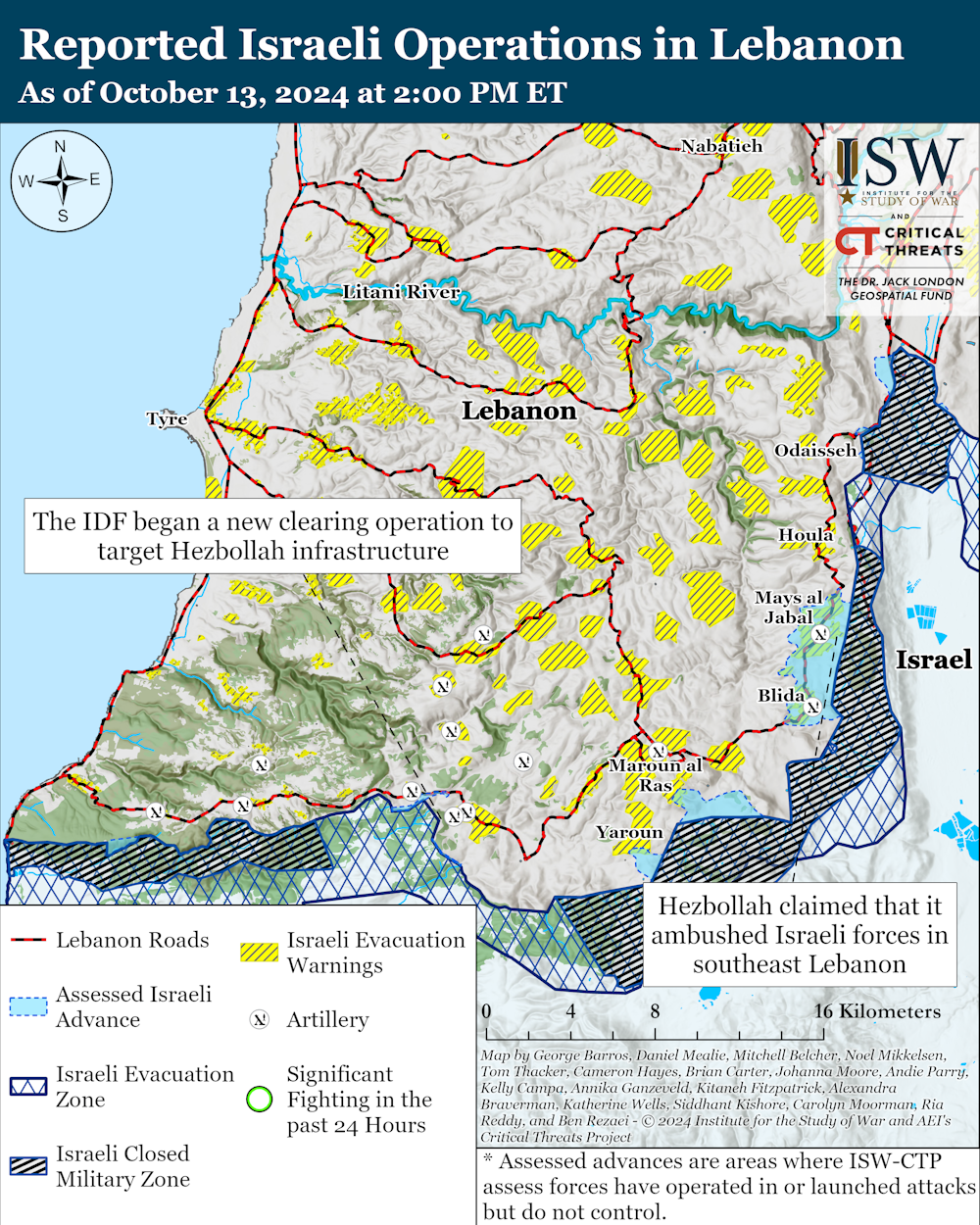
    Israel’s ground offensive in southern Lebanon, October 13 2024.
    Institute for the Study of War

    But there’s another possibility. During the Lebanese civil war, the IDF occupied a section of Lebanese land bordering Israel that was known as the “zone of security”. Its purpose was to serve as a buffer zone for northern Israel, initially designed to protect Israeli citizens from Palestinian militia, and later also from the Shia resistance groups Amal and Hezbollah.

    The Israeli request for Unifil to move five kilometres back from the blue line could mean Israel is considering reestablishing some kind of buffer zone. Several factors point to this being a possibility – although the IDF and the Israeli government may not be aligned on this issue as recent tensions suggest.

    First, the IDF has now deployed units from at least four divisions into Lebanon. The volume of troop numbers deployed is upwards of 15,000 suggesting this incursion is more than a limited operation.

    Second, 29 Unifil compounds lie along the blue line. Were they to be evacuated by the UN, there would be nothing to stop the IDF from moving in and developing them into their own strongholds. While UN positions would need reinforcement and protection equipment, they would nonetheless remain useful.

    Third, in 2006 the IDF tried to destroy Hezbollah from the air and deployed limited haphazard ground incursions. These tactics failed and the prevailing view may now be that the only way to guarantee the safe return of 65,000 Israelis to their homes in northern Israel is through an occupation.

    But unlike the previous occupation, where the IDF was aided by the SLA, Israel currently has no partner in Lebanon, and it is unlikely to find a willing accomplice among the Lebanese population to help them manage the security of a buffer zone. This means IDF troops would directly bear the brunt of attacks from resistance groups, and the northern Israeli villages would be unlikely to remain secure.

    The Netanyahu government’s continued use of military solutions to solve political problems has worrying implications for Israel, Lebanon and the Middle East as a whole. At this stage, Israel looks as if it might be settling back into a conflict that could become another “forever war”.

    Thus far, the tactics used by the IDF would imply they are not thinking ahead to “the day after” and the cost to Israel that would come with the prolonged occupation of a buffer zone.

    This article was written with assistance from John Molloy, lt. col. (rtd.) Irish Defence Forces and former senior Unifil political & civil affairs officer, 2008-2017.

    Chiara Ruffa receives funding from the Swedish Research Council, the Fulbright Commission and the European Commission.

    ref. IDF actions against UN peacekeepers suggest Israel may be considering occupying part of southern Lebanon – https://theconversation.com/idf-actions-against-un-peacekeepers-suggest-israel-may-be-considering-occupying-part-of-southern-lebanon-241297

    MIL OSI – Global Reports

  • MIL-OSI Europe: Analysis: UN peacekeepers at risk in southern Lebanon

    Source: Universities – Science Po in English

    United Nations peacekeepers in southern Lebanon have reported a series of incidents over the past few days in which they have been endangered by Israeli Defense Forces (IDF) as Israel continues its incursion into southern Lebanon. From bearing witness to sheltering the local population, the UN Unifil mission has a vital role to play in Lebanon, but at what cost?

    Read the analysis by experts Chiara Ruffa, Professor in political science at Sciences Po Center for International Studies (CERI), and Vanessa Newby, Assistant Professor at the Institute of Security and Global Affairs at Leiden University, initially published by our partner The Conversation.

    United Nations peacekeepers in southern Lebanon have reported a series of incidents over the past few days in which they have been endangered by Israeli Defense Forces (IDF) as Israel continues its incursion into southern Lebanon.

    Two members of the United Nations Interim Force in Lebanon (Unifil) were wounded on October 10 when an Israeli tank fired its weapon at Unifil’s headquarters in the city of Naqoura. They are reported to be receiving treatment in hospital for minor injuries.

    This follows a series of other reports of IDF troops firing on other Unifil positions in recent days. A Unifil statement called on the IDF “and all actors to ensure the safety and security of UN personnel and property and to respect the inviolability of UN premises at all times”.

    For 44 years the presence of UN peacekeepers in southern Lebanon has provided a much-needed measure of predictability and stability on an international fault line that has the potential to trigger a larger war in the Middle East. Its value has often been to shine an international spotlight on events on the ground and to provide humanitarian assistance to the local population.

    The Unifil peacekeeping mission is in an area of southern Lebanon that stretches from the de facto Lebanese border with Israel about 18 miles northwards up to the Litani River. In violation of UN security council resolution 1701, which was issued in 2006 and was designed to bring to an end the 33-day war between Israel and Hezbollah, Israeli tanks have been advancing into southern Lebanon since September 30. Hezbollah is fighting back – and casualties are mounting.

    On October 5, the Israel Defense Forces (IDF) pressed the Unifil Irish Battalion, stationed south-east of Marun al-Ras, to leave its position to allow the IDF to proceed with their invasion. On October 6, Unifil force commander Lt. Gen. Aroldo Lázaro Sáenz denied the request. A Unifil statement said: “Peacekeepers remain in all positions and the UN flag continues to fly.”


    The IDF reportedly ceased their military operations in the area on October 8. This is most likely because their military goals have changed. The rapidly unfolding Israeli military action in Lebanon has now deployed an additional 15,000 troops. This raises questions about the “limited” nature of the IDF’s incursion and its goals.

    Since 1978, Unifil has provided medical services, electricity, generators, language courses, financial aid and water to local communities. The peacekeeping force has also helped to clear millions of square meters of land from anti-personal mines and cluster bombs, releasing farmland for cultivation and preventing injuries or deaths since the 2006 war.

    In 2006, the Unifil mission adopted a new mandate under UN Resolution 1701. Like all newer UN peacekeeping mandates, it contained a protection of civilians clause which authorises Unifil to “protect civilians under imminent threat of physical violence”.

    Israel contends that Hezbollah missile attacks into northern Israel are an indication that Unifil has never fully implemented 1701 – hence the need to invade and destroy the militant group. But protection of civilians is central to Unifil’s mandate. While the IDF claims it is targeting Hezbollah’s military infrastructure and leadership, thousands of civilian lives in southern Lebanon remain at risk.

    It has recently been reported that more than 2,000 civilians have died in the latest Israeli incursion, with more than 9,000 injured and over 608,000 displaced. So, implementation of this protection clause has never been more important.

    Unifil must not become collateral damage

    Unifil’s ability to protect civilians during Israeli incursions has often been challenged because the IDF refused to guarantee the safety of fleeing civilians, either in convoys out of the villages, or in UN compounds.

    The most notorious incident was the Qana incident of 1996, when 106 civilians died while sheltering in the Fijian UN compound. In July 2006, the IDF used a precision guided aerial bomb on a Unifil post. The attack killed four international unarmed military observers working under Unifil operational control, despite repeated verbal warnings from Unifil headquarters to avoid the post. The IDF has also damaged Unifil positions in times of peace. In January 2005 an unarmed French UN observer was killed by IDF tank fire. In January 2015 IDF artillery killed a Spanish peacekeeper.

    So the challenge for Unifil has always been that if they allow civilians to take shelter in their compounds, they risk becoming part of the IDF’s collateral damage.

    Similarly, Hezbollah is also no friend of Unifil. In December 2022, Hezbollah supporters killed an Irish peacekeeper who ventured accidentally into a village just outside the area of operation.

    International witness

    Despite these challenges, Unifil still has a powerful role to play in southern Lebanon. As the fog of war engulfs all the protagonists, Unifil has the ability to bring the world’s attention to the current conflict which may help constrain the parties. It is critical at this time to have an international force bear witness to events on the ground and provide basic humanitarian assistance, monitor and report potential violations and guarantee shelter to the local population whenever possible to help the displaced people that remain within the Unifil area of operation.

    On October 7, the US State Department warned the IDF that it did not want to see military action taken against Unifil or for the peacekeepers to be put in danger in any way. This warning is welcome given the recent disregard for the UN demonstrated by Israel’s prime minister, Benjamin Netanyahu. who, when speaking to the UN general assembly on September 27, labelled the UN “contemptible in the eyes of decent people everywhere”. On October 2, the Israeli government barred UN secretary general António Guterres from entering Israel.

    Israel’s allies must increase the pressure for the IDF to allow Unifil to exercise the protection of civilians clause contained in its mandate. This would mean allowing the peacekeeping force the freedom of movement in south Lebanon to facilitate the delivery of humanitarian aid. The IDF must also guarantee the safety of civilians escaping with Unifil’s assistance from the villages. And the IDF must allow Unifil to establish safe zones for civilians trapped in the conflict, to compensate for the absence of air raid shelters and bunkers in Lebanon.

    While Unifil may not be able to prevent the bloodshed, for now it can continue help to stem the flow, just as it always has.

    MIL OSI Europe News

  • MIL-OSI China: Chinese medical peacekeepers to Lebanon complete emergency defense drill 2024-10-14 20:27:33 Recently, the 22nd Chinese Peacekeeping Level-1+ Hospital to the UNIFIL successfully completed the “Blue Porcupine 2024” emergency defense drill organized by the UNIFIL Sector East amid the ongoing conflicts in the mission area.

    Source: People’s Republic of China – Ministry of National Defense

      By Zeng Dele, Cheng Lu and Zhuang Xiaohao

      BEIRUT, Oct. 15 — Recently, the 22nd Chinese Peacekeeping Level-1+ Hospital to the United Nations Interim Force in Lebanon (UNIFIL) successfully completed the “Blue Porcupine 2024” emergency defense drill organized by the UNIFIL Sector East amid the ongoing conflicts in the mission area. The drill has examined and enhanced the emergency response capabilities of the Chinese peacekeeping medical contingent.

      After the drill began, the Chinese peacekeepers immediately put on their protective gear. The emergency combat team quickly collected weapons and ammunition, occupied a favorable position and stayed alert to the surrounding situation, while the rest of the personnel went to the designated bunker on standby.

      During the drill, the Chinese peacekeepers conducted medical treatment training. They provided emergency treatment for the wounded and then transferred them to the resuscitation room for fluid replacement and anti-shock therapy while monitoring the vital signs all the time.

      The UNIFIL Sector East sent special inspectors to verify the personnel composition, weapons and equipment, medical supplies and daily necessities in the two bunkers of the Chinese peacekeeping medical contingent. The inspectors used the communication facilities in the bunker to communicate with the UNIFIL Sector East and reported that the Chinese peacekeeping contingent fully met the exercise standards.

      In addition, the Chinese medical contingent conducted combat rescue knowledge and skills training for peacekeeping detachments and military observers from multiple countries, with a focus on several key subjects such as battlefield triage, spinal injury rescue, bleeding control, bandaging and fixation, airway management and cardiopulmonary resuscitation, in a bid to help friendly peacekeeping forces and military observers master the basic operational methods of self-rescue and mutual rescue.

    loading…

    MIL OSI China News

  • MIL-OSI United Kingdom: Israel Defence Forces’ attacks on UNIFIL bases: statement by foreign ministers of France, Germany, Italy and the UK

    Source: United Kingdom – Executive Government & Departments 3

    Foreign ministers of France, Germany, Italy and the UK gave a joint statement on attacks by the Israel Defence Forces against UNIFIL bases.

    Joint statment:

    We, the Foreign Ministers of France, Germany, Italy and the United Kingdom express our deep concern in the wake of recent attacks by IDF on UNIFIL bases, which have left several peacekeepers injured. These attacks must stop immediately. We condemn all threats to UNIFIL’s security.

    Any deliberate attack against UNIFIL goes against international humanitarian law and United Nations Security Council Resolution 1701. The protection of peacekeepers is incumbent upon all parties to a conflict.

    We call on Israel and all parties to uphold their obligations to ensure the safety and security of UNIFIL personnel at all times and to allow UNIFIL to continue carrying out its mandate. We reaffirm the essential stabilizing role played by UNIFIL in southern Lebanon. We underscore the importance of the United Nations in resolving armed conflict and mitigating the humanitarian impact.

    Media enquiries

    Email newsdesk@fcdo.gov.uk

    Telephone 020 7008 3100

    Contact the FCDO Communication Team via email (monitored 24 hours a day) in the first instance, and we will respond as soon as possible.

    Updates to this page

    Published 14 October 2024

    MIL OSI United Kingdom

  • MIL-OSI Banking: CBB 12 Month Treasury Bills Issue No. 121 Oversubscribed

    Source: Central Bank of Bahrain

    CBB 12 Month Treasury Bills Issue No. 121 Oversubscribed

    Published on 15 October 2024

    Manama, Bahrain –15th October 2024 – This week’s BD 100 million issue of Government Treasury Bills has been oversubscribed by 137%.

    The bills, carrying a maturity of 12 months, are issued by the CBB, on behalf of the Kingdom of Bahrain.

    The issue date of the bills is 17th October 2024, and the maturity date is 16th October 2025.

    The weighted average rate of interest is 5.42% compared to 5.37% of the previous issue on 19th September 2024

    The approximate average price for the issue was 94.808% with the lowest accepted price being 94.687%.

    This is issue No. 121 (ISIN BH00019OE454) of Government Treasury Bills. With this, the total outstanding value of Government Treasury Bills is BD 2.110 billion.

    Share this

    MIL OSI Global Banks

  • MIL-OSI Australia: Plimsoll Address

    Source: Australian Government – Minister of Foreign Affairs

    Thank you to the Australian Institute for International Affairs and the University of Tasmania for inviting me to give this address, in honour of this great statesperson. 

    With a career that spanned the first four decades of independent Australian foreign policy, there are few who have made a contribution comparable to James Plimsoll – or Jim Plim as he was affectionately known.

    He first made his mark in the late 1940s supporting Foreign Minister Evatt during his presidency of the United Nations General Assembly – support that included ghost-writing Evatt’s book, The Task of Nations.

    He later became Secretary of the Department of External Affairs – which we now know as DFAT…

    He was appointed Ambassador in Washington, Tokyo, Brussels and Moscow… 

    High Commissioner in London and Delhi…

    And even Governor of this great state of Tasmania…

    Among all these lofty appointments, his biographer Jeremy Hearder reflected that the highlight of Plimsoll’s career was serving as Australia’s Ambassador and Permanent Representative to the UN Nations in New York, in the late 1950s and early 1960s.

    And we can understand why. He found himself at the centre of major international issues – and his diplomatic skill meant, in the words of a British colleague, that Plimsoll “exercised an influence on the UN quite disproportionate to Australia’s standing in the world.”

    This was partly because of what the then Secretary of External Affairs, Arthur Tange, described as Plimsoll’s “remarkable capacity… for talking to people in their own terms, freely encouraging them to explain their viewpoints and problems.”

    It is patent that Jim Plim understood deeply how Australia’s interests as a middle power are at stake in the multilateral system.

    Even with all the flaws with the international system, this remains the case today.

    Australia will always be better off in a world that operates by rules that all countries have a say in shaping.

    A world where Australia and other countries have the freedom to decide our own futures, without interference and intimidation.

    A world where we can find collective solutions to our toughest problems.

    Where no country dominates, and no country is dominated.

    I’ve recently returned from the UN General Assembly’s annual High-Level Week, where Australia progressed our most ambitious multilateral agenda in many years.

    I convened meetings of humanitarian leaders and ministers from influential countries to address a serious problem in the international system.

    That is, the growing risk that norms are being eroded in international humanitarian law – what we often refer to as the rules of war.

    We see this in the massive civilian toll in conflicts around the world, and we see this in the increasing numbers of aid workers being killed and kidnapped.

    In order to protect civilians, we must also protect aid workers who deliver the food, water and medicine civilians need to survive.

    Aid workers are the best of humanity. Their dedication to improving the lives of others should not cost them their own.

    Yet 2023 was the deadliest year on record for aid workers, and 2024 is on track to be even worse.

    This has been felt directly by Australians with the IDF’s strike against World Central Kitchen vehicles, which killed Australian Zomi Frankcom and her colleagues.

    This was not a one-off incident. Gaza is the most dangerous place on earth to be an aid worker. More than 300 aid workers have been killed since the start of the conflict.

    Together, the ministerial group I convened agreed to pursue a new Declaration for the Protection of Humanitarian Personnel.

    Work on the Declaration is now underway, with our officials consulting experts and other countries.

    All countries will be invited to join the Declaration, to demonstrate the unity of the international community’s commitment to protect aid workers – and to channel that commitment into action in Gaza, in Sudan, in Ukraine and in all current and future conflicts.

    This is exactly the kind of leadership Australia should be taking in the world.

    We are not a superpower. But we are respected, and at our best we have a reputation for bringing countries together to defend and promote the rules-based order that protects us all.

    From the days helping draft the UN Charter and the Universal Declaration of Human Rights, to Gareth Evans’ leadership on the Chemical Weapons Convention, to our more leading role in the Arms Trade Treaty.

    There’s no doubt that reputation waned through the negative globalist years of the previous government.

    But in driving this Declaration we are demonstrating that Australians are indeed constructive internationalists in the mould of the honouree of this address.

    This brings me back to the book Plimsoll ghostwrote for Evatt, which spelled out our shared responsibility to each other. I quote:

    “We should try to raise standards everywhere in order to practice the simple humanitarian doctrine which is the basis of all morality, namely that we should help our neighbour and relieve misery and suffering… [We] can hardly imagine … the common lot of so many of mankind – disease, low expectation of life, and unrelieved pain; flood, famine and epidemics… These wrongs cry out for redress, and can and must be righted by co-operative international effort.”

    A powerful articulation of the motivation for our humanitarian work.

    And tonight we build on that work. Tonight, I am releasing Australia’s new Humanitarian Policy.

    It is a policy that comprehends the serious problems of our times.

    A climate changing faster than our combined efforts to stop it.

    More people displaced – in fact, more than 117 million people forcibly displaced from their homes.

    More people needing humanitarian assistance – 302 million people this year, up by nearly 30 million in just the last two years.

    More conflict than any time since World War Two. Russia’s invasion of Ukraine. Sudan. Myanmar. And in the Middle East.

    The Albanese Government is committed to humanitarian action which saves lives, alleviates human suffering and builds resilient communities. 

    The Policy outlines the role Australia will play at a time when need is outstripping the world’s capacity to respond and disregard for international humanitarian law is increasing.

    It is a plan of action that is not just about meeting humanitarian needs. It is also about protecting the peace, stability and prosperity that we want for Australia, our region and the world.

    It is a plan that is accountable – to the Australian people, and to the partners and communities we seek to help.

    We will focus on three priorities.

    First, we will build readiness and preparedness, anticipating shocks before they occur and working with our partners to lessen their impact.

    As part of this priority, I announce Australia is providing $5 million to the new Asia-Pacific Regional Humanitarian Fund to pre-position for the next emergency.

    Second, we will respond to crises and disasters, delivering support that meets the needs of crisis-affected populations and protects the most vulnerable, both immediately and over the longer term.

    As part of that effort, I announce $9 million in humanitarian relief to respond to high levels of food insecurity in Yemen. This follows support I announced yesterday for Myanmar, as well as over $80 million in aid to support civilians who have been devastated by the conflicts in Gaza and Lebanon.

    And third, we will reinforce the international humanitarian system, working to take practical and actionable steps to strengthen adherence to international humanitarian law – just as we are doing with the Declaration.

    We act globally, but our focus remains our region. We offer genuine partnerships, based on respect, listening and learning from each other.

    And we are helping build self-reliance, so obviously in Australia’s interests and the region’s interests.

    Now, we know humanitarian assistance can lessen shocks and keep further instability, conflict and displacement at bay.

    But we all want a world where humanitarian assistance is needed far less often.

    This is just one reason why the Albanese Government is acting on climate change.

    We have enshrined our ambitious emissions reduction targets into legislation: 43 per cent by 2030 and net zero by 2050.

    We are transforming our economy.

    Within this decade, 82 per cent of Australia’s electricity generation will be renewable, up from around 32 per cent when we came to office.

    We are building new industries to accelerate our economic transition and to export reliable, renewable energy to the world.

    And we are acting internationally, to respond to our partners.

    By the end of 2025, Australia will offer Climate Resilient Debt Clauses in our sovereign loans.

    And the groundbreaking Australia-Tuvalu Falepili Union treaty entered into force on 28 August – a treaty which provides for both adaptation and mobility with dignity…

    And the first treaty anywhere in the world which provides legal protection for sovereignty in the face of sea level rise.

    But we can’t address climate change on our own, just as we can’t alone resolve all of the conflicts that are driving humanitarian crises.

    What we are doing is using our forthcoming term on the UN Peacebuilding Commission to reform the international peacebuilding and conflict prevention architecture.

    What we are doing is helping Ukraine end Russia’s illegal and immoral war on its own terms.

    Since coming to office, we have more than doubled the military contribution to Ukraine – and Australia is the largest non-NATO contributor to Ukraine’s fight.

    And what we are doing is supporting efforts for long-term peace in the Middle East.

    We have just marked the first anniversary of the October 7 attacks by Hamas.

    We condemn Hamas’ terrorism unequivocally. We call for the release of hostages immediately.

    On that day, Hamas killed 1,200 people: the largest loss of Jewish life on any single day since the Holocaust.

    October 7 is a day that recalls humanity’s darkest memories. 

    The six million European Jews killed in the Holocaust – following thousands of years of persecution and atrocities perpetrated against the Jewish people.

    This long shadow of antisemitism is the history that finally resolved the international community to create the State of Israel.

    At the same time, the world also promised a Palestinian state.

    77 years later, that Palestinian state still does not exist.

    Earlier this year, Australia voted in the General Assembly in support of Palestinian aspirations for full membership of the UN. 

    The international community now must work together to pave a path to lasting peace.

    Australia wants to engage on new ways to build momentum, including the role of the Security Council in setting a pathway for two-states, with a clear timeline for the international declaration of Palestinian statehood.

    The world knows we cannot keep hoping the parties will fix this themselves; nor can we allow any party to obstruct the prospect of peace.

    Because a two-state solution is the only hope of breaking the endless cycle of violence – the only hope to see a secure and prosperous future for both peoples.

    To strengthen the forces for peace across the region and undermine extremism.

    Any future Palestinian state must not be in a position to threaten Israel’s security, with no role for terrorists.

    Right now, the suffering across the region must end.

    In Israel’s response to the attacks, more than 40,000 Palestinians have been killed. More than 11,000 children.

    It is now more than ten months since Australia and 152 other countries voted for a ceasefire in Gaza.

    I repeat that call again. 

    Just as I repeat our call for a diplomatic solution, de-escalation and ceasefire in Lebanon. 

    We want to see civilians on both sides of the Lebanon-Israel border return to their homes and the implementation of UNSC Resolution 1701.

    Australia made our call alongside a number of countries – Canada, European Union, France, Germany, Italy, Japan, Saudi Arabia, United Arab Emirates, the United Kingdom, the United States and Qatar.

    Shortly thereafter, G7 leaders issued a statement in similar terms.

    Yet somehow Mr Dutton accused the Prime Minister of being at odds with our allies. 

    He said the Prime Minister should be condemned for calling for a ceasefire.

    Now Mr Dutton has realised it is he who is at odds with the international community– but he still can’t bring himself to back a ceasefire.

    I can’t recall a single time over the past year that Mr Dutton has called for the protection of civilians, or for the upholding of international law. 

    He never utters a word of concern for innocent Palestinians and Lebanese civilians.

    From the other side, the Greens political party are being just as absolutist.

    Australians are rightly distressed by the catastrophic conflict, and the distress is felt most acutely in our Jewish, Palestinian and Lebanese communities.

    The lived experiences and understandings of our different Australian communities are distinct.

    There is long, complex and disputed history – deeply felt, close to the heart of many.

    And there is a need to acknowledge the real trauma on all sides, to acknowledge each other’s humanity, and to come together – as peacemakers throughout history have done.

    It is incumbent on any Australian Government to play a responsible role in promoting peace – recognising we are not the crucial player in the Middle East, but we have a respected voice. 

    Leaders must govern for the whole country.

    Our country does not benefit from the conflict being reproduced here. 

    Australians are 26 million people, from more than 300 ancestries. We are home to the oldest continuing civilisation on the planet.

    There is vast power in that.

    The ability to see and understand every part of the world.

    Yet it’s also something we need to nurture. 

    If we allow people to divide our community, if we allow conflicts overseas to be reproduced here; if we shout each other down and insist on respective absolutes; the bedrock of our stability, our security and our prosperity is shaken.

    Nothing is more important for our future than ensuring that Australia remains a pluralist nation, welcoming different races, religions and views, united by respect for each other’s humanity and for each other’s right to live in peace.

    As I said, there is vast power in who we are. Our people are the most elemental aspect of our national power. 

    We must deploy that power at this time in our history…

    This time when we face the most dangerous set of circumstances since World War Two. 

    This time when we need to combine our economic power, our cultural power, our strategic, diplomatic and defence power – all to make Australia stronger and more influential in a more contested and challenging world.

    We are making Australia more economically resilient at home, with a Future Made in Australia setting us on a path to be a renewable energy superpower.

    We are making Australia more economically resilient in the world, with the Southeast Asia Economic Strategy to 2040 that harnesses the opportunities from living in the most competitive and fastest growing region in the world – and so we never are over-reliant on one market again.

    We are rebuilding our diplomatic relationships.

    We are doing the work that should have been done a decade ago to again make Australia a partner of choice in the Pacific.

    We don’t just go around picking fights and blowing up relationships.

    We are investing in our credibility as a partner to the region.

    It is by our actions that we have been able to restore trust among the Pacific family.

    And we are stabilising our own relations with China, so we navigate differences wisely.

    Our calm and consistent approach to the China relationship has seen progress on the removal of trade impediments for wine, barley, coal, cotton, timber logs, copper ores and concentrates; and now lobster – almost $20 billion worth of Australian exports back into China.

    We are increasing our collaboration with new partners and traditional partners; with Southeast Asia, with Japan, with India, and through our Quad partnership.

    We are investing in defence cooperation and our own military capabilities, including through AUKUS.

    And we are working together with our partners to uphold the rules and reform the institutions that we helped establish.

    All of these efforts are to shape the strategic calculus of the region, so no potential aggressor thinks the pursuit of conflict is worth the risk.

    This is how we advance the region we want. A region in balance. 

    Where countries, large and small, have the freedom to decide our own futures.

    These are just some of the ways in which the Albanese Government is driving Australia’s most ambitious international engagement in many years. 

    Being a partner to our region, and a leader in our values. 

    Always working toward a more peaceful, stable and prosperous world for all.

    Where sovereignty is respected and civilians are protected. 

    And I would say, furthering the legacy of creative diplomacy and determined statecraft practised by the great Jim Plim himself.

    Thank you.

    MIL OSI News

  • MIL-OSI Europe: Briefing – Confirmation hearings of the Commissioners-designate: Hadja Lahbib – Preparedness and Crisis Management; Equality – 15-10-2024

    Source: European Parliament

    Hadja Lahbib a member of the Mouvement reformateur (MR) party, which sits with the Renew Europe group in the European Parliament, has been serving as Belgian minister for foreign affairs, European affairs and foreign trade, and federal cultural institutions since 2022. She was elected as a member of the Parliament of the Brussels Capital Region in 2024 but is currently on leave to fulfil her ministerial duties. Before joining the Belgian government, she co-led the Brussels bid for the title of European Capital of Culture 2030. Born in Belgium in 1970 to a family of Algerian Kabyle origin, Lahbib obtained a master’s degree in journalism and communication from the Université Libre de Bruxelles. She then worked as a journalist and presenter for Belgium’s French-speaking public broadcasting company and other broadcasters, where she gained international experience in covering conflict zones, including Afghanistan, Iraq, Israel and the occupied Palestinian territories. She produced several documentaries to highlight injustices, especially those against women in Afghanistan, Kenya and Belgium.

    MIL OSI Europe News

  • MIL-OSI Europe: Briefing – Confirmation hearings of the Commissioners-designate: Costas Kadis – Fisheries and Oceans – 15-10-2024

    Source: European Parliament

    Costas (Costantinos) Kadis is a scientist with a solid academic profile who has held ministerial portfolios in health, education and agriculture in various Cypriot governments. Kadis is professor of biodiversity conservation at Frederick University, where he also heads the Nature Conservation Unit and has been appointed as deputy president of the University Council. Between 2014 and 2023, Kadis served in two successive Cypriot governments without belonging to a political party. He was minister for education and culture (2014-2018), and minister for agriculture, rural development and environment (2018-2023). In the latter position, he was also responsible for fisheries and marine research. Born in Nicosia in 1967, Kadis graduated and obtained a PhD in biology from the University of Athens. After several research-related positions in Greece and Cyprus, he joined Frederick University in Cyprus in 2005, where he was appointed associate professor, founded the Nature Conservation Unit, and was Dean of the School of Education. He held these positions until 2014, apart from the period from July 2007 to February 2008 when he served as minister of health (as a member of the centre-right Democratic Party (DIKO). Kadis also chaired the Greek Cypriot Environment Committee from 2008 to 2014 as part of the government’s (unsuccessful) efforts to reunify Cyprus. This work did lead to important environmental cooperation agreements with the Turkish Cypriot community. This is one of a set of briefings designed to give an overview of issues of interest relating to the portfolios of the Commissioners designate. All these briefings can be found at: https://epthinktank.eu/commissioner_hearings_2024.

    MIL OSI Europe News

  • MIL-OSI United Kingdom: Turkey: British Embassy Bilateral Programme Fund

    Source: United Kingdom – Executive Government & Departments

    The call for bids under The British Embassy Bilateral Programme is now open

    The British Embassy in Ankara invites eligible organisations to submit project proposals for funding under the Bilateral Programme Fund. A total of £100,000 is available for projects in two thematic areas, with £50,000 allocated to each:

    Women and Girls Thematic Area

    • Improved Access to Education and Skills Training
    • Economic Empowerment

    Social Foundations Thematic Area

    • Improved Media Capacity and Training of Journalists
    • Greater Public Awareness of Climate and Gender Issues
    • Strengthened Civic Space

    Eligibility and Guidelines

    We are seeking proposals from NGOs, civil society organizations, academic institutions, and other relevant partners that align with the objectives of the Fund’s strategic priorities. Projects should demonstrate clear impact, measurable outcomes, and strong value for money.

    Given the limited time for implementation, applicants must adhere to the following deadlines:

    • Proposal Submission Deadline: 31 October 2024
    • Spending Requirement: At least 80% of the allocated funds must be spent by 31 December 2024

    Projects with innovative approaches, strategic partnerships, or pilot initiatives with the potential for scale-up are particularly encouraged to apply.

    How to Apply

    Please submit your proposals, using the required format (below), to bef.projects@fcdo.gov.uk by 31 October 2024. Late applications will not be considered.

    Contact Information

    For inquiries or further details, please contact us at bef.projects@fcdo.gov.uk

    British Embassy Bilateral Programme Fund

    Annexes:

    Annex 2 – Project Proposal Form above £10k

    Annex 3 – Activity Based Budget Template

    Annex 4 – Due Diligence Questionnaire

    Updates to this page

    Published 15 October 2024

    MIL OSI United Kingdom

  • MIL-OSI Video: First EU-Gulf Cooperation Council summit

    Source: European Commission (video statements)

    The summit is an opportunity for the EU to develop a closer partnership with the GCC and its member states (the United Arab Emirates, the Kingdom of Bahrain, the Kingdom of Saudi Arabia, the Sultanate of Oman, the State of Qatar and the State of Kuwait), who are geostrategic partners at a time of challenging geopolitical circumstances.

    Watch on the Audiovisual Portal of the European Commission:

    Subscribe to our channel: https://bit.ly/2X56Ju6

    Follow us on:
    -X: https://twitter.com/EU_Commission
    -Instagram: https://www.instagram.com/europeancommission/
    -Facebook: https://www.facebook.com/EuropeanCommission
    -LinkedIn: https://www.linkedin.com/company/european-commission/
    -Medium: https://medium.com/@EuropeanCommission

    Check our website: http://ec.europa.eu/

    https://www.youtube.com/watch?v=tICl0zaZ7s0

    MIL OSI Video

  • MIL-OSI United Kingdom: Labour’s approach to Middle East conflict “failing” as civilian death toll mounts

    Source: Green Party of England and Wales

    Green Party Co-Leader, Carla Denyer said, “The reports over the weekend that no food has entered Northern Gaza since the 1st of October, of Israel’s attack on al-Aqsa Hospital, of chemical weapons being used to attack UNIFIL peacekeepers, of mass civilian casualties in Gaza’s Jabalia Refugee Camp and of increased rocket fire into Israel from Hezbollah are extremely disturbing. The huge numbers of civilian deaths and the prospect of widespread starvation in Northern Gaza are intolerable.

    The Labour government must recognise that violence in the Middle East is escalating rapidly and that their current approach is failing. The Government needs to consider far more direct measures to incentivise a ceasefire including an end to arms sales, the introduction of divestments, boycotts and sanctions, prosecutions for all those who have committed war crimes and a plan for a viable Palestinian state.”

    Press Releases

    MIL OSI United Kingdom

  • MIL-OSI Video: Lebanon: UNIFIL would stay in all its position – Media Stakeout | United Nations

    Source: United Nations (Video News)

    Informal comments to the media by Jean-Pierre Lacroix, Under-Secretary-General for Peace Operations, on the situation in Lebanon.

    —————————-

    Under-Secretary-General for Peace Operations, Jean-Pierre Lacroix told reporters today (14 Oct) after the Security Council closed consultations in New York City, “the decision was made that UNIFIL would currently stay in all its position, in spite of the calls that were made by the Israeli Defense Forces to vacate the position that are in the vicinity of the Blue Line. I want to emphasize that this decision still remains.”

    The Under-Secretary-General emphasized ongoing communication efforts. He said, “the liaison mechanism continues to work,” adding that he would be meeting with the Israeli Permanent Representative on Tuesday (15 Oct) for further discussions.

    Lacroix also underscored the importance of maintaining open routes for UNIFIL’s operational needs. He said, “the movements that need to be carried out by UNIFIL with the purpose of resupplying position, with the purpose of supporting the civilian population, those movements need to be deconflicted, and they need to be also cleared by the parties, including the IDF.”

    Despite security concerns Lacroix reaffirmed the mission’s commitment to peacekeeping in southern Lebanon. He appealed to all parties saying, “our main call to all the parties is to respect their international obligation when it comes to protecting the safety and security of peacekeepers.”

    Lacroix reiterated UNIFIL’s mandate, which is to aid in the implementation of UN Security Council Resolution 1701. He said, “it’s for the parties to implement resolution 1701. UNIFIL are not mandated to implement, and certainly not to enforce, resolution 1701.”

    https://www.youtube.com/watch?v=v3i8EtN-6UI

    MIL OSI Video

  • MIL-OSI Video: Switzerland on Lebanon – Media Stakeout | United Nations

    Source: United Nations (Video News)

    Informal comments to the media by Pascale Baeriswyl, President of the UN Security Council for the month of October and Permanent Representative of Switzerland, following the Lebanon/UNIFIL Consultations.

    https://www.youtube.com/watch?v=uHK9TByba1o

    MIL OSI Video

  • MIL-OSI China: Defense attachés from over 60 countries visit Chinese PLA Eastern Theater Command: Defense Spokesperson 2024-10-15 “At the invitation of China’s Ministry of National Defense, defense attachés from more than 60 countries went to the Chinese PLA Eastern Theater Command on October 14th for a five-day visit,” said Chinese Defense Spokesperson Senior Colonel Wu Qian at regular press briefing on Tuesday.

    Source: People’s Republic of China – Ministry of National Defense 2

      BEIJING, Oct. 15 — “At the invitation of China’s Ministry of National Defense, defense attachés from more than 60 countries including Pakistan, Singapore, South Africa, Jordan, the United Kingdom, Kazakhstan, Canada and Argentina went to the Chinese PLA Eastern Theater Command on October 14th for a five-day visit,” said Chinese Defense Spokesperson Senior Colonel Wu Qian at regular press briefing on Tuesday.

      According to the spokesperson, this visit will help them better understand the Chinese path to modernization, the great achievements made by the people’s military in the new era, and promote the friendly and cooperative relations between the Chinese military and the militaries of these countries.

    loading…

    MIL OSI China News

  • MIL-OSI Security: U.S. Central Command conducts airstrikes against multiple ISIS camps in Syria

    Source: United States Central Command (CENTCOM)

    Oct. 12, 2024
    Release Number 20241012 – 01
    FOR IMMEDIATE RELEASE

    TAMPA, Fla. (Oct. 12, 2024) – U.S. Central Command forces conducted a series of airstrikes against multiple known ISIS camps in Syria in the early morning of Oct. 11. The strikes will disrupt the ability of ISIS to plan, organize, and conduct attacks against the United States, its allies and partners, and civilians throughout the region and beyond. Our battle damage assessments are underway and do not indicate civilian casualties. We will provide updates as information is confirmed.


    -30-

    MIL Security OSI

  • MIL-OSI Russia: Artificial Intelligence in Healthcare Across the UAE, China, Pakistan, and Saudi Arabia: Diverse Adoption Rates, Consistent Outcomes

    Source: Center of Diagnostics and Telemedicine – Moscow

    The integration of artificial intelligence (AI) in healthcare is transforming medical practices worldwide by significantly reducing patient care wait times and reducing physician’s workload. This was a key topic at the international session of the Russian Diagnostic Summit, where representatives from the UAE, China, Pakistan, and Saudi Arabia shared insights into their AI initiatives in radiology. Despite the differing speed of AI adoption, the outcomes in each country have been strikingly similar.

     During the session, experts from these nations discussed their experiences with AI in medical imaging. China is prioritizing the standardization and regulation of AI technologies in healthcare, while the UAE is advancing the use of AI in ultrasound. Saudi Arabia is leveraging remote CT and MRI scanning to address healthcare access challenges in rural areas. Russia, meanwhile, has developed the Unified Radiology Information Service, which centralizes patient records, providing physicians with real-time access to diagnostic data.

    This innovative system drew the attention of international delegates, who expressed interest in adopting similar solutions in their countries. As Yuri Vasilev, Senior Consultant for Radiology and Instrumental Diagnostics of the Moscow Healthcare Department, stated, AI’s implementation across all participating countries has led to faster patient care and reduced physician workload.

     In his presentation on musculoskeletal diagnostics, Dr. Abdulla Alremaithi, President of the Radiology Society of Emirates, highlighted that AI has reduced scanning times by 88% and improved image quality in the UAE.

     Peijun Wang, Professor and Vice Chairman of the Chinese Society of Radiology, outlined China’s comprehensive efforts to regulate and validate AI-enabled medical devices. As of 2022, China had issued 22 regulatory documents, and by 2023, 62 companies were involved in developing AI-driven medical imaging tools, with 45 products supporting the diagnosis of a wide range of conditions, including tumors, cardiovascular diseases, chest illnesses, and fractures.

     In Saudi Arabia, Dr.Mashael Alrujaiba, a board member of the Radiological Society of Saudi Arabia, discussed how remote diagnostic technologies, such as CT and MRI scans, are improving access to healthcare for patients in rural regions.

     Shazia Khan, Professor of Radiology from Pakistan, emphasized the impact of AI on workflow efficiency, citing the automation of measurements as a key advantage.

     The Russian Diagnostic Summit saw participation from over 13,000 attendees, including representatives from all regions of Russia and delegations from 28 countries, such as Abkhazia, Turkey, Serbia, Israel, India, and Syria. The event featured 236 scientific and educational sessions, held across 21 conference halls, including forums, seminars, roundtable discussions, and masterclasses. More than 800 leading professionals presented, and over 230 companies exhibited their latest technological innovations at the Diagnopolis exhibition.

    MIL OSI Russia News