Category: Middle East

  • MIL-OSI Video: Syria, Lebanon, Israel – Presser by Under-Secretary-General for Peace Operations | United Nations

    Source: United Nations (video statements)

    Upon his return from the Middle East, Under-Secretary-General for Peace Operations Jean-Pierre Lacroix, today (27 Jun) told journalists in New York that Lebanese Armed Forces “have continued to strengthen their presence South of the Litani River,” with the support of the United Nations Interim Force In Lebanon (UNIFIL), while in the United Nations Disengagement Observer Force (UNDOF) area of operations, Syrian authorities have indicated that they are ready to deploy “the military and security presence to all Syrian territory.”

    Lacroix said in Lebanon, “there has been additional action with a view to identify and eventually neutralize caches of weapons, which is an important element in the implementation of a resolution 1701.”

    Nevertheless, he said, “there continues to be violations, there continues to be more that needs to be done, again, to achieve a full implementation of that resolution.”

    Lacroix commended General Aroldo Lázaro, “who was at the head of UNIFIL during extremely, extremely challenging time” and welcomed General Diodato Abagnara, who just took over as the new Force Commander.

    UNDOF, he said, “is operating in a changed environment, where on the one hand, of course, there was this change in the political dispensation in Syria.”

    The Under-Secretary-General noted “the presence of the Israeli Defence Forces in the area, the so-called area of separation, where according to the 1973 Disengagement of Forces agreement, only UNDOF can be present with a military presence.”

    He said, “of course, the presence of the IDF in those areas is a violation, it’s quite clear.

    Finally, he welcomed efforts “for de-escalation and the advancement of dialog in the DRC and in the wider Great Lakes region,” and said the UN “and particularly when it comes to MONUSCO, we are fully committed to supporting these efforts” and the implementation of a peace agreement.

    In Washington DC today, the Democratic Republic of the Congo (DRC)and Rwanda signed a US-brokered peace deal which could bring peace to the eastern region of the DRC.

    https://www.youtube.com/watch?v=CroPGPYSJhY

    MIL OSI Video

  • MIL-OSI Africa: United Arab Emirates (UAE) President, Vice President congratulate President of Seychelles on Independence Day

    Source: Africa Press Organisation – English (2) – Report:

    Download logo

    President His Highness Sheikh Mohamed bin Zayed Al Nahyan has sent a cable of congratulations to President Wavel Ramkalawan of Seychelles, on the occasion of his country’s Independence Day, observed on 29th June.

    His Highness Sheikh Mohammed bin Rashid Al Maktoum, Vice President, Prime Minister and Ruler of Dubai, and His Highness Sheikh Mansour bin Zayed Al Nahyan, Vice President, Deputy Prime Minister and Chairman of the Presidential Court, dispatched similar cables to President Ramkalawan on the occasion.

    – on behalf of United Arab Emirates, Ministry of Foreign Affairs.

    MIL OSI Africa

  • MIL-Evening Report: Clark warns in new Pacific book renewed nuclear tensions pose ‘existential threat to humanity’

    Asia Pacific Report

    Former New Zealand prime minister Helen Clark has warned the country needs to maintain its nuclear-free policy as a “fundamental tenet” of its independent foreign policy in the face of gathering global storm clouds.

    Writing in a new book being published next week, she says “nuclear war is an existential threat to humanity. Far from receding, the threat of use of nuclear weapons is ever present.

    The Doomsday Clock of the Bulletin of Atomic Scientists now sits at 89 seconds to midnight,” she says in the prologue to journalist and media academic David Robie’s book Eyes of Fire: The Last Voyage and Legacy of the Rainbow Warrior.

    Writing before the US surprise attack with B-2 stealth bombers and “bunker-buster” bombs on three Iranian nuclear facilities on June 22, Clark says “the Middle East is a tinder box with the failure of the Iran nuclear deal and with Israel widely believed to possess nuclear weapons”.

    The Doomsday Clock references the Ukraine war theatre where “use of nuclear weapons has been floated by Russia”.

    Also, the arms control architecture for Europe is unravelling, leaving the continent much less secure. India and Pakistan both have nuclear arsenals, she says.

    “North Korea continues to develop its nuclear weapons capacity.”

    ‘Serious ramifications’
    Clark, who was also United Nations Development Programme administrator from 2009 to 2017, a member of The Elders group of global leaders founded by Nelson Mandela in 2007, and is an advocate for multilateralism and nuclear disarmament, says an outright military conflict between China and the United States “would be one between two nuclear powers with serious ramifications for East Asia, Southeast Asia, the Pacific, and far beyond.”

    She advises New Zealand to be wary of Australia’s decision to enter a nuclear submarine purchase programme with the United States.

    “There has been much speculation about a potential Pillar Two of the AUKUS agreement which would see others in the region become partners in the development of advanced weaponry,” Clark says.

    “This is occurring in the context of rising tensions between the United States and China.

    “Many of us share the view that New Zealand should be a voice for de-escalation, not for enthusiastic expansion of nuclear submarine fleets in the Pacific and the development
    of more lethal weaponry.”

    Eyes of Fire: The Last Voyage and Legacy of the Rainbow Warrior . . . publication July 2025. Image: Little Island Press

    In the face of the “current global turbulence, New Zealand needs to reemphasise the principles and values which drove its nuclear-free legislation and its advocacy for a nuclear-free South Pacific and global nuclear disarmament.

    Clark says that the years 1985 – the Rainbow Warrior was bombed by French secret agents on 10 July 1985 — and 1986 were critical years in the lead up to New Zealand’s nuclear-free legislation in 1987.

    “New Zealanders were clear – we did not want to be defended by nuclear weapons. We wanted our country to be a force for diplomacy and for dialogue, not for warmongering.”

    Chronicles humanitarian voyage
    The book Eyes of Fire chronicles the humanitarian voyage by the Greenpeace flagship to the Marshall Islands to relocate 320 Rongelap Islanders who were suffering serious community health consequences from the US nuclear tests in the 1950s.

    The author, Dr David Robie, founder of the Pacific Media Centre at Auckland University of Technology, was the only journalist on board the Rainbow Warrior in the weeks leading up to the bombing.

    His book recounts the voyage and nuclear colonialism, and the transition to climate justice as the major challenge facing the Pacific, although the “Indo-Pacific” rivalries between the US, France and China mean that geopolitical tensions are recalling the Cold War era in the Pacific.

    Dr Robie is also critical of Indonesian colonialism in the Melanesian region of the Pacific, arguing that a just-outcome for Jakarta-ruled West Papua and also the French territories of Kanaky New Caledonia and “French” Polynesia are vital for peace and stability in the region.

    Eyes of Fire is being published by Little Island Press, which also produced one of his earlier books, Don’t Spoil My Beautiful Face: Media, Mayhem and Human Rights in the Pacific.

    MIL OSI AnalysisEveningReport.nz

  • MIL-OSI Russia: D. Trump criticized Israeli prosecutors in connection with the investigation of B. Netanyahu

    Translation. Region: Russian Federal

    Source: People’s Republic of China in Russian – People’s Republic of China in Russian –

    Source: People’s Republic of China – State Council News

    WASHINGTON, June 29 (Xinhua) — U.S. President Donald Trump on Saturday lashed out at Israeli prosecutors over the corruption trial of Israeli Prime Minister Benjamin Netanyahu.

    “The United States of America spends billions of dollars a year, far more than any other nation, to protect and support Israel. We will not tolerate this,” Trump wrote on the Truth Social social network.

    He said the case would distract the prime minister from negotiations with Iran and Hamas.

    An Israeli court on Friday rejected Netanyahu’s request to postpone testimony in a corruption case, ruling that he had not provided sufficient grounds.

    The trial against B. Netanyahu has been going on for more than five years. In one of the cases, B. Netanyahu and his wife were accused of receiving luxury goods worth more than $260,000 from billionaires in exchange for political patronage.

    In two other cases, Netanyahu is accused of trying to get more positive coverage of his policies in two Israeli media outlets. –0–

    MIL OSI Russia News

  • Israel orders evacuations in northern Gaza as Trump calls for war to end

    Source: Government of India

    Source: Government of India (4)

    The Israeli military ordered Palestinians to evacuate areas in northern Gaza on Sunday before intensified fighting against Hamas, as U.S. President Donald Trump called for an end to the war amid renewed efforts to broker a ceasefire.

    “Make the deal in Gaza, get the hostages back,” Trump posted on his Truth Social platform early on Sunday.

    Israeli Prime Minister Benjamin Netanyahu was due to hold talks later in the day on the progress of Israel’s offensive. A senior security official said the military will tell him the campaign is close to reaching its objectives, and warn that expanding fighting to new areas in Gaza may endanger the remaining Israeli hostages.

    But in a statement posted on X and text messages sent to many residents, the military urged people in northern parts of the enclave to head south towards the Al-Mawasi area in Khan Younis, which Israel designated as a humanitarian area. Palestinian and U.N. officials say nowhere in Gaza is safe.

    “The (Israeli) Defense Forces is operating with extreme force in these areas, and these military operations will escalate, intensify, and extend westward to the city center to destroy the capabilities of terrorist organizations,” the military said.

    The evacuation order covered the Jabalia area and most Gaza City districts. Medics and residents said the Israeli army’s bombardments escalated in the early hours in Jabalia, destroying several houses and killing at least six people.

    In Khan Younis in the south, five people were killed in an airstrike on a tent encampment near Mawasi, medics said.

    NEW CEASEFIRE PUSH

    The escalation comes as Arab mediators, Egypt and Qatar, backed by the United States, begin a new ceasefire effort to halt the 20-month-old conflict and secure the release of Israeli and foreign hostages still being held by Hamas.

    Interest in resolving the Gaza conflict has heightened in the wake of U.S. and Israeli bombings of Iran’s nuclear facilities.

    A Hamas official told Reuters the group had informed the mediators it was ready to resume ceasefire talks, but reaffirmed the group’s outstanding demands that any deal must end the war and secure an Israeli withdrawal from the coastal territory.

    Hamas has said it is willing to free remaining hostages in Gaza, 20 of whom are believed to still be alive, only in a deal that will end the war. Israel says it can only end it if Hamas is disarmed and dismantled. Hamas refuses to lay down its arms.

    The latest bloodshed in the decades-old Israeli-Palestinian conflict was triggered in October 2023 when Hamas attacked Israel, killing 1,200 people and taking 251 hostages, Israeli tallies show.

    Israel’s subsequent military assault has killed more than 56,000 Palestinians, according to the Gaza health ministry, displaced almost the entire 2.3 million population, plunged the enclave into a humanitarian crisis and left much of it in ruins.

    (Reuters)

  • MIL-OSI Africa: Oman welcomes peace agreement between Rwanda and the Democratic Republic of the Congo


    Download logo

    The Foreign Ministry expresses the Sultanate of Oman’s welcome of the peace agreement signed between the Republic of Rwanda and the Democratic Republic of the Congo.

    The Sultanate values the active role played by all parties in prioritising dialogue and diplomacy as a means to resolve disputes and conflicts.

    Oman also commends the constructive efforts undertaken by the sisterly State of Qatar and the United States of America to reach an agreement that leads to lasting peace between the two friendly countries.

    Distributed by APO Group on behalf of Foreign Ministry of Oman.

    MIL OSI Africa

  • MIL-OSI Africa: Guterres welcomes peace deal between Democratic Republic of the Congo (DRC) and Rwanda


    Download logo

    UN Secretary-General António Guterres has welcomed the peace agreement between the Democratic Republic of the Congo (DRC) and Rwanda signed on Friday in the United States capital, Washington, DC.

    The accord is “a significant step towards de-escalation, peace and stability in the eastern Democratic Republic of the Congo and the Great Lakes region,” he said in a statement that evening.

    A breakthrough amid crisis

    Since the 1990s, eastern DRC has been plagued by dozens of armed groups who have terrorized the population.

    The Government has long accused Rwanda of supporting the M23 rebel group which Rwanda has denied.

    Earlier this year, the M23 launched an offensive in North and South Kivu provinces, capturing cities and villages, including provincial capitals Goma and Bukavu.

    Thousands of civilians were killed, hundreds of thousands more were displaced, and serious human rights violations were committed.

    UN commitment remains

    The Secretary-General commended the US for its leadership in facilitating the mediation process, in coordination with Qatar and the African Union Mediator, President Faure Gnassingbé of Togo.

    He also acknowledged the contributions of the five co-facilitators designated by the East African Community (EAC) and the Southern African Development Community (SADC).

    He urged the parties to fully honour their commitments under the peace agreement and in line with UN Security Council resolution 2773 (2025), including the cessation of hostilities and all other agreed measures.

    The resolution, unanimously adopted in February, condemned the M23 offensive and called for the DRC and Rwanda to return to diplomatic talks.

    The Secretary-General concluded his statement by saying the UN, including through its peacekeeping mission in the DRC, MONUSCO, “remains fully committed to supporting the implementation of the agreement, in close coordination with the African Union, regional and international partners.”

    Coincidentally, the Security Council met on Friday to discuss developments in the DRC.

    The Secretary-General’s Special Representative for the country and Head of MONUSCO, Bintou Keita, welcomed the peace agreement as a significant step towards ending the conflict.

    ‘A chance to turn the page’

    The UN refugee agency, UNHCR, echoed this message in a statement on Saturday, saying the agreement “offers a chance to stop the cycle of violence and displacement and focus on solutions that restore dignity, stability, and opportunity.”

    Furthermore, it “can bring renewed hope to those who have endured far too much for far too long,” added the agency’s chief, UN High Commissioner for Refugees Filippo Grandi.

    “This is a chance to turn the page – ensuring the protection of civilians, including refugees and internally displaced people, and advancing durable solutions that allow them to rebuild their lives in safety and dignity,” he said.

    Distributed by APO Group on behalf of UN News.

    MIL OSI Africa

  • Iran says 71 killed in Israeli strike on Evin Prison

    Source: Government of India

    Source: Government of India (4)

    Israel’s attack on the Evin Prison in Iran’s capital Tehran on June 23 killed 71 people, Iranian judiciary spokesperson Asghar Jahangir said on Sunday.

    At the end of an air war with Iran, Israel struck Tehran’s most notorious jail for political prisoners, in a demonstration that it was expanding its targets beyond military and nuclear sites to aim at symbols of Iran’s ruling system.

    “In the attack on Evin prison, 71 people were martyred including administrative staff, youth doing their military service, detainees, family members of detainees who were visiting them and neighbours who lived in the prison’s vicinity,” Jahangir said in remarks carried on the judiciary’s news outlet Mizan.

    Jahangir had previously said that part of Evin prison’s administrative building had been damaged in the attack and people were killed and injured. The judiciary added that remaining detainees had been transferred to other prisons in Tehran province.

    Evin prison holds a number of foreign nationals, including two French citizens detained for three years.

    “The strike targeting Evin prison in Tehran, put our citizens Cecile Kohler and Jacques Paris in danger. It is unacceptable,” France’s Foreign Minister Jean-Noel Barrot had said on social media X after the attack.

    (Reuters)

  • MIL-OSI Russia: 45 Palestinians killed in Israeli attacks on Gaza

    Translation. Region: Russian Federal

    Source: People’s Republic of China in Russian – People’s Republic of China in Russian –

    Source: People’s Republic of China – State Council News

    GAZA, June 29 (Xinhua) — At least 45 Palestinians were killed in Israeli attacks on the Gaza Strip on Saturday, Mahmoud Basal, spokesman for the Palestinian Civil Defense in Gaza, told Xinhua.

    He said Israeli warplanes carried out airstrikes on civilian areas, including a popular market, a school, tents sheltering displaced persons, residential buildings and crowded areas in various parts of the enclave.

    The air strikes killed 37 people, including women and children, and left dozens injured to varying degrees. All the wounded were taken to hospitals, he said.

    Basal added that eight civilians were killed by Israeli shelling in two separate incidents near US aid distribution points in the southern and central Gaza Strip.

    The Israeli army has not yet commented on the incidents. –0–

    MIL OSI Russia News

  • MIL-Evening Report: Why manufacturing consent for war with Iran failed this time

    COMMENTARY: By Ahmad Ibsais

    On June 22, American warplanes crossed into Iranian airspace and dropped 14 massive bombs.

    The attack was not in response to a provocation; it came on the heels of illegal Israeli aggression that took the lives of more than 600 Iranians.

    This was a return to something familiar and well-practised: an empire bombing innocents across the orientalist abstraction called “the Middle East”.

    That night, US President Donald Trump, flanked by his vice-president and two state secretaries, told the world: “Iran, the bully of the Middle East, must now make peace”.

    There is something chilling about how bombs are baptised with the language of diplomacy and how destruction is dressed in the garments of stability. To call that peace is not merely a misnomer; it is a criminal distortion.

    But what is peace in this world, if not submission to the West? And what is diplomacy, if not the insistence that the attacked plead with their attackers?

    In the 12 days that Israel’s illegal assault on Iran lasted, images of Iranian children pulled from the wreckage remained absent from the front pages of Western media. In their place were lengthy features about Israelis hiding in fortified bunkers.

    Victimhood serving narrative
    Western media, fluent in the language of erasure, broadcasts only the victimhood that serves the war narrative.

    And that is not just in its coverage of Iran. For 20 months now, the people of Gaza have been starved and incinerated. By the official count, more than 55,000 lives have been taken; realistic estimates put the number at hundreds of thousands.

    Every hospital in Gaza has been bombed. Most schools have been attacked and destroyed.

    Leading human rights groups like Amnesty International and Human Rights Watch have already declared that Israel is committing genocide, and yet, most Western media would not utter that word and would add elaborate caveats when someone does dare say it live on TV.

    Presenters and editors would do anything but recognise Israel’s unending violence in an active voice.

    Despite detailed evidence of war crimes, the Israeli military has faced no media censure, no criticism or scrutiny. Its generals hold war meetings near civilian buildings, and yet, there are no media cries of Israelis being used as “human shields”.

    Israeli army and government officials are regularly caught lying or making genocidal statements, and yet, their words are still reported as “the truth”.

    Bias over Palestinian deaths
    A recent study found that on the BBC, Israeli deaths received 33 times more coverage per fatality than Palestinian deaths, despite Palestinians dying at a rate of 34 to 1 compared with Israelis. Such bias is no exception, it is the rule for Western media.

    Like Palestine, Iran is described in carefully chosen language. Iran is never framed as a nation, only as a regime. Iran is not a government, but a threat — not a people, but a problem.

    The word “Islamic” is affixed to it like a slur in every report. This is instrumental in quietly signalling that Muslim resistance to Western domination must be extinguished.

    Iran does not possess nuclear weapons; Israel and the United States do. And yet only Iran is cast as an existential threat to world order.

    Because the problem is not what Iran holds, but what it refuses to surrender. It has survived coups, sanctions, assassinations, and sabotage. It has outlived every attempt to starve, coerce, or isolate it into submission.

    It is a state that, despite the violence hurled at it, has not yet been broken.

    And so the myth of the threat of weapons of mass destruction becomes indispensable. It is the same myth that was used to justify the illegal invasion of Iraq. For three decades, American headlines have whispered that Iran is just “weeks away” from the bomb, three decades of deadlines that never arrive, of predictions that never materialise.

    Fear over false ‘nuclear threat’
    But fear, even when unfounded, is useful. If you can keep people afraid, you can keep them quiet. Say “nuclear threat” often enough, and no one will think to ask about the children killed in the name of “keeping the world safe”.

    This is the modus operandi of Western media: a media architecture not built to illuminate truth, but to manufacture permission for violence, to dress state aggression in technical language and animated graphics, to anaesthetise the public with euphemisms.

    Time Magazine does not write about the crushed bones of innocents under the rubble in Tehran or Rafah, it writes about “The New Middle East” with a cover strikingly similar to the one it used to propagandise regime change in Iraq 22 years ago.

    But this is not 2003. After decades of war, and livestreamed genocide, most Americans no longer buy into the old slogans and distortions. When Israel attacked Iran, a poll showed that only 16 percent of US respondents supported the US joining the war.

    After Trump ordered the air strikes, another poll confirmed this resistance to manufactured consent: only 36 percent of respondents supported the move, and only 32 percent supported continuing the bombardment

    The failure to manufacture consent for war with Iran reveals a profound shift in the American consciousness. Americans remember the invasions of Afghanistan and Iraq that left hundreds of thousands of Afghans and Iraqis dead and an entire region in flames. They remember the lies about weapons of mass destruction and democracy and the result: the thousands of American soldiers dead and the tens of thousands maimed.

    They remember the humiliating retreat from Afghanistan after 20 years of war and the never-ending bloody entanglement in Iraq.

    Low social justice spending
    At home, Americans are told there is no money for housing, healthcare, or education, but there is always money for bombs, for foreign occupations, for further militarisation. More than 700,000 Americans are homeless, more than 40 million live under the official poverty line and more than 27 million have no health insurance.

    And yet, the US government maintains by far the highest defence budget in the world.

    Americans know the precarity they face at home, but they are also increasingly aware of the impact US imperial adventurism has abroad. For 20 months now, they have watched a US-sponsored genocide broadcast live.

    They have seen countless times on their phones bloodied Palestinian children pulled from rubble while mainstream media insists, this is Israeli “self-defence”.

    The old alchemy of dehumanising victims to excuse their murder has lost its power. The digital age has shattered the monopoly on narrative that once made distant wars feel abstract and necessary. Americans are now increasingly refusing to be moved by the familiar war drumbeat.

    The growing fractures in public consent have not gone unnoticed in Washington. Trump, ever the opportunist, understands that the American public has no appetite for another war.

    ‘Don’t drop bombs’
    And so, on June 24, he took to social media to announce, “the ceasefire is in effect”, telling Israel to “DO NOT DROP THOSE BOMBS,” after the Israeli army continued to attack Iran.

    Trump, like so many in the US and Israeli political elites, wants to call himself a peacemaker while waging war. To leaders like him, peace has come to mean something altogether different: the unimpeded freedom to commit genocide and other atrocities while the world watches on.

    But they have failed to manufacture our consent. We know what peace is, and it does not come dressed in war. It is not dropped from the sky.

    Peace can only be achieved where there is freedom. And no matter how many times they strike, the people remain, from Palestine to Iran — unbroken, unbought, and unwilling to kneel to terror.

    Ahmad Ibsais is a first-generation Palestinian American and law student who writes the newsletter State of Siege.

    MIL OSI AnalysisEveningReport.nz

  • MIL-Evening Report: ‘Bridge for peace – not more bombs,’ say CNMI Gaza protesters

    By Bryan Manabat in Saipan

    Advocacy groups in the Commonwealth of the Northern Mariana Islands (CNMI) disrupted the US Department of Defense’s public meeting this week, which tackled proposed military training plans on Tinian, voicing strong opposition to further militarisation in the Marianas.

    Members of the Marianas for Palestine, Prutehi Guahan and Commonwealth670 burst into the public hearing at the Crowne Plaza hotel in Garapan, chanting, “No build-up! No war!” and “Free, free, Palestine!”

    As the chanting echoed throughout the venue on Wednesday, the DOD continued the proceedings to gather public input on its CNMI Joint Military Training proposal.

    The US plan includes live-fire ranges, a base camp, communications infrastructure, and a biosecurity facility. Officials said feedback from Tinian, Saipan and Rota communities would help shape the final environmental impact statement.

    Salam Castro Younis, of Chamorro-Palestinian descent, linked the military expansion to global conflicts in Gaza and Iran.

    “More militarisation isn’t the answer,” Younis said. “We don’t need to lose more land. Diplomacy and peace are the way forward – not more bombs.”

    Saipan-born Chamorro activist Anufat Pangelinan echoed Younis’s sentiment, citing research connecting climate change and environmental degradation to global militarisation.

    ‘No part of a war’
    “We don’t want to be part of a war we don’t support,” he said. “The Marianas shouldn’t be a tip of the spear – we should be a bridge for peace.”

    The groups argue that CJMT could make Tinian a target, increasing regional hostility.

    “We want to sustain ourselves without the looming threat of war,” Pangelinan added.

    In response to public concerns from the 2015 draft EIS, the DOD scaled back its plans, reducing live-fire ranges from 14 to 2 and eliminating artillery, rocket and mortar exercises.

    Mark Hashimoto, executive director of the US Marine Corps Forces Pacific, emphasised the importance of community input.

    “The proposal includes live-fire ranges, a base camp, communications infrastructure and a biosecurity facility,” he said.

    Hashimoto noted that military lease lands on Tinian could support quarterly exercises involving up to 1000 personnel.

    Economic impact concerns
    Tinian residents expressed concerns about economic impacts, job opportunities, noise, environmental effects and further strain on local infrastructure.

    The DOD is expected to issue a Record of Decision by spring 2026, balancing public feedback with national security and environmental considerations.

    In a joint statement earlier this week, the activist groups said the people of Guam and the CNMI were “burdened by processes not meant to serve their home’s interests”.

    The groups were referring to public input requirements for military plans involving the use of Guam and CNMI lands and waters for war training and testing.

    “As colonies of the United States, the Mariana Islands continue to be forced into conflicts not of our people’s making,” the statement read.

    “ After decades of displacement and political disenfranchisement, our communities are now in subservient positions that force an obligation to extend our lands, airspace, and waters for use in America’s never-ending cycle of war.”

    They also lamented the “intense environmental degradation” and “growing housing and food insecurity” resulting from military expansion.

    “Like other Pacific Islanders, we are also overrepresented disproportionately in the military and in combat,” they said.

    “Meanwhile, prices on imported food, fuel, and essential goods will continue to rise with inflation and war.”

    Republished from Pacific Island Times.

    MIL OSI AnalysisEveningReport.nz

  • Trump slams Israel’s prosecutors over Netanyahu corruption trial

    Source: Government of India

    Source: Government of India (4)

    President Donald Trump on Saturday lashed out at prosecutors in Israel over the corruption trial that Israeli Prime Minister Benjamin Netanyahu has faced, saying Washington, having given billions of dollars worth of aid to Israel, was not going to “stand for this”.

    Netanyahu was indicted in 2019 in Israel on charges of bribery, fraud and breach of trust – all of which he denies. The trial began in 2020 and involves three criminal cases.

    “It is INSANITY doing what the out-of-control prosecutors are doing to Bibi Netanyahu,” Trump said in a Truth Social post, adding that the judicial process was going to interfere with Netanyahu’s ability to conduct talks with Palestinian militants Hamas, and Iran.

    Trump’s second post over the course of a few days defending Netanyahu and calling for the cancellation of the trial went a step further to tie Israel’s legal action to U.S. aid.

    “The United States of America spends Billions of Dollar [sic] a year, far more than on any other Nation, protecting and supporting Israel. We are not going to stand for this,” Trump said.

    Netanyahu “right now” was in the process of negotiating a deal with Hamas, Trump said, without giving further details. On Friday, the Republican president told reporters that he believes a ceasefire is close.

    Hamas has said it is willing to free remaining hostages in Gaza under any deal to end the war, while Israel says it can only end if Hamas is disarmed and dismantled. Hamas refuses to lay down its arms.

    Interest in resolving the Gaza conflict has heightened in the wake of the U.S. and Israeli bombing of Iran’s nuclear facilities. A ceasefire to the 12-day Israel-Iran conflict went into effect early this week.

    (Reuters)

  • Trump slams Israel’s prosecutors over Netanyahu corruption trial

    Source: Government of India

    Source: Government of India (4)

    President Donald Trump on Saturday lashed out at prosecutors in Israel over the corruption trial that Israeli Prime Minister Benjamin Netanyahu has faced, saying Washington, having given billions of dollars worth of aid to Israel, was not going to “stand for this”.

    Netanyahu was indicted in 2019 in Israel on charges of bribery, fraud and breach of trust – all of which he denies. The trial began in 2020 and involves three criminal cases.

    “It is INSANITY doing what the out-of-control prosecutors are doing to Bibi Netanyahu,” Trump said in a Truth Social post, adding that the judicial process was going to interfere with Netanyahu’s ability to conduct talks with Palestinian militants Hamas, and Iran.

    Trump’s second post over the course of a few days defending Netanyahu and calling for the cancellation of the trial went a step further to tie Israel’s legal action to U.S. aid.

    “The United States of America spends Billions of Dollar [sic] a year, far more than on any other Nation, protecting and supporting Israel. We are not going to stand for this,” Trump said.

    Netanyahu “right now” was in the process of negotiating a deal with Hamas, Trump said, without giving further details. On Friday, the Republican president told reporters that he believes a ceasefire is close.

    Hamas has said it is willing to free remaining hostages in Gaza under any deal to end the war, while Israel says it can only end if Hamas is disarmed and dismantled. Hamas refuses to lay down its arms.

    Interest in resolving the Gaza conflict has heightened in the wake of the U.S. and Israeli bombing of Iran’s nuclear facilities. A ceasefire to the 12-day Israel-Iran conflict went into effect early this week.

    (Reuters)

  • MIL-OSI USA: Nearly 800 Attend Congressman Brad Sherman’s Town Hall Focused on Combating Trump’s Extreme Agenda

    Source: United States House of Representatives – Congressman Brad Sherman (D-CA)

    Canoga Park, CA – Today, Congressman Brad Sherman (D-Sherman Oaks) hosted an in-person Town Hall at Canoga Park Senior High School, drawing hundreds of residents for a wide-ranging discussion on the national and local issues weighing on the country. From economic instability to radical immigration enforcement, constituents voiced concerns—and Sherman made clear his continued opposition to what he called “Donald Trump’s extreme and costly policy agenda.”

    “Our communities deserve a representative who shows up, fights back, and keeps them informed,” said Congressman Sherman. “That’s why I continue to hold these town hall meetings regularly, to hear from my constituents directly, give them straight answers, and help keep them connected to what’s happening in Washington that affects their lives.”

    During the event, many constituents shared personal stories and voiced their fears about Trump’s renewed and frenzied push for mass deportations and the recent I.C.E. crackdowns that have rattled families throughout Los Angeles. Sherman condemned the raids as “cruel, unnecessary, and undermine the values this country was built on,” and reassured the attendees of his firm support for immigrant rights, while also outlining the steps he and his Democratic colleagues are taking to combat such crackdowns.

    Another focal point was Trump’s so-called “Big Beautiful Bill” Act—a sweeping proposal that Sherman dubbed “One Big Ugly Bill” and criticized as a “reckless blueprint for corporate giveaways and political theater that will harm our economy.” He warned the bill would gut social safety nets while ballooning the national deficit. 

    A Senior Member of the House Foreign Affairs Committee, Congressman Sherman also addressed the current global concerns facing the United States. Several attendees questioned U.S. involvement in the rapidly escalating conflict in the Middle East. Sherman called for a return to diplomatic leadership and cautioned against Trump’s inflammatory rhetoric and erratic foreign policy. “We need a steady hand guiding our foreign policy—not one that tweets us closer to war,” he said. 

    Throughout the Town Hall, residents raised a vast array of issues from protecting healthcare rights, achieving housing affordability, improving public education and more. Sherman answered each directly and laid out his legislative priorities moving forward. And despite some interruptions by a few anti-Israel agitators, Sherman was able to keep the focus on the concerns raised by the Town Hall attendees. 

    The Canoga Park Town Hall is the latest in a long-running series of Town Hall meetings Sherman has consistently hosted throughout his tenure in Congress, reinforcing his belief that government should be accountable, transparent, and engaged with the people it serves. “Our democracy only works when we show up, listen, and speak the truth,” Sherman concluded. 

    During the Town Hall, Sherman requested input from residents by asking a series of survey questions about their thoughts and concerns.

    The results of the survey questions are as follows:


    A) Do you support the passage of Congressional Republicans’ so-called One Big Beautiful Bill Act that provides a tax cut of $82,000 to those who make over $1 million per year, takes away healthcare from 14 million Americans, and increases the U.S. debt by over $5 trillion?

    – Yes: 1%

    – No / Hell No: 96%

    – Unsure: 3%


    B) Metro has recently released details for a mass transit line through the Sepulveda Pass and given the community until August 30th to identify its preferred option. Which of the following options do you like best?

    -ALTERNATIVE 1: An entirely Ariel Monorail along the 405 freeway (with no direct connection to UCLA) that will take 28 minutes to get from the Valley to the Westside. This option costs $15.4 billion and takes 12 years to build. (Metro estimates 65k daily boardings.): 13%

    -ALTERNATIVE 3: A mostly Ariel Monorail along the 405 freeway -but includes an underground segment connecting directly to UCLA- that will take 32 minutes to get from the Valley to the Westside, costs $21 billion, and takes 14 years to build. (Metro estimates 86k daily boardings.): 7%

    -ALTERNATIVE 4: Aboveground Heavy Rail in the Valley -running along Sepulveda Blvd.- which then dives underground at Ventura Blvd and continues underground through the Sepulveda Pass to UCLA. This option will take 20 minutes to get from the Valley to the Westside, cost $20 billion, and will take 14 years to build. (Metro estimates 120k daily boardings.): 18%

    -ALTERNATIVE 5: Entirely underground Heavy Rail -below Sepulveda Blvd. in the Valley- and continuing underground through the Sepulveda Pass to UCLA. This option will take just 19 minutes to get from the Valley to the Westside, costs $24 billion, and will take 14 years to build. (Metro estimates 121k daily boardings.): 17%

    -ALTERNATIVE 6: Entirely underground Heavy Rail -running below Van Nuys Blvd in the Valley- and continuing underground through the Sepulveda Pass to UCLA. This option will take 18 minutes to get from the Valley to the Westside, cost $24.4 billion, and take 15 years to build. (Metro estimates 107k daily boardings.): 26%

    -Unsure: 14%

    -Do Not Build: 6%


    C) Do you support Republican’s proposal in the “big, beautiful bill” to prohibit states from enacting any safety regulations against AI for 10 years?

    Yes, we should have a ban on states regulating AI for 10 years: 2%

    -No, states should be able to enact safety regulations related to AI if their residents support it: 92%

    -Unsure: 6%


    MIL OSI USA News

  • MIL-OSI Russia: Direct flight connects Haikou and Jeddah

    Translation. Region: Russian Federal

    Source: People’s Republic of China in Russian – People’s Republic of China in Russian –

    Source: People’s Republic of China – State Council News

    HAIKOU, June 29 (Xinhua) — China’s Hainan Airlines launched a direct flight route Saturday linking Haikou, capital of south China’s Hainan Province, with Jeddah in Saudi Arabia.

    The plane departs from Haikou at 03:40 Beijing time and arrives in Jeddah at 08:00 local time, and on the return flight departs at 13:40 local time and lands at Haikou Meilan International Airport at 04:40 the next day Beijing time. The flight time from Haikou to Jeddah is 9 hours 20 minutes, and from Jeddah to Haikou is 10 hours.

    Flights on this route are operated three times a week – on Mondays, Wednesdays and Saturdays.

    Jeddah is the second most populous city in Saudi Arabia and a major tourist destination.

    The new flight will offer more options to passengers from China and Saudi Arabia, promoting further cultural and economic exchanges between the two countries. -0-

    MIL OSI Russia News

  • MIL-Evening Report: A return to Nature.

    Headline: A return to Nature. – 36th Parallel Assessments

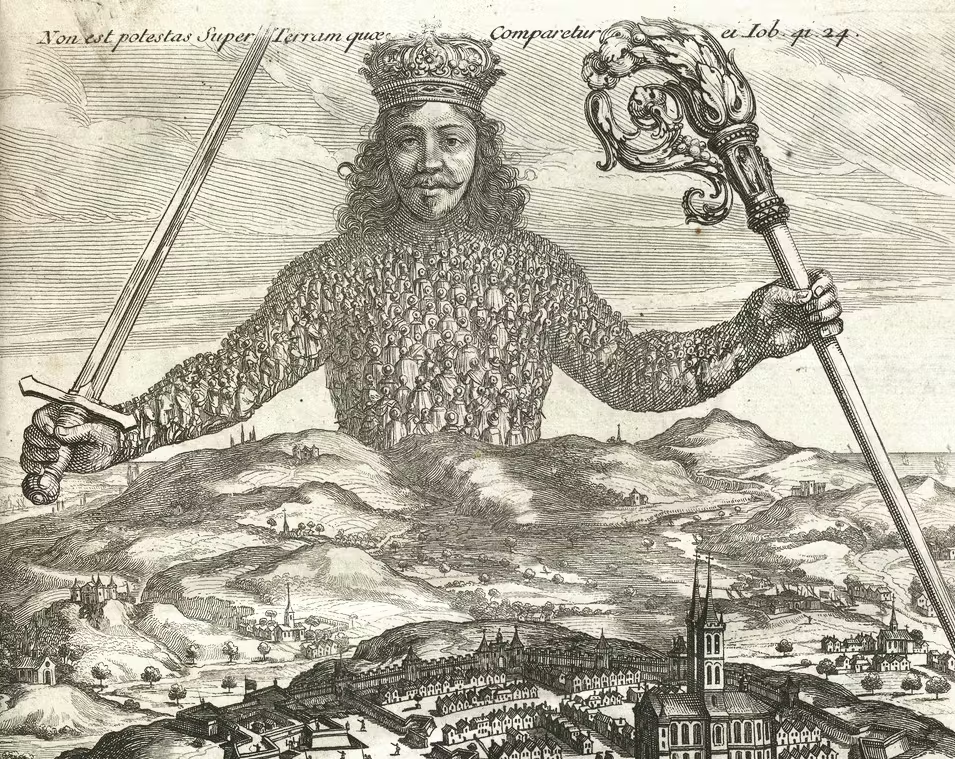
    Thomas Hobbes wrote his seminal work Leviathan in 1651. In it he describes the world system as it was then as being in “a state of nature,” something that some have interpreted as anarchy. However, anarchy has order and purpose. It is not chaos. In fact, if we think of Adam Smith’s “invisible hand of the market” we get something similar to what anarchy is in practice: the aggregate of individual acts of self-interest can lead to the optimisation of value and outcomes at the collective level. Anarchy clears; chaos does not.

    For Hobbes, the state of nature was chaos. Absent a “Sovereign” (i.e. a government) that could impose order on global and domestic societies, humans were destined to lead lives the were “solitary, poor, nasty, brutish and short.” This has translated into notions of “might makes right,” “survival of the fittest,” “to the victor goes the spoils” and other axioms of so-called power politics. The most elaborate of these, international relations realism, is a school of thought that is based on the belief that because the international system has no superseding Sovereign in the form of world government with comprehensive enforcement powers, and because there are no universally shared values and mores throughout the globe community that ideologically bind cultures, groups and individuals, global society exists as a state of nature where, even if there are attempts to manage the relationships between States (and other actors) via rules, norms, institutions and the like, the bottom line is that States (and other actors) have interests, not friends.

    Interests are pursued in a context of power differentials. Alliances are temporary and based on the convergence of mutual interests. Values are not universal and so are inconsequential. International exchange is transactional, not altruistic. Actors with greater resources at their disposal (human, natural, intellectual) prevail over those that have less. In case of resource parity between States or other actors, balances of power become systems regulators, but these are fluid and contingent, not permanent. Geography matters in that regard, which is why geopolitics (the relationship of power to geography) is the core of international relations.

    It is worth remembering this when evaluating contemporary international relations. It has been well established by now that the liberal international order of the post WW2 era has largely been dismantled in the context of increasing multipolarity in inter-State relations and the rise of the Global South within the emerging order. As I have written before, the long transition and systemic realignment in international affairs has led to norm erosion, rules violations, multinational institutional and international organizational decay or irrelevance and the rise of conflict (be it in trade, diplomacy or armed force) as the new systems regulator.

    These developments have accentuated over the last decade and now have a catalyst for a full move into a new global moment–but not into a multipolar or multiplex constellation arrangement in which rising and established powers move between multilateral blocs depending on the issues involved. Instead, the move appears to be one towards a modern Hobbesian state of nature, with the precipitant being the MAGA administration of Donald Trump and its foreign policy approach.

    We must be clear that it is not Trump who is the architect of this move. As mentioned in pervious posts, he is an empty vessel consumed by his own self-worth. That makes him a useful tool of far smarter people than he, people who work in the shadow of relative anonymity and who cut their teeth in rightwing think tanks and policy centres. In their view the liberal internationalist order placed too many constraints on the exercise of US power while at the same time requiring the US to over-extend itself as the “world’s policeman” and international aid donor . Bound by international conventions on the one hand and besieged by foreign rent-seekers and adversaries on the other, the US was increasingly bent under the weight of overlapped demands in which existential national interests were subsumed to a plethora of frivolous diversions (such as human rights and democracy promotion).

    For these strategists, the solution to the dilemma was not to be found in any new multipolar (or even technopolar) constellation but in a dismantling of the entire edifice of international order, something that was based on an architecture of rules, institutions and norms nearly 500 years in the making. Many have mentioned Trump’s apparent mercantilist inclinations and his admiration for former US president William McKinley’s tariff policies in the late 1890s. Although that may be true, the Trump/MAGA agenda is far broader in scope than trade. In fact, the US had its greatest period of (neo-imperial) expansion during McKinley’s tenure as president (1897-1901), winning the Spanish-American War and annexing Hawai’i, Puerto Rico, Guam, American Samoa and the Philippines, so Trump’s admiration for him may well be based on notions of territorial expansionism as well.

    Whatever Trump’s views of McKinley, the basic idea under-riding his foreign policy team’s approach is that in a world where the exercise of power is the ultimate arbiter of a State’s international status, the US remains the greatest Power of them all. It does not matter if the PRC or Russia challenge the US or if other emerging powers join the competition. Without the hobbling effect of its liberal obligations the US can and will dominate them all. This involves trade but also the exercise of raw (neo) imperialist ambitions in places like Greenland, the Panama Canal and even Canada. It involves sidelining the UN, NATO, EU and other international organisations where the US had to share equal votes with lesser powers who flaunted the respect and tribute that should naturally be given in recognition of the US’s superior power base.

    There appears to be a belief in this approach that the US can be a new hegemon–but not Sovereign–in a unipolar world, even more so than during the post-USSR-pre 9/11 interregnum. In a new state of nature it can sit at the core of the international system, orbited by constellations of lesser Great Powers like the PRC, Russia, the EU, perhaps India, who in turn would be circled by lesser powers of various stripes. The US will not seek to police the world or waste time and resources on well-meaning but ultimately futile soft power exercises like those involving foreign aid and humanitarian assistance. Its power projection will be sharp on all dimensions, be it trade, diplomacy or in military-security affairs. It will use leverage, intimidation and varying degrees of coercion as well as persuasion (and perhaps even bribery) as diplomatic tools. It will engage the world primarily in bilateral fashion, eschewing multilateralism for others to pursue according to their own interests and power capabilities. That may suit them, but for the US multilateralism is just another obsolescent vestige of the liberal internationalist past.

    Source: Northrop-Grumman.

    A possible (and partial) explanation for the change in the US foreign policy approach may be the learning effect in the US of Russia’s invasion of Ukraine and Israel’s scorched earth campaign in Gaza. Trump and his advisors may have learned that impunity has its own rewards, that no country or group of countries other than the US (if it has the will) can effectively confront a state determined to pursue its interests regardless of international law, the laws of war or institutional censorship (say, by the UN or International Criminal Court), or any other type of countervailing power. The Russians and Israelis have gotten away with their behaviour because, all rhetoric and hand-wringing aside, there is no actor or group of actors who have the will or capability to stop them. For Trump strategists, these lesser powers are pursuing their interests regardless of diplomatic niceties and international conventions, and they are prevailing precisely because of that. Other than providing military assistance to Ukraine, no one has lifted a serious finger against the Russians other than the Ukrainians themselves, and even fewer have seriously moved to confront Israel’s now evident ethnic cleansing campaign in part because the US has backed Israel unequivocally. The exercise of power in each case occurred in a norm enforcement vacuum in spite of the plethora of agencies and institutions designed to prevent such egregious violations of international standards.

    Put another way: if Israel and Russia can get away with their disproportionate and indiscriminate aggression, imagine what the US can do.

    If we go on to include the PRC’s successful aggressive military “diplomacy” in East/SE Asia, the use of targeted assassinations, hacking, disinformation and covert direct influence campaigns overseas by various States and assorted other unpunished violations of international conventions, then it is entirely plausible that Trump’s foreign policy brain trust sees the moment as ripe for finally breaking the shackles of liberal internationalism. Also recall that many in Trump’s inner circle subscribe to chaos or disruption theory, in which a norms-breaking “disruptor” like Trump seizes the opportunities presented by the breakdown of the status quo ante.

    Before the US could hollow out liberal internationalism abroad and replace it with a modern international state of nature it had to crush liberalism at home. Using Executive Orders as a bludgeon and with a complaint Republican-dominated Congress and Republican-adjacent federal courts. the Trump administration has openly exercised increasingly authoritarian control powers with the intention of subjugating US civil society to its will. Be it in its deportation policies, rollbacks of civil rights protections, attacks on higher education, diminishing of federal government capacity and services (except in the security field), venomous scapegoating of opponents and vulnerable groups, the Trump/MAGA domestic agenda not only seeks to turn the US into a illiberal or “hard” democracy (what Spanish language scholars call a “democradura” as a play on words mixing the terms democracia and dura (hard)). It also serves notice that the US under Trump/MAGA is willing to do whatever is necessary to re-impose its supremacy in world affairs, even if it means hurting its own in order to prove the point. By its actions at home Trump’s administration demonstrates capability, intent and steadfast resolve as it establishes a reputation for ruthless pursuit of its policy agenda. Foreign interlocutors will have to take note of this and adjust accordingly. Hence, for Trump’s advisors, authoritarianism at home is the first step towards undisputed supremacy abroad.

    The Trump embrace of international state of nature differs from Hobbes because it does not see the need for a superseding global governance network but instead believes that the US can dominate the world without the encumbrances of power-sharing with lesser players. In this view hegemony means domination, no more or less. It implies no attempt at playing the role of a Sovereign imposing order on a disorderly and recalcitrant community of Nation-States and non-State actors that do not share common values, much less interests.

    This is the core of the current US foreign policy approach. It is not about reorganising the international order within the extant frameworks as given. It is about removing those frameworks entirely and replacing them with an America First, go it alone agenda where the US, by virtue of its unrivalled power differential relative to all other States and global actors, can maximise its self-interest in largely unconstrained fashion. Some vestiges of the old international order may remain, but they will be marginalised and crippled the longer the US project is in force.

    What does not seem to be happening in Trump’s foreign policy circle are three things. First, recognition that other States and international actors may band together against the US move to unipolarity in a new state of nature and that for all its talk the US may not be able to impose unipolar dominance over them. Second, understanding that States like the PRC, Russia and other Great Powers and communities (like the EU) may resist the US move and challenge it before it can consolidate the new international status quo. Third, foreseeing that the technology titans who today are influential in the Trump administration may decide to transfer there loyalties elsewhere, especially if Trump’s ego starts becoming a hindrance to their (economic and digital) power bases. The fusion of private technology control and US State power may not be as compatible over time as presently appears to be the case, something that may not occur with States such as the PRC, India or Japan that have different corporate cultures and political structures. As the current investment in the Middle Eastern oligarchies shows, the fusion of State and private techno power may be easier to accomplish in those contexts rather than the US.

    In any event, whether it be a short-term interlude or a longue durée feature of international life, a modern state of nature is now our new global reality.

    Analysis syndicated by 36th Parallel Assessments

    MIL OSI AnalysisEveningReport.nz

  • MIL-OSI China: Iran’s FM urges Trump to stop ‘disrespectful tone’ towards Iranian top leader

    Source: People’s Republic of China – State Council News

    Iranian Foreign Minister Seyed Abbas Araghchi said early Saturday that if U.S. President Donald Trump is sincere about seeking to reach an agreement with Tehran, he should put aside his “disrespectful tone” towards the Iranian supreme leader.

    He made the remarks in a post on social media platform X while condemning the U.S. president’s several instances of using “disrespectful” language when speaking about Iran’s Supreme Leader Ali Khamenei.

    “If President Trump is genuine about wanting a deal, he should put aside the disrespectful and unacceptable tone towards Iran’s Supreme Leader … and stop hurting his millions of heartfelt followers,” he said, noting that “good will begets good will, and respect begets respect.”

    “The complexity and tenacity of Iranians is famously known in our magnificent carpets, woven through countless hours of hard work and patience,” he stressed, adding that however, “as a people, our basic premise is very simple and straightforward: we know our worth, value our independence, and never allow anyone else to decide our destiny.”

    Facilitated by Oman, Iranian and U.S. delegations had held five rounds of indirect talks since April on Tehran’s nuclear program and the lifting of U.S. sanctions.

    However, the negotiations were halted earlier this month as Israel launched airstrikes on Tehran and other areas.

    MIL OSI China News

  • MIL-OSI China: Iran holds funeral for military commanders, scientists killed in Israeli strikes

    Source: People’s Republic of China – State Council News

    Iran on Saturday held a state funeral for the military commanders and nuclear scientists killed during a 12-day conflict with Israel.

    The ceremony was attended by the families of those killed in the attacks as well as high-ranking Iranian officials and military commanders, including President Masoud Pezeshkian, Judiciary Chief Gholamhossein Mohseni-Ejei, Parliament Speaker Mohammad Bagher Ghalibaf, Foreign Minister Seyed Abbas Araghchi and senior advisor to Iran’s supreme leader, Ali Shamkhani, who was severely injured in the Israeli airstrikes on Tehran.

    On June 13, Israel launched major airstrikes on different areas in Iran, including nuclear and military sites, killing several senior commanders, nuclear scientists and civilians. Iran responded by launching several waves of missile and drone attacks on Israel.

    Following the 12-day war, a ceasefire between Iran and Israel was achieved on Tuesday.

    The mourners waved Iran’s flags while chanting slogans against Israel and the United States. They carried pictures of the “martyred” commanders and nuclear scientists, including Chief Commander of the Islamic Revolution Guards Corps (IRGC) Hossein Salami, Chief of Staff of the Iranian Armed Forces Mohammad Bagheri, Chief Commander of the IRGC’s Aerospace Division Amir Ali Hajizadeh and chief commander of the Khatam al-Anbiya Central Headquarters and his successor, Gholam Ali Rashid and Ali Shadmani respectively.

    Iran’s Interior Minister Eskandar Momeni said at the ceremony that the United States and Israel proved that they failed to honor any of their commitments.

    He emphasized that the Iranian armed forces were highly vigilant to give a decisive response to any “malicious action” or breach of promises by the “enemy.”

    The burial ceremonies are scheduled to be held on Sunday.

    MIL OSI China News

  • MIL-Evening Report: ER Report: A Roundup of Significant Articles on EveningReport.nz for June 29, 2025

    ER Report: Here is a summary of significant articles published on EveningReport.nz on June 29, 2025.

    Do all Iranians hate the regime? Hate America? Life inside the country is more complex than that
    Source: The Conversation (Au and NZ) – By Simon Theobald, Postdoctoral researcher, Institute for Ethics and Society, University of Notre Dame Australia From 2015 to 2018, I spent 15 months doing research work in Mashhad, Iran’s second-largest city. As an anthropologist, I was interested in everyday life in Iran outside the capital Tehran. I was

    Talks result in PNG and Bougainville signing ‘Melanesian Agreement’
    RNZ Pacific The leaders of Bougainville and Papua New Guinea have signed a deal that may bring the autonomous region’s quest for independence closer. Called “Melanesian Agreement”, the deal was developed earlier this month in 10 days of discussion at the New Zealand army base at Burnham, near Christchurch. Both governments have agreed that the

    Eugene Doyle: Why Asia-Pacific should be cheering for Iran and not US bomb-based statecraft
    ANALYSIS: By Eugene Doyle Setting aside any thoughts I may have about theocratic rulers (whether they be in Tel Aviv or Tehran), I am personally glad that Iran was able to hold out against the US-Israeli attacks this month. The ceasefire, however, will only be a pause in the long-running campaign to destabilise, weaken and

    ER Report: A Roundup of Significant Articles on EveningReport.nz for June 28, 2025
    ER Report: Here is a summary of significant articles published on EveningReport.nz on June 28, 2025.

    MIL OSI AnalysisEveningReport.nz

  • MIL-Evening Report: ER Report: A Roundup of Significant Articles on EveningReport.nz for June 29, 2025

    ER Report: Here is a summary of significant articles published on EveningReport.nz on June 29, 2025.

    Do all Iranians hate the regime? Hate America? Life inside the country is more complex than that
    Source: The Conversation (Au and NZ) – By Simon Theobald, Postdoctoral researcher, Institute for Ethics and Society, University of Notre Dame Australia From 2015 to 2018, I spent 15 months doing research work in Mashhad, Iran’s second-largest city. As an anthropologist, I was interested in everyday life in Iran outside the capital Tehran. I was

    Talks result in PNG and Bougainville signing ‘Melanesian Agreement’
    RNZ Pacific The leaders of Bougainville and Papua New Guinea have signed a deal that may bring the autonomous region’s quest for independence closer. Called “Melanesian Agreement”, the deal was developed earlier this month in 10 days of discussion at the New Zealand army base at Burnham, near Christchurch. Both governments have agreed that the

    Eugene Doyle: Why Asia-Pacific should be cheering for Iran and not US bomb-based statecraft
    ANALYSIS: By Eugene Doyle Setting aside any thoughts I may have about theocratic rulers (whether they be in Tel Aviv or Tehran), I am personally glad that Iran was able to hold out against the US-Israeli attacks this month. The ceasefire, however, will only be a pause in the long-running campaign to destabilise, weaken and

    ER Report: A Roundup of Significant Articles on EveningReport.nz for June 28, 2025
    ER Report: Here is a summary of significant articles published on EveningReport.nz on June 28, 2025.

    MIL OSI AnalysisEveningReport.nz

  • MIL-Evening Report: Do all Iranians hate the regime? Hate America? Life inside the country is more complex than that

    Source: The Conversation (Au and NZ) – By Simon Theobald, Postdoctoral researcher, Institute for Ethics and Society, University of Notre Dame Australia

    From 2015 to 2018, I spent 15 months doing research work in Mashhad, Iran’s second-largest city. As an anthropologist, I was interested in everyday life in Iran outside the capital Tehran. I was also interested in understanding whether the ambitions of the 1979 Revolution lived on among “ordinary” Iranians, not just political elites.

    I first lived on a university campus, where I learned Persian, and later with Iranian families. I conducted hundreds of interviews with people who had a broad spectrum of political, social and religious views. They included opponents of the Islamic Republic, supporters, and many who were in between.

    What these interviews revealed to me was both the diversity of opinion and experience in Iran, and the difficulty of making uniform statements about what Iranians believe.

    Measuring the depth of antipathy for the regime

    When Israel’s strikes on Iran began on June 13, killing many top military commanders, many news outlets – both international and those run by the Iranian diaspora – featured images of Iranians cheering the deaths of these hated regime figures.

    Friends from my fieldwork also pointed to these celebrations, while not always agreeing with them. Many feared the impact of a larger conflict between Iran and Israel.

    Trying to put these sentiments in context, many analysts have pointed to a 2019 survey by the GAMAAN Institute, an independent organisation based in the Netherlands that tracks Iranian public opinion. This survey showed 79% of Iranians living in the country would vote against the Islamic Republic if a free referendum were held on its rule.

    Viewing these examples as an indicator of the lack of support for the Islamic Republic is not wrong. But when used as factoids in news reports, they become detached from the complexities of life in Iran. This can discourage us from asking deeper questions about the relationships between ideology and pragmatism, support and opposition to the regime, and state and society.

    A more nuanced view

    The news reporting on Iran has encouraged a tendency to see the Iranian state as homogeneous, highly ideological and radically separate from the population.

    But where do we draw the line between the state and the people? There is no easy answer to this.

    When I lived in Iran, many of the people who took part in my research were state employees – teachers at state institutions, university lecturers, administrative workers. Many of them had strong and diverse views about the legacy of the revolution and the future of the country.

    They sometimes pointed to state discourse they agreed with, for example Iran’s right to national self-determination, free from foreign influence. They also disagreed with much, such as the slogans of “death to America”.

    This ambivalence was evident in one of my Persian teachers. An employee of the state, she refused to attend the annual parades celebrating the anniversary of the revolution. “We have warm feelings towards America,” she said. On the other hand, she happily attended protests, also organised by the government, in favour of Palestinian liberation.

    Or take the young government worker I met in Mashhad: “We want to be independent of other countries, but not like this.”

    In a narrower sense, discussions about the “state” may refer more to organisations like the Islamic Revolutionary Guard Corps (IRGC) and the Basij, the paramilitary force within the IRGC that has cracked down harshly on dissent in recent decades. Both are often understood as being deeply ideologically committed.

    Said Golkar, a US-based Iranian academic and author, for instance, calls Iran a “captive society”. Rather than having a civil society, he believes Iranians are trapped by the feared Basij, who maintain control through their presence in many institutions like universities and schools.

    Again, this view is not wrong. But even among the Basij and Revolutionary Guard, it can be difficult to gauge just how ideological and homogeneous these organisations truly are.

    For a start, the IRGC relies on both ideologically selected supporters, as well as conscripts, to fill its ranks. They are also not always ideologically uniform, as the US-based anthropologist Narges Bajoghli, who worked with pro-state filmmakers in Tehran, has noted.

    As part of my research, I also interviewed members of the Basij, which, unlike the IRGC proper, is a wholly volunteer organisation.

    Even though ideological commitment was certainly an important factor for some of the Basij members I met, there were also pragmatic reasons to join. These included access to better jobs, scholarships and social mobility. Sometimes, factors overlapped. But participation did not always equate to a singular or sustained commitment to revolutionary values.

    For example, Sāsān, a friend I made attending discussion groups in Mashhad, was quick to note that time spent in the Basij “reduced your [compulsory] military service”.

    This isn’t to suggest there are not ideologically committed people in Iran. They clearly exist, and many are ready to use violence. Some of those who join these institutions for pragmatic reasons use violence, too.

    Looking in between

    In addition, Iran is an ethnically diverse country. It has a population of 92 million people, a bare majority of whom are Persians. Other minorities include Azeris, Kurds, Arabs, Baloch, Turkmen and others.

    It is also religiously diverse. While there is a sizeable, nominally Shi’a majority, there are also large Sunni communities (about 10-15% of the population) and smaller communities of Christians, Jews, Zoroastrians, Baha’is and other religions.

    Often overlooked, there are also important differences in class and social strata in Iran, too.

    One of the things I noticed about state propaganda was that it flattened this diversity. James Barry, an Australian scholar of Iran, noticed a similar phenomenon.

    State propaganda made it seem like there was one voice in the country. Protests could be dismissed out of hand because they did not represent the “authentic” view of Iranians. Foreign agitators supported protests. Iranians supported the Islamic Republic.

    Since leaving Iran, I have followed many voices of Iranians in the diaspora. Opposition groups are loud on social media, especially the monarchists who support Reza Pahlavi, the son of the deposed Shah.

    In following these groups, I have noticed a similar tendency to speak as though they represent the voice of all Iranians. Iranians support the shah. Or Iranians support Maryam Rajavi, leader of a Paris-based opposition group.

    Both within Iran, and in the diaspora, the regime, too, is sometimes held to be the imposition of a foreign conspiracy. This allows the Islamic Republic and the complex relations it has created to be dismissed out of hand. Once again, such a view flattens diversity.

    Over the past few years, political identities and societal divisions seem to have become harder and clearer. This means there is an increasing perception among many Iranians of a gulf between the state and Iranian society. This is the case both inside Iran, and especially in the Iranian diaspora.

    Decades of intermittent protests and civil disobedience across the country also show that for many, the current system no longer represents the hopes and aspirations of many people. This is especially the case for the youth, who make up a large percentage of the population.

    I am not an Iranian, and I strongly believe it is up to Iranians to determine their own futures. I also do not aim to excuse the Islamic Republic – it is brutal and tyrannical. But its brutality should not let us shy away from asking complex questions.

    If the regime did fall tomorrow, Iran’s diversity means there is little unanimity of opinion as to what should come next. And if a more pluralist form of politics is to emerge, it must encompass the whole of Iran’s diversity, without assuming a uniform position.

    It, too, will have to wrestle with the difficult questions and sometimes ambivalent relations the Islamic Republic has created.

    Simon Theobald received funding from the Australian National University during his research.

    ref. Do all Iranians hate the regime? Hate America? Life inside the country is more complex than that – https://theconversation.com/do-all-iranians-hate-the-regime-hate-america-life-inside-the-country-is-more-complex-than-that-259554
    MIL OSI AnalysisEveningReport.nz

  • MIL-OSI USA: 06.21.2025 Senator Cruz Statement on U.S. Striking Iranian Regime Nuclear Infrastructure

    US Senate News:

    Source: United States Senator for Texas Ted Cruz

    WASHINGTON, D.C. – U.S. Sen. Ted Cruz (R-Texas) issued a statement following U.S. strikes on Iranian regime nuclear infrastructure. 
    Sen. Cruz said, “I commend our pilots and servicemembers, our intelligence personnel, President Trump, and his national security staff on tonight’s successful and critical operation.
    “The prospect of the Iranian regime acquiring nuclear weapons represents the most acute immediate threat to America and our allies. When the Ayatollah chants ‘Death to America,’ he means it, and the reason he is building nuclear weapons is because he intends to use them. President Trump has consistently and unequivocally stated that those threats cannot be countered without dismantling the Iranian regime’s enrichment capacity. The President and his negotiators spent two months exploring whether the regime would agree to a negotiated settlement that met America’s national security needs. At the end of that period, Iranian regime officials declared that instead of agreeing to a deal they would open a new enrichment facility and install more advanced centrifuges.
    “After that declaration, our Israeli allies launched a preemptive attack against the regime and its nuclear infrastructure, which was enormously successful but could not disable the nuclear activities at Fordow, an underground enrichment bunker built into a mountain which was legitimized by the catastrophic Obama-Iran nuclear deal. As long as Iran was able to access and conduct activities at Fordow, they could still rush to build a nuclear arsenal. Tonight’s actions have gone far in foreclosing that possibility, and countering the apocalyptic threat posed by an Iranian nuclear arsenal.”

    MIL OSI USA News

  • MIL-OSI USA: 06.21.2025 Senator Cruz Statement on U.S. Striking Iranian Regime Nuclear Infrastructure

    US Senate News:

    Source: United States Senator for Texas Ted Cruz

    WASHINGTON, D.C. – U.S. Sen. Ted Cruz (R-Texas) issued a statement following U.S. strikes on Iranian regime nuclear infrastructure. 
    Sen. Cruz said, “I commend our pilots and servicemembers, our intelligence personnel, President Trump, and his national security staff on tonight’s successful and critical operation.
    “The prospect of the Iranian regime acquiring nuclear weapons represents the most acute immediate threat to America and our allies. When the Ayatollah chants ‘Death to America,’ he means it, and the reason he is building nuclear weapons is because he intends to use them. President Trump has consistently and unequivocally stated that those threats cannot be countered without dismantling the Iranian regime’s enrichment capacity. The President and his negotiators spent two months exploring whether the regime would agree to a negotiated settlement that met America’s national security needs. At the end of that period, Iranian regime officials declared that instead of agreeing to a deal they would open a new enrichment facility and install more advanced centrifuges.
    “After that declaration, our Israeli allies launched a preemptive attack against the regime and its nuclear infrastructure, which was enormously successful but could not disable the nuclear activities at Fordow, an underground enrichment bunker built into a mountain which was legitimized by the catastrophic Obama-Iran nuclear deal. As long as Iran was able to access and conduct activities at Fordow, they could still rush to build a nuclear arsenal. Tonight’s actions have gone far in foreclosing that possibility, and countering the apocalyptic threat posed by an Iranian nuclear arsenal.”

    MIL OSI USA News

  • MIL-OSI USA: Senator Marshall: This is the Beginning of America’s Great Golden Era

    US Senate News:

    Source: United States Senator for Kansas Roger Marshall
    Senator Marshall Joins Fox News to Discuss the Reconciliation Bill, Medicaid, and Operation Midnight Hammer.
    Washington – On Saturday, U.S. Senator Roger Marshall, M.D. (R-Kansas), joined Rich Edson on Fox News’ Fox News Live to discuss the Senate’s latest timeline to move the reconciliation bill forward, the negotiations around the SALT deduction, the best way to save Medicaid for those who need it most, and what’s next for America in the ongoing conflicts abroad.
    Click HERE or on the image above to watch the full interview. 
    On the Republican reconciliation bill:
    “In my career as an obstetrician, I feel like this bill is three weeks past its due date. It’s time to have the baby. Everyone’s upset – that means we’re probably close to where it needs to be. We cannot blow this chance. This is the President’s legacy, his agenda. If you supported President Trump, you should support this bill. This will be the largest tax decrease in American history. We’re going to secure the border – a whole lot of other good things, but mostly this is the beginning of America’s great, golden era.”
    On the SALT Deduction and its impact on negotiations:
    “… Over in the house, I think we have a little tighter margin. And again, I think that what we asked the President to do here was split the baby, but he’s keeping the baby together. This is the best we can get. Speaker Johnson was there with us yesterday, negotiating this to the last second. I think everyone has thrown their best argument on the table – I think that’s a great step forward. I wish we were cutting more spending, including this, but this is the best bill that we can get through the finish line.”
    On how to save Medicaid from disaster:
    “Again, just because you have Medicaid doesn’t mean you have access to care. You pointed out that a third of doctors don’t accept Medicaid, and another third basically rule them out through the schedule. What our bill does is give a block grant for rural hospitals and for Community Health Centers. One of my three pillars of MAHA is making sure that everyone has meaningful, affordable access to primary care. Even Bernie Sanders agrees with me that these Community Health Centers are a great way to do that. I think that healthcare will be better.
    “And in this bill, we absolutely preserve Medicaid for those who need it the most. We don’t touch seniors in nursing homes, people with disabilities, pregnant women, or children. So, we will protect Medicaid for those who need it the most. And on the other hand, we want to make sure everyone has access to care. We’ll do it through a block grant – I’m so proud of the work we’ve done here, as far as making health care more affordable and more accessible.”
    On where the Medicaid savings will come from:
    “So, the savings come from a couple of things. One, something called a provider tax, which is absolutely a scam, a money laundering scam, where you have one state, maybe getting 25 times more per person than what a state like Kansas is getting. So, we need to level out those provider taxes.
    “And then, as we talk about people that may lose Medicaid, half of them are people that are on it fraudulently or through some type of error. And the other half will be those that are refusing to work 20 hours a day. Again, 60, 70% of Americans support some type of work requirements if you don’t have a disability, you’re working age, you don’t have a child under the age of 13, then I think it’s reasonable to ask people to work or volunteer for 20 hours a week.”
    On what’s next for America in the Israel and Iran conflict:
    “I think it will take them years just to restart their nuclear program. I think that they can’t control their airspace. They don’t have the will to do it. From what I’ve seen, I’m in shock and awe. You know, it’s shocking how much damage we did to their facilities. Obliterated is a great term. I’m in awe of our military, the great job that they did.
    “Thanks to all those Air Force guys who did this off. I’m an Army guy, but I’m still going to salute them. They did a great job. And thanks to all of our soldiers over in the Middle East, I don’t see Iran getting back in this ball game for several years.
    “Iran cannot have any type of nuclear bomb if they don’t want to move things in a different direction right now, then we need to double down on our sanctions. Whatever we need to do. Look, I don’t want boots on the ground. I’m tired of all the killing. I want all the killing to stop in Gaza, in Iran – all these different places, Ukraine. But at the end of the game, Iran cannot have a nuclear warhead.”

    MIL OSI USA News

  • MIL-OSI Europe: EUROPE/ITALY – Father Luigi Buccarello, Superior General of the Trinitarians, confirms: “Where there is dialogue, there is no violence”

    Source: Agenzia Fides – MIL OSI

    Saturday, 28 June 2025

    by Antonella PrennaRome (Agenzia Fides) – “We work in problematic, difficult, and complex contexts where persecution exists. Where violence and persecution prevail, there is no dialogue, there is no respect for others. Precisely for this reason, in support of our specific mission of helping persecuted Christians, we also focus on interreligious dialogue, on religious freedom as a topic for deepening and raising awareness not only on a social but also on a theological level.”This is what Father Luigi Buccarello said in an interview with Fides at the end of the General Chapter of the Order of the Most Holy Trinity and the Captives O.SS.T. (see Fides, 7/11/2023), where he was confirmed for a further term as Superior General. Also present was Father Antonio Aurelio Fernández Serrano, president of the organization Trinitarian International Solidarity (SIT), which coordinates activities to support persecuted Christians.In the wake of Dignitatis Humanae”Following the guidelines of the Vatican II document on religious freedom, Dignitatis Humanae, and the subsequent magisterium of the Pontiffs,” Father Buccarello continues, “we have been collaborating for two years with the Center for Interreligious Studies of the Pontifical Gregorian University, with whom we organized a six-month course entitled ‘Religious Freedom: Problems, Challenges, and Perspectives,’ which was offered for the first time this year. In addition to the course, which is aimed at theology students and those interested in the subject, we have established a two-year theological research group involving 15 specialists from various research fields. The topic of religious freedom requires an interdisciplinary and transdisciplinary approach; geopolitics, history, sociology, theology, canon law, civil law, and religious studies are all involved. A publication will be published at the end of this two-year research period.””The lack of religious freedom,” the priest continued, “is a challenge for every religion. Every day we hear about attacks in Nigeria, Yemen, and Syria. Syria had exuberantly celebrated the regime change, but we see that we are back to square one.” “Together with Father Antonio, we are always in contact with these countries, and since we touch these realities firsthand, we recognize that religious freedom is the only guarantee of peace and coexistence. Our service is not charitable; rather, we want to address the problem at its root and combat the causes underlying religious intolerance.””The General Chapter,” the Superior General continues, “placed great emphasis on the specific training of our students in these topics. Working in the field of interreligious dialogue means paving a path to peace. Religious freedom is the path to peace. One of the important themes of the post-conciliar Magisterium is the consideration of religious freedom as a prerequisite for peace, because where freedom is respected, there is obviously peace, acceptance of others, and appreciation of religious diversity. Fundamentalists resort to violence because they do not tolerate religious diversity. They want uniformity, even within their own religious tradition; they view religion as a monolithic bloc and consider themselves the sole bearers of the authentic religious message. If this acceptance of diversity is lacking and differences are perceived as a threat rather than an enrichment, peace is in danger. But our faith is also in danger, for it always leads us to an encounter with others.”A long historyThe current mission of the Trinitarian religious family coincides with an update of its founding charism. “The Trinitarian Order,” explains Father Buccarello, “was founded for persecuted Christians, obviously in a different time and in a different historical context. In our motto, “Gloria tibi Trinitas et captivis libertas,” we find the word ‘slaves,’ ‘prisoners.’ Our founder, Saint John of Matha, began the “liberation missions,” initially from Spain to Morocco, with a letter from Innocent III, in which he recommended the Trinitarians to the Sultan of Morocco, saying that the work of freeing slaves was a work of charity, the most important, the most significant, and of universal benefit. In fact, the Pope had given the Trinitarians permission to free Christian slaves through exchange with Muslim slaves, thus creating a double liberation of both Christian and Muslim slaves.”Saint John of Matha was a learned theologian and had no intention to found a new religious family. During his first Mass, he had a vision: he saw Christ in the center, holding the arms of two slaves, a white Christian and a Black Muslim. After a period of reflection, it became clear to him that he had to found a religious family dedicated to this special mission: the redemption of captives “pro fide Christi.””Today,” adds Father Buccarello, “we know that this inspiration of our founder is very timely. The two ‘lungs’ of our mission are the works of mercy and persecuted Christians. And the latter is the work that most identifies and unites us. To update this charism, the Extraordinary General Chapter of 1999, on the occasion of the 800th anniversary of the adoption of the Rule of the Order and the fourth anniversary of the Order’s reform, decided to create an organization to coordinate and promote this area of assistance to persecuted Christians, which would be called ‘Trinitarian International Solidarity.’”The organization’s current president, Father Antonio Aurelio Fernández Serrano, explains that “it is an internal body of the Trinitarian religious family, whose first 25th anniversary was just celebrated. On this occasion, we made a documentary to raise awareness of the problem of persecuted Christians.” “Our projects,” he explains, “are also present in countries like Sudan and South Sudan, where we have already freed several young people.”Father Buccarello adds details of a meeting of the aid organization in Bahrain, where, at the initiative of the Apostolic Vicar of Northern Arabia, Bishop Aldo Berardi, O.SS.T., a meeting was also held with Abdullah Abdullah, director of the Global Center for Peace Coexistence (see Fides, 23/10/2024). “Abdullah came to our Chapter to share his experience,” the Superior General said. “He was also in the Italian Parliament, where, at a meeting in the Chamber of Deputies, he described the Trinitarian Order as an example of dialogue, care, charity, and respect.”The challenges of todayThe Trinitarians are active in the Roman parish of Santa Maria delle Fornaci, the titular church of Cardinal Mario Zenari, Apostolic Nuncio to Syria. “The Cardinal,” Father Buccarello explains, “spoke to us extensively about the situation in Syria, about persecution, but also about poverty, about the many Christians who have left the country in recent years. When Christians disappear from the Middle East, the balance that ensures harmonious coexistence between different cultures and faiths is lost. Peaceful coexistence is most threatened when a historical component of a region’s religious landscape disappears.”The Trinitarian Order is present in 25 countries, including Vietnam, South Korea, and India, a country where, according to Father Buccarello, cases of violence and harassment against Christians are increasing year after year, as well as in many areas of Africa where “terrorist groups and movements engaged in aggressive proselytizing” are active.The specific contribution that the Trinitarian Order can make for the future, according to the Superior General, is to “train religious who are experts in interreligious dialogue. We all need to be sensitized; even in the Western world, where we often do not know how to deal with religious diversity, there is no genuine encounter between people. Everyone has their own space; there is no true integration.” “In many schools in northern Italy,” he notes, “for example, the majority of students are non-Catholic and non-Christian. What resources do we provide to the children so that they can interact and welcome others? And are there other situations that are unknown? Our Trinitarian sisters in Valence, for example, have a school on the outskirts of Marseille. Eighty percent of the students are Muslims, who choose Catholic rather than public schools because they prefer a religious approach to a materialistic, atheistic one. In our school in northern Assam, India, only five percent of the students are Catholic; the others are Hindus and Muslims. However, they live together without problems because religious diversity is a resource that fosters respect for others and promotes the value of coexistence and peace.”The “motto” of the General Chapter was a quote from Paul’s Second Letter to the Corinthians: “Persecuted, but not abandoned; struck down, but not destroyed.” “One of the criteria that was very well highlighted,” the Superior General emphasized, “is that religious freedom is not a theoretical question, but affects the lives and suffering of so many people, and that it must be analyzed in context. Each reality, in its complexity and problematic nature, presents different challenges to religious freedom. In Canada, for example, members of the order cannot go to the hospital wearing a religious habit. In the Western world, there is an aggressive secularism that tends to reduce religion to the private sphere, and identity-political cultural movements that instrumentalize religion. Identitarian movements aim to mark a kind of difference and opposition between “us and you” by fueling narratives that appeal to people’s fears, for example when migration is portrayed as a kind of invasion by the enemy who has come to destroy our identity. All of us, starting with religious leaders, must loudly emphasize that the name of God cannot be associated with war and violence. This must be said emphatically. Yet even these days, we hear statements from political leaders who seek to justify the war as a kind of divine mandate.” (Agenzia Fides, 28/6/2025)
    Share:

    MIL OSI Europe News

  • MIL-OSI Europe: EUROPE/ITALY – Father Luigi Buccarello, Superior General of the Trinitarians, confirms: “Where there is dialogue, there is no violence”

    Source: Agenzia Fides – MIL OSI

    Saturday, 28 June 2025

    by Antonella PrennaRome (Agenzia Fides) – “We work in problematic, difficult, and complex contexts where persecution exists. Where violence and persecution prevail, there is no dialogue, there is no respect for others. Precisely for this reason, in support of our specific mission of helping persecuted Christians, we also focus on interreligious dialogue, on religious freedom as a topic for deepening and raising awareness not only on a social but also on a theological level.”This is what Father Luigi Buccarello said in an interview with Fides at the end of the General Chapter of the Order of the Most Holy Trinity and the Captives O.SS.T. (see Fides, 7/11/2023), where he was confirmed for a further term as Superior General. Also present was Father Antonio Aurelio Fernández Serrano, president of the organization Trinitarian International Solidarity (SIT), which coordinates activities to support persecuted Christians.In the wake of Dignitatis Humanae”Following the guidelines of the Vatican II document on religious freedom, Dignitatis Humanae, and the subsequent magisterium of the Pontiffs,” Father Buccarello continues, “we have been collaborating for two years with the Center for Interreligious Studies of the Pontifical Gregorian University, with whom we organized a six-month course entitled ‘Religious Freedom: Problems, Challenges, and Perspectives,’ which was offered for the first time this year. In addition to the course, which is aimed at theology students and those interested in the subject, we have established a two-year theological research group involving 15 specialists from various research fields. The topic of religious freedom requires an interdisciplinary and transdisciplinary approach; geopolitics, history, sociology, theology, canon law, civil law, and religious studies are all involved. A publication will be published at the end of this two-year research period.””The lack of religious freedom,” the priest continued, “is a challenge for every religion. Every day we hear about attacks in Nigeria, Yemen, and Syria. Syria had exuberantly celebrated the regime change, but we see that we are back to square one.” “Together with Father Antonio, we are always in contact with these countries, and since we touch these realities firsthand, we recognize that religious freedom is the only guarantee of peace and coexistence. Our service is not charitable; rather, we want to address the problem at its root and combat the causes underlying religious intolerance.””The General Chapter,” the Superior General continues, “placed great emphasis on the specific training of our students in these topics. Working in the field of interreligious dialogue means paving a path to peace. Religious freedom is the path to peace. One of the important themes of the post-conciliar Magisterium is the consideration of religious freedom as a prerequisite for peace, because where freedom is respected, there is obviously peace, acceptance of others, and appreciation of religious diversity. Fundamentalists resort to violence because they do not tolerate religious diversity. They want uniformity, even within their own religious tradition; they view religion as a monolithic bloc and consider themselves the sole bearers of the authentic religious message. If this acceptance of diversity is lacking and differences are perceived as a threat rather than an enrichment, peace is in danger. But our faith is also in danger, for it always leads us to an encounter with others.”A long historyThe current mission of the Trinitarian religious family coincides with an update of its founding charism. “The Trinitarian Order,” explains Father Buccarello, “was founded for persecuted Christians, obviously in a different time and in a different historical context. In our motto, “Gloria tibi Trinitas et captivis libertas,” we find the word ‘slaves,’ ‘prisoners.’ Our founder, Saint John of Matha, began the “liberation missions,” initially from Spain to Morocco, with a letter from Innocent III, in which he recommended the Trinitarians to the Sultan of Morocco, saying that the work of freeing slaves was a work of charity, the most important, the most significant, and of universal benefit. In fact, the Pope had given the Trinitarians permission to free Christian slaves through exchange with Muslim slaves, thus creating a double liberation of both Christian and Muslim slaves.”Saint John of Matha was a learned theologian and had no intention to found a new religious family. During his first Mass, he had a vision: he saw Christ in the center, holding the arms of two slaves, a white Christian and a Black Muslim. After a period of reflection, it became clear to him that he had to found a religious family dedicated to this special mission: the redemption of captives “pro fide Christi.””Today,” adds Father Buccarello, “we know that this inspiration of our founder is very timely. The two ‘lungs’ of our mission are the works of mercy and persecuted Christians. And the latter is the work that most identifies and unites us. To update this charism, the Extraordinary General Chapter of 1999, on the occasion of the 800th anniversary of the adoption of the Rule of the Order and the fourth anniversary of the Order’s reform, decided to create an organization to coordinate and promote this area of assistance to persecuted Christians, which would be called ‘Trinitarian International Solidarity.’”The organization’s current president, Father Antonio Aurelio Fernández Serrano, explains that “it is an internal body of the Trinitarian religious family, whose first 25th anniversary was just celebrated. On this occasion, we made a documentary to raise awareness of the problem of persecuted Christians.” “Our projects,” he explains, “are also present in countries like Sudan and South Sudan, where we have already freed several young people.”Father Buccarello adds details of a meeting of the aid organization in Bahrain, where, at the initiative of the Apostolic Vicar of Northern Arabia, Bishop Aldo Berardi, O.SS.T., a meeting was also held with Abdullah Abdullah, director of the Global Center for Peace Coexistence (see Fides, 23/10/2024). “Abdullah came to our Chapter to share his experience,” the Superior General said. “He was also in the Italian Parliament, where, at a meeting in the Chamber of Deputies, he described the Trinitarian Order as an example of dialogue, care, charity, and respect.”The challenges of todayThe Trinitarians are active in the Roman parish of Santa Maria delle Fornaci, the titular church of Cardinal Mario Zenari, Apostolic Nuncio to Syria. “The Cardinal,” Father Buccarello explains, “spoke to us extensively about the situation in Syria, about persecution, but also about poverty, about the many Christians who have left the country in recent years. When Christians disappear from the Middle East, the balance that ensures harmonious coexistence between different cultures and faiths is lost. Peaceful coexistence is most threatened when a historical component of a region’s religious landscape disappears.”The Trinitarian Order is present in 25 countries, including Vietnam, South Korea, and India, a country where, according to Father Buccarello, cases of violence and harassment against Christians are increasing year after year, as well as in many areas of Africa where “terrorist groups and movements engaged in aggressive proselytizing” are active.The specific contribution that the Trinitarian Order can make for the future, according to the Superior General, is to “train religious who are experts in interreligious dialogue. We all need to be sensitized; even in the Western world, where we often do not know how to deal with religious diversity, there is no genuine encounter between people. Everyone has their own space; there is no true integration.” “In many schools in northern Italy,” he notes, “for example, the majority of students are non-Catholic and non-Christian. What resources do we provide to the children so that they can interact and welcome others? And are there other situations that are unknown? Our Trinitarian sisters in Valence, for example, have a school on the outskirts of Marseille. Eighty percent of the students are Muslims, who choose Catholic rather than public schools because they prefer a religious approach to a materialistic, atheistic one. In our school in northern Assam, India, only five percent of the students are Catholic; the others are Hindus and Muslims. However, they live together without problems because religious diversity is a resource that fosters respect for others and promotes the value of coexistence and peace.”The “motto” of the General Chapter was a quote from Paul’s Second Letter to the Corinthians: “Persecuted, but not abandoned; struck down, but not destroyed.” “One of the criteria that was very well highlighted,” the Superior General emphasized, “is that religious freedom is not a theoretical question, but affects the lives and suffering of so many people, and that it must be analyzed in context. Each reality, in its complexity and problematic nature, presents different challenges to religious freedom. In Canada, for example, members of the order cannot go to the hospital wearing a religious habit. In the Western world, there is an aggressive secularism that tends to reduce religion to the private sphere, and identity-political cultural movements that instrumentalize religion. Identitarian movements aim to mark a kind of difference and opposition between “us and you” by fueling narratives that appeal to people’s fears, for example when migration is portrayed as a kind of invasion by the enemy who has come to destroy our identity. All of us, starting with religious leaders, must loudly emphasize that the name of God cannot be associated with war and violence. This must be said emphatically. Yet even these days, we hear statements from political leaders who seek to justify the war as a kind of divine mandate.” (Agenzia Fides, 28/6/2025)
    Share:

    MIL OSI Europe News

  • MIL-OSI Security: Defense News in Brief: This Week in DOD: Hammer Drops on Iranian Nuclear Program, Allies Increase NATO Contribution, Navy Renames Ship for MOH Recipient

    Source: United States Department of Defense

    This week in the Defense Department, the joint force struck Iran’s Fordow Fuel Enrichment Plant with 30,000-pound bombs, NATO allies committed to increasing defense spending and the Navy’s USNS Harvey Milk was renamed the USNS Oscar V. Peterson.

    MIL Security OSI

  • MIL-OSI Africa: United Arab Emirates (UAE) Welcomes Signing of Peace Agreement Between Democratic Republic of the Congo and Republic of Rwanda


    Download logo

    The United Arab Emirates has welcomed the signing of the peace agreement between the Democratic Republic of the Congo and the Republic of Rwanda in Washington, commending it as a significant step towards reinforcing peace, security, and stability across the African continent.

    His Excellency Sheikh Shakhboot bin Nahyan Al Nahyan, Minister of State, commended the extensive efforts of U.S. President Donald Trump, and His Highness Sheikh Tamim bin Hamad Al Thani, Amir of the State of Qatar, in facilitating this positive and constructive achievement, which comes in support of the African Union’s mediation efforts and the outcomes of the joint summit of the Southern African Development Community (SADC) and the East African Community (EAC). His Excellency considers the agreement a reflection of the strong determination and unwavering commitment of both parties to peaceful solutions and dialogue. 

    His Excellency underscored that the international cooperation, which led to the signing of this agreement, reflects the significance of collective action in addressing regional issues, and the importance of resolving disputes through diplomatic means to achieve the aspirations of the peoples of the region for stability and prosperity.

    H.E. Sheikh Shakhboot bin Nahyan emphasized the deep-rooted historic ties between the UAE and the countries of the African continent, including the Democratic Republic of the Congo and the Republic of Rwanda, reiterating the country’s steadfast approach in consolidating bridges of partnership and dialogue and its support for any efforts that contribute to enhancing security, peace, and sustainable development on the continent.

    Distributed by APO Group on behalf of United Arab Emirates, Ministry of Foreign Affairs.

    MIL OSI Africa

  • MIL-OSI Russia: Iran holds funeral for military leaders and scientists killed in Israeli strikes

    Translation. Region: Russian Federal

    Source: People’s Republic of China in Russian –

    Source: People’s Republic of China – State Council News

    TEHRAN, June 28 (Xinhua) — Iran held state funerals on Saturday for military commanders and nuclear scientists killed during the 12-day conflict with Israel.

    The ceremony was attended by the families of those killed in the attacks, as well as senior Iranian officials and military commanders, including President Masoud Pezeshkian, Judiciary Chief Gholam-Hossein Mohseni-Ejei, Parliament Speaker Mohammad Bagher Ghalibaf, Foreign Minister Abbas Araqchi and senior adviser to Iran’s Supreme Leader Ali Shamkhani, who was seriously wounded in Israeli airstrikes on Tehran.

    On June 13, Israel launched a series of massive airstrikes on various areas of Iran, including nuclear and military sites, killing several high-ranking commanders, nuclear scientists, and civilians. Iran responded with several waves of missile and drone attacks on Israel.

    After a 12-day war, a ceasefire was signed between Iran and Israel on June 24.

    During the funeral ceremony, Iranian Interior Minister Eskandar Momeni noted that the United States and Israel have proven their inability to fulfill any of their commitments.

    He stressed that the Iranian armed forces remain on high alert and are ready to give a decisive response to any “malicious actions” or breach of promises by the “enemy.”

    Funeral ceremonies for the victims will take place on Sunday, June 29. –0–

    MIL OSI Russia News

  • MIL-OSI Russia: Iranian FM calls on Trump to change “disrespectful tone” towards Iran’s Supreme Leader

    Translation. Region: Russian Federal

    Source: People’s Republic of China in Russian – People’s Republic of China in Russian –

    Source: People’s Republic of China – State Council News

    TEHRAN, June 28 (Xinhua) — Iranian Foreign Minister Abbas Araqchi said on Saturday that if U.S. President Donald Trump is sincere in his desire to reach an agreement with Tehran, it should abandon its “disrespectful tone” toward Iran’s supreme leader.

    The diplomat made the statement in a post on the X social network, condemning the American leader for repeatedly using “disrespectful” language in his remarks about Iran’s Supreme Leader Ayatollah Ali Khamenei.

    “If President Trump really wants to make a deal, he should drop his disrespectful and unacceptable tone towards Iran’s Supreme Leader and stop hurting millions of his sincere followers,” Araqchi said, noting that “goodwill begets goodwill, and respect begets respect.”

    “The complexity of the Iranian character and tenacity are well known from our magnificent carpets, woven through countless hours of hard work and patience,” he stressed, adding that, however, “the basic principle of our people is very simple and clear: we know our worth, value our independence and never allow anyone else to decide our destiny.”

    Since April, with the assistance of Oman, delegations from Iran and the United States have held five rounds of indirect talks on the issue of Tehran’s nuclear program and the lifting of American sanctions against it.

    However, talks were suspended earlier this month after Israel launched airstrikes on Tehran and other parts of the country. –0–

    MIL OSI Russia News