Category: Middle East

  • MIL-OSI Analysis: Self-censorship and the ‘spiral of silence’: Why Americans are less likely to publicly voice their opinions on political issues

    Source: The Conversation – USA – By James L. Gibson, Sidney W. Souers Professor of Government, Washington University in St. Louis

    Polarization has led many people to feel they’re being silenced. AP Photo/Andrew Harnik

    For decades, Americans’ trust in one another has been on the decline, according to the most recent General Social Survey.

    A major factor in that downshift has been the concurrent rise in the polarization between the two major political parties. Supporters of Republicans and Democrats are far more likely than in the past to view the opposite side with distrust.

    That political polarization is so stark that many Americans are now unlikely to have friendly social interactions, live nearby or congregate with people from opposing camps, according to one recent study.

    Social scientists often refer to this sort of animosity as “affective polarization,” meaning that people not only hold conflicting views on many or most political issues but also disdain fellow citizens who hold different opinions. Over the past few decades, such affective polarization in the U.S. has become commonplace.

    Polarization undermines democracy by making the essential processes of democratic deliberation – discussion, negotiation, compromise and bargaining over public policies – difficult, if not impossible. Because polarization extends so broadly and deeply, some people have become unwilling to express their views until they’ve confirmed they’re speaking with someone who’s like-minded.

    I’m a political scientist, and I found that Americans were far less likely to publicly voice their opinions than even during the height of the McCarthy-era Red Scare.

    A supporter of Donald Trump tries to push past demonstrators in Philadelphia on June 30, 2023.
    AP Photo/Nathan Howard

    The muting of the American voice

    According to a 2022 book written by political scientists Taylor Carlson and Jaime E. Settle, fears about speaking out are grounded in concerns about social sanctions for expressing unwelcome views.

    And this withholding of views extends across a broad range of social circumstances. In 2022, for instance, I conducted a survey of a representative sample of about 1,500 residents of the U.S. I found that while 45% of the respondents were worried about expressing their views to members of their immediate family, this percentage ballooned to 62% when it came to speaking out publicly in one’s community. Nearly half of those surveyed said they felt less free to speak their minds than they used to.

    About three to four times more Americans said they did not feel free to express themselves, compared with the number of those who said so during the McCarthy era.

    Censorship in the US and globally

    Since that survey, attacks on free speech have increased markedly, especially under the Trump administration.

    Issues such as the Israeli war in Gaza, activist campaigns against “wokeism,” and the ever-increasing attempts to penalize people for expressing certain ideas have made it more difficult for people to speak out.

    The breadth of self-censorship in the U.S. in recent times is not unprecedented or unique to the U.S. Indeed, research in Germany, Sweden and elsewhere have reported similar increases in self-censorship in the past several years.

    How the ‘spiral of a silence’ explains self-censorship

    In the 1970s, Elisabeth Noelle-Neumann, a distinguished German political scientist, coined the term the “spiral of silence” to describe how self-censorship arises and what its consequences can be. Informed by research she conducted on the 1965 West German federal election, Noelle-Neumann observed that an individual’s willingness to publicly give their opinion was tied to their perceptions of public opinion on an issue.

    The so-called spiral happens when someone expresses a view on a controversial issue and then encounters vigorous criticism from an aggressive minority – perhaps even sharp attacks.

    People rally at the University of California, Berkeley, to protest the Trump administration on March 19, 2025.
    AP Photo/Godofredo A. Vásquez

    A listener can impose costs on the speaker for expressing the view in a number of ways, including criticism, direct personal attacks and even attempts to “cancel” the speaker through ending friendships or refusing to attend social events such as Thanksgiving or holiday dinners.

    This kind of sanction isn’t limited to just social interactions but also when someone is threatened by far bigger institutions, from corporations to the government. The speaker learns from this encounter and decides to keep their mouth shut in the future because the costs of expressing the view are simply too high.

    This self-censorship has knock-on effects, as views become less commonly expressed and people are less likely to encounter support from those who hold similar views. People come to believe that they are in the minority, even if they are, in fact, in the majority. This belief then also contributes to the unwillingness to express one’s views.

    The opinions of the aggressive minority then become dominant. True public opinion and expressed public opinion diverge. Most importantly, the free-ranging debate so necessary to democratic politics is stifled.

    Not all issues are like this, of course – only issues for which a committed and determined minority exists that can impose costs on a particular viewpoint are subject to this spiral.

    The consequences for democratic deliberation

    The tendency toward self-censorship means listeners are deprived of hearing the withheld views. The marketplace of ideas becomes skewed; the choices of buyers in that marketplace are circumscribed. The robust debate so necessary to deliberations in a democracy is squelched as the views of a minority come to be seen as the only “acceptable” political views.

    No better example of this can be found than in the absence of debate in the contemporary U.S. about the treatment of the Palestinians by the Israelis, whatever outcome such vigorous discussion might produce. Fearful of consequences, many people are withholding their views on Israel – whether Israel has committed war crimes, for instance, or whether Israeli members of government should be sanctioned – because they fear being branded as antisemitic.

    Many Americans are also biting their tongues when it comes to DEI, affirmative action and even whether political tolerance is essential for democracy.

    But the dominant views are also penalized by this spiral. By not having to face their competitors, they lose the opportunity to check their beliefs and, if confirmed, bolster and strengthen their arguments. Good ideas lose the chance to become better, while bad ideas – such as something as extreme as Holocaust denial – are given space to flourish.

    The spiral of silence therefore becomes inimical to pluralistic debate, discussion and, ultimately, to democracy itself.

    James L. Gibson does not work for, consult, own shares in or receive funding from any company or organization that would benefit from this article, and has disclosed no relevant affiliations beyond their academic appointment.

    ref. Self-censorship and the ‘spiral of silence’: Why Americans are less likely to publicly voice their opinions on political issues – https://theconversation.com/self-censorship-and-the-spiral-of-silence-why-americans-are-less-likely-to-publicly-voice-their-opinions-on-political-issues-251979

    MIL OSI Analysis

  • MIL-OSI Analysis: Israel-Iran war recalls the 2003 US invasion of Iraq – a war my undergraduate students see as a relic of the past

    Source: The Conversation – USA – By Andrea Stanton, Associate Professor of Islamic Studies & Faculty Affiliate, Center for Middle East Studies, University of Denver

    American troops topple a statue of Saddam Hussein on April 9, 2003, in Baghdad. Gilles Bassignac/Gamma-Rapho via Getty Images

    After 12 days of trading deadly airstrikes, Israel and Iran confirmed on June 24, 2025, that a ceasefire is in effect, one day after President Donald Trump proclaimed the countries reached a deal to end fighting. Experts are wondering how long the ceasefire, which does not contain any specific conditions, will hold.

    Meanwhile, Republicans and Democrats alike have debated whether the Trump administration’s decision to bomb Iran’s three nuclear facilities on June 22 constituted an unofficial declaration of war – since Trump has not asked Congress to formally declare war against Iran.

    The United States’ involvement in the fighting between Iran and Israel, which Israel started on June 12, has also sparked concerned comparisons with the eight-year war the U.S. waged in Iraq, another Middle Eastern country.

    The U.S. invaded Iraq more than 20 years ago in March 2003, claiming it had to disarm the Iraqi government of weapons of mass destruction and end the dictatorial rule of President Saddam Hussein. U.S. soldiers captured Saddam in December 2003, but the war dragged on through 2011.

    A 15-month search by U.S. and United Nations inspectors revealed in 2004 that Iraq had no weapons of mass destruction to seize.

    The Trump administration, bolstered by the Israeli government, has claimed that Iran’s development of nuclear weapons represents an imminent, dangerous threat to Western countries and the rest of the world. Iran says that its nuclear development program is for civilian use. While the International Atomic Energy Agency, an independent organization that is part of the United Nations, monitors Iran and other countries’ nuclear development work, Iran has not complied with recent IAEA requests for information about its nuclear program.

    Trump has also called for regime change in Iran, writing on his Truth Social media platform on June 22 that he wants to “Make Iran Great Again”, though he has since walked back that plan. The case of U.S. involvement in Iraq might offer some lessons in this current moment.

    The start and cost of the Iraq War

    The conflict between Western powers and Iraq dragged on until 2011. More than 4,600 American soldiers died in combat – and thousands more died by suicide after they returned home.

    More than 288,000 Iraqis, including fighters and civilians, have died from war-related violence since the invasion.

    The war cost the U.S. over $2 trillion.

    And Iraq is still dealing with widespread political violence between rival religious-political groups and an unstable government.

    Most of these problems stem directly or indirectly from the war. The 2003 U.S. invasion of Iraq and the war that followed are defining events in the histories of both countries – and the region. Yet, for many young people in the United States, drawing a connection between the war and its present-day impact is becoming more difficult. For them, the war is an artifact of the past.

    I am a Middle East historian and an Islamic studies scholar who teaches two undergraduate courses that cover the 2003 invasion and the Iraq War. My courses attract students who hope to work in politics, law, government and nonprofit groups, and whose personal backgrounds include a range of religious traditions, immigration histories and racial identities.

    The stories of the invasion and subsequent war resonate with them in the same way that stories of other past events do – they’re eager to learn from them, but don’t see them as directly connected to their lives.

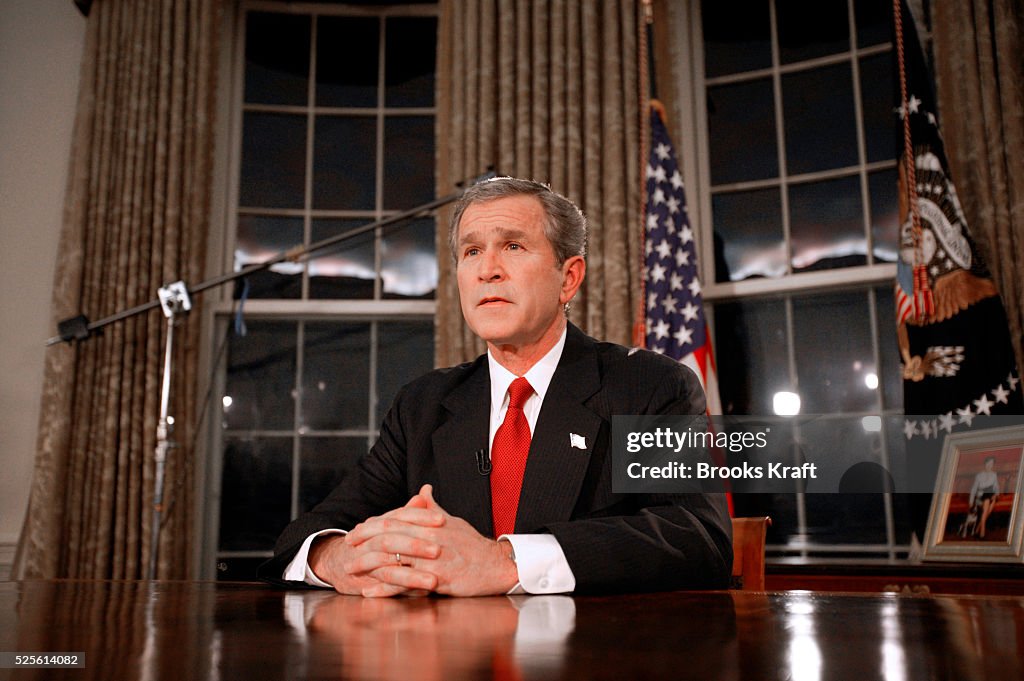
    Former President George W. Bush formally declared war on Iraq in a televised address on March 19, 2003.
    Brooks Kraft LLC/Corbis via Getty Images

    A generational shift

    Since I started teaching courses related to the Iraq War in 2010, my students have shifted from millennials to Generation Z. The latter were born between the mid-1990s and early 2010s. There has also been a change in how these students understand major early 21st-century events, including the U.S. invasion of Iraq.

    I teach this event by showing things like former President George W. Bush’s March 19, 2003, televised announcement of the invasion.

    I also teach it through the flow of my lived experience. That includes remembering the Feb. 15, 2003, anti-war protests that took place in over 600 cities around the world as an effort to prevent what appeared to be an inevitable war. And I show students aspects of material culture, like the “Iraqi most wanted” deck of playing cards, distributed to deployed U.S. military personnel in Iraq, who used the cards for games and to help them identify key figures in the Iraq government.

    The millennial students I taught around 2010 recalled the U.S. invasion of Iraq from their early teen years – a confusing but foundational moment in their personal timelines.

    But for the Gen-Z students I teach today, the invasion sits firmly in the past, as a part of history.

    Why this matters

    Since the mid-2010s, I have not been able to expect students to enroll in my course with personal prior knowledge about the invasion and war that followed. In 2013, my students would tell me that their childhoods had been defined by a United States at war – even if those wars happened far from U.S. soil.

    Millennial students considered the trifecta of 9/11, the war in Afghanistan and the war in Iraq to be defining events in their lives. The U.S. and its allies launched airstrikes against al-Qaida and Taliban targets in Afghanistan on Oct. 7, 2001, less than a month after the Sept. 11 terrorist attacks. This followed the Taliban refusing to hand over Osama bin Laden, the architect of 9/11.

    By 2021, my students considered Bush’s actions with the same level of abstract curiosity that they had brought to the class’s earlier examination of the 1957 Eisenhower Doctrine, which said that a country could request help from U.S. military forces if it was being threatened by another country, and was used to justify U.S. military involvement in Lebanon in 1958.

    On an educational level, this means that I now provide much more background information on the first the Gulf War, the 2000 presidential elections, the Bush presidency, the immediate U.S. responses to 9/11 and the Afghanistan invasion than I had to do before. All of these events help students better understand why the U.S. invaded Iraq and why Americans felt so strongly about the military action – whether they were for or against the invasion.

    The Iraq invasion lost popularity among Americans within two years. In March 2003, 71% of Americans said that the U.S. made the right decision to use military force in Iraq.

    That percentage dropped to 47% in 2005, following the revelation that there were no weapons of mass destruction. Yet those supporters continued to strongly endorse the invasion in later polls.

    In 2018, just over half of Americans believed that the U.S. failed to achieve its goals, however those goals might have been defined in Iraq.

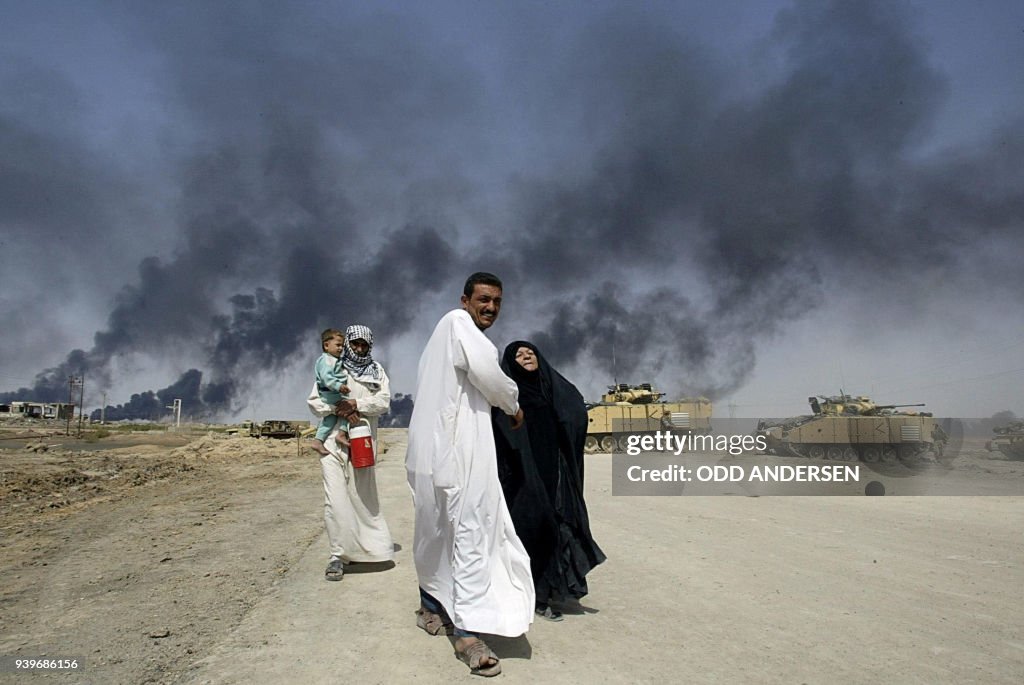
    An Iraqi family flees past British tanks from the city of Basra in March 2003.
    Odd Andersen/AFP via Getty Images

    A new set of priorities

    Older Americans age 65 and up are more likely than young people to prioritize foreign policy issues, including maintaining a U.S. military advantage.

    Younger Americans – age 18 to 39 – say the top issues that require urgency are providing support to refugees and limiting U.S. military commitments abroad, according to a 2021 Pew research survey.

    Generation Z members are also less likely than older Americans to think that the U.S. should act by itself in defending or protecting democracy around the world, according to a 2019 poll by the think tank Center for American Progress.

    They also agree with the statement that the United States’ “wars in the Middle East and Afghanistan were a waste of time, lives, and taxpayer money and they did nothing to make us safer at home.” They prefer that the U.S. use economic and diplomatic means, rather than military intervention, to advance American interests around the world.

    Israel’s conflict with Iran may not flare again and give way to more airstrikes and violence. If the countries resume fighting, however, their conflict threatens to draw in Lebanon, Qatar and other countries in the Middle East, as well as likely the U.S. – and to drag on for a long time.

    This is an update from a story originally published on March 15, 2023.

    Andrea Stanton does not work for, consult, own shares in or receive funding from any company or organization that would benefit from this article, and has disclosed no relevant affiliations beyond their academic appointment.

    ref. Israel-Iran war recalls the 2003 US invasion of Iraq – a war my undergraduate students see as a relic of the past – https://theconversation.com/israel-iran-war-recalls-the-2003-us-invasion-of-iraq-a-war-my-undergraduate-students-see-as-a-relic-of-the-past-259652

    MIL OSI Analysis

  • MIL-OSI Analysis: Uranium enrichment: A chemist explains how the surprisingly common element is processed to power reactors and weapons

    Source: The Conversation – USA – By André O. Hudson, Dean of the College of Science, Professor of Biochemistry, Rochester Institute of Technology

    Yellowcake is a concentrated form of mined and processed uranium. Nuclear Regulatory Commission, CC BY

    When most people hear the word uranium, they think of mushroom clouds, Cold War standoffs or the glowing green rods from science fiction. But uranium isn’t just fuel for apocalyptic fears. It’s also a surprisingly common element that plays a crucial role in modern energy, medicine and geopolitics.

    Uranium reentered the global spotlight in June 2025, when the U.S. launched military strikes on sites in Iran believed to be housing highly enriched uranium, a move that reignited urgent conversations around nuclear proliferation. Many headlines have mentioned Iran’s 60% enrichment of uranium, but what does that really mean?

    As a biochemist, I’m interested in demystifying this often misunderstood element.

    What is uranium?

    Uranium holds the 92nd position on the periodic table, and it is a radioactive, metallic element. Radioactivity is a natural process where some atoms – like uranium, thorium and radium – break down on their own, releasing energy.

    The German chemist Martin Heinrich Klaproth initially identified uranium in 1789, and he named it after the newly discovered planet Uranus. However, its power was not unlocked until the 20th century, when scientists discovered that uranium atoms could split via a process known as nuclear fission. In fission, the nucleus of the atom splits into two or more nuclei, which releases large amounts of energy.

    Uranium is found almost everywhere. It is in rocks, soil and water. There are even traces of uranium in plants and animals – albeit tiny amounts. Most of it is found in the Earth’s crust, where it is mined and concentrated to increase the amount of its most useful radioactive form, uranium-235.

    The enrichment dilemma

    Uranium-235 is an isotope of uranium, which is a version of an element that has the same basic identity but weighs a little more or less. Think about apples from the same tree. Some are big and some are small, but they are all apples – even though they have slightly different weights. Basically, an isotope is the same element but with a different mass.

    Unprocessed uranium is mostly uranium-238. It only contains approximately 0.7% uranium-235, the isotope that allows the most nuclear fission to occur. So, the enrichment process concentrates uranium-235.

    Enrichment can make uranium more useful for the development of nuclear weapons, since natural uranium doesn’t have enough uranium-235 to work well in reactors or weapons. The process usually contains three steps.

    Centrifuges spin the uranium to separate out its isotopes.

    The first step is to convert the uranium into a gas, called uranium hexafluoride. In the second step, the gas gets funneled into a machine called a centrifuge that spins very fast. Because uranium-235 is a little lighter than uranium-238, it moves outward more slowly when spun, and the two isotopes separate.

    It’s sort of like how a salad spinner separates water from lettuce. One spin doesn’t make much of a difference, so the gas is spun through many centrifuges in a row until the uranium-235 is concentrated.

    Uranium can typically power nuclear plants and generate electricity when it is 3%-5% enriched, meaning 3%-5% of the uranium is uranium-235. At 20% enriched, uranium-235 is considered highly enriched uranium, and 90% or higher is known as weapons-grade uranium.

    The enrichment level depends on the proportion of uranium-235 to uranium-238.
    Wikimedia Commons

    This high grade works in nuclear weapons because it can sustain a fast, uncontrolled chain reaction, which releases a large amount of energy compared with the other isotopes.

    Uranium’s varied powers

    While many headlines focus on uranium’s military potential, this element also plays a vital role in modern life. At low enrichment levels, uranium powers nearly 10% of the world’s electricity.

    In the U.S., many nuclear power plants run on uranium fuel, producing carbon-free energy. In addition, some cancer therapies and diagnostic imaging technologies harness uranium to treat diseases.

    Enriched uranium is used for nuclear power.
    Raimond Spekking/Wikimedia Commons, CC BY-SA

    In naval technology, nuclear-powered submarines and aircraft carriers rely on enriched uranium to operate silently and efficiently for years.

    Uranium is a story of duality. It is a mineral pulled from ancient rocks that can light up a city or wipe one off the map. It’s not just a relic of the Cold War or science fiction. It’s real, it’s powerful, and it’s shaping our world – from global conflicts to cancer clinics, from the energy grid to international diplomacy.

    In the end, the real power is not just in the energy released from the element. It is in how people choose to use it.

    André O. Hudson receives funding from the National Institutes of Health.

    ref. Uranium enrichment: A chemist explains how the surprisingly common element is processed to power reactors and weapons – https://theconversation.com/uranium-enrichment-a-chemist-explains-how-the-surprisingly-common-element-is-processed-to-power-reactors-and-weapons-259646

    MIL OSI Analysis

  • MIL-OSI Analysis: Uranium enrichment: A chemist explains how the surprisingly common element is processed to power reactors and weapons

    Source: The Conversation – USA – By André O. Hudson, Dean of the College of Science, Professor of Biochemistry, Rochester Institute of Technology

    Yellowcake is a concentrated form of mined and processed uranium. Nuclear Regulatory Commission, CC BY

    When most people hear the word uranium, they think of mushroom clouds, Cold War standoffs or the glowing green rods from science fiction. But uranium isn’t just fuel for apocalyptic fears. It’s also a surprisingly common element that plays a crucial role in modern energy, medicine and geopolitics.

    Uranium reentered the global spotlight in June 2025, when the U.S. launched military strikes on sites in Iran believed to be housing highly enriched uranium, a move that reignited urgent conversations around nuclear proliferation. Many headlines have mentioned Iran’s 60% enrichment of uranium, but what does that really mean?

    As a biochemist, I’m interested in demystifying this often misunderstood element.

    What is uranium?

    Uranium holds the 92nd position on the periodic table, and it is a radioactive, metallic element. Radioactivity is a natural process where some atoms – like uranium, thorium and radium – break down on their own, releasing energy.

    The German chemist Martin Heinrich Klaproth initially identified uranium in 1789, and he named it after the newly discovered planet Uranus. However, its power was not unlocked until the 20th century, when scientists discovered that uranium atoms could split via a process known as nuclear fission. In fission, the nucleus of the atom splits into two or more nuclei, which releases large amounts of energy.

    Uranium is found almost everywhere. It is in rocks, soil and water. There are even traces of uranium in plants and animals – albeit tiny amounts. Most of it is found in the Earth’s crust, where it is mined and concentrated to increase the amount of its most useful radioactive form, uranium-235.

    The enrichment dilemma

    Uranium-235 is an isotope of uranium, which is a version of an element that has the same basic identity but weighs a little more or less. Think about apples from the same tree. Some are big and some are small, but they are all apples – even though they have slightly different weights. Basically, an isotope is the same element but with a different mass.

    Unprocessed uranium is mostly uranium-238. It only contains approximately 0.7% uranium-235, the isotope that allows the most nuclear fission to occur. So, the enrichment process concentrates uranium-235.

    Enrichment can make uranium more useful for the development of nuclear weapons, since natural uranium doesn’t have enough uranium-235 to work well in reactors or weapons. The process usually contains three steps.

    Centrifuges spin the uranium to separate out its isotopes.

    The first step is to convert the uranium into a gas, called uranium hexafluoride. In the second step, the gas gets funneled into a machine called a centrifuge that spins very fast. Because uranium-235 is a little lighter than uranium-238, it moves outward more slowly when spun, and the two isotopes separate.

    It’s sort of like how a salad spinner separates water from lettuce. One spin doesn’t make much of a difference, so the gas is spun through many centrifuges in a row until the uranium-235 is concentrated.

    Uranium can typically power nuclear plants and generate electricity when it is 3%-5% enriched, meaning 3%-5% of the uranium is uranium-235. At 20% enriched, uranium-235 is considered highly enriched uranium, and 90% or higher is known as weapons-grade uranium.

    The enrichment level depends on the proportion of uranium-235 to uranium-238.
    Wikimedia Commons

    This high grade works in nuclear weapons because it can sustain a fast, uncontrolled chain reaction, which releases a large amount of energy compared with the other isotopes.

    Uranium’s varied powers

    While many headlines focus on uranium’s military potential, this element also plays a vital role in modern life. At low enrichment levels, uranium powers nearly 10% of the world’s electricity.

    In the U.S., many nuclear power plants run on uranium fuel, producing carbon-free energy. In addition, some cancer therapies and diagnostic imaging technologies harness uranium to treat diseases.

    Enriched uranium is used for nuclear power.
    Raimond Spekking/Wikimedia Commons, CC BY-SA

    In naval technology, nuclear-powered submarines and aircraft carriers rely on enriched uranium to operate silently and efficiently for years.

    Uranium is a story of duality. It is a mineral pulled from ancient rocks that can light up a city or wipe one off the map. It’s not just a relic of the Cold War or science fiction. It’s real, it’s powerful, and it’s shaping our world – from global conflicts to cancer clinics, from the energy grid to international diplomacy.

    In the end, the real power is not just in the energy released from the element. It is in how people choose to use it.

    André O. Hudson receives funding from the National Institutes of Health.

    ref. Uranium enrichment: A chemist explains how the surprisingly common element is processed to power reactors and weapons – https://theconversation.com/uranium-enrichment-a-chemist-explains-how-the-surprisingly-common-element-is-processed-to-power-reactors-and-weapons-259646

    MIL OSI Analysis

  • MIL-OSI Analysis: Israel bombed an Iraqi nuclear reactor in 1981 − it pushed program underground and spurred Saddam Hussein’s desire for nukes

    Source: The Conversation – Global Perspectives – By Jeffrey Fields, Professor of the Practice of International Relations, USC Dornsife College of Letters, Arts and Sciences

    The Osirak nuclear power research station in 1981. Jacques Pavlovsky/Sygma via Getty Images

    Israel, with the assistance of U.S. military hardware, bombs an adversary’s nuclear facility to set back the perceived pursuit of the ultimate weapon. We have been here before, about 44 years ago.

    In 1981, Israeli fighter jets supplied by Washington attacked an Iraqi nuclear research reactor being built near Baghdad by the French government.

    The reactor, which the French called Osirak and Iraqis called Tammuz, was destroyed. Much of the international community initially condemned the attack. But Israel claimed the raid set Iraqi nuclear ambitions back at least a decade. In time, many Western observers and government officials, too, chalked up the attack as a win for nonproliferation, hailing the strike as an audacious but necessary step to prevent Iraqi dictator Saddam Hussein from building a nuclear arsenal.

    But the reality is more complicated. As nuclear proliferation experts assess the extent of damage to Iran’s nuclear facilities following the recent U.S. and Israeli raids, it is worth reassessing the longer-term implications of that earlier Iraqi strike.

    The Osirak reactor

    Iraq joined the landmark Nuclear Non-Proliferation Treaty in 1970, committing the country to refrain from the pursuit of nuclear weapons. But in exchange, signatories are entitled to engage in civilian nuclear activities, including having research or power reactors and access to the enriched uranium that drives them.

    The International Atomic Energy Agency is responsible through safeguards agreements for monitoring countries’ civilian use of nuclear technology, with on-the-ground inspections to ensure that civilian nuclear programs do not divert materials for nuclear weapons.

    But to Israel, the Iraqi reactor was provocative and an escalation in the Arab-Israeli conflict.

    Israel believed that Iraq would use the French reactor – Iraq said it was for research purposes – to generate plutonium for a nuclear weapon. After diplomacy with France and the United States failed to persuade the two countries to halt construction of the reactor, Prime Minister Menachem Begin concluded that attacking the reactor was Israel’s best option. That decision gave birth to the “Begin Doctrine,” which has committing Israel to preventing its regional adversaries from becoming nuclear powers ever since.

    Israeli Prime Minister Menachem Begin addresses the press after the 1981 attack on the Osarik nuclear reactor.
    Israel Press and Photo Agency/Wikimedia Commons

    In spring 1979, Israel attempted to sabotage the project, bombing the reactor core destined for Iraq while it sat awaiting shipment in the French town of La Seyne-sur-Mer. The mission was only a partial success, damaging but not destroying the reactor.

    France and Iraq persisted with the project, and in July 1980 – with the reactor having been delivered – Iraq received the first shipment of highly enriched uranium fuel at the Tuwaitha Nuclear Research Center near Baghdad.

    Then in September 1980, during the initial days of the Iran-Iraq war, Iranian jets struck the nuclear research center. The raid also targeted a power station, knocking out electricity in Baghdad for several days. But a Central Intelligence Agency situation report assessed that “only secondary buildings” were hit at the nuclear site itself.

    It was then Israel’s turn. The reactor was still unfinished and not in operation when on June 7, 1981, eight U.S.-supplied F-16s flew over Jordanian and Saudi airspace and bombed the reactor in Iraq. The attack killed 10 Iraqi soldiers and a French civilian.

    Revisiting the ‘success’ of Israeli raid

    Many years later, U.S. President Bill Clinton commented: “Everybody talks about what the Israelis did at Osirak in 1981, which I think, in retrospect, was a really good thing. You know, it kept Saddam from developing nuclear power.”

    But nonproliferation experts have contended for years that while Saddam may have had nuclear weapons ambitions, the French-built research reactor would not have been the route to go. Iraq would either have had to divert the reactor’s highly enriched uranium fuel for a few weapons or shut the reactor down to extract plutonium from the fuel rods – all while hiding these operations from the International Atomic Energy Agency.

    As an additional safeguard, the French government, too, had pledged to shut down the reactor if it detected efforts to use the reactor for weapons purposes.

    In any event, Iraq’s desire for a nuclear weapon was more aspirational than operational. A 2011 article in the journal International Security included interviews with several scientists who worked on Iraq’s nuclear program and characterized the country’s pursuit of a nuclear weapons capability as “both directionless and disorganized” before the attack.

    Iraq’s program begins in earnest

    So what happened after the strike? Many analysts have argued that the Israeli attack, rather than diminish Iraqi desire for a nuclear weapon, actually catalyzed it.

    Nuclear proliferation expert Målfrid Braut-Hegghammer, the author of the 2011 study, concluded that the Israeli attack “triggered a nuclear weapons program where one did not previously exist.”

    In the aftermath of the attack, Saddam decided to formally, if secretively, establish a nuclear weapons program, with scientists deciding that a uranium-based weapon was the best route. He tasked his scientists with pursuing multiple methods to enrich uranium to weapons grade to ensure success, much the way the Manhattan Project scientists approached the same problem in the U.S.

    In other words, the Israeli attack, rather than set back an existing nuclear weapons program, turned an incoherent and exploratory nuclear endeavor into a drive to get the bomb personally overseen by Saddam and sparing little expense even as Iraq’s war with Iran substantially taxed Iraqi resources.

    From 1981 to 1987, the nuclear program progressed fitfully, facing both organizational and scientific challenges.

    As those challenges were beginning to be addressed, Iraq invaded Kuwait in 1990, provoking a military response from the United States. In the aftermath of what would become Operation Desert Storm, U.N. weapons inspectors discovered and dismantled the clandestine Iraqi nuclear weapons program.

    The Tammuz nuclear reactor was hit again during the 1991 Gulf War.
    Ramzi Haidar/AFP via Getty Images

    Had Saddam not invaded Kuwait over a matter not related to security, it is very possible that Baghdad would have had a nuclear weapon capability by the mid-to-late 1990s.

    Similarly to Iraq in 1980, Iran today is a party to the Nuclear Non-Proliferation Treaty. At the time President Donald Trump withdrew U.S. support in 2018 for the Joint Comprehensive Plan of Action, colloquially known as the Iran nuclear deal, the International Atomic Energy Agency certified that Tehran was complying with the requirements of the agreement.

    In the case of Iraq, military action on its nascent nuclear program merely pushed it underground – to Saddam, the Israeli strikes made acquiring the ultimate weapon more rather than less attractive as a deterrent. Almost a half-century on, some analysts and observers are warning the same about Iran.

    Jeffrey Fields receives funding from the Carnegie Corporation of New York and Schmidt Futures.

    ref. Israel bombed an Iraqi nuclear reactor in 1981 − it pushed program underground and spurred Saddam Hussein’s desire for nukes – https://theconversation.com/israel-bombed-an-iraqi-nuclear-reactor-in-1981-it-pushed-program-underground-and-spurred-saddam-husseins-desire-for-nukes-259618

    MIL OSI Analysis

  • MIL-OSI Analysis: Japanese prime minister’s abrupt no-show at NATO summit reveals a strained alliance with the US

    Source: The Conversation – Global Perspectives – By Craig Mark, Adjunct Lecturer, Faculty of Economics, Hosei University

    Japanese Prime Minister Shigeru Ishiba has sent a clear signal to the Trump administration: the Japan–US relationship is in a dire state.

    After saying just days ago he would be attending this week’s NATO summit at The Hague, Ishiba abruptly pulled out at the last minute.

    He joins two other leaders from the Indo-Pacific region, Australian Prime Minister Anthony Albanese and South Korean President Lee Jae-myung, in skipping the summit.

    The Japanese media reported Ishiba cancelled the trip because a bilateral meeting with US President Donald Trump was unlikely, as was a meeting of the Indo-Pacific Four (IP4) NATO partners (Australia, New Zealand, South Korea and Japan).

    Japan will still be represented by Foreign Minister Takeshi Iwaya, showing its desire to strengthen its security relationship with NATO.

    However, Ishiba’s no-show reveals how Japan views its relationship with the Trump administration, following the severe tariffs Washington imposed on Japan and Trump’s mixed messages on the countries’ decades-long military alliance.

    Tariffs and diplomatic disagreements

    Trump’s tariff policy is at the core of the divide between the US and Japan.

    Ishiba attempted to get relations with the Trump administration off to a good start. He was the second world leader to visit Trump at the White House, after Israeli Prime Minister Benjamin Netanyahu.

    However, Trump’s “Liberation Day” tariffs imposed a punitive rate of 25% on Japanese cars and 24% on all other Japanese imports. They are already having an adverse impact on Japan’s economy: exports of automobiles to the US dropped in May by 25% compared to a year ago.

    Six rounds of negotiations have made little progress, as Ishiba’s government insists on full tariff exemptions.

    Japan has been under pressure from the Trump administration to increase its defence spending, as well. According to the Financial Times, Tokyo cancelled a summit between US and Japanese defence and foreign ministers over the demand. (A Japanese official denied the report.)

    Japan also did not offer its full support to the US bombings of Iran’s nuclear facilities earlier this week. The foreign minister instead said Japan “understands” the US’s determination to prevent Iran from acquiring nuclear weapons.

    Japan has traditionally had fairly good relations with Iran, often acting as an indirect bridge with the West. Former Prime Minister Shinzo Abe even made a visit there in 2019.

    Japan also remains heavily dependent on oil from the Middle East. It would have been adversely affected if the Strait of Hormuz had been blocked, as Iran was threatening to do.

    Unlike the response from the UK and Australia, which both supported the strikes, the Ishiba government prioritised its commitment to upholding international law and the rules-based global order. In doing so, Japan seeks to deny China, Russia and North Korea any leeway to similarly erode global norms on the use of force and territorial aggression.

    Strategic dilemma of the Japan–US military alliance

    In addition, Japan is facing the same dilemma as other American allies – how to manage relations with the “America first” Trump administration, which has made the US an unreliable ally.

    Earlier this year, Trump criticised the decades-old security alliance between the US and Japan, calling it “one-sided”.

    “If we’re ever attacked, they don’t have to do a thing to protect us,” he said of Japan.

    Lower-level security cooperation is ongoing between the two allies and their regional partners. The US, Japanese and Philippine Coast Guards conducted drills in Japanese waters this week. The US military may also assist with upgrading Japan’s counterstrike missile capabilities.

    But Japan is still likely to continue expanding its security ties with partners beyond the US, such as NATO, the European Union, India, the Philippines, Vietnam and other ASEAN members, while maintaining its fragile rapprochement with South Korea.

    Australia is now arguably Japan’s most reliable security partner. Canberra is considering buying Japan’s Mogami-class frigates for the Royal Australian Navy. And if the AUKUS agreement with the US and UK collapses, Japanese submarines could be a replacement.

    Ishiba under domestic political pressure

    There are also intensifying domestic political pressures on Ishiba to hold firm against Trump, who is deeply unpopular among the Japanese public.

    After replacing former prime minister Fumio Kishida as leader of the Liberal Democratic Party (LDP) last September, the party lost its majority in the lower house of parliament in snap elections. This made it dependent on minor parties for legislative support.

    Ishiba’s minority government has struggled ever since with poor opinion polling. There has been widespread discontent with inflation, the high cost of living and stagnant wages, the legacy of LDP political scandals, and ever-worsening geopolitical uncertainty.

    On Sunday, the party suffered its worst-ever result in elections for the Tokyo Metropolitan Assembly, winning its lowest number of seats.

    The party could face a similar drubbing in the election for half of the upper house of the Diet (Japan’s parliament) on July 20. Ishiba has pledged to maintain the LDP’s majority in the house with its junior coalition partner Komeito. But if the government falls into minority status in both houses, Ishiba will face heavy pressure to step down.

    Craig Mark does not work for, consult, own shares in or receive funding from any company or organisation that would benefit from this article, and has disclosed no relevant affiliations beyond their academic appointment.

    ref. Japanese prime minister’s abrupt no-show at NATO summit reveals a strained alliance with the US – https://theconversation.com/japanese-prime-ministers-abrupt-no-show-at-nato-summit-reveals-a-strained-alliance-with-the-us-259694

    MIL OSI Analysis

  • MIL-OSI Analysis: Oil shocks in the 1970s drove rapid changes in transport. It could happen again if Middle East tensions continue

    Source: The Conversation – Global Perspectives – By Hussein Dia, Professor of Future Urban Mobility, Swinburne University of Technology

    The Image Bank/Getty

    As the world watches the US–Iran situation with concern, the ripple effect from these events are reaching global oil supply chains – and exposing their fragility.

    If Iran closes the Strait of Hormuz as it is considering, it would restrict the global oil trade and trigger energy chaos.

    Petrol in some Australian cities could hit A$2.50 a litre according to some economists. As global instability worsens, other experts warn price spikes are increasingly likely.

    What would happen next? There is a precedent: the oil shocks of the 1970s, when oil prices quadrupled. The shock drove rapid change, from more efficient cars to sudden interest in alternative energy sources. This time, motorists would likely switch to electric vehicles.

    If this crisis continues or if another one flares up, it could mark a turning point in Australia’s long dependence on foreign oil.

    What would an oil shock mean?

    Australia currently imports 80% of its liquid fuels, the highest level on record. If the flow of oil stopped, we would have about 50 days worth in storage before we ran out.

    Our cars, buses, trucks and planes run overwhelmingly on petrol and diesel. Almost three-quarters (74%) of these liquid fuels are used in transport, with road transport accounting for more than half (54%) of all liquid fuels. Australia is highly exposed to global supply shocks.

    The best available option to reduce dependence on oil imports is to electrify transport.

    How does Australia compare on EVs?

    EV uptake in Australia continues to lag behind global leaders. In 2024, EVs accounted for 9.65% of new car sales in Australia, up from 8.45% in 2023.

    In the first quarter of 2025, EVs were 6.3% of new car sales, a decline from 7.4% in the final quarter of 2024.

    Norway remains the global leader, with battery-electric passenger cars making up 88.9% of sales in 2024. The United Kingdom also saw significant growth – EVs hit almost 20% of new car registrations in 2024.

    In China, EVs made up 40.9% of new car sales in 2024. The 12.87 million cars sold represent three-quarters of total EV sales worldwide.

    One reason for Australia’s sluggishness is a lack of reliable public chargers. While charging infrastructure is expanding, large parts of regional Australia still lack reliable access to EV charging.

    Until recently, Australia’s fuel efficiency standards were among the weakest in the OECD. Earlier this year, the government’s new standards came into force. These are expected to boost EV uptake.

    Could global tensions trigger faster action?

    If history is any guide, oil shocks lead to long-term change.

    The 1970s oil shocks triggered waves of energy reform.

    When global oil prices quadrupled in 1973–74, many nations were forced to reconsider where they got their energy. A few years later, the 1979 Iranian Revolution caused another major supply disruption, sending oil prices soaring and pushing much of the world into recession.

    Huge increases in oil prices drove people to look for alternatives during the 1970s oil shocks.
    Everett Collection/Shutterstock

    These shocks drove the formation of the International Energy Agency in 1974, spurred alternative energy investment and led to advances in fuel-efficiency standards.

    Much more recently, Russia’s invasion of Ukraine pushed the European Union to face up to its reliance on Russian gas and find alternatives by importing gas from different countries and accelerating the clean energy shift.

    Clearly, energy shocks can be catalysts for long-term structural change in how we produce and consume energy.

    The new crisis could do the same, but only if policy catches up.

    If fuel prices shot up and stayed there, consumer behaviour would begin to shift. People would drive less and seek alternate forms of transport. Over time, more would look for better ways to get around.

    But without stronger support such as incentives, infrastructure and fuel security planning, shifting consumer preferences could be too slow to matter.

    A clean-energy future is more secure

    Cutting oil dependency through electrification isn’t just good for the climate. It’s also a hedge against future price shocks and supply disruptions.

    Transport is now Australia’s third-largest source of greenhouse gas emissions. Now that emissions are falling in the electricity sector, transport will be the highest emitting sector emissions source as soon as 2030.

    Building a cleaner transport system also means building a more resilient one. Charging EVs on locally produced renewable power cuts our exposure to global oil markets. So do biofuels, better public transport and smarter urban planning.

    Improving domestic energy resilience isn’t just about climate targets. It’s about economic stability and national security. Clean local energy sources reduce vulnerability to events beyond our control.

    What can we learn from China?

    China offers a compelling case study. The nation of 1.4 billion faces real oil security challenges. In response, Beijing has spent the past decade building a domestic clean energy ecosystem to reduce oil dependency and cut emissions.

    This is now bearing fruit. Last year, China’s oil imports had the first sustained fall in nearly two decades. Crude oil imports fell 1.5%, while oil refinery activity also fell due to lower demand.

    China’s rapid uptake of EVs has clear energy security benefits.
    pim pic/Shutterstock

    China’s green energy transition was driven by coordinated policy, industrial investment and public support for clean transport.

    China’s rapid shift to EVs and clean energy shows how long-term planning and targeted investment can pay off on climate and energy security.

    What we do next matters

    The rolling crises of 2025 present Australian policymakers a rare alignment of interests. What’s good for the climate, for consumers and for national security may now be the same thing.

    Real change will require more than sustained high petrol prices. It demands political will, targeted investment and a long-term vision for clean, resilient transport.

    Doing nothing has a real cost – not just in what we pay at the service station, but in how vulnerable we remain to events a long way away.

    Hussein Dia receives funding from the Australian Research Council, the iMOVE Australia Cooperative Research Centre, Transport for New South Wales, Queensland Department of Transport and Main Roads, Victorian Department of Transport and Planning, and Department of Infrastructure, Transport, Regional Development, Communications and the Arts.

    ref. Oil shocks in the 1970s drove rapid changes in transport. It could happen again if Middle East tensions continue – https://theconversation.com/oil-shocks-in-the-1970s-drove-rapid-changes-in-transport-it-could-happen-again-if-middle-east-tensions-continue-259670

    MIL OSI Analysis

  • MIL-OSI Russia: Saudi Arabia: Concluding Statement of the 2025 Article IV Mission

    Source: IMF – News in Russian

    June 26, 2025

    A Concluding Statement describes the preliminary findings of IMF staff at the end of an official staff visit (or ‘mission’), in most cases to a member country. Missions are undertaken as part of regular (usually annual) consultations under Article IV of the IMF’s Articles of Agreement, in the context of a request to use IMF resources (borrow from the IMF), as part of discussions of staff monitored programs, or as part of other staff monitoring of economic developments.

    The authorities have consented to the publication of this statement. The views expressed in this statement are those of the IMF staff and do not necessarily represent the views of the IMF’s Executive Board. Based on the preliminary findings of this mission, staff will prepare a report that, subject to management approval, will be presented to the IMF Executive Board for discussion and decision.

    Washington, DC: Saudi Arabia’s economy has demonstrated strong resilience to shocks, with non-oil economic activities expanding, inflation contained, and unemployment reaching record-low levels. While lower oil proceeds and investment-linked imports led to the emergence of twin deficits, external and fiscal buffers remain ample. A higher-than-budgeted fiscal stance in 2025 remains appropriate to prevent procyclicality that could exacerbate the growth impact of lower oil prices. Addressing strong credit growth and associated funding pressures will be crucial in mitigating risks to systemic financial stability. Given the current heightened global uncertainty, continued efforts on structural reform are essential to sustain non-oil growth and drive economic diversification.

    RECENT ECONOMIC DEVELOPMENTS[1]

    Saudi Arabia’s economy has been resilient to shocks. In 2024, non-oil real GDP grew by 4.2 percent, primarily driven by private consumption and non-oil private investment, with retail, hospitality, and construction leading growth. Repeated extensions of the OPEC+ production cuts have kept oil output at 9 million barrels per day (mb/d)—the lowest level since 2011— resulting in a 4.4 percent decline in oil GDP and an overall real growth rate of 1.8 percent. The composite PMI indicates sustained activity in Q1 2025, with the latest Q1 GDP estimate showing non-oil activities expanding by 4.9 percent year-on-year.

    The labor market’s strong momentum continues. The unemployment rate for Saudi nationals has declined to a record low of 7 percent in 2024, surpassing the original Vision 2030 target, which has now been revised down to 5 percent. The improvement is broad-based, with both youth and female unemployment halved over a four-year period. Private sector employment surged by 12 percent on average in 2024, while public sector hiring continued to slow, reflecting a redeployment to non-government entities.

    Inflation is contained as rent inflation decelerates. Despite a small pick-up to 2.3 percent in April 2025, headline inflation remains low, helped by high real interest rates. Declining prices for transport and communication helped offset housing rent inflation, which has decelerated for the 6th consecutive month to 8.1 percent y-o-y (the lowest annual rise since February 2023). Real wages have remained stable, albeit with some pickup for highly skilled workers.   

    The current account shifted to a narrow deficit, transitioning from a surplus of 2.9 percent of GDP in 2023 to a deficit of 0.5 percent of GDP in 2024. This shift mainly reflects a decline in oil export proceeds, higher imports of machinery and equipment, and stronger remittance outflows—factors that more than offset a surge in tourism inflows. The current account deficit has been financed through external borrowing and reduced FX asset accumulation. As a result, the Saudi Central Bank’s (SAMA) net foreign assets (NFA) holdings stabilized at $415 billion by end-2024—equivalent to 15 months of imports and 187 percent of the IMF’s reserve adequacy metric. 

    While spending overruns increased the overall fiscal deficit, the fiscal stance—as measured by the non-oil primary balance—showed a slight improvement in 2024. Additional expenditures related to project financing—partly linked to an accelerated implementation of Vision 2030—and flat oil revenue widened the overall fiscal deficit to 2.5 percent of GDP, approximately 0.8 percentage points above the budgeted target. However, driven by stronger non-oil revenue, the non-oil primary deficit improved, decreasing by 0.6 percentage points of GDP in 2024 compared to 2023. Central government debt rose to 26.2 percent of GDP as Saudi Arabia became the largest emerging market dollar debt issuer in 2024. However, Saudi Arabia remains amongst the lowest indebted nation globally and net debt is relatively low at approximately 17 percent of GDP.

    ECONOMIC OUTLOOK AND RISKS

    Robust domestic demand—including from government-led projects—will continue to drive growth despite heightened global uncertainty and a weakened commodity price outlook. Non-oil real GDP growth is projected at 3.4 percent in 2025, about 0.8 percentage points lower than in 2024. This reflects the continued implementation of Vision 2030 projects through public and private investment, as well as strong credit growth, which would help sustain domestic demand and mitigate the impact of lower oil prices. The direct impact of rising global trade tensions is limited, as oil products—comprising 78 percent of Saudi Arabia’s goods exports to the U.S. in 2024—are exempt from U.S. tariffs, while non-oil exports to the U.S. only account for 3.4 percent of Saudi Arabia’s total non-oil exports. Over the medium term, domestic demand—including momentum ahead of Saudi Arabia’s hosting of large-scale international events—is expected to push non-oil growth closer to 4 percent in 2027 before stabilizing at 3.5 percent by 2030. Supported by the OPEC+ production cut phase-out schedule, overall GDP growth will accelerate to 3.5 percent in 2025 and 3.9 percent in 2026 before stabilizing at approximately 3.3 percent over the medium term.

    Inflation would remain anchored around 2 percent, supported by a credible peg to the U.S. dollar, domestic subsidies, and an elastic supply of expatriate labor, notwithstanding a projected moderate positive output gap over the medium term. Imported inflation from increased tariffs worldwide is expected to remain contained.

    The external position will weaken. Investment-linked imports and remittance outflows from an expanding expatriate labor force are expected to widen the current account deficit, which is projected to peak at about 3.9 percent of GDP by 2027 before converging to about 3.4 percent of GDP in 2030. Rising non-oil exports and robust inbound tourism will have a partial offsetting effect. The deficit will be increasingly financed through deposit drawdowns, less FX asset accumulation abroad, and external borrowing. International reserve coverage would remain adequate at about 11-12 month import coverage over the medium term, with foreign assets held by the Public Investment Fund (PIF) and other government-related entities offering strong additional buffers.

    Risks to the outlook are mainly to the downside. Weaker oil demand, driven by heightened uncertainty, an escalation of global trade tensions, and deepening geoeconomic fragmentation could dampen oil proceeds. This, in turn, would lead to higher fiscal deficits and debt and costlier financing. An abrupt decrease in spending by the government (including projects recalibration below its baseline) or a slowdown in reform implementation in response to lower oil prices could further hinder private investment growth. Conversely, higher-than-expected oil production/prices and accelerated implementation of reforms could yield stronger or earlier-than-expected growth dividends.

    POLICIES

    Fiscal Policy

    The 2025 fiscal stance—resulting in a deficit twice the budget target—remains appropriate. Given past overruns and the ongoing transformational projects tied to Vision 2030, staff anticipates higher current expenditures than budgeted. Combined with lower oil prices and minimal performance-linked dividends from Aramco, this will bring the overall fiscal deficit to 4.3 percent of GDP. However, this outcome still represents a 3.6 percentage points of non-oil GDP improvement in the non-oil primary balance, effectively frontloading part of the adjustment required by 2030 to uphold intergenerational equity. Given the upfront adjustment and ample fiscal buffers available, staff believes that additional spending restraint in 2025—triggered by lower-than-budgeted oil prices—is not necessary as it would make fiscal policy procyclical and exacerbate the impact on growth.

    Over the medium term, the overall fiscal deficit is expected to narrow. After peaking at 4.3 percent of GDP in 2025, it will decline to approximately 3.3 percent of GDP by 2030, driven by ongoing wage bill containment and spending efficiency measures. Under this baseline scenario, the non-oil primary deficit would shrink by about 4.2 percent of non-oil GDP from 2025 to 2030. The fiscal deficit would primarily be financed by borrowing, including through debt issuances, syndicated loans or facilities from export credit agencies, leading to an increase in the public debt-to-GDP ratio to about 42 percent by 2030.

    A gradual fiscal consolidation will remain necessary over the medium term to achieve intergenerational equity. To avoid disruptive adjustments and build buffers, an additional 3.3 percent of non-oil GDP must be generated over the 2026-30 period, mainly through:

    • Non-oil revenue mobilization. Plans to increase the tax rate on underdeveloped land, introduce a tax on vacant land, and broadening the VAT base (e.g., for e-commerce transactions) are welcome. Additional efforts—including through new tax policy measures and continued efforts to strengthen revenue administration—would be needed. The temporary tax penalty waiver introduced repeatedly since Covid, should not be renewed when it expires in June as it fuels moral hazard and could undermine compliance.
    • Removing energy subsidies. Staff welcomes the ongoing energy price adjustments—including a doubling of diesel prices since January 2024—which combined with lower international oil prices have reduced fuel subsidies to 3½ percent of GDP (down from 5½ percent in 2022). With retail fuel prices closer to international oil prices and the envisaged scaling up of the well-targeted Damaan social support program, efforts should be accelerated to reduce energy subsidies, including by removing the cap on gasoline prices.
    • Rationalizing other spending. The mission welcomes ongoing spending reviews—including recent assessments on project execution by various government entities—to identify areas for potential savings and efficiency gains. Further rationalization should prioritize reducing current expenditures with a low fiscal multiplier, while preserving medium-term, growth-enhancing infrastructure plans. Greater transparency on how spending prioritization and recalibration aligns with the authorities’ announced investment plans will support investor confidence.

    Given the high global uncertainty, staff welcomes the authorities’ contingency planning to safeguard fiscal sustainability in the event of a severe shock. In a scenario where oil prices decline significantly, a more aggressive fiscal consolidation strategy would be necessary. Identifying and prioritizing projects that can be extended or cut, if further adjustments are required, represents a prudent approach to maintaining fiscal sustainability. Staff recommends a partial drawdown of fiscal buffers in the event of a temporary oil price shock, which would help smooth the transition to a steady state and mitigate the impact of short-term oil price fluctuations.

    Sustaining the authorities’ ongoing efforts to strengthen fiscal institutions will be crucial in supporting the fiscal adjustment and Saudi Arabia’s Vision 2030 objectives. Enhancing the Medium-Term Fiscal Framework remains a priority, particularly through better integration of its multiyear projections into annual budget preparations to align spending ceilings with fiscal forecasts, including commitments from multi-year contracts. Operationalizing and ensuring compliance with an expenditure-based fiscal rule would help anchor the fiscal stance over the medium term.

    Prudent debt management and a proper sovereign asset liability management (SALM) framework becomes increasingly important in a lower oil price environment. The mission encourages the authorities to assess the complex trade-offs between making greater use of central government deposits (currently at around 9¼ percent of GDP) and new bond issuances. The mission also supports the ongoing efforts toward operationalizing a comprehensive SALM framework to enhance the oversight of sovereign balance sheet exposures, which publication alongside the budget statement would support the drive for greater transparency and provide additional tools for fiscal policy analysis and formulation. Additionally, contingent liabilities—such as financing obligations for giga projects, debt guarantees, and Public-Private Partnerships—should be closely monitored.

    Monetary and Exchange Rate Policy

    SAMA has continued to refine its liquidity management framework to help reduce  overall liquidity volatility. Bank funding conditions in Saudi Arabia are influenced by persistently strong double-digit credit growth, with periodic spikes in the SAIBOR-SOFR spread reflecting episodes of liquidity pressures. SAMA’s standard market-based monetary operations should continue to remain focused on smoothing short-term liquidity imbalances without fueling asset/credit growth. The recent data-sharing arrangement between SAMA and the Ministry of Finance regarding expected government transactions is anticipated to improve the accuracy of liquidity forecasting and should be effectively implemented. Additionally, further enhancements to the reserve requirement framework would strengthen effective liquidity management and monetary policy transmission.

    The currency peg to the U.S. dollar remains appropriate. It has provided a credible anchor for monetary policy and is backed by ample external buffers. With an open capital account, it is essential that SAMA’s policy rate continues to align with the Fed’s policy rate.

    Financial Sector Policies

    The banking sector remains resilient, demonstrating strong capitalization and profitability despite rising funding costs. As of end-2024, the sector’s solvency ratio stood at 19.6 percent. Despite higher funding costs—driven by the increasing share of time and saving deposits—bank profitability is high, with an average return on assets of 2.2 percent in 2024. Non-performing loans have reached their lowest levels since 2016, reinforcing overall financial stability. Liquidity indicators are adequate and within regulatory thresholds, although the ratio of liquid assets to short-term liabilities has been declining, and the regulatory loan-to-deposit ratio has been on an upward trend.

    Strong credit growth is leading to funding pressures and a change in the funding mix of Saudi banks. As credit growth—mostly to corporates and for mortgages—outpaces deposit growth, banks diversify their liabilities by increasing reliance on other forms of financing, especially external borrowings in the form of bonds, bilateral or syndicated loans, and certificates of deposit. High external borrowing turned banks’ Net Foreign Assets (NFA) negative in 2024 for the first time since 1993. This trend is expected to continue in the near term as several banks are in the process of securing additional external funding. However, banks’ exposure to foreign exchange risk remains low.

    Addressing strong credit growth and associated funding pressures would help mitigate risks to systemic financial stability. The mission welcomes SAMA’s ongoing efforts to review its existing prudential toolkits to counter risks stemming from persistent double-digit credit growth amid a credit-to-deposit growth gap and the increased resort to short-term external wholesale funding. As loan demand is expected to remain high relative to deposit-based funding, setting prudential requirements commensurate with the evolving risks is essential. In that regard, the mission welcomes the introduction in May 2025 of a 100 basis points countercyclical capital buffer, which will be effective within a year. Vulnerabilities would be further mitigated by: (i) narrowing loan-to-value and debt burden ratios, which remain elevated relative to international standards; and (ii) tightening loan-to-deposit ratio to discourage excessive short-term foreign exchange funding. The mission welcomes SAMA’s proactive approach to monitoring the Liquidity Coverage Ratio and Net Stable Funding Ratio in foreign currency and encourages consideration of setting these ratios as regulatory requirements, should circumstances warrant.

    SAMA’s continued efforts to enhance regulatory and supervisory frameworks are commendable. The new Banking Law has been submitted for legislative approval, a risk-based supervisory framework is being refined, and a monitoring system has been introduced for large construction and infrastructure projects. Additionally, SAMA’s bank resolution function is being operationalized. The authorities have also made good progress in establishing a crisis management framework that includes an emergency liquidity assistance framework, which should be completed without undue delay. Furthermore, improvements in enhancing the effectiveness of AML/CFT supervision—including through thematic inspections—are welcome.

    Deepening the capital market is essential to help diversify funding and reduce reliance on bank financing. Although the capital market remains dominated by the large government-related issuers and the trading volumes are low, the recent and ongoing initiatives, such as the Investment Law that came into effect in February 2025 and the ongoing pension and savings reforms, should improve market liquidity and increase foreign participation in the Saudi capital markets. Greater use of asset-backed securities will create a new asset class and contribute to expanding funding in the banking system. The deepening of the domestic capital markets would also help improve the monetary policy transmission mechanism.

    Structural Policies

    The current environment of heightened uncertainty underscores the importance of continued structural reform efforts to sustain non-oil growth and economic diversification. Since 2016, Saudi Arabia has implemented significant and wide-ranging reforms, particularly in business regulations, governance, labor and capital markets. Several new laws that took effect in 2025—including the updated Investment Law, Labor Law amendments, and the new Commercial Registration Law—will enhance contractual certainty for investors and businesses, while also supporting productivity gains.

    The reform momentum should continue irrespective of oil price developments. Ongoing work to strengthen the anti-corruption framework—including by building on the recent Ultimate Beneficial Ownership Rules and By Laws of Nazaha—remains crucial. Equally important is enhancing human capital by aligning the skills of Saudi nationals with evolving labor market needs, improving access to finance and fostering digitalization, all of which are key to advancing the Kingdom’s economic diversification goals that are further enhanced with the integration of AI in government services. In addition to stronger fiscal institutions, pursuing these reforms will help Saudi Arabia build further resilience to oil price volatility.

    Targeted interventions through industrial policies should complement—not replace— structural reforms and must avoid crowding out private sector investment. Interventions by the PIF and public entities should continue to focus on areas where private investment is limited, market failures exist, or where they can play a catalytic role in attracting private capital, rather than potentially displacing domestic and foreign investors.  Industrial Policies should have clear exit criteria, claw-back mechanisms, and sunset clauses, to ensure they do not remain in place beyond their intended objective.

    **************************

    The mission team would like to thank the Saudi Arabian authorities and the people they met outside the government sector for their close collaboration, candid and informative discussions, and warm hospitality.

    [1] Numbers referred in percent of GDP are based on the authorities’ new rebasing GDP published in May 2025. The new methodological update is generally consistent with international best practices and the UN’s system of national accounts,

    IMF Communications Department
    MEDIA RELATIONS

    PRESS OFFICER: Wafa Amr

    Phone: +1 202 623-7100Email: MEDIA@IMF.org

    https://www.imf.org/en/News/Articles/2025/06/25/saudi-arabia-concluding-statement-of-the-2025-article-iv-mission

    MIL OSI
    MIL OSI Russia News

  • India wanted concerns on terrorism reflected in document: MEA on no adoption of Joint Statement at SCO meet

    Source: Government of India

    Source: Government of India (4)

    The Shanghai Cooperation Organisation (SCO) Defence Ministers’ Meeting, held in Qingdao, China, concluded on Thursday without the adoption of a joint statement. The Ministry of External Affairs (MEA) said that India wanted concerns on terrorism reflected in the final document, which was not acceptable to one particular country, therefore the statement was not adopted.

    At the SCO meeting, Defence Minister Rajnath Singh called for united global action against terrorism, radicalisation, and extremism, citing them as the biggest threats to regional peace and trust.

    MEA spokesperson Randhir Jaiswal told reporters at the weekly media briefing: “I understand that the Defence Ministers could not adopt a joint statement. Certain member countries could not reach consensus on specific issues, and hence the document could not be finalised. India wanted concerns on terrorism to be reflected in the statement, which was not acceptable to one particular country.”

    He added that Rajnath Singh, in his address, urged all SCO member states to unite against terrorism in all its forms and manifestations.

    “Raksha Mantri reiterated the importance of holding perpetrators, organisers, financers, and sponsors of terrorism—especially cross-border terrorism—accountable and bringing them to justice. He called on all SCO nations to act in unison to strengthen regional stability and security,” Jaiswal said.

    During his speech, Singh also referred to the recent April 22 terror attack in Pahalgam, which claimed the lives of 26 civilians, including a Nepali national. He said India had exercised its right to self-defence through Operation Sindoor, which targeted and dismantled cross-border terrorist infrastructure.

    Reiterating India’s firm stance, Singh said that “epicentres of terrorism are no longer safe” and urged SCO nations to reject double standards and hold state sponsors of terrorism accountable.

    “We must be in lockstep in our efforts to strengthen stability and security in our neighbourhood,” he asserted.

    The two-day SCO meeting, hosted by China, concluded on Thursday and saw the participation of Defence Ministers from member countries including Russia, Iran, Pakistan, Belarus, Kazakhstan, Kyrgyzstan, Tajikistan, and Uzbekistan.

    Singh’s visit to China came just over a month after Operation Sindoor, further underlining India’s security concerns and its zero-tolerance policy towards terrorism.

  • MIL-OSI Security: Two drug kingpins jailed for life following Met EncroChat investigation

    Source: United Kingdom London Metropolitan Police

    Two men have been jailed for life for importing and dealing a tonne of cocaine and plotting a murder.

    The Met’s investigation uncovered the two men’s plan to commit a murder, as well as their role in delivering millions of pounds worth of drugs across the capital and beyond.

    The evidence of the offences were identified after officers trawled through thousands of messages on encrypted communication service EncroChat.

    Thought to be impenetrable by law enforcement, Met officers accessed chats between James Harding and Jayes Kharouti.

    It was identified that James Harding, 34 (01.01.1991), of Alton, Hampshire, was the head of a sophisticated organised drug dealing network, turning over an estimated £5 million profit in just 10 weeks. Harding resided in Dubai at the time of his arrest.

    Detective Chief Inspector Jim Casey, who led the investigation, said:

    “This sentencing shows the severity of the crimes the duo committed.

    “Following one of the largest EncroChat investigations in the Met’s history, I am pleased that both criminals are serving the time they deserve.

    “Not only did they have a detailed plan to kill, their conspiracy to import and deal drugs harmed a number of our communities in London and across the country.

    “This sends a clear message to other potential offenders: we will investigate and we will put you before the courts.”

    Harding was found guilty by the jury of conspiracy to supply Class A drugs and conspiracy to commit murder on Tuesday, 24 June at The Old Bailey, following a seven-week trial.

    He was sentenced to life at The Old Bailey on Thursday, 26 June, and will have to serve a minimum of 32 years’ imprisonment.

    Kharouti, 39, (09.02.1986) of Depot Road, Epsom, previously admitted to his role in supplying drugs on Friday, 8 November 2024 at The Old Bailey. He was also found guilty of conspiracy to commit murder alongside Harding on Tuesday, 24 June at the same court.

    He was sentenced to life at The Old Bailey on Thursday, 26 June, and will have to serve a minimum of 26 years’ imprisonment.

    Chats on the encrypted messaging site unveiled they both spoke, in detail, about their plan to kill a suspected drug courier from a ‘rival crime network’.

    This case is part of a wider operation to take down those who utilised EncroChat, after the National Crime Agency (NCA) passed information onto the Met after European agencies cracked the encrypted communications platform.

    So far, Met investigations have led to more than 5,000 years-worth of prison sentences for criminals on the site.

    The investigation

    Following the thorough investigation into a series of conversations on EncroChat, the Met discovered Harding used the handle “thetopsking”, while Kharouti used “besttops”. They used the platform to confidently communicate with each other about their vast criminal enterprise.

    The Met spent hundreds of hours reviewing and analysing these messages. Among them were clear conspiracies to carry out a murder of a rival drug gang member with detailed plans, involving recruiting paid hitmen, arranging firearms and getaway vehicles. They had also discussed times, dates and locations.

    This was on top of plans to coordinate deliveries of hundreds of kilograms of cocaine across the country, manage their vast finances and discuss security threats.

    The court heard that approximately 50 importations were made into the UK, with a total weight of one tonne, between April and June 2020.

    This allowed Harding to live a lavish lifestyle in the United Arab Emirates, where he conducted his criminal enterprise.

    The arrests

    Harding was arrested on Monday, 27 December 2021 at Geneva Airport, Switzerland. On Friday, 27 May 2022, he was extradited from Switzerland to the UK when he was arrested by Met officers.

    Kharouti’s home was searched in 2020 after he was linked to the messages. Police found a handset with the same number he gave to Harding. He fled the country shortly after this, before being found in Turkey and extradited back to the UK.

    MIL Security OSI

  • MIL-OSI Africa: Let UN lead peaceful dispute resolution in Israel, Iran conflict

    Source: South Africa News Agency

    The South African government has called for the immediate de-escalation of hostilities between Israel and the Islamic Republic of Iran.

    The two countries traded air strikes earlier this month.

    Speaking during a media briefing on the outcomes of a Cabinet meeting held on Wednesday, Minister in the Presidency Khumbudzo Ntshavheni said Cabinet was “deeply concerned about escalation of hostilities between Israel and the Islamic Republic of Iran, along with airstrikes by the United States of America”.

    “The ongoing attacks by both countries has led to loss of lives, casualties and destruction to property. Cabinet calls for an urgent de-escalation of hostilities, restraint and full compliance with international law by all parties to prevent further human suffering.

    “Cabinet further calls on the USA, Israel and Iran to create room for constructive dialogue and give the United Nations the opportunity to lead the peaceful resolution of dispute, including the inspection and verification of Iran’s status on uranium enrichment, as well as its broader nuclear capacity.

    “The world cannot afford the balkanisation of Iran, by the sheer size of its population, geographic location and mineral resources.

    “As a continent, we in Africa are still suffering the consequences of the balkanisation of Libya 14 years later, with the escalation of terrorism across the continent,” she said.

    Turning to issues in the Caribbean, Ntshavheni said Cabinet had registered concern on the ongoing gang violence in Haiti.

    “Cabinet is concerned about the Haiti’s worsening situation and asserts that a multifaceted approach is needed to strengthen governance, improving law enforcement, and promoting economic development through regional and international cooperation prioritising Haitian interests,” she said.

    Group of 7 (G7)

    Cabinet reflected on the G7 Leaders’ Summit held in Canada last week.

    President Cyril Ramaphosa participated in the G7 Summit Outreach Session.

    “President Ramaphosa used the opportunity of the G7 to urge for greater cooperation between the G7 and the G20 and mobilise support for reforms in the international institutions of global governance such as the UN Security Council and the global financial system.

    “The President’s participation in the G7 clearly points out that South Africa does not hold an anti-West policy position, but we are ready to work with everyone to pursue South Africa’s national interests and to advance the African Agenda,” she said.

    SANDF soldiers

    Regarding the return of South African soldiers from the Democratic Republic of Congo, Ntshavheni said Cabinet was briefed on the process to bring them home.

    “Cabinet was updated on the phased arrival of South African National Defence Force (SANDF) troops from the eastern Democratic Republic of Congo (DRC) following the SADC decision to terminate the SAMIDRC intervention.

    “About 1 718 SANDF troops have now arrived in the country, and more are expected to arrive over the next few weeks.

    “Cabinet reaffirmed South Africa’s continued commitment to a peaceful, stable and prosperous Southern African region and commended the efforts by the SANDF troops to contribute towards restoring peace, security and stability in the DRC,” she said. – SAnews.gov.za

    MIL OSI Africa

  • MIL-OSI China: Chinese military praised for contributions to global health 2025-06-26 18:54:33 China’s military has made significant contributions to global health undertakings, said a senior official of an international organization Thursday at the ongoing sixth Pan-Asia Pacific Regional Congress on Military Medicine in Beijing.

    Source: People’s Republic of China – Ministry of National Defense

      BEIJING, June 26 (Xinhua) — China’s military has made significant contributions to global health undertakings, said a senior official of an international organization Thursday at the ongoing sixth Pan-Asia Pacific Regional Congress on Military Medicine in Beijing.

      China undoubtedly plays a very important role in regional cooperation in the Asia-Pacific, said Pierre Neirinckx, secretary-general of the International Committee of Military Medicine.

      He highlighted the conference’s role as a vital platform for dialogue and experience sharing, and emphasized the Chinese military’s sustained influence as a major player advancing global health amid complex security challenges.

      Chinese armed forces have deployed multiple medical teams for peacekeeping missions in countries such as the Democratic Republic of the Congo, Lebanon and South Sudan, and have participated in international disaster relief missions, including earthquake relief missions in Nepal and Myanmar.

      China’s naval hospital ship “Peace Ark” has toured to 49 countries and regions, providing health services to more than 370,000 people.

      Being a peace-loving and peace-preserving force, the Chinese military is a steadfast supporter of international humanitarianism and military medicine development, according to Chinese delegates to the conference.

      They pledged to cooperate with global counterparts in sharing medical experiences, technologies and resources to promote the development of military medicine.

    loading…

    MIL OSI China News

  • MIL-OSI Europe: Press release – EP President Metsola to EU leaders: “Peace may be difficult, but it is not impossible”

    Source: European Parliament 3

    Speaking to EU leaders, Parliament President Metsola said that in a volatile world, Europe must do more for its security.

    On the Middle East, President Metsola said: “What we are witnessing between Israel and Iran, and its potential spill over effects, is a litmus test for us all. The recent ceasefire deal marks a hopeful step forward.” She also stressed that: “Iran cannot acquire a nuclear bomb. That is a threat not just to the region, but to the world.” With regards to Gaza, she said that work for a ceasefire must continue, calling “for the immediate release of all hostages, an end to the terror, and for humanitarian aid to reach those who so desperately need it. Peace may be difficult, but it is not impossible.”

    On Ukraine, she underlined that the EU’s support must remain strong, including support for Ukraine’s future membership: “Ukraine and Moldova have already met the conditions to open the initial set of negotiations – the so-called ‘fundamentals’ cluster. The ball is now in our court. We need to maintain momentum.” On defence, the President referred to NATO’s agreement of upping defence spending targets to 5% and emphasised the that the European Parliament is doing its part by having acted fast on the Common Procurement Act and the Act in Support of Ammunition Production. “The same sense of urgency is what will continue to guide us as we look to finalise the recent Defence Omnibus package by the end of the year. Our processes are reformed and fast,” she said.

    On simplification, she stressed that Europe must deliver and here too, the European Parliament is moving fast having adopted the ‘Stop-the-clock’ mechanism and suspended penalties on the automotive sector. “Processes that used to take 9 months, now can take just a few hours.” But she also warned that “If Europe is to be faster, smarter, and more SME-friendly, we need to go beyond cosmetic changes.”

    On maternity rights, the President informed EU leaders that the European Parliament will table a targeted, narrow and surgical amendment to the EU Electoral Act to allow Members of European Parliament who are pregnant or who have just given birth to delegate their vote. She encouraged EU leaders to support this saying: “No democracy should ever penalise elected representatives for choosing to start a family. Representation should never come at the cost of parenthood.

    Find here the full speech

    MIL OSI Europe News

  • MIL-OSI Europe: Press release – EP President Metsola to EU leaders: “Peace may be difficult, but it is not impossible”

    Source: European Parliament 3

    Speaking to EU leaders, Parliament President Metsola said that in a volatile world, Europe must do more for its security.

    On the Middle East, President Metsola said: “What we are witnessing between Israel and Iran, and its potential spill over effects, is a litmus test for us all. The recent ceasefire deal marks a hopeful step forward.” She also stressed that: “Iran cannot acquire a nuclear bomb. That is a threat not just to the region, but to the world.” With regards to Gaza, she said that work for a ceasefire must continue, calling “for the immediate release of all hostages, an end to the terror, and for humanitarian aid to reach those who so desperately need it. Peace may be difficult, but it is not impossible.”

    On Ukraine, she underlined that the EU’s support must remain strong, including support for Ukraine’s future membership: “Ukraine and Moldova have already met the conditions to open the initial set of negotiations – the so-called ‘fundamentals’ cluster. The ball is now in our court. We need to maintain momentum.” On defence, the President referred to NATO’s agreement of upping defence spending targets to 5% and emphasised the that the European Parliament is doing its part by having acted fast on the Common Procurement Act and the Act in Support of Ammunition Production. “The same sense of urgency is what will continue to guide us as we look to finalise the recent Defence Omnibus package by the end of the year. Our processes are reformed and fast,” she said.

    On simplification, she stressed that Europe must deliver and here too, the European Parliament is moving fast having adopted the ‘Stop-the-clock’ mechanism and suspended penalties on the automotive sector. “Processes that used to take 9 months, now can take just a few hours.” But she also warned that “If Europe is to be faster, smarter, and more SME-friendly, we need to go beyond cosmetic changes.”

    On maternity rights, the President informed EU leaders that the European Parliament will table a targeted, narrow and surgical amendment to the EU Electoral Act to allow Members of European Parliament who are pregnant or who have just given birth to delegate their vote. She encouraged EU leaders to support this saying: “No democracy should ever penalise elected representatives for choosing to start a family. Representation should never come at the cost of parenthood.

    Find here the full speech

    MIL OSI Europe News

  • MIL-OSI Africa: President El-Sisi Greets Arab and Islamic Nations on New Hijri Year


    Download logo

    On the occasion of the new Hijri year 1447, I would like to greet the great people of Egypt, as well as the peoples of the Arab and Islamic nations.

    The blessed Prophet’s migration (hijra) will forever remain an eternal symbol of diligence, patience, and sacrifice of the precious and valuable for the sake of truth. It will remain a beacon that guides us in our journey toward the building of an advanced nation that enjoys peace and stability.

    I ask Allah the Almighty to bestow upon us all goodness and blessings this year and to return this occasion with blessings and prosperity.

    Distributed by APO Group on behalf of Presidency of the Arab Republic of Egypt.

    MIL OSI Africa

  • MIL-OSI Russia: Iran opens airspace in eastern part of country

    Translation. Region: Russian Federal

    Source: People’s Republic of China in Russian – People’s Republic of China in Russian –

    Source: People’s Republic of China – State Council News

    TEHRAN, June 26 (Xinhua) — Iran on Wednesday announced the opening of airspace in the eastern part of the country to domestic and foreign flights.

    The decision was made following approval from Iran’s Civil Aviation Organization and the completion of a safety assessment given the current circumstances in the country, the country’s Ministry of Roads and Urban Development said in a statement posted on the agency’s website.

    The move is aimed at gradually restoring air traffic to pre-conflict levels, ministry spokesman Majid Akhavan said, noting that only flights to and from airports in eastern Iran have resumed.

    The country extended the suspension of all domestic and international flights until midday Thursday, he said, citing concerns about the safety of passengers following the recent conflict with Israel.

    The agency’s spokesman added that the decision was made “in light of recent events and to ensure the safety of passengers and flights.”

    Iran closed its airspace on June 13 after Israel launched airstrikes on Tehran and other areas. –0–

    MIL OSI Russia News

  • Rajnath Singh holds ‘insightful’ meetings with Belarusian and Russian defence ministers in China

    Source: Government of India

    Source: Government of India (4)

    Defence Minister Rajnath Singh on Thursday held meetings with his Belarusian and Russian counterparts on the sidelines of the SCO Defence Ministers Meeting in China’s Qingdao, exchanging views on bilateral defence cooperation along with challenges and security threats in the region.

    “Enriching interaction with the Belarusian Defense Minister Lieutenant General Viktor Khrenin in Qingdao,” said Rajnath Singh on X after the meeting.

    It was under India’s first-ever presidency of SCO in 2023 that Iran joined the SCO family as a new member and the signing of the Memorandum of Obligation for Belarus’ SCO membership took place.

    Earlier, Defence Minister Rajnath Singh also met with his Russian counterpart Andrey Belousov, discussing the longstanding and wide-ranging cooperation between the two countries in the field of defence.

    Talking to X, Singh said, “Happy to have met the Defence Minister of Russia, Andrey Belousov on the sidelines of SCO Defence Ministers’ Meeting in Qingdao. We had insightful deliberations on boosting India-Russia defence ties”.

    India has longstanding and wide-ranging cooperation with Russia in the field of defence which is guided by the IRIGC-M&MTC mechanism, headed by the Defence Ministers of both countries.

    Longstanding and time-tested partners, both countries have been involved in several bilateral projects, including the supply of S-400, licensed production of T-90 tanks and Su-30 MKI, supply of MiG-29 and Kamov helicopters, INS Vikramaditya (formerly Admiral Gorshkov), production of Ak-203 rifles in India and BrahMos missiles.

    New Delhi and Moscow have acknowledged that the military technical cooperation has evolved over time from a buyer-seller framework to one involving joint research and development, co-development and joint production of advanced defence technology and systems.

    Addressing the gathering of defence ministers and security officials earlier, Singh called for united global action against terrorism, radicalisation, and extremism, citing them as the biggest threats to regional peace and trust.

    Referring to the heinous April 22 Pahalgam terror attack that killed 26 civilians — including a Nepali national — Defence Minister Singh said India exercised its right to self-defence through Operation Sindoor to dismantle cross-border terror infrastructure. He urged the SCO nations to reject double standards and hold terror sponsors accountable.

    “Epicentres of terrorism are no longer safe,” he declared, reaffirming India’s zero-tolerance policy.

    The visit comes just over a month after Operation Sindoor, under which India conducted targeted airstrikes on nine high-value terrorist infrastructures in Pakistan and Pakistan-occupied Kashmir (PoK) following the deadly Pahalgam terror attack.

    It also marks the first trip to China by an Indian Union Minister since bilateral relations were severely strained by the military standoff along the Line of Actual Control (LAC) in eastern Ladakh that began in May 2020.

    (With inputs from IANS)

  • Rajnath Singh holds ‘insightful’ meetings with Belarusian and Russian defence ministers in China

    Source: Government of India

    Source: Government of India (4)

    Defence Minister Rajnath Singh on Thursday held meetings with his Belarusian and Russian counterparts on the sidelines of the SCO Defence Ministers Meeting in China’s Qingdao, exchanging views on bilateral defence cooperation along with challenges and security threats in the region.

    “Enriching interaction with the Belarusian Defense Minister Lieutenant General Viktor Khrenin in Qingdao,” said Rajnath Singh on X after the meeting.

    It was under India’s first-ever presidency of SCO in 2023 that Iran joined the SCO family as a new member and the signing of the Memorandum of Obligation for Belarus’ SCO membership took place.

    Earlier, Defence Minister Rajnath Singh also met with his Russian counterpart Andrey Belousov, discussing the longstanding and wide-ranging cooperation between the two countries in the field of defence.

    Talking to X, Singh said, “Happy to have met the Defence Minister of Russia, Andrey Belousov on the sidelines of SCO Defence Ministers’ Meeting in Qingdao. We had insightful deliberations on boosting India-Russia defence ties”.

    India has longstanding and wide-ranging cooperation with Russia in the field of defence which is guided by the IRIGC-M&MTC mechanism, headed by the Defence Ministers of both countries.

    Longstanding and time-tested partners, both countries have been involved in several bilateral projects, including the supply of S-400, licensed production of T-90 tanks and Su-30 MKI, supply of MiG-29 and Kamov helicopters, INS Vikramaditya (formerly Admiral Gorshkov), production of Ak-203 rifles in India and BrahMos missiles.

    New Delhi and Moscow have acknowledged that the military technical cooperation has evolved over time from a buyer-seller framework to one involving joint research and development, co-development and joint production of advanced defence technology and systems.

    Addressing the gathering of defence ministers and security officials earlier, Singh called for united global action against terrorism, radicalisation, and extremism, citing them as the biggest threats to regional peace and trust.

    Referring to the heinous April 22 Pahalgam terror attack that killed 26 civilians — including a Nepali national — Defence Minister Singh said India exercised its right to self-defence through Operation Sindoor to dismantle cross-border terror infrastructure. He urged the SCO nations to reject double standards and hold terror sponsors accountable.

    “Epicentres of terrorism are no longer safe,” he declared, reaffirming India’s zero-tolerance policy.

    The visit comes just over a month after Operation Sindoor, under which India conducted targeted airstrikes on nine high-value terrorist infrastructures in Pakistan and Pakistan-occupied Kashmir (PoK) following the deadly Pahalgam terror attack.

    It also marks the first trip to China by an Indian Union Minister since bilateral relations were severely strained by the military standoff along the Line of Actual Control (LAC) in eastern Ladakh that began in May 2020.

    (With inputs from IANS)

  • MIL-OSI Russia: “Turpan is a place I dreamed about”: a special screening of a film by an Uzbek documentary filmmaker was held at the Xinjiang – Central Asia media salon

    Translation. Region: Russian Federal

    Source: People’s Republic of China in Russian –

    Source: People’s Republic of China – State Council News

    BEIJING, June 26 (Xinhua) — The “China’s Xinjiang – Central Asia” media salon was held Wednesday at the scenic Hoshanhong Distillery tourist area in Turpan, northwest China’s Xinjiang Uygur Autonomous Region. Twenty-three media representatives from China, Kazakhstan, Kyrgyzstan, Uzbekistan, Tajikistan and Turkey watched the documentary “Turpan – A Place I Dreamed About.”

    The event was attended by the film’s creator Muhammad Obidov, who is also the chairman of the Union of Journalists of the Fergana Region and the editor-in-chief of the Fergana Pravda newspaper. This film was shot under his supervision in Turfan in August 2024.

    As M. Obidov said, he came to Turpan in 2023, taking advantage of the opportunity to record an interview as a journalist. After spending just one day there, he was deeply impressed by the local culture, traditions and natural landscapes, and an idea to make a documentary about this place began to emerge in his head. In 2024, during a second visit to the city, he managed to realize his dream.

    According to M. Obidov, the documentary is currently available for viewing in Uzbek, Russian and Chinese. In Uzbekistan, the film was broadcast on several leading media structures and received a favorable response from the audience.

    “This is a touching documentary that faithfully tells the story of the development of Turpan’s grape industry, the rapidly renewing appearance of the city and the happy life of local residents, which contributes to the humanitarian exchanges between China and Uzbekistan,” said Song Tao, deputy head of the Propaganda Department of the CPC Committee of Turpan City.

    Turpan, located in the eastern Tianshan Mountains of Xinjiang, is a mountain basin. Despite the dry climate and sparse rainfall, thanks to the wisdom of local residents, it has become a green oasis and a famous wine-growing region in the country.

    According to statistics, by the end of 2024, the area of vineyards in Turpan exceeded 630 thousand mu /42 thousand hectares/, where more than 550 varieties of grapes are grown. It accounts for about 40 percent of the total grape production in Xinjiang. -0-

    MIL OSI Russia News

  • MIL-OSI: Beam Global and Platinum Group UAE Sign Joint Venture Agreement Creating Beam Middle East LLC

    Source: GlobeNewswire (MIL-OSI)

    SAN DIEGO, June 26, 2025 (GLOBE NEWSWIRE) — Beam Global, (Nasdaq: BEEM), a leading provider of innovative and sustainable infrastructure solutions for the electrification of transportation and energy security, today announced that it has entered into a joint venture agreement with the Platinum Group LLC, based in the United Arab Emirates (UAE). Chaired by His Royal Highness, Sheikh Mohammed Sultan Bin Khalifa Al-Nahyan, the Platinum Group UAE is recognized for its well-established and trusted relationships across government and industry.

    Beam Global and the Platinum Group will form a new entity, Beam Middle East LLC, which will sell and manufacture Beam Global’s patented sustainable infrastructure solutions for transportation electrification, energy storage, energy security, and smart city development across the Middle East and African regions. This joint venture supports Beam Global’s strategy of geographic diversification by opening new markets and creating opportunities for revenue growth outside the United States. Beam Global, Beam Europe, and now Beam Middle East will each sell and manufacture the company’s full portfolio of patented sustainable technology solutions.

    “The Platinum Group is an organization of the highest reputation, influence and relationships in Abu Dhabi and the surrounding region. They are a perfect partner to accelerate Beam Global’s growth in the Middle East and Africa,” said Desmond Wheatley, CEO of Beam Global. “With planned spending on sustainable infrastructure in the region projected to reach $75.6 billion by 2030, we believe that Beam Global’s patented technology combined with Platinum’s unrivalled position should create a platform for growth which we are uniquely able to leverage. Platinum’s relationships with the best companies in the region and their government contacts, including at the highest level in the UAE and with entities like Masdar City, will allow Beam Middle East to secure direct audiences with top decision makers. Our technology is ideal for the region’s current and future plans, but this is a region where relationships matter just as much as products and solutions. That is why our joint venture with Platinum is so ideal – Beam’s tried and tested clean-technology solutions and Platinum’s influence and relationships form a combination that ticks all the boxes and is without rivals.”

    “The Platinum Group seeks out the highest quality, most timely and relevant companies in each of the industries we target. Beam Global’s unique and patented products are ideally suited to provide value to governments and businesses, as the Gulf region and beyond transitions to clean and sustainable technologies,” said Dr Ali Nasser Sultan Al Yahbouni Al Daheri, CEO of Platinum Group. “We are looking forward to ensuring that our new joint venture with Beam Global, forming Beam Middle East, is a highly successful enterprise with wins in the Middle East and increasingly in Africa. With abundant sunshine and fast-growing adoption of electric vehicles (EVs), renewables, and energy storage, the region is perfect for Beam Global’s solutions. Energy security and Smart Cities solutions like those offered by Beam Middle East are at the forefront of government planning. Our timing is right, and our partnership is formed on mutual benefit from growth and success. We are delighted to have Beam Global as part of our growing family of businesses.”

    Middle East Market Overview Across Five Key Markets: UAE, Saudi Arabia, Qatar, Oman, and Jordan

    • The number of EVs in the region is projected to grow from approximately 69.0 thousand in 2024 to approximately 1.5 million by 2030 (Table 1), representing a compound annual growth rate (CAGR) of 66.6%.
    • Assuming a 5.0% share of regional chargers using EV ARC™ units, the addressable revenue could reach $516.5 million by 2030.
    • If eBikes account for just 5.0% of total EV volume and follow the same growth trajectory (Table 2), BeamBike™ units could represent a $245.0 million revenue opportunity in the region by 2030.

    Middle East Market Overview: Abu Dhabi Case Study

    • The UAE eBike market is projected to reach $443.8 million by 2030. Assuming 15.0% of that spend goes toward charging infrastructure, and that Abu Dhabi accounts for 35.0% of the national market based on population, the addressable eBike charger market for BeamBike™ in Abu Dhabi is approximately $23.3 million.
    • A streetlight-to-population ratio based on New York City, applied to Abu Dhabi’s estimated 3.8 million residents (Table 3), suggests BeamSpot™ units could represent a potential revenue opportunity of approximately $322.1 million assuming a market penetration of 5.0%.
    • Using Abu Dhabi’s population and a comparable U.S. Police motorcycle fleet ratio (Table 4), the opportunity to electrify local law enforcement fleets with BeamPatrol™ units is estimated at approximately $2.4 million.
    • With over 5.8 million annual hotel guests, Abu Dhabi also offers a strong use case for BeamSkoot™ at resorts, both for logistics and recreational purposes. Assuming adoption rates of 10.0% (Table 5), the potential revenue opportunity for BeamSkoot™ units could reach approximately $10.0 million.

    The above scenarios are estimates only, based upon market data taken from internet resources. Beam Global believes these case studies can be replicated in other markets across the Middle East and Africa.

    Key Terms of the Agreement
    Beam Middle East LLC will be a 50/50 joint venture between Beam Global and Platinum Group UAE, incorporated in Abu Dhabi. Beam Global will license its proprietary technologies to the joint venture and support it with incoming opportunities, training, marketing materials, and procurement assistance. Platinum Group will leverage its existing relationships at the highest levels, coordinate local sales, provide experienced and influential business development professionals, and establish manufacturing capabilities efficiently and inexpensively. Both parties will collaborate on the development of a regional manufacturing facility for the products. Beam Middle East will be headquartered in Masdar City, a pioneering sustainable urban community and world-class business and technology hub, where Platinum Group has recently signed an agreement. Masdar City is located in Abu Dhabi, the capital of the UAE, strategically positioned at the center of the country’s drive toward a net-zero future by 2050.

    About Platinum Group UAE
    Platinum Group UAE is a diversified, multi-billion-dollar conglomerate operating in energy, real estate, finance and investing, healthcare, information technology, sports and entertainment, food services and legal services in the Emirate of Abu Dhabi, United Arab Emirates. Chaired by His Royal Highness Sheikh Mohammed Sultan Bin Khalifa Al-Nahyan, son of the former ruler of Abu Dhabi, the Group is recognized for its well-established and trusted relationships across government and industry. Platinum Group UAE is headquartered in Abu Dhabi, with offices in Dubai and Sharjah. For more information visit, PlatinumGroupUAE.com.

    About Beam Global
    Beam Global is a clean technology innovator which develops and manufactures sustainable infrastructure products and technologies. We operate at the nexus of clean energy and transportation with a focus on sustainable energy infrastructure, rapidly deployed and scalable EV charging solutions, safe energy storage and vital energy security. With operations in the U.S. and Europe, Beam Global develops, patents, designs, engineers and manufactures unique and advanced clean technology solutions that power transportation, provide secure sources of electricity, save time and money and protect the environment. Beam Global is headquartered in San Diego, CA with facilities in Broadview, IL and Belgrade and Kraljevo, Serbia. Beam Global is listed on Nasdaq under the symbol BEEM. For more information visit, BeamForAll.comLinkedInYouTube, Instagram and X (formerly Twitter).

    Forward-Looking Statements
    This press release includes forward-looking statements within the meaning of the U.S. Private Securities Litigation Reform Act of 1995. Forward-looking statements may be identified by words such as “believe,” “expect,” “anticipate,” “plan,” “intend,” “estimate,” “potential,” “will,” “would,” “could,” “should,” “may,” or similar expressions. These statements include, but are not limited to, statements regarding the expected benefits, market potential, and future operations of Beam Middle East LLC; anticipated revenue opportunities in the Middle East and African regions; projections regarding electric vehicle and infrastructure market growth; and strategic goals and international expansion plans of Beam Global.

    These forward-looking statements are based on current assumptions and expectations that are subject to risks and uncertainties that may cause actual results to differ materially from those expressed or implied in the statements. Factors that may cause such differences include, among others, risks associated with entering new markets and joint ventures, including regulatory and operational challenges; risks relating to the adoption of EV technologies and infrastructure in foreign jurisdictions; the ability to develop and scale manufacturing capabilities in the region; the effectiveness of partnerships; and general economic, political, and business conditions in the Middle East and Africa. Additional risks and uncertainties are detailed in Beam Global’s filings with the U.S. Securities and Exchange Commission, including its most recent Annual Report on Form 10-K and Quarterly Reports on Form 10-Q.

    Beam Global disclaims any obligation to update or revise these forward-looking statements, except as required by law.

    Media Contact
    Andy Lovsted
    +1 858-327-9123
    Press@BeamForAll.com

    Investor Relations
    Luke Higgins
    +1 858-261-7646
    IR@BeamForAll.com

    Appendix 1 – Sources for Middle East Market Overview Sections

    Table 1 – Projected Growth of EV Adoption in the Middle East

      Number of EVs in 2024 Number of EVs in 2030
    Countries:    
    UAE 28,000 42,000
    Saudi Arabia 23,170 1,300,000
    Qatar 5,624 75,167
    Oman 2,200 13,500
    Jordan 10,000 45,000
         
    Total Number of EVs: 68,994 1,475,667

    Table 2 – Projected Growth of eBike Adoption in the Middle East Assuming 5% EV Market Share

      Number of eBikes in 2024 Number of eBikes in 2030
    Countries:    
    UAE 1,400 2,100
    Saudi Arabia 1,159 50,000
    Qatar 281 3,758
    Oman 110 675
    Jordan 500 2,250
         
    Total Number of eBikes: 3,450 58,783


    Table 3 – Estimated Number of Streetlights in Abu Dhabi Based on New York City’s Streetlight-to-Population Ratio

    Population of NYC 8,258,000
    Number of Street Lights 400,000
    Number of Street Lights per Person 21
    Population of Abu Dhabi 3,800,000
    Number of Street Lights approx. 180,952

    Table 4 – Estimated Size of Abu Dhabi Police Motorcycle Fleet Based on a Comparable U.S. Ratio

    Population of NYC 8,258,000
    Number of Police Motorcycles 115
    Number of People per Motorcycle 71,809
    Population of Abu Dhabi 3,800,000
    No. of Police Motorcycles approx. 53

    Table 5 – Estimated eScooter Demand in Abu Dhabi Based on Annual Number of Hotel Guests

    No. Hotel Guests in Abu Dhabi Annually: 5,811,000
       
    Scenario:  
    Number of Tourists Renting Annually (10%) 581,100
    Rentals per day 1,592
    Average Rentals per Scooter per Day 4
    eScooters Required 398

    The MIL Network

  • MIL-OSI: Beam Global and Platinum Group UAE Sign Joint Venture Agreement Creating Beam Middle East LLC

    Source: GlobeNewswire (MIL-OSI)

    SAN DIEGO, June 26, 2025 (GLOBE NEWSWIRE) — Beam Global, (Nasdaq: BEEM), a leading provider of innovative and sustainable infrastructure solutions for the electrification of transportation and energy security, today announced that it has entered into a joint venture agreement with the Platinum Group LLC, based in the United Arab Emirates (UAE). Chaired by His Royal Highness, Sheikh Mohammed Sultan Bin Khalifa Al-Nahyan, the Platinum Group UAE is recognized for its well-established and trusted relationships across government and industry.

    Beam Global and the Platinum Group will form a new entity, Beam Middle East LLC, which will sell and manufacture Beam Global’s patented sustainable infrastructure solutions for transportation electrification, energy storage, energy security, and smart city development across the Middle East and African regions. This joint venture supports Beam Global’s strategy of geographic diversification by opening new markets and creating opportunities for revenue growth outside the United States. Beam Global, Beam Europe, and now Beam Middle East will each sell and manufacture the company’s full portfolio of patented sustainable technology solutions.

    “The Platinum Group is an organization of the highest reputation, influence and relationships in Abu Dhabi and the surrounding region. They are a perfect partner to accelerate Beam Global’s growth in the Middle East and Africa,” said Desmond Wheatley, CEO of Beam Global. “With planned spending on sustainable infrastructure in the region projected to reach $75.6 billion by 2030, we believe that Beam Global’s patented technology combined with Platinum’s unrivalled position should create a platform for growth which we are uniquely able to leverage. Platinum’s relationships with the best companies in the region and their government contacts, including at the highest level in the UAE and with entities like Masdar City, will allow Beam Middle East to secure direct audiences with top decision makers. Our technology is ideal for the region’s current and future plans, but this is a region where relationships matter just as much as products and solutions. That is why our joint venture with Platinum is so ideal – Beam’s tried and tested clean-technology solutions and Platinum’s influence and relationships form a combination that ticks all the boxes and is without rivals.”

    “The Platinum Group seeks out the highest quality, most timely and relevant companies in each of the industries we target. Beam Global’s unique and patented products are ideally suited to provide value to governments and businesses, as the Gulf region and beyond transitions to clean and sustainable technologies,” said Dr Ali Nasser Sultan Al Yahbouni Al Daheri, CEO of Platinum Group. “We are looking forward to ensuring that our new joint venture with Beam Global, forming Beam Middle East, is a highly successful enterprise with wins in the Middle East and increasingly in Africa. With abundant sunshine and fast-growing adoption of electric vehicles (EVs), renewables, and energy storage, the region is perfect for Beam Global’s solutions. Energy security and Smart Cities solutions like those offered by Beam Middle East are at the forefront of government planning. Our timing is right, and our partnership is formed on mutual benefit from growth and success. We are delighted to have Beam Global as part of our growing family of businesses.”

    Middle East Market Overview Across Five Key Markets: UAE, Saudi Arabia, Qatar, Oman, and Jordan

    • The number of EVs in the region is projected to grow from approximately 69.0 thousand in 2024 to approximately 1.5 million by 2030 (Table 1), representing a compound annual growth rate (CAGR) of 66.6%.
    • Assuming a 5.0% share of regional chargers using EV ARC™ units, the addressable revenue could reach $516.5 million by 2030.
    • If eBikes account for just 5.0% of total EV volume and follow the same growth trajectory (Table 2), BeamBike™ units could represent a $245.0 million revenue opportunity in the region by 2030.

    Middle East Market Overview: Abu Dhabi Case Study

    • The UAE eBike market is projected to reach $443.8 million by 2030. Assuming 15.0% of that spend goes toward charging infrastructure, and that Abu Dhabi accounts for 35.0% of the national market based on population, the addressable eBike charger market for BeamBike™ in Abu Dhabi is approximately $23.3 million.
    • A streetlight-to-population ratio based on New York City, applied to Abu Dhabi’s estimated 3.8 million residents (Table 3), suggests BeamSpot™ units could represent a potential revenue opportunity of approximately $322.1 million assuming a market penetration of 5.0%.
    • Using Abu Dhabi’s population and a comparable U.S. Police motorcycle fleet ratio (Table 4), the opportunity to electrify local law enforcement fleets with BeamPatrol™ units is estimated at approximately $2.4 million.
    • With over 5.8 million annual hotel guests, Abu Dhabi also offers a strong use case for BeamSkoot™ at resorts, both for logistics and recreational purposes. Assuming adoption rates of 10.0% (Table 5), the potential revenue opportunity for BeamSkoot™ units could reach approximately $10.0 million.

    The above scenarios are estimates only, based upon market data taken from internet resources. Beam Global believes these case studies can be replicated in other markets across the Middle East and Africa.

    Key Terms of the Agreement
    Beam Middle East LLC will be a 50/50 joint venture between Beam Global and Platinum Group UAE, incorporated in Abu Dhabi. Beam Global will license its proprietary technologies to the joint venture and support it with incoming opportunities, training, marketing materials, and procurement assistance. Platinum Group will leverage its existing relationships at the highest levels, coordinate local sales, provide experienced and influential business development professionals, and establish manufacturing capabilities efficiently and inexpensively. Both parties will collaborate on the development of a regional manufacturing facility for the products. Beam Middle East will be headquartered in Masdar City, a pioneering sustainable urban community and world-class business and technology hub, where Platinum Group has recently signed an agreement. Masdar City is located in Abu Dhabi, the capital of the UAE, strategically positioned at the center of the country’s drive toward a net-zero future by 2050.

    About Platinum Group UAE
    Platinum Group UAE is a diversified, multi-billion-dollar conglomerate operating in energy, real estate, finance and investing, healthcare, information technology, sports and entertainment, food services and legal services in the Emirate of Abu Dhabi, United Arab Emirates. Chaired by His Royal Highness Sheikh Mohammed Sultan Bin Khalifa Al-Nahyan, son of the former ruler of Abu Dhabi, the Group is recognized for its well-established and trusted relationships across government and industry. Platinum Group UAE is headquartered in Abu Dhabi, with offices in Dubai and Sharjah. For more information visit, PlatinumGroupUAE.com.

    About Beam Global
    Beam Global is a clean technology innovator which develops and manufactures sustainable infrastructure products and technologies. We operate at the nexus of clean energy and transportation with a focus on sustainable energy infrastructure, rapidly deployed and scalable EV charging solutions, safe energy storage and vital energy security. With operations in the U.S. and Europe, Beam Global develops, patents, designs, engineers and manufactures unique and advanced clean technology solutions that power transportation, provide secure sources of electricity, save time and money and protect the environment. Beam Global is headquartered in San Diego, CA with facilities in Broadview, IL and Belgrade and Kraljevo, Serbia. Beam Global is listed on Nasdaq under the symbol BEEM. For more information visit, BeamForAll.comLinkedInYouTube, Instagram and X (formerly Twitter).

    Forward-Looking Statements
    This press release includes forward-looking statements within the meaning of the U.S. Private Securities Litigation Reform Act of 1995. Forward-looking statements may be identified by words such as “believe,” “expect,” “anticipate,” “plan,” “intend,” “estimate,” “potential,” “will,” “would,” “could,” “should,” “may,” or similar expressions. These statements include, but are not limited to, statements regarding the expected benefits, market potential, and future operations of Beam Middle East LLC; anticipated revenue opportunities in the Middle East and African regions; projections regarding electric vehicle and infrastructure market growth; and strategic goals and international expansion plans of Beam Global.

    These forward-looking statements are based on current assumptions and expectations that are subject to risks and uncertainties that may cause actual results to differ materially from those expressed or implied in the statements. Factors that may cause such differences include, among others, risks associated with entering new markets and joint ventures, including regulatory and operational challenges; risks relating to the adoption of EV technologies and infrastructure in foreign jurisdictions; the ability to develop and scale manufacturing capabilities in the region; the effectiveness of partnerships; and general economic, political, and business conditions in the Middle East and Africa. Additional risks and uncertainties are detailed in Beam Global’s filings with the U.S. Securities and Exchange Commission, including its most recent Annual Report on Form 10-K and Quarterly Reports on Form 10-Q.

    Beam Global disclaims any obligation to update or revise these forward-looking statements, except as required by law.

    Media Contact
    Andy Lovsted
    +1 858-327-9123
    Press@BeamForAll.com

    Investor Relations
    Luke Higgins
    +1 858-261-7646
    IR@BeamForAll.com

    Appendix 1 – Sources for Middle East Market Overview Sections

    Table 1 – Projected Growth of EV Adoption in the Middle East

      Number of EVs in 2024 Number of EVs in 2030
    Countries:    
    UAE 28,000 42,000
    Saudi Arabia 23,170 1,300,000
    Qatar 5,624 75,167
    Oman 2,200 13,500
    Jordan 10,000 45,000
         
    Total Number of EVs: 68,994 1,475,667

    Table 2 – Projected Growth of eBike Adoption in the Middle East Assuming 5% EV Market Share

      Number of eBikes in 2024 Number of eBikes in 2030
    Countries:    
    UAE 1,400 2,100
    Saudi Arabia 1,159 50,000
    Qatar 281 3,758
    Oman 110 675
    Jordan 500 2,250
         
    Total Number of eBikes: 3,450 58,783


    Table 3 – Estimated Number of Streetlights in Abu Dhabi Based on New York City’s Streetlight-to-Population Ratio

    Population of NYC 8,258,000
    Number of Street Lights 400,000
    Number of Street Lights per Person 21
    Population of Abu Dhabi 3,800,000
    Number of Street Lights approx. 180,952

    Table 4 – Estimated Size of Abu Dhabi Police Motorcycle Fleet Based on a Comparable U.S. Ratio

    Population of NYC 8,258,000
    Number of Police Motorcycles 115
    Number of People per Motorcycle 71,809
    Population of Abu Dhabi 3,800,000
    No. of Police Motorcycles approx. 53

    Table 5 – Estimated eScooter Demand in Abu Dhabi Based on Annual Number of Hotel Guests

    No. Hotel Guests in Abu Dhabi Annually: 5,811,000
       
    Scenario:  
    Number of Tourists Renting Annually (10%) 581,100
    Rentals per day 1,592
    Average Rentals per Scooter per Day 4
    eScooters Required 398

    The MIL Network

  • MIL-OSI Economics: ASEAN Foreign Ministers’ Statement on the Situation in the Middle East

    Source: ASEAN

    We express concern over the escalation of tensions in the Middle East since 13 June 2025, and welcome the ceasefire between Israel and Iran on 24 June 2025. We urge all parties to respect the ceasefire and avoid further escalation of this conflict.
    We reaffirm the obligation of all States to resolve their differences through peaceful means and to respect the sovereignty and territorial integrity of all nations, in line with international law, including the United Nations (UN) Charter. We further reiterate the obligations to protect civilians and civilian infrastructures in armed conflicts consistent with international law and relevant UN Security Council resolutions.
    We support ongoing efforts, including those led by the UN, aimed at de-escalating tensions and facilitating the resumption of constructive engagement among parties involved.
    We also re-emphasise the shared commitment to provide emergency assistance to ASEAN nationals, in accordance with the ASEAN Declaration on the Guidelines on Consular Assistance by ASEAN Member States’ Missions in Third Countries to Nationals of Other ASEAN Member State and the Guidelines for the Provision of Emergency Assistance by ASEAN Missions in Third Countries to Nationals of ASEAN Member Countries in Crisis Situations.

     
    Download the full statement here.

    The post ASEAN Foreign Ministers’ Statement on the Situation in the Middle East appeared first on ASEAN Main Portal.

    MIL OSI Economics

  • MIL-OSI USA: Pelosi Statement on Support of War Powers Resolution

    Source: United States House of Representatives – Congresswoman Nancy Pelosi Representing the 12th District of California

    Washington, D.C. – Speaker Emerita Nancy Pelosi released the following statement announcing her cosponsorship of H.Con.Res.40 to remove the United States Armed Forces from hostilities with Iran:
     
    “We must all exercise our best judgement in how we prevent Iran from having a nuclear weapon and honor our relationship with Israel in the interest of our national security. But over the weekend, the Trump Administration unilaterally conducted military airstrikes in Iran without consulting the Congress of the United States. This action endangered our servicemembers, diplomats and others by risking a serious escalation of tensions with Iran. 

    “Yesterday, the Administration decided to withhold intelligence and delay the scheduled bipartisan classified Member briefing — which was already long overdue — in a slap in the face to the Congress. The Administration must work with their co-equal branch of government to fulfill the Constitutional requirement that the President comes to Congress before going to war. That is why I am supporting War Powers Resolutions which reassert the Article One powers of the Congress and ensure the Administration does not keep the American people and their Representatives in the dark.”

    MIL OSI USA News

  • MIL-OSI USA: Pelosi Statement on Cancelation of Bipartisan Classified Member Briefing

    Source: United States House of Representatives – Congresswoman Nancy Pelosi Representing the 12th District of California

    Washington, D.C. – Speaker Emerita Nancy Pelosi released the following statement on the Trump Administration’s cancelation of a bipartisan classified Member briefing on Israel-Iran:
     
    “The decision of this Administration to withhold intelligence and cancel today’s scheduled bipartisan classified Member briefing — which was already long overdue — is a slap in the face to the Congress of the United States.

    “We must all exercise our best judgement in how we prevent Iran from having a nuclear weapon and honor our relationship with Israel in the interest of our national security. The unjustified cancellation of this briefing by the Trump Administration is an intolerable insult to their co-equal branch of government and the Constitutional requirement that the President comes to Congress before going to war.

    “The President owes the American people an explanation on why his Administration is keeping them and their Representatives in the dark.”

    MIL OSI USA News

  • MIL-OSI USA: Pelosi at Aspen Ideas Festival to Celebrate 15 Years of the Affordable Care Act: “This was the challenge of our generation.”

    Source: United States House of Representatives – Congresswoman Nancy Pelosi Representing the 12th District of California

    Aspen, CO – Yesterday, Speaker Emerita Nancy Pelosi joined former U.S. Health and Human Services Secretaries Kathleen Sebelius and Sylvia Burwell at the Aspen Ideas Festival for a behind-the-scenes look at the passage of the Affordable Care Act, moderated by former Congressman Charlie Dent.

    The conversation, hosted by the Aspen Institute, offered an inside look into one of the most consequential legislative efforts in American history, focusing on the intense political landscape in 2010, the stakes for working families and the coalition it took to get the ACA across the finish line.

    “For a hundred years they’d been trying to pass a [health care] bill,” Speaker Emerita Nancy Pelosi said. “This was the challenge of our generation—to do something very special for the American people that made a difference in their lives.”

    The panel recounted both the triumphs and trials of the legislative fight, including the instrumental leadership of Secretaries Sebelius and Burwell in its passage and implementation, efforts to prevent Republicans from repealing the ACA, and the ongoing fight to protect Medicaid from Republican attacks.

    Watch the full event HERE.

    Read coverage of the event below:

    The Aspen Daily News: Pelosi talks Affordable Care Act in Aspen

    [Rick Carroll, 6/23/25]

    Rep. Nancy Pelosi stuck to the script at Paepcke Auditorium on Sunday night. In Aspen for a panel discussion, Pelosi joined the stage with three others to discuss their roles in the passage of the Affordable Care Act, which became law in 2010.

    The conversation was titled “Behind the Vote: How the ACA Became Law.” Likely due to its irrelevancy to the discussion, there was no mention of the United States’ strikes on three nuclear sites in Iran a day earlier.

    Pelosi was critical of President Donald Trump’s decision to bomb the facilities on Saturday night. On X, she posted: “Tonight, the President ignored the Constitution by unilaterally engaging our military without Congressional authorization. I join my colleagues in demanding answers from the Administration on this operation which endangers American lives and risks further escalation and dangerous destabilization of the region.”

    On Sunday, however, the discussion of the landmark legislation — also known as Obamacare and considered the largest piece of health-care legislation in the U.S. since the introduction of Medicare and Medicaid in 1965 — took center stage. 

    Noting that it took a century of wrangling, Pelosi said it was President Bill Clinton’s administration that gave a serious push to start health care reform in his first term starting in 1993. Facing strong opposition from conservatives and the insurance lobby, Clinton couldn’t pass it through. 

    “For over 100 years, presidents had been trying to pass, to provide … some kind of health care for all Americans,” Pelosi said. “The Clintons had attempted and it may have not succeeded in terms of passing the bill, but it certainly succeeded in raising the awareness and making it possible for us to pass a bill later. So I just give them credit for that.”

    Pelosi, a House member since 1987, was speaker from 2007 to 2011 and from 2019 to 2023.

    As speaker of the House, she played a key role in shepherding the ACA bill through a divided Congress and a Republican party fiercely opposed to the legislation. She also had to negotiate with those in her party, from the progressives to the moderates, over concessions in the bill. Even without a single vote from a Republican in either chamber of Congress, the ACA became law in March 2010. 

    The legislation made health coverage more accessible to people with low to moderate incomes or pre-existing conditions by giving them income-based subsidies. Its supporters also say the ACA stabilized the health-care market by making it more equitable and accessible.

    The ACA’s backlash, however, has included insurers leaving marketplaces in rural areas, fewer choices for doctors because of insurers tightening their provider networks, increased premiums for middle-class consumers, as well as public confusion over navigating a system rife with complexities. 

    Pelosi was joined on the panel by Kathleen Sebelius and Sylvia Burwell, the respective 21st and 22nd U.S. Secretaries of Health and Human Services, and former Republican Rep. Charlie Dent of Pennsylvania. 

    MIL OSI USA News

  • MIL-OSI NGOs: Syria: Severe lack of support continues the nightmare for torture survivors from Saydnaya and other detention centres – new testimonies

    Source: Amnesty International –

    Torture and abuse have left survivors with tuberculosis, nerve and joint damage and broken teeth from torture and symptoms of PTSD

    Massive drop in foreign aid severely impacting availability of support programmes

    Survivors interviewed by Amnesty emphasised that accountability is crucial for their healing

    Reparations extend beyond financial compensation: ‘I don’t want it to be transactional. It should be about restoring human dignity’ – Younes, survivor

    ‘It is beyond the pale that the people who made it out alive from these horrific torture dungeons are now struggling to access urgent medical and mental health treatment’ – Bissan Fakih

    Six months after the fall of Bashar al-Assad’s government in Syria, survivors of its brutal detention system – including the notorious Saydnaya military prison – are struggling with severe physical and psychological trauma, while facing a critical shortage of support, Amnesty International said.

    On the International Day in Support of Victims of Torture, Amnesty joins survivor associations in calling for concrete action to uphold torture survivors’ rights to justice and reparations – including access to rehabilitation.

    The Syrian government has an obligation to ensure survivors’ rights to truth, justice, and reparations for torture and other grave human rights violations. Amnesty is also urging donor governments to urgently fund survivor-led initiatives, family associations, and programmes that provide critical care and assistance to survivors.

    Bissan Fakih, Campaigner at Amnesty International, said:

    “For years the stories of torture, enforced disappearances and mass hangings in secret in Syria’s detention centres made the blood run cold.

    “It is beyond the pale that the people who made it out alive from these horrific torture dungeons are now struggling to access urgent medical and mental health treatment

    “The Syrian government is struggling with a myriad of economic and political challenges, but it must still, without any delay, ensure that all those suspected of criminal responsibility for torture and other international crimes are brought to justice in fair trials before ordinary civilian courts.

    “Survivors of Syria’s notorious detention system are in need of medical, psychosocial and legal support right now. During this pivotal period, donor states should be restoring or increasing funding to survivors’ groups, civil society organisations and programmes offering survivors support, rather than cutting off or cutting down foreign assistance.”

    The Syrian government, in place since 29 March, prohibited torture in a recent Constitutional Declaration, noting it would not be subject to a statute of limitations, established a Transitional Justice Commission, which is meant to lead the work on accountability, and has carried out some consultations with survivors. In a May meeting, the Minister of Interior told Amnesty that the most notorious prisons, including Saydnaya Military Prison and the Palestine Branch, would never be used as prisons again.

    Last month Amnesty met with survivors, survivors’ associations and civil society organisations in Syria, attended events organised by survivors and family members of the disappeared, and listened to their demands. These included ensuring meaningful and effective participation of survivors and victims’ families, comprehensive reparations to meet the needs of survivors, which include immediate physical and mental health support, and ensuring accountability for the crimes to which they were subjected. 

    Years of torture and inhumane conditions have left former detainees with tuberculosis, and conditions affecting their eyes, joints and nerves. Broken teeth from torture are also common among survivors, as well as symptoms consistent with post-traumatic stress disorder.

    Survivors supporting each other amid funding cuts 

    Survivor-led organisations have sounded the alarm over severe gaps in support, particularly after the mass release of detainees following the ousting of former President al-Assad.

    “Right at the time that people were being released from detention centres, the funding stopped,”

    said Muhannad Younes from Ta’afi, a survivor-led group offering rehabilitation support to fellow survivors. The organisation lost 60% of their funding due to the suspension of US foreign aid, severely limiting its ability to support survivors who emerged from detention both before and after the recent releases.

    Diab Serrih from the Association of Detainees and Missing Persons of Sednaya, set up by former survivors from Sednaya military prison said:

    “The general reduction in US and European funding will inevitably increase the suffering of victims. Mental health services in a post-conflict country are not a luxury… They are fundamental for the long-term recovery and reintegration of survivors.”

    Survivor associations and detainees recently released from Saydnaya Military Prison interviewed by Amnesty in Damascus said that survivors have been unable or desperately struggling to access urgently needed medical care, in a country in which much of the healthcare system has crumbled.  

    An activist in Damascus told Amnesty he received a call from a Saydnaya survivor about a fellow survivor struggling to get medical care:

    “He required an MRI which he wasn’t able to get at government hospitals. He told me the other survivors were pooling their money together, 600,000 SYP [the equivalent of 70 USD], to get him the medical test he needed.”

    Abdulmoneim al-Kayed, a Saydnaya survivor released on 8 December, confirmed that survivors had been trying to pool their money together to support him and others in need of medical care. He said that while there had been a quick response to tuberculosis, other medical needs were neglected. At least 12 former detainees he is in contact with still require urgent surgery, particularly neurological and ophthalmological operations, and the vast majority need dental treatment for teeth broken during torture.

    Samira Shawarba, from The Female Survivor Union, emphasised the need for comprehensive medical tests, including bloodwork, to assess the long-term health impact of years in overcrowded, unsanitary conditions without sunlight.

    The need for mental health support is equally urgent and largely unmet. Al-Kayed said:

    “We tried every possible way to get psychological support, but unfortunately, we couldn’t find any.”

    Ahmed Helmi from Ta’afi said very few organisations are able to provide mental health support:

    “Support exists, but it’s limited, especially because those organisations have had cuts in funding. The organisations we used to work with on mental health support for example can’t always take referrals anymore because they can’t afford it.”

    Survivors and survivor networks emphasised that those emerging from Syria’s detention facilities needed particular and trauma-informed support to achieve dignified lives. “Survivor-centred approaches are essential,” Younes said, explaining that many grassroots survivor networks have adopted such approaches in their work, taking into account that survivors suffer from memory loss, and that extensive questionnaires to offer aid could come across as interrogations to survivors of detention. 

    Shawarba stressed the rights of survivors to rehabilitation, not just short-term but also long-term support that enables survivors to regain their independence and self-esteem.

    Truth, justice, and reparations

    Survivors interviewed by Amnesty consistently emphasised that accountability is crucial for their healing. Al-Kayed, said many detainees families were extorted. His own family had 25,000 euros extorted from them on promises he would be released:

    “I call for accountability for the heads of security branches, so they don’t escape justice, and for every person who traded in our lives and extorted our families.”

    Ahmed Helmi from Ta’afi said guarantees of non-recurrence were key to him as a survivor of detention:

    “There was a part of our lives where we were removed from the face of the earth, placed somewhere behind the sun and subjected to horrors. That place and that period will always be a black stain, and it will only continue to grow until we can make meaning of it. And it can only gain meaning if it becomes a foundation for making sure our children never go through it. The value and meaning of what we experienced only comes from ensuring it never happens again. If we can’t guarantee that, then what happened has no meaning.”

    Younes explained that reparations extend beyond financial compensation:

    “Reparations also have an emotional and symbolic side…. Imagine everything that happened in Syria over the last 14 years, and yet there’s no physical link between us and these memories. No plaques, no memorials. In other countries, they build monuments and organise national days…I don’t want it to be transactional. It should be about restoring human dignity.”

    Any truth, justice, and reparation efforts must address the rights of all victims, including those subjected to abuses by former armed opposition groups. The authorities should also seek reparations from other states and non-state actors, including businesses, responsible for human rights violations and crimes under international law in Syria.

    Research on crimes against humanity

    Amnesty has documented how Syrian government forces for decades have used arbitrary arrests, enforced disappearances and torture to crush dissent. Under Assad’s rule torture was used as part of a widespread and systematic attack against the civilian population amounting to crimes against humanity. More than 100,000 people are estimated to have been forcibly disappeared in Syria, the vast majority by government forces. Amnesty has also documented cases of abduction, torture, and summary killings by former armed opposition groups in Aleppo and Idlib. In 2024, Amnesty documented how the autonomous authorities in Northeast Syria have arbitrarily detained tens of thousands with many held in inhumane conditions and subjected to torture and other ill-treatment.

    MIL OSI NGO

  • MIL-OSI NGOs: Syria: Torture survivors of Saydnaya and other detention centres grappling with devastating needs and minimal support 

    Source: Amnesty International –

    Six months after the fall of Bashar al-Assad’s government in Syria, survivors of its brutal detention system, including the infamous Saydnaya military prison, are grappling with devastating physical and mental health consequences amid a critical lack of support, said Amnesty International. On the International Day in Support of Victims of Torture, the organization is echoing survivor associations in calling for concrete action to guarantee the rights of torture survivors to reparations, including rehabilitation, and to justice. 

    Syria’s government has an obligation to ensure the rights to truth, justice and reparations for survivors of torture and other gross human rights abuses. Amnesty International is also calling on donor governments to urgently fund survivor-led groups, family associations, and programs dedicated to supporting torture survivors. 

    “For years the stories of torture, enforced disappearances and mass hangings in secret in Syria’s detention centers made the blood run cold. It is beyond the pale that the people who made it out alive from these horrific torture dungeons are now struggling to access urgent medical and mental health treatment. The Syrian government is struggling with a myriad of economic and political challenges, but it must still, without any delay, ensure that all those suspected of criminal responsibility for torture and other international crimes are brought to justice in fair trials before ordinary civilian courts,” said Bissan Fakih, Campaigner at Amnesty International. 

    The Syrian government, in place since 29 March, prohibited torture in a recent Constitutional Declaration, noting it would not be subject to a statute of limitations, established a Transitional Justice Commission, which is meant to lead the work on accountability, and has carried out some consultations with survivors. In a May meeting, the Minister of Interior told Amnesty International that the most notorious prisons, including Saydnaya Military Prison and the Palestine Branch, would never be used as prisons again.  

    Last month Amnesty International met with survivors, survivors’ associations and civil society organizations in Syria, attended events organized by survivors and family members of the disappeared, and listened to their demands. These included ensuring meaningful and effective participation of survivors and victims’ families, ensuring comprehensive reparations to meet the needs of survivors, which include immediate physical and mental health support, and ensuring accountability for the crimes to which they were subjected.   

    Years of torture and inhumane conditions have left former detainees with tuberculosis, and conditions affecting their eyes, joints and nerves. Broken teeth from torture are also common among survivors, as well as symptoms consistent with post-traumatic stress disorder.  

    Survivors of Syria’s notorious detention system are in need of medical, psychosocial and legal support right now. During this pivotal period, donor states should be restoring or increasing funding to survivors’ groups, civil society organizations and programs offering survivors support, rather than cutting off or cutting down foreign assistance.

    Bissan Fakih, Campaigner at Amnesty International.

    “Survivors of Syria’s notorious detention system are in need of medical, psychosocial and legal support right now. During this pivotal period, donor states should be restoring or increasing funding to survivors’ groups, civil society organizations and programs offering survivors support, rather than cutting off or cutting down foreign assistance,” Bissan Fakih said. 

    Survivors supporting each other amid funding cuts   

    Survivor-led organizations have sounded the alarm over severe gaps in support, particularly after the mass release of detainees following the ousting of former President al-Assad on 8 December 2024.  

    “Right at the time that people were being released from detention centers, the funding stopped,” said Muhannad Younes from Ta’afi, a survivor-led group offering rehabilitation support to fellow survivors. The organization lost a $120,000 grant60% of their funding due to the suspension of U.S. foreign aid, severely limiting its ability to support survivors who emerged from detention both before and after the recent releases. 

    Diab Serrih from the Association of Detainees and Missing Persons of Sednaya (ADMSP), set up by former survivors from Sednaya military prison said:  “The general reduction in U.S. and European funding will inevitably increase the suffering of victims. Mental health services in a post-conflict country are not a luxury… They are fundamental for the long-term recovery and reintegration of survivors.” 

    Survivor associations and detainees recently released from Saydnaya Military Prison interviewed by Amnesty International in Damascus said that survivors have been unable or desperately struggling to access urgently needed medical care, in a country in which much of the healthcare system has crumbled.    

    An activist in Damascus told Amnesty International he received a call from a Saydnaya survivor about a fellow survivor struggling to get medical care: “He required an MRI which he wasn’t able to get at government hospitals. He told me the other survivors were pooling their money together, 600,000 SYP [the equivalent of 70 USD], to get him the medical test he needed.” 

    Abdulmoneim al-Kayed, a Saydnaya survivor released on 8 December, confirmed that survivors had been trying to pool their money together to support this person and others in need of medical care. He said that while there had been a quick response to tuberculosis, other medical needs were neglected. At least 12 former detainees he is in contact with still require urgent surgery, particularly neurological and ophthalmological operations, and the vast majority need dental treatment for teeth broken during torture.  

    Samira Shawarba, from The Female Survivor Union, emphasized the need for comprehensive medical tests, including bloodwork, to assess the long-term health impact of years in overcrowded, unsanitary conditions without sunlight. 

    The need for mental health support is equally urgent and largely unmet. Al-Kayed said: “We tried every possible way to get psychological support, but unfortunately, we couldn’t find any.”  

    Ahmed Helmi from Ta’afi said very few organizations are able to provide mental health support : “Support exists, but it’s limited, especially because those organizations have had cuts in funding. The  organizations we used to work with on mental health support for example can’t always take referrals anymore because they can’t afford it.” 

    Survivors and survivor networks emphasized that those emerging from Syria’s detention facilities needed particular and trauma-informed support to achieve dignified lives.  “Survivor-centred approaches are essential,” Younes said, explaining that many grassroots survivor networks have adopted such approaches in their work, taking into account that survivors suffer from memory loss, and that extensive questionnaires to offer aid could come across as interrogations to survivors of detention.  

    Shawarba stressed the rights of survivors to rehabilitation, not just short-term, but also long-term support that enables survivors to regain their independence and self-esteem.  

    Truth, justice, and reparations 

    Survivors interviewed by Amnesty International consistently emphasized that accountability is crucial for their healing. Al-Kayed, said many detainees families were extorted. His own family had 25,000 euros extorted from them on  promises he would be released: “I call for accountability for the heads of security branches so they don’t escape justice, and for every person who traded in our lives and extorted our families.” 

    Ahmed Helmi from Ta’afi said guarantees of non-recurrence were key to him as a survivor of detention: “There was a part of our lives where we were removed from the face of the Earth, placed somewhere behind the sun and subjected to horrors. That place and that period will always be a black stain, and it will only continue to grow until we can make meaning of it. And it can only gain meaning if it becomes a foundation for making sure our children never go through it. The value and meaning of what we experienced only comes from ensuring it never happens again. If we can’t guarantee that, then what happened has no meaning.”  

    Younes explained that reparations extend beyond financial compensation: “Reparations also have an emotional and symbolic side…. Imagine everything that happened in Syria over the last 14 years, and yet there’s no physical link between us and these memories. No plaques, no memorials. In other countries, they build monuments and organize national days…I don’t want it to be transactional. It should be about restoring human dignity.” 

    Any truth, justice, and reparation efforts must address the rights of all victims, including those subjected to abuses by former armed opposition groups. The authorities should also seek reparations from other states and non-state actors, including businesses, responsible for human rights violations and crimes under international law in Syria. 

    Background 

    Amnesty International has documented how Syrian government forces for decades have used arbitrary arrests, enforced disappearances and torture to crush dissent. Under Assad’s rule torture was used as part of a widespread and systematic attack against the civilian population amounting to crimes against humanity. More than 100,000 people are estimated to have been forcibly disappeared in Syria, the vast majority by government forces. The organization has also documented cases of abduction, torture, and summary killings by former armed opposition groups in Aleppo and Idlib. In 2024 Amnesty documented how the autonomous authorities in Northeast Syria have arbitrarily detained tens of thousands with many held in inhumane conditions and subjected to torture and other ill-treatment.  

    MIL OSI NGO

  • MIL-OSI Asia-Pac: External merchandise trade statistics for May 2025

    Source: Hong Kong Government special administrative region

    External merchandise trade statistics for May 2025 
    In May 2025, the value of total exports of goods increased by 15.5% over a year earlier to $434.1 billion, after a year-on-year increase by 14.7% in April 2025. Concurrently, the value of imports of goods increased by 18.9% over a year earlier to $461.4 billion in May 2025, after a year-on-year increase by 15.8% in April 2025. A visible trade deficit of $27.3 billion, equivalent to 5.9% of the value of imports of goods, was recorded in May 2025.
     
    For the first five months of 2025 as a whole, the value of total exports of goods increased by 12.6% over the same period in 2024. Concurrently, the value of imports of goods increased by 12.9%. A visible trade deficit of $124.7 billion, equivalent to 5.8% of the value of imports of goods, was recorded in the first five months of 2025.
     
    Comparing the three-month period ending May 2025 with the preceding three months on a seasonally adjusted basis, the value of total exports of goods increased by 10.0%. Meanwhile, the value of imports of goods increased by 11.9%.
     
    Analysis by country/territory
     
    Comparing May 2025 with May 2024, total exports to Asia as a whole grew by 21.8%. In this region, increases were registered in the values of total exports to most major destinations, in particular Japan (+96.2%), Malaysia (+55.3%), Taiwan (+54.8%), Vietnam (+41.2%), India (+35.1%) and the mainland of China (the Mainland) (+17.6%). On the other hand, a decrease was recorded in the value of total exports to Korea (-25.6%).
     
    Apart from destinations in Asia, decreases were registered in the values of total exports to some major destinations in other regions, in particular the United Kingdom (-52.0%) and the USA (-18.4%).
     
    Over the same period of comparison, increases were registered in the values of imports from most major suppliers, in particular Vietnam (+67.3%), the United Kingdom (+49.2%), Taiwan (+33.5%), Malaysia (+27.7%) and the Mainland (+18.5%).
     
    For the first five months of 2025 as a whole, increases were registered in the values of total exports to some major destinations, in particular Vietnam (+58.5%), Taiwan (+39.7%), Japan (+20.4%) and the Mainland (+17.9%). On the other hand, a decrease was recorded in the value of total exports to the United Arab Emirates (-24.0%).
     
    Over the same period of comparison, increases were registered in the values of imports from most major suppliers, in particular Vietnam (+76.4%), the United Kingdom (+55.8%), Taiwan (+48.9%), Malaysia (+34.2%) and the Mainland (+9.4%). On the other hand, a decrease was recorded in the value of imports from Korea (-19.6%).
     
    Analysis by major commodity
     
    Comparing May 2025 with May 2024, increases were registered in the values of total exports of most principal commodity divisions, in particular “electrical machinery, apparatus and appliances, and electrical parts thereof” (by $27.4 billion or +15.5%) and “office machines and automatic data processing machines” (by $18.9 billion or +44.9%).
     
    Over the same period of comparison, increases were registered in the values of imports of most principal commodity divisions, in particular “electrical machinery, apparatus and appliances, and electrical parts thereof” (by $40.4 billion or +23.7%) and “office machines and automatic data processing machines” (by $21.7 billion or +69.4%).
     
    For the first five months of 2025 as a whole, increases were registered in the values of total exports of most principal commodity divisions, in particular “office machines and automatic data processing machines” (by $125.1 billion or +66.1%) and “electrical machinery, apparatus and appliances, and electrical parts thereof” (by $103.3 billion or +12.0%).
     
    Over the same period of comparison, increases were registered in the values of imports of some principal commodity divisions, in particular “electrical machinery, apparatus and appliances, and electrical parts thereof” (by $122.8 billion or +14.6%) and “office machines and automatic data processing machines” (by $115.9 billion or +81.5%).
     
    Commentary
     
    A Government spokesman said that the value of merchandise exports continued to show resilience, picking up strongly by 15.5% in May over a year earlier. Exports to the Mainland and most other Asian markets grew visibly further. Exports to the European Union turned to moderate growth, while those to the United States fell.
     
    Looking ahead, the sustained steady growth in the Mainland economy and Hong Kong’s enhanced economic and trade ties with different markets should render support to trade performance. The Government will continue to closely monitor the external environment and stay vigilant to the elevated geopolitical tensions and uncertainties surrounding trade policies.
     
    Further information
     
    Table 1 presents the analysis of external merchandise trade statistics for May 2025. Table 2 presents the original monthly trade statistics from January 2022 to May 2025, and Table 3 gives the seasonally adjusted series for the same period.
     
    The values of total exports of goods to 10 main destinations for May 2025 are shown in Table 4, whereas the values of imports of goods from 10 main suppliers are given in Table 5.
     
    Tables 6 and 7 show the values of total exports and imports of 10 principal commodity divisions for May 2025.
     
    All the merchandise trade statistics described here are measured at current prices and no account has been taken of changes in prices between the periods of comparison. A separate analysis of the volume and price movements of external merchandise trade for May 2025 will be released in mid-July 2025.
     
    The May 2025 issue of “Hong Kong External Merchandise Trade” contains detailed analysis on the performance of Hong Kong’s external merchandise trade in May 2025 and will be available in early July 2025. Users can browse and download the report at the website of the C&SD (www.censtatd.gov.hk/en/EIndexbySubject.html?pcode=B1020005&scode=230 
    Enquiries on merchandise trade statistics may be directed to the Trade Analysis Section of the C&SD (Tel: 2582 4691).
    Issued at HKT 16:30

    NNNN

    MIL OSI Asia Pacific News

  • MIL-OSI Asia-Pac: External merchandise trade statistics for May 2025

    Source: Hong Kong Government special administrative region

    External merchandise trade statistics for May 2025 
    In May 2025, the value of total exports of goods increased by 15.5% over a year earlier to $434.1 billion, after a year-on-year increase by 14.7% in April 2025. Concurrently, the value of imports of goods increased by 18.9% over a year earlier to $461.4 billion in May 2025, after a year-on-year increase by 15.8% in April 2025. A visible trade deficit of $27.3 billion, equivalent to 5.9% of the value of imports of goods, was recorded in May 2025.
     
    For the first five months of 2025 as a whole, the value of total exports of goods increased by 12.6% over the same period in 2024. Concurrently, the value of imports of goods increased by 12.9%. A visible trade deficit of $124.7 billion, equivalent to 5.8% of the value of imports of goods, was recorded in the first five months of 2025.
     
    Comparing the three-month period ending May 2025 with the preceding three months on a seasonally adjusted basis, the value of total exports of goods increased by 10.0%. Meanwhile, the value of imports of goods increased by 11.9%.
     
    Analysis by country/territory
     
    Comparing May 2025 with May 2024, total exports to Asia as a whole grew by 21.8%. In this region, increases were registered in the values of total exports to most major destinations, in particular Japan (+96.2%), Malaysia (+55.3%), Taiwan (+54.8%), Vietnam (+41.2%), India (+35.1%) and the mainland of China (the Mainland) (+17.6%). On the other hand, a decrease was recorded in the value of total exports to Korea (-25.6%).
     
    Apart from destinations in Asia, decreases were registered in the values of total exports to some major destinations in other regions, in particular the United Kingdom (-52.0%) and the USA (-18.4%).
     
    Over the same period of comparison, increases were registered in the values of imports from most major suppliers, in particular Vietnam (+67.3%), the United Kingdom (+49.2%), Taiwan (+33.5%), Malaysia (+27.7%) and the Mainland (+18.5%).
     
    For the first five months of 2025 as a whole, increases were registered in the values of total exports to some major destinations, in particular Vietnam (+58.5%), Taiwan (+39.7%), Japan (+20.4%) and the Mainland (+17.9%). On the other hand, a decrease was recorded in the value of total exports to the United Arab Emirates (-24.0%).
     
    Over the same period of comparison, increases were registered in the values of imports from most major suppliers, in particular Vietnam (+76.4%), the United Kingdom (+55.8%), Taiwan (+48.9%), Malaysia (+34.2%) and the Mainland (+9.4%). On the other hand, a decrease was recorded in the value of imports from Korea (-19.6%).
     
    Analysis by major commodity
     
    Comparing May 2025 with May 2024, increases were registered in the values of total exports of most principal commodity divisions, in particular “electrical machinery, apparatus and appliances, and electrical parts thereof” (by $27.4 billion or +15.5%) and “office machines and automatic data processing machines” (by $18.9 billion or +44.9%).
     
    Over the same period of comparison, increases were registered in the values of imports of most principal commodity divisions, in particular “electrical machinery, apparatus and appliances, and electrical parts thereof” (by $40.4 billion or +23.7%) and “office machines and automatic data processing machines” (by $21.7 billion or +69.4%).
     
    For the first five months of 2025 as a whole, increases were registered in the values of total exports of most principal commodity divisions, in particular “office machines and automatic data processing machines” (by $125.1 billion or +66.1%) and “electrical machinery, apparatus and appliances, and electrical parts thereof” (by $103.3 billion or +12.0%).
     
    Over the same period of comparison, increases were registered in the values of imports of some principal commodity divisions, in particular “electrical machinery, apparatus and appliances, and electrical parts thereof” (by $122.8 billion or +14.6%) and “office machines and automatic data processing machines” (by $115.9 billion or +81.5%).
     
    Commentary
     
    A Government spokesman said that the value of merchandise exports continued to show resilience, picking up strongly by 15.5% in May over a year earlier. Exports to the Mainland and most other Asian markets grew visibly further. Exports to the European Union turned to moderate growth, while those to the United States fell.
     
    Looking ahead, the sustained steady growth in the Mainland economy and Hong Kong’s enhanced economic and trade ties with different markets should render support to trade performance. The Government will continue to closely monitor the external environment and stay vigilant to the elevated geopolitical tensions and uncertainties surrounding trade policies.
     
    Further information
     
    Table 1 presents the analysis of external merchandise trade statistics for May 2025. Table 2 presents the original monthly trade statistics from January 2022 to May 2025, and Table 3 gives the seasonally adjusted series for the same period.
     
    The values of total exports of goods to 10 main destinations for May 2025 are shown in Table 4, whereas the values of imports of goods from 10 main suppliers are given in Table 5.
     
    Tables 6 and 7 show the values of total exports and imports of 10 principal commodity divisions for May 2025.
     
    All the merchandise trade statistics described here are measured at current prices and no account has been taken of changes in prices between the periods of comparison. A separate analysis of the volume and price movements of external merchandise trade for May 2025 will be released in mid-July 2025.
     
    The May 2025 issue of “Hong Kong External Merchandise Trade” contains detailed analysis on the performance of Hong Kong’s external merchandise trade in May 2025 and will be available in early July 2025. Users can browse and download the report at the website of the C&SD (www.censtatd.gov.hk/en/EIndexbySubject.html?pcode=B1020005&scode=230 
    Enquiries on merchandise trade statistics may be directed to the Trade Analysis Section of the C&SD (Tel: 2582 4691).
    Issued at HKT 16:30

    NNNN

    MIL OSI Asia Pacific News

  • MIL-OSI Europe: Written question – Commission President’s call with Israeli Prime Minister – E-002414/2025

    Source: European Parliament

    Question for written answer  E-002414/2025
    to the Commission
    Rule 144
    Kathleen Funchion (The Left), Lynn Boylan (The Left)

    Commission President Ursula von der Leyen posted on social media on 15 June 2025 that she had spoken with Israeli Prime Minister Benjamin Netanyahu by telephone.

    • 1.During the course of this conversation, did the Commission reference the warrant for the arrest of the Israeli Prime Minister, issued by the International Criminal Court?
    • 2.Does the Commission believe that the Israeli Prime Minister should present himself to the International Criminal Court to face charges?
    • 3.Is it the Commission’s view and advice that, if an individual, subject to an outstanding arrest warrant issued by the International Criminal Court, enters the territory of any EU Member State, that Member State should take the person into custody?

    Submitted: 16.6.2025

    Last updated: 26 June 2025

    MIL OSI Europe News