Category: Middle East

  • MIL-OSI Europe: Other events – Europol presents latest EU Terrorism Situation & Trend Report (EU TE-SAT 2025) – 24-06-2025 – Committee on Civil Liberties, Justice and Home Affairs

    Source: European Parliament

    At the LIBE Committee meeting on 24 June 2025, Ms Anna Sjöberg, Head of Europol’s European Counter Terrorism Centre (ECTC), delivered a presentation of the latest EU Terrorism Situation & Trend Report (EU TE-SAT) covering the year 2024. She opened by underscoring the report’s comprehensive scope, combining data on terrorist attacks, arrests, and convictions across EU Member States, contextualised within evolving ideological trends.

    Ms Sjöberg highlighted that in 2024, 14 EU Member States reported 58 terrorist attacks — including 34 completed, 5 failed and 19 foiled). The report distinguishes between and elaborates in-depth on different forms of terrorism, based on varying ideologies: jihadist terrorism, right-wing terrorism, left-wing and anarchist terrorism, ethno-nationalist and separatist terrorism and other types of terrorism. In assessing the terrorist threat in the EU, Europol emphasised the recent geopolitical developments such as the conflict in Gaza, anti-Semitism across the entire ideological spectrum, the Russian war against Ukraine, and the ability of Syria’s new government to fight terrorism.

    During the ensuing debate, Members were keen to highlight the need for enhanced information exchange between the Member States with Europol, the threat of returning foreign fighters, and the recruitment of minors through social media platforms. Discussion also touched upon the issue of state-sponsored terrorism.

    Concluding, Ms Sjöberg stressed the TE SAT’s crucial role in guiding EU-wide counter terrorism efforts and fostering coordinated responses via Europol’s ECTC.

    MIL OSI Europe News

  • MIL-OSI Europe: Other events – Europol presents latest EU Terrorism Situation & Trend Report (EU TE-SAT 2025) – 24-06-2025 – Committee on Civil Liberties, Justice and Home Affairs

    Source: European Parliament

    At the LIBE Committee meeting on 24 June 2025, Ms Anna Sjöberg, Head of Europol’s European Counter Terrorism Centre (ECTC), delivered a presentation of the latest EU Terrorism Situation & Trend Report (EU TE-SAT) covering the year 2024. She opened by underscoring the report’s comprehensive scope, combining data on terrorist attacks, arrests, and convictions across EU Member States, contextualised within evolving ideological trends.

    Ms Sjöberg highlighted that in 2024, 14 EU Member States reported 58 terrorist attacks — including 34 completed, 5 failed and 19 foiled). The report distinguishes between and elaborates in-depth on different forms of terrorism, based on varying ideologies: jihadist terrorism, right-wing terrorism, left-wing and anarchist terrorism, ethno-nationalist and separatist terrorism and other types of terrorism. In assessing the terrorist threat in the EU, Europol emphasised the recent geopolitical developments such as the conflict in Gaza, anti-Semitism across the entire ideological spectrum, the Russian war against Ukraine, and the ability of Syria’s new government to fight terrorism.

    During the ensuing debate, Members were keen to highlight the need for enhanced information exchange between the Member States with Europol, the threat of returning foreign fighters, and the recruitment of minors through social media platforms. Discussion also touched upon the issue of state-sponsored terrorism.

    Concluding, Ms Sjöberg stressed the TE SAT’s crucial role in guiding EU-wide counter terrorism efforts and fostering coordinated responses via Europol’s ECTC.

    MIL OSI Europe News

  • MIL-OSI Europe: EU Fact Sheets – The European Neighbourhood Policy – 24-06-2025

    Source: European Parliament

    The European neighbourhood policy (ENP) applies to Algeria, Armenia, Azerbaijan, Belarus, Egypt, Georgia, Israel, Jordan, Lebanon, Libya, Moldova, Morocco, Palestine, Syria, Tunisia and Ukraine. It aims to strengthen the prosperity, stability and security of all. It is based on democracy, the rule of law and respect for human rights and is a bilateral policy between the EU and each partner country, with regional cooperation initiatives: the Eastern Partnership (EaP) and the Union for the Mediterranean[1].

    MIL OSI Europe News

  • MIL-OSI Economics: AI and collaboration tools: how cyberattackers are targeting SMBs in 2025

    Source: Securelist – Kaspersky

    Headline: AI and collaboration tools: how cyberattackers are targeting SMBs in 2025

    Cyberattackers often view small and medium-sized businesses (SMBs) as easier targets, assuming their security measures are less robust than those of larger enterprises. In fact, attacks through contractors, also known as trusted relationship attacks, remain one of the top three methods used to breach corporate networks. With SMBs generally being less protected than large enterprises, this makes them especially attractive to both opportunistic cybercriminals and sophisticated threat actors.

    At the same time, AI-driven attacks are becoming increasingly common, making phishing and malware campaigns easier to prepare and quickly adapt, thus increasing their scale. Meanwhile, cybersecurity regulations are tightening, adding more compliance pressure on SMBs.

    Improving your security posture has never been more critical. Kaspersky highlights key attack vectors every SMB should be aware of to stay protected.

    Kaspersky analysts have used data from the Kaspersky Security Network (KSN) to explore how frequently malicious and unwanted files and programs are disguised as legitimate applications commonly used by SMBs. The KSN is a system for processing anonymized cyberthreat-related data shared voluntarily by opted-in Kaspersky users. For this research, only data received from the users of Kaspersky solutions for SMBs were analyzed. The research focused on the following applications:

    • ChatGPT
    • Cisco AnyConnect
    • Google Drive
    • Google Meet
    • DeepSeek
    • Microsoft Excel
    • Microsoft Outlook
    • Microsoft PowerPoint
    • Microsoft Teams
    • Microsoft Word
    • Salesforce
    • Zoom

    Between January and April 2025 alone, nearly 8,500 SMB users encountered cyberattacks in which malware or PUAs were disguised as these popular tools.

    Among the detected threats, the highest number (1652) of unique malicious and potentially unwanted files mimicked Zoom, the widely used video conferencing platform. This accounted for nearly 41% of all unique files detected, a 14-percentage point increase compared to 2024. Microsoft Office applications remained frequent targets for impersonation: Outlook and PowerPoint each accounted for 16%, Excel for nearly 12%, while Word and Teams made up 9% and 5%, respectively.

    Share of unique files with names mimicking the nine most popular legitimate applications in 2024 and 2025 (download)

    A comparison of the threat landscape in 2024 and 2025 reveals a clear shift: with the growing popularity of AI services, cyberattackers are increasingly disguising malware as various AI tools. According to our analysis, the number of unique malicious files mimicking ChatGPT grew by 115%, reaching 177 in the first four months of 2025. This contributed to a three-percentage-point increase in the tool’s share among the most mimicked applications. DeepSeek, a large language model launched only in 2025, has immediately appeared on the list of impersonated tools.

    Another cybercriminal tactic to watch for in 2025 is the growing use of collaboration platform brands to trick users into downloading or launching malware and PUAs. As mentioned above, the share of threats disguised as Zoom increased by 14 percentage points, reaching 1652 unique files, while Microsoft Teams and Google Drive saw increases of over three and one percentage points, respectively, with 206 and 132 cases. This pattern likely reflects the normalization of remote work and geographically distributed teams, which has made these platforms integral to business operations across industries.

    Attackers are clearly leveraging the popularity and credibility of these services to increase the success rate of their campaigns.

    Malicious file names mimicking popular services 2024 2025 2025 vs 2024
    Zoom 26.24% 40.86% 14.62 p.p.
    Microsoft Teams 1.84% 5.10% 3.25 p.p.
    ChatGPT 1.47% 4.38% 2.9 p.p.
    DeepSeek 0 2.05%
    Google Drive 2.11% 3.26% 1.15 p.p.

    The total number of unique malicious and unwanted files imitating legitimate applications slightly declined year-over-year, from 5,587 in 2024 to 4,043 in 2025.

    Main types of threats affecting the SMB Sector, 2025 (download)

    The top threats targeting SMBs in 2025 included downloaders, Trojans, and adware.

    Leading the list are downloaders, potentially unwanted applications designed to install additional content from the internet, often without clearly informing the user of what’s being downloaded. While not inherently malicious, these tools are frequently exploited by attackers to deliver harmful payloads to victims’ devices.

    Trojans ranked next. These are malicious programs that carry out unauthorized actions such as deleting, blocking, modifying, or copying data, or disrupting the normal operation of computers and networks. Trojans are among the most prevalent forms of malware, and cyberattackers continue to use them in a wide range of malicious campaigns.

    Adware also made the top three list. These programs are designed to display advertisements on infected computers or substitute a promotional website for the default search engine in a browser. Adware often comes bundled with freeware or shareware, effectively serving as the price for using the free software. In some cases, Trojans silently download and install adware onto the victim’s machine.

    Among other common types of threats were DangerousObject, Trojan-Dropper, Backdoor, Trojan-Downloader, HackTool, Trojan-PSW, and PSW-Tool. For instance, we recently identified a campaign involving a Trojan-Downloader called “TookPS“, which was distributed through fake websites imitating legitimate remote access and 3D modeling software.

    How scammers and phishers trick victims into giving up accounts and money

    We continue to observe a wide range of phishing campaigns and scams targeting SMBs. Attackers aim to steal login credentials for various services, from delivery platforms to banking systems, or manipulate victims into sending them money.

    To do this, cyberattackers use a variety of lures, often imitating landing pages from brands commonly used by SMBs. One example is a phishing attempt targeting Google business accounts. The bait lures victims with the promise of promoting their company on X. It requires them to first log in to a dedicated platform using their Google account with credentials that will end up in cyberattackers’ hands.

    Another fake landing page impersonated a bank that offered business loans: a “Global Trust Bank”. Since legitimate organizations with that name exist in multiple countries, this phishing attempt may have seemed believable. The attackers tried to lure users with favorable business loan terms – but only after victims submitted their online banking credentials, giving the criminals access to their accounts.

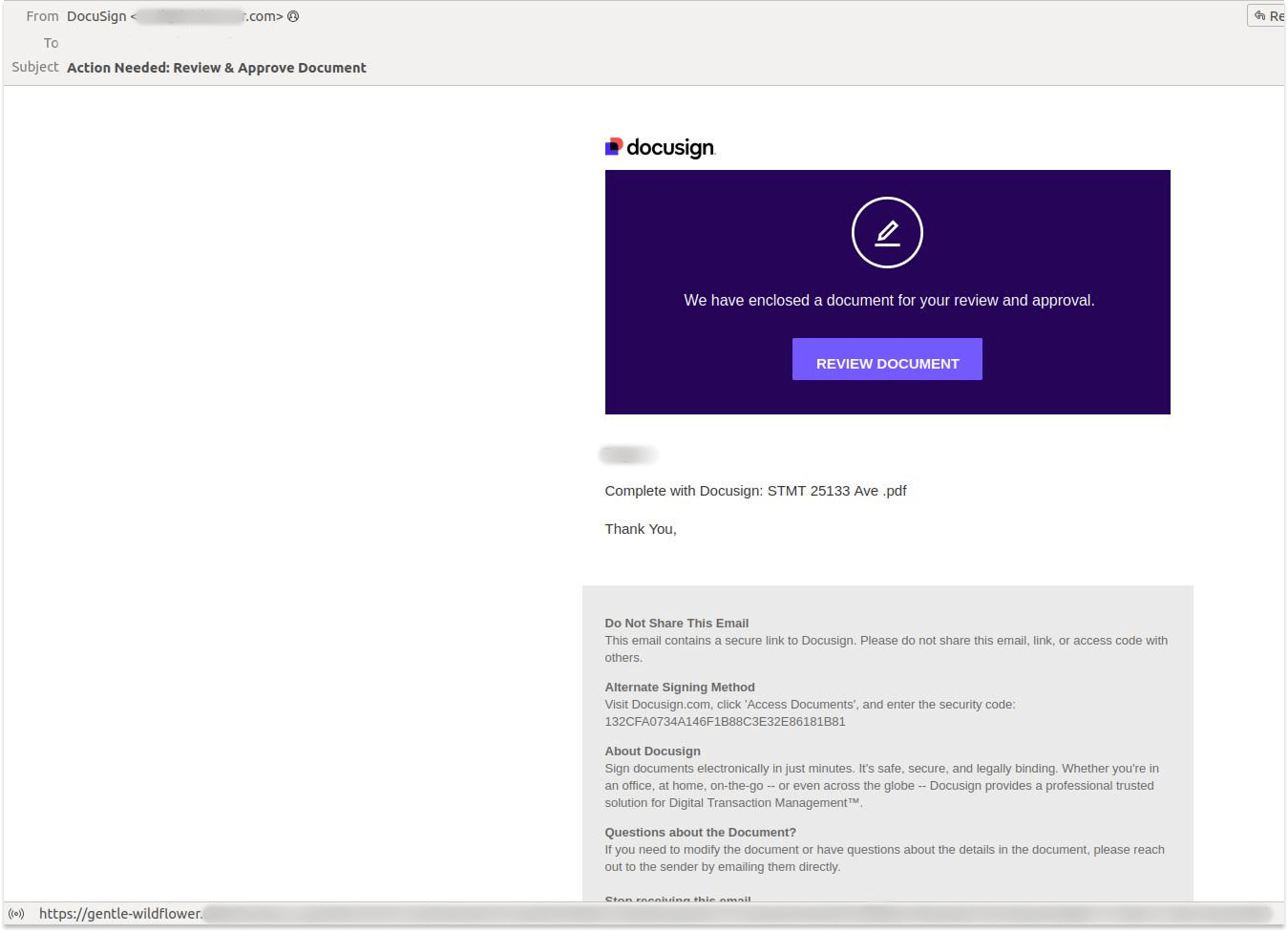
    We also saw a range of phishing emails targeting SMBs. In one recent case detected by our systems, the attacker sent a fake notification allegedly from DocuSign, an electronic document-signing service.

    SMBs can even find themselves targeted by classic Nigerian scams. In one recent example, the sender claimed to represent a wealthy client from Turkey who wanted to move $33 million abroad to allegedly avoid sanctions, and invited the recipient to handle the funds. In Nigerian scams, fraudsters typically cajole money. They may later request a relatively small payment to a manager or lawyer compared to the amount originally promised.

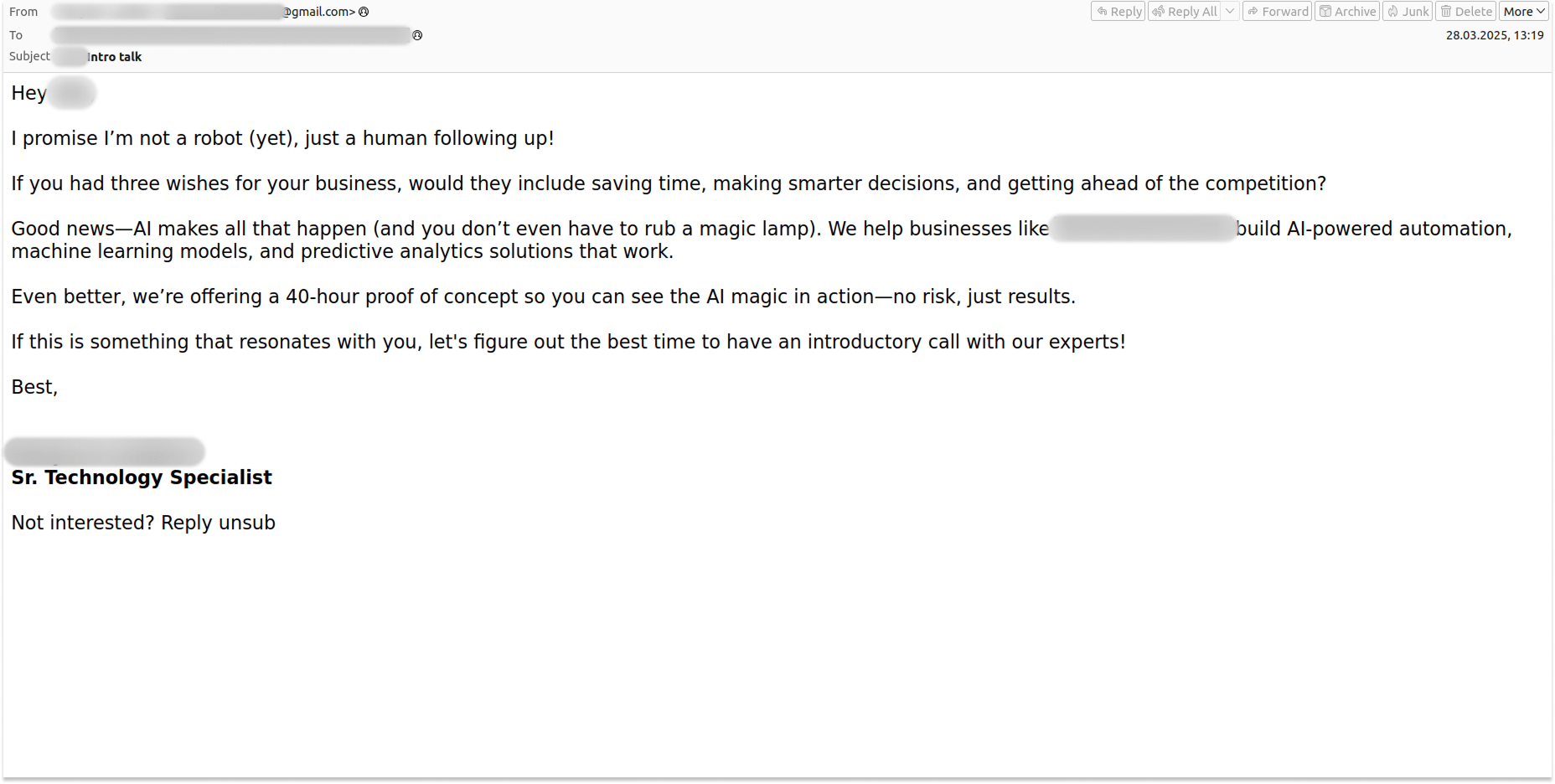
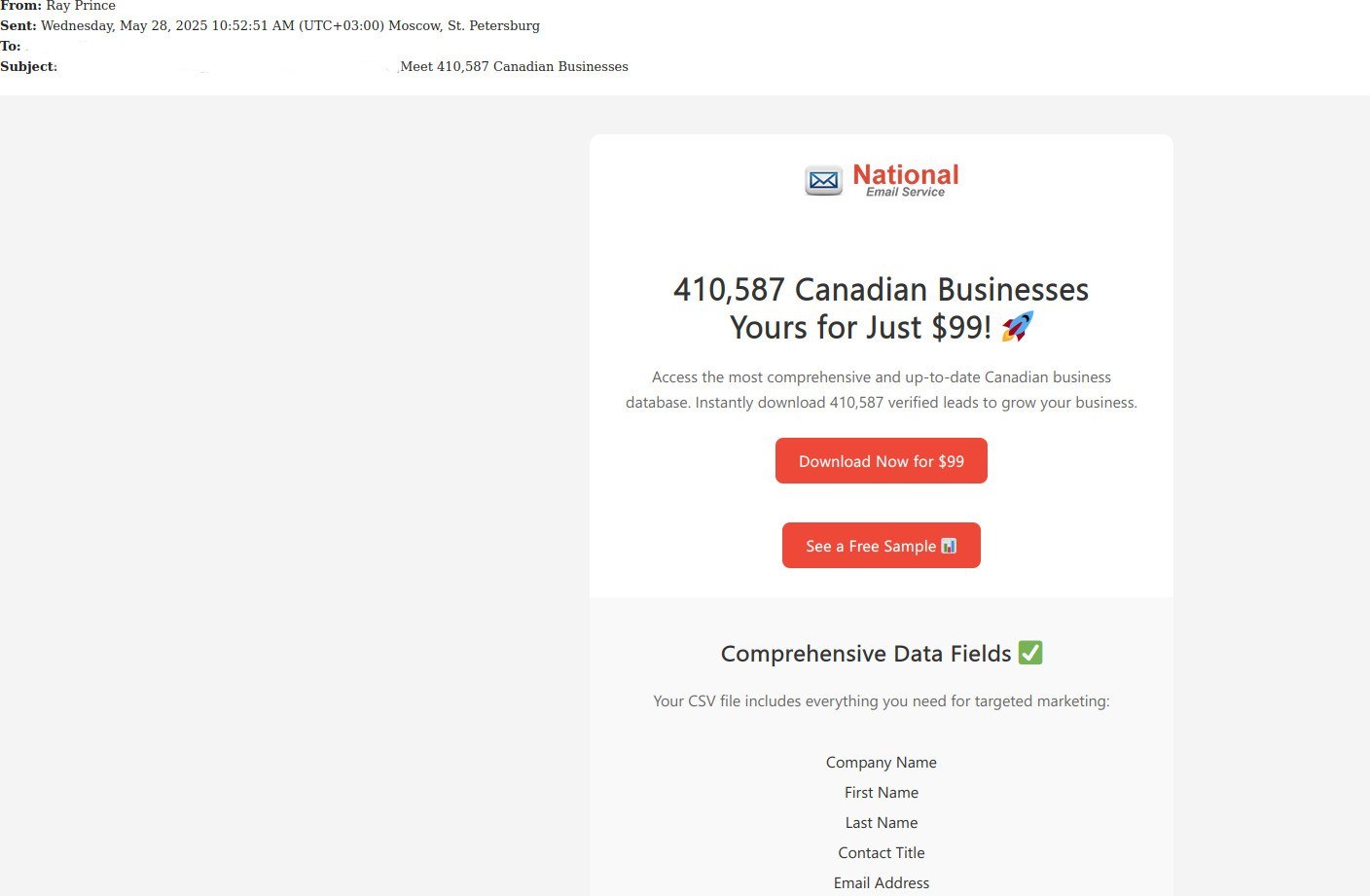
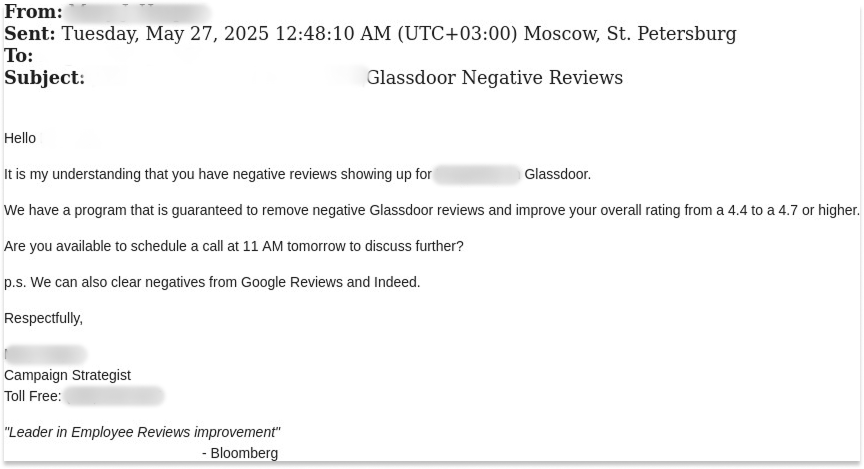
    Beyond these threats, SMBs are bombarded daily with hundreds of spam emails. Some promise attractive deals on email marketing or loans; others offer services like reputation management, content creation, or lead generation. In general, these offers are crafted to reflect the typical needs of small businesses. Not surprisingly, AI has also made its way into the spam folder – with offers to automate various business processes.

    We have also seen spammers offering dubious deals like purchasing a database of over 400,000 businesses for $100, supposedly to be used for selling the company’s B2B products, or manipulating reviews on a review platform.

    Security tips

    SMBs can reduce risks and ensure business continuity by investing in comprehensive cybersecurity solutions and increasing employee awareness. It is essential to implement robust measures such as spam filters, email authentication protocols, and strict verification procedures for financial transactions and the handling of sensitive information.

    Another key step toward cyber resilience is promoting awareness about the importance of comprehensive security procedures and ensuring they are regularly updated. Regular security training sessions, strong password practices, and multi-factor authentication can significantly reduce the risk of phishing and fraud.

    It is also worth noting that searching for software through search engines is an insecure practice, and should be prohibited in the organization. If you need to implement new tools or replace existing ones, make sure they are downloaded from official sources and installed on a centralized basis by your IT team.

    Cybersecurity Action Plan for SMBs

    1. Define access rules for corporate resources such as email accounts, shared folders, and online documents. Monitor and limit the number of individuals with access to critical company data. Keep access lists up to date and revoke access promptly when employees leave the company. Use cloud access security brokers to monitor and control employee activities within cloud services and enforce security policies.
    2. Regularly back up important data to ensure the preservation of corporate information in case of emergencies or cyberincidents.
    3. Establish clear guidelines for using external services and resources. Create well-defined procedures for coordinating specific tasks, such as implementing new software, with the IT department and other responsible managers. Develop short, easy-to-understand cybersecurity guidelines for employees, with a special focus on account and password management, email protection, and safe web browsing. A well-rounded training program will equip employees with the knowledge they need and the ability to apply it in practice.
    4. Implement specialized cybersecurity solutions that provide visibility and control over cloud services, such as Kaspersky Next.

    MIL OSI Economics

  • Returning to Iranian sites is top priority: IAEA chief

    Source: Government of India

    Source: Government of India (4)

    U.N. nuclear watchdog chief Rafael Grossi said on Wednesday his top priority is getting his inspectors back to Iran’s nuclear facilities to assess the impact of U.S. and Israeli military strikes and verify its stocks of enriched uranium.

    “This is the number 1 priority,” International Atomic Energy Agency chief Grossi told a news conference at an Austrian security cabinet meeting. He is seeking his inspectors’ return to Iranian sites including the three plants where it was enriching uranium until Israel launched strikes on June 13.

    Asked if Iran had informed him of the status of its stocks of enriched uranium, particularly its uranium enriched to up to 60% purity, close to weapons grade, he pointed to a letter he received from Iran on June 13, saying Iran would take “special measures” to protect its nuclear materials and equipment.

    “They did not get into details as to what that meant but clearly that was the implicit meaning of that. We can imagine this material is there,” Grossi said, suggesting much of that material had survived the attacks.

    (Reuters)

  • Iranian parliament approves bill to suspend cooperation with UN nuclear watchdog

    Source: Government of India

    Source: Government of India (4)

    Iran’s parliament approved a bill on Wednesday to suspend cooperation with the U.N. nuclear watchdog, state-affiliated news outlet Nournews reported.

    The move, which needs the final approval of Iran’s Supreme National Security Council to be enforced according to Nournews, follows an air war with Israel in which its longtime enemy said it wanted to prevent Tehran developing a nuclear weapon.

    Parliament Speaker Mohammad Baqer Qalibaf was quoted by state media as also saying Iran would accelerate its civilian nuclear programme.

    Tehran denies seeking nuclear weapons and says a resolution adopted this month by the International Atomic Energy Agency (IAEA) declaring Iran in breach of its non-proliferation obligations paved the way for Israel’s attacks.

    The parliament speaker was quoted as saying the IAEA had refused even to appear to condemn the attack on Iran’s nuclear facilities and “has put its international credibility up for sale.”

    He said that “for this reason, the Atomic Energy Organisation of Iran will suspend its cooperation with the Agency until the security of the nuclear facilities is guaranteed, and move at a faster pace with the country’s peaceful nuclear programme.”

    Earlier this week, parliament’s national security committee approved the bill’s general outline and the committee’s spokesperson, Ebrahim Rezaei, said the bill would suspend the installation of surveillance cameras, inspections and filing of reports to the IAEA.

    Following the Israeli attacks on its nuclear sites, and U.S. bombing of underground Iranian nuclear facilities at the weekend, the Iranian government also faces calls to limit the country’s commitments to the nuclear non-proliferation regime.

    In an interview with Qatar’s Al-Araby Al-Jadeed on Tuesday, Foreign Minister Abbas Araqchi said: “I think that our view on our nuclear programme and the non-proliferation regime will witness changes, but it is not possible to say in what direction.”

    (Reuters)

  • MIL-OSI Africa: HE the Prime Minister and Minister of Foreign Affairs, in a joint press conference with HE the Prime Minister of the Lebanese Republic

    Source: Government of Qatar

    In the name of God, the Most Gracious, the Most Merciful.

    Peace and God’s mercy, and blessings be upon you all.

    Firstly, I would like to extend a warm welcome to my dear brother and friend, His Excellency Dr. Nawaf Salam, Prime Minister of the sisterly Lebanese Republic, on his visit to the State of Qatar.

    I also wish to offer our sincere apologies to His Excellency for the disruption to air traffic last night. The delay was a necessary precaution to ensure his safety and the safety of all air travel. We understand he had just concluded a visit to our brothers in the Kingdom of Bahrain, and we regret any inconvenience caused.

    The discussion session between the Prime Minister and I followed his meeting with His Highness the Amir. We reviewed the bilateral relations and avenues of cooperation between our two countries. Naturally, we also explored ways in which we can work together to support our brothers in Lebanon and help maintain stability there. One of the key topics we addressed was the energy sector—specifically, how we can jointly develop and rehabilitate Lebanon’s energy infrastructure. There were important discussions held between the energy ministers of both countries, and, God willing, this will be followed by a concrete action plan in the coming months, as we pledged to the Prime Minister. We also discussed the urgent need to provide energy support to Lebanon during the summer, and, God willing, this matter will be further addressed with the Qatar Fund for Development and QatarEnergy to deliver as much support as possible.

    We also explored avenues for support and cooperation in transportation and air navigation. The Ministers of Transport of Qatar and of the sisterly Lebanese Republic held substantive talks on potential joint initiatives, including the reconstruction of infrastructure—particularly in areas damaged by the Israeli occupation forces.

    We also took the opportunity to review regional developments and ongoing events. I must unequivocally condemn Israel’s violations of the ceasefire agreement and its continued breaches of our brotherly Lebanon’s sovereignty. Such actions are unacceptable and deserve the strongest possible denunciation. We call on the UN Security Council to fulfill its responsibilities and bring an end to these irresponsible measures in the region.

    We also discussed regional developments more broadly, including progress in Lebanese–Syrian relations, for which we hope, God willing, a better future lies ahead. We noted the Prime Minister’s keen interest in deepening ties with sister Arab states, particularly neighboring countries such as Syria. The State of Qatar fully supports these endeavors.

    Today, the region is facing challenges that we have not faced for a long time. Recently, the sovereignty of the State of Qatar was violated by an attack on Al Udeid Air Base carried out by the Islamic Revolutionary Guard Corps. We condemn this act in the strongest terms and denounce such behavior by a neighboring country with which Qatar has traditionally maintained good-neighborly, transparent relations. At the same time, Qatar remains committed to its policy of good neighborliness: from the outset, we have also condemned Israeli strikes against the Islamic Republic of Iran and the harm inflicted on the Iranian people. Ultimately, the Iranian people are our neighbors, and we wish them peace, growth, and development. However, any attack on the State of Qatar is unacceptable. Prior to this incident, Qatar undertook significant diplomatic efforts with regional and international partners to defuse tensions, but we were nonetheless taken by surprise by this assault on the base of a sister country.

    I would like to commend the pivotal role of the armed forces under the leadership of His Highness the Amir, who remained fully informed and vigilant from the moment intelligence was received about a potential attack on bases hosting U.S. forces in the region until the threat was successfully repelled. In particular, the Qatari armed forces demonstrated exceptional bravery in defending against these attacks. As highlighted in yesterday’s press conference, thanks to God, the Qatari air defenses intercepted all incoming missiles except for one, which landed harmlessly in an open area.

    I would also like to express my sincere gratitude to our sisterly and friendly countries for their solidarity with Qatar and their clear rejection of this aggression—especially our brothers in the Gulf Cooperation Council (GCC), who promptly stood by us and offered their support. Today, at the request of the Council Presidency, held by Kuwait, an emergency ministerial meeting will take place in Doha, God willing, and I will receive my fellow GCC foreign ministers to discuss this serious development in our region. I must take this opportunity to emphasize a few key points: foremost among them is the need to approach regional events with responsibility and wisdom. The recent reckless Israeli attacks on multiple countries in the region, including the Islamic Republic of Iran—alongside the aggression against us—demonstrate how such uncalculated actions only fuel instability and could have pushed the region into a far more dangerous situation.

    Following the attack, the Armed Forces—under the directives of His Highness the Commander-in-Chief—carefully studied possible response scenarios. However, the State of Qatar has always prioritized diplomacy and wisdom, placing the greater good of the region above all else. The key message we aim to convey is that, thanks be to God, Qatar has demonstrated—through its capabilities and the strength of its Armed Forces—that it is fully capable of defending itself, its citizens, and its residents, united as one people. In the immediate aftermath of the attack, there were swift communications with His Highness the Amir, including a significant conversation with the President of the United States to discuss the situation, its consequences, and possible responses. This exchange opened the door to a complete ceasefire across all fronts. At the request of our American partners, Qatar contacted the Iranian side to assess their willingness to commit to such a ceasefire, which led to the announcement made by the U.S. President—a step we welcome. Despite some violations observed today, we remain hopeful that the ceasefire will hold and that efforts will return to a diplomatic path. We call on all parties to honor the agreement and urge both the American and Iranian sides to resume nuclear negotiations without delay. Qatar continues to advocate for a region free of nuclear weapons, achieved through a comprehensive agreement that ensures collective security, protects everyone’s interests, and respects Iran’s rights as our neighbor.

    A short while ago, His Highness the Amir received a call from the President of Iran, during which the Iranian President expressed his regret over the incident, acknowledging that the State of Qatar was the target. We made it clear to him that Qatar, as a neighboring country, has always based its relationship with Iran on the principles of good neighborliness and did not expect such an action—especially in light of ongoing efforts to escalate the situation. While Qatar will continue to handle matters with wisdom and restraint, the violation of its sovereignty is entirely unacceptable. All necessary diplomatic and legal measures will be pursued in response. We sincerely hope the situation will be contained swiftly and that this difficult chapter be closed soon.

    We must remember that the current developments in the region are a direct extension of the conflict in Gaza and the brutal aggression faced by our Palestinian brothers there. Since the beginning, the State of Qatar has worked tirelessly to prevent the escalation of this conflict and to halt the bombing of innocent civilians. In coordination with the Arab Republic of Egypt and the United States, Qatar continues its efforts to secure an immediate ceasefire in Gaza. Despite the region’s challenging circumstances, our efforts never ceased. Our aim remains clear: to end the war, lift the injustice inflicted upon the people of Gaza, and bring peace to the region. It is time for the international community to take a unified stand, to stop Israel’s irresponsible actions, and to end both the aggression in Gaza and the use of humanitarian aid as a means of political provocation.

    I would like to extend my sincere thanks to everyone here, and especially to the Prime Minister for honoring us with his visit during this sensitive time. We deeply appreciate the difficult circumstances our brotherly country, Lebanon, is facing, and we sincerely wish them all the best and a brighter future, God willing.

    Thank you, Mr. Prime Minister.

    MIL OSI Africa

  • MIL-OSI Africa: United Arab Emirates (UAE) leaders congratulate President of Mozambique on Independence Day


    Download logo

    President His Highness Sheikh Mohamed bin Zayed Al Nahyan has sent a message of congratulations to President Daniel Chapo of Mozambique on the occasion of his country’s Independence Day.

    His Highness Sheikh Mohammed bin Rashid Al Maktoum, Vice President, Prime Minister and Ruler of Dubai, and His Highness Sheikh Mansour bin Zayed Al Nahyan, Vice President, Deputy Prime Minister and Chairman of the Presidential Court, sent similar messages to the President of Mozambique and to Prime Minister Maria Benvinda Levi on the occasion.

    Distributed by APO Group on behalf of United Arab Emirates, Ministry of Foreign Affairs.

    MIL OSI Africa

  • MIL-OSI Russia: Iranian President Declares ‘End of 12-Day War’

    Translation. Region: Russian Federal

    Source: People’s Republic of China in Russian – People’s Republic of China in Russian –

    Source: People’s Republic of China – State Council News

    TEHRAN, June 25 (Xinhua) — Iranian President Masoud Pezeshkian on Tuesday declared “the end of the 12-day war” and called on all government bodies and revolutionary institutions to focus their efforts on reconstruction.

    “We are witnessing a ceasefire and the end of the 12-day war imposed on the Iranian nation by Israel’s adventurism,” M. Pezeshkian said in an address to the Iranian people after the ceasefire agreement came into force.

    “The aggressive enemy failed to achieve its sinister goals of destroying nuclear facilities and disrupting nuclear research, as well as inciting social unrest,” the head of state noted.

    During a telephone conversation with UAE President Sheikh Mohammed bin Zayed Al Nahyan on Tuesday, M. Pezeshkian said that his country is ready to resolve issues within the international framework and at the negotiating table.

    The United States and Israel are seeking to sow discord and hostility among Islamic countries, the Iranian president said. Iran seeks to strengthen unity and peace in the region and considers them the basis for accelerating development, he said.

    On June 13, Israel launched major airstrikes on various areas of Iran, including nuclear and military sites, killing senior commanders, nuclear scientists and civilians. Iran responded with a series of missile and drone strikes that caused deaths and extensive damage.

    On Saturday, the US Air Force attacked three Iranian nuclear sites: Fordow, Natanz and Isfahan, to which Iran responded on Monday with a missile strike on the US Al Udeid Air Base in Qatar.

    Following this, US President Donald Trump announced that a ceasefire between Israel and Iran would go into effect on Tuesday at around 04:00 GMT. Both sides later confirmed the start of the truce. –0–

    MIL OSI Russia News

  • MIL-OSI Africa: Commemoration of Martyrs Day by Diaspora Nationals


    Download logo

    Eritrean nationals residing in Dubai and the Northern Emirates, Germany, Scandinavian countries, and the United States, as well as Eritrea’s Permanent Representative to the African Union and the Economic Commission for Africa, commemorated Martyrs Day.

    According to reports, at commemorative events held in Sweden, Denmark, and Norway, the nationals pledged to augment the Martyrs Trust Fund and continue their support to the families of martyrs. Nationals in Sweden contributed over 104 thousand Kroner towards Martyrs Trust Fund.

    Eritrean nationals in various German cities also organized walkathons, candlelight vigils, and cultural and artistic performances in memory of the martyrs. At the Berlin event, certificates of recognition were awarded to individuals who assumed responsibility for supporting the families of martyrs.

    Nationals in Dubai and the Northern Emirates commemorated Martyrs Day with great spirit on19 June, featuring candlelight vigils and cultural programs. They also expressed their readiness to uphold the trust of the martyrs through supporting families of martyrs and hard work. Similarly, nationals in Kuwait commemorated Martyrs Day with great pride.

    Members of the Eritrean Embassy in Ethiopia, along with Eritrea’s Permanent Representative to the African Union and the Economic Commission for Africa, also marked Martyrs Day with patriotic zeal.

    Eritrean nationals across various U.S. cities commemorated the day, pledging to strengthen their participation and contributions to support the families of martyrs. Nationals in Chicago and its environs contributed over 30,240 U.S. Dollars in support of 42 families of martyrs.

    Distributed by APO Group on behalf of Ministry of Information, Eritrea.

    MIL OSI Africa

  • India back in space after 41 years, says Shubhanshu Shukla after Axiom 4 lift-off

    Source: Government of India

    Source: Government of India (4)

    Group Captain Shubhanshu Shukla, who is piloting the Axiom-4 mission that launched from Florida on Wednesday, said that India is returning to space after 41 years and called it an “amazing ride.” Stating that the journey is the beginning of India’s human space programme, he said the chest of Indians “should swell with pride.”

    The Axiom Mission 4 of Ax-4, launched aboard a SpaceX Dragon spacecraft from Launch Complex 39A at NASA’s Kennedy Space Centre in Florida at 2:31 am Eastern Time (12 Noon IST).

    “Liftoff for #Ax4. The #Ax4 crew is on its way to the space station,” said the US-based Axiom Space, which has, in collaboration with NASA and SpaceX, organised the mission.

    “Liftoff of Ax-4!” added SpaceX.

    The lift-off comes after being deferred at least six times.

    In his remarks from onboard the Dragon spacecraft, Shukla said, “Namaskar, my dear countrymen, what a ride. We are back in the space once again after 41 years. It’s an amazing ride. We are revolving around the Earth at a speed of 7.5 kilometres per second. The Tiranga embossed on my shoulders tells me that I am with all of you. This journey of mine is not a beginning to the International Space Station (ISS) but to India’s Human Space Programme. I want all of you to be part of this journey. Your chest, too, should swell with pride. You all also show excitement. Together, let’s initiate India’s Human Space Programme. Jai Hind! Jai Bharat!”

    “India is returning to space, Jai Hind,” Shukla wrote on X, just before the launch of the mission.

    “After 41 years, India’s flag will fly in space again,” he added.

    Earlier, Shukla also penned an emotional note for his wife.

    “Special thanks to Kamna for being the wonderful partner that you are. Without you none of this was possible but more importantly none of this would matter,” said Shukla, in a post on Instagram.

    He shared a photograph that shows them saying goodbye through opposite sides of a glass wall.

    Shukla also thanked people “involved in this mission for their support”.

    For Group Captain Shukla, this will be an opportunity to emulate fellow Indian Air Force Officer Wing Commander Rakesh Sharma, who flew aboard Soyuz T-11 on 3 April 1984 as part of the Soviet Interkosmos programme. Sharma spent seven days in space on board the Salyut 7 space station.

    This is the fourth private astronaut mission to the International Space Station. The crew is travelling to the orbiting laboratory on a new SpaceX Dragon spacecraft. The targeted docking time is approximately 7 am Eastern Time (4 pm IST) on Thursday, June 26.

    Once docked, the astronauts plan to spend up to 14 days aboard the orbiting laboratory, conducting a mission comprised of science, outreach, and commercial activities. Peggy Whitson, former NASA astronaut and director of human spaceflight at Axiom Space, is in command of the mission, while Indian Space Research Organisation Astronaut Group Captain Shubhanshu Shukla serves as pilot.

    The two mission specialists are European Space Agency project astronaut Slawosz Uznanski-Wisniewski of Poland and Tibor Kapu of Hungary. The astronauts are using the new Axiom Extravehicular Mobility Unit (AxEMU) spacesuit which provides them with advanced capabilities for space exploration while providing NASA with commercially developed human systems needed to access, live and work on and around the Moon.

    The advanced spacesuits ensure astronauts are equipped with high-performing, robust equipment and are designed to accommodate a wide range of crew members. The Ax-4 mission is going to conduct major research. The research complement includes around 60 scientific studies and activities representing 31 countries, including the U.S., India, Poland, Hungary, Saudi Arabia, Brazil, Nigeria, UAE, and nations across Europe.

    This will be the most research and science-related activities conducted on an Axiom Space mission aboard the International Space Station to date NASA and ISRO (Indian Space Research Organisation) are collaborating to launch several scientific investigations.

    These studies include examining muscle regeneration, growth of sprouts and edible microalgae, survival of tiny aquatic organisms, and human interaction with electronic displays in microgravity. The first private astronaut mission to the station, Axiom Mission 1, lifted off in April 2022 for a 17-day mission aboard the orbiting laboratory.

    The second private astronaut mission to the station, Axiom Mission 2, was also commanded by Whitson and launched in May 2023 with four private astronauts who spent eight days in orbit. The most recent private astronaut mission, Axiom Mission 3, launched in January 2024; the crew spent 18 days docked to the space station.

    (With agency inputs)

  • NATO leaders set to back Trump defence spending goal at Hague summit

    Source: Government of India

    Source: Government of India (4)

    NATO leaders gathered in The Hague on Wednesday for a summit tailor-made for U.S. President Donald Trump, with European allies hoping a pledge to hike defence spending will prompt him to dispel doubts about his commitment to the alliance.

    The summit is expected to endorse a higher defence spending goal of 5% of GDP – a response to a demand by Trump and to Europeans’ fears that Russia poses an increasingly direct threat to their security following the 2022 invasion of Ukraine.

    NATO Secretary General Mark Rutte acknowledged that it was not easy for countries to find the money for extra defence spending but said it was vital to do so.

    “There is absolute conviction with my colleagues at the table that given this threat from the Russians, given the international security situation, there is no alternative,” he told reporters on Wednesday morning.

    NATO officials are hoping the conflict between Israel and Iran, and the U.S. bombing of Iranian nuclear sites at the weekend, will not overshadow the gathering, hosted by Rutte in his home city.

    Trump has threatened not to protect NATO members if they fail to meet spending targets and he raised doubts about his commitment again on his way to the summit by avoiding directly endorsing the alliance’s Article 5 mutual defence clause.

    Speaking to reporters aboard Air Force One, he said there were “numerous definitions” of the clause. “I’m committed to saving lives. I’m committed to life and safety. And I’m going to give you an exact definition when I get there,” he said.

    The new target – to be achieved over the next 10 years – is a big increase on the current goal of 2% of GDP, although it will be measured differently. It would amount to hundreds of billions of dollars in extra annual spending.

    Countries would spend 3.5% of GDP on core defence – such as troops and weapons – and 1.5% on broader defence-related measures such as cyber security, protecting pipelines and adapting roads and bridges to handle military vehicles.

    All NATO members have backed a statement enshrining the target, although Spain declared it does not need to meet the goal. Madrid says it can meet its military commitments to NATO by spending much less – a view disputed by Rutte.

    But Rutte accepted a diplomatic fudge with Spanish Prime Minister Pedro Sanchez as part of his intense efforts to give Trump a diplomatic victory and make the summit go smoothly.

    UNUSUAL INSIGHT INTO SUMMIT DIPLOMACY

    Trump gave an unusual insight into those efforts on Tuesday by posting a private message in which Rutte lavished praise on him and congratulated him on “decisive action in Iran”.

    “You will achieve something NO American president in decades could get done,” Rutte told Trump.

    “Europe is going to pay in a BIG way as they should, and it will be your win.”

    To satisfy Trump, Rutte has also kept the summit and its final statement short and focused on the spending pledge.

    The text is expected to cite Russia as a threat and reaffirm allies’ support for Ukraine but not dwell on those issues, given Trump has taken a more conciliatory stance towards Moscow and been less supportive of Kyiv than his predecessor, Joe Biden.

    Ukrainian President Volodymyr Zelenskiy had to settle for a seat at the pre-summit dinner on Tuesday evening rather than a seat at the main meeting on Wednesday, although Trump said he would probably meet with Zelenskiy separately.

    Zelenskiy and his aides have said they want to talk to Trump about buying U.S. weapons including Patriot missile defence systems and increasing pressure on Moscow through tougher sanctions.

    The Kremlin accused NATO of being on a path of rampant militarisation and portraying Russia as a “fiend of hell” in order to justify its big increase in defence spending.

    (Reuters)

  • MIL-OSI China: Autonomous driving innovation fuels AI reach worldwide

    Source: People’s Republic of China – State Council News

    This photo shows a Pony.ai robotaxi at a pick-up point in Nansha District of Guangzhou, south China’s Guangdong Province, March 11, 2025. (Xinhua/Deng Hua)

    On the outskirts of Beijing, a self-driving bus navigated effortlessly through traffic, demonstrating China’s rapidly advancing autonomous driving technology.

    Developed by UISEE, a Beijing-based unicorn, this solution is now expanding beyond Chinese capital’s streets and beginning to make its mark on the global robotaxi industry.

    These “AI drivers” have spread to countries like Singapore, the United Arab Emirates (UAE), Saudi Arabia and Qatar, penetrating industries including energy, heavy industry, pharmaceuticals and chemicals, said Wu Gansha, CEO of UISEE.

    The unmanned buses operate at over 20 airports worldwide, forming a fleet of more than 1,000 autonomous vehicles that have collectively covered 5.8 million kilometers.

    These busy shuttles reflect the rising influence of Chinese companies like UISEE in the autonomous driving sector, as they secure increasing numbers of international contracts thanks to their reliable and innovative technology.

    In addition to buses, UISEE’s diverse fleet includes unmanned retail vehicles, patrol cars, cleaning vehicles, towing tractors and heavy-duty trucks, varying in size and function.

    Equipped with the latest solid-state LiDAR, the autonomous cars achieve 360-degree, blind-spot-free vision, according to Wu. While Tesla relies mainly on vision-based technology, Chinese tech firms are rolling out a multi-sensor data-driven approach globally.

    GOING GLOBAL

    UISEE is not alone in this global push. Last month, Pony.ai, a Guangzhou-based robotaxi service provider, announced a strategic partnership with Dubai’s transport authority.

    Under the partnership, Pony.ai’s robotaxi fleet is scheduled to commence test operations in 2025, with plans to start fully autonomous commercial services in 2026 in Dubai.

    “This partnership is integral to our goal of transforming 25 percent of all journeys in the city into autonomous trips by 2030, reinforcing Dubai’s position as a global leader in autonomous mobility and innovation,” said Ahmed Bahrozyan, CEO of Public Transport Agency at Dubai’s Roads and Transport Authority (RTA).

    To date, Pony.ai, a partner of ride-hailing platform Uber, has obtained Robotaxi licenses in countries such as the United States, the Republic of Korea and Luxembourg.

    Last July, during the signing ceremony of the memorandum of understanding between Pony.ai and Luxembourg authorities, the country’s Minister of the Economy, Lex Delles, described the agreement as “a significant opportunity to advance Luxembourg’s technical capabilities in the smart mobility sector.”

    “We are extending our proven-in-China integrated capabilities of autonomous driving, encompassing R&D, mass production, and commercial operations, globally,” said Pony.ai’s CFO Wang Junhao.

    The UAE is emerging as one of the showcasing grounds for China’s self-driving technology.

    In April this year, WeRide announced its collaboration with Uber and the RTA to launch robotaxi services in Dubai. It came after the Guangzhou-based tech firm secured the first autonomous driving license for the UAE in July 2023. In December last year, WeRide partnered with Uber to officially introduce robotaxi services in Abu Dhabi.

    Also, Baidu’s Apollo Go has inked a deal with the RTA this March to launch autonomous driving tests and services in Dubai, marking its entry into the Middle East. It plans to deploy 100 fully autonomous vehicles in Dubai by the end of 2025 and scale the fleet to at least 1,000 by 2028.

    The global Robotaxi market will grow at a compound annual growth rate of 64.1 percent from 2025 to 2032, according to a market forecast released by Coherent MI early this year.

    TECHNOLOGICAL STRENGTHS

    The global expansion of Chinese autonomous driving companies is partly driven by the country’s “data dividend” and strong government support for developing a self-driving ecosystem.

    With the country’s advantage of a vast population, extensive road networks, diverse and complex driving conditions, and rapidly advancing AI technology, robotaxi startups in China have quickly grown into leading companies in the world.

    Baidu and WeRide were named among the top 10 vendors in the Guidehouse Insights Leaderboard Report on automated driving systems (ADS), published last December, alongside NVIDIA and Waymo.

    They are developing at least Level-4 ADS that can operate without human intervention or supervision, according to research.

    Plus, Chinese authorities have designated at least 20 cities and city clusters as pilot zones for the application of “vehicle-road-cloud” integration for intelligent connected vehicles.

    This extensive road test data has boosted international recognition of China’s robotaxi services.

    “One day, autonomous driving will liberate human hands, and we will endeavor to see ‘AI drivers’ cruising in every corner of the world,” said UISEE’s CEO Wu when he talked about his ambitious plan. 

    MIL OSI China News

  • MIL-Evening Report: Election flows reveal nearly 90% of Greens preferenced Labor ahead of Coalition

    Source: The Conversation (Au and NZ) – By Adrian Beaumont, Election Analyst (Psephologist) at The Conversation; and Honorary Associate, School of Mathematics and Statistics, The University of Melbourne

    Minor party preference flows for the federal election have been released, with Labor winning Greens preferences by 88.2–11.8, while the Coalition won One Nation preferences by 74.5–24.5. I also cover a SA state poll that gave Labor a massive 67–33 lead.

    The Australian Electoral Commission’s results for the May 3 federal election now show how minor parties’ preferences flowed between Labor and the Coalition. The Greens won 12.2% of the national primary vote, and their preferences favoured Labor over the Coalition by 88.2–11.8. That’s a 2.5% preference flow gain for Labor since the 2022 election.

    One Nation had 6.4% of primary votes. Their preferences favoured the Coalition over Labor by 74.5–25.5, a 10.2% preference flow gain for the Coalition. Independents made up 7.3% of primary votes, and their preferences favoured Labor by 67.2–32.8, a 3.4% gain for Labor.

    Including Trumpet of Patriots (1.9% of primary votes) with others, others made up 7.7% of primary votes and their preferences favoured the Coalition by 57.3–42.7, a 0.6% gain for the Coalition since 2022 if United Australia Party (4.1% in 2022) is included with others then.

    The AEC formally declared the poll by returning the writs on June 12. Results can be legally challenged within 40 days of this declaration, so by July 22.

    In Bradfield, Teal Nicolette Boele only won by 26 votes against the Liberals, and this result could be challenged.

    As the AEC does not want to disturb the ballot papers until any challenge is resolved by the courts, it is for now using an estimated two-party result in Bradfield (55.0–45.0 to the Liberals against Labor). Analyst Ben Raue believes this estimate is understating Labor in Bradfield by 4.4%.

    If Raue is right, the current national two-party vote (55.22–44.78 to Labor) is very slightly understating Labor.

    While One Nation’s preference shift helped the Coalition, there were compensatory shifts to Labor from Greens and independent voters. The combined primary vote for One Nation and Trumpet of Patriots was down 0.8% from 2022 to 8.3%, while independents were up 2.0%.

    Applying 2022 election flows to primary votes at this election only overstates Labor by 0.1% compared to their actual two-party vote.

    In my poll review article on June 5, I said respondent allocated preferences in final polls did not show a large gap in the Coalition’s favour from using 2022 election flows that had occurred in polls earlier in the year.

    It’s likely that Labor’s share of preferences from Greens and Teal-type independents rose close to the election. People who voted for these candidates may have been disappointed with Labor’s environmental record, but both Peter Dutton and Donald Trump helped Labor with these people.

    In the last term, the Greens were economically left-wing as well as pro-environment. Voters who supported the Greens because of their economic agenda are probably less likely to prefer the Coalition to Labor than environmental voters.

    The Poll Bludger has a graph that shows that, in federal elections since 2004, Labor’s share of Greens preferences was at a record high this election, but their share of One Nation preferences was at a record low.

    Weak Labor flows to Boele

    In Bradfield, Labor preferences favoured Boele by 68.6–31.4 against the Liberals.
    There were 16 other seats where Labor preferences were distributed between the Coalition and a non-Coalition candidate. The Labor flow to Boele was the second weakest in such seats. This weak flow almost cost Boele Bradfield.

    The only seat that had a weaker Labor preference flow to a non-Coalition candidate was Maranoa, where the non-Coalition candidate was One Nation. Labor preferences in Maranoa split 57.9–42.1 to the Liberal National Party against One Nation. In 13 of the 17 seats, Labor preferences flowed at over 75% rates to the non-Coalition candidate.

    In early April, the ABC reported Boele had made a crude sexual remark to a 19-year-old employee at a hair salon after receiving a haircut and was banned from that salon. This may explain the weaker preference flow from Labor voters.

    Weak Greens flows to Teals in Teal vs Labor contests

    There were three seats where the final two were Labor and a Teal independent: Bean, Franklin and Fremantle. In Bean and Fremantle, the Liberals recommended preferences to the Teal on their how to vote material, but not in Franklin.

    Labor held all three seats, but only by 50.3–49.7 in Bean and 50.7–49.3 in Fremantle. Labor won much more easily in Franklin, by 57.8–42.2, where they benefited from Liberal how to vote cards.

    In Bean, Greens preferences only favoured Teal Jessie Price by 50.6–49.4 over Labor, while Liberal preferences favoured her by 80.0–20.0. In Fremantle, Greens preferences favoured Teal Kate Hulett by 52.9–47.1, while Liberal preferences favoured her by 76.5–23.5. In Franklin, Greens preferences favoured Teal Peter George by 53.8–46.2.

    In Bean and Fremantle, had Greens preferences been stronger for the Teal, Labor would have lost to a more pro-environment candidate. Perhaps Labor benefited on Greens preferences owing to the Greens’ more economic left-wing agenda.

    And a national Morgan poll, conducted June 2–22 from a sample of 3,957, gave Labor a 58–42 lead, unchanged from the previous Morgan poll in May. Primary votes were 37.5% Labor (up 0.5), 31% Coalition (steady), 12% Greens (up 0.5), 6% One Nation (steady) and 13.5% for all Others (down one).

    By 43–41.5, voters thought the country was headed in the right direction, the first time right direction has led since February 2023. The overall net +1.5 rating is +48 with Labor voters, +11.5 with Greens, -43 with Coalition voters, -80.5 with One Nation voters and -17.5 with all Others.

    Labor holds massive lead in SA

    The next South Australian state election will be held in March 2026. A YouGov poll for The Adelaide Advertiser, conducted May 15–28 from a sample of 903, gave Labor a massive 67–33 lead over the Liberals (54.6–45.4 to Labor at the March 2022 election). Primary votes were 48% Labor, 21% Liberals, 14% Greens, 7% One Nation, 8% independents and 2% others.

    If the results at next March’s election reflect this poll, the Liberals would hold just two of the 47 lower house seats on a uniform swing. It would be easily their worst result in SA state history.

    In Australian electoral history, there has only been one bigger landslide: when Western Australian Labor defeated the Liberals and Nationals by 69.7–30.3 at the March 2021 state election.

    Socialist likely to be next New York City mayor

    I covered today’s AEST New York City Democratic mayoral primary election for The Poll Bludger. While preferences won’t be tabulated until next Tuesday, the socialist Zohran Mamdani leads former New York governor Andrew Cuomo by 43.5–36.4 on primary votes, and is virtually certain to win. As the Democratic nominee, Mamdani is likely to win the November general election.

    The article also covers Donald Trump’s ratings and polls in Israel.

    Adrian Beaumont does not work for, consult, own shares in or receive funding from any company or organisation that would benefit from this article, and has disclosed no relevant affiliations beyond their academic appointment.

    ref. Election flows reveal nearly 90% of Greens preferenced Labor ahead of Coalition – https://theconversation.com/election-flows-reveal-nearly-90-of-greens-preferenced-labor-ahead-of-coalition-259438

    MIL OSI AnalysisEveningReport.nz

  • MIL-OSI China: Iranian president announces ‘end of the 12-day war’

    Source: People’s Republic of China – State Council News

    Iranian President Masoud Pezeshkian on Tuesday announced the “end of the 12-day war” and urged all government bodies and revolutionary institutions to focus all their efforts on reconstruction.

    “Today, after your brave and historic resilience, we witness a ceasefire and the end of the 12-day war imposed on the Iranian nation by the adventurism” of Israel, Pezeshkian said in a message to the Iranian people after the ceasefire came into force.

    “The aggressive enemy failed to achieve its nefarious goals of destroying nuclear facilities and undermining nuclear knowledge, as well as inciting social unrest,” he said.

    In contrast, the collapse of “the false invincibility” of Israel and its allies, along with the extensive destruction of important facilities and centers in the occupied territories, sent a key message to the world that the cost of adventurism against great Iran is exceedingly heavy, he added.

    In a phone call with the President of the United Arab Emirates Sheikh Mohamed bin Zayed Al Nahyan on Tuesday, Pezeshkian said that his country is ready to resolve issues within international frameworks and at the negotiating table.

    The United States and Israel seek to create discord and enmity among Islamic countries, he said, noting that Iran is seeking to strengthen unity and peace in the region and considers them a basis for accelerating development.

    On June 13, Israel launched major airstrikes on different areas in Iran, including nuclear and military sites, killing senior commanders, nuclear scientists, and civilians. Iran responded by launching several waves of missile and drone attacks on Israel, inflicting casualties and heavy damage.

    On Saturday, the U.S. Air Force bombed three Iranian nuclear sites of Fordow, Natanz, and Isfahan. In retaliation, Iran on Monday targeted the U.S. Al Udeid Air Base in Qatar with missiles.

    Following Iran’s attack, U.S. President Donald Trump announced that a ceasefire between the two sides would begin around 0400 GMT Tuesday. Both Iran and Israel later confirmed the start of the ceasefire. 

    MIL OSI China News

  • MIL-Evening Report: Wild swings in the oil price make the Reserve Bank’s job harder

    Source: The Conversation (Au and NZ) – By John Hawkins, Head, Canberra School of Government, University of Canberra

    It looks, at least for now, as though tensions in the Middle East are easing somewhat. It appears much less likely Iran will try to close the
    Strait of Hormuz, through which flows about a fifth of the world’s oil.

    In response, oil prices have dropped to a two-week low below US$70 a barrel.

    The economists at the Reserve Bank will be breathing a sigh of relief. A surge in oil prices would have injected more uncertainty into the global outlook. It would have made a decision on whether to cut interest rates in July harder.

    Financial markets are betting on a rate cut at the July 7–8 meeting, but three of the four major bank economists are tipping August as more likely.

    A tough global backdrop

    The global economic environment is particularly challenging. Even before the recent increased tensions in the Middle East, the Trump tariff announcements (and withdrawals and re-impositions) were the major cause of the uncertainty around the domestic economy.

    And there is a lot of “uncertainty”. Journalist Shane Wright noted the word “uncertain” appeared 134 times in the Reserve Bank’s latest Statement on Monetary Policy. Something similar has been noted in the United Kingdom.

    There have been wild swings in the oil price in recent days. There was a surge on market fears Iran would close the Strait of Hormuz. The price slid when a ceasefire was announced. It rose again when the ceasefire was broken within hours. As the fragile truce appeared to hold, the price of oil has now gone back down.

    Assumptions on the oil price

    Forecasting where it will be in a day or week, let alone in a month or a year, is difficult. But economic forecasts underlying monetary policy decisions need to incorporate some view. The Reserve Bank generally assumes the oil price stays at its current level in the short term. It then uses the price in forward contracts as a basis for its forecasts beyond that.

    A sustained jump in oil prices would have posed quite a dilemma for the Reserve Bank.

    Generally a shock that adds to inflation would lead to the bank raising interest rates. In contrast, a shock that weakens economic activity would lead to the Bank lowering rates.

    But a surge in oil prices would likely both increase inflation (by pushing up petrol prices) and weaken activity (by disrupting world trade and eroding consumers’ purchasing power).

    If the oil price surge was expected to be short-lived, it is unlikely to get baked into inflationary expectations. The bank would then probably disregard it. But assessing the longevity of disruptions to the global oil market is not easy.

    Monthly inflation drops to 2.1%

    On Wednesday, the monthly consumer price index (CPI) fell to 2.1% in May from 2.4% in April. This is the equal lowest level since March 2001.

    But the monthly reading will probably not impress RBA Governor Michele Bullock. In her most recent press conference, she commented that “we get four readings on inflation a year”, referring to the quarterly inflation reports. She was dismissive of what she termed “the monthly indicator which is very volatile”.

    In taking its decisions, the bank often relies on an underlying inflation measure called the “trimmed mean”. This excludes items with the largest price movements up or down, so it removes petrol prices when they move by large amounts. This measure was 2.4% in the monthly report.

    Petrol prices are also a significant contributor to the volatility of the monthly CPI.

    Further cuts are likely

    Both headline and underlying inflation are now within the central bank’s 2–3% target range. In its most recent outlook, the Reserve Bank forecast underlying inflation would remain in the target band, even if it made another two cuts in rates this year.

    So a further interest rate cut remains likely. If it doesn’t cut in July, the bank could wait for the next quarterly inflation report on July 30, and then cut at the August 12 meeting.

    Treasurer Jim Chalmers described the global economy as being “in a pretty dangerous place right now”.

    “There’s a lot of volatility, unpredictability, uncertainty in the global economy,” he said. That is one thing that is not uncertain.

    John Hawkins was formerly a senior economist at the Reserve Bank.

    ref. Wild swings in the oil price make the Reserve Bank’s job harder – https://theconversation.com/wild-swings-in-the-oil-price-make-the-reserve-banks-job-harder-259555

    MIL OSI AnalysisEveningReport.nz

  • MIL-OSI: WISeSat Signs a Service Agreement with Astrocast to Allow Access to Astrocast’s Operational Satellite Constellation

    Source: GlobeNewswire (MIL-OSI)

    FOR IMMEDIATE RELEASE

    WISeSat Signs a Service Agreement with Astrocast to Allow Access to Astrocast’s Operational Satellite Constellation

    Geneva, Switzerland – June 25, 2025 – WISeKey International Holding Ltd (“WISeKey”) (SIX: WIHN, NASDAQ: WKEY), a leading global cybersecurity, blockchain, and IoT company, today announces that its subsidiary, WISeSat.Space, a provider of secure satellite communications and space infrastructure, signed a strategic collaboration agreement with Astrocast, a Swiss-based nanosatellite IoT network operator, under which WISeSat will be gaining access to the operational satellite constellation of Astrocast. This collaboration significantly expands WISeSat’s existing operational satellite connectivity as Astrocast operates one of the largest LEO satellite networks in Europe.

    This agreement marks a major step in WISeSat’s mission to build a fully sovereign and secure European space ecosystem, aligned with EU space autonomy goals and ambitions. The expanded constellation access will strengthen connectivity, resilience, and coverage for Internet of Things (IoT) and critical infrastructure services across Europe and other strategic global regions.

    Carlos Moreira, CEO of WISeKey and WISeSat.Space, stated: “This is a decisive moment for the future of secure space communications in Europe. By utilizing Astrocast’s operational constellation, WISeSat’s is not only expanding its orbital reach, but it is also reinforcing Europe’s strategic autonomy in space. This partnership allows us to deliver more robust, real-time, and cyber-secure satellite-based services across key industries and geographies. It’s a powerful example of how Swiss-led innovation can shape the future of a sovereign, digital Europe.”

    This service agreement with Astrocast will support WISeSat’s secure IoT and communication services, which are powered by WISeKey’s cybersecurity and digital identity technologies, and deployed across sectors such as agriculture, environmental monitoring, logistics, energy, and defense.

    Fabien Jordan, CEO of Astrocast, added: “After a very challenging period of restructuring, the Astrocast constellation remains very reliable. We are excited to make this unique network usable for WISeSat and to help them shape the future of secure European space related services. This partnership demonstrates the power of collaboration in advancing innovation and delivering high-value, satellite IoT solutions.”

    This agreement also paves the way for deeper cooperation in areas such as edge AI in space, post-quantum cryptography, and satellite cybersecurity, further cementing Europe’s leadership in next-generation space technology.

    About Astrocast

    Astrocast SA operates a global nanosatellite IoT network, enabling reliable and cost-effective connectivity for remote and underserved regions. With a strong focus on innovation, Astrocast’s technology supports a wide range of industrial and environmental applications.

    About WISeSat.Space

    WISeSat.Space, a subsidiary of WISeKey International Holding Ltd (SIX: WIHN, NASDAQ: WKEY), provides secure satellite infrastructure designed to support sovereign European communications, IoT services, and critical mission applications. Its constellation of small satellites ensures end-to-end security and data sovereignty across strategic sectors.

    About WISeKey

    WISeKey International Holding Ltd (“WISeKey”, SIX: WIHN; Nasdaq: WKEY) is a global leader in cybersecurity, digital identity, and IoT solutions platform. It operates as a Swiss-based holding company through several operational subsidiaries, each dedicated to specific aspects of its technology portfolio. The subsidiaries include (i) SEALSQ Corp (Nasdaq: LAES), which focuses on semiconductors, PKI, and post-quantum technology products, (ii) WISeKey SA which specializes in RoT and PKI solutions for secure authentication and identification in IoT, Blockchain, and AI, (iii) WISeSat AG which focuses on space technology for secure satellite communication, specifically for IoT applications, (iv) WISe.ART Corp which focuses on trusted blockchain NFTs and operates the WISe.ART marketplace for secure NFT transactions, and (v) SEALCOIN AG which focuses on decentralized physical internet with DePIN technology and house the development of the SEALCOIN platform.

    Each subsidiary contributes to WISeKey’s mission of securing the internet while focusing on their respective areas of research and expertise. Their technologies seamlessly integrate into the comprehensive WISeKey platform. WISeKey secures digital identity ecosystems for individuals and objects using Blockchain, AI, and IoT technologies. With over 1.6 billion microchips deployed across various IoT sectors, WISeKey plays a vital role in securing the Internet of Everything. The company’s semiconductors generate valuable Big Data that, when analyzed with AI, enable predictive equipment failure prevention. Trusted by the OISTE/WISeKey cryptographic Root of Trust, WISeKey provides secure authentication and identification for IoT, Blockchain, and AI applications. The WISeKey Root of Trust ensures the integrity of online transactions between objects and people. For more information on WISeKey’s strategic direction and its subsidiary companies, please visit www.wisekey.com.

    Disclaimer
    This communication expressly or implicitly contains certain forward-looking statements concerning WISeKey International Holding Ltd and its business. Such statements involve certain known and unknown risks, uncertainties and other factors, which could cause the actual results, financial condition, performance or achievements of WISeKey International Holding Ltd to be materially different from any future results, performance or achievements expressed or implied by such forward-looking statements. WISeKey International Holding Ltd is providing this communication as of this date and does not undertake to update any forward-looking statements contained herein as a result of new information, future events or otherwise.

    This press release does not constitute an offer to sell, or a solicitation of an offer to buy, any securities, and it does not constitute an offering prospectus within the meaning of the Swiss Financial Services Act (“FinSA”), the FinSa’s predecessor legislation or advertising within the meaning of the FinSA. Investors must rely on their own evaluation of WISeKey and its securities, including the merits and risks involved. Nothing contained herein is, or shall be relied on as, a promise or representation as to the future performance of WISeKey.

    Press and Investor Contacts

    The MIL Network

  • MIL-OSI: WISeSat Signs a Service Agreement with Astrocast to Allow Access to Astrocast’s Operational Satellite Constellation

    Source: GlobeNewswire (MIL-OSI)

    FOR IMMEDIATE RELEASE

    WISeSat Signs a Service Agreement with Astrocast to Allow Access to Astrocast’s Operational Satellite Constellation

    Geneva, Switzerland – June 25, 2025 – WISeKey International Holding Ltd (“WISeKey”) (SIX: WIHN, NASDAQ: WKEY), a leading global cybersecurity, blockchain, and IoT company, today announces that its subsidiary, WISeSat.Space, a provider of secure satellite communications and space infrastructure, signed a strategic collaboration agreement with Astrocast, a Swiss-based nanosatellite IoT network operator, under which WISeSat will be gaining access to the operational satellite constellation of Astrocast. This collaboration significantly expands WISeSat’s existing operational satellite connectivity as Astrocast operates one of the largest LEO satellite networks in Europe.

    This agreement marks a major step in WISeSat’s mission to build a fully sovereign and secure European space ecosystem, aligned with EU space autonomy goals and ambitions. The expanded constellation access will strengthen connectivity, resilience, and coverage for Internet of Things (IoT) and critical infrastructure services across Europe and other strategic global regions.

    Carlos Moreira, CEO of WISeKey and WISeSat.Space, stated: “This is a decisive moment for the future of secure space communications in Europe. By utilizing Astrocast’s operational constellation, WISeSat’s is not only expanding its orbital reach, but it is also reinforcing Europe’s strategic autonomy in space. This partnership allows us to deliver more robust, real-time, and cyber-secure satellite-based services across key industries and geographies. It’s a powerful example of how Swiss-led innovation can shape the future of a sovereign, digital Europe.”

    This service agreement with Astrocast will support WISeSat’s secure IoT and communication services, which are powered by WISeKey’s cybersecurity and digital identity technologies, and deployed across sectors such as agriculture, environmental monitoring, logistics, energy, and defense.

    Fabien Jordan, CEO of Astrocast, added: “After a very challenging period of restructuring, the Astrocast constellation remains very reliable. We are excited to make this unique network usable for WISeSat and to help them shape the future of secure European space related services. This partnership demonstrates the power of collaboration in advancing innovation and delivering high-value, satellite IoT solutions.”

    This agreement also paves the way for deeper cooperation in areas such as edge AI in space, post-quantum cryptography, and satellite cybersecurity, further cementing Europe’s leadership in next-generation space technology.

    About Astrocast

    Astrocast SA operates a global nanosatellite IoT network, enabling reliable and cost-effective connectivity for remote and underserved regions. With a strong focus on innovation, Astrocast’s technology supports a wide range of industrial and environmental applications.

    About WISeSat.Space

    WISeSat.Space, a subsidiary of WISeKey International Holding Ltd (SIX: WIHN, NASDAQ: WKEY), provides secure satellite infrastructure designed to support sovereign European communications, IoT services, and critical mission applications. Its constellation of small satellites ensures end-to-end security and data sovereignty across strategic sectors.

    About WISeKey

    WISeKey International Holding Ltd (“WISeKey”, SIX: WIHN; Nasdaq: WKEY) is a global leader in cybersecurity, digital identity, and IoT solutions platform. It operates as a Swiss-based holding company through several operational subsidiaries, each dedicated to specific aspects of its technology portfolio. The subsidiaries include (i) SEALSQ Corp (Nasdaq: LAES), which focuses on semiconductors, PKI, and post-quantum technology products, (ii) WISeKey SA which specializes in RoT and PKI solutions for secure authentication and identification in IoT, Blockchain, and AI, (iii) WISeSat AG which focuses on space technology for secure satellite communication, specifically for IoT applications, (iv) WISe.ART Corp which focuses on trusted blockchain NFTs and operates the WISe.ART marketplace for secure NFT transactions, and (v) SEALCOIN AG which focuses on decentralized physical internet with DePIN technology and house the development of the SEALCOIN platform.

    Each subsidiary contributes to WISeKey’s mission of securing the internet while focusing on their respective areas of research and expertise. Their technologies seamlessly integrate into the comprehensive WISeKey platform. WISeKey secures digital identity ecosystems for individuals and objects using Blockchain, AI, and IoT technologies. With over 1.6 billion microchips deployed across various IoT sectors, WISeKey plays a vital role in securing the Internet of Everything. The company’s semiconductors generate valuable Big Data that, when analyzed with AI, enable predictive equipment failure prevention. Trusted by the OISTE/WISeKey cryptographic Root of Trust, WISeKey provides secure authentication and identification for IoT, Blockchain, and AI applications. The WISeKey Root of Trust ensures the integrity of online transactions between objects and people. For more information on WISeKey’s strategic direction and its subsidiary companies, please visit www.wisekey.com.

    Disclaimer
    This communication expressly or implicitly contains certain forward-looking statements concerning WISeKey International Holding Ltd and its business. Such statements involve certain known and unknown risks, uncertainties and other factors, which could cause the actual results, financial condition, performance or achievements of WISeKey International Holding Ltd to be materially different from any future results, performance or achievements expressed or implied by such forward-looking statements. WISeKey International Holding Ltd is providing this communication as of this date and does not undertake to update any forward-looking statements contained herein as a result of new information, future events or otherwise.

    This press release does not constitute an offer to sell, or a solicitation of an offer to buy, any securities, and it does not constitute an offering prospectus within the meaning of the Swiss Financial Services Act (“FinSA”), the FinSa’s predecessor legislation or advertising within the meaning of the FinSA. Investors must rely on their own evaluation of WISeKey and its securities, including the merits and risks involved. Nothing contained herein is, or shall be relied on as, a promise or representation as to the future performance of WISeKey.

    Press and Investor Contacts

    The MIL Network

  • ‘Bringing laurels to country’: Shubhanshu Shukla’s parents express their happiness ahead of Axiom-4 mission

    Source: Government of India

    Source: Government of India (4)

    Joy, pride, and excitement swept through Uttar Pradesh’s Lucknow as Group Captain Shubhanshu Shukla prepares to make history with the Axiom-4 mission, set to launch from NASA’s Kennedy Space Centre in Florida on Wednesday.

    The Indian Air Force Group Captain, hailing from Uttar Pradesh’s Lucknow, is heading to the International Space Station (ISS) as part of the Axiom-4 Mission.

    Shukla’s father, Shambhu Dayal, expressed that his son’s achievement brings pride not only to Lucknow but also to the entire nation.

    “…His mission is set to launch around 12 noon IST. We are very eager to see his mission launch. We are delighted. Our blessings are with him, and we also pray to God for his mission to be completed well… He is fully prepared… It feels great to see all the posters that have been put up for him… He is bringing laurels to Lucknow, the state and our country… We are proud of him,” Shambhu Sayal said.

    Asha Shukla, Shubhanshu’s mother, praised her daughter-in-law for her unwavering support ahead of the mission, emphasizing that this achievement wouldn’t have been possible without her.
    “It is a moment of pride for us and everyone else. Posters are being put up everywhere. Everyone is delighted that a man from this country, this Triveni Nagar, is going to soar so high… We are sending all our wishes and blessings to him… He has all the support of our daughter-in-law. This could not have been possible without her… She has played the biggest role here,” she added.

    The Axiom-4 mission is targeting a launch window of 2:31 a.m. EDT or 12 noon IST on Wednesday from Launch Complex 39A at NASA’s Kennedy Space Center in Florida in the US.
    The crew, piloted by India’s Group Captain Shubhanshu Shukla, will travel to the orbiting laboratory on a new SpaceX Dragon spacecraft after launching on the company’s Falcon 9 rocket. The targeted docking time is approximately 7 am EDT on Thursday, or 4 pm IST.

    The four-member crew, which has been in quarantine in Florida, will be commanded by Peggy Whitson, a former NASA astronaut and now Axiom Space’s Director of Human Spaceflight. The mission specialists are ESA project astronaut Slawosz Uznanski-Wisniewski from Poland and Tibor Kapu from Hungary.

    The Ax-4 mission will “realise the return” to human spaceflight for India, Poland, and Hungary, with each nation’s first government-sponsored flight in more than 40 years. While Ax-4 marks these countries’ second human spaceflight mission in history, it will be the first time all three nations will execute a mission on board the International Space Station.

    For Group Captain Shukla, this will be an opportunity to emulate fellow Indian Air Force Officer Wing Commander Rakesh Sharma, who flew aboard Soyuz T-11 on 3 April 1984 as part of the Soviet Interkosmos programme. Sharma spent seven days in space on board the Salyut 7 space station.

    The Ax-4 mission is also conducting major research. The research complement includes around 60 scientific studies and activities representing 31 countries, including the U.S., India, Poland, Hungary, Saudi Arabia, Brazil, Nigeria, the UAE, and nations across Europe.
    For ISRO and Group Captain Shubhanshu Shukla, this mission lays the groundwork for India’s space roadmap to land an Indian on the Moon by 2040.

    (With inputs from ANI)

  • MIL-OSI Australia: Doorstop – University of New South Wales

    Source: Murray Darling Basin Authority

    JASON CLARE, MINISTER FOR EDUCATION: G’ day, everybody. It’s great to be here at the University of New South Wales, my old university that I went to last century, to talk about the things that we’re doing to build a better and a fairer education system this century. 

    There are big things happening in education. Today the Prime Minister has released numbers that show that our cheaper child care laws are delivering thousands of dollars in savings for the average family. The data he’s released today shows that for an average family with a child in child care three days a week, they’ve saved about $7,000 dollars over the last two years. That’s $7,000 dollars less that they’ve had to spend on child care than they otherwise would because of the reforms that we put in place a couple of years ago. 

    In school education, we’re driving big reform as well. We’re fixing the funding of our public schools with the biggest new investment in public education by an Australian Government ever, something like $16.5 billion extra that we’re investing in public schools over the next decade. And later this week, on Friday, I’ll convene the first meeting of Education Ministers since the election. One of the things that will be on the agenda for us to discuss is the implementation of that agreement, the next steps in making sure that this funding is linked to reform, and that that reform drives the sort of outcomes that we all want. Fundamentally, more young people finishing high school and then going on to TAFE or going on to university. 

    Which brings me to the big reforms that are happening in higher education. Next week, paid prac will start for the first time. That’s financial support from the Commonwealth Government to help teaching students, nursing students, midwifery students and social work students while they do practical part of their degree. A bit of financial support to help them while they’re doing their practical training. It’s never happened before. It’s one of the recommendations that came out of the Universities Accord, which is a blueprint for how we reform our higher education system over the next decade and beyond. 

    And today, some more good news. Today, some data has been released by my department that shows that the number of Aussie students starting a university degree are bouncing back big time. The data that we’ve released today shows that when you take out the two years of COVID, which are a bit of an anomaly because people went to university during that period of time at record numbers, when you take out those two years of COVID, the number of Australian students starting an undergraduate or a postgraduate degree this year looks set to be the highest on record. And that’s a good thing. We want more people to finish school. We want more people to be able to go to TAFE or go to university, get the skills that they need. We want more Aussies to get more skills and to be able to get the careers of their dreams. 

    And the young people that I’ve had a chance to speak to today are just a couple of examples of people who are building the life of their dreams through the work that they’re doing here at my old university, the University of New South Wales, studying everything from medicine to law to chemistry to software engineering. I forgot one other – economics and maths. All fortunate recipients of the Gateway Program here at the University of New South Wales, which is helping a lot of young people from underrepresented groups to get a crack at going to university. This program, in a nutshell, is everything that I’m about, making sure that more kids, like the kid that I was growing up in Western Sydney, get a crack at going to university and build the career of their dreams. So, to tell their story rather than mine, can I ask Sam to tell us a little bit about yourself, what you’re doing and why the Gateway Program is so important for you?

    SAM: Brilliant. Thank you, Jason. So, yeah, I came from a country town called Goulburn, so near Canberra. And I think the thing is that most people in Goulburn don’t typically leave Goulburn. And although I love Goulburn, I did want to move on and so I fell in love with UNSW. I remember one day in September; I made the two hour trip on the train all the way up to the Open Day and I knew as soon as I got here that that’s exactly what I wanted to do. And so, I just needed to figure out actually how to get here. And that was through the Gateway Program. So, then I made my way up to UNSW after HSC and I’m now doing a Bachelor of Advanced Science majoring in chemistry. I absolutely love it. It’s the best decision I could have made for myself. And I think I can thank my high school teachers, but also the lecturers here at the university for that, because it’s been just such a great experience. And even more so, I now get to give back to the Gateway Program, which helped me get here with my fellow ambassadors, as I am now also a Gateway Ambassador. I get to go to schools; I get to talk to kids and just show them exactly what university education can be like.

    CLARE: Thanks mate, reminds me, I’ve got to buy myself a new hoodie. Over to you.

    JOURNALIST: You mentioned the record number that we’re seeing apart from COVID and there’s been a particular boost in teaching and nursing. Do you think that could be partially attributed to the placements coming into effect next week?

    CLARE: I think it’s part of it. Over the course of the last few years, a couple of things have happened, particularly to encourage more people to want to be a school teacher. There’s been big pay rises announced for new teachers here in New South Wales, but also in South Australia, in WA and the Northern Territory. There’s been a lot of work to try and reduce the unnecessary workload or burden that we place on school teachers to give them more time to teach. We ran a campaign a little over a year ago called ‘Be that Teacher’, which was really about sending a message to the whole country about how important our school teachers are. This is the most important job in the world. One of the great things I got out of our conversation a little while ago is that all of the young people I spoke to today, whether they’re thinking about becoming a lawyer or a doctor or a software engineer or an economist, are also thinking about becoming a teacher. And how they could do that either someday here at university or in the classroom of our schools. 

    The scholarships that we’re rolling out, $40,000 dollar scholarships to encourage people to become a school teacher, are working. I think that’s a big part of it, but paid prac is important as well. The other thing that’s worth pointing out in these numbers is that we’re seeing a boost in the number of people doing an undergraduate degree, but also a big boost in the number of people doing a postgraduate degree. Two things there; I think that shows that more and more people are thinking about coming back to university to get more skills, to reskill or to upskill. And we’re going to see more of that in the years ahead. But also, when it comes to school teaching in particular, this year we expect to see a jump of about 15 per cent in the number of people doing the masters degree, the course that people do after they’ve done another degree in another area of expertise, to become a school teacher. And that’s a really good thing because we want people to burst out of school and go to uni and want to become a school teacher. But we also want young people like this who might have had another career to think, “okay, now I’m going to do the masters degree and I’m going to become a school teacher as well.” And the data out today shows us that’s happening.

    JOURNALIST: Minister, what has the response of your electorate been over the conflict in the Middle East?

    CLARE: Over the course of almost two years now, the conflict in the Middle East, in particular the death and the destruction in Gaza, has been horrific for my community. The dead bodies that we see on our television every night for my community aren’t just numbers, aren’t just anonymous people, often their family or their friends. And that’s why this is so personal. My community, the whole country, I think the whole world wants to see an end to the violence, to the suffering, to the catastrophe that’s happening in Gaza. They want to see an end to all of the violence happening in the Middle East. And that’s why we hold our breath, and we hold our hopes that the ceasefire holds between Israel and Iran as well.

    JOURNALIST: On the university rankings as well, the QS rankings that came out UNSW is still in the top 20 and remained relatively stable, but we did see quite a few universities going backwards. I guess, is that a concern for the Government? And particularly suggestions that it could be related to debate over international student loan policies?

    CLARE: My position on this has been consistent. The mark of a great university isn’t just a ranking, isn’t just a number, it’s about students. It’s about the work that the universities do to produce young people like this. In truth, you’ve produced yourself. There’s a reason that you’re here and it sits within yourself. But it’s great universities that help you to get here. It’s gateway programs like the program here at my old university, the University of New South Wales, which is making a difference in people’s lives. 

    There was an article written a couple of weeks ago about the focus that I have placed in my first term as Education Minister on students. And that is true whether it’s the Student Ombudsman, whether it’s the fee-free courses to help young people that aren’t ready for university to be ready for university, whether it’s these paid prac payments or anything else. Yes, I’ve been deadly focused, directly focused, on helping students to get to university, but not just get here to succeed when they get here. And the data shows us that a lot of young people, particularly young people from underrepresented groups from poor backgrounds, from the regions from the outer suburbs, are more likely not to finish a degree than other people. And so, the next step in the reform program, big structural change, is around fixing the funding of our universities, you’ll see that roll out next year, including demand-driven funding for equity students and a real needs-based funding approach to universities a la the Gonski model. We’re finishing and fixing the funding of our public schools. A similar model we want to roll out to our universities so that we’re funding students based on need and making sure that more young people who start a degree finish a degree.

    JOURNALIST: And that includes the Jobs-ready Graduate Scheme?

    CLARE: That’ll be one of the things that we’re going to ask the new ATEC to look at. And the interim version of the ATEC led by Mary O’ Kane, will kick off next Tuesday.

    JOURNALIST: I just have one more as well about Albanese last week said he’s ruled out renewing the religious discrimination law, that obviously there was a big review commission to that. Is that a position that you maintain as well? And do you expect there’ll be any reforms to the independent private sector in the next term?

    CLARE: What the Prime Minister has said repeatedly here is that reform here requires bipartisanship. And that was more important in the last term than ever before, given the conflicts overseas and the propensity for a debate around religious freedom or religious discrimination to aggravate the tensions that already exist in our community because of the catastrophe happening overseas. And I still think it holds that reform here requires bipartisanship. We’ve got a new Opposition Leader. I do hold out hope that Sussan Ley, unlike Peter Dutton, will reach across the aisle and try to work with us on more things. Thanks.
     

    MIL OSI News

  • MIL-OSI New Zealand: Child Fund – Children bear the brunt as risk of war increases

    Source: ChildFund New Zealand

    Violence against children in areas with armed conflict has reached unprecedented levels, with children bearing the brunt of violent clashes, indiscriminate attacks, disregard for ceasefires and peace agreements, and deepening humanitarian crisis, according to a new report from the United Nations.
    “As wars across the world escalate, from Ukraine and Yemen, to Gaza, Israel and Iran, it is always children who suffer the most and are uniquely vulnerable to abuse,” says Josie Pagani, CEO of ChildFund.
    According to the United Nation’s annual report into Children and Armed Conflict, last year:
    • 22,495 children were illegally recruited into armed groups, killed, maimed, raped or victims of other forms of sexual violence, and abduction in conflict zones
    • 4,676 children were killed, and 7,291 maimed, affecting a staggering 11,967 children
    • 41,370 were victims of grave violations, including attacks on schools and hospitals and denial of humanitarian access
    • Grave violations against children increased by 545% in Lebanon, 525% in Mozambique and 490% in Haiti
    • 3,018 children were jailed for association with parties to conflict.
    “In too many examples, perpetrators targeted attacks on children, used explosive weapons in populated areas, and systematically exploited children in hostilities for military and sexual purposes.”
    “There is still a blatant disregard for international law at the moment, where ‘might is right’, and humanitarian access in war is denied. Children are the silent victims when the law is ignored,” says Josie Pagani.
    Charities like ChildFund are on the ground, doing what they can to protect children in war zones.
    “Through our partners in Gaza, we are distributing water, hygiene kits, and doing everything possible to keep on top of the rapid increase of illnesses spreading through communities and in the camps for displaced people.”
    In Gaza, 92% of homes, 88% of schools, 68% of cropland, and 68% of road networks have been destroyed, while only 50% of hospitals are functioning – most of them only partially.
    In Ukraine, ChildFund partners have reached nearly 3000 people, including 1,797 children and teenagers with food and water, and provided safe spaces for children to keep learning during the war, and to get the psychosocial support they need.
    “We must keep calling out those on all sides of a conflict who disregard international law, or recruit children as combatants in wars, target citizens illegally, or ride roughshod over the Convention of the Rights of the Child. These legal principles are there precisely to protect the most vulnerable people in the most violent situations.”

    MIL OSI New Zealand News

  • MIL-OSI USA: Cramer, Sullivan Introduce Bill to Support Construction of “Golden Dome” Missile Defense System

    US Senate News:

    Source: United States Senator Kevin Cramer (R-ND)
    Bill funds modernization of PARCS Radar in Cavalier
    ***Click here for photos.***
    WASHINGTON, D.C. – As the United States’ adversaries have developed and deployed next-generation missile delivery systems; the threat of such strategic weapons has become more complex. Despite this, the U.S. missile defense policy has been severely limited to only staying ahead of rogue threats and accidental or unauthorized missile launches.
    In the face of these emerging and pressing threats, missile defense plays an essential role in identifying, tracking, deterring, and defeating adversary missiles and other threats against the nation. To improve the missile defense capabilities of the United States, U.S. Senator Kevin Cramer (R-ND), chair of the Senate Armed Services Committee (SASC) Airland Subcommittee and co-chair of the Defense Modernization Caucus, was joined by fellow SASC member U.S. Senator Dan Sullivan (R-AK) in introducing the Ground and Orbital Launched Defeat of Emergent Nuclear Destruction and Other Missile Engagements (GOLDEN DOME) Act of 2025. U.S. Representative Mark Messmer (R-IN-08) introduced a companion measure in the House.
    Click here to watch 

    The bill is a sweeping legislative initiative to modernize and expand U.S. missile defense capabilities across all domains to protect the homeland against ballistic, cruise and hypersonic missiles, and drone threats. Specifically, it focuses on enhancing the all-domain awareness of the U.S missile defense system, bolstering the capacity of U.S. missiles and drones to defend against threats from rogue nations as well as near-peer nations, and accelerating the development of new capabilities to keep pace with future threats, particularly from hypersonics and cruise missiles.
    The GOLDEN DOME Act complements President Donald Trump’s executive order directing the implementation of a next-generation missile defense shield for the nation. The president nominated Vice Chief of Space Operations General Michael Guetlein to lead the implementation of the system.
    “Our adversaries have developed more advanced long-range weapons over the last couple of decades, posing a significant threat to our national security,” said Cramer. “We have to act in order to defend against the evolving and complex threat landscape. Senator Sullivan and I introduced the GOLDEN DOME Act to build a layered missile defense system, which protects our homeland from catastrophic attacks from modern missiles. Our bill puts the legislative muscle behind President Trump’s executive order to support his innovative vision of protecting our great nation from current and future threats. The Golden Dome is great for America, great for North Dakota, and great for Alaska. The time is now to prioritize the defense of the United States by modernizing our missile defense infrastructure.”
    “The escalating missile threats we’ve witnessed from the Iranian terrorist regime and the rapidly evolving missile threats from Russia and China demonstrate why we need to develop a robust, modernized missile defense system to protect the entire country—which the GOLDEN DOME Act will do,” said Sullivan. “The three prongs of successful policy in D.C. are presidential leadership, appropriated funding and comprehensive authorizing legislation. We have all three of these elements behind this historic Golden Dome initiative. President Trump has, for years, going back to his first term, driven the vision of a layered, open architecture missile defense system. Congress is stepping up with a down payment appropriation of $25 billion in the reconciliation bill. And now, we are introducing the GOLDEN DOME Act to cement this vision in law. The GOLDEN DOME Act will incorporate space-based sensors and new intercept technologies, significantly expand and modernize existing infrastructure, like the ground-based missile interceptor fields at Alaska’s Fort Greely and North Dakota’s PARCS radar system, and enhance all-domain awareness to counter, detect, track, and defeat potential missile threats. The great State of Alaska has been—and will continue to be—the cornerstone of our missile defense system. I look forward to working with my colleagues in both the House and the Senate to get this important legislation to President Trump’s desk to better secure the homeland.” 
    “In a world where hostile adversaries like Russia and China present an ever-present nuclear threat, America must stand ready to prevent nuclear weapons from harming our citizens,” said Messmer. “The Golden Dome Act fulfills President Trump’s initiative to keep America safe with this state of the art missile defense shield.”
    The GOLDEN DOME Act strengthens the Space Development Agency’s (SDA) independence and accelerates future tranches, which will likely be operated out of Grand Forks Air Force Base. Among other provisions, the bill requires the acceleration of the modernization and digitization of the Perimeter Acquisition Radar Attack Characterization System (PARCS), located at North Dakota’s Cavalier Space Force Station. PARCS is a single-faced, multi-function, UHF-Band, phased-array radar system, which tracks over half of all earth-orbiting objects. The modernization of PARCS improves detection of intercontinental and sea-launched missile threats, as well as improves space domain awareness capabilities.

    This legislation is cosponsored by U.S. Senators John Hoeven (R-N.D.), Tim Sheehy (R-MT), Katie Britt (R-AL), Jim Banks (R-IN), Tom Cotton (R-AR), Marsha Blackburn (R-TN), Tommy Tuberville (R-AL), and Tim Scott (R-SC).
    Click here for bill text. Click here for expanded summary.

    MIL OSI USA News

  • Fragile ceasefire holding, Trump envoy says peace talks with Iran ‘promising’

    Source: Government of India

    Source: Government of India (4)

    The ceasefire brokered by U.S. President Donald Trump between Iran and Israel appeared to be holding on Wednesday a day after both countries signalled that their air war had ended, at least for now.

    Each side claimed victory on Tuesday after 12 days of war, which the U.S. joined with airstrikes in support of Israel to take out Iran’s uranium-enrichment facilities.

    Trump’s Middle East envoy, Steve Witkoff, said late on Tuesday that talks between the United States and Iran were “promising” and that Washington was hopeful for a long-term peace deal.

    “We are already talking to each other, not just directly but also through interlocutors. I think that the conversations are promising. We are hopeful that we can have a long-term peace agreement that resurrects Iran,” Witkoff said in an interview on Fox News’ “The Ingraham Angle” show.

    “Now it’s for us to sit down with the Iranians and get to a comprehensive peace agreement, and I am very confident that we are going to achieve that,” he added.

    Trump said over the weekend that U.S. stealth bombers had “obliterated” Iran’s programme to develop nuclear weapons. Iran says its enrichment activities are for civilian purposes only.

    But Trump’s claim appeared to be contradicted by an initial report by one of his administration’s intelligence agencies, according to three people familiar with the matter.

    One of the sources said Iran’s enriched uranium stocks had not been eliminated, and the country’s nuclear programme, much of which is buried deep underground, may have been set back only a month or two.

    The White House said the intelligence assessment was “flat out wrong.”

    According to the report, which was produced by the Defense Intelligence Agency, the strikes sealed off the entrances to two of the facilities, but did not collapse underground buildings, said one of the people familiar with its findings.

    Some centrifuges remained intact, the Washington Post said, citing an unnamed person familiar with the report.

    Trump’s administration told the United Nations Security Council on Tuesday that its weekend strikes had “degraded” Iran’s nuclear programme, short of Trump’s assertion that the facilities had been “obliterated.”

    Israeli Prime Minister Benjamin Netanyahu said on Tuesday that the attack had removed the nuclear threat against Israel and he was determined to thwart any attempt by Tehran to revive its weapons program.

    “We have removed two immediate existential threats to us: the threat of nuclear annihilation and the threat of annihilation by 20,000 ballistic missiles,” he said.

    Iranian President Masoud Pezeshkian said his country had successfully ended the war in what he called a “great victory,” according to Iranian media.

    Pezeshkian also told Saudi Crown Prince Mohammed bin Salman that Tehran was ready to resolve differences with the U.S., according to official news agency IRNA.

    Israel launched the surprise air war on June 13, attacking Iranian nuclear facilities and killing top military commanders in the worst blow to the Islamic Republic since the 1980s war with Iraq.

    Iran, which denies trying to build nuclear weapons, retaliated with barrages of missiles on Israeli military sites and cities.

    RESTRICTIONS LIFTED

    Israel’s military lifted restrictions on activity across the country at 8 p.m. local time (1700 GMT) on Tuesday, and officials said Ben Gurion Airport, the country’s main airport near Tel Aviv, had reopened. Iran’s airspace likewise will be reopened, state-affiliated Nournews reported.

    Oil prices edged higher on Wednesday, finding some respite after plummeting in the last two sessions, as investors assessed the stability of the ceasefire and the diminished prospect of an Iranian blockade of the Strait of Hormuz.

    The truce appeared fragile: Both Israel and Iran took hours to acknowledge they had accepted the ceasefire and accused each other of violating it.

    Trump scolded both sides but aimed especially stinging criticism at Israel, telling the close U.S. ally to “calm down now.” He later said Israel called off further attacks at his command.

    Israel’s defence minister, Israel Katz, said he told his U.S. counterpart, Pete Hegseth, that his country would respect the ceasefire unless Iran violated it. Pezeshkian likewise said Iran would honour the ceasefire as long as Israel did, according to Iranian media.

    Israeli armed forces chief of staff Eyal Zamir said a “significant chapter” of the conflict had concluded but the campaign against Iran was not over. He said the military would refocus on its war against Iran-backed Hamas militants in Gaza.

    Iranian authorities said 610 people were killed in their country by Israeli strikes and 4,746 injured. Iran’s retaliatory bombardment killed 28 people in Israel, the first time its air defences were penetrated by large numbers of Iranian missiles.

    (Reuters)

  • ISRO to conduct key space experiments through Axiom-4 mission

    Source: Government of India

    Source: Government of India (4)

    The Axiom Mission 4 (Ax-4) is set to conduct major research during its mission to the International Space Station (ISS). The Ax-4, a landmark private spaceflight to the ISS, will launch on Wednesday from Florida’s Kennedy Space Center.

    The research complement includes around 60 scientific studies and activities representing 31 countries, including the US, India, Poland, Hungary, Saudi Arabia, Brazil, Nigeria, UAE, and nations across Europe.

    This will be the most research and science-related activities conducted on an Axiom Space mission aboard the International Space Station to date.

    NASA and ISRO (Indian Space Research Organisation) are collaborating to launch several scientific investigations.

    These studies include examining muscle regeneration, growth of sprouts and edible microalgae, survival of tiny aquatic organisms, and human interaction with electronic displays in microgravity.

    ISRO’s experiments include the following:

    Crop Seeds on ISS

    This ISRO experiment will investigate the impacts of spaceflight on six varieties of crop seeds. After the mission, seeds will be grown for multiple generations and plants showing preferred traits selected for genetic analyses. This project aims to help understand how crops may be grown in space for future exploration missions.

    Cyanobacteria on ISS

    Cyanobacteria are aquatic bacteria that can photosynthesize, and are of interest for integration into spacecraft environmental control systems. This ISRO experiment will compare two strains of cyanobacteria to investigate growth rates, cellular responses, and biochemical activity in microgravity. The results could help with the development of future spacecraft life support systems.

    Sprouts

    This ISRO experiment will investigate the impacts of spaceflight on germination and growth of crop seeds. After the mission, seeds will be grown for multiple generations and the effects on genetics, microbial load, and nutritional profile investigated. This project aims to help understand how crops may be grown in space for future exploration missions.

    Space Microalgae

    Microalgae are potentially useful organisms for future spaceflight that could be used as foods, fuel, or even used in life support systems. In this experiment, three strains of microalgae will be grown and the impact of microgravity on the growth, metabolism, and genetic activity will be investigated versus algae grown on the ground.

    Myogenesis

    This project aims to identify the pathways responsible for skeletal muscle dysfunction in microgravity and explore therapeutic targeting strategies. By studying how muscle loss occurs in space, the project seeks to pinpoint specific molecular mechanisms and potential interventions. Understanding these pathways is crucial for developing treatments to prevent muscle atrophy in astronauts during long space missions. On Earth, the findings could also impact the understanding of and treatments for muscle-related diseases and conditions related to aging or prolonged immobility.

    Voyager Displays

    This experiment will investigate how the physical and cognitive impact of utilizing computer screens in microgravity. The research will study how pointing tasks, gaze fixation, and rapid eye movements are affected my being performed in space, and how this may interact with subjective experiences of stress wellbeing. The results could inform future spacecraft computer design and interaction.

    STEMonstrations

    These will consist of four different STEAM outreach activities for Indian students. STEAM stands for Science and Technology, which is interpreted through Engineering and Arts and is based on mathematics.

    Voyager Tardigrades

    This ISRO project will investigate the revival, survival, and reproduction of tardigrades sent to the ISS. The project will examine the revival of dormant tardigrades, count the number of eggs laid and hatched during a mission, and compare the gene expression patterns of space flown vs. ground control populations. The research seeks to identify molecular mechanisms of resilience which has implications for understanding the limits of life in extreme environments. This knowledge could inform future space exploration and help develop biotechnology applications on Earth.

    The Axiom-4 mission also sets the tone for ISRO’s own Gaganyaan Mission, a project to send a 3-day manned mission to the Low Earth Orbit (LEO) of 400 km with a crew of three members and bring them safely back to Earth.

    (With inputs from ANI)

  • ISRO to conduct key space experiments through Axiom-4 mission

    Source: Government of India

    Source: Government of India (4)

    The Axiom Mission 4 (Ax-4) is set to conduct major research during its mission to the International Space Station (ISS). The Ax-4, a landmark private spaceflight to the ISS, will launch on Wednesday from Florida’s Kennedy Space Center.

    The research complement includes around 60 scientific studies and activities representing 31 countries, including the US, India, Poland, Hungary, Saudi Arabia, Brazil, Nigeria, UAE, and nations across Europe.

    This will be the most research and science-related activities conducted on an Axiom Space mission aboard the International Space Station to date.

    NASA and ISRO (Indian Space Research Organisation) are collaborating to launch several scientific investigations.

    These studies include examining muscle regeneration, growth of sprouts and edible microalgae, survival of tiny aquatic organisms, and human interaction with electronic displays in microgravity.

    ISRO’s experiments include the following:

    Crop Seeds on ISS

    This ISRO experiment will investigate the impacts of spaceflight on six varieties of crop seeds. After the mission, seeds will be grown for multiple generations and plants showing preferred traits selected for genetic analyses. This project aims to help understand how crops may be grown in space for future exploration missions.

    Cyanobacteria on ISS

    Cyanobacteria are aquatic bacteria that can photosynthesize, and are of interest for integration into spacecraft environmental control systems. This ISRO experiment will compare two strains of cyanobacteria to investigate growth rates, cellular responses, and biochemical activity in microgravity. The results could help with the development of future spacecraft life support systems.

    Sprouts

    This ISRO experiment will investigate the impacts of spaceflight on germination and growth of crop seeds. After the mission, seeds will be grown for multiple generations and the effects on genetics, microbial load, and nutritional profile investigated. This project aims to help understand how crops may be grown in space for future exploration missions.

    Space Microalgae

    Microalgae are potentially useful organisms for future spaceflight that could be used as foods, fuel, or even used in life support systems. In this experiment, three strains of microalgae will be grown and the impact of microgravity on the growth, metabolism, and genetic activity will be investigated versus algae grown on the ground.

    Myogenesis

    This project aims to identify the pathways responsible for skeletal muscle dysfunction in microgravity and explore therapeutic targeting strategies. By studying how muscle loss occurs in space, the project seeks to pinpoint specific molecular mechanisms and potential interventions. Understanding these pathways is crucial for developing treatments to prevent muscle atrophy in astronauts during long space missions. On Earth, the findings could also impact the understanding of and treatments for muscle-related diseases and conditions related to aging or prolonged immobility.

    Voyager Displays

    This experiment will investigate how the physical and cognitive impact of utilizing computer screens in microgravity. The research will study how pointing tasks, gaze fixation, and rapid eye movements are affected my being performed in space, and how this may interact with subjective experiences of stress wellbeing. The results could inform future spacecraft computer design and interaction.

    STEMonstrations

    These will consist of four different STEAM outreach activities for Indian students. STEAM stands for Science and Technology, which is interpreted through Engineering and Arts and is based on mathematics.

    Voyager Tardigrades

    This ISRO project will investigate the revival, survival, and reproduction of tardigrades sent to the ISS. The project will examine the revival of dormant tardigrades, count the number of eggs laid and hatched during a mission, and compare the gene expression patterns of space flown vs. ground control populations. The research seeks to identify molecular mechanisms of resilience which has implications for understanding the limits of life in extreme environments. This knowledge could inform future space exploration and help develop biotechnology applications on Earth.

    The Axiom-4 mission also sets the tone for ISRO’s own Gaganyaan Mission, a project to send a 3-day manned mission to the Low Earth Orbit (LEO) of 400 km with a crew of three members and bring them safely back to Earth.

    (With inputs from ANI)

  • MIL-Evening Report: Antoinette Lattouf’s unfair dismissal win shows ABC must be more courageous in defending its journalists

    Source: The Conversation (Au and NZ) – By Denis Muller, Senior Research Fellow, Centre for Advancing Journalism, The University of Melbourne

    Broadcast journalist Antoinette Lattouf was sacked by the Australian Broadcasting Corporation (ABC) for her political opinions concerning the war in Gaza, the Federal Court has found.

    Lattouf has been awarded $70,000 in damages for non-economic loss, based on findings that her sacking caused her what the judge called “great distress”.

    Justice Darryl Rangiah said this was obvious from her demeanour in the witness box. She had given evidence of feeling shock and humiliation at being sacked, and that this had affected her sleep and put strain on her personal relationships.

    However, the court found Lattouf’s race or ethnicity had played no part in the ABC’s decision to sack her, as she had claimed.

    The decision to sack her had been made by Chris Oliver-Taylor, who at the time was chief content officer of the ABC. His decision had been fortified by the views of the then managing director and editor-in-chief of the ABC, David Anderson, that Lattouf had expressed antisemitic opinions.

    The court found Oliver-Taylor was under pressure from many sources: the external complaints, Anderson’s view of the matter, and the wishes of the then chair Ita Buttrose to put an end to it.

    There was also a desire to appease the pro-Israel lobby, to defend the ABC’s reputation for impartiality, and to mitigate the impact of a story that he knew The Australian newspaper was about the publish on the issue.

    Oliver-Taylor has since resigned from the ABC.

    The case arose from events that occurred in December 2023.

    The ABC hired Lattouf, a journalist of Lebanese heritage, as a relief presenter on the mornings program of Sydney ABC Radio for one week leading up to Christmas. The mornings program consisted of light entertainment interspersed with hourly news bulletins. It did not otherwise offer news or current affairs content.

    Lattouf had worked for the ABC previously and was well-regarded inside the organisation. Her appointment was uncontroversial among those involved in making it, and she started work on Monday December 18.

    Before this stint began, Lattouf had made a series of personal social media posts accusing Israeli soldiers of using rape as a weapon of war. Then, early in the week she was on air, she posted on her personal social media profile a report by Human Rights Watch alleging Israel was using starvation as a weapon of war in Gaza. A few days earlier, the ABC had also posted this report on its own website.

    Like the ABC, Lattouf posted it without comment.

    However, an orchestrated campaign by the Jewish lobby to have her taken off air had already begun, on the basis of what she had previously published on her private social media account, and Justice Rangiah observed that this had caused consternation among senior ABC management.

    This consternation turned to panic after the posting of the Human Rights Watch report, and the campaign intensified. A coordinated email campaign by a pro-Israel lobbying group called “Lawyers for Israel”, and another group called “J.E.W.I.S.H creatives and academics”, demanded Lattouf be sacked, threatening legal action if she was not.

    Messages from a WhatsApp group leaked to The Sydney Morning Herald and The Age showed that in this way, the campaigners put intense pressure on the ABC’s most senior officers at the time, Anderson and Buttrose.

    On December 20, Lattouf was told when she came off air she would not be required for the final two days of her engagement. The Fair Work Commission subsequently found this amounted to sacking her. She then sued the ABC in the Federal Court for unlawful termination, alleging she had been dismissed because of her race and political views.

    When the matter came before the Federal Court in February 2025, the ABC argued she had been dismissed not because of her race or political views but because she had disobeyed a lawful instruction not to post anything “controversial” on social media while working for the ABC.

    The ABC alleged her act of disobedience was the posting of the Human Rights Watch report. In the course of the proceedings, emails between Anderson and Buttrose were admitted into evidence. They showed Buttrose telling Anderson she was “over” getting these complaints about Lattouf, and asking “can’t she come down with flu or COVID or a stomach upset? We owe her nothing.”

    Giving evidence during the court hearing, Buttrose said she had proposed this as a face-saving device for Lattouf’s benefit.

    In making a formal determination that Lattouf had been terminated, Justice Rangiah dismissed the ABC’s argument that she had simply been told there would be no work for her on the final two days of her contracted period of employment.

    He also found Lattouf had not been instructed not to post on her social media account but had merely been told she would be ill-advised to publish anything “controversial” while on air.

    In dismissing Lattouf for her political opinions, the ABC breached section 772 of the Fair Work Act, and by depriving her of an opportunity to defend herself before dismissing her it also breached the ABC’s enterprise bargaining agreement.

    The question of whether the ABC should suffer a financial penalty for these breaches will be decided at a later date.

    It was evident throughout the proceedings that the ABC had been concerned not just to put an end to the complaints about Lattouf but to protect the organisation’s reputation for impartiality.

    In the event, the way the case was handled has done substantial damage to the ABC’s reputation, not just for impartiality but for its capacity to stand up for its journalists and presenters when they come under external attack.


    Read more:
    Antoinette Lattouf sacking shows how the ABC has been damaged by successive Coalition governments


    Lattouf is one of several journalists whom the ABC has failed to defend from attacks by politicians, pressure groups and News Corporation. The latter’s flagship newspaper, The Australian, has conducted virulent campaigns against ABC journalists, most notably Stan Grant, as well as Lattouf and others.

    The managerial consternation and panic observed by Justice Rangiah in Lattouf’s case were discernible also in the Grant case and in the way the ABC handled the controversy over star journalist Laura Tingle’s observation at a writer’s festival that Australia was a racist country.

    This is a cultural weakness in the ABC. Its editorial leadership seems not to understand that the first duty of an editor is to create a safe space in which their staff can do good journalism.

    It is a malaise that goes back at least as far as the 2018 debacle in which a former chair, Justin Milne, and former managing director, Michelle Guthrie, showed themselves susceptible to pressure from the Turnbull government.

    Both resigned within a few days of each other after a stream of sensational allegations leaked to the press about Milne allegedly calling on Guthrie to fire the chief economics correspondent, Emma Alberici, and the political editor, Andrew Probyn.

    Perhaps the Lattouf case will at last stiffen their sinews and make standing up for their journalists a primary qualification for editorial leadership.

    The Lattouf case also leaves unresolved the question of the extent to which a media organisation is entitled to place restrictions on a staff journalist’s private activities to protect its interests and reputation.

    Denis Muller does not work for, consult, own shares in or receive funding from any company or organisation that would benefit from this article, and has disclosed no relevant affiliations beyond their academic appointment.

    ref. Antoinette Lattouf’s unfair dismissal win shows ABC must be more courageous in defending its journalists – https://theconversation.com/antoinette-lattoufs-unfair-dismissal-win-shows-abc-must-be-more-courageous-in-defending-its-journalists-259445

    MIL OSI AnalysisEveningReport.nz

  • ‘Fake News’: Trump slams CNN, NYT for reports stating US strikes did not destroy Iranian nuclear sites

    Source: Government of India

    Source: Government of India (4)

    ‘Fake News’: Trump slams CNN, NYT for reports stating US strikes did not destroy Iranian nuclear sites

    US President Donald Trump has slammed CNN for its report suggesting that the US strikes did not destroy nuclear sites in Iran. Trump said CNN, along with The New York Times, teamed up to “demean one of the most successful military strikes in history” and termed it “fake news.”

    He reiterated his claim that the US has completely destroyed nuclear sites in Iran. According to him, both the media outlets faced backlash from the people.

    In a statement shared on his social media platform Truth Social, Trump stated, “FAKE NEWS CNN, TOGETHER WITH THE FAILING NEW YORK TIMES, HAVE TEAMED UP IN AN ATTEMPT TO DEMEAN ONE OF THE MOST SUCCESSFUL MILITARY STRIKES IN HISTORY. THE NUCLEAR SITES IN IRAN ARE COMPLETELY DESTROYED! BOTH THE TIMES AND CNN ARE GETTING SLAMMED BY THE PUBLIC!”

    The findings, first reported by CNN, citing seven individuals briefed on the assessments, noted that the early evaluation from the Defence Intelligence Agency (DIA) suggested that the attacks only caused a temporary disruption, possibly setting Tehran’s nuclear program back by a few months.

    The findings based on a battle damage assessment by US Central Command contradict public claims made by US President Trump and Defence Secretary Pete Hegseth, who asserted that the US “completely obliterated” Iran’s nuclear capabilities, CNN reported.

    As per CNN, citing intelligence sources, the centrifuges in Iran’s nuclear facilities remain mostly functional, and enriched uranium stockpiles were likely moved before the strikes.

    The US strikes targeted Iran’s Fordow, Natanz, and Isfahan nuclear sites, which inflicted heavy damage to above-ground structures, such as power infrastructure and facilities involved in uranium metal conversion, but failed to neutralise Iran’s underground enrichment systems, as reported by CNN.

    As per CNN, citing officials, the US used its B-2 bombers that dropped over a dozen 30,000-pound bunker-buster bombs during the assault; underground components remained largely intact.

    Israel, which conducted their own strikes before the US operation, also found less damage at Fordow than anticipated; however, it was earlier believed that the combined efforts may delay Iran’s nuclear ambitions by up to two years, as reported by CNN. The long-standing doubts over whether the US’s Massive Ordnance Penetrators could penetrate Iran’s deeply buried nuclear sites.

    Earlier on Tuesday (local time), Trump has stated that Iran will “never be able to rebuild” its nuclear facilities after recent American airstrikes carried out under “Operation Midnight Hammer” over the weekend while claiming that the sites were now “under rock”, referring to Iran’s nuclear facilities at Fordow, Natanz, and Isfahan. Taking to his social media platform, Truth Social, Trump wrote, “IRAN WILL NEVER REBUILD THEIR NUCLEAR FACILITIES!”

    (ANI)

  • MIL-OSI Security: The Hawaii National Guard conducts Urban Rescue training during Pacific Partnership 2025 in Virac, Philippines

    Source: United States Navy (Logistics Group Western Pacific)

    Issued by: on


    Virac, Philippines (June 3, 2025) – Hawaii National Guard Spc. Elvis Salinas and personnel from the Armed Forces of the Philippines Disaster Response Unit instruct local emergency responders and civilian authorities on knot-tying techniques used in rappelling during a training session in Virac, Philippines, June 3, 2025. This effort is part of a two-week urban rescue training exercise supporting the humanitarian assistance and disaster response objectives of Pacific Partnership 2025. Now in its 21st iteration, Pacific Partnership series is the largest annual multinational humanitarian assistance and disaster management preparedness mission conducted in the Indo-Pacific. Pacific Partnership works collaboratively with host and partner nations to enhance regional interoperability and disaster response capabilities, increase security and stability in the region, and foster new and enduring friendships in the Indo-Pacific. (U.S. Navy photo by Mass Communication Specialist 2nd Class Jordan Jennings)

    Date Taken: 06.03.2025
    Date Posted: 06.24.2025 23:13
    Photo ID: 9130337
    VIRIN: 250603-N-YV347-1041
    Resolution: 8256×5504
    Size: 20.63 MB
    Location: VIRAC, PH

    Web Views: 1
    Downloads: 0

    PUBLIC DOMAIN  

    MIL Security OSI