Category: Middle East

  • MIL-OSI United Nations: 23 June 2025 News release Tobacco control efforts protect 6.1 billion people – WHO’s new report

    Source: World Health Organisation

    The World Health Organization (WHO) today released its report on the Global Tobacco Epidemic 2025 at the World Conference on Tobacco Control in Dublin, warning that action is needed to maintain and accelerate progress in tobacco control as rising industry interference challenges tobacco policies and control efforts.

    The report focuses on the six proven WHO MPOWER tobacco control measures to reduce tobacco use, which claims over 7 million lives a year:

    • Monitoring tobacco use and prevention policies;
    • Protecting people from tobacco smoke with smoke-free air legislation;
    • Offering help to quit tobacco use;
    • Warning about the dangers of tobacco with pack labels and mass media;
    • Enforcing bans on tobacco advertising, promotion and sponsorship; and
    • Raising taxes on tobacco.

    Since 2007, 155 countries have implemented at least one of the WHO MPOWER tobacco control measures to reduce tobacco use at best-practice level. Today, over 6.1 billion people, three-quarters of the world’s population, are protected by at least one such policy, compared to just 1 billion in 2007. Four countries have implemented the full MPOWER package: Brazil, Mauritius, the Netherlands (Kingdom of the), and Türkiye. Seven countries are just one measure away from achieving the full implementation of the MPOWER package, signifying the highest level of tobacco control, including Ethiopia, Ireland, Jordan, Mexico, New Zealand, Slovenia and Spain.

    However, there are major gaps. Forty countries still have no MPOWER measure at best-practice level and more than 30 countries allow cigarette sales without mandatory health warnings.

    “Twenty years since the adoption of the WHO Framework Convention on Tobacco Control, we have many successes to celebrate, but the tobacco industry continues to evolve and so must we,” said Dr Tedros Adhanom Ghebreyesus, WHO Director-General. “By uniting science, policy and political will, we can create a world where tobacco no longer claims lives, damages economies or steals futures. Together, we can end the tobacco epidemic.”

    The WHO Global Tobacco Epidemic 2025 report, developed with support from Bloomberg Philanthropies, was launched during the 2025 Bloomberg Philanthropies Awards for Global Tobacco Control. The awards celebrated several governments and nongovernmental organizations (NGOs) making progress to reduce tobacco use.

    “Since Bloomberg Philanthropies started supporting global tobacco control efforts in 2007, there has been a sea change in the way countries prevent tobacco use, but there is still a long way to go,” said Michael R. Bloomberg, founder of Bloomberg LP and Bloomberg Philanthropies and WHO Global Ambassador for Noncommunicable Diseases and Injuries. “Bloomberg Philanthropies remains fully committed to WHO’s urgent work – and to saving millions more lives together.”

    The WHO Global Tobacco Epidemic 2025 report reveals that the most striking gains have been in graphic health warnings, one of the key measures under the WHO Framework Convention on Tobacco Control (FCTC), that make the harms of tobacco impossible to ignore:

    • 110 countries now require them – up from just 9 in 2007 – protecting 62% of the global population; and
    • 25 countries have adopted plain packaging.

    WHO warns, however, that enforcement is inconsistent, and smokeless tobacco packaging remains poorly regulated. The new report is accompanied by a new data portal that tracks country-by-country progress between 2007–2025.

    Despite their effectiveness, 110 countries haven’t run anti-tobacco campaigns since 2022. However, 36% of the global population now lives in countries that have run best-practice campaigns, up from just 19% in 2022. WHO urges countries to invest in message-tested and evaluated campaigns.

    Taxes, quit services and advertising bans have been expanding, but many improvements are needed:

    • Taxation: 134 countries have failed to make cigarettes less affordable. Since 2022, just 3 have increased taxes to the best-practice level.
    • Cessation: Only 33% of people globally have access to cost-covered quit services.
    • Advertising bans: Best-practice bans exist in 68 countries, covering over 25% of the global population.

    Around 1.3 million people die from second-hand smoke every year. Today, 79 countries have implemented comprehensive smoke-free environments, covering one-third of the world’s population. Since 2022, six additional countries (Cook Islands, Indonesia, Malaysia, Sierra Leone, Slovenia and Uzbekistan) have adopted strong smoke-free laws, despite industry resistance, particularly in hospitality venues.

    There has been a growing trend to regulate the use of e-cigarettes or ENDS – Electronic Nicotine Delivery Systems. The number of countries regulating or banning ENDS has grown from 122 in 2022 to 133 in 2024, a clear signal of increased attention to these products. However, over 60 countries still lack any regulations on ENDS.

    WHO is calling for urgent action in areas where momentum is lagging. “Governments must act boldly to close remaining gaps, strengthen enforcement, and invest in the proven tools that save lives. WHO calls on all countries to accelerate progress on MPOWER and ensure that no one is left behind in the fight against tobacco,” said Dr Ruediger Krech, Director of Health Promotion.

    MIL OSI United Nations News

  • MIL-OSI Global: Which African countries are flourishing? Scientists have a new way of measuring well-being

    Source: The Conversation – Africa – By Victor Counted, Associate Professor of Psychology, Regent University

    What does it mean to live a good life? Psychologists and social scientists have been focusing on a new idea called flourishing – a sense of well-being that goes beyond just happiness or success. It’s about your whole life being good, including how you interact with other people and your community. So then, how do Africans fare when it comes to flourishing?

    Victor Counted is a psychological scientist whose research across 40 African countries offers a data-rich rethinking of flourishing on the continent. His findings challenge the dominant narrative that Africa is “lagging behind” in development by showing a more nuanced picture of what it means to live a good life. We asked him more.


    What is flourishing?

    Flourishing is more than economic growth or individual happiness. It’s a multidimensional state of being that reflects how people feel about their lives and how well their lives are actually going. So it also measures people’s values within their community.

    The idea of well-being often carries a Eurocentric emphasis on the individual – personal satisfaction, autonomy, achievement. Flourishing accounts for how whole a person is in relation to their environment.

    It includes the social, spiritual and ecological contexts in which one lives. So, it’s not just about how one feels, but how one lives – fully, meaningfully and in a satisfying relationship with the world around us.

    What’s the Global Flourishing Study?

    The Global Flourishing Study tries to measure global patterns of human flourishing. It’s an ongoing five-year longitudinal study in over 200,000 participants across 22 countries.

    I was one of the team of global scholars brought together to examine the trends on what it means to live well across cultures and life circumstances.


    Read more:
    What makes people flourish? A new survey of more than 200,000 people across 22 countries looks for global patterns and local differences


    The study identifies six key dimensions of flourishing:

    • Happiness and life satisfaction
    • Mental and physical health
    • Meaning and purpose
    • Character and virtue
    • Close social relationships
    • Financial and material stability

    Participants rate how they’re doing in each of these areas on a scale from 0 to 10. Further questions capture experiences related to trust, loneliness, hope, resilience, and other related well-being variables.


    CC BY-ND

    Of the 22 nations, five were African: Nigeria, Kenya, South Africa, Tanzania and Egypt.

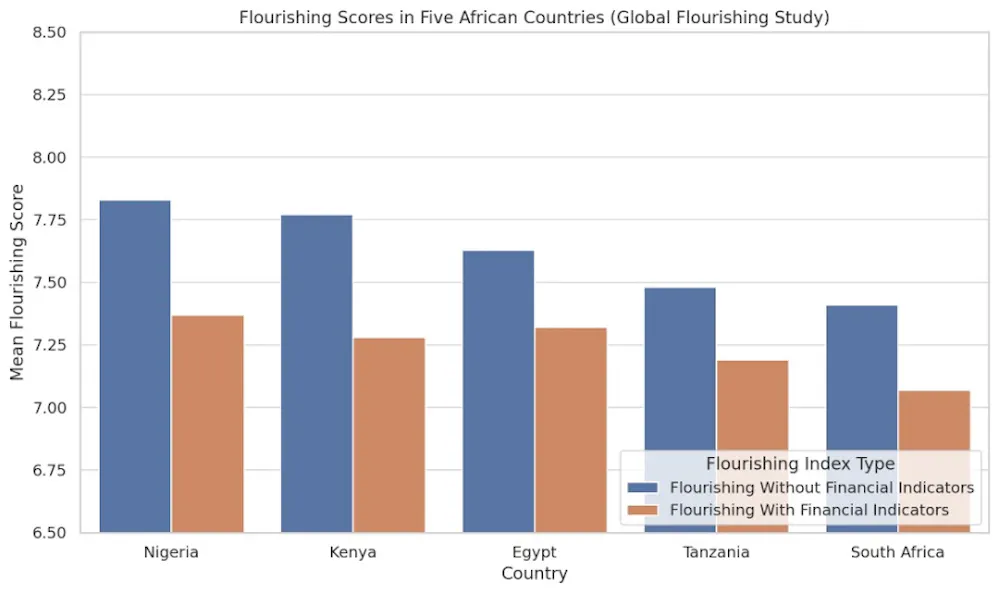
    While these countries didn’t top the global rankings (Indonesia and Mexico did), Nigeria, Kenya and Egypt all reported relatively high flourishing scores, especially when well-being was considered apart from financial status.


    Nigeria, for example, ranked 5th globally in flourishing scores that excluded financial indicators – ahead of many wealthier nations. Nigerians indicated strengths in social relationships, character and virtues (like forgiveness or helping others). But potential areas of growth included financial well-being, housing, ethnic discrimination and education.

    Overall, this suggests that while material resources matter, they’re not the only thing that determines well-being. Kenya ranked 7th, Egypt 10th, Tanzania 11th and South Africa 13th. Each showed unique strengths in areas like meaning, social connection or mental health.

    You did a separate study on flourishing in Africa. What did you find?

    In a 2024 study we analysed data from the Gallup World Poll (2020–2022) to explore 38 indicators of well-being across 40 African countries.

    This study offered a more detailed and culture-sensitive picture of how Africans experience and prioritise flourishing. The dimensions explored were derived from both local and universal sources, allowing for regionally relevant insights.

    We found that African populations often score high in meaning, character and social relationships – despite economic hardship. This offers an important corrective to western assumptions about well-being.

    Some of our key findings were:

    ● There is significant diversity between and within African countries. Mauritius consistently ranked highest in life evaluations (overall satisfaction with their lives), while countries like Sierra Leone and Zimbabwe scored lowest.

    ● East African countries such as Rwanda and Ethiopia showed strong performance in social well-being indicators (like feeling respected or learning new things daily) even when economic indicators were low.

    ● Countries in West Africa, such as Senegal and Ghana, scored high in emotional well-being, with many people reporting positive daily emotions like enjoyment and laughter.

    ● Southern African nations, despite challenges like income inequality, displayed resilience through strong community ties and cultural practices rooted in the philosophy of ubuntu.

    The results reinforced that flourishing in Africa cannot only be reduced to gross domestic product (GDP) per capita (a measure of the average economic output per person in a country) – nor to western norms of success.

    What can African countries focus on to flourish?

    In my view, the path to greater flourishing lies in embracing local knowledge and investing in culturally relevant development priorities. Instead of following western pathways – centred on individual advancement – Africa can model alternative flourishing pathways that reflect what matters most to African people.

    1. Prioritise local knowledge systems

    African ideas about a connected society – like ubuntu (southern Africa), ujamaa (east Africa), teranga or wazobia (west Africa), and al-musawat wal tarahum (north Africa) teach people to care for each other and live in peace. These values help people live meaningful lives and can inform leadership and legislation.

    2. Redefine development metrics

    Western development models focus on individual achievement, economic output and material consumption. GDP per capita fails to capture the everyday realities and aspirations of African communities. We should also measure things like how happy people are, how hopeful they feel about the future, how strong and resilient their communities are, and how clean, safe and dignifying their living environments are.

    This is not a new idea – for years development scholars have called for a shift away from narrow economic indicators toward a focus on human dignity, agency, and the real opportunities people have to pursue the lives they value. What’s new is the growing availability of data and the momentum to take these alternative metrics seriously in shaping national policies and priorities.

    3. Invest in education for character development

    Quality education is essential to unlocking the continent’s potential to flourish. But Africa needs more than just academic skills and workforce readiness – it needs a strategy for intentional development of values and habits that shape how a person thinks, feels, and acts with integrity.

    Part of the problem lies in how the humanities – fields like history, literature, philosophy, and religious studies – are often undervalued or underfunded in education systems. But it is precisely these disciplines that nurture moral imagination, critical reflection, and civic responsibility. We need educational models that form not just workers, but whole persons – people who can think ethically, act responsibly, and lead with character in their communities.


    Read more:
    What makes a person seem wise? Global study finds that cultures do differ – but not as much as you’d think


    What does Africa offer the world in terms of flourishing?

    Africa is not waiting to be saved. Across the continent, people are building communities of care, cultivating joy amid hardship, and passing on values of unity, faith, and compassion. This is what development looks like when rooted in human dignity.

    Africa flourishing goals offer an alternative vision for development – one that starts with what Africa already has, not what it lacks. These are locally emic aspirations for well-being. They are shaped by Africa’s indigenous knowledge systems, cultural values, and religious/spiritual traditions. Pursuing these goals means prioritising wholeness over wealth, community over consumption, and resilience over rescue.

    The continent has so much to offer the world: wisdom, strong community values, and ways of staying resilient and living fully even in hard times. But many of these local insights are missing in the global science of well-being.

    Victor Counted consults for Africa Flourishing Initiative

    ref. Which African countries are flourishing? Scientists have a new way of measuring well-being – https://theconversation.com/which-african-countries-are-flourishing-scientists-have-a-new-way-of-measuring-well-being-257458

    MIL OSI – Global Reports

  • MIL-OSI Africa: Which African countries are flourishing? Scientists have a new way of measuring well-being

    Source: The Conversation – Africa – By Victor Counted, Associate Professor of Psychology, Regent University

    What does it mean to live a good life? Psychologists and social scientists have been focusing on a new idea called flourishing – a sense of well-being that goes beyond just happiness or success. It’s about your whole life being good, including how you interact with other people and your community. So then, how do Africans fare when it comes to flourishing?

    Victor Counted is a psychological scientist whose research across 40 African countries offers a data-rich rethinking of flourishing on the continent. His findings challenge the dominant narrative that Africa is “lagging behind” in development by showing a more nuanced picture of what it means to live a good life. We asked him more.


    What is flourishing?

    Flourishing is more than economic growth or individual happiness. It’s a multidimensional state of being that reflects how people feel about their lives and how well their lives are actually going. So it also measures people’s values within their community.

    The idea of well-being often carries a Eurocentric emphasis on the individual – personal satisfaction, autonomy, achievement. Flourishing accounts for how whole a person is in relation to their environment.

    It includes the social, spiritual and ecological contexts in which one lives. So, it’s not just about how one feels, but how one lives – fully, meaningfully and in a satisfying relationship with the world around us.

    What’s the Global Flourishing Study?

    The Global Flourishing Study tries to measure global patterns of human flourishing. It’s an ongoing five-year longitudinal study in over 200,000 participants across 22 countries.

    I was one of the team of global scholars brought together to examine the trends on what it means to live well across cultures and life circumstances.


    Read more: What makes people flourish? A new survey of more than 200,000 people across 22 countries looks for global patterns and local differences


    The study identifies six key dimensions of flourishing:

    • Happiness and life satisfaction
    • Mental and physical health
    • Meaning and purpose
    • Character and virtue
    • Close social relationships
    • Financial and material stability

    Participants rate how they’re doing in each of these areas on a scale from 0 to 10. Further questions capture experiences related to trust, loneliness, hope, resilience, and other related well-being variables.


    CC BY-ND

    Of the 22 nations, five were African: Nigeria, Kenya, South Africa, Tanzania and Egypt.

    While these countries didn’t top the global rankings (Indonesia and Mexico did), Nigeria, Kenya and Egypt all reported relatively high flourishing scores, especially when well-being was considered apart from financial status.


    Courtesy Victor Counted

    Nigeria, for example, ranked 5th globally in flourishing scores that excluded financial indicators – ahead of many wealthier nations. Nigerians indicated strengths in social relationships, character and virtues (like forgiveness or helping others). But potential areas of growth included financial well-being, housing, ethnic discrimination and education.

    Overall, this suggests that while material resources matter, they’re not the only thing that determines well-being. Kenya ranked 7th, Egypt 10th, Tanzania 11th and South Africa 13th. Each showed unique strengths in areas like meaning, social connection or mental health.

    You did a separate study on flourishing in Africa. What did you find?

    In a 2024 study we analysed data from the Gallup World Poll (2020–2022) to explore 38 indicators of well-being across 40 African countries.

    This study offered a more detailed and culture-sensitive picture of how Africans experience and prioritise flourishing. The dimensions explored were derived from both local and universal sources, allowing for regionally relevant insights.

    We found that African populations often score high in meaning, character and social relationships – despite economic hardship. This offers an important corrective to western assumptions about well-being.

    Some of our key findings were:

    ● There is significant diversity between and within African countries. Mauritius consistently ranked highest in life evaluations (overall satisfaction with their lives), while countries like Sierra Leone and Zimbabwe scored lowest.

    ● East African countries such as Rwanda and Ethiopia showed strong performance in social well-being indicators (like feeling respected or learning new things daily) even when economic indicators were low.

    ● Countries in West Africa, such as Senegal and Ghana, scored high in emotional well-being, with many people reporting positive daily emotions like enjoyment and laughter.

    ● Southern African nations, despite challenges like income inequality, displayed resilience through strong community ties and cultural practices rooted in the philosophy of ubuntu.

    The results reinforced that flourishing in Africa cannot only be reduced to gross domestic product (GDP) per capita (a measure of the average economic output per person in a country) – nor to western norms of success.

    What can African countries focus on to flourish?

    In my view, the path to greater flourishing lies in embracing local knowledge and investing in culturally relevant development priorities. Instead of following western pathways – centred on individual advancement – Africa can model alternative flourishing pathways that reflect what matters most to African people.

    1. Prioritise local knowledge systems

    African ideas about a connected society – like ubuntu (southern Africa), ujamaa (east Africa), teranga or wazobia (west Africa), and al-musawat wal tarahum (north Africa) teach people to care for each other and live in peace. These values help people live meaningful lives and can inform leadership and legislation.

    2. Redefine development metrics

    Western development models focus on individual achievement, economic output and material consumption. GDP per capita fails to capture the everyday realities and aspirations of African communities. We should also measure things like how happy people are, how hopeful they feel about the future, how strong and resilient their communities are, and how clean, safe and dignifying their living environments are.

    This is not a new idea – for years development scholars have called for a shift away from narrow economic indicators toward a focus on human dignity, agency, and the real opportunities people have to pursue the lives they value. What’s new is the growing availability of data and the momentum to take these alternative metrics seriously in shaping national policies and priorities.

    3. Invest in education for character development

    Quality education is essential to unlocking the continent’s potential to flourish. But Africa needs more than just academic skills and workforce readiness – it needs a strategy for intentional development of values and habits that shape how a person thinks, feels, and acts with integrity.

    Part of the problem lies in how the humanities – fields like history, literature, philosophy, and religious studies – are often undervalued or underfunded in education systems. But it is precisely these disciplines that nurture moral imagination, critical reflection, and civic responsibility. We need educational models that form not just workers, but whole persons – people who can think ethically, act responsibly, and lead with character in their communities.


    Read more: What makes a person seem wise? Global study finds that cultures do differ – but not as much as you’d think


    What does Africa offer the world in terms of flourishing?

    Africa is not waiting to be saved. Across the continent, people are building communities of care, cultivating joy amid hardship, and passing on values of unity, faith, and compassion. This is what development looks like when rooted in human dignity.

    Africa flourishing goals offer an alternative vision for development – one that starts with what Africa already has, not what it lacks. These are locally emic aspirations for well-being. They are shaped by Africa’s indigenous knowledge systems, cultural values, and religious/spiritual traditions. Pursuing these goals means prioritising wholeness over wealth, community over consumption, and resilience over rescue.

    The continent has so much to offer the world: wisdom, strong community values, and ways of staying resilient and living fully even in hard times. But many of these local insights are missing in the global science of well-being.

    – Which African countries are flourishing? Scientists have a new way of measuring well-being
    – https://theconversation.com/which-african-countries-are-flourishing-scientists-have-a-new-way-of-measuring-well-being-257458

    MIL OSI Africa

  • MIL-OSI USA: Congressman Lawler, Chairman of the Middle East And North Africa Subcommittee, Strongly Condemns Indiscriminate Iranian Attack on Civilians

    Source: US Congressman Mike Lawler (R, NY-17)

    Pearl River, NY – 6/16/2025… Today, Congressman Mike Lawler, the Chairman of the Middle East and North Africa Subcommittee on the House Foreign Affairs Committee, released the following statement condemning the targeting of innocent civilians in Israel by the extremist Iranian regime. More than 20 Israeli civilians have lost their lives in recent days due to the Iranian regime’s indiscriminate missile attacks.

    “I am outraged at how Iran has been conducting itself in this conflict – indiscriminately killing Jews and Arabs alike,” said Congressman Lawler. “While Israel has sought to defend itself and eliminate the threat posed by a nuclear Iran, The Ayataollah has shown himself to be a bloodthirsty dictator and his actions back up Iran’s consistent rhetoric that they want to wipe the state of Israel off the face of the earth.”

    “With hypersonic and ballistic missiles raining down on Tel-Aviv, Haifa, and across Israel, and with civilians hiding in shelters for days on end, it’s imperative that the United States stand by our staunch ally, Israel,” concluded Lawler. “I urge President Trump to continue working with Prime Minister Netanyahu, and to keep all options on the table for dealing with Iran.”

    Congressman Lawler is one of the most bipartisan members of Congress and represents New York’s 17th Congressional District, which is just north of New York City and contains all or parts of Rockland, Putnam, Dutchess, and Westchester Counties. He was rated the most effective freshman lawmaker in the 118th Congress, 8th overall, surpassing dozens of committee chairs.

    ###

    MIL OSI USA News

  • MIL-OSI USA: Congressman Lawler, Chairman of the Middle East And North Africa Subcommittee, Strongly Condemns Indiscriminate Iranian Attack on Civilians

    Source: US Congressman Mike Lawler (R, NY-17)

    Pearl River, NY – 6/16/2025… Today, Congressman Mike Lawler, the Chairman of the Middle East and North Africa Subcommittee on the House Foreign Affairs Committee, released the following statement condemning the targeting of innocent civilians in Israel by the extremist Iranian regime. More than 20 Israeli civilians have lost their lives in recent days due to the Iranian regime’s indiscriminate missile attacks.

    “I am outraged at how Iran has been conducting itself in this conflict – indiscriminately killing Jews and Arabs alike,” said Congressman Lawler. “While Israel has sought to defend itself and eliminate the threat posed by a nuclear Iran, The Ayataollah has shown himself to be a bloodthirsty dictator and his actions back up Iran’s consistent rhetoric that they want to wipe the state of Israel off the face of the earth.”

    “With hypersonic and ballistic missiles raining down on Tel-Aviv, Haifa, and across Israel, and with civilians hiding in shelters for days on end, it’s imperative that the United States stand by our staunch ally, Israel,” concluded Lawler. “I urge President Trump to continue working with Prime Minister Netanyahu, and to keep all options on the table for dealing with Iran.”

    Congressman Lawler is one of the most bipartisan members of Congress and represents New York’s 17th Congressional District, which is just north of New York City and contains all or parts of Rockland, Putnam, Dutchess, and Westchester Counties. He was rated the most effective freshman lawmaker in the 118th Congress, 8th overall, surpassing dozens of committee chairs.

    ###

    MIL OSI USA News

  • MIL-OSI USA: Congressman Pat Fallon Statement on US Strikes on Iran’s Nuclear Sites

    Source: United States House of Representatives – Congressman Pat Fallon (TX-04)

    “President Trump made the tough, but absolutely correct decision in the best interest of America’s national security to order strikes on Iran’s nuclear sites,” said Rep. Fallon.

    “These highly successful strikes, carried out by B-2 stealth bombers, have shown Iran, and near-pear adversaries such as Russia and China that when the U.S. military is called to act, it will do so with precision and utter lethality to accomplish its objectives. This was not some trivial task to destroy Iran’s nuclear enrichment facilities—the courage and training of the U.S. Air Force pilots who undertook these missions is exceptional and I thank them for their steadfast commitment to duty and excellence that is core to our military’s ethos.”

    Rep. Fallon continued, “President Trump has made clear for years that Iran cannot possess nuclear weapons under any circumstances. This past weekend’s strikes are a profound act of deterrence that signals not only to Iran, but to rogue states and bad actors on the world stage that the U.S. is fully committed to protecting our nation’s interests as well as restoring security for ourselves and our allies and partners.”

    MIL OSI USA News

  • MIL-OSI USA: Congressman Nick Langworthy’s Statement on U.S. Airstrikes on Iran Nuclear Sites

    Source: US Congressman Nick Langworthy (NY-23)

    WASHINGTON, D.C. – Today, Congressman Nick Langworthy (NY-23) released the following statement in response to President Donald Trump’s announcement of U.S. airstrikes on Iran nuclear sites.


    “Today, President Trump acted with strength and clarity to eliminate a grave threat to our nation, our allies, and the world. After Iran refused every diplomatic path and persisted in its dangerous pursuit of nuclear weapons, the President was left with no choice but to defend American interests and global security. 

    “We honor and salute the brave men and women of the United States military who executed this critical mission with precision, courage, and professionalism. By destroying Iran’s nuclear sites, President Trump demonstrated bold leadership, unshakable resolve, and an unwavering commitment to safeguarding our homeland and our allies. 

    “This action sends a unmistakable message: the United States will never tolerate a nuclear-armed Iran, and we will stand firm and unflinching against aggression and terror. 

    “I stand with the President and our heroic service members as they defend peace and protect the American people.”

    ###

    MIL OSI USA News

  • MIL-OSI USA: Statement From U.S. Representative Gabe Vasquez on Strikes to Iranian Nuclear Sites

    Source: US Representative Gabe Vasquez’s (NM-02)

    WASHINGTON, D.C. – Today, U.S. Representative Gabe Vasquez (NM-02) issued the following statement in response to the recent U.S. military escalation in Iran:

    “Congress — not any one president — has the constitutional authority to declare war. Military escalation in Iran puts American troops, our allies, and global stability at great risk. The American people want peace, not another prolonged war.


    Acting unilaterally to toss aside years of diplomacy for military action is reckless and dangerous. This kind of unchecked executive action undermines our democratic institutions and sets a perilous precedent. I urge the president to bring us back from the brink of war and pursue a strategy grounded in strength, diplomacy, and lasting peace.”

    ###

    MIL OSI USA News

  • MIL-OSI USA: ICYMI: Rutherford Statement on U.S. Attacks on Nuclear Sites in Iran

    Source: United States House of Representatives – Congressman John Rutherford (4th District of Florida)

    WASHINGTON, D.C. – On Saturday, U.S. Congressman John H. Rutherford (FL-05) released the following statement on U.S. Armed Forces attacks on nuclear sites in Iran: 

    “I am fully behind President Trump and our Armed Forces in the action taken in self-defense, which precludes any need for an Authorization for Use of Military Force (AUMF). The President gave Iran every opportunity to make a deal for peace to end this long conflict, but they refused. This is what peace through strength looks like. The world is safer without the threat of a nuclear bomb in the hands of an Iranian regime.”

    MIL OSI USA News

  • MIL-OSI USA: Trahan Statement on Trump’s Unauthorized Military Strikes in Iran

    Source: United States House of Representatives – Congresswoman Lori Trahan (D-MA-03)

    LOWELL, MA — Today, Congresswoman Lori Trahan (MA-03) issued the following statement after President Donald Trump announced unauthorized U.S. military strikes in Iran:
    “I am deeply grateful that the American servicemembers who carried out this mission returned safely. Their professionalism, precision, and bravery are unmatched, and we owe them and their families a debt of gratitude for their unwavering commitment to our country.”
    “Absolutely no one wants to see the Iranian regime acquire nuclear weapons. That shared goal has guided years of bipartisan diplomatic and strategic engagement to prevent Iran from becoming a nuclear-armed state. President Trump’s decision to launch direct military strikes without congressional approval threatens to undermine those efforts and drag the United States into another costly, endless war in the Middle East.”
    “Acting without the consent of Congress, without a clear strategy, and without the backing of our allies puts American lives at risk and risks further destabilizing an already volatile region. It also flies in the face of the president’s campaign promise to de-escalate tensions in the Middle East, end the war in Gaza, and bring home the hostages still held by Hamas.”
    ###

    MIL OSI USA News

  • MIL-OSI USA: Babin statement on U.S. strikes on Iran

    Source: United States House of Representatives – Representative Brian Babin (R-TX)

    Babin statement on U.S. strikes on Iran

    Washington, June 21, 2025

    WASHINGTON, D.C. – U.S. Congressman Brian Babin (TX-36) released the following statement on the U.S. strikes on Iran. 

    “President Trump made the right call. The Iranian regime has spent more than four decades threatening the United States, attacking our troops, menacing Israel, and pursuing nuclear weapons in defiance of international norms,” said Rep. Babin. “America’s precision strikes against Iranian nuclear sites send a clear message: the United States will not allow a terrorist regime to acquire the world’s most dangerous weapons. I am proud of President Trump’s bold leadership, thankful for the incredible bravery of our U.S. military, and grateful for the continued partnership of our Israeli allies. Iran cannot have a nuclear weapon. Not now. Not ever.”

    MIL OSI USA News

  • MIL-OSI Video: IAEA: “Iran, Israel, the Middle East need peace and there is a path for diplomacy” | United Nations

    Source: United Nations (video statements)

    Statement to the Security Council by Rafael Mariano Grossi, Director General, International Atomic Energy Agency (IAEA), on threats to international peace and security.

    The nuclear non-proliferation regime that has underpinned international security for more than half a century is on the line.

    The dramatic events in Iran have become even more serious with last night’s bombardments and the potential widening of the conflict.

    We have a window of opportunity to return to dialogue and diplomacy. If that window closes, violence and destruction could reach unthinkable levels and the global non-proliferation regime as we know it could crumble and fall.

    Iran, Israel, the Middle East need peace and there is a path for diplomacy.

    We must return to the negotiating table and allow the IAEA inspectors, the guardians of the NPT, to go back to Iran’s nuclear sites and account for the stockpiles of uranium, including, most importantly, the 400kg enriched to 60%.

    Any agreement, any arrangement will have as a pre-requisite the establishment of the facts on the ground. This can be done only through IAEA inspections. IAEA inspectors are in Iran, and they must do their job. This will require a cessation of hostilities so that Iran can let the teams into the sites under the necessary safety and security conditions.

    Any special measures by Iran to protect its nuclear materials and equipment can be done in accordance with Iran’s safeguards obligations and the Agency. This is possible.

    Madame President,

    Based on information available to the IAEA, let me update you on what has occurred at Iran’s nuclear sites since I last addressed this Council three days ago.

    Craters are visible at the Fordow site, Iran’s main location for enriching uranium to 60%, indicating the use by the United States of America of ground-penetrating munitions. This is consistent with statements from the US. At this time, no one – including the IAEA – is in a position to assess the underground damage at Fordow.

    At the Esfahan nuclear site, additional buildings were hit overnight, with the US confirming their use of cruise missiles. Affected buildings include some related to the uranium conversion process. Also at this site, entrances to tunnels used for the storage of enriched material appear to have been hit.

    At the Natanz enrichment site, the Fuel Enrichment Plant has been hit again, with the US confirming that it used ground-penetrating munitions.

    Iran has informed the IAEA there has been no increase in off-site radiation levels at all three sites.

    The situation at the other sites remains as I described to the Council three days ago.

    We continue to monitor the situation and encourage the Iranian regulator to maintain its indispensable contact with the IAEA’s Incident and Emergency Centre.

    Madame President,

    The IAEA has consistently underlined, as stated in its General Conference resolution, that armed attacks on nuclear facilities should never take place and could result in radioactive releases with grave consequences within and beyond the boundaries of the State which has been attacked.

    I therefore again call on maximum restraint. Military escalation threatens lives and delays a diplomatic solution for the long-term assurance that Iran does not acquire a nuclear weapon. It also threatens the global non-proliferation regime.

    As I stated three days ago, I am ready to travel immediately and to engage with all relevant parties to help ensure the protection of nuclear facilities and the continued peaceful use of nuclear technology in accordance with the Agency mandate. With your support, the IAEA can deploy nuclear safety and security experts to Iran, in addition to our safeguards inspectors, wherever they are needed.

    Madame President,

    There is arguably no more important and universally supported endeavour than ensuring that we use the enormous power of the atom for good rather than destruction.

    Let us not allow the window to close on diplomacy. Let us not allow the non-proliferation regime to fail.

    Irrespective of individual positions and views, one thing is certain, and this is the simple truth: we will not be safer if there are more nuclear weapons in more states around the world.

    The IAEA is ready to do its part to bring this military confrontation to an end.

    https://www.youtube.com/watch?v=DRePLIFZcfw

    MIL OSI Video

  • MIL-OSI United Kingdom: Parliamentary veto “essential” before any UK military action in Middle East – Plaid Cymru

    Source: Party of Wales

    Plaid Cymru Leader Rhun ap Iorwerth MS and Westminster Leader Liz Saville Roberts MP have today warned the UK Government against being dragged into a “potentially catastrophic” conflict in the Middle East, and that the UK Parliament must have a say on any proposals for military action.

    Rhun ap Iorwerth MS and Liz Saville Roberts MP welcomed Prime Minister Keir Starmer’s calls for diplomacy and de-escalation, but voiced concerns that he had fallen short of roundly condemning President Trump’s authorisation of US strikes against Iran overnight.

    The Plaid Cymru politicians added that the pursuit of peace should take priority over any UK loyalty to the US and warned against repeating history where the UK entered a regional conflict in the Middle East as “America’s puppet.”

    In a joint statement, Rhun ap Iorwerth MS and Liz Saville Roberts MP said:

    “President Trump’s decision to launch US strikes against Iran is potentially catastrophic for an already destabilised region.

    “Whilst Prime Minister Keir Starmer’s calls for diplomacy and de-escalation are to be welcomed, it is concerning that he has fallen short of roundly condemning President Trump’s actions.

    “The pursuit of peace should take priority over any UK loyalty to the US. We all remember the disastrous consequences of being dragged into a regional conflict in the Middle East as America’s puppet.

    “It is essential therefore that Parliament has the opportunity to veto any UK military involvement in the Israel-Iran conflict should Keir Starmer yield to any pressure from President Trump and propose some form of intervention.

    “In the same way the US Democrats are divided on the issue, Keir Starmer may well face pressure from Labour hawks to follow President Trump’s lead.

    “Air strikes were launched against Syria in 2018 without granting Parliament an opportunity to vote on military action. At the time Plaid Cymru accused then-Prime Minister Theresa May of showing complete disregard towards democracy.

    “We stand firmly by that view and reiterate our calls for restraint before more innocent civilian lives are lost.”

    MIL OSI United Kingdom

  • MIL-OSI Global: Iran is considering closing the strait of Hormuz – why this would be a major escalation

    Source: The Conversation – UK – By Basil Germond, Professor of International Security, Department of Politics, Philosophy and Religion, Lancaster University

    Faced with the prospect of continuing Israeli airstrikes and further American involvement, Iran’s parliament has reportedly approved plans to close the strait of Hormuz.

    This is potentially a very dangerous moment. The strait of Hormuz is an important shipping lane through which 20% of the world’s oil transits – about 20 million barrels each day.

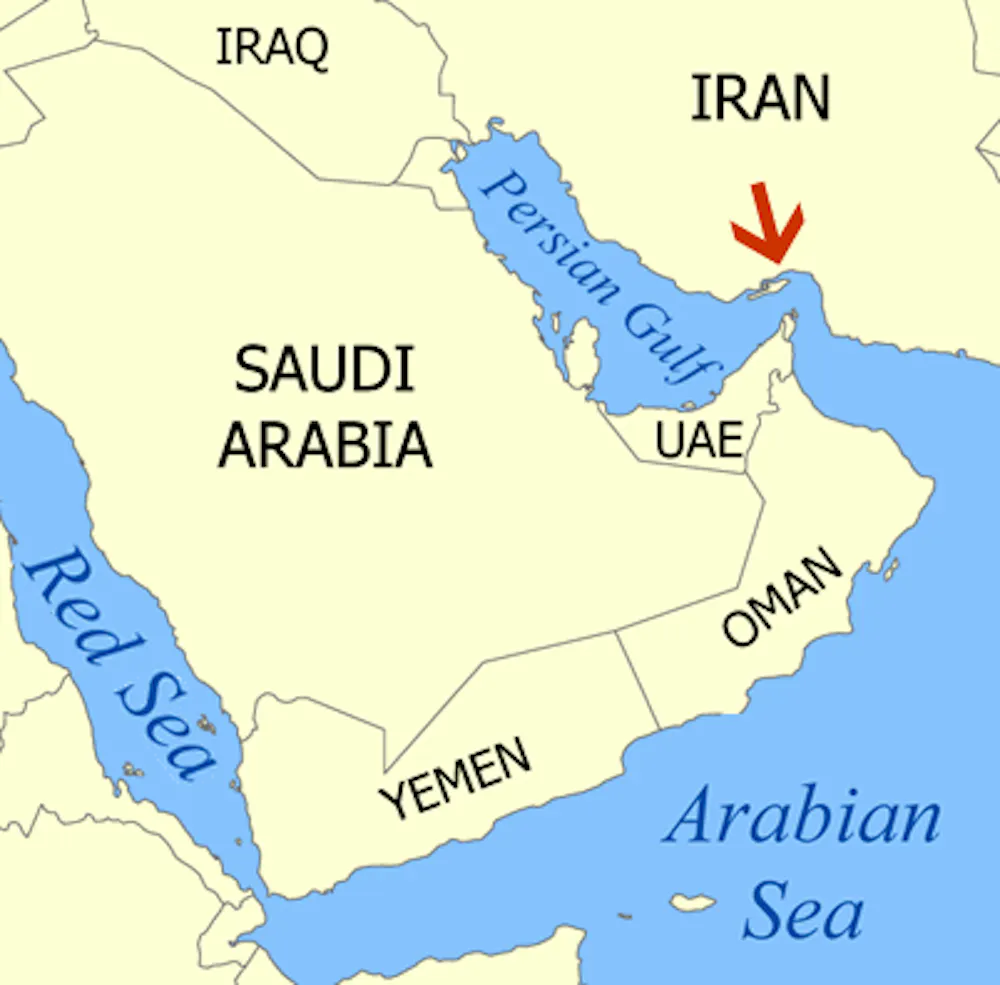
    The waterway connects the Persian Gulf and the Gulf of Oman. Iran can either disrupt maritime traffic or attempt to “close” the strait altogether. These are distinctly different approaches with different risks and outcomes.


    Get your news from actual experts, straight to your inbox. Sign up to our daily newsletter to receive all The Conversation UK’s latest coverage of news and research, from politics and business to the arts and sciences.


    The first option is to try and disrupt maritime traffic like Yemen’s Houthi rebels have been doing in the Red Sea since winter 2024. This can be done by attacking passing ships with rockets and drones.

    There are already reports that Iran has started to jam GPS signals in the strait, which has the potential to severely interfere with passing ships, according to US-based maritime analyst Windward.

    Disruption of this kind is likely to deter shipping companies from using this route for fear of casualties and loss of cargo. Shipping companies that want to avoid the Red Sea can always use alternative shipping lanes, such as the Cape of Good Hope route. As inconvenient as that is, there is no such option in the case of the Gulf.

    As we’ve seen with Houthis’ attacks, such disruptions have impacts on oil price, but also ripple effects on stock markets and inflation. Although the US and its western allies can absorb these economic effects – certainly for a while – disrupting the strait would still demonstrate that Tehran has some leverage.

    The credibility factor

    The second option – “closing” the strait would involve interdicting all maritime traffic. This is akin to a blockade. And for it to work, as we have seen in the Black Sea with Russia’s failed attempt at blockading Ukraine, a blockade must be credible enough to deter all traffic.

    Iran has a number of ways to block the strait. It could deploy mines in the waters around the choke point and sink vessels to create obstacles. Iran would also likely use its navy, including submarines, to engage those attempting to break the blockade; use electronic and cyber attacks to disrupt navigation; and threaten civilian traffic and regional ports and oil infrastructure with drones and rockets.

    It’s worth noting that Iran still has plenty of short-range rockets. Israel claims to have destroyed much of its longer range ballistic-missile capability, but it is understood that the country still has a stockpile of short-range missiles that could be effective in targeting ships and infrastructure in the Gulf as well as US bases in the region.

    Recent events have shown up Iran as a bit of a paper tiger. It has made bold claims about its plan to retaliate and the military strength it has to do so. Yet with almost no air power capabilities (apart from drones and missiles) and limited naval power – and with its proxies either defeated or on the back foot – Iran is no longer in a position to project power in the region.

    Iran’s response to the current Israeli attacks have not managed to inflict any major damage or achieve any strategic or political objectives. It’s hard to see a change on the battlefield as things stand.

    Vital waterway: 20% of the world’s oil transts through the Strait of Hormuz.
    w:en:Kleptosquirrel/Wikimedia Commons, CC BY-SA

    For this reason, Tehran’s best option is to target the strait of Hormuz, which has the potential to cause a significant spike in oil prices, leading to a major disruption of the global economy.

    Short of being able to rival the US or Israel on the battlefield, Iran might decide to use asymmetrical means of disruption (in particular missile and drone attacks on civilian shipping) to affect the global economy. Closing or disrupting the strait would be an effective way of doing that.

    A blockade, even a partial one, would offer Tehran some options on the diplomatic scene. For instance, it has been reported that the US asked China to convince Iran not to close the strait. This demonstrates that Tehran can use the threat of a blockade to its advantage on the diplomatic front. But for this to work, the blockade needs to be effective and thus sustained.

    What would be the effect of a blocking the Strait?

    Disrupting traffic in the strait could drag Gulf states – Iraq, Kuwait, Saudi Arabia, UAE, Bahrain and Qatar – into the conflict, since their interests will be directly affected. It’s important to consider how they might respond and whether this will drive them closer to the US – and even Israel, as was already happening with the Abraham Accords and the tentative, but shaky, rapprochement between Saudi Arabia and Israel.


    Read more:
    US joins Israel in attack on Iran and ushers in a new era of impunity


    These are all things Iran would have factored into its calculations a year ago when Israel was targeting its proxies, including Hezollah, Hamas and the various Shia militias it funds in Iraq and elsewhere. But now, given that it has suffered an enormous military setback, which has hurt the regime’s prestige and credibility – including, importantly, at home – Tehran is more likely to downplay these risks. I would expect it to proceed with its blockade plans.

    Even if China voices concerns, like it did regarding the Houthis’ attacks, this is unlikely to change the decision. The regime is cornered. If the leaders believe they could be toppled, they are likely to consider the risks worth taking, particularly if they feel it could give them diplomatic leverage.

    The US has enough naval and air power to disrupt such a blockade. It can preemptively destroy Iran’s mine-laying forces. It can also target missile launch sites inland and respond to threats as and when they arise.

    This is likely to prevent Iran from completely closing the strait. But it won’t prevent the Islamic republic from disrupting maritime trade enough to have serious effects on the world economy. This might well be one of the last cards the regime has to play, both on the battlefield and in the diplomatic arena.

    Basil Germond does not work for, consult, own shares in or receive funding from any company or organisation that would benefit from this article, and has disclosed no relevant affiliations beyond their academic appointment.

    ref. Iran is considering closing the strait of Hormuz – why this would be a major escalation – https://theconversation.com/iran-is-considering-closing-the-strait-of-hormuz-why-this-would-be-a-major-escalation-259562

    MIL OSI – Global Reports

  • MIL-OSI Russia: Chinese Foreign Ministry: China calls on international community to help de-escalate Israeli-Iranian conflict

    Translation. Region: Russian Federal

    Source: People’s Republic of China in Russian – People’s Republic of China in Russian –

    Source: People’s Republic of China – State Council News

    BEIJING, June 23 (Xinhua) — China has called on the international community to step up efforts to help de-escalate the Israeli-Iranian conflict and prevent regional turmoil from further affecting global economic growth, Foreign Ministry spokesperson Guo Jiakun said Monday.

    The Chinese diplomat made this statement at a regular departmental press conference, commenting on the report that the Iranian parliament had come to the conclusion that it was necessary to close the Strait of Hormuz, but the final decision rests with the country’s Supreme National Security Council.

    The Persian Gulf and its surrounding waters are an important route for international trade in goods and energy, Guo Jiakun stressed, adding that maintaining security and stability in the region is in the common interests of the international community. -0-

    MIL OSI Russia News

  • MIL-OSI Security: Man at Center of Alien Kidnapping and Smuggling Conspiracy Pleads Guilty

    Source: Office of United States Attorneys

    Defendants Kidnapped Two Women, Demanded Ransom, Instigated Shootout in Charlottesville’s Belmont Neighborhood

    CHARLOTTESVILLE, Va. –  A Texas man, who conspired to kidnap and transport aliens and held multiple victims for ransom before instigating a deadly shootout in a quiet, Charlottesville neighborhood, pled guilty recently to federal charges as part of Operation Take Back America.

    Ricardo Franco Ordaz, 26, of Cedar Creek, Texas, pled guilty to one count of conspiracy to kidnap and one count of transporting an alien resulting in death. At sentencing, Ordaz faces a maximum possible penalty of life in prison.

    “Human trafficking and human smuggling generate violence and are real threats to our community and the Justice Department will take all appropriate steps to hold accountable those who attempt to profit off of others trying to enter the country illegally,” Acting United States Attorney Zachary T. Lee said today. “This case serves as an example of the deadly consequences that can occur when individuals use human beings as currency. I am grateful to the Department of Homeland Security and our state and local partners for their work to bring this case to justice.”

    According to court documents, in early January of 2023, Ordaz, his co-defendant Jordan Perez, and other co-conspirators, kidnapped multiple victims and held them for ransom, knowing these individuals had entered the United States illegally.

    As part of the scheme, Ordaz arranged to pick up two victims from an area near the United States-Mexico border and bring them to a house near Austin, Texas. Once there, Ordaz, and others, held both victims against their will and under armed guard, then called and messaged the victims’ families and friends demanding cash ransom in exchange for their release.

    Ordaz exchanged one of the victims in Texas for $5,000 cash, and on January 8, 2023, Perez and a co-conspirator transported another victim to Charlottesville, Virginia, where they arranged to exchange that victim for $10,000 in cash.

    During the exchange, when it was revealed that the full $10,000 ransom was not available, an argument and shootout ensued, during which Perez, and another coconspirator, brandished firearms that resulted in the death of one of the kidnappers.

    Perez is scheduled to go to trial in December 2025.

    This case is part of Operation Take Back America, a nationwide initiative that marshals the full resources of the Department of Justice to repel the invasion of illegal immigration, achieve the total elimination of cartels and transnational criminal organizations (TCOs), and protect our communities from the perpetrators of violent crime. Operation Take Back America streamlines efforts and resources from the Department’s Organized Crime Drug Enforcement Task Forces (OCDETFs) and Project Safe Neighborhood (PSN).

    Homeland Security Investigations in Harrisonburg investigated the case with assistance from the Charlottesville Police Department, Albemarle County Police Department, and HSI Austin, Texas.

    Assistant U.S. Attorney Sally J. Sullivan is prosecuting the case.

    MIL Security OSI

  • MIL-OSI Security: Man at Center of Alien Kidnapping and Smuggling Conspiracy Pleads Guilty

    Source: Office of United States Attorneys

    Defendants Kidnapped Two Women, Demanded Ransom, Instigated Shootout in Charlottesville’s Belmont Neighborhood

    CHARLOTTESVILLE, Va. –  A Texas man, who conspired to kidnap and transport aliens and held multiple victims for ransom before instigating a deadly shootout in a quiet, Charlottesville neighborhood, pled guilty recently to federal charges as part of Operation Take Back America.

    Ricardo Franco Ordaz, 26, of Cedar Creek, Texas, pled guilty to one count of conspiracy to kidnap and one count of transporting an alien resulting in death. At sentencing, Ordaz faces a maximum possible penalty of life in prison.

    “Human trafficking and human smuggling generate violence and are real threats to our community and the Justice Department will take all appropriate steps to hold accountable those who attempt to profit off of others trying to enter the country illegally,” Acting United States Attorney Zachary T. Lee said today. “This case serves as an example of the deadly consequences that can occur when individuals use human beings as currency. I am grateful to the Department of Homeland Security and our state and local partners for their work to bring this case to justice.”

    According to court documents, in early January of 2023, Ordaz, his co-defendant Jordan Perez, and other co-conspirators, kidnapped multiple victims and held them for ransom, knowing these individuals had entered the United States illegally.

    As part of the scheme, Ordaz arranged to pick up two victims from an area near the United States-Mexico border and bring them to a house near Austin, Texas. Once there, Ordaz, and others, held both victims against their will and under armed guard, then called and messaged the victims’ families and friends demanding cash ransom in exchange for their release.

    Ordaz exchanged one of the victims in Texas for $5,000 cash, and on January 8, 2023, Perez and a co-conspirator transported another victim to Charlottesville, Virginia, where they arranged to exchange that victim for $10,000 in cash.

    During the exchange, when it was revealed that the full $10,000 ransom was not available, an argument and shootout ensued, during which Perez, and another coconspirator, brandished firearms that resulted in the death of one of the kidnappers.

    Perez is scheduled to go to trial in December 2025.

    This case is part of Operation Take Back America, a nationwide initiative that marshals the full resources of the Department of Justice to repel the invasion of illegal immigration, achieve the total elimination of cartels and transnational criminal organizations (TCOs), and protect our communities from the perpetrators of violent crime. Operation Take Back America streamlines efforts and resources from the Department’s Organized Crime Drug Enforcement Task Forces (OCDETFs) and Project Safe Neighborhood (PSN).

    Homeland Security Investigations in Harrisonburg investigated the case with assistance from the Charlottesville Police Department, Albemarle County Police Department, and HSI Austin, Texas.

    Assistant U.S. Attorney Sally J. Sullivan is prosecuting the case.

    MIL Security OSI

  • MIL-OSI: ZOOZ Power Explores Strategic Opportunities as Leading Defense Company Commences POC for Flywheel-Based Power Booster

    Source: GlobeNewswire (MIL-OSI)

    Board of Directors Announces Restructuring Plan

    Tel Aviv, Israel, June 23, 2025 (GLOBE NEWSWIRE) — ZOOZ Power (Nasdaq and TASE: ZOOZ), a leading provider of flywheel-based power boosters and energy management systems for enabling ultra-fast EV charging solutions, announced today that its board of directors has approved a plan to explore additional strategic alternatives to fully capitalize on its advanced, patented flywheel technology.

    Over the past several months, ZOOZ Power has engaged in ongoing discussions with a prominent defense and intelligence electronics company regarding deployment of a robust, repetitive short-duration power booster capable of operating in challenging environments. ZOOZ Power is currently conducting a proof of concept (POC) with this defense company — a collaboration that has the potential to unlock new verticals and significantly broaden the application of its flywheel technology.

    As part of the efforts to enhance execution, the board has also approved a company-wide cost reduction and restructuring initiative designed to reduce operating costs by approximately 35%. These cost efficiencies will enable greater business flexibility.

    “This POC engagement with a leading defense electronics company validates the versatility and competitive advantage of our flywheel technology in mission-critical environments, beyond our core EV charging systems,” said Erez Zimerman, Chief Executive Officer of ZOOZ Power. “At the same time, our cost reduction and restructuring plan will ensure we are lean, agile, and focused on the areas that we believe are most likely to deliver the highest growth and return.”

    About ZOOZ Power

    ZOOZ Power is a leading provider of flywheel-based power boosting and energy management solutions, enabling the widespread deployment of ultra-fast charging infrastructure for electric vehicles (EVs) while overcoming existing grid limitations.

    ZOOZ pioneers its unique flywheel-based power-boosting technology, enabling efficient utilization and power management of a power-limited grid at an EV charging site. Its Flywheel technology allows high-performance, reliable, and cost-effective ultra-fast charging infrastructure.

    ZOOZ Power’s sustainable, power-boosting solutions are built with longevity and the environment in mind, helping its customers and partners accelerate the deployment of fast-charging infrastructure, thus facilitating improved utilization rates, better efficiency, greater flexibility, and faster revenues and profitability growth. ZOOZ is publicly traded on NASDAQ and TASE under the ticker ZOOZ. For more information, please visit: www.zoozpower.com/

    Investor Contact:
    Miri Segal – CEO
    MS-IR LLC
    msegal@ms-ir.com

    Media enquiries:
    Media@zoozpower.com

    Forward-Looking Statement

    This press release contains “forward-looking statements” within the meaning of the Securities Act of 1933 and the Securities Exchange Act of 1934, as amended, and the safe-harbor provisions of the Private Securities Litigation Reform Act of 1995. Such forward-looking statements are based on the current beliefs, expectations, and assumptions of ZOOZ Power. All statements other than statements of historical facts contained in this press release, including statements regarding ZOOZ Power, and any of ZOOZ Power’s strategy, future operations and statements related to the POC engagement with a leading defense electronics company, ZOOZ Power’s cost reduction and restructuring plan, and the results thereof are forward-looking statements. These statements involve known and unknown risks, uncertainties and other important factors that may cause ZOOZ Power’s actual results, performance or achievements to be materially different from any future results, performance or achievements expressed or implied by the forward-looking statements. These risks and other risks and uncertainties are more fully discussed in the “Risk Factors” section of ZOOZ’s most recent Annual Report on Form 20-F as filed with the U.S. Securities and Exchange Commission (“SEC”) as well as other documents that may be subsequently filed by the Company from time to time with the SEC. The words “anticipate,” “believe,” “could,” “estimate,” “expect,” “intend,” “may,” “plan,” “potential,” “predict,” “project,” “should,” “target,” “will,” and similar expressions are intended to identify forward-looking statements, although not all forward-looking statements contain these identifying words. Forward-looking statements include, but are not limited to, statements relating to the deployment of a robust, repetitive short-duration power booster capable of operating in challenging environments, statements relating to ZOOZ Power’s currently conducted proof of concept (POC) with a defense company, statements relating to the potential results of such POC, including the potential of unlocking new verticals and significantly broaden the application of ZOOZ Power’s flywheel technology, statements relating to the potential versatility and competitive advantage of ZOOZ Power’s flywheel technology in mission-critical environments, beyond its core EV charging systems, statements relating to ZOOZ Power’s company-wide cost reduction and restructuring initiative including the potential results of such initiative, including its potential to reduce operating costs, statements relating to the areas that could deliver the highest growth and return, and conditions in Israel and in the Middle East, including the effect of the evolving nature of the ongoing “Swords of Iron” war, may adversely affect ZOOZ Power’s operations. These forward-looking statements are only estimations, and ZOOZ Power may not actually achieve the plans, intentions or expectations disclosed in any forward-looking statements, so you should not place undue reliance on any forward-looking statements. Actual results or events could differ materially from the plans, intentions and expectations disclosed in forward-looking statements made in this Press Release. Management of ZOOZ Power has based these forward-looking statements largely on current expectations and projections about future events and trends that such persons believe may affect ZOOZ Power’s business, financial condition and operating results. Forward-looking statements contained in this Press Release are made as of the date hereof, and none of ZOOZ Power or any of its representatives or any other person undertakes any duty to update such information except as may be expressly required under applicable law.

    The MIL Network

  • MIL-OSI: Micropolis Announces Subsidiary Name Change

    Source: GlobeNewswire (MIL-OSI)

    DUBAI, United Arab Emirates, June 23, 2025 (GLOBE NEWSWIRE) — Micropolis Holding Co. (“Micropolis” or the “Company”) (NYSE: MCRP), a pioneer in unmanned ground vehicles and AI-driven security solutions, today announced it has changed the legal name of its wholly-owned subsidiary from Micropolis Digital Development FZ-LLC to Micropolis Robotics FZ-LLC. This move is a result of the Company’s growing portfolio of autonomous robotic platforms and corporate milestones, including its collaboration with SEE Holding Ltd at The Sustainable City 2.0 and Memorandum of Understanding with Emirates Steel (EMSTEEL), a leading UAE-based steel and construction materials manufacturer.

    “Micropolis designs and produces advanced robotics and AI technologies tailored to our customers’ needs,” said Fareed Aljawhari, Founder & CEO of Micropolis. “This subsidiary renaming better reflects our identity as a robotics company, underscores our expanding market presence, and reinforces our commitment to delivering innovative autonomous solutions.”

    About Micropolis Holding Co.
    Micropolis is a UAE-based company specializing in the design, development, and manufacturing of unmanned ground vehicles (UGVs), AI systems, and smart infrastructure for urban, security, and industrial applications. The Company’s vertically integrated capabilities cover everything from mechatronics and embedded systems to AI software and high-level autonomy.

    For more information please visit www.micropolis.ai.

    Forward-Looking Statements
    This press release contains “forward-looking statements” within the meaning of the “safe harbor” provisions of the Private Securities Litigation Reform Act of 1995. You can identify forward-looking statements by the fact that they do not relate strictly to historical or current facts. These statements may include words such as “anticipate”, “estimate”, “expect”, “project”, “plan”, “intend”, “believe”, “may”, “will”, “should”, “can have”, “likely” and other words and terms of similar meaning. Forward-looking statements represent Micropolis’ current expectations regarding future events and are subject to known and unknown risks and uncertainties that could cause actual results to differ materially from those implied by the forward-looking statements. These statements are subject to uncertainties and risks including, but not limited to, the uncertainties related to market conditions and other factors discussed in the “Risk Factors” section of the registration statement filed by the Company with the SEC. For these reasons, among others, investors are cautioned not to place undue reliance upon any forward-looking statements in this press release. Additional factors are discussed in the Company’s filings with the SEC, which are available for review at www.sec.gov. The Company undertakes no obligation to publicly revise these forward-looking statements to reflect events or circumstances that arise after the date hereof.

    Investor Contact:
    KCSA Strategic Communications
    Valter Pinto, Managing Director
    PH: (212) 896-1254
    Valter@KCSA.com

    Media Contact:
    Jessica Starman
    media@elev8newmedia.com

    The MIL Network

  • MIL-Evening Report: NZ Greens call on state to condemn US over ‘dangerous’ attack on Iran

    Asia Pacific Report

    New Zealand’s opposition Green Party has called on the government to condemn the United States for its illegal bombing of Iran and inflaming tensions across the Middle East.

    “The actions of the United States pose a fundamental threat to world peace,” said Green Party co-leader Marama Davidson in a statement.

    “The rest of the world — including New Zealand– must take a stand and make it clear that this dangerous escalation is unacceptable.

    “We are calling on the New Zealand government to condemn the United States for its attack on Iran. This attack is a blatant breach of international law and yet another unjustified assault on the Middle East from the US.”

    Davidson said the country had seen this with the US war on Iraq in 2003, and it was happening again with Sunday’s attack on Iran.

    “We are at risk of a violent history repeating itself,” she said.

    “[Prime Minister] Christopher Luxon needs to condemn this escalation from the US and rule out any participation in this conflict, or any of the elements of the AUKUS pact.

    Independent foreign policy
    “New Zealand must maintain its independent foreign policy position and keep its distance from countries that are actively fanning the flames of war.”

    Davidson said New Zealand had a long and proud history of standing up for human rights on the world stage.

    “When we stand strong and with other countries in calling for peace, we can make a difference. We cannot afford to be a bystander to the atrocities unfolding in front of our eyes.”

    It was time for the New Zealand government to step up.

    “It has failed to sanction Israel for its illegal and violent occupation of Palestine, and we risk burning all international credibility by failing to speak out against what the United States has just done.”

    Meanwhile, Prime Minister Luxon said New Zealand wanted to see a peaceful stable and secure Middle East, but more military action was not the answer, reports RNZ News.

    The UN Security Council met in emergency session today to discuss the US attack on the three key nuclear facilities.

    UN Secretary-General António Guterres said the US bombing marked a “perilous turn” in a region already reeling.

    Iran called on the 15-member body to condemn what it called a “blatant and unlawful act of aggression”.

    MIL OSI AnalysisEveningReport.nz

  • MIL-Evening Report: NZ Greens call on state to condemn US over ‘dangerous’ attack on Iran

    Asia Pacific Report

    New Zealand’s opposition Green Party has called on the government to condemn the United States for its illegal bombing of Iran and inflaming tensions across the Middle East.

    “The actions of the United States pose a fundamental threat to world peace,” said Green Party co-leader Marama Davidson in a statement.

    “The rest of the world — including New Zealand– must take a stand and make it clear that this dangerous escalation is unacceptable.

    “We are calling on the New Zealand government to condemn the United States for its attack on Iran. This attack is a blatant breach of international law and yet another unjustified assault on the Middle East from the US.”

    Davidson said the country had seen this with the US war on Iraq in 2003, and it was happening again with Sunday’s attack on Iran.

    “We are at risk of a violent history repeating itself,” she said.

    “[Prime Minister] Christopher Luxon needs to condemn this escalation from the US and rule out any participation in this conflict, or any of the elements of the AUKUS pact.

    Independent foreign policy
    “New Zealand must maintain its independent foreign policy position and keep its distance from countries that are actively fanning the flames of war.”

    Davidson said New Zealand had a long and proud history of standing up for human rights on the world stage.

    “When we stand strong and with other countries in calling for peace, we can make a difference. We cannot afford to be a bystander to the atrocities unfolding in front of our eyes.”

    It was time for the New Zealand government to step up.

    “It has failed to sanction Israel for its illegal and violent occupation of Palestine, and we risk burning all international credibility by failing to speak out against what the United States has just done.”

    Meanwhile, Prime Minister Luxon said New Zealand wanted to see a peaceful stable and secure Middle East, but more military action was not the answer, reports RNZ News.

    The UN Security Council met in emergency session today to discuss the US attack on the three key nuclear facilities.

    UN Secretary-General António Guterres said the US bombing marked a “perilous turn” in a region already reeling.

    Iran called on the 15-member body to condemn what it called a “blatant and unlawful act of aggression”.

    MIL OSI AnalysisEveningReport.nz

  • MIL-OSI Economics: ICC elects four new members to the Executive Board

    Source: International Chamber of Commerce

    Headline: ICC elects four new members to the Executive Board

    The new members were formally elected during the annual meeting of the ICC World Council on 19 June 2025 and will each serve a three-year term effective 19 June 2025. The diverse experience of new members will enrich ICC’s roadmap to enable peace and prosperity through trade and reflects ICC’s continued commitment to geographic representation and diversity of expertise as the world’s largest and most inclusive business organisation.

    The ICC Executive Board is responsible for developing and implementing ICC’s strategy, policy and programme of action as well as for overseeing the financial affairs of ICC. 

    ICC Chair Philippe Varin said:

    “I’m very pleased to welcome this exceptional group of global leaders who bring deep expertise and fresh perspectives to ICC. Their leadership will be vital as we continue charting a path forward in delivering real-world solutions for business in a changing global environment. My thanks also to our outgoing Board members for their contributions.”

    The new Board members are: 

    Mohammad Lootah

    Mohammad Ali Rashed Lootah is the President and CEO of Dubai Chambers, where he leads strategic initiatives to enhance Dubai’s business environment, attract foreign investment, support global business expansion, and promote the digital economy. Prior to this role, he held several key leadership positions within Dubai’s Department of Economy and Tourism, including CEO of Commercial Compliance and Consumer Protection, overseeing areas such as consumer rights, business protection, and intellectual property. He also served in senior roles at the Department of Economic Development and the Dubai Land Department. 

    Zhang Hui

    Zhang Hui is Vice Chairman, Executive Director and President of the Bank of China, roles he assumed between December 2024 and January 2025. He also serves as Vice Chairman of BOC Hong Kong (Holdings) Limited. Mr Zhang joined the Bank of China in 2024 after serving as Executive Vice President of China Development Bank from 2021 to 2024. Prior to that, he spent many years at Bank of Communications, where he held various senior roles including as Chief Risk Officer, general manager of several risk management departments, and president of regional branches including in Guizhou and Shanghai. 

    Anousheh Ansari

    Anousheh Ansari is the CEO of XPRIZE, where she leads global innovation competitions addressing some of humanity’s most pressing challenges. A tech entrepreneur and space pioneer, Ms Ansari co-founded and led Prodea Systems, an IoT company recognised among Inc. Magazine’s 500 fastest-growing firms. In 2006, she became the first female private space explorer, the first astronaut of Iranian descent, and the first Muslim woman in space. Under her leadership, XPRIZE has awarded over US$81 million and launched US$361 million in active competitions. Ms Ansari also serves in various global advisory roles, including with the World Economic Forum, GESDA and UNESCO, and is an advocate for women entrepreneurs through initiatives like The Billion Dollar Fund for Women.

    Kobkarn Wattanavrangkul

    Kobkarn Wattanavrangkul is a Thai business leader and former Minister of Tourism and Sports, known for her contributions to both public policy and corporate governance. As Thailand’s tourism minister from 2014 to 2017, Ms Wattanavrangkul championed sustainable tourism and cultural heritage. She currently serves as Chair of the Board of Directors at Kasikornbank and Toshiba Thailand, and plays an active role in advancing education, innovation and international cooperation through various institutional boards. Ms Wattanavrangkul’s career reflects a strong commitment to inclusive and sustainable development in Thailand.

    Term renewals

    Elected to serve on the ICC Executive Board for a second term during the World Council meeting were Holger Bingmann (Germany), Managing Partner, Bingmann Pflüger International GmbH, Rebecca Enonchong (Cameroon), CEO, AppsTech and Chair of Afrilabs, Marjorie Yang (Hong Kong), Chair, Esquel Group, Lama Al Sulaiman (Saudi Arabia), Shareholder and Board Member of Rolaco Holdings, KSA and LUX and Justin D’Agostino (Hong Kong), Global CEO, Herbert Smith Freehills Kramer.

    Outgoing Board members are Candace Johnson (United States/Luxemburg), Vice-Chair, NorthStar Earth and Space, Fredrik Cappelen (Sweden), Chairman and Board Member in the Swedish and Nordic industry, Valentina Mintah (Ghana), Founder West Blue Consulting, Zhang Xiaolun (China) Chair, China National Machinery Industry Corporation (SINOMACH).

    Leading chambers worldwide

    The ICC World Council also ratified the re-election of Rifat Hisarcıklıoğlu as Chair of the ICC World Chambers Federation (WCF) for a second three-year term commencing 20 June 2025. Mr Hisarcıklıoğlu is Chair of ICC Türkiye and President of the Union of Chambers and Commodity Exchanges of Türkiye (TOBB).

    MIL OSI Economics

  • MIL-OSI Europe: ASIA/SYRIA – Massacre of Christians in Damascus. Greek Orthodox Patriarchate: “they are our new martyrs”

    Source: Agenzia Fides – MIL OSI

    Monday, 23 June 2025

    by Pascale RizkDamascus (Agenzia Fides) – “On the day our Church of Antioch commemorates all the Antiochian saints, the treacherous hand of injustice has risen this evening and reaped our souls along with the souls of our loved ones who fell as martyrs today during the evening Mass at the Church of St. Elias in Dwela’a in Damascus.” With these words, the Greek Orthodox Patriarchate of Antioch, led by Patriarch Yohanna X, addressed the faithful around the world following the massacre perpetrated during the evening Mass on Sunday, June 22.The Church of St. Elias is located in the Tabbalah neighborhood, at the entrance to the Douweila neighborhood. It was built in 1990. It is a monastic complex with a church, a school, and several guest rooms for pilgrims and students.According to information from local sources, the attack began with several shots fired at praying Christians from outside the church. Then, at least two suicide bombers wearing explosive belts entered the church through the rear entrance to the altar and blew themselves up.The eyewitness account of Laure al NasrMeanwhile, a video with the account of eyewitness Laure al Nasr was posted on social media: Her husband, Geryes el Bechara, a member of the General Directorate of the Road Traffic Authority, tried to stop the attacker along with Botros el Bechara, one of the brothers present at the mass. “The shots,” Laura recounts in her account, traumatized by her own grief, “first hit the church windows, frightening the people who gathered around the altar. As the attacker entered the church,” the witness continued, “Geryes and Botros tried to stop him: one by hitting him on the arm to make him drop a grenade that hadn’t exploded, the other by trying to pull him out of the church.” At that moment, the suicide bomber detonated his explosive belt and blew himself up. “I saw the bodies of my husband and my brother-in-law being torn to pieces, one next to the other. They tried to save us all; they are martyrs for our Church.” Other family members died in the massacre: their sister Myriam, cousins Julia, Sleman, and Nabil. A niece and a third brother of Geryes and Botros, notary Elias el Bechara, were seriously injured.Unconfirmed information suggests the suicide bombers may have been of Pakistani origin, and another attacker is said to have escaped after the massacre.So far, the provisional death toll amounts to 22 and 53 injured. “We continue to collect the remains and bodies of our martyrs,” reads the statement released by the Patriarchate.The government’s reactionsProfessor Hind Aboud Kabawat (see Fides, 12/2/2025), Minister of Labor and Social Affairs, the only Christian minister in the government led by Ahmad al-Sharaa, went to the scene of the attack to express the Syrian government’s closeness to the community affected by the massacre. Government authorities condemned the attack and blamed individuals linked to the so-called Islamic State. “This criminal act, targeting members of the Christian community, is a desperate attempt to undermine national unity and destabilize the country, as well as a response by the remnants of terrorism to the continued successes of the Syrian state and leadership,” reads the government statement.Syrian President Ahmed al-Sharaa, under the name Abu Muhammed el-Jolani, headed the Islamist “Hayat Tahrir al-Sham” for years, which played a leading role in the fight against the Assad regime, which collapsed in December of last year.Interior Ministry spokesperson Noureddine Al-Baba announced that “all those involved in this criminal act will be held accountable, and we will work to restore the church to its former glory.”The solidarity of the entire population with the church affected by the massacre was also expressed through blood donations in the hospitals where the wounded are being treated. Meanwhile, Islamists are praising the massacre and issuing intimidating messages directed at Christians in other Syrian cities. Official expressions of solidarity with the Syrian Christians, however, came from leaders of other religious communities, while several ministers visited the wounded and their families in hospitals.In the final part of the message, issued by the Greek Orthodox Patriarchate of AntiochThe statement, published on , calls on the relevant authorities in Syria to “assume full responsibility for the protection of the Holy Sites and all citizens.” This at a time when the entire Middle East seems more than ever to be dominated by “inhuman forces that want to accelerate the end of the world” (Pope Francis). (Agenzia Fides, 23/6/2025)
    Share:

    MIL OSI Europe News

  • MIL-OSI Europe: Global Human Rights Sanctions Regime: EU imposes restrictive measures on five Syrian individuals associated with the former Assad regime for supporting crimes against humanity and for fueling sectarian violence

    Source: Council of the European Union

    The Council imposed restrictive measures on five persons responsible for serious human rights violations and abuses in Syria, including supporting the use of chemical weapons under the al-Assad regime, and for their involvement in the recent violence in coastal regions that resulted in many civilian casualties.

    MIL OSI Europe News

  • MIL-OSI Russia: Iran Launches New Wave of Missile, Drone Attacks on Israel

    Translation. Region: Russian Federal

    Source: People’s Republic of China in Russian – People’s Republic of China in Russian –

    Source: People’s Republic of China – State Council News

    TEHRAN/JERUSALEM, June 23 (Xinhua) — Iran launched a new wave of missile and drone attacks on Israel on Monday morning, Iran’s state broadcaster IRIB reported.

    According to the report, Iran used a combination of solid and liquid fuel missiles and special tactics to render Israel’s air defenses ineffective in the attacks.

    Earlier on Monday, Iran’s military said it had launched dozens of kamikaze drones armed with warheads at Israel.

    The Israeli military confirmed in a statement that Iran launched new missile strikes on Israel on Monday morning.

    About 10 rockets were fired and sirens sounded from northern Israel to the southern border with the Gaza Strip, forcing millions of Israelis to shelter for about an hour, the statement said.

    Most of the rockets were intercepted, but three fell in Israeli territory, and no casualties were reported. –0–

    MIL OSI Russia News

  • MIL-OSI Russia: Israel strikes military targets in western Iran

    Translation. Region: Russian Federal

    Source: People’s Republic of China in Russian –

    Source: People’s Republic of China – State Council News

    JERUSALEM, June 23 (Xinhua) — The Israel Defense Forces (IDF) carried out new strikes on targets in Kermanshah province in western Iran, the IDF said on Monday.

    The Israeli Air Force struck what it called “military infrastructure” — launch pads and storage facilities for surface-to-surface missiles, the military said in a statement. More than 15 warplanes took part in the operation.

    The strikes came shortly after Iran fired a rocket at Israel before dawn, sending air raid sirens ringing across much of the country. The Israeli military said the rocket was shot down and there were no casualties or damage.

    The Iranian attack followed US President Donald Trump’s suggestion of possible regime change in Iran. –0–

    MIL OSI Russia News

  • Evacuees laud ‘Operation Sindhu’, credit PM Modi for safe evacuation

    Source: Government of India

    Source: Government of India (4)

    As India continues to bring its nationals home from Iran under ‘Operation Sindhu’, evacuees on Monday expressed heartfelt gratitude to Prime Minister Narendra Modi and the Union government for the timely and efficient efforts to help Indians stuck in the war-hit country.

    Recounting their ordeal, one evacuee told IANS, “I was brought back from Iran. We were in serious trouble. I want to thank PM Modi for ensuring our safe return.”

    Another evacuee from Lucknow, who had been in Iran for the past 22 days, said, “When Israel attacked Iran, the Indian Embassy stayed in constant contact with us. They ensured our safety, provided us with food and medicine. We are truly thankful. Jai Modi!”

    Describing the tense conditions, a young student added, “The situation there was very bad, but the Indian Embassy supported us fully. We didn’t face any difficulties, and the arrangements for our return were excellent.”

    Another returnee added, “There’s nothing better than our India. Our PM Modi is truly great.”

    Another evacuee stated, “The situation in Iran was frightening with continuous bombardments. Despite that, the Indian government made proper arrangements. PM Modi took care of all of us.”

    Yet another person praised the seamless coordination, saying, “The government did a fantastic job, from picking us up in Iran to bringing us back home. The Indian Embassy was constantly in touch. I am extremely grateful.”

    On Monday, another batch of 285 Indian nationals landed safely in New Delhi as part of the ongoing ‘Operation Sindhu’, taking the total number of evacuees to 1,713.

    This large-scale evacuation effort comes in response to the escalating conflict in the Middle East, especially between Iran and Israel. The latest flight included passengers from various states including Delhi, Bihar, Gujarat, Uttar Pradesh, Maharashtra, and Jammu and Kashmir.

    Coordinated by the Ministry of External Affairs, ‘Operation Sindhu’ highlights India’s firm commitment to safeguarding its citizens, even in the most volatile regions of the world.

    (With inputs from IANS)

  • Putin tells Iranian foreign minister there was no justification for US attack

    Source: Government of India

    Source: Government of India (4)

    Russian President Vladimir Putin told Iran’s foreign minister on Monday there was no justification for the U.S. bombing of his country and that Moscow was trying to help the Iranian people.

    Putin hosted Iranian Foreign Minister Abbas Araqchi in Moscow two days after U.S. President Donald Trump sent U.S. bomber planes to strike Iran’s three main nuclear sites.

    “The absolutely unprovoked aggression against Iran has no basis and no justification,” Putin told Araqchi in televised comments.

    “For our part, we are making efforts to assist the Iranian people,” he added.

    “I am very glad that you are in Moscow today, this will give us the opportunity to discuss all these pressing issues and think together about how we could get out of today’s situation.”

    Araqchi told Putin that Iran was conducting legitimate self-defence, and thanked Russia for condemning the U.S. actions. He conveyed best wishes to Putin from Iran’s supreme leader and president.

    “Russia is today on the right side of history and international law,” said Araqchi.

    It was unclear, however, what Russia might do to support Iran, an important ally with which Putin signed a strategic cooperation treaty in January. That agreement did not include a mutual defence clause.

    Before Saturday’s U.S. strikes, Moscow had warned that U.S. military intervention could destabilise the entire region and plunge it into the “abyss”.

    Asked what Russia was ready to do to help Tehran, Kremlin spokesman Dmitry Peskov said: “It all depends on what Iran needs”. He said the fact that Moscow had offered to mediate in the crisis was itself a form of support.

    Peskov condemned the U.S. attacks.

    “An increase in the number of participants in this conflict is happening – or rather, has happened. A new spiral of escalation of tension in the region,” Peskov told reporters.

    “And, of course, we condemn this and express regret in this regard, deep regret. In addition, of course, it remains to be seen what happened to (Iran’s) nuclear facilities, whether there is a radiation hazard.”

    Peskov said Trump had not told Putin in detail about the planned strikes in advance.

    “There was no detailed information. The topic of Iran itself was repeatedly discussed by the presidents during their most recent conversations, certain proposals were voiced by Russia, but there was no direct detailed information about this,” he said.

    (Reuters)

  • Succession plans for Iran’s Khamenei hit top gear

    Source: Government of India

    Source: Government of India (4)

    The clock’s ticking for senior clerics seeking a successor to Iran’s Supreme Leader Ayatollah Ali Khamenei.

    A three-man committee from a top clerical body, appointed by Khamenei himself two years ago to identify his replacement, has accelerated its planning in recent days since Israel attacked Iran and threatened to assassinate the veteran leader, five insiders with knowledge of the discussions told Reuters.

    Khamenei, 86, is being regularly briefed on the talks, according to the Iranian sources who requested anonymity to discuss highly sensitive matters. He has gone into hiding with his family and is being guarded by the Vali-ye Amr special forces unit of the Revolutionary Guards, a top security official said.

    The ruling establishment will immediately seek to name a successor to Khamenei if he is killed, to signal stability and continuity, according to the sources who acknowledged that predicting Iran’s subsequent political trajectory was difficult.

    A new leader will still be chosen for his devotion to the revolutionary precepts of the Islamic Republic’s late founder Ayatollah Ruhollah Khomeini, according to one insider, who is close to Khamenei’s office and privy to succession discussions.

    At the same time, the top echelon of power is also considering which candidate might present a more moderate face to ward off foreign attacks and internal revolts, the person said.

    Two frontrunners have emerged in the succession discussions, the five insiders said: Khamenei’s 56-year-old son Mojtaba, long seen as a continuity choice, and a new contender, Hassan Khomeini, grandson of the father of the Islamic revolution.

    Khomeini, a close ally of the reformist faction that favours the easing of social and political restrictions, nonetheless commands respect among senior clerics and the Revolutionary Guards because of his lineage, the sources added.

    “I once again humbly express that this small and insignificant servant of the Iranian people stands ready to proudly be present on any front or scene you deem necessary,” the 53-year-old said in a public message of support to the supreme leader on Saturday, hours before the U.S. bombed Iran’s nuclear facilities.

    Khomeini has come into the frame as a serious candidate this month amid the conflict with Israel and America because he could represent a more conciliatory choice internationally and domestically than Mojtaba Khamenei, the five people said.

    By contrast, Khamenei hews closely to his father’s hardline policies, according to the insiders who cautioned that nothing had been determined, candidates could change and the supreme leader would have the final say.

    However, with the military conflict continuing, it remains unclear whether any new leader could be chosen easily or installed securely or if he could assume the level of authority enjoyed by Khamenei, they added.

    Israeli strikes have also killed several of Iran’s top Revolutionary Guards commanders, potentially complicating a handover of power as the elite military force has long played a central role in enforcing the supreme leader’s rule.

    Khamenei’s office and the Assembly of Experts, the clerical body from which the succession committee was drawn, were not available to comment.

    TRUMP: KHAMENEI IS EASY TARGET

    Planning for an eventual handover was already in the works because of Khamenei’s age and the longstanding health concerns of a leader who has dominated all aspects of Iranian politics for decades, the sources said.

    The urgency of the task was underlined in September when Israel killed Hezbollah leader Sayyed Hassan Nasrallah, a close ally of Khamenei’s, and the planning accelerated significantly this month following the Israeli attacks on nuclear sites, which were followed by the American attacks at the weekend.

    “We know exactly where the so-called ‘Supreme Leader’ is hiding,” U.S. President Trump warned on social media last week, calling for Tehran’s unconditional surrender. “He is an easy target.”

    Khamenei hasn’t publicly expressed any preference for his successor. The sources said he had repeatedly opposed the idea of his son taking over, in succession discussions in the past, concerned about any suggestion of Iran returning to the kind of hereditary rule that ended with the ousting of the shah in 1979.

    The role of Supreme Leader was created after the revolution and then enshrined in the constitution giving a top cleric ultimate authority in guiding the elected president and parliament.

    Officially, the leader is named by the Assembly of Experts, made up of 88 senior clerics who are chosen through a national election in which a hardline watchdog body aligned with Khamenei must approve all the candidates.

    “Whether the Islamic Republic survives or not, it will be a very different one, because the context in which it has existed has fundamentally changed,” said London-based Iranian political analyst Hossein Rassam, adding that Hassan Khomeini could fit the bill for a leader to take Iran in a new direction.

    “The regime has to opt for someone who’ll facilitate slow transition.”

    Hassan Khomeini’s close links to the reformist faction of Iranian politics, which pursued an ultimately unsuccessful policy of opening Iran to the outside world in the 1990s, saw hardline officials bar him from running as a member of senior clerical body the Assembly of Experts in 2016.

    The succession planners are aware that Khomeini is likely to be more palatable to the Iranian population than a hardliner, the five insiders said. Last year he warned of a “crisis of rising popular dissatisfaction” among Iranians due to poverty and deprivation.

    By contrast, Mojtaba Khamenei’s views echo those of his father on every major topic from cracking down on opponents to taking a hardline with foreign foes, the sources said – qualities they saw as hazardous with Iran under attack.

    A mid-ranking cleric who teaches theology at a religious seminary in the city Qom, the centre of Iranian religious life, Mojtaba has never held a formal position the Islamic Republic, though exercises influence behind the scenes as the gatekeeper to his father, according to Iran watchers.

    The U.S. Treasury Department imposed sanctions on Mojtaba in 2019, saying he represented the Supreme Leader in “an official capacity despite never being elected or appointed to a government position” aside from working his father’s office.

    OTHER CANDIDATES FALL AWAY

    Several of the candidates long seen as possible successors to Khamenei have already died.

    Former presidents Hashemi Rafsanjani passed away in 2017, former judiciary chief Mahmoud Hashemi Shahroudi died of natural causes in 2018 and former President Ebrahim Raisi was killed in a helicopter crash in 2023. Another senior cleric Sadegh Amoli Larijani, has been sidelined.

    Others, such as the Assembly of Experts member Ayatollah Alireza Arafi, are still in contention but have fallen behind Mojtaba Khamenei and Hassan Khomeini, the five sources said.

    Beyond the most likely candidates, it’s also possible that a less prominent cleric could be chosen as a pawn of Revolutionary Guards, said Ali Vaez, Iran project director at the International Crisis Group think-tank.

    “It is possible that they would put forward a candidate that no one has ever heard of and would not really hold the same levers of power that Ayatollah Khamenei has held now for more than 30 years,” he said.

    The supreme leader’s voice is powerful.

    After the death of the Islamic Republic’s founder Ruhollah Khomeini in 1989, Khamenei was publicly hailed as his predecessor’s choice. Although he had already served as president, Khamenei was only a mid-ranking cleric and was initially dismissed by influential clerics as weak and an unlikely successor to his charismatic predecessor.

    However, he steadily tightened his grip to become Iran’s unquestioned decision-maker, relying on the Revolutionary Guards as he outmanoeuvred rivals and crushed bouts of popular unrest.

    (Reuters)

  • Sensex ends lower in volatile session

    Source: Government of India

    Source: Government of India (4)

    The stock markets started the week on a weak note as tensions escalated in the Middle East, after the United States bombed three nuclear facilities in Iran, showing clear support for Israel in the ongoing conflict.

    The development made investors cautious, leading to a fall in benchmark indices on Monday. The Sensex dropped 511.38 points, or 0.62 per cent, to close at 81,896.79. During the intra-day, it moved between a high of 82,169.67 and a low of 81,476.76.

    Similarly, the Nifty also ended in the red. It fell 140.50 points, or 0.56 per cent, to settle at 24,971.90. The index had touched an intra-high of 25,057 and a low of 24,824.85 during the session.

    Interestingly, broader markets performed better than the frontline indices. The Nifty Midcap100 closed with a gain of 0.36 per cent, while the Smallcap100 rose 0.70 per cent.

    Out of the 30 stocks in the Sensex, HCL Tech, Infosys, Larsen and Toubro, Mahindra and Mahindra, Hindustan Unilever, and ITC were the biggest losers, falling between 2.28 per cent and 1.21 per cent.

    On the other hand, Trent, Bharat Electronics, Bajaj Finance, Kotak Mahindra Bank, and Bajaj Finserv were the top gainers, rising between 3.39 per cent and 0.58 per cent.

    The performance of sectoral indices was mixed as Bank Nifty, Auto, FMCG, and Realty ended in the red while metal, consumer durables, pharma, and media sectors managed to close with gains.

    However, the biggest loser was the Nifty IT index, which declined by 1.48 per cent as stocks like Coforge and Persistent Systems pulled the sector down.

    “Last Friday, markets buildup in anticipation of easing Middle East tensions, following the US announcement of a two-week window to deliberate its involvement in the Israel-Iran conflict,” Vinod Nair of Geojit Investments Limited said.

    “However, the unexpected US airstrike on Iran’s nuclear facilities over the weekend disrupted those expectations, triggering a sharp rise in crude oil prices and leading to consolidation in the domestic equity market,” he added.

    The market’s fear gauge, India VIX, which indicates volatility, rose by 2.74 per cent to 14.05 points.

    The Nifty recovered significantly after a gap-down opening amid weak geopolitical sentiment. A pullback in crude oil prices helped the Indian market pare some of its morning losses, although it still ended on a negative note.

    Meanwhile, the rupee traded weak by 0.11 at 86.75 as the dollar index appreciated toward the 99 mark. “Technically, the rupee remains weak below 86, with the next support seen near 87,” said Jateen Trivedi of LKP Securities.

    (IANS)