Category: English

  • Johnny Depp’s new film about Modigliani is in danger of downplaying his importance as an artist – an art expert’s verdict

    Source: ForeignAffairs4

    Source: The Conversation – UK – By Frances Fowle, Personal Chair of Nineteenth-Century Art, History of Art, University of Edinburgh

    In 2018 an oil painting of a nude by the Italian artist Amedeo Modigliani broke a world record when it sold at Sotheby’s for US$157.2 million (£115.2m). It was created in 1917, at a time when Modigliani was unable to sell his pictures for more than a few francs.

    Johnny Depp’s new film Modi: Three Days on the Wings of Madness explores the artist’s struggle to sell his work, and the tension that existed between his own idealism and the need to be commercially minded.

    The film also addresses Modigliani’s mental instability, brought on by self-medication while suffering from tuberculosis. He took refuge in hashish and alcohol (including absinthe), and this movie pulls out all the stops when it comes to visualising the horrors and hallucinations that afflicted him as the illness progressed and the drugs took hold.

    Set against the background of Paris during the first world war, the action takes place over three days in 1916. It takes its inspiration from Modigliani – A Play in Three Acts by Dennis McIntyre and remains remarkably faithful to the plot.


    Looking for something good? Cut through the noise with a carefully curated selection of the latest releases, live events and exhibitions, straight to your inbox every fortnight, on Fridays. Sign up here.


    This revolves round Modigliani’s friendship with the artists Chaïm Soutine (Ryan McParland) and Maurice Utrillo (Bruno Gouery); his tempestuous relationship with the English poet and writer Beatrice Hastings (Antonia Desplat); and his reliance on the art dealer Léopold Zborowski (Stephen Graham). It is Zborowski who sets up a much-anticipated meeting with an important collector, Maurice Gangnat (Al Pacino).

    Modigliani, brilliantly and energetically portrayed by Riccardo Scamarcio, comes across as a passionate, idealistic and irresistible genius. However, he is also haunted by ghosts, and a slave to his drug addiction, perhaps echoing Depp’s own past.

    Depp’s film – his second as director – never loses pace. In one scene Modigliani plunges through a stained-glass window. In another he shocks potential buyers by setting fire to a painting; in a third he trashes his studio, destroys his most recent sculptures and slashes several canvases.

    The title of the film, Modì, was the artist’s nickname, but is also a play on the French word maudit, meaning cursed. As a young man Modigliani was an avid reader of the German philosopher Nietzsche, whose own descent into madness was punctuated by periods of lucidity.

    Nietzsche saw no clear distinction between dreaming and waking, and the film reflects this in the way in which hallucination, memory and reality become confused. Modí masks his increasing pain with alcohol, drinking with his artist friends Utrillo and Soutine in the seedy Bateau Lavoir in Montmartre.

    Of Belarusian extraction, Soutine, like Modigliani, was a Jewish outsider. In 1916 the two artists occupied neighbouring studios in La Ruche, a down-at-heel artists’ residence in the 15th arrondissement of Paris. Before he achieved commercial success, Soutine lived in abject poverty, forced to sleep rough in stairways and on park benches. He suffered from depression and anxiety, and his internal turmoil is reflected in his highly expressive work.

    The third member of the triumvirate, Maurice Utrillo, also suffered from mental health issues, and took up art to ward off depression. The movie alludes to this as the reason he was unable to enlist during the war. Instead, he spent regular periods in hospitals and mental institutions and painted many of his views of Paris from postcard images.

    Modigliani, too, tried to join up, but was refused due to poor health. In the film this memory sparks an episode of disturbing hallucinations, featuring walking wounded with horrific injuries, and a plague doctor doubling as a spectre of death, a leitmotif for Modigliani’s own fear of dying.

    Following such nightmarish episodes, Modigliani turns to Beatrice Hastings, who adopts the role of carer (and, as the film implies, substitute mother) as well as lover. She was however, motivated as much by Modigliani’s genius, as by her own burgeoning career as a poet, literary critic and co-editor of the British avant-garde magazine The New Age.

    In the film she is frustrated by Modigliani’s idealism. She encourages him to be more pragmatic and commercially minded and berates him, not for embracing life, but for constantly “running from death”.

    She is also the artist’s muse, the model for his “masterpiece”, a reclining nude, and an unfinished sculpted head of a woman. Both are cinematic devices; there is no evidence that Beatrice ever posed nude, while the sculpted head was produced in 1911-12, before the two had even met. Despite this, both works play a central role in the film’s denouement, sparking the artist’s falling out with Zborowski.

    The climax of the movie is the artist’s much-anticipated meeting with Gangnat, a rich industrialist and significant figure in art history, whose collection included 160 works by Auguste Renoir. The meeting, predictably, is a disaster, but, even though he leaves without a penny, Modigliani has the last word: “I am much richer than you, Monsieur Gangnat,” he insists, “You have merely existed…I have lived”.

    Was Modigliani as idealistic as the film portrays? Possibly, but perhaps not, for by 1916 he had already met a new and influential dealer, Paul Guillaume, who would ensure a commercially successful future, not only for our hero, but also for Soutine and Utrillo.

    In the end, the film is an enjoyable romp, even if it is in danger of downplaying Modigliani’s importance as an artist in favour of the more sensational aspects of his life.

    And yet it is undeniable that his life really did read like a film script. He died of tuberculosis in January 1920 at the age of 35. Two days later his common-law wife, Jeanne Hébuterne, pregnant with their second child, took her own life. Soon after, however, thanks to dealers such as Zborowski and Guillaume, the importance of Modigliani’s work was finally recognised, and today he is remembered as one of the most significant artists of his generation.

    The Conversation

    Frances Fowle does not work for, consult, own shares in or receive funding from any company or organisation that would benefit from this article, and has disclosed no relevant affiliations beyond their academic appointment.

    ref. Johnny Depp’s new film about Modigliani is in danger of downplaying his importance as an artist – an art expert’s verdict – https://theconversation.com/johnny-depps-new-film-about-modigliani-is-in-danger-of-downplaying-his-importance-as-an-artist-an-art-experts-verdict-260340

  • What’s the forever chemical TFA doing in the UK’s rivers?

    Source: ForeignAffairs4

    Source: The Conversation – UK – By Daniel Drage, Associate Professor of Environmental Health, University of Birmingham

    The river Kelvin runs through Glasgow, Scotland. Jeff Whyte/Shutterstock

    Most UK rivers are contaminated by a chemical called trifluoroacetic acid (TFA). This is a type of human-made chemical known as perfluorinated alkyl substances (PFAS), often called “forever chemicals”.

    This widespread contamination highlights the extensive scale of work required to remove synthetic forever chemicals from our environment.

    Many PFAS are known to be toxic (including associations with altered liver and thyroid function and various cancers). PFAS all contain at least two carbon-fluorine (C-F) chemical bonds, one of the toughest bonds to break so they tend to be persistent. Once they are released to the environment, they don’t easily degrade.

    The PFAS class incorporates a vast but unknown number of different chemicals – estimates vary from around 5,000 to 6.5 million. TFA is just one of many PFAS.


    Get your news from actual experts, straight to your inbox. Sign up to our daily newsletter to receive all The Conversation UK’s latest coverage of news and research, from politics and business to the arts and sciences.


    TFA enters the environment from different sources. It’s used to make blowing agents (used to make things like expanded foams and plastics such as packaging materials), pesticides and pharmaceuticals. So it is intentionally used for some useful applications.

    But it can also be produced unintentionally as a by-product from various processes that involve “pre-cursor” PFAS chemicals. The biggest environmental source of TFA is as a by-product from manufacturing “F-gases” or flourinated greenhouse gases – these are used as refrigerants instead of CFCs (chlorofluorocarbons) and HCFCs (hydrochlorofluorocarbons) which are known to cause ozone depletion.

    While F-gases may not deplete ozone, they are greenhouse gases with extremely high global warming potential with some several thousand times more potent then CO₂. An F-gas called fluoroform has a global warming potential of 14,800. This means that when fluoroform is released into the atmosphere, it will trap 14,800 times more heat for an equivalent amount of CO₂.

    TFA is highly persistent so it resists most forms of physical, chemical and biological degradation. TFA is also highly mobile so it can enter waterways and move around them easily, while remaining in the environment for hundreds of years. This is why it’s now accumulating and cropping up in our environment more often, contaminating our rivers, food and even our wine.

    gloved hand holding glass jug with water sample, river in background
    Scientists have analysed levels of a particular forever chemical in 32 UK rivers.
    Inessa Boo/Shutterstock

    TFA has been found in rivers across the globe including the US, China, Germany and Switzerland. These findings have triggered joint research between environmental charity Fidra and scientists at the University of York to sample water from and analyse the TFA levels in 32 UK rivers, streams and lakes. They found TFA present in 31 of the 32 sites investigated, including an exceptionally high level in the River Kelvin, Glasgow (the second highest recorded globally to date). This is approaching levels where TFA has been previously observed to start having adverse effects on aquatic organisms.

    The trouble with TFA

    Apart from its major source being as a breakdown product from the production of greenhouse gases (and knock on climate change effects), the presence of TFA in our environment represents a genuine threat to human and environmental health.

    Currently there is no guidance for safe levels of TFA in drinking water, and it is not something that is measured. However, if it is present in our rivers and lakes, then there is a potential pathway for it to enter our drinking water. This needs to be addressed so that our levels of exposure, and the level of threat that TFA poses, can be assessed by scientists, industries and regulators.

    While evidence is limited on human toxicity of TFA, studies dating back more than 25 years have highlighted its potential effects on aquatic organisms, including effects on development of zebrafish, as well as various algaes, which act as important food sources in aquatic ecosystems. Studies on mammals have that continuous TFA exposure could lead to shown increased liver sizes (suggesting the possibility of a significant underlying, unknown medical condition) and potential disruption to reproductive hormones, causing fertility and foetal development issues.

    The EU’s chemical regulator, the European Chemicals Agency is responsible for ensuring chemical safety in Europe. They suggest TFA poses a low threat if exposure is short term. However, longer-term exposure effects remain unknown. With other PFAS, recommended weekly maximum intakes have been substantially reduced as knowledge has advanced.

    While TFA pollution continues unabated, levels in the environment beyond those 32 rivers – and in our food and drink – remain difficult to quantify. It is also hard to confidently suggest methods to reduce personal TFA exposure. However, work by myself and colleagues has shown that exposure to many PFAS can be reduced by filtering tap water with activated carbon or charcoal filters. Other researchers have suggested that this could be an effective way to remove TFA from drinking water, as long as filters are changed regularly.


    Don’t have time to read about climate change as much as you’d like?

    Get a weekly roundup in your inbox instead. Every Wednesday, The Conversation’s environment editor writes Imagine, a short email that goes a little deeper into just one climate issue. Join the 45,000+ readers who’ve subscribed so far.


    The Conversation

    Daniel Drage has previously received funding from the Natural Environment Research Council, DEFRA, Environmental Protection Agency of Ireland. He is an Associate Professor at University of Birmingham and an Honorary Research Fellow at the University of Queensland.

    ref. What’s the forever chemical TFA doing in the UK’s rivers? – https://theconversation.com/whats-the-forever-chemical-tfa-doing-in-the-uks-rivers-259411

  • From athlete’s foot to smelly soles: why daily washing is key to healthy feet

    Source: ForeignAffairs4

    Source: The Conversation – UK – By Dipa Kamdar, Senior Lecturer in Pharmacy Practice, Kingston University

    Anastasia1507/Shutterstock

    Washing your feet might not top your list of daily priorities – but it should.

    While most of us shower regularly, our feet are often forgotten. Letting water run over them isn’t enough. To keep them healthy, you need to actively wash your feet with soap and water, paying close attention to the soles and the spaces between your toes. This helps remove sweat, dead skin and microbes that build up throughout the day and helps prevent infections, irritation – and that all-too-familiar smell.

    Feet, particularly the spaces between toes, are a breeding ground for bacteria and fungi. Thanks to socks, shoes, and sweaty soles, they spend most of the day in a warm, humid environment that’s perfect for microbial growth. This can lead to common conditions like athlete’s foot, fungal nail infections, and bromodosis (smelly feet).

    Stinky feet

    Sweat itself doesn’t smell. But when bacteria break down sweat on your feet, they release smelly compounds called volatile fatty acids (VFAs). Staphylococcus bacteria are key players here, feeding on amino acids in sweat and producing isovaleric acid, which smells distinctly cheesy or sour (fun fact: it’s the same compound found in certain cheeses).

    A study found that 98.6% of bacteria on the soles of participants’ feet were Staphylococci, and the intensity of foot odour was directly linked to how much of this bacteria was present.

    Good foot hygiene isn’t just about avoiding odour, though; it also helps prevent infections. Athlete’s foot, a fungal infection, thrives in the damp space between your toes. It causes itching, redness, cracked skin and sometimes blisters. And despite the name, you don’t have to be an athlete to get it. The infection spreads easily in communal places like swimming pools, showers and changing rooms, particularly if you go barefoot.

    If left untreated, the fungus can spread to the toenails, making them thick, yellow and brittle. Catching it early makes treatment much easier.


    Read more:
    Fighting fungal nail infections: simple steps for healthier toenails


    Bacterial infections are also a concern, especially when Staphylococcus or Pseudomonas enter through small cuts or cracked skin. Washing regularly helps reduce the number of bacteria living on the surface, lowering the risk of infection for anyone with vulnerable or damaged skin.

    Diabetic foot care

    If you have diabetes, foot care becomes even more important. People with diabetes are more prone to ulcers and infections and wounds often heal more slowly, particularly when blood sugar levels are poorly controlled.


    Read more:
    Five ways to save your legs – by a vascular surgery specialist


    This is due to several factors: poor circulation means less oxygen and fewer nutrients reach the site of the wound, the immune response is weaker, and inflammation may persist. Nerve damage (diabetic neuropathy) in the feet can also mean that injuries go unnoticed – and untreated.

    According to Diabetes UK, daily foot washing is a key part of diabetes care; not just to reduce infection risk, but to check for any early signs of damage, such as redness, swelling, or breaks in the skin.

    Too clean?

    If you’ve been in closed shoes all day, or exercising, a proper wash is a good idea. For most people, once a day is enough, particularly during warm weather.

    But not everyone needs to scrub their feet daily. The skin is home to a healthy community of beneficial microbes that defend against harmful bacteria and support the skin’s natural barrier. Overwashing, particularly with hot water or harsh soaps, can strip these helpful organisms and remove natural oils, leaving skin dry, irritated and more prone to cracking.

    This is especially problematic for people with skin conditions like eczema where the skin barrier is already weakened.

    The use of antibacterial soaps can also disrupt the skin’s microbial balance, killing off friendly bacteria and potentially encouraging the growth of more harmful, antibiotic-resistant strains. Some scientists also suggest that excessive hygiene might reduce the immune system’s exposure to everyday microbes; exposure that helps build a healthy immune response.

    How to wash your feet properly

    Here’s how to do it right, according to NHS guidance:

    • use warm (not hot) water and a mild soap

    • wash thoroughly, paying close attention to the soles and between the toes

    • dry your feet completely, including the spaces between your toes

    • apply moisturiser to keep the skin soft and less likely to crack — but skip the areas between the toes, as added moisture there can encourage fungal growth

    • inspect your feet regularly for any signs of redness, swelling, or blisters — vital for those with diabetes.

    If you notice persistent itching, unusual odours, or signs of infection, speak to a pharmacist. They can recommend over-the-counter treatments or refer you to a podiatrist if necessary.

    Whether you’re active, managing a chronic condition, or just trying to stay fresh in summer, proper foot hygiene matters. It might seem like a small step – but it makes a big difference to your overall health.

    The Conversation

    Dipa Kamdar does not work for, consult, own shares in or receive funding from any company or organisation that would benefit from this article, and has disclosed no relevant affiliations beyond their academic appointment.

    ref. From athlete’s foot to smelly soles: why daily washing is key to healthy feet – https://theconversation.com/from-athletes-foot-to-smelly-soles-why-daily-washing-is-key-to-healthy-feet-259301

  • Why Trump blames decisions on others – a psychologist explains

    Source: ForeignAffairs4

    Source: The Conversation – UK – By Geoff Beattie, Professor of Psychology, Edge Hill University

    It was US president Harry S. Truman who, in the years just after the second world war, kept a little wooden sign on his desk which read: “The buck stops here!”. It emphasised his willingness to accept ultimate responsibility for his decisions and actions as president, even the ones that didn’t quite work out.

    This phrase has since become emblematic of presidential accountability and leadership. Truman wasn’t interested in trying to pass the buck, not as a man and certainly not as president.

    Interestingly, the sign was made in the Federal Reformatory (prison) at El Reno, Oklahoma, suggesting an implicit moral dimension to this issue of responsibility and accountability. We’re all accountable for our actions, whoever we are, but the president above all.

    But how things seem to have changed with Donald Trump in the White House.


    Get your news from actual experts, straight to your inbox. Sign up to our daily newsletter to receive all The Conversation UK’s latest coverage of news and research, from politics and business to the arts and sciences.


    Trump continually takes personal credit for any perceived successes as president – fixing global tariffs, Nato members paying more, the Middle East (even taking credit for things that were completed before he took office). But he makes sure that any failures are immediately attributed elsewhere.

    He frequently positions himself as surprised or “blindsided” by unpopular decisions, which are always somebody else’s doing, somebody else’s fault. Subordinates are held responsible. He is not averse to pointing the finger directly at them, and often in public, high-profile settings.

    That great loyal Trump supporter, defense secretary Pete Hegseth, for example, has recently been in the firing line for being personally responsible for pausing the delivery of missile shipments to Ukraine. US defence officials had apparently become concerned that weapons stockpiles were becoming low, as they needed to divert arms to Israel to help in the war with Iran.

    But the pause in supplying some weapons to Ukraine announced by the Pentagon on July 2 was a hugely unpopular decision that resonated around the world. Hegseth was blamed.

    Some have suggested that having loyalists such as Hegseth in critical positions like secretary of defense is highly strategic, and not just for the more obvious reasons. You could argue that having loyal supporters with delegated but overlapping authority is highly advantageous when it comes to the blame game.

    Trump can publicly distance himself when things go wrong (as he did here), claim a degree of surprise, and swiftly change course. That way he is publicly reasserting his role as leader without admitting fault.

    It is also noteworthy that Trump often reverses these decisions made by his subordinates in high-visibility environments, which suggests a determined pattern of strategic image management.

    It’s a simple set of moves – you allow a subordinate to initiate a controversial decision, then you rein it in publicly and reassert your authority, thus showcasing your resolve. In other words, delegation to loyal insiders like Hegseth becomes a useful buffer against political fallout.

    Loyal insiders still stay loyal (for the foreseeable future at least). They won’t sling mud, like some might in their position. So Trump can appear masterful.

    Are you going to send weapons to Ukraine? President Trump reverses a policy and decides he will.

    But of course, there’s more to this than everyday political shenanigans. Personality plays a major role. Some psychologists have argued that not internalising failure is psychologically beneficial.

    If you take credit for success but externalise failure, that makes you resilient (and happy). But there are clearly limits to this, and there’s a darker side.

    People with high levels of narcissism (“I like to be the centre of attention”; “I am an extraordinary person” – both items on the narcissism personality inventory, a method of measuring personalities) often avoid accountability because they perceive themselves as superior to others. But only, it should be noted, in certain “key” aspects of life.

    In the words of Jean Twenge and W. Keith Campbell, authors of The Narcissism Epidemic: “Narcissists think that they are smarter, better looking and more important than others, but not necessarily more moral, more caring or more compassionate.”

    Narcissistic individuals tend to externalise blame to protect their fragile self-esteem and maintain their self-image. They may refuse to admit fault because doing so threatens their grandiose concept of self.

    Individuals exhibiting Machiavellian traits, characterised by manipulativeness and a lack of empathy, are also more prone to shifting blame. They may deflect responsibility to serve their self-interest, which is clearly a highly manipulative manoeuvre. You just do whatever is required.

    Research also indicates that individuals with low conscientiousness, one of what are considered the “big five” personality traits, are less likely to accept responsibility for their actions. They may be somewhat careless or irresponsible in their work or actions, and when mistakes do occur – which they will – they blame external factors or other people.

    In other words, certain personality traits are associated with a tendency to avoid accountability and responsibility.

    It has been said that Trump’s inner circle consists of loyal sycophants who, even when it’s cringeworthy for outsiders, publicly praise him to amplify and protect his self-image. He needs this from them.

    But they have another use as well. When things don’t go so well, they take it on the chin for him. That’s almost part of the job description. When things go wrong, his inner circle all understand the buck really stops with them.

    The Conversation

    Geoff Beattie does not work for, consult, own shares in or receive funding from any company or organisation that would benefit from this article, and has disclosed no relevant affiliations beyond their academic appointment.

    ref. Why Trump blames decisions on others – a psychologist explains – https://theconversation.com/why-trump-blames-decisions-on-others-a-psychologist-explains-260877

  • Earth’s ‘oldest’ impact crater is much younger than previously thought – new study

    Source: ForeignAffairs4

    Source: The Conversation – Global Perspectives – By Aaron J. Cavosie, Senior Lecturer, School of Earth and Planetary Sciences, Curtin University

    Outcrops of shocked rocks from the Miralga impact structure. Aaron Cavosie

    Ever been late because you misread a clock? Sometimes, the “clocks” geologists use to date events can also be misread. Unravelling Earth’s 4.5-billion-year history with rocks is tricky business.

    Case in point: the discovery of an ancient meteorite impact crater was recently reported in the remote Pilbara region of Western Australia. The original study, by a different group, made headlines with the claim the crater formed 3.5 billion years ago. If true, it would be Earth’s oldest by far.

    As it turns out, we’d also been investigating the same site. Our results are published in Science Advances today. While we agree that this is the site of an ancient meteorite impact, we have reached different conclusions about its age, size and significance.

    Let’s consider the claims made about this fascinating crater.

    One impact crater, two versions of events

    Planetary scientists search for ancient impacts to learn about Earth’s early formation. So far, nobody has found an impact crater older than the 2.23-billion-year-old Yarrabubba structure, also in Australia. (Some of the authors from both 2025 Pilbara studies were coauthors on the 2020 Yarrabubba study.)

    The new contender is located in an area called North Pole Dome. Despite the name, this isn’t where Santa lives. It’s an arid, hot, ochre-stained landscape.

    The sun sets on the arid landscape of North Pole Dome in the Pilbara region of Western Australia.
    Alec Brenner

    The first report on the new crater claimed it formed 3.5 billion years ago, and was more than 100 kilometres in diameter. It was proposed that such a large impact might have played a role in forming continental crust in the Pilbara. More speculatively, the researchers also suggested it may have influenced early life.

    Our study concludes the impact actually happened much later, sometime after 2.7 billion years ago. This is at least 800 million years younger than the earlier estimate (and we think it’s probably even younger; more on that in a moment).

    We also determined the crater was much smaller – about 16km in diameter. In our view, this impact was too young and too small to have influenced continent formation or early life.

    So how could two studies arrive at such different findings?

    Subtle clues of an impact

    The originally circular crater is deeply eroded, leaving only subtle clues on the landscape. However, among the rust-coloured basalts are unique telltale signs of meteorite impact: shatter cones.

    Outcrop photo of shatter cones in basalt at the Miralga impact structure. The black pen cap is 5cm long.
    Alec Brenner

    Shatter cones are distinctive fossilised imprints of shock waves that have passed through rocks. Their unique conical shapes form under brief but immense pressure where a meteorite strikes Earth.

    Both studies found shatter cones, and agree the site is an ancient impact.

    This new crater also needed a name. We consulted the local Aboriginal people, the Nyamal, who shared the traditional name for this place and its people: Miralga. The “Miralga impact structure” name recognises this heritage.

    Determining the timing of the impact

    The impact age was estimated by field observations, as neither study found material likely to yield an impact age by radiometric dating – a method that uses measurements of radioactive isotopes.

    Both studies applied a geological principle called the law of superposition. This states that rock layers get deposited one on top of another over time, so rocks on top are younger than those below.

    A rock formation with two layers of rocks in contrasting directions.
    Example of the law of superposition, known as Hutton’s unconformity, at Siccar Point Scotland. The gently dipping layered rocks at the top left were deposited onto – and are therefore younger than – the nearly vertical layered rocks at the bottom right.
    Anne Burgess/Wikimedia Commons, CC BY-SA

    The first group found shatter cones within and below a sedimentary layer known to have been deposited 3.47 billion years ago, but no shatter cones in younger rocks above this layer. This meant the impact occurred during deposition of the sedimentary layer.

    Their observation seemed to be a “smoking gun” for an impact 3.47 billion years ago.

    As it turns out, there was more to the story.

    Our investigation found shatter cones in the same 3.47 billion-year-old rocks, but also in younger overlying rocks, including lavas known to have erupted 2.77 billion years ago.

    Outcrop of shatter cones in 2.77-billion-year-old basalt at the Miralga impact structure. These lavas are the youngest rocks in the area we found to have shatter cones. They have distinctive holes (vesicles) representing trapped gas bubbles. The pen is 15cm long.
    Aaron Cavosie

    The impact had to occur after the formation of the youngest rocks that contained shatter cones, meaning sometime after the 2.77-billion-year-old lavas.

    At the moment, we don’t know precisely how young the crater is. We can only constrain the impact to have occurred between 2.7 billion and 400 million years ago. We’re working on dating the impact by isotopic methods, but these results aren’t yet in.

    Smaller than originally thought

    We made the first map showing where shatter cones are found. There are many hundreds over an area 6km across. From this map and their orientations, we calculate the original crater was about 16km in diameter.

    A 16km crater is a far cry from the original estimate of more than 100km. It’s too small to have influenced the formation of continents or life. By the time of the impact, the Pilbara was already quite old.

    Artist’s depiction looking northwest across the Pilbara, over the 16km-wide Miralga crater. The crater is shown 3km above the modern land surface to account for the deep erosion that has since erased it. The crater size is based on the distribution of shatter cones (inset). The cones point up and back towards the original ‘ground zero’ of the impact. Maps produced using Google Earth Studio.
    Alec Brenner

    A new connection to Mars

    Science is a self-policing sport. Claims of discovery are based on data available at the time, but they often require modification based on new data or observations.

    While it’s not the world’s oldest, the Miralga impact is scientifically unique, as craters formed in basalt are rare. Most basalts there formed 3.47 billion years ago, making them the oldest shocked target rocks known.

    Prior to impact, these ancient basalts had been chemically altered by seawater. Sedimentary rocks nearby also contain the earliest well-established fossils on Earth. Such rocks likely covered much of early Earth and Mars.

    This makes the Miralga impact structure a playground for planetary scientists studying the cratered surface (and maybe early life) of Mars. It’s an easily accessible proving ground for Mars exploration instruments and imagery, right here on Earth.

    The Conversation

    Aaron J. Cavosie receives or has received funding from the Australian Research Council, the US National Science Foundation, and NASA.

    Alec Brenner does not work for, consult, own shares in or receive funding from any company or organisation that would benefit from this article, and has disclosed no relevant affiliations beyond their academic appointment.

    ref. Earth’s ‘oldest’ impact crater is much younger than previously thought – new study – https://theconversation.com/earths-oldest-impact-crater-is-much-younger-than-previously-thought-new-study-259803

  • A weakened Iran and Hezbollah gives Lebanon an opening to chart path away from the region’s conflicts − will it be enough?

    Source: ForeignAffairs4

    Source: The Conversation – Global Perspectives – By Mireille Rebeiz, Chair of Middle East Studies and Associate Professor of Francophone and Women’s, Gender and Sexuality Studies at Dickinson College. Adjunct Professor of Law at Penn State Dickinson Law., Dickinson College

    The national Lebanese flag hangs on a building amid a Hezbollah demonstration in the southern suburbs of Beirut on July 6, 2025. Photo by Nael Chahine / Middle East Images via AFP

    After a 12-day war launched by Israel and joined briefly by the United States, Iran has emerged weakened and vulnerable. And that has massive implications for another country in the region: Lebanon.

    Hezbollah, Tehran’s main ally in Lebanon, had already lost a lot of its fighters, arsenal and popular support during its own war with Israel in October 2024.

    Now, Iran’s government has little capacity to continue to finance, support and direct Hezbollah in Lebanon like it has done in the past. Compounding this shift away from Hezbollah’s influence, the U.S. recently laid down terms for a deal that would see the withdrawal of Israeli troops from southern Lebanon in return for the total disarmament of the paramilitary group – a proposal seemingly backed by the Lebanese government.

    As an expert on Lebanese history and culture, I believe that these changing regional dynamics give the Lebanese state an opening to chart a more neutral orientation and extricate itself from neighboring conflicts that have long exacerbated the divided and fragile country’s chronic problems.

    The shaping of modern Lebanon

    Ideologically, developments in Iran played a major role in shaping the circumstances in which Hezbollah, the Shiite Islamist political party and paramilitary group, was born.

    The Iranian Revolution of 1978-79 toppled the widely reviled and corrupt Western-backed monarchy of Shah Mohammad Reza and led to the establishment of an Islamic republic. That revolution resonated among the young Shiite population in Lebanon, where a politically sectarian system that was intended to reflect a balanced representation of Muslims and Christians in the country had led to de facto discrimination against underrepresented groups.

    Since Lebanon’s independence from France in 1943, most of the power has been concentrated in the hands of the Maronite Christians and Sunnis, leaving Shiite regions in south Lebanon and the Bekaa Valley lacking in development projects, social services and infrastructure.

    At the same time, Lebanon for decades had been irreparably changed by the politics of its powerful neighbor in Israel.

    In the course of founding its state in 1948, Israel forcibly removed over 750,000 Palestinians from their homeland – what Palestinians refer to as the Nakba, or “catastophe.” Many fled to Lebanon, largely in the country’s impoverished south and Bekaa Valley, which became a center of Palestinian resistance to Israel.

    In 1978, Israel invaded Lebanon to push Palestinian fighters away from its northern borders and put an end to rockets launched from south Lebanon. This fighting included the massacre of many civilians and the displacement of many Lebanese and Palestinians farther north.

    In 1982, Israel invaded Lebanon again with the stated purpose of eliminating the Palestinian Liberation Organization that had moved its headquarters to the country’s south. An estimated 17,000 to 19,000 Lebanese and Palestinian civilians and armed personnel were killed during the conflict and the accompanying siege of Beirut.

    It was in this cauldron of regional and domestic sectarianism and state abandonment that Hezbollah formed as a paramilitary group in 1985, buoyed by Shiite mobilization following the Iranian revolution and Israel’s invasion and occupation.

    Hezbollah’s domestic spoiler status

    Over time and with the continuous support of Iran, Hezbollah become an important player in the Middle East, intervening in the Syrian civil war to support the Assad regime and supporting the Kata’ib Hezbollah, a dominant Iraqi pro-Iranian militia.

    In 2016, Secretary General of Hezbollah Hassan Nasrallah officially recognized Iran’s role in funding their activities.

    People march with flags and placards.
    People gather to stage a demonstration in support of Iran in front of the Iranian Embassy in Beirut, Lebanon, on June 25, 2025.
    Photo by Houssam Shbaro/Anadolu via Getty Images

    With Tehran’s support, Hezbollah was effectively able to operate as a state within a state while using its political clout to veto the vast majority of Lebanese parliamentary decisions it opposed. Amid that backdrop, Lebanon endured three long presidential vacuums: from November 2007 to May 2008; from May 2014 to October 2016; and finally from October 2022 to January 2024.

    Lebanon also witnessed a series of political assassinations from 2005 to 2021 that targeted politicians, academics, journalists and other figures who criticized Hezbollah.

    How the equation has changed

    It would be an understatement, then, to say that Hezbollah’s and Iran’s weakened positions as a result of their respective conflicts with Israel since late 2023 create major political ramifications for Lebanon.

    The most recent vacuum at the presidential level ended amid Hezbollah’s military losses against Israel, with Lebanon electing the former army commander Joseph Aoun as president.

    Meanwhile, despite the threat of violence, the Lebanese opposition to Hezbollah, which consists of members of parliament and public figures, has increased its criticism of Hezbollah, openly denouncing its leadership and calling for Lebanon’s political neutrality.

    These dissenting voices emerged cautiously during the Syrian civil war in 2011 and have grown after the Oct. 7 Hamas attacks and the subsequent war on Gaza.

    During the latest Israel-Iran war, the Lebanese opposition felt emboldened to reiterate its call for neutrality. Enabled by the U.S’s growing tutelage over Lebanon, some opposition figures have even called to normalize relations with Israel.

    These efforts to keep Lebanon out of the circle of violence are not negligible. In the past, they would have been attacked by Hezbollah and its supporters for what they would have considered high treason. Today, they represent new movement for how leaders are conceiving of politics domestically and diplomacy across the region.

    The critical regional context going forward

    As the political system cautiously changes, Hezbollah is facing unprecedented financial challenges and is unable to meet its fighters’ needs, including the promise to rebuild their destroyed homes. And with its own serious internal challenges, Iran now has much less ability to meaningfully support Hezbollah from abroad.

    But none of that means that Hezbollah is defeated as a political and military force, particularly as ongoing skirmishes with Israel give the group an external pretext.

    The Hezbollah-Israel war ended with a ceasefire brokered by the United States and France on Nov. 27, 2024. However, Israel has been attacking south Lebanon on an almost daily basis, including three incidents over the course of 10 days from late June to early July that have left several people dead and more than a dozen wounded.

    Amid these violations, Hezbollah continues to refuse to disarm and still casts itself as the only defender of Lebanon’s territorial integrity, again undermining the power of the Lebanese army and state.

    Lebanon’s other neighbor, Syria, will also be critical. The fall of the Assad regime in December 2024 diminished Hezbollah’s powers in the region and land access to Iraq and Iran. And the new Syrian leadership is not interested in supporting the Iranian Shiite ideology in the region but rather in empowering the Sunni community, one that was oppressed under the Assad dictatorship.

    While it’s too early to say, border tensions might translate into sectarian violence in Lebanon or even potential land loss. Yet the new Syrian government also has a different approach toward its neighbors than its predecessor. After decades of hostility, Syria seems to be opting for diplomacy with Israel rather than war. It is unclear what these negotiations will entail and how they will impact Lebanon and Hezbollah. However, there are real concerns about new borders in the region.

    The U.S. as ever will play a major role in next steps in Lebanon and the region. The U.S. has been pressing Lebanon to disarm Hezbollah, and the U.S Ambassador to Turkey and special envoy for Syria Thomas Barrack said he was “unbelievably satisfied” by Lebanon’s response thus far. But so far, there has been no fundamental shift on that front.

    Meanwhile, despite the calls for neutrality and the U.S pressure on Lebanon, it is hard to envision a new and neutral Lebanon without some serious changes in the region. Any future course for Lebanon will still first require progress toward peace in Gaza and ensuring Iran commits not to use Hezbollah as a proxy in the future.

    The Conversation

    Mireille Rebeiz is affiliated with American Red Cross.

    ref. A weakened Iran and Hezbollah gives Lebanon an opening to chart path away from the region’s conflicts − will it be enough? – https://theconversation.com/a-weakened-iran-and-hezbollah-gives-lebanon-an-opening-to-chart-path-away-from-the-regions-conflicts-will-it-be-enough-260031

  • The Secret Lives of Mormon Wives shatters the church’s century-long effort to curate its own image

    Source: ForeignAffairs4

    Source: The Conversation – Global Perspectives – By Brenton Griffin, Casual Lecturer and Tutor in History, Indigenous Studies, and Politics, Flinders University

    Hulu

    Reality TV series The Secret Lives of Mormon Wives follows a number of social media influencers from the Church of Jesus Christ of Latter-day Saints who rose to prominence through social media, and particularly TikTok.

    The show is based in Utah, United States, where the church has its headquarters. But it stands in stark contrast with the stereotypical perception of Mormons – and especially Mormon women – the church has promoted for more than a century.

    Through its exploration of traditionally “taboo” topics such as sex, marital issues, mental illness and sexual abuse, The Secret Lives of Mormon Wives clashes against the church’s carefully curated public image.

    Historical pariahs

    Historically, the church’s practice of polygamy placed it at odds with the mainstream sexual and familial norms of 19th century America.

    Polygamy had been practised by Mormons since at least the 1830s, and was officially announced as permissible by the church in 1852. The church now acknowledges its founder, Joseph Smith, married almost 40 women and teenage girls before his death in 1844.
    When Mormon missionaries began to proselytise throughout the world, newspapers criticised the practice, and Mormons were framed as sexual deviants and racialised “pariahs”. In other words, Mormons were presented as being racially different to the rest of white American society. This claim was even supported by doctors at the time.

    1904 Time cartoon by C.J. Rudd, captioned: ‘Mormon Elder Berry – out with his six year olds, who take after their mothers.’
    KUER/Religion of a Different Color: Mormonism and the Struggle for Whiteness’ (2017) by W. Paul Reeve.

    To Mormons, however, polygamy was a reintroduction of the correct form of marriage, and they pointed to biblical prophets to justify it.

    In 1862, the US congress passed a series of laws aimed at abolishing polygamy. This resulted in the arrest of church leaders and the confiscation of church-owned funds and properties in Utah.

    Then, in the 1870s, exposés written by former Mormons (particularly women) decried polygamy as evil, increasing hostility against Mormon leaders.

    Ann Eliza Webb Young, ex-wife of Mormon prophet Brigham Young, wrote the exposé ‘Wife No. 19, Or The Story of Life in Bondage’.
    Internet Archive Open Library

    In 1890, church leader Wilford Woodruff announced in a revelation known as the Manifesto that polygamy would cease. The Manifesto was accepted by most Mormons as the government’s harassment increased. However, breakaway groups called “fundamentalists” continued the practice.

    Today, Mormon scriptures continue to state polygamy is the correct form of marriage, and will exist in the afterlife.

    The stereotypical Mormon

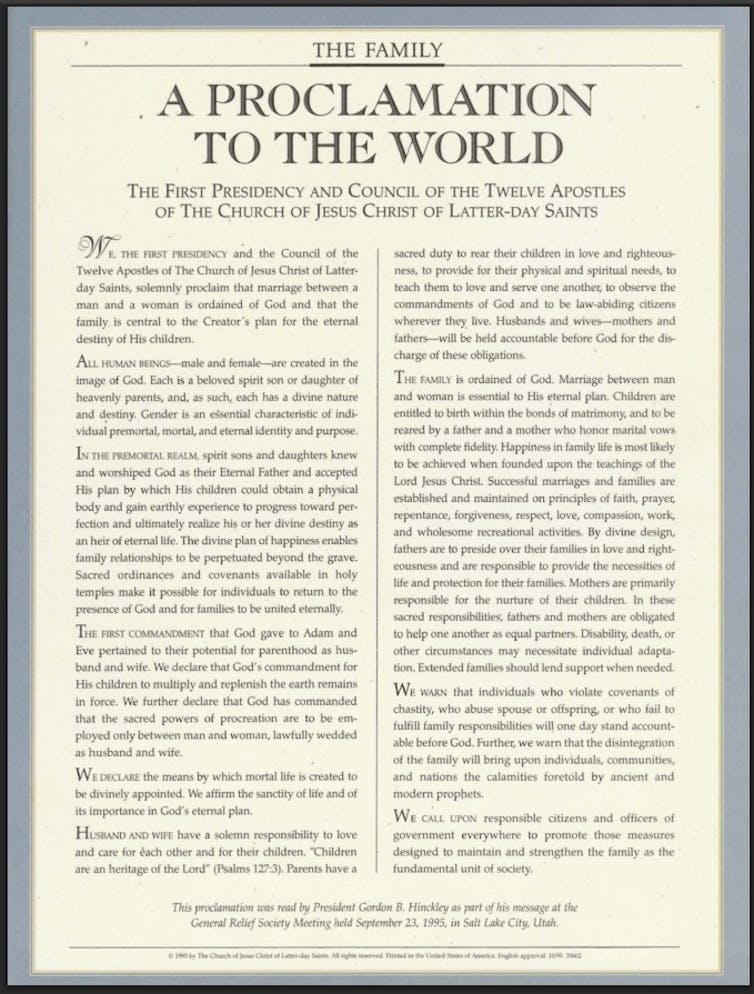
    Since the ending of polygamy, the church has sought to establish itself as a moral equal to mainstream Christian norms, especially sexual norms. In 1995, it released a document titled Family: A Proclamation to the World which emphasised the view that heterosexual marriage and strict gender roles are divinely ordained.

    The 1995 official Mormon document, ‘The Family: A Proclamation to the World’.
    BYU Scholar Arcive

    As the church has grown, it has presented its members as model citizens of the nations they reside in.

    In doing so, it has promoted unique doctrines and practices, such as sexual abstinence before marriage, and a particular health code called the Word of Wisdom which bars alcohol, tea, coffee and tobacco.

    These doctrines, and existing stereotypes of Mormons, are examined in The Secret Lives of Mormon Wives.

    Colliding perceptions

    The 2024 release of the series caused waves in the Latter-day Saints community, with a number of Mormon-focused publications condemning it.

    Before the show was released, the church published a general statement saying media portrayals of Mormons “often rely on sensationalism and inaccuracies that do not fairly and fully reflect the lives of our Church members”. It has yet to directly comment on the show.

    Nonetheless, the representation of Mormons in The Secret Lives of Mormon Wives is problematic for the church, because it transgresses its highly curated image of Mormonism.

    As the influencers put it, there is a desire to push back against stereotypes around Mormonism, and particularly Mormon women. These stereotypes have been crystallised by the church to combat perceptions of Mormons as sexually abhorrent, due to past practices of polygamy.

    The women in the show wear clothing that would not cover “temple garments”, the mandatory Latter-day Saint undergarments which seek to impose sexual modesty.

    There is also a tongue-in-cheek acknowledgement that while the church prohibits stimulants such as tea, coffee and alcohol, Mormons within Utah and surrounds still consume other, somewhat surprising, substances. For instance, the use of ketamine in therapy is allowed when administered by a healthcare professional.

    The series also engages with topics considered taboo in the church, such as marital issues, mental health struggles and consensual sex. Even if these are being played up by the cast or producers, such discussions are lacking in broader Mormon circles.

    Importantly, there are admissions by some cast members, including one of the husbands, of being sexually abused as children. According to the cast members themselves, these disclosures are intended to empower viewers who may have had similar experiences.

    This is a powerful critique, because the Mormon church has come under intense scrutiny for its failure to properly respond to child sexual assault, both in the US and globally.

    The next steps

    The show is having a marked impact on perceptions of Mormonism, despite the church’s stance it doesn’t represent the beliefs and lifestyle of Mormons more broadly.

    For many viewers, it might be their introduction to the religion. This is concerning for adherents, and particularly for the church’s leadership.

    The Secret Lives of Mormon Wives reunion special aired earlier this month.
    Hulu

    There are internal tools the church could use against the show’s cast members, such as disciplinary councils or excommunication. But these would be ineffective since only about half the members consider themselves “faithful” Mormons.

    It’s interesting the church has yet to condemn the show. Perhaps maintaining an image of reluctant acceptance is more important, as in recent years the church has been criticised for overreach against its own members.

    In this case, the show would be an uncomfortable reality the church will just have to live with. Either way, the damage to the stereotypical Mormon image is done.

    The Secret Lives of Mormon Wives is available to stream on Disney+.

    The Conversation

    Brenton Griffin was raised as a member of the Church of Jesus Christ of Latter-day Saints, but is no longer a practising member of the church. His research is focused on the religion’s place in Australian and New Zealand popular culture, politics, and society from the 19th century to present.

    ref. The Secret Lives of Mormon Wives shatters the church’s century-long effort to curate its own image – https://theconversation.com/the-secret-lives-of-mormon-wives-shatters-the-churchs-century-long-effort-to-curate-its-own-image-260418

  • Israel’s Rafah camp – ‘humanitarian city’ or crime against humanity?

    Source: ForeignAffairs4

    Source: The Conversation – Global Perspectives – By Shannon Bosch, Associate Professor (Law), Edith Cowan University

    Israel’s Defence Minister Israel Katz has announced a controversial plan to move up to 600,000 Palestinians in Gaza into a designated “humanitarian area” on the ruins of the southern city of Rafah.

    Access to the camp would be through strict security screening to ensure entrants were not Hamas operatives. Once inside, the perimeter would be sealed off by the Israeli military. Palestinians would not be allowed to leave.

    Eventually the camp would house the entire 2.1 million population of Gaza.

    Camp construction would begin during the proposed 60-day ceasefire being negotiated by Israel and Hamas

    ‘Illegal and inhumane’

    The plan is illegal, inhumane and risks worsening the humanitarian crisis in Gaza.

    The forced displacement and containment of any civilian population in an occupied territory is a violation of international humanitarian law.

    Done on this scale would constitute a war crime and a crime against humanity under the Rome Statute.

    The UN Security Council, UN General Assembly and UN Commission on Human Rights have all condemned instances of forced transfer in armed conflicts.

    So too, the International Committee of the Red Cross and the Red Crescent, which have stressed the fundamental prohibition of forced displacement of a civilian population and the need for all parties to respect this prohibition.

    For their own protection?

    Katz is describing the camp as a “humanitarian city”. The Israeli military says Palestinians would only be contained for their own protection.

    As we have seen, civilian displacement is prohibited. But there is an exception if a case can be made either for military reasons or the protection of the population.

    However, this exception only exists for as long as the conditions warrant for it to exist. Anyone subject to such an evacuation must be transferred back to their homes as soon as possible.

    Imperative military reasons never justify the removal of a civilian population in order to persecute it. The Guiding Principles on Internal Displacement entrenches the duty of international actors to avoid creating the conditions that might lead to the displacement of people.

    Aid dilemma

    Katz has indicated international organisations would be responsible for managing aid and services inside the area.

    But Israel has a history of defying even orders from the International Court of Justice to allow humanitarian aid to reach the Palestinians in Gaza.

    If international humanitarian agencies were called upon to service the camp, they would face a dilemma.

    They would need to decide whether to cooperate in managing aid under conditions that compromise their neutrality and ethical standards, deny basic human rights and are built on violations of international law.

    Aid groups would risk being complicit in a process that sets up a transit camp for Palestinians before possibly expelling them from Gaza altogether.

    This “humanitarian city” would essentially become an open-air prison. Palestinians would be reliant on international aid under strict Israeli military control.

    Mass expulsion?

    Could the Rafah camp be a precursor to mass expulsion from Gaza and what does international law say about that?

    Katz has been quoted saying Israel aims to implement “the emigration plan, which will happen” – meaning Gazans will eventually be forced to leave for other countries.

    Changing the demographic composition of a territory – ethnic cleansing – achieved through the displacement of the civilian population of a territory is strictly prohibited under international law.

    The idea of displacing Palestinians has long been part of Israeli strategic thinking, but this announcement signals a dangerous escalation and intention to permanently alter Gaza’s demographic landscape through displacement and containment.

    Voluntary exodus?

    According to Katz, Gazans would have the option of “voluntary” emigration.

    Indeed, speaking at the White House this week, Prime Minister Benjamin Netanyahu said there would be no forced exodus from Gaza:

    If people want to stay, they can stay, but if they want to leave, they should be able to leave.

    But the scale of the humanitarian crisis in Gaza is incomprehensible.

    The population has been displaced multiple times and 90% of homes in Gaza are damaged or destroyed. The healthcare, water, sanitation and hygiene systems have collapsed.

    On average 100 Palestinians are killed daily as they try to access food.

    These crisis circumstances negate the voluntary nature of any person’s consent to either the transfer to the Rafah camp or ultimately, the departure from Gaza.

    According to Amos Goldberg, historian of the Holocaust at the Hebrew University of Jerusalem, what the defence minister laid out was clear plans for the ethnic cleansing of Gaza:

    [it is] a transit camp for Palestinians before they expel them. It is neither humanitarian nor a city.

    The Conversation

    Shannon Bosch does not work for, consult, own shares in or receive funding from any company or organisation that would benefit from this article, and has disclosed no relevant affiliations beyond their academic appointment.

    ref. Israel’s Rafah camp – ‘humanitarian city’ or crime against humanity? – https://theconversation.com/israels-rafah-camp-humanitarian-city-or-crime-against-humanity-260809

  • Are ‘ghost stores’ haunting your social media feed? How to spot and avoid them

    Source: ForeignAffairs4

    Source: The Conversation – Global Perspectives – By Gary Mortimer, Professor of Marketing and Consumer Behaviour, Queensland University of Technology

    CC BY

    The offer pops up in your social media feed. The website is professional and the imagery illustrates an Australian coastal region, or chic inner-CBD scene.

    The brand name indicates this exclusive fashion retailer is based in Melbourne, Sydney, Adelaide, or an exclusive enclave such as Double Bay or Byron Bay.

    The businesses have history, having apparently been “established” 30–40 years ago, and a story. The owners have reluctantly decided to close or relocate, resulting in significant discounts.

    However, behind the illusion of prestige and luxury, is cheap, poorly manufactured clothing from Chinese factories.

    The recent growth of these online “ghost stores” has led the Australian Consumer and Competition Commission to issue public warning notices about four websites.

    Everly-melbourne.com, willowandgrace-adelaide.com, sophie-claire.com and doublebayboutique.com are the four named.

    A new type of scam

    The ACCC’s Targeting Scams report estimated Australians lost A$2.74 billion in 2023. Most losses were from investment scams ($1.3 billion), remote access scams ($256 million), and romance scams ($201.1 million).


    Read more:
    3.5 million Australians experienced fraud last year. This could be avoided through 6 simple steps


    However, online ghost store scams are so new, researchers and government agencies have not yet had time to measure the financial impact these businesses are having on consumers or legitimate fashion businesses.

    It is possible a consumer, once stung by a ghost store scam, will be less likely to shop with a legitimate online fashion retailer.

    This type of emerging scam was touched on in a 2015 report called Framework for a Taxonomy of Fraud. The report noted there were businesses selling “worthless or non-existent products”. Their sites made:

    misleading claims about products that are exaggerated, undervalued, or non-existent.

    Since the beginning of 2025, the ACCC reports it has received at least 360 complaints about 60 online ghost retailers. It says many more may be operating across several social media sites.

    Tricky tactics

    Ghost stores use a variety of tactics to attract unsuspecting customers.

    Price: Customers regularly assume higher prices mean higher quality. Most customers seeing a “leather” jacket for $19.74 on Temu would expect low quality. However, a silk maxi-dress from Everly Melbourne reduced from $209.95 to $82.95 – a 60% saving – seems reasonable and reflective of normal mid-season clearance pricing. That fact it’s still priced at more than $80 also implies good quality.

    Cosmopolitan localism: Researchers have reported that so-called cosmopolitan localism fosters meaningful consumer relationships with brands. Consumers are more likely to trust a business based in Melbourne or Byron Bay over one based internationally.

    Adding images of a physical store front creates credibility and “realness”. Customers feel confident to buy from a little business based in Melbourne, Sydney or somewhere well known to them.

    Storytelling: Storytelling can influence shoppers’ emotions and affect purchasing. It helps stimulate deeper emotional connections to a brand. Ghost stores will regularly create a narrative around “going out of business” to justify price discounts and pull on heart-strings.

    Layout: A professionally developed website, with high-quality images, detailed product information, online payment methods and order tracking, creates the illusion of authenticity. Researchers have found luxury brand website designs can create a strong sense of luxury. This increases a willingness to buy.

    How to spot a “ghost”

    When the post indicates “closing today” or “closing down sale ends tonight”, it is very easy to impulsively jump in to take advantage of the savings. However, before you click, check for these red flags:

    1. The website does not provide a contact phone number or physical address for the store. There might just be an email address or web form. Simply entering the suspected store into google maps will indicate no physical location.

    2. The website domain is “.com” rather than “.com.au”. This indicates the store is not an Australian-based business.

    3. Is the business registered? ABN Lookup is the free public view of the Australian Business Register – a quick search will identify that the Double Bay designer isn’t registered locally.

    4. Review platforms, including Trustpilot, often have negative reviews for the business, whereas the business’ website only features very positive reviews.

    5. The images of products or even the owner may be AI generated. For example, Harry – Melbourne, is apparently an artisan watchmaker. However, simply right-clicking on the image reveals Harry is an AI-generated image.

    A cautionary note

    Online shopping is risky. You can’t physically touch or interact with the product to determine its quality. Three types of risks are common when shopping online. These are performance risk (it doesn’t work, doesn’t fit well, or the quality is poor), financial risk (losing your money on a poor-quality product), and time-loss risk (refund processing takes weeks).

    As such, customers must trust the online retailer to act honestly and describe products accurately. When trust is breached, consumers will naturally become cautious even about legitimate online retailers.

    As ghost stores scams increasingly populate social media feeds, unsuspecting consumers will continue to get caught out. This will leave legitimate retailers exposed to scepticism and mistrust.

    The Conversation

    Gary Mortimer receives funding from the Building Employer Confidence and Inclusion in Disability Grant, AusIndustry Entrepreneurs’ Program, National Clothing Textiles Stewardship Scheme, National Retail Association and Australian Retailers Association.

    ref. Are ‘ghost stores’ haunting your social media feed? How to spot and avoid them – https://theconversation.com/are-ghost-stores-haunting-your-social-media-feed-how-to-spot-and-avoid-them-260583

  • Does Donald Trump deserve the Nobel Peace Prize? We asked 5 experts

    Source: ForeignAffairs4

    Source: The Conversation – Global Perspectives – By Emma Shortis, Adjunct Senior Fellow, School of Global, Urban and Social Studies, RMIT University

    Israeli Prime Minister Benjamin Netanyahu has formally nominated United States President Donald Trump for the Nobel Peace Prize. He says the president is “forging peace as we speak, in one country, in one region after the other”.

    Trump, who has craved the award for years, sees himself as a global peacemaker in a raft of conflicts from Israel and Iran, to Rwanda and the Democratic Republic of Congo.

    With the conflict in Gaza still raging, we ask five experts – could Trump be rewarded with the world’s most prestigious peace prize?

    The Conversation

    Emma Shortis is Director of International and Security Affairs at The Australia Institute, an independent think tank.

    Jasmine-Kim Westendorf has received funding from the Australian Research Council.

    Shahram Akbarzadeh receives funding from Australia Research Council.

    Ali Mamouri and Ian Parmeter do not work for, consult, own shares in or receive funding from any company or organisation that would benefit from this article, and have disclosed no relevant affiliations beyond their academic appointment.

    ref. Does Donald Trump deserve the Nobel Peace Prize? We asked 5 experts – https://theconversation.com/does-donald-trump-deserve-the-nobel-peace-prize-we-asked-5-experts-260801

  • Trump is aiming to silence public media in the US – and if he succeeds, his supporters here will take note

    Source: ForeignAffairs4

    Source: The Conversation – Global Perspectives – By Bruce Wolpe, Non-resident Senior Fellow, United States Study Centre, University of Sydney

    The ABC dodged a bullet in the Australian election. The Albanese government supports the ABC. In the United States, however, the 2024 presidential election severely wounded public media in America.

    Fresh from his decisive victory in Congress – passage of the One Big Beautiful bill that locks in the legislation to prosecute Trump’s domestic policy agenda – Trump is demanding Congress cancel funding for public media, the Public Broadcasting Service (PBS) and National Public Radio (NPR). Hardliners in the US House of Representatives have already voted to end all federal funding for public media. The Senate will vote on this issue in mid-July.

    We have tale of two vital and powerful media institutions in Australia and the US. What happens over there can affect what happens here.

    Towards the end of Australia’s election campaign, Peter Dutton, then leader of the Liberal Party, opened up on the ABC. He looped in The Guardian for good measure. And he implied other media deserved his words:

    Forget about what you have been told by the ABC, The Guardian and the other hate media.

    Dutton’s words embellished previous policies under Coalition governments, with budget cuts to the ABC of over $500 million, and several inquiries into the degree of ABC’s neutrality and objectivity in its coverage of news and current affairs.


    Read more:
    Peter Dutton calling the ABC and the Guardian ‘hate media’ rings alarm bells for democracy


    Kim Williams, chair of the ABC, said the network would “perform well” under any scrutiny from a Dutton government. Dutton himself, shortly before the election, demanded the ABC show “excellence” in order to prove to taxpayers that its almost $1.2 billion annual budget was justified.

    The Coalition’s defeat aided the ABC’s victory in its longstanding quest for financial stability and future growth. The ABC can continue to build on the commitments established by the Albanese Labor government in 2023 – even though there are choppy waters for the ABC as its new leadership makes programming and staffing decisions for the years ahead.

    With a new Coalition shadow cabinet in place, we will see as future budgets play out whether they have changed their tune on their approach to the ABC.

    We will see how both the government and the Coalition react to Kim Williams’ powerful case he recently presented for “more investment for much-needed renewal” in the ABC.

    Public media in Trump’s America

    In America today, public media are facing Trump’s wrath.

    Trump’s hatred of mainstream media is legendary. For the past decade, Trump has called the major media outlets the “enemy of the people” – the same label that Soviet dictator Joseph Stalin used against those who dared to oppose him.

    In his second term, Trump is engaged in aggressive muscling of the enemies he sees in the media. The Associated Press is barred from the pool of journalists covering the president. Trump has silenced the Voice of America. The US ABC and CBS television networks have both settled lawsuits filed by Trump to seek damages for their broadcast coverage of him and the 2024 presidential campaign. The price to help avoid regulatory punishment by the government of those two networks: $US16 million (A$24.5 million) each.

    For a country that established freedom of the press under its Constitution, Trump’s attacks on news media are an ongoing assault on America’s democracy.

    Trump’s attacks on PBS and NPR show the existential threat they face.

    In 1967, Congress established and funded the Corporation for Public Broadcasting to bring to life public television and radio across America. Money from CPB supports the stations. The stations contract with PBS and NPR to help produce the programming they air, from the PBS NewsHour, Frontline and Sesame Street on PBS to Morning Edition and All Things Considered on NPR – and much more.

    Trump holds the same sentiment that Dutton expressed against the ABC – that the public broadcasters are biased toward the “extreme woke Marxist left”. Trump wrote on Truth Social that:

    Jim Jordan of Ohio, one of the most influential Republican leaders in the House of Representatives, was in-your-face direct on the case against public media:

    This bill’s real simple. Don’t spend money on stupid things, and don’t subsidize biased media.

    In late April, Trump ordered the firing of three of CPB’s five directors. On May 1, Trump issued an executive order that will savage public media’s existence:

    At the very least, Americans have the right to expect that if their tax dollars fund public broadcasting at all, they fund only fair, accurate, unbiased, and nonpartisan news coverage […] The CPB fails to abide by these principles to the extent it subsidizes NPR and PBS.“

    Public media has filed red-hot lawsuits against Trump and his officials for crushing the First Amendment free-speech rights of public televion and radio stations, and for cancelling funds appropriated by Congress. The court rulings in these cases will be crucial to the outcome.

    The last near-fatal threat to public broadcasting was in 1981, when President Ronald Reagan sought Congress’ approval to decimate its funding. Under Reagan conservatism, media belong in the private sector. The conservative’s political bias against public broadcasting framed the push to cancel government funding.

    But Congress rose up successfully against the Reagan cuts – led not only by Democrats but with Senate Republicans from rural states who understood how important public broadcasting was to their communities. Their budgets were trimmed, but PBS and NPR were not decapitated.

    Lessons for the ABC

    The same is true here: ABC stations in country areas are similarly held in high regard.

    The cuts to public media passed the US House by one vote on June 12.

    The Senate will vote in the coming days. We will see if some Senate Republicans who voted against Trump’s One Big Beautiful bill last week will stand up again and vote to buck Trump on this issue and protect public media in their states.

    If Trump succeeds in silencing public media in America, the Trump echo chamber in Australia will take note. Some hard conservatives in Canberra and the Murdoch media will likely leverage Congress’ approval of Trump’s order that PBS and NPR be punished for their left-wing bias and that public media should become the province of the private sector. Defunding public media in the US will sustain the sentiment that one day, under a future government here, the scythe will be wielded at the ABC.

    If the US Senate supports Trump, the fight for the ABC in Australia – not just over money, but over its role, responsibilities and standing in Australia – may not be over.

    The Conversation

    Bruce Wolpe is a (non-resident) Senior Fellow at the United States Studies Centre at the University of Sydney. The views expressed herein are his own. Wolpe served on the staff of Prime Minister Julia Gillard. He worked on the Democratic staff in Congress on public broadcasting issues and was an executive with NPR. He is the author of two books on Trump and Australia.

    ref. Trump is aiming to silence public media in the US – and if he succeeds, his supporters here will take note – https://theconversation.com/trump-is-aiming-to-silence-public-media-in-the-us-and-if-he-succeeds-his-supporters-here-will-take-note-260584

  • What is the Strait of Hormuz and why is it so important for global shipping?

    Source: ForeignAffairs4

    Source: The Conversation – Global Perspectives – By Belinda Clarence, Law Lecturer, RMIT University

    During the recent conflict between Iran and Israel, Iran threatened to block the Strait of Hormuz, one of the world’s major shipping routes.

    Would that be possible, and what effects would it have?

    The Strait of Hormuz is a choke point at the entrance to the Persian Gulf. It is used to transport about 20% of global daily oil consumption.

    Iran effectively controls this crucial shipping route because it is a coastal state bordering this narrow stretch of water. The strait is too narrow to avoid navigating waters claimed by Iran. This raises thorny legal questions about whether it is really possible for Iran to block the strait, and what recourse other states have if it does.

    This geographical reality is far from new, and the legal frameworks governing international maritime activity have developed over centuries. At its heart is the lex mercatoria — the “law of merchants” — a body of transnational commercial law that emerged organically from the practices of traders operating across borders.

    Within this broader framework sits the lex maritima, or customary maritime law, which has long adapted to the hazards of shipping across vast oceans.

    The lex maritima originated from the shared practices of seafarers and merchants. Its purpose? To manage the unpredictable nature of maritime trade that demands coherent and stable rules.

    One of the most enduring principles of this legal tradition is the idea of mare liberum, or “the free sea”, set out by Dutch jurist Hugo Grotius in 1609. He argued the high seas should remain open to all for peaceful navigation and trade. This conveniently legitimised the ambitions of European colonial powers, granting them unfettered access to global maritime routes at a time when control over sea-based trade promised immense economic and strategic advantage.

    The shifting boundaries of maritime law

    One of the most fundamental questions in maritime law is: where do a nation’s territorial waters end, and the high seas begin?

    After the second world war, a series of conferences culminated in the United Nations Convention on the Law of the Sea (UNCLOS), where the customary 3 nautical miles (5.56km) of territorial waters states could claim as their own was extended. This narrow limit was rooted more in historical naval range – the so-called “cannon shot rule” – than in modern geopolitical or environmental realities.

    In 1959, Iran took the unusual step of unilaterally extending its territorial sea to 12 nautical miles, despite not being a party to UNCLOS. Two decades later, following the 1979 Iranian Revolution and the US Embassy hostage crisis, Washington grew increasingly anxious about the security of oil flows from the Persian Gulf. These concerns intensified during the Iran-Iraq War, especially as Iran began using small islands in the Strait of Hormuz to deploy military forces and threaten commercial shipping.

    UNCLOS and the new rules of the sea

    One of the key compromises of UNCLOS was an extension of territorial waters for states that ratified the treaty. In exchange, UNCLOS replaced the older concept of “innocent passage” – which allowed only surface navigation through territorial seas – with the broader notion of “transit passage”. Under this regime, vessels and aircraft from other states are granted the right to travel not only on the surface, but also under the sea and through the air above straits used for international navigation.

    While 169 states have ratified UNCLOS, both Iran and the United States remain notable holdouts. This means Iran does not enjoy the broader 12-nautical-mile limit recognised under UNCLOS, and the US cannot claim the agreement’s protections for transit passage through strategic choke points.

    While the geopolitical and legal tensions surrounding the Strait of Hormuz may seem far removed from the world of private commerce, the global economy continues to function thanks to a powerful legal tool: the contract. Contracts offer a predictable framework that allows trade across borders without parties needing to trust one another personally.

    The Strait of Hormuz is bordered by active, assertive states such as Iran, which means the potential for interstate conflict is relatively high. This doesn’t mean commercial contracts are irrelevant to the recent dispute in the Strait of Hormuz — far from it. But their influence is more indirect.

    What can be learned?

    Without significant political change in Tehran, it’s unlikely either Iran or the US will shift its position on adopting UNCLOS. Yet despite Iran’s repeated threats to close the strait, it has never followed through — and the US Navy continues to maintain a steady presence in the region. For now, a fragile but persistent equilibrium holds.

    The Conversation

    Belinda Clarence does not work for, consult, own shares in or receive funding from any company or organisation that would benefit from this article, and has disclosed no relevant affiliations beyond their academic appointment.

    ref. What is the Strait of Hormuz and why is it so important for global shipping? – https://theconversation.com/what-is-the-strait-of-hormuz-and-why-is-it-so-important-for-global-shipping-260920

  • Rugby headgear can’t prevent concussion – but new materials could soften the blows over a career

    Source: ForeignAffairs4

    Source: The Conversation – Global Perspectives – By Nick Draper, Professor of Sport and Exercise Science, University of Canterbury

    The widely held view among rugby players, coaches and officials is that headgear can’t prevent concussion. If so, why wear it? It’s hot, it can block vision and hearing, and it can be uncomfortable.

    Headgear was originally designed to protect players from cuts and abrasions. But players still hope it will offer them a degree of protection against the collisions they experience in the game. Some players adopt it after previous concussions.

    We’re now seeing increasing numbers of professional players opting in. The Irish men’s team, for example, field up to five players each match sporting headgear. In Japan, it’s mandatory for juniors. And more parents in New Zealand are making their children wear it, too.

    The exact specifications for rugby match kit – boots, shorts, shoulder pads and
    headgear – are regulated through World Rugby’s Law 4 and Regulation 12. In 2019, the governing body launched a trial enabling players to wear headgear with new technical specifications in training and matches.

    The specifications have meant manufacturers can take advantage of novel “isotropic” materials that can potentially reduce the impact forces experienced by players.

    Conventional headgear is composed of soft foams that flatten when a player’s head collides with the ground or another player. As such, they can only minimally absorb those collision forces.

    Isotropic materials behave differently. They can absorb impacts from multiple directions and may offer a level of protection against the effects on a player’s head of a tackle or other collision event.

    Given these changes, and in light of recent research, we may need to change the narrative around rugby headgear: while it may not prevent concussion, it might reduce the total contact “burden” experienced by players in a game and over a whole season. And this could have benefits for long-term brain health.

    Impacts across seasons and careers

    Contact in rugby – through tackles, at the breakdown, and in scrums and lineouts – leads to players experiencing a number of collisions or “head acceleration events”. This contact is most commonly head to ground, head to body or head to head.

    By having players use “smart” mouthguards with embedded micro-accelerometers and gyroscopes to capture head movements, researchers can now measure each collision and each player’s contact load in a game – and potentially over a career.

    A player’s total contact load is found by adding together the magnitude of the impacts they experience in a game. These are measured as “peak linear accelerations” or “peak rotational accelerations”.

    While past research and media attention has focused on concussion, it has become clear the total contact burden in training and matches – the total “sub-concussive knocks” through head acceleration events – may be as important, if not more so.

    One of our own research projects involved following 40 under-16 players wearing smart mouthguards for all training and matches across one season. Peak Linear accelerations are measured as a g-force (g). Activities such as such as running, jumping and shaking the head would measure under 8g, for example, whereas heading a soccer ball might measure 31g.

    The results of our study showed the players differed greatly in their cumulative exposure over a whole season, from 300g to nearly 14,000g. These differences would be amplified further over an entire rugby career.

    Some of the variation is likely due to a player’s team position, with loose forwards having a greater burden than others. But it also seems some players just enjoy the contact aspects of the game more than others.

    Rugby is an impact sport: the Ireland and England women’s teams clash in 2025.
    Getty Images

    Potential benefits of new headgear materials

    Researcher Helen Murray at the University of Auckland has highlighted the need for more research into the burden of collisions, rather than just concussions, over a rugby career. In particular, we need to know more about its effect on future brain health.

    We hope to contribute to this by following our existing cohort of players through their careers. In the meantime, our research has examined the potential of existing rugby headgear and new isotropic materials to mitigate peak accelerations in rugby collisions.

    Using the field data collected from male and female players over the past four seasons, we have designed laboratory testing protocols to compare the conventional and newer materials.

    The results suggest the new forms of headgear do have the potential to reduce the impact burden for players.

    We found 55–90% of head acceleration events do involve direct contact with the head. As such, collision-mitigation headgear could be beneficial. And our laboratory testing produced an estimated 30% reduction in peak linear accelerations with the headgear compared to without.

    The nature of concussion is complex and related to the size of an impact as well as its direction and angle. For instance, we observed the concussions experienced by the junior players occurred between 12g and 62g – well below the male threshold of 70g requiring professional players to be removed from the field for a head injury assessment.

    Currently, it seems unlikely headgear can prevent concussion. But it does appear new headgear materials could significantly reduce the total impact burden for players during their careers. And this may help safeguard their future brain health.

    The Conversation

    Nick Draper receives funding from the Health Research Council, Cure Kids, the Neurological Foundation, Canterbury Medical Research Foundation, Pacific Radiology Group, the Maurice and Phyllis Paykel Trust, and the UC Foundation.

    ref. Rugby headgear can’t prevent concussion – but new materials could soften the blows over a career – https://theconversation.com/rugby-headgear-cant-prevent-concussion-but-new-materials-could-soften-the-blows-over-a-career-258912

  • Does AI actually boost productivity? The evidence is murky

    Source: ForeignAffairs4

    Source: The Conversation – Global Perspectives – By Jon Whittle, Director, Data61, CSIRO

    Roman Samborskyi/Shutterstock

    There’s been much talk recently – especially among politicians – about productivity. And for good reason: Australia’s labour productivity growth sits at a 60-year low.

    To address this, Prime Minister Anthony Albanese has convened a productivity round table next month. This will coincide with the release of an interim report from the Productivity Commission, which is looking at five pillars of reform. One of these is the role of data and digital technologies, including artificial intelligence (AI).

    This will be music to the ears of the tech and business sectors, which have been enthusiastically promoting the productivity benefits of AI. In fact, the Business Council of Australia also said last month that AI is the single greatest opportunity in a generation to lift productivity.

    But what do we really know about how AI impacts productivity?

    What is productivity?

    Put simply, productivity is how much output (goods and services) we can produce from a given amount of inputs (such as labour and raw materials). It matters because higher productivity typically translates to a higher standard of living. Productivity growth has accounted for 80% of Australia’s income growth over the past three decades.

    Productivity can be thought of as individual, organisational or national.

    Your individual productivity is how efficiently you manage your time and resources to complete tasks. How many emails can you respond to in an hour? How many products can you check for defects in a day?

    Organisational productivity is how well an organisation achieves its goals. For example, in a research organisation, how many top-quality research papers are produced?

    National productivity is the economic efficiency of a nation, often measured as gross domestic product per hour worked. It is effectively an aggregate of the other forms. But it’s notoriously difficult to track how changes in individual or organisational productivity translate into national GDP per hour worked.

    AI and individual productivity

    The nascent research examining the relationship between AI and individual productivity shows mixed results.

    A 2025 real-world study of AI and productivity involved 776 experienced product professionals at US multinational company Procter & Gamble. The study showed that individuals randomly assigned to use AI performed as well as a team of two without. A similar study in 2023 with 750 consultants from Boston Consulting Group found tasks were 18% faster with generative AI.

    A 2023 paper reported on an early generative AI system in a Fortune 500 software company used by 5,200 customer support agents. The system showed a 14% increase in the number of issues resolved per hour. For less experienced agents, productivity increased by 35%.

    But AI doesn’t always increase individual productivity.

    A survey of 2,500 professionals found generative AI actually increased workload for 77% of workers. Some 47% said they didn’t know how to unlock productivity benefits. The study points to barriers such as the need to verify and/or correct AI outputs, the need for AI upskilling, and unreasonable expectations about what AI can do.

    A recent CSIRO study examined the daily use of Microsoft 365 Copilot by 300 employees of a government organisation. While the majority self-reported productivity benefits, a sizeable minority (30%) did not. Even those workers who reported productivity improvements expected greater productivity benefits than were delivered.

    AI and organisational productivity

    It’s difficult, if not impossible, to attribute changes in an organisation’s productivity to the introduction of AI. Businesses are sensitive to many social and organisational factors, any one of which could be the reason for a change in productivity.

    Nevertheless, the Organisation for Economic Co-operation and Development (OECD) has estimated the productivity benefits of traditional AI – that is, machine learning applied for an industry-specific task – to be zero to 11% at the organisational level.

    A 2024 summary paper cites independent studies showing increases in organisational productivity from AI in Germany, Italy and Taiwan.

    In contrast, a 2022 analysis of 300,000 US firms didn’t find a significant correlation between AI adoption and productivity, but did for other technologies such as robotics and cloud computing. Likely explanations are that AI hasn’t yet had an effect on many firms, or simply that it’s too hard to disentangle the impact of AI given it’s never applied in isolation.

    AI productivity increases can also sometimes be masked by additional human labour needed to train or operate AI systems. Take Amazon’s Just Walk Out technology for shops.

    Publicly launched in 2018, it was intended to reduce labour as customer purchases would be fully automated. But it reportedly relied on hiring around 1,000 workers in India for quality control. Amazon has labelled these reports “erroneous”.

    More generally, think about the unknown number (but likely millions) of people paid to label data for AI models.

    AI and national productivity

    The picture at a national level is even murkier.

    Clearly, AI hasn’t yet impacted national productivity. It can be argued that technology developments take time to affect national productivity, as companies need to figure out how to use the technology and put the necessary infrastructure and skills in place.

    However, this is not guaranteed. For example, while there is consensus that the internet led to productivity improvements, the effects of mobile phones and social media are more contested, and their impacts are more apparent in some industries (such as entertainment) than others.

    Productivity isn’t just doing things faster

    The common narrative around AI and productivity is that AI automates mundane tasks, making us faster at doing things and giving us more time for creative pursuits. This, however, is a naive view of how work happens.

    Just because you can deal with your inbox more quickly doesn’t mean you’ll spend your afternoon on the beach. The more emails you fire off, the more you’ll receive back, and the never-ending cycle continues.

    Faster isn’t always better. Sometimes, we need to slow down to be more productive. That’s when great ideas happen.

    Imagine a world in which AI isn’t simply about speeding up tasks but proactively slows us down, to give us space to be more innovative, and more productive. That’s the real untapped opportunity with AI.

    The Conversation

    Jon Whittle works at CSIRO which receives R&D funding from a wide range of government and industry clients.

    ref. Does AI actually boost productivity? The evidence is murky – https://theconversation.com/does-ai-actually-boost-productivity-the-evidence-is-murky-260690

  • School smartphone bans reflect growing concern over youth mental health and academic performance

    Source: ForeignAffairs4

    Source: The Conversation – USA (2) – By Margaret Murray, Associate Professor of Public Communication and Culture Studies, University of Michigan

    New laws that ban smartphones or social media for youth are being introduced across several Western nations. SeventyFour/iStock via Getty Images

    The number of states banning smartphones in schools is growing.

    New York is now the largest state in the U.S. to ban smartphones in public schools. Starting in fall 2025, students will not be allowed to use their phones during the school day, including during lunch, recess or in between classes. This bell-to-bell policy will impact almost 2.5 million students in grades K-12.

    By banning smartphones in schools, New York is joining states across the country. The bans are happening in both traditionally liberal and conservative states.

    Alabama, Arkansas, Nebraska, North Dakota, Oklahoma and West Virginia all passed legislation in 2025 that requires schools to have policies that limit access to smartphones. The policies will go into effect in the 2025-2026 school year. This brings the total to 17 states, plus Washington, D.C., that have phone-free school legislation or executive orders.

    I’m a professor who studies communication and culture, and while writing a book about parenting culture, I’ve noticed the narrative around smartphones and social media shifting over the past decade.

    A turning tide

    A group of students stare down at their phones in a classroom.
    Statewide cellphone policies are gaining momentum, with many states aiming to restrict use of the devices in classrooms.
    Thomas Barwick/Digital Vision via Getty Images

    According to the Pew Research Center, 67% of American adults support banning smartphones during class time, although only 36% support banning them for the entire school day. Notably, a majority of Republican, Democratic and independent voters all support bans during class time.

    More broadly, parent-led movements to limit children’s use of smartphones, social media and the internet have sprung up around the country. For example, the Phone-Free Schools Movement in Pennsylvania was launched in 2023, and Mothers Against Media Addiction started in New York in March 2024. These organizations, which empower parents to advocate in their local communities, follow in the footsteps of organizations such as Wait Until 8th in Texas and Screen Time Action Network at Fairplay in Massachusetts, which were formed in 2017.

    The concerns of these parent-led organizations were reflected in the best-selling book “The Anxious Generation,” which paints a bleak picture of modern childhood as dominated by depression and anxiety brought on by smartphone addiction.

    Phone-free schools are one of the four actions the book’s author, Jonathan Haidt, recommended to change course. The other three are no smartphones for children before high school, waiting until 16 for social media access, and allowing more childhood independence in the real world.

    Haidt’s research team collaborated with The Harris Poll to survey Gen Z. They found that almost half of those age 18-27 wish social media had never been invented, and 21% wish smartphones had never been invented. About 40% of Gen Z respondents supported phone-free schools.

    The Pew Research Center found that almost 40% of kids age 8-12 use social media, and almost 95% of kids age 13-17 use it, with nearly half of teens reporting that they use social media almost constantly.

    Phone-free schools are also part of the larger trend of states and nations resisting Big Tech, the large technology companies that play a significant role in global commerce.

    In May 2025, two U.S. senators introduced the Stop the Scroll Act, which would require mental health warnings on social media.

    New laws that ban smartphones or social media for youth are being introduced across several Western nations. Australia has banned all social media for those under 16.

    After a fatal stabbing at a middle school in eastern France on June 10, French President Emmanuel Macron announced the same day that he wants the European Union to set the minimum age for social media at 15. He argued that social media is a factor in teen violence. If the EU doesn’t act within a few months, Macron has pledged to enact a ban in France as soon as possible.

    The impact on learning

    Students sit at a desk in a classroom using smartphones, while a teacher in the background looks on.
    Research suggests that students are less focused in class when they have access to cellphones.
    isuzek/E+ via Getty Images

    Although this trend of restricting use of phones in school is new, more states may adopt smartphone bans in the future. Bell-to-bell bans are viewed as especially powerful in improving academic performance.

    Some research has suggested that when children have access to a smartphone, even if they do not use it, they find it harder to focus in class. Initial research has found that academic performance improves after the bans go into effect.

    Test scores fell across the U.S. during the pandemic lockdown and have not returned to prepandemic levels. Some states, such as Maine and Oregon, are almost a full year behind grade level in reading. Not a single state has recovered in both math and reading.

    Statewide bans free local school districts from having to create their own technology bans, which can lead to heated debates. Although a majority of adults approve of banning smartphones in class, 24% oppose it for reasons such as wanting to be able to contact their kids throughout the day and wanting parents to set the boundaries.

    However, 72% of high school teachers say that phones are a major distraction. Anecdotally, schools report that students like the bans after getting used to the change.

    The Conversation

    I signed the Wait Until 8th pledge mentioned in the article, promising not to give my kids a smartphone or social media until at least the end of 8th grade.

    ref. School smartphone bans reflect growing concern over youth mental health and academic performance – https://theconversation.com/school-smartphone-bans-reflect-growing-concern-over-youth-mental-health-and-academic-performance-259962

  • Israel’s relocation plan for Palestinians and fading hopes for a ceasefire

    Source: ForeignAffairs4

    Source: The Conversation – UK – By Jonathan Este, Senior International Affairs Editor, Associate Editor

    This article was first published in The Conversation UK’s World Affairs Briefing email newsletter. Sign up to receive weekly analysis of the latest developments in international relations, direct to your inbox.


    It was revealing this week to read reports of Benjamin Netanyahu’s meeting with Donald Trump (his third White House visit since Trump’s inauguration in January). There was no sense that the US president upped the pressure on the Israeli prime minister to soften Israel’s conditions in order to secure a ceasefire. Instead the pair appears to have discussed the prospect of moving large numbers of Palestinians out of the Gaza Strip to countries what would, as Netanyahu put it, “give Palestinians a better future”.

    If Israel’s defence minister, Israel Katz, has his way, the future for those Palestinians who want to stay put does indeed look pretty bleak. And the 57,000 people who, according to figures collated by the Hamas-run Gaza health ministry, have lost their lives since the Israeli assault on Gaza began back in October 2023, have no future at all.

    But the plan for the future of Gazan Palestinians that Katz unveiled this week will horrify many too. It involves the construction of a “humanitarian city” at Rafah, close to the Egyptian border at the very southern end of the Strip. Under the plan, people entering the city will be searched for weapons and checked for affiliation to Hamas. Once in, they will not be allowed to leave, except to depart from Gaza altogether.


    Sign up to receive our weekly World Affairs Briefing newsletter from The Conversation UK. Every Thursday we’ll bring you expert analysis of the big stories in international relations.


    This immediately prompted critics to accuse the Israeli government of ethnic cleansing. James Sweeney, an expert in human rights and international law at the University of Lancaster, believes that, if Israel were to carry out Katz’s plan, there would be strong case against political and military leaders for war crimes and crimes against humanity. He argues that the plan amounts at the very least to the forcible transfer of civilians prohibited under the Geneva conventions and the Rome statute, which underpins the International Criminal Court (ICC).

    The snag, as Sweeney sees it, is going to be enforcing international law. While there is an ICC warrant out for the arrests of Netanyahu and his former defence minister, Yoav Gallant, the Israeli prime minister was able to visit Washington without fear of being apprehended. The US doesn’t recognise the ICC and, indeed, the prosecutor that issued the warrant against Netanyahu and Gallant is now subject to US sanctions.


    Read more:
    Plans to relocate Gazans to a ‘humanitarian city’ look like a crime against humanity – international law expert


    Of course, what happens in Gaza tends to reverberate throughout the region. If hundreds of thousands of Palestinian citizens are moved out of Gaza, it’s likely to be to one of the neighbouring countries. When the idea of a Trump Riviera was first mooted earlier this year, the US president said the Palestinian population could be rehomed in Egypt or Jordan – something both those countries pushed back against with alacrity.

    And the powerful Gulf States, which Trump was keen to woo as business partners when he made a tour of the region in May, are also deeply concerned about Israel’s conduct of its military campaign in Gaza. Geopolitics aside, their populations are broadly sympathetic to the Palestinian people, so a plan to force them out of their homes is unacceptable for Gulf leaders.

    Scott Lucas, an expert in Middle East politics at University College Dublin, gives us a broader view of the region. He describes what he calls two “kaleidoscope moments” when one event has changed the entire region. The first was the Hamas attack of October 7. This brought to an abrupt end the process of normalisation of relations between Israel and Saudi Arabia. The second was the 12-day war between Israel and Iran, which has further isolated Israel. Lucas believes for there to be any hope of regional stability and the furthering of Israeli relations with the rest of the region, the war in Gaza must end.


    Read more:
    As Netanyahu meets Trump in Washington, what hope for peace in Gaza? Expert Q&A


    Ali Mamouri, a Middle East scholar at Australia’s Deakin University doesn’t believe there’s much chance of this happening any time soon. Part of this is political: Netanyahu still depends on the far-right elements of his coalition represented by national security minister Itamar Ben-Gvir and finance minister, Bezalel Smotrich. They remain steadfastly opposed to even a ceasefire and want to see Israel expel Palestinians by hook or by crook.

    Also, by prolonging the war, Netanyahu can keep delaying his corruption trial (incidentally, Donald Trump has called for the charges to be dropped altogether).

    And the idea of full statehood for Palestine remains anathema for Israel, as Netanyahu made clear this week talking with journalists after his meeting with Trump when he made clear his insistence that far from pulling Israeli troops out of Gaza, Israel would keep full control of all security matters there: “Now, people will say: ‘It’s not a complete state, it’s not a state.’ We don’t care,” he said.

    Mansour concludes: “The coming weeks will reveal whether Israel chooses the path of compromise and coexistence, or continues down a road that forecloses the possibility of lasting peace.”


    Read more:
    The US has high hopes for a new Gaza ceasefire, but Israel’s long-term aims seem far less peaceful


    Europe must step up over Ukraine

    Just as the picture remains bleak in Gaza, the prospects for peace remain very slim in Ukraine. Although given Donald Trump’s mercurial approach to foreign affairs, it’s also fair to say that anything is possible.

    This week the US president decided to recommence US arms supplies to Ukraine, having previously frozen military aid (although he insists this was done by his defense secretary, Pete Hegseth, and that he was “blindsided” by the move). His relationship with Putin appears to have soured – for the present at least. He said: “We get a lot of bullshit thrown at us by Putin, if you want to know the truth. He’s very nice all of the time, but it turns out to be meaningless.”

    And at the most recent Nato summit in The Hague on June 25, Trump put his signature to a declaration that Russia poses “long-term threat … to Euro-Atlantic security” and that Nato member states retain “their enduring sovereign commitments to provide support to Ukraine”.

    But Stefan Wolff, an expert in international security at the University of Birmingham, believes that Nato’s European members cannot bank on the US as a reliable long-term partner. There are few signs that the US is pressuring Russia to compromise on its maximalist aims, which remain unchanged since it invaded Ukraine in February 2022. So Russia remains the most urgent threat to European security. And it’s a threat that Europe will need to prepare to confront, if necessary without US assistance.

    But there are signs that many European countries are preparing to do just that, Wolff writes. Increased commitments to defence spending are a strong start. As he concludes: “They will not turn Europe into a military heavyweight overnight. But they will buy time to do so.”


    Read more:
    US backs Nato’s latest pledge of support for Ukraine, but in reality seems to have abandoned its European partners


    Understandably, much of the reporting of the war in Ukraine has focused on the human tragedy unfolding in the war-torn country: the enormous casualty list on both sides, civilians killed or forced from their homes in the fighting, and the Ukrainian citizens forced to live under Russian occupation.

    But a new film, which premiered recently at the Tribeca film festival, looks at War Through the Eyes of Animals. Janine Natalya Clark, an expert in transitional justice at the University of Birmingham, has done similar. Clark interviewed a number of Ukrainian natural scientists including botanists, ornithologists, herpetologists (who study reptiles and amphibians) and a marine biologist. She asked them to make sound recordings in their area to reflect on how the war is affecting Ukraine’s flora and fauna.

    What emerged was extraordinary and reflects how the conflict has affected the natural world in both positive and negative ways. Clark believes that this information will be invaluable when it comes to rebuilding Ukraine and in securing justice and reparations for the damage done – not just to humans, but to Ukraine’s animals and the habitats in which they live.


    Read more:
    Sound recordings can give us an animal-eye view of the war in Ukraine


    In Russia, meanwhile, a controversial measure introduced by the Putin government is dividing public opinion. In some parts of the country, schoolgirls who become pregnant are being paid more than 100,000 roubles (nearly £900) for giving birth and raising their babies.

    Jannifer Mathers, a Russia expert at Aberystwyth University, looks at the rise of pronatalism in the face of declining populations and finds it’s not just an issue in Russia, but for many other countries as well, including the US.


    Read more:
    Russia is paying schoolgirls to have babies. Why is pronatalism on the rise around the world?


    World Affairs Briefing from The Conversation UK is available as a weekly email newsletter. Click here to get updates directly in your inbox.


    The Conversation

    ref. Israel’s relocation plan for Palestinians and fading hopes for a ceasefire – https://theconversation.com/israels-relocation-plan-for-palestinians-and-fading-hopes-for-a-ceasefire-260933

  • Why Texas Hill Country, where a devastating flood killed more than 120 people, is one of the deadliest places in the US for flash flooding

    Source: ForeignAffairs4

    Source: The Conversation – USA (2) – By Hatim Sharif, Professor of Civil and Environmental Engineering, The University of Texas at San Antonio

    A Kerrville, Texas, resident watches the flooded Guadalupe River on July 4, 2025. Eric Vryn/Getty Images

    Texas Hill Country is known for its landscapes, where shallow rivers wind among hills and through rugged valleys. That geography also makes it one of the deadliest places in the U.S. for flash flooding.

    In the early hours of July 4, 2025, a flash flood swept through an area of Hill Country dotted with summer camps and small towns about 70 miles northwest of San Antonio. More than 120 people died in the flooding. The majority of them were in Kerr County, including more than two dozen girls and counselors at one summer camp, Camp Mystic. Dozens of people were still unaccounted for a week later.

    The flooding began with a heavy downpour, with more than 10 inches of rain in some areas, that sent water sheeting off the hillsides and into creeks. The creeks poured into the Guadalupe River.

    A river gauge at Hunt, Texas, near Camp Mystic, showed how quickly the river flooded: Around 3 a.m. on July 4, the Guadalupe River was rising about 1 foot every 5 minutes at the gauge, National Weather Service data shows. By 4:30 a.m., it had risen more than 20 feet. As the water moved downstream, it reached Kerrville, where the river rose even faster.

    Flood expert Hatim Sharif, a hydrologist and civil engineer at the University of Texas at San Antonio, explains what makes this part of the country, known as Flash Flood Alley, so dangerous.

    What makes Hill Country so prone to flooding?

    Texas as a whole leads the nation in flood deaths, and by a wide margin. A colleague and I analyzed data from 1959 to 2019 and found 1,069 people had died in flooding in Texas over those six decades. The next highest total was in Louisiana, with 693.

    Many of those flood deaths have been in Hill County. It’s part of an area known as Flash Flood Alley, a crescent of land that curves from near Dallas down to San Antonio and then westward.

    The hills are steep, and the water moves quickly when it floods. This is a semi-arid area with soils that don’t soak up much water, so the water sheets off quickly and the shallow creeks can rise fast.

    When those creeks converge on a river, they can create a surge of water that wipes out homes and washes away cars and, unfortunately, anyone in its path.

    Hill Country has seen some devastating flash floods. In 1987, heavy rain in western Kerr County quickly flooded the Guadalupe River, triggering a flash flood similar to the one in 2025. Ten teenagers being evacuated from a camp died in the rushing water.

    San Antonio, at the eastern edge of Hill Country, was hit with a flash flood on June 12, 2025, that killed 13 people whose cars were swept away by high water from a fast-flooding creek near an interstate ramp in the early morning.

    Why does the region get such strong downpours?

    One reason Hill Country gets powerful downpours is the Balcones Escarpment.

    The escarpment is a line of cliffs and steep hills created by a geologic fault. When warm air from the Gulf rushes up the escarpment, it condenses and can dump a lot of moisture. That water flows down the hills quickly, from many different directions, filling streams and rivers below.

    As temperature rise, the warmer atmosphere can hold more moisture, increasing the downpour and flood risk.

    A tour of the Guadalupe River and its flood risk.

    The same effect can contribute to flash flooding in San Antonio, where the large amount of paved land and lack of updated drainage to control runoff adds to the risk.

    What can be done to improve flash flood safety?

    First, it’s important for people to understand why flash flooding happens and just how fast the water can rise and flow. In many arid areas, dry or shallow creeks can quickly fill up with fast-moving water and become deadly. So people should be aware of the risks and pay attention to the weather.

    Improving flood forecasting, with more detailed models of the physics and water velocity at different locations, can also help.

    Probabilistic forecasting, for example, can provide a range of rainfall scenarios, enabling authorities to prepare for worst-case scenarios. A scientific framework linking rainfall forecasts to the local impacts, such as streamflow, flood depth and water velocity, could also help decision-makers implement timely evacuations or road closures.

    Education is particularly essential for drivers. One to two feet of moving water can wash away a car. People may think their trucks and SUVs can go through anything, but fast-moving water can flip a truck and carry it away.

    Officials can also do more to barricade roads when the flood risk is high to prevent people from driving into harm’s way. We found that 58% of the flood deaths in Texas over the past six decades involved vehicles. The storm on June 12 in San Antonio was an example. It was early morning, and drivers had poor visibility. The cars were hit by fast-rising floodwater from an adjacent creek.

    This article, originally published July 5, 2025, has been updated with the death toll rising.

    The Conversation

    Hatim Sharif does not work for, consult, own shares in or receive funding from any company or organization that would benefit from this article, and has disclosed no relevant affiliations beyond their academic appointment.

    ref. Why Texas Hill Country, where a devastating flood killed more than 120 people, is one of the deadliest places in the US for flash flooding – https://theconversation.com/why-texas-hill-country-where-a-devastating-flood-killed-more-than-120-people-is-one-of-the-deadliest-places-in-the-us-for-flash-flooding-260555

  • What is the ‘Seven Mountain Mandate’ and how is it linked to political extremism in the US?

    Source: ForeignAffairs4

    Source: The Conversation – USA (3) – By Art Jipson, Associate Professor of Sociology, University of Dayton

    People pray before Republican vice presidential nominee J.D. Vance at a town hall hosted by Lance Wallnau on Sept. 28, 2024, in Monroeville, Pa. AP Photo/Rebecca Droke

    Vance Boelter, who allegedly shot Melissa Hortman, a Democratic Minnesota state representative, and her husband, Mark Hortman, on June 14, 2025, studied at Christ for the Nations Institute in Dallas. The group is a Bible school linked to the New Apostolic Reformation, or NAR.

    The NAR is a loosely organized but influential charismatic Christian movement that shares similarities with Pentecostalism, especially in its belief that God actively communicates with believers through the Holy Spirit. Unlike traditional Pentecostalism, however, the organization emphasizes modern-day apostles and prophets as authoritative leaders tasked with transforming society and ushering in God’s kingdom on Earth. Prayer, prophecy and worship are defined not only as acts of devotion but as strategic tools for advancing believers’ vision of government and society.

    After the shooting, the Christ for the Nations Institute issued a statement “unequivocally” denouncing “any and all forms of violence and extremism.” It stated: “Our organization’s mission is to educate and equip students to spread the Gospel of Jesus Christ through compassion, love, prayer, service, worship, and value for human life.”

    But the shooting has drawn attention to the school and the larger Christian movement it belongs to. One of the most important aspects of NAR teachings today is what is called “the Seven Mountain Mandate.”

    The Seven Mountain Mandate calls on Christians to gain influence, or “take dominion,” over seven key areas of culture: religion, family, education, government, media, business and the arts.

    With over three decades of experience studying extremism, I offer a brief overview of the history and core beliefs of the Seven Mountain Mandate.

    ‘Dominion of Christians’

    The Seven Mountain concept was originally proposed in 1975 by evangelical leader Bill Bright, the founder of Campus Crusade for Christ. Now known as “Cru,” the Campus Crusade for Christ was founded as a global ministry in 1951 to promote Christian evangelism, especially on college campuses.

    United by a shared vision to influence society through Christian values, Bright partnered with Loren Cunningham, the founder of Youth With A Mission, a major international missionary training and outreach organization, in the 1970s.

    The Seven Mountain Mandate was popularized by theologian Francis Schaeffer, who linked it to a larger critique of secularism and liberal culture. Over time, it evolved.

    C. Peter Wagner, a former seminary professor who helped organize and name the New Apostolic Reformation, is often regarded as the theological architect of the group. He developed it into a call for dominion. In his 2008 book “Dominion! How Kingdom Action Can Change the World,” he urged Christians to take authoritative control of cultural institutions.

    For Wagner, “dominion theology” – the idea that Christians should have control over all aspects of society – was a call to spiritual warfare, so that God’s kingdom would be “manifested here on earth as it is in heaven.”

    A gray-haired man wearing glasses and a blue shirt.
    Bill Johnson.
    Doctorg via Wikimedia Commons

    Since 1996, Bill Johnson, a senior leader of Bethel Church, and Johnny Enlow, a self-described prophet and Seven Mountain advocate, among others, have taken the original idea of the Seven Mountain Mandate and reshaped it into a more aggressive, political and spiritually militant approach. Spiritual militancy reflects an aggressive, us-vs.-them mindset that blurs the line between faith and authoritarianism, promoting dominion over society in the name of spiritual warfare.

    Their version doesn’t just aim to influence culture; it frames the effort as a spiritual battle to reclaim and reshape the nation according to their vision of God’s will.

    Lance Wallnau, another Christian evangelical preacher, televangelist, speaker and author, has promoted dominion theology since the early 2000s. During the 2020 U.S. presidential election, Wallnau, along with several prominent NAR figures, described Donald Trump as anointed by God to reclaim the “mountain” of government from demonic control.

    In their book “Invading Babylon: The 7 Mountain Mandate,” Wallnau and Johnson explicitly call for Christian leadership as the only antidote to perceived moral decay and spiritual darkness.

    The beliefs

    Sometimes referred to as Seven Mountains of Influence or Seven Mountains of Culture, the seven mountains are not neutral domains but seen as battlegrounds between divine truth and demonic deception.

    Adherents believe that Christians are called to reclaim these areas through influence, leadership and even, if necessary, the use of force and to confront demonic political forces, as religion scholar Matthew Taylor demonstrates in his book “The Violent Take It By Force.”

    Diverse perspectives and interpretations surround the rhetoric and actions associated with the New Apostolic Reformation. Some analysts have pointed out how the NAR is training its followers for an active confrontation. Other commentators have said that the rhetoric calling for physical violence is anti-biblical and should be denounced.

    NAR-aligned leaders have framed electoral contests as struggles between “godly” candidates and those under the sway of “satanic” influence.

    Similarly, NAR prophet Cindy Jacobs has repeatedly emphasized the need for “spiritual warfare” in schools to combat what she characterizes as “demonic ideologies” such as sex education, LGBTQ+ inclusion or discussions of systemic racism.

    In the NAR worldview, cultural change is not merely political or social but considered a supernatural mission; opponents are not simply wrong but possibly under the sway of demonic influence. Elections become spiritual battles.

    This belief system views pluralism as weakness, compromise as betrayal, and coexistence as capitulation. Frederick Clarkson, a senior research analyst at Political Research Associates, a progressive think tank based in Somerville, Massachusetts, defines the Seven Mountain Mandate as “the theocratic idea that Christians are called by God to exercise dominion over every aspect of society by taking control of political and cultural institutions.”

    The call to “take back” the culture is not metaphorical but literal, and believers are encouraged to see themselves as soldiers in a holy war to dominate society. Some critics argue that NAR’s call to “take back” culture is about literal domination, but this interpretation is contested.

    Many within the movement see the language of warfare as spiritually focused on prayer, evangelism and influencing hearts and minds. Still, the line between metaphor and mandate can blur, especially when rhetoric about “dominion” intersects with political and cultural action. That tension is part of an ongoing debate both within and outside the movement.

    Networks that spread the beliefs

    This belief system is no longer confined to the margins. It is spread widely through evangelical churches, podcasts, YouTube videos and political networks.

    It’s hard to know exactly how many churches are part of the New Apostolic Reformation, but estimates suggest that about 3 million people in the U.S. attend churches that openly follow NAR leaders.

    At the same time, the Seven Mountain Mandate doesn’t depend on centralized leadership or formal institutions. It spreads organically through social networks, social media – notably podcasts and livestreams – and revivalist meetings and workshops.

    André Gagné, a theologian and author of “American Evangelicals for Trump: Dominion, Spiritual Warfare, and the End Times,” writes about the ways in which the mandate spreads by empowering local leaders and believers. Individuals are authorized – often through teachings on spiritual warfare, prophetic gifting, and apostolic leadership – to see themselves as agents of divine transformation in society, called to reclaim the “mountains,” such as government, media and education, for God’s kingdom.

    This approach, Gagné explains, allows different communities to adapt the action mandate to their unique cultural, political and social contexts. It encourages individuals to see themselves as spiritual warriors and leaders in their domains – whether in business, education, government, media or the arts.

    Small groups or even individuals can start movements or initiatives without waiting for top-down directives. The only recognized authorities are the apostles and prophets running the church or church network the believers attend.

    The framing of the Seven Mountain Mandate as a divinely inspired mission, combined with the movement’s emphasis on direct spiritual experiences and a specific interpretation of scripture, can create an environment where questioning the mandate is perceived as challenging God’s authority.

    Slippery slope

    These beliefs have increasingly fused with nationalist rhetoric and conspiracy theories.

    A white flag bearing the words 'An Appeal to Heaven,' featuring a green pine tree, with the American flag displayed beneath it.
    The ‘Appeal to Heaven’ flags symbolize the belief that people have the right to appeal directly to God’s authority when they think the government has failed.
    Paul Becker/Becker1999 via Flickr, CC BY

    A powerful example of NAR political rhetoric in action is the rise and influence of the “Appeal to Heaven” flags. For those in the New Apostolic Reformation, these flags symbolize the belief that when all earthly authority fails, people have the right to appeal directly to God’s authority to justify resistance.

    This was evident during the Jan. 6, 2021, Capitol insurrection, when these flags were prominently displayed.

    To be clear, its leaders are not calling for violence but rather for direct political engagement and protest. For some believers, however, the calls for “spiritual warfare” may become a slippery slope into justification for violence, as in the case of the alleged Minnesota shooter.

    Understanding the Seven Mountain Mandate is essential for grasping the dynamics of contemporary efforts to align government and culture with a particular vision of Christian authority and influence.

    The Conversation

    Art Jipson does not work for, consult, own shares in or receive funding from any company or organization that would benefit from this article, and has disclosed no relevant affiliations beyond their academic appointment.

    ref. What is the ‘Seven Mountain Mandate’ and how is it linked to political extremism in the US? – https://theconversation.com/what-is-the-seven-mountain-mandate-and-how-is-it-linked-to-political-extremism-in-the-us-260034

  • This tropical plant builds isolated ‘apartments’ to prevent battles among the aggressive ant tenants it relies on for survival

    Source: ForeignAffairs4

    Source: The Conversation – USA – By Guillaume Chomicki, Professor of Evolutionary Biology, Durham University

    When aggressive ant species come in contact, deadly conflicts ensue G. Chomicki

    In the middle of the South Pacific, a group of Fijian plants have solved a problem that has long puzzled scientists: How can an organism cooperate with multiple partners that are in turn competing for the same resources? The solution turns out to be simple – compartmentalization.

    Imagine an apartment building where unfriendly neighbors might clash if they run into each other, but smart design keeps everyone peacefully separated. In our new research published in the journal Science, we show how certain plants build specialized structures that allow multiple aggressive ant species to live side by side inside them without ever meeting.

    Ants and plants cooperate in Fijian rainforest

    Squamellaria plants are epiphytes – meaning they don’t have roots attached to the ground, and instead grow on another plant for physical support. They live high up in the rainforest canopy, in the South Pacific.

    Because they don’t have direct access to the soil’s nutrients, Squamellaria plants have evolved an original strategy to acquire what they need: In a mutually beneficial relationship, they grow structures that appeal to ants looking for a place to live. This kind of long-term relationship between species – whether helpful or harmful – is called symbiosis.

    Here’s how it works in this case. The base of the Squamellaria plant stem forms a swollen, hollow structure called a domatium – a perfect place for ants to live. Domatia gradually enlarge to the size of a soccer ball, containing ever more plant-made houses ready for ants to move into. Each apartment can house a colony made up of thousands of ants.

    A bulbous plant attached to a branch in a canopy
    A multicompartment Squamellaria (S. tenuiflora) in its natural habitat: rainforests in Fiji. This large plant likely contains a dozen or more compartments.
    G. Chomicki

    The relationship between the ants and the plants is mutualistic, meaning both parties benefit. The ants gain a nice sturdy and private nest space, while the plants gain essential nutrients. They obtain nitrogen and phosphorus from the ants’ feces and from detritus – including dead insects, plant bits and soil – that the ants bring inside the domatium.

    However, tropical rainforest canopies are battlegrounds for survival. Ants compete fiercely for nesting space, taking over any hollow branch or space under tree bark. Any Squamellaria ant house would thus be at risk of being colonized and taken over by other incoming ants, disrupting the existing partnership.

    Until now, it was unclear how the cooperative relationships between ants and plants remain stable in this competitive environment.

    Walls keep the peace

    Our first hint about what keeps the peace in the Squamellaria real estate came when we discovered several ant species living in the same plant domatium. This finding just didn’t make sense. How could aggressively competing ant species live together?

    We investigated the structure of domatia using computed-tomography scanning, which revealed an interesting internal architecture. Each plant domatium is divided into distinct compartments, with thick walls isolating each unit. Independent entrances prevent direct contact between the inhabitants of different units. The walls safeguard the peace as they prevent encounters between different ant species.

    A close-up view of the domatium, showing three overlapping regions in different colors
    A 3D model of a Squamellaria tenuiflora domatiium based on CT-scanning data reveals its compartmentalization. Each color-coded cavity is a distinct ‘ant apartment,’ isolated of the others, but connected to the outside.
    S. Renner & G. Chomicki

    Back in the lab, when we removed the ant apartments’ walls, placing inhabitants in contact with their neighbors, deadly fights broke out between ant species. The compartmentalized architecture is thus critical in preventing symbiont “wars” and maintaining the stability of the plant’s partnership with all the ants that call it home. By minimizing deadly conflicts that could harm the ants it hosts, this strategy ensures that the plant retains access to sufficient nutrients provided by the ants.

    This research reveals a new mechanism that solves a long-standing riddle – the stability of symbioses involving multiple unrelated partners. Scientists hadn’t previously discovered aggressive animal symbionts living together inside a single plant host. Our study reveals for the first time how simple compartmentalization is a highly effective way to reduce conflict, even in the most extreme cases. The ant colonies are living side by side, but not really together.

    What’s next

    The key to conflict-free living of multipartner symbioses discovered in these Fijian plants – compartmentalization – is likely important in other multispecies partnerships. However, it remains unknown whether compartmentalization is widespread in nature. Research on cooperation between species has long focused on pairwise interactions. Our new insights suggest a need to reinvestigate other multispecies mutualistic symbioses to see how they maintain stability.

    The Conversation

    Guillaume Chomicki receives funding from UKRI.

    Susanne S. Renner received previous funding from the German Research Foundation (DFG)

    ref. This tropical plant builds isolated ‘apartments’ to prevent battles among the aggressive ant tenants it relies on for survival – https://theconversation.com/this-tropical-plant-builds-isolated-apartments-to-prevent-battles-among-the-aggressive-ant-tenants-it-relies-on-for-survival-260674

  • Justice Department efforts to strip citizenship from naturalized Americans likely violate constitutional rights

    Source: ForeignAffairs4

    Source: The Conversation – USA – By Cassandra Burke Robertson, Professor of Law and Director of the Center for Professional Ethics, Case Western Reserve University

    New American citizens recite the Oath of Allegiance during a naturalization ceremony in Miami on Aug. 17, 2018. AP Photo/Wilfredo Lee

    The Trump administration wants to take away citizenship from naturalized Americans on a massive scale.

    While a recent Justice Department memo prioritizes national security cases, it directs the department to “maximally pursue denaturalization proceedings in all cases permitted by law and supported by the evidence” across 10 broad priority categories.

    Denaturalization is different from deportation, which removes noncitizens from the country. With civil denaturalization, the government files a lawsuit to strip people’s U.S. citizenship after they have become citizens, turning them back into noncitizens who can then be deported.

    The government can only do this in specific situations. It must prove someone “illegally procured” citizenship by not meeting the requirements, or that they lied or hid important facts during the citizenship process.

    The Trump administration’s “maximal enforcement” approach means pursuing any case where evidence might support taking away citizenship, regardless of priority level or strength of evidence. As our earlier research documented, this has already led to cases like that of Baljinder Singh, whose citizenship was revoked based on a name discrepancy that could easily have resulted from a translator’s error rather than intentional fraud.

    A brief history

    For most of American history, taking away citizenship has been rare. But it increased dramatically during the 1940s and 1950s during the Red Scare period characterized by intense suspicion of communism. The United States government targeted people it thought were communists or Nazi supporters. Between 1907 and 1967, over 22,000 Americans lost their citizenship this way.

    Everything changed in 1967 when the Supreme Court decided Afroyim v. Rusk. The court said the government usually cannot take away citizenship without the person’s consent. It left open only cases involving fraud during the citizenship process.

    After this decision, denaturalization became extremely rare. From 1968 to 2013, fewer than 150 people lost their citizenship, mostly war criminals who had hidden their past.

    A man dressed in a suit and tie speaks and points his right index finger.
    Sen. Joseph McCarthy appears at a March 1950 hearing on his charges of communist infiltration at the State Department.
    AP Photo/Herbert K. White

    How the process works

    In criminal lawsuits, defendants get free lawyers if they can’t afford one. They get jury trials. The government must prove guilt “beyond a reasonable doubt” – the highest standard of proof.

    But in most denaturalization cases, the government files a civil suit, where none of these protections exist.

    People facing denaturalization get no free lawyer, meaning poor defendants often face the government alone. There’s no jury trial – just a judge deciding whether someone deserves to remain American. The burden of proof is lower – “clear and convincing evidence” instead of “beyond a reasonable doubt.” Most important, there’s no time limit, so the government can go back decades to build cases.

    As law professors who study citizenship, we believe this system violates basic constitutional rights.

    The Supreme Court has called citizenship a fundamental right. Chief Justice Earl Warren in 1958 described it as the “right to have rights.”

    In our reading of the law, taking away such a fundamental right through civil procedures that lack basic constitutional protection – no right to counsel for those who can’t afford it, no jury trial, and a lower burden of proof – seems to violate the due process of law required by the Constitution when the government seeks to deprive someone of their rights.

    The bigger problem is what citizenship-stripping policy does to democracy.

    When the government can strip citizenship from naturalized Americans for decades-old conduct through civil procedures with minimal due process protection – pursuing cases based on evidence that might not meet criminal standards – it undermines the security and permanence that citizenship is supposed to provide. This creates a system where naturalized citizens face ongoing vulnerability that can last their entire lives, potentially chilling their full participation in American democracy.

    The Justice Department memo establishes 10 priority categories for denaturalization cases. They range from national security threats and war crimes to various forms of fraud, financial crimes and, most importantly, any other cases it deems “sufficiently important to pursue.” This “maximal enforcement” approach means pursuing not just clear cases of fraud, but also any case where evidence might support taking away citizenship, no matter how weak or old the evidence is.

    This creates fear throughout immigrant communities.

    About 20 million naturalized Americans now must worry that any mistake in their decades-old immigration paperwork could cost them their citizenship.

    A two-tier system

    This policy effectively creates two different types of American citizens. Native-born Americans never have to worry about losing their citizenship, no matter what they do. But naturalized Americans face ongoing vulnerability that can last their entire lives.

    This has already happened. A woman who became a naturalized citizen in 2007 helped her boss with paperwork that was later used in fraud. She cooperated with the FBI investigation, was characterized by prosecutors as only a “minimal participant,” completed her sentence, and still faced losing her citizenship decades later because she didn’t report the crime on her citizenship application – even though she hadn’t been charged at the time.

    A woman accepts a small American flag handed to her from a man across a counter.
    A woman receives a U.S. flag after passing her citizenship interview in Newark, N.J., on May 25, 2016.
    AP Photo/Julio Cortez

    The Justice Department’s directive to “maximally pursue” cases across 10 broad categories – combined with the first Trump administration’s efforts to review over 700,000 naturalization files – represents an unprecedented expansion of denaturalization efforts.

    The policy will almost certainly face legal challenges on constitutional grounds, but the damage may already be done. When naturalized citizens fear their status could be revoked, it undermines the security and permanence that citizenship is supposed to provide.

    The Supreme Court, in Afroyim v. Rusk, was focused on protecting existing citizens from losing their citizenship. The constitutional principle behind that decision – that citizenship is a fundamental right which can’t be arbitrarily taken away by whoever happens to be in power – applies equally to how the government handles denaturalization cases today.

    The Trump administration’s directive, combined with court procedures that lack basic constitutional protections, risks creating a system that the Afroyim v. Rusk decision sought to prevent – one where, as the Supreme Court said, “A group of citizens temporarily in office can deprive another group of citizens of their citizenship.”

    The Conversation

    The authors do not work for, consult, own shares in or receive funding from any company or organization that would benefit from this article, and have disclosed no relevant affiliations beyond their academic appointment.

    ref. Justice Department efforts to strip citizenship from naturalized Americans likely violate constitutional rights – https://theconversation.com/justice-department-efforts-to-strip-citizenship-from-naturalized-americans-likely-violate-constitutional-rights-260353

  • Returning to the office isn’t the answer to Canada’s productivity problem — and it will add pressure to urban housing

    Source: ForeignAffairs4

    Source: The Conversation – Canada – By Dilara Baysal, Research Fellow in Sociology, Concordia University

    As companies face pressure to increase productivity, many are calling workers back to the office — even though there is limited evidence that return-to-office policies actually improve innovation or performance.

    In cities like Toronto and Vancouver, where many major companies are headquartered, this is putting pressure on people to live near expensive downtown areas.

    As of April 2025, average one-bedroom rents were $2,317 in Toronto and $2,536 in Vancouver, with North Vancouver even higher at $2,680. If return-to-office policies continue, more workers may be forced into these pricey city centres, adding pressure to already overheated housing markets.

    Since early 2025, return-to-office policies have added to Canada’s housing stress. The Royal Bank of Canada, for instance, now requires staff in the office four days a week, and Amazon ended remote work in January. While rents haven’t jumped yet, similar policies in the U.S. have already pushed up demand, and may be a sign of what’s to come.

    In Washington, D.C., rents rose 3.3 per cent after federal employees were called back to offices. Cities like New York and San Francisco also saw rent increases linked to companies like JPMorgan Chase, Meta and Salesforce reversed remote work policies.

    The myth of office productivity

    According to the Bank of Canada, Canada’s economy is being negatively affected by low productivity. Low productivity slows Canada’s economic growth and keeps wages low. It also makes inflation worse because supply can’t keep up with demand. A productive economy meets demand more easily, keeping prices stable.

    In response, many companies are pushing return-to-office as the answer. RBC CEO Dave McKay endorsed a return to the office back in 2023, saying that “the absence of working together” has hurt innovation and productivity.

    At Google, under mounting pressure to compete in artificial intelligence, co-founder Sergey Brin also pushed for full-time office work, calling a 60-hour week the “sweet spot” for productivity.

    But recent research shows the story isn’t so simple. A University of Chicago working paper found that strict return-to-office rules can cause senior staff to leave, which hurts innovation.


    Read more:
    Working one day a week in person might be the key to happier, more productive employees


    Another study of 48,000 knowledge workers in India found that hybrid setups — where some people are in the office and others work from home — can make it harder to share ideas and work together.

    Meanwhile, a Stanford-led study found that working in the office just two days a week kept productivity strong and cut employee turnover by 33 per cent.

    A mind map with productivity in the centre and different determinants of productivity branching out from it, including: entrepreneurship, human capital, finance, institutions, policies/regulations, demographic profiles and trends, infrastructure, governan
    The determinants of productivity and their underlying factors. These determinants connect across industries, businesses and places.
    (Organization for Economic Co-operation and Development), CC BY

    Where people live matters more

    Return-to-office mandates also aren’t a guaranteed way to boost productivity. A 2023 study supported by housing organizations across Canada found that affordable, well-located housing helps people find better jobs and specialize in their work.

    But when housing costs are high and commutes are long, productivity drops, especially for lower-income workers. Long commutes and high living costs create stress, limit mobility and cause people to miss out on job opportunities.

    Studies show that investing in technology and training workers matters much more. Research from the Canadian Research Data Centre Network finds that workplace training improves productivity in most sectors.

    A recent report from the Canada Mortgage and Housing Corporation also shows that high housing costs make it harder for many people to live in big cities, which ultimately reduces diversity in the workforce and weakens the economy.

    Affordable housing could boost productivity

    Housing in Canada is often viewed in two ways. One treats it as a commodity, where prices follow supply and demand. In this view, policies focus on increasing supply and offering market incentives. The other sees housing as a public need and a basic right, and calls for government action to ensure affordability and stability.


    Read more:
    Housing is both a human right and a profitable asset, and that’s the problem


    In practice, market forces can undermine policies designed to meet housing needs and ensure affordability. In Toronto, for example, developers resisted inclusionary zoning rules that require or encourage developers to include a certain percentage of affordable housing units within new residential developments. Instead, they delayed projects or chose to build high-end condos in different zones.

    This tension between housing as a commodity and housing as a public good is central to Canada’s current housing strategy. Prime Minister Mark Carney’s government has pledged to build 500,000 new homes annually by 2035 using tools like public lands, modular housing and tax incentives.

    While this supply-focused strategy targets long-term housing needs, it must also account for today’s complex economic realities such as inflation, increasing unemployment and economic stagnation due to lagging productiviy.

    Without tackling affordability and access directly, building more homes alone won’t be enough.

    Two line graphs showing how housing has increased since 2004 in Canada
    Rising home prices and rents have played a major role in driving inflation. In Canada’s Consumer Price Index, shelter makes up about 29 per cent of overall household spending.
    (Organization for Economic Co-operation and Development), CC BY

    The real foundation of a productive economy

    Return-to-office policies often focus too much on one thing: how much each worker produces. But that narrow view of productivity ignores what really supports good work: access to affordable housing, time for training and flexibility to relocate for better job opportunities.

    To address productivity challenges, companies should invest in job-specific training, digital skills and ongoing learning to help employees adapt to new tools and processes, and the should offer more flexibility. What workers need most are affordable homes, shorter commutes and real opportunities to grow — not added stress and rising costs.

    The Conversation

    Dilara Baysal does not work for, consult, own shares in or receive funding from any company or organisation that would benefit from this article, and has disclosed no relevant affiliations beyond their academic appointment.

    ref. Returning to the office isn’t the answer to Canada’s productivity problem — and it will add pressure to urban housing – https://theconversation.com/returning-to-the-office-isnt-the-answer-to-canadas-productivity-problem-and-it-will-add-pressure-to-urban-housing-260395

  • International students’ stories are vital in shaping Canada’s future

    Source: ForeignAffairs4

    Source: The Conversation – Canada – By Emilda Thavaratnam, PhD student, Leadership and Higher Education, University of Toronto

    Over the past decade, international students have navigated a complex and challenging landscape shaped by neoliberal policies.

    Neoliberal economic and political ideology upholds entrepreneurship, individualism, free trade, open markets, minimal government intervention and reduced public services for citizens.


    Read more:
    What exactly is neoliberalism?


    Neoliberal governance has transformed higher education into a mechanism for economic growth, shifting the burden of funding onto students.

    As my doctoral research examines, international students in Ontario’s colleges of applied arts and technology face barriers related to neoliberal restructuring. Drawing on interviews with students and front-line staff, my study examines experiences across five key themes: pre-arrival, housing insecurity, pandemic survival, precarious labour and future aspirations.

    Through these challenges, the resilience and drive of international students to build community reveal powerful forms of everyday resistance.

    This has been seen through their front-line work during the pandemic, their persistent pursuit of education and their collective efforts to challenge marginalization. Their stories are vital in shaping Canada’s social, economic and educational fabric.

    Shifts towards neoliberal education

    Since the late 1970s, higher education in Ontario and elsewhere has experienced significant changes. In the province, public funding per student has steadily declined, shifting the cost onto students, with higher educational institutions adopting models of privatization and corporatization to survive.

    Though higher education continues to serve the public good, these changes reflect a broader adaptation to the new economic realities driven by market principles.

    As David Harvey, a scholar of urban and political economy, explains, neoliberal approaches hold that economic growth and prosperity occur when markets are allowed to operate with minimal government regulation. Over time, these approaches have shaped policies and practices globally across various sectors, including education, media, corporations and international institutions such as the International Monetary Fund.

    Neoliberal policies are presented as naturally occurring or unavoidable; however, this framing prioritizes market principles over social protections and often masks the deeper political and social dynamics.

    Education as a product serving the job market

    Neoliberal values have reshaped the purpose and practice of higher education. The problem with this market-driven approach is it often prioritizes individual gain and profit over social equity and the public good. This shift aligns learning with market-oriented approaches.

    Scholars concerned with the adverse effects of neoliberal education policy highlight how education is often treated as a product designed to serve economic interests, with measurable outcomes and links to the job market becoming the primary focus.

    This shift is evident when policymakers and institutions prioritize competition, performance, metrics and individual achievement — often at the expense of collaboration, critical thinking and shared goals.

    COVID-19 pandemic

    The COVID-19 pandemic highlighted the effects of neoliberal ideology in higher education, revealing both the precarity of post-secondary finance and living conditions for many international students.


    Read more:
    The pandemic exposed the vulnerability of international students in Canada


    When colleges and universities faced pandemic closures and uncertain enrolment, international students came under scrutiny as learners who pay high fees. They contribute more than $21 billion annually to the Canadian economy and pay an average of five times more than domestic students.

    It also became clear that international students make significant contributions to Canada by working on the front lines in sectors such as health care, long-term care and food supply chains.

    At the same time, this situation revealed broader tendencies rooted in the neoliberal market logic.

    During the pandemic, the federal government acknowledged how it has positioned international students as a flexible, commodified labour resource integral to the Canadian economy and essential services. For example, in April 2020, Immigration, Refugees and Citizenship Canada announced it would “temporarily lift the 20 hour per week work restriction on study permit holders working off-campus during their academic session, provided they are working in an essential service or function.”

    While international student contributions are vital, this framing begs deeper questions around the protection of international students’ labour rights, student well-being and potential exploitation.

    Housing, food insecurity, high tuition

    Before the pandemic, many international students struggled with housing, food insecurity and tuition payments due to work restrictions and financial constraints.

    With the current cap in place as of 2024, it’s ironic that international students have been treated as both “essential” and “disposable” simultaneously.

    Despite facing housing insecurity, food shortages and inaccessible health care, international students have continued to demonstrate their resilience and resistance. Their efforts extend beyond individual acts of survival.

    Post-pandemic protest

    International students have also organized petitions, protests and advocacy campaigns to challenge unjust policies.

    For example, in November 2022, hundreds of students (domestic and international) rallied at the Ontario legislature in Toronto under the banner “Need or Greed.” A coalition of student associations representing 120,000 students united to protest.

    The protests were partly a response to unfair and unpredictable jumps in already high tuition fees for international students: the average undergraduate international tuition fees in Ontario rose from about $35,000 to just under $50,000 between 2018 and 2025. The coalition urged the provincial government and Colleges Ontario to freeze tuition for international students.

    Following these efforts, nationwide protests erupted in August 2024 when 70,000 international student graduates faced possible deportation due to tightened immigration rules. Students set up encampments outside the Prince Edward Island legislative assembly for three months to protest the 25 per cent cut in permanent resident nominations, which left many students in limbo.

    A notable aspect of this activism was the solidarity shown from labour organizations and people across the country. Laura Walton, president of the Ontario Federation of Labour, joined the protests in solidarity, stating: “Your right is our fight.

    The Naujawaan Support Network, an advocacy group for youth and international students based in Brampton, Ont., issued a statement declaring:“International students are not the cause of the crisis, but we are being made into scapegoats.


    Read more:
    International students cap falsely blames them for Canada’s housing and health-care woes


    Power of collective organizing

    Collective organizing and calls for action are powerful acts of resistance that transcend the neoliberal ideology of individualism. Through petitions and protests, international students demonstrate a profound commitment to their education and aspirations.

    As Canada continues to welcome international students, and post-secondary institutions, governments and public sector organizations navigate turbulent economic times, it’s essential to uphold the rights of international students.

    It’s also essential to provide the support necessary for them to succeed and affirm their value as vital members of the community.

    International students’ resilience offers a valuable lesson about the human capacity to reframe challenges and persist. Students and citizens across the country have a role in celebrating their contributions and building bridges to foster more resilient communities.

    The Conversation

    Emilda Thavaratnam does not work for, consult, own shares in or receive funding from any company or organisation that would benefit from this article, and has disclosed no relevant affiliations beyond their academic appointment.

    ref. International students’ stories are vital in shaping Canada’s future – https://theconversation.com/international-students-stories-are-vital-in-shaping-canadas-future-258271

  • Gene-edited pigs may soon enter the Canadian market, but questions about their impact remain

    Source: ForeignAffairs4

    Source: The Conversation – Canada – By Gwendolyn Blue, Professor, University of Calgary

    The Canadian government is currently considering approving the entry of gene-edited pigs into the food system.

    Using CRISPR gene-editing technology, genetic changes can be created precisely and efficiently without introducing foreign genetic material. If approved, these pigs would be the first gene-edited food animals available for sale in Canadian markets. My research examines how including the public in decision-making around emerging applications of genomics can help mitigate potential harms.

    These pigs are resistant to porcine reproductive and respiratory syndrome (PRRS), a horrible and sometimes fatal disease that affects pigs worldwide. PRRS has significant economic, food security and animal welfare implications.


    Read more:
    What is gene editing and how could it shape our future?


    The United States Food and Drug Administration recently greenlit the commercial production of gene-edited pigs. Will the Canadian government follow suit?

    AquAdvantage and EnviroPig

    In 2016, Canada approved the first transgenic animal for human consumption — an Atlantic salmon called AquAdvantage salmon that contains DNA from other species of fish.

    This approval came more than 25 years after the genetically modified fish was created by scientists at Memorial University in Newfoundland. The approval and commercialization of AquAdvantage salmon faced strong public opposition on both sides of the border, including protests, supermarket boycotts and court battles. In 2024, the company that produced AquAdvantage salmon announced that it was shutting down its operations.


    Read more:
    The science and politics of genetically engineered salmon: 5 questions answered


    In 2012, the Canadian government approved the manufacture of a transgenic pig known by its trade name, EnviroPig. Created by scientists at the University of Guelph, EnviroPigs released less phosphorus than conventionally bred pigs.

    EnviroPig did not make it to market; the same year, the University of Guelph ended the EnviroPig project. Funding for the project had been suspended, in part because of consumer concerns.

    Government regulation

    Some researchers argue that government regulation of gene-edited animals should be less restrictive than for transgenic techniques. Gene editing introduces genetic changes that can occur with conventional animal breeding that is not subject to regulation. Gene-edited crops in Canada are treated the same as conventionally bred crops.

    Others insist that stringent government regulation is necessary for gene editing to identify potential problems and ensure that laws keep up with industry and scientific ambition. Regulation plays a vital role in minimizing risk, encouraging public involvement and building trust.

    Social science research has, for decades, demonstrated that resistance to biotechnology is not because of the public’s lack of knowledge, as is often argued by biotechnology proponents. Public resistance to biotechnology is better understood as a rejection of potential harms imposed by governments and industry without public input and consent.

    Ethical, moral, cultural and political concerns

    At present, little opportunity exists for public engagement in Canadian assessments of gene-edited animals.

    Similar to the U.S., Canada does not have specific gene technology regulation. Rather, the federal government relies on pre-existing environmental and food safety legislation. Canadian regulatory agencies use a risk, novelty and product-based approach to assess animal biotechnology. From a regulatory standpoint, distinctions between technical processes — like transgenic modification versus gene editing — are less important than the safety of the final product.

    The Canadian government has recently updated its federal environmental and health regulations. This includes introducing mandatory public consultations for animals (vertebrates, specifically) created using biotechnology.

    Even with these changes, there’s still room for improvement. Public engagement is limited to consultations conducted within a short time frame. Interested parties are invited to provide scientific information about potential risks of animal biotechnology to human health or the environment, but comments that address ethical, moral, cultural or political concerns are not taken into consideration.

    More broadly, regulatory and academic debates about the gene editing of animals are largely informed by scientists and industry proponents with considerably less input from the public, Indigenous communities and social sciences and humanities researchers.

    Consulting the public

    From a social standpoint, the process by which gene editing is assessed matters as much as the safety of the final product. Inclusive public engagement is essential to ensure that the production of gene-edited food animals aligns with societal needs and values.

    Reactions to gene technologies are based on underlying values and beliefs, and sustained opportunities for public reflection and deliberation are vital for responsible innovation.

    Important questions should be addressed: Who will reap the benefits of gene-editing techniques? Who will bear the costs and harms? What are the potential implications, including hard-to-anticipate social and political changes? How should decision-making proceed to ensure that Canadians have sufficient opportunities for input?

    Currently, for the gene-edited pigs, members of the public can submit comments to the government until July 20, 2025.

    Public reactions to previous biotech food animals in Canada — including AquAdvantage salmon and the EnviroPig — show that lack of inclusive engagement can contribute to the rejection of animal biotechnology.

    The Conversation

    Gwendolyn Blue receives funding from the Social Sciences and Humanities Research Council. She is a member of Gene Editing for Food Security and Environmental Sustainability, a multi-university consortium based at McGill University, and funded by the Natural Sciences and Engineering Research Council of Canada.

    ref. Gene-edited pigs may soon enter the Canadian market, but questions about their impact remain – https://theconversation.com/gene-edited-pigs-may-soon-enter-the-canadian-market-but-questions-about-their-impact-remain-260627

  • Superman wasn’t always so squeaky clean – in early comics he was a radical vigilante

    Source: ForeignAffairs4

    Source: The Conversation – UK – By John Caro, Principal Lecturer, Film and Media, University of Portsmouth

    Superman was the very first superhero. He debuted in Action Comics issue #1 which was released in June 1938. Over time, the character has been assigned multiple nicknames: “The Man of Steel”, “The Man of Tomorrow” and “The Big Blue Boy Scout”. However, in his first appearance in ravaged Depression-era America, the byline used to announce Superman’s debut was: “The Champion of the Oppressed”.

    Created by the sons of Jewish immigrants, writer Jerry Siegel and artist Joe Shuster, Superman is an example of youthful male wish fulfilment: an all-powerful figure dressed like a circus strong man, who uses brawn to right wrongs. However, Siegel and Shuster’s initial version of the character was a more flawed character.

    Appearing in a 1933 fanzine, Siegel’s prose story The Reign of the Superman with accompanying illustrations by Shuster, featured a reckless scientist whose hubris is punished when he creates the telepathic “super man” by experimenting on a drifter plucked from the poverty lines. Echoing Mary Shelley’s Frankenstein, the creator is dispatched by his creation.


    Looking for something good? Cut through the noise with a carefully curated selection of the latest releases, live events and exhibitions, straight to your inbox every fortnight, on Fridays. Sign up here.


    Siegel and Shuster had some early success selling stories to National Allied Publications, the forerunner of DC Comics. At this time, comic books were mainly collections of newspaper cartoons – the “funnies” – pasted together to create more portable anthologies. They featured the escapades of characters like Popeye and Little Orphan Annie.

    Inspired by the heroic tales of derring do of pulp fiction adventurers such as Johnston McCulley’s Zorro (1919) and Philip Wylie’s 1930 science fiction novel Gladiator, Siegel and Shuster further developed their Superman character. They transformed him into a hero and added the now familiar cape and “S” logo.

    Having no luck selling their superhero to the newspapers, they eventually sold the rights to Superman to DC Comics, where Superman achieved huge success. Within a year, there was a syndicated newspaper strip and a spin-off Superman comic book featuring the first superhero with their own exclusive title. Along with extensive merchandising, there was a 1940 radio show, followed by an animation series in 1941, with the inevitable live action serial in 1948.

    In this early example of a property crossing multiple media platforms, Superman’s apparent appeal lay with the fantastical aspects, as he battled mad scientists, criminal masterminds and giant dinosaurs.

    But in the early issues, Superman’s enemies were noticeably more earthbound and reflected the concerns of an audience reeling from the effects of the Great Depression. In an early story, War in Sante Monte, Superman confronts a corrupt Washington lobbyist, Alex Greer, who is bribing a greedy senator. It transpires that Greer represents an arms dealer who is profiteering by manipulating both sides in an overseas war.

    In a later tale, Superman Battles Death Underground, our hero challenges the owner of a dangerous mine who is cutting corners with safety precautions.

    In 1932 Siegel’s father, a tailor, died following the attempted robbery of the family shop – so it is no surprise that Superman had a low tolerance for crime and its causes. In the story Superman in the Slums, dated January 1939, the social commentary is plain. When teenager Frankie Marello is sentenced to reform school, Superman acknowledges the impact of the boy’s social environment:

    It’s these slums – your poor living conditions – if there was only some way I could remedy it!

    His solution is to raze the dilapidated buildings to the ground, forcing the authorities to replace them with modern cheap-rental apartments. In creating new construction work, here is Superman’s extreme version of President Franklin D. Roosevelt’s New Deal.

    In the 1998 forward to Superman: The Action Comics Archives Volume 2, former DC Comics editor Paul Kupperberg comments this is a Superman “who fought (mainly) guys in suits out to screw over the little guy”. The form that the fight took is of interest, for this Superman has no time for niceties or due process, as he gleefully intimidates and bullies anyone who gets in his way.

    A man caught beating his wife is thrown into a wall and warned that there is plenty more where that came from. The corrupt lobbyist is dangled over power cables until he reveals who he is working for. Any police officers that attempt to obstruct Superman’s personal quest for justice are brushed aside with annoyance.

    Refining Superman

    Through his appearances on mainstream radio and cinema, Superman softened and became more patient. In popular culture, concerns about the depression and social injustice shifted to efforts to encourage a national consensus as the United States moved to a war footing in the early 1940s.

    Post-war, there were occasional returns to the more radical interpretations of Superman, but generally it is the clean cut, fantastical Big Blue Boy Scout perception of the character that has dominated.

    The new Superman film appears to be maintaining that image. In the trailer, actor David Corenswet’s Superman tackles various super-villains and a destructive Kaiju (a Godzilla-like skyscraper-sized monster) – although there is the suggestion that behind them all is the corrupt industrialist, Lex Luthor.

    The trailer for the latest Superman film.

    Fittingly, it is in the pages of comic books that a more progressive, militant representation of Superman has emerged. In 2024 DC rebooted its familiar superheroes with its new grittier “Absolute” universe.

    Jason Aaron and Rafa Sandoval’s Absolute Superman comic (2024) emphasises the character’s status as an isolated blue-collar immigrant from the doomed planet of Krypton. This is a youthful, less seasoned Superman who is quick to anger and less likely to pull his punches. Their interpretation is closer to Superman’s early vigilante roots, including a storyline where he liberates the workers in a Brazilian mine from the clutches of exploitative big business.

    Perhaps – in the comic books at least – the Champion of the Oppressed has finally returned.


    This article features references to books that have been included for editorial reasons, and may contain links to bookshop.org. If you click on one of the links and go on to buy something from bookshop.org The Conversation UK may earn a commission.

    The Conversation

    John Caro does not work for, consult, own shares in or receive funding from any company or organisation that would benefit from this article, and has disclosed no relevant affiliations beyond their academic appointment.

    ref. Superman wasn’t always so squeaky clean – in early comics he was a radical vigilante – https://theconversation.com/superman-wasnt-always-so-squeaky-clean-in-early-comics-he-was-a-radical-vigilante-260721

  • The Bangladesh delta is under a dangerous level of strain, analysis reveals

    Source: ForeignAffairs4

    Source: The Conversation – UK – By Md Sarwar Hossain, Senior Lecturer in Environmental Science & Sustainability, University of Glasgow

    The Ganges delta in Bangladesh. Emre Akkoyun/Shutterstock

    Bangladesh is known as the land of rivers and flooding, despite almost all of its water originating outside the territory. The fact that 80% of rivers that flow through Bangladesh have their sources in a neighbouring country, can make access to freshwater in Bangladesh fraught. And the country’s fast-growing cities and farms – and the warming global climate – are turning up the pressure.

    In a recent analysis, my colleagues and I found that four out of the ten rivers that flow through Bangladesh have failed to meet a set of conditions known as their “safe operating space”, meaning that the flow of water in these rivers is below the minimum necessary to sustain the social-ecological systems that rely on them. These rivers included the Ganges and Old Brahmaputra, as well as Gorai and Halda.

    This puts a safe and reliable food and water supply not to mention the livelihoods of millions of fishers, farmers and other people in the region, at risk.

    Water flow on the remaining six rivers may be close to a dangerous state too, due to the construction of hydropower dams and reservoirs, as well as booming irrigated agriculture.


    Get your news from actual experts, straight to your inbox. Sign up to our daily newsletter to receive all The Conversation UK’s latest coverage of news and research, from politics and business to the arts and sciences.


    The concept of a safe operating space was devised by Stockholm University researchers in 2009 and typically assesses the Earth’s health as a whole by defining boundaries such as climate warming, water use and biodiversity loss which become dangerous to humanity once exceeded. A 2023 update to this research found that six of the nine defined planetary boundaries have been transgressed.

    Since the Bangladesh delta is one of the world’s largest and most densely populated (home to around 170 million people), we thought it prudent to apply this thinking to the rivers here. We found that food, fisheries and the world’s largest intertidal mangrove forest, a haven for rich biodiversity, are all under strain from water demand in growing cities such as Dhaka.

    The knock-on effects

    During all seasons but winter, river flows in the Bangladesh delta have fallen over the past three decades.

    An infographic depicting the relative health of five rivers in Bangladesh.
    No river in the Bangladesh delta is within its safe operating space.
    Kabir et al. (2024)

    Our analysis highlights the limits of existing political solutions. The ability of the Ganges river to support life and society is severely strained, despite the Ganges water sharing treaty between India and Bangladesh, which was signed in 1996.

    Rivers in Bangladesh have shaped the economy, environment and culture of South Asia since the dawn of human civilisation here. And humans are not the only species suffering. Hilsha (Tenualosa ilisha), related to the herring, is a fish popular for its flavour and delicate texture. It contributes 12% to national fish production in Bangladesh but has become extinct in the upper reaches of the Ganges due to the reduction of water flow.

    Excessive water extraction upstream, primarily through the Farakka barrage, a dam just over the border in the Indian state of West Bengal, has also raised the salinity of the Gorai river. A healthy river flow maintains a liveable balance of salt and freshwater. As river flows have been restricted, salinity has crept up, particularly in coastal regions that are also beset by sea level rise. This damages freshwater fisheries, farm yields and threatens a population of freshwater dolphins in the Ganges.

    Low river flows and increasing salinisation now threaten the destruction of the world’s largest mangrove forest, the loss of which would disrupt the regional climate of Bangladesh, India and Nepal. It would also release a lot of stored carbon to the atmosphere, accelerating climate change and the melting of snow and ice in the Himalayan mountain chain.

    Resilience to climate change

    Solving this problem is no simple task. It will require cooperation across national boundaries and international support to ensure fair treaties capable of managing the rivers sustainably, restoring their associated ecosystems and maintaining river flows within their safe operating spaces.

    A dry river bank.
    The mighty Ganges is running dry in some parts of Bangladesh during the hotter months.
    Md Sarwar Hossain

    This is particularly challenging in the Bangladesh delta, which contains rivers that drain many countries, including China, India, Nepal and Pakistan. The political regimes in each country might oppose transboundary negotiations, which could nevertheless resolve conflict over water which is needed to sustain nearly 700 million people.

    There have been success stories, however. The Mekong river commission between Cambodia, Laos, Thailand and Vietnam is a useful template for bilateral and multilateral treaties with India and Nepal for the Ganges, and China and Bhutan for the Jamuna river.

    Tax-based water sharing can help resolve conflicts and decide water allocation between countries in the river basin. The countries using more water would pay more tax and the revenue would be redistributed among the other countries who share rivers in the treaty. Additionally, water sharing should be based on the historical river flow disregarding existing infrastructure and projections of future changes.

    Reducing deforestation, alternating land use and restoring wetlands could enhance resilience to flooding and drought and ensure water security in the Bangladesh delta. Ultimately, to secure a safe operating space for the rivers here is to secure a safe future for society too.


    Don’t have time to read about climate change as much as you’d like?

    Get a weekly roundup in your inbox instead. Every Wednesday, The Conversation’s environment editor writes Imagine, a short email that goes a little deeper into just one climate issue. Join the 45,000+ readers who’ve subscribed so far.


    The Conversation

    Md Sarwar Hossain does not work for, consult, own shares in or receive funding from any company or organisation that would benefit from this article, and has disclosed no relevant affiliations beyond their academic appointment.

    ref. The Bangladesh delta is under a dangerous level of strain, analysis reveals – https://theconversation.com/the-bangladesh-delta-is-under-a-dangerous-level-of-strain-analysis-reveals-241097

  • Five unusual ways to make buildings greener (literally)

    Source: ForeignAffairs4

    Source: The Conversation – UK – By Paul Dobraszczyk, Lecturer in Architecture, UCL

    Belgian architect Luc Schuiten’s vision of ‘the Vegetal City’. Luc Schuiten

    Buildings adorned with plants are an increasingly familiar sight in cities worldwide. These “green walls” are generally created using metal frames that support plastic plates, onto which pre-grown plants are inserted. These plants are able to survive without soil because they’re sustained by nutrient-packed rolls of felt and artificial sprinklers.

    Some are fabulously rich tapestries of luxuriant vegetation, like French botanist Patrick Blanc’s coating of part of the Athenaeum hotel in London. Here, small shrubs sprout from an almost tropical green wall, with an abundance of mosses and ferns. In summer, butterflies peruse the flowers. All this next to Piccadilly, one of the busiest streets in central London.

    Others are objects of ridicule: the sadly common outcome of poor design and a lack of maintenance (all green walls need careful planning and a great deal of care). If they’re not carefully tended, green walls will quickly turn into brown ones, with the plastic supports all too visible beneath the dying plants.

    But there are many others ways of integrating plants into buildings beyond simply trying to grow them on walls. Here are five examples that straddle the mundane and the marvellous.

    A wall with a metal grid and dying plants.
    A wilted green wall in Tokyo, Japan.
    Wikimedia Images, CC BY

    Growing buildings

    German architectural practice Baubotanik (a word that means “botanic building”) has taken the radical step of creating buildings that flout the conventional idea of architecture as static and inert. After all, plants grow – they are living organisms.

    Baubotanik uses pre-grown trees to create multi-storey structures, with trees replacing the conventional steel girders of most tall buildings. Its Plane-Tree-Cube in Nagold, begun in 2012, is made of plane trees supported on a steel scaffold, with a built-in irrigation system to water the trees until they’re large enough for the steel to be removed.

    A square-framed building composed of a metal lattice and growing plants.
    Baubotanik’s Plan-Tree-Cube is intended to grow into a usable structure.
    Baubotanik

    It’ll probably be another ten years before this structure is ready to be used, but as what? It’s hard to imagine making a home in such an unruly structure, let alone plugging in your internet or other electrical appliances.

    Building in trees

    Baubotanik takes grafting, an age-old horticultural technique, and uses it to create structural frames for buildings. Grafting joins the tissue of plants so that they can grow together (it’s most commonly used in the cultivation of fruit trees).

    As the architects themselves acknowledge, there are many interesting historical precedents, such as the Lindenbaum concentrated in a small region of rural Germany in northwestern Bavaria.

    These are accessible platforms built into large lime (linden) trees to accommodate dancers in a yearly ritual known as the Tanzlinden (“dance linden”), which originated in the middle of the 17th century and still happen in early September.

    In the surviving Lindenbaum in the small village of Peesten (one of around 12 that are still around), a stone stairwell spirals up to the wooden platform built inside the tree: dancing happens on this platform, while musicians provide accompaniment beneath.

    A curved stone staircase leading into a structure obscured by a tree growing around it.
    Lindenbaum in Peesten, Germany.
    Wikimedia Images, CC BY

    Weaving buildings

    It’s possible to take this practice of integrating buildings and trees one step further and imagine whole cities redesigned in this way. This has been the lifelong preoccupation of Belgian architect Luc Schuiten, particularly in his speculative drawings of “vegetal cities”.

    These are urban environments in which the branches of trees and the stems of climbing plants have become completely enmeshed with buildings made of steel and glass. One of his designs, called Habitarbres, imagines a house constructed within a living tree. The structure would flex as the tree grows, while hot-air pipes and other infrastructure would be embedded in the trunk. It’s an attempt to envisage how the infrastructure of our buildings – pipes, wire, cables and the like – can be accommodated in a living structure with its own vascular network.

    An artist's sketch of a house built around the main body of a tree.
    With Habitarbes, Schuiten proposes a house built within a living tree.
    Luc Schuiten

    It’s a speculative proposal, but perhaps not so different from a common building type normally associated with enterprising children, namely treehouses. Schuiten is merely taking a human desire – to live in a tree – and suggesting how it might be squared with our equally strong desire for comfort.

    Architecture as compost

    When plants die and decay they create the conditions for the next cycle of vegetal growth; they are sustainable in a way that the vast majority of our buildings are not. While there is a drive to recycle existing building materials (metals and plastics mostly), it’s another thing entirely to make buildings truly regenerative.

    Martin Miller and Caroline O’Donnell’s “Primitive Hut” project from 2017 created a building that does just this. They made a wooden lattice structure to support the growth of four red maple saplings. Another lattice decomposed over time, providing food for the growing trees. Eventually the whole structure was overwhelmed by the trees.

    A shed-like building composed of a lattice and trees.
    Martin Miller and Caroline O’ Donnell’s ‘Primitive Hut’.
    OMG!

    In calling this a primitive hut, the architects questioned how western architectural thinking tends to see indigenous architecture as both an origin point and a model for more sustainable forms of construction. It asks whether the industrial technologies that dominate construction in the global north should be more informed by architects that have continued to build with natural and compostable materials for centuries.

    Letting be

    It’s worth remembering that we don’t have to design green buildings; given enough time, they will happen anyway.

    Roof slates sandwiched together with moss.
    Moss on the roof of the Sandringham estate’s visitors’ centre in Norfolk, eastern England.
    Wikimedia Images, CC BY

    The sloping roof of my house, directly below the window where I’m writing this article, is gradually acquiring its own green patina of lichen and moss. The roof is old and I’ve been told it needs to be replaced soon. A cloud of spores and seeds peppers this and every single roof every day with the prospect of new life.

    Without any human intervention whatsoever, this process of vegetal succession can produce a complex ecosystem of not only plant but also animal life (from microbes to insects). That architects so rarely call such a surface “green” betrays something that’s deep-seated in ideas about green design. For it is precisely the absence of human control that allows vegetation to colonise a building; there is, in effect no design involved at all – unless, of course, we accept that plants have designs of their own.


    Don’t have time to read about climate change as much as you’d like?

    Get a weekly roundup in your inbox instead. Every Wednesday, The Conversation’s environment editor writes Imagine, a short email that goes a little deeper into just one climate issue. Join the 45,000+ readers who’ve subscribed so far.


    The Conversation

    Paul Dobraszczyk does not work for, consult, own shares in or receive funding from any company or organisation that would benefit from this article, and has disclosed no relevant affiliations beyond their academic appointment.

    ref. Five unusual ways to make buildings greener (literally) – https://theconversation.com/five-unusual-ways-to-make-buildings-greener-literally-259721

  • Tackling the chaos at home might be the secret to a more successful work life

    Source: ForeignAffairs4

    Source: The Conversation – UK – By Yasin Rofcanin, Professor of Management Strategy & Organisation, University of Bath

    Maria Svetlychnaja/Shuttersotck

    In a world of hybrid working and four-day weeks, most workers are asked to be agile, creative and strategic – not just at work but also at home. But what if the energy and focus workers invest into solving family life challenges could actually make them better at adapting and innovating in their jobs?

    Our recent study suggests that managing household life – what we call “strategic renewal at home” – doesn’t just benefit family functioning. It also boosts employees’ ability to generate ideas, reshape their roles and respond effectively to change at work.

    In short, proactively adapting and reorganising your home life could be a hidden asset for your career.

    “Strategic renewal” is a concept long associated with business transformation – think of a company reinventing its operations to respond to shifts in the market. But we argue that this same concept can apply to people managing life at home.


    Get your news from actual experts, straight to your inbox. Sign up to our daily newsletter to receive all The Conversation UK’s latest coverage of news and research, from politics and business to the arts and sciences.


    Imagine a working parent who streamlines their childcare routine, redistributes chores with their partner or introduces a new system for managing family meals. These efforts – far from mundane – are proactive, forward-thinking moves to adapt to a changing environment. That’s strategic renewal, just in a different setting.

    Our findings show that when people engage in this kind of domestic renewal, it creates powerful ripple effects, shaping how they think, feel and perform at work.

    The hidden power of home life

    We followed 147 dual-earning couples in the US over six weeks. Each week, employees reported how much they engaged in strategic renewal at home and at work. We also captured their experiences of “flow” at home (those rare, deeply focused and enjoyable moments).

    For instance, when someone is completely absorbed in gardening, painting a room, or even following a complex recipe – activities that are both enjoyable and require focus – time seems to fly. We also captured their confidence in handling challenges (self-efficacy), and their partner’s view of how well they were managing work–family balance.

    We uncovered several interesting points. Employees who took proactive steps to improve family routines felt more “in flow” at home.

    These moments of flow built their confidence (self-efficacy), making them feel more capable of tackling future challenges – not just at home, but at work too. That confidence translated into more strategic renewal at work. Employees were more likely to change how they approached tasks, pitch ideas or redesign their roles.

    Crucially, their partners also noticed. Employees high in self-efficacy were rated as better at balancing work and family, as well as being more effective in family life.

    In other words, strategic behaviour at home doesn’t stay there – it travels with us. What happens at the breakfast table can spill over into the boardroom.

    But not all environments are equal. The benefits of home-based strategic renewal were much stronger when the family was supportive of creativity. When people felt free to try new things, take risks and share ideas at home, the gains from their efforts were amplified.

    This could be as simple as trying out a new meal, brainstorming weekend plans together or encouraging a partner to experiment with a new hobby. These activities reflect openness, curiosity and support for creative expression in everyday life.

    The same was true at work. Employees who felt their organisations fostered a climate of creativity – valuing new ideas, experimentation and autonomy – were more likely to act on their confidence and engage in strategic behaviour.

    We found a big takeaway for workers. Cultivating open, creative climates in both domains makes all the difference. Encouraging new ideas at home or at work doesn’t just make people feel good – it helps workers to be flexible and adaptive.

    What employers can do

    There’s a crucial lesson here for organisations too. The home is not a “black box” – some kind of impenetrable space that has no bearing on work. Instead, home life can play an active and meaningful role in shaping employees’ energy, confidence and creative capacity. Home can be a source of renewal, resilience and even innovation.

    Forward-thinking companies should avoid treating home and work as separate silos. Instead, they can invest in developing self-efficacy in employees. This could be providing training, coaching and feedback that reinforces workers’ belief in their ability to handle challenges.

    They should also encourage family-supportive leadership. Managers who ask about employees’ home life, support flexible arrangements and accommodate caring responsibilities help create the space for home-based renewal to thrive.

    a surprised woman receiving a gift at her desk from her colleagues
    Celebrating employees – for things beyond their professional achievements – is important.
    La Famiglia/Shutterstock

    And they should recognise “off-the-clock” moments. Celebrating life milestones, offering childcare support or simply acknowledging the mental load of home life all signal that organisations value the full person, not just the professional.

    For decades, companies have looked inward for solutions to innovation and adaptability – to things like better tech, better processes and better metrics. But our study found leaders should instead look outward — toward employees’ lives beyond work.

    When employees reorganise their domestic life, they’re demonstrating foresight, adaptability and leadership. These are precisely the qualities workplaces are looking for in a world of constant disruption.

    When workplaces start seeing the home not just as a stressor but as a source of strength, they can open the door to smarter, more sustainable strategies for resilience, creativity and growth.

    So the next time you redesign your morning routine, don’t think of it as just surviving the chaos. You might just be sharpening your edge for the workday ahead.

    The Conversation

    The authors do not work for, consult, own shares in or receive funding from any company or organisation that would benefit from this article, and have disclosed no relevant affiliations beyond their academic appointment.

    ref. Tackling the chaos at home might be the secret to a more successful work life – https://theconversation.com/tackling-the-chaos-at-home-might-be-the-secret-to-a-more-successful-work-life-258487

  • Wimbledon’s electronic line-calling system shows we still can’t replace human judgment

    Source: ForeignAffairs4

    Source: The Conversation – UK – By Feng Li, Chair of Information Management, Associate Dean for Research & Innovation, Bayes Business School, City St George’s, University of London

    The Wimbledon tennis tournament in 2025 has brought us familiar doses of scorching sunshine and pouring rain, British hopes and despair, and the usual queues, strawberries and on-court stardust. One major difference with this year’s tournament, however, has been the notable absence of human line judges for the first time in 147 years.

    In a bid to modernise, organisers have replaced all 300 line judges with the Hawk-Eye electronic line-calling (ELC) system powered by 18 high-speed cameras and supported by around 80 on-court assistants.

    It has been sold as a leap forward but has already caused widespread controversy. In her fourth-round match against Britain’s Sonay Kartal, Anastasia Pavlyuchenkova was forced to replay a point she had clearly won, because ELC had failed to register that a ball had landed out. Furious, Pavlyuchenkova told the umpire: “You took the game away from me … they stole the game from me.”

    British players Emma Raducanu and Jack Draper have also voiced concerns about the accuracy and reliability of the technology.

    We have seen this before in business, government and elite sport (think VAR in football). Promising technologies fail, not necessarily because the systems are flawed – though some are – but because the institutions around them have not kept up. The belief that technology can neatly replace human judgement is seductive. It’s also deeply flawed.


    Get your news from actual experts, straight to your inbox. Sign up to our daily newsletter to receive all The Conversation UK’s latest coverage of news and research, from politics and business to the arts and sciences.


    Systems like Hawk-Eye at Wimbledon offer measurable gains in accuracy, but accuracy is not the same as legitimacy. People don’t just want correct decisions, they also want understandable and fair ones. When human line judges made mistakes, they were visible and open to appeal. When a machine fails, with no explanation and no route for redress, it breeds confusion and frustration.

    Consider Formula 1. At the 2025 British Grand Prix in Silverstone, driver Oscar Piastri was handed a 10-second penalty by race stewards for erratic braking during a safety car restart. He called it inconsistent and harsh, and many fans agreed.

    The key difference? We knew who made the call. There was someone to question, and a process to scrutinise. With machines, however, there’s no one to challenge. You can’t argue with a black box, or hold it to account.

    Beyond performance

    Technology is usually introduced to improve performance or reduce costs, but the full story is rarely made explicit. Wimbledon’s adoption of the new system was framed as a move towards greater accuracy and consistency, but it was also likely driven by the desire to speed up matches, cut costs, and reduce reliance on human labour.

    Yet sport is not just about accuracy. It is entertainment. It thrives on emotion, tradition and theatre. For 147 years, line judges were part of Wimbledon’s identity. Their posture, uniforms, gestures, indeed even the drama of a close call, added to the spectacle. Removing them may have improved accuracy (and cut costs), but the atmosphere was also changed.

    Tradition is often dismissed as nostalgia, but in institutions like Wimbledon, tradition is part of what makes the experience legitimate and enjoyable. When it’s stripped away with only a token explanation, players and audiences can lose trust, not just in the change, but in the institution itself. It is a cultural change, which is never easy.

    One common solution is to combine human judgement with the technology especially during the transition period, but hybrids rarely work well in practice as responsibilities get blurred.

    In business, this is known as the “hybrid trap”: bolting new technologies onto old systems without rethinking or redesigning either. Instead of the best of both worlds, the result is often confusion, duplication and failure.

    Wimbledon did not seem to offer a formal challenge system or human override during matches. Although 80 former line judges were retained as on-court assistants, their role was not adjudicative. This might speed up play, but it leaves the system brittle. When something breaks, there is no immediate redress. We have seen this elsewhere.

    What this tells us about AI

    Wimbledon’s failure was a textbook case of poor tech adoption. Hawk-Eye did what it was designed to do, but the institution wasn’t ready, least of all the players, umpires and spectators.

    The same pattern is playing out with artificial intelligence (AI) and other emerging technologies, from customer service bots to healthcare triage systems. These tools are being rolled out at speed, often with minimal oversight. When they hallucinate, embed bias or produce erratic results, there is rarely a clear route to appeal, and often no one to hold accountable.

    The real problem is not just technical but institutional. Most organisations aren’t ready for what they’re adopting. Instead of transforming themselves to harness new technologies, they bolt them onto legacy systems and carry on as before. Key questions go unanswered: Who decides? Who benefits? Who is accountable when things go wrong? Without clear answers, new technologies don’t solve dysfunction, they entrench it. Sometimes, they hardwire it.

    If we want technology to improve how the world works, we can’t just automate tasks, processes or jobs. We need to rethink and redesign the institutions these systems are meant to serve, using new capabilities these technologies make possible. Until then, even the best systems will continue to fall short, both quietly and occasionally spectacularly.

    The Conversation

    Feng Li does not work for, consult, own shares in or receive funding from any company or organisation that would benefit from this article, and has disclosed no relevant affiliations beyond their academic appointment.

    ref. Wimbledon’s electronic line-calling system shows we still can’t replace human judgment – https://theconversation.com/wimbledons-electronic-line-calling-system-shows-we-still-cant-replace-human-judgment-260845

  • The Salt Path scandal: defending a memoir’s ‘emotional truth’ is a high-risk strategy

    Source: ForeignAffairs4

    Source: The Conversation – UK – By Robert Eaglestone, Professor of Contemporary Literature and Thought, Royal Holloway University of London

    Raynor Winn, author of the award-winning memoir The Salt Path, which was recently adapted into a film, has been accused of “lies, deceit and desperation”. Writing in The Observer, reporter Chloe Hadjimatheou claims that Winn left out significant facts and invented parts of the story.

    The Salt Path follows a transformative 630-mile trek along England’s South West Coast Path that Winn took with her terminally ill husband Moth after they lost their home and livelihood.

    The Observer article claims that aspects of both the story of losing their home and Winn’s husband’s illness were fabricated. In a statement on her website, Winn has defended her memoir, calling the claims “grotesquely unfair” and “highly misleading”.

    There’s a long list of memoirs which have been shown to be problematic. James Frey’s recovery memoir A Million Little Pieces (2003) was allegedly exaggerated. In 2006, he apologised for fabricating portions of the book. Worse, Binjamin Wilkomirski’s feted Holocaust survivor memoir Fragments: Memories of a Wartime Childhood (1995) was completely fake. Wilkomirski’s real name was Bruno Dössekker and he was not a Holocaust survivor, he had simply invented his “memories” of a death camp, though he seemed to believe they were true.

    But, for readers, how much does this matter? Novelist D.H. Lawrence wrote that readers should: “Never trust the artist. Trust the tale.” As readers of The Salt Path, we fear for Raynor and Moth as they desperately try to escape drowning from a freak high tide at Portheras Cove. We are relieved when we hear that Moth’s terminal disease was “somehow, for a while, held at bay”.

    The origin of the word fiction is from the Latin fingere, which means not to lie, but to fashion or form. All memoirs – indeed, all texts, from scientific articles to history books to bestselling novels – are “formed” or “shaped”. Writing doesn’t just fall from a tree, we make it, and it reveals the world by mediating the world.


    Looking for something good? Cut through the noise with a carefully curated selection of the latest releases, live events and exhibitions, straight to your inbox every fortnight, on Fridays. Sign up here.


    But this idea, that writing is a “shaping”, is why this case matters. Writing, done by oneself, or by a ghostwriter (or even by AI) has conventions, not-quite-rules that underlie its creation and reception. Some of these are in the text (the enemies eventually become lovers); some are outside the text itself (you really can judge a book by its cover). But most conventions are both inside and outside at the same time.

    Works by historians have footnotes to sources, so you (and other historians) can check the claims. Each scientific article refers to many others, because each article is just one tiny piece of the whole puzzle on which a huge community of scientists are working, and the extensive references show how this piece fits (or doesn’t). Non-fiction follows conventions, while novelists can do whatever they want, of course, to challenge or obey the conventions (that’s one reason why novels are exciting).

    Memoir has a particularly important convention, revealed most clearly by the historian Stefan Maechler’s report on Wilkomirski’s fraudulent memoir. Maechler argued that Wilkomirski broke what the French critic Philippe Lejeune called the “autobiographical pact”, a contract of truth between the author and the reader.

    For Lejeune, however, this pact is not like a legal agreement. A memoir, unlike a scientific article, need only put forward the truth as it appeared to the author in that area of their life. While the information needs to be accurate to some degree, its level of verifiability is less than a legal document or work of history. Much more important for Lejeune is the harder-to-pin-down fidelity to meaning.

    After all, many meaningful things – falling in love, for example, or grief – happen mostly inside us and are hard to verify. Even more, the developing overall shape of our life as it seems to us is not really a historical fact, but our own making of meaning. For Lejeune, in a memoir, this emotional truth is more significant than the verifiable truth.

    Playing with ‘emotional truth’

    The author of The Salt Path seems to have leaned into this idea. In her first statement after The Observer’s piece she claims that her book “lays bare the physical and spiritual journey Moth and I shared, an experience that transformed us completely and altered the course of our lives … This is the true story of our journey”. How, after all, could one verify a “spiritual journey”?

    However, I don’t fully agree with Lejeune. Perhaps our inner and outer worlds are not as separate as he supposes. Our public actions, including sharing facts, show who we are as much as our words describing our inner journeys.

    In a memoir, the verifiable truth and the emotional truth are linked by a kind of feedback loop. As readers, we allow some degree of playing with verifiable truth: dialogue is reconstructed, not recorded; we accept some level of dramatisation; we know it’s from one person’s perspective. But we also make a judgment about these things (there’s no fixed rule, no science to this judgment).

    If there’s too much reconstruction, too much dramatisation, we begin to get suspicious about the emotional truth too: is this really how it felt for them? Was it honestly a spiritual journey? And, in turn, this makes us more suspicious of the verifiable claims. By contrast, the novelist’s pact with the reader admits they fake emotional truth, which somehow makes it not fake at all: that’s one reason why novels are complicated.

    This is why defending a memoir’s “emotional truth” is a high-risk strategy. We know from our own lives that people who are unreliable in small (verifiable) things are often unreliable in large (emotional, meaningful) ones.

    So, for readers, the facts behind The Salt Path matter less in themselves and more because each question points to a larger issue about the book’s meaning. When you call someone “fake”, you don’t really mean that “their factual claims are inaccurate”, but that they are somehow inauthentic, hollow or – it’s a teenager’s word, but still – phoney. Once the “autobiographical pact” looks broken in enough small details, the reader no longer trusts the teller or the tale.

    In a lengthy statement published on her website in which she addresses the allegations in detail, Winn said that the suggestion that Moth’s illness was fabricated was an “utterly vile, unfair, and false suggestion” and added: “I can’t allow any more doubt to be cast on the validity of those memories, or the joy they have given so many.”


    This article features references to books that have been included for editorial reasons, and may contain links to bookshop.org. If you click on one of the links and go on to buy something from bookshop.org The Conversation UK may earn a commission.

    The Conversation

    Robert Eaglestone does not work for, consult, own shares in or receive funding from any company or organisation that would benefit from this article, and has disclosed no relevant affiliations beyond their academic appointment.

    ref. The Salt Path scandal: defending a memoir’s ‘emotional truth’ is a high-risk strategy – https://theconversation.com/the-salt-path-scandal-defending-a-memoirs-emotional-truth-is-a-high-risk-strategy-260937

  • Dyspraxia: why children with developmental coordination disorder in the UK are still being failed

    Source: ForeignAffairs4

    Source: The Conversation – UK – By Charikleia Sinani, Senior Lecturer in Physiotherapy, School of Science, Technology and Health, York St John University

    M-Production/Shutterstock

    When a child struggles to tie their shoelaces, write legibly or stay upright during PE, it can be dismissed as clumsiness or lack of effort. But for around 5% of UK children, these challenges stem from a neurodevelopmental condition known as developmental coordination disorder (DCD), also known as dyspraxia. And new findings reveal how deeply it’s impacting their lives – at home, in school and in their future.

    Alongside colleagues, we conducted a national survey of more than 240 UK parents. The findings reveal a stark reality for families of children with developmental coordination disorder (DCD).

    Despite affecting around 5% of children – making it as common as ADHD – DCD remains underdiagnosed, misunderstood and insufficiently supported. Families reported an average wait of nearly three years for a diagnosis, with almost one in five children showing clear signs of DCD but not yet having begun the diagnostic process.

    The diagnosis, when it comes, is often welcomed: 93% of parents say it helped explain their child’s difficulties and offered clarity. But many also expressed frustration that this recognition didn’t change much in practical terms, particularly in schools. One parent summarised the prevailing sentiment: “It is helpful for us at home but not at school.”


    Get your news from actual experts, straight to your inbox. Sign up to our daily newsletter to receive all The Conversation UK’s latest coverage of news and research, from politics and business to the arts and sciences.


    Our survey showed that the movement difficulties associated with DCD can ripple through everyday life, mental health and wellbeing.

    Children with DCD face daily physical struggles with eating, dressing, cutting with scissors and handwriting. These aren’t just inconveniences. They translate into fatigue, frustration and often social exclusion. Compared to national averages, children in this survey were less active, with only 36% meeting recommended physical activity levels. Many parents worry that early disengagement from sport is cultivating lifelong habits that will undermine their children’s health.

    The emotional impact is just as severe. A staggering 90% of parents expressed concern about their child’s mental health. Anxiety, low self-esteem and feelings of isolation are common. Children with DCD are significantly more likely than their peers to show signs of emotional and peer-related difficulties.

    One parent recalled their child asking, “Why do I even try when I’m never picked?” Others shared heartbreaking worries: a child who felt “he doesn’t belong here” or another who had internalised the idea that they are “stupid” or “terrible”.

    DCD is a lifelong condition: it doesn’t go away with age, and there’s currently no “cure.” However, with the right support, many children can develop strategies to manage their difficulties and thrive. Early intervention, tailored therapies, especially occupational therapy, and appropriate classroom accommodations can make a significant difference to a child’s confidence, independence and quality of life.

    Schools are often unprepared

    Despite 81% of teachers being aware of a child’s motor difficulties, fewer than 60% had individual learning plans in place. Support was inconsistent: some children benefited from teaching assistants or adaptive tools like laptops, while others found themselves struggling alone. Physical education posed particular challenges, with 43% of parents saying their child wasn’t supported in PE lessons, often facing teachers who didn’t understand DCD at all.

    The consequences are significant: 80% of parents felt that movement difficulties negatively impacted their child’s education, and the same number feared it would affect their future employment.

    Therapy helps but is hard to access. Most families had sought therapy, with occupational therapy proving transformative for some. Yet many faced long waits or had to pay out of pocket, with some families spending thousands annually. Even when therapy was available, 78% felt it wasn’t sufficient.

    And it’s not just the children who suffer – 68% of parents reported constant emotional concern, and nearly half said the condition restricted their ability to take part in normal family activities.

    What needs to change

    To improve outcomes for children with DCD, we need urgent, coordinated action across five key areas. Parents and experts involved in the report outlined clear recommendations:

    Awareness: A nationwide effort is needed to educate the public, schools and healthcare professionals about DCD as a common yet currently poorly understood condition.

    Diagnosis: GPs and frontline professionals need clear, step-by-step guidance and referral routes to help them identify early motor difficulties and connect families with the right support quickly.

    Education: All teachers should receive mandatory training in DCD and practical strategies for supporting affected pupils in the classroom.

    Mental health: Support systems must recognise the deep connection between movement challenges and emotional wellbeing, ensuring that physical and psychological needs are treated together.

    Support: Crucially, children shouldn’t have to wait for a formal diagnosis to get support. Early intervention is vital to preventing long-term harm – and must be available as soon as difficulties emerge.

    Children with DCD are bright, capable and full of potential. But as one parent warns, “If she can’t write her answers down quickly enough in exams, she won’t be able to show her knowledge.” The cost of neglect is high, not just in lost grades or missed goals, but in the wellbeing of a generation of children struggling in silence.

    The Conversation

    Charikleia Sinani has received funding from The Waterloo Foundation.

    The Impact of Developmental Coordination Disorder in the UK study was conducted in collaboration with our colleagues Catherine Purcell, Judith Gentle, Melissa Licari, Jacqueline Williams, Mark Mierzwinski and Sam Hudson.

    Greg Wood has previously received funding from The Waterloo Foundation.

    Kate Wilmut has in the past received funding from ESRC (Economic and Social Research Council), The Leverhulme Trust and The Waterloo Foundation

    ref. Dyspraxia: why children with developmental coordination disorder in the UK are still being failed – https://theconversation.com/dyspraxia-why-children-with-developmental-coordination-disorder-in-the-uk-are-still-being-failed-260853