NewzIntel.com

    • Checkout Page
    • Contact Us
    • Default Redirect Page
    • Frontpage
    • Home-2
    • Home-3
    • Lost Password
    • Member Login
    • Member LogOut
    • Member TOS Page
    • My Account
    • NewzIntel Alert Control-Panel
    • NewzIntel Latest Reports
    • Post Views Counter
    • Privacy Policy
    • Public Individual Page
    • Register
    • Subscription Plan
    • Thank You Page

Category: Eurozone

  • MIL-OSI Europe: Luis de Guindos: Interview with Reuters

    Source: European Central Bank

    Interview with Luis de Guindos, Vice-President of the ECB, conducted by Balázs Korányi and Francesco Cánepa on 12 June 2025

    16 June 2025

    President Lagarde said the ECB was in a good place now. Investors and ECB watchers took that to mean a pause in rate cuts is appropriate. Was that the correct interpretation?

    The projections provide the key to understanding our policy decision. It’s almost a cliché now but the level of uncertainty is huge. So much so, we published alternative scenarios. The key differences in the scenarios relate to trade policy. In the baseline, we assume no retaliation and a 10% tariff. In the adverse scenario, we assume higher tariffs and retaliation.

    The final outcome in trade negotiations is by far the most relevant factor of uncertainty that we considered in our projections, which are the basis for our monetary policy decisions. Nobody knows the final outcome of the trade negotiations and the impact it may have on the outlook for growth and inflation.

    Having said that, markets have understood perfectly well what the President said about being in a good position. Even in this context of huge uncertainty, I think that markets believe and discount that we are very close to our target of sustainable 2% inflation over the medium term.

    Your projections incorporate interest rate futures, which still price in one more rate cut. So, if the baseline materialises, we can still expect a cut?

    We incorporate market expectations for interest rates into the underlying assumptions of our projection framework. But I think that, in this case, this assumption is not important compared with the consideration we give to trade issues in the June exercise. Trade has a greater magnitude of relevance in influencing our projections.

    Would you say that risks to the inflation outlook are to the upside or the downside?

    This is quite an important question. A tariff is a tax on imported goods. So the first impact is inflationary. But tariffs simultaneously depress demand, which can more than compensate for the initial inflationary impact. So, in the medium term, tariffs reduce both growth and inflation.

    But there is another factor that is more difficult to calibrate. A fully fledged trade war could give rise to fragmentation in the global economy and distortions in the global supply chain. And that would be inflationary in the longer term.

    So, with all these nuances, over the next two years tariffs would reduce both growth and inflation. But, if you look further out, you have to consider the potential impact that fragmentation could have. That goes beyond our projection horizon, but it is something that we will have to take into consideration in the future.

    You now project inflation dipping below target and then coming back to 2%. We’ve seen such a scenario before, when the longer-term projection always points to 2%, partly because of mean reversion. So, how much weight do you attach to the 2027 projection? And do you give a lot of thought to this notion of mean reversion as a feature at the back of the projection?

    When it comes to 2026, there are two key issues: the appreciation of the euro and the evolution of prices of raw materials, particularly energy. For 2027 a similar appreciation of the currency and a fall in energy prices is not expected to take place, and that is the reason why we expect inflation to come back up to 2%. But, of course, the level of uncertainty is huge. So, even though we are convinced that inflation will converge to our target, we need to stay data-dependent and decide meeting by meeting. Also, bear in mind that we have already reduced interest rates by 200 basis points – from 4% to 2%.

    The risk of undershooting in any year is that it influences wage-setting and could perpetuate low inflation. In the first quarter of next year, you see inflation at 1.4%. Do you consider undershooting a significant risk?

    I think inflation is going in the right direction. There is a clear deceleration, also confirmed by the latest data. But I don’t think that inflation hovering around 1.4% in the first quarter of 2026 is going to be enough to unanchor inflation expectations and modify the wage bargaining process. We clearly see that wage dynamics are cooling. But, even when you take all these factors into consideration, compensation per employee will be around 3% over time. So, the risk of undershooting is very limited in my view.

    Our assessment is that risks for inflation are balanced. Clearly, 1.4% is below target. But we look at the medium term, and in the medium term there are other factors that can compensate for the short-term elements that can temporarily bring inflation down.

    Europe is expected to spend more on defence. Do you think that greater military expenditure should come at the expense of other spending, or should it be financed from debt?

    A lot of uncertainty still surrounds our fiscal policy assumptions and projections. Trade is prominently in the news, but fiscal policy is often overlooked.

    First of all, fiscal policy in the United States is important. The new tax bill is going to increase the deficit, and the US fiscal position is already challenging. The debt ratio is over 100% and the fiscal deficit between 6% and 7%. So, markets are likely to start paying more attention to fiscal policy in the United States, which could give rise to increasing yields. I think this will catch the eye of markets more and more in the future.

    In the case of Europe, we have seen a degree of decoupling in terms of yields with respect to the United States. But developments have been much more moderate.

    Nevertheless, fiscal policy is relevant because there is an additional need to increase spending on defence, which is going to demand more resources. The starting point for some EU countries is not good. The EU does not have much fiscal space, so we have to look for social and political space in order to expand it.

    We will need to have more support from the people of Europe, and governments will have to explain clearly the necessity for higher spending on defence, because it’s a question of independence and autonomy.

    This extra spending may take some time to ramp up. Do you think ECB watchers or the ECB’s own projections overestimate how much fiscal support is coming?

    There are different fiscal multipliers, and much will depend on the kind of fiscal spending that countries are going to pursue. This kind of expenditure takes time to be implemented, so the impact on inflation and growth is not going to be material in the short term.

    Do you think the ECB can play a role in helping that defence spending, like with the targeted QE, targeted TLTRO, or some other tool?

    I can assure you that this is something that we have not discussed.

    We saw in the minutes of the Federal Reserve System’s May meeting that it had extended the swap line with the ECB. Nevertheless, given the political turmoil in the United States, do you think it would be a good exercise to look at scenarios in which US dollar funding dries up? Should the ECB be preparing the financial sector for such a scenario?

    We believe that swap lines with the Federal Reserve are a good instrument in terms of financial stability for both the euro area and the United States. We are fully convinced that the swap lines will be maintained over time because they are positive for both sides and for global financial stability.

    But markets are starting to openly doubt the status of the US dollar as the world’s leading reserve currency. And some central banks are even building up reserves in gold. Do you think it would be prudent for the ECB, and the Eurosystem more generally, also to start building up more gold reserves or reserves in assets other than US dollar-denominated assets?

    The weight of gold in our reserves has been on the increase clearly because of rising gold prices. Central banks use gold as an instrument to diversify in moments of geopolitical risk, and that is understandable. Some are even looking at silver or platinum to diversify.

    But the role of the US dollar as a reserve currency in the short term is not going to be challenged, in my opinion.

    The role of the euro as a reserve currency in the global arena will depend on actions taken in Europe. If we can achieve a much more integrated goods and services market, then the capital markets union and the banking union will come about much more easily. It’s very difficult to make progress in the capital markets union or the banking union if you do not advance in the integration of the goods and services market.

    You put out a report on the role of the euro last week, which covers basically to the end of last year. Can you provide us with a bit of insight on what’s been happening since 2 April. There’s been a lot of movement on financial markets. Have euro assets really benefited from capital leaving the US dollar, or is it mostly gold that has benefited?

    If you look at market developments, we had a big decline and a risk-off movement at the beginning of April. And now market valuations have fully recovered – apart from the US dollar and commodity prices.

    The policies of the new US Administration cover not only tariffs, but also fiscal policy and the regulatory frameworks for banks – in terms of the implementation of Basel III – and non-banks, and even for crypto assets. At the end of the day, this is a sort of change of paradigm. There have even been some doubts about how engaged the new US Administration is going to be with multilateral institutions.

    Even though markets have recovered, setting aside the US dollar and commodities, there is something that is quite obvious. The correlation of asset prices has changed quite a lot since April. If you look at developments in stock and bond prices, the correlation has been different from the ones we had in the past.

    Even in the case of yields on US Treasuries, we have seen ups and downs. But I think that the main element that indicates some doubts about the new US policies is the evolution of the US dollar. That’s quite clear.

    The flipside of that is that the euro has become stronger. Is it becoming an issue for growth and for exporters? Can the euro zone even afford reserve currency status given the currency strength that comes with it?

    I think that, at USD 1.15, the euro’s exchange rate is not going to be a big obstacle. And the question of the reserve status of the euro in the global arena is not going to have a significant impact in the short term.

    In the short term, the status of the US dollar is not going to be challenged. In the medium term, the factor that is going to be key is the kind of policy that we implement in Europe. If we are able to become more independent, more autonomous in defence, and we start to do what we have to do for the integration of markets… gradually, over the medium to long term, the euro will gain market share. But, in the short term, a big jump in market share is out of the question.

    So you don’t seem to be terribly concerned about USD 1.15 for the real economy. Accepting that you have no exchange rate target, what is the point where you become concerned that the exchange rate has a detrimental impact on the real economy?

    Much more than a specific level, I think that we have to look at the speed of developments, how rapid the appreciation or depreciation is. And if there is a clear overshooting of the exchange rate, that is something we should analyse.

    So far, the evolution has been quite controlled. Perhaps the surprise has been that, at the beginning of the year, most market participants believed that we could go to parity. And instead we have gone to the current level. I would not say that the exchange rate has been extremely volatile so far, or that we have seen a very rapid appreciation .

    We take the exchange rate into consideration in our projections. The perception of the ECB is that the appreciation of the euro has so far been positive in terms of achieving our target for inflation. That’s one of the reasons why we have revised our inflation projections down for 2026.

    A recent paper by Blanchard and Ubide has relaunched the idea of a European safe asset. You were on the other side of the fence when you were once a finance minister. Do you see growing chances of more joint issuance happening?

    Ideas coming from the academic sphere are very good. The one you mentioned is a very interesting proposal for a EU safe asset in a very liquid and deep market. That is something we have to take into consideration.

    But I think we have to do a lot of things before that. We need a much more integrated single market, and to make much more progress towards the capital markets union and the completion of the banking union. Simultaneously – and I feel we have made some progress here – we need the fiscal positions of euro area countries to be closer and disparities to be reduced.

    So it’s an interesting proposal from an academic standpoint. But I think that, from a practical viewpoint, there are other necessary conditions before we get there and these are not yet in place.

    Do you think it could be prudent for the ECB and the Eurosystem’s national central banks to bring back some of the gold reserves they store in New York?

    There is no doubt in my mind that they are totally safe.

    Even when a new Federal Reserve Chair will be appointed next year?

    Well, I don’t know who the next Chair is going to be, but I expect it will be a competent and sensible person.

    Fair enough. But has there been a discussion about this or didn’t it even come up?

    Even the possibility of it didn’t come up.

    Over the past few years, the ECB has learned some lessons, such as that you also have to react forcefully to inflation when it’s too high. This didn’t seem to be a problem a few years ago, yet all of a sudden it was. So, with that in mind, how would you like the new strategy document to reflect that?

    As you have said, the framework for inflation was totally different five years ago. And now we have had a period of high inflation, which was an important change.

    This is going to be a reassessment of our strategy review. In my view, we are not going to see modications in the definition of price stability. With respect to the toolkit, I think that all the instruments are going to remain available for use in the future.

    Simultaneously, we have learned much more about side effects, and we are going to pay more attention to financial stability considerations. QE, for instance, was a new instrument added to the toolkit in 2015. What is important is that when you use an instrument, you can gauge its real impact. Sometimes it’s much easier to start using the instrument than to withdraw it — that’s something we have learned as well. And finally, the framework of the global economy is going to be very different from the one we had in 2021. In one sense, I think we are going to have a much more fragmented world.

    In 2021, we didn’t have any discussions about trade. Deflation, or low inflation, was the main point of our review, and how close we were to the lower bound. At the same time, some academics raised the issue of the natural interest rate. This is interesting from a conceptual and an academic standpoint, but not for actual monetary policy decision-making.

    What should we expect from the new strategy statement?

    I would not expect big surprises. This is about evolution, not revolution. It is just a reassessment. It will be much more focused on how the framework for central banks and for the ECB has changed over the last five years.

    In a multipolar world, what role can China play for the ECB as a partner, and the People’s of Bank of China particularly?

    China is an important player. It’s the world’s second largest economy. We have some monetary arrangements with the central bank, like our swap lines.

    Sometimes when we talk about trade policies, we look only at bilateral tariffs. But we need to have a holistic approach. In the case, for instance, of the negotiations between the United States and Europe, what is going to be key is not only the final outcome in terms of bilateral tariffs, but the potential impact of trade diversion. You need to be holistic with respect to trade, because otherwise, perhaps, you are missing the real impact that these trade negotiations are going to have.

    Do you see that as a big risk, trade diversion? Your colleague Isabel Schnabel seemed to suggest this was not a major risk.

    Well, I don’t know whether it’s going to be a big risk, but undoubtedly this is something that we have to monitor and take into consideration.

    Could the ECB work with the People’s Bank of China, for example in the field of payments? China has its own digital currency.

    We are fully behind a digital euro. We believe that it’s something that is going to be very important in Europe.

    There will be new legislation in the United States about stablecoins. They are going to become a means of payment and most projects are going to come from the United States. My reading of the digital euro project is digital public money: it will be a means of payment, it’s not going to pay an interest rate, and it will not replace cash. We are going to take financial stability implications into consideration too.

    People, at the end of the day, both in the analogue and digital context, always want to have public money. For them, that’s real money. And if people doubt whether they can transform their current account balance into banknotes, then a bank run can take place. The digital euro is going to play a similar role in a digital world.

    If the case for a digital euro is so clear, why does the legislator not see it? Brussels has been dragging its feet. Why is that, and do you expect a change?

    I hope that we will be able to convince the legislators, but you have to ask them why they have so many doubts. From our standpoint, it’s quite clear that a digital euro is something that is extremely relevant and useful in the payment context in Europe. And I think that eventually, they will be convinced of the clear advantages of a digital euro.

    MIL OSI Europe News –

    June 16, 2025
  • High-level visits cement strategic partnership between India and Cyprus

    Source: Government of India

    Source: Government of India (4)

    India and the Republic of Cyprus (RoC) have sustained and deepened their bilateral relations through a series of high-level political engagements, Ministerial meetings, and institutional consultations in recent years. A statement issued by the Ministry of External Affairs (MEA) said that both countries have consistently reaffirmed their commitment to enhancing cooperation across a wide spectrum of areas including trade, innovation, defence, maritime, legal exchange, and digital transformation.

    The foundation of this longstanding relationship has been reinforced through key high-level visits. President Nicos Anastasiades of RoC paid a State visit to India from 24–29 April 2017, while the then President of India, Ram Nath Kovind, visited Cyprus from 2–4 September 2018. In subsequent years, bilateral ties have continued to progress through meetings between top leadership and diplomatic representatives.

    Prime Minister Narendra Modi met President Anastasiades during the United Nations General Assembly (UNGA) in New York on 26 September 2019 and earlier during the Commonwealth Heads of Government Meeting (CHOGM) in London on 20 April 2018.

    External Affairs Minister Dr. S. Jaishankar has had multiple engagements with his Cypriot counterparts in recent years. In a virtual meeting with then Foreign Minister Nikos Christodoulides on 16 February 2021, both sides expressed satisfaction over the growing trajectory of bilateral ties and agreed to maintain momentum across high-level exchanges, economic partnership, and people-to-people ties. EAM Jaishankar held further discussions with Foreign Minister Ioannis Kasoulides on the sidelines of CHOGM 2022 in Kigali and again at the 77th UNGA in New York in September 2022.

    EAM Dr. Jaishankar visited Cyprus from 29–31 December 2022. During the visit, he held meetings with Acting President and Speaker of the House of Representatives Annita Demetriou, and Foreign Minister Ioannis Kasoulides. Two key agreements were signed: a Memorandum of Understanding (MoU) on Defence and Military Cooperation and a Declaration of Intent on a Migration and Mobility Partnership Agreement (MMPA). Additionally, RoC joined the International Solar Alliance during this visit. EAM and his counterpart also addressed an Economic and Business Forum in Limassol on 30 December 2022.

    Engagements between the two countries have continued at multilateral fora. EAM met with RoC Foreign Minister Dr. Constantinos Kombos on the sidelines of the EU-Indo Pacific Forum in Stockholm on 13 May 2023, and again during the 78th UNGA in New York on 23 September 2023, followed by another meeting during the 79th UNGA on 25 September 2024, and later during the Doha Forum on 7 December 2024.

    Minister of State for Ports, Shipping and Waterways Shantanu Thakur visited Cyprus from 8–11 October 2023 to attend the “Cyprus Maritime 2023 Conference” in Limassol. The event, inaugurated by President Nikos Christodoulides, served as a platform to discuss maritime cooperation and future shipping partnerships. On the sidelines, MoS held a bilateral meeting with the Shipping Deputy Minister Marina Hadjimanolis and also engaged with the Indian shipping community and professionals based in Cyprus.

    Dr. Nicodemos Damianou, Deputy Minister of Research, Innovation and Digital Policy of RoC, led a delegation to New Delhi from 5–6 September 2024 to participate in the “CII India Mediterranean Business Conclave.” He joined Commerce Minister Piyush Goyal and EAM Jaishankar during a ministerial session on trade and investment.

    Judicial and legal cooperation also received a boost when a high-level delegation from India, led by Justice Surya Kant and Attorney General R. Venkataramani, visited RoC to attend the Commonwealth Legal Education Association (CLEA) International Conference held at UCLan Cyprus from 7–8 October 2024.

    To institutionalize the strategic dialogue, the sixth round of Foreign Office Consultations (FOC) was held on 26 November 2024 in Nicosia.

    June 16, 2025
  • High-level visits cement strategic partnership between India and Cyprus

    Source: Government of India

    Source: Government of India (4)

    India and the Republic of Cyprus (RoC) have sustained and deepened their bilateral relations through a series of high-level political engagements, Ministerial meetings, and institutional consultations in recent years. A statement issued by the Ministry of External Affairs (MEA) said that both countries have consistently reaffirmed their commitment to enhancing cooperation across a wide spectrum of areas including trade, innovation, defence, maritime, legal exchange, and digital transformation.

    The foundation of this longstanding relationship has been reinforced through key high-level visits. President Nicos Anastasiades of RoC paid a State visit to India from 24–29 April 2017, while the then President of India, Ram Nath Kovind, visited Cyprus from 2–4 September 2018. In subsequent years, bilateral ties have continued to progress through meetings between top leadership and diplomatic representatives.

    Prime Minister Narendra Modi met President Anastasiades during the United Nations General Assembly (UNGA) in New York on 26 September 2019 and earlier during the Commonwealth Heads of Government Meeting (CHOGM) in London on 20 April 2018.

    External Affairs Minister Dr. S. Jaishankar has had multiple engagements with his Cypriot counterparts in recent years. In a virtual meeting with then Foreign Minister Nikos Christodoulides on 16 February 2021, both sides expressed satisfaction over the growing trajectory of bilateral ties and agreed to maintain momentum across high-level exchanges, economic partnership, and people-to-people ties. EAM Jaishankar held further discussions with Foreign Minister Ioannis Kasoulides on the sidelines of CHOGM 2022 in Kigali and again at the 77th UNGA in New York in September 2022.

    EAM Dr. Jaishankar visited Cyprus from 29–31 December 2022. During the visit, he held meetings with Acting President and Speaker of the House of Representatives Annita Demetriou, and Foreign Minister Ioannis Kasoulides. Two key agreements were signed: a Memorandum of Understanding (MoU) on Defence and Military Cooperation and a Declaration of Intent on a Migration and Mobility Partnership Agreement (MMPA). Additionally, RoC joined the International Solar Alliance during this visit. EAM and his counterpart also addressed an Economic and Business Forum in Limassol on 30 December 2022.

    Engagements between the two countries have continued at multilateral fora. EAM met with RoC Foreign Minister Dr. Constantinos Kombos on the sidelines of the EU-Indo Pacific Forum in Stockholm on 13 May 2023, and again during the 78th UNGA in New York on 23 September 2023, followed by another meeting during the 79th UNGA on 25 September 2024, and later during the Doha Forum on 7 December 2024.

    Minister of State for Ports, Shipping and Waterways Shantanu Thakur visited Cyprus from 8–11 October 2023 to attend the “Cyprus Maritime 2023 Conference” in Limassol. The event, inaugurated by President Nikos Christodoulides, served as a platform to discuss maritime cooperation and future shipping partnerships. On the sidelines, MoS held a bilateral meeting with the Shipping Deputy Minister Marina Hadjimanolis and also engaged with the Indian shipping community and professionals based in Cyprus.

    Dr. Nicodemos Damianou, Deputy Minister of Research, Innovation and Digital Policy of RoC, led a delegation to New Delhi from 5–6 September 2024 to participate in the “CII India Mediterranean Business Conclave.” He joined Commerce Minister Piyush Goyal and EAM Jaishankar during a ministerial session on trade and investment.

    Judicial and legal cooperation also received a boost when a high-level delegation from India, led by Justice Surya Kant and Attorney General R. Venkataramani, visited RoC to attend the Commonwealth Legal Education Association (CLEA) International Conference held at UCLan Cyprus from 7–8 October 2024.

    To institutionalize the strategic dialogue, the sixth round of Foreign Office Consultations (FOC) was held on 26 November 2024 in Nicosia.

    June 16, 2025
  • MIL-OSI Security: Montréal — Collecteur Project: a vast money laundering network dismantled

    Source: Royal Canadian Mounted Police

    UPDATE 2020-10-01

    On September 28, 2020, Victor Vargotskii was arrested in Argentina on an international arrest warrant. Francisco Javier Jimenez Guerrero was arrested on October 24, 2019 in Spain.

    Yesterday, RCMP police officers arrested 17 individuals involved in a vast international money laundering network. This major investigation targeted a criminal organization in Montréal and Toronto. The raid mobilized more than 300 police officers and partners.

    The investigation was led by the Integrated Proceeds of Crime unit, in cooperation with RCMP investigators from Ontario and the Canada Revenue Agency (CRA). The investigation was conducted from 2016 to 2018 following information received from the Drug Enforcement Administration (DEA).

    An elaborate money‑laundering scheme

    The network’s members facilitated the collection of money from criminal groups in Montréal and then laundered the results of their illegal business. In particular, the network offered a money transfer service to drug exporting countries.

    The network moved money that was collected in Montréal through various individuals and currency exchange offices in Toronto. The network used an informal value transfer system (IVTS) with connections in Lebanon, the United Arab Emirates, Iran, the United States and China. The funds were then returned to drug exporting countries, such as Colombia and Mexico.

    This procedure allowed for the laundering of significant amounts of money originating from illegal activities, including drug trafficking. The criminal organizations could thus import drugs through this network.

    The scheme set up by the network for criminal purposes was identified and dismantled.

    Proceeds of crime seized

    During the investigation and the searches, police officers seized significant quantities of drugs, such as cannabis, cocaine, hashish and methamphetamine, for a market value of close to $2.2 million. Bank accounts and money in Canadian and foreign currencies was also seized, for a value of $8.7 million. The CRA also proceeded with the restraint of six properties, of an estimated value of $15 million. The RCMP also seized a considered offence-related property of an estimated value of $7 million. To date, the estimated value of the assets that were seized or restrained is more than $32.8 million.

    Individuals accused

    Charges were laid against 17 individuals, including the two individuals who are the network’s alleged leaders, Nader Gramian-Nik, 56 years old, from Vaughan (Ontario cell) and Mohamad Jaber, 51 years old, from Laval (Quebec cell).

    Quebec cell

    • Mohamad Jaber, 51 years old, Laval
    • Kamel Ghaddar, 39 years old, Laval
    • Eric Bradette, 36 years old, L’Assomption
    • Sergio Violetta Galvez, 43 years old, Laval
    • Alexei Parasenco, 26 years old, Montréal
    • Victor Vargotskii, 56 years old, Montréal
    • Mario Maratta 64, years old, Sainte-Sophie
    • Sorin Ehrlich, 62 years old, Montréal
    • Gary Maybee, 57 years old, Austin
    • Francisco Javier Jimenez Guerrero, 35 years old, address unknown

    Ontario cell

    • Nader Gramian-Nik, 56 years old, Vaughan
    • Tania Geramian-Nik, 28 years old, Vaughan
    • Frederick Rayman, 71 years old, Unionville
    • Sahar Shojaei, 45 years old, Thornhill
    • Thomas Hsueh, 47 years old, Thornhill
    • Mohammadreza Sheikhhassani, 55 years old, Richmond Hill
    • Shabnam Mansouri, 38 years old, Maple

    These individuals are facing a number of charges:

    • conspiracy
    • possession of drugs for the purpose of trafficking
    • instructing the commission of an offence for a criminal organization
    • commission of offence for criminal organization
    • trafficking in property obtained by crime
    • laundering proceeds of crime

    Three individuals arrested during yesterday’s operations were also interrogated and released without charges.

    Fighting organized crime

    This operation conducted by the RCMP and its partners disrupted the activities of criminal organizations that import drugs. It cut them off their money transferring network and allowed for the confiscation of significant sums.

    Public appeal

    Do you have information about the illegal activities of individuals or groups of individuals? Contact the RCMP at 514-939-8300 / 1-800-771-5401 or your local police department.

    MIL Security OSI –

    June 16, 2025
  • Bayern Munich shows might, topples Auckland City 10-0

    Source: Government of India

    Source: Government of India (4)

    Michael Olise scored two goals with two assists, all in the first half, and Germany’s Bayern Munich was off and running toward a 10-0 victory over New Zealand’s Auckland City in a Group C opener of the FIFA Club World Cup at Cincinnati.

    Kinglesly Coman also scored a pair of first-half goals for Bayern Munich, including the opening goal of the tournament in the sixth minute, after Saturday’s game between Egypt’s Al Ahly and Inter Miami FC ended in a scoreless draw.

    Olise scored goals in the 20th minute and the third minute of first-half stoppage time. His early assists came on Coman’s second goal, for a 4-0 lead in the 22nd minute and his second came on a score from veteran Thomas Muller for a 5-0 lead in the 45th minute.

    Bayern Munich further distanced itself in the second half, with midfielder Jamal Musiala scoring three goals in a 16-minute stretch. Muller capped the scoring with a goal in the 89th minute and also had an assist on Musiala’s first goal in the 68th minute.

    The champions of the just-completed Bundesliga in Germany, Bayern Munich had possession for 71 percent of the match and had 17 shots on target to just one for Auckland City. Bayern Munich goalkeeper Manuel Neuer made one save.

    Auckland City goalkeeper Conor Tracey made seven saves.

    Bayern Munich next faces Argentina’s Boca Juniors in Group C play at Miami on Friday. Auckland City is set to face Portugal’s SL Benifica at Orlando, also on Friday.

    -Reuters

    June 16, 2025
  • MIL-OSI Global: ‘No kings!’: like the LA protesters, the early Romans hated kings, too

    Source: The Conversation – Global Perspectives – By Peter Edwell, Associate Professor in Ancient History, Macquarie University

    Protesters across the United States have brandished placards declaring “no kings!” in recent days, keen to send a message one-man rule is not acceptable.

    The defeat of the forces of King George III in the United States’ revolutionary war of 1775–83 saw the end of royal rule in the US. Touting itself as the world’s leading democracy, kings have not been welcome in America for 250 years. But for many, Donald Trump is increasingly behaving as one and now is the time to stop him.

    Having studied ancient Roman politics for years, America’s rejection of kingship reminds me vividly of the strong aversion to it in the Roman republic.

    Early Romans too, sought a society with “no kings!” – up until, that is, the period following the assassination of Julius Caesar, when everything changed.

    The seven kings of Rome

    Seven kings ruled Rome, one after the other, after the city was founded in 753 BCE. The first was Romulus who, according to some legends, gave the city its name.

    When the last of the kings of Rome was driven from the city in 509 BCE, his key opponent, Lucius Junius Brutus, vowed:

    I will pursue Lucius Tarquinius Superbus and his wicked wife and all his children, with sword, with fire, with whatever violence I may; and I will suffer neither him nor anyone else to be king in Rome!

    Tarquinius Superbus (meaning “the proud”) had ruled Rome for 25 years. He began his reign by executing uncooperative Senators.

    When Tarquinius’ son raped a noblewoman named Lucretia, the Roman population rebelled against the king’s long-running tyranny. The hubris of the king and his family was finally too much. They were driven from Rome and never allowed to return.

    A new system of government was ushered in: the republic.

    The rise of the Roman republic

    In the new system, power was shared among elected officials – including two consuls, who were elected annually.

    The consuls were the most powerful officials in the republic and were given power to wage war.

    The Senate, which represented the wealthiest sections of society (initially the patrician class), held power in some key areas, including foreign policy.

    Less affluent citizens elected tribunes of the plebs who had various powers, including the right to veto laws.

    In the republican system, the term king (rex in Latin) quickly became anathema.

    “No kings” would effectively remain the watchword through the Roman republic’s entire history. “Rex” was a word the Romans hated. It was short-hand for “tyranny”.

    The rise and fall of Julius Caesar

    Over time, powerful figures emerged who threatened the republic’s tight power-sharing rules.

    Figures such as the general Pompey (106–48 BCE) broke all the rules and behaved in suspiciously kingly ways. With military success and vast wealth, he was a populist who broke the mould. Pompey even staged a three-day military parade, known as a triumph, to coincide with his birthday in 61 BCE.

    But the ultimate populist was Julius Caesar.

    Born to a noble family claiming lineage from the goddess Venus, Caesar became fabulously wealthy.

    He also scored major military victories, including subduing the Gauls (across modern France and Belgium) from 58–50 BCE.

    In the 40s BCE, Caesar began taking offices over extended time frames – much longer periods than the rules technically allowed.

    Early in 44 BCE he gave himself the formal title “dictator for life” (Dictator Perpetuo), having been appointed dictator two years earlier. The dictatorship was only meant to be held in times of emergency for a period of six months.

    When Caesar was preparing a war against Parthia (in modern day Iran), some tried to hail him as king.

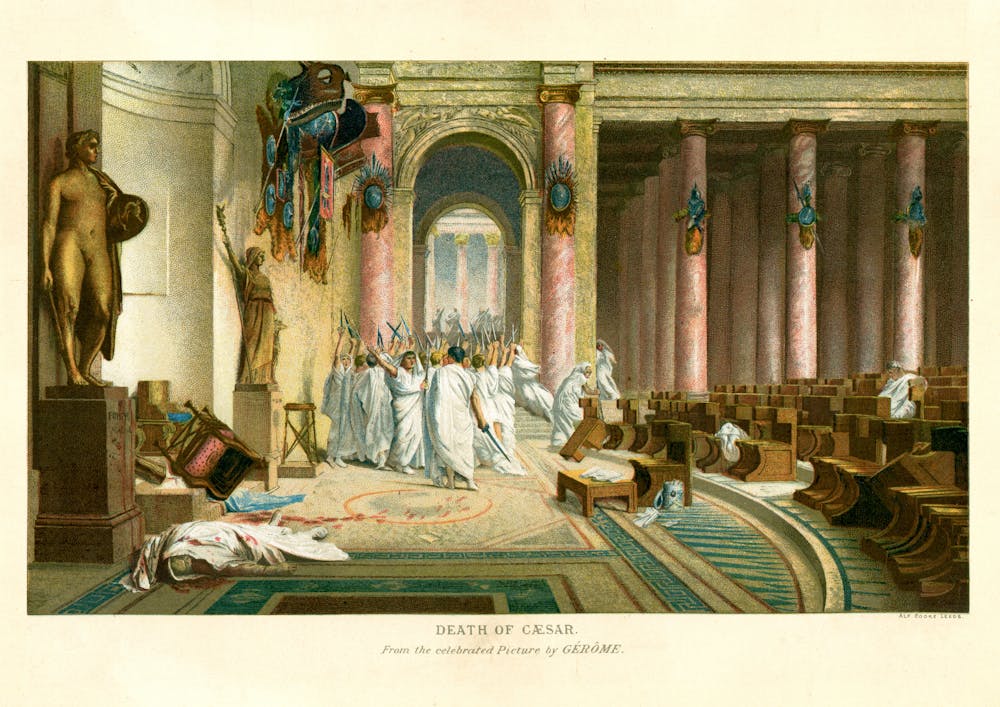
    Soon after, an angry group of 23 senators stabbed him to death in a vain attempt to save the republic. They were led by Marcus Junius Brutus, a descendant of the Brutus who killed the last Roman king, Tarquinius Superbus.

    The Roman republic was beyond saving despite Caesar’s death.
    duncan1890/Getty Images

    However, the Roman republic was beyond saving despite Caesar’s death. His great nephew Octavian eventually emerged as leader and became known as Augustus (27 BCE – 14 CE). With Augustus, an age of emperors was born.

    Emperors were kings in all but name. The strong aversion to kingship in Rome ensured their complete avoidance of the term rex.

    ‘No kings!’

    American protesters waving placards shouting “no kings!” are expressing clear concerns that their beloved democracy is under threat.

    Donald Trump has already declared eight national emergencies and issued 161 executive orders in his second term.

    When asked if he needs to uphold the Constitution, Trump declares “I don’t know.” He has joked about running for a third term as president, in breach of the longstanding limit of two terms.

    Like Caesar, is Donald Trump becoming a king in all but name? Is he setting a precedent for his successors to behave increasingly like emperors?

    The American aversion to “king” likely ensures the term will never return. But when protesters and others shout “no kings!”, they know the very meaning of the term “president” is changing before their eyes.

    Peter Edwell receives funding from the Australian Research Council.

    – ref. ‘No kings!’: like the LA protesters, the early Romans hated kings, too – https://theconversation.com/no-kings-like-the-la-protesters-the-early-romans-hated-kings-too-259011

    MIL OSI – Global Reports –

    June 16, 2025
  • MIL-OSI Global: Seabed mining is becoming an environmental flashpoint – NZ will have to pick a side soon

    Source: The Conversation – Global Perspectives – By Myra Williamson, Senior Lecturer in Law, Auckland University of Technology

    Getty Images

    Seabed mining could become one of the defining environmental battles of 2025. Around the world, governments are weighing up whether to allow mining of the ocean floor for metal ores and minerals. New Zealand is among them.

    The stakes are high. Deep-sea mining is highly controversial, with evidence showing mining activity can cause lasting damage to fragile marine ecosystems. One area off the east coast of the United States, mined as an experiment 50 years ago, still bears scars and shows little sign of recovery.

    With the world facing competing pressures – climate action and conservation versus demand for resources – New Zealand must now decide whether to fast-track mining, regulate it tightly, or pause it entirely.

    Who controls international seabed mining?

    A major flashpoint is governance in international waters. Under international law, seabed mining beyond national jurisdiction is managed by the International Seabed Authority (ISA), created by the United Nations Convention on the Law of the Sea (UNCLOS).

    But the US has never ratified UNCLOS. In April this year, President Donald Trump issued an executive order to bypass the ISA and allow companies to begin mining in international waters.

    The ISA has pushed back, warning unilateral action breaches international law. However, the declaration from the recently concluded UN Ocean Conference in France does not urge countries to adopt a precautionary approach, nor does it ban deep seabed mining.

    The declaration does “reiterate the need to increase scientific knowledge on deep sea ecosystems” and recognises the role of the ISA in setting “robust rules, regulations and procedures for exploitation of resources” in international waters.

    So, while the international community supports multilateralism and international law, deep-sea mining in the near future remains a real possibility.

    Fast-track approvals

    In the Pacific, some countries have already made up their minds about which way they will go. Nauru recently updated its agreement with Canadian-based The Metals Company to begin mining in the nearby Clarion Clipperton Zone. The deal favours the US’s go-it-alone approach over the ISA model.

    By contrast, in 2022, New Zealand’s Labour government backed the ISA’s moratorium and committed to a holistic ocean management strategy. Whether that position still holds is unclear, given the current government’s policies.

    The list of applications under the Fast-track Approvals Act 2024 – described by Regional Development Minister Shane Jones as “arguably the most permissive regime” in Australasia – includes two controversial seabed mining proposals in Bream Bay and off the Taranaki coast:

    • Trans-Tasman Resources’ proposal to extract up to 50 million tonnes of Taranaki seabed material annually to recover heavy mineral sands that contain iron ore as well as rare metal elements titanium and vanadium.

    • McCallum Brothers Ltd’s Bream Bay proposal to dredge up to 150,000 cubic metres of sand yearly for three years, and up to 250,000 cubic metres after that.

    Legal landscape changing

    Māori and environmental groups have opposed the fast-track policy, and the Treaty of Waitangi has so far been a powerful safeguard in seabed mining cases.

    Provisions referencing Treaty principles appear in key laws, including the Crown Minerals Act and the Exclusive Economic Zone and Continental Shelf (Environmental Effects) Act.

    In 2021, the Supreme Court cited these obligations when it rejected a 2016 marine discharge application by Trans-Tasman Resources to mine the seabed in the Taranaki Bight. The court ruled Treaty clauses must be interpreted in a “broad and generous” way, recognising tikanga Māori and customary marine rights.

    But that legal landscape could soon change. The Regulatory Standards Bill, now before parliament, would give priority to property rights over environmental or Indigenous protections in the formulation of new laws and regulations.

    The bill also allows for the review of existing legislation. In theory, if the Regulatory Standards Bill becomes law, it could result in the removal of Treaty principles clauses from legislation.

    This in turn could deny courts the tools they’ve previously used to uphold environmental and Treaty-based protections to block seabed mining applications. That would make it easier to approve fast-tracked projects such as the Bream Bay and Taranaki projects.

    Setting a precedent

    Meanwhile, Hawai’i has gone in a different direction. In 2024, the US state passed a law banning seabed mining in state waters – joining California (2022), Washington (2021) and Oregon (1991).

    Under the Hawai’i Seabed Mining Prevention Act, mining is banned except in rare cases such as beach restoration. The law cites the public’s right to a clean and healthy environment.

    As global conflict brews over seabed governance, New Zealand’s eventual position could set a precedent.

    Choosing to prohibit seabed mining in New Zealand waters, as Hawai’i has done, would send a strong message that environmental stewardship and Indigenous rights matter more than short-term resource extraction interests.

    If New Zealand does decide to go ahead with seabed mining, however, it could trigger a cascade of mining efforts across New Zealand and the Pacific. A crucial decision is fast approaching.

    Myra Williamson does not work for, consult, own shares in or receive funding from any company or organisation that would benefit from this article, and has disclosed no relevant affiliations beyond their academic appointment.

    – ref. Seabed mining is becoming an environmental flashpoint – NZ will have to pick a side soon – https://theconversation.com/seabed-mining-is-becoming-an-environmental-flashpoint-nz-will-have-to-pick-a-side-soon-258908

    MIL OSI – Global Reports –

    June 16, 2025
  • India positioned to become world’s third-largest economy, says PM Modi in Cyprus

    Source: Government of India

    Source: Government of India (4)

    Prime Minister Narendra Modi and the President of Cyprus, Nikos Christodoulides, held a high-level roundtable interaction with business leaders from both India and Cyprus in Limassol on Sunday. The engagement brought together stakeholders from a wide range of sectors including banking, financial institutions, manufacturing, defence, logistics, maritime, shipping, technology, digital innovation, artificial intelligence, IT services, tourism and mobility.

    During the interaction, Prime Minister Modi highlighted India’s robust economic transformation over the last eleven years, noting the country’s consistent growth driven by major reforms, policy stability, and improvements in the Ease of Doing Business.

    “India’s focus on innovation, digital revolution, start-up culture and future-ready infrastructure is positioning it firmly on the path to becoming the world’s third-largest economy,” the Prime Minister said. He noted that sectors such as civil aviation, port and shipbuilding, digital payments, and green development offer promising avenues for cooperation with Cyprus-based enterprises.

    The Prime Minister further pointed to the expansion of sectors such as civil aviation, shipbuilding, digital payments, and green development as avenues of cooperation for Cypriot businesses. He also underlined India’s growing capabilities in new-age industries like AI, Quantum technology, Semiconductors, and Critical Minerals.

    Describing Cyprus as an “important economic partner,” Prime Minister Modi welcomed the island nation’s interest in increasing investments into India, particularly in the Foreign Direct Investment (FDI) domain.

    The interaction also witnessed the announcement of several collaborative initiatives. A Memorandum of Understanding (MoU) was signed between the NSE International Exchange at GIFT City, Gujarat, and the Cyprus Stock Exchange to deepen cooperation in financial markets. In a key development for digital payments, NIPL (NPCI International Payments Limited) and Eurobank Cyprus reached an understanding to introduce Unified Payments Interface (UPI) for cross-border transactions. The move is expected to benefit both tourists and businesses by simplifying payments.

    Prime Minister Modi also welcomed the launch of the India–Greece–Cyprus (IGC) Business and Investment Council. The council is expected to strengthen trilateral cooperation in key sectors such as shipping, logistics, renewable energy, civil aviation and digital services.

    “Indian companies increasingly view Cyprus as a gateway to Europe and a hub for IT services, financial management, and tourism,” said the Prime Minister.

    As Cyprus prepares to assume the Presidency of the European Union Council next year, both leaders reaffirmed their commitment to strengthening the India-EU Strategic Partnership. They expressed optimism about concluding the long-pending India-EU Free Trade Agreement by the end of the year, which would provide a fresh impetus to trade and investment.

    Reflecting on the outcomes of the roundtable, Prime Minister Modi said, “The practical suggestions emerging from today’s discussion will help chart a structured roadmap for deepening cooperation in trade, innovation, and strategic sectors.”

    June 16, 2025
  • India positioned to become world’s third-largest economy, says PM Modi in Cyprus

    Source: Government of India

    Source: Government of India (4)

    Prime Minister Narendra Modi and the President of Cyprus, Nikos Christodoulides, held a high-level roundtable interaction with business leaders from both India and Cyprus in Limassol on Sunday. The engagement brought together stakeholders from a wide range of sectors including banking, financial institutions, manufacturing, defence, logistics, maritime, shipping, technology, digital innovation, artificial intelligence, IT services, tourism and mobility.

    During the interaction, Prime Minister Modi highlighted India’s robust economic transformation over the last eleven years, noting the country’s consistent growth driven by major reforms, policy stability, and improvements in the Ease of Doing Business.

    “India’s focus on innovation, digital revolution, start-up culture and future-ready infrastructure is positioning it firmly on the path to becoming the world’s third-largest economy,” the Prime Minister said. He noted that sectors such as civil aviation, port and shipbuilding, digital payments, and green development offer promising avenues for cooperation with Cyprus-based enterprises.

    The Prime Minister further pointed to the expansion of sectors such as civil aviation, shipbuilding, digital payments, and green development as avenues of cooperation for Cypriot businesses. He also underlined India’s growing capabilities in new-age industries like AI, Quantum technology, Semiconductors, and Critical Minerals.

    Describing Cyprus as an “important economic partner,” Prime Minister Modi welcomed the island nation’s interest in increasing investments into India, particularly in the Foreign Direct Investment (FDI) domain.

    The interaction also witnessed the announcement of several collaborative initiatives. A Memorandum of Understanding (MoU) was signed between the NSE International Exchange at GIFT City, Gujarat, and the Cyprus Stock Exchange to deepen cooperation in financial markets. In a key development for digital payments, NIPL (NPCI International Payments Limited) and Eurobank Cyprus reached an understanding to introduce Unified Payments Interface (UPI) for cross-border transactions. The move is expected to benefit both tourists and businesses by simplifying payments.

    Prime Minister Modi also welcomed the launch of the India–Greece–Cyprus (IGC) Business and Investment Council. The council is expected to strengthen trilateral cooperation in key sectors such as shipping, logistics, renewable energy, civil aviation and digital services.

    “Indian companies increasingly view Cyprus as a gateway to Europe and a hub for IT services, financial management, and tourism,” said the Prime Minister.

    As Cyprus prepares to assume the Presidency of the European Union Council next year, both leaders reaffirmed their commitment to strengthening the India-EU Strategic Partnership. They expressed optimism about concluding the long-pending India-EU Free Trade Agreement by the end of the year, which would provide a fresh impetus to trade and investment.

    Reflecting on the outcomes of the roundtable, Prime Minister Modi said, “The practical suggestions emerging from today’s discussion will help chart a structured roadmap for deepening cooperation in trade, innovation, and strategic sectors.”

    June 16, 2025
  • Iran and Israel Exchange Fresh Strikes as Global Leaders Push for Ceasefire

    Source: Government of India

    Source: Government of India (4)

    The war between Iran and Israel is in its fourth day of direct hostilities as international diplomatic activity is in full swing to prevent the conflict from engulfing broader West Asia. While ongoing military operations have killed dozens of people and caused widespread destruction, a complex matrix of behind-the-scenes negotiations is underway among world powers and regional actors desperately trying to contain the crisis.

    Iran launched missile strikes on Israeli cities , with rockets striking Haifa and injuring at least 15 in Israel’s National Emergency Service. The attacks were launched as residents in Tehran reported shaking explosions throughout the capital city, with Iranian officials confirming missile strikes in the Niavaran and Tajrish neighborhoods in the northern part of the city, as well as in and around central Valiasr and Hafte Tir squares.

    Israeli forces have expanded their campaign beyond Tehran to cities including Shiraz and Isfahan, where a Defense Ministry military base was hit. The Israeli military announced it had conducted its longest-range strike since the fighting began, striking an aerial refueling aircraft at Mashhad Airport in eastern Iran. Well over 250 Iranian targets have been hit in the expanding military campaign, including what Israel identifies as nuclear command and control centers and key energy targets. The situation is still complex and fraught with difficulties. Now, Iranian officials refer to negotiations with USA as unjustifiable amid current Israeli aggression, and Iran has stopped attending nuclear negotiations that were supposed to be carried out in Oman.

    Iran’s Foreign Minister Abbas Aragchi has indicated readiness for nuclear agreements that ensure Iran does not pursue weapons development, but insists the country will not accept any deal that deprives it of nuclear rights.

    Behind closed doors, Iran has approached Qatar and Oman requesting them to act as intermediaries with the United States to facilitate ceasefire negotiations, while Saudi Arabia is reportedly involved in diplomatic efforts to de-escalate the situation. US President Donald Trump has expressed optimism about peace prospects, stating he anticipates a deal soon through ongoing calls and meetings to broker an agreement. International diplomatic efforts have accelerated as global leaders warn of the urgent need to prevent the conflict from spilling over to the rest of the Middle East, with multiple regional powers working frantically to halt what they describe as a spiral of violence causing irreparable economic and civil damage to both sides.

    The United Nations Security Council convened an emergency session where both nations presented diametrically opposing positions. Iran labeled Israel’s strike a declaration of war, while Israel justified its attack as legitimate self-defense after failed diplomacy. The session failed to produce a binding resolution, which was indicative of the failure of the international community to agree on anything.

    European leaders have called for diplomatic solutions but appear to have limited influence in the conflict, with analysts saying Europe is on the sidelines. Cyprus has played a minor role, with its president reportedly having carried messages between Israel and Iran through indirect intermediaries.

    Israel remains extremely skeptical of Iranian intentions and has continued its military push despite diplomatic progress. Israeli leaders have warned Iran to vacate nuclear facilities while calling for the United States to assist efforts at abandoning Iran’s nuclear program entirely. The Israeli government has shown little desire to stop activities without concrete Iranian concessions.

    Stakes have also increased as Iran threatened that Western assistance to Israel in downing missiles can result in targeting US, UK, and French military assets throughout the region. The threat has complicated diplomacy as Washington has already provided defensive assistance to Israel while publicly urging restraint.

    In spite of active diplomatic contacts with various regional mediators and ongoing US engagement, prospects for an immediate ceasefire are uncertain.

    June 16, 2025
  • Iran and Israel Exchange Fresh Strikes as Global Leaders Push for Ceasefire

    Source: Government of India

    Source: Government of India (4)

    The war between Iran and Israel is in its fourth day of direct hostilities as international diplomatic activity is in full swing to prevent the conflict from engulfing broader West Asia. While ongoing military operations have killed dozens of people and caused widespread destruction, a complex matrix of behind-the-scenes negotiations is underway among world powers and regional actors desperately trying to contain the crisis.

    Iran launched missile strikes on Israeli cities , with rockets striking Haifa and injuring at least 15 in Israel’s National Emergency Service. The attacks were launched as residents in Tehran reported shaking explosions throughout the capital city, with Iranian officials confirming missile strikes in the Niavaran and Tajrish neighborhoods in the northern part of the city, as well as in and around central Valiasr and Hafte Tir squares.

    Israeli forces have expanded their campaign beyond Tehran to cities including Shiraz and Isfahan, where a Defense Ministry military base was hit. The Israeli military announced it had conducted its longest-range strike since the fighting began, striking an aerial refueling aircraft at Mashhad Airport in eastern Iran. Well over 250 Iranian targets have been hit in the expanding military campaign, including what Israel identifies as nuclear command and control centers and key energy targets. The situation is still complex and fraught with difficulties. Now, Iranian officials refer to negotiations with USA as unjustifiable amid current Israeli aggression, and Iran has stopped attending nuclear negotiations that were supposed to be carried out in Oman.

    Iran’s Foreign Minister Abbas Aragchi has indicated readiness for nuclear agreements that ensure Iran does not pursue weapons development, but insists the country will not accept any deal that deprives it of nuclear rights.

    Behind closed doors, Iran has approached Qatar and Oman requesting them to act as intermediaries with the United States to facilitate ceasefire negotiations, while Saudi Arabia is reportedly involved in diplomatic efforts to de-escalate the situation. US President Donald Trump has expressed optimism about peace prospects, stating he anticipates a deal soon through ongoing calls and meetings to broker an agreement. International diplomatic efforts have accelerated as global leaders warn of the urgent need to prevent the conflict from spilling over to the rest of the Middle East, with multiple regional powers working frantically to halt what they describe as a spiral of violence causing irreparable economic and civil damage to both sides.

    The United Nations Security Council convened an emergency session where both nations presented diametrically opposing positions. Iran labeled Israel’s strike a declaration of war, while Israel justified its attack as legitimate self-defense after failed diplomacy. The session failed to produce a binding resolution, which was indicative of the failure of the international community to agree on anything.

    European leaders have called for diplomatic solutions but appear to have limited influence in the conflict, with analysts saying Europe is on the sidelines. Cyprus has played a minor role, with its president reportedly having carried messages between Israel and Iran through indirect intermediaries.

    Israel remains extremely skeptical of Iranian intentions and has continued its military push despite diplomatic progress. Israeli leaders have warned Iran to vacate nuclear facilities while calling for the United States to assist efforts at abandoning Iran’s nuclear program entirely. The Israeli government has shown little desire to stop activities without concrete Iranian concessions.

    Stakes have also increased as Iran threatened that Western assistance to Israel in downing missiles can result in targeting US, UK, and French military assets throughout the region. The threat has complicated diplomacy as Washington has already provided defensive assistance to Israel while publicly urging restraint.

    In spite of active diplomatic contacts with various regional mediators and ongoing US engagement, prospects for an immediate ceasefire are uncertain.

    June 16, 2025
  • PM Modi’s Visit to Strengthen India-EU Ties, says EAM Jaishankar on meeting Cyprus counterpart

    Source: Government of India

    Source: Government of India (4)

    External Affairs Minister (EAM) S. Jaishankar met the Cyprus Foreign Minister Constantinos Kombos on Sunday (local time) on his arrival at the Larnaca International Airport in Limassol and said that he was confident that that “Prime Minister Narendra Modi’s visit to the Mediterranean nation will deepen our longstanding bilateral ties and the partnership between India and the European Union.

    Taking to his official X account, EAM Jaishankar said: “Delighted to meet FM @ckombos of Cyprus on my arrival at Larnaca. Confident that PM @narendramodi’s visit to Cyprus will deepen our longstanding bilateral ties and the India-EU partnership.”

    Earlier on Sunday, Prime Minister Narendra Modi reached Cyprus, heralding the start of his three-nation tour, including Canada and Croatia. The pictures of his arrival in Cyprus were shared by Prime Minister Narendra Modi on his X account.

    PM Modi was received and given a warm welcome at the airport by the Cyprus President Nikos Christodoulides as well as Finance Minister Constantinos Kombos, reflecting the deep-rooted historic ties between the two nations.

    The Cyprus President also took to X to welcome PM Modi, as he wrote: “Welcome to Cyprus Prime Minister Narendra Modi! Here, at the EU’s southeastern frontier and gateway of the Mediteranean A historic visit A new chapter in a strategic partnership that knows no limits We make a promise to advance, transform, prosper more. Together.”

    PM Modi also note of the special gesture of Cyprus President and reciprocated on his social media handle, “Landed in Cyprus. My gratitude to the President of Cyprus, Mr. Nikos Christodoulides for the special gesture of welcoming me at the airport. This visit will add significant momentum to India-Cyprus relations, especially in areas like trade, investment and more.”

    Notably, this is the first visit by an Indian Prime Minister to Cyprus in over two decades. During the visit, the two leaders are set to take part in extensive discussions for deepening bilateral ties and also explore ways to strengthen cooperation in trade, investment, security, and technology.

    Prior to his departure for three-nation tour, PM Modi described Cyprus as “a close friend and an important partner in the Mediterranean region and the EU”.

    He added that the visit was an opportunity to build on the historical friendship between the two nations and promote people-to-people exchanges.

    Cyprus, a member of the European Union is set to assume the ‘rotating presidency’ of the EU, early next year. PM Modi’s visit is seen as part of India’s consistent diplomatic outreach to Europe.

    After Cyprus visit, PM Modi will head to Canada to attend the G7 Summit and will then travel to Croatia for meetings with President Zoran Milanovic and Prime Minister Andrej Plenkovic. (IANS)

    June 16, 2025
  • PM Modi’s Visit to Strengthen India-EU Ties, says EAM Jaishankar on meeting Cyprus counterpart

    Source: Government of India

    Source: Government of India (4)

    External Affairs Minister (EAM) S. Jaishankar met the Cyprus Foreign Minister Constantinos Kombos on Sunday (local time) on his arrival at the Larnaca International Airport in Limassol and said that he was confident that that “Prime Minister Narendra Modi’s visit to the Mediterranean nation will deepen our longstanding bilateral ties and the partnership between India and the European Union.

    Taking to his official X account, EAM Jaishankar said: “Delighted to meet FM @ckombos of Cyprus on my arrival at Larnaca. Confident that PM @narendramodi’s visit to Cyprus will deepen our longstanding bilateral ties and the India-EU partnership.”

    Earlier on Sunday, Prime Minister Narendra Modi reached Cyprus, heralding the start of his three-nation tour, including Canada and Croatia. The pictures of his arrival in Cyprus were shared by Prime Minister Narendra Modi on his X account.

    PM Modi was received and given a warm welcome at the airport by the Cyprus President Nikos Christodoulides as well as Finance Minister Constantinos Kombos, reflecting the deep-rooted historic ties between the two nations.

    The Cyprus President also took to X to welcome PM Modi, as he wrote: “Welcome to Cyprus Prime Minister Narendra Modi! Here, at the EU’s southeastern frontier and gateway of the Mediteranean A historic visit A new chapter in a strategic partnership that knows no limits We make a promise to advance, transform, prosper more. Together.”

    PM Modi also note of the special gesture of Cyprus President and reciprocated on his social media handle, “Landed in Cyprus. My gratitude to the President of Cyprus, Mr. Nikos Christodoulides for the special gesture of welcoming me at the airport. This visit will add significant momentum to India-Cyprus relations, especially in areas like trade, investment and more.”

    Notably, this is the first visit by an Indian Prime Minister to Cyprus in over two decades. During the visit, the two leaders are set to take part in extensive discussions for deepening bilateral ties and also explore ways to strengthen cooperation in trade, investment, security, and technology.

    Prior to his departure for three-nation tour, PM Modi described Cyprus as “a close friend and an important partner in the Mediterranean region and the EU”.

    He added that the visit was an opportunity to build on the historical friendship between the two nations and promote people-to-people exchanges.

    Cyprus, a member of the European Union is set to assume the ‘rotating presidency’ of the EU, early next year. PM Modi’s visit is seen as part of India’s consistent diplomatic outreach to Europe.

    After Cyprus visit, PM Modi will head to Canada to attend the G7 Summit and will then travel to Croatia for meetings with President Zoran Milanovic and Prime Minister Andrej Plenkovic. (IANS)

    June 16, 2025
  • MIL-OSI Banking: [Interview] Samsung Onyx Meets Golden Globes® Winner Matīss Kaža, Producer of Flow

    Source: Samsung

    “Is the cat black or is it dark gray? There is this debate online.
    If you watch it on Onyx, you get the answer.”
    — Matīss Kaža, co-writer and co-producer of Flow (2024)
     
    Visual and immersive storytelling is central to how a film is experienced on the big screen by moviegoers. As more people seek premier theater experiences, filmmakers are increasingly embracing cinema LED screens over projectors to deliver their creations in a way audiences haven’t experienced before, fully immersing the viewer in the worlds they create.
     
    Following the launch of the latest Samsung Onyx (ICD), Matīss Kaža, Golden Globes® winner, Academy Award® winner and producer of the film Flow, shared his insights on how Onyx is pushing the boundaries in cinema.
     

    Matīss Kaža is a Latvian director, writer and producer, renowned for co-writing and co-producing the animated film Flow (2024), which won a Golden Globe® Award for Best Motion Picture — Animated, an Academy Award® for Best Animated Feature, a Toronto International Film Festival — Best Animated Film, a European Film Awards for European Animated Feature Film, and more. His projects have a strong sense of authorship and cinematic vision that resonates beyond national borders.


    Q: Could you tell us a bit about what the film Flow is about?
     
    Flow is an animated film, without any dialogue, telling the story of a solitary, individualist cat who likes to be by himself. Then suddenly comes this huge flood, destroying the cat’s home and forcing it upon a boat with other animals. On this boat, the cat learns to collaborate and become friends with these animals to survive this new, beautiful and humanless world.
     
    ▲ Matīss Kaža shares his experience of watching his work on Samsung Onyx. (Poster: Courtesy of Sideshow and Janus Films)
     
     
    Q: As a dialogue-free film, how does a Cinema LED screen enhance the viewing experience for the audience?
     
    One of the goals of Flow as a dialogue-free film is to essentially have the audience come as close to the cat’s experience as possible, since the film is built around the contrast between the main protagonist and the world around it. Cinema is all about detailing in the visual storytelling, and this comes through on Onyx very well. The world is vividly colorful with the yellows, greens and blues — and then the cat is dark gray. There’s a huge contrast that shines through when watching on the Onyx screen, with its vivid colors and deep blacks.
     
    ▲ Flow, played on Samsung Onyx
     
     
    Q: How did the team work through the movements of each of the animals?
     
    We studied the movements of these real animals, down to the most meticulous detail, to make sure our approach to the film was naturalistic for the audience. For example, when something attracts the cat’s attention, rather than twisting its head to look, it would just twist the ear.
     
    Each animal moves in different ways and has different silhouettes, weights and verticality. It was important for us to nail this process when making the film for the audience to feel fully immersed in this world.


    ▲ Courtesy of Sideshow and Janus Films
     
     
    Q: How did it feel to watch Flow on the Samsung Onyx Cinema LED screen?
     
    Many scenes in the film feature foreground and background interactions, and the audience can fully enjoy and experience exactly how we wanted the film to look. The movements are also very clear, and you can see how all the different characters have their particularities, down to the most subtle interactions. From the smallest twitching in the ear and the smallest gaze of the eye, or any little interaction, the level of detail on Onyx makes these perfectly visible for the audience.
     
    “I would have to say that Flow on the Onyx screen really flows.”
     
     
    Q: Did you notice anything new or different about Flow after seeing it on Samsung Onyx?
     
    How vivid the color was in the beginning — where the cat is still in its home, which is a lovely sculpture garden — really stood out to me. The finer details, like the little butterflies and critters flying around, give this emotion of calmness that might not be noticeable on other screens. The Onyx truly shows the film for what it is — there is very crisp detail and clarity — and it displays things that would go unnoticed in other situations.
     
    “On the Onyx, these little details were perfectly visible —
    details which give a lot to the atmosphere, to the peaceful tone of the scene.”


    ▲ Flow, played on Samsung Onyx
     
     
    Q: Water is a core element of the film. Can you tell us more about its purpose and how the team uses it to add to the story?
     
    The most difficult part of making this movie is the water effect. The dynamics of the water in the storytelling is really important because it’s one of the central metaphors of the film.
     
    On an Onyx screen, you can explicitly see the difference between the little waves in the puddle at the beginning and end of the film. These details are so important to the storytelling, and it really comes through here on the Onyx.
     
    ▲ Courtesy of Sideshow and Janus Films
     
     
    Q: How do the color, image details and storytelling jump out more on a screen like Onyx compared to other traditional methods?
     
    Because there is no dialogue in this film, we relied solely on visual storytelling. In terms of visual storytelling, color is essential — setting the right levels of contrast and the exact color palette — for the scene. It’s what creates the mood and the atmosphere.
     
    These aspects are fundamental to the film and are captured precisely, just as we intended. Every detail and color really shines on the Onyx screen.
     
    ▲ “Cinema is all about detailing in the storytelling, it always comes through detail. And that comes through on the Onyx,” says Matīss Kaža, co-writer and co-producer of animated film Flow (2024).
     
     
    Q: As a filmmaker, do the capabilities of Onyx help inspire your creative direction for upcoming projects?
     
    I love it when the theatrical experience has me in the middle of the experience, trying to decode what is going on. Filmmakers can do a lot of interesting things using environments, visuals and powerful storytelling to put audience members in an active relationship with the film. The crispness and range of colors offered on the Onyx bring us back to why we love seeing motion pictures on the big screen. It’s super immersive, and the level of detailing is just incredible.
     
     
    Q: Anything else you would like us to know?
     
    “I do filmmaking for the cinema-going experience;
    that’s where the film really shines.”
     
    Cinemas are where you see the picture as you’re supposed to see it. Every cinematographer and director, I think, has had to come to terms with different cinemas showing different images when using traditional projection. With the uniform approach that the Onyx has, I think that problem might be solved.
     

    “Every detail and color really shines on the Onyx screen,” says Matīss Kaža, co-writer and co-producer of animated film Flow (2024).

    MIL OSI Global Banks –

    June 16, 2025
  • MIL-OSI China: Chinese climber Pan makes history with victory in Bern

    Source: People’s Republic of China – State Council News

    Pan Yufei became the first Chinese climber to win the men’s Boulder event at the International Federation of Sport Climbing World Cup, edging out France’s Mejdi Schalck by 0.1 points on Sunday.

    Pan, whose previous best finish was fifth in Prague, the Czech Republic, last weekend, overtook Schalck in the final run on M4, topping out on his second attempt to score 84.2 points.

    Schalck had been in control for most of the final, topping M1, M2 and M3, but failed on M4 and finished with 84.1 points.

    “It feels unreal. My mind was so empty,” Pan said. “The last few years have been really tough for myself, I struggled so much and I thought I was not good enough. At the beginning of the season it was not so good, but this time I just wanted to enjoy myself.”

    Pan finished 12th at the 2024 Paris Olympic Games but did not qualify for the final of the men’s combined event, which includes both Boulder and Lead climbing.

    MIL OSI China News –

    June 16, 2025
  • MIL-Evening Report: Seabed mining is becoming an environmental flashpoint – NZ will have to pick a side soon

    Source: The Conversation (Au and NZ) – By Myra Williamson, Senior Lecturer in Law, Auckland University of Technology

    Getty Images

    Seabed mining could become one of the defining environmental battles of 2025. Around the world, governments are weighing up whether to allow mining of the ocean floor for metal ores and minerals. New Zealand is among them.

    The stakes are high. Deep-sea mining is highly controversial, with evidence showing mining activity can cause lasting damage to fragile marine ecosystems. One area off the east coast of the United States, mined as an experiment 50 years ago, still bears scars and shows little sign of recovery.

    With the world facing competing pressures – climate action and conservation versus demand for resources – New Zealand must now decide whether to fast-track mining, regulate it tightly, or pause it entirely.

    Who controls international seabed mining?

    A major flashpoint is governance in international waters. Under international law, seabed mining beyond national jurisdiction is managed by the International Seabed Authority (ISA), created by the United Nations Convention on the Law of the Sea (UNCLOS).

    But the US has never ratified UNCLOS. In April this year, President Donald Trump issued an executive order to bypass the ISA and allow companies to begin mining in international waters.

    The ISA has pushed back, warning unilateral action breaches international law. However, the declaration from the recently concluded UN Ocean Conference in France does not urge countries to adopt a precautionary approach, nor does it ban deep seabed mining.

    The declaration does “reiterate the need to increase scientific knowledge on deep sea ecosystems” and recognises the role of the ISA in setting “robust rules, regulations and procedures for exploitation of resources” in international waters.

    So, while the international community supports multilateralism and international law, deep-sea mining in the near future remains a real possibility.

    Fast-track approvals

    In the Pacific, some countries have already made up their minds about which way they will go. Nauru recently updated its agreement with Canadian-based The Metals Company to begin mining in the nearby Clarion Clipperton Zone. The deal favours the US’s go-it-alone approach over the ISA model.

    By contrast, in 2022, New Zealand’s Labour government backed the ISA’s moratorium and committed to a holistic ocean management strategy. Whether that position still holds is unclear, given the current government’s policies.

    The list of applications under the Fast-track Approvals Act 2024 – described by Regional Development Minister Shane Jones as “arguably the most permissive regime” in Australasia – includes two controversial seabed mining proposals in Bream Bay and off the Taranaki coast:

    • Trans-Tasman Resources’ proposal to extract up to 50 million tonnes of Taranaki seabed material annually to recover heavy mineral sands that contain iron ore as well as rare metal elements titanium and vanadium.

    • McCallum Brothers Ltd’s Bream Bay proposal to dredge up to 150,000 cubic metres of sand yearly for three years, and up to 250,000 cubic metres after that.

    Legal landscape changing

    Māori and environmental groups have opposed the fast-track policy, and the Treaty of Waitangi has so far been a powerful safeguard in seabed mining cases.

    Provisions referencing Treaty principles appear in key laws, including the Crown Minerals Act and the Exclusive Economic Zone and Continental Shelf (Environmental Effects) Act.

    In 2021, the Supreme Court cited these obligations when it rejected a 2016 marine discharge application by Trans-Tasman Resources to mine the seabed in the Taranaki Bight. The court ruled Treaty clauses must be interpreted in a “broad and generous” way, recognising tikanga Māori and customary marine rights.

    But that legal landscape could soon change. The Regulatory Standards Bill, now before parliament, would give priority to property rights over environmental or Indigenous protections in the formulation of new laws and regulations.

    The bill also allows for the review of existing legislation. In theory, if the Regulatory Standards Bill becomes law, it could result in the removal of Treaty principles clauses from legislation.

    This in turn could deny courts the tools they’ve previously used to uphold environmental and Treaty-based protections to block seabed mining applications. That would make it easier to approve fast-tracked projects such as the Bream Bay and Taranaki projects.

    Setting a precedent

    Meanwhile, Hawai’i has gone in a different direction. In 2024, the US state passed a law banning seabed mining in state waters – joining California (2022), Washington (2021) and Oregon (1991).

    Under the Hawai’i Seabed Mining Prevention Act, mining is banned except in rare cases such as beach restoration. The law cites the public’s right to a clean and healthy environment.

    As global conflict brews over seabed governance, New Zealand’s eventual position could set a precedent.

    Choosing to prohibit seabed mining in New Zealand waters, as Hawai’i has done, would send a strong message that environmental stewardship and Indigenous rights matter more than short-term resource extraction interests.

    If New Zealand does decide to go ahead with seabed mining, however, it could trigger a cascade of mining efforts across New Zealand and the Pacific. A crucial decision is fast approaching.

    Myra Williamson does not work for, consult, own shares in or receive funding from any company or organisation that would benefit from this article, and has disclosed no relevant affiliations beyond their academic appointment.

    – ref. Seabed mining is becoming an environmental flashpoint – NZ will have to pick a side soon – https://theconversation.com/seabed-mining-is-becoming-an-environmental-flashpoint-nz-will-have-to-pick-a-side-soon-258908

    MIL OSI Analysis – EveningReport.nz –

    June 16, 2025
  • MIL-OSI Europe: Meeting with the Chancellor of the Federal Republic of Germany, Friedrich Merz

    Source: Government of Italy (English)

    Vai al Contenuto Raggiungi il piè di pagina

    15 Giugno 2025

    The President of the Council of Ministers, Giorgia Meloni, met with the Chancellor of the Federal Republic of Germany, Friedrich Merz, today, on the eve of the G7 Summit in Kananaskis.

    Coming shortly after their recent talks at Palazzo Chigi, today’s meeting provided an opportunity to confirm the shared will to hold a new edition of the Italy-Germany intergovernmental summit in Rome at the beginning of 2026 and to maintain close coordination on the main issues on the EU agenda, such as the fight against irregular migration and competitiveness.

    Lastly, the meeting also allowed for an exchange of views on the most recent developments in the Middle East and on the war in Ukraine, in the context of transatlantic relations and in view of the upcoming NATO Summit in The Hague.

    MIL OSI Europe News –

    June 16, 2025
  • MIL-OSI Europe: Meeting with the Prime Minister of the United Kingdom, Keir Starmer

    Source: Government of Italy (English)

    The President of the Council of Ministers, Giorgia Meloni, met with the Prime Minister of the United Kingdom, Keir Starmer, today, on the eve of the G7 Summit in Kananaskis.

    The meeting provided an opportunity for an in-depth discussion on the most pressing issues on the international agenda, starting with the situation in the Middle East and the conflict in Ukraine.
    During the meeting, close coordination also continued regarding both the G7 agenda and in view of the NATO Summit in The Hague, with a full convergence of views being noted.

    Lastly, the two leaders reviewed the main areas of bilateral collaboration, especially in the fields of energy, investment promotion, and security and defence, with particular reference to the strategic Global Combat Air Programme (GCAP), as well as the increasingly fruitful cooperation in combating irregular migration and fighting human trafficking.

    MIL OSI Europe News –

    June 16, 2025
  • MIL-OSI Economics: Huawei’s FDD Tri-Band Massive MIMO Wins Red Dot Design Award 2025

    Source: Huawei

    Headline: Huawei’s FDD Tri-Band Massive MIMO Wins Red Dot Design Award 2025

    [Shenzhen, China, June 16, 2025] At Germany’s prestigious Red Dot Award Design Competition, Huawei’s FDD tri-band Massive MIMO earned the Red Dot Design Award for its exceptional performance and lean, energy-efficient design.

    The award-winning FDD tri-band Massive MIMO

    Since its commercial debut in Nigeria with MTN—Africa’s largest mobile operator—this February, Huawei’s FDD tri-band Massive MIMO has been tested and deployed on over 20 networks across the globe. The solution delivers significant value to operators’ customers by relieving traffic demand on 4G networks, providing deep and wide 5G coverage, and enabling enhanced 5G-A uplink. The solution simultaneously delivers five leading technological advantages:

    Simplified ultra-wideband: The solution supports industry-leading, high-power 720 W output, while employing cutting-edge Real Wide Bandwidth and Compact Dipole technologies. This realizes unified operations across three bands (such as 1.8 GHz, 2.1 GHz, and 2.6 GHz, or AWS, PCS, and 2.6 GHz) within a single form factor whose size is equivalent to a conventional two-band Massive MIMO device. This enables the solution to boost both frequency bands and power capabilities without increasing size or wind load.
    Ultimate capacity: This solution is an effective enabler for 4G, 5G, and 5G-A. It can deliver 3-fold to 4-fold downlink capacity gains on 4G networks, which can increase to 7-fold in NR over LTE 4T4R, thereby effectively alleviating network congestion.
    Enhanced uplink: By leveraging M-Receiver technology, the solution realizes 5-fold uplink capacity and 10 dB uplink coverage gains compared to LTE 4T4R, fulfilling new demands of the mobile AI era that are typified by HD streaming and security, multimodal AI interactions, and autonomous driving.
    Native beamforming: Tri-band Massive MIMO traditionally increases interference due to the addition of extra beams. However, supported by enhanced intelligent beam scheduling and intelligent beamforming, Huawei’s tri-band Massive MIMO enables dynamic beam movement with users and intelligent interference avoidance, boosting user experience by 20% to 30%.
    Energy saving: The innovative GigaGreen architecture supports “0 bit 0 watt”, enabling ultra-deep dormancy during low-traffic periods and instant wake-up when traffic increases, meaning substantial reductions in overall network power consumption.

    “We have prioritized innovation in order to provide customers with wireless products that deliver unparalleled performance in terms of user experience, network capacity, energy efficiency, and simplified deployment. It is our mission to help operators build premium networks that offer improved efficiency and cost-performance. This award for tri-band Massive MIMO represents the industry’s recognition of our innovative design. Moving forward, we will continue down the path of innovation and escort our operator partners as they strive towards greater business success,” said Fang Xiang, Vice President of Huawei Wireless Network Product Line.

    MIL OSI Economics –

    June 16, 2025
  • MIL-OSI Economics: Huawei’s FDD Tri-Band Massive MIMO Wins Red Dot Design Award 2025

    Source: Huawei

    Headline: Huawei’s FDD Tri-Band Massive MIMO Wins Red Dot Design Award 2025

    [Shenzhen, China, June 16, 2025] At Germany’s prestigious Red Dot Award Design Competition, Huawei’s FDD tri-band Massive MIMO earned the Red Dot Design Award for its exceptional performance and lean, energy-efficient design.

    The award-winning FDD tri-band Massive MIMO

    Since its commercial debut in Nigeria with MTN—Africa’s largest mobile operator—this February, Huawei’s FDD tri-band Massive MIMO has been tested and deployed on over 20 networks across the globe. The solution delivers significant value to operators’ customers by relieving traffic demand on 4G networks, providing deep and wide 5G coverage, and enabling enhanced 5G-A uplink. The solution simultaneously delivers five leading technological advantages:

    Simplified ultra-wideband: The solution supports industry-leading, high-power 720 W output, while employing cutting-edge Real Wide Bandwidth and Compact Dipole technologies. This realizes unified operations across three bands (such as 1.8 GHz, 2.1 GHz, and 2.6 GHz, or AWS, PCS, and 2.6 GHz) within a single form factor whose size is equivalent to a conventional two-band Massive MIMO device. This enables the solution to boost both frequency bands and power capabilities without increasing size or wind load.
    Ultimate capacity: This solution is an effective enabler for 4G, 5G, and 5G-A. It can deliver 3-fold to 4-fold downlink capacity gains on 4G networks, which can increase to 7-fold in NR over LTE 4T4R, thereby effectively alleviating network congestion.
    Enhanced uplink: By leveraging M-Receiver technology, the solution realizes 5-fold uplink capacity and 10 dB uplink coverage gains compared to LTE 4T4R, fulfilling new demands of the mobile AI era that are typified by HD streaming and security, multimodal AI interactions, and autonomous driving.
    Native beamforming: Tri-band Massive MIMO traditionally increases interference due to the addition of extra beams. However, supported by enhanced intelligent beam scheduling and intelligent beamforming, Huawei’s tri-band Massive MIMO enables dynamic beam movement with users and intelligent interference avoidance, boosting user experience by 20% to 30%.
    Energy saving: The innovative GigaGreen architecture supports “0 bit 0 watt”, enabling ultra-deep dormancy during low-traffic periods and instant wake-up when traffic increases, meaning substantial reductions in overall network power consumption.

    “We have prioritized innovation in order to provide customers with wireless products that deliver unparalleled performance in terms of user experience, network capacity, energy efficiency, and simplified deployment. It is our mission to help operators build premium networks that offer improved efficiency and cost-performance. This award for tri-band Massive MIMO represents the industry’s recognition of our innovative design. Moving forward, we will continue down the path of innovation and escort our operator partners as they strive towards greater business success,” said Fang Xiang, Vice President of Huawei Wireless Network Product Line.

    MIL OSI Economics –

    June 16, 2025
  • MIL-OSI China: China lose to Turkey to wrap up VNL Xi’an leg

    Source: People’s Republic of China – State Council News

    Host China lost to Turkey 3-0 at the 2025 FIVB Men’s Volleyball Nations League Xi’an leg on Sunday, wrapping up the opening leg with two wins and two defeats.

    After conceding its opener to Japan, China bounced back with back-to-back victories over Serbia and the Netherlands. Turkey, meanwhile, had suffered three consecutive losses before the encounter with China.

    Ramazan Efe Mandiraci (L) of Türkiye vies with Jiang Chuan of China during the Pool 3 match between China and Türkiye at the Men’s Volleyball Nations League (VNL) 2025 in Xi’an, northwest China’s Shaanxi Province, June 15, 2025. (Xinhua/Zhang Bowen)

    Turkey came out strong in the first set, taking advantage of powerful attacking to win 25-22. China raced to a 5-2 lead in the second set, but Turkey’s superior blocking shut down China’s attack to win the second set 25-21.

    China once again started fast in the third set, surging into a 5-2 lead, but Turkey countered with a four-point run to flip the score. In the final stages, Turkey pulled away with a decisive 6-2 run to close out the match 25-20, registering its first win of the season.

    China captain Jiang Chuan admitted frustration after the defeat, pointing to execution and endurance issues as key factors. “After the first three matches, we were quite fatigued physically in the fourth match, but that’s not an excuse. We need to learn how to handle such situations,” he said.

    Despite the loss, China head coach Vital Heynen expressed satisfaction with his team’s performance, especially with key players like Zhang Jingyin and Wang Jingyi sidelined with injury. “We have to be realistic that we came here without two core players. We made one good step already, winning two matches in the tournament,” he said.

    According to the schedule, China will next compete in the Chicago leg in late June, followed by the Gdansk leg in mid-July.

    Heynen emphasized that his team will not fear strong opponents, whether at home or abroad. “This year in VNL, a lot of teams are at the same level, so there will be a chance in other matches also. It will be about us. When we get better, we will get more matches,” he added.

    In other matches on Sunday, Poland beat Serbia 3-0 (25-21, 25-20, 25-23) to stay undefeated, while Japan swept the Netherlands 3-0 (25-18, 25-23, 25-18).

    MIL OSI China News –

    June 16, 2025
  • MIL-OSI China: Italy name World Cup winner Gattuso as manager

    Source: People’s Republic of China – State Council News

    Former AC Milan midfielder Gennaro Gattuso has been appointed head coach of Italy’s national football team, the Italian Football Federation (FIGC) confirmed Sunday, just days after Luciano Spalletti’s departure.

    Spalletti had taken charge of the Azzurri in August 2023 on a reported three-year deal, but resigned following a disappointing Euro 2024 campaign and a 3-0 loss to Norway in Italy’s opening 2026 World Cup qualifier earlier this month.

    Gennaro Gattuso, then head coach of Valencia, instructs players during the Orange Trophy match between Valencia CF of Spain and Atalanta of Italy in Valencia, Spain, on Aug. 6, 2022. (Photo by Pablo Morano/Xinhua)

    At a press conference prior to Italy’s second qualifier against Moldova, Spalletti announced he would step down after the match, despite Italy bouncing back with a 2-0 win.

    Gattuso, 47, spent the majority of his playing career with AC Milan, where he helped the Rossoneri to two Serie A titles and two UEFA Champions League crowns. He was also part of Italy’s 2006 World Cup-winning squad.

    Since hanging up his boots in 2013, Gattuso has coached the likes of AC Milan, Napoli, Valencia and Marseille, and most recently spent the 2024/25 at the helm of Croatian side Hajduk Split.

    Italy currently sits third in World Cup Qualifying Group I with three points from two matches, while Norway leads the group with four straight wins.

    Only group winners from UEFA’s qualifiers will book direct spots to the 2026 tournament. Second-place teams will enter a playoff round – a scenario that has haunted Italy in recent years, with the Azzurri missing the last two World Cups after playoff defeats. 

    MIL OSI China News –

    June 16, 2025
  • MIL-Evening Report: ‘No kings!’: like the LA protesters, the early Romans hated kings, too

    Source: The Conversation (Au and NZ) – By Peter Edwell, Associate Professor in Ancient History, Macquarie University

    Protesters across the United States have brandished placards declaring “no kings!” in recent days, keen to send a message one-man rule is not acceptable.

    The defeat of the forces of King George III in the United States’ revolutionary war of 1775–83 saw the end of royal rule in the US. Touting itself as the world’s leading democracy, kings have not been welcome in America for 250 years. But for many, Donald Trump is increasingly behaving as one and now is the time to stop him.

    Having studied ancient Roman politics for years, America’s rejection of kingship reminds me vividly of the strong aversion to it in the Roman republic.

    Early Romans too, sought a society with “no kings!” – up until, that is, the period following the assassination of Julius Caesar, when everything changed.

    The seven kings of Rome

    Seven kings ruled Rome, one after the other, after the city was founded in 753 BCE. The first was Romulus who, according to some legends, gave the city its name.

    When the last of the kings of Rome was driven from the city in 509 BCE, his key opponent, Lucius Junius Brutus, vowed:

    I will pursue Lucius Tarquinius Superbus and his wicked wife and all his children, with sword, with fire, with whatever violence I may; and I will suffer neither him nor anyone else to be king in Rome!

    Tarquinius Superbus (meaning “the proud”) had ruled Rome for 25 years. He began his reign by executing uncooperative Senators.

    When Tarquinius’ son raped a noblewoman named Lucretia, the Roman population rebelled against the king’s long-running tyranny. The hubris of the king and his family was finally too much. They were driven from Rome and never allowed to return.

    A new system of government was ushered in: the republic.

    The rise of the Roman republic

    In the new system, power was shared among elected officials – including two consuls, who were elected annually.

    The consuls were the most powerful officials in the republic and were given power to wage war.

    The Senate, which represented the wealthiest sections of society (initially the patrician class), held power in some key areas, including foreign policy.

    Less affluent citizens elected tribunes of the plebs who had various powers, including the right to veto laws.

    In the republican system, the term king (rex in Latin) quickly became anathema.

    “No kings” would effectively remain the watchword through the Roman republic’s entire history. “Rex” was a word the Romans hated. It was short-hand for “tyranny”.

    The rise and fall of Julius Caesar

    Over time, powerful figures emerged who threatened the republic’s tight power-sharing rules.

    Figures such as the general Pompey (106–48 BCE) broke all the rules and behaved in suspiciously kingly ways. With military success and vast wealth, he was a populist who broke the mould. Pompey even staged a three-day military parade, known as a triumph, to coincide with his birthday in 61 BCE.

    But the ultimate populist was Julius Caesar.

    Born to a noble family claiming lineage from the goddess Venus, Caesar became fabulously wealthy.

    He also scored major military victories, including subduing the Gauls (across modern France and Belgium) from 58–50 BCE.

    In the 40s BCE, Caesar began taking offices over extended time frames – much longer periods than the rules technically allowed.

    Early in 44 BCE he gave himself the formal title “dictator for life” (Dictator Perpetuo), having been appointed dictator two years earlier. The dictatorship was only meant to be held in times of emergency for a period of six months.

    When Caesar was preparing a war against Parthia (in modern day Iran), some tried to hail him as king.

    Soon after, an angry group of 23 senators stabbed him to death in a vain attempt to save the republic. They were led by Marcus Junius Brutus, a descendant of the Brutus who killed the last Roman king, Tarquinius Superbus.

    The Roman republic was beyond saving despite Caesar’s death.
    duncan1890/Getty Images

    However, the Roman republic was beyond saving despite Caesar’s death. His great nephew Octavian eventually emerged as leader and became known as Augustus (27 BCE – 14 CE). With Augustus, an age of emperors was born.

    Emperors were kings in all but name. The strong aversion to kingship in Rome ensured their complete avoidance of the term rex.

    ‘No kings!’

    American protesters waving placards shouting “no kings!” are expressing clear concerns that their beloved democracy is under threat.

    Donald Trump has already declared eight national emergencies and issued 161 executive orders in his second term.

    When asked if he needs to uphold the Constitution, Trump declares “I don’t know.” He has joked about running for a third term as president, in breach of the longstanding limit of two terms.

    Like Caesar, is Donald Trump becoming a king in all but name? Is he setting a precedent for his successors to behave increasingly like emperors?

    The American aversion to “king” likely ensures the term will never return. But when protesters and others shout “no kings!”, they know the very meaning of the term “president” is changing before their eyes.

    Peter Edwell receives funding from the Australian Research Council.

    – ref. ‘No kings!’: like the LA protesters, the early Romans hated kings, too – https://theconversation.com/no-kings-like-the-la-protesters-the-early-romans-hated-kings-too-259011

    MIL OSI Analysis – EveningReport.nz –

    June 16, 2025
  • MIL-Evening Report: Keith Rankin Analysis – Clio: Whose side is ‘History’ on?

    Analysis by Keith Rankin.

    Keith Rankin, trained as an economic historian, is a retired lecturer in Economics and Statistics. He lives in Auckland, New Zealand.

    Is history binary? A judge of past behaviour with just two available options: thumbs-up, or thumbs-down? If you are not on the ‘right side’ of history, are you therefore on the ‘wrong side’?

    Can there be a ‘right side of history’? Given the contexts that we now proclaim to be the right or wrong sides of history, can we presume to evaluate future judgements of our behaviours as ‘history’? And, if we can, is ‘history’ about morals, or momentum; or, prosaically, is she just about facts? Can you (or we) ride history, like a wave? Clio, in Greek mythology, is the muse of history. She is not a straightforward lady.

    Are politicians who support, by word or deed, fascists (or racists or any other obviously nasty ‘ists’) in another country ‘on the wrong side of history’ or could they be ‘riding a historical wave’? I am reminded of the Hitler youth singing ‘Tomorrow Belongs to Me’ in the musical cabaret. In Natacha Butler’s report (Al Jazeera 10 June 2025, Europe’s far-right leaders, hosted by Marine Le Pen, rally in France) she notes “the conviction [by ‘far-right’ protesters] that history is on their side”.

    History as Momentum

    Whoever participates in a social or political movement believes that their movement will become sufficiently consequential for those in the future to believe that the movement affected the course of history. So, the Hitler youth were correct, in the sense that their movement made their tomorrow different to what it would otherwise have been. The Hitler youth, though, were expecting a favourable judgement by ‘us’ in 2025. Clearly, we judge their movement in highly unfavourable terms, while accepting that the world at the end of the twentieth century mighthave been a better world than the world would have been had Adolf Hitler been killed in combat in the Great World War in1918. Problematic, though, is the whole subjective idea of a ‘better world’; better for whom?

    An important example of historicism, or alleged historical momentum, is the writings of Karl Marx. He thought he was writing scientific history, of ‘historical materialism’, and many people believed him; a few still do. Marx fused classical Ricardian economics – the intellectual ancestor of today’s neoliberal macroeconomics – with the philosophical historicism of Georg Hegel. Josef Stalin, and others in his intellectually unaccommodating mould, killed people who spun different (or nuanced) stories of past or future history.

    History as a Judge

    From a judgment perspective, we place much weight on academic historians in the medium-term future to make (for all time) the correct verdict events in the present, immediate past, and immediate future.

    Whether or not Clio is qualified to judge as ‘good’ or ‘bad’ past events, people, or movements, we today can evaluate Clio today – or at least her mortal disciples – on her performance so far.

    Two of many issues we could look into are, first, Winston Churchill and the World War Two bombing campaigns by the ‘Allies’, and our present understanding of the Great Depression of the 1930s.

    Was Neville Chamberlain on the wrong side of history? And Churchill on the right side? (See my Invoking Munich, ‘Appeasement’, and the ‘Lessons of History’, 13 Mar 2025.)

    Churchill, more than most political leaders, features in many separable stories in history. His role in pursuing the Gallipoli campaign in 1915 has generally been awarded a ‘thumbs-down’. Likewise, his role as Chancellor of the Exchequer in 1925, when he decided to fix the British pound to gold at the overvalued pre-war (1914) exchange rate; this decision was one of the key events that led the world into the Great Depression.

    However, most post-war judgement of Churchill has focussed on his role as an opponent of ‘appeasement’ in 1938, and on his role as Great Britain’s leader for the majority of World War Two (though he had been removed as Britain’s leader, in a landslide electoral defeat, by the time the atomic bombs fell on Japan). On the ‘appeasement’ matter, Neville Chamberlain continues to be the epitome of someone ‘on the wrong side of history’, with Churchill on the ‘right side’.

    Churchill had his own personal political agenda in 1938; his lifelong pursuit of the glory of the British Empire. Churchill’s principal strategic interest was to maintain the Mediterranean Sea as ‘Britain’s Lake’; substantially but not only because it represented Britain’s sea passage to India. So many of his actions in World War Two can best be understood in terms of what he was fighting for, not what he was fighting against.

    In 1938, the alternatives to the ‘appeasement’ of Hitler were to abstain in the face of Nazi Germany’s clear-and immediate-threat to East Europe (a part of the non-Mediterranean world that Churchill was not interested in), or to threaten to declare war against Germany knowing that Britain couldn’t act on its threat and thereby risked revealing its weakness. (In the summer of 1939, Britain did reveal its weakness to Josef Stalin, who then relayed that information onto Hitler at the end of August, allowing Hitler to invade Poland in the sure knowledge that Britain had no military capacity to come to Poland’s aid. Chamberlain’s allowing that ‘information leak’ to happen was surely a bigger mistake than his 1938 Munich Accord with Hitler.) And we note that Churchill said that, rather than ‘peace in our time’, there “would be war”.

    Churchill did not claim that any of the alternative choices that Chamberlain faced could or would have prevented war. Unless, that is, Chamberlain had been able to terrify Hitler into not going ahead with his military plans. (Hitler would have been more likely to liken threats by Chamberlain to ‘being mauled by a mouse’; a famous if somewhat forgotten witticism of our own Robert Muldoon, speaking in reference to Opposition leader Bill Rowling.)

    Realistically, Hitler was never going to commit to putting his military toys away. I think that, in light of the alternatives, Chamberlain made the right call in 1938; he hoped that he had restricted Hitler’s military ambitions to the acquisition of territory inhabited by German-speaking people.

    On the matter of the Allied bombing campaign, being willing to commit unspeakable aerial executions upon tens of millions of ‘enemy’ civilians, history has largely been silent; those (over a million) who were actually barbecued by the Allies fell well short of those who Churchill’s ‘scientific adviser’ and onetime ‘best friend’ Friedrich Lindemann would have liked to have ‘dehoused’. (See my Barbecued Hamburgers and Churchill’s Bestie, 17 Apr 2025.) We cannot rely on academic historians to counter decades of myth; in part because we have too few competent historians, and in part because historians hunt in packs and are as liable to fall under the sway of the zeitgeists of their eras as are the rest of humanity’s intellectual communities.

    Despite Churchill’s firebombing efforts, most of which took place in the early months of 1945, it was American bombing specialist Curtis LeMay who became barbecuer-el-supremo. (See my Who Executed 100,000 Civilians in a Single Night?) In 1945, and mainly through his own initiative, he burned more Japanese civilians to death than those who died from the atomic bombs. Was Curtis LeMay on the right side of history? The Japanese ruling class thought so in 1964; LeMay had helped to make the new Japan possible. The Emperor had been saved, as an emperor without an empire. And Japan had been saved from Stalin’s advances, advances that stopped at Korea, Sakhalin, and the Kuril Islands.

    We note that the worst of the Allies’ terror campaign took place towards the end of the war, when the ‘evil’ Axis was in no position to reciprocate. Inherently, such crimes – on the scale that ‘we’ perpetrated them – are asymmetric warfare. Killing your enemies’ civilians seemingly grants your enemies a moral right to kill your civilians. I think that no party who commits those kinds of war crimes can ever be on ‘the right side of history’; though some other people may take more convincing. To compound the criminality of the Allied bombing campaign, it was ineffective, because World War Two was already asymmetric; the main turning points were Hitler’s foolish declaration of war against the United States, and the Battle of Stalingrad in the latter part of 1942. World War Two could have been ended much more quickly with carrot than with stick, by finding suitable ways for the retreating powers to ‘save face’. Truth and reconciliation always trump vengeance. Yet so many horrendous “killings of civilians to [allegedly] save ‘our’ soldiers” remain either on the ‘right side of history’ or concealed from view, obviating the popular requirement to cast judgement.

    The Great Depression was still much in historical memory in the 1970s and 1980s. In the 1930s, Josef Stalin and his comrades believed this was the beginning of the end of the capitalist world; and he executed any economists (eg Nikolai Kondratiev) who suggested otherwise. At the time, a number of progressive western economists (eg Alvin Hansen) to an extent agreed with Stalin.

    However, in the 1970s, a group of extremist ‘Chicago’ economists and economic historians – Milton Friedmanwould lay claim to being both an economist and a historian – successfully committed on the world an intellectual coup-d’etat which would distract the historical community from reality. Friedman’s coupsters scapegoated the United States Federal Reserve Bank (on the basis of a few quite minor ‘mistakes’ in monetary policy in 1929 and 1930). The net result was that the real culprits, the fiscal conservatives, escaped the condemnation of history.

    The Friedmanites, and their ‘intellectual’ descendants, have claimed the ‘right side of history’; claiming victories (without convincing counterfactuals) in the alleged titanic battle between the ‘inflation monster’ and the battlers of the ‘lower middle classes’. These faux historians claimed that small “mistakes” in monetary policy in 2003/04 and 2021/22 have been the predominant causes of the 2008/09 ‘global financial crisis’ and the 2022 to 2024 ‘cost of living’ crisis. When it comes to macroeconomics and macroeconomic policy, this writing of consumable history is about as pathetic (as intellectual history) as the claims of the Holocaust-deniers, or of the people (such as Herr Hitler) who claimed that Germany was ‘stabbed-in-the-back’ by international Jewry in 1918.

    Saying Sayonara to Clio?

    In the meantime, Aotearoa New Zealand’s political leaders – and their public service collaborators – are doing their best to deconstruct Clio, by shredding many many books held at the National Library. (See National Library to dispose of 500,000 books from overseas collection, OneNews, 12 Jun 2015; and Book dealer sickened by plan to destroy half a million books, RNZ 12 Jun 2015.) This purge is being justified as a nationalist purge of books written in another time, and therefore with another perspective, and not written in our little exceptionalist country. And also the possible loss of much of our historical memory, through the lack of support for Aotearoan memory banks such as Te Ara Encyclopaedia of NZ, Dictionary of New Zealand Biography, NZHistory, and Te Akomanga. Jock Phillips, recently retired historian in chief, is disgusted. (see More cuts proposed at Ministry for Culture and Heritage, RNZ, 13 June 2025.)

    Clio is a muse to be loved and cultivated. She gives much, but rarely in simplistic right-wrong terms; and she changes her mind, in response to both new information and new zeitgeists. Whereas Hitler’s Nazis burned the books they didn’t like – and many other books besides – Aotearoa’s fiscal conservatives are looking for a whimper – a tearless shredding – rather than a blaze. And our remaining unshredded public collections, our memories – our abilities to evaluate the rights and the wrongs and the waves of our national and international pasts – stand to depreciate, to wither.

    *******

    Keith Rankin (keith at rankin dot nz), trained as an economic historian, is a retired lecturer in Economics and Statistics. He lives in Auckland, New Zealand.

    MIL OSI Analysis – EveningReport.nz –

    June 16, 2025
  • MIL-Evening Report: Keith Rankin Analysis – Clio: Whose side is ‘History’ on?

    Analysis by Keith Rankin.

    Keith Rankin, trained as an economic historian, is a retired lecturer in Economics and Statistics. He lives in Auckland, New Zealand.

    Is history binary? A judge of past behaviour with just two available options: thumbs-up, or thumbs-down? If you are not on the ‘right side’ of history, are you therefore on the ‘wrong side’?

    Can there be a ‘right side of history’? Given the contexts that we now proclaim to be the right or wrong sides of history, can we presume to evaluate future judgements of our behaviours as ‘history’? And, if we can, is ‘history’ about morals, or momentum; or, prosaically, is she just about facts? Can you (or we) ride history, like a wave? Clio, in Greek mythology, is the muse of history. She is not a straightforward lady.

    Are politicians who support, by word or deed, fascists (or racists or any other obviously nasty ‘ists’) in another country ‘on the wrong side of history’ or could they be ‘riding a historical wave’? I am reminded of the Hitler youth singing ‘Tomorrow Belongs to Me’ in the musical cabaret. In Natacha Butler’s report (Al Jazeera 10 June 2025, Europe’s far-right leaders, hosted by Marine Le Pen, rally in France) she notes “the conviction [by ‘far-right’ protesters] that history is on their side”.

    History as Momentum

    Whoever participates in a social or political movement believes that their movement will become sufficiently consequential for those in the future to believe that the movement affected the course of history. So, the Hitler youth were correct, in the sense that their movement made their tomorrow different to what it would otherwise have been. The Hitler youth, though, were expecting a favourable judgement by ‘us’ in 2025. Clearly, we judge their movement in highly unfavourable terms, while accepting that the world at the end of the twentieth century mighthave been a better world than the world would have been had Adolf Hitler been killed in combat in the Great World War in1918. Problematic, though, is the whole subjective idea of a ‘better world’; better for whom?

    An important example of historicism, or alleged historical momentum, is the writings of Karl Marx. He thought he was writing scientific history, of ‘historical materialism’, and many people believed him; a few still do. Marx fused classical Ricardian economics – the intellectual ancestor of today’s neoliberal macroeconomics – with the philosophical historicism of Georg Hegel. Josef Stalin, and others in his intellectually unaccommodating mould, killed people who spun different (or nuanced) stories of past or future history.

    History as a Judge

    From a judgment perspective, we place much weight on academic historians in the medium-term future to make (for all time) the correct verdict events in the present, immediate past, and immediate future.

    Whether or not Clio is qualified to judge as ‘good’ or ‘bad’ past events, people, or movements, we today can evaluate Clio today – or at least her mortal disciples – on her performance so far.

    Two of many issues we could look into are, first, Winston Churchill and the World War Two bombing campaigns by the ‘Allies’, and our present understanding of the Great Depression of the 1930s.

    Was Neville Chamberlain on the wrong side of history? And Churchill on the right side? (See my Invoking Munich, ‘Appeasement’, and the ‘Lessons of History’, 13 Mar 2025.)

    Churchill, more than most political leaders, features in many separable stories in history. His role in pursuing the Gallipoli campaign in 1915 has generally been awarded a ‘thumbs-down’. Likewise, his role as Chancellor of the Exchequer in 1925, when he decided to fix the British pound to gold at the overvalued pre-war (1914) exchange rate; this decision was one of the key events that led the world into the Great Depression.

    However, most post-war judgement of Churchill has focussed on his role as an opponent of ‘appeasement’ in 1938, and on his role as Great Britain’s leader for the majority of World War Two (though he had been removed as Britain’s leader, in a landslide electoral defeat, by the time the atomic bombs fell on Japan). On the ‘appeasement’ matter, Neville Chamberlain continues to be the epitome of someone ‘on the wrong side of history’, with Churchill on the ‘right side’.

    Churchill had his own personal political agenda in 1938; his lifelong pursuit of the glory of the British Empire. Churchill’s principal strategic interest was to maintain the Mediterranean Sea as ‘Britain’s Lake’; substantially but not only because it represented Britain’s sea passage to India. So many of his actions in World War Two can best be understood in terms of what he was fighting for, not what he was fighting against.

    In 1938, the alternatives to the ‘appeasement’ of Hitler were to abstain in the face of Nazi Germany’s clear-and immediate-threat to East Europe (a part of the non-Mediterranean world that Churchill was not interested in), or to threaten to declare war against Germany knowing that Britain couldn’t act on its threat and thereby risked revealing its weakness. (In the summer of 1939, Britain did reveal its weakness to Josef Stalin, who then relayed that information onto Hitler at the end of August, allowing Hitler to invade Poland in the sure knowledge that Britain had no military capacity to come to Poland’s aid. Chamberlain’s allowing that ‘information leak’ to happen was surely a bigger mistake than his 1938 Munich Accord with Hitler.) And we note that Churchill said that, rather than ‘peace in our time’, there “would be war”.

    Churchill did not claim that any of the alternative choices that Chamberlain faced could or would have prevented war. Unless, that is, Chamberlain had been able to terrify Hitler into not going ahead with his military plans. (Hitler would have been more likely to liken threats by Chamberlain to ‘being mauled by a mouse’; a famous if somewhat forgotten witticism of our own Robert Muldoon, speaking in reference to Opposition leader Bill Rowling.)

    Realistically, Hitler was never going to commit to putting his military toys away. I think that, in light of the alternatives, Chamberlain made the right call in 1938; he hoped that he had restricted Hitler’s military ambitions to the acquisition of territory inhabited by German-speaking people.

    On the matter of the Allied bombing campaign, being willing to commit unspeakable aerial executions upon tens of millions of ‘enemy’ civilians, history has largely been silent; those (over a million) who were actually barbecued by the Allies fell well short of those who Churchill’s ‘scientific adviser’ and onetime ‘best friend’ Friedrich Lindemann would have liked to have ‘dehoused’. (See my Barbecued Hamburgers and Churchill’s Bestie, 17 Apr 2025.) We cannot rely on academic historians to counter decades of myth; in part because we have too few competent historians, and in part because historians hunt in packs and are as liable to fall under the sway of the zeitgeists of their eras as are the rest of humanity’s intellectual communities.

    Despite Churchill’s firebombing efforts, most of which took place in the early months of 1945, it was American bombing specialist Curtis LeMay who became barbecuer-el-supremo. (See my Who Executed 100,000 Civilians in a Single Night?) In 1945, and mainly through his own initiative, he burned more Japanese civilians to death than those who died from the atomic bombs. Was Curtis LeMay on the right side of history? The Japanese ruling class thought so in 1964; LeMay had helped to make the new Japan possible. The Emperor had been saved, as an emperor without an empire. And Japan had been saved from Stalin’s advances, advances that stopped at Korea, Sakhalin, and the Kuril Islands.

    We note that the worst of the Allies’ terror campaign took place towards the end of the war, when the ‘evil’ Axis was in no position to reciprocate. Inherently, such crimes – on the scale that ‘we’ perpetrated them – are asymmetric warfare. Killing your enemies’ civilians seemingly grants your enemies a moral right to kill your civilians. I think that no party who commits those kinds of war crimes can ever be on ‘the right side of history’; though some other people may take more convincing. To compound the criminality of the Allied bombing campaign, it was ineffective, because World War Two was already asymmetric; the main turning points were Hitler’s foolish declaration of war against the United States, and the Battle of Stalingrad in the latter part of 1942. World War Two could have been ended much more quickly with carrot than with stick, by finding suitable ways for the retreating powers to ‘save face’. Truth and reconciliation always trump vengeance. Yet so many horrendous “killings of civilians to [allegedly] save ‘our’ soldiers” remain either on the ‘right side of history’ or concealed from view, obviating the popular requirement to cast judgement.

    The Great Depression was still much in historical memory in the 1970s and 1980s. In the 1930s, Josef Stalin and his comrades believed this was the beginning of the end of the capitalist world; and he executed any economists (eg Nikolai Kondratiev) who suggested otherwise. At the time, a number of progressive western economists (eg Alvin Hansen) to an extent agreed with Stalin.

    However, in the 1970s, a group of extremist ‘Chicago’ economists and economic historians – Milton Friedmanwould lay claim to being both an economist and a historian – successfully committed on the world an intellectual coup-d’etat which would distract the historical community from reality. Friedman’s coupsters scapegoated the United States Federal Reserve Bank (on the basis of a few quite minor ‘mistakes’ in monetary policy in 1929 and 1930). The net result was that the real culprits, the fiscal conservatives, escaped the condemnation of history.

    The Friedmanites, and their ‘intellectual’ descendants, have claimed the ‘right side of history’; claiming victories (without convincing counterfactuals) in the alleged titanic battle between the ‘inflation monster’ and the battlers of the ‘lower middle classes’. These faux historians claimed that small “mistakes” in monetary policy in 2003/04 and 2021/22 have been the predominant causes of the 2008/09 ‘global financial crisis’ and the 2022 to 2024 ‘cost of living’ crisis. When it comes to macroeconomics and macroeconomic policy, this writing of consumable history is about as pathetic (as intellectual history) as the claims of the Holocaust-deniers, or of the people (such as Herr Hitler) who claimed that Germany was ‘stabbed-in-the-back’ by international Jewry in 1918.

    Saying Sayonara to Clio?

    In the meantime, Aotearoa New Zealand’s political leaders – and their public service collaborators – are doing their best to deconstruct Clio, by shredding many many books held at the National Library. (See National Library to dispose of 500,000 books from overseas collection, OneNews, 12 Jun 2015; and Book dealer sickened by plan to destroy half a million books, RNZ 12 Jun 2015.) This purge is being justified as a nationalist purge of books written in another time, and therefore with another perspective, and not written in our little exceptionalist country. And also the possible loss of much of our historical memory, through the lack of support for Aotearoan memory banks such as Te Ara Encyclopaedia of NZ, Dictionary of New Zealand Biography, NZHistory, and Te Akomanga. Jock Phillips, recently retired historian in chief, is disgusted. (see More cuts proposed at Ministry for Culture and Heritage, RNZ, 13 June 2025.)

    Clio is a muse to be loved and cultivated. She gives much, but rarely in simplistic right-wrong terms; and she changes her mind, in response to both new information and new zeitgeists. Whereas Hitler’s Nazis burned the books they didn’t like – and many other books besides – Aotearoa’s fiscal conservatives are looking for a whimper – a tearless shredding – rather than a blaze. And our remaining unshredded public collections, our memories – our abilities to evaluate the rights and the wrongs and the waves of our national and international pasts – stand to depreciate, to wither.

    *******

    Keith Rankin (keith at rankin dot nz), trained as an economic historian, is a retired lecturer in Economics and Statistics. He lives in Auckland, New Zealand.

    MIL OSI Analysis – EveningReport.nz –

    June 16, 2025
  • MIL-OSI United Kingdom: Unprecedented boost for clinical trials under 10 Year Health Plan

    Source: United Kingdom – Executive Government & Departments 2

    Press release

    Unprecedented boost for clinical trials under 10 Year Health Plan

    Millions will take part in clinical trials under the 10 Year Health Plan which will speed up clinical research.

    • Millions to take part in clinical trials under 10 Year Health Plan, transforming patient care with groundbreaking treatments, while driving growth.
    • Unparalleled access to trials via NHS App, and public reporting of Trusts to show who is and isn’t delivering on trials, with funding prioritised for best performers
    • Plan for Change will turbocharge clinical research to regain UK’s clout on world stage and deliver most ambitious reduction in trial set-up times in British history  

    Patients will receive the most cutting-edge treatments years earlier than planned under the government’s 10 Year Health Plan, which will speed-up clinical trials so the UK becomes a hotbed of innovation.

    Millions of people will now be able to search for and sign up to lifechanging clinical trials, via the NIHR Be Part of Research service on the NHS App, allowing patients to browse and find the trials best suited to their interests and needs.

    Eventually the plan will see the NHS App automatically match patients with studies based on their own health data and interests, sending push notifications to your phone about relevant new trials to sign up to.

    It comes as the NIHR launches a UK-wide recruitment drive for clinical trials – the biggest ever health research campaign – to get as many people involved in research as possible. Adults across the UK are being urged to register, with underrepresented groups including young people, Black people and people of South Asian heritage particularly encouraged to sign up, at bepartofresearch.uk

    The 10 Year Health Plan will bring transparency to which Trusts are performing well in clinical trials – and which are not. All NHS Trusts and organisations will need to submit data on the number of trials being conducted and the amount of progress being made – as we rebuild the country’s global status as the epicentre of research.

    Public reporting will show the number of trials sponsored by both commercial and non-commercial sponsors at specific Trusts and other organisations, including universities or Primary Care sites. It will reveal to the government, patients, investors, and Trust boards which NHS organisations are performing well and which are falling behind. Government investment will only be prioritised for the Trusts that can prove they can support the NHS to deliver the treatments of tomorrow.  

    Health and Social Care Secretary Wes Streeting said:

    The UK was has been at the forefront of scientific and medical discovery throughout our history. Some country will lead the charge in the emerging revolution in life sciences, and why shouldn’t it be Britain?

    The 10 year plan for health will marry the genius of our country’s leading scientific minds, with the care and compassion of our health service, to put NHS patients at the front of the queue for new cutting-edge treatments.

    The NHS App will become the digital front door to the NHS, and enable all of us as citizens to play our part in developing the medicines of the future. The British people showed they were willing to be part of finding the vaccine for Covid, so why not do it again to cure cancer and dementia?

    By slashing through red tape and making it easier for patients to take part, reforms in our ten year plan will grow our life sciences sector, generate news funds for the NHS to reinvest in frontline care, and benefit patients through better medicines.

    In recent years, the UK has fallen behind as a global destination for these trials, with patients and the wider economy missing out. It takes around 100 days to set up a trial in Spain, but around 250 days in the NHS. The plan will see commercial clinical trial set-up times fall to 150 days or less by March 2026 – this will be the most ambitious reduction in trial set-up times in British history.

    Currently set up processes for clinical trials take too long as a result of unnecessary bureaucracy and duplication of activities across different agencies and sites.

    Government will cut set up times for clinical trials. Currently, trials have to agree separate contracts with each part of the NHS they want to be involved. The plan will introduce a national standardised contract which can save months of wasted time, as well as simplifying paperwork to remove duplication on technical assurances.

    This means if any authority asks for evidence from a study, they can provide it once without having to spend time reframing that evidence differently to meet a separate criteria for another authority.

    In the coming weeks, the government will publish its 10 Year Health Plan. Through the plan, we will restore our position as a world leader in clinical trials, so we attract the world’s greatest minds and drive vital investment into the UK. This will spur economic growth, improve the standard of care to support a healthier population, and make the NHS more financially sustainable.

    Professor Lucy Chappell, Chief Scientific Adviser at the Department of Health and Social Care (DHSC) and Chief Executive Officer of the NIHR said:

    We know the benefits of embedding clinical research across the NHS and beyond. It leads to better care for patients, more opportunities for our workforce and provides a huge economic benefit for our health and care system. Integrated into the NHS App, the NIHR Be Part of Research service enables members of the public to be matched to vital trials, ensuring the best and latest treatments and care get to the NHS quicker.

    Ensuring all sites are consistently meeting the 150-day or less set-up time will bring us to the starting line, but together we aim to go further, faster to ensure the UK is a global destination for clinical research to improve the health and wealth of the nation.

    Dr Vin Diwakar, Clinical Transformation Director at NHS England, said:

    The NHS App is transforming how people manage their healthcare, with new features letting them see their test results or check when prescriptions are ready to collect – all at the tap of a screen.

    We’re making it easier to sign up for clinical trials through the NHS App so patients can access new treatments and technologies earlier, improving their quality of care.

    The Medicines and Healthcare products Regulatory Agency (MHRA) – which makes sure that medicines and healthcare products available in the UK are safe and effective – has already improved its performance.

    All clinical trial approval backlogs are cleared, and performance targets are now being met. Building on this, the 10 Year Health Plan will see the MHRA focus its attention on the most complex and potentially transformational new treatments – like individually personalised cancer vaccines, and the regulation of artificial intelligence. 

    Nicola Perrin, Chief Executive of the Association of Medical Research Charities, said:

    Clinical trials are good for patients, the NHS and the economy. But both commercial and non-commercial trials in the UK have closed because of failures to recruit.

    Today’s announcements will help to maximise opportunities for everyone to take part in research and speed up access to innovative treatments. We warmly welcome the focus on driving up the participation of diverse and under-served groups – something that is incredibly important to our member charities.

    It’s encouraging to see the government recognise that boosting access to clinical trials must be a key part of the 10 Year Health Plan. Transforming clinical trials is an important step in truly embedding research in the NHS, securing the UK’s position as a leader in life sciences and offering a lifeline to patients.

    Professor Andrew Morris CBE PMedSci, President of the Academy of Medical Sciences, said: 

    This announcement marks a significant commitment to strengthening the UK’s leadership in clinical research. The global clinical trials market is estimated to be worth at least $80 billion by 2030 and countries that can demonstrate speed, quality and cost will have a competitive edge.

    This commitment is very welcome as streamlined trial set-up times and enhanced public access through the NHS App will accelerate the translation of cutting-edge treatments from laboratory to bedside, directly benefiting patients whilst driving economic growth and ensuring policymakers have the evidence needed for informed healthcare decisions. 

    The focus on improving participation from under-represented communities is important, though success will depend on earning trust and addressing the broader barriers to diverse participation. By embedding research throughout the NHS and making it accessible to all communities, we can ensure that medical innovation benefits reach every corner of society whilst strengthening the UK’s position as a hub for life sciences investment and discovery.

    Share this page

    The following links open in a new tab

    • Share on Facebook (opens in new tab)
    • Share on Twitter (opens in new tab)

    Updates to this page

    Published 16 June 2025

    MIL OSI United Kingdom –

    June 16, 2025
  • MIL-OSI NGOs: Northern Ireland: Anti-racism rally hears criticism of politicians for ‘fanning the flames of hate’

    Source: Amnesty International –

    14 Jun 2025, 11:51am

    Addressing an anti-racism rally in Belfast today, Amnesty International Northern Ireland director Patrick Corrigan, will say:

    “Once again, racism has shown its ugly face on our streets. We have come very close this week to the loss of life. We are just one petrol bomb away from racially motivated murder.

    “Too many political representatives have chosen to fan the flames of hate rather than put them out. By linking immigration to crime, by blaming migrants for pressure on housing or public services, they seek to turn neighbour against neighbour.

    “This rhetoric is not only dangerous — it is dishonest. It gives cover to racism.

    “People working in our hospitals, in social care or in factories are not the problem. People fleeing war, persecution or poverty are not the problem. Racism is the problem.

    “When leaders suggest that migrants are to blame for our social ills, they distract from their own failures to address those challenges.

    “What Northern Ireland needs is not more division. It needs real leadership — leadership that stands up for human rights, that protects all communities, and that recognises the value of diversity.

    “We call on every political party to end the language of scapegoating. To condemn racist attacks without qualification. To commit to serious action against hate crime, and to put in place an Executive anti-racism strategy which is worthy of the name.”

    The rally, called ‘stop the violence, stop the hate’ is due to take place at Belfast City Hall today (Saturday) at 12 noon.

    ENDS 

    Amnesty media contacts: 

    Patrick Corrigan, email: Patrick.Corrigan@amnesty.org.uk / 07740 623155 

    Out of hours: media@amnesty.org.uk / 07721 398984 

    View latest press releases

    MIL OSI NGO –

    June 16, 2025
  • MIL-OSI: HAPPY FATHER’S DAY and $HAREHOLDER ALERT: The M&A Class Action Firm Investigates the Merger: OPOF, PRA, SWTX and FLS

    Source: GlobeNewswire (MIL-OSI)

    NEW YORK, June 15, 2025 (GLOBE NEWSWIRE) —

    Monteverde & Associates PC (the “M&A Class Action Firm”), has recovered millions of dollars for shareholders and is recognized as a Top 50 Firm in the 2024 ISS Securities Class Action Services Report. We are headquartered at the Empire State Building in New York City and are investigating:

    • Old Point Financial Corporation (NASDAQ: OPOF), relating to the proposed merger with TowneBank. Under the terms of the agreement, shareholders of Old Point will elect to receive $41.00 in cash or 1.1400 shares of TowneBank common stock for each share of Old Point outstanding common stock.

    ACT NOW. The Shareholder Vote is scheduled for July 2, 2025.
            
    Click here for more https://monteverdelaw.com/case/old-point-financial-corporation-opof/. It is free and there is no cost or obligation to you.

    • ProAssurance Corporation (NYSE: PRA), relating to the proposed merger with The Doctors Company. Under the terms of the agreement, ProAssurance stockholders will receive $25.00 per share in cash.

    ACT NOW. The Shareholder Vote is scheduled for June 24, 2025.

    Click here for more https://monteverdelaw.com/case/proassurance-corporation-pra/. It is free and there is no cost or obligation to you.

    • SpringWorks Therapeutics, Inc. (NASDAQ: SWTX), relating to the proposed merger with Merck KGaA, Darmstadt, Germany. Under the terms of the agreement, SpringWorks shareholders will have the right to receive $47.00 in cash per share of SpringWorks stock held.

    ACT NOW. The Shareholder Vote is scheduled for June 26, 2025.

    Click here for more https://monteverdelaw.com/case/springworks-therapeutics-inc-swtx/. It is free and there is no cost or obligation to you.

    • Flowserve Corporation (NYSE: FLS) related to its merger with Chart Industries, Inc. Upon completion of the proposed transaction, Flowserve shareholders will own approximately 46.5% of the combined company.

    Click here for more info https://monteverdelaw.com/case/flowserve-corporation/. It is free and there is no cost or obligation to you.

    NOT ALL LAW FIRMS ARE THE SAME. Before you hire a law firm, you should talk to a lawyer and ask:

    1. Do you file class actions and go to Court?
    2. When was the last time you recovered money for shareholders?
    3. What cases did you recover money in and how much?

    About Monteverde & Associates PC

    Our firm litigates and has recovered money for shareholders…and we do it from our offices in the Empire State Building. We are a national class action securities firm with a successful track record in trial and appellate courts, including the U.S. Supreme Court. 

    No company, director or officer is above the law. If you own common stock in the above listed company and have concerns or wish to obtain additional information free of charge, please visit our website or contact Juan Monteverde, Esq. either via e-mail at jmonteverde@monteverdelaw.com or by telephone at (212) 971-1341.

    Contact:
    Juan Monteverde, Esq.
    MONTEVERDE & ASSOCIATES PC
    The Empire State Building
    350 Fifth Ave. Suite 4740
    New York, NY 10118
    United States of America
    jmonteverde@monteverdelaw.com
    Tel: (212) 971-1341

    Attorney Advertising. (C) 2025 Monteverde & Associates PC. The law firm responsible for this advertisement is Monteverde & Associates PC (www.monteverdelaw.com).  Prior results do not guarantee a similar outcome with respect to any future matter.

    The MIL Network –

    June 16, 2025
  • MIL-OSI Asia-Pac: Sun Dong begins Dutch visit

    Source: Hong Kong Information Services

    Secretary for Innovation, Technology & Industry Prof Sun Dong today met the management of internationally renowned semiconductor company Nexperia as he began his visit to the Netherlands.

    Apart from learning about Nexperia’s latest development directions and technology as well as its businesses in Hong Kong and globally, Prof Sun also explored with the company on its plan of further expansion in Hong Kong.

    Nexperia has businesses around the globe with research and development (R&D) facilities established in the Hong Kong Science Park.

    On Saturday, Prof Sun visited the showroom of Renault Group in Paris, France, and met the group’s management who gave him a briefing on the latest development and planning of the group and its brands as well as its various innovative businesses. Both sides also explored ways to deepen collaboration.

    BeyonCa, a premium electric vehicle enterprise backed by France’s Renault Group and China’s Dongfeng Motor Corporation, was established in Hong Kong in 2021 with its international headquarters being set up at the Hong Kong Science Park.

    Prof Sun pointed out that the Hong Kong Special Administrative Region Government has clearly stated in the Hong Kong Innovation & Technology Development Blueprint that the development of advanced manufacturing and new energy are one of the strategic technology industries.

    He highlighted that the Hong Kong Microelectronics Research & Development Institute, established in September last year, is preparing the set-up of two pilot lines at the Microelectronics Centre this year, striving to put them into operation next year to support product development and trial production.          

    MIL OSI Asia Pacific News –

    June 16, 2025
  • MIL-OSI Asia-Pac: SITI commences visit to Netherlands (with photos)

    Source: Hong Kong Government special administrative region

    ​The Secretary for Innovation, Technology and Industry, Professor Sun Dong, began his visit to the Netherlands today (June 15, Amsterdam time).
     
    Professor Sun met with the management of an internationally renowned semiconductor company Nexperia to learn about its latest development directions and technology, as well as its businesses in Hong Kong and globally. He also explored with the company on its plan of further expansion in Hong Kong. Nexperia has businesses around the globe with research and development (R&D) facilities established in the Hong Kong Science Park.
     
    Professor Sun visited the showroom of Renault Group in Paris, France and met with the group’s management yesterday (June 14, Paris time). BeyonCa, a premium electric vehicle enterprise backed by France’s Renault Group and China’s Dongfeng Motor Corporation, was established in Hong Kong in 2021 with its international headquarters being set up at the Hong Kong Science Park. Professor Sun was briefed on the latest development and planning of the group and its brands as well as its various innovative businesses. Both sides also explored ways to deepen collaboration.

    Professor Sun said, “The Hong Kong Special Administrative Region Government has clearly stated in the Hong Kong Innovation and Technology Development Blueprint that the development of advanced manufacturing and new energy are one of the strategic technology industries, and is actively enhancing support for strategic industries such as new energy vehicles and semiconductor technology, so as to promote new industrialisation in Hong Kong. In promoting microelectronics R&D, the Hong Kong Microelectronics Research and Development Institute was established in September last year to spearhead collaboration among universities, R&D centres and the industry on the R&D of third generation semiconductor core technology. The institute leverages the Greater Bay Area’s well-developed manufacturing industry chain and enormous market, and promotes the ‘1 to N’ transformation of R&D outcomes and industry development. It is preparing the set-up of two pilot lines at the Microelectronics Centre this year, striving to put them into operation next year to support product development and trial production.”
     
    During his stay in Paris, Professor Sun was interviewed by local media to introduce the latest situation and opportunities of Hong Kong’s I&T, telling the good I&T story of Hong Kong.
     
    Professor Sun will depart for The Hague this evening to continue his visit to the Netherlands.


    MIL OSI Asia Pacific News –

    June 16, 2025
←Previous Page
1 … 126 127 128 129 130 … 190
Next Page→
NewzIntel.com

NewzIntel.com

MIL Open Source Intelligence

  • Blog
  • About
  • FAQs
  • Authors
  • Events
  • Shop
  • Patterns
  • Themes

Twenty Twenty-Five

Designed with WordPress