NewzIntel.com

    • Checkout Page
    • Contact Us
    • Default Redirect Page
    • Frontpage
    • Home-2
    • Home-3
    • Lost Password
    • Member Login
    • Member LogOut
    • Member TOS Page
    • My Account
    • NewzIntel Alert Control-Panel
    • NewzIntel Latest Reports
    • Post Views Counter
    • Privacy Policy
    • Public Individual Page
    • Register
    • Subscription Plan
    • Thank You Page

Category: Eurozone

  • MIL-OSI Security: NATO to participate at World Expo 2025 in Osaka, Japan

    Source: NATO

    From 1 to 12 August, NATO will participate in the 2025 edition of the World Expo in Japan. Taking place in Osaka, Kansai, the theme for this year’s Expo is “Designing Future Society for Our Lives”, with the sub-themes of “Saving Lives”, “Empowering Lives” and “Connecting Lives”. This landmark event is expected to welcome over 28 million visitors, making it one of the largest global gatherings after the FIFA World Cup and the Olympic Games.

    With a long tradition dating back to 1851, World Expos (also known as World’s Fairs) are grand international exhibitions where countries unite to showcase their cultures, technologies and innovations, fostering global cooperation and exchanging new ideas. Since 2000, they have taken place once every five years.

    Osaka’s Expo is taking place over several months, from 13 April to 13 October. The “NATO Days” will take place in August aligning appropriately with the “Peace, Human Security and Dignity Week.” Although NATO is not an official Expo participant, it will collaborate closely with NATO member countries hosting pavilions at the event — a partnership facilitated by the Mission of Japan to NATO and coordinated through Norway and Romania, NATO’s Contact Point Embassies for Japan.

    This collaboration is a prime example of NATO’s broad framework of partnership with Japan. Since the early 1990s, NATO and Japan have been working together on a range of global security challenges, enhancing political dialogue and practical cooperation, and upholding and strengthening the rules-based international order. This complements the firm relationships between NATO and its other partners in the Indo-Pacific region: Australia, the Republic of Korea and New Zealand.

    NATO’s engagement activities during the “Peace, Security and Dignity Week” will emphasise the importance of multilateralism and cooperative security in addressing today’s complex challenges, including cyber security, hybrid threats, information threats, the Women, Peace and Security agenda, emerging technologies, and industrial cooperation. The events will also showcase NATO’s Science for Peace and Security Programme, promoting joint scientific research, technological innovation and knowledge exchange.

    Like many other countries and organisations who will be represented in Osaka by mascots, NATO will be travelling to Japan with a new version of its long-term unofficial mascot, the NATO Hedgehog. Hedgehogs are peaceful animals, but formidable and resilient when attacked, making them the perfect representation of NATO’s role as a defensive alliance.

    The provisional agenda for NATO’s participation at the Expo can be found below. Sign-up links for events requiring registration will be shared in late July. Any questions may be addressed to Dr Pietro De Matteis, Programme Officer for the Indo-Pacific.

    1 August

    • Romanian Pavilion: Opening of the “Home Beyond the Dawn: Contemporary Art Exhibit”. This exhibition features works by Ukrainian artists and is organised by the European Union in collaboration with Romania. The exhibition will be open until 12 August.

    5 August – Ukrainian National Day at Expo 2025

    • Romanian Pavilion: 15:30–16:30 – Panel discussion with Ukrainian artists of the “Home Beyond the Dawn: Contemporary Art Exhibit” on the topic: “Art as an instrument for resistance and solidarity in times of war”.
       
    • Belgian Pavilion:
      • 17:00–18:00 (provisional) – Panel discussion on “Women (artists) at war” to contribute to the celebration of Ukraine National Day at World Expo Osaka celebrated on 5 August.
      • 20:00–21:00 (provisional) – Cultural event with Ukrainian DJ Reset at the Belgian Pavilion organised by the European Union in collaboration with the Belgian Pavilion and Ukraine.
         
    • Expo Guest House:19:00–20:30 – Official Reception linked to the Ukraine National Day at Expo Guest House (by invitation only).

    7 August

    • Nordic Pavilion: 10:00–13:30 – NATO Conference Day 1: “NATO’s Contribution to Preserving Peace & Stability” at the shared pavilion of Denmark, Finland, Iceland, Norway and Sweden. The conference will provide an opportunity to discuss NATO’s engagement and its commitment to peace, security and international cooperation with representatives from the diplomatic community, international organisations, academia, think-tanks and youth.
       
    • Nordic Pavilion: 19:00–21:00 (provisional) – Networking Reception

    8 August

    • Nordic Pavilion: 10:00–13:30 –NATO Conference Day 2 – Continuation of the conference “NATO’s Contribution to Preserving Peace & Stability”
       
    • Nordic Pavilion: 14:30–16:30 (provisional) – “Youth for peace & security”. Activities involving young people from Japan and NATO member countries in partnership with Japanese universities.
       
    • Czech Pavilion: 13:00–18:00 –NATO Industry Day: “Designing Future Security for Our Lives”. This event will present NATO’s approach to industrial cooperation and foster connections with businesses, startups and young entrepreneurs from NATO member and partner countries.
       
    • Czech Pavilion: 19:00–21:00 – NATO Days Closing reception: A Spectacle of Air and Water show

    MIL Security OSI –

    July 1, 2025
  • MIL-OSI Security: NATO to participate at World Expo 2025 in Osaka, Japan

    Source: NATO

    From 1 to 12 August, NATO will participate in the 2025 edition of the World Expo in Japan. Taking place in Osaka, Kansai, the theme for this year’s Expo is “Designing Future Society for Our Lives”, with the sub-themes of “Saving Lives”, “Empowering Lives” and “Connecting Lives”. This landmark event is expected to welcome over 28 million visitors, making it one of the largest global gatherings after the FIFA World Cup and the Olympic Games.

    With a long tradition dating back to 1851, World Expos (also known as World’s Fairs) are grand international exhibitions where countries unite to showcase their cultures, technologies and innovations, fostering global cooperation and exchanging new ideas. Since 2000, they have taken place once every five years.

    Osaka’s Expo is taking place over several months, from 13 April to 13 October. The “NATO Days” will take place in August aligning appropriately with the “Peace, Human Security and Dignity Week.” Although NATO is not an official Expo participant, it will collaborate closely with NATO member countries hosting pavilions at the event — a partnership facilitated by the Mission of Japan to NATO and coordinated through Norway and Romania, NATO’s Contact Point Embassies for Japan.

    This collaboration is a prime example of NATO’s broad framework of partnership with Japan. Since the early 1990s, NATO and Japan have been working together on a range of global security challenges, enhancing political dialogue and practical cooperation, and upholding and strengthening the rules-based international order. This complements the firm relationships between NATO and its other partners in the Indo-Pacific region: Australia, the Republic of Korea and New Zealand.

    NATO’s engagement activities during the “Peace, Security and Dignity Week” will emphasise the importance of multilateralism and cooperative security in addressing today’s complex challenges, including cyber security, hybrid threats, information threats, the Women, Peace and Security agenda, emerging technologies, and industrial cooperation. The events will also showcase NATO’s Science for Peace and Security Programme, promoting joint scientific research, technological innovation and knowledge exchange.

    Like many other countries and organisations who will be represented in Osaka by mascots, NATO will be travelling to Japan with a new version of its long-term unofficial mascot, the NATO Hedgehog. Hedgehogs are peaceful animals, but formidable and resilient when attacked, making them the perfect representation of NATO’s role as a defensive alliance.

    The provisional agenda for NATO’s participation at the Expo can be found below. Sign-up links for events requiring registration will be shared in late July. Any questions may be addressed to Dr Pietro De Matteis, Programme Officer for the Indo-Pacific.

    1 August

    • Romanian Pavilion: Opening of the “Home Beyond the Dawn: Contemporary Art Exhibit”. This exhibition features works by Ukrainian artists and is organised by the European Union in collaboration with Romania. The exhibition will be open until 12 August.

    5 August – Ukrainian National Day at Expo 2025

    • Romanian Pavilion: 15:30–16:30 – Panel discussion with Ukrainian artists of the “Home Beyond the Dawn: Contemporary Art Exhibit” on the topic: “Art as an instrument for resistance and solidarity in times of war”.
       
    • Belgian Pavilion:
      • 17:00–18:00 (provisional) – Panel discussion on “Women (artists) at war” to contribute to the celebration of Ukraine National Day at World Expo Osaka celebrated on 5 August.
      • 20:00–21:00 (provisional) – Cultural event with Ukrainian DJ Reset at the Belgian Pavilion organised by the European Union in collaboration with the Belgian Pavilion and Ukraine.
         
    • Expo Guest House:19:00–20:30 – Official Reception linked to the Ukraine National Day at Expo Guest House (by invitation only).

    7 August

    • Nordic Pavilion: 10:00–13:30 – NATO Conference Day 1: “NATO’s Contribution to Preserving Peace & Stability” at the shared pavilion of Denmark, Finland, Iceland, Norway and Sweden. The conference will provide an opportunity to discuss NATO’s engagement and its commitment to peace, security and international cooperation with representatives from the diplomatic community, international organisations, academia, think-tanks and youth.
       
    • Nordic Pavilion: 19:00–21:00 (provisional) – Networking Reception

    8 August

    • Nordic Pavilion: 10:00–13:30 –NATO Conference Day 2 – Continuation of the conference “NATO’s Contribution to Preserving Peace & Stability”
       
    • Nordic Pavilion: 14:30–16:30 (provisional) – “Youth for peace & security”. Activities involving young people from Japan and NATO member countries in partnership with Japanese universities.
       
    • Czech Pavilion: 13:00–18:00 –NATO Industry Day: “Designing Future Security for Our Lives”. This event will present NATO’s approach to industrial cooperation and foster connections with businesses, startups and young entrepreneurs from NATO member and partner countries.
       
    • Czech Pavilion: 19:00–21:00 – NATO Days Closing reception: A Spectacle of Air and Water show

    MIL Security OSI –

    July 1, 2025
  • MIL-OSI Africa: Lamola highlights investment challenges at international financing development conference

    Source: South Africa News Agency

    Lamola highlights investment challenges at international financing development conference

    International Relations and Cooperation Minister, Ronald Lamola, has underscored the persistent difficulties that hinder private investment, underscoring political and regulatory volatility as matters of primary concern. 

    “Frequent policy shifts, coupled with weak institutions and inconsistent regulatory frameworks, create a climate of uncertainty that undermines investor confidence. This unpredictability hampers long-term planning and complicates risk assessments,” he said on Monday. 

    The Minister was speaking at the 4th International Conference on the Financing for Development Summit, which is taking place in Seville, Spain. The gathering kicked off on Monday. 

    Lamola, the head of the South African delegation, delivered a speech at a multi-stakeholder roundtable themed: “Revitalising International Development Cooperation”.

    The event aims to address new and emerging issues in development financing, emphasising the need to fully implement the Sustainable Development Goals (SDGs).

    Lamola called for a unified approach to building institutional capacity, coherence in policy, and independent regulatory bodies. 

    “We need robust investment protection laws to foster investor confidence. Without these safeguards, we are undermining our own potential for growth.”

    The Minister further elaborated on macroeconomic fragility, emphasising that high inflation, currency instability, and unsustainable debt burdens restrict governments’ abilities to provide incentives for investment. 

    To restore stability, he said leaders must adopt prudent fiscal and monetary policies. 

    Lamola believes that improving debt management and collaborating with development finance institutions can create an environment where private investment flourishes.

    Pointing out the limitations posed by underdeveloped financial markets, Lamola highlighted the necessity of expanding local capital markets. 

    “Governments must prioritise regulatory reforms and infrastructure improvements to unlock the potential of our economies. 

    “Supporting fintech innovation and promoting financial inclusion are pivotal in creating a more accessible financing landscape.”

    Building capacity to attract investment

    The Minister also addressed the significant infrastructure gaps that plague many developing nations, which further deter investment. 

    “Inadequate transport and energy infrastructure increase operational costs and evaporate profitability. 

    “We need strategic infrastructure planning, informed by private sector insights, to mobilise the capital necessary for development.”

    He noted that many initiatives falter due to weak design and a lack of feasibility assessments. 

    “We must invest in building technical capacity within the public sector. Establishing dedicated project preparation facilities will significantly increase the attractiveness of investment opportunities,” he urged.  

    To level the playing field for investors, Lamola stressed the importance of improving governance and regulatory certainty. 

    “Simplifying investment-related regulations and reducing bureaucratic hurdles can greatly enhance investor confidence.  

    “We must create an environment where potential investors feel secure in their commitments.”

    The Minister also stressed the importance of developing national sustainable finance strategies to align financial flows with environmental, social, and governance (ESG) criteria. 

    “We must define what constitutes a sustainable investment. Robust taxonomies and disclosure standards can enhance transparency and credibility in the market.”

    He also highlighted the crucial role of Multilateral Development Banks (MDBs) in fostering a conducive investment environment. 

    “MDBs can offer credit enhancements, support project preparation, and co-finance investments alongside private capital.  

    “Their involvement can significantly increase the viability of projects in emerging markets.”

    The Minister expressed optimism about the potential for collaboration in driving sustainable development through private investment. 

    “Together, we can create a future where every dollar invested unlocks new opportunities, tackles pressing challenges, and builds a more sustainable world.” 

    The event highlighted a collective commitment from governments, private sector representatives, and development institutions to work together to revitalise international development cooperation and attract the much-needed private investment that can empower developing nations in their growth journey. – SAnews.gov.za

    Gabisile
    Tue, 07/01/2025 – 10:56

    MIL OSI Africa –

    July 1, 2025
  • MIL-OSI Analysis: New special tribunal for Ukraine will pave the way for holding Russian leaders to account for the invasion

    Source: The Conversation – UK – By Andrew Forde, Assistant Professor – European Human Rights Law, Dublin City University

    A special tribunal has been established by the international human rights organisation the Council of Europe (CoE) and the Ukrainian government to try crimes of aggression against Ukraine which could be used to hold Vladimir Putin and others to account for the February 2022 invasion and war crimes committed since.

    The Ukrainian president, Volodymyr Zelensky, signed an agreement with CoE secretary general, Alain Berset, on June 25, setting up the special tribunal. Subject to it securing the necessary political backing and budget the tribunal will be established within the framework of the CoE (which is not part of the European Union.

    Work on the first phase of the court could progress in 2026. In his speech to the Council of Europe parliamentary assembly in Strasbourg, Zelensky was cautious in his optimism but stressed that the agreement was “just the beginning”.

    “It will take strong political and legal cooperation to make sure every Russian war criminal faces justice – including Putin,” he said. He knows, through years of hard experience as he travelled the world seeking help from Ukraine’s allies, that political support can be fleeting.

    A new Nuremberg?

    Inspired by ad hoc courts established after major conflicts such as the Nuremberg tribunal after the second world war or, more recently the International Criminal Tribunal for the former Yugoslavia (ICTY)
    in the 1990s, the Ukraine has been established with the aim of holding to account the perpetrators of the first full-scale armed conflict in Europe in the 21st century.

    The prohibition against the crime of aggression is a basic principle of international law, and a key part of the UN charter.

    In principle, the crime of aggression should be prosecuted by the International Criminal Court (ICC). But as Russia is not a party to the Rome Statute which underpins the court, that option was ruled out. Similarly, Russia’s veto on the UN security council meant that it would be impossible in practice to practically set up a court under the mandate of the UN – as the ICTY was in 1993.

    The Ukraine special tribunal, which was developed by a Core Group, made up of states plus the EU and the Council of Europe, seeks to fill an obvious accountability gap. If the illegal invasion is left unpunished, it would set a dangerous precedent.

    Such impunity would embolden Russia and inspire others with revanchist ambitions, undermining an already shaky international order. The US, which was instrumental in setting up the Core Group under the presidency of Joe Biden, withdrew in March 2025 when Donald Trump took office.

    The statute of the special tribunal sets out that the court will be based on Ukrainian law and will have a strong link to the country’s legal system. Ukraine’s prosecutor-general will play a key role in the proceedings, referring evidence for further investigation by the tribunal. But it will be internationally funded with international judges and prosecutors, and strong cooperation with the International Criminal Court. It is likely to be based in the Hague – although this has yet to be confirmed.

    The need for accountability for the illegal invasion of Ukraine was stressed in a resolution of the UN general assembly in February 2023 as the war headed into its second year. The resolution, which calls for “appropriate, fair and independent investigations and prosecutions at the national or international level” to “ensure justice for all victims and the prevention of future crimes” was approved by an overwhelming majority of 141 states. Any country in the world can join this core group to support its establishment.

    Holding leaders accountable

    Unlike previous international courts, the caseload is likely to be extremely narrow. There are likely to be dozens of charges rather than hundreds or thousands, which is perhaps reassuring in terms of managing costs.

    The tribunal will focus on those “most responsible” including the so-called “troika”: the president Vladimir Putin, prime minister Mikhail Mishustin and the minister for foreign affairs Sergey Lavrov. Charges may also be levelled against the leadership of Belarus and North Korea for their role in aiding, abetting and actively participating in the war of aggression. But don’t expect Kim Jong-un or Alexander Lukashenko in the dock anytime soon.

    The Court has opted for a novel approach to a longstanding customary rule by noting that heads of state are not functionally immune from prosecution. But it adds that indictments won’t be confirmed until such time as the suspect is no longer in office.

    Trials can take place in absentia if the accused fails to attend and all reasonable steps taken to apprehend them have failed. But, like the ICC, the court will still rely on states to apprehend and physically transfer indicted individuals in due course. This will inevitably limit the chances of seeing any of the key individuals actually in a court, something that has also dogged the ICC.

    The fact that a tribunal has now been set up is a major development in international criminal justice. But it is now in a sort of purgatory, existing and not existing at the same time. To become operational, another treaty known as an enlarged partial agreement must be signed by interested states. This will have to be ratified by many national parliaments, depending on their constitutions. This process could take years.

    But simply by creating the framework for the tribunal, the Council of Europe has demonstrated its commitment to ensuring accountability. In a further development, the European Court of Human Rights delivers its long-awaited judgment in the case of Ukraine and the Netherlands v Russia on July 9.

    This concerns “complaints about the conflict in eastern Ukraine involving pro-Russian separatists which began in 2014, including the downing of Malaysia Airlines flight MH17, and the Russian military operations in Ukraine since 2022”. The judgement will add further momentum to these accountability efforts.

    Symbolic as it may seem, this week’s agreement creates a real opportunity for the international community to send a message that impunity for international aggression is intolerable – not just for the victims, but for all who believe in the rule of law.

    Andrew Forde is affiliated with Dublin City University (Assistant Professor, European Human Rights Law). He is also, separately, affiliated with the Irish Human Rights and Equality Commission (Commissioner).

    – ref. New special tribunal for Ukraine will pave the way for holding Russian leaders to account for the invasion – https://theconversation.com/new-special-tribunal-for-ukraine-will-pave-the-way-for-holding-russian-leaders-to-account-for-the-invasion-260022

    MIL OSI Analysis –

    July 1, 2025
  • MIL-OSI Analysis: Class and masculinity are connected – when industry changes, so does what it means to ‘be a man’

    Source: The Conversation – UK – By Sophie Lively, PhD Candidate in Human Geography, Newcastle University

    Tero Vesalainen/Shutterstock

    On July 3, I’ll be discussing Youth, Masculinity and the Political Divide at an event with The Conversation and Cumberland Lodge at Newcastle University (get your tickets here).

    Young people involved in the panel have brought up class and the decline of industry as topics for discussion. This is particularly fitting, given my ongoing PhD research exploring masculinity and the contemporary lives of working-class men in Tyneside.

    Tyneside is an area in north-east England which was once a major centre of Britain’s Industrial Revolution. Its coal mining, shipbuilding and heavy engineering industries were seen as the backbone of the region, upheld by a large industrial skilled working class.

    As with many northern towns, widespread deindustrialisation, predominantly around the 1970s and 1980s, dramatically changed the area. At its peak, Swan Hunter – a globally recognised shipyard and significant employer in Wallsend (North Tyneside) and the surrounding area – employed up to 12,000 people. By 2005, the year before its closure, only 357 direct workers were employed.

    The process of deindustrialisation affected not just the type of work that was done, but how men in the region saw themselves. As I am currently researching, the effects of this ring true today.


    Boys and girls are together facing an uncertain world. But research shows they are diverging when it comes to attitudes about masculinity, feminism and gender equality.

    Social media, politics, and identity all play a role. But what’s really going on with boys and girls? Join The Conversation UK and Cumberland Lodge’s Youth and Democracy project at Newcastle University for a discussion of these issues with young people and academic experts. Tickets available here.


    Like other regions in Britain, Tyneside shifted from mostly masculine manual labour to a largely “feminised” service sector. Informal work, subcontracting and part-time work proliferated while rates of trade unionism declined.

    Changes in industry and understandings of social class have a surprising amount to do with how we think about masculinity. Paul Willis’ 1977 seminal study Learning to Labour explores how the links between social class and masculinity are forged early in life.

    Our ideas about masculinity are produced, reinforced and upheld through institutions such as schools, the workplace and media. There is no singular “form” of masculinity – men perform it in many different ways. There is, however, hegemonic masculinity. This is the most dominant form of masculinity in a society at any given time, valued above other forms of gender identities that do not match up to the dominant ideal.

    “Traditional” views of masculinity were particularly prevalent during the height of industry in the area. These views centred around ideas of men as providers and ideas of toughness. Value was placed on a willingness (or need) to do physical and often hazardous labour.

    The demise of “masculine” labour in areas such as Tyneside disrupted not only economic stability but also male identity and pride. As broader socioeconomic shifts unfolded across England, many working class men found themselves outside of those traditional masculine ideals around labour.

    This has been well documented, particularly in ethnographic work such as Anoop Nayak’s 2006 study Displaced Masculinities. This key text explored how working-class boys navigate “what it is to be a ‘man’ beyond the world of industrial paid employment”.

    Class and identity in a changing world

    Early findings from my research suggest that today, class (and working-class identity) is not as salient in mens’ everyday lives. Participants in my study have spoken about class, but it does not overtly feature in how they make sense of their identities. As one man put it: “Class means you have to use yourself to earn money. Your labour, that’s what I understand by it, but I’ve never thought about class much.”

    The quayside in Newcastle-upon-Tyne.
    Philip Mowbray/Shutterstock

    What happens to men when an area’s strong working-class identity declines, but there is no narrative to replace it? There is a risk that harmful ideas about masculinity step in to fill a gap left by declining industry and continued economic inequality. We have seen this in extensive research in the US about masculinity, class and the appeal of the far right.

    This is why class must be part of the discussion around the rise of the “manosphere” – online communities and influencers sharing content about masculinity that can veer into misogyny. Class politics also presents a positive and unifying alternative.

    It is imperative that working-class areas and the people within them aren’t portrayed as somehow inherently susceptible to, or represented by, the narratives of the manosphere. Indeed, the men I have spoken to have not been particularly pulled in by the manosphere. However they do recognise the feeling of being overlooked and not measuring up to idealised “standards” about masculinity.

    The “manosphere” preys on this, tapping into boys’ and young men’s fears around masculinity and their (perceived) social status. Narrow portrayals of what success looks like puts immense pressure on young people to live up to unattainable standards.

    As I have written before, mansophere content often relies on messages around hyper-individualism that ignore the broader effects of class, the economy and political views.

    Manosphere messaging that “most men are invisible” and that the system is now “rigged against men” fits neatly with young boys’ and men’s anxieties about not having the same place or opportunities in society that previous generations of men might have had.

    Without honest discussion about working-class communities and the effects of deindustrialisation on identity, this messaging may become alluring in postindustrial towns.

    Sophie Lively receives funding from the Economic and Social Research Council as part of the Northern Ireland and North East Doctoral Training Partnership.

    – ref. Class and masculinity are connected – when industry changes, so does what it means to ‘be a man’ – https://theconversation.com/class-and-masculinity-are-connected-when-industry-changes-so-does-what-it-means-to-be-a-man-258857

    MIL OSI Analysis –

    July 1, 2025
  • MIL-OSI United Nations: Secretary-General’s remarks at the opening of the 4th Financing for Development Conference [trilingual, as delivered; scroll down for all-English and all-Spanish and all-French]

    Source: United Nations

    Majestades,

    Excelencias, señoras y señores:

    Agradezco al Gobierno y al pueblo de España por su cálida acogida en Sevilla para esta importante conferencia.

    Durante décadas, la misión del desarrollo sostenible ha unido a países grandes y pequeños, desarrollados y en desarrollo.

    Juntos, hemos logrado avances.

    Reduciendo la pobreza y el hambre en el mundo.
     
    Salvando vidas con sistemas sanitarios más sólidos.
     
    Llevando más niños a la escuela.
     
    Ampliando las oportunidades para mujeres y niñas.
     
    Y fortaleciendo las redes de seguridad social.
     
    Pero hoy, el desarrollo y su gran impulsor – la cooperación internacional –enfrentan fortísimos vientos en contra.
     
    Vivimos en un mundo donde la confianza se está desmoronando y el multilateralismo está bajo tensión.
     
    Un mundo con una economía en desaceleración, tensiones comerciales crecientes y presupuestos de ayuda diezmados.
     
    Un mundo sacudido por desigualdades, caos climático y conflictos devastadores.
     
    El vínculo entre paz y desarrollo es evidente.
     
    Nueve de los diez países con los Indicadores de Desarrollo Humano más bajos se encuentran actualmente en situación de conflicto.
     
    Excelencias,
     
    La financiación es el motor del desarrollo.
     
    Y, ahora mismo, ese motor se está ahogando.
     
    Mientras nos reunimos, la Agenda 2030 para el Desarrollo Sostenible – nuestra promesa global de transformar nuestro mundo para lograr un futuro mejor y más justo – está en peligro.
     
    Dos tercios de las metas de los Objetivos de Desarrollo Sostenible están rezagadas.
     
    Alcanzarlos requiere una inversión de más de 4 billones de dólares al año.
     
    Pero no se trata sólo de una crisis de cifras.
     
    Es una crisis de personas.
     
    De familias que pasan hambre.
     
    De niños que no reciben vacunas.
     
    De niñas obligadas a abandonar la escuela.
     
    Estamos aquí en Sevilla para cambiar el rumbo.
     
    Para reparar y poner en marcha el motor del desarrollo y acelerar la inversión a la escala y velocidad necesarias.
     
    Y restaurar equidad y justicia – para todas y todos.
     
    Excellencies,
     
    The Sevilla Commitment is a global promise to fix how the world supports countries as they climb the development ladder.
     
    I see three areas of action.
     
    First — we must get resources flowing. Fast.  
     
    Countries must lead by mobilizing domestic resources and investing in areas of greatest impact: schools, health care, social protection, decent work, and renewable energy.
     
    Unlocking these investments requires strengthening tax systems, and tackling illicit financial flows and tax evasion.
     
    And helping developing countries dedicate a greater share of their tax revenues to the systems people need.
     
    The Sevilla Commitment’s call on developed countries to double their aid dedicated to domestic resource mobilization to support this.
     
    Multilateral and national development banks must unite to finance major investments. 
     
    This includes tripling the lending capacity of Multilateral Development Banks — and rechanneling Special Drawing Rights that can unlock lending capacity and help developing countries boost investment.
     
    We also need innovative funding solutions to unlock private capital.
     
    Solutions that mitigate currency risks;
     
    That combine public and private finance more effectively, and ensure the risks and rewards of development projects are shared by both the public and the private sectors; 
     
    And that ensure financial regulations assess risk appropriately and support investments in frontier markets.
     
    Second — we must fix the global debt system which is unsustainable, unfair and unaffordable.
     
    With annual debt service at $1.4 trillion, countries need — and deserve — a system that lowers borrowing costs, enables fair and timely debt-restructuring, and prevents debt crises in the first place.
     
    The Sevilla Commitment lays the groundwork:  
     
    With other aspects, by also creating a single debt registry for transparency, and promoting responsible lending and borrowing;
     
    By lowering the cost of capital through debt swaps and debt management support;
     
    And through debt service pauses in times of emergency.    
     
    And third — we must increase the participation of developing countries in the institutions of the global financial architecture. The present major shareholders have a role to play recognizing the importance of correcting injustices and adapting to a changing world. 

    A new borrowers forum will give voice to borrowers for fairer debt resolution and to foster transparency, shared learning and coordinated debt action.
     
    And we need a fairer global tax system shaped by all, not just by a few.
     
    Excellences, Mesdames et Messieurs,
     
    Cette conférence n’est pas une affaire de charité.
     
    Il s’agit de rétablir la justice – et de permettre à chacun de vivre dans la dignité.
     
    Cette conférence n’est pas une affaire d’argent.
     
    Il s’agit d’investir dans l’avenir que nous voulons construire – ensemble.
     
    Merci – à toutes et à tous – de participer à cet effort essentiel et ambitieux.
     

    ****

    DECLARACIONES DEL SECRETARIO GENERAL
    CON OCASIÓN DE LA INAUGURACIÓN DE LA CUARTA CONFERENCIA SOBRE LA FINANCIACIÓN PARA EL DESARROLLO

    Majestades,

    Excelencias, señoras y señores:

    Agradezco al Gobierno y al pueblo de España por su cálida acogida en Sevilla para esta importante conferencia.

    Durante décadas, la misión del desarrollo sostenible ha unido a países grandes y pequeños, desarrollados y en desarrollo.

    Juntos, hemos logrado avances.

    Reduciendo la pobreza y el hambre en el mundo.

    Salvando vidas con sistemas sanitarios más sólidos.

    Llevando más niños a la escuela.
            
    Ampliando las oportunidades para mujeres y niñas.

    Y fortaleciendo las redes de seguridad social.

    Pero hoy, el desarrollo y su gran impulsor – la cooperación internacional –enfrentan fortísimos vientos en contra.

    Vivimos en un mundo donde la confianza se está desmoronando y el multilateralismo está bajo tensión.

    Un mundo con una economía en desaceleración, tensiones comerciales crecientes y presupuestos de ayuda diezmados.

    Un mundo sacudido por desigualdades, caos climático y conflictos devastadores.

    El vínculo entre paz y desarrollo es evidente.

    Nueve de los diez países con los Indicadores de Desarrollo Humano más bajos se encuentran actualmente en situación de conflicto.

    Excelencias,

    La financiación es el motor del desarrollo.

    Y, ahora mismo, ese motor se está ahogando.

    Mientras nos reunimos, la Agenda 2030 para el Desarrollo Sostenible – nuestra promesa global de transformar nuestro mundo para lograr un futuro mejor y más justo – está en peligro.

    Dos tercios de las metas de los Objetivos de Desarrollo Sostenible están rezagadas.

    Alcanzarlos requiere una inversión de más de 4 billones de dólares al año.

    Pero no se trata sólo de una crisis de cifras.

    Es una crisis de personas.

    De familias que pasan hambre.

    De niños que no reciben vacunas.

    De niñas obligadas a abandonar la escuela.

    Estamos aquí en Sevilla para cambiar el rumbo.

    Para reparar y poner en marcha el motor del desarrollo y acelerar la inversión a la escala y velocidad necesarias.

    Y restaurar equidad y justicia – para todas y todos.

    Excelencias:

    El documento del Compromiso de Sevilla es una clara promesa global de reparar la forma en que el mundo apoya a los países que suben la escalera del desarrollo.

    Veo tres esferas de acción.

    En primer lugar, tenemos que hacer fluir los recursos. Rápido.

    Los países deben dirigir el proceso movilizando recursos nacionales e invirtiendo en las esferas de mayor impacto: escuelas, atención sanitaria, protección social, trabajo decente y energía renovable.

    Para favorecer estas inversiones es necesario reforzar los sistemas tributarios y combatir los flujos financieros ilícitos y la evasión fiscal.

    Y ayudar a los países en desarrollo a que puedan dedicar una mayor parte de sus ingresos tributarios a los sistemas que necesitan las personas.

    El llamamiento del Compromiso de Sevilla a los países desarrollados para que dupliquen la ayuda dedicada a la movilización de recursos nacionales para servir de apoyo.

    Los bancos multilaterales y nacionales de desarrollo deben unirse para financiar grandes inversiones. 

    Para ello, hay que triplicar la capacidad de préstamo de los bancos multilaterales de desarrollo y reorientar los derechos especiales de giro para aumentar la capacidad de préstamo y ayudar a los países en desarrollo a impulsar la inversión.

    También necesitamos soluciones de financiación innovadora para facilitar el capital privado: 

    Que mitiguen los riesgos cambiarios;

    Que combinen más eficazmente la financiación pública y privada, y garanticen que los riesgos y las recompensas de los proyectos de desarrollo sean compartidos por el sector público y el sector privado; 

    Y que garanticen que la reglamentación financiera evalúa los riesgos adecuadamente y apoya las inversiones en mercados frontera.

    En segundo lugar, debemos reparar el sistema mundial de la deuda, que es insostenible, injusto e inasequible.

    Con un servicio de la deuda que asciende a 1,4 billones de dólares al año, los países necesitan — y merecen — un sistema que abarate el costo del endeudamiento, facilite la reestructuración justa y oportuna de la deuda, y prevenga las crisis de deuda en primer lugar.

    El Compromiso de Sevilla sienta las bases:  

    Con otros factores, creando también un registro único de la deuda en aras de la transparencia, y promoviendo prácticas responsables de préstamo y endeudamiento;

    Reduciendo el costo del capital mediante canjes de deuda y el apoyo a la gestión de la deuda;

    Y suspendiendo el servicio de la deuda en épocas de emergencia.    

    Y en tercer lugar debemos incrementar la participación de los países en desarrollo en las instituciones de la arquitectura financiera global. Los principales accionistas tienen un papel que desempeñar al reconocer la importancia de corregir las injusticias y adaptarse a un mundo cambiante.

    Las partes principales deben apoyar reformas que les den una voz más potente.

    Un foro de prestatarios puede fomentar el aprendizaje común y la acción coordinada en materia de deuda. 

    Un nuevo foro de prestatarios dará voz a los prestatarios para una resolución de la deuda más justa y puede fomentar el aprendizaje compartido y la acción coordinada en materia de deuda.

    Y necesitamos un sistema tributario mundial más justo, conformado por todos, no solo por unos pocos.

    Excelencias, señoras y señores:

    Esta conferencia no trata de caridad.

    Trata de restablecer la justicia y permitir que todos vivan con dignidad.

    Esta conferencia no trata de dinero.

    Trata de invertir en el futuro que queremos construir, juntos.

    Gracias a todos por participar en este importante y ambicioso esfuerzo.
     

    ******

    THE SECRETARY-GENERAL
    REMARKS AT THE OPENING OF THE 4TH FINANCING FOR DEVELOPMENT CONFERENCE

    Your Majesties,

    Excellencies, ladies and gentlemen,

    I thank the Government and people of Spain for welcoming us to Sevilla for this important conference.

    For decades, the mission of sustainable development has united countries large and small, developed and developing.

    Together, we achieved progress.

    Reducing global poverty and hunger.

    Saving lives with stronger health care systems.

    Getting more children into school.
                                        
    Expanding opportunities for women and girls.

    And strengthening social safety nets.

    But today, development and its great enabler — international cooperation — are facing massive headwinds.

    We are living in a world where trust is fraying and multilateralism is strained.

    A world with a slowing economy, rising trade tensions, and decimated aid budgets.

    A world shaken by inequalities, climate chaos and raging conflicts. 

    The link between peace and development is clear.

    Nine of the ten countries with the lowest Human Development Indicators are currently in a state of conflict. 

    Excellencies,

    Financing is the engine of development.

    And right now, this engine is sputtering.

    As we meet, the 2030 Agenda for Sustainable Development — our global promise to transform our world for a better, fairer future — is in danger.

    Two-thirds of the Sustainable Development Goals targets are lagging.

    Achieving them requires an investment of more than $4 trillion a year.

    But this is not just a crisis of numbers. 

    It’s a crisis of people.

    Of families going hungry.

    Of children going unvaccinated.

    Of girls forced to drop out of school.

    We are here in Sevilla to change course.
     
    To repair and rev up the engine of development to accelerate investment at the scale and speed required.

    And to restore a measure of fairness and justice for all.

    Excellencies,

    The Sevilla Commitment document is a global promise to fix how the world supports countries as they climb the development ladder.

    I see three areas of action.

    First — we must get resources flowing. Fast.  

    Countries must lead by mobilizing domestic resources and investing in areas of greatest impact: schools, health care, social protection, decent work, and renewable energy.

    Unlocking these investments requires strengthening tax systems, and tackling illicit financial flows and tax evasion.

    And helping developing countries dedicate a greater share of their tax revenues to the systems people need.

    The Sevilla Commitment’s call on developed countries to double their aid dedicated to domestic resource mobilization to support this. 

    Multilateral and national development banks must unite to finance major investments. 

    This includes tripling the lending capacity of Multilateral Development Banks — and rechanneling Special Drawing Rights that can unlock lending capacity and help developing countries boost investment.

    We also need innovative funding solutions to unlock private capital.  

    Solutions that mitigate currency risks;

    That combine public and private finance more effectively, and ensure the risks and rewards of development projects are shared by both the public and private sectors; 

    And that ensure financial regulations assess risk appropriately and support investments in frontier markets.

    Second — we must fix the global debt system which is unsustainable, unfair and unaffordable.

    With annual debt service at $1.4 trillion, countries need — and deserve — a system that lowers borrowing costs, enables fair and timely debt-restructuring, and prevents debt crises in the first place.

    The Sevilla Commitment lays the groundwork:  

    With other aspects, by also creating a single debt registry for transparency, and promoting responsible lending and borrowing;

    By lowering the cost of capital through debt swaps and debt management support;

    And through debt service pauses in times of emergency.    

    And third — we must increase the participation of developing countries in the institutions of the global financial architecture. The present major shareholders have a role to play recognizing the importance of correcting injustices and adapting to a changing world. 

    A new borrowers forum will give voice to borrowers for fairer debt resolution and can foster transparency, shared learning and coordinated debt action.

    And we need a fairer global tax system shaped by all, not just a few.

    Excellencies, ladies and gentlemen,

    This conference is not about charity.

    It’s about restoring justice and lives of dignity.

    This conference is not about money.

    It’s about investing in the future we want to build, together.

    Thank you all for being part of this important and ambitious effort.
     

    *****
    [all-French]

    Je remercie le Gouvernement et le peuple espagnols de nous accueillir à Séville pour cette importante conférence.

    Depuis des décennies, l’aspiration au développement durable est le trait d’union entre tous les pays – grands et petits, développés et en développement.

    Ensemble, nous avons fait des progrès.

    En réduisant la pauvreté et la faim dans le monde.

    En sauvant des vies grâce à des systèmes de santé plus solides.

    En scolarisant plus d’enfants.

    En ouvrant de nouveaux horizons pour les femmes et les filles.

    Et en renforçant les filets de sécurité sociale.

    Aujourd’hui pourtant, le développement et son principal catalyseur – la coopération internationale – sont freinés par de puissants vents contraires.

    Nous vivons dans un monde où la confiance s’effrite et où le multilatéralisme est mis à rude épreuve.

    Un monde où l’économie ralentit, où les tensions commerciales s’accentuent et où les budgets consacrés à l’aide sont amputés.

    Un monde ébranlé par les inégalités, le chaos climatique et la brutalité des conflits.

    Le lien entre la paix et le développement saute aux yeux.

    De fait, neuf des dix pays ayant les indicateurs de développement humain les plus faibles sont actuellement en proie à un conflit.

    Excellences,

    Le financement est le moteur du développement.

    Et pour l’instant, ce moteur tousse.

    À l’heure où nous nous réunissons, le Programme de développement durable à l’horizon 2030 – notre promesse de transformer le monde et de faire advenir un avenir meilleur et plus juste – vacille.

    Deux tiers des cibles associées aux objectifs de développement risquent de ne pas être atteintes.

    Pour y remédier, il faudrait investir plus de 4 000 milliards de dollars par an.

    Mais la crise que nous traversons n’est pas qu’une affaire de chiffres.

    Elle touche aussi les personnes.

    Les familles qui ont faim.

    Les enfants que l’on ne peut pas vacciner.

    Les filles obligées d’abandonner l’école.

    Nous sommes ici à Séville pour changer de cap.

    Pour réparer le moteur du développement et passer la vitesse supérieure afin d’accélérer les investissements à l’échelle et à la vitesse voulues.

    Et pour rétablir un certain degré d’équité et de justice pour toutes et tous.

    Excellences,

    L’Engagement de Séville est une promesse qui cherche à changer la façon dont le monde aide les pays à gravir les échelons du développement.

    Pour moi, il faut agir sur trois fronts.

    Premièrement, nous devons dégager des ressources, sans attendre.

    Les pays doivent prendre les choses en main et mobiliser les ressources nationales pour les injecter dans les domaines qui ont le plus d’impact : l’éducation, la santé, la protection sociale, le travail décent et les énergies renouvelables.

    Pour débloquer ces investissements, il faut renforcer les régimes fiscaux et lutter contre les flux financiers illicites et la fraude fiscale.

    Il faut aider les pays en développement à consacrer une plus grande part de leurs recettes fiscales aux systèmes dont les populations ont besoin.

    À cette fin, un appel est lancé dans l’Engagement de Séville pour que les pays développés multiplient par deux l’aide qu’ils consacrent à la mobilisation des ressources nationales.

    Les banques de développement multilatérales et nationales doivent unir leurs forces pour financer les grands projets d’investissement.

    Il s’agit notamment de tripler la capacité de prêt des banques multilatérales de développement et de réaffecter les droits de tirage spéciaux qui peuvent débloquer la capacité de prêt et aider les pays en développement à stimuler l’investissement.

    Il nous faut, en outre, des modes de financement novateurs pour débloquer les capitaux privés.

    Des solutions qui atténuent les risques de change.

    Des solutions qui combinent plus efficacement les financements publics et privés et garantissent que les risques et les avantages des projets de développement se répartissent entre les secteurs public et privé.

    Des solutions qui garantissent que les réglementations financières évaluent correctement les risques et appuient l’investissement dans les marchés frontières.

    Deuxièmement, nous devons repenser le système mondial de la dette, qui est insoutenable et injuste, et qui coûte trop cher

    Le service de la dette atteint 1 400 milliards de dollars par an ; aussi les pays ont-ils besoin – et méritent-ils – un système qui réduise les coûts d’emprunt, qui facilite une restructuration équitable et rapide de la dette et qui s’attache en premier lieu à prévenir les crises de la dette.

    L’Engagement de Séville prépare le terrain :

    En créant notamment un seul registre de la dette pour plus de transparence et en encourageant les prêts et les emprunts responsables.

    En réduisant le coût du capital grâce à des conversions de dettes et à un soutien à l’administration de la dette.

    Et en suspendant le service de la dette en cas d’urgence.

    Troisièmement, nous devons accroître la participation des pays en développement aux institutions de l’architecture financière mondiale. Les principaux actionnaires actuels ont un rôle à jouer en reconnaissant l’importance de corriger les injustices et de s’adapter à un monde en mutation.

    Une nouvelle tribune permettra aux emprunteurs de défendre un règlement plus équitable de la dette et pourra favoriser la transparence, l’apprentissage en commun et une action coordonnée en matière de dette.

    Enfin, il nous faut un système fiscal mondial plus équitable, pensé par tous et pas seulement par une minorité.

    Excellences, Mesdames et Messieurs,

    Cette conférence n’est pas une affaire de charité.

    Il s’agit de rétablir la justice – et de permettre à chacun de vivre dans la dignité.

    Cette conférence n’est pas une affaire d’argent.

    Il s’agit d’investir dans l’avenir que nous voulons construire – ensemble.

    Merci – à toutes et à tous – de participer à cet effort essentiel et ambitieux.

    MIL OSI United Nations News –
    July 1, 2025
  • MIL-OSI Submissions: Haiti on the brink: Gangs fill power vacuum as current solutions fail a nation in crisis

    Source: The Conversation – Canada – By Greg Beckett, Associate Professor of Anthropology, Western University

    Haiti is facing a multifaceted crisis unlike any in the country’s modern history.

    Haiti recently marked the one-year anniversary of Haiti’s Presidential Transitional Council’s (CPT) new government — an internationally backed effort to restore governance in the country after Prime Minister Ariel Henry was ousted by gangs.

    But rather than charting a path to stability, the CPT remains mired in dysfunction as Haiti’s crisis deepens with no end in sight. Armed gangs now control most of the capital, more than a million Haitians have been displaced and half the country faces acute food insecurity.

    Criminal gangs have taken control of most of the capital city of Port-au-Prince and significant parts of the country. Since 2021, gangs have killed more than 15,000 people and forcibly displaced over a million people.

    Beyond the security situation, there is a dire humanitarian emergency as more than half the country faces severe food insecurity.

    The United Nations says the country may be reaching a point of no return and risks falling into “total chaos.”

    Haitian friends tell me their whole country feels as blocked as the barricaded streets and choke points used by the gangs to control the capital.

    A security crisis paralyzing everything

    The impasse is undoubtedly shaped by entrenched gang violence. Armed groups have been used by political players for political ends in Haiti for decades.

    But now, new, well-organized armed gangs have emerged as political entities in their own right.

    For example, the G9 Alliance, the most notorious of gangs — actually a federation of gangs — is led by former police officer Jimmy “Barbecue” Chérizier.

    Chérizier presents himself on social media as a revolutionary figure fighting the elites, but in the streets of Port-au-Prince most, see him as a violent criminal.

    Last year, the G9 merged with rivals to form a coalition called Viv Ansamn (Live Together). Led by Chérizier and others, the group forced Prime Minister Ariel Henry from power. Henry had become prime pinister after the assassination of Haiti’s last elected head of state, President Jovenel Moïse, in July 2021, despite himself being implicated in the assassination.

    Both Henry and Moïse were accused of paying gangs to maintain control.

    Viv Ansamn’s takeover of the capital confirms gangs have become an autonomous political force. They have since expanded their power through their control over fuel supplies, critical infrastructure and key choke points.

    It’s telling that the gangs have become so powerful despite the presence of a UN-approved, Kenya-led Multinational Security Support (MSS) mission. The mission has been in Haiti since shortly after Henry was forced out of power.

    But with limited scope and funding from donor countries, including the United States, Canada and Ecuador, the mission has failed to achieve any major successes. Indeed, by the UN’s own estimates, gang violence continues to have a “devastating impact” on the population, despite the presence of the mission.

    Last month, the U.S. government designated Viv Ansamn and Gran Grif, Haiti’s two most powerful armed gangs, as terrorist organizations. Canada and others have also imposed sanctions on politicians and gang leaders, and perhaps this could lead to more sanctions against those who most directly benefit from the crisis. But for residents of Port-au-Prince, little has changed on the ground, where many feel the gangs are holding the country hostage.

    Democratic vacuum with no clear path forward

    A common saying in Haiti goes like this: peyi’m pa gen leta, my country has no state. Once a criticism of a particular government, it now feels literal. Haiti has no elected national officials.

    The CPT was established by the Organization of American States after Henry’s ousting, but has has done little to restore democracy. Elections are impossible under the current security conditions.

    Instead, the CPT has become another obstacle to resolution. Mired in internal conflict, some members have been accused of bribery. With no framework for political compromise, the council reflects a system where some key players actually benefit from the political impasse.

    Governing structures that can’t govern

    Haiti is now in uncharted territory. The CPT operates in a legal vacuum, making decisions without a clear mandate or authority.

    Still, the council is moving forward with a controversial plan to rewrite the Haitian constitution. The proposed changes will fundamentally alter Haiti’s government structure, including abolishing the senate and the prime minister, allowing presidents to hold consecutive terms, changing election procedures and allowing dual citizens and Haitians living abroad to run for office.

    This constitutional reform highlights the paradox at the heart of Haiti’s crisis: an institution with questionable legitimacy is attempting to redesign the very framework that would determine its own authority.

    These aren’t just procedural problems: they represent fundamental questions about who has the authority to govern and how decisions get made in a country where democratic institutions have always been fragile.

    International responses miss the mark

    International groups, including the UN, the Organization of American States and the Core Group that includes the United States, Canada and France, have overseen Haiti’s politics for decades. But their influence has often backfired. Many in Haiti see the international community as directly responsible for the current crisis.

    Whatever internal problems have given rise to the current crisis, the role played by the international community in Haiti has undoubtedly contributed to the impasse.

    The MSS mission is a stop gap at best and a liability at worst. It is insufficient for the scale of the crisis.

    Some observers have called for a full UN peacekeeping mission, but there is little support for it and such a mission would likely face resistance within Haiti given the country’s fraught history with international interventions.

    Can the international community undo the damage it has already done? And can Haiti make it through the impasse without the international community?

    Beyond the impasse: What needs to change

    There are no easy solutions. Addressing gang violence without legitimate governing institutions won’t create lasting stability. Yet the path to a legitimate government remains unclear as organizing elections without basic security is unrealistic.

    The international community must stop treating Haiti as a series of separate crises requiring separate responses. The current piecemeal approach treats symptoms while ignoring the underlying causes that block political resolutions.

    For Haitians, the stakes could not be higher. The question isn’t whether change is needed, but whether the international community and Haitian leaders can move beyond the impasse before the situation deteriorates even further.

    Greg Beckett receives funding from the Social Sciences and Humanities Research Council of Canada.

    – ref. Haiti on the brink: Gangs fill power vacuum as current solutions fail a nation in crisis – https://theconversation.com/haiti-on-the-brink-gangs-fill-power-vacuum-as-current-solutions-fail-a-nation-in-crisis-257948

    MIL OSI –

    July 1, 2025
  • MIL-OSI Submissions: How pterosaurs learned to fly: scientists have been looking in the wrong place to solve this mystery

    Source: The Conversation – Global Perspectives – By Davide Foffa, Research Fellow in Palaeobiology, University of Birmingham

    Ever since the first fragments of pterosaur bone surfaced nearly 250 years ago, palaeontologists have puzzled over one question: how did these close cousins of land-bound dinosaurs take to the air and evolve powered flight? The first flying vertebrates seemed to appear on the geological stage fully formed, leaving almost no trace of their first tentative steps into the air.

    Taken at face value, the fossil record implies that pterosaurs suddenly originated in the later part of the Triassic period (around 215 million years ago), close to the equator on the northern super-continent Pangaea. They then spread quickly between the Triassic and the Jurassic periods, about 10 million years later, in the wake of a mass extinction that was most likely caused by massive volcanic activity.

    Most of the handful of Triassic specimens come from narrow seams of dark shale in Italy and Austria, with other fragments discovered in Greenland, Argentina and the southwestern US. These skeletons appear fully adapted for flight, with a hyper-elongated fourth finger supporting membrane-wings. Yet older rocks show no trace of intermediate gliders or other transitional forms that you might expect as evidence of pterosaurs’ evolution over time.

    There are two classic competing explanations for this. The literal reading says pterosaurs evolved elsewhere and did not reach those regions where most have been discovered until very late in the Triassic period, by which time they were already adept flyers. The sceptical reading notes that pterosaurs’ wafer-thin, hollow bones could easily vanish from the fossil record, dissolve, get crushed or simply be overlooked, creating this false gap.

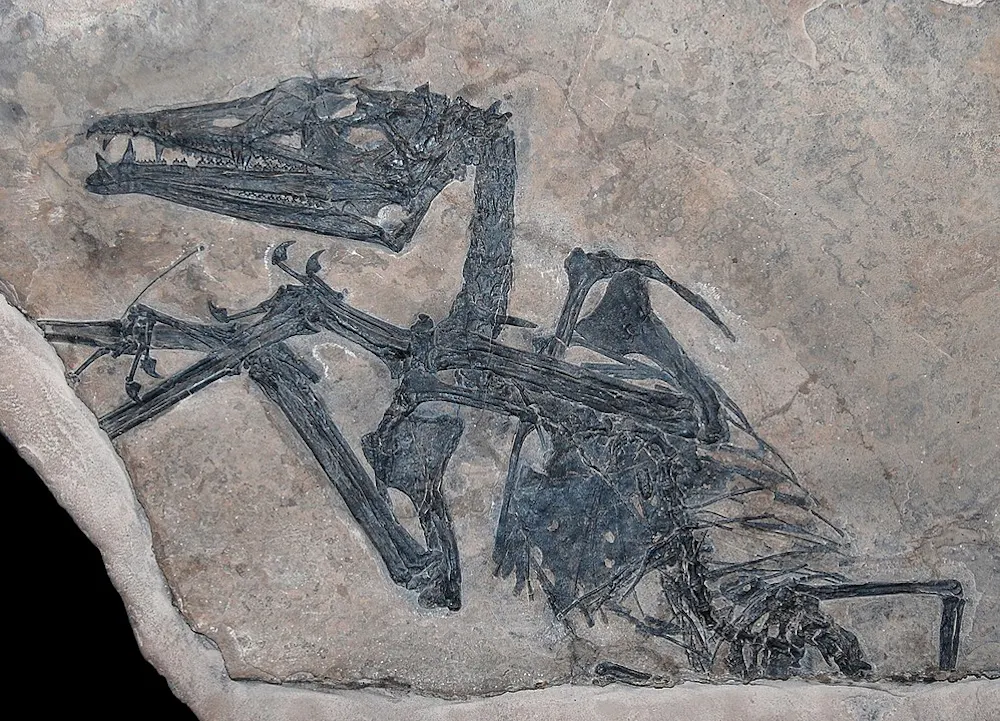
    Eudimorphodon ranzii fossil from Bergamo in 1973 is one of many pterosaur discoveries from southern Europe.
    Wikimedia, CC BY-SA

    For decades, the debate stalled as a result of too few fossils or too many missing rocks. This impasse began to change in 2020, when scientists identified the closest relatives of pterosaurs in a group of smallish upright reptiles called lagerpetids.

    From comparing many anatomical traits across different species, the researchers established that pterosaurs and lagerpetids shared many similarities including their skulls, skeletons and inner ears. While this discovery did not bring any “missing link” to the table, it showed what the ancestor of pterosaurs would have looked like: a rat-to-dog-sized creature that lived on land and in trees.

    This brought new evidence about when pterosaurs may have originated. Pterosaurs and lagerpetids like Scleromochlus, a small land-dwelling reptile, diverged at some point after the end-Permian mass extinction. It occurred some 250 million years ago, 35 million years before the first pterosaur appearance in the fossil record.

    Scleromochlus is one of the lagerpetids, the closest known relatives to the pterosaurs.
    Gabriel Ugueto

    Pterosaurs and their closest kin did not share the same habitats, however. Our new study, featuring new fossil maps, shows that soon after lagerpetids appeared (in southern Pangaea), they spread across wide areas, including harsh deserts, that many other groups were unable to get past. Lagerpetids lived both in these deserts and in humid floodplains.

    They tolerated hotter, drier settings better than any early pterosaur, implying that they had evolved to cope with extreme temperatures. Pterosaurs, by contrast, were more restricted. Their earliest fossils cluster in the river and lake beds of the Chinle and Dockum basins (southwest US) and in moist coastal belts fringing the northern arm of the Tethys Sea, a huge area that occupied today’s Alps.

    Scientists have inferred from analysing a combination of fossil distributions, rock features and climate simulations that pterosaurs lived in areas that were warm but not scorching. The rainfall would have been comparable to today’s tropical forests rather than inland deserts.

    This suggests that the earliest flying dinosaurs may have lived in tree canopies, using foliage both for take-off and to protect themselves from predators and heat. As a result of this confined habitat, the distances that they flew may have been quite limited.

    Changing climates

    We were then able to add a fresh dimension to the story using a method called ecological niche modelling. This is routinely used in modern conservation to project where endangered animals and plants might live as the climate gets hotter. By applying this approach to later Triassic temperatures, rainfall and coastlines, we asked where early pterosaurs lived, regardless of whether they’ve shown up there in the fossil record.

    Many celebrated fossil sites in Europe emerge as poor pterosaur habitat until very late in the Triassic period: they were simply too hot, too dry or otherwise inhospitable before the Carnian age, around 235 million years ago. The fact that no specimens have been discovered there that are more than about 215 million years old may be because the climate conditions were still unsuitable or simply because we don’t have the right type of rocks preserved of that age.

    In contrast, parts of the south-western US, Morocco, India, Brazil, Tanzania and southern China seem to have offered welcoming environments several million years earlier than the age of our oldest discoveries. This rewrites the search map. If pterosaurs could have thrived in those regions much more than 215 million years ago, but we have not found them there, the problem may again lie not with biology but with geology: the right rocks have not been explored, or they preserve fragile fossils only under exceptional conditions.

    Our study flags a dozen geological formations, from rivers with fine sediment deposits to lake beds, as potential prime targets for the next breakthrough discovery. They include the Timezgadiouine beds of Morocco, the Guanling Formation of south-west China and, in South America, several layers of rock from the Carnian age, such as the Santa Maria Formation, Chañares Formation and Ischigualasto Formation.

    Pterosaurs were initially confined to tropical treetops near the equator. When global climates shifted and forested corridors opened, pterosaurs’ wings catapulted them into every corner of the planet and ultimately carried them through one of Earth’s greatest extinctions. What began as a tale of missing fossils has become a textbook example of how climate, ecology and evolutionary science have come together to illuminate a fragmentary history that has intrigued paleontologists for over two centuries.

    Davide Foffa is funded by Marie Skłodowska-Curie Actions: Individual (Global) Fellowship (H2020-MSCA-IF-2020; No.101022550), and by the Royal Commission for the Exhibition of 1851–Science Fellowship

    Alfio Alessandro Chiarenza receives funding from The Royal Society (Newton International Fellowship NIFR1231802)

    Emma Dunne does not work for, consult, own shares in or receive funding from any company or organisation that would benefit from this article, and has disclosed no relevant affiliations beyond their academic appointment.

    – ref. How pterosaurs learned to fly: scientists have been looking in the wrong place to solve this mystery – https://theconversation.com/how-pterosaurs-learned-to-fly-scientists-have-been-looking-in-the-wrong-place-to-solve-this-mystery-259063

    MIL OSI –

    July 1, 2025
  • MIL-OSI Submissions: Air India crash in Ahmedabad sends reverberations to Canadian families of Air India Flight 182

    Source: The Conversation – Canada – By Chandrima Chakraborty, Professor, English and Cultural Studies; Director, Centre for Global Peace, Justice and Health, McMaster University

    The June 12 Air India crash in Ahmedabad, Gujarat, India, with 230 passengers and 12 crew members aboard is sending deep reverberations through a group of Canadians who know all too well the shock, grief and horror of losing loved ones in hauntingly similar circumstances.

    They are the families of those killed in the bombing of Air India Flight 182 en route from Canada to India 40 years ago this month.

    I work closely with these families as a researcher and advocate. I began interviewing these families in 2014 and have witnessed firsthand their pain, advocacy and emotional turmoil of living in the shadow of a historical event.

    As reports of the Ahmedabad crash came in, the WhatsApp account of the Air India Flight 182 families immediately flooded with expressions of shock, concern, sympathy and memories triggered by the latest incident.

    On June 23, 1985, Flight 182 was brought down by terrorist bombs created and planted on Canadian soil. The devastating mid-air explosion occurred over the Atlantic Ocean near Ireland. It killed all 329 passengers and crew, including 268 Canadians. The crew and most of the passengers were of Indian origin.

    Investigations into the causes of the crash of Air India Flight 171, en route to London’s Gatwick airport, shortly after take-off are still underway. At least 279 people died in the crash, which also impacted people on the ground.

    Acknowledging losses as significant

    A recent public conference at McMaster University commemorated the 40th anniversary of Flight 182, bringing together Indian and Canadian families, researchers, creative artists and community members.

    Book cover for ‘Remembering Air India The Art of Public Mourning,’ edited by Chandrima Chakraborty, Amber Dean and Angela Failler.
    University of Alberta Press

    The conference dealt with critical themes, including the challenge of Flight 182 families recovering from their losses within a climate of broad indifference among their fellow Canadians.

    Regardless of what may have caused the more recent crash in western India, these Canadian families know the shock and loss that a new set of victims’ families are facing, and how important it is to support them.

    Hopefully, the home countries of last week’s crash victims — most of them Indian and British citizens, with at least one Canadian reported to have been aboard — will regard their deaths as significant losses. If so, this would be unlike what the 1985 victims’ families experienced in Canada.

    A little-mourned Canadian tragedy

    In Canada, we have a national day to remember on June 23, 1985. The bombing has been called a Canadian tragedy in a public inquiry report.

    Yet according to a 2023 Angus Reid poll, “nine out of 10 Canadians say they have little or no knowledge of the worst single instance of the mass killing of their fellow citizens.” That essentially means the bombing has yet to penetrate the consciousness of everyday Canadians or evoke shared grief or public mourning.

    The families continue to carry the torch of remembrance as they organize annual memorial vigils every June 23. Few others attend. Many victims’ relatives have died since 1985. Some spouses, siblings or parents are now in their 80s, wondering why the bombing is still not widely discussed in schools or in public discourse.

    The grinding and unsatisfying criminal proceedings, the belated public inquiry and the welcome but lukewarm apology by the Canadian government 25 years after the fact have all contributed to the failure of this tragedy to adhere more solidly to the Canadian consciousness. In fact, many continue to deny the Canadian significance of Flight 182 and view the bombing as a foreign event.

    A torch of remembrance

    At last month’s conference, my research team launched the Air India Flight 182 archive to counter this collective amnesia and lack of acknowledgement.

    Canadian archival consultant and writer Laura Millar has said that archives act as “touchstones to memory” and can aid the process of transforming individual memories into collective remembering. Adopting NYU professor Carol Gilligan’s ethics of care for the archive, we have been consulting with families to find ways to share their grief with the public.

    The Flight 182 memory archive — both physical and digital — serves as a repository for artefacts, first-person narratives, memorabilia and creative works related to the tragedy produced by family members. Family donations of artefacts such as dance videos and pilot wings redirect notions of archives away from a documental deposit. Hopefully, they can move the public to learn and care for the impacts of the Flight 182 bombing.

    The archive is a publicly accessible record of the tragedy, where scholars and everyday citizens can learn about the victims and their families.

    Since the past involves both the present and the future, the archive will enable a meaningful recognition of marginalized voices and histories. It can offer a form of memory justice for those who would otherwise be forgotten by sustaining memory from generation to generation.

    While the archive articulates the demand from families that the bombing of Flight 182 and its aftermath be incorporated into Canadian national consciousness, establishing this archive alone will not be enough to elevate the memory of Flight 182 to the place it deserves.

    But at least it establishes a rich, permanent academic and personal legacy for the community of mourners, and for the Canadian and global public to find it, use it and learn from its many lessons.

    Families of those on board the 1985 flight are preparing to commemorate the 40th anniversary of the terror bombing of Flight 182 that has devastated their lives.

    As we learn more about the tragic Air India Flight 171 crash on June 12, the lessons of Flight 182 will hopefully prevent a new set of families from feeling the pain of indifference on top of the unimaginable agony of loss they’re already experiencing.

    Chandrima Chakraborty receives funding from the Social Sciences and Humanities Research Council of Canada.

    – ref. Air India crash in Ahmedabad sends reverberations to Canadian families of Air India Flight 182 – https://theconversation.com/air-india-crash-in-ahmedabad-sends-reverberations-to-canadian-families-of-air-india-flight-182-258991

    MIL OSI –

    July 1, 2025
  • MIL-OSI Submissions: The 28 Days Later franchise redefined zombie films. But the undead have an old, rich and varied history

    Source: The Conversation – Global Perspectives – By Christopher White, Historian, The University of Queensland

    The history of the dead – or, more precisely, the history of the living’s fascination with the dead – is an intriguing one.

    As a researcher of the supernatural, I’m often pulled aside at conferences or at the school gate, and told in furtive whispers about people’s encounters with the dead.

    The dead haunt our imagination in a number of different forms, whether as “cold spots”, or the walking dead popularised in zombie franchises such as 28 Days Later.

    The franchise’s latest release, 28 Years Later, brings back the Hollywood zombie in all its glory – but these archetypal creatures have a much wider and varied history.

    Zombis, revenants and the returning dead

    A zombie is typically a reanimated corpse: a category of the returning dead. Scholars refer to them as “revenants”, and continue to argue over their exact characteristics.

    In the Haitian Vodou religion, the zombi is not the same as the Hollywood zombie. Instead, zombi are people who, as a religious punishment, are drugged, buried alive, then dug out and forced into slavery.

    The Hollywood zombie, however, draws more from medieval European stories about the returning dead than from Vodou.

    A perfect setting for a ‘zombie’ film

    In 28 Years Later, the latest entry in Danny Boyle’s blockbuster horror franchise, the monsters technically aren’t zombies because they aren’t dead. Instead, they are infected by a “rage virus”, accidentally released by a group of animal rights activists in the beginning of the first film.

    This third film focuses on events almost three decades after the first film. The British Isles is quarantined, and the young protagonist Spike (Alfie Williams) and his family live in a village on Lindisfarne Island. This island, one of the most important sites in early medieval British Christianity, is isolated and protected by a tidal causeway that links it to the mainland.

    Aaron Taylor-Johnson and Alfie Williams star in the new film, out in Australian cinemas today.
    Sony Pictures

    The film leans heavily on how we imagine the medieval world, with scenes showing silhouetted fletchers at work making arrows, children training with bows, towering ossuaries and various memento mori. There’s also footage from earlier depictions of medieval warfare. And at one point, the characters seek sanctuary in the ruins of Fountains Abbey, in Yorkshire, which was built in 1132.

    The medieval locations and imagery of 28 Years Later evoke the long history of revenants, and the returned dead who once roved medieval England.

    Early accounts of the medieval dead

    In the medieval world, or at least the parts that wrote in Latin, the returning dead were usually called spiritus (“spirit”), but they weren’t limited to the non-corporeal like today’s ghosts are.

    Medieval Latin Christians from as early as the 3rd century saw the dead as part of a parallel society that mirrored the world of the living, where each group relied on the other to aid them through the afterlife.

    Depiction of the undead from a medieval manuscript.
    British Library, Yates Thompson MS 13

    While some medieval ghosts would warn the living about what awaited sinners in the afterlife, or lead their relatives to treasure, or prophesise the future, some also returned to terrorise the living.

    And like the “zombies” affected by the rage virus in 28 Years Later, these revenants could go into a frenzy in the presence of the living.

    Thietmar, the Prince-Bishop of Merseburg, Germany, wrote the Chronicon Thietmari (Thietmar’s Chronicle) between 1012 and 1018, and included a number of ghost stories that featured revenants.

    Although not all of them framed the dead as terrifying, they certainly didn’t paint them as friendly, either. In one story, a congregation of the dead at a church set the priest upon the altar, before burning him to ashes – intended to be read as a mirror of pagan sacrifice.

    These dead were physical beings, capable of seizing a man and sacrificing him in his own church.

    A threat to be dealt with

    The English monastic historian William of Newburgh (1136–98) wrote revenants were so common in his day that recording them all would be exhausting. According to him, the returned dead were frequently seen in 12th century England.

    So, instead of providing a exhausting list, he offered some choice examples which, like most medieval ghost stories, had a good Christian moral attached to them.

    William’s revenants mostly killed the people of the towns they lived, returning to the grave between their escapades. But the medieval English had a method for dealing with these monsters; they dug them up, tore out the heart and then burned the body.

    Other revenants were dealt with less harshly, William explained. In one case, all it took was the Bishop of Lincoln writing a letter of absolution to stop a dead man returning to his widow’s bed.

    These medieval dead were also thought to spread disease – much like those infected with the rage virus – and were capable of physically killing someone.

    Depiction of the undead from a medieval manuscript.
    British Library, Arundel MS 83.

    The undead, further north

    In medieval Scandinavia and Iceland, the undead draugr were extremely strong, hideous to look at and stunk of decomposition. Some were immune to human weapons and often killed animals near their tombs before building up to kill humans. Like their English counterparts, they also spread disease.

    But according to the Eyrbyggja saga, an anonymous 13th or 14th century text written in Iceland, all it took was a type of community court and the threat of legal action to drive off these returned dead.

    It’s a method the survivors in 28 Years Later didn’t try.

    The dead live on

    The first-hand zombie stories that were common during the medieval period started to dwindle in the 16th century with the Protestant Reformation, which focused more on individuals’ behaviours and salvation.

    Nonetheless, their influence can still be felt in Catholic ritual practices today, such as in prayers offered for the dead, and the lighting of votive candles.

    We still tell ghost stories, and we still worry about things that go bump in the night. And of course, we continue to explore the undead in all its forms on the big screen.

    Christopher White does not work for, consult, own shares in or receive funding from any company or organisation that would benefit from this article, and has disclosed no relevant affiliations beyond their academic appointment.

    – ref. The 28 Days Later franchise redefined zombie films. But the undead have an old, rich and varied history – https://theconversation.com/the-28-days-later-franchise-redefined-zombie-films-but-the-undead-have-an-old-rich-and-varied-history-247900

    MIL OSI –

    July 1, 2025
  • MIL-OSI Submissions: Trump’s worldview is causing a global shift of alliances – what does this mean for nations in the middle?

    Source: The Conversation – Global Perspectives – By Dilnoza Ubaydullaeva, Lecturer in Government – National Security College, Australian National University

    Since US President Donald Trump took office this year, one theme has come up time and again: his rule is a threat to the US-led international order.

    As the US political scientist John Mearsheimer famously argued, the liberal international order

    was destined to fail from the start, as it contained the seeds of its own destruction.

    This perspective has gained traction in recent years. And now, Trump’s actions have caused many to question whether a new world order is emerging.

    Trump has expressed a desire for a new international order defined by multiple spheres of influence — one in which powers like the US, China and Russia each exert dominance over distinct regions.

    This vision aligns with the idea of a “multipolar” world, where no single state holds overarching global dominance. Instead, influence is distributed among several great powers, each maintaining its own regional sphere.

    This architecture contrasts sharply with earlier periods – the bipolar world of the Cold War, dominated by the US and the Soviet Union; and the unipolar period that followed, dominated by the US.

    What does this mean for the world order moving forward?

    Shifting US spheres of influence

    We’ve seen this shift taking place in recent months. For example, Trump has backed away from his pledge to end the war between Russia and Ukraine and now appears to be leaving it to the main protagonists, and Europe, to find a solution.

    Europe, which once largely spoke in a unified voice with the US, is also showing signs of policy-making which is more independent. Rather than framing its actions as protecting “Western democratic principles”, Europe is increasingly focused on defining its own security interests.

    In the Middle East, the US will likely maintain its sphere of influence. It will continue its unequivocal support for Israel under Trump.

    Amid shifting global alliances, the Trump administration will continue to support Israel, led by Prime Minister Benjamin Netanyahu.
    noamgalai/Shutterstock

    The US will also involve itself in the region’s politics when its interests are at stake, as we witnessed in its recent strikes on Iranian nuclear facilities.

    This, along with increasing economic ties between the US and Gulf states, suggests US allies in the region will remain the dominant voices shaping regional dynamics, particularly now with Iran weakened.

    Yet it’s clear Trump is reshaping US dynamics in the region by signaling a desire for reduced military and political involvement, and criticising the nation building efforts of previous administrations.

    The Trump administration now appears to want to maintain its sphere of influence primarily through strong economic ties.

    Russia and China poles emerging elsewhere

    Meanwhile, other poles are emerging in the Global South. Russia and China have deepened their cooperation, positioning themselves as defenders against what they frame as Western hegemonic bullying.

    Trump’s trade policies and sanctions against many nations in the Global South have fuelled narratives (spread by China and Russia) that the US does not consistently adhere to the rules it imposes on others.

    Trump’s decision to slash funding to USAID has also opened the door to China, in particular, to become the main development partner for nations in Africa and other parts of the world.

    And on the security front, Russia has become more involved in many African and Middle Eastern countries, which have become less trustful and reliant on Western powers.

    Russian President Vladimir Putin and Chinese leader Xi Xinping see opportunities to spread their influence in the Global South.
    plavi011/Shutterstock

    In the Indo-Pacific, much attention has been given to the rise of China and its increasingly assertive posture. Many of Washington’s traditional allies are nervous about its continued engagement in the region and ability to counter China’s rise.

    Chinese leader Xi Jinping has sought to take advantage of the current environment, embarking on a Vietnam, Malaysia and Cambodia push earlier this year. But many nations continue to be wary of China’s increasing influence, in particular the Philippines, which has clashed with China over the South China Sea.

    Strategic hedging

    Not all countries, however, are aligning themselves neatly with one pole or another.

    For small states caught between great powers, navigating this multipolar environment is both a risk and an opportunity.

    Ukraine is a case in point. As a sovereign state, Ukraine should have the freedom to decide its own alignments. Yet, it finds itself ensnared in great power politics, with devastating consequences.

    Other small states are playing a different game — pivoting from one power to another based on their immediate interests.

    Slovakia, for instance, is both a NATO and EU member, yet its leader, Robert Fico, attended Russia’s Victory Day Parade in May and told President Vladimir Putin he wanted to maintain “normal relations” with Russia.

    Then there is Central Asia, which is the centre of a renewed “great game,” with Russia, China and Europe vying for influence and economic partnerships.

    Yet if any Central Asian countries were to be invaded by Putin, would other powers intervene? It’s a difficult question to answer. Major powers are reluctant to engage in direct conflict unless their core interests or borders are directly threatened.

    As a result, Central Asian states are hedging their bets, seeking to maintain relations with multiple poles, despite their conflicting agendas.

    A future defined by regional power blocs?

    While it is still early to draw definitive conclusions, the events of the past few months underscore a growing trend. Smaller countries are expressing solidarity with one power, but pragmatic cooperation with another, when it suits their national interests.

    For this reason, regional power blocs seem to be of increasing interest to countries in the Global South.

    For instance, the China-led Shanghai Cooperation Organisation has become a stronger and larger grouping of nations across Eurasia in recent years.

    Trump’s focus on making “America Great Again,” has taken the load off the US carrying liberal order leadership. A multipolar world may not be the end of the liberal international order, but it may be a reshaped version of liberal governance.

    How “liberal” it can be will likely depend on what each regional power, or pole, will make of it.

    Dilnoza Ubaydullaeva does not work for, consult, own shares in or receive funding from any company or organisation that would benefit from this article, and has disclosed no relevant affiliations beyond their academic appointment.

    – ref. Trump’s worldview is causing a global shift of alliances – what does this mean for nations in the middle? – https://theconversation.com/trumps-worldview-is-causing-a-global-shift-of-alliances-what-does-this-mean-for-nations-in-the-middle-257113

    MIL OSI –

    July 1, 2025
  • MIL-OSI Submissions: Black holes spew out powerful jets that span millions of light-years – we’re trying to understand their whole life cycle

    Source: The Conversation – Africa (2) – By Gourab Giri, Postdoctoral researcher, University of Pretoria

    An artistic representation of what a giant cosmic jet the size of the distance between the Milky Way and Andromeda could look like. Author provided, CC BY-SA

    There is a supermassive black hole at the centre of nearly every big galaxy – including ours, the Milky Way (it’s called Sagittarius A*). Supermassive black holes are the densest objects in the universe, with masses reaching billions of times that of the Sun.

    Sometimes a galaxy’s supermassive black hole “wakes up” due to a sudden influx of gas and dust, most likely supplied from a neighbouring galaxy. It begins eating up lots of nearby gas and dust. This isn’t a calm, slow or passive process. As the black hole pulls in material, the material gets superheated on a scale of millions of degrees, far hotter than the surface temperature of our Sun, and is ejected from the galaxy at near-light speeds. This creates powerful jets that look like fountains in the cosmos.

    The accelerated high-speed plasma matter prompts these “fountains” to emit radio signals that can only be detected by very powerful radio telescopes. This gives them their name: radio galaxies. While black holes are common, radio galaxies are not. Only between 10% and 20% of all galaxies exhibit this phenomenon.

    Giant radio galaxies are even less common. They account for only 5% of all radio galaxies and take their name from the fact that they reach enormous distances. Some radio galaxies’ jets reach nearly 16 million light-years. (That’s almost six times the distance between the Milky Way and the Andromeda galaxy.) The largest jet discovered spans nearly 22 million light-years across.


    Read more:
    South African telescope discovers a giant galaxy that’s 32 times bigger than Earth’s


    But how do these structures cover such enormous distances? To find out, I led a study in which we used modern supercomputers to develop models that simulated behaviour of giant cosmic jets within a mock universe, constructed on the basis of fundamental physical laws governing the cosmos.

    This allowed us to observe how radio jets propagate over hundreds of millions of years – a process impossible to track directly in the real universe. These sophisticated simulations provide deeper insights into the life cycle of radio galaxies, highlighting the differences between their early, compact stages and their later, expansive forms.

    Understanding the evolution of radio galaxies helps us unravel the broader processes that shape the universe.

    Supercomputing

    Cutting-edge technology was key to this study.

    Sensitive observations from world-class radio telescopes like South Africa’s MeerKAT and LOFAR in the Netherlands have recently led to several discoveries of cosmic fountains.


    Read more:
    MeerKAT: the South African radio telescope that’s transformed our understanding of the cosmos


    However, modelling their origins has been challenging. Tracking events over millions of years is impossible in real-time.

    That’s where supercomputers come in. These high-performance computing systems are designed to process massive amounts of data. They can perform complex simulations at incredible speeds. In this study, their power was crucial for modelling the evolution of giant radio jets over millions of years.

    The necessary supercomputing power was provided by South Africa’s Inter-University Institute for Data Astronomy, a network comprising the University of Pretoria, the University of Cape Town and the University of the Western Cape.

    Our universe is governed by fundamental forces like gravity, which can be described through mathematical formulas. These formulas, essentially numbers, are fed into supercomputers to create a simulated “mock universe” that follows the same physical laws as the real cosmos. This allows scientists to experiment with how jets from supermassive black holes evolve over time. With their immense processing power, supercomputers can simulate millions of years of cosmic jet evolution in just a month.

    Key takeaways

    Gravity is the dominant force in the universe, pulling heavier matter and dragging nearby lighter matter. If gravity were the only force at play, the universe might have collapsed by now. Yet we see galaxies, galaxy clusters and even life itself thriving. We suspect that these cosmic fountains play a key role in solving the mystery of how this happens.

    By releasing thermal and mechanical energy, they heat up the surrounding collapsing gas, counteracting gravity and maintaining a balance that sustains cosmic structures.

    Our models also shed light on why some radio galaxies’ jets bend sharply, forming an “X” shape in radio waves instead of following a straight trajectory, and revealed the conditions under which giant fountains can continue growing even in dense cosmic environments (that is, in a galaxy cluster).

    The study also suggests that giant radio galaxies may be statistically more common than previously believed. There are potentially thousands of undiscovered giant cosmic fountains. Thanks to world-class telescopes like MeerKAT and LOFAR – and the power of supercomputers – there’s plenty more to explore as we try to understand our universe.

    The research on which this article is based required extensive collaboration with an international team, including Jacinta Delhaize from the University of Cape Town, Joydeep Bagchi from Christ University, India, and DJ Saikia from the Inter-University Centre for Astronomy and Astrophysics in India. Essential contributions by Kshitij Thorat and Roger Deane from the University of Pretoria also played a crucial role in shaping the study.

    Gourab Giri does not work for, consult, own shares in or receive funding from any company or organisation that would benefit from this article, and has disclosed no relevant affiliations beyond their academic appointment.

    – ref. Black holes spew out powerful jets that span millions of light-years – we’re trying to understand their whole life cycle – https://theconversation.com/black-holes-spew-out-powerful-jets-that-span-millions-of-light-years-were-trying-to-understand-their-whole-life-cycle-250073

    MIL OSI –

    July 1, 2025
  • MIL-OSI Submissions: Ancient DNA reveals Maghreb communities preserved their culture and genes, even in a time of human migration

    Source: The Conversation – Africa (2) – By Giulio Lucarini, Senior Researcher, Institute of Heritage Science, National Research Council (CNR)

    Doukanet el Khoutifa, Tunisia, where some of the remains were found. Giulio Lucarini, CC BY-NC-ND

    The Neolithic period began in southwest Asia around 12,000 years ago. It marked a major shift in human history as societies transitioned from hunting and gathering to farming. This sparked migrations across Europe and dramatically reshaped the continent’s gene pool.

    For a long time, North Africa was seen as a passive participant in this transformation. The dominant narrative suggested that farming economies never fully took root there.

    Some studies proposed that North African communities actively resisted agriculture, except perhaps in the Nile Delta and the western Maghreb (modern-day Morocco). They continued to rely on land snails, wild plants, and hunting for survival. Only later, they also began herding domesticated sheep, goats, and cattle, introduced from southwest Asia.

    Genetic studies have only recently tested this reconstruction in North Africa. This has never been done in the eastern Maghreb (modern-day Tunisia and eastern Algeria) – until now.

    A burial at one of the study sites, SHM-1 (Hergla) in Tunisia.
    Simone Mulazzani, CC BY-NC-ND

    As an Africanist archaeologist, I specialise in the study of ancient societies across Mediterranean Africa and the Sahara. My focus is on how humans adapted to their environments and the rise of food production in these regions. I recently conducted research in the eastern Maghreb alongside an international team of archaeologists, geneticists, and physical anthropologists to trace ancient population movements.

    Our new study has just been published in Nature. We analysed the ancient genomes (complete DNA sequences) of nine individuals who lived in the eastern Maghreb between 15,000 and 6,000 years ago.

    This may seem like a small sample. But, in the field of ancient DNA research, even a few well-preserved genomes can provide significant insights. They serve as reference points for tracing genetic lineages and identifying ancestral connections.

    By adding genetic evidence to broader archaeological findings, we reconstructed patterns of population continuity, interaction and change over thousands of years.

    Our results were striking. It’s clear from these genomes that some influence from farmers did reach north Africa from across the Mediterranean. But much of the genetic makeup of the eastern Maghreb populations remained rooted in their ancient foraging heritage.

    This challenges the long-held narrative about migration into and out of north Africa before and during the Neolithic. It deepens our understanding of the past and highlights the incredible complexity of human movement and cultural exchange.

    As we continue to unravel the genetic legacy of our ancestors, studies like this remind us of the complexity of human history. They show that the history of agriculture in the Mediterranean was not merely one of population replacement. Rather, it was a tale of cultural exchange, adaptation and continuity.

    And researching these ancient human movements is more than just a matter of understanding history. It also provides insights into the patterns of migration and adaptation that can help us understand similar processes today.

    Extraction and analysis

    A map of the eastern Maghreb showing the study sites (1: Afalou Bou Rhummel; 2: Djebba; 3: Doukanet el Khoutifa; 4: SHM-1, Hergla)
    Giulio Lucarini, CC BY-NC-ND

    We worked with ancient genomes extracted from human skeletal remains housed in museum or heritage institution collections. They came from excavations at four sites Afalou Bou Rhummel, Djebba, Doukanet el Khoutifa and SHM-1 (Hergla), all in the eastern Maghreb.

    We chose the specimens because they were well-preserved, which is not always the case with ancient DNA.

    The analysis found that some of the sampled individuals possessed European farmer ancestry around 7,000 years ago. Europeans contributed some genes to the region – but no more than 20% per individual.

    Excavation of human remains at Doukanet el Khoutifa, Tunisia.
    Giulio Lucarini, CC BY-NC-ND

    This is a modest genetic influence compared to ancient western Maghreb populations where, at some sites, European farmer ancestry can reach as high as 80%.

    Our findings suggest that food-producing economies were introduced to the eastern Maghreb not by a large-scale replacement of the population (as seen in Europe) but more gradually. Change happened through sporadic migrations, mixing of cultures, and the spread of knowledge.

    Across sea and land

    One of the most intriguing discoveries was the genetic trace of European hunter-gatherers found in one individual from Djebba, Tunisia, dating to around 8,000 years ago. This suggests that early European and north African populations could interact via seafaring routes across the Strait of Sicily.

    Researchers have long known that cultural exchange took place across the Mediterranean. We see this from the spread of technologies such as the so-called pressure technique – a method of shaping stone tools by carefully applying force with a pointed implement rather than striking the stone directly.

    The discovery in Tunisia of obsidian (volcano glass) from Pantelleria, a small island in the Strait of Sicily, strengthens the link between the Mediterranean’s northern and southern shores.

    Prehistoric wooden artefacts are seldom preserved over time. This may explain the absence of boat remains from this period in North Africa. However, dugout canoes from similar periods found in central Italy (Bracciano Lake) suggest that seafaring skills were well established around the Mediterranean. While there is no direct evidence linking these specific canoes to connections between Europe and North Africa, they support the idea that navigation was within the technological capabilities of the time.

    Our study is the first time the connections suggested by this existing evidence have been substantiated genetically.


    Read more:
    Discovery of 5,000-year-old farming society in Morocco fills a major gap in history – north-west Africa was a central player in trade and culture


    Another exciting aspect of our study is the identification of early Levantine (modern southwest Asia)-related ancestry in the eastern Maghreb. This was detected in human remains dated to around 6,800 years ago. It’s a genetic signature that postdates the arrival of European farmer ancestry by several centuries. It likely reflects the movement of people associated with early pastoralism, who introduced domesticated animals, such as sheep and goats, to the region.

    Backing up archaeological evidence

    It is especially rewarding to see the genetic evidence aligning with the archaeological record. This underscores the value of multidisciplinary research in uncovering past human dynamics.

    What emerges overall is a region of strong genetic and cultural resilience, consistent with archaeological evidence.

    Giulio Lucarini receives funding for this study from the National Research Council of Italy (CNR) and ISMEO – International Association for Mediterranean and Oriental Studies, Italy. He is affiliated with the National Research Council of Italy, Institute of Heritage Science (CNR-ISPC).

    This study resulted from a collaboration between the following institutions: Harvard University, USA; the Max Planck Institute, Germany; the National Research Council of Italy (CNR); the Institut National du Patrimoine (INP), Tunisia; the Centre National de Recherche Préhistorique, Anthropologique et Historique (CNRPAH), Algeria; the Institut de Paléontologie Humaine (IPH), France; the University of Vienna, Austria; Sapienza University of Rome, Italy; and ISMEO – International Association for Mediterranean and Oriental Studies, Italy.

    – ref. Ancient DNA reveals Maghreb communities preserved their culture and genes, even in a time of human migration – https://theconversation.com/ancient-dna-reveals-maghreb-communities-preserved-their-culture-and-genes-even-in-a-time-of-human-migration-248338

    MIL OSI –

    July 1, 2025
  • MIL-OSI Video: President of the Conference & of the Government of Spain at the Opening of the #FFD4 in Sevilla

    Source: United Nations (video statements)

    Opening remarks by Pedro Sánchez Pérez-Castejón, President of the Government of the Kingdom of Spain, and President of the Conference, at the Opening of the 4th International Conference on Financing for Development FFD4 (Sevilla, Spain).

    —
    “It is time to take a step forward and not only reaffirm our commitment but redouble it. We must improve debt sustainability, ensure fiscal justice, and fulfill our commitments to international cooperation,” said Pedro Sánchez, Prime Minister of Spain.

    https://www.youtube.com/watch?v=YSB5Cxh2Wok

    MIL OSI Video –

    July 1, 2025
  • MIL-OSI Video: President of the Conference & of the Government of Spain at the Opening of the #FFD4 in Sevilla

    Source: United Nations (video statements)

    Opening remarks by Pedro Sánchez Pérez-Castejón, President of the Government of the Kingdom of Spain, and President of the Conference, at the Opening of the 4th International Conference on Financing for Development FFD4 (Sevilla, Spain).

    —
    “It is time to take a step forward and not only reaffirm our commitment but redouble it. We must improve debt sustainability, ensure fiscal justice, and fulfill our commitments to international cooperation,” said Pedro Sánchez, Prime Minister of Spain.

    https://www.youtube.com/watch?v=YSB5Cxh2Wok

    MIL OSI Video –

    July 1, 2025
  • MIL-OSI Video: President of the Conference & of the Government of Spain at the Opening of the #FFD4 in Sevilla

    Source: United Nations (video statements)

    Opening remarks by Pedro Sánchez Pérez-Castejón, President of the Government of the Kingdom of Spain, and President of the Conference, at the Opening of the 4th International Conference on Financing for Development FFD4 (Sevilla, Spain).

    —
    “It is time to take a step forward and not only reaffirm our commitment but redouble it. We must improve debt sustainability, ensure fiscal justice, and fulfill our commitments to international cooperation,” said Pedro Sánchez, Prime Minister of Spain.

    https://www.youtube.com/watch?v=YSB5Cxh2Wok

    MIL OSI Video –

    July 1, 2025
  • MIL-OSI Europe: Minister Smyth announces new round of Tariff Suspension/Quota Scheme applications

    Source: Government of Ireland – Department of Jobs Enterprise and Innovation

    1st July 2025

    Niamh Smyth TD, Minister of State for Trade Promotion, Artificial Intelligence and Digital Transformation announces a new round of the EU’s Tariff Suspension/Quota Scheme applications opens today, Tuesday, 1 July 2025, and is calling for applications from manufacturers in the industrial, agricultural, and related sectors.

    The tariff suspensions scheme offers the possibility for such companies to import raw materials, components, or intermediate products from outside the European Union free from tariff duty, if the item cannot be sourced in the EU/Türkiye.

    The tariff quota scheme is designed to address shortages in the availability of essential materials within the EU and can be applied for in the same way as suspensions. 

    This is the second of two calls this year, the next one will be on 1 January 2026.

    Welcoming the new call, Minister Smyth said:

    “The tariff suspension and quota schemes represent a very effective way for Irish manufacturers to gain a competitive edge by reducing the cost of sourcing components that are not available in the EU. I would encourage all Irish manufacturers to avail of these schemes.”

    Deadline for applications is 5.30pm on Friday 25 July 2025. Applications should be sent by email to tariffschemes@enterprise.gov.ie and posted to the Department of Enterprise, Tourism and Employment, 23 Kildare Street, D02 TD30. 

    Please note that late or incomplete applications will not be accepted.

    The suspension of duties on these applications, if they are successful, will come into effect from 1 July 2026. 

    Notes to Editors 

    The tariff suspension/quota scheme offers the possibility for companies to import raw materials, components or intermediate products from outside the European Union free from tariff duty. 

    Companies, in applying for tariff suspensions, must be able to demonstrate that each item for which duty suspension is sought:

    • is intended for further processing by them
    • is not available within the EU
    • generates duty savings of at least €15,000 per annum (if an applicant company cannot reach this minimum limit on its own, it is possible to join forces with one or more other companies to do so)

    Further information on the tariff suspension or quota schemes may be found here: 

    EU Tariff Suspension and Quota Scheme

    Communication from the Commission concerning autonomous tariff suspensions and quotas

    ENDS

    Back to Department News

    Back to Top

    MIL OSI Europe News –

    July 1, 2025
  • MIL-OSI: Atos successfully supported UEFA Under21 Championship 2025™

    Source: GlobeNewswire (MIL-OSI)

                                                                    Press Release

    Atos successfully supported UEFA Under21 Championship 2025™

    Next-Gen technologies for Next-Gen players

    Paris, France – July 1st, 2025 – Atos, the Official Information Technology Partner of UEFA National Team Football, has delivered key IT services and applications support for the UEFA Under21 Championship 2025, that took place from June 11 to June 28, 2025, in Slovakia. This championship, which brings together 16 European teams, is the tournament where countless football legends started their journey on the global stage.

    Atos supported a total of 31 matches in 17 days, taking place across 8 cities Slovakia. The services provided included:

    • Event Management systems including accreditation, access control solutions, competitions solutions, radio communication and service desk services.
    • Diffusion system like the football service platform, the mobile app, the website including some embedded gaming functionalities such as match predictor and quiz about competitions.
    • End-to-end cybersecurity services, from compliance and threat intelligence to on-the-ground and hybrid-cloud security.

    This year’s championship has proven to be an immense popular success, establishing new records regarding physical attendance with a total of 244,866 spectators, as illustrated by Atos employees that enthusiastically attended the games. The final broke the record for stadium attendance at over 18,000 fans watching in Bratislava. TV audiences set a new standard for the competition, with a cumulated audience of over 100 million. Ahead of the final, across all competing markets domestic match audiences have seen a 7% increase, and across the Top 6 markets domestic audiences have increased by 55%, thanks to strong audiences in Germany and UK. Digital audience, page views and applications visits, are also expected to establish new heights for the tournament.

    In addition to the key services provided, Atos is proudly supporting the next generation of players and rising stars of European Football with advanced technologies that can be used by coaches to further develop their players and teams’ skills and abilities. The data collected during the tournament are, for example, consolidated through AI to extract and define main strategies and new trends that appeared during the competition, allowing for a deeper understanding of the players and game’s evolution.

    “We feel privileged to have witnessed first-hand the emergence of the next football stars at the UEFA Under21 Championship in Slovakia. We made sure to deliver best-in-class IT services during the tournament to allow these young players to enter the global stage and express their incredible potential in the best possible conditions” said Nacho Moros, Head of Atos Major Events.

    In addition to marking a coming-of-age moment for some of the most exceptional playing careers, the Under21 championship is also the gateway to the Olympic Games men’s tournament.

    Since the beginning of their collaboration in 2022, Atos and UEFA have established a strong partnership. Atos has been supporting UEFA daily in managing, enhancing, and optimizing its complex technology ecosystem while helping it navigate emerging technological challenges. Atos has also been instrumental in making the UEFA EURO 2024™ a tremendous success, as well as most recently in successfully delivering IT services for the UEFA Nations League Finals™ 2025 in Germany.

    Atos has been serving its partners and customers through a dedicated in-house sports and major events division (“Major Events”) for over 3 decades, giving it an unmatched experience and the experience and flexibility to serve its customers regardless of their exposure, size and scale. From global events to local competitions, Atos consistently strives to deliver technology excellence to its entire customer base. 

    Atos has been involved with the Olympic Movement since 1992 and the Paralympic Movement since 2002 and is the official Digital partner for Special Olympics International. Most recently, Atos has been instrumental in delivering successful leading-edge IT services for iconic events such as the Olympic and Paralympic Games Paris 2024 or inspiring events such as the Invictus Games Vancouver 2025 or the Special Olympics Torino Winter Games 2025. 

    To learn more about Atos solutions for sporting events and major events, visit  Atos Major events. 

    ***

    About Atos Group

    Atos Group is a global leader in digital transformation with c. 72,000 employees and annual revenue of c. € 10 billion, operating in 68 countries under two brands — Atos for services and Eviden for products. European number one in cybersecurity, cloud and high-performance computing, Atos Group is committed to a secure and decarbonized future and provides tailored AI-powered, end-to-end solutions for all industries. Atos is a SE (Societas Europaea) and listed on Euronext Paris.

    The purpose of Atos is to help design the future of the information space. Its expertise and services support the development of knowledge, education and research in a multicultural approach and contribute to the development of scientific and technological excellence. Across the world, the Group enables its customers and employees, and members of societies at large to live, work and develop sustainably, in a safe and secure information space.

    Press contact

    Laurent Massicot – laurent.massicot@atos.net – 33 (0)7 69 48 01 80

    Attachment

    • PR – Global – Atos successfully supported UEFA Under21 Championship 2025™

    The MIL Network –

    July 1, 2025
  • From Ghana to Brazil: PM Modi’s tour to cement South-South cooperation

    Source: Government of India

    Source: Government of India (4)

    Prime Minister Narendra Modi is set to embark on a five-nation tour on Tuesday covering Ghana, Trinidad and Tobago, Argentina, Brazil and Namibia, marking an important push to strengthen India’s ties with Africa, Latin America and the Caribbean.

    First Indian PM visit to Ghana in three decades

    Prime Minister Modi will begin his tour with an official visit to Ghana on July 2 and 3- the first visit by an Indian Prime Minister to the West African nation in 30 years.

    The Ministry of External Affairs (MEA) said the visit holds special significance as Ghana’s President John Dramani Mahama recently assumed office after a decisive electoral victory. PM Modi and President Mahama, who share a history of engagement since the India-Africa Forum Summit in 2015, will discuss ways to deepen bilateral ties.

    Key areas on the agenda include agriculture, defence cooperation, critical minerals, and a possible vaccine hub to serve West Africa. India’s capacity-building initiatives like the ITEC programme have long contributed to Ghana’s human resource development. Officials expect the two sides to sign MoUs in areas such as traditional medicine, standards and cultural exchange.

    Trinidad and Tobago: marking 180 years of Indian arrival

    From July 3 to 4, PM Modi will visit Trinidad and Tobago, marking the first bilateral visit by an Indian Prime Minister since 1999. The visit coincides with the 180th anniversary of the arrival of Indian immigrants to the island nation, which hosts one of the largest Indian-origin communities in the Caribbean.

    In Port of Spain, PM Modi will hold wide-ranging discussions with President Christine Carla Kangaloo, and Prime Minister Kamala Prasad Bisessar, both of whom are of Indian origin. Talks will cover cooperation in pharmaceuticals, renewable energy, digital public infrastructure, agriculture, disaster resilience, education and culture.

    Highlighting the shared heritage, PM Modi will address a joint session of the Trinidad and Tobago Parliament and interact with the vibrant Indian diaspora.

    Argentina visit: tapping new opportunities

    PM Modi’s next stop will be Argentina on July 4 and 5 – the first standalone bilateral visit by an Indian PM to Argentina in nearly six decades.

    Officials said the visit is timely as Argentina pursues major economic reforms and offers new avenues for partnership. PM Modi will hold talks with President Javier Milei, focusing on boosting cooperation in defence manufacturing, digital technology, telemedicine, mining and renewable energy.

    Argentina’s vast reserves of lithium, copper and rare earths align with India’s push for secure and sustainable critical mineral supplies. India’s KABIL has already secured mining concessions in Argentina this year. Discussions will also cover food security, green energy, infrastructure, science and technology.

    Brazil: BRICS summit and bilateral talks

    PM Modi will then travel to Brazil to attend the 17th BRICS Summit in Rio de Janeiro on July 6 and 7. The theme for this year’s summit — “Strengthening Global South Cooperation for Inclusive and Sustainable Governance” — aligns with India’s foreign policy priorities.

    Leaders will deliberate on reforming global governance, peace and security, climate change and artificial intelligence. India expects key outcomes including a Leaders’ Declaration and frameworks for climate finance and socially determined diseases.

    On July 8, PM Modi will pay a state visit to Brasilia for bilateral talks with President Luiz Inácio Lula da Silva. India and Brazil will review trade ties, currently valued at $12.2 billion, and aim to push the target to $20 billion. Cooperation in oil and gas, renewable energy, critical minerals, defence, agriculture, traditional medicine, and digital public infrastructure are expected to feature prominently.

    Namibia: energy, minerals, digital pay on radar

    PM Modi will conclude his tour with a landmark visit to Namibia on July 9- the first by an Indian Prime Minister in 27 years.

    India has long supported Namibia’s independence struggle and has maintained strong economic ties. Trade stands at around $600 million, with Indian investments of nearly $800 million, mostly in minerals like zinc and diamonds.

    During the visit, PM Modi will hold bilateral talks with President Netumbo Nandi-Ndaitwah and address Namibia’s Parliament. A key highlight will be a technology agreement enabling unified payment interoperability between the two countries — deepening fintech and digital cooperation.

    Namibia’s reserves of uranium, copper, cobalt and rare earths, and recent oil discoveries make it an attractive partner as India diversifies its energy and mineral supplies. The Cheetah translocation project from Namibia to India’s Kuno National Park remains a symbol of trust and collaboration.

    July 1, 2025
  • MIL-OSI United Kingdom: New Shop ABC Gift Card launches

    Source: Northern Ireland City of Armagh

    Lord Mayor, Alderman Stephen Moutray launching the Shop ABC Gift Card with Armagh business owners Ann Doyle and Dessie Feeney.

    “We all benefit from a thriving community.”

    The new Shop ABC Gift Card can be spent with shops, restaurants, salons, attractions and hotels – it’s available as either a physical or digital card.

    A brand-new gift card, exclusively for the Armagh City, Banbridge and Craigavon Borough, has now gone live, making it easier than ever for people to support local businesses.

    Backed by Armagh City, Banbridge and Craigavon Borough Council, the Shop ABC Gift Card can only be spent with registered businesses in the area, locking spend into local economies and driving footfall.

    The Shop ABC Gift Card is available as either a physical card that is swiped at the till or a digital card that is added to digital wallets enabling ‘tap to pay’ technology.

    Over 150 businesses across the borough already accept the card with more joining the scheme each day.

    Lord Mayor of Armagh City, Banbridge and Craigavon Borough, Alderman Stephen Moutray said: “We’re proud to launch the Shop ABC Gift Card to power local economies within our city, town centres and villages. With the card, we have a local option for gifts, rewards and incentives. I encourage everyone to look at how they can use the card for the benefit of our borough, from organisations rewarding staff to charities supporting service users or people buying as gifts for the end of term, birthdays and beyond.”

    Local businesses are welcoming the launch of the gift card. Chris Dalzell of Dalzells of Markethill said: “We’re a family run business that has been in operation for almost 70 years, based in a rural location, with delivery across the island of Ireland. Local businesses are the lifeblood of the community, giving their support to all manner of local clubs and charities, and the Shop ABC Gift Card is a fantastic way for people to show their support for local businesses in return. We all benefit from a thriving community. Everything we can do to promote local shopping is hugely positive and we look forward to accepting the new gift card across our full range – home appliances to beds and furniture.”

    Another independent business accepting the card is Gasp Boutique owner Ann said: “The boutique is family run with nearly 25 years in Armagh, specialising in casuals, shoes, occasion wear and mother of the bride outfits. Independent businesses all employ local people so the Shop ABC Gift Card that encourages people to shop with their local businesses is brilliant. I like the fact that it will be easy for people to spend like a regular gift card, but locking spend into the area. Many people pay using their phones now, so the digital version is great, especially for encouraging the younger generation to shop local. I’d love to see larger organisations using the card to reward their staff – what a great way to show their support for local.”

    Alongside products, Shop ABC Gift Card recipients can also spend their gift card on a range of experiences and services.

    Rachel McDonald, practice manager at Mackey Opticians in Portadown commented: “Mackey Opticians is a family run, independent opticians – the largest in Northern Ireland. As soon as I heard about the card, I said ‘sign us up’ because I think it’s a great idea. Not only will it benefit our business it will benefit our neighbouring businesses. And it will be a really nice thing for customers to spend too, both on products and services. The ability to use the Shop ABC Gift Card in a practical way on things like new glasses or an eye test is a huge benefit and means the cards will be well used and ideal as both gifts and corporate rewards. I really like the community feel of it too – the high street is so important, and the Shop ABC Gift Card will help support it.”

    Colin Munro, Managing Director of Miconex, said: “Support for local is extremely strong in Northern Ireland with over 92% of people saying it has become more important to them over the past 12 months and 95% believing that more needs to be done to support local businesses. The Shop ABC Gift Card is the ultimate ‘shop local’ Gift Card for the area, and a fun, easy to use way to support local businesses.”

    The physical or digital Shop ABC Gift Card is available to buy for consumers and organisations at https://townandcitygiftcards.com/product/shop-abc-gift-card/

    MIL OSI United Kingdom –

    July 1, 2025
  • MIL-OSI Russia: International Deep Space Association to be established in China

    Translation. Region: Russian Federal

    Source: People’s Republic of China in Russian – People’s Republic of China in Russian –

    Source: People’s Republic of China – State Council News

    HEFEI, July 1 (Xinhua) — A meeting will be held next Monday to establish the International Deep Space Exploration Association (IDSEA), which will be China’s first international aerospace science and technology organization.

    The association, which will be headquartered in Hefei, Anhui Province, east China, will aim to build the capacity of other developing countries to develop technologies for deep space exploration.

    IDSEA will focus on deep space exploration, which includes exploration of the Moon, other planets and asteroids, and will promote international cooperation.

    Wang Zhongmin, director of the International Cooperation Center of the China Deep Space Laboratory, said IDSEA aims to become an inclusive academic platform that will benefit developing countries in particular.

    “We are trying to reach out to as many developing countries as possible and, by initiating small-scale but effective programs such as CubeSat satellite development and educational training, we hope to give these countries access to advanced space technologies that were once unavailable to them,” Wang Zhongmin said.

    Deep space exploration has long been the preserve of a few countries, primarily due to the significant capital requirements, high demands on technology and specialists. “The vast majority of countries may face a technological monopoly. It is necessary for deep space exploration technologies to go beyond their current limited applications and become generally available, benefiting the entire population of the planet,” Wang Zhongmin noted.

    Although China is not a pioneer in space exploration, it has quickly become a significant player in the field, while demonstrating its commitment to cooperation with other countries.

    In April this year, China announced that seven institutions from six countries – France, Germany, Japan, Pakistan, Britain and the United States – had received permission to use lunar samples collected by China’s Chang’e-5 mission for scientific research.

    The China National Space Administration (CNSA) announced international cooperation opportunities for the Tianwen-3 mission to collect samples from Mars and send them back to Earth in April this year, inviting partners from around the world to jointly advance Mars exploration. The Tianwen-3 mission, an important part of China’s planetary exploration program, is scheduled to launch around 2028, according to the CNSA. Collecting samples from Mars is the most technically challenging space exploration mission since the Apollo program. -0-

    MIL OSI Russia News –

    July 1, 2025
  • MIL-OSI USA: Garamendi Statement on Israel-Iran Conflict

    Source: United States House of Representatives – Congressman John Garamendi – Representing California’s 3rd Congressional District

    WASHINGTON DC – Today, Representative John Garamendi (D-CA-8) released the following statement regarding the Israel-Iran conflict.   

    “America cannot afford to repeat the mistakes of the past. We must not allow Prime Minister Netanyahu to sucker us into another endless Middle East war. We must de-escalate and return to the negotiating table to achieve what we all want: an Iran that never obtains a nuclear weapon.”

    “Israel’s attack was a dangerous escalation that has already resulted in the deaths of hundreds of civilians in both Iran and Israel. War with Iran is not in the interest of the United States, and robust diplomacy remains the best option for achieving long-term peace, regional stability and an Iran with no nuclear weapons. Further escalation is a threat to regional stability, risks drawing the U.S. into a wider conflict, and puts thousands of American servicemembers in harm’s way.

    “The JCPOA negotiated by President Obama was our best chance at ensuring that Iran could not build a nuclear weapon. Unfortunately, Donald Trump ripped up this critical treaty. Trump may have killed that signature deal that was negotiated by Russia, China, France, the U.K., Germany, the European Union and the United States. There is still room for the administration to negotiate a new deal to prevent Iran from developing a nuclear weapon. We should be focused on reviving diplomatic efforts—not threatening military escalation or considering the use of bunker buster bombs. This is a dangerous path.”  

    ### 

    MIL OSI USA News –

    July 1, 2025
  • MIL-OSI United Kingdom: Highland Councillor elected as Vice Chair of the North Sea Commission Transport Thematic Group

    Source: Scotland – Highland Council

    Councillor Ken Gowans, Chair of The Highland Council’s Economy and Infrastructure Committee has been elected as Vice Chair of the North Sea Commission Transport Thematic Group. The appointment was made during the NSC’s Executive Committee held last week in Oldenburg, Germany.

    The North Sea Commission is one of the six geographical commissions of the Conference of Peripheral Maritime Regions (CPMR) and its mission is to strengthen partnerships between regional authorities which face the challenges and opportunities presented by the North Sea.

    It serves as a platform for cooperation, information-sharing and lobbying between regional authorities across the North Sea Region, member come from the UK, EU and Scandinavia.

    The Commission is comprised of four thematic working groups, with each of these groups supported by an advisor and led by three politicians from around the North Sea region. 

    Councillor Ken Gowans said: “It is an honour to take on the role of Vice Chair of the Transport Group and I very much welcome this opportunity to ensure that Highland and Scotland are well represented so we can work together with transport partners in the North Sea region to improve our connectivity, for business trade and personal travel. The work of the Transport group will link to the other thematic areas.”

    These are:

    • The Energy & Climate Change Working Group
    • The Marine Resources Working Group
    • The Smart Regions Working Group

    1 Jul 2025

    Share this story

    MIL OSI United Kingdom –

    July 1, 2025
  • MIL-OSI Russia: Switzerland: IMF Staff Concluding Statement—2025 Article IV Consultation Mission

    Source: IMF – News in Russian

    July 1, 2025

    A Concluding Statement describes the preliminary findings of IMF staff at the end of an official staff visit (or ‘mission’), in most cases to a member country. Missions are undertaken as part of regular (usually annual) consultations under Article IV of the IMF’s Articles of Agreement, in the context of a request to use IMF resources (borrow from the IMF), as part of discussions of staff monitored programs, or as part of other staff monitoring of economic developments.

    The authorities have consented to the publication of this statement. The views expressed in this statement are those of the IMF staff and do not necessarily represent the views of the IMF’s Executive Board. Based on the preliminary findings of this mission, staff will prepare a report that, subject to management approval, will be presented to the IMF Executive Board for discussion and decision.

    Bern: Switzerland continues to benefit from strong fundamentals, highly credible institutions, and a skilled labor force, positioning it among the world’s most competitive, resilient, and innovative economies. Economic performance has been strong. Nonetheless, Switzerland faces important challenges, including from evolving global economic conditions, rising global trade tensions, and persistent safe-haven pressures and franc appreciation. The ongoing IMF Financial Sector Assessment Program (FSAP) has called for strengthening supervisory, resolution, and crisis management frameworks, including to address gaps exposed during the Credit Suisse crisis, where the authorities are taking action. Navigating these challenges will require broad policy consensus and effective macroeconomic management. Priorities include safeguarding price stability, addressing emerging fiscal pressures, advancing strong financial sector reforms, implementing structural measures to boost productivity and competitiveness, and ratifying the new package of agreements with the EU to enhance external resilience.

    Economic Outlook

    With global headwinds, growth is projected to remain somewhat below potential in 2025-26. Growth is expected to reach 1.3 percent in 2025 (sporting events adjusted), up from 1 percent in 2024, driven by private consumption supported by real wage growth and stronger construction activity with easier monetary conditions. While unemployment rates have remained near their natural level, recent labor market indicators suggest some softening, e.g., declines in the vacancy-to-employment ratio. This is in line with moderate slack (0.3 percent of potential GDP) in 2025. Growth is projected at 1.2 percent in 2026, converging to potential (1.5 percent) by 2030, driven by a gradual increase in domestic and external demand; trade tariffs in the baseline reflect those prevailing in June 2025. Switzerland’s external position is assessed to be broadly in line with medium-term fundamentals and desirable policies.

    With a temporary decline below zero, headline inflation in 2025 will remain subdued; core inflation is expected to stay above zero and within the price stability range. While core inflation through May was 0.5 percent (y/y), reflecting some deceleration in rent inflation, headline inflation declined to -0.1 percent (y/y) driven by franc appreciation, lower electricity tariffs, and softer international oil prices, and is projected to end 2025 at 0.1 percent (y/y). Accommodative monetary policy and higher oil prices are expected to drive headline inflation to 0.6 percent (y/y) by end-2026.

    Important risks loom, particularly from external factors. Worsening geopolitical tensions and fragmentation, volatile energy prices, and uncertainty over trade policy and tariff levels could adversely impact confidence, exports, and investment. Sectoral impacts would likely vary. Heightened uncertainty could spark further safe-haven inflows and appreciation pressures with additional challenges for export-oriented and import-competing sectors. If heightened uncertainty extends over the medium term, Switzerland’s growth model could be affected if supply chains are disrupted and R&D spending is scaled back, impacting innovation, productivity, and potential growth. On the upside, a positive resolution of tariff negotiations with the U.S., both for Switzerland and the EU, would lead to better growth prospects and alleviate appreciation pressures. Fiscal easing in Germany may also support activity more than expected. Domestic demand may be bolstered by planned pension payment increases.

    Monetary Policy: Mitigating Deflationary Pressures

    The recent 25 bps policy rate cut was appropriate considering recent declines in inflation, signs of weakening in the labor market, and external uncertainty. This brought the cumulative policy easing over the past 1½ years to 175 bps and placed the policy rate at zero. Notably, core inflation has remained within the Swiss National Bank’s (SNB) 0–2 percent price stability range, and medium-term inflation expectations have stayed anchored around the mid-point of the range. While additional easing may be needed if deflationary pressures materialize, future policy action needs to consider that trade-offs of further easing become more pronounced when policy rates decline below zero. Negative rates may amplify financial sector risks through lower bank profitability and possibly higher real estate exposures. Given the limited space for further policy rate cuts (the SNB’s main policy tool), these should be aimed at sharp and (or) persistent deflationary pressures that risk de-anchoring medium-term inflation expectations. Temporarily negative headline inflation should not warrant further easing. While intervention in the foreign exchange market (FXIs) may be needed to smooth the impact of safe-haven financial inflow surges, FXIs should continue to be considered cautiously, also given the SNB’s already large balance sheet. To mitigate balance sheet risks, the upcoming review of dividend policy should ensure that robust capital buffers are maintained and refrain from raising distributions.

    The SNB should continue to assess whether its monetary policy and communication frameworks warrant adjustments. Given the specific challenges facing Swiss monetary policy in a context of elevated uncertainty and low equilibrium interest rates, a review, possibly with external support as in the case of other major central banks, could be useful. The SNB should consider whether providing additional information in the context of monetary policy assessments or between quarterly meetings could support policy guidance. In light of the heightened uncertainty, attention should be given to clarifying the reaction function (including via scenario analysis) and strengthening the formulation of risks to the outlook.


    Fiscal Policy: Addressing Long-Term Fiscal Challenges

    The moderately looser fiscal stance projected for 2025 is appropriate given some economic slack. The general government’s overall fiscal surplus is projected to decline to 0.3 percent of GDP in 2025 from 0.6 percent of GDP in 2024, largely reflecting a reduction in the surplus of social security funds. The federal government’s deficit is projected to remain broadly unchanged vs. 2024 (0.2 percent of GDP), as higher defense and social welfare spending is offset by budget consolidation measures. The proposed Relief Package 2027 aims to cut expenditures by CHF 2–3 billion on a permanent basis from 2027 onwards to comply with the debt brake rule amid spending pressures and uncertain tax reform impacts. Staff note the limited room for maneuver implied by the debt-brake rule and the authorities’ choice of spending cuts over tax hikes. If moderate downside risks materialize, automatic stabilizers should operate fully. In the event of severe shocks, targeted transfers may be warranted via extraordinary provisions of the debt brake rule to avoid a deep recession, including one induced by a deflationary spiral. As in the past, staff note that there is a bias toward fiscal surpluses through spending below budget allocations and cautious revenue forecasts; efforts should continue to mitigate this where possible.

    Planned increases in pension payments will require additional revenues to preserve the financial strength of social security funds. A new 13th monthly pension payment, planned to start in December 2026, will require additional outlays of CHF 4.2 billion annually (0.5 percent of GDP). To this end, the Federal Council has proposed financing options, including a VAT rate increase of 0.7 ppt. Continued efforts, including stabilizing Pillar I pension finances for 2030-40, are essential to ensure long-term pension system viability amidst changing demographics and rising costs. Timely repayment (or recapitalization) of the disability insurance (IV) debt to the old-age and survivor’s insurance (AHV) is critical to safeguarding the structural and financial soundness of both schemes.

    Demographic trends, climate change, and defense spending pressures create medium-to-long term fiscal challenges. The 2024 Fiscal Sustainability Report projected demographic-related expenditures rising by 3 percent of GDP by 2060; absent compensatory policy decisions, climate mitigation measures to reach the net zero target could raise public debt by 3–4 ppt of GDP by 2040 and 8–11 ppt by 2060, depending on policy choices (e.g., carbon taxation vs. subsidies) and compared to a business-as-usual scenario. Defense spending is expected to increase significantly by 2032. Given the provisions of the debt brake rule, a comprehensive medium-and-long term plan is needed to identify and ensure that revenue increases and spending reprioritization are sufficient to meet these and other needs. A careful assessment is needed to determine whether pressures will emerge at the federal or cantonal level and whether the division of responsibilities across levels of government may need to be adjusted accordingly.

    Financial Sector: Enhancing Systemic Resilience

    While Switzerland’s financial system demonstrated resilience, systemic risks have remained high due to sizable real estate exposures. Mortgages account for a large share of bank lending and of assets of life insurers and pension funds. Risks are heightened by house price overvaluation, loosening mortgage lending standards, and initiatives to ease affordability criteria for new borrowers. Lower interest rates may further pressure banks, potentially leading to increased risk-taking.

    The ongoing FSAP has found the financial sector to be broadly resilient to severe shocks. Systemically-important (SIBs) and most other banks would remain above regulatory capital requirements under stress. Overall, liquidity risks for banks are relatively limited. Insurers also withstand severe solvency and liquidity scenarios. Still, global uncertainty and financial stability risks warrant reinforcing resilience.

    The 2023 Credit Suisse (CS) crisis exposed gaps in supervisory, resolution and crisis management frameworks and increased Too-Big-To-Fail (TBTF) risks, which the authorities have begun to address. Drawing on lessons from the CS crisis, the Federal Council has recently proposed several reforms aimed at strengthening the financial sector and thereby reducing the risks for the state, taxpayers and the economy. These would improve the TBTF framework, enhance bank governance, strengthen prevention, early intervention, and crisis preparedness, and expand the powers of FINMA. Staff commends the authorities as these proposals are broadly in line with FSAP recommendations; timely implementation of these bold reforms would further strengthen the long-term stability of the Swiss financial center.

    Enhanced legal powers and resources for FINMA are critical to strengthening the effectiveness of supervision. FINMA’s legal powers should be expanded to include a full suite of early intervention powers, immediately enforceable, including the ability to preemptively restrict banks’ business activities, require capital conservation measures, address governance failures, and rectify deficiencies in risk management. FINMA should be able to conduct onsite inspections as necessary, require forward-looking Pillar 2 capital add-on, impose administrative fines, and have broader ability to prescribe binding supervisory standards. FINMA should reduce reliance on external auditors. Enhanced market monitoring and reporting and better mechanisms for market abuse prevention, detection, and enforcement would benefit securities supervision. Overall, more supervisory resources are needed, including for direct supervision in corporate governance, risk management, market conduct, AML/CFT, cyber risk, and recovery and resolution. FINMA needs to be proactive and direct in its engagement with supervised firms across sectors (banks, insurance, securities).

    Systemic real estate risks call for expanding the macroprudential toolkit. The FSAP recommends introducing a debt-service-to-income (DSTI) cap in addition to the existing loan-to-value (LTV) cap and a sectoral capital-based instrument, separate from the sectoral countercyclical buffer (CCyB), which already stands at the 2.5 percent maximum. It would be also helpful to establish a formal Systemic Risk Council, comprised of SNB, FINMA, and Federal Department of Finance (FDF) representatives to regularly assess and communicate on systemic risk and decide on necessary policy measures.

    Switzerland’s financial safety net should be cast wider to better secure financial stability. Resolution planning should also cover Category 3 banks, which include some large and complex market participants, as well as designated insurance groups, and financial market infrastructures. FINMA, SNB, and FDF need to develop, and practice coordinated crisis response plans. The cap on deposit insurance contributions should be removed, and deposit insurance gradually aligned with international best practices. SNB efforts to establish and communicate a comprehensive emergency liquidity assistance framework—expanding support to all banks and making drawing conditions more flexible—are an important reinforcement of the safety net. The introduction of a Public Liquidity Backstop for SIBs, with the possibility of extending it to non-SIBs that might be systemic in failure, would provide an instrument allowing additional room for maneuver in a crisis.

    To protect the resilience and integrity of the Swiss financial center, enhanced vigilance on cyber, AML/CFT, crypto, and fintech risks is paramount. The cyber resilience framework should be broadened to all financial sector entities and external service providers. Progress in rolling out the Registry of Beneficial Ownership should continue, and the legal framework expanded to gatekeepers, including lawyers, accountants, trust, and company service providers. Crypto exposures, which are increasing, should be assessed comprehensively and the related Basel standards implemented in a timely manner. The concentrated and increasingly complex FMI structure warrants closer oversight and enhanced collaboration with foreign authorities, particularly in shared risk management platforms, recovery, and resolution.

    Structural Policies: Supporting Productivity Growth and Resilience to Global Shocks

    Switzerland enjoys high labor productivity—on par with the U.S. and above European peers. This has been supported by strong R&D, a high-quality education system, and deep global integration that fosters competition and innovation. Multinational corporations in high-value-added manufacturing have driven much of this performance. Labor productivity in small firms and services has lagged, constrained by low R&D intensity, limited access to funding, small markets, and expensive skilled labor. To sustain its competitive edge, Switzerland would benefit from policies that reduce administrative burdens, improve access to equity and R&D financing, strengthen ties to larger markets, and address labor shortages through upskilling and an open labor market. The ongoing revision of the Vocational Training Act is a welcome step, reinforcing Switzerland’s strength in workforce development and skills adaptation in a changing economy.

    The conclusion of negotiations with the EU resulted in a broad package of sectoral agreements aimed at stabilizing and developing bilateral relations. These agreements—covering areas such as electricity, food safety, and participation in EU programs—will require ratification by both sides, for which the necessary procedures have been launched. Continued engagement with the EU and other partners remains important to reduce uncertainty, safeguard access to critical markets, and strengthen resilience in the face of rising geo-economic fragmentation.


    *   *   *   *   *


    The IMF team thanks the Swiss authorities and other stakeholders for their hospitality, engaging discussions, and productive collaboration. We are especially grateful to the SNB and the State Secretariat for International Finance for assistance with arrangements.

    IMF Communications Department
    MEDIA RELATIONS

    PRESS OFFICER: Meera Louis

    Phone: +1 202 623-7100Email: MEDIA@IMF.org

    @IMFSpokesperson

    https://www.imf.org/en/News/Articles/2025/06/30/07012025-mcs-switzerland-imf-concluding-statement-2025-art-iv-consultation-mission

    MIL OSI

    MIL OSI Russia News –

    July 1, 2025
  • MIL-OSI China: FIFA Club World Cup 2025: FC Inter Milan vs Fluminense FC

    Source: People’s Republic of China – State Council News

    Hercules (C) of Fluminense FC celebrates scoring during the round of 16 match between Italy’s FC Inter Milan and Brazil’s Fluminense FC at the FIFA Club World Cup 2025 at the Bank of America Stadium, Charlotte, North Carolina, the United States, June 30, 2025. (Xinhua/Li Ming)

    1   2   3   4   5   6   7   8   >  

    MIL OSI China News –

    July 1, 2025
  • MIL-OSI China: SCIO briefs media on green development in Qinghai province

    Source: People’s Republic of China – State Council News

    SCIO briefs media on green development in Qinghai province

    China SCIO | July 1, 2025

    A three-day media trip organized by the State Council Information Office (SCIO) kicked off Monday in northwestern China’s Qinghai province, bringing together nearly 30 journalists — including foreign correspondents from the United States, Germany, Spain, Japan, and the United Arab Emirates — to observe the progress of green development in the province.

    A press briefing was held Monday in Qinghai’s capital city Xining, where Zhang Jingang, a member of the Standing Committee of the Communist Party of China Qinghai Provincial Committee and executive vice governor of the People’s Government of Qinghai Province, briefed the media and answered questions.

    On June 30, 2025, the State Council Information Office (SCIO) holds a press briefing in Xining, Qinghai province, about promoting green development. [Photo by Xu Xiang/China SCIO]

    1   2   3   4   5   6   7   8   >  

    MIL OSI China News –

    July 1, 2025
  • MIL-OSI: Baltic Horizon Fund publishes its ESG report for 2024

    Source: GlobeNewswire (MIL-OSI)

    Baltic Horizon Fund today announces the release of its annual ESG report for the year of 2024.

    Baltic Horizon introduced its ESG strategy in 2019, and has since allocated consideable efforts on promoting environmental, social, and governance practices across its asset portfolio and in the investment strategies and decision-making processes.

    The past years, Baltic Horizon Fund has operated in a very demanding environment. In 2024, the Fund Management‘s attention has been concentrated on maximizing the potential of its portfolio and each asset to build a solid foundation for the future. In the area of ESG, our efforts have been focused on improving the ESG data quality and embracing green energy sources, in alignment with the growing tenant demand for sustainable and environmentally friendly spaces,‘ commented Tarmo Karotam, Fund Manager for Baltic Horizon Fund.

    Baltic Horizon Fund‘s ESG performance highlights in 2024

    During 2024, Baltic Horizon Fund maintained a 100% portfolio BREEAM certification. The office building Meraki received its BREEAM New Construction certificate in October with the grade Excellent. This certification improves and replaces the design state certificate which had the Very good rating.

    The Fund uses green leases to align and formalize sustainability commitments with the tenants and has set a goal to achieve 100 % of green lease coverage. In 2024, the Fund increased the share of green leases, reaching 98 % coverage by the end of the year.

    The Fund has analyzed its investments in accordance with the EU Taxonomy. In 2024, 23% of the Fund’s real estate investments satisfied the EU taxonomy substantial contribution criteria. This is a significant improvement from 2023 where the taxonomy alignment was 14% .

    During 2024, 86% of the Fund’s properties electricity was renewable. 2 out of 12 assets had on-site solar panels. 10 out of the 12 assets used renewable electricity. To increase the renewable electricity in the portfolio, the Fund has signed private power purchase agreements (PPA) to purchase solar and/or wind power directly from the energy parks. Two of the PPAs became effective in 2024 and more PPAs will enter into force in 2025.

    During 2024, the Fund once again participated in the Global Real Estate Benchmark (GRESB). The Fund received a 3-star GRESB rating in 2024, and has thoroughly analyzed the assessment results and developed an action plan to achieve a 4-star GRESB rating in 2025.

    The full ESG report 2024 is attached and is also available on the Fund’s website: https://www.baltichorizon.com/esg/.

    The Estonian translation of the report is available on the Fund’s website: www.baltichorizon.com/et/esg/.

    For additional information, please contact:

    Tarmo Karotam
    Baltic Horizon Fund manager
    E-mail tarmo.karotam@nh-cap.com
    www.baltichorizon.com

    The Fund is a registered contractual public closed-end real estate fund that is managed by Alternative Investment Fund Manager license holder Northern Horizon Capital AS. 

    Distribution: GlobeNewswire, Nasdaq Tallinn, Nasdaq Stockholm, www.baltichorizon.com

    To receive Nasdaq announcements and news from Baltic Horizon Fund about its projects, plans and more, register on www.baltichorizon.com. You can also follow Baltic Horizon Fund on www.baltichorizon.com and on LinkedIn, Facebook, X and YouTube.

    Attachment

    • Baltic Horizon ESG report 2024

    The MIL Network –

    July 1, 2025
  • MIL-OSI United Nations: Sevilla Platform for Action Offers ‘Ambitious, Action-oriented Response to Global Financing Challenge’, Says Secretary-General, at Launch Event

    Source: United Nations General Assembly and Security Council

    Following are UN Secretary-General António Guterres’ remarks at the launch of the Sevilla Platform for Action, in Sevilla, Spain, today:

    Thank you for joining this launch of the Sevilla Platform for Action.

    Respected President of the Government of Spain, I commend you and your Government for your vision and leadership as hosts of the Fourth International Conference on Financing for Development.

    We are all here to respond to a global development crisis that threatens people and planet alike.  Our road map to a better future — the Sustainable Development Goals — is in danger. Two thirds of the targets are not progressing fast enough — or at all.

    Solutions depend on financing.  Developing countries need over $4 trillion a year to deliver on the 2030 Agenda for Sustainable Development.  But, they are being battered by limited fiscal space, slowing growth, crushing debt burdens and growing systemic risks. 

    The Sevilla Commitment document represents a bold plan to get the engine of development revving again:  through new domestic and global commitments that can channel public and private finance to the areas of greatest need; by overhauling the world’s approach to debt to make borrowing work in service of sustainable development; and by reforming the global financial architecture to reflect today’s realities and the urgent needs of developing countries.

    But, we need all hands on deck.  And that’s why the Sevilla Platform for Action is so critical — and so significant.

    In the midst of a world of division, conflict and economic uncertainty, this Platform contains more than 130 specific initiatives that demonstrate what we can achieve by working together.

    Governments, private sector partners, international institutions and civil society groups all together are teaming up to launch high-impact initiatives to bring the Sevilla Commitment to life.

    This includes a global hub for debt swaps at the World Bank as part of a broader facility aimed at relieving liquidity constraints and lowering the cost of borrowing.  A debt pause alliance to help countries in times of crisis.  A global coalition to scale up pre-arranged finance that can be readily deployed when disasters strike.  A blended finance platform to bring public and private finance together in a new and expanded way.  A new tool for multilateral development banks to manage currency risks.  And a commission to explore the future of development cooperation.

    In December 2024, I appointed a group of experts on debt who today are announcing 11 immediately actionable proposals to help resolve the debt crisis.  This includes the commitment to establish a borrowers forum for countries to learn from one another and coordinate their approaches in debt management and restructuring.  I look forward to working closely with Member States — including the G20 — to bring this forum to life, to empower borrower countries and create a fairer system.

    The Sevilla Platform for Action offers an ambitious, action-oriented response to the global financing challenge.  It provides a springboard towards a more just, inclusive and sustainable world for all countries.  And above all, it proves that progress and change are possible if we work together.

    I hope the Platform inspires countries to work as one to tackle other challenges facing our world today.  I thank Spain Prime Minister Pedro Sánchez and all of you for your leadership.

    MIL OSI United Nations News –

    July 1, 2025
  • MIL-OSI Video: King of Spain at the Opening of the 4th International Conference on Financing for Development (FFD4)

    Source: United Nations (video statements)

    Opening remarks by Felipe VI, King of the Kingdom of Spain, a the Opening of the 4th International Conference on Financing for Development FFD4 in Sevilla, Spain.

    —
    King of Spain H.M. Don Felipe VI, also made remarks at the opening of the Conference.

    The King said,“Despite the difficulties, we must continue on the long path of multilateral diplomacy, not because we believe that that is always the most direct or swiftest path, or because we refuse to see its clear shortcomings, but rather because we know where other paths have led.”

    https://www.youtube.com/watch?v=3csnkJNdC9E

    MIL OSI Video –

    July 1, 2025
  • MIL-OSI United Kingdom: Interim Biometrics Commissioner announced

    Source: United Kingdom – Executive Government & Departments

    News story

    Interim Biometrics Commissioner announced

    The Minister for Policing and Crime Prevention has appointed Francesca Whitelaw KC as the interim Biometrics Commissioner.

    The role of the Biometrics and Surveillance Camera Commissioner has been vacant since August 2024. The government is actively recruiting the next permanent Biometrics and Surveillance Camera Commissioner, through open competition.

    While this campaign is ongoing, the minister has decided to appoint Francesca as the interim Biometrics Commissioner. Francesca has been appointed in accordance with the Governance Code on Public Appointments.

    Francesca will undertake the casework functions of the Biometrics Commissioner set out under the Protection of Freedoms Act 2012, providing oversight of National Security Determinations and applications made under section 63G PACE by the police. 

    Francesca was appointed King’s Counsel in 2023 and is a leading specialist in public law, police, government, information law and human rights. She has expertise in biometrics and national security, working on several inquiries and inquests. 

    She will take up her post from today, Tuesday 1 July 2025, for a period of up to 6 months, until the new Biometrics and Surveillance Camera Commissioner is appointed. The Surveillance Camera Commissioner post will also remain vacant until this point.

    Share this page

    The following links open in a new tab

    • Share on Facebook (opens in new tab)
    • Share on Twitter (opens in new tab)

    Updates to this page

    Published 1 July 2025

    MIL OSI United Kingdom –

    July 1, 2025
←Previous Page
1 … 77 78 79 80 81 … 190
Next Page→
NewzIntel.com

NewzIntel.com

MIL Open Source Intelligence

  • Blog
  • About
  • FAQs
  • Authors
  • Events
  • Shop
  • Patterns
  • Themes

Twenty Twenty-Five

Designed with WordPress