Category: Trump administration

  • MIL-OSI USA: Kamlager-Dove Statement on U.S. Strikes in Iran

    Source: United States House of Representatives – Congresswoman Sydney Kamlager California (37th District)

    WASHINGTON, D.C. — Today, Congresswoman Sydney Kamlager-Dove (CA-37), Ranking Member of the House Foreign Affairs Subcommittee on South and Central Asia, released the following statement on the U.S. strikes in Iran:

    “The ‘President of peace’ just bombed Iran without Congressional authorization, without clear evidence that Iran is imminently close to having a nuclear weapon, without properly notifying both parties in Congress, and with no clear plan for what comes next. 

    “I support the longstanding U.S. policy that Iran, an adversary and state-sponsor of terror, must never acquire a nuclear weapon. However, I have not received any classified briefing on the intelligence that shows Iran could imminently develop a nuclear weapon, which directly contradicts DNI Tulsi Gabbard’s testimony to Congress in March. Equally concerning, President Trump and his incompetent national security team have not shown to the American people what their day after plan is and how they will manage the possibility of another forever war in the Middle East.

    “The U.S. must not be dragged into a wider war in the Middle East, and I pray for the U.S. servicemembers Trump has now placed in harm’s way. The Trump Administration must come before Congress to seek approval for further actions and my colleagues on both sides of the aisle must reassert Congress’s constitutional authority to ensure we do not repeat the mistakes of past conflicts.”

    # # #

    MIL OSI USA News

  • MIL-OSI USA: McClellan Statement on U.S. Strikes on Iran

    Source: United States House of Representatives – Congresswoman Jennifer McClellan (Virginia 4th District)

    Washington, D.C. – Congresswoman Jennifer McClellan (VA-04) issued the following statement after the U.S. launched direct strikes on Iran:

    “President Trump’s decision to launch air strikes on Iran without Congressional consultation or approval absent an imminent threat to the United States risks triggering a broader regional war that drags us deeper into an avoidable conflict with no clear strategy.

    “Escalating tensions through force without a coordinated diplomatic effort dangerously undermines our national security and the safety of our allies, and puts our over 40,000 servicemembers stationed throughout the Middle East within reach of Iranian missiles and drones at risk. The American people deserve transparency and accountability when it comes to decisions that could cost American lives. I urge the Administration to brief all members in Congress on the intelligence that compelled these strikes, the effectiveness of the strikes, the plans for what comes next, and the actions that the Administration is taking to protect American servicemembers and potential domestic targets from Iranian reprisals.

    “While we remain firm in our commitment to preventing a nuclear armed Iran, using force that at best merely delays nuclear weapons development by a few years will not bring long-term success. Only robust and aggressive diplomatic action has ever successfully contained Iran’s nuclear ambitions in a meaningful way. Unfortunately, the President abandoned the Joint Comprehensive Plan of Action agreement successfully negotiated by the Obama-Biden Administration, without any clear alternatives in mind to avoid the current crisis that we find ourselves in at this moment.

    “I urge the Administration to  pursue every available diplomatic channel to deescalate this crisis, prevent further bloodshed and achieve a lasting and durable solution to Iran’s nuclear ambitions.”

    ###

    MIL OSI USA News

  • MIL-OSI USA: NEWS: Sanders Statement: No War with Iran

    US Senate News:

    Source: United States Senator for Vermont – Bernie Sanders

    BURLINGTON, Vt. June 22 – Sen. Bernie Sanders (I-Vt.) today released the following statement about President Trump’s military strikes against Iran:

    In the 1960s the United States government lied to the American people and took us into a terrible war in Vietnam. The result of that war was that over 58,000 young Americans died and many more came back wounded both in mind and in spirit. Millions of Vietnamese were also killed. Hundreds of billions of dollars of taxpayer money was wasted.

    In 2002 we were told that we had to go to war against Iraq, that Iraq was building weapons of mass destruction, and that if we did not act quickly and decisively nuclear weapons would fall on America. Among those who told us that was none other than Benjamin Netanyahu, the Prime Minister of Israel, who stated in testimony before Congress: “There is no question whatsoever that Saddam is seeking… nuclear weapons… If you take out Saddam’s regime, I guarantee you that it will have enormous positive reverberations.” The United States invaded Iraq and became embroiled in a long civil war there. No weapons of mass destruction were ever found. That war was based on a lie – a lie which cost us 4,492 young Americans, 32,000 wounded, over half a million Iraqis and trillions of dollars.  

    The American people were lied to about Vietnam, with tragic consequences.

    The American people were lied to about Iraq, with tragic consequences. 

    The American people are being lied to again today. We cannot allow history to repeat itself. The U.S. faces enormous problems here at home, which we must address. We cannot allow ourselves to be dragged into another Middle East war based on  lies.

    MIL OSI USA News

  • MIL-OSI USA: Gillibrand Statement On U.S. Strikes On Iran’s Nuclear Facilities

    US Senate News:

    Source: United States Senator for New York Kirsten Gillibrand

    Addressing U.S. strikes on Iran’s nuclear facilities, U.S. Senator Kirsten Gillibrand, a member of the Senate Armed Services Committee and the Senate Select Committee on Intelligence, issued the following statement:

    “I am grateful that no U.S. service members were harmed during the military operation against Iran’s nuclear facilities. I am praying for American troops and citizens in the region, and I will be working with state and local partners to ensure New Yorkers here at home are safe.

    Throughout my career, I have been a steadfast champion of Israel, leading U.S. support for Iron Dome and initiatives to strengthen the alliance between our nations. I have long supported efforts to ensure that Iran, the foremost exporter of terrorism in the world, cannot obtain a nuclear weapon.

    However, I am deeply concerned by President Trump’s decision to unilaterally launch these attacks without seeking congressional authorization, as required by the Constitution. The Trump administration must fully explain to the American people the rationale for this military action and a strategy to avoid being mired in another Middle Eastern war, and it must give Congress a full intelligence briefing immediately.

    No further military actions should be allowed without proper congressional approval.

    Avoiding further escalation is essential to the peace and security of Israel, the U.S., and our partners in the region. I urge the president and Iran to pursue a diplomatic resolution to this conflict.”

    MIL OSI USA News

  • MIL-OSI USA: Wyden Statement on U.S. Strikes on Iran

    US Senate News:

    Source: United States Senator Ron Wyden (D-Ore)

    June 22, 2025

    Washington, D.C. – U.S. Senator Ron Wyden, D-Ore., released the following statement in response to Donald Trump ordering airstrikes on Iranian nuclear facilities:

     “Keeping a nuclear weapon out of Iran’s hands and securing Israel’s democratic future has always been crucial to America’s national interest. However, Donald Trump’s reckless attack on Iran without congressional authorization has raised the risks that every U.S. servicemember in the Middle East will be a target for retaliation. As senior senator on the Intelligence Committee I’ll be pushing the Trump administration for answers on what plan, if any, it has to prevent an escalation of violence,” Wyden said.

     “I heard loud and clear at four town halls in eastern Oregon and the Columbia Gorge this past weekend that Oregonians do not want U.S. troops to be drawn into another foreign war. Just as I opposed George W. Bush’s Iraq War, I reject the idea that sacrificing more American lives in the Middle East will make our country safer.”


    MIL OSI USA News

  • MIL-OSI USA: Padilla Statement on Trump Administration’s Strikes on Iranian Nuclear Facilities

    US Senate News:

    Source: United States Senator Alex Padilla (D-Calif.)

    Padilla Statement on Trump Administration’s Strikes on Iranian Nuclear Facilities

    WASHINGTON, D.C. — Today, U.S. Senator Alex Padilla (D-Calif.) released the following statement after President Trump announced that the United States had completed strikes on three of Iran’s nuclear facilities:

    “Dismantling Iran’s nuclear weapons program is imperative for America’s national security and essential to Israel’s safety and right to exist. However, it is unacceptable that the president disregarded his constitutional responsibility to seek and secure congressional authorization before launching these strikes.

    “Before any further military action is taken, President Trump must come before Congress. That’s not just a matter of process — it’s a matter of law. Trump risks igniting a wider war in the region that puts American lives at risk and that he himself has warned repeatedly against. That’s why we must exhaust every diplomatic channel, working with our allies and partners to contain escalation in the region.

    “I’m praying for the safety of our service members and all Americans in the region.”

    MIL OSI USA News

  • MIL-OSI USA News: SUNDAY SHOWS: President Trump’s Pursuit of Peace Through Strength in Iran

    Source: US Whitehouse

    This morning, key leaders of the Trump Administration were out across the airwaves with a clear message: the world is safer today because of President Donald J. Trump’s highly successful precision strikes against the Iranian regime’s key nuclear facilities — and that what happens next is up to them.

    Here’s what you missed:

    Vice President JD Vance on Meet the Press

    • On the precision strikes: “We’re not at war with Iran … We destroyed the Iranian nuclear program … and we did it without endangering the lives of American pilots. That’s an incredible thing.”
    • On achieving peace: “We do not want war with Iran. We actually want peace, but we want peace in the context of them not having a nuclear weapons program — and that’s exactly what the President accomplished last night.”
    • On diplomacy: “They weren’t taking this seriously. They were trying to draw this process out as long as possible so they could rebuild their nuclear weapons program without the threat of American action … We didn’t blow up the diplomacy. The diplomacy never was given a real chance by the Iranians.”
    • On potential retaliation: “We’re prepared in the event the that the Iranians do retaliate, but … if the Iranians want to enlarge this by attacking American troops, I think that would be a catastrophic mistake.”
    • On further conflict: “We have no interest in a protracted conflict. We have no interest in boots on the ground. The President has actually been one of the fiercest critics of 25 years of failed foreign policy in the Middle East, which is why he did what he did — a very precise, a very surgical strike tailored to an American national interest.”
    • On regime change: “Our view has been very clear that we don’t want a regime change … We want to end their nuclear program, and then we want to talk to the Iranians about a long-term settlement.”

    Vice President JD Vance on This Week

    • On Iranian nuclear capabilities: “I can say to the American people with great confidence that [Iran is] much further away from a nuclear program today than they were 24 hours ago. That was the objective of the mission.”
    • On the nature of the precision strikes: “If the Iranians attack us, they’re going to be met with overwhelming force … We did not attack the nation of Iran. We did not attack any civilian targets. We didn’t even attack military targets outside of the three nuclear weapons facilities.”
    • On a peaceful solution: “We believe the way that you achieve peace is through strength … You can’t sit there and allow the Iranians to achieve a nuclear weapon and expect that’s going to lead to peace … The President — more than anybody — is worried about protracted military conflicts. That is NOT what we’re getting ourselves involved in.”

    Secretary of State Marco Rubio on Face the Nation

    • On what happens next: “What happens next will now depend on what Iran chooses to do next. If they choose the path of diplomacy, we’re ready. We can do a deal that’s good for them, the Iranian people, and good for the world. If they choose another route, then there’ll be consequences.”
    • On the reality of Iran’s nuclear development: “They had everything they need to build nuclear weapons. Why would you bury things in a mountain 300 feet under the ground? Why do they have 60% enriched uranium? … The only countries in the world that have uranium at 60% are countries that have nuclear weapons because they can quickly make it 90%.”
    • On a peaceful resolution: “We’ll defend our people … but let’s hope they don’t choose that route. Let’s all hope that they actually decide, ‘let’s go negotiate’ because we want a diplomatic and peaceful solution.”
    • On diplomacy: “This is very simple. The President wants to resolve this diplomatically and peacefully. He gave them a chance to do that … What happens next is up to the regime.”

    Secretary of State Marco Rubio on Sunday Morning Futures

    • On President Trump’s decision: “[Iran] tried to play him along the way they’ve played every American president for the last 35 years and the President told them if we don’t get a deal — which is what we wanted — then I’ll have to have to handle it differently … We didn’t make that choice, they did.”
    • On U.S. military might: “The President said very clearly, ‘We have 60 days to make progress on a deal and if we don’t, I’m going to deal with it differently’ … [Our military] went in, they did what they needed to do with precision and skill that no other military in the world can do, and they left.”
    • On President Trump’s leadership: “They thought they could do with President Trump what they’ve done with presidents in the past and get it away with it — and they found out last night that they can’t … This is a President that tells you what he’s going to do and then he does it.”
    • On the evil of the Iranian regime: “Why did Hezbollah exist? Because of Iran. Why does Hamas exist? Because of Iran. How do the Houthis exist? Because of Iran. Who built the IEDs that maimed and killed American soldiers in Iraq? Iran. They’re behind every problem in this region. They are the sole source of instability in the entire Middle East … Imagine those people having a nuclear weapon … That is unacceptable.”
    • On the Strait of Hormuz: “If they do that, it will be another terrible mistake. It’s economic suicide for them if they do it, and we retain options to deal with that.”

    MIL OSI USA News

  • MIL-OSI Global: US and Iran have a long, complicated history, spanning decades before US strikes on nuclear sites

    Source: The Conversation – USA – By Jeffrey Fields, Professor of the Practice of International Relations, USC Dornsife College of Letters, Arts and Sciences

    People observe fire and smoke from an Israeli airstrike on an oil depot in Tehran, Iran, on June 15, 2025. Stringer/Getty Images

    With the U.S. bombing of three nuclear sites in Iran, relations between the two countries have arguably reached one of the lowest points in modern times. But the bad blood between the two countries isn’t new: The U.S. and Iran have been in conflict for decades – at least since the U.S. helped overthrow a democracy-minded prime minister, Mohammed Mossadegh, in August 1953. The U.S. then supported the long, repressive reign of the Shah of Iran, whose security services brutalized Iranian citizens for decades.

    The two countries have been particularly hostile to each other since Iranian students took over the U.S. Embassy in Tehran in November 1979, resulting in economic sanctions and the severing of formal diplomatic relations between the nations.

    Since 1984, the U.S. State Department has listed Iran as a “state sponsor of terrorism,” alleging the Iranian government provides terrorists with training, money and weapons.

    Some of the major events in U.S.-Iran relations highlight the differences between the nations’ views, but others arguably presented real opportunities for reconciliation.

    1953: US overthrows Mossadegh

    Mohammed Mossadegh.
    Wikimedia Commons

    In 1951, the Iranian Parliament chose a new prime minister, Mossadegh, who then led lawmakers to vote in favor of taking over the Anglo-Iranian Oil Company, expelling the company’s British owners and saying they wanted to turn oil profits into investments in the Iranian people. The U.S. feared disruption in the global oil supply and worried about Iran falling prey to Soviet influence. The British feared the loss of cheap Iranian oil.

    President Dwight Eisenhower decided it was best for the U.S. and the U.K. to get rid of Mossadegh. Operation Ajax, a joint CIA-British operation, convinced the Shah of Iran, the country’s monarch, to dismiss Mossadegh and drive him from office by force. Mossadegh was replaced by a much more Western-friendly prime minister, handpicked by the CIA.

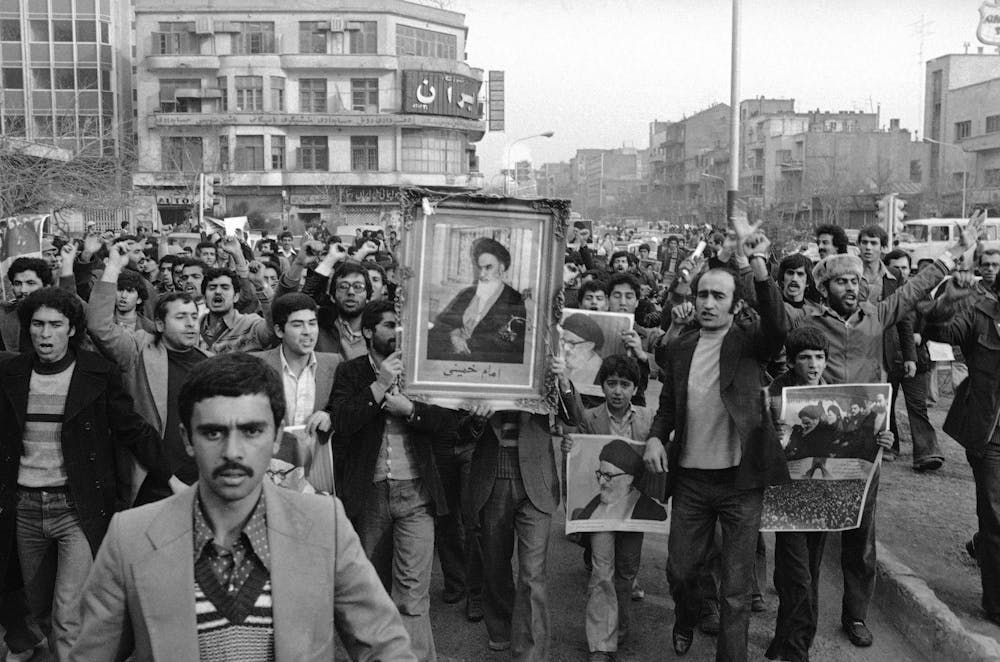
    Demonstrators in Tehran demand the establishment of an Islamic republic.
    AP Photo/Saris

    1979: Revolutionaries oust the shah, take hostages

    After more than 25 years of relative stability in U.S.-Iran relations, the Iranian public had grown unhappy with the social and economic conditions that developed under the dictatorial rule of Shah Mohammad Reza Pahlavi.

    Pahlavi enriched himself and used American aid to fund the military while many Iranians lived in poverty. Dissent was often violently quashed by SAVAK, the shah’s security service. In January 1979, the shah left Iran, ostensibly to seek cancer treatment. Two weeks later, Ayatollah Ruhollah Khomeini returned from exile in Iraq and led a drive to abolish the monarchy and proclaim an Islamic government.

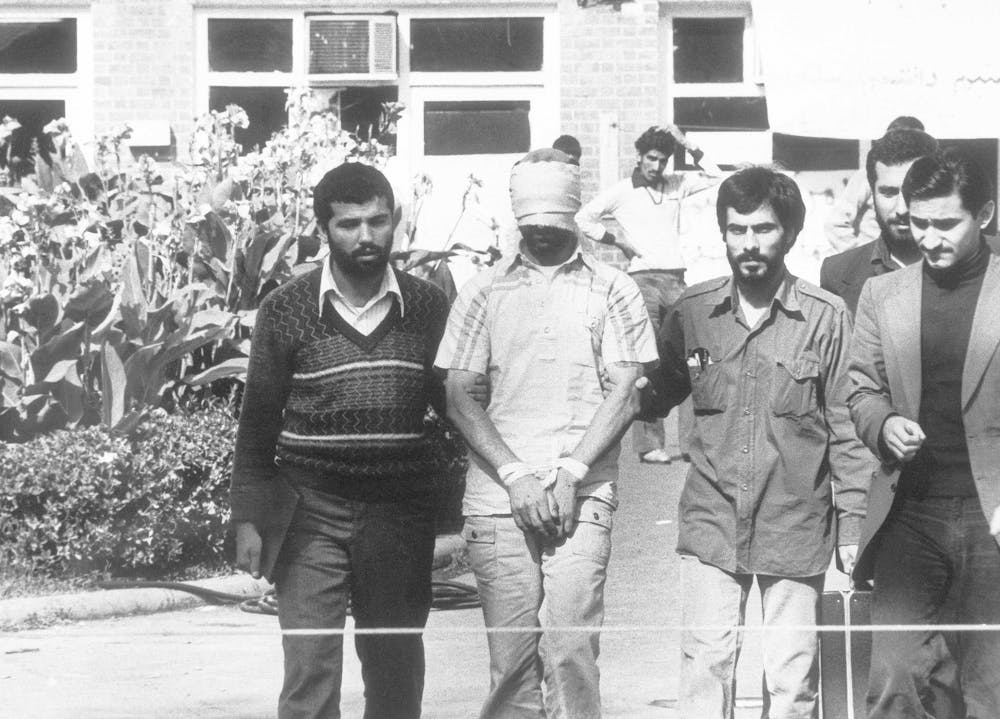
    Iranian students at the U.S. Embassy in Tehran show a blindfolded American hostage to the crowd in November 1979.
    AP Photo

    In October 1979, President Jimmy Carter agreed to allow the shah to come to the U.S. to seek advanced medical treatment. Outraged Iranian students stormed the U.S. Embassy in Tehran on Nov. 4, taking 52 Americans hostage. That convinced Carter to sever U.S. diplomatic relations with Iran on April 7, 1980.

    Two weeks later, the U.S. military launched a mission to rescue the hostages, but it failed, with aircraft crashes killing eight U.S. servicemembers.

    The shah died in Egypt in July 1980, but the hostages weren’t released until Jan. 20, 1981, after 444 days of captivity.

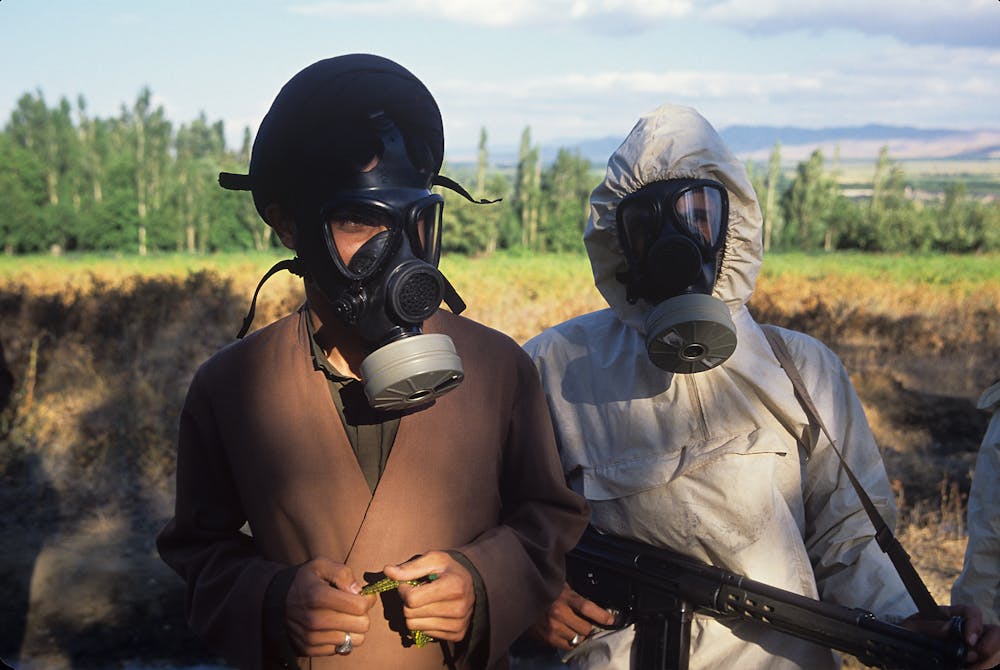
    An Iranian cleric, left, and an Iranian soldier wear gas masks to protect themselves against Iraqi chemical-weapons attacks in May 1988.
    Kaveh Kazemi/Getty Images

    1980-1988: US tacitly sides with Iraq

    In September 1980, Iraq invaded Iran, an escalation of the two countries’ regional rivalry and religious differences: Iraq was governed by Sunni Muslims but had a Shia Muslim majority population; Iran was led and populated mostly by Shiites.

    The U.S. was concerned that the conflict would limit the flow of Middle Eastern oil and wanted to ensure the conflict didn’t affect its close ally, Saudi Arabia.

    The U.S. supported Iraqi leader Saddam Hussein in his fight against the anti-American Iranian regime. As a result, the U.S. mostly turned a blind eye toward Iraq’s use of chemical weapons against Iran.

    U.S. officials moderated their usual opposition to those illegal and inhumane weapons because the U.S. State Department did not “wish to play into Iran’s hands by fueling its propaganda against Iraq.” In 1988, the war ended in a stalemate. More than 500,000 military and 100,000 civilians died.

    1981-1986: US secretly sells weapons to Iran

    The U.S. imposed an arms embargo after Iran was designated a state sponsor of terrorism in 1984. That left the Iranian military, in the middle of its war with Iraq, desperate for weapons and aircraft and vehicle parts to keep fighting.

    The Reagan administration decided that the embargo would likely push Iran to seek support from the Soviet Union, the U.S.’s Cold War rival. Rather than formally end the embargo, U.S. officials agreed to secretly sell weapons to Iran starting in 1981.

    The last shipment, of anti-tank missiles, was in October 1986. In November 1986, a Lebanese magazine exposed the deal. That revelation sparked the Iran-Contra scandal in the U.S., with Reagan’s officials found to have collected money from Iran for the weapons and illegally sent those funds to anti-socialist rebels – the Contras – in Nicaragua.

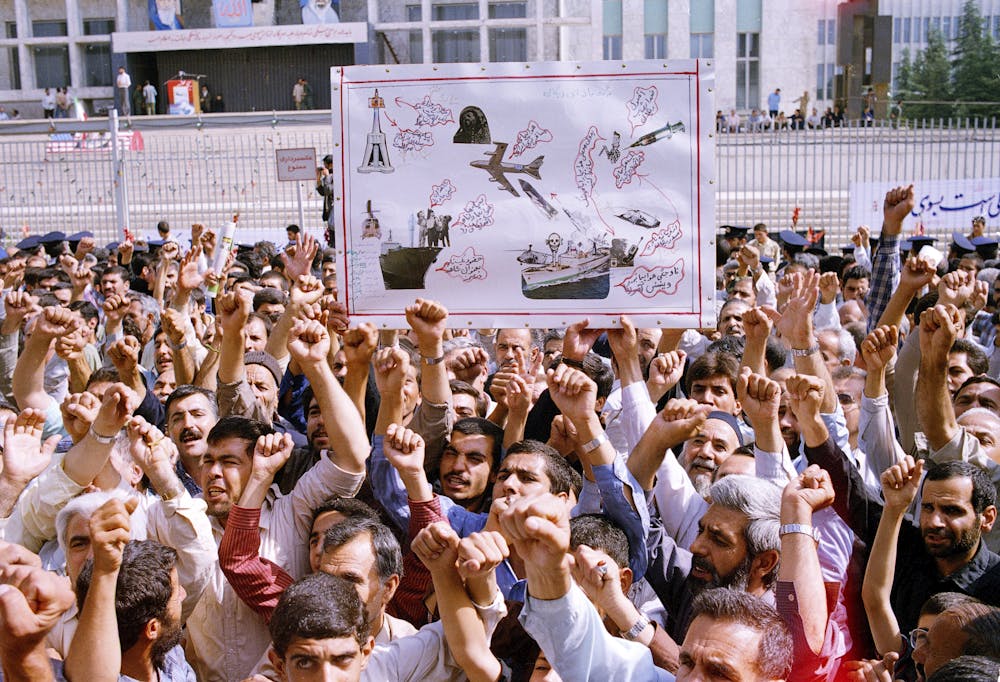
    At a mass funeral for 76 of the 290 people killed in the shootdown of Iran Air 655, mourners hold up a sign depicting the incident.
    AP Photo/CP/Mohammad Sayyad

    1988: US Navy shoots down Iran Air flight 655

    On the morning of July 8, 1988, the USS Vincennes, a guided missile cruiser patrolling in the international waters of the Persian Gulf, entered Iranian territorial waters while in a skirmish with Iranian gunboats.

    Either during or just after that exchange of gunfire, the Vincennes crew mistook a passing civilian Airbus passenger jet for an Iranian F-14 fighter. They shot it down, killing all 290 people aboard.

    The U.S. called it a “tragic and regrettable accident,” but Iran believed the plane’s downing was intentional. In 1996, the U.S. agreed to pay US$131.8 million in compensation to Iran.

    1997-1998: The US seeks contact

    In August 1997, a moderate reformer, Mohammad Khatami, won Iran’s presidential election.

    U.S. President Bill Clinton sensed an opportunity. He sent a message to Tehran through the Swiss ambassador there, proposing direct government-to-government talks.

    Shortly thereafter, in early January 1998, Khatami gave an interview to CNN in which he expressed “respect for the great American people,” denounced terrorism and recommended an “exchange of professors, writers, scholars, artists, journalists and tourists” between the United States and Iran.

    However, Supreme Leader Ayatollah Ali Khamenei didn’t agree, so not much came of the mutual overtures as Clinton’s time in office came to an end.

    In his 2002 State of the Union address, President George W. Bush characterized Iran, Iraq and North Korea as constituting an “Axis of Evil” supporting terrorism and pursuing weapons of mass destruction, straining relations even further.

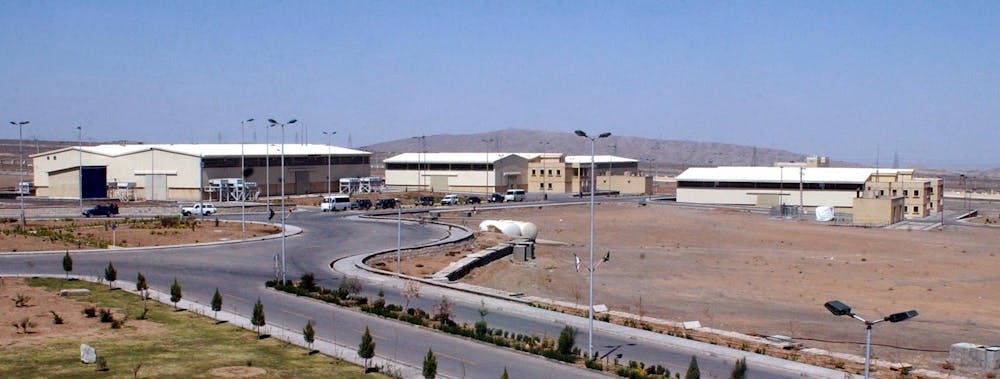
    Inside these buildings at the Natanz nuclear facility in Iran, technicians enrich uranium.
    AP Photo/Vahid Salemi

    2002: Iran’s nuclear program raises alarm

    In August 2002, an exiled rebel group announced that Iran had been secretly working on nuclear weapons at two installations that had not previously been publicly revealed.

    That was a violation of the terms of the Nuclear Nonproliferation Treaty, which Iran had signed, requiring countries to disclose their nuclear-related facilities to international inspectors.

    One of those formerly secret locations, Natanz, housed centrifuges for enriching uranium, which could be used in civilian nuclear reactors or enriched further for weapons.

    Starting in roughly 2005, U.S. and Israeli government cyberattackers together reportedly targeted the Natanz centrifuges with a custom-made piece of malicious software that became known as Stuxnet.

    That effort, which slowed down Iran’s nuclear program was one of many U.S. and international attempts – mostly unsuccessful – to curtail Iran’s progress toward building a nuclear bomb.

    2003: Iran writes to Bush administration

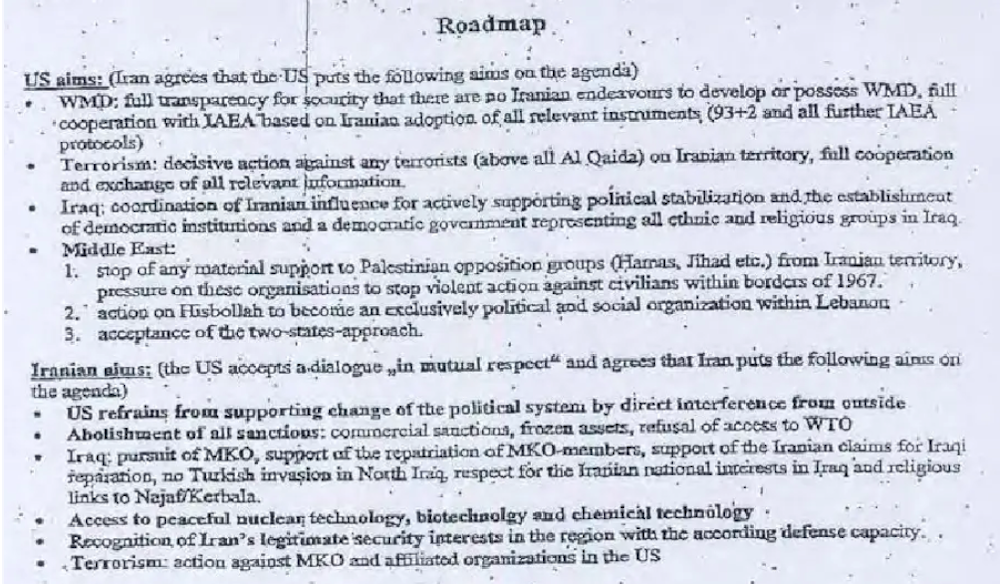
    An excerpt of the document sent from Iran, via the Swiss government, to the U.S. State Department in 2003, appears to seek talks between the U.S. and Iran.
    Washington Post via Scribd

    In May 2003, senior Iranian officials quietly contacted the State Department through the Swiss embassy in Iran, seeking “a dialogue ‘in mutual respect,’” addressing four big issues: nuclear weapons, terrorism, Palestinian resistance and stability in Iraq.

    Hardliners in the Bush administration weren’t interested in any major reconciliation, though Secretary of State Colin Powell favored dialogue and other officials had met with Iran about al-Qaida.

    When Iranian hardliner Mahmoud Ahmadinejad was elected president of Iran in 2005, the opportunity died. The following year, Ahmadinejad made his own overture to Washington in an 18-page letter to President Bush. The letter was widely dismissed; a senior State Department official told me in profane terms that it amounted to nothing.

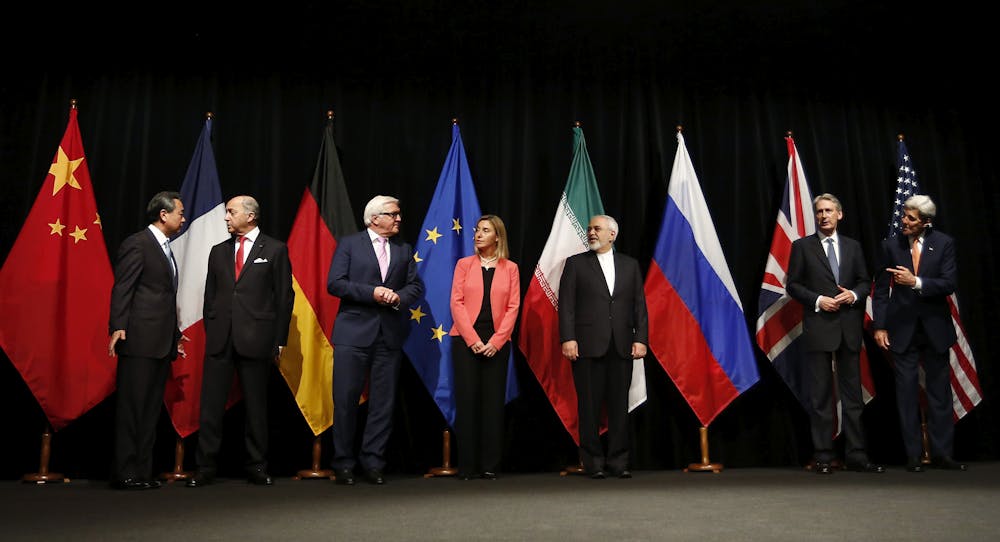
    Representatives of several nations met in Vienna in July 2015 to finalize the Iran nuclear deal.
    Austrian Federal Ministry for Europe, Integration and Foreign Affairs/Flickr

    2015: Iran nuclear deal signed

    After a decade of unsuccessful attempts to rein in Iran’s nuclear ambitions, the Obama administration undertook a direct diplomatic approach beginning in 2013.

    Two years of secret, direct negotiations initially bilaterally between the U.S. and Iran and later with other nuclear powers culminated in the Joint Comprehensive Plan of Action, often called the Iran nuclear deal.

    Two years of secret, direct negotiations conducted bilaterally at first between the U.S. and Iran and later with other nuclear powers culminated in the Joint Comprehensive Plan of Action, often called the Iran nuclear deal.

    Iran, the U.S., China, France, Germany, Russia and the United Kingdom signed the deal in 2015. It severely limited Iran’s capacity to enrich uranium and mandated that international inspectors monitor and enforce Iran’s compliance with the agreement.

    In return, Iran was granted relief from international and U.S. economic sanctions. Though the inspectors regularly certified that Iran was abiding by the agreement’s terms, President Donald Trump withdrew from the agreement in May 2018.

    2020: US drones kill Iranian Maj. Gen. Qassem Soleimani

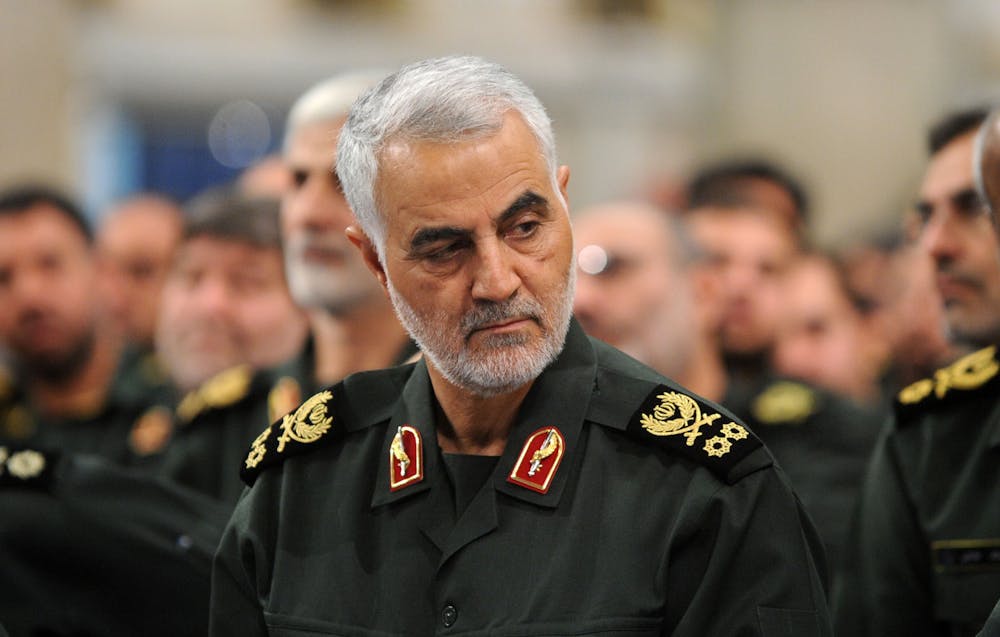
    An official photo from the Iranian government shows Maj. Gen. Qassem Soleimani, who was killed in a Jan. 3 drone strike ordered by President Donald Trump.
    Iranian Supreme Leader Press Office/Anadolu Agency via Getty Images

    On Jan. 3, 2020, an American drone fired a missile that killed Maj. Gen. Qassem Soleimani, the leader of Iran’s elite Quds Force. Analysts considered Soleimani the second most powerful man in Iran, after Supreme Leader Ayatollah Khamenei.

    At the time, the Trump administration asserted that Soleimani was directing an imminent attack against U.S. assets in the region, but officials have not provided clear evidence to support that claim.

    Iran responded by launching ballistic missiles that hit two American bases in Iraq.

    2023: The Oct. 7 attacks on Israel

    Hamas’ brazen attack on Israel on Oct. 7, 2023, provoked a fearsome militarized response from Israel that continues today and served to severely weaken Iran’s proxies in the region, especially Hamas – the perpetrator of the attacks – and Hezbollah in Lebanon.

    2025: Trump 2.0 and Iran

    Trump saw an opportunity to forge a new nuclear deal with Iran and to pursue other business deals with Tehran. Once inaugurated for his second term, Trump appointed Steve Witkoff, a real estate investor who is the president’s friend, to serve as special envoy for the Middle East and to lead negotiations.

    Negotiations for a nuclear deal between Washington and Tehran began in April, but the countries did not reach a deal. They were planning a new round of talks when Israel struck Iran with a series of airstrikes on June 13, forcing the White House to reconsider is position.

    On June 22, in the early morning hours, the U.S. chose to act decisively in an attempt to cripple Iran’s nuclear capacity, bombing three nuclear sites and causing what Pentagon officials called “severe damage.” Iran vowed to retaliate.

    This story has been updated to reflect the U.S. bombing of Iranian nuclear sites on June 22, 2025.

    Jeffrey Fields receives funding from the Carnegie Corporation of New York and Schmidt Futures.

    ref. US and Iran have a long, complicated history, spanning decades before US strikes on nuclear sites – https://theconversation.com/us-and-iran-have-a-long-complicated-history-spanning-decades-before-us-strikes-on-nuclear-sites-259240

    MIL OSI – Global Reports

  • MIL-OSI USA: Kaptur Releases Statement And Demands Answers Following American Strikes On Iranian Nuclear Facilities

    Source: United States House of Representatives – Congresswoman Marcy Kaptur (OH-09)

    Toledo, Ohio — Today, Congresswoman Marcy Kaptur (OH-09), a senior member of the House Appropriations Defense Subcommittee, released the following statement. Congresswoman has demanded immediate highly secure confidential Congressional briefings of key Defense and Intelligence Committees to address the following questions related to American strikes on Iranian nuclear facilities. Congresswoman Kaptur is one of 44 bipartisan members of the House who are leading H.Con.Res.38 Directing the President pursuant to section 5(c) of the War Powers Resolution to remove United States Armed Forces from unauthorized hostilities in the Islamic Republic of Iran. 

    “There was no congressional vote, no debate, nor even any discussion with Congress, with leaders of key intelligence committees reportedly left in the dark,” said Congresswoman Marcy Kaptur (OH-09). “This is not the way our Republic is supposed to function because that is not how our Constitution reads. I will continue to demand answers in a secure confidential Congressional briefing in the coming days. May God bless America and our people.”

    (1) If not an act of war against Iran, which Constitutionally would require Congressional consent before bombs were dropped, how does President Trump define his actions against Iran? 

    (2) Who — which individuals — exactly at the National Security Council, Pentagon, and Departments of Defense and State were involved in this decision?

    (3) With what other nations, and which international leaders did President Trump consult before making what appears to be a lone decision?

    (4) Going forward, the secretive manner in which the White House has made such a consequential, strategic, “Lone Ranger” decision puts at very serious risk American troops, US global assets, and strategic interests both abroad and at home.

    (5) This decision appears to have been solely President Trump’s. The consequences that will likely flow from it, however, will attend to the American people at home and abroad and rest squarely on his shoulders alone. 

    (6) Political retribution can take many forms  where religious beliefs do not accommodate compromise nor forgiveness as an accepted behavior. 

    # # #

    MIL OSI USA News

  • MIL-OSI Global: US bombs Iran’s nuclear sites: What led to Trump pulling the trigger – and what happens next?

    Source: The Conversation – Global Perspectives – By Javed Ali, Associate Professor of Practice of Public Policy, University of Michigan

    US President Donald Trump addresses the nation on Iran strikes on June 21, 2025 Carlos Barria/AFP via Getty Images

    In the early hours of June 22, 2025, local time, the United States attacked three nuclear facilities in Iran with “bunker buster” bombs and Tomahawk missiles.

    Following more than a week of Israeli strikes on various targets in Iran – which had prompted retaliatory strikes from Tehran – the U.S. move marks a possible inflection point in the conflict. In initial comments on the strikes at the Fordo, Isfahan and Natanz facilities, President Donald Trump said that Iran’s nuclear program had been “completely and fully obliterated.” In response, Iran’s Foreign Minister Abbas Araghchi said the U.S. had “crossed a very big red line.”

    The Conversation U.S. turned to Javed Ali, an expert on Middle East affairs at the University of Michigan and a former senior official at the National Security Council during the first Trump administration, to talk through why Trump chose now to act and what the potential repercussions could be.

    What do we know about the nature and timing of US involvement?

    President Trump has been forcefully hinting for days days that such a strike could happen, while at the same time opening up a window of negotiation by suggesting as late as June 20 that he would make a decision “within the next two weeks.” We know Trump can be very unpredictable, but he must have assessed that the current conditions presented an opportunity for U.S. action.

    Trump met with the National Security Council twice in the days leading up to the strike. Typically at such meetings the president is presented with a menu of military options, which usually boil down to three: a narrow option, a middle ground and a “if you really want to go big” strike.

    The one he picked, I would argue, is somewhere between the narrow option and the middle ground one.

    The “go big” options would have been an attack on nuclear sites and Iranian leadership – be that senior members of Iran’s Revolutionary Guard, or possibly the Supreme Leader Ayatollah Ali Khamenei. The more narrow approach would have been just one facility, likely to have been Fordo – a deeply fortified uranium enrichment site buried within a mountain.

    What did occur was a strike there, but also at two other sites – Isfahan and Natanz.

    U.S. military chiefs confirmed that that 12 GBU-57s – the so-called 30,000-pound bunker busters – were dropped by B-2 bombers on Fordo, and two on Isfahan.

    That suggests to me that the military goal of the operation was to destroy Iran’s ability to produce and or store highly enriched uranium in a one-time strike rather than drag the U.S. into a more prolonged conflict.

    Has the strike achieved Trump’s objectives?

    It will take some time to properly assess the extent to which Iran’s ability to produce or store highly enriched uranium has been damaged.

    Certainly we know that the bombs hit their targets, and they have been damaged – but to what extent is not immediately clear. General Dan Caine, chairman of the Joint Chiefs of Staff, said that all three target sites had suffered “extremely severe damage and destruction” – possibly rolling back from Trump’s “fully obliterated” assessment. Perhaps most tellingly, Iran has not commented yet on the extent of the damage.

    But to Trump, the objective was not just military but political, too. Trump has long said “no” to a nuclear Iran while at the same time has expressed that he has no desire to drag the U.S. into another war.

    And this strike may allow Trump to achieve those seemingly contradictory goals. If U.S. initial assessments are correct, Iran’s nuclear program will have been severely compromised. But the strikes won’t necessarily pull U.S. into the conflict fully – unless Iran retaliates in such a way that necessitates further U.S. action.

    And that is what Iran’s supreme leader and his military generals will need to work out: Should Iran retaliate and, if so, is it prepared to deal with a heavier U.S. military response – especially when there is no end in sight to its current conflict with Israel.

    An operational timeline of a strike on Iran is displayed during a news conference with U.S. Chairman of the Joint Chiefs of Staff Gen. Dan Caine and U.S. Defense Secretary Pete Hegseth on June 22, 2025.
    Andrew Harnik/Getty Images

    What options does Iran have to retaliate against US?

    Iran has in the past tried to respond proportionately to any attack. But here is the problem for Iran’s leaders: There is no feasible proportionate response to the United States. Iran has no capability to hit nuclear plants in the U.S. – either conventionally or through unconventional warfare.

    But there are tens of thousands of U.S. troops in the region, stationed in Iraq, Syria, the United Arab Emirates, Oman, Qatar and Jordan. All are in range of Iran’s ballistic, drones or cruise missiles.

    But that military inventory has been depleted – both by using ballistic missiles in waves of attacks against Israel and by Israel hitting missile launch and storage sites in Iran.

    Similarly, Tehran’s capacity to respond through one of its proxy or aligned groups in the region has been degraded. Hezbollah in Lebanon and Gaza’s Hamas – both of whom have ties to Iran – are in survival mode following damaging attacks from Israel over the past 18 months.

    The Houthis in Yemen are in many ways the “last man standing” in Iran’s so-called “Axis of Resistance.” But the Houthis have limited capability and know that if they do attack U.S. assets, they will likely get hit hard. During Operation Rough Rider from March to May this year, the Trump administration launched over 1,000 strikes against the Houthis.

    Meanwhile Shia militias in Iraq and Syria that could be encouraged to attack U.S. bases haven’t been active in months.

    Of course, Iran could look outside the region. In the past the country has been involved in assassinations, kidnappings and terror attacks abroad that were organized through its Quds Force or via operatives of MOIS, its intelligence service.

    But for Iran’s leaders, it is increasingly looking like a lose-lose proposition. If they don’t respond in a meaningful way, they look weak and more vulnerable. But if they do hit U.S. targets in any meaningful way, they will invite a stronger U.S. involvement in the conflict, as Trump has warned.

    The parallel I see here is with the killing of Iranian general and commander of the Quds Force, Qassem Soleimani, in January 2020 by a U.S. drone strike.

    On that occasion, Iran promised a strong retaliation. Its retaliatory attack against the U.S. Ain al-Asad air base in Iraq involved 27 ballistic missiles and caused the physical destruction of some of the facilities on base as well as traumatic brain injury-type symptoms to dozens of troops and personnel, but no deaths. Nevertheless, after this both the U.S. and Iran then backed off from deepening the conflict.

    The circumstances now are very different. Iran is already at war with Israel. Moreover, the U.S. went after Iran’s crown jewels – its nuclear program – and it was on Iranian territory. Nonetheless, Khameini knows that if he retaliates, he risks provoking a larger response.

    Trump suggested ‘further attacks’ could occur. What could that entail?

    The U.S. has suggested that it has the intelligence and ability to hit senior leadership in Iran. And any “go big option” would have likely involved strikes on key personnel. Similarly there could be plans to hit the Iranian economy by attacking oil and gas targets.

    A satellite image of the Fordo nuclear facility in Iran prior to the U.S. strike on June 22, 2025.
    Maxar/Getty

    But such actions risk either damaging the global economy or drawing the U.S. deeper into the conflict – it would evolve from a “one and done” strike to a cycle of attacks and responses. And that could widen political cracks between hawks in the administration and parts of Trump’s MAGA faithful who are against the U.S. being involved in overseas wars.

    Is there any opportunity of a return to diplomacy?

    Trump has not closed his “two weeks” window for talks – theoretically it is still open.

    But will Iran come to table? Leaders there had already said they were not willing to entertain any deal while under attack from Israel. Araghchi, Iran’s foreign minister, said after the U.S. strikes that the time for diplomacy had now passed.

    In any event, you have to ask, what can Iran come to the table with? Do they have much of a nuclear program anymore? And if not, what would they try to negotiate? It would seem, using one of Trump’s phrases, they “don’t have the cards” to make much of a deal.

    Javed Ali does not work for, consult, own shares in or receive funding from any company or organization that would benefit from this article, and has disclosed no relevant affiliations beyond their academic appointment.

    ref. US bombs Iran’s nuclear sites: What led to Trump pulling the trigger – and what happens next? – https://theconversation.com/us-bombs-irans-nuclear-sites-what-led-to-trump-pulling-the-trigger-and-what-happens-next-259519

    MIL OSI – Global Reports

  • MIL-OSI USA: Warnock Statement on President Trump’s Decision to Bomb Iran Without Congressional Approval

    US Senate News:

    Source: United States Senator Reverend Raphael Warnock – Georgia

    Warnock Statement on President Trump’s Decision to Bomb Iran Without Congressional Approval

    Washington, D.C. – Today, U.S. Senator Reverend Raphael Warnock (D-GA) released the following statement on President Trump’s decision to enter another Middle East conflict and bomb Iran without seeking congressional approval:

    “The ordering of our service members into battle is the gravest of responsibilities for an American president and should never be undertaken lightly. President Trump, who has said he ‘might or might not’ bomb Iran and has indicated this week that he disagrees with the assessment of his own national intelligence advisers, has now entered another Middle East conflict. He has not sought congressional approval and has not sufficiently explained why this operation was necessary right now. With thousands of American troops at risk for potential retaliation, this is not “the art of the deal.” This is war. And this is not the first time the American people have been told that it will end quickly. The people deserve to hear more than they’ve heard so far and the constitution requires a much more serious engagement with their representatives,” said Senator Reverend Warnock.

    MIL OSI USA News

  • MIL-OSI USA: Warnock Statement on President Trump’s Decision to Bomb Iran Without Congressional Approval

    US Senate News:

    Source: United States Senator Reverend Raphael Warnock – Georgia

    Warnock Statement on President Trump’s Decision to Bomb Iran Without Congressional Approval

    Washington, D.C. – Today, U.S. Senator Reverend Raphael Warnock (D-GA) released the following statement on President Trump’s decision to enter another Middle East conflict and bomb Iran without seeking congressional approval:
    “The ordering of our service members into battle is the gravest of responsibilities for an American president and should never be undertaken lightly. President Trump, who has said he ‘might or might not’ bomb Iran and has indicated this week that he disagrees with the assessment of his own national intelligence advisers, has now entered another Middle East conflict. He has not sought congressional approval and has not sufficiently explained why this operation was necessary right now. With thousands of American troops at risk for potential retaliation, this is not “the art of the deal.” This is war. And this is not the first time the American people have been told that it will end quickly. The people deserve to hear more than they’ve heard so far and the constitution requires a much more serious engagement with their representatives,” said Senator Reverend Warnock.

    MIL OSI USA News

  • MIL-OSI USA: Congressman Baird Statement on U.S. Airstrikes on Iran’s Nuclear Sites

    Source: United States House of Representatives – Congressman Jim Baird (R-IN-04)

    Congressman Baird Statement on U.S. Airstrikes on Iran’s Nuclear Sites

    Washington, June 22, 2025

    Today, Congressman Jim Baird (IN-04) released the following statement on the U.S. airstrikes which destroyed three of Iran’s nuclear sites:

    “The president has been consistent and clear: Iran cannot have a nuclear weapon. President Trump gave Iran every opportunity to make a deal, but Iran failed to come to an agreement and has terrorized Israel and Americans for decades. Thanks to President Trump’s decisive action, three of Iran’s key nuclear enrichment sites have been decimated. May God bless our brave, heroic troops for successfully completing this mission, and I thank them for their outstanding service to our country. God bless America.”

    MIL OSI USA News

  • MIL-OSI USA: Letlow Statement on Iran Strikes

    Source: United States House of Representatives – Congresswoman Julia Letlow (LA-05)

    WASHINGTON, D.C. –  Congresswoman Julia Letlow (LA-5) released the following statement regarding Saturday’s U.S. strikes against Iranian nuclear sites. 

    “President Trump’s decisive action protects America’s security and is a key step toward halting Iran’s march toward becoming a nuclear power. I’m grateful to our troops for their bravery in successfully executing this mission.

    Military action should never be taken lightly, but the world’s leading sponsor of terrorism obtaining a nuclear weapon would fundamentally threaten our national security. These targeted strikes were the right call, and I pray for the continued protection of our men and women in uniform.”

    MIL OSI USA News

  • MIL-OSI USA: Congressman Jonathan L. Jackson Condemns Escalation in Middle East, Calls for Congressional Oversight

    Source: United States House of Representatives – Representative Jonathan Jackson – Illinois (1st District)

    FOR IMMEDIATE RELEASE

    WASHINGTON, D.C. – Congressman Jonathan L. Jackson issued the following statement regarding the escalating tensions between Israel, Iran, and the United States: 

    “The current situation in the Middle East is deeply troubling. I have long maintained that Iran must never be allowed to possess nuclear weapons—nor should any nation in the region. Diplomacy, not unilateral military action, must guide our approach to preventing nuclear proliferation. 

    I supported the Joint Comprehensive Plan of Action (JCPOA), negotiated through U.S. leadership and in partnership with our allies. While imperfect, it was the most effective means of restraining Iran’s nuclear ambitions at the time. President Trump’s decision to unilaterally withdraw from the deal—against the counsel of our allies—undermined global security and allowed Iran to resume uranium enrichment at alarming levels. 

    Prime Minister Benjamin Netanyahu’s recent preemptive strike on Iran, on the eve of potential U.S.-Iran negotiations, was unnecessary and provocative. U.S. intelligence agencies and Rafael Grossi, Director General of the International Atomic Energy Agency (IAEA), have confirmed there is no evidence Iran is actively building a nuclear weapon. 

    Today’s U.S. military strikes on Iranian facilities were equally unjustified, as there was no imminent threat to American security. Moreover, the President failed to consult Congress—the sole branch of government with the constitutional authority to authorize such actions.

    I demand that President Trump immediately brief Congress before taking any further military action. The American people deserve transparency. We cannot repeat the mistakes of the Iraq War, launched on false intelligence, which cost thousands of lives and billions of dollars. 

    It is time for restraint, accountability, and a return to diplomacy.” 

    ###

    MIL OSI USA News

  • MIL-OSI USA: Luján Statement on U.S. Airstrikes on Iran

    US Senate News:

    Source: United States Senator Ben Ray Luján (D-New Mexico)

    Santa Fe, N.M. – U.S. Senator Ben Ray Luján (D-N.M.) issued the following statement following U.S. airstrikes on Iranian nuclear facilities:

    “Americans have made it clear they do not want to be dragged into another endless war in the Middle East. Yet President Trump went against the American people without sharing any evidence to prove these military strikes would protect our homeland security.

    “This unauthorized and unilateral action puts American troops at risk and threatens to further destabilize the region.

    “President Trump must work to deescalate rising tensions in the Middle East and to protect the American people.” 

    MIL OSI USA News

  • MIL-OSI USA: Luján Statement on U.S. Airstrikes on Iran

    US Senate News:

    Source: United States Senator Ben Ray Luján (D-New Mexico)

    Santa Fe, N.M. – U.S. Senator Ben Ray Luján (D-N.M.) issued the following statement following U.S. airstrikes on Iranian nuclear facilities:

    “Americans have made it clear they do not want to be dragged into another endless war in the Middle East. Yet President Trump went against the American people without sharing any evidence to prove these military strikes would protect our homeland security.

    “This unauthorized and unilateral action puts American troops at risk and threatens to further destabilize the region.

    “President Trump must work to deescalate rising tensions in the Middle East and to protect the American people.” 

    MIL OSI USA News

  • MIL-OSI Russia: China Strongly Condemns US Attack on Iran – Chinese Foreign Ministry /more details/

    Translation. Region: Russian Federal

    Source: People’s Republic of China in Russian – People’s Republic of China in Russian –

    Source: People’s Republic of China – State Council News

    BEIJING, June 22 (Xinhua) — China strongly condemns the U.S. attacks on Iran and the U.S. bombing of nuclear facilities under International Atomic Energy Agency (IAEA) safeguards, a Chinese Foreign Ministry spokesman said Sunday.

    The diplomat said this while commenting on the statement by US President Donald Trump that the United States had struck three nuclear facilities in Iran.

    As the official representative noted, by its actions the United States seriously violated the purposes and principles of the UN Charter and international law, and also exacerbated tensions in the Middle East.

    China calls on all parties to the conflict, first and foremost Israel, to cease fire as soon as possible, ensure the safety of civilians, and begin dialogue and negotiations, the official representative emphasized.

    According to him, the Chinese side is ready to cooperate with the international community to consolidate efforts, defend justice, and contribute to the restoration of peace and stability in the Middle East. –0–

    MIL OSI Russia News

  • MIL-OSI United Kingdom: Scottish Greens condemn escalation of Israel-Iran conflict

    Source: Scottish Greens

    Keir Starmer’s response to the bombing of Iran sides with the aggressors and contributes to the escalation of the conflict.

    The Scottish Greens have condemned Keir Starmer’s response to the bombing of Iran as siding with the aggressors and contributing to the escalation of the conflict.

    Iran had previously reached a negotiated solution to their nuclear programme with the US, China, Russa, UK and others, which was unilaterally scrapped by the first Trump administration in 2018.

    It has said it is willing to discuss a new deal once it is no longer under attack.

    In response to last night’s US bombings, the UK Government and Keir Starmer spoke supportively of the action.

    Patrick Harvie MSP said:

    “This is a deplorable response from the UK government, but it’s all too predictable.

    “Israel expanding its war at a time when negotiations were imminent, and high-level meetings between Iran and the US were already beginning to take place, is an outrage. UN experts have called it a ‘flagrant violation’ of international law and a ‘blatant act of aggression.’

    “The UK’s response has done nothing but encourage this escalation, from its ongoing material support for Israel’s routine atrocities in Gaza, to the political cover it’s now providing Israel and the US as they intensify their bombing of Iran.

    “The Iranian regime is unquestionably brutal, and everyone will celebrate if the Iranian people can overthrow it. But this attack will do nothing to make that happen, and only takes the world toward ever wider conflict.

    “Rather than being a voice for peace, Keir Starmer has shown a reckless disregard for international law and sided with the aggressors. In doing so he is only contributing to further death, destruction, and instability for people in the middle east and the wider world.”

    MIL OSI United Kingdom

  • MIL-OSI Global: Why Israel and the U.S. are sure to encounter the limits of air power in Iran

    Source: The Conversation – Canada – By James Horncastle, Assistant Professor and Edward and Emily McWhinney Professor in International Relations, Simon Fraser University

    The United States has apparently answered Israel’s call to to become involved in the war between Israel and Iran.

    President Donald Trump had signalled a willingness for the U.S. to become involved in the conflict. He went so far, in fact, to suggest in social media posts that he could kill Iran’s supreme leader if he wanted to.

    Segment on Trump’s threats against Iran’s leader. (BBC News)

    The American military can certainly make an impact in any air campaign against Iran. The problem from a military standpoint, however, is that the U.S., based on its forces’ deployment, will almost certainly seek to keep its involvement limited to its air force to avoid another Iraq-like quagmire.

    While doing so could almost certainly disrupt Iran’s nuclear program, it will likely fall short of Israel’s goal of regime change.

    In fact, it could reinforce the Iranian government and draw the U.S. into a costly ground war.


    Read more:
    Why is there so much concern over Iran’s nuclear program? And where could it go from here?


    Israel’s need for American support

    The initial stated reason for Israel’s bombing campaign — Iran’s nuclear capabilities — appears specious at best.

    Israeli Prime Minister Benjamin Netanyahu has argued several times in the past, without evidence, that Iran is close to achieving a nuclear weapon. U.S. intelligence, however, have assessed that Iran is three years away from deploying a nuclear weapon.

    Regardless of the veracity of the claims, Israel initiated the offensive and requires American support.

    Israel’s need for U.S. assistance rests on two circumstances:

    1. While Israel succeeded in eliminating key figures from the Iranian military in its initial strikes, Iran’s response appears to have exceeded Israel’s expectations with their Arrow missile interceptors nearing depletion.

    2. Israel’s air strikes can only achieve so much in disrupting Iran’s nuclear ambitions. Most analysts note that Israel’s bombings are only likely to delay the Iranian nuclear program by a few months. This is due to the fact that Israeli missiles are incapable of penetrating the Fordow Fuel Enrichment Plant, which estimates place close to 300 feet underground.

    The United States, however, possesses munitions that have reportedly destroyed the Fordow facility. Most notably, the GBU-57A/B Massive Ordnance Penetrator (more commonly known as a bunker buster) has a penetration capability of 200 feet and was reportedly used in the attack.

    Romanticizing air power

    Nonetheless, the efficacy of air power has been vastly overrated in the popular media and various air forces of the world. Air power is great at disrupting an opponent, but has significant limitations in influencing the outcome of a war.

    Specifically, air power is likely to prove an inadequate tool for one of the supposed Israeli and American objectives in the war: regime change. For air power to be effective at bringing about regime change, it needs to demoralize the Iranian people to the point that they’re willing to oppose their own government.

    Early air enthusiasts believed that a population’s demoralization would be an inevitable consequence of aerial bombardment. Italian general Giulio Douhet, a prominent air power theorist, argued that air power was so mighty that it could destroy cities and demoralize an opponent into surrendering.

    Douhet was correct on the first point. He was wrong on the second.

    Recent history provides evidence. While considerable ink has been spilled to demonstrate the efficacy of air power during the Second World War, close examination of the facts demonstrate that it had a minimal impact. In fact, Allied bombing of German cities in several instances created the opposite effect.

    More recent bombing campaigns replicated this failure. The U.S. bombing of North Vietnam during the Vietnam War did not significantly damage North Vietnamese morale or war effort. NATO’s bombing of Serbia in 1999, likewise, rallied support for the unpopular Slobodan Milosevic due to its perceived injustice — and continues to evoke strong emotions to this day.

    Iran’s political regime may be unpopular with many Iranians, but Israeli and American bombing may shore up support for the Iranian government.

    Nationalism is a potent force, particularly when people are under attack. The attacks on Iran will rally segments of the population to the government that would otherwise oppose it.

    Few positive options

    The limitations of air power to fuel significant political change in Iran should have given Trump pause about intervening in the conflict.

    Some American support, such as providing weapons, is a given due to the close relationship between the U.S. and Israel. But any realization of American and Israeli aspirations of a non-nuclear Iran and a new government will likely require ground forces.

    Recent American experiences in Afghanistan and Iraq show such a ground forces operation won’t lead to the swift victory that Trump desires, but could potentially stretch on for decades.

    James Horncastle does not work for, consult, own shares in or receive funding from any company or organisation that would benefit from this article, and has disclosed no relevant affiliations beyond their academic appointment.

    ref. Why Israel and the U.S. are sure to encounter the limits of air power in Iran – https://theconversation.com/why-israel-and-the-u-s-are-sure-to-encounter-the-limits-of-air-power-in-iran-259348

    MIL OSI – Global Reports

  • MIL-OSI USA News: WHAT THEY ARE SAYING: President Trump’s Display of Peace Through Strength

    Source: US Whitehouse

    President Donald J. Trump’s bold, decisive action against Iran — the world’s leading state sponsor of terrorism — and its key nuclear facilities was met with bipartisan praise from lawmakers across Capitol Hill.

    Here’s what they’re saying:

    Speaker Mike Johnson: “The President made the right call, and did what he needed to do. Leaders in Congress were aware of the urgency of this situation and the Commander-in-Chief evaluated that the imminent danger outweighed the time it would take for Congress to act. The world’s largest state sponsor of terrorism, which chants ‘Death to America,’ simply could not be allowed the opportunity to obtain and use nuclear weapons. The President fully respects the Article I power of Congress, and tonight’s necessary, limited, and targeted strike follows the history and tradition of similar military actions under presidents of both parties.”

    Senate Majority Leader John Thune: “The regime in Iran, which has committed itself to bringing ‘death to America’ and wiping Israel off the map, has rejected all diplomatic pathways to peace. The mullahs’ misguided pursuit of nuclear weapons must be stopped. As we take action tonight to ensure a nuclear weapon remains out of reach for Iran, I stand with President Trump and pray for the American troops and personnel in harm’s way.”

    Senate Majority Whip John Barrasso: “President @realDonaldTrump’s decision to strike Iran’s nuclear program is the right one. The greatest threat to the safety of the United States and the world is Iran with a nuclear weapon. God Bless our troops”

    Senate Republican Conference Chair Tom Cotton: “Iran has waged a war of terror against the United States for 46 years. We could never allow Iran to get nuclear weapons. God bless our brave troops. President Trump made the right call and the ayatollahs should recall his warning not to target Americans.”

    Senate Foreign Relations Committee Chair Jim Risch: “As President Trump has said over and over again – as have I – Iran cannot have a nuclear weapon. Why? A nuclear-armed Iran would without doubt spark a nuclear arms race that would take off around the world. This is a direct threat to American national security if left unchecked. This war is Israel’s war not our war, but Israel is one of our strongest allies and is disarming Iran for the good of the world. I’ve also always said that Israel would not allow Iran to have a nuclear weapon. For Israel this is existential. The Iranians literally want to wipe Israel and all Jews off the face of the earth. This strike will put an end to those ambitions. President Trump took decisive action today to assist the Israelis in their efforts to stop the Iranian nuclear program. Only American weapons could do what has been done. This has made America safer, in addition to the Israelis, and the world more broadly. This is not the start of a forever war. There will not be American boots on the ground in Iran. This was a precise, limited strike, which was necessary and by all accounts was very successful. As President Trump has stated, now is the time for peace.”

    Sen. Jim Banks: “I trust President Trump!”

    Sen. Marsha Blackburn: “@realDonaldTrump knows peace can only be achieved through strength. This is a victory for the United States.”

    Sen. Katie Britt: “I stand by President Trump. Strong and surgical. Please pray for peace.”

    Sen. Ted Budd: “Tonight, the United States dealt a decisive blow to Iran’s nuclear program. The U.S. military alone had the capability to destroy these facilities deep underground, and I commend President Trump for standing with our Israeli allies in their efforts to end the threat of a nuclear Iran once and for all. May God bless and protect our troops, who continue to keep us safe around the world.”

    Sen. Bill Cassidy: “Iran’s nuclear program is a threat to peace and stability. Peace must remain the goal.”

    Sen. John Cornyn: “President Trump made the courageous and correct decision to eliminate the Iranian nuclear threat. God Bless the USA. Thank you to our extraordinary military and our indomitable @POTUS This is what leadership on the world stage looks like.”

    Sen. Kevin Cramer: “When only we can do what needs doing, we must do it. Great call Mr. President and great job @usairforce ! God Bless The USA! #PeaceThroughStrength #GodBlessIsrael.”

    Sen. Ted Cruz: “I commend our pilots and servicemembers, our intelligence personnel, and his national security staff on tonight’s successful and critical operation. The prospect of the Iranian regime acquiring nuclear weapons represents the most acute immediate threat to America and our allies. When the Ayatollah chants ‘Death to America’ he means it, and the reason he is building nuclear weapons is because he intends to use them. President Trump has consistently and unequivocally stated that those threats cannot be countered without dismantling the Iranian regime’s enrichment capacity. The President and his negotiators spent two months exploring whether the regime would agree to a negotiated settlement that met America’s national security needs. At the end of that period, Iranian regime officials declared that instead of agreeing to deal they would open a new enrichment facility and install more advanced centrifuges. After that declaration, our Israeli allies launched a preemptive attack against the regime and its nuclear infrastructure, which was enormously successful. It could not disable the nuclear activities at Fordow, an underground enrichment bunker built into a mountain which was legitimized by the Obama-era deal. As long as Iran was able to access and enrich uranium, they could still rush to build a nuclear arsenal. Tonight’s actions have gone far in foreclosing that possibility, and countering the apocalyptic threat posed by an Iranian nuclear arsenal.”

    Sen. John Curtis: “Iran’s relentless pursuit of nuclear weapons is a direct threat to American interests, our allies, and global stability. Today’s action was a serious and necessary response to that danger. I honor the brave servicemembers who carried out the mission with skill and courage. Strength paired with genuine diplomacy is how we create peace, prevent conflict, and preserve freedom. I join the President in calling for a return to diplomacy.”

    Sen. Steve Daines: “Thank you President Trump and the men and women of our armed forces. America, Israel and the rest of the world are safer tonight as a result of your bravery, courage and unrivaled skill. Iran is the world’s largest state sponsor of terror, has killed hundreds of U.S. service members, attempted to assassinate President Trump, and calls the United States ‘big Satan’ and Israel ‘little Satan.’ Stopping Iran’s pursuit of nuclear weapons is a major step toward achieving peace.”

    Sen. Joni Ernst: “By leading with peace through strength, President Trump is making the world a safer place and protecting Americans. Iran must never be able to threaten America with a nuclear weapon. God bless our commander in chief and our servicemembers!”

    Sen. Deb Fischer: “For decades, Iran has chanted ‘death to America’ and pledged to wipe Israel off the map. When foreign adversaries pledge to destroy us, we should believe them. President Trump has always been clear: Iran must never obtain a nuclear weapon – and I agree. Today, his administration took the necessary steps to keep a nuclear weapon out of Iran’s reach, and I am grateful to the service members who successfully carried out the mission.”

    Sen. Bill Hagerty: “@POTUS’s decisive leadership enforced deadlines and redlines. This was a tough decision, one that, as always, President Trump put the interests of the American people first in making. May this be the end of Iran’s nuclear weapon ambitions and lay the groundwork for lasting peace.”

    Sen. Lindsey Graham: “Good. This was the right call. The regime deserves it. Well done, President @realDonaldTrump To my fellow citizens: We have the best Air Force in the world. It makes me so proud. Fly, Fight, Win.”

    Sen. Chuck Grassley: “Our commander in chief & brave military forces hv carried out a mission in Iran to prevent nuclear enrichment Iran believes in “Death to Israel Death to America” Keeping USA safe is number 1 responsibility of Pres Trump”

    Sen. John Fetterman: “As I’ve long maintained, this was the correct move by @POTUS. Iran is the world’s leading sponsor of terrorism and cannot have nuclear capabilities. I’m grateful for and salute the finest military in the world.”

    Sen. James Lankford: “I continue to be grateful for the skill and professionalism of our United States service members. Cindy and I are praying for our military, the President and for a lasting peace.”

    Sen. Mike Lee: “Tonight, the Iranian nuclear program was wiped out. Please join me in praying for the safety of the brave men and women of America’s armed forces in the Middle East and around the world, and that these strikes may lead to the lasting peace called for by President Trump.”

    Sen. Roger Marshall: “Thank you to our brave American Air Force and their successful mission as no Americans were harmed. We stand tall with President Trump who is protecting the world from a nuclear capable Iran.”

    Sen. Dave McCormick: “As I have said all along, Iran must not have a nuclear weapon. This targeted attack on Iran’s nuclear facilities is the result of the Iranian regime’s failure to make a deal despite months of President Trump’s good faith efforts to negotiate. I applaud President Trump’s strong leadership and his continued commitment to peace through strength. Once again, America’s detractors around the world should know President Trump means what he says. And I am so grateful for America’s brave warriors, who appear to have achieved their mission successfully and are returning home safely. I look forward to being briefed along with my Senate colleagues on this action.  This is an important step toward ensuring that the world’s largest state sponsor of terror never obtains a nuclear weapon.”

    Sen. Ashley Moody: “This is a solemn and important moment for security and peace. We stand with and pray for our President, the service members who carried out this mission, and the people affected by this conflict.”

    Sen. Markwayne Mullin: “To those concerned about U.S. involvement— this isn’t a “forever war” in fact, it’s ending one. @POTUS was clear: Iran must never have a nuclear weapon. The Republican-led @SenateGOP trusts President Trump to keep America safe, free, and prosperous. Peace through strength.”

    Sen. Pete Ricketts: “President Trump gave Iran ample time to come to the negotiating table on its nuclear program. Tonight’s strikes mean Iran is further from possessing a nuclear weapon. I’m thankful for the heroes who carried out this strike and for our service members in the Middle East and around the world.”

    Sen. Rick Scott: “Thank you, @POTUS, @SecDef, and our brave American warriors for a successful strike on three Iranian nuclear sites. This is what peace through strength looks like. The United States and the world are a safer place without Iran possessing a nuclear weapon.”

    Sen. Tim Scott: “Decisive American leadership. Americans and the world can thank President Trump for his courage to lead.”

    Sen. Tim Sheehy: “The right decision. Iran had every opportunity to give up their nukes. To the naysayers out there, this isn’t starting a war, this is ending one. Iran has been at war with America for 46 years. The Iranian people should rise up and put an end to this murderous regime.”

    Sen. Dan Sullivan: “President Trump meant what he said—Iran will never get a nuclear bomb. I commend @POTUS and his national security team for making this important but difficult decision and our brave military members for carrying it out. The terrorist leaders of Iran have, in essence, been at war with the United States for decades—targeting, wounding and killing thousands of American service members for years. Making sure the world’s largest state sponsor of terrorism never gets a nuclear weapon is part of the work of reestablishing deterrence against Iran, which was lost during the appeasement of the Biden Administration. This is difficult work, but critical for our national security. I fully support the President and his national security team in these critical efforts.”

    Sen. Thom Tillis: “This was the right decision by @POTUS: we cannot allow Iran to build nuclear weapons. God Bless our brave servicemembers who supported and executed this mission.”

    Sen. Tommy Tuberville: “God bless our Troops. God bless President Trump. And may God continue to bless the United States of America.”

    Sen. Roger Wicker: “Our commander-in-chief has made a deliberate —and correct— decision to eliminate the existential threat posed by the Iranian regime. We now have very serious choices ahead to provide security for our citizens and our allies and stability for the middle-east. Well-done to our military personnel. You’re the best!”

    Sen. Todd Young: “Thank you to our brave service members who executed this mission. The world will be safer if Iran’s nuclear capability is destroyed. I look forward to briefings in the coming days.”

    House Majority Whip Tom Emmer: “A nuclear Iran posed a threat to the Middle East and to the world. @POTUS has been consistent that this dangerous regime should NEVER possess a nuclear weapon. He was right then, and he is right today: NOW IS THE TIME FOR PEACE.”

    House Republican Conference Chair Lisa McClain: “President Trump is delivering PEACE THROUGH STRENGTH. Today’s successful mission destroyed Iran’s nuclear capabilities, protected American lives, and will make the world safer. Now, it’s time for peace.  God bless America and our warfighters!”

    Rep. Robert Aderholt: “I fully support President Trump’s decision to take out Iran’s nuclear facilities. As I have said, I believe that if Iran gets a functioning nuclear weapon they would not hesitate to use it against Israel or the United States. When they say death to Israel and death to America, we have no reason not to believe them. I pray this action has made the world safer. President Trump has pledged to get us out of “forever wars.” This could be a step toward ending the war we have been in with Iran since 1979. They have killed hundreds and hundreds of Americans in the past half century.”

    Rep. Mark Alford: “PEACE THROUGH STRENGTH REQUIRES STRENGTH We strongly support President Trump’s targeted strikes against Iranian nuclear facilities. The Ayatollah must never be allowed to obtain a nuclear weapon and we will always stand with Israel.”

    Rep. Don Bacon: “Iran with a nuclear weapon is an existential threat. Pres. Trump is protecting America.”

    Rep. Troy Balderson: “Thank you @realDonaldTrump for taking decisive action. The world is a whole lot safer tonight.”

    Rep. Michael Baumgartner: “There is no greater threat to the world than nuclear proliferation, let alone from a regime that has consistently used radical Islamic terrorists to attack and kill Americans for nearly 4 decades. I fully support President Trump’s decision to bomb Iran’s nuke reactor. Trump gave Iran a choice. The Ayatollah chose poorly.”

    Rep. Andy Barr: “God Bless Donald J. Trump, God Bless our military, and God Bless the United States of America! America thanks you, @realdonaldtrump! The world thanks you too.”

    Rep. Tom Barrett: “I anticipate a full briefing of our military strike in Iran immediately upon my return to Washington. Tonight, I am praying for wisdom in our decisions, President Trump and his team, and the safety of our troops. God bless the United States of America.” 

    Rep. Aarron Bean: “The rogue Iranian regime has murdered American soldiers and been the world’s leading sponsor of terrorism for decades. Peace through strength is a strategy that works. God bless our brave American troops and God bless the USA!”

    Rep. Mike Bost: “I trust that President Trump made the decision to target Iran’s nuclear program tonight due to intelligence that indicates the regime was within reach of developing nuclear weapons that could threaten the lives of American citizens and U.S. troops stationed across the globe. He showed the strength to ensure that never happens.”

    Rep. Ken Calvert: “Like President Trump, I have consistently said Iran cannot be allowed to obtain a nuclear weapon. I support his decision to use the force and precision of the U.S. military in coordination with our ally Israel to uphold this redline with tonight’s targeted strike.”

    Rep. Buddy Carter: “I support President Trump. Peace through strength!  Thank you to the brave troops who defended us and our ally, Israel.”

    Rep. Mike Collins: “Peace through strength. Thank God we have President Trump as Commander in Chief.”

    Rep. Jeff Crank: “Tonight, President Trump took decisive action to stop Iran from obtaining a nuclear weapon, protect Americans and build peace in the Middle East.  Congratulations to the Department of Defense on a successful mission.”

    Rep. Rick Crawford: “As I have said multiple times recently, I regret that Iran has brought the world to this point. That said, I am thankful President Trump understood that the red line—articulated by Presidents of both parties for decades—was real. The United States and our allies, including Israel, are making it clear that the world would never accept Iran’s development of a nuclear weapon. I have been in touch with the White House before this action and will continue to track developments closely with them in the coming days. I commend President Trump for taking decisive action and I am grateful to the U.S. servicemembers who carried out these precise and successful strikes. I continue to pray for the safety of the forces engaged to protect the free world.”

    Rep. Dan Crenshaw: “Support President Trump. You think these decisions were easy? They weren’t. You think this means WW3? You’re wrong. You think it means American soldiers deploying to Iran? You’re wrong. You think it means long term stability in the Middle East and a safer future for Americans? You’re right. Because the regime that wanted ‘Death to the Great Satan’ is at its end.  Support the President.”

    Rep. Scott DesJarlais: “I stand with President Trump’s decision to take out the last of Iran’s nuclear sites and his call for peace. My full statement & the DOJ indictment on Iran’s attempt to assassinate Trump.”

    Rep. Mario Diaz-Balart: “I stand with our Commander-in-Chief President @realDonaldTrump in making sure the terrorist regime in Iran never gets a nuclear weapon. Proud of our exceptional military and proud to stand by our ally Israel.”

    Rep. Neal Dunn: “Iran’s nuclear ambitions are a threat not just to Israel but also to all our allies and the entire free world. The Ayatollah’s regime forced the President’s hand. It was imperative that President Trump act decisively to eliminate that existential threat. Prayers for the Iranian people and peace in the Middle East.”

    Rep. Gabe Evans: “I’m glad to see @POTUS take action to prevent Iran from acquiring a nuclear weapon. As a veteran of a Global War on Terror, I know we achieve peace through strength. Prayers and thanks to our brave men and women who carried out this necessary operation.”

    Rep. Pat Fallon: “President Trump today made the tough, but absolutely correct decision in the best interest of America’s national security to order strikes on Iran’s nuclear sites. Let me be clear — Iran cannot possess nuclear weapons under any circumstances. Thank you to our brave servicemembers for getting the job done.”

    Rep. Brian Fitzpatrick: “Tonight, the United States executed a successful strike on Iran’s nuclear sites at Fordow, Natanz, and Esfahan. All our aircraft are safely out of Iranian airspace and headed home. This was the right call—and a necessary one. Make no mistake: a nuclear Iran is an existential threat—not just to Israel, but to the entire free world. Peace through strength is how we lead. And tonight, the greatest military on Earth delivered —for America, for our allies, and for the cause of global security. God bless our Troops. God bless America. And God Bless the enduring cause of liberty, now and forever.”

    Rep. Chuck Fleischmann: “President Trump is showing strong leadership that will protect America and the entire world by ensuring Iran never acquires a nuclear weapon. Iran is the world’s largest state-sponsor of terrorism, responsible for the murder of thousands globally. The Iranian regime must NEVER have access to nuclear weapons. I applaud President Trump for his steadfast leadership as our Commander in Chief and our outstanding Armed Forces for their successful mission.”

    Rep. Mike Flood: “Tonight, President Trump took bold steps to ensure that Iran never obtains a nuclear weapon. Keeping Iran from becoming a nuclear power will not only help keep America safe but can provide peace and stability around the world.  Thank you to our brave service members who skillfully carried out this mission.”

    Rep. Vince Fong: “President Trump’s decisive action to eliminate the nuclear capabilities posed by the Iranian regime was a necessary one to prevent a real and catastrophic threat. Iran can NEVER be allowed to have a nuclear weapon. We’re grateful for the bravery of the @usairforce and all our military personnel. May God protect them and all Americans in harm’s way as we continue the necessary work to preserve peace and stability.”

    Rep. Russell Fry: “I stand with President Trump—Iran CANNOT have a nuclear weapon. Peace through strength.”

    Rep. Brandon Gill: “’Peace through strength’ means ensuring our existential enemies don’t acquire the most lethal and catastrophic weapons known to man.”

    Rep. Carlos Gimenez: “God bless America! God bless the Jewish State of Israel! God bless President Donald J. Trump! The people of #Iran will soon taste freedom again, Israel will be at peace, & democracy will be safe from this radical Islamist terrorist regime!”

    Rep. Lance Gooden: “PEACE THROUGH STRENGTH! Thank you, Mr. President, and our great military! And thanks, especially, to God, for our pilots’ safe return.”

    Rep. Mark Green: “The United States has given Tehran every opportunity to forgo its nuclear ambitions; it has repeatedly refused. President Trump made the right decision. A nuclear armed Iran would be detrimental to the existence of our ally Israel, the stability of the Middle East, and our own national security.”

    Rep. Abe Hamadeh: “Iran has limited internet access. The news of Trump’s successful military operation should be spread far and wide in Iran, DROP LEAFLETS. The Iranian people need to know how weak the regime truly is, and now is their time to chart their own destiny if they choose.”

    Rep. Mike Haridopolos: “I support the actions taken by President Trump to end Iran’s nuclear ambitions. The world is a much safer place due to his actions taken today.”

    Rep. Pat Harrigan: “President Trump gave Iran a diplomatic off-ramp—60 days to deescalate and come to the table. They kept enriching uranium, kept making threats, and ignored every warning, including the one not to target Americans. We tried peace through strength. With American lives at risk, I support @POTUS’s actions to advance peace in the Middle East.”

    Rep. Andy Harris: “A nuclear-armed Iran endangers America, Israel, and the entire free world. The U.S. took decisive action to destroy Iran’s nuclear capability, protecting American lives, our allies, and global stability. This is peace through strength.

    Rep. Mark Harris: “I am grateful for President Trump’s thoughtful and wise approach that has gone into the decision and action which has been carried out this evening in a determined approach to make certain Iran does not have a nuclear weapon!! Pray for our nation’s military, the most powerful courageous fighting force in the world!!”

    Rep. Diana Harshbarger: “President Trump has tried over and over again to come to a peaceful agreement with Iran, but they have refused to work with us. While I believe war should never be an option, I am proud of President Trump and our military on a successful operation to deter the spread of war in the Middle East.”

    Rep. Ashley Hinson: “Thanks to President Trump’s decisive leadership, our military carried out successful strikes on Iran’s nuclear sites tonight. Iran is the largest state sponsor of terrorism & President Trump made it clear: Iran can never have a path to a nuclear weapon. Now they won’t. Thank you to our brave warriors who carried out these attacks & are now on their way back safely home. God Bless President Trump and the USA.”

    Rep. Richard Hudson: “President Donald Trump has been consistent and resolute that Iran- the world’s leading sponsor of terrorism- will not be allowed to build a nuclear weapons capability. He negotiated in good faith and offered Iran peace in exchange for ending their nuclear ambition. Iran did not take President Trump seriously and they have learned tonight that was a mistake. It would be another mistake for Iran to retaliate against Americans anywhere in the world. I support President Trump, I stand with Israel and I pray for the safety of our brave men and women in uniform around the world. America leads with resolve, and the world is safer when we do.”

    Rep. Bill Huizenga: “After attempting to negotiate peace through diplomacy, President Trump took decisive action. We must ensure that Iran does not obtain a nuclear weapon and usher in a new age of nuclear terrorism. I commend the men and women of our Armed Forces for their performance in this operation to make the world a safer place. It is now time for Iran to come to the table and abandon its nuclear ambitions.”

    Rep. Wesley Hunt: “When faced with a clear choice between peace and violence, Iran chose violence. That was a grave mistake. Underestimating the resolve of the United States, the leadership of President Trump, and the unmatched strength of the most advanced military force on Earth is not just unwise, it’s fatal. I commend our Commander-in-Chief for acting decisively to dismantle Iran’s nuclear ambitions at the source. This was not just a mission of military precision, it was a message: the United States will not tolerate threats to our national security or to global stability. To the brave men and women of our Armed Forces who carried out this operation with courage and excellence, thank you. The nation stands in awe of your service.”

    Rep. Jeff Hurd: “Iran cannot be allowed to possess nuclear capabilities. We must always stand up for the safety and security of the U.S. and its allies. I fully support actions taken to prevent an evil regime from being able to harm us, Israel, and our other allies.”

    Rep. Darrell Issa: “Tonight, @realDonaldTrump is showing the world the true meaning of peace through strength. And American strength is making peace with Iran possible for the first time in 46 years.”

    Rep. Brian Jack: “I stand with our brave military stationed across the world and President Trump, our Commander in Chief.”

    Rep. Ronny Jackson: “President Trump once again demonstrated the bold, decisive leadership the American people elected him for. He has long maintained that Iran must NEVER obtain a nuclear weapon and he kept that promise. A nuclear Iran is a direct threat to America and our allies. Tonight, the world is safer because OUR COMMANDER IN CHIEF, PRESIDENT TRUMP acted. Thank you President Trump and the servicemembers who carried out the strike. GOD BLESS THE USA!!!”

    Rep. Jim Jordan: “God Bless the United States Military. God Bless President Trump.”

    Rep. Tom Kean: “The world is a far safer place without Iranian nuclear sites. Thank you to President Trump and our second-to-none American military for carrying out this successful series of strikes. It is time for security and peace for all.”

    Rep. Jen Kiggans: “The American military remains the greatest in the world … God bless our troops. I support President Trump’s decision to bomb the three sites in Iran because Iran cannot have nuclear weapons. Iran should heed the president’s warning to not retaliate against U.S. forces or U.S. citizens anywhere in the world. Peace through strength remains our goal.”

    Rep. Young Kim: “The military’s targeted actions tonight against Iranian nuclear sites are necessary to deter Tehran’s nuclear ambitions and save lives. I thank our military for their service in this critical operation to restore peace through strength and am glad they are safely on the way home. I look forward to additional briefings from the administration soon.”

    Rep. David Kustoff: “Thank you, @realDonaldTrump, for demonstrating strong leadership on the World stage. Iran should never have a nuclear weapon. This is peace through strength!”

    Rep. Darin LaHood: “@POTUS and the United States have been clear: under no circumstances can Iran be allowed to develop a nuclear weapon. I thank our brave service members, Intelligence Community, and the Administration’s national security team for holding this red line to protect U.S. national security.”

    Rep. Nick LaLota: “Tonight’s American response makes it clear: Iran will be held accountable for its proxies killing Americans and its blatant ambition to bring death to America through nuclear weapons. Tehran must return to the table, abandon its nuclear ambitions, and choose peace. Praying for our brave troops and American citizens in the region.”

    Rep. Doug LaMalfa: “The President’s decision to carry out a targeted strike on Iranian nuclear sites was the right move. It was necessary, and sent a clear message. No other country has the capability to take out this type of threat. I support President Trump’s decision to take action before it was too late. Iran’s leaders chant “Death to America” and “Death to Israel” as official policy and they mean it. They’ve made it clear that if they ever got their hands on a nuclear weapon, they’d use it on America and Israel. We could not leave major Iranian nuclear sites operational and intact.  I hope Iran will take the President’s offer now. They’ve had many chances to give up their weapons ambitions.”

    Rep. Nick Langworthy: “God bless the United States of America and the brave men and women in uniform who sacrifice so much to protect our freedoms and do the extraordinary every day. We pray for their safety, and we pray for wisdom and strength for our Commander in Chief.”

    Rep. Bob Latta: “Iran, the world’s leading state sponsor of terrorism, must never be allowed to obtain a nuclear weapon. The president took decisive action to stop Iran’s nuclear program. Now is the time for peace. God bless and protect our troops.”

    Rep. Mike Lawler: “President Trump made the right decision — and like when President Obama struck Libya, Syria, Pakistan, and Yemen — he did so under the terms of the 2001 and 2002 AUMF. War has not been declared, however, a Nuclear Iran has been prevented. I fully support the President’s decision.”

    Rep. Barry Loudermilk: “Thanks to this bold and decisive action by President Trump, and our amazing military, America and the rest of the world are much safer. Putting America first means prioritizing the safety and security of the United States; and Iran has been a serious threat to the U.S. and our ally, Israel, for decades. President Trump exercised incredible restraint while seeking diplomatic solutions with Iran these past few months; unfortunately, Iran was unwilling to cooperate.”

    Rep. Anna Paulina Luna: “May God protect our brave service members until they return home safely, along with our foreign service officers and the dedicated men and women of the State Department. Pray for our country. We need peace.”

    Rep. Nicole Malliotakis: “There’s no other military in the world that can do what was just done. God bless America and our brave service members.”

    Rep. Tracey Mann: “Audrey and I join the nation in praying for the safety of our troops and civilians in the Middle East. We pray for wisdom for President Trump and his team as they promote American peace through strength. God bless our troops.”

    Rep. Rich McCormick: “President Trump gave Iran every opportunity to give up its nuclear ambitions. They are now very aware that this President will not be dropping pallets of cash to bribe them to stop developing nukes, we will be delivering ordinances that ensures they do.”

    Rep. Addison McDowell: “President Trump protects America and our interests: A nuclear Iran was never an option. God bless America and the brave men and women who serve our nation.”

    Rep. Carol Miller: “Iran was persistent in their refusal to stop enriching uranium. We gave them every opportunity to stop and agree to nuclear disarmament. They refused, so America ended their nuclear weapons program tonight. The Commander in Chief has my full support.”

    Rep. Mary Miller: “A great victory for the United States! President Trump understands that PEACE THROUGH STRENGTH keeps America, and the world, safe and secure.”

    Rep. Max Miller: “As President Trump has stated before, Iran will not have a nuclear weapon. Promises made, promises kept”

    Rep. Mariannette Miller-Meeks: “Under the constitutional authority granted to the president as Commander-in-Chief under Article II, @POTUS took decisive action tonight to keep America, our allies and the world, safe. His bold leadership and commitment to peace through strength delivered results. Our military successfully struck Iran’s nuclear sites, sending a clear message: the world’s top sponsor of terrorism will never obtain a nuclear weapon.  Proud of our warriors and our President.”

    Rep. John Moolenaar: “President Trump has been consistent. A nuclear Iran poses a grave threat to our nation, our military, and our allies. His decision to strike Iran is necessary to keep us and our allies safe, and ensure the largest sponsor of terror in the world does not develop nuclear weapons.”

    Rep. Barry Moore: “I stand with President Trump. God bless him and our brave service members.”

    Rep. Tim Moore: “Iran’s radical regime is a threat to freedom everywhere and has spent decades spreading terror across the globe. President Trump made clear that any attack on Americans or our allies would be met with overwhelming force. May God bless and protect our troops as we confront the evil of Iran and its terrorist proxies.”

    Rep. Nathaniel Moran: “Peace through strength in action. This was a necessary step to protect America and its ally Israel from the clear and present danger presented by Iran and its advanced nuclear program. This is the kind of leadership the moment demands. @POTUS”

    Rep. Troy Nehls: “Iran cannot have a nuclear weapon. I’m glad the mission was successful, and I’m glad we have President Trump in the White House. Peace through strength.”

    Rep. Ralph Norman: “President Trump’s bold leadership didn’t just defend democracy around the world — it helped save it. God bless the USA”

    Rep. Zach Nunn: “As President Trump takes decisive action to eliminate Iran’s nuclear threat, I also remain committed to ensuring our troops—including Iowa’s Guardsmen deploying to the region—are protected and not engaged in a forever war. America remains a strong force for Peace through Strength.”

    Rep. Andy Ogles: “We must end Iran’s nuclear ambitions and protect American lives. Praise God for a successful mission—keep praying for our country.”

    Rep. Burgess Owens: “We have a peace through strength President who doesn’t bluff and knows the world is safer without a nuclear Iran. God bless our U.S. Armed Forces”

    Rep. August Pfluger: “Today, American airmen executed an operation at the direction of President Trump to eliminate Iranian nuclear facilities. I commend President Trump, the national security team, and the men and women who executed these orders on this successful mission. The Iranian regime is the largest sponsor of terrorism and the choice is now theirs… I hope they choose peace and a return to normalized society. But one thing is clear, they will not have a nuclear weapon.”

    Rep. Guy Reschenthaler: “President Trump was right to strike Iran’s nuclear program. A nuclear Iran was a direct threat to our national security and our allies in the region. Iran is responsible for the deaths of hundreds if not thousands of our servicemembers. May God bless our nation and our troops.”

    Rep. John Rose: “Our brave troops executed a well-planned and successful strike in Iran that signals a new chapter in the Middle East, a chapter where there is no misunderstanding about American tolerance of a nuclear-armed Iran. @POTUS is leading with strength, and I fully support this action.”

    Rep. David Rouzer: “I commend President Trump for taking decisive and resolute action to destroy Iran’s nuclear capabilities. Regardless of any Iranian response which may occur, the President and those in our great military responsible for successfully carrying out this difficult mission have provided a meaningful opportunity for lasting peace in the Middle East and safety to the United States and our allies.”

    Rep. Maria Salazar: “Thank you, President Trump, for leading with strength and clarity. Iran must never be allowed to obtain nuclear weapons. May God protect our troops, and may peace prevail through strength.”

    Rep. Austin Scott: “I commend the President for his decisive action to attack Iran’s nuclear program. I also commend the bravery and skill of our warfighters who participated in this important mission. There was no scenario in which Iran could be allowed to continue their nuclear weapons program. The time is now for the Iranian people to rise up against the radical regime.”

    Rep. Keith Self: “This is what leadership from a Commander in Chief looks like.”

    Rep. Adrian Smith: “Through months of talks between negotiators from his administration and Iranian officials, President Trump has shown he is committed to achieving peace for the United States and our allies. Today, he and brave American servicemembers acted decisively when it became clear the Iranian regime, which openly threatened to wield nuclear weapons, was not open to diplomatic engagement. America stands with the friends of freedom, and our forces will defend our people against all threats.”

    Rep. Pete Stauber: “Iran has been wanting to eliminate the United States and Israel for decades. President Trump’s decision to surgically remove this threat was decisive leadership with the power of our extraordinary military force! This is peace through strength.”

    Rep. Greg Steube: “President Trump made every effort to give Iran a peaceful off-ramp to dismantle its nuclear ambitions. The Ayatollah’s refusal to negotiate in good faith confirms what we’ve long known: Iran cannot be trusted with nuclear weapons. I’m deeply grateful to our brave men and women in uniform for executing their mission with courage and precision. And I thank President Trump for his decisive leadership during this critical moment.”

    Rep. Dale Strong: “A nuclear-armed Iran is a threat to the entire world. They had ample time to come to the table and make a deal, but forced President Trump to take action to ensure the safety of our country and our allies.”

    Rep. Marlin Stutzman: “Peace through strength means you have to be willing to prove your strength when adversaries will not accept the peaceful option. I support President Trump’s decision and am thankful the strikes were successful. God Bless America!”

    Rep. Claudia Tenney: “President Trump has shown unwavering resolve in defending the U.S. & the free world. We are grateful for the bravery of our servicemembers who carried out these successful airstrikes & for President Trump’s leadership as our Commander in Chief!  God Bless America”

    Rep. William Timmons: “President Trump took decisive action against Iran’s nuclear threat. This sends a clear message: the U.S. will defend our interests and our allies. Grateful our Airmen carried out the mission safely — their courage keeps us safe. FLY FIGHT WIN”

    Rep. Derrick Van Orden: “Peace Through Strength. The terrorist regime in Iran’s time in the sun is over.”

    Rep. Tim Walberg: “Tonight, President @realDonaldTrump displayed decisive action to eliminate the nuclear program of the world’s largest state sponsor of terrorism. President Trump pursued and exhausted diplomatic options, and to protect the security of our nation, this moment called for strong leadership. God bless America and God bless our troops.”

    Rep. Ann Wagner: “Iran was given every chance to get rid of its nuclear program, but instead of choosing peace the Ayatollah embraced violence and chaos. President Trump was absolutely right to send our bombers in and strike the Fordow, Natanz, and Esfahan nuclear facilities, and this decision will save American lives and protect our national security. He and I are in full agreement that we must achieve peace through strength, and today’s decisive strikes are a testament to that shared commitment. Iran cannot and will not have nuclear weapons and today is a direct result of the Ayatollah’s reckless choices…”

    Rep. Randy Weber: “Iran should NEVER have their hands on a nuclear weapon. President Trump ensured that won’t happen. Congratulations on a successful mission.”

    Rep. Roger Williams: “We must always stand with Israel.  Iran should never have a nuclear weapon and I’m thankful that under @realDonaldTrump, our country is stronger than ever.  God bless our military.  We pray for their safety and for peace.”

    Rep. Joe Wilson: “President Trump has been consistent in his willingness to engage in negotiations. Enemies of America insult this effort instead pursuing apocalyptic delusions. Ultimately, Peace is achieved through deterrence and Strength. Assad was warned in 2017. The Iranian regime was warned. War criminal Putin has been warned. President Trump will not hesitate to act when tested.”

    Rep. Rob Wittman: “The President was right – Iran refused to commit to nuclear disarmament. This was the right decision. America must secure peace through strength. God bless our servicemen and women in uniform – I am praying for their safe return.”

    Rep. Steve Womack: “I support the President’s decisive action to thwart Iran from completing a nuclear weapon. Our Israeli allies were instrumental in setting the conditions for these strikes, and President Trump’s decision ultimately makes America and our allies safer. I thank God for the bravery and safety of our servicemembers who made this mission a success.”

    Rep. Rudy Yakym: “Thank you to our brave warfighters for defending the greatest nation on earth. God bless our troops and the United States of America!”

    Rep. Ryan Zinke: “We gave Iran a chance, they didn’t take it. The President has been crystal clear: Iran must not have nuclear weapons. If they don’t give up their nuclear program, this will continue to escalate. They will lose their Army, Navy, what’s left of their Air Force AND they will lose their refineries. This is a fight they will not win. I pray for the freedom loving Iranian people who have lived under extremism for too long.”
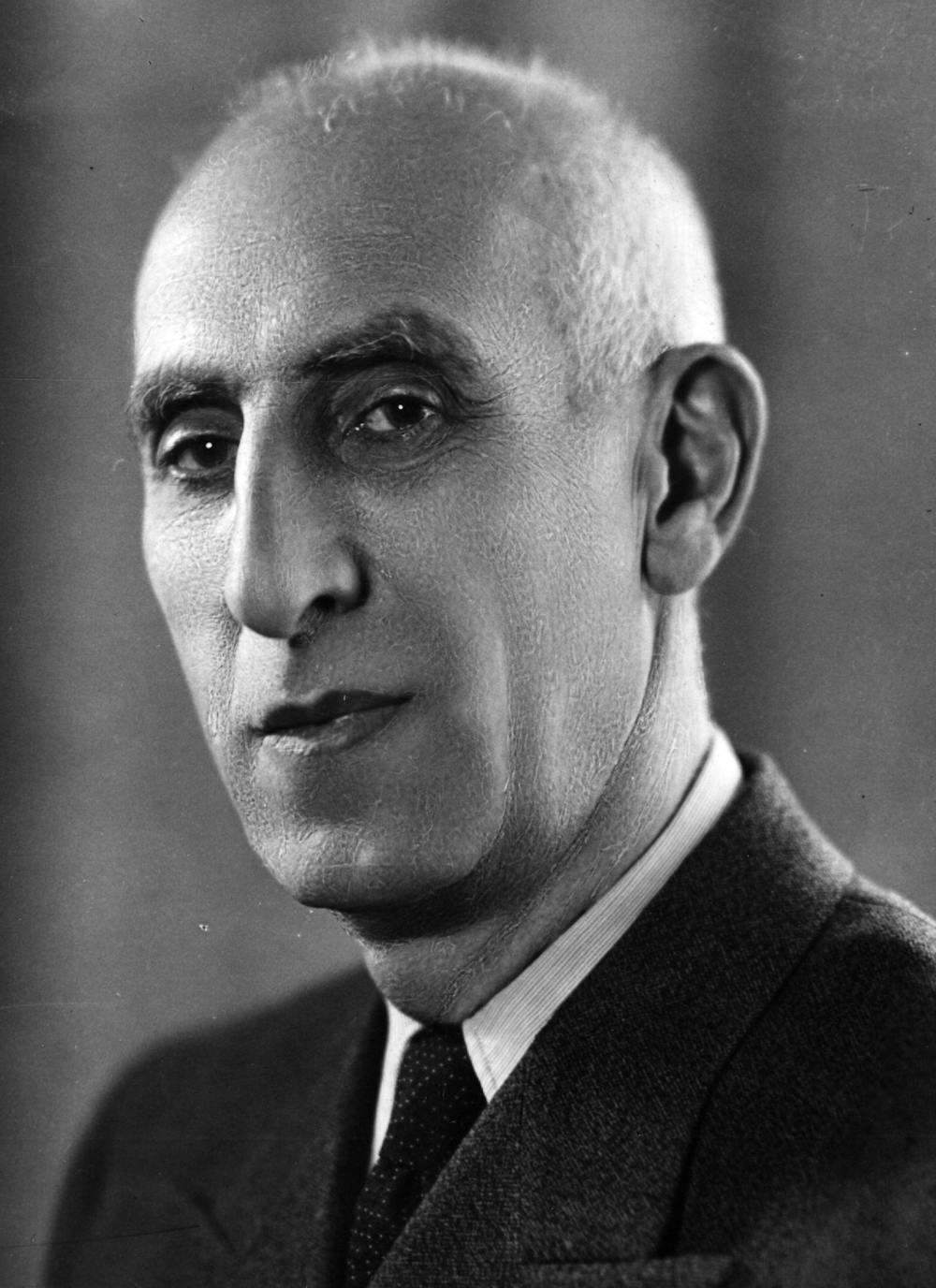
    MIL OSI USA News

  • MIL-OSI Global: Why corporations are backing away from supporting Pride this year

    Source: The Conversation – Canada – By Leah Hamilton, Professor in the Faculty of Business & Communication Studies, Mount Royal University

    Prime Minister Mark Carney recently raised the Pride flag on Parliament Hill and lamented the growing anti-2SLGBTQIA+ sentiment in Canada. He also committed $1.5 million to make Pride festivals across the country safer.

    This political support stands in sharp contrast to the many businesses that have reduced or ended their support for the 2SLGBTQIA+ community this Pride season.

    Multinational corporations like Google, as well as Canadian-owned companies like Molson Coors, have divested from supporting festivals, while Target has scaled back its Pride merchandise due to threats against employees and large-scale conservative backlash.

    The impact is already being felt. Pride Toronto is currently facing a $900,000 funding gap. Executive director Kojo Modeste recently told CBC News this corporate divestment appears to be linked to the larger backlash against diversity, equity and inclusion efforts.

    Fear of punitive measures

    In January, United States President Donald Trump issued an executive order to dismantle DEI initiatives in federal agencies and target private companies that support DEI measures. In the executive order, Trump’s administration called DEI measures and mandates “immoral discrimination programs.”

    Spearheaded by journalist-cum-activist and Trump adviser Christopher Rufo, the attacks against so-called “woke” DEI programs are fuelled by the “culture wars” that pit equity and inclusion against merit and the free market.


    Read more:
    Here’s what ‘woke’ means and how to respond to it


    Major private corporations, including IBM, quickly bent to the pressure of Trump’s anti-DEI orders by gutting their programs and shifting corporate donorship away from “woke” initiatives.

    The pressure to comply with anti-DEI measures hasn’t ended with corporations. More recently, Trump has set his sights on the U.S. post-secondary system, freezing US$2.2 million in federal grants and US$60 million in contracts after Harvard University refused to comply with the administration’s demands related to its DEI programs.

    In Canada, the rollback of DEI programs isn’t as loud, but it is happening. Michelle Grocholsky, the CEO of Empowered EDI in Toronto, told CBC News companies are reducing their budgets and cutting their staff. In the midst of job cuts in January 2025, the Alberta Investment Management Corporation removed their DEI staff.

    Following in the footsteps of the U.S., Alberta’s United Conservative Party membership passed a resolution to eliminate DEI programs and training in the public service. The party has also indicated it will remove government funding from post-secondary institutions that continue to do DEI work.

    Declining public support

    In addition to the rollback of DEI programs, the ongoing corporate reductions in Pride support are taking place amid increasing anti-2SLGBTQIA+ sentiment.

    A 2024 poll reported that, in Canada, support for 2SLGBTQIA+ visibility — like representation on screens and in sports — is lower than it was in 2021. Compared to previous years, Canadians also expressed less support for transgender rights, and this level of support was lower than the 26 other countries surveyed.

    Not surprisingly, this declining public support for the 2SLGBTQIA+ community coincides with rising hate crimes targeting 2SLGBTQIA+ communities. In 2023, Statistics Canada reported a 69 per cent increase in hate crimes targeting sexual orientation.

    Public attitudes don’t change in a vacuum. They are deeply influenced by hate movements, political rhetoric and the spread of misinformation and disinformation weaponized by politicians and leaders to dehumanize the 2SLGBTQIA+ community, particularly transgender people.

    This dehumanization incites fear, violence and support for anti-2SLGBTQIA+ hate. It has coincided with companies silently withdrawing their support for the 2SLGBTQIA+ community.

    Where we live, in Alberta, the provincial government has passed the most draconian anti-trans laws Canada has ever seen. As we (Corinne L. Mason and Leah Hamilton) have previously written, Premier Danielle Smith’s government has unveiled a suite of policies targeting transgender, intersex and gender diverse children and youth in Alberta, and the 2SLGBTQIA+ community more broadly.

    In this environment of reduced public and political support, it’s not surprising to see companies backing away from the 2SLGBTQIA+ community.

    Getting back to Pride’s roots

    The fact that companies have quickly backed away from their support of the 2SLGBTQIA+ community — by halting production of Pride merchandise or reducing sponsorship in Pride festivals — illustrates the conditionality of their support.

    Rather than beg big business to come back to the table, some members of the community are using this moment to reflect on how corporate “Love is Love” campaigns haven’t actually led to increased quality of life or justice for our communities.

    While it has received less media coverage than calls to remove police from Pride and the presence of Boycott, Divest and Sanction movement at Pride festivals, the corporatization of Pride has long been subject of debate in the 2SLGBTQIA+ community.


    Read more:
    Queers and trans say no to police presence at Pride parade


    Those against “rainbow capitalism” — the shallow and inauthentic use of Pride imagery in advertising — argue for a return to community-based and radical protest rather than settling for flag-waving bankers throwing beads from atop expensive floats.

    Pride Month is rooted in protest and resistance against police violence and systemic oppression. It was led by Black trans women and can be traced back to the Stonewall Riots. Today, Pride still isn’t simply a party and parade.

    Authentic ‘rainbow dollars’

    In this sociopolitical climate of legislated DEI rollbacks and declining public support for the 2SLGBTQIA+ community, organizations that want to support the 2SLGBTQIA+ community should back up their messaging with meaningful actions and structural support.

    Some organizations have shown a commitment to structural support for the 2SLGBTQIA+ community from its beginning, including the Northern Super League, the top-division professional women’s soccer league in Canada. The league openly and consistently amplifies and supports its 2SLGBTQIA+ players, coaches, staff and fans. Founded by Diana Matheson, an openly queer woman, the league is founded on inclusion as a core value.

    When it comes to creating Pride merchandise, Social Made Local is a queer-owned Canadian apparel company in Saskatoon that focuses on gender-inclusive sizing, sustainability and community. They donate a portion of their sales to Canadian non-profits like Rainbow Railroad.

    Companies that want to show their support can spend their rainbow dollars in good faith through actions that meaningfully support the 2SLGBTQIA+ community. This could include creating programs that support queer entrepreneurs, donating to legal funds that are fighting discriminatory legislation, and partnering with 2SLGBTQIA+ organizations to amplify their work.

    Leah Hamilton receives funding from the Social Sciences and Humanities Research Council of Canada.

    Corinne L. Mason receives funding from Social Sciences and Humanities Research Council.

    Gini (Virginia) Weber does not work for, consult, own shares in or receive funding from any company or organisation that would benefit from this article, and has disclosed no relevant affiliations beyond their academic appointment.

    ref. Why corporations are backing away from supporting Pride this year – https://theconversation.com/why-corporations-are-backing-away-from-supporting-pride-this-year-258770

    MIL OSI – Global Reports

  • MIL-OSI Global: 4 reasons to be concerned about Bill C-4’s threats to Canadian privacy and sovereignty

    Source: The Conversation – Canada – By Sara Bannerman, Professor and Canada Research Chair in Communication Policy and Governance, McMaster University

    In Canada, federal political parties are not governed by basic standards of federal privacy law. If passed, Bill C-4, also known as the Making Life More Affordable for Canadians Act, would also make provincial and territorial privacy laws inapplicable to federal political parties, with no adequate federal law in place.

    Federal legislation in the form of the Privacy Act and the Personal Information Protection and Electronic Documents Act sets out privacy standards for government and business, based on the fair information principles that provide for the collection, use and disclosure of Canadians’ personal information.

    At the moment, these laws don’t apply to political parties. Some provinces — especially British Columbia — have implemented laws that do. In May 2024, the B.C. Supreme Court upheld the provincial Information Commissioner’s ruling that B.C.’s privacy legislation applies to federal political parties. That decision is currently under appeal.

    Bill C-4 would undermine those B.C. rights. It would make inapplicable to federal parties the standard privacy rights that apply in other business and government contexts— such as the right to consent to the collection, use and disclosure of personal information — and to access and correct personal information held by organizations.

    Why should we be concerned about Bill C-4’s erasure of these privacy protections for Canadians? There are four reasons:

    1. Threats to Canada’s sovereignty

    In light of threats to Canadian sovereignty by United States President Donald Trump, the Canadian government and Canadian politicians must rethink their approach to digital sovereignty.

    Until now, Canadian parties and governments have been content to use American platforms, data companies and datified campaign tactics. Bill C-4 would leave federal parties free to do more of the same. This is the opposite of what’s needed.

    The politics that resulted in Trump being elected twice to the Oval Office was spurred in part by the datafied campaigning of Cambridge Analytica in 2016 and Elon Musk in 2024. These politics are driven by micro-targeted and arguably manipulative political campaigns.

    Do Canadians want Canada to go in the same direction?


    Read more:
    How political party data collection may turn off voters


    Are political parties spying and experimenting on Canadians via personal data collection?
    (Unsplash/Arthur Mazi), FAL

    2. Threats to Canada’s future

    Bill C-4 would undermine one of the mechanisms that makes Canada a society: collective political decisions.

    Datified campaigning and the collection of personal information by political parties change the nature of democracy. Rather than appealing to political values or visions of what voters may want in the future or as a society — critically important at this historical and troubling moment in history — datified campaigning operates by experimenting on unwitting individual citizens who are alone on their phones and computers. It operates by testing their isolated opinions and unvarnished behaviours.

    For example, a political campaign might do what’s known as A/B testing of ads, which explores whether ad A or ad B is more successful by issuing two different versions of an ad to determine which one gets more clicks, shares, petition signatures, donations or other measurable behaviour. With this knowledge, a campaign or party can manipulate the ads through multiple versions to get the desired behaviour and result. They also learn about ad audiences for future targeting.


    Read more:
    A/B testing: how offline businesses are learning from Google to improve profits


    In other words, political parties engaging in this tactic aren’t engaging with Canadians — they’re experimenting on them to see what type of messages, or even what colour schemes or visuals, appeal most. This can be used to shape the campaign or just the determine the style of follow-up messaging to particular users.

    University researchers, to name just one example, are bound by strict ethical protocols and approvals, including the principle that participants should consent to the collection of personal information, and to participation in experiments and studies. Political parties have no such standards, despite the high stakes — the very future of democracy and society.

    Most citizens think of elections as being about deliberation and collectively deciding what kind of society they want to live in and what kind of future they want to have together as they decide how to cast their ballots.

    But with datified campaigning, citizens may not be aware of the political significance of their online actions. Their data trail might cause them to be included, or excluded, from a party’s future campaigning and door-knocking, for example. The process isn’t deliberative, thoughtful or collective.

    3. Secret personal data collection

    Political parties collect highly personal data about Canadians without their knowledge or consent. Most Canadians are not aware of the extent of the collection by political parties and the range of data they collect, which can include political views, ethnicity, income, religion or online activities, social media IDs, observations of door-knockers and more.

    If asked, most Canadians would not consent to the range of data collection by parties.

    4. Data can be dangerous in the wrong hands

    Some governments can and do use data to punish individuals politically and criminally, sometimes without the protection of the rule of law.

    Breaches and misuses of data, cybersecurity experts say, are no longer a question of “if,” but “when.”

    Worse, what would happen if the wall between political parties and politicians or government broke down and the personal information collected by parties became available to governments? What if the data were used for political purposes, such as for vetting people for political appointments or government benefits? What if it were used against civil servants?

    What if it were to be used at the border, or passed to other governments? What if it were passed to and used by authoritarian governments to harass and punish citizens?

    What if it was passed to tech companies and further to data brokers?

    OpenMedia recently revealed that Canadians’ data is being passed to the many different data companies political parties use. That data is not necessarily housed in Canada or by Canadian companies.

    If provincial law is undermined, there are few protections against any of these problems.

    Strengthening democracy

    Bill C-4 would erase the possibility of provincial and territorial privacy laws being applied to federal political parties, with virtually nothing remaining. Privacy protection promotes confidence and engagement with democratic processes — particularly online. Erasing privacy protections threatens this confidence and engagement.

    The current approach of federal political parties in terms of datified campaigning and privacy law is entirely wrong for this political moment, dangerous to Canadians and dangerous to democracy. Reforms should instead ensure federal political parties must adhere to the same standards as businesses and all levels of government.

    Data privacy is important everywhere, but particularly so for political parties, campaigns and democratic engagement. It is important at all times — particularly now.

    Sara Bannerman receives funding from the Canada Research Chairs program, the Social Sciences and Humanities Research Council, and McMaster University. She has previously received funding from the Office of the Privacy Commissioner’s Contributions Program and the Digital Ecosystem Research Challenge.

    ref. 4 reasons to be concerned about Bill C-4’s threats to Canadian privacy and sovereignty – https://theconversation.com/4-reasons-to-be-concerned-about-bill-c-4s-threats-to-canadian-privacy-and-sovereignty-259331

    MIL OSI – Global Reports

  • MIL-OSI Russia: |Sirens sound in Israel as Iran launches new wave of missiles

    Translation. Region: Russian Federal

    Source: People’s Republic of China in Russian – People’s Republic of China in Russian –

    Source: People’s Republic of China – State Council News

    JERUSALEM, June 22 (Xinhua) — Sirens sounded in central and northern Israel and in Israeli-controlled Jerusalem as Iran launched a new wave of ballistic missiles.

    Israelis in the affected areas were advised to remain in bomb shelters.

    It was Iran’s first ballistic missile strike on Israel in more than a day – and the first since the United States attacked three Iranian nuclear sites.

    Israel closed its airspace as an apparent precaution following the US strike on Iran’s nuclear facilities, the Israel Airports Authority said earlier.

    The IDF said in a statement that with the approval of Defense Minister Israel Katz and after assessing the situation, it was determined that changes would be made to the Home Front Command instructions immediately as of 03:45 Sunday /00:45 GMT/.

    Earlier on Saturday, US President Donald Trump said the United States had completed attacks on three nuclear sites in Iran, namely “Fordo, Natanz and Isfahan.” –0–

    MIL OSI Russia News

  • MIL-OSI Global: US joins Israel in attack on Iran and ushers in a new era of impunity

    Source: The Conversation – UK – By Simon Mabon, Professor of International Relations, Lancaster University

    When US B-2 bombers hit Iran’s nuclear facilities at Fordow, Natanz and Isfahan, Donald Trump declared the strikes a success and urged the Islamic Republic to make peace or face even more devastating strikes. The US president proclaimed the might of the US military, operating in full coordination with Israel, before taking to truth social.

    Trump and the Israeli prime minister, Benjamin Netanyahu, will hope that the strikes will end Iran’s nuclear programme once and for all. It may, it may not. More certain is that the operation will sound the death knell for the post-second world war global order.

    After the horrors of the that war and the cold war that followed, a global order emerged seemingly predicated on a set of largely liberal rules and norms that sought to prevent a retreat into global conflict. Predicated on non-intervention, diplomacy and a respect for the rule of law, this global order was idealistic and – ultimately – aspirational.

    But in recent years, this vision of global politics has come crashing down. Now America joining Israel in its attacks on Iran will rightly provoke serious questions about the future of global order and what comes next.


    Get your news from actual experts, straight to your inbox. Sign up to our daily newsletter to receive all The Conversation UK’s latest coverage of news and research, from politics and business to the arts and sciences.


    Trump’s decision to use US air power to land heavy blows against Iran’s nuclear programme is the latest event on a continuum which arguably reaches back to the Hamas terror attack of October 7.

    Israel’s destruction of Gaza, its decapitation of Hamas and disabling of Hezbollah’s military capacity and its strikes against the Houthi rebels have consolidated Israel’s position of strength in the region, to generally positive acclaim from global audiences. Yet the spectre of Iran continued to loom large, even as its proxies were defeated

    Iran has long been framed as an nefarious puppet master controlling a complex web of “proxy actors” across the Middle East each accused of doing the bidding of Tehran. The reality is rather different. While the Islamic Republic undeniably wields influence over such groups, it is not the perfidious mastermind that some would suggest, nor is it the source of all ills in the region.

    Instead, Iran is in a perilous position. The Islamic Republic faces serious social and economic pressures, with the “women life freedom movement” galvanising popular opposition, while unrest across Iran’s peripheral provinces which are home to ethnic and religious minorities continues to ferment.

    In recent years, diplomacy has shown it can work, ameliorating longstanding and deep-seated animosities. This was bearing fruits as seen in the gradual rapprochement between Iran and Saudi Arabia from 2023, which had been preceded by the signing of the Abraham accords in 2020.

    Seen by many as a key achievement of Trump’s first presidency, this was a series of agreements between Israel and Bahrain, the United Arab Emirates, Morocco and Sudan in which the Arab countries recognised Israel and all sides signed a declaration of principles focused on mutual understanding, respect for human dignity, and cooperation.

    While many in Israel and the US hoped that Saudi Arabia would officially recognise Israel, the events of October 7 and the destruction of Gaza that followed ended those hopes. Now the possibility of all-out conflict between Iran and Israel and the US risks blowing a major regional conflict with global implications.

    Serious questions must be asked as to the longer-term strategy here. While Israeli officials have articulated a need for strikes on Iran’s nuclear facilities to prevent the Islamic Republic from getting a nuclear weapons capability, Iran is a signatory of the nuclear non-proliferation treaty (although it has threatened recently to quit) and key officials have regularly declared that nuclear weapons have no place in Iran’s strategic portfolio.

    Israel is not a signatory to the treaty. In fact, it is thought to possess between 75 and 400 nuclear warheads. It’s hard to tell, as the country has maintained a steadfast policy of nuclear opacity, never actually admitting the extent of its nuclear capability.

    New impunity?

    Is this the start of a new order of impunity across the region, backed by western powers? And if so, what does this mean for the war in Ukraine and the potential for an aggressive Russia engaging in further dangerous adventurism? What does it mean for the possibility of China taking advantage in this breakdown to perhaps fulfil its generations-old ambition to unite with Taiwan, by force, if necessary? Are we seeing the shift to a world in which Donald Trump’s threats to annex Greenland – even perhaps Canada – must be taken seriously?

    The contours of global politics are changing before our eyes. Gone are the norms that have served as the bedrock of the so-called liberal international order. The risk is that while this period has itself featured tragedy and suffering on an almost unimaginable scale, tearing up the rule book will be far worse.

    Simon Mabon receives funding from Carnegie Corporation of New York and the Henry Luce Foundation. He is a Senior Research Fellow with the Foreign Policy Centre.

    ref. US joins Israel in attack on Iran and ushers in a new era of impunity – https://theconversation.com/us-joins-israel-in-attack-on-iran-and-ushers-in-a-new-era-of-impunity-259511

    MIL OSI – Global Reports

  • MIL-OSI USA: Reed Statement on Trump Ordering U.S. Airstrike Attacks on Iran

    US Senate News:

    Source: United States Senator for Rhode Island Jack Reed

    PROVIDENCE, RI — Tonight, U.S. Senator Jack Reed (D-RI), the Ranking Member of the Senate Armed Services Committee, issued the following statement on President Trump’s decision to order U.S. airstrikes on Iran’s nuclear facilities:

    “Tonight, President Trump ordered airstrikes on Iran’s nuclear facilities, directly involving U.S. forces in this conflict.  This was a massive gamble by President Trump, and nobody knows yet whether it will pay off.  President Trump declared: “Iran’s nuclear facilities have been completely and totally obliterated.”  But there is a lot we still don’t know and we need an accurate, factual damage assessment.

    “What we do know is that the United States of America has the strongest military in the world powered by brave men and women who expertly supported and executed this mission.  We are grateful for their service and we must be prepared for retaliation — both in the short and long-term, on the battlefield and asymmetrically.   

    “Congress needs to be briefed in a classified setting.  And I will work with my colleagues on both sides of the aisle to ensure the American people get the facts and answers they deserve.  

    “It’s easier to start wars than end them.  Even though the U.S. maintains military dominance, we are in a dangerous stage that could lead to significant instability in the region and beyond.  We must be prepared for contingencies going forward. 

    “I strongly urge the Trump Administration to immediately pursue restraint, diplomacy, and international engagement to prevent further bloodshed.”

    MIL OSI USA News

  • MIL-OSI United Kingdom: Green Party respond to US strikes on Iran

    Source: Green Party of England and Wales

    Responding to news of US attacks on Iran’s nuclear facilities, Green Party co-leader Adrian Ramsay MP said:

    “We utterly condemn the reckless attacks on Iran by the United States that can only lead to further dangerous conflict in an already volatile region. There is no international legal basis for this unilateral action that poses a serious threat to international peace and security.

    “Our prime minister has shamefully decided to echo the rhetoric of Trump and Netanyahu rather than condemn the indefensible aggression of both Israel and the US. Keir Starmer has further implied that it is justifiable for the Iranian regime to be bombed back to the negotiating table. I fully recognise the brutal nature of the Iranian regime but this unilateral action is no way to build peace and risks making the UK once again complicit in escalating a Middle East crisis.”

    MIL OSI United Kingdom

  • MIL-OSI Global: The US has entered the Israel-Iran war. Here are 3 scenarios for what might happen next

    Source: The Conversation – Global Perspectives – By Ian Parmeter, Research Scholar, Middle East Studies, Australian National University

    After prevaricating about whether the United States would enter Israel’s war on Iran, President Donald Trump finally made a decision.

    Early Sunday, US warplanes and submarines struck three of Iran’s nuclear sites at Natanz, Isfahan and Fordow, where the Iranians have a uranium enrichment plant buried about 80 metres beneath a mountain.

    These strikes have to be viewed as part of an overall continuum that began with the Gaza war following Hamas’ attack on Israel on October 7, 2023, and then continued with Israel’s attacks on Hezbollah (the Iran-backed militant group in Lebanon) and the fall of the Iran-backed Assad regime in Syria.

    Iran has never been weaker than it is now. And when Trump said it may take two weeks for him to decide whether to bomb Iran, the Israelis likely pushed him to act sooner.

    We can assume there was a lot of Israeli pressure on Trump to use the massive ordnance penetrators, the 30,000-pound (13,600-kilogram) “bunker buster” bombs that only the US can deploy with its B2 bombers.

    Now that Trump has taken the significant step of entering the US in yet another Middle East war, where could things go from here? There are a few possible scenarios.

    Iran strikes back

    The Iranians know they don’t have the strength to take on the US, and that the Americans can do enormous damage to their country and even put the Iranian regime’s stability at risk.

    This is always the prime consideration of the clerical regime led by Supreme Leader Ali Khamenei – everything else is subordinate to that.

    To gauge Iran’s possible reaction, we can look at the how it responded to the first Trump administration’s assassination of the head of the Islamic Revolutionary Guard Corps’ elite Quds Force, Qassem Soleimani, in January 2020.

    Iran said there would be a major reaction, but all it did was launch a barrage of missiles at two American bases in Iraq, which caused no US fatalities and very little damage. After that token retaliation, Iran said the matter was closed.

    Iran’s reaction to the new US strikes will likely be along these lines. It probably won’t want to get into a tit-for-tat with the US by launching attacks against American facilities in the region. Trump has promised to respond with force:

    Iran, a bully of the Middle East, must now make peace. If they do not, future attacks will be far greater and a lot easier.

    It’s also unclear how long Iran will be able to prosecute this war. This depends largely on how many ballistic missiles and launchers it has left.

    There are various estimates as to how many ballistic missiles Iran may have remaining in its stockpiles. It was believed to have about 2,000 missiles capable of reaching Israel at the start of the war. Some estimates say Iran has fired 700 of them; others say around 400. Whatever the number is, its stockpiles are dwindling quickly.

    Israel has also destroyed about a third of Iran’s ballistic missile launchers. If Israel is able to destroy all of them, Iran would have very limited ability to fight back.

    Iran backs down

    Before the US got involved in the conflict, Iran said it was prepared to negotiate, but it wouldn’t do so while Israel was still attacking.

    So, one scenario is that some sort of compromise can now be worked out, in which Israel announces a ceasefire and Iran and the US agree to resume negotiations on Tehran’s nuclear program.

    The big problem is that Israeli Prime Minister Benjamin Netanyahu has said he doesn’t trust the negotiating process and he doesn’t want to stop Israel’s military actions until all of Iran’s nuclear facilities have been completely destroyed. He’s also been bombing Iran’s oil terminals and gas facilities to put even more pressure on the regime.

    But the regime has shown itself to be incredibly determined not to lose face. It was under great pressure at different times during the Iran-Iraq war in the 1980s and never considered surrendering until a US missile mistakenly took down an Iranian passenger jet, killing 290 people.

    Iran then agreed to a UN-brokered ceasefire. But the Iran-Iraq war lasted eight years, causing an estimated one million deaths. And when the then-supreme leader, Ayatollah Ruhollah Khomeini, agreed to the ceasefire, he said it was “worse than drinking poison”.

    Given the state of Iran’s military capabilities, Khamenei, the current supreme leader, might surrender simply to try to preserve the regime. But this would be quite a climbdown as far as he’s concerned, and he has been very obstinate in the past.

    The regime is very unpopular, but the Iranian people, in my experience, are strongly patriotic – loyal to their country, if not the regime. Though it’s difficult to gauge opinion in a country of 90 million people, a lot of Iranians would not want to be ordered to do anything by the US or Israel, and would rather fight on.

    Netanyahu has said he wants to create the conditions for the Iranian people to rise up against the regime.

    But it’s worth bearing in mind that the opposite of autocracy is not necessarily democracy. It could possibly be chaos. Iran has a number of different ethnic groups and there may be huge disagreements over what should take the place of the clerical regime, were it to fall.

    At this stage, the regime will probably be able to hold together. And even if Khameini were to die suddenly, the regime will likely be able to quickly replace him.

    Though we don’t know his probable successor, the regime has had plenty of time to plan for this. Those in senior positions will also know that a post-Khamenei succession struggle really would put the regime at risk.

    The US engagement is limited

    According to the new polling by The Economist and YouGov, released on June 17, 60% of Americans were opposed to joining the conflict between Israel and Iran, with just 16% in favour. Among Republicans, 53% opposed military action.

    So, these strikes were not an obviously popular move among Americans at this stage. However, if this is an isolated event and succeeds in bringing a swift end to the war, Trump will probably be applauded by a majority of Americans.

    If the US has to go back with more bombers – or there are serious attacks on US interests in the region – there could be more adverse reactions among Americans.

    Another question is whether Iran’s 400 kilograms of 60% enriched uranium have been destroyed in the US attack.

    If it hasn’t been destroyed, and depending how much damage has been done to its centrifuges, Iran may be able to reconstruct its nuclear program relatively quickly. And it could have more incentive to further enrich this uranium to 90% purity, or weapons-grade level, to build a nuclear device.

    Ian Parmeter does not work for, consult, own shares in or receive funding from any company or organisation that would benefit from this article, and has disclosed no relevant affiliations beyond their academic appointment.

    ref. The US has entered the Israel-Iran war. Here are 3 scenarios for what might happen next – https://theconversation.com/the-us-has-entered-the-israel-iran-war-here-are-3-scenarios-for-what-might-happen-next-259509

    MIL OSI – Global Reports

  • MIL-OSI Global: What is a ‘bunker buster’? An expert explains what the US dropped on Iran

    Source: The Conversation – Global Perspectives – By James Dwyer, Lecturer, School of Social Sciences, University of Tasmania

    The jagged silhouette of a B2 stealth bomber seen during a 2015 flyover in the US. Jonathan Daniel / Getty Images

    Late on Saturday night, local time, the United States carried out strikes against Iranian nuclear enrichment sites at Fordow, Natanz and Isfahan, marking its open participation in the conflict between Iran and Israel.

    The US says it fired 30 submarine-launched missiles at the sites in Natanz and Isfahan, as well as dropping more than a dozen “bunker buster” bombs at Fordow and Natanz.

    The kind of bomb in question is the extremely destructive GBU-57 Massive Ordance Penetrator, or MOP, which weighs around 13.5 tonnes.

    The attacks raise a lot of questions. What are these enormous bombs? Why did the US feel it had to get involved in the conflict? And, going forward, what does it mean for Iran’s nuclear ambitions?

    What are ‘bunker busters’, and why are they used?

    Bunker busters are weapons designed to destroy heavily protected facilities such as bunkers deep underground, beyond the reach of normal bombs.

    Bunker busters are designed to bury themselves into the ground before detonating. This allows more of the explosive force to penetrate into the ground, rather than travelling through the air or across the surface.

    Iran’s nuclear enrichment sites at Fordow, Natanz and Isfahan are built deep underground. Estimates suggest that Fordow for example could be 80m beneath the surface, and capped with layers of reinforced concrete and soil.

    What is the MOP?

    The bunker buster used in this particular operation is the largest in the US arsenal. Leaving aside nuclear weapons, the MOP is the largest known buster buster in the world.

    Weighing some 13.5 tonnes, the MOP is believed to be able to penetrate up to 60 metres below ground in the right conditions. It is not known how many the US possesses, but the numbers are thought to be small (perhaps 20 or so in total).

    We also don’t know exactly how many were used in Iran, though some reports say it was 14. However, it is likely to be a significant portion of the US MOP arsenal.

    Why does only the US possess this capability?

    The US is not the only state with bunker-busting weaponry. However, the size of MOP means it requires very specialised bombers to carry and drop it.

    Only the B2 stealth bomber is currently able to deploy the MOP. Each B2 can carry at most two MOPs at a time. Around seven of America’s 19 operational B2s were used in the Iran operation.

    There has been some consideration whether large transport aircraft such as the C-130 Hercules could be modified to carry and drop the MOP from its rear cargo doors. While this would allow other countries (including Israel) to deploy the MOP, it is for now purely hypothetical.

    Why has the US (apparently) used them in Iran

    The Trump administration claims Iran may be only a few weeks from possessing a nuclear weapon, and that it needed to act now to destroy Iranian nuclear enrichment sites. This claim is notably at odds with published assessments from the US intelligence community.

    However, Israel lacks bunker busting weaponry sufficient to damage the deeply buried and fortified enrichment sites at Fordow, Natanz and Isfahan.

    An F-15E Strike Eagle releases a GBU-28 ‘bunker buster’ laser-guided bomb, a smaller equivalewnt of the 13,600 kg GBU-57 ‘Massive Ordnance Penetrator’ believed to have been used in Iran.
    Michael Ammons / US Air Force

    Only the MOP could do the job (short of using nuclear weapons). Even then, multiple MOPs would have been required to ensure sufficient damage to the underground facilities.

    The US has claimed that these sites have been utterly destroyed. We cannot conclusively say whether this is true.

    Iran may also have other, undeclared nuclear sites elsewhere in the country.

    Iran’s reaction

    The US has reportedly reached out to Iran via diplomatic channels to emphasise that this attack was a one-off, not part of a larger project of regime change. It is hard to say what will happen in the next few weeks.

    Iran may retaliate with large strikes against Israel or against US forces in the region. It could also interrupt shipping in the Strait of Hormuz, which would affect a large portion of global oil shipments, with profound economic implications.

    Alternatively, Iran could capitulate and take steps to demonstrate it is ending its nuclear program. However, capitulation would not necessarily mean the end of Iran’s nuclear ambitions.

    The value of nuclear weapons

    Perhaps a greater concern is that the attack will reinforce Iran’s desire to go nuclear. Without nuclear weapons, Iran was unable to threaten the US enough to deter today’s attack.

    Iran may take lessons from the fate of other states. Ukraine (in)famously surrendered its stockpile of former Soviet nuclear weapons in the early 1990s. Russia has since felt emboldened to annex Crimea in 2014 and launch an ongoing invasion in 2022. Other potential nuclear states, such as Iraq and Gadaffi’s regime in Libya, also suffered from military intervention.

    By contrast, North Korea successfully tested its first nuclear weapon in 2006. Since then there has been no serious consideration of military intervention in North Korea.

    Iran may yet have the ability to produce useful amounts of weapons-grade uranium. It may now aim to buy itself time to assemble a relatively small nuclear device, similar in scale to the bombs used in Hiroshima and Nagasaki.

    Depending on what facilities and resources have survive the US strikes, the attack has likely reinforced that the only way the Iranian regime can guarantee its survival is to possess nuclear weapons.

    James Dwyer does not work for, consult, own shares in or receive funding from any company or organisation that would benefit from this article, and has disclosed no relevant affiliations beyond their academic appointment.

    ref. What is a ‘bunker buster’? An expert explains what the US dropped on Iran – https://theconversation.com/what-is-a-bunker-buster-an-expert-explains-what-the-us-dropped-on-iran-259508

    MIL OSI – Global Reports

  • Israel under missile attack, Iran says all options open after US strikes

    Source: Government of India

    Source: Government of India (4)

    Israel faced a missile attack on Sunday as Iran said it reserved all options to defend itself after unprecedented U.S. strikes that President Donald Trump said had “obliterated” its key nuclear facilities.

    Hours after Trump dramatically escalated Middle East tensions by sending B-2 bombers to Iran, the Israeli military warned people to seek cover from a barrage that appeared heavier than the Iranian salvoes fired in the past few days.

    “The events this morning are outrageous and will have everlasting consequences,” said Iranian Foreign Minister Abbas, calling the U.S. strikes a “grave violation” of the U.N. charter, international law and the nuclear Non-Proliferation Treaty.

    “Iran reserves all options to defend its sovereignty, interest, and people,” Araqchi posted on X.

    Iran’s Atomic Energy Organization said it would not allow development of its “national industry” to be stopped, and an Iranian state television commentator said every U.S. citizen or military member in the region would be legitimate targets.

    Israel’s ambulance service said at least 16 people were hurt in the morning barrage.

    Air raid sirens sounded across most of the country, sending millions of people to safe rooms and bomb shelters as explosions rang out and missile interceptions were seen above Jerusalem and in other parts of the country.

    It was not immediately clear how many missiles had pierced Israel’s air defence systems, but police confirmed at least three impact sites in residential areas in central and northern Israel.

    Video from Israel’s commercial hub Tel Aviv and the port city of Haifa further north showed rescue teams combing through debris, apartments reduced to rubble, mangled cars along a street filled with debris and medics evacuating injured people from a row of blown out houses.

    Most airlines continued to avoid large parts of the Middle East after the U.S. strikes, according to flight tracking website FlightRadar24, with traffic already skirting airspace in the region due to recent missile exchanges.

    TRUMP SAYS IRAN FACES ‘PEACE OR TRAGEDY’

    Trump, in a televised address to the U.S. people, flanked by Vice President JD Vance, Defense Secretary Pete Hegseth and Secretary of State Marco Rubio, called the strikes a “spectacular military success” that had taken out Iran’s three principal nuclear sites: Natanz, Isfahan and Fordow.

    He warned Tehran it would face more devastating attacks if it does not agree to peace.

    After days of deliberation and long before his self-imposed two-week deadline, Trump’s decision to join Israel’s military campaign against its major rival Iran is the biggest foreign policy gamble of his two presidencies and one fraught with risks and unknowns.

    The major escalation of armed conflict in the Middle East risks opening a new era of instability in the Middle East.

    Trump said Iran’s future held “either peace or tragedy,” and there were many other targets that could be hit by the U.S. military. “If peace does not come quickly, we will go after those other targets with precision, speed and skill.”

    The U.S. contacted Iran diplomatically on Saturday to say the strikes are all the U.S. plans and it does not aim for regime change, CBS News reported.

    Trump told Fox News’ Sean Hannity show that six “bunker-buster” bombs were dropped on the deep-underground Fordow facility, while 30 Tomahawk missiles were fired against other nuclear sites. U.S. B-2 bombers were involved in the strikes, a U.S. official told Reuters, speaking on condition of anonymity.

    Reuters had reported the movement of the B-2 bombers, which can be equipped to carry the massive bombs that experts say would be needed to strike Fordow, which is buried beneath a mountain south of Tehran. Given its fortification, it will likely be days, if not longer, before the impact of the strikes is known.

    An Iranian official, cited by Tasnim news agency, confirmed part of the Fordow site was attacked by “enemy airstrikes.” However, Mohammad Manan Raisi, a lawmaker for Qom, near Fordow, told the semi-official Fars news agency the facility had not been seriously damaged.

    A reporter from Iranian state media IRNA reporter said he had arrived near the Fordow site at 3 a.m. (2330 GMT on Saturday) and saw smoke that “seems to be related to air defences”. He quoted a nearby witness as reporting “six explosions were heard, but they said it wasn’t very loud.”

    DIPLOMATIC FAILURE

    The U.N. nuclear watchdog said no increases in off-site radiation levels had been reported after the U.S. strikes.

    Hassan Abedini, deputy political head of Iran’s state broadcaster, said Iran had evacuated the three sites some time ago.

    “The enriched uranium reserves had been transferred from the nuclear centres and there are no materials left there that, if targeted, would cause radiation and be harmful to our compatriots,” he told the channel.

    Israeli Prime Minister Benjamin Netanyahu congratulated Trump on his “bold decision”, saying, “History will record that President Trump acted to deny the world’s most dangerous regime, the world’s most dangerous weapons.”

    Israel and Iran have been engaged in more than a week of aerial combat that has resulted in deaths and injuries in both countries. Israel launched its attacks on June 13, saying Iran was on the verge of developing nuclear weapons.

    Iran says its nuclear programme is for peaceful purposes only. Israel is widely assumed to possess nuclear weapons, which it neither confirms nor denies.

    Diplomatic efforts by Western nations to stop the hostilities have so far failed. U.N. Secretary-General Antonio Guterres called the U.S. strikes a “dangerous escalation in a region already on the edge – and a direct threat to international peace and security.”

    In the U.S., Democratic lawmakers and some from Trump’s Republican Party have argued that he must receive permission from Congress before committing the U.S. military to any combat against Iran.

    At least 430 people have been killed and 3,500 injured in Iran since Israel began its attacks, Iranian state-run Nour News said, citing the health ministry.

    In Israel, 24 civilians have been killed and 1,272 people injured, according to local authorities.

    (Reuters)