Category: Trump administration

  • MIL-OSI United Kingdom: Biden’s diagnosis underlines need for timely screening

    Source: Anglia Ruskin University

    Former US President Joe Biden – photograph by Gage Skidmore/Flickr

    By Justin Stebbing, Anglia Ruskin University

    Former US President Joe Biden, aged 82, has been diagnosed with an aggressive form of prostate cancer that has spread to his bones, marking a serious escalation in the disease.

    The diagnosis was made after he sought medical help for worsening urinary symptoms – a decision that likely saved his life. A small nodule on his prostate led to further investigation, revealing a high-grade cancer with a Gleason score of nine out of 10. This score indicates one of the most aggressive and fast-growing types of prostate cancer.

    Prostate cancer is the second most common cancer in men worldwide, especially affecting those over the age of 50. The prostate is a walnut-sized gland located just below the bladder, responsible for producing seminal fluid.

    While many prostate cancers grow slowly and may never cause serious harm, some – like Biden’s – are far more dangerous, capable of spreading quickly, often before symptoms are even noticed.

    The Gleason score is a critical tool used to grade prostate cancer based on how abnormal the cancer cells appear under a microscope. It ranges from six to 10, with higher scores indicating more aggressive disease.

    A score of nine suggests that the cancer cells are highly abnormal and likely to spread rapidly, requiring immediate and intensive treatment.

    In Biden’s case, the cancer has already metastasized – or spread – beyond the prostate, to the bones. This places him in stage four, the most advanced stage of prostate cancer. While not curable at this point, it is still treatable and can be managed with a combination of therapies aimed at slowing the disease’s progression and alleviating symptoms.

    A significant detail in Biden’s diagnosis is that the cancer is hormone-sensitive. Prostate cancer cells typically rely on male hormones such as testosterone to grow. Hormone-sensitive cancers can respond well to treatments that block or lower hormone levels – a common first step in managing the disease. This therapy may be combined with chemotherapy, targeted medications, and drugs that help reduce the risk of complications from bone metastases, such as fractures or severe pain.

    Early prostate cancer often has no symptoms, which is why regular screening is crucial, especially for older men or those with a family history of the disease.

    When symptoms do appear, they might include frequent urination (especially at night), difficulty starting or maintaining urine flow, or a feeling that the bladder hasn’t fully emptied. More advanced cancer may manifest as pain in the hips, back, or pelvis, as well as fatigue or unexplained weight loss – all of which contributed to Biden’s decision to seek medical attention.

    While the news of Biden’s diagnosis has been met with concern, it has also sparked a wave of bipartisan support. Messages have poured in from political allies and opponents alike, including President Donald Trump. Beyond the personal response, Biden’s condition has reignited public discussions about prostate cancer – particularly around access to screening, the importance of early detection, and disparities in treatment outcomes.

    The reality is stark: one in eight men will be diagnosed with prostate cancer in their lifetime. For many, it may never become life-threatening. But for others, it can be aggressive and fast-moving, underscoring the importance of vigilance and regular check-ups.

    Biden’s case is a sobering reminder that cancer doesn’t discriminate based on fame or status. It also serves as a testament to the power of listening to your body and seeking help when something feels wrong. Thanks to advancements in medical research, treatment options today are more effective than ever, offering patients a better quality of life – even in the face of a serious diagnosis.

    As Biden begins treatment, his journey may inspire more men to talk to their doctors, get tested and take their health seriously. With the right care and support, life with prostate cancer – even at stage four – is still worth living, and still full of moments that matter.

    Justin Stebbing, Professor of Biomedical Sciences, Anglia Ruskin University

    This article is republished from The Conversation under a Creative Commons license. Read the original article.

    The opinions expressed in VIEWPOINT articles are those of the author(s) and do not necessarily reflect the views of ARU.

    If you wish to republish this article, please follow these guidelines: https://theconversation.com/uk/republishing-guidelines

    MIL OSI United Kingdom

  • MIL-OSI Banking: NOIA Statement on Lifting of Empire Wind Stop Work Order

    Source: National Ocean Industries Association – NOIA

    Headline: NOIA Statement on Lifting of Empire Wind Stop Work Order

    For Immediate Release: Monday, May 19, 2025NOIA .org
    NOIA Statement on Lifting of Empire Wind Stop Work Order
    Washington, D.C. – National Ocean Industries Association (NOIA) President Erik Milito issued the following statement following the decision to lift the stop work order for the Empire Wind project:
    “We appreciate the Trump administration’s swift review of the Empire Wind project and engagement with state and local governments and other stakeholders. Lifting the stop work order underscores the project’s critical role in safely advancing American energy, shipbuilding, workforce development, and economic growth.
    “The administration is clearing the way for major investments to move forward—activating American shipyards, creating high-quality jobs, and accelerating the buildout of infrastructure needed to deliver reliable, domestic energy to the East Coast. With power demand surging due to AI, data centers, and advanced manufacturing, offshore wind is an important part of an all-of-the-above solution. Companies throughout the supply chain – from Louisiana to Texas to New York – will be able to see the return on their investments.”
    ##
    About NOIAThe National Ocean Industries Association (NOIA) represents and advances a dynamic and growing offshore energy industry, providing solutions that support communities and protect our workers, the public and our environment.

    MIL OSI Global Banks

  • MIL-OSI USA: TAKE IT DOWN Act Officially Signed into Law by President Trump

    Source: United States House of Representatives – Congresswoman María Elvira Salazar’s (FL-27)

    strong>(Washington, D.C.) – Today marks a major victory for victims of online exploitation and a defining moment in digital and child safety: President Donald J. Trump has officially signed the TAKE IT DOWN Act into law. The bipartisan, bicameral legislation—originally introduced in the House by Rep. María Elvira Salazar (FL-27) and in the Senate by Sen. Ted Cruz (TX)—will protect Americans from the non-consensual distribution of intimate images, including AI-generated deepfakes. 

    “Today, through the ‘TAKE IT DOWN’ Act, we affirm that the well-being of our children is central to the future of our families and America. I am proud to say that the values of BE BEST will be reflected in the law of the land,” said First Lady Melania Trump.

    “The signing of my TAKE IT DOWN Act is a historic moment in our fight to protect children online. I’m grateful to President Trump and First Lady Melania Trump for standing with us against the growing threat of online exploitation and AI abuse. For the first time, victims have real legal protection, and parents have a powerful tool to fight back and protect their children from digital threats. Predators will finally face the full force of the law,” said Rep. Maria Salazar.

    “The TAKE IT DOWN ACT is an historic win for victims of revenge porn and deepfake image abuse. Predators who weaponize new technology to post this exploitative filth will now rightfully face criminal consequences, and Big Tech will no longer be allowed to turn a blind eye to the spread of this vile material. This day stands as a powerful testament to the bravery and dedication of Elliston Berry, Francesca Mani, Breeze Liu, and Brandon Guffey, whose relentless advocacy made this law possible. I am deeply grateful to my legislative partners, particularly Sen. Amy Klobuchar and First Lady Melania Trump, for their collaboration in advancing this critical legislation to protect every American’s privacy and dignity online,” said Sen. Ted Cruz.

    “I am overjoyed that our bipartisan TAKE IT DOWN Act is now law — a monumental step in the fight to protect Americans’ privacy, empower victims, and address sexually explicit AI deepfakes. This was made possible by many advocates and partners — including Representatives Salazar and Dingell in the House, Senators Cruz and Klobuchar in the Senate, and the President and First Lady. Today is evidence that when we work together, we can accomplish important work for the American people,” said Rep Madeleine Dean.

    “In an age where personal images can be stolen and weaponized in seconds, the signing of the TAKE IT DOWN Act into law marks a pivotal step forward. Our bipartisan law creates the first federal protections against non-consensual intimate imagery and AI-generated deepfakes—finally giving survivors the right to reclaim control and hold offenders accountable. I’m proud to have championed this legislation alongside Rep. Salazar, whose leadership was instrumental to this achievement,” said Rep. Brian Fitzpatrick.

    “The publication of sexually exploitative images—including AI-generated deepfakes – is a terrifying and destructive part of the digital age. I applaud the First Lady for bringing attention to this issue, and the Problem Solvers Caucus will work with her across party lines to pass the TAKE IT DOWN Act to address these reprehensible acts. Let it be the first of many actions we take in this Congress to get things done,” said Problem Solvers Caucus Co-Chair Rep. Tom Suozzi.

    With the President’s signature, the TAKE IT DOWN law now becomes the strongest federal tool to date for combatting “revenge porn,” digital harassment, and image-based sexual abuse. This new law sends a clear message to both predators and platforms: online exploitation will no longer be tolerated, and accountability will be enforced at every level. It is a major win for families and parents across America who can finally feel more secure knowing their children are better protected in today’s digital world. 

    The law addresses the growing threat of deepfake technology, which allows perpetrators to create explicit, realistic images—usually of women and girls—without consent. Many victims don’t discover these images until after serious harm is done. By setting clear federal standards and requiring swift takedowns, the law closes a dangerous gap that left victims with little recourse.

    Rep. María Elvira Salazar led the charge in the House, reintroducing the bill in January 2025. First Lady Melania Trump played a pivotal role in elevating the issue, hosting a high-profile roundtable on Capitol Hill and mobilizing bipartisan support. The law was passed unanimously in the Senate in February 2025 and received final approval in the House soon after.

    The TAKE IT DOWN Act has earned support from over 120 organizations, including major tech companies like Meta, Snap, Google, TikTok, X (formerly Twitter), and Amazon, as well as advocacy groups. 

    The TAKE IT DOWN Act addresses these issues while protecting lawful speech by:
     

    • Criminalizing the publication of Non-Consensual Intimate Image (NCII) or the threat to publish NCII in interstate commerce;
       
    • Protecting good faith efforts to assist victims by permitting the good faith disclosure of NCII for the purpose of law enforcement or medical treatment;
       
    • Requiring websites to take down NCII upon notice from the victims within 48 hours; and
       
    • Requiring that computer-generated NCII meet a ‘reasonable person’ test for appearing to realistically depict an individual, to conform to current First Amendment jurisprudence.

    A Legislative Milestone for Rep. Salazar

    The TAKE IT DOWN Act is the ninth piece of legislation sponsored by Rep. Salazar to be signed into law, further cementing her role as a national leader in the fight to safeguard Americans—especially women and minors—from digital abuse. Other key policies sponsored by Rep. Salazar that have been enacted into law include:

    • The Forgotten Heroes of the Holocaust Congressional Gold Medal Act – Honors 60 diplomats who risked their lives during World War II to save Jews from Nazi persecution. Signed into law in December 2024.
       
    • The Migratory Birds of the Americas Conservation Enhancements Act – Protects migratory birds and their habitat, critical for the Everglades. Signed into law in April 2024.
       
    • The RECLAIM Taxpayer Funds Act – Recovers billions in fraudulent government loans and restores fiscal responsibility and government accountability. Implemented by the Biden Administration in December 2023.
       
    • The REEF Act – Incentivizes retired Navy ships to be sunk and used as artificial reefs in marine ecosystems across America. Signed into law in December 2023.
       
    • The Summer Barrow Prevention, Treatment, and Recovery Act – Reauthorizes critical funding for programs that address mental health and substance abuse issues. Signed into law in December 2022.
       
    • The PRICE Act – Makes it easier for small businesses to get federal contracts. Signed into law in February 2022.
       
    • The Reinforcing Nicaragua’s Adherence to Conditions for Electoral Reform (RENACER) Act – Sanctions the Ortega Regime in Nicaragua. Signed into law in November 2021.
       
    • The COVID Economic Injury Disaster Loan (EIDL) Relief Act – Provides economic relief for Floridians. Implemented by the Biden Administration in March 2021.

    ###

    MIL OSI USA News

  • MIL-OSI Asia-Pac: Government announces projects to be implemented by Working Group on Developing Tourist Hotspots

    Source: Hong Kong Government special administrative region

    The Deputy Chief Secretary for Administration, Mr Cheuk Wing-hing, today (May 20) held a press conference to announce nine projects to be implemented by the Working Group on Developing Tourist Hotspots (Working Group). Also attending the press conference were the Secretary for Culture, Sports and Tourism, Miss Rosanna Law; the Under Secretary for Security, Mr Michael Cheuk; the Under Secretary for Home and Youth Affairs, Mr Clarence Leung; the Under Secretary for Environment and Ecology, Miss Diane Wong; the Under Secretary for Development, Mr David Lam; and the Commissioner for Tourism, Mrs Angelina Cheung.
     
    Mr Cheuk said, “New travel patterns and tourists’ preferences increasingly value hotspots with unique features that are part of the flavour of Hong Kong. As there are many treasured tourist attractions in Hong Kong, we consider that in addition to creating new hotspots, current tourism resources should be consolidated and enriched to maximise the value of these hotspots and create attractions that tourists cannot miss.
     
    “The Working Group has gathered opinions from different sectors of the community and considered different proposals. From the many options, we have at this stage selected nine appealing and feasible projects that can be implemented within a short period. Through upgrades of hardware and software, renovations and enhancements, maintenance and renewal of attractions, provision of ancillary services and facilities as well as opening up places that have not been open to the public before, tourists will be offered new experiences that are more in-depth and fascinating.”
     
    The nine projects to be implemented are:
     
    1. Hong Kong Industrial Brand Tourism

    Hong Kong’s industrial story fully embodies the spirit of the Lion Rock. The tourism industry is forming groups to develop “Made in Hong Kong” industrial tourism, creating hotspots for visitors to tour, experience and shop. Industrial brands that can be visited include Lee Kum Kee, Kee Wah, Pat Chun and Yakult. A trial launch is expected in the third quarter of this year.
     
    2. Victoria Park Bazaar 
    3. Creating a Pink Trumpet Tree Garden 
    4. Featured community – In-depth travel in Old Town Central 
    5. Featured community – In-depth travel in Kowloon City 
    6. Disciplinary Services Pioneer Tours 
    7.   Opening of the Former Yau Ma Tei Police Station 
    8.        “Four Peaks” Tourism 
    9. Revistalising the Former Hung Hom Railway Freight Yard Pier 
         “The above hotspots span across the territory, underlining the concept of ‘tourism is everywhere in Hong Kong’. There are indoor and outdoor hotspots, locales for visits and explorations, as well as places for enjoying the ecology and scenery. They cater for travellers’ individual preferences, which can easily fit in different travelling routes for creating pleasant journeys. Hong Kong will gain in popularity and prosperity as the hotspots will bring economic benefits, boost consumption sentiment and stimulate the economy,” Mr Cheuk said.
     
         “The Government will engage the trade proactively, making good use of various resources for marketing and promotions, creating innovative travelling routes and new products for tourist groups. This new initiative will capitalise on the characteristics of different tourist hotspots, to enhance their attractiveness. With concerted efforts, I firmly believe Hong Kong’s tourism industry will attain a new level of prosperity.”
     
         The Chief Executive announced in the 2024 Policy Address that a Working Group on Developing Tourist Hotspots will be set up, and the Deputy Chief Secretary for Administration will be the leader. The Working Group aims to strengthen cross-departmental co-ordination and leverage community efforts, identify and develop tourist hotspots of high popularity and with strong appeal in various districts. Other members of the Working Group include the Secretary for Culture, Sports and Tourism (deputy leader), the Secretary for Commerce and Economic Development, the Secretary for Development, the Secretary for Environment and Ecology, the Secretary for Home and Youth Affairs, the Secretary for Security, the Secretary for Transport and Logistics, the Director of Home Affairs, the Director of Leisure and Cultural Services and the Commissioner for Tourism.

    MIL OSI Asia Pacific News

  • MIL-OSI USA: PHOTOS: Smith and Pillen Host Rollins for Visit with Nebraska Producers, Announce USDA Farmers First Initiative

    Source: United States House of Representatives – Congressman Adrian Smith (R-NE)

    Washington, DC — Today Congressman Adrian Smith (R-NE) and Governor Jim Pillen hosted U.S. Department of Agriculture Secretary Brooke Rollins on a visit to Nebraska. The officials toured the Cargill Bioscience Complex in Blair, NE, the Wholestone Farms pork facility in Fremont, and Ohnoutka family farm in Valparaiso where they held a roundtable with local agriculture producers. Secretary Rollins announced the administration’s new Farmers First: Small Family Farms Policy Agenda to support family agriculture operations for a prosperous future.

    The officials released the following statements.

    “Welcoming Secretary Rollins to Nebraska alongside Governor Pillen provided a tremendous opportunity to showcase Nebraska’s world-leading livestock, crop, and biofuels producers. As we mark 163 years since the signing of the Homestead Act, agriculture remains the economic driver of our state and the nation’s Heartland. USDA’s new Farmers First strategy will expand markets, deliver regulatory relief, promote long-term certainty, and ensure the accessibility of USDA resources for American farming families working tirelessly to feed and fuel the world. I will continue to work with Secretary Rollins and President Trump to unleash prosperity for generations to come,” said Representative Smith

    “Nebraska is helping to lead the nation in agriculture! Great to meet with the farmers, ranchers, and producers from the Cornhusker State who are working to feed, fuel, and clothe the world. Under President Trump’s leadership, we are returning USDA to a Farmers First department, and that starts with giving farmers a seat at the table,” said Secretary Rollins

    “Our family-owned farms and ranches are at the heart of agriculture in America and are the backbone of the economy in states like Nebraska. Generations of producers have passed down the love of farming, strongly-rooted values, and common-sense stewardship of our land and water to the next generation. I’m glad that Secretary Rollins and the USDA are highlighting the value and importance of family owned and small operations as part of our efforts to put Farmers First. I look forward to this tremendous initiative, and I am thrilled that she chose to launch it from a family farm right here in Nebraska,” said Governor Pillen.

    MIL OSI USA News

  • MIL-Evening Report: RBA cuts interest rates, ready to respond again if the economy weakens further

    Source: The Conversation (Au and NZ) – By John Hawkins, Senior Lecturer, Canberra School of Politics, Economics and Society, University of Canberra

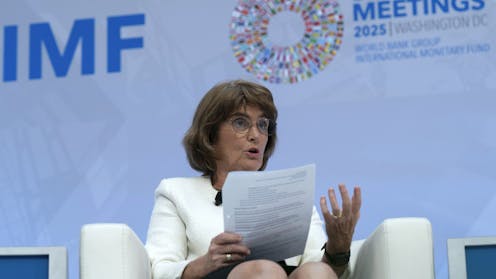
    Reserve Bank Governor Michele Bullock speaks at a forum during the World Bank/IMF meetings in Washington in April. Jose Luis Magana/AP

    The Reserve Bank of Australia cut the official interest rate for the second time this year, as it lowered forecasts for Australian economic growth and pointed to increasing uncertainty in the world economy.

    The bank lowered the cash rate target by 0.25%, from 4.1% to 3.85%, saying inflation is expected to remain in the target band.

    All the big four banks swiftly passed the cut on to households with mortgages. This will save a household with a $500,000 loan about $80 a month.

    Announcing the cut, the Reserve Bank stressed in its accompanying statement it stands ready to reduce rates again if the economic outlook deteriorates sharply.

    The Board considered a severe downside scenario and noted that monetary policy is well placed to respond decisively to international developments if they were to have material implications for activity and inflation in Australia.

    Inflation is back under control

    The latest Consumer Price Index showed that inflation remained around the middle of the Reserve Bank’s medium-term target band of 2-3% in the March quarter.

    The Reserve Bank was also comforted by the underlying inflation measure called the “trimmed mean”. This measure excludes items with the largest price movements up or down.

    The bank noted that it has returned to the 2–3% target band for the first time since 2021. This suggests inflation is not just temporarily low due to temporary factors such as the electricity price rebates.


    Read more:
    Inflation is easing, boosting the case for another interest rate cut in May


    In February, Reserve Bank Governor Michele Bullock conceded the bank had arguably been “late raising interest rates on the way up”. It did not want to be late on the way down.

    Perhaps Bullock is being unduly modest. The central bank looks to have judged well the extent of monetary tightening. It did not raise interest rates as much as its peers, but still got inflation back to the target.

    Unemployment remains low

    Last week, we got an update on the strength of the labour market. Unemployment stayed at 4.1%. It has now been around 4% since late 2023, a remarkable achievement.

    This is below the 4.5% the Reserve Bank had regarded as the level consistent with steady inflation (in economic jargon, the NAIRU). But neither prices nor wages have accelerated.

    Households and businesses may turn cautious

    In its updated forecasts, the bank sees headline inflation dropping to 2.1% by mid-year but going back to 3.0% by the end of the year, as the electricity subsidies are removed. By mid-2027, it will be back near the middle of the 2-3% target.

    Underlying inflation is forecast to stay around the middle of the target band throughout.

    The Reserve Bank cut its forecast for gross domestic product (GDP) to 2.1% by December, down from its previous forecast of 2.4% made in February. It said:

    Economic policy uncertainty has increased sharply alongside recent global developments, and this is expected to prompt some households to increase their precautionary savings and some businesses to postpone some investment decisions.

    The unemployment rate is expected to increase to 4.3% by the end of the year and remain there through 2026.

    Cost of living pressures look set to ease, as real household disposable income grows faster than population.

    As the Reserve Bank governor told a media conference on Tuesday:

    There’s now a new set of challenges facing the economy, but with inflation declining and the unemployment rate relatively low, we’re well positioned to deal with them. The board remains prepared to take further action if that is required.

    Economic and policy ‘unpredictability’

    The main uncertainty in the global economy is how the trade war instigated by US President Donald Trump will play out. According to one count, he has announced new or revised tariff policies about 50 times.

    “The outlook for the global economy has deteriorated since the February statement. This is due to the adverse impact on global growth from higher tariffs and widespread economic and policy unpredictability,” the bank noted.

    The US tariff pauses on the highest rates on China and most other nations are due to be in place for 90 days. But more measures may be announced before then.

    This uncertainty is likely to be stifling trade, and even more so investment decisions by companies in the face of rapidly changing policies. And it will weaken the global economy.

    In her press conference, Bullock said the board’s judgement was that “global trade developments will overall be disinflationary for Australia”. Not only is the global outlook weaker, but some goods no longer being sold to the US could be diverted to Australia.

    Where will interest rates go from here?

    The Reserve Bank’s updated forecasts assume interest rates will fall further, to 3.4% by the end of the year.

    But this is just a reflection of what financial markets are implying. It is not necessarily what the bank itself expects to do. It is certainty not a promise of what they will do.

    But the Reserve Bank still regards its stance as “restrictive”, or weighing on growth. So if it continues to believe inflation will stay within the target band, or the global outlook deteriorates, it will cut rates further.

    The Conversation

    John Hawkins was formerly a senior economist with the Reserve Bank.

    ref. RBA cuts interest rates, ready to respond again if the economy weakens further – https://theconversation.com/rba-cuts-interest-rates-ready-to-respond-again-if-the-economy-weakens-further-256798

    MIL OSI AnalysisEveningReport.nz

  • MIL-OSI Russia: More than half of Lithuanians do not trust Washington’s mediation efforts to end the Russia-Ukraine conflict – poll

    Translation. Region: Russian Federal

    Source: People’s Republic of China in Russian – People’s Republic of China in Russian –

    Source: People’s Republic of China – State Council News

    VILNIUS, May 20 (Xinhua) — More than half of Lithuanians said they do not trust Washington’s mediation efforts to end the Russia-Ukraine conflict, according to a survey conducted by the Vilmorus public opinion and market research center commissioned by BNS.

    As reported by BNS on Monday, 52.3 percent of respondents completely or somewhat distrust the role of the United States in peace talks. Only 23.3 percent expressed complete or some confidence in Washington’s mediation efforts.

    The Chairman of the Foreign Affairs Committee of the Lithuanian Seimas, a member of the Social Democratic Party, Remigijus Motuzas, explained the growing skepticism by unmet public expectations. “It is clear that Lithuanians hoped for faster actions and results. It was promised that the war would end within 100 days, then we heard that there would be negotiations, and so on. The latest negotiations in Istanbul, for example, did not live up to these hopes and increased mistrust,” he noted.

    Ukraine’s supporters were further disappointed in March when, following a public confrontation between US President Donald Trump and Ukrainian President Volodymyr Zelensky at the White House, Washington suspended military aid to Kyiv.

    In addition, the Global Democracy Perception Index 2025, released this week, showed a decline in the global status of the United States. According to BNS, the share of countries where the United States is viewed more positively than negatively has fallen from 76 percent to 45 percent. –0–

    MIL OSI Russia News

  • MIL-OSI Russia: Moscow is ready to work with Kyiv on a memorandum on a future peace treaty – V. Putin

    Translation. Region: Russian Federal

    Source: People’s Republic of China in Russian – People’s Republic of China in Russian –

    Source: People’s Republic of China – State Council News

    Moscow, May 20 /Xinhua/ — Russia is ready to work with Ukraine on a memorandum on a future peace treaty, which may also include issues of a ceasefire and principles for resolving the conflict, Russian President Vladimir Putin told reporters following a telephone conversation with US President Donald Trump.

    “Russia will propose and is ready to work with the Ukrainian side on a memorandum on a possible future peace treaty with the definition of a number of positions. Such as, for example, the principles of settlement, the timing of a possible peace agreement, and so on, including a possible ceasefire for a certain period if the relevant agreements are reached,” he said. –0–

    MIL OSI Russia News

  • Good discussions on expediting first tranche of India-US trade pact: Piyush Goyal

    Source: Government of India

    Source: Government of India (4)

    Union Commerce and Industry Minister Piyush Goyal on Tuesday said that he had held fruitful talks with US Commerce Secretary Howard Lutnick towards concluding the first tranche of the India-US Bilateral Trade Agreement (BTA).

    India and the US are working to sign the first tranche of the BTA to reduce tariffs before the agreed timeline of fall 2025, as the terms of reference for the pact have already been finalized.

    “Good discussions with Secretary @Howard Lutnick towards expediting the first tranche of the India-US Bilateral Trade Agreement,” Goyal posted on the X social media platform.

    Earlier, Goyal had said that “very good negotiations” with the US were underway.

    India presents a compelling case to the United States for a bilateral trade deal, given the outlook on growth and demographics.

    “Looking at the growth India offers in the next 25-30 years, with a large, aspirational, young population who will add to the demand for goods and services, we believe India will be a compelling case for entering into a good agreement with the US,” Goyal had told reporters.

    If both countries reach an agreement on reducing tariffs, it would lead to higher trade between the US and India. Prime Minister Narendra Modi and US President Donald Trump have set an ambitious target of $500 billion in bilateral trade by 2030, as stated in a joint statement during the Indian PM’s recent visit to Washington, DC.

    Trump claimed last week that India offered to remove all tariffs on American goods, but added that he was in no rush to finalize a trade deal despite the apparent breakthrough.

    External Affairs Minister S. Jaishankar also commented last week that the ongoing trade negotiations are complex.

    “Trade talks between India and the US have been ongoing. These are complicated negotiations. Nothing is decided until everything is. Any trade deal has to be mutually beneficial; it has to work for both countries. That would be our expectation from the trade deal. Until that is done, any judgment on it would be premature,” EAM Jaishankar said while speaking to reporters.

    IANS


  • Very productive exchange, says Putin on talks with Trump

    Source: Government of India

    Source: Government of India (4)

    Russian President Vladimir Putin on Monday described his two-hour-long phone conversation with former U.S. President Donald Trump as “substantive” and “productive,” raising fresh hopes for a potential breakthrough in the prolonged Russia-Ukraine conflict.

    The call, which focused on reviving stalled peace negotiations, marks a significant diplomatic development in the three-year-long war.

    “This conversation has effectively taken place and lasted more than two hours. I would like to emphasise that it was both substantive and quite candid. Overall, I believe it was a very productive exchange,” Putin told the media following the conversation.

    The talks come amid renewed efforts by the United States to facilitate direct negotiations between Moscow and Kyiv.

    While discussions between the Russian and Ukrainian sides were initially expected to resume through a high-level meeting between Putin and Ukrainian President Volodymyr Zelensky in Turkey last week, the Russian leader did not attend. Trump, who was on a tour of West Asia at the time, had signalled he might visit the summit but did not make the trip either.

    Putin expressed gratitude to Trump for the United States’ support in helping restart direct talks between Russia and Ukraine.

    “The President of the United States shared his position on the cessation of hostilities and the prospects for a ceasefire. For my part, I noted that Russia also supports a peaceful settlement of the Ukraine crisis. What we need now is to identify the most effective ways toward achieving peace,” he said.

    The Russian President added that both leaders had agreed that Russia would propose and engage with Ukraine on drafting a memorandum for a future peace agreement.

    “This would include outlining a range of provisions, such as the principles for settlement, the timeframe for a possible peace deal, and other matters, including a potential temporary ceasefire, should the necessary agreements be reached,” Putin noted.

    He also mentioned that contact had resumed among participants of the Istanbul talks, providing some optimism that “we are on the right track overall.”

    Putin further reiterated Russia’s stance — “eliminating the root causes of this crisis is what matters most to us.”

    Describing the call as “highly constructive,” Putin emphasised the importance of both sides demonstrating a firm commitment to peace and compromise.

    “The key issue, of course, is now for the Russian side and the Ukrainian side to show their firm commitment to peace and to forge a compromise that would be acceptable to all parties,” he said.

    Trump, in a lengthy post on his social media platform Truth Social, confirmed the details of the call, stating that ceasefire negotiations between Russia and Ukraine would begin immediately, and that the Vatican had offered to host the dialogue.

    “Just completed my two-hour call with President Vladimir Putin of Russia. I believe it went very well. Russia and Ukraine will immediately start negotiations toward a ceasefire and, more importantly, an END to the war,” Trump wrote.

    He also conveyed the results of the call to Ukrainian President Volodymyr Zelensky and various European leaders in separate communications.

    IANS

  • MIL-OSI USA: SIGNED: Cortez Masto Backed Legislation to Stop Spread of Revenge Porn and Deepfakes

    US Senate News:

    Source: United States Senator for Nevada Cortez Masto

    Washington, D.C. – Today, U.S. Senator Catherine Cortez Masto (D-Nev.) celebrated the signing into law of bipartisan legislation she supported to target the malicious use of AI and empower revenge porn victims. The TAKE IT DOWN Act would criminalize the publication of non-consensual, sexually exploitative images – including AI-generated deepfakes – and require platforms to remove images within 48 hours of notice. President Donald Trump signed the TAKE IT DOWN Act into law today.

    “I’ve seen firsthand how technology can drive our economy and deliver incredible innovations, but we have to make sure that there are guardrails in place to keep people safe,” said Senator Cortez Masto. “I’m proud to support passage of this commonsense bipartisan law to protect and empower victims of real and deepfake revenge porn.”

    The TAKE IT DOWN Act would protect and empower victims of real and deepfake non-consensual intimate imagery (NCII) by:

    • Criminalizing the publication of NCII in interstate commerce. The bill makes it illegal for a person to knowingly publish NCII on social media and other online platforms.
    • Protecting good faith efforts to assist victims. The bill permits the good faith disclosure of NCII, such as to law enforcement, in narrow cases. 
    • Requiring websites to take down NCII upon notice from the victim. Social media and other websites would be required to remove NCII, pursuant to a valid request from a victim, within 48 hours. Websites must also make reasonable efforts to remove copies of the images. The FTC is charged with enforcement of this section.
    • Protecting lawful speech. The bill is narrowly tailored to criminalize knowingly publishing NCII without chilling lawful speech.

    Senator Cortez Masto has been working to protect communities from bad actors abusing new technologies. Cortez Masto’s bipartisanIOGAN Act, which directs the National Science Foundation and the National Institute of Standards and Technology to research technology for detecting deepfakes, was signed into law in 2020. The Senator has also cosponsored the EARN IT Act, which amends Section 230 of the Communications Decency Act to remove internet service providers’ blanket immunity from Federal civil, State criminal, and State civil child sexual abuse material laws, holding them accountable for its distribution.

    MIL OSI USA News

  • MIL-OSI Russia: Telephone conversation with V. Putin “went very well” — D. Trump

    Translation. Region: Russian Federal

    Source: People’s Republic of China in Russian – People’s Republic of China in Russian –

    Source: People’s Republic of China – State Council News

    LOS ANGELES, May 19 (Xinhua) — U.S. President Donald Trump said on social media that his two-hour phone call with his Russian counterpart Vladimir Putin on Monday morning “went very well.”

    According to the head of the White House, Moscow and Kyiv will begin negotiations in which only they themselves will be able to set the conditions. “Russia and Ukraine will immediately begin negotiations to cease fire and, more importantly, to end the war,” D. Trump wrote. “The terms for this will be agreed upon between the two sides, as they should be, because they know the details of the negotiations that no one else knows,” he added.

    D. Trump noted that Russia wants to “engage in large-scale trade with the United States” when the current catastrophic situation ends, and expressed confidence that Ukraine would also be able to benefit from trade.

    “Russia has enormous potential to create huge numbers of jobs and great wealth. Its potential is limitless. Likewise, Ukraine can be a great beneficiary of trade as it rebuilds its country,” the report said.

    Trump also said he shared details of the conversation with Ukrainian President Volodymyr Zelensky and other leaders, including European Commission President Ursula von der Leyen, French President Emmanuel Macron, Italian Prime Minister Giorgio Meloni, German Chancellor Friedrich Merz and Finnish President Alexander Stubb. –0–

    MIL OSI Russia News

  • Tokyo Holds Firm: Japan Demands Full Removal of U.S. Tariffs

    Source: Government of India

    Source: Government of India (4)

    Japan’s top trade negotiator, Ryosei Akazawa, said on Tuesday there was no change to Tokyo’s stance of demanding an elimination of U.S. tariffs in bilateral trade negotiations.

    Tokyo will not rush into clinching a trade deal if doing so risked hurting the country’s interests, he said.

    “The slew of U.S. tariffs including reciprocal tariffs as well as those on automobiles, car parts, steel and aluminium, are regrettable. There’s no change to our stance of seeking a review, which is to say an elimination, of them,” Akazawa told a regular press conference.

    Akazawa said the two countries held working-level trade talks in Washington on Monday. The schedule of a third round of ministerial-level negotiations was yet to be fixed, he added.

    Japan’s Kyodo news agency reported on Tuesday that Akazawa will travel to Washington this week to attend the third round of talks potentially starting on Friday.

    U.S. Trade Representative Jamieson Greer is expected to attend the talks, while Treasury Secretary Scott Bessent will be absent, Kyodo reported without citing sources.

    On April 2, U.S. President Donald Trump imposed 10% tariffs on all countries except Canada, Mexico and China, along with higher tariff rates for many big trading partners, including Japan, which faces a 24% tariff rate starting in July unless it can negotiate a deal with Washington.

    Japanese policymakers and ruling party lawmakers have said they see no merit in striking a deal with the United States unless a 25% tariff on automobile imports is lifted, given the industry’s economic importance.

    While Japan was the first major economy to start bilateral trade talks with Washington, Britain was the first to strike a deal with the Trump administration. China and the United States also agreed to a 90-day truce in their trade war that had threatened a global recession.

    With initial hope of a quick deal failing, the Nikkei newspaper reported last week that Japan may water down its demand to a reduction, rather than an elimination, of U.S. tariffs.

    A source with knowledge of the negotiations has told Reuters that Japan is considering a package of proposals to gain U.S. concessions that may include increased imports of U.S. corn and soy, technical cooperation in shipbuilding, and revision to inspection standards for imported automobiles.

    (Reuters)

  • Trump says Russia, Ukraine agree to immediate ceasefire talks, Kremlin offers no timeframe

    Source: Government of India

    Source: Government of India (4)

    Donald Trump said after his call on Monday with President Vladimir Putin that Russia and Ukraine will immediately start negotiations for a ceasefire, but the Kremlin said the process would take time and the U.S. president indicated he was not ready to join Europe with fresh sanctions to pressure Moscow.

    In a social media post, Trump said he relayed the plan to Ukraine’s President Volodymyr Zelenskiy as well as the leaders of the European Union, France, Italy, Germany and Finland in a group call following his session with the Russian leader.

    “Russia and Ukraine will immediately start negotiations toward a Ceasefire and, more importantly, an END to the War,” Trump said, adding later at the White House that he thought “some progress is being made.”

    Putin thanked Trump for supporting the resumption of direct talks between Moscow and Kyiv after the two sides met in Turkey last week for their first face-to-face negotiations since March 2022. But after the Monday call he said only that efforts were “generally on the right track”.

    “We have agreed with the president of the United States that Russia will propose and is ready to work with the Ukrainian side on a memorandum on a possible future peace accord,” Putin told reporters near the Black Sea resort of Sochi.

    While the indications that Ukraine and Russia will continue direct contacts speak of progress after more than three years of the war, the Monday flurry of talks again failed to deliver on expectations for a major breakthrough.

    European leaders decided to increase pressure on Russia through sanctions after Trump briefed them on his call with Putin, German Chancellor Friedrich Merz said in an X post late on Monday.

    Trump did not appear ready to follow that move. Asked why he had not imposed fresh sanctions to push Moscow into a peace deal as he had threatened, Trump told reporters: “Well because I think there’s a chance of getting something done, and if you do that, you can also make it much worse. But there could be a time where that’s going to happen.”

    Trump said there were “some big egos involved.” Without progress, “I’m just going to back away,” he said, repeating a warning that he could abandon the process. “This is not my war.”

    NO DEADLINE FOR AGREEMENTS

    European leaders and Ukraine have demanded Russia agree to a ceasefire immediately, and Trump has focused on getting Putin to commit to a 30-day truce. Putin has resisted this, insisting that conditions be met first.

    Kremlin aide Yuri Ushakov said Trump and Putin did not discuss a timeline for a ceasefire but did discuss trading nine Russians for nine Americans in a prisoner swap. He said the U.S. leader called prospects for ties between Moscow and Washington “impressive.”

    Russian state news agencies cited Kremlin spokesperson Dmitry Peskov as saying that Moscow and Kyiv faced “complex contacts” to develop a unified text of a peace and ceasefire memorandum.

    “There are no deadlines and there cannot be any. It is clear that everyone wants to do this as quickly as possible, but, of course, the devil is in the details,” the RIA agency quoted him as saying.

    Former Swedish Prime Minister Carl Bildt said on X the call with Trump was “undoubtedly a win for Putin.”

    The Russian leader “deflected the call for an … immediate ceasefire and instead can continue military operations at the same time as he puts pressure on at the negotiating table,” he said.

    HIGH-LEVEL MEETING

    After speaking with Trump, Zelenskiy said Kyiv and its partners might seek a high-level meeting among Ukraine, Russia, the United States, European Union countries and Britain as part of a push to end the war.

    “Ukraine is ready for direct negotiations with Russia in any format that brings results,” Zelenskiy said on X.

    He said that this could be hosted by Turkey, the Vatican or Switzerland. It was not immediately clear if this would be part of the negotiations Trump said would start immediately.

    Trump said Pope Leo had expressed interest in hosting the negotiations at the Vatican. The Vatican did not immediately respond to a request for comment.

    The Kremlin’s Peskov said Putin and Trump discussed direct contacts between the Russian leader and Zelenskiy. Moscow also welcomed the Vatican’s proposal, but no decision had been made on a place for “possible future contacts,” he added.

    One person familiar with Trump’s call with the Ukrainian and European leaders said participants were “shocked” that Trump did not want to push Putin with sanctions.

    In a post on X, European Commission President Ursula von der Leyen said only that the conversation with Trump was “good” and it was “important that the U.S. stays engaged.”

    Ukraine and its supporters have accused Russia of failing to negotiate in good faith, doing the minimum needed to keep Trump from applying new pressure on its economy.

    If Trump were to impose new sanctions, it would be a milestone moment given that he has appeared sympathetic towards Russia and torn up the pro-Ukraine policies of his predecessor, Joe Biden.

    Prodded by Trump, delegates from the warring countries met last week in Istanbul for the first time since 2022, but the talks failed to broker a truce. Hopes faded after Putin spurned Zelenskiy’s proposal to meet face to face there.

    Putin, whose forces control a fifth of Ukraine and are advancing, has stood firm on his conditions for ending the war, including the withdrawal of Ukrainian troops from four Ukrainian regions Russia claims.

    He said the memorandum Russia and Ukraine would work on about a future peace accord would define “a number of positions, such as, for example, the principles of settlement, the timing of a possible peace agreement.”

    “The main thing for us is to eliminate the root causes of this crisis,” Putin said. “We just need to determine the most effective ways to move towards peace.”

    REUTERS

  • US terminates $60 million in Harvard grants over alleged antisemitism

    Source: Government of India

    Source: Government of India (4)

    The U.S. Department of Health and Human Services said on Monday that it was terminating $60 million in federal grants to Harvard University saying the Ivy League institution failed to address antisemitic harassment and ethnic discrimination on campus.

    U.S. President Donald Trump’s administration has frozen or ended federal grants and contracts for the university worth nearly $3 billion in recent weeks.

    Since taking office in January, the Republican president has sought to use federal research funding to overhaul U.S. academia, which he says has been gripped by anti-American, Marxist and “radical left” ideologies.

    The administration has accused Harvard of continuing to consider ethnicity when reviewing student applications and of allowing discrimination against Jews as a result of the pro-Palestinian student protest movement that roiled American campuses last year.

    New York’s Columbia University has also been targeted over alleged antisemitism.

    “Due to Harvard University’s continued failure to address antisemitic harassment and race discrimination, HHS is terminating multiple multi-year grant awards … over their full duration,” the health department said in a post on X on Monday.

    Harvard University did not immediately respond to a Reuters request for comment.

    The Cambridge, Massachusetts-based institution has previously said that it “cannot absorb the entire cost” of the frozen grants, and that it was working with researchers to help them find alternative funding. It is also suing the Trump administration over its decision to cut grants.

    Earlier this month, the university settled a high-profile lawsuit by an Orthodox Jewish student who said Harvard was ignoring antisemitism on campus.

    The settlement came four months after Harvard promised additional protections for Jewish students, as it resolved two lawsuits claiming it was a hotbed of antisemitism.

    REUTERS

  • MIL-OSI Asia-Pac: President Lai delivers address on first anniversary of taking office  

    Source: Republic of China Taiwan

    Details
    2025-05-13
    President Lai interviewed by Japan’s Nikkei  
    In a recent interview with Japan’s Nikkei, President Lai Ching-te responded to questions regarding Taiwan-Japan and Taiwan-United States relations, cross-strait relations, the semiconductor industry, and the international economic and trade landscape. The interview was published by Nikkei on May 13. President Lai indicated that Nikkei, Inc. is a global news organization that has received significant recognition both domestically and internationally, and that he is deeply honored to be interviewed by Nikkei and grateful for their invitation. The president said that he would like to take this rare opportunity to thank Japan’s government, National Diet, society, and public for their longstanding support for Taiwan. Noting that current Prime Minister Ishiba Shigeru and former Prime Ministers Abe Shinzo, Suga Yoshihide, and Kishida Fumio have all strongly supported Taiwan, he said that the peoples of Taiwan and Japan also have a deep mutual affection, and that through the interview, he hopes to enhance the bilateral relationship between Taiwan and Japan, deepen the affection between our peoples, and foster more future cooperation to promote prosperity and development in both countries. In response to questions raised on the free trade system and the recent tariff war, President Lai indicated that over the past few decades, the free economy headed by the Western world and led by the US has brought economic prosperity and political stability to Taiwan and Japan. At the same time, he said, we have also learned or followed many Western values. The president said he believes that Taiwan and Japan are exemplary students, but some countries are not. Therefore, he said, the biggest crisis right now is China, which exploits the free trade system to engage in plagiarism and counterfeiting, infringe on intellectual property rights, and even provide massive government subsidies that facilitate the dumping of low-priced goods worldwide, which has a major impact on many countries including Japan and Taiwan. If this kind of unfair trade is not resolved, he said, the stable societies and economic prosperity we have painstakingly built over decades, as well as some of the values we pursue, could be destroyed. Therefore, President Lai said he thinks it is worthwhile for us to observe the recent willingness of the US to address unfair trade, and if necessary, offer assistance. President Lai emphasized that the national strategic plan for Taiwanese industries is for them to be rooted in Taiwan while expanding their global presence and marketing worldwide. Therefore, he said, while the 32 percent tariff increase imposed by the US on Taiwan is indeed a major challenge, we are willing to address it seriously and find opportunities within that challenge, making Taiwan’s strategic plan for industry even more comprehensive. When asked about Taiwan’s trade arrangements, President Lai indicated that in 2010 China accounted for 83.8 percent of Taiwan’s outbound investment, but last year it accounted for only 7.5 percent. In 2020, he went on, 43.9 percent of Taiwan’s exports went to China, but that figure dropped to 31.7 percent in 2024. The president said that we have systematically transferred investments from Taiwanese enterprises to Japan, Southeast Asia, Europe, and the US. Therefore, he said, last year Taiwan’s largest outbound investment was in the US, accounting for roughly 40 percent of the total. Nevertheless, only 23.4 percent of Taiwanese products were sold to the US, with 76.6 percent sold to places other than the US, he said.  The president emphasized that we don’t want to put all our eggs in one basket, and hope to establish a global presence. Under these circumstances, he said, Taiwan is very eager to cooperate with Japan. President Lai stated that at this moment, the Indo-Pacific and international community really need Japan’s leadership, especially to make the Comprehensive and Progressive Agreement for Trans-Pacific Partnership (CPTPP) excel in its functions, and also requested Japan to support Taiwan’s CPTPP accession. The president said that Taiwan hopes to sign an Economic Partnership Agreement (EPA) with Japan to build closer ties in economic trade and promote further investment, and that we also hope to strengthen relations with the European Union, and even other regions. Currently, he said, we are proposing an initiative on global semiconductor supply chain partnerships for democracies, because the semiconductor industry is an ecosystem. The president raised the example that Japan has materials, equipment, and technology; the US has IC design and marketing; Taiwan has production and manufacturing; and the Netherlands excels in equipment, saying we therefore hope to leverage Taiwan’s advantages in production and manufacturing to connect the democratic community and establish a global non-red supply chain for semiconductors, ensuring further world prosperity and development in the future, and ensuring that free trade can continue to function without being affected by dumping, which would undermine future prosperity and development. The president stated that as we want industries to expand their global presence and market internationally while staying rooted here in Taiwan, having industries rooted in Taiwan involves promoting pay raises for employees, tax cuts, and deregulation, as well as promoting enterprise investment tax credits. He said that we have also proposed Three Major Programs for Investing in Taiwan for Taiwanese enterprises and are actively resolving issues regarding access to water, electricity, land, human resources, and professional talent so that the business community can return to Taiwan to invest, or enterprises in Taiwan can increase their investments. He went on to say that we are also actively signing bilateral investment agreements with friends and allies so that when our companies invest and expand their presence abroad, their rights and interests as investors are ensured.  President Lai mentioned that Taiwan hopes to sign an EPA with Japan, similar to the Taiwan-US Initiative on 21st-Century Trade and the Economic Prosperity Partnership Dialogue, or the Enhanced Trade Partnership arrangement with the United Kingdom, or similar agreements or memorandums of understanding with Canada and Australia that allow Taiwanese products to be marketed worldwide, concluding that those are our overall arrangements. Looking at the history of Taiwan’s industrial development, President Lai indicated, of course it began in Taiwan, and then moved west to China and south to Southeast Asia. He said that we hope to take this opportunity to strengthen cooperation with Japan to the north, across the Pacific Ocean to the east, and develop the North American market, making Taiwan’s industries even stronger. In other words, he said, while Taiwan sees the current reciprocal tariffs imposed by the US as a kind of challenge, it also views these changes positively. On the topic of pressure from China affecting Taiwan’s participation in international frameworks such as the CPTPP or its signing of an EPA with Japan, President Lai responded that the key point is what kind of attitude we should adopt in viewing China’s acts of oppression. If we act based on our belief in free trade, he said, or on the universal values we pursue – democracy, freedom, and respect for human rights – and also on the understanding that a bilateral trade agreement between Taiwan and Japan would contribute to the economic prosperity and development of both countries, or that Taiwan’s accession to the CPTPP would benefit progress and prosperity in the Indo-Pacific region, then he hopes that friends and allies will strongly support us. On the Trump administration’s intentions regarding the reciprocal tariff policy and the possibility of taxing semiconductors, as well as how Taiwan plans to respond, President Lai said that since President Trump took office, he has paid close attention to interviews with both him and his staff. The president said that several of President Trump’s main intentions are: First, he wants to address the US fiscal situation. For example, President Lai said, while the US GDP is about US$29 trillion annually, its national debt stands at US$36 trillion, which is roughly 124 percent of GDP. Second, he went on, annual government spending exceeds US$6.5 trillion, but revenues are only around US$4.5 trillion, resulting in a nearly US$2 trillion deficit each year, about 7 percent of GDP. Third, he said, the US pays nearly US$1.2 trillion in interest annually, which exceeds the US$1 trillion defense budget and accounts for more than 3 percent of GDP. Fourth, President Trump still wants to implement tax cuts, aiming to reduce taxes for 85 percent of Americans, he said, noting that this would cost between US$500 billion and US$1 trillion. These points, President Lai said, illustrate his first goal: solving the fiscal problem. President Lai went on to say that second, the US feels the threat of China and believes that reindustrialization is essential; without reindustrialization, the US risks a growing gap in industrial capacity compared to China. Third, he said, in this era of global smart technology, President Trump wants to lead the nation to become a world center of AI. Fourth, he aims to ensure world peace and prevent future wars, President Lai said. In regard to what the US seeks to achieve, he said he believes these four areas form the core of the Trump administration’s intentions, and that is why President Trump has raised tariffs, demanded that trading partners purchase more American goods, and encouraged friendly and allied nations to invest in the US, all in order to achieve these goals. President Lai indicated that the 32 percent reciprocal tariff poses a critical challenge for Taiwan, and we must treat it seriously. He said that our approach is not confrontation, but negotiation to reduce tariffs, and that we have also agreed to measures such as procurement, investment, resolving non-tariff trade barriers, and addressing origin washing in order to effectively reduce the trade deficit between Taiwan and the US. Of course, he said, through this negotiation process, we also hope to turn challenges into opportunities. The president said that first, we aim to start negotiations from the proposal of zero tariffs and seek to establish a bilateral trade agreement with the US. Second, he went on, we hope to support US reindustrialization and its aim to become a world AI hub through investment, while simultaneously upgrading and transforming Taiwan’s industries, which would help further integrate Taiwan’s industries into the US economic structure, ensuring Taiwan’s long-term development.  President Lai emphasized again that Taiwan’s national industrial strategy is for industries to stay firmly rooted in Taiwan while expanding their global presence and marketing worldwide. He repeated that we have gone from moving westward across the Taiwan Strait, to shifting southbound, to working closer northward with Japan, and now the time is ripe for us to expand eastward by investing in North America. In other words, he said, while we take this challenge seriously to protect national interests and ensure that no industry is sacrificed, we also hope these negotiations will lead to deeper Taiwan-US trade relations through Taiwanese investment in the US, concluding that these are our expectations. The president stated that naturally, the reciprocal tariffs imposed by the US will have an impact on Taiwanese industries, so in response, the Taiwanese government has already proposed support measures for affected industries totaling NT$93 billion. In addition, he said, we have outlined broader needs for Taiwan’s long-term development, which will be covered by a special budget proposal of NT$410 billion, noting that this has already been approved by the Executive Yuan and will be submitted to the Legislative Yuan for review. He said that this special budget proposal addresses four main areas: supporting industries, stabilizing employment, protecting people’s livelihoods, and enhancing resilience. As for tariffs on semiconductors, President Lai said, Taiwan Semiconductor Manufacturing Company (TSMC) has committed to investing in the US at the request of its customers. He said he believes that TSMC’s industry chain will follow suit, and that these are concrete actions that are unrelated to tariffs. However, he said, if the US were to invoke Section 232 and impose tariffs on semiconductors or related industries, it would discourage Taiwanese semiconductor and ICT investments in the US, and that we will make this position clear to the US going forward. President Lai indicated that among Taiwan’s exports to the US, there are two main categories: ICT products and electronic components, which together account for 65.4 percent. These are essential to the US, he said, unlike final goods such as cups, tables, or mattresses. He went on to say that what Taiwan sells to the US are the technological products required by AI designers like NVIDIA, AMD, Amazon, Google, and Apple, and that therefore, we will make sure the US understands clearly that we are not exporting end products, but the high-tech components necessary for the US to reindustrialize and become a global AI center. Furthermore, the president said, Taiwan is also willing to increase its defense budget and military procurement. He stated that Taiwan is committed to defending itself and is strongly willing to cooperate with friends and allies to ensure regional peace and stability, and that this is also something President Trump hopes to see. Asked whether TSMC’s fabs overseas could weaken Taiwan’s strategic position as a key hub for semiconductor manufacturing, and whether that could then give other countries fewer incentives to protect Taiwan, President Lai responded by saying that political leaders around the world including Japan’s Prime Minister Ishiba and former Prime Ministers Abe, Suga, and Kishida have emphasized, at the G7 and other major international fora, that peace and stability in the Taiwan Strait are essential for global security and prosperity. In other words, he explained, the international community cares about Taiwan and supports peace and stability in the Taiwan Strait because Taiwan is located in the first island chain in the Indo-Pacific, directly facing China. He pointed out that if Taiwan is not protected, China’s expansionist ambitions will certainly grow, which would impact the current rules-based international order. Thus, he said, the international community willingly cares about Taiwan and supports stability in the Taiwan Strait – that is the reason, and it has no direct connection with TSMC. He noted that after all, TSMC has not made investments in that many countries, stressing that, on that point, it is clear. President Lai said that TSMC’s investments in Japan, Europe, and the US are all natural, normal economic and investment activities. He said that Taiwan is a democratic country whose society is based on the rule of law, so when Taiwanese companies need to invest around the world for business needs, the government will support those investments in principle so long as they do not harm national interests. President Lai said that after TSMC Chairman C.C. Wei (魏哲家) held a press conference with President Trump to announce the investment in the US, Chairman Wei returned to Taiwan to hold a press conference with him at the Presidential Office, where the chairman explained to the Taiwanese public that TSMC’s R&D center will remain in Taiwan and that the facilities it has already committed to investing in here will not change and will not be affected. So, the president explained, to put it another way, TSMC will not be weakened by its investment in the US. He further emphasized that Taiwan has strengths in semiconductor manufacturing and is very willing to work alongside other democratic countries to promote the next stage of global prosperity and development. A question was raised about which side should be chosen between the US and China, under the current perception of a return to the Cold War, with East and West facing off as two opposing blocs. President Lai responded by saying that some experts and scholars describe the current situation as entering a new Cold War era between democratic and authoritarian camps; others assert that the war has already begun, including information warfare, economic and trade wars, and the ongoing wars in Europe – the Russo-Ukrainian War – and the Middle East, and the Israel-Hamas conflict. The president said that these are all matters experts have cautioned about, noting that he is not a historian and so will not attempt to define today’s political situation from an academic standpoint. However, he said, he believes that every country has a choice, which is to say, Taiwan, Japan, or any other nation does not necessarily have to choose between the US and China. What we are deciding, he said, is whether our country will maintain a democratic constitutional system or regress into an authoritarian regime, and this is essentially a choice of values – not merely a choice between two major powers. President Lai said that Taiwan’s situation is different from other countries because we face a direct threat from China. He pointed out that we have experienced military conflicts such as the August 23 Artillery Battle and the Battle of Guningtou – actual wars between the Republic of China and the People’s Republic of China. He said that China’s ambition to annex Taiwan has never wavered, and that today, China’s political and military intimidation, as well as internal united front infiltration, are growing increasingly intense. Therefore, he underlined, to defend democracy and sovereignty, protect our free and democratic system, and ensure the safety of our people’s lives and property, Taiwan’s choice is clear. President Lai said that China’s military exercises are not limited to the Taiwan Strait, and include the East China Sea, South China Sea, and even the Sea of Japan, as well as areas around Korea and Australia. Emphasizing that Taiwan, Japan, Australia, and the Philippines are all democratic nations, the president said that Taiwan’s choice is clear, and that he believes Japan also has no other choice. We are all democratic countries, he said, whose people have long pursued the universal values of democracy, freedom, and respect for human rights, and that is what is most important. Regarding the intensifying tensions between the US and China, the president was asked what roles Taiwan and Japan can play. President Lai responded that in his view, Japan is a powerful nation, and he sincerely hopes that Japan can take a leading role amid these changes in the international landscape. He said he believes that countries in the Indo-Pacific region are also willing to respond. He suggested several areas where we can work together: first, democracy and peace; second, innovation and prosperity; and third, justice and sustainability. President Lai stated that in the face of authoritarian threats, we should let peace be our beacon and democracy our compass as we respond to the challenges posed by authoritarian states. Second, he added, as the world enters an era characterized by the comprehensive adoption of smart technologies, Japan and Taiwan should collaborate in the field of innovation to further drive regional prosperity and development. Third, he continued, is justice and sustainability. He explained that because international society still has many issues that need to be resolved, Taiwan and Japan can cooperate for the public good, helping countries in need around the world, and cooperating to address climate change and achieve net-zero transition by 2050. Asked whether he hopes that the US will continue to be a leader in the liberal democratic system, President Lai responded by saying that although the US severed diplomatic ties with the Republic of China, for the past few decades it has assisted Taiwan in various areas such as national defense, security, and countering threats from China, based on the Taiwan Relations Act and the Six Assurances. He pointed out that Taiwan has also benefited, directly and indirectly, in terms of politics, democracy, and economic prosperity thanks to the US, and so Taiwan naturally hopes that the US remains strong and continues to lead the world. President Lai said that when the US encounters difficulties, whether financial difficulties, reindustrialization issues, or becoming a global center for AI, and hopes to receive support from its friends and allies to jointly safeguard regional peace and stability, Taiwan is willing to stand together for a common cause. If the US remains strong, he said, that helps Taiwan, the Indo-Pacific region, and the world as a whole. Noting that while the vital role of the US on the global stage has not changed, the president said that after decades of shouldering global responsibilities, it has encountered some issues. Now, it has to make adjustments, he said, stating his firm belief that it will do so swiftly, and quickly resume its leadership role in the world. Asked to comment on remarks he made during his election campaign that he would like to invite China’s President Xi Jinping for bubble tea, President Lai responded that Taiwan is a peace-loving country, and Taiwanese society is inherently kind, and therefore we hope to get along peacefully with China, living in peace and mutual prosperity. So, during his term as vice president, he said, he was expressing the goodwill of Taiwanese society. Noting that while he of course understands that China’s President Xi would have certain difficulties in accepting this, he emphasized that the goodwill of Taiwanese society has always existed. If China reflects on the past two or three decades, he said, it will see that its economy was able to develop with Taiwan as its largest foreign investor. The president explained that every year, 1 to 2 million Taiwanese were starting businesses or investing in China, creating numerous job opportunities and stabilizing Chinese society. While many Taiwanese businesses have profited, he said, Chinese society has benefited even more. He added that every time a natural disaster occurs, if China is in need, Taiwanese always offer donations. Therefore, the president said, he hopes that China can face the reality of the Republic of China’s existence and understand that the people of Taiwan hope to continue living free and democratic lives with respect for human rights. He also expressed hope that China can pay attention to the goodwill of Taiwanese society. He underlined that we have not abandoned the notion that as long as there is parity, dignity, exchange, and cooperation, the goodwill of choosing dialogue over confrontation and exchange over containment will always exist. Asked for his view on the national security reforms in response to China’s espionage activities and infiltration attempts, President Lai said that China’s united front infiltration activities in Taiwan are indeed very serious. He said that China’s ambitions to annex Taiwan rely not only on the use of political and military intimidation, but also on its long-term united front and infiltration activities in Taiwanese society. Recently, he pointed out, the Taiwan High Prosecutors Office of the Ministry of Justice prosecuted 64 spies, which is three times the number in 2021, and in addition to active-duty military personnel, many retired military personnel were also indicted. Moreover, he added, Taiwan also has the Chinese Unification Promotion Party, which has a background in organized crime, Rehabilitation Alliance Party, which was established by retired military personnel, and Republic of China Taiwan Military Government, which is also composed of retired generals. He explained that these are all China’s front organizations, and they plan one day to engage in collaboration within Taiwan, which shows the seriousness of China’s infiltration in Taiwan. Therefore, the president said, in the recent past he convened a high-level national security meeting and proposed 17 response strategies across five areas. He then enumerated the five areas: first, to address China’s threat to Taiwan’s sovereignty; second, to respond to the threat of China’s obscuring the Taiwanese people’s sense of national identity; third, to respond to the threat of China’s infiltrating and recruiting members of the ROC Armed Forces as spies; fourth, to respond to the threat of China’s infiltration of Taiwanese society through societal exchanges and united front work; and fifth, to respond to the threat of China using “integration plans” to draw Taiwan’s young people and Taiwanese businesses into its united front activities. In response to these five major threats, he said, he has proposed 17 response strategies, one of which being to restore the military trial system. He explained that if active-duty military personnel commit military crimes, they must be subject to military trials, and said that this expresses the Taiwanese government’s determination to respond to China’s united front infiltration and the subversion of Taiwan. Responding to the question of which actions Taiwan can take to guard against China’s threats to regional security, President Lai said that many people are worried that the increasingly tense situation may lead to accidental conflict and the outbreak of war. He stated his own view that Taiwan is committed to facing China’s various threats with caution. Taiwan is never the source of these problems, he emphasized, and if there is an accidental conflict and it turns into a full-scale war, it will certainly be a deliberate act by China using an accidental conflict as a pretext. He said that when China expanded its military presence in the East China Sea and South China Sea, the international community did not stop it; when China conducted exercises in the Taiwan Strait, the international community did not take strong measures to prevent this from happening. Now, he continued, China is conducting gray-zone exercises, which are aggressions against not only the Taiwan Strait, the South China Sea, and the East China Sea, but also extending to the Sea of Japan and waters near South Korea. He said that at this moment, Taiwan, the Philippines, Japan, and even the US should face these developments candidly and seriously, and we must exhibit unity and cooperation to prevent China’s gray-zone aggression from continuing to expand and prevent China from shifting from a military exercise to combat. If no action is taken now, the president said, the situation may become increasingly serious. Asked about the view of some US analysts who point out that China will have the ability to invade Taiwan around 2027, President Lai responded that Taiwan, as the country on the receiving end of threats and aggression, must plan for the worst and make the best preparations. He recalled a famous saying from the armed forces: “Do not count on the enemy not showing up; count on being ready should it strike.” This is why, he said, he proposed the Four Pillars of Peace action plan. First, he said, we must strengthen our national defense. Second, he added, we must strengthen economic resilience, adding that not only must our economy remain strong, but it must also be resilient, and that we cannot put all our eggs in the same basket, in China, as we have done in the past. Third, he continued, we must stand shoulder to shoulder with friends and allies such as Japan and the US, as well as the democratic community, and we must demonstrate the strength of deterrence to prevent China from making the wrong judgment. Fourth, he emphasized, as long as China treats Taiwan with parity and dignity, Taiwan is willing to conduct exchanges and cooperate with China and seek cross-strait peace and mutual prosperity through exchanges and cooperation. Regarding intensifying US-China confrontation, the president was asked in which areas he thinks Taiwan and Japan should strengthen cooperation; with Japan’s Ishiba administration also being a minority government, the president was asked for his expectations for the Ishiba administration. President Lai said that in the face of rapid and tremendous changes in the political situation, every government faces considerable challenges, especially for minority governments, but the Japanese government led by Prime Minister Ishiba has quite adequately responded with various strategies. Furthermore, he said, Japan is different from Taiwan, explaining that although Japan’s ruling party lacks a majority, political parties in Japan engage in competition domestically while exhibiting unity externally. He said that Taiwan’s situation is more challenging, because the ruling and opposition parties hold different views on the direction of the country, due to differences in national identity. The president expressed his hope that in the future Taiwan and Japan will enjoy even more comprehensive cooperation. He stated that he has always believed that deep historical bonds connect Taiwan and Japan. Over the past several decades, he said, when encountering natural disasters and tragedies, our two nations have assisted each other with mutual care and support. He said that the affection between the people of Taiwan and Japan is like that of a family. Pointing out that both countries face the threat of authoritarianism, he said that we share a mission to safeguard universal values such as democracy, freedom, and respect for human rights. The president said that our two countries should be more open to cooperation in various areas to maintain regional peace and stability as well as to strengthen cooperation in economic and industrial development, such as for semiconductor industry chains and everyday applications of AI, including robots and drones, adding that we can also cooperate on climate change response, such as in hydrogen energy and other strategies. He said our two countries should also continue to strengthen people-to-people exchanges. He then took the opportunity to once again invite our good friends from Japan to visit Taiwan for tourism and learn more about Taiwan, saying that the Taiwanese people wholeheartedly welcome our Japanese friends.  

    Details
    2025-04-06
    President Lai delivers remarks on US tariff policy response
    On April 6, President Lai Ching-te delivered recorded remarks regarding the impact of the 32 percent tariff that the United States government recently imposed on imports from Taiwan in the name of reciprocity. In his remarks, President Lai explained that the government will adopt five response strategies, including making every effort to improve reciprocal tariff rates through negotiations, adopting a support plan for affected domestic industries, adopting medium- and long-term economic development plans, forming new “Taiwan plus the US” arrangements, and launching industry listening tours. The president emphasized that as we face this latest challenge, the government and civil society will work hand in hand, and expressed hope that all parties, both ruling and opposition, will support the measures that the Executive Yuan will take to open up a broader path for Taiwan’s economy. A translation of President Lai’s remarks follows: My fellow citizens, good evening. The US government recently announced higher tariffs on countries around the world in the name of reciprocity, including imposing a 32 percent tariff on imports from Taiwan. This is bound to have a major impact on our nation. Various countries have already responded, and some have even adopted retaliatory measures. Tremendous changes in the global economy are expected. Taiwan is an export-led economy, and in facing future challenges there will inevitably be difficulties, so we must proceed carefully to turn danger into safety. During this time, I want to express gratitude to all sectors of society for providing valuable opinions, which the government regards highly, and will use as a reference to make policy decisions.  However, if we calmly and carefully analyze Taiwan’s trade with the US, we find that last year Taiwan’s exports to the US were valued at US$111.4 billion, accounting for 23.4 percent of total export value, with the other 75-plus percent of products sold worldwide to countries other than the US. Of products sold to the US, competitive ICT products and electronic components accounted for 65.4 percent. This shows that Taiwan’s economy does still have considerable resilience. As long as our response strategies are appropriate, and the public and private sectors join forces, we can reduce impacts. Please do not panic. To address the reciprocal tariffs by the US, Taiwan has no plans to adopt retaliatory tariffs. There will be no change in corporate investment commitments to the US, as long as they are consistent with national interests. But we must ensure the US clearly understands Taiwan’s contributions to US economic development. More importantly, we must actively seek to understand changes in the global economic situation, strengthen Taiwan-US industry cooperation, elevate the status of Taiwan industries in global supply chains, and with safeguarding the continued development of Taiwan’s economy as our goal, adopt the following five strategies to respond. Strategy one: Make every effort to improve reciprocal tariff rates through negotiations using the following five methods:  1. Taiwan has already formed a negotiation team led by Vice Premier Cheng Li-chiun (鄭麗君). The team includes members from the National Security Council, the Office of Trade Negotiations, and relevant Executive Yuan ministries and agencies, as well as academia and industry. Like the US-Mexico-Canada free trade agreement, negotiations on tariffs can start from Taiwan-US bilateral zero-tariff treatment. 2. To expand purchases from the US and thereby reduce the trade deficit, the Executive Yuan has already completed an inventory regarding large-scale procurement plans for agricultural, industrial, petroleum, and natural gas products, and the Ministry of National Defense has also proposed a military procurement list. All procurement plans will be actively pursued. 3. Expand investments in the US. Taiwan’s cumulative investment in the US already exceeds US$100 billion, creating approximately 400,000 jobs. In the future, in addition to increased investment in the US by Taiwan Semiconductor Manufacturing Company, other industries such as electronics, ICT, petrochemicals, and natural gas can all increase their US investments, deepening Taiwan-US industry cooperation. Taiwan’s government has helped form a “Taiwan investment in the US” team, and hopes that the US will reciprocate by forming a “US investment in Taiwan” team to bring about closer Taiwan-US trade cooperation, jointly creating a future economic golden age.  4. We must eliminate non-tariff barriers to trade. Non-tariff barriers are an indicator by which the US assesses whether a trading partner is trading fairly with the US. Therefore, we will proactively resolve longstanding non-tariff barriers so that negotiations can proceed more smoothly. 5. We must resolve two issues that have been matters of longstanding concern to the US. One regards high-tech export controls, and the other regards illegal transshipment of dumped goods, otherwise referred to as “origin washing.” Strategy two: We must adopt a plan for supporting our industries. For industries that will be affected by the tariffs, and especially traditional industries as well as micro-, small-, and medium-sized enterprises, we will provide timely and needed support and assistance. Premier Cho Jung-tai (卓榮泰) and his administrative team recently announced a package of 20 specific measures designed to address nine areas. Moving forward, the support we provide to different industries will depend on how they are affected by the tariffs, will take into account the particular features of each industry, and will help each industry innovate, upgrade, and transform. Strategy three: We must adopt medium- and long-term economic development plans. At this point in time, our government must simultaneously adopt new strategies for economic and industrial development. This is also the fundamental path to solutions for future economic challenges. The government will proactively cooperate with friends and allies, develop a diverse range of markets, and achieve closer integration of entities in the upper, middle, and lower reaches of industrial supply chains. This course of action will make Taiwan’s industrial ecosystem more complete, and will help Taiwanese industries upgrade and transform. We must also make good use of the competitive advantages we possess in such areas as semiconductor manufacturing, integrated chip design, ICT, and smart manufacturing to build Taiwan into an AI island, and promote relevant applications for food, clothing, housing, and transportation, as well as military, security and surveillance, next-generation communications, and the medical and health and wellness industries as we advance toward a smarter, more sustainable, and more prosperous new Taiwan. Strategy four: “Taiwan plus one,” i.e., new “Taiwan plus the US” arrangements: While staying firmly rooted in Taiwan, our enterprises are expanding their global presence and marketing worldwide. This has been our national economic development strategy, and the most important aspect is maintaining a solid base here in Taiwan. We absolutely must maintain a solid footing, and cannot allow the present strife to cause us to waver. Therefore, our government will incentivize investments, carry out deregulation, and continue to improve Taiwan’s investment climate by actively resolving problems involving access to water, electricity, land, human resources, and professional talent. This will enable corporations to stay in Taiwan and continue investing here. In addition, we must also help the overseas manufacturing facilities of offshore Taiwanese businesses to make necessary adjustments to support our “Taiwan plus one” policy, in that our national economic development strategy will be adjusted as follows: to stay firmly rooted in Taiwan while expanding our global presence, strengthening US ties, and marketing worldwide. We intend to make use of the new state of supply chains to strengthen cooperation between Taiwanese and US industries, and gain further access to US markets. Strategy five: Launch industry listening tours: All industrial firms, regardless of sector or size, will be affected to some degree once the US reciprocal tariffs go into effect. The administrative teams led by myself and Premier Cho will hear out industry concerns so that we can quickly resolve problems and make sure policies meet actual needs. My fellow citizens, over the past half-century and more, Taiwan has been through two energy crises, the Asian financial crisis, the global financial crisis, and pandemics. We have been able to not only withstand one test after another, but even turn crises into opportunities. The Taiwanese economy has emerged from these crises stronger and more resilient than ever. As we face this latest challenge, the government and civil society will work hand in hand, and I hope that all parties in the legislature, both ruling and opposition, will support the measures that the Executive Yuan will take to open up a broader path for Taiwan’s economy. Let us join together and give it our all. Thank you.

    Details
    2025-03-13
    President Lai holds press conference following high-level national security meeting
    On the afternoon of March 13, President Lai Ching-te convened a high-level national security meeting, following which he held a press conference. In remarks, President Lai introduced 17 major strategies to respond to five major national security and united front threats Taiwan now faces: China’s threat to national sovereignty, its threats from infiltration and espionage activities targeting Taiwan’s military, its threats aimed at obscuring the national identity of the people of Taiwan, its threats from united front infiltration into Taiwanese society through cross-strait exchanges, and its threats from using “integrated development” to attract Taiwanese businesspeople and youth. President Lai emphasized that in the face of increasingly severe threats, the government will not stop doing its utmost to ensure that our national sovereignty is not infringed upon, and expressed hope that all citizens unite in solidarity to resist being divided. The president also expressed hope that citizens work together to increase media literacy, organize and participate in civic education activities, promptly expose concerted united front efforts, and refuse to participate in any activities that sacrifice national interests. As long as every citizen plays their part toward our nation’s goals for prosperity and security, he said, and as long as we work together, nothing can defeat us. A translation of President Lai’s remarks follows: At many venues recently, a number of citizens have expressed similar concerns to me. They have noticed cases in which members of the military, both active-duty and retired, have been bought out by China, sold intelligence, or even organized armed forces with plans to harm their own nation and its citizens. They have noticed cases in which entertainers willingly followed instructions from Beijing to claim that their country is not a country, all for the sake of personal career interests. They have noticed how messaging used by Chinese state media to stir up internal opposition in Taiwan is always quickly spread by specific channels. There have even been individuals making careers out of helping Chinese state media record united front content, spreading a message that democracy is useless and promoting skepticism toward the United States and the military to sow division and opposition. Many people worry that our country, as well as our hard-won freedom and democracy and the prosperity and progress we achieved together, are being washed away bit by bit due to these united front tactics. In an analysis of China’s united front, renowned strategic scholar Kerry K. Gershaneck expressed that China plans to divide and conquer us through subversion, infiltration, and acquisition of media, and by launching media warfare, psychological warfare, and legal warfare. What they are trying to do is to sow seeds of discord in our society, keep us occupied with internal conflicts, and cause us to ignore the real threat from outside. China’s ambition over the past several decades to annex Taiwan and stamp out the Republic of China has not changed for even a day. It continues to pursue political and military intimidation, and its united front infiltration of Taiwan’s society grows ever more serious. In 2005, China promulgated its so-called “Anti-Secession Law,” which makes using military force to annex Taiwan a national undertaking. Last June, China issued a 22-point set of “guidelines for punishing Taiwan independence separatists,” which regards all those who do not accept that “Taiwan is part of the People’s Republic of China” as targets for punishment, creating excuses to harm the people of Taiwan. China has also recently been distorting United Nations General Assembly Resolution 2758, showing in all aspects China’s increasingly urgent threat against Taiwan’s sovereignty. Lately, China has been taking advantage of democratic Taiwan’s freedom, diversity, and openness to recruit gangs, the media, commentators, political parties, and even active-duty and retired members of the armed forces and police to carry out actions to divide, destroy, and subvert us from within. A report from the National Security Bureau indicates that 64 persons were charged last year with suspicion of spying for China, which was three times the number of persons charged for the same offense in 2021. Among them, the Unionist Party, Rehabilitation Alliance Party, and Republic of China Taiwan Military Government formed treasonous organizations to deploy armed forces for China. In a democratic and free society, such cases are appalling. But this is something that actually exists within Taiwan’s society today. China also actively plots ways to infiltrate and spy on our military. Last year, 28 active-duty and 15 retired members of the armed forces were charged with suspicion of involvement in spying for China, respectively comprising 43 percent and 23 percent of all of such cases – 66 percent in total. We are also alert to the fact that China has recently used widespread issuance of Chinese passports to entice Taiwanese citizens to apply for the Residence Permit for Taiwan Residents, permanent residency, or the Resident Identity Card, in an attempt to muddle Taiwanese people’s sense of national identity. China also views cross-strait exchanges as a channel for its united front against Taiwan, marking enemies in Taiwan internally, creating internal divisions, and weakening our sense of who the enemy really is. It intends to weaken public authority and create the illusion that China is “governing” Taiwan, thereby expanding its influence within Taiwan. We are also aware that China has continued to expand its strategy of integrated development with Taiwan. It employs various methods to demand and coerce Taiwanese businesses to increase their investments in China, entice Taiwanese youth to develop their careers in China, and unscrupulously seeks to poach Taiwan’s talent and steal key technologies. Such methods impact our economic security and greatly increase the risk of our young people heading to China. By its actions, China already satisfies the definition of a “foreign hostile force” as provided in the Anti-Infiltration Act. We have no choice but to take even more proactive measures, which is my purpose in convening this high-level national security meeting today. It is time we adopt proper preventive measures, enhance our democratic resilience and national security, and protect our cherished free and democratic way of life. Next, I will be giving a detailed account of the five major national security and united front threats Taiwan now faces and the 17 major strategies we have prepared in response. I. Responding to China’s threats to our national sovereignty We have a nation insofar as we have sovereignty, and we have the Republic of China insofar as we have Taiwan. Just as I said during my inaugural address last May, and in my National Day address last October: The moment when Taiwan’s first democratically elected president took the oath of office in 1996 sent a message to the international community, that Taiwan is a sovereign, independent, democratic nation. Among people here and in the international community, some call this land the Republic of China, some call it Taiwan, and some, the Republic of China Taiwan. The Republic of China and the People’s Republic of China are not subordinate to each other, and Taiwan resists any annexation or encroachment upon our sovereignty. The future of the Republic of China Taiwan must be decided by its 23 million people. This is the status quo that we must maintain. The broadest consensus in Taiwanese society is that we must defend our sovereignty, uphold our free and democratic way of life, and resolutely oppose annexation of Taiwan by China. (1) I request that the National Security Council (NSC), the Ministry of National Defense (MND), and the administrative team do their utmost to promote the Four Pillars of Peace action plan to demonstrate the people’s broad consensus and firm resolve, consistent across the entirety of our nation, to oppose annexation of Taiwan by China. (2) I request that the NSC and the Ministry of Foreign Affairs draft an action plan that will, through collaboration with our friends and allies, convey to the world our national will and broad social consensus in opposing annexation of Taiwan by China and in countering China’s efforts to erase Taiwan from the international community and downgrade Taiwan’s sovereignty. II. Responding to China’s threats from infiltration and espionage activities targeting our military (1) Comprehensively review and amend our Law of Military Trial to restore the military trial system, allowing military judges to return to the frontline and collaborate with prosecutorial, investigative, and judicial authorities in the handling of criminal cases in which active-duty military personnel are suspected of involvement in such military crimes as sedition, aiding the enemy, leaking confidential information, dereliction of duty, or disobedience. In the future, criminal cases involving active-duty military personnel who are suspected of violating the Criminal Code of the Armed Forces will be tried by a military court. (2) Implement supporting reforms, including the establishment of a personnel management act for military judges and separate organization acts for military courts and military prosecutors’ offices. Once planning and discussion are completed, the MND will fully explain to and communicate with the public to ensure that the restoration of the military trial system gains the trust and full support of society. (3) To deter the various types of controversial rhetoric and behavior exhibited by active-duty as well as retired military personnel that severely damage the morale of our national military, the MND must discuss and propose an addition to the Criminal Code of the Armed Forces on penalties for expressions of loyalty to the enemy as well as revise the regulations for military personnel and their families receiving retirement benefits, so as to uphold military discipline. III. Responding to China’s threats aimed at obscuring the national identity of the people of Taiwan (1) I request that the Ministry of the Interior (MOI), Mainland Affairs Council (MAC), and other relevant agencies, wherever necessary, carry out inspections and management of the documents involving identification that Taiwanese citizens apply for in China, including: passports, ID cards, permanent residence certificates, and residence certificates, especially when the applicants are military personnel, civil servants, or public school educators, who have an obligation of loyalty to Taiwan. This will be done to strictly prevent and deter united front operations, which are performed by China under the guise of “integrated development,” that attempt to distort our people’s national identity. (2) With respect to naturalization and integration of individuals from China, Hong Kong, and Macau into Taiwanese society, more national security considerations must be taken into account while also attending to Taiwan’s social development and individual rights: Chinese nationals applying for permanent residency in Taiwan must, in accordance with the law of Taiwan, relinquish their existing household registration and passport and may not hold dual identity status. As for the systems in place to process individuals from Hong Kong or Macau applying for residency or permanent residency in Taiwan, there will be additional provisions for long-term residency to meet practical needs. IV. Responding to China’s threats from united front infiltration into Taiwanese society through cross-strait exchanges  (1) There are increasing risks involved with travel to China. (From January 1, 2024 to today, the MAC has received reports of 71 Taiwanese nationals who went missing, were detained, interrogated, or imprisoned in China; the number of unreported people who have been subjected to such treatment may be several times that. Of those, three elderly I-Kuan Tao members were detained in China in December of last year and have not yet been released.) In light of this, relevant agencies must raise public awareness of those risks, continue enhancing public communication, and implement various registration systems to reduce the potential for accidents and the risks associated with traveling to China. (2) Implement a disclosure system for exchanges with China involving public officials at all levels of the central and local government. This includes everyone from administrative officials to elected representatives, from legislators to village and neighborhood chiefs, all of whom should make the information related to such exchanges both public and transparent so that they can be accountable to the people. The MOI should also establish a disclosure system for exchanges with China involving public welfare organizations, such as religious groups, in order to prevent China’s interference and united front activities at their outset. (3) Manage the risks associated with individuals from China engaging in exchanges with Taiwan: Review and approval of Chinese individuals coming to Taiwan should be limited to normal cross-strait exchanges and official interactions under the principles of parity and dignity, and relevant factors such as changes in the cross-strait situation should be taken into consideration. Strict restrictions should be placed on Chinese individuals who have histories with the united front coming to Taiwan, and Chinese individuals should be prohibited from coming to Taiwan to conduct activities related in any way to the united front. (4) Political interference from China and the resulting risks to national security should be avoided in cross-strait exchanges. This includes the review and management of religious, cultural, academic, and education exchanges, which should in principle be depoliticized and de-risked so as to simplify people-to-people exchanges and promote healthy and orderly exchanges. (5) To deter the united front tactics of a cultural nature employed by Chinese nationals to undermine Taiwan’s sovereignty, the Executive Yuan must formulate a solution to make our local cultural industries more competitive, including enhanced support and incentives for our film, television, and cultural and creative industries to boost their strengths in democratic cultural creation, raise international competitiveness, and encourage research in Taiwan’s own history and culture. (6) Strengthen guidance and management for entertainers developing their careers in China. The competent authorities should provide entertainers with guidelines on conduct while working in China, and make clear the scope of investigation and response to conduct that endangers national dignity. This will help prevent China from pressuring Taiwanese entertainers to make statements or act in ways that endanger national dignity. (7) The relevant authorities must adopt proactive, effective measures to prevent China from engaging in cognitive warfare against Taiwan or endangering cybersecurity through the internet, applications, AI, and other such tools. (8) To implement these measures, each competent authority must run a comprehensive review of the relevant administrative ordinances, measures, and interpretations, and complete the relevant regulations for legal enforcement. Should there be any shortcomings, the legal framework for national security should be strengthened and amendments to the National Security Act, Anti-Infiltration Act, Act Governing Relations between the People of the Taiwan Area and the Mainland Area, Laws and Regulations Regarding Hong Kong & Macao Affairs, or Cyber Security Management Act should be proposed. Communication with the public should also be increased so that implementation can happen as soon as possible. V. Responding to threats from China using “integrated development” to attract Taiwanese businesspeople and youth (1) I request that the NSC and administrative agencies work together to carry out strategic structural adjustments to the economic and trade relations between Taiwan and China based on the strategies of putting Taiwan first and expanding our global presence while staying rooted in Taiwan. In addition, they should carry out necessary, orderly adjustments to the flow of talent, goods, money, and skills involved in cross-strait economic and trade relations based on the principle of strengthening Taiwan’s foundations to better manage risk. This will help boost economic security and give us more power to respond to China’s economic and trade united front and economic coercion against Taiwan. (2) I request that the Ministry of Education, MAC, Ministry of Economic Affairs, and other relevant agencies work together to comprehensively strengthen young students’ literacy education on China and deepen their understanding of cross-strait exchanges. I also request these agencies to widely publicize mechanisms for employment and entrepreneurship for Taiwan’s youth and provide ample information and assistance so that young students have more confidence in the nation’s future and more actively invest in building up and developing Taiwan. My fellow citizens, this year marks the 80th anniversary of the end of the Second World War. History tells us that any authoritarian act of aggression or annexation will ultimately end in failure. The only way we can safeguard freedom and prevail against authoritarian aggression is through solidarity. As we face increasingly severe threats, the government will not stop doing its utmost to ensure that our national sovereignty is not infringed upon, and to ensure that the freedom, democracy, and way of life of Taiwan’s 23 million people continues on as normal. But relying solely on the power of the government is not enough. What we need even more is for all citizens to stay vigilant and take action. Every citizen stands on the frontline of the defense of democracy and freedom. Here is what we can do together: First, we can increase our media literacy, and refrain from spreading and passing on united front messaging from the Chinese state. Second, we can organize and participate in civic education activities to increase our knowledge about united front operations and build up whole-of-society defense resilience. Third, we can promptly expose concerted united front efforts so that all malicious attempts are difficult to carry out. Fourth, we must refuse to participate in any activities that sacrifice national interests. The vigilance and action of every citizen forms the strongest line of defense against united front infiltration. Only through solidarity can we resist being divided. As long as every citizen plays their part toward our nation’s goals for prosperity and security, and as long as we work together, nothing can defeat us.

    Details
    2025-02-14
    President Lai holds press conference following high-level national security meeting
    On the morning of February 14, President Lai Ching-te convened the first high-level national security meeting of the year, following which he held a press conference. In remarks, President Lai announced that in this new year, the government will prioritize special budget allocations to ensure that Taiwan’s defense budget exceeds 3 percent of GDP. He stated that the government will also continue to reform national defense, reform our legal framework for national security, and advance our economic and trade strategy of being rooted in Taiwan while expanding globally. The president also proposed clear-cut national strategies for Taiwan-US relations, semiconductor industry development, and cross-strait relations. President Lai indicated that he instructed the national security and administrative teams to take swift action and deliver results, working within a stable strategic framework and according to the various policies and approaches outlined. He also instructed them to keep a close watch on changes in the international situation, seize opportunities whenever they arise, and address the concerns and hope of the citizens with concrete actions. He expressed hope that as long as citizens remain steadfast in their convictions, are willing to work hand in hand, stand firm amidst uncertainty, and look for ways to win within changing circumstances, Taiwan is certain to prevail in the test of time yet again. A translation of President Lai’s remarks follows: First, I would like to convey my condolences for the tragic incident which occurred at the Shin Kong Mitsukoshi department store in Taichung, which resulted in numerous casualties. I have instructed Premier Cho Jung-tai (卓榮泰) to lead the relevant central government agencies in assisting Taichung’s municipal government with actively resolving various issues regarding the incident. It is my hope that these issues can be resolved efficiently. Earlier today, I convened this year’s first high-level national security meeting. I will now report on the discussions from the meeting to all citizens. 2025 is a year full of challenges, but also a year full of hope. In today’s global landscape, the democratic world faces common threats posed by the convergence of authoritarian regimes, while dumping and unfair competition from China undermine the global economic order. A new United States administration was formed at the beginning of the year, adopting all-new strategies and policies to address challenges both domestic and from overseas. Every nation worldwide, including ours, is facing a new phase of changes and challenges. In face of such changes, ensuring national security, ensuring Taiwan’s indispensability in global supply chains, and ensuring that our nation continues to make progress amidst challenges are our top priorities this year. They are also why we convened a high-level national security meeting today. At the meeting, the national security team, the administrative team led by Premier Cho, and I held an in-depth discussion based on the overall state of affairs at home and abroad and the strategies the teams had prepared in response. We summed up the following points as an overall strategy for the next stage of advancing national security and development. First, for overall national security, so that we can ensure the freedom, democracy, and human rights of the Taiwanese people, as well as the progress and development of the nation as we face various threats from authoritarian regimes, Taiwan must resolutely safeguard national sovereignty, strengthen self-sufficiency in national defense, and consolidate national defense. Taiwan must enhance economic resilience, maintain economic autonomy, and stand firm with other democracies as we deepen our strategic partnerships with like-minded countries. As I have said, “As authoritarianism consolidates, democratic nations must come closer in solidarity!” And so, in this new year, we will focus on the following three priorities: First, to demonstrate our resolve for national defense, we will continue to reform national defense, implement whole-of-society defense resilience, and prioritize special budget allocations to ensure that our defense budget exceeds 3 percent of GDP. Second, to counter the threats to our national security from China’s united front tactics, attempts at infiltration, and cognitive warfare, we will continue with the reform of our legal framework for national security and expand the national security framework to boost societal resilience and foster unity within. Third, to seize opportunities in the restructuring of global supply chains and realignment of the economic order, we will continue advancing our economic and trade strategy of being rooted in Taiwan while expanding globally, strengthening protections for high-tech, and collaborating with our friends and allies to build supply chains for global democracies. Everyone shares concern regarding Taiwan-US relations, semiconductor industry development, and cross-strait relations. For these issues, I am proposing clear-cut national strategies. First, I will touch on Taiwan-US relations. Taiwan and the US have shared ideals and values, and are staunch partners within the democratic, free community. We are very grateful to President Donald Trump’s administration for their continued support for Taiwan after taking office. We are especially grateful for the US and Japan’s joint leaders’ statement reiterating “the importance of maintaining peace and stability across the Taiwan Strait as an indispensable element of security and prosperity for the international community,” as well as their high level of concern regarding China’s threat to regional security. In fact, the Democratic Progressive Party government has worked very closely with President Trump ever since his first term in office, and has remained an international partner. The procurement of numerous key advanced arms, freedom of navigation critical for security and stability in the Taiwan Strait, and many assisted breakthroughs in international diplomacy were made possible during this time. Positioned in the first island chain and on the democratic world’s frontline countering authoritarianism, Taiwan is willing and will continue to work with the US at all levels as we pursue regional stability and prosperity, helping realize our vision of a free and open Indo-Pacific. Although changes in policy may occur these next few years, the mutual trust and close cooperation between Taiwan and Washington will steadfastly endure. On that, our citizens can rest assured. In accordance with the Taiwan Relations Act and the Six Assurances, the US announced a total of 48 military sales to Taiwan over the past eight years amounting to US$26.265 billion. During President Trump’s first term, 22 sales were announced totaling US$18.763 billion. This greatly supported Taiwan’s defensive capabilities. On the foundation of our close cooperation with the past eight years’ two US administrations, Taiwan will continue to demonstrate our determination for self-defense, accelerate the bolstering of our national defense, and keep enhancing the depth and breadth of Taiwan-US security cooperation, along with all manner of institutional cooperation. In terms of bilateral economic cooperation, Taiwan has always been one of the US’s most reliable trade partners, as well as one of the most important cooperative partners of US companies in the global semiconductor industry. In the past few years, Taiwan has greatly increased both direct and indirect investment in the US. By 2024, investment surpassed US$100 billion, creating nearly 400,000 job opportunities. In 2023 and 2024, investment in the US accounted for over 40 percent of Taiwan’s overall foreign investment, far surpassing our investment in China. In fact, in 2023 and 2024, Taiwanese investment in China fell to 11 percent and 8 percent, respectively. The US is now Taiwan’s biggest investment target. Our government is now launching relevant plans in accordance with national development needs and the need to establish secure supply systems, and the Executive Yuan is taking comprehensive inventory of opportunities for Taiwan-US economic and trade cooperation. Moving forward, close bilateral cooperation will allow us to expand US investment and procurement, facilitating balanced trade. Our government will also strengthen guidance and support for Taiwanese enterprises on increasing US investment, and promote the global expansion and growth of Taiwan’s industries. We will also boost Taiwan-US cooperation in tech development and manufacturing for AI and advanced semiconductors, and work together to maintain order in the semiconductor market, shaping a new era for our strategic economic partnership. Second, the development of our semiconductor industry. I want to emphasize that Taiwan, as one of the world’s most capable semiconductor manufacturing nations, is both willing and able to address new situations. With respect to President Trump’s concerns about our semiconductor industry, the government will act prudently, strengthen communications between Taiwan and the US, and promote greater mutual understanding. We will pay attention to the challenges arising from the situation and assist businesses in navigating them. In addition, we will introduce an initiative on semiconductor supply chain partnerships for global democracies. We are willing to collaborate with the US and our other democratic partners to develop more resilient and diversified semiconductor supply chains. Leveraging our strengths in cutting-edge semiconductors, we will form a global alliance for the AI chip industry and establish democratic supply chains for industries connected to high-end chips. Through international cooperation, we will open up an entirely new era of growth in the semiconductor industry. As we face the various new policies of the Trump administration, we will continue to uphold a spirit of mutual benefit, and we will continue to communicate and negotiate closely with the US government. This will help the new administration’s team to better understand how Taiwan is an indispensable partner in the process of rebuilding American manufacturing and consolidating its leadership in high-tech, and that Taiwan-US cooperation will benefit us both. Third, cross-strait relations. Regarding the regional and cross-strait situation, Taiwan-US relations, US-China relations, and interactions among Taiwan, the US, and China are a focus of global attention. As a member of the international democratic community and a responsible member of the region, Taiwan hopes to see Taiwan-US relations continue to strengthen and, alongside US-China relations, form a virtuous cycle rather than a zero-sum game where one side’s gain is another side’s loss. In facing China, Taiwan will always be a responsible actor. We will neither yield nor provoke. We will remain resilient and composed, maintaining our consistent position on cross-strait relations: Our determination to safeguard our national sovereignty and protect our free and democratic way of life remains unchanged. Our efforts to maintain peace and stability in the Taiwan Strait, as well as our willingness to work alongside China in the pursuit of peace and mutual prosperity across the strait, remain unchanged. Our commitment to promoting healthy and orderly exchanges across the strait, choosing dialogue over confrontation, and advancing well-being for the peoples on both sides of the strait, under the principles of parity and dignity, remains unchanged. Regarding the matters I reported to the public today, I have instructed our national security and administrative teams to take swift action and deliver results, working within a stable strategic framework and according to the various policies and approaches I just outlined. I have also instructed them to keep a close watch on changes in the international situation, seize opportunities whenever they arise, and address the concerns and hope of the citizens with concrete actions. My fellow citizens, over the past several years, Taiwan has weathered a global pandemic and faced global challenges, both political and economic, arising from the US-China trade war and Russia’s invasion of Ukraine. Through it all, Taiwan has persevered; we have continued to develop our economy, bolster our national strength, and raise our international profile while garnering more support – all unprecedented achievements. This is all because Taiwan’s fate has never been decided by the external environment, but by the unity of the Taiwanese people and the resolve to never give up. A one-of-a-kind global situation is creating new strategic opportunities for our one-of-a-kind Taiwanese people, bringing new hope. Taiwan’s foundation is solid; its strength is great. So as long as everyone remains steadfast in their convictions, is willing to work hand in hand, stands firm amidst uncertainty, and looks for ways to win within changing circumstances, Taiwan is certain to prevail in the test of our time yet again, for I am confident that there are no difficulties that Taiwan cannot overcome. Thank you.

    Details
    2025-01-01
    President Lai delivers 2025 New Year’s Address
    On the morning of January 1, President Lai Ching-te delivered his 2025 New Year’s Address, titled “Bolstering National Strength through Democracy to Enter a New Global Landscape,” in the Reception Hall of the Presidential Office. President Lai stated that today’s Taiwan is receiving international recognition for its performance in many areas, among them democracy, technology, and economy. In this new year, he said, Taiwan must be united, and we must continue on the right course. The president expressed hope that everyone in the central and local governments, regardless of party, can work hard together, allowing Taiwan sure footing as it strides forward toward ever greater achievements.  President Lai emphasized that in 2025, we must keep firm on the path of democracy, continue to bolster our national strength, make Taiwan more economically resilient, enhance the resilience of supply chains for global democracies, and continue working toward a Balanced Taiwan and generational justice, ensuring that the fruits of our economic growth can be enjoyed by all our people. The president said that Taiwan will keep going strong, and we will keep walking tall as we enter the new global landscape. A translation of President Lai’s address follows: Today is the first day of 2025. With a new year comes new beginnings. I wish that Taiwan enjoys peace, prosperity, and success, and that our people lead happy lives. Taiwan truly finished 2024 strong. Though there were many challenges, there were also many triumphs. We withstood earthquakes and typhoons, and stood firm in the face of constant challenges posed by authoritarianism. We also shared glory as Taiwan won the Premier12 baseball championship, and now Taiwanese people around the world are all familiar with the gesture for Team Taiwan. At the Paris Olympics, Wang Chi-lin (王齊麟) and Lee Yang (李洋) clinched another gold in men’s doubles badminton. Lin Yu-ting (林郁婷) took home Taiwan’s first Olympic gold in boxing. At the International Junior Science Olympiad, every student in our delegation of six won a gold medal. And Yang Shuang-zi’s (楊双子) novel Taiwan Travelogue, translated into English by King Lin (金翎), became a United States National Book Award winner and a tour de force of Taiwan literature on the international level. Our heroes of Taiwan are defined by neither age nor discipline. They have taken home top prizes at international competitions and set new records. They tell Taiwan’s story through their outstanding performances, letting the world see the spirit and culture of Taiwan, and filling all our citizens with pride. My fellow citizens, we have stood together through thick and thin; we have shared our ups and downs. We have wept together, and we have laughed together. We are all one family, all members of Team Taiwan. I want to thank each of our citizens for their dedication, fueling Taiwan’s progress and bringing our nation glory. You have given Taiwan even greater strength to stand out on the global stage. In this new year, we must continue bringing Taiwan’s stories to the world, and make Taiwan’s successes a force for global progress. In 2025, the world will be entering a new landscape. Last year, over 70 countries held elections, and the will of the people has changed with the times. As many countries turn new pages politically, and in the midst of rapid international developments, Taiwan must continue marching forward with steady strides. First, we must keep firm on the path of democracy. Taiwan made it through a dark age of authoritarianism and has since become a glorious beacon of democracy in Asia. This was achieved through the sacrifices of our democratic forebears and the joint efforts of all our citizens. Democracy’s value to Taiwan lies not just in our free way of life, or in the force driving the diverse and vigorous growth of our society. Democracy is the brand that has earned us international trust in terms of diplomacy. No matter the threat or challenge Taiwan may face, democracy is Taiwan’s only path forward. We will not turn back. Domestic competition among political parties is a part of democracy. But domestic political disputes must be resolved democratically, within the constitutional system. This is the only way democracy can continue to grow. The Executive Yuan has the right to request a reconsideration of the controversial bills passed in the Legislative Yuan, giving it room for reexamination. Constitutional institutions can also lodge a petition for a constitutional interpretation, and through Constitutional Court adjudication, ensure a separation of powers, safeguard constitutional order, and gradually consolidate the constitutional system. The people also have the right of election, recall, initiative, and referendum, and can bring together even greater democratic power to show the true meaning of sovereignty in the hands of the people. In this new year, the changing international landscape will present democratic nations around the world with many grave challenges. Russia’s invasion of Ukraine and conflict between Israel and Hamas rage on, and we are seeing the continued convergence of authoritarian regimes including China, Russia, North Korea, and Iran, threatening the rules-based international order and severely affecting peace and stability in the Indo-Pacific region and the world at large. Peace and stability in the Taiwan Strait are essential components for global security and prosperity. Taiwan needs to prepare for danger in times of peace. We must continue increasing our national defense budget, bolster our national defense capabilities, and show our determination to protect our country. Everyone has a responsibility to safeguard Taiwan’s democracy and security. We must gather together every bit of strength we have to enhance whole-of-society defense resilience, and build capabilities to respond to major disasters and deter threats or encroachment. We must also strengthen communication with society to combat information and cognitive warfare, so that the populace rejects threats and enticements and jointly guards against malicious infiltration by external forces. Here at home, we must consolidate democracy with democracy. Internationally, we must make friends worldwide through democracy. This is how we will ensure security and peace. The more secure Taiwan, the more secure the world. The more resilient Taiwan, the sounder the defense of global democracy. The global democratic community should work even closer together to support the democratic umbrella as we seek ways to resolve the war in Ukraine and conflict between Israel and Hamas. Together, we must uphold stability in the Taiwan Strait and security in the Indo-Pacific, and achieve our goal of global peace. Second, we must continue to bolster our national strength, make Taiwan more economically resilient, and enhance the resilience of supply chains for global democracies. In the first half of 2024, growth in the Taiwan Stock Index was the highest in the world. Our economic growth rate for the year as a whole is expected to reach 4.2 percent, leading among the Four Asian Tigers. Domestic investment is soaring, having exceeded NT$5 trillion, and inflation is gradually stabilizing. Export orders from January to November totaled US$536.6 billion, up 3.7 percent from the same period in 2023. And compared over the same period, exports saw a 9.9 percent increase, reaching US$431.5 billion. Recent surveys also show that in 2024, the average increase in salaries at companies was higher than that in 2023. Additionally, over 90 percent of companies plan to raise salaries this year, which is an eight-year high. All signs indicate that Taiwan’s economic climate continues to recover, and that our economy is growing steadily. Our overall economic performance is impressive; still, we must continue to pay attention to the impact on Taiwan’s industries from the changing geopolitical landscape, uncertainties in the global economic environment, and dumping by the “red supply chain.”  For a nation, all sectors and professions are equally important; only when all our industries are strong can Taiwan be strong as a nation. Our micro-, small-, and medium-sized enterprises (MSMEs) are the lifeblood of Taiwan, and the development of our various industrial parks has given Taiwan the impetus for our prosperity. We must carry the spirit of “Made in Taiwan” forward, bringing it to ever greater heights. Thus, beyond just developing our high-tech industry, our Executive Yuan has already proposed a solution that will help traditional industries and MSMEs comprehensively adopt technology applications, engage in the digital and net-zero twin transition, and develop channels, all for better operational structures and higher productivity. Taiwan must continue enhancing its economic resilience. In recent years, Taiwan has significantly increased its investments in the US, Japan, Europe, and the New Southbound countries, and such investment has already surpassed investment in China. This indicates that our efforts in diversifying markets and reducing reliance on any single market are working. Moving forward, we must keep providing assistance so that Taiwan industries can expand their global presence and market internationally from a solid base here in Taiwan. At the same time, Taiwan must use democracy to promote economic growth with the rest of the world. We must leverage our strengths in the semiconductor and AI industries. We must link with democratic countries so that we can together enhance the resilience of supply chains for global democracies. And through international cooperation across many sectors, such as UAVs, low-orbit communications satellites, robots, military, security and surveillance, or biopharmaceuticals, renewable energy technology, new agriculture, and the circular economy, we must keep abreast of the latest cutting-edge technology and promote diverse development. This approach will help Taiwan remain a leader in advancing global democratic supply chains, ensuring their security and stability. Third, we must continue working toward a Balanced Taiwan and generational justice, ensuring that the fruits of our economic growth can be enjoyed by all our people. Democracy means the people have the final say. Our nation belongs to all 23 million of us, without regard for ethnic group, generation, political party, or whether we live in urban or rural areas. In this new year, we must continue to pursue policies that promote the well-being of the nation and the people. But to that end, the central government needs adequate financial resources to ensure that it can enact each of these measures. Therefore, I hope that the ruling and opposition parties can each soberly reconsider the amendments to the Act Governing the Allocation of Government Revenues and Expenditures and find a path forward that ensures the lasting peace and stability of our country. For nine consecutive years, the minimum wage has continued to rise. Effective today, the minimum monthly salary is being raised from NT$27,470 to NT$28,590, and the hourly salary from NT$183 to NT$190. We hope by raising the pay for military personnel, civil servants, and educators for two consecutive years, coupled with benefits through wage increases and tax reductions, that private businesses will also raise wages, allowing all our people to enjoy the fruits of our economic growth. I know that everyone wants to pay lower taxes and rent. This year, we will continue to promote tax reductions. For example, unmarried individuals with an annual income of NT$446,000 or less can be exempt from paying income tax. Dual-income families with an annual income of NT$892,000 or less and dual-income families with two children aged six or younger with an annual income of NT$1,461,000 or less are also exempt from paying income tax. Additionally, the number of rent-subsidized housing units will also be increased, from 500,000 to 750,000 units, helping lighten the load for everyone. This year, the age eligibility for claiming Culture Points has been lowered from 16 to 13 years, so that now young people aged between 13 and 22 can receive government support for experiencing more in the arts. Also, our Taiwan Global Pathfinders Initiative is about to take effect, which will help more young people in Taiwan realize their dreams by taking part in education and exchange activities in many places around the world. We are also in the process of establishing a sports ministry to help young athletes achieve their dreams on the field, court, and beyond. The ministry will also be active in developing various sports industries and bringing sports and athletics more into the lives of the people, making our people healthier as a result. This year, as Taiwan becomes a “super-aged society,” we will launch our Long-term Care 3.0 Plan to provide better all-around care for our seniors. And we will expand the scope of cancer screening eligibility and services, all aimed at creating a Healthy Taiwan. In addition, Taiwan will officially begin collecting fees for its carbon fee system today. This brings us closer in line with global practices and helps us along the path to our goal of net-zero emissions by 2050. We will also continue on the path to achieving a Balanced Taiwan. Last month, the Executive Yuan launched the Trillion NT Dollar Investment National Development Plan and its six major regional flagship projects. Both of these initiatives will continue to expand the investment in our public infrastructure and the development of local specialty industries, narrowing urban-rural and wealth gaps so that all our people can live and work in peace and happiness. My fellow citizens, today’s Taiwan is receiving international recognition for its performance in many areas, among them democracy, technology, and economy. This tells us that national development is moving in the right direction. In this new year, Taiwan must be united, and we must continue on the right course. We hope that everyone in the central and local governments, regardless of party, can work hard together to ensure that national policies are successfully implemented, with the people’s well-being as our top priority. This will allow Taiwan sure footing as it strides forward toward ever greater achievements. In this new year, we have many more brilliant stories of Taiwan to share with the world, inspiring all Taiwanese, both here and around the world, to cheer time and again for the glory of Taiwan. Taiwan will keep going strong. And we will keep walking tall as we enter the new global landscape. Thank you.

    Details
    2025-05-20
    President Lai delivers address on first anniversary of taking office  
    On the morning of May 20, President Lai Ching-te delivered an address on the first anniversary of his taking office. In his address, the president stated that the Taiwan of today is a Taiwan of the world, and whether it is global technological development, divisions of labor within international supply chains, worldwide economic and trade exchanges, or regional security matters, Taiwan plays a pivotal and indispensable role. He said that, looking forward, we will not cower in the face of challenges; rather, we will bravely march forward into the future. We will maintain solidarity, he emphasized, and with our resilience, perseverance, and enthusiasm as Taiwanese, forge ahead with transition, steadily and solidly.  President Lai stated that moving forward, the government will set up a fund to boost Taiwan’s economic momentum. He also stated that he will be instructing the national security team to initiate a major national security briefing for the chairs of opposition parties, in the hope that leaders of all parties can prioritize our nation’s interests and uphold our nation’s security so that we can tackle our nation’s challenges side by side. A translation of President Lai’s address follows: Yesterday, outside of Beida Elementary School in New Taipei City’s Sanxia District, there was a major traffic accident that, sadly, claimed several lives and resulted in multiple injuries. The Executive Yuan immediately formed a task force, and last night I personally visited the victims in hospital. Central government agencies and the local government will cooperate to provide assistance to the victims’ families. They will work as quickly as possible to determine the cause of the accident and assess areas for improvement, so as to prevent reoccurrence of accidents like this. Today, let me express my deepest condolences to the bereaved families for the unfortunate loss of life and my hope for the quick and full recovery of those injured. The purpose of government is to serve the people. I want to thank the people of Taiwan for entrusting me, one year ago today, with the responsibility of leading the nation bravely forward. I want to thank all my fellow citizens for working hand in hand with the government over this past year. Together, we have overcome numerous challenges to ensure that our nation will keep moving forward.  As we face three major challenges that receive international attention and create the largest impact on our citizens: climate change, the promotion of health, and social resilience, I decided to establish three committees at the Presidential Office. In each committee, we have thus far seen incremental progress. We are working to align ourselves with international standards. The voluntary bottom-up plans of different government agencies plus the top-down approach of the Executive Yuan National Council for Sustainable Development’s Net Zero Emissions Transition Taskforce have produced 20 flagship carbon reduction projects for six major sectors. The government is expected to continue to inject over NT$1 trillion in the budget for the net-zero transition by 2030; and we expect to spur at least NT$5 trillion in private green investment and financing as we work toward the new 2035 NDC target for emissions reductions of 38±2 percent. Taiwan’s air quality has been steadily improving. From 2015 to today, the annual average PM2.5 concentration has dropped from 21.82 to 12.8 μg/m3. Taiwan officially began collecting fees for its carbon fee system this year. With firm resolve, a steady pace, and flexible strategies, we will work to realize the vision of net-zero transition by 2050; and together with the world we will pursue sustainable growth and prosperous development. To address the challenges in the post-pandemic world, we are establishing a national center for disease prevention and control, strengthening our central pandemic response. To promote health for all, we are promoting cancer screening, establishing a fund for new cancer drugs, and launching the five-year, NT$48.9 billion Healthy Taiwan Cultivation Plan. This year, we significantly increased the total National Health Insurance budget by NT$71.2 billion to achieve sustainable NHI development. We aim to create a Healthy Taiwan, keeping people healthy and making the nation stronger so that the world embraces Taiwan. We are also hard at work to enhance our whole-of-society defense resilience. In addition to continuing to assess various aspects of preparedness at the national level and conduct field verification, we have concerted the efforts of various ministries to propose 17 major strategies to respond to national security and united front threats, uniting our people to resist division and protecting our cherished free and democratic way of life. Recently, the Executive Yuan made special budget allocations of NT$410 billion, of which NT$150 billion is aimed to enhance national resilience. On this, we look forward to mutual support from the ruling and opposition parties. As our nation continues on the path forward, challenges and obstacles will continue to emerge. Early last month, the United States announced its new tariff policy, and in response I proposed five major strategies. I also launched industry listening tours, with the aim of working alongside industries to overcome challenges and open up new opportunities. The Executive Yuan is also soliciting opinions from all sectors as quickly as possible to put forward a special act to enhance the resilience of Taiwan’s national security. The annual surplus will be utilized in the special budget allocations totaling NT$410 billion to not only support industries and stabilize employment, but also strengthen the economy, protect people’s livelihoods, enhance resilience in homeland security, and ensure that Taiwan’s industries continue to steadily advance amidst changing circumstances. Notably, in our discussions across different industries, all sectors advocated against raising electricity prices and were in support of government subsidies for Taiwan Power Company. These would offset Taipower’s losses from subsidies to support people’s livelihoods and for industrial electricity usage since the COVID-19 pandemic and Russo-Ukrainian War, both strengthening its finances and stabilizing electricity prices. We look forward to cooperation among the ruling and opposition parties to pass the Executive Yuan’s special budget. All sectors hope to maintain a stable power supply. As energy security is national security, ensuring a stable power supply while developing more forms of green energy is, whether now or in the future, one of the government’s most important tasks. Aside from the issue of electricity prices, the Taiwanese people have also been closely following the recent Taiwan-US tariff negotiations. The first round of in-person talks have concluded, and tariff negotiations are currently still going smoothly. The government will uphold the principles of ensuring national interests and safeguarding industry development, under no circumstances sacrificing any one sector. We will stand firm on Taiwan’s position and, from the basis of deepening Taiwan-US economic and trade relations, strive for optimal negotiation results in a well-paced, balanced manner. Taiwan shares democratic values with our democratic partners around the world. When combined with our adherence to free market principles to foster mutual prosperity, those values are our greatest assets. They form a protective umbrella that allows Taiwanese businesses to unleash their vitality and energy. They are also the most significant mark of distinction between us and authoritarian regimes. For many years now, Taiwan, the US, and our democratic partners have actively engaged in exchange and cooperation, spurring mutual growth. Among friends, there is always some friction; but that friction is always resolvable. Just as it says in the Bible, “As iron sharpens iron, so one person sharpens another.” Through mutual exchange, friends can smooth out their shortcomings and further hone their strengths. Even when differences arise, so long as there is a foundation built on trust and honest dialogue, friends can better understand one another and further deepen their bonds. Now, Taiwan’s market is global; its stage is international. Going forward, we will hold firm to our democratic values and expand into diverse markets. First, Taiwan’s economic path is clearly established. Taking a market-oriented approach, we will promote an economic path of staying firmly rooted in Taiwan and expanding the global presence of our enterprises while strengthening ties with the US. In recent years, Taiwan has updated investment protection agreements with such countries as the Philippines, India, Vietnam, and Thailand, and signed a foreign investment promotion and protection arrangement with Canada. Moving forward, we will endeavor to sign investment protection agreements and double taxation avoidance agreements with our friends and allies. Second, Taiwan’s trade strategy is clearly defined. We will extend our market connections with the US and other free, democratic nations, expanding our presence worldwide. To that end, we have completed the signing of the first agreement under the Taiwan-US Initiative on 21st-Century Trade and signed an enhanced trade partnership arrangement with the United Kingdom. We are in active negotiations on trade agreements with other countries, and we continue to seek admission to the Comprehensive and Progressive Agreement for Trans-Pacific Partnership and other mechanisms for regional economic integration. Third, we must ensure that Taiwan’s economy is export-led while expanding domestic demand, concurrently prioritizing strong technological R&D and upgraded traditional industries, and boosting software development, production, and manufacturing. We must also continue tapping into Taiwan’s strengths to attract international firms here to invest and collaborate. In just the past few years, Entegris opened a new manufacturing facility in Kaohsiung, Micron launched a new facility in Taichung, and Google further solidified Taiwan as its biggest R&D hub outside of the US by opening a new office here. AMD, Nvidia, and major cloud computing companies from the US have also been expanding their presence here. And yesterday, Nvidia even announced that it will establish an overseas headquarters in Taiwan. Through such collaboration across borders, we are introducing advanced technology from overseas and engaging in international R&D. We will build Taiwan into an even more resilient economy. Moving forward, the government will set up a fund to boost Taiwan’s economic momentum. With our sights set on the whole globe, we will invest in international markets, while the government will also set up a sovereign wealth fund and build a national-level investment platform. We will make full use of Taiwan’s industrial advantages and, with the government taking the lead and synergizing private-sector enterprises, expand our global presence and link with major target markets of the AI era. Domestically, we will bolster local supply chains and strengthen industries’ ability to adapt to changing circumstances. The government will enhance the functions of the National Development Fund to achieve industrial restructuring and assist domestic industries and small- and medium-sized enterprises with upgrading and transformation, raising international competitiveness and consolidating domestic industry foundations. My fellow citizens, our market and our values are defined by democracy. Democracy is also a display of our national strength. Taiwan was once the country with the world’s longest martial law period, but now, we are a beacon for democracy in Asia. Our past generations, through valiant sacrifice and devotion, bravely resisted authoritarianism and pursued democracy. Today’s younger generations are able to proactively engage in politics, protect the nation, further entrench democracy, and strive for a diverse Taiwan through all manner of constitutional and legal means, without fear of difficulty. This is the democratic Taiwan we take pride in. I am confident that no one Taiwanese would give up their free and democratic way of life. And no president can abandon the values of freedom and democracy. On the path of democracy, Taiwan never relied on the mobilization of hate; rather, it relied on the participation and coming together of citizens. We do not fear differences in opinion because the core of democracy is about finding, within difference, unity. I have always believed that democratic disputes are resolved through greater exercise of democracy. Over the past year, despite the domestic political situation, ruling and opposition parties formed a delegation to attend the inaugural ceremonies of the president and vice president of the US, demonstrating that democratic Taiwan stands united for deepening Taiwan-US ties. I also, in accordance with the powers granted me by the Constitution, convened a national policy meeting with the heads of the five branches of government, with the hope of achieving reconciliation and encouraging cooperation. I have always been willing, with open arms, to work hard for cross-party dialogue and strengthened cooperation among our political parties. That is why I will be instructing our national security team to initiate a major national security briefing for the chairs of opposition parties. It is hoped that leaders of all parties, regardless of political stance, can prioritize our nation’s interests and uphold our nation’s security; and grounded in shared facts, we can openly and honestly exchange views and discuss matters of national importance, so that we can tackle our nation’s challenges side by side. Later today is the opening ceremony of COMPUTEX TAIPEI, an event that will be closely followed in the international community. Taiwan, as the world’s silicon island, is a central pillar in the global economy and the field of AI, and this event will therefore attract important tech industry figures from around the world. Once a small-scale expo initially held near Taipei’s Songshan Airport, COMPUTEX has continued to grow in scale over the past 40-plus years, and now marks an important milestone in the development of global technological innovation. COMPUTEX is a microcosm of the Taiwan story, an achievement that the people of Taiwan share. The Taiwan of today is a Taiwan of the world. Whether it is global technological development, divisions of labor within international supply chains, worldwide economic and trade exchanges, or regional security matters, Taiwan plays a pivotal and indispensable role. My fellow citizens, we do not cower in the face of challenges; rather, we bravely march forward into the future. As the saying goes, success is 30 percent destiny and 70 percent hard work. We will maintain solidarity, and with our resilience, perseverance, and enthusiasm as Taiwanese, forge ahead with transition, steadily and solidly. That is the spirit of us Taiwanese. We will keep working together in solidarity and meet challenges with firm strides, making Taiwan a global beacon, a pilot for world peace, and a force for global prosperity. Thank you.  

    MIL OSI Asia Pacific News

  • MIL-Evening Report: Labor’s second-term defence priorities – could they include a pact with Europe?

    Source: The Conversation (Au and NZ) – By Peter Layton, Visiting Fellow, Strategic Studies, Griffith University

    1000 Words/Shutterstock

    An apt metaphor for the Department of Defence in Labor’s second term might be the Titanic. The good ship “defence” has hit an iceberg: the senior officers are reassuring all is fine, the band is playing and the crew are busy. But the ship is gradually sinking.

    The iceberg is the $A368 billion AUKUS nuclear submarine project. The scale of the program in terms of money, time and workforce is progressively damaging the rest of the defence portfolio. AUKUS is now so large it is seen as a fourth service, alongside the navy, army and air force.

    Given the challenges facing Australia’s defence budget, what are we to make of the proposed defence pact with the European Union?

    European defence partners

    An ever-changing world always intrudes on defence planning.

    The latest is the European Union (EU) suggesting a defence partnership with Australia. To some degree, this simply formalises existing arrangements and practices. Individual European nations, such as Germany and France, already have strategic partnerships with Australia, while Italy and Spain undertake defence training in Darwin.

    A new partnership would elevate Australia’s European defence relationships to a different level, given the EU is a supra-national grouping of 27 countries with a GDP comparable to the United States. On the upside, EU defence spending is steadily being increased, creating new possibilities for Australian defence industry exports and the joint manufacture of selected equipment such as Germany’s Boxer vehicle in Brisbane.

    But funding a deepening relationship with the EU while sustaining those in the Indo-Pacific would be challenging. And AUKUS means the government will need to carefully balance today’s demands with suddenly emerging pressures.

    Treading water

    If the Europeans do land a defence pact with Australia – will it be worth their while?

    In this decade, Australia’s defence budget will simply be marking time. AUKUS has already begun crowding out other defence possibilities that might better fit today’s changed strategic circumstances.

    The navy’s surface warship fleet will decline until well into the 2030s. Its ageing amphibious and submarine fleets have become unreliable and its two brand new replenishment oilers are both inexplicably unserviceable.

    The army, unsure of itself, is crafting a new “theory of army” to update strategic and operational principles.

    Billions are being spent buying new-build and refurbished armoured vehicles, and old-design helicopters. These projects commenced before Labor’s first term and are less suited to today’s needs.

    The RAAF is better off, having finally received the last of its F-35 fighters even if they need updating as soon as possible. Ideally, the air force should be investing now in future new equipment for delivery in the 2030s, when some current in-service aircraft approach their end of life. But thanks to AUKUS, there is no money for this.

    No time to waste

    Both the Morrsion and the first Albanese government emphasised that this decade is particularly dangerous: a major war might break out unexpectedly.

    Three areas stand out for Labor to get busy on:

    1. The Trump Factor

    The Trump factor is threatening the existing defence plans built around tight military integration with the US. US President Donald Trump’s policy volatility makes the US an unreliable ally. This uncertainty works against relying on defence plans that literally bet the future of the nation on US support in time of war.

    The new National Defence Strategy due in early 2026, must address the Trump factor in a robust and comprehensive manner. The scale of the problem may mean a new grand strategy is needed.

    2. Labor’s first term Strategic Defence Review

    This review was fundamentally flawed. It failed to consider AUKUS – or indeed the navy’s surface war fleet – in its overall advice on the design of the future Australian Defence Force. Nor did it include defence funding needs in any detail beyond “should be increased”.

    Consequently, the review provided an inadequate foundation on which to forecast a long term plan for the force. This plan is now being steadily distorted as factors not previously considered intrude. The flow on effect means the original planned growth in defence budgets is now seriously insufficient.

    For better or worse, defence must be rebuilt around AUKUS. The attempt to keep the two separate has failed. AUKUS is no longer just a submarine project, but the core of the future defence force.

    As a result, army modernisation and the navy’s large amphibious ships look vulnerable.

    3. Future opportunities

    There are opportunities for the Australian Defence Force, despite the challenges. For example, the very rapid rise of robots being demonstrated in Ukraine portends the future of warfare.

    High tech robotics are an investment opportunity for the Australian Defence Force.
    Parilov/Shutterstock

    Defence is presently trapped in the old paradigm of buying a few large and very expensive crewed platforms like AUKUS, and is neglecting emerging uncrewed system models that are small and affordable.

    The defence department lacks money to explore such new ideas but the government could use the mostly untapped A$15 billion reconstruction fund, which handily includes defence manufacturing as a priority.

    Australian defence industry is potentially on the cusp of becoming a regional uncrewed system manufacturer, including the high-end Ghost Bats and Ghost Sharks, or the more affordable Speartooths, Fathoms, Bluebottles and Atlases. Australian made uncrewed systems have been combat proven in Ukraine.

    The reconstruction fund could build this industry sector, moving defence into the future and ensuring defence industry survives the AUKUS iceberg.

    Peter Layton does not work for, consult, own shares in or receive funding from any company or organisation that would benefit from this article, and has disclosed no relevant affiliations beyond their academic appointment.

    ref. Labor’s second-term defence priorities – could they include a pact with Europe? – https://theconversation.com/labors-second-term-defence-priorities-could-they-include-a-pact-with-europe-256580

    MIL OSI AnalysisEveningReport.nz

  • MIL-OSI USA: CLARKE ISSUES STATEMENT ON UNJUST CHARGES BROUGHT AGAINST REP. LAMONICA MCIVER

    Source: United States House of Representatives – Congresswoman Yvette D Clarke (9th District of New York)

    FOR IMMEDIATE RELEASE:

    May 19, 2025

    MEDIA CONTACT: 

    e: jessica.myers@mail.house.gov

    c: 202.913.0126

    WASHINGTON, DC – Congresswoman Yvette D. Clarke (NY-09) released the following statement:

    “The baseless charges filed this evening against Congresswoman LaMonica McIver are nothing more than a reprehensible political stunt intended to intimidate an exceptional public servant into abiding by the overwhelming injustice and cruelty created by the very administration now prosecuting her. For months, this president and his lackeys have been relentless in trying to disrupt the work of Congress as a co-equal branch of government. Now, they’ve stooped so low and so shamefully as to weaponize the Justice Department against Rep. McIver, who only stood up for the freedoms of her constituents and her fellow elected officials. 

    “Members of Congress have every right to conduct oversight. When egregious, illegal violations are taking place, they have a responsibility to do so. Rep. McIver was just doing her job, and that is why the American people recognize these charges as bogus to a laughable degree. No matter how many attempts this administration makes to intimidate Congress, local leaders, the federal workforce, or anyone who stands up against the Trump regime, they should know our resolve is only deepened by this disgusting attack. He does not have the capacity to scare us.

    “Donald Trump took a monstrous step on his pathway to dictatorship tonight. With it, it’s clear this is no longer the America I know.”

    ###

    MIL OSI USA News

  • MIL-OSI USA News: ICYMI: President Trump Signs TAKE IT DOWN Act into Law

    Source: The White House

    Today, President Donald J. Trump signed the TAKE IT DOWN Act into law — a key initiative of First Lady Melania Trump and a landmark step in the fight to protect victims of digital exploitation.

    The signing of this critical bill received bipartisan praise on Capitol Hill and beyond:

    Sen. Ted Cruz: “The TAKE IT DOWN ACT is an historic win for victims of revenge porn and deepfake image abuse. Predators who weaponize new technology to post this exploitative filth will now rightfully face criminal consequences, and Big Tech will no longer be allowed to turn a blind eye to the spread of this vile material. This day stands as a powerful testament to the bravery and dedication of Elliston Berry, Francesca Mani, Breeze Liu, and Brandon Guffey, whose relentless advocacy made this law possible. I am deeply grateful to my legislative partners, particularly Sen. Amy Klobuchar and First Lady Melania Trump, for their collaboration in advancing this critical legislation to protect every American’s privacy and dignity online.”

    Sen. Amy Klobuchar: “Big news: my bipartisan TAKE IT DOWN Act w/Sen. Cruz was signed into law by the President today.  It protects victims of online abuse and set some rules of the road for social media and AI. Thank you to the First Lady for her support and to the advocates who made this possible.”

    Rep. Maria Elvira Salazar: “Before this law, victims were ignored. Schools couldn’t act, police had no tools, and Big Tech looked away. With TAKE IT DOWN, that changes. Platforms must respond — and predators will face justice. Now, victims have the power and the law behind them.”

    X CEO Linda Yaccarino: “Honored to be at the @WhiteHouse today as @POTUS signed the Take It Down Act. Grateful to @FLOTUS for her dedication to ensuring safety. @X will continue to work alongside @SenTedCruz @MarshaBlackburn @RepNancyMace and @NCMEC to do everything possible to make the internet safer, especially for children.”

    South Carolina Attorney General Alan Wilson: “No one should have to live in fear of their most private moments being weaponized against them. Revenge porn is a cruel and deeply violating crime, and for too long, the law has lagged behind the technology. Today, with President Trump’s leadership, we’re now bringing that fight to the national stage, by standing up for survivors, holding predators accountable, and making it absolutely clear: digital abuse is real abuse, and it will be met with real consequences.”

    National Center for Missing & Exploited Children: “Today, @NCMEC_CEO, Michelle DeLaune and NCMEC’s Chief Legal Officer, Yiota Souras attended the TAKE IT DOWN Act bill signing ceremony at the White House. We’re grateful for @POTUS and @FLOTUS prioritizing this critical legislation and shining a light on child exploitation. This groundbreaking new law closes a dangerous gap by targeting the distribution of both real and digitally altered exploitative content involving children – content that may fall outside existing CSAM definitions – and requires social media platforms to take this imagery down. As the Congressionally designated national clearinghouse on missing and exploited children issues, we will continue to work with Congress and the Administration to identify evolving threats in child sexual exploitation and look forward to continuing our work together to protect children online.”

    National Organization for Women President Christian F. Nunes: “Today, President Donald Trump signed into law the Take It Down Act—the first bipartisan legislation that zeroes in on one of the most pernicious threats to women’s health and safety—the theft of our bodily autonomy through deepfake images used to harass and exploit women and girls … Today’s signing shows how much can be done when we get out of the silos that separate us from issue to issue and work together on the values and common goals that unite us despite those differences. When it comes to protecting women and girls from online abuse, this work is just beginning.”

    Sen. Marsha Blackburn: “I was pleased to be at the White House to witness the signing of The Take It Down Act, which will criminalize the distribution of nonconsensual intimate imagery. I will be working to get the Kids Online Safety Act to President Trump’s desk next to hold Big Tech accountable for failing to protect innocent children from online harms.”

    Sen. Shelley Moore Capito: “I am proud to be an original cosponsor on the TAKE IT DOWN Act. This important legislation will protect victims of digital exploitation by making non-consensual, explicit images shared online against the law. Thank you to @FLOTUS for your work on this issue and for @POTUS signing it into law today.”

    Sen. John Cornyn: “I was honored to join @POTUS + @FLOTUS at the @WhiteHouse today for the signing of the TAKE IT DOWN Act. This bill will help punish predators & protect kids from exploitation by requiring online platforms to remove explicit images, including AI generated deepfakes, within 48 hours. Happy to see this commonsense bill signed into law!”

    Sen. Catherine Cortez Masto: “I’m glad Pres. Trump signed our bipartisan TAKE IT DOWN Act today. We’ve seen how technology can deliver incredible innovations but there have to be guardrails to keep people safe. That’s why I supported this bill to protect and empower victims of real and deepfake revenge porn.”

    Sen. Roger Wicker: “The U.S. must lead in AI innovation and accountability. Today, President Trump signed the Take It Down Act. This new law protects people from AI deepfakes which often target families and children.”

    Sen. Todd Young: “Glad to see @POTUS sign our TAKE IT DOWN Act into law today to protect victims—especially young women and children—from harmful deepfakes.”

    House Majority Whip Tom Emmer: “Glad to see @POTUS sign the Take It Down Act into law. Deepfake sexual exploitation has sadly become more common with technological advancements. Thankfully, this law will hold perpetrators accountable and protect the victims of these depraved crimes.”

    House Republican Conference Chair Lisa McClain: “In America, we will not tolerate the exploitation of our children. This law will protect our children and families from becoming targets of digital predators. I’m proud to have stood alongside President Trump when he signed this important legislation into law. I look forward to continuing to support his administration and the First Lady’s efforts to hold those who create harmful content accountable, ensure that platforms take responsibility, and keep our children safe in the digital age.”

    Rep. Rick Allen: “✅ SIGNED INTO LAW: The Take It Down Act As a grandfather of 14, I was proud to support this bill in @HouseCommerce and on the House floor. Thank you to @FLOTUS for your tireless work to create a safer digital future and protect our kids from online exploitation.”

    Rep. Vern Buchanan: “President Trump has signed the TAKE IT DOWN Act into law, which protects children and victims of revenge porn from online exploitation. I was proud to help introduce this bill and vote for its passage in support of those who have been subject to this horrific violation.”

    Rep. Kat Cammack: “Glad to support the Take It Down Act and to see it signed into law today by @POTUS.”

    Rep. Ben Cline: “President Trump just signed the bipartisan TAKE IT DOWN Act into law—a major step toward removing non-consensual AI-generated deepfakes on social media. Grateful for @FLOTUS’s leadership in getting this across the finish line and protecting every American from these harmful images.”

    Rep. Debbie Dingell: “The TAKE IT DOWN ACT is now law. This is a huge win for women and children across the country. Grateful for my partners in the House and Senate who helped get this bill across the finish line and passed into law.”

    Rep. Randy Feenstra: “Thank you to President Trump for signing the TAKE IT DOWN Act to deliver the harshest punishment possible for criminals who take advantage of our kids.”

    Rep. Laura Gillen: “I was proud to vote for the bipartisan Take It Down Act and glad to see it signed into law today. No one should have to endure such a violation of privacy without protection. #TakeItDown”

    Rep. Morgan Griffith: “For me, voting for the Take It Down Act was easy. This commonsense bill protects our kids from nonconsensual online distribution of sexually explicit images.”

    Rep. Brett Guthrie: “I want to thank President Trump and First Lady Melania Trump for their steadfast leadership, as well as the millions of Americans affected by online exploitation, for their courage. As the Chairman of the House Committee on Energy and Commerce, I am proud that we delivered on our commitment to advance this important legislation to protect victims of online exploitation. I want to honor Eli Heacock, and express my gratitude to his mom, Shannon Cronister-Heacock, for having the courage to share her son’s devastating story. The scourge of sexual exploitation online has upended the lives of innocent victims all across our country. The TAKE IT DOWN Act is an important step forward in protecting kids from new, 21st century threats to their well-being. This bill would not have been possible without the bravery of families like the Heacocks, and the TAKE IT DOWN Act works to ensure tragedies like this never happen again.”

    Rep. Pat Harrigan: “A few weeks ago, I voted for the TAKE IT DOWN ACT in the House. Today, it’s the law! Justice is here for the victims, and a reckoning is coming for those who thought they could get away with preying on the vulnerable.”

    Rep. Diana Harshbarger: “The Take It Down Act is a crucial step in protecting our children from predatory behavior online. I was proud to support this important legislation!”

    Rep. Kevin Hern: “I’m honored to be at the @WhiteHouse today to witness @POTUS sign the Take It Down Act into law! Earlier this year, @FLOTUS came to Capitol Hill for a roundtable that I was grateful to be a part of. We heard directly from teenagers whose lives had been destroyed by malicious AI-generated pornographic images shared on social media. This legislation will require social media sites to act as quickly as possible to remove such images from their platforms. The First Lady has been an incredible advocate for this legislation, helping to garner bipartisan support in both the House and Senate. Congratulations!”

    Rep. Young Kim: “Good news! The TAKE IT DOWN Act is now the law of the land to protect kids from online exploitation. I was proud to vote in favor of this historic, bipartisan bill on the House floor.”

    Rep. Barry Loudermilk: “Today, @POTUS signed the TAKE IT DOWN Act into law. As AI advances, so do the risks involved with it. This legislation will help children and their families to remove explicit or defamatory images posted online. In the digital age, privacy and security are vital and this is a major step.”

    Rep. Nancy Mace: “We’re at the @WhiteHouse as the Take It Down Act is signed into law. Thank you, President Trump. With the rise of AI and deepfake a*use, women and children have been left vulnerable for too long. The Take It Down Act finally gives victims real protection, and makes exploitation a crime, not a loophole.”

    Rep. Ryan Mackenzie: “Proud to attend today’s signing of the Take it Down Act. As a Pennsylvania State Representative, I helped to lead efforts to remove harmful deepfake images. Now, this law takes that fight nationwide and protects young people throughout our nation from AI-generated online exploitation.”

    Rep. Nicole Malliotakis: “Today @POTUS signed the Take It Down Act, bipartisan legislation I co-sponsored, into law! Together we’re protecting women (and men) from becoming victims of digital exploitation.”

    Rep. August Pfluger: “I just witnessed @POTUS sign the TAKE IT DOWN Act into law! This is a major step forward in protecting innocent victims and restoring online accountability, and I was proud to co-lead this legislation alongside @RepMariaSalazar.”

    Rep. Roger Williams: “Today @POTUS signed the bipartisan TAKE IT DOWN Act into law. This law will hold abusers accountable and empower victims of online abuse to have deepfake content or explicit material shared without their consent removed. We will not tolerate the exploitation of our children.”

    Attorney General Pam Bondi: “I was proud to stand with @POTUS as he signed the Take It Down Act. Thank you @FLOTUS for your work in safeguarding children from deepfake exploitation.”

    Secretary of Housing and Urban Development Scott Turner: “As @FLOTUS’ Take it Down Act is signed into law, @POTUS highlights $25 million to support foster youth aging out of the foster care system. I am proud to partner with the First Lady to provide young adults with the assistance and foundation they need to transform their lives.”

    Small Business Administration Administrator Kelly Loeffler: “Congratulations to @FLOTUS on the official signing of the Take It Down Act. This nation is so grateful for your advocacy and commitment to protecting America’s children!”

    House Republican Conference: “The Take It Down Act was signed into LAW by @POTUS!
    Congratulations to @FLOTUS, @RepMariaSalazar, and Chairman @RepGuthrie. Thank you for leading this effort to protect children from exploitation online.”

    House Energy & Commerce Committee: “This bill will protect countless Americans from entirely preventable harm online.”

    Republican Study Committee: “This is a huge win. The TAKE IT DOWN Act is critical to protecting children from non-consensual deepfakes online and holds AI abusers accountable. Thank you, President Trump!”

    Department of Homeland Security: “Thank you @POTUS Trump for continuing to prioritize America’s children by signing into law the “Take It Down Act,” to protect children from extortion. DHS is at the forefront fighting predators who try to harm and exploit our children. Make America Safe Again!”

    MIL OSI USA News

  • MIL-OSI Submissions: Energy – Stop work order lifted, Empire Wind project resumes construction – Equinor

    Source: Equinor

    Empire Offshore Wind LLC (Empire), a subsidiary of Equinor ASA, has been informed by the Department of the Interior’s Bureau of Ocean Energy Management (BOEM) that the stop work order has been lifted for the Empire Wind project, allowing construction activities to resume.

    “We appreciate the fact that construction can now resume on Empire Wind, a project which underscores our commitment to deliver energy while supporting local economies and creating jobs,” says Anders Opedal, President and CEO of Equinor ASA.

    “I would like to thank President Trump for finding a solution that saves thousands of American jobs and provides for continued investments in energy infrastructure in the U.S. I am grateful to Governor Hochul for her constructive collaboration with the Trump Administration, without which we would not have been able to advance this project and secure energy for 500 000 homes in New York. We are very appreciative of New York City Mayor Adams, congressional leaders including Senator Schumer, Senator Gillibrand, Representative Garbarino, and Representative Goldman, as well as labour groups and other advocates that have maintained their steadfast support for the project,” says Anders Opedal, President and CEO of Equinor ASA.

    “I would like to thank the Norwegian Prime Minister Støre and Minister of Finance Stoltenberg for their support at a critical time, and that the Minister of Finance raised the situation with the U.S.administration,” says Anders Opedal, President and CEO of Equinor ASA.

    The stop work order was issued on 16 April 2025. Following dialogue with regulators and federal, state, and city officials, the stop work order has been lifted and construction activities will resume.

    “This project delivers on the energy ambitions shared by the United States and New York by providing a vital new source of power to the region. Empire Wind brings supply chain investments in states across the nation including New York, Louisiana, Pennsylvania, Texas and South Carolina,” said Molly Morris, President of Equinor Wind US.

    Equinor will perform an updated assessment of the project economics in the second quarter. Empire aims to be able to execute planned activities in the offshore installation window in 2025 and reach its planned commercial operation date in 2027. Empire will engage with suppliers and regulatory bodies to reduce the impact of the stop work order.

    After a competitive process, the United States government first leased Empire a designated area of the outer continental shelf off the coast of New York in 2017. After an extensive environmental review process, the United States government approved the plan to build a commercial offshore wind farm in early 2024, after which construction started. Project financing was secured in 2024. The project is currently more than 30 percent complete.

    The United States is a core country in Equinor’s portfolio. Since the early 2000s, Equinor has invested approximately USD 60 billion in U.S. energy projects, mainly within oil and gas, and more recently within low carbon solutions, critical minerals and renewables.

    MIL OSI – Submitted News

  • MIL-OSI USA: JOINT DEMOCRATIC LEADERSHIP STATEMENT ON REP. LaMONICA McIVER

    Source: United States House of Representatives – Congressman Hakeem Jeffries (8th District of New York)

    Today, House Democratic Leader Hakeem Jeffries, Whip Katherine Clark, Caucus Chair Pete Aguilar, Vice Chair Ted Lieu and Assistant Leader Joe Neguse released the following statement: 

    The criminal charge against Congresswoman LaMonica McIver is extreme, morally bankrupt and lacks any basis in law or fact.

    Members of Congress have a constitutional responsibility to conduct oversight of the executive branch wherever and whenever it is needed. We are lawfully permitted to show up at any federal facility unannounced to conduct an inspection on behalf of the American people. By visiting the detention center in Newark, Rep. McIver and two other Members of Congress were upholding their oath of office. They didn’t assault anyone, but were themselves aggressively mistreated by illegally masked individuals. 

    Shortly after the alleged altercation took place, administration officials escorted Congressmembers LaMonica McIver, Bonnie Watson Coleman and Rob Menendez on a tour of the detention center that lasted approximately an hour. There is no credible evidence that Rep. McIver engaged in any criminal activity, and she would not have been permitted to tour the facility had she done anything wrong.

    The proceeding initiated by the so-called U.S. Attorney in New Jersey is a blatant attempt by the Trump administration to intimidate Congress and interfere with our ability to serve as a check and balance on an out-of-control executive branch. House Democrats will not be intimidated by the Trump administration. Not today. Not ever. 

    Everyone responsible for this illegitimate abuse of power is going to be held accountable for their actions. An attack on one of us is an attack on the American people. House Democrats will respond vigorously in the days to come at a time, place and manner of our choosing. 

    ###

    MIL OSI USA News

  • MIL-OSI USA: ICYMI: Sen. Cramer Op-Ed: If Countries Want Access to Our Markets, They Must Abide By Our Standards

    US Senate News:

    Source: United States Senator Kevin Cramer (R-ND)
    BISMARCK, N.D. – On President Trump’s “Liberation Day” last month, he argued non-tariff trade barriers are often more damaging to America’s competitiveness than actual tariffs imposed by foreign governments. He rightly called out unfair practices like currency manipulation, export subsidies, and intellectual property theft. But one often-overlooked offense stands out: lax environmental standards, enforcement, and compliance.
    In his remarks, the President blasted other countries for accusing America of committing environmental crimes and demanding that our producers pay for damages for which they were not responsible. U.S. Senator Kevin Cramer (R-ND), member of the Senate Environment and Public Works Committee, penned an op-ed in RealClearEnergy, arguing for an America First approach to foreign pollution, and that the rules we impose on ourselves reflect our stewardship values. If countries want access to our markets they should abide by our standards, and we shouldn’t devolve to theirs. 

    If Countries Want Access to Our Markets, They Must Abide By Our Standards
    RealClearEnergy – May 19, 2024
    On President Trump’s “Liberation Day,” he argued non-tariff trade barriers are often more damaging to America’s competitiveness than actual tariffs imposed by foreign governments.  
    The President called out several unfair practices used to create an artificial advantage in trade – currency manipulation, export subsidies, intellectual property theft, exorbitant value-added taxes, and unfair rules. But one often-overlooked offense stands out: lax environmental standards, enforcement, and compliance. He is right to pinpoint this disparity as it undermines U.S. competitiveness and directly harms the wellbeing of Americans.
    Emissions from industrial activities across the Pacific, particularly in China, contribute up to 30% of surface ozone and 20% of fine particulate matter in the western U.S., making it more difficult for states to meet their air quality targets under the Clean Air Act. In addition, mercury pollution from coal-fired plants in Asia accounts for 20 to 40% of mercury deposition in the West.
    If American facilities fail to comply with our environmental statutes, a state’s federal highway funds can be withheld, or strict regulatory constraints impacting the permitting and investment of new industrial facilities could be imposed. This is why U.S. Environmental Protection Agency (EPA) Administrator Lee Zeldin recently announced the removal of red tape that placed excessive burden on states’ ability to prove their pollution problem was linked to foreign sources. He understands Americans should not be punished for another country’s’ pollution.
    U.S. companies work hard to meet EPA requirements. They spend hundreds of billions on environmental compliance, with our manufacturing and energy-intensive sectors bearing the highest burden. A National Association of Manufacturers’ report found the average U.S. producer pays over $10,000 per employee annually on meeting environmental standards.
    When a regulation’s costs outweigh its public benefits, it should be eliminated. But Americans live by the old Boy Scout adage to “leave this world a little better than you found it.” We want safe environments for our workers, clean air and water, and for our innovators to create more efficient ways to produce more in America. The rules we impose on ourselves reflect our stewardship values. If countries want access to our markets they should abide by our standards, and we shouldn’t devolve to theirs. 
    “Free-trade-at-any-cost” idealogues portend all commodities are created equal, as if there isn’t intrinsic value in where a product is made. In their mind, a barrel of Russian or Iranian oil is the same as one out of North Dakota or Alaska, or a rod of Chinese steel is no different than one out of Cleveland or Pittsburgh. Never mind these foreign producers are dirtier, use their profits to promulgate foreign wars, and exploit abhorrent labor standards.
    In his remarks, the President blasted other countries for accusing America of committing environmental crimes and demanding that our producers pay for damages for which they were not responsible.   
    He’s right to decry this hypocrisy and I’m committed to working with him to hold overseas polluters accountable.
    Last Congress, Sen. Chris Coons (D-DE) and I introduced the PROVE IT Act, which would require the U.S. Department of Energy (DOE) to develop a dataset to compare the relative carbon efficiency of U.S. production to our foreign competitors. Existing data compiled by the Climate Leadership Council already shows the United States has a clear carbon advantage over its competitors. While the idea of using carbon as a metric might confuse those who seek to punish overseas producers for traditional pollutants, it serves as an excellent proxy for actual emissions. 
    On paper, China’s environmental regulatory regime appears reasonable, but enforcement and compliance suffer from corruption that results in cheating. Chinese companies, especially coal-fired power plants and heavy industries, have been documented turning off or bypassing pollution scrubbers to cut costs. Our bill requires DOE to strictly review foreign data to make sure this type of cheating isn’t tolerated.
    The President is right to focus on the effects of unfair trade practices to level the playing field. An America First approach on foreign pollution, however, can do much more – it can rewrite the script on how conservatives view U.S. environmental progress.
    Paired with effective trade measures that hold overseas polluters accountable, we can monetize the superior environmental performance of our workers and industry and protect public health. At the same time, we can create a durable and transparent trade agenda that not only encourages domestic investment in manufacturing but also cleans up the global environment. 
    Global demand for virtually everything is growing. If we want cleaner, more secure supply chains, we won’t get there by punishing ourselves. The solution is recognizing our excellence and making more in America!
    President Trump gets this. But first, we need the comparative emissions data authorized by the PROVE IT Act to determine the scope of this unfair trade practice and to help understand the impact of foreign pollution on America.

    MIL OSI USA News

  • MIL-OSI USA: ICYMI: Tuberville Joins Kudlow to Discuss the Urgent Need for Congress to Pass President Trump’s “One Big Beautiful Bill”

    US Senate News:

    Source: United States Senator for Alabama Tommy Tuberville
    WASHINGTON – Today, U.S. Senator Tommy Tuberville (R-AL) joined Larry Kudlow on Fox Business to discuss the urgent need for Congress to pass President Trump’s “One Big Beautiful Bill,” which cleared the House Budget Committee last night.
    Read excerpts from the interview below or watch on YouTube or Rumble.

    KUDLOW: “Senator Tuberville, as always, sir, great to see you. The Laffer Curve is one thing, [but] I’m hearing rumors that Republican Senators are gonna take the ‘One Big Beautiful Bill’ and split it up into three parts. I can’t—I mean, we had this debate months ago. I can’t imagine getting three reconciliation bills through Congress, but you tell me what’s going on here with three parts.”
    TUBERVILLE: “Well, first of all, Larry, we all need to read the book titled JFK and the Reagan Revolution, written by Larry Kudlow himself. I think a lot of us up here have read that book, Larry. It’s a great book.”
    KUDLOW: “Thank you, sir.” 
    TUBERVILLE: “But there is a lot of Republican Senators up here that would love to see more than ‘One Big Beautiful Bill.’ There are some pluses and there are some minuses [to that]. But at the end of the day, we’ve gone a long way and let’s go ahead and get this done if we possibly can. I think it’s gonna be very tough, though, Larry. There’s a lot of reform that has to be put into this bill, not cuts, but reform. […] So, I think tomorrow, President Trump’s coming here at 8:30 in the morning, as we just heard, is a warning signal that something’s not going very well over in the House to get this thing pushed to the Senate.”
    KUDLOW: “I mean, you wanna get these tax cuts done. July 4th is fine. Memorial Day, March 31st would have been better, but whatever. July 4th is fine, okay? Get them done and [let them] take effect. The withholding rates will change. The depreciation rates will change. We’ll get the overtime pay and the tax-free tips and so forth and so on. We’ll get growth into the middle class, the blue collar, the working folks coalition. You wanna get it done as soon as possible. I can’t imagine dilly dallying through the rest of the year with three bills or whatever and risk a $5 trillion dollar tax hike?”
    TUBERVILLE: “Yeah, we can’t do that. It’ll be disastrous. And, again, going back to the Laffer Curve, we all know. Everybody understands the more you lower taxes, the more money that comes into the federal government. And we have to understand that. A lot of people don’t believe that. Democrats keep fighting back on that. But as you said, it has been proven right. So, let’s get this done. Let’s let President Trump have his tax cuts that he ran on. We need to do that, but if we don’t get a tax bill done in the very near future, it won’t get done this year, and it will be a disaster for the Republican party.”
    Senator Tommy Tuberville represents Alabama in the United States Senate and is a member of the Senate Armed Services, Agriculture, Veterans’ Affairs, HELP and Aging Committees.

    MIL OSI USA News

  • MIL-OSI China: EPC summit ends in multiple challenges

    Source: People’s Republic of China – State Council News

    Attendees chat during the 6th European Political Community (EPC) Summit in Tirana, Albania, May 16, 2025. [Photo/Xinhua]

    Amid rising political and economic pressures, the sixth summit of the European Political Community (EPC) concluded in Tirana on Friday with few substantive results.

    Themed “New Europe in a new world: unity – cooperation – joint action,” the summit marked the EPC’s first gathering in the Western Balkans. Yet, despite mounting calls for solidarity, deep divisions and growing anxieties were difficult to settle.

    Around 50 national and regional leaders, as well as heads of European Union (EU) and international institutions, gathered in the Albanian capital, facing an array of unresolved issues ranging from enlargement fatigue and economic headwinds to migration dilemmas and pressing security concerns.

    Strategic anxiety

    Launched by French President Emmanuel Macron in May 2022, the EPC was intended to serve as a platform for policy coordination and political dialogue among European countries.

    Three years on, however, that vision appears increasingly strained.

    As transatlantic divisions deepen, particularly over the Ukraine conflict, European nations are increasingly grappling with the implications of a diminished American commitment.

    Agathe Demarais, a senior policy fellow at the European Council on Foreign Relations, said that Europe is not a priority for the United States. “I don’t think that in any field — be it trade or defense or anything else,” she said.

    Faruk Boric, a political analyst from Bosnia and Herzegovina, said that for many years, the EU had followed the United States in terms of external politics. “But nowadays you can see that (U.S. President Donald) Trump is trying to make America great again without the EU,” he said.

    Europe’s economic concerns are also growing as a new wave of U.S. tariffs poses a serious challenge to sustaining growth and enhancing competitiveness. Negotiations between the EU and the United States on related issues have yet to yield a breakthrough.

    The EU is currently facing a 25 percent U.S. import tariff on steel, aluminum and automobiles, along with a 10 percent baseline duty on nearly all other goods. In April, Washington announced a 20 percent “reciprocal tariff” on EU products, which was later postponed for 90 days.

    Migration remains another intractable issue. The EU faces both illegal migration flows and labor shortages, creating both political and logistical strain. Recent discussions have broadened to include legal migration pathways, cooperation with countries of origin and transit, and managing so-called “weaponized” migration.

    Divisions persist among EPC-participating countries on migration-related issues. There is no consensus over the proposal of offshore deportation centers or to provide greater facilitation for admitting more young migrants.

    More symbolic than substantive

    Now in its sixth edition, the EPC still lacks a permanent secretariat, formal declarations or binding commitments. While it provides a flexible platform for dialogue, critics argue that a loose structure limits its political impact.

    “The EPC has become little more than a photo-op of unity,” said He Zhigao, associate researcher with the Institute of European Studies under the Chinese Academy of Social Sciences. “It can neither replace the EU nor NATO. It offers no real public goods like security guarantees or economic aid, and it lacks the power to advance meaningful EU enlargement.”

    Albanian Prime Minister Edi Rama, who co-chaired the meeting, called for a broader vision for the EPC beyond defense. “Why not imagine an EPC of education, science, and artificial intelligence and transnational lines beyond weaponry? A terrain of interconnected sources of knowledge, research and innovation, where Non-EU or Not-Yet-EU territories can become new frontiers for investments, free from bureaucracy, regulations and fiscal burdens…” he said.

    Italian Prime Minister Giorgia Meloni emphasized at the summit Europe’s responsibility to pursue unity despite diversity, noting that Western Balkan countries “must have a clear perspective for integration.”

    However, no concrete steps toward accession were taken during the summit, once again leaving candidate countries in a state of waiting.

    With no non-EU country volunteering to host the 2026 summit, doubts about the EPC’s long-term viability continue to grow. As the European Policy Centre warned, “without reform, the EPC risks becoming irrelevant.”

    MIL OSI China News

  • MIL-OSI China: Moscow prepared for long-term work on settlement of Ukraine crisis

    Source: People’s Republic of China – State Council News

    Moscow is prepared for long-term work focused on reaching a settlement of the Ukraine crisis, Kremlin spokesman Dmitry Peskov said on Monday.

    He confirmed that the Russian side is ready to engage in detailed and potentially long-term work to solve the crisis, adding that “the settlement involves a large number of nuances that need to be discussed.”

    At the same time, Peskov said that a meeting between Russian President Vladimir Putin and U.S. President Donald Trump is not being prepared at the moment.

    Trump said Saturday that he will speak separately with Putin and Ukrainian President Volodymyr Zelensky on Monday to push for a ceasefire deal between the two countries.

    The Kremlin confirmed Monday that Putin would hold a telephone conversation with Trump later in the day. 

    MIL OSI China News

  • MIL-OSI China: Trump says phone call with Putin ‘went very well’

    Source: People’s Republic of China – State Council News

    U.S. President Donald Trump and his wife Melania Trump arrive for a bill signing ceremony of the Take It Down Act at the White House in Washington, D.C., the United States, on May 19, 2025. [Photo/Xinhua]

    U.S. President Donald Trump said his telephone conversation Monday morning with his Russian counterpart Vladimir Putin “went very well.”

    Trump made the remarks in a social media post after the two-hour phone call about the war in Ukraine, saying Russia and Ukraine would start a negotiation in which the conditions could only be set by the two sides themselves.

    “Russia and Ukraine will immediately start negotiations toward a Ceasefire and, more importantly, an END to the War,” Trump wrote. “The conditions for that will be negotiated between the two parties, as it can only be, because they know details of a negotiation that nobody else would be aware of.”

    Trump noted that Russia wants to “do largescale TRADE with the United States” when the current catastrophic situation is over and he expressed the belief Ukraine could benefit from trade as well.

    “There is a tremendous opportunity for Russia to create massive amounts of jobs and wealth. Its potential is UNLIMITED. Likewise, Ukraine can be a great beneficiary on Trade, in the process of rebuilding its Country,” the post read.

    Trump also said he shared details of the call with Ukrainian President Volodymyr Zelensky and other leaders, including President of the European Commission Ursula von der Leyen, French President Emmanuel Macron, Italian Prime Minister Giorgia Meloni, German Chancellor Friedrich Merz and Finnish President Alexander Stubb. 

    MIL OSI China News

  • MIL-OSI China: US stocks inch higher despite credit rating downgrade

    Source: People’s Republic of China – State Council News

    U.S. stocks were little changed on Monday, as markets reacted to mounting concerns over the country’s fiscal outlook following a credit rating downgrade and the advancement of a controversial tax-and-spending bill.

    The Dow Jones Industrial Average rose 137.33 points, or 0.32 percent, to 42,792.07. The S&P 500 added 5.22 points, or 0.09 percent, to 5,963.6. The Nasdaq Composite Index increased 4.36 points, or 0.02 percent, to 19,215.46.

    Seven of the 11 primary S&P 500 sectors ended in green, with health and consumer staples leading the gainers by adding 0.96 percent and 0.42 percent, respectively. Meanwhile, energy and consumer discretionary led the laggards by losing 1.55 percent and 0.27 percent, respectively.

    Late Friday, Moody’s Ratings downgraded the U.S. credit rating, stripping its last triple-A credit rating, citing persistent fiscal deficits and rising interest costs as key factors. Those concerns intensified after the House Budget Committee approved U.S. President Donald Trump’s tax-and-spending bill late Sunday. Moody’s cited “persistent, large fiscal deficits” for its downgrade.

    “We do not believe that material multi-year reductions in mandatory spending and deficits will result from current fiscal proposals under consideration,” the agency wrote, referring to the tax and spending bill making its way through Congress. U.S. financial health is likely to deteriorate as the government’s debt and interest burden increase.

    Experts seem not to worry about the long-term sustainability of U.S. finances. “There are no signs of any serious deficit restraint at this stage,” noted Jim Reid, a strategist at Deutsche Bank.

    “The Moody’s downgrade of U.S. debt doesn’t tell investors anything they don’t already know about the U.S.’s fiscal woes,” wrote Bank of America analysts in a note on Monday.

    However, the downgrade and fiscal developments contributed to volatility in the bond market. The 10-year Treasury yield briefly climbed to 4.56 percent, its highest level in over a month, before pulling back to 4.45 percent as of 4:10 p.m. Eastern Daylight Time.

    Trump added to the tensions over the weekend by criticizing Walmart for signaling price increases tied to tariffs. Walmart slumped 0.12 percent on Monday.

    The Federal Reserve, which has held interest rates steady this year, remains cautious due to the uncertainty surrounding tariffs and fiscal policy. New York Fed President John Williams noted Monday that the economic outlook remains murky and that monetary policy direction may not become clearer for months.

    Tech stocks, which have driven much of the recent market rally, traded mixed on Monday. Tesla dropped 2.25 percent after a 17 percent gain last week, while Apple lost about 1.17 percent. Nvidia also slipped, while Alphabet, Microsoft, Amazon, Meta and Broadcom posted some gains. 

    MIL OSI China News

  • MIL-OSI Economics: ACP Statement on Empire Wind 1 Resuming Construction

    Source: American Clean Power Association (ACP)

    Headline: ACP Statement on Empire Wind 1 Resuming Construction

    WASHINGTON D.C., May 19, 2025 — The American Clean Power Association (ACP) issued the following statement from ACP CEO Jason Grumet after the Department of the Interior lifted its April 16, 2025 stop work order that halted offshore construction for the Empire Wind 1 project (15-30 miles south of Long Island):
    “We commend the Trump Administration for allowing construction on Empire Wind 1 to proceed, putting more than 1,500 workers, in construction and maritime trades, back to work. This is the right decision for American workers, consumers, and the reliability of our electric grid.
    “Fully permitted projects must have policy consistency and certainty to deliver the infrastructure required to meet America’s growing electricity demand. Our nation needs all types of energy infrastructure to lower energy prices and support economic growth. In lifting the stop work order, the Administration has honored a principle that is essential to all infrastructure investment. The decision is a critical step toward supporting an all of the above energy policy and is consistent with the Administration’s commitment to reducing the bureaucratic obstacles that are undermining critical infrastructure development across the nation.”

    MIL OSI Economics

  • MIL-OSI USA: Rosen, Colleagues Demand Action to Prevent Corporations From Jacking Up Prices On Top of Trump Tariffs’ Price Hikes 

    US Senate News:

    Source: United States Senator Jacky Rosen (D-NV)
    WASHINGTON, DC – U.S. Senator Jacky Rosen (D-NV) joined House and Senate colleagues in sending a letter to the Federal Trade Commission (FTC) urging them to investigate which big corporations are using the Trump tariffs as an excuse to raise prices in excess of actual cost increases caused by the President’s tariffs, and to prosecute individuals and companies that price gouge American consumers.
    “President Trump’s on-again, off-again tariffs build an especially fertile environment for price-gouging. The new tariffs have created a cloud of uncertainty that gives companies cover to raise prices on all goods, regardless of whether they are subject to new tariffs or whether their costs have meaningfully increased, above and beyond what is necessary to cover any cost increases,” the members wrote.  
    “Armed with the knowledge that the FTC has turned a blind eye to this price-gouging tactic, companies now have free rein to use surveillance pricing to price gouge consumers. A former FTC official said, ‘The message that is coming out of this administration…is that the watchdog is gone and companies feel emboldened to rip people off.’ We urge you to fulfill your public commitment and to ensure President Trump’s trade war is not a ‘green light’ for price gouging,” concluded the members.
    You can read the full text of the letter HERE.
    Senator Rosen is working to lower costs and protect American consumers. Earlier this year, she sent a letter to the FTC expressing concern over the use of artificial intelligence (AI) by corporations to target individuals with different prices for the same products through surveillance pricing. Senator Rosen was also part of a letter pressing the Trump Administration on how mass firings at the Consumer Financial Protection Bureau will hurt Nevada families. She has also introduced legislation to crack down on price gouging by corporate investors who are driving up housing prices. Last Congress, Senator Rosen successfully pushed the FTC to block the Kroger-Albertsons grocery store mega merger because it could reduce competition and raise grocery prices.

    MIL OSI USA News

  • MIL-OSI USA: Rosen Statement on Supreme Court Ruling Allowing Trump Administration to Revoke TPS for Venezuelans

    US Senate News:

    Source: United States Senator Jacky Rosen (D-NV)
    WASHINGTON, DC – Today, U.S. Senator Jacky Rosen (D-NV) released the following statement regarding the Supreme Court’s decision to overturn a lower court’s decision to block President Trump from revoking Temporary Protected Status (TPS) for Venezuelans.
    “Venezuelans still face dire and unimaginable conditions as a result of the Maduro regime’s brutality and oppression,” said Senator Rosen. “TPS has allowed law-abiding Venezuelans to escape political violence and economic collapse, and legally live in the United States and contribute to our economy. It’s outrageous that the Supreme Court is allowing Donald Trump to end this protection and send Venezuelans back into harm’s way.”
    Senator Rosen has been clear in her support for securing the border and making sure the asylum process is humane and orderly. She has also been outspoken in opposing mass deportation, and strongly supporting DACA and TPS recipients and their families. Earlier this year, she condemned the Trump Administration’s decision to revoke a previously authorized TPS extension for Venezuelans and released a statement condemning President Trump’s unconstitutional attempt to end birthright citizenship. Last month, Rosen helped introduce legislation to reaffirm access to legal counsel during immigration proceedings. 

    MIL OSI USA News