The war between Iran and Israel is in its fourth day of direct hostilities as international diplomatic activity is in full swing to prevent the conflict from engulfing broader West Asia. While ongoing military operations have killed dozens of people and caused widespread destruction, a complex matrix of behind-the-scenes negotiations is underway among world powers and regional actors desperately trying to contain the crisis.
Iran launched missile strikes on Israeli cities , with rockets striking Haifa and injuring at least 15 in Israel’s National Emergency Service. The attacks were launched as residents in Tehran reported shaking explosions throughout the capital city, with Iranian officials confirming missile strikes in the Niavaran and Tajrish neighborhoods in the northern part of the city, as well as in and around central Valiasr and Hafte Tir squares.
Israeli forces have expanded their campaign beyond Tehran to cities including Shiraz and Isfahan, where a Defense Ministry military base was hit. The Israeli military announced it had conducted its longest-range strike since the fighting began, striking an aerial refueling aircraft at Mashhad Airport in eastern Iran. Well over 250 Iranian targets have been hit in the expanding military campaign, including what Israel identifies as nuclear command and control centers and key energy targets. The situation is still complex and fraught with difficulties. Now, Iranian officials refer to negotiations with USA as unjustifiable amid current Israeli aggression, and Iran has stopped attending nuclear negotiations that were supposed to be carried out in Oman.
Iran’s Foreign Minister Abbas Aragchi has indicated readiness for nuclear agreements that ensure Iran does not pursue weapons development, but insists the country will not accept any deal that deprives it of nuclear rights.
Behind closed doors, Iran has approached Qatar and Oman requesting them to act as intermediaries with the United States to facilitate ceasefire negotiations, while Saudi Arabia is reportedly involved in diplomatic efforts to de-escalate the situation. US President Donald Trump has expressed optimism about peace prospects, stating he anticipates a deal soon through ongoing calls and meetings to broker an agreement. International diplomatic efforts have accelerated as global leaders warn of the urgent need to prevent the conflict from spilling over to the rest of the Middle East, with multiple regional powers working frantically to halt what they describe as a spiral of violence causing irreparable economic and civil damage to both sides.
The United Nations Security Council convened an emergency session where both nations presented diametrically opposing positions. Iran labeled Israel’s strike a declaration of war, while Israel justified its attack as legitimate self-defense after failed diplomacy. The session failed to produce a binding resolution, which was indicative of the failure of the international community to agree on anything.
European leaders have called for diplomatic solutions but appear to have limited influence in the conflict, with analysts saying Europe is on the sidelines. Cyprus has played a minor role, with its president reportedly having carried messages between Israel and Iran through indirect intermediaries.
Israel remains extremely skeptical of Iranian intentions and has continued its military push despite diplomatic progress. Israeli leaders have warned Iran to vacate nuclear facilities while calling for the United States to assist efforts at abandoning Iran’s nuclear program entirely. The Israeli government has shown little desire to stop activities without concrete Iranian concessions.
Stakes have also increased as Iran threatened that Western assistance to Israel in downing missiles can result in targeting US, UK, and French military assets throughout the region. The threat has complicated diplomacy as Washington has already provided defensive assistance to Israel while publicly urging restraint.
In spite of active diplomatic contacts with various regional mediators and ongoing US engagement, prospects for an immediate ceasefire are uncertain.
Israel and Iran kept up their attacks, killing and wounding civilians and raising concern among world leaders at a G7 meeting in Canada this week that the biggest battle between the two old enemies could lead to a broader regional conflict.
The Iranian death toll in four days of Israeli strikes, carried out with the declared aim of wiping out Iran’s nuclear and ballistic missile programs, had reached at least 224, with 90% of the casualties reported to be civilians, an Iranian health ministry spokesperson said.
Early on Monday, the Israeli military said it had detected more missiles launched from Iran towards Israel.
“At this time, the (Israeli Air Force) is operating to intercept and strike where necessary to eliminate the threat,” the Israeli Defence Forces said. Live video footage showed several missiles over Tel Aviv and Reuters witnesses said explosions could be heard there and over Jerusalem.
At least 10 people in Israel, including children, have been killed so far, according to authorities there.
Group of Seven leaders began gathering in the Canadian Rockies on Sunday with the Israel-Iran conflict expected to be a top priority.
German Chancellor Friedrich Merz said his goals for the summit include for Iran to not develop or possess nuclear weapons, ensuring Israel’s right to defend itself, avoiding escalation of the conflict and creating room for diplomacy.
“This issue will be very high on the agenda of the G7 summit,” Merz told reporters.
Before leaving for the summit on Sunday, U.S. President Donald Trump was asked what he was doing to de-escalate the situation. “I hope there’s going to be a deal. I think it’s time for a deal,” he told reporters. “Sometimes they have to fight it out.”
Iran has told mediators Qatar and Oman that it is not open to negotiating a ceasefire while it is under Israeli attack, an official briefed on the communications told Reuters on Sunday.
FIRST DAYLIGHT ATTACK ON ISRAEL
Explosions shook Tel Aviv on Sunday during Iran’s first daylight missile attack since Israel’s strike on Friday. Shortly after nightfall, Iranian missiles hit a residential street in Haifa, a mixed Jewish-Arab city, and in Israel’s south.
In Bat Yam, a city near Tel Aviv, residents braced on Sunday evening for another sleepless night after an overnight strike on an apartment tower.
“It’s very dreadful. It’s not fun. People are losing their lives and their homes,” said Shem, 29.
Images from Tehran showed the night sky lit up by a huge blaze at a fuel depot after Israel began strikes against Iran’s oil and gas sector – raising the stakes for the global economy and the functioning of the Iranian state.
Brent crude futures were up $1.04, or 1.4%, to $75.39 a barrel by 0115 GMT, having jumped as much as $4 earlier in the session. While the spike in oil prices has investors on edge, stock and currency markets were little moved in early trading in Asia on Monday.
“It’s more of an oil story than an equity story at this point,” said Jim Carroll, senior wealth adviser and portfolio manager at Ballast Rock Private Wealth. “Stocks right now seem to be hanging on.”
TRUMP VETOES PLAN TO TARGET KHAMENEI, OFFICIALS SAY
In Washington, two U.S. officials told Reuters that Trump had vetoed an Israeli plan in recent days to kill Iran’s Supreme Leader Ayatollah Ali Khamenei.
When asked about the Reuters report, Netanyahu told Fox News on Sunday: “There’s so many false reports of conversations that never happened, and I’m not going to get into that.”
“We do what we need to do,” he told Fox’s “Special Report With Bret Baier.”
Israel began the assault with a surprise attack on Friday that wiped out the top echelon of Iran’s military command and damaged its nuclear sites, and says the campaign will escalate in the coming days.
The intelligence chief of Iran’s Revolutionary Guards, Mohammad Kazemi, and his deputy were killed in attacks on Tehran on Sunday, Iran’s semi-official Tasnim news agency said.
Iran has vowed to “open the gates of hell” in retaliation.
TRUMP WARNS IRAN NOT TO ATTACK
Trump has lauded Israel’s offensive while denying Iranian allegations that the U.S. has taken part and warning Tehran not to widen its retaliation to include U.S. targets.
Two U.S. officials said on Friday the U.S. military had helped shoot down Iranian missiles that were headed toward Israel.
The U.S. president has repeatedly said Iran could end the war by agreeing to tough restrictions on its nuclear program, which Iran says is for peaceful purposes but which Western countries and the IAEA nuclear watchdog say could be used to make an atomic bomb.
The latest round of nuclear negotiations between Iran and the U.S., due on Sunday, was scrapped after Tehran said it would not negotiate while under Israeli attack.
Israel and Iran kept up their attacks, killing and wounding civilians and raising concern among world leaders at a G7 meeting in Canada this week that the biggest battle between the two old enemies could lead to a broader regional conflict.
The Iranian death toll in four days of Israeli strikes, carried out with the declared aim of wiping out Iran’s nuclear and ballistic missile programs, had reached at least 224, with 90% of the casualties reported to be civilians, an Iranian health ministry spokesperson said.
Early on Monday, the Israeli military said it had detected more missiles launched from Iran towards Israel.
“At this time, the (Israeli Air Force) is operating to intercept and strike where necessary to eliminate the threat,” the Israeli Defence Forces said. Live video footage showed several missiles over Tel Aviv and Reuters witnesses said explosions could be heard there and over Jerusalem.
At least 10 people in Israel, including children, have been killed so far, according to authorities there.
Group of Seven leaders began gathering in the Canadian Rockies on Sunday with the Israel-Iran conflict expected to be a top priority.
German Chancellor Friedrich Merz said his goals for the summit include for Iran to not develop or possess nuclear weapons, ensuring Israel’s right to defend itself, avoiding escalation of the conflict and creating room for diplomacy.
“This issue will be very high on the agenda of the G7 summit,” Merz told reporters.
Before leaving for the summit on Sunday, U.S. President Donald Trump was asked what he was doing to de-escalate the situation. “I hope there’s going to be a deal. I think it’s time for a deal,” he told reporters. “Sometimes they have to fight it out.”
Iran has told mediators Qatar and Oman that it is not open to negotiating a ceasefire while it is under Israeli attack, an official briefed on the communications told Reuters on Sunday.
FIRST DAYLIGHT ATTACK ON ISRAEL
Explosions shook Tel Aviv on Sunday during Iran’s first daylight missile attack since Israel’s strike on Friday. Shortly after nightfall, Iranian missiles hit a residential street in Haifa, a mixed Jewish-Arab city, and in Israel’s south.
In Bat Yam, a city near Tel Aviv, residents braced on Sunday evening for another sleepless night after an overnight strike on an apartment tower.
“It’s very dreadful. It’s not fun. People are losing their lives and their homes,” said Shem, 29.
Images from Tehran showed the night sky lit up by a huge blaze at a fuel depot after Israel began strikes against Iran’s oil and gas sector – raising the stakes for the global economy and the functioning of the Iranian state.
Brent crude futures were up $1.04, or 1.4%, to $75.39 a barrel by 0115 GMT, having jumped as much as $4 earlier in the session. While the spike in oil prices has investors on edge, stock and currency markets were little moved in early trading in Asia on Monday.
“It’s more of an oil story than an equity story at this point,” said Jim Carroll, senior wealth adviser and portfolio manager at Ballast Rock Private Wealth. “Stocks right now seem to be hanging on.”
TRUMP VETOES PLAN TO TARGET KHAMENEI, OFFICIALS SAY
In Washington, two U.S. officials told Reuters that Trump had vetoed an Israeli plan in recent days to kill Iran’s Supreme Leader Ayatollah Ali Khamenei.
When asked about the Reuters report, Netanyahu told Fox News on Sunday: “There’s so many false reports of conversations that never happened, and I’m not going to get into that.”
“We do what we need to do,” he told Fox’s “Special Report With Bret Baier.”
Israel began the assault with a surprise attack on Friday that wiped out the top echelon of Iran’s military command and damaged its nuclear sites, and says the campaign will escalate in the coming days.
The intelligence chief of Iran’s Revolutionary Guards, Mohammad Kazemi, and his deputy were killed in attacks on Tehran on Sunday, Iran’s semi-official Tasnim news agency said.
Iran has vowed to “open the gates of hell” in retaliation.
TRUMP WARNS IRAN NOT TO ATTACK
Trump has lauded Israel’s offensive while denying Iranian allegations that the U.S. has taken part and warning Tehran not to widen its retaliation to include U.S. targets.
Two U.S. officials said on Friday the U.S. military had helped shoot down Iranian missiles that were headed toward Israel.
The U.S. president has repeatedly said Iran could end the war by agreeing to tough restrictions on its nuclear program, which Iran says is for peaceful purposes but which Western countries and the IAEA nuclear watchdog say could be used to make an atomic bomb.
The latest round of nuclear negotiations between Iran and the U.S., due on Sunday, was scrapped after Tehran said it would not negotiate while under Israeli attack.
Seabed mining could become one of the defining environmental battles of 2025. Around the world, governments are weighing up whether to allow mining of the ocean floor for metal ores and minerals. New Zealand is among them.
The stakes are high. Deep-sea mining is highly controversial, with evidence showing mining activity can cause lasting damage to fragile marine ecosystems. One area off the east coast of the United States, mined as an experiment 50 years ago, still bears scars and shows little sign of recovery.
With the world facing competing pressures – climate action and conservation versus demand for resources – New Zealand must now decide whether to fast-track mining, regulate it tightly, or pause it entirely.
Who controls international seabed mining?
A major flashpoint is governance in international waters. Under international law, seabed mining beyond national jurisdiction is managed by the International Seabed Authority (ISA), created by the United Nations Convention on the Law of the Sea (UNCLOS).
But the US has never ratified UNCLOS. In April this year, President Donald Trump issued an executive order to bypass the ISA and allow companies to begin mining in international waters.
The ISA has pushed back, warning unilateral action breaches international law. However, the declaration from the recently concluded UN Ocean Conference in France does not urge countries to adopt a precautionary approach, nor does it ban deep seabed mining.
The declaration does “reiterate the need to increase scientific knowledge on deep sea ecosystems” and recognises the role of the ISA in setting “robust rules, regulations and procedures for exploitation of resources” in international waters.
So, while the international community supports multilateralism and international law, deep-sea mining in the near future remains a real possibility.
Fast-track approvals
In the Pacific, some countries have already made up their minds about which way they will go. Nauru recently updated its agreement with Canadian-based The Metals Company to begin mining in the nearby Clarion Clipperton Zone. The deal favours the US’s go-it-alone approach over the ISA model.
By contrast, in 2022, New Zealand’s Labour government backed the ISA’s moratorium and committed to a holistic ocean management strategy. Whether that position still holds is unclear, given the current government’s policies.
Trans-Tasman Resources’ proposal to extract up to 50 million tonnes of Taranaki seabed material annually to recover heavy mineral sands that contain iron ore as well as rare metal elements titanium and vanadium.
McCallum Brothers Ltd’s Bream Bay proposal to dredge up to 150,000 cubic metres of sand yearly for three years, and up to 250,000 cubic metres after that.
Legal landscape changing
Māori and environmental groups have opposed the fast-track policy, and the Treaty of Waitangi has so far been a powerful safeguard in seabed mining cases.
Provisions referencing Treaty principles appear in key laws, including the Crown Minerals Act and the Exclusive Economic Zone and Continental Shelf (Environmental Effects) Act.
In 2021, the Supreme Court cited these obligations when it rejected a 2016 marine discharge application by Trans-Tasman Resources to mine the seabed in the Taranaki Bight. The court ruled Treaty clauses must be interpreted in a “broad and generous” way, recognising tikanga Māori and customary marine rights.
But that legal landscape could soon change. The Regulatory Standards Bill, now before parliament, would give priority to property rights over environmental or Indigenous protections in the formulation of new laws and regulations.
The bill also allows for the review of existing legislation. In theory, if the Regulatory Standards Bill becomes law, it could result in the removal of Treaty principles clauses from legislation.
This in turn could deny courts the tools they’ve previously used to uphold environmental and Treaty-based protections to block seabed mining applications. That would make it easier to approve fast-tracked projects such as the Bream Bay and Taranaki projects.
Setting a precedent
Meanwhile, Hawai’i has gone in a different direction. In 2024, the US state passed a law banning seabed mining in state waters – joining California (2022), Washington (2021) and Oregon (1991).
Under the Hawai’i Seabed Mining Prevention Act, mining is banned except in rare cases such as beach restoration. The law cites the public’s right to a clean and healthy environment.
As global conflict brews over seabed governance, New Zealand’s eventual position could set a precedent.
Choosing to prohibit seabed mining in New Zealand waters, as Hawai’i has done, would send a strong message that environmental stewardship and Indigenous rights matter more than short-term resource extraction interests.
If New Zealand does decide to go ahead with seabed mining, however, it could trigger a cascade of mining efforts across New Zealand and the Pacific. A crucial decision is fast approaching.
Myra Williamson does not work for, consult, own shares in or receive funding from any company or organisation that would benefit from this article, and has disclosed no relevant affiliations beyond their academic appointment.
ER Report: Here is a summary of significant articles published on EveningReport.nz on June 16, 2025.
‘No kings!’: like the LA protesters, the early Romans hated kings, too Source: The Conversation (Au and NZ) – By Peter Edwell, Associate Professor in Ancient History, Macquarie University Protesters across the United States have brandished placards declaring “no kings!” in recent days, keen to send a message one-man rule is not acceptable. The defeat of the forces of King George III in the United States’ revolutionary
Keith Rankin Analysis – Clio: Whose side is ‘History’ on? Analysis by Keith Rankin. Is history binary? A judge of past behaviour with just two available options: thumbs-up, or thumbs-down? If you are not on the ‘right side’ of history, are you therefore on the ‘wrong side’? Can there be a ‘right side of history’? Given the contexts that we now proclaim to be the
A 3-tonne, $1.5 billion satellite to watch Earth’s every move is set to launch this week Source: The Conversation (Au and NZ) – By Steve Petrie, Earth Observation Researcher, Swinburne University of Technology Artist’s concept of the NISAR satellite in orbit over Earth. NASA/JPL-Caltech In a few days, a new satellite that can detect changes on Earth’s surface down to the centimetre, in almost real time and no matter the time
Decades on from the Royal Commission, why are Indigenous people still dying in custody? Source: The Conversation (Au and NZ) – By Thalia Anthony, Professor of Law, University of Technology Sydney Rose Marinelli/Shutterstock Aboriginal and Torres Strait Islander readers are advised that this article contains the name of an Indigenous person who has died. The recent deaths in custody of two Indigenous men in the Northern Territory have provoked
Small businesses are an innovation powerhouse. For many, it’s still too hard to raise the funds they need Source: The Conversation (Au and NZ) – By Colette Southam, Associate Professor of Finance, Bond University The federal government wants to boost Australia’s productivity levels – as a matter of national priority. It’s impossible to have that conversation without also talking about innovation. We can be proud of (and perhaps a little surprised by) some
A solar panel recycling scheme would help reduce waste, but please repair and reuse first Source: The Conversation (Au and NZ) – By Deepika Mathur, Senior Research Fellow, Northern Institute, Charles Darwin University tolobalaguer.com, Shutterstock Australia’s rooftop solar industry has renewed calls for a mandatory recycling scheme to deal with the growing problem of solar panel waste. Only about 10% of panels are currently recycled. The rest are stockpiled, sent
Why Israel’s shock and awe has proven its power but lost the war COMMENTARY: By Antony Loewenstein War is good for business and geopolitical posturing. Before Israeli Prime Minister Benjamin Netanyahu arrived in Washington in early February for his first visit to the US following President Donald Trump’s inauguration, he issued a bold statement on the strategic position of Israel. “The decisions we made in the war [since
Netanyahu has two war aims: destroying Iran’s nuclear program and regime change. Are either achievable? Source: The Conversation (Au and NZ) – By Ian Parmeter, Research Scholar, Middle East Studies, Australian National University Israeli Prime Minister Benjamin Netanyahu has said Israel’s attack on Iran’s nuclear facilities could last for at least two weeks. His timing seems precise for a reason. The Israel Defence Forces and the country’s intelligence agencies have
Israel’s attacks on Iran are already hurting global oil prices, and the impact is set to worsen Source: The Conversation (Au and NZ) – By Joaquin Vespignani, Associate Professor of Economics and Finance, University of Tasmania The weekend attacks on Iran’s oil facilities – widely seen as part of escalating hostilities between Israel and Iran – represent a dangerous moment for global energy security. While the physical damage to Iran’s production facilities
Vehicle issued to Fiji assistant minister involved in fatal accident – driver’s son implicated By Anish Chand in Suva The son of a Fiji assistant minister is under investigation for allegedly driving a government vehicle without authority and causing an accident that killed two men. The accident took place along Bau Road, Nausori, last night. The vehicle involved in the accident was the official government vehicle issued for the
Caitlin Johnstone: We are, of course, being lied to about Iran Report by Dr David Robie – Café Pacific. – COMMENTARY: By Caitlin Johnstone Iran and Israel are at war, with the US already intimately involved and likely to become more so. Which of course means we’ll be spending the foreseeable future getting bashed in the face with lies from the most powerful people in the
Source: People’s Republic of China – State Council News
Dozens of displaced Syrian families departed the notorious al-Hol camp in northeastern Syria on Sunday, in a humanitarian transfer coordinated between the Kurdish-led autonomous administration and Syria’s interim government, a coordinator confirmed.
The convoy, consisting of 43 families, nearly 190 people, left the camp and traveled to the interim government-held areas in Aleppo province, according to Manal Haj Ali, a coordinator from the Syrian Center for Dialogue and Studies, an independent, non-profit civil society organization that works to publish research and studies related to Syrian affairs.
“This evacuation is for humanitarian and medical cases that cannot be treated in the camp or surrounding areas,” Haj Ali told Xinhua. “Coordination began in December 2024, when the autonomous administration announced it would open the door for families and urgent cases to leave. Now that coordination with Damascus has resulted in this transfer,” she said.
Located roughly 13 kilometers from the Iraqi border, al-Hol is one of the most overcrowded and controversial displacement camps in the region.
An earlier report by the International Committee of the Red Cross estimated that the camp once held over 55,000 people.
According to Manal Haj Ali, as of early 2025, the population had declined to around 40,000, including nearly 16,000 Syrians. Women and children made up around 90 percent of the camp’s residents, representing over 60 nationalities. Iraqis constituted the largest group.
Many of those residing in the camp are believed to be family members of former Islamic State (IS) fighters, contributing to the camp’s infamy and heightened security concerns.
The journey from al-Hol to Aleppo is part of a broader, phased process. On May 31, a separate group of IS-linked families was repatriated to Iraq, part of the ongoing effort to reduce the camp’s population and ease humanitarian strain.
International concern has grown in recent years over the camp’s dire living conditions, recurring security incidents, and the prolonged detention of women and children with limited access to essential services.
Earlier this year, U.S. foreign aid programs, including those supporting operations at al-Hol, were suspended following a global freeze in American assistance funding under the Trump administration, further complicating relief efforts.
The latest transfer aims to reduce pressure on the facility and promote the reintegration of displaced families not linked to IS. Syrian families in this week’s convoy had long awaited clearance, citing medical needs, poverty, and a desire to rebuild their lives.
For many, returning to Aleppo offers a sliver of hope.
“We hope to return to our homes and land,” said a woman traveling with the convoy. “We’ve lived for years in tents, under the sun and cold. We’re just waiting for the world to open its arms to us,” she added, declining to provide her name.
Another woman, recalling her rushed departure from war-torn Aleppo years ago, said: “We left everything, our belongings, our official papers. We miss the smell of our homes. We just want to return in safety and peace.”
“There are still many hesitant to leave,” said a third woman, “but we all hope the situation will calm down so that everyone can go back. People here are still clinging to that dream.”
Source: United States Senator Alex Padilla (D-Calif.)
WATCH: Padilla Condemns Trump’s Militarization of Los Angeles, Extreme Immigration Enforcement on Face the Nation, State of the Union
Padilla speaks out on rise in political violence and Trump’s polarizing rhetoric
Watch the full Face the Nation Interview here. Watch the full State of the Union interview here.
WASHINGTON, D.C. — In case you missed it, U.S. Senator Alex Padilla (D-Calif.), Ranking Member of the Senate Judiciary Immigration Subcommittee, joined CBS’ “Face the Nation” and CNN’s “State of the Union” to discuss the unprecedented militarization of Los Angeles and his forcible removal from Secretary of Homeland Security Kristi Noem’s press conference, where he was thrown to the ground and handcuffed after simply trying to ask a question. Padilla condemned the Trump Administration’s cruel immigration enforcement operations in Los Angeles, utilizing unnecessary and excessive actions to repeatedly escalate tensions across the region.
Senator Padilla set the record straight against blatant Republican disinformation on his forcible removal, highlighting that he was already in the high-security building for a scheduled oversight meeting with the general in charge of the military presence in Los Angeles and was escorted into the briefing room by law enforcement.
Key Excerpts — CBS’ “Face the Nation”:
On his attempt to ask Secretary Noem a question:
“The reason I was at the press conference, I was at a scheduled briefing with representatives of Northern Command just a couple doors down the hall in the same federal building when I learned of the press conference, my briefing delayed because the folks I was supposed to meet with were at that press conference. So I asked if we could listen in. I was escorted over, and that’s what I was doing.”
“Why? Because for months and months, whether it’s in committee, the Secretary herself testifying and not providing substantive answers to questions, other representatives of the department, formal letters and inquiries that we’ve submitted, doing my job as a Senator to get information as part of our oversight and accountability responsibility. So to be able to ask a question of the Secretary directly when they offered the meeting after the incident, I took it, but sadly, no, nothing substantive, nothing informative.”
“When I had the audacity to try to ask a question, as a Senator, of a cabinet secretary, that’s what happened. And you saw the response, everybody’s seen the video. It wasn’t about me, right? If that’s how this Administration responds to a Senator with a question, don’t just imagine what they’re capable of, but what they are doing when the cameras are not there, to people without a title like United States Senator, that cruel disrespectful treatment of so many people who deserve much better.”
On the unprecedented deployment of military personnel to Los Angeles and the Trump Administration’s broken promise to target violent criminals:
“Among other things, their justification for the federalization of the National Guard, not only not necessary, but counterproductive as we’ve seen this last week in Los Angeles.”
“And also just truth. You know, for all the talk about the focus and targeting of violent criminals, if that’s all the Trump Administration was doing, there would be no debate. There is no disagreement on that. But as you’re hearing more and more stories of undocumented, long-term residents of the United States who are otherwise law abiding, working hard, paying taxes, raising families and, frankly, working in jobs that under the first Trump Administration, when the COVID pandemic hit, were deemed essential. Workers in restaurants, in agricultural fields, in health care, construction, etc. — that’s who’s being targeted now, and that’s why there’s so much fear and terror in communities, not just in Los Angeles, but throughout the country.”
On Trump’s sudden order to reduce ICE enforcement and what broader immigration reform looks like:
“Let’s hope there’s more to follow because they’re responding to what I and others have been saying for months, and what’s frankly, years, going back to the first Trump Administration.”
“The State of California, the most populous state in the nation, the most diverse state in the nation, home to more immigrants than any state in the nation, mostly documented, some undocumented. This is the same California that is the largest economy of any state in the nation, fourth largest economy in the world, not despite the immigrant population, but thanks to the contributions of so many immigrants as a workforce, as consumers, and as entrepreneurs.”
“So again, focus on the dangerous, violent criminals. No disagreement there, but the folks who are otherwise law abiding, taxpaying, and enriching communities. There’s got to be a better way, a pathway towards legalization, a pathway to citizenship for Dreamers, farm workers, and others.”
On the Trump Administration’s harmful rhetoric and rising political violence, including the tragic Minnesota killings:
“Look a lot of questions, a lot of concerns. I work directly with both the U.S. Capitol Police and the Senate Sergeant at Arms, and they’re doing what they need to do to ensure the safety of members of Congress.”
“But I also think it’s more than appropriate to step back and say, why are tensions so high, not just in Los Angeles, but throughout the country? And I can’t help but point to the beginning of not just the first Trump term, but the beginning of the campaign, the tone with which the President launched his first campaign for president, served throughout his first term, and continues in this term. For a cabinet secretary, during a press conference, to not be able or be willing to de-escalate a situation when I was trying to ask a question — that’s just indicative of the tone of this [Administration].”
Video of Senator Padilla’s full “Face the Nation” interview is available here.
Key Excerpts — CNN’s “State of the Union”:
On why he felt the need to speak up:
“Surprise, surprise, no substance came from that press conference, just political attacks. You know, when I heard the Secretary, not for the first time in that press conference, talk about the needing to liberate the people of Los Angeles from their duly elected Mayor and Governor, it was at that moment that I chose to try to ask a question.”
“If all the Trump Administration was doing was truly focusing on dangerous, violent criminals, as they suggest, there would be no debate. There would be no disagreement. But we’ve seen story after story after story of hardworking women and men, maybe undocumented, but otherwise law abiding, good people being subject to the terror that the … immigration enforcement operations is subjecting the people to, I needed to speak up. I needed to try to get the information from the Secretary that they’ve refused to provide in hearing after hearing.”
On Republican disinformation that Sen. Padilla tried to “manufacture a viral moment” and that nobody knew who he was at the press conference:
“Nothing could be further from the truth. Again, what are the odds? I was in a federal building a couple of doors down awaiting a briefing from Northern Command, because I still believe the federalization of the National Guard troops and deployment in Los Angeles was not only unlawful, unjustified, but counterproductive. It’s what’s escalated the tensions in Los Angeles.”
“I was escorted during my entire time in that building, from showing up in the building, going through security screening, escorted by an FBI agent and a National Guard member to the conference room where I was awaiting a briefing. … They escorted me over to the press conference. They opened the door for me, and they stood next to me while I was listening for the entire time. And then, of course, once I was forcibly removed and handcuffed.”
On Secretary Noem and President Trump’s failed leadership:
“I do think there’s some serious questions, how does the Cabinet Secretary not know the Senator from California when she steps foot into Los Angeles? She came through the Senate for confirmation at one point. And certainly, how does the Secretary of Homeland Security not know how to de-escalate a situation? It’s because she can’t, or because they don’t want to, and it sets the tone — Donald Trump and Secretary Noem have set the tone for the Department of Homeland Security and the entire Administration in terms of escalation and extreme enforcement actions.”
Video of Senator Padilla’s full “State of the Union” interview is available here.
Senator Padilla has been outspoken in calling out the ICE raids in Los Angeles and Trump’s misguided deployment of the National Guard and U.S. Marine Corps. Yesterday, Padilla led the entire Senate Democratic Caucus in demanding that President Trump immediately withdraw all military forces from Los Angeles and cease all threats to deploy the National Guard or active-duty servicemembers to American cities. Earlier this week, Padilla and Schiff demanded answers regarding the Trump Administration’s decision to deploy approximately 700 Marines to Los Angeles. Padilla has spoken at a spotlight hearing and on the Senate floormultiple times to blast President Trump for manufacturing a crisis by launching indiscriminate ICE raids across Los Angeles and deploying the National Guard and active-duty servicemembers to the region.
Protesters across the United States have brandished placards declaring “no kings!” in recent days, keen to send a message one-man rule is not acceptable.
The defeat of the forces of King George III in the United States’ revolutionary war of 1775–83 saw the end of royal rule in the US. Touting itself as the world’s leading democracy, kings have not been welcome in America for 250 years. But for many, Donald Trump is increasingly behaving as one and now is the time to stop him.
Having studied ancient Roman politics for years, America’s rejection of kingship reminds me vividly of the strong aversion to it in the Roman republic.
Early Romans too, sought a society with “no kings!” – up until, that is, the period following the assassination of Julius Caesar, when everything changed.
The seven kings of Rome
Seven kings ruled Rome, one after the other, after the city was founded in 753 BCE. The first was Romulus who, according to some legends, gave the city its name.
When the last of the kings of Rome was driven from the city in 509 BCE, his key opponent, Lucius Junius Brutus, vowed:
I will pursue Lucius Tarquinius Superbus and his wicked wife and all his children, with sword, with fire, with whatever violence I may; and I will suffer neither him nor anyone else to be king in Rome!
Tarquinius Superbus (meaning “the proud”) had ruled Rome for 25 years. He began his reign by executing uncooperative Senators.
When Tarquinius’ son raped a noblewoman named Lucretia, the Roman population rebelled against the king’s long-running tyranny. The hubris of the king and his family was finally too much. They were driven from Rome and never allowed to return.
A new system of government was ushered in: the republic.
The rise of the Roman republic
In the new system, power was shared among elected officials – including two consuls, who were elected annually.
The consuls were the most powerful officials in the republic and were given power to wage war.
The Senate, which represented the wealthiest sections of society (initially the patrician class), held power in some key areas, including foreign policy.
Less affluent citizens elected tribunes of the plebs who had various powers, including the right to veto laws.
In the republican system, the term king (rex in Latin) quickly became anathema.
“No kings” would effectively remain the watchword through the Roman republic’s entire history. “Rex” was a word the Romans hated. It was short-hand for “tyranny”.
The rise and fall of Julius Caesar
Over time, powerful figures emerged who threatened the republic’s tight power-sharing rules.
Figures such as the general Pompey (106–48 BCE) broke all the rules and behaved in suspiciously kingly ways. With military success and vast wealth, he was a populist who broke the mould. Pompey even staged a three-day military parade, known as a triumph, to coincide with his birthday in 61 BCE.
But the ultimate populist was Julius Caesar.
Born to a noble family claiming lineage from the goddess Venus, Caesar became fabulously wealthy.
He also scored major military victories, including subduing the Gauls (across modern France and Belgium) from 58–50 BCE.
In the 40s BCE, Caesar began taking offices over extended time frames – much longer periods than the rules technically allowed.
Early in 44 BCE he gave himself the formal title “dictator for life” (Dictator Perpetuo), having been appointed dictator two years earlier. The dictatorship was only meant to be held in times of emergency for a period of six months.
When Caesar was preparing a war against Parthia (in modern day Iran), some tried to hail him as king.
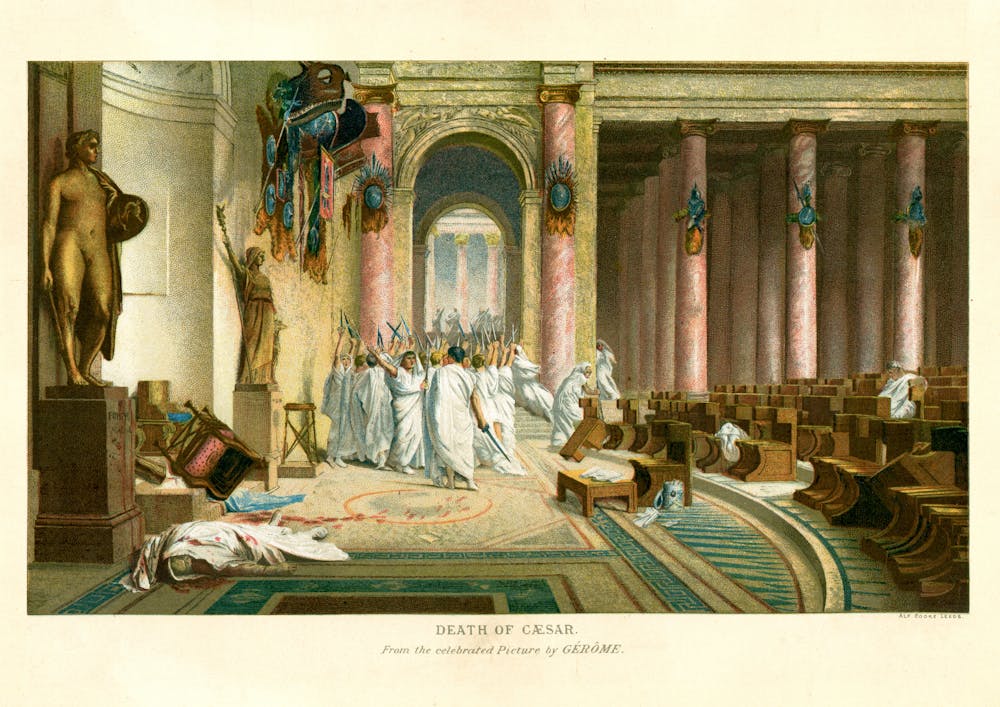
Soon after, an angry group of 23 senators stabbed him to death in a vain attempt to save the republic. They were led by Marcus Junius Brutus, a descendant of the Brutus who killed the last Roman king, Tarquinius Superbus.
However, the Roman republic was beyond saving despite Caesar’s death. His great nephew Octavian eventually emerged as leader and became known as Augustus (27 BCE – 14 CE). With Augustus, an age of emperors was born.
Emperors were kings in all but name. The strong aversion to kingship in Rome ensured their complete avoidance of the term rex.
‘No kings!’
American protesters waving placards shouting “no kings!” are expressing clear concerns that their beloved democracy is under threat.
Donald Trump has already declared eight national emergencies and issued 161 executive orders in his second term.
When asked if he needs to uphold the Constitution, Trump declares “I don’t know.” He has joked about running for a third term as president, in breach of the longstanding limit of two terms.
Like Caesar, is Donald Trump becoming a king in all but name? Is he setting a precedent for his successors to behave increasingly like emperors?
The American aversion to “king” likely ensures the term will never return. But when protesters and others shout “no kings!”, they know the very meaning of the term “president” is changing before their eyes.
Peter Edwell receives funding from the Australian Research Council.
Keith Rankin, trained as an economic historian, is a retired lecturer in Economics and Statistics. He lives in Auckland, New Zealand.
Is history binary? A judge of past behaviour with just two available options: thumbs-up, or thumbs-down? If you are not on the ‘right side’ of history, are you therefore on the ‘wrong side’?
Can there be a ‘right side of history’? Given the contexts that we now proclaim to be the right or wrong sides of history, can we presume to evaluate future judgements of our behaviours as ‘history’? And, if we can, is ‘history’ about morals, or momentum; or, prosaically, is she just about facts? Can you (or we) ride history, like a wave? Clio, in Greek mythology, is the muse of history. She is not a straightforward lady.
Are politicians who support, by word or deed, fascists (or racists or any other obviously nasty ‘ists’) in another country ‘on the wrong side of history’ or could they be ‘riding a historical wave’? I am reminded of the Hitler youth singing ‘Tomorrow Belongs to Me’ in the musical cabaret. In Natacha Butler’s report (Al Jazeera 10 June 2025, Europe’s far-right leaders, hosted by Marine Le Pen, rally in France) she notes “the conviction [by ‘far-right’ protesters] that history is on their side”.
History as Momentum
Whoever participates in a social or political movement believes that their movement will become sufficiently consequential for those in the future to believe that the movement affected the course of history. So, the Hitler youth were correct, in the sense that their movement made their tomorrow different to what it would otherwise have been. The Hitler youth, though, were expecting a favourable judgement by ‘us’ in 2025. Clearly, we judge their movement in highly unfavourable terms, while accepting that the world at the end of the twentieth century mighthave been a better world than the world would have been had Adolf Hitler been killed in combat in the Great World War in1918. Problematic, though, is the whole subjective idea of a ‘better world’; better for whom?
An important example of historicism, or alleged historical momentum, is the writings of Karl Marx. He thought he was writing scientific history, of ‘historical materialism’, and many people believed him; a few still do. Marx fused classical Ricardian economics – the intellectual ancestor of today’s neoliberal macroeconomics – with the philosophical historicism of Georg Hegel. Josef Stalin, and others in his intellectually unaccommodating mould, killed people who spun different (or nuanced) stories of past or future history.
History as a Judge
From a judgment perspective, we place much weight on academic historians in the medium-term future to make (for all time) the correct verdict events in the present, immediate past, and immediate future.
Whether or not Clio is qualified to judge as ‘good’ or ‘bad’ past events, people, or movements, we today can evaluate Clio today – or at least her mortal disciples – on her performance so far.
Two of many issues we could look into are, first, Winston Churchill and the World War Two bombing campaigns by the ‘Allies’, and our present understanding of the Great Depression of the 1930s.
Churchill, more than most political leaders, features in many separable stories in history. His role in pursuing the Gallipoli campaign in 1915 has generally been awarded a ‘thumbs-down’. Likewise, his role as Chancellor of the Exchequer in 1925, when he decided to fix the British pound to gold at the overvalued pre-war (1914) exchange rate; this decision was one of the key events that led the world into the Great Depression.
However, most post-war judgement of Churchill has focussed on his role as an opponent of ‘appeasement’ in 1938, and on his role as Great Britain’s leader for the majority of World War Two (though he had been removed as Britain’s leader, in a landslide electoral defeat, by the time the atomic bombs fell on Japan). On the ‘appeasement’ matter, Neville Chamberlain continues to be the epitome of someone ‘on the wrong side of history’, with Churchill on the ‘right side’.
Churchill had his own personal political agenda in 1938; his lifelong pursuit of the glory of the British Empire. Churchill’s principal strategic interest was to maintain the Mediterranean Sea as ‘Britain’s Lake’; substantially but not only because it represented Britain’s sea passage to India. So many of his actions in World War Two can best be understood in terms of what he was fighting for, not what he was fighting against.
In 1938, the alternatives to the ‘appeasement’ of Hitler were to abstain in the face of Nazi Germany’s clear-and immediate-threat to East Europe (a part of the non-Mediterranean world that Churchill was not interested in), or to threaten to declare war against Germany knowing that Britain couldn’t act on its threat and thereby risked revealing its weakness. (In the summer of 1939, Britain did reveal its weakness to Josef Stalin, who then relayed that information onto Hitler at the end of August, allowing Hitler to invade Poland in the sure knowledge that Britain had no military capacity to come to Poland’s aid. Chamberlain’s allowing that ‘information leak’ to happen was surely a bigger mistake than his 1938 Munich Accord with Hitler.) And we note that Churchill said that, rather than ‘peace in our time’, there “would be war”.
Churchill did not claim that any of the alternative choices that Chamberlain faced could or would have prevented war. Unless, that is, Chamberlain had been able to terrify Hitler into not going ahead with his military plans. (Hitler would have been more likely to liken threats by Chamberlain to ‘being mauled by a mouse’; a famous if somewhat forgotten witticism of our own Robert Muldoon, speaking in reference to Opposition leader Bill Rowling.)
Realistically, Hitler was never going to commit to putting his military toys away. I think that, in light of the alternatives, Chamberlain made the right call in 1938; he hoped that he had restricted Hitler’s military ambitions to the acquisition of territory inhabited by German-speaking people.
On the matter of the Allied bombing campaign, being willing to commit unspeakable aerial executions upon tens of millions of ‘enemy’ civilians, history has largely been silent; those (over a million) who were actually barbecued by the Allies fell well short of those who Churchill’s ‘scientific adviser’ and onetime ‘best friend’ Friedrich Lindemann would have liked to have ‘dehoused’. (See my Barbecued Hamburgers and Churchill’s Bestie, 17 Apr 2025.) We cannot rely on academic historians to counter decades of myth; in part because we have too few competent historians, and in part because historians hunt in packs and are as liable to fall under the sway of the zeitgeists of their eras as are the rest of humanity’s intellectual communities.
Despite Churchill’s firebombing efforts, most of which took place in the early months of 1945, it was American bombing specialist Curtis LeMay who became barbecuer-el-supremo. (See my Who Executed 100,000 Civilians in a Single Night?) In 1945, and mainly through his own initiative, he burned more Japanese civilians to death than those who died from the atomic bombs. Was Curtis LeMay on the right side of history? The Japanese ruling class thought so in 1964; LeMay had helped to make the new Japan possible. The Emperor had been saved, as an emperor without an empire. And Japan had been saved from Stalin’s advances, advances that stopped at Korea, Sakhalin, and the Kuril Islands.
We note that the worst of the Allies’ terror campaign took place towards the end of the war, when the ‘evil’ Axis was in no position to reciprocate. Inherently, such crimes – on the scale that ‘we’ perpetrated them – are asymmetric warfare. Killing your enemies’ civilians seemingly grants your enemies a moral right to kill your civilians. I think that no party who commits those kinds of war crimes can ever be on ‘the right side of history’; though some other people may take more convincing. To compound the criminality of the Allied bombing campaign, it was ineffective, because World War Two was already asymmetric; the main turning points were Hitler’s foolish declaration of war against the United States, and the Battle of Stalingrad in the latter part of 1942. World War Two could have been ended much more quickly with carrot than with stick, by finding suitable ways for the retreating powers to ‘save face’. Truth and reconciliation always trump vengeance. Yet so many horrendous “killings of civilians to [allegedly] save ‘our’ soldiers” remain either on the ‘right side of history’ or concealed from view, obviating the popular requirement to cast judgement.
The Great Depression was still much in historical memory in the 1970s and 1980s. In the 1930s, Josef Stalin and his comrades believed this was the beginning of the end of the capitalist world; and he executed any economists (eg Nikolai Kondratiev) who suggested otherwise. At the time, a number of progressive western economists (eg Alvin Hansen) to an extent agreed with Stalin.
However, in the 1970s, a group of extremist ‘Chicago’ economists and economic historians – Milton Friedmanwould lay claim to being both an economist and a historian – successfully committed on the world an intellectual coup-d’etat which would distract the historical community from reality. Friedman’s coupsters scapegoated the United States Federal Reserve Bank (on the basis of a few quite minor ‘mistakes’ in monetary policy in 1929 and 1930). The net result was that the real culprits, the fiscal conservatives, escaped the condemnation of history.
The Friedmanites, and their ‘intellectual’ descendants, have claimed the ‘right side of history’; claiming victories (without convincing counterfactuals) in the alleged titanic battle between the ‘inflation monster’ and the battlers of the ‘lower middle classes’. These faux historians claimed that small “mistakes” in monetary policy in 2003/04 and 2021/22 have been the predominant causes of the 2008/09 ‘global financial crisis’ and the 2022 to 2024 ‘cost of living’ crisis. When it comes to macroeconomics and macroeconomic policy, this writing of consumable history is about as pathetic (as intellectual history) as the claims of the Holocaust-deniers, or of the people (such as Herr Hitler) who claimed that Germany was ‘stabbed-in-the-back’ by international Jewry in 1918.
Clio is a muse to be loved and cultivated. She gives much, but rarely in simplistic right-wrong terms; and she changes her mind, in response to both new information and new zeitgeists. Whereas Hitler’s Nazis burned the books they didn’t like – and many other books besides – Aotearoa’s fiscal conservatives are looking for a whimper – a tearless shredding – rather than a blaze. And our remaining unshredded public collections, our memories – our abilities to evaluate the rights and the wrongs and the waves of our national and international pasts – stand to depreciate, to wither.
*******
Keith Rankin (keith at rankin dot nz), trained as an economic historian, is a retired lecturer in Economics and Statistics. He lives in Auckland, New Zealand.
Keith Rankin, trained as an economic historian, is a retired lecturer in Economics and Statistics. He lives in Auckland, New Zealand.
Is history binary? A judge of past behaviour with just two available options: thumbs-up, or thumbs-down? If you are not on the ‘right side’ of history, are you therefore on the ‘wrong side’?
Can there be a ‘right side of history’? Given the contexts that we now proclaim to be the right or wrong sides of history, can we presume to evaluate future judgements of our behaviours as ‘history’? And, if we can, is ‘history’ about morals, or momentum; or, prosaically, is she just about facts? Can you (or we) ride history, like a wave? Clio, in Greek mythology, is the muse of history. She is not a straightforward lady.
Are politicians who support, by word or deed, fascists (or racists or any other obviously nasty ‘ists’) in another country ‘on the wrong side of history’ or could they be ‘riding a historical wave’? I am reminded of the Hitler youth singing ‘Tomorrow Belongs to Me’ in the musical cabaret. In Natacha Butler’s report (Al Jazeera 10 June 2025, Europe’s far-right leaders, hosted by Marine Le Pen, rally in France) she notes “the conviction [by ‘far-right’ protesters] that history is on their side”.
History as Momentum
Whoever participates in a social or political movement believes that their movement will become sufficiently consequential for those in the future to believe that the movement affected the course of history. So, the Hitler youth were correct, in the sense that their movement made their tomorrow different to what it would otherwise have been. The Hitler youth, though, were expecting a favourable judgement by ‘us’ in 2025. Clearly, we judge their movement in highly unfavourable terms, while accepting that the world at the end of the twentieth century mighthave been a better world than the world would have been had Adolf Hitler been killed in combat in the Great World War in1918. Problematic, though, is the whole subjective idea of a ‘better world’; better for whom?
An important example of historicism, or alleged historical momentum, is the writings of Karl Marx. He thought he was writing scientific history, of ‘historical materialism’, and many people believed him; a few still do. Marx fused classical Ricardian economics – the intellectual ancestor of today’s neoliberal macroeconomics – with the philosophical historicism of Georg Hegel. Josef Stalin, and others in his intellectually unaccommodating mould, killed people who spun different (or nuanced) stories of past or future history.
History as a Judge
From a judgment perspective, we place much weight on academic historians in the medium-term future to make (for all time) the correct verdict events in the present, immediate past, and immediate future.
Whether or not Clio is qualified to judge as ‘good’ or ‘bad’ past events, people, or movements, we today can evaluate Clio today – or at least her mortal disciples – on her performance so far.
Two of many issues we could look into are, first, Winston Churchill and the World War Two bombing campaigns by the ‘Allies’, and our present understanding of the Great Depression of the 1930s.
Churchill, more than most political leaders, features in many separable stories in history. His role in pursuing the Gallipoli campaign in 1915 has generally been awarded a ‘thumbs-down’. Likewise, his role as Chancellor of the Exchequer in 1925, when he decided to fix the British pound to gold at the overvalued pre-war (1914) exchange rate; this decision was one of the key events that led the world into the Great Depression.
However, most post-war judgement of Churchill has focussed on his role as an opponent of ‘appeasement’ in 1938, and on his role as Great Britain’s leader for the majority of World War Two (though he had been removed as Britain’s leader, in a landslide electoral defeat, by the time the atomic bombs fell on Japan). On the ‘appeasement’ matter, Neville Chamberlain continues to be the epitome of someone ‘on the wrong side of history’, with Churchill on the ‘right side’.
Churchill had his own personal political agenda in 1938; his lifelong pursuit of the glory of the British Empire. Churchill’s principal strategic interest was to maintain the Mediterranean Sea as ‘Britain’s Lake’; substantially but not only because it represented Britain’s sea passage to India. So many of his actions in World War Two can best be understood in terms of what he was fighting for, not what he was fighting against.
In 1938, the alternatives to the ‘appeasement’ of Hitler were to abstain in the face of Nazi Germany’s clear-and immediate-threat to East Europe (a part of the non-Mediterranean world that Churchill was not interested in), or to threaten to declare war against Germany knowing that Britain couldn’t act on its threat and thereby risked revealing its weakness. (In the summer of 1939, Britain did reveal its weakness to Josef Stalin, who then relayed that information onto Hitler at the end of August, allowing Hitler to invade Poland in the sure knowledge that Britain had no military capacity to come to Poland’s aid. Chamberlain’s allowing that ‘information leak’ to happen was surely a bigger mistake than his 1938 Munich Accord with Hitler.) And we note that Churchill said that, rather than ‘peace in our time’, there “would be war”.
Churchill did not claim that any of the alternative choices that Chamberlain faced could or would have prevented war. Unless, that is, Chamberlain had been able to terrify Hitler into not going ahead with his military plans. (Hitler would have been more likely to liken threats by Chamberlain to ‘being mauled by a mouse’; a famous if somewhat forgotten witticism of our own Robert Muldoon, speaking in reference to Opposition leader Bill Rowling.)
Realistically, Hitler was never going to commit to putting his military toys away. I think that, in light of the alternatives, Chamberlain made the right call in 1938; he hoped that he had restricted Hitler’s military ambitions to the acquisition of territory inhabited by German-speaking people.
On the matter of the Allied bombing campaign, being willing to commit unspeakable aerial executions upon tens of millions of ‘enemy’ civilians, history has largely been silent; those (over a million) who were actually barbecued by the Allies fell well short of those who Churchill’s ‘scientific adviser’ and onetime ‘best friend’ Friedrich Lindemann would have liked to have ‘dehoused’. (See my Barbecued Hamburgers and Churchill’s Bestie, 17 Apr 2025.) We cannot rely on academic historians to counter decades of myth; in part because we have too few competent historians, and in part because historians hunt in packs and are as liable to fall under the sway of the zeitgeists of their eras as are the rest of humanity’s intellectual communities.
Despite Churchill’s firebombing efforts, most of which took place in the early months of 1945, it was American bombing specialist Curtis LeMay who became barbecuer-el-supremo. (See my Who Executed 100,000 Civilians in a Single Night?) In 1945, and mainly through his own initiative, he burned more Japanese civilians to death than those who died from the atomic bombs. Was Curtis LeMay on the right side of history? The Japanese ruling class thought so in 1964; LeMay had helped to make the new Japan possible. The Emperor had been saved, as an emperor without an empire. And Japan had been saved from Stalin’s advances, advances that stopped at Korea, Sakhalin, and the Kuril Islands.
We note that the worst of the Allies’ terror campaign took place towards the end of the war, when the ‘evil’ Axis was in no position to reciprocate. Inherently, such crimes – on the scale that ‘we’ perpetrated them – are asymmetric warfare. Killing your enemies’ civilians seemingly grants your enemies a moral right to kill your civilians. I think that no party who commits those kinds of war crimes can ever be on ‘the right side of history’; though some other people may take more convincing. To compound the criminality of the Allied bombing campaign, it was ineffective, because World War Two was already asymmetric; the main turning points were Hitler’s foolish declaration of war against the United States, and the Battle of Stalingrad in the latter part of 1942. World War Two could have been ended much more quickly with carrot than with stick, by finding suitable ways for the retreating powers to ‘save face’. Truth and reconciliation always trump vengeance. Yet so many horrendous “killings of civilians to [allegedly] save ‘our’ soldiers” remain either on the ‘right side of history’ or concealed from view, obviating the popular requirement to cast judgement.
The Great Depression was still much in historical memory in the 1970s and 1980s. In the 1930s, Josef Stalin and his comrades believed this was the beginning of the end of the capitalist world; and he executed any economists (eg Nikolai Kondratiev) who suggested otherwise. At the time, a number of progressive western economists (eg Alvin Hansen) to an extent agreed with Stalin.
However, in the 1970s, a group of extremist ‘Chicago’ economists and economic historians – Milton Friedmanwould lay claim to being both an economist and a historian – successfully committed on the world an intellectual coup-d’etat which would distract the historical community from reality. Friedman’s coupsters scapegoated the United States Federal Reserve Bank (on the basis of a few quite minor ‘mistakes’ in monetary policy in 1929 and 1930). The net result was that the real culprits, the fiscal conservatives, escaped the condemnation of history.
The Friedmanites, and their ‘intellectual’ descendants, have claimed the ‘right side of history’; claiming victories (without convincing counterfactuals) in the alleged titanic battle between the ‘inflation monster’ and the battlers of the ‘lower middle classes’. These faux historians claimed that small “mistakes” in monetary policy in 2003/04 and 2021/22 have been the predominant causes of the 2008/09 ‘global financial crisis’ and the 2022 to 2024 ‘cost of living’ crisis. When it comes to macroeconomics and macroeconomic policy, this writing of consumable history is about as pathetic (as intellectual history) as the claims of the Holocaust-deniers, or of the people (such as Herr Hitler) who claimed that Germany was ‘stabbed-in-the-back’ by international Jewry in 1918.
Clio is a muse to be loved and cultivated. She gives much, but rarely in simplistic right-wrong terms; and she changes her mind, in response to both new information and new zeitgeists. Whereas Hitler’s Nazis burned the books they didn’t like – and many other books besides – Aotearoa’s fiscal conservatives are looking for a whimper – a tearless shredding – rather than a blaze. And our remaining unshredded public collections, our memories – our abilities to evaluate the rights and the wrongs and the waves of our national and international pasts – stand to depreciate, to wither.
*******
Keith Rankin (keith at rankin dot nz), trained as an economic historian, is a retired lecturer in Economics and Statistics. He lives in Auckland, New Zealand.
Israeli Prime Minister Benjamin Netanyahu has said Israel’s attack on Iran’s nuclear facilities could last for at least two weeks.
His timing seems precise for a reason. The Israel Defence Forces and the country’s intelligence agencies have clearly devised a methodical, step-by-step campaign.
Israeli forces initially focused on decapitating the Iranian military and scientific leadership and, just as importantly, destroying virtually all of Iran’s air defences.
Israeli aircraft can not only operate freely over Iranian air space now, they can refuel and deposit more special forces at key sites to enable precision bombing of targets and attacks on hidden or well-protected nuclear facilities.
In public statements since the start of the campaign, Netanyahu has highlighted two key aims: to destroy Iran’s nuclear program, and to encourage the Iranian people to overthrow the clerical regime.
With those two objectives in mind, how might the conflict end? Several broad scenarios are possible.
A return to negotiations
US President Donald Trump’s special envoy for the Middle East, Steve Witkoff, was to have attended a sixth round of talks with his Iranian counterparts on Sunday aimed at a deal to replace the Iran nuclear agreement negotiated under the Obama administration in 2015. Trump withdrew from that agreement during his first term in 2018, despite Iran’s apparent compliance to that point.
Netanyahu was opposed to the 2015 agreement and has indicated he does not believe Iran is serious about a replacement.
So, accepting negotiations as an outcome of the Israeli bombing campaign would be a massive climbdown by Netanyahu. He wants to use the defanging of Iran to reestablish his security credentials after the Hamas attacks of October 2023.
Even though Trump continues to press Iran to accept a deal, negotiations are off the table for now. Trump won’t be able to persuade Netanyahu to stop the bombing campaign to restart negotiations.
Complete destruction of Iran’s nuclear program
Destruction of Iran’s nuclear program would involve destroying all known sites, including the Fordow uranium enrichment facility, about 100 kilometres south of Tehran.
According to International Atomic Energy Agency (IAEA) Director General Rafael Grossi, the facility is located about half a mile underground, beneath a mountain. It is probably beyond the reach of even the US’ 2,000-pound deep penetration bombs.
The entrances and ventilation shafts of the facility could be closed by causing landslides. But that would be a temporary solution.
Taking out Fordow entirely would require an Israeli special forces attack. This is certainly possible, given Israel’s success in getting operatives into Iran to date. But questions would remain about how extensively the facility could be damaged and then how quickly it could be rebuilt.
And destruction of Iran’s nuclear centrifuges – used to enrich uranium to create a bomb – would be only one step in dismantling its program.
Israel would also have to secure or eliminate Iran’s stock of uranium already enriched to 60% purity. This is sufficient for up to ten nuclear bombs if enriched to the weapons-grade 90% purity.
But does Israeli intelligence know where that stock is?
Collapse of the Iranian regime
Collapse of the Iranian regime is certainly possible, particularly given Israel’s removal of Iran’s most senior military leaders since its attacks began on Friday, including the heads of the Islamic Revolutionary Guard Corps and the Iranian armed forces.
And anti-regime demonstrations over the years, most recently the “Women, Life, Freedom” protests after the death in police custody of a young Iranian woman, Mahsa Amini, in 2022, have shown how unpopular the regime is.
That said, the regime has survived many challenges since coming to power in 1979, including war with Iraq in the 1980s and massive sanctions. It has developed remarkably efficient security systems that have enabled it to remain in place.
Another uncertainty at this stage is whether Israeli attacks on civilian targets might engender a “rally round the flag” movement among Iranians.
Netanyahu said in recent days that Israel had indications the remaining senior regime figures were packing their bags in preparation for fleeing the country. But he gave no evidence.
A major party joins the fight
Could the US become involved in the fighting?
This can’t be ruled out. Iran’s UN ambassador directly accused the US of assisting Israel with its strikes.
That is almost certainly true, given the close intelligence sharing between the US and Israel. Moreover, senior Republicans, such as Senator Lindsey Graham, have called on Trump to order US forces to help Israel “finish the job”.
Trump would probably be loath to do this, particularly given his criticism of the “forever wars” of previous US administrations. But if Iran or pro-Iranian forces were to strike a US base or military asset in the region, pressure would mount on Trump to retaliate.
Another factor is that Trump probably wants the war to end as quickly as possible. His administration will be aware the longer a conflict drags on, the more likely unforeseen factors will arise.
Could Russia become involved on Iran’s side? At this stage that’s probably unlikely. Russia did not intervene in Syria late last year to try to protect the collapsing Assad regime. And Russia has plenty on its plate with the war in Ukraine.
Russia criticised the Israeli attack when it started, but appears not to have taken any action to help Iran defend itself.
And could regional powers such as Saudi Arabia or the United Arab Emirates become involved?
Though they have a substantial arsenal of US military equipment, the two countries have no interest in becoming caught up in the conflict. The Gulf Arab monarchies have engaged in a rapprochement with Iran in recent years after decades of outright hostility. Nobody would want to put this at risk.
Uncertainties predominate
We don’t know the extent of Iran’s arsenal of missiles and rockets. In its initial retaliation to Israel’s strikes, Iran has been able to partially overwhelm Israel’s Iron Dome air defence system, causing civilian casualties.
If it can continue to do this, causing more civilian casualties, Israelis already unhappy with Netanyahu over the Gaza war might start to question his wisdom in starting another conflict.
But we are nowhere near that point. Though it’s too early for reliable opinion polling, most Israelis almost certainly applaud Netanyahu’s action so far to cripple Iran’s nuclear program. In addition, Netanyahu has threatened to make Tehran “burn” if Iran deliberately targets Israeli civilians.
We can be confident that Iran does not have any surprises in store. Israel has severely weakened its proxies, Hezbollah and Hamas. They are clearly in no position to assist Iran through diversionary attacks.
The big question will be what comes after the war. Iran will almost certainly withdraw from the Nuclear Non-Proliferation Treaty and forbid more inspections by the International Atomic Energy Agency.
Israel will probably be able to destroy Iran’s existing nuclear facilities, but it’s only a question of when – not if – Iran will reconstitute them.
This means the likelihood of Iran trying to secure a nuclear bomb in order to deter future Israeli attacks will be much higher. And the region will remain in a precarious place.
Ian Parmeter does not work for, consult, own shares in or receive funding from any company or organisation that would benefit from this article, and has disclosed no relevant affiliations beyond their academic appointment.
Source: United States House of Representatives – Congresswoman María Elvira Salazar’s (FL-27)
span>Today, Rep. Maria Salazar made the following comment:
“President Trump himself has acknowledged what so many of us already know: long-time workers, many of whom have built their lives in this country, are being taken away. Our construction sites, our hotels, and our farms are feeling the impact.
It’s time for Congress to act and bring a solution.
That’s why, before the end of the month, Congresswoman Veronica Escobar and I will lead a bipartisan group of our colleagues in introducing a revolutionary piece of legislation that will offer real solutions to fix our immigration system and finally bring order to chaos for good.”
What you need to know: President Trump’s illegal military deployment impacts firefighting resources already seeing cuts by the U.S. Forest Service.
SACRAMENTO – With the risk of catastrophic wildfire on the rise as peak fire season sets in across California, the state’s firefighting and prevention resources are facing new strain resulting from President Trump’s actions.
President Trump’s illegal militarization of Los Angeles is cutting into valuable firefighting resources. As a federal judge noted yesterday in ruling that President Trump’s actions are illegal and should be halted, five of California’s 14 National Guard fire crews – who staff Joint Task Force Rattlesnake – are now understaffed due to the federalization and diversion of 300 California National Guard (CalGuard) soldiers from those crews to armories in the Los Angeles region. That represents three-quarters of CalGuard’s fire response and prevention resources.
Trump is endangering communities across California. He’s pulling National Guard members off of critical wildfire prevention and response missions for his political stunt in Los Angeles. And this is on top of his dangerous cuts to the Forest Service.
It’s critical that Trump heeds his own advice: restore funding to the Forest Service, support federal firefighters and Make America Rake Again.
Governor Gavin Newsom
The National Guard impact is on top of the Trump administration’s dangerous cuts to the U.S. Forest Service, which also threatens the safety of communities across the state. The U.S. Forest Service has lost 10% of all positions and 25% of positions outside of direct wildfire response – both of which are likely to impact wildfire response this year. The cuts come as the President issued an executive order yesterday on wildfire response – another order that rings hollow given the President’s actions.
“In just the first five months of 2025 California has experienced more than 2,300 wildfires,” said CAL FIRE Director and Fire Chief Joe Tyler. “Having the necessary firefighting apparatus and personnel is critical to our mission at CAL FIRE.”
Trump cuts to the U.S. Forest Service
The California Natural Resources Agency recently outlined impacts of President Trump’s cuts to the U.S. Forest Service: “State agencies in California are concerned that these cuts could jeopardize our nation-leading wildfire response capability, and result in a shift in emphasis from protecting communities to generating revenue from National Forests within the state.”
More staffing losses ahead: The USFS has already lost 10% of all positions and 25% of positions outside of direct wildfire suppression, and a reorganization proposal to be announced soon is likely to include significant additional reductions.
Suppression operations will likely suffer: The USFS claims that federal suppression resources are in good shape, but the reality is that deep cuts in related logistical staff are likely to have a major impact on fire operations.
Weather forecasts will be hampered: National Weather Service cuts will reduce the availability of meteorologists for incident support, briefings, and overall coverage. CAL FIRE relies on NWS meteorologists for weather predictions, intelligence, and briefings on all major incidents.
Timber targets may shift emphasis away from wildfire resilience: To generate more revenue from National Forests, the USFS is proposing to increase timber sales by 25% over five years. But because there is a mismatch between areas with high potential for timber sales (found at roughly 6,000-8,000 feet elevation) and areas most at risk from wildfire (1,000-4,000 feet elevation, including the Sierra Nevada and Southern California foothills), this could shift the focus of federal agencies away from protecting the state’s most vulnerable communities.
State, private, and tribal grants programs proposed to be eliminated: The President’s proposed budget eliminates annual block grants to the states to support state, private landowner, tribal, and urban forestry programs. This will have a small impact in California, but will have dramatic impact on other Western states that are highly dependent on federal funding to support their wildfire resilience programs.
Regional offices could be combined or eliminated: The Pacific Southwest Regional Office in Vallejo is currently largely vacant, with senior leadership positions no longer there. The office is considered likely to be eliminated as part of the reorganization.
Key scientific data will be lost and researchers laid off: The President’s proposed budget eliminates all USFS Research Stations and key scientific data to better design, implement, and assess the benefits of projects is being removed and will be unlikely to remain available.
California’s unprecedented wildfire readiness
As part of the state’s ongoing investment in wildfire resilience and emergency response, CAL FIRE has significantly expanded its workforce over the past five years by adding an average of 1,800 full-time and 600 seasonal positions annually – nearly double that from the previous administration. Over the next four years and beyond, CAL FIRE will be hiring thousands of additional firefighters, natural resource professionals, and support personnel to meet the state’s growing demands.
Late last month, the Governor announced $72 million for projects across the state that help reduce catastrophic wildfire risk. Additionally,16 new vegetation management and community protection projects spanning more than 7,000 acres have already been approved for fast-tracking under the Governor’s new streamlining initiative.
This builds on consecutive years of intensive and focused work by California to confront the severe ongoing risk of catastrophic wildfires, and Governor Newsom’s emergency proclamation signed in March to fast-track forest and vegetation management projects throughout the state. Additionally, to bolster the state’s ability to respond to fires, Governor Newsom announced last week that the state’s second C-130 Hercules airtanker is ready for firefighting operations, adding to the largest aerial firefighting fleet in the world.
New, bold moves to streamline state-level regulatory processes builds long-term efforts already underway in California to increase wildfire response and forest management in the face of a hotter, drier climate. A full list of California’s progress on wildfire resilience is available here.
Highlights of achievements to date include:
Historic investments — Overall, the state has more than doubled investments in wildfire prevention and landscape resilience efforts, providing more than $2.5 billion in wildfire resilience since 2020, with an additional $1.5 billion to be allocated from the 2024 Climate Bond.
On-the-ground progress — More than 2,200 landscape health and fire prevention projects are complete or underway, and from 2021-2023, the State and its partners treated nearly 1.9 million acres, including nearly 730,000 acres in 2023.
Increasing transparency — The Governor’s Task Force launched an Interagency Treatment Dashboard to display wildfire resilience work across federal, state, local, and privately managed lands across the State. The Dashboard, launched in 2023, provides transparency, tracks progress, facilitates planning, and informs firefighting efforts.
Hardening communities — Adding to California’s nation-leading fire safety standards, Governor Newsom signed an executive order to further improve community hardening and wildfire mitigation strategies to neighborhood resilience statewide. Since 2019, CAL FIRE has awarded more than $450 million for 450 wildfire prevention projects across the state and conducts Defensible Space Inspections on more than 250,000 homes each year.
Leveraging cutting-edge technology — On top of expanding the world’s largest aerial firefighting fleet, CAL FIRE has doubled its use of Uncrewed Aerial Systems (UAS) and the state is utilizing AI-powered tools to spot fires quicker.
Press releases, Recent news
Recent news
Jun 13, 2025
News What you need to know: Governor Newsom ordered the pre-deployment of safety and security resources across California to protect the public’s safety during anticipated demonstrations over the weekend. SACRAMENTO – Governor Gavin Newsom today announced he ordered…
Jun 13, 2025
News What you need to know: Following new reports that the U.S. Department of Health and Human Services has shared Medicaid beneficiary information with the Department of Homeland Security, Governor Newsom slammed the Trump administration for their dangerous abuse of…
Jun 12, 2025
News “A win for all Americans” What you need to know: Standing up for American citizens and the nation’s foundational ban on martial law in peacetime, Governor Newsom and Attorney General Bonta today secured an emergency restraining order blocking President Trump’s…
What you need to know: Governor Newsom ordered the pre-deployment of safety and security resources across California to protect the public’s safety during anticipated demonstrations over the weekend.
SACRAMENTO – Governor Gavin Newsom today announced he ordered the state to pre-deploy safety and security resources to communities throughout California to aid and support local law enforcement, ahead of anticipated nationwide demonstrations.
The resources from the California Highway Patrol and those coordinated through the Governor’s Office of Emergency Services (Cal OES) will help local governments protect the safety of peaceful demonstrators and the public – as well as enforce strict laws against the destruction of property, vandalism, and looting.
In the United States, the office of citizen is the most important office we can hold. We respect and protect those who exercise their First Amendment rights when they do so peacefully and respectfully.
California has zero tolerance for those who plan to take advantage of peaceful demonstrations with violence. We’re pre-deploying resources to maintain safety – and we will prosecute those who break the law.
Governor Gavin Newsom
All eight of CHP’s Special Response Teams (SRT) are activated and pre-staged throughout California, a surge of nearly 700 officers. The CHP’s Southern Division remains on tactical alert, which ensures every available uniformed employee is prepared should they be needed. The CHP is coordinating with local law enforcement partners and Cal OES.
“The California Highway Patrol actively protects and upholds every individual’s First Amendment right to peacefully assemble and express their views,” said CHP Commissioner Sean Duryee. “Our officers stand ready to ensure these rights are exercised safely and lawfully. If anyone attempts to violate the rights of others, destroy property, or obstruct public movement, we will respond swiftly and decisively to enforce the law.”
Cal OES has coordinated with state and local partners to ensure communities have resources to help keep people safe. At this time, CalOES has not received significant requests from local governments for mutual aid in advance of this coming weekend. CalOES remains in close communication with local government partners and stands ready to coordinate any future requests for mutual aid or support.
“Cal OES remains prepared to assist and respond,” said Cal OES Director Nancy Ward. “We’re in close contact with local government partners and stand ready to assist with any requests for support or mutual aid.”
Stay peaceful, never resort to violence
This is a reminder to Californians that they have a right to speak out, but they must remain peaceful. Those who engage in protests and demonstrations must always emphasize partnership, unity and non-violence.
Recent news
Jun 13, 2025
News What you need to know: Following new reports that the U.S. Department of Health and Human Services has shared Medicaid beneficiary information with the Department of Homeland Security, Governor Newsom slammed the Trump administration for their dangerous abuse of…
Jun 12, 2025
News “A win for all Americans” What you need to know: Standing up for American citizens and the nation’s foundational ban on martial law in peacetime, Governor Newsom and Attorney General Bonta today secured an emergency restraining order blocking President Trump’s…
Jun 12, 2025
News What you need to know: Former secretaries of the Army and Navy and retired four-star admirals and generals filed an amicus brief in support of the Governor’s motion to block the Trump administration’s illegal militarization of downtown Los Angeles. SACRAMENTO –…
Last night, President Donald J. Trump and the First Lady — along with members of his Administration and military leaders — joined veterans, active-duty troops, wounded warriors, Gold Star Families, and patriotic Americans from all over the country in the nation’s capital to celebrate the 250th birthday of the U.S. Army.
An iconic grand parade wrapped up a day of festivities celebrating the legacy of the U.S. Army and the generations of heroes who have protected our country with strength, selflessness, and bravery — and looking boldly forward to the next 250 years of patriotism and military achievement.
As President Trump said in his remarks: “Tonight, we affirm with unwavering certainty that in the years ahead, and in every generation hence, whenever duty calls and whatever danger comes, the American Soldier will be there. No matter the risks, no matter the obstacles, our warriors will charge into battle, they will plunge into the crucible of fire, and they will seize the crown of victory because the United States of America will always have the grace of Almighty God and the iron will of the United States Army.”
Protesters parade through the Marigny neighborhood of New Orleans as part of the nationwide No Kings protest against President Donald Trump, on June 14, 2025. Patt Little/Anadolu via Getty Images
In the last few months, large numbers of anti-Trump protesters have come out in the streets across the U.S., on occasions like the April 5 Hands Off protests against safety net budget cuts and government downsizing. Many of those protesters assert they are protecting American democracy.
The Trump administration has decried these protesters and the concept of protest more generally, with the president recently calling protesters “troublemakers, agitators, insurrectionists.” A few days before the June 14 military parade in Washington, President Donald Trump said of potential protesters: “this is people that hate our country, but they will be met with very heavy force.”
As co-director of the Crowd Counting Consortium, which compiles information on each day’s protests in the U.S., I understand that protests sometimes can advance the goals of the protest movement. They also can shape the goals and behavior of federal or state governments and their leaders.
Opportunity for expressing or suppressing democracy
Protests are an expression of democracy, bolstered by the right to free speech and “the right of the people peaceably to assemble” in the First Amendment of the U.S. Constitution.
At the same time, clamping down on protests is one way to rebut challenges to government policies and power.
Widespread, well-attended demonstrations can represent a mass movement in favor of democracy or other issues as well as serve as an opportunity to expand participation even further. Large events often lead to significant press coverage and plenty of social media posting. The protests may heighten protesters’ emotional connection to the movement and increase fundraising and membership numbers of sponsoring organizations.
Though it is not an ironclad law, research shows that when at least 3.5% of the total population is involved in a demonstration, protesters usually prevail over their governments. That included the Chilean movement in the 1980s that toppled longtime dictator Augusto Pinochet. Chileans used not only massive demonstrations but also a wide array of creative tactics like a coordinated slowdown of driving and walking, neighbors banging pots outside homes simultaneously, and singing together.
Protests are rarely only about protesting. Organizers usually seek to involve participants in many other activities, whether that is contacting their elected officials, writing letters to the editor, registering to vote or running a food drive to help vulnerable populations.
In this way of thinking, participation in a major street protest like No Kings is a gateway into deeper activism.
Risks and opportunities
Of course, protest leaders cannot control everyone in or adjacent to the movement.
Other protesters with a different agenda, or agitators of any sort, can insert themselves into a movement and use confrontational tactics like violence against property or law enforcement.
In one prominent example from Los Angeles, someone set several self-driving cars on fire. Other Los Angeles examples included some protesters’ throwing things like water bottles at officers or engaging in vandalism. Police officers also use coercive measures such as firing chemical irritants and pepper balls at protesters.
When leaders want to concentrate executive power and establish an autocracy, where they rule with absolute power, protests against those moves could lead to a mass rejection of the leader’s plans. That is what national protest groups like 50501 and Indivisible are hoping for and why they aimed to turn out millions of people at the No Kings protests on June 14.
But while the Trump administration faces risks from protests, it also may see opportunities.
Misrepresenting and quashing dissent
Protests can serve as a justification for a nascent autocrat to further undermine democratic practices and institutions.
Take the recent demonstrations in Los Angeles protesting the Trump administration’s immigration raids conducted by Immigration and Customs Enforcement, or ICE.
Autocrats seek to politicize independent institutions like the armed forces. The Los Angeles protests offered the opportunity for that. Trump sent troops from the California National Guard and Marines to Los Angeles to contain the protests. That domestic deployment of the military is rare but not unheard of in U.S. history.
And the deployment was ordered against the backdrop of the president’s partisan June 10 speech at a U.S. military base in North Carolina. The military personnel in attendance cheered and applauded many of Trump’s political statements. Both the speech and audience reactions to it appeared to violate the U.S. military norm of nonpartisanship.
This deployment of military personnel in a U.S. city also dovetails with the expansion of executive power characteristic of autocratic leaders. It is rare that presidents call up the National Guard; the Guard is traditionally under the control of the state governor.
The contrast on June 14 was striking. In Washington, D.C., Trump reviewed a parade of troops, tanks and planes, leaning into a display of American military power.
At the same time, from rainy Bethlehem, Pennsylvania, to sweltering Yuma, Arizona, millions of protesters embraced their First Amendment rights to oppose the president. It perfectly illustrated the dynamic driving deep political division today: the executive concentrating power while a sizable segment of the people resist.
Jeremy Pressman does not work for, consult, own shares in or receive funding from any company or organization that would benefit from this article, and has disclosed no relevant affiliations beyond their academic appointment.
Protesters parade through the Marigny neighborhood of New Orleans as part of the nationwide No Kings protest against President Donald Trump, on June 14, 2025. Patt Little/Anadolu via Getty Images
In the last few months, large numbers of anti-Trump protesters have come out in the streets across the U.S., on occasions like the April 5 Hands Off protests against safety net budget cuts and government downsizing. Many of those protesters assert they are protecting American democracy.
The Trump administration has decried these protesters and the concept of protest more generally, with the president recently calling protesters “troublemakers, agitators, insurrectionists.” A few days before the June 14 military parade in Washington, President Donald Trump said of potential protesters: “this is people that hate our country, but they will be met with very heavy force.”
As co-director of the Crowd Counting Consortium, which compiles information on each day’s protests in the U.S., I understand that protests sometimes can advance the goals of the protest movement. They also can shape the goals and behavior of federal or state governments and their leaders.
Opportunity for expressing or suppressing democracy
Protests are an expression of democracy, bolstered by the right to free speech and “the right of the people peaceably to assemble” in the First Amendment of the U.S. Constitution.
At the same time, clamping down on protests is one way to rebut challenges to government policies and power.
Widespread, well-attended demonstrations can represent a mass movement in favor of democracy or other issues as well as serve as an opportunity to expand participation even further. Large events often lead to significant press coverage and plenty of social media posting. The protests may heighten protesters’ emotional connection to the movement and increase fundraising and membership numbers of sponsoring organizations.
Though it is not an ironclad law, research shows that when at least 3.5% of the total population is involved in a demonstration, protesters usually prevail over their governments. That included the Chilean movement in the 1980s that toppled longtime dictator Augusto Pinochet. Chileans used not only massive demonstrations but also a wide array of creative tactics like a coordinated slowdown of driving and walking, neighbors banging pots outside homes simultaneously, and singing together.
Protests are rarely only about protesting. Organizers usually seek to involve participants in many other activities, whether that is contacting their elected officials, writing letters to the editor, registering to vote or running a food drive to help vulnerable populations.
In this way of thinking, participation in a major street protest like No Kings is a gateway into deeper activism.
Risks and opportunities
Of course, protest leaders cannot control everyone in or adjacent to the movement.
Other protesters with a different agenda, or agitators of any sort, can insert themselves into a movement and use confrontational tactics like violence against property or law enforcement.
In one prominent example from Los Angeles, someone set several self-driving cars on fire. Other Los Angeles examples included some protesters’ throwing things like water bottles at officers or engaging in vandalism. Police officers also use coercive measures such as firing chemical irritants and pepper balls at protesters.
When leaders want to concentrate executive power and establish an autocracy, where they rule with absolute power, protests against those moves could lead to a mass rejection of the leader’s plans. That is what national protest groups like 50501 and Indivisible are hoping for and why they aimed to turn out millions of people at the No Kings protests on June 14.
But while the Trump administration faces risks from protests, it also may see opportunities.
Misrepresenting and quashing dissent
Protests can serve as a justification for a nascent autocrat to further undermine democratic practices and institutions.
Take the recent demonstrations in Los Angeles protesting the Trump administration’s immigration raids conducted by Immigration and Customs Enforcement, or ICE.
Autocrats seek to politicize independent institutions like the armed forces. The Los Angeles protests offered the opportunity for that. Trump sent troops from the California National Guard and Marines to Los Angeles to contain the protests. That domestic deployment of the military is rare but not unheard of in U.S. history.
And the deployment was ordered against the backdrop of the president’s partisan June 10 speech at a U.S. military base in North Carolina. The military personnel in attendance cheered and applauded many of Trump’s political statements. Both the speech and audience reactions to it appeared to violate the U.S. military norm of nonpartisanship.
This deployment of military personnel in a U.S. city also dovetails with the expansion of executive power characteristic of autocratic leaders. It is rare that presidents call up the National Guard; the Guard is traditionally under the control of the state governor.
The contrast on June 14 was striking. In Washington, D.C., Trump reviewed a parade of troops, tanks and planes, leaning into a display of American military power.
At the same time, from rainy Bethlehem, Pennsylvania, to sweltering Yuma, Arizona, millions of protesters embraced their First Amendment rights to oppose the president. It perfectly illustrated the dynamic driving deep political division today: the executive concentrating power while a sizable segment of the people resist.
Jeremy Pressman does not work for, consult, own shares in or receive funding from any company or organization that would benefit from this article, and has disclosed no relevant affiliations beyond their academic appointment.
Protesters parade through the Marigny neighborhood of New Orleans as part of the nationwide No Kings protest against President Donald Trump, on June 14, 2025. Patt Little/Anadolu via Getty Images
In the last few months, large numbers of anti-Trump protesters have come out in the streets across the U.S., on occasions like the April 5 Hands Off protests against safety net budget cuts and government downsizing. Many of those protesters assert they are protecting American democracy.
The Trump administration has decried these protesters and the concept of protest more generally, with the president recently calling protesters “troublemakers, agitators, insurrectionists.” A few days before the June 14 military parade in Washington, President Donald Trump said of potential protesters: “this is people that hate our country, but they will be met with very heavy force.”
As co-director of the Crowd Counting Consortium, which compiles information on each day’s protests in the U.S., I understand that protests sometimes can advance the goals of the protest movement. They also can shape the goals and behavior of federal or state governments and their leaders.
Opportunity for expressing or suppressing democracy
Protests are an expression of democracy, bolstered by the right to free speech and “the right of the people peaceably to assemble” in the First Amendment of the U.S. Constitution.
At the same time, clamping down on protests is one way to rebut challenges to government policies and power.
Widespread, well-attended demonstrations can represent a mass movement in favor of democracy or other issues as well as serve as an opportunity to expand participation even further. Large events often lead to significant press coverage and plenty of social media posting. The protests may heighten protesters’ emotional connection to the movement and increase fundraising and membership numbers of sponsoring organizations.
Though it is not an ironclad law, research shows that when at least 3.5% of the total population is involved in a demonstration, protesters usually prevail over their governments. That included the Chilean movement in the 1980s that toppled longtime dictator Augusto Pinochet. Chileans used not only massive demonstrations but also a wide array of creative tactics like a coordinated slowdown of driving and walking, neighbors banging pots outside homes simultaneously, and singing together.
Protests are rarely only about protesting. Organizers usually seek to involve participants in many other activities, whether that is contacting their elected officials, writing letters to the editor, registering to vote or running a food drive to help vulnerable populations.
In this way of thinking, participation in a major street protest like No Kings is a gateway into deeper activism.
Risks and opportunities
Of course, protest leaders cannot control everyone in or adjacent to the movement.
Other protesters with a different agenda, or agitators of any sort, can insert themselves into a movement and use confrontational tactics like violence against property or law enforcement.
In one prominent example from Los Angeles, someone set several self-driving cars on fire. Other Los Angeles examples included some protesters’ throwing things like water bottles at officers or engaging in vandalism. Police officers also use coercive measures such as firing chemical irritants and pepper balls at protesters.
When leaders want to concentrate executive power and establish an autocracy, where they rule with absolute power, protests against those moves could lead to a mass rejection of the leader’s plans. That is what national protest groups like 50501 and Indivisible are hoping for and why they aimed to turn out millions of people at the No Kings protests on June 14.
But while the Trump administration faces risks from protests, it also may see opportunities.
Misrepresenting and quashing dissent
Protests can serve as a justification for a nascent autocrat to further undermine democratic practices and institutions.
Take the recent demonstrations in Los Angeles protesting the Trump administration’s immigration raids conducted by Immigration and Customs Enforcement, or ICE.
Autocrats seek to politicize independent institutions like the armed forces. The Los Angeles protests offered the opportunity for that. Trump sent troops from the California National Guard and Marines to Los Angeles to contain the protests. That domestic deployment of the military is rare but not unheard of in U.S. history.
And the deployment was ordered against the backdrop of the president’s partisan June 10 speech at a U.S. military base in North Carolina. The military personnel in attendance cheered and applauded many of Trump’s political statements. Both the speech and audience reactions to it appeared to violate the U.S. military norm of nonpartisanship.
This deployment of military personnel in a U.S. city also dovetails with the expansion of executive power characteristic of autocratic leaders. It is rare that presidents call up the National Guard; the Guard is traditionally under the control of the state governor.
The contrast on June 14 was striking. In Washington, D.C., Trump reviewed a parade of troops, tanks and planes, leaning into a display of American military power.
At the same time, from rainy Bethlehem, Pennsylvania, to sweltering Yuma, Arizona, millions of protesters embraced their First Amendment rights to oppose the president. It perfectly illustrated the dynamic driving deep political division today: the executive concentrating power while a sizable segment of the people resist.
Jeremy Pressman does not work for, consult, own shares in or receive funding from any company or organization that would benefit from this article, and has disclosed no relevant affiliations beyond their academic appointment.
Source: United States House of Representatives – Congressman Hakeem Jeffries (8th District of New York)
This morning, House Democratic Leader Hakeem Jeffries appeared on MSNBC’s The Weekend to discuss the violent attacks against Minnesota lawmakers and the need for leaders that bring America together rather than tear us apart.
EUGENE DANIELS: House Minority Leader Hakeem Jeffries joins us now. Leader Jeffries, thank you so much for coming on. The thing that I kind of can’t get around is how we unring this bell. It feels to me, and I think to a lot of Americans, that the normalization of violence in our politics, the normalization of assassination attempts in our politics, something we haven’t seen since maybe the Civil Rights Era of the 60s, when those were happening. How do we, how can we actually unring that bell realistically?
LEADER JEFFRIES: Well, it’s going to be imperative that everyone, across the political spectrum, demonstrate the type of leadership that actually is designed to bring people together, to lift people up and to appeal to the greater values of the American people, the things that should bind us together, patriotic Americans. We can have spirited debates, but we should never allow those spirited debates to inspire others to engage in behavior that’s unlawful. That’s going to fall on the President. It’s going to fall on the House, the Senate, governors, mayors, people all across the country because the trajectory that we are on right now, the violent culture that exists, is not sustainable.
JONATHAN CAPEHART: And Leader Jeffries, then, is the President doing enough to lower the temperature? Are Republican leaders in the House and the Senate doing enough to lower the temperature or are they exacerbating the tensions in the country by some of the things they say and some of the things they do?
LEADER JEFFRIES: Well, that certainly remains to be seen in terms of how the President, how my colleagues in Congress handle this moment moving forward. This should be another wake up call amongst many that have happened over the last several years, including, of course, the violent attack on the Capitol that took place on January 6. But at this particular moment in time, the President is going to have to step forward, as is the case with any President when tragedy strikes the United States of America. Now, of course, it’s complicated at this moment by the fact that there’s an ongoing manhunt. All of us should support our law enforcement officials who are engaged in a dangerous endeavor to try to apprehend this suspect, who is clearly violent and likely very disturbed. And we’re thankful for the effort that is being done—city, state and federal officials—to try to apprehend this suspect who engaged in a political assassination of Speaker Hortman. And that’s shocking. That should shock the conscience of everyone. But we also have to come together, and we’re going to need some executive branch leadership partnering with us in the Congress and the Judiciary to keep people safe. It’s not sustainable that Members of Congress, perhaps members of the Judiciary, are being threatened and targeted simply for doing their jobs.
ELISE JORDAN: Leader Jeffries, are you going to be pushing for any additional security for your members? One of your members, Congresswoman Morrison, was on the list as a target. What has to be done in terms of concrete steps to make sure that Members of the House and also the Senate here in Washington are safe?
LEADER JEFFRIES: Yeah, this is going to require additional resources, in all likelihood, so that Members of Congress, Democrats, Republicans, people in the House, people in the Senate, you know, have the ability to actually vigilantly and vigorously represent their constituents, articulate views that are designed to advance the best interests of their constituents and not be targeted in the process. And so I expect to have a conversation with the four corners of leadership across the Congress sooner rather than later, because we’re going to need to speak in one voice on this issue. And of course, early next week, we’ll convene directly with the Sergeant at Arms and the head of the Capitol Police Department to have a conversation with House Democrats about the steps that can be immediately taken to put people in a position where they can be safe and do their jobs actively and aggressively at the same time.
EUGENE DANIELS: Leader Jeffries, also yesterday we saw these kind of, you know, split screen moment of what was happening in this country with people taking to the streets and protesting and these ‘No Kings’ protests just while President Trump was having his military parade here. There’s a lot of energy, right? We were seeing folks in big cities, small towns and townships. I was driving to a friend’s baby shower yesterday, and I saw one woman just standing out there with a sign by herself on her street corner. How do you, as a leader, how do Democratic leaders take what seems to be an energy that folks are feeling, both Democrats, Republicans and even some Independents, and channel that into something moving forward? What does that look like?
LEADER JEFFRIES: Well, yes. Well, you know, it was very inspirational to see that across 50 states, you had peaceful demonstrators coming out in community, after community, after community to make a few things clear—primarily that we need to defend our democracy, uplift and cherish the Constitution and create a better America moving forward that’s less divided and more unified. There’s this principle that is an important part of who we are as a country, that we don’t have kings, we don’t have monarchs, we don’t have dictators. We’re a democracy, and in that democracy, you have three separate and co-equal branches of government. And what we need at this moment is to make sure that the legislative branch actually functions in the way that was intended: a check and balance on an out-of-control executive branch. And the way to do that in this current moment is that we just need a handful of Republicans to actually come to the conclusion that they don’t work for Donald Trump, they don’t work for Elon Musk, they don’t work for JD Vance, they work for the American people.Just a handful—four in the House, four in the Senate to do the right thing, to push back against the reckless Republican efforts to jam this GOP Tax Scam down the throats of the American people, the largest cut to Medicaid in American history, on top of the largest cut to nutritional assistance in American history, literally ripping food out of the mouths of children, seniors and veterans. And all of it is being done to give massive tax breaks to GOP billionaire donors. That’s unacceptable. It’s an attack on the American way of life, an attack on the rule of law, an attack on democracy itself. And we need people in the Congress to step up and we need to also support the efforts of the Judiciary branch, which by and large, have been tremendous in upholding the rule of law and pushing back against this administration.
JONATHAN CAPEHART: Leader Jeffries, as you noted a couple times in that response, you just need a handful of Republicans to step forward and do the right thing. Why won’t they step forward? Is it because they are in fear of going against this President, and what that would mean in terms of their constituents and also some of the folks who maybe might go a little too far? Or is the problem also that you actually have true believers within the Republican Party now, more true believers than the handful you need to step forward to do the right thing for the American people?
LEADER JEFFRIES: It’s a great question, Jonathan, and I think you have 220 Republicans in the House of Representatives. The overwhelming majority of them are true believers in terms of the far-right extremism the Trump administration is trying to jam down the throats of the American people. There are a handful who are not, but we need them to show, with respect to defending our democracy and the rule of law, what I would call Liz Cheney-like courage. And when it comes to policy issues and the extreme efforts to, you know, end Medicaid as we know it, or wipe away the healthcare of tens of millions of Americans or snatch food out of the mouths of children, we need them to show John McCain-like courage when John McCain, of course, several years ago, was the decisive vote in defeating the Republican effort to repeal the Affordable Care Act. We’re going to continue to work on them every day, every week, every month until a handful of them finally decide to cross over. It’s why we’ve been having town hall meetings in our districts and in Republican districts and rallies and speeches and press conferences and hearings and being very aggressive as Democrats in trying to make sure that you have some Republicans partner with us to do the right thing on behalf of our great country.
JONATHAN CAPEHART: And that John McCain moment was iconic as he walked to the Senate Floor and did a thumbs down on the effort to overturn the Affordable Care Act. House Minority Leader Hakeem Jeffries, thank you very much for coming to The Weekend.
Source: The Conversation – Canada – By Oliver Schmidtke, Professor, Director of the Centre for Global Studies, University of Victoria
In response to a report on the virulence of antisemitism in Germany, Chancellor Friedrich Merz recently cast the blame on attitudes held by immigrants.
Merz stated in a Fox News interview that Germany has “imported antisemitism with the big numbers of migrants we have within the last 10 years.”
Merz is pointing to a real and pressing issue. Yet his emphasis on so-called “imported antisemitism” serves as a convenient diversion from Germany’s persistent failure to confront home-grown antisemitism.
His remarks also risk emboldening those who weaponize antisemitism as a rhetorical tool to fuel anti-immigrant sentiments.
Antisemitism in Germany
Antisemitic incidents in Germany have been on the rise since the Oct. 7, 2023 attack on Israel by Hamas and the subsequent war in Gaza.
According to a survey by the Research and Information Centre on Antisemitism (RIAS), antisemitic occurrences rose by more than 80 per cent in 2023. That year, 4,782 occurrences were documented, the highest number since the organization began tracking such cases in 2017.
However, RIAS’s most recent report found that the primary motive behind antisemitic crimes remained right-wing extremist ideology (48 per cent). It also noted that, since 2023, there has been a marked increase in incidents attributed to “foreign ideology.” These are understood as originating outside Germany and often linked to Islamist or anti-Israel sentiments, which accounted for 31 per cent of cases in 2024.
It should be noted that RIAS’s approach to classifying antisemitism has been subject to controversy, especially with regard to its treatment of criticism of or protest against the Israeli government’s actions.
The ‘imported antisemitism’ narrative
A recent survey of antisemitic attitudes among immigrants in Germany found that such attitudes are more prevalent among Muslim respondents compared to their Christian or religiously unaffiliated counterparts. The study revealed particularly high levels of antisemitism among individuals from the Middle East and North Africa.
Approximately 35 per cent of Muslim respondents — especially those with strong religious convictions and lower levels of formal education — “strongly agreed with classical antisemitic statements.” These statements reflect classical antisemitic tropes, such as attributing too much influence over politics or finance to Jews, accusing Jews of driving the world into disaster or relativizing the Holocaust.
At the same time, there is evidence that immigrants successfully integrating into German society is associated with lower levels of antisemitism.
Yet blaming a rise in antisemitism on “imported” attitudes or “foreign ideologies” signals a crude simplification. Antisemitism has remained prevalent in German society even after the Second World War, and political movements or leaders can easily mobilize it.
Although Holocaust education is mandatory in German schools, knowledge about the Shoah and the legacy of antisemitism remains limited among younger generations. A recent study by the Jewish Claims Conference found that among Germans aged 18 to 29, around 40 per cent were not aware that approximately six million Jews were killed by the Nazis and their collaborators.
According to a 2023 MEMO survey, more than 50 per cent of 14- to 16-year-old students in Germany did not know what Auschwitz was.
Blaming immigrants for challenges in Germany’s memory culture oversimplifies a deeper issue: the growing difficulty of making the country’s dominant remembrance — centred on the horrors of the Nazi dictatorship and the Holocaust — politically meaningful and emotionally resonant for younger generations.
For many young Germans, the memory of the Holocaust feels increasingly remote, lacking the emotional immediacy that vanishing eyewitnesses once provided.
This problem is further exacerbated by the absence of innovative, impactful teaching capable of conveying the continued relevance of Holocaust memory and its political message.
In a 2023 article, American journalist Masha Gessen highlighted how Holocaust remembrance in Germany was becoming an elite-driven ritual, one that risks preventing a meaningful connection between its moral imperatives and today’s political realities.
The AfD has made it a central objective to challenge the primacy of Holocaust memory, calling for a U-turn in Germany’s remembrance culture.
Leading party members have labelled Holocaust memorials “monuments of shame,” reflecting the party’s broader effort to promote nationalist reinterpretations of history.
Furthermore, the AfD’s staunchly anti-immigrant stance exposes a fundamental flaw in the imported antisemitism narrative. Across Europe, populist right-wing movements have increasingly mobilized anti-Muslim rhetoric under the banner of defending so-called “Judeo-Christian values,” even as they simultaneously draw on classic antisemitic tropes targeting “globalist elites” and conspiratorial power structures.
This use of Jewish identity as a rhetorical weapon against Islam, while perpetuating antisemitism in other forms, reveals the deep contradictions and opportunism underlying imported antisemitism claims.
Blaming Muslim immigrants for the rise of antisemitism offers German political leaders a convenient excuse for their own failure to confront entrenched antisemitic beliefs within German society.
In addition, Holocaust remembrance can sometimes exclude immigrants. For example, Germany recently added questions about the Holocaust and Nazi crimes to its citizenship test, committing newcomers to its memory culture.
Research shows this kind of policy can have unintended effects. It can make immigrants feel excluded if they are seen as not fully sharing in “our” nation and “our” history. Given the universalist values it is meant to embody, the commemoration of the Holocaust can also serve to alienate immigrants from full cultural citizenship.
Framing antisemitism primarily as an imported problem risks strengthening those forces that actively seek to undermine and ignore Germany’s confrontation with its Nazi past.
Instead, what is needed is a more nuanced approach, one that bridges the divide between antiracist and anti-antisemitism efforts, and aligns more faithfully with the moral and political commitments that this collective memory is meant to uphold.
Oliver Schmidtke receives funding from the Social Sciences and Humanities Research Council of Canada.
Source: People’s Republic of China in Russian – People’s Republic of China in Russian –
Source: People’s Republic of China – State Council News
NEW YORK, June 15 (Xinhua) — U.S. President Donald Trump’s administration has ordered immigration agents to stop making arrests at farms, restaurants and hotels, a policy change amid concerns that recent immigration measures could hurt those industries, CBS News reported Saturday.
These industries rely heavily on immigrants, many of whom are in the United States illegally, the channel reported, citing sources who asked to remain anonymous.
The move comes as U.S. Immigration and Customs Enforcement (ICE) has stepped up raids on workplaces across the country to arrest and deport undocumented migrants. Stories of ICE agents detaining migrants in fields and car washes have dominated the news over the past week.
The crackdown on migrants has sparked protests in cities across the United States, including Los Angeles and New York. Violence during the protests has prompted the Trump administration to send National Guard troops and Marines to the Los Angeles area, despite objections from California Governor Gavin Newsom and other local officials.
For now, Washington can continue to use troops to protect ICE agents and quell protests. The 9th U.S. Circuit Court of Appeals issued an emergency stay of the case just hours after Circuit Judge Charles Breyer ruled Thursday night that Trump illegally deployed the California National Guard and violated the Constitution. –0–
Source: United States Navy (Logistics Group Western Pacific)
Issued by: on
NADI, Fiji (June 11, 2025) U.S. Navy Musician 1st Class Jonathan Starr, trumpetist with the Pacific Fleet “Big Wave” Brass Band, performs at St. Thomas High School during Pacific Partnership 2025 in Nadi, Fiji, June 11, 2025. Now in its 21st iteration, the Pacific Partnership series is the largest annual multinational humanitarian assistance and disaster management preparedness mission conducted in the Indo-Pacific. Pacific Partnership works collaboratively with host and partner nations to enhance regional interoperability and disaster response capabilities, increase security and stability in the region, and foster new and enduring friendships in the Indo- Pacific. (U.S. Navy photo by Mass Communication Specialist 2nd Class Moises Sandoval/Released)
War is good for business and geopolitical posturing.
Before Israeli Prime Minister Benjamin Netanyahu arrived in Washington in early February for his first visit to the US following President Donald Trump’s inauguration, he issued a bold statement on the strategic position of Israel.
“The decisions we made in the war [since 7 October 2023] have already changed the face of the Middle East,” he said.
“Our decisions and the courage of our soldiers have redrawn the map. But I believe that working closely with President Trump, we can redraw it even further.”
How should this redrawn map be assessed?
Hamas is bloodied but undefeated in Gaza. The territory lies in ruins, leaving its remaining population with barely any resources to rebuild. Death and starvation stalk everyone.
Hezbollah in Lebanon has suffered military defeats, been infiltrated by Israeli intelligence, and now faces few viable options for projecting power in the near future. Political elites speak of disarming Hezbollah, though whether this is realistic is another question.
Morocco, Bahrain and the UAE accounted for 12 percent of Israel’s record $14.8bn in arms sales in 2024 — up from just 3 percent the year before
In Yemen, the Houthis continue to attack Israel, but pose no existential threat.
Meanwhile, since the overthrow of dictator Bashar al-Assad in late 2024, Israel has attacked and threatened Syria, while the new government in Damascus is flirting with Israel in a possible bid for “normalisation“.
The Gulf states remain friendly with Israel, and little has changed in the last 20 months to alter this relationship.
According to Israel’s newly released arms sales figures for 2024, which reached a record $14.8bn, Morocco, Bahrain and the United Arab Emirates accounted for 12 percent of total weapons sales — up from just 3 percent in 2023.
It is conceivable that Saudi Arabia will be coerced into signing a deal with Israel in the coming years, in exchange for arms and nuclear technology for the dictatorial kingdom.
An Israeli and US-assisted war against Iran began on Friday.
In the West Bank, Israel’s annexation plans are surging ahead with little more than weak European statements of concern. Israel’s plans for Greater Israel — vastly expanding its territorial reach — are well underway in Syria, Lebanon and beyond.
Shifting alliances On paper, Israel appears to be riding high, boasting military victories and vanquished enemies. And yet, many Israelis and pro-war Jews in the diaspora do not feel confident or buoyed by success.
Instead, there is an air of defeatism and insecurity, stemming from the belief that the war for Western public opinion has been lost — a sentiment reinforced by daily images of Israel’s campaign of deliberate mass destruction across the Gaza Strip.
What Israel craves and desperately needs is not simply military prowess, but legitimacy in the public domain. And this is sorely lacking across virtually every demographic worldwide.
It is why Israel is spending at least $150 million this year alone on “public diplomacy”.
Get ready for an army of influencers, wined and dined in Tel Aviv’s restaurants and bars, to sell the virtues of Israeli democracy. Even pro-Israel journalists are beginning to question how this money is being spent, wishing Israeli PR were more responsive and effective.
Today, Israeli Jews proudly back ethnic cleansing and genocide in Gaza in astoundingly high numbers. This reflects a Jewish supremacist mindset that is being fed a daily diet of extremist rhetoric in mainstream media.
There is arguably no other Western country with such a high proportion of racist, genocidal mania permeating public discourse.
According to a recent poll of Western European populations, Israel is viewed unfavourably in Germany, Denmark, France, Italy and Spain.
Very few in these countries support Israeli actions. Only between 13 and 21 percent hold a positive view of Israel, compared to 63-70 percent who do not.
The US-backed Pew Research Centre also released a global survey asking people in 24 countries about their views on Israel and Palestine. In 20 of the 24 nations, at least half of adults expressed a negative opinion of the Jewish state.
A deeper reckoning Beyond Israel’s image problems lies a deeper question: can it ever expect full acceptance in the Middle East?
Apart from kings, monarchs and elites from Dubai to Riyadh and Manama to Rabat, Israel’s vicious and genocidal actions since 7 October 2023 have rendered “normalisation” impossible with a state intent on building a Jewish theocracy that subjugates millions of Arabs indefinitely.
While it is true that most states in the region are undemocratic, with gross human rights abuses a daily reality, Israel has long claimed to be different — “the only democracy in the Middle East”.
But Israel’s entire political system, built with massive Western support and grounded in an unsustainable racial hierarchy, precludes it from ever being fully and formally integrated into the region.
The American journalist Murtaza Hussain, writing for the US outlet Drop Site News, recently published a perceptive essay on this very subject.
He argues that Israeli actions have been so vile and historically grave — comparable to other modern holocausts — that they cannot be forgotten or excused, especially as they are publicly carried out with the explicit goal of ethnically cleansing Palestine:
“This genocide has been a political and cultural turning point beyond which we cannot continue as before. I express that with resignation rather than satisfaction, as it means that many generations of suffering are ahead on all sides.
“Ultimately, the goal of Israel’s opponents must not be to replicate its crimes in Gaza and the West Bank, nor to indulge in nihilistic hatred for its own sake.
“People in the region and beyond should work to build connections with those Israelis who are committed opponents of their regime, and who are ready to cooperate in the generational task of building a new political architecture.”
The issue is not just Netanyahu and his government. All his likely successors hold similarly hardline views on Palestinian rights and self-determination.
The monumental task ahead lies in crafting an alternative to today’s toxic Jewish theocracy.
But this rebuilding must also take place in the West. Far too many Jews, conservatives and evangelical Christians continue to cling to the fantasy of eradicating, silencing or expelling Arabs from their land entirely.
Pushing back against this fascism is one of the most urgent generational tasks of our time.
War is good for business and geopolitical posturing.
Before Israeli Prime Minister Benjamin Netanyahu arrived in Washington in early February for his first visit to the US following President Donald Trump’s inauguration, he issued a bold statement on the strategic position of Israel.
“The decisions we made in the war [since 7 October 2023] have already changed the face of the Middle East,” he said.
“Our decisions and the courage of our soldiers have redrawn the map. But I believe that working closely with President Trump, we can redraw it even further.”
How should this redrawn map be assessed?
Hamas is bloodied but undefeated in Gaza. The territory lies in ruins, leaving its remaining population with barely any resources to rebuild. Death and starvation stalk everyone.
Hezbollah in Lebanon has suffered military defeats, been infiltrated by Israeli intelligence, and now faces few viable options for projecting power in the near future. Political elites speak of disarming Hezbollah, though whether this is realistic is another question.
Morocco, Bahrain and the UAE accounted for 12 percent of Israel’s record $14.8bn in arms sales in 2024 — up from just 3 percent the year before
In Yemen, the Houthis continue to attack Israel, but pose no existential threat.
Meanwhile, since the overthrow of dictator Bashar al-Assad in late 2024, Israel has attacked and threatened Syria, while the new government in Damascus is flirting with Israel in a possible bid for “normalisation“.
The Gulf states remain friendly with Israel, and little has changed in the last 20 months to alter this relationship.
According to Israel’s newly released arms sales figures for 2024, which reached a record $14.8bn, Morocco, Bahrain and the United Arab Emirates accounted for 12 percent of total weapons sales — up from just 3 percent in 2023.
It is conceivable that Saudi Arabia will be coerced into signing a deal with Israel in the coming years, in exchange for arms and nuclear technology for the dictatorial kingdom.
An Israeli and US-assisted war against Iran began on Friday.
In the West Bank, Israel’s annexation plans are surging ahead with little more than weak European statements of concern. Israel’s plans for Greater Israel — vastly expanding its territorial reach — are well underway in Syria, Lebanon and beyond.
Shifting alliances On paper, Israel appears to be riding high, boasting military victories and vanquished enemies. And yet, many Israelis and pro-war Jews in the diaspora do not feel confident or buoyed by success.
Instead, there is an air of defeatism and insecurity, stemming from the belief that the war for Western public opinion has been lost — a sentiment reinforced by daily images of Israel’s campaign of deliberate mass destruction across the Gaza Strip.
What Israel craves and desperately needs is not simply military prowess, but legitimacy in the public domain. And this is sorely lacking across virtually every demographic worldwide.
It is why Israel is spending at least $150 million this year alone on “public diplomacy”.
Get ready for an army of influencers, wined and dined in Tel Aviv’s restaurants and bars, to sell the virtues of Israeli democracy. Even pro-Israel journalists are beginning to question how this money is being spent, wishing Israeli PR were more responsive and effective.
Today, Israeli Jews proudly back ethnic cleansing and genocide in Gaza in astoundingly high numbers. This reflects a Jewish supremacist mindset that is being fed a daily diet of extremist rhetoric in mainstream media.
There is arguably no other Western country with such a high proportion of racist, genocidal mania permeating public discourse.
According to a recent poll of Western European populations, Israel is viewed unfavourably in Germany, Denmark, France, Italy and Spain.
Very few in these countries support Israeli actions. Only between 13 and 21 percent hold a positive view of Israel, compared to 63-70 percent who do not.
The US-backed Pew Research Centre also released a global survey asking people in 24 countries about their views on Israel and Palestine. In 20 of the 24 nations, at least half of adults expressed a negative opinion of the Jewish state.
A deeper reckoning Beyond Israel’s image problems lies a deeper question: can it ever expect full acceptance in the Middle East?
Apart from kings, monarchs and elites from Dubai to Riyadh and Manama to Rabat, Israel’s vicious and genocidal actions since 7 October 2023 have rendered “normalisation” impossible with a state intent on building a Jewish theocracy that subjugates millions of Arabs indefinitely.
While it is true that most states in the region are undemocratic, with gross human rights abuses a daily reality, Israel has long claimed to be different — “the only democracy in the Middle East”.
But Israel’s entire political system, built with massive Western support and grounded in an unsustainable racial hierarchy, precludes it from ever being fully and formally integrated into the region.
The American journalist Murtaza Hussain, writing for the US outlet Drop Site News, recently published a perceptive essay on this very subject.
He argues that Israeli actions have been so vile and historically grave — comparable to other modern holocausts — that they cannot be forgotten or excused, especially as they are publicly carried out with the explicit goal of ethnically cleansing Palestine:
“This genocide has been a political and cultural turning point beyond which we cannot continue as before. I express that with resignation rather than satisfaction, as it means that many generations of suffering are ahead on all sides.
“Ultimately, the goal of Israel’s opponents must not be to replicate its crimes in Gaza and the West Bank, nor to indulge in nihilistic hatred for its own sake.
“People in the region and beyond should work to build connections with those Israelis who are committed opponents of their regime, and who are ready to cooperate in the generational task of building a new political architecture.”
The issue is not just Netanyahu and his government. All his likely successors hold similarly hardline views on Palestinian rights and self-determination.
The monumental task ahead lies in crafting an alternative to today’s toxic Jewish theocracy.
But this rebuilding must also take place in the West. Far too many Jews, conservatives and evangelical Christians continue to cling to the fantasy of eradicating, silencing or expelling Arabs from their land entirely.
Pushing back against this fascism is one of the most urgent generational tasks of our time.
Israeli Prime Minister Benjamin Netanyahu has said Israel’s attack on Iran’s nuclear facilities could last for at least two weeks.
His timing seems precise for a reason. The Israel Defence Forces and the country’s intelligence agencies have clearly devised a methodical, step-by-step campaign.
Israeli forces initially focused on decapitating the Iranian military and scientific leadership and, just as importantly, destroying virtually all of Iran’s air defences.
Israeli aircraft can not only operate freely over Iranian air space now, they can refuel and deposit more special forces at key sites to enable precision bombing of targets and attacks on hidden or well-protected nuclear facilities.
In public statements since the start of the campaign, Netanyahu has highlighted two key aims: to destroy Iran’s nuclear program, and to encourage the Iranian people to overthrow the clerical regime.
With those two objectives in mind, how might the conflict end? Several broad scenarios are possible.
A return to negotiations
US President Donald Trump’s special envoy for the Middle East, Steve Witkoff, was to have attended a sixth round of talks with his Iranian counterparts on Sunday aimed at a deal to replace the Iran nuclear agreement negotiated under the Obama administration in 2015. Trump withdrew from that agreement during his first term in 2018, despite Iran’s apparent compliance to that point.
Netanyahu was opposed to the 2015 agreement and has indicated he does not believe Iran is serious about a replacement.
So, accepting negotiations as an outcome of the Israeli bombing campaign would be a massive climbdown by Netanyahu. He wants to use the defanging of Iran to reestablish his security credentials after the Hamas attacks of October 2023.
Even though Trump continues to press Iran to accept a deal, negotiations are off the table for now. Trump won’t be able to persuade Netanyahu to stop the bombing campaign to restart negotiations.
Complete destruction of Iran’s nuclear program
Destruction of Iran’s nuclear program would involve destroying all known sites, including the Fordow uranium enrichment facility, about 100 kilometres south of Tehran.
According to International Atomic Energy Agency (IAEA) Director General Rafael Grossi, the facility is located about half a mile underground, beneath a mountain. It is probably beyond the reach of even the US’ 2,000-pound deep penetration bombs.
The entrances and ventilation shafts of the facility could be closed by causing landslides. But that would be a temporary solution.
Taking out Fordow entirely would require an Israeli special forces attack. This is certainly possible, given Israel’s success in getting operatives into Iran to date. But questions would remain about how extensively the facility could be damaged and then how quickly it could be rebuilt.
And destruction of Iran’s nuclear centrifuges – used to enrich uranium to create a bomb – would be only one step in dismantling its program.
Israel would also have to secure or eliminate Iran’s stock of uranium already enriched to 60% purity. This is sufficient for up to ten nuclear bombs if enriched to the weapons-grade 90% purity.
But does Israeli intelligence know where that stock is?
Collapse of the Iranian regime
Collapse of the Iranian regime is certainly possible, particularly given Israel’s removal of Iran’s most senior military leaders since its attacks began on Friday, including the heads of the Islamic Revolutionary Guard Corps and the Iranian armed forces.
And anti-regime demonstrations over the years, most recently the “Women, Life, Freedom” protests after the death in police custody of a young Iranian woman, Mahsa Amini, in 2022, have shown how unpopular the regime is.
That said, the regime has survived many challenges since coming to power in 1979, including war with Iraq in the 1980s and massive sanctions. It has developed remarkably efficient security systems that have enabled it to remain in place.
Another uncertainty at this stage is whether Israeli attacks on civilian targets might engender a “rally round the flag” movement among Iranians.
Netanyahu said in recent days that Israel had indications the remaining senior regime figures were packing their bags in preparation for fleeing the country. But he gave no evidence.
A major party joins the fight
Could the US become involved in the fighting?
This can’t be ruled out. Iran’s UN ambassador directly accused the US of assisting Israel with its strikes.
That is almost certainly true, given the close intelligence sharing between the US and Israel. Moreover, senior Republicans, such as Senator Lindsey Graham, have called on Trump to order US forces to help Israel “finish the job”.
Trump would probably be loath to do this, particularly given his criticism of the “forever wars” of previous US administrations. But if Iran or pro-Iranian forces were to strike a US base or military asset in the region, pressure would mount on Trump to retaliate.
Another factor is that Trump probably wants the war to end as quickly as possible. His administration will be aware the longer a conflict drags on, the more likely unforeseen factors will arise.
Could Russia become involved on Iran’s side? At this stage that’s probably unlikely. Russia did not intervene in Syria late last year to try to protect the collapsing Assad regime. And Russia has plenty on its plate with the war in Ukraine.
Russia criticised the Israeli attack when it started, but appears not to have taken any action to help Iran defend itself.
And could regional powers such as Saudi Arabia or the United Arab Emirates become involved?
Though they have a substantial arsenal of US military equipment, the two countries have no interest in becoming caught up in the conflict. The Gulf Arab monarchies have engaged in a rapprochement with Iran in recent years after decades of outright hostility. Nobody would want to put this at risk.
Uncertainties predominate
We don’t know the extent of Iran’s arsenal of missiles and rockets. In its initial retaliation to Israel’s strikes, Iran has been able to partially overwhelm Israel’s Iron Dome air defence system, causing civilian casualties.
If it can continue to do this, causing more civilian casualties, Israelis already unhappy with Netanyahu over the Gaza war might start to question his wisdom in starting another conflict.
But we are nowhere near that point. Though it’s too early for reliable opinion polling, most Israelis almost certainly applaud Netanyahu’s action so far to cripple Iran’s nuclear program. In addition, Netanyahu has threatened to make Tehran “burn” if Iran deliberately targets Israeli civilians.
We can be confident that Iran does not have any surprises in store. Israel has severely weakened its proxies, Hezbollah and Hamas. They are clearly in no position to assist Iran through diversionary attacks.
The big question will be what comes after the war. Iran will almost certainly withdraw from the Nuclear Non-Proliferation Treaty and forbid more inspections by the International Atomic Energy Agency.
Israel will probably be able to destroy Iran’s existing nuclear facilities, but it’s only a question of when – not if – Iran will reconstitute them.
This means the likelihood of Iran trying to secure a nuclear bomb in order to deter future Israeli attacks will be much higher. And the region will remain in a precarious place.
Ian Parmeter does not work for, consult, own shares in or receive funding from any company or organisation that would benefit from this article, and has disclosed no relevant affiliations beyond their academic appointment.
Source: People’s Republic of China in Russian – People’s Republic of China in Russian –
Source: People’s Republic of China – State Council News
Moscow, June 15 /Xinhua/ — Russian President Vladimir Putin discussed the escalation of tensions in the Middle East during a telephone conversation with U.S. President Donald Trump on Saturday, presidential aide Yuri Ushakov said. The information was released by the Russian president’s press service on the same day.
“The conversation between the Russian President and the US President lasted 50 minutes. The exchange of opinions focused on the dangerous escalation of the situation in the Middle East. V. Putin, having condemned Israel’s military operation against Iran, expressed serious concern about the possible escalation of the conflict, which would have unpredictable consequences for the entire situation in the region,” noted Yu. Ushakov.
According to him, V. Putin informed his American colleague about the telephone contacts he had with the Prime Minister of Israel and the President of Iran. The importance of preventing the escalation of the conflict and the readiness of the Russian side to carry out possible mediation efforts were emphasized.
“Russia’s fundamental approach and interest in the settlement remain unchanged. And, as V. Putin noted, we will continue to act based on this. D. Trump, for his part, also assessed the situation as very alarming, although he acknowledged the effectiveness of Israel’s strikes on targets in Iran. But it is characteristic that the Russian and American presidents, despite such a complicated situation, do not rule out a return to the negotiating track on the Iranian nuclear program,” emphasized Y. Ushakov.
He also reported that, as D. Trump noted, the team of American negotiators is ready to resume work with Iranian representatives.
“In addition, during the conversation, V. Putin informed D. Trump about the implementation of the agreements reached at the meeting of the Russian and Ukrainian delegations in Istanbul on June 2. V. Putin noted that these days, an exchange of prisoners of war is taking place, including seriously wounded, and prisoners of war under 25 years of age. Ukraine also accepted two batches of bodies of the dead. The Russian side expressed its readiness to continue negotiations with the Ukrainians, as agreed, after June 22. D. Trump took note of this information and once again noted his interest in the speedy end of the Russian-Ukrainian conflict,” Y. Ushakov summarized. –0–
President Donald Trump said early on Sunday that if Iran attacks the United States in any way, it would face the might of the U.S. military “at levels never seen before.”
Trump said in a post on his Truth Social platform that the U.S. had nothing to do with an attack on Iran overnight and that “we can easily get a deal done between Iran and Israel, and end this bloody conflict!!!”
Source: People’s Republic of China – State Council News
WASHINGTON, June 14 (Xinhua) — U.S. President Donald Trump on Saturday held a telephone conversation with his Russian counterpart Vladimir Putin on tensions in the Middle East and Russia-Ukraine peace talks. The two sides agreed that “this war between Israel and Iran must end,” Trump said on social media.
“He believes, as do I, that this war between Israel and Iran must end,” Trump wrote on his Truth Social page, adding that Putin “knows Iran very well.”
D. Trump said that during the hour-long conversation he also explained to the Russian president that the Russian-Ukrainian conflict “must end too.”
“We talked at length. Much less time was spent on the situation between Russia and Ukraine. We’ll talk about that next week,” D. Trump said. “He /Vladimir Putin/ is conducting the planned prisoner exchanges – a large number of prisoners are being exchanged on both sides at once.”
On Saturday, D. Trump celebrated his 79th birthday. According to him, during a telephone conversation, V. Putin congratulated him on his birthday. –0–
President Donald Trump’s long-sought military parade rolled though the streets of downtown Washington on Saturday, but the celebration of the U.S. Army’s 250th anniversary was marred by a day of violence and discord.
In the hours before the parade began, hundreds of thousands of Americans marched and rallied in streets in cities from New York to Chicago to Los Angeles, protesting Trump’s actions while in office, in the largest such actions since his return to power in January.
Earlier in the day, a gunman assassinated a Democratic lawmaker and wounded another in Minnesota and remained at large.
Meanwhile, Israel and Iran exchanged further attacks early on Sunday, stoking fears of a mushrooming conflict between the two nations.
All of it followed a week of tension in Los Angeles, where protests over federal immigration raids resulted in Trump calling in National Guard troops and U.S. Marines to help keep the peace, over the objections of the state’s Democratic Governor Gavin Newsom.
The parade, which fell on Trump’s 79th birthday, kicked off earlier than expected with thunderstorms forecast in the Washington area.
Tanks, armored personnel carriers and artillery rumbled down the parade route along storied Constitution Avenue, an unusual sight in the U.S. where such displays of military might are rare.
“Every other country celebrates their victories, it’s about time America did too,” Trump told the crowd following the parade.
Thousands of spectators lined up along the route. Trump watched the proceedings from an elevated viewing stand behind bulletproof glass.
Some of the president’s opponents also managed to find a spot along the parade route, holding signs in protest. Other demonstrators were kept separate from the parade crowd by local police.
The U.S. Army has brought nearly 7,000 troops into Washington, along with 150 vehicles, including more than 25 M1 Abrams tanks, 28 Stryker armored vehicles, four Paladin self-propelled artillery vehicles, and artillery pieces including the M777 and M119.
ARMY’S HISTORY
The parade traced the history of the Army from its founding during the Revolutionary War through modern day. Trump frequently stood and saluted troops as they marched by.
Members of Trump’s cabinet including Pentagon chief Pete Hegseth and Secretary of State Marco Rubio looked on.
Trump had first expressed interest in a military parade in Washington early in his first 2017-2021 term in office.
In 1991, tanks and thousands of troops paraded through Washington to celebrate the ousting of Iraqi President Saddam Hussein’s forces from Kuwait in the Gulf War.
The celebrations were expected to cost the U.S. Army between $25 million and $45 million, U.S. officials have told Reuters. That includes the parade itself as well as the cost of moving equipment and housing and feeding the troops.
Critics have called the parade an authoritarian display of power that is wasteful, especially given Trump has said he wants to slash costs throughout the federal government.
Bryan Henrie, a Trump supporter, flew in from Texas to celebrate the Army’s anniversary and did not see any issues with tanks rolling down the streets of Washington.
“I don’t see a controversy. I will celebrate safety and stability any day over anarchy,” 61-year-old Henrie said.
‘SHAME! SHAME!’
Earlier in the day, thousands marched in Washington and other cities in protest of Trump’s policies. The demonstrations were largely peaceful, and marked the largest outpouring of opposition to Trump’s presidency since he returned to power in January.
In Los Angeles, however, the situation remained tense. About an hour before a downtown curfew, police officers mounted on horses were aggressively pushing back demonstrators, using gas, flash bangs and other less lethal munitions, causing large groups to panic and flee.
Protesters were firing what police called commercial-grade fireworks against officers, along with rocks and bottles. Some demonstrators wore gas masks and helmets and vowed to stay in the area for many more hours.
A crowd earlier had confronted soldiers guarding a federal building, yelling “Shame! Shame!” and “Marines, get out of LA!”
Anti-Trump groups planned nearly 2,000 demonstrations across the country to coincide with the parade. Many took place under the theme “No Kings,” asserting that no individual is above the law.
Thousands of people of all ages turned out in and around Bryant Park in Midtown Manhattan, many carrying homemade signs that played off the “No Kings” theme. “No crown for a clown,” said one. Actor Mark Ruffalo was among the demonstrators, wearing a hat that read “immigrant.”
“We’re seeing dehumanizing language towards LGBT people, towards people with autism, towards people with other disabilities, racial minorities, undocumented people,” said Cooper Smith, 20, from upstate New York. “Somebody’s got to show that most Americans are against this.”
Protesters in downtown Chicago stood off against police on Saturday, with some waving upside-down American flags and chanting: “Who do you protect? Who do you serve?” and “No justice, no peace.”
Members of the far-right Proud Boys, ardent Trump supporters, appeared at an Atlanta “No Kings” protest, wearing the group’s distinctive black and yellow colors.
About 400 protesters, organized by a group called RefuseFascism.org, marched through Washington and gathered for a rally in a park opposite the White House. Trump had warned people against protesting at the parade itself, saying that “they’re going to be met with very big force.”
Sunsara Taylor, a founder of RefuseFascism, told the crowd, “Today we refuse to accept Donald Trump unleashing the military against the people of this country and in the streets of this country. We say, ‘Hell no.’”
Israel and Iran launched fresh attacks on each other overnight into Sunday, stoking fears of a wider conflict after Israel expanded its surprise campaign against its main rival with a strike on the world’s biggest gas field.
Tehran called off nuclear talks that Washington had said were the only way to halt Israel’s bombing, while Israeli Prime Minister Benjamin Netanyahu said the attacks were nothing compared with what Iran would see in the coming days.
The latest wave of Iranian attacks began shortly after 11:00 p.m. on Saturday (2000 GMT), when air raid sirens blared in Jerusalem and Haifa, sending around a million people into bomb shelters.
Around 2:30 a.m. local time (2330 GMT Saturday), the Israeli military warned of another incoming missile barrage and urged residents to seek shelter. Explosions echoed through Tel Aviv and Jerusalem as missiles streaked across the skies as interceptor rockets were launched in response. The military lifted its shelter-in-place advisory nearly an hour after issuing the warning.
The ambulance service said at least seven people were killed overnight, including a 10-year-old boy and a woman in her 20s, and more than 140 injured in multiple attacks.
Search and rescue worked combed through the rubble of residential buildings destroyed in multiple strikes, using flashlights and dogs to look for survivors.
Israeli media said at least 35 people were missing after a strike hit Bat Yam, a city south of Tel Aviv. A spokesperson for the emergency services said a missile hit an 8-storey building there and while many people were rescued, there were fatalities.
It was unclear how many buildings were hit overnight.
So far, at least nine people in Israel have been killed and over 300 others injured since Iran launched its retaliatory attacks on Friday.
Iran has said 78 people were killed there on the first day of Israel’s campaign, and scores more on the second, including 60 when a missile brought down a 14-storey apartment block in Tehran, where 29 of the dead were children.
The Shahran oil depot in Tehran was targeted in an Israeli attack, Iran said, but added the situation was under control. A fire had erupted after an Israeli attack on an oil refinery near the capital while Israeli strikes also targeted Iran’s defence ministry building, causing minor damage, the semi-official Tasnim news agency said on Sunday.
U.S. President Donald Trump had warned Iran of worse to come, but said it was not too late to halt the Israeli campaign if Tehran accepted a sharp downgrading of its nuclear programme.
A round of U.S.-Iran nuclear talks that was due to be held in Oman on Sunday was cancelled, with Iranian Foreign Minister Abbas Araqchi saying the discussions could not take place while Iran was being subjected to Israel’s “barbarous” attacks.
GAS FIELD ATTACK
In the first apparent attack to hit Iran’s energy infrastructure, Tasnim news agency said Iran partially suspended production at South Pars, the world’s biggest gas field, after an Israeli strike caused a fire there on Saturday.
The South Pars field, offshore in Iran’s southern Bushehr province, is the source of most of the gas produced in Iran.
Fears about potential disruption to the region’s oil exports had already driven up oil prices 9% on Friday even though Israel spared Iran’s oil and gas on the first day of its attacks.
An Iranian general, Esmail Kosari, said on Saturday that Tehran was reviewing whether to close the Strait of Hormuz controlling access to the Gulf for tankers.
With Israel saying its operation could last weeks, and Netanyahu urging Iran’s people to rise up against their Islamic clerical rulers, fears have grown of a regional conflagration dragging in outside powers.
B’Tselem, a leading Israeli human rights organization, said on Saturday that instead of exhausting all possibilities for a diplomatic resolution, Israel’s government had chosen to start a war that puts the entire region in danger.
Tehran has warned Israel’s allies that their military bases in the region would come under fire too if they helped shoot down Iranian missiles.
However, 20 months of war in Gaza and a conflict in Lebanon last year have decimated Tehran’s strongest regional proxies, Hamas in Gaza and Hezbollah in Lebanon, reducing its options for retaliation.
Israel sees Iran’s nuclear programme as a threat to its existence, and said the bombardment was designed to avert the last steps to production of a nuclear weapon.
Tehran insists the programme is entirely civilian and that it does not seek an atomic bomb. The U.N. nuclear watchdog, however, reported Iran this week as violating obligations under the global non-proliferation treaty.