Category: Trumpism

  • MIL-Evening Report: Scandalous mormons, dystopian Buenos Aires and Nicolas Cage down under: what to watch in June

    Source: The Conversation (Au and NZ) – By Claudia Sandberg, Senior Lecturer, Technology in Culture and Society, The University of Melbourne

    As we head into a new month of streaming, here’s a fresh wave of TV ready to challenge, transport and entertain you.

    This month’s picks span genre and geography, from an eerie dystopian Buenos Aires, to a witty, awkward cyborg hero. Reality TV also gets a scandalous twist with the return of The Secret Lives of Mormon Wives. And Deaf President Now! delivers a powerful documentary on a historical milestone for Deaf rights.

    There’s something for every kind of viewer — and every kind of mood.

    The Eternaut

    Netflix

    Argentine sci-fi The Eternaut opens with a group of old friends in Buenos Aires meeting to play the card game truco on a hot summer night – when things suddenly get eerie.

    The power goes out and a poisonous snowfall starts to blanket the city, killing thousands of people instantly. The survivors must get answers, quickly, as they start to grasp the true strength of their invisible enemy.

    Based on Héctor Germán Oesterheld’s 1950s comic of the same name, The Eternaut portrays apocalypse through a deeply local and political lens – and in doing so has struck a chord in Argentina.

    Directed by Bruno Stagnaro and led by Argentine film icon Ricardo Darín, as protagonist Juan Salvo, the series emphasises the power of collective heroism, and subtly critiques the current government’s uncompromising neoliberal approach.

    It also pulses with national pride. Buenos Aires is not glamorized; real neighbourhoods are shown as classic Argentine tango, rock and folk plays in the background. Most importantly, Argentine identity is celebrated through themes of community spirit, grassroots resistance, and ingenuity in times of crisis.

    The Eternaut feels both timely and timeless. Its slogan, “no one survives alone,” resonates for a country that has been long marked by both trauma and resistance efforts.

    Its emotional weight is further deepened by Oesterheld’s legacy, including the tragic disappearance of him and his family members under the military rule of the 1970s.

    With a second season on the way, this series is a powerful ode to Argentina.

    – Claudia Sandberg


    Read more:
    Why Netflix’s The Eternaut is one of the most important shows to come out of Argentina in recent years


    Murderbot

    Apple TV+

    Murderbot, Apple’s adaptation of Martha Wells’ science-fiction novella, All Systems Red (2017) is a satisfying combination of action, sci-fi and comedy. The show centres on a security unit (SecUnit) – an indentured private security cyborg – who secretly cracks the programming of its governing chip, granting itself autonomy.

    Murderbot (Alexander Skarsgård), as it dubs itself, is both horrified and fascinated by humans. It’s far more afraid of eye contact, emotions and direct conversation than any physical danger. It’s also obsessed with mainlining media, particularly the ridiculous soap opera The Rise and Fall of Sanctuary Moon.

    Murderbot is hired, reluctantly, by some hippy scientists from a group of “freehold” planets – ones that exist outside the Corporation Rim – to act as protection on a scientific expedition. It goes quickly awry.

    Wells’ award-winning novella, the first in an equally good series, limits us to the first-person perspective of the sarcastic cyborg. The series expands this frame beautifully, building on the source material’s dry humour to create a world that is both goofy and grounded.

    And while there are serious themes at play, such as the way SecUnits are effectively enslaved, and the violent capitalist dominance of the Corporation Rim, the show is not heavy. Skarsgård offers a pitch-perfect performance of the awkward, anxious robot – its eyes flickering in horror as the scientists try to befriend it.

    The opening minutes of the first episode are clumsy and on-the-nose, but ignore them. This otherwise well-designed and well-directed show cracks along with brisk, highly-entertaining 22-minute episodes.

    – Erin Harrington

    The Secret Lives of Mormon Wives, season two

    Disney+

    Season one of The Secret Lives of Mormon Wives had us hooked at the end of 2024. Now, the women have returned for an explosive 10-episode second season.

    The reality series follows a group of Mormon women living in Utah. While the title may have you anticipating stories of faith and motherhood, the show is more focused on the personal lives of Mormon mothers who rose to TikTok fame due to scandal and infamy.

    Season one saw the women grapple with balancing traditional Mormon values with their online lives and subsequent businesses (along with the fallout from a “soft-swinging scandal”). Season two further highlights infidelity, jealously and money.

    Old characters are brought back, with finger-pointing ex-husbands and former alienated friends adding to the fray. Police are called, insults are thrown and many of the women delve deeper into their pasts.

    The show flips flops between difficult moments such as processing the death of loved ones and difficult pregnancies, with parties and poorly executed party games. At one point the women play pregnancy roulette (a game no one should recommend), and take pregnancy tests which are anonymously read out to the group. Chaos ensues.

    And after watching, you can search for the TikTok accounts of the stars and watch new drama unfold in real-time – or watch them “correct” and expand on past situations based on their own perspectives – far removed from show’s editors.

    – Edith Jennifer Hill

    Deaf President Now!

    Apple TV+

    Deaf President Now! is a stirring documentary about an iconic student uprising at Gallaudet University, the world’s only Deaf university, in 1988. The film chronicles how Deaf students – tired of being led by hearing leadership – decided to take things in their own hands come the 1988 Gallaudet presidential election.

    With two of the three candidates being Deaf, the appointment of Elisabeth Zinser, a hearing candidate unfamiliar with Deaf culture, sparked outrage. Fuelled by decades of marginalisation, the students barricaded campus gates, burned effigies of Zinser and marched to the Capitol, calling for Deaf leadership in Deaf spaces.

    It worked. The protest forced Zinser’s resignation and ushered in Irving King Jordan, Gallaudet’s first Deaf president.

    The film juxtaposes historic footage with present-day interviews with key leaders of the movement, allowing them to tell their stories their own way. These reflections, delivered in American Sign Language (ASL), underscore how storytelling itself can become an act of resistance for Deaf people.

    At the same time, the documentary wrestles with a paradox. Co-directed by Deaf activist Nyle DiMarco and hearing filmmaker Davis Guggenheim, the film exemplifies how Deaf storytelling still often has hearing involvement, especially when the story is packaged for a mainstream audience.

    Nevertheless, the release of Deaf President Now! couldn’t have been more timely. With disability rights in the United States threatened under Trump, the film is a call to action. It reminds us Deaf culture isn’t just about language: it’s about Pride, self-determination and visibility.

    – Gemma King, Samuel Martin and Sofya Gollan


    Read more:
    Deaf President Now! traces the powerful uprising that led to Deaf rights in the US – now again under threat


    The Surfer

    Stan, from June 15

    In Lorcan Finnegan’s The Surfer, our unnamed protagonist (Nicolas Cage) is returning to his former Australian home from the United States. He is newly divorced, and trying to buy a beachside property to win back his family.

    He takes his teenage son (Finn Little) for a surf near the property, but they are run off by an unfriendly pack of locals.

    Returning alone to the beachside car park to make some calls, he is besieged there by the same gang, and this continues over the next several days. The gang is led by a terrifying middle-aged Andrew Tate-esque influencer, Scally (Julian McMahon), who runs the beach like a combination of a frat bro party and wellness retreat.

    It is impossible to think of an actor other than Cage who could make a character like this so enjoyable to watch. Cage’s distinctively American confidence has no resistance to the terrifying switches of Australian masculinity from friendly to teasing to violent.

    The Surfer is an absolute blast. A lot of the fun is in anticipating each dreadful humiliation – and it somehow turning out worse than you could have expected.

    The Surfer beautifully captures the natural surroundings, stunning views and shimmering heat of Australian coastal summer. At the same time, a confined, semi-urban feature like a beachside car park feels bleak and uninviting.

    As a film setting, it is both a spectacular wide-open vista and stiflingly claustrophobic – a perfect mechanism for The Surfer’s psychological horror.

    Grace Russell


    Read more:
    Dishevelled, dehydrated delirium: new Aussie film The Surfer, starring Nicolas Cage, is an absolute blast


    Fred and Rose West: A British Horror Story

    Netflix

    The story of serial killers, Fred and Rose West, has been highly narrativised since their shocking crimes were discovered in Gloucester in 1994. The horror of the Wests lies in the juxtaposition of their seemingly ordinary suburban family and what was hidden beneath the foundations of their home.

    Fred and Rose West: A British Horror Story takes us back to the moment of that revelation via previously unheard interview tapes and recordings of the property search – and of Rose while she was kept in a safe house. Family home videos add to the disturbing sense of the couple’s duplicity.

    Interviews with the family of some of the victims emphasise the ongoing pain caused by the Wests, who preyed on vulnerable young women. Meanwhile, Fred’s interviews reinforce his determination to protect his wife: “I trained Rose to do what I wanted. That is why our marriage worked out so well.”

    Many details of the Wests’ true horror, however, are absent: the incredible torture suffered by the victims; Fred and Rose’s own childhoods of abuse and Fred’s earlier assault of young girls, including his own sister; and any reference to the couple’s surviving children and the extraordinary abuse they suffered.

    The horror of this new documentary is present in the couple’s habitual lies, their casual attitude to violence and murder, and their refusal to take responsibility for their many crimes. Yet it only scratches the surface of the Wests’ true horror story.

    – Jessica Gildersleeve

    The Four Seasons

    Netflix

    The Four Seasons follows three 50-something affluent couples as they holiday together over the course of a year.

    Friends since college, the group’s easy camaraderie is upended by Nick’s (Steve Carroll) bombshell decision to leave his seemingly unsuspecting wife, Anne (Kerri Kenney-Silver), after 25 years of marriage. The announcement sends shockwaves through the other couples, testing their own relationships.

    Adapted from Alan Alda’s bittersweet 1981 comedy of the same name, the series preserves the film’s narrative conceit, unfolding over four seasonal mini trips. Episode one opens in full spring at Nick and Anne’s bucolic lake house.

    Given the luxury on display, you’d be forgiven for mistaking The Four Seasons as another entry in the “rich-people-behaving-badly” genre. But while there’s plenty of quips and snarky humour, what unfolds is ultimately much kinder – less a scathing indictment of wealth and more a gentle exploration of the banalities of love and middle age.

    The show’s creators make the most of the expanded running time to humanise the sextet. The open marriage between gregarious Italian Claude (Marco Calvini) and husband Danny (a marvellous Colman Domingo) updates the source material without sliding into tokenism or homonormativity.

    The prickly Type-A Kate (Tina Fey) and peacekeeper Jack (Will Forte) provide the series’ beating heart, in a relationship that feels lived-in and familiar.

    Despite its focus on ageing, loss, mortality and grief, The Four Seasons offers comfort viewing at its finest, best enjoyed with a cup of tea and a loved one who’s known you for decades.

    – Rachel Williamson

    Gemma King receives funding from the Australian Research Council.

    Claudia Sandberg, Edith Jennifer Hill, Erin Harrington, Grace Russell, Jessica Gildersleeve, Rachel Williamson, Samuel Martin, and Sofya Gollan do not work for, consult, own shares in or receive funding from any company or organisation that would benefit from this article, and have disclosed no relevant affiliations beyond their academic appointment.

    ref. Scandalous mormons, dystopian Buenos Aires and Nicolas Cage down under: what to watch in June – https://theconversation.com/scandalous-mormons-dystopian-buenos-aires-and-nicolas-cage-down-under-what-to-watch-in-june-257549

    MIL OSI AnalysisEveningReport.nz

  • MIL-OSI USA: LEADER JEFFRIES: “OUR REPUBLICAN COLLEAGUES CONTINUE TO BE NOTHING MORE THAN RUBBER STAMPS FOR TRUMP’S RECKLESS AND EXTREME AGENDA”

    Source: United States House of Representatives – Congressman Hakeem Jeffries (8th District of New York)

    Today, Democratic Leader Hakeem Jeffries appeared on CNN’s State of the Union with Dana Bash where he emphasized the unity of House and Senate Democrats in opposing the reckless Republican One Big Ugly Bill and serving as a check and balance on the out-of-control Trump White House.

    DANA BASH: Here with me now is the House Democratic Leader, Hakeem Jeffries. Thank you so much for being here this morning, sir. I want to start with that bill. You have vowed to keep the pressure on and stop it from becoming law. Obviously, you’re in the minority, same goes with Democrats in the Senate. How will you do that?

    LEADER JEFFRIES: 
    Trump’s One Big Ugly Bill narrowly escaped the House of Representatives, and we’re going to continue to press our case across the country, partner with Senate Democrats in making clear to the American people the type of damage that this bill would do if it ever became law. This bill actually hurts everyday Americans in order to reward billionaires. It would strip away healthcare from approximately 14 million Americans. Premiums, copays and deductibles for tens of millions more will go up. Actually, if it ever were to be implemented into law, hospitals will close, nursing homes will shut down and people will literally die. At the same time, this bill represents the largest cut to nutritional assistance in American history. It takes food out of the mouths of children, seniors and veterans, and all of this is being done in order to enact massive tax breaks for their billionaire donors like Elon Musk. And then they want to stick the American people with the bill, increase the debt by more than $5 trillion. So I expect that you’ll see strong Democratic opposition in the Senate, just like there was strong Democratic opposition in the House. And the bill just narrowly escaped the House of Representatives.

    DANA BASH: You made these arguments before it passed the House. Democrats are going to make that argument in the Senate, but again, you don’t have the votes, so what makes you think that what you’re saying will prevail and change the outcome?

    LEADER JEFFRIES: The bill is deeply unpopular. If you go back to where we were in 2017, where Republicans, after several failed attempts, finally got their effort to repeal the Affordable Care Act out of the House of Representatives, but it limped out of House and then failed in the Senate. I think the One Big Ugly Bill is setting up for a similar fate, but we can’t let our foot off the gas pedal.

    DANA BASH: I want to ask you about something that happened in your home state of New York. In the past couple of days, Congressman Jerry Nadler said that DHS agents entered his congressional office on Wednesday without a warrant and handcuffed a member of his staff. This, of course, comes after the Trump Justice Department charged Democratic Congresswoman LaMonica McIver with obstructing ICE agents after an altercation at a facility in Newark, New Jersey. Now, I know you previously warned that the administration charging Members of Congress was a, quote, red line. What are you doing now that the red line you talked about has apparently been crossed?

    LEADER JEFFRIES: 
    Well, let me make clear that the House is a separate and co-equal branch of government, the Congress. We don’t work for Donald Trump, we don’t work for the administration, we don’t work for Elon Musk, we work for the American people. And we have a responsibility to serve as a check and balance on an out-of-control executive branch. That’s the constitutional blueprint that was given to us by the framers of the United States democracy that we have inherited over the last few centuries. And so, we’re going to continue to undertake our congressional responsibility, notwithstanding efforts by the Trump administration to try to intimidate Democrats. It’s unfortunate that our Republican colleagues continue to be nothing more than rubber stamps for Trump’s reckless and extreme agenda, and the American people, I think, will ultimately reject that next year when we will take back control of the House of Representatives. In the meantime, in terms of how we will respond to what Trump and the administration have endeavored to do, we will make that decision in a time, place and manner of our choosing, but the response will be continuous and it will meet the moment that is required.

    DANA BASH: What exactly does that mean? Have you not decided how to respond?

    LEADER JEFFRIES: We’ve publicly responded in a variety of different ways. We haven’t let our foot off the gas pedal in terms of additional things that may take place with respect to our congressional oversight authority and capacity. We will respond in a time, place and manner of our choosing if this continues to happen.

    DANA BASH: 
    You believe, as Jerry Nadler said, that the administration is trying to intimidate Democrats?

    LEADER JEFFRIES: I think the administration is clearly trying to intimidate Democrats, in the same way that they’re trying to intimidate the country. This whole shock and awe strategy, this flood the zone with outrageous behavior that they’ve tried to unleash on the American people during the first few months of the Trump administration is all designed to create the appearance of inevitability. But Donald Trump has learned an important lesson, the American people are not interested in bending the knee to a wannabe king. It’s the reason why Donald Trump actually is the most unpopular president at this point of a presidency in American history. The American people have rejected this approach, and we as Congressional Democrats will continue to reject this approach.

    DANA BASH: Mr. Leader, you brought up polls, so let me tell you about a new one that just came out here at CNN this morning. It shows that only 19% of Americans say that your party can get things done. 36% say the same about Republicans. And just 16% say your party has strong leaders. It’s pretty rough, and you are one of those leaders. How do you turn that around?

    LEADER JEFFRIES: Yeah, we don’t have the presidency right now, so that’s always going to be challenging a few months after a presidential election. But we have to continue to make the case, one, that Democrats, of course, are the party that is determined to make life more affordable for everyday Americans, for hardworking American taxpayers, that we believe that we need to lower the high cost of living, which for decades has been going up while the size of the middle class has been going down. So, understandably, there’s real frustration amongst the American people. They should be frustrated. Housing costs are too high, childcare costs—

    DANA BASH: But they’re frustrated with you as well, with Democrats as well.

    LEADER JEFFRIES: Of course, they’re frustrated with the system. But what is interesting, Dana, I think you’re aware of this, every single public poll that has come out since the Trump presidency has had congressional Democrats winning the generic ballot against congressional Republicans. And in fact, we know this is not simply speculative, in every single high-profile special election, Iowa in January, New York in February, Pennsylvania in March, the Wisconsin State Supreme Court race in April and most recently in Omaha, the mayor’s race in May, Democrats have won. So the American people are actually being very clear and decisive in saying who they trust more to govern.

    DANA BASH: We’re gonna have to leave it there. Hakeem Jeffries, the Leader of the House Democrats. Appreciate you being here this morning.

    Full remarks can be watched here.

    ###

    MIL OSI USA News

  • MIL-OSI USA: Senator Reverend Warnock on MTP: “This Big Ugly Bill is Going to Strip People of their Health Care”

    US Senate News:

    Source: United States Senator Reverend Raphael Warnock – Georgia

    Senator Reverend Warnock on MTP: “This Big Ugly Bill is Going to Strip People of their Health Care”

    Today, Senator Reverend Warnock joined Kristen Welker on Meet the Press to outline the consequences for Georgians if the Senate passes the GOP billionaire tax giveaway bill
    The Senator laid out a vision for a tax code that uplifts ordinary people: “Here’s a proposal. How about [allowing] the tax cuts to expire for people making over $500,000 a year? If they did that, they wouldn’t have to have these draconian SNAP cuts and cuts on health care”
    Watch the full interview HERE
    Washington, D.C. – Today, U.S. Senator Reverend Raphael Warnock (D-GA) joined Kristen Welker on Meet the Press to outline the consequences for Georgians if the Senate passes the GOP billionaire tax giveaway bill. The GOP tax bill is expected to kick as many as 13.7 million people off their health care and risk up to 42,000 good-paying Georgia jobs, all to pay for a tax cut for the ultra-wealthy. Senator Warnock is a member of the Finance Committee, which oversees taxes and revenue. The full interview is available HERE.
    “The Republicans are trying to push forward this Big Ugly Bill that’s going to literally cut as many as 7 million Americans [on Medicaid] off of their health care. It is a drag, not only on their health care, it is a drag on the American economy. They want to cut some $290 billion out of SNAP,” said Senator Reverend Warnock. “This is an unfunded mandate at a time when Donald Trump’s tariff tax is literally raising the cost of groceries, and so I’ve got my sleeves rolled up, and in front of me is the American people, the people of Georgia, and doing everything I can to save them from Trump’s Big Ugly Bill.”
    “Here’s a proposal. How about [allowing] the tax cuts to expire for people making over $500,000 a year? If they did that, they wouldn’t have to have these draconian SNAP cuts and cuts on health care,” continued Senator Reverend Warnock.
    Key excerpts of the interview are available below:
    Senator Warnock on work reporting requirements:
    “Listen, I am a big advocate for work. I have a fierce work ethic. It was something passed on to me by my late father, who was a preacher and a junk man… I believe in work and I recently released a study in Georgia that shows that this work reporting requirement, because that’s what we’re talking about, not work requirements, work reporting requirements, are very good at kicking [working] people off of their health care. It’s not good at incentivizing work at all… The data clearly shows that if you want to get people to work, the way to do that is to provide them just basic health care so that they don’t get sick. And what they’re trying to do now is take this terrible experiment in Georgia, force it on the whole nation, and what we will see as a result of that is a workforce that is sicker and poorer and an economy that’s weaker.”
    Senator Warnock on consequences of the GOP tax bill:
    “We are headed into a very critical week. The Republicans are trying to push forward this Big Ugly Bill that’s going to literally cut as many as 7 million Americans [on Medicaid] off of their health care. It is a drag, not only on their health care, it is a drag on the American economy. They want to cut some $290 billion out of SNAP. This is an unfunded mandate at a time when Donald Trump’s tariff tax is literally raising the cost of groceries. And so I’ve got my sleeves rolled up, and in front of me is the American people, the people of Georgia, and doing everything I can to save them from Trump’s Big Ugly Bill.”
    “I’m laser-focused on doing everything I can for the people of my state, particularly children. You’re looking at somebody who grew up in public housing, the 11th of 12 children, but through good government programs, Pell grants and low-interest student loans, because of Head Start, which the Republicans want to cut. You are you looking at someone who is the first college graduate in his family, the 11th out of 12 children, who is now a United States Senator. I’ll tell you what keeps me up at night. It would be harder for me to do right now what I did as that 17-year-old kid all those years ago. That is an indictment on this moment. That’s an indictment on our leadership. And what the Republicans want to do this week will take us further back in the wrong direction. Which is why I’m going to do everything I can, not only to save us from this awful bill, but to put forward programs like workforce development programs so that our children can find their wings for their dreams. I want to do everything that I can for working-class people.”
    Senator Warnock on his vision of a tax code that uplifts ordinary people:
    “Here’s a proposal. How about [allowing] the tax cuts to expire for people making over $500,000 a year? If they did that, they wouldn’t have to have these draconian SNAP cuts and cuts on health care.”

    MIL OSI USA News

  • MIL-OSI USA: Joint Statement from U.S. Senators Graham and Blumenthal on Visit to France

    US Senate News:

    Source: United States Senator for South Carolina Lindsey Graham
    WASHINGTON – U.S. Senators Lindsey Graham (R-South Carolina) and Richard Blumenthal (D-Connecticut) today made this joint statement on their visit to Paris, France. 
    “Congratulations to Paris Saint-Germain for winning the Champions league and making history. We learned firsthand that the French are good at soccer and have amazing endurance when it comes to celebrating. Also during our time in Paris, we had worthwhile meetings with France’s Ministers of Foreign Affairs and Finance and President Macron’s national security advisor, and a lengthy and productive phone call with President Macron. 
    “As authors of the bone-crushing Russia sanctions bill that now has 82 Senate cosponsors, we assured President Macron and his team that we believe Putin is playing games regarding peace and is actually preparing for a military offensive in the late summer or early fall. 
    “President Macron shares the view that Putin’s behavior demonstrates that he is not interested in peace. Macron is also very determined to unite Europe, working in coordination with the U.S., to change the calculation for Putin. Importantly, we all agreed that if China and India stopped buying cheap Russian oil, Putin’s war machine would grind to a halt. 
    “President Macron supports lowering the price cap for Russian oil, which will hit Putin in the wallet, and working with his team, he committed to try to deliver a forceful message to China and India regarding their financial backing of Putin’s war. It is our hope that Europe will move forward together on lowering the price caps, and join together to send a clear message to China and India that they must change their behavior. 
    “Europe and the United States are holding all the cards and can make meaningful efforts to change China and India’s behavior. 
    “We are also hopeful Europe will up their game regarding the seizure of frozen assets of those who are benefiting off of Putin’s illegal invasion. President Macron was very open to that idea. 
    “We also discussed Russia’s kidnapping of approximately 20,000 Ukrainian children over the course of the war.  President Macron has been a clear, moral voice against this barbaric kidnapping and other Russian atrocities. 
    “France has been terrific in supporting Ukraine. In many ways, this has been President Macron’s finest hour. 
    “We will be pushing the Senate to take action by using the expedited Rule 14 process to bring the sanctions bill to the floor. By the G7 summit, we hope to have sanctions put in place —  in coordination with Europe —  to deliver an unequivocal message to China. 
    “The theme of this engagement was that we appreciate President Trump’s earnest efforts to bring about peace and entice Putin to come to the table. It is our view Putin is not responding in kind, he is not interested in peace and that he plans to continue to dismember Ukraine. We appreciate that President Zelensky will send a delegation to Istanbul, which is a clear sign that he is earnestly seeking peace. Unfortunately, we believe Monday’s meeting will result in another demand by Russia that will be unrealistic. 
    “An end of the war that rewards Putin’s aggression will create a ripple effect around the world, which will be catastrophic in every corner. Bad actors will be emboldened, and those who want to align with the West will be deterred.
    “If we can have a just and honorable peace, it will reset the world in all the right ways. History is watching.”

    MIL OSI USA News

  • MIL-OSI Video: President Donald J. Trump is Protecting American Steel

    Source: United States of America – The White House (video statements)

    “With the help of patriots like you, we’re going to produce our own metal, unleash our own energy, secure our own future, build our country, control our destiny, and we are once again going to put Pennsylvania steel into the backbone of America like never before.” –President Donald J. Trump

    https://www.youtube.com/watch?v=ejyVPCZ2dxc

    MIL OSI Video

  • MIL-OSI USA: Celebrating LGBTQ+ Pride Month

    Source: US State of New York

    overnor Kathy Hochul directed state office buildings and landmarks to illuminate in the colors of the Pride flag and raise LGBTQ+ progress Pride flags today, June 1, to celebrate New York’s LGBTQ+ community and mark the beginning of Pride month. The Governor also issued a proclamation designating June 2025 as LGBTQ+ Pride Month in the Empire State. The Pride flag will be raised at the State Capitol, the Empire State Plaza and the Governor’s Executive Mansion.

    “New York is the birthplace of the LGBTQ+ rights movement — members of the community have marched for equality since 1969, and every year one of the world’s largest Pride marches takes place in New York City,” Governor Hochul said. “Now more than ever, we are fighting to protect LGBTQ+ rights and protections — all New Yorkers deserve to be safe, heard and valued regardless of who they love or how they identify. New York is proud of its history and will always celebrate Pride.”

    The following State landmarks will illuminate various colors of the Pride flag on June 1 and June 23-30, and Capital region landmarks will be lit the weekend of June 7-9:

    • One World Trade Center
    • Governor Mario M. Cuomo Bridge
    • Kosciuszko Bridge
    • The H. Carl McCall SUNY Building
    • State Education Building
    • Alfred E. Smith State Office Building
    • Empire State Plaza
    • State Fairgrounds – Main Gate & Expo Center
    • Niagara Falls
    • The “Franklin D. Roosevelt” Mid-Hudson Bridge
    • Grand Central Terminal – Pershing Square Viaduct
    • Albany International Airport Gateway
    • MTA LIRR – East End Gateway at Penn Station
    • Fairport Lift Bridge over the Erie Canal
    • Moynihan Train Hall
    • Walkway Over the Hudson State Historic Park

    The Pride flag will be flown at the following State agencies and office buildings throughout New York State:

    • New York State Capitol
    • Empire State Plaza
    • Governor’s Executive Mansion
    • Alfred E. Smith State Office Building
    • New York State Office of General Services
    • New York State Department Of Transportation
    • New York State Office for People With Developmental Disabilities
    • New York State Workers’ Compensation Board
    • Hampton Plaza
    • Harriman Campus
    • Ten Eyck
    • Binghamton State Office Building
    • Dulles State Office Building
    • Henderson-Smith State Office Building
    • State Preparedness Training Center (Oriskany)
    • Homer Folks Facility
    • Senator John H. Hughes State Office Building
    • Utica State Office Building
    • Adam Clayton Powell, Jr. State Office Building
    • Eleanor Roosevelt State Office Building
    • Hudson Valley Transportation Management Center
    • Perry B. Duryea State Office Building

    Additionally, Governor Hochul announced that the Pride flag will be flown at the following State parks across New York State:

    • Allegany State Park
    • Artpark
    • Bayard Cutting Arboretum
    • Belmont Lake State Park
    • Bethpage State Park
    • Caleb Smith State Park
    • Clay Pit Ponds State Park Preserve
    • Clermont State Historic Site
    • Connetquot River State Park
    • DF Riverbank State Park
    • FDR Four Freedoms State Park
    • FDR State Park
    • Gantry Plaza State Park
    • Green Lakes State Park
    • Hamlin State Park
    • Hempstead Lake State Park
    • Hither Hills State Park
    • Jones Beach State Park
    • Lake Taghkanic State Park
    • Letchworth State Park
    • Marsha P Johnson State Park
    • Mills-Norrie State Park
    • Montauk Downs State Park
    • Niagara Falls State Park
    • Orient Beach State Park
    • Philipse Manor Hall
    • Planting Fields State Park
    • Robert Moses State Park
    • Roberto Clemente State Park
    • Saratoga Spa State Park
    • Shirley Chisholm State Park
    • Sunken Meadow State Park
    • Taconic State Park State Park
    • Valley Stream State Park
    • Wellesley Island State Park

    Throughout her positions in local and state government, Governor Hochul has championed policies and made investments to support marginalized New Yorkers. A national leader in advocating for LGBTQ+ rights, she signed legislation to make New York a safe haven for LGBTQ+ youth and paved the way for an Equal Rights Amendment to be embedded in the New York State Constitution.

    The LGBTQ+ community has been no stranger to the Trump administration’s attacks and the federal government’s pursuit to strip away rights and protections from people who are trying to be themselves. These attacks have dismantled years of civil rights progress and advocacy, rolling back protections for LGBTQ+ individuals and sheltering accessibility to information for individuals who are seeking to learn more about their identity and receive gender-affirming care.

    Every year, New York City is home to one of the world’s largest Pride marches and Pride events in the world. This year, the Pride march will take place on June 29 — annually, the last Sunday in June — and throughout June, Empire State Development’s Division of Tourism/I LOVE NY will continue to encourage tourists to discover all the events and destinations awaiting them across New York State through I LOVE NY LGBTQ. The I LOVE NY LGBTQ website features travel guides, blogs and a Pride event calendar with events taking place throughout New York State. For more information on LGBTQ travel and Pride events, click here.

    MIL OSI USA News

  • MIL-OSI Global: ‘Pax Americana’ in Toronto: How speculative art can help us navigate threats

    Source: The Conversation – Canada – By Pascal Michelberger, Postdoctoral Scholar, Western Academy for Advanced Research, Western University

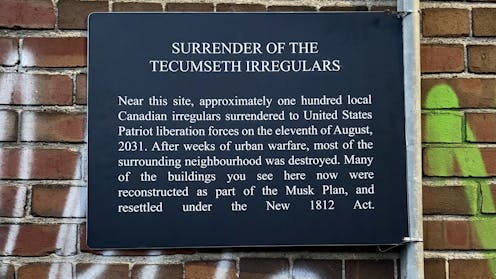
    Artist Dara Vandor’s futuristic, commemorative historical plaques on Toronto streets project a U.S.-annexed Canada. (Dara Vandor)

    As part of her ongoing public art series, Pax Americana, Toronto visual artist Dara Vandor has been posting aluminum signs in public spaces.

    These are plaques that reimagine, as the artist writes, the city as “a site of future conflict and occupation” by the United States. The signage, in the style of commemorative historical markers, echoes U.S. President Donald Trump’s recent and repeated threats to annex Canada and “is meant to serve as a dark warning, inviting contemplation on the fragility of nationhood.”

    For example, one plaque, posted on a bridge on Spadina Ave., informs passersby:

    “This spot served as the center of operations for United States Army snipers during Operation McKinley, the campaign to liberate the northern territory formerly known as Canada. From February to May 2035, this site, code-named ‘The Hot Dog Stand,’ served as a concealed sniper’s nest, providing precision fire support, disrupting insurgent movements, and protecting advancing American units.”

    Vandor’s thought-provoking project, which she told CBC News was sparked by anger at Trump’s threats to Canadian sovereignty, underlines how storytelling can be a powerful tool in times of conflict, especially when it affords itself the artistic freedom to envision potential futures before they can become reality.

    Psychological effects

    In order to understand how exactly stories such as the one portrayed on Vandor’s plaques can make a real impact on the way we navigate moments of crisis, we can turn to the work of conflict analysis experts such as Solon Simmons.

    In his recent book on conflict storytelling, Simmons introduces the concept of post-plot pressure.

    The term describes the psychological effect that a story can have on its readers after they finish reading. As Simmons puts it:

    “What makes stories so important (as opposed to just interesting or entertaining) is the effect of the story, and this effect doesn’t end when the story ends. It leaves the viewer/reader/listener with a feeling.”

    Simmons also explains that the kind and amount of post-plot pressure placed upon an audience depends on the type of story being told.

    Projected unhappy ending exerts pressure

    A story, for example, featuring a struggle in which the antagonist eventually triumphs over the protagonist is what Simmons calls a “satirical struggle story.”

    “Satirical” in this context does not necessarily mean that stories of this kind include elements of mockery or sarcasm. Rather, the label goes back to the influential research contributions of Canadian literary theorist Northrop Frye and American historian Hayden White, from which Simmons derives his own framework.

    This is exactly how to understand the story told over its several episodes on Vandor’s Pax Americana plaques: the U.S., as the story’s antagonist, abuses its power and ends up getting away with it, defeating Canadian resistance and annexing what is now only referred to as the “northern territory.”

    As Simmons suggests, conflict stories like this one, where what is viewed as injustice is allowed to prevail, exercise a relatively high level of post-plot pressure. This is mainly because the unhappy ending leaves audiences dissatisfied and with a sense of loss to grapple with.

    Reader reactions

    Simmons also explains that not all readers react to this particular kind of post-plot pressure in the same way. Vandor’s project, for example, has brought out some critical and upset responses.

    As the artist told Toronto Today, some people have called the plaques pro-American propaganda; one online commenter said they should be taken down.

    Julian Bleecker — a researcher, author, designer and engineer with a PhD in history of consciousness whose design studio offers services around future imagining and planning — voiced his objection to the project in a blog post.

    In his opinion, the antagonistic and fatalistic vision of the future portrayed on the plaques runs the risk of “playing into the hands of the very forces that are at work to make the world a less habitable place.”


    Read more:
    The theatre we want in 2040? We used ‘strategic foresight’ to plan on the Prairies


    But, as Simmons argues, conflict stories in which the happy ending never comes can also leave readers with a productive sense of post-plot pressure. In that case, feeling dissatisfied with the story’s outcome can instead motivate people to mobilize and strategize against the perceived injustice.

    Seen in this light, the plaques’ imagined collapse of Canadian sovereignty can therefore also serve as a stark and urgent inspiration, begging response.

    A sign in an alleyway says 'let go of your past, and welcome to our united future.'
    In Dara Vandor’s speculative future, U.S. President Ivanka Trump, standing on a tank, exhorts Torontonians to ‘Let go of your past, and welcome to our united future.’
    (Dara Vandor)

    A cautionary tale

    Fictional storytelling is often viewed as a useful tool that allows us to make sense of real moments of conflict that happened in the past. Think, for example, of Erich Maria Remarque’s famous war novel All Quiet on the Western Front, which was turned into an Oscar-winning film directed by Edward Berger in 2022.

    Our understanding of these kinds of stories as useful comes with the acknowledgement that there is nothing we can do to prevent past conflict. At the same time, the underlying assumption here is that by learning about the past, we can learn from the past and hopefully stop similar crises from ever happening again.


    Read more:
    How stories about alternate worlds can help us imagine a better future: Don’t Call Me Resilient EP 7 transcript


    What makes Vandor’s ongoing project especially valuable is that it moves its reflections on the past into an imagined future. The actual conflict that the plaques refer to is still part of the present, and its future still undecided. Whatever lessons we draw from their cautionary tale about Canadian annexation, we still have time to act upon them before that imagined future can become reality.

    Importance of resistance in the present

    This is exactly what leads historian Camille Bégin to conclude that the project’s appeal to the importance of resistance in the present is particularly strong:

    “It really shows us that the future is not written, that it’s in our hands to act in the present to forge the future that we want.”

    Even though Vandor’s project tells a story of Canadian defeat, it also highlights that Canadians did resist, a thought that should appeal to anyone opposed to Trump’s vision of territorial expansion.

    Or, and this is perhaps the most hopeful reflection coming out of the project, if Canadians come together and resist now, Trump’s threat of annexation may never get that far.

    The Conversation

    Pascal Michelberger does not work for, consult, own shares in or receive funding from any company or organisation that would benefit from this article, and has disclosed no relevant affiliations beyond their academic appointment.

    ref. ‘Pax Americana’ in Toronto: How speculative art can help us navigate threats – https://theconversation.com/pax-americana-in-toronto-how-speculative-art-can-help-us-navigate-threats-256755

    MIL OSI – Global Reports

  • MIL-OSI Global: Experimenting with generative AI to kibbitz and futz towards more inclusive futures

    Source: The Conversation – Canada – By Nathaniel Laywine, Assistant Professor, Communication and Media Studies, York University, Canada

    Generative AI draws from limited datasets, often reproducing errors and bias. (Shutterstock)

    What does it mean to think, act and work as a Jewish professor when human freedoms are under siege and authoritarian power gains ground? And how can we draw on our Jewish identities to navigate the sweeping encroachment of new technologies like AI?

    As communication scholars, colleagues and collaborators, we have spent a lot of time trying to answer these questions in our scholarship by taking cues from the intellectual lineage of our shared culture.


    Read more:
    Philosopher Hannah Arendt provokes us to rethink what education is for in the era of AI


    Lately, Donald Trump’s administration has demonstrated a heavy investment in cataloguing and categorizing Jewish professors. In April, the Equal Employment Opportunity Commission (EEOC) sent text messages to the personal cellphones of faculty and staff at Barnard College, asking them to self-identify as Jewish and/or Israeli. The text message also asked them to disclose any instances of antisemitic discrimination or harassment they had experienced.

    Presumably, the text message inquiry itself was not recognized by its senders as an instance of such harassment.

    We do not believe being a Jewish professor means silencing our students as they protest atrocities in Gaza, and it certainly doesn’t mean revoking their visas or deporting them. Rather, it means drawing upon the tools of our forebears to question systems of oppression, wherever and however they may arise.

    We simultaneously occupy both privileged and marginal positions within the university and North American society at large. This makes us acutely aware of how fragile conditional tolerance is, and how quickly a list of names can be used to justify repression or violence.

    Collection and use of data

    As communication and media scholars, we’re often critical of how data are aggregated, stored and disseminated. The EEOC questionnaire concerns us because it reduces the complexities of Jewish identity and the profound harms of antisemitism to a handful of abstract and ideologically determined data points.

    Our recent research on generative AI (genAI) and its incompatibility with Jewish cultural expression shows that meaningful efforts to combat antisemitism — and other forms of oppression — must centre the knowledge and experiences of affected communities.

    Our research found that outputs of chatbots such as ChatGPT are unable to tell jokes in a Jewish comedic style without resorting to offensive tropes. In another forthcoming study, we argue that genAI is equally incapable of representing the multifaceted “intersectional identities” of Jewish people except by smashing together rudimentary cultural signifiers (such as rainbows for queerness or bagels for Jewishness).

    In each case, these platforms rely on datasets to determine what Jewishness is, and these datasets originate from the narratives that other people tell about Jewish people, rather than the ones we tell about ourselves.

    Futzing is a Yiddish word that means messing around via hands-on experimentation.
    (Shutterstock)

    Critical strategies

    These platforms have increasingly become parts of daily life and communicative infrastructure. To investigate them, we adopted two critical strategies from our shared heritage as Ashkenazi Jews: kibbitzing and futzing.

    Both terms are Yiddish. Kibbitzing is a lively, informal way of thinking and talking together. It’s somewhere between joking, arguing and exchanging ideas. It is grounded in our relationships, histories and biases; kibbitzing is how we make shared meaning together through many voices.

    Kibbitzing values contradiction, humour and the messiness of human conversation. Unlike AI chatbots, which follow scripted, dialogic, question-and-answer routines based on quantifiable patterns in data, kibbitzing is unpredictable, non-linear and intentionally disorganized.

    When we kibbitz, we build understanding by challenging one another and reflecting on what each of us brings to the table. In the age of genAI, kibbitzing offers a way to talk that is full of friction, laughter and deep, collective insight.

    Futzing means messing around via hands-on experimentation, with no set agenda and no official guidance. This unstructured inquiry is an acknowledgement of Jews’ historical role as outsiders within European society. As we write in our forthcoming article, these practices reflect what social theorist Michel de Certeau calls “making do,” a tactical means of collective empowerment in a hostile society.

    Using futzing as a methodology, we started exploring genAI, drawing on our curiosity to see what might happen by playing, testing and responding in real time.

    Futz first, then kibbitz

    Each of us futzed on our own at first, with no ambition to crack the code or reverse-engineer the algorithm. Later, when we began kibbitzing together, we realized our scattered efforts were actually circling around shared concerns. Futzing helped us see patterns, surprises and contradictions — things we might have missed with a more rigid approach. Kibbitzing helped us connect those patterns and reconcile the contradictions.

    Drawing on our culture this way allows us to imagine inclusive, anti-oppressive Jewish epistemologies that respond to the complexity of the current political moment. Jewish identity — like all identities — is porous and resistant to fixed form. Our shared North American Ashkenazi identity is just one of many possible perspectives that comprise a broader identity of Jewishness.

    That is not a problem to be solved. Rather, it is a strength and a bond between us. Readers may well see their own cultural traditions, vernaculars and ancestral practices in this light too, as techniques of resilience and joy in the face of hardship and oppression.

    There is an irony here. The deeper we dig into the intellectual roots of our own culture, the more common ground we might discover with everyone else’s. And that makes us feel a whole lot safer than getting a text from the EEOC ever could.

    The authors do not work for, consult, own shares in or receive funding from any company or organisation that would benefit from this article, and have disclosed no relevant affiliations beyond their academic appointment.

    ref. Experimenting with generative AI to kibbitz and futz towards more inclusive futures – https://theconversation.com/experimenting-with-generative-ai-to-kibbitz-and-futz-towards-more-inclusive-futures-252553

    MIL OSI – Global Reports

  • MIL-OSI Global: ‘Pax Americana’ in Toronto? Speculative art can help us navigate threats

    Source: The Conversation – Canada – By Pascal Michelberger, Postdoctoral Scholar, Western Academy for Advanced Research, Western University

    Artist Dara Vandor’s futuristic, commemorative historical plaques on Toronto streets project a U.S.-annexed Canada. (Dara Vandor)

    As part of her ongoing public art series, Pax Americana, Toronto visual artist Dara Vandor has been posting aluminum signs in public spaces.

    These are plaques that reimagine, as the artist writes, the city as “a site of future conflict and occupation” by the United States. The signage, in the style of commemorative historical markers, echoes U.S. President Donald Trump’s recent and repeated threats to annex Canada and “is meant to serve as a dark warning, inviting contemplation on the fragility of nationhood.”

    For example, one plaque, posted on a bridge on Spadina Ave., informs passersby:

    “This spot served as the center of operations for United States Army snipers during Operation McKinley, the campaign to liberate the northern territory formerly known as Canada. From February to May 2035, this site, code-named ‘The Hot Dog Stand,’ served as a concealed sniper’s nest, providing precision fire support, disrupting insurgent movements, and protecting advancing American units.”

    Vandor’s thought-provoking project, which she told CBC News was sparked by anger at Trump’s threats to Canadian sovereignty, underlines how storytelling can be a powerful tool in times of conflict, especially when it affords itself the artistic freedom to envision potential futures before they can become reality.

    Psychological effects

    In order to understand how exactly stories such as the one portrayed on Vandor’s plaques can make a real impact on the way we navigate moments of crisis, we can turn to the work of conflict analysis experts such as Solon Simmons.

    In his recent book on conflict storytelling, Simmons introduces the concept of post-plot pressure.

    The term describes the psychological effect that a story can have on its readers after they finish reading. As Simmons puts it:

    “What makes stories so important (as opposed to just interesting or entertaining) is the effect of the story, and this effect doesn’t end when the story ends. It leaves the viewer/reader/listener with a feeling.”

    Simmons also explains that the kind and amount of post-plot pressure placed upon an audience depends on the type of story being told.

    Projected unhappy ending exerts pressure

    A story, for example, featuring a struggle in which the antagonist eventually triumphs over the protagonist is what Simmons calls a “satirical struggle story.”

    “Satirical” in this context does not necessarily mean that stories of this kind include elements of mockery or sarcasm. Rather, the label goes back to the influential research contributions of Canadian literary theorist Northrop Frye and American historian Hayden White, from which Simmons derives his own framework.

    This is exactly how to understand the story told over its several episodes on Vandor’s Pax Americana plaques: the U.S., as the story’s antagonist, abuses its power and ends up getting away with it, defeating Canadian resistance and annexing what is now only referred to as the “northern territory.”

    As Simmons suggests, conflict stories like this one, where what is viewed as injustice is allowed to prevail, exercise a relatively high level of post-plot pressure. This is mainly because the unhappy ending leaves audiences dissatisfied and with a sense of loss to grapple with.

    Reader reactions

    Simmons also explains that not all readers react to this particular kind of post-plot pressure in the same way. Vandor’s project, for example, has brought out some critical and upset responses.

    As the artist told Toronto Today, some people have called the plaques pro-American propaganda; one online commenter said they should be taken down.

    Julian Bleecker — a researcher, author, designer and engineer with a PhD in history of consciousness whose design studio offers services around future imagining and planning — voiced his objection to the project in a blog post.

    In his opinion, the antagonistic and fatalistic vision of the future portrayed on the plaques runs the risk of “playing into the hands of the very forces that are at work to make the world a less habitable place.”


    Read more:
    The theatre we want in 2040? We used ‘strategic foresight’ to plan on the Prairies


    But, as Simmons argues, conflict stories in which the happy ending never comes can also leave readers with a productive sense of post-plot pressure. In that case, feeling dissatisfied with the story’s outcome can instead motivate people to mobilize and strategize against the perceived injustice.

    Seen in this light, the plaques’ imagined collapse of Canadian sovereignty can therefore also serve as a stark and urgent inspiration, begging response.

    In Dara Vandor’s speculative future, U.S. President Ivanka Trump, standing on a tank, exhorts Torontonians to ‘Let go of your past, and welcome to our united future.’
    (Dara Vandor)

    A cautionary tale

    Fictional storytelling is often viewed as a useful tool that allows us to make sense of real moments of conflict that happened in the past. Think, for example, of Erich Maria Remarque’s famous war novel All Quiet on the Western Front, which was turned into an Oscar-winning film directed by Edward Berger in 2022.

    Our understanding of these kinds of stories as useful comes with the acknowledgement that there is nothing we can do to prevent past conflict. At the same time, the underlying assumption here is that by learning about the past, we can learn from the past and hopefully stop similar crises from ever happening again.


    Read more:
    How stories about alternate worlds can help us imagine a better future: Don’t Call Me Resilient EP 7 transcript


    What makes Vandor’s ongoing project especially valuable is that it moves its reflections on the past into an imagined future. The actual conflict that the plaques refer to is still part of the present, and its future still undecided. Whatever lessons we draw from their cautionary tale about Canadian annexation, we still have time to act upon them before that imagined future can become reality.

    Importance of resistance in the present

    This is exactly what leads historian Camille Bégin to conclude that the project’s appeal to the importance of resistance in the present is particularly strong:

    “It really shows us that the future is not written, that it’s in our hands to act in the present to forge the future that we want.”

    Even though Vandor’s project tells a story of Canadian defeat, it also highlights that Canadians did resist, a thought that should appeal to anyone opposed to Trump’s vision of territorial expansion.

    Or, and this is perhaps the most hopeful reflection coming out of the project, if Canadians come together and resist now, Trump’s threat of annexation may never get that far.

    Pascal Michelberger does not work for, consult, own shares in or receive funding from any company or organisation that would benefit from this article, and has disclosed no relevant affiliations beyond their academic appointment.

    ref. ‘Pax Americana’ in Toronto? Speculative art can help us navigate threats – https://theconversation.com/pax-americana-in-toronto-speculative-art-can-help-us-navigate-threats-256755

    MIL OSI – Global Reports

  • MIL-OSI Global: Kids care deeply about our planet, so adults need to start listening

    Source: The Conversation – Canada – By Jen Kostuchuk, PhD Candidate, Sociology, University of Victoria

    “I wish adults knew that I really care about the environment and want to help, but I sometimes feel like my ideas don’t matter because I’m just a kid.”

    This is what a nine-year-old respondent told us when we asked how they feel about the environment.

    In today’s current political climate, many adults seem resigned to climate catastrophe and even dabble in climate change denialism. However, our survey of 1,000 youth aged eight to 14 from Canada and the United States found that children care deeply about the planet and are ready to take action.

    The findings from our report were produced as part of an ongoing study with the Humanity in Motion Society, a Canadian non-profit organization focused on engaging youth as key stakeholders in advancing environmental stewardship.

    Almost 90 per cent of the kids we spoke to recognize climate change as a real and urgent problem, calling for intergenerational collaboration and bolder environmental mitigation and adaptation commitments.

    It turns out that our nine-year-old respondent speaks for many children. Kids know what’s at stake, want a seat at the table and need adults to act with them.

    What kids told us

    Some of the kids in the survey talk about the action they want adults to take to tackle climate change. (Humanity in Motion Society)

    Many of the kids told us they regularly take action to mitigate their carbon footprint, including recycling, embracing reusable items and conserving energy. Their accounts are consistent with numerous academic studies on youth involvement in environmental citizenship.

    However, many understand individual action alone is not enough. In fact, most kids recognize that systemic accountability is necessary to tackle the climate crisis. As one kid in Grade 6 shared:

    “I wish big industry and governments would stop asking us to do something when they continue to fly in private jets [and] drill for oil and more; we are asked to recycle.”

    Kids have a deep understanding of current political issues, including the cost-of-living crisis and the harmful “drill baby drill” sentiments, but also underscore a stark disconnect: while we instil environmentally responsible values in our children, elected leaders remain consistently inactive on these very same issues.


    Read more:
    The oil and gas industry has been lying about global warming for decades — accountability is long overdue


    Kids play active roles in knowledge sharing

    The kids in this study display impressive knowledge about the steps that need to be taken to address the climate crisis. Our findings demonstrate that youth are not just passive recipients of knowledge but, rather, play an active role in being climate communicators.

    For example, two thirds of our respondents say their friends learn about climate change directly from them. Even though many children note that they do not have climate clubs at school, they are curious about the role of big oil, deforestation and corporate greed in the ongoing climate crisis.

    In addition to teachers and parents being the most influential sources of knowledge for children, social media content has an impact on kids’ environmental behaviour and feelings of empowerment.

    Specifically, our data shows that talking to others online has a significant positive relationship with reported sustainable behaviour, and that watching videos has a significant positive relationship with how much kids feel they can make a difference. One young girl reflected on using Tiktok for insights on climate change while also capturing an awareness among her generation:

    “I would say if there’s a really big issue, like, I know there’s something called the Climate Clock in New York…I mean, the thing with social media, you never know what’s true and untrue, but that thing [Climate Clock] came on my ‘For You’ page…and everybody in the comments, they were saying ‘this is very real, we have to do something about it.’”

    This shows that kids would benefit greatly from spaces to continue in-person environmental discussions with adults in the room. One young respondent captured the potential for meaningful engagement:

    “There are a lot of things that can be done, curriculum integrations…sustainable skills like critical thinking, problem-solving, collaboration, and maybe explore the ecosystems and biodiversities and actually encourage students to design and implement climate-friendly projects and carry out field trips and organize visits to renewable energy sites or environmental organizations and sometimes, maybe occasionally, the school can invite climate experts, activists or scientists.”

    These ideas were shared by others who called on adults to lead more experiential approaches to climate education inside the classroom and beyond.

    Adults can help by providing opportunities in the classroom and beyond for kids to discuss cliamte change.
    (Shutterstock)


    Read more:
    Teachers need bolder action from our school boards to educate in and for a climate emergency


    Five calls to action

    Here are five ways to help bring about change:

    1. Adults need to step up. Adults play a critical role in shaping how youth engage in climate action. Our report found that teachers and parents, in addition to the internet, are among the most influential learning sources for youth today. Kids often take pro-environmental values, actions and cues from their parents.

    2. Apathy is not an option if we want change. Youth are looking to leaders and elected officials to invest heavily in infrastructure and education to improve our environment.

    3. Intergenerational collaboration promotes better environmental values. Despite the consequences of climate change, youth share a sense of optimism and emphasize the need for intergenerational responsibility.

    4. Provide spaces for youth to take leadership roles and engage in climate dialogue. Kids want to do more to build a sustainable future, but don’t know where to begin. Providing opportunities in the classroom and beyond are critical next steps to raise the next generation of climate leaders.

    5. Promote bold action. Kids should be able to answer the call of many climate activists who recognize the need to pursue a greener economy by working together.

    Our survey findings highlight a hopeful message about young people’s engagement in climate action, underscoring their impressive knowledge of the systemic changes required to address the crisis.

    As adults across the political spectrum bicker about climate policy, young people are growing impatient and hoping to lead the way. Our results refocus attention on the future we’re creating and challenge us to listen seriously to children when they seek to address what may be their generation’s greatest crisis.

    Sean Lyons has received funding from Mitacs in support of an earlier iteration of the study discussed here.

    Erik Steiner and Jen Kostuchuk do not work for, consult, own shares in or receive funding from any company or organisation that would benefit from this article, and have disclosed no relevant affiliations beyond their academic appointment.

    ref. Kids care deeply about our planet, so adults need to start listening – https://theconversation.com/kids-care-deeply-about-our-planet-so-adults-need-to-start-listening-257304

    MIL OSI – Global Reports

  • MIL-OSI Russia: D. Trump to Announce New NASA Administrator Nominee

    Translation. Region: Russian Federal

    Source: People’s Republic of China in Russian – People’s Republic of China in Russian –

    Source: People’s Republic of China – State Council News

    WASHINGTON, June 1 (Xinhua) — U.S. President Donald Trump will soon announce a new candidate to lead the U.S. National Aeronautics and Space Administration (NASA) after his decision to withdraw the nomination of Jared Isaacman, a close ally of Elon Musk, the White House said Saturday.

    “After careful review, I am withdrawing Jared Isaacman’s nomination to lead NASA,” Trump wrote on Truth Social. “I will soon announce a new nominee who will live up to the mission and put America first in space.”

    Late last year, Trump named billionaire and amateur astronaut J. Isaacman as his candidate to head NASA. The Senate Committee on Commerce, Science, and Transportation approved his nomination in late April.

    J. Isaacman, a close associate of I. Musk and a major client of his company SpaceX, has purchased several private space flights from the company for hundreds of millions of dollars. –0–

    MIL OSI Russia News

  • MIL-Evening Report: Phil Goff: Israel doesn’t care how many innocent people, children it’s killing

    COMMENTARY: By Phil Goff

    “What we are doing in Gaza now is a war of devastation: indiscriminate, limitless, cruel and criminal killing of civilians. It’s the result of government policy — knowingly, evilly, maliciously, irresponsibly dictated.”

    This statement was made not by a foreign or liberal critic of Israel but by the former Prime Minister and former senior member of Benjamin Netanyahu’s own Likud party, Ehud Olmet.

    Nightly, we witness live-streamed evidence of the truth of his statement — lethargic and gaunt children dying of malnutrition, a bereaved doctor and mother of 10 children, nine of them killed by an Israeli strike (and her husband, another doctor, died later), 15 emergency ambulance workers gunned down by the IDF as they tried to help others injured by bombs, despite their identity being clear.

    Statistics reflect the scale of the horror imposed on Palestinians who are overwhelmingly civilians — 54,000 killed, 121,000 maimed and injured. Over 17,000 of these are children.

    This can no longer be excused as regrettable collateral damage from targeted attacks on Hamas.

    Israel simply doesn’t care about the impact of its military attacks on civilians and how many innocent people and children it is killing.

    Its willingness to block all humanitarian aid- food, water, medical supplies, from Gaza demonstrates further its willingness to make mass punishment and starvation a means to achieve its ends. Both are war crimes.

    Influenced by the right wing extremists in the Coalition cabinet, like Israeli Finance Minister Bezalel Smotrich and National Security Minister Itamar Ben-Gvir, Israel’s goal is no longer self defence or justifiable retaliation against Hamas terrorists.

    Israel attacks Palestinians at US-backed aid hubs in Gaza, killing 36. Image: AJ screenshot APR

    Making life unbearable
    The Israeli government policy is focused on making life unbearable for Palestinians and seeking to remove them from their homeland. In this, they are openly encouraged by President Trump who has publicly and repeatedly endorsed deporting the Palestinian population so that the Gaza could be made into a “Middle East Riviera”.

    This is not the once progressive pioneer Israel, led by people who had faced the Nazi Holocaust and were fighting for the right to a place where they could determine their own future and be safe.

    Sadly, a country of people who were themselves long victims of oppression is now guilty of oppressing and committing genocide against others.

    New Zealand recently joined 23 other countries calling out Israel and demanding a full supply of foreign aid be allowed into Gaza.

    Foreign Minister Winston Peters called Israel’s actions “ intolerable”. He said that we had “had enough and were running out of patience and hearing excuses”.

    While speaking out might make us feel better, words are not enough. Israel’s attacks on the civilian population in Gaza are being increased, aid distribution which has restarted is grossly insufficient to stop hunger and human suffering and Palestinians are being herded into confined areas described as humanitarian zones but which are still subject to bombardment.

    People living in tents in schools and hospitals are being slaughtered.

    World must force Israel to stop
    Like Putin, Israel will not end its killing and oppression unless the world forces it to. The US has the power but will not do this.

    The sanctions Trump has imposed are not on Israel’s leaders but on judges in the International Criminal Court (ICC) who dared to find Prime Minister Benjamin Netanyahu guilty of war crimes.

    New Zealand’s foreign policy has traditionally involved working with like-minded countries, often small nations like us. Two of these, Ireland and Sweden, are seeking to impose sanctions on Israel.

    Both are members of the European Union which makes up a third of Israel’s global trade. If the EU decides to act, sanctions imposed by it would have a big impact on Israel.

    These sanctions should be both on trade and against individuals.

    New Zealand has imposed sanctions on a small number of extremist Jewish settlers on the West Bank where there is evidence of them using violence against Palestinian villagers.

    These sanctions should be extended to Israel’s political leadership and New Zealand could take a lead in doing this. We should not be influenced by concern that by taking a stand we might offend US president Donald Trump.

    Show our preparedness to uphold values
    In the way that we have been proud of in the past, we should as a small but fiercely independent country show our preparedness to uphold our own values and act against gross abuse of human rights and flagrant disregard for international law.

    We should be working with others through the United Nations General Assembly to maximise political pressure on Israel to stop the ongoing killing of innocent civilians.

    Moral outrage at what Israel is doing has to be backed by taking action with others to force the Israeli government to end the killing, destruction, mass punishment and deliberate starvation of Palestinians including their children.

    An American doctor working at a Gaza hospital reported that in the last five weeks he had worked on dozens of badly injured children but not a single combatant.

    He noted that as well as being maimed and disfigured by bombing, many of the children were also suffering from malnutrition. Children were dying from wounds that they could recover from but there were not the supplies needed to treat them.

    Protest is not enough. We need to act.

    Phil Goff is Aotearoa New Zealand’s former Minister of Foreign Affairs. This article was first published by the Stuff website and is republished with the permission of the author.

    MIL OSI AnalysisEveningReport.nz

  • Bridges collapse in 2 Russian regions bordering Ukraine, 7 dead

    Source: Government of India

    Source: Government of India (4)

    Two bridges collapsed in different Russian regions bordering Ukraine, derailing trains and killing at least seven people and injuring dozens, Russian authorities said early on Sunday, while a Russian politician called Kyiv a “terrorist enclave”.

    Reuters could not independently confirm whether the incidents in the neighbouring regions were related. The areas in Russia’s south have been subject to frequent attacks by Ukraine during the war that Russia started with its full-scale invasion more than three years ago.

    Seven people were killed and 69 injured when a highway bridge collapsed onto railway tracks, derailing an approaching train in the Bryansk region late on Saturday, Russian emergency ministry and regional officials said.

    Russia’s Railways initially posted on the Telegram messaging app that the Bryansk bridge collapse was the result of an “illegal interference in the operation of transport”, but the post was later removed.

    Bryansk Governor Alexander Bogomaz said on Telegram that 47 people were hospitalised. Three children were among those injured with one in serious condition, he said.

    The collapse in the Kursk region occurred early on Sunday while a freight train was crossing the bridge, Alexander Khinshtein, acting governor of the region, and Russian Railways said on Telegram.

    “Part of the train fell onto a road underneath the bridge,” Khinshtein said. He added that the locomotive caught fire, which was quickly extinguished. One of the drivers sustained leg injuries, and he and the team operating the train were taken to a local hospital, Khinshtein added.

    He posted a photo of derailed carriages on a damaged bridge over a road.

    Andrei Klishas, a senior member of the Federation Council, Russia’s upper chamber of parliament, said on the Telegram messaging app that the incident in Bryansk shows that “Ukraine has long lost the attributes of a state and has turned into a terrorist enclave.”

    Russia’s Baza Telegram channel, which often publishes information from sources in the security services and law enforcement, reported, without providing evidence, that according to preliminary information, the Bryansk bridge had been blown up.

    Prominent Russian military blogger Semyon Pegov, who uses the name War Gonzo, called the Bryansk collapse “sabotage.”

    Since the war began in February 2022, there have been continued cross-border shelling, drone strikes and covert raids from Ukraine into the Bryansk, Kursk and Belgorod regions that border Ukraine.

    Russia’s Ministry of Emergency Situations said on Telegram that efforts to find and rescue victims in the Bryansk incident continued throughout the night, and that some 180 personnel were involved in the operation.

    Among those killed was the locomotive driver, Russia’s state news agencies reported, citing medics.

    Social media pictures and videos showed passengers trying to help others climb out of the Bryansk train’s damaged carriages in the dark and firefighters looking for ways to reach passengers.

    The train was going from the town of Klimovo to Moscow, Russian Railways said. It collided with the collapsed bridge in the area of a federal highway in the Vygonichskyi district of the Bryansk region, Bogomaz said. The district lies some 100 km (60 miles) from the border with Ukraine.

    U.S. President Donald Trump has urged Moscow and Kyiv to work together on a deal to end the war, and Russia has proposed a second round of face-to-face talks with Ukrainian officials in Istanbul on Monday.

    Ukraine has not committed to attending the talks, saying it first needed to see Russia’s proposals, while a leading U.S. senator warned Moscow it would be “hit hard” by new U.S. sanctions.

    (Reuters)

  • Trump pulls Musk ally’s NASA nomination, will announce replacement

    Source: Government of India

    Source: Government of India (4)

    The White House withdrew on Saturday its nominee for NASA administrator, Jared Isaacman, abruptly yanking a close ally of Elon Musk from consideration to lead the space agency.

    President Donald Trump said he would announce a new candidate soon.

    “After a thorough review of prior associations, I am hereby withdrawing the nomination of Jared Isaacman to head NASA,” Trump wrote on his Truth Social site.

    “I will soon announce a new nominee who will be mission aligned, and put America First in space.”

    Isaacman, a billionaire private astronaut who had been Musk’s pick to lead NASA, was due next week for a much-delayed confirmation vote before the U.S. Senate. His removal from consideration caught many in the space industry by surprise.

    Trump and the White House did not explain what led to the decision.

    “It may not always be obvious through the discourse and turbulence, but there are many competent, dedicated people who love this country and care deeply about the mission,” Isaacman said in a post on X.

    “That was on full display during my hearing, where leaders on both sides of the aisle made clear they’re willing to fight for the world’s most accomplished space agency.

    “I am incredibly grateful to President Trump, the Senate and all those who supported me.”

    His removal comes days after Musk’s official departure from the White House, where the SpaceX CEO’s role as a “special government employee” leading the Department of Government Efficiency created turbulence for the administration and frustrated some of Trump’s aides.

    Semafor reported the news earlier.

    According to a person familiar with his reaction, Musk was disappointed by Isaacman’s removal.

    “It is rare to find someone so competent and good-hearted,” Musk wrote of Isaacman on X, responding to the news.

    It was unclear whom the administration might tap to replace Isaacman.

    One name being floated is retired U.S. Air Force Lieutenant General Steven Kwast, an early advocate for the setting-up of the U.S. Space Force and Trump supporter, according to three people familiar with the discussions.

    Isaacman, the former CEO of payment processor company Shift4, had broad space industry support but faced concerns from lawmakers over his ties to Musk and SpaceX, where he spent hundreds of millions of dollars as an early private spaceflight customer.

    The former nominee had donated to Democrats in prior elections. In his confirmation hearing in April, he sought to balance NASA’s existing moon-aligned space exploration strategy with pressure to shift the agency’s focus on Mars, saying the U.S. can plan for travel to both destinations.

    As a potential leader of NASA’s roughly 18,000 employees, Isaacman faced a daunting task of implementing that decision to prioritize Mars, given that NASA has spent years and billions of dollars trying to return its astronauts to the moon.

    On Friday, the space agency released new details of the Trump administration’s 2026 budget plan that proposed killing dozens of space science programs and laying off thousands of employees, a controversial overhaul that space advocates and lawmakers described as devastating for the agency.

    Montana Republican Tim Sheehy, a member of the Senate Commerce, Science and Transportation committee, wrote on X that Isaacman “was a strong choice by President Trump to lead NASA” in response to reports of his departure.

    “I was proud to introduce Jared at his hearing and strongly oppose efforts to derail his nomination,” Sheehy said.

    Some scientists saw the nominee change as further destabilizing to NASA as it faces dramatic budget cuts without a confirmed leader to navigate political turbulence among Congress, the White House and the agency’s workforce.

    “So not having (Isaacman) as boss of NASA is bad news for the agency,” Harvard-Smithsonian astronomer Jonathan McDowell said on X.

    “Maybe a good thing for Jared himself though, since being NASA head right now is a bit of a ‘Kobayashi Maru’ scenario,” McDowell added, referring to a no-win situation cadets face in the science fiction franchise Star Trek.

    (Reuters)

  • MIL-OSI USA: Mfume, House and Senate Democrats Send Letter Calling on GAO to Investigate Federal Worker Firings

    Source: United States House of Representatives – Congressman Kweisi Mfume (MD-07)

    WASHINGTON, D.C. –  In response to the Trump Administration’s unprecedented purge of tens of thousands of federal workers without cause, Ranking Member of the House Committee on Oversight and Government Reform Subcommittee on Government Operations Rep. Kweisi Mfume (MD-07), Ranking Member of the House Appropriations Subcommittee on Financial Services and General Government (FSGG) Congressman Steny H. Hoyer (MD-05), Ranking Member of the Senate Appropriations Subcommittee on Commerce, Justice, Science, and Related Agencies Senator Chris Van Hollen (D-MD), Ranking Member of the Senate Appropriations Subcommittee on FSGG Senator Jack Reed (D-RI), Ranking Member of the Senate Committee on Homeland Security and Governmental Affairs Senator Gary Peters (D-MI), Acting Ranking Member on the House Committee on Oversight and Government Reform Rep. Stephen F. Lynch (MA-08), and Ranking Member of the House Committee on Oversight and Government Reform Subcommittee on Delivering On Government Efficiency (DOGE) Rep. Melanie Stansbury (NM-01) led more than 30 Democrats in sending a letter to Comptroller General of the United States Gene L. Dodaro calling on the Government Accountability Office (GAO) to provide Congress with regular updates on how the Trump Administration’s personnel actions are affecting the federal workforce.

    “Over the past several months, the civil service has undergone an unprecedented level of change as tens of thousands of federal employees have been terminated, resigned, or placed on administrative leave,” the Members wrote. “Americans are already feeling the consequences – longer wait times for Social Security assistance, delayed veterans’ benefits, and disrupted disaster response are just a few examples of how these personnel actions are impacting people across the country. We are deeply concerned about the impact these actions will have on our government’s capacity to design, develop and deliver efficient services that connect agencies with the people they serve and meet the needs of the public.”

    Signatories include: Senator Angela D. Alsobrooks; Rep. Yassamin Ansari; Rep. Wesley Bell; Rep. Donald Beyer; Rep. Sanford D. Bishop, Jr.; Senator Richard Blumenthal; Rep. Shontel Brown; Rep. Greg Casar; Rep. Jasmine Crockett; Rep. Sarah Elfreth; Rep. Maxwell Frost; Rep. Robert Garcia; Rep. Glenn Ivey; Senator Timothy Kaine; Rep. Ro Khanna; Rep. Raja Krishnamoorthi; Rep. Summer Lee; Rep. April McClain Delaney; Rep. Jennifer McClellan; Rep. Dave Min; Senator Patty Murray; Rep. Eleanor Holmes Norton; Senator Alex Padilla; Rep. Emily Randall; Rep. Jamie Raskin; Senator Bernard Sanders; Senator Brian Schatz; Rep. Lateefah Simon; Rep. Suhas Subramanyam; Rep. Rashida Tlaib; Rep. Eugene Vindman; and Senator Mark R. Warner.

    The full text of the letter is included below:

    May 29, 2025
     

    The Honorable Gene L. Dodaro
    Comptroller General of the United States
    Government Accountability Office
    441 G Street, N.W.
    Washington D.C. 20548

    Dear Comptroller General Dodaro:

    The 2 million federal employees who work across our country are the backbone of our federal government and are responsible for delivering vital services to the American people. These individuals dedicate their lives to public service and ensure our government fulfills its mission to make our country safer, healthier and more prosperous.

    Over the past several months, the civil service has undergone an unprecedented level of change as tens of thousands of federal employees have been terminated, resigned, or placed on administrative leave. Americans are already feeling the consequences – longer wait times for Social Security assistance, delayed veterans’ benefits, and disrupted disaster response are just a few examples of how these personnel actions are impacting people across the country. We are deeply concerned about the impact these actions will have on our government’s capacity to design, develop and deliver efficient services that connect agencies with the people they serve and meet the needs of the public.

    To assist our oversight of the federal government’s personnel actions, we request that the Government Accountability Office provide us with regular briefings to ensure Congress has timely data and information on the status of the federal workforce. Specifically, we request that GAO begin providing the information following each quarter through the end of fiscal year 2028 to be scheduled in coordination with applicable staff. Information on the total number of the following groups of federal employees in the 24 CFO agencies categorized by agency of employment, location, occupation and tenure by quarter –

    a. All terminated federal employees who are separated for any reason;

    b. Federal employees who took the deferred resignation program offer;

    c. Federal employees in their probationary period;

    d. Federal employees in their probationary period who were terminated;

    e. Federal employees on administrative leave.

    f. Federal employees hired.

    Any difficulties experienced by the Office of Personnel Management (OPM) in its collection, analysis, and publication of human capital data.

    Thank you for your attention to this matter.

    Sincerely,

    ###

    MIL OSI USA News

  • MIL-OSI USA: Senator Marshall Visits Southern Border Alongside Kansas Law Enforcement Officials

    US Senate News:

    Source: United States Senator for Kansas Roger Marshall

    Washington – U.S. Senator Roger Marshall, M.D. (R-Kansas) visited Sierra Vista, Arizona yesterday to tour the Joint Task Force-Southern Border Command offices, thank members of Kansas’ own 1st Infantry Division from Fort Riley, participate in tours along the southern border, receive briefings, and take an aerial tour of the border near Arizona with several Kansas law enforcement officials.
    Below are photos from Senator Marshall’s visit. Click HERE and HERE for b-roll videos.

    Senator Marshall with members of Joint Task Force Southern Border.

    Senator Marshall prepares to view the border from the air.

    Senator Marshall at the border wall with detectives from the Cochise County Sheriff’s Office.

    Senator Marshall with members of Kansas law enforcement at the southern border wall.
    From left to right: Sheriff Billy Tomasi, Director Brian Peete, Sheriff Jeff Easter, Sheriff Scott Braun, Senator Roger Marshall, Chief Karl Oakman, Director Tony Mattivi, and Chief Courtney Leslie.
    “Having visited the southern border multiple times under the Biden-Harris Administration, I witnessed chaos, lawlessness, and a system overwhelmed by over 10 million illegal crossings –including individuals on the FBI’s terrorist watchlist,” said Senator Marshall. “But during my most recent trip, the difference was clear. Since President Trump returned to office, we’ve already seen a dramatic shift with illegal border crossings dropping 93% compared to last year. What I’ve witnessed firsthand at the border proves that President Trump’s bold leadership is delivering results, and he is keeping his promises. To continue delivering on the President’s agenda, the Senate must pass the ‘One Big, Beautiful Bill’ – legislation that will provide critical funding our border agencies need to keep America safe.”
    Since President Trump took office in January 2025, the number of illegal immigrant crossings at the southern border has dropped dramatically. In April 2024, there were 128,900 crossings at the border, while in April 2025, there were only 8,400.
    The Kansas law enforcement officers who accompanied Senator Marshall included Kansas Bureau of Investigation (KBI) Director Tony Mattivi, Director of the Riley County Police Department Brian Peete, Sedgwick County Sheriff Jeffery Easter, Crawford County Sheriff Billy Tomasi, Ellis County Sheriff and Kansas Sheriffs’ Association President Scott Braun, Hugoton Police Chief and Kansas Association of Chiefs of Police President Courtney Leslie, and Kansas City, Kansas Police Chief Karl Oakman.
    “I was honored to join Senator Marshall and several sheriffs and police chiefs in experiencing firsthand the challenges at our southern border,” said KBI Director Tony Mattivi. “We know every fentanyl pill sold in Kansas is trafficked by Mexican drug cartels through this border. Every single pill that kills a Kansan enters the country here, so we must continue the fight to keep dangerous and violent criminals out.”
    “Senator Marshall champions law enforcement and public safety efforts. He understands the unique role the Riley County Police Department plays in protecting national security and operational readiness because of our ties to NBAF and Fort Riley,” said Riley County Police Department Director Brian Peete. “This opportunity has helped the department forge new strategic plans and procedures to keep our county safe from narcotic and human trafficking, as well as foreign terrorist organizations. My sincerest thanks to both he and his team.”
    “The experience was very informative. It was amazing to me to see what 4 years of an unsecured border looked like and the issues it created for the United States,” said Sedgwick County Sheriff Jeffrey Easter. “This trip highlighted the absolute cooperation between the U.S military, Border Patrol, and the Cochise County Sheriff’s Office. These men and women are on the front lines protecting Kansans from the fentanyl and methamphetamine scourge that has gripped Sedgwick County. I am very appreciative of Senator Marshall inviting me to observe and understand the situation at our border.”
    “We’ve learned where it’s coming in from, we’ve learned where it’s being transported to, and this is a hub where it’s coming out of,” said Crawford County Sheriff Billy Tomasi. “Like I told the voters when I came on, that I am going to learn about this and I’m going to start taking it off the streets, and that’s my goal. And I appreciate the opportunity from Senator Marshall allowing me to come down here with him to learn this, to bring back to our community.”
    “Our visit to the Arizona border with the dedicated military – including soldiers from Fort Riley –and border agencies, was eye-opening. The fight against illegal immigrants and the deadly flow of fentanyl is real.  It’s happening on the ground, and it’s impacting Kansas communities every day. The brave men and women on the front lines deserve our full support as they work to protect our borders and save lives back home,” said Hugoton Police Chief and Kansas Association of Chiefs of Police President Courtney Leslie. “I am extremely grateful to Senator Marshall and his staff for the opportunity to see firsthand the fight against the cartels that are trafficking fentanyl across our border daily. The fight against these cartels is not just a border issue – it is a fight for the safety of every Kansas community.”
    “I would like to thank Senator Marshall for the opportunity to see firsthand the great work being done by our men and women of law enforcement, border patrol, and the military,” said Kansas Police Chief Karl Oakman. “Eliminating drug smuggling is still a major challenge at the border, and additional resources are needed.”
    Background:

    Senator Marshall spoke out against Joe Biden’s reckless border policies continuously during his four disastrous years in office, calling it the “number one” most immediate national security threat.
    Senator Marshall supports President Donald Trump’s ‘One, Big Beautiful Bill,’ which includes the largest border security investment in history, empowers ICE to deport the millions of illegal immigrants who entered under the Biden-Harris Administration, and provides funding for at least one million annual removals.
    Recently, Senator Marshall reintroduced the Justice for Angel Families Act, legislation that would amend the Crime Victims Fund (CVF) to expand financial coverage for Angel Families – the immediate relatives of victims killed by illegal aliens.
    In 2024, he introduced legislation the Demanding Citizenship in D.C. Elections Act, which would require anyone who votes in a municipal election in the District of Columbia to be a U.S. Citizen and require proof of citizenship. 
    In 2024, Senator Marshall also went to the Senate Floor demanding the immediate passage of his resolution declaring an invasion at the southern border.
    In an op-ed for FOX News in 2019, then-Congressman Marshall detailed his border visit with fellow doctors in Congress stating, “Our systems are simply overwhelmed, and there appears to be no break in the near future… until we build a wall, and until we turn off the laws that only serve as magnets, all the money in the world will not have a huge humanitarian impact.”

    MIL OSI USA News

  • MIL-OSI USA: Cantwell & Colleagues Call on Trump Administration to Stop Bureaucratic Delays and Immediately Release Broadband Equity, Access & Deployment Funding to States

    US Senate News:

    Source: United States Senator for Washington Maria Cantwell
    05.31.25
    Cantwell & Colleagues Call on Trump Administration to Stop Bureaucratic Delays and Immediately Release Broadband Equity, Access & Deployment Funding to States
    WASHINGTON, D.C. – U.S. Senator Maria Cantwell (D-WA), ranking member of the Senate Committee on Commerce, Science, and Transportation and senior member of the Senate Finance Committee, Democratic Leader Senator Chuck Schumer (D-NY), and Senator Ben Ray Luján (D-NM) called on the Trump Administration to immediately release the $42 billion allocated for the Broadband Equity, Access and Deployment (BEAD) Program as part of the bipartisan Infrastructure Investment and Jobs Act. The program was designed with the goal of building high-speed, scalable, and reliable networks everywhere in the United States.
    “For six months, states have been waiting to break ground on scores of projects, held back only by the Commerce Department’s bureaucratic delays,” wrote the Senators in a letter to Commerce Secretary Howard Lutnick and President Trump. “If states are forced to redo or rework their plans, they will not only miss this year’s construction season but next year’s as well, delaying broadband deployment by years. That’s why we urge the Administration to move swiftly to approve state plans, and release the $42 billion allocated to the states by the BEAD Program.”
    In the innovation economy, universal access to high-speed internet is essential for the nation’s future economic growth and to ensure that some 25 million Americans will not be denied the opportunity to fully participate in and contribute to that growth. And, in addition to excluding millions of citizens, lack of broadband access also puts our nation further behind in the race with China, putting at risk our ability to compete in AI, advanced robotics, and semiconductor manufacturing. The BEAD program has allocated $1.2 billion to the State of Washington.
    “High-speed, reliable, and scalable connectivity is essential for jobs, education, and telehealth.  It’s also the backbone for the advanced industries of today and tomorrow,” the Senators wrote. “AI systems require massive volumes of data and low-latency networks to operate effectively. Data centers, smart warehouses, robotic assembly lines, and chip fabrication plants all depend on fast, stable, and scalable bandwidth. If we want these job-creating facilities built throughout the United States, including rural areas, we must ensure the infrastructure—including high-speed internet networks—is in place to support them.”
    Sen. Cantwell, at the time the chair of the Commerce Committee, was an early supporter of the BEAD program.
    “We urge you to move forward with the submitted BEAD plans and deliver on the promise of the BEAD program without further delay. Every American and every community needs access to reliable, scalable, and high-speed internet if we are to remain the world’s innovation leader,” concluded the letter.
    The full text of the letter is available HERE and below.
    Dear Sec. Lutnick / President Trump,
    Congress created the Broadband Equity, Access and Deployment (BEAD) Program as part of the bipartisan Infrastructure Investment and Jobs Act to finish the job of connecting everyone and building high-speed, scalable, and reliable networks everywhere.  For six months, states have been waiting to break ground on scores of projects, held back only by the Commerce Department’s bureaucratic delays. If states are forced to redo or rework their plans, they will not only miss this year’s construction season but next year’s as well, delaying broadband deployment by years. That’s why we urge the Administration to move swiftly to approve state plans, and release the $42 billion allocated to the states by the BEAD Program.
    Universal access to high-speed internet is essential for jobs, education, and telehealth —and also for the bandwidth-hungry innovation economy, from artificial intelligence and advanced robotics to smart manufacturing and semiconductor production.  Further delay means 25 million Americans continue to wait for high-speed internet and the economic benefits it brings.  It also means that we risk falling behind China, which is aggressively building out digital infrastructure to support its AI, advanced manufacturing, and semiconductor ambitions. 
    States have already developed plans to address these needs, and restarting or slowing down the process will only hold back progress.  States must maintain the flexibility to choose the highest quality broadband options, rather than be forced by bureaucrats in Washington to funnel funds to Elon Musk’s Starlink, which lacks the scalability, reliability, and speed of fiber or other terrestrial broadband solutions.
    High-speed, reliable, and scalable connectivity is essential for jobs, education, and telehealth.  It’s also the backbone for the advanced industries of today and tomorrow. AI systems require massive volumes of data and low-latency networks to operate effectively. Data centers, smart warehouses, robotic assembly lines, and chip fabrication plants all depend on fast, stable, and scalable bandwidth. If we want these job-creating facilities built throughout the United States, including rural areas, we must ensure the infrastructure—including high-speed internet networks—is in place to support them.  If we want AI developed and deployed in the United States, if we want to win the race for semiconductor dominance, if we want the next generation of manufacturing jobs to be created here, then we must act now—and we must build the high-speed, high-capacity networks those technologies demand.
    States have spent years developing implementation plans under the BEAD program to reach every  American with high-speed internet access. These plans reflect local needs, technical realities, and the bipartisan intent of Congress. States are ready to put shovels in the ground and have been waiting for months to get started connecting communities and building networks that will support the industries of tomorrow. Additional delays and onerous changes to the program at this stage threaten to further stall urgently needed deployment and leave communities behind. 
    We urge you to move forward with the submitted BEAD plans and deliver on the promise of the BEAD program without further delay. Every American and every community needs access to reliable, scalable, and high-speed internet if we are to remain the world’s innovation leader.
    Sincerely, 

    MIL OSI USA News

  • MIL-OSI Russia: Australia has called US plans to double steel and aluminium tariffs an ‘unjustifiable’ act of ‘self-harm’

    Translation. Region: Russian Federal

    Source: People’s Republic of China in Russian – People’s Republic of China in Russian –

    Source: People’s Republic of China – State Council News

    CANBERRA, May 31 (Xinhua) — Australian Trade and Tourism Minister Don Farrell on Saturday called U.S. President Donald Trump’s plan to double tariffs on steel and aluminum an “unreasonable” act of economic “self-harm.”

    On Friday, D. Trump announced that he plans to raise the tariff rate on steel and aluminum imports to the United States from 25 percent to 50 percent starting June 4 to protect American industry from foreign competition.

    Commenting on the statement, D. Farrell stressed that Australia’s position remains “consistent and clear” and the federal government will continue to advocate strongly for the removal of the relevant tariffs.

    “These tariffs are unjustified and not an act of friendship,” the Australian minister said in a statement. “They are an act of economic self-harm that will only hurt consumers and businesses that rely on free and fair trade,” he added.

    Australian Prime Minister Anthony Albanese, whose Labor Party won a second straight general election on May 3 by a landslide, in turn described Trump’s “Liberation Day” tariffs in April as “an unfriendly act.”

    The US administration decided in March not to exempt Australia from steel and aluminium tariffs. At the time, Mr Albanese also said that the decision was contrary to the “strong friendship” between the two countries. –0–

    MIL OSI Russia News

  • MIL-OSI USA: Jayapal, Randall, Dexter Conduct Unannounced Oversight Visit at Northwest Detention Center 

    Source: United States House of Representatives – Congresswoman Pramila Jayapal (7th District of Washington)

    TACOMA, WA — Today, Congresswomen Emily Randall (WA-06), Pramila Jayapal (WA-07), and Maxine Dexter, M.D. (OR-03) conducted an unannounced Congressional oversight visit at the Northwest Detention Center (NWDC). 

    Officials at the detention center allowed the Members to tour the facility one hour after they arrived. Despite repeated attempts, the Members were only permitted to meet with two detained individuals, which raises concerns over the medical care and legal counsel available in this detention center.

    This visit follows a troubling pattern: recent ICE raids targeting labor leaders, multiple reports over the past few years citing poor compliance with medical and sanitary standards at the facility, and actions by the Trump Administration that undermine Congressional oversight authority.

    Following the visit, the Members and Roxana Norouzi, Executive Director of OneAmerica, addressed members of the press to share their experience. 

    “Today was a stark reminder of the pain, chaos, and confusion caused at the hands of Donald Trump — and what happens when policy is developed from a source of hate, instead of fact,” said Congresswoman Randall, a member of the House Oversight Committee. “The American people are being told one thing, but my eyes saw another: the people inside this facility are our neighbors, people who we would see in the community, parents, and siblings. We spoke with a legal permanent resident who is being detained on a 20 year old crime for which he served his time. This is an injustice, it’s unconstitutional, and it’s being funded on the backs of taxpayers. We must continue to show up — unannounced — and demand answers.” 

    “Today I visited the Northwest Detention Center in Tacoma for an unannounced inspection. While I am disappointed that the facility staff would not allow me to speak with more detained individuals, I was able to speak with two detained persons,” said Congresswoman Jayapal, Ranking Member of the Subcommittee on Immigration, Integrity, Security, and Enforcement. “One woman has been in this country for 20 years and was detained less than a week before she was to be married to a U.S. citizen. Another man has been here 31 years as a legal permanent resident, is a proud member of the Machinists Union, and is married to a U.S. citizen with three U.S. citizen children. These individuals could not understand why they were in detention, why this country they live is treating them this way, and they fear terribly for their families. I remain incredibly concerned about the entire immigration detention system, which is supposed to be a civil system but is instead functioning as a massive for-profit prison that utilizes billions of taxpayer dollars to jail people who should not be there. It is being weaponized by the Trump administration to carry out mass disappearances and deportations of people of all statuses like the lawful permanent residents held in this facility and undocumented immigrants who are married to US citizens — many of whom are not ‘the worst of the worst’ like Trump said he would go after, but instead are people who were contributing members of our community. I will continue to conduct this oversight and work to build a humane and fair immigration system that benefits Americans while protecting the rights of all  immigrants.”

    “Donald Trump is lying to the American people. He is dehumanizing immigrants who came here for a better life—only to face cruelty and injustice—funded by your tax dollars. Inside the Northwest Detention Center, we were not allowed to speak with or see most individuals detained here, and that should concern every one of us. What are they hiding?” said Congresswoman Dexter (OR-03), a critical care and lung physician. “Trump is detaining our neighbors, coworkers, and loved ones without guaranteed due process and no accountability. That’s not American; that’s authoritarianism.” 

    “No matter where we come from, the color of our skin, or our immigration status we all deserve to live in a country where our families are together, where we feel safe, and where our rights are upheld. Unfortunately, we are witnessing attacks on immigrants and working people across the country that are violating these core values,” said Roxana Norouzi, Executive Director of OneAmerica. “This Administration has pushed the limits of their executive power, snatching, and disappearing our neighbors, coworkers, and loved ones – detaining them in centers like this one. At times, with no due process and no accountability. We want to ensure our community members who are detained are treated humanely. They need access to legal counsel and, at a minimum, to understand the immigration process while detained. Our legal system requires fairness and respect for due process, with increased transparency and accountability of for-profit detention centers like this one.”

    ###

    MIL OSI USA News

  • MIL-OSI Russia: EU condemns US steel tariff hike, prepares retaliatory measures

    Translation. Region: Russian Federal

    Source: People’s Republic of China in Russian –

    Source: People’s Republic of China – State Council News

    BRUSSELS, May 31 (Xinhua) — The European Commission (EC) on Saturday sharply criticized the United States’ decision to raise tariffs on steel imports from 25 percent to 50 percent, warning that the move could trigger swift retaliatory measures from Europe.

    “We deeply regret the announced increase,” an EC spokesman said in an email, noting that the decision “increases uncertainty in the global economy and increases costs for consumers and businesses on both sides of the Atlantic.”

    US President Donald Trump announced on Friday that he plans to double tariffs on steel and aluminum imports to 50 percent. The American leader on the social network Truth Social reported that the new tariffs will come into effect on June 4.

    The EC noted that the US actions undermine ongoing efforts to reach a negotiated agreement. In April, the EU suspended its countermeasures to create space for dialogue. However, it has now signaled its readiness to retaliate.

    “The EU stands ready to introduce countermeasures, including in response to the latest tariff hike by the US,” the spokesman said, adding that the EC was finalizing consultations on the expanded measures. Both the existing and additional EU measures would come into force on July 14 or earlier “if circumstances so require.” –0–

    MIL OSI Russia News

  • Trump administration orders enhanced vetting of all Harvard University-linked visa applicants

    Source: Government of India

    Source: Government of India (4)

    The U.S. State Department ordered all its consular missions overseas to begin additional vetting of visa applicants looking to travel to Harvard University for any purpose, according to an internal cable seen by Reuters on Friday, in move that significantly expands President Donald Trump’s crackdown against the academic institution.

    In a cable dated May 30 and sent to all U.S. diplomatic and consular posts, U.S. Secretary of State Marco Rubio instructed the immediate start of “additional vetting of any non-immigrant visa applicant seeking to travel to Harvard University for any purpose.”

    Such applicants include but are not limited to prospective students, students, faculty, employees, contractors, guest speakers, and tourists, the cable said. The word “any” in the cable text is written in bold format and underlined.

    Harvard University failed to maintain “a campus environment free from violence and anti-Semitism”, the cable said, and that the enhanced vetting measures were aimed at helping consular officers identify visa applicants “with histories of anti-Semitic harassment and violence.”

    While the U.S. has previously required additional vetting of visa applicants from particular countries, applying such procedures against Harvard appears to be an unprecedented use of the visa process against a university that has fallen out of favor with the administration.

    The additional measures for Harvard-linked applicants were first reported by Fox News, but the cable itself has not been previously reported.

    The State Department does not comment on its internal documents or communications, a department spokesperson said in an email when asked about the cable.

    The Trump administration has launched a multifront attack on the nation’s oldest and wealthiest university, freezing billions of dollars in grants and other funding, proposing to end its tax-exempt status and opening an investigation into whether it discriminated against white, Asian, male or straight employees or job applicants.

    Trump alleges top U.S. universities are cradles of anti-American movements. In a dramatic escalation, his administration last week revoked Harvard‘s ability to enroll foreign students, a move later blocked by a federal judge.

    Harvard argues the Trump administration is retaliating against it for refusing to accede to its demands to control the school’s governance, curriculum and the ideology of its faculty and students.

    PRIVATE SOCIAL MEDIA ACCOUNTS

    The move is also part of the Trump administration’s intensifying immigration crackdown and follows Rubio’s order to stop scheduling new appointments for student and exchange visitor visa applicants.

    The top U.S. diplomat also said earlier this week that Washington will start revoking the visas of Chinese students with links to the Chinese Communist Party and those who are studying in critical areas.

    Implementation of this order will also serve as a “pilot for expanded screening and vetting of visa applicants,” the cable adds, raising the possibility of the measures taken against Harvard and visa applicants being used as a template for other universities.

    The order also directs consular officers to consider questioning the credibility of the applicant if the individual’s social media accounts are private, as that may be reflective of “evasiveness,” and instructs them to ask applicants to set their accounts to public.

    The officers can remind the applicant that “limited access to or visibility of social media activity could be construed as an effort to evade or hide certain activity,” the cable said.

    The cable instructs the consular officers to consider any information about the applicant that does not raise to the level of inadmissibility to ensure that the applicant’s claimed purpose of travel is consistent with the visa they are seeking.

    “If you are not personally and completely satisfied that the applicant, during his time in the United States, will engage in activities consistent with his non-immigrant visa status, you should refuse the visa…,” the cable said.

    Such a recommendation would follow comments from Rubio in recent months saying he has personally revoked the visas of hundreds, perhaps thousands of people, including students, because they got involved in activities that go against U.S. foreign policy priorities.

    “If you’re coming here to create problems, you’re probably going to have a problem,” Rubio told reporters on April 7. “We’re not going to continue to be stupid enough to let people into our country who are coming here to tear things up.”

    (Reuters)

  • MIL-OSI Global: Investors are calling Trump a chicken – here’s why that matters

    Source: The Conversation – UK – By Alex Dryden, PhD Student in Economics, Department of Economics, SOAS, University of London

    Calling someone “chicken” might sound like a playground insult, but it’s exactly the label some financial investors have begun attaching to US president Donald Trump. The “Taco” trade, short for “Trump Always Chickens Out”, has gained traction in financial circles in recent weeks, as investors come to believe that whenever markets begin to slide as a result of one of his policy decisions, Trump tends to retreat.

    The jibe appears to have struck a nerve. When a reporter asked him about the “chicken” reputation this week, Trump bristled. “Oh isn’t that nice – I chicken out. I’ve never heard that,” he snapped. The president returned to the topic later to criticise the “nasty” question and insisted that he was no such thing.

    Policy reversals have been a hallmark of both Trump’s first and second terms. During the 2018-19 trade wars, he frequently threatened sweeping tariffs only to water them down in subsequent rounds of negotiation.

    A similar pattern has emerged this year. In early April, Trump’s “liberation day” announcement triggered a sharp sell-off, with the S&P 500 falling more than 12% over the following week.

    However, as market volatility surged, the administration softened its positioned and opted to delay the tariffs for 90 days. As the tariff plans were softened, markets rebounded. The index is now 4% higher than it was before the announcement and up 0.7% year-to-date.

    To the president’s supporters, these policy U-turns reflect his shrewd negotiating tactics designed to extract concessions or cajole reluctant governments into striking trade deals. But to many investors, the pattern looks less like strategy and more like retreat. And while the Taco nickname might sound like a playground insult, for financial investors the jibe has a real impact on navigating financial markets.

    Credibility is currency

    When investors call a politician or policymaker a “chicken”, it’s not just a jab at their courage. It’s a much more serious insult that calls into question their credibility. And in financial markets, that’s one of the most valuable assets a leader can have.

    As a policymaker or politician, communicating successfully with markets depends on trust. Investors allocate capital based on expectations about the future – inflation, trade flows, interest rates, fiscal spending – and those expectations are influenced not only by what policymakers do, but by what they say.

    If a leader regularly threatens sweeping economic action but repeatedly backs down at the first sign of trouble, their credibility begins to erode.

    Once that doubt takes hold, it changes the dynamic. Investors begin to ignore warnings as threats are brushed off and policymakers’ influence loses its force.

    The erosion of a leader’s credibility among investors is likely initially to dampen market volatility as investors begin to ignore the words of politicians and policymakers. They assume that the status quo will remain in place as a leader is unwilling or unable to instigate the changes they had initially proposed, leading to little change in financial markets. This weakens a leader’s ability to steer market expectations and, by extension, the broader economy.

    However, the Taco mindset could be dangerous if it takes hold in markets. Once investors start to assume that Trump will always blink, they build their portfolios around that expectation. Talk of sweeping economic changes or significant increases in tariffs begin to be ignored as investors lean into risky positions in the belief that escalation will be avoided at the last minute. This can create a false sense of calm that holds only as long as Trump plays to type.

    ‘It’s called negotiating.’ Trump was clearly angered by the chicken jibe.

    But the “chicken” jibe has clearly angered the president. He may well be looking for an opportunity to change investors’ minds. If Trump decides to hold the line by pushing through tariffs without compromise even in the face of legal action, or let a standoff over the US debt ceiling run hot, this could catch complacent investors off-guard.

    The resulting repricing is likely to be sharp and disorderly. Volatility could spike, not because Trump changed, but because investors assumed he never would and then overreact when he does. In that sense, the real risk of the Taco mindset isn’t that it insults Trump – it’s that it provokes a stubborn response. A president who digs his heels in and ploughs ahead with risky policies despite all the warning signs would be bad news for the whole world – and the global economy.

    Alex Dryden does not work for, consult, own shares in or receive funding from any company or organisation that would benefit from this article, and has disclosed no relevant affiliations beyond their academic appointment.

    ref. Investors are calling Trump a chicken – here’s why that matters – https://theconversation.com/investors-are-calling-trump-a-chicken-heres-why-that-matters-257926

    MIL OSI – Global Reports

  • MIL-OSI Global: Kyiv’s allies have lifted restrictions on Ukraine attacking targets inside Russia – here’s what that means for the war

    Source: The Conversation – UK – By Matthew Powell, Teaching Fellow in Strategic and Air Power Studies, University of Portsmouth

    The frontlines in the Russo-Ukrainian conflict have largely been bogged down, with little significant movement on either side. It was reported recently that Russian troops had only advanced about 25 miles in the eastern sector near Donetsk in one year, at a huge cost in terms of casualties. As a result, both sides have sought different ways of trying to gain a strategic advantage over their opponent.

    Air power has long been a recognised way of restoring a degree of mobility to the battlefield. But in Ukraine, neither side has been able to achieve control of the air, thanks to the quality of their air defences. So instead, both sides are using drones for “tactical” (small-scale) effect.

    At this point, it’s worth focusing on the three levels of warfare: tactical, operational and strategic. The chart below, taken from the US Military Review, illustrates how these levels work – operating as a “distinct hierarchy with marginally overlapping areas between the strategic and the operational, and between the tactical and the operational”.

    The three levels of war: tactical, operational and strategic.
    Army University Press

    The tactical level is where small actions are planned and executed. At the operational level, major operations and campaigns are planned with a view to achieving strategic objectives. The strategic level involves longer-term ways to achieve the overarching political objectives of a conflict.

    Russia’s ability to deploy long-range missiles and longer-range drones (such as the Shahed 136) that can strike targets – both military and civilian – deep inside Ukraine, has given it a strategic advantage.

    There are two strategic aims to these strikes. The first is to reduce Ukraine’s capacity to produce military equipment through its domestic industrial base. The second is to target urban areas and civilian populations to undermine public morale – although how effective this is has long been a matter for debate.

    Advantage Russia

    The prohibition on Ukraine using weapons supplied by its allies to strike targets in Russia has put it at a considerable disadvantage – meaning that Ukraine’s military has been unable to exploit these weapons’ full potential. So, Russia has been able to build a considerable military/industrial base without threat of attack.

    But now, the decision to lift these restrictions by the UK, US and, most recently, Germany will allow Ukraine to attack a wider range of targets and create more strategic difficulties for Russian political and military leadership.

    In particular, it’s worth highlighting the recent statement by the German chancellor, Friedrich Merz, who announced on May 28 that Berlin would help Kyiv develop new long-range weapons that can hit targets in Russian territory.

    To what extent Ukraine will be able to exploit this greater latitude to attack targets inside Russia remains to be seen. But the prospect of long-range missiles being used against its cities – the German Taurus missiles have a range of more than 500km – could give Ukraine a degree of leverage in any fresh peace talks.

    The lifting of these restrictions is unlikely to make much difference on the ground for some time, though. While theoretically, Ukraine will be able to strike at some of Russia’s military production sites, Russia has dramatically overhauled its arms production capacity. Nato’s top US commander is reported to have recently told a Senate Armed Services Committee that Russia is “on track to build a stockpile three times greater than the United States and Europe combined”.

    No restrictions – for now

    It’s also worth noting that both the US and UK signalled their willingness to allow their long-range missiles to strike at missile launchers inside Russia late last year as a defensive measure – but on a limited scale and only using domestically produced weapons, in contrast to the attacks conducted by Russia.

    What is different in the most recent announcement is the lifting of restrictions on what can be targeted with weapons provided by western allies, rather than those domestically produced by the Ukrainian defence industry. This is an extension of an initial lifting of restrictions in late 2024
    by the US and UK, further broadening the targets that can be attacked.

    But the relaxation of these restrictions could be reversed very quickly if Ukraine launches large-scale strikes against civilian populations – which could generate highly adverse publicity for Ukraine and the countries that supplied the weapons.

    Russia’s targeting of Kyiv in recent weeks has been bitterly criticised by the US president, Donald Trump, who posted on his TruthSocial website recently: “[Vladimir Putin] has gone absolutely crazy. Needlessly killing a lot of people.”

    But Kyiv’s allies will also be wary of how Russia may react. Russia has always threatened dire consequences if Ukraine uses western-supplied weapons to launch attacks within Russia.

    Indeed, the political ramifications of the lifting of restrictions are likely to be more consequential than the military outcomes – for now, at least.

    Matthew Powell does not work for, consult, own shares in or receive funding from any company or organisation that would benefit from this article, and has disclosed no relevant affiliations beyond their academic appointment.

    ref. Kyiv’s allies have lifted restrictions on Ukraine attacking targets inside Russia – here’s what that means for the war – https://theconversation.com/kyivs-allies-have-lifted-restrictions-on-ukraine-attacking-targets-inside-russia-heres-what-that-means-for-the-war-257841

    MIL OSI – Global Reports

  • MIL-OSI Russia: D. Trump thanks I. Musk, who is leaving the government, for “colossal changes”

    Translation. Region: Russian Federal

    Source: People’s Republic of China in Russian – People’s Republic of China in Russian –

    Source: People’s Republic of China – State Council News

    WASHINGTON, May 31 (Xinhua) — U.S. President Donald Trump bid farewell to Elon Musk in the Oval Office on Friday after the billionaire announced his decision to step down from his position at the Department of Government Efficiency (DOGE).

    “I just want to say that Elon has worked tirelessly to help lead the largest and most significant government reform program in generations,” he said.

    Mr. Musk has “made a huge change to the old ways of doing things in Washington,” the president said, adding that some of his staffers will retain positions in the administration.

    “I look forward to remaining a friend and adviser to the president,” Musk told reporters after Trump presented him with a golden key.

    Musk, who has spent about $300 million supporting the election campaigns of Donald Trump and other Republicans, recently said he plans to significantly cut his political spending. “I think I’ve done enough,” he said. –0–

    MIL OSI Russia News

  • MIL-OSI Global: US labels QRIS a trade barrier – what’s next for Indonesia’s digital payment system?

    Source: The Conversation – Indonesia – By Farhan Mutaqin, PhD Researcher, University of Edinburgh

    The United States has recently called out Indonesia’s national digital payment system QRIS (Quick Response Code Indonesian Standard) for being unfair. The Office of the US Trade Representative (USTR) assessed QRIS as a trade barrier in its the National Trade Estimate Report 2025. The report – which includes broader trade concerns – underpins the Trump administration’s plan to impose 32% tariff duty for Indonesian products as of July 2025.

    QRIS synchronises Indonesia’s electronic money payments, digital wallets, and mobile banking into one national standard system. By scanning a QR code, payment takes only a matter of seconds, allowing a swift cashless transaction compared to using cards.

    USTR report criticises how QRIS implementation limits access for international stakeholders — particularly US companies — and creates an imbalance in Indonesia’s digital payments market.

    The report also cites Indonesia’s National Payment Gateway (GPN) as less transparent and limits foreign ownership. The card, which is for domestic use only, eases administrative financial burdens, encourages cashless payment and facilitate social disbursement of social assistance.

    Putting the trade assessment aside, QRIS helps small businesses and low-income groups in Indonesia to access modern payment facilities, closing the gap that Visa and Mastercard cannot provide. Throughout 2024, more than 30 million small businesses and merchants across Indonesia have made transactions via QRIS.

    Here are what readers need to know about QRIS and what may come for Indonesia after its labelling as a trade barrier.

    How significant is QRIS?

    QRIS transaction value and popularity have skyrocketed since the central bank, Bank Indonesia, introduced it to the market in August 2019, months away before COVID-19 entered Indonesia. Throughout 2024 QRIS has recorded 2.2 billion transactions with a total value of Rp 242 trillion (around US$14.9 billion). This figure increased by 188% compared to the previous year.

    In the first quarter of 2025, Bank Indonesia’s latest report noted that QRIS transactions surged to 2.6 billion with a transaction value reaching Rp 262 trillion (US$16 billion).

    So, why does QRIS have such a huge reputation?

    Massive digital adoption and user convenience factors triggered its growth, contributing to financial inclusion and supporting the growth and productivity of the Indonesian economy.

    According to 2024 survey, the main reasons Indonesians use QRIS are its simplicity (49%) and transaction speed (42%). Promotion factors (33%) and the habit of not carrying cash (28%) also add to its appeal.

    Wide outlet coverage (23%) and perceived security (22%) are also factors causing QRIS to be increasingly in demand. This practicality and growing digital habits in Indonesia are the main drivers of QRIS adoption.

    From the merchant’s perspective, QRIS has advantages over card payments. The card system requires expensive EDC machines that cost Rp 3–5 million (US$180-310) per device.

    Meanwhile, the merchant can receive payments via QRIS with just a single printed QR code, without needing extra equipment. QRIS transaction fees are also much lower at around 0.3% of transactions (even 0% for micro merchants), compared to 2–3% on cards.

    QRIS is also compatible with all Indonesian and most of ASEAN countries e-wallets.

    According to the Indonesian Payment System Association QRIS has become “the king of digital payment” channels for local transactions. Meanwhile, Visa–Mastercard’s position remains dominant for cross-border payments.

    Risk of QRIS blocking

    The USTR claims developed without input from international stakeholders may serve as an empty accusation.

    Bank Indonesia designed QRIS to meet domestic needs while aligning with international standards like EMVCo standards carried by Europay, Mastercard, and Visa (EMV). The three global payment giants are also members of Indonesian Payment System Association and were involved in QRIS drafting process, accompanying the government and the central bank. Given how strictly regulated digital payment systems are, it’s hard to believe the US lacks information about QRIS.

    However, the label of “trade barriers” has already been attached by the US and could ruin Indonesia’s negotiation process with other countries.

    First, this issue could potentially hamper QRIS adoption in other countries. While Singapore, Malaysia, and Thailand have already facilitated QRIS into their national payment systems, further expansion into India and South Korea could be hampered by concerns about creating friction with Washington.

    Second, the classification of QRIS as a trade barrier could also hinder the expansion of Indonesian small businesses into overseas markets. In fact, this standard was designed so that micro and small business actors can speed up the transaction process, including cross-border transactions with foreign buyers.

    Advantage or disadvantage?

    Both. It brings opportunities and challenges. The impact of USTR claim for Indonesia will depend largely on its negotiating strategy in the coming terms.

    For now, the 32%-tariff sanction – affecting products from shoes, textiles, to nickel components – has been suspended until early July 2025. The two countries are continuing negotiations, including technical discussions on QRIS access since the US complaint aired.

    But Indonesia can turn the US protest into an opportunity. The threat of tariffs forced the two countries into a two-month negotiation window.

    Indonesia could trade off small adjustments to QRIS rules for larger rewards —such as lower tariffs on nickel products or new investment commitments from the US, especially in the fields of technology or the latest financial systems.

    At least, Bank Indonesia has stated that “If America is ready, we are ready,” – a nod for possibility to prepare clearer guidelines for both countries. Arranging such documents will benefit all parties, including foreign and local business.

    At last, Indonesia needs to share the success story of QRIS more widely. Currently, QRIS has served 56 million users, supports payments at more than 33 million outlets, and is seamlessly connected to several countries such as Malaysia, Singapore, and Thailand. This shows that the payment system is open, beneficial, and contributes to financial integration across countries and regions.

    QRIS’s rapid growth, along with how the US feels threatened by it, shows huge potential for Indonesia’s digital finance. This can actually contribute to its bargaining position in the international arena in this digital era.


    This article was originally published in Indonesian, translated into English with the help of machine translator and further edited by human editors.

    Para penulis tidak bekerja, menjadi konsultan, memiliki saham atau menerima dana dari perusahaan atau organisasi mana pun yang akan mengambil untung dari artikel ini, dan telah mengungkapkan bahwa ia tidak memiliki afiliasi di luar afiliasi akademis yang telah disebut di atas.

    ref. US labels QRIS a trade barrier – what’s next for Indonesia’s digital payment system? – https://theconversation.com/us-labels-qris-a-trade-barrier-whats-next-for-indonesias-digital-payment-system-257616

    MIL OSI – Global Reports

  • MIL-OSI Russia: US to double tariffs on imported steel and aluminum to 50 percent

    Translation. Region: Russian Federal

    Source: People’s Republic of China in Russian – People’s Republic of China in Russian –

    Source: People’s Republic of China – State Council News

    NEW YORK, May 31 (Xinhua) — U.S. President Donald Trump said on Friday that he plans to double tariffs on imported steel and aluminum to 50 percent to further protect domestic industries from foreign competition.

    D. Trump made the announcement during a visit to the US Steel plant in West Mifflin, Pennsylvania, where the US Steel deal with Japan’s Nippon Steel worth $14 billion was also announced.

    “We are going to raise tariffs by 25 percent. We will raise tariffs on steel imports to the United States of America from 25 to 50 percent,” local media quotes D. Trump as saying. “/This/ will further protect the US steel industry.”

    The US president later confirmed the decision in a post on the Truth Social social network, stating that the new tariffs would go into effect on June 4.

    On March 12, the Trump administration imposed 25 percent tariffs on steel and aluminum imports, drawing sharp criticism from the U.S. auto industry. Canada immediately retaliated, and the European Union announced counter-tariffs but ultimately dropped them.

    As local media note, the increase in tariffs could lead to an increase in prices for metal products, including cars, canned goods and industrial equipment. –0–

    MIL OSI Russia News

  • MIL-OSI USA: Warner & Kaine Condemn Labor Department’s Abrupt Closing of Job Corps Centers, Including Two in Virginia

    US Senate News:

    Source: United States Senator for Virginia Tim Kaine
    WASHINGTON, D.C. – Today, U.S. Senators Mark R. Warner and Tim Kaine, a member of the Senate Health, Education, Labor and Pensions (HELP) Committee, (both D-VA) condemned the Department of Labor’s decision to shut down contractor-run Job Corps centers across the country, which will abruptly eliminate crucial job training for thousands of young Americans and cut nearly 13,000 jobs across the program’s 99 centers.
    Two affected Job Corps centers in Virginia – Old Dominion and Blue Ridge – serve 163 students between them, many homeless or aging out of foster care. Job Corps students aged 16-24 receive education, vocational training, and job placement assistance through the program, and more than 80 percent of program graduates are employed within six months – which in turn leads to as much as a 20 percent reduction in unemployment in areas with a Job Corps center.
    “For decades, the Job Corps program has transformed lives in Virginia and across the country by helping to equip young people with the skills and resources they need to succeed,” said Warner. “It’s deeply frustrating, and incredibly short-sighted, to see the Trump administration pause operations. We should be investing more in opportunities that lift up our young people, strengthen our workforce, and have a tremendous economic impact in the Commonwealth.”
    “Job Corps is a lifeline for thousands of youths in need – many of whom are homeless, in the foster care system, or facing dire socioeconomic circumstances. For decades, the program has given them direction, taught them hard skills, and set them up for success,” said Kaine. “Of course fiscal and safety concerns with the program need to be addressed. But instead of working to further invest in the program, the Labor Department has made the shameful choice to give up on thousands of vulnerable young Americans, including 163 in Virginia.”
    Warner and Kaine have vigorously opposed Donald Trump and his Administration’s efforts to roll back crucial federal programs. In January 2025, the senators excoriated the Trump Administration’s illegal order to stop all federal grants and loans, which the Administration subsequently rescinded amid massive public pressure.

    MIL OSI USA News

  • MIL-OSI USA: Warner & Kaine Slam Department of Homeland Security for Issuing Erroneous List of ‘Sanctuary Jurisdictions’ in Virginia

    US Senate News:

    Source: United States Senator for Virginia Tim Kaine
    WASHINGTON, D.C. – Today, U.S. Senators Mark R. Warner and Tim Kaine (both D-VA) issued the following statements slamming an erroneous list released by the Department of Homeland Security (DHS) that includes 20 counties—including Martinsville County, which does not exist—and 13 “cities”—including Duffield, a town with roughly 70 residents and no dedicated police department—as being “sanctuary jurisdictions defying federal immigration law.” There are no sanctuary cities in Virginia and various jurisdictions, including Martinsville and Tazewell County, have released statements to share their confusion regarding being included on the list.
    “This list is further proof that the Trump administration’s obsession with government efficiency is nothing but cheap talk. The White House should get its basic facts straight before attempting to come after Virginia’s localities and its hardworking public servants,” said Warner. 
    “The list is riddled with egregious errors—Martinsville isn’t a county and Duffield isn’t a city,” said Kaine. “Coupled with the Department of Health and Human Services’ report this week that cites nonexistent studies, I’m concerned that the Administration is turning to artificial intelligence to replace the work of dedicated civil servants that are being fired. This is yet another reminder of why it’s important that agencies be staffed by experts, because putting inaccurate information out only sows chaos and confusion, and puts commonsense solutions to real problems further out of reach.”

    MIL OSI USA News

  • MIL-OSI China: US Supreme Court allows Trump administration ending humanitarian parole for 500,000-plus migrants

    Source: People’s Republic of China – State Council News

    U.S. President Donald Trump walks to board Marine One at the White House in Washington, D.C., the United States, on May 30, 2025. [Photo/Xinhua]

    U.S. Supreme Court on Friday lifted a federal district court order that kept humanitarian parole protections in place for more than 500,000 migrants from four countries of Cuba, Haiti, Nicaragua and Venezuela.

    The court has also allowed the Trump administration to revoke temporary legal status for about 350,000 Venezuelan migrants in another case.

    The move has cleared the way for the Trump administration to strip temporary legal protections for hundreds of thousands of immigrants for now, and pushed the total number of people who could be exposed to deportation to nearly one million, local media reported Friday.

    To address the growing number of migrants arriving at the U.S.-Mexico border, the Biden administration created a parole program for Cubans, Haitians, Nicaraguans and Venezuelans in late 2022 and early 2023, authorizing them to work in the United States for two years after going through certain process. The program protected roughly 532,000 people from the risk of deportation.

    But soon after beginning his second term, President Donald Trump issued an executive order directing the Homeland Security Secretary Kristi Noem to terminate all parole programs. Acting on the executive order, Noem in March announced ending the parole program, with any grants of parole still in effect expiring by April 24.

    A federal district court judge in Massachusetts agreed to halt Noem’s blanket revocation of migrants’ temporary legal status when a group of 23 individuals including several parolees and a nonprofit organization challenged Noem’s termination of the program.

    The Trump administration first appealed to the U.S. Court of Appeals for the 1st Circuit, which declined to pause the district court’s order pending appeal; and then sought the Supreme Court’s intervention.

    MIL OSI China News

  • MIL-OSI USA: Stauber to Attend President Trump’s Rally in Pittsburgh Celebrating U.S. Steel-Nippon Partnership

    Source: United States House of Representatives – Congressman Pete Stauber (MN-08)

    PITTSBURGH, PA – Today, Congressman Pete Stauber (MN-08) will join President Donald Trump, Members of Congress from the Pennsylvania delegation, and local steelworkers at the U.S. Steel Irvin Works Plant in Pittsburgh to celebrate the new and historic partnership between U.S. Steel and Nippon Steel.

    Of this partnership, Congressman Stauber stated, “The partnership between U.S. Steel and Nippon Steel will revive America’s steel industry, and the benefits will be felt right here in Northern Minnesota. This deal will inject $14 billion in new, capital investments, including an estimated $800 million for U.S. Steel’s Iron Range taconite mining operations. This significant investment will create jobs and strengthen our region’s proud iron mining legacy for generations to come. I thank the President for his decisive leadership on the matter, and for making American Steel Great Again.”

    BACKGROUND: 

    Without this partnership, U.S. Steel faced an uncertain future. This iconic American company was in jeopardy of being split up, thousands of jobs would have been lost, and China would have been enabled to attempt its dominance in global steelmaking.

    Instead, this historic partnership will save jobs and strengthen American steel production, improving the domestic steel supply chain for vital products such as cars, appliances, ships, pipelines, and more. Northern Minnesota will greatly benefit from the partnership, as the iron ore and taconite mined on the Iron Range is used to make approximately 80% of the country’s domestically produced steel.

    Under this partnership, U.S. Steel will remain headquartered in Pittsburgh, Pennsylvania under American control: 

    • U.S. Steel will maintain its production locations and capacity in the United States. American jobs are protected and cannot be offshored.
    • A majority of U.S. Steel’s Board of Directors must be American citizens.
    • U.S. Steel’s key management team, including the CEO, will all be American citizens.
    • U.S. Steel’s trade actions will continue to be determined solely by American citizens, with oversight from the U.S. government.
    • U.S. Steel will honor existing labor commitments with the United Steelworkers (USW).  

    ###

    MIL OSI USA News