Category: Trumpism

  • MIL-OSI USA: Padilla Condemns Republicans’ Rescission of Billions in Public Broadcast and Foreign Aid Funding

    US Senate News:

    Source: United States Senator Alex Padilla (D-Calif.)

    Padilla Condemns Republicans’ Rescission of Billions in Public Broadcast and Foreign Aid Funding

    WASHINGTON, D.C. — Today, U.S. Senator Alex Padilla (D-Calif.) issued the following statement slamming Republicans’ narrow passage of President Trump’s $9 billion rescissions package to revoke Congressionally appropriated funding for public broadcasting and foreign aid:
    “On the heels of giving away $4.5 trillion in tax breaks to corporations and billionaires, Donald Trump and Republicans in Congress are now claiming we can’t afford essential public broadcasting services and important foreign aid programs. 
    “Republicans’ cuts to public broadcasting will put lives at risk by undermining the last line for lifesaving emergency alerts in so many communities across the country, just days after the devastating floods in Texas. At the same time, their cuts to foreign aid will end low-cost, high-impact programs while undermining U.S. national security, creating a vacuum in global leadership that China and Russia are more than happy to fill.  
    “All these funds were negotiated and approved in a good-faith and bipartisan manner. By breaking those commitments, Republicans have made it exponentially harder for themselves to seek and secure the support they’ll need from Democrats to fund the government later this year.”

    MIL OSI USA News

  • MIL-OSI: Cyabra Launches AI-Powered Deepfake Detection Tool to Expose Media Manipulation

    Source: GlobeNewswire (MIL-OSI)

    New York, NY, July 17, 2025 (GLOBE NEWSWIRE) — Cyabra Strategy Ltd. (“Cyabra”), the AI-powered platform for real-time disinformation detection, has announced the launch of its advanced deepfake detection tool designed to help brands and governments counter the growing threat of AI-generated “synthetic” media.

    The new capability uses artificial intelligence to analyze images and videos for signs of manipulation, providing rapid verification of content authenticity. In an era when hyper-realistic fake videos and photos spread disinformation at alarming speeds, Cyabra’s tool empowers organizations to distinguish real content from convincing forgeries, detecting threats to brand reputation and public safety.

    Earlier this year, the World Economic Forum warned that organizations must be vigilant and maintain awareness of attacker techniques to protect their people and systems. In February 2024, it was reported that a finance worker for a multinational firm in Hong Kong was tricked into paying $25 million based on a Zoom meeting in which all of the participants, including the company’s chief financial officer, were all deepfakes.

    The advanced detection tool leverages two proprietary AI models: PixelProof for images and MotionProof for videos. PixelProof uses spatio-frequency analysis to detect invisible pixel inconsistencies, while MotionProof identifies unnatural movement patterns and lip-sync errors across video frames. Both models deliver results in seconds and provide confidence scores with visual heatmap explanations showing exactly where content appears manipulated.

    Dan Brahmy, CEO and Co-founder of Cyabra. “Our detection tool acts as a digital magnifying glass, revealing the invisible fingerprints of even the most convincing deepfakes. As digital manipulation evolves, our defenses must keep pace. This new tool gives our customers the forensic clarity needed to help them preserve trust, safeguard discourse, and defend democratic institutions.”

    Recently fabricated videos of public figures – one depicting U.S. President Donald Trump being “arrested,” and another showing Ukrainian President Volodymyr Zelenskyy seemingly surrendering to Russia – briefly went viral and misled audiences before being debunked. Companies are also increasingly targets of deepfake-driven disinformation. Malicious actors can use AI-generated videos and images to fabricate corporate scandals or executive remarks, wreaking havoc on a company’s reputation and stock price. This vulnerability has made deepfake detection a critical component of brand reputation management.

    Unlike standalone deepfake detection tools, Cyabra’s solution integrates into the company’s comprehensive disinformation detection platform. Deepfakes are rarely used in isolation; they are often deployed alongside fake social media profiles, bot networks, and orchestrated false narratives as part of larger influence campaigns. Recognizing this, Cyabra has built the deepfake detector to work in concert with its existing suite of tools for authenticity analysis, narrative tracking, and 24/7 real-time monitoring. This integrated approach gives government agencies and corporations the context and early-warning signals needed to counter complex disinformation threats.

    Cyabra has entered into a business combination agreement with Trailblazer Merger Corporation I (NASDAQ: TBMC), a blank-check special-purpose acquisition company.

    About Cyabra

    Cyabra is a real-time AI-powered platform that uncovers and analyzes online disinformation and misinformation by uncovering fake profiles, harmful narratives, and GenAI content across social media and digital news channels. Cyabra’s AI solutions protect corporations and governments against brand reputation risks, election manipulation, foreign interference, and other online threats. Cyabra’s platform leverages proprietary algorithms and NLP solutions, gathering and analyzing publicly available data to provide clear, actionable insights and real-time alerts that inform critical decision-making. Cyabra uncovers the good, bad, and fake online.

    For more information, visit www.cyabra.com.

    Media Contact:

    Jill Burkes
    Jill@cyabra.com

    About Trailblazer

    Trailblazer is a blank check company formed for the purpose of entering into a merger, share exchange, asset acquisition, stock purchase, recapitalization, reorganization, or other similar business combination with one or more businesses or entities. For more information, visit: www.trailblazermergercorp.com

    Forward-Looking Statements

    This press release contains certain forward-looking statements within the meaning of the federal securities laws with respect to certain products and services that are the subject of a proposed transaction (the “Business Combination”) between Trailblazer and Cyabra. All statements other than statements of historical facts contained in this press release, including statements regarding Cyabra’s business strategy, products and services, research and development costs, plans and objectives of management for future operations, and future results of current and anticipated product offerings, are forward-looking statements. These forward-looking statements generally are identified by the words “believe,” “project,” “expect,” “anticipate,” “estimate,” “intend,” “strategy,” “future,” “opportunity,” “plan,” “may,” “should,” “will,” “would,” “will be,” “will continue,” “will likely result,” and similar expressions. These forward-looking statements are subject to a number of risks, uncertainties and assumptions, including, but not limited to, the following risks relating to the proposed transaction: the ability to complete the Business Combination or, if Trailblazer does not consummate such Business Combination, any other

    initial business combination; expectations regarding Cyabra’s strategies and future financial performance, including its future business plans or objectives, prospective performance and opportunities and competitors, revenues, products and services, pricing, operating expenses, market trends, liquidity, cash flows and uses of cash, capital expenditures, and Cyabra’s ability to invest in growth initiatives and pursue acquisition opportunities; the occurrence of any event, change or other circumstances that could give rise to the termination of the Business Combination Agreement; the outcome of any legal proceedings that may be instituted against Trailblazer or Cyabra following announcement of the Business Combination Agreement and the transactions contemplated therein; the inability to complete the proposed Business Combination due to, among other things, the failure to obtain Trailblazer stockholder approval; the risk that the announcement and consummation of the proposed Business Combination disrupts Cyabra’s current operations and future plans; the ability to recognize the anticipated benefits of the proposed Business Combination; unexpected costs related to the proposed Business Combination; the amount of any redemptions by existing holders of Trailblazer’s common stock being greater than expected; limited liquidity and trading of Trailblazer’s securities; geopolitical risk and changes in applicable laws or regulations; the size of the addressable markets for Cyabra’s products and services; the possibility that Trailblazer and/or Cyabra may be adversely affected by other economic, business, and/or competitive factors; the ability to obtain and/or maintain the listing of the combined company’s common stock on Nasdaq following the Business Combination; operational risk; and the risks that the consummation of the proposed Business Combination is substantially delayed or does not occur.

    Important Information for Investors and Stockholders

    In connection with the Business Combination, Trailblazer Holdings, Inc., a subsidiary of Trailblazer (“Holdings”) has filed a registration statement on Form S-4 (the “Registration Statement”) with the United States Securities and Exchange Commission (the “SEC”), which includes a preliminary proxy statement/prospectus, and certain other related documents, which will be both the proxy statement to be distributed to holders of shares of Trailblazer’s common stock in connection with its solicitation of proxies for the vote by its stockholders with respect to the Business Combination and other matters as may be described in the Registration Statement, as well as the prospectus of Holdings relating to the offer and sale of its securities to be issued in the Business Combination. . After the Registration Statement is declared effective, the proxy statement/prospectus will be sent to all Trailblazer stockholders so that they may vote on the Business Combination.

    INVESTORS AND STOCKHOLDERS OF TRAILBLAZER ARE URGED TO READ CAREFULLY THE REGISTRATION STATEMENT, PROXY STATEMENT/PROSPECTUS, AND OTHER RELEVANT DOCUMENTS FILED OR TO BE FILED WITH THE SEC WHEN THEY BECOME AVAILABLE, AS THEY WILL CONTAIN IMPORTANT INFORMATION ABOUT THE BUSINESS COMBINATION AND THE PARTIES INVOLVED.

    Trailblazer stockholders are currently able to obtain copies of the preliminary proxy

    statement/prospectus and other documents filed with the SEC that are incorporated by reference therein, and will be able to obtain the definitive proxy statement/prospectus and other documents filed with the SEC that will be incorporated by reference therein, once available, in all cases without charge, at the SEC’s web site at www.sec.gov, or by directing a request to: Trailblazer at 510 Madison Avenue, Suite 1401, New York, NY 10022, Telephone: 646-747-9618.

    Participants in the Solicitation

    Cyabra, Trailblazer, and their respective directors and executive officers may be deemed participants in the solicitation of proxies from Trailblazer stockholders regarding the proposed Business Combination. Information about Trailblazer’s directors and executive officers and their ownership of Trailblazer’s securities is set forth in the proxy statement/prospectus pertaining to the proposed Business Combination.

    No Offer or Solicitation

    This press release does not constitute an offer to sell or a solicitation of an offer to buy any securities, or a solicitation of any vote or approval. No sale of securities shall occur in any jurisdiction in which such offer, solicitation, or sale would be unlawful before registration or qualification under applicable laws.

    The MIL Network

  • MIL-OSI: Commercial Drone Applications Rapidly Expanding as a Huge Spotlight is Currently Shining on Drone Industry

    Source: GlobeNewswire (MIL-OSI)

    PALM BEACH, Fla., July 17, 2025 (GLOBE NEWSWIRE) — FN Media Group News Commentary – On the heels of the latest Drone Production Governmental initiatives and Executive Orders, manufacturing efforts have rapidly increased. For example, in the commercial drone space, the Indoor Inspection and Surveillance Drone Market is growing globally. Technological advancements in drone capabilities have significantly improved their suitability for industrial applications. Modern drones are equipped with advanced sensors, improved navigation systems, and enhanced safety features, enabling precise inspections in complex indoor environments. These enhancements align with industry demands for efficient and safe inspection methods, thereby driving market growth. Furthermore, as governments worldwide recognize the benefits of drones in industrial operations, supportive policies are being implemented to facilitate their integration. The increasing investment in drone research and development is an opportunity for manufacturers to innovate and develop drones tailored to industry-specific needs, expanding their application scope. According to industry reports: “Warehouse inspection has emerged as one of the most critical applications for indoor inspection drones, driven by the increasing complexity of supply chain operations and the increasing demand for automation in logistics. Warehouses, particularly those in e-commerce, retail, and third-party logistics, require regular inspections to ensure operational efficiency, inventory accuracy, and infrastructure maintenance. The manufacturing sector has become one of the leading adopters of indoor inspection drones, driven by the increasing need for automation, precision monitoring, and predictive maintenance. Manufacturing facilities, particularly in industries such as automotive, aerospace, and electronics, require frequent inspections of machinery, production lines, and inventory storage areas to ensure operational efficiency and compliance with quality standards. Indoor drones equipped with AI-powered visual imaging and thermal sensors enable real-time monitoring of production processes, detecting potential defects, equipment malfunctions, and structural vulnerabilities.” Active Companies in the drone industries include ZenaTech, Inc. (NASDAQ: ZENA), ParaZero Technologies Ltd. (NASDAQ: PRZO), NVIDIA Corporation (NASDAQ: NVDA), Archer Aviation Inc. (NYSE: ACHR), AIRO Group Holdings, Inc. (NASDAQ: AIRO).

    The article continued: “The North American indoor inspection drone market is witnessing substantial growth, driven by increasing industrial automation, stringent safety regulations, and advancements in drone technology. On the basis of Type, the Global Indoor Inspection Drone Market has been segmented into Rotary-wing Drones, Hybrid Drones, Fixed-wing Drones. Rotary-wing Drones accounted for the largest market share of 78.65% in 2024, with a market value of USD 4,013.90 Million and is projected to grow at a CAGR of 16.86% during the forecast period. Hybrid Drones was the second-largest market in 2024. Rotary-wing drones are the most commonly used type in indoor inspection applications as a result of their ability to hover, maneuver in tight spaces, and perform precise inspections in complex industrial environments. These drones feature multiple rotors that provide stability and control, making them ideal for navigating confined areas such as warehouses, factories, and energy facilities. Their growth is primarily driven by advancements in autonomous navigation, AI-powered obstacle avoidance, and real-time data analytics.”

    ZenaTech (NASDAQ:ZENA) Releases Video of ZenaDrone’s IQ Nano Indoor Inventory AI Drone for US Defense and Government – ZenaTech, Inc. (FSE: 49Q) (BMV: ZENA) (“ZenaTech”), a business technology solution provider specializing in AI (Artificial Intelligence) drones, Drone as a Service (DaaS), Enterprise SaaS, and Quantum Computing solutions, today releases an exclusive video of ZenaDrone’s IQ Nano indoor drone for inventory management and security applications. The video footage showcases the drone’s precision navigation in complex warehouse environments for rapid stock-taking and real-time data integration—capabilities that can improve US military logistics and bolsters supply chain modernization.

    Watch ZenaDrone’s IQ Nano indoor inventory AI drone in operation here.

    The ZenaDrone IQ Nano is a tactical indoor drone engineered and designed for GPS-denied, confined, or high-risk environments where traditional systems and personnel face operational challenges. Engineered for precision, it automates inventory management by scanning barcodes or RFID tags in armories and warehouses, while seamlessly integrating with SAP-based systems for real-time NSN (National Stock Number) military stock tracking verification and cycle counts and eliminating human error. Equipped with HD/thermal imaging and LiDAR, and AI-powered anomaly detection, it also combines secure indoor surveillance and security of command centers, ammunition depots, and restricted zones, with stable hover capabilities, and obstacle avoidance.

    “With the IQ Nano, we are delivering more than a drone—we’re deploying a mission-critical logistics asset built for a technologically advanced military,” said Shaun Passley, Ph.D., ZenaTech CEO. “The US federal government, including the Department of Defense, operates over a billion square feet of warehouse and storage space globally, representing a large opportunity. Our drone is also designed to operate where GPS fails and risks run high for unmatched precision, automation, and situational awareness. We will commence demonstrations of this product in August, a key step in our go-to-market plan.”

    The IQ Nano is part of ZenaDrone’s IQ Series product portfolio. This autonomous indoor drone features an NDAA-compliant supply chain that excludes Chinese produced components. The company has initiated submission for the Green UAS certification – the required pathway to Blue UAS (Unmanned Autonomous Systems) approval for US military procurement listing. Continued… Read this full release by visiting: https://www.financialnewsmedia.com/news-zena/

    Other recent developments in the drone industries include:

    ParaZero Technologies Ltd. (NASDAQ: PRZO), an aerospace defense company pioneering smart, autonomous solutions for the global manned and unmanned aerial systems (UAS) industry, recently announced the successful completion of a live demonstration of its DefendAir™ Personal Net Gun System to a select group of Israeli security and defense professionals.

    The demonstration was attended by 25 senior officers and experts from various tactical units and critical infrastructure defense entities. During the live field simulation, ParaZero’s DefendAir system demonstrated 100% interception success, effectively neutralizing every fast-incoming multirotor drone threat in real-time scenarios. While specific affiliations remain confidential, participants represented top-level Israeli national security sectors, including site protection and strategic defense planning.

    NVIDIA Corporation (NASDAQ: NVDA) Developments: Vision software company Foresight Autonomous Holdings has integrated Nvidia’s Jetson Orin generative AI computing modules into its 3D-perception system.   Foresight is using Nvidia’s Jetson Orin Nano and Jetson AGX Orin modules to improve the capabilities of its perception systems deployed in various use cases, with a major focus on autonomous drones and unmanned aerial vehicles.

    The Jetson modules, which are used in generative AI, computer vision and advanced robotics, upgrade Foresight’s vision system with the computing power needed for autonomous drones and UAVs, according to Foresight. The Nano module is best suited for compact, lightweight UAVs and provides them with robust AI performance and energy efficiency in a small and lightweight package. The Nano reduces power consumption while maintaining high performance, which makes it well suited for drones operating in wide open or remote areas.

    Archer (NYSE: ACHR) recently announced the company raised an additional $850M following the White House’s announcement last week of an Executive Order by President Trump to implement an eVTOL Integration Pilot Program in the United States. This program is focused on accelerating the deployment of eVTOL aircraft in the U.S.

    Archer intends to closely coordinate with the White House, Department of Transportation and the Federal Aviation Administration on how this can integrate into Archer’s plans to ramp its operations in the U.S. ahead of the LA 28 Olympic Games at which Archer will serve as the Official Air Taxi Provider of the Olympic Games and Team USA. Archer believes cross-industry collaboration will be the key to the success of the eVTOL Integration Pilot Program and the U.S. achieving its goal of “dominance” within this new category of aircraft.

    AIRO Group Holdings, Inc. (NASDAQ: AIRO), a global leader in advanced aerospace and defense technologies, recently announced plans to expand its U.S. footprint with the addition of a new manufacturing and engineering development facility. This strategic move builds on the success of AIRO’s existing operations and is driven by the growing global demand for AIRO’s flagship product, the RQ-35 ISR Drone.

    The RQ-35 ISR Drone has rapidly gained international recognition for its reliability, performance, and mission versatility across defense and security sectors. Known in military applications as the RQ-35 Heidrun, the system offers significant advantages over existing micro-ISR drones due to its combination of full autonomy, long flight endurance, and ease of operation. It has been rigorously tested and deployed in harsh electronic warfare and GPS-denied environments, including active conflict zones, where it has demonstrated exceptional resilience and effectiveness.

    About FN Media Group:

    At FN Media Group, via our top-rated online news portal at www.financialnewsmedia.com, we are one of the very few select firms providing top tier one syndicated news distribution, targeted ticker tag press releases and stock market news coverage for today’s emerging companies. #tickertagpressreleases #pressreleases

    Follow us on Facebook to receive the latest news updates: https://www.facebook.com/financialnewsmedia

    Follow us on Twitter for real time Market News: https://twitter.com/FNMgroup

    Follow us on Linkedin: https://www.linkedin.com/in/financialnewsmedia/

    DISCLAIMER: FN Media Group LLC (FNM), which owns and operates FinancialNewsMedia.com and MarketNewsUpdates.com, is a third party publisher and news dissemination service provider, which disseminates electronic information through multiple online media channels. FNM is NOT affiliated in any manner with any company mentioned herein. FNM and its affiliated companies are a news dissemination solutions provider and are NOT a registered broker/dealer/analyst/adviser, holds no investment licenses and may NOT sell, offer to sell or offer to buy any security. FNM’s market updates, news alerts and corporate profiles are NOT a solicitation or recommendation to buy, sell or hold securities. The material in this release is intended to be strictly informational and is NEVER to be construed or interpreted as research material. All readers are strongly urged to perform research and due diligence on their own and consult a licensed financial professional before considering any level of investing in stocks. All material included herein is republished content and details which were previously disseminated by the companies mentioned in this release. FNM is not liable for any investment decisions by its readers or subscribers. Investors are cautioned that they may lose all or a portion of their investment when investing in stocks. For current services performed FNM has been compensated fifty one hundred dollars for news coverage of the current press releases issued by ZenaTech, Inc. by the Company. FNM HOLDS NO SHARES OF ANY COMPANY NAMED IN THIS RELEASE.

    This release contains “forward-looking statements” within the meaning of Section 27A of the Securities Act of 1933, as amended, and Section 21E the Securities Exchange Act of 1934, as amended and such forward-looking statements are made pursuant to the safe harbor provisions of the Private Securities Litigation Reform Act of 1995. “Forward-looking statements” describe future expectations, plans, results, or strategies and are generally preceded by words such as “may”, “future”, “plan” or “planned”, “will” or “should”, “expected,” “anticipates”, “draft”, “eventually” or “projected”. You are cautioned that such statements are subject to a multitude of risks and uncertainties that could cause future circumstances, events, or results to differ materially from those projected in the forward-looking statements, including the risks that actual results may differ materially from those projected in the forward-looking statements as a result of various factors, and other risks identified in a company’s annual report on Form 10-K or 10-KSB and other filings made by such company with the Securities and Exchange Commission. You should consider these factors in evaluating the forward-looking statements included herein, and not place undue reliance on such statements. The forward-looking statements in this release are made as of the date hereof and FNM undertakes no obligation to update such statements.

    Contact Information:

    Media Contact email: editor@financialnewsmedia.com – +1(561)325-8757

    SOURCE: FN Media Group

    The MIL Network

  • MIL-OSI Analysis: Data can show if government programs work or not, but the Trump administration is suppressing the necessary information

    Source: The Conversation – USA (2) – By Sarah James, Assistant Professor of Political Science, Gonzaga University

    Do government programs work? It’s impossible to find out with no data. Andranik Hakobyan/iStock via Getty Images Plus

    The U.S. has the highest rate of maternal mortality among developed nations. Since 1987, the Centers for Disease Control and Prevention has administered the Pregnancy Risk Assessment Monitoring System to better understand when, where and why maternal deaths occur.

    In April 2025, the Trump administration put the department in charge of collecting and tracking this data on leave.

    It’s just one example of how the administration is deleting and disrupting American data of all kinds.

    The White House is also collecting less information about everything from how many Americans have health insurance to the number of students enrolled in public schools, and making government-curated data of all kinds off-limits to the public. President Donald Trump is also trying to get rid of entire agencies, like the Department of Education, that are responsible for collecting important data tied to poverty and inequality.

    His administration has also begun deleting websites and respositories that share government data with the public.

    Why data is essential for the safety net

    I study the role that data plays in political decision-making, including when and how government officials decide to collect it. Through years of research, I’ve found that good data is essential – not just for politicians, but for journalists, advocates and voters. Without it, it’s much harder to figure out when a policy is failing, and even more difficult to help people who aren’t politically well connected.

    Since Trump was sworn in for a second time, I have been keeping an eye on the disruption, removal and defunding of data on safety net programs such as food assistance and services for people with disabilities.

    I believe that disrupting data collection will make it harder to figure out who qualifies for these programs, or what happens when people lose their benefits. I also think that all this missing data will make it harder for supporters of safety net programs to rebuild them in the future.

    Why the government collects this data

    There’s no way to find out whether policies and programs are working without credible data collected over a long period of time.

    For example, without a system to accurately measure how many people need help putting food on their tables, it’s hard to figure out how much the country should spend on the Supplemental Nutrition Assistant Program, formerly known as food stamps, the federal supplemental nutrition program for women, infants and children, known as WIC, and related programs. Data on Medicaid eligibility and enrollment before and after the passage of the Affordable Care Act in 2010 offers another example. National data showed that millions of Americans gained health insurance coverage after the ACA was rolled out.

    Many institutions and organizations, such as universities, news organizations, think tanks, and nonprofits focused on particular issues like poverty and inequality or housing, collect data on the impact of safety net policies on low-income Americans.

    No doubt these nongovernmental data collection efforts will continue, and maybe even increase. However, it’s highly unlikely that these independent efforts can replace any of the government’s data collection programs – let alone all of them.

    The government, because it takes the lead in implementing official policies, is in a unique position to collect and store sensitive data collected over long periods of time. That’s why the disappearance of thousands of official websites can have very long-term consequences.

    What makes Trump’s approach stand out

    The Trump administration’s pausing, defunding and suppressing of government data marks a big departure from his predecessors.

    As early as the 1930s, U.S. social scientists and local policymakers realized the potential for data to show which policies were working and which were a waste of money. Since then, policymakers across the political spectrum have grown increasingly interested in using data to make government work better.

    This focus on data grew starting in 2001, when President George W. Bush made holding government accountable to measurable outcomes a top priority.

    He saw data as a powerful tool for reducing waste and assessing policy outcomes. His signature education reform, the No Child Left Behind Act, radically expanded the collection and reporting of student achievement data at K-12 public schools.

    President George W. Bush speaks about education in 2005 at a high school in Falls Church, Va., outlining his plans for the No Child Left Behind Act.
    Alex Wong/Getty Images)

    How this contrasts with the Obama and Biden administrations

    Presidents Barack Obama and Joe Biden emphasized the importance of data for evaluating the impact of their policies on low-income people, who have historically had little political clout.

    Obama initiated a working group to identify ways to collect, analyze and incorporate more useful data into safety net policies. Biden implemented several of the group’s suggestions.

    For example, he insisted on the collection of demographic data and its analysis when assessing the impacts of new safety net policies. This approach shaped how his administration handled changes in home loan practices, the expansion of broadband access and the establishment of outreach programs for enrolling people in Medicaid and Medicare.

    Why rebuilding will be hard

    It’s harder to make a case for safety net programs when you don’t have relevant data. For example, programs that help low-income people see a doctor, get fresh food and find housing can be more cost-effective than simply having them continue to live in poverty.

    Blocking data collection may also make restoring government funding after a program gets cut or shut down even more challenging. That’s because it will be more challenging for people who in the past benefited from these programs to persuade their fellow taxpayers that there is a need for investing in a expanding program or creating a new one.

    Without enough data, even well-intended policies in the future may worsen the very problems they’re meant to fix, long after the Trump administration has concluded.

    Sarah James does not work for, consult, own shares in or receive funding from any company or organization that would benefit from this article, and has disclosed no relevant affiliations beyond their academic appointment.

    ref. Data can show if government programs work or not, but the Trump administration is suppressing the necessary information – https://theconversation.com/data-can-show-if-government-programs-work-or-not-but-the-trump-administration-is-suppressing-the-necessary-information-259760

    MIL OSI Analysis

  • MIL-OSI Analysis: Poll finds bipartisan agreement on a key issue: Regulating AI

    Source: The Conversation – USA – By Adam Eichen, Ph.D. Candidate in Political Science, UMass Amherst

    Are concerns about AI a bridge across the polarization divide? ZargonDesign/iStock via Getty Images

    In the run-up to the vote in the U.S. Senate on President Donald Trump’s spending and tax bill, Republicans scrambled to revise the bill to win support of wavering GOP senators. A provision included in the original bill was a 10-year moratorium on any state law that sought to regulate artificial intelligence. The provision denied access to US$500 million in federal funding for broadband internet and AI infrastructure projects for any state that passed any such law.

    The inclusion of the AI regulation moratorium was widely viewed as a win for AI firms that had expressed fears that states passing regulations on AI would hamper the development of the technology. However, many federal and state officials from both parties, including state attorneys general, state legislators and 17 Republican governors, publicly opposed the measure.

    In the last hours before the passage of the bill, the Senate struck down the provision by a resounding 99-1 vote. In an era defined by partisan divides on issues such as immigration, health care, social welfare, gender equality, race relations and gun control, why are so many Republican and Democratic political leaders on the same page on the issue of AI regulation?

    Whatever motivated lawmakers to permit AI regulation, our recent poll shows that they are aligned with the majority of Americans who view AI with trepidation, skepticism and fear, and who want the emerging technology regulated.

    Bipartisan sentiments

    We are political scientists who use polls to study partisan polarization in the United States, as well as the areas of agreement that bridge the divide that has come to define U.S. politics. In April 2025, we fielded a nationally representative poll that sought to capture what Americans think about AI, including what they think AI will mean for the economy and society going forward.

    The public is generally pessimistic. We found that 65% of Americans said they believe AI will increase the spread of false information. Fifty-six percent of Americans worry AI will threaten the future of humanity. Fewer than 3 in 10 Americans told us AI will make them more productive (29%), make people less lonely (21%) or improve the economy (22%).

    While Americans tend to be deeply divided along partisan lines on most issues, the apprehension regarding AI’s impact on the future appears to be relatively consistent across Republicans and Democrats. For example, only 19% of Republicans and 22% of Democrats said they believe that artificial intelligence will make people less lonely. Respondents across the parties are in lockstep when it comes to their views on whether AI will make them personally more productive, with only 29% − both Republicans and Democrats − agreeing. And 60% of Democrats and 53% Republicans said they believe AI will threaten the future of humanity.

    On the question of whether artificial intelligence should be strictly regulated by the government, we found that close to 6 in 10 Americans (58%) agree with this sentiment. Given the partisan differences in support for governmental regulation of business, we expected to find evidence of a partisan divide on this question. However, our data finds that Democrats and Republicans are of one mind on AI regulation, with majorities of both Democrats (66%) and Republicans (54%) supporting strict AI regulation.

    When we take into account demographic and political characteristics such as race, educational attainment, gender identity, income, ideology and age, we again find that partisan identity has no significant impact on opinion regarding the regulation of AI.

    State of anxiety

    In the years ahead, the debate over AI and the government’s role in regulating it is likely to intensify, on both the state and federal levels. As each day seems to bring new advances in AI’s capability and reach, the future is shaping up to be one in which human beings coexist – and hopefully flourish – alongside AI. This new reality has made the American public, both Democrats and Republicans, justifiably nervous, and our polling captures this widespread trepidation.

    Lawmakers and technology leaders alike could address this anxiety by better communicating the pitfalls and potential of AI, and take seriously the concerns of the public. After all, the public is not alone in its trepidation. Many experts in the field also have substantial worries about the future of AI.

    One of the fundamental political questions moving forward, then, will be to what degree regulators put guardrails on this emerging and transformative technology in order to protect Americans from AI’s negative consequences.

    The authors do not work for, consult, own shares in or receive funding from any company or organization that would benefit from this article, and have disclosed no relevant affiliations beyond their academic appointment.

    ref. Poll finds bipartisan agreement on a key issue: Regulating AI – https://theconversation.com/poll-finds-bipartisan-agreement-on-a-key-issue-regulating-ai-259780

    MIL OSI Analysis

  • MIL-OSI Analysis: Supreme Court justices’ political leanings got a lot more newspaper coverage after the 2016 death of Scalia – and reporters have been mentioning them ever since

    Source: The Conversation – USA – By Joshua Boston, Associate Professor of Political Science, Bowling Green State University

    Reporters used to treat the Supreme Court as a nonpolitical institution, but not anymore. Tetra Images/Getty

    The U.S. Supreme Court has always ruled on politically controversial issues. From elections to civil rights, from abortion to free speech, the justices frequently weigh in on the country’s most debated problems.

    And because of the court’s influence over national policy, political parties and interest groups battle fiercely over who gets appointed to the high court.

    The public typically finds out about the court – including its significant decisions and the politics surrounding appointments – from the news media. While elected officeholders and candidates make direct appeals to their voters, the justices and Supreme Court nominees are different – they largely rely on the news to disseminate information about the court, giving the public at least a cursory understanding.

    Recently, something has changed in newspaper coverage of the Supreme Court. As scholars of judicial politics, political institutions and political behavior, we set out to understand precisely how media coverage of the court has changed over the past 40 years. Specifically, we analyzed the content of every article referencing the Supreme Court in five major newspapers from 1980 to 2023.

    Of course, people get their news from a variety of sources, but we have no reason to believe the trends we uncovered in our research of traditional newspapers do not apply broadly. Research indicates that alternative media sources largely follow the lead of traditional beat reporters.

    What we found: Politics has a much stronger presence in articles today than in years past, with a notable increase beginning in 2016.

    When public goodwill prevailed

    Not many cases have been more important in the past quarter-century or, from a partisan perspective, more contentious than Bush v. Gore – the December 2000 ruling that stopped a ballot recount, resulting in then-Texas Governor George W. Bush defeating Democratic candidate Al Gore and winning the presidential election.

    Bush v. Gore is particularly interesting to us because nine unelected, life-tenured justices functionally decided an election.

    The New York Times story about the Supreme Court’s decision in Bush v. Gore indicated the justices’ names and votes but neither the party of the president who appointed them nor their ideological leanings.
    Screenshot, The New York Times

    Surprisingly, the court’s public support didn’t suffer, ostensibly because the court had built up a sufficient store of public goodwill.

    One reason public support remained steady following Bush v. Gore might be newspaper coverage. Although the court’s decision reflected the justices’ ideologies, with the more conservative members effectively voting to end the recount and its more liberal members voting in favor of the recount, newspapers largely ignored the role of politics in the decision.

    For example, the New York Times case coverage indicated the justices’ names and their votes but mentioned neither the party of the president who appointed them nor their ideological leanings. The words “Democrat,” “Republican,” “liberal” and “conservative” – what we call political frames – do not appear in the Dec. 13, 2000, story about the decision.

    This epitomizes court-related newspaper articles from the 1980s to the early 2000s, when reporters treated the court as a nonpolitical institution. According to our research, court-related news articles in The New York Times, The Washington Post, Chicago Tribune, Los Angeles Times and The Wall Street Journal hardly used political frames during that time.

    Instead, newspapers perpetuated a dominant belief among the public that Supreme Court decisions were based almost completely on legal principles rather than political preferences. This belief, in turn, bolstered support for the court.

    Recent newspaper coverage reveals a starkly different pattern.

    A contemporary political court

    It would be nearly impossible to read contemporary articles about the Supreme Court without getting the impression that it is just as political as Congress and the presidency.

    Analyzing our data from 1980 to 2023, the average number of political frames per article tripled. To be sure, politics has always played a role in the court’s decisions. Now, newspapers are making that clear. The question is when this change occurred.

    Across the five major newspapers, reporting about the court has gradually become more political over time. That isn’t surprising: America has been gradually polarizing since the 1980s as well, and the changes in news media coverage reflect that polarization.

    Take February of 2016, when Justice Antonin Scalia unexpectedly died. Of course, justices have died while serving on the court before. But Scalia was a conservative icon, and his death could have swung the court to the center or the left.

    How the politics of naming his successor played out after Scalia’s death was unprecedented.

    President Barack Obama’s nomination effort to put Merrick Garland on the court were stonewalled. The Senate majority leader, Republican Mitch McConnell of Kentucky, said the Senate would not consider any nomination until after the presidential election, nine months from Scalia’s death.

    Republican candidate Donald Trump, seeing an opening, promised to fill the vacancy with a conservative justice who would overturn Roe v. Wade. The court and the 2016 election became inseparable.

    President Barack Obama and first lady Michelle Obama pay respects to Justice Antonin Scalia, whose 2016 death brought lasting change in newspaper coverage of the court.
    Tom Williams/CQ Roll Call via Getty Images

    Scalia vacancy changed everything

    February 2016 brought about an abrupt and lasting change in newspaper coverage. The day before Scalia’s death, a typical article referencing the court used 3.22 political frames.

    The day after, 10.48.

    We see an uptick in political frames if we consider annual changes as well. In 2015, newspapers averaged 3.50 political frames per article about the Supreme Court. Then, in 2016, 5.30.

    Using a variety of statistical methods to identify enduring framing shifts, we consistently find February 2016 as the moment newspapers shifted to higher levels of political framing of the court. We find the number of political frames in newspapers remained elevated through 2023.

    How stories frame something shapes how people think about it.

    If an article frames a court decision as “originalist” – an analytical approach that says constitutional texts should be interpreted as they were understood at the time they became law – then readers might think of the court as legalistic.

    But if the newspaper were to frame the decision as “conservative,” then readers might think of the court as ideological.

    We found in our study that when people read an article about a court decision using political frames, court approval declines. That’s because most people desire a legal court rather than a political one. No wonder polls today find the court with precariously low public support.

    We do not necessarily hold journalists responsible for the court’s dramatic decline in public support. The bigger issue may be the court rather than reporters. If the court acts politically, and the justices behave ideologically, then reporters are doing their job: writing accurate stories.

    That poses yet another problem. Before Trump’s three court appointments, the bench was known for its relative balance. Sometimes decisions were liberal; other times, conservative.

    In June 2013, the court provided protections to same-sex marriages. Two days earlier, the court struck down part of the Voting Rights Act. A liberal win, a conservative win – that’s what we might expect from a legal institution.

    Today the court is different. For most salient issues, the court supports conservative policies.

    Given, first, the media’s willingness to emphasize the court’s politics, and second, the justices’ ideologically consistent decisions across critical issues, it is unlikely that the news media retreats from political framing anytime soon.

    If that’s the case, the court may need to adjust to its low public approval.

    The authors do not work for, consult, own shares in or receive funding from any company or organization that would benefit from this article, and have disclosed no relevant affiliations beyond their academic appointment.

    ref. Supreme Court justices’ political leanings got a lot more newspaper coverage after the 2016 death of Scalia – and reporters have been mentioning them ever since – https://theconversation.com/supreme-court-justices-political-leanings-got-a-lot-more-newspaper-coverage-after-the-2016-death-of-scalia-and-reporters-have-been-mentioning-them-ever-since-259120

    MIL OSI Analysis

  • MIL-OSI Analysis: Research replication can determine how well science is working – but how do scientists replicate studies?

    Source: The Conversation – USA – By Amanda Kay Montoya, Associate Professor of Psychology, University of California, Los Angeles

    Some research teams work on replicating prior studies to assess the value of a body of work. AzmanL/E+ via Getty Images

    Back in high school chemistry, I remember waiting with my bench partner for crystals to form on our stick in the cup of blue solution. Other groups around us jumped with joy when their crystals formed, but my group just waited. When the bell rang, everyone left but me. My teacher came over, picked up an unopened bag on the counter and told me, “Crystals can’t grow if the salt is not in the solution.”

    To me, this was how science worked: What you expect to happen is clear and concrete. And if it doesn’t happen, you’ve done something wrong.

    If only it were that simple.

    It took me many years to realize that science is not just some series of activities where you know what will happen at the end. Instead, science is about discovering and generating new knowledge.

    Now, I’m a psychologist studying how scientists do science. How do new methods and tools get adopted? How do changes happen in scientific fields, and what hinders changes in the way we do science?

    One practice that has fascinated me for many years is replication research, where a research group tries to redo a previous study. Like with the crystals, getting the same result from different teams doesn’t always happen, and when you’re on the team whose crystals don’t grow, you don’t know if the study didn’t work because the theory is wrong, or whether you forgot to put the salt in the solution.

    The replication crisis

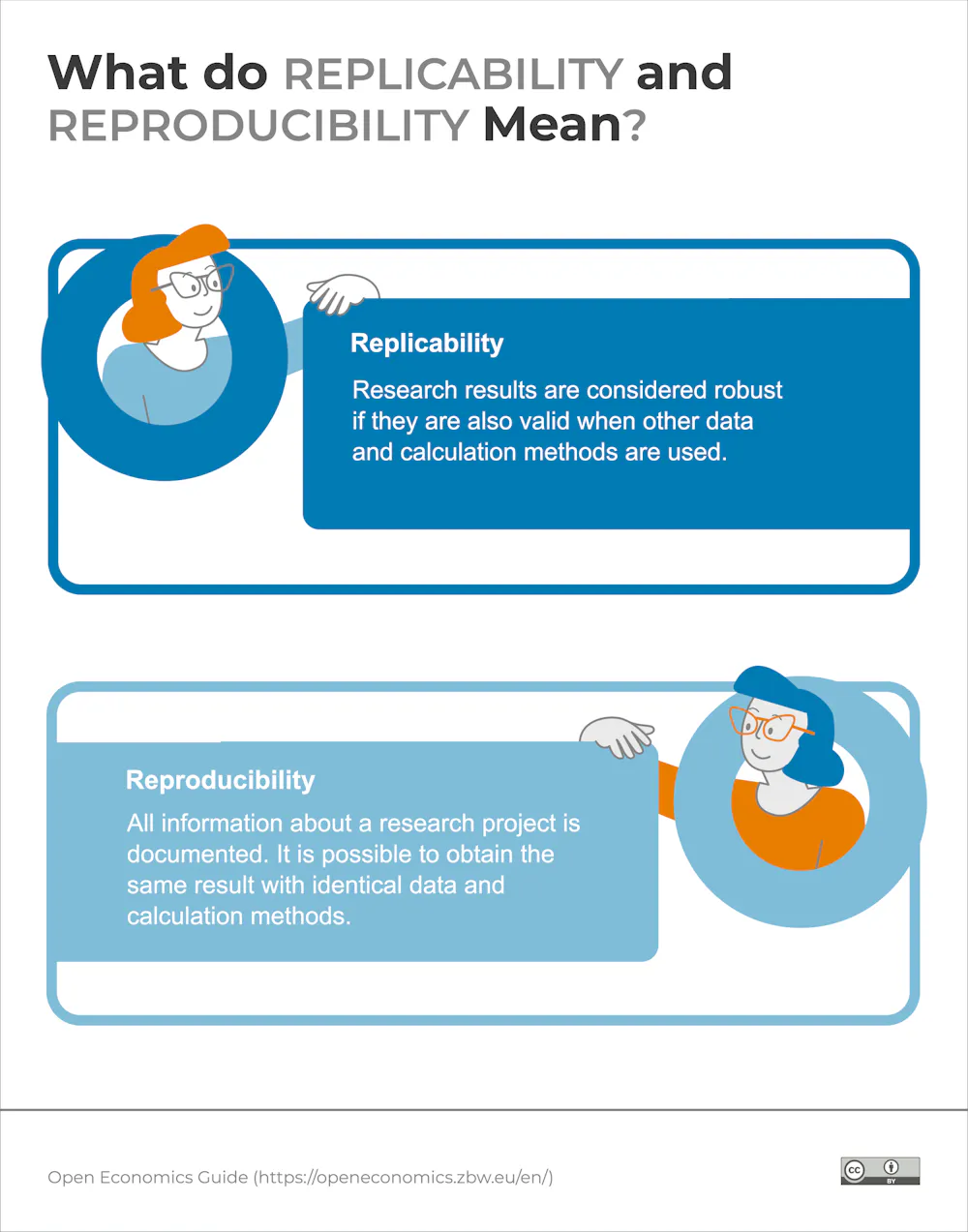
    A May 2025 executive order by President Donald Trump emphasized the “reproducibility crisis” in science. While replicability and reproducibility may sound similar, they’re distinct.

    Reproducibility is the ability to use the same data and methods from a study and reproduce the result. In my editorial role at the journal Psychological Science, I conduct computational reproducibility checks where we take the reported data and check that all the results in the paper can be reproduced independently.

    But we’re not running the study over again, or collecting new data. While reproducibility is important, research that is incorrect, fallible and sometimes harmful can still be reproducible.

    By contrast, replication is when an independent team repeats the same process, including collecting new data, to see if they get the same results. When research replicates, the team can be more confident that the results are not a fluke or an error.

    Reproducibility and replicability are both important, but have key differences.
    Open Economics Guide, CC BY

    The “replication crisis,” a term coined in psychology in the early 2010s, has spread to many fields, including biology, economics, medicine and computer science. Failures to replicate high-profile studies concern many scientists in these fields.

    Why replicate?

    Replicability is a core scientific value: Researchers want to be able to find the same result again and again. Many important findings are not published until they are independently replicated.

    In research, chance findings can occur. Imagine if one person flipped a coin 10 times and got two heads, then told the world that “coins have a 20% chance of coming up heads.” Even though this is an unlikely outcome – about 4% – it’s possible.

    Replications can correct these chance outcomes, as well as scientific errors, to ensure science is self-correcting.

    For example, in the search for the Higgs boson, two research centers at CERN, the European Council for Nuclear Research, ATLAS and CMS, independently replicated the detection of a particle with a large unique mass, leading to the 2013 Nobel Prize in physics.

    The ATLAS experiment at the Large Hadron Collider at CERN is one of two that led to the discovery of the Higgs boson.
    CERN, CC BY

    The initial measurements from the two centers actually estimated the mass of the particle as slightly different. So while the two centers didn’t find identical results, the teams evaluated them and determined they were close enough. This variability is a natural part of the scientific process. Just because results are not identical does not mean they are not reliable.

    Research centers like CERN have replication built into their process, but this is not feasible for all research. For projects that are relatively low cost, the original team will often replicate their work prior to publication – but doing so does not guarantee that an independent team could get the same results.

    Because the results on vaccine efficacy were so clear, replication wasn’t necessary and would have slowed the process of getting the vaccine to people.
    XKCD, CC BY-NC

    When projects are costly, urgent or time-specific, independently replicating them prior to disseminating results is often not feasible. Remember when people across the country were waiting for a COVID-19 vaccine?

    The initial Pfizer-BioNTech COVID-19 vaccine took 13 months from the start of the trial to authorization from the Food and Drug Administration. The results of the initial study were so clear and convincing that a replication would have unnecessarily delayed getting the vaccine out to the public and slowing the spread of disease.

    Since not every study can be replicated prior to publication, it’s important to conduct replications after studies are published. Replications help scientists understand how well research processes are working, identify errors and self-correct. So what’s the process of conducting a replication?

    The replication process

    Researchers could independently replicate the work of other teams, like at CERN. And that does happen. But when there are only two studies – the original and the replication – it’s hard to know what to do when they disagree. For that reason, large multigroup teams often conduct replications where they are all replicating the same study.

    Alternatively, if the purpose is to estimate the replicability of a body of research – for example, cancer biology – each team might replicate a different study, and the focus is on the percentage of studies that replicate across many studies.

    These large-scale replication projects have arisen around the world and include ManyLabs, ManyBabies, Psychological Accelerator and others.

    Replicators start by learning as much as possible about how the original study was conducted. They can collect details about the study from reading the published paper, discussing the work with its original authors and consulting online materials.

    The replicators want to know how the participants were recruited, how the data was collected and using what tools, and how the data was analyzed.

    But sometimes, studies may leave out important details, like the questions participants were asked or the brand of equipment used. Replicators have to make these difficult decisions themselves, which can affect the outcome.

    Replicators also often explicitly change details of the study. For example, many replication studies are conducted with larger samples – more participants – than the original study, to ensure the results are reliable.

    Registration and publication

    Sadly, replication research is hard to publish: Only 3% of papers in psychology, less than 1% in education and 1.2% in marketing are replications.

    If the original study replicates, journals may reject the paper because there is no “new insight.” If it doesn’t replicate, journals may reject the paper because they assume the replicators made a mistake – remember the salt crystals.

    Because of these issues, replicators often use registration to strengthen their claims. A preregistration is a public document describing the plan for the study. It is time-stamped to before the study is conducted.

    This type of document improves transparency by making changes in the plan detectable to reviewers. Registered reports take this a step further, where the research plan is subject to peer review before conducting the study.

    If the journal approves the registration, they commit to publishing the results of the study regardless of the results. Registered reports are ideal for replication research because the reviewers don’t know the results when the journal commits to publishing the paper, and whether the study replicates or not won’t affect whether it gets published.

    About 58% of registered reports in psychology are replication studies.

    Replication research often uses the highest standards of research practice: large samples and registration. While not all replication research is required to use these practices, those that do contribute greatly to our confidence in scientific results.

    Replication research is a useful thermometer to understand if scientific processes are working as intended. Active discussion of the replicability crisis, in both scientific and political spaces, suggests to many researchers that there is room for growth. While no field would expect a replication rate of 100%, new processes among scientists aim to improve the rates from those in the past.

    Amanda Kay Montoya is an Associate Professor at the University of California, Los Angeles. She serves on the Board of Directors for the Center for Open Science. She receives funding from the US-National Science Foundation.

    ref. Research replication can determine how well science is working – but how do scientists replicate studies? – https://theconversation.com/research-replication-can-determine-how-well-science-is-working-but-how-do-scientists-replicate-studies-260771

    MIL OSI Analysis

  • MIL-OSI USA: Malliotakis Celebrates Historic Investment to Improve Newark Airport

    Source: United States House of Representatives – Congresswoman Nicole Malliotakis (NY-11)

    (NEW YORK, NY) – Following the completion of the runway renovation and the FAA’s transition to a new fiber-optic network at Newark Liberty International Airport, even more investment is underway to modernize our aviation system. Congresswoman Nicole Malliotakis is celebrating Congressional approval of investments coming to Newark Airport, a convenient and frequently used hub for residents of Staten Island and Brooklyn. These historic investments are also being made at airports across the New York City area and the nation, aimed at improving air traffic control operations and overall reliability.


    In the One Big Beautiful Law, Congresswoman Malliotakis helped secure $12.5 billion to modernize Air Traffic Control systems across the nation including at Newark Airport. This investment is part of a larger $31 billion plan championed by President Trump to upgrade federal air traffic control infrastructure and bring America’s air traffic management system into the 21st century.


    “This historic investment marks a major step forward in modernizing our nation’s aviation infrastructure and improving the travel experience for millions of Americans with a priority on Newark Airport used by a vast majority of travelers from our district,” said Rep. Malliotakis. “I worked with Transportation Secretary Sean Duffy and my colleagues to deliver this infrastructure funding and ensure the Department of Transportation continues to prioritize upgrades at Newark Airport to improve passenger safety and reduce flight delays.


    Modernizing systems like radar, radios, and fiber-optic cables is critical to improving efficiency, reducing delays, and ensuring the safety of the public. As air travel demand grows, these investments will benefit the Staten Island and Brooklyn residents who depend on Newark as a key travel hub. Following the recent runway renovation and the FAA’s transition to a new fiber optic network at Newark, I will continue to support efforts to strengthen our aviation system and bring it into the 21st century.”

    MIL OSI USA News

  • China threatens to block Panama ports deal unless its shipping giant gets stake, WSJ reports

    Source: Government of India

    Source: Government of India (4)

    China is threatening to block the sale of more than 40 ports, owned by Hong Kong-based CK Hutchison, to BlackRock BLK.N and MediteAAACrranean Shipping Company (MSC) if Chinese shipping company Cosco does not get a stake, the Wall Street Journal reported on Thursday, citing unnamed sources.

    Reuters could not immediately verify the WSJ report.

    CK Hutchison, MSC, BlackRock and Cosco did not immediately respond to Reuters’ requests for a comment, while the Chinese government could not be immediately reached outside office hours.

    Chinese officials have told BlackRock, MSC and Hutchison that if Cosco is left out of the deal, Beijing would take steps to block Hutchison’s proposed sale of the ports, the newspaper said.

    Tycoon Li Ka-shing’s CK Hutchison in March announced it would sell its 80% holding in the ports business, which encompasses 43 ports in 23 countries. The business has an enterprise value of $22.8 billion, including debt.

    After much scrutiny and criticism in China, Hong Kong conglomerate CK Hutchison confirmed in May Italian billionaire Gianluigi Aponte’s family-run MSC, one of the world’s top container shipping groups, was the main investor in a group seeking to buy the ports.

    BlackRock, MSC and Hutchison all are open to Cosco taking a stake, WSJ said.

    However, the parties would likely not reach a deal before a previously agreed upon July 27 deadline for exclusive talks between BlackRock, MSC and Hutchison, the report added.

    The proposed sale has also drQAawn the attention of U.S. President Donald Trump, who has repeatedly expressed his desire to reduce Chinese influence around the Panama Canal and termed the deal a “reclaiming” of the waterway after it was first announced.

    (Reuters)

  • China threatens to block Panama ports deal unless its shipping giant gets stake, WSJ reports

    Source: Government of India

    Source: Government of India (4)

    China is threatening to block the sale of more than 40 ports, owned by Hong Kong-based CK Hutchison, to BlackRock BLK.N and MediteAAACrranean Shipping Company (MSC) if Chinese shipping company Cosco does not get a stake, the Wall Street Journal reported on Thursday, citing unnamed sources.

    Reuters could not immediately verify the WSJ report.

    CK Hutchison, MSC, BlackRock and Cosco did not immediately respond to Reuters’ requests for a comment, while the Chinese government could not be immediately reached outside office hours.

    Chinese officials have told BlackRock, MSC and Hutchison that if Cosco is left out of the deal, Beijing would take steps to block Hutchison’s proposed sale of the ports, the newspaper said.

    Tycoon Li Ka-shing’s CK Hutchison in March announced it would sell its 80% holding in the ports business, which encompasses 43 ports in 23 countries. The business has an enterprise value of $22.8 billion, including debt.

    After much scrutiny and criticism in China, Hong Kong conglomerate CK Hutchison confirmed in May Italian billionaire Gianluigi Aponte’s family-run MSC, one of the world’s top container shipping groups, was the main investor in a group seeking to buy the ports.

    BlackRock, MSC and Hutchison all are open to Cosco taking a stake, WSJ said.

    However, the parties would likely not reach a deal before a previously agreed upon July 27 deadline for exclusive talks between BlackRock, MSC and Hutchison, the report added.

    The proposed sale has also drQAawn the attention of U.S. President Donald Trump, who has repeatedly expressed his desire to reduce Chinese influence around the Panama Canal and termed the deal a “reclaiming” of the waterway after it was first announced.

    (Reuters)

  • MIL-OSI USA: Markey Rips Republicans for Gutting Public Broadcasting, Global Public Health Funding

    US Senate News:

    Source: United States Senator for Massachusetts Ed Markey
    Washington (July 17, 2025) – Senator Edward J. Markey (D-Mass.), a member of the Commerce, Science, and Transportation Committee, today issued the following statement after Senate Republicans passed a rescissions package that claws back more than $9 billion in congressionally appropriated funding, including over $1 billion from the Corporation for Public Broadcasting and $500 million from global public health programs. Senator Markey spoke on the Senate floor in support of his amendment that would have protected children’s educational programming from GOP cuts. Republicans defeated the amendment.
    “In the middle of the night, Republicans once again bent the knee to their wannabe King Donald, rubberstamping his cruel and callous cuts while robbing kids and communities of free, high quality public programming.
    “Republicans are making a Clifford-sized mistake by choosing Donald Trump and multi-billionaires over Daniel Tiger and Masterpiece Theater. By eliminating public media funding, Republicans are silencing rural broadcasters. They are stripping communities of essential emergency alert infrastructure. They are taking away trusted educational programming from millions of children. And by gutting global public health programs, they’re abandoning vulnerable populations around the world.
    “The consequences of this reckless package will be felt for years to come. But I am committed to ensuring that characters like Arthur and Molly of Denali can continue to educate our children, and that public radio and television stations can continue to connect and protect people in every community across America.”

    MIL OSI USA News

  • MIL-OSI Africa: East African countries and open borders: great strides, but still a long way to go

    Source: The Conversation – Africa – By Alan Hirsch, Senior Research Fellow New South Institute, Emeritus Professor at The Nelson Mandela School of Public Governance, University of Cape Town

    It’s not uncommon to find a Ugandan taxi driver in Rwanda’s capital, Kigali, just as one regularly meets Zimbabwean Uber drivers in South Africa. But there is a big difference. A Ugandan working in Rwanda most likely has a secure legal right to be there, whereas Zimbabweans working in South Africa are often uncertain of their current or future legality.

    East Africa has made greater strides towards the free flow of people crossing borders and seeking work than most of Africa. Only the Economic Community of West African States (Ecowas) is in the same league.

    While the African Union’s Free Movement of Persons protocol has faltered at a continental level, some of the regional economic communities have made progress. The Southern African Development Community (SADC) allows visa-free travel across almost all its borders.

    Ecowas and the East African Community (EAC) have driven ambitiously towards regional common markets including the freeing up of job-seeking, residential settlement and business development across the borders of member states.

    The New South Institute, a think-tank focused on governance reforms in the global south, is nearing the end of a research programme on migration governance reform in Africa. Our new report is on East Africa.

    We have found that unlike much of the global north, the African continent is moving towards more open borders for people. In some of the global south the promise of economic growth outweighs political fears. Yet progress is slow, and not coordinated. Mostly migration reform happens in regions and between neighbours.

    The progress in the East African Community is particularly notable compared with other African regional communities. We identify a number of reasons for this, including strong leadership and co-operation between state and non-state actors.

    The commitment to free movement

    The East African Community adopted its Common Market Protocol in 2010. The bloc is made up of Tanzania, Uganda, Kenya, Rwanda, Burundi, South Sudan, the DRC and Somalia.

    The regional body’s common market pact includes the movement of goods, services, capital and people. It gives people the right – on paper at least – to find employment across borders, the right to reside and the right to establish a business. There is also a commitment to the harmonisation and mutual recognition of academic and professional qualifications and labour policies to ease mobility.

    Even before the common market protocol, the regional bloc began to establish one-stop border posts on many of its internal borders to facilitate the flow of goods and people. Though they don’t all operate the same way or equally well, they have been successful at easing movement.

    Uneven outcomes

    The common market’s impact on the movement of people has been uneven within the region. Most integrated are Uganda, Kenya and Rwanda, which allow the cross-border movement of citizens with standardised identity documents – they do not need passports.

    It is also relatively easy to get jobs across these borders.

    Tanzania and Burundi are close to the inner circle but still require passports, though no visas. The three states which joined more recently, South Sudan, the DRC and Somalia, are all fragile states with governance systems that do not always meet the standards needed for acceptance into all the privileges of the regional bloc.

    In practice there is differential treatment. Generally, it is more difficult for citizens of the three latecomers to get regular access and jobs in their regional partners.

    Another limitation when it comes to the mobility of people is that little progress has been made in the formal harmonisation of education, health and social welfare systems between member states. This inhibits job seeking across borders.

    In addition, national labour laws, which tend to require permits for foreigners, still apply to varying degrees in the region. Some countries are more permissive. For example, Kenya, Uganda and Rwanda have a reciprocal no-fee work permit agreement.

    Another shortcoming has been that the outcomes of court processes in enforcing the freedom of movement have been disappointing. This is so even though the regional bloc has an active East African Court of Justice. Its legal mandate includes the enforcement of the bloc’s treaty and its protocols.

    In some cases the court has found that national actions inhibiting the movement of persons were trumped by the regional protocol. It has instructed the errant governments to comply. But its ability to enforce the decisions is minimal.

    Reasons for success

    Leadership has been important. The fact that the strongest economy in the region, Kenya, has been part of the leading echelon is significant.

    Rwanda and Uganda have led by example too. Rwanda was one of the first countries on the continent to offer visa-free entry to all other African countries. For its part, Uganda is widely admired for its refugee inclusion programmes.

    Another factor outlined in our report has been the opportunity for collaboration fostered by relationships between formal institutions, such as governments, and non-state actors such as the International Organisation for Migration. Interactions between these various players have created opportunities for officials and policymakers from states of the region to meet, discuss issues of concern, and develop relationships of trust and understanding.

    Another non-state donor-funded actor, TradeMark Africa, which was established in 2010 to support in the implementation of the common market in east Africa, provided considerable support. For example it supported the implementation of the regional One-Stop Border Post programme..

    Way forward

    Based on our report we identified changes that could make a positive difference.

    Firstly, the development of reliable, harmonised systems in the region to collect and manage data on population mobility and employment. This would build confidence that policy was being made on the basis of reliable information.

    Secondly, reducing friction in cross-border monetary transactions, including migrants’ remittances. This would make it easier for migrants to send some of their income to their countries of origin.

    Thirdly, improvements to population registers, identity documents, passports and cross-border migration management systems. Improvements would build mutual trust in the integrity of systems and pave the way for further commitments to lowering migration barriers.

    Fourth, cooperation on cross-border access to social services such as health and education. This is one of the most important intermediate steps towards freeing up mobility for the citizens of the region.

    Fifth, reconsidering some of the amendments made to weaken the East African Court of Justice in 2007. This would strengthen the de jure powers of the court, adding considerably to the entrenchment of cross-border rights in the region.

    Ultimately, the key constraint in the region is political and security instability, which holds back social and economic development. Nevertheless, incremental progress on mobility is possible despite issues in the fragile states, even though it may result in asymmetric progress within the East African Community.

    – East African countries and open borders: great strides, but still a long way to go
    – https://theconversation.com/east-african-countries-and-open-borders-great-strides-but-still-a-long-way-to-go-261021

    MIL OSI Africa

  • MIL-OSI USA: Welch Votes Against Defunding Global Health, Public Media 

    US Senate News:

    Source: United States Senator Peter Welch (D-Vermont)
    WASHINGTON, D.C.—Early this morning, U.S. Senator Peter Welch (D-Vt.) voted against President Trump’s rescissions bill, which claws back more than $9 billion in congressionally-appropriated funding for global health, foreign aid, and public media:  
    “This federal funding was negotiated on a bipartisan basis, passed with bipartisan support in both the Senate and House, and signed into law by President Trump. The rescissions bill is a reckless abandonment of our obligation as an independent branch of government to set spending. Republicans have, yet again, willingly ceded even more power to President Trump and Elon Musk’s DOGE,” said Senator Welch. “This bill has far-reaching, devastating impacts—the cuts to public media, global health, peacekeeping missions, and international food aid will hurt hundreds of millions of people, at home and around the world. My colleagues have made it clear that they will turn their backs on rural American communities and starving children to appease Donald Trump.” 
    The bill passed around 2:30am on Thursday.
    Senator Welch voted in support of amendments to protect funding for the Corporation for Public Broadcasting (CPB) and to restore funding for global health and food and nutrition aid programs. 
    The rescissions package, requested by President Trump and supported by Senate Republicans, would claw back millions of dollars in humanitarian assistance, foreign aid, and global health initiatives. This bill cuts funding for the United States Agency for International Development (USAID); the World Health Organization (WHO); United Nations peacekeeping missions; migration and refugee assistance programs; the Global Fund to Fight AIDS, Tuberculosis and Malaria; international food aid missions; the United States Institute of Peace (USIP); the United Nations Children’s Fund (UNICEF); and more.  
    Earlier this week Senator Welch called on Republicans to drop efforts to cut funding for the Global Fund, as well as President’s Emergency Plan for AIDS Relief (PEPFAR), the latter of which was removed from the rescissions package Tuesday.
    The Corporation for Public Broadcasting supports National Public Radio (NPR), the Public Broadcasting Service (PBS) and member stations across the United States. This bill would cut more than $1 billion in funding from the CPB, and hurt over 1,500 public radio and television stations across the country. Vermont stations received more than $2 million from the CPB in Fiscal Year 2024. Rural communities, families, and farmers rely on CPB-funded systems and news stations for lifesaving emergency alerts, breaking news, and educational programming.  
    Last week, Senator Welch spoke out against the president’s request cut funding for CPB and public media, saying “We must not abandon the people we represent and the right they have to public broadcasting. And we cannot abandon the trust we must have in one another to keep our word. An agreement made must be an agreement kept.” 

    MIL OSI USA News

  • G20 finance chiefs meet under tariff cloud in South Africa

    Source: Government of India

    Source: Government of India (4)

    South Africa urged G20 countries to provide global and cooperative leadership to tackle challenges including rising trade barriers as the club’s finance chiefs met on Thursday under the shadow of President Donald Trump’s tariff threats.

    The G20, which emerged as a forum for cooperation to combat the 2008 global financial crisis, has for years been hobbled by disputes among key players that have been exacerbated by Russia’s war in Ukraine and Western sanctions on Moscow.

    Host South Africa, under its presidency’s motto “Solidarity, Equality, Sustainability”, has aimed to promote an African agenda, with topics including the high cost of capital and funding for climate change action.

    In opening remarks, South Africa’s Finance Minister Enoch Godongwana said the G20 must provide strategic global leadership, cooperation and action in the face of complex challenges.

    “Many developing countries especially in Africa remain burdened by high and rising debt vulnerabilities, constrained fiscal space and high cost of capital that limits their ability to invest in their people and their futures,” he said.

    “The need for bold cooperative leadership has never been greater.”

    Questions, however, are lingering over the ability of the finance chiefs and central bankers meeting in the coastal city of Durban to tackle those issues and others together. The G20 aims to coordinate policies, but its agreements are non-binding.

    U.S. Treasury Secretary Scott Bessent will not attend the two-day meeting, his second absence from a G20 event in South Africa this year.

    Bessent also skipped February’s Cape Town gathering, where several officials from China, Japan and Canada were also absent, even though Washington is due to assume the G20 rotating presidency at the end of the year.

    Michael Kaplan, acting undersecretary for international affairs, will represent the United States at the meetings.

    A G20 delegate, who asked not to be named, said Bessent’s absence was not ideal but that the U.S. was engaging in discussions on trade, the global economy and climate language.

    Finance ministers from India, France and Russia are also set to miss the Durban meeting.

    South Africa’s central bank governor Lesetja Kganyago said that representation was what mattered most.

    “What matters is, is there somebody with a mandate sitting behind the flag and are all countries represented with somebody sitting behind the flag?” Kganyago told Reuters.

    U.S. officials have said little publicly about their plans for the presidency next year, but one source familiar with them said Washington would reduce the number of non-financial working groups and streamline the summit schedule.

    Brad Setser, a former U.S. official now at the Council on Foreign Relations, said he expected it to be “kind of a scaled-back G20 with less expectation of substantive outcomes.”

    TARIFF SHADOW

    Trump’s tariff policies have torn up the global trade rule book. With baseline levies of 10% on all U.S. imports and targeted rates as high as 50% on steel and aluminium, 25% on autos and potential levies on pharmaceuticals, extra tariffs on more than 20 countries are slated to take effect on August 1.

    His threat to impose further 10% tariffs on BRICS nations — of which eight are G20 members — has raised fears of fragmentation within global forums.

    German Finance Minister Lars Klingbeil said in Durban on Thursday that Europe was engaged in constructive talks with the U.S. on tariffs but was prepared to take countermeasures if necessary.

    He also said Germany and Europe must demonstrate they are safe destinations for investment.

    South Africa’s Treasury Director General Duncan Pieterse said the group hoped to issue the first communique under the South African G20 presidency by the end of the meetings.

    The G20 was last able to collectively issue a communique in July of 2024, mutually agreeing on the need to resist protectionism but making no mention of Russia’s invasion of Ukraine.

    (Reuters)


  • G20 finance chiefs meet under tariff cloud in South Africa

    Source: Government of India

    Source: Government of India (4)

    South Africa urged G20 countries to provide global and cooperative leadership to tackle challenges including rising trade barriers as the club’s finance chiefs met on Thursday under the shadow of President Donald Trump’s tariff threats.

    The G20, which emerged as a forum for cooperation to combat the 2008 global financial crisis, has for years been hobbled by disputes among key players that have been exacerbated by Russia’s war in Ukraine and Western sanctions on Moscow.

    Host South Africa, under its presidency’s motto “Solidarity, Equality, Sustainability”, has aimed to promote an African agenda, with topics including the high cost of capital and funding for climate change action.

    In opening remarks, South Africa’s Finance Minister Enoch Godongwana said the G20 must provide strategic global leadership, cooperation and action in the face of complex challenges.

    “Many developing countries especially in Africa remain burdened by high and rising debt vulnerabilities, constrained fiscal space and high cost of capital that limits their ability to invest in their people and their futures,” he said.

    “The need for bold cooperative leadership has never been greater.”

    Questions, however, are lingering over the ability of the finance chiefs and central bankers meeting in the coastal city of Durban to tackle those issues and others together. The G20 aims to coordinate policies, but its agreements are non-binding.

    U.S. Treasury Secretary Scott Bessent will not attend the two-day meeting, his second absence from a G20 event in South Africa this year.

    Bessent also skipped February’s Cape Town gathering, where several officials from China, Japan and Canada were also absent, even though Washington is due to assume the G20 rotating presidency at the end of the year.

    Michael Kaplan, acting undersecretary for international affairs, will represent the United States at the meetings.

    A G20 delegate, who asked not to be named, said Bessent’s absence was not ideal but that the U.S. was engaging in discussions on trade, the global economy and climate language.

    Finance ministers from India, France and Russia are also set to miss the Durban meeting.

    South Africa’s central bank governor Lesetja Kganyago said that representation was what mattered most.

    “What matters is, is there somebody with a mandate sitting behind the flag and are all countries represented with somebody sitting behind the flag?” Kganyago told Reuters.

    U.S. officials have said little publicly about their plans for the presidency next year, but one source familiar with them said Washington would reduce the number of non-financial working groups and streamline the summit schedule.

    Brad Setser, a former U.S. official now at the Council on Foreign Relations, said he expected it to be “kind of a scaled-back G20 with less expectation of substantive outcomes.”

    TARIFF SHADOW

    Trump’s tariff policies have torn up the global trade rule book. With baseline levies of 10% on all U.S. imports and targeted rates as high as 50% on steel and aluminium, 25% on autos and potential levies on pharmaceuticals, extra tariffs on more than 20 countries are slated to take effect on August 1.

    His threat to impose further 10% tariffs on BRICS nations — of which eight are G20 members — has raised fears of fragmentation within global forums.

    German Finance Minister Lars Klingbeil said in Durban on Thursday that Europe was engaged in constructive talks with the U.S. on tariffs but was prepared to take countermeasures if necessary.

    He also said Germany and Europe must demonstrate they are safe destinations for investment.

    South Africa’s Treasury Director General Duncan Pieterse said the group hoped to issue the first communique under the South African G20 presidency by the end of the meetings.

    The G20 was last able to collectively issue a communique in July of 2024, mutually agreeing on the need to resist protectionism but making no mention of Russia’s invasion of Ukraine.

    (Reuters)


  • MIL-OSI USA: DHS Statement on Capture of Violent Extremist Involved in Prairieland Attack on ICE Agents

    Source: US Federal Emergency Management Agency

    Headline: DHS Statement on Capture of Violent Extremist Involved in Prairieland Attack on ICE Agents

    Song, a former U

    S

    Marine Corps reservist, joined a violent group of at least 10 individuals in opening fire on officers at the federal facility just after 10:30 p

    m

    on Independence Day

    He is charged with three counts of attempted murder of federal agents and three counts of discharging a firearm during a crime of violence

    His capture brings the total number of arrests in the attack to 14

    Image

    “On Independence Day, as Americans were celebrating our freedoms, a group of violent extremists attempted to assassinate federal officers protecting us from violent criminals,” said Assistant Secretary Tricia McLaughlin

    “Song’s arrest sends a clear message: under President Trump and Secretary Noem, if you lay a hand on an ICE agent, you will NOT walk free

    We will not forget, and we will not rest until every attacker is in custody

    ” 

    The Prairieland Detention Center, which housed more than 1,000 illegal aliens on the night of the attack, includes detainees with convictions for rape, child molestation, murder, kidnapping, arson, human trafficking, and terrorism

    Nearly 50 known members of MS-13, Tren de Aragua, and other transnational gangs were among the detainees, in addition to 13 Known or Suspected Terrorists (KSTs)

    This is just the latest in a disturbing pattern of politically motivated violence targeting DHS personnel

    Last week, ICE officers conducting enforcement operations in San Francisco were assaulted by violent protestors

    In June, rioters stormed an ICE field office in Portland

    ICE agents are now facing an 830% increase in assaults against them

    DHS and its law enforcement partners continue working around the clock to identify, arrest, and prosecute anyone involved in the July 4 ambush or other coordinated attacks against federal officers

     
    ###

    MIL OSI USA News

  • MIL-OSI USA: DHS Statement on Capture of Violent Extremist Involved in Prairieland Attack on ICE Agents

    Source: US Federal Emergency Management Agency

    Headline: DHS Statement on Capture of Violent Extremist Involved in Prairieland Attack on ICE Agents

    Song, a former U

    S

    Marine Corps reservist, joined a violent group of at least 10 individuals in opening fire on officers at the federal facility just after 10:30 p

    m

    on Independence Day

    He is charged with three counts of attempted murder of federal agents and three counts of discharging a firearm during a crime of violence

    His capture brings the total number of arrests in the attack to 14

    Image

    “On Independence Day, as Americans were celebrating our freedoms, a group of violent extremists attempted to assassinate federal officers protecting us from violent criminals,” said Assistant Secretary Tricia McLaughlin

    “Song’s arrest sends a clear message: under President Trump and Secretary Noem, if you lay a hand on an ICE agent, you will NOT walk free

    We will not forget, and we will not rest until every attacker is in custody

    ” 

    The Prairieland Detention Center, which housed more than 1,000 illegal aliens on the night of the attack, includes detainees with convictions for rape, child molestation, murder, kidnapping, arson, human trafficking, and terrorism

    Nearly 50 known members of MS-13, Tren de Aragua, and other transnational gangs were among the detainees, in addition to 13 Known or Suspected Terrorists (KSTs)

    This is just the latest in a disturbing pattern of politically motivated violence targeting DHS personnel

    Last week, ICE officers conducting enforcement operations in San Francisco were assaulted by violent protestors

    In June, rioters stormed an ICE field office in Portland

    ICE agents are now facing an 830% increase in assaults against them

    DHS and its law enforcement partners continue working around the clock to identify, arrest, and prosecute anyone involved in the July 4 ambush or other coordinated attacks against federal officers

     
    ###

    MIL OSI USA News

  • MIL-OSI USA: Governor Newsom calls on Trump to end Los Angeles militarization, shares community resources

    Source: US State of California 2

    Jul 16, 2025

    What you need to know: Governor Newsom visited local businesses in the Los Angeles area that have been impacted by the federal government’s indiscriminate immigration raids, called on Trump to end his deployment of soldiers, and shared new “know your rights” resources with the community.

    LOS ANGELESProviding support to local communities impacted by federal immigration enforcement actions, Governor Gavin Newsom today met with business owners and faith leaders in the Los Angeles area.

    Enough is enough – Stephen Miller and Trump’s chaos campaign needs to end now. They are violating constitutional rights, terrorizing neighborhoods and businesses, and targeting people because of their skin color and the language they speak. These heartless and cruel actions have real consequences for our economy and society.

    Governor Gavin Newsom

    Visiting with community members

    Governor Newsom met with local restaurant owners of Cuernavaca’s Grill in the City of Bell to discuss the economic impact these indiscriminate immigration actions have had on their small business.

    The Governor then stopped by a church in Downey that recently was targeted by federal immigration agents. 

    Economic impact of this cruel policy

    Trump’s actions have a chilling effect – the state’s economy is likely to contract later this year due to fallout from global tariffs and immigration raids in Los Angeles and other cities that have rattled key sectors, including construction, hospitality, and agriculture, according to a UCLA Anderson forecast.

    Mass deportations in California could slash $275 billion from the state’s economy and eliminate $23 billion in annual tax revenue. The loss of immigrant labor would delay projects (including rebuilding Los Angeles after the wildfires), reduce food supply, and drive up costs.

    Undocumented immigrants contributed $8.5 billion in state and local taxes in 2022 — a number that would rise to $10.3 billion if these taxpayers could apply to work lawfully.

    New resource for community 

    Trump’s militarization of Los Angeles has also led to increasingly concerning tactics by federal immigration enforcement, including violating the law and people’s constitutional rights. Families are being terrorized by the broad enforcement efforts targeting Latino neighborhoods, harming U.S. citizens, and racially profiling families and workers. That’s why it’s important to remember the following if you are affected by a federal immigration action:

    • You can observe and record public immigration arrests, but stay calm and at a safe distance to avoid risk to yourself and others.
    • Do not interfere or argue with federal agents. Physical obstruction or verbal escalation can put your safety at risk and may lead to criminal charges.
    • Agents don’t need a judge-signed warrant to arrest someone in public — but do need one to enter non-public areas of private property.
    • Prepare yourself and your family in case you are arrested. Memorize the phone numbers of your family members and your lawyer. Make emergency plans if you have children or take medication. 

    For more information on helpful community resources, the Governor’s Office has released new factsheets here in English and here in Spanish.

    End the militarization of LA now

    For over a month, about 4,000 National Guard members have been serving as political pawns for the President in Los Angeles, pulled away from their families, communities, and civilian jobs. While half are just now beginning to demobilize, many remain without a clear mission, direction, or a timeline for returning to their communities. California urges Trump and the Department of Defense to end this theatrical deployment and send all remaining guardsmembers home immediately.

    The federal government can enforce immigration laws and keep us safe without violating our rights, terrorizing entire communities, breaking the law, disrupting the economy, and raising costs for families. 

    Recent news

    News What you need to know: Residents impacted by the Eaton and Palisades fires have an opportunity to help directly shape the next steps of rebuilding their communities. The first phase of the engagement with fire survivors has led to a series of early actions guided…

    News What you need to know: On July 17, the LGBTQ support option on the 988 Suicide & Crisis Lifeline will end thanks to the Trump administration – but California is stepping up and doubling down on life-saving support for young gay people in crisis.  LOS…

    News LOS ANGELES COUNTY — Governor Gavin Newsom will hold a media availability to speak on the federal government’s demobilization of 2,000 National Guard members, as well as the effect of immigration raids on immigrant communities across California.WHEN: Wednesday,…

    MIL OSI USA News

  • MIL-OSI USA: Governor Newsom invites LA Fire survivors to continue shaping rebuilding efforts through Engaged California

    Source: US State of California 2

    Jul 16, 2025

    What you need to know: Residents impacted by the Eaton and Palisades fires have an opportunity to help directly shape the next steps of rebuilding their communities. The first phase of the engagement with fire survivors has led to a series of early actions guided by residents’ input, including streamlined permitting technology for local communities.

    LOS ANGELES – Today, Governor Gavin Newsom is urging anyone who was affected by the LA fires in January to sign up for the Engaged California platform and use their voice to shape the rebuilding of their community. This call to action is for anyone who has lived or worked in, or was impacted by the evacuation zones in the path of the Eaton and Palisades fires.

    “Recovery isn’t something that happens to you, it happens with you. The feedback generated from the Engaged California process is reflective of residents’ experiences and is needed for leaders to understand their vision for rebuilding the future. Engaged California is designed to build trust and understanding of what actions need to be taken. I am very grateful to everyone who has participated so far. We are just getting started.”

    Governor Gavin Newsom

    After signing up, individuals affected by the evacuation zones will be invited to the program’s platform to share ideas on rebuilding Altadena and the Palisades, weighing choices that can guide recovery in both the short and long term.

    “Engaged California has given us valuable insight into how people are feeling in a moment of unimaginable tragedy,” said California Government Operations Secretary Nick Maduros. “This next step will be pivotal for us to listen and learn about how rebuilding should look according to those who experienced it firsthand.”

    You spoke. We listened.

    Engaged California was piloted as part of the administration’s response to the fire recovery, and nearly 8,000 people have signed up. It marks the first time California has used a dedicated, open digital tool to gather wildfire survivor input at this scale

    Launching in February, participants began to share comments as they prioritized topics for wildfire recovery from mid-March through May 16. Residents were asked to weigh in on 10 recovery topics, including housing and infrastructure, emotional well-being, and wildfire prevention.

    “This is a significant milestone in a brand-new program for the State of California,” said Office of Data and Innovation Director Jeffery Marino. “The voices of Californians impacted by the fires are being heard by their government and used to make data-driven decisions. This early action shows it is possible to have a two-way conversation between Californians and their government that results in meaningful, impactful outcomes.” 

    Early actions

    Here are a few examples of the early actions taken that deliver on what survivors said they need

    Provide clear and affordable rebuilding pathways

    Residents said they want an easier permit process and less red tape for rebuilding.

    ✅ Action taken: The state launched Archistar, a new artificial intelligence-driven software tool to aid Los Angeles City and County in accelerating the approval process for rebuilding permits. This week marked the beta launch of the new AI permitting tool made possible by a partnership between the state and philanthropic partners, including LA Rises. The tool aims to fast-track the approval process for rebuilding permits to help Angelenos get back into their homes following the Eaton and Palisades fires. 

    ✅ Action taken: Launched the CalAssist Mortgage Fund to assist homeowners whose homes were destroyed or left uninhabitable.

    Mental health

    Residents expressed a need for mental health support.

    ✅ Action taken: There are many resources available now on the ca.gov/lafires recovery website, including immediate assistance, ongoing support, and care for all age groups and language needs. Yesterday, the Governor also announced a new public outreach campaign with LA Rises, which will connect and support impacted Angelenos with key resources and share stories of community efforts to recover and rebuild for the long term in the aftermath of the Eaton and Palisades fires.

    Efficient, effective, and engaged

    Since the start of his administration in 2019, Governor Newsom has made efficiency and engagement a top priority, implementing new technologies and practices that make government more efficient and responsive to the people it serves. In 2019, the Governor established the Office of Data Innovation to help advance this important work and yesterday announced a new effort through the California Breakthrough Project —  which brings together innovators and leaders from the Golden State’s top tech companies to help guide this work

    As the birthplace of the tech industry, California is at the forefront in the study and implementation of AI in government. In 2023, Governor Newsom issued an executive order directing the state to utilize Generative AI technologies to improve state services and help solve important issues. Since that time, the state has integrated AI and other efficiency solutions to make state government work faster and even more effectively.

    Engaged California is a bold, new state program that elevates the voices of survivors through a digital platform. They opt in and share their thoughts while connecting with other people in their communities on topics that are important to them. The comments are anonymous and will remain anonymous. You can read all comments in full here.

    To get involved in the rebuilding conversation, visit engaged.ca.gov and sign up. 

    Press releases, Recent news

    Recent news

    News What you need to know: On July 17, the LGBTQ support option on the 988 Suicide & Crisis Lifeline will end thanks to the Trump administration – but California is stepping up and doubling down on life-saving support for young gay people in crisis.  LOS…

    News LOS ANGELES COUNTY — Governor Gavin Newsom will hold a media availability to speak on the federal government’s demobilization of 2,000 National Guard members, as well as the effect of immigration raids on immigrant communities across California.WHEN: Wednesday,…

    News What you need to know: Productions filmed in California are raking in the nominations in this year’s Emmy bids.  SACRAMENTO –  Today, the nominees for the 77th Emmy Awards were announced, with California-based television productions securing at least 104…

    MIL OSI USA News

  • MIL-OSI Africa: International Relations (IR) Committee Launches People-Centred Oversight Mechanism in Western Cape

    Source: APO


    .

    The Portfolio Committee on International Relations and Cooperation yesterday successfully launched the People-Centred Oversight Mechanism in the Western Cape where there were traditional leaders, academics, students and representatives from different non-governmental organisations.

    The Chairperson of the committee, Mr Supra Mahumapelo, said the People-Centred Oversight Mechanism is an initiative of the committee to ensure that ordinary citizens in villages, townships and small towns have a say in foreign policy and international trade relations that impact on their lives.

    The committee heard from the Western Cape legislature that no one must be left behind when it comes to international and trade relations and these policies have an impact on job creation and the economy of the country.

    There was a call to link trade agreements negotiated by the DIRCO and the Department of Trade, Industry and Competition with local governments that are affected by those agreements. That will ensure that municipalities will have a say in these agreements and implementation is at local level.

    Student representatives from the universities of the Western Cape, Cape Town and Stellenbosch appealed for opportunities for students to be able to participate in international trade delegations and in the drafting of policies on international relations. They called for inclusion in decision making as the future leaders of the country.

    The women’s wing of the Congress of Traditional Leaders of South Africa welcomed the opportunity to engage with the committee. The role of the DIRCO is significant and the management of the influx of refugees is a challenge that requires engagement with all stakeholders. There is little engagement with traditional leaders in this regard. With the incorporation of the traditional leadership, social cohesion will be enhanced.

    With reference to the United States (USA), the opposition parties in the Western Cape Legislature reiterated the need for the province to send a positive message to the international community that South Africa is a united country especially when there are utterances that impact on the economic policy of South Africa.

    Labour unions positively viewed the engagement and called for more such dialogues so that workers on the ground can understand what foreign policy is and informed the committee that there is a need for structured platforms so that information reaches the workers. A call was made to the DIRCO to use social media platforms to disseminate information to inform workers and ordinary people on the ground about what is happening internationally.

    COSATU representatives called for all international agreements to translate into job creation in the country. The representative called for migrant workers to be protected and there should be a labour impact assessment in countries that export goods to South Africa. The impact of imported goods from the European Union and China have an impact on local jobs.

    Africa’s Growth and Opportunity Act was passed as part of the Trade and Development Act of 2000 in the USA. It provides duty- free access to the USA market for almost all products from more than 40 eligible sub-Saharan African countries including South Africa. The impact of the 30% increase on tariffs on exports needs to be engaged on.

    The committee heard the sentiment among the people about the importance of the oversight mechanism and their hope for its effectiveness. Representatives also called for monitoring and evaluation of the oversight mechanism, transparency and accessibility. The committee will upon the end of the launch proramme at all the nine provinces, develop monitoring and evaluation mechanism for the programme.

    The Chairperson of the committee, Mr Supra Mahumapelo said that going forward the DIRCO will provide reports on Trade Agreements and their impact on a quarterly basis. The reports will include the volume of minerals/products produced and released in SA for export. He said: “ Together with the Portfolio Committee on Employment and Labour we must be able to engage with our counterparts on the trumpeting tariffs of the US.”

    Mr Mahumapelo said workers in South Africa must be able to understand how the utterances of the US affect the economic growth of South Africa. The People-Centred Oversight Mechanism has been launched in Mpumalanga, North West and Gauteng provinces. The committee strives to complete to launch the programme in the remaining five provinces by early next year 2026.”

    Distributed by APO Group on behalf of Republic of South Africa: The Parliament.

    MIL OSI Africa

  • MIL-OSI Submissions: East African countries and open borders: great strides, but still a long way to go

    Source: The Conversation – Africa – By Alan Hirsch, Senior Research Fellow New South Institute, Emeritus Professor at The Nelson Mandela School of Public Governance, University of Cape Town

    It’s not uncommon to find a Ugandan taxi driver in Rwanda’s capital, Kigali, just as one regularly meets Zimbabwean Uber drivers in South Africa. But there is a big difference. A Ugandan working in Rwanda most likely has a secure legal right to be there, whereas Zimbabweans working in South Africa are often uncertain of their current or future legality.

    East Africa has made greater strides towards the free flow of people crossing borders and seeking work than most of Africa. Only the Economic Community of West African States (Ecowas) is in the same league.

    While the African Union’s Free Movement of Persons protocol has faltered at a continental level, some of the regional economic communities have made progress. The Southern African Development Community (SADC) allows visa-free travel across almost all its borders.

    Ecowas and the East African Community (EAC) have driven ambitiously towards regional common markets including the freeing up of job-seeking, residential settlement and business development across the borders of member states.

    The New South Institute, a think-tank focused on governance reforms in the global south, is nearing the end of a research programme on migration governance reform in Africa. Our new report is on East Africa.

    We have found that unlike much of the global north, the African continent is moving towards more open borders for people. In some of the global south the promise of economic growth outweighs political fears. Yet progress is slow, and not coordinated. Mostly migration reform happens in regions and between neighbours.

    The progress in the East African Community is particularly notable compared with other African regional communities. We identify a number of reasons for this, including strong leadership and co-operation between state and non-state actors.

    The commitment to free movement

    The East African Community adopted its Common Market Protocol in 2010. The bloc is made up of Tanzania, Uganda, Kenya, Rwanda, Burundi, South Sudan, the DRC and Somalia.

    The regional body’s common market pact includes the movement of goods, services, capital and people. It gives people the right – on paper at least – to find employment across borders, the right to reside and the right to establish a business. There is also a commitment to the harmonisation and mutual recognition of academic and professional qualifications and labour policies to ease mobility.

    Even before the common market protocol, the regional bloc began to establish one-stop border posts on many of its internal borders to facilitate the flow of goods and people. Though they don’t all operate the same way or equally well, they have been successful at easing movement.

    Uneven outcomes

    The common market’s impact on the movement of people has been uneven within the region. Most integrated are Uganda, Kenya and Rwanda, which allow the cross-border movement of citizens with standardised identity documents – they do not need passports.

    It is also relatively easy to get jobs across these borders.

    Tanzania and Burundi are close to the inner circle but still require passports, though no visas. The three states which joined more recently, South Sudan, the DRC and Somalia, are all fragile states with governance systems that do not always meet the standards needed for acceptance into all the privileges of the regional bloc.

    In practice there is differential treatment. Generally, it is more difficult for citizens of the three latecomers to get regular access and jobs in their regional partners.

    Another limitation when it comes to the mobility of people is that little progress has been made in the formal harmonisation of education, health and social welfare systems between member states. This inhibits job seeking across borders.

    In addition, national labour laws, which tend to require permits for foreigners, still apply to varying degrees in the region. Some countries are more permissive. For example, Kenya, Uganda and Rwanda have a reciprocal no-fee work permit agreement.

    Another shortcoming has been that the outcomes of court processes in enforcing the freedom of movement have been disappointing. This is so even though the regional bloc has an active East African Court of Justice. Its legal mandate includes the enforcement of the bloc’s treaty and its protocols.

    In some cases the court has found that national actions inhibiting the movement of persons were trumped by the regional protocol. It has instructed the errant governments to comply. But its ability to enforce the decisions is minimal.

    Reasons for success

    Leadership has been important. The fact that the strongest economy in the region, Kenya, has been part of the leading echelon is significant.

    Rwanda and Uganda have led by example too. Rwanda was one of the first countries on the continent to offer visa-free entry to all other African countries. For its part, Uganda is widely admired for its refugee inclusion programmes.

    Another factor outlined in our report has been the opportunity for collaboration fostered by relationships between formal institutions, such as governments, and non-state actors such as the International Organisation for Migration. Interactions between these various players have created opportunities for officials and policymakers from states of the region to meet, discuss issues of concern, and develop relationships of trust and understanding.

    Another non-state donor-funded actor, TradeMark Africa, which was established in 2010 to support in the implementation of the common market in east Africa, provided considerable support. For example it supported the implementation of the regional One-Stop Border Post programme..

    Way forward

    Based on our report we identified changes that could make a positive difference.

    Firstly, the development of reliable, harmonised systems in the region to collect and manage data on population mobility and employment. This would build confidence that policy was being made on the basis of reliable information.

    Secondly, reducing friction in cross-border monetary transactions, including migrants’ remittances. This would make it easier for migrants to send some of their income to their countries of origin.

    Thirdly, improvements to population registers, identity documents, passports and cross-border migration management systems. Improvements would build mutual trust in the integrity of systems and pave the way for further commitments to lowering migration barriers.

    Fourth, cooperation on cross-border access to social services such as health and education. This is one of the most important intermediate steps towards freeing up mobility for the citizens of the region.

    Fifth, reconsidering some of the amendments made to weaken the East African Court of Justice in 2007. This would strengthen the de jure powers of the court, adding considerably to the entrenchment of cross-border rights in the region.

    Ultimately, the key constraint in the region is political and security instability, which holds back social and economic development. Nevertheless, incremental progress on mobility is possible despite issues in the fragile states, even though it may result in asymmetric progress within the East African Community.

    Alan Hirsch’s work on migration governance is part of his responsibilities while employed as a Senior Research Fellow at the New South Institute.

    ref. East African countries and open borders: great strides, but still a long way to go – https://theconversation.com/east-african-countries-and-open-borders-great-strides-but-still-a-long-way-to-go-261021

    MIL OSI

  • MIL-OSI United Kingdom: ODIHR’s latest report adds to the mountain of evidence detailing serious concerns with Russia’s actions in Ukraine: UK statement to the OSCE

    Source: United Kingdom – Executive Government & Departments

    Speech

    ODIHR’s latest report adds to the mountain of evidence detailing serious concerns with Russia’s actions in Ukraine: UK statement to the OSCE

    Ambassador Holland condemns Russia’s appalling actions in Ukraine – including civilians deaths, CRSV and widespread use of torture – as detailed in ODIHR’s seventh interim report on reported violations of international humanitarian law and international human rights law in Ukraine.

    Thank you, Mr Chair.  Today I would like to address the issue of civilian casualties from Russia’s war in Ukraine.

    Firstly, every death in this conflict is a tragedy.  These are people, not statistics, and for each life lost, many more are destroyed as a result.  We cannot allow the normalisation of such death and destruction here or anywhere else.

    Secondly, we must remember that Russia chose to start this war.  There was no threat to Russia or Russians or Russian speakers in Ukraine.  What Russia feared was Ukraine escaping Moscow’s orbit.  It feared a prosperous, successful and sovereign Ukraine on its doorstep.  The responsibility for the increased risk to Russians, Ukrainians and our collective security sits squarely with Moscow.

    But just as President Putin chose to start this war, he could choose to end it.  President Trump has called for the senseless killing to stop and proposed an immediate and unconditional ceasefire.  Ukraine agreed to it.  Russia rejected it.  Despite Moscow’s attempts to obfuscate, these are the facts.

    Thirdly, Mr Chair, when it comes to civilian casualties, let us remember that Ukraine permits access to independent organisations who provide impartial reporting and verification of developments on the ground.  Many of these, including the UN Independent International Commission of Inquiry on Ukraine, have requested equal access to Russia.  But these requests have been denied.  We strongly urge Russia to allow access by independent international bodies who can offer impartial analysis of incidents in the Russian Federation, which would be of benefit to all OSCE participating States.

    A timely example of factual reporting from an independent organisation, this week ODIHR published their seventh interim report on reported violations of international humanitarian law and international human rights law in Ukraine.  The report covers some of the deeply concerning issues that we have raised in this room.  For example, ODIHR reported that in the six months to 31 May 2025, the number of verified civilian casualties in Government-controlled areas of Ukraine was over 50% higher than in the corresponding period in 2024.

    ODIHR’s report also covered the 4 April attack on Kryvyi Rih, which involved a Russian ballistic missile hitting a playground and killing 20 civilians, including nine children.  Colleagues will remember that we held a Special Permanent Council on this shocking incident.  ODIHR states: “Following analysis of photographs and videos, as well as eye-witness statements and other publicly available evidence, ODIHR has reasonable grounds to believe that, contrary to the Russian Federation’s claims, there were no military objectives in the area immediately prior to or at the time of the strike.”

    There is much more of concern in ODIHR’s report, including testimony that conflict-related sexual violence is intensifying and increasingly cruel.  And the reconfirmation of ODIHR’s previous findings on the widespread and systematic use of torture by the Russian authorities against detained Ukrainian civilians and POWs. We are appalled by these findings and urge the full implementation of the recommendations within the report.

    Thank you, Mr Chair.

    Updates to this page

    Published 17 July 2025

    MIL OSI United Kingdom

  • MIL-OSI USA: Hoeven Statement on Senate Passage of President Trump’s Rescissions Request Legislation Makes $9 Billion in Spending Cuts

    US Senate News:

    Source: United States Senator for North Dakota John Hoeven
    07.17.25
    WASHINGTON – Senator John Hoeven issued the following statement after the Senate approved President Trump’s request to rescind $9 billion in wasteful spending. The White House submitted the rescissions package, which represents less than one-tenth of 1 percent of the federal budget, to Congress for consideration.
    “The American people have made it clear that we need to get control of our debt and deficit,” said Hoeven. “This package represents a fraction of our federal budget but is an important step in reining in federal spending. The vast majority of the rescissions come from foreign aid, and will help get rid of projects we shouldn’t be funding.”

    MIL OSI USA News

  • MIL-OSI China: US to impose uniform tariff rate on over 150 economies: Trump

    Source: People’s Republic of China – State Council News

    U.S. President Donald Trump on Wednesday unveiled a plan to impose a unified tariff rate on more than 150 countries and regions, according to a report by Politico.

    “It’s all going to be the same for everyone, for that group,” Trump told reporters during talks with Bahrain’s Crown Prince Salman bin Hamad Al Khalifa at the White House.

    Those to be covered under the new measure are described by Trump as “not big,” and ones that “don’t do that much business.”

    In April, the Trump administration introduced a baseline tariff of 10 percent on economies not covered by bilateral deals. Although Trump has previously suggested the new baseline could be raised to 15 percent or 20 percent, he did not specify a new rate on Wednesday.

    The U.S. government has already sent letters to about two dozen economies — including the European Union, Japan and South Korea — outlining the tariff rates they will face starting Aug. 1, the report said. The announcement has prompted intensified negotiations as affected trading partners seek more favorable terms.

    However, analysts and observers continue to express doubts about whether the new tariff schedule will take effect as planned on Aug. 1, amid concerns about its potential impact on the U.S. economy and domestic politics, according to the report.

    Countries and regions such as Switzerland and India, which accounted for more than 3 percent of the U.S. trade deficit in 2024 but have not yet received official notices, remain in negotiation with Washington.

    Trump sent mixed messages Wednesday on U.S.-India trade talks, first stating “we have another (deal) coming up,” then later asserting “we’re very close to a deal.”

    Regarding Japan, Trump said negotiations are underway but expressed doubt about the outcome.

    “I think we’ll probably live by the letter with Japan,” he said, referring to a previously issued tariff notification.

    MIL OSI China News

  • US Senate passes aid, public broadcasting cuts in victory for Trump

    Source: Government of India

    Source: Government of India (4)

    The U.S. Senate early on Thursday approved President Donald Trump’s plan for billions of dollars in cuts to funding for foreign aid and public broadcasting, handing the Republican president another victory as he exerts control over Congress with little opposition.

    The Senate voted 51 to 48 in favor of Trump’s request to cut $9 billion in spending already approved by Congress.

    Most of the cuts are to programs to assist foreign countries suffering from disease, war and natural disasters, but the plan also eliminates all $1.1 billion the Corporation for Public Broadcasting was due to receive over the next two years.

    Trump and many of his fellow Republicans argue that spending on public broadcasting is an unnecessary expense and reject its news coverage as suffering from anti-right bias.

    Standalone rescissions packages have not passed in decades, with lawmakers reluctant to cede their constitutionally mandated control of spending. But Trump’s Republicans, who hold narrow majorities in the Senate and House, have shown little appetite for resisting his policies since he began his second term in January.

    The $9 billion at stake is extremely small in the context of the $6.8 trillion federal budget, and represents only a tiny portion of all the funds approved by Congress that the Trump administration has held up while it has pursued sweeping cuts, many ordered by billionaire Elon Musk’s Department of Government Efficiency, or DOGE.

    As of mid-June, Trump was blocking $425 billion in funding that had already been appropriated and previously approved by Congress, according to Democratic lawmakers tracking frozen funding.

    However, Trump and his supporters have promised more of the “rescission” requests to eliminate previously approved spending in what they say is an effort to pare back the federal government.

    The House of Representatives passed the rescissions legislation without altering Trump’s request by 214-212 last month. Four Republicans joined 208 Democrats in voting no.

    But after a handful of Republican senators balked at the extent of the cuts to global health programs, Russell Vought, director of the Office of Management and Budget, said on Tuesday that PEPFAR, a global program to fight HIV/AIDS launched in 2003 by then-President George W. Bush, was being exempted.

    The change brought the size of the package of cuts to $9 billion from $9.4 billion, requiring another House vote before the measure can be sent to the White House for Trump to sign into law.

    The rescissions must pass by Friday. Otherwise, the request would expire and the White House will be required to adhere to spending plans passed by Congress.

    REPUBLICAN ‘NO’ VOTES

    Two of the Senate’s 53 Republicans – Lisa Murkowski of Alaska and Susan Collins of Maine – joined Democrats in voting against the legislation.

    “You don’t need to gut the entire Corporation for Public Broadcasting,” Murkowski said in a Senate speech.

    She said the Trump administration also had not provided assurances that battles against diseases such as malaria and polio worldwide would be maintained. Most of all, Murkowski said, Congress must assert its role in deciding how federal funds were spent.

    Republican Senate Majority Leader John Thune of South Dakota called Trump’s request a “small, but important step toward fiscal sanity.”

    Democrats scoffed at that, noting that congressional Republicans earlier this month passed a massive package of tax and spending cuts that nonpartisan analysts estimated would add more than $3 trillion to the nation’s $36.2 trillion debt.

    Democrats charged Republicans with giving up Congress’ Constitutionally-mandated control of federal spending.

    “Today, Senate Republicans turn this chamber into a subservient rubber stamp for the executive, at the behest of Donald Trump,” Senate Democratic Leader Chuck Schumer of New York said.

    “Republicans embrace the credo of cut, cut, cut now, and ask questions later,” Schumer said.

    The cuts would overturn bipartisan spending agreements most recently passed in a full-year stopgap funding bill in March. Democrats warn a partisan cut now could make it more difficult to negotiate government funding bills that must pass with bipartisan agreement by September 30 to avoid a shutdown.

    Appropriations bills require 60 votes to move ahead in the Senate, but the rescissions package needs just 51, meaning Republicans can pass it without Democratic support.

    -REUTERS

  • MIL-OSI USA: Senate Passes Legislation to Rescind Wasteful Federal Spending

    US Senate News:

    Source: United States Senator Kevin Cramer (R-ND)

    WASHINGTON, D.C. – By a vote of 51 to 48 the United States Senate advanced the Rescissions Act of 2025 to rescind $9 billion in unnecessary, wasteful federal funds. The bill, which passed the House of Representatives in June by a vote of 214 to 212, will now return to the House for final consideration.

    The Rescissions Act of 2025 formalizes $9 billion in requested cuts made by the Trump administration. The bill contains 20 targeted rescissions of unobligated balances. Under the Impoundment Control Act, Congress must address the administration’s requested cuts within a 45-day window, or the funding remains in federal coffers. The bill must be sent to President Trump’s desk by Friday.

    U.S. Senator Kevin Cramer (R-ND), a member of the Senate DOGE Caucus, issued the following statement after voting in favor of the rescissions package:

    “After four years of reckless spending by the Biden administration, President Trump is right to request this cut in wasteful spending and Congress was right to pass it. This bill reclaims taxpayer dollars for hardworking North Dakotans and Americans, but this is only the beginning. Congress and the administration have a lot more work to do to restore accountability and fiscal sanity to Washington.”

    This rescissions package cuts funding for the Corporation for Public Broadcasting (CPB), which funds National Public Radio (NPR) and Public Broadcasting Service (PBS). The Trump administration’s request described the funds as being used to “subsidize a public media system that is politically biased and an unnecessary expense to the taxpayer.”

    While the CPB is legally mandated to be nonpolitical and unbiased, it has funded content celebrating irrevocable ‘gender transitions’ in minors, segments framing healthy eating and doorway sizes as forms of “fatphobia,” and children’s programming featuring drag queens. NPR has published stories on “genderqueer dinosaur enthusiasts,” “nonbinary deer,” and “hermaphrodite banana slugs,” while dismissing the Hunter Biden laptop scandal and pushing the discredited Russia-collusion narrative. In April 2024, Cramer led several of his colleagues in a letter to NPR CEO Katherine Maher, highlighting deep concerns regarding the network’s national leadership and calling for the enforcement of journalistic standards Americans deserve.

    Importantly, these cuts do not impact emergency broadcast capabilities. North Dakota radio stations continue to provide critical emergency services, and all for-profit broadcasters are required by the FCC to maintain an Emergency Alert System (EAS) and typically employ their own meteorologists. FEMA’s Integrated Public Alert & Warning System (IPAWS), and the Next Generation Warning System Grant Program (NGWS) also remain fully funded.

    These rescissions also eliminate funding in foreign-aid accounts antithetical to American interests and outside the scope of Congressional intent.  Taxpayer dollars have been allocated to projects such as promoting veganism in Zambia, funding pride parades in Lesotho, wind farms in Ukraine, DEIA contractors in Belarus, and gender diversity in Mexican street lighting. Other rescinded accounts supported “sedentary migrant” outreach in Colombia, reproductive health climate curricula, and social media mentorship in Eastern Europe—all at the expense of the American taxpayer. At the same time, the Senate bill provides guardrails to protect core Global Health Program funding —PEPFAR, tuberculosis, malaria, maternal and child health, and nutrition. It also protects the Countering PRC Influence Fund and reaffirms commitment to aid in the Middle East.

    MIL OSI USA News

  • Trump says he’s not planning to fire Fed’s Powell

    Source: Government of India

    Source: Government of India (4)

    U.S. President Donald Trump said Wednesday he is not planning to fire Federal Reserve Chair Jerome Powell, but he kept the door open to the possibility and renewed his criticism of the central bank chief for not lowering interest rates.

    A Bloomberg report earlier Wednesday saying that Trump was likely to fire Powell soon sparked a drop in stocks and the dollar, and a rise in Treasury yields.

    Trump, who has been criticizing Powell on an almost daily basis for being “TOO LATE” to cut interest rates, said the report wasn’t true. But Trump confirmed he had floated the idea with Republican lawmakers on Tuesday evening, marking the latest chapter in an escalating campaign by Trump against the independent central bank and its embattled chief.

    “I don’t rule out anything, but I think it’s highly unlikely unless he has to leave for fraud,” Trump said, a reference to recent White House and Republican lawmaker criticism of cost overruns in the $2.5 billion renovation of the Fed’s historic headquarters in Washington. There has been no evidence of fraud, and the Fed has pushed back on criticism of its handling of the project.

    Powell, who was nominated by Trump during his first term in late 2017 to lead the Fed and then nominated for a second term by Democratic President Joe Biden four years later, has repeatedly said he intends to serve out his term, which runs through May 15, 2026. A recent Supreme Court opinion has solidified a long-standing interpretation of the law that the Fed chair cannot be fired over policy differences but only “for cause.”

    In an interview aired later on Wednesday, Trump was again asked if he was thinking of removing Powell. “I’d love it if he wants to resign, that would be up to him,” Trump told the Real America’s Voice. “They say it would disrupt the market if I did.”

    Treasury yields pared declines and stocks ended the day higher after Trump’s comments, which included the familiar complaint that Powell is a “terrible” chair for keeping the Fed’s short-term policy rate in the 4.25%-4.50% range since December while the central bank assesses the impact of sharply higher tariffs on inflation.

    Trump blames the Fed for higher long-term rates that increase the cost of U.S. government borrowing. His attacks on Powell have continued since his signing on July 4 of the “Big Beautiful Bill,” the tax and spending bill that independent analysts say will add trillions of dollars to the U.S. deficit.

    “A HUGE MISTAKE”

    Republican Senator Thom Tillis of North Carolina, who opposed the tax bill and has since said he won’t run for reelection, on Wednesday delivered a spirited defense of an independent Fed, which economists say is the linchpin of U.S. financial and price stability.

    “There’s been some talk about potentially firing the Fed chair,” said Tillis, a member of the Senate Banking Committee, which oversees the Fed and confirms presidential nominations to its Board. Subjecting the Fed to direct presidential control would be a “huge mistake,” he said.

    “The consequences of firing a Fed chair, just because political people don’t agree with that economic decision, will be to undermine the credibility of the United States going forward, and I would argue if it happens you are going to see a pretty immediate response, and we’ve got to avoid that,” said Tillis.

    Other Republicans downplayed the possibility of Trump’s firing Powell.

    Asked if it would be a problem for Trump to fire Powell, Senate Majority Leader John Thune told reporters: “My understanding is he doesn’t have any intention of doing that.”

    “President Trump’s own analysis and that of his Treasury secretary is that he cannot fire Jay Powell,” House Financial Services Committee Chair French Hill told CNBC earlier on Wednesday.

    RENOVATIONS AT THE FED

    Last week, the White House appeared to try to lay the groundwork for firing Powell for cause when the director of the Office of Management and Budget, Russell Vought, sent Powell a letter saying that Trump was “extremely troubled” by the renovations of two Fed buildings.

    Powell responded by asking the U.S. central bank’s inspector general to review the project. The central bank also posted a “frequently asked questions” fact sheet, which rebutted some of Vought’s assertions about VIP dining rooms and elevators that he said added to the costs.

    “Nobody is fooled by President Trump and Republicans’ sudden interest in building renovations — it’s clear pretext to fire Fed Chair Powell,” Elizabeth Warren, the top Democrat on the Senate Banking Committee and herself a longtime critic of Powell, posted on X. Warren was the committee’s only member to vote against Powell’s renomination as chair in 2022, saying he had not done enough on regulation.

    Fed policymakers are worried that, with 40-year-high inflation only recently in the rear-view mirror, any bump up in inflation coupled with a too-early cut to short-term borrowing costs could ignite expectations that inflation is back, a potentially self-fulfilling prophecy that could weaken the economy and undermine progress on price stability.

    Analysts said they feared the pressure campaign on Powell would continue — with deleterious effects on the Fed’s ability to do its congressionally mandated job of both keeping prices stable and maximizing employment.

    “Any reduction in the independence of the Fed would likely add upside risks to an inflation outlook that is already subject to upward pressures from tariffs and somewhat elevated inflation expectations,” wrote JP Morgan chief U.S. economist Michael Feroli, who said he doubts the “saga” of the president’s repeated threats to remove Powell is over.

    Feroli and others noted that continued pressure on Powell would likely push up longer-term interest rates as investors demand more protection from the risk of higher inflation — making U.S. government borrowing more, not less, expensive.

    The “formal process” for identifying a successor to Powell is under way, Treasury Secretary Scott Bessent has said. Bessent is one candidate for the job, along with White House economic adviser Kevin Hassett, former Fed Governor Kevin Warsh and Fed Governor Christopher Waller.

    (Reuters)

  • MIL-OSI USA: Grassley-Led HALT Fentanyl Act Becomes Law

    US Senate News:

    Source: United States Senator for Iowa Chuck Grassley

    WASHINGTON – President Donald Trump today signed the Halt All Lethal Trafficking of (HALT) Fentanyl Act into law, permanently classifying illicit, fentanyl-related substances as Schedule I. The bipartisan and bicameral legislation was led by Senate Judiciary Committee Chairman Chuck Grassley (R-Iowa), Health, Education, Labor and Pensions Chairman Bill Cassidy, M.D. (R-La.) and Sen. Martin Heinrich (D-N.M.).

    “The HALT Fentanyl Act is now the law of the land, marking a major victory in America’s fight against fentanyl,” Grassley said. “By permanently classifying fentanyl-related substances as Schedule I, the HALT Fentanyl Act will save American lives and prevent deadly fentanyl knockoffs from making their way into Iowa communities. I applaud President Trump’s action today, as well as his ongoing commitment to turning the corner on the Biden administration’s disastrous policies and creating a safer America.”  

    Download photos HERE. 

    Download bill text HERE and a fact sheet HERE.  

    Background:

    The HALT Fentanyl Act was introduced by Grassley, Cassidy and Heinrich in January, advanced by the Senate Judiciary Committee in February, passed by the Senate in March and passed by the House of Representatives in June. Both houses of Congress passed the bill by overwhelming margins.

    The bipartisan bill is supported by over 40 major advocacy groups, including a coalition of over 200 impacted family groups and law enforcement organizations representing over a million officers. Learn more about the bill’s widespread support HERE.

    -30-

    MIL OSI USA News

  • MIL-OSI USA: REMARKS: Senator Coons condemns deep cuts to humanitarian and disaster aid in moving speech on Senate floor

    US Senate News:

    Source: United States Senator for Delaware Christopher Coons
    WASHINGTON – U.S. Senator Chris Coons (D-Del.) delivered a floor speech today condemning proposed Republican-led efforts to axe humanitarian and disaster relief funding, and eliminate publicly broadcast emergency alerts for rural communities in the latest budget rescission package. The cuts, totaling approximately $9 billion, or roughly 0.1% of the federal budget, target critical aid programs including the World Food Program, UNICEF, Catholic Relief Services, Save the Children, and disaster response efforts around the globe. During his speech, Senator Coons said the cuts not only undermine America’s values, but they also betray the moral teachings at the heart of our faith traditions.
    “Jesus wept,” Senator Coons began, referencing the Gospel of John. Senator Coons warned that the proposed $9 billion in rescissions, which include drastic reductions to food assistance, refugee aid, and disaster response, would cause similar needless suffering to our most vulnerable. “For God’s justice is swift and sure, and I tremble when I think about the answer this chamber will give today to the question, who is my neighbor? Ladies and gentlemen of the Senate, we should turn aside. We should not, with this act and this vote today, make Jesus weep.”
    Despite the focus of President Trump and his Republican allies in Congress on cutting foreign aid this year, the United States spends less than 1% of its annual budget on foreign assistance. The money feeds starving children, combats epidemics overseas before they reach American shores, helps us strengthen partnerships and alliances, and is critical in helping us outcompete China.
    “I was on a bipartisan trip to the Philippines just a few months ago with Senator Ricketts, and I was struck to learn that the Philippines of all the nations on Earth is the most prone to natural disasters,” Senator Coons continued. “They value our partnership, our alliance. We’ve been security partners for decades. There’s many Filipino-Americans. There’s a close and deep relationship. But in meeting with their national leaders, their elected leaders, their senators and their ministers of their cabinet, they said, you know, it makes an incredible difference here in the Philippines: every time there’s a typhoon, there’s an earthquake, there’s a volcano, it’s the Americans who come. It’s the Americans who deliver the aid, who help us help ourselves with training and equipment and support.”
    Shortly afterward, Senator Coons offered an amendment on the Senate floor to strip out $496 million of the cuts that target international disaster relief.
    A video and transcript of Senator Coons’ remarks are available below.
    WATCH HERE.
    Senator Coons: Jesus wept. Jesus wept. Most of us who grew up in bible-believing households know this is the shortest verse in all of Scripture, and in some ways the most powerful – one that haunts me. Jesus wept in John, the 11th chapter, 35th verse, because he had come too late, seemingly, to save the life of Lazarus. He wept because someone he knew and loved had died, and it had caused such harm and loss to his family. Today we are doing something on this floor of this Senate – my Republican colleagues are doing something on the floor of this Senate – that I believe would make Jesus weep.
    In Luke, there’s a moment in the 10th chapter where a lawyer – and it’s always a lawyer – comes to test Jesus, and trying to justify himself, presses Jesus with questions: “What must I do to gain eternal life?” And Jesus says, “what does the Scripture teach?” He says, “You should love the Lord your God with all your heart, all your soul, and all your mind. And the second commandment is like unto it, you should love your neighbor as yourself.” Jesus says, “you have read well. Do this and you will gain eternal life.” But the lawyer, hoping to be justified says – “but, but, but wait. Who is my neighbor?” And what follows is the well-known parable of the good Samaritan where the righteous, the priestly, the respected, the powerful walk on the other side of the road when they encounter someone who’s been set upon by robbers. Not my problem, not my neighbor. But in the parable of the good Samaritan, it’s this person – a Samaritan from a disfavored ethnicity, someone outside the circle of concern to the ancient Israelites – who does the right thing.
    This parable would have been shocking at the time that it was preached by Jesus. The idea that the “good neighbor” was the outcast – the unexpected – would be something that frankly would have been a surprise. So although today being a ‘good Samaritan’ is a common term, it’s important to know the history. We are taught as children that we are to see all as our neighbors, not just those who live next door, not just those who look like us or speak like us or pray like us, but the widest possible definition of neighbor is what we are called through righteousness to see in the world.
    And what a difference it has made. Because our nation has for decades embraced the cause of being present, of caring, of making lifesaving differences to young mothers and children, to widows and orphans, to the imprisoned, to the hungry, to the refugee, to those fleeing oppression, to those seeking relief from authoritarian governments, for those seeking a better way. We are all God’s children, and from childhood we are taught that the Golden Rule, which appears in virtually every religion – do unto others as you would have them unto to you – is the very foundation of the goodness of America, that we care for each other as neighbors, and we care for the world as neighbors. Yes, we are the most charitable, giving, philanthropic, engaged nation on Earth. And yet all that we do in foreign aid is less than 1% of our total federal budget.
    Months ago, when Elon Musk and DOGE began roaming about the federal agencies of our government, their first target was that that delivers disaster relief, that helps feed the hungry, that helps welcome the refugee, that helps stabilize countries going through turmoil. They laid off thousands. They shut down programs. They canceled billions [of dollars]. And yet, here today we are at it again. Republicans are proposing even deeper cuts.
    I want to talk about one area of the many that will be cut, I fear, later today: disaster assistance. Our nation has been riveted as we’ve watched the tragedy that unfolded in the Texas Hill Country, where a raging river killed dozens and dozens of innocent children. And you know, around the world, when disaster strikes, it is the Americans who show up first. It is Americans who show up with relief, with assistance, with skill and talent and ability.
    It’s been this way for decades and it should be this way still. I was on a bipartisan trip to the Philippines just a few months ago with Senator Ricketts, and I was struck to learn that the Philippines, of all the nations on Earth, is the most prone to natural disasters. They value our partnership, our alliance. We’ve been security partners for decades. There’s many Filipino-Americans. There’s a close and deep relationship. But in meeting with their national leaders, their elected leaders, their senators and their ministers of their cabinet, they said, you know, it makes an incredible difference here in the Philippines: every time there’s a typhoon, there’s an earthquake, there’s a volcano, it’s the Americans who come. It’s the Americans who deliver the aid, who help us help ourselves with training and equipment and support. And you know, in the excess of DOGE’s deep cuts, they fired and laid off most of our experts who are capable of delivering world-class disaster relief.
    We saw the consequences with an earthquake in Myanmar just three months ago, where the few remaining folks who did this work were laid off as they were deployed. And instead, the response was led by the Chinese. We are driving nations into the open arms of our adversaries. We have long been known as a nation that sought to be respected, admired, believed in, embraced, not for the example of our power, but by the power of our example. That when there were dread pandemics killing millions, America showed up. 
    One of the positives of this day is that my Republican colleagues have recoiled from fully shutting down PEPFAR, and that is a positive. One of the best things we’ve ever done as a nation is to save 27 million lives across the world that otherwise would have been lost to HIV and AIDS. But I’ll tell you, when Ebola raged across Africa in 2014, I was the one member of Congress who went to Liberia at the request of the president – a Nobel Peace Prize winner, a brave and proud leader of a nation struggling facing massive losses of life. Projections at the early stages of the Ebola pandemic were that a fifth to a quarter of their population would die in a matter of weeks. And who came to help? The Americans. Catholic Relief Services, Save the Children, CARE, the U.S. military, our public health service. 
    I’ll never forget meeting a young Liberian named Alvin. He dropped out of college to become a physician’s assistant to help when the outbreak began and he in caring for patients himself contracted Ebola – a near certain death sentence. Yet, Alvin was evacuated by Americans to the Ebola treatment center set up and funded and equipped by Americans. And his life was saved by Americans. Whether it was the president of the nation, Ellen Johnson Sirleaf, or Alvin, the folks I met on that trip to Liberia thanked and praised the American people for our decency, our kindness, our seeing them as our neighbor in their moment of deepest struggle, risk, and loss. And yet today – yet today – my colleagues would rather trim one-tenth of 1% of the budget, $9 billion, to cut deeper into food aid and disaster assistance and fighting pandemics, all to justify a tax cut.
    I can think of few more despicable acts on this floor in my 15 years. I can speak to process. We have a bipartisan appropriations process where we can and should debate and consider these further cuts, and put them on the floor, and vote them up. But this is an odd thing. It’s a rescission. It is a cutting back further of money we’ve already appropriated. Just a few minutes later today, I will be trying to get votes to end $465 million of further cuts in disaster assistance that’ll be on the floor today. Taking money from the World Food Program and UNICEF, from Red Cross and Save the Children, from Catholic Relief Services and World Vision. Folks may think at home that this money that goes out to the world is money better spent here, but for the pennies on the federal dollar that we spend responding to disasters around the world, organizations we all know and the majority of us believe in and support, like the Red Cross, World Vision, or Catholic Relief Services are able to appear in time and deliver lifesaving aid. 
    Think about what we are doing. Think about the example we are setting. Think about what we are teaching our children. Open your hearts and eyes and realize what we are about to do. This is a nation of which I am so proud, and yet at times it does things of which I am so ashamed. I cannot imagine the faces in the refugee camps, in the villages, in the clinics, in the schools, in the towns, in the cities around the world, who for years have been used to the idea that when there’s a pandemic, the Americans come; that when there’s an earthquake, the Americans come; that when there is starvation, the Americans come. Today we will vote, “no, we won’t.” We are more interested in ourselves and in a bigger tax cut than we are in saving starving children, people laid low by the devastation of an earthquake, families separated by a typhoon. The best part of this nation – what truly makes us great – is our selfless giving to others. We will be judged by how we act today. For God’s justice is swift and sure, and I tremble when I think about the answer this chamber will give today to the question, who is my neighbor?
    Ladies and gentlemen of the Senate, we should turn aside. We should not, with this act and this vote today, make Jesus weep.

    MIL OSI USA News

  • G20 finance chiefs to meet under tariff cloud in South Africa

    Source: Government of India

    Source: Government of India (4)

    G20 finance chiefs will meet in South Africa on Thursday under the shadow of President Donald Trump’s tariff threats and questions over their ability to tackle global challenges together.

    The club, which came to fore as a forum for international cooperation to combat the global financial crisis, has for years been hobbled by disputes among key players exacerbated by Russia’s war in Ukraine and Western sanctions on Moscow.

    Host South Africa, under its presidency motto “Solidarity, Equality, Sustainability,” has aimed to promote an African agenda, with topics including the high cost of capital and funding for climate change action.

    The G20 aims to coordinate policies but its agreements are non-binding.

    U.S. Treasury Secretary Scott Bessent will not attend the two-day meeting of finance ministers and central bank governors in the coastal city of Durban, marking his second absence from a G20 event in South Africa this year.

    Bessent also skipped February’s Cape Town gathering, where several officials from China, Japan and Canada were also absent, even though Washington is due to assume the G20 rotating presidency at the end of the year.

    Michael Kaplan, U.S. acting undersecretary for international affairs, will represent Washington at the meetings.

    A G20 delegate, who asked not to be named, said Bessent’s absence was not ideal but that the United States was engaging in discussions on trade, the global economy and climate language.

    Finance ministers from India, France and Russia are also set to miss the Durban meeting.

    South Africa’s central bank governor Lesetja Kganyago said that representation was what mattered most.

    “What matters is, is there somebody with a mandate sitting behind the flag and are all countries represented with somebody sitting behind the flag?” Kganyago told Reuters.

    U.S. officials have said little publicly about their plans for the presidency next year, but one source familiar with the plans said Washington would reduce the number of non-financial working groups, and streamline the summit schedule.

    Brad Setser, a former U.S. official now at the Council on Foreign Relations, said he expected it to be “kind of a scaled-back G20 with less expectation of substantive outcomes.”

    ‘TURBULENT TIMES’

    Trump’s tariff policies have torn up the global trade rule book. With baseline levies of 10% on all U.S. imports and targeted rates as high as 50% on steel and aluminium, 25% on autos and potential levies on pharmaceuticals, extra tariffs on more than 20 countries are slated to take effect on August 1.

    His threat to impose further 10% tariffs on BRICS nations — of which eight are G20 members — has raised fears of fragmentation within global forums.

    German finance ministry sources said on Tuesday that the Durban meeting would seek to deepen global relationships in “turbulent times”.

    South Africa’s Treasury Director General Duncan Pieterse said the group nonetheless hoped to issue the first communique under the South African G20 presidency by the end of the meetings.

    The G20 was last able to take a mutually agreed stance to issue a communique in July of 2024, agreeing on the need to resist protectionism but making no mention of Russia’s invasion of Ukraine.

    (Reuters)