Category: Trumpism

  • MIL-OSI Security: ICE Arrests Criminal Illegal Alien Sex Offenders and Pedophiles in Minneapolis

    Source: US Department of Homeland Security

    Sanctuary politicians, like Governor Walz, defend these heinous criminals over American citizens

    ICE arrested Pao Angelo Vang, a Laotian criminal illegal alien convicted of 2nd degree sexual assault of a child, on June 6, 2025. 

    ICE arrested Thong Lao, a Laotian criminal illegal alien convicted of 2nd degree sexual assault of a child, on June 6, 2025. 

    ICE arrested Tou Pao Lee, a Thai criminal illegal alien convicted of soliciting a minor, on June 6, 2025.

    ICE arrested Va Vang, a Laotian criminal illegal alien convicted of 1st degree sexual assault, on June 6, 2025.

    ICE arrested Xiong Pao Vang, a Laotian criminal illegal alien convicted of lewd or lascivious acts with a child under 14, on June 6, 2025.

    ICE arrested Yee Shae, a Thai criminal illegal alien convicted of 1st degree sexual abuse of a minor, on June 6, 2025.

    ICE arrested Yia Xiong, a Laotian criminal illegal alien convicted of 3rd degree criminal sexual conduct, on June 6, 2025.

    ICE arrested Pok Vue, a Laotian criminal illegal alien convicted of 4th degree criminal sexual conduct, on June 10, 2025.

    ICE arrested Hue Nai Cheng, a Laotian criminal illegal alien convicted of 1st degree criminal sexual conduct, on June 11, 2025.

    ICE arrested Vang Neng Lao, a Laotian criminal illegal alien convicted of 2nd degree criminal sexual conduct, on June 11, 2025.

    ICE arrested Dao Moua, a Laotian criminal illegal alien convicted of 3rd degree criminal sexual conduct, on June 6, 2025.

    “These pedophiles and sex offenders are the sickos our brave ICE law enforcement are putting their lives on the line to arrest and remove from American communities,” said Assistant Secretary Tricia McLaughlin. “Governor Walz and his fellow sanctuary politicians are fighting to keep these sex offenders and other criminal illegal aliens in our country. Instead of comparing ICE to the Nazi-Gestapo, Governor Walz should be thanking our law enforcement for removing these pedophiles from Minnesota.”

    70% of ICE arrests are of criminal illegal aliens with convictions or pending charges. Additionally, many illegal aliens categorized as “non-criminals” are actually terrorists, human rights abusers, gang members and more—they just don’t have a rap sheet in the U.S. This deceptive “non-criminal” categorization is devoid of reality and misleads the American public.  

    Secretary Noem unleashed ICE to target the worst of the worst—including gang members, murderers, and rapists. President Trump is putting the American people first by removing illegal aliens who pose a threat to our communities. 

    # # #

    MIL Security OSI

  • MIL-OSI Security: El Salvadoran with prior sex offense pleads guilty to illegally reentering United States

    Source: Office of United States Attorneys

    COLUMBUS, Ohio – An illegal alien from El Salvador pleaded guilty in U.S. District Court today to illegally reentering the United States after being convicted of a felony. 

    Adiel Hernandez-Orellana, 39, was previously convicted in Arkansas of sexual assault.

    In 2003, Hernandez-Orellana was arrested for unlawfully entering the United States. In 2004, he was ordered removed from the United States after failing to appear for an immigration court hearing. In 2010, he was convicted of sexual assault in Sebastian County, Arkansas, and sentenced to seven years in prison. Following his prison sentence, he was removed from the United States.

    In March 2025, the defendant was detained at the Delaware County jail in Ohio for outstanding traffic warrants. He was then processed for the instant immigration offense of illegally reentering the United States after being convicted of a felony.

    Illegally reentering the United States is a federal crime punishable by up to two years in prison. If the offender has a prior felony conviction (or multiple prior misdemeanor convictions of certain types), the penalty is increased to up to 10 years in prison, and if the offender has been previously convicted of an aggravated felony, the defendant faces up to 20 years in prison. Transporting illegal aliens is punishable by up to 10 years in prison. Possessing a firearm as an illegal alien is a federal crime punishable by up to 15 years in prison.

    Kelly A. Norris, Acting United States Attorney for the Southern District of Ohio; Jared Murphey, acting Special Agent in Charge, U.S. Immigration and Customs Enforcement’s (ICE) Homeland Security Investigations (HSI) Detroit; and Kevin Raycraft, Acting Field Office Director, ICE Enforcement and Removal Operations (ERO) Detroit Field Office; announced the guilty plea entered today before Chief U.S. District Judge Sarah D. Morrison. Assistant United States Attorney Noah R. Litton is representing the United States in this case.

    This case was investigated and prosecuted by the Southern District of Ohio Homeland Security Task Force (HSTF) as part of Operation Take Back America. HSTFs, which were established by President Trump in Executive Order 14159, Protecting the American People Against Invasion, are joint operations led by the Department of Justice and the Department of Homeland Security. Operation Take Back America is a nationwide federal initiative that marshals the full resources of the Department of Justice to repel the invasion of illegal immigration, achieve the total elimination of cartels and transnational criminal organizations (TCOs), and protect our communities from the perpetrators of violent crime. Operation Take Back America streamlines efforts and resources from the Department’s Organized Crime Drug Enforcement Task Forces (OCDETFs) and Project Safe Neighborhood (PSN).

    # # #

    MIL Security OSI

  • MIL-OSI Security: New Executive Order on “Gold Standard Science”: FOIA Implications

    Source: United States Attorneys General

    On May 23, 2025, President Trump issued a new Executive Order No. 14303, “Restoring Gold Standard Science.”  This Executive Order is “committed to restoring a gold standard for science to ensure that federally funded research is transparent, rigorous, and impactful, and that Federal decisions are informed by the most credible, reliable, and impartial scientific evidence available.”[1]  The Executive Order includes a provision that requires agencies to proactively make publicly available certain scientific information.  Specifically, Section 4 states that “agency heads and employees shall adhere to the following rules governing the use, interpretation, and communication of scientific data, unless otherwise provided by law:

    (b)  Except as prohibited by law, and consistent with relevant policies that protect national security or sensitive personal or confidential business information, agency heads shall in a timely manner and, to the extent practicable and within the agency’s authority:

    (i)  subject to paragraph (ii), make publicly available the following information within the agency’s possession:

    (A)  the data, analyses, and conclusions associated with scientific and technological information produced or used by the agency that the agency reasonably assesses will have a clear and substantial effect on important public policies or important private sector decisions (influential scientific information), including data cited in peer-reviewed literature; and

    (B)  the models and analyses (including, as applicable, the source code for such models) the agency used to generate such influential scientific information.  Employees may not invoke exemption 5 to the Freedom of Information Act [FOIA] (5 U.S.C. 552(b)(5)) to prevent disclosure of such models unless authorized in writing to do so by the agency head following prior notice to the OSTP Director.

    (ii)  risk models used to guide agency enforcement actions or select enforcement targets are not information that must be disclosed under this subsection.”[2]

    Additionally, the Executive Order defines “scientific information” in the following manner:

    • “Scientific information” means factual inputs, data, models, analyses, technical information, or scientific assessments related to such disciplines as the behavioral and social sciences, public health and medical sciences, life and earth sciences, engineering, physical sciences, or probability and statistics.  This includes any communication or representation of knowledge such as facts or data, in any medium or form, including textual, numerical, graphic, cartographic, narrative, or audiovisual forms.[3]

    The Section 4 disclosure requirement includes several disclosure limitations.  Section 4 does not require the disclosure of information that the FOIA or another law requires to be withheld.  Certain FOIA exemptions are non-discretionary and would therefore satisfy the “[e]xcept as prohibited by law” limitation of Section 4.  Specifically, FOIA Exemption 1, which protects classified information,[4] and FOIA Exemption 3, which exempts information protected by a statute other than the FOIA,[5] must still be applied to information subject to the Executive Order.  Additionally, the “sensitive personal or confidential business information” provision of the Executive Order would continue to protect information covered by FOIA Exemptions 4, 6, and 7(C).  These exemptions protect, respectively, confidential commercial information obtained by outside parties, and information for which the disclosure constitutes an unwarranted invasion of personal privacy.[6]  Furthermore, the disclosure requirement is limited to “influential scientific information” that “the agency reasonably assesses will have a clear and substantial effect on important public policies or important private sector decisions.”[7]  Finally, agencies are not required to publish risk models for agency enforcement actions.[8]

    In short, these are the Executive Order’s disclosure-related takeaways:

    • The Executive Order requires proactive public disclosure of “influential scientific information” as well as models and analyses used to generate that information.
    • Such information cannot be withheld from disclosure pursuant to FOIA Exemption 5 absent notice to OSTP and approval from the agency head.
    • However, non-discretionary FOIA exemptions including Exemptions 1, 3, 4, 6, and 7(C) should still be applied to such information where appropriate.
    • Risk models for agency enforcement actions are not subject to the disclosure requirements of the Executive Order.

    The Executive Order further required that the Office of Science and Technology Policy (OSTP) issue guidance on implementing the Order.[9]  On June 23, 2025, OSTP issued that guidance entitled, “Agency Guidance for Implementing Gold Standard Science in the Conduct & Management of Scientific Activities.”  This memorandum requires each agency to report their intended actions to implement the Executive Order and OSTP guidance by August 22, 2025.[10] Section 3 provides additional details on what information to include in the agency report.

    FOIA personnel should be made aware of the new public disclosure requirements in the Executive Order and should consult with their General Counsel’s Office for any questions regarding implementation of these requirements. Questions regarding the applicability of the FOIA to information subject to the Executive Order may also be directed to OIP.


    [1] Exec. Order No. 14,303 § 1, 90 Fed. Reg. 22601 (May 23, 2025).

    [2] Id. § 4(b).

    [3] Id. § 2(b).

    [4] 5 U.S.C. § 552(b)(1).

    [5] 5 U.S.C. § 552(b)(3).

    [6] See 5 U.S.C. § 552(b)(1), (3), (4), (6), & (7)(C).

    [7] Exec. Order No. 14,303 § 4(b)(i)(A).

    [8] Id. § 4(b)(ii).

    [9] Id. § 3(a).

    [10] Off. of Science & Tech. Pol’y, Exec. Off. of the President, Agency Guidance for Implementing Gold Standard Science in the Conduct & Management of Scientific Activities (June 23, 2025).

    MIL Security OSI

  • MIL-OSI Russia: Russia and China’s interaction within BRICS is constructive in nature — Russian Foreign Ministry

    Translation. Region: Russian Federal

    Source: People’s Republic of China in Russian – People’s Republic of China in Russian –

    An important disclaimer is at the bottom of this article.

    Source: People’s Republic of China – State Council News

    Moscow, July 9 /Xinhua/ — Russia and China’s interaction within the BRICS framework is constructive in nature and is aimed at resolving issues of developing countries, Russian Foreign Ministry spokesperson Maria Zakharova said at a briefing on Wednesday, answering a question from a Xinhua correspondent about US President Donald Trump’s threats against countries supporting BRICS.

    “The cooperation between Russia and China, both in BRICS and in general, is not directed against anyone. I would like to emphasize that our cooperation – between Russia and China – is of a constructive nature, it is aimed at strengthening the socio-economic, innovative and human potential of its participants, as well as at supporting the solution of real pressing problems and issues of developing countries,” she said, commenting on the results of the 17th meeting of the BRICS leaders that recently ended in Rio de Janeiro.

    As M. Zakharova noted, the activities of the association are of keen interest, including among Western countries, for whom BRICS has become a “red rag”. “Not because we want to anger anyone, but because they themselves were initially aggressively inclined and, apparently, realized that their aggressive attitude was not justified. We have something to respond to. We are strong, and we have demonstrated this strength, but not in aggression, but in a constructive, creative approach,” the official representative of the Russian Foreign Ministry emphasized.

    She recalled that Russia and China stood at the origins of BRICS and made an important contribution to its development and the creation of favorable conditions for the progressive sustainable economic growth of all states of the association, as well as the formation of a more just and balanced multipolar world order that would meet the needs of all countries and peoples without exception.

    The Russian diplomat added that in matters of further expansion of bilateral cooperation within the BRICS framework, Russia and China are looking in the same direction and are ready to overcome all challenges shoulder to shoulder.

    “We are focused on joint consistent work with Beijing to strengthen the authority of the association as one of the core mechanisms of global governance. Among the main tasks, of course, we see an increase in the role of developing countries and emerging market countries in multilateral institutions,” M. Zakharova specified, noting that in the context of a radical transformation of the global geopolitical landscape, Russian-Chinese relations of comprehensive partnership and strategic interaction continue to develop dynamically and demonstrate high adaptability and stress resistance. -0-

    Please note: This information is raw content obtained directly from the source of the information. It is an accurate report of what the source claims and does not necessarily reflect the position of MIL-OSI or its clients.

    .

    MIL OSI Russia News

  • MIL-OSI Analysis: Action is the antidote to ecological grief and climate anxiety – an ecotherapist explains

    Source: The Conversation – UK – By Louise Taylor, Early Career Researcher and Ecotherapist, Queen’s University Belfast

    Brussels, Belgium. 21st February 2019. High school and university students stage a protest against the climate policies of the Belgian government. Alexandros Michailidis / Shutterstock.com

    There’s a popular quote by the 13th-century poet and spiritual teacher Rumi: “The cure for the pain is in the pain.” This line often echoes through my mind when I’m working with clients, especially those experiencing ecological grief and climate anxiety.

    As an ecotherapist – a therapist guided by nature and nature-based therapeutic approaches – and environmental researcher, I work with people who are navigating the emotional weight of ecological breakdown.

    Ecotherapy helps people reconnect with the natural world as a way to support mental and emotional wellbeing. It might involve walking in green spaces, mindfulness practices in nature, working with natural materials, or nature-based rituals.

    Whether it’s planting a garden, sitting under a tree, or engaging in conservation efforts, ecotherapy helps people feel more grounded, more connected and more resilient both emotionally and spiritually.


    Get your news from actual experts, straight to your inbox. Sign up to our daily newsletter to receive all The Conversation UK’s latest coverage of news and research, from politics and business to the arts and sciences.


    In my practice, I’ve noticed that younger people are more likely to experience climate anxiety, while older generations tend to experience ecological grief. The difference is subtle but important. Anxiety often relates to what lies ahead and a sense of powerlessness. Grief is about what has already been lost.

    This emotional divide makes sense when we consider what has happened to the natural world over recent decades. Older adults have witnessed the loss of species, habitats and biodiversity in real time. Many have rich memories and relationships with landscapes that no longer exist as they once did. Meanwhile, younger generations face the terrifying uncertainty of a rapidly changing climate and an increasingly unstable future.

    Both grief and anxiety are valid, but they are not the same.

    I have explored these experiences in depth while researching nature connection, mental health and how the climate and ecological crisis is reshaping this relationship.

    At the outset, I assumed that greater connection with nature would always lead to improved mental wellbeing. But that wasn’t the full picture.

    What I found instead was that deepening our connection with the natural world can indeed foster healing, but it can also sharpen our awareness of the damage being done. This heightened sensitivity can trigger emotional pain, despair and even a decline in mental wellbeing.

    Swiss psychiatrist and psychotherapist Carl Jung once said, “There is no coming to consciousness without pain.” That’s exactly what climate-anxious and ecologically grieving people are expressing: the deep psychological toll of recognising the scale of the crisis we’re facing. For some, it affects their ability to function, to enjoy their lives and to maintain relationships.

    How to stay well

    The question I kept returning to in my work was this: how do we stay well in a time of collapse? My research pointed to one consistent answer: action.

    Engaging in pro-environmental actions emerged as the most effective way people coped with emotional strain. These weren’t merely acts of activism — they became spiritual practices, grounded in care, connection and meaning. Through these actions, people began to reclaim a sense of power and purpose in the face of overwhelming ecological loss.

    For many, this was also a path back to what eco-philosophers call the ecological self: the part of us that extends beyond the individual and identifies with the living world.

    This self isn’t driven by ego or personal gain, but by the impulse to build relationships, nurture communities and support the flourishing of all life. It represents an expanded way of being; one that understands health and healing as collective, not just personal.

    Importantly, these actions don’t have to be large-scale. They might involve growing your own herbs or vegetables, for instance, or joining a local conservation effort, forming a community group to protect waterways or green spaces, or participating in climate strikes and land defence work. What matters is that the action is relational: rooted in reciprocity and care.

    The conclusion of my research was clear: in the face of ecological distress, mental wellbeing is sustained not by thoughts, but by meaningful action.

    Healing through action

    In Northern Ireland, where I live and work, I’ve seen a growing grassroots environmental movement. Communities are stepping up to protect landscapes under threat, from campaigns to defend the Sperrin Mountains from gold mining, to local resistance against the pollution that’s devastating Lough Neagh, the largest freshwater lake in Ireland and the UK.

    This is unpaid, often invisible labour, but it’s powerful. It gives people a way to process their emotions, to feel less helpless and to turn grief into agency.

    Many environmentalists talk about “saving the planet”. But the truth is, the Earth will go on. What’s under threat is us: our ways of life, our communities, our ability to thrive. The dread we feel is rooted in the enormity of this realisation.

    To stay well while caring deeply about the Earth means learning to live with this pain, and still choosing to act. It requires us to show up, to be present and to tend to both the human and non-human world with care and reciprocity. As we do, we become more empowered and less overwhelmed.

    If you are struggling with climate anxiety or ecological grief, know this: the goal isn’t to suppress your feelings. The goal is to acknowledge them, and then use them as fuel for meaningful action.

    Don’t underestimate small acts. The way forward isn’t to wait for hope: it’s to create it through connection, courage and commitment.

    In a time of ecological uncertainty, wellness doesn’t come from thinking differently. It comes from doing differently.

    Louise Taylor does not work for, consult, own shares in or receive funding from any company or organisation that would benefit from this article, and has disclosed no relevant affiliations beyond their academic appointment.

    ref. Action is the antidote to ecological grief and climate anxiety – an ecotherapist explains – https://theconversation.com/action-is-the-antidote-to-ecological-grief-and-climate-anxiety-an-ecotherapist-explains-260428

    MIL OSI Analysis

  • MIL-OSI Submissions: ‘Big Beautiful Bill’ will have Americans paying higher prices for dirtier energy

    Source: The Conversation – USA (2) – By Daniel Cohan, Professor of Civil and Environmental Engineering, Rice University

    Congress passed Donald Trump’s tax and spending bill on July 3, 2025. Kevin Carter/Getty Images

    When congressional Republicans decided to cut some Biden-era energy subsidies to help fund their One Big Beautiful Bill Act, they could have pruned wasteful subsidies while sparing the rest. Instead, they did the reverse. Americans will pay the price with higher costs for dirtier energy.

    The nearly 900-page bill that President Donald Trump signed on July 4, 2025, slashes incentives for wind and solar energy, batteries, electric cars and home efficiency while expanding subsidies for fossil fuels and biofuels. That will leave Americans burning more fossil fuels despite strong public and scientific support for shifting to renewable energy.

    As an environmental engineering professor who studies ways to confront climate change, I think it is important to distinguish which energy technologies could rapidly cut emissions or need a financial boost to become viable from those that are already profitable but harm the environment. Unfortunately, the Republican bill favors the latter while stifling the former.

    The Spring Creek Mine in Decker, Mont., is just one mine in the Powder River Basin, the most productive coal-producing region in the U.S.
    AP Photo/Matthew Brown

    Cuts to renewable electricity

    Wind and solar power, often paired with batteries, provide over 90% of the new electricity added nationally and around the world in recent years. Natural gas turbines are in short supply, and there are long lead times to build nuclear power plants. Wind and solar energy projects – with batteries to store excess power until it’s needed – offer the fastest way to satisfy growing demand for power. Recent technological breakthroughs put geothermal power on the verge of rapid growth.

    However, the One Big Beautiful Bill Act rescinds billions of dollars that the Inflation Reduction Act, enacted in 2022, devoted to boosting domestic manufacturing and deployments of renewable energy and batteries.

    It accelerates the phaseout of tax credits for factories that manufacture equipment needed for renewable energy and electric vehicles. That would disrupt the boom in domestic manufacturing projects that had been stimulated by the Inflation Reduction Act.

    Efforts to build new wind and solar farms will be hit even harder. To receive any tax credits, those projects will need to commence construction by mid-2026 or come online by the end of 2027. The act preserves a slower timeline for phasing out subsidies for nuclear, geothermal and hydrogen projects, which take far longer to build than wind and solar farms.

    However, even projects that could be built soon enough will struggle to comply with the bill’s restrictions on using Chinese-made components. Tax law experts have called those provisions “unworkable,” since some Chinese materials may be necessary even for projects built with as much domestic content as possible. For example, even American-made solar panels may rely on components sourced from China or Chinese-owned companies.

    Princeton University professor Jesse Jenkins estimates that the bill will mean wind and solar power generate 820 fewer terawatt-hours in 2035 than under previous policies. That’s more power than all U.S. coal-fired power plants generated in 2023.

    That’s why BloombergNEF, an energy research firm, called the bill a “nightmare scenario” for clean energy proponents.

    However, one person’s nightmare may be another man’s dream. “We’re constraining the hell out of wind and solar, which is good,” said U.S. Rep. Chip Roy, a Texas Republican who is backed by the oil and gas industry.

    Federal tax credits for homeowners who install solar panels will now expire at the end of 2025.
    AP Photo/Michael Conroy

    Electric cars and efficiency

    Cuts fall even harder on Americans who are trying to reduce their carbon footprints and energy costs. The quickest phaseout comes for tax credits for electric vehicles, which will end on Sept. 30, 2025. And since the bill eliminates fines on car companies that fail to meet fuel economy standards, other new cars are likely to guzzle more gas.

    Tax credits for home efficiency improvements such as heat pumps, efficient windows and energy audits will end at the end of 2025. Homeowners will also lose tax credits for installing solar panels at the end of the year, seven years earlier than under the previous law.

    The bill also rescinds funding that would have helped cut diesel emissions and finance clean energy projects in underserved communities.

    Federal tax credits for buying electric vehicles will end on Sept. 30, 2025.
    AP Photo/Jae C. Hong

    Support for biofuels and fossil fuels

    Biofuels and fossil fuels fared far better under the bill. Tens of billions of dollars will be spent to extend tax credits for biofuels such as ethanol and biodiesel.

    Food-based biofuels do little good for the climate because growing, harvesting and processing crops requires fertilizers, pesticides and fuel. The bill would allow forests to be cut to make room for crops because it directs agencies to ignore the effects of biofuels on land use.

    Meanwhile, the bill opens more federal lands and waters to leasing for oil and gas drilling and coal mining. It also slashes the royalties that companies pay to the federal government for fuels extracted from publicly owned land. And a new tax credit will subsidize metallurgical coal, which is mainly exported to steelmakers overseas.

    The bill also increases subsidies for using captured carbon dioxide to extract more oil and gas from the ground. That makes it less likely that captured emissions will only be sequestered to combat climate change.

    Summing it up

    With fewer efficiency improvements, fewer electric vehicles and less clean power on the grid, Princeton’s Jenkins projects that the law will increase household energy costs by over $280 per year by 2035 above what they would have been without the bill. The extra fossil fuel-burning will negate 470 million tons of anticipated emissions reductions that year, a 7% bump.

    The bill will also leave America’s clean energy transition further behind China, which is deploying more solar and wind power and electric vehicles than the rest of the world combined.

    No one expected President Joe Biden’s Inflation Reduction Act to escape unscathed with Republicans in the White House and dominating both houses of Congress, even though many of its projects were in Republican-voting districts. Still, pairing cuts to clean energy with support for fossil fuels makes Trump’s bill uniquely harmful to the world’s climate and to Americans’ wallets.

    This article includes some material previously published on June 10, 2025.

    Daniel Cohan receives research funding from the Carbon Hub at Rice University. He previously received research funding from Project InnerSpace, the Mitchell Foundation, the National Science Foundation, NASA, and the Environmental Protection Agency.

    ref. ‘Big Beautiful Bill’ will have Americans paying higher prices for dirtier energy – https://theconversation.com/big-beautiful-bill-will-have-americans-paying-higher-prices-for-dirtier-energy-260588

    MIL OSI

  • MIL-OSI Submissions: ‘Big Beautiful Bill’ will have Americans paying higher prices for dirtier energy

    Source: The Conversation – USA (2) – By Daniel Cohan, Professor of Civil and Environmental Engineering, Rice University

    Congress passed Donald Trump’s tax and spending bill on July 3, 2025. Kevin Carter/Getty Images

    When congressional Republicans decided to cut some Biden-era energy subsidies to help fund their One Big Beautiful Bill Act, they could have pruned wasteful subsidies while sparing the rest. Instead, they did the reverse. Americans will pay the price with higher costs for dirtier energy.

    The nearly 900-page bill that President Donald Trump signed on July 4, 2025, slashes incentives for wind and solar energy, batteries, electric cars and home efficiency while expanding subsidies for fossil fuels and biofuels. That will leave Americans burning more fossil fuels despite strong public and scientific support for shifting to renewable energy.

    As an environmental engineering professor who studies ways to confront climate change, I think it is important to distinguish which energy technologies could rapidly cut emissions or need a financial boost to become viable from those that are already profitable but harm the environment. Unfortunately, the Republican bill favors the latter while stifling the former.

    The Spring Creek Mine in Decker, Mont., is just one mine in the Powder River Basin, the most productive coal-producing region in the U.S.
    AP Photo/Matthew Brown

    Cuts to renewable electricity

    Wind and solar power, often paired with batteries, provide over 90% of the new electricity added nationally and around the world in recent years. Natural gas turbines are in short supply, and there are long lead times to build nuclear power plants. Wind and solar energy projects – with batteries to store excess power until it’s needed – offer the fastest way to satisfy growing demand for power. Recent technological breakthroughs put geothermal power on the verge of rapid growth.

    However, the One Big Beautiful Bill Act rescinds billions of dollars that the Inflation Reduction Act, enacted in 2022, devoted to boosting domestic manufacturing and deployments of renewable energy and batteries.

    It accelerates the phaseout of tax credits for factories that manufacture equipment needed for renewable energy and electric vehicles. That would disrupt the boom in domestic manufacturing projects that had been stimulated by the Inflation Reduction Act.

    Efforts to build new wind and solar farms will be hit even harder. To receive any tax credits, those projects will need to commence construction by mid-2026 or come online by the end of 2027. The act preserves a slower timeline for phasing out subsidies for nuclear, geothermal and hydrogen projects, which take far longer to build than wind and solar farms.

    However, even projects that could be built soon enough will struggle to comply with the bill’s restrictions on using Chinese-made components. Tax law experts have called those provisions “unworkable,” since some Chinese materials may be necessary even for projects built with as much domestic content as possible. For example, even American-made solar panels may rely on components sourced from China or Chinese-owned companies.

    Princeton University professor Jesse Jenkins estimates that the bill will mean wind and solar power generate 820 fewer terawatt-hours in 2035 than under previous policies. That’s more power than all U.S. coal-fired power plants generated in 2023.

    That’s why BloombergNEF, an energy research firm, called the bill a “nightmare scenario” for clean energy proponents.

    However, one person’s nightmare may be another man’s dream. “We’re constraining the hell out of wind and solar, which is good,” said U.S. Rep. Chip Roy, a Texas Republican who is backed by the oil and gas industry.

    Federal tax credits for homeowners who install solar panels will now expire at the end of 2025.
    AP Photo/Michael Conroy

    Electric cars and efficiency

    Cuts fall even harder on Americans who are trying to reduce their carbon footprints and energy costs. The quickest phaseout comes for tax credits for electric vehicles, which will end on Sept. 30, 2025. And since the bill eliminates fines on car companies that fail to meet fuel economy standards, other new cars are likely to guzzle more gas.

    Tax credits for home efficiency improvements such as heat pumps, efficient windows and energy audits will end at the end of 2025. Homeowners will also lose tax credits for installing solar panels at the end of the year, seven years earlier than under the previous law.

    The bill also rescinds funding that would have helped cut diesel emissions and finance clean energy projects in underserved communities.

    Federal tax credits for buying electric vehicles will end on Sept. 30, 2025.
    AP Photo/Jae C. Hong

    Support for biofuels and fossil fuels

    Biofuels and fossil fuels fared far better under the bill. Tens of billions of dollars will be spent to extend tax credits for biofuels such as ethanol and biodiesel.

    Food-based biofuels do little good for the climate because growing, harvesting and processing crops requires fertilizers, pesticides and fuel. The bill would allow forests to be cut to make room for crops because it directs agencies to ignore the effects of biofuels on land use.

    Meanwhile, the bill opens more federal lands and waters to leasing for oil and gas drilling and coal mining. It also slashes the royalties that companies pay to the federal government for fuels extracted from publicly owned land. And a new tax credit will subsidize metallurgical coal, which is mainly exported to steelmakers overseas.

    The bill also increases subsidies for using captured carbon dioxide to extract more oil and gas from the ground. That makes it less likely that captured emissions will only be sequestered to combat climate change.

    Summing it up

    With fewer efficiency improvements, fewer electric vehicles and less clean power on the grid, Princeton’s Jenkins projects that the law will increase household energy costs by over $280 per year by 2035 above what they would have been without the bill. The extra fossil fuel-burning will negate 470 million tons of anticipated emissions reductions that year, a 7% bump.

    The bill will also leave America’s clean energy transition further behind China, which is deploying more solar and wind power and electric vehicles than the rest of the world combined.

    No one expected President Joe Biden’s Inflation Reduction Act to escape unscathed with Republicans in the White House and dominating both houses of Congress, even though many of its projects were in Republican-voting districts. Still, pairing cuts to clean energy with support for fossil fuels makes Trump’s bill uniquely harmful to the world’s climate and to Americans’ wallets.

    This article includes some material previously published on June 10, 2025.

    Daniel Cohan receives research funding from the Carbon Hub at Rice University. He previously received research funding from Project InnerSpace, the Mitchell Foundation, the National Science Foundation, NASA, and the Environmental Protection Agency.

    ref. ‘Big Beautiful Bill’ will have Americans paying higher prices for dirtier energy – https://theconversation.com/big-beautiful-bill-will-have-americans-paying-higher-prices-for-dirtier-energy-260588

    MIL OSI

  • MIL-OSI NGOs: ​​​​​​​‘Do not invest in US gas exports’ Greenpeace warns EU, backed by new report

    Source: Greenpeace Statement –

    ‘Do not invest in US gas exports’ Greenpeace warns EU, backed by new report

    Brussels – As European leaders and companies are pushing for increased imports of US liquefied gas (LNG), a new report by Greenpeace USA, Earthworks, and Oil Change International highlights the climate threats and financial risks posed by five major new liquefied gas export projects proposed for the US Gulf Coast, most of them still awaiting a final investment decision.[1]

    “What we found was crystal clear – any further investment in LNG is not compatible with a livable climate,” said Andres Chang, Senior Research Specialist at Greenpeace USA and lead author of the report. “The massive growth in infrastructure along the Texas and Louisiana Gulf Coast has already created significant public health and ecosystem impacts, threatening entire coastal communities. But it doesn’t stop there. We believe this report shows that, if built, these projects would put global climate goals even further out of reach.”

    The report analyses five major US LNG projects – Venture Global CP2, Cameron LNG Phase II, Sabine Pass Stage V, Cheniere Corpus Christi LNG Midscale 8-9, and Freeport LNG Expansion – and finds that each would fail the climate test derived from models in the US Department of Energy’s 2024 LNG Export public interest studies.[2] Each would increase greenhouse gas emissions by edging out renewable energy and driving up global fossil fuel use, undermining the world’s ability to meet the Paris Agreement targets and driving more frequent and intense extreme weather events. The report suggests that future US administrations could therefore revoke export authorisations issued under current US President Trump.

    Pressured by Trump and facing the threat of sweeping tariffs, the EU Commission is proposing increased LNG imports.[3] It has also agreed to look into direct public investments by the EU and its member states in gas export facilities outside the EU – including potentially the five US LNG projects analysed in this report – in its Affordable Energy Action Plan released in February 2025.[4]

    “Increasing US gas imports will deepen Europe’s dependence on the US, making the EU and national governments even more vulnerable to Trump’s political extortion. EU leaders must break free from fossil fuel dependency and take control of Europe’s future by investing in a renewable, secure and peaceful energy system. A ban on all new fossil fuel projects in the EU would be the right first step, certainly not funding projects abroad,” said Thomas Gelin, Greenpeace EU climate and energy campaigner.

    Another result of Trump’s pressure is the calls by some Member States and other EU policymakers to weaken the EU methane regulation, which was adopted just last year, in order to continue importing US liquefied gas despite the fact that its production – mostly coming from fracking – is associated with particularly high methane emissions.[5][6]

    “This report adds to a rapidly growing body of evidence that financing U.S. LNG is not a sound decision for insurers, investors, or purchasers – something the EU and America’s Asian allies must keep in mind as President Trump pressures them to increase their imports of U.S. LNG under threat of sweeping tariffs. Countries with climate commitments, such as those in the EU, should be very wary of the climate cost of importing US LNG,” said Dr Dakota Raynes, Senior Manager of Research, Policy, and Data at Earthworks.

    European energy companies have already signed long-term purchase agreements for four of the projects analysed in the report. These contracts extend well beyond 2035, the year by which Europe must phase-out fossil gas if it is serious about meeting its international climate commitments. These companies include SEFE (Germany), BASF (Germany), GASTRADE S.A. (Greece), DTEK (Ukraine), TotalEnergies (France), PKN Orlen (Poland), Gap (Portugal) and Equinor (Norway) – several of which are fully or partially state-owned.[7] 

    “Fossil fuel dependency has long externalized its true costs, forcing communities to bear the burden of pollution, sickness, and economic instability,” says James Hiatt, founder and director of For a Better Bayou. “For decades the oil and gas industry has known about the devastating health and climate impacts of its operations, yet it continues to expand, backed by billions in private and public financing. These harms are not isolated – they’re systemic, and they threaten all of us. This report is a call to conscience. It’s time we stop propping up deadly false solutions and start investing in a transition to energy systems that sustain life, not sacrifice it.”

    Greenpeace calls on EU leaders to stop new long-term purchase agreements for liquefied gas and drop the proposal for direct financial investments in gas export facilities. Instead, the EU should impose a ban on all new fossil fuel projects, including new liquefied gas import terminals, stop all public investments in fossil fuel infrastructure and agree to end fossil gas by 2035 at the latest.

    ENDS

    Notes

    Read the full report: Failing the climate test: LNG projects awaiting final investment decision do not stand up to US Government analysis

    Read the European media briefing

    Watch the press conference recording

    [1] At the time of drafting of the report, all five were awaiting a final investment decision. On June 24, 2025, Cheniere Corpus Christi LNG announced a positive final investment decision.

    [2] December 2024 | ENERGY, ECONOMIC, AND ENVIRONMENTAL ASSESSMENT OF US LNG EXPORTS

    [3] Trump says EU must buy $350B of US energy to get tariff relief – POLITICO

    [4] Action Plan for Affordable Energy 

    [5] The Member States are: Bulgaria, Czechia, Greece, Hungaria, Romania, Slovakia and Slovenia.

    [6] Liquefied natural gas carbon footprint is worse than coal | Cornell Chronicle

    [7] Source: Sierra Club US LNG Export Tracker, date as of 4 June 2025

    Contacts

    Greenpeace International Press Desk: [email protected], +31 (0) 20 718 2470 (available 24 hours)

    Katie Nelson, Senior Communications Specialist, Greenpeace USA, [email protected], +1 (678) 644-1681, (GMT -8)

    MIL OSI NGO

  • MIL-OSI Analysis: My city was one of hundreds expecting federal funds to help manage rising heat wave risk – then EPA terminated the grants

    Source: The Conversation – USA – By Brian G. Henning, Professor of Philosophy and Environmental Studies and Science, Gonzaga University

    The Pacific Northwest heat wave of 2021 left cities across Washington state sweltering in dangerous temperatures. AP Photo/Ted S. Warren

    In June 2021, a deadly heat wave pushed temperatures to 109 degrees Fahrenheit (43 Celsius) in Spokane, Washington, a northern city near the Idaho border where many homes weren’t built with central air conditioning.

    As the heat lingered for over a week, 19 people died in Spokane County and about 300 visited hospitals with signs of heat-related illnesses.

    Scientists say it’s not a matter of if, but when, another deadly heat wave descends on the region. To help save lives, the city teamed up with my university, Gonzaga, to start preparing for a hotter future.

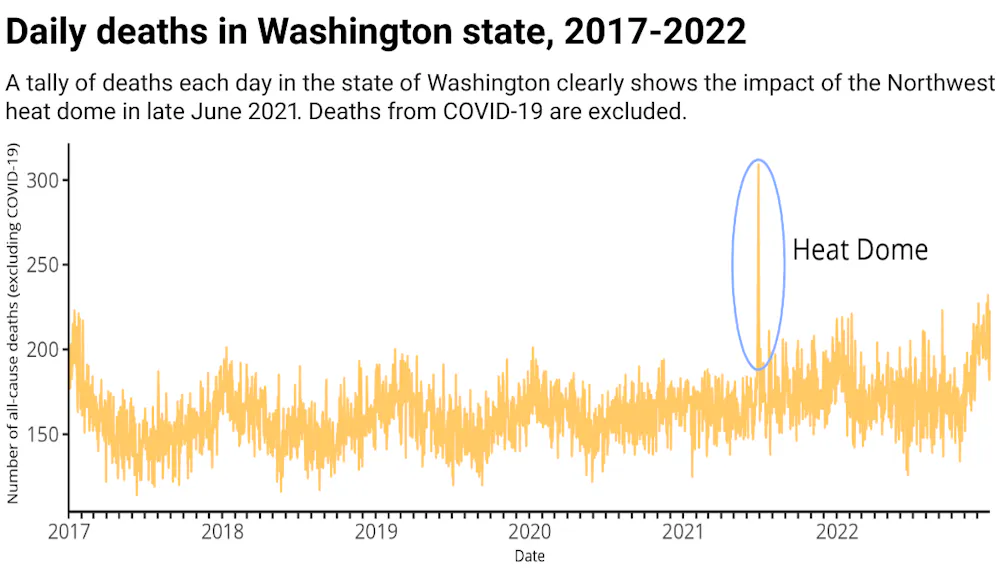
    A chart of all deaths, excluding COVID-19, shows the extraordinary impact the 2021 heat dome had in Washington.
    ‘In the Hot Seat’ report, 2022

    We were excited and relieved when the community was awarded a US$19.9 million grant from the Environmental Protection Agency to help it take concrete steps to adapt to climate change and boost the local economy in the process. The grant would help establish resilience hubs with microgrids and help residents without air conditioning install energy-efficient cooling systems. The city doesn’t have the means to make these improvements on its own, even if they would save lives and money in the long run.

    Less than a year later, the Trump administration abruptly terminated the funding.

    Spokane’s grant wasn’t the only one eliminated – about 350 similar grants that had been awarded to help communities across the country manage climate changes, from extreme heat and wildfire smoke to rising seas and flooding, were also terminated on the grounds that they don’t meet the White House’s priorities. Many other grants to help communities have also been terminated.

    Many of the communities that lost funding are like Spokane: They can’t afford to do this kind of work on their own.

    Why cities like Spokane need the help

    Like many communities in the American West, Spokane was founded in the late 19th century on wealth from railroads and resource extraction, especially gold, silver and timber.

    Today, it is a city of 230,000 in a metro area of a half-million people, the largest on the I-90 corridor between Minneapolis and Seattle. In many ways, Spokane could be on the cusp of a renaissance.

    In January 2025, the U.S. Department of Commerce announced a $48 million grant to develop a tech hub that could put the Inland Northwest on a path to become a global leader in advanced aerospace materials. But then, in May, the Trump administration rescinded that grant as well.

    The lost grants left the economy – and Spokane’s ability to adapt fast enough to keep up with climate changes – uncertain.

    Heat waves are becoming a growing risk in Spokane, known for its river and falls that tumble near downtown.
    Roman Eugeniusz/Wikimedia Commons, CC BY-SA

    This is not a wealthy area. The median household income is nearly $30,000 less than the state average. More than 13 out of every 100 people in Spokane live in poverty, above the national average, and over 67% of the children are eligible for free or reduced lunch.

    The city is a light blue island in a dark red sea, politically speaking, with a moderate mayor. Its congressional district has voted Republican by wide margins since 1995, the year that then-House Speaker Tom Foley lost his reelection bid.

    Lessons from the 2021 heat dome

    The 2021 heat wave was a catalyzing event for the community. The newly formed Gonzaga Institute for Climate, Water and the Environment brought together a coalition of government and community partners to apply for the EPA’s Climate and Environmental Justice Community Change Grant Program. The grants, funded by Congress under the Inflation Reduction Act of 2022, were intended to help communities most affected by pollution and climate change build adaptive capacity and boost the safety of their residents.

    A key lesson from the 2021 heat dome was that temporary, or pop-up, cooling centers don’t work well. People just weren’t showing up. Our research found that the best approach is to strengthen existing community facilities that people already turn to in moments of difficulty.

    Half the $19.9 million award was for outfitting five resilience hubs in existing libraries and community centers with solar arrays and battery backup microgrids, allowing them to continue providing a safe, cool space during a heat wave if the power shuts down.

    The locations and plans for five resilience hubs to serve Spokane, and the infrastructure they would receive.
    Gonzaga Institute for Climate, Water and the Environment

    Another $8 million in grant funding was meant to provide 300 low- to moderate-income homeowners with new high-efficiency electric heat pump heating, ventilation and air conditioning systems, providing more affordable utility bills while improving their ability to cool their homes and reducing fossil fuel emissions.

    Communities are left with few options

    Now, this and other work is at risk in Spokane and cities and towns like it around the country that also lost funding.

    According to the Trump administration, the program – designed to help hundreds of communities around the country become safer – was “no longer consistent with EPA funding priorities.”

    A class action lawsuit was recently filed over the termination of the grants by a coalition that includes Earth Justice and the Southern Environmental Law Center. If the case is successful, Spokane could see its funding restored.

    Meanwhile, the city and my team know we have to move fast, with whatever money and other resources we can find, to help Spokane prepare for worsening heat. We formed the Spokane Climate Resilience Collaborative – a partnership between community organizations, health officials and the city – as one way to advance planning for and responding to climate hazards such as extreme heat and wildfire smoke.

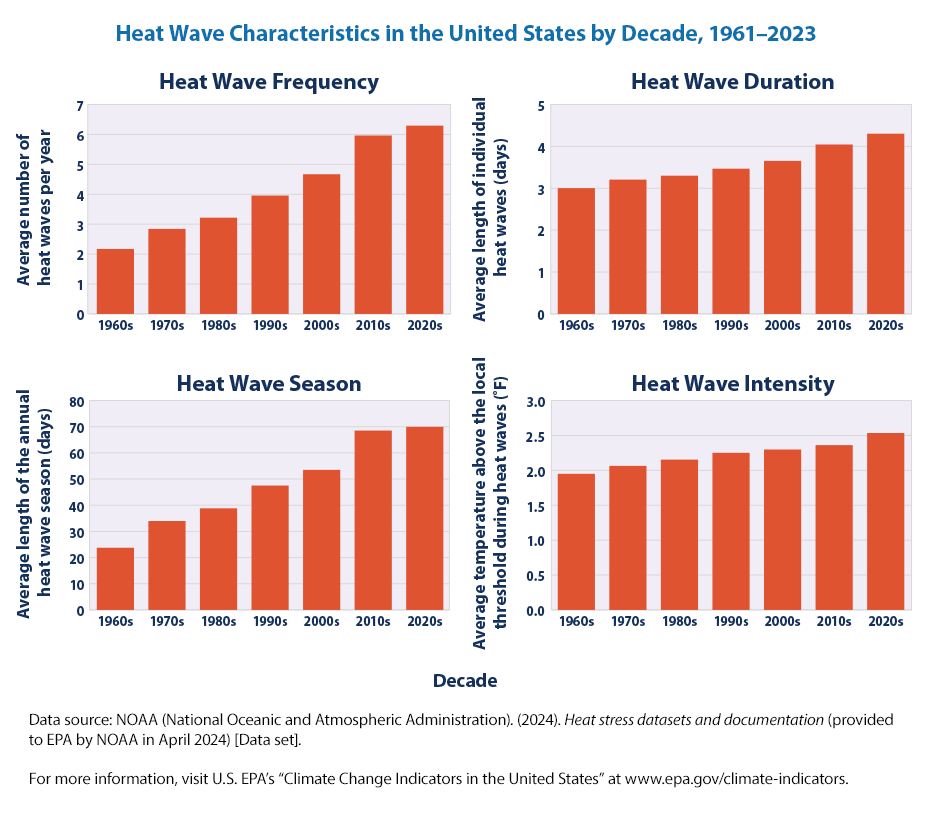
    As concentrations of heat-trapping gasses accumulate in the atmosphere, both the frequency and severity of heat waves increase. It is only a matter of time before another deadly heat dome arrives.

    Brian G. Henning receives funding from the Environmental Protection Agency.

    ref. My city was one of hundreds expecting federal funds to help manage rising heat wave risk – then EPA terminated the grants – https://theconversation.com/my-city-was-one-of-hundreds-expecting-federal-funds-to-help-manage-rising-heat-wave-risk-then-epa-terminated-the-grants-259009

    MIL OSI Analysis

  • MIL-OSI Analysis: Trump administration’s lie detector campaign against leakers is unlikely to succeed and could divert energy from national security priorities

    Source: The Conversation – USA – By Brian O’Neill, Professor of Practice, International Affairs, Georgia Institute of Technology

    The Department of Homeland Security and FBI are reportedly using polygraphs aggressively to identify dissenters. standret/Getty Images

    The Trump administration has recently directed that a new wave of polygraphs be administered across the executive branch, aimed at uncovering leaks to the press.

    As someone who has taken roughly a dozen polygraphs during my 27-year career with the CIA, I read this development with some skepticism.

    Polygraphs carry an ominous, almost mythological reputation among Americans. The more familiar and unofficial term – lie detector tests – likely fuels that perception. Television crime dramas have done their part, too, often portraying the device as an oracle for uncovering the truth when conventional methods fail.

    In those portrayals, the polygraph is not merely a tool – it’s a window into the soul.

    Among those entering government service, especially in national security, the greater anxiety is not the background check but passing the polygraph. My advice is always the same: Don’t lie.

    It’s the best – and perhaps only – guidance for a process that most assessments have concluded is a more subjective interpretation than empirical science.

    Why the polygraph persists

    Polygraphs are “pseudo-scientific” in that they measure physiological responses such as heart rate, blood pressure and perspiration. The assumption is that liars betray themselves through spikes in those signals. But this presumes a kind of psychological transparency that simply doesn’t hold up. A person might sweat and tremble simply from fear, anger or frustration – not deceit.

    There also are no specific physiological reactions associated with lying. The National Academy of Sciences in 2003, and the American Psychological Association in a 2004 review, concluded that the polygraph rests more on theater than fact. Recent assessments, published in 2019, have reached the same conclusion.

    Accordingly, polygraph results are not generally admissible in U.S. courts. Only a handful of states – such as Georgia, Arizona and California – permit their use even under limited conditions. And they typically require that both parties agree to admission and a judge to approve it. Unconditional admissibility remains the exception, not the rule.

    And yet, inside many national security agencies, polygraphs remain central to the clearance process – a fact I observed firsthand during my time overseeing personnel vetting and analytic hiring within the intelligence community.

    While not treated as conclusive, polygraph results often serve as a filter. A candidate’s visible discomfort – or the examiner’s subjective judgment that a response seems evasive – can stall or end the hiring process. For instance, I know that government agencies have halted clearances after an examiner flagged elevated reactions to questions about past drug use or foreign contacts, even when no disqualifying behavior was ultimately documented.

    The FBI’s J. Edgar Hoover headquarters building in Washington in 2016.
    AP Photo/Cliff Owen

    In some cases, an examiner’s suggestion that a chart shows an anomaly has led otherwise strong applicants to volunteer details they hadn’t planned to share – such as minor security infractions, undeclared relationships, or casual drug use from decades earlier – that, while not disqualifying on their own, reshape how their trustworthiness is perceived.

    The polygraph’s power lies in creating the conditions under which deception is confessed.

    A predictable pattern

    No administration has been immune to the impulse to investigate leaks. The reflex is bipartisan and familiar: An embarrassing disclosure appears in the press – contradicting official statements or exposing internal dissent – and the White House vows to identify and punish the source. Polygraphs are often part of this ritual.

    During his first term, Trump intensified efforts to expose internal dissent and media leaks. Department guidelines were revised to make it easier for agencies to obtain journalists’ phone and email records, and polygraphs were reportedly used to pressure officials suspected of talking to the press. That trend has continued – and, in some areas, escalated.

    Recent policies at the Pentagon now restrict unescorted press access, revoke office space for major outlets and favor ideologically aligned networks. The line between legitimate leak prevention and the surveillance or sidelining of critical press coverage has grown increasingly blurred.

    At agencies such as the Department of Homeland Security and the FBI, polygraphs are reportedly being used more frequently – and more punitively – to identify internal dissenters. Even “cold cases,” such as the leak of the Supreme Court’s Dobbs opinion ahead of its overturning of Roe v. Wade, have been reopened, despite prior investigations yielding no definitive source.

    Government reaction varies

    Not all leaks are treated the same. Disclosures that align with official narratives or offer strategic advantage may be quietly tolerated, even if unauthorized. Others, especially those that embarrass senior officials or reveal dysfunction, are more likely to prompt formal investigation.

    In 2003, for example, the leak of CIA officer Valerie Plame’s identity – widely seen as retaliation for her husband’s criticism of the Iraq War – triggered a federal investigation. The disclosure embarrassed senior officials, led to White House aide Scooter Libby’s conviction for perjury, later commuted, and drew intense political scrutiny.

    Lewis Libby, Vice President Dick Cheney’s chief of staff, rides in the backseat of a limousine on Oct. 27, 2005, in McLean, Va.
    Win McNamee/Getty Images

    Leaks involving classified material draw the sharpest response when they challenge presidential authority or expose internal disputes. That was the case in 2010 with Chelsea Manning, whose disclosure of diplomatic cables and battlefield reports embarrassed senior officials and sparked global backlash. Government reaction often depends less on what was disclosed than on who disclosed it – and to what effect.

    A narrow set of disclosures, such as those involving espionage or operational compromise, elicit broad consensus as grounds for prosecution. But most leaks fall outside that category. Most investigations fade quietly. The public rarely learns what became of them. Occasionally, there is a vague resignation, but direct accountability is rare.

    What the future holds

    Trump’s polygraph campaign is not likely to eliminate leaks to the press. But they may have a chilling effect that discourages internal candor while diverting investigative energy away from core security priorities.

    Even if such campaigns succeed in reducing unauthorized disclosures, they may come at the cost of institutional resilience. Historically, aggressive internal enforcement has been associated with declining morale and reduced information flow – factors that can hinder adaptation to complex threats.

    Some researchers have suggested that artificial intelligence may eventually offer reliable tools for detecting deception. One recent assessment raised the possibility, while cautioning that the technology is nowhere near operational readiness.

    For now, institutions will have to contend with the tools they have – imperfect, imprecise and more performative than predictive.

    As a former US intelligence officer, I am required to submit any written draft, before sharing it with other persons, for prepublication review. I submitted this draft to CIA’s Prepublication Review Board, which responded on 11 June: “No classified information was identified. Therefore, no changes are required for publication or sharing with others.”

    ref. Trump administration’s lie detector campaign against leakers is unlikely to succeed and could divert energy from national security priorities – https://theconversation.com/trump-administrations-lie-detector-campaign-against-leakers-is-unlikely-to-succeed-and-could-divert-energy-from-national-security-priorities-259128

    MIL OSI Analysis

  • MIL-OSI USA: Governor Newsom deploys firefighter strike team to support Oregon wildfire response

    Source: US State of California 2

    Jul 8, 2025

    SACRAMENTO — As wildfire conditions intensify across the Pacific Northwest, Governor Newsom has directed the deployment of a CAL FIRE Type 3 engine strike team to assist firefighting efforts in southern Oregon. The deployment includes five fire engines and a strike team leader who will join suppression operations just north of the California–Oregon border.

    “Just as Oregon supported our state during the Los Angeles firestorms, we’re glad to support our Northern neighbors with strike teams and fire engines to aid in their wildfire response efforts. I’m proud California can lend a helping hand to fellow Americans in their time of need.” 

    Governor Gavin Newsom

    CAL FIRE engines being sent to support wildfire suppression in Oregon

    This mobilization comes in response to a significant lightning event that ignited numerous wildfires across the region. Southern Oregon has experienced more than 2,000 lightning strikes in recent days, compounded by high temperatures and gusty winds. The National Weather Service has issued Red Flag Warnings through July 8 for much of southern and central Oregon, signaling elevated fire danger and the need for immediate firefighting reinforcements.

    Upon arrival in Medford, CAL FIRE resources will seamlessly integrate into Oregon’s Department of Forestry command structure to support suppression efforts on active fires. This response is part of a long-standing interstate mutual aid agreement that strengthens wildfire readiness across the western United States.

    California remains prepared to send additional resources should conditions escalate.

    “We stand with Oregon during this critical time, just as they’ve stood with us during some of California’s toughest fire seasons,” said Anale Burlew, Chief Deputy Director of CAL FIRE. “These mutual aid partnerships are built on trust, coordination, and a shared commitment to public safety.”

    Press releases, Recent news

    Recent news

    News What you need to know: The $101 million being made available today will support the development of affordable multifamily rental housing in Los Angeles, prioritizing the needs of displaced residents in the fire-devastated regions. Los Angeles, California – Six…

    News SACRAMENTO – Governor Gavin Newsom today announced the deployment of an additional 18 highly skilled Urban Search and Rescue Team members to Texas to assist with ongoing response efforts related to severe flooding impacts.The deployment includes a total of four…

    News Perris, California — On June 18, 2025, the First Partner visited the Inland Empire to meet with California communities impacted by the Trump Administration’s federal immigration raids. The First Partner visited TODEC, a local nonprofit organization that’s become…

    Jul 8, 2025

    What you need to know: The passage of Proposition 1 by California voters adds rocket fuel to Governor Gavin Newsom’s transformational overhaul of the state’s behavioral health system. These reforms refocus existing funds to prioritize Californians with the most serious mental health and substance use issues, who are too often experiencing homelessness. They also fund more than 11,150 new behavioral health beds and supportive housing units and 26,700 outpatient treatment slots.

    Los Angeles, California – California took a major step forward in correcting the damage from 50 years of neglect to the state’s mental health system with the passage of Proposition 1. This historic measure — a signature priority of Governor Gavin Newsom — adds rocket fuel to California’s overhaul of the state’s behavioral health systems. It provides a full range of mental health and substance abuse care, with new accountability metrics to ensure local governments deliver for their communities.

    This is the biggest reform of the California mental health system in decades and will finally equip partners to deliver the results all Californians need and deserve. Treatment centers will prioritize mental health and substance use support in the community like never before. Now, it’s time to roll up our sleeves and begin implementing this critical reform – working closely with city and county leaders to ensure we see results.

    Governor Gavin Newsom

    newsom-news-template
    IMG_3682-min
    contact-governor-landing
    workers-FxAJ5fkakAAtVI3
    priorities-and-progress-image
    economy-F-isBKpbsAAxdab
    gun-violence-San Diego Guns Package 2.18.22_2

    What they’re saying: 

    • Sacramento Mayor Darrell Steinberg, original author of the Mental Health Services Act: “Twenty years ago, I never could have dreamed that we would have the strong leadership we have today, committing billions and making courageous policy changes that question the conventional wisdom on mental health. Now, with the passage of Proposition 1. California is delivering on decades old promises to help people living with brain-based illnesses, to live better lives, to live independently and to live with dignity in our communities. This is a historic moment and the hard work is ahead of us.“
    • Senator Susan Eggman (D-Stockton), author of Senate Bill 326: “Today marks a day of hope for thousands of Californians who are struggling with mental illness – many of whom are living unhoused. I am tremendously grateful to my fellow Californian’s for passing this important measure.  And I am very appreciative of this Governor’s leadership to transform our behavioral health care system!”
    • Assemblymember Jacqui Irwin (D-Thousand Oaks), author of Assembly Bill 531: “This started as an audacious proposal to address the root cause of homelessness and today, Californians can be proud to know that they did the right thing by passing Proposition 1. Now, it’s time for all of us to get to work, and make sure these reforms are implemented and that we see results.”

    Bigger picture: Transforming the Mental Health Services Act into the Behavioral Health Services Act and building more community mental health treatment sites and supportive housing is the last main pillar of Governor Newsom’s Mental Health Movement – pulling together significant recent reforms like 988 crisis line, CalHOPE, CARE Court, conservatorship reform, CalAIM behavioral health expansion (including mobile crisis care and telehealth), Medi-Cal expansion to all low-income Californians, Children and Youth Behavioral Health Initiative (including expanding services in schools and on-line), Older Adult Behavioral Health Initiative, Veterans Mental Health Initiative, Behavioral Health Community Infrastructure Program, Behavioral Health Bridge Housing, Health Care Workforce for All and more.

    More details on next step here

    Press releases, Recent news

    Recent news

    News What you need to know: The $101 million being made available today will support the development of affordable multifamily rental housing in Los Angeles, prioritizing the needs of displaced residents in the fire-devastated regions. Los Angeles, California – Six…

    News SACRAMENTO – Governor Gavin Newsom today announced the deployment of an additional 18 highly skilled Urban Search and Rescue Team members to Texas to assist with ongoing response efforts related to severe flooding impacts.The deployment includes a total of four…

    News Perris, California — On June 18, 2025, the First Partner visited the Inland Empire to meet with California communities impacted by the Trump Administration’s federal immigration raids. The First Partner visited TODEC, a local nonprofit organization that’s become…

    Jul 8, 2025

    What you need to know: The passage of Proposition 1 by California voters adds rocket fuel to Governor Gavin Newsom’s transformational overhaul of the state’s behavioral health system. These reforms refocus existing funds to prioritize Californians with the most serious mental health and substance use issues, who are too often experiencing homelessness. They also fund more than 11,150 new behavioral health beds and supportive housing units and 26,700 outpatient treatment slots.

    Los Angeles, California – California took a major step forward in correcting the damage from 50 years of neglect to the state’s mental health system with the passage of Proposition 1. This historic measure — a signature priority of Governor Gavin Newsom — adds rocket fuel to California’s overhaul of the state’s behavioral health systems. It provides a full range of mental health and substance abuse care, with new accountability metrics to ensure local governments deliver for their communities.

    This is the biggest reform of the California mental health system in decades and will finally equip partners to deliver the results all Californians need and deserve. Treatment centers will prioritize mental health and substance use support in the community like never before. Now, it’s time to roll up our sleeves and begin implementing this critical reform – working closely with city and county leaders to ensure we see results.

    Governor Gavin Newsom

    newsom-news-template
    IMG_3682-min
    contact-governor-landing
    workers-FxAJ5fkakAAtVI3
    priorities-and-progress-image
    economy-F-isBKpbsAAxdab
    gun-violence-San Diego Guns Package 2.18.22_2

    What they’re saying: 

    • Sacramento Mayor Darrell Steinberg, original author of the Mental Health Services Act: “Twenty years ago, I never could have dreamed that we would have the strong leadership we have today, committing billions and making courageous policy changes that question the conventional wisdom on mental health. Now, with the passage of Proposition 1. California is delivering on decades old promises to help people living with brain-based illnesses, to live better lives, to live independently and to live with dignity in our communities. This is a historic moment and the hard work is ahead of us.“
    • Senator Susan Eggman (D-Stockton), author of Senate Bill 326: “Today marks a day of hope for thousands of Californians who are struggling with mental illness – many of whom are living unhoused. I am tremendously grateful to my fellow Californian’s for passing this important measure.  And I am very appreciative of this Governor’s leadership to transform our behavioral health care system!”
    • Assemblymember Jacqui Irwin (D-Thousand Oaks), author of Assembly Bill 531: “This started as an audacious proposal to address the root cause of homelessness and today, Californians can be proud to know that they did the right thing by passing Proposition 1. Now, it’s time for all of us to get to work, and make sure these reforms are implemented and that we see results.”

    Bigger picture: Transforming the Mental Health Services Act into the Behavioral Health Services Act and building more community mental health treatment sites and supportive housing is the last main pillar of Governor Newsom’s Mental Health Movement – pulling together significant recent reforms like 988 crisis line, CalHOPE, CARE Court, conservatorship reform, CalAIM behavioral health expansion (including mobile crisis care and telehealth), Medi-Cal expansion to all low-income Californians, Children and Youth Behavioral Health Initiative (including expanding services in schools and on-line), Older Adult Behavioral Health Initiative, Veterans Mental Health Initiative, Behavioral Health Community Infrastructure Program, Behavioral Health Bridge Housing, Health Care Workforce for All and more.

    More details on next step here

    Press releases, Recent news

    Recent news

    News What you need to know: The $101 million being made available today will support the development of affordable multifamily rental housing in Los Angeles, prioritizing the needs of displaced residents in the fire-devastated regions. Los Angeles, California – Six…

    News SACRAMENTO – Governor Gavin Newsom today announced the deployment of an additional 18 highly skilled Urban Search and Rescue Team members to Texas to assist with ongoing response efforts related to severe flooding impacts.The deployment includes a total of four…

    News Perris, California — On June 18, 2025, the First Partner visited the Inland Empire to meet with California communities impacted by the Trump Administration’s federal immigration raids. The First Partner visited TODEC, a local nonprofit organization that’s become…

    MIL OSI USA News

  • MIL-OSI USA: Governor Newsom commits $101 million to jumpstart critical rebuilding efforts after LA Fires

    Source: US State of California 2

    Jul 8, 2025

    What you need to know: The $101 million being made available today will support the development of affordable multifamily rental housing in Los Angeles, prioritizing the needs of displaced residents in the fire-devastated regions.

    Los Angeles, California – Six months after the LA Fires, Governor Gavin Newsom and the California Department of Housing and Community Development (HCD) announced the release of $101 million to help rapidly rebuild critically needed, affordable multifamily rental housing in the fire-devastated Los Angeles region. Thousands of families are still displaced by the wildfires that raged through the Greater Los Angeles Region in January 2025, placing an incredible strain on an already tight rental market.

    Tomiquia Moss, Secretary of the California Business, Consumer Services and Housing Agency: “The State’s special Multifamily Finance Super NOFA will galvanize the collective public-private response to the wildfires in Los Angeles County, expediting and expanding opportunities to build affordable housing for low-income residents. By prioritizing affordable housing projects that are ready to go, these funds will accelerate household stability, climate and health outcomes in communities.”

    Today’s funding

    HCD’s Multifamily Finance Super NOFA (MFSN) allows affordable housing developers to apply to multiple funding programs through a single application. In February 2025, HCD released a MFSN Notice of Funding Availability (NOFA) announcing $382 million available for development of affordable multifamily rental housing statewide. A separate $50 million Tribal MFSN was released in March 2025.

    The special MFSN NOFA announced today (MFSN-LA Disaster) provides an additional $101 million in funding to support recovery and rebuilding efforts from 2025 wildfires within Los Angeles County. This MFSN-LA Disaster NOFA has been designed to meet the immediate housing needs of disaster-impacted areas and residents in Los Angeles as quickly as possible by prioritizing projects that are: close to wildfire burn areas; ready to begin construction immediately upon award; and include a resident preference for households displaced by the Los Angeles County wildfires.

    HCD Director Gustavo Velasquez: “HCD has taken a program built on efficiency and further refined it specifically to help the Los Angeles region rebuild from unimaginable tragedy. Our team has gone above and beyond to ensure this program is designed to provide housing stability for fire-displaced families as quickly as possible.”

    This MFSN-LA Disaster NOFA provides a two-phase award process to accelerate the delivery of affordable housing. If funds remain after all applications for shovel-ready projects have been assessed, applications will continue to be accepted for all eligible projects until the funds are expended.

    Funding available through this MFSN-LA Disaster NOFA includes grants for the infrastructure needed to facilitate housing development with a focus on disaster resilience and mitigation, low-interest loans for the development of new multifamily units affordable to low-income and very low-income households, and operating subsidy reserves to support the long-term financial feasibility of the projects. All projects will be required to remain affordable for at least 55 years.

    Multifamily Finance Super NOFA (MFSN)

    This year marks the third round of MFSN, which provides applicants the opportunity to apply simultaneously for a combination of awards from the Multifamily Housing Program (MHP), Supportive Housing MHP, Infill Infrastructure Grant Program, Transit-Oriented Development Program, and Veterans Housing and Homelessness Prevention Program. This is the first MFSN round to offer capitalized operating subsidy reserve funding through MHP to support operations.   

    MFSN makes funds more accessible to developers (including emerging and community-based developers), enables the funding to further serve the lowest-income Californians, and increases the range of potential applicants and target populations to achieve better outcomes in health, climate, and household stability.

    Application materials for MFSN-LA Disaster will be available July 21, 2025. Applicants applying for the first phase of funding must upload all required application documents to the HCD website no later than August 21, 2025, at 4:00 p.m. PDT.

    For more information, including webinars and workshops, please visit HCD’s Multifamily Finance Super NOFA webpage.

    Historic fire recovery 

    Today’s announcement builds on Governor Newsom’s broader efforts to cut red tape and expedite the rebuilding of homes and businesses to support disaster survivors.

    Yesterday, the governor announced the substantial completion of the public debris removal program from more than 10,000 fire damaged parcels — marking the fastest major disaster cleanup in American history. The Governor also signed an executive order removing more barriers to rebuilding homes and schools. He also joined local officials to unveil a new blueprint for recovery, a step-by-step plan to accelerate rebuilding and provide support to impacted families and communities. The near-completion of the public debris removal program comes months ahead of schedule.

    Recent news

    News SACRAMENTO – Governor Gavin Newsom today announced the deployment of an additional 18 highly skilled Urban Search and Rescue Team members to Texas to assist with ongoing response efforts related to severe flooding impacts.The deployment includes a total of four…

    News Perris, California — On June 18, 2025, the First Partner visited the Inland Empire to meet with California communities impacted by the Trump Administration’s federal immigration raids. The First Partner visited TODEC, a local nonprofit organization that’s become…

    News SACRAMENTO – Governor Gavin Newsom today announced the deployment of skilled Urban Search and Rescue Team members to Texas to assist with ongoing response efforts related to severe flooding impacts. “California stands with all those who have lost loved ones,…

    MIL OSI USA News

  • MIL-OSI USA: Governor Newsom announces additional crews to assist Texas search and rescue operations

    Source: US State of California 2

    Jul 8, 2025

    SACRAMENTO – Governor Gavin Newsom today announced the deployment of an additional 18 highly skilled Urban Search and Rescue Team members to Texas to assist with ongoing response efforts related to severe flooding impacts.

    The deployment includes a total of four units of Human Remains Detection (HRD) Teams, which also include a total of eight canines. The deployed teams are from the Los Angeles County, Riverside City, Menlo Park and Orange County Fire Departments.   

    The 18 Urban Search and Rescue Team members sent today are in addition to the 9 members deployed yesterday from Riverside City and Oakland City

    The scale of loss and devastation Texas is experiencing right now is unfathomable. California is proud to lend a helping hand to our fellow Americans.

    Governor Gavin Newsom

    During this deployment to Texas, California personnel will use their highly-developed and specialized skills to assist emergency operations in and around the hardest hit areas based on priorities and direction of state and local officials to assist with search and rescue operations.  In close coordination with Texas and through the Emergency Management Assistance Compact (EMAC), the California Governor’s Office of Emergency Services (Cal OES) is deploying these crews.

    “Cal OES deploys these experienced teams to help those in need in Texas,” said Cal OES Director Nancy Ward. “These search and rescue professionals have the training needed to navigate extreme conditions.”

    Potential exists for additional flood impacts in the area. California stands ready to send additional resources as requested.

    Since 1992, California-based resources have been deployed to a long list of state, national, and even international disasters including 2017’s Hurricanes Harvey, Irma and Maria, 1992 Hurricane Iniki (Hawaii), the 1994 Northridge Earthquake, the September 11, 2001 attacks, the World Trade Center, Hurricane Katrina and Hurricane Rita, Hurricane Ian, the Camp Fire in Paradise, the Oklahoma City Bombing, and the Montecito Mudslides.

    This deployment does not impact California’s emergency response and firefighting capabilities.

    Press releases, Recent news

    Recent news

    News Perris, California — On June 18, 2025, the First Partner visited the Inland Empire to meet with California communities impacted by the Trump Administration’s federal immigration raids. The First Partner visited TODEC, a local nonprofit organization that’s become…

    News SACRAMENTO – Governor Gavin Newsom today announced the deployment of skilled Urban Search and Rescue Team members to Texas to assist with ongoing response efforts related to severe flooding impacts. “California stands with all those who have lost loved ones,…

    News What you need to know: California added area the equivalent of Glacier National Park to its conserved lands and coastal waters in just the last year – marking significant progress toward its goal of 30% conservation by 2030. SACRAMENTO – Governor Gavin Newsom…

    MIL OSI USA News

  • MIL-OSI USA: DHS to End ‘Shoes-Off’ Travel Policy

    Source: US Federal Emergency Management Agency

    Headline: DHS to End ‘Shoes-Off’ Travel Policy

    lass=”text-align-center”>Passengers can now keep their shoes on at TSA security checkpoints
    WASHINGTON—Homeland Security Secretary Kristi Noem announced a new policy today which will allow passengers traveling through domestic airports to keep their shoes on while passing through security screening at TSA checkpoints

    The new policy will increase hospitality for travelers and streamline the TSA security checkpoint process, leading to lower wait times

    “Ending the ‘Shoes-Off’ policy is the latest effort DHS is implementing to modernize and enhance traveler experience across our nation’s airports,” said Secretary Noem

    “We expect this change will drastically decrease passenger wait times at our TSA checkpoints, leading to a more pleasant and efficient passenger experience

    As always, security remains our top priority

    Thanks to our cutting-edge technological advancements and multi-layered security approach, we are confident we can implement this change while maintaining the highest security standards

    This initiative is just one of many the Trump administration is pursuing to usher in the President’s vision for a new Golden Age of American travel


    Other aspects of TSA’s layered security approach will still apply during the TSA checkpoint process

    For example, passengers subject must still clear identity verification, Secure Flight vetting, and other processes

    Ending the “Shoes-Off” policy is the latest in a series of changes DHS has implemented since the Trump administration entered office

    On July 2nd, TSA announced its “Serve with Honor, Travel with Ease” program which provides special benefits to uniformed service members and their families, including a TSA PreCheck enrollment discount and expedited access lanes at select airports

    In May, TSA began implementation of REAL ID at airport checkpoints which has seen a 94 percent compliance rate which has led to a more efficient security process

    # # #

    MIL OSI USA News

  • EU working closely to get trade deal with US, ready for all scenarios, von der Leyen says

    Source: Government of India

    Source: Government of India (4)

    The European Union is working closely with U.S. President Donald Trump’s administration to reach a trade deal, but Brussels is getting ready for all scenarios, European Commission President Ursula von der Leyen said on Wednesday.

    “We stick to our principles, we defend our interests, we continue to work in good faith, and we get ready for all scenarios,” von der Leyen told the European Parliament.

    Trump signed an executive order on Monday extending the date on which so-called “reciprocal” tariffs will take effect to August 1.

    The previous deadline had been Wednesday.

    In a wave of letters, Trump has begun informing a range of trading partners from Japan to Myanmar of sharply higher tariffs on goods they sell into the United States.

    But EU sources told Reuters the European Union would not be among the recipients of a similar letter.

    (Reuters)

  • Trump criticizes Putin after approving more weapons for Ukraine, Kremlin says it is ‘calm’

    Source: Government of India

    Source: Government of India (4)

    President Donald Trump said on Tuesday he had approved sending U.S. defensive weapons to Ukraine and was considering additional sanctions on Moscow, underscoring his frustration with Russian President Vladimir Putin over the growing death toll in Russia’s war with Ukraine.

    Trump, who pledged as a presidential candidate to end the war within a day, has not been able to follow through on that promise and efforts by his administration to broker peace have come up short.

    Trump directed his ire at Putin on Tuesday during a meeting with cabinet officials at the White House.

    “I’m not happy with Putin. I can tell you that much right now,” Trump said, noting that Russian and Ukrainian soldiers were dying in the thousands.

    “We get a lot of bullshit thrown at us by Putin … He’s very nice all the time, but it turns out to be meaningless,” Trump said

    Trump said he was considering whether to support a bill in the Senate that would impose steep sanctions on Russia over the war.

    “I’m looking at it very strongly,” he said.

    The bill, whose lead sponsors are Republican Senator Lindsey Graham of South Carolina and Democratic Senator Richard Blumenthal of Connecticut, would also punish other countries that trade with Moscow, imposing 500% tariffs on nations that buy Russian oil, gas, uranium and other exports.

    DEFENSIVE WEAPONS AGAINST RUSSIAN ADVANCES

    Trump said on Monday that the United States would send more weapons to Ukraine, primarily defensive ones, to help it defend itself against Russian advances. On Tuesday he said he had approved such a move.

    “We’re sending some defensive weapons to Ukraine, and I’ve approved that,” he said.

    Ukrainian President Volodymyr Zelenskiy said on Tuesday he had ordered an expansion of contacts with the United States to ensure critical deliveries of military supplies, primarily air defence.

    “We currently have all the necessary political statements and decisions and we must implement them as quickly as possible to protect our people and positions,” he said.

    “These are critical deliveries that mean saving lives and protecting Ukrainian cities and villages. I expect results from these contacts very soon. And this week, we are preparing formats for meetings of our military and political teams.”

    Zelenskiy has repeatedly urged Ukraine’s Western allies to impose tougher sanctions on Moscow to force the Kremlin to agree to a ceasefire as a step towards reaching an end to the war, now 40 months old.

    A decision by the Pentagon to halt some shipments of critical weapons to Ukraine prompted warnings by Kyiv last week that the move would weaken its ability to defend against Russia’s intensifying airstrikes and battlefield advances.

    Trump, who was seated next to Defense Secretary Pete Hegseth, was asked on Tuesday who had ordered that pause.

    “I don’t know. Why don’t you tell me?” Trump responded.

    The Kremlin, asked on Wednesday about U.S. President Donald Trump’s criticism of Russian President Vladimir Putin, said that Moscow was “calm” regarding the criticism, and that it would continue to try to fix a “broken” U.S.-Russia relationship.

    Trump has in recent days accused Putin of not taking U.S. efforts to reach a peace deal in Ukraine seriously, and suggested that the U.S. will continue supporting Kyiv.

    (Reuters)

  • MIL-Evening Report: Israel’s Rafah camp – ‘humanitarian city’ or crime against humanity?

    Source: The Conversation (Au and NZ) – By Shannon Bosch, Associate Professor (Law), Edith Cowan University

    Israel’s Defence Minister Israel Katz has announced a controversial plan to move up to 600,000 Palestinians in Gaza into a designated “humanitarian area” on the ruins of the southern city of Rafah.

    Access to the camp would be through strict security screening to ensure entrants were not Hamas operatives. Once inside, the perimeter would be sealed off by the Israeli military. Palestinians would not be allowed to leave.

    Eventually the camp would house the entire 2.1 million population of Gaza.

    Camp construction would begin during the proposed 60-day ceasefire being negotiated by Israel and Hamas

    ‘Illegal and inhumane’

    The plan is illegal, inhumane and risks worsening the humanitarian crisis in Gaza.

    The forced displacement and containment of any civilian population in an occupied territory is a violation of international humanitarian law.

    Done on this scale would constitute a war crime and a crime against humanity under the Rome Statute.

    The UN Security Council, UN General Assembly and UN Commission on Human Rights have all condemned instances of forced transfer in armed conflicts.

    So too, the International Committee of the Red Cross and the Red Crescent, which have stressed the fundamental prohibition of forced displacement of a civilian population and the need for all parties to respect this prohibition.

    For their own protection?

    Katz is describing the camp as a “humanitarian city”. The Israeli military says Palestinians would only be contained for their own protection.

    As we have seen, civilian displacement is prohibited. But there is an exception if a case can be made either for military reasons or the protection of the population.

    However, this exception only exists for as long as the conditions warrant for it to exist. Anyone subject to such an evacuation must be transferred back to their homes as soon as possible.

    Imperative military reasons never justify the removal of a civilian population in order to persecute it. The Guiding Principles on Internal Displacement entrenches the duty of international actors to avoid creating the conditions that might lead to the displacement of people.

    Aid dilemma

    Katz has indicated international organisations would be responsible for managing aid and services inside the area.

    But Israel has a history of defying even orders from the International Court of Justice to allow humanitarian aid to reach the Palestinians in Gaza.

    If international humanitarian agencies were called upon to service the camp, they would face a dilemma.

    They would need to decide whether to cooperate in managing aid under conditions that compromise their neutrality and ethical standards, deny basic human rights and are built on violations of international law.

    Aid groups would risk being complicit in a process that sets up a transit camp for Palestinians before possibly expelling them from Gaza altogether.

    This “humanitarian city” would essentially become an open-air prison. Palestinians would be reliant on international aid under strict Israeli military control.

    Mass expulsion?

    Could the Rafah camp be a precursor to mass expulsion from Gaza and what does international law say about that?

    Katz has been quoted saying Israel aims to implement “the emigration plan, which will happen” – meaning Gazans will eventually be forced to leave for other countries.

    Changing the demographic composition of a territory – ethnic cleansing – achieved through the displacement of the civilian population of a territory is strictly prohibited under international law.

    The idea of displacing Palestinians has long been part of Israeli strategic thinking, but this announcement signals a dangerous escalation and intention to permanently alter Gaza’s demographic landscape through displacement and containment.

    Voluntary exodus?

    According to Katz, Gazans would have the option of “voluntary” emigration.

    Indeed, speaking at the White House this week, Prime Minister Benjamin Netanyahu said there would be no forced exodus from Gaza:

    If people want to stay, they can stay, but if they want to leave, they should be able to leave.

    But the scale of the humanitarian crisis in Gaza is incomprehensible.

    The population has been displaced multiple times and 90% of homes in Gaza are damaged or destroyed. The healthcare, water, sanitation and hygiene systems have collapsed.

    On average 100 Palestinians are killed daily as they try to access food.

    These crisis circumstances negate the voluntary nature of any person’s consent to either the transfer to the Rafah camp or ultimately, the departure from Gaza.

    According to Amos Goldberg, historian of the Holocaust at the Hebrew University of Jerusalem, what the defence minister laid out was clear plans for the ethnic cleansing of Gaza:

    [it is] a transit camp for Palestinians before they expel them. It is neither humanitarian nor a city.

    Shannon Bosch does not work for, consult, own shares in or receive funding from any company or organisation that would benefit from this article, and has disclosed no relevant affiliations beyond their academic appointment.

    ref. Israel’s Rafah camp – ‘humanitarian city’ or crime against humanity? – https://theconversation.com/israels-rafah-camp-humanitarian-city-or-crime-against-humanity-260809

    MIL OSI AnalysisEveningReport.nz

  • MIL-OSI Asia-Pac: President Lai meets delegation led by Foreign Minister Jean-Victor Harvel Jean-Baptiste of Republic of Haiti

    Source: Republic of China Taiwan

    Details
    2025-07-01
    President Lai meets delegation from 2025 Taiwan International Ocean Forum
    On the afternoon of July 1, President Lai Ching-te met with a delegation from the 2025 Taiwan International Ocean Forum (TIOF). In remarks, President Lai noted that the people of Taiwan will continue to work with democratic partners throughout the world in a maritime spirit of freedom and openness to contribute to ocean governance and jointly ensure maritime security. He expressed hope that their visit will help forge stronger friendships between Taiwan and international maritime partners, so that all can work together to spur shared maritime prosperity and sustainable development for the next generation. A translation of President Lai’s remarks follows: I want to thank our guests for coming here to the Presidential Office. The 2025 TIOF will take place tomorrow and the day after, and I thank you all for making the long trip to Taiwan to attend the event and share your valuable insights and experiences. This year’s forum will focus on strategies for strengthening maritime security and pathways to achieving a sustainable blue economy. By attending this forum, our guests are highlighting their commitment to safeguarding the oceans, and beyond that, taking concrete action to demonstrate support for Taiwan. I once again offer deepest gratitude on behalf of the people of Taiwan. Taiwan holds a key position on the first island chain, is one of the world’s top 10 shipping nations, and accounts for close to 10 percent of global container shipping by volume. As such, Taiwan occupies a unique and important position in maritime strategy. For Taiwan, the ocean is more than just a basis for survival and development; it is also an important driver of national prosperity. In my inaugural address last year, I spoke of a threefold approach to further Taiwan’s development. One of these involves further developing our strengths as a maritime nation. Our government must actively help deepen our connections with the ocean, and must continue to promote green shipping, a sustainable fishing industry, marine renewable energy, and other forms of industrial transformation. It must also make use of marine technology and digital innovation to create a new paradigm that balances environmental, economic, and social inclusion concerns. This will help enhance Taiwan’s responsibilities and competitiveness as a maritime nation. Taiwan is surrounded by ocean, and our territorial waters are a natural protective barrier. However, continued gray-zone aggression from China creates serious threats and challenges to peace and stability in the Taiwan Strait. Our government continues to invest resources to deal with increasingly complex maritime security issues. In addition to building coast guard patrol vessels, we must also step up efforts to build underwater, surface, and airborne unmanned vehicles and smart reconnaissance equipment, so as to demonstrate Taiwan’s determination to defend democracy and freedom and commitment to maintaining peace and stability in the Taiwan Strait. Oceans are Taiwan’s roots, and provide the channels by which we engage with the world. The people of Taiwan will continue to work with democratic partners throughout the world in a maritime spirit of freedom and openness to contribute to ocean governance and jointly ensure maritime security. The TIOF was first launched in 2020, and has now become an important platform for enhancement of cooperation between Taiwan and other countries. I hope that our distinguished guests will reap great benefits at this year’s forum, and further hope that this visit will help forge stronger friendships between Taiwan and international maritime partners, so that all can work together to spur shared maritime prosperity and sustainable development for the next generation. Chairman of The Washington Times Thomas McDevitt, a member of the delegation, then delivered remarks, noting first that July 4th, this Friday, is Independence Day in America. Independence is a sacred, powerful word which has great meaning in this part of the world, he said. Chairman McDevitt indicated that Taiwan has truly become a global beacon of democracy and a key partner for many nations. He then quoted President Lai’s 2024 inaugural address: “We will work together to combat disinformation, strengthen democratic resilience, address challenges, and allow Taiwan to become the MVP of the democratic world.” Chairman McDevitt went on to say that he appreciated the president’s speech with regard to his philosophical depth, sensitivity, and both moral and political clarity. He said that he was deeply moved by the speech, but within a few days of it, China responded with military activities and many threats. The chairman then emphasized that we are in a civilization crisis. Chairman McDevitt mentioned that President Lai has begun a series of 10 lectures, and remarked that they would help the world to understand the identity and the nature of Taiwan, as well as the situation we are in in the world. On behalf of all the delegation, Chairman McDevitt thanked the president for his leadership in dealing with these issues thoughtfully. Chairman McDevitt concluded with a line from the Old Testament which states that if the people have no vision, they will perish. He said that he believes Taiwan’s president has led the people of Taiwan, and the world, with a vision of how to navigate this great civilization crisis together. The delegation also included Members of the Japanese House of Representatives Kikawada Hitoshi, Aoyama Yamato, and Genma Kentaro, and Member of Parliament of the United Kingdom Gavin Williamson.

    Details
    2025-06-30
    President Lai meets Minister of State at UK Department for Business and Trade Douglas Alexander  
    On the morning of June 30, President Lai Ching-te met with Douglas Alexander, Minister of State at the Department for Business and Trade of the United Kingdom. In remarks, President Lai thanked the UK government for its longstanding support for peace and stability across the Taiwan Strait, demonstrating that Taiwan and the UK share similar goals. Noting that two years ago, Taiwan and the UK signed an enhanced trade partnership (ETP) arrangement, the president said that today Taiwan and the UK have signed three pillars under the ETP, which will help promote bilateral economic and trade cooperation. He expressed hope of the UK publicly supporting Taiwan’s accession to the Comprehensive and Progressive Agreement for Trans-Pacific Partnership (CPTPP) so that together we can create an economic and trade landscape in the Indo-Pacific characterized by shared prosperity and development. A translation of President Lai’s remarks follows: First, on behalf of the people of Taiwan, I extend a warm welcome to Minister Alexander and wish a fruitful outcome for the 27th round of Taiwan-UK trade talks later today. Taiwan-UK relations have grown closer in recent years. We have not only continued to strengthen cooperation in such fields as offshore wind power, innovative technologies, and culture and education but also have established regular dialogue mechanisms in the critical areas of economics and trade, energy, and agriculture. The UK is currently Taiwan’s fourth-largest European trading partner, second-largest source of investment from Europe, and third-largest target for investment in Europe. Two years ago, Taiwan and the UK signed an ETP arrangement. This was particularly meaningful, as it was the first institutionalized economic and trade framework between Taiwan and a European country. Today, this arrangement is yielding further results. I am delighted that Taiwan and the UK have signed three pillars under the ETP covering investment, digital trade, and energy and net-zero. This will help promote bilateral economic and trade cooperation and advance industrial development on both sides. I also want to thank the UK government for its longstanding support for peace and stability across the Taiwan Strait. This month, the UK published its Strategic Defence Review 2025 and National Security Strategy 2025, which oppose any unilateral attempts to change the status quo across the Taiwan Strait. These not only demonstrate that Taiwan and the UK share similar goals but also show that security and prosperity in the Indo-Pacific region are inseparable from those of the transatlantic regions. In addition, last November, the House of Commons passed a motion which made clear that United Nations General Assembly (UNGA) Resolution 2758 neither established the sovereignty of the People’s Republic of China over Taiwan nor determined Taiwan’s status in the United Nations. The UK government also responded to the motion by publicly expressing for the first time its position on UNGA Resolution 2758, opposing any attempt to broaden the interpretation of the resolution to rewrite history. For this, on behalf of the people of Taiwan, I once again want to extend my deepest gratitude. Taiwan and the UK have the advantage of being highly complementary in the technology sector. In facing the restructuring of global supply chains and other international economic and trade developments, I believe that Taiwan and the UK are indispensable key partners for one another. I look forward to the UK publicly supporting Taiwan’s accession to the CPTPP so that together, we can create an economic and trade landscape in the Indo-Pacific characterized by shared prosperity and development. In closing, I wish Minister Alexander a pleasant and successful visit. And I hope he has the opportunity to visit Taiwan for personal travel in the future. Minister Alexander then delivered remarks, saying that it is a great personal honor to meet with everyone today to discuss further deepening the UK-Taiwan trade relationship and explore the many opportunities our two sides can pursue together. He mentioned that he traveled to Taiwan in 2022 when he was a private citizen, a visit he thoroughly enjoyed, so he is delighted to be back to see the strength of the UK-Taiwan relationship and the strengthening of that relationship. He said that relationship is built on mutual respect, democratic values, and a shared vision for open, resilient, and rules-based economic cooperation. As like-minded partners, he pointed out, our collaboration continues to grow across multiple sectors, and he is here today to further that momentum. Minister Alexander stated that on trade and investment, he is proud that this morning we signed the ETP Pillars on Investment, Digital Trade, Energy and Net Zero, which will provide a clear framework for our future cooperation and lay the foundation for expanded access and market-shaping engagement between our two economies. The minister said he believes that together with our annual trade talks, this partnership will help UK’s firms secure new commercial opportunities, improve regulatory alignment, and promote long-term investment in key growth areas, which in turn will also support Taiwan’s efforts to expand high-quality trade relationships with trusted partners. Minister Alexander said that President Lai’s promotion of the Five Trusted Industry Sectors and the UK’s recently published industrial and trade strategies are very well-aligned, as both cover clean energy and semiconductors as well as advanced manufacturing. He then provided an example, saying that both sides plan to invest in AI infrastructure and compute power-creating opportunities for great joint research in the future. By combining our strengths in these areas, he said, we can open the door to innovative collaboration and commercial success for both sides. He mentioned that yesterday he visited the Taiwan Space Agency, commenting that in sectors such as satellite technology, green energy, and cyber security, British expertise and trusted standards can provide meaningful solutions. Noting that President Lai spoke in his remarks of the broader challenge of peace and security in the region, Minister Alexander stated that the United Kingdom has, of course, also continued to affirm its commitment to peace and stability in the Taiwan Strait, along with its G7 partners. The UK-Taiwan relationship is strategic, enduring, and growing, he stated, and they reaffirm and remain firm in their longstanding position and confident in their ability to work together to support both prosperity and resilience in both of our societies. Minister Alexander said that, as Taiwan looks to diversify capital and build global partnerships, they believe the UK represents a strong and ambitious investment destination, particularly for Taiwanese companies at the very forefront of robotics, clean tech, and advanced industry. He pointed out that the UK’s markets are stable, open, and aligned with Taiwan’s vision of a high-tech, sustainable future, adding that he looks forward to our discussion on how we can further deepen our cooperation across all of these areas and more. The delegation also included Martin Kent, His Majesty’s Trade Commissioner for Asia Pacific at the UK Department for Business and Trade. The delegation was accompanied to the Presidential Office by British Office Taipei Representative Ruth Bradley-Jones.   

    Details
    2025-06-27
    President Lai confers decoration on former Japan-Taiwan Exchange Association Chairman Ohashi Mitsuo
    On the morning of June 27, President Lai Ching-te conferred the Order of Brilliant Star with Grand Cordon upon former Chairman of the Japan-Taiwan Exchange Association Ohashi Mitsuo in recognition of his firm convictions and tireless efforts in promoting Taiwan-Japan exchanges. In remarks, President Lai stated that Chairman Ohashi cares for Taiwan like a family member, and expressed hope that Taiwan and Japan continue to deepen their partnership, bring about the early signing of an economic partnership agreement (EPA), and jointly build secure and stable non-red supply chains as we boost the resilience and competitiveness of our economies and jointly safeguard the values of freedom and democracy. A translation of President Lai’s remarks follows: Every meeting I have with Chairman Ohashi, with whom I have worked side by side for many years, is warm and friendly. I recall that when we met last year, Chairman Ohashi said that he often thinks about what Japan can do for Taiwan and what Taiwan can do for Japan, and that it is that mutual concern that makes us so close. This was a truly moving statement illustrating the relationship between Taiwan and Japan. Chairman Ohashi has also said numerous times that our bilateral relations may very well be the best in the entire world, and that in fact they may serve as a model to other countries. Indeed, Chairman Ohashi is himself an exemplary model for friendly relations between Taiwan and Japan. His spirit of always working tirelessly to promote Taiwan-Japan exchanges is truly admirable. Assuming the position of chairman of the Japan-Taiwan Exchange Association in 2011, he served during the terms of former Presidents Ma Ying-jeou and Tsai Ing-wen, continuously making positive contributions to Taiwan-Japan relations. Over these past 14 years, Taiwan and Japan have signed over 50 major agreements, spanning the economy and trade, fisheries, and taxes, among other areas. In 2017, the Taiwan-Japan Relations Association and the Japan-Taiwan Exchange Association underwent name changes, strengthening the essence and significance of Taiwan-Japan relations. These great achievements were all made possible thanks to the firm convictions and tireless efforts of Chairman Ohashi. On behalf of the people of Taiwan, I am delighted to confer upon Chairman Ohashi the Order of Brilliant Star with Grand Cordon to express our deepest thanks for his outstanding contributions. Chairman Ohashi is not just a good friend of Taiwan, but someone who cares for Taiwan like a family member. When a major earthquake struck in 2016, he personally went to Tainan to assess the situation and meet with the city government. This outpouring of friendship and support across borders was deeply moving. As we look to the future, I hope that Taiwan and Japan can continue to deepen our partnership. In addition to bringing about the early signing of an EPA, I also hope that we can expand collaboration in key areas such as semiconductors, energy, and AI, continue building secure and stable non-red supply chains, and boost the resilience and competitiveness of our economies as well as peace and stability in the Indo-Pacific. As Chairman Ohashi has said, the close bilateral relationship between Taiwan and Japan is one the world can be proud of. I would like to thank him once again for his contributions to deepening Taiwan-Japan ties. Taiwan will continue to forge ahead side by side with Japan, jointly safeguarding the values of freedom and democracy and mutually advancing prosperous development. I wish Chairman Ohashi good health, happiness, peace, and success in his future endeavors, and invite him to return to Taiwan often to visit old friends. Chairman Ohashi then delivered remarks, first thanking President Lai for his kind words. He stated that the Taiwan-Japan relationship is not only worthy of praise; it can also serve as a superb model in the world for bilateral relations that is worthy of study by other countries. He added that this is the result of the collective efforts of President Lai as well as many other individuals. Chairman Ohashi said that the current international situation is rather severe, with wars and conflicts occurring between many neighboring countries. He said that there is a growing trend of nuclear weapon proliferation, emphasizing that use of such weapons would cause significant harm between nations. He also pointed out that some countries even use nuclear weapons as a threat, leading to instability and impacting the global situation. Chairman Ohashi said that neither Taiwan nor Japan possesses nuclear weapons, which is something to be proud of. That is why, he said, we can declare that a world without nuclear weapons is a peaceful world. He also mentioned that during his tenure as chairman of the Japan-Taiwan Exchange Association, he consistently upheld this principle in his work. Chairman Ohashi said that the mission of the World Federalist Movement (WFM) is to promote world peace. He said that the WFM has branches in countries worldwide, with the WFM of Japan being one of the most prominent, and that it also aspires to achieve the goal of world peace. Having served as chairman of the Japan-Taiwan Exchange Association for 14 years, he said, he is now stepping down from this role and will serve as the chairman of the WFM of Japan, aiming to promote peace in countries around the world. Chairman Ohashi said that both Taiwan and Japan can take pride in our friendly bilateral relationship, emphasizing that if the good relationship between Japan and Taiwan could be offered as an example to countries around the world, there would be no more wars. He expressed his sincere hope that under President Lai’s leadership, Taiwan and Japan can work together to jointly promote world peace. Also in attendance at the ceremony was Japan-Taiwan Exchange Association Taipei Office Chief Representative Katayama Kazuyuki.

    Details
    2025-06-25
    President Lai meets Japan’s former Economic Security Minister Kobayashi Takayuki
    On the afternoon of June 25, President Lai Ching-te met with Kobayashi Takayuki, Japan’s former economic security minister and a current member of the House of Representatives. In remarks, President Lai expressed hope to combine the strengths of the democratic community to build resilient, reliable non-red supply chains, and ensure a resilient global economy and sustainable development. He also expressed hope that Taiwan and Japan can bring about the early signing of an economic partnership agreement (EPA), and that Japan will continue supporting Taiwan’s bid to join the Comprehensive and Progressive Agreement for Trans-Pacific Partnership (CPTPP), enhancing our own bilateral partnership, as doing so would create win-win situations and further contribute to regional economic security and stability. The following is a translation of President Lai’s remarks: I welcome Representative Kobayashi back to Taiwan for another visit after seven years. During his last visit, he was with a delegation from the Liberal Democratic Party (LDP) Youth Division, and we met at the Executive Yuan. I am very happy to see him again today. Representative Kobayashi has long paid close attention to matters involving economic security, technological innovation, and aerospace policy. He also made a stunning debut in last year’s LDP presidential election, showing that he is truly a rising star and an influential figure in the political sphere. With this visit, Representative Kobayashi is demonstrating support for Taiwan with concrete action, which is very meaningful. Taiwan and Japan are both part of the first island chain’s key line of defense. We thank the many Japanese prime ministers, including former Prime Ministers Abe Shinzo, Suga Yoshihide, and Kishida Fumio, as well as current Prime Minister Ishiba Shigeru, for the many times they have highlighted the importance of peace and stability in the Taiwan Strait at important international venues, and for expressing opposition to the use of force or coercion to unilaterally change the status quo in the Taiwan Strait. I hope that Taiwan and Japan can engage in more cooperation and exchanges to promote peace and prosperity in the Indo-Pacific region in all aspects. In particular, China in recent years has been actively expanding its red supply chains, which threaten the global free trade system and advanced technology markets. Taiwan hopes to combine the strengths of the democratic community to build resilient, reliable non-red supply chains. In the semiconductor industry, for example, Taiwan has excellent advanced manufacturing capabilities, while Japan plays an important role in materials, equipment, and key technologies. I am confident that, given the experience that Taiwan and Japan have in cooperating, we can build an industrial supply chain composed of democratic nations to ensure a resilient global economy and sustainable development. I hope that Taiwan and Japan can bring about the early signing of an EPA in order to deepen our bilateral trade and investment exchanges and cooperation. I also hope that Japan will continue supporting Taiwan’s bid to join the CPTPP, enhancing our own bilateral partnership, as doing so would create win-win situations and further contribute to regional economic security and stability. Taiwan and Japan are democratic partners that share the values of freedom, democracy, and respect for human rights. I firmly believe that so long as we work together, we can certainly address the challenges posed by authoritarianism, and bring prosperity and development to the Indo-Pacific region. In closing, I welcome Representative Kobayashi once again. I am certain that this visit will help enhance Taiwan-Japan exchanges and deepen our friendship. Representative Kobayashi then delivered remarks, first thanking President Lai for taking the time to meet with him, and noting that this was his second visit to Taiwan following a trip seven years prior, when he came with his good friend from college and then-Director of the LDP Youth Division Suzuki Keisuke, now Japan’s minister of justice. Representative Kobayashi mentioned a Japanese kanji that he is very fond of – 絆 (kizuna) – which means “deep ties of friendship.” He emphasized that a key purpose of this visit to Taiwan was to reiterate the deep ties of friendship between Taiwan and Japan. In addition to deep historical ties, he said, Taiwan and Japan also enjoy a like-minded partnership in terms of economic, personnel, and friendship-oriented exchanges. He went on to say that at the strategic level, Taiwan and Japan also have deep ties of friendship, and that for Japan, it is strategically important that Taiwan not be isolated under any circumstances. Representative Kobayashi emphasized that cooperation between Taiwan and Japan, and even cooperation among Taiwan, Japan, and the United States, are more important now than ever, and that another important focus of this visit is the non-red supply chains referred to earlier by President Lai. He said that as Japan’s first economic security minister and the person currently in charge of the LDP’s policy on economic security, he is acutely aware of the important impact of economic security on national interests, and therefore looks forward to further exchanging views regarding Taiwan’s concrete steps to build non-red supply chains. The delegation was accompanied to the Presidential Office by Japan-Taiwan Exchange Association Deputy Representative Takaba Yo.

    Details
    2025-06-16
    President Lai meets delegation led by Representative Bera, co-chair of US Congressional Taiwan Caucus
    On the morning of June 16, President Lai Ching-te met with a delegation led by Representative Ami Bera, co-chair of the US Congressional Taiwan Caucus. In remarks, President Lai thanked the representatives in Congress for actively voicing support for Taiwan and proposing numerous Taiwan-friendly initiatives to strengthen Taiwan-US ties, helping expand Taiwan’s international space and continuing to place focus on peace and stability across the Taiwan Strait. The president said that we will continue to strengthen bilateral investment and industrial cooperation and create a more comprehensive environment for economic and trade exchanges to jointly enhance economic and developmental resilience. A translation of President Lai’s remarks follows: I am delighted to meet with the delegation and welcome Congressman Bera back to the Presidential Office. Last January, he visited after the presidential election, demonstrating the steadfast backing of the US Congress for democratic Taiwan. This time, as head of a delegation of new members of the House Armed Services Committee and the Foreign Affairs Committee, he is continuing to foster US congressional support for Taiwan. On behalf of the people of Taiwan, I extend a sincere welcome to Congressman Bera and all our esteemed guests. Over the years, staunch bipartisan US congressional backing of Taiwan has been a key force for steadily advancing our bilateral relations. I thank the representatives in Congress for actively voicing support for Taiwan and proposing numerous Taiwan-friendly initiatives, thereby strengthening Taiwan-US ties, helping expand Taiwan’s international space, and continuing to place focus on peace and stability across the Taiwan Strait. I want to emphasize that Taiwan has an unwavering determination to safeguard peace and stability in the Indo-Pacific region. Over the past year, the government and private sector have been working together to enhance Taiwan’s whole-of-society defense resilience and accelerate reform of national defense. The government is also prioritizing special budget allocations to ensure that our defense budget exceeds three percent of GDP this year. I hope that Taiwan-US security cooperation will evolve beyond military procurement to a partnership that encompasses joint research and development and joint production, further strengthening cooperation and exchange in the defense industry. Regarding industrial exchanges, last month, Minister of Foreign Affairs Lin Chia-lung (林佳龍) and Minister of Economic Affairs Kuo Jyh-huei (郭智輝) each visited Texas to see firsthand Taiwan-US collaboration in AI and semiconductors. And the delegation led by Executive Yuan Secretary-General Kung Ming-hsin (龔明鑫) sent by Taiwan to this year’s SelectUSA Investment Summit in Washington, DC, was again the largest of those attending. All of this demonstrates Taiwan’s commitment to working alongside the US to create mutual prosperity. In the future, we will continue to strengthen bilateral investment and industrial cooperation. And I hope that the legislation addressing the issue of Taiwan-US double taxation will become law this year. I want to thank Congressman Bera for co-leading a joint letter last November signed by over 100 members of Congress calling for such legislation. I believe that by creating a more comprehensive environment for economic and trade exchanges, Taiwan and the US can enhance economic and developmental resilience. In closing, I thank you all for making the long journey here to advance Taiwan-US relations. Let us continue working together to promote the prosperous development of this important partnership. Congressman Bera then delivered remarks, saying that on behalf of the delegation, it is an honor for him to be here once again, it being last January that he and Congressman Mario Díaz-Balart visited and congratulated President Lai on his election victory, noting that theirs was the first congressional delegation to do so. Congressman Bera said that this is an important time, not just for the US and Taiwan relationship, but for all relationships around the world. When we look at conflicts in Europe and in the Middle East, he said, it is incumbent upon democracies to hold the peace in Asia. He emphasized that is why it is important for them to bring a delegation of members of the Foreign Affairs Committee and the Armed Services Committee, adding that he believes for all of them it is their first trip to Taiwan.  Congressman Bera said that while this is a delegation of Democratic members of Congress, in a bipartisan way all of Congress continues to support the people of Taiwan. As such, in this visit he brings support from his co-chairs on the Taiwan caucus, Congressman Díaz-Balart and Congressman Andy Barr. He also took a moment to recognize the passing of Congressman Gerald Connolly, who was a longtime friend of Taiwan and one of their co-chairs on the caucus. Congressman Bera mentioned that there is always a special bond between himself and President Lai because they are both doctors, and as doctors, their profession is about healing, keeping the peace, and making sure everybody has a bright, prosperous future. In closing, he highlighted that it is in that spirit that their delegation visits with the president. The delegation also included members of the US Congress Gabe Amo, Wesley Bell, Julie Johnson, Sarah McBride, and Johnny Olszewski.

    Details
    2025-05-20
    President Lai interviewed by Nippon Television and Yomiuri TV
    In a recent interview on Nippon Television’s news zero program, President Lai Ching-te responded to questions from host Mr. Sakurai Sho and Yomiuri TV Shanghai Bureau Chief Watanabe Masayo on topics including reflections on his first year in office, cross-strait relations, China’s military threats, Taiwan-United States relations, and Taiwan-Japan relations. The interview was broadcast on the evening of May 19. During the interview, President Lai stated that China intends to change the world’s rules-based international order, and that if Taiwan were invaded, global supply chains would be disrupted. Therefore, he said, Taiwan will strengthen its national defense, prevent war by preparing for war, and achieve the goal of peace. The president also noted that Taiwan’s purpose for developing drones is based on national security and industrial needs, and that Taiwan hopes to collaborate with Japan. He then reiterated that China’s threats are an international problem, and expressed hope to work together with the US, Japan, and others in the global democratic community to prevent China from starting a war. Following is the text of the questions and the president’s responses: Q: How do you feel as you are about to round out your first year in office? President Lai: When I was young, I was determined to practice medicine and save lives. When I left medicine to go into politics, I was determined to transform Taiwan. And when I was sworn in as president on May 20 last year, I was determined to strengthen the nation. Time flies, and it has already been a year. Although the process has been very challenging, I am deeply honored to be a part of it. I am also profoundly grateful to our citizens for allowing me the opportunity to give back to our country. The future will certainly be full of more challenges, but I will do everything I can to unite the people and continue strengthening the nation. That is how I am feeling now. Q: We are now coming up on the 80th anniversary of the end of World War II, and over this period, we have often heard that conflict between Taiwan and the mainland is imminent. Do you personally believe that a cross-strait conflict could happen? President Lai: The international community is very much aware that China intends to replace the US and change the world’s rules-based international order, and annexing Taiwan is just the first step. So, as China’s military power grows stronger, some members of the international community are naturally on edge about whether a cross-strait conflict will break out. The international community must certainly do everything in its power to avoid a conflict in the Taiwan Strait; there is too great a cost. Besides causing direct disasters to both Taiwan and China, the impact on the global economy would be even greater, with estimated losses of US$10 trillion from war alone – that is roughly 10 percent of the global GDP. Additionally, 20 percent of global shipping passes through the Taiwan Strait and surrounding waters, so if a conflict breaks out in the strait, other countries including Japan and Korea would suffer a grave impact. For Japan and Korea, a quarter of external transit passes through the Taiwan Strait and surrounding waters, and a third of the various energy resources and minerals shipped back from other countries pass through said areas. If Taiwan were invaded, global supply chains would be disrupted, and therefore conflict in the Taiwan Strait must be avoided. Such a conflict is indeed avoidable. I am very thankful to Prime Minister of Japan Ishiba Shigeru and former Prime Ministers Abe Shinzo, Suga Yoshihide, and Kishida Fumio, as well as US President Donald Trump and former President Joe Biden, and the other G7 leaders, for continuing to emphasize at international venues that peace and stability across the Taiwan Strait are essential components for global security and prosperity. When everyone in the global democratic community works together, stacking up enough strength to make China’s objectives unattainable or to make the cost of invading Taiwan too high for it to bear, a conflict in the strait can naturally be avoided. Q: As you said, President Lai, maintaining peace and stability across the Taiwan Strait is also very important for other countries. How can war be avoided? What sort of countermeasures is Taiwan prepared to take to prevent war? President Lai: As Mr. Sakurai mentioned earlier, we are coming up on the 80th anniversary of the end of WWII. There are many lessons we can take from that war. First is that peace is priceless, and war has no winners. From the tragedies of WWII, there are lessons that humanity should learn. We must pursue peace, and not start wars blindly, as that would be a major disaster for humanity. In other words, we must be determined to safeguard peace. The second lesson is that we cannot be complacent toward authoritarian powers. If you give them an inch, they will take a mile. They will keep growing, and eventually, not only will peace be unattainable, but war will be inevitable. The third lesson is why WWII ended: It ended because different groups joined together in solidarity. Taiwan, Japan, and the Indo-Pacific region are all directly subjected to China’s threats, so we hope to be able to join together in cooperation. This is why we proposed the Four Pillars of Peace action plan. First, we will strengthen our national defense. Second, we will strengthen economic resilience. Third is standing shoulder to shoulder with the democratic community to demonstrate the strength of deterrence. Fourth is that as long as China treats Taiwan with parity and dignity, Taiwan is willing to conduct exchanges and cooperate with China, and seek peace and mutual prosperity. These four pillars can help us avoid war and achieve peace. That is to say, Taiwan hopes to achieve peace through strength, prevent war by preparing for war, keeping war from happening and pursuing the goal of peace. Q: Regarding drones, everyone knows that recently, Taiwan has been actively researching, developing, and introducing drones. Why do you need to actively research, develop, and introduce new drones at this time? President Lai: This is for two purposes. The first is to meet national security needs. The second is to meet industrial development needs. Because Taiwan, Japan, and the Philippines are all part of the first island chain, and we are all democratic nations, we cannot be like an authoritarian country like China, which has an unlimited national defense budget. In this kind of situation, island nations such as Taiwan, Japan, and the Philippines should leverage their own technologies to develop national defense methods that are asymmetric and utilize unmanned vehicles. In particular, from the Russo-Ukrainian War, we see that Ukraine has successfully utilized unmanned vehicles to protect itself and prevent Russia from unlimited invasion. In other words, the Russo-Ukrainian War has already proven the importance of drones. Therefore, the first purpose of developing drones is based on national security needs. Second, the world has already entered the era of smart technology. Whether generative, agentic, or physical, AI will continue to develop. In the future, cars and ships will also evolve into unmanned vehicles and unmanned boats, and there will be unmanned factories. Drones will even be able to assist with postal deliveries, or services like Uber, Uber Eats, and foodpanda, or agricultural irrigation and pesticide spraying. Therefore, in the future era of comprehensive smart technology, developing unmanned vehicles is a necessity. Taiwan, based on industrial needs, is actively planning the development of drones and unmanned vehicles. I would like to take this opportunity to express Taiwan’s hope to collaborate with Japan in the unmanned vehicle industry. Just as we do in the semiconductor industry, where Japan has raw materials, equipment, and technology, and Taiwan has wafer manufacturing, our two countries can cooperate. Japan is a technological power, and Taiwan also has significant technological strengths. If Taiwan and Japan work together, we will not only be able to safeguard peace and stability in the Taiwan Strait and security in the Indo-Pacific region, but it will also be very helpful for the industrial development of both countries. Q: The drones you just described probably include examples from the Russo-Ukrainian War. Taiwan and China are separated by the Taiwan Strait. Do our drones need to have cross-sea flight capabilities? President Lai: Taiwan does not intend to counterattack the mainland, and does not intend to invade any country. Taiwan’s drones are meant to protect our own nation and territory. Q: Former President Biden previously stated that US forces would assist Taiwan’s defense in the event of an attack. President Trump, however, has yet to clearly state that the US would help defend Taiwan. Do you think that in such an event, the US would help defend Taiwan? Or is Taiwan now trying to persuade the US? President Lai: Former President Biden and President Trump have answered questions from reporters. Although their responses were different, strong cooperation with Taiwan under the Biden administration has continued under the Trump administration; there has been no change. During President Trump’s first term, cooperation with Taiwan was broader and deeper compared to former President Barack Obama’s terms. After former President Biden took office, cooperation with Taiwan increased compared to President Trump’s first term. Now, during President Trump’s second term, cooperation with Taiwan is even greater than under former President Biden. Taiwan-US cooperation continues to grow stronger, and has not changed just because President Trump and former President Biden gave different responses to reporters. Furthermore, the Trump administration publicly stated that in the future, the US will shift its strategic focus from Europe to the Indo-Pacific. The US secretary of defense even publicly stated that the primary mission of the US is to prevent China from invading Taiwan, maintain stability in the Indo-Pacific, and thus maintain world peace. There is a saying in Taiwan that goes, “Help comes most to those who help themselves.” Before asking friends and allies for assistance in facing threats from China, Taiwan must first be determined and prepared to defend itself. This is Taiwan’s principle, and we are working in this direction, making all the necessary preparations to safeguard the nation. Q: I would like to ask you a question about Taiwan-Japan relations. After the Great East Japan Earthquake in 2011, you made an appeal to give Japan a great deal of assistance and care. In particular, you visited Sendai to offer condolences. Later, you also expressed condolences and concern after the earthquakes in Aomori and Kumamoto. What are your expectations for future Taiwan-Japan exchanges and development? President Lai: I come from Tainan, and my constituency is in Tainan. Tainan has very deep ties with Japan, and of course, Taiwan also has deep ties with Japan. However, among Taiwan’s 22 counties and cities, Tainan has the deepest relationship with Japan. I sincerely hope that both of you and your teams will have an opportunity to visit Tainan. I will introduce Tainan’s scenery, including architecture from the era of Japanese rule, Tainan’s cuisine, and unique aspects of Tainan society, and you can also see lifestyles and culture from the Showa era.  The Wushantou Reservoir in Tainan was completed by engineer Mr. Hatta Yoichi from Kanazawa, Japan and the team he led to Tainan after he graduated from then-Tokyo Imperial University. It has nearly a century of history and is still in use today. This reservoir, along with the 16,000-km-long Chianan Canal, transformed the 150,000-hectare Chianan Plain into Taiwan’s premier rice-growing area. It was that foundation in agriculture that enabled Taiwan to develop industry and the technology sector of today. The reservoir continues to supply water to Tainan Science Park. It is used by residents of Tainan, the agricultural sector, and industry, and even the technology sector in Xinshi Industrial Park, as well as Taiwan Semiconductor Manufacturing Company. Because of this, the people of Tainan are deeply grateful for Mr. Hatta and very friendly toward the people of Japan. A major earthquake, the largest in 50 years, struck Tainan on February 6, 2016, resulting in significant casualties. As mayor of Tainan at the time, I was extremely grateful to then-Prime Minister Abe, who sent five Japanese officials to the disaster site in Tainan the day after the earthquake. They were very thoughtful and asked what kind of assistance we needed from the Japanese government. They offered to provide help based on what we needed. I was deeply moved, as former Prime Minister Abe showed such care, going beyond the formality of just sending supplies that we may or may not have actually needed. Instead, the officials asked what we needed and then provided assistance based on those needs, which really moved me. Similarly, when the Great East Japan Earthquake of 2011 or the later Kumamoto earthquakes struck, the people of Tainan, under my leadership, naturally and dutifully expressed their support. Even earlier, when central Taiwan was hit by a major earthquake in 1999, Japan was the first country to deploy a rescue team to the disaster area. On February 6, 2018, after a major earthquake in Hualien, former Prime Minister Abe appeared in a video holding up a message of encouragement he had written in calligraphy saying “Remain strong, Taiwan.” All of Taiwan was deeply moved. Over the years, Taiwan and Japan have supported each other when earthquakes struck, and have forged bonds that are family-like, not just neighborly. This is truly valuable. In the future, I hope Taiwan and Japan can be like brothers, and that the peoples of Taiwan and Japan can treat one another like family. If Taiwan has a problem, then Japan has a problem; if Japan has a problem, then Taiwan has a problem. By caring for and helping each other, we can face various challenges and difficulties, and pursue a brighter future. Q: President Lai, you just used the phrase “If Taiwan has a problem, then Japan has a problem.” In the event that China attempts to invade Taiwan by force, what kind of response measures would you hope the US military and Japan’s Self-Defense Forces take? President Lai: As I just mentioned, annexing Taiwan is only China’s first step. Its ultimate objective is to change the rules-based international order. That being the case, China’s threats are an international problem. So, I would very much hope to work together with the US, Japan, and others in the global democratic community to prevent China from starting a war – prevention, after all, is more important than cure.

    MIL OSI Asia Pacific News

  • Trump, Netanyahu meet a second time as gaps said to narrow in Gaza ceasefire talks

    Source: Government of India

    Source: Government of India (4)

    U.S. President Donald Trump on Tuesday met for a second time in two days with Israeli Prime Minister Benjamin Netanyahu to discuss Gaza as Trump’s Middle East envoy said Israel and Hamas were closing their differences on a ceasefire deal.

    The Israeli leader departed the White House on Tuesday evening after just over an hour’s meeting with Trump in the Oval Office, with no press access. The two men also met for several hours during a dinner at the White House on Monday during Netanyahu’s third U.S. visit since the president began his second term on January 20.

    Netanyahu met with Vice President JD Vance and then visited the U.S. Capitol on Tuesday, and is due back in Congress on Wednesday to meet with U.S. Senate leaders.

    He told reporters after a meeting with the Republican House of Representatives Speaker Mike Johnson that while he did not think Israel’s campaign in the Palestinian enclave was done, negotiators are “certainly working” on a ceasefire.

    “We have still to finish the job in Gaza, release all our hostages, eliminate and destroy Hamas’ military and government capabilities,” Netanyahu said.

    Shortly after Netanyahu spoke, Trump’s special envoy to the Middle East, Steve Witkoff, said the issues keeping Israel and Hamas from agreeing had dropped to one from four and he hoped to reach a temporary ceasefire agreement this week.

    “We are hopeful that by the end of this week, we’ll have an agreement that will bring us into a 60-day ceasefire. Ten live hostages will be released. Nine deceased will be released,” Witkoff told reporters at a meeting of Trump’s Cabinet.

    A delegation from Qatar, which has been hosting indirect talks between Israeli negotiators and the Hamas Palestinian militant group, met with senior White House officials for several hours before Netanyahu’s arrival on Tuesday, Axios reported, citing a source familiar with the details.

    The White House had no immediate comment on the report.

    The Gaza war erupted when Hamas attacked southern Israel in October 2023, killing around 1,200 people and taking 251 hostages, according to Israeli figures. Some 50 hostages remain in Gaza, with 20 believed to be alive.

    Israel’s retaliatory war in Gaza has killed over 57,000 Palestinians, according to the enclave’s health ministry. Most of Gaza’s population has been displaced by the war and nearly half a million people are facing famine within months, according to United Nations estimates.

    Trump had strongly supported Netanyahu, even wading into domestic Israeli politics by criticizing prosecutors over a corruption trial against the Israeli leader on bribery, fraud and breach-of-trust charges that Netanyahu denies.

    In his remarks to reporters at the U.S. Congress, Netanyahu praised Trump, saying there has never been closer coordination between the U.S. and Israel in his country’s history.

    (Reuters)

  • FBI launches probes into former FBI, CIA directors, Fox News reports

    Source: Government of India

    Source: Government of India (4)

    The FBI has launched criminal probes into former CIA Director John Brennan and former FBI Director James Comey, Fox News Digital reported on Tuesday, citing sources.

    The probes are over alleged wrongdoing related to past government investigations about claims of Russian interference in the 2016 U.S. elections in which President Donald Trump defeated former Secretary of State Hillary Clinton, the news report said.

    The CIA and the Justice Department had no immediate comment. The FBI declined to comment.

    The scope of the criminal investigations into Brennan and Comey was unclear, the report added. Trump-nominated CIA Director John Ratcliffe referred Brennan, who served in that role under former Democratic President Barack Obama, for potential prosecution, according to the report.

    A criminal investigation does not necessarily result in charges. Brennan did not immediately respond to a request for comment. Comey could not immediately be reached.

    Fox said its sources were from the Justice Department but did not specify the number of sources.

    “I am glad to see that the Department of Justice is opening up this investigation,” White House press secretary Karoline Leavitt told Fox News’ “Jesse Watters Primetime” show in an interview.

    The probes reportedly target two former officials who have long drawn the ire of Trump and his supporters for their role in investigating Russian interference in the 2016 election.

    Comey led the FBI when authorities began a criminal investigation in 2016 into potential coordination between the Trump campaign and the Russian government to influence the election. Trump fired Comey in 2017 early in his first term after Comey publicly confirmed Trump was under investigation.

    The probe was then taken over by former Special Counsel Robert Mueller, who found no evidence of a criminal conspiracy between Trump’s 2016 campaign and Russia.

    Trump railed against the investigation for years and has repeatedly dismissed it as the “Russia hoax.”

    Brennan led the CIA when U.S. intelligence assessed, in a report made public in January 2017, that Russian President Vladimir Putin sought to sway the 2016 U.S. vote in favor of Trump.

    A CIA review released last week found flaws in the preparation of the 2017 assessment, but it did not contest its underlying conclusion.

    The Fox News report on the investigations broke as Trump’s top officials at the FBI and Justice Department faced online criticism from some Trump supporters for concluding that there was no evidence to support long-held conspiracy theories about the death of accused sex trafficker Jeffrey Epstein.

    During Trump’s first term, the Justice Department appointed a separate special counsel, John Durham, to examine any missteps in the FBI’s Russia investigation. Durham brought charges against three lower-level figures who worked on the probe or provided information to investigators, but did not find evidence of a conspiracy to target Trump.

    (Reuters)

  • Trump to attend Club World Cup final, FIFA opens office in Trump Tower

    Source: Government of India

    Source: Government of India (4)

    U.S. President Donald Trump will attend Sunday’s Club World Cup final in East Rutherford, New Jersey, he said at a Cabinet meeting on Tuesday, as world soccer’s ruling body FIFA announced it had opened an office in New York’s Trump Tower.

    The expanded tournament featuring many of the world’s best club teams has been widely seen as a dry run for the 2026 World Cup, which will be co-hosted by the United States, Canada and Mexico with a record 48 national teams taking part.

    Sunday’s Club World Cup final at MetLife Stadium will be a preview of next year’s championship match, with the home of the NFL’s New York Jets and Giants also hosting the 2026 finale.

    “I’ll be going to the game,” Trump told reporters.

    The news came a day after FIFA President Gianni Infantino announced the opening of a representative office at Trump Tower, where the Club World Cup trophy will be on display until the final.

    “We have received such a big support from the government and from the President with the White House Task Force for the FIFA Club World Cup (now) and for the FIFA World Cup next year,” Infantino said.

    Trump has not shied away from sport’s super-sized spotlight during his second term, becoming the first sitting president to attend a Super Bowl in February, and in May announcing D.C. as the host for the 2027 NFL Draft from the Oval Office.

    His immigration crackdown and travel ban on 12 countries have prompted concerns ahead of the 2026 World Cup, however, even as Infantino offered assurances that the world will be welcomed in the U.S. for the quadrennial global showpiece event.

    A memo obtained by Reuters last month showed that the Trump administration was considering significantly expanding its travel restrictions by potentially banning citizens of 36 additional countries from entering the U.S.

    (Reuters)

  • Trump says steep copper tariffs in store as he broadens his trade war

    Source: Government of India

    Source: Government of India (4)

    U.S. President Donald Trump on Tuesday said he would impose a 50% tariff on imported copper and soon introduce long-threatened levies on semiconductors and pharmaceuticals, broadening his trade war that has rattled markets worldwide.

    One day after he pressured 14 trading partners, including powerhouse U.S. suppliers like South Korea and Japan, with fresh tariff letters, Trump reiterated his threat of 10% tariffs on products from Brazil, India and other members of the BRICS group of countries.

    He also said trade talks have been going well with the European Union and China, though he added he is only days away from sending a tariff letter to the EU.

    Trump’s remarks, made during a White House cabinet meeting, could inject further instability into a global economy that has been shaken by the tariffs he has imposed or threatened on imports to the world’s largest consumer market.

    U.S. copper futures jumped more than 10% after Trump’s announcement of new duties on a metal that is critical to electric vehicles, military hardware, the power grid and many consumer goods. They would join duties already in place for steel, aluminum and automobile imports, though it was unclear when the new tariffs might take effect.

    U.S. pharmaceutical stocks also slid following Trump’s threat of 200% tariffs on drug imports, which he said could be delayed by about a year.

    Other countries, meanwhile, said they would try to soften the impact of Trump’s threatened duties after he pushed back a Wednesday deadline to August 1.

    Trump’s administration promised “90 deals in 90 days” after he unveiled an array of country-specific duties in early April. So far only two agreements have been reached, with the United Kingdom and Vietnam. Trump has said a deal with India is close.

    Trump said countries have been clamoring to negotiate.

    “It’s about time the United States of America started collecting money from countries that were ripping us off … and laughing behind our back at how stupid we were,” he said.

    He said late Tuesday that “a minimum of seven” tariff notices would be released on Wednesday morning, and more in the afternoon. He gave no other details in his Truth Social post.

    Trading partners across the globe say it has been difficult to negotiate even framework agreements with the U.S. given the haphazard way new tariffs are announced, complicating their internal discussions about concessions.

    HIGHEST LEVELS SINCE 1934

    Following Trump’s announcement of higher tariffs for imports from the 14 countries, U.S. research group Yale Budget Lab estimated consumers face an effective U.S. tariff rate of 17.6%, up from 15.8% previously and the highest in nine decades.

    Trump’s administration has been touting those tariffs as a significant revenue source. Treasury Secretary Scott Bessent said Washington has taken in about $100 billion so far and could collect $300 billion by the end of the year. The United States has taken in about $80 billion annually in tariff revenue in recent years.

    The S&P 500 finished slightly lower on Tuesday, a day after Wall Street markets sold off sharply following Trump’s new tariffs announcement.

    Trump said he will “probably” tell the European Union within two days what rate it can expect for its exports to the U.S., adding that the 27-member bloc had been treating his administration “very nicely” in trade talks.

    The EU, the largest bilateral trade partner of the U.S., aims to strike a deal before August 1 with concessions for key export industries such as aircraft, medical equipment and spirits, according to EU sources. Brussels is also considering an arrangement that would protect European automakers with large U.S. production facilities.

    However, German Finance Minister Lars Klingbeil warned that the EU was prepared to retaliate if necessary.

    “If we don’t reach a fair trade deal with the U.S., the EU is ready to take counter measures,” he said in the lower house of parliament.

    Japan, which faces a possible 25% tariff – up from 24% first threatened in April – wants concessions for its large automobile industry and will not sacrifice its agriculture sector, a powerful domestic lobby, for the sake of an early deal, top trade negotiator Ryosei Akazawa said on Tuesday.

    South Korea, which also faces a possible 25% tariff, said it planned to intensify trade talks over the coming weeks “to reach a mutually beneficial result.”

    Washington and Beijing agreed to a trade framework in June, but with many of the details still unclear, traders and investors are watching to see if it unravels before a separate, U.S.-imposed August 12 deadline or leads to a lasting detente.

    “We have had a really good relationship with China lately, and we’re getting along with them very well. They’ve been very fair on our trade deal, honestly,” Trump said, adding that he has been speaking regularly with Chinese President Xi Jinping.

    Trump said the United States would impose tariffs of 25% on goods from Tunisia, Malaysia and Kazakhstan; 30% on South Africa and Bosnia and Herzegovina; 32% on Indonesia; 35% on Serbia and Bangladesh; 36% on Cambodia and Thailand; and 40% on Laos and Myanmar.

    (Reuters)

  • Dollar firm, Asian stocks mixed as traders ponder tariff outlook

    Source: Government of India

    Source: Government of India (4)

    The dollar traded close to a 2-1/2-week high versus major peers on Wednesday while copper hit an all-time peak overnight after U.S. President Donald Trump broadened his global trade war by threatening a 50% tariff on the metal.

    Trump also said levies on semiconductors and pharmaceuticals were coming soon, weighing on Wall Street on Tuesday, with futures indicating further weakness there on Wednesday.

    However, stock markets around the Asia-Pacific were mixed, as investors digested Trump’s latest, shifting trade salvos. Japan and South Korea are among major U.S. trading partners in the region facing an August 1 deadline to reach a trade deal or be subjected to new tariff rates, although Trump has sent mixed signals on how flexible that date is.

    On Monday, Trump said it was “firm, but not 100% firm,” reinforcing the view among some in markets that the deadlines are a negotiating tactic that the U.S. president will ultimately back away from. On Tuesday though, Trump appeared to harden his stance by saying, “No extensions will be granted.”

    Japan’s Nikkei edged down 0.2%, shedding early small gains. Australia’s stock index declined 0.4%, and Hong Kong’s Hang Seng lost 0.9%.

    At the same time, mainland Chinese blue chips rose 0.2%, and South Korea’s KOSPI climbed 0.5%.

    U.S. S&P 500 futures ESCv1 eased 0.1%, following a 0.1% loss for the cash index .SPX on Tuesday that extended the 0.8% drop that started the week.

    “The delay in the imposition of new tariffs on some of the U.S.’s major trading partners to August 1 has simultaneously kicked the proverbial can down the road and supported the notion that the loftier tariff rates are a negotiating ploy,” Kyle Rodda, senior financial markets analyst at Capital.com, wrote in a note.

    “As a result, the markets have been left hanging, and waiting for a stronger catalyst to drive the next move.”

    Trump said on Tuesday that trade talks have been going well with the European Union and China, though he added he is only days away from sending a tariff letter to the EU.

    Only two U.S. agreements, with Britain and Vietnam, have been reached since Trump’s April 2 “Liberation Day” reciprocal tariffs’ announcement roiled markets. In June, Washington and China agreed on a framework covering tariff rates.

    METALS, CURRENCIES

    U.S. copper futures jumped by more than 10% to a record high after Trump threatened new duties on the metal that is critical to electric vehicles, military hardware, the power grid and many consumer goods. They would join duties already in place for steel, aluminium and automobile imports.

    By contrast, copper futures in London and Shanghai fell on Wednesday, as traders may not have sufficient time to ship much to the United States following Trump’s sudden tariff announcement.

    Trump also threatened 200% tariffs on drug imports, which he said could be delayed by about a year.

    The U.S. dollar continued its recent run of strength on Wednesday, pushing to the highest since June 20 at 147.02 Japanese yen.

    The dollar index =USD, which measures the currency against the yen and five other major rivals, edged up to 97.573, after touching the highest since June 25 on Tuesday at 97.837.

    The euro was steady at $1.1720 EUR=EBS, and sterling GBP=D3 was flat at $1.3585.

    Gold XAU= found a floor at $3,301 per ounce, after slumping more than 1% on Tuesday.

    Oil prices edged back from Tuesday’s two-week highs. Brent crude futures LCOc1 were down 20 cents at $69.95 a barrel, and U.S. West Texas Intermediate crude CLc1 fell 21 cents to $68.12 a barrel.

    (Reuters)

  • Trump says BRICS nations to get 10% tariff ‘pretty soon’

    Source: Government of India

    Source: Government of India (4)

    U.S. President Donald Trump said on Tuesday the U.S. would “pretty soon” charge a 10% tariff on imports from BRICS countries, drawing another complaintfrom Brazil PresidentLuiz Inacio Lula da Silva, who just hosted the bloc’s annual summit.

    Trump, who raised the tariff threat on Sunday, said in a Tuesday cabinet meeting at the White House that the duty was on the way: “Anybody that’s in BRICS is getting a 10% charge pretty soon … If they’re a member of BRICS, they’re going to have to pay a 10% tariff … and they won’t be a member long.”

    The BRICS group expanded last year beyond Brazil, Russia, India, China and South Africa to include members such as Iran and Indonesia. Leaders at the summit in Rio de Janeiro voiced indirect criticism of U.S. military and trade policies.

    Asked about Trump‘s tariff threat, Lula told journalists at the BRICS summit on Monday that the world does not want an emperor. After a state visit from Indian Prime Minister Narendra Modi, Lula on Tuesday expressed further disagreement.

    “We will not accept any complaints about the BRICS summit. We do not agree with the U.S. president insinuating he’s going to put tariffs on BRICS countries,” he told journalists in Brasilia.

    Trump gave no specific date for the BRICS tariff to kick in. On Monday, a source familiar with the matter said the Trump administration would charge the tariff only if countries adopted anti-American policies, differentiating actions from statements like the one adopted by the BRICS leaders on Sunday.

    Trump claimed without evidence on Tuesday that the group was set up to hurt the United States and he U.S. dollar’s role as the world’s reserve currency. He said he would not allow that to happen.

    BRICS was set up to degenerate our dollar and take our dollar … take it off as the standard,” he said. “And that’s okay if they want to play that game, but I can play that game too.”

    Trump said losing the dollar’s role as the world’s reserve currency would be like “losing a war, a major world war. We would not be the same country any longer.”

    Brazil in February nixed plans for a common currency agenda during its presidency year.

    (REUTERS)

  • MIL-OSI Russia: D. Trump signals new sanctions against Russia

    Translation. Region: Russian Federal

    Source: People’s Republic of China in Russian – People’s Republic of China in Russian –

    An important disclaimer is at the bottom of this article.

    Source: People’s Republic of China – State Council News

    LOS ANGELES, July 8 (Xinhua) — U.S. President Donald Trump said on Tuesday that he has approved sending additional weapons to Ukraine and is considering imposing new sanctions on Russia.

    “We are sending some defensive weapons to Ukraine, and I have approved that,” Trump said during a cabinet meeting at the White House.

    He also expressed dissatisfaction with Russian President Vladimir Putin. “I am not happy with Putin. I can tell you that right now,” Trump said, noting that Russian and Ukrainian soldiers are dying in the thousands.

    Trump says he is considering supporting a bipartisan Senate bill that would impose sweeping sanctions on Russia. –0–

    Please note: This information is raw content obtained directly from the source of the information. It is an accurate report of what the source claims and does not necessarily reflect the position of MIL-OSI or its clients.

    .

    MIL OSI Russia News

  • MIL-OSI USA: Durbin Slams Republicans’ So-Called “One Big, Beautiful Bill” Which Slashes Health Care Coverage For 17 Million Americans To Provide Massive Tax Breaks For Billionaires

    US Senate News:

    Source: United States Senator for Illinois Dick Durbin

    July 08, 2025

    Durbin voted against final passage of the bill last week

    WASHINGTON – In a speech on the Senate floor, U.S. Senate Democratic Whip Dick Durbin (D-IL) today slammed the Republicans’ so-called One Big Beautiful Bill Act, which will slash Medicaid, Affordable Care Act, and Medicare coverage for 17 million Americans to provide massive tax breaks for millionaires and billionaires. During his speech, Durbin underscored the dangers of this Republican bill, which was signed into law by President Trump on the Fourth of July.

    “Americans across this nation overwhelmingly opposed this bill—and for good reason. This bill signed by the President on the Fourth of July was the largest cut to health care and the largest cut to nutrition assistance in history, slashing more than $1 trillion from health care programs like Medicaid and $200 billion from SNAP. Seventeen million Americans will lose their health insurance, health insurance premiums will rise for another 20 million families, and three million people will have food taken off the table, including kids, seniors, and veterans… Why would the government do these things to so many innocent people? In this case, very simply, to give tax breaks to the wealthiest Americans and big corporations with the richest Americans seeing $400,000 back in their pockets every year because of this legislation,” said Durbin.

    More than 300 rural hospitals may be forced to close because the Republican bill cripples the Medicaid program that keep our rural hospitals and their communities afloat. Illinois hospitals at risk of closing includes HSHS St. Francis Hospital in Litchfield, Illinois, where Medicaid pays for 53 percent of hospitalizations; St. Mary’s Hospital in Centralia, Illinois, where Medicaid pays for 42 percent of hospitalizations; and OSF St. Clare Hospital in Princeton, Illinois, where Medicaid covers 45 percent of hospitalizations.

    Durbin continued, “Aside from hospitals, this bill will also have major consequences on American energy… This bill kills solar, wind, and EV tax credits enjoyed by companies and consumers alike, all but ceding the future of electricity to China and risking billions of dollars of investments in renewable energy, ironically mostly in Republican states. And while working families grapple with the consequences of these cuts, they’ll also see their family home expenses increase by $1,000 a year—utility bills are going up because of this bill.”

    During his floor speech, Durbin highlighted a constituent, Isaiah Rogers, who will be impacted by the Republican bill. Isaiah is a 61-year-old man who was diagnosed with Type 2 diabetes. As a result of his diagnosis, he has not been able to return to his job trimming trees and has been working small side jobs. Medicaid pays for Isaiah’s doctors’ visits and insulin. A single father without a high school degree, he’s concerned the bill’s cuts and changes to Medicaid will result in him losing his health coverage.

    Durbin continued, “And if Isaiah loses Medicaid, he’ll no longer be able to afford his insulin and other medications, and he may face a diabetic complication or even suffer a stroke. What would that mean for his 12-year-old son? It’s unconscionable to think the other party would pull-the-plug on life-saving health coverage and deny food from our most needy children—but that’s exactly what they voted for.”

    Durbin then highlighted Democrats’ efforts to push back on the bill. Over the course of 27 hours, Senate Democrats forced votes on a slew of amendments to put Republicans on-notice and show their constituents how they’re betraying them. It was the longest vote-a-rama in Senate history.

    “It [the amendments] included Republicans voting against: Nursing home care and home health aides, food assistance for children and veterans, protections for Medicaid, clean energy jobs… and an expansion of the Child Tax Credit… all to give billionaires another tax cut instead. In the end, three sensible Senate Republicans looked at this ugly betrayal of a bill and agreed that they couldn’t be part of the process. I commend them, but sadly, it wasn’t enough. And who swooped in to cast the decisive vote? Vice President Vance… This Vice President cast the deciding vote that will be painful for so many families across America.”

    Durbin concluded, “As the effects of this bill take shape and slither their way through our communities, my Republican colleagues will have to look their constituents in the eye and explain their votes. They will have to explain to the farmer who now must drive 50 miles to the nearest hospital why they voted to shut his community’s hospital doors. They will have to explain to the grandmother in a nursing home why her care is being slimmed down because of cuts to Medicaid, and they will have to explain to the young mother who is preparing to have a baby why there is no longer a maternity ward in her county. This bill flies in the face of American values that we celebrate on the Fourth of July. The other party has a lot of explaining to do and the American people are going to face the consequences.”

    The Joint Committee on Taxation estimates that Senate Republicans’ proposal will cost $4.45 trillion, but despite the price tag, the legislation primarily helps billionaires at the expense of American working families. In fact, this legislation provides a huge, permanent tax cut of nearly $350,000 for multimillionaires and billionaires while people earning $40,000 a year will see a comparatively meager average tax decrease of $442 per year.

    Video of Durbin’s remarks on the Senate floor is available here.

    Audio of Durbin’s remarks on the Senate floor is available here.

    Footage of Durbin’s remarks on the Senate floor is available here for TV Stations.

    -30-

    MIL OSI USA News

  • Supreme Court clears way for Trump to pursue mass federal layoffs

    Source: Government of India

    Source: Government of India (4)

    The U.S. Supreme Court on Tuesday cleared the way for Donald Trump’s administration to pursue mass government job cuts and the sweeping downsizing of numerous agencies, a decision that could lead to tens of thousands of layoffs while dramatically reshaping the federal bureaucracy.

    Tuesday’s ruling stemmed from an executive order Trump issued in February ordering agencies to prepare for mass layoffs. At Trump’s direction, the administration has come up with plans to reduce staff at the U.S. Departments of Agriculture, Commerce, Health and Human Services, State, Treasury, Veterans Affairs and more than a dozen other agencies.

    In a brief unsigned order, the court said the Trump administration was “likely to succeed” in its argument that his directives were legally within his power.

    The decision is the latest win for Trump’s broader efforts to consolidate power in the executive branch. The Supreme Court has sided with Trump in several cases on an emergency basis since he returned to office in January, including clearing the way for implementation of some of his hardline immigration policies.

    The Supreme Court’s decision on Tuesday lifted San Francisco-based U.S. District Judge Susan Illston’s order in May that temporarily blocked large-scale federal layoffs while the case proceeded.

    Illston had ruled that Trump exceeded his authority in ordering the government downsizing without consulting Congress, which created and funded the agencies in question.

    “As history demonstrates, the president may broadly restructure federal agencies only when authorized by Congress,” Illston wrote.

    While Tuesday’s decision cleared one major legal obstacle for the White House, the court noted that it was not assessing the legality of any specific layoff plans at federal agencies.

    Those layoff proposals, some of which were submitted earlier this year, could still face legal challenges on a variety of grounds, including union opposition, statutory restrictions and civil service protections.

    The White House said in a statement that the decision is a “definitive victory for the president and his administration” that reinforced Trump’s authority to implement “efficiency across the federal government.”

    However, two White House sources familiar with the matter, who asked to remain unidentified, said the ruling did not permit agencies to execute layoffs immediately. One of the sources said additional delays or legal hurdles “could alter the scope and timing of the cuts.”

    A group of unions, nonprofits and local governments that sued to block the administration’s mass layoffs said the ruling “dealt a serious blow to our democracy and puts services that the American people rely on in grave jeopardy” and vowed to continue fighting as the case proceeds.

    The plaintiffs had warned in court filings that Trump’s plans, if allowed to proceed, would result in hundreds of thousands of layoffs.

    A Reuters/Ipsos poll in April found that Americans narrowly favored Trump’s campaign to downsize the federal government, with about 56% saying they supported the effort and 40% opposed. Their views broke down along party lines, with 89% of Republicans but just 26% of Democrats supportive.

    Some agencies whose downsizing plans had been put on hold said they would resume advancing those efforts.

    “We will continue to move forward with our historic reorganization plan,” the State Department, which has proposed laying off nearly 2,000 employees, said on X.

    DOGE CUTS

    Upon taking office in January, Trump launched a massive campaign to cut the 2.3-million strong federal civilian workforce, led by billionaire Elon Musk and his Department of Government Efficiency.

    Musk and his mostly young lieutenants immediately moved into key government agencies, fired workers, gained access to government computer systems and virtually shuttered two agencies – the U.S. Agency for International Development and the Consumer Financial Protection Bureau.

    Trump and Musk said the bloated federal bureaucracy needed to be downsized. Federal workers’ unions and most Democrats say the cuts so far, and the plans for further mass layoffs, have been carried out haphazardly, leading to chaos inside many agencies and threatening important public services such as the processing of Social Security claims.

    By late April, about 100 days into the effort, the government overhaul had resulted in the firing, resignations and early retirements of 260,000 civil servants, according to a Reuters tally.

    Liberal Justice Ketanji Brown Jackson was the sole member of the nine-person court to publicly dissent from Tuesday’s decision, criticizing the “court’s demonstrated enthusiasm for greenlighting this president’s legally dubious actions in an emergency posture.”

    Tuesday’s decision extended Trump’s winning record at the Supreme Court since taking office. The court has let Trump’s administration resume deporting migrants to countries other than their own without offering them a chance to show the harms they could face and end temporary legal status previously granted on humanitarian grounds to hundreds of thousands of migrants.

    In addition, it has allowed Trump to implement his ban on transgender people in the U.S. military, blocked a judge’s order that the administration rehire thousands of fired employees and curbed the power of federal judges to impose nationwide rulings impeding presidential policies.

    Most of these decisions have been issued as emergency orders, known colloquially as the shadow docket, that respond to applications for immediate action from the court.

    (Reuters)

  • MIL-OSI Video: Ask the ECB Forum: defence, tariffs and AI – insights from top experts

    Source: European Central Bank (video statements)

    Can an increase in defence spending affect investments in green energy and digital infrastructure? What do US tariff threats mean for the ECB? How does the ECB support smaller countries in the Eurosystem? And is AI an opportunity or a risk for the financial future?

    In the last episode of our Sintra series, our host Stefania Secola takes us on a walk around the ECB Forum and gets top experts to answer your questions.

    The views expressed are those of the speakers and not necessarily those of the European Central Bank.

    Published on 9 July 2025 and recorded during the ECB Forum on Central Banking in Sintra between 30 June and 2 July 2025.

    In this episode:
    02:05 Defence spending
    Can an increase in defence spending affect investments in green energy and digital infrastructure?

    08:08 Tariffs
    How do US tariff threats affect the economy? What do they mean for the ECB? And what are the opportunities for Europe?

    14:14 Smaller vs. bigger economies in the Eurosystem
    Does the ECB prioritise bigger economies over smaller ones? Do smaller countries, such as Slovenia, benefit from the ECB’s monetary policy?

    18:55 Artificial intelligence
    Is AI an opportunity or a risk for the financial future?

    Further readings:
    Gensler, G., Johnson, S., Panizza, U. and Weder di Mauro, B.: The Economic Consequences of The Second Trump Administration: A Preliminary Assessment
    https://cepr.org/publications/books-and-reports/economic-consequences-second-trump-administration-preliminary

    The ECB Podcast: AI: economic game changer or job taker?

    ECB Instagram
    https://www.instagram.com/europeancentralbank/

    https://www.youtube.com/watch?v=40gWLnVP98U

    MIL OSI Video

  • MIL-Evening Report: ER Report: A Roundup of Significant Articles on EveningReport.nz for July 9, 2025

    ER Report: Here is a summary of significant articles published on EveningReport.nz on July 9, 2025.

    Teeth record the hidden history of your childhood climate and diet
    Source: The Conversation (Au and NZ) – By Tanya M. Smith, Professor in the Australian Research Centre for Human Evolution & Griffith Centre for Social and Cultural Research, Griffith University Douglas Sacha / Getty Images The climate we live in affects our lives in profound ways: hot summers, cold winters, dry spells and wet weather

    Netflix’s Shark Whisperer wants us to think ‘sexy conservation’ is the way to save sharks – does it have a point?
    Source: The Conversation (Au and NZ) – By Susan Hopkins, Senior Lecturer in Education (Curriculum and Pedagogy), University of the Sunshine Coast Netflix In the new Netflix documentary Shark Whisperer, the great white shark gets an image makeover – from Jaws villain to misunderstood friend and admirer. But the star of the documentary is not

    How do coronial inquests work? Here’s what they can and can’t do
    Source: The Conversation (Au and NZ) – By Marc Trabsky, Associate Professor of Law, Monash University Northern Territory Coroner Elizabeth Armitage’s inquest findings into the death of Kumanjayi Walker have sparked conversations across Australia. The coroner found the NT police officer who shot Walker, Zachary Rolfe, was “racist”, and she couldn’t exclude the possibility that

    Greek and Roman nymphs weren’t just sexy nature spirits. They had other important jobs too
    Source: The Conversation (Au and NZ) – By Kitty Smith, PhD Candidate in Classical Greek and Roman History, University of Sydney Acteon, having accidentally seen the goddess Diana and her nymphs bathing, begins to change into a stag. Metropolitan Museum of Art, Gift of Mrs. George S. Amory, Object Number: 64.208. Could you ever be

    American science is in crisis. It’s a great opportunity for Australia to snap up top scientists
    Source: The Conversation (Au and NZ) – By Kylie Walker, Visiting Fellow, National Centre for the Public Awareness of Science, Australian National University Stellalevi / Getty Images Science in the United States in in trouble. The National Science Foundation, a key research funding agency, has suffered devastating funding cuts under the current administration. Critics say

    Some young people sexually abuse. Here’s how to reduce reoffending by up to 90%
    Source: The Conversation (Au and NZ) – By Jesse Cale, Associate Professor of Criminology, Deputy Director Research (Griffith Youth Forensic Service), Griffith University When we think about who’s responsible for sexual abuse in Australia, we usually picture adults. But young people are responsible for a substantial proportion of sexual offences nationwide. Up to a third

    XFG could become the next dominant COVID variant. Here’s what to know about ‘Stratus’
    Source: The Conversation (Au and NZ) – By Paul Griffin, Professor, Infectious Diseases and Microbiology, The University of Queensland visualspace/Getty Images Given the number of times this has happened already, it should come as little surprise that we’re now faced with yet another new subvariant of SARS-CoV-2, the virus responsible for COVID. This new subvariant

    Can a pizza box go in the yellow bin – or not? An expert answers this and other messy recycling questions
    Source: The Conversation (Au and NZ) – By Pooria Pasbakhsh, Research Fellow in Polymer Upcycling, The University of Melbourne ViDCan/Shutterstock Have you ever gone to toss something into the recycling bin – a jam jar, a pizza box, a takeaway container encrusted with yesterday’s lunch – and wondered if you’re doing it right? Perhaps you

    AI is driving down the price of knowledge – universities have to rethink what they offer
    Source: The Conversation (Au and NZ) – By Patrick Dodd, Professional Teaching Fellow, Business School, University of Auckland, Waipapa Taumata Rau For a long time, universities worked off a simple idea: knowledge was scarce. You paid for tuition, showed up to lectures, completed assignments and eventually earned a credential. That process did two things: it

    Academic slams NZ government over ‘compromised’ foreign policy
    Asia Pacific Report A prominent academic has criticised the New Zealand coalition government for compromising the country’s traditional commitment to upholding an international rules-based order due to a “desire not to offend” the Trump administration. Professor Robert Patman, an inaugural sesquicentennial distinguished chair and a specialist in international relations at the University of Otago, has

    Interest rates are on hold at 3.85%, as the Reserve Bank opts for caution over mortgage relief
    Source: The Conversation (Au and NZ) – By Stella Huangfu, Associate Professor, School of Economics, University of Sydney Thurtell/Getty Images The Reserve Bank of Australia has kept the cash rate at 3.85%, after cutting it in February and May. Those earlier moves were aimed at supporting the economy as growth slowed and inflation eased. This

    The US has high hopes for a new Gaza ceasefire, but Israel’s long-term aims seem far less peaceful
    Source: The Conversation (Au and NZ) – By Ali Mamouri, Research Fellow, Middle East Studies, Deakin University US President Donald Trump has hosted Israeli Prime Minister Benjamin Netanyahu for dinner at the White House, where he has declared talks to end the war in Gaza are “going along very well”. In turn, Netanyahu revealed he

    What makes a good AI prompt? Here are 4 expert tips
    Source: The Conversation (Au and NZ) – By Sandra Peter, Director of Sydney Executive Plus, Business School, University of Sydney FOTOSPLASH/Shutterstock “And do you work well with AI?” As tools such as ChatGPT, Copilot and other generative artificial intelligence (AI) systems become part of everyday workflows, more companies are looking for employees who can answer

    Saying goodbye is never easy: why we mourn the end of our favourite TV series
    Source: The Conversation (Au and NZ) – By Adam Gerace, Senior Lecturer and Head of Course – Positive Psychology, CQUniversity Australia Netflix Has the ending of Squid Game left you feeling downhearted? The South Korean megahit struck a nerve with audiences worldwide, with millions logging in to Netflix to follow protagonist Seong Gi-hun and fellow

    Are chemicals to blame for cancer in young people? Here’s what the evidence says
    Source: The Conversation (Au and NZ) – By Sarah Diepstraten, Senior Research Officer, Blood Cells and Blood Cancer Division, WEHI (Walter and Eliza Hall Institute of Medical Research) Cancer is traditionally known as a disease affecting mostly older people. But some worrying trends show cancer rates in younger people aged under 50 are on the

    ER Report: A Roundup of Significant Articles on EveningReport.nz for July 8, 2025
    ER Report: Here is a summary of significant articles published on EveningReport.nz on July 8, 2025.

    MIL OSI AnalysisEveningReport.nz

  • MIL-Evening Report: ER Report: A Roundup of Significant Articles on EveningReport.nz for July 9, 2025

    ER Report: Here is a summary of significant articles published on EveningReport.nz on July 9, 2025.

    Teeth record the hidden history of your childhood climate and diet
    Source: The Conversation (Au and NZ) – By Tanya M. Smith, Professor in the Australian Research Centre for Human Evolution & Griffith Centre for Social and Cultural Research, Griffith University Douglas Sacha / Getty Images The climate we live in affects our lives in profound ways: hot summers, cold winters, dry spells and wet weather

    Netflix’s Shark Whisperer wants us to think ‘sexy conservation’ is the way to save sharks – does it have a point?
    Source: The Conversation (Au and NZ) – By Susan Hopkins, Senior Lecturer in Education (Curriculum and Pedagogy), University of the Sunshine Coast Netflix In the new Netflix documentary Shark Whisperer, the great white shark gets an image makeover – from Jaws villain to misunderstood friend and admirer. But the star of the documentary is not

    How do coronial inquests work? Here’s what they can and can’t do
    Source: The Conversation (Au and NZ) – By Marc Trabsky, Associate Professor of Law, Monash University Northern Territory Coroner Elizabeth Armitage’s inquest findings into the death of Kumanjayi Walker have sparked conversations across Australia. The coroner found the NT police officer who shot Walker, Zachary Rolfe, was “racist”, and she couldn’t exclude the possibility that

    Greek and Roman nymphs weren’t just sexy nature spirits. They had other important jobs too
    Source: The Conversation (Au and NZ) – By Kitty Smith, PhD Candidate in Classical Greek and Roman History, University of Sydney Acteon, having accidentally seen the goddess Diana and her nymphs bathing, begins to change into a stag. Metropolitan Museum of Art, Gift of Mrs. George S. Amory, Object Number: 64.208. Could you ever be

    American science is in crisis. It’s a great opportunity for Australia to snap up top scientists
    Source: The Conversation (Au and NZ) – By Kylie Walker, Visiting Fellow, National Centre for the Public Awareness of Science, Australian National University Stellalevi / Getty Images Science in the United States in in trouble. The National Science Foundation, a key research funding agency, has suffered devastating funding cuts under the current administration. Critics say

    Some young people sexually abuse. Here’s how to reduce reoffending by up to 90%
    Source: The Conversation (Au and NZ) – By Jesse Cale, Associate Professor of Criminology, Deputy Director Research (Griffith Youth Forensic Service), Griffith University When we think about who’s responsible for sexual abuse in Australia, we usually picture adults. But young people are responsible for a substantial proportion of sexual offences nationwide. Up to a third

    XFG could become the next dominant COVID variant. Here’s what to know about ‘Stratus’
    Source: The Conversation (Au and NZ) – By Paul Griffin, Professor, Infectious Diseases and Microbiology, The University of Queensland visualspace/Getty Images Given the number of times this has happened already, it should come as little surprise that we’re now faced with yet another new subvariant of SARS-CoV-2, the virus responsible for COVID. This new subvariant

    Can a pizza box go in the yellow bin – or not? An expert answers this and other messy recycling questions
    Source: The Conversation (Au and NZ) – By Pooria Pasbakhsh, Research Fellow in Polymer Upcycling, The University of Melbourne ViDCan/Shutterstock Have you ever gone to toss something into the recycling bin – a jam jar, a pizza box, a takeaway container encrusted with yesterday’s lunch – and wondered if you’re doing it right? Perhaps you

    AI is driving down the price of knowledge – universities have to rethink what they offer
    Source: The Conversation (Au and NZ) – By Patrick Dodd, Professional Teaching Fellow, Business School, University of Auckland, Waipapa Taumata Rau For a long time, universities worked off a simple idea: knowledge was scarce. You paid for tuition, showed up to lectures, completed assignments and eventually earned a credential. That process did two things: it

    Academic slams NZ government over ‘compromised’ foreign policy
    Asia Pacific Report A prominent academic has criticised the New Zealand coalition government for compromising the country’s traditional commitment to upholding an international rules-based order due to a “desire not to offend” the Trump administration. Professor Robert Patman, an inaugural sesquicentennial distinguished chair and a specialist in international relations at the University of Otago, has

    Interest rates are on hold at 3.85%, as the Reserve Bank opts for caution over mortgage relief
    Source: The Conversation (Au and NZ) – By Stella Huangfu, Associate Professor, School of Economics, University of Sydney Thurtell/Getty Images The Reserve Bank of Australia has kept the cash rate at 3.85%, after cutting it in February and May. Those earlier moves were aimed at supporting the economy as growth slowed and inflation eased. This

    The US has high hopes for a new Gaza ceasefire, but Israel’s long-term aims seem far less peaceful
    Source: The Conversation (Au and NZ) – By Ali Mamouri, Research Fellow, Middle East Studies, Deakin University US President Donald Trump has hosted Israeli Prime Minister Benjamin Netanyahu for dinner at the White House, where he has declared talks to end the war in Gaza are “going along very well”. In turn, Netanyahu revealed he

    What makes a good AI prompt? Here are 4 expert tips
    Source: The Conversation (Au and NZ) – By Sandra Peter, Director of Sydney Executive Plus, Business School, University of Sydney FOTOSPLASH/Shutterstock “And do you work well with AI?” As tools such as ChatGPT, Copilot and other generative artificial intelligence (AI) systems become part of everyday workflows, more companies are looking for employees who can answer

    Saying goodbye is never easy: why we mourn the end of our favourite TV series
    Source: The Conversation (Au and NZ) – By Adam Gerace, Senior Lecturer and Head of Course – Positive Psychology, CQUniversity Australia Netflix Has the ending of Squid Game left you feeling downhearted? The South Korean megahit struck a nerve with audiences worldwide, with millions logging in to Netflix to follow protagonist Seong Gi-hun and fellow

    Are chemicals to blame for cancer in young people? Here’s what the evidence says
    Source: The Conversation (Au and NZ) – By Sarah Diepstraten, Senior Research Officer, Blood Cells and Blood Cancer Division, WEHI (Walter and Eliza Hall Institute of Medical Research) Cancer is traditionally known as a disease affecting mostly older people. But some worrying trends show cancer rates in younger people aged under 50 are on the

    ER Report: A Roundup of Significant Articles on EveningReport.nz for July 8, 2025
    ER Report: Here is a summary of significant articles published on EveningReport.nz on July 8, 2025.

    MIL OSI AnalysisEveningReport.nz