Category: Trumpism

  • MIL-OSI Global: The rule of law is key to capitalism − eroding it is bad news for American business

    Source: The Conversation – USA – By Robert Bird, Professor of Business Law & Eversource Energy Chair in Business Ethics, University of Connecticut

    Something dangerous is happening to the U.S. economy, and it’s not inflation or trade wars. Chaotic deregulation and the selective enforcement of laws have upended markets and investor confidence. At one point, the threat of tariffs and resulting chaos evaporated US$4 trillion in value in the U.S. stock market. This approach isn’t helping the economy, and there are troubling signs it will hurt both the U.S. and the global economy in the short and long term.

    The rule of law – the idea that legal rules apply to everyone equally, regardless of wealth or political connections − is essential for a thriving economy. Yet globally the respect for the rule of law is slipping, and the U.S. is slipping with it. According to annual rankings from the World Justice Project, the rule of law has declined in more than half of all countries for seven years in a row. The rule of law in the U.S., the most economically powerful nation in the world, is now weaker than the rule of law in Uruguay, Singapore, Latvia and over 20 other countries.

    When regulation is unnecessarily burdensome for business, government should lighten the load. However, arbitrary and frenzied deregulation does not free corporations to earn higher profits. As a business school professor with an MBA who has taught business law for over 25 years, and the author of a recently published book about the importance of legal knowledge to business, I can affirm that the opposite is true. Chaotic deregulation doesn’t drive growth. It only fuels risk.

    Chaos undermines investment, talent and trust

    Legal uncertainty has become a serious drag on American competitiveness.

    A study by the U.S. Chamber of Commerce found that public policy risks — such as unexpected changes in taxes, regulation and enforcement — ranked among the top challenges businesses face, alongside more familiar business threats such as competition or economic volatility. Companies that can’t predict how the law might change are forced to plan for the worst. That means holding back on long-term investment, slowing innovation and raising prices to cover new risks.

    When the government enforces rules arbitrarily, it also undermines property rights.

    For example, if a country enters into a major trade agreement and then goes ahead and violates it, that threatens the property rights of the companies that relied on the agreement to conduct business. If the government can seize assets without due process, those assets lose their stability and value. And if that treatment depends on whether a company is in the government’s political favor, it’s not just bad economics − it’s a red flag for investors.

    When government doesn’t enforce rules fairly, it also threatens people’s freedom to enter into contracts.

    Consider presidential orders that threaten the clients of law firms that have challenged the administration with cancellation of their government contracts. The threat alone jeopardizes the value of those agreements.

    If businesses can’t trust public contracts to be respected, they’ll be less likely to work with the government in the first place. This deprives the government, and ultimately the American people, of receiving the best value for their tax dollars in critical areas such as transportation, technology and national defense.

    Regulatory chaos also allows corruption to spread.

    For example, the Foreign Corrupt Practices Act, which prohibits businesses from bribing foreign government officials, has leveled the playing field for firms and enabled the best American companies to succeed on their merits. Before the law was enacted in 1977, some American companies felt pressured to pay bribes to compete. “Pausing” enforcement of the law, as the current presidential administration has done, increases the cost of doing business and encourages a wild west economy where chaos thrives.

    When corruption grows, stable and democratic governments weaken, opportunities for terrorism increase and corruption-fueled authoritarian regimes, which oppose the interests of the U.S., thrive. Halting the enforcement of an anti-bribery law, even for a limited time, is an issue of national security.

    Legal uncertainty fuels brain drain

    Chaotic enforcement of the law also corrodes labor markets.

    American companies require a strong pool of talented professionals to fuel their financial success. When legal rights are enforced arbitrarily or unjustly, the very best talent that American companies need may leave the country.

    The science brain drain is already happening. American scientists have submitted 32% more applications for jobs abroad compared with last year. Nonscientists are leaving too. Ireland’s Department of Foreign Affairs has witnessed a 50% increase in Americans taking steps to obtain an Irish passport. Employers in the U.K. saw a spike in job applications from the United States.

    Business from other countries will gladly accept American talent as they compete against American companies. During the Third Reich, Nazi Germany lost its best and brightest to other countries, including America. Now the reverse is happening, as highly talented Americans leave to work for firms in other nations.

    Threats of arbitrary legal actions also drive away democratic allies and their prosperous populations that purchase American-made goods and services. For example, arbitrarily threatening to punish or even annex a closely allied nation does not endear its citizens to that government or the businesses it represents. So it’s no surprise that Canadians are now boycotting American goods and services. This is devastating businesses in American border towns and hurts the economy nationwide.

    Similarly, the Canadian government has responded to whipsawing U.S. tariff announcements with counter-tariffs, which will slice the profits of American exporters. Close American allies and trading partners such as Japan, the U.K. and the European Union are also signaling their own willingness to impose retaliatory tariffs, increasing the costs of operations to American business even more.

    Modern capitalism depends on smart regulation to thrive. Smart regulation is not an obstacle to capitalism. Smart regulation is what makes American capitalism possible. Smart regulation is what makes American freedom possible.

    Clear and consistently applied legal rules allow businesses to aggressively compete, carefully plan, and generate profits. An arbitrary rule of law deprives business of the true power of capitalism – the ability to promote economic growth, spur innovation and improve the overall living standards of a free society. Americans deserve no less, and it is up to government to make that happen for everyone.

    Robert Bird does not work for, consult, own shares in or receive funding from any company or organization that would benefit from this article, and has disclosed no relevant affiliations beyond their academic appointment.

    ref. The rule of law is key to capitalism − eroding it is bad news for American business – https://theconversation.com/the-rule-of-law-is-key-to-capitalism-eroding-it-is-bad-news-for-american-business-254922
    MIL OSI – Global Reports

  • MIL-OSI Global: Hurricane forecasters are losing 3 key satellites ahead of peak storm season − a meteorologist explains why it matters

    Source: The Conversation – USA – By Chris Vagasky, Meteorologist and Research Program Manager, University of Wisconsin-Madison

    Many coastal communities rely on satellite data to understand the risks as hurricanes head their way.
    Ricardo Arduengo/AFP via Getty Images

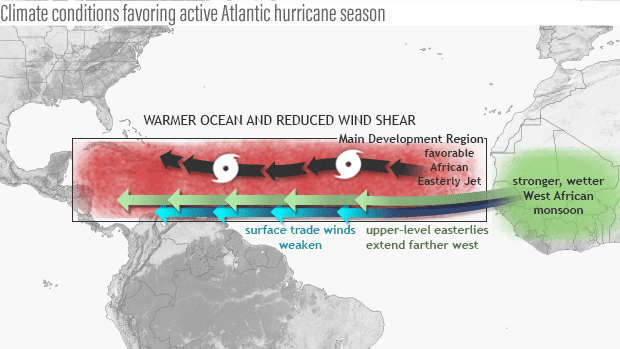
    About 600 miles off the west coast of Africa, large clusters of thunderstorms begin organizing into tropical storms every hurricane season. They aren’t yet in range of Hurricane Hunter flights, so forecasters at the National Hurricane Center rely on weather satellites to peer down on these storms and beam back information about their location, structure and intensity.

    The satellite data helps meteorologists create weather forecasts that keep planes and ships safe and prepare countries for a potential hurricane landfall.

    Now, meteorologists are about to lose access to three of those satellites.

    On June 25, 2025, the Trump administration issued a service change notice announcing that the Defense Meteorological Satellite Program, DMSP, and the Navy’s Fleet Numerical Meteorology and Oceanography Center would terminate data collection, processing and distribution of all DMSP data no later than June 30. The data termination was postponed until July 31 following a request from the head of NASA’s Earth Science Division.

    How hurricanes form. NOAA

    I am a meteorologist who studies lightning in hurricanes and helps train other meteorologists to monitor and forecast tropical cyclones. Here is how meteorologists use the DMSP data and why they are concerned about it going dark.

    Looking inside the clouds

    At its most basic, a weather satellite is a high-resolution digital camera in space that takes pictures of clouds in the atmosphere.

    These are the satellite images you see on most TV weather broadcasts. They let meteorologists see the location and some details of a hurricane’s structure, but only during daylight hours.

    Hurricane Flossie spins off the Mexican coast on July 1, 2025. Images show the top of the hurricane from space as day turns to night. NOAA GOES

    Meteorologists can use infrared satellite data, similar to a thermal imaging camera, at all hours of the day to find the coldest cloud-top temperatures, highlighting areas where the highest wind speeds and rainfall rates are found.

    But while visible and infrared satellite imagery are valuable tools for hurricane forecasters, they provide only a basic picture of the storm. It’s like a doctor diagnosing a patient after a visual exam and checking their temperature.

    Infrared bands show more detail of Hurricane Flossie’s structure on July 1, 2025. NOAA GOES

    For more accurate diagnoses, meteorologists rely on the DMSP satellites.

    The three satellites orbit Earth 14 times per day with special sensor microwave imager/sounder instruments, or SSMIS. These let meteorologists look inside the clouds, similar to how an MRI in a hospital looks inside a human body. With these instruments, meteorologists can pinpoint the storm’s low-pressure center and identify signs of intensification.

    Precisely locating the center of a hurricane improves forecasts of the storm’s future track. This lets meteorologists produce more accurate hurricane watches, warnings and evacuations.

    Hurricane track forecasts have improved by up to 75% since 1990. However, forecasting rapid intensification is still difficult, so the ability of DMPS data to identify signs of intensification is important.

    About 80% of major hurricanes – those with wind speeds of at least 111 mph (179 kilometers per hour) – rapidly intensify at some point, ramping up the risks they pose to people and property on land. Finding out when storms are about to undergo intensification allows meteorologists to warn the public about these dangerous hurricanes.

    Where are the defense satellites going?

    NOAA’s Office of Satellite and Product Operations described the reason for turning off the flow of data as a need to mitigate “a significant cybersecurity risk.”

    The three satellites have already operated for longer than planned.

    The DMSP satellites were launched between 1999 and 2009 and were designed to last for five years. They have now been operating for more than 15 years. The United States Space Force recently concluded that the DMSP satellites would reach the end of their lives between 2023 and 2026, so the data would likely have gone dark soon.

    Are there replacements for the DMSP satellites?

    Three other satellites in orbit – NOAA-20, NOAA-21 and Suomi NPP – have a microwave instrument known as the advanced technology microwave sounder.

    The advanced technology microwave sounder, or ATMS, can provide data similar to the special sensor microwave imager/sounder, or SSMIS, but at a lower resolution. It provides a more washed-out view that is less useful than the SSMIS for pinpointing a storm’s location or estimating its intensity.

    Images of Hurricane Erick off the coast of Mexico, viewed from NOAA-20’s ATMS (left) and DMPS SSMIS (right) on June 18 show the difference in resolution and the higher detail provided by the SSMIS data.
    U.S. Naval Research Laboratory, via Michael Lowry

    The U.S. Space Force began using data from a new defense meteorology satellite, ML-1A, in late April 2025.

    ML-1A is a microwave satellite that will help replace some of the DMSP satellites’ capabilities. However, the government hasn’t announced whether the ML-1A data will be available to forecasters, including those at the National Hurricane Center.

    Why are satellite replacements last minute?

    Satellite programs are planned over many years, even decades, and are very expensive. The current geostationary satellite program launched its first satellite in 2016 with plans to operate until 2038. Development of the planned successor for GOES-R began in 2019.

    Similarly, plans for replacing the DMSP satellites have been underway since the early 2000s.

    Scientists prepare a GOES-R satellite for packing aboard a rocket in 2016.
    NASA/Charles Babir

    Delays in developing the satellite instruments and funding cuts caused the National Polar-orbiting Operational Environmental Satellite System and Defense Weather Satellite System to be canceled in 2010 and 2012 before any of their satellites could be launched.

    The 2026 NOAA budget request includes an increase in funding for the next-generation geostationary satellite program, so it can be restructured to reuse spare parts from existing geostationary satellites. The budget also terminates contracts for ocean color, atmospheric composition and advanced lightning mapper instruments.

    A busy season remains

    The 2025 Atlantic hurricane season, which runs from June 1 to Nov. 30, is forecast to be above average, with six to 10 hurricanes. The most active part of the season runs from the middle of August to the middle of October, after the DMSP satellite data is set to be turned off.

    Hurricane forecasters will continue to use all available tools, including satellite, radar, weather balloon and dropsonde data, to monitor the tropics and issue hurricane forecasts. But the loss of satellite data, along with other cuts to data, funding and staffing, could ultimately put more lives at risk.

    Chris Vagasky is a member of the American Meteorological Society and the National Weather Association.

    ref. Hurricane forecasters are losing 3 key satellites ahead of peak storm season − a meteorologist explains why it matters – https://theconversation.com/hurricane-forecasters-are-losing-3-key-satellites-ahead-of-peak-storm-season-a-meteorologist-explains-why-it-matters-260190

    MIL OSI – Global Reports

  • MIL-OSI Global: The Supreme Court upholds free preventive care, but its future now rests in RFK Jr.’s hands

    Source: The Conversation – USA – By Paul Shafer, Associate Professor of Health Law, Policy and Management, Boston University

    The Affordable Care Act has survived its fourth Supreme Court challenge. Ted Eytan via Wikimedia Commons, CC BY

    On June 26, 2025, the U.S. Supreme Court handed down a 6-3 ruling that preserves free preventive care under the Affordable Care Act, a popular benefit that helps approximately 150 million Americans stay healthy.

    The case, Kennedy v. Braidwood, was the fourth major legal challenge to the Affordable Care Act. The decision, written by Justice Brett Kavanaugh with the support of Justices Amy Coney Barrett, Elena Kagan, Ketanji Brown Jackson and Sonia Sotomayor, ruled that insurers must continue to cover at no cost any preventive care approved by a federal panel called the U.S. Preventive Services Task Force.

    Members of the task force are independent scientific experts, appointed for four-year terms. The panel’s role had been purely advisory until the ACA, and the plaintiffs contended that the members lacked the appropriate authority as they had not been appointed by the President and confirmed by the Senate. The Supreme Court rejected this argument, saying that members simply needed to be appointed by the Health and Human Services Secretary – currently, Robert F. Kennedy Jr. – which they had been, under his predecessor during the Biden administration.

    This ruling seemingly safeguards access to preventive care. But as public health researchers who study health insurance and sexual health, we see another concern: It leaves preventive care vulnerable to how Kennedy and future HHS secretaries will choose to exercise their power over the task force and its recommendations.

    What is the US Preventive Services Task Force?

    The U.S. Preventive Services Task Force was initially created in 1984 to develop recommendations about prevention for primary care doctors. It is modeled after the Canadian Task Force on Preventive Health Care, which was established in 1976.

    Under the ACA, insurers must fully cover all screenings and interventions endorsed by the U.S. Preventive Services Task Force.
    SDI Productions/E+ via Getty Images

    The task force makes new recommendations and updates existing ones by reviewing clinical and policy evidence on a regular basis and weighing the potential benefits and risks of a wide range of health screenings and interventions. These include mammograms; blood pressure, colon cancer, diabetes and osteoporosis screenings; and HIV prevention. Over 150 million Americans have benefited from free coverage of these recommended services under the ACA, and around 60% of privately insured people use at least one of the covered services each year.

    The task force plays such a crucial role in health care because it is one of three federal groups whose recommendations insurers must abide by. Section 2713 of the Affordable Care Act requires insurers to offer full coverage of preventive services endorsed by three federal groups: the U.S. Preventive Services Task Force, the Advisory Committee on Immunization Practices, and the Health Resources and Services Administration. For example, the coronavirus relief bill, which passed in March 2020 and allocated emergency funding in response to the COVID-19 pandemic, used this provision to ensure COVID-19 vaccines would be free for many Americans.

    The Braidwood case and HIV prevention

    This case, originally filed in Texas in 2020, was brought by Braidwood Management, a Christian for-profit corporation owned by Steven Hotze, a Texas physician and Republican activist who has previously filed multiple lawsuits against the ACA. Braidwood and its co-plaintiffs argued on religious grounds against being forced to offer preexposure prophylaxis, or PrEP, a medicine that prevents HIV infection, in their insurance plans.

    At issue in Braidwood was whether task force members – providers and researchers who provide independent and nonpartisan expertise – were appropriately appointed and supervised under the appointments clause of the Constitution, which specifies how various government positions are appointed. The case called into question free coverage of all recommendations made by the task force since the Affordable Care Act was passed in March 2010.

    In the ruling, Kavanaugh wrote that “the Task Force members’ appointments are fully consistent with the Appointments Clause in Article II of the Constitution.” In laying out his reasoning, he wrote, “The Task Force members were appointed by and are supervised and directed by the Secretary of HHS. And the Secretary of HHS, in turn, answers to the President of the United States.”

    Concerns over political influence

    The U.S. Preventive Services Task Force is meant to operate independently of political influence, and its decisions are technically not directly reviewable. However, the task force is appointed by the HHS secretary, who may remove any of its members at any time for any reason, even if such actions are highly unusual.

    Kennedy recently took the unprecedented step of removing all members of the Advisory Committee on Immunization Practices, which debates vaccine safety but also, crucially, helps decide what immunizations are free to Americans guaranteed by the Affordable Care Act. The newly constituted committee, appointed in weeks rather than years, includes several vaccine skeptics and has already moved to rescind some vaccine recommendations, such as routine COVID-19 vaccines for pregnant women and children.

    Kennedy has also proposed restructuring out of existence the agency that supports the task force, the Agency for Healthcare Research and Quality. That agency has been subject to massive layoffs within the Department of Health and Human Services. For full disclosure, one of the authors is currently funded by the Agency for Healthcare Research and Quality and previously worked there.

    The decision to safeguard the U.S. Preventive Services Task Force as a body and, by extension, free preventive care under the ACA, doesn’t come without risks and highlights the fragility of long-standing, independent advisory systems in the face of the politicization of health. Kennedy could simply remove the existing task force members and replace them with members who may reshape the types of care recommended to Americans by their doctors and insurance plans based on debunked science and misinformation.

    Partisanship and the politicization of health threaten trust in evidence. Already, signs are emerging that Americans on both side of the political divide are losing confidence in government health agencies. This ruling preserves a crucial part of the Affordable Care Act, yet federal health guidelines and access to lifesaving care could still swing dramatically in Kennedy’s hands – or with each subsequent transition of power.

    Portions of this article originally appeared in previous articles published on Sept. 7, 2021; Dec. 1, 2021; Sept. 13, 2022; April 7, 2023; and April 15, 2025.

    Paul Shafer receives research funding from the National Institutes of Health, Agency for Healthcare Research and Quality, and Department of Veterans Affairs. The views expressed in this article are those of the authors and do not necessarily reflect the position or policy of these agencies or the United States government.

    Kristefer Stojanovski receives funding from the Robert Wood Johnson Foundation. The views expressed in this article are those of the authors and do not necessarily reflect the position or policy of these agencies or the United States government.

    ref. The Supreme Court upholds free preventive care, but its future now rests in RFK Jr.’s hands – https://theconversation.com/the-supreme-court-upholds-free-preventive-care-but-its-future-now-rests-in-rfk-jr-s-hands-260072

    MIL OSI – Global Reports

  • MIL-OSI Global: The Supreme Court upholds free preventive care, but its future now rests in RFK Jr.’s hands

    Source: The Conversation – USA – By Paul Shafer, Associate Professor of Health Law, Policy and Management, Boston University

    The Affordable Care Act has survived its fourth Supreme Court challenge. Ted Eytan via Wikimedia Commons, CC BY

    On June 26, 2025, the U.S. Supreme Court handed down a 6-3 ruling that preserves free preventive care under the Affordable Care Act, a popular benefit that helps approximately 150 million Americans stay healthy.

    The case, Kennedy v. Braidwood, was the fourth major legal challenge to the Affordable Care Act. The decision, written by Justice Brett Kavanaugh with the support of Justices Amy Coney Barrett, Elena Kagan, Ketanji Brown Jackson and Sonia Sotomayor, ruled that insurers must continue to cover at no cost any preventive care approved by a federal panel called the U.S. Preventive Services Task Force.

    Members of the task force are independent scientific experts, appointed for four-year terms. The panel’s role had been purely advisory until the ACA, and the plaintiffs contended that the members lacked the appropriate authority as they had not been appointed by the President and confirmed by the Senate. The Supreme Court rejected this argument, saying that members simply needed to be appointed by the Health and Human Services Secretary – currently, Robert F. Kennedy Jr. – which they had been, under his predecessor during the Biden administration.

    This ruling seemingly safeguards access to preventive care. But as public health researchers who study health insurance and sexual health, we see another concern: It leaves preventive care vulnerable to how Kennedy and future HHS secretaries will choose to exercise their power over the task force and its recommendations.

    What is the US Preventive Services Task Force?

    The U.S. Preventive Services Task Force was initially created in 1984 to develop recommendations about prevention for primary care doctors. It is modeled after the Canadian Task Force on Preventive Health Care, which was established in 1976.

    Under the ACA, insurers must fully cover all screenings and interventions endorsed by the U.S. Preventive Services Task Force.
    SDI Productions/E+ via Getty Images

    The task force makes new recommendations and updates existing ones by reviewing clinical and policy evidence on a regular basis and weighing the potential benefits and risks of a wide range of health screenings and interventions. These include mammograms; blood pressure, colon cancer, diabetes and osteoporosis screenings; and HIV prevention. Over 150 million Americans have benefited from free coverage of these recommended services under the ACA, and around 60% of privately insured people use at least one of the covered services each year.

    The task force plays such a crucial role in health care because it is one of three federal groups whose recommendations insurers must abide by. Section 2713 of the Affordable Care Act requires insurers to offer full coverage of preventive services endorsed by three federal groups: the U.S. Preventive Services Task Force, the Advisory Committee on Immunization Practices, and the Health Resources and Services Administration. For example, the coronavirus relief bill, which passed in March 2020 and allocated emergency funding in response to the COVID-19 pandemic, used this provision to ensure COVID-19 vaccines would be free for many Americans.

    The Braidwood case and HIV prevention

    This case, originally filed in Texas in 2020, was brought by Braidwood Management, a Christian for-profit corporation owned by Steven Hotze, a Texas physician and Republican activist who has previously filed multiple lawsuits against the ACA. Braidwood and its co-plaintiffs argued on religious grounds against being forced to offer preexposure prophylaxis, or PrEP, a medicine that prevents HIV infection, in their insurance plans.

    At issue in Braidwood was whether task force members – providers and researchers who provide independent and nonpartisan expertise – were appropriately appointed and supervised under the appointments clause of the Constitution, which specifies how various government positions are appointed. The case called into question free coverage of all recommendations made by the task force since the Affordable Care Act was passed in March 2010.

    In the ruling, Kavanaugh wrote that “the Task Force members’ appointments are fully consistent with the Appointments Clause in Article II of the Constitution.” In laying out his reasoning, he wrote, “The Task Force members were appointed by and are supervised and directed by the Secretary of HHS. And the Secretary of HHS, in turn, answers to the President of the United States.”

    Concerns over political influence

    The U.S. Preventive Services Task Force is meant to operate independently of political influence, and its decisions are technically not directly reviewable. However, the task force is appointed by the HHS secretary, who may remove any of its members at any time for any reason, even if such actions are highly unusual.

    Kennedy recently took the unprecedented step of removing all members of the Advisory Committee on Immunization Practices, which debates vaccine safety but also, crucially, helps decide what immunizations are free to Americans guaranteed by the Affordable Care Act. The newly constituted committee, appointed in weeks rather than years, includes several vaccine skeptics and has already moved to rescind some vaccine recommendations, such as routine COVID-19 vaccines for pregnant women and children.

    Kennedy has also proposed restructuring out of existence the agency that supports the task force, the Agency for Healthcare Research and Quality. That agency has been subject to massive layoffs within the Department of Health and Human Services. For full disclosure, one of the authors is currently funded by the Agency for Healthcare Research and Quality and previously worked there.

    The decision to safeguard the U.S. Preventive Services Task Force as a body and, by extension, free preventive care under the ACA, doesn’t come without risks and highlights the fragility of long-standing, independent advisory systems in the face of the politicization of health. Kennedy could simply remove the existing task force members and replace them with members who may reshape the types of care recommended to Americans by their doctors and insurance plans based on debunked science and misinformation.

    Partisanship and the politicization of health threaten trust in evidence. Already, signs are emerging that Americans on both side of the political divide are losing confidence in government health agencies. This ruling preserves a crucial part of the Affordable Care Act, yet federal health guidelines and access to lifesaving care could still swing dramatically in Kennedy’s hands – or with each subsequent transition of power.

    Portions of this article originally appeared in previous articles published on Sept. 7, 2021; Dec. 1, 2021; Sept. 13, 2022; April 7, 2023; and April 15, 2025.

    Paul Shafer receives research funding from the National Institutes of Health, Agency for Healthcare Research and Quality, and Department of Veterans Affairs. The views expressed in this article are those of the authors and do not necessarily reflect the position or policy of these agencies or the United States government.

    Kristefer Stojanovski receives funding from the Robert Wood Johnson Foundation. The views expressed in this article are those of the authors and do not necessarily reflect the position or policy of these agencies or the United States government.

    ref. The Supreme Court upholds free preventive care, but its future now rests in RFK Jr.’s hands – https://theconversation.com/the-supreme-court-upholds-free-preventive-care-but-its-future-now-rests-in-rfk-jr-s-hands-260072

    MIL OSI – Global Reports

  • MIL-OSI Global: Despite claims they’d move overseas after the election, most Americans are staying put

    Source: The Conversation – USA – By Amanda Klekowski von Koppenfels, Honorary Reader in MIgration and Politics, University of Kent

    Not that many people are preparing to leave the U.S. gerenme/E+ via Getty Images

    Based on pronouncements in 2024, you might think now is the time to see U.S. citizens streaming out of the country. Months before the 2024 presidential election, Americans were saying they would leave should candidate Donald Trump win the election. Gallup polling in 2024 found that 21% of Americans wanted to leave the United States permanently, more than double the 10% who had said so in 2011.

    And indeed in June 2025, a Vermont legislator announced that she was resigning her seat and moving to Canada because of political concerns and economic opportunities. To be sure, people are moving. Even so, as a scholar of American migration overseas, my research finds that the vast majority of Americans are not about to depart for greener shores.

    A western Massachusetts group

    In October 2024, I surveyed 68 Americans in western Massachusetts, an area with a slight Democratic majority, asking if they wanted to leave the United States for a lengthy period of time, but not necessarily permanently. Over 90% said no, noting that there were factors limiting their mobility, such as financial obligations or having a partner who would not move, and that there were reasons that made them want to stay, such as owning property and having friends nearby.

    Just three respondents indicated they were making plans to move, while an additional 11 said they wanted to move “someday.”

    Reality strikes

    After the November 2024 election, I interviewed seven of those respondents, two of whom had said prior to the election that they might leave the United States. After the election, they all said they planned to stay.

    One who had said she wanted to leave acknowledged her reversal, saying: “I may have flippantly said, ‘Oh, if (Trump) gets voted in … I would leave,’ but I can’t see leaving. Part of it is because of my daughter,” who had recently become a mother. She continued, “It’s never crossed my mind seriously enough to even research it.”

    Another told me, “I’m not going to let somebody push me out of what I consider my country and my home because he’s a jerk.”

    Others spoke of needing to work several more years in order to receive a pension, or having family responsibilities keeping them in the country. None supported the current administration.

    On a national level

    In two nationally representative surveys, my colleague Helen B. Marrow, a sociologist of immigration, and I found no significant increase in migration aspiration between 2014 and 2019. We also found that respondents mentioned exploration and adventure much more often than political or economic reasons for wanting to move abroad.

    Even though the U.S. passport grants visa-free visitor access to more than 180 countries, U.S. citizens still need residence and work visas. At home, they, like others, have family commitments and financial constraints, or may just not want to leave home. More than 95% of the world’s population do not move abroad – and U.S. citizens are no different.

    Relocation coaching

    In addition to my academic research on overseas Americans, I am also an international relocation coach. I help Americans considering a move abroad navigate the emotional, practical and professional complexities of relocation, whether they’re just starting to explore the idea or actively planning their next steps.

    Many of my clients do not want to live in a United States that no longer aligns with their values, while others are concerned about their safety, particularly, but not only, due to racism or homophobia. They are finding jobs overseas, retiring abroad or acquiring a European citizenship through a parent or grandparent. Most recently, American academics seeking to leave are being courted by European universities.

    But most are staying

    In February 2025, a national poll found that 4% of Americans said they were “definitely planning to move” to another country.

    That same month, I followed up with my seven interviewees from western Massachusetts, including one trans man. They all reiterated their choice to remain in the United States. One person, who might move abroad at some point, told me she hadn’t changed her mind about leaving soon: “Leaving doesn’t necessarily mean anything will be better for me, even if it was a financial possibility.”

    Two people said that recent political developments actually meant that they were more committed to remaining in the United States. One told me, “Now, more than ever, individuals need to figure out what small actions can be taken to help our fellow Americans get through this dark period.”

    But even those “definitely planning on moving” can have other factors intervene. Two clients of mine who were making serious plans had to stop when family members’ health situations changed for the worse.

    So how many people are actually leaving? It is clear that a growing number of Americans are considering a move abroad. But far fewer are conducting serious research, seeking professional consultation or actually moving. Drawing on available data, my own academic research and my coaching experience, my educated estimate is that no more than 1% to 2% of U.S. citizens are actively making viable plans to leave the country. Nor are all of those leaving out of protest; many are still motivated by exploration, adventure, employment or to be with a partner.

    Even so, that figure is roughly 3 million to 6 million people – which would be a significant increase over the estimated 5.5 million Americans currently living abroad. As with many migration flows, even the movement of a small percentage of a population can still have the potential to reshape both the United States and its overseas population.

    Amanda Klekowski von Koppenfels does not work for, consult, own shares in or receive funding from any company or organization that would benefit from this article, and has disclosed no relevant affiliations beyond their academic appointment.

    ref. Despite claims they’d move overseas after the election, most Americans are staying put – https://theconversation.com/despite-claims-theyd-move-overseas-after-the-election-most-americans-are-staying-put-250728

    MIL OSI – Global Reports

  • MIL-OSI Global: What damage did the US do to Iran’s nuclear program? Why it’s so hard to know

    Source: The Conversation – USA – By Joshua Rovner, Associate Professor of International Relations, American University

    Gen. Dan Caine, chairman of the Joint Chiefs of Staff, describes the U.S. military attack on Iranian nuclear sites, which occurred on June 21, 2025, . AP Photo/Alex Brandon

    The U.S. Air Force dropped a dozen ground-penetrating bombs, each weighing 30,000 pounds (13,607 kilograms), in a raid on Iran’s nuclear site at Fordo on June 21, 2025. The attack was an attempt to reach the uranium enrichment facility buried deep inside a mountain. The target, President Donald Trump declared, was “completely and totally obliterated.”

    Others were less sure. On June 24, the administration canceled a classified intelligence briefing to members of Congress, leading to frustration among those with questions about White House claims. While Defense Intelligence Agency analysts apparently agree that the strikes did real damage, they dispute the idea that the attack permanently destroyed Iran’s enrichment capability. Reports emerged that their initial analysis found that the strikes had only set Iran back a few months.

    Such disagreements are unsurprising. Battle damage assessment – originally called bomb damage assessment – is notoriously difficult, and past wars have featured intense controversies among military and intelligence professionals. In World War II, poor weather and the limits of available technology conspired against accuracy.

    Battle damage assessment remained a thorny problem decades later, even after radical improvements in surveillance technology. In the first Gulf War in 1990, for example, military leaders argued with CIA officials over the effects of airstrikes against Iraq’s armored forces.

    I am a scholar of international relations who studies intelligence and strategy in international conflicts, and the author of “Fixing the Facts: National Security and the Politics of Intelligence.” I know from history that overcoming the challenges of battle damage assessment is especially hard when the target is a facility hidden under hundreds of feet of earth and rock, as is the case at Fordo.

    How the U.S. military’s ‘bunker buster’ bomb works.

    Tools of the trade

    The intelligence community has a number of tools and techniques that can help with challenges like assessing the damage at Fordo. Imagery intelligence such as satellite photography is the obvious starting point. Before-and-after comparisons might reveal collapsed tunnels or topographical changes, suggesting unseen subterranean damage.

    More exotic data collection techniques may be able to help infer the underground effects based on particle and electromagnetic emissions from the site. These platforms provide what is called measurement and signatures intelligence. Specialized sensors can measure nuclear radiation, seismographic information and other potentially revealing information from camouflaged facilities. When combined with traditional imagery, measurement and signatures intelligence can provide a more detailed model of the likely effects of the bombing.

    Other sources may prove useful as well. Reporting from human intelligence assets – spies or unwitting informers with firsthand or secondhand knowledge – may provide information on internal Iranian assessments. These may be particularly valuable because Iranian officials presumably know how much equipment was removed in advance, as well as the location of previously enriched uranium.

    The same is true for signals intelligence, which intercepts and interprets communications. Ideally, battle damage assessment will become more comprehensive and accurate as these sources of intelligence are integrated into a single assessment.

    Pervasive uncertainty

    But even in that case, it will still be difficult to estimate the broader effects on Iran’s nuclear program. Measuring the immediate physical effects on Fordo and other nuclear sites is a kind of puzzle, or a problem that can be solved with sufficient evidence. Estimating the long-term effects on Iranian policy is a mystery, or a problem that cannot be solved even with abundant information on hand. It’s impossible to know how Iran’s leaders will adapt over time to their changing circumstances. They themselves cannot know either; perceptions of the future are inherently uncertain.

    Regarding the puzzle over Fordo, Trump seems to believe that the sheer volume of explosives dropped on the site must have done the job. As White House Press Secretary Karoline Leavitt put it: “Everyone knows what happens when you drop 14 30,000-pound bombs perfectly on their targets: total obliteration.”

    But the fact that Fordo is buried in the side of a mountain is a reason to doubt this commonsense conclusion. In addition, Iran may have moved enriched uranium and specialized equipment from the site in advance, limiting the effects on its nuclear program.

    Trump’s instincts might be right. Or the skeptics might be right. Both make plausible claims. Analysts will need more intelligence from more sources to make a confident judgment about the effects on Fordo and on Iran’s broader nuclear efforts. Even then, it is likely that they will disagree on the effects, because this requires making predictions.

    News coverage of the attack on Fordo and White House claims of success.

    Politicized intelligence

    In a perfect world, policymakers and intelligence officials would wrestle with dueling assessments in good faith. Such a process would take place outside the political fray, giving both sides the opportunity to offer criticism without being accused of political mischief. In this idealized scenario, policymakers could use reasonable intelligence conclusions to inform their decision-making process. After all, there are a lot of decisions about Middle Eastern security left to be made.

    But we are not in a perfect world, and hopes for a good faith debate seem hopelessly naïve. Already the battle lines are being drawn. Congressional Democrats are suspicious that the administration is being disingenuous about Iran. The White House, for its part, is going on the offensive. “The leaking of this alleged assessment is a clear attempt to demean President Trump,” Leavitt declared in a written statement, “and discredit the brave fighter pilots who conducted a perfectly executed mission.”

    Relations between policymakers and their intelligence advisers are often contentious, and U.S. presidents have a long history of clashing with spy chiefs. But intelligence-policy relations today are in a particularly dismal state. Trump bears the most responsibility, given his repeated disparagement of intelligence officials. For example, he dismissed the congressional testimony on Iran from Director of National Intelligence Tulsi Gabbard: “I don’t care what she said.”

    The problem goes deeper than the president, however. Intelligence-policy relations in a democracy are difficult because of the persuasive power of secret information. Policymakers fear that intelligence officials who control secrets might use them to undermine the policymakers’ plans. Intelligence officials worry that the policymakers will bully them into giving politically convenient answers. Such fears led to intelligence-policy breakdowns over estimates of enemy strength in the Vietnam War and estimates of Soviet missile capabilities in the early years of detente.

    This mutual suspicion has become progressively worse since the end of the Cold War, as secret intelligence has become increasingly public. Intelligence leaders have become recognizable public figures, and intelligence judgments on current issues are often quickly declassified. The public now expects to have access to intelligence findings, and this has helped turn intelligence into a political football.

    What lies ahead

    What does all this mean for intelligence on Iran? Trump might ignore assessments he dislikes, given his history with intelligence. But the acrimonious public dispute over the Fordo strike may lead the White House to pressure intelligence leaders to toe the line, especially if critics demand a public accounting of secret intelligence.

    Such an outcome would benefit nobody. The public would not have a better sense of the questions surrounding Iran’s nuclear effort, the intelligence community would suffer a serious blow to its reputation, and the administration’s efforts to use intelligence in public might backfire, as was the case for the George W. Bush administration after the war in Iraq.

    As with military campaigns, episodes of politicizing intelligence have lasting and sometimes unforeseen consequences.

    Joshua Rovner is associate professor of international relations at American University, and nonresident senior fellow at the Brookings Institution.

    ref. What damage did the US do to Iran’s nuclear program? Why it’s so hard to know – https://theconversation.com/what-damage-did-the-us-do-to-irans-nuclear-program-why-its-so-hard-to-know-260058

    MIL OSI – Global Reports

  • MIL-OSI Submissions: The Supreme Court upholds free preventive care, but its future now rests in RFK Jr.’s hands

    Source: The Conversation – USA (3) – By Paul Shafer, Associate Professor of Health Law, Policy and Management, Boston University

    The Affordable Care Act has survived its fourth Supreme Court challenge. Ted Eytan via Wikimedia Commons, CC BY

    On June 26, 2025, the U.S. Supreme Court handed down a 6-3 ruling that preserves free preventive care under the Affordable Care Act, a popular benefit that helps approximately 150 million Americans stay healthy.

    The case, Kennedy v. Braidwood, was the fourth major legal challenge to the Affordable Care Act. The decision, written by Justice Brett Kavanaugh with the support of Justices Amy Coney Barrett, Elena Kagan, Ketanji Brown Jackson and Sonia Sotomayor, ruled that insurers must continue to cover at no cost any preventive care approved by a federal panel called the U.S. Preventive Services Task Force.

    Members of the task force are independent scientific experts, appointed for four-year terms. The panel’s role had been purely advisory until the ACA, and the plaintiffs contended that the members lacked the appropriate authority as they had not been appointed by the President and confirmed by the Senate. The Supreme Court rejected this argument, saying that members simply needed to be appointed by the Health and Human Services Secretary – currently, Robert F. Kennedy Jr. – which they had been, under his predecessor during the Biden administration.

    This ruling seemingly safeguards access to preventive care. But as public health researchers who study health insurance and sexual health, we see another concern: It leaves preventive care vulnerable to how Kennedy and future HHS secretaries will choose to exercise their power over the task force and its recommendations.

    What is the US Preventive Services Task Force?

    The U.S. Preventive Services Task Force was initially created in 1984 to develop recommendations about prevention for primary care doctors. It is modeled after the Canadian Task Force on Preventive Health Care, which was established in 1976.

    Under the ACA, insurers must fully cover all screenings and interventions endorsed by the U.S. Preventive Services Task Force.
    SDI Productions/E+ via Getty Images

    The task force makes new recommendations and updates existing ones by reviewing clinical and policy evidence on a regular basis and weighing the potential benefits and risks of a wide range of health screenings and interventions. These include mammograms; blood pressure, colon cancer, diabetes and osteoporosis screenings; and HIV prevention. Over 150 million Americans have benefited from free coverage of these recommended services under the ACA, and around 60% of privately insured people use at least one of the covered services each year.

    The task force plays such a crucial role in health care because it is one of three federal groups whose recommendations insurers must abide by. Section 2713 of the Affordable Care Act requires insurers to offer full coverage of preventive services endorsed by three federal groups: the U.S. Preventive Services Task Force, the Advisory Committee on Immunization Practices, and the Health Resources and Services Administration. For example, the coronavirus relief bill, which passed in March 2020 and allocated emergency funding in response to the COVID-19 pandemic, used this provision to ensure COVID-19 vaccines would be free for many Americans.

    The Braidwood case and HIV prevention

    This case, originally filed in Texas in 2020, was brought by Braidwood Management, a Christian for-profit corporation owned by Steven Hotze, a Texas physician and Republican activist who has previously filed multiple lawsuits against the ACA. Braidwood and its co-plaintiffs argued on religious grounds against being forced to offer preexposure prophylaxis, or PrEP, a medicine that prevents HIV infection, in their insurance plans.

    At issue in Braidwood was whether task force members – providers and researchers who provide independent and nonpartisan expertise – were appropriately appointed and supervised under the appointments clause of the Constitution, which specifies how various government positions are appointed. The case called into question free coverage of all recommendations made by the task force since the Affordable Care Act was passed in March 2010.

    In the ruling, Kavanaugh wrote that “the Task Force members’ appointments are fully consistent with the Appointments Clause in Article II of the Constitution.” In laying out his reasoning, he wrote, “The Task Force members were appointed by and are supervised and directed by the Secretary of HHS. And the Secretary of HHS, in turn, answers to the President of the United States.”

    Concerns over political influence

    The U.S. Preventive Services Task Force is meant to operate independently of political influence, and its decisions are technically not directly reviewable. However, the task force is appointed by the HHS secretary, who may remove any of its members at any time for any reason, even if such actions are highly unusual.

    Kennedy recently took the unprecedented step of removing all members of the Advisory Committee on Immunization Practices, which debates vaccine safety but also, crucially, helps decide what immunizations are free to Americans guaranteed by the Affordable Care Act. The newly constituted committee, appointed in weeks rather than years, includes several vaccine skeptics and has already moved to rescind some vaccine recommendations, such as routine COVID-19 vaccines for pregnant women and children.

    Kennedy has also proposed restructuring out of existence the agency that supports the task force, the Agency for Healthcare Research and Quality. That agency has been subject to massive layoffs within the Department of Health and Human Services. For full disclosure, one of the authors is currently funded by the Agency for Healthcare Research and Quality and previously worked there.

    The decision to safeguard the U.S. Preventive Services Task Force as a body and, by extension, free preventive care under the ACA, doesn’t come without risks and highlights the fragility of long-standing, independent advisory systems in the face of the politicization of health. Kennedy could simply remove the existing task force members and replace them with members who may reshape the types of care recommended to Americans by their doctors and insurance plans based on debunked science and misinformation.

    Partisanship and the politicization of health threaten trust in evidence. Already, signs are emerging that Americans on both side of the political divide are losing confidence in government health agencies. This ruling preserves a crucial part of the Affordable Care Act, yet federal health guidelines and access to lifesaving care could still swing dramatically in Kennedy’s hands – or with each subsequent transition of power.

    Portions of this article originally appeared in previous articles published on Sept. 7, 2021; Dec. 1, 2021; Sept. 13, 2022; April 7, 2023; and April 15, 2025.

    Paul Shafer receives research funding from the National Institutes of Health, Agency for Healthcare Research and Quality, and Department of Veterans Affairs. The views expressed in this article are those of the authors and do not necessarily reflect the position or policy of these agencies or the United States government.

    Kristefer Stojanovski receives funding from the Robert Wood Johnson Foundation. The views expressed in this article are those of the authors and do not necessarily reflect the position or policy of these agencies or the United States government.

    ref. The Supreme Court upholds free preventive care, but its future now rests in RFK Jr.’s hands – https://theconversation.com/the-supreme-court-upholds-free-preventive-care-but-its-future-now-rests-in-rfk-jr-s-hands-260072

    MIL OSI

  • MIL-OSI Submissions: The rule of law is key to capitalism − eroding it is bad news for American business

    Source: The Conversation – USA (2) – By Robert Bird, Professor of Business Law & Eversource Energy Chair in Business Ethics, University of Connecticut

    Something dangerous is happening to the U.S. economy, and it’s not inflation or trade wars. Chaotic deregulation and the selective enforcement of laws have upended markets and investor confidence. At one point, the threat of tariffs and resulting chaos evaporated US$4 trillion in value in the U.S. stock market. This approach isn’t helping the economy, and there are troubling signs it will hurt both the U.S. and the global economy in the short and long term.

    The rule of law – the idea that legal rules apply to everyone equally, regardless of wealth or political connections − is essential for a thriving economy. Yet globally the respect for the rule of law is slipping, and the U.S. is slipping with it. According to annual rankings from the World Justice Project, the rule of law has declined in more than half of all countries for seven years in a row. The rule of law in the U.S., the most economically powerful nation in the world, is now weaker than the rule of law in Uruguay, Singapore, Latvia and over 20 other countries.

    When regulation is unnecessarily burdensome for business, government should lighten the load. However, arbitrary and frenzied deregulation does not free corporations to earn higher profits. As a business school professor with an MBA who has taught business law for over 25 years, and the author of a recently published book about the importance of legal knowledge to business, I can affirm that the opposite is true. Chaotic deregulation doesn’t drive growth. It only fuels risk.

    Chaos undermines investment, talent and trust

    Legal uncertainty has become a serious drag on American competitiveness.

    A study by the U.S. Chamber of Commerce found that public policy risks — such as unexpected changes in taxes, regulation and enforcement — ranked among the top challenges businesses face, alongside more familiar business threats such as competition or economic volatility. Companies that can’t predict how the law might change are forced to plan for the worst. That means holding back on long-term investment, slowing innovation and raising prices to cover new risks.

    When the government enforces rules arbitrarily, it also undermines property rights.

    For example, if a country enters into a major trade agreement and then goes ahead and violates it, that threatens the property rights of the companies that relied on the agreement to conduct business. If the government can seize assets without due process, those assets lose their stability and value. And if that treatment depends on whether a company is in the government’s political favor, it’s not just bad economics − it’s a red flag for investors.

    When government doesn’t enforce rules fairly, it also threatens people’s freedom to enter into contracts.

    Consider presidential orders that threaten the clients of law firms that have challenged the administration with cancellation of their government contracts. The threat alone jeopardizes the value of those agreements.

    If businesses can’t trust public contracts to be respected, they’ll be less likely to work with the government in the first place. This deprives the government, and ultimately the American people, of receiving the best value for their tax dollars in critical areas such as transportation, technology and national defense.

    Regulatory chaos also allows corruption to spread.

    For example, the Foreign Corrupt Practices Act, which prohibits businesses from bribing foreign government officials, has leveled the playing field for firms and enabled the best American companies to succeed on their merits. Before the law was enacted in 1977, some American companies felt pressured to pay bribes to compete. “Pausing” enforcement of the law, as the current presidential administration has done, increases the cost of doing business and encourages a wild west economy where chaos thrives.

    When corruption grows, stable and democratic governments weaken, opportunities for terrorism increase and corruption-fueled authoritarian regimes, which oppose the interests of the U.S., thrive. Halting the enforcement of an anti-bribery law, even for a limited time, is an issue of national security.

    Legal uncertainty fuels brain drain

    Chaotic enforcement of the law also corrodes labor markets.

    American companies require a strong pool of talented professionals to fuel their financial success. When legal rights are enforced arbitrarily or unjustly, the very best talent that American companies need may leave the country.

    The science brain drain is already happening. American scientists have submitted 32% more applications for jobs abroad compared with last year. Nonscientists are leaving too. Ireland’s Department of Foreign Affairs has witnessed a 50% increase in Americans taking steps to obtain an Irish passport. Employers in the U.K. saw a spike in job applications from the United States.

    Business from other countries will gladly accept American talent as they compete against American companies. During the Third Reich, Nazi Germany lost its best and brightest to other countries, including America. Now the reverse is happening, as highly talented Americans leave to work for firms in other nations.

    Threats of arbitrary legal actions also drive away democratic allies and their prosperous populations that purchase American-made goods and services. For example, arbitrarily threatening to punish or even annex a closely allied nation does not endear its citizens to that government or the businesses it represents. So it’s no surprise that Canadians are now boycotting American goods and services. This is devastating businesses in American border towns and hurts the economy nationwide.

    Similarly, the Canadian government has responded to whipsawing U.S. tariff announcements with counter-tariffs, which will slice the profits of American exporters. Close American allies and trading partners such as Japan, the U.K. and the European Union are also signaling their own willingness to impose retaliatory tariffs, increasing the costs of operations to American business even more.

    Modern capitalism depends on smart regulation to thrive. Smart regulation is not an obstacle to capitalism. Smart regulation is what makes American capitalism possible. Smart regulation is what makes American freedom possible.

    Clear and consistently applied legal rules allow businesses to aggressively compete, carefully plan, and generate profits. An arbitrary rule of law deprives business of the true power of capitalism – the ability to promote economic growth, spur innovation and improve the overall living standards of a free society. Americans deserve no less, and it is up to government to make that happen for everyone.

    Robert Bird does not work for, consult, own shares in or receive funding from any company or organization that would benefit from this article, and has disclosed no relevant affiliations beyond their academic appointment.

    ref. The rule of law is key to capitalism − eroding it is bad news for American business – https://theconversation.com/the-rule-of-law-is-key-to-capitalism-eroding-it-is-bad-news-for-american-business-254922

    MIL OSI

  • MIL-OSI Submissions: Despite claims they’d move overseas after the election, most Americans are staying put

    Source: The Conversation – USA – By Amanda Klekowski von Koppenfels, Honorary Reader in MIgration and Politics, University of Kent

    Not that many people are preparing to leave the U.S. gerenme/E+ via Getty Images

    Based on pronouncements in 2024, you might think now is the time to see U.S. citizens streaming out of the country. Months before the 2024 presidential election, Americans were saying they would leave should candidate Donald Trump win the election. Gallup polling in 2024 found that 21% of Americans wanted to leave the United States permanently, more than double the 10% who had said so in 2011.

    And indeed in June 2025, a Vermont legislator announced that she was resigning her seat and moving to Canada because of political concerns and economic opportunities. To be sure, people are moving. Even so, as a scholar of American migration overseas, my research finds that the vast majority of Americans are not about to depart for greener shores.

    A western Massachusetts group

    In October 2024, I surveyed 68 Americans in western Massachusetts, an area with a slight Democratic majority, asking if they wanted to leave the United States for a lengthy period of time, but not necessarily permanently. Over 90% said no, noting that there were factors limiting their mobility, such as financial obligations or having a partner who would not move, and that there were reasons that made them want to stay, such as owning property and having friends nearby.

    Just three respondents indicated they were making plans to move, while an additional 11 said they wanted to move “someday.”

    Reality strikes

    After the November 2024 election, I interviewed seven of those respondents, two of whom had said prior to the election that they might leave the United States. After the election, they all said they planned to stay.

    One who had said she wanted to leave acknowledged her reversal, saying: “I may have flippantly said, ‘Oh, if (Trump) gets voted in … I would leave,’ but I can’t see leaving. Part of it is because of my daughter,” who had recently become a mother. She continued, “It’s never crossed my mind seriously enough to even research it.”

    Another told me, “I’m not going to let somebody push me out of what I consider my country and my home because he’s a jerk.”

    Others spoke of needing to work several more years in order to receive a pension, or having family responsibilities keeping them in the country. None supported the current administration.

    On a national level

    In two nationally representative surveys, my colleague Helen B. Marrow, a sociologist of immigration, and I found no significant increase in migration aspiration between 2014 and 2019. We also found that respondents mentioned exploration and adventure much more often than political or economic reasons for wanting to move abroad.

    Even though the U.S. passport grants visa-free visitor access to more than 180 countries, U.S. citizens still need residence and work visas. At home, they, like others, have family commitments and financial constraints, or may just not want to leave home. More than 95% of the world’s population do not move abroad – and U.S. citizens are no different.

    Relocation coaching

    In addition to my academic research on overseas Americans, I am also an international relocation coach. I help Americans considering a move abroad navigate the emotional, practical and professional complexities of relocation, whether they’re just starting to explore the idea or actively planning their next steps.

    Many of my clients do not want to live in a United States that no longer aligns with their values, while others are concerned about their safety, particularly, but not only, due to racism or homophobia. They are finding jobs overseas, retiring abroad or acquiring a European citizenship through a parent or grandparent. Most recently, American academics seeking to leave are being courted by European universities.

    But most are staying

    In February 2025, a national poll found that 4% of Americans said they were “definitely planning to move” to another country.

    That same month, I followed up with my seven interviewees from western Massachusetts, including one trans man. They all reiterated their choice to remain in the United States. One person, who might move abroad at some point, told me she hadn’t changed her mind about leaving soon: “Leaving doesn’t necessarily mean anything will be better for me, even if it was a financial possibility.”

    Two people said that recent political developments actually meant that they were more committed to remaining in the United States. One told me, “Now, more than ever, individuals need to figure out what small actions can be taken to help our fellow Americans get through this dark period.”

    But even those “definitely planning on moving” can have other factors intervene. Two clients of mine who were making serious plans had to stop when family members’ health situations changed for the worse.

    So how many people are actually leaving? It is clear that a growing number of Americans are considering a move abroad. But far fewer are conducting serious research, seeking professional consultation or actually moving. Drawing on available data, my own academic research and my coaching experience, my educated estimate is that no more than 1% to 2% of U.S. citizens are actively making viable plans to leave the country. Nor are all of those leaving out of protest; many are still motivated by exploration, adventure, employment or to be with a partner.

    Even so, that figure is roughly 3 million to 6 million people – which would be a significant increase over the estimated 5.5 million Americans currently living abroad. As with many migration flows, even the movement of a small percentage of a population can still have the potential to reshape both the United States and its overseas population.

    Amanda Klekowski von Koppenfels does not work for, consult, own shares in or receive funding from any company or organization that would benefit from this article, and has disclosed no relevant affiliations beyond their academic appointment.

    ref. Despite claims they’d move overseas after the election, most Americans are staying put – https://theconversation.com/despite-claims-theyd-move-overseas-after-the-election-most-americans-are-staying-put-250728

    MIL OSI

  • MIL-OSI Submissions: What damage did the US do to Iran’s nuclear program? Why it’s so hard to know

    Source: The Conversation – USA – By Joshua Rovner, Associate Professor of International Relations, American University

    Gen. Dan Caine, chairman of the Joint Chiefs of Staff, describes the U.S. military attack on Iranian nuclear sites, which occurred on June 21, 2025, . AP Photo/Alex Brandon

    The U.S. Air Force dropped a dozen ground-penetrating bombs, each weighing 30,000 pounds (13,607 kilograms), in a raid on Iran’s nuclear site at Fordo on June 21, 2025. The attack was an attempt to reach the uranium enrichment facility buried deep inside a mountain. The target, President Donald Trump declared, was “completely and totally obliterated.”

    Others were less sure. On June 24, the administration canceled a classified intelligence briefing to members of Congress, leading to frustration among those with questions about White House claims. While Defense Intelligence Agency analysts apparently agree that the strikes did real damage, they dispute the idea that the attack permanently destroyed Iran’s enrichment capability. Reports emerged that their initial analysis found that the strikes had only set Iran back a few months.

    Such disagreements are unsurprising. Battle damage assessment – originally called bomb damage assessment – is notoriously difficult, and past wars have featured intense controversies among military and intelligence professionals. In World War II, poor weather and the limits of available technology conspired against accuracy.

    Battle damage assessment remained a thorny problem decades later, even after radical improvements in surveillance technology. In the first Gulf War in 1990, for example, military leaders argued with CIA officials over the effects of airstrikes against Iraq’s armored forces.

    I am a scholar of international relations who studies intelligence and strategy in international conflicts, and the author of “Fixing the Facts: National Security and the Politics of Intelligence.” I know from history that overcoming the challenges of battle damage assessment is especially hard when the target is a facility hidden under hundreds of feet of earth and rock, as is the case at Fordo.

    How the U.S. military’s ‘bunker buster’ bomb works.

    Tools of the trade

    The intelligence community has a number of tools and techniques that can help with challenges like assessing the damage at Fordo. Imagery intelligence such as satellite photography is the obvious starting point. Before-and-after comparisons might reveal collapsed tunnels or topographical changes, suggesting unseen subterranean damage.

    More exotic data collection techniques may be able to help infer the underground effects based on particle and electromagnetic emissions from the site. These platforms provide what is called measurement and signatures intelligence. Specialized sensors can measure nuclear radiation, seismographic information and other potentially revealing information from camouflaged facilities. When combined with traditional imagery, measurement and signatures intelligence can provide a more detailed model of the likely effects of the bombing.

    Other sources may prove useful as well. Reporting from human intelligence assets – spies or unwitting informers with firsthand or secondhand knowledge – may provide information on internal Iranian assessments. These may be particularly valuable because Iranian officials presumably know how much equipment was removed in advance, as well as the location of previously enriched uranium.

    The same is true for signals intelligence, which intercepts and interprets communications. Ideally, battle damage assessment will become more comprehensive and accurate as these sources of intelligence are integrated into a single assessment.

    Pervasive uncertainty

    But even in that case, it will still be difficult to estimate the broader effects on Iran’s nuclear program. Measuring the immediate physical effects on Fordo and other nuclear sites is a kind of puzzle, or a problem that can be solved with sufficient evidence. Estimating the long-term effects on Iranian policy is a mystery, or a problem that cannot be solved even with abundant information on hand. It’s impossible to know how Iran’s leaders will adapt over time to their changing circumstances. They themselves cannot know either; perceptions of the future are inherently uncertain.

    Regarding the puzzle over Fordo, Trump seems to believe that the sheer volume of explosives dropped on the site must have done the job. As White House Press Secretary Karoline Leavitt put it: “Everyone knows what happens when you drop 14 30,000-pound bombs perfectly on their targets: total obliteration.”

    But the fact that Fordo is buried in the side of a mountain is a reason to doubt this commonsense conclusion. In addition, Iran may have moved enriched uranium and specialized equipment from the site in advance, limiting the effects on its nuclear program.

    Trump’s instincts might be right. Or the skeptics might be right. Both make plausible claims. Analysts will need more intelligence from more sources to make a confident judgment about the effects on Fordo and on Iran’s broader nuclear efforts. Even then, it is likely that they will disagree on the effects, because this requires making predictions.

    News coverage of the attack on Fordo and White House claims of success.

    Politicized intelligence

    In a perfect world, policymakers and intelligence officials would wrestle with dueling assessments in good faith. Such a process would take place outside the political fray, giving both sides the opportunity to offer criticism without being accused of political mischief. In this idealized scenario, policymakers could use reasonable intelligence conclusions to inform their decision-making process. After all, there are a lot of decisions about Middle Eastern security left to be made.

    But we are not in a perfect world, and hopes for a good faith debate seem hopelessly naïve. Already the battle lines are being drawn. Congressional Democrats are suspicious that the administration is being disingenuous about Iran. The White House, for its part, is going on the offensive. “The leaking of this alleged assessment is a clear attempt to demean President Trump,” Leavitt declared in a written statement, “and discredit the brave fighter pilots who conducted a perfectly executed mission.”

    Relations between policymakers and their intelligence advisers are often contentious, and U.S. presidents have a long history of clashing with spy chiefs. But intelligence-policy relations today are in a particularly dismal state. Trump bears the most responsibility, given his repeated disparagement of intelligence officials. For example, he dismissed the congressional testimony on Iran from Director of National Intelligence Tulsi Gabbard: “I don’t care what she said.”

    The problem goes deeper than the president, however. Intelligence-policy relations in a democracy are difficult because of the persuasive power of secret information. Policymakers fear that intelligence officials who control secrets might use them to undermine the policymakers’ plans. Intelligence officials worry that the policymakers will bully them into giving politically convenient answers. Such fears led to intelligence-policy breakdowns over estimates of enemy strength in the Vietnam War and estimates of Soviet missile capabilities in the early years of detente.

    This mutual suspicion has become progressively worse since the end of the Cold War, as secret intelligence has become increasingly public. Intelligence leaders have become recognizable public figures, and intelligence judgments on current issues are often quickly declassified. The public now expects to have access to intelligence findings, and this has helped turn intelligence into a political football.

    What lies ahead

    What does all this mean for intelligence on Iran? Trump might ignore assessments he dislikes, given his history with intelligence. But the acrimonious public dispute over the Fordo strike may lead the White House to pressure intelligence leaders to toe the line, especially if critics demand a public accounting of secret intelligence.

    Such an outcome would benefit nobody. The public would not have a better sense of the questions surrounding Iran’s nuclear effort, the intelligence community would suffer a serious blow to its reputation, and the administration’s efforts to use intelligence in public might backfire, as was the case for the George W. Bush administration after the war in Iraq.

    As with military campaigns, episodes of politicizing intelligence have lasting and sometimes unforeseen consequences.

    Joshua Rovner is associate professor of international relations at American University, and nonresident senior fellow at the Brookings Institution.

    ref. What damage did the US do to Iran’s nuclear program? Why it’s so hard to know – https://theconversation.com/what-damage-did-the-us-do-to-irans-nuclear-program-why-its-so-hard-to-know-260058

    MIL OSI

  • China denies military base ambitions in Pacific Islands

    Source: Government of India

    Source: Government of India (4)

    China’s embassy in Fiji denied on Thursday that Beijing wanted a military base or sphere of influence in the Pacific Islands, after Fiji’s Prime Minister Sitiveni Rabuka said islands were trying to cope with a powerful China seeking to spread its influence.

    “The claims about China setting up a military base in the Pacific are false narratives,” an embassy spokesperson said in a statement.

    “China’s presence in the Pacific is focused on building roads and bridges to improve people’s livelihoods, not on stationing troops or setting up military bases.”

    Rabuka said on Wednesday his country had development cooperation with China, but was opposed to Beijing establishing a military base in the region. In any case, China did not need a base to project power in the region, he added.

    China tested an intercontinental ballistic missile in September that flew over Fiji to land 11,000 km (6,800 miles) from China in the international waters of the Pacific Ocean.

    “If they can very well target an empty space they can very well target occupied space,” Rabuka told the National Press Club in Canberra.

    Washington became concerned about China’s ambition to gain a military foothold in the Pacific Islands in 2018 when Beijing sought to redevelop a naval base in Papua New Guinea and a military base in Fiji. China was outbid by Australia for both projects.

    The concern resurfaced in 2022 when China signed a security pact with Solomon Islands, prompting Washington to warn it would respond if Beijing established a permanent military presence.

    In November, the outgoing U.S. Deputy Secretary of State Kurt Campbell urged the Trump administration to keep its focus on the region because China wanted to build bases in the Pacific Islands.

    The Chinese embassy spokesperson said Fiji and China respect each other’s sovereignty.

    “China has no interest in geopolitical competition, or seeking the so-called ‘sphere of influence’,” the statement added.

    China has established a police presence in Solomon Islands, Kiribati and Vanuatu.

    (Reuters)

  • MIL-OSI Russia: Igor Sechin: Ill-Conceived Strategy Results in Electricity Costs in Europe Five Times Higher Than In the US

    Source: Rosneft – An important disclaimer is at the bottom of this article.

    Lifting subsidies for green energy in the US shows that this country, unlike the European Union, is returning to a pragmatic policy, said Igor Sechin, Chief Executive Officer of Rosneft.

    The Company’s CEO noted that in the US, where electricity consumption has returned to growth after a decade of stagnation, the new administration is already revising its energy strategy in favor of traditional sources. For example, President Trump recently signed a series of executive orders aimed at revitalizing the coal industry. Simultaneously with regulations’ mitigation, the US Department of Energy has raised its forecast for US coal production this year by 6%.

    “The lifting of “green energy” subsidies in the US shows that unlike the European Union this country is coming back to a pragmatic policy. This has already led to the fact that the cost of electricity in Europe today is 5 times higher than in the US,” the CEO of Rosneft said at the Energy Panel at the XXVIII St. Petersburg International Economic Forum.

    Department of Information and Advertising
    Rosneft Oil Company
    June 21, 2025

    Please note; this information is the raw content received directly from the information source. This is exactly what the source claims and does not necessarily reflect the position of MIL-OSI or its clients.

    MIL OSI Russia News

  • MIL-OSI Russia: US Oil Production at Current Prices Peaks – Sechin

    Source: Rosneft – An important disclaimer is at the bottom of this article.

    US oil production at current prices has probably reached its peak, Rosneft CEO Igor Sechin said at the Energy Panel of the XXVIII St. Petersburg International Economic Forum.

    Delivering a keynote speech, the CEO called the energy policy initially announced by the new US administration promising. However, most of these goals have not yet been achieved: tariff wars have led to a drop in oil prices, while taxes for the oil industry remain at the same level and interest rates have not been reduced. Given this backdrop, the number of active drilling rigs has fallen 9% to 439 over the past two months and oil production growth has stalled. In less than a year, the U.S. Department of Energy has lowered its forecast for U.S. oil production by the end of 2025 by 400 thousand barrels per day.

    “At current prices, the USA oil production appears to have peaked,” Sechin said, noting that Diamondback Energy and ConocoPhillips recently voiced this opinion. And Liberty Energy, an oilfield services company founded by U.S. Energy Secretary Chris Wright, expects a significant slowdown in drilling activity in the second half of this year, which should lead to a reduction in the U.S. drilling fleet by about 10% more. “Not surprisingly, against this backdrop, many shale players have already started cutting investments,” said Rosneft’s CEO.

    He noted that the sharp drop in oil prices this year has already led to a revision of investment plans. According to the IEA’s latest estimate, this year, for the first time in five years, global investments in oil exploration and production will drop by 6%, while in the U.S. the drop will amount to about 10%.  “I think this is just the beginning,” the CEO of Rosneft remarked.

    “The new head of the US Treasury Department, Scott Bessent, has repeatedly stated that the success of Trump’s second presidential term requires oil production growth in the US in the amount of three million barrels per day. This is part of a so-called “3-3-3 Plan” which also envisages cutting the US budget deficit down to 3% of GDP and reaching 3% of GDP increase,” Igor Sechin reminded.

    The CEO of the Company also asks the question, what difference does it make for the US market where these barrels will come from? “Quite possibly, those may be barrels produced in OPEC+ countries. Since late last year the alliance has consistently reiterated the need to ramp up production due to changes in consumption,” Sechin said.

    The CEO also noted that in addition to the interest of states, the interests of shareholders should be taken into account. Low oil prices in the current period do not allow many companies to maintain the same level of dividend payments and share buybacks, said the CEO of Rosneft. According to Rystad Energy experts, which Sechin cited, if the oil majors maintain their payments to shareholders, they will have to almost completely abandon investments or significantly increase their debt as early as this year.

    “The fall in prices has already started to affect the major players. BP and Chevron will reduce share buybacks by almost 60% and 30%, respectively , while Aramco has to build up debt to be able to pay dividends,” the CEO said.

    Department of Information and Advertising
    Rosneft Oil Company
    June 21, 2025

    Please note; this information is the raw content received directly from the information source. This is exactly what the source claims and does not necessarily reflect the position of MIL-OSI or its clients.

    MIL OSI Russia News

  • MIL-OSI Russia: D. Trump demanded that the Fed Chairman resign immediately

    Translation. Region: Russian Federal

    Source: People’s Republic of China in Russian – People’s Republic of China in Russian –

    Source: People’s Republic of China – State Council News

    NEW YORK, July 3 (Xinhua) — U.S. President Donald Trump on Wednesday took to the social media platform Truth Social to demand that Federal Reserve Board Chairman Jerome Powell “resign immediately.”

    The White House chief referred to an article about comments by Federal Housing Finance Agency head Bill Pulte, who called on Congress to investigate alleged political bias and misleading the Senate by J. Powell.

    Trump has previously threatened to remove Powell from office before his term ends next year, repeatedly criticizing the Fed chairman for refusing to cut interest rates. –0–

    MIL OSI Russia News

  • Trump shows frustration as Republicans struggle to unite on tax-cut bill

    Source: Government of India

    Source: Government of India (4)

    U.S. President Donald Trump lashed out at congressional Republicans on Thursday for failing to swiftly pass his signature legislation, warning them on social media they would lose MAGA votes if the bill died.

    Republicans in the House of Representatives on Wednesday appeared to advance Trump’s massive tax-cut and spending bill, but then progress stalled with a handful of holdouts refusing to vote for a bill that nonpartisan analysts say will add $3.4 trillion to the nation’s $36.2 trillion in debt over the next decade.

    The holdouts could switch their vote and support the president as Republican leaders held open the vote while they continued to negotiate.

    Trump argued the legislation would promote economic growth and said it was popular with his MAGA base.

    The package contains most of the president’s top domestic priorities: extending his 2017 tax cuts, cutting health and food safety net programs, funding Trump’s immigration crackdown, and zeroing out many green-energy incentives. It also includes a $5 trillion increase in the nation’s debt ceiling, which lawmakers must address in the coming months or risk a devastating default.

    As a marathon session on Wednesday dragged into the early morning hours of Thursday, Trump and his allies appeared frustrated that the legislation had yet to clear a procedural hurdle, with voting continuing in the U.S. House of Representatives. That vote was needed to advance the bill to a final vote on the House floor.

    Trump warned Republicans who were not on board that they would lose support from his base, posting on his Truth Social platform that the holdout was “ridiculous.” In a post after midnight U.S. eastern time, he wrote: “FOR REPUBLICANS, THIS SHOULD BE AN EASY YES VOTE. RIDICULOUS!!!”

    In another earlier post he had written: “What are the Republicans waiting for??? What are you trying to prove??? MAGA IS NOT HAPPY, AND IT’S COSTING YOU VOTES!!!”

    A handful of so-called fiscal hawks, who oppose deficit spending, have voted “no” along with all the House Democrats, who are critical of cuts to social spending. The Medicaid cuts have also raised concerns among some Republicans, prompting the Senate to set aside more money for rural hospitals.

    The Senate passed Trump’s legislation by the narrowest possible margin on Tuesday after intense debate on the bill’s hefty price tag and $900 million in cuts to the Medicaid healthcare program for low-income Americans.

    Any changes made by the House would require another Senate vote, which would make it all but impossible to meet the July 4 Independence Day deadline set by Trump.

    Democrats are united in opposition to the bill, saying that its tax breaks disproportionately benefit the wealthy while cutting services that lower- and middle-income Americans rely on. The nonpartisan Congressional Budget Office estimated that almost 12 million people could lose health insurance as a result of the bill.

    “This bill is catastrophic. It is not policy, it is punishment,” Democratic Representative Jim McGovern said in debate on the House floor.

    Republicans in Congress have struggled to stay united in recent years, but they also have not defied Trump since he returned to the White House in January.

    (Reuters)

  • Trump shows frustration as Republicans struggle to unite on tax-cut bill

    Source: Government of India

    Source: Government of India (4)

    U.S. President Donald Trump lashed out at congressional Republicans on Thursday for failing to swiftly pass his signature legislation, warning them on social media they would lose MAGA votes if the bill died.

    Republicans in the House of Representatives on Wednesday appeared to advance Trump’s massive tax-cut and spending bill, but then progress stalled with a handful of holdouts refusing to vote for a bill that nonpartisan analysts say will add $3.4 trillion to the nation’s $36.2 trillion in debt over the next decade.

    The holdouts could switch their vote and support the president as Republican leaders held open the vote while they continued to negotiate.

    Trump argued the legislation would promote economic growth and said it was popular with his MAGA base.

    The package contains most of the president’s top domestic priorities: extending his 2017 tax cuts, cutting health and food safety net programs, funding Trump’s immigration crackdown, and zeroing out many green-energy incentives. It also includes a $5 trillion increase in the nation’s debt ceiling, which lawmakers must address in the coming months or risk a devastating default.

    As a marathon session on Wednesday dragged into the early morning hours of Thursday, Trump and his allies appeared frustrated that the legislation had yet to clear a procedural hurdle, with voting continuing in the U.S. House of Representatives. That vote was needed to advance the bill to a final vote on the House floor.

    Trump warned Republicans who were not on board that they would lose support from his base, posting on his Truth Social platform that the holdout was “ridiculous.” In a post after midnight U.S. eastern time, he wrote: “FOR REPUBLICANS, THIS SHOULD BE AN EASY YES VOTE. RIDICULOUS!!!”

    In another earlier post he had written: “What are the Republicans waiting for??? What are you trying to prove??? MAGA IS NOT HAPPY, AND IT’S COSTING YOU VOTES!!!”

    A handful of so-called fiscal hawks, who oppose deficit spending, have voted “no” along with all the House Democrats, who are critical of cuts to social spending. The Medicaid cuts have also raised concerns among some Republicans, prompting the Senate to set aside more money for rural hospitals.

    The Senate passed Trump’s legislation by the narrowest possible margin on Tuesday after intense debate on the bill’s hefty price tag and $900 million in cuts to the Medicaid healthcare program for low-income Americans.

    Any changes made by the House would require another Senate vote, which would make it all but impossible to meet the July 4 Independence Day deadline set by Trump.

    Democrats are united in opposition to the bill, saying that its tax breaks disproportionately benefit the wealthy while cutting services that lower- and middle-income Americans rely on. The nonpartisan Congressional Budget Office estimated that almost 12 million people could lose health insurance as a result of the bill.

    “This bill is catastrophic. It is not policy, it is punishment,” Democratic Representative Jim McGovern said in debate on the House floor.

    Republicans in Congress have struggled to stay united in recent years, but they also have not defied Trump since he returned to the White House in January.

    (Reuters)

  • Trump shows frustration as Republicans struggle to unite on tax-cut bill

    Source: Government of India

    Source: Government of India (4)

    U.S. President Donald Trump lashed out at congressional Republicans on Thursday for failing to swiftly pass his signature legislation, warning them on social media they would lose MAGA votes if the bill died.

    Republicans in the House of Representatives on Wednesday appeared to advance Trump’s massive tax-cut and spending bill, but then progress stalled with a handful of holdouts refusing to vote for a bill that nonpartisan analysts say will add $3.4 trillion to the nation’s $36.2 trillion in debt over the next decade.

    The holdouts could switch their vote and support the president as Republican leaders held open the vote while they continued to negotiate.

    Trump argued the legislation would promote economic growth and said it was popular with his MAGA base.

    The package contains most of the president’s top domestic priorities: extending his 2017 tax cuts, cutting health and food safety net programs, funding Trump’s immigration crackdown, and zeroing out many green-energy incentives. It also includes a $5 trillion increase in the nation’s debt ceiling, which lawmakers must address in the coming months or risk a devastating default.

    As a marathon session on Wednesday dragged into the early morning hours of Thursday, Trump and his allies appeared frustrated that the legislation had yet to clear a procedural hurdle, with voting continuing in the U.S. House of Representatives. That vote was needed to advance the bill to a final vote on the House floor.

    Trump warned Republicans who were not on board that they would lose support from his base, posting on his Truth Social platform that the holdout was “ridiculous.” In a post after midnight U.S. eastern time, he wrote: “FOR REPUBLICANS, THIS SHOULD BE AN EASY YES VOTE. RIDICULOUS!!!”

    In another earlier post he had written: “What are the Republicans waiting for??? What are you trying to prove??? MAGA IS NOT HAPPY, AND IT’S COSTING YOU VOTES!!!”

    A handful of so-called fiscal hawks, who oppose deficit spending, have voted “no” along with all the House Democrats, who are critical of cuts to social spending. The Medicaid cuts have also raised concerns among some Republicans, prompting the Senate to set aside more money for rural hospitals.

    The Senate passed Trump’s legislation by the narrowest possible margin on Tuesday after intense debate on the bill’s hefty price tag and $900 million in cuts to the Medicaid healthcare program for low-income Americans.

    Any changes made by the House would require another Senate vote, which would make it all but impossible to meet the July 4 Independence Day deadline set by Trump.

    Democrats are united in opposition to the bill, saying that its tax breaks disproportionately benefit the wealthy while cutting services that lower- and middle-income Americans rely on. The nonpartisan Congressional Budget Office estimated that almost 12 million people could lose health insurance as a result of the bill.

    “This bill is catastrophic. It is not policy, it is punishment,” Democratic Representative Jim McGovern said in debate on the House floor.

    Republicans in Congress have struggled to stay united in recent years, but they also have not defied Trump since he returned to the White House in January.

    (Reuters)

  • Ukraine voices concern as US halts some missile shipments

    Source: Government of India

    Source: Government of India (4)

    A decision by Washington to halt some shipments of critical weapons to Ukraine prompted warnings by Kyiv on Wednesday that the move would weaken its ability to defend against intensifying airstrikes and battlefield advances.

    Ukraine said it had called in the acting U.S. envoy to Kyiv to underline the importance of military aid from Washington continuing, and cautioned that any cut-off would embolden Russia in its war in Ukraine.

    The Pentagon’s decision – tied to concerns that U.S. military stockpiles are too low – began in recent days and includes 30 Patriot air defence missiles, which Ukraine relies on to destroy fast-moving ballistic missiles, four people familiar with the decision said on Wednesday.

    It also includes nearly 8,500 155mm artillery shells, more than 250 precision GMLRS (mobile rocket artillery) missiles and 142 Hellfire air-to-surface missiles, they said.

    “The Ukrainian side emphasised that any delay or procrastination in supporting Ukraine‘s defence capabilities will only encourage the aggressor to continue the war and terror, rather than seek peace,” Ukraine‘s foreign ministry said.

    The defence ministry said it had not been officially notified of any halt in U.S. shipments and was seeking clarity from its American counterparts.

    A Ukrainian source familiar with the situation said the decision was a “total shock.”

    Deputy White House press secretary Anna Kelly said the decision was made “to put America’s interests first” following a Department of Defense review of military support around the world.

    “The strength of the United States Armed Forces remains unquestioned — just ask Iran,” she said, referring to U.S. bombing of Iranian nuclear facilities last month.

    NATO Secretary-General Mark Rutte said the U.S. needed to take care of its stockpiles but told Fox News that “in the short term, Ukraine cannot do without all the support it can get” when it comes to ammunition and air defence systems.

    RUSSIAN AIRSTRIKES

    Dozens of people have been killed in recent airstrikes on Ukrainian cities and Russian forces, which control about a fifth of Ukraine, have been making gains in the east.

    Senator Jeanne Shaheen, the top Democrat on the U.S. Senate Foreign Relations Committee, said the decision risks Ukrainian lives, undermines Washington’s credibility and will make it harder to end the war.

    “This sends a message to not just our allies, like Ukraine and our European allies, but it sends a message to our adversaries, to China, to North Korea, to Russia, that our allies can’t count on the United States,” she told WKBK radio in her home state New Hampshire.

    Since U.S. President Donald Trump took office in January, he has softened Washington’s position towards Russia, seeking a diplomatic solution to the war and raising doubts about future U.S. military support for Kyiv.

    Trump said last week he was considering selling more Patriot air defence missiles to Ukraine after meeting President Volodymyr Zelenskiy.

    Fedir Venislavskyi, a member of the Ukrainian parliament’s national security and defence committee, said the decision to halt shipments was “very unpleasant for us“.

    In an email, the Pentagon said it was providing Trump with options to continue military aid to Ukraine in line with the goal of ending the war.

    Elbridge Colby, undersecretary of defence for policy, said it was “rigorously examining and adapting its approach…while also preserving U.S. forces’ readiness.”

    All weapons aid was briefly stopped in February, with a second, longer halt in March. Washington resumed sending the last of the aid approved under the previous administration, of Democratic President Joe Biden, but no new aid to Ukraine has been announced.

    The Kremlin welcomed the news of a halt, saying the conflict would end sooner if fewer arms reached Ukraine.

    Kyiv residents expressed alarm at the Pentagon’s decision.

    “If we end up in a situation where there’s no air defence left, I will move (out of Kyiv), because my safety is my first concern,” said Oksana Kurochkina, a 35-year-old lawyer.

    On the battlefield, a halt in precision munitions would limit the capacity of Ukrainian troops to strike Russian positions farther behind the front line, said Jack Watling, a military analyst at the Royal United Services Institute.

    “In short, this decision will cost Ukrainian lives and territory,” he said.

    (Reuters)

  • India, US to sign new 10-year Defence Framework this year

    Source: Government of India

    Source: Government of India (4)

    India and the United States have agreed to sign a new 10-year US-India Defence Framework by the end of this year, US Senior Defence Spokesperson Colonel Chris Devine has said.

    According to a statement from the Pentagon, US Secretary of Defence Pete Hegseth and India’s Defence Minister Rajnath Singh agreed during a phone conversation on Tuesday to finalise and sign the new framework when they meet later this year.

    In a post on X, Rajnath Singh said, “Glad to speak with the US Secretary of Defense Pete Hegseth today. Excellent discussion to review the ongoing and new initiatives to further deepen the India-US defence partnership and strengthen cooperation in capacity building. Conveyed my deep appreciation for the unwavering support extended by the US to India in its fight against terrorism. Looking forward to meeting him at an early date.”

    During the conversation, Secretary Hegseth underlined the priority the United States places on India as its key defence partner in South Asia.

    Both leaders reviewed the significant progress the two nations have made toward achieving the defence objectives set out in the February 2025 joint statement by President Trump and Prime Minister Modi.

    “On July 1, Secretary of Defence Pete Hegseth spoke with India’s Minister of Defence Rajnath Singh. Secretary Hegseth emphasized the priority the United States places on India as its key defence partner in South Asia. Secretary Hegseth and Minister Singh reviewed the considerable progress both countries have made toward achieving the defence goals set out in the February 2025 joint statement by President Trump and Prime Minister Modi. The two discussed pending major US defence sales to India and the importance of close defence industrial cooperation between the two countries,” the Pentagon statement said.

    Following the call, India’s Ministry of Defence said in an official statement that the two leaders discussed a wide range of issues, including long-term cooperation in the defence sector, training and military exchanges, and expanding industrial collaboration. They agreed to build further momentum in this critical and mutually beneficial partnership, covering areas such as interoperability, integration of defence industrial supply chains, logistics sharing, increased joint military exercises, and cooperation with other like-minded partners.

    — ANI

  • India, US to sign new 10-year Defence Framework this year

    Source: Government of India

    Source: Government of India (4)

    India and the United States have agreed to sign a new 10-year US-India Defence Framework by the end of this year, US Senior Defence Spokesperson Colonel Chris Devine has said.

    According to a statement from the Pentagon, US Secretary of Defence Pete Hegseth and India’s Defence Minister Rajnath Singh agreed during a phone conversation on Tuesday to finalise and sign the new framework when they meet later this year.

    In a post on X, Rajnath Singh said, “Glad to speak with the US Secretary of Defense Pete Hegseth today. Excellent discussion to review the ongoing and new initiatives to further deepen the India-US defence partnership and strengthen cooperation in capacity building. Conveyed my deep appreciation for the unwavering support extended by the US to India in its fight against terrorism. Looking forward to meeting him at an early date.”

    During the conversation, Secretary Hegseth underlined the priority the United States places on India as its key defence partner in South Asia.

    Both leaders reviewed the significant progress the two nations have made toward achieving the defence objectives set out in the February 2025 joint statement by President Trump and Prime Minister Modi.

    “On July 1, Secretary of Defence Pete Hegseth spoke with India’s Minister of Defence Rajnath Singh. Secretary Hegseth emphasized the priority the United States places on India as its key defence partner in South Asia. Secretary Hegseth and Minister Singh reviewed the considerable progress both countries have made toward achieving the defence goals set out in the February 2025 joint statement by President Trump and Prime Minister Modi. The two discussed pending major US defence sales to India and the importance of close defence industrial cooperation between the two countries,” the Pentagon statement said.

    Following the call, India’s Ministry of Defence said in an official statement that the two leaders discussed a wide range of issues, including long-term cooperation in the defence sector, training and military exchanges, and expanding industrial collaboration. They agreed to build further momentum in this critical and mutually beneficial partnership, covering areas such as interoperability, integration of defence industrial supply chains, logistics sharing, increased joint military exercises, and cooperation with other like-minded partners.

    — ANI

  • EAM Jaishankar meets heads of US FBI and National Intelligence

    Source: Government of India

    Source: Government of India (4)

    External Affairs Minister (EAM) Dr. S. Jaishankar met with two top US intelligence officials – Federal Bureau of Investigation (FBI) Director Kash Patel and Director of National Intelligence Tulsi Gabbard – on Wednesday.

    In a post on X, Jaishankar noted that he had a “good exchange on the global situation and bilateral cooperation” with Gabbard.

    He also shared details of his meeting with Patel, stating, “Great to meet FBI Director Kash Patel. Appreciate our strong cooperation in countering organised crime, drug trafficking and terrorism.”

    Counterterrorism remains a key area of collaboration between India and the United States. Following the 26/11 Mumbai terror attacks, both countries signed the India-US Counterterrorism Initiative in 2010. This cooperation has expanded over the years through frameworks such as the India-US Working Group on Counterterrorism and the US-India Counterterrorism Designations Dialogue, which work to identify terrorists and affiliated organisations globally.

    For the US, combating drug smuggling continues to be a major focus – particularly under the leadership of President Donald Trump.

    Coinciding with Jaishankar’s meetings in Washington, Union Home Minister Amit Shah in India announced a major crackdown on a transnational drug-smuggling network operating between India and the US.

    According to the Ministry of Home Affairs (MHA), intelligence shared by India’s Narcotics Control Bureau (NCB) led to the arrest of a key figure in the network by the US Drug Enforcement Administration (USDEA).

    “Joel Hall, a major re-shipper based in Alabama, was arrested following a coordinated operation, which led to the seizure of more than 17,000 tablets of controlled medication,” the MHA said. It added that an Indian-American—identified as the network’s primary money launderer—is currently awaiting indictment.

    On Tuesday, EAM Jaishankar also participated in the Quad Foreign Ministers’ meeting alongside US Secretary of State Marco Rubio, Australian Foreign Minister Penny Wong, and Japanese Foreign Minister Takeshi Iwaya.

    In addition to his meetings with Gabbard and Patel, Jaishankar held bilateral discussions with several senior US officials, including Secretary of State Marco Rubio, Defence Secretary Pete Hegseth, and Energy Secretary Chris Wright, focusing on key areas of India-US cooperation.

    (With inputs from IANS)

  • EAM Jaishankar meets heads of US FBI and National Intelligence

    Source: Government of India

    Source: Government of India (4)

    External Affairs Minister (EAM) Dr. S. Jaishankar met with two top US intelligence officials – Federal Bureau of Investigation (FBI) Director Kash Patel and Director of National Intelligence Tulsi Gabbard – on Wednesday.

    In a post on X, Jaishankar noted that he had a “good exchange on the global situation and bilateral cooperation” with Gabbard.

    He also shared details of his meeting with Patel, stating, “Great to meet FBI Director Kash Patel. Appreciate our strong cooperation in countering organised crime, drug trafficking and terrorism.”

    Counterterrorism remains a key area of collaboration between India and the United States. Following the 26/11 Mumbai terror attacks, both countries signed the India-US Counterterrorism Initiative in 2010. This cooperation has expanded over the years through frameworks such as the India-US Working Group on Counterterrorism and the US-India Counterterrorism Designations Dialogue, which work to identify terrorists and affiliated organisations globally.

    For the US, combating drug smuggling continues to be a major focus – particularly under the leadership of President Donald Trump.

    Coinciding with Jaishankar’s meetings in Washington, Union Home Minister Amit Shah in India announced a major crackdown on a transnational drug-smuggling network operating between India and the US.

    According to the Ministry of Home Affairs (MHA), intelligence shared by India’s Narcotics Control Bureau (NCB) led to the arrest of a key figure in the network by the US Drug Enforcement Administration (USDEA).

    “Joel Hall, a major re-shipper based in Alabama, was arrested following a coordinated operation, which led to the seizure of more than 17,000 tablets of controlled medication,” the MHA said. It added that an Indian-American—identified as the network’s primary money launderer—is currently awaiting indictment.

    On Tuesday, EAM Jaishankar also participated in the Quad Foreign Ministers’ meeting alongside US Secretary of State Marco Rubio, Australian Foreign Minister Penny Wong, and Japanese Foreign Minister Takeshi Iwaya.

    In addition to his meetings with Gabbard and Patel, Jaishankar held bilateral discussions with several senior US officials, including Secretary of State Marco Rubio, Defence Secretary Pete Hegseth, and Energy Secretary Chris Wright, focusing on key areas of India-US cooperation.

    (With inputs from IANS)

  • MIL-OSI China: 20 US states sue Trump administration over leaking personal data

    Source: People’s Republic of China – State Council News

    U.S. President Donald Trump speaks before signing an executive order at the White House in Washington, D.C., the United States, on March 20, 2025. [Photo/Xinhua]

    California, leading a multistate coalition, filed a lawsuit Tuesday against the administration of U.S. President Donald Trump over leaking citizens’ personal information.

    Charging the Trump administration with illegally sharing Medicaid recipients’ health data with immigration enforcement agencies, the 59-page lawsuit document was filed to the U.S. District Court for the Northern District of California, with Health and Human Services Secretary Robert F. Kennedy Jr., Homeland Security Secretary Kristi Noem and their departments listed as defendants.

    California Attorney General Rob Bonta led the state attorneys general of Arizona, Colorado, Connecticut, Delaware, Hawaii, Illinois, Massachusetts, Maine, Maryland, Michigan, Minnesota, Nevada, New Jersey, New Mexico, New York, Oregon, Rhode Island, Vermont and Washington in filing the lawsuit.

    The plaintiffs challenged the U.S. Department of Health and Human Services (HHS) granting “unfettered access” to individuals’ health records to the Department of Homeland Security (DHS), which houses the Immigration and Customs Enforcement (ICE), saying the decision violated privacy laws and longstanding practices separating Medicaid information from law enforcement.

    They highlighted that the Trump administration’s illegal actions created fear and confusion among communities that will lead noncitizens and their family members to disenroll or refuse to enroll in emergency Medicaid. Under these circumstances, some patients may not get the emergency health services they need and will suffer fatal health consequences as a result.

    “The Trump Administration has upended longstanding privacy protections with its decision to illegally share sensitive, personal health data with ICE. In doing so, it has created a culture of fear that will lead to fewer people seeking vital emergency medical care,” Bonta said in a press release published by his office, noting that the lawsuit was aimed at ensuring Medicaid data would not be used for immigration enforcement purposes.

    “I’m sickened by this latest salvo in the President’s anti-immigrant campaign. We’re headed to court to prevent any further sharing of Medicaid data,” he said.

    According to California’s Department of Justice, Medicaid is an essential source of health insurance for lower-income individuals and particularly underserved population groups. As of January 2025, 78.4 million people were enrolled in Medicaid and the Children’s Health Insurance Program across the United States.

    The Medicaid program allows each participating state to develop and administer its unique health plans. In California, the most populous state in the country, the Medi-Cal program, the state’s version of Medicaid, provides healthcare coverage for one out of three residents, including more than 2 million noncitizens.

    Medicaid Act, enacted by the Congress in 1965, and other U.S. federal laws defined the personal healthcare data collected by the program is confidential and could be only shared in certain narrow circumstances that benefit public health and the integrity of the Medicaid program itself, the lawsuit document said, noting that the mass transfer of data between the HHS and the DHS is illegal.

    Moreover, it said reports indicated that the U.S. federal government plans to create a sweeping database after collecting data from the HHS to use for “mass deportations” and other large-scale immigration enforcement purposes.

    MIL OSI China News

  • Hamas studies Gaza ceasefire proposal labelled ‘final’ by Trump

    Source: Government of India

    Source: Government of India (4)

    Hamas said on Wednesday it was studying what U.S. President Donald Trump called a “final” ceasefire proposal for Gaza but that Israel must pull out of the enclave, and Israeli leader Benjamin Netanyahu said Hamas would be eliminated.

    Trump said on Tuesday Israel had agreed to the conditions needed to finalise a 60-day ceasefire with Hamas after a meeting between his representatives and Israeli officials.

    In a statement, the Palestinian militant group said it was studying new ceasefire offers received from mediators Egypt and Qatar but that it aimed to reach an agreement that would ensure an end to the war and an Israeli pullout from Gaza.

    Israeli Prime Minister Benjamin Netanyahu called for the elimination of Hamas in his first public remarks since Trump’s announcement.

    “There will not be a Hamas. There will not be a ‘Hamastan’. We’re not going back to that. It’s over,” Netanyahu told a meeting hosted by the Trans-Israel pipeline.

    The two sides’ statements reiterated long-held positions, giving no clues as to whether or how a compromise agreement could be reached.

    “I hope it would work this time, even if for two months, it would save thousands of innocent lives,” Kamal, a resident of Gaza City, said by phone.

    Others questioned whether Trump’s statements would deliver long-term peace.

    “We hope he is serious like he was serious during the Israeli-Iranian war when he said the war should stop, and it stopped,” said Adnan Al-Assar, a resident of Khan Younis in Gaza’s south.

    There is growing public pressure on Netanyahu to reach a permanent ceasefire and end the nearly two-year-long war, a move opposed by hardline members of his right-wing ruling coalition.

    At the same time, U.S. and Israeli strikes on nuclear sites in Iran and ceasefire agreed on in last month’s 12-day Israel-Iran air war have put pressure on Hamas, which is backed by Tehran.

    Israeli leaders believe that, with Iran weakened, other countries in the region have an opportunity to forge ties with Israel.

    ‘SOME POSITIVE SIGNS’

    Foreign Minister Gideon Saar said Israel was “serious in our will” to reach a hostage deal and ceasefire.

    “There are some positive signs. I don’t want to say more than that right now. But our goal is to begin proximity talks as soon as possible,” he said while visiting Estonia.

    Of 50 hostages held by Hamas, about 20 are believed to be still alive.

    Israeli opposition leader Yair Lapid posted that his party could provide a safety net if any cabinet members opposed a deal, effectively pledging not to back a no-confidence motion in parliament that could topple the government.

    At the end of May, Hamas had said it was seeking amendments to a U.S.-backed ceasefire proposal. Trump’s envoy, Steve Witkoff, said this was “totally unacceptable.”

    That proposal involved a 60-day ceasefire and the release of half the hostages held by Hamas in exchange for Palestinian prisoners and the remains of other Palestinians; Hamas would release the remaining hostages as part of a deal that guarantees the end of the war.

    “Israel has agreed to the necessary conditions to finalize the 60 Day CEASEFIRE, during which time we will work with all parties to end the War,” Trump posted on Tuesday, without specifying the conditions.

    A source close to Hamas said its leaders were expected to debate the proposal and seek clarifications from mediators before giving an official response.

    Gaza health authorities said Israeli gunfire and military strikes had killed at least 139 Palestinians in northern and southern areas in the past 24 hours, and the Israeli military ordered more evacuations late on Tuesday.

    Among those killed was Marwan Al-Sultan, director of the Indonesian Hospital in northern Gaza, in an airstrike that has also killed his wife and five children, medics said.

    The Israeli military said it had targeted a “key terrorist” from Hamas in the Gaza City area. It said it was reviewing reports of civilian casualties and that the military regretted any harm to “uninvolved individuals” and takes steps to minimise such harm.

    Hamas fighters stormed into Israel on October 7, 2023, and killed 1,200 people, most of them civilians, and took 251 hostages back to Gaza, according to Israeli tallies.

    Israel’s subsequent military assault has killed more than 57,000 Palestinians, most of them civilians, according to the Gaza health ministry, displaced almost all the 2.3 million population and caused a humanitarian crisis.

    (Reuters)

  • MIL-OSI USA: Here’s how President Trump’s tax cuts for the ultra-rich will hurt YOU

    Source: US State of California Governor

    Jul 2, 2025

    SACRAMENTO – As House Republicans vote on the measure as soon as tonight, President Trump’s “big beautiful” national debt-adding bill is a massive tax break for the wealthiest Americans, at the cost of programs and services used by everyday families. It gives tax breaks to the ultra-rich, balloons our national debt, and guts programs that most Americans depend on – including health care, food assistance, and public safety programs. Allow us to demonstrate:

    A plan for the ultra-rich

    Starting in 2029, those making $30,000 a year or less would see a tax increase, while the top 0.1 percent would get a $309,000 tax cut, on average – an annual tax break that is more than three times what the typical American household earns in an entire year. 

    Oh, and the “no taxes on tips” program that Trump keeps raving about? Many workers will see little to no benefit. The program for tipped workers is temporary, expiring in 2028, meanwhile the tax cut for the ultra-wealthy is permanent. By 2029, those earning less than $30,000 a year will see their taxes increase, on average. These same families will also be harmed by cuts to health care and food assistance. 

    Here’s how Trump’s plan will hurt you

    This bill is a complete betrayal of Americans by the Trump administration. Not only does it cut programs for families trying to make ends meet, but decimates middle-class opportunities – including health care and children’s access to college. 
     

    Eliminates American taxpayer jobs

    • Puts 686,000 California jobs at risk, through the elimination of the Inflation Reduction Act’s clean energy tax credits. NABTU says that if enacted, “this stands to be the biggest job-killing bill in the history of this country.”

    Significantly cuts critical family support programs

    • More than $28.4 billion slashed in federal Medicaid funding to California – increasing medical debt and jeopardizing health care providers’ ability to keep their doors open.
    • More than 11 million newly uninsured for health care nationally.
    • Roughly 17 million people would lose coverage and become uninsured by 2034 due to various Medicaid reductions and the exclusion of enhanced premium subsidies.
    • Cuts necessary food assistance for people for 3 million people nationwide in need of quality nutrition and food.
    • Establishes a tax hike for parents who pay for child care.
    • Rural hospitals across the state are likely to see care offered cut or doors closed entirely.

    Defunds public safety

    • $646 million from the Federal Emergency Management Agency (FEMA) for violence and terrorism prevention.
    • $545 million from the Federal Bureau of Investigation (FBI), cutting its workforce by more than 2,000 personnel and reducing its capacity to keep criminals off the street. 
    • $491 million from the Cybersecurity and Infrastructure Security Agency (CISA), making our cyber and physical infrastructure more vulnerable to attack.
    • $468 million from the Bureau of Alcohol, Tobacco, and Firearms (ATF), greatly reducing its ability to crack down on firearm trafficking and reduce gun violence.
    • $212 million from the Drug Enforcement Administration (DEA), greatly reducing its capacity to help state and local law enforcement and weakening efforts to fight international drug smuggling impacting the United States.
    • $107 million from Bureau of Indian Affairs (BIA) Public Safety and Justice, exacerbating current understaffing and making tribal communities less safe.

    Endangers wildfire-prone communities

    • Cuts wildfire prevention programs like – raking the forests, forest management services – and eliminates personnel hired to fight wildfires.

    Defunds Planned Parenthood

    • Defunds Planned Parenthood – essentially creating a backdoor abortion ban – that could put health care for 1.1 million patients at risk and force nearly 200 health centers to close, mostly in states where abortion is legal.

    Unfairly targets green vehicles 

    • Creates penalties for families who own a hybrid or electric vehicle – increasing the cost of taking personal responsibility even more.

    Unjustly targets American students

    • Takes away college access from millions of children by limiting families’ ability to access financial aid for college, including Pell Grants. 
    • Betrays student loan borrowers by ending student loan deferment for borrowers who experience job loss or other financial hardships, and forbids any future student loan forgiveness programs. 

    Raises costs and separates American families

    • Pours billions of dollars into supercharging the cruel and reckless raids like we have seen in Southern California and across agricultural areas, expanding the targeting of families, workers and businesses and harassment of U.S. citizens nationwide. Americans overwhelmingly agree we should have a pathway to citizenship for immigrants who have been here for years, pay their taxes, and are good members of their communities, such as farmworkers, Dreamers, and mixed-status families. 

    Recent news

    News SACRAMENTO – Governor Gavin Newsom today announced the following appointments: Tamie McGowen, of Folsom, has been appointed Senior Advisor for Strategy and Operations for the California State Transportation Agency. McGowen has been Deputy Secretary of…

    News SACRAMENTO – Governor Gavin Newsom issued the following statement regarding the death of California Highway Patrol Officer Miguel Cano:“Officer Miguel Cano dedicated his life to serving our communities, and his passing is a heartbreaking loss for the state and…

    News What you need to know: Governor Newsom is more than doubling the state’s Film and Television Tax Credit Program, and adding 16 new television projects that will generate $1.1 billion in new economic activity. BURBANK – Today, Governor Gavin Newsom joined labor…

    MIL OSI USA News

  • MIL-OSI China: Iran’s president issues order to suspend cooperation with IAEA

    Source: People’s Republic of China – State Council News

    Iranian President Masoud Pezeshkian has issued an order to enact a law to suspend the country’s cooperation with the International Atomic Energy Agency (IAEA), the Tasnim news agency reported on Wednesday.

    The law calls for a suspension of cooperation with the IAEA until Iran’s sovereignty, territorial integrity, and the safety of its nuclear facilities and scientists are fully guaranteed, said Constitutional Council Spokesman Hadi Tahan Nazif.

    Pezeshkian issued the order on Tuesday in a letter to the Atomic Energy Organization of Iran, the Iranian Foreign Ministry and the Supreme National Security Council, said the report.

    The law, passed by the Iranian parliament last Wednesday and approved by the Constitutional Council the following day, was enacted due to “the violation of Iran’s national sovereignty by the United States and Israel, and their attacks on the country’s territorial integrity as well as peaceful nuclear facilities,” said Tahan Nazif.

    On June 13, Israel launched major airstrikes on several areas in Iran, including nuclear and military sites, killing senior commanders, nuclear scientists and many civilians. Iran responded with multiple waves of missile and drone attacks on Israel.

    On June 22, U.S. President Donald Trump said the United States had carried out airstrikes on three Iranian nuclear sites — Fordow, Natanz and Esfahan. In response, Iran launched missile attacks on the U.S. Al Udeid Air Base in Qatar.

    After 12 days of fighting, a ceasefire between Iran and Israel was reached on June 24. 

    MIL OSI China News

  • MIL-Evening Report: ER Report: A Roundup of Significant Articles on EveningReport.nz for July 3, 2025

    ER Report: Here is a summary of significant articles published on EveningReport.nz on July 3, 2025.

    Childcare sexual abuse is mostly committed by men. Failing to recognise that puts children at risk
    Source: The Conversation (Au and NZ) – By Delanie Woodlock, Senior research fellow, UNSW Sydney Australians are reeling from the news that Victorian childcare worker Joshua Dale Brown has been charged with more than 70 offences against children, including rape. As 1,200 children await results for sexually transmitted infections, a horror no parent should ever

    Overtourism is reshaping communities in Europe – could Australia be next?
    Source: The Conversation (Au and NZ) – By Freya Higgins-Desbiolles, Adjunct professor and adjunct senior lecturer in tourism management, University of South Australia Bumble Dee/Shutterstock A media frenzy erupted over the recent Jeff Bezos “wedding of the century” in Venice. Also notable were the public protests that showed tensions around tourism, especially mass tourism, are

    How should I talk to my kids about abuse and body safety?
    Source: The Conversation (Au and NZ) – By Elizabeth Westrupp, Associate Professor in Psychology, Deakin University Jose Luis Peleaz/Getty Hearing about child abuse in trusted places such as childcare centres is every parent’s worst nightmare. So, how can we talk to our kids about it and help them stay safe? While it’s not always possible

    Creative Australia’s backflip on Venice Biennale representatives exposes deep governance failures
    Source: The Conversation (Au and NZ) – By Samuel Cairnduff, Lecturer in Media and Communications, The University of Melbourne The reinstatement of artist Khaled Sabsabi and curator Michael Dagostino as Australia’s representatives for the 2026 Venice Biennale closes a bruising recent cultural episode and exposes the fragility of the systems meant to protect artistic freedom

    Catholic Church warns against PNG declaring itself a ‘Christian country’
    By Reinhard Minong in Port Moresby The Catholic Church has strongly warned against Papua New Guinea’s political rhetoric and push to declare the nation a Christian country, saying such a move threatens constitutional freedoms and risks dangerous implications for the country’s future. Speaking before the Permanent Parliamentary Committee on Communication on Tuesday at Rapopo during

    Antarctic research is in decline, and the timing couldn’t be worse
    Source: The Conversation (Au and NZ) – By Elizabeth Leane, Professor of Antarctic Studies, School of Humanities, University of Tasmania Oleksandr Matsibura/Shutterstock Ice loss in Antarctica and its impact on the planet – sea level rise, changes to ocean currents and disturbance of wildlife and food webs – has been in the news a lot

    Homes are more than walls and a roof, especially for Indigenous people. It’s time housing policy reflects that
    Source: The Conversation (Au and NZ) – By Giles Gunesekera, PhD Researcher, University of Technology Sydney Australia is experiencing a housing crisis. But for many Aboriginal and Torres Strait Islander people, the challenge runs deeper than high rents and limited supply. A major problem is that housing in Australia is rarely designed with Indigenous communities

    Fallout: Spies on Norfolk Island – SBS podcast
    Pacific Media Watch In July 1985, Australia’s Pacific territory of Norfolk Island (pop. 2188) became the centre of a real life international spy thriller. Four French agents sailed there on board the Ouvéa, a yacht from Kanaky New Caledonia, after bombing the Rainbow Warrior in Auckland, killing Greenpeace photographer Fernando Pereira. The Rainbow Warrior was

    Trump is not like other presidents – but can he beat the ‘second term curse’ that haunts the White House?
    Source: The Conversation (Au and NZ) – By Garritt C. Van Dyk, Senior Lecturer in History, University of Waikato Getty Images While he likes to provoke opponents with the possibility of serving a third term, Donald Trump faces a more immediate historical burden that has plagued so many presidents: the “second term curse”. Twenty-one US

    More and more tourists are flocking to Antarctica. Let’s stop it from being loved to death
    Source: The Conversation (Au and NZ) – By Darla Hatton MacDonald, Professor of Environmental Economics, University of Tasmania VCG via Getty Images The number of tourists heading to Antarctica has been skyrocketing. From fewer than 8,000 a year about three decades ago, nearly 125,000 tourists flocked to the icy continent in 2023–24. The trend is

    Australia’s superannuation regulator is worried about your fund’s spending. Should you be?
    Source: The Conversation (Au and NZ) – By Mark Melatos, Associate Professor of Economics, University of Sydney GettyImages skynesher/Getty Australia’s superannuation regulator has written to Australian superannuation funds raising concerns their spending might not be benefiting members. The Australian Prudential Regulation Authority is not just concerned with the type of expenses, but with the corporate

    Thumbs up: good or passive aggressive? How emojis became the most confusing kind of online language
    Source: The Conversation (Au and NZ) – By Brittany Ferdinands, Lecturer in Digital Content Creation, Discipline of Media and Communications, University of Sydney The Conversation, CC BY Emojis, as well as memes and other forms of short-form content, have become central to how we express ourselves and connect online. Yet as meanings shift across different

    Lung cancer screening hopes to save lives. But we also need to watch for possible harms
    Source: The Conversation (Au and NZ) – By Katy Bell, Professor of Clinical Epidemiology, Sydney School of Public Health, University of Sydney There is much to commend about Australia’s lung cancer screening program, which started on July 1. The program is based on gold-standard trial evidence showing this type of screening is likely to reduce

    Uganda’s ride-hailing motorbike service promised safety – but drivers are under pressure to speed
    Source: The Conversation (Au and NZ) – By Rich Mallett, Research Associate and Independent Researcher, ODI Global Motorcycle-taxis are one of the fastest and most convenient ways to get around Uganda’s congested capital, Kampala. But they are also the most dangerous. Though they account for one-third of public transport trips taking place within the city,

    Philadelphia’s $2B affordable housing plan relies heavily on municipal bonds, which can come with hidden costs for taxpayers
    Source: The Conversation (Au and NZ) – By Jade Craig, Assistant Professor of Law, University of Mississippi The Parker administration says it will issue $800 million in bonds over the next four years to fund affordable housing. Jeff Fusco/The Conversation, CC BY-NC-SA Philadelphia Mayor Cherelle Parker’s Housing Opportunities Made Easy initiative, which was included in

    Around 250 million years ago, Earth was near-lifeless and locked in a hothouse state. Now scientists know why
    Source: The Conversation (Au and NZ) – By Andrew Merdith, DECRA Fellow, School of Earth Sciences, University of Adelaide Some 252 million years ago, almost all life on Earth disappeared. Known as the Permian–Triassic mass extinction – or the Great Dying – this was the most catastrophic of the five mass extinction events recognised in

    Politics with Michelle Grattan: Kerrynne Liddle on seizing more opportunities with Indigenous Australians
    Source: The Conversation (Au and NZ) – By Michelle Grattan, Professorial Fellow, University of Canberra From this Sunday, Australians will be celebrating NAIDOC Week, which marks its 50th anniversary this year. The week highlights the achievements, history and culture of Australia’s First Peoples. It’s also a time to reflect on the huge effort needed to

    Supervision gaps can lead to child abuse – what can be done?
    Source: The Conversation (Au and NZ) – By Marg Rogers, Senior Lecturer, Early Childhood Education; Post Doctoral Fellow, Manna Institute, University of New England Suwatchai Pluemruetai/Shutterstock The horrific allegations of child abuse by an early childhood educator in Victoria came to light at a time when the early learning sector was already under fire for

    Trump’s ‘big beautiful bill’ has passed the US Senate – these are the winners and losers
    Source: The Conversation (Au and NZ) – By Lester Munson, Non-Resident Fellow, United States Studies Centre, University of Sydney Igor Link/Shutterstock One of the unique aspects of Washington life is a Senate “vote-a-rama,” in which the upper house of Congress tortures itself by pulling a marathon all-nighter of speeches, amendments and votes on a critical

    Tonga cybersecurity attack wake-up call for Pacific, warns expert
    By Teuila Fuatai, RNZ Pacific senior journalist A Tongan cybersecurity expert says the country’s health data hack is a “wake-up call” for the whole region. Siosaia Vaipuna, a former director of Tonga’s cybersecurity agency, spoke to RNZ Pacific in the wake of the June 15 cyberattack on the country’s Health Ministry. Vaipuna said Tonga and

    MIL OSI AnalysisEveningReport.nz

  • MIL-Evening Report: ER Report: A Roundup of Significant Articles on EveningReport.nz for July 3, 2025

    ER Report: Here is a summary of significant articles published on EveningReport.nz on July 3, 2025.

    Childcare sexual abuse is mostly committed by men. Failing to recognise that puts children at risk
    Source: The Conversation (Au and NZ) – By Delanie Woodlock, Senior research fellow, UNSW Sydney Australians are reeling from the news that Victorian childcare worker Joshua Dale Brown has been charged with more than 70 offences against children, including rape. As 1,200 children await results for sexually transmitted infections, a horror no parent should ever

    Overtourism is reshaping communities in Europe – could Australia be next?
    Source: The Conversation (Au and NZ) – By Freya Higgins-Desbiolles, Adjunct professor and adjunct senior lecturer in tourism management, University of South Australia Bumble Dee/Shutterstock A media frenzy erupted over the recent Jeff Bezos “wedding of the century” in Venice. Also notable were the public protests that showed tensions around tourism, especially mass tourism, are

    How should I talk to my kids about abuse and body safety?
    Source: The Conversation (Au and NZ) – By Elizabeth Westrupp, Associate Professor in Psychology, Deakin University Jose Luis Peleaz/Getty Hearing about child abuse in trusted places such as childcare centres is every parent’s worst nightmare. So, how can we talk to our kids about it and help them stay safe? While it’s not always possible

    Creative Australia’s backflip on Venice Biennale representatives exposes deep governance failures
    Source: The Conversation (Au and NZ) – By Samuel Cairnduff, Lecturer in Media and Communications, The University of Melbourne The reinstatement of artist Khaled Sabsabi and curator Michael Dagostino as Australia’s representatives for the 2026 Venice Biennale closes a bruising recent cultural episode and exposes the fragility of the systems meant to protect artistic freedom

    Catholic Church warns against PNG declaring itself a ‘Christian country’
    By Reinhard Minong in Port Moresby The Catholic Church has strongly warned against Papua New Guinea’s political rhetoric and push to declare the nation a Christian country, saying such a move threatens constitutional freedoms and risks dangerous implications for the country’s future. Speaking before the Permanent Parliamentary Committee on Communication on Tuesday at Rapopo during

    Antarctic research is in decline, and the timing couldn’t be worse
    Source: The Conversation (Au and NZ) – By Elizabeth Leane, Professor of Antarctic Studies, School of Humanities, University of Tasmania Oleksandr Matsibura/Shutterstock Ice loss in Antarctica and its impact on the planet – sea level rise, changes to ocean currents and disturbance of wildlife and food webs – has been in the news a lot

    Homes are more than walls and a roof, especially for Indigenous people. It’s time housing policy reflects that
    Source: The Conversation (Au and NZ) – By Giles Gunesekera, PhD Researcher, University of Technology Sydney Australia is experiencing a housing crisis. But for many Aboriginal and Torres Strait Islander people, the challenge runs deeper than high rents and limited supply. A major problem is that housing in Australia is rarely designed with Indigenous communities

    Fallout: Spies on Norfolk Island – SBS podcast
    Pacific Media Watch In July 1985, Australia’s Pacific territory of Norfolk Island (pop. 2188) became the centre of a real life international spy thriller. Four French agents sailed there on board the Ouvéa, a yacht from Kanaky New Caledonia, after bombing the Rainbow Warrior in Auckland, killing Greenpeace photographer Fernando Pereira. The Rainbow Warrior was

    Trump is not like other presidents – but can he beat the ‘second term curse’ that haunts the White House?
    Source: The Conversation (Au and NZ) – By Garritt C. Van Dyk, Senior Lecturer in History, University of Waikato Getty Images While he likes to provoke opponents with the possibility of serving a third term, Donald Trump faces a more immediate historical burden that has plagued so many presidents: the “second term curse”. Twenty-one US

    More and more tourists are flocking to Antarctica. Let’s stop it from being loved to death
    Source: The Conversation (Au and NZ) – By Darla Hatton MacDonald, Professor of Environmental Economics, University of Tasmania VCG via Getty Images The number of tourists heading to Antarctica has been skyrocketing. From fewer than 8,000 a year about three decades ago, nearly 125,000 tourists flocked to the icy continent in 2023–24. The trend is

    Australia’s superannuation regulator is worried about your fund’s spending. Should you be?
    Source: The Conversation (Au and NZ) – By Mark Melatos, Associate Professor of Economics, University of Sydney GettyImages skynesher/Getty Australia’s superannuation regulator has written to Australian superannuation funds raising concerns their spending might not be benefiting members. The Australian Prudential Regulation Authority is not just concerned with the type of expenses, but with the corporate

    Thumbs up: good or passive aggressive? How emojis became the most confusing kind of online language
    Source: The Conversation (Au and NZ) – By Brittany Ferdinands, Lecturer in Digital Content Creation, Discipline of Media and Communications, University of Sydney The Conversation, CC BY Emojis, as well as memes and other forms of short-form content, have become central to how we express ourselves and connect online. Yet as meanings shift across different

    Lung cancer screening hopes to save lives. But we also need to watch for possible harms
    Source: The Conversation (Au and NZ) – By Katy Bell, Professor of Clinical Epidemiology, Sydney School of Public Health, University of Sydney There is much to commend about Australia’s lung cancer screening program, which started on July 1. The program is based on gold-standard trial evidence showing this type of screening is likely to reduce

    Uganda’s ride-hailing motorbike service promised safety – but drivers are under pressure to speed
    Source: The Conversation (Au and NZ) – By Rich Mallett, Research Associate and Independent Researcher, ODI Global Motorcycle-taxis are one of the fastest and most convenient ways to get around Uganda’s congested capital, Kampala. But they are also the most dangerous. Though they account for one-third of public transport trips taking place within the city,

    Philadelphia’s $2B affordable housing plan relies heavily on municipal bonds, which can come with hidden costs for taxpayers
    Source: The Conversation (Au and NZ) – By Jade Craig, Assistant Professor of Law, University of Mississippi The Parker administration says it will issue $800 million in bonds over the next four years to fund affordable housing. Jeff Fusco/The Conversation, CC BY-NC-SA Philadelphia Mayor Cherelle Parker’s Housing Opportunities Made Easy initiative, which was included in

    Around 250 million years ago, Earth was near-lifeless and locked in a hothouse state. Now scientists know why
    Source: The Conversation (Au and NZ) – By Andrew Merdith, DECRA Fellow, School of Earth Sciences, University of Adelaide Some 252 million years ago, almost all life on Earth disappeared. Known as the Permian–Triassic mass extinction – or the Great Dying – this was the most catastrophic of the five mass extinction events recognised in

    Politics with Michelle Grattan: Kerrynne Liddle on seizing more opportunities with Indigenous Australians
    Source: The Conversation (Au and NZ) – By Michelle Grattan, Professorial Fellow, University of Canberra From this Sunday, Australians will be celebrating NAIDOC Week, which marks its 50th anniversary this year. The week highlights the achievements, history and culture of Australia’s First Peoples. It’s also a time to reflect on the huge effort needed to

    Supervision gaps can lead to child abuse – what can be done?
    Source: The Conversation (Au and NZ) – By Marg Rogers, Senior Lecturer, Early Childhood Education; Post Doctoral Fellow, Manna Institute, University of New England Suwatchai Pluemruetai/Shutterstock The horrific allegations of child abuse by an early childhood educator in Victoria came to light at a time when the early learning sector was already under fire for

    Trump’s ‘big beautiful bill’ has passed the US Senate – these are the winners and losers
    Source: The Conversation (Au and NZ) – By Lester Munson, Non-Resident Fellow, United States Studies Centre, University of Sydney Igor Link/Shutterstock One of the unique aspects of Washington life is a Senate “vote-a-rama,” in which the upper house of Congress tortures itself by pulling a marathon all-nighter of speeches, amendments and votes on a critical

    Tonga cybersecurity attack wake-up call for Pacific, warns expert
    By Teuila Fuatai, RNZ Pacific senior journalist A Tongan cybersecurity expert says the country’s health data hack is a “wake-up call” for the whole region. Siosaia Vaipuna, a former director of Tonga’s cybersecurity agency, spoke to RNZ Pacific in the wake of the June 15 cyberattack on the country’s Health Ministry. Vaipuna said Tonga and

    MIL OSI AnalysisEveningReport.nz

  • MIL-OSI USA: Attorney General Bonta Files Amicus Brief in Support of Legal Challenge to Unlawful Termination of Job Corps

    Source: US State of California

    OAKLAND  California Attorney General Rob Bonta today joined an amicus brief, alongside 21 attorneys general, in support of a proposed class of plaintiffs challenging the unlawful termination of Job Corps in Cabrera et al. v. Department of Labor et al., in the U.S. District Court for the District of Columbia. Job Corps is a national program that offers career training and housing to young Americans from low-income backgrounds. Unlawful termination of the program would impact tens of thousands of young Americans who are currently enrolled and housed at campuses in all fifty states. Last week, in a similar case where California also joined an amicus brief, the U.S. District Court for the Southern District of New York issued a preliminary injunction in favor of the plaintiffs.  The preliminary injunction in the New York case enjoins the administration from closing the Job Corps centers and from taking any action to end the Job Corps program absent congressional authorization. In today’s amicus brief, the attorneys general urge the Court to issue a preliminary injunction in Cabrera as well. 

    “Gutting Job Corps strips our youth, especially those from underserved communities, of one of the few accessible pathways to stable careers, education, and economic mobility,” said Attorney General Bonta. “An injunction is essential to protect this critical program and uphold the rule of law.”

    Job Corps has nearly 100 residential campuses across the country, and the Trump Administration’s effort to illegally terminate the program threatens to leave thousands of vulnerable young Americans homeless. The brief explains that “in the sixty years since Congress created Job Corps, millions of young Americans from low-income backgrounds have been served by the program’s unique combination of education, training, housing, healthcare and community.”  

    Today’s amicus filing reaffirms that an injunction is necessary to protect vulnerable state residents and promote state goals in education and workforce development. It further reinforces the point that the Trump Administration cannot violate federal law and the Constitution by terminating congressionally mandated programs it opposes.

    Attorney General Bonta joins the attorneys general of Arizona, California, Colorado, Connecticut, Delaware, the District of Columbia, Hawai’i, Illinois, Maine, Maryland, Massachusetts, Michigan, Minnesota, Nevada, New Jersey, New Mexico, New York, Oregon, Rhode Island, Vermont, Washington, and Wisconsin, in filing this amicus brief.

    A copy of the amicus brief is available here.

    MIL OSI USA News

  • MIL-OSI China: Hamas says conducting consultations over Gaza ceasefire proposals

    Source: People’s Republic of China – State Council News

    Palestinians pray over victims who were killed in Israeli airstrikes, at a hospital in Gaza City, July 1, 2025. [Photo/Xinhua]

    Hamas said on Wednesday that it is conducting consultations to discuss Gaza ceasefire proposals put forward by mediators.

    The Palestinian militant group said in a statement that it is “acting with a high sense of responsibility” and holding consultations on the mediators’ proposals to reach an agreement that ensures an end to Israeli aggression, the withdrawal of Israeli forces, and the delivery of urgent humanitarian relief to the Gaza Strip.

    “The mediators are making intensive efforts to bridge the gap between the parties, reach a framework agreement, and begin a new round of serious negotiations,” it said.

    U.S. President Donald Trump said on Tuesday that Israel had agreed on terms for a 60-day ceasefire and urged Hamas to accept the deal.

    “I hope, for the good of the Middle East, that Hamas takes this Deal, because it will not get better — IT WILL ONLY GET WORSE,” Trump wrote in a post on Truth Social.

    Hamas and Israel have held several rounds of indirect negotiations over the past months, but no final ceasefire agreement has been reached. In previous talks, Hamas demanded a complete end to the war, while Israel insisted on a temporary ceasefire.

    Israel resumed its military campaign in Gaza on March 18, ending a two-month ceasefire. Since then, at least 6,454 Palestinians have been killed and 22,551 others injured, according to data released by Gaza’s health authorities on Wednesday.

    The total Palestinian death toll since the conflict erupted in October 2023 has risen to 57,012, with 134,592 others wounded, the health authorities said.

    MIL OSI China News