NewzIntel.com

    • Checkout Page
    • Contact Us
    • Default Redirect Page
    • Frontpage
    • Home-2
    • Home-3
    • Lost Password
    • Member Login
    • Member LogOut
    • Member TOS Page
    • My Account
    • NewzIntel Alert Control-Panel
    • NewzIntel Latest Reports
    • Post Views Counter
    • Privacy Policy
    • Public Individual Page
    • Register
    • Subscription Plan
    • Thank You Page

Category: United States of America

  • MIL-OSI USA: Senator Marshall: This is America’s Golden Age

    US Senate News:

    Source: United States Senator for Kansas Roger Marshall

    Senator Marshall Joins Fox Business to Discuss President Trump’s First Six Months in Office
    Washington – On Friday, U.S. Senator Roger Marshall, M.D. (R-Kansas), joined Maria Bartiromo on Fox Business’ Mornings with Maria to discuss the historic wins that the Trump Administration has secured in just six months, including tax cuts, a secure border, and multiple trade deals, as well as Democrats’ weaponization of the intelligence community.

    Click HERE or on the image above to watch Senator Marshall’s full interview.
    On President Trump’s First Six Months in Office:
    “Well, we’re on Trump time right now. Maria, I think what’s more important is what the American people think. We did three telephone town halls, 5,000 Kansans on those phone calls, and over 80% of them feel our country’s generally going in the right direction.
    “Now, by the way, 70% of them think work requirements are good as well. But this is the sort of a new golden era. The border is secure. We’re rolling back regulations. The price of gas and groceries are down. President Trump on these trade deals – major, major wins for all of Americans, but especially rural America, when it comes to agriculture and energy opportunities.”
    On Senate Republicans’ work to pass Appropriations bills to avoid shutdown:
    “Well, if there’s a is a shutdown, it’s on the back of Chuck Schumer. He’s doing everything he can to sabotage the process. On the other hand, under the leadership of Susan Collins and all these Appropriations Committees, they’ve got their work done.
    “The big news here is that, actually, we’re going back to pre-pandemic spending levels, working towards a balanced budget. So we’ve done our work. The appropriations committees are passing those out in twenty-five to one unanimous in some of the twelve buckets you’re talking about.
    “So, now we’ll have to bring them to the floor, and we’ll see if Chuck Schumer keeps eight Democrats from voting for those, so we’re doing our work. If anything, if this doesn’t come to fruition, it will be on the back of Chuck Schumer.”
    On Democrats’ weaponization of the intelligence community:
    “They lied to us about Joe Biden’s mental health. They lied to us about COVID. And of course, they’ve lied to us all things Russia, Russia, Russia.
    “I do remember interviewing with you and going back to the FISA court abuse. I think in 2017 you were already covering that. This is the next chapter of that FISA court abuse. And in this case, it’s new evidence with President Obama’s fingerprints all over this.
    “He took evidence that his intelligence agency said, look, there was no interference, and now, he’s turned that narrative around and then weaponized his intelligence community to paralyze President Trump’s presidency going forward.
    “When I look at a story like this, the first thing I want to know is, what’s their motive? Well, the Democrats clearly had a motive here. They wanted to delegitimize the election, and they wanted to cripple President Trump’s agenda going forward. And to your point, they did just that.
    “The next thing I asked, you know, does the story make sense? It makes 100% sense. I’m not a conspiracy theorist, but here we have again, this next chapter of the FISA court abuse. This would absolutely be the next chapter of this. Then, where’s the evidence? Well, here’s the evidence. The smoking gun, this document from the White House, this new document, which Tulsi Gabbard has uncovered, that President Obama literally switched the narrative, saying that Russia interfered with the election. He wanted to delegitimize that election and freeze out President Trump’s agenda and the will [of] the American people, by the way.”
    On President Trump’s trade deals and deterring China:
    “Well, Maria, I just want to again compliment President Trump and what he’s doing strategically with trade to try to put China in a box. If you think about his trade agreements, he’s done here, put the UK aside, but you mentioned earlier, trade agreements with Japan, all those South Sea countries right now, as well as Indonesia.
    “Indonesia is the fourth largest country in the world, and what China is doing is they’re sending those goods to places like Indonesia and Vietnam, and then trying to get into the US on that lower tariff.
    “So, President Trump is boxing in China right now, and I think he’s made it very, very clear as far as the fentanyl precursors go, and by the way, because the border secure, there’s less fentanyl coming into the country right now. There’s less crime. There’s less fentanyl poisoning as well.”

    MIL OSI USA News –

    July 27, 2025
  • MIL-OSI USA: Larsen Launches ‘Share Your Story’ Webpage

    Source: United States House of Representatives – Congressman Rick Larsen (2nd Congressional District Washington)

    Today, Rep. Rick Larsen (WA-02) announced a ‘share your story’ webpage where community members can tell him directly how Republicans’ Big Ugly Law will impact their lives: larsen.house.gov/shareyourstory

    Rep. Larsen announced this webpage during his speech at Snohomish County Indivisible’s “Families First” rally. A recording of his remarks is available here, and below is an excerpt:

    “The Republicans do not care about working families. They care about the richest Americans and the largest corporations, and the Big Ugly Law is a clear indication of that. It puts big corporations first, and it puts you all last…

    “We’ve got to start now thinking about, and building the case, to reverse the worst impacts of the Big Ugly Law… and that’s where you all come in. The health care and food assistance cuts will be rolled out slowly over the next couple years… Hearing from you all about the impacts is going to be important.

    “I want you to pull out your phone right now if you’re interested… and go to larsen.house.gov/shareyourstory. You story about yourself, about your family, matters to me.

    “Just this year I’ve received about 209,000 separate emails and communications from people in the district, seven months in to this Congress. Last Congress, over 24 months, I received 290,000 communications…

    “The share your story website is very important… Please, you can help me fight back… You can help Congress fight back by sharing your story about the impacts of the Big Ugly Law.” 

    The Big Ugly Law contains the largest cuts to Medicaid and food assistance in U.S. history. More than 328,000 people in Washington state will lose their health care because of the legislation, and 57,000 people could lose some or all of their food assistance.

    ###

    MIL OSI USA News –

    July 27, 2025
  • MIL-OSI Submissions: Which wildfire smoke plumes are hazardous? New satellite tech can map them in 3D for air quality alerts at neighborhood scale

    Source: The Conversation – USA (2) – By Jun Wang, Professor of Chemical and Biochemical Engineering, University of Iowa

    Smoke from Canadian wildfires prompted air quality alerts in Chicago as it blanketed the city on June 5, 2025. Scott Olson/Getty Images

    Canada is facing another dangerous wildfire season, with burning forests sending smoke plumes across the provinces and into the U.S. again. The pace of the 2025 fires is reminiscent of the record-breaking 2023 wildfire season, which exposed millions of people in North America to hazardous smoke levels.

    For most of the past decade, forecasters have been able to use satellites to track these smoke plumes, but the view was only two-dimensional: The satellites couldn’t determine how close the smoke was to Earth’s surface.

    The altitude of the smoke matters.

    If a plume is high in the atmosphere, it won’t affect the air people breathe – it simply floats by far overhead.

    But when smoke plumes are close to the surface, people are breathing in wildfire chemicals and tiny particles. Those particles, known as PM2.5, can get deep into the lungs and exacerbate asthma and other respiratory and cardiac problems.

    An animation on May 30, 2025, shows a thick smoke plume from Canada moving over Minnesota, but the air quality monitors on the ground detected minimal risk, suggesting it was a high-level smoke plume.
    NOAA NESDIS Center for Satellite Applications and Research

    The Environmental Protection Agency uses a network of ground-based air quality monitors to issue air quality alerts, but the monitors are few and far between, meaning forecasts have been broad estimates in much of the country.

    Now, a new satellite-based method that I and colleagues at universities and federal agencies have been working on for the past two years is able to give scientists and air quality managers a 3D picture of the smoke plumes, providing detailed data of the risks down to the neighborhood level for urban and rural areas alike.

    Building a nationwide smoke monitoring system

    The new method uses data from a satellite that NASA launched in 2023 called the Tropospheric Emissions: Monitoring of Pollution, or TEMPO, satellite.

    Data from the TEMPO satellite shows the height of the smoke plume, measured in kilometers. Light blue areas are closest to the ground, suggesting the worst air quality. Pink areas suggest the smoke is more than 2 miles (3.2 kilometers) above the ground, where it poses little risk to human health. The data aligns with air monitor readings taken on the ground at the same time.
    NOAA NESDIS Center for Satellite Applications and Research

    TEMPO makes it possible to determine a smoke plume’s height by providing data on how much the oxygen molecules absorb sunlight at the 688 nanometer wavelength. Smoke plumes that are high in the atmosphere reflect more solar radiation at this wavelength back to space, while those lower in the atmosphere, where there is more oxygen to absorb the light, reflect less.

    Understanding the physics allowed scientists to develop algorithms that use TEMPO’s data to infer the smoke plume’s altitude and map its 3D movement in nearly real time.

    Aerosol particles in high smoke plumes reflect more light back into space. Closer to Earth’s surface, there is more oxygen to absorb light at the 688 nanometer wavelength, so less light is reflected. Satellites can detect the difference, and that can be used to determine the height of the smoke plume.
    Adapted from Xu et al, 2019, CC BY

    By combining TEMPO’s data with measurements of particles in the atmosphere, taken by the Advanced Baseline Imager on the NOAA’s GOES-R satellites, forecasters can better assess the health risk from smoke plumes in almost real time, provided clouds aren’t in the way.

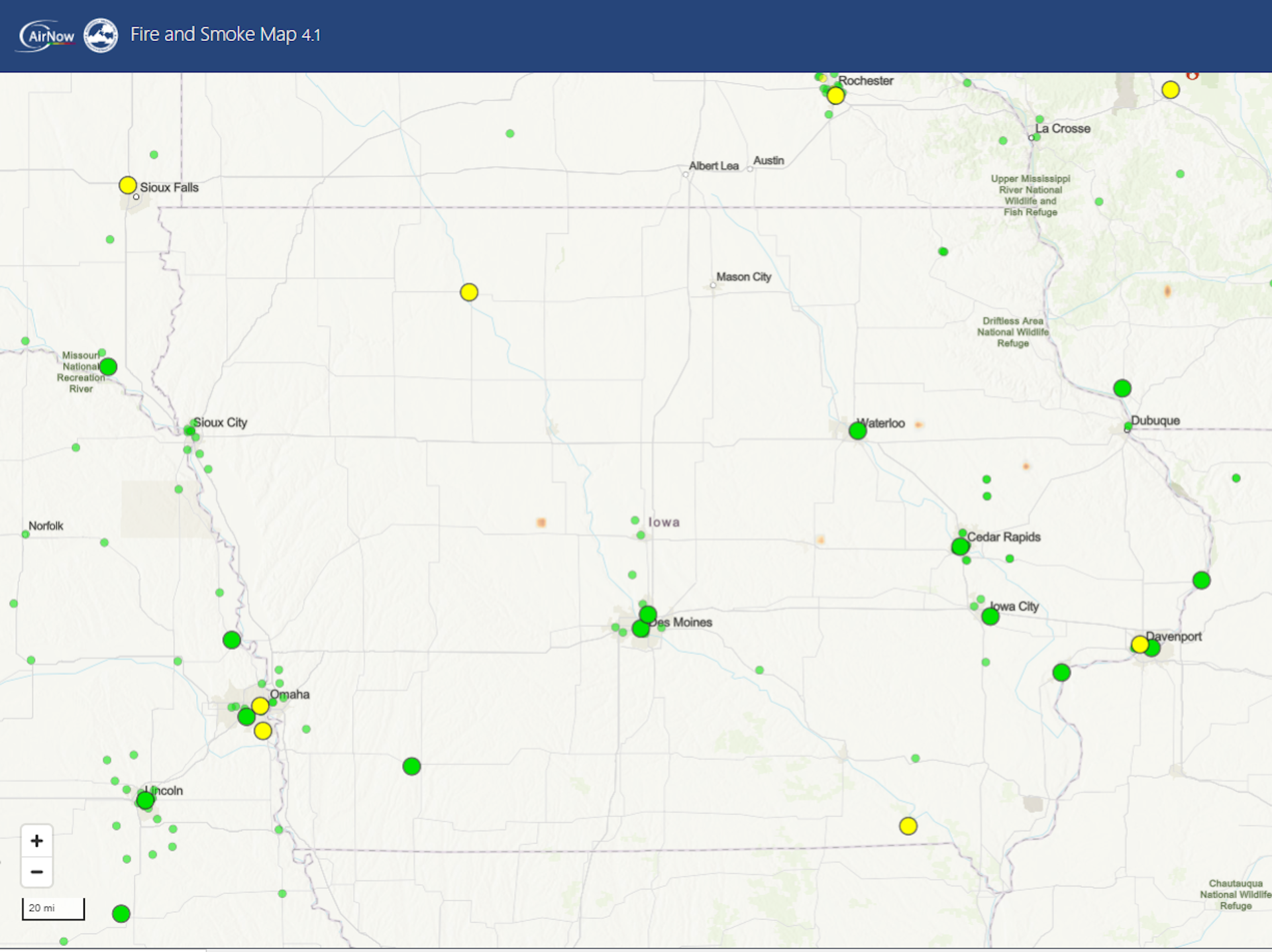
    That’s a big jump from relying on ground-based air quality monitors, which may be hundreds of miles apart. Iowa, for example, had about 50 air quality monitors reporting data on a recent day for a state that covers 56,273 square miles. Most of those monitors were clustered around its largest cities.

    NOAA’s AerosolWatch tool currently provides a near-real-time stream of wildfire smoke images from its GOES-R satellites, and the agency plans to incorporate TEMPO’s height data. A prototype of this system from my team’s NASA-supported research project on fire and air quality, called FireAQ, shows how users can zoom in to the neighborhood level to see how high the smoke plume is, however the prototype is currently only updated once a day, so the data is delayed, and it isn’t able to provide smoke height data where clouds are also overhead.

    Wildfire health risks are rising

    Fire risk is increasing across North America as global temperatures rise and more people move into wildland areas.

    While air quality in most of the U.S. improved between 2000 and 2020, thanks to stricter emissions regulations on vehicles and power plants, wildfires have reversed that trend in parts of the western U.S. Research has found that wildfire smoke has effectively erased nearly two decades of air quality progress there.

    Our advances in smoke monitoring mark a new era in air quality forecasting, offering more accurate and timely information to better protect public health in the face of these escalating wildfire threats.

    Prof. Wang’s group have been supported from NOAA, NASA, and Naval ONR to develop research algorithm to retrieve aerosol layer height. The compute codes of the research algorithm were shared with colleagues in NOAA.

    – ref. Which wildfire smoke plumes are hazardous? New satellite tech can map them in 3D for air quality alerts at neighborhood scale – https://theconversation.com/which-wildfire-smoke-plumes-are-hazardous-new-satellite-tech-can-map-them-in-3d-for-air-quality-alerts-at-neighborhood-scale-259654

    MIL OSI –

    July 27, 2025
  • Musk ordered shutdown of Starlink satellite service as Ukraine retook territory from Russia

    Source: Government of India

    Source: Government of India (4)

    During a pivotal push by Ukraine to retake territory from Russia in late September 2022, Elon Musk gave an order that disrupted the counteroffensive and dented Kyiv’s trust in Starlink, the satellite internet service the billionaire provided early in the war to help Ukraine’s military maintain battlefield connectivity.

    According to three people familiar with the command, Musk told a senior engineer at the California offices of SpaceX, the Musk venture that controls Starlink, to cut coverage in areas including Kherson, a strategic region north of the Black Sea that Ukraine was trying to reclaim.

    “We have to do this,” Michael Nicolls, the Starlink engineer, told colleagues upon receiving the order, one of these people said. Staffers complied, the three people told Reuters, deactivating at least a hundred Starlink terminals, their hexagon-shaped cells going dark on an internal map of the company’s coverage. The move also affected other areas seized by Russia, including some of Donetsk province further east.

    Upon Musk’s order, Ukrainian troops suddenly faced a communications blackout, according to a Ukrainian military official, an advisor to the armed forces, and two others who experienced Starlink failure near the front lines. Soldiers panicked, drones surveilling Russian forces went dark, and long-range artillery units, reliant on Starlink to aim their fire, struggled to hit targets.

    As a result, the Ukrainian military official and the military advisor said, troops failed to surround a Russian position in the town of Beryslav, east of Kherson, the administrative center of the region of the same name. “The encirclement stalled entirely,” said the military official in an interview. “It failed.”

    Ultimately, Ukraine’s counteroffensive succeeded in reclaiming Beryslav, the city of Kherson and some additional territory Russia had occupied. But Musk’s order, which hasn’t previously been reported, is the first known instance of the billionaire actively shutting off Starlink coverage over a battlefield during the conflict. The decision shocked some Starlink employees and effectively reshaped the front line of the fighting, enabling Musk to take “the outcome of a war into his own hands,” another one of the three people said.

    The account of the command counters Musk’s narrative of how he has handled Starlink service in Ukraine amid the war. As recently as March, in a post on X, his social media site, Musk wrote: “We would never do such a thing.”

    Musk and Nicolls didn’t respond to requests from Reuters for comment.

    A SpaceX spokesperson said by email that the news agency’s reporting is “inaccurate” and referred reporters to an X post earlier this year in which the company said: “Starlink is fully committed to providing service to Ukraine.” The spokesperson didn’t specify any inaccuracies in this report or answer a lengthy list of questions regarding the incident, Starlink’s role in the Ukraine war, or other details regarding its business.

    The office of Ukrainian President Volodymyr Zelenskiy and the country’s Ministry of Defence didn’t respond to requests for comment. Starlink still provides service to Ukraine, and the Ukrainian military relies on it for some connectivity. Zelenskiy as recently as this year has publicly expressed gratitude to Musk for Starlink.

    It isn’t clear what prompted Musk’s command, when exactly he gave it, or precisely how long the outage lasted. The three people familiar with the order said they believed it stemmed from concerns Musk expressed later that Ukrainian advances could provoke nuclear retaliation from Russia. One of the people said the shutoff transpired on September 30, 2022. The two others said it was around then, but didn’t recall the exact date. Some senior U.S. officials shared Musk’s concerns that Russia would make good on threats to escalate, one former White House staffer told Reuters.

    Musk’s order was an early glimpse of the power the magnate now wields in geopolitics and global security because of Starlink, a fast-growing satellite internet service that barely existed early this decade and now provides connectivity even in remote areas of the world. Even before his brief role as financial backer and advisor to U.S. President Donald Trump, the success of Starlink – and the unrivaled connectivity it offers across the planet – had given Musk increasing influence with political leaders, governments and militaries worldwide.

    Musk’s sway in military affairs in Washington and beyond – through Starlink’s dominance in satellite communications and SpaceX’s clout in space launches – has reached a dimension previously limited to sovereign governments, alarming some regulators and lawmakers. “Elon Musk’s current global dominance exemplifies the dangers of concentrated power in unregulated domains,” Martha Lane Fox, a member of Britain’s upper house of parliament, said during a debate earlier this year. The parliamentarian is a businesswoman and former board member at Twitter, the social media site that Musk acquired in 2022 and rebranded as X.

    “Its control,” Lane Fox said of Starlink, “rests solely with Musk, allowing his whims to dictate access to vital infrastructure.”

    Musk’s political influence, and his massive business with the U.S. federal government, are now being put to the test. Since leaving his role advising Trump, Musk has publicly feuded with the president, announced plans to create a new political party, and criticized a signature spending bill that he said will expand the budget deficit and destroy jobs. Trump, for his part, has threatened to end government contracts and subsidies for Musk’s companies, including lucrative new defense projects.

    Whatever the reason for Musk’s decision, the shutoff over Kherson and other regions surprised some involved with the Ukraine war – from troops on the ground to U.S. military and foreign policy officials, who after Russia’s full-scale invasion that February had worked to secure Starlink service for Ukrainian forces. Panicked calls by Ukrainian officials during the outage to seek information from Pentagon counterparts, five people familiar with the incident said, were met with few explanations for what could have caused it.

    The U.S. Department of Defense declined to comment. Reuters couldn’t determine whether White House or Pentagon officials after the shutdown had any exchanges with Musk over the outage.

    The Kherson episode is distinct from an earlier report of an incident that purportedly occurred that same September, involving Crimea just to the south, and raised concerns about Musk’s ability to influence the conflict in Ukraine.

    In his 2023 biography of Musk, author Walter Isaacson reported that the tycoon had ordered Starlink to disable coverage in Crimea, which Russia had annexed from Ukraine after a 2014 invasion that the international community condemned as illegal. Musk, Isaacson wrote, believed a planned Ukrainian attack on Russian vessels in the Crimean port of Sevastopol could prompt nuclear retaliation.

    After the book was published, Musk denied a shutdown, saying that there had never been coverage in Crimea to begin with. He said he had, rather, rejected a Ukrainian request to provide service ahead of Kyiv’s planned attack. Isaacson later conceded his account was flawed. A spokesperson at Isaacson’s publisher declined to comment or make him available for an interview.

    SpaceX also said in 2023 that it had taken unspecified steps to prevent Ukraine from using Starlink for certain activities, including drone attacks. “Our intent was never to have them use it for offensive purposes,” Gwynne Shotwell, the company’s president, said at a conference in Washington in February of that year. “There are things that we can do, and have done” to prevent it, she added, without providing further detail.

    Reuters couldn’t determine if the shutdown affecting Kherson was among the steps she was referring to. Shotwell didn’t respond to requests for comment for this article.

    Following the start of the Kherson shutdown, word of an outage emerged in some media reports. At the time, it wasn’t clear to those who lost connectivity whether a technical problem, sabotage or some other factor was responsible. Early in the war, Russia had orchestrated a large cyberattack that disrupted service of another satellite operator, Western officials have said, creating suspicions around any outage and leaving a void quickly filled by Starlink. Russia has denied it conducts offensive cyberattacks.

    As of April 2025, according to Ukrainian government social media posts, Kyiv has received more than 50,000 Starlink terminals. Easily transported and deployed, the pizza-box-sized devices communicate with thousands of SpaceX satellites now circling the globe. An initial batch of terminals was provided to Ukraine by SpaceX itself. Further terminals have arrived from donors including Poland, the United States and Germany.

    This account of the outage, and the growing dependence on Musk by governments and militaries worldwide, is based on interviews with more than three dozen people with knowledge of SpaceX’s operations and the company’s technology. These people included current and former employees, U.S. and European military officials, and senior politicians and diplomats.

    The reporting puts a spotlight on Musk’s control of services now critical to countries including the U.S., which has about $22 billion in contracts with SpaceX. Underscoring the point himself during his recent dispute with Trump, Musk threatened to decommission a SpaceX spacecraft the U.S. now relies upon to transport astronauts and critical cargo.

    His threat, later retracted, unnerved attorneys at the National Aeronautics and Space Administration, who felt forced to explore whether Musk’s warning could be considered a notice of contract termination, according to two people familiar with the matter. NASA didn’t respond to Reuters’ requests for comment.

    “There needs to be some contractual assurances” that Musk won’t cut off services to the U.S. government, said Lori Garver, a former deputy administrator of the agency. “We will need to consider how comfortable the U.S. will be at putting SpaceX in the critical path on national security.”

    As countries increasingly rely on tech companies for everything from cyber defense to data storage, the question of dependence on one or a few dominant service providers will apply to other nations, too. “Governments have to think through what that means,” said Marcus Willett, former deputy head of Britain’s Government Communications Headquarters intelligence agency and now a senior adviser to the International Institute for Strategic Studies, a London-based think tank.

    “WE NEED ASSURANCES”

    SpaceX is the first company to establish an extensive network of communication satellites in low-Earth orbit, a region of space that is closer to the planet than areas where such satellites historically reside. The proximity of satellites that now make up the company’s constellation allows Starlink to offer space-based wireless connectivity that is faster than any previously available.

    Starlink on Thursday suffered a rare global outage of several hours, the company said, because of an internal software problem. A Ukrainian military commander in a social media post said “Starlink is down across the entire front,” updating the post two and a half hours later to say connectivity had returned.

    With more than 7,900 satellites now in orbit, SpaceX has become the world’s largest satellite operator. Its devices, which relay signals among each other to create a network that communicates with the ground, account for about two-thirds of all active satellites in space, according to Jonathan McDowell, an astronomer at the Center for Astrophysics, Harvard & Smithsonian.

    Starlink began rolling out service in 2020 and now has more than six million customers in over 140 countries, territories and markets, according to a June Starlink social media post. Novaspace, a consulting firm near Paris, estimates that Starlink in 2025 will generate about $9.8 billion in revenue for SpaceX, or about 60% of the company’s income. SpaceX is privately held and doesn’t disclose financial information, but Musk recently said he expects the rocket company to post revenues of about $15.5 billion this year.

    Rivals are scrambling to get in on the market.

    OneWeb, a European service owned by Eutelsat, a French company, is the furthest along, boasting about 650 satellites in low-Earth orbit. Amazon this year launched its first satellites for Project Kuiper, a $10 billion effort to compete. China is developing multiple networks, including a state-backed venture known as SpaceSail.

    Still, Starlink has made much of its first-mover advantage. Its terminals, priced as low as a few hundred dollars for standard models, are known for being affordable and easy to use. “There is no existing system right now to replace Starlink,” said Grace Khanuja, an analyst at Novaspace, the consultancy near Paris.

    Compared to the geostationary satellites historically used for communications, the sheer number of SpaceX satellites helps make Starlink less vulnerable to jamming and attacks. Its far reach makes it valuable in remote and hostile terrain – from battlefields to airspace to high seas. In Ukraine, it has facilitated activities including communications, intelligence and drone piloting.

    Some Western militaries not engaged in conflict are also using the service. Britain’s armed forces, for instance, three years ago began using Starlink for “welfare purposes,” including personal communications for troops, the Ministry of Defence said in response to a freedom of information request. The ministry said it has fewer than 1,000 Starlink terminals and doesn’t employ them for sensitive military communications. Spain’s navy is also using Starlink, but only for recreation and leisure of troops, a spokesperson said.

    “That will change,” said Chris Moore, a retired air vice-marshal in the British military, speaking about high-speed space-based connectivity. Moore also worked as a OneWeb executive and is now a defense industry consultant. Satellites in low-Earth orbit, he said, offer too many advantages for militaries to ignore, especially for modern developments such as drone warfare, a signature element of the Ukraine conflict.

    Some leaders are leery.

    In Taiwan, ever wary of conflict with China, officials have expressed concern about Musk’s extensive business interests on the mainland, including a major factory for Tesla, the electric vehicle company he controls. Eager for communications backups in the event of war, Taiwan is developing its own low-Earth orbit satellite network. Taiwanese officials have said the government could partner with Amazon’s Kuiper, too.

    Spokespersons for the Taiwanese government said it welcomes international satellite providers but that Starlink hasn’t applied for a license in Taiwan. They didn’t respond to questions about Taipei’s relationship with Musk.

    In Italy, the government is evaluating whether to employ Starlink for secure communications among the government, defense and other officials. But some officials, including President Sergio Mattarella, remain unconvinced by SpaceX’s assurances that its service would be secure and free from meddling by Musk. “More than Musk’s word, we need assurances that we can’t be shut down, and especially that he can’t access the data,” said a person familiar with the views of the president, who is an influential figure with the armed forces.

    Poland, a major donor to Ukraine, told Reuters it employs Starlink as well as other military and commercial satellite systems. A mix of providers, Polish officials have said, offers the most security, even if at high cost.

    “In peacetime, you want the best product at the best price,” Foreign Minister Radoslaw Sikorski said in response to a question from Reuters at a press conference in April. “In wartime, you want redundancy. You want security. You want duplicated systems, so that if one fails, you can still use the other.”

    “THERE WAS NOT A CONNECTION”

    Even before the conflict began, documents reviewed by Reuters show, SpaceX had already been in discussions with the U.S. government about providing Starlink in Ukraine. Rollout began after Russian troops crossed the border on February 24, 2022.

    Two days later, Mykhailo Fedorov, a deputy prime minister in Ukraine, requested Musk’s help. “We ask you to provide Ukraine with Starlink stations,” he wrote on Twitter.

    Musk responded in 10 hours. “Starlink service is now active in Ukraine,” he tweeted. “More terminals en route.”

    Poland was also instrumental in the early days of the war, shipping thousands of terminals to Ukraine shortly after the invasion. Warsaw this year said it has purchased about 25,000 Starlink terminals for the effort – roughly half the total now in Ukraine – and that it is paying the subscription costs to keep them connected. So far, it has spentabout $89 million on Starlink for Ukraine.

    The equipment has made a critical difference for Ukraine.

    Day-to-day bureaucracy has also benefited. Early in the conflict, Ukraine stored state data in the cloud and relied on Starlink to access it, helping keep some government operations running. “We wouldn’t be anywhere without Starlink,” said Vadym Prystaiko, Ukraine’s ambassador to Britain until 2023. “The whole state was preserved.”

    On the battlefield, Ukraine quickly deployed Starlink to enable front-line troops to communicate with commanders. The service also allowed drone operators to transmit surveillance video streams and locate and attack Russian targets. Reuters couldn’t establish just when such attacks may have become a concern for Musk or SpaceX.

    By September 2022, a major Ukrainian counteroffensive was underway. Kyiv’s forces were pushing back into territories, including Kherson, that Russia had captured. The drive threatened Russian supply lines, prompting Moscow to threaten the West, including oblique references to Starlink.

    That month, in a statement to the United Nations, Russia noted the use of “elements of civilian, including commercial, infrastructure in outer space for military purposes.” It warned that “quasi-civilian infrastructure may become a legitimate target for retaliation.”

    It isn’t clear whether Russia has tried to attack any Starlink facilities. Musk has said, however, that Moscow has repeatedly sought to block its connectivity. “SpaceX is spending significant resources combating Russian jamming efforts,” Musk wrote on X last year. “This is a tough problem.”

    The Kremlin declined to comment on whether it has sought to interfere with Starlink. The Ministry of Defence didn’t respond to a request for comment. Starlink isn’t licensed for either civilian or military use in Russia.

    As Ukraine’s counterattack intensified, Russian President Vladimir Putin on September 21, 2022, ordered a partial mobilization of reservists, Russia’s first since World War II. He also threatened to use nuclear weapons if Russia’s own “territorial integrity” were at risk.

    Around this time, Musk engaged in weeks of backchannel conversations with senior officials in the administration of President Joe Biden, according to three former U.S. government officials and one of the people familiar with Musk’s order to stop service. During those conversations, the former White House staffer told Reuters, U.S. intelligence and security officials expressed concern that Putin could follow through on his threats. Musk, this person added, worried too, and asked U.S. officials if they knew where and how Ukraine used Starlink on the battlefield.

    Soon after, he ordered the shutdown.

    Reuters couldn’t ascertain the full geographic extent of the outage, but the three people familiar with the stoppage said that it covered regions that had recently been taken by Russia. Starlink coverage prior to the order, they said, had been active up to what had been Ukraine’s border with Russia before the full-scale invasion.

    Taras Tymochko, a Ukrainian military signals specialist stationed in the Kherson region at the time, said an outage disrupted communications for troops, including colleagues on the front, for several hours. “If you were using Starlink to provide surveillance of the front line, you pretty much would be blind,” said Tymochko, who is now a consultant to Come Back Alive, a non-governmental organization that procures military equipment for Ukraine’s armed forces.

    Maryna Tsirkun, a drone expert at Aerorozvidka, an aerial reconnaissance organization that works closely with the Ukrainian military, was also in southern Ukraine at the time. Starlink signals failed as Ukrainian troops began to push toward terrain seized by Russia, she told Reuters. “When we started to proceed there was not a connection,” she said. The outage she and colleagues experienced lasted several days.

    On October 3, Musk angered Zelenskiy and other Ukrainian officials by tweeting a suggestion that locals in regions annexed by Russia vote on whether they should remain a part of Ukraine. A day later, Musk tweeted his concern about the conflict spiraling. “I still very much support Ukraine,” he tweeted, “but am convinced that massive escalation of the war will cause great harm to Ukraine and possibly the world.”

    Three days later, following one media report about a Starlink outage, Musk tweeted that “what’s happening on the battlefield, that’s classified.” He added that SpaceX by the end of 2022 was on track to spend $100 million on Ukraine. Although the Polish and U.S. governments by then had begun donations of their own, the billionaire complained about the cost of the equipment and services SpaceX was providing.

    SpaceX “cannot fund the existing system indefinitely,” Musk wrote in a mid-October post. The next day, in another tweet, he reversed course. “To hell with it,” he wrote, “we’ll just keep funding Ukraine govt for free.”

    After the outage, Kyiv worked to charm Musk.

    In November 2022, Fedorov, the government minister, publicly expressed trust in the service. Months later – just after Shotwell, the SpaceX president, said the company had taken steps to prevent Ukraine from using Starlink for drone attacks – Fedorov in an interview with a Ukrainian news site recognized Starlink’s ability to “geofence” coverage, selectively limiting signals in some areas.

    By February 2023, however, Starlink was fully functional in Ukraine, he said. “All the Starlink terminals in Ukraine work properly,” Fedorov told Ukrainska Pravda, the news site. Fedorov, who recently assumed the title of first deputy prime minister, didn’t respond to a request for comment about Ukraine’s use of Starlink in the war.

    In mid-2023, the U.S. Department of Defense signed an agreement with SpaceX to pay for Starlink coverage in Ukraine. Terms of the contract weren’t disclosed, but Quilty Space, a Florida-based research firm, said the Pentagon has an ongoing $537 million agreement with SpaceX to provide satellite communications to Ukraine. It’s not clear whether SpaceX is still footing the bill for any equipment or connectivity.

    As the war has evolved, so has Ukraine’s use of Musk’s technology.

    Ukrainian drone specialists and Prystaiko, the former ambassador to Britain, said some attack devices, including maritime and bomber drones, now have Starlink antennas fitted to them. The antennas, in the case of sea drones, help operators guide the devices and view video feeds to classify targets, said Sidharth Kaushal, a senior research fellow at Royal United Services Institute, a London-based defense think tank.

    It’s uncertain whether such use contravenes SpaceX’s desire that Starlink not be employed for offense.

    Ukraine continues to explore alternatives that could complement or back up Starlink if the service became unavailable, a senior government official told Reuters. Ukraine’s government has expressed interest in European satellite projects, European Commission spokesperson Thomas Regnier told Reuters. That includes GOVSATCOM, an EU project to pool satellite resources from member states and industry to provide services to governments, he said.

    Privately, though, some Ukrainian officials say the existing alternatives to Starlink have limitations. “It takes time, it takes money,” the senior government official told Reuters. With Starlink, he added, “we have a working system.”

    Musk himself has boasted of Starlink’s importance to Kyiv. “My Starlink system is the backbone of the Ukrainian army,” he wrote on X in March. “Their entire front line would collapse if I turned it off.”

    (Reuters)


    July 26, 2025
  • MIL-OSI United Kingdom: Joint Statement on the Australia-UK Nuclear-Powered Submarine Partnership and Collaboration Treaty

    Source: United Kingdom – Executive Government & Departments

    News story

    Joint Statement on the Australia-UK Nuclear-Powered Submarine Partnership and Collaboration Treaty

    On 26 July 2025 in Geelong, Australia, the Honourable Richard Marles MP, Deputy Prime Minister and Minister for Defence, Australia and the Right Honourable John Healey MP, Secretary of State for Defence, United Kingdom (UK) signed the bilateral Nuclear-Powered Submarine Partnership and Collaboration Treaty (the Geelong Treaty) at the UK-Australia Defence Ministers’ Meeting in Geelong, Victoria.

    On 26 July 2025 in Geelong, Australia, the Honourable Richard Marles MP, Deputy Prime Minister and Minister for Defence, Australia and the Right Honourable John Healey MP, Secretary of State for Defence, United Kingdom (UK) signed the bilateral Nuclear-Powered Submarine Partnership and Collaboration Treaty (the Geelong Treaty) at the UK-Australia Defence Ministers’ Meeting in Geelong, Victoria. The Geelong Treaty is a historic agreement, the commitment for the next 50 years of UK-Australian bilateral defence cooperation under AUKUS Pillar I. 

    The Geelong Treaty will enable comprehensive cooperation on the design, build, operation, sustainment, and disposal of our SSN-AUKUS submarines. It will support the development of the personnel, workforce, infrastructure and regulatory systems required for Australia’s SSN-AUKUS programme, as well as support port visits and the rotational presence of a UK Astute-class submarine at HMAS Stirling under Submarine Rotational Force – West.

    The Treaty builds on the strong foundation of trilateral cooperation between Australia, the UK and the United States, advancing the shared objectives of the AUKUS partnership. It will enable the development of SSN-AUKUS and resilient trilateral supply chains.

    Importantly, the Geelong Treaty is consistent with Australia’s and the UK’s respective international nuclear non-proliferation obligations, including under the Treaty on the Non-Proliferation of Nuclear Weapons, the South Pacific Nuclear Free Zone Treaty and its Protocols, and Australia’s safeguards agreements with the International Atomic Energy Agency, and the trilateral AUKUS Naval Nuclear Propulsion Agreement (ANNPA).

    Together with the ANNPA, the Treaty will enable Australia and the UK to deliver a cutting-edge undersea capability through the SSN-AUKUS programme, and in doing so, support stability and security in the Euro Atlantic and the Indo-Pacific for decades to come, drive defence as an engine for growth across our two nations, create thousands of jobs, build our respective submarine industrial bases and supply chains, and provide new opportunities for industry partners.

    Share this page

    The following links open in a new tab

    • Share on Facebook (opens in new tab)
    • Share on Twitter (opens in new tab)

    Updates to this page

    Published 26 July 2025

    MIL OSI United Kingdom –

    July 26, 2025
  • MIL-OSI Security: U.S. Forces Conduct Operation Targeting ISIS-Somalia

    Source: United States AFRICOM

    In coordination with the Federal Government of Somalia, U.S. Africa Command (AFRICOM) conducted an operation against the ISIS-Somalia terrorist network in Somalia on July 25.

    AFRICOM, alongside the Federal Government of Somalia and Somali Armed Forces, continues to take action to degrade ISIS-Somalia’s ability to plan and conduct attacks that threaten the U.S. homeland, our forces, and our citizens abroad.

    Specific details about units and assets will not be released to ensure continued operations security.

    MIL Security OSI –

    July 26, 2025
  • MIL-OSI Security: USS Pearl Harbor (LSD 52) Sailors Conduct Weapon Maintenance [Image 2 of 3]

    Source: United States Navy (Logistics Group Western Pacific)

    Issued by: on


    PACIFIC OCEAN (July 21, 2025) Gunner’s Mate 2nd Class Kenneth Rettig, from Gastonia, North Carolina, left, and Gunner’s Mate 2nd Class Adrian Ferguson from San Bernadino, California, right, conducts maintenance on Mark 38 25mm machine gun on the bridge wing aboard the Harpers Ferry-class amphibious dock landing ship USS Pearl Harbor (LSD 52) in the Indo-Pacific on July 21, 2025. Now in its 21st iteration, the Pacific Partnership series is the largest annual multinational humanitarian assistance and disaster management preparedness mission conducted in the Indo-Pacific. Pacific Partnership works collaboratively with host and partner nations to enhance regional interoperability and disaster response capabilities, increase security and stability in the region, and foster new and enduring friendships in the Indo-Pacific. (U.S. Navy photo by Mass Communication Specialist Seaman Mario E. Reyes Villatoro)

    Date Taken: 12.31.2015
    Date Posted: 07.23.2025 07:32
    Photo ID: 9197326
    VIRIN: 250721-N-OJ012-1020
    Resolution: 5504×3096
    Size: 1.2 MB
    Location: US

    Web Views: 8
    Downloads: 0

    PUBLIC DOMAIN  

    This work, USS Pearl Harbor (LSD 52) Sailors Conduct Weapon Maintenance [Image 3 of 3], by SA Mario Reyes Villatoro, identified by DVIDS, must comply with the restrictions shown on https://www.dvidshub.net/about/copyright.

    GALLERY

    MORE LIKE THIS

    CONTROLLED VOCABULARY KEYWORDS

    TAGS

    MIL Security OSI –

    July 26, 2025
  • MIL-OSI Security: The USNS Bowditch Departs Sri Vijaya Puram, India, July, 2025 [Image 1 of 4]

    Source: United States Navy (Logistics Group Western Pacific)

    Issued by: on


    SRI VIJAYA PURAM, India — David Mitchell (middle), Captain of pathfinder class
    oceanographic survey ship USNS Bowditch (T-AGS 62), poses with Indian Navy and Indian Coast Guard personnel in the bridge of the USNS Bowditch during a scheduled port visit to Sri Vijaya Puram, India, July 25, 2025. COMLOG WESTPAC supports deployed maritime forces, along with regional allies and partners, to sustain Western Pacific operations. (Photo by Courtesy Asset, Petty Officer Lawrence Dass)

    Date Taken: 07.25.2025
    Date Posted: 07.26.2025 04:28
    Photo ID: 9205987
    VIRIN: 250725-N-YV347-1001
    Resolution: 4032×3024
    Size: 2.28 MB
    Location: IN

    Web Views: 0
    Downloads: 0

    PUBLIC DOMAIN  

    This work, The USNS Bowditch Departs Sri Vijaya Puram, India, July, 2025 [Image 4 of 4], by PO2 Jordan Jennings, identified by DVIDS, must comply with the restrictions shown on https://www.dvidshub.net/about/copyright.

    MIL Security OSI –

    July 26, 2025
  • MIL-OSI Security: Pacific Partnership Conducts Mission Stop in Lae, Papua New Guinea, July 2025 [Image 3 of 5]

    Source: United States Navy (Logistics Group Western Pacific)

    Issued by: on


    LAE, Papua New Guinea (July 23, 2025) – Army Capt. Levi Jackson assigned to the 72nd Medical Detachment Veterinary Service Support unit and Navy Lt. j.g. William Chipmon assigned to Navy Medicine Readiness and Training Unit Key West, conduct a food and water risk assessment at a restaurant in Lae, Papua New Guinea, July 23, 2025. Now in its 21st iteration, Pacific Partnership series is the largest annual multinational humanitarian assistance and disaster management preparedness mission conducted in the Indo-Pacific. Pacific Partnership works collaboratively with host and partner nations to enhance regional interoperability and disaster response capabilities, increase security and stability in the region, and foster new and enduring friendships in the Indo-Pacific. (U.S. Navy photo by Mass Communication Specialist 2nd Class Jordan Jennings)

    Date Taken: 07.23.2025
    Date Posted: 07.23.2025 06:46
    Photo ID: 9197305
    VIRIN: 250723-N-YV347-1089
    Resolution: 7311×4874
    Size: 20.99 MB
    Location: LAE, PG

    Web Views: 38
    Downloads: 1

    PUBLIC DOMAIN  

    This work, Pacific Partnership Conducts Mission Stop in Lae, Papua New Guinea, July 2025 [Image 5 of 5], by PO2 Jordan Jennings, identified by DVIDS, must comply with the restrictions shown on https://www.dvidshub.net/about/copyright.

    GALLERY

    MORE LIKE THIS

    CONTROLLED VOCABULARY KEYWORDS

    TAGS

    MIL Security OSI –

    July 26, 2025
  • MIL-OSI Security: The USS Pearl Harbor Arrives in Lae, Papua New Guinea, July, 2025 [Image 1 of 3]

    Source: United States Navy (Logistics Group Western Pacific)

    Issued by: on


    LAE, Papua New Guinea (July 26, 2025) – The Harpers Ferry-class amphibious dock landing ship USS Pearl Harbor (LSD 52) arrives in Lae, Papua New Guinea, in support of Pacific Partnership, July 26, 2025. Now in its 21st iteration, the Pacific Partnership series is the largest annual multinational humanitarian assistance and disaster management preparedness mission conducted in the Indo-Pacific. Pacific Partnership works collaboratively with host and partner nations to enhance regional interoperability and disaster response capabilities, increase security and stability in the region, and foster new and enduring friendships in the Indo-Pacific. (U.S. Navy photo by Mass Communication Specialist 2nd Class Jordan Jennings)

    Date Taken: 07.26.2025
    Date Posted: 07.26.2025 03:55
    Photo ID: 9205984
    VIRIN: 250726-N-YV347-1126
    Resolution: 8146×5431
    Size: 18.08 MB
    Location: LAE, PG

    Web Views: 1
    Downloads: 0

    PUBLIC DOMAIN  

    This work, The USS Pearl Harbor Arrives in Lae, Papua New Guinea, July, 2025 [Image 3 of 3], by PO2 Jordan Jennings, identified by DVIDS, must comply with the restrictions shown on https://www.dvidshub.net/about/copyright.

    MIL Security OSI –

    July 26, 2025
  • MIL-OSI Security: The USS Pearl Harbor Arrives in Lae, Papua New Guinea, July, 2025 [Image 2 of 3]

    Source: United States Navy (Logistics Group Western Pacific)

    Issued by: on


    LAE, Papua New Guinea (July 26, 2025) – The Harpers Ferry-class amphibious dock landing ship USS Pearl Harbor (LSD 52) arrives in Lae, Papua New Guinea, in support of Pacific Partnership, July 26, 2025. Now in its 21st iteration, the Pacific Partnership series is the largest annual multinational humanitarian assistance and disaster management preparedness mission conducted in the Indo-Pacific. Pacific Partnership works collaboratively with host and partner nations to enhance regional interoperability and disaster response capabilities, increase security and stability in the region, and foster new and enduring friendships in the Indo-Pacific. (U.S. Navy photo by Mass Communication Specialist 2nd Class Jordan Jennings)

    Date Taken: 07.26.2025
    Date Posted: 07.26.2025 03:55
    Photo ID: 9205985
    VIRIN: 250726-N-YV347-1183
    Resolution: 8236×5491
    Size: 18.82 MB
    Location: LAE, PG

    Web Views: 4
    Downloads: 0

    PUBLIC DOMAIN  

    This work, The USS Pearl Harbor Arrives in Lae, Papua New Guinea, July, 2025 [Image 3 of 3], by PO2 Jordan Jennings, identified by DVIDS, must comply with the restrictions shown on https://www.dvidshub.net/about/copyright.

    MIL Security OSI –

    July 26, 2025
  • MIL-OSI Asia-Pac: SCED attends 2nd Zhejiang-Hong Kong Modern Professional Services Cooperation Conference in Ningbo (with photo)

    Source: Hong Kong Government special administrative region

    The Secretary for Commerce and Economic Development, Mr Algernon Yau, attended the 2nd Zhejiang-Hong Kong Modern Professional Services Cooperation Conference in Ningbo, Zhejiang, today (July 26) to foster co-operation between the two places in the field of professional services to achieve complementarity.
     
    Speaking at the opening ceremony, Mr Yau said that right after the establishment of the Hong Kong/Zhejiang Co-operation Conference Mechanism and the convening of the High-Level Meeting cum the First Plenary Session of the Hong Kong/Zhejiang Co-operation Conference in April this year, the Hong Kong Investment Promotion Conference – Zhejiang (Ningbo) Forum cum Ningbo-Hong Kong Economic Co-operation Forum was held in Ningbo. He said he was very pleased to visit Ningbo again to further promote Zhejiang-Hong Kong and Ningbo-Hong Kong economic and trade co-operation.
     
    Mr Yau said that Zhejiang is an economic powerhouse of the country with its GDP ranking among the top and has been a leading force in advancing the upgrading and transformation of industries and the development of new quality productive forces, especially in the areas of innovation and technology and artificial intelligence. On the other hand, Hong Kong, with its robust research capabilities, high level of internationalisation and extensive networks for international exchange and co-operation, presents vast potential in becoming a globally significant hub for education, technology and talent.
     
    Mr Yau said that building on the foundation of the Hong Kong/Zhejiang Co-operation Conference Mechanism, the two places will work together to promote collaboration in the field of professional services such as accounting and auditing, legal and dispute resolution, management consulting, intellectual property, industrial design, planning and design, architectural and related engineering services.
     
    He added that in the areas of finance, Hong Kong boasts quality, efficient and internationalised financial institutions and financial services, as well as a deep and broad capital market, making it an ideal fundraising platform. Hong Kong is also the world’s fifth-largest merchandise trading entity, after the Mainland, the United States, the European Union and Japan.
     
    Mr Yau noted that despite uncertainties brought about by the ever-changing global trade landscape and geopolitics, Hong Kong’s real GDP recorded a year-on-year increase of 3.1 per cent in the first quarter of this year. In the first half of this year, Hong Kong has completed 42 initial public offerings, raising over HK$107 billion, 20 per cent more than the full-year total for 2024. As at June this year, among the enterprises applying for listing in Hong Kong, 19 of them were from Zhejiang, accounting for about 10 per cent of the total number of applicants. This fully reflected that Hong Kong’s robust financial market has become the prime listing platform for Mainland enterprises.
     
    Mr Yau said he believes that with a solid foundation of economic and trade co-operation, Zhejiang and Hong Kong can jointly strengthen collaboration in modern professional services, attracting global investors to use Hong Kong as a springboard to tap into the immense potential of the enormous Zhejiang market, while enabling Zhejiang enterprises to go global by making use of Hong Kong’s professional services.
     
    Also speaking at the opening ceremony were Vice-Chairman of the National Committee of the Chinese People’s Political Consultative Conference Mr C Y Leung; Deputy-Head of the United Front Work Department of the Communist Party of China Central Committee Mr Ma Lihuai; the Chairman of the Zhejiang Provincial Committee of the Chinese People’s Political Consultative Conference, Mr Lian Yimin; and the Mayor of the Ningbo Municipal People’s Government, Mr Tang Feifan. The Under Secretary for Transport and Logistics, Mr Liu Chun-san, and the Under Secretary for Innovation, Technology and Industry, Ms Lillian Cheong, also attended the opening ceremony. In addition, Mr Liu and Ms Cheong attended two thematic sessions to promote the synergistic development of the two places in areas such as port and maritime services, innovative applications and technological services.
     
    Mr Yau will return to Hong Kong this evening.

    MIL OSI Asia Pacific News –

    July 26, 2025
  • MIL-OSI Security: Vehicle Theft Investigation Leads to 33-Year Federal Prison Sentence for Production of Child Pornography

    Source: Office of United States Attorneys

    An Arlington resident was sentenced to 405 months in federal prison for Production of Child Pornography and Illegal Possession of a Machinegun, announced Acting United States Attorney for the Northern District of Texas Nancy E. Larson.

    Court documents revealed that in late September 2024, the Bedford Police Department began investigating a theft of a truck that belonged to a business in Bedford, Texas.  A few days later, the Arlington Police Department recovered the vehicle and returned it to the owners.  Multiple bags containing cell phones and illegal firearms that belonged to Carlos Isaac Barrientos were found in the vehicle.  A forensic review of the devices by agents from the Bureau of Alcohol Tobacco and Firearms located images and videos of child pornography on the devices.  Barrientos, 36, of Arlington, Texas, was arrested, charged, and subsequently pled guilty to production of child pornography and illegal possession of a machinegun on April 16, 2025.  On July 24, 2025, Barrientos was sentenced to 405 months in federal prison by United States District Judge Reed O’Connor.

    The investigation was conducted by the Arlington Police Department, Bedford Police Department, Bureau of Alcohol, Tobacco and Firearms, and Department of Homeland Security. Assistant United States Attorney Allyson Monte prosecuted the case.
     

    MIL Security OSI –

    July 26, 2025
  • MIL-OSI Security: Serial Cyberstalker Who Terrorized Women for 16 Years Sentenced to Nine Years in Prison

    Source: Office of United States Attorneys

    Defendant created 62 accounts across dozens of online platforms to abuse and impersonate women he knew; Posted thousands of fake, AI-generated, or photoshopped pornographic images of victims and their information, encouraging others to torment them

    BOSTON – A Plymouth, Mass. man has been sentenced in federal court in Boston for cyberstalking more than a dozen Massachusetts women over a 16-year period. Beginning as early as 2008 and continuing into 2024, the defendant engaged in elaborate online harassment campaigns that targeted and tormented women he knew personally – including two who were minors when the conduct began. Among other things, the defendant hacked into victims’ personal accounts and used over 60 accounts across nearly 30 platforms to relentlessly impersonate, intimidate and abuse them – sharing thousands of fake sexually explicit images of the victims along with their personal information and urging others to contact, shame and sextort them.

    James Florence Jr., 37, was sentenced on July 23, 2025, by U.S. District Court Judge Richard G. Stearns to nine years in prison and 10 years of supervised release. In April 2025, Florence pleaded guilty to seven counts of cyberstalking and one count of possession of child pornography. Florence was arrested and charged by criminal complaint in September 2024 and has remained in custody since.

    “This was not internet trolling. It was psychological torture – sustained, targeted, and deeply personal. For 16 years, this defendant tormented more than a dozen women who considered him a friend, a loved one or an ally and, at the stroke of a key, inflicted lasting harm that changed the way many of these women move through the world. And he did it all while hiding, cowardly, behind a keyboard. Now, he’ll face the consequences of that cruelty behind bars for the better part of the next decade,” said United States Attorney Leah B. Foley.  “The courage of the victims in this case is extraordinary and it’s their strength that made justice possible here. Our office will continue to do everything in our power to unmask and hold predators like this accountable.”

    “James Florence Jr. is a serial cyber stalker who led a double life, weaponizing modern technology to debase, destroy and traumatize more than a dozen women, many of whom were family and close friends, for over a decade. What he did was sickening, demented, and cruel, and he’ll now pay for it with his freedom,” said Ted E. Docks, Special Agent in Charge of the Federal Bureau of Investigation, Boston Division. “Cyberstalking is a serious crime, and you can be sure the FBI will work to unmask and bring to justice anyone who uses today’s technology in such a despicable way.”

    According to court filings, Florence targeted women he knew personally as well as acquaintances – stealing photos from their online accounts and digitally altering the images to make the victims appear nude or engaged in sexual acts. Florence would then post the doctored images publicly alongside the victims’ names, home addresses and other identifying details. For nearly all seven victims, Florence’s cyberstalking campaigns included:

    • Creating “imposter” social media accounts designed to appear as if they were operated by the victims themselves;
    • Posting sexually explicit, AI-generated or photoshopped images of victims, often tagging the victims’ real accounts to maximize exposure;
    • Publishing victims’ personal information, including driver’s license photos, home addresses and professional affiliations, with messages urging others to humiliate and expose them;
    • Using hacked and compromised personal accounts to surveil victims and gain access to additional private content;
    • Attempting to sell doctored nude images of one victim online; and
    • Setting up notifications to monitor any changes to victims’ online biographies.

    Florence often prompted strangers to contact the victims directly – with some unknown senders demanding that the victims produce real sexually explicit content under threat of distributing the doctored images to friends, family and professional contacts.

    For one of the victims, Florence used the name, image and other personal identifying information to program at least three AI-driven chatbots to interact with strangers across multiple platforms in sexually explicit conversations and disclose how to contact or find the victim. For another victim, he created a false online persona describing her sexual preferences, fabricated stories about sex toys and equipment in her home and posted her home address inviting strangers to contact her for sex.

    Florence also designed a collage of digitally altered images depicting one victim nude, which he posted to a website alongside her full personal information, encouraging viewers to “Post & Share Her Everywhere. Make The Whore Famous.”

    Many of Florence’s victims continue to receive harassing and threatening messages from unknown individuals who encountered the content he created and distributed online.

    Additionally, the following items were uncovered during a search of Florence’s residence in Plymouth in September 2024:

    • Dozens of pairs of women’s underwear and socks stolen from his victims;
    • A custom phone case featuring the image of one of the victims;
    • At least 11 digital wallpapers of his victims stored on his phone;
    • At least one photo of a victim taken when she was a minor; and
    • 62 images and four videos of child sexual abuse material, depicting minor female victims between the ages of approximately eight and 15 years old.

    Florence used his expertise to employ several techniques to hide his online identity and criminal activities. According to court filings, Florence was an Information Technology professional who had worked for 10 years at MIT Lincoln Laboratory and had a DoD “Secret” clearance. With this knowledge, he employed a variety of tactics to evade law enforcement – via VPN services, anonymous overseas “revenge porn” websites and encrypted foreign email providers that do not respond to U.S. legal process or retain identifying records.

    If you or someone you know is a victim of cyberstalking, please visit: Office for Victims of Crime | What can I do if I am a victim of stalking?

    U.S. Attorney Foley and FBI SAC Docks made the announcement today. Valuable assistance was provided by the Norfolk and Plymouth Police Departments and the Plymouth Fire Department. Assistant U.S. Attorney Luke A. Goldworm, Project Safe Childhood Coordinator and a member of the Major Crimes Unit, is prosecuting the case.

    MIL Security OSI –

    July 26, 2025
  • MIL-OSI Security: Honduran National Sentenced to 24 Months for Illegal Re-Entry of Removed Alien; Sentence Enhanced Due to Prior Felony Conviction

    Source: Office of United States Attorneys

    NEW ORLEANS, LOUISIANA – CESAR A. LOBO-RAMOS (“,LOBO-RAMOS”) age 38, a native of Honduras, was sentenced on July 22, 2025, for illegal re-entry of a removed alien, in violation of Title 8, United States Code, Section 1326(a), announced Acting U.S. Attorney Michael M. Simpson. U.S. District Judge Brandon S. Long sentenced him to 24 months in federal prison.

    According to court documents, LOBO-RAMOS re-entered the United States after being previously deported on April 10, 2018. LOBO-RAMOS came to the attention of Immigration and Customs Enforcement after he was arrested by the Kenner Police Department on November 2, 2023 for resisting arrest and obstruction of police. He faced an enhanced statutory maximum sentence of 20 years due to a Sexual Battery conviction in Jefferson Parish in 2010.

    Acting U.S. Attorney Simpson praised the work of the United States Immigration and Customs Enforcement Agency and the Kenner Police Department in investigating this matter. Assistant United States Attorney Carter K.D. Guice, Jr. of the General Crimes Unit is in charge of the prosecution.


    MIL Security OSI –

    July 26, 2025
  • MIL-OSI Security: Two New Orleans Men Plead Guilty to Multiple Drug and Gun Offenses

    Source: Office of United States Attorneys

    NEW ORLEANS, LOUISIANA – Acting United States Attorney Michael M. Simpson announced that HENRY MITCHELL (“MITCHELL”), age 35, and JAYLAN WASHINGTON (“WASHINGTON”), age 30, both residents of New Orleans, were sentenced on July 22, 2025, by United States District Judge Greg G. Guidry pursuant to their pleas of guilty to federal drug and gun charges.  Listed below are the charges to which each Defendant pled guilty, and the sentence received:

    CHARGE

    DEFENDANT

    SENTENCE

    Conspiracy to Distribute and Possess with Intent to Distribute marihuana, Fentanyl, tapentadol and tramadol (21 U.S.C. § 846) MITCHELL 151 months, 3 years of supervised release
    Possession With Intent to Distribute marihuana, Fentanyl, tapentadol and tramadol (21 U.S.C. §§ 841(a)(1) & (b)(1)(C)) MITCHELL 151 months, 3 years of supervised release
    Felon in Possession of a Firearm (18 U.S.C. § 922(g)(1)) MITCHELL 151 months, 3 years of supervised release
    Possession of a Machine Gun (18 U.S.C. § Section 922(o)) MITCHELL 120 months, 3 years of supervised release
    Possession of a Machine Gun (18 U.S.C. § 922(o)) MITCHELL 120 months, 3 years of supervised release
    Conspiracy to Distribute and Possess with Intent to Distribute marihuana, Fentanyl, tapentadol and tramadol (21 U.S.C. § 846) WASHINGTON 120 months, 3 years of supervised release
    Possession with Intent to Distribute marihuana, and tapentadol (21 U.S.C. § 841(a)(1) and (b)(1)(C) WASHINGTON 120 months, 3 years of supervised release
    Felon in Possession of a Firearm (18 U.S.C. § 922(g)(1)) WASHINGTON 120 months, 3 years of supervised release
    Possession of a Machine Gun (18 U.S.C. § 922(o)) WASHINGTON 120 months, 3 years of supervised release

    All sentences were ordered to run concurrently with each other.  Judge Guidry also ordered MITCHELL to pay $500.00 in mandatory special assessment fees and ordered WASHINGTON to pay $400 in mandatory special assessment fees. 

    Court documents reflect that MITCHELL and WASHINGTON were openly selling various controlled substance in the Plum Orchard Neighborhood of New Orleans. Federal Bureau of Investigation Violent Crime Task Force Officers (TFO) observed this activity after receiving multiple citizen complaints. The TFOs notified New Orleans Police Department Officers who surrounded the area and arrested MITCHELL and WASHINGTON.  A search of their vehicles revealed both controlled substances and firearms.  Officers also recovered “Glock switches” that convert semiautomatic weapons into fully automatic ones.  These switches are considered machineguns under federal law.  Additionally, both MITCHELL and WASHINGTON have several prior felony convictions including ones for violation of drug and firearm laws.

    This case is part of Project Safe Neighborhoods (PSN), a program bringing together all levels of law enforcement and the communities they serve to reduce violent crime and gun violence, and to make our neighborhoods safer for everyone.  On May 26, 2021, the Department launched a violent crime reduction strategy strengthening PSN based on these core principles: fostering trust and legitimacy in our communities, supporting community-based organizations that help prevent violence from occurring in the first place, setting focused and strategic enforcement priorities, and measuring the results.

    The case was investigated by Federal Bureau of Investigation Violent Crime Task Force, and the New Orleans Police Department.  Assistant United States Attorney Mark A. Miller of the Narcotics Unit is assigned the prosecution.

    MIL Security OSI –

    July 26, 2025
  • India advances Siddha’s global reach with WHO standards, cementing role as Ayush knowledge hub

    Source: Government of India

    Source: Government of India (4)

    India has taken a significant step toward globalizing its traditional medical systems, with the World Health Organization (WHO), in collaboration with the Ministry of Ayush and the Central Council for Research in Siddha (CCRS), concluding a two-day WHO External Expert Group Meeting on July 24–25. The meeting focused on finalizing the Draft WHO Technical Reports on Training and Practice in Siddha, aiming to establish globally harmonized standards for this ancient Indian medical system.

    In his keynote address, Vaidya Rajesh Kotecha, Secretary of the Ministry of Ayush, emphasized India’s commitment to promoting evidence-based practices in traditional medicine. He underscored the importance of robust training standards to enhance Siddha’s global credibility. Joint Secretary Monalisa Dash highlighted Siddha’s scientific relevance and cultural heritage, describing it as a living tradition with growing international resonance. She stressed the need for structured, evidence-based training to elevate Siddha’s global recognition.

    Dr. Kim Sungchol, Head of WHO’s Traditional, Complementary, and Integrative Medicine (TCI) Unit, praised India’s leadership in traditional medicine and outlined WHO’s vision to integrate Siddha into national healthcare systems while preserving its traditional roots. He acknowledged the Ministry of Ayush’s technical and financial support in developing evidence-based documents.

    The hybrid-mode meeting brought together 16 international experts from 11 countries across all six WHO regions, including Sri Lanka, Japan, Malaysia, the USA, the UK, Germany, Switzerland, the UAE, Singapore, Canada, and Australia. Their region-specific inputs enriched the draft documents, ensuring their global applicability while preserving Siddha’s indigenous identity. Facilitated by WHO’s TCI Unit and supported by the Government of India, the deliberations marked a milestone in aligning Siddha with international frameworks.

    July 26, 2025
  • MIL-OSI Security: PACIFIC PARTNERSHIP 2025 RETURNS TO PAPUA NEW GUINEA

    Source: United States Navy (Logistics Group Western Pacific)

    LAE, Papua New Guinea – Now in its 21st iteration, the Pacific Partnership series is the largest annual multinational humanitarian assistance and disaster management preparedness mission conducted in the Indo-Pacific., July, 26.

    Returning to Papua New Guinea following last year’s visit to Port Moresby and Wewak, the mission team will work to strengthen relationships, and bolster host nation capacity in order to provide humanitarian services, and support efforts to prepare and respond to potential natural disasters in the Indo-Pacific region. Engagements for this year’s mission are scheduled to take place across Lae and Port Moresby.

    At the invitation of Papua New Guinea, Pacific Partnership’s mission is based on the shared goal of enhancing partnerships with allied nations and building mutual understanding. People-to-people relationships, forged over decades of joint exercises, exchanges, and collaborative response to real-world crises, illustrate the value we place in our allies and partners, and our enduring commitment to maintaining a free and open Indo-Pacific as well as Papua New Guinea outreach events. This year’s mission, featuring nearly 1500 personnel from the United States and participating nations including Australia, Canada, Germany, Japan, New Zealand, Republic of Korea (ROK), Singapore, and the United Kingdom.

    “I am excited for what Pacific Partnership 2025 is bringing to Papua New Guinea and grateful for the help of the eight partner nations who are here with us in this effort,” said U.S. Navy Capt. Mark Stefanik, Mission Commander. “The focus is on collective capacity building that strengthens our collaboration with our allies and partners, beginning here in Papua New Guinea — providing opportunities to develop operations, activities and investments as we prepare in calm for times of crisis.”

    While in Papua New Guinea, Pacific Partnership 2025 will provide tailored medical subject-matter exchanges and community education, conduct repairs at a local schoolhouse, and knowledge exchanges with exercises covering disaster response and humanitarian assistance. Additionally, the U.S. Pacific Fleet Band, accompanied by band members from the supporting nations, will perform in a variety of community engagements.

    “We plan to create lasting bonds of friendship and trust between mission partners and host nations by coming together to prepare in calm, in order to be able to respond quickly in crisis.” said Col. Matt Churchward, Deputy Mission Commander.

    Pacific Partnership 2025 underscores the essential role public health plays in strengthening regional cooperation, improving medical readiness, and building trust among partner nations.

    Date Taken: 07.26.2025
    Date Posted: 07.26.2025 00:59
    Story ID: 543920
    Location: PG

    Web Views: 3
    Downloads: 0

    PUBLIC DOMAIN  

    This work, PACIFIC PARTNERSHIP 2025 RETURNS TO PAPUA NEW GUINEA, by CPO Julio Rivera, identified by DVIDS, must comply with the restrictions shown on https://www.dvidshub.net/about/copyright.

    MIL Security OSI –

    July 26, 2025
  • MIL-OSI Russia: Israeli army says it intercepted rocket fired from Yemen

    Translation. Region: Russian Federal

    Source: People’s Republic of China in Russian – People’s Republic of China in Russian –

    An important disclaimer is at the bottom of this article.

    Source: People’s Republic of China – State Council News

    JERUSALEM, July 26 (Xinhua) — The Israel Defense Forces (IDF) said it successfully intercepted a rocket fired from Yemen toward Israel on Friday evening.

    There were no reports of hits or casualties, Israel’s Magen David Adom rescue service reported.

    Sirens sounded in several locations in southeastern Israel, including the Dead Sea area and the Judean Desert city of Arad, after the IDF detected a launch from Yemeni territory.

    The latest missile launch by Yemen’s Houthis took place on Tuesday and was also intercepted.

    The Houthis, who control much of northern Yemen, have been launching ballistic missiles and drones toward Israel since November 2023 in solidarity with the Palestinians and to pressure Israel to end the war and blockade of Gaza. –0–

    Please note: This information is raw content obtained directly from the source of the information. It is an accurate report of what the source claims and does not necessarily reflect the position of MIL-OSI or its clients.

    .

    MIL OSI Russia News –

    July 26, 2025
  • MIL-OSI Security: USS Indiana changes homeport to Joint Base Pearl Harbor-Hickam

    Source: United States INDO PACIFIC COMMAND

    JOINT BASE PEARL HARBOR-HICKAM — The Virginia-class fast-attack submarine USS Indiana (SSN 789) arrived at its new homeport of Joint Base Pearl Harbor-Hickam, July 22. The Indiana joined Submarine Squadron 7 as its third Virginia-class submarine after transiting from its previous homeport of Groton, Connecticut.

    MIL Security OSI –

    July 26, 2025
  • MIL-OSI Security: First time U.S. Army moves Theater Provided Equipment in Australia as part of Talisman Sabre 25

    Source: United States INDO PACIFIC COMMAND

    BRISBANE, Australia — For Talisman Sabre 25, the Australian Defence Force and United States military took steps to streamline the movement and readiness of military equipment within Australia. The focus of this effort is the utilization of theater-provided equipment from South Australia to training locations in northeastern Australia.

    MIL Security OSI –

    July 26, 2025
  • MIL-OSI Security: First time U.S. Army moves Theater Provided Equipment in Australia as part of Talisman Sabre 25

    Source: United States INDO PACIFIC COMMAND

    BRISBANE, Australia — For Talisman Sabre 25, the Australian Defence Force and United States military took steps to streamline the movement and readiness of military equipment within Australia. The focus of this effort is the utilization of theater-provided equipment from South Australia to training locations in northeastern Australia.

    MIL Security OSI –

    July 26, 2025
  • MIL-OSI Security: Air National Guard Demonstrates Critical Indo-Pacific Capabilities During Talisman Sabre 25

    Source: United States INDO PACIFIC COMMAND

    BRISBANE, Queensland — Talisman Sabre 25, Australia’s premier military exercise, underscored the U.S. Air National Guard’s vital role in projecting airpower and enhancing security cooperation within the Indo-Pacific region. Airmen from Hawaii, California, Guam, Idaho, and Wisconsin Air National Guard participated, contributing significantly to the exercise’s success and demonstrating the ANG’s ability to rapidly deploy forces and capabilities to this critical area of operations.

    MIL Security OSI –

    July 26, 2025
  • MIL-OSI Security: Air National Guard Demonstrates Critical Indo-Pacific Capabilities During Talisman Sabre 25

    Source: United States INDO PACIFIC COMMAND

    BRISBANE, Queensland — Talisman Sabre 25, Australia’s premier military exercise, underscored the U.S. Air National Guard’s vital role in projecting airpower and enhancing security cooperation within the Indo-Pacific region. Airmen from Hawaii, California, Guam, Idaho, and Wisconsin Air National Guard participated, contributing significantly to the exercise’s success and demonstrating the ANG’s ability to rapidly deploy forces and capabilities to this critical area of operations.

    MIL Security OSI –

    July 26, 2025
  • MIL-OSI Security: U.S. Air Advisors Enhance USAF-PAF Interoperability at Cope Thunder 25-2

    Source: United States INDO PACIFIC COMMAND

    CLARK AIR BASE, Philippines — Cope Thunder 25-2 is a bilateral exercise between the U.S. Pacific Air Forces and Philippine Air Forces that reaffirms each nation’s commitment to the Mutual Defense Treaty of 1951. Held at the invitation of the Philippine government, this iteration of Cope Thunder included a varied contingent of U.S. Air Force air advisors who integrated with their Philippine Air Force counterparts to exchange knowledge and best practices to enhance readiness and interoperability.

    MIL Security OSI –

    July 26, 2025
  • MIL-OSI Security: U.S. Air Advisors Enhance USAF-PAF Interoperability at Cope Thunder 25-2

    Source: United States INDO PACIFIC COMMAND

    CLARK AIR BASE, Philippines — Cope Thunder 25-2 is a bilateral exercise between the U.S. Pacific Air Forces and Philippine Air Forces that reaffirms each nation’s commitment to the Mutual Defense Treaty of 1951. Held at the invitation of the Philippine government, this iteration of Cope Thunder included a varied contingent of U.S. Air Force air advisors who integrated with their Philippine Air Force counterparts to exchange knowledge and best practices to enhance readiness and interoperability.

    MIL Security OSI –

    July 26, 2025
  • MIL-OSI Security: https://www.dvidshub.net/news/543802/missiles-fly-1-1-ada-fires-back

    Source: United States INDO PACIFIC COMMAND

    KADENA AIR BASE, Japan — Operating out of Kadena Air Base, the 1-1 Air Defense Artillery commands four Mobile Interceptor Missile-104 Patriot missile batteries, rotating and deploying them across the region when needed while maintaining a constant aerial defense presence on Okinawa. These Soldiers stand ready to defend against any aerial strike that threatens U.S. forces or allied nations.

    MIL Security OSI –

    July 26, 2025
  • MIL-OSI USA: After Unlawfully Withholding Public School Funding, Trump Admin. Melts & Unfreezes K-12 Public School Funds

    US Senate News:

    Source: United States Senator for Rhode Island Jack Reed
    WASHINGTON, DC – Today, U.S. Senator Jack Reed (D-RI), a member of the Senate Appropriations Committee, welcomed the Trump Administration’s decision to relent in the face of public opposition and finally release nearly $6 billion in federal funding for K-12 schools and adult education programs that it had been unlawfully withholding for weeks.
    Instead of disbursing the federal funds on July 1, the Trump Administration abruptly informed states the day before that it would withhold nearly $7 billion that public schools were counting on, forcing school districts nationwide to scramble and plug serious budget holes. Some schools were forced to decide between laying off teachers or ending after school programs in the coming weeks.
    The Trump funding freeze on K-12 public school dollars put about $30 million in federal education funding for Rhode Island at risk for this coming school year. The frozen funds represented 7.6 percent of the entire U.S. Department of Education’s budget for fiscal year 2025.
    Frustrated and alarmed by the unlawful withholding of this federal money for after-school programs, summer learning, teacher training, adult literacy, and other programs, state lawmakers and public educators across the political spectrum spoke out against the Trump Administration’s education funding freeze and urged them to change course.
    “President Trump tried to shortchange students, but elected officials, educators, and communities across the country spoke up and forced the Trump Administration to relent. School districts were left scrambling trying to figure out if they could afford to pay for student services that had already been funded. The Trump White House put those funds in limbo and needlessly left many local school budgets in the lurch. The Trump Administration’s poor management inflicted real stress on schools, teachers, and communities. It’s inexcusable. Students deserve better and elected leaders should be working to strengthen schools, not causing needless partisan chaos,” said Senator Reed.
    Today, without explanation, the Trump Administration finally relented and confirmed it will disburse this funding in the coming days, including:
    Title II-A for professional development: $2.19 billion
    Title IV-A for student support and academic enrichment: $1.38 billion
    Title III-A for English-learner services: $890 million
    Title I-C for migrant education: $376 million
    Adult Basic and Literacy Education State Grants: $715 million
    Senator Reed repeatedly called on President Trump to release the funding, joining colleagues on both sides of the aisle in demanding the funds flow.
    Reed has also strongly opposed the Trump Administration’s plans to cut federal investments in education by 15 percent.

    MIL OSI USA News –

    July 26, 2025
  • MIL-OSI USA: New $458,000 Federal Investment to Buoy Clean Water Pumpout Facilities for RI Boaters

    US Senate News:

    Source: United States Senator for Rhode Island Jack Reed
    WASHINGTON, DC – In an effort to protect the health of Rhode Island’s waters, U.S. Senators Jack Reed and Sheldon Whitehouse announced today that Rhode Island will receive $457,709 through the U.S. Fish and Wildlife Service’s Clean Vessel Act (CVA) grant program. The federal grant will be used to procure three new pumpout barges and one new pumpout boat that will assist recreational boaters in properly disposing of on-board septic waste.
    The Rhode Island Department of Environmental Management (DEM) administers the program and competitively awards the grants for new or upgraded marine pumpout facilities to local grantees through the DEM Office of Water Resources. Each CVA grant requires a 25-percent match.
    Under state and federal law, it is illegal for boats to discharge any sewage – treated or untreated – into the waters of Rhode Island. The three pumpout barges and pumpout boat will provide boaters in marine waters of Narragansett Bay and coastal Rhode Island an opportunity to conveniently unload waste in a safe and sanitary way.
    “Keeping our waters clean and healthy is good for our economy and the environment. As more boaters enjoy time on the water, we’ve got to ensure we have the right infrastructure in place to meet the growing need for safe and convenient sewage disposal. This new federal funding will help protect Rhode Island’s waterways and ensure there are free, convenient, and efficient pumping options,” said Reed, a member of the Appropriations Committee. “Over the years, the Clean Vessel Act has prevented millions of gallons of untreated sewage from polluting our waters, including Narragansett Bay.”
    “We have made decades of enormous progress cleaning up Narragansett Bay to the great benefit of the local economy and our quality of life in Rhode Island. This federal investment will help keep our treasured Bay and other Ocean State waterways clean and free of sewage,” said Whitehouse, the top Democrat on the Senate Environment and Public Works Committee.
    Congress passed the Clean Vessel Act in 1992. The law provides funds for the construction, renovation, operation and maintenance of sewage pumpout stations and dump stations for recreational boats, as well as information and education programs that encourage boaters to use pumpout facilities.
    This year, U.S. Fish and Wildlife Service awarded over $17.7 million in CVA grants to 21 states.
    Funding for CVA grants are provided through the federal Sport Fish Restoration and Boating Trust Fund, which is derived from excise taxes on fishing equipment, motorboat and small engine fuels, import duties and interest on the fund.
    Owners of Rhode Island marinas may apply for grants for projects located at the owner’s marina using DEM’s application. A non-owner operator may apply for such a grant, but only if the owner co-signs the application and the grant award.

    MIL OSI USA News –

    July 26, 2025
  • MIL-OSI Europe: Piero Cipollone: Interview with Delo

    Source: European Central Bank

    Interview with Piero Cipollone, conducted by Miha Jenko on 10 July 2025

    26 July 2025

    Mr Cipollone, the ECB is actively exploring the digital euro, the project was launched in July 2021. What are your arguments in favour of the introduction of a digital currency? Is it just a must, something that is necessary in the era of fast-paced digitalisation and of many alternative payment systems and cryptocurrencies, including stablecoins?

    We definitely think that it’s a must, because we need to solve a fundamental problem.

    Central banks do one fundamental thing: they offer a means of payment to the public. Both for retail, day-to-day transactions, and for the wholesale transactions of banks. At the retail level, we provide cash and we will continue to do so. With cash you can pay throughout the euro area in almost every shop. Paying with cash is one of the fundamental freedoms people have.

    However, cash can not be used for a growing part of our day-to-day transactions: we all shop online, but to do that we cannot use cash. And Europeans increasingly prefer to use digital rather than physical means of payments. Today, there is no equivalent of cash for these transactions and we still do not have a European solution to pay digitally throughout the euro area for all our needs and occasions. As a result, we depend on non-European private payment service providers to perform such a basic activity in our life as paying.

    By issuing a digital euro that has exactly the same functions as cash but is digital, we would allow central banks to provide a means of payment to the public to enable them to pay in those cases where physical cash cannot be used. Essentially, we are preserving people’s freedom to pay with public money: cash would be made available in both physical and digital form. And because the digital euro would be legal tender like banknotes and coins, it would be accepted for any digital payments.

    What is the current situation on the way to the digital euro? How do you see the progress made and are you satisfied with the preparations so far?

    There are two dimensions here.

    The first dimension relates to the technical preparations for the digital euro, which is the responsibility of the ECB and euro area central banks. We are progressing on all technical aspects of the project and we are on schedule.

    The second dimension is the legislative process, which will define the digital euro’s regulatory framework. On this side, progress has also been made but the legislation still needs to be finalised. We hope the legislative process can be completed as soon as possible so that we can reflect the choices of the legislators in the development of the digital euro. At the same time we understand that this is a complex project. Both the European Parliament and the Council of the EU – which brings together the ministers from each country – need to fully understand and take ownership of this process.

    In short, while we hope that things move faster on the legislative side, we are making good progress on the technical side.

    Do you feel political support from the European legislators? What is the mood among the politicians?

    At the summit in March, European leaders clearly stated that “accelerating progress on a digital euro is key,” notably to support a competitive and resilient European payment system and contribute to Europe’s economic security. Some details have yet to be agreed upon and we are dealing with them. But we have the highest possible support, and the Heads of State have told us that we need to go ahead with this. For us this is very strong encouragement to continue.

    But what about the people? Europeans eventually expect that the digital euro will provide the highest standards of quality, security, privacy and usability in payment systems. How is all that achievable in the near future?

    This is what we have been working on since we started the digital euro project in 2021. It is a complex project but we have very capable people both at the ECB and at national central banks. We have been identifying the best technical solutions to ensure the greatest degree of simplicity, speed, security and privacy.

    Let me take the example of privacy. The digital euro will provide the highest level of protection.

    First, people will have the possibility to use the digital euro offline, something that so far no digital payment solution offers. In terms of privacy, this will be as good as cash. Only the payer and the recipient will know about the transaction, and no one else.

    Second, when it comes to privacy for the online use of the digital euro, we at the central bank will only see a code for the payer and the payee. By law, we will not be able to identify the participants to the transaction.

    Let me give you another example. We are working on the technical side to provide the very best user experience and we are designing the system so that it is ready for innovation.

    In particular, we are giving banks and payment service providers the possibility to leverage on the digital euro’s technical platform to develop new services that are not yet available today. For instance, we are exploring conditional payments. As of today, users can only link a payment to time: “Pay this person at this point in time.” But users could decide to make a payment conditional on other events, and this would improve people’s lives.

    Here is an illustration. We are experimenting across Europe, conducting tests with users, start-ups, universities, banks. One of the proposed projects involves buying tickets for trains or planes – currently, if you want to get reimbursed in case of delays, you have to go through a lot of hassle. With the digital euro, it would be possible for the payment to be made only if, say, the train arrives on time. This means that the payment is made only if the service is provided in full.

    On the other hand, we know that many Europeans still love cash. For example, in May this year, the Slovenian Parliament even initiated official proceedings to introduce the right to use cash into our constitution. What is your message to the people who are sceptical about using any form of digital money?

    My answer is simple: you will continue to be able to use physical cash. Cash will always be available and everyone will be able to use it. As I said, we are committed to providing cash to society. And we strongly support the legislative proposal by the European Commission to strengthen the mandatory acceptance of cash.

    Moreover, we are designing a digital euro to be a digital form of cash: simple, free, inclusive, protecting privacy and accepted throughout the euro area. In any case, it will only provide an additional option: we will not force anyone to use it. We are guided by one objective: protecting people’s freedom to decide how to pay.

    What about the very young people, the new generations, who frequently use mobile devices? Will you prepare any solution for them?

    We are testing and analysing user solutions and organising focus groups to see people’s preferences. We are asking people about their priorities and how they would use the digital euro. We want to make sure that the product is simple to use and that everyone can understand it. This is the key point: people don’t wake up in the morning thinking, “I’d love to pay for something” – they pay because they want to buy things. So, payments need to be as simple, fast and as reliable as possible. And because the digital euro will be legal tender, you will know that you have a solution you can use to pay wherever digital payments are accepted, in a simple way, by placing your phone next to the payment device. And that you don’t have to worry whether the shop will accept your card or mobile payment app.

    So is the basic idea that the main instrument for executing digital euro payments will be mobile phones and devices?

    We will also provide physical cards to include people who are technologically less savvy or do not have mobile devices. We want to be as inclusive as possible.

    By the end of this year the ECB’s Governing Council will decide whether to move on to the next phase of preparations. What will be the key considerations taken into account in that crucial decision?

    We will assess where we stand in our technical preparations. At the same time, we will look at the discussion at the political level. We will look at whether the circumstances are developing in favour of issuing the digital euro.

    It seems to me that there are important reasons for us to proceed with the project. Political leaders have expressed strong support and even asked us to accelerate progress. We are also seeing a growing public interest. People are telling us that they will use the digital euro if it is available. People understand the importance of having a digital form of cash in cases where it is not possible to use physical cash or where they prefer to pay digitally.

    Who are the main stakeholders you communicate with?

    We’re engaging with everyone – consumers, merchants, payment service providers, policymakers. We see a lot of support.

    For example, consumers are very interested and ask us to ensure that the digital euro will be simple, free for basic use, inclusive.

    Merchants are also very supportive because having an alternative to international card payments would reduce the high fees they pay for digital payment transactions. So they expect a reduction in costs, and they want to be sure that the digital euro will be easy to integrate with existing payment solutions. We recently had a meeting in Frankfurt with representatives of European merchant associations. Their main request was: do it, do it fast and do it simple!

    Banks and payment service providers understand the importance of strategic autonomy. They want to be reassured that there won’t be excessive deposit outflows from bank accounts to the digital euro. In fact, this is not a big risk because the digital euro, as I said, is intended for payments rather than as a store of value. The digital euro will not be remunerated, so we do not expect people to keep high amounts in their digital euro wallet, and in any case there will be a holding limit. Furthermore, even if people do not have enough funds in their digital euro wallet, they will be able to pay with digital euro through a link to their bank account. So again, there will not be a need to keep high amounts in the digital wallet. We are also discussing with banks how to ensure the use of the digital euro within their IT systems in a cost-effective and less burdensome way, and how they will be compensated for the costs they incur. Banks seem to understand the importance of the project.

    Currently, we are living in a very different world compared with two or three decades ago, when the euro project was designed and then launched into the lives of Europeans in the form of coins and banknotes on 1 January 2002. That was the biggest cash changeover in history. And presumably, we are heading to the euro digital changeover in the near future. When will we be able to pay with the digital euro?

    Technically, we will be ready to launch in the next two-and-a-half to three years after the legislation is in place. So a lot depends on the adoption of the legislation. We cannot finalise the digital euro development until the legislation is adopted.

    So we are talking about the year 2028 or 2029?

    Yes, from 2028 onwards. But it really depends on the legislative process. Just an example to help people understand. We are still discussing whether people will be able to have one or several wallets. Technically, this means a completely different design and a different degree of complexity. We cannot finalise the technical specifications until we know what the legislation requires of us. That is why the current timeline very much depends on the legislation being adopted.

    And should the legislation be adopted only at the EU level or also by the national parliaments?

    No, just at the European level. We need the Council and the Parliament to adopt their positions and sit down together with the Commission to agree on a final text.

    Will the digital euro also be used in the countries that haven’t adopted the euro yet?

    No, the digital euro is for the residents of the euro area and for people who travel to the euro area. If a country that is in the EU but outside of the euro area wants to allow its citizens to use the digital euro, it needs to have an agreement between the ECB and its central bank. For countries outside the EU, an agreement is needed with both the government and the central bank.

    In an interview for Expansión in March this year you pointed out that there is a growing sense of urgency as “the situation outside the euro area is a source of pressure and demands greater consideration of the risks we face in payments as a result of our fragility and our extreme dependence on foreign providers”. What kind of risks do you refer to?

    We are currently in a situation where as many as two-thirds of card payments are processed by non-European companies. When you pay by card, our banking sector and payment service providers pay them fees. In addition, mobile payments are expanding their market share and when you pay with a mobile device, banks are losing fees and data. And we know that stablecoins – which are mostly denominated in dollars – are coming, which could take deposits away from banks. This would be a further step toward a deeper dependency of Europe on foreign providers.

    This dependency is a concern for the central bank, as the resilience of payment systems is one of the mandates of central banks. We want to make sure that Europeans can pay independently of other regions of the world, so that we have the means to lead a normal life even if something happens outside the euro area. Right now, we do not have that certainty.

    Yes, we are facing many new geopolitical and economical challenges, many of them coming from the other side of the Atlantic or from China. Given this new context, how could the digital euro boost EU competitiveness and enhance its strategic autonomy, as you’ve just mentioned?

    What I wish to say is that we should be masters of our own destiny. Regardless of what happens. We wish to fix the problem we have. We have had a common currency for 25 years, but when we wish to use it online, we depend on somebody else. This is a concerning situation. And we need to fix it. Just to give you an example: if we do the digital euro, this means that Europe will have a unified infrastructure and a common standard for payments. Payment service providers are very innovative. For example, in Slovenia you have flik and they tell me that it is a very good solution for paying…

    Yes, it is great for small payments.

    So why cannot flik expand outside Slovenia? It is a good solution and people can use it, but the difficulty is the standards. If you have different standards in different countries, it is very difficult for small companies to expand abroad, even if they are very innovative. It is like having to face different languages. But if you have one single standard, one language in common, it is much easier for you to sell your product. That is what we should care about: creating an environment where our companies can compete, grow and become big.

    In an article you wrote in the economics journal Bancaria, you pointed out that digital payments stand at the intersection of information technology and finance. Could you elaborate a little more on that?

    When we discuss and compare ourselves to the United States in the long run and look at the sectoral composition of productivity, we see that the distance between the United States and us is mainly visible in those two sectors: IT and finance. They both have one fundamental characteristic: economies of scale are key, allowing you to increase your productivity. Our companies cannot grow because they operate in a fragmented market. Even if you invent something in Slovenia in these two sectors, it is very difficult to expand your business abroad because of market fragmentation. And you cannot reap the benefits of your increased activity.

    So we need to ensure that our companies in these two fields can easily expand and take advantage of the EU’s single market. A study by the International Monetary Fund, which has been replicated several times, says that the non-tariff barriers that continue to hamper trade within the EU are equivalent to a tariff of 44% for goods and more than 100% for services. So it is important that those two sectors expand as much as possible in Europe, and to do so we need to address remaining barriers within the Single Market. For those two sectors, finance and IT, and for activities at their intersection – such as digital payments – economies of scale are essential to grow and thrive.

    What is the experience of the countries that have already introduced their digital currencies so far? Could we eventually learn something from them?

    The most advanced digital project so far is the Chinese one. But this is a completely different context in terms of rules, for example, a different level of privacy for digital wallets.

    So we focus on addressing the needs of the euro area and the preferences of Europeans, for instance on privacy. It is also very important that the system is very resilient to fraud – that is of great importance to citizens, and is a point that European consumer organisations have placed particular emphasis on.

    In fact, a number of central banks outside the euro area are looking at the progress we are making and reaching out to learn from our work. We in the euro area have a particular sense of urgency because the fragmentation of our payments landscape along national lines is inconsistent with our monetary union and does not allow to reap the full benefits of the Single Market. A digital euro would unify European payments.

    How do you see the ECB’s latest interest rate decision this Thursday (24 July)? What is the rationale behind it? Could we expect more rate cuts in 2025?

    Inflation is at our 2% target and the economy has proven resilient so far in a challenging global environment, but we still face considerable uncertainty, notably in relation to the trade outlook. Against this background, we have decided to leave rates unchanged.

    Trade disruptions make it harder to assess recent data. In the first quarter, the economy grew more strongly than expected, largely because firms frontloaded exports and capital goods investment ahead of expected tariff hikes. In contrast, private consumption growth moderated and the savings rate increased.

    In September – and later this year – we will have more information, which will feed into revised macroeconomic projections. We will then reassess our stance, in line with our data-dependent and meeting-by-meeting approach. In particular, we will be in a better position to assess the trade situation and look through the volatility generated by frontloading effects. This will allow us to better discern the underlying momentum in the economy and its implications for the inflation outlook.

    For now, we see conflicting signals. Weak consumer confidence points to subdued consumption growth in the short term, while continued uncertainty and the unwinding of frontloading effects could weigh on business investment and exports. At the same time, the labour market has so far remained resilient, even as labour demand weakens, and real incomes are rising even as wage growth gradually moderates. Over time, higher public investment in defence and infrastructure is expected to support economic activity. Overall, we continue to see risks to economic growth as tilted to the downside, but the outlook for inflation is more uncertain than usual. In particular, we will need to see how prices in the euro area are affected by trade disruptions – including their impact on supply chains as well as on trade diversion that is already resulting in higher euro area imports from China.

    After ten rate hikes between September 2022 and September 2023, the ECB has lowered borrowing costs eight (or nine) times since last June. What lessons has the ECB learnt from addressing the inflation in the past four years?

    I can tell you the two key lessons I take from the recent episode. First, when sudden inflationary shocks occur, inflation dynamics may change, because there is so-called non-linearity in the system. Inflation can accelerate very fast, especially because firms tend to change prices much faster than we expected. They take many small steps, but frequently. This acceleration is very important and we must take this non-linearity into account.

    Second, the recent inflation spike has confirmed the benefits of keeping inflation expectations under control. If you are able to anchor inflation expectations to your target level, the system will also adjust to this in a soft way. This way the implications of your monetary policy for the real economy may be less severe once you bring inflation expectations back to your target and you can bring back interest rates to lower levels earlier once the inflationary shock unwinds. Keeping inflation expectations close to our 2% inflation target is very important, and it’s one of the principles that we stressed a few weeks ago in our updated monetary policy strategy.

    In this context: what are the main risks to the euro area inflation outlook? Are they to the upside or to the downside right now and why?

    In our latest forecast, in June, we assessed that these risks are really balanced and are tilted neither to the upside nor to the downside. We now see an additional appreciation of the euro and a slight increase in energy costs. The overall assessment therefore stays the same. At that time, we also saw higher trade tensions and some concerns for the global economic outlook, which has so far been resilient. Overall, it seems to me that the June assessment can be confirmed and that inflation expectations are balanced.

    And finally: what lies ahead for the euro area in the context of rising geopolitical tensions and uncertainties, fractured multilateral rules, Trump’s tariffs, increased defence challenges and spending? How to address all these issues and challenges and what should be the role of the ECB in this more complicated and changed world?

    We have one fundamental mission: price stability. So we take all these factors into account and design the monetary policy to make sure that inflation stays at our target level. Price stability and financial stability create the conditions for people and businesses to take their decisions in a stable context, with as little uncertainty as possible. This is the role of the ECB – to provide, within our mandate, a macroeconomic environment that fosters long-term investment and reduces uncertainty for people when taking decisions. That is our key contribution.

    MIL OSI Europe News –

    July 26, 2025
←Previous Page
1 … 26 27 28 29 30 … 714
Next Page→
NewzIntel.com

NewzIntel.com

MIL Open Source Intelligence

  • Blog
  • About
  • FAQs
  • Authors
  • Events
  • Shop
  • Patterns
  • Themes

Twenty Twenty-Five

Designed with WordPress