Category: United States of America

  • MIL-OSI Security: Former SBA Employee from South Florida Headed to Federal Prison After Defrauding COVID-19 Relief Programs

    Source: United States Department of Justice (National Center for Disaster Fraud)

    MIAMI – A former Small Business Administration (SBA) employee who fraudulently obtained COVID-19 relief money to spend on luxury items was sentenced on June 13.

    United States District Judge Rodolfo A. Ruiz II sentenced Malaina Chapman, 38, to 54 months imprisonment, followed by three years of supervised release. Judge Ruiz further ordered Chapman to pay $1,297,178 in restitution.

    According to court documents and statements made in court, Chapman was employed as a Disaster Relief Specialist with the SBA from September 28, 2020 through March 18, 2021.   While employed by the SBA, Chapman became involved in multiple schemes to defraud the Paycheck Protection Program (PPP) and Economic Injury Disaster Loan program, as well as local credit unions and local and state programs designed to assist those affected by the COVID-19 pandemic.

    On February 10, 2021, Chapman submitted an online loan application in the name of Upscale Credit Lounge, LLC to a lender. In support of her application, Chapman submitted a false and fraudulent Schedule C (Form 1040) that reported gross revenues of $103,674 and a tentative profit of $81,860 for 2020. The lender relied upon the representations in Chapman’s application to approve a loan in the amount of $17,052.50. 

    On February 19, 2021, Chapman submitted an online PPP loan application with the lender on behalf of DA TRAP, LLC. In her application, Chapman claimed that she had four employees and an average monthly payroll of $14,191.  In support of her application, Chapman submitted a false and fraudulent Employers Quarterly Tax Return (Form 941), which purportedly documented the wages paid by DA TRAP.  Relying on the representations in the application, the lender approved a loan in the amount of $35,477.50.

    In total, Chapman received $230,246 for the loan applications she submitted on her own behalf.

    Chapman also conspired with others to submit false and fraudulent PPP loan applications on their behalf. Six defendants were charged under case number 24-cr-20079. For that conspiracy, Chapman was held accountable for losses of $837,716.

    In addition to defrauding the PPP program, Chapman also took advantage of the State of Florida and the City of Miami’s COVID-19 Emergency Rental Assistance Programs. 

    Chapman spent the money on luxury items from Louis Vuitton, Nordstrom, Goyard, Chanel, Fendi, as well as a designer teacup puppy. Chapman also spent over $7,500 on a stay at a Key Largo luxury resort.

    U.S. Attorney Hayden P. O’Byrne for the Southern District of Florida; Special Agent in Charge Jonathan Ulrich, U.S. Postal Service Office of Inspector General (USPS OIG); Special Agent in Charge Amaleka McCall-Brathwaite, U.S. Small Business Administration Office of Inspector General (SBA OIG), Investigations Division’s Eastern Region; and Special Agent in Charge Mathew Broadhurst of the U.S. Department of Labor Office of Inspector General (DOL-OIG), Southeast Region, made the announcement.

    This case was investigated by USPS-OIG, SBA-OIG, and DOL-OIG.

    Assistant U.S. Attorney Daniel Bernstein prosecuted the case.

    Assistant U.S. Attorney Gabrielle Charest-Turken is handling asset forfeiture.

    In March 2020, the Coronavirus Aid, Relief, and Economic Security (“CARES”) Act was enacted. It was designed to provide emergency financial assistance to the millions of Americans suffering the economic effects caused by the COVID-19 pandemic. Among other sources of relief, the CARES Act authorized and provided funding to the SBA to provide EIDLs to eligible small businesses, including sole proprietorships and independent contractors, experiencing substantial financial disruptions due to the COVID-19 pandemic to allow them to meet financial obligations and operating expenses that could otherwise have been met had the disaster not occurred.  EIDL applications were submitted directly to the SBA via the SBA’s on-line application website, and the applications were processed and the loans funded for qualifying applicants directly by the SBA.

    On May 17, 2021, the Attorney General established the COVID-19 Fraud Enforcement Task Force to marshal the resources of the Department of Justice in partnership with agencies across government to enhance efforts to combat and prevent pandemic-related fraud. The Task Force bolsters efforts to investigate and prosecute the most culpable domestic and international criminal actors and assists agencies tasked with administering relief programs to prevent fraud by, among other methods, augmenting and incorporating existing coordination mechanisms, identifying resources and techniques to uncover fraudulent actors and their schemes, and sharing and harnessing information and insights gained from prior enforcement efforts. For more information on the Department’s response to the pandemic, please visit https://www.justice.gov/coronavirus.

    On September 15, 2022, the Attorney General selected the Southern District of Florida’s U.S. Attorney’s Office to head one of three national COVID-19 Fraud Strike Force Teams. The Department of Justice established the Strike Force to enhance existing efforts to combat and prevent COVID-19 related financial fraud. For more information on the department’s response to the pandemic, please click here.

    Related court documents and information may be found on the website of the District Court for the Southern District of Florida at www.flsd.uscourts.gov or at http://pacer.flsd.uscourts.gov, under case number  24-cr-20321.

    ###

    MIL Security OSI

  • MIL-Evening Report: Why a US court allowed a dead man to deliver his own victim impact statement – via an AI avatar

    Source: The Conversation (Au and NZ) – By James D Metzger, Senior Lecturer in Law & Justice, UNSW Sydney

    Composite image: Arrington Watkins Architects / AI avatar: YouTube/StaceyWales, CC BY

    In November 2021, in the city of Chandler, Arizona, Chris Pelkey was shot and killed by Gabriel Horcasitas in a road rage altercation.

    Horcasitas was tried and convicted of reckless manslaughter.

    When it was time for Horcasitas to be sentenced by a judge, Pelkey’s family knew they wanted to make a statement – known as a “victim impact statement” – explaining to the judge who Pelkey had been when he was alive.

    They found they couldn’t get the words right.

    The solution for them turned out to be having Pelkey speak for himself by creating an AI-generated avatar that used his face and voice, allowing him to “talk” directly to the judge.

    In Arizona, a judge allowed an AI avatar of a deceased crime victim to “read” an impact statement.

    This marked the first time a United States court had allowed an AI-generated victim to make this kind of beyond-the-grave statement, and likely the first time something like this had occurred anywhere in the world.

    How was the AI avatar made and received?

    The AI avatar was created by Pelkey’s sister Stacey Wales and her husband Tim, with Stacey writing the words “spoken” by Pelkey – words that were not taken from anything he actually said when he was alive but based on what she believed he would have said.

    Stacey Wales explained how she came to create an AI video of her brother to allow him to deliver his own victim impact statement.

    The avatar was created by using samples of Pelkey’s voice from videos that had been recorded before his death and photos the family had of him – specifically a photo used at his funeral.

    In the video, Pelkey “says” he believes in forgiveness and “a God who forgives”, and that “in another life” he and Horcasitas could have been friends.

    After the video was played in court, Judge Todd Lang, who had allowed the AI statement to be delivered, stated he “loved” the AI, adding he “heard the forgiveness” contained in it. He further stated he felt the forgiveness was “genuine”.

    Judge Todd Lang’s reaction to Chris Pelkey’s AI victim impact statement.

    In the end, Horcasitas was sentenced to the maximum of ten-and-a-half years – more than the nine years the prosecution was seeking but equal to what Pelkey’s family asked for in their own victim impact statements.

    Could this happen in Australia?

    In general, court rules are similar across Australian states and territories and it would be unlikely these technological advances would be acceptable in Australian sentencing courts.

    These rules allow victims or their families to read their statement to courts, but this is limited to written statements usually edited by the prosecution, although victims may include drawings and photos where approved.

    A victim will generally read their own statement to the court. However, where the victim has died, family members can make a statement speaking to their own trauma and loss.

    Sometimes victims ask the prosecutor to read their statement, or the prosecutor merely hands over a written statement to the judge.

    To date, no Australian court has permitted family members to speak for the deceased victim personally and family members are generally limited to describing harms they have directly suffered.

    Victims may also be cross-examined by defence counsel on the statements’ content.

    Creating an AI avatar would be time-consuming and expensive for prosecutors to edit. Cross-examination by the defence would be impossible.

    Compared to the US, there is generally far less tolerance in Australian courts for dramatic readings of statements or using audio-visual materials.

    In the US, victims enjoy greater freedom to invoke emotions, explore personal narratives and even show videos of the deceased, all to give the court a better sense of the victim as a person.

    The use of an AI avatar, therefore, is not too far from what is already allowed in most US courts.

    Despite these allowances, there is still concern the emotional impact of a more direct statement from an AI victim could be used to manipulate the court by putting words into the victim’s virtual mouth.

    As can be seen in the Arizona sentencing, Judge Lang was clearly affected by the emotions generated by the AI Pelkey.

    Changes to Australian law would be needed to ban use of AI recordings specifically. But even without such changes, Australian sentencing practice is already so restrictive as to essentially preclude such technology.

    It seems Australia is some ways from joining Arizona in allowing an AI avatar of a deceased person speaking from “beyond the grave”.

    The authors do not work for, consult, own shares in or receive funding from any company or organisation that would benefit from this article, and have disclosed no relevant affiliations beyond their academic appointment.

    ref. Why a US court allowed a dead man to deliver his own victim impact statement – via an AI avatar – https://theconversation.com/why-a-us-court-allowed-a-dead-man-to-deliver-his-own-victim-impact-statement-via-an-ai-avatar-259045

    MIL OSI AnalysisEveningReport.nz

  • MIL-OSI Global: US and Iran have a long, complicated history, spanning far beyond Israel’s strikes on Tehran

    Source: The Conversation – USA – By Jeffrey Fields, Professor of the Practice of International Relations, USC Dornsife College of Letters, Arts and Sciences

    People observe fire and smoke from an Israeli airstrike on an oil depot in Tehran, Iran, on June 15, 2025. Stringer/Getty Images

    Relations between the United States and Iran have been fraught for decades – at least since the U.S. helped overthrow a democracy-minded prime minister, Mohammed Mossadegh, in August 1953. The U.S. then supported the long, repressive reign of the Shah of Iran, whose security services brutalized Iranian citizens for decades.

    The two countries have been particularly hostile to each other since Iranian students took over the U.S. Embassy in Tehran in November 1979, resulting in economic sanctions and the severing of formal diplomatic relations between the nations.

    Since 1984, the U.S. State Department has listed Iran as a “state sponsor of terrorism,” alleging the Iranian government provides terrorists with training, money and weapons.

    Some of the major events in U.S.-Iran relations highlight the differences between the nations’ views, but others arguably presented real opportunities for reconciliation.

    1953: US overthrows Mossadegh

    Mohammed Mossadegh.
    Wikimedia Commons

    In 1951, the Iranian Parliament chose a new prime minister, Mossadegh, who then led lawmakers to vote in favor of taking over the Anglo-Iranian Oil Company, expelling the company’s British owners and saying they wanted to turn oil profits into investments in the Iranian people. The U.S. feared disruption in the global oil supply and worried about Iran falling prey to Soviet influence. The British feared the loss of cheap Iranian oil.

    President Dwight Eisenhower decided it was best for the U.S. and the U.K. to get rid of Mossadegh. Operation Ajax, a joint CIA-British operation, convinced the Shah of Iran, the country’s monarch, to dismiss Mossadegh and drive him from office by force. Mossadegh was replaced by a much more Western-friendly prime minister, handpicked by the CIA.

    Demonstrators in Tehran demand the establishment of an Islamic republic.
    AP Photo/Saris

    1979: Revolutionaries oust the shah, take hostages

    After more than 25 years of relative stability in U.S.-Iran relations, the Iranian public had grown unhappy with the social and economic conditions that developed under the dictatorial rule of Shah Mohammad Reza Pahlavi.

    Pahlavi enriched himself and used American aid to fund the military while many Iranians lived in poverty. Dissent was often violently quashed by SAVAK, the shah’s security service. In January 1979, the shah left Iran, ostensibly to seek cancer treatment. Two weeks later, Ayatollah Ruhollah Khomeini returned from exile in Iraq and led a drive to abolish the monarchy and proclaim an Islamic government.

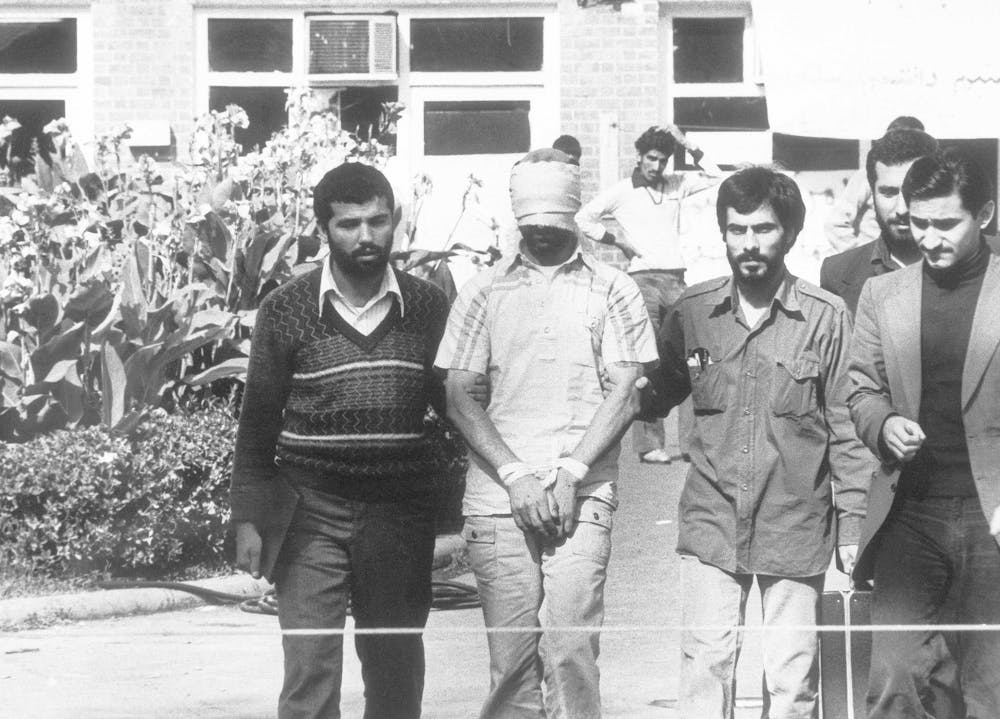
    Iranian students at the U.S. Embassy in Tehran show a blindfolded American hostage to the crowd in November 1979.
    AP Photo

    In October 1979, President Jimmy Carter agreed to allow the shah to come to the U.S. to seek advanced medical treatment. Outraged Iranian students stormed the U.S. Embassy in Tehran on Nov. 4, taking 52 Americans hostage. That convinced Carter to sever U.S. diplomatic relations with Iran on April 7, 1980.

    Two weeks later, the U.S. military launched a mission to rescue the hostages, but it failed, with aircraft crashes killing eight U.S. servicemembers.

    The shah died in Egypt in July 1980, but the hostages weren’t released until Jan. 20, 1981, after 444 days of captivity.

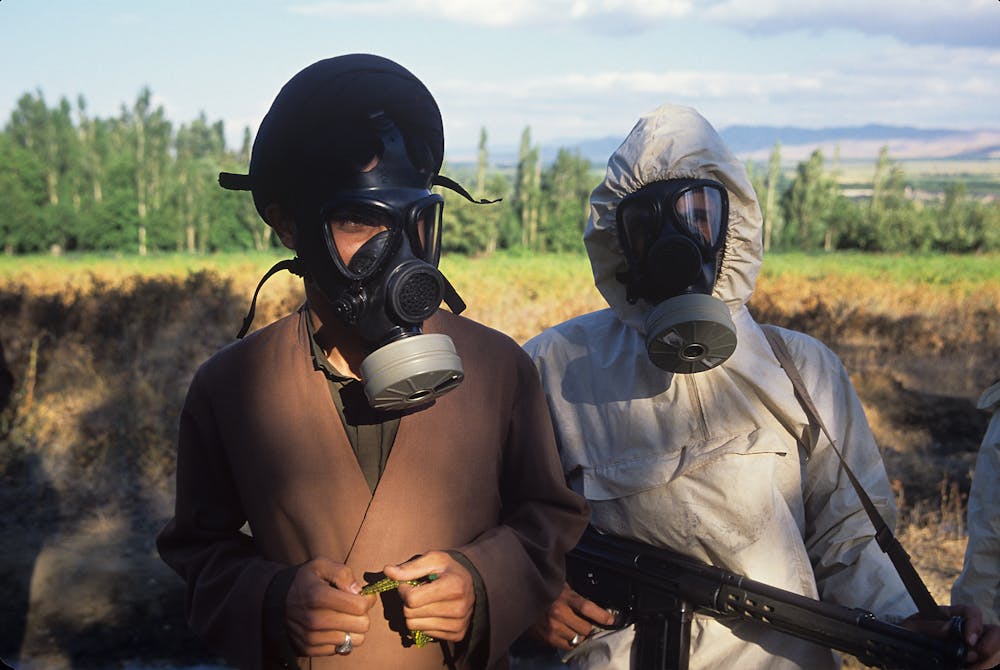
    An Iranian cleric, left, and an Iranian soldier wear gas masks to protect themselves against Iraqi chemical-weapons attacks in May 1988.
    Kaveh Kazemi/Getty Images

    1980-1988: US tacitly sides with Iraq

    In September 1980, Iraq invaded Iran, an escalation of the two countries’ regional rivalry and religious differences: Iraq was governed by Sunni Muslims but had a Shia Muslim majority population; Iran was led and populated mostly by Shiites.

    The U.S. was concerned that the conflict would limit the flow of Middle Eastern oil and wanted to ensure the conflict didn’t affect its close ally, Saudi Arabia.

    The U.S. supported Iraqi leader Saddam Hussein in his fight against the anti-American Iranian regime. As a result, the U.S. mostly turned a blind eye toward Iraq’s use of chemical weapons against Iran.

    U.S. officials moderated their usual opposition to those illegal and inhumane weapons because the U.S. State Department did not “wish to play into Iran’s hands by fueling its propaganda against Iraq.” In 1988, the war ended in a stalemate. More than 500,000 military and 100,000 civilians died.

    1981-1986: US secretly sells weapons to Iran

    The U.S. imposed an arms embargo after Iran was designated a state sponsor of terrorism in 1984. That left the Iranian military, in the middle of its war with Iraq, desperate for weapons and aircraft and vehicle parts to keep fighting.

    The Reagan administration decided that the embargo would likely push Iran to seek support from the Soviet Union, the U.S.’s Cold War rival. Rather than formally end the embargo, U.S. officials agreed to secretly sell weapons to Iran starting in 1981.

    The last shipment, of anti-tank missiles, was in October 1986. In November 1986, a Lebanese magazine exposed the deal. That revelation sparked the Iran-Contra scandal in the U.S., with Reagan’s officials found to have collected money from Iran for the weapons and illegally sent those funds to anti-socialist rebels – the Contras – in Nicaragua.

    At a mass funeral for 76 of the 290 people killed in the shootdown of Iran Air 655, mourners hold up a sign depicting the incident.
    AP Photo/CP/Mohammad Sayyad

    1988: US Navy shoots down Iran Air flight 655

    On the morning of July 8, 1988, the USS Vincennes, a guided missile cruiser patrolling in the international waters of the Persian Gulf, entered Iranian territorial waters while in a skirmish with Iranian gunboats.

    Either during or just after that exchange of gunfire, the Vincennes crew mistook a passing civilian Airbus passenger jet for an Iranian F-14 fighter. They shot it down, killing all 290 people aboard.

    The U.S. called it a “tragic and regrettable accident,” but Iran believed the plane’s downing was intentional. In 1996, the U.S. agreed to pay US$131.8 million in compensation to Iran.

    1997-1998: The US seeks contact

    In August 1997, a moderate reformer, Mohammad Khatami, won Iran’s presidential election.

    U.S. President Bill Clinton sensed an opportunity. He sent a message to Tehran through the Swiss ambassador there, proposing direct government-to-government talks.

    Shortly thereafter, in early January 1998, Khatami gave an interview to CNN in which he expressed “respect for the great American people,” denounced terrorism and recommended an “exchange of professors, writers, scholars, artists, journalists and tourists” between the United States and Iran.

    However, Supreme Leader Ayatollah Ali Khamenei didn’t agree, so not much came of the mutual overtures as Clinton’s time in office came to an end.

    In his 2002 State of the Union address, President George W. Bush characterized Iran, Iraq and North Korea as constituting an “Axis of Evil” supporting terrorism and pursuing weapons of mass destruction, straining relations even further.

    Inside these buildings at the Natanz nuclear facility in Iran, technicians enrich uranium.
    AP Photo/Vahid Salemi

    2002: Iran’s nuclear program raises alarm

    In August 2002, an exiled rebel group announced that Iran had been secretly working on nuclear weapons at two installations that had not previously been publicly revealed.

    That was a violation of the terms of the Nuclear Nonproliferation Treaty, which Iran had signed, requiring countries to disclose their nuclear-related facilities to international inspectors.

    One of those formerly secret locations, Natanz, housed centrifuges for enriching uranium, which could be used in civilian nuclear reactors or enriched further for weapons.

    Starting in roughly 2005, U.S. and Israeli government cyberattackers together reportedly targeted the Natanz centrifuges with a custom-made piece of malicious software that became known as Stuxnet.

    That effort, which slowed down Iran’s nuclear program was one of many U.S. and international attempts – mostly unsuccessful – to curtail Iran’s progress toward building a nuclear bomb.

    2003: Iran writes to Bush administration

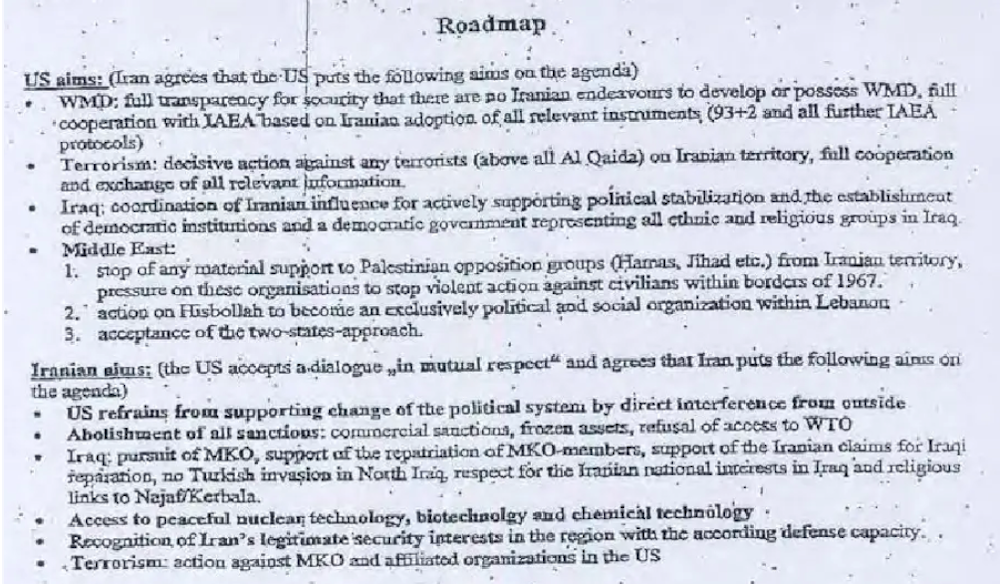
    An excerpt of the document sent from Iran, via the Swiss government, to the U.S. State Department in 2003, appears to seek talks between the U.S. and Iran.
    Washington Post via Scribd

    In May 2003, senior Iranian officials quietly contacted the State Department through the Swiss embassy in Iran, seeking “a dialogue ‘in mutual respect,’” addressing four big issues: nuclear weapons, terrorism, Palestinian resistance and stability in Iraq.

    Hardliners in the Bush administration weren’t interested in any major reconciliation, though Secretary of State Colin Powell favored dialogue and other officials had met with Iran about al-Qaida.

    When Iranian hardliner Mahmoud Ahmadinejad was elected president of Iran in 2005, the opportunity died. The following year, Ahmadinejad made his own overture to Washington in an 18-page letter to President Bush. The letter was widely dismissed; a senior State Department official told me in profane terms that it amounted to nothing.

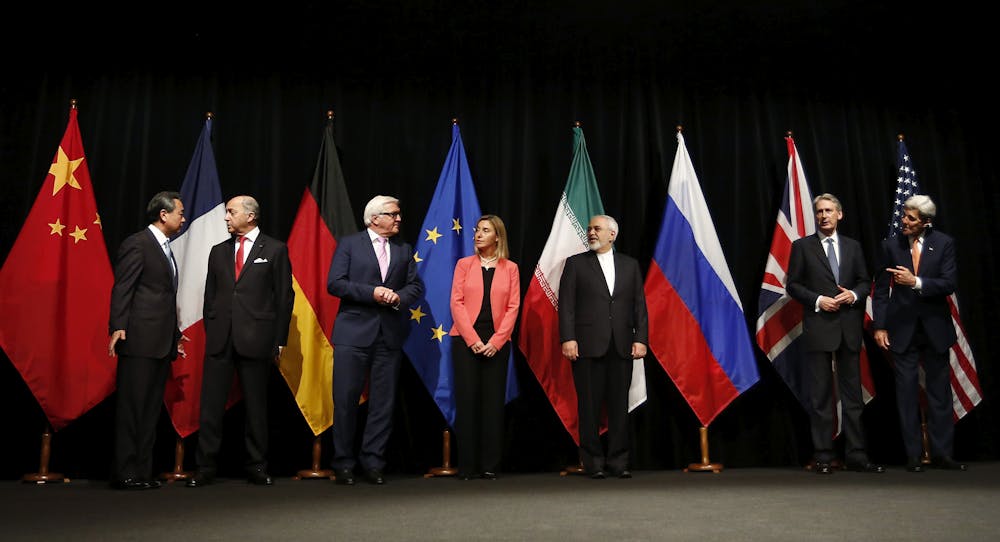
    Representatives of several nations met in Vienna in July 2015 to finalize the Iran nuclear deal.
    Austrian Federal Ministry for Europe, Integration and Foreign Affairs/Flickr

    2015: Iran nuclear deal signed

    After a decade of unsuccessful attempts to rein in Iran’s nuclear ambitions, the Obama administration undertook a direct diplomatic approach beginning in 2013.

    Two years of secret, direct negotiations initially bilaterally between the U.S. and Iran and later with other nuclear powers culminated in the Joint Comprehensive Plan of Action, often called the Iran nuclear deal.

    Two years of secret, direct negotiations conducted bilaterally at first between the U.S. and Iran and later with other nuclear powers culminated in the Joint Comprehensive Plan of Action, often called the Iran nuclear deal.

    Iran, the U.S., China, France, Germany, Russia and the United Kingdom signed the deal in 2015. It severely limited Iran’s capacity to enrich uranium and mandated that international inspectors monitor and enforce Iran’s compliance with the agreement.

    In return, Iran was granted relief from international and U.S. economic sanctions. Though the inspectors regularly certified that Iran was abiding by the agreement’s terms, President Donald Trump withdrew from the agreement in May 2018.

    2020: US drones kill Iranian Maj. Gen. Qassem Soleimani

    An official photo from the Iranian government shows Maj. Gen. Qassem Soleimani, who was killed in a Jan. 3 drone strike ordered by President Donald Trump.
    Iranian Supreme Leader Press Office/Anadolu Agency via Getty Images

    On Jan. 3, 2020, an American drone fired a missile that killed Maj. Gen. Qassem Soleimani, the leader of Iran’s elite Quds Force. Analysts considered Soleimani the second most powerful man in Iran, after Supreme Leader Ayatollah Khamenei.

    At the time, the Trump administration asserted that Soleimani was directing an imminent attack against U.S. assets in the region, but officials have not provided clear evidence to support that claim.

    Iran responded by launching ballistic missiles that hit two American bases in Iraq.

    2023: The Oct. 7 attacks on Israel

    Hamas’ brazen attack on Israel on Oct. 7, 2023, provoked a fearsome militarized response from Israel that continues today and served to severely weaken Iran’s proxies in the region, especially Hamas – the perpetrator of the attacks – and Hezbollah in Lebanon.

    2025: Trump 2.0 and Iran

    Trump saw an opportunity to forge a new nuclear deal with Iran and to pursue other business deals with Tehran. Once inaugurated for his second term, Trump appointed Steve Witkoff, a real estate investor who is the president’s friend, to serve as special envoy for the Middle East and to lead negotiations.

    Negotiations for a nuclear deal between Washington and Tehran began in April, but the countries did not reach a deal. They were planning a new round of talks when Israel struck Iran with a series of airstrikes on June 13, forcing the White House to reconsider is position.

    Jeffrey Fields receives funding from the Carnegie Corporation of New York and Schmidt Futures.

    ref. US and Iran have a long, complicated history, spanning far beyond Israel’s strikes on Tehran – https://theconversation.com/us-and-iran-have-a-long-complicated-history-spanning-far-beyond-israels-strikes-on-tehran-259240

    MIL OSI – Global Reports

  • MIL-OSI USA: Video: Kaine Speaks About Harmful Impacts of GOP Tax Bill

    US Senate News:

    Source: United States Senator for Virginia Tim Kaine

    VIDEO OF KAINE’S REMARKS IS AVAILABLE HERE.

    WASHINGTON, D.C. – Today, U.S. Senator Tim Kaine (D-VA), a member of the Senate Health, Education, Labor and Pensions (HELP) Committee, hosted a spotlight forum with Senator Chris Murphy (D-CT) to highlight how President Donald Trump and Republicans’ bill would make major cuts to vital programs that families rely on, including Medicaid and SNAP, in order to pay for massive tax breaks for the wealthy.

    “We’re here because of the reconciliation bill … which we call the ‘Big Beautiful Betrayal.’ And my Republican colleagues are trying to pass it by a party-line vote without including us in any of the discussions about what’s in the bill. But it would be disastrous for this country,” said Kaine as he began the forum. “We’ll do everything we can to try and defeat it.”

    Kaine continued, “President Trump and congressional Republicans are championing this BBB and it reflects choices – affirmative, calculated decisions about who to help and who to harm … But we don’t have to make a choice to harm middle-class and working people. We don’t have to do that. We can cut taxes for working- and middle-class families without cutting crucial programs that these families rely on. We can choose not to give additional tax breaks to those who have already been so benefitted in the past by tax breaks.

    “The top 20 percent of households will receive nearly 70 percent of the tax cuts in the House bill. That is an upside-down priority,” Kaine continued. “According to the nonpartisan Congressional Budget Office … 16 million Americans nationwide will lose health care coverage under the House bill, and that includes more than 300,000 Virginians.

    “According to our Joint Economic Committee, the House bill … would cut SNAP, the Supplemental Nutrition Assistance Program, by 20 percent, slashing away a crucial safety net for about 200,000 Virginians – 800,000 get SNAP benefits [in total in Virginia]. The benefits are modest – $4.70 per day – but 200,000 of those 800,000 will either have their $4.70 benefit reduced or completely eliminated,” said Kaine. “SNAP fights hunger fast. When it’s slashed, families will feel hunger a lot faster.”

    Kaine continued, “If we take a second and just tally things up: the tax plan would boot millions off health care, take food from the mouths of hungry children and families, cut taxes for millionaires and billionaires, and drive up the deficit by 3 trillion, although I saw the Senate version actually knocks it up even further, maybe as high as $5 trillion. This is before you start factoring in historic and illegal tariffs that the administration is levying on the same everyday people who are suffering by these cuts,” Kaine said.

    “The Yale Budget Lab found that when you factor in both the reconciliation bill and the President’s tariff actions, the bottom 80 percent of American households are going to be worse off. So I truly hope my Republican colleagues will have a change of heart and rework this product, and we’re sure going to give them an opportunity to do it with all the amendments that we’re going to offer—very targeted amendments that will pose some really important choices for them. They could take out all of the SNAP and Medicaid cuts by scaling back the tax cuts for the wealthy, and still have a bill that costs the same as it is. This legislation is going to harm Virginians and harm Americans,” Kaine concluded.

    MIL OSI USA News

  • MIL-OSI USA: Video: Kaine Speaks on Senate Floor Regarding His War Powers Resolution to Prevent War with Iran

    US Senate News:

    Source: United States Senator for Virginia Tim Kaine

    VIDEO OF KAINE’S FLOOR SPEECH IS AVAILABLE HERE.

    WASHINGTON, D.C.—Today, U.S. Senator Tim Kaine (D-VA), a member of the Senate Armed Services and Foreign Relations Committees, spoke on the Senate floor about a war powers resolution he filed this week to express concern about the escalating violence in the Middle East and its potential to pull the U.S. into conflict. The resolution requires that any U.S. participation in offensive hostilities against Iran be explicitly authorized by Congress through a declaration of war or specific authorization for use of military force. It does not prevent the U.S. from defending itself from an imminent attack. The resolution is privileged, meaning that the Senate will be required to promptly consider and vote upon the resolution.

    “There’s no part of the Constitution that’s more important than the Article One provision making plain that the United States should not be at war without a vote of Congress,” said Kaine. “Yet the news of the day suggests that we are potentially on the verge of a war with Iran.”

    “I was elected to the Senate in 2012, having served as a Governor from 2006 to 2010 during a tremendous upsurge in the two wars in Iraq and Afghanistan. I visited our troops multiple times in the green zones in Baghdad and in Afghanistan. I went to the deployments and the homecomings. I went to the wakes and the funerals,” Kaine continued. “And I told myself when I came to the Senate that if I ever had the chance to stop this nation from getting into an unnecessary war, I would do everything I could to stop us.”

    “I happen to believe that the United States engaging in a war against Iran – a third war in the Middle East since 2001 – would be a catastrophic blunder for this country,” Kaine said. “I think there are some in this body who have a different point of view than me on that point, but I think we should all be able to agree in the fundamental constitutional principle that says we shouldn’t be in a war if Congress doesn’t have the guts to debate it and vote on it. We should all – having taken an oath to the Constitution – at least support the principle that war is something that should be for Congress to declare.”

    “Our Constitution has, accordingly, with studied care, vested the question of war with the legislature,” said Kaine. “Other countries don’t do this, but the Framers of our Constitution in 1787 decided we’re going to be different. Before we send troops in harm’s way where they could be killed, where they could be injured, where they could see people that they love – their colleagues killed and injured – before we’re going to send troops in harm’s way in war, we want to see the people’s elected bodies – both houses – have a debate about what the stakes are and whether we should force our troops into harm’s way and potentially lose their lives. And that debate will be in full view of the American public, so the American public can understand what’s at stake and then they can call their representatives or write them a letter and tell them what they think about whether war is necessary and whether the sacrifice we ask of our troops should be the ultimate sacrifice that we are often asking of them in war.”

    “The question for this body that we will grapple with over the course of the next couple of weeks is whether the United States should be in another war in the Middle East – in particular, whether we should allow war to start without us, whether we should hide in the tall grass, rather than exercise our constitutional responsibility under Article One. This is fundamentally a debate about Congress being true to its oath of office and actually also being true to the obligations we have to our public,” Kaine said. “The Framers put this in the Constitution so that we wouldn’t be at war without a debate in front of the public.”

    “If we have that debate and we decide that war is in the national interest, then the troops go into war knowing that the civilian leadership of this country have had the hard debate in view of the American public and decided that the stakes are sufficient to ask people to make the ultimate sacrifice,” Kaine said. “How dare we ask people to make the ultimate sacrifice if we don’t have the guts to have a debate and decide whether a war is in the interest of this country?”

    “We need to have this debate in front of the American public,” Kaine said. “Let them watch us debate the stakes of this – and it might be that colleagues in this body or in the House think a war with Iran is a good idea. Let them put a war authorization on the table. Let’s debate that. Let’s debate that in front of Virginians and Kansans and Californians and hear what our constituents have to say. Let’s debate that in the full view of people whose spouses are in the military or whose kids are in the military. Let’s have that debate in front of them and hear what they think before we cast a vote that would be one of the most serious votes that you ever cast on the floor of a body like this. But we should not allow a war of the magnitude of this to begin with Congress hiding.”

    “I will be asking my colleagues to support my simple resolution as early as next week. No war without a vote of Congress. I’ll be asking my colleagues to support it and uphold the oath we’ve all taken to support the Constitution that established that most unusual principle, most unique principle, that is part of what makes this nation special,” Kaine concluded.

    For years, Kaine has been a leading voice in Congress raising concerns over presidents’ efforts to expand the use of military force without congressional authorization. In 2017, Kaine wrote a piece in TIME warning of the consequences if President Donald Trump pulled out of the nuclear deal with Iran. In 2018, Kaine wrote a piece in The Atlantic warning that Trump was blundering toward war with Iran. In March 2020, Congress passed Kaine’s bipartisan war powers resolution to prevent further escalation of hostilities with Iran without congressional authorization. In 2023, the Senate passed bipartisan legislation led by Kaine to repeal the 1991 and 2002 Authorizations for Use of Military Force (AUMFs) and formally end the Gulf and Iraq wars.

    MIL OSI USA News

  • MIL-OSI USA: Warner Applauds Senate Passage of the Bipartisan Genius Act

    US Senate News:

    Source: United States Senator for Commonwealth of Virginia Mark R Warner

    WASHINGTON – U.S. Sen. Mark R. Warner (D-VA) today applauded the Senate passage of the Guiding and Establishing National Innovation for U.S. Stablecoins (GENIUS) Act, bipartisan legislation to bring much-needed oversight and standards to the $250 billion stablecoin market, and released the following statement:

    “For too long, stablecoins have operated in a regulatory gray area, putting consumers, markets, and national security at risk. The GENIUS Act changes that by creating guardrails for responsible innovation, setting high standards for issuers, and reining in potential abuses by big tech and bad actors.

    “Many of us have deep concerns about how members of the Trump family have used crypto technologies to evade scrutiny, conceal financial entanglements, and profit off the public trust. We must remain vigilant in exposing and stopping these abuses. But our outrage over that corruption cannot prevent us from building a foundation for responsible innovation in this space. If we don’t lead, others will, and not in ways that reflect our interests or democratic values. With the GENIUS Act, the U.S. will finally begin to set the rules of the road to support innovation while protecting consumers and our national security.”

    MIL OSI USA News

  • MIL-OSI USA: Padilla, Schiff, Senate Democrats Press Trump Administration to Resume Processing DACA Applications

    US Senate News:

    Source: United States Senator Alex Padilla (D-Calif.)

    Padilla, Schiff, Senate Democrats Press Trump Administration to Resume Processing DACA Applications

    The Fifth Circuit Court of Appeals recently limited a nationwide injunction to only Texas, giving the Administration the greenlight to resume processing initial DACA applications for all other states

    WASHINGTON, D.C. — U.S. Senators Alex Padilla, Ranking Member of the Senate Judiciary Immigration Subcommittee, and Adam Schiff (both D-Calif.) joined U.S. Senate Democratic Whip Dick Durbin (D-Ill.), Ranking Member of the Senate Judiciary Committee and lead author of the Dream Act, and Senate Democrats in urging U.S. Citizenship and Immigration Services to resume processing initial applications for the Deferred Action for Childhood Arrivals (DACA) program, following a ruling in the Fifth Circuit Court of Appeals that narrowed an earlier injunction to just Texas and allowed USCIS to start processing initial DACA applications from all other states.

    The Senators began by highlighting the popular support for providing Dreamers a pathway to citizenship, writing: “Noncitizens brought to the United States as children, often known as Dreamers, are American in every way but their immigration status. Many only know this country as their home, and they contribute every day to this great nation by paying taxes and serving in critical roles, such as police officers, teachers, and nurses. Americans overwhelmingly support providing Dreamers a path to citizenship, and in December 2024, President Trump stated that he supported protections for Dreamers to remain in the United States.” 

    “Consistent with this statement, we implore you to use your authority at United States Citizenship and Immigration Services (USCIS) to resume processing initial applications for Deferred Action for Childhood Arrivals (DACA) and provide such protections for Dreamers immediately,” continued the Senators. 

    Sunday, June 15, marked the thirteenth anniversary of the DACA program via policy memorandum in 2012. Since then, more than 825,000 people have received deferred action pursuant to DACA, empowering recipients to bolster their careers and contribute an estimated $140 billion to the U.S. economy in spending power and $40 billion in combined federal, payroll, state, and local taxes.   

    In 2021, U.S. District Court Judge Andrew Hanen halted the DACA program and enjoined USCIS from approving any new DACA applications nationwide. While the program was enjoined, USCIS has continued to accept and hold initial applications, and in 2022, the Department of Homeland Security published the DACA Final Rule, codifying the 2012 memorandum establishing DACA into regulation. More than 100,000 initial DACA applications are pending with USCIS. 

    On January 17, 2025, the Fifth Circuit Court of Appeals issued a decision limiting Judge Hanen’s injunction to just Texas. 

    “Pursuant to the order, in Texas, DACA must resume as a limited program providing protection from deportation for current DACA recipients, but without access to work authorization or driver’s licenses as part of those renewals. This order went into effect on March 11, giving USCIS the authority to start processing initial DACA applications from states other than Texas. However, nearly three months later, USCIS has not made any public announcement on whether new DACA applications will be processed; nor has the agency begun processing initial applications that have been pending with the agency for years,” added the Senators.

    “We urge you to begin processing these DACA applications immediately, consistent with the Fifth Circuit decision and existing regulations, and to ensure Dreamers eligible to file initial DACA applications can do so as soon as possible,” concluded the Senators. 

    In addition to Padilla, Schiff, and Durbin, the letter is signed by U.S. Senators Tammy Baldwin (D-Wis.), Michael Bennet (D-Colo.), Richard Blumenthal (D-Conn.), Cory Booker (D-N.J.), Chris Coons (D-Del.), Catherine Cortez Masto (D-Nev.), Tammy Duckworth (D-Ill.), John Fetterman (D-Pa.), Ruben Gallego (D-Ariz.), Kirsten Gillibrand (D-N.Y.), Maggie Hassan (D-N.H.), Martin Heinrich (D-N.M.), John Hickenlooper (D-Colo.), Mazie Hirono (D-Hawai’i), Tim Kaine (D-Va.), Mark Kelly (D-Ariz.), Andy Kim (D-N.J.), Angus King (I-Maine), Amy Klobuchar (D-Minn.), Ben Ray Luján (D-N.M.), Edward Markey (D-Mass.), Jeff Merkley (D-Ore.), Patty Murray (D-Wash.), Gary Peters (D-Mich.), Jack Reed (D-R.I.), Jacky Rosen (D-Nev.), Bernie Sanders (I-Vt.), Brian Schatz (D-Hawai’i), Jeanne Shaheen (D-N.H.), Elissa Slotkin (D-Mich.), Tina Smith (D-Minn.), Chris Van Hollen (D-Md.), Mark Warner (D-Va.), Raphael Warnock (D-Ga.), Elizabeth Warren (D-Mass.), Peter Welch (D-Vt.), Sheldon Whitehouse (D-R.I.), and Ron Wyden (D-Ore.). 

    Full text of the letter to USCIS is available here. 

    MIL OSI USA News

  • MIL-OSI USA: WATCH: Padilla Delivers Floor Speech Following His Forcible Removal From DHS Press Conference

    US Senate News:

    Source: United States Senator Alex Padilla (D-Calif.)

    WATCH: Padilla Delivers Floor Speech Following His Forcible Removal From DHS Press Conference

    WATCH: Padilla: “If this Administration is this afraid of just one Senator with a question, colleagues, imagine what the voices of tens of millions of Americans peacefully protesting can do.”
     
    “If that is what the Administration is willing to do to a United States Senator for having the [audacity] to simply ask a question, imagine what they’ll do to any American who dares to speak up. If what you saw happen can happen when the cameras are on, imagine not only what can happen — but what is happening — in so many places where there are no cameras.”
     
    Video of Senator Padilla’s full speech can be viewed here and downloaded here.

    WASHINGTON, D.C. — Today, U.S. Senator Alex Padilla (D-Calif.), Ranking Member of the Senate Judiciary Immigration Subcommittee, spoke on the Senate floor following his forcible removal from Secretary of Homeland Security Kristi Noem’s press conference, where he was thrown to the ground and handcuffed after attempting to ask a question. Padilla delivered a strong rebuke to the Trump Administration’s unprecedented militarization of Los Angeles and called for his colleagues on both sides of the aisle, as well as the American people, to speak up against Trump’s abuse of power.

    Last week, Trump deployed approximately 4,000 National Guard troops and 700 active-duty Marines to Los Angeles amid unrest caused by his indiscriminate immigration raids across the region. Padilla flew to Los Angeles to conduct oversight over the Trump Administration’s unprecedented military deployment to California — without Governor Newsom’s consent — and was in the high-security Los Angeles Federal Building for a scheduled oversight meeting with the commanding general in charge of the military presence in the region before law enforcement escorted him into Secretary Noem’s briefing room.

    • The Trump Administration has done everything in their power but to provide transparency to the American people about their mission in Los Angeles. And so last week, I chose to go home to try to get answers from the Administration as they are literally militarizing our city.”
    • “I want to share what I learned. I want to share what I heard because it should shock the conscience of our country.

    In the hopes of learning new information after having his requests ignored for months, Padilla tried to ask a question in response to Noem’s demonizing rhetoric toward immigrants and Los Angeles’ democratically elected leadership.

    • “At one point, the United States Secretary of Homeland Security said that the purpose of federal law enforcement and the purpose of the United States military was to ‘liberate’ Los Angeles from our governor and our mayor. To somehow liberate us from the very people that we democratically elected to lead our city and our state.
    • “Colleagues, let that fundamentally un-American mission statement sink in. That is not a mission focused on public safety. And that simply is not, and cannot be, the mission of federal law enforcement and the United States military.
    • To my colleagues on both sides of the aisle, are we truly prepared to live in a country where the President can deploy the Armed Forces to decide which duly elected governors and mayors should be allowed to lead their constituents? Is that really the precedent that we’re okay with setting?”
    • “Throughout the country’s history, we’ve had conflict, we’ve had tumult, but we’ve never had a tyrant as a commander-in-chief.

    Padilla detailed his own background as the proud son of immigrants from Mexico who left behind his MIT engineering degree to protest against the vile anti-immigrant rhetoric in the 1990s that a Republican governor up for reelection spread across California. He said he felt he had to speak out against the Trump Administration’s “un-American” scapegoating of immigrants and California, and detailed the violent reaction to his question.

    • So last week, when I heard something so blatantly un-American from the Secretary of Homeland Security, a cabinet official — of course I was compelled, both as a Senator and as an American, to speak up.
    • “But before I could even get out my question, I was physically and aggressively forced out of the room — even as I repeatedly announced I was a United States Senator, and I had a question for the Secretary. And even as the National Guardsman and the FBI agent who served as my escorts and brought me into that press briefing room stood by, silently, knowing full well who I was.”
    • You’ve seen the video. I was pushed and pulled, struggled to maintain my balance. I was forced to the ground — first on my knees and then flat on my chest. And as I was handcuffed and marched down a hallway, repeatedly asking why am I being detained, not once did they tell me why.

    Padilla expressed his gratitude for the immense support for him and his family that poured in since his forcible removal. However, he emphasized that this fight was not about him but about the fundamental democratic rights of all Americans across the country.

    • “If you watched what unfolded last week and thought what happened is just about one politician and one press conference, you’re missing the point.”
    • If that is what the Administration is willing to do to a United States Senator for having the [audacity] to simply ask a question, imagine what they’ll do to any American who dares to speak up. If what you saw happen can happen when the cameras are on, imagine not only what can happen — but what is happening — in so many places where there are no cameras.
    • “Colleagues, this isn’t about me. In fact, it’s not just about immigrant communities or even just the State of California. It’s about every single American who values their Constitutional rights. It’s about anyone who’s ever exercised their First Amendment rights, or anyone who’s ever disagreed with a president, or anyone who simply values our democracy and wants to keep it.

    Padilla set the record straight on Republican misinformation on undocumented immigrants as Trump has used the same playbook when the headlines turn against him: scapegoat immigrants and manufacture a crisis. Public reporting shows that the majority of immigrants currently in ICE custody have no prior criminal conviction, and under 10 percent of immigrants taken into ICE custody since October have serious criminal convictions. Yet, President Trump has blamed immigrants to distract from his failed policies, including Republicans’ billionaire-first budget reconciliation bill that would cut critical services like health care and nutrition for millions of working families across the country.

    As President Trump takes unprecedented action to militarize Los Angeles without justification or the Governor’s request, Padilla warned of the stakes for cities across the United States and American democracy.

    • “Donald Trump is continuing to test the boundaries of his power. And he’s surrounded himself with yes-men and underqualified attack dogs — from the DHS Secretary to the FBI Director to the Secretary of Defense — who will rubberstamp every anti-democratic step he takes.”
    • “This Administration’s officials and maybe not all, but many Republicans in Congress may choose not to do their job, but they cannot stop me from doing mine.”
    • Again, if you really think this is just about immigrants and immigration, it’s time to wake up. What’s happening is not just a threat to California; it’s a threat to everyone in every state. If Donald Trump can bypass the Governor and activate the National Guard to put down protests on immigrant rights, he can do it to suppress your rights, too. If he can deploy the Marines to Los Angeles without justification, he can deploy them to your state, too. And if he can ignore due process, strip away First Amendment rights, and disappear people to foreign prisons without their day in court, he can do it to you too.”
    • “California is just the test case for the rest of the country. Last week for many was a warning shot. But I pray that it also serves as a wakeup call.

    Padilla concluded his speech with a call to action for Angelenos and millions of Americans to stand up and keep peacefully protesting against the Trump Administration’s attack on fundamental rights.

    • “It doesn’t matter if you’re a Republican, or a Democrat, or an Independent — we all have a responsibility to speak up and to push back, before it’s too late. So I do encourage people to keep peacefully protesting. There’s nothing more patriotic than to peacefully protest for your rights.”
    • Because no one will liberate Los Angeles but Angelenos. No one will redeem America but Americans. No one is coming to save us but us.
    • “And we know that the cameras are not on in every corner of the country. But if this Administration is this afraid of just one Senator with a question, colleagues, imagine what the voices of tens of millions of Americans peacefully protesting can do.

    Senator Padilla has been outspoken in calling out the Immigration and Customs Enforcement (ICE) raids in Los Angeles and Trump’s misguided deployment of the National Guard and U.S. Marine Corps. This weekend, Padilla led the entire Senate Democratic Caucus in demanding that President Trump immediately withdraw all military forces from Los Angeles and cease all threats to deploy the National Guard or active-duty servicemembers to American cities. Last week, Padilla and Senator Adam Schiff (D-Calif.) demanded answers regarding the Trump Administration’s decision to deploy approximately 700 Marines to Los Angeles. Padilla has spoken at a spotlight hearing and on the Senate floor multiple times to blast President Trump for manufacturing a crisis by launching indiscriminate ICE raids across Los Angeles and deploying the National Guard and active-duty servicemembers to the region. He also joined all Senate Judiciary Committee Democrats today in calling on Chairman Grassley to schedule Department of Homeland Security Secretary Noem for a broad oversight hearing for testimony before the committee.

    Padilla’s full remarks as prepared for delivery are available below:

    [Mr./Madam] President,

    Over the last two weeks in Los Angeles – my hometown – we’ve seen masked federal agents in tactical gear ordered into our communities . . .

    We’ve seen a disturbing pattern of extreme and cruel immigration enforcement operations, targeting non-violent people at places of worship, schools, and courthouses.

    All to meet an arbitrary quota.

    Now, we’re seeing President Trump federalize and deploy the National Guard without the Governor’s consent . . .

    Active-duty Marines have been deployed, escalating tensions in our city . . .

    All without coordination with the state and local law enforcement.

    Despite repeated requests for justification for these extreme actions…and after months of little to no response from the Administration on their aggressive and theatrical immigration raids…

    The Trump administration has done everything in their power BUT provide transparency to the American people about their mission in Los Angeles.

    So last week, I went home to try to get answers from the administration as they militarize our city.

    What I heard should shock the conscience of our country.

    One of the first items on my schedule last Thursday was a meeting with General Guillot, the four-star general in charge of U.S. Northern Command at the Federal Building in west Los Angeles, where they are overseeing these military operations.

    When the United States military is deployed domestically…

    When our own troops are deployed against the wishes of the Governor for the first time since 1965, against the wishes of the mayor, against even the wishes of local law enforcement — then we’re in uncharted territory.

    So in an effort to do my duty to conduct congressional oversight — and to try to get answers from the Department of Defense that state and local officials were not receiving— I went to the federal building in West LA.

    I was met at the entrance by a National Guardsman and an FBI agent, who escorted me through the security screening and up to a conference room for my scheduled briefing.

    While waiting for my scheduled briefing with General Guillot, I learned that Homeland Security Secretary Kristi Noem was holding a press conference just down the hall and that the press conference was causing my briefing to be delayed.

    The thought occurred to me that maybe I could attend and listen in, in the hopes of hearing Secretary Noem provide some new information that could help us make sense of what was happening.

    I asked and was escorted by my National Guard and FBI escorts into the press conference. They opened the door for me. They accompanied me into the press briefing room.

    It was there that I listened as the United States Secretary of Homeland Security said that the purpose of federal law enforcement and the United States military was to “liberate” Los Angeles from our governor and our mayor . . .

    . . . To somehow liberate us from the very people we democratically elected to lead our city and our state.

    Colleagues, let that fundamentally un-American mission statement sink in.

    That’s not a mission focused on public safety.

    That simply is not, and cannot be, the mission of federal law enforcement and the United States military.

    To my colleagues on the other side of the aisle, are you truly prepared to live in a country where the President can deploy the armed forces to decide which duly elected governors and mayors should be allowed to lead their constituents?

    Is that really the precedent you’re okay with setting?

    As Secretary Noem herself said last year when serving as Governor of South Dakota, “If Joe Biden federalizes the National Guard, that would be a direct attack on states’ rights.”

    Throughout the country’s history, we’ve had conflict, and we’ve had tumult. But we have never had a tyrant as a commander-in-chief.

    That’s not by coincidence!

    It’s because the American people have always been willing to speak up and exercise their First Amendment right to protest – especially when our fundamental rights have been threatened.

    As the proud son of immigrants from Mexico, it’s that same right I came to revere when marching through the streets of Los Angeles in 1994 alongside friends and family protesting against the vile anti-immigrant rhetoric that was growing in California.

    It was that year that a Republican Governor up for reelection and down in the polls, turned to scapegoating immigrants to try to improve his political standing.

    That fight is what got me to leave an engineering career behind and dedicate myself to influencing government and politics. So, I’ve seen this before. Californians have seen this before.

    So last week, when I heard something so blatantly un-American from the Secretary of Homeland Security — I was compelled, both as a Senator AND as an American, to speak up.

    But before I could even get out my question, I was physically and aggressively forced out of the room — even as I announced I was a United States Senator, and I had a question for the Secretary.

    And even as the National Guardsman and FBI agent who escorted me into the press conference stood by, silently, knowing full well who I was.

    You’ve seen the video.

    I was pushed and pulled, struggling to maintain my balance.

    I was forced to the ground — first to my knees and then flat on my chest.

    As I was handcuffed and marched down a hallway, I repeatedly asked why I was being detained. Not once did they tell me why.

    In that moment, a lot of questions run through your head.

    Where are they taking me?

    Am I being arrested?

    What will a city already on edge from being militarized think when they see their Senator has been handcuffed just for trying to ask a question? Or . . .

    What will my wife and our three boys think?

    I also remember asking myself: if this aggressive escalation is the result of speaking up against the abuses and overreach of the Trump administration, was it really worth it?

    But colleagues, how many Americans in our nation’s history have marched, have protested, have shed blood and lost their lives to protect our rights?

    How many Americans have served in wars overseas to protect our freedoms here at home?

    And how many Americans in the year 2025 see a vindictive president on a tour of retribution, unrestrained by the majority of this separate but co-equal branch of government in this building, and wonder if it’s worth it to stand up or to speak out?

    If a United States Senator is too afraid to speak up, how can we expect any other American to do the same?

    Colleagues, you know me.

    I’m not aware of anyone who would describe me as a flamethrower. I try to be respectful and considerate to every member of this body— regardless of your politics.

    So I want to thank all of my colleagues on both sides of the aisle who reached out to share messages of support — whether it was public or in private.

    In means a great deal to me and my family.

    But if you watched what unfolded last week and thought this was about one politician or one press conference, you’re missing the point.

    If that’s what this Administration will do to a United States Senator for having the audacity to simply ask a question, imagine what they’ll do to any American who dares to speak up.

    If that’s what can happen when the cameras are on, imagine not only what can happen — but what is happening — when the cameras are off.

    This isn’t about me. In fact, it’s not even just about immigrant communities or about Californians.

    It’s about every single American who values their constitutional rights. It’s about anyone who’s ever exercised their First Amendment rights, or ever disagreed with a president, or who simply values living in a democracy and wants to keep it.

    The President will tell you this is about undocumented immigrants, and about law and order and about targeting dangerous, violent criminals.

    But we know differently.

    Public data released by the administration shows that the majority of immigrants currently in ICE custody do not have a prior criminal conviction.

    And new reporting shows that less than 10 percent of immigrants taken into ICE custody since October have serious criminal convictions.

    Less than 10 percent!

    Two weeks ago, Donald Trump was at the lowest point in his presidency so far.

    He was drowning in a week of terrible headlines.

    The American people were finally waking up to the realities of the budget reconciliation bill that will cut health care, nutrition assistance, and good paying clean energy jobs in order to cut taxes for billionaires.

    He was losing his tariff wars as the costs of everyday goods were continuing to rise.

    His promises to end Russia’s invasion of Ukraine were falling flat.

    He’d been handed loss after loss in federal court.

    And maybe the most embarrassing part was his public breakup with Elon Musk.

    But we know what happens when the headlines turn on Donald Trump. Donald Trump turns to the same tired playbook he always has: when in doubt, scapegoat immigrants. And manufacture a crisis to distract the media from your failures.

    That’s the reason he ramped up ICE raids in California.

    And when Californians took to the streets to peacefully protest, that’s the reason he bypassed the Governor and federalized the National Guard. And as things began to settle in Los Angeles, he escalated even further by sending in the Marines.

    He wants the spectacle — not just to distract, but to justify his undemocratic crackdowns and his authoritarian power grabs.

    That’s the reason why even while the vast majority of protests have remained peaceful, the President, the Vice President, and their allies have called protestors insurrectionists!

    Yes, this is the same man who provoked an actual insurrection on our Capitol on January 6th.

    The same man who incited a violent mob, carrying confederate flags, against Congress.

    The same man who then pardoned the convicted felons who assaulted our brave Capitol Police officers.

    Trump is testing the boundaries of his power. And he’s surrounded himself with yes-men and underqualified attack dogs — from the DHS Secretary to the FBI Director to the Secretary of Defense — who will rubberstamp every anti-democratic step he takes.

    This Administration’s officials and Congressional Republicans may choose not to do their job, but they cannot stop me from doing mine.

    And I refuse to let immigrants be pawns on the path to fascism.

    Again, if you really think this is just about immigrants, it’s time to wake up.

    What’s happening isn’t just a threat to California, it’s a threat to everyone in every state.

    If Donald Trump can bypass the Governor and activate the National Guard to put down protests for immigrant rights, he can do it to suppress your rights, too.

    If he can deploy Marines to Los Angeles without justification, he can deploy them to your city, too.

    If he can ignore due process, strip away First Amendment rights, and disappear people to foreign prisons without their day in court, he can do it to you too.

    California is just Trump’s test case for the rest of the country.

    Last week was a warning shot.

    But I pray that it can be our wakeup call, too.

    We’ve now seen Trump threaten to do the same in other cities run by elected Democrats.

    It doesn’t matter if you’re a Republican, a Democrat, or an independent — we all have a responsibility to speak up and to push back, before it’s too late.

    So I encourage people to keep peacefully protesting. There’s nothing more patriotic than peacefully protesting for your rights.

    No one will liberate Los Angeles but Angelenos.

    No one will redeem America but Americans.

    No one is coming to save us but us.

    The cameras won’t always be on.

    But if this Administration is this scared of just one Senator with a question, imagine what the voices of tens of millions of Americans in the streets can do.

    Thank you, [Mr./Madam] President, I yield the floor.

    MIL OSI USA News

  • MIL-OSI USA: Padilla, Schiff Condemn Trump Administration Decision to Terminate $3.7 Billion in Clean Energy Grants, Urge DOE to Reinstate Them

    US Senate News:

    Source: United States Senator Alex Padilla (D-Calif.)

    Padilla, Schiff Condemn Trump Administration Decision to Terminate $3.7 Billion in Clean Energy Grants, Urge DOE to Reinstate Them

    Senators Padilla and Schiff: “These unlawful terminations represent a significant setback for American energy independence, and they undermine California and America’s leadership in the globally competitive clean energy industry.”

    “These grants were provided through legally binding contract agreements between recipients and the federal government and, therefore, cannot be canceled on a political whim.”

    WASHINGTON, D.C — Today, U.S. Senators Alex Padilla and Adam Schiff (both D-Calif.) condemned the Trump Administration’s decision to terminate $3.7 billion in federal funding for clean energy projects across the country, including $845 million in California, and called on the Administration to reinstate them. In the letter to U.S. Department of Energy (DOE) Chris Wright, the Senators note that these grants were previously awarded through legally binding contract agreements between recipients and the federal government and cannot be canceled on a political whim.

    The projects targeted include the National Cement Company of California which lost $500 million for their Lebec Net-Zero Project to focus on carbon capture and the development of carbon-neutral cement, a manufacturing process that is notoriously emissions-intensive, $270 million for implementing carbon capture at a natural gas power plant in Yuba City, and $75 million for a project focused on testing new technology at Gallo Glass Company furnaces in Modesto.  

    “These grants were provided through legally binding contract agreements between recipients and the federal government and, therefore, cannot be canceled on a political whim. DOE claims that the agency evaluated the investments “on a case-by-case basis to identify waste of taxpayer dollars,” and yet your agency has not provided any information to Congress detailing waste of any kind,” wrote the Senators.

    “DOE’s attacks on cutting-edge clean energy projects run counter to our shared interest in boosting energy production, innovation, and economic vitality. The United States cannot afford to halt our progress and hinder American companies’ efforts to move beyond outdated technologies if we hope to remain competitive and truly energy dominant around the globe. These irrational cancellations will increase energy prices, hamper innovation, and set us backwards as we strive toward a clean energy future. We ask that you reinstate the $3.7 billion in canceled OCED funding so that we may bolster American energy production and maintain our competitive edge,” concluded the Senators.  

    A list of DOE awards terminated is available here.  

    Full text of the letter is available here and below:    

    Dear Secretary Wright: 

    We write with deep concern regarding the U.S. Department of Energy’s (DOE) terminations of energy projects in California that were supported by the Office of Clean Energy Demonstrations (OCED). These unlawful terminations represent a significant setback for American energy independence, and they undermine California and America’s leadership in the globally competitive clean energy industry.  We urge you to work with recipients to reinstate their grant awards.    

    On May 30, DOE canceled $3.7 billion in funding for 24 clean energy projects around the country, including in Alabama, Arizona, California, Illinois, Kentucky, Louisiana, Massachusetts, Michigan, Nevada, New York, Ohio, Texas, Washington, and Wyoming. In California alone, DOE terminated $845 million in project funding. These terminations are unnecessarily harmful to California’s industries, who often push the cutting edge of innovation forward.    

    One of the largest cancellations targeted the National Cement Company of California Inc., which lost $500 million for their Lebec Net-Zero Project to focus on carbon capture and the development of carbon-neutral cement, a manufacturing process that is notoriously emissions-intensive.  Not only would this project have accelerated decarbonization efforts, but it would have also created hundreds of local jobs in construction and plant operations. Another canceled project in California was $270 million for implementing carbon capture at a natural gas power plant in Yuba City. This project, which supported the same traditional sources of energy that the Trump DOE claims to support, would have helped reduce 95 percent of CO2 emissions from the plant and provided Northern California with more low-carbon electricity. DOE canceled another $75 million for a project focused on testing new technology at Gallo Glass Company furnaces in Modesto.  This project would have reduced natural gas use by 70 percent and would have used union labor to produce glass for California’s wine industry.   

    These grants were provided through legally binding contract agreements between recipients and the federal government and, therefore, cannot be canceled on a political whim.  DOE claims that the agency evaluated the investments “on a case-by-case basis to identify waste of taxpayer dollars,” and yet your agency has not provided any information to Congress detailing waste of any kind.  These terminations follow your agency’s May 15 announcement that DOE would review 179 awards totaling over $15 billion for projects dedicated to updating power grids and supporting the domestic manufacture of batteries, which has created significant chaos and uncertainty in America’s energy and manufacturing sectors. 

    Additionally, it has been reported that DOE may be planning to close OCED, which has contributed to more than 70 percent of staff in that office departing the agency.  In 2021, Congress directed the establishment of OCED in the bipartisan Infrastructure Investment and Jobs Act. OCED’s mission is to advance large-scale demonstration projects to accelerate the deployment and market adoption of energy technologies like clean hydrogen, carbon management, advanced nuclear reactors, and long-duration energy storage.  Until recently, these were bipartisan initiatives.    

    DOE’s attacks on cutting-edge clean energy projects run counter to our shared interest in boosting energy production, innovation, and economic vitality. The United States cannot afford to halt our progress and hinder American companies’ efforts to move beyond outdated technologies if we hope to remain competitive and truly energy dominant around the globe. These irrational cancellations will increase energy prices, hamper innovation, and set us backwards as we strive toward a clean energy future. We ask that you reinstate the $3.7 billion in canceled OCED funding so that we may bolster American energy production and maintain our competitive edge.     

    Thank you and we look forward to your response.

    MIL OSI USA News

  • MIL-OSI USA: Gillibrand Statement On Senate Passage Of The GENIUS Act

    US Senate News:

    Source: United States Senator for New York Kirsten Gillibrand
    Today, U.S. Senator Kirsten Gillibrand lauded Senate passage of the GENIUS Act, landmark legislation that will establish a regulatory framework for stablecoins. Senator Gillibrand was the lead Democratic senator on the bill and shepherded the legislation through to final passage.
    “Senate passage of the GENIUS Act is a landmark moment in the bipartisan effort to regulate stablecoins. This bill will enable U.S. businesses and consumers to take advantage of the next generation of financial innovation,” said Gillibrand. “A product of months of bipartisan negotiations, the GENIUS Act will protect consumers, enable responsible innovation, and safeguard the dominance of the U.S. dollar. The bill targets illicit finance, places limitations on Big Tech, puts in place ethical guardrails, and strengthens national security. I want to extend my sincere gratitude to Senators Hagerty, Scott, Alsobrooks and Lummis, who worked tirelessly to find common ground and produce this excellent legislation. The GENIUS Act will position our country for the 21st century, and I will continue working to ensure it is signed into law.” 
    Senator Gillibrand, alongside Senators Hagerty (R-TN), Scott (R-SC), Lummis (R-WY), and Alsobrooks (D-MD), introduced the GENIUS Act earlier this year. The bill passed out of the Senate Banking Committee with bipartisan support in March 2025. 
    Senator Gillibrand has been working on cryptocurrency legislation since 2022, when she and Senator Lummis introduced the Lummis-Gillibrand Responsible Financial Innovation Act, a comprehensive bipartisan framework for cryptocurrency regulation. The framework was re-introduced in 2023. In 2024, Gillibrand and Lummis also introduced a stablecoin bill that included many of the provisions that passed in the GENIUS Act.

    MIL OSI USA News

  • MIL-OSI USA: Tillis, Coons Announce New Bipartisan Support for Legislation to Restore American Innovation

    US Senate News:

    Source: United States Senator for North Carolina Thom Tillis
    WASHINGTON, D.C. – Today, Senators Thom Tillis (R-NC) and Chris Coons (D-DE) announced that Senators Marsha Blackburn (R-TN) and Mazie Hirono (D-HI) have joined the Patent Eligibility Restoration Act (PERA) as cosponsors. This bipartisan, bicameral legislation will restore patent eligibility to important inventions across many fields while also resolving legitimate concerns over the patenting of mere ideas, the mere discovery of what already exists in nature, and social and cultural content that everyone agrees is beyond the scope of the patent system. It also affirms the basic principle that the patent system is central to promoting technology-based innovation.
    “In recent years the Supreme Court has expanded judicial exceptions to such a degree that patent eligibility has gone from being a coarse filter to a fine one – resulting in U.S. inventors being unable to obtain patents in areas where our economic peers offer protections, such as for diagnostic medicine and for artificial intelligence,” said Senator Tillis. “Patent eligibility is but one of four criteria that determines whether a patent application can be issued as a patent. PERA will expand the aperture of patent eligibility – it does not automatically render something patentable – and will ensure that the U.S. does not shut the door to innovations that is welcomed by the patent systems of our economic peers. We cannot allow the U.S. to fall behind on the global stage and I’m glad to see more of my Senate colleagues recognize this pressing need.” 
    “When American innovators know their ideas are eligible for patent protection, they take the risks that push us into the future – whether that’s the next groundbreaking medical test or the latest AI technology,” said Senator Coons. “PERA restores clarity to the law on what can be patented and what cannot – guidance that federal courts have been requesting for years and that the Supreme Court has refused to provide. I’m excited to welcome my colleagues from both sides of the aisle to this bill. This is another step toward providing America’s inventors with the stable legal foundation they need to produce the cutting-edge technologies that power our economy.”
    “Our patent system must fuel innovation and secure America’s competitive edge over adversaries like Communist China,” said Senator Blackburn. “The bipartisan Patent Eligibility Restoration Act would restore patent eligibility for important inventions across many critical fields to ensure America remains ahead of the curve when it comes to technological innovation.”
    “A series of Supreme Court decisions restricting patent eligibility have constricted American innovation,” said Senator Hirono. “The Patent Eligibility Restoration Act will help clarify patent eligibility law, encouraging technological innovation to help ensure that our country does not fall behind on innovation. Importantly, this legislation only affects patent eligibility, it does nothing to affect the many other requirements for patentability.”
    Background:
    Unfortunately, due to a series of Supreme Court decisions, patent eligibility law in the United States has become confused, constricted, and unclear in recent years. This has resulted in a wide range of well-documented negative impacts – inconsistent case decisions, uncertainty in innovation and investment communities, and unpredictable business outcomes.
    As of 2021, all 12 then-sitting judges of the United States Court of Appeals for the Federal Circuit lamented the state of the law. Witnesses and stakeholders from a wide array of industries, fields, interest groups, and academia have testified and submitted comments confirming the uncertainty and detailing the detrimental effects of patent eligibility confusion in the United States. There is now widespread bipartisan agreement in Congress and across all recent Administrations that reforms are necessary to restore the United States to a position of global strength and leadership in key areas of technology and innovation, such as medical diagnostics, biotechnology, personalized medicine, artificial intelligence, 5G, and blockchain. 
    The Patent Eligibility Restoration Act achieves this critical goal by restoring patent eligibility to important inventions across many fields, while also resolving legitimate concerns over patenting of mere ideas, the mere discovery of what already exists in nature, and social and cultural content that everyone agrees is beyond the scope of the patent system, which is a system aimed at promoting technology-based innovation. As a general approach, the Patent Eligibility Restoration Act maintains the existing statutory categories of eligible subject matter, which have worked well for over two centuries, but eliminates the overly malleable set of current judicial exceptions – replacing them with five specific, defined statutory exclusions. By eliminating and replacing the current judicial exceptions, the Patent Eligibility Restoration Act provides predictable patent eligibility for important computer-implemented technological developments and medical advances, creating a solid bedrock for America’s innovation future.
    Full text of the bill is available HERE. 

    MIL OSI USA News

  • MIL-OSI USA: FAA Announces $1.9 Million for Projects at North Dakota Airports

    US Senate News:

    Source: United States Senator Kevin Cramer (R-ND)

    WASHINGTON, D.C. – The U.S. Department of Transportation (DOT) Federal Aviation Administration (FAA) announced an award of $1,906,102 through the Airport Infrastructure Grant (AIG) program for projects at several airports across North Dakota. The funding will be distributed as follows:

    • $1,000,000 to the City of Minot to reconstruct 1,500 feet of the existing airport firefighting, rescue building, and hangar access road.
    • $322,254 to the Washburn Municipal Airport Authority for a new 200-foot Taxilane midfield to provide airfield access to a nonexclusive hangar development area to bring the airport into conformity with current standards.
    • $250,000 to the Barnes County Municipal Airport Authority to fund the final reconstruction of an existing lighting vault building and equipment.
    • $225,000 to the Oakes Municipal Airport Authority to replace one existing airport rotating beacon.
    • $108,848 to the Cando Municipal Airport Authority to reseal 4,433 square yards of existing North Apron pavement and pavement joints, reseal 450 feet of existing Taxiway A pavement and pavement joints, and reseal 466 feet of existing Taxilane East pavement and pavement joints to extend its useful life.

    The AIG Program was established by the fully-paid-for Bipartisan Infrastructure Law to provide airports with funding for modernization and safety projects. Since its creation, airports in North Dakota have received over $49 million in program funding.

    MIL OSI USA News

  • MIL-OSI USA: On Senate Floor, Klobuchar Honors Representative Melissa Hortman and Mark Hortman

    US Senate News:

    Source: United States Senator Amy Klobuchar (D-Minn)

    WATCH KLOBUCHAR’S FULL REMARKS HERE

    WASHINGTON —On the Senate Floor, U.S. Senators Amy Klobuchar and Tina Smith delivered remarks honoring the life and legacy of Representative Melissa Hortman, former Minnesota House speaker, and her husband Mark Hortman. 

    A transcript of the Senator Klobuchar’s floor speech is below: 

    Mr. President, I rise today with my colleague from Minnesota, Senator Smith, to honor two Minnesotans who are friends of ours, who were taken from us this weekend in a shocking act of political violence: Representative Melissa Hortman, our former Speaker of the House and her husband, Mark Hortman. 

    I’m also continuing to pray for State Senator John Hoffman and his wife Yvette, who survived a brutal assassination attempt. John took nine bullets and Yvette took eight, and they are continuing to recover in the hospital.  I’ve been in touch with Yvette, and she is grateful for the outpouring of support from all over the country for their family.

    And I want to extend my enormous gratitude to the hundreds and hundreds of local, state and federal law enforcement who worked tirelessly over the course of a 43-hour manhunt to apprehend the suspect. They ran toward the danger. They risked their lives, and because of their bravery and diligence, our state was able to breathe a sigh of relief Sunday night knowing that this man was no longer at large. 

    The local officers from Brooklyn Park, Minnesota also stopped further assassinations, along with other officers, in the moment by going over to check on legislators after learning about what had happened at Senator Hoffman’s house.  We now know that the assassin went to two other legislators’ homes in between the two shootings that night, and in one case, sped off after being spotted by the police. 

    While it was too late to save Melissa and Mark, the officers’ decision to check on their house allowed them to spot the assassin, separate him from his vehicle, and begin the manhunt. 

    But right now, we want to focus on who Melissa and Mark were as people. They were great neighbors, wonderful friends and great parents to their beloved children, Sophie and Colin. 

    Melissa is someone that I wish the whole Senate and the whole nation knew.  We treasured her in Minnesota. She was the epitome of what you want in a public servant. She went into it for all the right reasons. 

    She grew up in Spring Lake Park and Andover Minnesota, working at her family’s used auto parts company in Blaine in the summers. After leaving for college, she came back to Minnesota for law school and began her career in our state.

    She was always devoted to her community. She was a girl scout leader and taught Sunday School at her local Catholic Church, and she was always one of the first to raise her hand when someone needed a volunteer for, well, just about anything, including training service dogs for veterans. One of them, Gilbert, was just too friendly for service, and so their family adopted him and loved him very much. Sadly, he was shot that night, and the two children had to make the decision to put him down this weekend. How they loved that dog.  

    Melissa and I first ran for public office around the same time, both with little kids. Me, for the county attorney’s office, her for the state legislature. That’s how I got to know her. I was the county attorney. She was running for legislature. We went door to door together, and it seemed like she knew everyone in the district already. 

    She was elected in 2004 and served in the Minnesota House for 20 years. And she left a lasting impact. As a legislator, she authored legislation that created Minnesota’s solar energy standard. As minority leader, she guided her caucus with conviction and a sense of humor. And she wasn’t afraid to call out the all-male card game taking place during debates.

    When her colleagues chose to make her the speaker, her first order of business was getting rid of the speaker’s mute button. As she said at the time, “I have a gavel…and a gavel is good enough for me.” 

    Melissa was one of the most consequential speakers in the history of our state. She knew no limits in terms of trying to get people together, trying to get things done. And while I cannot believe she is gone, Minnesotans will be feeling the impact of her leadership forever. 

    When a Minnesota student gets a free school lunch, that’s Melissa. 

    When a Minnesota parent is able to take paid leave to spend those early, precious moments with a newborn, that’s Melissa. 

    When a Minnesota voter casts a ballot without facing unfair discrimination, that’s Melissa. 

    When a woman is able to access reproductive care in our state, that’s Melissa, and when our state achieves 100% clean energy by 2040, that will be because of Melissa. 

    And when we had a tied state house this year, it was Melissa who forged a power sharing agreement and a budget with her Republican counterpart. 

    She was a generational leader, and she led with integrity and with courage. She, like her husband, Mark, who also was accomplished in business and a kind, kind person, they were compassionate and they were smart, and they were just nice to everyone. And I can’t believe they are gone. 

    The polarization in our country, the divisions, the online hate, needs to stop.  Violence has absolutely no place in our democracy. We need to come together and bring down the rhetoric. We must be united in the face of this attack. It was simply un-American. 

    That’s why the entire Minnesota delegation, Democrats and Republicans, including Senator Smith, including Congressman Emmer, came together over the weekend to call this violence out. We spoke with one voice to condemn it, and in our state, Melissa’s colleagues on both sides of the aisle have done the same. 

    We need to recognize the reality that there are unbalanced people out there. Read things online, they believe them. They act on them.

    We have seen this too many times. There are many things we can do as a body to fix this problem, and I’m sure in the days to come, we will offer legislation on security and all kinds of things.  But we don’t need to pass a law for people to turn down the rhetoric, to treat each other with decency and respect, to act a little more like Melissa and Mark. 

    Mr. President, Melissa and Mark Hortman were the best of us. I am shattered to have lost them, but eternally grateful to have known them. 

    I want to end by sharing a message from their beloved kids, Sophie and Colin.  They wrote this just last night: “This tragedy must become a moment for us to come together. Hold your loved ones a little closer, love your neighbors and treat each other with kindness and respect. The best way to honor our parents’ memory,” they said,”is to do something, whether big or small, to make our community just a little better for someone else.”

    I urge my colleagues to hear that message, and I’m honored to be here with my wonderful colleague, Senator Smith. Thank you and I yield the floor.

    MIL OSI USA News

  • MIL-OSI China: More US exhibitors to take part in 3rd supply chain expo

    Source: People’s Republic of China – State Council News

    An increasing number of exhibitors from the United States will participate in the third China International Supply Chain Expo (CISCE) this July, signaling their confidence in the Chinese economy despite anti-globalization headwinds, the event organizer said Tuesday.

    The number of U.S. exhibitors is expected to increase by 15 percent compared with the previous edition, and 60 percent of them are Global Fortune 500 companies, said Yu Jianlong, vice president of the China Council for the Promotion of International Trade (CCPIT), at a press conference.

    U.S. tech giant Nvidia is expected to make its debut at the expo. During his visit to Beijing in April, Nvidia CEO Jensen Huang met with CCPIT chairman Ren Hongbin and emphasized that China is a very important market for Nvidia, expressing the company’s willingness to continue cooperation with China.

    Overseas participants at the upcoming expo are estimated to account for 35 percent of the total of 650 exhibitors from 75 countries, regions and international organizations, with half of the overseas participants coming from Europe and the United States, according to Yu.

    “Against the backdrop of a complex international situation and anti-globalization headwinds, the gathering of so many friends from all over the world, especially those from the global business community, is a vote of confidence in the expo and also in China’s economic development,” Yu said.

    The third CISCE will take place in Beijing from July 16 to 20, with Thailand as the guest country of honor.

    As the world’s first national-level exhibition focusing on supply chains, the expo is an internationally shared public product. First held in 2023, the expo has contributed to building more secure, stable, open and inclusive global industrial and supply chains, according to the CCPIT.

    Last year, U.S. companies made a strong presence at the second edition of the expo in Beijing, with well-known American firms such as Apple and Tesla seeking to further tap into China’s vast market.

    The upcoming expo will feature a new exhibition area dedicated to the innovation chain, aimed at promoting the commercialization of lab-developed technologies and fostering seamless integration between the innovation and industrial chains, the CCPIT said. 

    MIL OSI China News

  • MIL-OSI China: Britain, US sign partial trade deal as key issues remain unresolved

    Source: People’s Republic of China – State Council News

    A worker cleans Land Rover cars at a Jaguar Land Rover dealership in Reading Britain on June 24, 2020. [Photo/Xinhua]

    Britain and the United States have formally signed a partial bilateral trade agreement during the G7 summit in Canada, according to a press release issued by the UK government on Tuesday.

    The agreement, first announced in May, includes tariff reductions on British car and aerospace exports, but several key sectors, notably steel, aluminium and pharmaceuticals, remain unresolved.

    The deal came into effect after U.S. President Donald Trump signed an executive order to implement it. British Prime Minister Keir Starmer, who met with Trump at the summit, confirmed that the core tariff reduction measures would take effect “immediately.”

    Under the agreement, the U.S. will reduce tariffs on up to 100,000 British-made cars per year from 27.5 percent to 10 percent. It also removes the 10 percent U.S. tariff on British aerospace products, including jet engines and aircraft components, a measure expected to take effect by the end of the month.

    Britain has also agreed to a quota of 1.4 billion litres of tariff-free U.S. bioethanol imports, a volume roughly equivalent to the country’s total annual domestic demand. In return, the U.S. has committed to allowing limited British beef exports.

    The British government said all American agricultural imports would still need to meet Britain’s food safety and animal welfare standards. However, British bioethanol producers and farming groups have expressed concern that the influx of U.S. products could undercut local industries.

    Despite these developments, large parts of the agreement remain incomplete. According to reports by the Financial Times, both sides are still in negotiations over steel and aluminium tariffs.

    Although Britain currently benefits from an exemption to the new 50 percent global steel duty announced by Trump, it continues to face a 25 percent tariff.

    British officials said that final arrangements have been delayed due to “technical and legal” challenges, including U.S. rules requiring that steel must be “melted and poured” in its country of origin. Much of Britain’s steel is processed from imported material and may not qualify under that definition.

    People walk past a Boots store in Manchester, Britain, on July 9, 2020. [Photo/Xinhua] 

    Pharmaceuticals represent another unresolved area. While the British government says both sides aim to secure “significantly preferential outcomes” for the British pharmaceutical industry, no binding provisions have been announced.

    According to British media, Starmer has appointed his senior business adviser Varun Chandra to lead a delegation to Washington this week. The team, which includes embassy trade officials, is expected to focus on finalising the remaining elements of the agreement.

    Industry analysts and trade experts have pointed out that the deal is limited in scope and relies on executive action rather than formal legislation. This raises questions about the long-term stability of the agreement, particularly if there is a change in U.S. leadership. 

    MIL OSI China News

  • MIL-OSI USA: Courts Partially Blocks Trump-Vance Administration’s Anti-Science Meddling and Cuts to Pandemic Prevention Programs

    Source: American Federation of State, County and Municipal Employees Union

    Municipalities in Texas, Tennessee, Ohio, and Missouri and Public Sector Union Win Injunction to Prevent Cuts at U.S. Department of Health and Human Services Court Declines to Issue Nationwide Relief

     A coalition of major municipalities across the nation —  including Harris County, Texas; Columbus, Ohio; the Metropolitan Government of Nashville and Davidson County, Tennessee; and Kansas City, Missouri — and public service workers represented by the American Federation of State, County, and Municipal Employees (AFSCME) were granted an injunction today in their challenge to unlawful funding termination by the U.S. Department of Health and Human Services (HHS). That termination would have canceled grants that those municipalities and their public health workforce rely on to protect their constituents from infectious diseases and pandemics. 
     
    The injunction will stop the unlawful HHS funding termination, requiring the Department to issue the grants while the case proceeds. The court declined to issue a nationwide injunction, but left open the possibility of extending needed relief later in the case to public health employees across the country.
     
    The municipalities filed suit in April in District Court for the District of Columbia, and the case is Harris County et al. v. Kennedy. Nashville and Davidson County, Kansas City, and Columbus are represented by Democracy Forward and the Public Rights Project. AFSCME is also represented by Democracy Forward. Harris County is represented by Harris County Attorney Christian Menefee. 
     
    “This ruling is a win for Harris County residents and public health departments across the country. The federal government cannot simply ignore Congress and pull the plug on essential services that communities rely on. Today’s decision ensures we can keep doing the work that protects our residents — from tracking disease outbreaks to providing vaccinations and supporting vulnerable families,” said Harris County Attorney Christian Menefee.
     
    “When the executive branch claims virtually unlimited powers, we all rely on the courts to uphold the Constitution. Nashville cannot easily replace the five individuals laid off when the cancellation of the grant was initially announced, but we are grateful to the partners that pushed for this injunction and skillfully articulated why no administration has the authority to rescind grants previously authorized by Congress,” said Metro Nashville’s Director of Law, Wally Dietz.
     
    “We are pleased the judge ruled that it was unlawful and a violation of the Constitution for the administration to rip this critical public health funding from our communities; however, we are disappointed by the decision to only deliver limited relief,” said AFSCME President Lee Saunders. “Every tax dollar withheld means fewer staff responding to outbreaks, fewer vaccinations, and greater risk to the public — especially those most vulnerable. But this fight isn’t over. We will continue to push our case forward to ensure public dollars remain invested in public health.”
     
    On March 24, 2025, HHS Secretary Robert F. Kennedy Jr. unlawfully eliminated congressionally-mandated federal funding designed to keep local governments safe from COVID-19 and from future pandemics. The terminated appropriations provided more than $11 billion worth of federal grants to local municipalities for the vital public health work of identifying, monitoring, and addressing infectious diseases; ensuring access to necessary immunizations, including immunizations for children; and strengthening emergency preparedness to avoid future pandemics. 
     
    “This injunction is important for public health,” said Joel McElvain, Senior Legal Advisor at Democracy Forward. “The Trump-Vance administration’s destructive agenda threatens to deprive residents of essential public health services in the midst of continuing dangers posed by COVID-19 and other diseases, including a deadly measles outbreak centered in Texas that has spread to Ohio, Tennessee, and other states across the country. The stakes here are real and immediate, and this injunction reflects that urgency. Democracy Forward is honored to represent this coalition, which is fighting to preserve crucial and lifesaving public health efforts.”
     
    “This case is about stopping federal abuse of power that puts lives at risk,” said Jill Habig, founder and chief executive officer of Public Rights Project. “Local governments rely on this funding to track disease, maintain vaccinations and staff essential health programs. This ruling ensures communities nationwide — not just the ones that sued — can continue to count on these vital services.”
     
    Though the reasoning offered by the Trump administration for canceling the grants was the end of the COVID-19 pandemic, the programs canceled were not limited to work on COVID-19, and include work to stop outbreaks of avian flu and measles, two infectious diseases currently spreading in American neighborhoods. 
     
    The Democracy Forward legal team working on the matter includes counsel Joel McElvain,
    Pooja Boisture, and Skye L. Perryman. 
     
    Please find the full complaint here and today’s ruling here. 

    MIL OSI USA News

  • MIL-OSI USA: SBA Amends Disaster Declaration for Nebraska

    Source: United States Small Business Administration

    SACRAMENTO, Calif. – In response to an amended Presidential public assistance declaration, the U.S. Small Business Administration (SBA) announced the availability of low interest federal disaster loans to private nonprofit (PNP) organizations in Dakota County affected by the severe winter storm and straight-line winds occurring March 18-19.

    These low-interest federal disaster loans are available in the Nebraska counties of Boone, Burt, Butler, Cass, Clay, Colfax, Cuming, Dakota, Dodge, Douglas, Fillmore, Hamilton, Jefferson, Johnson, Lancaster, Nuckolls, Otoe, Platte, Polk, Saline, Sarpy, Saunders, Seward, Thayer, Thurston, Washington, Webster and York.

    Applicants may be eligible for a loan amount increase of up to 20% of their physical damages, as verified by the SBA, for mitigation purposes. Eligible mitigation improvements might include insulating pipes, walls and attics, weather stripping doors and windows, and installing storm windows to help protect property and occupants from future damage caused by any disaster. 

    “One distinct advantage of SBA’s disaster loan program is the opportunity to fund upgrades reducing the risk of future storm damage,” said Chris Stallings, associate administrator of the Office of Disaster Recovery and Resilience at the SBA. “I encourage businesses, private nonprofits and homeowners to work with contractors and mitigation professionals to improve their storm readiness while taking advantage of SBA’s mitigation loans.”

    PNPs are also eligible to apply for Economic Injury Disaster Loans (EIDLs) to help meet working capital needs. The loans may be used to pay fixed debts, payroll, accounts payable, and other bills not paid due to the disaster. EIDL assistance is available regardless of whether the PNP suffered any physical property damage. 

    The loan amount can be up to $2 million with interest rates are as low as 3.62% for PNPs, with terms up to 30 years. Interest does not begin to accrue, and payments are not due, until 12 months from the date of the first loan disbursement. The SBA will set loan amounts and terms based on each applicant’s financial condition.

    The SBA encourages applicants to submit their loan applications promptly. Applications will be prioritized in the order they are received, and the SBA remains committed to processing them as efficiently as possible.

    To apply online, visit sba.gov/disaster. Applicants may also call SBA’s Customer Service Center at (800) 659-2955 or email disastercustomerservice@sba.gov for more information on SBA disaster assistance. For people who are deaf, hard of hearing, or have a speech disability, please dial 7-1-1 to access telecommunications relay services.

    The deadline to return applications for physical property damage is July 22, 2025. The deadline to return economic injury applications is Feb. 23, 2026.

    ###

    About the U.S. Small Business Administration

    The U.S. Small Business Administration helps power the American dream of business ownership. As the only go-to resource and voice for small businesses backed by the strength of the federal government, the SBA empowers entrepreneurs and small business owners with the resources and support they need to start, grow, expand their businesses, or recover from a declared disaster. It delivers services through an extensive network of SBA field offices and partnerships with public and private organizations. To learn more, visit www.sba.gov.

    MIL OSI USA News

  • MIL-OSI USA: SBA Offers Relief to Missouri Private Nonprofits Affected by April Storms

    Source: United States Small Business Administration

    SACRAMENTO, Calif. – The U.S. Small Business Administration (SBA) announced the availability of low interest federal disaster loans to private nonprofit (PNP) organizations in Missouri affected by severe storms, straight-line winds, tornadoes and flooding beginning April 29.

    The disaster declaration covers the Missouri counties of Barry, Greene, Lawrence, McDonald, Newton and Washington.

    Under this declaration, PNPs providing non-critical services of a governmental nature impacted by physical damages or financial losses directly related to the disaster are eligible to apply for both business physical damage loans and Economic Injury Disaster Loans (EIDLs) from the SBA. Examples of eligible non-critical PNP organizations include, but are not limited to, food kitchens, homeless shelters, museums, libraries, community centers, schools, and colleges.

    PNPs may borrow up to $2 million to repair or replace damaged or destroyed real estate, machinery and equipment, inventory, and other business assets. Applicants may also be eligible for a loan increase of up to 20% of their physical damages, as verified by the SBA, for mitigation purposes.

    EIDLs are for working capital needs caused by the disaster and are available even if the PNP did not suffer any physical damage. The loans may be used to pay fixed debts, payroll, accounts payable, and other bills not paid due to the disaster.

    “SBA loans help eligible small businesses and private nonprofits cover operating expenses after a disaster, which is crucial for their recovery,” said Chris Stallings, associate administrator of the Office of Disaster Recovery and Resilience at the SBA. “These loans not only help business owners get back on their feet but also play a key role in sustaining local economies in the aftermath of a disaster.”

    Interest rates are as low 3.62% for PNPs, with terms up to 30 years. Interest does not begin to accrue, and payments are not due, until 12 months from the date of the first loan disbursement. The SBA will set loan amounts and terms based on each applicant’s financial condition.

    The SBA encourages applicants to submit their loan applications promptly. Applications will be prioritized in the order they are received, and the SBA remains committed to processing them as efficiently as possible.

    To apply online, visit sba.gov/disaster. Applicants may also call SBA’s Customer Service Center at (800) 659-2955 or email disastercustomerservice@sba.gov for more information on SBA disaster assistance. For people who are deaf, hard of hearing, or have a speech disability, please dial 7-1-1 to access telecommunications relay services.

    The deadline to return physical damage applications is Aug. 11, 2025. The deadline to return economic injury applications is March 9, 2026.

    ###

    About the U.S. Small Business Administration

    The U.S. Small Business Administration helps power the American dream of business ownership. As the only go-to resource and voice for small businesses backed by the strength of the federal government, the SBA empowers entrepreneurs and small business owners with the resources and support they need to start, grow, expand their businesses, or recover from a declared disaster. It delivers services through an extensive network of SBA field offices and partnerships with public and private organizations. To learn more, visit www.sba.gov.

    MIL OSI USA News

  • MIL-OSI USA: Governor Hochul Condemns Arrest of Brad Lander

    Source: US State of New York

    arlier today, Governor Hochul spoke at a press conference following the release of New York City Comptroller Brad Lander following his arrest earlier this afternoon. The Governor also highlighted the state’s investment of $50 million dollars to support immigrant legal services.

    AUDIO: The Governor’s remarks are available in audio form here.

    PHOTOS: The Governor’s Flickr page will post photos of the event here.

    A rush transcript of the Governor’s remarks is available below:

    Good afternoon — this is a sorry day for New York. This is a sorry—excuse me, we need to deal with this — excuse me — please everyone, we need to deal with this situation.

    This is a sorry day for New York and our country. I was literally walking the streets of Little Haiti, to try and bring some comfort to a community that’s under siege with a travel ban and losing their legal status. The streets were empty, people were scared, businesses are concerned about their future, and that’s when I got word of what happened to my colleague in government, our comptroller Brad Lander.

    The video is shocking — I knew I needed to come down here immediately and check on his whereabouts, and do what I could to intervene. I’ll let Brad speak about his experience, but to my knowledge the charges — there are no charges, the charges have been dropped. He walks out of there a free man. While that is a positive outcome in a very high profile case. We’re also concerned about those — that are walking out this courthouse, taken away from their families.

    They don’t have the attention, they don’t have the lawyers and that’s why the State of New York is providing fifty-million dollars to cover legal services for people who are finding themselves in this situation. We continue to do what we can to support the communities and the immigration coalitions and thank them for their work they’re doing at this time.

    It’s hard to see these people, to know their stories, to hug them, to know they’ve been separated from loved ones. I just want to say — we’re a better country than this. We are a far better country than what we’re experiencing.

    This is New York–this is New York! The land of immigrants, we’re proud of them. As I stood in the hallway upstairs from the ninth door waiting to know the whereabouts of my friend, almost everyone I spoke to who worked there, in security and otherwise — they came from other countries. They are immigrants themselves, don’t forget that — don’t forget that. Ladies and gentleman, I present our Comptroller Brad Lander.

    MIL OSI USA News

  • MIL-OSI USA: Congresswoman Sara Jacobs, Williams, Pressley Introduce Resolution Condemning Anti-Abortion Laws that Continue to Harm People including Adriana Smith

    Source: United States House of Representatives – Congresswoman Sara Jacobs (D-CA-53)

    June 17, 2025

    Today, Congresswoman Sara Jacobs (CA-51), Congresswoman Nikema Williams (GA-05), and Congresswoman Ayanna Pressley (MA-07) introduced a resolution recognizing the tragic and deeply disturbing case of Adriana Smith, a Black mother who was declared brain dead in February 2025 and has since been kept on artificial life support without her family’s consent. On Friday, June 13, 2025, her infant son, named Chance, was born prematurely at approximately 4:41 a.m. via emergency Cesarean section. Chance weighs about 1 pound, 13 ounces and is currently in the NICU. Adriana Smith is being taken off life support today, Tuesday, June 17, 2025.

    The resolution calls for urgent legislative and policy changes to protect the rights, autonomy, and dignity of pregnant people — particularly Black women, who are disproportionately impacted by systemic medical neglect and restrictive anti-abortion laws.

    Representative Sara Jacobs said: “My heart breaks for Adriana Smith, her family, and new baby Chance, who had to enter the world this way. Georgia’s fetal personhood law denied Adriana Smith’s family the ability to say goodbye to her on their own terms. Instead, she was kept on life support, breathing through machines for nearly four months to serve as an incubator. Women are worth more than their ability to get pregnant and give birth – we are human beings who should be trusted to make our own health care decisions. It’s devastating that Adriana is the latest casualty of our nation’s Black maternal health crisis and anti-abortion laws – but let’s ensure she’s the last. This needs to be the watershed moment to end anti-abortion and fetal personhood laws and guarantee the rights and dignity of everyone to make the best health care decisions for themselves and their families.”

    Congresswoman Nikema Williams said: “I extend my sympathies to Adriana Smith’s family as they spend their final moments with Adriana on their terms. Adriana Smith deserved better at every point of this tragedy. Her family, along with baby Chance, remain in my family’s prayers as they navigate life after this unimaginably devastating situation that Georgia’s laws imposed on them.

    “From my service in the State Senate when the LIFE Act was passed in 2019, I know that the bill was drafted in a way that created uncertainty among medical providers and my constituents in Georgia’s 5th District about what is permitted under the law and how the law would be enforced. The clear intention of this was to create a chilling effect on doctors providing essential maternal healthcare services and on patients seeking lifesaving medical treatment. We are now seeing this lack of clarity result in unimaginable cruelty to Adriana Smith and her family.”

    “Adriana Smith was a beloved daughter, a devoted mother, and a compassionate nurse denied dignity and basic human rights,” said Congresswoman Ayanna Pressley, Co-Chair of the Reproductive Freedom Caucus. “She and her family were failed by a broken system that ignored her pain and then forced them to endure months of trauma under cruel, dehumanizing laws. These laws stripped Adriana of her dignity and denied her family the right to make deeply personal medical decisions. I hope their experiences compel Congress and the states to finally end cruel abortion bans, end fetal personhood laws, and confront the Black maternal morbidity crisis once and for all. I am proud to join Congresswoman Williams and our colleagues on this resolution to honor Adriana’s life, uplift her family, and recommit ourselves to fighting for reproductive freedom, Black maternal health, the right to abortion care and the bodily autonomy of every person who calls this country home. We join Adriana’s family members in praying for strength for baby Chance and mourning the loss of Adriana.”

    Adriana Smith, a nurse and mother, sought medical care for symptoms, including an extreme headache, in early February but was not given adequate treatment. She returned the next day as her condition worsened and was declared brain dead while nine weeks pregnant on February 19. She has been kept on artificial support until her pregnancy reaches 32 weeks and the fetus can be delivered, meaning her bodily functions will have been supported for more than 5 months. Due to Georgia’s LIFE Act and uncertainty surrounding fetal personhood laws, Emory University Midtown Hospital began maintaining Adriana’s bodily functions without consent from her family.

    The resolution urges the government to:

    • Repeal state laws that ban or criminalize abortion and abortion-related services;
    • Repeal laws that exclude pregnant people from having their advance directives come into effect;
    • Clarify how anti-abortion and fetal personhood laws should be interpreted in medical settings;
    • Reaffirm and guarantee autonomy and dignity to pregnant people over their lives, well-being, and medical needs.

    While Georgia’s Attorney General has stated that nothing in the LIFE Act explicitly mandates keeping a brain-dead patient on life support, the lack of a formal legal opinion or prosecutorial guidance leaves families and doctors in limbo.

    Anti-abortion laws deprive people who can become pregnant of their autonomy by prioritizing the life of the fetus over the health, medical decisions, and rights of the pregnant person — a dehumanizing practice that violates their civil rights and reinforces systemic control over their bodies.

    Out of fear of criminalization, family separation, or mistreatment like what Adriana Smith is experiencing, many pregnant people avoid healthcare settings even when they desire care, putting their health and the health of their fetus at risk.

    The resolution declares that the House of Representatives stands with Adriana Smith’s family in their efforts to return dignity and justice to their family, condemns giving fetuses rights and taking them away from pregnant people in our laws, and condemns the troublingly common experience that Black women face in medical settings of having their pain not given full credence or treatment.

    Read the full resolution here.

    Read a one-pager on the resolution here.

    MIL OSI USA News

  • MIL-OSI USA: Congresswoman Sara Jacobs, Williams, Pressley Introduce Resolution Condemning Anti-Abortion Laws that Continue to Harm People including Adriana Smith

    Source: United States House of Representatives – Congresswoman Sara Jacobs (D-CA-53)

    June 17, 2025

    Today, Congresswoman Sara Jacobs (CA-51), Congresswoman Nikema Williams (GA-05), and Congresswoman Ayanna Pressley (MA-07) introduced a resolution recognizing the tragic and deeply disturbing case of Adriana Smith, a Black mother who was declared brain dead in February 2025 and has since been kept on artificial life support without her family’s consent. On Friday, June 13, 2025, her infant son, named Chance, was born prematurely at approximately 4:41 a.m. via emergency Cesarean section. Chance weighs about 1 pound, 13 ounces and is currently in the NICU. Adriana Smith is being taken off life support today, Tuesday, June 17, 2025.

    The resolution calls for urgent legislative and policy changes to protect the rights, autonomy, and dignity of pregnant people — particularly Black women, who are disproportionately impacted by systemic medical neglect and restrictive anti-abortion laws.

    Representative Sara Jacobs said: “My heart breaks for Adriana Smith, her family, and new baby Chance, who had to enter the world this way. Georgia’s fetal personhood law denied Adriana Smith’s family the ability to say goodbye to her on their own terms. Instead, she was kept on life support, breathing through machines for nearly four months to serve as an incubator. Women are worth more than their ability to get pregnant and give birth – we are human beings who should be trusted to make our own health care decisions. It’s devastating that Adriana is the latest casualty of our nation’s Black maternal health crisis and anti-abortion laws – but let’s ensure she’s the last. This needs to be the watershed moment to end anti-abortion and fetal personhood laws and guarantee the rights and dignity of everyone to make the best health care decisions for themselves and their families.”

    Congresswoman Nikema Williams said: “I extend my sympathies to Adriana Smith’s family as they spend their final moments with Adriana on their terms. Adriana Smith deserved better at every point of this tragedy. Her family, along with baby Chance, remain in my family’s prayers as they navigate life after this unimaginably devastating situation that Georgia’s laws imposed on them.

    “From my service in the State Senate when the LIFE Act was passed in 2019, I know that the bill was drafted in a way that created uncertainty among medical providers and my constituents in Georgia’s 5th District about what is permitted under the law and how the law would be enforced. The clear intention of this was to create a chilling effect on doctors providing essential maternal healthcare services and on patients seeking lifesaving medical treatment. We are now seeing this lack of clarity result in unimaginable cruelty to Adriana Smith and her family.”

    “Adriana Smith was a beloved daughter, a devoted mother, and a compassionate nurse denied dignity and basic human rights,” said Congresswoman Ayanna Pressley, Co-Chair of the Reproductive Freedom Caucus. “She and her family were failed by a broken system that ignored her pain and then forced them to endure months of trauma under cruel, dehumanizing laws. These laws stripped Adriana of her dignity and denied her family the right to make deeply personal medical decisions. I hope their experiences compel Congress and the states to finally end cruel abortion bans, end fetal personhood laws, and confront the Black maternal morbidity crisis once and for all. I am proud to join Congresswoman Williams and our colleagues on this resolution to honor Adriana’s life, uplift her family, and recommit ourselves to fighting for reproductive freedom, Black maternal health, the right to abortion care and the bodily autonomy of every person who calls this country home. We join Adriana’s family members in praying for strength for baby Chance and mourning the loss of Adriana.”

    Adriana Smith, a nurse and mother, sought medical care for symptoms, including an extreme headache, in early February but was not given adequate treatment. She returned the next day as her condition worsened and was declared brain dead while nine weeks pregnant on February 19. She has been kept on artificial support until her pregnancy reaches 32 weeks and the fetus can be delivered, meaning her bodily functions will have been supported for more than 5 months. Due to Georgia’s LIFE Act and uncertainty surrounding fetal personhood laws, Emory University Midtown Hospital began maintaining Adriana’s bodily functions without consent from her family.

    The resolution urges the government to:

    • Repeal state laws that ban or criminalize abortion and abortion-related services;
    • Repeal laws that exclude pregnant people from having their advance directives come into effect;
    • Clarify how anti-abortion and fetal personhood laws should be interpreted in medical settings;
    • Reaffirm and guarantee autonomy and dignity to pregnant people over their lives, well-being, and medical needs.

    While Georgia’s Attorney General has stated that nothing in the LIFE Act explicitly mandates keeping a brain-dead patient on life support, the lack of a formal legal opinion or prosecutorial guidance leaves families and doctors in limbo.

    Anti-abortion laws deprive people who can become pregnant of their autonomy by prioritizing the life of the fetus over the health, medical decisions, and rights of the pregnant person — a dehumanizing practice that violates their civil rights and reinforces systemic control over their bodies.

    Out of fear of criminalization, family separation, or mistreatment like what Adriana Smith is experiencing, many pregnant people avoid healthcare settings even when they desire care, putting their health and the health of their fetus at risk.

    The resolution declares that the House of Representatives stands with Adriana Smith’s family in their efforts to return dignity and justice to their family, condemns giving fetuses rights and taking them away from pregnant people in our laws, and condemns the troublingly common experience that Black women face in medical settings of having their pain not given full credence or treatment.

    Read the full resolution here.

    Read a one-pager on the resolution here.

    MIL OSI USA News

  • MIL-OSI USA: RGA Statement: A Contrast of Records in Virginia

    Source: US Republican Governors Association

    The following text contains opinion that is not, or not necessarily, that of MIL-OSI –

    WASHINGTON, D.C. – The Republican Governors Association (RGA) released the following statement on the Virginia gubernatorial election:

    “The general election is officially on, and the contrast could not be more clear between Lt. Governor Winsome Earle-Sears’ record of commonsense leadership alongside Governor Youngkin versus Abigail Spanberger’s failed record in Washington. While Winsome Earle-Sears is ready to axe the Car Tax and the Tax on Tips, Spanberger will continue to protect illegal criminals over Virginia families and oppose commonsense tax cuts – just like she did in Washington,” said RGA Rapid Response Director Kollin Crompton. “Abigail Spanberger would take Virginia backward and stunt the growth Virginians have seen under Lt. Governor Earle-Sears and Governor Youngkin’s leadership.”

    ###

    MIL OSI USA News

  • MIL-OSI China: Trump administration to extend TikTok ban deadline for third time

    Source: People’s Republic of China – State Council News

    The logo of TikTok is seen on the screen of a smartphone in Arlington, Virginia, the United States, March 13, 2024. [Photo/Xinhua]

    U.S. President Donald Trump will extend the deadline for ByteDance Ltd. to divest TikTok’s U.S. operations for the third time, allowing the app to continue operating in the United States as negotiations continue, the White House said Tuesday.

    “As he has said many times, President Trump does not want TikTok to go dark,” White House Press Secretary Karoline Leavitt said in a statement. “This extension will last 90 days, which the Administration will spend working to ensure this deal is closed so that the American people can continue to use TikTok with the assurance that their data is safe and secure.”

    This marks the third extension since Trump took office in January. He initially signed an executive order delaying the TikTok ban by 75 days, saying it would permit his administration “an opportunity to determine the appropriate course of action with respect to TikTok.” In April, he granted another 75-day extension to avoid disrupting the app’s operations. The latest extension expires on June 19.

    In his first term, Trump signed an executive order effectively seeking to ban the app in the United States unless ByteDance sold its U.S. operations to an American company, but the order didn’t go into effect amid legal challenges.

    In April 2024, then-President Joe Biden signed a law giving ByteDance 270 days to sell TikTok, citing national security concerns that critics called unfounded. Under the law, failure to comply would require app store operators like Apple and Google to remove TikTok from their platforms starting Jan. 19, 2025.

    The app went dark for hours and resumed its service on Jan. 19, one day before Trump’s inauguration for his second term.

    MIL OSI China News

  • MIL-OSI: Diversified Royalty Corp. Announces Acquisition of US-Based Cheba Hut Franchising, Inc.’s Trademarks, a 10% Dividend Increase, and an Increase in Size of its Acquisition Facility

    Source: GlobeNewswire (MIL-OSI)

    VANCOUVER, British Columbia, June 17, 2025 (GLOBE NEWSWIRE) — Diversified Royalty Corp. (TSX: DIV and DIV.DB.A) (the “Corporation” or “DIV”) is pleased to announce that it has acquired the trademarks and certain other intellectual property used by Cheba Hut Franchising, Inc. (“Cheba Hut”) of Fort Collins, Colorado, adding a ninth royalty stream (and the second based in the United States) to DIV’s portfolio. All dollar amounts in this news release, unless specifically denominated in U.S. dollars, are represented in Canadian dollars.

    Highlights

    • Acquisition of Cheba Hut’s worldwide trademark portfolio and certain other intellectual property rights for US$36 million and certain additional consideration
    • Initial annual royalty revenue from Cheba Hut of US$4 million, representing approximately 7% of DIV’s pro-forma adjusted revenue1
    • The royalty grows at a fixed rate equal to the greater of 3.5% and the U.S. Consumer Price Index (“U.S. CPI”) + 1.5% per year
    • Annual dividend on DIV’s common shares to be increased 10% from 25 cents per share to 27.5 cents per share, effective July 1, 2025
    • DIV’s strong balance sheet enabled it to fund the Transaction without the need to raise equity

    1. Pro-forma adjusted revenue is a non-IFRS financial measure and as such, does not have a standardized meaning under IFRS. For additional information, refer to “Non-IFRS Measures” in this news release.

    Acquisition Overview

    DIV and its wholly-owned subsidiary Cheeb Royalties Limited Partnership (“Cheeb LP”) entered into an acquisition agreement dated June 17, 2025 (the “Acquisition Agreement”) with Cheba Hut and an affiliate of Cheba Hut pursuant to which Cheeb LP acquired (the “Acquisition”) Cheba Hut’s worldwide trademarks portfolio and certain other intellectual property rights utilized by Cheba Hut in its fast casual, toasted sub sandwich restaurants (the “Cheba Rights”) for a purchase price (the “Purchase Price”), of US$36 million cash. The Purchase Price was funded with (i) approximately US$18 million drawn from DIV’s amended acquisition facility (further details below) (the “Acquisition Facility”), (ii) approximately US$8 million from DIV’s cash on hand, (iii) US$5 million drawn from a new senior credit facility issued to Cheeb LP (the “Cheeb Credit Facility”), and (iv) US$5 million drawn from a new senior term credit facility issued to DIV (the “Additional Term Facility”).

    Immediately following the closing of the Acquisition, DIV licensed the Cheba Rights in the United States back to Cheba Hut for 50 years, in exchange for an initial royalty payment of US$4 million per annum (the “Royalty” and together with the Acquisition, the “Transaction”). The Royalty will be automatically increased at a rate equal to the greater of 3.5% and the U.S. CPI + 1.5% per year without any further consideration payable by DIV or Cheeb LP. Cheba Hut may also increase the annual royalty payable on April 1st of each year following the closing (each an “Adjustment Date”) subject to Cheba Hut satisfying certain royalty coverage tests. The amount of each royalty increase cannot be less than US$500,000 per annum and must, in respect of amounts over that threshold, be in increments of US$100,000 per annum. In consideration for a royalty increase on an Adjustment Date, Cheeb LP will pay an amount to Cheba Hut in cash, based on a multiple between 7 and 8 times (depending on certain conditions being met) the incremental annual royalty purchased, as additional consideration for the Cheba Rights.

    Payment of the Royalty will be secured by a general security agreement granted by Cheba Hut to Cheeb LP, and by secured corporate guarantees to be granted to Cheeb LP by several affiliates of Cheba Hut.

    The Acquisition is expected to increase DIV’s tax pools by approximately $51 million to a total of approximately $424 million, which can be depreciated over time to reduce DIV’s cash taxes. Amounts paid for incremental annual royalties will also increase DIV’s tax pools.

    Founded in 1998, Cheba Hut has 77 fast casual, toasted sub sandwich restaurants in the US. All of Cheba Hut’s locations are franchised, except for two corporate stores and substantially all future growth is currently expected to result from opening additional franchised locations. Cheba Hut had US$149 million of system sales2 and SSSG2 of 5% in 2024. Cheba Hut is forecasting over US$187 million in system sales2 in the fiscal year ended December 31, 2025.

    2. System sales and same store sales growth (SSSG) are supplementary financial measures and as such, do not have standardized meanings under IFRS. For additional information, refer to “Non-IFRS Measures” in this news release.

    Sean Morrison, Chief Executive Officer of DIV, stated, “The Cheba Hut trademark acquisition and royalty agreement adds a ninth royalty stream to DIV’s portfolio, representing approximately 7% of DIV’s pro-forma adjusted revenue3 and is another step in our strategy of purchasing royalties from a diverse group of proven multi-location businesses and franchisors. We believe Cheba Hut’s impressive track record of growth is a result of its strong store-level economics, quality of its franchisees and experience of its management team. Scott Jennings, the founder of Cheba Hut, and his management team represent a great partner for DIV, as they strongly believe in the continued success of Cheba Hut over the long term and therefore partnering with DIV was far superior to selling equity ownership. We look forward to working with Scott and Cheba Hut’s management team to continue expanding the business across the U.S.

    DIV has worked to promote its royalty model in the U.S. market and now, with its second US-based royalty transaction, is building significant momentum in that market. Such continued momentum in the U.S. franchisor market will become significant to DIV as it scales its business going forward.

    Further, DIV’s strong balance sheet (cash on hand, under-levered existing royalty LP’s, an unused acquisition facility) enabled it to fund the Transaction without the need to raise equity. DIV’s less than 100% payout ratio4, automated DRIP program and ability to refinance existing LP’s will enable it to substantially pay down the acquisition facility within 12 months. This is a game-changer for DIV as all prior trademarks acquisitions have been funded concurrently, or shortly thereafter, with a sizeable equity raise.”

    Scott Jennings, stated, “DIV understands and believes that leaving us in control of our company keeps us in the best position to sustain our controlled growth. In addition, we can continue to take care of our product, partners, crew, and most importantly our CUSTOMERS the way we have for the last 27 years. We thank DIV for believing in Cheba Hut and helping us stay in excellent position to keep our soul intact for the next 50 years and beyond!!!”

    3. Pro-forma adjusted revenue is a non-IFRS financial measure, and as such, does not have a standardized meaning under IFRS. For additional information, refer to “Non-IFRS Measures” in this news release.

    Amendment to Acquisition Facility

    DIV amended its Acquisition Facility to increase the size from $50 million to $70 million and extend the maturity date to May 30, 2027, and thereafter to June 17, 2028 (if certain conditions are met).

    DIV and Cheeb LP Credit Facilities

    Cheeb LP financed US$5 million of the Purchase Price with new bank debt having a term of three years from closing. The Cheeb Credit Facility is non-amortizing and has a floating interest rate equal to SOFR + 2.5% per annum; however, DIV will have 90 days following closing to effectively fix the interest rate on 75% of the amount borrowed under this facility through an interest rate swap. The Cheeb Credit Facility is secured by the Cheba Rights and the Royalty payable by Cheba Hut, and has covenants customary for this type of a credit facility.

    DIV financed approximately US$18 million of the Purchase Price from the Acquisition Facility as amended and described above. The approximately US$18 million drawn on the Acquisition Facility is interest-only for twelve months and thereafter amortizes over a 60-month period. In connection with the Transaction, DIV financed US$5 million of the Purchase Price from an Additional Term Facility of US$5 million with a term of approximately 18 months. The Additional Term Facility is non-amortizing and has a floating interest rate based on SOFR plus a spread based on prevailing market rates. The Additional Term Facility is secured by a general security interest over the assets of the Corporation and, if requested by the lender, may be secured by specific assignments of certain material agreements entered into by the Corporation from time to time, and has covenants customary for this type of credit facility. DIV intends to pay down the Acquisition Facility through a combination of cash flows, debt refinancings and/or capital markets transactions.

    Dividend Policy Increase

    DIV’s board of directors has approved an increase in DIV’s dividend policy to increase its annualized dividend from 25.0 cents per share to 27.5 cents per share effective July 1, 2025, an increase of 10%. DIV estimates its pro-forma payout ratio4 will be approximately 94.9% (pro-forma payout ratio, net of DRIP is approximately 83.0%)4.

    4. Pro-forma payout ratio and pro-forma payout ratio, net of DRIP are non-IFRS ratios, and as such, do not have standardized meanings under IFRS. For additional information, refer to “Non-IFRS Measures” in this news release.

    Investor Conference Call

    Management of DIV will host a conference call on Wednesday, June 18, 2025, at 7:00 am Pacific Time (10:00 am Eastern Time). To participate by telephone across Canada, call toll free at 1 (800)  717-1738 or 1 (289) 514-5100 (conference ID 02753). The presentation will be followed by a question-and-answer session. An archived telephone recording of the call will be available until Wednesday, September 17, 2025, by calling 1 (888) 660-6264 or 1 (289) 819-1325 (playback passcode: 02753 #). The management presentation for the conference call will be available on DIV’s website https://www.diversifiedroyaltycorp.com/investors/investor-presentation/ prior to the call. Alternatively, the link to the webcast of the conference can be found below:

    https://onlinexperiences.com/Launch/QReg/ShowUUID=AE82A2E9-8F95-4F22-BF7D-3DF54A94A39D

    About Diversified Royalty Corp.

    DIV is a multi-royalty corporation, engaged in the business of acquiring top-line royalties from well-managed multi-location businesses and franchisors in North America. DIV’s objective is to acquire predictable, growing royalty streams from a diverse group of multi-location businesses and franchisors.

    DIV currently owns the Mr. Lube + Tires, AIR MILES®, Sutton, Mr. Mikes, Nurse Next Door, Oxford Learning Centres, Stratus Building Solutions, BarBurrito and Cheba Hut trademarks. Mr. Lube + Tires is the leading quick lube service business in Canada, with locations across Canada. AIR MILES® is Canada’s largest coalition loyalty program. Sutton is among the leading residential real estate brokerage franchisor businesses in Canada. Mr. Mikes operates casual steakhouse restaurants primarily in western Canadian communities. Nurse Next Door is a home care provider with locations across Canada and the United States as well as in Australia. Oxford Learning Centres is one of Canada’s leading franchisee supplemental education services. Stratus Building Solutions is a leading commercial cleaning service franchise company providing comprehensive janitorial, building cleaning, and office cleaning services primarily in the United States. BarBurrito is the largest quick service Mexican restaurant food chain in Canada. Cheba Hut is a fast casual toasted sub sandwich franchise with locations across 19 U.S. states.

    DIV’s objective is to increase cash flow per share by making accretive royalty purchases and through the growth of purchased royalties. DIV intends to continue to pay a predictable and stable monthly dividend to shareholders and increase the dividend over time, in each case as cash flow per share allows.

    Forward Looking Statements

    Certain statements contained in this news release may constitute “forward-looking information” or “financial outlook” within the meaning of applicable securities laws that involve known and unknown risks, uncertainties and other factors which may cause the actual results, performance or achievements to be materially different from any future results, performance or achievements expressed or implied by such forward-looking information or financial outlook. The use of any of the words “anticipate”, “continue”, “estimate”, “expect”, “intend”, “may”, “will”, ”project”, “should”, “believe”, “confident”, “plan” and “intends” and similar expressions are intended to identify forward-looking information, although not all forward-looking information contains these identifying words. Specifically, forward-looking information or financial outlook in this news release includes, but are not limited to, statements made in relation to: the increase in DIV’s annual dividend; statements related to the expected tax implications of the Acquisition on DIV; substantially all future growth for Cheba Hut is currently expected to result from opening additional franchised locations; Cheba Hut’s forecasted system sales in the fiscal year ended December 31, 2025; the expected financial impact of the Transaction on DIV, including on its pro-forma payout ratio, pro-forma payout ratio, net of DRIP and pro-forma adjusted revenue; DIV intends to pay down the Acquisition Facility through a combination of cash flows, debt refinancings and/or capital markets transactions; the continued expansion in the U.S. franchisor market and the expected effect on DIV and its business; DIV’s intention to continue to pay a predictable and stable monthly dividend to shareholders and increase the dividend over time; and DIV’s corporate objectives. The forward-looking information and financial outlook contained herein involve known and unknown risks, uncertainties and other factors that may cause actual results or events, performance, or achievements of DIV to differ materially from those anticipated or implied therein. DIV believes that the expectations reflected in the forward-looking information and financial-outlook are reasonable but no assurance can be given that these expectations will prove to be correct. In particular there can be no assurance that: DIV will realize the expected benefits of the Transaction, or that it will be accretive; the actual tax implications of the Acquisition and the Transaction on DIV will be consistent with the tax implications expected by DIV; Cheba Hut will pay the Royalty and otherwise comply with its obligations under the agreements governing the Transaction; Cheba Hut will not be adversely affected by the other risks facing its business; DIV may not complete any further royalty acquisitions; DIV may not increase its dividend in accordance with the currently expected timing or amounts; DIV will be able to make monthly dividend payments to the holders of the DIV common shares; or DIV will achieve any of its corporate objectives. Given these uncertainties, readers are cautioned that forward-looking information and financial outlook included in this news release are not guarantees of future performance, and such forward-looking information and financial outlook should not be unduly relied upon. More information about the risks and uncertainties affecting DIV’s business and the businesses of its royalty partners can be found in the “Risk Factors” section of its Annual Information Form dated March 24, 2025 and the “Risk Factors” section of its management’s discussion and analysis for the three months ended March 31, 2025 that are available under DIV’s profile on SEDAR+ at www.sedarplus.ca.

    In formulating the forward-looking statements contained herein, management has assumed that, among other things, Cheba Hut will be successful in meeting its stated corporate objectives, including its growth targets; DIV will realize the expected benefits of the Transaction; the Cheba Hut business will not suffer any material adverse effect; the actual tax implications of the Acquisition, the Transaction and the payment of the Royalty will be consistent with the tax implications expected by DIV; and the business and economic conditions affecting DIV and Cheba Hut will continue substantially in the ordinary course, including without limitation with respect to general industry conditions, general levels of economic activity and regulations. These assumptions, although considered reasonable by management at the time of preparation, may prove to be incorrect.

    To the extent any forward-looking information in this news release constitute a “financial outlook” within the meaning of applicable securities laws, such information is being provided to assist investors in understanding the potential financial impact of the Transaction, the Cheeb Credit Facility, the Additional Term Facility and the dividend increase and may not appropriate for other purposes.

    All of the forward-looking information and financial outlook disclosed in this news release is qualified by these cautionary statements and other cautionary statements or factors contained herein, and there can be no assurance that the actual results or developments contemplated thereby will be realized or, even if substantially realized, that they will have the expected consequences to, or effects on, DIV contemplated by such forward-looking information and financial outlook contained herein. The forward-looking information and financial outlook included in this news release is made as of the date of this news release and DIV assumes no obligation to publicly update or revise such information to reflect new events or circumstances, except as may be required by applicable law.

    Non-IFRS Measures

    Management believes that disclosing certain non-IFRS financial measures, non-IFRS ratios and supplementary financial measures provides readers with important information regarding the Corporation’s financial performance and its ability to pay dividends, the performance of its royalty partners and the financial impacts to DIV of the Transaction. By considering these measures in combination with the most closely comparable IFRS measure, management believes that investors are provided with additional and more useful information about the Corporation, its royalty partners and the Transaction than investors would have if they simply considered IFRS measures alone. The non-IFRS financial measures, non-IFRS ratios and supplementary financial measures used in this news release do not have standardized meanings prescribed by IFRS and therefore are unlikely to be comparable to similar measures presented by other issuers. Investors are cautioned that non-IFRS financial measures should not be construed as a substitute or an alternative to net income or cash flows from operating activities as determined in accordance with IFRS.

    The non-IFRS financial measure used in this news release is pro-forma adjusted revenue, which includes as components the following non-IFRS financial measures: DIV royalty entitlement, adjusted revenue and run-rate adjusted revenue. Run-rate adjusted revenue is calculated as the sum of DIV’s adjusted revenue for each of the three months ended December 31, 2024 and March 31, 2025, multiplied by two for purposes of annualizing such amount, plus the amount of Mr. Lube’s roll-in of royalties from 5 net new store locations on May 1, 2025. Pro-forma adjusted revenue is calculated as the run-rate adjusted revenue plus the amount of the initial adjusted revenue contribution payable by Cheba Hut. DIV management believes run-rate adjusted revenue provides useful information as it provides supplemental information regarding DIV’s consolidated revenues, and pro-forma adjusted revenue provides useful information as it provides supplemental information regarding DIV’s consolidated revenues after giving effect to the Transaction. For an explanation of the composition of DIV royalty entitlement and adjusted revenue, including a reconciliation to the most directly comparable IFRS measure, see the disclosure under the heading “Description of Non-IFRS Financial Measures, Non-IFRS Ratios and Supplementary Financial Measures” in DIV’s management discussion and analysis for the three months and year ended December 31, 2024 and three months ended March 31, 2025, copies of which are available under DIV’s profile on SEDAR+ at www.sedarplus.ca, which is incorporated by reference herein.

    The following table reconciles revenue for the three months ended December 31, 2024 and March 31, 2025 to pro-forma adjusted revenue and run-rate adjusted revenue:

    (Cdn$000’s)  (a)
    Q4 2024
    (b)
    Q1 2025
    =(a+b) x 2
    Annualized
    Revenues 17,032 15,639 65,342
    DIV royalty entitlement 1,320 1,329 5,298
    Adjusted revenue 18,352 16,968 70,640
           
    Adjustment:      
    Mr. Lube roll-in – May 1, 2025(1)     668
    Run-rate adjusted revenue      71,308
           
    Cheba Hut contribution(2)     5,600
    Pro-forma adjusted revenue     76,908
           

    1) Adjustment for Mr. Lube’s roll-in of royalties from 5 net new store locations on May 1, 2025, assuming incremental annual net system sales (system sales is a non-IFRS supplementary measure and as such, does not have a standardized meaning under IFRS – see the disclosure under the heading “Description of Non-IFRS Financial Measures, Non-IFRS Ratios and Supplementary Financial Measures” in DIV’s management discussion and analysis for the three months and year ended December 31, 2024 and three months ended March 31, 2025) of $8.4 million, multiplied by 7.95% royalty rate

    2) Cheba Hut contribution is calculated as the initial adjusted revenue contribution of USD$4,000,000 payable by Cheba Hut, multiplied by a USD to CAD exchange rate of $1.4:1

    The non-IFRS ratios used in this news release are pro-forma payout ratio and pro-forma payout ratio, net of DRIP, which include as components the following non-IFRS financial measures: EBITDA, normalized EBITDA, distributable cash, run-rate distributable cash, pro-forma distributable cash, pro-forma dividends declared and DIV royalty entitlement net of NND Royalties LP expenses. Run-rate distributable cash is calculated as the sum of DIV’s distributable cash for each of the three months ended December 31, 2024 and March 31, 2025, multiplied by two for purposes of annualizing such amount, plus the after-tax amount of Mr. Lube’s roll-in of royalties from 5 net new store locations on May 1, 2025, less adjustments for interest income and current tax. Pro-forma distributable cash is calculated as run-rate distributable cash plus the amount of the initial adjusted revenue contribution payable by Cheba Hut, less incremental operating expenses, interest expenses and taxes. DIV management believes run-rate distributable cash provides useful information as it provides supplemental information regarding DIV’s ability to generate cash available for payment of dividends after adjusting for non-recurring expenses and pro-forma distributable cash provides useful information as it provides supplemental information regarding DIV’s ability to generate cash available for payment of dividends after giving effect to the Transaction. Pro-forma dividends declared is calculated as DIV’s new annualized dividend of $0.275 per share multiplied by the number of DIV common shares issued and outstanding as of March 31, 2025. Pro-forma dividends declared is used to calculate the pro-forma payout ratio, and thus management believes that it provides useful information as to DIV’s expected future aggregate annualized dividend payments. Pro-forma payout ratio is calculated as pro-forma dividends declared divided by pro-forma distributable cash. Pro-forma payout ratio, net of DRIP is calculated as the difference of (X) pro-forma dividends declared less (Y) dividends paid by DIV in the form of DIV common shares issued under DIV’s dividend reinvestment plan (“DRIP”) at an estimated participation rate of 12.5%, divided by pro-forma distributable cash. For an explanation of the composition of EBITDA, normalized EBITDA, distributable cash and DIV royalty entitlement net of NND Royalties LP expenses, including a reconciliation to the most directly comparable IFRS measure, see the disclosure under the heading “Description of Non-IFRS Financial Measures, Non-IFRS Ratios and Supplementary Financial Measures” in DIV’s management discussion and analysis for the three months and year ended December 31, 2024 and three months ended March 31, 2025, copies of which are available under DIV’s profile on SEDAR+ at www.sedarplus.ca, which is incorporated by reference herein. DIV management believes that (i) pro-forma payout ratio provides useful information as it provides supplemental information regarding DIV’s ability to generate cash to pay dividends following the completion of the Transaction and the increase to the dividend, and (ii) pro-forma payout ratio, net of DRIP provides useful information as it provides supplemental information regarding DIV’s ability to generate cash to pay dividends following the completion of the Transaction and the increase to the dividend after adjusting for dividends paid by DIV in the form of DIV common shares issued under the DRIP.

    The following table reconciles net income for the three months ended December 31, 2024 and March 31, 2025, to run-rate distributable cash and pro-forma distributable cash and illustrates the calculation of pro-forma payout ratio and pro-forma payout ratio, net of DRIP:

    (Cdn$000’s) (a)
    Q4 2024
    (b)
    Q1 2025
    =(a+b) x 2
    Annualized
    Net income 4,015 7,993 24,016
           
    Interest expense on credit facilities 3,368 3,150 13,036
    Income tax expense 1,653 2,997 9,300
    Depreciation expense 25 24 98
    EBITDA 9,061 14,164 46,450
           
    Adjustments:      
    Share-based compensation 645 368 2,026
    Other finance costs, net (2,044) 995 (2,098)
    Fair value adjustment on financial instruments 15 (904) (1,778)
    Payment of lease obligations (28) (28) (112)
    DIV royalty entitlement net of NND Royalties LP expenses 1,314 1,325 5,278
    Impairment loss 8,204 16,408
    Normalized EBITDA 17,167 15,920 66,174
    Add: interest income 139 135 548
    Less: Distributions on exchangeable MRM units (34) (48) (164)
    Less: current tax expense (1,301) (1,719) (6,040)
    Less: interest expense on credit facilities (3,368) (3,150) (13,036)
    Distributable cash 12,603 11,138 47,482
           
    Adjustment:      
    Mr. Lube roll-in – May 1, 2025, net of taxes(1)     487
    Interest income adjustment     (493)
    Current tax adjustment     (2,000)
    Run-rate distributable cash     45,476
    Cheba Hut distributable cash contribution(2)     3,075
    Pro-forma distributable cash     48,551
           
    Pro-forma dividends declared(3)     46,081
    Pro-forma payout ratio     94.9%
           
    Pro-forma dividends declared, net of DRIP(4)     40,321
    Pro-forma payout ratio, net of DRIP     83.0%
           

    1) Adjustment for Mr. Lube’s roll-in of royalties from 5 net new store locations on May 1, 2025, assuming incremental annual net system sales (system sales is a non-IFRS supplementary measure and as such, does not have a standardized meaning under IFRS – see the disclosure under the heading “Description of Non-IFRS Financial Measures, Non-IFRS Ratios and Supplementary Financial Measures” in DIV’s management discussion and analysis for the three months and year ended December 31, 2024 and three months ended March 31, 2025) of $8.4 million, multiplied by 7.95% royalty rate, less marginal income taxes assumed at 27%

    2) Cheba Hut contribution is calculated as the initial adjusted revenue contribution of USD$4,000,000, multiplied by a USD to CAD exchange rate of $1.4:1, less incremental operating expenses of $50,000, interest expense of $1,890,000 and taxes of $586,000

    3) Calculated as the number of DIV common shares issued and outstanding as of March 31, 2025 (167,567,468) multiplied by the new annualized dividend of $0.275 per share

    4) Calculated as pro-forma dividends declared, multiplied by 1 minus the effective DRIP rate of 12.5%

    System Sales is a supplementary financial measure and is a reference to the top-line sales revenue reported to Cheba Hut by all Cheba Hut franchisees. System sales is a supplementary financial measure and does not have a standardized meaning prescribed by IFRS. The Corporation believes system sales is a useful measure as it provides investors with an indication of performance of the franchisees underlying Cheba Hut’s business.

    Same store sales growth or SSSG is a supplementary financial measure and is a reference to the percentage increase in system sales over the prior comparable period for Cheba Hut locations that were in operation in both the current and prior periods, excluding stores that were permanently closed. The Corporation believes that SSSG is a useful measure as it provides investors with an indication of the change in year-over-year sales of Cheba Hut locations.

    Third Party Information

    This news release includes information obtained from third party reports and other publicly available sources as well as financial statements and other reports provided to DIV by its royalty partners and Cheba Hut. Although DIV believes these sources to be generally reliable, such information cannot be verified with complete certainty. Accordingly, the accuracy and completeness of this information is not guaranteed. DIV has not independently verified any of the information from third party sources referred to in this news release nor ascertained the underlying assumptions relied upon by such sources.

    THE TORONTO STOCK EXCHANGE HAS NOT REVIEWED AND DOES NOT ACCEPT RESPONSIBILITY FOR THE ADEQUACY OR THE ACCURACY OF THIS RELEASE.

    Additional Information

    Additional information relating to the Corporation and other public filings, is available on SEDAR+ at www.sedarplus.ca.

    Contact:
    Sean Morrison, President and Chief Executive Officer
    Diversified Royalty Corp.
    (236) 521-8470

    Greg Gutmanis, Chief Financial Officer and VP Acquisitions
    Diversified Royalty Corp.
    (236) 521-8471

    The MIL Network

  • MIL-OSI USA: Border Patrol Didn’t Release a Single Illegal into the U.S. Last Month

    US Senate News:

    Source: US Whitehouse
    U.S. Border Patrol didn’t release a single illegal immigrant into the interior of the U.S. last month, the New York Post reports — the latest victory in President Donald J. Trump’s relentless commitment to securing the homeland and a remarkable turnaround from the 64,000 illegals released into the country under the Biden Administration just one year ago.
    Promises made, promises kept.
    From the Post:
    “Border Patrol agents didn’t release a single migrant into the US last month — a staggering drop after the Biden administration allowed 64,000 illegal crossers in the country in May 2024, The Post can exclusively reveal.
    Agents caught 8,725 migrants crossing illegally at the southern border last month. That’s a 93% decrease from May 2024, when 117,905 were nabbed, according to internal data obtained by The Post.
    And Acting Customs and Border Protection commissioner Pete Flores said it’s a result of the Trump administration’s tough border policies.”
    Click here to read the full story.

    MIL OSI USA News

  • MIL-OSI USA: Rep. Ayanna Pressley’s Statement on Adriana Smith

    Source: United States House of Representatives – Congresswoman Ayanna Pressley (MA-07)

    Adriana Smith’s Family Was Denied the Right to Make Medical Decisions for Months, After She Was Declared Brain Dead, Due to Georgia Abortion Ban

    Pressley Joins Williams, Jacobs in Introducing Resolution Condemning Anti-Abortion Laws that Denied Smith’s Dignity and Human Rights

    Adriana’s Son Chance was Delivered via Postmortem Emergency C-Section and Adriana Will be Taken Off Life Support

    Resolution Text (PDF)

    WASHINGTON – Today, Congresswoman Ayanna Pressley (MA-07) released the following statement on the tragic case of Adriana Smith, a 30-year-old Georgia mother who was declared brain dead in February and had been kept on artificial life support without her family’s consent. The Georgia hospital where Adriana died indicated that the state’s extreme abortion ban mandated Adriana remain on life support because she was 9 weeks pregnant at the time of her death. On Friday, June 13, 2025, her infant son, named Chance, was born prematurely at approximately 4:41 a.m. via a postmortem emergency Cesarean section. Chance weighs about 1 pound, 13 ounces and is currently in the NICU. Adriana is being taken off life support today.

    “Adriana Smith was a beloved daughter, a devoted mother, and a compassionate nurse denied dignity and basic human rights,” said Congresswoman Ayanna Pressley, Co-Chair of the Reproductive Freedom Caucus. “She and her family were failed by a broken system that ignored her pain and then forced them to endure months of trauma under cruel, dehumanizing laws. These laws stripped Adriana of her dignity and denied her family the right to make deeply personal medical decisions. I hope their experiences compel Congress and the states to finally end cruel abortion bans, end fetal personhood laws, and confront the Black maternal morbidity crisis once and for all. I am proud to join Congresswoman Williams and our colleagues on this resolution to honor Adriana’s life, uplift her family, and recommit ourselves to fighting for reproductive freedom, Black maternal health, the right to abortion care and the bodily autonomy of every person who calls this country home. We join Adriana’s family members in praying for strength for baby Chance and mourning the loss of Adriana.”

    In light of this solemn update, Congresswoman Pressley joined Congresswoman Nikema Williams (GA-05) and Congresswoman Sara Jacobs (CA-51) in introducing a resolution recognizing the deeply disturbing case of Adriana Smith.

    The resolution calls for urgent legislative and policy changes to protect the rights, autonomy, and dignity of pregnant people — particularly Black women, who are disproportionately impacted by systemic medical neglect and restrictive anti-abortion laws.

    “I extend my sympathies to Adriana Smith’s family as they spend their final moments with Adriana on their terms. Adriana Smith deserved better at every point of this tragedy. Her family, along with baby Chance, remain in my family’s prayers as they navigate life after this unimaginably devastating situation that Georgia’s laws imposed on them. From my service in the State Senate when the LIFE Act was passed in 2019, I know that the bill was drafted in a way that created uncertainty among medical providers and my constituents in Georgia’s 5th District about what is permitted under the law and how the law would be enforced. The clear intention of this was to create a chilling effect on doctors providing essential maternal healthcare services and on patients seeking lifesaving medical treatment. We are now seeing this lack of clarity result in unimaginable cruelty to Adriana Smith and her family,” said Congresswoman Nikema Williams.

    “My heart breaks for Adriana Smith, her family, and new baby Chance, who had to enter the world this way. Georgia’s fetal personhood law denied Adriana Smith’s family the ability to say goodbye to her on their own terms,” said Congresswoman Sara Jacobs. “Instead, she was kept on life support, breathing through machines for nearly four months to serve as an incubator. Women are worth more than their ability to get pregnant and give birth – we are human beings who should be trusted to make our own health care decisions. It’s devastating that Adriana is the latest casualty of our nation’s Black maternal health crisis and anti-abortion laws – but let’s ensure she’s the last. This needs to be the watershed moment to end anti-abortion and fetal personhood laws and guarantee the rights and dignity of everyone to make the best health care decisions for themselves and their families.”

    Adriana Smith, a nurse and mother, sought medical care for symptoms, including an extreme headache, in early February but was not given adequate treatment. She returned the next day as her condition worsened and was declared brain dead while nine weeks pregnant on February 19. She has been kept on artificial support until her pregnancy reaches 32 weeks and the fetus can be delivered, meaning her bodily functions will have been supported for more than 5 months. Due to Georgia’s LIFE Act and uncertainty surrounding fetal personhood laws, Emory University Midtown Hospital began maintaining Adriana’s bodily functions without consent from her family.

    The resolution urges the government to:

    • Repeal state laws that ban or criminalize abortion and abortion-related services;
    • Repeal laws that exclude pregnant people from having their advance directives come into effect;
    • Clarify how anti-abortion and fetal personhood laws should be interpreted in medical settings;
    • Reaffirm and guarantee autonomy and dignity to pregnant people over their lives, well-being, and medical needs.

    While Georgia’s Attorney General has stated that nothing in the LIFE Act explicitly mandates keeping a brain-dead patient on life support, the lack of a formal legal opinion or prosecutorial guidance leaves families and doctors in limbo.

    Anti-abortion laws deprive people who can become pregnant of their autonomy by prioritizing the life of the fetus over the health, medical decisions, and rights of the pregnant person — a dehumanizing practice that violates their civil rights and reinforces systemic control over their bodies.

    Out of fear of criminalization, family separation, or mistreatment like what Adriana Smith is experiencing, many pregnant people avoid healthcare settings even when they desire care, putting their health and the health of their fetus at risk.

    The resolution declares that the House of Representatives stands with Adriana Smith’s family in their efforts to return dignity and justice to their family, condemns giving fetuses rights and taking them away from pregnant people in our laws, and condemns the troublingly common experience that Black women face in medical settings of having their pain not given full credence or treatment.

    A copy of the resolution text can be found here.

    On June 5, Rep. Pressley delivered an impassioned speech on the House floor demanding justice for Adriana Smith and sharing her family’s story. Pressley connected the horrific mistreatment of Adriana Smith to the brutal history of medical violence Black women have faced in America for centuries.

    Last month, as Co-Chair of the Reproductive Freedom Caucus, Rep. Pressley and Co-Chair Diana DeGette (CO-01) released a statement calling for the state of Georgia and the hospital in question to respect the fundamental rights of Adriana Smith and her family and condemned GOP abortion bans.

    ###

    MIL OSI USA News

  • MIL-OSI: Bitdeer Announces Proposed Private Placement of US$300.0 Million of Convertible Senior Notes

    Source: GlobeNewswire (MIL-OSI)

    SINGAPORE, June 17, 2025 (GLOBE NEWSWIRE) — Bitdeer Technologies Group (Nasdaq: BTDR) (“Bitdeer” or the “Company”), a world-leading technology company for Bitcoin mining, today announced that it intends to offer, subject to market conditions and other factors, US$300.0 million principal amount of Convertible Senior Notes due 2031 (the “notes”) in a private placement (the “offering”) to persons reasonably believed to be qualified institutional buyers pursuant to Rule 144A under the Securities Act of 1933, as amended (the “Securities Act”). The Company also intends to grant the initial purchasers of the notes an option to purchase, for settlement within a 13-day period beginning on, and including, the date on which the notes are first issued, up to an additional US$45.0 million principal amount of notes.

    The notes will be general senior unsecured obligations of the Company and will accrue interest payable semiannually in arrears. Upon conversion, the Company will pay or deliver, as the case may be, cash, Class A ordinary shares par value US$0.0000001 per share, of the Company (the “Class A ordinary shares”) or a combination of cash and Class A ordinary shares, at its election. The interest rate, initial conversion rate, repurchase or redemption rights and certain other terms of the notes will be determined at the time of pricing of the offering.

    Use of Proceeds

    The Company intends to use a portion of the net proceeds from the offering to pay the cost of the zero-strike call option transaction and to pay the cash consideration for the concurrent note exchange transactions, each as described below. The Company intends to use the remaining net proceeds from the offering for datacenter expansion, ASIC based mining rig development and manufacture, as well as working capital and other general corporate purposes. If the initial purchasers exercise their option to purchase additional notes, the Company expects to use the net proceeds from the sale of the additional notes for datacenter expansion, ASIC based mining rig development and manufacture, as well as working capital and other general corporate purposes as described above.

    Zero-Strike Call Option Transaction

    In connection with the pricing of the notes, the Company intends to enter into a privately negotiated zero-strike call option transaction with one of the initial purchasers or its affiliate (the “option counterparty”) and, having an expiration date that is scheduled to occur shortly after the maturity date of the notes. Pursuant to the zero-strike call option transaction, the Company would pay a premium for the right to receive, without further payment, a specified number of Class A ordinary shares (subject to customary adjustment), with delivery thereof by the option counterparty at expiry, subject to early settlement of the zero-strike call option transaction in whole or in part at the option counterparty’s discretion. In the case of settlement at expiration or upon any early settlement, the option counterparty would deliver to the Company the number of Class A ordinary shares underlying the zero-strike call option transaction or the portion thereof being settled early. The zero-strike call option transaction is intended to facilitate privately negotiated derivative transactions with respect to the Class A ordinary shares between the option counterparty (or its affiliate) and certain investors in the notes by which those investors will be able to hedge their investment in the notes. Those activities, which are expected to occur concurrently with or shortly after the pricing of the offering, could increase (or reduce the size of any decrease in) the market price of the Class A ordinary shares and/or the notes at that time.

    The option counterparty (or its affiliate) may modify its hedge positions by entering into or unwinding derivative transactions with respect to the Class A ordinary shares and/or purchasing or selling Class A ordinary shares or other securities of the Company in secondary market transactions at any time following the pricing of the notes and shortly before or after the expiry or early settlement of the zero-strike call option transaction, and, the Company has been advised that the option counterparty may unwind its derivative transactions and/or purchase or sell the Class A ordinary shares in connection with the expiry of the zero-strike call option transaction or any early settlement of the zero-strike call option transaction at the option counterparty’s discretion, including any early settlement relating to any conversion, repurchase or redemption of the notes. Those activities could also increase (or reduce the size of any decrease in) or decrease (or reduce the size of any increase in) the market price of the Class A ordinary shares and/or the notes.

    If the zero-strike call option transaction fails to become effective, whether or not the offering is completed, the option counterparty may unwind its hedge positions with respect to the Class A ordinary shares, which could adversely affect the market price of the Class A ordinary shares and, if the notes have been issued, the market price of the notes.

    Concurrent Note Exchange Transaction

    Concurrently with the pricing of the notes in the offering, the Company expects to enter into one or more privately negotiated transactions with one or more holders of 8.50% convertible senior notes due 2029 (the “August 2029 notes”) to exchange for cash and Class A ordinary shares certain of its August 2029 notes on terms to be negotiated with each holder (each, a “note exchange transaction”). The terms of each note exchange transaction will depend on a variety of factors. No assurance can be given as to how much, if any, of the August 2029 notes will be exchanged or the terms on which they will be exchanged. This press release is not an offer to exchange the August 2029 notes, and the offering of the notes is not contingent upon the exchange of the August 2029 notes.

    In connection with any note exchange transaction, the Company expects that holders of the August 2029 notes who agree to have their August 2029 notes exchanged and who have hedged their equity price risk with respect to such notes (the “hedged holders”) will unwind all or part of their hedge positions by buying the Class A ordinary shares and/or entering into or unwinding various derivative transactions with respect to the Class A ordinary shares. The amount of the Class A ordinary shares to be purchased by the hedged holders or in connection with such derivative transactions may be substantial in relation to the historical average daily trading volume of the Class A ordinary shares. This activity by the hedged holders could increase (or reduce the size of any decrease in) the market price of the Class A ordinary shares, including concurrently with the pricing of the notes. The Company cannot predict the magnitude of such market activity or the overall effect it will have on the price of the notes or the Class A ordinary shares.

    The notes and any Class A ordinary shares issuable upon conversion of the notes have not been and will not be registered under the Securities Act, any state securities laws or the securities laws of any other jurisdiction, and unless so registered, may not be offered or sold in the United States absent registration or an applicable exemption from, or in a transaction not subject to, the registration requirements of the Securities Act and other applicable securities laws.

    This press release is neither an offer to sell nor a solicitation of an offer to buy any of these securities nor shall there be any sale of these securities in any state or jurisdiction in which such an offer, solicitation or sale would be unlawful prior to the registration or qualification thereof under the securities laws of any such state or jurisdiction.

    About Bitdeer Technologies Group

    Bitdeer is a world-leading technology company for Bitcoin mining. Bitdeer is committed to providing comprehensive Bitcoin mining solutions for its customers. The Company handles complex processes involved in computing such as equipment procurement, transport logistics, datacenter design and construction, equipment management, and daily operations. The Company also offers advanced cloud capabilities to customers with high demand for artificial intelligence. Headquartered in Singapore, Bitdeer has deployed datacenters in the United States, Norway, and Bhutan.

    Forward-Looking Statements

    Statements in this press release about future expectations, plans, and prospects, as well as any other statements regarding matters that are not historical facts, may constitute “forward-looking statements” within the meaning of the Private Securities Litigation Reform Act of 1995. The words “anticipate,” “look forward to,” “believe,” “continue,” “could,” “estimate,” “expect,” “intend,” “may,” “plan,” “potential,” “predict,” “project,” “should,” “target,” “will,” “would” and similar expressions are intended to identify forward-looking statements, although not all forward-looking statements contain these identifying words. Such forward-looking statements include, among others, statements relating to Bitdeer’s expectations regarding the proposed terms and the completion, timing and size of the proposed offering, the note exchange transactions and the zero-strike call option transaction, the expected use of proceeds from the sale of the notes and potential impact of the foregoing or related transactions on the market price of the Class A ordinary shares or the trading price of the notes. Actual results may differ materially from those indicated by such forward-looking statements as a result of various important factors, including risks and uncertainties associated with market conditions, whether Bitdeer will offer the notes, enter into the note exchange transactions and the zero-strike call option transaction or be able to consummate the proposed offering, the note exchange transactions and the zero-strike call option transaction at the anticipated size or on the anticipated terms, or at all, and the satisfaction of closing conditions related to the proposed offering and the note exchange transactions, as well as discussions of potential risks, uncertainties and other factors discussed in the section entitled “Risk Factors” in Bitdeer’s annual report on Form 20-F, as well as those discussed in Bitdeer’s subsequent filings with the U.S. Securities and Exchange Commission. You are cautioned not to place undue reliance on these forward-looking statements as there are important factors that could cause actual results to differ materially from those in forward-looking statements, many of which are beyond Bitdeer’s control. Any forward-looking statements contained in this press release speak only as of the date hereof. Bitdeer specifically disclaims any obligation to update any forward-looking statement, whether due to new information, future events, or otherwise. Readers should not rely upon the information on this page as current or accurate after its publication date.

    For investor and media inquiries, please contact:

    Investor Relations
    Orange Group
    Yujia Zhai
    bitdeerir@orangegroupadvisors.com

    Public Relations
    BlocksBridge Consulting
    Nishant Sharma
    bitdeer@blocksbridge.com

    The MIL Network

  • MIL-OSI USA: Sen. Scott Champions Historic Senate Passage of GENIUS Act

    US Senate News:

    Source: United States Senator for South Carolina Tim Scott
    WASHINGTON — Today, the United States Senate passed the bipartisan Guiding and Establishing National Innovation for U.S. Stablecoins (GENIUS) Act – legislation Senator Tim Scott (R-S.C.) co-sponsored and championed as it advanced through the Senate. The GENIUS Act – which is led by Senator Bill Hagerty (R-Tenn.) and also cosponsored by Senator Kirsten Gillibrand (D-N.Y.), Senator Cynthia Lummis (R-Wyo.), and Senator Angela Alsobrooks (D-Md.) – establishes a first of its kind regulatory framework for payment stablecoins, protecting consumers and strengthening national security. Under Senator Scott’s leadership, the bill passed the Senate Banking Committee in March, with every Republican and five Democrats supporting it.
    “Today is a bold step forward – not just for financial innovation, but for American leadership, consumer protection, and economic opportunity. With the GENIUS Act, we’re bringing clarity to a sector that’s been clouded by uncertainty and proving that bipartisan, principled leadership can still deliver real results for the American people. This did not happen by accident. It happened because we led – across the aisle and with purpose. I’m especially grateful to Senator Hagerty for his leadership, as well as the hard work of many of my colleagues to get this across the finish line,” said Senator Scott.
    BACKGROUND:
    Upon becoming Chairman of the Senate Banking Committee, Scott pledged to advance a regulatory framework that will provide clarity for the digital assets industry and promote consumer choice, education, and protection. Building on that promise, Senator Scottcreated the first-ever Subcommittee on Digital Assets, led by Senator Cynthia Lummis (R-Wyo.).
    In its first legislative markup of the 119th Congress, and after considering nearly 40 amendments to the bill, the Senate Banking Committee voted to advance the GENIUS Act, with every Republican and five Democrats supporting it. 
    Ahead of the Senate’s vote on the bill, key stakeholders voiced support for the legislation. After the Senate voted to begin consideration of the bill, Senator Scott issued astatement and spoke on the Senate floor highlighting the importance of passing the bill, noting that the GENIUS Act is the result of months of good-faith, bipartisan negotiations and has benefited from extensive consultation with industry participants, legal and academic experts, and government stakeholders. 
    To read Senator Scott’s op-ed in the Washington Examiner on the GENIUS Act, click here.

    MIL OSI USA News

  • MIL-OSI USA: Durbin Introduces The Bicycles For Rural African Transport Act

    US Senate News:

    Source: United States Senator for Illinois Dick Durbin

    June 17, 2025

    WASHINGTON – Today, U.S. Senate Democratic Whip Dick Durbin (D-IL) introduced the Bicycles for Rural African Transport Act, legislation that would establish within the United States Agency forInternational Development (USAID) a program to promote mobility in rural communities using affordable, sustainable bicycles to support access and key development objectives. 

    U.S. foreign assistance makes up less than one percent of the federal budget—yet, it can yield millions in returns, both financially and in lives saved.  Sometimes, the simplest of tools, like a bicycle, can help make incredible progress,” said Durbin.  “Since 2019, I have worked through the appropriations process to push USAID to invest in locally appropriate and sustainable bicycles, which help meet needs in health care, education, and women and girls’ empowerment. Now that the Trump Administration has gutted USAID and is trying to jam a rescissions package through the Senate that strips global funding for the most vulnerable abroad, we need this legislation more than ever.”

    “Reliable, purpose-built bicycles are among the most cost-effective tools to improve access to healthcare, education, and economic opportunities in rural communities. We applaud Senator Durbin’s leadership in reintroducing the Bicycles for Rural African Transport Act, which recognizes that mobility is foundational to development. This bill has the power to accelerate progress and unlock potential for millions of people,” said Dave Neiswander, CEO, World Bicycle Relief.

    This Bicycles for Rural African Transport Act builds on the work Durbin has done through the Senate Appropriations Subcommittee on State, Foreign Operations, and Related Programs (SFOPS) in the annual appropriations package in recent years, to provide modest funding and a comprehensive USAID assessment for a pilot program related to bicycles that has been successful at helping get girls to school, providing health services, allowing farmers to take their crops to market, and more. This bill would effectively codify those efforts, and requires USAID to report on such projects from which the agency can continue to build.  

    The legislation also emphasizes partnerships with existing entities, such as Chicago-based World Bicycle Relief, with successful models for providing access to affordable bicycles to achieve development objectives. Founded in 2005, World Bicycle Relief partners with communities across nearly two dozen countries to establish and manage a sustainable transportation ecosystem that has delivered nearly 900,000 sustainable bicycles and supported more 4.4 million people.

    -30-

    MIL OSI USA News

  • MIL-OSI USA: Senate Judiciary Democrats Call On Secretary Noem To Testify Before The Committee

    US Senate News:

    Source: United States Senator for Illinois Dick Durbin
    June 17, 2025
    Durbin, SJC Dems cite alarming conduct such as the unnecessary use of force by masked ICE agents, family separations, targeting of workers, unjustified invocation of wartime powers, defiance of court orders, ignoring congressional oversight, and deployment of National Guard to California
    WASHINGTON – U.S. Senate Democratic Whip Dick Durbin (D-IL), Ranking Member of the Senate Judiciary Committee, led all Senate Judiciary Committee Democrats in calling on Chairman Grassley to schedule Department of Homeland Security (DHS) Secretary Kristi Noem for testimony before the committee.
    In a letter to Chairman Chuck Grassley (R-IA), the Senators write: “We request that you immediately convene a Judiciary Committee oversight hearing with Homeland Security Secretary Kristi Noem to discuss the Department of Homeland Security’s escalating use of alarming immigration enforcement practices.”
    The Senators cited recent alarming conduct as part of the Trump Administration’s anti-immigrant agenda, writing: “Federal agents’ conduct during the incident last week with Senator Padilla has become all too common. We increasingly are seeing masked agents, acting with unnecessary force and failing to identify themselves, arresting noncitizens in raids that terrify communities and needlessly separate families. The treatment of Senator Padilla is the latest in a string of attacks on our constitutional order. Earlier this year, President Trump invoked the Alien Enemies Act, a wartime authority that was last used during World War II to detain Japanese, Italian, and German immigrants. He has sent nearly 300 people to a dangerous and brutal prison in El Salvador without due process. He has consistently failed to comply with court orders. In recent days, he deployed the National Guard to California in response to protests of his Administration’s mass deportations over the objections of state officials.”
    The Senators continued by criticizing the Trump Administration’s hypocrisy for abandoning its promise to hold violent criminals accountable, writing: “We must ensure violent criminals are held accountable. The Administration, however, has abandoned its commitment to arresting and deporting dangerous immigrants, sweeping up hardworking, longstanding members of our communities in disorganized and dangerous raids in a misguided effort to meet arrest quotas. One Administration official reports that White House Deputy Chief of Staff Stephen Miller admonished U.S. Immigration and Customs Enforcement officials not to focus deportation efforts on criminals.”
    The Senate Judiciary Committee has a constitutional responsibility to conduct oversight of Executive Branch agencies under its jurisdiction, regardless of the party in charge of the White House or Congress. During the Biden Administration, then-Chair Durbin held a DHS oversight hearing months into then-Homeland Security Secretary Mayorkas’ tenure.
    The Senators then admonished the Trump Administration for neglecting to comply with Congressional oversight, writing: “This Administration, however, has dismissed Congress’s critical role in ‘seek[ing] information to help inform Members as they perform their Constitutional duty to legislate and fix real problems for the American people.’ Ranking Member Durbin alone has eight outstanding letters and briefing requests that have gone unanswered by DHS. To quote you once more, Mr. Chairman, ‘oversight brings transparency, and transparency brings accountability. And, the opposite is true. Shutting down oversight requests doesn’t drain the swamp …. It floods the swamp.’”
    The Senators concluded by reiterating the necessity for a DHS oversight hearing, writing: “The President should not be allowed to bypass constitutional principles like due process, separation of powers, and federalism. Senator Padilla’s mistreatment by federal agents should be a warning to us all. We urge you to quickly schedule a hearing to ensure we have an opportunity to question Secretary Noem regarding Committee members’ many unanswered requests for information from DHS, and the cruel and un-American steps this Administration has taken to carry out its mass deportation agenda.”
    In addition to Durbin, the letter is signed by U.S. Senators Sheldon Whitehouse (D-RI), Amy Klobuchar (D-MN), Chris Coons (D-DE), Richard Blumenthal (D-CT), Mazie Hirono (D-HI), Cory Booker (D-NJ), Alex Padilla (D-CA), Peter Welch (D-VT), and Adam Schiff (D-CA).
    For a full PDF of the letter to Chairman Grassley, click here.
    -30-

    MIL OSI USA News