Category: United States of America

  • MIL-OSI USA: Building New Homes with Office-to-Housing Conversions

    Source: US State of New York

    oday, the New York Daily News published an op-ed by Governor Kathy Hochul regarding her commitment to addressing New York’s housing crisis, including converting the vacant 5 Times Square office building into 1,250 new homes. Text of the op-ed can be viewed online and is available below:

    Behind each one of my housing reforms — each proposal to build more and build better — are New Yorkers like Niya Newman, who I helped move into a permanently affordable unit in Gowanus. For Niya and her son, a few hundred dollars rent isn’t just the difference between new clothes or a family vacation, it’s the difference between staying in New York or joining the ranks of hard-working families who just couldn’t get by in the city they love.

    As I handed Niya the keys, her eyes were filled with tears. I know that feeling as a mom — that sense of possibility that comes when you have the dignity of a home that makes you feel valued. Whether it’s converting an existing office building or investing in an area that had been left behind, like the Gowanus area, hearing stories like Niya’s remind me of the extraordinary importance of this fight.

    For decades, community and state leaders have failed to harness the aspiration and boldness needed to break through barriers and build the future New Yorkers deserve. Even as our neighbors in New Jersey and Connecticut have implemented ambitious plans to build more housing and drive down costs, New York’s supply has been stagnant.

    To create more stories like Niya’s means using every tool in our toolkit — new strategies and projects that weren’t even possible just a few years ago. We have the tools now because I fought for and secured historic changes to bring our laws into the 21st century and put your families at the forefront.

    Just look at converting underused and vacant offices into apartments — it is a simple concept: What if we took the most costly part of development — building the actual buildings — out of the equation, and put to use otherwise unused space? But in many parts of New York City where the opportunity was greatest, it wasn’t even possible due to 60-year-old laws and a lack of key tools to keep up with the demand.

    Over my last three budgets, I have been determined to break through these barriers. In the aftermath of the pandemic, we saw the over supply of empty office space looming over the skyline. With the housing crisis only worsening, we knew this was an opportunity to be innovative. We were able to break through those barriers — lifting the residential Floor Area Ratio cap, providing tax incentives for affordable housing and office conversions to housing.

    Now we are starting to see those actions take shape. The latest example is a massive office-to-housing conversion announced at 5 Times Square — bringing us one step closer to solving the housing crisis by proving that we can create more supply with what already exists. This conversion of a 38-story office tower in one of the largest business hubs in the world, will create up to 1,250 new homes, including 313 that will be permanently affordable.

    And we’re not stopping there. It’s part of a wave of new, innovative office-to-housing conversions throughout New York City since we took action last year, with approximately 10,000 new apartments completed or currently under construction since last April. We need to see that number of conversions increase even more.

    And conversions are only part of what we’re doing to increase our housing supply. As part of my state budget this year, I invested more than $1 billion for affordable housing to help secure “City of Yes for Housing Opportunity,” the most significant pro-housing rezoning in the city’s history, which is expected to create more than 80,000 homes.

    I also fought hard to extend the completion deadline for 421-a projects, and as a result, up to 71,000 homes, including 21,000 affordable homes — like Niya’s — which were previously at risk can now be built. Building for the future has to be our first priority — these programs are about incentivizing housing growth in communities of all shapes and sizes.

    I’m fighting to make New York more affordable for families by tackling the highest cost that New Yorkers have to endure, the cost of their rent or their mortgage. I am committed to using every lever of power to break down the barriers that have held us back and suppressed housing growth. And as governor, I will partner with anyone who shares that vision.

    New Yorkers deserve safe, stable and affordable homes — and the only way we can do that is to build more housing.

    MIL OSI USA News

  • MIL-OSI Video: President Donald J. Trump is Protecting American Steel

    Source: United States of America – The White House (video statements)

    “With the help of patriots like you, we’re going to produce our own metal, unleash our own energy, secure our own future, build our country, control our destiny, and we are once again going to put Pennsylvania steel into the backbone of America like never before.” –President Donald J. Trump

    https://www.youtube.com/watch?v=ejyVPCZ2dxc

    MIL OSI Video

  • MIL-OSI USA: Celebrating LGBTQ+ Pride Month

    Source: US State of New York

    overnor Kathy Hochul directed state office buildings and landmarks to illuminate in the colors of the Pride flag and raise LGBTQ+ progress Pride flags today, June 1, to celebrate New York’s LGBTQ+ community and mark the beginning of Pride month. The Governor also issued a proclamation designating June 2025 as LGBTQ+ Pride Month in the Empire State. The Pride flag will be raised at the State Capitol, the Empire State Plaza and the Governor’s Executive Mansion.

    “New York is the birthplace of the LGBTQ+ rights movement — members of the community have marched for equality since 1969, and every year one of the world’s largest Pride marches takes place in New York City,” Governor Hochul said. “Now more than ever, we are fighting to protect LGBTQ+ rights and protections — all New Yorkers deserve to be safe, heard and valued regardless of who they love or how they identify. New York is proud of its history and will always celebrate Pride.”

    The following State landmarks will illuminate various colors of the Pride flag on June 1 and June 23-30, and Capital region landmarks will be lit the weekend of June 7-9:

    • One World Trade Center
    • Governor Mario M. Cuomo Bridge
    • Kosciuszko Bridge
    • The H. Carl McCall SUNY Building
    • State Education Building
    • Alfred E. Smith State Office Building
    • Empire State Plaza
    • State Fairgrounds – Main Gate & Expo Center
    • Niagara Falls
    • The “Franklin D. Roosevelt” Mid-Hudson Bridge
    • Grand Central Terminal – Pershing Square Viaduct
    • Albany International Airport Gateway
    • MTA LIRR – East End Gateway at Penn Station
    • Fairport Lift Bridge over the Erie Canal
    • Moynihan Train Hall
    • Walkway Over the Hudson State Historic Park

    The Pride flag will be flown at the following State agencies and office buildings throughout New York State:

    • New York State Capitol
    • Empire State Plaza
    • Governor’s Executive Mansion
    • Alfred E. Smith State Office Building
    • New York State Office of General Services
    • New York State Department Of Transportation
    • New York State Office for People With Developmental Disabilities
    • New York State Workers’ Compensation Board
    • Hampton Plaza
    • Harriman Campus
    • Ten Eyck
    • Binghamton State Office Building
    • Dulles State Office Building
    • Henderson-Smith State Office Building
    • State Preparedness Training Center (Oriskany)
    • Homer Folks Facility
    • Senator John H. Hughes State Office Building
    • Utica State Office Building
    • Adam Clayton Powell, Jr. State Office Building
    • Eleanor Roosevelt State Office Building
    • Hudson Valley Transportation Management Center
    • Perry B. Duryea State Office Building

    Additionally, Governor Hochul announced that the Pride flag will be flown at the following State parks across New York State:

    • Allegany State Park
    • Artpark
    • Bayard Cutting Arboretum
    • Belmont Lake State Park
    • Bethpage State Park
    • Caleb Smith State Park
    • Clay Pit Ponds State Park Preserve
    • Clermont State Historic Site
    • Connetquot River State Park
    • DF Riverbank State Park
    • FDR Four Freedoms State Park
    • FDR State Park
    • Gantry Plaza State Park
    • Green Lakes State Park
    • Hamlin State Park
    • Hempstead Lake State Park
    • Hither Hills State Park
    • Jones Beach State Park
    • Lake Taghkanic State Park
    • Letchworth State Park
    • Marsha P Johnson State Park
    • Mills-Norrie State Park
    • Montauk Downs State Park
    • Niagara Falls State Park
    • Orient Beach State Park
    • Philipse Manor Hall
    • Planting Fields State Park
    • Robert Moses State Park
    • Roberto Clemente State Park
    • Saratoga Spa State Park
    • Shirley Chisholm State Park
    • Sunken Meadow State Park
    • Taconic State Park State Park
    • Valley Stream State Park
    • Wellesley Island State Park

    Throughout her positions in local and state government, Governor Hochul has championed policies and made investments to support marginalized New Yorkers. A national leader in advocating for LGBTQ+ rights, she signed legislation to make New York a safe haven for LGBTQ+ youth and paved the way for an Equal Rights Amendment to be embedded in the New York State Constitution.

    The LGBTQ+ community has been no stranger to the Trump administration’s attacks and the federal government’s pursuit to strip away rights and protections from people who are trying to be themselves. These attacks have dismantled years of civil rights progress and advocacy, rolling back protections for LGBTQ+ individuals and sheltering accessibility to information for individuals who are seeking to learn more about their identity and receive gender-affirming care.

    Every year, New York City is home to one of the world’s largest Pride marches and Pride events in the world. This year, the Pride march will take place on June 29 — annually, the last Sunday in June — and throughout June, Empire State Development’s Division of Tourism/I LOVE NY will continue to encourage tourists to discover all the events and destinations awaiting them across New York State through I LOVE NY LGBTQ. The I LOVE NY LGBTQ website features travel guides, blogs and a Pride event calendar with events taking place throughout New York State. For more information on LGBTQ travel and Pride events, click here.

    MIL OSI USA News

  • MIL-OSI China: Chinese defense ministry criticizes Hegseth’s speech at Shangri-La Dialogue 2025-06-01 21:20:00 China’s Ministry of National Defense expressed strong dissatisfaction and firm opposition on Sunday to the United States defense chief’s speech at the Shangri-La Dialogue.

    Source: People’s Republic of China – Ministry of National Defense

    China’s Ministry of National Defense expressed strong dissatisfaction and firm opposition on Sunday to the United States defense chief’s speech at the Shangri-La Dialogue, which it said was filled with hegemonic logic and seriously provoked China’s sovereign rights and interests while distorting China’s policy positions.

    The ministry’s spokesman Zhang Xiaogang made these remarks in a statement responding to the US defense secretary Pete Hegseth’s speech at the high-profile security summit on Saturday.

    US Defense Secretary Pete Hegseth arrives for a trilateral meeting between Japan, the US and Australia, at the Shangri-La Dialogue security summit in Singapore, May 31, 2025. [Photo/Agencies]

    The senior US official, in his speech, urged Asia-Pacific countries to increase their military spending to five percent of GDP to counter perceived threats from China in the region, including in the South China Sea and the Taiwan Strait.

    Zhang said the US is accustomed to using the Shangri-La Dialogue to create disputes, incite confrontation, and seek its own interests.

    The US remarks were rife with deeply ingrained hegemonic logic and Cold War mentality, he said, underscoring that the speech seriously ignored the joint efforts of regional countries to maintain prosperity and stability and deviated from the common desire of countries worldwide for peace and development.

    The spokesman noted that the actions of the US are clear to the whole world.

    “For its own selfish interests, the US launches tariff wars and trade wars; forms ‘small circles’ and engages in bloc confrontation, causing deep concerns among countries; strengthens military deployments in the Asia-Pacific, rudely interferes in the internal affairs of other countries, and stirs up tensions,” Zhang said.

    Facts have repeatedly shown that the US, by going against the trend and acting willfully, will ultimately harm itself, the military official said.

    Zhang reiterated China’s position on the Taiwan question and the South China Sea issue.

    “The Taiwan question is purely China’s internal affair, and the US has no right to make irresponsible remarks, let alone attempt to use it as a bargaining chip to contain China,” he said.

    The People’s Liberation Army will resolutely safeguard national sovereignty and territorial integrity and firmly crush any “Taiwan independence” separatist plots and any external interference, Zhang said.

    “Our determination and will are rock-solid, and our capabilities and means are strong and reliable,” he said.

    Emphasizing that the South China Sea is one of the busiest and safest shipping lanes globally, he said China will continue to resolve disputes through dialogue and consultation with relevant countries, uphold territorial sovereignty and maritime rights and interests in accordance with the law, and work with regional countries to build a sea of peace, friendship, and cooperation.

    The US, fearing no chaos in the South China Sea, forms cliques and stirs up trouble, posing the greatest threat to regional peace and stability, Zhang said.

    The spokesman said that China has always been a defender and builder of peace and development in the Asia-Pacific.

    The Chinese military will work with regional countries to jointly oppose hegemonism that harms the Asia-Pacific, prevent geopolitical conflicts from being introduced into the region, and oppose any country or force that creates trouble here, he stressed.

    “We will actively pursue the concept of a community with a shared future for mankind and the three major global initiatives, working together to maintain long-term peace, stability and prosperity in the Asia-Pacific,” said Zhang.

    MIL OSI China News

  • MIL-OSI Global: ‘Pax Americana’ in Toronto: How speculative art can help us navigate threats

    Source: The Conversation – Canada – By Pascal Michelberger, Postdoctoral Scholar, Western Academy for Advanced Research, Western University

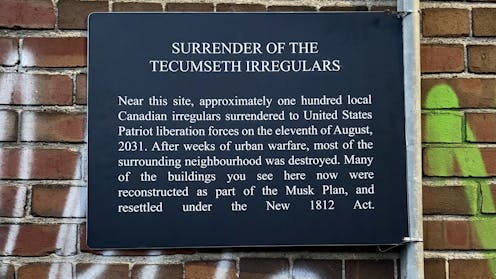
    Artist Dara Vandor’s futuristic, commemorative historical plaques on Toronto streets project a U.S.-annexed Canada. (Dara Vandor)

    As part of her ongoing public art series, Pax Americana, Toronto visual artist Dara Vandor has been posting aluminum signs in public spaces.

    These are plaques that reimagine, as the artist writes, the city as “a site of future conflict and occupation” by the United States. The signage, in the style of commemorative historical markers, echoes U.S. President Donald Trump’s recent and repeated threats to annex Canada and “is meant to serve as a dark warning, inviting contemplation on the fragility of nationhood.”

    For example, one plaque, posted on a bridge on Spadina Ave., informs passersby:

    “This spot served as the center of operations for United States Army snipers during Operation McKinley, the campaign to liberate the northern territory formerly known as Canada. From February to May 2035, this site, code-named ‘The Hot Dog Stand,’ served as a concealed sniper’s nest, providing precision fire support, disrupting insurgent movements, and protecting advancing American units.”

    Vandor’s thought-provoking project, which she told CBC News was sparked by anger at Trump’s threats to Canadian sovereignty, underlines how storytelling can be a powerful tool in times of conflict, especially when it affords itself the artistic freedom to envision potential futures before they can become reality.

    Psychological effects

    In order to understand how exactly stories such as the one portrayed on Vandor’s plaques can make a real impact on the way we navigate moments of crisis, we can turn to the work of conflict analysis experts such as Solon Simmons.

    In his recent book on conflict storytelling, Simmons introduces the concept of post-plot pressure.

    The term describes the psychological effect that a story can have on its readers after they finish reading. As Simmons puts it:

    “What makes stories so important (as opposed to just interesting or entertaining) is the effect of the story, and this effect doesn’t end when the story ends. It leaves the viewer/reader/listener with a feeling.”

    Simmons also explains that the kind and amount of post-plot pressure placed upon an audience depends on the type of story being told.

    Projected unhappy ending exerts pressure

    A story, for example, featuring a struggle in which the antagonist eventually triumphs over the protagonist is what Simmons calls a “satirical struggle story.”

    “Satirical” in this context does not necessarily mean that stories of this kind include elements of mockery or sarcasm. Rather, the label goes back to the influential research contributions of Canadian literary theorist Northrop Frye and American historian Hayden White, from which Simmons derives his own framework.

    This is exactly how to understand the story told over its several episodes on Vandor’s Pax Americana plaques: the U.S., as the story’s antagonist, abuses its power and ends up getting away with it, defeating Canadian resistance and annexing what is now only referred to as the “northern territory.”

    As Simmons suggests, conflict stories like this one, where what is viewed as injustice is allowed to prevail, exercise a relatively high level of post-plot pressure. This is mainly because the unhappy ending leaves audiences dissatisfied and with a sense of loss to grapple with.

    Reader reactions

    Simmons also explains that not all readers react to this particular kind of post-plot pressure in the same way. Vandor’s project, for example, has brought out some critical and upset responses.

    As the artist told Toronto Today, some people have called the plaques pro-American propaganda; one online commenter said they should be taken down.

    Julian Bleecker — a researcher, author, designer and engineer with a PhD in history of consciousness whose design studio offers services around future imagining and planning — voiced his objection to the project in a blog post.

    In his opinion, the antagonistic and fatalistic vision of the future portrayed on the plaques runs the risk of “playing into the hands of the very forces that are at work to make the world a less habitable place.”


    Read more:
    The theatre we want in 2040? We used ‘strategic foresight’ to plan on the Prairies


    But, as Simmons argues, conflict stories in which the happy ending never comes can also leave readers with a productive sense of post-plot pressure. In that case, feeling dissatisfied with the story’s outcome can instead motivate people to mobilize and strategize against the perceived injustice.

    Seen in this light, the plaques’ imagined collapse of Canadian sovereignty can therefore also serve as a stark and urgent inspiration, begging response.

    A sign in an alleyway says 'let go of your past, and welcome to our united future.'
    In Dara Vandor’s speculative future, U.S. President Ivanka Trump, standing on a tank, exhorts Torontonians to ‘Let go of your past, and welcome to our united future.’
    (Dara Vandor)

    A cautionary tale

    Fictional storytelling is often viewed as a useful tool that allows us to make sense of real moments of conflict that happened in the past. Think, for example, of Erich Maria Remarque’s famous war novel All Quiet on the Western Front, which was turned into an Oscar-winning film directed by Edward Berger in 2022.

    Our understanding of these kinds of stories as useful comes with the acknowledgement that there is nothing we can do to prevent past conflict. At the same time, the underlying assumption here is that by learning about the past, we can learn from the past and hopefully stop similar crises from ever happening again.


    Read more:
    How stories about alternate worlds can help us imagine a better future: Don’t Call Me Resilient EP 7 transcript


    What makes Vandor’s ongoing project especially valuable is that it moves its reflections on the past into an imagined future. The actual conflict that the plaques refer to is still part of the present, and its future still undecided. Whatever lessons we draw from their cautionary tale about Canadian annexation, we still have time to act upon them before that imagined future can become reality.

    Importance of resistance in the present

    This is exactly what leads historian Camille Bégin to conclude that the project’s appeal to the importance of resistance in the present is particularly strong:

    “It really shows us that the future is not written, that it’s in our hands to act in the present to forge the future that we want.”

    Even though Vandor’s project tells a story of Canadian defeat, it also highlights that Canadians did resist, a thought that should appeal to anyone opposed to Trump’s vision of territorial expansion.

    Or, and this is perhaps the most hopeful reflection coming out of the project, if Canadians come together and resist now, Trump’s threat of annexation may never get that far.

    The Conversation

    Pascal Michelberger does not work for, consult, own shares in or receive funding from any company or organisation that would benefit from this article, and has disclosed no relevant affiliations beyond their academic appointment.

    ref. ‘Pax Americana’ in Toronto: How speculative art can help us navigate threats – https://theconversation.com/pax-americana-in-toronto-how-speculative-art-can-help-us-navigate-threats-256755

    MIL OSI – Global Reports

  • MIL-OSI Global: ‘Pax Americana’ in Toronto? Speculative art can help us navigate threats

    Source: The Conversation – Canada – By Pascal Michelberger, Postdoctoral Scholar, Western Academy for Advanced Research, Western University

    Artist Dara Vandor’s futuristic, commemorative historical plaques on Toronto streets project a U.S.-annexed Canada. (Dara Vandor)

    As part of her ongoing public art series, Pax Americana, Toronto visual artist Dara Vandor has been posting aluminum signs in public spaces.

    These are plaques that reimagine, as the artist writes, the city as “a site of future conflict and occupation” by the United States. The signage, in the style of commemorative historical markers, echoes U.S. President Donald Trump’s recent and repeated threats to annex Canada and “is meant to serve as a dark warning, inviting contemplation on the fragility of nationhood.”

    For example, one plaque, posted on a bridge on Spadina Ave., informs passersby:

    “This spot served as the center of operations for United States Army snipers during Operation McKinley, the campaign to liberate the northern territory formerly known as Canada. From February to May 2035, this site, code-named ‘The Hot Dog Stand,’ served as a concealed sniper’s nest, providing precision fire support, disrupting insurgent movements, and protecting advancing American units.”

    Vandor’s thought-provoking project, which she told CBC News was sparked by anger at Trump’s threats to Canadian sovereignty, underlines how storytelling can be a powerful tool in times of conflict, especially when it affords itself the artistic freedom to envision potential futures before they can become reality.

    Psychological effects

    In order to understand how exactly stories such as the one portrayed on Vandor’s plaques can make a real impact on the way we navigate moments of crisis, we can turn to the work of conflict analysis experts such as Solon Simmons.

    In his recent book on conflict storytelling, Simmons introduces the concept of post-plot pressure.

    The term describes the psychological effect that a story can have on its readers after they finish reading. As Simmons puts it:

    “What makes stories so important (as opposed to just interesting or entertaining) is the effect of the story, and this effect doesn’t end when the story ends. It leaves the viewer/reader/listener with a feeling.”

    Simmons also explains that the kind and amount of post-plot pressure placed upon an audience depends on the type of story being told.

    Projected unhappy ending exerts pressure

    A story, for example, featuring a struggle in which the antagonist eventually triumphs over the protagonist is what Simmons calls a “satirical struggle story.”

    “Satirical” in this context does not necessarily mean that stories of this kind include elements of mockery or sarcasm. Rather, the label goes back to the influential research contributions of Canadian literary theorist Northrop Frye and American historian Hayden White, from which Simmons derives his own framework.

    This is exactly how to understand the story told over its several episodes on Vandor’s Pax Americana plaques: the U.S., as the story’s antagonist, abuses its power and ends up getting away with it, defeating Canadian resistance and annexing what is now only referred to as the “northern territory.”

    As Simmons suggests, conflict stories like this one, where what is viewed as injustice is allowed to prevail, exercise a relatively high level of post-plot pressure. This is mainly because the unhappy ending leaves audiences dissatisfied and with a sense of loss to grapple with.

    Reader reactions

    Simmons also explains that not all readers react to this particular kind of post-plot pressure in the same way. Vandor’s project, for example, has brought out some critical and upset responses.

    As the artist told Toronto Today, some people have called the plaques pro-American propaganda; one online commenter said they should be taken down.

    Julian Bleecker — a researcher, author, designer and engineer with a PhD in history of consciousness whose design studio offers services around future imagining and planning — voiced his objection to the project in a blog post.

    In his opinion, the antagonistic and fatalistic vision of the future portrayed on the plaques runs the risk of “playing into the hands of the very forces that are at work to make the world a less habitable place.”


    Read more:
    The theatre we want in 2040? We used ‘strategic foresight’ to plan on the Prairies


    But, as Simmons argues, conflict stories in which the happy ending never comes can also leave readers with a productive sense of post-plot pressure. In that case, feeling dissatisfied with the story’s outcome can instead motivate people to mobilize and strategize against the perceived injustice.

    Seen in this light, the plaques’ imagined collapse of Canadian sovereignty can therefore also serve as a stark and urgent inspiration, begging response.

    In Dara Vandor’s speculative future, U.S. President Ivanka Trump, standing on a tank, exhorts Torontonians to ‘Let go of your past, and welcome to our united future.’
    (Dara Vandor)

    A cautionary tale

    Fictional storytelling is often viewed as a useful tool that allows us to make sense of real moments of conflict that happened in the past. Think, for example, of Erich Maria Remarque’s famous war novel All Quiet on the Western Front, which was turned into an Oscar-winning film directed by Edward Berger in 2022.

    Our understanding of these kinds of stories as useful comes with the acknowledgement that there is nothing we can do to prevent past conflict. At the same time, the underlying assumption here is that by learning about the past, we can learn from the past and hopefully stop similar crises from ever happening again.


    Read more:
    How stories about alternate worlds can help us imagine a better future: Don’t Call Me Resilient EP 7 transcript


    What makes Vandor’s ongoing project especially valuable is that it moves its reflections on the past into an imagined future. The actual conflict that the plaques refer to is still part of the present, and its future still undecided. Whatever lessons we draw from their cautionary tale about Canadian annexation, we still have time to act upon them before that imagined future can become reality.

    Importance of resistance in the present

    This is exactly what leads historian Camille Bégin to conclude that the project’s appeal to the importance of resistance in the present is particularly strong:

    “It really shows us that the future is not written, that it’s in our hands to act in the present to forge the future that we want.”

    Even though Vandor’s project tells a story of Canadian defeat, it also highlights that Canadians did resist, a thought that should appeal to anyone opposed to Trump’s vision of territorial expansion.

    Or, and this is perhaps the most hopeful reflection coming out of the project, if Canadians come together and resist now, Trump’s threat of annexation may never get that far.

    Pascal Michelberger does not work for, consult, own shares in or receive funding from any company or organisation that would benefit from this article, and has disclosed no relevant affiliations beyond their academic appointment.

    ref. ‘Pax Americana’ in Toronto? Speculative art can help us navigate threats – https://theconversation.com/pax-americana-in-toronto-speculative-art-can-help-us-navigate-threats-256755

    MIL OSI – Global Reports

  • MIL-OSI Global: Kids care deeply about our planet, so adults need to start listening

    Source: The Conversation – Canada – By Jen Kostuchuk, PhD Candidate, Sociology, University of Victoria

    “I wish adults knew that I really care about the environment and want to help, but I sometimes feel like my ideas don’t matter because I’m just a kid.”

    This is what a nine-year-old respondent told us when we asked how they feel about the environment.

    In today’s current political climate, many adults seem resigned to climate catastrophe and even dabble in climate change denialism. However, our survey of 1,000 youth aged eight to 14 from Canada and the United States found that children care deeply about the planet and are ready to take action.

    The findings from our report were produced as part of an ongoing study with the Humanity in Motion Society, a Canadian non-profit organization focused on engaging youth as key stakeholders in advancing environmental stewardship.

    Almost 90 per cent of the kids we spoke to recognize climate change as a real and urgent problem, calling for intergenerational collaboration and bolder environmental mitigation and adaptation commitments.

    It turns out that our nine-year-old respondent speaks for many children. Kids know what’s at stake, want a seat at the table and need adults to act with them.

    What kids told us

    Some of the kids in the survey talk about the action they want adults to take to tackle climate change. (Humanity in Motion Society)

    Many of the kids told us they regularly take action to mitigate their carbon footprint, including recycling, embracing reusable items and conserving energy. Their accounts are consistent with numerous academic studies on youth involvement in environmental citizenship.

    However, many understand individual action alone is not enough. In fact, most kids recognize that systemic accountability is necessary to tackle the climate crisis. As one kid in Grade 6 shared:

    “I wish big industry and governments would stop asking us to do something when they continue to fly in private jets [and] drill for oil and more; we are asked to recycle.”

    Kids have a deep understanding of current political issues, including the cost-of-living crisis and the harmful “drill baby drill” sentiments, but also underscore a stark disconnect: while we instil environmentally responsible values in our children, elected leaders remain consistently inactive on these very same issues.


    Read more:
    The oil and gas industry has been lying about global warming for decades — accountability is long overdue


    Kids play active roles in knowledge sharing

    The kids in this study display impressive knowledge about the steps that need to be taken to address the climate crisis. Our findings demonstrate that youth are not just passive recipients of knowledge but, rather, play an active role in being climate communicators.

    For example, two thirds of our respondents say their friends learn about climate change directly from them. Even though many children note that they do not have climate clubs at school, they are curious about the role of big oil, deforestation and corporate greed in the ongoing climate crisis.

    In addition to teachers and parents being the most influential sources of knowledge for children, social media content has an impact on kids’ environmental behaviour and feelings of empowerment.

    Specifically, our data shows that talking to others online has a significant positive relationship with reported sustainable behaviour, and that watching videos has a significant positive relationship with how much kids feel they can make a difference. One young girl reflected on using Tiktok for insights on climate change while also capturing an awareness among her generation:

    “I would say if there’s a really big issue, like, I know there’s something called the Climate Clock in New York…I mean, the thing with social media, you never know what’s true and untrue, but that thing [Climate Clock] came on my ‘For You’ page…and everybody in the comments, they were saying ‘this is very real, we have to do something about it.’”

    This shows that kids would benefit greatly from spaces to continue in-person environmental discussions with adults in the room. One young respondent captured the potential for meaningful engagement:

    “There are a lot of things that can be done, curriculum integrations…sustainable skills like critical thinking, problem-solving, collaboration, and maybe explore the ecosystems and biodiversities and actually encourage students to design and implement climate-friendly projects and carry out field trips and organize visits to renewable energy sites or environmental organizations and sometimes, maybe occasionally, the school can invite climate experts, activists or scientists.”

    These ideas were shared by others who called on adults to lead more experiential approaches to climate education inside the classroom and beyond.

    Adults can help by providing opportunities in the classroom and beyond for kids to discuss cliamte change.
    (Shutterstock)


    Read more:
    Teachers need bolder action from our school boards to educate in and for a climate emergency


    Five calls to action

    Here are five ways to help bring about change:

    1. Adults need to step up. Adults play a critical role in shaping how youth engage in climate action. Our report found that teachers and parents, in addition to the internet, are among the most influential learning sources for youth today. Kids often take pro-environmental values, actions and cues from their parents.

    2. Apathy is not an option if we want change. Youth are looking to leaders and elected officials to invest heavily in infrastructure and education to improve our environment.

    3. Intergenerational collaboration promotes better environmental values. Despite the consequences of climate change, youth share a sense of optimism and emphasize the need for intergenerational responsibility.

    4. Provide spaces for youth to take leadership roles and engage in climate dialogue. Kids want to do more to build a sustainable future, but don’t know where to begin. Providing opportunities in the classroom and beyond are critical next steps to raise the next generation of climate leaders.

    5. Promote bold action. Kids should be able to answer the call of many climate activists who recognize the need to pursue a greener economy by working together.

    Our survey findings highlight a hopeful message about young people’s engagement in climate action, underscoring their impressive knowledge of the systemic changes required to address the crisis.

    As adults across the political spectrum bicker about climate policy, young people are growing impatient and hoping to lead the way. Our results refocus attention on the future we’re creating and challenge us to listen seriously to children when they seek to address what may be their generation’s greatest crisis.

    Sean Lyons has received funding from Mitacs in support of an earlier iteration of the study discussed here.

    Erik Steiner and Jen Kostuchuk do not work for, consult, own shares in or receive funding from any company or organisation that would benefit from this article, and have disclosed no relevant affiliations beyond their academic appointment.

    ref. Kids care deeply about our planet, so adults need to start listening – https://theconversation.com/kids-care-deeply-about-our-planet-so-adults-need-to-start-listening-257304

    MIL OSI – Global Reports

  • MIL-OSI Global: Blind box toys are booming: Are they just child’s play or something more concerning?

    Source: The Conversation – Canada – By Eugene Y. Chan, Associate Professor of Marketing, Toronto Metropolitan University

    Collectible figurines on display at Pop Mart in Ivano-Frankivsk, Ukraine, on April 29, 2025. (Shutterstock)

    If you’ve seen videos of people tearing into tiny toy packages online, or noticed teens obsessing over pastel-coloured figurines at the mall, you’ve probably encountered the global craze for blind box toys.

    These small collectibles — usually figures of cartoonish characters — are sold in sealed packaging that hides which specific item is inside. You might get the one you want, or you might not. That uncertainty is part of the thrill.

    Unlike traditional toys, these figures are marketed as collectibles. Many are part of themed series, with some designs labelled as “rare” or “secret,” appearing in as few as one in every 144 boxes. This sense of exclusivity fuels repeat purchases and has spawned a resale market where rare figures can command hundreds of dollars.

    Popular among children and adults alike, blind box toys have grown into a billion-dollar industry. One of the more popular brands is Pop Mart, a Chinese toy company founded in 2010 known for its collectible designer toys sold in mystery packs.

    Gen Z consumers, in particular, have embraced blind box toys both as a nostalgic pastime and as a form of legitimate collecting. The proliferation of unboxing videos on platforms like TikTok and YouTube, where creators open dozens of blind boxes on camera, has added to their appeal.

    For many fans, these toys offer more than just cuteness: they also provide suspense, surprise and a rush of dopamine with every box opened. But how did this niche product become a global obsession?

    From Tokyo streets to western malls

    The origins of blind box toys trace back to East Asia. Capsule toy vending machines called gashapon originated in Japan in the 1960s. By the 1980s, they had become a cultural fixture. These machines dispense small toys in opaque plastic balls, with customers never quite sure which item they’ll receive.

    In the early 2010s, Chinese companies like Pop Mart adapted the gashapon model for the mainstream retail space. Instead of vending machines, they began selling artist-designed vinyl toys in blind boxes at dedicated boutiques.

    A tourist uses a gashapon machine in Osaka, Japan, in 2024. Gashapon machines are similar to the coin-operated toy vending machines seen outside grocery stores and other retailers in North America.
    (Shutterstock)

    Pop Mart’s success helped transform the blind box into a mainstream commercial phenomenon. Characters like Molly, Skullpanda and Dimoo became instant hits, combining Japanese kawaii esthetics with western pop art sensibilities.

    Pop Mart figures have since developed a cult-like following. Many consumers treat the toys as affordable art objects, displayed in cabinets, on purses or traded online.

    Today, blind box retail stores have expanded globally from Asia to Europe and North America. In October 2024, Pop Mart opened its first store in the Midwestern United States, located on Chicago’s Magnificent Mile at The Shops at North Bridge. The store offers exclusive products and taps into the growing demand for collectibles among American consumers.

    The psychology behind the mystery

    What makes blind box toys so hard to resist?

    Their success relies on a psychological principle known as variable-ratio reinforcement — the same reward pattern that makes slot machines so addictive.

    You never know exactly when you’ll score the item you’re after, but the possibility that the next box might contain it keeps people coming back. This unpredictability keeps people engaged, especially when the potential reward is framed as rare or valuable.

    Cconsumer psychology research also suggests that anticipation plays a major role. Studies show that dopamine, the brain’s reward chemical, spikes not just when we get what we want, but when we anticipate it. The sealed packaging, the suspense of unwrapping and the hope for a rare figure all heighten this effect.

    Sonny Angels on display in a store in Shenzhen, China, in March 2019.
    (Shutterstock)

    For younger collectors, the excitement of “the chase” can foster compulsive buying habits. This effect is amplified by the social influence of watching unboxings online or seeing friends complete their sets, and it becomes a powerful loop.

    Even when buyers don’t get the figure they want, the sunk cost fallacy — the feeling that they’ve already invested too much time or money to walk away — keeps them buying more.

    The hidden costs of blind boxes

    As blind box toys surge in popularity, they have drawn criticism from consumer advocates, psychologists and environmentalists alike.

    Some worry that blind boxes normalize gambling-like behaviours, especially among children. The randomness, excitement and promise of rare rewards closely mirror the mechanisms behind loot boxes in video games — another product that has sparked global concern over youth exposure to gambling psychology.

    Several countries, including Belgium and the Netherlands, have regulated loot boxes under gambling laws. Blind boxes, though currently unregulated, may be next in line for scrutiny.


    Read more:
    Blind bags: how toy makers are making a fortune with child gambling


    There are also environmental concerns. Many blind box toys come in excessive packaging — plastic wraps, foil bags, cardboard boxes — most of which is discarded immediately. The collectibles themselves are often made of non-recyclable plastics, raising questions about sustainability in an era of rising consumer awareness over waste.

    Even among adult fans, some critics question whether blind boxes are designed less to bring joy and more to trigger compulsive consumption. The joy of collecting, they argue, is increasingly overshadowed by the mechanics of engineered desire.

    What should we make of the blind box boom?

    Blind box toys are not inherently harmful, and for many, they’re a source of fun, nostalgia and self-expression. They also offer an accessible way for consumers to engage with designer art in a collectible, miniature form, as many of them are created by individual artists.

    But blind box toys also raise deeper questions about how modern marketing leverages psychological triggers associated with gambling, especially when it comes to children.

    As these toys continue to gain traction in the West, it’s worth asking more critical questions, like: are we buying into mystery or are we being sold obsession and compulsion?

    The blind box trend reflects broader shifts in how products are marketed, how value is perceived and how consumer behaviour is shaped in a digital, attention-driven economy. Understanding the forces at play may be the first step toward more informed — and perhaps more mindful — collecting.

    Eugene Y. Chan does not work for, consult, own shares in or receive funding from any company or organisation that would benefit from this article, and has disclosed no relevant affiliations beyond their academic appointment.

    ref. Blind box toys are booming: Are they just child’s play or something more concerning? – https://theconversation.com/blind-box-toys-are-booming-are-they-just-childs-play-or-something-more-concerning-257611

    MIL OSI – Global Reports

  • Operation Sindoor: India’s Military Doctrine of Offensive Defence

    Source: Government of India

    Source: Government of India (4)

    In the annals of India’s military history, Operation Sindoor marks a decisive departure from the doctrine of strategic restraint. Triggered by the barbaric Pahalgam terror attack that claimed the lives of Indian civilians and tourists, this operation was meticulously crafted as a calibrated military-political response. It did not seek territorial gain nor a prolonged conflict it was a limited, high-impact military reprisal meant to enforce deterrence, inflict punitive costs, and collapse the artificial distinction between so-called “non-state actors” and the Pakistani state that harbours, trains, and directs them. This operation represents a maturing Indian statecraft where kinetic power is exercised with precision, proportionality, and political clarity. India’s strategic objective was not war it was redefinition. By shifting the cost-benefit calculus of cross-border terrorism and signalling that every future provocation will invite asymmetric retaliation, Operation Sindoor has ushered in a new era in subcontinental geopolitics.

    Precision Strikes: Surgical, Not Symbolic

    The first phase of Operation Sindoor commenced in the early hours of May 7, 2025. Leveraging a composite air package of Rafale multirole fighters, Sukhoi-30MKIs, and Mirage-2000 aircraft, the Indian Air Force conducted precise, intelligence-led strikes deep inside Pakistani territory. These were not blind retaliations they were carefully selected targets identified through layered ISR (Intelligence, Surveillance, Reconnaissance) systems, including satellite imagery, HUMINT, and SIGINT.

    The use of SCALP missiles from Rafales and BrahMos supersonic missiles from air platforms ensured surgical delivery with minimal collateral damage. Terrorist enclaves in Bahawalpur, Muridke, and Kotli, Skardu etc., regions long known to host training camps, ammunition dumps, and communication nodes were decimated. Over 100 confirmed militant casualties, including senior leadership figures from proscribed outfits like Jaish-e-Mohammed and Lashkar-e-Taiba, marked a devastating blow to the Pakistani terror-industrial complex. What distinguished these strikes from past episodes was their surgical nature and strategic framing. India did not seek to provoke full-scale war, nor did it act in anger. It acted with method, legality, and legitimacy framing the strikes as a response to an act of war perpetrated through proxy actors by a complicit state. This legitimacy ensured global understanding, if not overt support.

    The Dogfight: Honouring the Fog of War

    Later that night, tensions escalated into an aerial dogfight over contested between two countries. Both sides scrambled assets, leading to a kinetic engagement involving BVR (Beyond Visual Range) and close-range exchanges. India lost some air assets, and so did Pakistan. However, all Indian pilots were accounted for, is a testament to India’s rapid SAR protocols, operational preparedness, and strong morale. The air engagement is a reminder that operations however well-planned carry risks. Air dominance is not simply about superior machines but real-time decision-making, jamming, radar countermeasures, and pilot skill. India emerged from the engagement with its credibility intact. The enemy was bloodied, morale hit, and escalation managed.

    Air Defence Triumph: Holding the Line

    On May 8 and 9, 2025, Pakistan attempted retaliatory missile strikes and indulged in drone warfare by Turkish drones but India’s integrated air defence network held firm. Systems like the indigenous Akash SAMs, S-400 Triumf batteries, L-70 anti-aircraft guns, and the command-and-control network Akashteer worked in seamless coordination to intercept and neutralize incoming aerial threats. These systems represented a layered shield—short, medium, and long-range defences working in tandem. Not many Indian casualties were reported across these two days. While it is tempting to credit hardware alone, this success was equally a victory for Indian military doctrine, training, radar discipline, and force synergy across the Army, Air Force, and strategic command. The S-400 system, sourced from Russia, showed its full battlefield integration with Indian command doctrine, while Akash and L-70 systems, developed by DRDO and BEL, demonstrated India’s growing self-reliance in air defence. These engagements proved that India is no longer reactive. It can now predict, pre-empt, and neutralize threats without waiting for external validation or international permission.

    Airbases Neutralized: A Blow to Pakistani Air Power

    The most daring component of Operation Sindoor came in the early hours of May 10, 2025. In a pre-dawn mission, India struck eleven Pakistani airbases with BrahMos cruise missiles and stand-off weapons. Airstrips, hardened aircraft shelters, radar systems, and command centers were targeted based on precise ISR data. These strikes disrupted the Pakistan Air Force’s sortie capability, grounded multiple squadrons, and paralyzed operational momentum.

    These weren’t merely punitive. They were strategic de-capacitation measures, designed to ensure that Pakistan could not sustain a second or third wave of escalation. Post-strike imagery, open-source analysis, and leaked intercepts confirm major damages at bases like Rahim Yar Khan, Sargodha, Bholari, Jacobabad & Nur Khan Airbase. Significant PAF infrastructure, including JF-17 hangars, SAAB Awacs, and early-warning systems, were taken offline.

    As per noted Defence & Security expert Shishir Gupta in HT, “India’s S-400 air defence system in Adampur went into action no less than 11 times during Operation Sindoor and destroyed a Pakistani SAAB-2000 airborne early warning system as far as 315 kilometres away deep in Pakistan”. He further goes on to report that “Indian Air Force also has proof of its missiles having downed one C-130 J medium lift aircraft, a JF-17 and two F-16 fighters on ground and in the air” & “..The Indian strikes took out a Chinese-made LY-80 air defence system using a HARPY kamikaze drone at Lahore, while an Indian missile took out the prized HQ-9 (Chinese version of S-300) at Malir in Karachi.”

    This phase also demonstrated India’s maturing offensive deterrence posture. The use of standoff missiles allowed deep strikes without exposing aircraft to enemy radar or engagement zones. The message was clear: India possesses both the will and the capability to cripple Pakistan’s retaliatory framework without boots on the ground.

    Redefining Deterrence: The End of “Plausible Deniability”

    Perhaps the most far-reaching impact of Operation Sindoor is the collapse of the false firewall Pakistan erected between its army and its jihadi proxies. For decades, GHQ Rawalpindi operated in the grey zone training, equipping, and deploying terrorists while pretending innocence. India, until now, often responded diplomatically, seeking proof and global condemnation. That model is now obsolete. By treating the Pahalgam attack as a state-sanctioned act of war, India has established a new doctrine: no differentiation between non-state actors and the state that shelters them. This strategic redefinition collapses the ambiguity that Pakistan exploited for decades and forces it to absorb the consequences of proxy warfare. This is more than retaliation it is deterrence by punishment. The world, too, is watching. While global powers may issue standard calls for restraint. The legitimacy of India’s counter-strikes is enhanced by its commitment to proportionality, non-targeting of civilian infrastructure, and avoidance of war escalation.

    Indus Waters Treaty in Abeyance: Weaponizing Asymmetry

    One of the boldest geopolitical moves during Operation Sindoor was India’s decision to place the Indus Waters Treaty (IWT) in abeyance. Long hailed as an example of transboundary cooperation, the IWT has persisted even through wars. However, in the face of repeated Pakistani provocation, it has become a one-sided symbol of Indian restraint. By moving to suspend water flows or delay data sharing and project clearances, India has signalled that economic levers are now part of the strategic toolkit. This asymmetric tool non-lethal but deeply consequential gives India leverage without inviting kinetic escalation. It allows New Delhi to exert economic, agricultural, and psychological pressure on Pakistan’s heartland in a prolonged conflict scenario. This step also sends a larger message: India will now integrate all dimensions of national power military, diplomatic, economic, technological into its response architecture.

    A Strategic Template for the Future

    Operation Sindoor is not just a successful operation it is a template. India has for the first time demonstrated where there was Rapid force mobilization with surgical precision, multi-platform integration of air, missile-based assets, Resilience and transparency in combat engagements, Defensive superiority using indigenous and imported systems, Asymmetric escalation through economic and hydrological tools and Geopolitical signalling without diplomatic fallout. This holistic approach marks India’s arrival as a mature regional power capable of defending its interests across the spectrum from grey-zone threats to full-spectrum deterrence. It is no longer about reactive diplomacy. India now leads with strength, speed, and clarity.

    Noted International Defence Expert, John Spencer in his Article, “India’s Wake-Up Call: Why US Defense Reform Must Match the Speed of Modern War”, in Small War Journal has quoted as below:

    “India’s overwhelming success demonstrated something more enduring than airpower. It validated a national defense doctrine built around efficient domestic industrial strength. And most significantly, it delivered a clear message to its strategic rival. Pakistan a Chinese proxy by armament, alignment, doctrine was completely outmatched. Its Chinese-made air defense systems could not stop, detect, or deter India’s precision strikes. In Sindoor, India didn’t just win. It demonstrated overwhelming military superiority against a Chinese-backed adversary.”

    Reflecting on the Brahmos strikes of Indian Russian joint venture and its integration with domestic Indian systems under Make in India Program, he goes on to highlight that, “In the skies over Pakistan, India didn’t just dominate. It redefined regional deterrence. India didn’t just talk about reform. It executed it. And it won. India has become a master of the physics of lethality. The United States can learn from their success and model some of their changes for its own needs. India’s success—and Ukraine’s innovation—should be a wake-up call. They are building the warfighting models of the future. The US is still operating with Cold War machinery and Gulf War assumptions.”

    Further in an Article dt 29th May 2029 on X, titled “India’s Operation Sindoor: A Battlefield Verdict on Chinese Weapons—And India’s Victory”, John Spencer goes on to write about India’s weapon systems used and exclaimed that:

     “India fought as a sovereign power wielding precision tool it designed, built, and deployed with unmatched battlefield control. Pakistan fought as a proxy force, dependent on Chinese hardware that was built for export, not for excellence. When challenged, these systems failed—exposing the strategic hollowness behind Islamabad’s defense posture. ….Operation Sindoor wasn’t just a military campaign. It was a technology demonstration, a market signal, and a strategic blueprint. India showed the world what self-reliance in modern warfare looks like and proved that “Atmanirbhar Bharat” works under fire.”

    Conclusion: Sindoor as a Strategic Line Drawn

    One of the articles written by Royal United Services Institute titled, “Calibrated Force: Operation Sindoor and the Future of Indian Deterrence”, on 21st May 2025 sums it up perfectly. It states that rather than serious analysis of India’s targeting methodology, command intent, or escalation thresholds, the western media coverage has focused instead on the air-to-air engagement that led to the probable loss of some Indian Air Assets. Undue prominence was given to the performance of specific platforms, with little regard for the broader operational context or the rules of engagement that shaped the encounter. Arguably more impressive than the operation’s reach was its restraint on the first day.

    The article on goes on say, “According to Indian officials, pilots operated under strict rules of engagement that prohibited initiating attacks on Pakistani aircraft or pre-emptively suppressing air defence systems. It suggests a political leadership determined to signal its intent with clarity: India was not interested in initiating a conflict with the Pakistani state, but rather in degrading a specific ecosystem of terrorist violence that exists in the country. In effect, India accepted heightened operational risk in pursuit of clear strategic messaging. Such discipline in the face of a capable adversary is neither automatic nor easy. Yet it may well have prevented a broader escalation spiral. That alone deserves more analytical attention than it has received”.

    There is a media narrative of Chinese experts in Bloomberg exulting on performance of Chinese platforms presents a distorted narrative as part of information warfare. The target here is to drown the Indian strategic success and overwhelming air-superiority of the Indian Airforce crippling Pakistani Airbases and infrastructure, taking out Chinese defence systems of which we have clear satellite imagery and proof. In any air-combat there are bound to be losses, the Americans have faced F-16 losses operated by Ukraine, American MQ-9 reaper drones were taken out by Houthis in Yemen, even the Chinese air defence systems of Pakistan were taken out by Indian Airforce in Operation Sindoor. Many of these narratives in international media are shaped by commercial interests of respective military-industrial complexes.

    However, what should matter is that the overall objective of targeted military operation carried out by India between 7th to 10th May 2025 has been achieved. Indian strategic objectives have been met without getting trapped into an elongated war like Vietnam, Afghanistan, Syria or Ukraine. Pakistan must remember that Operation Sindoor is not over yet and no amount of aid from IMF, World Bank, military aid from China (amounting to 80% its military hardware) or a Crypto deal with US corporations would be able to protect it from Indian response to state sponsored terrorism abetted by Pakistani military-intelligence apparatus.

    Operation Sindoor is a watershed in India’s military and geopolitical evolution. It transformed tragedy into a moment of clarity, demonstrating that the Indian state will no longer absorb terror as the cost of diplomacy. Every attack will now invite disproportionate retaliation measured not in rhetoric but in military and economic terms. By operationalizing deterrence, neutralizing terror nodes, blunting enemy retaliation, and avoiding escalation into war, India has delivered a sophisticated, high-impact campaign that redefines conflict dynamics in South Asia. The message is now loud and clear: There will be no safe havens. No immunity through proxies. And no peace without accountability. India has drawn a red line in blood and steel. Operation Sindoor thus showcases clinical execution of India’s military doctrine of Offensive Defence

     

  • MIL-OSI Russia: Israeli army confirms killing of Hamas leader and two commanders in Gaza

    Translation. Region: Russian Federal

    Source: People’s Republic of China in Russian – People’s Republic of China in Russian –

    Source: People’s Republic of China – State Council News

    JERUSALEM, June 1 (Xinhua) — The Israeli military on Saturday confirmed the death of Mohammed Sinwar, a senior Hamas commander and head of the group’s military wing in Gaza, in an airstrike earlier this month.

    A joint statement from the Israel Defense Forces (IDF) and the country’s Shin Bet security service said Sinwar was killed on May 13 in a targeted attack on an underground command center located beneath the European Hospital in the southern Gaza Strip. The Israeli military accused Hamas of using the hospital as a cover, putting civilians at risk.

    According to the IDF, M. Sinwar, 49, is one of Hamas’s most senior and longest-serving military leaders, and played a key role in planning the October 7, 2023 attack on Israel that led to the current conflict.

    Israeli Prime Minister Benjamin Netanyahu announced Sinwar’s death earlier this week in a speech to the Israeli parliament.

    The strike also killed two other senior Hamas commanders: Muhammad Shabana, who led the Rafah Brigade, and Mahdi Quara, commander of the Khan Younis Battalion. The IDF said both men were involved in the October 7, 2023, attack and later led attacks on Israeli troops, including hostage-taking and rocket fire.

    Earlier, Gaza health authorities said the Israeli strike had killed at least six people and wounded 40. Hamas has not issued an official statement confirming Sinwar’s death.

    M. Sinwar was the younger brother of Yahya Sinwar, the former leader of the Hamas movement in the Gaza Strip, who was killed in a clash with the IDF in October 2024. –0–

    MIL OSI Russia News

  • MIL-OSI Russia: Israeli army says it killed five militants in Gaza

    Translation. Region: Russian Federal

    Source: People’s Republic of China in Russian – People’s Republic of China in Russian –

    Source: People’s Republic of China – State Council News

    JERUSALEM, June 1 (Xinhua) — The Israel Defense Forces (IDF) said Saturday that five militants were killed in operations in the Gaza Strip over the past 24 hours.

    According to the statement, a combat team from the IDF’s Paratroopers Brigade found four armed men in the surrounding area on Friday and killed them during a clash.

    The IDF added that it had struck and killed Hamas militant Khalil Farwan in the Gaza neighborhood of Sabra, saying he was in charge of weapons production at the movement’s headquarters.

    According to the statement, the military also dismantled weapons and explosive devices planted in the ground and destroyed infrastructure, some of which was underground. –0–

    MIL OSI Russia News

  • MIL-OSI Russia: Asian leaders express concern over US tariff policy

    Translation. Region: Russian Federal

    Source: People’s Republic of China in Russian – People’s Republic of China in Russian –

    Source: People’s Republic of China – State Council News

    TOKYO, June 1 (Xinhua) — Political leaders and former heads of state from across Asia have expressed concern over the U.S. government’s tariff policies, calling for stronger unity among Asian countries to overcome common challenges.

    Speaking at the 30th Future of Asia Forum held in Tokyo from May 29 to 30, Singapore’s Deputy Prime Minister Gan Kim Yong warned that the current global trading order was under threat.

    He called on Asian countries to unite in addressing trade issues arising from US tariffs and stressed the importance of enhancing cooperation within ASEAN and the Comprehensive and Progressive Agreement for Trans-Pacific Partnership (CPTPP), especially in the areas of trade and industry.

    Cambodian Prime Minister Hun Manet said trade wars were undermining the free, open, inclusive and rules-based multilateral trading system, disproportionately affecting the most vulnerable. He called for unity among countries facing pressure over tariffs.

    Lao President Thongloun Sisoulith stressed the importance of peaceful coexistence and mutual respect, noting that while Laos has limited trade with the United States, high tariffs could still affect its economy and investment climate.

    Vietnam’s Deputy Prime Minister Nguyen Chi Dung said the US tariffs were having a significant impact on Vietnam’s exports and investments.

    Former Malaysian Prime Minister Mahathir Mohamad has criticised US tariff measures, saying they could hurt the American economy and raise the cost of living at home.

    The Future of Asia Forum, organized by Nikkei, has been held annually since 1995. This year’s event is themed “Challenging Asia in a Turbulent World.” –0–

    MIL OSI Russia News

  • MIL-OSI China: Growing appetite drives up exports of zongzi

    Source: People’s Republic of China – State Council News

    Traditional sticky rice dumplings — better known as zongzi, a favorite dish during Dragon Boat Festival — are enjoying booming popularity abroad, with exports seeing strong double-digit growth this year from Shenzhen, Guangdong province.

    According to Shenzhen Customs, more than 157 metric tons of zongzi have been exported from the city since January, up 95.2 percent year-on-year, showing that the overseas appetite for this festive favorite is growing fast.

    Zhu Danpeng, an independent food and beverage analyst, said that as China’s global influence grows, overseas Chinese are feeling a deeper connection to their roots.

    “Zongzi isn’t just a festive food, it’s a symbol of cultural identity and nostalgia,” Zhu said. “Occasions such as Dragon Boat Festival are becoming even more meaningful abroad. This trend speaks not only to growing cultural influence, but also the rising confidence among overseas Chinese in the safety, quality and value of Chinese food products.”

    Traditionally, Shenzhen-made zongzi were sent mostly to Hong Kong and Macao. But that’s changing quickly. Orders have started flowing in from more markets, including Singapore, the Netherlands and the United States, as international consumers show more interest in Chinese holiday foods, according to Shenzhen Customs.

    Although classic fillings like salted egg yolk and pork still dominate, manufacturers in Shenzhen are getting more creative. Red bean paste, seafood and even fruits are now part of the mix, catering to more adventurous eaters. Zongzi fillings are also being exported on their own, opening up even more international business opportunities.

    At Santa Ana Bakery, in Shenzhen’s Bao’an district, its employees were busy wrapping and steaming zongzi for global shipments.

    “Our export orders are up 14 percent this year compared with last year,” said Wan Yingfang, a manager at the bakery. “Production started earlier, as demand was rising.”

    Meanwhile, Shenzhen Customs has stepped up efforts to facilitate exports of the festive favorite.

    “Dragon Boat Festival exports are extremely time-sensitive,” said Yao Bing, an official at Tongle division of Shenzhen Customs.

    “As a result, we have dedicated staff to help manufacturers quickly get through inspections. We’ve also created a fast-track clearance channel and improved coordination at the ports.”

    Other cities in Guangdong are also joining the export wave.

    As of Tuesday, more than 150 tons of Dragon Boat Festival-related foods, including zongzi, had been exported from cities such as Guangzhou, Foshan and Zhaoqing, according to Chinanews.com.

    These products not only bring comfort to overseas Chinese communities, but also help share a taste of Chinese culture with a wider global audience, said Zhu, the food and beverage analyst.

    MIL OSI China News

  • MIL-OSI Video: POV: SOAR to the rescue!

    Source: US Army (video statements)

    160th SOAR training with the USCG Advanced Helicopter Rescue School.

    About the U.S. Army: The Army Mission – our purpose – remains constant: To deploy, fight and win our nation’s wars by providing ready, prompt & sustained land dominance by Army forces across the full spectrum of conflict as part of the joint force. Interested in joining the U.S. Army? Visit:
    spr.ly/6001igl5L
    Connect with the U.S. Army online: Web:
    https://www.army.mil
    Facebook:
    https://www.facebook.com/USarmy/
    X:

    Instagram:
    https://www.instagram.com/usarmy/
    LinkedIn:
    https://www.linkedin.com/company/us-army
    #USArmy #Soldiers #Military #Shorts #Army

    https://www.youtube.com/watch?v=w7TTC7Yn7o4

    MIL OSI Video

  • MIL-OSI Security: USINDOPACOM Commander Travels to Singapore, Speaks at Shangri-La Dialogue

    Source: United States INDO PACIFIC COMMAND

    SINGAPORE — Adm. Samuel J. Paparo, commander of U.S. Indo-Pacific Command, visited Singapore from May 29 – June 1, 2025, where he met with senior military and government officials to engage with allies and partners, deepen relationships, and discuss global security challenges at the Shangri-La Dialogue. 

    MIL Security OSI

  • MIL-OSI China: China strongly deplores, firmly opposes U.S. Defense Secretary’s negative remarks related to China at Shangri-La Dialogue: FM spokesperson

    Source: People’s Republic of China – State Council News

    China strongly deplores and firmly opposes the negative remarks related to China made by U.S. Defense Secretary Pete Hegseth, at the 22nd edition of the Shangri-La Dialogue, a Chinese foreign ministry spokesperson said on Saturday.

    The spokesperson said Hegseth deliberately ignored the call for peace and development by countries in the region, and instead touted the Cold War mentality for bloc confrontation, vilified China with defamatory allegations, and falsely called China a “threat.”

    “The remarks were filled with provocations and intended to sow division. China deplores and firmly opposes them and has protested strongly to the United States,” said the spokesperson.

    The spokesperson said that no country in the world deserves to be called a hegemonic power other than the United States itself, who is also the primary factor undermining the peace and stability in the Asia-Pacific. To perpetuate its hegemony and advance the so-called “Indo-Pacific strategy,” the United States has deployed offensive weaponry in the South China Sea and kept stoking flames and creating tensions in the Asia-Pacific, which are turning the region into a powder keg and making countries in the region deeply concerned.

    Noting that the Taiwan question is entirely China’s internal affair, the spokesperson said no country is in a position to interfere. “The United States should never imagine it could use the Taiwan question as leverage against China. The United States must never play with fire on this question. China urges the United States to fully abide by the one-China principle and the three China-U.S. joint communiques, and stop supporting and emboldening the ‘Taiwan independence’ separatist forces,” the spokesperson said.

    “On the South China Sea, there has never been any problem with regard to freedom of navigation and overflight there,” the spokesperson said, adding China has always been committed to working with countries concerned to properly handle differences through dialogue and consultation, while safeguarding China’s territorial sovereignty and maritime rights and interests in accordance with laws and regulations. “It is the United States who is the primary factor that is hurting the peace and stability in the South China Sea,” said the spokesperson.

    China urges the United States to fully respect the efforts of countries in the region to maintain peace and stability, stop deliberately destroying the peaceful and stable environment cherished by the region, and stop inciting conflict and confrontation and escalating tensions in the region, the spokesperson said.

    MIL OSI China News

  • MIL-OSI USA: Mfume, House and Senate Democrats Send Letter Calling on GAO to Investigate Federal Worker Firings

    Source: United States House of Representatives – Congressman Kweisi Mfume (MD-07)

    WASHINGTON, D.C. –  In response to the Trump Administration’s unprecedented purge of tens of thousands of federal workers without cause, Ranking Member of the House Committee on Oversight and Government Reform Subcommittee on Government Operations Rep. Kweisi Mfume (MD-07), Ranking Member of the House Appropriations Subcommittee on Financial Services and General Government (FSGG) Congressman Steny H. Hoyer (MD-05), Ranking Member of the Senate Appropriations Subcommittee on Commerce, Justice, Science, and Related Agencies Senator Chris Van Hollen (D-MD), Ranking Member of the Senate Appropriations Subcommittee on FSGG Senator Jack Reed (D-RI), Ranking Member of the Senate Committee on Homeland Security and Governmental Affairs Senator Gary Peters (D-MI), Acting Ranking Member on the House Committee on Oversight and Government Reform Rep. Stephen F. Lynch (MA-08), and Ranking Member of the House Committee on Oversight and Government Reform Subcommittee on Delivering On Government Efficiency (DOGE) Rep. Melanie Stansbury (NM-01) led more than 30 Democrats in sending a letter to Comptroller General of the United States Gene L. Dodaro calling on the Government Accountability Office (GAO) to provide Congress with regular updates on how the Trump Administration’s personnel actions are affecting the federal workforce.

    “Over the past several months, the civil service has undergone an unprecedented level of change as tens of thousands of federal employees have been terminated, resigned, or placed on administrative leave,” the Members wrote. “Americans are already feeling the consequences – longer wait times for Social Security assistance, delayed veterans’ benefits, and disrupted disaster response are just a few examples of how these personnel actions are impacting people across the country. We are deeply concerned about the impact these actions will have on our government’s capacity to design, develop and deliver efficient services that connect agencies with the people they serve and meet the needs of the public.”

    Signatories include: Senator Angela D. Alsobrooks; Rep. Yassamin Ansari; Rep. Wesley Bell; Rep. Donald Beyer; Rep. Sanford D. Bishop, Jr.; Senator Richard Blumenthal; Rep. Shontel Brown; Rep. Greg Casar; Rep. Jasmine Crockett; Rep. Sarah Elfreth; Rep. Maxwell Frost; Rep. Robert Garcia; Rep. Glenn Ivey; Senator Timothy Kaine; Rep. Ro Khanna; Rep. Raja Krishnamoorthi; Rep. Summer Lee; Rep. April McClain Delaney; Rep. Jennifer McClellan; Rep. Dave Min; Senator Patty Murray; Rep. Eleanor Holmes Norton; Senator Alex Padilla; Rep. Emily Randall; Rep. Jamie Raskin; Senator Bernard Sanders; Senator Brian Schatz; Rep. Lateefah Simon; Rep. Suhas Subramanyam; Rep. Rashida Tlaib; Rep. Eugene Vindman; and Senator Mark R. Warner.

    The full text of the letter is included below:

    May 29, 2025
     

    The Honorable Gene L. Dodaro
    Comptroller General of the United States
    Government Accountability Office
    441 G Street, N.W.
    Washington D.C. 20548

    Dear Comptroller General Dodaro:

    The 2 million federal employees who work across our country are the backbone of our federal government and are responsible for delivering vital services to the American people. These individuals dedicate their lives to public service and ensure our government fulfills its mission to make our country safer, healthier and more prosperous.

    Over the past several months, the civil service has undergone an unprecedented level of change as tens of thousands of federal employees have been terminated, resigned, or placed on administrative leave. Americans are already feeling the consequences – longer wait times for Social Security assistance, delayed veterans’ benefits, and disrupted disaster response are just a few examples of how these personnel actions are impacting people across the country. We are deeply concerned about the impact these actions will have on our government’s capacity to design, develop and deliver efficient services that connect agencies with the people they serve and meet the needs of the public.

    To assist our oversight of the federal government’s personnel actions, we request that the Government Accountability Office provide us with regular briefings to ensure Congress has timely data and information on the status of the federal workforce. Specifically, we request that GAO begin providing the information following each quarter through the end of fiscal year 2028 to be scheduled in coordination with applicable staff. Information on the total number of the following groups of federal employees in the 24 CFO agencies categorized by agency of employment, location, occupation and tenure by quarter –

    a. All terminated federal employees who are separated for any reason;

    b. Federal employees who took the deferred resignation program offer;

    c. Federal employees in their probationary period;

    d. Federal employees in their probationary period who were terminated;

    e. Federal employees on administrative leave.

    f. Federal employees hired.

    Any difficulties experienced by the Office of Personnel Management (OPM) in its collection, analysis, and publication of human capital data.

    Thank you for your attention to this matter.

    Sincerely,

    ###

    MIL OSI USA News

  • MIL-OSI USA: Senator Marshall Visits Southern Border Alongside Kansas Law Enforcement Officials

    US Senate News:

    Source: United States Senator for Kansas Roger Marshall

    Washington – U.S. Senator Roger Marshall, M.D. (R-Kansas) visited Sierra Vista, Arizona yesterday to tour the Joint Task Force-Southern Border Command offices, thank members of Kansas’ own 1st Infantry Division from Fort Riley, participate in tours along the southern border, receive briefings, and take an aerial tour of the border near Arizona with several Kansas law enforcement officials.
    Below are photos from Senator Marshall’s visit. Click HERE and HERE for b-roll videos.

    Senator Marshall with members of Joint Task Force Southern Border.

    Senator Marshall prepares to view the border from the air.

    Senator Marshall at the border wall with detectives from the Cochise County Sheriff’s Office.

    Senator Marshall with members of Kansas law enforcement at the southern border wall.
    From left to right: Sheriff Billy Tomasi, Director Brian Peete, Sheriff Jeff Easter, Sheriff Scott Braun, Senator Roger Marshall, Chief Karl Oakman, Director Tony Mattivi, and Chief Courtney Leslie.
    “Having visited the southern border multiple times under the Biden-Harris Administration, I witnessed chaos, lawlessness, and a system overwhelmed by over 10 million illegal crossings –including individuals on the FBI’s terrorist watchlist,” said Senator Marshall. “But during my most recent trip, the difference was clear. Since President Trump returned to office, we’ve already seen a dramatic shift with illegal border crossings dropping 93% compared to last year. What I’ve witnessed firsthand at the border proves that President Trump’s bold leadership is delivering results, and he is keeping his promises. To continue delivering on the President’s agenda, the Senate must pass the ‘One Big, Beautiful Bill’ – legislation that will provide critical funding our border agencies need to keep America safe.”
    Since President Trump took office in January 2025, the number of illegal immigrant crossings at the southern border has dropped dramatically. In April 2024, there were 128,900 crossings at the border, while in April 2025, there were only 8,400.
    The Kansas law enforcement officers who accompanied Senator Marshall included Kansas Bureau of Investigation (KBI) Director Tony Mattivi, Director of the Riley County Police Department Brian Peete, Sedgwick County Sheriff Jeffery Easter, Crawford County Sheriff Billy Tomasi, Ellis County Sheriff and Kansas Sheriffs’ Association President Scott Braun, Hugoton Police Chief and Kansas Association of Chiefs of Police President Courtney Leslie, and Kansas City, Kansas Police Chief Karl Oakman.
    “I was honored to join Senator Marshall and several sheriffs and police chiefs in experiencing firsthand the challenges at our southern border,” said KBI Director Tony Mattivi. “We know every fentanyl pill sold in Kansas is trafficked by Mexican drug cartels through this border. Every single pill that kills a Kansan enters the country here, so we must continue the fight to keep dangerous and violent criminals out.”
    “Senator Marshall champions law enforcement and public safety efforts. He understands the unique role the Riley County Police Department plays in protecting national security and operational readiness because of our ties to NBAF and Fort Riley,” said Riley County Police Department Director Brian Peete. “This opportunity has helped the department forge new strategic plans and procedures to keep our county safe from narcotic and human trafficking, as well as foreign terrorist organizations. My sincerest thanks to both he and his team.”
    “The experience was very informative. It was amazing to me to see what 4 years of an unsecured border looked like and the issues it created for the United States,” said Sedgwick County Sheriff Jeffrey Easter. “This trip highlighted the absolute cooperation between the U.S military, Border Patrol, and the Cochise County Sheriff’s Office. These men and women are on the front lines protecting Kansans from the fentanyl and methamphetamine scourge that has gripped Sedgwick County. I am very appreciative of Senator Marshall inviting me to observe and understand the situation at our border.”
    “We’ve learned where it’s coming in from, we’ve learned where it’s being transported to, and this is a hub where it’s coming out of,” said Crawford County Sheriff Billy Tomasi. “Like I told the voters when I came on, that I am going to learn about this and I’m going to start taking it off the streets, and that’s my goal. And I appreciate the opportunity from Senator Marshall allowing me to come down here with him to learn this, to bring back to our community.”
    “Our visit to the Arizona border with the dedicated military – including soldiers from Fort Riley –and border agencies, was eye-opening. The fight against illegal immigrants and the deadly flow of fentanyl is real.  It’s happening on the ground, and it’s impacting Kansas communities every day. The brave men and women on the front lines deserve our full support as they work to protect our borders and save lives back home,” said Hugoton Police Chief and Kansas Association of Chiefs of Police President Courtney Leslie. “I am extremely grateful to Senator Marshall and his staff for the opportunity to see firsthand the fight against the cartels that are trafficking fentanyl across our border daily. The fight against these cartels is not just a border issue – it is a fight for the safety of every Kansas community.”
    “I would like to thank Senator Marshall for the opportunity to see firsthand the great work being done by our men and women of law enforcement, border patrol, and the military,” said Kansas Police Chief Karl Oakman. “Eliminating drug smuggling is still a major challenge at the border, and additional resources are needed.”
    Background:

    Senator Marshall spoke out against Joe Biden’s reckless border policies continuously during his four disastrous years in office, calling it the “number one” most immediate national security threat.
    Senator Marshall supports President Donald Trump’s ‘One, Big Beautiful Bill,’ which includes the largest border security investment in history, empowers ICE to deport the millions of illegal immigrants who entered under the Biden-Harris Administration, and provides funding for at least one million annual removals.
    Recently, Senator Marshall reintroduced the Justice for Angel Families Act, legislation that would amend the Crime Victims Fund (CVF) to expand financial coverage for Angel Families – the immediate relatives of victims killed by illegal aliens.
    In 2024, he introduced legislation the Demanding Citizenship in D.C. Elections Act, which would require anyone who votes in a municipal election in the District of Columbia to be a U.S. Citizen and require proof of citizenship. 
    In 2024, Senator Marshall also went to the Senate Floor demanding the immediate passage of his resolution declaring an invasion at the southern border.
    In an op-ed for FOX News in 2019, then-Congressman Marshall detailed his border visit with fellow doctors in Congress stating, “Our systems are simply overwhelmed, and there appears to be no break in the near future… until we build a wall, and until we turn off the laws that only serve as magnets, all the money in the world will not have a huge humanitarian impact.”

    MIL OSI USA News

  • MIL-OSI USA: U.S. Department of Energy Issues 202(c) Emergency Order to Safeguard Electric Grid Reliability in PJM Interconnection

    Source: US Department of Energy

    WASHINGTON— The U.S. Department of Energy (DOE) today issued an emergency order under section 202(c) of the Federal Power Act. The order directs PJM Interconnection (PJM) to operate specified generation units at the Eddystone, Pennsylvania Generation Station past their planned retirement. This order follows recent statements from PJM warning that its system faces a “growing resource adequacy concern” due to load growth, the retirement of dispatchable resources, and other factors.

    “Maintaining access to affordable, reliable, and secure power is always our top priority, particularly during the summer months when electricity demand reaches its peak,” said U.S. Secretary of Energy Chris Wright. “Americans should never be left wondering whether they will be able to turn on their lights or air conditioning. This emergency order helps keep money in consumers’ pockets while keeping their homes and businesses fully powered. Energy shortfalls or unnecessary price increases are not options in this Administration.”

    DOE’s order states that PJM shall, in coordination with Constellation Energy, run specified units at the Eddystone Generating Station, when PJM deems necessary, past their planned retirement date of May 31, 2025. DOE issued the order due to resource adequacy concerns given the timing of the retirement of the generation units coinciding with sustained increased energy demand.

    Background:

    PJM has recently stated its system faces “growing resource adequacy concern” due to load growth, the retirement of dispatchable resources, and other factors. Upcoming retirements, including the planned retirement of Unit 3 and Unit 4 of the Eddystone Generating Station in Eddystone, Pennsylvania, will exacerbate these resource adequacy issues.

    In its February 2023 assessment, PJM also highlighted the increasing resource adequacy concerns and reliability risks in the coming years due to the potential timing mismatch between resource retirements, load growth and the pace of new generation entry.

    MIL OSI USA News

  • MIL-OSI USA: DAUPHIN COUNTY – Governor Shapiro, PennDOT Secretary to Highlight Importance of Investing in Mass Transit to Connect Communities, Power Pennsylvania’s Economy

    Source: US State of Pennsylvania

    June 02, 2025Harrisburg, PA

    ADVISORY – DAUPHIN COUNTY – Governor Shapiro, PennDOT Secretary to Highlight Importance of Investing in Mass Transit to Connect Communities, Power Pennsylvania’s Economy

    Governor Josh Shapiro and Secretary of PennDOT Mike Carroll will visit Capital Area Transit to highlight the importance of investing in mass transit to create jobs, connect communities, and grow Pennsylvania’s economy. The Governor’s 2025-26 Budget Proposal calls for significant investments in mass transit and road and bridge infrastructure all across the Commonwealth to ensure Pennsylvanians can get where they need to go.

    WHO:
    Governor Josh Shapiro
    Secretary Mike Carroll, PennDOT
    Senator Patty Kim
    Richard Farr, Executive Director of the Susquehanna Regional Transportation Authority

    WHERE:
    Capital Area Transit
    901 N. Cameron Street,
    Harrisburg, PA 17101

    WHEN:
    Monday, June 2, 2025, at 11:00 AM
    LIVE STREAM:
    pacast.com/live/gov
    governor.pa.gov/live/

    RSVP:
    Press who are interested in attending must RSVP with the names and phone numbers for each member of their team to ra-gvgovpress@pa.gov.

    MIL OSI USA News

  • MIL-OSI Security: Coast Guard Cutter William Hart returns home following 46-day Operation Blue Pacific Patrol in Oceania

    Source: United States Coast Guard


    05/31/2025 06:24 PM EDT

    HONOLULU – The crew of Coast Guard Cutter William Hart (WPC 1134) returned to Honolulu Saturday following a 46-day patrol in support of Coast Guard District Fourteen’s Operation Blue Pacific in Oceania.

    For breaking news follow us on twitter @USCGHawaiiPac

    MIL Security OSI

  • MIL-OSI USA: Rep. Mike Levin Honors Rohen Vargo as May 2025 Constituent of the Month

    Source: United States House of Representatives – Representative Mike Levin (CA-49)

    May 31, 2025

    San Clemente, CA – Today, Rep. Mike Levin (CA-49) announced Rohen Vargo as his May 2025 Constituent of the Month for launching “Health in Your Hands,” a public health initiative that provides free blood pressure clinics in low-income neighborhoods in South Orange County.

    Rohen Vargo

    See below for Rep. Levin’s statement recognizing Rohen Vargo in the Congressional Record:

    “M. Speaker, I am proud to recognize Rohen Vargo as my May 2025 Constituent of the Month.

    “As Rohen grew up, he often took the blood pressure of his grandfather, who has Parkinson’s Disease. After learning about healthcare disparities in Orange County, Rohen felt called to action and launched ‘Health in Your Hands,’ a student-run blood pressure screening clinic that operates in low-income neighborhoods in South Orange County.

    “Health in Your Hands screens for hypertension and distributes free blood pressure cuffs and educational pamphlets. To date, they have screened over 90 adults and distributed over 400 free blood pressure cuffs.

    “Rohen’s dedication to helping others has made the community a healthier place, and I am proud to honor him as my Constituent of the Month.”

    ABOUT THE CONSTITUENT OF THE MONTH PROGRAM:

    Rep. Levin’s Constituent of the Month program recognizes outstanding North County San Diego and South Orange County residents who have gone above and beyond to help their neighbors, give back to their community, and represent the best of our country. Rep Levin’s April 2025 Constituent of the Month was Amanda Reuther, an advocate for children with disabilities, and his March 2025 Constituent of the Month was Michelle Gonzalez, President and CEO of TrueCare.

    ###

    MIL OSI USA News

  • MIL-OSI Global: Forecasters expect a busy 2025 hurricane season – a storm scientist explains why and what meteorologists are watching

    Source: The Conversation – USA – By Colin Zarzycki, Associate Professor of Meteorology and Climate Dynamics, Penn State

    U.S. forecasters with the National Oceanic and Atmospheric Administration are expecting an above-normal 2025 Atlantic hurricane season, with 13 to 19 named storms, and 6 to 10 of those becoming hurricanes.

    But, how do they know what’s likely to happen months in the future?

    I’m an atmospheric scientist who studies extreme weather. Let’s take a look at what Atlantic hurricane forecasts are based on and why those forecasts can shift during the season, which runs from June 1 to Nov. 30.

    What goes into a seasonal forecast

    Think of the preseason hurricane forecast as the 30,000-foot view: It can’t predict if or when a storm will hit a particular location, but it can offer insight into how many storms are likely to form throughout the entire Atlantic, and how active the season overall might be.

    These outlooks rely heavily on two large-scale climate factors.

    The first is the sea surface temperature in areas where tropical cyclones tend to form and grow. Hurricanes draw their energy from warm ocean water. So when the Atlantic is unusually warm, as it has been in recent years, it provides more fuel for storms to form and intensify.

    Once water temperatures are 79 degrees Fahrenheit (26 degrees Celsius), hurricanes can form. Most of the Gulf was above that by late May 2025.
    NOAA/NESDIS

    The second key ingredient that meteorologists have their eye on is the El Niño–Southern Oscillation, which forecasters refer to as ENSO. ENSO is a climate cycle that shifts every few years between three main phases: El Niño, La Niña, and a neutral space that lives somewhere in between.

    During El Niño, winds over the Atlantic high up in the troposphere – roughly 25,000 to 40,000 feet – strengthen and can disrupt storms and hurricanes. La Niña, on the other hand, tends to reduce these winds, making it easier for storms to form and grow. When you look over the historical hurricane record, La Niña years have tended to be busier than their El Niño counterparts, as we saw from 2020 through 2023.

    We’re in the neutral phase as the 2025 hurricane season begins, and probably will be for at least a few more months. That means upper-level winds aren’t particularly hostile to hurricanes, but they’re not exactly rolling out the red carpet either.

    At the same time, sea surface temperatures are running warmer than the 30-year average, but not quite at the record-breaking levels seen in some recent seasons.

    Taken together, these conditions point to a moderately above-average hurricane season.

    It’s important to emphasize that these factors merely load the dice, tilting the odds toward more or fewer storms, but not guaranteeing an outcome. A host of other variables influence whether a storm actually forms, how strong it becomes, and whether it ever threatens land.

    The smaller influences forecasters can’t see yet

    Once hurricane season is underway, forecasters start paying close attention to shorter-term influences.

    These subseasonal factors evolve quickly enough that they don’t shape the entire season. However, they can noticeably raise or lower the chances for storms developing in the coming two to four weeks.

    One factor is dust lofted from the Sahara Desert by strong winds and carried from east to west across the Atlantic.

    These dust plumes tend to suppress hurricanes by drying out the atmosphere and reducing sunlight that reaches the ocean surface. Dust outbreaks are next-to-impossible to predict months in advance, but satellite observations of growing plumes can give forecasters a heads-up a couple weeks before the dust reaches the primary hurricane development region off the coast of Africa.

    Dust blowing in from the Sahara Desert can tamp down hurricane activities by shading the ocean over the main development region for hurricanes and drying out the atmosphere, just off the African coast. This plume spread over 2,000 miles in June 2020.
    NASA

    Another key ingredient that doesn’t go into seasonal forecasts but becomes important during the season are African easterly waves. These “waves” are clusters of thunderstorms that roll off the West African coast, tracking from east to west across the ocean. Most major storms in the Atlantic basin, especially in the peak months of August and September, can trace their origins back to one of these waves.

    Forecasters monitor strong waves as they begin their westward journey across the Atlantic, knowing they can provide some insight about potential risks to U.S. interests one to two weeks in advance.

    Also in this subseasonal mix is the Madden–Julian Oscillation. The MJO is a wave-like pulse of atmospheric activity that moves slowly around the tropics every 30 to 60 days. When the MJO is active over the Atlantic, it enhances the formation of thunderstorms associated with hurricanes. In its suppressed phase, storm activity tends to die down. The MJO doesn’t guarantee storms – or a lack of them – but it turns up or down the odds. Its phase and position can be tracked two or three weeks in advance.

    Lastly, forecasters will talk about the Loop Current, a deep river of warm water that flows from the Caribbean into the Gulf of Mexico.

    When storms pass over the Loop Current or its warm eddies, they can rapidly intensify because they are drawing energy from not just the warm surface water but from warm water that’s tens of meters deep. The Loop Current has helped power several historic Gulf storms, including Hurricanes Katrina in 2005 and Ida in 2021.

    The Loop Current stretched well into the Gulf in May 2022. The scale, in meters, shows the maximum depth at which temperatures were 78 F (26 C) or greater.
    Nick Shay/University of Miami, CC BY-ND

    But the Loop Current is always shifting. Its strength and location in early summer may look very different by late August or September.

    Combined, these subseasonal signals help forecasters fine-tune their outlooks as the season unfolds.

    Where hurricanes form shifts over the months

    Where storms are most likely to form and make landfall also changes as the pages of the calendar turn.

    In early summer, the Gulf of Mexico warms up faster than the open Atlantic, making it a notable hotspot for early-season tropical storm development, especially in June and July. The Texas coast, Louisiana, and the Florida Panhandle often face a higher early-season risk than locations along the Eastern seaboard.

    These are generally the busiest areas during each month of hurricane season, but that doesn’t mean hurricanes won’t make landfall elsewhere.
    NOAA

    By August and September, the season reaches its peak. This is when those waves moving off the coast of Africa become a primary source of storm activity. These long-track storms are sometimes called “Cape Verde hurricanes” because they originate near the Cape Verde Islands off the African coast. While many stay over open water, others can gather steam and track toward the Caribbean, Florida or the Carolinas.

    Later in the hurricane season, storms are more likely to form in the western Atlantic or Caribbean, where waters are still warm and upper-level winds remain favorable. These late-season systems have a higher probability of following atypical paths, as Sandy did in 2012 when it struck the New York City region and Milton did in 2024 before making landfall in Florida.

    At the end of the day, the safest way to think about hurricane season is this: If you live along the coast, don’t let your guard down. Areas susceptible to hurricanes are never totally immune from hurricanes, and it only takes one to make it a dangerous – and unforgettable – season.

    Colin Zarzycki’s research lab receives funding from the U.S. National Science Foundation, Department of Energy, and National Oceanic and Atmospheric Administration.

    ref. Forecasters expect a busy 2025 hurricane season – a storm scientist explains why and what meteorologists are watching – https://theconversation.com/forecasters-expect-a-busy-2025-hurricane-season-a-storm-scientist-explains-why-and-what-meteorologists-are-watching-257223

    MIL OSI – Global Reports

  • MIL-OSI USA: SBA Offers Disaster Assistance to Kansas Small Businesses, Private Nonprofits and Residents Affected by May Storms

    Source: United States Small Business Administration

    SACRAMENTO, Calif. – The U.S. Small Business Administration (SBA) announced the availability of low interest federal disaster loans to Kansas small businesses, private nonprofits and residents to offset physical and economic losses from the severe storm and tornado occurring May 18. The SBA issued a disaster declaration in response to a request SBA received from Gov. Laura Kelly on May 28.

    The disaster declaration covers the Kansas counties of Gove, Graham, Lane, Logan, Ness, Scott, Sheridan, Thomas and Trego.

    Businesses and nonprofits are eligible to apply for business physical disaster loans and may borrow up to $2 million to repair or replace disaster-damaged or destroyed real estate, machinery and equipment, inventory, and other business assets.

    Homeowners and renters are eligible to apply for home and personal property loans and may borrow up to $100,000 to replace or repair personal property, such as clothing, furniture, cars, and appliances. Homeowners may apply for up to $500,000 to replace or repair their primary residence.

    Applicants may be eligible for a loan increase of up to 20% of their physical damages, as verified by the SBA, for mitigation purposes. Eligible mitigation improvements include insulating pipes, walls and attics, weather stripping doors and windows, and installing storm windows to help protect property and occupants from future disasters.

    SBA’s Economic Injury Disaster Loan (EIDL) program is available to eligible small businesses, small agricultural cooperatives, nurseries and private nonprofit (PNP)organizations impacted by financial losses directly related to this disaster. The SBA is unable to provide disaster loans to agricultural producers, farmers, or ranchers, except for aquaculture enterprises.

    EIDLs are for working capital needs caused by the disaster and are available even if the business or PNP did not suffer any physical damage. They may be used to pay fixed debts, payroll, accounts payable, and other bills not paid due to the disaster.

    Interest rates are as low as 4% for businesses, 3.62% for nonprofits, and 2.81% for homeowners and renters with terms up to 30 years. Interest does not begin to accrue, and payments are not due until 12 months from the date of the first loan disbursement. The SBA sets loan amounts and terms based on each applicant’s financial condition.

    “When disasters strike, SBA’s Disaster Loan Outreach Centers play a vital role in helping small businesses and their communities recover,” said Chris Stallings, associate administrator of the Office of Disaster Recovery and Resilience at the SBA. “At these centers, SBA specialists assist business owners and residents with disaster loan applications and provide information on the full range of recovery programs available.”

    Beginning Tuesday, June 3, SBA customer service representatives will be on hand at the Disaster Loan Outreach Center (DLOC) to answer questions about SBA’s disaster loan program, explain the application process and help each individual complete their application. Walk-ins are accepted, but you can schedule an in-person appointment in advance at appointment.sba.gov.

    The DLOC hours of operations are as follows.

    GOVE COUNTY
    Disaster Loan Outreach Center
    Grinnell Senior Center
    105 S. Adams St.
    Grinnell, KS  67738

    Opens at 11 a.m., Tuesday, June 3

    Mondays – Fridays, 8:00 a.m. – 4:30 p.m.

    Closes at 4:30 p.m., Wednesday, June 25

    To apply online, visit sba.gov/disaster. Applicants may also call SBA’s Customer Service Center at (800) 659-2955 or email disastercustomerservice@sba.gov for more information on SBA disaster assistance. For people who are deaf, hard of hearing, or have a speech disability, please dial 7-1-1 to access telecommunications relay services.

    The deadline to return physical damage applications is July 28, 2025. The deadline to return economic injury applications is March 2, 2026.

    ###

    About the U.S. Small Business Administration

    The U.S. Small Business Administration makes the American dream of business ownership a reality. As the only go-to resource and voice for small businesses backed by the strength of the federal government, the SBA empowers entrepreneurs and small business owners with the resources and support they need to start, grow or expand their businesses, or recover from a declared disaster. It delivers services through an extensive network of SBA field offices and partnerships with public and private organizations. To learn more, visit www.sba.gov.

    MIL OSI USA News

  • MIL-OSI USA: SBA Opens Disaster Loan Outreach Center in Benton

    Source: United States Small Business Administration

    SACRAMENTO, Calif. – The U.S. Small Business Administration (SBA) announced today the opening of a Disaster Loan Outreach Center (DLOC) in Saline County to assist small businesses, private nonprofit (PNP) organizations and residents affected by severe storms, tornadoes and flooding occurring April 2-22.

    Beginning Monday, June 2, SBA customer service representatives will be on hand at the Disaster Loan Outreach Center in Benton to answer questions and assist with the disaster loan application process. No appointment is necessary, walk-ins are welcome. Those who prefer to schedule an in-person appointment in advance can do so at appointment.sba.gov.

    The center’s hours of operation are as follows:

    SALINE COUNTY
    Disaster Loan Outreach Center
    Saline County Career and Technical Campus
    Conference Room B202
    13600 I-30 North
    Benton, AR  72015

    Opens at 8:00 a.m., Monday, June 2

    Mondays – Fridays, 8:00 a.m. – 4:30 p.m.

    Closes at 4:30 p.m., Friday, June 20

    The following DLOCs are open and continue to serve survivors:

    SHARP COUNTY
    Disaster Loan Outreach Center
    City Hall – Cave City
    Conference Room
    Entrance and parking at back of building
    201 S. Main St.
    Cave City, AR  72521

    Mondays – Fridays, 9:00 a.m. – 6:00 p.m.
    Saturdays, 9:00 a.m. – 1:00 p.m.

    SHARP COUNTY
    Disaster Loan Outreach Center
    Hardy Fire Station
    203 Church St.
    Hardy, AR  72542

    Mondays – Fridays, 9:00 a.m. – 6:00 p.m.
    Saturdays, 9:00 a.m. – 1:00 p.m.

    “When disasters strike, SBA’s Disaster Loan Outreach Centers perform an important role by assisting small businesses and their communities,” said Chris Stallings, associate administrator of the Office of Disaster Recovery and Resilience at the U.S. Small Business Administration. “At these centers, our SBA specialists help business owners and residents apply for disaster loans and learn about the full range of programs available to support their recovery.”

    Businesses and nonprofits are eligible to apply for business physical disaster loans and may borrow up to $2 million to repair or replace disaster-damaged or destroyed real estate, machinery and equipment, inventory, and other business assets.

    Homeowners and renters are eligible to apply for home and personal property loans and may borrow up to $100,000 to replace or repair personal property, such as clothing, furniture, cars, and appliances. Homeowners may apply for up to $500,000 to replace or repair their primary residence.

    Applicants may be eligible for a loan increase of up to 20% of their physical damages, as verified by the SBA, for mitigation purposes. Eligible mitigation improvements include insulating pipes, walls and attics, weather stripping doors and windows, and installing storm windows to help protect property and occupants from future disasters.

    The SBA’s Economic Injury Disaster Loan (EIDL) program is available to small businesses, small agricultural cooperatives, nurseries, and private nonprofit organizations impacted by financial losses directly related to these disasters. The SBA is unable to provide disaster loans to agricultural producers, farmers, or ranchers, except for small aquaculture enterprises.

    EIDLs are available for working capital needs caused by the disaster and are available even if the business or PNP did not suffer any physical damage. The loans may be used to pay fixed debts, payroll, accounts payable, and other bills not paid due to the disaster.

    Interest rates are as low as 4% for small businesses, 3.62% for nonprofits, and 2.75% for homeowners and renters with terms up to 30 years. Interest does not begin to accrue, and payments are not due until 12 months from the date of the first loan disbursement. The SBA determines eligibility and sets loan amounts and terms based on each applicant’s financial condition.

    To apply online, visit sba.gov/disaster. Applicants may also call SBA’s Customer Service Center at (800) 659-2955 or email disastercustomerservice@sba.gov for more information on SBA disaster assistance. For people who are deaf, hard of hearing, or have a speech disability, please dial 7-1-1 to access telecommunications relay services.

    The deadline to return physical damage applications is July 21, 2025. The deadline to return economic injury applications is Feb. 23, 2026.

    ###

    About the U.S. Small Business Administration

    The U.S. Small Business Administration helps power the American dream of business ownership. As the only go-to resource and voice for small businesses backed by the strength of the federal government, the SBA empowers entrepreneurs and small business owners with the resources and support they need to start, grow, expand their businesses, or recover from a declared disaster. It delivers services through an extensive network of SBA field offices and partnerships with public and private organizations. To learn more, visit www.sba.gov.

    MIL OSI USA News

  • MIL-OSI USA: Cantwell, Colleagues Urge Additional Funding to Keep Communities Safe

    US Senate News:

    Source: United States Senator for Washington Maria Cantwell
    05.31.25
    Cantwell, Colleagues Urge Additional Funding to Keep Communities Safe
    WASHINGTON, D.C. – U.S. Senator Maria Cantwell (D-WA), ranking member of the Senate Committee on Commerce, Science, and Transportation and senior member of the Senate Finance Committee, joined 29 Senate Democratic colleagues in urging the Senate Committee on Appropriations to fund the Community Oriented Policing Services (COPS) Hiring Program at a minimum of $270 million for Fiscal Year 2026.
    In Fiscal Year 2024, six police departments in Washington state received a total of $3.75M to hire 31 police officers.
    Amid a nationwide shortage of police officers, the COPS Hiring Program is critical for keeping communities safe and reducing taxpayer costs related to crime by providing funding directly to law enforcement agencies to increase their community policing capacity and crime prevention efforts.
    “The COPS Hiring Program represents a fiscally responsible solution to ensure that our communities remain safe. CHP provides funds directly to law enforcement agencies to hire new or rehire additional career law enforcement officers and to increase their community policing capacity and crime-prevention efforts,” the lawmakers wrote.
    “When officers establish a presence on their patrols using community-policing principles, they can develop positive relationships with the communities they serve.  In turn, these relationships increase law enforcement’s ability to solve local crimes and resolve public safety problems,” the lawmakers continued. “This proactive approach to policing prevents crime from occurring, saving taxpayers the high societal costs associated with crime, incarceration, and services for victims.”
    Sen. Cantwell is a longtime champion of the COPS program and the Byrne Memorial Justice Assistance Grants (JAG) program, which help equip and enable local law enforcement to address drug trafficking.
    The National Fraternal Order of Police, National Association of Police Organizations, the U.S. Conference of Mayors, Federal Law Enforcement Officers Association, and the Major Cities Chiefs Association support the Senators’ funding request.
    Led by Senator Ben Ray Luján (D-NM), the letter was also signed by U.S. Senators Jacky Rosen (D-NV), Ruben Gallego (D-AZ), Tina Smith (D-MN), Raphael Warnock (D-GA), Tim Kaine (D-VA), Tammy Baldwin (D-WI), Kirsten Gillibrand (D-NY), Mark Warner (D-VA), Angus King (I-ME), Ron Wyden (D-OR) Michael Bennet (D-CO), Tammy Duckworth (D-IL), Brian Schatz (D-HI), Jack Reed (D-RI), Jeff Merkley (D-OR), Chris Coons (D-DE), Mark Kelly (D-AZ), Sheldon Whitehouse (D-RI), Andy Kim (D-NJ), Richard Durbin (D-IL), Elissa Slotkin (D-MI), Ed Markey (D-MA), Amy Klobuchar (D-MN), Richard Blumenthal (D-CT), Maggie Hassan (D-NH), Catherine Cortez Masto (D-NV), Alex Padilla (D-CA), and Elizabeth Warren (D-MA).
    The full text of the letter can be found HERE and below:
    Dear Chairman Moran and Ranking Member Van Hollen:
    As you consider funding levels for Fiscal Year 2026, we urge you to fund the Community Oriented Policing Services (COPS) Hiring Program at a minimum of $270 million.
    The COPS Hiring Program represents a fiscally responsible solution to ensure that our communities remain safe. CHP provides funds directly to law enforcement agencies to hire new or rehire additional career law enforcement officers and to increase their community policing capacity and crime-prevention efforts. When officers establish a presence on their patrols using community-policing principles, they can develop positive relationships with the communities they serve.  In turn, these relationships increase law enforcement’s ability to solve local crimes and resolve public safety problems.  This proactive approach to policing prevents crime from occurring, saving taxpayers the high societal costs associated with crime, incarceration, and services for victims.
    To date, the COPS Office has been appropriated more than $20 billion to advance community policing including grants awarded to more than 15,000 state, local, and tribal law enforcement agencies to fund the hiring and redeployment of more than 136,000 officers. In 2024, the program awarded 235 grants across all 50 states and the District of Columbia. In total, the program allowed for the funding of 1193 officer positions. COPS Hiring plays an essential role in our federal government’s support for local law enforcement and should therefore receive the highest possible level of funding.
    We are supported in this request by law enforcement organizations including the National Fraternal Order of Police, National Association of Police Organizations, the U.S. Conference of Mayors, Federal Law Enforcement Officers Association, and the Major Cities Chiefs Association.  We appreciate the hard work and leadership that you have shown on these issues. Ongoing crime and violence across the country demonstrates the vital need for increased police protection in our communities.  Therefore, as you determine the funding levels for this program, we ask that you support funding for the COPS Hiring Program at the highest possible level.
    Thank you for your consideration of this request.

    MIL OSI USA News

  • MIL-OSI USA: Cantwell & Colleagues Call on Trump Administration to Stop Bureaucratic Delays and Immediately Release Broadband Equity, Access & Deployment Funding to States

    US Senate News:

    Source: United States Senator for Washington Maria Cantwell
    05.31.25
    Cantwell & Colleagues Call on Trump Administration to Stop Bureaucratic Delays and Immediately Release Broadband Equity, Access & Deployment Funding to States
    WASHINGTON, D.C. – U.S. Senator Maria Cantwell (D-WA), ranking member of the Senate Committee on Commerce, Science, and Transportation and senior member of the Senate Finance Committee, Democratic Leader Senator Chuck Schumer (D-NY), and Senator Ben Ray Luján (D-NM) called on the Trump Administration to immediately release the $42 billion allocated for the Broadband Equity, Access and Deployment (BEAD) Program as part of the bipartisan Infrastructure Investment and Jobs Act. The program was designed with the goal of building high-speed, scalable, and reliable networks everywhere in the United States.
    “For six months, states have been waiting to break ground on scores of projects, held back only by the Commerce Department’s bureaucratic delays,” wrote the Senators in a letter to Commerce Secretary Howard Lutnick and President Trump. “If states are forced to redo or rework their plans, they will not only miss this year’s construction season but next year’s as well, delaying broadband deployment by years. That’s why we urge the Administration to move swiftly to approve state plans, and release the $42 billion allocated to the states by the BEAD Program.”
    In the innovation economy, universal access to high-speed internet is essential for the nation’s future economic growth and to ensure that some 25 million Americans will not be denied the opportunity to fully participate in and contribute to that growth. And, in addition to excluding millions of citizens, lack of broadband access also puts our nation further behind in the race with China, putting at risk our ability to compete in AI, advanced robotics, and semiconductor manufacturing. The BEAD program has allocated $1.2 billion to the State of Washington.
    “High-speed, reliable, and scalable connectivity is essential for jobs, education, and telehealth.  It’s also the backbone for the advanced industries of today and tomorrow,” the Senators wrote. “AI systems require massive volumes of data and low-latency networks to operate effectively. Data centers, smart warehouses, robotic assembly lines, and chip fabrication plants all depend on fast, stable, and scalable bandwidth. If we want these job-creating facilities built throughout the United States, including rural areas, we must ensure the infrastructure—including high-speed internet networks—is in place to support them.”
    Sen. Cantwell, at the time the chair of the Commerce Committee, was an early supporter of the BEAD program.
    “We urge you to move forward with the submitted BEAD plans and deliver on the promise of the BEAD program without further delay. Every American and every community needs access to reliable, scalable, and high-speed internet if we are to remain the world’s innovation leader,” concluded the letter.
    The full text of the letter is available HERE and below.
    Dear Sec. Lutnick / President Trump,
    Congress created the Broadband Equity, Access and Deployment (BEAD) Program as part of the bipartisan Infrastructure Investment and Jobs Act to finish the job of connecting everyone and building high-speed, scalable, and reliable networks everywhere.  For six months, states have been waiting to break ground on scores of projects, held back only by the Commerce Department’s bureaucratic delays. If states are forced to redo or rework their plans, they will not only miss this year’s construction season but next year’s as well, delaying broadband deployment by years. That’s why we urge the Administration to move swiftly to approve state plans, and release the $42 billion allocated to the states by the BEAD Program.
    Universal access to high-speed internet is essential for jobs, education, and telehealth —and also for the bandwidth-hungry innovation economy, from artificial intelligence and advanced robotics to smart manufacturing and semiconductor production.  Further delay means 25 million Americans continue to wait for high-speed internet and the economic benefits it brings.  It also means that we risk falling behind China, which is aggressively building out digital infrastructure to support its AI, advanced manufacturing, and semiconductor ambitions. 
    States have already developed plans to address these needs, and restarting or slowing down the process will only hold back progress.  States must maintain the flexibility to choose the highest quality broadband options, rather than be forced by bureaucrats in Washington to funnel funds to Elon Musk’s Starlink, which lacks the scalability, reliability, and speed of fiber or other terrestrial broadband solutions.
    High-speed, reliable, and scalable connectivity is essential for jobs, education, and telehealth.  It’s also the backbone for the advanced industries of today and tomorrow. AI systems require massive volumes of data and low-latency networks to operate effectively. Data centers, smart warehouses, robotic assembly lines, and chip fabrication plants all depend on fast, stable, and scalable bandwidth. If we want these job-creating facilities built throughout the United States, including rural areas, we must ensure the infrastructure—including high-speed internet networks—is in place to support them.  If we want AI developed and deployed in the United States, if we want to win the race for semiconductor dominance, if we want the next generation of manufacturing jobs to be created here, then we must act now—and we must build the high-speed, high-capacity networks those technologies demand.
    States have spent years developing implementation plans under the BEAD program to reach every  American with high-speed internet access. These plans reflect local needs, technical realities, and the bipartisan intent of Congress. States are ready to put shovels in the ground and have been waiting for months to get started connecting communities and building networks that will support the industries of tomorrow. Additional delays and onerous changes to the program at this stage threaten to further stall urgently needed deployment and leave communities behind. 
    We urge you to move forward with the submitted BEAD plans and deliver on the promise of the BEAD program without further delay. Every American and every community needs access to reliable, scalable, and high-speed internet if we are to remain the world’s innovation leader.
    Sincerely, 

    MIL OSI USA News

  • MIL-OSI USA: Rep. Scott Peters’ Statement on South Park ICE Enforcement Action

    Source: United States House of Representatives – Congressman Scott Peters (52nd District of California)

    San Diego, CA – “How does scaring restaurant patrons and arresting people bussing tables and washing dishes make us safer?

    It doesn’t. It wastes our limited law enforcement resources. It proves that the promise to deport only dangerous criminals was a fraud. And it abuses hardworking people and the neighbors they work among – there’s your waste, fraud and abuse.

    My office will be investigating the incident to ensure law enforcement is using its resources on public safety threats and meeting the highest standards.”

    ###

    MIL OSI USA News

  • MIL-OSI Russia: Head of Iran’s Atomic Energy Organization says ‘some progress’ in indirect talks with US

    Translation. Region: Russian Federal

    Source: People’s Republic of China in Russian – People’s Republic of China in Russian –

    Source: People’s Republic of China – State Council News

    TEHRAN, May 31 (Xinhua) — Atomic Energy Organization of Iran (AEOI) chief Mohammad Eslami said on Saturday that there has been “some progress” in the proxy talks on the nuclear program between his country and the United States, Iran’s official IRNA news agency reported.

    He made the remarks at a national conference in the northern province of Mazandaran, referring to ongoing Oman-facilitated indirect talks between Tehran and Washington on Iran’s nuclear program and the lifting of sanctions against the latter.

    As Eslami pointed out, although some progress has been made in indirect talks with the United States, some American officials continue to talk about Iran’s zero enrichment level, and such statements, in his words, are just rhetoric of “enemies aimed at appeasing Israel.”

    Speaking about the production of nuclear electricity in Iran, he noted that the country has a 1,000 MW nuclear power plant in the southern province of Bushehr, which generated more than 7 billion kWh of electricity during the previous Iranian calendar year that ended on March 20, 2025.

    M. Eslami also specified that by 2028, the country’s total nuclear power capacity will reach 3,000 MW, indicating that Iran has allocated sites for the construction of two nuclear power plants in the northern and southern parts of the country.

    The head of the AEOI said that Iran plans to generate 20,000 MW of nuclear electricity by 2041 and stressed that the radiopharmaceuticals produced in the country are not inferior to their foreign counterparts.

    Since April, Iran and the United States have held five rounds of proximity talks: three in the Omani capital Muscat and two in Rome.

    In recent days, US officials have repeatedly demanded that Iran completely stop enriching uranium, to which Tehran has responded with a resolute refusal. –0–

    MIL OSI Russia News

  • MIL-OSI USA: Safeguarding Long Island’s Public Hospital

    Source: US State of New York

    overnor Kathy Hochul today announced four appointments to the newly restructured Board of Directors for the Nassau Health Care Corporation (NHCC), which oversees the Nassau University Medical Center (NUMC), Nassau County’s only public hospital. The appointments coincide with the implementation of a new state law, taking effect June 1, 2025, that significantly reforms NHCC governance, enhances state oversight and sets a path forward for strengthening NUMC’s financial and operational stability. Governor Hochul also designated Stuart Rabinowitz, Esq., former President of Hofstra University and a longtime leader in higher education and public policy, as Chair of the Board.

    “NUMC is a vital lifeline for so many on Long Island, and today we are taking long-overdue steps to ensure it has the leadership and oversight it needs to thrive,” Governor Hochul said. “These new appointments, and the new authority granted to the state and NIFA, will help ensure accountability, responsible fiscal management and high-quality care for the communities NUMC serves. Stuart Rabinowitz is a respected and visionary leader, and I can’t think of a better person to help lead this next chapter for NUMC.”

    Nassau University Medical Center Board Chair Stuart Rabinowitz said, “NUMC is a critical safety-net institution that has suffered from years of dysfunction and mismanagement. I’m grateful to Governor Hochul for the trust she’s placed in me, and I’m eager to get to work with my fellow board members to restore public confidence, implement long-overdue reforms and put this hospital back on a path to stability and excellence.”

    About the Governance Reforms Taking Effect June 1:

    • The NHCC Board of 11 members will include six appointed by the Governor (one each upon recommendation of the Assembly Speaker and Senate Temporary President), two by the Nassau County Executive, two by the majority of the Nassau County Legislature, and one by the minority.
    • The Governor will designate the Board Chair.
    • The Nassau County Executive will no longer have approval authority over the NHCC CEO.
    • The Nassau Interim Finance Authority (NIFA) will have enhanced oversight, including the power to approve NHCC contracts exceeding $1 million and, under specific conditions, the authority to declare a control period over NHCC.
    • NHCC is required to conduct and submit a study by December 1, 2026, exploring options to strengthen NUMC.

    Governor Hochul’s two remaining appointments, one each recommended by the Speaker of the Assembly and the Temporary President of the Senate, will be announced in coordination with legislative leaders. Once the appointments take effect on June 1, the new board is expected to call a special meeting to set NHCC on a path toward stability.

    Governor Hochul’s Appointees to the NHCC Board:

    Stuart Rabinowitz, Esq. (Chair)

    Stuart Rabinowitz is Senior Counsel at Meltzer, Lippe, Goldstein & Breitstone, LLP, where he focuses on state and federal litigation, constitutional law, civil rights, and education law. He served for over 20 years as President of Hofstra University, where he significantly expanded the institution’s academic footprint, including the creation of a medical school, and raised its national profile by hosting three U.S. presidential debates. A former constitutional law professor and nationally recognized policy leader, he holds a J.D., magna cum laude, from Columbia Law School and is a member of Phi Beta Kappa. His decades of experience leading large public-serving institutions make him uniquely qualified to help guide NUMC’s revitalization.

    Amy Flores

    Amy Flores is an experienced executive with more than 15 years in financial services, public administration, and economic development. She currently serves as Community Manager at JPMorgan Chase, where she leads initiatives focused entirely on collaborating with local leaders across sectors to understand and address community challenges. She previously served as Executive Director of the Nassau County Office of Hispanic Affairs and has held senior roles in banking. Amy serves on the boards of CARECEN and Círculo de la Hispanidad and has been recognized by City & State and Long Island Business News as one of Long Island’s most influential civic leaders. Amy holds a Bachelor of Business Administration (BBA) degree from Hofstra University and Certificate of Completion with Honors from Hofstra University’s ABA Accredited Paralegal Studies Program.

    Dean Mihaltses, RPh, BPS, MPA

    Dean Mihaltses is a veteran health care executive and licensed pharmacist with over 40 years of experience in hospital operations, public health policy, and clinical pharmacy services. He most recently served as Interim CEO and COO at NYC Health + Hospitals/Queens, where he managed hospital operations, emergency preparedness and strategic initiatives in one of the city’s busiest public hospitals. Earlier roles included Director of Pharmacy Services at Jacobi & Elmhurst hospitals and health care consultant for skilled nursing and developmental disability facilities. He is a Fellow of several national professional associations and continues to mentor future health professionals.

    Lisa Warren

    Lisa Warren is President of Placid, LLC, a Long Island-based real estate investment and management firm, and a civic leader with a dedicated record of leadership and engagement, including as a Commissioner on the Nassau County Planning Commission. With over 30 years of experience in business and philanthropy, she supports youth development, education and the arts across Nassau County. She is especially active in expanding access to youth sports and serves on the boards of the Long Island Children’s Museum and Ice Hockey in Harlem. She holds degrees from Hofstra and Duke Universities and a diploma from the French Culinary Institute.

    MIL OSI USA News