NewzIntel.com

    • Checkout Page
    • Contact Us
    • Default Redirect Page
    • Frontpage
    • Home-2
    • Home-3
    • Lost Password
    • Member Login
    • Member LogOut
    • Member TOS Page
    • My Account
    • NewzIntel Alert Control-Panel
    • NewzIntel Latest Reports
    • Post Views Counter
    • Privacy Policy
    • Public Individual Page
    • Register
    • Subscription Plan
    • Thank You Page

Category: United States of America

  • MIL-OSI Security: Salt River Woman Sentenced to 15 Years for Fentanyl Overdose Death of Her Baby

    Source: US FBI

    PHOENIX, Ariz.– Sarah Caitlin Burnette, 23, of the Salt River-Pima Maricopa Indian Community, was sentenced on June 12, 2023, by United States District Judge Steven P. Logan to 180 months in prison. Burnette previously pleaded guilty to Voluntary Manslaughter.

    On February 27, 2021, Burnette’s 18-month-old baby boy died of acute fentanyl toxicity after ingesting the drug. On October 19, 2021, Burnette was charged with murder and child abuse for the fentanyl overdose death of her son, and exposing another child to the same risk of death by fentanyl overdose.

    The Salt River Police Department and FBI jointly conducted the investigation in this case. Assistant U.S. Attorney Jennifer E. LaGrange and Special Assistant U.S. Attorney Alane Breland, District of Arizona, Phoenix, handled the prosecution. SAUSA Breland is also the Chief Prosecutor for the Salt River Pima-Maricopa Indian Community.

    CASE NUMBER:           CR-21-00867-PHX-SPL
    RELEASE NUMBER:    2023-093_Burnette

    # # #

    For more information on the U.S. Attorney’s Office, District of Arizona, visit http://www.justice.gov/usao/az/
    Follow the U.S. Attorney’s Office, District of Arizona, on Twitter @USAO_AZ for the latest news.

    MIL Security OSI –

    May 27, 2025
  • MIL-OSI Security: Inscription House Man Sentenced to More Than 24 Years for Murder

    Source: US FBI

    PHOENIX, Ariz. – Eric Lee Kinney, 37, of Inscription House, Arizona, was sentenced on June 26, 2023, by United States District Judge Dominic W. Lanza to 292 months in prison, followed by five years of supervised release. Kinney pleaded guilty to Second Degree Murder.

    On or about November 5, 2022, Kinney, a member of the Navajo Nation, stabbed the victim to death and later fled from law enforcement. Upon his arrest, Kinney directed law enforcement agents to where he had hidden the murder weapon.

    The Federal Bureau of Investigation and the Navajo Nation Division of Public Safety conducted the investigation in this case. The United States Attorney’s Office, District of Arizona, Phoenix, handled the prosecution.

    CASE NUMBER:           CR-22-08132-PCT-DWL
    RELEASE NUMBER:    2023-108_Kinney

    # # #

    For more information on the U.S. Attorney’s Office, District of Arizona, visit http://www.justice.gov/usao/az/
    Follow the U.S. Attorney’s Office, District of Arizona, on Twitter @USAO_AZ for the latest news.

    MIL Security OSI –

    May 27, 2025
  • MIL-OSI Security: Little Rock Woman Pleads Guilty to COVID Relief Fraud

    Source: US FBI

          LITTLE ROCK—A Little Rock woman pleaded guilty to bank fraud this afternoon after fraudulently obtaining nearly $2 million in Paycheck Protection Program (PPP) loans intended to provide relief for small businesses affected by COVID-19. Cody Hiland, United States Attorney for the Eastern District of Arkansas, and Diane Upchurch, Special Agent in Charge of the FBI Little Rock Field Office, announced today the guilty plea of Ganell Tubbs, 41.

          At today’s hearing, Tubbs admitted that she purported to own two businesses: The Little Piglet Soap Company, LLC, and Suga Girl Customs, LLC. According to the Arkansas Secretary of State, neither business is in good standing, and both businesses list Tubbs’ residence and personal phone number as the business contact information.

          On April 30, 2020, Tubbs submitted a PPP application representing that Suga Girl Customs had paid $1,385,903 in wages and compensation during the first quarter of 2020. She was approved for a PPP loan of $1,518,887 and received the funds on May 5, 2020, but two days later, she used the proceeds to make an $8,000 payment on her personal student loan. The following week, Tubbs spent approximately $6,000 in online purchases at retailers including Apple, Michael Kors, Sephora, North Face, Nike, and others.

          Similarly, on May 5, 2020, Tubbs submitted another PPP application, this time regarding The Little Piglet Soap Company. Based on the false representations she made in the loan application, The Little Piglet Soap Company received a PPP loan for $414,375.

          “This defendant took almost two million dollars that were intended to keep small businesses afloat during COVID-related shutdowns,” stated U.S. Attorney Hiland. “Hardworking Arkansans needed these funds to pay their employees and support their families, and we will not tolerate fraudsters who lie to obtain these funds and then use them for their personal enjoyment. We ask anyone with information on suspected PPP fraud to please report it.”

          The indictment, which was returned by a grand jury on July 7, 2020, charges Tubbs with two counts of bank fraud, two counts of making a false statement on a loan application, and one count of engaging in a monetary transaction with proceeds of unlawful activity. Tubbs pleaded guilty today to one count of bank fraud in exchange for dismissal of the remaining charges.

          Tubbs’ plea was accepted this afternoon by United States District Judge Brian S. Miller, who will sentence Tubbs at a later date. The FBI, the Small Business Administration – Office of Inspector General, and the U.S. Treasury Inspector General for Tax Administration conducted the investigation. Assistant United States Attorneys Pat Harris and Jamie Dempsey are prosecuting the case.

    # # #

    This news release, as well as additional information about the office of the

    United States Attorney for the Eastern District of Arkansas, is available online at

    https://www.justice.gov/edar

    Twitter:

    @EDARNEWS

    MIL Security OSI –

    May 27, 2025
  • MIL-OSI Security: Camden Arkansas Man Sentenced to Over Eight Years in Federal Prison for Drug Possession

    Source: US FBI

    El Dorado, Arkansas – David Clay Fowlkes, First Assistant United States Attorney for the Western District of Arkansas, announced that Justin Tyrone Seguin, age 37, of Camden, Arkansas, was sentenced today to 100 months in federal prison followed by three years of supervised release on one count of Possession of  Methamphetamine with the Intent to Distribute. The Honorable Chief Judge Susan O. Hickey presided over the sentencing hearing in the United States District Court in El Dorado.

    In July of 2019, investigators with the Camden police department obtained a search warrant for Seguin’s residence in Camden, Arkansas. The search warrant authorized investigators to search the residence for controlled substances and other records indicating ownership and occupancy. On July 19, 2019, Investigators executed the search warrant. When officers entered Seguin’s bedroom, he struck an officer and resisted arrest.  After being subdued, a search of his bedroom revealed digital scales containing methamphetamine residue, marijuana and three bags of methamphetamine weighing approximately 45 grams. 

    Seguin was indicted by a federal grand jury in November of 2019, and entered a guilty plea in February of 2020. 

    This case was investigated by the Camden Police Department, the FBI, and Assistant United States Attorney Ben Wulff prosecuted the case for the Western District of Arkansas.

    MIL Security OSI –

    May 27, 2025
  • How Pakistan Undermines Judicial Process and Denies Justice from being Served

    Source: Government of India

    Source: Government of India (4)

    India defines any act as terrorism under the Unlawful Activities (Prevention) Act, 1967 (UAPA): “Whoever does any act with intent to threaten or likely to threaten the unity, integrity, security (including economic security), or sovereignty of India or with intent to strike terror or likely to strike terror in the people or any section of the people in India or in any foreign country.” Whoever is involved in these activities is a terrorist, including Pakistan-based terrorists Hafiz Saeed and Sajid Mir (Lashkar-e-Taiba), Masood Azhar (Jaish-e-Mohammed) and others from Pakistan on India’s most-wanted list.

    The United Nations defines it, “Terrorism involves the intimidation or coercion of populations or governments through the threat or perpetration of violence. This may result in death, serious injury or the taking of hostages.”

    Definition of terrorism as accepted in the United States follows the pattern. The Federal Bureau of Investigation (FBI) divides it into “international” and “domestic” terrorism. International terrorism means “violent, criminal acts committed by individuals and/or groups who are inspired by, or associated with, designated foreign terrorist organizations or nations (state-sponsored)”, whereas domestic terrorism pertains to violent, criminal acts committed by individuals and/or groups to further ideological goals stemming from domestic influences, such as those of a political, religious, social, racial, or environmental nature.

    Threatening unity, integrity, security or sovereignty of a nation, intimidating its people or the governing machinery, by individuals, or designated foreign terrorists – the core of these definitions – applies to all of the terrorists and their terror groups operating from Pakistan.

    For this, they have been designated as terrorists not just by India but by the United States, the United Nations and many other countries, including Pakistan.

    The United States designated LeT and JeM as foreign terrorist organisations in December 2001. UN sanctions for JeM came in October 2001; for LeT, they came in May 2005. Hizbul Mujahideen (HM), another Pakistan-based terrorist organisation targeting India, was designated a foreign terrorist organisation by the United States in August 2017.

    Hafiz Saeed was sanctioned as a Specially Designated Global Terrorist (SDGT) by the United States in May 2008 with a USD 10 million bounty after the Mumbai terror attack which killed 166 people including six Americans. Saeed was seen as the main perpetrator. Over the next few years, many other terrorists from Pakistan were also included as SDGT: Masood Azhar in November 2010, Sajid Mir in August 2012, and Syed Salahudeen in June 2017. Zakiur Rehman Lakhvi, LeT’s operations commander and another key perpetrator behind the Mumbai 26/11 attack, was also designated as a global terrorist. Except Syed Salahudeen, who heads the HM, all others are banned under the ISIL/Al-Qaeda Committee sanctions by the United Nations as well.

    These designated terrorists were living a free life in Pakistan, raising funds, radicalising and recruiting terrorists more and more, linking with other terror groups and launching terror attacks against India and other places across the world.

    After overwhelming international pressure and financial sanctions, Pakistan was forced to jail some of them, but under much-diluted charges. The way Pakistan has made a mockery of the judicial process becomes evident from how these terrorists were always given the upper hand of supportive governance machinery.

    The jail-in and jail-out of LeT chief Hafiz Saeed is a case in point here.

    Pakistan was forced to arrest LeT chief Hafiz Saeed, the mastermind of the 13 December 2001 terror attack on the Indian Parliament. LeT and JeM jointly carried out this attack. After international pressure, Saeed was briefly detained, for three months, but no formal charges were filed against him and a Pakistan court ordered his release.

    The mastermind of the terror operations at the sovereign sign of a nation’s identity, its Parliament, was let off without charge, for an incident that got wide condemnation from across the world.

    He was again detained in May 2002 after two terror attacks killed 30 people and soldiers in Jammu & Kashmir. In October 2002, Saeed was shifted to his house and kept under house arrest. No charges were filed and the court ordered his release in November 2002.

    Saeed was detained for the third time in 2006, reports available show. This time, he was detained after the July 2006 Mumbai train bombing attack. Put under house arrest in August 2006 for badly affecting Pakistan’s ties with other governments through his activities, a court order released him in December 2006.

    He was detained for the fourth time in 2008, after the Mumbai terror attack on 26 November, after the United Nations listed him as a terrorist under the resolutions on the ISIL (Da’esh) and Al-Qaida Sanctions List. LeT was blamed for the multiple terror acts in Mumbai that killed 166 people including six Americans and under United States pressure, Pakistan cracked down on Jamaat-ud-Dawa, LeT’s front that called itself a religious charity and that was headed by Saeed. He was again detained (placed under house arrest). The JuD was sanctioned by the United Nations.

    What was the end result? Pakistan again failed to provide any evidence and Saeed was released from jail by an order of the Lahore High Court in June 2009.

    The international voices post-the Mumbai 26/11 outrage though forced Pakistan to file terror charges against Hafiz Saeed this time, in September 2009, though his formal arrest was years away, past developments show. Also, he was not charged for the Mumbai terror attacks case. The charges filed were for inciting riots through his speeches and terror financing through JuD. Saeed went to court and petitioned against them. Next month, in October 2009, the Lahore High Court quashed those terror charges. The court said as his outfit JuD was not banned in Pakistan, Hafiz Saeed could not be charged as a terrorist. Before it, Pakistan had claimed that JuD was banned inside the country but the high court order clarified it was not.

    His next sham arrest came after eight years, in 2017. Pakistan slapped a case against him under the anti-terrorism act, again under international pressure, but diluted it by placing him under house arrest on 30 January 2017. Like in the past, Pakistan again failed to collect and present evidence and the Lahore High Court released him on 24 November 2017. He was put under house arrest after US President Donald Trump called Pakistan a terror haven with his strong anti-terrorism response. The United States government vehemently criticised his release, appealing to Pakistan to re-arrest Saeed again for the terror crimes he committed.

    In July 2019, Hafiz Saeed was arrested again, booked under the anti-terrorism laws for terror financing. The trigger this time was from multiple fronts. Global attention, including the pressure put by the United States, initially failed to check the terror tentacles in the country unless it was put under stricter norms of the Financial Action Task Force (FATF) guidelines. It was coupled with the deteriorating economy of the nation and its rising external debt. Pakistan was inching towards economic default and only IMF loans were its lifeline as being on the FATF Grey List meant a difficult flow of external money and investment to Pakistan, either by other countries or by many other multilateral lending institutions. External loans from some friendly countries were not able to help much. Also, these loans were raising Pakistan’s external debt even more.

    For Pakistan, it needed to come out of the FATF Grey List, as its repeated inclusion in the Grey List was giving it a bad reputation, with misguided economic governance and endemic corruption factors pushing money-laundering and terror financing, the lifeline of terror networks like LeT, JeM and many others existing in Pakistan. No investor, be it an organisation, or a country, would like to loan such a nation or invest there.

    Saeed was charged with collecting funds that were routed through religious charities to recruit and fund terrorism. It coincided with the next FATF meeting slated to happen soon on Pakistan’s performance on the corrective guidelines given by the financial watchdog.

    The October 2019 FATF Plenary retained Pakistan on the Grey List. Post that, Saeed was formally indicted just within two months, in December 2019, unusually fast for the terrorist who roamed freely in Pakistan in spite of committing grave terror offences. He was jailed for 11 years in a February 2020 verdict for two terror financing cases. The verdict came just one week before the FATF Plenary which again retained Pakistan on the Grey List. In another terror financing case, he was sentenced to fifteen and a half years’ imprisonment in a court verdict in December 2020. It was followed by another two separate five-year prison terms given to him in two more terror finance cases in November 2020.

    On 7 April 2022, he was sentenced to 31 years in prison in two other terror finance cases. According to the United Nations Security Council, the terrorist has been handed down a cumulative prison term of 78 years in different terror finance cases. All of these prison terms will run concurrently, but so far he has not been convicted for perpetrating the Mumbai 26/11 terror case, despite India’s innumerable calls, the USD 10-million bounty by the United States and the continued global outrage. Three years are now over and there has been no update on it while Hafiz Saeed, earlier this month, challenged his convictions in a petition filed in the Lahore High Court.

    And Hafiz Saeed is not alone. There are many other similar examples that show how Pakistan undermines the judicial process to save terrorist groups and their members operating from its soil. Before the FATF Plenary in March 2021, Pakistan saw another high-profile terrorist, LeT’s Zakiur Rehman Lakhvi, convicted in January 2021. He was jailed for three concurrent five-year terms, again for terror financing. As LeT’s operations commander, he was one of the main perpetrators behind the 26/11 terror strike.

    Lakhvi was out on bail. He was arrested in December 2008, under intense international pressure, after Ajmal Kasab, the sole surviving terrorist of the Mumbai terror attack, identified Lakhvi as the one who indoctrinated him and other terrorists. He got bail in April 2015 and remained on bail, in spite of the grave charges against him. According to a BBC report, while in jail, he was given more luxurious facilities than a common prisoner. Just next to the office, he was given several rooms, television, mobile phone and internet access with dozens of visitors daily visiting him, day or night.

    LeT terrorist Sajid Mir, who planned the outfit’s external terror operations and was one of the handlers sitting in Pakistan operating terrorists during the Mumbai 26/11 terrorist attack, was first declared missing and then dead by Pakistan. Before the FATF Plenary in Berlin in June 2022, Sajid Mir was quietly arrested in April 2022 and sentenced to 15 years in prison in May 2022, again for terror financing. Pakistan claimed it had taken effective measures to meet all of the FATF corrective measures, including these high-profile arrests. FATF, after the Plenary, decided to visit Pakistan to verify its claims.

    All delayed convictions, under unrelated charges, on terror financing, and not for masterminding and implementing the Mumbai terror attack or other such similar barbaric attacks – the United Nations, the United States, the FATF, the IMF, and the other global community at large – should raise questions and look into it. HM is not even proscribed in Pakistan even if the United States calls it a foreign terrorist organisation and Syed Salahudeen a specially designated global terrorist.

    The heinous Pahalgam terror attack of 22 April is a living example – of the audacity shown by Pakistan’s state-supported terror groups, in spite of the country’s claims of successfully curbing money-laundering and terror financing and imprisoning big terror names. Twenty-six innocent civilians were killed and many others injured and a LeT proxy, the Resistance Front (TRF), was behind the attack. The global community needs to see how Pakistan keeps on distorting and undermining the judicial process and keeps on denying the justice India and the world community need.


    May 27, 2025
  • MIL-OSI Russia: China urges US not to politicize educational cooperation

    Translation. Region: Russian Federal

    Source: People’s Republic of China in Russian – People’s Republic of China in Russian –

    Source: People’s Republic of China – State Council News

    BEIJING, May 23 (Xinhua) — Education cooperation between China and the United States is mutually beneficial, Chinese Foreign Ministry spokesperson Mao Ning said Friday, stressing that China always opposes the politicization of cooperation in education.

    The Chinese diplomat made the remarks at a regular press conference, responding to a question about the Trump administration’s decision to stop Harvard University from accepting foreign students.

    Mao Ning noted that such actions by the American side damage the image and international reputation of the United States itself. China will firmly protect the legitimate rights and interests of its students and scholars abroad, she added.

    The Foreign Ministry spokeswoman reiterated that China opposes groundless accusations, attacks and smear campaigns against it, calling on Washington to lift illegal sanctions against China as soon as possible. -0-

    MIL OSI Russia News –

    May 27, 2025
  • MIL-OSI Video: President Cyril Ramaphosa engages members of the media on conclusion of his working visit to the US

    Source: Republic of South Africa (video statements)

    President Cyril Ramaphosa engages members of the media on conclusion of his working visit to the United States where he was meeting with President Donald Trump.

    https://www.youtube.com/watch?v=fxml__yThtw

    MIL OSI Video –

    May 27, 2025
  • MIL-OSI United Kingdom: Mayor welcomes confirmation of All-Ireland Pipe Band Championships

    Source: Northern Ireland – City of Derry

    Mayor welcomes confirmation of All-Ireland Pipe Band Championships

    23 May 2025

    The Mayor of Derry City and Strabane District Council, Councillor Lilian Seenoi Barr, has welcomed the launch of the prestigious All-Ireland Pipe Band Championships which will take place in Ebrington Square on 5th July.

    The event was officially launched this week by the First Minister Michelle O’Neill and deputy First Minister Emma Little-Pengelly, when The Executive Office unveiled plans for the Championships during a visit to Ebrington Square.

    The event is part-funded by Derry City and Strabane District Council’s Community Festival Fund and the Ulster-Scots Agency, with support from The Executive Office.  There will be an additional six events in the week leading up to the Championships to promote music, dance, culture and heritage across the district.

    Last hosted during the successful 2013 UK City of Culture celebrations, the event is expected to draw thousands of visitors to the city, providing a major boost for local businesses and tourism.

    Welcoming the announcement, Mayor Barr said: “It is with immense pride that we welcome the All-Ireland Pipe Band Championships to our historic city on July 5th, 2025. Hosting this prestigious event at Ebrington Square represents a wonderful opportunity to showcase our rich cultural heritage and our city’s growing reputation as a premier events destination.

    “The championships will not only bring the stirring sounds of world-class pipe bands to our city but will also deliver significant economic benefits to our local businesses and hospitality sector. We anticipate welcoming over 50 bands and 35 drum majors, along with their supporters, to experience the warm welcome our city is famous for.

    “I would like to extend my sincere thanks to the Joint Association Committee, comprising the Royal Scottish Pipe Band Association Northern Ireland Branch and the Irish Pipe Band Association, for choosing Ebrington Square as the venue for the 2025 championships. Their confidence in our city is a testament to our proven track record of hosting major cultural events.

    “I encourage everyone to mark July 5th, 2025, in their calendars and join us for what promises to be an unforgettable day of music, pageantry, and community spirit in the heart of our city.”

    Andrew Graham, Chairperson of The Royal Scottish Pipe Band Association Northern Ireland Branch added: “I am pleased to have been present at the official launch of the 78th All Ireland Championships, which this year will take place in the wonderful surroundings of Ebrington Square in Derry/Londonderry. This flagship event in our pipe band calendar is always a highlight every two years when our Branch hosts it within Northern Ireland and I am very much looking forward to welcoming the Bands, Drum Majors, Highland Dancers and of course, our spectators back to the city for the first time since 2013. I am also excited this year to see the inclusion of a number of fringe events across the district during the week leading up to the main day’s competition. 

    “It is great to see a sizeable number of our bands and Drum Majors from across Northern Ireland and IPBA members from Ireland entered to compete this year. We are also very pleased to welcome bands and Drum Majors from Scotland and the USA who are also journeying to the province for this year’s Championships.

    “On behalf of the RSPBA Northern Ireland Branch, I give my sincere gratitude to all our funders who are supporting this event. The First Minister and deputy First Minister and The Executive Office; The Mayor, Cllr Seenoi Barr and Derry City and Strabane District Council; and Ian Crozier and the Ulster-Scots Agency. I want to pledge thanks to our wonderful Branch team who have worked so hard over the last six months to bring this event to a reality this year. I also extend my continued appreciation to our colleagues within the Irish Pipe Band Association for their continued partnership and friendship with our Branch as part of the Joint Association Council. While there is still some more work to do, rest assured, the sound of pipes and drums, and the visual spectacle of Drum Majors and Highland Dancers at Ebrington Square will be very much alive on the first Saturday in July this year”.

    MIL OSI United Kingdom –

    May 27, 2025
  • MIL-OSI USA: ICE removes child rapist, illegal alien wanted in Honduras

    Source: US Immigration and Customs Enforcement

    SAINT PAUL – U.S. Immigration and Customs Enforcement removed a dangerous foreign fugitive and illegal alien wanted by law enforcement authorities in Honduras for rape and preparation for use of aggravated child pornography May 16.

    Felipe Nery Casco Murillo, first came to the attention of immigration authorities, May 13, 2023, when he applied for admission to the United States at the Hildago Port of Entry in Hidalgo, Texas. On the same date, U.S. Customs and Border Protection issued Casco a notice to appear and paroled him into the U.S., pending immigration proceedings.

    On Nov. 5, 2024, ICE Enforcement and Removal Operations received notice that Casco was wanted in Honduras for the crime of rape and preparation and use of aggravated child pornography. ICE ERO arrested him on Jan. 28, 2025, and an immigration judge with the Justice Department’s Executive Office for Immigration Review ordered him removed April 17.

    ICE ERO St. Paul removed Casco and turned him over to Honduran authorities May 16.

    Members of the public who have information about foreign fugitives are urged to contact ICE by calling the ICE Tip Line at 866-347-2423 or internationally at 001-1802-872-6199. They can also file a tip online by completing ICE’s online tip form.

    For more news and information on how the ERO field office in the Twin Cities carries out its immigration enforcement mission follow us on X at @EROSaintPaul

    MIL OSI USA News –

    May 27, 2025
  • MIL-OSI Security: Around the Air Force: Allied Fighter Training, Oracle-M Satellite Test, Real ID Compliance

    Source: United States Air Force

    In this week’s look Around the Air Force, the newest hub for allied fighter training reaches initial operational capability, a milestone in monitoring space between Earth and the moon, and federal installations now require all visitors seeking base access to possess a REAL ID.

    MIL Security OSI –

    May 27, 2025
  • MIL-OSI Global: US solar manufacturers lag skyrocketing market demand

    Source: The Conversation – USA – By Mojtaba Akhavan-Tafti, Associate Research Scientist, University of Michigan

    Americans continue to want solar energy. AP Photo/Sue Ogrocki

    U.S. consumer demand for renewable energy continues to grow, with more solar panel capacity installed in 2024 than in 2023, which saw more than in 2022. But U.S. trade policy is in flux, and high tariffs have been imposed on imported solar panels, which may cause shortages.

    I am a scholar who studies the Sun, as well as an entrepreneur who is working to harness its power here on Earth by creating new designs for generating solar electricity. As part of that effort, I’ve studied market trends and manufacturing capabilities in the U.S. and abroad. Right now, U.S. manufacturers do not produce enough solar panels to meet the nation’s demand, but industry investments and federal tax incentives have been making progress, though recent federal moves have created uncertainty.

    In 2024, U.S. installers put up enough solar panels to generate 50 gigawatts of electricity – enough to power New York City for a year.

    U.S. manufacturers made only a small fraction of that – 4.2 GW of solar modules in the first half of 2024. That was a big boost, though – a 75% increase compared with the same period in 2023. And the prices were roughly three times the cost of imports.

    A look at recent imports

    In 2024, the U.S. imported far more panels than the country needed, suggesting developers may be stockpiling panels for future projects.

    Most of those imported panels were made in Asia, particularly Malaysia, Vietnam and Thailand. In fact, nearly all of the U.S.-made panels used at least some components from overseas. China currently makes about 97% of the world’s supply of photovoltaic wafers, which are building blocks of solar panels.

    The effects of proposed U.S. trade policies on the solar industry remain unclear. Through 2024, manufacturing continued a yearslong ramp-up to take advantage of government policies favoring domestic manufacturing. And imported panels seem slated to suffer from ever-increasing tariffs, which drive up costs.

    Domestic production rises

    Since 2010, U.S. solar panel production has increased about eightfold. But U.S.-made panels are more expensive than imported alternatives. In 2024, U.S.-made panels typically cost 31 cents per watt, but imported panels, even including tariffs that existed before President Donald Trump’s second term, cost about one-third of that: 11 cents per watt.

    But domestic manufacturers are bringing costs down by ramping up production while relying on the government to maintain or increase tariffs on imports, which may make U.S. panels more competitive domestically in the future.

    Reliance on overseas sources

    Despite that increase in domestic production, U.S. demand for solar panels has grown even faster. To meet demand, the U.S. imports a substantial portion of its solar photovoltaic modules.

    Tariffs, including a 30% tariff on solar cells and solar panels starting in 2018, aimed to boost domestic manufacturing.

    But those tariffs and falling global prices made solar installations more costly in the U.S. than in the rest of the world. The average global cost of installed solar systems dropped from $1.15 per watt in 2012 to $0.72 per watt in 2016, nearly half that of U.S. installations.

    The 2018 tariffs, as well as earlier rounds in 2012 and 2014, have shifted the source of U.S. imports of solar panels – from China and Taiwan to Malaysia and South Korea. Manufacturers are also building solar panels in Singapore and Germany to maintain access to the U.S. market. And Chinese companies are even investing in U.S. solar manufacturers to take advantage of federal incentives and avoid tariffs.

    New tariffs emerge

    Trump’s proposal for new tariffs on foreign-made solar goods, including panels and components, particularly target Chinese-owned companies in Southeast Asia.

    They could include a potential 375% tariff on Thai products – nearly quadrupling prices – and a 3,500% tariff on products from Cambodia.

    In contrast, U.S.-made solar panels will be cheaper. But a reduced supply of solar panels will raise prices even of domestic-made panels, at least until U.S. manufacturing can catch up with the demand. Some developers have begun to delay or cancel solar installations to address rising costs.

    Domestic investment

    Due in large part to the Biden administration’s Inflation Reduction Act, enacted in 2022, the U.S. solar panel industry has seen significant investments.

    Since the law’s enactment, more than 95 GW of manufacturing capability have been added across the solar supply chain in the U.S., including new facilities that in a year can construct enough solar panels to produce nearly 42 GW, beyond existing manufacturing levels. This growth in manufacturing capabilities is largely located in Texas and Georgia.

    Still, the new administration’s shifting priorities and trade policies make the landscape uncertain. Before Trump began discussing various solar-related trade policies, the industry projected it would install an average of 45 GW of solar panels every year for the next decade.

    Mojtaba Akhavan-Tafti owns shares in APT Solar Solutions Inc. in Ann Arbor, Michigan. He receives funding from public and private organizations to develop and commercialize three-dimensional solar modules.

    – ref. US solar manufacturers lag skyrocketing market demand – https://theconversation.com/us-solar-manufacturers-lag-skyrocketing-market-demand-256944

    MIL OSI – Global Reports –

    May 27, 2025
  • MIL-OSI Global: In 2025, Tornado Alley has become almost everything east of the Rockies − and it’s been a violent year

    Source: The Conversation – USA – By Daniel Chavas, Associate Professor of Atmospheric Science, Purdue University

    A deadly tornado hit London, Ky., on May 16, 2025, just a few weeks after another tornado outbreak in the state. Allison Joyce/AFP/Getty Images

    Violent tornado outbreaks, like the storms that tore through parts of St. Louis and London, Kentucky, on May 16, have made 2025 seem like an especially active, deadly and destructive year for tornadoes.

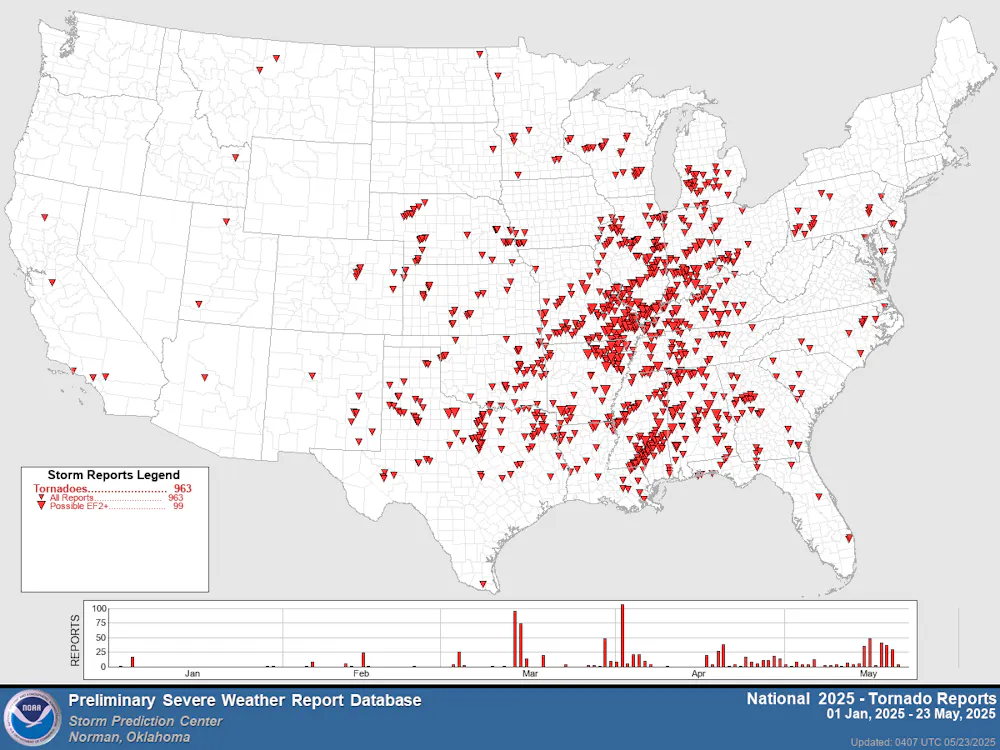
    The U.S. has had more reported tornadoes than normal – over 960 as of May 22, according to the National Weather Service’s preliminary count.

    That’s well above the national average of around 660 tornadoes reported by that point over the past 15 years, and it’s similar to 2024 – the second-most active year over that same period.

    The National Weather Service tracks reported tornadoes based on local storm reports, allowing for comparisons throughout the year. The red line shows 2025 through May 22.
    NOAA National Storm Prediction Center

    I’m an atmospheric scientist who studies natural hazards. What stands out about 2025 so far isn’t just the number of tornadoes, but how Tornado Alley has encompassed just about everything east of the Rockies, and how tornado season is becoming all year.

    Why has 2025 been so active?

    The high tornado count in 2025 has a lot to do with the weather in March, which broke records with 299 reported tornadoes – far exceeding the average of 80 for that month over the past three decades.

    March’s numbers were driven by two large tornado outbreaks: about 115 tornadoes swept across more than a dozen states March 14-16, stretching from Arkansas to Pennsylvania; and 145 tornadoes hit March 31 to April 1, primarily in a swath from Arkansas to Iowa and eastward. The 2025 numbers are preliminary pending final analyses.

    While meteorologists don’t know for sure why March was so active, there were a couple of ingredients that favor tornadoes:

    • First, in March the climate was in a weak La Niña pattern, which is associated with a wavier and stormier jet stream and, often, with more U.S. tornadoes.

    • Second, the waters of the Gulf were much warmer than normal, which feeds moister air inland to fuel severe thunderstorms.

    By April and May, however, those ingredients had faded. The weak La Niña ended and the Gulf waters were closer to normal.

    April and May also produced tornado outbreaks, but the preliminary count over most of this period, since the March 31-April 1 outbreak, has actually been close to the average, though things could still change.

    A tornado on May 18, 2025, tore apart homes in Bennett, Colorado.
    Helen H. Richardson/MediaNews Group/The Denver Post via Getty Images

    What has stood out in April and May is persistence: The jet stream has remained wavy, bringing with it the normal ebb and flow of stormy low-pressure weather systems mixed with sunny high-pressure systems. In May alone, tornadoes were reported in Colorado, Minnesota, Delaware, Florida and just about every state in between.

    Years with fewer tornadoes often have calm periods of a couple of weeks or longer when a sunny high-pressure system is parked over the central U.S. However, the U.S. didn’t really get one of those calm periods in spring 2025.

    Tornado Alley shifts eastward

    The locations of these storms have also been notable: The 2025 tornadoes through May have been widespread but clustered near the lower and central Mississippi Valley, stretching from Illinois to Mississippi.

    That’s well to the east of traditional Tornado Alley, typically seen as stretching from Texas through Nebraska, and farther east than normal. April through May is still peak season for the Mississippi Valley, though it is usually on the eastern edge of activity rather than at the epicenter. The normal seasonal cycle of tornadoes moves inland from near the Gulf Coast in winter to the upper Midwest and Great Plains by summer.

    Where local forecast centers reported tornadoes in 2025, through May 22. Data is preliminary, pending final analysis.
    NOAA Storm Prediction Center

    Over the past few decades, the U.S. has seen a broad shift in tornadoes in three ways: to the east, earlier in the year and clustered into larger outbreaks.

    Winter tornadoes have become more frequent over the eastern U.S., from the southeast, dubbed Dixie Alley for its tornado activity in recent years, to the Midwest, particularly Kentucky, Illinois and Indiana.

    Meanwhile, there has been a steady and stark decline in tornadoes in the “traditional” tornado season and region: spring and summer in general, especially across the Great Plains.

    It may come as a surprise that the U.S. has actually seen a decrease in overall U.S. tornado activity over the past several decades, especially for intense tornadoes categorized as EF2 and above. There have been fewer days with a tornado. However, those tornado days have been producing more tornadoes. These trends may have stabilized over the past decade.

    Deadlier tornadoes

    This eastward shift is likely making tornadoes deadlier.

    Tornadoes in the Southeastern U.S. are more likely to strike overnight, when people are asleep and cannot quickly protect themselves, which makes these events dramatically more dangerous. The tornado that hit London, Kentucky, struck after 11 p.m. Many of the victims were over age 65.

    The shift toward more winter tornadoes has also left people more vulnerable. Since they may not expect tornadoes at that time of year, they are likely to be less prepared. Tornado detection and forecasting is rapidly improving and has saved thousands of lives over the past 50-plus years, but forecasts can save lives only if people are able to receive them.

    Average number of tornadoes by month, 2000-2024. Source: NOAA

    This shift in tornadoes to the east and earlier in the year is very similar to how scientists expect severe thunderstorms to change as the world warms. However, researchers don’t know whether the overall downward trend in tornadoes is driven by warming or will continue into the future. Field campaigns studying how tornadoes form may help us better answer this question.

    Remember that it only takes one

    For safety, it’s time to stop focusing on spring as tornado season and the Great Plains as Tornado Alley.

    Tornado Alley is really all of the U.S. east of the Rockies and west of the Appalachians for most of the year. The farther south you live, the longer your tornado season lasts.

    Forecasters say it every year for hurricanes, and we badly need to start saying it for tornadoes too: It only takes one to make it a bad season for you or your community. Just ask the residents of London, Kentucky; St. Louis; Plevna and Grinnell, Kansas; and McNairy County, Tennessee.

    Listen to your local meteorologists so you will know when your region is facing a tornado risk. And if you hear sirens or are under a tornado warning, immediately go to your safe space. A tornado may already be on the ground, and you may have only seconds to protect yourself.

    Daniel Chavas receives funding from the National Science Foundation, NASA, and NOAA. He is a member of the American Geophysical Union and American Meteorological Society.

    – ref. In 2025, Tornado Alley has become almost everything east of the Rockies − and it’s been a violent year – https://theconversation.com/in-2025-tornado-alley-has-become-almost-everything-east-of-the-rockies-and-its-been-a-violent-year-257169

    MIL OSI – Global Reports –

    May 27, 2025
  • MIL-OSI Global: How abortion laws focusing on fetal viability miss the mark on women’s experiences

    Source: The Conversation – USA – By Katrina Kimport, Professor of Sociology, University of California, San Francisco

    Abortion policy in the U.S. often focuses on fetal viability and fails to address the concerns of actual pregnant people. John Fedele/Tetra Images via GettyImages

    During the 2024 presidential campaign, politicians and their surrogates repeatedly raised concerns about abortion later in pregnancy. The topic grabbed media attention and continues to inspire strong emotions, but most of the discussions include numerous misunderstandings.

    These debates tend to focus almost exclusively on the status of a presumed healthy fetus: Does it have a heartbeat? Can it feel pain? Can it survive outside of the pregnant person’s body? Laws in the U.S. routinely use these fetal development markers to restrict abortion rights.

    The problem with this framing, however, is that the preoccupation with these fetal development markers originated in law and politics, not in science or medicine. And, most importantly, not from the lives, needs and experiences of pregnant people.

    We are medical sociologists who specialize in research on abortion. We noticed that fetal development markers shape the experience of pregnant patients. But that doesn’t mean these markers feel meaningful to people who get abortions.

    We wanted to understand how patients who have abortions later in pregnancy, including from states with laws banning abortion after specified markers like “viability,” thought about their pregnancy and abortion. Do they think about abortion in terms of the development of their fetus? We analyzed interviews with 30 women who obtained abortions later in pregnancy to answer this question.

    A history of limitations

    Long before the 2022 U.S. Supreme Court’s Dobbs v. Jackson Women’s Health Organization decision overturned the constitutional right to abortion, thousands of people each year in the U.S. were denied abortion services. Often, this was because they were beyond the pregnancy gestational limit imposed by their state’s abortion laws.

    These limits were rooted in fetal development markers. For instance, some states such as Maine and Washington allow abortion until a particular developmental point, such as presumed fetal viability. This is the point in pregnancy when the fetus might survive outside the uterus. Even in states considered supportive of abortion rights, such as California and Illinois, limits based on fetal development are still in force today.

    Since the Dobbs ruling, more abortion seekers are being denied the chance to get the procedure or facing long delays because of laws based on ideas about fetal development markers. But in fact, laws focused on fetal markers often end up jeopardizing the life and health of pregnant patients and furthering suffering, our study shows.

    Fetal development markers explained

    Fetal development markers sound like they are established clinical terms, but they aren’t. Some, like “potential fetal viability,” are concepts that started in legal thinking in the early 1970s. Then, when they were incorporated into limits on legal abortion, clinicians had to figure out how to apply them in a health care setting.

    Laws premised on fetal development markers around the U.S. have led to a host of lawsuits and general confusion among medical practitioners, as the language they use often doesn’t translate into medical contexts.

    It’s worth noting that common shorthand is to assign a specific gestation to a particular marker – for example, saying that viability starts at 24 weeks. But this ignores the fact that fetal viability depends on many factors, including fetal weight, sex, genetics and availability of neonatal intensive care resources.

    Only about half of infants born at 24 weeks of gestation will even survive long enough to be discharged from the hospital. Among infants born at 28 weeks, that rises to more than 90%. And of course, just looking at whether a baby was discharged from the hospital does not capture the acute impairments that babies born this prematurely experience and ongoing medical care they will require for much, if not all, of their lives.

    Focusing on the fetus’s viability overlooks the baby’s viability

    When we interviewed women who had abortions after 24 weeks of pregnancy, it became evident that these legal definitions were entirely irrelevant to the realities of their fetuses’ health.

    Some described carrying a fetus with a serious health issue that doctors told them would lead to its death soon after birth, just not during pregnancy. For instance, one woman we interviewed learned that a child with her fetus’s diagnosis would be born alive but would have regular seizures, cognitive disabilities and an inability to control its own movement.

    “I couldn’t imagine bringing a child into this world who would suffer and not have cognition of why, or be able to understand a good day from a bad day,” she said. To her, having an abortion was a way to protect her son: “I can’t give him that life of pain if I have a choice.”

    Women in similar situations struggled with the way their states’ laws focused on fetal viability but ignored the fact that the life their baby would have would be very brief and characterized by deep, sometimes constant pain. To them, the law reduced “viability” to the ability to survive birth, without consideration of the quality of their child’s life and the degree of its suffering.

    Overlooking women’s health

    Research and journalism have documented harrowing obstetric emergencies and their physical consequences in states where abortion has been banned. These traumatic events are often directly linked to laws that, in effect, leave little to no room to protect the pregnant patient’s life and health. The women in our study repeatedly highlighted that when a state’s law emphasizes “fetal viability” at the time an abortion is sought, the pregnant patient’s future health – both emotional and physical – takes a back seat.

    One woman we interviewed explained that she was so desperate not to be pregnant that she considered suicide because the fetal development-based law in her state meant she would not have access to a needed abortion. She had to travel out of state for her abortion. In her interview, she said the staff at the abortion clinic “saved my life. They definitely did. If it wasn’t for them, I probably wouldn’t be here.”

    We also interviewed a woman who had a medical condition that made pregnancy and laboring very dangerous for her, but she decided to take that risk to start a family. Once it was clear that her fetus had a serious health issue and would die in utero or shortly after birth, she no longer wanted to risk her own health.

    “Never mind the suffering, like needless suffering for the baby — I would also have to go through a cesarean surgery for that,” she said. But in her state, a fetal development-based law prohibited her from receiving an abortion. She, too, had to travel in order to get one.

    Ultimately, the women we interviewed found the laws based in fetal development markers to be nonsensical and cruel when applied to their pregnancies. One woman we interviewed, whose fetus’s severe medical condition was only diagnosable by doctors after her state’s 24-week viability cutoff, put the issue in stark terms.

    She was denied an abortion even after multiple specialists told her there was “100% certainty” her baby would have a bad outcome – an outcome that one specialist gently told her “no parent wants.” She had to fly halfway across the country to get the abortion she needed, far away from her support system.

    She said, “What sense does that make? I can’t imagine anybody looking at that and saying, ‘Yes, that was the desired outcome of this policy.’”

    Katrina Kimport receives funding from the Society of Family Planning and an anonymous private foundation.

    Tracy A. Weitz receives funding from the Society of Family Planning, Education Foundation of America, and William and Flora Hewlett Foundation. She is affiliated with Cambridge Reproductive Health Consultants, Fund Access Forward, Democracy Forward, Abortion Bridge Collaborative (Women’s Donors Network), Breast Cancer Action.

    – ref. How abortion laws focusing on fetal viability miss the mark on women’s experiences – https://theconversation.com/how-abortion-laws-focusing-on-fetal-viability-miss-the-mark-on-womens-experiences-245998

    MIL OSI – Global Reports –

    May 27, 2025
  • MIL-OSI Global: Like many populist leaders, Trump accuses judges of being illegitimate obstacles to safety and democracy

    Source: The Conversation – USA – By Michael Gregory, Assistant Professor of Philosophy, Clemson University

    The front entrance of the E. Barrett Prettyman United States Court House, the workplace of Judge James Boasberg, along with other federal and appeals court judges, is seen in Washington, D.C. Philip Yabut/Getty Images

    Federal judges and at times Supreme Court justices have repeatedly challenged – and blocked – President Donald Trump’s attempts to reshape fundamental aspects of American government.

    Many of Trump’s more than 150 executive orders, including one aimed at eliminating the Department of Education, have been blocked by injunctions and lawsuits.

    When a majority of Supreme Court justices ruled on May 16, 2025, that the Trump administration could not deport a group of Venezuelan immigrants without first giving them the right to due process in court, Trump attacked the court.

    “The Supreme Court of the United States is not allowing me to do what I was elected to do,” Trump wrote on Truth Social. “This is a bad and dangerous day for America!” he continued in the post.

    As the Trump administration faces other orders blocking its plans, the president and his team are framing judges not just as political opponents but as enemies of democracy.

    Trump, for example, has called for the impeachment of James Boasberg, a federal judge who also issued orders blocking the deportation of immigrants in the U.S. to El Salvador. Attorney General Pam Bondi has said that Boasberg was “trying to protect terrorists who invaded our country over American citizens,” and Trump has also called Boasberg and other judges who ruled against him or his administration “left-wing activists.”

    “We cannot allow a handful of communist, radical-left judges to obstruct the enforcement of our laws and assume the duties that belong solely to the president of the United States,” Trump said at a rally in April 2025. “Judges are trying to take away the power given to the president to keep our country safe.”

    As a scholar of legal and political theory, I believe this kind of talk about judges and the judicial system is not just misleading, it’s dangerous. It mirrors a pattern seen across many populist movements worldwide, where leaders cast independent courts and judges as illegitimate obstacles to what they see as the will of the people.

    By confusing the idea that the people’s will must prevail with what the law actually says, these leaders justify intimidating judges and their sound legal rulings, a move that ultimately undermines democracy.

    President Donald Trump shakes hands with Supreme Court Chief Justice John Roberts at his inauguration on Jan. 20, 2025, in Washington, D.C.
    Chip Somodevilla/Getty Images

    Thwarting ‘the will of the American people’?

    In the face of judicial rulings against them, Trump and other administration officials have suggested on multiple occasions that judges are antagonistic to what the American people voted for.

    Yet these rulings are merely a reflection of the rule of law.

    Trump and supporters such as Elon Musk have characterized the rulings as a sign that a group of elite judges are abusing their power and acting against the will of the American people. The rulings that enforce the law, according to this argument, stand in opposition to the popular mandate American voters give to elected officials like the president.

    “If ANY judge ANYWHERE can stop EVERY Presidential action EVERYWHERE, we do NOT live in a democracy,” Elon Musk posted on X in February 2025. “When judges egregiously undermine the democratic will of the people, they must be fired,” Musk added.

    And U.S. Rep. Mike Johnson, the Republican speaker of the House of Representatives, said in March 2025, “We do have the authority over the federal courts, as you know. We can eliminate an entire district court.”

    Framing judges as enemies of democracy or as obstacles to the people’s will departs sharply from the traditional view – held across political lines – that the judiciary is an essential, nonpartisan part of the American constitutional system.

    While previous presidents have expressed frustration with specific court decisions or judges’ political leanings, their critiques mostly focused on specific legal reasoning.

    Supreme Court Justice Ketanji Brown Jackson warned against the Trump administration’s charge that judges were actively undermining democracy. In late April 2025, she said during a conference for judges that “relentless attacks on judges are an attack on democracy.”

    So, are judges obstructing democracy – or protecting it?

    Are unelected judges a sign of democracy?

    The U.S. Constitution established an independent judiciary as a coequal branch of government, alongside the legislative and executive branches. Federal judges are appointed for life and cannot be removed for political reasons. The country’s founders thought this protection could insulate judges from political pressures and ensure that courts uphold the Constitution, not the popularity of a given policy.

    Yet as the federal judiciary has expanded in size and power, the arguments about the relationship between democracy and judicial independence have become louder among some political scientists and legal philosophers.

    Some critics take issue with the fact that federal judges are appointed by politicians, not elected to their positions – a fact that others argue contributes to their independence.

    Federal judges often serve longer on the bench than many elected officials.

    Why, some critics argue, should a small group of unelected experts be allowed to overturn decisions made by elected officials?

    Other democratic theorists, however, say that federal judges can act as a check on elected leaders who may misuse or abuse their power, or pass laws that violate people’s legal rights. This indirectly strengthens democracy by giving people a meaningful way to have recourse against laws that go against their rights and what they actually voted for.

    A common story across countries

    The argument that judges are an enemy to democracy is not unique to the U.S.

    Authoritarian leaders from across the world have used similar language to justify undermining the courts.

    In the Philippines, then-President Rodrigo Duterte in 2018 told Maria Lourdes Sereno, a top judge who was an outspoken critic of Duterte’s war on drugs, “I am now your enemy.” Shortly after, the Philippines Supreme Court voted to oust Sereno from the court. These judges cited Sereno’s failure to disclose personal financial information when she was first appointed to the court as the reason for her removal.

    Filipino protesters and outside critics alike viewed Sereno’s removal as politically motivated and said it undermined the country’s judicial independence.

    El Salvador President Nayib Bukele’s allies in the legislative assembly similarly voted in May 2021 to remove the government’s attorney general as well all five top judges for obstructing Bukele’s plans to imprison, without proper due process, large numbers of people. Bukele replaced the attorney general and judges with political loyalists, violating constitutional procedure.

    Kamala Harris, then vice president of the U.S., was among the international observers who said the removal of judges in El Salvador made her concerned about El Salvador’s democracy. Bukele justified the judges’ removal by saying he was right and that he refused to “listen to the enemies of the people” who wanted him to do otherwise.

    And in April 2024, a minister in Israeli Prime Minister Benjamin Netanyahu’s Cabinet called Attorney General Gali Baharav-Miara an “enemy of the people,” blaming her for protests outside Netanyahu’s home. This disparagement was part of Netanyahu’s broader efforts to weaken judges’ role and independence and to remove judicial constraints on executive power.

    Judge James Boasberg is one example of a judge who was personally attacked by President Donald Trump for issuing various rulings on the administration’s plans to deport Venezuelan immigrants.
    Drew Angerer/AFP via Getty Images

    Pushing against democracy

    In the name of weakening what they call undemocratic institutions, these and other leaders try to discredit independent judges. This attempt helps these leaders gain power and silence dissent.

    Their attempts to disparage and discredit judges misrepresent judges’ work by asserting that it is political in nature – and thus subject to political criticism and even intimidation. But in the U.S., judges’ constitutionally mandated work takes place in the realm of law, not politics.

    By confusing the idea that the people’s will must prevail with what the law actually says, these leaders justify intimidating judges and their rulings, a move that ultimately undermines democracy.

    Independent judges may not always make perfect decisions, and concerns about their interpretations or potential biases are legitimate. Judges sometimes make decisions that are objectionable from a moral and legal standpoint.

    But when political leaders portray judges as the problem, I believe it’s crucial to ask: Who truly benefits from silencing judges?

    Michael Gregory does not work for, consult, own shares in or receive funding from any company or organization that would benefit from this article, and has disclosed no relevant affiliations beyond their academic appointment.

    – ref. Like many populist leaders, Trump accuses judges of being illegitimate obstacles to safety and democracy – https://theconversation.com/like-many-populist-leaders-trump-accuses-judges-of-being-illegitimate-obstacles-to-safety-and-democracy-255472

    MIL OSI – Global Reports –

    May 27, 2025
  • MIL-OSI Global: From furry friends to fish, turning up the heat helps animals fight germs − how Mother Nature’s cure offers humans a lesson on fever

    Source: The Conversation – USA – By Phil Starks, Associate Professor of Biology, Tufts University

    Sick animals often move to warmer places to raise their body temperature. GK Hart/Vikki Hart/Stone via Getty Images

    Why do people get fevers when we get sick?

    It’s a common misconception that pathogens, such as SARS-CoV-2 or the flu, cause fevers. But as biology professors, we know it’s not that simple. Pathogens cause fevers only indirectly.

    When your immune system detects harmful microbes, your body raises its internal temperature to create a hostile environment. Turning up the heat suppresses the proliferation of invaders. In short, the fever is the body’s way of fighting back.

    Although many people don’t understand fever’s purpose, animals certainly utilize it. Even so-called “simple creatures,” such as lizards, fish and insects, use fever to recover from illness.

    The body’s response

    Suppose you catch a virus. The immune system responds by releasing molecules called pyrogens, which induce fever. They signal the brain’s hypothalamus to raise the body’s set point temperature – like adjusting a thermostat.

    Normal body temperature hovers around 98.6 degrees Fahrenheit (37 degrees Celsius), but fevers commonly increase temperatures to 100.4-104 F (38-40 C).

    When that happens, your muscles contract, causing shivers, and blood vessels constrict to retain heat. You’ll feel cold until your body reaches the new set point, often prompting you to add clothes or snuggle into blankets. When the infection subsides, pyrogens decrease and the hypothalamus resets the temperature. You sweat, your blood vessels dilate, and you cool off. You’re feeling better.

    There’s a reason why you shiver when you have a fever.
    Edwin Tan/E+ via Getty Images

    Mammals, lizards, fish and insects

    Humans are not special in this regard; all mammals are capable of generating fevers. Even without taking their temperature, you might recognize the signs in a familiar companion. When dogs have a fever, they often lose their appetite, become lethargic and may shiver − behaviors that closely resemble how people respond when they’re running a fever.

    This adaptive response to infection is widespread in nature. Even cold-blooded animals, which rely on the environment for warmth, raise their temperature behaviorally.

    Lizards move to warmer areas when sick. If they’re blocked from doing so − or given fever-reducing drugs − their survival rates drop. Zebrafish swim to warmer waters during infection; a rise of just 5.4 F (3 C) correlates with improved gene expression, stronger antiviral responses and higher survival. Naked mole rats – a social, subterranean cold-blooded mammal that looks like a hot dog with teeth – generate fevers in response to infection, despite their unusual physiology.

    Insects, too, show remarkable responses. Desert locusts elevate their body temperature when infected, doing so in a dose-dependent manner: more pathogen, higher temperature. This behavior increases their chance of survival and reproduction.

    Honeybees have a unique way of fighting a fever.
    Joannis S. Duran/Moment via Getty Images

    Honeybees are among the most sophisticated. These social insects regulate brood temperature with extraordinary precision, keeping it between 90-95 F (32-35 C). They warm the hive by contracting flight muscles and cool it by fanning wings, sometimes spreading water on the comb to induce evaporative cooling.

    If their larvae are exposed to heat-sensitive fungal spores, the colony raises the temperature − essentially giving itself a fever. The increased heat prevents spore germination and protects the next generation. Once the threat has passed, the bees restore their normal hive temperature.

    If fevers don’t wind down within 24 to 36 hours, it’s time to see a doctor.

    Treating a fever

    These examples show that evolution has favored the fever response. Yet when humans get a fever, our instinct is often to bring it down – using aspirin, removing blankets or applying cold compresses. And sometimes that’s appropriate. Adults should seek medical attention if fever exceeds 103 F (39.4 C); children at 102 F (38.9 C); and infants younger than three months at 100.4 F (38 C).

    But mild to moderate fevers often help more than they hurt. Reducing a fever too soon − via medication or environmental cooling − may interfere with the body’s natural defense, prolonging illness.

    This isn’t a new idea. Nearly a century ago, Austrian physician Julius Wagner-Jauregg pioneered an extreme method called malariotherapy: infecting syphilis patients with malaria. The high fever induced by malaria killed the syphilis-causing bacteria. Once the bacteria was eliminated, doctors treated the malaria with quinine.

    The approach was risky but effective enough to win Wagner-Jauregg the Nobel Prize in 1927. Although some patients died from the treatment, and many others relapsed, it remained in use for about two decades, until replaced by penicillin. Think of Wagner-Jauregg’s treatment like using a sledgehammer to drive a nail; it worked, though the wall didn’t always survive.

    Much remains to be discovered about how fever affects the immune response. Still, the underlying message holds: Fever fights infection.

    The fact that so many diverse creatures developed similar fever responses suggests a powerful pattern known as convergent evolution − when different species with enormously complex evolutionary histories converge on a similar solution. Despite different evolutionary paths, all these organisms faced the same challenge − infection − and arrived at the same solution: fever.

    Phil Starks received past funding from the NSF for providing research experiences for undergraduates (REU).

    Harry Bernheim had grants from the NIH in the 1980’s.

    – ref. From furry friends to fish, turning up the heat helps animals fight germs − how Mother Nature’s cure offers humans a lesson on fever – https://theconversation.com/from-furry-friends-to-fish-turning-up-the-heat-helps-animals-fight-germs-how-mother-natures-cure-offers-humans-a-lesson-on-fever-229078

    MIL OSI – Global Reports –

    May 27, 2025
  • MIL-OSI USA: Hickenlooper, Cantwell, Lummis, Wicker Reintroduce Bill to Clear Space Junk, Protect Space Exploration

    US Senate News:

    Source: United States Senator John Hickenlooper – Colorado
    ORBITS Act would create landmark program to clean up dangerous orbital debris threatening space exploration, satellites, and commercial space operations
    Bill unanimously passed Senate last Congress
    WASHINGTON – Today, U.S. Senators John Hickenlooper, Maria Cantwell, Cynthia Lummis, and Roger Wicker reintroduced the bipartisan Orbital Sustainability (ORBITS) Act to establish a first-of-its-kind demonstration program that would reduce the nearly 1 million pieces of space junk in orbit.
    “Dangerous debris in Earth’s orbit threatens American satellites and jeopardizes future space exploration missions,” said Hickenlooper. “It’s time we clean up the clutter and protect our critical space operations.”
    “The Orbital Sustainability or ORBITS Act will jumpstart the technology development we need to address the very serious problem of orbital debris that threatens our scientific satellites, human space exploration and commercial space services,” said Cantwell.  “The longer we delay in taking meaningful action, the less safe our activities in orbit become.”
    “Space is getting more and more crowded with debris that poses a real threat to our satellites,” said Lummis. “People in Wyoming and across the country depend on satellites for our national security, weather forecasting, wildfire monitoring, GPS navigation, and communications essential for our way of life. The ORBITS Act addresses this growing challenge and helps maintain safe human spaceflight operations above the earth. This bipartisan solution will protect America’s interests in space for generations to come.”
    “The ORBITS Act would address a key aspect of the complex space debris problem. We should be empowering NASA to partner with the U.S. space industry in active debris removal technology to tackle space junk threats. The United States is the world’s premier spacefaring nation, and I look forward to continuing our leadership,” said Wicker.
    The ORBITS Act passed the Senate in the 118th Congress.
    Space junk, or orbital debris, currently threatens human space exploration, scientific research missions, and emerging commercial space services. There are approximately 8,000 metric tons of debris currently in orbit, including at least 900,000 individual pieces of debris that are potentially lethal to satellites. Because of the threats from debris already in orbit, simply preventing more debris in the future is not enough. The ORBITS Act will jumpstart a program focused on research, development, and the demonstration of technologies capable of safely carrying out successful Active Debris Remediation (ADR) missions to create a robust commercial market for these services.
    In recent years, NASA canceled a planned spacewalk and maneuvered the International Space Station (ISS) to avoid colliding with orbital debris. Due to growing amounts of debris, the ISS has performed numerous Pre-Determined Debris Avoidance Maneuvers (PDAM) in the past year alone. 
    Specifically, the bill contains the following provisions:
    Orbital Debris Remediation List
    Directs NASA, in coordination with the Departments of Commerce, Defense, and the National Space Council, to publish a list of debris objects that pose the greatest risk to the safety of orbiting spacecraft and on-orbit activities

    Active Orbital Debris Remediation Demonstration Program
    Directs NASA to establish a demonstration program to partner with industry in developing technology for remediating debris objects through repurposing or removal from orbit
    The NASA program will promote competition by incentivizing  two or moreteams of technology developers to conduct demonstrations of successful debris remediation

    Asks NASA to partner with other nations to address debris in orbit that belongs to them

    Active Debris Remediation (ADR) Services
    Encourages the U.S. government to buy ADR services from  industry partners once they succeed in the demonstration and are commercially available
    Requires an economic assessment of the long-term demand for ADR services

    Uniform Orbital Debris Standards
    Directs the National Space Council to update the Orbital Debris Mitigation Standard Practices (ODMSP) used by U.S. government space missions
    Encourages the FAA and FCC to use the updated standards and practices as the basis for federal regulations applicable to all space activities
    Directs the U.S. to encourage other nations to align their regulations with ours to encourage effective and non-discriminatory regulation worldwide

    Space Traffic Coordination Standard Practices
    Directs the Department of Commerce, in coordination with the National Space Council and the FCC, to develop and promote standard practices for avoiding near misses and collisions between spacecraft in orbit

    Key supporters of the bill include the Aerospace Industry Association, Secure World Foundation, and CONFERS.
    Full text of the ORBITS Act is available HERE.

    MIL OSI USA News –

    May 27, 2025
  • MIL-OSI Video: President Cyril Ramaphosa arrives at the White House and is received by President Donald Trump.

    Source: Republic of South Africa (video statements)

    President Cyril Ramaphosa arrives at the White House and is received by President Donald Trump, President of the United States

    https://www.youtube.com/watch?v=UGFdBa9hhhY

    MIL OSI Video –

    May 27, 2025
  • MIL-OSI USA: Hinson Named Co-Chair of Biofuels Caucus, Will Use Position to Advocate for Iowa Biofuels

    Source: United States House of Representatives – Congresswoman Ashley Hinson (IA-01)

    Washington, D.C. – Today, Congresswoman Ashley Hinson was announced as a co-chair for the Congressional Biofuels Caucus alongside Representatives Angie Craig (D-MN), Adrian Smith (R-NE), Mark Pocan (D-WI), Julie Fedorchak (R-ND), and Nikki Budzinski (D-IL).

    “Biofuels are key to Iowa’s economy and key to American energy dominance,” said Co-chair Hinson. “Since coming to Congress, I have worked tirelessly to expand access to Iowa biofuels and support Iowa’s biofuels producers by fighting to secure permanent year-round E15, increase biofuels blending targets, and replace foreign energy with homegrown biofuels. I’m honored to co-lead the biofuels caucus and will continue working with President Trump and other caucus members to increase domestic energy production and support Iowa agriculture.”

    “Increasing the production and availability of homegrown biofuels is a critical piece of the puzzle when it comes to the all-of-the-above energy policy we need to stay ahead,” said Co-chair Craig. “I’m proud to be relaunching the Biofuels Caucus alongside my bipartisan colleagues this Congress so we can continue our work to lower prices at the pump, create opportunities for local producers and strengthen our energy security.”

    “American biofuel producers have an untapped ability to power the future of liquid fuels, whether ethanol blends, biodiesel, or sustainable aviation fuel,” said Co-chair Smith. “Advancing sound policy can unlock billions of dollars in savings at the pump and hundreds of thousands of added jobs for the American people. I thank Co-chairs Craig and Pocan and congratulate Co-chairs Hinson, Fedorchak, and Budzinski for joining me to strengthen this bipartisan caucus and continue working to inform our colleagues in the House of the value of biofuels for American energy abundance.”

    “I am glad to join my colleagues in the Congressional Biofuels Caucus,” said Co-chair Pocan. “Corn growers in Wisconsin deserve to have an even playing field in the market dominated by the oil and gas industry. This Caucus will showcase how biofuels can help us reach our emissions reduction goals while investing in rural jobs and infrastructure.”

    “Biofuels are a growing part of America’s energy strategy and another way North Dakota is helping fuel the world,” said Co-chair Fedorchak. “It’s an honor to serve as a co-chair of this bipartisan caucus to advance policies that will help expand domestic energy production, empower rural America, and deliver practical solutions for North Dakotans.”

    “I came to Congress to be a strong voice for the people of Central and Southern Illinois—especially our hardworking farmers. Few issues are more critical to their success than strengthening the biofuels industry and expanding market opportunities,” said Co-chair Budzinski. “That’s why promoting the use of homegrown, sustainable biofuels has been a central focus of my work in Congress, and I’m looking forward to continuing that commitment as co-chair of this bipartisan caucus.

    The Congressional Biofuels Caucus advocates for policies which reflect the capacity of American biofuels producers to meet the demand for reliable and affordable liquid fuels while growing rural economies, high-paying jobs, and value-added markets for agricultural commodities. The caucus recognizes biofuels are key to American energy independence and responsible stewardship of our resources.

    Additional members of the caucus include: Reps. Dusty Johnson (R-SD), Darin LaHood (R-IL), Jim Baird (R-IN), Scott Peters (D-CA), Tom Emmer (R-MN), Andre Carson (D-IN), Ann Wagner (R-MO), Emanuel Cleaver (D-MO), James Comer (R-KY), Brett Guthrie (R-KY), Marcy Kaptur (D-OH), Suzanne Bonamici (D-OR), Sam Graves (R-MO), Don Bacon (R-NE), Mike Bost (R-IL), Pete Stauber (R-MN), Michelle Fischbach (R-MN), Randy Feenstra (R-IA), Marianette Miller Meeks (R-IA), Zach Nunn (R-IA), Mike Flood (R-NE), Eric Sorensen (D-IL), Brad Finstad (R-MN), Tracey Mann (R-KS), Derrick Van Orden (R-WI), Mark Alford (R-MO), Sharice Davids (D-KS), Kristen McDonald Rivet (D-MI), Brian Jack (R-GA), and Mark Messmer (R-IN).

    ###

    MIL OSI USA News –

    May 27, 2025
  • MIL-OSI United Kingdom: A Reset Relationship and New Opportunities for Northern Ireland

    Source: United Kingdom – Executive Government & Departments

    Press release

    A Reset Relationship and New Opportunities for Northern Ireland

    Secretary of State Hilary Benn MP underlines the benefits for Northern Ireland of recent trade deals, and a new intended partnership agreement with the European Union.

    Secretary of State for Northern Ireland, Hilary Benn.

    It has been a momentous month – both for Northern Ireland and for the entire United Kingdom. First came the Government’s trade deals with India and the USA which will open up new opportunities for Northern Ireland exporters. 

    Next, on Monday, the UK played host to the first-ever UK-EU summit at Lancaster House in London as we set out to build a new partnership with the European Union. In recent years, our relationship with the EU has – at times – been strained, but in an era in which global instability is rising, it makes sense to build stronger ties with our European friends and neighbours.

    And then, on Thursday, we marked the anniversary of the referenda on the 1998 Good Friday Agreement held in Northern Ireland and Ireland. By voting ‘yes’, the people chose and secured a chance for peace in Northern Ireland; a peace which has lasted in the almost three decades since and helped pave the way for Northern Ireland’s transformation. It was an agreement which remains to this day proof of the power of courageous political leadership, and people’s willingness to compromise in hope of a better future.

    The agreement with the European Union will help to create growth and lower household bills across the UK as a whole. 

    It is a particularly good deal for Northern Ireland. Our economy is already vibrant – think of our aerospace, life sciences, manufacturing, and film and television industries – and this agreement will further help Northern Ireland which experienced stronger growth than the United Kingdom as a whole last year. Peace has delivered real economic benefits.

    Of particular significance will be the deal we reached on agrifood and plants, which will smooth flows of trade, ease the frictions for businesses and protect the UK internal market. Applying the same rules across the UK will give businesses greater certainty, and mean we can eliminate paperwork and mandatory identity and physical checks on goods moving under these arrangements. 

    All of this will save up to £1 million a month for those firms using the ‘red lane’ and we’ll see a real difference in garden centres, with bans on so-called ‘high risk’ plants being eliminated – a commitment made in Safeguarding the Union – and plants being able to move within the UK without barriers. 

    This deal will also maintain Northern Ireland’s unique access to both the UK and EU markets and the advantages that the Windsor Framework offers to businesses and the economy. So, it’s no surprise that businesses have welcomed it. The Ulster Farmers Union called it ‘a major step forward for Northern Ireland’s agri-food industry’. The Horticultural Trades Association have said that their sector will save millions. And big name retailers such as Asda and M&S have praised the removal of frictions too. The message is clear from business – this is good news for Northern Ireland and good news for you.

    The other outcomes of Monday’s summit are also good for Northern Ireland. Our new security and defence partnership with the EU will support our national security and the aerospace, defence and space industry which is already home to more than 9,000 jobs in Northern Ireland. Our closer law enforcement relationship with the EU will help prevent crime. Closer cooperation on decarbonisation and energy will lower prices and make our country greener and more resilient. And it’ll become easier to travel to mainland Europe through e-Gates. 

    Northern Ireland’s prosperity is intrinsically linked to its strong relationship with the rest of the UK, and it can only benefit further from our new partnership with the EU. The steps we are taking will bring practical benefits, and Monday’s summit makes me even more confident that Northern Ireland’s economy will continue to flourish as a thriving and growing part of the UK.

    This article also featured in the Belfast Telegraph.

    Share this page

    The following links open in a new tab

    • Share on Facebook (opens in new tab)
    • Share on Twitter (opens in new tab)

    Updates to this page

    Published 23 May 2025

    MIL OSI United Kingdom –

    May 27, 2025
  • MIL-OSI USA: Around the Air Force: Allied Fighter Training, Oracle-M Satellite Test, Real ID Compliance

    Source: United States Air Force

    Headline: Around the Air Force: Allied Fighter Training, Oracle-M Satellite Test, Real ID Compliance

    In this week’s look Around the Air Force, the newest hub for allied fighter training reaches initial operational capability, a milestone in monitoring space between Earth and the moon, and federal installations now require all visitors seeking base access to possess a REAL ID.

    MIL OSI USA News –

    May 27, 2025
  • MIL-OSI Security: Florida Man Found Guilty by Jury

    Source: US FBI

    SOUTH BEND – Late yesterday, Stephen Forte, 63 years old, of Lakeland, Florida, was found guilty of two felony counts after a one-day jury trial presided over by United States District Court Judge Damon R. Leichty, announced Acting United States Attorney Tina L. Nommay.

    Specifically, Forte was found guilty of abusive sexual contact and interference with the duties of a flight crew member, both committed within the special aircraft jurisdiction of the United States for conduct occurring on a flight from St. Petersburg, Florida to South Bend, Indiana.

    Sentencing is scheduled for September 5, 2025, at 10:00 am. Any specific sentence to be imposed will be determined by the District Court Judge after consideration of federal statutes and the United States Sentencing Guidelines.

    This case was investigated by the Federal Bureau of Investigation with assistance from the St. Joseph County Airport Authority Department of Public Safety.  The case was prosecuted by Assistant United States Attorneys Jerome W. McKeever and Hannah T Jones.

    MIL Security OSI –

    May 27, 2025
  • MIL-OSI Security: Sin City Deciples Member Sentenced to 180 Months in Prison

    Source: US FBI

    HAMMOND- Roger Lee Ervin Burton, age 55, of Merrillville, Indiana, was sentenced by United States District Court Judge Philip P. Simon after pleading guilty to a racketeering conspiracy announced Acting United States Attorney Tina L. Nommay.

    Burton was sentenced to 180 months in prison followed by 2 years of supervised release. 

    According to the Second Superseding Indictment, the Sin City Deciples, originally formed in 1967 in Gary, Indiana, is an outlaw motorcycle organization in which its members and associates engaged in acts of violence, extortion, and narcotics distribution in the Northern District of Indiana and elsewhere.

    Burton served as a National Board Member of the entire club and was described by informants as one of the top three leaders in the criminal organization.  

    The agencies involved in this prosecution were: the Bureau of Alcohol, Tobacco, Firearms and Explosives, the East Chicago Police Department, the Federal Bureau of Investigation, the Gary Police Department, the Griffith Police Department, the Hammond Police Department, the Internal Revenue Service-Criminal Investigation Division, the Lake County Sheriff’s Department, Indiana High Intensity Drug Trafficking Area officers and agents, the Merrillville Police Department, the Munster Police Department, and the Schererville Police Department.   Also aiding were the Lake County Prosecutor’s Office, the U.S. Attorney’s Offices for the Eastern District of Arkansas, the Northern District of Illinois, the Southern District of Indiana, the Western District of Kentucky, and the Western District of Pennsylvania.

    This case was prosecuted by Assistant United States Attorneys David J. Nozick, Michael J. Toth, and former Assistant United States Attorney Kimberly L. Schultz.  

    This case was part of an Organized Crime Drug Enforcement Task Force (OCDETF) investigation. OCDETF identifies, disrupts, and dismantles the highest-level drug traffickers, money launderers, gangs, and transnational criminal organizations that threaten the United States by using a prosecutor-led, intelligence-driven, multi-agency approach that leverages the strengths of federal, state, and local law enforcement agencies against criminal networks.

    This case was also part of Project Safe Neighborhoods (PSN), a program bringing together all levels of law enforcement and the communities they serve to reduce violent crime and gun violence, and to make our neighborhoods safer for everyone. On May 26, 2021, the Department launched a violent crime reduction strategy strengthening PSN based on these core principles: fostering trust and legitimacy in our communities, supporting community-based organizations that help prevent violence from occurring in the first place, setting focused and strategic enforcement priorities, and measuring the results.

    MIL Security OSI –

    May 27, 2025
  • MIL-OSI Security: Federal Grand Jury in Louisville Returns Superseding Indictment Charging Three Men with Murder of Federal Witness

    Source: US FBI

    Louisville, KY – On May 6, 2025, a federal grand jury in Louisville returned a superseding indictment charging three men with conspiring to kill, and ultimately murdering, a witness in a federal investigation. Two of the defendants were previously charged with drug trafficking and firearms-related charges.    

    U.S. Attorney Michael A. Bennett of the Western District of Kentucky, Special Agent in Charge Jim Scott of the DEA Louisville Field Division, Acting Special Agent in Charge Olivia Olson of the FBI Louisville Field Office, Special Agent in Charge John Nokes of the ATF Louisville Field Division, Special Agent in Charge Rana Saoud of Homeland Security Investigations Nashville, Special Agent in Charge Karen Wingerd of the Internal Revenue Service, Criminal Investigation, Cincinnati Field Office, and Chief Paul Humphrey of the Louisville Metro Police Department made the announcement.

    According to the superseding indictment, Anyelle Curtley, Sr., 47, of Louisville, Delrico Nelson, 48, of Macomb, Illinois, and Antoyne Penick, 48, of Louisville, are each charged with conspiracy to tamper with a witness or informant by killing and conspiracy to retaliate against a witness or informant by killing. The superseding indictment alleges that between December 28, 2023, and January 31, 2023, Curtley Sr., Nelson, and Penick conspired and agreed to kill Victim 1 with the intent to prevent the testimony of Victim 1 in an official proceeding and to prevent Victim 1 from communicating with a law enforcement officer or judge information relating to the commission of a federal offense. Additionally, the superseding indictment alleges that the three men conspired and agreed to kill Victim 1 in retaliation for providing information to a law enforcement officer relating to the commission of a federal offense.

    Also, according to the superseding indictment, Curtley Sr. and Nelson, aided and abetted by each other, killed Victim 1, who was a person assisting a federal investigation, while that assistance was being rendered and because of it. Finally, the superseding indictment alleges that Curtley Sr. and Nelson aided and abetted each other in the murder of Victim 1 through the use of a firearm.

    This indictment supersedes an indictment returned March 5, 2024, charging Curtley, Sr. and others with drug trafficking and firearms related charges.

    The March 5, 2024, indictment charged Carl Delph, 53, of California, Curtley, Sr., Anyelle Curtley, Jr., 26, Adrian Richie, 35, Joseph Cousins, 39, Alandro O’Neal, 50, Jeroy Boyd, 44, Ameer Ellis, 45, Paul Butler, Jr., 35, and Susan Jenkins, 41, all of Louisville, with conspiracy to possess with intent to distribute controlled substances. Beginning as early as May 9, 2023, and continuing through February 21, 2024, the defendants conspired to possess with the intent to distribute and distributed over 50 grams of methamphetamine, over 400 grams of fentanyl, and over 500 grams of cocaine.

    Delph and Curtley, Sr. were also charged with a money laundering conspiracy.

    Delph was also charged with distributing over 500 grams of cocaine and distributing over 400 grams of fentanyl.

    Curtley, Sr. was also charged with distributing methamphetamine, cocaine, and fentanyl, attempting to possess with the intent to distribute cocaine and fentanyl, possessing with the intent to distribute fentanyl, possessing a firearm in furtherance of a drug trafficking crime, and possessing a firearm as a convicted felon. On December 28, 2023, Curtley, Sr., possessed a Glock, model 27, .40 caliber handgun. Curtley, Sr. was prohibited from possessing a firearm because he had previously been convicted the following felony offense.

    On May 19, 2010, in the United States District Court for the Western District of Kentucky, Curtley, Sr. was convicted of possession with intent to distribute cocaine and possession of a firearm by a convicted felon.

    Curtley, Jr. was also charged with distributing fentanyl and cocaine.

    Richie and Cousins were also charged with distributing fentanyl.

    O’Neal, Ellis, and Jenkins were also charged with distributing methamphetamine.

    Boyd was also charged with distributing cocaine.

    Butler, Jr. was also charged with distributing methamphetamine and fentanyl.

    Cousins and O’Neal have pled guilty and are pending sentencing before a United States District Judge.

    An additional federal indictment was returned on March 5, 2024, charging Christopher Curtley, 50, and Penick, both of Louisville, with conspiracy to possess with intent to distribute controlled substances. Beginning as early as January 9, 2024, and continuing through February 29, 2024, the defendants conspired to distribute methamphetamine, fentanyl, and heroin.

    Christopher Curtley was also charged with distributing fentanyl and methamphetamine.

    Penick was also charged with distributing fentanyl, methamphetamine, and heroin. Penick was also charged with possessing a firearm in furtherance of a drug trafficking crime and possession of a firearm by a convicted felon. On January 24, 2024, Penick possessed a Heritage Manufacturing Inc., Model Rough Rider, .22 caliber revolver. Penick was prohibited from possessing a firearm because he had previously been convicted of the following felony offenses.

    On September 27, 2017, in Jefferson Circuit Court, Penick was convicted of flagrant non-support.

    On October 19, 2015, in Clark Circuit Court, Clark County, Indiana, Penick was convicted of theft.

    On November 1, 2010, in Clark Superior Court, Clark County, Indiana, Penick was convicted of theft, robbery (two counts), and dealing in marijuana.

    Those charges against Christopher Curtley and Penick remain pending.

    Curtley Sr. and Penick previously appeared before a U.S. Magistrate Judges of the U.S. District Court for the Western District of Kentucky on the underlying drug and firearm charges. Nelson appeared before a U.S. Magistrate Judge for Central District of Illinois on May 8, 2025. Curtley Sr., Nelson, and Penick have been ordered detained pending trial. If convicted of the offenses alleged in the superseding indictment, all three defendants face a potential sentence of death, life, or any term of years. A federal district court judge will determine any sentence after considering the sentencing guidelines and other statutory factors.

    There is no parole in the federal system. 

    This case is being investigated by the DEA, FBI, HSI, ATF, IRS-CI, and the Louisville Metro Police Department, with assistance from the Kentucky State Police and Macomb, Illinois Police Department.

    Assistant U.S. Attorneys Frank Dahl and Josh Porter are prosecuting the case, with assistance from paralegal Aaron Cooper.

    This case is part of Operation Take Back America, a nationwide initiative that marshals the full resources of the Department of Justice to repel the invasion of illegal immigration, achieve the total elimination of cartels and transnational criminal organizations (TCOs), and protect our communities from the perpetrators of violent crime. Operation Take Back America streamlines efforts and resources from the Department’s Organized Crime Drug Enforcement Task Forces (OCDETFs) and Project Safe Neighborhood (PSN).

    An indictment is merely an allegation. All defendants are presumed innocent until proven guilty beyond a reasonable doubt in a court of law.

    ###

    MIL Security OSI –

    May 27, 2025
  • MIL-OSI USA: Discovery May Flip the Genetic Script on Fungal Threat of Wheat

    Source: US Agriculture Research Service

    Discovery May Flip the Genetic Script on Fungal Threat of Wheat

    By: Jan Suszkiw
    Email: arspress@usda.gov

    May 23, 2025

    Researchers from the Agricultural Research Service (ARS) have discovered a breakthrough in the fight against Fusarium Head Blight, which is a major disease affecting U.S. wheat and other cereal crops.

    Farmers must be diligent for signs of Fusarium Head Blight, a disease of cereal crops that flourishes under wet conditions and high temperatures. Caused by the fungus Fusarium graminearum, the disease inflicts yield losses of more than one billion dollars annually in wheat and barley. The disease also produces mycotoxins that can contaminate the crops’ grain, limiting its marketability or even rendering it unfit for food or feed uses.  

    Now, an ARS-led team may have found a way to turn the tables on Fusarium Head Blight, potentially minimizing the threat it poses to consumer health, farmer profits, and a $5.94 billion U.S. wheat export market. 

    The team’s discovery, reported in the International Society for Molecular Plant-Microbe Interactions, centers around a key molecule that the fungus naturally produces, known as FgTPP1.

    “This molecule helps the fungus shut off the plant’s defenses or weaken them enough that it can grow in the rest of the plant,” explained Matthew Helm, team leader and a research molecular biologist with ARS’s Crop Production and Pest Control Research Unit in West Lafayette, IN.

    The top half of this wheat head is infected with Fusarium Head Blight, a costly fungal disease that can diminish the grain yield and quality of wheat, barley and certain other cereal crops. (Photo Credit: Mathew Helm, ARS)

    FgTPP1 is one of hundreds of molecules that the fungus produces to help it infect wheat plants and cause Fusarium Head Blight.  The fact that other disease-causing species of Fusarium also produce FgTPP1 “suggests it serves an important function,” Helm said.

    To find out, Helm and his team of researchers used a standard procedure to “delete” the gene for FgTPP1 from the fungus. In the lab, the scientists then infected the wheat heads of a susceptible spring wheat variety with the gene-deleted fungus. They also infected a second group of wheat heads with fungus whose FgTPP1 remained intact. This enabled the researchers to compare the progress of Fusarium Head Blight in wheat heads exposed to the two fungus groups.  

    As expected, wheat heads exposed to the gene-deleted fungus fared far better than those exposed to the intact fungus—with the former causing disease in 18% to 27% of wheat heads versus 50% for the latter.  

    Helm and his team showed that, during infection, the fungus uses FgTPP1 to deactivate the plant defensive response, allowing the fungus to grow and cause Fusarium Head Blight.

    Now, Helm’s team has begun examining which proteins in wheat are important targets for FgTPP1 and whether removing them could slow the fungus’s advance to the rest of the plant.

    “The trick,” Helm noted, “will be to avoid hurting the plant by removing a protein that it also needs.”   

    The outcome of this research will benefit commercially grown wheat to naturally withstand the disease and keep its toxins out of grain destined for consumer and livestock uses. Ultimately, investing in and exploring novel approaches like this “adds another tool in the toolbox that U.S. farmers can use to manage Fusarium Head Blight in wheat and possibly barley,” Helm added.

    The Agricultural Research Service is the U.S. Department of Agriculture’s chief scientific in-house research agency. Daily, ARS focuses on solutions to agricultural problems affecting America. Each dollar invested in U.S. agricultural research results in $20 of economic impact.

    ###

    USDA is an equal opportunity provider, employer, and lender.

    MIL OSI USA News –

    May 27, 2025
  • MIL-OSI Security: PANAMA CITY COMMERCIAL FISHERMAN SENTENCED FOR KILLING DOLPHINS IN THE GULF OF AMERICA

    Source: Office of United States Attorneys

    TALLAHASSEE, FLORIDA – Zackery Brandon Barfield, 31, of Panama City, Florida, was sentenced to 30 days’ imprisonment and ordered to pay a $51,000 fine for three counts of poisoning and shooting dolphins in violation of the Marine Mammal Protection Act and the Federal Insecticide, Fungicide and Rodenticide Act. The sentence was announced by Michelle Spaven, Acting United States Attorney for the Northern District of Florida.

    “The Gulf of America is a vital natural resource,” said Acting United States Attorney Spaven. “The defendant’s selfish acts are more than illegally poisoning and shooting protected animals – they are serious crimes against public resources, threats to the local ecosystem, and a devastating harm to a highly intelligent and charismatic species. With our dedicated law enforcement partners, we will ensure that the coastal waters remain safe for our citizens and its wildlife.”

    According to court filings and statements made in court, Barfield has been a licensed charter and commercial fishing captain in the Panama City area for his entire adult life. From 2022-2023, he poisoned and shot bottlenose dolphins on multiple occasions.

    In the summer of 2022, Barfield grew frustrated with dolphins eating red snapper from the lines of his charter fishing clients. He began placing methomyl inside baitfish to poison the dolphins that surfaced near his boat. Methomyl is a highly toxic pesticide that acts on the nervous system of humans, mammals, and other animals, and is restricted by the Environmental Protection Agency (EPA) to control flies in non-residential settings. Barfield recognized methomyl’s toxicity and impact on the environment but continued to feed poisoned baitfish to the dolphins for months.

    While captaining fishing trips in December 2022 and the summer of 2023, Barfield saw dolphins eating snapper from his client’s fishing lines. On both occasions, he used a 12-gauge shotgun to shoot the dolphins that surfaced near his vessel, killing one immediately. On other occasions, Barfield shot, but did not immediately kill, dolphins near his vessel. On one trip he shot a dolphin while two elementary-aged children were on board, and another with more than a dozen fisherman on board.

    “Barfield was a longtime charter and commercial fishing captain,” said Acting Assistant Attorney General Adam Gustafson of the Justice Department’s Environment and Natural Resources Division (ENRD). “He knew the regulations protecting dolphins, yet he killed them anyway — once in front of children. This sentence demonstrates our commitment to enforcing the rule of law. It should deter others from engaging in such conduct.”

    “These cruel and unnecessary deaths may have gone unsolved without the determination and expertise of our investigator and the close working relationship we have with the Florida Fish and Wildlife Conservation Commission, U.S. Department of Justice’s Environmental Crimes Section and U.S. Attorney’s Office for the Northern District of Florida,” said Paige Casey, Acting Assistant Director, NOAA OLE Southeast Division. “The subject’s actions were intentional and heartless, and we’ll continue to pursue any harmful acts against marine mammals. Egregious crimes such as in this case have serious consequences.”

    Barfield’s prison sentence will be followed by a 1-year term of supervised release.

    “We are proud to work alongside our partner agencies to bring Zachary Barfield to justice,” said Captain Mike Godwin, FWC Investigations Northwest Region. “His actions were cruel, illegal, and a threat to the Gulf’s marine life. This case shows the power of teamwork and our shared commitment to protecting Florida’s wildlife and holding offenders accountable.”

    The National Marine Fisheries Service Office of Law Enforcement conducted the investigation with assistance from the Florida Fish and Wildlife Conservation Commission. The case was prosecuted by Environmental Crimes Section Senior Trial Attorney Patrick Duggan and Assistant United States Attorney Joseph A. Ravelo.

    The United States Attorney’s Office for the Northern District of Florida is one of 94 offices that serve as the nation’s principal litigators under the direction of the Attorney General.  To access public court documents online, please visit the U.S. District Court for the Northern District of Florida website.  For more information about the United States Attorney’s Office, Northern District of Florida, visit http://www.justice.gov/usao/fln/index.html.

    Public reporting of crimes is a crucial aspect of law enforcement. If you are aware of a violation of federal marine resource laws or federal pesticide laws, please contact NOAA Enforcement Hotline at (800) 853-1964 or EPA’s National Response Center at (800) 424-8802.

    MIL Security OSI –

    May 27, 2025
  • MIL-OSI Security: Former Senior Partner at McKinsey & Company Sentenced

    Source: Office of United States Attorneys

    Martin Elling to Serve Six Months in Federal Prison for Obstructing Justice Related to his Work with Purdue Pharma

    ABINGDON, Va. – A former senior partner at McKinsey & Company, a global management consulting firm based in New York, N.Y., that agreed in 2024 to pay $650 million to resolve criminal and civil investigations into the firm’s consulting work with opioids manufacturers, including Purdue Pharma, L.P., was sentenced yesterday to six months in federal prison for obstructing justice related to his work on Purdue matters. In addition, Elling was ordered to serve two years of supervised release following his incarceration, which includes a requirement that he perform 1,000 hours of community service. The court also imposed a $40,000 fine.

    Martin Elling, 60, a U.S. citizen most recently residing in Bangkok, Thailand, pled guilty in January 2025 to a one-count Information charging him with knowingly destroying records with the intent to impede, obstruct, and influence the investigation and proper administration of a matter within the jurisdiction of the United States Department of Justice.

    “Martin Elling willfully destroyed records in order to obstruct a Department of Justice investigation related to the actions of McKinsey & Company, Purdue Pharma and the opioid crisis that has devastated communities in this region. He will now have six months to fully comprehend the consequences of those actions,” Acting United States Attorney Zachary T. Lee said today. “This sentence should be an example to all individuals considering similar actions – if you destroy records, if you impeded a Department of Justice investigation, you will go to jail.”

    “Today’s sentencing sends a resounding message: those who attempt to obstruct justice and conceal the truth – no matter how senior, sophisticated, or well-connected – will be held accountable,” said Leah B. Foley, U.S. Attorney for the District of Massachusetts. “Mr. Elling’s efforts to erase evidence tied to McKinsey’s work with Purdue Pharma were not just a breach of corporate integrity – they were a calculated effort to hinder a federal investigation into one of the most devastating public health crises in our nation’s history. Justice requires the truth, and our office will continue to pursue it wherever the facts lead.”

    “Knowingly destroying records and documents to impede a government investigation into the unlawful prescribing of opioids impairs the ability of law enforcement to do its job and endangers the public health,” said Special Agent in Charge George A. Scavdis of the FDA Office of Criminal Investigations Metro Washington Field Office. “We will continue to investigate and bring to justice those who attempt to thwart these important investigations and whose actions put profits over patient safety.”

    “The opioid epidemic has left a trail of heartbreak across Virginia and the nation,” said Virginia Attorney General Jason Miyares. “I commend both the US Department of Justice and my office’s Medicaid Fraud Control Unit for their exemplary efforts and partnership to ensure justice is served.”

    According to court documents, in May 2013, Purdue engaged McKinsey to recover lost OxyContin sales. Purdue retained McKinsey to conduct a rapid assessment of the underlying drivers of OxyContin performance, identify key opportunities to increase near-term OxyContin revenue and develop plans to capture priority opportunities. This 2013 effort was called Evolve to Excellence, or “E2E,” and included McKinsey advising Purdue on how to “turbocharge” the sales pipeline for OxyContin by, among other strategies, intensifying marketing to High Value Prescribers.

    Elling served as the director of the client services team for approximately 30 of McKinsey’s engagements with Purdue. He had a senior, relationship-focused role with respect to the E2E engagement and was involved in securing the engagement for McKinsey.

    On July 4, 2018, Elling emailed another senior partner: “Just saw in the FT that [Purdue board member] is being sued by states attorneys general for her role on the [Purdue] Board. It probably makes sense to have a quick conversation with the risk committee to see if we should be doing anything other [than] eliminating all our documents and emails. Suspect not but as things get tougher there someone might turn to us.”

    According to court documents, forensic analysis of Elling’s McKinsey-issued laptop found that Elling in fact deleted materials related to McKinsey’s work for Purdue from the laptop, as well as a Purdue-related folder from his Outlook email account. On August 22, 2018, Elling emailed himself an apparent to-do list, with the subject line, “When home.” The items listed included: “delete old pur [Purdue Pharma] documents from laptop[.]” Forensic analysis of Elling’s laptop by the Department of Justice’s Computer Crimes and Intellectual Property Section determined that between approximately April 2018 and September 2018, Elling removed a folder titled “Purdue” (which included a subfolder entitled “Strategy”) from his Windows operating system that contained more than 100 items for whom the filenames indicate they were from as far back as 2004 and included the name of the Purdue Pharma CEO at the time of the origination of the Purdue Pharma engagements with McKinsey. The CEO was among the former Purdue Pharma executives who, in 2007, pled guilty and was convicted of misbranding in United States District Court in Abingdon.

    On August 25, 2018, Elling emailed himself the following, “Remove Pur[due] folder from garbage[.]” Elling was aware of the investigations into Purdue Pharma’s conduct and knowingly deleted folders, documents, and emails from his McKinsey-issued laptop knowing these documents would be pertinent to those investigations.

    The case was prosecuted by Assistant United States Attorney Randy Ramseyer of the United States Attorney’s Office for the Western District of Virginia; Assistant United States Attorneys Amanda P. Masselam Strachan and William B. Brady of the United States Attorney’s Office for the District of Massachusetts; Senior Trial Counsel Kristen M. Echemendia of the Civil Division’s Commercial Litigation Branch (Fraud Section); Trial Attorneys Jessica Harvey and Steven R. Scott of the Civil Division’s Consumer Protection Branch; and Special Assistant United States Attorneys and Assistant Attorneys General Kristin Gray and Kimberly Bolton of the Virginia Office of the Attorney General’s Medicaid Fraud Control Unit.

    The matter was investigated by the Food and Drug Administration – Office of Criminal Investigations, Federal Bureau of Investigation, and the Offices of the Inspector General of the Department of Health and Human Services, Department of Veterans Affairs, and Office of Personnel Management, with assistance from the Department of Justice’s Computer Crimes and Intellectual Property Section.

    MIL Security OSI –

    May 27, 2025
  • MIL-OSI Security: New Orleans Man Guilty of Drug Trafficking and Possessing AR-15 Pistol Inside Hospital

    Source: US FBI

    NEW ORLEANS, LOUISIANA –ERIC FALKINS (“FALKINS”), age 19, a resident of New Orleans, pleaded guilty on May 8, 2025, before Chief U.S. District Judge Nanette Jolivette Brown, to conspiracy to distribute, and possess with the intent to distribute, marijuana, in violation of Title 21, United States Code, Sections 841(a)(1), 841(b)(1)(D), and 846; possession with the intent to distribute marijuana, in violation of Title 21, United States Code, Sections 841(a)(1) and 841(b)(1)(D); and possession of a firearm in furtherance of a drug trafficking crime, in violation of Title 18, United States Code, Section 924(c)(1)(A)(i).

    According to court documents, FALKINS had been selling marijuana in New Orleans since at least 2023, and conspiring with others to help him sell drugs.  On January 24, 2024, FALKINS went to Touro Infirmary hospital in New Orleans to visit a patient.  FALKINS brought a backpack inside the hospital that smelled like marijuana.  Inside the backpack, were two plastic bags containing distributable quantities of marijuana; 17 sealed, pre-packaged bags of marijuana; a sealed bag of marijuana edibles; two digital scales; and a Radical Firearms Model RF-15, multi-caliber semi-automatic pistol, loaded with 29 rounds of ammunition. 

    As to each of his drug trafficking convictions, FALKINS faces up to 5 years in prison, up to a $250,000 fine, and a minimum of two years of supervised release.  As to his conviction for possessing a firearm in furtherance of a drug trafficking crime, he faces a mandatory minimum sentence of five years and up to life in prison, which must run consecutively to any other sentence, and up to five years of supervised release.  Each count also carries a mandatory special assessment fee of $100.

    This case is part of Project Safe Neighborhoods (PSN), a program bringing together all levels of law enforcement and the communities they serve to reduce violent crime and gun violence, and to make our neighborhoods safer for everyone.  On May 26, 2021, the Department launched a violent crime reduction strategy strengthening PSN based on these core principles: fostering trust and legitimacy in our communities, supporting community-based organizations that help prevent violence from occurring in the first place, setting focused and strategic enforcement priorities, and measuring the results.

    The case was investigated by the Federal Bureau of Investigation.  Assistant United States Attorney David Berman of the Violent Crime Unit is in charge of the prosecution.

    MIL Security OSI –

    May 27, 2025
  • MIL-OSI Security: New Orleans Man Sentenced for Federal Firearms Offense

    Source: US FBI

    NEW ORLEANS, LOUISIANA – LaMICHAEL JACKSON (“JACKSON”), age 26, was sentenced on May 8, 2025 by U.S. District Judge Eldon E. Fallon to thirty-nine (39) months in prison followed by three years of supervised release, along with a $100 mandatory special assessment fee, after previously pleading guilty to being a felon in possession of a firearm, in violation of 18 U.S.C. §§ 922(g)(1) and 924(a)(8).

    According to court documents, New Orleans Police Department (NOPD) officers on patrol in Hollygrove saw JACKSON crossing the street holding a Palmetto State Armory Model PA-15 pistol. JACKSON fled in a vehicle before being cut off by an NOPD patrol car.  Inside the vehicle, officers recovered a second gun belonging to JACKSON, a Glock Model 43x, nine-millimeter handgun.  Both firearms were loaded when they were recovered.  JACKSON is prohibited from possessing a firearm by prior felony convictions for aggravated assault with a firearm, and possession of a firearm with an obliterated serial number.

    This case is part of Project Safe Neighborhoods (PSN), a program bringing together all levels of law enforcement and the communities they serve to reduce violent crime and gun violence, and to make our neighborhoods safer for everyone.  On May 26, 2021, the Department launched a violent crime reduction strategy strengthening PSN based on these core principles: fostering trust and legitimacy in our communities, supporting community-based organizations that help prevent violence from occurring in the first place, setting focused and strategic enforcement priorities, and measuring the results.

    The case was investigated by the New Orleans Police Department and the Federal Bureau of Investigation.  It is being prosecuted by Assistant United States Attorney David Berman of the Violent Crime Unit.

    MIL Security OSI –

    May 27, 2025
  • MIL-OSI Security: New Orleans Man Caught on Video Firing Gun and Driving Stolen Car Sentenced to 15 Years in Prison for Machinegun and Drug Trafficking Crimes

    Source: US FBI

    NEW ORLEANS, LOUISIANA – RENARD SANTIAGO (“SANTIAGO”), age 19, was sentenced on May 13, 2025 by U.S. District Judge Wendy B. Vitter to fifteen (15) years in prison, followed by four (4) years of supervised release, along with a mandatory $400 special assessment fee, after previously pleading guilty to conspiracy, and possession with the intent to distribute, marijuana, in violation of Title 21, United States Code, Sections 841(a)(1), 841(b)(1)(D), and 846; possession of a firearm in furtherance of a drug trafficking crime, in violation of Title 18, United States Code, Section 924(c)(1)(A)(i); and possession of a machinegun, in violation of Title 18, United States Code, Sections 922(o) and 924(a)(2).

    According to court documents, in 2024, SANTIAGO was wanted by the Federal Bureau of Investigation (“FBI”) and the New Orleans Police Department.  Specifically, an arrest warrant had been issued for SANTIAGO for an armed robbery committed on October 10, 2023.  On December 25, 2023,he was captured on surveillance video firing a handgun with a drum magazine attached and then driving away in a stolen SUV.  During their investigation into his whereabouts, law enforcement officers saw stories on SANTIAGO’s social media account showing SANTIAGO in possession of a handgun equipped with a machinegun conversion device, posing with large amounts of cash, and advertising the sale of marijuana.  The next day, officers executed a search warrant at SANTIAGO’s residence.  SANTIAGO hid in the attic for four hours before he was finally forced out of the house.  Inside the attic, officers found SANTIAGO’s handgun, with the machinegun conversion device still attached, a distributable quantity of marijuana, and over $400 in cash.

    This case is part of Project Safe Neighborhoods (PSN), a program bringing together all levels of law enforcement and the communities they serve to reduce violent crime and gun violence, and to make our neighborhoods safer for everyone.  On May 26, 2021, the Department launched a violent crime reduction strategy strengthening PSN based on these core principles: fostering trust and legitimacy in our communities, supporting community-based organizations that help prevent violence from occurring in the first place, setting focused and strategic enforcement priorities, and measuring the results.

    The case was investigated by the Federal Bureau of Investigation and the New Orleans Police Department.  It is being prosecuted by Assistant United States Attorney David Berman of the Violent Crime Unit.

    MIL Security OSI –

    May 27, 2025
  • MIL-OSI Security: Federal Grand Jury Returns Indictment Charging Two Men Involved in Robberies at Stores in Shreveport

    Source: US FBI

    SHREVEPORT, La. – Acting United States Attorney Alexander C. Van Hook announced that a federal grand jury has returned an indictment charging two men for their involvement in the robbery of two stores in Shreveport. 

    Kevin Terrell Lewis a/k/a “Kelvin Lewis,” 38, of Arlington, Texas, and his brother, Larry Dewayne Lewis, 44, of Shreveport, have been charged with two counts of robbery and one count of conspiracy to using, carrying, brandishing and discharging firearms during and in relation to a crime of violence. Kelvin Lewis was also charged with two counts of using, carrying, and brandishing a firearm during and in relation to a crime of violence.

    The indictment alleges that on or about December 23, 2024, Kelvin Lewis and Larry Lewis, each aided and abetted by the other, committed robbery of personal property consisting of approximately $500 in United States currency from the victim owner/manager of the Pull-Up Liquor located at 5619 Hearne Avenue in Shreveport, as he was closing the store and walking to his car in the parking lot. 

    The indictment further alleges that on or about January 22, 2025, Kelvin Lewis and Larry Lewis, each aided and abetted by the other, committed robbery of personal property consisting of prescription drugs and a work van that was in the care, custody and control of victim B.J. as he was making a delivery from the Hackbarth Company to Walgreens located at 3124 Line Avenue in Shreveport. 

    Kelvin Lewis is charged in the indictment with using, carrying, and brandishing semi-automatic firearms during and in relation to these crimes of violence. The indictment also alleges that Kelvin Lewis and Larry Lewis conspired to use, carry, brandish and discharge a firearm during and in relation to a crime of violence, namely, robbery.

    If convicted, each defendant faces a sentence of not less than 10 years or more than life in prison, and a fine of up to $250,000.  

    Larry Dewayne Lewis is currently in federal custody after being indicted on February 5, 2025, and charged with one count of possession of a firearm by a convicted felon. 

    This investigation is ongoing and is being led by the Federal Bureau of Investigation and Shreveport Police Department. The case is being prosecuted by Assistant United States Attorneys J. Aaron Crawford and William C. Gaskins.

    An indictment is merely an accusation, and a defendant is presumed innocent unless and until proven guilty beyond a reasonable doubt.

    # # #

    MIL Security OSI –

    May 27, 2025
←Previous Page
1 … 635 636 637 638 639 … 714
Next Page→
NewzIntel.com

NewzIntel.com

MIL Open Source Intelligence

  • Blog
  • About
  • FAQs
  • Authors
  • Events
  • Shop
  • Patterns
  • Themes

Twenty Twenty-Five

Designed with WordPress