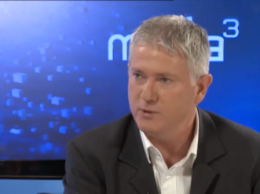
Palestinian advocate Issa Amro has been nominated for the Nobel Peace Prize this year for his decades of work advocating for peaceful resistance against Israel’s illegal settlements in the occupied West Bank.
The settlements are illegal under international law — and a record 45 were established last year under cover of the war on Gaza,
Advocacy against the settlements has seen Amro become a target.
He is based in the occupied West Bank, in Hebron — a city of about 250,000 mostly Palestinian people. He founded Youth Against Settlements.
He paints a picture about what daily life is like.
“Our life in West Bank was very hard and difficult before October 7 [2023 – the date of the Hamas resistance movement attack on southern Israel]. And after October 7, life became much harder. . . .
‘Daily harassment, violence’ “So there are hard conditions. No jobs. No work. No movement in the West Bank. Schools are affected . . . There is daily harassment and violence — they attack the Palestinian villages, they attack the Palestinian cities, they attack the Palestinian roads.
“In my city Hebron, it has got much, much harder. People are not able to leave their homes because of the closure of the checkpoints. The [Israeli] soldiers are very mean and adversarial . . .
“The soldiers close the checkpoints whenever they want. In fact, the soldiers act like militia, not like a regular army.
“My house was attacked in the last 20 months . . . ”
At least 55,104 people, including at least 17,400 children, have been killed in Israel’s war on Gaza. At least 943 Palestinians, more than 200 of them minors, have been killed in the occupied West Bank.
This article is republished under a community partnership agreement with RNZ.
Analysis and Notes by Selwyn Manning: Prep for Radio New Zealand – Israel Strikes Against Iran – June 13, 2025.
Listen to the audio from 3:00 minutes in.
Selwyn Manning, editor of EveningReport.nz.
Over the last 24 hours, the atomic control agency IAEA (International Atomic Energy Agency) formed a view at its UN Geneva meeting, that there was so-called evidence that Iran had ‘undisclosed sites’ where uranium was identified.
Iran disputes this, and suggested today that the IAEA members were wrong.
It appears Israel identified a window of opportunity where it can strike Iran’s nuclear power generation infrastructure, assassinate its nuclear scientists, and destroy other sites that it insists are covert nuclear-development-sites.
But let’s be clear at this moment, it is not proven that Iran has or had a covert uranium enrichment operation in play.
ISRAEL CLAIMS:
Israel claims its attacks on Iran are justified as preemptive defence operations – but we need to understand here… preemptive defence in itself is not legal.
The problem on this aspect is Israel has arguably, long ago, crossed the Rubicon regarding International Law – especially in Gaza and the West Bank. So it’s reasonable to suggest; Israel is not deterred by the possibility of any future recourse being brought upon it by the international community.
CONTEXT:
Iran is believed to be not war-ready. But, Iran will respond. Its Supreme Leader stated it will respond. It remains to be seen how it will respond.
At this moment, there are reports in Israel that over 100 missiles are incoming from Iran to Israel.
We also know, Israel has weakened Hezbollah, especially within Lebanon. The strikes on Beirut earlier this month and prior were designed to weaken Hezbollah.
Further, Syria is in a state of transition.
This is the backdrop to Israel’s window of opportunity.
THE UNITED STATES:
The United States obviously knew a strike was imminent. It pulled non-essential personnel out of neighbouring Iraq and from the general region.
United States President Donald Trump has confirmed that there was communication on this offensive between Israel and the US, in the context of no-surprises.
Trump added that the US would help defend Israel, but it’s unclear what ‘defend’ actually means. The US appears to be waiting to see exactly how Iran responds.
The Trump Administration insists Israel’s decision to strike Iran was unilateral. United States Secretary of State Marco Rubio said today: “We are not involved in strikes against Iran, and our top priority is protecting American forces in the region.”
IRAN’S POSITION:
Last Sunday, the Iranian President said Iran was “ready for inspections” but added it is “unacceptable to deprive peoples of access to knowledge, technology and scientific achievements”.
*** Only yesterday Iran’s foreign minister stated that Iran and the US were close to a deal on its nuclear energy ambitions. In a statement he said: “Trump took office saying that Iran should not have nuclear weapons. In fact, this is in line with our own doctrine and could be the main basis for the deal.”
Perhaps Israel saw its window of opportunity narrowing.
Iran insists its nuclear energy programme has been transparent.
BACK-STORY:
In negotiations with United States envoys, Iran has been insisting that it has the right to enrich its uranium but insists this is for efficient energy generation.
Back in May Iran’s foreign minister said: To claim that any country that wants to enrich uranium has non-peaceful purposes is a “deliberate misconception”
He stressed. “There are states that enrich uranium but do not possess nuclear weapons.”
LEAKS ISRAEL GOVERNMENT INTELLIGENCE:
On June 7, Iran’s Intelligence Minister claimed Iran had acquired trove of Israel Government documents that detailed Israel’s nuclear program.
Iran described the intelligence as “sensitive and strategic” and one of the most significant intelligence leaks in Israel’s history.
The intelligence documents also detailed communications between Israel and the United States, Europe and other countries.
OTHER CONTEXT:
The Russian Federation announced this week that it was willing to assist Iran with its nuclear energy ambitions.