Category: Military Intelligence

  • MIL-OSI USA: Army releases version 2.0 of its unified network plan

    Source: United States Army

    WASHINGTON – The U.S. Army has released its Army Unified Network Plan 2.0. While the first AUNP, published in 2021, focused mainly on the first phase of the plan – to unifying the network – AUNP 2.0 focuses mainly on phase two and some of phase three, which are to “operationalize the Unified Network” from 2024 to2026, and to “continuously modernize and transform the Unified Network” in 2027 and beyond.

    Since the publication of the first AUNP – which provided the roadmap for converging Army tactical and enterprise networks around common standards, systems and security to “reduce complexity and increase integration” across the force – global events and emerging technologies have resulted in a persistently contested information environment. As a result, a far more data-centric approach to the Army Network is needed to harness its power to fight and win during multidomain operations.

    Reflecting these changes, AUNP 2.0 focuses on five lines of effort to complete the Army’s portion of the Department of Defense Information Network: 1) establish the Unified Network; 2) posture the force to support MDO; 3) ensure security and survivability based on zero trust principles; 4) transform the Army’s Unified Network investments, policy and governance; and 5) continuously improve the Unified Network.

    “AUNP 2.0 is new guidance on how the warfighter actually approaches, accelerates and operationalizes the Unified Network across the board,” said Lt. Gen. Jeth Rey, the Army’s Deputy Chief of Staff, G-6. “It’s going to enable multidomain operations and chart the roadmap of where we’re going for the Unified Network by 2027. It also talks about the critical enablers required to achieve a multidomain operational Army by 2030.”

    AUNP 2.0 provides a path to reduce technological complexity at the edge by enhancing the Army’s ability to execute MDO; ensuring the Army’s ability to seamlessly plug in anywhere around the globe; continuing the establishment and employment of common data standards and systems for all theaters and domains by ensuring the necessary security, agility and interoperability to stay ahead of adversaries; and enabling faster, more secure data sharing with partners and allies.

    “As warfare continues to evolve across multiple domains and our adversaries challenge our historical dominance, the Army’s dedication to integrating and modernizing its network infrastructure is crucial.” the AUNP 2.0’s conclusion states. “The Unified Network is essential to the future force’s success, enabling seamless and effective operations across air, land, sea, space, and cyberspace…. The AUNP 2.0 sets a direction for technological superiority and operational readiness for an uncertain future.”

    To read the Army Unified Network Plan 2.0, click here.

    MIL OSI USA News

  • MIL-OSI Security: Former Colombian Navy Personnel Extradited To The United States For Their Role In Selling Locations Of Colombian Navy Drug Interdiction Vessels To International Drug Traffickers

    Source: Office of United States Attorneys

    Tampa, Florida – Acting United States Attorney Sara C. Sweeney announced the extraditions of Jair Alberto Alvarez Valenzuela (54) and Luis Carlos Diaz Martinez (32), both from Colombia, to stand trial on an indictment for conspiracy to distribute cocaine having reasonable cause to believe it would be unlawfully imported into the United States. Alvarez Valenzuela and Diaz Martinez were extradited to the United States on March 13, 2025, from Colombia. If convicted, both defendants face a maximum penalty of life in federal prison. 

    According to the indictment, Alvarez Valenzuela and Diaz Martinez were former employees of the Colombian Navy. In exchange for money from drug traffickers they recruited active-duty members of the Colombian Navy to secretly plant global positioning system (GPS) tracking devices in Colombian Navy vessels. Transnational Criminal Organizations used the location data derived from these tracking devices to direct vessels filled with cocaine bound for the United States around Colombian Navy ships and patrols. 

    An indictment is merely a formal charge that a defendant has committed one or more violations of federal criminal law, and every defendant is presumed innocent unless, and until, proven guilty.

    This prosecution is part of an Organized Crime Drug Enforcement Task Forces (OCDETF) Strike Force Initiative, which provides for the establishment of permanent multi-agency task force teams that work side-by-side in the same location. This co-located model enables agents from different agencies to collaborate on intelligence-driven, multi- jurisdictional operations to disrupt and dismantle the most significant drug traffickers, money launderers, gangs, and transnational criminal organizations.

    The specific mission of the OCDETF Panama Express Strike Force is to disrupt and dismantle Transnational Criminal Organizations involved in large-scale drug trafficking, money laundering, and related activities. The OCDETF Panama Express Strike Force is comprised of agents and officers from the Coast Guard Investigative Service, Drug Enforcement Administration, Federal Bureau of Investigation, and Homeland Security Investigation. The Department of Justice’s Office of International Affairs and the Criminal Division’s Narcotic and Dangerous Drug Section’s Office of the Judicial Attaché in Bogotá, Colombia provided significant assistance in securing the arrests and extraditions of these defendants. This case is being prosecuted by Assistant United States Attorney Lauren Stoia.

    MIL Security OSI

  • MIL-OSI Global: A ‘golden age’ of global free trade is over. Smaller alliances can meet the moment

    Source: The Conversation – France – By Armin Steinbach, Professor of Law and Economics, HEC Paris Business School

    The global trade landscape is shifting, and not in the way free traders had hoped. For decades, the belief that economic openness could foster peace and stability reigned supreme. Trade, it was argued, could transform authoritarian regimes into more peaceful players. But Russia’s invasion of Ukraine has shattered this way of thinking. Rather than mourning the end of a multilateralism based on states’ commitments to jointly agreed trade rules, we should see it as a necessary adjustment to a world where economic security takes precedence over market efficiency, and resilience over cost minimization.

    The World Trade Organization (WTO), which has constrained protectionism since its inception in 1995, is no longer the linchpin of global trade it once was. Multilateral trade talks have stagnated, and the WTO’s dispute settlement system is in paralysis. The US, once a champion of rules-based trade, now finds strategic advantage in a world where power dynamics outweigh legal frameworks. Years of negotiations on agriculture and fisheries subsidies have yielded little progress, underscoring the difficulty of reaching consensus among increasingly divergent national interests.


    A weekly e-mail in English featuring expertise from scholars and researchers. It provides an introduction to the diversity of research coming out of the continent and considers some of the key issues facing European countries. Get the newsletter!


    Consider the Uruguay Round negotiations in the 1990s that led to the establishment of the WTO – a rare moment when 123 countries found common ground on liberalizing trade in goods, services and intellectual property. That success stemmed from a broad agenda that offered enough variety to create win-win scenarios for all. Today, narrow negotiation agendas make compromise far harder to achieve.

    Free trade agreements are emerging less frequently: the average number of new trade agreements per year since 2020 is less than half the average of the previous decade. Meanwhile, protectionist measures have proliferated: there were about five times as many in 2023 as in 2015. Regardless of US President Donald Trump’s tariff frenzy, governments are erecting trade barriers and adopting policies that favour domestic industries, driven by the need to secure critical supply chains.

    The trend is clear: trade liberalization is no longer the top priority for most countries. Instead, security concerns are reshaping trade policy, echoing the arguments of the 18th-century philosopher Adam Smith. In The Wealth of Nations, Smith argued that national defence is more valuable than economic wealth. (“Defence,” he wrote, “is of much more importance than opulence”). This idea feels particularly relevant today. In a world of geopolitical conflict, trade is often yielding to strategic concerns.

    The United Nations, despite its mission to maintain peace, has struggled to prevent conflict. If international law cannot deter aggression, economic policy must step in.

    Security-driven trade

    For the EU, this translates into using its trade policy instruments, especially vis-à-vis China, on the basis of a careful dependency analysis that identifies strategic commodities and products. As the European Commission sets self-sufficiency benchmarks for green technologies following the bloc’s Net-Zero Industry Act, it errs if it sees the substitution of domestic products for imports as the right way to reduce dependencies. In most cases, reducing import concentration will require diversifying suppliers rather than European self-production.

    Security-driven trade requires shifting away from fragile multilateralism toward more selective, regional alliances. These “trade clubs” would align economic interests with shared security priorities. The EU’s strengthening ties with the South American Mercosur states, a group of non-hegemonic countries reliant on open trade, exemplify this approach. Intensifying trade with targeted countries could be the best response to Trump’s tariffs, avoiding the lose-lose outcome of tit-for-tat tariff wars. The goal of autonomy from an unpredictable US offers a good framework for crafting new bilateral relationships.

    Another example is the idea of a “climate club”, which policy-makers have discussed for some time. Climate clubs would consist of countries that agree on joint strategies to reduce carbon emissions while fostering energy security and protecting their economies from competitors without adequate carbon pricing.


    À lire aussi :
    Trump protectionism and tariffs: a threat to globalisation, or to democracy itself?


    The challenge is to distinguish between “legitimate” and “illegitimate” security claims. The latter refer to countries’ growing abuse of the national security card to justify trade policies. WTO dispute settlement panels ruled against the “self-judging” character of national security claims, hence subjecting them to legal scrutiny, but this “rule of law” approach has only heightened rejection of the WTO system on the US side. To limit abuse, the EU should seek alignment with the US on issues of common concern, such as responding to industrial overcapacity or preventing technology leaks. A joint approach could avert nationalist unilateralism.

    A new focus for the WTO

    Some worry this shift away from multilateralism could disadvantage poorer nations, leaving them vulnerable to the whims of powerful ones. However, regional trade alliances can empower smaller states. For example, the African Continental Free Trade Area (AfCFTA) gives African nations collective bargaining power they might lack individually. Since its inception with 22 signatories, AfCFTA has grown to include 48 countries, enhancing the continent’s influence in global trade.

    Abandoning multilateralism doesn’t mean sidelining the WTO entirely. Instead, the WTO can refocus on smaller, “plurilateral” agreements among like-minded countries. This “coalition of the willing” approach has already proven effective in areas like e-commerce and investment facilitation. The WTO can remain a forum for building consensus, but its future lies in fostering flexible partnerships rather than pursuing grand, all-encompassing trade deals. In a fragmented world, these smaller agreements could yield the most meaningful progress. Nascent but promising plurilateral efforts are under way to tackle fossil fuel subsidies and environmentally sustainable plastics trade.

    The golden age of global free trade may be over, but that doesn’t spell disaster. As nations grapple with security challenges, trade policy must evolve to reflect new priorities. Strategic alliances, diversified supply chains and targeted trade agreements will shape the future of global commerce. Rather than lament the decline of multilateralism, we should embrace this shift as a necessary response to a more volatile world. In doing so, we can craft a trade policy that prioritizes resilience and security, safeguarding both economic stability and national interests.

    Armin Steinbach ne travaille pas, ne conseille pas, ne possède pas de parts, ne reçoit pas de fonds d’une organisation qui pourrait tirer profit de cet article, et n’a déclaré aucune autre affiliation que son organisme de recherche.

    ref. A ‘golden age’ of global free trade is over. Smaller alliances can meet the moment – https://theconversation.com/a-golden-age-of-global-free-trade-is-over-smaller-alliances-can-meet-the-moment-251438

    MIL OSI – Global Reports

  • MIL-OSI United Nations: UN staff member killed in central Gaza blast, five others injured

    Source: United Nations 2

    Peace and Security

    At least one UN staffer has been killed and at least five others injured – several very severely – following an explosion at their official premises in Deir al Balah in the central Gaza Strip on Wednesday.

    The UN is verifying and confirming the details, including the circumstances that led up to the incident, but it was not due to “any action” that was being taken by UN personnel to remove “unexploded ordinance”, the head of the UN Office for Project Services (UNOPS) said during a press conference in Brussels.

    According to media reports, the Israeli military – which has resumed deadly strikes in the Gaza Strip, killing hundreds since Monday – has denied attacking the compound.

    These premises were well known by the Israel Defense Forces (IDF) and they were ‘deconflicted’,” said, UNOPS chief Jorge Moreira da Silva, explaining that “everyone knew who was working inside the premises – it was UN personnel, UNOPS personnel.”

    No accident

    “This was not an accident, this was an incident,” he told journalists, adding that additional information is being collected.

    What we do know is that an explosive ordnance was dropped or fired at the infrastructure and detonated inside the building,” he said, adding it was unclear if it had been due to air-drop weapons, artillery or rocket fire.

    Mr. da Silva stressed that attacks against humanitarian premises are a breach of international law.  

    “UN personnel and its premises must be protected by all sides. The civilian population relies on the UN for lifesaving assistance, they are an essential lifeline at the time of utter tragedy and devastation,” he said.

    Previous attacks

    The incident took place at around 11:30 AM local time on Wednesday. It followed strikes on Tuesday that resulted in some damage, and “a near miss” on Monday, Mr. da Silva said.

    The UNOPS building is situated in an “isolated area” in Dier al Balah.

    UN Brussels/Jorge Varas Mardones

    UNOPS Executive Director Jorge Moreira da Silva (right) speaking to the press in the Belgian capital, Brussels.

    More to come on this developing story…

    MIL OSI United Nations News

  • MIL-OSI Global: Israel’s war on Gaza is deliberately targeting children – new UN report

    Source: The Conversation – UK – By Rachel Rosen, Associate Professor of Childhood, UCL

    A fresh round of Israeli airstrikes on Gaza which has killed more than 400 Palestinians has destroyed any hope that the ceasefire negotiated in January would hold. A statement from the child rights group Defence for Children Palestine claimed that 174 children had been killed in the bombing, claiming: “Today is one of the deadliest days for Palestinian Children in history.”

    The renewed bombing follows repeated violations of the ceasefire terms by Israel and comes days after a report commissioned by the United Nations said Israel is “deliberately inflicting conditions of life calculated to bring about the physical destruction of Palestinians as a group”. The March 13 report from the UN Independent International Commission of Inquiry on the Occupied Palestinian Territory examines what it calls Israel’s “systematic use of
    sexual, reproductive and other forms of gender-based violence
    since 7 October 2023”.

    The report alleges deliberate acts have been aimed against mothers and children, including the destruction of Gaza’s main fertility clinic, Basma IVF clinic, which it said amounted to “a genocidal act under the Rome Statute and Genocide Convention”. It concluded that “this was done with the intent to destroy the Palestinians in Gaza as a group, in whole or in part, and that this is the only inference that could reasonably be drawn from the acts in question”.

    The International Court of Justice (ICJ) has yet to rule on a case brought by South Africa in December 2023 accusing Israel of committing genocide in Gaza. In January 2024 it issued a ruling saying that Palestinians in Gaza had “plausible rights to protection from genocide” and set out provisional measures that Israel should follow to prevent genocide. There is no evidence that Israel has heeded this advice.

    Addressing the UN human rights committee in October 2024, special rapporteur Francesca Albanese said she believed it is important to “call a genocide as a genocide”. While noting the legal position according to the ICJ, we agree with her on the grounds that a post-hoc judgement of genocide does nothing to prevent it from occurring.

    Francesca Albanese addresses the United Nations, October 2024.

    The commission’s report is not the first time that international organisations and lawmakers have called attention to Israel’s violence against Palestinian mothers and children. In March 2024, Philippe Lazzarini, the commissioner-general of the UN agency Unrwa, wrote on X: “This is a war on children. It is a war on their childhood and their future.” The numbers are “staggering” he said. More children had been killed in Gaza in four months than in all global conflicts in the previous four years.

    This has continued throughout Israel’s assault on Gaza. Between October 7 2023 and January 15 2025, children made up at least 18,000 of the 46,707 Palestinians killed in Gaza, according to data collected by the Gaza health ministry. Both figures are likely to be underestimates, as so many bodies remain buried under the rubble.

    Most children have been killed by direct military strikes. Israel has dropped an estimated 85,000 tonnes of explosives on Gaza, killing Palestinians through direct hits, biolding collapses, fires and inhalation of toxic substances. Doctors have also reported evidence of children being killed in drone attacks and by snipers, including by shots to the head and chest.

    On March 2 Israel blocked the entry of humanitarian aid into Gaza, using starvation and dehydration as military strategy. On March 15 a Unicef report claimed that 31% of children under two years of age in the north of the Strip were acutely malnourished. There has also been a “dramatic increase in child deaths due to acute malnutrition”.

    Israel’s destruction of medical and other infrastructure in the strip has resulted in “indirect deaths” by communicable illness and noncommunicable conditions. In April 2024, a report published in science journal Frontiers found that more than 90% of children in Gaza were affected by infectious diseases. There have also been multiple infant deaths from hypothermia as displaced families attempt to survive winter conditions.

    Killing the future

    The abnormally high child death rate is partly down to demographics. About 47% of Gaza’s population was under 18 years of age at the end of 2022. Children are generally more “susceptible to dehydration, diarrhoea, disease, and malnutrition” according to Unicef which says the nutritional needs for infants under 23 months “are greater per kilogram of bodyweight than at any other time of life”.

    But the problem with these arguments is that they make child mortality rates in Gaza appear as a simple reflection of natural factors. They are not. They are a direct consequence of Israel’s military aggression in Gaza.

    Israel has systematically used powerful explosives in densely populated areas and, through AI tracking systems such as “Where’s Daddy?”, deliberately targeted Palestinians in their family homes. Given the deep evidence base about childhood health, the logical outcome of using starvation as a method of war, actively denying aid, and destroying infrastructures that enable life is that children will die disproportionately.

    Palestinian children are being killed by design. This has been explicitly articulated by the Israeli state.

    Itamar Ben-Gvir, who was this week reappointed to the Netanyahu government as police minister, has publicly defended the army’s “open-fire” directive declaring: “We cannot have women and children getting close to the border … anyone who gets near must get a bullet in the head.” In January, MP and deputy speaker of the Knesset, Nissim Vaturi, said every child born in Gaza is “already a terrorist, from the moment of his birth”.

    But children represent their community’s dreams for their futures. Killing large number of children in Gaza is not simply forcible depopulation. It is an effort to destabilise communities and crush their hopes for liberation and the right of return as mandated by the UN.

    Palestinian children in Gaza have been telling their stories to a global audience. The killing, injury and starvation they are testifying to has proved a powerful counternarrative to the idea that Israel is simply “defending itself”. International humanitarian law states that: “Children affected by armed conflict are entitled to special respect and protection.”

    But in Gaza, children are being killed in their thousands.

    Rachel Rosen receives funding from Independent Social Research Foundation. She is affiliated with BDS @ UCL.

    Mai Abu Moghli is a policy member at Al- Shabaka: the Palestinian Policy Network.

    ref. Israel’s war on Gaza is deliberately targeting children – new UN report – https://theconversation.com/israels-war-on-gaza-is-deliberately-targeting-children-new-un-report-252398

    MIL OSI – Global Reports

  • MIL-OSI Security: Florida Attorney Sentenced to 102 Months for an Attempted Bombing Near the Chinese Embassy in Washington, D.C.

    Source: Federal Bureau of Investigation (FBI) State Crime News

               WASHINGTON – Christopher Rodriguez, 45, of Panama City, Fla., was sentenced today to 102 months in federal prison for the September 2023 attempted bombing near the Embassy of the People’s Republic of China in Washington, D.C., and for the November 2022 bombing of a satirical sculpture depicting communist leaders Vladimir Lenin and Mao Zedong in San Antonio, Texas.

               The sentence was announced by U.S. Attorney Edward R. Martin, Jr., and Special Agent in Charge Anthony Spotswood of the Bureau of Alcohol, Tobacco, Firearms and Explosives, Washington Field Division. 

               Rodriguez, a licensed Florida attorney and a U.S. Army veteran, pleaded guilty August 2, 2024, to damaging property occupied by a foreign government, explosive materials—malicious damage to federal property, and receipt or possession of an unregistered firearm (destructive device). 

               In addition to the 102-month prison term, U.S. District Court Chief Judge James E. Boasberg ordered Rodriguez to serve three years of supervised release.

               According to court documents, on September 23-24, 2023, Rodriguez drove from his home in Panama City, Fla., to Northern Virginia with a rifle and 15 pounds of explosive material. On the way, he stopped in Harrisonburg and Charlottesville, Va., to buy a black backpack, nitrile gloves, and a burner cell phone. On September 24, he parked his car in Arlington, Va., and used the burner phone to arrange for a taxi to drive him to within a few blocks of the Chinese Embassy. Between midnight and 3 a.m. near the back wall of the Embassy in Northwest Washington, Rodriguez placed the explosives-filled backpack next to a streetlight. Rodriguez then attempted to detonate the explosives by shooting at the backpack with a rifle. Rodriguez missed his target, and the device failed to detonate. Law enforcement officers later recovered the backpack containing explosive material, three shell casings, and bullet fragments from the ground along the outer perimeter wall of the Chinese Embassy. Impact marks were found on the Embassy wall near the bullet fragments behind the backpack.

               According to court documents, DNA obtained from the black backpack was found to be consistent with DNA evidence obtained from a previous arrest of Rodriguez in June 2021 in California. During the California incident, Rodriguez possessed three firearms and apparent explosive material consistent with the explosives used during the Chinese Embassy attack. DNA evidence obtained from Rodriguez pursuant to a buccal swab warrant later confirmed this DNA match.

             Between November 5 and 7, 2022, according to court documents, Rodriguez rented a vehicle in Pensacola, Fla., and drove to San Antonio, Texas. At about 2:25 a.m. on November 7, Rodriguez scaled an eight-foot fence to enter a courtyard on the 300 block of West Commerce Street, San Antonio. Inside the courtyard, he placed two canisters of explosive materials at the base of a satirical steel sculpture titled “Miss Mao Trying to Poise Herself at the Top of Lenin’s Head.” At 2:30 a.m., Rodriguez used a rifle to shoot at the canisters at the base of the statue, causing an explosion that caused damages of at least $325,000 to the Miss Mao sculpture.

    Law enforcement arrested Rodriguez on November 4, 2023, in Lafayette, Louisiana. He has been held since that date. 

               This case was investigated by the Bureau of Alcohol, Tobacco, Firearms, and Explosives (ATF), Washington Field Division. Valuable assistance was provided by the U.S. Attorney’s Offices for the Northern District of Florida, the Western District of Louisiana, and the Western District of Texas; the ATF’s Tampa, New Orleans, and Houston Field Divisions; the FBI’s Washington and San Antonio Field Offices; the San Antonio Field Office of the Department of Homeland Security, Homeland Security Investigations; the U.S. Secret Service, Uniformed Division and Foreign Missions Detective Unit; the U.S. Department of State, Bureau of Diplomatic Security; and the Metropolitan Police Department. 

                The case is being prosecuted by Assistant U.S. Attorneys Jolie F. Zimmerman and Stuart D. Allen. Valuable assistance was provided by Assistant U.S. Attorneys Maeghan Mikorski and Kelly Stephenson and former Assistant U.S. Attorney Michael McCarthy.

    23cr392

    MIL Security OSI

  • MIL-OSI Security: Defense News: USNS John Lewis Completes First Fleet Tasked Underway Replenishment

    Source: United States Navy

    Military Sealift Command fleet replenishment oiler, USNS John Lewis (T-AO 205) became the first ship in the new John Lewis class to conduct a fleet task under Commander, U.S. Third Fleet, by refueling the U.S. Navy guided-missile destroyer USS Mustin (DDG 89) of the coast of Southern California Saturday.

    MIL Security OSI

  • MIL-OSI Global: As mountain glaciers melt, risk of catastrophic flash floods rises for millions − World Day for Glaciers carries a reminder

    Source: The Conversation – USA – By Suzanne OConnell, Harold T. Stearns Professor of Earth Science, Wesleyan University

    Imja Lake, a glacial lake in the Mount Everest region of Nepal, began as meltwater ponds in 1962 and now contains 90 million cubic meters of water. Its water level was lowered to protect downstream communities. Alton Byers

    In mountain ranges around the world, glaciers are melting as global temperatures rise. Europe’s Alps and Pyrenees lost 40% of their glacier volume from 2000 to 2023. These and other icy regions have provided freshwater for people living downstream for centuries – almost 2 billion people rely on glaciers today. But as glaciers melt faster, they also pose potentially lethal risks.

    Water from the melting ice often drains into depressions once occupied by the glacier, creating large lakes. Many of these expanding lakes are held in place by precarious ice dams or rock moraines deposited by the glacier over centuries.

    Too much water behind these dams or a landslide into the lake can break the dam, sending huge volumes of water and debris sweeping down the mountain valleys, wiping out everything in the way.

    These risks and the loss of freshwater supplies are some of the reasons the United Nations declared 2025 the International Year of Glaciers’ Preservation and March 21 the first World Day for Glaciers. As an Earth scientist and a mountain geographer, we study the impact that ice loss can have on the stability of the surrounding mountain slopes and glacial lakes. We see several reasons for increasing concern.

    Erupting ice dams and landslides

    Most glacial lakes began forming over a century ago as a result of warming trends since the 1860s, but their abundance and rates of growth have risen rapidly since the 1960s.

    Many people living in the Himalayas, Andes, Alps, Rocky Mountains, Iceland and Alaska have experienced glacial lake outburst floods of one type or another.

    A glacial lake outburst flood in the Himalayas in October 2023 damaged more than 30 bridges and destroyed a 200-foot-high (60-meter) hydropower plant. Residents had little warning. By the time the disaster was over, more than 50 people had died.

    Juneau, Alaska, has been hit by several flash floods in recent years from a glacial lake dammed by ice on an arm of Mendenhall Glacier. Those floods, including in 2024, were driven by a melting glacier that slowly filled a basin below it until the basin’s ice dam broke.

    Scientists investigate flooding from Mendenhall Glacier’s Suicide Basin.

    Avalanches, rockfalls and slope failures can also trigger glacial lake outburst floods. These are growing more common as frozen ground known as permafrost thaws, robbing mountain landscapes of the cryospheric glue that formerly held them together. These slides can create massive waves when they plummet into a lake. The waves can then rupture the ice dam or moraine, unleashing a flood of water, sediment and debris.

    That dangerous mix can rush downstream at speeds of 20-60 mph (30-100 kph), destroying homes and anything else in its path.

    The casualties of such an event can be staggering. In 1941, a huge wave caused by a snow and ice avalanche that fell into Laguna Palcacocha, a glacial lake in the Peruvian Andes, overtopped the moraine dam that had contained the lake for decades. The resulting flood destroyed one-third of the downstream city of Huaraz and killed between 1,800 and 5,000 people.

    Teardrop-shaped Lake Palcacocha, shown in this satellite view, has expanded in recent decades. The city of Huaraz, Peru, is just down the valley to the right of the lake.
    Google Earth, data from Airbus Data SIO, NOAA, U.S. Navy, NGA, GEBCO

    In the years since, the danger there has only increased. Laguna Palcacocha has grown to more than 14 times its size in 1941. At the same time, the population of Huaraz has risen to over 120,000 inhabitants. A glacial lake outburst flood today could threaten the lives of an estimated 35,000 people living in the water’s path.

    Governments have responded to this widespread and growing threat by developing early warning systems and programs to identify potentially dangerous glacial lakes. Some governments have taken steps to lower water levels in the lakes or built flood diversion structures, such as walls of rock-filled wire cages, known as gabions, that divert floodwaters from villages, infrastructure or agricultural fields.

    Where the risks can’t be managed, communities have been encouraged to use zoning that prohibits building in flood-prone areas. Public education has helped build awareness of the flood risk, but the disasters continue.

    Flooding from inside and thawing permafrost

    The dramatic nature of glacial lake outburst floods captures headlines, but those aren’t the only risks. As scientists expand their understanding of how the world’s icy regions interact with global warming, they are identifying a number of other phenomena that can lead to similarly disastrous events.

    Englacial conduit floods, for instance, originate inside of glaciers, commonly those on steep slopes. Meltwater can collect inside massive systems of ice caves, or conduits. A sudden surge of water from one cave to another, perhaps triggered by the rapid drainage of a surface pond, can set off a chain reaction that bursts out of the ice as a full-fledged flood.

    An englacial conduit flood begins in the Himalayas. Elizabeth Byers.

    Thawing mountain permafrost can also trigger floods. This permanently frozen mass of rock, ice and soil has been a fixture at altitudes above 19,685 feet (6,000 meters) for millennia.

    Freezing helps keep mountains together. But as permafrost thaws, even solid rock becomes less stable and is more prone to breaking, while ice and debris are more likely to become detached and turn into destructive and dangerous debris flows. Thawing permafrost has been increasingly implicated in glacial lake outburst floods because of these new sources of potential triggers.

    In 2017, nearly a third of the solid rock face of Nepal’s 29,935-foot (6,374-meter) Saldim Peak collapsed and fell onto the Langmale glacier below. Heat generated by the friction of rock falling through air melted ice, creating a slurry of rock, debris and sediment that plummeted into Langmale glacial lake below, resulting in a massive flood.

    A glacial outburst flood in Barun Valley started when nearly one-third of the face of Saldim Peak in Nepal fell onto Langmale Glacier and slid into a lake. The top image shows the mountain in 2016. The lower shows the same view in 2017.
    Elizabeth Byers (2016), Alton Byers (2017)

    These and other forms of glacier-related floods and hazards are being exacerbated by climate change.

    Flows of ice and debris from high altitudes and the sudden appearance of meltwater ponds on a glacier’s surface are two more examples. Earthquakes can also trigger glacial lake outburst floods. Not only have thousands of lives been lost, but billions of dollars in hydropower facilities and other structures have also been destroyed.

    Impermanent frost. Nepali Times.

    A reminder of what’s at risk

    The International Year of Glaciers’ Preservation and World Day for Glaciers are reminders of the risks and also of who is in harm’s way.

    The global population depends on the cryosphere – the 10% of the Earth’s land surface that’s covered in ice. But as more glacial lakes form and expand, floods and other risks are rising. A study published in 2024 counted more than 110,000 glacial lakes around the world and determined 10 million people’s lives and homes are at risk from glacial lake outburst floods.

    The U.N. is encouraging more research into these regions. It also declared 2025 to 2034 the “decade of action in cryospheric sciences.” Scientists on several continents will be working to understand the risks and find ways to help communities respond to and mitigate the dangers.

    Suzanne OConnell receives funding from The National Science Foundation

    Alton C. Byers does not work for, consult, own shares in or receive funding from any company or organization that would benefit from this article, and has disclosed no relevant affiliations beyond their academic appointment.

    ref. As mountain glaciers melt, risk of catastrophic flash floods rises for millions − World Day for Glaciers carries a reminder – https://theconversation.com/as-mountain-glaciers-melt-risk-of-catastrophic-flash-floods-rises-for-millions-world-day-for-glaciers-carries-a-reminder-251707

    MIL OSI – Global Reports

  • MIL-OSI Global: Fires, wars and bureaucracy: The tumultuous journey to establish the US National Archives

    Source: The Conversation – USA – By Elizabeth Call, University Archivist, RIT Libraries and Archives, Rochester Institute of Technology

    The 1952 procession to deliver the Declaration of Independence and Constitution from the Library of Congress to the National Archives included military guards and a tank. National Archives

    Some of the United States’ most important historical documents, including the Declaration of Independence, the Constitution, the Bill of Rights and the Emancipation Proclamation, are housed in the U.S. National Archives. Beyond these high-profile items, it also preserves lesser-known but no less vital records, such as national park master plans, polar exploration documents and the records of all U.S. veterans. Together, these materials stand as a testament to the country’s commitment to preserving its history.

    While these crucial documents in U.S. history now have a home in the National Archives, the road to establishing this institution was paved with catastrophic losses and bureaucratic inertia.

    Creating the National Archives required decades of advocacy by historians, politicians and government officials. The National Archives was not simply an administrative convenience – it was a necessity born from repeated disasters that underscored the fragility of government records. And with President Donald Trump’s firing of the head archivist in February 2025, as well as the loss of several high-level archives staff members, the organization faces a new era of uncertainty.

    Documentary heritage – the recorded memory of a nation that preserves its cultural, historical and legal legacy – is essential for a country as it safeguards its identity, informs its governance and ensures that future generations can understand and learn from the past.

    I am a university archivist with two decades of experience in the library and archives field. I oversee the preservation and accessibility of historical records at Rochester Institute of Technology, advocate for inclusivity, and engage in national conversations on the evolving role of archives in the digital age.

    Understanding the precarious nature of historical records, it’s clear to me that maintaining, staffing and funding the National Archives is a necessary safeguard against the destruction of the nation’s documentary heritage.

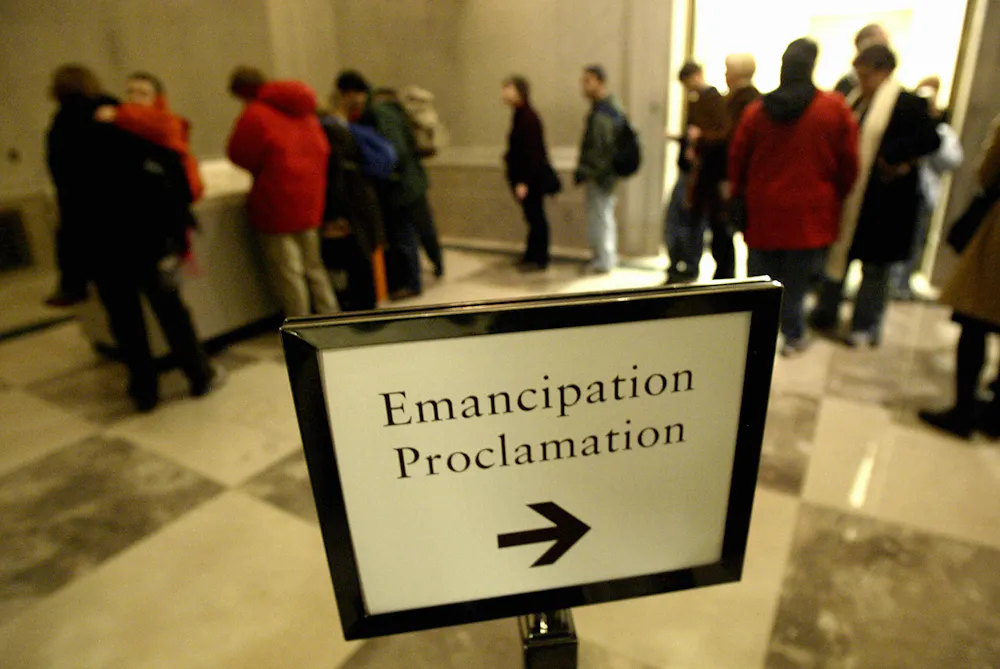
    People line up to view the original Emancipation Proclamation on Martin Luther King Jr. Day, Jan. 19, 2004, at the National Archives building in Washington, D.C.
    Tim Sloan/AFP-Getty Images

    Destroyed by fire

    The idea of preserving the government’s records dates back to the country’s founding. Charles Thomson, secretary of the Continental Congress during the American Revolution and then secretary of Congress under the Articles of Confederation, recognized the need for proper storage of the Congress’ records.

    But the young nation lacked the money and infrastructure to act. Many of the Continental Congress’ records were kept by Thomson himself for years, and while some were later transferred to the Department of State, others were lost.

    Throughout the 19th and early 20th centuries, fires repeatedly ravaged federal records. Fires were very common in the 19th century due to a combination of highly flammable building materials, open frames used for lighting and heating, and the lack of modern fire safety measures such as sprinklers and fire-resistant construction.

    In 1800, a blaze destroyed the War Department’s archives, a loss that severely hampered government operations. In 1810, Congress authorized better housing for government records, but the law was never fully executed. Instead, different parts of the government, from the Department of State to the Department of Treasury, continued maintaining their own records.

    The Treasury Department suffered fires in 1801 and again in 1833, further erasing crucial financial records. The Patent Office, home to invaluable documentation of American innovation, burned in 1877, having already been damaged by an 1836 fire.

    Storage at the federal Office of Indian Affairs in 1935.
    National Archives Foundation

    One of the most devastating losses occurred in 1921 when a fire at the Department of Commerce destroyed nearly all records from the 1890 federal census. This loss had far-reaching consequences, particularly for genealogical and demographic research.

    Fires weren’t the only threat to the government’s records.

    “It is a matter of common report that during the civil war, great quantities of documents stored in the Capitol were thrown away to make quarters for soldiers,” Historian and founding member of the American Historical Association J. Franklin Jameson noted in a 1911 Washington Post article.

    “At a later date,” he added, “the archives of the House of Representatives were systematically looted for papers having a market value because of their autographs.”

    Jameson spent decades lobbying Congress for a centralized repository. His persistence, coupled with the advocacy of key officials, laid the groundwork for future action.

    A bound copy of George Washington’s account of expenses while commander in chief of the Continental Army.
    National Archives and Records Administration

    These repeated disasters illuminated a glaring issue: The federal government lacked a centralized, protected repository to safeguard its records.

    Finding a home

    Momentum for a dedicated archives building gained traction in the late 19th century. In 1903, a bipartisan bill passed Congress giving the OK to purchase land in Washington, D.C., for a Hall of Records.

    But the legislation didn’t lead to any action. Government records remained scattered, vulnerable and neglected. That same year, Congress authorized that any records not needed for daily business be transferred to the Library of Congress.

    In 1912, President William H. Taft issued executive order 1499, aptly named Disposal of Useless Papers, requiring agencies to consult the librarian of Congress before disposing of documents.

    This established a formal review process for government document disposal, but agencies still discarded records, often haphazardly, until stricter records management laws were enacted.

    In 1926, Congress passed the Public Buildings Act, authorizing construction of an archives facility in Washington, D.C. Departing president Herbert Hoover laid the cornerstone of the new building on Feb. 20, 1933. He then deposited facsimiles of the Declaration of Independence and the Constitution, an American flag and daily newspapers from that day underneath the cornerstone.

    Growth and standardization

    President Franklin D. Roosevelt, who took office two weeks later, was himself a meticulous record-keeper. He understood the importance of historical preservation. Roosevelt kept all of his personal and presidential records and books in a fire-safe space he built on his Hyde Park, New York, property, which he donated to the government after he died. This building and the materials inside became part of the National Archives as the first U.S. presidential library.

    The National Archives, an independent agency, was officially established under Roosevelt in the 1934 National Archives Act. The head archivist was to be appointed by the president. The first archivist, Robert D.W. Connor, took office that year with a mandate to organize, preserve and make accessible the nation’s records.

    Initially, the National Archives was simply a building – an impressive neoclassical structure in Washington, D.C., that opened in 1935. The very first records deposited there came from three World War I-era regulatory agencies – the U.S. Food Administration, the Sugar Equalization Board and the U.S. Grain Corporation.

    Initially, the Archives lacked a formalized records management program. There were no clear guidelines on what to keep and what to discard, so agencies made their own decisions. This led to inconsistent preservation.

    The creation of the first federal records administration program in 1941, together with the 1943 Records Disposal Act, codified things. These policies granted the National Archives authority to establish a structured approach to determining which records held historical value and should be preserved, while allowing for the responsible disposal of other documents.

    A 1950 law gave the National Archives more power to decide what should be kept and what could be discarded, creating a more organized and accountable system for preserving the nation’s history.

    As the volume of records increased and their formats changed, the archives adapted. By 2014, amendments to the Federal Records Act explicitly included electronic records, recognizing the shift toward digital documentation.

    Stacks at the National Archives in Washington in 1950, where rare photographs and national records are ordered and stored.
    Three Lions/Getty Images

    Ensuring accountability

    Beyond mere storage, the National Archives plays a vital role in upholding democracy.

    It ensures transparency by preserving government accountability, preventing manipulation or loss of records that could distort historical truth. The National Archives also provides public access to documents that shape civic awareness and historical knowledge, from the Declaration of Independence to declassified government files.

    In an era of digital misinformation and contested narratives, the National Archives stands as a guardian of primary sources. Its existence reminds the nation that history is not a matter of convenience, but a cornerstone of informed governance.

    Elizabeth Call is a member of the Society of American Archivists.

    ref. Fires, wars and bureaucracy: The tumultuous journey to establish the US National Archives – https://theconversation.com/fires-wars-and-bureaucracy-the-tumultuous-journey-to-establish-the-us-national-archives-250857

    MIL OSI – Global Reports

  • MIL-OSI United Kingdom: UK Reaffirms Support for Ukraine, Emphasizes Ceasefire and Accountability Amid Ongoing Conflict: UK Statement to the OSCE

    Source: United Kingdom – Executive Government & Departments

    Speech

    UK Reaffirms Support for Ukraine, Emphasizes Ceasefire and Accountability Amid Ongoing Conflict: UK Statement to the OSCE

    UK Military Advisor, Lt Col Joby Rimmer, says Ukraine’s long-term security depends on a multifaceted approach of immediate ceasefire efforts, robust security arrangements, and economic and humanitarian support.

    Thank you, Mr Chair. As we reaffirm our unwavering support for Ukraine in defending its territorial integrity and right to exist, we continue to emphasise the importance of its freedom, sovereignty, and independence. These principles are critical to securing Ukraine’s long-term prosperity and security and are paramount to ensuring stability and peace in the region.

    Recent efforts to achieve a ceasefire have rightly dominated the strategic narrative. The meeting on March 11 between the USA and Ukraine in the Kingdom of Saudi Arabia was promising. We applaud Ukraine’s commitment to an immediate ceasefire, which is an essential step towards a comprehensive, just, and lasting peace in line with the Charter of the United Nations. A ceasefire is not only a cessation of hostilities but also a foundation for rebuilding trust and fostering long-term stability.

    Although we don’t have the full details from the dialogue between the USA and Russia yesterday, we understand that Putin has repeated his ‘Yes but No’ approach to a ceasefire, expressing concerns regarding the monitoring of the line of conflict and Ukraine’s ability to mobilise and re-arm in the interim. Russia’s demand for the complete cessation of provision of foreign military aid and intelligence to Kyiv is likely to prevent rapid progress. We repeat that any ceasefire must be respected, and that robust and credible security arrangements are necessary to ensure that Ukraine can deter and defend against any renewed acts of aggression.

    The UK welcomes the proposed agreement on a cessation of kinetic strikes on energy infrastructure, but again, we call on Russia to fully reciprocate by explicitly agreeing to a ceasefire in all areas and implementing it completely. Should Russia fail to agree to such a ceasefire, we remain prepared to impose further costs, including additional sanctions, caps on oil prices, and increased support for Ukraine. The use of extraordinary revenues stemming from immobilised Russian Sovereign Assets will also be considered.

    The devastating impact of the war continues. Russian attacks on civilians and civilian infrastructure are deeply alarming. The destruction of homes, schools, hospitals, and other critical infrastructure has caused immense suffering and displacement. A Russian attack on Pokrovsk on March 17 severely injured three children. A Russian drone attack on a hospital in Kharkiv Oblast caused a 1500 square yard building fire, and the subsequent assault targeted rescue workers. On March 8, a coordinated strike on apartment buildings in Dobropillia killed 11 people and injured 30. We must emphasise the importance of accountability for these actions and reaffirm our commitment again to work together to achieve a durable peace.

    In conclusion, Ukraine’s long-term prosperity and security depend on a multifaceted approach that includes immediate ceasefire efforts, robust security arrangements, economic and humanitarian support, and accountability for actions taken during the conflict. By standing together with Ukraine, we can achieve a durable peace and ensure that Ukraine remains democratic, free, strong and prosperous. The path to peace and prosperity is challenging, but it is achievable. Thank you, Mr Chair.

    Updates to this page

    Published 19 March 2025

    MIL OSI United Kingdom

  • MIL-OSI Security: Defense News: Navy Culinary Specialists Showcase their skills at the 49th Joint Culinary Training Exercise

    Source: United States Navy

    FORT GREGG-ADAMS, Va. – Culinary Specialists (CS) from across the fleet competed at the 49th annual Joint Culinary Training Exercise (JCTE), which ran from Feb. 28 until March 7, 2025, at Fort Gregg-Adams, Virginia. This year’s training event attracted over 150 U.S. military personnel from installations and activities worldwide, alongside allied forces teams from the Republic of Korea, Germany, the U.K., and France.

    MIL Security OSI

  • MIL-OSI: AFWERX and SpaceWERX Select Rise8 for Program Year 2025 STRATFI under U.S. Air Force SBIR to Enable Rapid, Continuous Delivery of Mission-Critical Applications

    Source: GlobeNewswire (MIL-OSI)

    TAMPA, Fla., March 19, 2025 (GLOBE NEWSWIRE) — Rise8 announces its selection for the SpaceWERX Strategic Funding Increase (STRATFI) under the U.S. Air Force’s Small Business Innovation Research (SBIR) program. Rise8 will support the U.S. Space Force, Space Systems Command to enable rapid, continuous delivery of its mission-critical applications by establishing a continuous Authorization to Operate (cATO) pipeline for third-party applications on Warp Core. Warp Core is the USSF Data as a Service (DaaS) platform for data ingestion, processing, normalization, analysis, and visualization across the global space enterprise.

    “Deploying a cATO pipeline on the Warp Core platform will unlock the full potential of development opportunities with significant mission impact, increased deployment frequency, and reduced lead time,” said Bryon Kroger, CEO and founder of Rise8. “We’re honored by our selection as a STRATFI awardee and look forward to helping the U.S. Space Force maximize current technology investments while increasing flexibility, speed, and reliability for continuous delivery of valuable software users love.”

    The STRATFI program is designed to help advance successful solutions from Phase II SBIR projects to Phase III, full-scale deployment. Previously, Rise8 was awarded a Phase II SBIR focused on developing pathways to production and a Phase I contract with SpaceWERX. The full list of STRATFI awardees can be found here.

    To learn more about how Rise8 delivers elite software development for government customers, visit https://www.rise8.us/.

    About Rise8
    Rise8 provides elite software development for critical missions, revolutionizing the way government agencies and companies build, deploy, and utilize critical software. Rise8 is a Service-Disabled Veteran-Owned Small Business (SDVOSB) with headquarters in Tampa, FL, and a fully remote workforce. Learn more at https://www.rise8.us/ and on LinkedIn, and X.

    About AFRL
    The Air Force Research Laboratory is the primary scientific research and development center for the Department of the Air Force. AFRL plays an integral role in leading the discovery, development, and integration of affordable warfighting technologies for our air, space and cyberspace force. With a workforce of more than 12,500 across nine technology areas and 40 other operations across the globe, AFRL provides a diverse portfolio of science and technology ranging from fundamental to advanced research and technology development. For more information, visit afresearchlab.com.

    About AFWERX
    As the innovation arm of the DAF and a directorate within the Air Force Research Laboratory, AFWERX brings cutting-edge American ingenuity from small businesses and start-ups to address the most pressing challenges of the DAF. AFWERX employs approximately 370 military, civilian and contractor personnel at four hubs and sites executing an annual $1.4 billion budget. Since 2019, AFWERX has executed over 6,200 new contracts worth more than $4.7 billion to strengthen the U.S. defense industrial base and drive faster technology transition to operational capability. For more information, visit: afwerx.com.

    About SpaceWERX
    As the innovation arm of the U.S. Space Force and a unique division within AFWERX, SpaceWERX inspires and empowers collaboration with innovators to accelerate capabilities and shape our future in space. Headquartered in Los Angeles, SpaceWERX employs 40 military, civilian and contractor personnel executing an annual $457 million budget. Additionally, SpaceWERX partners with Space Systems Command’s Commercial Space Office (COMSO) as a collaborative program. Since it was aligned under AFRL in Aug. 2021, SpaceWERX has executed 1,106 contracts worth more than $897 million to strengthen the U.S. defense industrial base and drive faster technology transition to operational capability. For more information, visit: spacewerx.us.

    The views expressed are those of Rise8 and do not necessarily reflect the official policy or position of the U.S. Space Force, the Department of the Air Force, the Department of Defense, or the U.S. government.

    Media Contact:
    Casey Dell’Isola
    REQ for Rise8
    rise8@req.co

    The MIL Network

  • MIL-OSI: BOS Announces the Appointment of Osnat Gur as Board Chair and Avi Dadon as Independent Director

    Source: GlobeNewswire (MIL-OSI)

    RISHON LE ZION, Israel, March 19, 2025 (GLOBE NEWSWIRE) — BOS Better Online Solutions Ltd. (“BOS” or the “Company”) (NASDAQ: BOSC), a global integrator of supply chain technologies, today announced the appointment of Osnat Gur, currently an independent director at BOS, as Board Chair, and Avi Dadon, former Head of Procurement for the Israeli Ministry of Defense, as a new independent director.

    Osnat Gur – Board Chair

    Ms. Gur has served on BOS’ Board of Directors since 2021 and brings extensive management experience in B2B marketing, technology, and manufacturing. She previously held key leadership positions, including:

    • CEO of Oz Global B2B, a global B2B marketing agency.
    • CEO of Tadbik TAT, an RFID technology company.
    • CEO of Anlit Ltd., a producer of high-quality children’s dietary supplements.
    • Deputy CEO of Altman Health, a leading provider of dietary supplements.

    In addition to her role at BOS, Ms. Gur serves as a board director in multiple Israeli companies. She holds an M.A. in Organizational Sociology from Tel Aviv University and a B.A. in Behavioral Sciences from Bar-Ilan University.

    Avi Dadon – Independent Director

    Mr. Dadon was the Head of Procurement for the Israeli Ministry of Defense from 2017 to 2023, overseeing procurement and production operations for the Israeli Defense Forces (IDF). He brings extensive expertise in defense procurement, supply chain management, and logistics.

    A retired Colonel with 28 years of military service, Mr. Dadon holds:

    • M.Sc. in Logistics Management from Florida Institute of Technology.
    • B.A. in Economics and Society from Bar-Ilan University.
    • Wexner Senior Leadership Program at Harvard University.
    • Governance and Directors Course at Tel Aviv University.

    “I am grateful for the confidence of my fellow Board members in appointing me as Chair, and I look forward to working closely with BOS’ leadership team to drive growth in revenue and earnings for the benefit of our stockholders,” said Osnat Gur. “Additionally, I am excited to welcome Avi to our Board and look forward to leveraging his decades of experience with the IDF and Ministry of Defense procurement to support BOS’ continued success.”

    About BOS Better Online Solutions Ltd.

    BOS integrates cutting-edge technologies to streamline and enhance supply chain operations across three specialized divisions:

    • Intelligent Robotics Division: Automates industrial and logistics inventory processes through advanced robotics technologies, improving efficiency and precision.
    • RFID Division: Optimizes inventory management with state-of-the-art solutions for marking and tracking, ensuring real-time visibility and control.
    • Supply Chain Division: Integrates franchised components directly into customer products, meeting their evolving needs for developing cutting-edge products.

    Safe Harbor Regarding Forward-Looking Statements

    The forward-looking statements contained herein reflect management’s current views with respect to future events and financial performance. These forward-looking statements are subject to certain risks and uncertainties that could cause the actual results to differ materially from those in the forward-looking statements, all of which are difficult to predict and many of which are beyond the control of BOS. These risk factors and uncertainties include, amongst others, the dependency of sales being generated from one or few major customers, the uncertainty of BOS being able to maintain current gross profit margins, inability to keep up or ahead of technology and to succeed in a highly competitive industry, inability to maintain marketing and distribution arrangements and to expand our overseas markets, uncertainty with respect to the prospects of legal claims against BOS, the effect of exchange rate fluctuations, general worldwide economic conditions, the continued availability of financing for working capital purposes and to refinance outstanding indebtedness; and additional risks and uncertainties detailed in BOS’ periodic reports and registration statements filed with the US Securities and Exchange Commission.

    In October 2023, Hamas terrorists infiltrated Israel’s southern border from the Gaza Strip and conducted a series of attacks on civilian and military targets. Hamas also launched extensive rocket attacks on Israeli population and industrial centers located along Israel’s border with the Gaza Strip and in other areas within the State of Israel. Following the attack, Israel’s security cabinet declared war against Hamas and a military campaign against these terrorist organizations commenced in parallel to their continued rocket and terror attacks. Moreover, in response to extensive rocket attacks by Hezbollah on Israel, Israel has launched a military campaign in Lebanon. The clash between Israel and Hezbollah in Lebanon, may escalate in the future into a greater regional conflict. It is currently not possible to predict the duration or severity of the ongoing conflicts or their long term effects on our business, operations and financial conditions. The ongoing conflicts are rapidly evolving and developing, and could disrupt our business and operations, interrupt our sources and availability of supply and hamper our ability to raise additional funds or sell our securities, among others.

    BOS undertakes no obligation to publicly update or revise any forward-looking statements to reflect any change in its expectations or in events, conditions or circumstances on which any such statements may be based, or that may affect the likelihood that actual results will differ from those set forth in the forward-looking statements.

    The MIL Network

  • MIL-OSI Africa: Violence in South Sudan is rising again: what’s different this time, and how to avoid civil war

    Source: The Conversation – Africa – By Jan Pospisil, Associate Professor at the Centre for Peace and Security, Coventry University

    A rise in political tensions in South Sudan and an escalation of violence in the Upper Nile State have raised fears of a return to civil war in the world’s youngest nation. In early March 2025, neighbouring Uganda sent troops to South Sudan on the request of the government, and was involved in aerial bombardments.

    South Sudan’s opposition groups took issue with the Ugandan intervention, and stopped taking part in discussions to create a joint military system in the country. These developments risk unravelling the 2018 power-sharing deal between President Salva Kiir, and First Vice-President Riek Machar and other opposition leaders. This deal brought a halt to a five-year civil war. Jan Pospisil, who has researched South Sudan’s political transition, unpacks the drivers of growing discontent.

    What’s the current situation in South Sudan?

    In early March 2025, the White Army, a Nuer community militia, launched attacks against units of the South Sudan People’s Defence Forces in Nasir County, Upper Nile State.

    This sparked fierce fighting. Nearly 50 people have been killed so far and many more wounded. The White Army claims it acted in self-defence. The militia group defends the Nuer community, one of country’s major ethnolinguistic groups.

    This outbreak of violence follows patterns of conflict from 2024 and years before. But it has spiralled out of control. The government’s response – including aerial bombardments with the support of the Ugandan army and arrests of leading opposition figures – has inflamed tensions.

    This conflict can be traced back to historical tensions between the Nuer and Dinka communities, worsened by the 1991 split of the Sudanese People’s Liberation Movement (SPLM), a political party.

    After the split, Riek Machar established a Nuer-dominated faction called SPLM-Nasir. It broke away from the John Garang-led SPLM, which was said to be Dinka-dominated. The split led to years of infighting.

    The White Army itself emerged during this period in the 1990s. It was primarily concerned with Nuer community defence and cattle raiding. It has never been controlled by any political entity.

    Machar has tried but never succeeded to command all Nuer militias, including the White Army.

    The White Army’s independence remains crucial in understanding the current situation in South Sudan. Many statements – often deliberately to discredit the opposition – conflate White Army actions with South Sudan’s opposition strategy. Such statements downplay the existing grievances in Nasir County.

    What’s different this time compared to the outbreak of civil war in 2013?

    When South Sudan’s civil war erupted in 2013, Nasir was engulfed in violence. Government troops – largely of Dinka origin – perceived the Nuer-majority town as enemy territory. Their attacks were often an attempt to take revenge for the atrocities committed by the White Army against Dinka civilians in the 1990s. Nuer fighters retaliated in kind. This trapped civilians in cycles of violence. By August 2014, Nasir was deserted, its infrastructure in ashes.

    The White Army’s recent attacks appear to be motivated by a series of provocations rather than any centralised political directive.

    Clashes erupted in mid-February 2025 when White Army members attacked soldiers collecting firewood. Four soldiers died and at least 10 civilians were injured by retaliatory shelling from the army.

    This incident heightened animosities, resulting in violent attacks. In March 2025, army forces suffered a humiliating defeat. This embarrassed the government – it looked like the national army was unable to control a community militia. This provoked a crackdown, and the White Army pushed back.

    The White Army seized Nasir and parts of the Wec Yar Adiu army barracks on 4 March.

    A planned evacuation of army troops via a UN peacekeeping helicopter on 7 March was disrupted when an exchange of fire led to casualties. At least 27 soldiers died, including Nasir army commander Majur Dak, a Dinka from neighbouring Jonglei State, and a UN peacekeeping crew member.

    In response, the SPLM-led government has moved to scapegoat the opposition.

    Several opposition figures, including oil minister Puot Kang Chol and opposition chief of staff Gabriel Duop Lam, were arrested.

    The government’s narrative suggests that the opposition orchestrated the White Army attacks as part of a broader destabilisation effort in the country.

    However, this ignores the fact that the White Army has historically acted independently. The arrests appear to be an opportunistic move to weaken the opposition, rather than a genuine attempt to address the root causes of the violence.

    What can be done to avoid a return to war?

    The path to stability lies in dialogue and sustained community demobilisation.

    The government needs to refrain from randomly arresting opposition figures because it feels humiliated. And it needs to stop indiscriminate attacks against civilians, such as aerial bombardments, in Nasir County.

    At the same time, community leaders, particularly those with influence over White Army factions, should be engaged in negotiations to de-escalate the situation.

    The coming rainy season, expected to start in April, provides a natural window for such efforts. Logistical challenges will make large-scale armed operations more difficult. This period could allow for confidence-building measures on the ground between Nuer communities and the army.

    And internationally?

    The international community has responded to the unfolding crisis with condemnations of the violence in Nasir. However, there has been little action.

    The UN mission in South Sudan has called for restraint from all sides but has largely failed to acknowledge the complex, independent nature of White Army mobilisation. The head of the UN mission should clearly call out the arrests of opposition figures as unbased and a threat to the transition process.

    The lack of such statements risks reinforcing government narratives that justify the use of heavy military force. The UN and international actors must emphasise the need for de-escalation, while also advocating for political solutions that address underlying grievances.

    – Violence in South Sudan is rising again: what’s different this time, and how to avoid civil war
    – https://theconversation.com/violence-in-south-sudan-is-rising-again-whats-different-this-time-and-how-to-avoid-civil-war-252395

    MIL OSI Africa

  • MIL-OSI Global: Violence in South Sudan is rising again: what’s different this time, and how to avoid civil war

    Source: The Conversation – Africa – By Jan Pospisil, Associate Professor at the Centre for Peace and Security, Coventry University

    A rise in political tensions in South Sudan and an escalation of violence in the Upper Nile State have raised fears of a return to civil war in the world’s youngest nation. In early March 2025, neighbouring Uganda sent troops to South Sudan on the request of the government, and was involved in aerial bombardments.

    South Sudan’s opposition groups took issue with the Ugandan intervention, and stopped taking part in discussions to create a joint military system in the country. These developments risk unravelling the 2018 power-sharing deal between President Salva Kiir, and First Vice-President Riek Machar and other opposition leaders. This deal brought a halt to a five-year civil war. Jan Pospisil, who has researched South Sudan’s political transition, unpacks the drivers of growing discontent.

    What’s the current situation in South Sudan?

    In early March 2025, the White Army, a Nuer community militia, launched attacks against units of the South Sudan People’s Defence Forces in Nasir County, Upper Nile State.

    This sparked fierce fighting. Nearly 50 people have been killed so far and many more wounded. The White Army claims it acted in self-defence. The militia group defends the Nuer community, one of country’s major ethnolinguistic groups.

    This outbreak of violence follows patterns of conflict from 2024 and years before. But it has spiralled out of control. The government’s response – including aerial bombardments with the support of the Ugandan army and arrests of leading opposition figures – has inflamed tensions.

    This conflict can be traced back to historical tensions between the Nuer and Dinka communities, worsened by the 1991 split of the Sudanese People’s Liberation Movement (SPLM), a political party.

    After the split, Riek Machar established a Nuer-dominated faction called SPLM-Nasir. It broke away from the John Garang-led SPLM, which was said to be Dinka-dominated. The split led to years of infighting.

    The White Army itself emerged during this period in the 1990s. It was primarily concerned with Nuer community defence and cattle raiding. It has never been controlled by any political entity.

    Machar has tried but never succeeded to command all Nuer militias, including the White Army.

    The White Army’s independence remains crucial in understanding the current situation in South Sudan. Many statements – often deliberately to discredit the opposition – conflate White Army actions with South Sudan’s opposition strategy. Such statements downplay the existing grievances in Nasir County.

    What’s different this time compared to the outbreak of civil war in 2013?

    When South Sudan’s civil war erupted in 2013, Nasir was engulfed in violence. Government troops – largely of Dinka origin – perceived the Nuer-majority town as enemy territory. Their attacks were often an attempt to take revenge for the atrocities committed by the White Army against Dinka civilians in the 1990s. Nuer fighters retaliated in kind. This trapped civilians in cycles of violence. By August 2014, Nasir was deserted, its infrastructure in ashes.

    The White Army’s recent attacks appear to be motivated by a series of provocations rather than any centralised political directive.

    Clashes erupted in mid-February 2025 when White Army members attacked soldiers collecting firewood. Four soldiers died and at least 10 civilians were injured by retaliatory shelling from the army.

    This incident heightened animosities, resulting in violent attacks. In March 2025, army forces suffered a humiliating defeat. This embarrassed the government – it looked like the national army was unable to control a community militia. This provoked a crackdown, and the White Army pushed back.

    The White Army seized Nasir and parts of the Wec Yar Adiu army barracks on 4 March.

    A planned evacuation of army troops via a UN peacekeeping helicopter on 7 March was disrupted when an exchange of fire led to casualties. At least 27 soldiers died, including Nasir army commander Majur Dak, a Dinka from neighbouring Jonglei State, and a UN peacekeeping crew member.

    In response, the SPLM-led government has moved to scapegoat the opposition.

    Several opposition figures, including oil minister Puot Kang Chol and opposition chief of staff Gabriel Duop Lam, were arrested.

    The government’s narrative suggests that the opposition orchestrated the White Army attacks as part of a broader destabilisation effort in the country.

    However, this ignores the fact that the White Army has historically acted independently. The arrests appear to be an opportunistic move to weaken the opposition, rather than a genuine attempt to address the root causes of the violence.

    What can be done to avoid a return to war?

    The path to stability lies in dialogue and sustained community demobilisation.

    The government needs to refrain from randomly arresting opposition figures because it feels humiliated. And it needs to stop indiscriminate attacks against civilians, such as aerial bombardments, in Nasir County.

    At the same time, community leaders, particularly those with influence over White Army factions, should be engaged in negotiations to de-escalate the situation.

    The coming rainy season, expected to start in April, provides a natural window for such efforts. Logistical challenges will make large-scale armed operations more difficult. This period could allow for confidence-building measures on the ground between Nuer communities and the army.

    And internationally?

    The international community has responded to the unfolding crisis with condemnations of the violence in Nasir. However, there has been little action.

    The UN mission in South Sudan has called for restraint from all sides but has largely failed to acknowledge the complex, independent nature of White Army mobilisation. The head of the UN mission should clearly call out the arrests of opposition figures as unbased and a threat to the transition process.

    The lack of such statements risks reinforcing government narratives that justify the use of heavy military force. The UN and international actors must emphasise the need for de-escalation, while also advocating for political solutions that address underlying grievances.

    This research is supported by the Peace and Conflict Resolution Evidence Platform (PeaceRep), funded by UK International Development from the UK government. However, the views expressed are those of the author and do not necessarily reflect the UK government’s official policies. Any use of this work should acknowledge the author and the Peace and Conflict Resolution Evidence Platform.

    ref. Violence in South Sudan is rising again: what’s different this time, and how to avoid civil war – https://theconversation.com/violence-in-south-sudan-is-rising-again-whats-different-this-time-and-how-to-avoid-civil-war-252395

    MIL OSI – Global Reports

  • MIL-OSI Global: Trump’s phone call with Putin fails to deliver ceasefire – here’s what could happen next

    Source: The Conversation – UK – By Stefan Wolff, Professor of International Security, University of Birmingham

    After more than two hours on the phone on Tuesday, March 17, the US president, Donald Trump, and his Russian counterpart, Vladimir Putin, agreed agreed only to confidence-building measures, not a ceasefire between Ukraine and Russia. The two leaders came away from the call having agreed on a limited prisoner exchange, a suspension of attacks on energy infrastructure, and the creation of working groups to explore further steps towards a ceasefire and ultimately a peace agreement.

    A less charitable way of looking at the outcome of the second call between the two presidents since Trump returned to the White House would be that the ball is now back in America’s court. Putin made it crystal clear to Trump that he is not (yet) in the mood for any compromise.

    This is hardly surprising given recent events.

    The US has pressured Ukraine mercilessly into accepting a proposal for a 30-day ceasefire, which Trump hoped Russia would also agree to. But apart from a vague statement by Trump that he might consider sanctions against Russia, he has so far seemed unwilling to contemplate putting any meaningful equivalent pressure on Putin.


    Sign up to receive our weekly World Affairs Briefing newsletter from The Conversation UK. Every Thursday we’ll bring you expert analysis of the big stories in international relations.


    On the ground, Russia has gained the upper hand in the Kursk region where Ukrainian troops have ceded most of the territory they captured after a surprise offensive last summer. Once Putin’s forces, assisted by thousands of North Korean soldiers, have succeeded in driving the Ukrainians out of Russia, Kyiv will have lost its most valuable bargaining chip in negotiations with Moscow.

    Meanwhile, Russia has also made further gains on the frontlines inside Ukraine especially in parts of Kherson and Zaporizhzhia. These are two of the four regions (the other two are Donetsk and Luhansk) that Putin has claimed for Russia in their entirety since sham referendums in September 2022, despite not yet having full control of them.

    If Russia were to capture yet more Ukrainian territory, Putin would probably find it even easier to convince Trump that his demands are reasonable. The fact that Trump already hinted at a “dividing of assets”, including the nuclear power plant at Zaporizhzhia – Europe’s largest before its forced shutdown in September 2022 – is a worrying indication of how far the Russian president has already pushed the envelope.

    Ukraine war: territory occupied by Russia as at March 18 2025.
    Institute for the Study of War

    But a deal solely between Russia and the US is not going to work. In that sense, time is not only on Putin’s side but also on Zelensky’s.

    The Russian readout of the call between the two presidents claimed that they had discussed “the complete cessation of foreign military assistance and the provision of intelligence information to Kyiv” as a key condition for moving forward – something that Trump subsequently denied in an interview with Fox. This means that, for now, Kyiv is likely to continue to receive US aid.

    Europe at the ready

    Perhaps more importantly in the long term, Europe is also doubling down on support for Ukraine. While Trump and Putin were discussing a carve-up of Ukraine over the phone, the president of the European Commission, Ursula von der Leyen, left no doubt on where the EU stands.

    In a speech at the Royal Danish Military Academy foreshadowing the publication of the commission’s Readiness 2030 white paper on bolstering European defences, she recommitted to developing European “capabilities to have credible deterrence” against a hostile Russia.

    A few hours later, the German parliament passed a multi-billion Euro package that loosens the country’s tight borrowing rules to enable massive investments in defence. This follows announcements of increased defence elsewhere on the continent, including in the UK, Poland, and by the EU itself.

    Meanwhile, the UK and France are leading efforts to assemble a coalition of the willing to help Ukraine. Representatives of the 30-member group gathered in London on March 15 for further talks.

    Afterwards, the UK prime minister, Keir Starmer, released a statement saying that Ukraine’s western partners “will keep increasing the pressure on Russia, keep the military aid flowing to Ukraine and keep tightening the restrictions on Russia’s economy”.

    Undoubtedly, these measures would be more effective if they had Washington’s full buy-in – but they send a strong signal to both the Kremlin and the White House that Ukraine is not alone in its fight against Russia’s continuing aggression.

    Putin’s options

    Putin, meanwhile, may have time on his side in the short term – but he should take note of this. Russian manpower and firepower may dwarf that of Ukraine, but it would be no match for a Ukraine backed by such a coalition of the willing.

    Putin’s apparent plan to drag Trump into the minutiae of negotiating a comprehensive deal may eventually backfire in more ways than one. For a start, really detailed discussions will test the US president’s notoriously short attention span.

    But this will also buy time for Ukraine and its supporters to strengthen Kyiv’s position in future negotiations. And it will continue to strain – but not immediately break – Russia’s economy.

    For now, Trump’s efforts to end the war in Ukraine have stalled. He is attempting to broker a complex ceasefire deal that involves separate agreements with Kyiv and Moscow, pressure on Nato allies, and an attempt to drive a wedge between Russia and China. It’s not clear how this will succeed or indeed where it will end.

    The only certainty is that they are not bringing a just and stable peace for Ukraine any closer.

    Stefan Wolff is a past recipient of grant funding from the Natural Environment Research Council of the UK, the United States Institute of Peace, the Economic and Social Research Council of the UK, the British Academy, the NATO Science for Peace Programme, the EU Framework Programmes 6 and 7 and Horizon 2020, as well as the EU’s Jean Monnet Programme. He is a Trustee and Honorary Treasurer of the Political Studies Association of the UK and a Senior Research Fellow at the Foreign Policy Centre in London.

    Tetyana Malyarenko does not work for, consult, own shares in or receive funding from any company or organisation that would benefit from this article, and has disclosed no relevant affiliations beyond their academic appointment.

    ref. Trump’s phone call with Putin fails to deliver ceasefire – here’s what could happen next – https://theconversation.com/trumps-phone-call-with-putin-fails-to-deliver-ceasefire-heres-what-could-happen-next-252417

    MIL OSI – Global Reports

  • MIL-OSI Economics: Thales to provide high-performance sonar suite for future Orka-class submarines in the Netherlands

    Source: Thales Group

    Headline: Thales to provide high-performance sonar suite for
    future Orka-class submarines in the Netherlands

    • Under an agreement signed by Thales and Naval Group, Thales will supply the sonar suite for the Orka-class submarines to be deployed by the Royal Netherlands Navy under the RNSC (Replacement Netherlands Submarine Capability) programme.
    • The sonar suite will provide a comprehensive picture of the underwater acoustic environment to support the future submarines’ capacity to thwart increasingly silent threats.
    • Thales is a world leader in the underwater systems market, equipping more than 50 submarines of various types — SSBNs1, SSNs2 and conventionally powered attack submarines — in service today.

    Thales, a long-standing partner of both Naval Group and the Royal Netherlands Navy, will provide a comprehensive suite of high-performance sonar systems for the future class of submarines that will replace the Walrus-class vessels in service today. The contract will provide the submarines with a comprehensive picture of the underwater acoustic environment, helping the Netherlands to guarantee operational superiority.

    The sonar suite features high-performance acoustic sensors, including bow, flank and obstacle-avoidance sonars, an intercept array, a passive towed-array sonar, an underwater voice communication system, an echo-sounder and signal processing racks. This cohesive suite of equipment will provide an unprecedented panoramic view of the underwater environment, making it possible to detect, locate and classify all types of threats at short, medium and long range across a wide range of frequencies.

    Sylvain Perrier, RNSC Programme Director for Naval Group, said: “The highly capable Thales sonar suite was a key component of Naval Group’s bid for this programme, and will make a significant contribution to the acoustic superiority of the Orka-class submarines. We know we can count on Thales to meet the demanding requirements of the COMMIT3and to work hand in hand with Dutch industry on the RNSC programme.”

    This programme is an opportunity for Thales to align with the Dutch government’s policy of support and empowerment of strategic national industries. It will consolidate the company’s engagement with the naval defence ecosystem in the Netherlands, within the framework of the RNSC programme, as illustrated by a recent contract with the Dutch company Optics11, to use its OptiArray technology in the passive towed-array sonar.

    “We are proud that Thales’s advanced sonar suite has been selected to equip the Royal Netherlands Navy’s Orka-class submarines. This partnership will enhance the technological superiority of the Dutch armed forces, and reflects our ongoing commitment to providing innovative, dependable solutions in support of the defence capabilities of allied nations,” said Sébastien Guérémy, Vice President, Underwater Systems, Thales.

    1Ballistic missile submarines

    2Nuclear-powered attack submarines

    3COMMIT (Commando Materieel en IT / Materiel and IT Command) is part of the Dutch Ministry of Defence and responsible for the Orka-class submarines tendering process and project management.

    MIL OSI Economics

  • MIL-OSI USA: Governor Newsom proclaims Women’s Military History Week

    Source: US State of California 2

    Mar 18, 2025

    Sacramento, California – Governor Gavin Newsom today issued a proclamation declaring March 17, 2025 through March 23, 2025, as Women’s Military History Week.

    The text of the proclamation and a copy can be found below:

    PROCLAMATION

    From the Revolutionary War to today, women have played vital roles in our nation’s defense, answering the call to serve and demonstrating courage and dedication in every branch of the military – even before they could officially serve. Women’s Military History Week honors these women, recognizing their resilience, sacrifice, and leadership.

    World War II marked a turning point with the creation of the Women’s Army Corps and the historic 6888th Central Postal Directory Battalion, an all-Black and all-woman unit that ensured frontline troops received their mail. These forerunners helped pave the way for the full integration of women into all military roles, including combat positions.

    Breaking down barriers has always made our military – and our country – stronger. This week, we celebrate all the women who have chosen to serve this country, no matter the cost to themselves, and we honor the history they’ve made in doing so. 

    From U.S. Army Sergeant Sagen Maddalena, silver medal winner in the 2024 Summer Olympics, to Captain Sage Fox, the first transgender soldier to openly serve, to our own CalVet Secretary Lindsey Sin, California is home to countless women who have selflessly and bravely put their lives on the line – all of them history makers in their own way.

    Each of these servicemembers, whether they’re active-duty or a veteran, those with us today and those who have passed on, deserve recognition and respect. At a moment when important parts and people of military history are being removed, we take this moment to acknowledge women’s military history. Our military is strong because of its many parts – because it draws on the strengths of our people, coming together in unity and in defense of our country.

    Women’s Military History Week is a time to recognize these achievements and reaffirm our commitment to a military where all servicemembers have equal opportunities and recognition. Their stories inspire us and remind us of the strength that diversity brings to our U.S. Armed Forces.

    NOW THEREFORE I, GAVIN NEWSOM, Governor of the State of California, do hereby proclaim March 17-23, 2025, as “Women’s Military History Week.”

    IN WITNESS WHEREOF I have hereunto set my hand and caused the Great Seal of the State of California to be affixed this 16th day of March 2025.

    GAVIN NEWSOM
    Governor of California

    ATTEST:
    SHIRLEY N. WEBER, Ph.D.
    Secretary of State

    Recent news

    News What you need to know: California will provide a total of $2.4 billion in utility bill credits this year thanks to the state’s Cap-and-Trade program that funds critical climate action. SACRAMENTO – Today, Governor Gavin Newsom announced millions of Californians…

    News What you need to know: Governor Newsom and Los Angeles community-based organizations (CBOs) today announced $25 million to advance educational outreach to workers and businesses about vital health, safety, and workplace protections. LOS ANGELES — As rebuilding in…

    News What you need to know: With the release of a new draft working report by leading artificial intelligence experts, California continues to lead in advocating for the responsible use of emerging AI technology and the study of its impacts and opportunities.  SAN…

    MIL OSI USA News

  • MIL-OSI Asia-Pac: Put nation first, remain united, discharge duties honestly & move fearlessly towards set goals: Raksha Mantri’s clarion call at Major Bob Khathing Memorial Event

    Source: Government of India (2)

    Raksha Mantri Shri Rajnath Singh has called upon the people to always put the nation first, remain united, discharge the duties with honesty, and move fearlessly towards achieving their goals, which were the core principles of Major Bob Khathing, an extraordinary figure who made invaluable contributions to the North-East region and national security. Raksha Mantri was addressing the fifth edition of Major Bob Khathing Memorial Event jointly organised by the Indian Army, Assam Rifles and United Services Institution of India (USI) at Delhi Cantt on March 19, 2025 to honour the life and legacy of the legendary figure. 

    Paying glowing tributes to Major Bob Khathing, Shri Rajnath Singh asserted that India has been fortunate that it is home to such prominent personalities for whom security, integrity and sovereignty of the nation is paramount. He termed Major Khathing as a great son of India, who left an indelible mark in the history of the country through his bravery in the battlefield and skill in the field of diplomacy. It is the responsibility of the people to adopt the ideals and principles of such great personalities, he said. 

    Raksha Mantri commended Major Khathing’s role in integrating, developing and rebuilding not only Tawang but the entire North-East region. “Major Bob Khathing made a significant contribution in strengthening national unity. The work he carried out for the North-East is similar to what Sardar Vallabhbhai Patel did at the national level,” he said. 

    Raksha Mantri added that Major Bob Khathing efficiently carried out the integration of Tawang into India without firing a single bullet, and the Government, led by Prime Minister Shri Narendra Modi, follows the principles of such revolutionaries. “We completely merged Jammu and Kashmir into India by removing the biggest hurdle – Article 370 – without firing a single bullet. The work was carried out peacefully with full security, keeping all the stakeholders in mind,” he said. 

    Shri Rajnath Singh highlighted the administrative proficiency of Major Khathing, especially his contribution in the formation of Sashastra Seema Bal & Nagaland Armed Police and other such reforms. He emphasised that, on similar lines, the Government is focussing on administrative reforms. “Through ‘Minimum Government, Maximum Governance’ and ‘Good Governance’, we have reduced the gap between the people and the government. Through ‘Digital India’ and ‘Jan Dhan, Aadhaar, Mobile (JAM) Trinity’, today administration has become more people-oriented,” he said. 

    Raksha Mantri pointed out that the Government’s foreign policy is based on the diplomatic skills of personalities such as Major Khathing. “Today, India is maintaining a balance between its hard power and soft power amidst the prevailing uncertainties in the multipolar world. It is a matter of great pride that India has strengthened its global position. A new, strong and organised India has emerged before the world. There was a time when India was not taken seriously on international forums. But today, when we speak, the world listens. This is inspired by the ideals of Major Khathing,” he said. 

    Shri Rajnath Singh expressed satisfaction over the fact that India is touching greater heights due to the organisational skills imbibed from personalities like Major Khathing. He stressed on the need to remain organised for India to transform into Viksit Bharat by 2047. 

    Raksha Mantri had, in October 2024, virtually inaugurated Major Ralengnao ‘Bob’ Khathing ‘Museum of Valour’ in Tawang. He was scheduled to visit Tawang, but could not due to bad weather. He carried out the inauguration from 4 Corps Headquarters in Tezpur, Assam. Shri Rajnath Singh lauded the will and courage of the residents of the North-East region who continue to contribute to nation building despite living in challenging conditions. 

    Shri Rajnath Singh acknowledged the role of the North East in India’s development journey and voiced the Government’s commitment towards increasing the region’s contribution and its progress. “We have always given priority to the development of the region. Among the infrastructure projects is the Sela Tunnel built at a height of 13,000 feet connecting Tezpur in Assam to Tawang in Arunachal Pradesh. In addition, the opening of the Arunachal frontier highway will play a big role in enhancing the connectivity of the entire North East region, especially border areas. This approximately 2,000 km long will act as a strategic and economic asset for India,” he said. 

    Raksha Mantri further stated that it is the result of the developmental projects launched by the Government that the North East is rapidly progressing on the path of development and violent incidents have reduced significantly. He referred to the list of ‘52 Places To Visit In 2025’ released by The New York Times, which has placed Assam on the fourth place. 

    During the event, Shri Rajnath Singh visited a specially curated photo gallery showcasing Major Bob Khathing’s remarkable achievements and enduring legacy. He also attended the screening of a film depicting the pivotal moments of Major Khathing’s life and service. 

    The event witnessed the presence of distinguished dignitaries, including Arunachal Pradesh Chief Minister Shri Pema Khandu, Member of Parliament Shri Alfred Kanngam Arthur, Chief of the Army Staff General Upendra Dwivedi, Chief of the Air Staff Air Chief Marshal AP Singh, Director General Assam Rifles Lt Gen Vikas Lakhera and DG, USI Maj Gen BK Sharma (Retd). 

    A keynote address titled ‘Deciphering Implications of Major Bob Khathing’s Expedition to Tawang’ was delivered by former DG, Assam Rifles Lt Gen PC Nair (Retd). His address provided deep insights into the strategic ramifications of Major Khathing’s expedition and its lasting impact on national security. 

    Shri John Khathing, son of Major Bob Khathing, shared heartfelt reminiscences about his father’s remarkable life and legacy, adding a personal dimension to the commemoration. The event also featured vibrant cultural performances by troupes showcasing the rich and diverse heritage of North-East.

     ***

    VK/Savvy

    MIL OSI Asia Pacific News

  • MIL-OSI Africa: Ethiopia’s war may have ended, but the Tigray crisis hasn’t

    Source: The Conversation – Africa – By Assefa Leake Gebru, Assistant Professor of Political Science and Strategic Studies , Mekelle University

    For over 20 years, Ethiopia was led by the Ethiopian People’s Revolutionary Democratic Front, a coalition of four ethnic-based political parties representing Tigray, Amhara, Oromo, and Southern nations, nationalities and peoples. The Tigray People’s Liberation Front was the most influential party within the coalition. However, in 2018, when the Prosperity Party came into power, the front lost its important role in government.

    On 4 November 2020, the federal government launched an attack on Tigray, terming it a military offensive against political aggression from the Tigrayan front. This sparked a war that lasted two years, and caused severe damage to people and resources. The African Union’s lead mediator in the crisis, Olusegun Obasanjo, estimated about 600,000 civilians were killed. This makes it one of the most destructive conflicts of the 21st century.

    On 2 November 2022, the Ethiopian government and the Tigray People’s Liberation Front signed a peace deal in South Africa, the Pretoria agreement. More than two years later, however, Tigray still faces immense political and humanitarian challenges. Assefa Leake Gebru, who has studied post-war Tigray, explains what’s happening.

    What’s the current situation in Tigray?

    The 2022-2022 war and its lingering effects have thrown the Tigray region into chaos. People are grappling to get basics like food, water and medicine. The regional economy was devastated by the war. There have been no rehabilitation and reconstruction efforts so far. Humanitarian aid is limited. Imagine if your local grocery store ran out of everything and couldn’t restock – that’s the situation I have witnessed and studied in Tigray, which is affecting millions of residents.

    Additionally, the leaders of the Tigray People’s Liberation Front are now fighting among themselves for power. The division is mainly between two factions: one led by former regional president Debretsion Gebremichael and the other by Getachew Reda, who heads the interim administration.

    In January 2025, leaders of Tigray’s military forces supported calls from the Debretsion faction for new regional leadership. The interim administration opposed this, calling it a soft coup. The federal government considers the political faction led by Debretsion illegitimate. The military leaders’ decision also sparked public protests, with Tigrayans calling for a separation between the military and politics.

    This internal division has weakened the interim administration, which was installed as part of the Pretoria agreement in March 2023.

    Given this situation, the interim administration remains fragile amid serious humanitarian concerns and security threats facing the region. The interim government and dysfunctional law enforcement institutions aren’t strong enough to fix things.


    Read more: What is federalism? Why Ethiopia uses this system of government and why it’s not perfect


    Economically, jobs remain scarce. A 2024 survey found a youth unemployment rate of 81%. This situation has been created by economic collapse, asset plunder during the war and the absence of a functioning government.

    Socially, people are stressed and hurting, like a community still reeling from a major fallout. It’s a pile-up of problems that are making life incredibly tough.

    What, exactly, is the Pretoria agreement?

    The Pretoria agreement is an important peace deal between Tigray’s political leaders and the federal government. It was signed in Pretoria, South Africa, on 2 November 2022. The African Union facilitated the peace talks hosted by South Africa.

    The goal of the agreement? End the violence that began in 2020, keep people safe by calling for an immediate cessation of hostilities, allow aid like food trucks to roll in, disarm Tigray fighters and set up an interim government to restore order.

    It also aimed to re-establish the Ethiopian government’s control over federal installations in Tigray.

    What has been implemented and what hasn’t?

    There has been some positive progress. The Pretoria agreement established the interim government. Some everyday services are back, like banks reopening and planes flying again. A few Tigray fighters have put down their weapons.

    But here’s where it gets messy. Soldiers from Eritrea – which supported the Ethiopian army in the Tigray war – and militias from another Ethiopian region, Amhara, are still hanging around Tigray, raising security threats. They’re preventing internally displaced persons from going back home.

    The plan to fully disarm Tigrayan fighters hasn’t been completed either. This threatens regional stability, undermines peace efforts and increases the risk of renewed violence.

    What are the implications of not fully executing the Pretoria agreement?

    First, the region’s humanitarian crisis could worsen. An estimated one million displaced people are grappling with high levels of food insecurity, and thousands of schools remain closed. A weak interim government and the continued occupation of parts of Tigray by armed groups has hindered the restoration of services and stifled economic progress.

    Second, the division within the Tigray People’s Liberation Front makes it hard to lead the region under an interim administration. A lack of consensus on power-sharing has hindered effective governance, undermining the intended transitional authority.

    Third, a weak interim government can’t keep civilians safe, which was a pillar of the Pretoria agreement. Economically, the lack of jobs and skyrocketing prices are hitting Tigrayans hard. Socially, everyone’s on edge.

    Finally, there’s a risk of igniting further conflict in the region along the political fault lines between Debretsion and Getachew. There is a high chance of this situation being manipulated by Eritrean forces, who weren’t involved in the negotiations that led to the Pretoria agreement. The fractures in the interim government provide an opportunity for neighbouring Eritrea to support one faction against the other, which could escalate into war between Ethiopia and Eritrea. The Tigray People’s Liberation Front has been one of Eritrea’s bitterest enemies. The antagonism between the two led to the 1998-2000 war between Ethiopia and Eritrea.

    If these tensions keep up, Tigray will remain stuck in an awful cycle. The African Union and international community must address these issues to prevent a spiral into further chaos.

    – Ethiopia’s war may have ended, but the Tigray crisis hasn’t
    – https://theconversation.com/ethiopias-war-may-have-ended-but-the-tigray-crisis-hasnt-251846

    MIL OSI Africa

  • MIL-OSI China: Global leaders attend eighth Yushan Forum in concrete show of support for Taiwan’s integrated diplomacy

    Source: Republic of Taiwan – Ministry of Foreign Affairs

    March 16, 2025 

    No. 067 

    The eighth Yushan Forum will take place from March 17 to 18 at the Taipei Marriott Hotel. The theme of the event is “New Southbound Policy+: Taiwan, the Indo-Pacific, and a New World.” In line with President Lai Ching-te’s Smart Nation 2.0 policy vision, the meeting is being held parallel to the 2025 Smart City Summit and Expo and the 2050 Net Zero City Expo. The expanded forum will be attended by key political figures, industrial leaders, and experts from New Southbound Policy partner countries and other like-minded nations worldwide, including Denmark, Slovenia, the United States, Japan, the Czech Republic, Poland, Lithuania, Canada, New Zealand, the Philippines, Thailand, Singapore, and India. Participants will discuss how Taiwan leverages its digital state power and innovative technology to promote a digital New Southbound initiative and develop smart solutions with partner countries to jointly advance sustainable prosperity in the region.


    On the first day of the event, President Lai will deliver opening remarks in the morning, Vice President Hsiao Bi-khim will hold a luncheon for important guests in the afternoon, and Minister of Foreign Affairs Lin Chia-lung will host a welcome dinner for participants in the evening. Leading political figures attending the forum include Anders Fogh Rasmussen, former Danish Prime Minister and current Chairman of the Alliance of Democracies Foundation; Janez Janša, former Slovenian Prime Minister; Keiji Furuya, Chairman of the Japan-ROC Diet Members’ Consultative Council and member of the Japanese House of Representatives; Pavel Fischer, member of the Czech Senate and Chairman of its Committee on Foreign Affairs, Defence, and Security; Anna Fotyga, former Polish Minister of Foreign Affairs; Mantas Adomenas, former Lithuanian Deputy Minister of Foreign Affairs and current Secretary General of the Polish-based Community of Democracies; and Tony Clement, former Canadian Minister of Health. Other guests include leaders of Taiwanese companies and industrial associations; representatives of globally renowned corporate groups such as Merck, US-based Coupang and Uber, and Thai-based AMATA; and delegates of the US-based Pacific Forum, the Asia Centre from Thailand, and various think tanks and nongovernmental organizations based in Indonesia, India, and other New Southbound Policy partner countries.


    Taiwan held the first Yushan Forum in 2017. Now in its eighth iteration, the event has fully demonstrated the achievements of the New Southbound Policy. In line with integrated diplomacy, this year’s forum has been further transformed and elevated into a key discussion platform to connect Taiwan, the Indo-Pacific, and the world, and to incorporate Taiwan’s successful advancements and experiences in various fields into regional dialogue. The forum will make an indispensable contribution to sustainable democracy, sustainable prosperity, and sustainable peace in the Indo-Pacific region. (E)

    MIL OSI China News

  • MIL-OSI China: MOFA response to Chinese Foreign Ministry’s statement that recent PLA drills near Taiwan Strait were directed at United States

    Source: Republic of Taiwan – Ministry of Foreign Affairs

    MOFA response to Chinese Foreign Ministry’s statement that recent PLA drills near Taiwan Strait were directed at United States

    March 17, 2025 

    The Ministry of Foreign Affairs (MOFA) has taken note that the Chinese People’s Liberation Army (PLA) conducted joint combat readiness patrols near the Taiwan Strait on March 17, undermining regional peace and stability. The Chinese Ministry of Foreign Affairs subsequently made a number of claims, including that the action was in response to revisions made to the fact sheet on US-Taiwan relations on the United States Department of State website. It also demanded that the United States avoid causing severe damage to peace and stability across the Taiwan Strait. 


    MOFA strongly denounces China for jeopardizing the cross-strait status quo of peace and stability through military actions around the Taiwan Strait, using the aforementioned revisions to deflect attention from its own disruptive behavior and push its skewed narrative, and attempting to maliciously discredit Taiwan-US relations.


    The US Department of State on February 13 updated the abovementioned section on its official website, emphasizing the United States’ abiding interest in peace and stability across the Taiwan Strait, opposition to any unilateral changes to the status quo, and expectation that cross-strait differences be resolved by peaceful means. It also reiterated that the United States would honor its security commitments to Taiwan in accordance with the Taiwan Relations Act. The website, in addition to reflecting the status quo and the consistent US approach to Taiwan across decades and administrations, underscored the importance that the United States places on cross-strait peace and stability.


    Minister of Foreign Affairs Lin Chia-lung welcomes the support for Taiwan-US relations and the shared goal of promoting peace and prosperity as expressed on the related webpage. He stresses that the international community is cognizant of the fact that it is the Chinese Communist Party (CCP) that has been pursuing expansion in the region in recent years, attempting to challenge the status quo, and employing gray-zone coercion, thereby repeatedly jeopardizing the stable status quo. The CCP cannot claim that it seeks stability when, in fact, it continues to adopt provocative means that disrupt regional and global peace and stability. As a responsible member of the international community, Taiwan will remain steadfast and do its utmost to ensure peace, stability, and prosperity in the region. 

    MIL OSI China News

  • MIL-OSI Asia-Pac: Global leaders attend eighth Yushan Forum in concrete show of support for Taiwan’s integrated diplomacy

    Source: Republic of China Taiwan 3

    March 16, 2025 
    No. 067 

    The eighth Yushan Forum will take place from March 17 to 18 at the Taipei Marriott Hotel. The theme of the event is “New Southbound Policy+: Taiwan, the Indo-Pacific, and a New World.” In line with President Lai Ching-te’s Smart Nation 2.0 policy vision, the meeting is being held parallel to the 2025 Smart City Summit and Expo and the 2050 Net Zero City Expo. The expanded forum will be attended by key political figures, industrial leaders, and experts from New Southbound Policy partner countries and other like-minded nations worldwide, including Denmark, Slovenia, the United States, Japan, the Czech Republic, Poland, Lithuania, Canada, New Zealand, the Philippines, Thailand, Singapore, and India. Participants will discuss how Taiwan leverages its digital state power and innovative technology to promote a digital New Southbound initiative and develop smart solutions with partner countries to jointly advance sustainable prosperity in the region.
     
    On the first day of the event, President Lai will deliver opening remarks in the morning, Vice President Hsiao Bi-khim will hold a luncheon for important guests in the afternoon, and Minister of Foreign Affairs Lin Chia-lung will host a welcome dinner for participants in the evening. Leading political figures attending the forum include Anders Fogh Rasmussen, former Danish Prime Minister and current Chairman of the Alliance of Democracies Foundation; Janez Janša, former Slovenian Prime Minister; Keiji Furuya, Chairman of the Japan-ROC Diet Members’ Consultative Council and member of the Japanese House of Representatives; Pavel Fischer, member of the Czech Senate and Chairman of its Committee on Foreign Affairs, Defence, and Security; Anna Fotyga, former Polish Minister of Foreign Affairs; Mantas Adomenas, former Lithuanian Deputy Minister of Foreign Affairs and current Secretary General of the Polish-based Community of Democracies; and Tony Clement, former Canadian Minister of Health. Other guests include leaders of Taiwanese companies and industrial associations; representatives of globally renowned corporate groups such as Merck, US-based Coupang and Uber, and Thai-based AMATA; and delegates of the US-based Pacific Forum, the Asia Centre from Thailand, and various think tanks and nongovernmental organizations based in Indonesia, India, and other New Southbound Policy partner countries.
     
    Taiwan held the first Yushan Forum in 2017. Now in its eighth iteration, the event has fully demonstrated the achievements of the New Southbound Policy. In line with integrated diplomacy, this year’s forum has been further transformed and elevated into a key discussion platform to connect Taiwan, the Indo-Pacific, and the world, and to incorporate Taiwan’s successful advancements and experiences in various fields into regional dialogue. The forum will make an indispensable contribution to sustainable democracy, sustainable prosperity, and sustainable peace in the Indo-Pacific region. (E)

    MIL OSI Asia Pacific News

  • MIL-OSI Asia-Pac: MOFA response to Chinese Foreign Ministry’s statement that recent PLA drills near Taiwan Strait were directed at United States

    Source: Republic of China Taiwan 3

    MOFA response to Chinese Foreign Ministry’s statement that recent PLA drills near Taiwan Strait were directed at United States

    March 17, 2025 

    The Ministry of Foreign Affairs (MOFA) has taken note that the Chinese People’s Liberation Army (PLA) conducted joint combat readiness patrols near the Taiwan Strait on March 17, undermining regional peace and stability. The Chinese Ministry of Foreign Affairs subsequently made a number of claims, including that the action was in response to revisions made to the fact sheet on US-Taiwan relations on the United States Department of State website. It also demanded that the United States avoid causing severe damage to peace and stability across the Taiwan Strait. 
     
    MOFA strongly denounces China for jeopardizing the cross-strait status quo of peace and stability through military actions around the Taiwan Strait, using the aforementioned revisions to deflect attention from its own disruptive behavior and push its skewed narrative, and attempting to maliciously discredit Taiwan-US relations.
     
    The US Department of State on February 13 updated the abovementioned section on its official website, emphasizing the United States’ abiding interest in peace and stability across the Taiwan Strait, opposition to any unilateral changes to the status quo, and expectation that cross-strait differences be resolved by peaceful means. It also reiterated that the United States would honor its security commitments to Taiwan in accordance with the Taiwan Relations Act. The website, in addition to reflecting the status quo and the consistent US approach to Taiwan across decades and administrations, underscored the importance that the United States places on cross-strait peace and stability.
     
    Minister of Foreign Affairs Lin Chia-lung welcomes the support for Taiwan-US relations and the shared goal of promoting peace and prosperity as expressed on the related webpage. He stresses that the international community is cognizant of the fact that it is the Chinese Communist Party (CCP) that has been pursuing expansion in the region in recent years, attempting to challenge the status quo, and employing gray-zone coercion, thereby repeatedly jeopardizing the stable status quo. The CCP cannot claim that it seeks stability when, in fact, it continues to adopt provocative means that disrupt regional and global peace and stability. As a responsible member of the international community, Taiwan will remain steadfast and do its utmost to ensure peace, stability, and prosperity in the region. 

    MIL OSI Asia Pacific News

  • MIL-OSI Asia-Pac: President Lai meets Arizona Governor Katie Hobbs  

    Source: Republic of China Taiwan

    Details
    2025-03-18
    President Lai meets delegation led by Minister of Foreign Affairs Denzil Douglas of Saint Christopher and Nevis
    On the afternoon of March 18, President Lai Ching-te met with a delegation led by Minister of Foreign Affairs Denzil Douglas of the Federation of Saint Christopher and Nevis. In remarks, President Lai thanked St. Kitts and Nevis for speaking up for Taiwan at major international venues and supporting Taiwan’s international participation. The president expressed hope that our two countries continue to achieve remarkable results through cooperation in such fields as education and training, agricultural development, women’s empowerment, and environmental sustainability, and create even greater well-being for our peoples. A translation of President Lai’s remarks follows: I welcome Minister Douglas and our esteemed guests to Taiwan. Last June, Minister Douglas accompanied Prime Minister Terrance Drew and his wife on their trip to Taiwan. I am delighted to be able to meet and exchange views with Minister Douglas again less than one year later. Your presence fully demonstrates the profound bond between Taiwan and St. Kitts and Nevis. I look forward to the further deepening of our partnership through our exchanges during this visit. Although our two nations are separated by a great distance, we share such universal values as democracy, freedom, and respect for human rights. We also continue to achieve remarkable results through cooperation in such fields as education and training, agricultural development, women’s empowerment, and environmental sustainability. Given that Prime Minister Drew, Minister Douglas, and I all share medical backgrounds, we deeply understand the importance of people’s health. I thus look forward to St. Kitts and Nevis’s climate-smart JNF General Hospital commencing operations as soon as possible thanks to our cooperation. The provision of even higher-quality public health and medical services will yield benefits for many more people. I also believe that by having Taiwan share its experiences in renewable energy and energy-saving technologies, our two countries will jointly drive green industrial transformation and stimulate sustainable development together. I would like to take this opportunity to thank St. Kitts and Nevis for actively speaking up for Taiwan and supporting Taiwan’s participation at such major international venues and organizations as the United Nations General Assembly, the World Health Organization, and the International Civil Aviation Organization. In the future, Taiwan will continue to make critical contributions to the international community. With the support of Minister Douglas and our guests, I look forward to our two countries backing each other on the global stage and continuing to build an even stronger foundation for bilateral cooperation. Let us work together to address the various challenges we face and create even greater well-being for our peoples. Minister Douglas then delivered remarks, first conveying greetings from Prime Minister Drew to President Lai, the government, and the people of Taiwan. He then stated that over the last 41 years since the dawn of their nationhood, the Republic of China Taiwan has steadfastly walked beside St. Kitts and Nevis as a strong and immovable partner. As we reflect on four decades of our journey together, he said, we recognize the unswerving and unwavering spirit that has guided both our nations through trials and challenges. The minister then acknowledged the generous support of Taiwan’s government that has helped St. Kitts and Nevis in its own economic and social development. He went on to say that Taiwan’s partnership with St. Kitts and Nevis has been instrumental in helping them achieve the goals of their sustainable island state agenda. Whether in enhancing food security through the diversification of their agricultural sector, fostering clean energy solutions through the solar PV farm, or advancing healthcare through assistance in building their smart hospital, he said, Taiwan has been a steadfast partner in shaping a much more resilient and sustainable future for the people of their federation. In the spirit of reciprocity and solidarity, Minister Douglas said, St. Kitts and Nevis continues to leverage opportunities on the global stage to request incessantly that Taiwan be given its rightful place in international organizations, where it can make a meaningful contribution to resolving the world’s most critical issues. Minister Douglas indicated that the global challenges we face today demand collective action, and that Taiwan has the innovation, the technology, the knowledge, and the expertise to make a tremendous positive impact on some of the world’s most urgent issues. He said that St. Kitts and Nevis will never grow weary in their own support, but shall continue to sound the clarion call of “let Taiwan in,” as well as advocate for peace to be maintained in the Taiwan Strait. To close, Minister Douglas expressed gratitude for the warm hospitality bestowed upon him and his delegation by Taiwan’s government, remarking that the engagements they had thus far were pregnant with promise, and that they are confident in witnessing a fruitful outcome as we work together to build a prosperous and sustainable future for our peoples. The delegation also included Permanent Secretary in the Ministry of Foreign Affairs Kaye Bass, Permanent Secretary of Economic Development and Investment Adina Richards, and Director in the Ministry of International Trade Sean Lawrence. The delegation was accompanied to the Presidential Office by St. Kitts and Nevis Ambassador Donya L. Francis.

    Details
    2025-03-18
    President Lai meets 2025 Yushan Forum participants
    On the afternoon of March 18, President Lai Ching-te met with participants in the 2025 Yushan Forum. In remarks, President Lai thanked the guests for gathering here in Taiwan and discussing ways to enhance regional cooperation, demonstrating that our democratic allies and friends are standing together as we take on the challenges of a new world and a new era. The president reiterated that Taiwan will continue to engage with the world, and we welcome the world to come closer to Taiwan. He stated that Taiwan will continue to work with international partners to deepen cooperation, exchanges, and partnership in various domains and resist the expansion of authoritarianism. Together, the president emphasized, we can pursue regional peace and security and realize a new vision for a free and open, stable and prosperous Indo-Pacific. A translation of President Lai’s remarks follows: I would like to begin by thanking Anders Fogh Rasmussen, former prime minister of Denmark and chairman of the Alliance of Democracies Foundation, for inviting then-President Tsai Ing-wen to address the Copenhagen Democracy Summit via video over five consecutive years since 2020, and for inviting myself to give remarks via video last year. Those opportunities allowed Taiwan to share with the world our motivation for, and our work toward, safeguarding freedom and democracy. I would also like to thank Mr. Janez Janša, former prime minister of the Republic of Slovenia, who has visited Taiwan many times already, for actively elevating the cordial ties between Taiwan and Slovenia during his term as prime minister, helping expand friendship for Taiwan throughout Europe. Today’s guests have traveled a long way to show their strong backing for Taiwan. For this, I express my deepest gratitude. Yesterday was my first time attending the Yushan Forum as president. I saw political leaders and representatives gather here in Taiwan and discuss ways to enhance regional cooperation. The event demonstrated that our democratic allies and friends are standing together as we take on the challenges of a new world and a new era. It was truly moving. As I stated at the opening ceremony, Taiwan will continue to engage with the world, and we welcome the world to come closer to Taiwan. Our government will help guide Taiwanese small- and medium-sized enterprises as they expand into the international market and extend Taiwan’s economic power. I hope that during this visit, our guests will be able to explore more opportunities for cooperation in such fields as AI, smart healthcare, and advanced technologies, and join hands in contributing to the prosperity and development of our democratic allies and friends. Taiwan will continue to work with international partners, building upon the shared values of freedom and democracy, to deepen cooperation, exchanges, and partnership in various domains and resist the expansion of authoritarianism. Together, we can pursue regional peace and security and realize a new vision for a free and open, stable and prosperous Indo-Pacific. And I hope, with the assistance of our guests here today, that we can further strengthen the ties between Taiwan and Europe so that we can all take up the work of maintaining global peace and stability. Once again, I welcome our guests to Taiwan. I look forward to hearing your thoughts in a few moments. I also hope you will visit Taiwan often in the future and continue to experience our vibrant democratic society and culture. Chairman Rasmussen then delivered remarks, saying that it is a great pleasure to be back here in Taipei after meeting with President Lai in 2023. He then thanked President Lai for the Taiwanese hospitality on behalf of the Yushan Forum international visitors and participants, who represent four continents and very different political parties but who are united by one thing – the commitment to democracy. Chairman Rasmussen mentioned that over the past few days, they have met with members of the government, legislature, and civil society in Taiwan. He said that he is more convinced than ever that in a very uncertain world, Taiwan continues to stand as a beacon of democracy, from which people in Europe and in the rest of the world have a lot to learn. Over the past eight years, he has been proud to step up his engagement with Taiwan, he said, as he has always subscribed to the view that freedom must advance everywhere, or else it is in decline everywhere. Chairman Rasmussen noted that they have many interests in making sure Taiwan remains free and that we must always stand up for freedom when it is under assault by a dictator. This is why Ukraine’s fight is also everyone’s fight, he explained. He then praised Taiwan for all of the support it has given to Ukraine since Russia’s invasion and honored the two Taiwanese volunteer soldiers who gave their lives for freedom in Ukraine. Chairman Rasmussen remarked that Taiwan is a strong feature of the Copenhagen Democracy Summit that he convenes each year. His foundation, the Alliance of Democracies, has even been sanctioned by the Chinese government due to its support of Taiwan, he said, which is something he takes as a badge of honor. He added that this year’s Copenhagen Democracy Summit in May will be no different, as they plan to focus on the new world order, urgent measures to strengthen Europe’s military, and the situation in Ukraine. But as the United States pulls back from the transatlantic alliance and Europe focuses more on its own defense, he said, Europe should not retreat from the world. He added that to ensure European security, we need more Europe in the Indo-Pacific, and that is why he has been making the argument for more political and economic cooperation with Taiwan. Chairman Rasmussen praised President Lai’s recent decision to increase Taiwan’s national defense budget to more than 3 percent of GDP, adding that it is important that each nation does what it can for its own defense. The chairman once again thanked President Lai for meeting with them today and for the opportunity to visit Taiwan, a beacon of democracy and liberty in Asia. Also in attendance at the meeting were Chairman of the Czech Senate Committee on Foreign Affairs, Defence and Security Pavel Fischer; Member of the National Security Advisory Board to India’s National Security Council Anshuman Tripathi; former Minister of Foreign Affairs of Poland Anna Fotyga; former Minister of Health of Canada Tony Clement; and former Vice-Minister of Foreign Affairs of the Republic of Lithuania and current Secretary General of the Polish-based Community of Democracies Mantas Adomėnas.

    Details
    2025-03-17
    President Lai meets Japan-ROC Diet Members’ Consultative Council Chairman Furuya Keiji
    On the afternoon of March 17, President Lai Ching-te met with a delegation led by Japanese House of Representatives Member and Japan-ROC Diet Members’ Consultative Council Chairman Furuya Keiji. In remarks, President Lai thanked the Consultative Council for doing its utmost to strengthen the relationship between Taiwan and Japan. He also stated that Taiwan and Japan are both part of the first island chain’s key line of defense, and in addition to continuing to bolster its economic strength and enhance its self-defense capabilities, Taiwan will work together with Japan and other like-minded countries to promote regional and global democracy, peace, and prosperity. A translation of President Lai’s remarks follows: I would like to extend a warm welcome to Chairman Furuya, who is visiting us once again. I am also delighted to meet House of Councillors Member Yamamoto Junzo and House of Representatives Member Hiranuma Shojiro today. Although the Japanese Diet is currently in session, our distinguished guests overcame many hurdles and organized a delegation to attend the 2025 Yushan Forum and deliver speeches, providing valuable insights into issues of mutual concern in the Indo-Pacific region and demonstrating the support for Taiwan in the Diet. Here, I would like to express my deepest gratitude. During the Yushan Forum, it was especially inspiring when Chairman Furuya spoke Taiwanese when he emphasized that “if Taiwan has a problem, then Japan has a problem.” Over the past few years under Chairman Furuya’s leadership, the Consultative Council has done its utmost to strengthen the relationship between Taiwan and Japan. In addition to passing resolutions every year supporting Taiwan’s participation in the World Health Organization and Comprehensive and Progressive Agreement for Trans-Pacific Partnership (CPTPP), the council has established four internal research groups regarding the CPTPP, exchanges for women legislators, encouraging local-level exchanges, and the Taiwan Relations Act, using an issue-oriented approach to deepen Taiwan-Japan relations. Thanks to the Consultative Council’s long-term assistance and promotional efforts, the Japanese Ministry of Justice has announced that beginning this May, members of the Taiwanese overseas community in Japan included in the country’s family registry system may list “Taiwan” in the field designating their nationality or region of origin. This demonstrates the friendly relations between Taiwan and Japan, and the Taiwanese people will always remember the council’s continued concrete actions in support of Taiwan. In his remarks at the Yushan Forum today, Chairman Furuya mentioned that there are many areas in which Taiwan and Japan can engage in industrial cooperation. We can continue to deepen our partnership in semiconductors, energy, AI, unmanned aerial vehicles, and other areas related to economic security and supply chain resilience, all of which have significant room for cooperation, creating win-win situations for both Taiwan and Japan. As authoritarianism consolidates, democratic nations must come closer in solidarity. Taiwan and Japan are both part of the first island chain’s key line of defense. In addition to bolstering our economic strength and enhancing our self-defense capabilities, Taiwan will also work with Japan and other like-minded countries to promote regional and global democracy, peace, and prosperity. All of our distinguished guests are good friends of Taiwan, and are very familiar with Taiwan. I hope to continue working together with you all to carry Taiwan-Japan relations to an even higher level. Chairman Furuya then delivered remarks, first thanking President Lai for taking time out of his busy schedule to see them. He then noted that Japan, Taiwan, and quite a few other nations around the world changed leaders last year, and conditions around the world are becoming increasingly unstable. One cannot see what the world will be like a few years from now, he said, which is why he is counting so heavily on the strong leadership of President Lai. Chairman Furuya said that, in addition to collaboration in foreign affairs and security matters, economic cooperation between Taiwan and Japan is also very important. He mentioned new technologies, and said he had spoken quite a bit on the topic that very morning at the Yushan Forum. The clearest example, he said, is the establishment by Taiwan Semiconductor Manufacturing Company of a wafer plant in Japan’s Kumamoto Prefecture, which has sparked robust economic activity. He added that cooperation addressing such matters as cyberattacks and supply chain resilience is also very important. Chairman Furuya noted that President Lai had mentioned in his remarks that beginning from May, Taiwanese overseas community members in Japan will be able to list “Taiwan” on their family registers. The chairman expressed his view that this is not a foreign affairs issue, but rather a human rights issue for the Taiwanese people, and an excellent way to show respect for Taiwan. He further noted President Lai’s mentioning of the four research groups that the Consultative Council has established, and said that these groups will ramp up their work. He also expressed hope that Taiwan and Japan will work together to address challenges that face both countries, such as issues pertaining to democracy and peace in the Taiwan Strait, so that they can together push for international peace and stability. Chairman Furuya stated that reciprocal visits by Taiwanese and Japanese people reached an all-time high last year. He said that in the future, in addition to further promoting local exchanges between the two countries, he also hopes that Japanese middle school and high school students planning to go on overseas study trips will choose Taiwan as their destination, because he feels that any student who visits Taiwan will become a fan of this place. Also in attendance was Japan-Taiwan Exchange Association Taipei Office Chief Representative Katayama Kazuyuki.

    Details
    2025-03-17
    President Lai addresses opening of 2025 Yushan Forum
    On the morning of March 17, President Lai Ching-te attended the opening of the 2025 Yushan Forum, the theme of which was “New Southbound Policy+: Taiwan, the Indo-Pacific, and a New World.” In remarks, President Lai stated that the New Southbound Policy has led to great success in economic and trade cooperation, professional exchanges, resource sharing, and building regional links. He said that in the past, Taiwanese industries went from moving westward across the Taiwan Strait, to shifting southbound, to working closer with the north, but that now, Taiwan is confidently stepping across the Pacific, reaching eastward, to the Americas and other regions. While staying firmly rooted in Taiwan, he said, Taiwan’s enterprises are expanding their global presence and marketing worldwide. The president stated that Taiwan will strive alongside its partners in democracy to bolster non-red supply chains and digital solidarity, and together respond to the threats and challenges posed by expanding authoritarianism. He indicated that the Yushan Forum is a place to share experiences, and more importantly, lay down firm foundations for exchanges and cooperation among participants’ countries to create greater stability for the region and greater prosperity for the world. A transcript of President Lai’s remarks follows: On behalf of all the people of Taiwan, I want to welcome our good friends joining us from around the world. Your presence shows support for a peaceful and stable Taiwan and a free and open Indo-Pacific region. The Yushan Forum has become more than just an important platform for the New Southbound Policy. Over these eight years, more than 3,600 participants from Taiwan and 28 other countries have helped deepen Taiwan’s connections with nations around the world. The New Southbound Policy has led to great success in economic and trade cooperation, professional exchanges, resource sharing, and building regional links. Looking ahead, the Yushan Forum will be taking on the important mission of carrying its legacy forward and transforming it into action. Not only must we turn consensus into action plans for close cooperation among countries in the region; we must also work with partners around the world to forge ahead with cooperative plans for mutual prosperity. We hope to envision a new world from Taiwan – and see Taiwan in this new world. We are also embracing an era of smart technology. The government sessions of this Yushan Forum are therefore centered around topics including smart healthcare, smart transportation, and resilient supply chains for semiconductors. Taiwan is intent on working side by side with other countries to face the challenges of this new era. Today’s Taiwan celebrates not only the democratic achievements that are recognized by the international community, but also our strengths in the semiconductor and other tech industries, which enable us to play a key role in restructuring global democratic supply chains and the economic order. We are building on Taiwan as a “silicon island” for semiconductors while accelerating innovation and AI applications for industry. These efforts will help Taiwan become an “AI island” as well. We are also developing forward-looking fields such as quantum technology and precision medicine, which will create an industry ecosystem that is highly competitive and innovative. The government will also develop economic models powered by innovation. This will help SMEs (small- and medium-sized enterprises) upgrade and transform through the power of digital transformation and net-zero transition. In the past, Taiwanese industries went from moving westward across the Taiwan Strait, to shifting southbound, to working closer with the north. But now, we are confidently stepping across the Pacific, reaching eastward, to the Americas and other regions. While staying firmly rooted in Taiwan, our enterprises are expanding their global presence and marketing worldwide. Taiwan will continue to engage with the world, and we welcome the world to come closer to Taiwan. As we gather here today, I am confident that we share the same goal: Through international cooperation, we hope to build an even more inclusive, resilient, prosperous Indo-Pacific, while jointly defending the democracy, freedom, and peace we so firmly believe in. I want to thank you all once again for supporting Taiwan. We will strive alongside our partners in democracy to bolster non-red supply chains and digital solidarity, and together respond to the threats and challenges posed by expanding authoritarianism. Yushan is also known as Jade Mountain. It is Taiwan’s highest peak and stands as firm as our unwavering spirit. During this critical time of global change and transformation, the Yushan Forum is a place where we can share our experiences, and more importantly, lay down firm foundations for exchanges and cooperation among our countries. This way, we can create greater stability for the region and greater prosperity for the world. I wish everyone a successful forum. Thank you. Also in attendance at the event were former Prime Minister of Denmark and Alliance of Democracies Foundation Chairman Anders Fogh Rasmussen, former Prime Minister of the Republic of Slovenia Janez Janša, Japan-ROC Diet Members’ Consultative Council Chairman Furuya Keiji, and American Institute in Taiwan Taipei Office Director Raymond Greene.

    Details
    2025-03-13
    President Lai attends Ministry of Foreign Affairs 2025 Spring Banquet  
    On the evening of March 13, President Lai Ching-te attended the Ministry of Foreign Affairs 2025 Spring Banquet for foreign ambassadors and representatives stationed in Taiwan. In remarks, President Lai thanked our diplomatic allies and like-minded countries for continuing to demonstrate their high regard and support for Taiwan at international venues. The president stated that a stronger Taiwan will be able to contribute even more to the world, explaining that is why he established the National Climate Change Committee, the Whole-of-Society Defense Resilience Committee, and the Healthy Taiwan Promotion Committee. He added that he hopes to pool our strengths so as to formulate national development strategies and enhance Taiwan’s international collaboration. The president also expressed hope of developing opportunities for cooperation with other countries across many domains to jointly advance democracy, peace, and prosperity throughout the region and around the world. A translation of President Lai’s remarks follows: Today is my first time attending the Ministry of Foreign Affairs Spring Banquet since becoming president. It is a pleasure to be able to meet and socialize with esteemed guests from other countries and good friends from all sectors of Taiwan. The global landscape has changed rapidly over the past year. Geopolitical volatility, the restructuring of supply chains, technological advancements, and other factors have had a profound impact on nations’ strategic plans. I want to take this opportunity to thank our diplomatic allies and like-minded countries for continuing to demonstrate their high regard and support for Taiwan at international venues. Last month, the leaders of the United States and Japan, the US secretary of state and the foreign ministers of Japan and the Republic of Korea, and the G7 foreign ministers all issued joint statements emphasizing the importance of peace and stability across the Taiwan Strait, underscoring Taiwan’s vital role in global progress and prosperity.  I would especially like to thank members of the diplomatic corps for working with us to build even closer partnerships between our countries. I have always believed that a stronger Taiwan will be able to contribute even more to the world. That is why, after taking office, I established the National Climate Change Committee, the Whole-of-Society Defense Resilience Committee, and the Healthy Taiwan Promotion Committee under the Office of the President. These committees continue to address global concerns and seek to solve important issues that impact our own people. I hope to pool our strengths so as to formulate national development strategies and enhance Taiwan’s international collaboration.  Last year, I visited our Pacific allies – the Republic of the Marshall Islands, Tuvalu, and the Republic of Palau. I deeply appreciated our friends’ warm hospitality and came to feel very deeply that we are like a family. Through local visits and mutual exchanges, we deepened our diplomatic alliances and cooperation, creating win-win outcomes. We also showed Taiwan’s determination to work with allies to tackle the many challenges related to climate change, net-zero transition, and digital transformation. At the start of this month, Taiwan hosted the first-ever workshop on whole-of-society defense resilience under the Global Cooperation and Training Framework. Experts and scholars from 30 countries participated in the discussions. I once again thank the diplomatic corps for their support and assistance. In the future, we look forward to developing opportunities for cooperation with other countries across many domains to jointly advance democracy, peace, and prosperity throughout the region and around the world. In the face of authoritarian expansion, Taiwan will continue to bolster its national defense capabilities. We will stand shoulder to shoulder with fellow democracies to demonstrate the strength of deterrence. We will also join hands to build non-red supply chains, strengthen our economic resilience, and promote an initiative on semiconductor supply chain partnerships for global democracies. All of this will ensure steady technological and economic development.  In my New Year’s Day address, I said that in this new year, we have many more brilliant stories of Taiwan to share with the world. Everyone gathered here tonight is a dear friend of Taiwan. And each of you plays an important role in the stories this land has to tell.  I am deeply grateful to you all for the incredible efforts you make in support of Taiwan. In so many ways, you connect Taiwan to the rest of the world and allow the world to see the many different sides of this amazing nation. I believe that through even deeper and more extensive cooperation, we will create many more wonderful stories of Taiwan and build an even brighter future together. I wish you all a pleasant evening. Also in attendance at the event were Dean of the Diplomatic Corps and Saint Vincent and the Grenadines Ambassador Andrea Clare Bowman and other members of the foreign diplomatic corps in Taiwan.

    Details
    2025-03-13
    President Lai holds press conference following high-level national security meeting
    On the afternoon of March 13, President Lai Ching-te convened a high-level national security meeting, following which he held a press conference. In remarks, President Lai introduced 17 major strategies to respond to five major national security and united front threats Taiwan now faces: China’s threat to national sovereignty, its threats from infiltration and espionage activities targeting Taiwan’s military, its threats aimed at obscuring the national identity of the people of Taiwan, its threats from united front infiltration into Taiwanese society through cross-strait exchanges, and its threats from using “integrated development” to attract Taiwanese businesspeople and youth. President Lai emphasized that in the face of increasingly severe threats, the government will not stop doing its utmost to ensure that our national sovereignty is not infringed upon, and expressed hope that all citizens unite in solidarity to resist being divided. The president also expressed hope that citizens work together to increase media literacy, organize and participate in civic education activities, promptly expose concerted united front efforts, and refuse to participate in any activities that sacrifice national interests. As long as every citizen plays their part toward our nation’s goals for prosperity and security, he said, and as long as we work together, nothing can defeat us. A translation of President Lai’s remarks follows: At many venues recently, a number of citizens have expressed similar concerns to me. They have noticed cases in which members of the military, both active-duty and retired, have been bought out by China, sold intelligence, or even organized armed forces with plans to harm their own nation and its citizens. They have noticed cases in which entertainers willingly followed instructions from Beijing to claim that their country is not a country, all for the sake of personal career interests. They have noticed how messaging used by Chinese state media to stir up internal opposition in Taiwan is always quickly spread by specific channels. There have even been individuals making careers out of helping Chinese state media record united front content, spreading a message that democracy is useless and promoting skepticism toward the United States and the military to sow division and opposition. Many people worry that our country, as well as our hard-won freedom and democracy and the prosperity and progress we achieved together, are being washed away bit by bit due to these united front tactics. In an analysis of China’s united front, renowned strategic scholar Kerry K. Gershaneck expressed that China plans to divide and conquer us through subversion, infiltration, and acquisition of media, and by launching media warfare, psychological warfare, and legal warfare. What they are trying to do is to sow seeds of discord in our society, keep us occupied with internal conflicts, and cause us to ignore the real threat from outside. China’s ambition over the past several decades to annex Taiwan and stamp out the Republic of China has not changed for even a day. It continues to pursue political and military intimidation, and its united front infiltration of Taiwan’s society grows ever more serious. In 2005, China promulgated its so-called “Anti-Secession Law,” which makes using military force to annex Taiwan a national undertaking. Last June, China issued a 22-point set of “guidelines for punishing Taiwan independence separatists,” which regards all those who do not accept that “Taiwan is part of the People’s Republic of China” as targets for punishment, creating excuses to harm the people of Taiwan. China has also recently been distorting United Nations General Assembly Resolution 2758, showing in all aspects China’s increasingly urgent threat against Taiwan’s sovereignty. Lately, China has been taking advantage of democratic Taiwan’s freedom, diversity, and openness to recruit gangs, the media, commentators, political parties, and even active-duty and retired members of the armed forces and police to carry out actions to divide, destroy, and subvert us from within. A report from the National Security Bureau indicates that 64 persons were charged last year with suspicion of spying for China, which was three times the number of persons charged for the same offense in 2021. Among them, the Unionist Party, Rehabilitation Alliance Party, and Republic of China Taiwan Military Government formed treasonous organizations to deploy armed forces for China. In a democratic and free society, such cases are appalling. But this is something that actually exists within Taiwan’s society today. China also actively plots ways to infiltrate and spy on our military. Last year, 28 active-duty and 15 retired members of the armed forces were charged with suspicion of involvement in spying for China, respectively comprising 43 percent and 23 percent of all of such cases – 66 percent in total. We are also alert to the fact that China has recently used widespread issuance of Chinese passports to entice Taiwanese citizens to apply for the Residence Permit for Taiwan Residents, permanent residency, or the Resident Identity Card, in an attempt to muddle Taiwanese people’s sense of national identity. China also views cross-strait exchanges as a channel for its united front against Taiwan, marking enemies in Taiwan internally, creating internal divisions, and weakening our sense of who the enemy really is. It intends to weaken public authority and create the illusion that China is “governing” Taiwan, thereby expanding its influence within Taiwan. We are also aware that China has continued to expand its strategy of integrated development with Taiwan. It employs various methods to demand and coerce Taiwanese businesses to increase their investments in China, entice Taiwanese youth to develop their careers in China, and unscrupulously seeks to poach Taiwan’s talent and steal key technologies. Such methods impact our economic security and greatly increase the risk of our young people heading to China. By its actions, China already satisfies the definition of a “foreign hostile force” as provided in the Anti-Infiltration Act. We have no choice but to take even more proactive measures, which is my purpose in convening this high-level national security meeting today. It is time we adopt proper preventive measures, enhance our democratic resilience and national security, and protect our cherished free and democratic way of life. Next, I will be giving a detailed account of the five major national security and united front threats Taiwan now faces and the 17 major strategies we have prepared in response. I. Responding to China’s threats to our national sovereignty We have a nation insofar as we have sovereignty, and we have the Republic of China insofar as we have Taiwan. Just as I said during my inaugural address last May, and in my National Day address last October: The moment when Taiwan’s first democratically elected president took the oath of office in 1996 sent a message to the international community, that Taiwan is a sovereign, independent, democratic nation. Among people here and in the international community, some call this land the Republic of China, some call it Taiwan, and some, the Republic of China Taiwan. The Republic of China and the People’s Republic of China are not subordinate to each other, and Taiwan resists any annexation or encroachment upon our sovereignty. The future of the Republic of China Taiwan must be decided by its 23 million people. This is the status quo that we must maintain. The broadest consensus in Taiwanese society is that we must defend our sovereignty, uphold our free and democratic way of life, and resolutely oppose annexation of Taiwan by China. (1) I request that the National Security Council (NSC), the Ministry of National Defense (MND), and the administrative team do their utmost to promote the Four Pillars of Peace action plan to demonstrate the people’s broad consensus and firm resolve, consistent across the entirety of our nation, to oppose annexation of Taiwan by China. (2) I request that the NSC and the Ministry of Foreign Affairs draft an action plan that will, through collaboration with our friends and allies, convey to the world our national will and broad social consensus in opposing annexation of Taiwan by China and in countering China’s efforts to erase Taiwan from the international community and downgrade Taiwan’s sovereignty. II. Responding to China’s threats from infiltration and espionage activities targeting our military (1) Comprehensively review and amend our Law of Military Trial to restore the military trial system, allowing military judges to return to the frontline and collaborate with prosecutorial, investigative, and judicial authorities in the handling of criminal cases in which active-duty military personnel are suspected of involvement in such military crimes as sedition, aiding the enemy, leaking confidential information, dereliction of duty, or disobedience. In the future, criminal cases involving active-duty military personnel who are suspected of violating the Criminal Code of the Armed Forces will be tried by a military court. (2) Implement supporting reforms, including the establishment of a personnel management act for military judges and separate organization acts for military courts and military prosecutors’ offices. Once planning and discussion are completed, the MND will fully explain to and communicate with the public to ensure that the restoration of the military trial system gains the trust and full support of society. (3) To deter the various types of controversial rhetoric and behavior exhibited by active-duty as well as retired military personnel that severely damage the morale of our national military, the MND must discuss and propose an addition to the Criminal Code of the Armed Forces on penalties for expressions of loyalty to the enemy as well as revise the regulations for military personnel and their families receiving retirement benefits, so as to uphold military discipline. III. Responding to China’s threats aimed at obscuring the national identity of the people of Taiwan (1) I request that the Ministry of the Interior (MOI), Mainland Affairs Council (MAC), and other relevant agencies, wherever necessary, carry out inspections and management of the documents involving identification that Taiwanese citizens apply for in China, including: passports, ID cards, permanent residence certificates, and residence certificates, especially when the applicants are military personnel, civil servants, or public school educators, who have an obligation of loyalty to Taiwan. This will be done to strictly prevent and deter united front operations, which are performed by China under the guise of “integrated development,” that attempt to distort our people’s national identity. (2) With respect to naturalization and integration of individuals from China, Hong Kong, and Macau into Taiwanese society, more national security considerations must be taken into account while also attending to Taiwan’s social development and individual rights: Chinese nationals applying for permanent residency in Taiwan must, in accordance with the law of Taiwan, relinquish their existing household registration and passport and may not hold dual identity status. As for the systems in place to process individuals from Hong Kong or Macau applying for residency or permanent residency in Taiwan, there will be additional provisions for long-term residency to meet practical needs. IV. Responding to China’s threats from united front infiltration into Taiwanese society through cross-strait exchanges  (1) There are increasing risks involved with travel to China. (From January 1, 2024 to today, the MAC has received reports of 71 Taiwanese nationals who went missing, were detained, interrogated, or imprisoned in China; the number of unreported people who have been subjected to such treatment may be several times that. Of those, three elderly I-Kuan Tao members were detained in China in December of last year and have not yet been released.) In light of this, relevant agencies must raise public awareness of those risks, continue enhancing public communication, and implement various registration systems to reduce the potential for accidents and the risks associated with traveling to China. (2) Implement a disclosure system for exchanges with China involving public officials at all levels of the central and local government. This includes everyone from administrative officials to elected representatives, from legislators to village and neighborhood chiefs, all of whom should make the information related to such exchanges both public and transparent so that they can be accountable to the people. The MOI should also establish a disclosure system for exchanges with China involving public welfare organizations, such as religious groups, in order to prevent China’s interference and united front activities at their outset. (3) Manage the risks associated with individuals from China engaging in exchanges with Taiwan: Review and approval of Chinese individuals coming to Taiwan should be limited to normal cross-strait exchanges and official interactions under the principles of parity and dignity, and relevant factors such as changes in the cross-strait situation should be taken into consideration. Strict restrictions should be placed on Chinese individuals who have histories with the united front coming to Taiwan, and Chinese individuals should be prohibited from coming to Taiwan to conduct activities related in any way to the united front. (4) Political interference from China and the resulting risks to national security should be avoided in cross-strait exchanges. This includes the review and management of religious, cultural, academic, and education exchanges, which should in principle be depoliticized and de-risked so as to simplify people-to-people exchanges and promote healthy and orderly exchanges. (5) To deter the united front tactics of a cultural nature employed by Chinese nationals to undermine Taiwan’s sovereignty, the Executive Yuan must formulate a solution to make our local cultural industries more competitive, including enhanced support and incentives for our film, television, and cultural and creative industries to boost their strengths in democratic cultural creation, raise international competitiveness, and encourage research in Taiwan’s own history and culture. (6) Strengthen guidance and management for entertainers developing their careers in China. The competent authorities should provide entertainers with guidelines on conduct while working in China, and make clear the scope of investigation and response to conduct that endangers national dignity. This will help prevent China from pressuring Taiwanese entertainers to make statements or act in ways that endanger national dignity. (7) The relevant authorities must adopt proactive, effective measures to prevent China from engaging in cognitive warfare against Taiwan or endangering cybersecurity through the internet, applications, AI, and other such tools. (8) To implement these measures, each competent authority must run a comprehensive review of the relevant administrative ordinances, measures, and interpretations, and complete the relevant regulations for legal enforcement. Should there be any shortcomings, the legal framework for national security should be strengthened and amendments to the National Security Act, Anti-Infiltration Act, Act Governing Relations between the People of the Taiwan Area and the Mainland Area, Laws and Regulations Regarding Hong Kong & Macao Affairs, or Cyber Security Management Act should be proposed. Communication with the public should also be increased so that implementation can happen as soon as possible. V. Responding to threats from China using “integrated development” to attract Taiwanese businesspeople and youth (1) I request that the NSC and administrative agencies work together to carry out strategic structural adjustments to the economic and trade relations between Taiwan and China based on the strategies of putting Taiwan first and expanding our global presence while staying rooted in Taiwan. In addition, they should carry out necessary, orderly adjustments to the flow of talent, goods, money, and skills involved in cross-strait economic and trade relations based on the principle of strengthening Taiwan’s foundations to better manage risk. This will help boost economic security and give us more power to respond to China’s economic and trade united front and economic coercion against Taiwan. (2) I request that the Ministry of Education, MAC, Ministry of Economic Affairs, and other relevant agencies work together to comprehensively strengthen young students’ literacy education on China and deepen their understanding of cross-strait exchanges. I also request these agencies to widely publicize mechanisms for employment and entrepreneurship for Taiwan’s youth and provide ample information and assistance so that young students have more confidence in the nation’s future and more actively invest in building up and developing Taiwan. My fellow citizens, this year marks the 80th anniversary of the end of the Second World War. History tells us that any authoritarian act of aggression or annexation will ultimately end in failure. The only way we can safeguard freedom and prevail against authoritarian aggression is through solidarity. As we face increasingly severe threats, the government will not stop doing its utmost to ensure that our national sovereignty is not infringed upon, and to ensure that the freedom, democracy, and way of life of Taiwan’s 23 million people continues on as normal. But relying solely on the power of the government is not enough. What we need even more is for all citizens to stay vigilant and take action. Every citizen stands on the frontline of the defense of democracy and freedom. Here is what we can do together: First, we can increase our media literacy, and refrain from spreading and passing on united front messaging from the Chinese state. Second, we can organize and participate in civic education activities to increase our knowledge about united front operations and build up whole-of-society defense resilience. Third, we can promptly expose concerted united front efforts so that all malicious attempts are difficult to carry out. Fourth, we must refuse to participate in any activities that sacrifice national interests. The vigilance and action of every citizen forms the strongest line of defense against united front infiltration. Only through solidarity can we resist being divided. As long as every citizen plays their part toward our nation’s goals for prosperity and security, and as long as we work together, nothing can defeat us.

    MIL OSI Asia Pacific News

  • MIL-OSI China: China recruits more officers from college students

    Source: China State Council Information Office 2

    China is recruiting more military and armed police officers from elite universities in an effort to attract top talent, according to the military authority.
    Starting Thursday, graduates from the over 100 universities included in the country’s “Double First-Class Initiative” are eligible to apply online for listed vacancies, according to a recent circular from the Central Military Commission.
    Graduates from certain other universities can apply for a limited number of vacancies in specialized fields urgently needed for military construction, noted the circular.
    The document emphasized fairness and impartiality in the selection process, which will include a physical examination, an assessment of political background and awareness, and an evaluation of professional competences.
    The deadline for the application process is March 30, according to the notice.

    MIL OSI China News

  • MIL-OSI China: J-10 fighter jets engage in flight training

    Source: People’s Republic of China – Ministry of National Defense

      A J-10 fighter jet attached to an aviation brigade of the air force under the Chinese PLA Southern Theater Command taxies down the runway and slows down its speed after completing a flight training exercise in early March, 2025. (eng.chinamil.com.cn/Photo by Xiao Rui)

    loading…

    MIL OSI China News

  • MIL-OSI Asia-Pac: President Lai meets 2025 Yushan Forum participants

    Source: Republic of China Taiwan

    Details
    2025-03-18
    President Lai meets delegation led by Minister of Foreign Affairs Denzil Douglas of Saint Christopher and Nevis
    On the afternoon of March 18, President Lai Ching-te met with a delegation led by Minister of Foreign Affairs Denzil Douglas of the Federation of Saint Christopher and Nevis. In remarks, President Lai thanked St. Kitts and Nevis for speaking up for Taiwan at major international venues and supporting Taiwan’s international participation. The president expressed hope that our two countries continue to achieve remarkable results through cooperation in such fields as education and training, agricultural development, women’s empowerment, and environmental sustainability, and create even greater well-being for our peoples. A translation of President Lai’s remarks follows: I welcome Minister Douglas and our esteemed guests to Taiwan. Last June, Minister Douglas accompanied Prime Minister Terrance Drew and his wife on their trip to Taiwan. I am delighted to be able to meet and exchange views with Minister Douglas again less than one year later. Your presence fully demonstrates the profound bond between Taiwan and St. Kitts and Nevis. I look forward to the further deepening of our partnership through our exchanges during this visit. Although our two nations are separated by a great distance, we share such universal values as democracy, freedom, and respect for human rights. We also continue to achieve remarkable results through cooperation in such fields as education and training, agricultural development, women’s empowerment, and environmental sustainability. Given that Prime Minister Drew, Minister Douglas, and I all share medical backgrounds, we deeply understand the importance of people’s health. I thus look forward to St. Kitts and Nevis’s climate-smart JNF General Hospital commencing operations as soon as possible thanks to our cooperation. The provision of even higher-quality public health and medical services will yield benefits for many more people. I also believe that by having Taiwan share its experiences in renewable energy and energy-saving technologies, our two countries will jointly drive green industrial transformation and stimulate sustainable development together. I would like to take this opportunity to thank St. Kitts and Nevis for actively speaking up for Taiwan and supporting Taiwan’s participation at such major international venues and organizations as the United Nations General Assembly, the World Health Organization, and the International Civil Aviation Organization. In the future, Taiwan will continue to make critical contributions to the international community. With the support of Minister Douglas and our guests, I look forward to our two countries backing each other on the global stage and continuing to build an even stronger foundation for bilateral cooperation. Let us work together to address the various challenges we face and create even greater well-being for our peoples. Minister Douglas then delivered remarks, first conveying greetings from Prime Minister Drew to President Lai, the government, and the people of Taiwan. He then stated that over the last 41 years since the dawn of their nationhood, the Republic of China Taiwan has steadfastly walked beside St. Kitts and Nevis as a strong and immovable partner. As we reflect on four decades of our journey together, he said, we recognize the unswerving and unwavering spirit that has guided both our nations through trials and challenges. The minister then acknowledged the generous support of Taiwan’s government that has helped St. Kitts and Nevis in its own economic and social development. He went on to say that Taiwan’s partnership with St. Kitts and Nevis has been instrumental in helping them achieve the goals of their sustainable island state agenda. Whether in enhancing food security through the diversification of their agricultural sector, fostering clean energy solutions through the solar PV farm, or advancing healthcare through assistance in building their smart hospital, he said, Taiwan has been a steadfast partner in shaping a much more resilient and sustainable future for the people of their federation. In the spirit of reciprocity and solidarity, Minister Douglas said, St. Kitts and Nevis continues to leverage opportunities on the global stage to request incessantly that Taiwan be given its rightful place in international organizations, where it can make a meaningful contribution to resolving the world’s most critical issues. Minister Douglas indicated that the global challenges we face today demand collective action, and that Taiwan has the innovation, the technology, the knowledge, and the expertise to make a tremendous positive impact on some of the world’s most urgent issues. He said that St. Kitts and Nevis will never grow weary in their own support, but shall continue to sound the clarion call of “let Taiwan in,” as well as advocate for peace to be maintained in the Taiwan Strait. To close, Minister Douglas expressed gratitude for the warm hospitality bestowed upon him and his delegation by Taiwan’s government, remarking that the engagements they had thus far were pregnant with promise, and that they are confident in witnessing a fruitful outcome as we work together to build a prosperous and sustainable future for our peoples. The delegation also included Permanent Secretary in the Ministry of Foreign Affairs Kaye Bass, Permanent Secretary of Economic Development and Investment Adina Richards, and Director in the Ministry of International Trade Sean Lawrence. The delegation was accompanied to the Presidential Office by St. Kitts and Nevis Ambassador Donya L. Francis.

    Details
    2025-03-17
    President Lai meets Japan-ROC Diet Members’ Consultative Council Chairman Furuya Keiji
    On the afternoon of March 17, President Lai Ching-te met with a delegation led by Japanese House of Representatives Member and Japan-ROC Diet Members’ Consultative Council Chairman Furuya Keiji. In remarks, President Lai thanked the Consultative Council for doing its utmost to strengthen the relationship between Taiwan and Japan. He also stated that Taiwan and Japan are both part of the first island chain’s key line of defense, and in addition to continuing to bolster its economic strength and enhance its self-defense capabilities, Taiwan will work together with Japan and other like-minded countries to promote regional and global democracy, peace, and prosperity. A translation of President Lai’s remarks follows: I would like to extend a warm welcome to Chairman Furuya, who is visiting us once again. I am also delighted to meet House of Councillors Member Yamamoto Junzo and House of Representatives Member Hiranuma Shojiro today. Although the Japanese Diet is currently in session, our distinguished guests overcame many hurdles and organized a delegation to attend the 2025 Yushan Forum and deliver speeches, providing valuable insights into issues of mutual concern in the Indo-Pacific region and demonstrating the support for Taiwan in the Diet. Here, I would like to express my deepest gratitude. During the Yushan Forum, it was especially inspiring when Chairman Furuya spoke Taiwanese when he emphasized that “if Taiwan has a problem, then Japan has a problem.” Over the past few years under Chairman Furuya’s leadership, the Consultative Council has done its utmost to strengthen the relationship between Taiwan and Japan. In addition to passing resolutions every year supporting Taiwan’s participation in the World Health Organization and Comprehensive and Progressive Agreement for Trans-Pacific Partnership (CPTPP), the council has established four internal research groups regarding the CPTPP, exchanges for women legislators, encouraging local-level exchanges, and the Taiwan Relations Act, using an issue-oriented approach to deepen Taiwan-Japan relations. Thanks to the Consultative Council’s long-term assistance and promotional efforts, the Japanese Ministry of Justice has announced that beginning this May, members of the Taiwanese overseas community in Japan included in the country’s family registry system may list “Taiwan” in the field designating their nationality or region of origin. This demonstrates the friendly relations between Taiwan and Japan, and the Taiwanese people will always remember the council’s continued concrete actions in support of Taiwan. In his remarks at the Yushan Forum today, Chairman Furuya mentioned that there are many areas in which Taiwan and Japan can engage in industrial cooperation. We can continue to deepen our partnership in semiconductors, energy, AI, unmanned aerial vehicles, and other areas related to economic security and supply chain resilience, all of which have significant room for cooperation, creating win-win situations for both Taiwan and Japan. As authoritarianism consolidates, democratic nations must come closer in solidarity. Taiwan and Japan are both part of the first island chain’s key line of defense. In addition to bolstering our economic strength and enhancing our self-defense capabilities, Taiwan will also work with Japan and other like-minded countries to promote regional and global democracy, peace, and prosperity. All of our distinguished guests are good friends of Taiwan, and are very familiar with Taiwan. I hope to continue working together with you all to carry Taiwan-Japan relations to an even higher level. Chairman Furuya then delivered remarks, first thanking President Lai for taking time out of his busy schedule to see them. He then noted that Japan, Taiwan, and quite a few other nations around the world changed leaders last year, and conditions around the world are becoming increasingly unstable. One cannot see what the world will be like a few years from now, he said, which is why he is counting so heavily on the strong leadership of President Lai. Chairman Furuya said that, in addition to collaboration in foreign affairs and security matters, economic cooperation between Taiwan and Japan is also very important. He mentioned new technologies, and said he had spoken quite a bit on the topic that very morning at the Yushan Forum. The clearest example, he said, is the establishment by Taiwan Semiconductor Manufacturing Company of a wafer plant in Japan’s Kumamoto Prefecture, which has sparked robust economic activity. He added that cooperation addressing such matters as cyberattacks and supply chain resilience is also very important. Chairman Furuya noted that President Lai had mentioned in his remarks that beginning from May, Taiwanese overseas community members in Japan will be able to list “Taiwan” on their family registers. The chairman expressed his view that this is not a foreign affairs issue, but rather a human rights issue for the Taiwanese people, and an excellent way to show respect for Taiwan. He further noted President Lai’s mentioning of the four research groups that the Consultative Council has established, and said that these groups will ramp up their work. He also expressed hope that Taiwan and Japan will work together to address challenges that face both countries, such as issues pertaining to democracy and peace in the Taiwan Strait, so that they can together push for international peace and stability. Chairman Furuya stated that reciprocal visits by Taiwanese and Japanese people reached an all-time high last year. He said that in the future, in addition to further promoting local exchanges between the two countries, he also hopes that Japanese middle school and high school students planning to go on overseas study trips will choose Taiwan as their destination, because he feels that any student who visits Taiwan will become a fan of this place. Also in attendance was Japan-Taiwan Exchange Association Taipei Office Chief Representative Katayama Kazuyuki.

    Details
    2025-03-17
    President Lai addresses opening of 2025 Yushan Forum
    On the morning of March 17, President Lai Ching-te attended the opening of the 2025 Yushan Forum, the theme of which was “New Southbound Policy+: Taiwan, the Indo-Pacific, and a New World.” In remarks, President Lai stated that the New Southbound Policy has led to great success in economic and trade cooperation, professional exchanges, resource sharing, and building regional links. He said that in the past, Taiwanese industries went from moving westward across the Taiwan Strait, to shifting southbound, to working closer with the north, but that now, Taiwan is confidently stepping across the Pacific, reaching eastward, to the Americas and other regions. While staying firmly rooted in Taiwan, he said, Taiwan’s enterprises are expanding their global presence and marketing worldwide. The president stated that Taiwan will strive alongside its partners in democracy to bolster non-red supply chains and digital solidarity, and together respond to the threats and challenges posed by expanding authoritarianism. He indicated that the Yushan Forum is a place to share experiences, and more importantly, lay down firm foundations for exchanges and cooperation among participants’ countries to create greater stability for the region and greater prosperity for the world. A transcript of President Lai’s remarks follows: On behalf of all the people of Taiwan, I want to welcome our good friends joining us from around the world. Your presence shows support for a peaceful and stable Taiwan and a free and open Indo-Pacific region. The Yushan Forum has become more than just an important platform for the New Southbound Policy. Over these eight years, more than 3,600 participants from Taiwan and 28 other countries have helped deepen Taiwan’s connections with nations around the world. The New Southbound Policy has led to great success in economic and trade cooperation, professional exchanges, resource sharing, and building regional links. Looking ahead, the Yushan Forum will be taking on the important mission of carrying its legacy forward and transforming it into action. Not only must we turn consensus into action plans for close cooperation among countries in the region; we must also work with partners around the world to forge ahead with cooperative plans for mutual prosperity. We hope to envision a new world from Taiwan – and see Taiwan in this new world. We are also embracing an era of smart technology. The government sessions of this Yushan Forum are therefore centered around topics including smart healthcare, smart transportation, and resilient supply chains for semiconductors. Taiwan is intent on working side by side with other countries to face the challenges of this new era. Today’s Taiwan celebrates not only the democratic achievements that are recognized by the international community, but also our strengths in the semiconductor and other tech industries, which enable us to play a key role in restructuring global democratic supply chains and the economic order. We are building on Taiwan as a “silicon island” for semiconductors while accelerating innovation and AI applications for industry. These efforts will help Taiwan become an “AI island” as well. We are also developing forward-looking fields such as quantum technology and precision medicine, which will create an industry ecosystem that is highly competitive and innovative. The government will also develop economic models powered by innovation. This will help SMEs (small- and medium-sized enterprises) upgrade and transform through the power of digital transformation and net-zero transition. In the past, Taiwanese industries went from moving westward across the Taiwan Strait, to shifting southbound, to working closer with the north. But now, we are confidently stepping across the Pacific, reaching eastward, to the Americas and other regions. While staying firmly rooted in Taiwan, our enterprises are expanding their global presence and marketing worldwide. Taiwan will continue to engage with the world, and we welcome the world to come closer to Taiwan. As we gather here today, I am confident that we share the same goal: Through international cooperation, we hope to build an even more inclusive, resilient, prosperous Indo-Pacific, while jointly defending the democracy, freedom, and peace we so firmly believe in. I want to thank you all once again for supporting Taiwan. We will strive alongside our partners in democracy to bolster non-red supply chains and digital solidarity, and together respond to the threats and challenges posed by expanding authoritarianism. Yushan is also known as Jade Mountain. It is Taiwan’s highest peak and stands as firm as our unwavering spirit. During this critical time of global change and transformation, the Yushan Forum is a place where we can share our experiences, and more importantly, lay down firm foundations for exchanges and cooperation among our countries. This way, we can create greater stability for the region and greater prosperity for the world. I wish everyone a successful forum. Thank you. Also in attendance at the event were former Prime Minister of Denmark and Alliance of Democracies Foundation Chairman Anders Fogh Rasmussen, former Prime Minister of the Republic of Slovenia Janez Janša, Japan-ROC Diet Members’ Consultative Council Chairman Furuya Keiji, and American Institute in Taiwan Taipei Office Director Raymond Greene.

    Details
    2025-03-13
    President Lai attends Ministry of Foreign Affairs 2025 Spring Banquet  
    On the evening of March 13, President Lai Ching-te attended the Ministry of Foreign Affairs 2025 Spring Banquet for foreign ambassadors and representatives stationed in Taiwan. In remarks, President Lai thanked our diplomatic allies and like-minded countries for continuing to demonstrate their high regard and support for Taiwan at international venues. The president stated that a stronger Taiwan will be able to contribute even more to the world, explaining that is why he established the National Climate Change Committee, the Whole-of-Society Defense Resilience Committee, and the Healthy Taiwan Promotion Committee. He added that he hopes to pool our strengths so as to formulate national development strategies and enhance Taiwan’s international collaboration. The president also expressed hope of developing opportunities for cooperation with other countries across many domains to jointly advance democracy, peace, and prosperity throughout the region and around the world. A translation of President Lai’s remarks follows: Today is my first time attending the Ministry of Foreign Affairs Spring Banquet since becoming president. It is a pleasure to be able to meet and socialize with esteemed guests from other countries and good friends from all sectors of Taiwan. The global landscape has changed rapidly over the past year. Geopolitical volatility, the restructuring of supply chains, technological advancements, and other factors have had a profound impact on nations’ strategic plans. I want to take this opportunity to thank our diplomatic allies and like-minded countries for continuing to demonstrate their high regard and support for Taiwan at international venues. Last month, the leaders of the United States and Japan, the US secretary of state and the foreign ministers of Japan and the Republic of Korea, and the G7 foreign ministers all issued joint statements emphasizing the importance of peace and stability across the Taiwan Strait, underscoring Taiwan’s vital role in global progress and prosperity.  I would especially like to thank members of the diplomatic corps for working with us to build even closer partnerships between our countries. I have always believed that a stronger Taiwan will be able to contribute even more to the world. That is why, after taking office, I established the National Climate Change Committee, the Whole-of-Society Defense Resilience Committee, and the Healthy Taiwan Promotion Committee under the Office of the President. These committees continue to address global concerns and seek to solve important issues that impact our own people. I hope to pool our strengths so as to formulate national development strategies and enhance Taiwan’s international collaboration.  Last year, I visited our Pacific allies – the Republic of the Marshall Islands, Tuvalu, and the Republic of Palau. I deeply appreciated our friends’ warm hospitality and came to feel very deeply that we are like a family. Through local visits and mutual exchanges, we deepened our diplomatic alliances and cooperation, creating win-win outcomes. We also showed Taiwan’s determination to work with allies to tackle the many challenges related to climate change, net-zero transition, and digital transformation. At the start of this month, Taiwan hosted the first-ever workshop on whole-of-society defense resilience under the Global Cooperation and Training Framework. Experts and scholars from 30 countries participated in the discussions. I once again thank the diplomatic corps for their support and assistance. In the future, we look forward to developing opportunities for cooperation with other countries across many domains to jointly advance democracy, peace, and prosperity throughout the region and around the world. In the face of authoritarian expansion, Taiwan will continue to bolster its national defense capabilities. We will stand shoulder to shoulder with fellow democracies to demonstrate the strength of deterrence. We will also join hands to build non-red supply chains, strengthen our economic resilience, and promote an initiative on semiconductor supply chain partnerships for global democracies. All of this will ensure steady technological and economic development.  In my New Year’s Day address, I said that in this new year, we have many more brilliant stories of Taiwan to share with the world. Everyone gathered here tonight is a dear friend of Taiwan. And each of you plays an important role in the stories this land has to tell.  I am deeply grateful to you all for the incredible efforts you make in support of Taiwan. In so many ways, you connect Taiwan to the rest of the world and allow the world to see the many different sides of this amazing nation. I believe that through even deeper and more extensive cooperation, we will create many more wonderful stories of Taiwan and build an even brighter future together. I wish you all a pleasant evening. Also in attendance at the event were Dean of the Diplomatic Corps and Saint Vincent and the Grenadines Ambassador Andrea Clare Bowman and other members of the foreign diplomatic corps in Taiwan.

    Details
    2025-03-04
    President Lai meets US Heritage Foundation founder Dr. Edwin Feulner
    On the afternoon of March 4, President Lai Ching-te met with a delegation led by founder of the US-based Heritage Foundation Dr. Edwin Feulner. In remarks President Lai thanked the foundation for publishing the 2025 Index of Economic Freedom, in which Taiwan ranked fourth globally and which recognized Taiwan’s sound legal foundation and ideal investment environment. The president said that Taiwan and the United States are important economic and trade partners and engage closely in industrial exchange. The president also expressed hope to expand investment in and procurement from the US in such areas as high-tech, energy, and agricultural products, and to work with the US and other democratic partners to create more resilient and diverse semiconductor supply chains to address new circumstances. A translation of President Lai’s remarks follows: It is a pleasure to welcome Dr. Feulner back to Taiwan today. I recall meeting with Dr. Feulner and Heritage Foundation President Kevin Roberts here at the Presidential Office at the end of last February. We had a fruitful discussion on Taiwan-US relations and regional affairs. When President Donald Trump was elected for his first term, Dr. Feulner played a crucial role in the administration’s transition team. Today, I look forward to hearing his thoughts on possible ways to further deepen relations between Taiwan and the US. I would like to thank the Heritage Foundation for publishing the 2025 Index of Economic Freedom, in which Taiwan ranked fourth globally. The report also recognized Taiwan’s sound legal foundation and ideal investment environment. Taiwan and the US are important economic and trade partners and engage closely in industrial exchange. The Taiwan Semiconductor Manufacturing Company’s (TSMC) historic US$65 billion investment in Arizona–negotiated and finalized during President Trump’s first term–is a case in point. And today, TSMC Chairman C.C. Wei (魏哲家) and President Trump jointly announced that the company would be expanding its investment in the US with new facilities. Looking ahead, we hope to expand investment in and procurement from the US in such areas as high-tech, energy, and agricultural products. We also look forward to working with the US and other democratic partners to create more resilient and diverse semiconductor supply chains to address new circumstances. At present, we continue to face authoritarian expansionism. As a country that deeply loves and staunchly defends freedom, Taiwan will collaborate with the US and other like-minded countries to maintain regional peace and stability. I would like to thank President Trump for his recent joint statement with Japanese Prime Minister Ishiba Shigeru, which emphasized the importance of maintaining peace and stability across the Taiwan Strait. And last month, the US was also part of a G7 foreign ministers’ statement in which “they strongly opposed any attempts to change unilaterally the status quo using force.” We firmly believe that only peace attained through one’s own strength can truly be called peace. Currently, Taiwan’s defense budget stands at approximately 2.5 percent of GDP. Going forward, the government will prioritize special budget allocations to ensure that Taiwan’s defense budget exceeds 3 percent of GDP. Also, we will continue to reform national defense in the conviction that help comes most to those who help themselves. This will allow us to contribute even more to regional peace and stability. In closing, I once again thank Dr. Feulner for visiting and for demonstrating support of Taiwan. I wish you all a smooth and successful trip. Dr. Feulner then delivered remarks, first stating that on behalf of his successor, President Roberts, and all of his colleagues at the Heritage Foundation, it is his pleasure to present President Lai with the first copy of the 2025 Index of Economic Freedom. Pointing out that in the Index the Republic of China (Taiwan) is number four of 176 countries around the world in terms of its economic freedom, Dr. Feulner extended his congratulations to President Lai.  Dr. Feulner said he looks forward to a discussion about the present situation and how we can improve relations between the US and Taiwan. Dr. Feulner expressed his gratitude on hearing the wonderful announcement from TSMC, which was released right before his visit, that it will be expanding its investment in the US. In past trips, he said, he has had the opportunity to visit the TSMC headquarters in Taiwan, and fairly recently he has had the opportunity to view the site in Arizona where the construction continues and where the initial operations are beginning. He stated that they are proud to have TSMC now as an integral part of our responsible bilateral relationship. Dr. Feulner noted that while TSMC is of course very big, he also wants to express appreciation for all of the hundreds and hundreds of Taiwan-based companies that are strong, close partners throughout the US with American companies and with American people in terms of making a close and unified alliance of two freedom-loving countries.

    Details
    2025-03-13
    President Lai holds press conference following high-level national security meeting
    On the afternoon of March 13, President Lai Ching-te convened a high-level national security meeting, following which he held a press conference. In remarks, President Lai introduced 17 major strategies to respond to five major national security and united front threats Taiwan now faces: China’s threat to national sovereignty, its threats from infiltration and espionage activities targeting Taiwan’s military, its threats aimed at obscuring the national identity of the people of Taiwan, its threats from united front infiltration into Taiwanese society through cross-strait exchanges, and its threats from using “integrated development” to attract Taiwanese businesspeople and youth. President Lai emphasized that in the face of increasingly severe threats, the government will not stop doing its utmost to ensure that our national sovereignty is not infringed upon, and expressed hope that all citizens unite in solidarity to resist being divided. The president also expressed hope that citizens work together to increase media literacy, organize and participate in civic education activities, promptly expose concerted united front efforts, and refuse to participate in any activities that sacrifice national interests. As long as every citizen plays their part toward our nation’s goals for prosperity and security, he said, and as long as we work together, nothing can defeat us. A translation of President Lai’s remarks follows: At many venues recently, a number of citizens have expressed similar concerns to me. They have noticed cases in which members of the military, both active-duty and retired, have been bought out by China, sold intelligence, or even organized armed forces with plans to harm their own nation and its citizens. They have noticed cases in which entertainers willingly followed instructions from Beijing to claim that their country is not a country, all for the sake of personal career interests. They have noticed how messaging used by Chinese state media to stir up internal opposition in Taiwan is always quickly spread by specific channels. There have even been individuals making careers out of helping Chinese state media record united front content, spreading a message that democracy is useless and promoting skepticism toward the United States and the military to sow division and opposition. Many people worry that our country, as well as our hard-won freedom and democracy and the prosperity and progress we achieved together, are being washed away bit by bit due to these united front tactics. In an analysis of China’s united front, renowned strategic scholar Kerry K. Gershaneck expressed that China plans to divide and conquer us through subversion, infiltration, and acquisition of media, and by launching media warfare, psychological warfare, and legal warfare. What they are trying to do is to sow seeds of discord in our society, keep us occupied with internal conflicts, and cause us to ignore the real threat from outside. China’s ambition over the past several decades to annex Taiwan and stamp out the Republic of China has not changed for even a day. It continues to pursue political and military intimidation, and its united front infiltration of Taiwan’s society grows ever more serious. In 2005, China promulgated its so-called “Anti-Secession Law,” which makes using military force to annex Taiwan a national undertaking. Last June, China issued a 22-point set of “guidelines for punishing Taiwan independence separatists,” which regards all those who do not accept that “Taiwan is part of the People’s Republic of China” as targets for punishment, creating excuses to harm the people of Taiwan. China has also recently been distorting United Nations General Assembly Resolution 2758, showing in all aspects China’s increasingly urgent threat against Taiwan’s sovereignty. Lately, China has been taking advantage of democratic Taiwan’s freedom, diversity, and openness to recruit gangs, the media, commentators, political parties, and even active-duty and retired members of the armed forces and police to carry out actions to divide, destroy, and subvert us from within. A report from the National Security Bureau indicates that 64 persons were charged last year with suspicion of spying for China, which was three times the number of persons charged for the same offense in 2021. Among them, the Unionist Party, Rehabilitation Alliance Party, and Republic of China Taiwan Military Government formed treasonous organizations to deploy armed forces for China. In a democratic and free society, such cases are appalling. But this is something that actually exists within Taiwan’s society today. China also actively plots ways to infiltrate and spy on our military. Last year, 28 active-duty and 15 retired members of the armed forces were charged with suspicion of involvement in spying for China, respectively comprising 43 percent and 23 percent of all of such cases – 66 percent in total. We are also alert to the fact that China has recently used widespread issuance of Chinese passports to entice Taiwanese citizens to apply for the Residence Permit for Taiwan Residents, permanent residency, or the Resident Identity Card, in an attempt to muddle Taiwanese people’s sense of national identity. China also views cross-strait exchanges as a channel for its united front against Taiwan, marking enemies in Taiwan internally, creating internal divisions, and weakening our sense of who the enemy really is. It intends to weaken public authority and create the illusion that China is “governing” Taiwan, thereby expanding its influence within Taiwan. We are also aware that China has continued to expand its strategy of integrated development with Taiwan. It employs various methods to demand and coerce Taiwanese businesses to increase their investments in China, entice Taiwanese youth to develop their careers in China, and unscrupulously seeks to poach Taiwan’s talent and steal key technologies. Such methods impact our economic security and greatly increase the risk of our young people heading to China. By its actions, China already satisfies the definition of a “foreign hostile force” as provided in the Anti-Infiltration Act. We have no choice but to take even more proactive measures, which is my purpose in convening this high-level national security meeting today. It is time we adopt proper preventive measures, enhance our democratic resilience and national security, and protect our cherished free and democratic way of life. Next, I will be giving a detailed account of the five major national security and united front threats Taiwan now faces and the 17 major strategies we have prepared in response. I. Responding to China’s threats to our national sovereignty We have a nation insofar as we have sovereignty, and we have the Republic of China insofar as we have Taiwan. Just as I said during my inaugural address last May, and in my National Day address last October: The moment when Taiwan’s first democratically elected president took the oath of office in 1996 sent a message to the international community, that Taiwan is a sovereign, independent, democratic nation. Among people here and in the international community, some call this land the Republic of China, some call it Taiwan, and some, the Republic of China Taiwan. The Republic of China and the People’s Republic of China are not subordinate to each other, and Taiwan resists any annexation or encroachment upon our sovereignty. The future of the Republic of China Taiwan must be decided by its 23 million people. This is the status quo that we must maintain. The broadest consensus in Taiwanese society is that we must defend our sovereignty, uphold our free and democratic way of life, and resolutely oppose annexation of Taiwan by China. (1) I request that the National Security Council (NSC), the Ministry of National Defense (MND), and the administrative team do their utmost to promote the Four Pillars of Peace action plan to demonstrate the people’s broad consensus and firm resolve, consistent across the entirety of our nation, to oppose annexation of Taiwan by China. (2) I request that the NSC and the Ministry of Foreign Affairs draft an action plan that will, through collaboration with our friends and allies, convey to the world our national will and broad social consensus in opposing annexation of Taiwan by China and in countering China’s efforts to erase Taiwan from the international community and downgrade Taiwan’s sovereignty. II. Responding to China’s threats from infiltration and espionage activities targeting our military (1) Comprehensively review and amend our Law of Military Trial to restore the military trial system, allowing military judges to return to the frontline and collaborate with prosecutorial, investigative, and judicial authorities in the handling of criminal cases in which active-duty military personnel are suspected of involvement in such military crimes as sedition, aiding the enemy, leaking confidential information, dereliction of duty, or disobedience. In the future, criminal cases involving active-duty military personnel who are suspected of violating the Criminal Code of the Armed Forces will be tried by a military court. (2) Implement supporting reforms, including the establishment of a personnel management act for military judges and separate organization acts for military courts and military prosecutors’ offices. Once planning and discussion are completed, the MND will fully explain to and communicate with the public to ensure that the restoration of the military trial system gains the trust and full support of society. (3) To deter the various types of controversial rhetoric and behavior exhibited by active-duty as well as retired military personnel that severely damage the morale of our national military, the MND must discuss and propose an addition to the Criminal Code of the Armed Forces on penalties for expressions of loyalty to the enemy as well as revise the regulations for military personnel and their families receiving retirement benefits, so as to uphold military discipline. III. Responding to China’s threats aimed at obscuring the national identity of the people of Taiwan (1) I request that the Ministry of the Interior (MOI), Mainland Affairs Council (MAC), and other relevant agencies, wherever necessary, carry out inspections and management of the documents involving identification that Taiwanese citizens apply for in China, including: passports, ID cards, permanent residence certificates, and residence certificates, especially when the applicants are military personnel, civil servants, or public school educators, who have an obligation of loyalty to Taiwan. This will be done to strictly prevent and deter united front operations, which are performed by China under the guise of “integrated development,” that attempt to distort our people’s national identity. (2) With respect to naturalization and integration of individuals from China, Hong Kong, and Macau into Taiwanese society, more national security considerations must be taken into account while also attending to Taiwan’s social development and individual rights: Chinese nationals applying for permanent residency in Taiwan must, in accordance with the law of Taiwan, relinquish their existing household registration and passport and may not hold dual identity status. As for the systems in place to process individuals from Hong Kong or Macau applying for residency or permanent residency in Taiwan, there will be additional provisions for long-term residency to meet practical needs. IV. Responding to China’s threats from united front infiltration into Taiwanese society through cross-strait exchanges  (1) There are increasing risks involved with travel to China. (From January 1, 2024 to today, the MAC has received reports of 71 Taiwanese nationals who went missing, were detained, interrogated, or imprisoned in China; the number of unreported people who have been subjected to such treatment may be several times that. Of those, three elderly I-Kuan Tao members were detained in China in December of last year and have not yet been released.) In light of this, relevant agencies must raise public awareness of those risks, continue enhancing public communication, and implement various registration systems to reduce the potential for accidents and the risks associated with traveling to China. (2) Implement a disclosure system for exchanges with China involving public officials at all levels of the central and local government. This includes everyone from administrative officials to elected representatives, from legislators to village and neighborhood chiefs, all of whom should make the information related to such exchanges both public and transparent so that they can be accountable to the people. The MOI should also establish a disclosure system for exchanges with China involving public welfare organizations, such as religious groups, in order to prevent China’s interference and united front activities at their outset. (3) Manage the risks associated with individuals from China engaging in exchanges with Taiwan: Review and approval of Chinese individuals coming to Taiwan should be limited to normal cross-strait exchanges and official interactions under the principles of parity and dignity, and relevant factors such as changes in the cross-strait situation should be taken into consideration. Strict restrictions should be placed on Chinese individuals who have histories with the united front coming to Taiwan, and Chinese individuals should be prohibited from coming to Taiwan to conduct activities related in any way to the united front. (4) Political interference from China and the resulting risks to national security should be avoided in cross-strait exchanges. This includes the review and management of religious, cultural, academic, and education exchanges, which should in principle be depoliticized and de-risked so as to simplify people-to-people exchanges and promote healthy and orderly exchanges. (5) To deter the united front tactics of a cultural nature employed by Chinese nationals to undermine Taiwan’s sovereignty, the Executive Yuan must formulate a solution to make our local cultural industries more competitive, including enhanced support and incentives for our film, television, and cultural and creative industries to boost their strengths in democratic cultural creation, raise international competitiveness, and encourage research in Taiwan’s own history and culture. (6) Strengthen guidance and management for entertainers developing their careers in China. The competent authorities should provide entertainers with guidelines on conduct while working in China, and make clear the scope of investigation and response to conduct that endangers national dignity. This will help prevent China from pressuring Taiwanese entertainers to make statements or act in ways that endanger national dignity. (7) The relevant authorities must adopt proactive, effective measures to prevent China from engaging in cognitive warfare against Taiwan or endangering cybersecurity through the internet, applications, AI, and other such tools. (8) To implement these measures, each competent authority must run a comprehensive review of the relevant administrative ordinances, measures, and interpretations, and complete the relevant regulations for legal enforcement. Should there be any shortcomings, the legal framework for national security should be strengthened and amendments to the National Security Act, Anti-Infiltration Act, Act Governing Relations between the People of the Taiwan Area and the Mainland Area, Laws and Regulations Regarding Hong Kong & Macao Affairs, or Cyber Security Management Act should be proposed. Communication with the public should also be increased so that implementation can happen as soon as possible. V. Responding to threats from China using “integrated development” to attract Taiwanese businesspeople and youth (1) I request that the NSC and administrative agencies work together to carry out strategic structural adjustments to the economic and trade relations between Taiwan and China based on the strategies of putting Taiwan first and expanding our global presence while staying rooted in Taiwan. In addition, they should carry out necessary, orderly adjustments to the flow of talent, goods, money, and skills involved in cross-strait economic and trade relations based on the principle of strengthening Taiwan’s foundations to better manage risk. This will help boost economic security and give us more power to respond to China’s economic and trade united front and economic coercion against Taiwan. (2) I request that the Ministry of Education, MAC, Ministry of Economic Affairs, and other relevant agencies work together to comprehensively strengthen young students’ literacy education on China and deepen their understanding of cross-strait exchanges. I also request these agencies to widely publicize mechanisms for employment and entrepreneurship for Taiwan’s youth and provide ample information and assistance so that young students have more confidence in the nation’s future and more actively invest in building up and developing Taiwan. My fellow citizens, this year marks the 80th anniversary of the end of the Second World War. History tells us that any authoritarian act of aggression or annexation will ultimately end in failure. The only way we can safeguard freedom and prevail against authoritarian aggression is through solidarity. As we face increasingly severe threats, the government will not stop doing its utmost to ensure that our national sovereignty is not infringed upon, and to ensure that the freedom, democracy, and way of life of Taiwan’s 23 million people continues on as normal. But relying solely on the power of the government is not enough. What we need even more is for all citizens to stay vigilant and take action. Every citizen stands on the frontline of the defense of democracy and freedom. Here is what we can do together: First, we can increase our media literacy, and refrain from spreading and passing on united front messaging from the Chinese state. Second, we can organize and participate in civic education activities to increase our knowledge about united front operations and build up whole-of-society defense resilience. Third, we can promptly expose concerted united front efforts so that all malicious attempts are difficult to carry out. Fourth, we must refuse to participate in any activities that sacrifice national interests. The vigilance and action of every citizen forms the strongest line of defense against united front infiltration. Only through solidarity can we resist being divided. As long as every citizen plays their part toward our nation’s goals for prosperity and security, and as long as we work together, nothing can defeat us.

    MIL OSI Asia Pacific News

  • MIL-OSI Global: Why did the Israel-Hamas ceasefire fall apart? It was never going to solve the root causes of the conflict

    Source: The Conversation – Global Perspectives – By Marika Sosnowski, Postdoctoral research fellow, The University of Melbourne

    When a ceasefire in the war between Hamas and Israel finally came into effect on January 19, the world breathed a collective sigh of relief.

    However, that ceasefire agreement, and its associated negotiations, have now been cast aside by new Israeli attacks on Gaza.

    A statement from Israeli Prime Minister Benjamin Netanyahu’s office said the strikes came after Hamas’ “repeated refusals” to “release our hostages”, and the group’s rejection of all proposals presented by US President Donald Trump’s Middle East envoy, Steve Witkoff.

    Even before Israel cut off all humanitarian aid and electricity to Gaza in the past two weeks, Hamas claimed it had not met the levels of humanitarian aid, shelter and fuel it agreed to provide in the terms of the ceasefire. However, this is a distraction from a larger issue.

    This ceasefire was always more like a strangle contract than a negotiated agreement between equal parties. Israel, as the party with far greater military and political power, has always had the upper hand.

    And while the first phase of the ceasefire, which lasted 42 days, saw the successful release of 33 hostages held by Hamas in exchange for nearly 1,800 Palestinian prisoners, the ceasefire also enabled Israel to use it for its own political and military ends.

    Buying time

    The most common conventional concern about ceasefires is that the parties to a conflict will use them for their own ends.

    Typically, the worry is that non-state armed groups, such as Hamas, will use the halt in violence to buy time to regroup, rearm and rebuild their strength to continue fighting.

    But states such as Israel have this ability, too. Even though they have standing armies that might not need to regroup and rearm in the same way, states can use this time to manoeuvre in the international arena – a space largely denied to non-state actors.

    Trump’s rise to power in the US has seemingly given the Israeli government carte blanche to proceed in ways that were arguably off limits to previous US presidents who were also largely supportive of Israel’s actions.

    This includes the plan of forcing Gaza’s population out of the strip. This plan was raised earlier in the war by Trump advisor Jared Kushner and Israeli officials as a supposed humanitarian initiative.

    Trump has now repeated the call to relocate Palestinians from Gaza to Egypt and Jordan – or possibly other parts of Africa – and for the US to take “ownership” of the coastal strip and turn it into the “Riviera of the Middle East”.

    On the face of it, this plan would be a war crime. But even if it is never fully implemented, the fact it is being promoted by Trump after many years of domestic Israeli and international opprobrium shows how political ideas once thought unacceptable can take on a life of their own.

    Political and military maneouvering

    Israel has also used the ceasefire to pursue larger political and military goals in Gaza, the West Bank, southern Lebanon and Syria.

    Even though the ceasefire did reduce overall levels of violence in Gaza, Israel has continued to carry out attacks on targets in the strip.

    It has also escalated the construction of settlements and carried out increasingly violent operations in the West Bank. In addition, there have been egregious attacks on Palestinian residents in Israel.

    And though nearly 1,800 Palestinian prisoners were released during the ceasefire, Israel was holding more than 9,600 Palestinians in detention on “security grounds” at the end of 2024. Thousands more Palestinians are being held by Israel in administrative detention, which means without trial or charge.

    During the ceasefire, Israel also accelerated efforts to evict the UN agency for Palestinian refugees, UNRWA, from its headquarters in East Jerusalem. And the Israeli government has also proposed increasingly draconian laws aimed at restraining the work of Israeli human rights organisations.

    On the military front, the ceasefire arguably alleviated some pressure on Israel, giving it time to consolidate its territorial and security gains against Hezbollah in southern Lebanon and in Syria.

    In the past two months, two deadlines for the withdrawal of Israeli forces from southern Lebanon passed. Israel has instead proposed establishing a buffer zone on Lebanese territory and has begun destroying villages, uprooting olive trees and building semi-permanent outposts along the border.

    In a speech in February, Netanyahu also demanded the “complete demilitarisation of southern Syria” following the fall of Bashar al-Assad’s regime. And Defence Minister Israel Katz said this month Israel would keep its troops in southern Syria to “protect” residents from any threats from the new Syrian regime.

    Be careful what you wish for

    While Palestinians are known for their sumud – usually translated as steadfastness or tenacity – there is a limit to what humans can endure. The war, and subsequent ceasefires, have created a situation in which Gazans may have to put the survival and wellbeing of themselves and their families above their desire to stay in Palestine.

    There is a general assumption that ceasefires are positive and humanitarian in nature. But ceasefires are not panaceas. In reality, they are a least-worst option for stopping the violence of war for often just a brief period.

    A ceasefire was never going to be the solution to the decades-old conflict between Israel and the Palestinians. Instead, it has turned out to be part of the problem.

    Marika Sosnowski does not work for, consult, own shares in or receive funding from any company or organisation that would benefit from this article, and has disclosed no relevant affiliations beyond their academic appointment.

    ref. Why did the Israel-Hamas ceasefire fall apart? It was never going to solve the root causes of the conflict – https://theconversation.com/why-did-the-israel-hamas-ceasefire-fall-apart-it-was-never-going-to-solve-the-root-causes-of-the-conflict-249944

    MIL OSI – Global Reports

  • MIL-OSI Asia-Pac: President Lai meets delegation led by Minister of Foreign Affairs Denzil Douglas of Saint Christopher and Nevis

    Source: Republic of China Taiwan

    Details
    2025-03-17
    President Lai meets Japan-ROC Diet Members’ Consultative Council Chairman Furuya Keiji
    On the afternoon of March 17, President Lai Ching-te met with a delegation led by Japanese House of Representatives Member and Japan-ROC Diet Members’ Consultative Council Chairman Furuya Keiji. In remarks, President Lai thanked the Consultative Council for doing its utmost to strengthen the relationship between Taiwan and Japan. He also stated that Taiwan and Japan are both part of the first island chain’s key line of defense, and in addition to continuing to bolster its economic strength and enhance its self-defense capabilities, Taiwan will work together with Japan and other like-minded countries to promote regional and global democracy, peace, and prosperity. A translation of President Lai’s remarks follows: I would like to extend a warm welcome to Chairman Furuya, who is visiting us once again. I am also delighted to meet House of Councillors Member Yamamoto Junzo and House of Representatives Member Hiranuma Shojiro today. Although the Japanese Diet is currently in session, our distinguished guests overcame many hurdles and organized a delegation to attend the 2025 Yushan Forum and deliver speeches, providing valuable insights into issues of mutual concern in the Indo-Pacific region and demonstrating the support for Taiwan in the Diet. Here, I would like to express my deepest gratitude. During the Yushan Forum, it was especially inspiring when Chairman Furuya spoke Taiwanese when he emphasized that “if Taiwan has a problem, then Japan has a problem.” Over the past few years under Chairman Furuya’s leadership, the Consultative Council has done its utmost to strengthen the relationship between Taiwan and Japan. In addition to passing resolutions every year supporting Taiwan’s participation in the World Health Organization and Comprehensive and Progressive Agreement for Trans-Pacific Partnership (CPTPP), the council has established four internal research groups regarding the CPTPP, exchanges for women legislators, encouraging local-level exchanges, and the Taiwan Relations Act, using an issue-oriented approach to deepen Taiwan-Japan relations. Thanks to the Consultative Council’s long-term assistance and promotional efforts, the Japanese Ministry of Justice has announced that beginning this May, members of the Taiwanese overseas community in Japan included in the country’s family registry system may list “Taiwan” in the field designating their nationality or region of origin. This demonstrates the friendly relations between Taiwan and Japan, and the Taiwanese people will always remember the council’s continued concrete actions in support of Taiwan. In his remarks at the Yushan Forum today, Chairman Furuya mentioned that there are many areas in which Taiwan and Japan can engage in industrial cooperation. We can continue to deepen our partnership in semiconductors, energy, AI, unmanned aerial vehicles, and other areas related to economic security and supply chain resilience, all of which have significant room for cooperation, creating win-win situations for both Taiwan and Japan. As authoritarianism consolidates, democratic nations must come closer in solidarity. Taiwan and Japan are both part of the first island chain’s key line of defense. In addition to bolstering our economic strength and enhancing our self-defense capabilities, Taiwan will also work with Japan and other like-minded countries to promote regional and global democracy, peace, and prosperity. All of our distinguished guests are good friends of Taiwan, and are very familiar with Taiwan. I hope to continue working together with you all to carry Taiwan-Japan relations to an even higher level. Chairman Furuya then delivered remarks, first thanking President Lai for taking time out of his busy schedule to see them. He then noted that Japan, Taiwan, and quite a few other nations around the world changed leaders last year, and conditions around the world are becoming increasingly unstable. One cannot see what the world will be like a few years from now, he said, which is why he is counting so heavily on the strong leadership of President Lai. Chairman Furuya said that, in addition to collaboration in foreign affairs and security matters, economic cooperation between Taiwan and Japan is also very important. He mentioned new technologies, and said he had spoken quite a bit on the topic that very morning at the Yushan Forum. The clearest example, he said, is the establishment by Taiwan Semiconductor Manufacturing Company of a wafer plant in Japan’s Kumamoto Prefecture, which has sparked robust economic activity. He added that cooperation addressing such matters as cyberattacks and supply chain resilience is also very important. Chairman Furuya noted that President Lai had mentioned in his remarks that beginning from May, Taiwanese overseas community members in Japan will be able to list “Taiwan” on their family registers. The chairman expressed his view that this is not a foreign affairs issue, but rather a human rights issue for the Taiwanese people, and an excellent way to show respect for Taiwan. He further noted President Lai’s mentioning of the four research groups that the Consultative Council has established, and said that these groups will ramp up their work. He also expressed hope that Taiwan and Japan will work together to address challenges that face both countries, such as issues pertaining to democracy and peace in the Taiwan Strait, so that they can together push for international peace and stability. Chairman Furuya stated that reciprocal visits by Taiwanese and Japanese people reached an all-time high last year. He said that in the future, in addition to further promoting local exchanges between the two countries, he also hopes that Japanese middle school and high school students planning to go on overseas study trips will choose Taiwan as their destination, because he feels that any student who visits Taiwan will become a fan of this place. Also in attendance was Japan-Taiwan Exchange Association Taipei Office Chief Representative Katayama Kazuyuki.

    Details
    2025-03-17
    President Lai addresses opening of 2025 Yushan Forum
    On the morning of March 17, President Lai Ching-te attended the opening of the 2025 Yushan Forum, the theme of which was “New Southbound Policy+: Taiwan, the Indo-Pacific, and a New World.” In remarks, President Lai stated that the New Southbound Policy has led to great success in economic and trade cooperation, professional exchanges, resource sharing, and building regional links. He said that in the past, Taiwanese industries went from moving westward across the Taiwan Strait, to shifting southbound, to working closer with the north, but that now, Taiwan is confidently stepping across the Pacific, reaching eastward, to the Americas and other regions. While staying firmly rooted in Taiwan, he said, Taiwan’s enterprises are expanding their global presence and marketing worldwide. The president stated that Taiwan will strive alongside its partners in democracy to bolster non-red supply chains and digital solidarity, and together respond to the threats and challenges posed by expanding authoritarianism. He indicated that the Yushan Forum is a place to share experiences, and more importantly, lay down firm foundations for exchanges and cooperation among participants’ countries to create greater stability for the region and greater prosperity for the world. A transcript of President Lai’s remarks follows: On behalf of all the people of Taiwan, I want to welcome our good friends joining us from around the world. Your presence shows support for a peaceful and stable Taiwan and a free and open Indo-Pacific region. The Yushan Forum has become more than just an important platform for the New Southbound Policy. Over these eight years, more than 3,600 participants from Taiwan and 28 other countries have helped deepen Taiwan’s connections with nations around the world. The New Southbound Policy has led to great success in economic and trade cooperation, professional exchanges, resource sharing, and building regional links. Looking ahead, the Yushan Forum will be taking on the important mission of carrying its legacy forward and transforming it into action. Not only must we turn consensus into action plans for close cooperation among countries in the region; we must also work with partners around the world to forge ahead with cooperative plans for mutual prosperity. We hope to envision a new world from Taiwan – and see Taiwan in this new world. We are also embracing an era of smart technology. The government sessions of this Yushan Forum are therefore centered around topics including smart healthcare, smart transportation, and resilient supply chains for semiconductors. Taiwan is intent on working side by side with other countries to face the challenges of this new era. Today’s Taiwan celebrates not only the democratic achievements that are recognized by the international community, but also our strengths in the semiconductor and other tech industries, which enable us to play a key role in restructuring global democratic supply chains and the economic order. We are building on Taiwan as a “silicon island” for semiconductors while accelerating innovation and AI applications for industry. These efforts will help Taiwan become an “AI island” as well. We are also developing forward-looking fields such as quantum technology and precision medicine, which will create an industry ecosystem that is highly competitive and innovative. The government will also develop economic models powered by innovation. This will help SMEs (small- and medium-sized enterprises) upgrade and transform through the power of digital transformation and net-zero transition. In the past, Taiwanese industries went from moving westward across the Taiwan Strait, to shifting southbound, to working closer with the north. But now, we are confidently stepping across the Pacific, reaching eastward, to the Americas and other regions. While staying firmly rooted in Taiwan, our enterprises are expanding their global presence and marketing worldwide. Taiwan will continue to engage with the world, and we welcome the world to come closer to Taiwan. As we gather here today, I am confident that we share the same goal: Through international cooperation, we hope to build an even more inclusive, resilient, prosperous Indo-Pacific, while jointly defending the democracy, freedom, and peace we so firmly believe in. I want to thank you all once again for supporting Taiwan. We will strive alongside our partners in democracy to bolster non-red supply chains and digital solidarity, and together respond to the threats and challenges posed by expanding authoritarianism. Yushan is also known as Jade Mountain. It is Taiwan’s highest peak and stands as firm as our unwavering spirit. During this critical time of global change and transformation, the Yushan Forum is a place where we can share our experiences, and more importantly, lay down firm foundations for exchanges and cooperation among our countries. This way, we can create greater stability for the region and greater prosperity for the world. I wish everyone a successful forum. Thank you. Also in attendance at the event were former Prime Minister of Denmark and Alliance of Democracies Foundation Chairman Anders Fogh Rasmussen, former Prime Minister of the Republic of Slovenia Janez Janša, Japan-ROC Diet Members’ Consultative Council Chairman Furuya Keiji, and American Institute in Taiwan Taipei Office Director Raymond Greene.

    Details
    2025-03-13
    President Lai attends Ministry of Foreign Affairs 2025 Spring Banquet  
    On the evening of March 13, President Lai Ching-te attended the Ministry of Foreign Affairs 2025 Spring Banquet for foreign ambassadors and representatives stationed in Taiwan. In remarks, President Lai thanked our diplomatic allies and like-minded countries for continuing to demonstrate their high regard and support for Taiwan at international venues. The president stated that a stronger Taiwan will be able to contribute even more to the world, explaining that is why he established the National Climate Change Committee, the Whole-of-Society Defense Resilience Committee, and the Healthy Taiwan Promotion Committee. He added that he hopes to pool our strengths so as to formulate national development strategies and enhance Taiwan’s international collaboration. The president also expressed hope of developing opportunities for cooperation with other countries across many domains to jointly advance democracy, peace, and prosperity throughout the region and around the world. A translation of President Lai’s remarks follows: Today is my first time attending the Ministry of Foreign Affairs Spring Banquet since becoming president. It is a pleasure to be able to meet and socialize with esteemed guests from other countries and good friends from all sectors of Taiwan. The global landscape has changed rapidly over the past year. Geopolitical volatility, the restructuring of supply chains, technological advancements, and other factors have had a profound impact on nations’ strategic plans. I want to take this opportunity to thank our diplomatic allies and like-minded countries for continuing to demonstrate their high regard and support for Taiwan at international venues. Last month, the leaders of the United States and Japan, the US secretary of state and the foreign ministers of Japan and the Republic of Korea, and the G7 foreign ministers all issued joint statements emphasizing the importance of peace and stability across the Taiwan Strait, underscoring Taiwan’s vital role in global progress and prosperity.  I would especially like to thank members of the diplomatic corps for working with us to build even closer partnerships between our countries. I have always believed that a stronger Taiwan will be able to contribute even more to the world. That is why, after taking office, I established the National Climate Change Committee, the Whole-of-Society Defense Resilience Committee, and the Healthy Taiwan Promotion Committee under the Office of the President. These committees continue to address global concerns and seek to solve important issues that impact our own people. I hope to pool our strengths so as to formulate national development strategies and enhance Taiwan’s international collaboration.  Last year, I visited our Pacific allies – the Republic of the Marshall Islands, Tuvalu, and the Republic of Palau. I deeply appreciated our friends’ warm hospitality and came to feel very deeply that we are like a family. Through local visits and mutual exchanges, we deepened our diplomatic alliances and cooperation, creating win-win outcomes. We also showed Taiwan’s determination to work with allies to tackle the many challenges related to climate change, net-zero transition, and digital transformation. At the start of this month, Taiwan hosted the first-ever workshop on whole-of-society defense resilience under the Global Cooperation and Training Framework. Experts and scholars from 30 countries participated in the discussions. I once again thank the diplomatic corps for their support and assistance. In the future, we look forward to developing opportunities for cooperation with other countries across many domains to jointly advance democracy, peace, and prosperity throughout the region and around the world. In the face of authoritarian expansion, Taiwan will continue to bolster its national defense capabilities. We will stand shoulder to shoulder with fellow democracies to demonstrate the strength of deterrence. We will also join hands to build non-red supply chains, strengthen our economic resilience, and promote an initiative on semiconductor supply chain partnerships for global democracies. All of this will ensure steady technological and economic development.  In my New Year’s Day address, I said that in this new year, we have many more brilliant stories of Taiwan to share with the world. Everyone gathered here tonight is a dear friend of Taiwan. And each of you plays an important role in the stories this land has to tell.  I am deeply grateful to you all for the incredible efforts you make in support of Taiwan. In so many ways, you connect Taiwan to the rest of the world and allow the world to see the many different sides of this amazing nation. I believe that through even deeper and more extensive cooperation, we will create many more wonderful stories of Taiwan and build an even brighter future together. I wish you all a pleasant evening. Also in attendance at the event were Dean of the Diplomatic Corps and Saint Vincent and the Grenadines Ambassador Andrea Clare Bowman and other members of the foreign diplomatic corps in Taiwan.

    Details
    2025-03-04
    President Lai meets US Heritage Foundation founder Dr. Edwin Feulner
    On the afternoon of March 4, President Lai Ching-te met with a delegation led by founder of the US-based Heritage Foundation Dr. Edwin Feulner. In remarks President Lai thanked the foundation for publishing the 2025 Index of Economic Freedom, in which Taiwan ranked fourth globally and which recognized Taiwan’s sound legal foundation and ideal investment environment. The president said that Taiwan and the United States are important economic and trade partners and engage closely in industrial exchange. The president also expressed hope to expand investment in and procurement from the US in such areas as high-tech, energy, and agricultural products, and to work with the US and other democratic partners to create more resilient and diverse semiconductor supply chains to address new circumstances. A translation of President Lai’s remarks follows: It is a pleasure to welcome Dr. Feulner back to Taiwan today. I recall meeting with Dr. Feulner and Heritage Foundation President Kevin Roberts here at the Presidential Office at the end of last February. We had a fruitful discussion on Taiwan-US relations and regional affairs. When President Donald Trump was elected for his first term, Dr. Feulner played a crucial role in the administration’s transition team. Today, I look forward to hearing his thoughts on possible ways to further deepen relations between Taiwan and the US. I would like to thank the Heritage Foundation for publishing the 2025 Index of Economic Freedom, in which Taiwan ranked fourth globally. The report also recognized Taiwan’s sound legal foundation and ideal investment environment. Taiwan and the US are important economic and trade partners and engage closely in industrial exchange. The Taiwan Semiconductor Manufacturing Company’s (TSMC) historic US$65 billion investment in Arizona–negotiated and finalized during President Trump’s first term–is a case in point. And today, TSMC Chairman C.C. Wei (魏哲家) and President Trump jointly announced that the company would be expanding its investment in the US with new facilities. Looking ahead, we hope to expand investment in and procurement from the US in such areas as high-tech, energy, and agricultural products. We also look forward to working with the US and other democratic partners to create more resilient and diverse semiconductor supply chains to address new circumstances. At present, we continue to face authoritarian expansionism. As a country that deeply loves and staunchly defends freedom, Taiwan will collaborate with the US and other like-minded countries to maintain regional peace and stability. I would like to thank President Trump for his recent joint statement with Japanese Prime Minister Ishiba Shigeru, which emphasized the importance of maintaining peace and stability across the Taiwan Strait. And last month, the US was also part of a G7 foreign ministers’ statement in which “they strongly opposed any attempts to change unilaterally the status quo using force.” We firmly believe that only peace attained through one’s own strength can truly be called peace. Currently, Taiwan’s defense budget stands at approximately 2.5 percent of GDP. Going forward, the government will prioritize special budget allocations to ensure that Taiwan’s defense budget exceeds 3 percent of GDP. Also, we will continue to reform national defense in the conviction that help comes most to those who help themselves. This will allow us to contribute even more to regional peace and stability. In closing, I once again thank Dr. Feulner for visiting and for demonstrating support of Taiwan. I wish you all a smooth and successful trip. Dr. Feulner then delivered remarks, first stating that on behalf of his successor, President Roberts, and all of his colleagues at the Heritage Foundation, it is his pleasure to present President Lai with the first copy of the 2025 Index of Economic Freedom. Pointing out that in the Index the Republic of China (Taiwan) is number four of 176 countries around the world in terms of its economic freedom, Dr. Feulner extended his congratulations to President Lai.  Dr. Feulner said he looks forward to a discussion about the present situation and how we can improve relations between the US and Taiwan. Dr. Feulner expressed his gratitude on hearing the wonderful announcement from TSMC, which was released right before his visit, that it will be expanding its investment in the US. In past trips, he said, he has had the opportunity to visit the TSMC headquarters in Taiwan, and fairly recently he has had the opportunity to view the site in Arizona where the construction continues and where the initial operations are beginning. He stated that they are proud to have TSMC now as an integral part of our responsible bilateral relationship. Dr. Feulner noted that while TSMC is of course very big, he also wants to express appreciation for all of the hundreds and hundreds of Taiwan-based companies that are strong, close partners throughout the US with American companies and with American people in terms of making a close and unified alliance of two freedom-loving countries.

    Details
    2025-03-04
    President Lai attends opening ceremony of GCTF Workshop on Whole-of-Society Resilience Building, Preparation, and Response
    On the morning of March 4, President Lai Ching-te attended the opening ceremony of the Global Cooperation and Training Framework (GCTF) Workshop on Whole-of-Society Resilience Building, Preparation, and Response. In remarks, President Lai stated that global challenges such as extreme weather, pandemics, and energy crises continue to emerge, and growing authoritarianism presents a grave threat to freedom-loving countries. These challenges have no borders, he said, and absolutely no single country can face them alone. The president said that as a responsible member of the international community, Taiwan is both willing and able to contribute even more to the democracy, peace, and prosperity of the world, and that the GCTF is an important platform where Taiwan can make those contributions by sharing its experiences with the rest of the world. President Lai indicated that Taiwan will join the forces of the central and local governments to enhance social resilience across the board, enhance disaster response capabilities in the community, and leverage its strengths to make contributions to the international community. He said that we are demonstrating to the world our determination to create an even more resilient Taiwan, and expressed hope to advance mutual assistance and exchanges with all the countries involved, so that we can together promote stability and prosperity around the world. A transcript of President Lai’s remarks follows: To begin, I would like to welcome more than 60 distinguished guests from 30 countries, as well as experts from Taiwan. You are all here for this GCTF workshop to discuss whole-of-society resilience building, preparation, and response. As a responsible member of the international community, Taiwan is both willing and able to contribute even more to the democracy, peace, and prosperity of the world. The GCTF is an important platform where Taiwan can make those contributions by sharing its experiences with the rest of the world. I want to thank our full GCTF partners, the United States, Japan, Australia, and Canada. Over the past several years, we have worked with even more countries through this framework and have expanded our exchanges into even more fields. Together, we have met all kinds of new challenges. I am confident that as our cooperation grows stronger, so will our ability to promote global progress. Each of today’s guests is contributing a vital force in that regard. I extend my sincere thanks to you all. Global challenges such as extreme weather, pandemics, and energy crises continue to emerge. And growing authoritarianism presents a grave threat to freedom-loving countries. These challenges have no borders, and absolutely no single country can face them alone. Taiwan holds a key position on the first island chain, and stands at the very frontline of the defense of democracy. With this joint workshop, we are demonstrating to the world our determination to create an even more resilient Taiwan. We are also aiming to advance our mutual assistance and exchanges with all the countries involved, so that we can make our societies more resilient and together promote stability and prosperity around the world. Moving forward, we will continue advancing the following three initiatives: First, we will join the forces of the central and local governments to enhance social resilience across the board. Just last year, I established the Whole-of-Society Defense Resilience Committee at the Presidential Office. Civilian force training, strategic material preparation, and critical infrastructure operation and maintenance are all key discussion areas for our committee. These aim to enhance Taiwan’s resilience in national defense, economic livelihoods, disaster prevention, and democracy. They are also items on the agenda for this GCTF workshop. To cover all the bases, Taiwan must unite and cooperate as a team. Last year, our committee held the very first cross-sector tabletop exercise at the Presidential Office which included central and local government officials as well as civilian observers. We aim to test the government’s emergency response capabilities in high-intensity gray-zone operations and near-conflict situations. We will continue to hold exercises to help the central and local governments work together more efficiently, and strengthen Taiwan’s overall disaster response capabilities. Second is to enhance disaster response capabilities in the community. We fully understand that to build whole-of-society resilience, we must help people increase risk awareness, know how to respond to disasters, and develop abilities to help themselves, help one another, and work together. We are grateful to the American Institute in Taiwan (AIT) for collaborating with the Taiwan Development Association for Disaster Medical Teams to host “Take Action” workshops around the country since 2021. A 2.0 version is already in practice, and continues to train the public in first aid skills. Director of the AIT Taipei Office Raymond Greene and I took part in a Take Action event in New Taipei City last year and personally saw the positive outcomes of the training. In addition to the Take Action workshops, the government is also providing Disaster Relief Volunteer training for ages 11 to 89, and is continuing to expand its target audience. We have also set up Taiwan Community Emergency Response Teams at key facilities nationwide, enhancing the ability of these important facilities to respond independently to disasters. Civilian training will continue to be refined and expanded so that members of the public can serve as important partners in government-led disaster prevention and relief. Third, we will leverage Taiwan’s strengths to make contributions to the international community. The inspiration for our Disaster Relief Volunteer training comes from a similar program run by The Nippon Care-Fit Education Institute in Japan. I am confident that through exchanges like this workshop, Taiwan and other countries can also inspire one another in many areas, and enhance whole-of-society resilience in multiple ways. Taiwan also excels in information and communications and advanced technology. We will set up even more robust cybersecurity systems, expand usage of emerging technologies, and improve the ways we maintain domestic security. We hope that by leveraging our capabilities and sharing our experiences, Taiwan can contribute even more to the international community. I want to welcome all our partners once again, and thank AIT for co-hosting this event. Let’s continue down the path of advancing global security and developing resilience together. Because together, we can travel farther, and we can travel longer. Also in attendance at the event were Japan-Taiwan Exchange Association Deputy Representative Takaba Yo, Australian Office in Taipei Representative Robert Fergusson, and Canadian Trade Office in Taipei Executive Director Jim Nickel.

    Details
    2025-03-13
    President Lai holds press conference following high-level national security meeting
    On the afternoon of March 13, President Lai Ching-te convened a high-level national security meeting, following which he held a press conference. In remarks, President Lai introduced 17 major strategies to respond to five major national security and united front threats Taiwan now faces: China’s threat to national sovereignty, its threats from infiltration and espionage activities targeting Taiwan’s military, its threats aimed at obscuring the national identity of the people of Taiwan, its threats from united front infiltration into Taiwanese society through cross-strait exchanges, and its threats from using “integrated development” to attract Taiwanese businesspeople and youth. President Lai emphasized that in the face of increasingly severe threats, the government will not stop doing its utmost to ensure that our national sovereignty is not infringed upon, and expressed hope that all citizens unite in solidarity to resist being divided. The president also expressed hope that citizens work together to increase media literacy, organize and participate in civic education activities, promptly expose concerted united front efforts, and refuse to participate in any activities that sacrifice national interests. As long as every citizen plays their part toward our nation’s goals for prosperity and security, he said, and as long as we work together, nothing can defeat us. A translation of President Lai’s remarks follows: At many venues recently, a number of citizens have expressed similar concerns to me. They have noticed cases in which members of the military, both active-duty and retired, have been bought out by China, sold intelligence, or even organized armed forces with plans to harm their own nation and its citizens. They have noticed cases in which entertainers willingly followed instructions from Beijing to claim that their country is not a country, all for the sake of personal career interests. They have noticed how messaging used by Chinese state media to stir up internal opposition in Taiwan is always quickly spread by specific channels. There have even been individuals making careers out of helping Chinese state media record united front content, spreading a message that democracy is useless and promoting skepticism toward the United States and the military to sow division and opposition. Many people worry that our country, as well as our hard-won freedom and democracy and the prosperity and progress we achieved together, are being washed away bit by bit due to these united front tactics. In an analysis of China’s united front, renowned strategic scholar Kerry K. Gershaneck expressed that China plans to divide and conquer us through subversion, infiltration, and acquisition of media, and by launching media warfare, psychological warfare, and legal warfare. What they are trying to do is to sow seeds of discord in our society, keep us occupied with internal conflicts, and cause us to ignore the real threat from outside. China’s ambition over the past several decades to annex Taiwan and stamp out the Republic of China has not changed for even a day. It continues to pursue political and military intimidation, and its united front infiltration of Taiwan’s society grows ever more serious. In 2005, China promulgated its so-called “Anti-Secession Law,” which makes using military force to annex Taiwan a national undertaking. Last June, China issued a 22-point set of “guidelines for punishing Taiwan independence separatists,” which regards all those who do not accept that “Taiwan is part of the People’s Republic of China” as targets for punishment, creating excuses to harm the people of Taiwan. China has also recently been distorting United Nations General Assembly Resolution 2758, showing in all aspects China’s increasingly urgent threat against Taiwan’s sovereignty. Lately, China has been taking advantage of democratic Taiwan’s freedom, diversity, and openness to recruit gangs, the media, commentators, political parties, and even active-duty and retired members of the armed forces and police to carry out actions to divide, destroy, and subvert us from within. A report from the National Security Bureau indicates that 64 persons were charged last year with suspicion of spying for China, which was three times the number of persons charged for the same offense in 2021. Among them, the Unionist Party, Rehabilitation Alliance Party, and Republic of China Taiwan Military Government formed treasonous organizations to deploy armed forces for China. In a democratic and free society, such cases are appalling. But this is something that actually exists within Taiwan’s society today. China also actively plots ways to infiltrate and spy on our military. Last year, 28 active-duty and 15 retired members of the armed forces were charged with suspicion of involvement in spying for China, respectively comprising 43 percent and 23 percent of all of such cases – 66 percent in total. We are also alert to the fact that China has recently used widespread issuance of Chinese passports to entice Taiwanese citizens to apply for the Residence Permit for Taiwan Residents, permanent residency, or the Resident Identity Card, in an attempt to muddle Taiwanese people’s sense of national identity. China also views cross-strait exchanges as a channel for its united front against Taiwan, marking enemies in Taiwan internally, creating internal divisions, and weakening our sense of who the enemy really is. It intends to weaken public authority and create the illusion that China is “governing” Taiwan, thereby expanding its influence within Taiwan. We are also aware that China has continued to expand its strategy of integrated development with Taiwan. It employs various methods to demand and coerce Taiwanese businesses to increase their investments in China, entice Taiwanese youth to develop their careers in China, and unscrupulously seeks to poach Taiwan’s talent and steal key technologies. Such methods impact our economic security and greatly increase the risk of our young people heading to China. By its actions, China already satisfies the definition of a “foreign hostile force” as provided in the Anti-Infiltration Act. We have no choice but to take even more proactive measures, which is my purpose in convening this high-level national security meeting today. It is time we adopt proper preventive measures, enhance our democratic resilience and national security, and protect our cherished free and democratic way of life. Next, I will be giving a detailed account of the five major national security and united front threats Taiwan now faces and the 17 major strategies we have prepared in response. I. Responding to China’s threats to our national sovereignty We have a nation insofar as we have sovereignty, and we have the Republic of China insofar as we have Taiwan. Just as I said during my inaugural address last May, and in my National Day address last October: The moment when Taiwan’s first democratically elected president took the oath of office in 1996 sent a message to the international community, that Taiwan is a sovereign, independent, democratic nation. Among people here and in the international community, some call this land the Republic of China, some call it Taiwan, and some, the Republic of China Taiwan. The Republic of China and the People’s Republic of China are not subordinate to each other, and Taiwan resists any annexation or encroachment upon our sovereignty. The future of the Republic of China Taiwan must be decided by its 23 million people. This is the status quo that we must maintain. The broadest consensus in Taiwanese society is that we must defend our sovereignty, uphold our free and democratic way of life, and resolutely oppose annexation of Taiwan by China. (1) I request that the National Security Council (NSC), the Ministry of National Defense (MND), and the administrative team do their utmost to promote the Four Pillars of Peace action plan to demonstrate the people’s broad consensus and firm resolve, consistent across the entirety of our nation, to oppose annexation of Taiwan by China. (2) I request that the NSC and the Ministry of Foreign Affairs draft an action plan that will, through collaboration with our friends and allies, convey to the world our national will and broad social consensus in opposing annexation of Taiwan by China and in countering China’s efforts to erase Taiwan from the international community and downgrade Taiwan’s sovereignty. II. Responding to China’s threats from infiltration and espionage activities targeting our military (1) Comprehensively review and amend our Law of Military Trial to restore the military trial system, allowing military judges to return to the frontline and collaborate with prosecutorial, investigative, and judicial authorities in the handling of criminal cases in which active-duty military personnel are suspected of involvement in such military crimes as sedition, aiding the enemy, leaking confidential information, dereliction of duty, or disobedience. In the future, criminal cases involving active-duty military personnel who are suspected of violating the Criminal Code of the Armed Forces will be tried by a military court. (2) Implement supporting reforms, including the establishment of a personnel management act for military judges and separate organization acts for military courts and military prosecutors’ offices. Once planning and discussion are completed, the MND will fully explain to and communicate with the public to ensure that the restoration of the military trial system gains the trust and full support of society. (3) To deter the various types of controversial rhetoric and behavior exhibited by active-duty as well as retired military personnel that severely damage the morale of our national military, the MND must discuss and propose an addition to the Criminal Code of the Armed Forces on penalties for expressions of loyalty to the enemy as well as revise the regulations for military personnel and their families receiving retirement benefits, so as to uphold military discipline. III. Responding to China’s threats aimed at obscuring the national identity of the people of Taiwan (1) I request that the Ministry of the Interior (MOI), Mainland Affairs Council (MAC), and other relevant agencies, wherever necessary, carry out inspections and management of the documents involving identification that Taiwanese citizens apply for in China, including: passports, ID cards, permanent residence certificates, and residence certificates, especially when the applicants are military personnel, civil servants, or public school educators, who have an obligation of loyalty to Taiwan. This will be done to strictly prevent and deter united front operations, which are performed by China under the guise of “integrated development,” that attempt to distort our people’s national identity. (2) With respect to naturalization and integration of individuals from China, Hong Kong, and Macau into Taiwanese society, more national security considerations must be taken into account while also attending to Taiwan’s social development and individual rights: Chinese nationals applying for permanent residency in Taiwan must, in accordance with the law of Taiwan, relinquish their existing household registration and passport and may not hold dual identity status. As for the systems in place to process individuals from Hong Kong or Macau applying for residency or permanent residency in Taiwan, there will be additional provisions for long-term residency to meet practical needs. IV. Responding to China’s threats from united front infiltration into Taiwanese society through cross-strait exchanges  (1) There are increasing risks involved with travel to China. (From January 1, 2024 to today, the MAC has received reports of 71 Taiwanese nationals who went missing, were detained, interrogated, or imprisoned in China; the number of unreported people who have been subjected to such treatment may be several times that. Of those, three elderly I-Kuan Tao members were detained in China in December of last year and have not yet been released.) In light of this, relevant agencies must raise public awareness of those risks, continue enhancing public communication, and implement various registration systems to reduce the potential for accidents and the risks associated with traveling to China. (2) Implement a disclosure system for exchanges with China involving public officials at all levels of the central and local government. This includes everyone from administrative officials to elected representatives, from legislators to village and neighborhood chiefs, all of whom should make the information related to such exchanges both public and transparent so that they can be accountable to the people. The MOI should also establish a disclosure system for exchanges with China involving public welfare organizations, such as religious groups, in order to prevent China’s interference and united front activities at their outset. (3) Manage the risks associated with individuals from China engaging in exchanges with Taiwan: Review and approval of Chinese individuals coming to Taiwan should be limited to normal cross-strait exchanges and official interactions under the principles of parity and dignity, and relevant factors such as changes in the cross-strait situation should be taken into consideration. Strict restrictions should be placed on Chinese individuals who have histories with the united front coming to Taiwan, and Chinese individuals should be prohibited from coming to Taiwan to conduct activities related in any way to the united front. (4) Political interference from China and the resulting risks to national security should be avoided in cross-strait exchanges. This includes the review and management of religious, cultural, academic, and education exchanges, which should in principle be depoliticized and de-risked so as to simplify people-to-people exchanges and promote healthy and orderly exchanges. (5) To deter the united front tactics of a cultural nature employed by Chinese nationals to undermine Taiwan’s sovereignty, the Executive Yuan must formulate a solution to make our local cultural industries more competitive, including enhanced support and incentives for our film, television, and cultural and creative industries to boost their strengths in democratic cultural creation, raise international competitiveness, and encourage research in Taiwan’s own history and culture. (6) Strengthen guidance and management for entertainers developing their careers in China. The competent authorities should provide entertainers with guidelines on conduct while working in China, and make clear the scope of investigation and response to conduct that endangers national dignity. This will help prevent China from pressuring Taiwanese entertainers to make statements or act in ways that endanger national dignity. (7) The relevant authorities must adopt proactive, effective measures to prevent China from engaging in cognitive warfare against Taiwan or endangering cybersecurity through the internet, applications, AI, and other such tools. (8) To implement these measures, each competent authority must run a comprehensive review of the relevant administrative ordinances, measures, and interpretations, and complete the relevant regulations for legal enforcement. Should there be any shortcomings, the legal framework for national security should be strengthened and amendments to the National Security Act, Anti-Infiltration Act, Act Governing Relations between the People of the Taiwan Area and the Mainland Area, Laws and Regulations Regarding Hong Kong & Macao Affairs, or Cyber Security Management Act should be proposed. Communication with the public should also be increased so that implementation can happen as soon as possible. V. Responding to threats from China using “integrated development” to attract Taiwanese businesspeople and youth (1) I request that the NSC and administrative agencies work together to carry out strategic structural adjustments to the economic and trade relations between Taiwan and China based on the strategies of putting Taiwan first and expanding our global presence while staying rooted in Taiwan. In addition, they should carry out necessary, orderly adjustments to the flow of talent, goods, money, and skills involved in cross-strait economic and trade relations based on the principle of strengthening Taiwan’s foundations to better manage risk. This will help boost economic security and give us more power to respond to China’s economic and trade united front and economic coercion against Taiwan. (2) I request that the Ministry of Education, MAC, Ministry of Economic Affairs, and other relevant agencies work together to comprehensively strengthen young students’ literacy education on China and deepen their understanding of cross-strait exchanges. I also request these agencies to widely publicize mechanisms for employment and entrepreneurship for Taiwan’s youth and provide ample information and assistance so that young students have more confidence in the nation’s future and more actively invest in building up and developing Taiwan. My fellow citizens, this year marks the 80th anniversary of the end of the Second World War. History tells us that any authoritarian act of aggression or annexation will ultimately end in failure. The only way we can safeguard freedom and prevail against authoritarian aggression is through solidarity. As we face increasingly severe threats, the government will not stop doing its utmost to ensure that our national sovereignty is not infringed upon, and to ensure that the freedom, democracy, and way of life of Taiwan’s 23 million people continues on as normal. But relying solely on the power of the government is not enough. What we need even more is for all citizens to stay vigilant and take action. Every citizen stands on the frontline of the defense of democracy and freedom. Here is what we can do together: First, we can increase our media literacy, and refrain from spreading and passing on united front messaging from the Chinese state. Second, we can organize and participate in civic education activities to increase our knowledge about united front operations and build up whole-of-society defense resilience. Third, we can promptly expose concerted united front efforts so that all malicious attempts are difficult to carry out. Fourth, we must refuse to participate in any activities that sacrifice national interests. The vigilance and action of every citizen forms the strongest line of defense against united front infiltration. Only through solidarity can we resist being divided. As long as every citizen plays their part toward our nation’s goals for prosperity and security, and as long as we work together, nothing can defeat us.

    MIL OSI Asia Pacific News