Category: Natural Disasters

  • MIL-OSI Global: Five classic concept albums that will take you on a sonic road-trip across America

    Source: The Conversation – UK – By David Scott, Head of Division, School of Business and Creative Industries, University of the West of Scotland

    The concept album is often viewed as an art form that is primarily focused on lyrical storytelling. But in these five key records, musical ambition, performance and production combine to take the listener on a road-trip through America.

    1. Gunfighter Ballads and Trail Songs by Marty Robbins (1959)

    Gunfighter Ballads and Trail Songs, by Marty Robbins, has rightly been lauded as one of the most important artworks of the 20th century – indeed it was preserved in the Library of Congress in 2017.

    The thematic album transports the listener into a mythical west. Each song tells its own story, but there is a distinct unity of characterisation. The tearful convict awaiting death in They’re Hanging Me Tonight might well be an alter ego of the desert rider, hallucinating and desperate in Cool Water. Or even the ebullient narrator celebrating his own American dream in A Hundred and Sixty Acres.

    Marty Robbins performing El Paso.

    The album’s arrangements are mostly simple and stripped back, allowing Robbins’ extraordinary vocal performances and expressive backing vocal arrangements to fly. This reaches a stylistic peak in his greatest song, the white-knuckle ride of El Paso, wherein our protagonist willingly throws himself into a living hell.

    2. Smile by Brian Wilson (2004)

    The Beach Boys released 15 studio albums in the 1960s. Their voluminous output represented one of the most supercharged evolutions in contemporary music – fired by the imagination, energy and ambition of Brian Wilson.

    In 1965, in partnership with lyricist Mike Love, Wilson was extolling the virtues of California girls. Just a few months later, he was creating the mature, introspective humanity of Pet Sounds with collaborator Tony Asher. From there Wilson engaged lyricist Van Dyke Parks to help him realise an “American gothic trip”. Smile describes a journey across the country on the “ribbon of concrete”, or along the railroad with the early settlers.

    Heroes and Villains by Brian Wilson, from Smile.

    One key track on Smile, Heroes and Villains, took its narrative cue directly from Marty Robbins’ El Paso. But others – Cabin Essence and Surf’s Up – painted a new old west and still feel revolutionary today. However, the album became most famous for being left unfinished for 34 years, with snippets appearing piecemeal before its completion as a new recording by Brian Wilson in 2004.

    Van Dyke Park’s lyrics remain intriguing and unique. But I’d argue the real conceptual unity of Smile comes from its musical design. This is an album about American music as much as it is about America. It’s a kaleidoscope of Gershwin, Ives, Bernstein and goofy doo-wop, scaffolded by unexpected and rich textural juxtapositions (double bass, banjo and backing vocals going “boing boing” anyone?). And, of course, there’s the peerless vocal performances of The Beach Boys.

    3. The Delta Sweete by Bobbie Gentry (1968)

    Bobbie Gentry’s The Delta Sweete is another concept album that looks at both America (in this case the Mississippi Delta) and American music.

    Gentry first found fame with Ode to Billie Joe, a narrative ballad that became a major hit single. In The Delta Sweete, Gentry blended her own distinctive vignettes of southern life with skilfully curated covers of classics, like Mose Allison’s Parchman Farm.

    In Reunion, Gentry invites listeners into the front parlour of an alternately loving and warring southern family. She illustrates the scene by interweaving dialogue, vocal chants and rhythmic solo cello. Elsewhere we meet the swaggering, comedic Okolona River Bottom Band and experience a southern gothic nightmare in Refractions.

    Bobbie Gentry performs Courtyard.

    The sense of journey is enhanced by a series of orchestral pieces that link each of the 12 tracks. So when we finally alight on the solitude of the closing track, Courtyard, there is a feeling of coming home.

    The ambition of The Delta Sweete was not met with commercial success, but Gentry never quite gave up the conceptual flame. Her follow up – Local Gentry, in 1968 – shared some of the same approach to musical portraiture. And in her final studio album, Patchwork (1971), she returned to a series of vignettes with orchestral links. All make for essential listening.

    4. What’s Going On by Marvin Gaye (1971)

    From a journey across America, to a journey across the Mississippi Delta, we turn now to the streets of 1971 inner-city America, via Marvin Gaye’s masterly record, What’s Going On.

    This album represented a clear shift in Gaye’s artistic voice towards commentary, question and critique, against the will of Motown Records boss Berry Gordy resulting in a standoff during which Gaye threatened never to record for the label again. What’s Going On is perhaps most famous for its engagement with the social and political issues of the day, but the ambition of the music, performance and sound stand up thrillingly, 55 years after its release.

    A new music video for What’s Going On by Marvin Gaye, released in 2019.

    Motown Records house arranger David Van De Pitte set congas and guiros against sweeping orchestral arrangements, glockenspiel, choirs and jazz influences. The juxtaposition of tempo and feel created by transitions between the tracks hold you there as listener, walking around Gaye’s landscape, and seeing it through his eyes.

    The key sound of What’s Going On though – and the element that most solidifies its status as a conceptual album – is the approach taken with the vocals. Different takes of the same song overlap, and different ad libs collide and diverge as choral passages peek out from the background. These are the voices talking to Gaye during his walk through the inner city of What’s Going On.

    5. Cowboy Carter by Beyoncé (2024)

    Cowboy Carter’s conceptual birth sprang from the artist’s performance at the 2016 Country Association Awards, where prejudiced questions were raised (in the room and online) about Beyonce’s legitimacy and place in the context of a country music performance. Her ultimate response was this detailed exploration, celebration and critique that gets under the skin of American music itself. Beyoncé creates a searing and detailed a commentary on, and road-map to, American music.


    Read more:
    The genius of Cowboy Carter is Beyoncé’s accent – a musicologist explains


    Jolene by Beyoncé.

    Big questions around the origin and evolution of genre are asked via the medium of a Jolene cover, use of the banjo, impressionistic music arrangements and flights of performative imagination.

    There are spoken inserts (from Linda Martell, Willie Nelson and Dolly Parton) and striking musical juxtapositions. Like other albums on this list, Cowboy Carter’s conceptual veracity springs as much from this kaleidoscopic approach to sound as from the central narrative at its heart.

    In this collage we hear new songs, interpretations of classic songs and quotes from American classics, including one from The Beach Boys’ Smile – Good Vibrations.


    Looking for something good? Cut through the noise with a carefully curated selection of the latest releases, live events and exhibitions, straight to your inbox every fortnight, on Fridays. Sign up here.


    David Scott does not work for, consult, own shares in or receive funding from any company or organisation that would benefit from this article, and has disclosed no relevant affiliations beyond their academic appointment.

    ref. Five classic concept albums that will take you on a sonic road-trip across America – https://theconversation.com/five-classic-concept-albums-that-will-take-you-on-a-sonic-road-trip-across-america-239011
    MIL OSI – Global Reports

  • MIL-OSI Canada: Don’t be Alarmed: Tomorrow is Test Your Smoke Alarm Day

    Source: Government of Canada regional news

    Released on September 27, 2024

    According to data from the National Fire Protection Association, nearly three out of five (59 per cent) fire deaths happen in homes with no smoke alarms or smoke alarms that failed to operate. That is one of the reasons why the Government of Saskatchewan and the Saskatchewan Public Safety Agency (SPSA) have proclaimed September 28, 2024, as Test Your Smoke Alarm Day in the province. 

    Test Your Smoke Alarm Day encourages residents to properly install and maintain smoke alarms in their homes. This is fundamental to ensure that occupants are warned of a fire and have the time needed to escape.

    “Smoke alarms save lives,” SPSA President and Fire Commissioner Marlo Pritchard said. “September 28 is the perfect time to test your smoke alarms and change their batteries. Protect yourself and your loved ones by properly installing and maintaining your smoke alarms.”

    As of July 2022, all Saskatchewan residential buildings are required to have working smoke alarms and carbon monoxide alarms. 

    To learn more about smoke alarms, home fire escape planning and fire safety, visit: saskpublicsafety.ca. 

    -30-

    For more information, contact:

    MIL OSI Canada News

  • MIL-OSI USA: Governor Murphy Announces $15 Million FEMA Award to Increase Climate Change Resiliency

    Source: US State of New Jersey

    TRENTON – To conclude Climate Week, Governor Phil Murphy today announced that the Federal Emergency Management Agency (FEMA) selected New Jersey’s application, awarding $15 million in funding to increase climate change preparedness and provide immediate relief to homeowners in the aftermath of a storm. New Jersey will provide a 10% match, about $1.5 million, as part of the award.

    The selection, through FEMA’s Safeguarding Tomorrow Revolving Loan Fund (RLF) program, will allow New Jersey to make low-interest loans to local governments most in need of financial assistance, including low-income areas and underserved communities, for their hazard mitigation and resilience infrastructure needs.

    “This award is essential to ensuring that our local communities have the tools they need to get ahead of the next disaster,” said Governor Murphy. “As our state experiences the growing intensity of storms and sea-level rise due to climate change, this program will allow us to increase available resources so we can provide prompt assistance to New Jerseyans. I’m grateful to the Biden-Harris Administration and New Jersey’s congressional delegation for fully funding the STORM Act as part of the Bipartisan Infrastructure Law.”

    The Safeguarding Tomorrow through Ongoing Risk Mitigation (STORM) Act established the STORM Revolving Loan Fund (RLF) to provide revolving loan funds to states, eligible federally recognized tribes, territories, and Washington, D.C. to finance projects that reduce risks from natural hazards and disasters.

    Through the STORM RLF program, FEMA empowers these entities to make funding decisions and award loans directly. These revolving loan funds will help local governments carry out hazard mitigation projects that reduce disaster risks for communities, homeowners, businesses, and nonprofit organizations to build climate resilience.

    “As we highlight Climate Week, it is important for us to address the ever-expanding impacts that climate change has on the communities we serve. Increased severe weather activity not just threatens an increase in costs– it threatens lives,” said FEMA Region 2 Administrator David Warrington. “At FEMA, we take climate change seriously and understand that funding opportunities of this type are critical to building resilience against the damaging effects that can occur throughout the region. We remain committed to putting people first and value our partnership with New Jersey to help communities build capacity for years to come.”

    “The new STORM RLF financing program highlights the significance our federal and State officials have placed on climate mitigation infrastructure projects in our neediest communities,” said Robert Briant, Jr., Chairperson of the I-Bank. “Working with FEMA, New Jersey now has one more tool to help these communities protect their residents and assets before the next disaster strikes.”

    “This is a significant award for the state and provides an additional path to assist local governments and underserved communities,” said Colonel Patrick J. Callahan, Superintendent of the New Jersey State Police and State Director of Emergency Management. “As New Jersey continues to experience stronger storms, this resource allows us to offer yet another method to carry out mitigation projects and make our state even more resilient.” 

    This second year of STORM Act funding to New Jersey represents the second highest cumulative award in the nation to date.

    The funding was made possible by a partnership between the New Jersey Infrastructure Bank (I-Bank) and the New Jersey State Office of Emergency Management (NJOEM), within the Division of State Police, to apply for and administer funds to finance hazard mitigation projects in New Jersey through the New Jersey Community Hazard Assistance Mitigation Program (NJ CHAMP). Please contact the I-Bank at information@njib.gov for additional information.

    MIL OSI USA News

  • MIL-OSI USA: Congressman Valadao Introduces Supplemental Appropriations Bill to Assist Ag Producers Impacted by Natural Disasters

    Source: United States House of Representatives – Congressman David G Valadao (CA-21)

    WASHINGTON – Today, Reps. David G. Valadao (CA-22) and Jimmy Panetta (CA-19) introduced the Agriculture Disaster Relief Supplemental Appropriations Act. The bill provides an additional $14 billion to the U.S. Department of Agriculture (USDA) to assist agriculture producers impacted by losses caused by natural disasters in 2023.

    “Natural disasters like drought and flooding have caused devastating losses for Central Valley producers over the last two years,” said Congressman Valadao. “These extreme weather events negatively affect the security of our nation’s food supply, prices for consumers, and jobs throughout our community. My legislation provides USDA with the funding necessary to assist farmers in California and across the country who have been impacted by natural disasters. Producers in the Central Valley have had a difficult and uncertain couple of years, and I’ll continue working to ensure they have the resources and support they need to grow the food that feeds the world.”

    “Our farmers and ranchers have been getting hammered with severe weather, significant flooding, smoke damage, and steep prices, which have all led to serious setbacks this season,” said Rep. Panetta.  “The bipartisan Agriculture Disaster Supplemental Appropriations Act would allow the federal government to provide reasonable assistance as necessary for those in our agricultural industry to recover and continue moving forward.  This bill is the least that Congress can do to ensure that the federal government plays its part to help those who help put food on our tables.”

    Reps. Valadao and Panetta were joined in introduction by Reps. John Duarte (R-CA), Jim Costa, (D-CA), Vince Fong (R-CA), Jake LaTurner (R-KS), Dan Newhouse (R-WA), Salud Carbajal (D-CA), Darren Soto (D-FL), Doug LaMalfa (R-CA), Marc Molinaro (R-NY), Mike Thompson, and Josh Harder (D-CA).

    The legislation is supported by American Farm Bureau, California Farm Bureau, Western Growers Association, National Milk Producers Federation, Milk Producers Council, California Dairies, Inc., Napa Valley Vinters, California Tomato Growers Association, Almond Alliance, and the Grower-Shipper Association of Central California.

    “Californians have faced a unique and broad range of disasters across the state in recent years—including floods, drought and wildfires. Unfortunately, only a quarter of the roughly 400 commodities grown in California are covered by a direct crop insurance program, meaning thousands of farmers are unable to access critical risk management tools to recover from disasters. This has led to our reliance on resources such as the Emergency Relief Program, which is currently oversubscribed and underfunded. We are appreciative of the attention and leadership Rep. Valadao, Rep. Panetta and others have shown in addressing this shortfall by introducing this supplemental appropriations bill,” said California Farm Bureau President Shannon Douglass.

    “California dairy farm families suffered last year from major storms and flooding that displaced families and their cows while also damaging feed supplies farmers had worked hard to store. We are grateful to Rep. Valadao for consistently championing the needs of California’s dairy farmers. His bipartisan agricultural disaster supplemental funding package, cosponsored by Reps. Panetta, Fong, and Costa, will ensure that Central Valley dairy families finally recover what they lost well over a year ago,” said Gregg Doud, president and CEO, National Milk Producers Federation

    “It has been nearly two years since California growers suffered major losses due to flooding and related natural disasters, which affected many rural communities,” said Dave Puglia, President and CEO of Western Growers. “This bipartisan bill ensures sufficient funding and a strong delivery program to finally address all those impacted in 2023. Western Growers supports the Agriculture Disaster Relief Supplemental Appropriations Act and we urge Congress to pass this bill to deliver relief to our farmers and their communities as soon as possible.”

    “On behalf of California’s almond industry, the Almond Alliance strongly supports the bipartisan Agriculture Disaster Relief Supplemental Appropriations Act introduced by Congressman David G. Valadao and Congressman Jimmy Panetta. Farmers across the nation, including our almond growers, faced significant losses in 2023 due to floods, droughts, wildfires, and other natural disasters that threaten the agricultural sector and the economic stability of rural communities, and our nation’s food security. This bill provides $14 billion in disaster relief, ensuring farmers can recover and continue feeding domestic and global markets. We urge swift passage of this legislation to protect American agriculture and the communities that depend on it,” said Blake Vann, Chairman, Almond Alliance.

    “The board of Directors at Milk Producers Council appreciates the bipartisan support of well needed assistance due to substantial losses encountered due to climate variability,” said Kevin Abernathy, General Manager, Milk Producers Council.

    Congressman Valadao has worked to ensure producers impacted by the 2023 atmospheric rivers and flooding in California have the resources they need to recoup losses. Last year, he introduced the Emergency Assistance for Dairy Producers Act to make Commodity Credit Corporation emergency assistance funds available for dairy producers. He also questioned Secretary of Agriculture Thomas Vilsack on disaster relief for Central Valley dairy producers during a House Appropriations Committee hearing this year to raise concerns over the distribution of disaster assistance for dairy producers.

    Background:

    In 2023, farmers and producers across the United States experienced significant agricultural losses due to natural disasters including floods, hurricanes, droughts, tornadoes, wildfires, and weather-related pest damages. These disasters have severely affected crop and livestock production and continue to jeopardize our nation’s food security and the economic stability of our rural communities.

    The Agriculture Disaster Relief Supplemental Appropriations Act:

    • Appropriates $14 billion to the Office of the Secretary for Agriculture for necessary expenses related to 2023 disasters.
    • Includes a $1.5 billion carveout for livestock losses and provides expanded assistance to livestock producers, including relocation of livestock, feed crop losses, and shelter-in-place procedures. 
    • Covers quality loss from smoke-tainted wine grapes due to wildfire.
    • Includes additional provisions modeled after the 2021 Emergency Relief Program and the Supplemental Appropriations Act of 2022 covering the definition of drought, direct payments to producers, payment limitations, crop insurance requirements, etc.
    • Includes a new provision to ensure payments are administered simultaneously for all producers, regardless of type of qualified loss.

    Read the full text of the bill here.

    Read a one page summary of the bill here.

    MIL OSI USA News

  • MIL-OSI Global: Hurricane Helene power outages leave over 3 million in the dark – history shows poorer areas often wait longest for electricity to be restored

    Source: The Conversation – USA – By Chuanyi Ji, Associate Professor of Engineering, Georgia Institute of Technology

    Strong winds from Hurricane Helene, one of the most powerful storms to hit the Southeast, flooded roads and cut power in multiple states. AP Photo/Mike Carlson

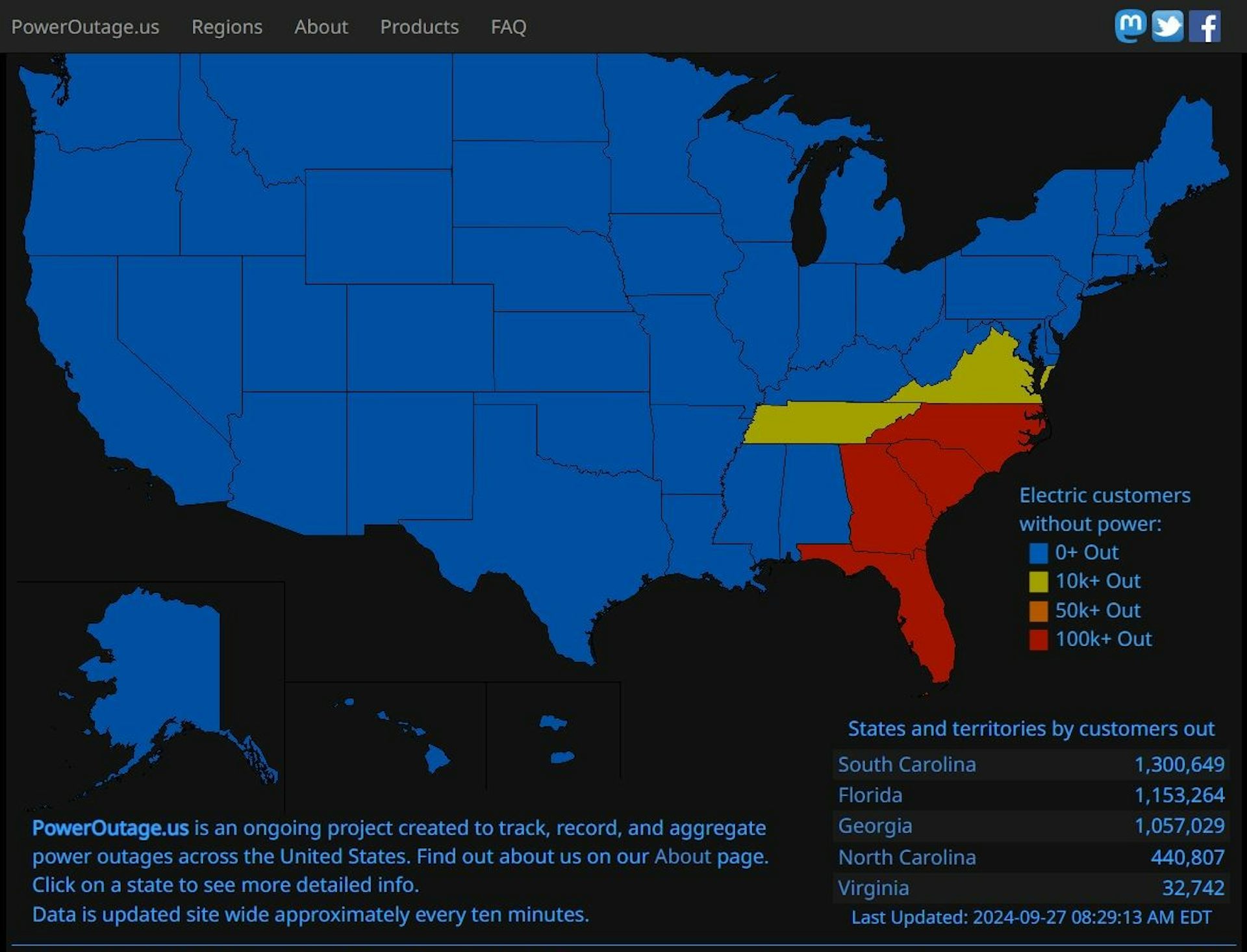
    Hurricane Helene left more than 3 million homes and businesses in the dark across Florida, Georgia and the Carolinas after hitting Florida’s Big Bend region as a powerful Category 4 storm late on Sept. 26, 2024. As Helene’s rains moved inland, officials warned that fixing downed utility lines and restoring power would take several days in some areas.

    Electricity is essential to just about everyone – rich and poor, old and young. Yet, when severe storms strike, socioeconomically disadvantaged communities often wait longest to recover.

    That isn’t just a perception.

    We analyzed data from over 15 million consumers in 588 U.S. counties who lost power when hurricanes made landfall between January 2017 and October 2020. The results show that poorer communities did indeed wait longer for the lights to go back on.

    A 10 percentile drop in socioeconomic status in the Centers for Disease Control and Prevention’s social vulnerability index was associated with a 6.1% longer outage on average. This corresponds to waiting an extra 170 minutes on average for power to be restored, and sometimes much longer.

    The top map shows the total duration of power outages over eight storms by county. The lower map is a comparison with socioeconomic status taken into account, showing that counties with lower average socioeconomic status have longer outages than expected.
    Ganz et al, 2023, PNAS Nexus

    Implications for policy and utilities

    One likely reason for this disparity is written into utilities’ standard storm recovery policies. Often, these polices prioritize critical infrastructure first when restoring power after an outage, then large commercial and industrial customers. They next seek to recover as many households as they can as quickly as possible.

    While this approach may seem procedurally fair, these recovery routines appear to have an unintended effect of often making vulnerable communities wait longer for electricity to be restored. One reason may be that these communities are farther from critical infrastructure, or they may be predominantly in older neighborhoods where power infrastructure requires more significant repairs.

    Commercial areas are often higher on the priority list for faster power recovery in an outage. This store was still closed for several days during Texas’ widespread outages in 2021.
    Montinique Monroe/Getty Images

    The upshot is that households that are already at greater risk from severe weather – whether due to being in flood-prone areas or in vulnerable buildings – and those who are least likely to have insurance or other resources to help them recover are also likely to face the longest storm-caused power outages. Long outages can mean refrigerated food goes bad, no running water and delays in repairing damage, including delays in running fans to dry out water damage and avoid mold.

    Our study spanned 108 service regions, including investor-owned utilities, cooperatives and public utilities. The differential impact on poorer communities did not line up with any particular storm, region or individual utility. We also found no correlation with race, ethnicity or housing type. Only average socioeconomic level stood out.

    How to make power recovery less biased

    There are ways to improve power recovery times for everyone, beyond the necessary work of improving the stability of power distribution.

    Policymakers and utilities can start by reexamining power restoration practices and power infrastructure maintenance, such as replacing aging utility poles and trimming trees, with disadvantaged communities in mind.

    Power providers already have granular data on power usage and grid performance in their service regions. They can begin experimenting with alternative recovery routines that consider the vulnerability of their customers in ways that do not substantially affect average recovery duration.

    People in some Fort Myers, Fla., neighborhoods still lacked water and electricity more than a week after Hurricane Ian in 2022.
    Montinique Monroe/Getty Images

    For socioeconomically vulnerable regions that are likely to experience long outages because of their locations and possibly the aging energy infrastructure, utilities and policymakers can proactively ensure that households are well prepared to evacuate or have access to backup sources of power.

    For example, the U.S. Department of Energy announced in October 2023 that it would invest in developing dozens of resilience hubs and microgrids to help supply local power to key buildings within communities when the wider grid goes down. Louisiana plans several of these hubs, using solar and large-scale batteries, in or near disadvantaged communities.

    Policymakers and utilities can also invest in broader energy infrastructure and renewable energy in these vulnerable communities. The U.S. Department of Energy’s Justice40 program directs that 40% of the benefit from certain federal energy, transportation and housing investments benefit disadvantaged communities. That may help residents who need public help the most.

    Severe weather events are becoming more common as global temperatures rise. That increases the need for better planning and approaches that don’t leave low-income residents in the dark.

    Chenghao Duan, a Ph.D. student at Georgia Tech, also contributed to this article. This is an update to an article originally published on Feb. 7, 2024.

    The authors do not work for, consult, own shares in or receive funding from any company or organization that would benefit from this article, and have disclosed no relevant affiliations beyond their academic appointment.

    ref. Hurricane Helene power outages leave over 3 million in the dark – history shows poorer areas often wait longest for electricity to be restored – https://theconversation.com/hurricane-helene-power-outages-leave-over-3-million-in-the-dark-history-shows-poorer-areas-often-wait-longest-for-electricity-to-be-restored-240001

    MIL OSI – Global Reports

  • MIL-OSI Global: US home insurance rates are rising fast – hurricanes and wildfires play a big role, but there’s more to it

    Source: The Conversation – USA – By Andrew J. Hoffman, Professor of Management & Organizations, Environment & Sustainability, and Sustainable Enterprise, University of Michigan

    The U.S. has seen a large number of billion-dollar disasters in recent years. AP Photo/Mark Zaleski

    Millions of Americans have been watching with growing alarm as their homeowners insurance premiums rise and their coverage shrinks. Nationwide, premiums rose 34% between 2017 and 2023, and they continued to rise in 2024 across much of the country.

    To add insult to injury, those rates go even higher if you make a claim – as much as 25% if you claim a total loss of your home.

    Why is this happening?

    There are a few reasons, but a common thread: Climate change is fueling more severe weather, and insurers are responding to rising damage claims. The losses are exacerbated by more frequent extreme weather disasters striking densely populated areas, rising construction costs and homeowners experiencing damage that was once more rare.

    Hurricane Ian, supercharged by warm water in the Gulf of Mexico, hit Florida as a Category 4 hurricane in October 2022 and caused an estimated $112.9 billion in damage.
    Ricardo Arduengo/AFP via Getty Images

    Parts of the U.S. have been seeing larger and more damaging hail, higher storm surges, massive and widespread wildfires, and heat waves that kink metal and buckle asphalt. In Houston, what used to be a 100-year disaster, such as Hurricane Harvey in 2017, is now a 1-in-23-years event, estimates by risk assessors at First Street Foundation suggest. In addition, more people are moving into coastal and wildland areas at risk from storms and wildfires.

    Just a decade ago, few insurance companies had a comprehensive strategy for addressing climate risk as a core business issue. Today, insurance companies have no choice but to factor climate change into their policy models.

    Rising damage costs, higher premiums

    There’s a saying that to get someone to pay attention to climate change, put a price on it. Rising insurance costs are doing just that.

    Increasing global temperatures lead to more extreme weather, and that means insurance companies have had to make higher payouts. In turn, they have been raising their prices and changing their coverage in order to remain solvent. That raises the costs for homeowners and for everyone else.

    The importance of insurance to the economy cannot be understated. You generally cannot get a mortgage or even drive a car, build an office building or enter into contracts without insurance to protect against the inherent risks. Because insurance is so tightly woven into economies, state agencies review insurance companies’ proposals to increase premiums or reduce coverage.

    The insurance companies are not making political statements with the increases. They are looking at the numbers, calculating risk and pricing it accordingly. And the numbers are concerning.

    The arithmetic of climate risk

    Insurance companies use data from past disasters and complex models to calculate expected future payouts. Then they price their policies to cover those expected costs. In doing so, they have to balance three concerns: keeping rates low enough to remain competitive, setting rates high enough to cover payouts and not running afoul of insurance regulators.

    But climate change is disrupting those risk models. As global temperatures rise, driven by greenhouse gases from fossil fuel use and other human activities, past is no longer prologue: What happened over the past 10 to 20 years is less predictive of what will happen in the next 10 to 20 years.

    The number of billion-dollar disasters in the U.S. each year offers a clear example. The average rose from 3.3 per year in the 1980s to 18.3 per year in the 10-year period ending in 2024, with all years adjusted for inflation.

    With that more than fivefold increase in billion-dollar disasters came rising insurance costs in the Southeast because of hurricanes and extreme rainfall, in the West because of wildfires, and in the Midwest because of wind, hail and flood damage.

    Hurricanes tend to be the most damaging single events. They caused more than US$692 billion in property damage in the U.S. between 2014 and 2023. But severe hail and windstorms, including tornadoes, are also costly; together, those on the billion-dollar disaster list did more than $246 billion in property damage over the same period.

    As insurance companies adjust to the uncertainty, they may run a loss in one segment, such as homeowners insurance, but recoup their losses in other segments, such as auto or commercial insurance. But that cannot be sustained over the long term, and companies can be caught by unexpected events. California’s unprecedented wildfires in 2017 and 2018 wiped out nearly 25 years’ worth of profits for insurance companies in that state.

    To balance their risk, insurance companies often turn to reinsurance companies; in effect, insurance companies that insure insurance companies. But reinsurers have also been raising their prices to cover their costs. Property reinsurance alone increased by 35% in 2023. Insurers are passing those costs to their policyholders.

    What this means for your homeowners policy

    Not only are homeowners insurance premiums going up, coverage is shrinking. In some cases, insurers are reducing or dropping coverage for items such as metal trim, doors and roof repair, increasing deductibles for risks such as hail and fire damage, or refusing to pay full replacement costs for things such as older roofs.

    Some insurances companies are simply withdrawing from markets altogether, canceling existing policies or refusing to write new ones when risks become too uncertain or regulators do not approve their rate increases to cover costs. In recent years, State Farm and Allstate pulled back from California’s homeowner market, and Farmers, Progressive and AAA pulled back from the Florida market, which is seeing some of the highest insurance rates in the country.

    In some cases, insurers are restricting coverage. Roof repairs, like these in Fort Myers Beach, Fla., after Hurricane Ian, can be expensive and widespread after windstorms.
    Joe Raedle/Getty Images

    State-run “insurers of last resort,” which can provide coverage for people who can’t get coverage from private companies, are struggling too. Taxpayers in states such as California and Florida have been forced to bail out their state insurers. And the National Flood Insurance Program has raised its premiums, leading 10 states to sue to stop them.

    About 7.4% of U.S. homeowners have given up on insurance altogether, leaving an estimated $1.6 trillion in property value at risk, including in high-risk states such as Florida.

    No, insurance costs aren’t done rising

    According to NOAA data, 2023 was the hottest year on record “by far.” And 2024 could be even hotter. This general warming trend and the rise in extreme weather is expected to continue until greenhouse gas concentrations in the atmosphere are abated.

    In the face of such worrying analyses, U.S. homeowners insurance will continue to get more expensive and cover less. And yet, Jacques de Vaucleroy, chairman of the board of reinsurance giant Swiss Re, believes U.S. insurance is still priced too low to fully cover the risk from climate change.


    Climate change is a major factor in the rising cost of insurance. Join us for a special free webinar with experts Andrew Hoffman of the University of Michigan and Melanie Gall of Arizona State University to discuss the arithmetic behind these rising rates, what climate change has to do with it, and what may be coming in your future insurance bills.

    Wednesday, October 9, 2024, 11:30 a.m. PT/2:30 p.m. ET.
    Register for the webinar here.


    Andrew J. Hoffman does not work for, consult, own shares in or receive funding from any company or organization that would benefit from this article, and has disclosed no relevant affiliations beyond their academic appointment.

    ref. US home insurance rates are rising fast – hurricanes and wildfires play a big role, but there’s more to it – https://theconversation.com/us-home-insurance-rates-are-rising-fast-hurricanes-and-wildfires-play-a-big-role-but-theres-more-to-it-238939

    MIL OSI – Global Reports

  • MIL-OSI USA: Revised Preliminary Flood Maps for Tulsa County, Oklahoma, Ready for Public View

    Source: US Federal Emergency Management Agency

    Headline: Revised Preliminary Flood Maps for Tulsa County, Oklahoma, Ready for Public View

    Revised Preliminary Flood Maps for Tulsa County, Oklahoma, Ready for Public View

    DENTON, Texas –Revised Preliminary Flood Insurance Rate Maps (FIRMs) are available for review by residents and business owners in portions of the City of Tulsa and Tulsa County, Oklahoma.

    Property owners are encouraged to review the latest information to learn about local flood risks and potential future flood insurance requirements. Community residents can identify any concerns or questions about the information provided and participate in the appeal and comment periods for the maps.

    For this Physical Map Revision, the FIRMs for Tulsa County serve multiple purposes, including defining Special Flood Hazard Areas (SFHAs). SFHAs are areas at high risk for flooding. Community leaders and residents can use these maps to make informed decisions about building standards, development and flood insurance that will make the community more resilient and lessen the impacts of a flood event.

    FEMA stresses that flooding can and does happen outside of the most vulnerable areas.

    Review the preliminary flood maps by visiting the local floodplain administrator (FPA). A FEMA Map Specialist can help identify community FPAs. Specialists are available by telephone at 877-FEMA-MAP (877-336-2627) or by email at FEMA-FMIX@fema.dhs.gov.

    The preliminary maps may also be viewed online:

    For more information about the flood maps:

    There are cost-saving options available for those newly mapped into a high-risk flood zone. Learn more about your flood insurance options by talking with your insurance agent or visiting floodsmart.gov.

    alexa.brown

    MIL OSI USA News

  • MIL-OSI USA: FEMA offers free Repair and Rebuilding Advice in O’Brien County

    Source: US Federal Emergency Management Agency

    Headline: FEMA offers free Repair and Rebuilding Advice in O’Brien County

    FEMA offers free Repair and Rebuilding Advice in O’Brien County

    Des Moines, Iowa — FEMA is providing free information about how to make your home stronger and safer – whether it was damaged by this summer’s severe storms or not.

    FEMA will be in O’Brien County at the Downtown Hardware Hank store, 816 Third Ave., Sheldon Iowa 51201 on Oct. 1-4 from 9 a.m. – 4:30 p.m.

    You can speak directly with FEMA specialists at local home improvement stores. The public can get answers to questions and discuss:

    • Proven methods for preventing damage from future disasters.
    • Techniques for rebuilding homes.
    • Tips for reducing your disaster risk – whether you own or rent your home.
    • Help is available to all homeowners, not only those affected by the recent storms.

    If you have questions about how to make your home safer, call the FEMA Hazard Mitigation Helpline at 833-336-2487.

    If you had flood related damage or storm-caused expenses and live or own a business in Buena Vista, Cherokee, Clay, Dickinson, Emmet, Humboldt, Lyon, Monona, O’Brien, Osceola, Palo Alto, Plymouth, Pottawattamie, Scott, Sioux and Woodbury counties, FEMA assistance can provide grants to help cover temporary housing, home repairs and other disaster related needs. 

    Disaster recovery assistance is available without regard to race, color, religion, nationality, sex, age, disability, English proficiency, or economic status. If you or someone you know has been discriminated against, call FEMA toll-free at 833-285-7448. For Spanish, press 2. If you use a relay service, such as video relay service (VRS), captioned telephone service or others, give FEMA the number for that service. 

    martyce.allenjr

    MIL OSI USA News