Category: New Zealand

  • MIL-OSI New Zealand: Protecting our endangered fish

    Source: Environment Canterbury Regional Council

    Members of our Land Management and Biodiversity teams, along with representatives from EOS, ACCG and several local farmers, travelled to Corbies Creek to learn from Department of Conservation (DOC) rangers and Martha Jolly, who is completing her PhD at the University of Canterbury on built and natural barriers protecting native fish species.

    “These populations of endangered fish species are really small and fragmented,” Jolly said.

    Of particular note is the lowland longjaw galaxid, one of Aotearoa/New Zealand’s most endangered fish.

    “We have seven known populations left, all at risk of extinction through extreme events like floods, droughts and invasion by bigger predatory fish such as trout,” she said.

    Together with partners across the region, we have funded deliberate fish passage barriers to protect indigenous biodiversity in a practice known as isolation management.

    MIL OSI New Zealand News

  • MIL-OSI New Zealand: ACT continues to drive real change in the latest quarterly plan

    Source: ACT Party

    “ACT’s contribution to the Coalition Government’s Quarter Two Plan shows ACT’s continued outsized role in delivering real change,” says ACT Leader David Seymour.

    “Close to half of the plan’s action points reflect ACT’s contributions. With ACT in Government, Kiwis are being liberated from red tape and wasteful spending, while smart investment continues to improve the safety and security of all New Zealanders.

    “This document is full of ACT ideas that boost economic growth through better access to products, skills and investment from overseas, alongside Brooke van Velden’s reforms to the labour market and health and safety rules to supercharge New Zealand’s productivity.

    “Actions taken on attendance, law and order, and benefit sanctions will continue to send a message of personal responsibility and consequences for crime.”

    Of the 37 actions listed, 18 are led by ACT ministers, advance ACT coalition commitments, or reflect policies ACT campaigned on. These actions include:

    • Introduce legislation to make it easier, quicker, and more transparent for foreign investors to invest in and grow New Zealand businesses.

    • Take Cabinet decisions on the Parent Visa Boost, to enable migrants to sponsor their parents or grandparents to enter the country.

    • Take Cabinet decisions on the fleetwide transition to Road User Charges.

    • Begin public consultation on National Direction to the Resource Management Act to unlock development in infrastructure, housing, and our primary industries.

    • Begin public consultation on the 30-year National Infrastructure Plan.

    • Pass legislation to remove barriers to the use of overseas building products to increase competition and reduce costs.

    • Agree the first Regional Deal Memorandum of Understanding (MoU) to drive economic growth and improve the supply of housing and infrastructure.

    • Pass legislation to allow businesses to make pay deductions in response to partial strikes.

    • Take Cabinet decisions to refocus WorkSafe and the WorkSafe New Zealand Act to increase certainty and reduce unnecessary compliance costs for business.

    • Introduce legislation to establish a regulatory system for online gambling to reduce gambling harm.

    • Take Cabinet decisions on proposals from the Ministerial Advisory Group for Victims of Retail Crime to strengthen trespass law.

    • Take Cabinet decisions on AML/CFT reform to improve the supervisory and funding model; and to reduce the burden on business while enhancing access to financial services for everyday Kiwis.

    • Open the 600-bed extension at Waikeria Prison to support the Government’s efforts to keep criminals off the streets.

    • Deliver 10,000 additional elective procedures through the Health NZ electives boost.

    • Introduce legislation to require freedom of expression in universities.

    • Pilot the Stepped Attendance Response with select schools to raise student attendance.

    • Pass legislation to expand the Traffic Light System to add more tools to support people off welfare into work.

    • Take Cabinet decisions on scaling up the New Zealand biodiversity credit market to incentivise the protection and restoration of native wildlife.

    MIL OSI New Zealand News

  • MIL-OSI New Zealand: Health Coalition Aotearoa demands fairness in Government decision-making

    Source: Health Coalition Aotearoa

    Health Coalition Aotearoa (HCA), in partnership with the Helen Clark Foundation and Transparency International NZ, have today launched Let’s Level the Playing Field, a campaign to end hidden lobbying and restore fairness to government decision-making.
    “In Aotearoa New Zealand, policy must serve the public, not just those with money and access,” says Professor Boyd Swinburn, HCA co-chair. “When industry lobbying goes unchecked, powerful interests override public good. We need transparency, accountability, and a system that works for everyone.”
    The cost of unchecked influence The New Zealand public will gain many benefits from a fairer, transparent public policy making process – like a greater recognition of what the public values and more trust in government decision makers.
    HCA points to recent failures where government favoured industry over public health-such as repealing world-leading smokefree laws and prioritising industry interests in infant formula regulations.
    “These decisions ignored public concerns and catered to wealthy lobbyists,” says Professor Swinburn. “Stronger rules would have ensured fairer outcomes.”
    New Zealand lags behind most OECD countries in regulating lobbying. Without clear rules, industry voices dominate while ordinary people are shut out.
    A plan for fairer decision-making HCA’s five-point plan will bring Aotearoa in line with international best practice:
    • Regulate lobbying: A public register of lobbyist meetings, a mandatory code of conduct, and an Integrity Commission to enforce these measures.
    • Slow the revolving door: A “cooling off” period to prevent former ministers and senior officials from immediately becoming lobbyists in their past areas of responsibility.
    • Manage conflicts of interest: Stronger codes of conduct for government employees, appointees, and contractors.
    • Strengthen transparency laws: A modernised Official Information Act to prevent government secrecy.
    • Tighten political donation rules: Caps on individual donations, a lower disclosure threshold, and limits ensuring only registered voters can donate.
    Broad support for reform Former Prime Minister Helen Clark, former Attorney-General Chris Finlayson, Moana Tuwhare (Te Tumu Whakahaere, Te Rūnanga-ā-iwi o Ngāpuhi) and former Cabinet Minister Anne Tolley will speak at the campaign launch, supporting the five asks of the campaign and backing stronger protections for public policy.
    “New Zealanders deserve a democracy where decisions reflect the common good-not just corporate interests,” says Professor Swinburn. “We must strengthen our defences against undue influence and level the playing field for all.”
    Health Coalition Aotearoa (HCA) is a coalition of 45 NGO member organisations and 75 individuals supported by expert advisory panels advocating to advance health equity and reduce the harms of tobacco, vaping, alcohol and unhealthy food.

    MIL OSI New Zealand News

  • MIL-OSI New Zealand: Safety alert: Duties of importers and suppliers of safety net systems

    Source: Worksafe New Zealand

    This safety alert highlights the serious health and safety risks for workers when using safety net systems that may not have been tested to a recognised standard by an accredited testing body.

    What we know

    Safety net systems are used in residential and commercial construction as a control to reduce the likelihood of harm if a worker falls from height.

    The Health and Safety at Work Act places a duty on importers and suppliers of safety net systems to ensure that the nets that they are importing and supplying have been tested to ensure that it performs. WorkSafe New Zealand accepts testing to a recognised safety net standard, such as BS EN 1263.1, and that all reasonably practicable steps are taken to ensure that this testing has been undertaken by an accredited testing body.

    WorkSafe notes that the testing and resulting documentation provdied by overseas testing bodies can be difficult to verify and, in some instances, be fraudulent.

    What are your duties as an importer or supplier of safety net systems?

    In addition to your primary duty of care, under the Health and Safety at Work Act 2015 you must also:

    • make sure the safety nets you import do not create health and safety risks to the people that use them
    • make sure the safety nets you import have been tested to a recognised standard, such as BS EN 1263.1, so they are safe for use in a workplace
    • give the following information to those you provide your safety nets to:
      • the results of calculations and tests
      • any general and current relevant information or conditions about how to safely use, handle, store, install, inspect, maintain, repair, or otherwise work with the products you have imported.

    WorkSafe advice

    Ensure that you have completed all necessary due diligence on the safety net and safety net manufacturer from which you are importing from.

    Ensure that any testing and certification of the safety net is carried out in accordance with BS EN 1263.1, or an equivalent standard that gives similar or better outcomes for safety, by an accredited testing body.

    If you have any doubt regarding the testing or certification of the safety net, including verification, engage the services of a New Zealand based reputable third party to undertake additional testing to demonstrate conformance with a recognised safety net standard.

    Guidance

    Safe use of safety nets
    This best practice guideline outlines safety net requirements and the safe use of safety nets

    Working at height in New Zealand
    This good practice guide will provide practical guidance to employers, contractors, employees and all others engaged in work associated with working at height.

    Safety alert – safety nets
    This safety alert highlights the serious health and safety risks for workers when using poorly installed safety nets.

    Download safety alert

    Duties of importers and suppliers of safety net systems – safety alert (PDF 153 KB)

    MIL OSI New Zealand News

  • MIL-OSI New Zealand: Swift response leads to the rescue of a man in New Plymouth

    Source: New Zealand Police (National News)

    Swift actions by Police and community partner agencies helped rescue a man from the water near Omata in the weekend.

    At around 12.15pm on Saturday 5 April, a member of the public notified Police of a person in need of assistance in the water after they had put their hand up and called for help.

    As the man was swept further out to sea, Taranaki Rescue Helicopter provided the man with a buoy to assist him in staying afloat while Taranaki Surf Life Saving and Taranaki Coastguard quickly responded to the incident.

    Police Search and Rescue assisted on the ground coordinating with the partner agencies in the water and air.

    After a period of time, the man was successfully rescued and was transported to hospital by Ambulance for hypothermia and to be further assessed.

    Police would like to thank the members of the public who saw the man in trouble and did the right thing by calling emergency services and remaining on scene so we had the best possible chance to locate and rescue the man.

    Police would also like to thank the Taranaki Rescue Helicopter, Taranaki Surf Life Saving, Taranaki Coast Guard, and Port Taranaki for their response and assistance.

    This incident is a reminder that water safety is key, and Police commend the man for raising his hand and calling for help.

    Police urge anyone going near waters, no matter the skill level, to take the basic precautions to keep themselves safe in case something goes wrong.

    If you’re swimming or surfing, ensure you stick to your limits, and if in doubt as to the conditions, don’t go in.

    Tell someone where you are going and when you will come back – this can be crucial information for us to locate you.

    Be aware of your surroundings and the dangers they may have – check the local marine weather forecast before you go and expect both weather and water state changes.

    You can find more information on water safety at www.watersafetynz.org/water-safety-code

    ENDS

    Issued by Police Media Centre
     

    MIL OSI New Zealand News

  • MIL-OSI New Zealand: NZ Transport Agency and Ashburton District Council working together on second Ashburton Bridge

    Source: New Zealand Transport Agency

    NZ Transport Agency Waka Kotahi (NZTA) and Ashburton District Council in recent days signed an agreement to manage the construction of the second Ashburton bridge and connecting road as one project.

    NZTA will tender the full work package as a design and build project later this year.

    The NZTA board officially approved the project at its meeting in the past week, allowing the work on the ground to now get underway, says NZTA’s Acting Director Regional Relationships Ian Duncan.

    Central Government will fund the 360-metre bridge plus embankments from Chalmers Ave to Carters Terrace. Ashburton District Council will fund the connecting local road from Carters Terrace to Grahams Road.

    “This second bridge is so important for our community,” says Ashburton Mayor Neil Brown. “I’m excited all the necessary paperwork to get it started is now signed and sealed. The agreement Council has signed with NZTA means we will soon see and approve concept plans for the second bridge and connecting road, and then have regular meetings during the construction period to ask questions and ensure it is done in a timely manner.”

    Ashburton District Council has been buying property for the project since a land designation was confirmed in 2014, and the bridge and connecting road are shown in the District Plan.

    Mayor Brown said the project could be completed away from existing traffic routes, given it will be part of a new local road network, without major disruption to residents and travellers.

    “There’ll be a roundabout at the intersection of South Street and Chalmers Avenue, and another at the end of the new connecting road and Grahams Road, and a footpath on the Tinwald side of the new road.

    “We’re looking forward to seeing physical works starting as early as possible in 2026, and Council will have a better idea of how much the road section will cost once the tender process is complete.”

    Council will talk with the community about how it will fund the road construction once the costs are known, Mr Brown says.

    “The most important thing for everyone to know is that this project can finally begin, and our town will be a lot more resilient and our roads much safer when it is complete.”

    NZTA’s Ian Duncan says he is pleased to see progress on this project, acknowledging the second bridge will provide significant resilience and new road connection across the Ashburton/Hakatere River, using modern design and build techniques.

    The 2021 flood highlighted the vulnerability of the existing SH1 Ashburton bridge and the wider state highway network, so a second bridge provides insurance in the event the SH1 bridge is unable to be used for whatever reason.

    Ashburton people may see geotechnical investigations underway on site in coming days and weeks and the start of the procurement and tendering process.

    MIL OSI New Zealand News

  • MIL-OSI New Zealand: Ōtaki River Bridge in line for more improvements

    Source: New Zealand Transport Agency

    Ōtaki residents can expect to see more improvements on the main bridge on old State Highway 1 this month.

    Resurfacing work is planned for the bridge to improve its safety and reliability.

    For safety reasons, the bridge will be closed to traffic while the resurfacing is completed. It will be done on the night of Monday, 14 April, from 9 pm to 4:30 am, weather permitting.

    The resurfacing has been deliberately timed to be done at night as there will be fewer vehicles on the road. It means overall disruption for drivers is significantly reduced.

    However, the closure will require significant detours, particularly for Ōtaki and Te Horo residents.

    NZTA/Waka Kotahi and the Wellington Transport Alliance appreciate the work will create travel delays and disruption for drivers and Ōtaki residents.

    Every effort is being made to complete it as quickly as possible, and a full closure on a single night allows the work to be done faster and more efficiently. Doing the work during the day would have a much larger impact on traffic flows and affect more road users.

    Detour information

    • Getting to Ōtaki from The Expressway
      • Northbound vehicles needing to get to Ōtaki from The Expressway will need to travel for approximately five minutes further north to the Ōtaki turnaround/rest area (near Lawlors Road) and turnaround to travel south. This will be well signposted.

    Drivers will then need to travel south towards the Ōtaki southbound offramp to get to Ōtaki township. This is expected to add approximately 10 minutes to travel times.

    • Getting between Ōtaki and Te Horo
      • People travelling between Te Horo and Ōtaki, will need to take longer detours. This will add approximately 25 – 30 minutes to travel times in both directions.
      • Te Horo to Ōtaki vehicles should use the Peka Peka northbound onramp to The Expressway, travel north to the Ōtaki turnaround/rest area to turn around. They should then travel south and take the Ōtaki southbound offramp to get to Ōtaki.
      • Ōtaki to Te Horo vehicles should use the Ōtaki northbound onramp to The Expressway and travel to the Ōtaki turnaround/rest area to turn around. They should then travel south and take the Peka Peka southbound offramp to get to Te Horo.
    • Getting to Waikanae, Peka Peka and Te Horo from The Expressway
      • Residents of Waikanae, Peka Peka and Te Horo can travel as normal from The Expressway, either via Waikanae Beach offramps or via Old State Highway 1 using the Ōtaki offramps.

    More Information

    MIL OSI New Zealand News

  • MIL-OSI New Zealand: Shellebrating* groundbreaking turtle research |

    Source: Department of Conservation

    By Krysia Nowak and Karen Middlemiss

    *While leatherback turtles don’t actually have a shell, they have pretty thick skins, so we think they wouldn’t mind the pun.

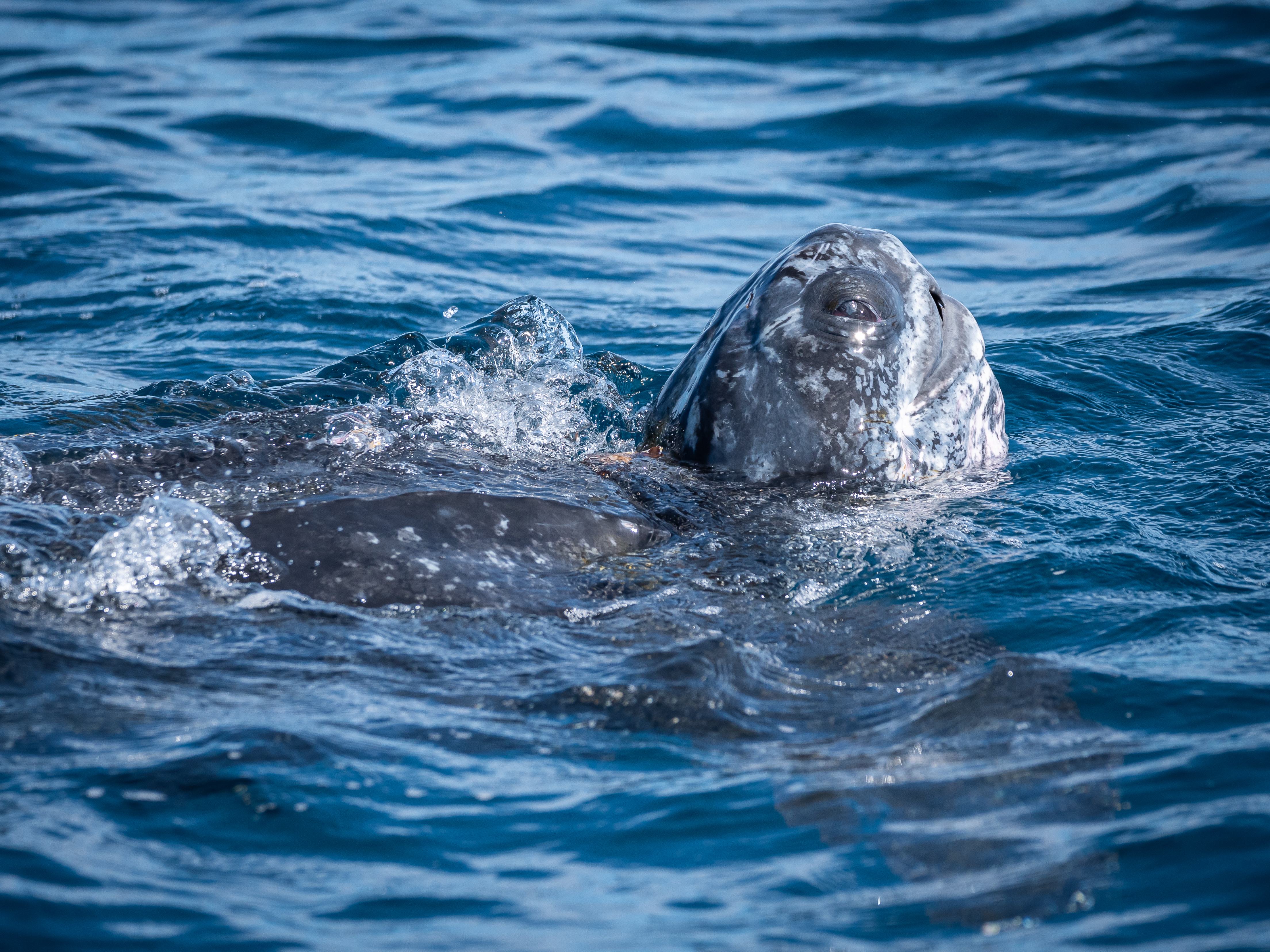
    What if we told you the largest sea turtles in the world visit Aotearoa New Zealand and that our waters are important to their survival? That they’re Critically Endangered, and that we know almost nothing about how they spend their time here? 

    You might say it’s about time we learn about them, and that’s exactly what we’re doing in our new research collaborating with USA-based Upwell Turtles.  

    Turtles crossing borders 

    Leatherback turtles aren’t worried about international boundaries.  

    The leatherbacks which visit New Zealand waters are part of the Western Pacific population that forage on the US West Coast and then migrate some 12,000km to nesting beaches in Indonesia, Papua New Guinea, New Caledonia, and the Solomon Islands.  

    Leatherbacks have been tagged for monitoring when they come ashore at nesting beaches overseas, but there aren’t many known foraging areas where it’s possible to tag them in open water and study their movements. The Bay of Plenty is one of those known areas. 

    For the love of jelly(fish)

    We have the opportunity to tag turtles at sea during summer and early autumn when our waters are full of their favourite food – jellyfish! 

    Leatherbacks can weigh more than 350 kilograms and need to eat more than 1/2 their body weight in jellyfish to get enough energy for long trips. The jellyfish-rich waters off the Bay of Plenty are important to leatherback migration success.

    Human for scale: Upwell Executive Director George Shillinger tagging nesting leatherbacks in Playa Grande Costa Rica in 2007 | Upwell Turtles

    Running the gauntlet 

    Leatherbacks face many risks in various countries across the huge distances they travel between foraging grounds and nesting beaches. Threats can include unintentional capture by fisheries (bycatch), the harvesting of adult turtles and eggs, plastic pollution, nesting beach habitat loss, climate change, and vessel strike.

    Currently, the biggest threat to leatherback turtles, globally, is from commercial fishing. Most turtles accidentally caught by fisheries in New Zealand waters are released alive, but we need to learn how to reduce bycatch numbers to better protect them. 

    It’s a minefield for a turtle travelling across international boundaries, and we’ve seen a decline in this population of over 80% in the last 40 years. That’s why international collaboration is so important for their research and conservation if we are to have any chance of recovering the population. 

    Collaborating for conservation  

    We’re working with scientists who have been studying leatherbacks for decades. Being able to work together to study their habitat use in New Zealand waters will be another piece in the migration puzzle for these ancient turtles. 

    Dr George Shillinger, Executive Director of Upwell Turtles, says leatherbacks are among the most highly migratory and transboundary marine species on the planet.  

    “Effective conservation requires international collaboration from nesting beaches all the way to distant foraging habitats.” 

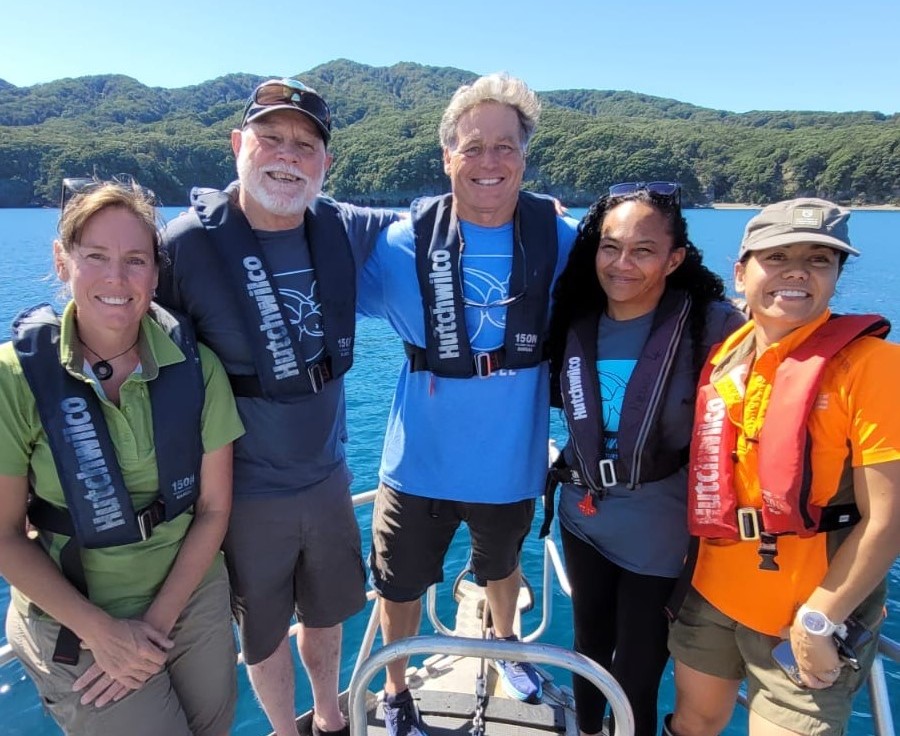
    Some of the leatherback researchers and partners out on the boat | DOC

    Taking to the air 

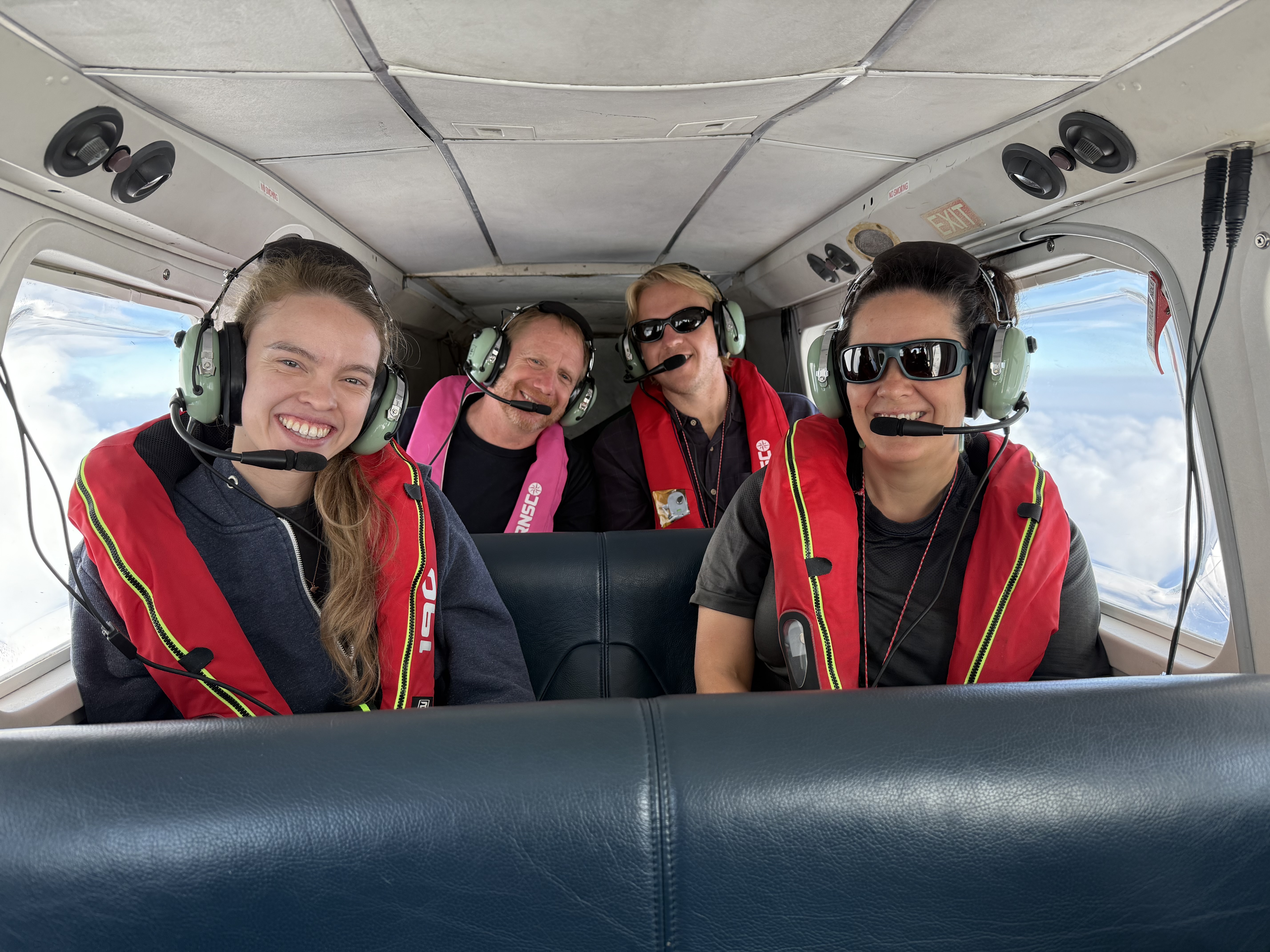
    Our turtle-team recently took to the air over the Bay of Plenty as a starting point to find out more about leatherbacks in New Zealand waters. We worked with Upwell Turtles, and with support and expertise from NIWA, Monash University (Australia), and Moss Landing Marine Laboratories (USA).  

    While we had George and Scott here from Upwell Turtles, they graciously gave us some of their time and expertise, to help develop our own techniques to catch and tag leatherbacks. 

    The international research crew monitoring for leatherbacks from a plane | Sean Williamson

    Practice Makes Perfect 

    Along with our international experts, we assembled an array of technical equipment, and formed a team including Tauranga DOC staff, Tuhua Island kaitiaki, and a local marine conservationist, all eager to embrace the challenge of finding and netting such large animals. 

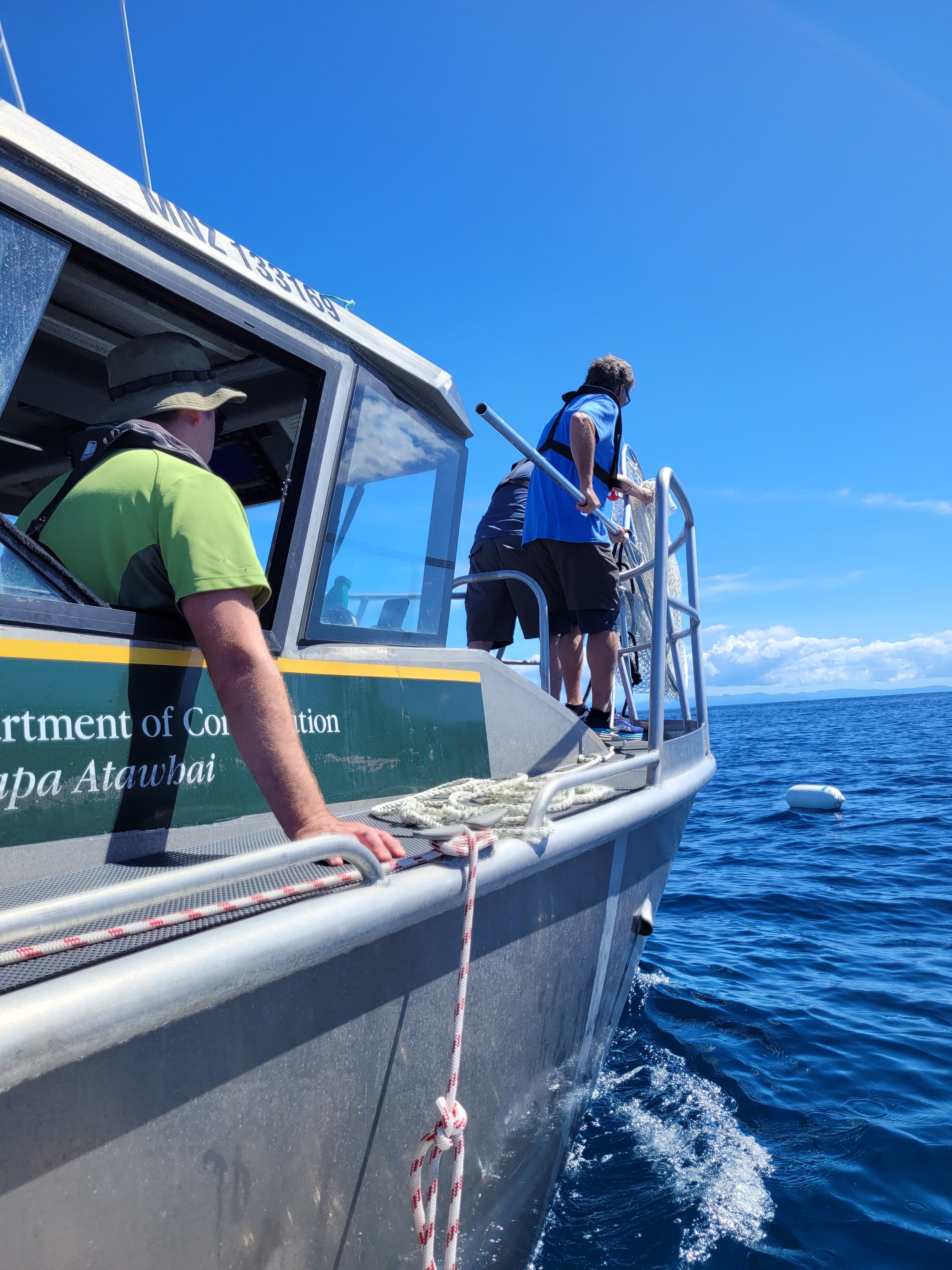
    Heading out on our DOC boat off the coast of Tauranga on calm, sunny weekend in March we focused our efforts on a large rubber fender co-opted as a ‘pretend’ turtle. Few fenders have had such an exciting couple of days! 

    The team has now honed the required skills and techniques to safely net actual turtles. In future, when we do this for real, we will have a spotter plane in the air and other boats on the water to help us find turtles – leatherbacks can be tricky to spot from sea level. 

    Where to from here? 

    Because leatherback turtles have historically visited the Bay of Plenty, we’re working to build partnerships with local iwi and hapū, and the Bay of Plenty community, as well as collaborating with our research partners. 

    We’re starting to plan our next steps into the world of tagging, aiming for next summer when the turtles and jellyfish have returned to the Bay.  

    Everything we learn from tagging studies of leatherback turtles in our waters will help inform future conservation efforts for this species, which is so ancient we call it the tuatara of our oceans. We’ll be doing our part in the international effort to protect a species on the brink of extinction.   

    How you can help leatherback turtles: 

    • No marine turtles nest on beaches in New Zealand, any turtle on the beach should be reported immediately to 0800 DOC HOT (0800 362 468).
    • Spot a sea turtle in the water around New Zealand? You can report sightings to
    turtles@doc.govt.nz 
    • You can help protect leatherbacks and other marine animals by preventing plastics and pollution from reaching our oceans. 

    MIL OSI New Zealand News

  • MIL-OSI New Zealand: Pedestrian dies following Henderson crash

    Source: New Zealand Police (District News)

    Police can advise that the pedestrian critically injured in Henderson on Sunday has died.

    A collision involving a vehicle and pedestrian was reported at 10.20am on Lincoln Road.

    The pedestrian was transported to Auckland Hospital in critical condition.

    Sadly, Police can now advise that the man succumbed to injuries and died in hospital on Sunday night, 6 April.

    Our thoughts are with the man’s family.

    An investigation is underway into the circumstances of the crash, and this remains ongoing.

    Anyone who may have witnessed the crash and has yet to speak with Police can do so by calling 105 using the reference number 250406/2570.

    ENDS.

    Jarred Williamson/NZ Police

    MIL OSI New Zealand News

  • MIL-OSI New Zealand: Government Cuts – Public Defence Service cuts risk reducing access to justice – PSA

    Source: PSA

    The Public Defence Service (PDS) is proposing to take fewer criminal cases to appeal as Government funding restrictions force it to do more with less, the PSA says.
    “The proposed reduction in appeal cases – signalled in change proposal released to staff late last week – raises serious questions about access to justice,” says Public Service Association Te Pūkenga Here Tikanga Mahi National Secretary Fleur Fitzsimons.
    The PDS, which provides lawyers for defendants in criminal trials who have legal aid, is proposing to cut 14 roles (one vacant). The change proposal says this loss of roles would enable a yet to be determined number of lawyers to be hired in the future.
    “These proposed changes undermine the very purpose of the PDS, which is to provide high quality legal representation to everybody – not just a privileged few – and to do so through the use of salaried staff, not contracted lawyers.
    “The proposed changes would disestablish the PDS standalone Appeals Team, with the loss of four out of five roles within the team, and would see the PDS not taking many appeals they have not previously been involved in. This would lead to a decrease in the number of Court of Appeal and Supreme Court cases the PDS accepted each year.”
    The reduction in appeal cases to the Court of Appeal and Supreme Court, which are more complex and time consuming than other cases the PDS takes, is part of efforts to try and fund a “significantly higher annual case load” within the existing PDS budget.
    “The PDS has developed specialist expertise in criminal appeals, which are a critical way miscarriages of justice are uncovered. This proposal will reduce access to justice for people with limited means,” says Fitzsimons, who is a lawyer.
    It is understood work being done by the Appeals Team, approximately 25 cases last year, will be outsourced to external lawyers.
    “It’s a short-sighted approach forced on the PDS by the Government not adequately funding the justice sector,” says Fitzsimons.

    MIL OSI New Zealand News

  • MIL-OSI New Zealand: Investments Sector – Consumer Demand for Ethical Investing Remains Strong Despite International Headwinds

    Source: Mindful Money

    New research shows New Zealanders are standing firm in their commitment to ethical investment, with three-quarters wanting their money invested according to their values, even as political movements in some countries attempt to undermine responsible investing frameworks.

    The Voices of Aotearoa: Demand for Ethical Investment in New Zealand 2025 report, released today by Mindful Money and the Responsible Investment Association Australasia (RIAA), reveals the resilience in New Zealand investors’ ethical expectations. Despite high-profile political criticism of ESG investing internationally and at home, 75% of Kiwis continue to expect their KiwiSaver and managed funds to be invested ethically and responsibly, with their focus shifting from merely avoiding harm to actively creating positive impact.

    Key findings from the 2025 survey include:

    • Strong consumer support persists: 75% of New Zealanders want their KiwiSaver or investment fund to be invested ethically and responsibly. Only 5% disagree.
    • Expectations of better returns: 45% of respondents expect ethical and responsible investments to perform better in the long term, with only 11% disagreeing. This shows Kiwis don’t perceive a trade-off between investing ethically and earning good returns.
    • Increasing concern about greenwashing: Half of New Zealanders are concerned about misleading claims. 54% are more likely to choose funds with independent certification, and 66% want to know which companies are in their portfolio.
    • How companies behave matters: Investors prioritise avoiding companies that violate human rights (91%), abuse labour rights (91%), and damage the environment (89%) over traditional investment exclusions like tobacco and gambling.
    • Growing demand for positive impact: 76% would invest in a fund that creates positive benefits for society and the environment, with 60% seeking comparable returns and 16% willing to accept lower returns.
    • Strong climate action expectations: Three-quarters of respondents consider it important for fund managers to reduce financed emissions, set targets for further reductions, and commit to net zero emissions by 2050.

    Carey Church, Managing Director of Moneyworks Ethical Investing, and principal sponsor of the survey, pointed out: “These findings show that demand for ethical investing remains strong despite the headwinds of criticism from the US White House and some politicians. They have not convinced others. Investment sectors in the rest of the world are showing leadership, continuing to strengthen ethical investment standards. The New Zealand public agrees. This survey continues to show strong demand for ethical investment funds that reflect people’s personal values.”

    Barry Coates, Co-CEO of Mindful Money, commented: “New Zealanders continue to want their investments to avoid harm and contribute to addressing real-world challenges such as climate change, biodiversity loss and harm to people. They not only want to avoid harm, but they are also seeking investments that deliver positive outcomes for society and the environment.”

    Dean Hegarty, Co-CEO of RIAA, added: “Rising consumer concerns about greenwashing aligns with RIAA’s 2024 benchmark report, which found it has become the top barrier to growth for investment managers. Kiwis want confidence that their money is creating a positive impact, with over half more likely to choose ethical or responsible funds that have independent certification. This presents a significant opportunity for investment providers who can authentically demonstrate how they’re contributing to positive social and environmental outcomes.”

    The survey indicates substantial growth potential, with nearly half (49%) of respondents considering investing in an ethical fund within the next five years, and only 4% stating they would not consider ethical investing at all.

    “These findings reinforce what we’ve been seeing over the past seven years of this survey – New Zealanders want to know that their money is being invested in line with their values. Those values consistently prioritise issues such as human rights, environmental protection, animal welfare and weapons,” said Coates.

    Dean Hegarty concluded: “The message from Kiwis is clear, they expect their investments to align with their values and the demand for responsible products will continue to grow. Investment providers and financial advisers must take this seriously.”

    The 2025 report is a collaboration between RIAA and Mindful Money. It surveyed 1,000 New Zealanders aged 18 years and over via Dynata’s New Zealand panel from 6-17 February 2025.

    About RIAA The Responsible Investment Association Australasia (RIAA) champions responsible investing and a sustainable financial system in Australia and New Zealand. With over 500 members representing NZ$83 trillion in assets under management, RIAA is the largest and most active network of people and organisations engaged in responsible, ethical and impact investing across Australia and New Zealand.

    About Mindful Money Mindful Money is a charity that aims to make money a force for good. We empower consumers, engage investment providers and advocate for change. The Mindful Money website provides transparency on KiwiSaver and retail investment funds, showing company holdings and relating them to key public concerns so userscan understand their investments and find funds that align with their values.

    Report Launch: The report will be launched at a free seminar at 3-4.30pm on Monday 7th April, at KPMG, Viaduct Harbour in Auckland CBD. Tickets for the in-person and online event are at https://events.humanitix.com/voices-of-aotearoa-2025?hxchl=hex-pfl

    MIL OSI New Zealand News

  • MIL-Evening Report: The graver Israel’s atrocities in Gaza, the quieter the BBC grows

    ANALYSIS: By Jonathan Cook

    The BBC’s news verification service, Verify, digitally reconstructed a residential tower block in Mandalay earlier this week to show how it had collapsed in a huge earthquake on March 28 in Myanmar, a country in Southeast Asia largely cut off from the outside world.

    The broadcaster painstakingly pieced together damage to other parts of the city using a combination of phone videos, satellite imagery and Nasa heat detection images.

    Verify dedicated much time and effort to this task for a simple reason: to expose as patently false the claims made by the ruling military junta that only 2000 people were killed by Myanmar’s 7.7-magnitude earthquake.

    The West sees the country’s generals as an official enemy, and the BBC wanted to show that the junta’s account of events could not be trusted. Myanmar’s rulers have an interest in undercounting the dead to protect the regime’s image.

    The BBC’s determined effort to strip away these lies contrasted strongly with its coverage — or rather, lack of it — of another important story this week.

    Israel has been caught in another horrifying war crime. Late last month, it executed 15 Palestinian first responders and then secretly buried them in a mass grave, along with their crushed vehicles.

    Israel is an official western ally, one that the United States, Britain and the rest of Europe have been arming and assisting in a spate of crimes against humanity being investigated by the world’s highest court. Fourteen months ago, the International Court of Justice ruled it was “plausible” that Israel was committing genocide in Gaza.

    Israeli Prime Minister Benjamin Netanyahu, meanwhile, is a fugitive from its sister court, the International Criminal Court. Judges there want to try him for crimes against humanity, including starving the 2.3 million people of Gaza by withholding food, water and aid.

    Israel is known to have killed tens of thousands of Palestinians, many of them women and children, in its 18-month carpet bombing of the enclave. But there are likely to be far more deaths that have gone unreported.

    This is because Israel has destroyed all of Gaza’s health and administrative bodies that could do the counting, and because it has created unmarked “kill zones” across much of the enclave, making it all but impossible for first responders to reach swathes of territory to locate the dead.

    The latest crime scene in Gaza is shockingly illustrative of how Israel murders civilians, targets medics and covers up its crimes — and of how Western media collude in downplaying such atrocities, helping Israel to ensure that the extent of the death toll in Gaza will never be properly known.

    Struck ‘one by one’
    Last Sunday, United Nations officials were finally allowed by Israel to reach the site in southern Gaza where the Palestinian emergency crews had gone missing a week earlier, on March 23. The bodies of 15 Palestinians were unearthed in a mass grave; another is still missing.

    All were wearing their uniforms, and some had their hands or legs zip-tied, according to eyewitnesses. Some had been shot in the head or chest. Their vehicles had been crushed before they were buried.

    Two of the emergency workers were killed by Israeli fire while trying to aid people injured in an earlier air strike on Rafah. The other 13 were part of a convoy sent to retrieve the bodies of their colleagues, with the UN saying Israel had struck their ambulances “one by one”.

    Even the usual excuses, as preposterous as they are, simply won’t wash in the case of Israel’s latest atrocity — which is why it initially tried to black out the story

    More details emerged during the week, with the doctor who examined five of the bodies reporting that all but one — which had been too badly mutilated by feral animals to assess — were shot from close range with multiple bullets. Ahmad Dhaher, a forensic consultant working at Nasser hospital in Khan Younis, said: “The bullets were aimed at one person’s head, another at their heart, and a third person had been shot with six or seven bullets in the torso.”

    Bashar Murad, the Red Crescent’s director of health programmes, observed that one of the paramedics in the convoy was in contact with the ambulance station when Israeli forces started shooting: “During the call, we heard the sound of Israeli soldiers arriving at the location, speaking in Hebrew.

    “The conversation was about gathering the [Palestinian] team, with statements like: ‘Gather them at the wall and bring some restraints to tie them.’ This indicated that a large number of the medical staff were still alive.”

    Jonathan Whittall, head of the UN office for the coordination of humanitarian affairs in Palestine, reported that, on the journey to recover the bodies, he and his team witnessed Israeli soldiers firing on civilians fleeing the area. He saw a Palestinian woman shot in the back of the head and a young man who tried to retrieve her body shot, too.

    Concealing slaughter
    The difficulty for Israel with the discovery of the mass grave was that it could not easily fall back on any of the usual mendacious rationalisations for war crimes that it has fed the Western media over the past year and a half, and which those outlets have been only too happy to regurgitate.

    Since Israel unilaterally broke a US-backed ceasefire agreement with Hamas last month, its carpet bombing of the enclave has killed more than 1000 Palestinians, taking the official death toll to more than 50,000. But Israel and its apologists, including Western governments and media, always have a ready excuse at hand to mask the slaughter.

    Israel disputes the casualty figures, saying they are inflated by Gaza’s Health Ministry, even though its figures in previous wars have always been highly reliable. It says most of those killed were Hamas “terrorists”, and most of the slain women and children were used by Hamas as “human shields”.

    Israel has also destroyed Gaza’s hospitals, shot up large numbers of ambulances, killed hundreds of medical personnel and disappeared others into torture chambers, while denying the entry of medical supplies.

    Israel implies that all of the 36 hospitals in Gaza it has targeted are Hamas-run “command and control centres”; that many of the doctors and nurses working in them are really covert Hamas operatives; and that Gaza’s ambulances are being used to transport Hamas fighters.

    Even if these claims were vaguely plausible, the Western media seems unwilling to ask the most obvious of questions: why would Hamas continue to use Gaza’s hospitals and ambulances when Israel made clear from the outset of its 18-month genocidal killing rampage that it was going to treat them as targets?

    Even if Hamas fighters did not care about protecting the health sector, which their parents, siblings, children, and relatives desperately need to survive Israel’s carpet bombing, why would they make themselves so easy to locate?

    Hamas has plenty of other places to hide in Gaza. Most of the enclave’s buildings are wrecked concrete structures, ideal for waging guerrilla warfare.

    Israeli cover-up
    Even the usual excuses, as preposterous as they are, simply won’t wash in the case of Israel’s latest atrocity — which is why it initially tried to black out the story.

    Given that it has banned all Western journalists from entering Gaza, killed unprecedented numbers of local journalists, and formally outlawed the UN refugee agency Unrwa, it might have hoped its crime would go undiscovered.

    But as news of the atrocity started to appear on social media last week, and the mass grave was unearthed on Sunday, Israel was forced to concoct a cover story.

    It claimed the convoy of five ambulances, a fire engine, and a UN vehicle were “advancing suspiciously” towards Israeli soldiers. It also insinuated, without a shred of evidence, that the vehicles had been harbouring Hamas and Islamic Jihad fighters.

    Once again, we were supposed to accept not only an improbable Israeli claim but an entirely nonsensical one. Why would Hamas fighters choose to become sitting ducks by hiding in the diminishing number of emergency vehicles still operating in Gaza?

    Why would they approach an Israeli military position out in the open, where they were easy prey, rather than fighting their enemy from the shadows, like other guerrilla armies — using Gaza’s extensive concrete ruins and their underground tunnels as cover?

    If the ambulance crews were killed in the middle of a firefight, why were some victims exhumed with their hands tied? How is it possible that they were all killed in a gun battle when the soldiers could be heard calling for the survivors to be zip-tied?

    And if Israel was really the wronged party, why did it seek to hide the bodies and the crushed vehicles under sand?

    ‘Deeply disturbed’
    All available evidence indicates that Israel killed all or most of the emergency crews in cold blood — a grave war crime.

    But as the story broke on Monday, the BBC’s News at Ten gave over its schedule to a bin strike by workers in Birmingham; fears about the influence of social media prompted by a Netflix drama, Adolescence; bad weather on a Greek island; the return to Earth of stranded Nasa astronauts; and Britain’s fourth political party claiming it would do well in next month’s local elections.

    All of that pushed out any mention of Israel’s latest war crime in Gaza.

    Presumably under pressure from its ordinary journalists — who are known to be in near-revolt over the state broadcaster’s persistent failure to cover Israeli atrocities in Gaza — the next day’s half-hour evening news belatedly dedicated 30 seconds to the item, near the end of the running order.

    This was the perfect opportunity for BBC Verify to do a real investigation, piecing together an atrocity Israel was so keen to conceal

    The perfunctory report immediately undercut the UN’s statement that it was “deeply disturbed” by the deaths, with the newsreader announcing that Israel claimed nine “terrorists” were “among those killed”.

    Where was the BBC Verify team in this instance? Too busy scouring Google maps of Myanmar, it would seem.

    If ever there was a region where its forensic, open-source skills could be usefully deployed, it is Gaza. After all, Israel keeps out foreign journalists, and it has killed Palestinian journalists in greater numbers than all of the West’s major wars of the past 150 years combined.

    This was the perfect opportunity for BBC Verify to do a real investigation, piecing together an atrocity Israel was so keen to conceal. It was a chance for the BBC to do actual journalism about Gaza.

    Why was it necessary for the BBC to contest the narrative of an earthquake in a repressive Southeast Asian country whose rulers are opposed by the West but not contest the narrative of a major atrocity committed by a Western ally?

    Missing in action
    This is not the first time that BBC Verify has been missing in action at a crucial moment in Gaza.

    Back in January 2024, Israeli soldiers shot up a car containing a six-year-old girl, Hind Rajab, and her relatives as they tried to flee an Israeli attack on Gaza City. All were killed, but before Hind died, she could be heard desperately pleading with emergency services for help.

    Two paramedics who tried to rescue her were also killed. It took two weeks for other emergency crews to reach the bodies.

    It was certainly possible for BBC Verify to have done a forensic study of the incident — because another group did precisely that. Forensic Architecture, a research team based at the University of London, used available images of the scene to reconstruct the events.

    It found that the Israeli military had fired 335 bullets into the small car carrying Hind and her family. In an audio recording before she was killed, Hind’s cousin could be heard telling emergency services that an Israeli tank was near them.

    The sound of the gunfire, most likely from the tank’s machine gun, indicates it was some 13 metres away — close enough for the crew to have seen the children inside.

    Not only did BBC Verify ignore the story, but the BBC also failed to report it until the bodies were recovered. As has happened so often before, the BBC dared not do any reporting until Israel was forced to confirm the incident because of physical evidence.

    We know from a BBC journalist-turned-whistleblower, Karishma Patel, that she pushed editors to run the story as the recordings of Hind pleading for help first surfaced, but she was overruled.

    When the BBC very belatedly covered Hind’s horrific killing online, in typical fashion, it did so in a way that minimised any pushback from Israel. Its headline, “Hind Rajab, 6, found dead in Gaza days after phone calls for help”, managed to remove Israel from the story.

    Evidence buried
    A clear pattern thus emerges. The BBC also tried to bury the massacre of the 15 Palestinian first responders — keeping it off its website’s main page — just as Israel had tried to bury the evidence of its crime in Gaza’s sand.

    The story’s first headline was: “Red Cross outraged over killing of eight medics in Gaza”. Once again, Israel was removed from the crime scene.

    Only later, amid massive backlash on social media and as the story refused to go away, did the BBC change the headline to attribute the killings to “Israeli forces”.

    But subsequent stories have been keen to highlight the self-serving Israeli claim that its soldiers were entitled to execute the paramedics because the presence of emergency vehicles at the scene of much death and destruction was “suspicious”.

    In one report, a BBC journalist managed to shoe-horn this same, patently ridiculous “defence” twice into her two-minute segment. She reduced the discovery of an Israeli massacre to mere “allegations”, while a clear war crime was soft-soaped as only an “apparent” one.

    Notably, the BBC has on one solitary occasion managed to go beyond other media in reporting an attack on an ambulance crew. The footage incontrovertibly showed a US-supplied Apache helicopter firing on the crew and a young family they were trying to evacuate.

    There was no possibility the ambulance contained “terrorists” because the documentary team were filming inside the vehicle with paramedics they had been following for months. The video was included near the end of a documentary on the suffering of Palestinians in Gaza, seen largely through the eyes of children.

    But the BBC quickly pulled that film, titled Gaza: How to Survive a War Zone, after the Israel lobby manufactured a controversy over one of its child narrators being the son of Gaza’s deputy Agriculture Minister, who served in the Hamas-run civilian government.

    Wholesale destruction
    The unmentionable truth, which has been evident since the earliest days of the 18-month genocide, is that Israel is intentionally dismantling and destroying Gaza’s health sector, piece by piece.

    According to the UN, Israel’s war has killed at least 1060 healthcare workers and 399 aid workers — those deaths it has been possible to identify — and wrecked Gaza’s health facilities. Israel has rounded up hundreds of medical staff and disappeared many of them into what Israeli human rights groups call torture chambers.

    One doctor, Dr Hussam Abu Safiya, director of the Kamal Adwan hospital in northern Gaza, has been held by Israel since he was abducted in late December. During brief contacts with lawyers, Dr Safiya revealed that he is being tortured.

    Other doctors have been killed in Israeli detention from their abuse, including one who was allegedly raped to death.

    Israel’s destruction of Gaza’s hospitals and execution of medical personnel is part of the same message: there is nowhere safe, no sanctuary, the laws of war no longer apply

    Why is Israel carrying out this wholesale destruction of Gaza’s health sector? There are two reasons. Firstly, Netanyahu recently reiterated his intent to carry out the complete ethnic cleansing of Gaza.

    He presents this as “voluntary migration”, supposedly in accordance with US President Donald Trump’s plan to relocate the enclave’s population of 2.3 million Palestinians to other countries.

    There can be nothing voluntary about Palestinians leaving Gaza when Israel has refused to allow any food or aid into the enclave for the past month, and is indiscriminately bombing Gaza. Israel’s ultimate intention has always been to terrify the population into flight.

    Israel’s ambassador to Austria, David Roet, was secretly recorded last month stating that “there are no uninvolved in Gaza”— a constant theme from Israeli officials. He also suggested that there should be a “death sentence” for anyone Israel accuses of holding a gun, including children.

    Meanwhile, Israeli Defence Minister Israel Katz has threatened the “total devastation” of Gaza’s civilian population should they fail to “remove Hamas” from the enclave, something they are in no position to do.

    Not surprisingly, faced with the prospect of an intensification of the genocide and the imminent annihilation of themselves and their loved ones, ordinary people in Gaza have started organising protests against Hamas — marches readily reported by the BBC and others.

    Israel’s destruction of Gaza’s hospitals and execution of medical personnel is part of the same message: there is nowhere safe, no sanctuary, the laws of war no longer apply, and no one will come to your aid in your hour of need.

    You are alone against our snipers, drones, tanks and Apache helicopters.

    Too much to bear
    The second reason for Israel’s destruction of Gaza’s health sector is that we in the West, or at least our governments and media, have consented to Israel’s savagery — and actively participated in it — every step of the way. Had there been any meaningful pushback at any stage, Israel would have been forced to take another course.

    When David Lammy, Britain’s Foreign Secretary, let slip in Parliament last month the advice he has been receiving from his officials since he took up the job last summer — that Israel is clearly violating international law by starving the population — he was immediately rebuked by Prime Minister Keir Starmer’s office.

    Let us not forget that Starmer, when he was opposition leader, approved Israel’s genocidal blocking of food, water and electricity to Gaza, saying Israel “had that right”.

    In response to Lammy’s comments, Starmer’s spokesperson restated the government’s view that Israel is only “at risk” of breaching international law — a position that allows the UK to continue arming Israel and providing it with intelligence from British spy flights over Gaza from a Royal Air Force base in Cyprus.

    Our politicians have consented to everything Israel has done, and not just in Gaza over the past 18 months. This genocide has been decades in the making.

    Three-quarters of a century ago, the West authorised the ethnic cleansing of most of Palestine to create a self-declared Jewish state there. The West consented, too, to the violent occupation of the last sections of Palestine in 1967, and to Israel’s gradual colonisation of those newly seized territories by armed Jewish extremists.

    The West nodded through waves of house demolitions carried out against Palestinian communities by Israel to “Judaise” the land. It backed the Israeli army creating extensive “firing zones” on Palestinian farmland to starve traditional agricultural communities of any means of subsistence.

    The West ignored Israeli settlers and soldiers destroying Palestinian olive groves, beating up shepherds, torching homes, and murdering families. Even being an Oscar winner offers no immunity from the rampant settler violence.

    The West agreed to Israel creating an apartheid road system and a network of checkpoints that kept Palestinians confined to ever-shrinking ghettoes, and building walls around Palestinian areas to permanently isolate them from the rest of the world.

    It allowed Israel to stop Palestinians from reaching one of their holiest sites, Al-Aqsa Mosque, on land that was supposed to be central to their future state.

    The West kept quiet as Israel besieged the two million people of Gaza for 17 years, putting them on a tightly rationed diet so their children would grow ever-more malnourished. It did nothing — except supply more weapons — when the people of Gaza launched a series of non-violent protests at their prison walls around the enclave, and were greeted with Israeli sniper fire that left thousands dead or crippled.

    The West only found a collective voice of protest on 7 October 2023, when Hamas managed to find a way to break out of Gaza’s choking isolation to wreak havoc in Israel for 24 hours. It has been raising its voice in horror at the events of that single day ever since, drowning out 18 months of screams from the children being starved and exterminated in Gaza.

    The murder of 15 Palestinian medics and aid workers is a tiny drop in an ocean of Israeli criminality — a barbarism rewarded by Western capitals decade after decade.

    This genocide was made in the West. Israel is our progeny, our ugly reflection in the mirror — which is why Western leaders and establishment media are so desperate to make us look the other way. That reflection is too much for anyone with a soul to bear.

    Jonathan Cook is a writer, journalist and media critic, and author of many books about Palestine. He is a winner of the Martha Gellhorn Special Prize for Journalism. Republished from the Middle East Eye and the author’s blog with permission.
    MIL OSI AnalysisEveningReport.nz

  • MIL-Evening Report: Ian Powell: When apartheid met Zionism – the case for NZ recognising Palestine as a state

    COMMENTARY: By Ian Powell

    The 1981 Springbok Tour was one of the most controversial events in Aotearoa New Zealand’s history. For 56 days, between July and September, more than 150,000 people took part in more than 200 demonstrations in 28 centres.

    It was the largest protest in the country’s history.

    It caused social ruptures within communities and families across the country. With the National government backing the tour, protests against apartheid sport turned into confrontations with both police and pro-tour rugby fans — on marches and at matches.

    The success of these mass protests was that this was the last tour in either country between the two teams with the strongest rivalry among rugby playing nations.

    This deeply rooted antipathy towards the racism of apartheid helps provide context to today’s growing opposition by New Zealanders to the horrific actions of another apartheid state.

    Depuis la révolte de 1976, le nom de ce township noir symbolise la lutte de la population noire contre le système d’apartheid. Les habitants mènent leur vie quotidienne au milieu des conflits et manifestations, le 15 juin 1980. (Photo by William Campbell/Sygma via Getty Images)

    ” data-medium-file=”https://politicalbytes.blog/wp-content/uploads/2025/03/apartheid-in-south-africa.jpg?w=300″ data-large-file=”https://politicalbytes.blog/wp-content/uploads/2025/03/apartheid-in-south-africa.jpg?w=612″/>

    A township protest against apartheid in South Africa in 1980. Image: politicalbytes.blog

    Understanding apartheid
    Apartheid is a humiliating, repressive and brutal legislated segregation through separation of social groups. In South Africa, this segregation was based on racism (white supremacy over non-whites; predominantly Black Africans but also Asians).

    For nearly three centuries before 1948, Africans had been dispossessed and exploited by Dutch and British colonists. In 1948, this oppression was upgraded to an official legal policy of apartheid.

    Apartheid does not have to be necessarily by race. It could also be religious based. An earlier example was when Christians separated Jews into ghettos on the false claim of inferiority.

    In August 2024, Le Monde Diplomatic published article (paywalled) by German prize-winning journalist and author Charlotte Wiedemann on apartheid in both Israel and South Africa under the heading “When Apartheid met Zionism”:

    She asked the pointed question of what did it mean to be Jewish in a country that saw Israel through the lens of its own experience of apartheid?

    It is a fascinating question making her article an excellent read. Le Monde Diplomatic is a quality progressive magazine, well worth the subscription to read many articles as interesting as this one.

    Relevant Wiedemann observations
    Wiedemann’s scope is wider than that of this blog but many of her observations are still pertinent to my analysis of the relationship between the two apartheid states.

    Most early Jewish immigrants to South Africa fled pogroms and poverty in tsarist Lithuania. This context encouraged many to believe that every human being deserved equal respect, regardless of skin colour or origin.

    Blatant widespread white-supremacist racism had been central to South Africa’s history of earlier Dutch and English colonialism. But this shifted to a further higher level in May 1948 when apartheid formally became central to South Africa’s legal and political system.

    Although many Jews were actively opposed to apartheid it was not until 1985, 37 years later, that Jewish community leaders condemned it outright. In the words of Chief Rabbi Cyril Harris to the post-apartheid Truth and Reconciliation Commission:

    “The Jewish community benefited from apartheid and an apology must be given … We ask forgiveness.”

    On the one hand, Jewish lawyers defended Black activists, But, on the other hand, it was a Jewish prosecutor who pursued Nelson Mandela with “extraordinary zeal” in the case that led to his long imprisonment.

    Israel became one of apartheid South Africa’s strongest allies, including militarily, even when it had become internationally isolated, including through sporting and economic boycotts. Israel’s support for the increasingly isolated apartheid state was unfailing.

    Jewish immigration to South Africa from the late 19th century brought two powerful competing ideas from Eastern Europe. One was Zionism while the other was the Bundists with a strong radical commitment to justice.

    But it was Zionism that grew stronger under apartheid. Prior to 1948 it was a nationalist movement advocating for a homeland for Jewish people in the “biblical land of Israel”.

    Zionism provided the rationale for the ideas that actively sought and achieved the existence of the Israeli state. This, and consequential forced removal of so many Palestinians from their homeland, made Zionism a “natural fit” in apartheid South Africa.

    Nelson Mandela and post-apartheid South Africa
    Although strongly pro-Palestinian, post-apartheid South Africa has never engaged in Holocaust denial. In fact, Holocaust history is compulsory in its secondary schools.

    Its first president, Nelson Mandela, was very clear about the importance of recognising the reality of the Holocaust. As Charlotte Wiedemann observes:

    “Quite the reverse . . .  In 1994 Mandela symbolically marked the end of apartheid at an exhibition about Anne Frank. ‘By honouring her memory as we do today’ he said at its opening, ‘we are saying with one voice: never and never again!’”

    In a 1997 speech, on the International Day of Solidarity with the Palestinian People, Mandela also reaffirmed his support for Palestinian rights:

    “We know too well that our freedom is incomplete without the freedom of the Palestinians.”

    There is a useful account of Mandela’s relationship with and support for Palestinians published by Middle East Eye.

    Mandela’s identification with Palestine was recognised by Palestinians themselves. This included the construction of an impressive statue of him on what remains of their West Bank homeland.

    Palestinians stand next to a giant statue of Nelson Mandela following its inauguration ceremony in the West Bank city of Ramallah on April 26, 2016. – Palestinians inaugurated the statue of Mandela donated by the South African city of Johannesburg to their political capital. The six-metre (20-foot) two-tonne bronze statue was a gift from Johannesburg with which Ramallah is twinned. (Photo by ABBAS MOMANI / AFP)

    ” data-medium-file=”https://politicalbytes.blog/wp-content/uploads/2025/03/mandela-statue-in-west-bank-city-of-ramallah.jpg?w=300″ data-large-file=”https://politicalbytes.blog/wp-content/uploads/2025/03/mandela-statue-in-west-bank-city-of-ramallah.jpg?w=750″/>

    Palestinians stand next to a 6 metre high statue of Nelson Mandela following its inauguration ceremony in the West Bank city of Ramallah in 2016. It was donated by the South African city of Johannesburg, which is twinned with Ramallah. Image: politicalbytes.blog

    Comparing apartheid in South Africa and Israel
    So how did apartheid in South Africa compare with apartheid in Israel. To begin with, while both coincidentally began in May 1948, in South Africa this horrendous system ended over 30 years ago. But in Israel it not only continues, it intensifies.

    Broadly speaking, this included Israel adapting the infamously cruel “Bantustan system” of South Africa which was designed to maintain white supremacy and strengthen the government’s apartheid policy. It involved an area set aside for Black Africans, purportedly for notional self-government.

    In South Africa, apartheid lasted until the early 1990s culminating in South Africa’s first democratic election in 1994.

    Tragically, for Palestinians in their homeland, apartheid not only continues but is intensified by ethnic cleansing delivered by genocide, both incrementally and in surges.

    Apartheid Plus: ethnic cleansing and genocide
    Israel has gone further than its former southern racist counterpart. Whereas South Africa’s economy depended on the labour exploitation of its much larger African workforce, this was relatively much less so for Israel.

    As much as possible Israel’s focus was, and still is, instead on the forcible removal of Palestinians from their homeland.

    This began in 1948 with what is known by Palestinians as the Nakba (“the catastrophe”) when many were physically displaced by the creation of the Israeli state. Genocide is the increasing means of delivering ethnic cleansing.

    Ethnic cleansing is an attempt to create ethnically homogeneous geographic areas by deporting or forcibly displacing people belonging to particular ethnic groups.

    It can also include the removal of all physical vestiges of the victims of this cleansing through the destruction of monuments, cemeteries, and houses of worship.

    This destructive removal has been the unfortunate Palestinian experience in much of today’s Israel and its occupied or controlled territories. It is continuing in Gaza and the occupied West Bank.

    Genocide involves actions intended to destroy, in whole or in part, a national, ethnic, racial, or religious group.

    In contrast with civil war, genocide usually involves deaths on a much larger scale with civilians invariably and deliberately the targets. Genocide is an international crime, according to the Convention on the Prevention and Punishment of the Crime of Genocide (1948).

    Today the Israeli slaughter and destruction in Gaza is a huge genocidal surge with the objective of being the “final solution” while incremental genocide of Palestinians speeds up in the occupied West Bank.

    Notwithstanding the benefits of the recent ceasefire, it freed up Israel to militarily focus on repressing West Bank Palestinians.

    Meanwhile, Israel’s genocide in Gaza during the current vulnerable hiatus of the ceasefire has shifted from military action to starvation.

    The final word
    One of the encouraging features has been the massive protests against the genocide throughout the world. In a relative context, and while not on the same scale as the mass protests against the racist South African rugby tour in 1981, this includes New Zealand.

    Many Jews, including in New Zealand and in the international protests such as at American universities, have been among the strongest critics of the ethnic cleansing through genocide of the apartheid Israeli state.

    They have much in common with the above-mentioned Bundist focus on social justice in contrast to the dogmatic biblical extremism of Zionism.

    Amos Goldberg, professor of genocidal studies at the Hebrew University in Jerusalem is one such Jew. Let’s leave the final word to him:

    “It’s so difficult and painful to admit it, but we can no longer avoid this conclusion. Jewish history will henceforth be stained.”

    This is a compelling case for the New Zealand government to join the many other countries in formally recognising the state of Palestine.

    Ian Powell is a progressive health, labour market and political “no-frills” forensic commentator in New Zealand. A former senior doctors union leader for more than 30 years, he blogs at Second Opinion and Political Bytes, where this article was first published. Republished with the author’s permission.

    MIL OSI AnalysisEveningReport.nz

  • MIL-OSI New Zealand: Greenpeace Statement – ‘Anchor Rainforest Killer’ palm kernel protest continues in New Plymouth

    Source: Greenpeace

    Greenpeace activists remain on the roof of an Agrifeeds palm kernel storage warehouse in Port Taranaki despite police intervention to remove other protestors inside the facility.

    Two orangutans have attached a 70-metre banner reading ‘Anchor Rainforest Killer’ to the roof and have locked themselves to the building. They are now entering their tenth hour on the roof of the building.
    Greenpeace is also suing Fonterra for misleading claims on Anchor Butter packaging. The packaging claims that the butter is ‘100% New Zealand grass-fed’, however, a Fonterra dairy cow’s diet can be composed of up to 20% palm kernel – a product linked to rainforest destruction in Indonesia.
    From inside the Agrifeeds storage shed, Greenpeace spokesperson Sinéad Deighton-O’Flynn said, “Fonterra markets its Anchor butter as ‘grass-fed’, but this is a deception. Every year, dairy cows in New Zealand are fed almost two million tonnes of palm kernel imported from Southeast Asia.
    “Rainforests are being burned, peatlands are being drained, and rows of palm trees are being planted in their place to feed Fonterra’s oversized dairy herd.
    “This facility here in New Plymouth has been linked to illegal palm plantations in Indonesia, connecting Anchor butter and other Fonterra products with the destruction of lush rainforests and the wildlife that depend on them.
    “As more and more evidence emerges of New Zealand’s link to destructive palm kernel, Fonterra must ban the use of this blood-soaked animal feed on all their farms across Aotearoa.”
    In Taranaki, New Zealand – Greenpeace activists dressed as orangutans climbed onto the roof of Fonterra’s biggest palm kernel supplier, where they deployed a 500 square meter banner that reads ‘Anchor Rainforest Killer’. Meanwhile, three more activists inside the Agrifeeds facility locked themselves to pillars, stopping a ship from Indonesia carrying 30 thousand tonnes of palm kernel expeller from unloading. The Greenpeace activists are protesting against the use of palm kernel as cow feed on Fonterra farms due to the product’s links to illegal palm plantations and deforestation of paradise rainforests in Southeast Asia.

    MIL OSI New Zealand News

  • MIL-Evening Report: Trump funding cuts on media impacts on independent Asia Pacific outlet

    Pacific Media Watch

    One of the many casualties of the Trump administration’s crackdown on “soft power” that enabled many democratic media and truth to power global editorial initiatives has been BenarNews, a welcome contribution to the Asia-Pacific region.

    BenarNews had been producing a growing range of insightful on powerful articles on the region’s issues, articles that were amplified by other media such as Asia Pacific Report.

    Managing editor Kate Beddall and her deputy, Imran Vittachi, announced the suspension of the decade-old BenarNews editorial operation this week, stating in their “Letter from the editors”:

    “After 10 years of reporting from across the Asia-Pacific, BenarNews is pausing operations due to matters beyond its control.

    “The US administration has withheld the funding that we rely on to bring our readers and viewers the news from Indonesia, Malaysia, Thailand, Bangladesh, the Philippines and island-states and territories in the Pacific.

    “We have always strived to offer clear and accurate news on security, politics and human rights, to shed light on news that others neglect or suppress, and to cover issues that will shape the future of Asia and the Pacific.

    “Only last month, we marked our 10th anniversary with a video showcasing some of the tremendous but risky work done by our journalists.

    “Amid uncertainty about the future, we’d like to take this opportunity to thank our readers and viewers for their loyalty and trust in BenarNews.

    “And to Benar journalists, cartoonists and commentary writers in Washington, Asia, Australia and the Pacific, thank you for your hard work and passion in serving the public and helping make a difference.

    “We hope that our funding is restored and that we will be back online soon.”


    BenarNews: A decade of truth in democracies at risk.    Video: BenarNews

    One of the BenarNews who has contributed much to the expansion of Pacific coverage is Brisbane-based former SBS Pacific television journalist Stefan Ambruster.

    He has also been praising his team in a series of social media postings, such as Papua New Guinea correspondent Harlyne Joku — “from the old school with knowledge of the old ways”. Ambruster writes:

    “Way back in December 2022, Harlyne Joku joined Radio Free Asia/BenarNews and the first Pacific correspondent Stephen Wright as the PNG reporter to help kick this Pacific platform off.

    “Her first report was Prime Minister James Marape accusing the media of creating a bad perception of the country.

    “Almost 90 stories in just over two years carry Harlyne’s byline, covering politics, geopolitics, human and women’s rights, media freedom, police and tribal violence, corruption, Bougainville, and also PNG’s sheep.

    “Her contacts allowed BenarNews Pacific to break stories consistently. She travelled to be on-ground to cover massacre aftermaths, natural disasters and the Pope in Vanimo (where she broke another story).

    “Particularly, Harlyne — along with colleagues Victor Mambor in Jayapura and Ahmad Panthoni and Dandy Koswaraputra in Jakarta — allowed BenarNews, to cover West Papua like no other news service. From both sides of the border.

    “And it was noticed in Indonesia, PNG and the Pacific region.

    “Last year, she was barred from covering President Probowo Subianto’s visit to Moresby, a move condemned by the Media Council of Papua New Guinea.

    “At press conferences she questioned Marape about the failure to secure a UN human rights mission to West Papua, as a Melanesian Spearhead Group special envoy, which led to an eventual apology by fellow envoy, Fiji’s Prime Minister Rabuka, to Pacific leaders.”

    PNG correspondent Harlyne Joku (right) with Stefan Armbruster and Rado Free Asia president Bay Fang in Port Moresby in February 2025. Image: Stefan Armbruster/BN

    MIL OSI AnalysisEveningReport.nz

  • MIL-OSI New Zealand: Op Kereru targets antisocial road users in the Hutt Valley overnight

    Source: New Zealand Police (National News)

    Infringements, checkpoints, and seizures are some of the results from Hutt Valley Police’s focus on disrupting antisocial road user activity overnight.

    Operation Kereru saw an increased Police presence into the early hours of this morning, taking a zero-tolerance approach to unlawful road user behaviour.

    Police intercepted and disrupted a number of gatherings in the Hutt Valley area.

    One gathering in Pauatahanui was successfully disrupted as Police established a checkpoint at the only exit from the area where antisocial road users had gathered.

    Hutt Valley Area Prevention Manager, Inspector Shaun Lingard says Police were agile and persistent, making it clear that this activity would not be tolerated.

    “Our visibility and enforcement approach meant groups were intercepted before they were able to participate in antisocial road user behaviours.”

    Over the course of the night, eight vehicles were ordered off the road, 43 infringement notices were issued, and four drivers were processed for excess breath alcohol.

    Bailiffs from the Ministry of Justice were also present, leading to four vehicles being seized and a large number of fines being collected.

    Hutt Valley Police are committed to ensuring those participating in unlawful road user behaviour are held to account, as we know the impact this activity has on the wider community.

    “Not only does this keep residents nearby awake and damage roads, but it places drivers, passengers, bystanders, and other motorists at extreme risk,” says Inspector Shaun Lingard.

    Police ask members of the public to report unlawful activity to us, as soon as possible with as much information as safely possible.

    This will assist in an effective response to the issue, and in cases where we can’t immediately respond, allow us to follow up with drivers and take later enforcement action.

    You can report information to us by calling 111, if it is happening now, or through our 105 service for non-emergencies.

    Alternatively, you can report information anonymously via Crime Stoppers on 0800 555 111.

    ENDS

    Issued by Police Media Centre

    MIL OSI New Zealand News

  • MIL-OSI New Zealand: Road re-opens, Lincoln Road, Henderson

    Source: New Zealand Police (District News)

    Lincoln Road in Henderson has re-opened after emergency services responded to a collision between a vehicle and a pedestrian reported at around 10.20am.

    One person was transported to Auckland Hospital in a critical condition.

    Enquiries into the circumstances of the crash are ongoing.

    ENDS

    Issued by Police Media Centre

    MIL OSI New Zealand News

  • MIL-OSI New Zealand: Fatality following fire, Ashburton

    Source: New Zealand Police (National News)

    Police can confirm that a person has died following a fire at a house on Glassey Drive, Ashburton.

    Emergency services attended the fire, reported at around 12.45am. One person was located deceased in the building. At this time there are no other people unaccounted for.

    Enquiries into the circumstances of the fire are ongoing.

    ENDS

    Issued by Police Media Centre

    MIL OSI New Zealand News

  • MIL-OSI New Zealand: Fatal crash, Gore

    Source: New Zealand Police (National News)

    One person has died following a serious crash on Charlton Siding Road, Waimumu, Gore last night.

    The crash involving a single vehicle was reported at around 10pm, Saturday 5 April.

    Sadly, the sole occupant of the vehicle was located deceased at the scene.

    The road remains closed while the Serious Crash Unit conduct a scene examination.

    Enquiries into the circumstances of the crash are ongoing.

    ENDS

    Issued by Police Media Centre

    MIL OSI New Zealand News

  • MIL-OSI New Zealand: Pressing go on the second Ashburton Bridge

    Source: New Zealand Government

    A major milestone has been achieved this week with the NZ Transport Agency (NZTA) Board approving the business case and signing a partner agreement with Ashburton District Council (ADC) on how both parties will work together to deliver the second Ashburton Bridge, says Associate Transport Minister and Minister for the South Island James Meager.
    “This is great news for the people of Mid Canterbury and for the resiliency of State Highway 1. It is so important that we have a resilient roading network to connect our island and ensure the safe and reliable movement of people and goods up and down the island,” says Mr Meager.
    “Approximately 24,000 vehicles use the Ashburton Bridge each day. It provides a key connection for supply chains and emergency services across the South Island, and it connects Tinwald with Ashburton. We all remember when the bridge was knocked out in 2021, and Dunedin was 3 days away from running out of food.
    “Building this bridge was one of our key commitments at the start of this term and locals will be pleased to see work is moving ahead at pace. 
    “A second bridge will reduce congestion, improve road safety, reduce delays, improve reliability in the case of potential closures, and help accommodate future growth. 
    “As next steps, NZTA will soon begin geotechnical investigations and a Registration of Interest will go out to market next week for technical and design support. This will be followed by procurement for detailed design and construction later in the year.
    “NZTA will manage the design and build of the bridge and adjoining roads as one project, with ADC responsible for funding the section of new local road, as outlined in the partner agreement.
    “I would like to thank Ashburton District Council and Mayor Neil Brown for the progress made on the second Ashburton Bridge so far, which has enabled the acceleration of this key project that will serve many people heading into the future.”
    Construction is expected to start in mid-2026, pending approvals.

    MIL OSI New Zealand News

  • MIL-OSI New Zealand: Government delivers breakthrough week for building

    Source: New Zealand Government

    Significant action by the Government this week will make building in New Zealand easier by unclogging the consenting system, reducing construction costs, and giving tradies the support they need to get on with the job, Building and Construction Minister Chris Penk says. “Tradies are bogged down in paperwork instead of doing what they do best. Building materials cost too much, and securing land for roads, housing developments, and hospitals takes far too long.  “Kiwis are fed up – and rightly so. We’ve listened to frustrated builders, first-home buyers, and families calling out for concrete change, and we’re acting.  “This week, we announced the final stage of reforms to the Public Works Act to make the process of purchasing land for much-needed public projects clearer, faster and fairer.    “Negotiations sometimes take years. We’re putting incentive payments of up to $100,000 on the table for landowners who agree to sell early. That means fewer drawn-out legal battles and costly delays.   “We’re also stripping back needless red tape in the consenting system and taking our granny flat proposal further – lifting the maximum permitted size of granny flats that can be built without consent from 60 to 70 square metres, so more families can build without jumping through hoops.  “These changes are expected to see 13,000 more granny flats built over the next decade – giving families more affordable, flexible housing options.   “We’re also backing our skilled builders by cracking down on the cowboys. Stronger disciplinary powers, new waterproofing licences for wet area bathrooms, and a better complaints process will lift trust in the industry and help protect Kiwis’ biggest investment – their homes.  “Building new homes and granny flats and doing renovations will also become more affordable – thanks to new legislation passed this week, that will make it easier for builders and designers to use top-quality products from overseas.  “We expect up to 250,000 more building products—like plasterboard, insulation, and cladding—to become available this year alone through the streamlined Building Product Specifications pathway.  “This week’s announcements are just the start. There’s more to come as we get on with fixing the consenting system and making it easier to put a roof over every Kiwi’s head.” 

    MIL OSI New Zealand News

  • MIL-OSI New Zealand: Strengthening strategic ties with UAE investors

    Source: New Zealand Government

    Trade and Investment Minister Todd McClay will attend the Annual Investment Congress (AIM Congress) in Abu Dhabi from 7–9 April to strengthen ties with UAE investors.​
    “The UAE is a trusted Gulf partner, with two-way trade valued at NZ$1.3 billion,” Mr McClay says.​
    “In January this year, we signed a Comprehensive Economic Partnership Agreement (CEPA) and investment treaty with the UAE to signify the importance of our bilateral relationship and enhance two-way trade and investment flows between our countries.
    “Foreign direct investment is vital for New Zealand’s economic growth and UAE investors are seeking high-growth opportunities. New Zealand offers world-class prospects in energy, infrastructure, cleantech, fintech, transport, manufacturing, aquaculture, and many more sectors.​
    “Building on the recent Infrastructure Investment Summit, we’re now presenting these opportunities directly to top-tier investors offshore.”​ 
    In the UAE, Mr. McClay will meet with Ministers, investors, and business leaders to showcase New Zealand as an attractive investment destination.​
    “New Zealand is open for business. The establishment of Invest New Zealand and recent investment reforms make it easier to welcome foreign capital that benefits our country,” Mr McClay says.
    “Engaging with global investors enables New Zealand to grow and supercharge our economic development.”

    MIL OSI New Zealand News

  • MIL-OSI New Zealand: Road closure, Lincoln Road, Henderson

    Source: New Zealand Police (District News)

    Police are responding to a collision between a vehicle and a pedestrian on Lincoln Road in Henderson.

    Emergency services are responding to the incident, reported at around 10.20am.

    There are cordons in the area and road closures, Police advise motorists to avoid the area.

    ENDS

    Issued by Police Media Centre

    MIL OSI New Zealand News

  • MIL-OSI New Zealand: Greenpeace Statement – Taranaki: Greenpeace activists stop unloading of palm kernel sourced from Indonesian rainforests

    Source: Greenpeace

    Greenpeace Aotearoa activists in Taranaki have occupied the storage facility of Fonterra’s biggest palm kernel supplier Agrifeeds this morning, stopping a ship from Indonesia carrying 30 thousand tonnes of palm kernel expeller from unloading.
    The organisation says that it is protesting against the use of palm kernel as cow feed on Fonterra farms due to the product’s links to illegal palm plantations and deforestation of paradise rainforests in Southeast Asia.
    Inside the facility, two activists have locked themselves to pillars, preventing trucks of feed from unloading. Meanwhile, a team on the roof has unfurled a 500 square metre banner labelling the Fonterra butter brand Anchor as a ‘rainforest killer’.
    Greenpeace spokesperson Sinéad Deighton-O’Flynn is inside the facility and says, “Fonterra markets its Anchor butter as ‘grass-fed’, but this is a deception. Every year, dairy cows in New Zealand are eating almost two million tonnes of palm kernel imported from Southeast Asia.
    “Rainforests are being burned, peatlands are being drained, and rows of palm trees are being planted in their place to feed Fonterra’s oversized dairy herd.”
    Greenpeace activist Danika Plowman, also inside the storage facility, says, “Rainforests and the wildlife that inhabit them should not be destroyed to feed to dairy cows here in New Zealand. We’re here to tell Fonterra to end the use of palm kernel and cut its ties to deforestation now.”
    Deighton-O’Flynn says, “Just this year, this facility was linked to illegal palm plantations in Indonesia, connecting Anchor butter and other Fonterra products with the destruction of lush rainforests and the wildlife that depend on them.
    “Fonterra has failed to take accountability for the deforestation in its supply chain, and instead has tried to hide behind greenwash, by falsely claiming that its products are “grass-fed”.
    “No one should have to worry about whether the butter they are spreading on their toast is fuelling deforestation and driving orangutans towards extinction. We are calling on Fonterra to stop its greenwash and cut its ties to deforestation. “
    “As more and more evidence emerges of New Zealand’s link to destructive palm kernel, Fonterra must ban the use of this blood-soaked animal feed on all their farms across Aotearoa.”

    MIL OSI New Zealand News

  • MIL-OSI New Zealand: Myanmar – One week after Myanmar earthquake, children grieve for lost parents while needs, including water and shelter, remain high – Save the Children

    Source: Save the Children

    One week on from the powerful 7.7 magnitude earthquake that hit central Myanmar, children are grieving for loved ones lost in the disaster while immediate needs such as water, food and shelter remain high, Save the Children said.
    With local partners, Save the Children is delivering emergency health care and first aid medical services to children and their families, including psychosocial support to children who are experiencing fear, shock and loss after the earthquake.
    Myat Nyein-, 15, lives in a village on Myanmar’s iconic Inle Lake in Shan State, where houses and farms are built on the water.
    When the earthquake struck, Myat Nyein, along with his younger brother and father, were out fishing near their village. They survived by jumping into the lake as the earthquake hit but when they returned, they found their village in ruins.
    Myat Nyein said:
    “The houses, which were all built on the water, were gone – all flattened. My heart pounded as we rushed toward our home, only to find it destroyed. My mother was nowhere to be seen.
    Then, my uncle came running toward us. “Your mother is at the hospital,” he said.
    We didn’t even stop to change our wet clothes. When we arrived, the scene before us shattered our hearts-our mother’s lifeless body – the bruises covering her, the stitches on her head, the wound on her neck.
    “My grandmother told us that until her last breath, my mother was asking for us.”
    “I will never forget the moment I pulled my younger brother into the water, the sight of our fallen village, or my mother’s broken body. These memories will stay with me forever.”
    Similar scenes have unfolded across Myanmar which has declared a state of emergency across six regions that are home to over 28 million people, including an estimated 6.7 million children.
    Kyaing Thin-, 41, who is the mother of two children aged 13 and 15, and lives in Mandalay:
    “Right after the earthquake, my sister called me, crying. Her house had collapsed, and my niece was injured. She was hysterical with fear and begged me to come and take my niece, as their place was no longer safe. Despite the continuing aftershocks, I didn’t think about my own safety-I just drove to her house.
    On the way, I saw many injured people, bleeding, lying on the ground-some conscious, some unconscious-all begging for help.”
    Homes and critical infrastructure have collapsed, and many families are still seeking shelter in monasteries, football fields, and open spaces over fears of aftershocks. Many children and their families have no electricity or running water and with the country entering its peak summer season, and soaring temperatures earlier this week , children also risk heat stroke or exhaustion.
    Jeremy Stoner, interim Asia Regional Director, Save the Children, said:
    “One week on from this hugely traumatic event for the children of Myanmar, they will still be feeling scared and many children in the affected areas will have lost both homes and loved ones. They may even have witnessed the death of loved ones and need specialist support to overcome this.
    Where homes have been destroyed, they will need immediate shelter and emergency relief items which Save the Children and our local partners are providing.”
    Conflict and climate fueled disasters have left 6.3 million children among the 19.9 million people – or more than one third of the population – already in need of humanitarian support in Myanmar before the earthquake. [1]
    Save the Children’s teams are responding in affected areas alongside local partners to ensure children get the support they need. We’re distributing food and water and working to provide personal hygiene kits and child friendly recreational materials.
    Save the Children has been working in Myanmar since 1995, providing life-saving healthcare, food and nutrition, education and child protection programmes.  
    In New Zealand, Save the Children has launched an emergency appeal. To donate, go to:  Myanmar-Thailand Earthquake Emergency – Save the Children NZ.

    MIL OSI New Zealand News

  • MIL-Evening Report: 100 children killed or wounded every day since Gaza ceasefire broken

    Asia Pacific Report

    The chief of the UN agency for Palestinian refugees has described Gaza as “no land” for children, as two rallies were held in New Zealand’s largest city Auckland today to mark Palestine Children’s Day.

    Citing the UN agency for children UNICEF, Phillipe Lazzarini said that “at least 100 children are reported killed or injured every day in Gaza” since Israel broke the truce with Hamas on March 18.

    “The ceasefire at the beginning of the year gave Gaza’s children a chance to survive and be children,” said Lazzarini, who is Commissioner-General of UNRWA.

    “The resumption of the war is again robbing them of their childhood. The war has turned Gaza into a ‘no land’ for children. This is a stain on our common humanity.

    The two Auckland Palestinian solidarity events today marking April 5 — one a children’s activities gathering in Albert Park and the other a regular weekly rally at “Palestine Corner” in downtown Te Komititanga Square — were among 25 activist happenings across the country on week 78 of continuous protests.

    In Albert Park, one of the organisers said the children “had lots of fun — painting, drawing, listening to stories, making collages, playing games with Palestinian themes and some families had picnics.”

    In “Palestine Corner”, several teachers spoke of the realities of the genocide in Gaza, protesters carried placards with photos and names of children killed by the Israeli bombing, while children coloured pictures and blew bubbles.

    Adults holding pictures of children killed in the bombing of Gaza since the ceasefire was broken by the Israeli forces this week. Image: APR

    Huge toll on children
    Reporting from Deir el-Balah, Gaza, Al Jazeera’s Tareq Abu Azzoum reports that children have been among the most severely affected by the continuing Israeli war on Gaza.

    “Many of them have been killed, injured and orphaned and we can see that thousands of children have lost their limbs and they are suffering from severe trauma,” he said.

    “As the UNRWA spokesperson stated: 51 percent of Gaza’s population are children and they make up the largest proportion of those that were killed since the war began back on October 7, 2023.

    A girl drawing at the Rotunda in Auckland’s Albert Park today. In the foreground are olive trees with the slogan “Free Palestine”. Image: Del Abcede/APR

    “For many children here in Gaza, displacement has taken a very heavy, huge toll on them.

    “They have been repeatedly displaced, forced to flee their homes and right now they are forced to live in overcrowded shelters and tents and on the rubble of their destroyed homes and residential buildings.”

    The Palestinian Human Rights Organisations Council (PHROC) — made up of nine groups — has written to UN High Commissioner for Human Rights Volker Turk to demand action on Israel in protest over the killing of children.

    Israeli forces continued to kill Palestinians on a genocidal scale in Gaza and had created “conditions of life unfit for human survival,” the council told Turk.

    Israel’s “intent to eliminate and eventually destroy Palestinians across unlawfully occupied Palestine” is also evident in occupied West Bank, the council said.

    The council called on Turk to clearly label Israel’s conduct as genocide, pressure the Israeli government to end its genocide, ensure accountability for Israeli perpetrators, and mobilise the UN to implement a plan to end genocide against Palestinians across the occupied territory.

    Boys decorating pictures with Palestinian poppies at the Rotunda in Auckland’s Albert Park today. Image: Del Abcede/APR

    Albanese’s mandate renewed
    Meanwhile, Francesca Albanese will continue to serve as Special Rapporteur until 30 April 2028, a spokesperson for the UN Human Rights Council announced after the vote today in Geneva by the UNHRC to retain her.

    The UN Human Rights Council defied the efforts of Israel, the US, The Netherlands and other Western countries trying to unseat Albanese, who has been special rapporteur on human rights in the occupied Palestinian territories occupied since 1967 for the past three years.

    Albanese had faced a smear campaign for many months by deniers of Israel’s genocide against Palestinians, which she had warned about in October 2023.

    She documented the crimes against humanity, notably in her devastating report Anatomy Of A Genocide in April 2024.

    Children painting and drawing Palestinian themes in the Rotunda at Auckland’s Albert Park today. Image: Del Abcede/APR
    “Palestinian kids matter” . . . images of the 500 children who have been killed by Israeli forces since the ceasefire was broken by the IDF at the start of last month. Image: Del Abcede/APR

    MIL OSI AnalysisEveningReport.nz

  • MIL-OSI New Zealand: Police appeal for information after burglary, Nelson

    Source: New Zealand Police (National News)

    A 26-year-old man is before the courts following a burglary in Tahunanui and Police are appealing for information from the public as enquiries to locate several firearms continue.

    On Sunday 30 March, a man allegedly burgled a commercial premises on Parkers Road between the hours of 4am and 5am.

    After following initial enquiries, Police identified and located the 26-year-old and took him into custody without incident.

    As part of our investigation to understand the circumstances of what has occurred, Police are searching for a number of firearms that were stolen in the burglary.

    We appeal to anyone who may have any information about this incident and the firearms to please get in touch with Police.

    We would especially like to speak with anyone who may have CCTV or dashcam footage, and anyone who saw suspicious activity, in the Parkers Road area on Sunday between 4am and 5am.

    We understand incidents such as this can cause concern in the community, and we are working hard to determine the circumstances around this incident.

    We urge anyone with information to contact Police online at 105.police.govt.nz, clicking “Update Report” or by calling 105.

    Please use the reference number 250331/9912.

    You can also provide information anonymously through Crime Stoppers at 0800 555 111.

    ENDS

    Issued by Police Media Centre

    MIL OSI New Zealand News

  • MIL-OSI New Zealand: Travellers to benefit from joint airline agreement extension

    Source: New Zealand Government

    The British Airways and Qatar Airways joint business agreement has been extended for five more years by the Government, Acting Transport Minister James Meager announced today.

    “This continuation is great news for both New Zealand travellers and tourists visiting from overseas – people will continue to benefit from more convenient flight schedules, better coordination when booking and checking in, access to the loyalty programmes of both airlines, and the ability to combine different fare classes,” Mr Meager says.

    The reauthorised agreement now includes Iberia Airlines and will continue to provide connectivity and capacity between New Zealand and the UK, and other European destinations. 

    Mr Meager says that additionally, the new Civil Aviation Act, which came into force today, will benefit other future airline cooperation agreements, with the new law in part providing a clearer process for authorising them. 

    “This Government is committed to growing and strengthening our economy, and improving our air connections is a key part of this.

    “As well as enabling easier travel for Kiwis, it allows visitors to more easily reach New Zealand and experience what we have to offer. This boosts our economy through our second-largest export – tourism – and ultimately grows jobs and incomes for local New Zealanders.

    “Working to help people get where they wish or need more safely, more quickly, and more conveniently, is a key priority for me, and I’m pleased that these changes along with others will help better connect us to the world.”

    This joint business agreement, initially approved in May 2020, has been authorised for a further five years until 31 May 2030.

    MIL OSI New Zealand News

  • MIL-OSI New Zealand: Four before the courts following incident in Levin

    Source: New Zealand Police (National News)

    Attributable to Inspector Ross Grantham, Manawatū Area Commander:

    Manawatū Police have arrested and charged four people following a serious incident in Levin.

    In the early hours of Thursday 3 April, Police received a report of an aggravated robbery in which four people entered a store on Oxford Street, Levin and threatened the employee with a firearm.

    The group took cigarettes and other items before fleeing the area in a vehicle.

    Thankfully, the employee was uninjured however is understandably shaken by the incident.

    As part of our investigation, Police, including the Armed Offenders Squad, conducted a search warrant at a Seddon Street address on Friday.

    Police located two men at the address and arrested them without incident.

    During the search warrant, a vehicle containing three occupants was seen exiting the driveway of a nearby property of interest.

    Police signalled the vehicle to stop, however the driver failed to stop and fled from Police. A pursuit was abandoned due to the manner of driving.

    A short time later the vehicle was located abandoned on Macarthur Street after the occupants fled on foot.

    An initial search of the area around the vehicle located a firearm and ammunition, prompting Police to cordon the surrounding area.

    A short time later, Police saw an alleged offender running on Queenwood Road. Following a quick response by a Police dog team, a woman was located and taken into custody.

    Upon a search of the woman, a firearm was found to be in her possession.

    Shortly afterwards, a member of the public reported seeing a man suspiciously hiding in a bush before getting into a vehicle.

    Police stopped the vehicle and the man was taken into custody without incident.

    Police continue to make enquiries to locate the third remaining occupant of the vehicle. The investigation into the aggravated robbery is ongoing.

    Manawatū Police understand these incidents can be distressing, and we would like to thank members of the Levin community for their cooperation and understanding while this incident unfolded.

    We will continue to respond with all the resources at our disposal to hold people to account for this offending and keep our communities safe.

    Three Males aged from 18-23 years appeared in the Levin District Court today on Aggravated Robbery charges.

    A 32 year old woman appeared in the Levin District Court today on a Firearms charge.

    ENDS

    Issued by Police Media Centre

    MIL OSI New Zealand News

  • MIL-OSI New Zealand: Modern civil aviation law comes into effect

    Source: New Zealand Government

    New Zealand’s new civil aviation law will modernise regulations and ensure New Zealanders are safe in our skies, Acting Transport Minister James Meager says.
    “A strong aviation sector is integral to New Zealand’s economic success and to ensuring New Zealanders can get to where they need to go for work or leisure,” Mr Meager says. 
    “This Government is committed to supporting the aviation sector to grow and innovate. The new Civil Aviation Act, which comes into force today, focuses on keeping Kiwis safe while allowing for new technology and changing aviation needs. It will ensure we can keep pace with a rapidly changing aviation environment.
    “A better and more robust process for authorising airline cooperation agreements will improve competition and ensure benefits for New Zealanders. Proposed decisions will be published and open for consultation before a final decision is made, ensuring transparency over the whole process. The new Act also provides the ability for more on-time performance reporting for airlines and price transparency mechanisms.                                                                      
    “As remotely piloted aircraft, commonly referred to as drones, continue to develop, changes will also enable policies and rules to be updated more quickly, to encourage further innovation and investment.
    “Aviation safety and security have also been boosted through random drug and alcohol testing being introduced for people involved in safety-sensitive work, and AvSec officers will have clearer powers to keep travellers safe.
    “A new independent review function has also been introduced to enable individuals and organisations to seek expert independent reviews of decisions made by the Director of Civil Aviation, saving them significant time and money. This will enable a faster and more cost-effective alternative to going through the courts and will help ensure that our regulatory processes are fair and transparent. I expect to announce the names of the reviewers in the coming weeks.
    “I know this legislation is something the aviation sector has been eagerly awaiting, and I thank them for their cooperation as the Act is implemented.”

    MIL OSI New Zealand News