The Independent Police Conduct Authority received four complaints concerning Wellington Police officers obtaining a warrant and seizing vehicles for unpaid fines in 2022 and 2023. Upon review, the Authority found common themes arose which continue to be relevant to current Police practice.
The complaints arose following the commencement of ‘Operation Cobalt’. As part of this operation, Police used their legal power to apply for warrants to seize property for unpaid fines, specifically for the purpose of disrupting gang activity. The practice then transitioned into general policing, where the seizures did not always relate to gang activity. However, outside of Operation Cobalt, Police had no policy or instructions regarding the execution of the warrants for unpaid fines.
In three of the four cases we reviewed, officers lacked understanding of what is required when executing the warrants and they neglected to demand payment prior to seizing the vehicle. In doing so, they failed to comply with the requirements stipulated in the Summary Proceedings Act 1957, thereby making the vehicle seizures unlawful.
In early 2024, after our investigation commenced, Police updated policy to include the necessary guidance. Officers are now required to have bailiffs present unless there is urgency and/or good reason for Police to execute the warrant as part of a major event operation or criminal investigation.
The Authority recommends that, if Police wish to execute warrants to seize property for unpaid fines without the presence of bailiffs as part of major event operations or criminal investigations, Police should provide officers with specific training in the legal requirements for executing warrants and ensure that these are adhered to.
The Authority also found that it was unnecessary and unreasonable for an officer to execute one of the warrants for unpaid fines during the early hours of the morning.
Source: It’s time to fix the secondary teacher shortage
The Green Party is appalled by the Government’s use of urgency torewrite the Wildlife Act–without consultation, without an impact statement, and in direct response to a court ruling in favour of protecting wildlife.
“The Government is rushing legislation through Parliament to make it easier to kill kiwi and other precious wildlife,” says Green Party co-leader and Conservation spokesperson, Marama Davidson.
“Our native taonga should be treasured. They connect us to our whenua and whakapapa, and form a critical component of our national identity.
“This law change comes directly off the back of a court ruling that found it was unlawful for the Department of Conservation (DOC) to permit developers to kill protected species.
“Rather than respecting that ruling, and learning from it, the Government is rewriting the Act to make that killing legal. It’s cynical, calculated, and utterly, utterly devastating.
“For the Minister of Conservation to say only days ago that nature is ‘part of our national identity, economy and way of life,’ then allow this legislation to bulldoze through the House is a disgrace.
“You can’t claim to value our biodiversity while forcing through law changes to make it easier to destroy it. This isn’t about protecting biodiversity—it’s about protecting profit and feeding corporate greed.
“When nature is only valued for its economic benefit, the outcome is inevitable: destruction. This Government has made it clear that when forced to choose between the interests of industry or the interests of the law, the public, and the environment, it will always choose the bulldozer.
“Our Green Budget will outline our bold vision for an Aotearoa that works with nature, not against it,”says Marama Davidson.
Source: PISA results continue to show more to be done for equity in education
Date:
Waitarakao community beach clean-ups
Volunteers recently completed the project’s fourth beach clean-up.
Twenty volunteers took part in the beach clean-up.
Six tyres and a road cone were removed.
Fifteen bags of rubbish were collected.
The effort helped prevent pollution from entering the ocean or lagoon and harming wildlife.
Izzy Macfarlane (Craighead) and Jack Bennett, Luke Campbell (Roncalli), Timaru, are working toward their Duke of Edinburgh Awards
Rural restoration work
Further inland, farmers in the catchment are working closely with our biodiversity advisors on restoration work on their land.
streams are being fenced off and planted, aiming over time to improve water quality and habitat for native species like mudfish
water quality is being improved
and mudfish habitats are being nurtured back to health.
This work is being done with both the environment and future generations in mind.
A recent field day organised by local landowners and Living Landscapes, and supported by Our Waitarakao was a great day out and a fantastic opportunity for the 50 or so participants to share ideas and build relationships.
We thank Living Landscapes and landowners for inviting us along to share in such a positive event.
Biodiversity advisors Jenna Games-Hughes, Abi Hill, and farmer Jeremy Gaskin improving mudfish habitat in Papaka Stream
Community pest trapping
At the same time, community predator trapping initiatives are gaining momentum.
We’ve had a great response from businesses and residents in a target area around the lagoon who have volunteered to host traps and monitoring equipment, which will be distributed in the next few weeks.
This is to support the trapping work we’re doing in the lagoon, and to help prevent reinfestation of that wildlife refuge.
Chris Fauth signing up community pest trapping partners at a drop-in event with Tim Exton from Department of Conservation
Our Waitarakao strategy – actions and projects
There’s lots more happening, including Timaru schools incorporating the lagoon and Our Waitarakao into their learning, and we’re progressing a crucial investigation that will support a blueprint for the future lagoon, as per the first objective of the strategy.
Our staff and project partners are working alongside the community, supporting practical action with a shared vision for a healthier, more resilient catchment.
What’s happening in Waitarakao is more than just environmental work—it’s a partnership between people and place.
Source: PISA results continue to show more to be done for equity in education
Ken said the older he got the more he noticed environmental decline, particularly the loss of biodiversity and it was a nice feeling to help regenerate the area and help restore birdlife.
Since retiring, he has become passionate about conservation and raising awareness about the indigenous biodiversity in the area.
“It’s not until you get involved in conservation that you find there’s so many people doing similar work. You might think you’re not doing much but together we’re actually doing quite a lot.”
The rest of the South Rakaia Hut holders, about 70 people based between Ashburton and Christchurch, have been providing funding to Ken to support his efforts.
A stoat that was caught in one of Ken’s traps at South Rakaia. Photo credit Ken Body.
Community gets behind conservation
The local community have also been getting behind the project by planting and maintaining hundreds of natives along the reserve and within the settlement.
As a result of the planting and trappings, more native birds have been spotted in the area which was surrounded by streams, wetlands, regenerated forests, and the ocean.
Ken said there were now about a dozen breeding pairs of korimako (bellbirds) who were there all year round and in the last 18 months, there had been two kererū (wood pigeon) as well as tui, bittern and a white heron who visited every so often.
“We’re seeing a lot more birdlife, and everyone is noticing it,” Ken said.
One of Ken’s biggest motivations was protecting the dotterels that nested on the beach. He hoped his trappings would ensure a successful breeding season, which was due to start in July.
“They nest right on the stones, so they are really a free feed for the weasels.”
To support Ken and the community’s conservation work, we have funded signs to help educate the community and visitors about the birds, and to make them aware of trappings in the area. The signs had been designed by Braided Rivers New Zealand.
Land management and biodiversity advisor Jess Cochrane said the signs showed pictures of all the different bird species to help visitors identify any they might see.
“We included the Māori and English names of each of the birds to encourage use of te reo Māori for our indigenous species,” Jess said.
Conservation work would continue in the area with the hope of one day eliminating the predators and encouraging more birds to call South Rakaia home.
Ken Body next to one of the new signs we funded to help visitors identify the birds around South Rakaia
Source: PISA results continue to show more to be done for equity in education
Te Waihora/Lake Ellesmere is open to the sea following a successful attempt to open the lake on Monday, 5 May.
Attempts to open the lake on Saturday, 3 May and again on Sunday, 4 May were unsuccessful due to persistent large sea swell.
Te Waihora/Lake Ellesmere is the largest lake in Waitaha/Canterbury and has no natural outlet to the sea. The lake is normally opened two to three times a year and closes naturally.
Openings are jointly managed by Ngāi Tahu and us and governed by the National Water Conservation Order and a suite of resource consents.
Conditions suitable for keeping the lake open
The cut made on Monday, 5 May remains open and is flowing well, although changing conditions could impact this.
“The sea is much calmer than it has been over the last week, which means the cut has developed well and scoured out from an initial width of 15 metres to 100 metres now”, says Leigh Griffiths, general manager hazards.
“While we can say the lake is open once we’ve made a connection to the sea, the cut can take a few days to scour out and fully develop. We consider the lake opening successful once the cut survives at least two high tides.”
The connection will be monitored over the next few days, and staff and machinery will remain onsite in case conditions change.
“Many things need to line up for an opening to be successful, including conditions set in the
The cost of each opening ranges from $20,000 to $200,000 depending on the amount of work. The operation is funded through targeted, works and services, and general rates. Central Plains Water Trust also contributes to the operation.
Source: Secondary teachers question rationale for changes to relationship education guidelines
Three Auckland train stations where there have been dozens of near misses between pedestrians and trains during the past decade will have their pedestrian level crossings replaced by modern, accessible overbridges, Auckland Transport (AT) says.
New pedestrian overbridges at Glen Innes, Takaanini and Te Mahia stations will improve safety and support more frequent and reliable train services when the City Rail Link opens.
The Government and Auckland Council have brought forward funding to allow construction of the three pedestrian bridges to be fast-tracked, with work starting at Labour Weekend when the rail network is closed and continuing during the summer rail closure.
From this week, AT is asking for feedback on the proposed bridge designs for Glen Innes, Takaanini and Te Mahia stations.
Local boards onboard with plan to improve safety in their communities
Maungakiekie-Tāmaki Local Board Chair Maria Meredith says it will be great to have safer access for the Glen Innes community.
“The City Rail Link will enable more efficient travel times from the Glen Innes station, but more importantly, the removal of the level crossing will also enable a far safer environment,” she says.
“By removing level crossing incidents, we’ll have a more efficient and safer network for all users.”
Papakura Local Board Chair Brent Catchpole says removing level crossings will help keep people moving safely.
“Many crossings were built back when there were less people and less trains operating,” he says.
“As our community grows and more people live near train lines, removing level crossings will help keep people moving safely with less congestion.”
Manurewa Local Board Chairperson Matt Winiata says he is pleased to see AT progressing plans for the replacement of the pedestrian level crossing at Te Mahia Station.
Te Mahia bridge design concept.
“The new pedestrian bridge will allow safer access to and from the station platform from both Great South Road and Ferguson Street,” he says.
“This follows significant investment by the Local Board in the Te Mahia pedestrian plaza, transforming a train station with a once uncertain future into a notable transport hub for the surrounding area.”
Safe rail bridges part of AT’s plan to get ready for the City Rail Link opening
Auckland Transport Director of Infrastructure and Place Murray Burt says the new pedestrian bridges will make it safer to access the stations and are part of a broader level crossing programme that will support more frequent and reliable train services when the City Rail Link opens.
“Every single incident at a level crossing has an impact that can be deadly or life-changing, taking a huge toll on train drivers and those who narrowly miss a collision,” Mr Burt says.
Mr Burt says these three level crossings have been prioritised for replacement with accessible overbridges because of how busy the rail network is through those areas.
“Takaanini and Te Mahia stations have been prioritised because that section of the Southern Line is the busiest on the Auckland rail network with a large number of freight and passenger trains,” Mr Burt says.
“Removing the level crossing at Glen Innes Station is needed because it is the last remaining level crossing on the Eastern Line, which will have trains every five minutes at peak after City Rail Link opens.”
Feedback wanted before AT finalises bridge designs
The designs for the three bridges have been developed to provide good access to the train stations, improve pedestrian safety, and to deliver value for money for ratepayers.
“We now want to hear feedback from our passengers and local communities about what the designs will mean for access, connection, and safety,” Mr Burt says.
This feedback will be used to finalise the bridge designs and to help with AT’s plans to integrate the bridges and station access into the wider neighbourhoods nearby.
About AT’s level crossings programme
Level crossings increase safety risks for pedestrians and people in vehicles and make travel time longer for both people travelling on trains and those wanting to cross the tracks.
Level crossings restrict train frequencies and have safety, productivity and accessibility implications on the road network, particularly when barrier arms need to be down longer.
AT, KiwiRail and NZTA are working together to remove or replace all remaining 42 level crossings in Auckland over the next 10-30 years.
The phasing of removals is driven by a range of factors including the frequency of trains, traffic delays, safety, available funding and future passenger growth in the years after City Rail Link opens.
Following the removal of crossings to support increased train frequencies when City Rail Link opens in 2026 the priority order of removals is:
Takanini – three new road bridges to replace level crossings. Funding has been confirmed and AT is beginning the detailed design, consenting, property acquisition and construction phase.
Inner Western Line and other high priority crossings on the Western Line from the 2030s when passenger numbers have grown.
Remaining Western Line crossings.
Southern Line Papakura to Pukekohe – aligned with KiwiRail’s four tracking.
Infrastructure Minister Chris Bishop and Regional Development Minister Shane Jones have welcomed the formation of the first two Fast-track expert panels.
“At this year’s Infrastructure Investment Summit we announced that the first project applications had been accepted by the Environmental Protection Authority (EPA),” Mr Bishop says.
“Judge Borthwick, the Panel Convener, and Helen Atkins, Associate Panel Convener, have now appointed expert panels to assess the Maitahi Village project and Delmore project applications respectively. These panels will commence their work on Monday 12th of May.
“Maitahi Village is a retirement village development in Nelson of around 180 residential dwellings (50 being Iwi-led housing), a commercial centre, and a retirement village with approximately 194 townhouses and 36 in-care facility units, and Delmore is an Auckland project ofapproximately 1,250 residential units, including features such as parks.
“Each expert panel will assess the project, decide whether to consent it, and apply any relevant conditions.Final decisions are expected for these applications by the 12th of September.
“The expert panels include members with technical expertise relevant to the project and expertise in environmental matters.
“This Government is serious about growing our economy, and doing its part to make infrastructure and housing quicker, easier, and cheaper to build in New Zealand. I am pleased to see the formation of these panels and look forward to watching the process move forward.”
Development of approximately 180 residential dwellings (50 to be Ngāti Koata iwi-led housing), a commercial centre, and a retirement village (approximately 194 townhouses, 36 in-care facility units, a clubhouse, and a pavilion).
Maitahi Village Expert Panel:
Honourable Lyn Stevens KC (chair)
Andrew Whaley
Glenice Paine
Sam Flewellen
Delmore (Auckland):
Subdivision and development of approximately 1,250 residential dwellings and associated features such as parks, including delivery of the State Highway 1 Grand Drive interchange and Wainui area connection.
Ahead of the 10th anniversary of the Paris Agreement, research released by Save the Children and Vrije Universiteit Brussel (VUB) found that under current climate commitments – which will likely see a global temperature rise of 2.7°C above pre-industrial levels – about 100 million of the estimated 120 million children born in 2020, or 83%, will face “unprecedented” lifetime exposure to extreme heat. However, if the world limits warming to the 1.5°C Paris Agreement target, this would reduce the number of five-year-olds impacted to 62 million – a difference of 38 million – highlighting the urgency to protect children through rapidly phasing out the use and subsidy of fossil fuels. Dangerous heat is deadly for children, taking an immense toll on their physical and mental health, disrupting access to food and clean water and forcing schools to close . Researchers defined an “unprecedented” life as an exposure to climate extremes that someone would have less than a 1 in 10,000 chance of experiencing during their life in a world without human-induced climate change. The research, published in the report Born into the Climate Crisis 2. An Unprecedented Life: Protecting Children’s Rights in a Changing Climate also found that meeting the 1.5°C target would protect millions of children born in 2020 from the severest impacts of other climate related disasters such as crop failures, floods, tropical cyclones, droughts and wildfires. The report found that, for children born in 2020, if global temperature rise is limited to 1.5°C rather than reaching 2.7°C above pre-industrial levels:
About 38 million would be spared from facing unprecedented lifetime exposure to heatwaves; About 8 million would avoid unprecedented lifetime exposure to crop failures; About 5 million would be spared from unprecedented lifetime exposure to river floods; About 5 million would avoid unprecedented lifetime exposure to tropical cyclones; About 2 million would avoid unprecedented lifetime exposure to droughts; About 1.5 million children would be spared unprecedented lifetime exposure to wildfires.
Climate extremes – which are becoming more frequent and severe due to climate change – are increasingly harming children, forcing them from their homes, putting food out of reach, damaging schools and increasing risks like child marriage as they are forced out of education and into poverty and food shortages.
Denise-, 16, and her family were forced from their home in Brazil when the country’s worst floods in 80 years devastated their community last year. Their home, including Denise’s bedroom, was severely damaged, and she was out of school for nearly two months. She said: “It really affected me mentally, and academically too. Catching up on all my grades to pass secondary school was really tough, especially at a state school. It massively impacted my schoolwork. My grades dropped significantly after the floods.” Children impacted by inequality and discrimination and those in lower-and middle-income countries, are often worst affected . Meanwhile they have fewer resources to cope with climate shocks and are already at far greater risk from vector and waterborne diseases, hunger, and malnutrition, and their homes are often more vulnerable to increased risks from floods, cyclones and other extreme weather events. Haruka, 16, whose poem is featured in the report, is from Vanuatu, which recently experienced three of the most severe types of cyclone in just a year. She said: “Cyclones are scary. For me, they continue to destroy my home, every year – we don’t even bother trying to fix the ceiling anymore. “The past few years, I’ve seen ceaseless destruction and constant rebuilding. This seemingly never-ending cycle has become our reality, and most people aren’t even aware that it’s not just nature doing its thing, but it’s us bearing the brunt of a crisis that we did not cause.” As well as comparing conditions under 1.5°C and 2.7°C scenarios, the report also examines a scenario in which global temperatures rise to 3.5°C by 2100, which will lead to about 92% of children born in 2020 – about 111 million children [5] – living with unprecedented heatwave exposure over their lifetime. While we need a rapid phase-out of the use and subsidy of fossil fuels to stick to the 1.5°C target, we must not lose sight of solutions, Save the Children said. The report highlights initiatives like increased climate finance, child-centred and locally led adaptation and increasing the participation of children in shaping climate action. Inger Ashing, CEO of Save the Children International, said: “Across the world, children are forced to bear the brunt of a crisis they are not responsible for. Dangerous heat that puts their health and learning at risk; cyclones that batter their homes and schools; creeping droughts that shrivel up crops and shrink what’s on their plates. “Amid this daily drumbeat of disasters, children plead with us not to switch off. This new research shows there is still hope, but only if we act urgently and ambitiously to rapidly limit warming temperatures to 1.5°C , and truly put children front and centre of our response to climate change at every level.” As the world’s leading independent child rights organisation, Save the Children works in about 110 countries, tackling climate across everything we do. Save the Children supports children and their communities globally in preventing, preparing for, adapting to, and recovering from climate disasters and gradual climate change. We have set up floating schools, rebuilt destroyed homes and provided cash grants to families hit by disasters. We also work to influence governments and other key stakeholders on climate policies, including at the UNFCCC COP summits, giving children a platform for their voices to be heard. READ FULL REPORT HERE.
The Government is encouraging New Zealanders to mark Victory in Europe Day’s 80th anniversary today by paying tribute to those who fought for freedom and peace.
“On the 8th of May 1945, the Second World War in Europe came to an end, bringing relief and hope to millions after six years of devastating conflict,” Heritage Minister Paul Goldsmith says.
“Today marks a significant milestone in world history, and a poignant moment for New Zealand.
“I encourage all New Zealanders to commemorate this day in their own way. Whether that is by laying a tribute at a local war memorial, pausing to take a moment of quiet reflection, or simply learning more about New Zealand’s effort in this global fight for peace,” Mr Goldsmith says.
“New Zealand played a crucial role in the Second World War, with about 140,000 New Zealanders serving in military forces overseas,” Defence Minister Judith Collins says.
“By the end of the war, nearly 12,000 New Zealanders had lost their lives, and 9,000 had been taken as prisoners of war. Many more served on the home front, supporting the war effort in numerous ways.”
“The nation’s contributions spanned various theatres of war, from Egypt, Italy, and Greece to Southeast Asia and the Pacific, and our people lie in cemeteries around the world.
“We must never forget their service and their sacrifice,” Ms Collins says.
“VE day is a time to remember the immense sacrifice of all who contributed to the Second World War effort, in particular our veterans, of whom fewer than 100 remain with us,” Veterans Minister Chris Penk says.
“As we honour this significant anniversary, we reflect on the courage of those who fought for peace and acknowledge that the most meaningful way to uphold their legacy is by striving for a world free from conflict.”
The Ministry for Culture and Heritage has detailed a variety of ways people can commemorate this significant moment onits website.
The Second World War ended for New Zealand on 15 August 1945, when conflict ceased in the Asia-Pacific region with Japan’s surrender.
Lower Hutt Mayor Campbell Barry is welcoming confirmation the Government will co-fund the replacement of Ava Rail pedestrian footbridge, saying it’s “a great win for our community.”
Transport Minister Chris Bishop has agreed to $2.4 million of Crown funding for the project, covering half of the total cost.
Mayor Barry will recommend to councillors that Hutt City Council funds the remaining cost and delivers the new footbridge.
The existing pedestrian walkway has to be removed as part of work KiwiRail is doing to replace ageing infrastructure on the rail bridge it’s attached to.
Mayor Barry has spent months advocating for Government support to maintain this vital pedestrian connection in Lower Hutt by building a replacement footbridge.
“This is a fantastic result and a strong example of what we can achieve when local and central government work together”, Mayor Barry says.
“We made it clear that this bridge is an essential connection for people on both sides of the Hutt River-whether they’re heading to school, work, or simply getting from A to B. Thanks to the strong voices of our community, we’ve secured a commitment that ensures this vital link will not be lost.”
If approved by councillors, Hutt City Council will manage the delivery of the footbridge replacement and KiwiRail will remain involved in an advisory capacity.
“This project is now in our hands, and we’re committed to ensuring that a modern, safe and accessible bridge is delivered for our community”, Mayor Barry says.
If the new bridge gets the green light, it is expected to meet modern engineering standards and be an improvement on the current accessway, providing long-term pedestrian connectivity across the river.
The existing footbridge will remain open until just before the major rail shutdown scheduled for December 2025.
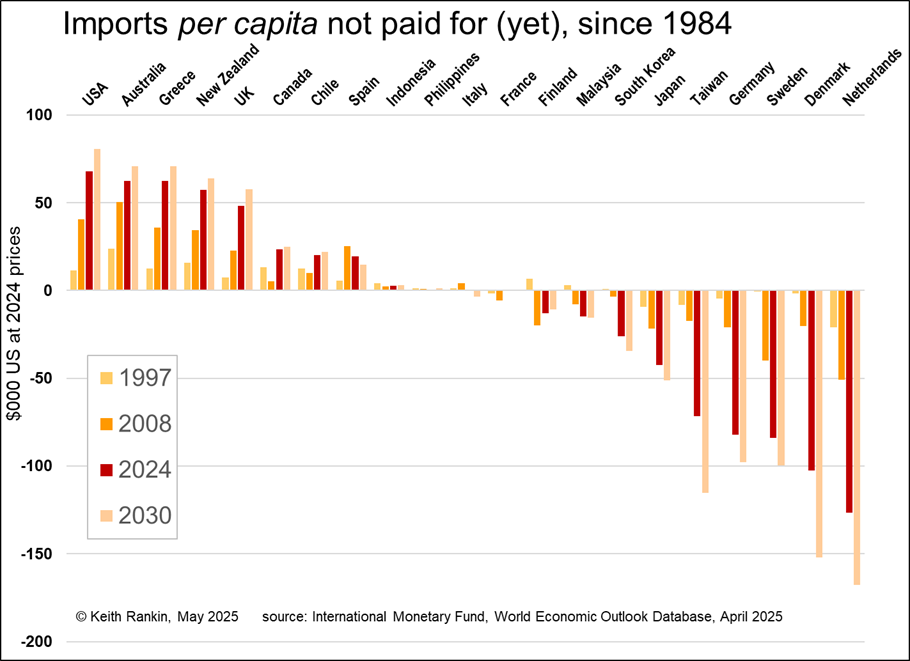
The ‘see-saw’ chart above shows the accumulated ‘excess benefits’ that Aotearoa New Zealand, and a few other countries, have enjoyed from international trade over the last 40 years. These are benefits arising from ‘unbalanced trade’ which are in addition to the regular benefits – arising from efficient specialisation – of ‘balanced’ world trade. Real world trade is a mix of ‘balanced’ (paid for) and ‘unbalanced’ (on forever-credit).
The excess benefit data shown is an inflation-adjusted accumulation of the United States’ current account deficits. We remember that the benefits of trade are what (goods and services) you get, not what you give up.
We note here that the United States is a ‘winner’; not the loser which Donald Trump claims that it has been. The United States has enjoyed $70,000 worth of excess trade benefits over 40 years, per American. And it is projected to enjoy another $10,000 worth of excess trade benefits over the next seven years.
So, what is Donald Trump grumping about? Rhetorically, why does he aspire that ‘America’ should be like Germany?
The biggest losers, as shown here, are a group of northwest European countries, plus Taiwan. (For lack of a complete set of data from 1984, China is not shown here. But China would fit into the chart next to Malaysia. While China has significant accumulated trade surpluses, these are spread over a very large population.) The losers are the countries which have – in effect – ‘given’ away lots of stuff; exports for which they have not received anything in return and will probably never receive anything in return.
The 2030 projections show that these ‘surplus’ countries will continue to under-import; they are not projected to claim the imports that are rightfully theirs to enjoy. Rather, the deficit countries will most likely continue to enjoy these excess unpaid-for benefits.
(There are at least two other ‘surplus countries’ – countries like Germany and Sweden – which would be ‘off the chart’: Singapore and Norway. And one other deficit country: Türkiye.)
Discussion
With international trade in any given year, surplus countries ‘give’ goods and services to deficit countries. They give ‘with strings’. The most obvious form of ‘string’ is a return gift next year; a fully commercial kind of ‘string’ would be a return gift with interest.
For example, if Sweden exports US$1,100 million worth of stuff (ie goods and services) to New Zealand in 2025, and New Zealand exports $1,000 million worth of stuff to Sweden in 2025, then the 2025 gift is $100 million worth of stuff from Sweden to New Zealand. (In technical language, and from New Zealand’s viewpoint this gift from Sweden is called a bilateral trade deficit; from Sweden’s point of view, it’s a trade surplus.)
A return gift with 3% interest would be $103 million worth of stuff from New Zealand to Sweden. (This would be a New Zealand bilateral trade surplus – a deficit for Sweden – in 2026.) The bilateral – ie two-country – ledger would be settled. Effectively, in this example, Sweden lends $100 million of stuff to New Zealand in 2025, and New Zealand repays the loan, with interest, in 2026. Gifts ‘with strings’ are debts.
There are two potential problems. The first problem is that New Zealand may not be able to sufficiently increase, in one year, its exports to Sweden (eg from $1,000 million to $1,203 million, assuming unchanged imports from Sweden). One solution might be for New Zealand to increase its exports by that amount to other countries, and for other countries to export $203 million more to Sweden. But that increase in exports of $203 million might still be too difficult for New Zealand to accomplish in 2026, regardless of who the buyers are. New Zealand might need to borrow more in 2026, (or to import less,) or to repay its 2025 trade debits further into the future.
Indeed, New Zealand might prefer something like a 40-year mortgage. New Zealand could run trade surpluses re Sweden (ie Sweden running deficits) of about 4,358,000 each year for 40 years. In total, over the 40 years from 2026 to 2065, Sweden would receive stuff worth $174,323,300 as its ‘return gift’.
The second (much larger) ‘problem’ is that Sweden might not want to run a trade deficit at all; that is, Sweden might not want to be repaid (except, that is, in some imaginary never-never timeframe). Whether this qualifies as a problem depends on a person’s belief-system. If New Zealand is perfectly happy to receive – into the indefinite future – annual increments of unpaid-for goods and services, and Sweden prefers to keep supplying such stuff without material recompense in foreseeable time, then this sort of unbalanced trade can be categorised as a win-win outcome.
Sweden might not want New Zealand’s (or anybody else’s) debt to it to be repaid; in 2026, or ever. Sweden, happy to run a trade surplus in 2025, might actually prefer to keep making annual ‘gifts’ to New Zealand (and other countries). While each of these gifts would be technically an addition to New Zealand’s debt to Sweden, New Zealand would be able to – maybe, be obliged to – delay settlement of any of that debt (let alone all of it) indefinitely.
In this example, Sweden is a ‘mercantilist’ country; mercantilist means ‘merchant capitalist’, the social science analogue of alchemy. Indeed, Sweden actually is a mercantilist country. Its preference is to accumulate ‘promises’, whereas countries like the United States and New Zealand have been accumulating (and enjoying) imported goods and services.
Mercantilists of yore sought to accumulate ‘treasure’, especially gold. Indeed, in the quarter millennium from 1500 to 1750, economic policy and foreign policy – especially but not only in European power centres – was to become rich by accumulating treasure hoards.
Mercantilism never went away, despite having been debunked by Adam Smith and others around 250 years ago (The Wealth of Nations was published in 1776). In that golden age of mercantilism, the Dutch – the Netherlanders – succeeded par excellence. (Part of their success was in exporting military hardware and software – big guns, and big military knowhow – to all sides in the Thirty Years War of 1618 to 1648. Is that what the USA will end up mimicking?) As we can see from the chart, the Dutch still do incur some of the world’s biggest export surpluses. Instead of accumulating treasure as they did in the seventeenth century – as gold and silver bullion and specie – they now accumulate ‘virtual treasure’ or ‘virtual gold’. Virtual gold is the whole set of ‘promises’ and ‘titles’ – including money and real gold – that are formally known as ‘financial assets’.
New Zealand and America, and others, get the consumable loot. Sweden and Netherlands and Germany get the paperwork. Everyone should be happy.
The dark cloud on the horizon comes when the Americas and the Aotearoas of the world start wanting to be like Germany and Sweden. Then indeed our happyish world descends into a ‘race-to-the-bottom’. Not every country can sit with Germany and its neighbours at the bottom of the above chart. This can be thought of as a see-saw chart: someone has to be at the top; we cannot all be at the bottom.
If some countries have forever-surpluses, other countries must have forever-deficits. Getting to benefit from other countries’ largesse – as New Zealand and America do – may seem like a problem to some. But we should remember that the driving force of the capitalist market system is to want – indeed, to demand – consumable goods and services. Someone has to be able to benefit from all the hard work and sacrifice of others.
*******
Keith Rankin (keith at rankin dot nz), trained as an economic historian, is a retired lecturer in Economics and Statistics. He lives in Auckland, New Zealand.
Work is moving at pace on the State Highway 1 (SH1) Belfast to Pegasus Motorway and Woodend Bypass project, with geotech work beginning this week, Transport Minister Chris Bishop and Minister for the South Island and Associate Transport Minister James Meager say.
“The Government is committed to supporting the fast-growing Waimakariri District. This much needed transport infrastructure will boost economic growth, reduce congestion, improve safety and access to housing growth areas. SH1 approaching Woodend currently carries around 21,500 vehicles per day, of which nine percent is freight. The traffic volume is expected to reach 28,000 vehicles per day by 2048. There have been 280 crashes on SH1 through Woodend between 2014 and 2023, with three fatalities and 25 serious injuries,” Mr Bishop says.
“The NZ Transport Agency (NZTA) Board endorsed the investment case for the Belfast to Pegasus Motorway and Woodend Bypass Road of National Significance in November 2024, which proposes:
Widening the southern section of the existing SH1 from two to four lanes.
A new four-lane motorway bypass in the northern section.
A grade separated interchange at the Williams Street intersection with SH1.
Replace the Pegasus roundabout with an overbridge and signalised intersection.
Kaiapoi Bridge seismic strengthening and widening.
Construction of new bridges over the Cam River and overbridges at Woodend Beach Road and Gladstone Road.
Tolling to support the construction and maintenance of the road.
“In addition to endorsing the investment case in November last year, the NZTA Board also approved $68.1 million in initial funding to complete detailed design work and advance an early works package, as well as around $37 million for property acquisition. Further funding to begin and complete main construction will be considered by the NZTA Board in due course.
“Delivering this project has substantial benefits, including a three-minute travel time saving along the state highway, and up to 10 minutes at peak. It is also expected to reduce traffic through Woodend from 21,000 vehicles per day to 8,000, and a reduction in deaths and serious injuries from 5.6 to 1.25 per year.
“The investment case endorsed by the NZTA Board sets an investment envelope between $800 million and $1 billion to design, consent, and construct the project.
“The Government Policy Statement on Land Transport 2024 (GPS) requires NZTA to consider tolling for all new RoNS. The investment case confirms tolling is possible and the revenue will support the construction and maintenance of the road. The Government will consider this recommendation and announce next steps of the process in due course.”
“NZTA is continuing to move at pace on the project with the detailed design contract awarded to Aurecon and Tonkin + Taylor in March this year. Getting geotech works underway is an essential part of the design phase of the project and will involve drilling around 70 boreholes up to 35 metres deep and digging pits at individual sites within the construction area,” Mr Meager says.
“The geotechnical investigations will look at ground conditions, including soil and rock types, groundwater depths and the strength of soil and rock. This work will take around two months to complete.
“Once geotechnical data is available, NZTA will confirm the scope and design of an early works package and prepare and lodge consent applications. The early works package will likely begin in early 2026, while main construction is likely to begin later in 2026. The project is expected to take four years to complete.
“SH1 is a nationally strategic freight route and provides critical access to Christchurch City, Christchurch International Airport, Lyttelton Port, and the major health, education, commercial and industrial services in the Canterbury region. Delivering the Belfast to Pegasus Motorway and Woodend Bypass Road of National Significance will significantly improve reliability of the corridor and ensure people and freight can get where they need to go, quickly and safely.
“I want to thank local Waimakariri MP Matt Doocey, Banks Peninsula MP Vanessa Weenink, Kaikoura MP Stuart Smith and Mayor Dan Gordon who have been a staunch advocates of this project, as well as wider Canterbury MPs Hamish Campbell and Nicola Grigg. I know we’re all looking forward to seeing more progress in the months and years ahead as we move into construction as soon as possible.”
Please attribute to Relieving Wellington District Commander Inspector Lincoln Sycamore:
Police acknowledge the findings by the Independent Police Conduct Authority (IPCA) regarding four complaints against Wellington Police officers obtaining a warrant and seizing vehicles for unpaid fines in 2022 and 2023.
The incidents occurred following the start of ‘Operation Cobalt’, a nationwide effort by Police to target and disrupt illegal gang activity. As part of this operation, Police staff would apply for warrants to seize property belonging to gang members with unpaid fines.
Police have reviewed the policy and practice regarding obtaining a warrant to seize property for unpaid fines and have addressed the recommendation made by the IPCA.
In March 2024, we updated our search instructions for officers to ensure they are aware of and understand their obligations. Officers are required to have Ministry of Justice bailiffs present at the search location, unless there is urgency and or good reason for Police to execute the warrant as part of a major event operation or criminal investigation.
We also agree with the second recommendation made by the IPCA and have already begun the process to engage with Ministry of Justice to update an internal form used by officers. This will ensure the form accurately reflects the scope of the search and seizure power under section 99 of the Summary Proceedings Act 1957.
The Interim Financial Statements of the Government of New Zealand for the nine months ended 31 March 2025 were released by the Treasury today. The March results are reported against forecasts based on the Half Year Economic and Fiscal Update 2024 (HYEFU 2024), published on 17 December 2024, and the results for the same period for the previous year.
The majority of the key fiscal indicators for the nine months ended 31 March 2025 were better than forecast. The Government’s main operating indicator, the operating balance before gains and losses excluding ACC (OBEGALx), showed a deficit of $6.6 billion. This was $0.5 billion smaller than forecast largely due to lower than forecast core Crown expenditure. Net core Crown debt was $2.1 billion lower than forecast at $182.0 billion, or 42.6% of GDP.
Core Crown tax revenue, at $89.5 billion, was $0.2 billion (0.2%) higher than forecast. While GST and other individuals’ tax were both above forecast by $0.5 billion each, this was broadly offset by source deductions and corporate tax which were below forecast by $0.5 billion and $0.3 billion, respectively.
Core Crown expenses, at $104.1 billion, were $0.6 billion (0.5%) below forecast. This variance included some significant offsetting variances and was mostly timing in nature. In particular, core government services expenses were $0.6 billion above forecast, while transport and housing expenses were $0.6 billion and $0.3 billion below forecast, respectively. The remaining variance was spread across a range of agencies.
The OBEGALx was a deficit of $6.6 billion, $0.5 billion less than the forecast deficit. When including the revenue and expenses of ACC, the OBEGAL deficit was $8.4 billion, $0.4 billion less than the forecast deficit.
The operating balance deficit of $4.5 billion was $0.8 billion higher than the forecast deficit. This reflected net unfavourable valuation movements along with the favourable OBEGAL result. Net gains on financial instruments were $4.0 billion lower than forecast, driven by the performance of the New Zealand Superannuation Fund (NZS Fund) and ACC’s investment portfolios. This unfavourable variance was partly offset by net losses on non-financial instruments being $2.6 billion less than forecast. This was largely owing to a $0.7 billion net actuarial gain on ACC’s outstanding claims liability compared to a forecast net loss of $1.0 billion, and the New Zealand Emissions Trading Scheme with net losses being $0.9 billion lower than forecast.
The core Crown residual cash deficit of $5.3 billion was $1.7 billion lower than forecast. While net operating cash flows were broadly in line with forecast, net core Crown capital cash outflows were $1.5 billion lower than forecast. This variance is expected to be timing in nature, mainly owing to net purchases of investments and net increases in advances which were both below forecast by $0.6 billion and $0.7 billion, respectively.
Net core Crown debt at $182.0 billion (42.6% of GDP) was $2.1 billion lower than forecast. This variance was largely due to the variance in core Crown residual cash deficit and the factors not impacting residual cash which improved net core Crown debt. Of these factors, the most significant was foreign exchange movements since the HYEFU 2024 forecast which have resulted in $0.5 billion of net gains improving net core Crown debt without impacting the core Crown residual cash indicator.
Gross debt at $206.0 billion (48.3% of GDP) was $0.5 billion higher than forecast, largely owing to higher than forecast government stock, partially offset by lower than forecast Treasury bills.
Net worth at $183.8 billion (43.1% of GDP) was $0.3 billion lower than forecast. The variance to forecast reflects a higher operating balance deficit discussed above, partially offset by net actuarial gains on retirement plan schemes ($0.5 billion). Net worth consisted of total Crown assets of $594.7 billion (in line with forecast) and total Crown liabilities of $410.9 billion ($0.3 billion higher than forecast).
Year to date
Full Year
March 2025 Actual1 $m
March 2025 HYEFU 2024 Forecast1 $m
Variance2 HYEFU 2024 $m
Variance HYEFU 2024 %
June 2025 HYEFU 2024 Forecast3 $m
Core Crown tax revenue
89,478
89,278
200
0.2
120,623
Core Crown revenue
99,124
99,152
(28)
–
134,038
Core Crown expenses
104,088
104,662
574
0.5
144,638
Core Crown residual cash
(5,297)
(7,018)
1,721
24.5
(16,610)
Net core Crown debt4
181,984
184,121
2,137
1.2
192,810
as a percentage of GDP
42.6%
43.1%
45.1%
Gross debt
205,997
205,456
(541)
(0.3)
206,558
as a percentage of GDP
48.3%
48.1%
48.3%
OBEGAL excluding ACC (OBEGALx)
(6,589)
(7,118)
529
7.4
(12,868)
OBEGAL
(8,370)
(8,774)
404
4.6
(17,317)
Operating balance (excluding minority interests)
(4,484)
(3,656)
(828)
(22.6)
(10,161)
Net worth
183,815
184,118
(303)
(0.2)
177,492
as a percentage of GDP
43.1%
43.1%
41.5%
Using the most recently published GDP (for the year ended 31 December 2024) of $426,925 million (Source: Stats NZ).
Favourable variances against forecast have a positive sign and unfavourable variances against forecast have a negative sign.
Using HYEFU 2024 forecast GDP for the year ending 30 June 2025 of $427,252 million (Source: The Treasury).
Net core Crown debt excludes the NZS Fund and core Crown advances. Net core Crown debt may fluctuate during the year largely reflecting the timing of tax receipts.
A young has been arrested as Police progress an investigation into several serious incidents in Invercargill.
It follows two aggravated robberies, two burglaries and an attempted burglary, all between 1.50am and 4.30am on Monday morning.
Thankfully, no serious injuries were reported, but the victims were understandably upset and shaken by what occurred, Detective Inspector Stu Harvey said.
Police have arrested and charged a young person in relation to the incidents. He is facing a number of charges and has been remanded in custody to appear in the Invercargill Youth Court today.
“The investigation into this offending is still very much active. We understand these events are unnerving for our community, and we are working hard to locate those we believe to be involved,” Detective Inspector Harvey says.
“We still need the public’s help and want to hear from anyone who might be able to assist.
“In particular, Police are seeking information about two vehicles that were seen in the area of some of the incidents. One of them, a stolen red Toyota Vitz, was involved in the offending and has been recovered while the other vehicle is described only as a car.
“Police would like to speak to anyone who saw vehicles fitting these descriptions between 1am and 5am on Monday.”
Anyone with information about these vehicles or those involved is asked to call Police on 105. You can also share information anonymously through Crime Stoppers on 0800 555 111.
Source: Secondary teachers question rationale for changes to relationship education guidelines
A recent dog attack during a football training session at Tahurangi / Crum Park has highlighted the serious risk off-leash dogs pose to our communities.
A young girl, watching the football training with family members, was attacked by an uncontrolled dog. She will be left with a large scar and a life-long traumatic memory because of this preventable incident.
Auckland Council’s General Manager for Licensing and Compliance, Robert Irvine says this is not an isolated incident and off-leash dog attacks on sports fields are on the rise.
“Similar situations have occurred at other sports grounds where off-leash dogs have rushed at junior players during training,” Mr Irvine says.
“Week after week, dogs are walked off-leash across Auckland’s sports fields while children train, play, and compete; an attack can and does happen so quickly when there are kids running around and a dog is off leash,” he adds.
“This behaviour not only puts children and adults at risk of injury, but it also degrades the quality of our fields. Dog fouling on sports grounds is a persistent problem — one that poses health risks and ruins the experience for players.
Chair of the Regulatory and Safety Committee Councillor Josephine Bartley, herself a dog lover and owner, says it’s unacceptable to have dogs running uncontrolled across our playing fields.
“No parent wants to see their child land face-first in dog excrement while playing soccer or rugby.
“And not only children, but adults too, deserve a safe, clean environment to train and play,” Councillor Bartley says.
“Dogs must be always kept under control near playing fields. This sort of thoughtless behaviour has serious consequences; let’s keep our sports grounds safe, clean, and enjoyable for everyone.”
Auckland Council’s regional rule states that dogs are not on most sports playing surfaces at any time. This includes marked football pitches. These areas are for organised sport and recreation — not dog exercise. Dogs may still be allowed away from playing surfaces, including on a leash on the sidelines when sport is being played. Alternative off-leash dog parks and spaces are provided away from playing surfaces.
To find out where your dog can be exercised off-leash click here
Source: Police investigating after shots fired at Hastings house
Learn how bats, Fiordland tokoeka kiwi, and kākā are all benefiting from our landscape-scale predator control programme using 1080 to protect public conservation land.
Fiordland tokoeka kiwi chick. Image: Belle Gwilliam
Our National Predator Control Programme
DOC’s National Predator Control Programme protects native wildlife and forests at important conservation sites across New Zealand.
Currently, we control predators on a sustained, rotational basis over about 1.8 million hectares, which is nearly 20% of public conservation land.
It’s critical that rats, stoats, and possums are regularly controlled so that populations of threatened native species can survive and grow.
We use the most effective tools available, such as 1080 toxin and large-scale trapping, to protect vulnerable native species and forests.
While the tools and strategies are being developed to achieve Predator Free 2050, our National Predator Control Programme is holding the line for threatened native species by regularly controlling introduced predators across large forest areas.
We recently published our 2024 National Predator Control Programme report which shows we had some big wins for our native species last year.
Here’s our top five highlights of 2024 – from bustling bat roosts to turning the tide for one of our rarest kiwi species:
1️⃣ We’ve turned the tide for Fiordland tokoeka kiwi
Before predator control, every single kiwi chick we monitored in Shy Lake died, meaning the species was facing extinction.
After predator control and eight years of research, last year’s kiwi chick survival rate climbed to 60%.
Ranger Chris Dodd with ‘Spanners’, one of the first monitored tokoeka chicks to survive during the programme, now fully grown. Image: Monty Williams.
2️⃣ Thanks to our science advice, we’ve improved timing for operations and achieved our best results yet
Our scientists carefully reviewed the results of how we time our operations around beech masts. With their advice, we changed tactics and targeted rats either before beech seed was produced or after it had germinated.
It paid off big time – all our operations suppressed rats effectively, in most cases down to undetectable levels.
Predator plague cycle. Image: DOC
3️⃣ Pīwauwau rock wren thriving with predator control
There are an average of twice as many rock wrens at predator control sites compared to sites with no control.
Every year our team surveys alpine rock wren populations. Research across our 25 sites shows that aerial operations help rock wren populations recover and grow.
4️⃣ We found a record-breaking pekapeka bat roost while monitoring the results of predator control
We discovered 275 bats in one tree roost in Whirinaki Te Pua-a-Tāne Conservation park where we undertake regular predator control operations. That’s a lot of bats!
Pekapeka/short-tailed bat. Image: Maddy Brennan
5️⃣ Thanks to predator control, kākā in Waipapa have the most balanced sex ratio ever recorded
Female kākā are more vulnerable to predation, especially when they’re confined to nest cavities during breeding season. Studying the ratio of kākā males to females can help us understand the health of a population and its predation pressures.
This year, kākā monitoring in Pureora Forest (an ongoing predator control site) revealed a 1:1 sex ratio – the most balanced we’ve ever recorded.
A 39-year-old man is before the courts following an operation targeting illicit drug dealing in Queenstown, alongside the seizure of multiple illicit drugs and around $45,000 cash.
Following an investigation into the distribution of illicit drugs in the community, Police executed a search warrant at a Queenstown property yesterday morning.
The man was arrested and charged in relation to the operation.
Following the arrest, a search of the residence located varying amounts of ketamine, cocaine, MDMA, LSD, cannabis, and psilocybin.
Digital scales were also located, alongside $45,000 cash.
Detective Sergeant Miriam Chittenden says Police is pleased with the result from this operation.
“We work hard to disrupt the supply of illicit drugs within our community as we see first-hand the serious impacts and harm from these illicit drugs every day.
Police will continue to target those who supply illicit drugs, which cause extreme harm and damage to our communities. However, we cannot do this alone, and we ask that anyone with information about the supply of illicit drugs contacts us through 105, either online or via phone.
Information can also be reported to your local Police station or anonymously through Crime Stoppers at 0800 555 111.
We encourage anyone affected by drug addiction to seek help through Alcohol and Drug helpline on 0800 787 797, or free text 8681.
The 39-year-old man is due to appear in Queenstown District Court on Monday 12 May, charged with multiple charges including offers to supply LSD, offers to supply psilocybin, possession of cocaine, and possession of MDMA.
Canterbury Police are investigating a crash in Hei Hei last month and are appealing for witnesses.
At around 4:15pm on Saturday 12 April, a vehicle collided with a pedestrian at the corner of Buchanans Road and Carmen Road.
The pedestrian sustained serious injuries however these are not believed to be life threatening.
Police would like to speak to anyone who witnessed the crash, or saw a dark-coloured Mazda people mover in the Hei Hei area between 4pm and 4:30pm on 12 April.
The vehicle travelled towards the airport along Carmen Road following the collision and was last seen at around 4:25pm turning into Roydvale Ave from Memorial Ave.
If you have any information that could assist, including dashcam or CCTV footage, please get in touch via 105, either over the phone or online.
A man has been arrested as Oamaru Police investigate three serious, violent incidents in 24 hours.
Sergeant Tony Woodbridge says members of the public have played a crucial role in the arrest, and while enquiries are ongoing, those involved are believed to be known to each other.
Two of the incidents involved individuals entering residential addresses. The first occurred on Queens Crescent at 11.45pm on Tuesday, where one person was assaulted. The second incident occurred at a Thames Highway address at 4am on Wednesday, where another person was assaulted.
Both victims were taken to hospital with moderate injuries.
At 4.20pm on Wednesday, Police were called to a serious assault at Centennial Park in Oamaru, where a woman was knocked unconscious. A white station wagon then drove at the offender, before ramming a black Subaru Legacy.
After the offender left in the Subaru, the victim got into the station wagon and the vehicle left the scene.
“The third incident occurred in a busy area, in the vicinity of a number of people, and with hockey games being played nearby,” Sergeant Woodbridge says.
“We would like to hear from anyone who was near the Centennial Park carpark, who saw or filmed the assault, or the vehicles leaving.”
Yesterday (7 May), Police arrested a 27-year-old Oamaru man in relation to the incidents.
He has been charged with breaching release conditions; four counts of assault with intent to injure; wounding with intent to commit grievous bodily harm; and two counts of burglary.
“Such serious violent incidents are always of concern, and we know this will be unsettling. I want to assure the Oamaru community that these were not random acts of violence, and we are doing everything we can to hold those responsible to account.
“We are still working to determine why this offending took place, and enquiries are ongoing to locate other people who may have been involved.
“Police want to thank the members of the public who have assisted us with information so far. We still need to hear from anyone who may have witnessed these events, or anyone who has information that can assist us.”
You can update Police online now or call 105 using the reference number 250507/6833.
Information can also be provided anonymously via Crime Stoppers on 0800 555 111.
BRUSSELS, 7 May 2025 –Almost a third of today’s five-year-olds – about 38 million children – will be spared a lifetime’s “unprecedented” exposure to extreme heat if the world meets the 1.5°C warming target by 2100, Save the Children said.
Ahead of the 10th anniversary of the Paris Agreement,research released by Save the Children and Vrije Universiteit Brussel (VUB) found that undercurrent climate commitments– which will likely see a global temperature rise of 2.7°C above pre-industrial levels – about 100 million of the estimated 120 million children born in 2020, or 83%, will face “unprecedented” lifetime exposure to extreme heat.
However, if the world limits warming to the 1.5°C Paris Agreement target, this would reduce the number of five-year-olds impacted to 62 million – a difference of 38 million – highlighting the urgency to protect children through rapidly phasing out the use and subsidy of fossil fuels. Dangerous heat is deadly for children, taking an immense toll on their physical and mental health, disrupting access to food and clean water andforcing schools to close.
Researchers defined an “unprecedented” life as an exposure to climate extremes that someone would have less than a 1 in 10,000 chance of experiencing during their life in a world without human-induced climate change. The research, published in the reportBorn into the Climate Crisis 2. An Unprecedented Life: Protecting Children’s Rights in a Changing Climatealso found that meeting the 1.5°C target would protect millions of children born in 2020 from the severest impacts of other climate related disasters such as crop failures, floods, tropical cyclones, droughts and wildfires.
The report found that, for children born in 2020, if global temperature rise is limited to 1.5°C rather than reaching 2.7°C above pre-industrial levels:
About 38 million would be spared from facing unprecedented lifetime exposure to heatwaves;
About 8 million would avoid unprecedented lifetime exposure to crop failures;
About 5 million would be spared from unprecedented lifetime exposure to river floods;
About 5 million would avoid unprecedented lifetime exposure to tropical cyclones;
About 2 million would avoid unprecedented lifetime exposure to droughts;
About 1.5 million children would be spared unprecedented lifetime exposure to wildfires.
Climate extremes – which are becoming more frequent and severe due to climate change – areincreasingly harming children,forcing them from their homes, putting food out of reach, damaging schools and increasing risks like child marriage as they are forced out of education and into poverty and food shortages.
Denise-, 16, and her family were forced from their home in Brazil when the country’s worst floods in 80 years devastated their community last year. Their home, including Denise’s bedroom, was severely damaged, and she was out of school for nearly two months.
She said: “It really affected me mentally, and academically too. Catching up on all my grades to pass secondary school was really tough, especially at a state school. It massively impacted my schoolwork. My grades dropped significantly after the floods.”
Children impacted by inequality and discrimination and those in lower-and middle-income countries, are oftenworst affected. Meanwhile they have fewer resources to cope with climate shocks and are already at far greater risk from vector and waterborne diseases, hunger, and malnutrition, and their homes are often more vulnerable to increased risks from floods, cyclones and other extreme weather events.
Haruka, 16,whose poem is featured in the report, is from Vanuatu, which recently experienced three of the most severe types of cyclone in just a year.
She said:“Cyclones are scary. For me, they continue to destroy my home, every year – we don’t even bother trying to fix the ceiling anymore. “The past few years, I’ve seen ceaseless destruction and constant rebuilding. This seemingly never-ending cycle has become our reality, and most people aren’t even aware that it’s not just nature doing its thing, but it’s us bearing the brunt of a crisis that we did not cause.”
As well as comparing conditions under 1.5°C and 2.7°C scenarios, the report also examines a scenario in which global temperatures rise to 3.5°C by 2100, which will lead to about 92% of children born in 2020 – about 111 million children [5] – living with unprecedented heatwave exposure over their lifetime. While we need a rapid phase-out of the use and subsidy of fossil fuels to stick to the 1.5°C target, we must not lose sight of solutions, Save the Children said.
The report highlights initiatives like increased climate finance, child-centred and locally led adaptation and increasing the participation of children in shaping climate action.
Inger Ashing, CEO of Save the Children International, said: “Across the world, children are forced to bear the brunt of a crisis they are not responsible for. Dangerous heat that puts their health and learning at risk; cyclones that batter their homes and schools; creeping droughts that shrivel up crops and shrink what’s on their plates. “Amid this daily drumbeat of disasters, children plead with us not to switch off. This new research shows there is still hope, but only if we act urgently and ambitiously to rapidly limit warming temperatures to 1.5°C , and truly put children front and centre of our response to climate change at every level.”
As the world’s leading independent child rights organisation, Save the Children works in about 110 countries, tackling climate across everything we do.
Save the Children supports children and their communities globally in preventing, preparing for, adapting to, and recovering from climate disasters and gradual climate change. We have set up floating schools, rebuilt destroyed homes and provided cash grants to families hit by disasters. We also work to influence governments and other key stakeholders on climate policies, including at the UNFCCC COP summits, giving children a platform for their voices to be heard.
In this Pulse article, Kelvin Davidson, Chief Property Economist for Cotality NZ (formerly CoreLogic), explores the significant regional divergences that have emerged since the post-COVID peaks.
Following the dramatic growth in property values during the COVID-era boom, New Zealand’s housing market has entered a more fragmented phase. While national indicators suggest a stabilisation in values, the underlying regional picture tells a far more complex story — one marked by stark divergences in performance, resilience, and recovery.
New analysis from Cotality reveals that while some regional markets have already surged past previous highs, others — particularly in parts of Auckland and Wellington — remain well below their cyclical peaks.
In fact, over a dozen areas are still more than 20% off their highs, highlighting how uneven the past few years have been across the country.
As mortgage rates ease and affordability improves in select locations, this Pulse takes a closer look at the forces shaping these regional variations — shedding light on affordability trends, economic drivers, and standout performers such as Hamilton, Queenstown, and much of Canterbury.Some areas are back to peak, others languishing
Cotality’s latest hedonic Home Value Index shows there were three areas that set their own new record highs for property values in April – New Plymouth at $711,699, Westland at $493,500, and Kaikoura at $775,443. While the early signs of growth have recently re-emerged in many other parts of the country – driven by lower mortgage rates – the gap compared to where property values were at the peak remains significant.Indeed, 13 areas still have property values more than 20% below the peak, all of them either in the Auckland or Wellington regions, apart from Wairoa (-21%).
Both Lower Hutt and Upper Hutt sit at -24% compared to the peak, with Wellington City at -23% and Porirua -22%. Waitakere is -23%, with Papakura and Manukau at -22% apiece. ‘Rural’ areas of Wellington Region such as South Wairarapa and Carterton sit at -21%.
A story of South Island affordability?
Another distinct trend that stands out is the north-south split – with the South emerging as a clear winner when it comes to affordability.
Take areas such as Grey, Buller, Clutha, and Gore, where the current figure for mortgage payments as a percentage of gross median household income is less than 30% (versus 46% nationally).
By contrast, Tauranga’s mortgage affordability measure is still 54% and Kapiti Coast sits at the same level.
“Affordability remains a key pillar of housing demand, and in many South Island regions we’re seeing that balance become a little more favourable for buyers,” said Kelvin Davidson, Chief Property Economist at Cotality NZ.
Areas of interest
Hamilton’s recent strength. Compared to the other main centres in the North Island, Hamilton hasn’t fallen as far (-10% from the peak) in the past three years or so and has been showing stronger signs of growth more recently too.
Since January, values are up by +2.1% in Hamilton, matching Christchurch’s figure, and ahead of Auckland at +0.9% and Tauranga (which has edged down by -0.4%). The buoyancy of the surrounding rural economy at present may be supporting Hamilton’s market, with other factors potentially including the increased connectivity to Auckland via improved roading.
Queenstown’s continued prominence. Despite an elevated median value of $1.66m, well ahead of second-placed North Shore (Auckland) at $1.31m, Queenstown has remained a reasonably buoyant market – ‘only’ down by 5% from the peak – still appealing to overseas buyers who can navigate the rules and also wealthy domestic investors.
Canterbury’s resilience. Of the 17 areas that are back within 5% of their peak, eight are in Canterbury, including Christchurch, Waimakariri, Ashburton, and Timaru. This comes even though new housing supply volumes have been high across large parts of the Region and signals that property demand has been rising to match construction.
Looking ahead
While some of New Zealand’s largest urban centres remain well below their recent market peaks, a return to strong growth is not guaranteed. Structural factors—such as Auckland’s substantial pipeline of new townhouse developments and ongoing fiscal tightening in Wellington—may continue to weigh on short-term performance.
Nevertheless, improved mortgage affordability and early signs of broader economic recovery are likely to support renewed value growth across many parts of the country in 2025, including Auckland and Wellington. As market fundamentals continue to evolve, buyers and investors alike will be watching closely for signs of renewed momentum.
After 19 months of conflict that has killed tens of thousands of Palestinians and drawn accusations of war crimes against Israel, Benjamin Netanyahu is once more preparing to escalate Israel’s offensive in Gaza.
The latest plan puts Israel on course for full occupation of the Palestinian territory and would drive Gazans into ever-narrowing pockets of the shattered strip.
It would lead to more intensive bombing and Israeli forces clearing and holding territory, while destroying what few structures remain in Gaza.
This would be a disaster for 2.2 million Gazans who have already endured unfathomable suffering.
Each new offensive makes it harder not to suspect that the ultimate goal of Netanyahu’s far-right coalition is to ensure Gaza is uninhabitable and drive Palestinians from their land. For two months, Israel has blocked delivery of all aid into the strip.
Child malnutrition rates are rising, the few functioning hospitals are running out of medicine, and warnings of starvation and disease are growing louder. Yet the US and European countries that tout Israel as an ally that shares their values have issued barely a word of condemnation.
They should be ashamed of their silence, and stop enabling Netanyahu to act with impunity.
In brief remarks on Sunday, US President Donald Trump acknowledged Gazans were “starving”, and suggested Washington would help get food into the strip.
But, so far, the US president has only emboldened Netanyahu. Trump returned to the White House promising to end the war in Gaza after his team helped broker a January ceasefire between Israel and Hamas.
Under the deal, Hamas agreed to free hostages in phases, while Israel was to withdraw from Gaza and the foes were to reach a permanent ceasefire.
But within weeks of the truce taking hold, Trump announced an outlandish plan for Gaza to be emptied of Palestinians and taken over by the US.
In March, Israel collapsed the ceasefire as it sought to change the terms of the deal, with Washington’s backing. Senior Israeli officials have since said they are implementing Trump’s plan to transfer Palestinians out of Gaza.
On Monday, far-right Finance Minister Bezalel Smotrich said: “We are finally going to occupy the Gaza Strip.”
Netanyahu insists an expanded offensive is necessary to destroy Hamas and free the 59 remaining hostages. The reality is that the prime minister has never articulated a clear plan since Hamas’s October 7, 2023, attack killed 1200 people and triggered the war.
Instead, he repeats his maximalist mantra of “total victory” while seeking to placate his extremist allies to ensure the survival of his governing coalition.
But Israel is also paying a price for his actions. The expanded offensive would imperil the lives of the hostages, further undermine Israel’s tarnished standing and deepen domestic divisions.
Israel has briefed that the expanded operation would not begin until after Trump’s visit to the Gulf next week, saying there is a “window” for Hamas to release hostages in return for a temporary truce.
Arab leaders are infuriated by Netanyahu’s relentless pursuit of conflict in Gaza yet they will fete Trump at lavish ceremonies with promises of multibillion-dollar investments and arms deals.
Trump will put the onus on Hamas when speaking to his Gulf hosts. The group’s murderous October 7 attack is what triggered the Israeli offensive.
Gulf states agree that its continued stranglehold on Gaza is a factor prolonging the war. But they must stand up to Trump and convince him to pressure Netanyahu to end the killing, lift the siege and return to talks.
The global tumult triggered by Trump has already distracted attention from the catastrophe in Gaza. Yet the longer it goes on, the more those who remain silent or cowed from speaking out will be complicit.
Source: Eastern Institute of Technology – Tairāwhiti
2 minutes ago
Students in EIT’s supported learning programme are celebrating a new beginning, returning to the Hawke’s Bay campus with a refreshed curriculum, a custom-designed learning space, and a teaching team made up entirely of EIT graduates.
The newly renamed New Zealand Certificate in Skills for Learning and Working (Level 1) replaces a previous qualification and reflects a significant shift in both content and delivery.
EIT graduates Mel Gregory, Pete McLachlan, Georgia Blair and Kelly Dickson are now working as Learning Facilitators for the New Zealand Certificate in Skills for Learning and Working (Level 1), while fellow graduate Janine Blamey is a lecturer on the programme.
Programme Coordinator Les Blair says it is a fresh start in every sense.
“It is a new programme, new space and new team – new, new, new.”
The return to EIT’s Hawke’s Bay campus in Taradale comes after more than two years based at Equippers Church Napier, where staff and students took refuge following Cyclone Gabrielle.
Students marked the end of their time at Equippers Church by crafting a commemorative tile plaque.
“We made great relationships in the community, but it’s good to be home,” Les said.
“We’re just so grateful that people took our advice about what the space needed. It’s a welcoming place for the students to be in,” Blair said.
“There’s now a real sense that we’re EIT students again.”
The new facility includes a homeroom and a flexible classroom setup, with digital tools that support collaborative learning – improving accessibility and allowing students to move more freely.
The transition from temporary facilities to a permanent home marks more than just a change of address. For Les and her team, it signals a reconnection with the wider EIT community — and a chance to reset expectations for students.
“That’s a really positive shift.”
The newly assembled teaching team includes five graduates from EIT’s School of Health and Sport Science, several of whom have transitioned from student placements to staff roles.
“They’ve brought not just their own journey but the skills and technologies from their training. It’s exciting to see former students come full circle.”
Dr Andrew Garrett, Head of School, Health and Sport Science, said: “Les and her team do an excellent job on the skills for living programme”.
“Providing a really valuable contribution to the community. It’s great to see they now have purpose built facilities on the campus with their students joining the vibrant student community.”