Category: Pandemic

  • MIL-OSI USA News: Statement from President Joe  Biden on the August PCE  Report

    Source: The White House

    Today’s report shows inflation has come back down to 2.2%, similar to pre-pandemic levels, at a time when interest rates have fallen—lowering the cost of buying a home or car, or operating a small business. This follows yesterday’s news that on my watch the economy has grown more than 10% and incomes are up nearly $4,000, after accounting for inflation. The economy, incomes, savings, and consumer spending are all stronger than previously estimated.
     
    We have more work to do to lower costs and create opportunities for Americans. The Vice President and I want to build millions of new homes, continue to lower the price of prescription drugs and health care, and cut taxes for families, small businesses, and industries of the future. Congressional Republicans would take the opposite approach—raising costs for middle-class families by nearly $4,000 per year while giving more tax cuts to the wealthy and big corporations. That’s not how you grow the economy, or the middle class.

    ###

    MIL OSI USA News

  • MIL-OSI Global: Autoworkers, Boeing machinists, cannabis drivers: Labor unions are mobilizing in new and old industries alike

    Source: The Conversation – USA – By Robert Forrant, Professor of U.S. History and Labor Studies, UMass Lowell

    Members and supporters of an International Association of Machinists and Aerospace Workers union district local convene in Seattle on July 17, 2024. Jason Redmond/AFP via Getty Images

    What do violinists, grocery store clerks, college dorm counselors, nurses, teachers, hotel housekeepers, dockworkers, TV writers, autoworkers, Amazon warehouse workers and Boeing workers have in common?

    In the past year or so, they’ve all gone on strike, tried to get co-workers to join a union, or threatened to walk off the job over an array of issues that include retirement plans, technology replacing workers and lagging wages as inflation increased.

    The array of Americans who are organizing unions extends to the tech, digital media and cannabis industries. Even climbing gym employees have formed a union.

    This is happening as U.S. workers in general are finding themselves in an increasingly precarious position. As a labor historian, I believe mobilization is the result of economic disruption caused by the relocation of jobs, the impact of new technologies on work and the erosion of income stability. It’s become very unlikely that today’s workers will have the same employer for decades, as my father and many men and women of his generation did.

    Greatest generation of jobs

    My father, a butcher, worked for the same company for 40 years and raised a family of seven on his union-secured wages and benefits. While back in the 1950s and 1960s many working-class Americans took that kind of job security for granted, it’s no longer the case. Some career coaches consider keeping a job for many years as a character flaw.

    The upsurge in labor organizing is in part a way for workers to gain some sort of say about what happens to their jobs. It’s also helping employees plan for the future.

    Union members are increasingly using strikes to demand higher wages, better benefits and increased job security. Why should it be, some low-income earners are asking, that in my family we must hold down two or three jobs to make ends meet, while CEO pay goes through the stratosphere?

    There were 33 major strikes involving nearly a half-million workers in 2023, the most since 2000. Many labor scholars attribute much of this uptick in organizing to several long-term trends. They include stagnating wages, high out-of-pocket health spending costs – even for those with insurance coverage – and growing concerns over job insecurity caused by the expanded use of labor-saving technology.

    Hundreds of Los Angeles County workers rally on Sept. 24, 2024, to show support for their union, SEIU, to hold a strike. Many held signs regarding alleged unfair labor practices, abbreviated to ULP.
    Genaro Molina/Los Angeles Times via Getty Images

    Precarious work

    In many industries, large numbers of the reliable jobs that paid enough for workers to be in the middle class have dwindled. That’s largely due to technological advances that replaced labor with automation and manufacturers moving to lower-income places, including Mexico, China and other foreign countries, as well as southern states such as Alabama and Tennessee. These trends have left behind a Rust Belt strewn with decaying buildings that once housed bustling factories and increasing numbers of what are sometimes called “precarious” jobs, which are poorly paid and lack sick leave, vacation time and other basic protections.

    This isn’t new.

    I’ve researched how New England’s textile industry fled cities such as Lowell, Massachusetts, as early as the 1920s for nonunion locations in South Carolina, while precision metalworking plants in Springfield, Massachusetts, sent work to Mississippi and South Carolina starting in the 1950s.

    But faced with mounting economic uncertainty, public support for unions is increasing. A 2024 Gallup Poll found that 70% of Americans approve of them – close to the 71% level seen in 2022, which was the highest approval rating that unions had gotten in half a century.

    Support is even rising among Americans who identify as Republicans, a political party that has historically frowned on organized labor: Gallup found it stood at 49% in 2024, down from 56% two years earlier but up from a low point of 26% in 2011.

    Hotel workers strike

    On Labor Day weekend in 2024, more than 10,000 hotel workers represented by the UNITE HERE union and employed by 24 hotels from Boston to the West Coast to Hawaii went on strike. Their labor actions disrupted travel plans during a busy time.

    Most hotel work stoppages lasted for three days and intended to pressure the companies that own hotels as part of a larger labor contract negotiation strategy. Later in September, workers kept walking off the job at other hotels to pressure management to improve pay, expand health insurance coverage, boost retirement benefits and agree to resolve important job security issues.

    Although the hotel industry has been booming since 2023, UNITE HERE contends that employment has decreased by nearly 40%, while wages have stagnated. On the picket line, workers have described living paycheck to paycheck and working one or two additional jobs to cover recent rent hikes.

    Hotel workers have more bargaining power today because, according to an industry study, 79% of the 450 hotels surveyed looking to hire people said they could not fill open jobs.

    That strike shows no sign of ending. Thousands more hotel workers were joining in by late September.

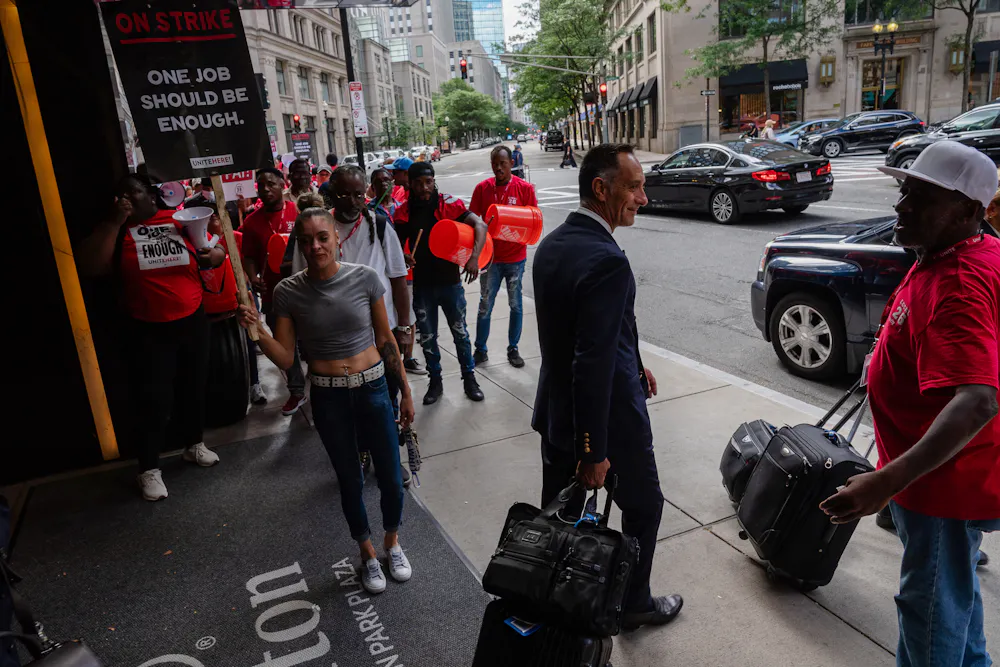
    Striking hotel workers make way for an airline crew while picketing outside of the Hilton Boston Park Plaza in Boston, Mass., on Sept. 2, 2024.
    Sophie Park/The Washington Post via Getty Images

    Boeing strike

    Unlike the hotel workers’ brief rolling work stoppages, the Boeing strike hasn’t let up since it began on Sept. 13, 2024. About 32,000 workers, mainly in Seattle, Washington, and Portland, Oregon, have walked off the job.

    Boeing workers declared the strike even though the International Association of Machinists District 751 leadership in Seattle wanted to accept a deal from Boeing’s management. But on Sept. 12, 94.6% of all rank-and-file workers rejected the tentative contract their leadership recommended the union accept.

    The Boeing strike started the next day; it could last a long time. On Sept. 25, the workers rejected what the company had called its “best and final offer” to settle the strike.

    This is the eighth time these workers have gone on strike since their union formed in the 1930s. Its two most recent strikes, in 2008 and 2005, lasted 57 days and 28 days, respectively. Boeing’s management, already reeling from the company’s numerous operational and safety problems, has announced several cost-cutting measures, including furloughs for some nonunion employees.

    Boeing’s nonunion backup plan

    Boeing has assured its shareholders and the public that the strike would not hinder production of the 787 Dreamliner jets at the company’s nonunion factory in South Carolina.

    International Association of Machinists union members have never forgiven Boeing for deciding to build that assembly plant. Operational since 2011, it now employs roughly 6,000 workers. Most of them would have been union members had Boeing built that plant or expanded production in Washington or Oregon, because the existing labor agreement would have covered the new workers.

    However, the agreement did not extend to South Carolina.

    At the time of the decision, a Boeing spokesperson said, its contract with the machinists’ union “acknowledges our right to locate work elsewhere, and that’s what we chose to do in this case because we just couldn’t get the terms from them that we needed.”

    Dockworkers could be next

    The timing of the hotel and Boeing strikes makes them perhaps more visible than they might have been because union members’ votes are coveted by both major parties in the 2024 presidential election.

    Meanwhile, 25,000 dockworkers who belong to the International Longshoremen’s Association are planning a possible shutdown of ports from Boston to Houston on Oct. 1, over the union’s concern for job loss due to automation.

    How job security issues are addressed following this wave of strikes could set the tone for what other hospitality, manufacturing and transportation unions seek when their contracts are up for negotiation again.

    Robert Forrant does not work for, consult, own shares in or receive funding from any company or organization that would benefit from this article, and has disclosed no relevant affiliations beyond their academic appointment.

    ref. Autoworkers, Boeing machinists, cannabis drivers: Labor unions are mobilizing in new and old industries alike – https://theconversation.com/autoworkers-boeing-machinists-cannabis-drivers-labor-unions-are-mobilizing-in-new-and-old-industries-alike-239371

    MIL OSI – Global Reports

  • MIL-OSI Africa: African Development Bank Group’s Sustainable Energy Fund for Africa approves €6 Million for Desert to Power – Burkina Faso Solar Project

    Source: Africa Press Organisation – English (2) – Report:

    African Development Bank Group’s Sustainable Energy Fund for Africa approves €6 Million for Desert to Power – Burkina Faso Solar Project Burkina Faso is one of five priority countries under the Desert-to-Power initiative, which aims to generate 10 gigawatts of solar power across 11 Sahelian countries by 2030 ABIDJAN, Ivory Coast, September 27, 2024/APO Group/ — The African Development Bank Group (www.AfDB.org) has approved a €6 million concessional financing package from the Sustainable Energy Fund for Africa (SEFA), a special multi-donor fund managed by the Bank, to accelerate the completion of Burkina Faso’s Dédougou photovoltaic solar project in support of the Bank’s Desert-to-Power initiative (https://apo-opa.co/3XKXpwG). The project involves designing, constructing and operating an 18-megawatt solar power plant in Dédougou, located 250 kilometres west of the capital, Ouagadougou. Burkina Faso is one of five priority countries under the Desert-to-Power initiative, which aims to generate 10 gigawatts of solar power across 11 Sahelian countries by 2030, promoting socio-economic development. This project stands as one of the first independent power producers (IPPs) in Burkina Faso and has secured both senior and subordinated loans, along with a 25-year Power Purchase Agreement (PPA) with the Société Nationale d’électricité du Burkina Faso (SONABEL). However, the project encountered challenges in reaching financial close due to cost escalations resulting from the COVID-19 pandemic.  The SEFA Covid-19 IPP Relief Programme (SEFA Programme) played a pivotal role in overcoming these hurdles. Through concessional financing, SEFA helped restructure the financial arrangements to absorb the pandemic-related cost increases, ensuring the project’s viability and preserving the originally agreed structure with the Government of Burkina Faso, thereby contributing to the country’s energy security. Under the SEFA Programme, a €2.5 million senior concessional loan and a €3.5 million reimbursable grant have been provided through its concessional finance facility. SEFA’s involvement has been instrumental in unlocking additional financing from the Dutch entrepreneurial development bank, FMO (www.FMO.nl), including subordinated and senior loans. These funds will be disbursed to Dédougou Solaire SARL, the project company jointly developed by QAIR (www.Qair.Energy), which is responsible for managing the project. As part of the Desert-to-Power initiative, the project is expected to contribute to energy security, diversification of the energy mix, reduced electricity costs, and increased national electrification rates. “The Dédougou Solar PV project increases Burkina Faso’s renewable energy generation capacity in line with the objectives of the Desert-to-Power Initiative. By backing projects like this, we are making tangible strides toward electrifying the Sahel, bolstering energy security, and improving the lives of millions,” said Dr. Daniel SCHROTH, Director of the Renewable Energy and Energy Efficiency Department at the African Development Bank. “Abdoulaye Toure, CFO at Qair Africa, acknowledged SEFA’s support and the project’s advancement: “We are pleased with this approval by SEFA and thank the African Development Bank for their support of the project. This allows us to move forward with our commitment to supporting Burkina Faso’s energy goals by developing a second solar plant, just a year after the successful commissioning of Zano. This achievement aligns with the country’s ambitions for energy supply and reinforces Qair’s vision of becoming a leading player in Africa’s renewable energy sector in the coming years.” Distributed by APO Group on behalf of African Development Bank Group (AfDB). Contact: Communication and External Relations media@afdb.org About SEFA: SEFA is a multi-donor Special Fund that provides catalytic finance to unlock private sector investments in renewable energy and energy efficiency. SEFA offers technical assistance and concessional finance instruments to remove market barriers, build a more robust pipeline of projects and improve the risk-return profile of individual investments. The Fund’s overarching goal is to contribute to universal access to affordable, reliable, sustainable, and modern energy services for all in Africa, in line with the New Deal on Energy for Africa and Sustainable Development Goal 7. About Qair: Qair is an independent renewable energy company developing, financing, building, and operating solar, onshore and offshore wind, hydroelectric, tidal energy, waste-to-energy, battery storage and green hydrogen production. With 1.1 GW of capacity in operation, the group’s 640 employees are developing a portfolio pipeline of 30 GW in 20 countries across Europe, Latin America and Africa. Our ambition is to become an independent leader in responsible energy. In Africa, Qair’s portfolio of wind, PV and BESS assets includes 65 MW operational projects, 174 MW/262 MWh under construction or financing and a robust pipeline under development of 2GW+. With over 15 years of presence in Africa and teams established in Burkina Faso, Chad, Mauritius, Morocco, Seychelles, and Tunisia, Qair continually expands its geographical footprint across North, Central and West Africa and the Indian Ocean. Qair has already completed another 24MW solar PV project (Zano) in Burkina Faso, which was awarded under a public-private partnership (PPP) with GoBF along with a PPA with the National Electricity Company (SONABEL). About FMO: FMO is the Dutch entrepreneurial development bank. As a leading impact investor, FMO supports sustainable private sector growth in developing countries and emerging markets by investing in ambitious projects and entrepreneurs. FMO believes that a strong private sector leads to economic and social development and has a 50+ year proven track record in empowering entrepreneurs to make local economies more inclusive, productive, resilient and sustainable. FMO focuses on three sectors with a high development impact: Agribusiness, Food & Water, Energy, and Financial Institutions. With a total committed portfolio of EUR ~13 billion spanning over 85 countries, FMO is one of the larger bilateral private sector development banks globally. About the African Development Bank Group: The African Development Bank Group is Africa’s premier development finance institution. It comprises three distinct entities: the African Development Bank (AfDB), the African Development Fund (ADF) and the Nigeria Trust Fund (NTF). On the ground in 41 African countries with an external office in Japan, the Bank contributes to the economic development and the social progress of its 54 regional member states. For more information: www.AfDB.org

    Text copied to clipboard.

    MIL OSI Africa

  • MIL-OSI USA: Scalise Sends Letter to Colleagues Touting Republican Wins in 118th Congress

    Source: United States House of Representatives – Congressman Steve Scalise (1st District of Louisiana)

    WASHINGTON, D.C.— Today, House Majority Leader Steve Scalise (R-La.) sent the following letter to his colleagues as we head into the October district work period:

    Dear Colleagues,
     
    It’s hard to believe, but only two years ago the Democrats were signing their deceptively named “Inflation Reduction Act” into law. That capped four years of unified Democrat control of Washington, where they jammed their radical agenda through Congress, spending $10 trillion and causing runaway inflation the American people still struggle with today.
     
    Thankfully, in November 2022, the American people had enough of the destruction caused by the Democrats’ radical agenda and voted us into a narrow House majority. House Republicans were a small beacon of hope in an otherwise desolate Washington landscape controlled by the Democrat Party, their army of bureaucrats, and a media propaganda machine.
     
    It’s been a David versus Goliath fight over the last 21 months of our House majority, and I’m so proud to fight alongside all of you. As we head into the final stretch before this pivotal election, we have a lot to be proud of and important accomplishments we can talk about at home.
     
    While we do not control the Senate or White House, we should be encouraged by the fact that we, as House Republicans, unified around an ambitious agenda that addressed the real concerns American families face every day. From inflation and energy costs to historic illegal immigration and crime to national security and holding those in power accountable, we put on full display the contrast of our vision for the country versus the vision of chaos and economic distress of radical Democrats. Here are some of the highlights:
     
    H.R. 1, the 
    Lower Energy Costs Act:
    Our conference fought back against the Biden-Harris Administration’s war on American energy by passing the 
    Lower Energy Costs Act to cut burdensome red tape and boost energy production here at home, instead of relying on hostile foreign dictators that put our energy security at risk. In addition to making America energy independent again, H.R. 1 lowers costs for families who are struggling every day thanks to skyrocketing prices at the gas pump, in the grocery store, and elsewhere.
     
    H.R. 2, the 
    Secure the Border Act:
    It’s no secret that, even in larger Republican majorities, we have historically struggled to unify around one comprehensive border bill. It was an uphill battle that required painstaking deliberations with all members of our diverse conference. The result was the most comprehensive border security bill in history, H.R. 2, the 
    Secure the Border Act, to address the worst border crisis in history. Over 8.2 million illegal immigrants have entered the U.S. and more than 2 million gotaways under President Biden and “Border Czar” V.P. Harris’ open border policies, which cost American lives every day, like Laken Riley, Jocelyn Nungaray, and Rachel Morin. H.R. 2 increases the number of border patrol agents, resumes construction of the border wall, ends catch-and-release, reinstates ‘Remain in Mexico’, cracks down on the flow of fentanyl, and keeps our communities safe.
     
    H.R. 5, the 
    Parents Bill of Rights:
     When the Administration and school boards tried to silence parents and remove them from their child’s education while using taxpayer dollars to promote woke agendas in classrooms, House Republicans stood up for parents’ right to be involved in their child’s education by passing H.R. 5, the 
    Parents Bill of Rights Act. Parents have the right to transparency when it comes to their child’s education, to know how their taxpayer dollars are being used by schools, and to express their concerns to school boards without being silenced by the federal government.
     
    H.R. 7521, the 
    Protecting Americans from Foreign Adversary Controlled Applications Act:
    TikTok, which is controlled by ByteDance and tied to the Chinese Communist Party, poses a significant national security threat to the United States by allowing the CCP to spy on Americans and dictate what we see. House Republicans passed H.R. 7521, the 
    Protecting Americans from Foreign Adversary Controlled Applications Act, and placed the choice in TikTok’s hands: either they can sever their ties with the CCP or no longer be available in the United States. The Senate and President Biden followed our lead, signing our TikTok bill into law.
     
    Standing with Our Ally Israel:
    After the horrific attack of October 7th, House Republicans stood by our commitment to provide Israel with the tools it needs to defend itself and defeat terror. We passed H.R. 6126, the 
    Israel Security Supplemental Appropriations Act, to quickly provide additional military equipment for our ally Israel, and in the face of Biden-Harris Administration efforts to pressure Israel by withholding critical weapons, we passed H.R. 8369, the Israel Security Assistance Support Act, to force the delivery of congressionally approved military aid. We have also taken on Iran and its terrorist proxies like Hezbollah, Hamas, and the Houthis through legislation like H.R. 5961, the No Funds for Iranian Terrorism Act, to freeze the Biden-Harris Administration’s $6 billion payday for Iran, H.R. 6046, the Standing Against Houthi Aggression Act, and H.R. 340, the Hamas International Financing Prevention Act.
     
    Taking on the Chinese Communist Party:
    The Chinese Communist Party (CCP) poses a generational threat to America, and dealing with it requires working across committee jurisdictions to develop a comprehensive approach. Since beginning this Congress with the establishment of the China Select Committee, that is exactly what we have done, culminating in this month’s China Week. We passed H.R. 9456, the 
    Protecting American Agriculture from Foreign Adversaries Act, to prevent foreign adversaries from gaining control of our American farmland, H.R. 1398, the Protect America’s Innovation and Economic Security from CCP Act, to defend American research and intellectual property, and H.R. 8333, the BIOSECURE Act, to kick the CCP out of our biotechnology supply chains, among many other strong bills.
     
    H.R. 277, the 
    REINS Act of 2023:
    Under the Biden-Harris Administration, federal agencies continue to expand their authority by assuming the powers of the legislative and judicial branches, allowing unelected and unaccountable bureaucrats to make laws behind closed doors that will have serious impacts on the American way-of-life. House Republicans stepped up to rein in executive overreach by passing H.R. 277, the 
    REINS Act of 2023, which requires congressional approval before major rules can take effect. 
      
    Ending the COVID National and Public Health Emergencies:
    Long after schools reopened and the majority of workers returned to the office, President Biden delayed terminating the COVID-19 national and public health emergencies because he didn’t want to give up the powers it gave his Administration. The National Emergencies Act was never intended to give the president unlimited authority over the American people’s lives – we passed H.J. Res. 7 and H.R. 382, the 
    Pandemic is Over Act, to end the COVID national and public health emergencies and get America back to normal.
     
    H.R. 8281, the 
    SAVE Act:
    With the over 8.2 million illegal immigrants that have come across our southern border thanks to President Biden and Vice President Harris’ open border policies, it is vital we shore up our election security and ensure that only American citizens are voting in American elections. House Republicans came together in strong support of H.R. 8281, the 
    SAVE Act
    , which would require individuals to provide proof of citizenship when registering to vote in federal elections.
     
    H.J. Res 26:
    Last year, Washington, D.C. tried to implement Democrats’ soft-on-crime policies, including weakening criminal penalties for violent offenses, such as carjacking, robberies, and burglary. To keep our nation’s capital safe, House Republicans passed H.J. Res. 29 to reverse the D.C. Council’s misguided crime bill, which all present Republicans voted for and more than 170 Democrats voted against. Thanks to our work in forcing this issue, President Biden eventually caved, and the measure passed the Senate and was signed into law.
     
    H.R. 7024, the 
    Tax Relief for American Families and Workers Act of 2024:
    In 2017, under President Trump’s leadership, Republicans passed the 
    Tax Cuts and Jobs Act, a pro-family, pro-worker, and pro-growth tax reform package. Because of constraints associated with reconciliation, some temporary provisions of TCJA have begun to expire, and substantially more will expire at the end of 2025. House Republicans are working to support American families and the economy by extending expiring provisions of TCJA. This Congress, we passed H.R. 7024, the Tax Relief for American Families and Workers Act of 2024, which allows working families to keep more of their paycheck and also restores important tax incentivizes that drive investment in the American economy.
     
    Digital Assets:
    Despite hostility from the Biden-Harris Administration, the digital asset ecosystem continues to grow. To foster continued growth by providing regulatory certainty and appropriate consumer protections, House Republicans passed three trailblazing bills in the digital asset space: H.J. Res. 109, a congressional resolution of disapproval against the SEC’s misguided “Staff Accounting Bulletin No. 121”; H.R. 4763, the 
    Financial Innovation and Technology for the 21st Century Act; and, H.R. 5403, the CBDC Anti-Surveillance State Act. Taken together, these bills set a clear path for the future of digital assets and their regulation.
     
    H.R. 26, the 
    Born-Alive Abortion Survivors Protection Act:
    To protect the sanctity of life, House Republicans passed H.R. 26, the 
    Born-Alive Abortion Survivors Protection Act, which secures medical protections for babies that survive an attempted abortion. This comes after four years of Democrats refusing to hold a vote on the life-saving legislation. Newborn babies deserve protection and care regardless of the circumstances under which they are born – this should not be a partisan issue, but common sense and basic morality.
     
    Attempted Assassinations of President Trump:
    The House quickly acted after the attempted assassination of President Donald Trump on July 13th in Butler, Pennsylvania, and formed a task force to investigate the series of failures by the U.S. Secret Service that day. The Task Force is also investigating the subsequent assassination attempt that occurred on September 15th in Florida, as it works to deliver answers to the American people and ensure their choice of president is never again threatened by a deranged, radical individual.
     
    Antisemitism on Campuses:
    After Hamas’ horrific October 7th attacks on Israel, and the subsequent military actions taken by Israel to defend itself, the U.S. has seen a disturbing uptick in antisemitism on college campuses. Led by the Committee on Education and the Workforce, House Republicans discovered a troubling culture on campuses, where administrators fail to implement protections for Jewish students and even mock Jewish students, and has demanded answers from these universities about student safety and funding of pro-Hamas groups and propaganda. As a result, the presidents of Harvard, the University of Pennsylvania, and Columbia resigned in disgrace.
     
    The Biden-Harris Border Crisis Report:
    The Committee on Homeland Security released a report exposing the many ways the Biden-Harris Administration knowingly and intentionally undermined U.S. border security to create the crisis we currently see at the border. The report revealed that even before taking office, the Administration was warned by experienced border security professionals about the dangers of their plan to open our borders and dismantle our border security. The Biden-Harris border crisis was not some inevitable phenomenon – it was directly caused by the actions taken by President Biden, Vice President Harris, and Homeland Security Secretary Mayorkas. Earlier this year, House Republicans impeached Homeland Security Secretary Alejandro Mayorkas for violating border security laws enacted by Congress and threatening the safety of the American people – unfortunately, Senate Democrats refuse to hold him accountable for his failures.
     
    The Biden-Harris Failed Afghanistan Withdrawal Report:
    The Foreign Affairs Committee’s investigation into the Biden-Harris Administration’s catastrophic withdrawal from Afghanistan revealed that the Administration disregarded the advice of military and security professionals, ignored the facts on the ground, and indulged in wishful thinking and endless deliberation that left American troops and diplomats in-country dangerously exposed – ultimately resulting in the tragic and unnecessary deaths of 13 U.S. servicemembers. This week, House Republicans passed legislation to condemn key figures and officials in the Administration, including President Biden, Vice President Harris, National Security Advisor Jake Sullivan, National Security Communications Advisor John Kirby, State Department Secretary Antony Blinken, and others, for their part in this historic disaster.
     
    President Biden’s Influence Peddling and Classified Documents:
    On December 13, 2023, the House voted to formalize the impeachment inquiry into President Biden allowing the Oversight, Judiciary, and Ways and Means Committees to continue developing compelling evidence revealing how President Biden knew, was involved, and benefited directly from his family’s influence peddling schemes. The committees took key actions to bring in significant witnesses, including Hunter Biden and James Biden, both of whom had lied during their appearances, and the committees sent criminal referrals to the Department of Justice recommending they be charged with making false statements.
     
    In February, the House Oversight and Judiciary Committees subpoenaed Attorney General Merrick Garland for records, including transcripts, notes, video, and audio files, related to Special Counsel Robert Hur’s investigation of President Biden’s willful mishandling of classified information, after Hur declined to recommend charges against Biden citing his memory problems. A.G. Garland refused to produce the audio recordings of Special Counsel Hur’s interviews with President Biden and his ghostwriter, and on June 12, 2024, House Republicans voted to hold A.G. Garland in contempt for failing to comply with the subpoena. On July 2, 2024, the House Judiciary Committee filed a lawsuit in D.C. federal court to obtain these recordings. We remain committed to obtaining this critically important evidence in our investigation into Biden’s mishandling of classified documents.
     
    Regulatory Burdens:
    In the wake of the Supreme Court overruling 
    Chevron, to assure the Biden-Harris Administration respects the limits placed on its authority, our House committees sent oversight letters to nearly every agency in the Executive branch requesting information on legislative rules, agency adjudications, enforcement actions, and agency guidance documents. Additionally, the House Oversight Committee issued a thorough report on the Biden-Harris Administration’s regulatory overreach
    , concluding that it has imposed an estimated $1.7 trillion in regulatory costs, with EPA counting for $1.3 trillion.
     
    This Congress hasn’t been easy, but nothing worth fighting for is. The future of our country is at stake, and it is critical that we make our case across the country of what we’ve accomplished so far and how much more we have left to do to save our country from the chaos and destruction that we have seen under the Biden-Harris Administration and their far-left partners in Congress. We are a team, and I am proud of all of you for the work you have done to help us keep our promises and unite to fulfill the agenda we set out to achieve on behalf of the American people. It’s an honor to serve as your Majority Leader.
     
    -Steve

    MIL OSI USA News

  • MIL-OSI Asia-Pac: Speech by FS at Hong Kong Association Luncheon in London (English only)

    Source: Hong Kong Government special administrative region

         Following is the speech by the Financial Secretary, Mr Paul Chan, at the Hong Kong Association Luncheon in London, the United Kingdom, today (September 27, London time):
     
    Adrian (Chairman of the Hong Kong Association, Mr Adrian Cartwright), members of the Hong Kong Association, ladies and gentlemen, friends of Hong Kong all,

         Good afternoon. I’m delighted to join you, once again, over a welcome lunch.

         The one consistent theme of my trip, first to Spain, now in London, has been the many speaking occasions.
     
         Last night’s Hong Kong Dinner was truly splendid and savory, and now I’m pleased to speak to the Hong Kong Association -thank you for the privilege – because you are very much invested in Hong Kong.
     
         I’m always pleased to speak at such times, especially when the topic is Hong Kong, and particularly to an audience as invested in Hong Kong as you are.

    The state of Hong Kong’s economy
     
         I have much to share, but let me start with a quick update on Hong Kong’s economy. 

         â€‹Last year, our GDP grew by 3.3 per cent as we recovered from the pandemic, and we achieved 3 per cent growth in the first half of this year. 

         The three main drivers fueling our economic growth are: exports, investments, and private consumption. Goods exports have seen significant growth, with Hong Kong serving as a major re-export hub for the Mainland, rising by over 7 per cent in the first half of the year. 

         â€‹For exports of services, tourism remains a key component. It is steadily recovering, with around 30 million visitors in the first eight months of this year, an increase of 44 per cent compared to last year. We expect 46 million visitors for the whole of 2024. 

         With improving economic and business prospects, but amid complex external environment, investment, from both the public and private sectors, expanded by more than 3 per cent in the first half of this year. 

         â€‹Private consumption has been bumpy. It is challenging given changes to the spending patterns of tourists and our residents. 

         Our stock market remains one of Asia’s leading exchanges, with a capitalisation in excess of 3 trillion pounds – 11 times our GDP. The measures announced, earlier this week by the Central Authorities to cut rates, reduce reserve requirement ratios and provide more support to the property sector – is boosting market confidence. The effects are already visible on Hong Kong’s stock market, with record high transactions! Before that, the China Securities Regulatory Commission announced measures in April 2024 that would encourage leading Mainland enterprises to list in Hong Kong. 

         Residential property market prices have fallen by over 6 per cent from the end of last year to August this year – and more than 25 per cent compared to its peak in September 2021. We know property market is an important pillar to any economy, so we remain vigilant, and has been monitoring the market closely. So far, our assessment is that it has been an orderly adjustment. 

         This February, we removed all the demand-side management measures for the residential property market. Overall, the property market is now stabilising. 

         The commencement of the monetary easing cycle by the Federal Reserve will provide support to both the economy and the property sector. 
         
         Currently, inflation is at around 1 per cent, and unemployment is lying low, at just 3 per cent. 

         â€‹Overall, we expect Hong Kong to grow between 2.5 per cent to 3.5 per cent this year. 

         Looking into the future, our economic development will be heading in eight discrete directions: internationally, as finance, trade, shipping, aviation and innovation and technology centres; and, regionally, as Asia Pacific’s legal and dispute resolution centre and intellectual property trading centre. We are committed, too, to becoming the East-meets-West centre for international cultural exchange. 

         Allow me now to highlight two of them: financial services and innovation and technology. 

         Let me start with financial services. Besides traditional areas that we are good at, we are working to become an international green finance and green technology hub. 

    Green and Sustainable Finance
     
         Green transition is a global agenda, bringing along responsibilities and opportunities. 
         â€‹
         Hong Kong has established a clear roadmap to achieve carbon neutrality by 2050, while reducing emissions by 50 per cent by 2035 from our 2005 levels. 

         â€‹We are taking a multi-pronged approach to realise this goal by addressing emission sources: first, achieving net-zero electricity generation by phases; second, enhancing energy efficiency in buildings through the promotion of green building practices; third, promoting green transport, particularly electric vehicles; and fourth, reducing waste. 

         Indeed, the Hong Kong SAR Government (Hong Kong Special Administrative Region Government) will invest more than 20 billion pounds in the next 15 to 20 years to implement climate change mitigation and adaptation measures. 

         However, the International Energy Agency has projected that the global energy transition finance gap will reach $3 trillion a year by 2030 and rise to $4.5 trillion a year by 2040. 

         â€‹Hong Kong is Asia’s No. 1 for green finance: for instance, we issue, over the past three years, 48 billion pounds of green bonds and debts per year on average, accounting for one-third of Asia’s market. But there is much more that we can achieve. 

         One is on green standards. Earlier this year, the Hong Kong Monetary Authority released the Hong Kong Green Taxonomy (Hong Kong Taxonomy for Sustainable Finance), which is compatible with the Common Ground Taxonomy developed by China and the EU (European Union), to assist the financial sector in assessing the “greenness” of projects. 

         Similarly, the Hong Kong Stock Exchange also impose ESG (environmental, social and governance) disclosure requirements for listed entities. 

         â€‹Just a few days ago, the Hong Kong Institute of Certified Public Accountants released the draft financial reporting standards which it plans to implement in August next year. The proposed Hong Kong standards follow those issued by the International Sustainability Standards Board, ISSB. 

         In the realm of green tech, start-ups are a powerhouse for many green innovative solutions, fully reflecting our younger generation’s passion for the environment and a sustainable future. 

         You might have met the delegation of start-ups from the Hong Kong Science Park and Cyberport who are with me on this trip to the United Kingdom. Some of them are engaged in green tech, and while others are engaged in different fields, but they share a common goal: to change people’s lives for the better. 

         We are working to attract more green start-ups in our innovation ecosystem. 

         By the way, our Science Park annually organises an elevator pitch competition where the start-ups have to sell their ideas in just 60 seconds in the lift of Hong Kong’s tallest skyscraper. The winner this year is from Munich seeking to establish a lithium battery recycle plant. 
     
    Innovation and Technology
     
         Let me now turn to innovation and technology. Our focus areas are: AI and big data analytics, biotech and health sciences, fintech and new energy and new materials. 

         The key success factor for the development of AI are algorithms, computing capabilities, data and use case scenarios. Under the “one country, two systems” arrangements, Hong Kong has unique advantages because we are the hub converging the Mainland and international data, and the Greater Bay Area provides us with ample use case scenarios. 

         In order to expedite the development of the eco-system of the aforementioned industries, we have set up the Hong Kong Investment Corporation, HKIC. 

         With six billion pounds at its disposal, the HKIC has a dual mandate. While it seeks financial returns, it also promotes the development of target industries that are crucial for the long-term competitiveness and economic vitality of Hong Kong. The HKIC serves as a tool for the Hong Kong SAR Government to invest and/or co-invest in enterprises, start-ups and important projects. 

         The ​HKIC is “patient capital”. It has already initiated several strategic partnerships in the areas of hard tech, biotech and new energy. 

         What distinguishes the HKIC from other sovereign funds is its investment approach to channel private capital into strategic industries through a collaborative approach, by bringing together like-minded private equity funds, venture capitalists, investors, and even entrepreneurs.

         This is particularly important for start-ups, especially those with original and disruptive technologies because their development cycles are often long, and patient capital is crucial for their success.

         Going forward, the HKIC will expand its collaboration with overseas partners to maximise impact. Next January, the HKIC will host a Roundtable for International Sovereign Wealth Funds, inviting sovereign wealth funds and financial leaders to explore investment opportunities and develop collaborative partnerships. In fact, this September, the HKIC also staged a Hong Kong Start-up Investment and Development Summit. 

         Ladies and gentlemen, I hope to leave ample time for questions, so I will conclude my remarks here. My sincere thanks, once again, to the Hong Kong Association for this welcome opportunity to speak to you. 

         I’m happy now to take your questions. 

         â€‹Thank you.

    MIL OSI Asia Pacific News