Category: Politics

  • MIL-OSI USA: Duckworth Joins Durbin, Foster in Introducing American Innovation Act

    US Senate News:

    Source: United States Senator for Illinois Tammy Duckworth

    April 03, 2025

    As the Trump Administration continues to ax critical research funding, Duckworth, Durbin and Foster introduce legislation that would bolster research funding at five federal research agencies

    [WASHINGTON, D.C.] – U.S. Senator Tammy Duckworth (D-IL) joined U.S. Senate Democratic Whip Dick Durbin (D-IL) and U.S. Representative Bill Foster (D-IL-11) today in reintroducing the bicameral American Innovation Act, which would provide annual budget increases at a rate of five percent, indexed to inflation, for cutting edge research at five federal agencies: the Department of Energy Office of Science; the National Science Foundation; the National Institute of Standards and Technology Scientific and Technical Research Services; the Department of Defense Science and Technology Programs; and the National Aeronautics and Space Administration (NASA) Science Directorate. The American Innovation Act would position the U.S. as a leader in development and discovery for decades to come by creating steady, sustained funding for breakthrough research at America’s top research agencies.

    “As the Trump Administration continues slashing federal funding programs, investing in our world-renowned scientific research facilities and institutions is critical in order for America to stay competitive on the global scale,” said Duckworth. “I’m proud to join Senator Durbin and Congressman Foster in reintroducing the American Innovation Act to support our scientists and researchers as we expand American innovation, strengthen national security, create jobs, and grow our economy.”

    “In its crusade to damage essential government infrastructure, the Trump Administration has failed to recognize that sustained support for basic scientific research has enabled the United States to put a man on the moon, build the internet, and produce a COVID-19 vaccine in record time.  If we want to maintain our status as a world leader in research and technology, we must empower and fund our federal research agencies and retain their top talent,” said Durbin. “I’m introducing the American Innovation Act to ensure our nation’s scientists and researchers have access to critical funding to push our world forward while also creating jobs, growing our economy, and improving our national security.”

    “I’m proud to work with Senator Durbin on this legislation to expand federal investment in scientific research,” said Foster.  “Since World War II, investments in science and technology have helped expand our economy, create millions of jobs, and advance our national security.  As we confront new and existing challenges, it’s critical that our scientists have the resources they need to ensure our nation remains at the forefront of research and innovation.”

    The introduction of the American Innovation Act comes as the Trump Administration continues to gut federal research agencies by slashing programs and firing scientists conducting critical research. These moves only harm the future of the U.S., as investments in scientific research have helped the nation lead the world in new technologies, create millions of jobs, grow the economy and advance national security. Further, without serious federal investment in research, the U.S. could fall behind its competitors, particularly China.

    Basic science funding in the U.S. has lagged in recent decades. Since the 1970’s, the United States investment in basic science has decreased by tenfold to about 0.1 percent of GDP. Meanwhile, China’s research intensity (GDP expenditures on R&D) has increased by 500 percent since 1996– if this trend continues, China will soon surpass the U.S. in investment in science.

    In addition to Duckworth and Durbin, the American Innovation Act is cosponsored in the Senate by U.S. Senators Alex Padilla (D-CA), Mazie Hirono (D-HI) and Brian Schatz (D-HI).

    The legislation has earned the endorsement of the American Society of Mechanical Engineers; Association of American Universities; American Mathematical Society; Association of Public and Land-Grant Universities; Council of Undergraduate Research, Institute for Progress; Coalition for Academic Scientific Computation; American Physical Society; Federation of American Scientists; American Geophysical Union and the Institute of Electrical and Electronics Engineers.

    A one-pager on the legislation can be found here.

    -30-
    MIL OSI USA News

  • MIL-OSI United Nations: ‘When Parliaments Are Strong, Representative, Accountable, Societies Are More Resilient’, Secretary-General Tells Inter-Parliamentary Union

    Source: United Nations General Assembly and Security Council

    Following is UN Secretary-General António Guterres’ message for the 150th Inter-Parliamentary Union (IPU) Assembly, in Tashkent today:

    I am honoured to convey my warm greetings and congratulations to this historic 150th Assembly of the Inter-Parliamentary Union.

    As a former parliamentarian and member of IPU, I know that all of you are vital in transforming people’s hopes into policy.  Parliamentarians are on the frontlines of the fight for justice, inclusion, and opportunity.  When parliaments are strong, representative and accountable, societies are more resilient — and democracy delivers.

    The Pact for the Future — approved at the United Nations last year — recognizes the essential role that parliaments can play in rebuilding trust and revitalizing multilateralism.  The Pact calls for a renewed social contract — anchored in solidarity, inclusion and dignity — and for deeper parliamentary engagement across UN processes.

    The IPU has long been a bridge between national action and international cooperation — working to help shape and inform multilateral efforts around people’s realities and aspirations.

    Your leadership is crucial — from building peace to advancing sustainable development to championing equal rights for all.  As you also mark the fortieth anniversary of the Forum of Women Parliamentarians, let us renew our push for true gender parity — at every level.

    Social development and justice demand courage — and action. 

    Thank you and best wishes for every success in your pivotal work.

    MIL OSI United Nations News

  • MIL-OSI Canada: Minister’s statement on Public Health Week

    Source: Government of Canada regional news

    Josie Osborne, Minister of Health, has released the following statement in recognition of Public Health Week, April 7-11, 2025: 

    “Public Health Week is a time to recognize the invaluable contributions of public health professionals throughout B.C. who work so hard to make sure people in our province are supported in achieving their best health and well-being.

    “Public health professionals provide essential programs, services and guidance that keep us and our loved ones safe. Through actions such as disease and injury prevention, health promotion and health protection, our public health professionals empower people to live healthy lives.

    “I want to recognize public health workers around our province, including Dr. Bonnie Henry and the team at the Office of the Provincial Health Officer, as well as the public health professionals at regional health authorities, the First Nations Health Authority, the BC Centre for Disease Control and the Ministry of Health, for their guidance and commitment in helping people take care of their mental, physical and emotional health, and for continuing to address challenges like the effects of climate emergencies, the toxic-drug crisis and anti-Indigenous racism.

    “I also commend the resilience and resolve of those in public health, who, in the face of the toxic-drug crisis, continue to work toward finding supportive solutions and connecting people to care when they’re ready.

    “We are committed to supporting the needs of people in British Columbia and strengthening public health care. British Columbia continues to demonstrate significant leadership and innovation with outstanding work in public health programs and services, research, epidemiology and collaboration with partners. For example, last year we released British Columbia’s Population and Public Health Framework: Strengthening Public Health, and Age Forward: BC’s 50+ Health Strategy and 3-Year Action Plan, which include commitments to health equity, anti-racism and the principles of truth, rights and reconciliation.

    “On behalf of the provincial government, I want to express my deep gratitude to every public health professional for their ongoing commitment to helping keep people safe and well, for the compassion and dedication they continuously demonstrate, and for being there for people in our province. Thank you.”

    MIL OSI Canada News

  • MIL-OSI Australia: Canberra’s best coffees (as voted by you)

    Source: Northern Territory Police and Fire Services

    Working in the city and in need of a coffee in between meetings? ARC is a beautiful light-filled shop and focuses on local produce and great coffees.

    Barrio, Braddon

    A small and humble café serving delicious food and superb specialty coffee! If you’re looking for the perfect spot to stop off and enjoy a morning coffee before work, then Barrio is your café. You can even take home their roasted beans or homemade hot sauce!

    Kopiku is an Indonesian style café located at the O’Connor shops. Blending Asian and Australian influences together why not try this unique place and try out the coffee. You can also grab some Nasi Goreng, Mee Goreng and much more.

    Doubleshot, Deakin

    Looking for coffee and a healthy menu? Doubleshot Deakin offer a relaxing experience coupled with a guilt free menu.

    Curio Press, Lake Burley Griffin

    The perfect finish line for those running or walking around the lake. Sit back and enjoy the view, Curio is located next to Blundells Cottage, nestled among the mature, shady trees.

    Early Edition, Kingston

    Want vintage charm meets modern flavour? Try Early Editions range of coffees and organic lattes. Grab a quick coffee or relax and enjoy the weekend with your friends.

    Silo Bakery, Kingston

    Looking for a bakery that offers some of Canberra’s best pastries, artisanal bread, and tarts? You need to check out Silo. Renowned for its high-quality food and excellent service, Silo is a popular choice among locals. Stop by for a coffee and a tart, and don’t forget your loaf of bread for the week!

    East Row Specialty Coffee, Canberra City

    Enjoy Ona coffee and Instagram-worthy food at East Row. Visit their stylish, industrial café for a meal and coffee before work or during lunch. They’re open 7 days and also offer catering.

    The Pialligo Bakesmith, Pialligo

    Looking for a place to sit outdoors with views of lush trees and gardens? The Bakesmith, owned by the former owner of Le Bon Melange, is the ideal spot to enjoy coffee and a delicious French pastry.

    Bedst Coffee, Canberra City

    Coffee with a Nordic twist? Try Bedst light, bright roasted coffees. They specialise in coffees from the Nordic region but also showcase coffee from all over the world. A worthwhile trip to check out this niche and popular offering.

    Need a coffee on the go? Flatheads not only serves up delicious fish and chips, but also a yummy Will & Co coffee.

    Clay Coffee, Turner

    Grab a coffee, bring your dog and hang out with friends in the small but inviting outdoor area. A popular spot for locals on weekends serving Redbrick coffee.

    DOP is a small but mighty coffee shop serving up authentic Italian Street food and artisan coffee. It’s hole in the wall vibe is hard to miss with the lines of people waiting for a cup of their morning brew!

    Superfine Café, Canberra Central

    Start your morning feeling superfine! Grab a coffee and specialty toastie on the way to work. Superfine is a popular morning spot known for its friendly staff and good coffee.

    Café by day, function space by night, Deakin & Me is a local fave and beloved by all. Grab a coffee and choose a sandwich from the selection in the deli cabinet.

    In Canberra’s industrial area and needing a pick-me-up? Pellegrino’s Café is the perfect spot to grab a toastie and takeaway.

    Not only does the Cupping Room roast award winning lattes, but they also have a cookbook! Last year this Canberra local café won the Best Flat White in the Wotif awards, so it’s worth trying out.

    Good Neighbour, Kingston

    Living or working in Kingston and want a great coffee, or an even greater strawberry matcha? Good Neighbour offers delicious baked goods and a huge range of iced matcha’s.

    B-side is home to a mix of European comfort foods, tasty coffees, and wines for the night. Wander down Lonsdale Street with which a cup of this European coffee blend.

    Ona Coffee House, Fyshwick

    Get your award-winning coffee straight from the source. The Ona Coffee House offers those in Fyshwick specialty coffee and a fresh, seasonal menu for breakfast and lunch.

    Sonoma Bakery, Braddon

    Want amazing specialty coffees, artisan sourdough, and pastries crafted to perfection? Sonoma is worth getting in early for. Enjoy their range of baked goods and coffees.

    After a cosy warm pub vibe for your morning coffee? Edgar’s Inn has an awarding winning outdoor beer garden and beautiful scenery to enjoy.

    Super Sweet, Braddon

    Enjoy a coffee and some delicious cake at Super Sweet. Their selection of foods is mouthwatering.

    Want a rainbow salad bagel with your coffee? Nicky’s has you covered! You can also grab a French toast tiramisu which is made with their Redbrick coffee.

    Gungahlin

    Escape to France without leaving Canberra! This French patisserie will serve you up a cup of coffee alongside a French treat.

    Serving up a house cold brew and many more delicious coffee choices this isn’t one to miss.

    This hole in the wall café is proud to deliver local and quality ingredients within their great coffee.

    After a café that loves to experiment with flavours and try out new coffee styles? The Usual is always adding new and exciting things to its specials, think Caramello cold brews, Taro lattes and so much more.

    Woden, Weston Creek and Molonglo

    In Woden for the day and need to grab a coffee? Happy Hub café will serve up great coffee and meals with a smile.

    On the outskirts of Canberra and need a local comfortable café? Check out Pitch Black Café for a great community vibe.

    Village Café, Warramanga

    Village Café offers a good cuppa with a friendly smile. They make in-house jams, and their menu includes produce from their kitchen garden. Come for fresh, good-quality food and coffee.

    Space Kitchen, Phillip

    Looking for the perfect cup of coffee and a sweet treat? Find Space Kitchen in the Woden precinct nestled amongst office buildings. A busy café offering breakfast and lunch and a range of specialty cakes and sweet treats.

    Tuggeranong

    MIL OSI News

  • MIL-OSI United Kingdom: Gaza: Minister for Middle East statement on detention of two British MPs in Israel

    Source: United Kingdom – Executive Government & Departments

    Oral statement to Parliament

    Gaza: Minister for Middle East statement on detention of two British MPs in Israel

    The Minister for the Middle East, Hamish Falconer, has delivered a statement to The House, following the detention of two British MPs in Israel.

    Madam Deputy Speaker, over the weekend, two Members of this House – the Member for Earley and Woodley and the Member for Sheffield Central – on a parliamentary delegation to Israel and the Occupied Palestinian Territories were detained and refused entry by the authorities.

    They had both been granted entry clearance in advance of travelling to Israel.

    On arrival in Tel Aviv at 2.30pm local time, the two Hon Members were held in immigration for six hours. When I spoke to them at 8.30pm, they believed they were to be detained overnight without their mobile phones.

    While the situation was ongoing on Saturday night, the Foreign Secretary spoke to his counterpart, the Israeli Foreign Minister and I spoke with the Deputy Foreign Minister and the Israeli Ambassador.

    Following that intervention, both were released from detention but their entry was still denied.

    Foreign Office officials supported the two MPs and their staff at the airport as soon as they were alerted to the situation.

     After a public statement at 10pm from the Israeli Immigration Authority, they were then flown back in the early hours of Sunday morning.

    It is my understanding that this is first time a British MP has been barred from entering Israel.

    That decision appears to have been taken on the basis of the comments made in this Chamber.

    As the Foreign Secretary has made clear, and as I’m sure almost every member of this House will agree, their treatment is unacceptable and it is deeply concerning.

    It is no way to treat democratically elected representatives of a close partner nation. We have made this clear at the highest levels in Israel.

    I pay tribute to the contributions that both members have made to this place since they were elected.

    I know they both believe in a two-state solution. They have our support and solidarity.

    The Foreign Secretary spoke to both MPs while they were in Israel and I met with them earlier today. They have behaved with great dignity.

    They were part of a delegation visiting humanitarian projects amid the appalling situation in Gaza and a dangerous and deteriorating situation in the Occupied West Bank.

    They were going to see for themselves what is taking place in the Occupied Territories and to meet those directly affected by the shocking rise in settler violence.

    Such visits are commonplace for MPs from across this House and from all parties.

    Indeed, I’m told that more than 161 Members of Parliament have conducted such visits.

    They enrich the knowledge and experience of us as legislators and representatives. They create connections with countries, political counterparts and civil society.

    Indeed, I note that both organisations – Medical Aid for Palestinians and Council on Arab British Understanding – have supported visits involving Members from all the main political parties – including the benches opposite.

    All Members should therefore be worried by what this decision means and the precedent it sets.

    So our message to the Israeli government is not just that this is wrong, but that it is counterproductive.

    We have warned them that actions like this will only damage the image of the Israeli government in the eyes of Honourable Members across the House.

    Mr Speaker, amid this unnecessary and unwelcome decision, the bloodshed continues in Gaza.

    The hostages are still held by Hamas. Essential aid is still blocked by Israel. And yet more innocent Palestinians are suffering.

    The killing of 15 paramedics and rescue workers in Rafah on March the 23rd was one of the deadliest attacks on humanitarian staff since the war began.

    Madam Deputy Speaker, these deaths are an outrage and we must see this incident investigated transparently and those responsible held to account. Our thoughts remain with the victims and their families.

    We will not go quiet in our calls for the violence to stop and in our demands for humanitarian workers and civilians to be protected. We urge all parties to return to ceasefire negotiations.

    It is clear that this conflict cannot be won by bombs and bullets, but by diplomacy. A ceasefire is the only way we will bring the conflict to an end and return to negotiations for a lasting peace in the region.

    This is the only way we can end the needless loss of humanitarian workers striving to alleviate suffering.

    And it is the only pathway towards a two-state solution that we all want to see, where Israelis and Palestinians can live in peace and security. I know Honourable Members across this House will continue to work towards that goal.

    I commend this statement to the House.

    Media enquiries

    Email newsdesk@fcdo.gov.uk

    Telephone 020 7008 3100

    Contact the FCDO Communication Team via email (monitored 24 hours a day) in the first instance, and we will respond as soon as possible.

    Updates to this page

    Published 7 April 2025

    MIL OSI United Kingdom

  • MIL-OSI United Nations: Cold War Lessons ‘Forgotten So Quickly’, High Representative Warns, as Disarmament Commission Opens Annual Session amid Heightened Nuclear Risks

    Source: United Nations MIL OSI b

    A senior United Nations official called for renewed action to fortify the international disarmament architecture, as the 2025 session of the Disarmament Commission opened today amid the highest risk of nuclear weapon use since the cold war.

    “It is remarkable that we have so quickly forgotten the lessons of the cold war,” said Izumi Nakamitsu, High Representative for Disarmament Affairs, emphasizing the urgent need for action and reaffirming the Commission’s crucial role as a platform for consensus-building and charting a path forward in today’s volatile security landscape.

    “At no time since the height of the cold war has the risk of a nuclear weapon being used been so high, and the mechanisms designed to prevent its use so fragile,” she added.

    The Disarmament Commission, a subsidiary body of the General Assembly, provides a forum where all Member States can engage in in-depth, consensus-based discussions on key disarmament issues.  While it does not negotiate binding agreements, the Commission focuses on developing recommendations aimed at reducing and ultimately eliminating weapons — particularly weapons of mass destruction such as nuclear arms.

    Describing the Commission as “a core component of the disarmament machinery”, the High Representative recalled that the forum has agreed to a range of consensus principles, guidelines and recommendations over the years — from the establishment of nuclear-weapon-free zones to confidence-building measures in the field of conventional arms.  Most recently, in 2023, the entity reached consensus on recommendations for practically implementing transparency and confidence-building measures in outer space activities.

    Amid concerns over “the growing role of nuclear weapons in military doctrines and security policies”, she stated:  “We are drifting away from long-standing and effective disarmament and non-proliferation norms and efforts to prevent any use of a nuclear weapon into dangerous and uncharted territory without the guardrails which have helped to stabilize and sustain global security in the past.”

    Global Nuclear Stockpiles Stand at Approximately 12,000

    As a result of international treaties, she noted, the world’s nuclear stockpiles in 1986 were reduced from more than 70,000 warheads to around 12,000 today.

    Calls for Creative, Practical Approaches to Advance Nuclear Disarmament Despite Geopolitical Divisions 

    Meeting annually, the Commission typically concentrates on two agenda items at a time, allowing for substantive dialogue in both plenary sessions and working groups.  This year — the second of a three-year cycle — the organ continues its discussions on formulating recommendations for achieving nuclear disarmament and non-proliferation of nuclear weapons, as well as fostering common understandings related to emerging technologies in the context of international security.

    On the first topic, Ms. Nakamitsu urged the Commission to reaffirm the importance of existing disarmament frameworks, especially multilateral treaties such as the Treaty on the Non-Proliferation of Nuclear Weapons. She encouraged creative and practical approaches to finding common ground and advancing nuclear disarmament, despite geopolitical divisions.  The Commission should also safeguard past gains while encouraging fresh ideas to reinvigorate global disarmament efforts.

    The prevention of nuclear war and the elimination of nuclear weapons are among the most important tasks entrusted to the international community, she stressed, adding:  “It will not happen overnight, but it will never happen if steps are not taken now.”

    Framework Key for Ensuring Artificial Intelligence, Quantum Computing Advances Benefit Humanity and Not Facilitate Warfare 

    On the second topic, she noted that rapid advances in artificial intelligence, quantum computing and space-based services — among others — have the potential to greatly benefit humanity and contribute to achieving common objectives.  “At the same time”, she warned, “these advances are reshaping warfare in troubling ways.”

    With governance mechanisms failing to keep pace with technological innovation and adoption, she stated that this year’s deliberations will be crucial for establishing the framework within which final negotiations will take place next year.

    At the outset of its session, the Commission — which runs through 25 April — elected José Pereira (Paraguay) as Chair, along with Mahmud Mohammed Lawal (Nigeria), Amr Essam (Egypt), and Vivica Münkner (Germany) as Vice-Chairs.  It also elected Akaki Dvali (Georgia) and Julia Rodriguez (El Salvador) to serve as Chairs of Working Groups I and II, respectively.

    MIL OSI United Nations News

  • MIL-OSI USA News: Everyday Americans Support President Trump’s Trade Action

    Source: The White House

    President Donald J. Trump is finally doing what politicians have refused to do for decades — fighting back against the one-sided war waged on American workers. As he puts into action his bold plan to reverse the decades of globalization that has decimated our industrial base, President Trump is putting the Forgotten Men and Women of America first.

    There’s a reason groups like the United Auto Workers, the Steel Manufacturers Association, the National Cattlemen’s Beef Association, the Southern Shrimp Alliance, and the National Council of Textile Organizations have all praised President Trump’s policy.

    Across the country, everyday Americans, small business owners, and industry leaders are supporting President Trump’s plan:

    Illinois cattle farmer Alan Adams: “We’ve struggled with tariffs my whole adult life in the cattle business, so we were happy last week to hear the president last week mentioned that beef was one of the things he wanted to have tariffs lowered. And so some of the European countries and Australia have been difficult for us to sell beef in — and so they get to sell beef into our country, and we’re happy to have them compete against us, but we’d like the same chance to sell the great taste of American beef to them.”

    Fourth-generation Louisiana shrimp producer Acy Cooper: “We’ve been suffering for over 20 years … this country can’t feed itself, this country can’t sustain its own way of life. If we get into a war with China, one of our big importers … how are we going to feed the people of this country? … It has to come [from] within this country.”

    Retired auto worker Brian Pannebecker: “To see those plants close, one after another, and just sit idle and then fall into disrepair and collapse, they become abandoned buildings… I’m glad to see Donald Trump finally standing up saying he’s going to do something about it.”

    Guardian Bikes CEO Brian Riley: “[President Trump’s trade agenda] is a welcome departure from a trade and economic policy that prioritized offshoring production and cheap consumption.”

    Paddock Chevrolet, Inc., CEO Duane Paddock: “Whether President Trump was a Democrat or Republican, I have to have faith in my president and that’s what I choose to do … It’s a great opportunity for people to get back with manufacturing and have an opportunity to have a great middle-class life and increase their compensation over the course of time.”

    MIL OSI USA News

  • MIL-OSI USA: Making Westchester’s Busiest Highways Safe and Dependable

    Source: US State of New York

    overnor Kathy Hochul today announced the start of a $86.7 million pavement improvement project on a nearly five-mile stretch of the New England Thruway (I-95) in Westchester County. Spanning between Pelham Manor and Mamaroneck, the project also includes the rehabilitation of 12 bridges within this heavily traveled corridor that’s used by approximately 120,000 vehicles a day.

    “The New England Thruway is one of the busiest highways in Westchester County and this project will ensure that it remains safe and dependable for years to come,” Governor Hochul said. “Strengthening our infrastructure across the State remains a top priority and this modernization will make critical safety improvements to I-95, providing a better driving experience for the millions of travelers who rely on this critical route.”

    New York State Thruway Authority Executive Director Frank G. Hoare said,“We are continuing our ongoing investment in Interstate 95, one of the most critical highway arteries in the Northeast. For the past several years, we have rehabilitated the highway from the Bronx into Westchester County. This project will continue this vital work for another five miles in Westchester by upgrading the roadway and its surrounding infrastructure for our neighboring communities, and the motorists that travel this commuter and commercial corridor.”

    The I-95 project will begin with pavement repairs, meaning crews will remove and replace the most deteriorated portions on a nearly five-mile stretch of roadway (milepost 4.0 to 8.8) in both the northbound and southbound direction. Covering close to 30 total lane miles, the repairs will improve the roadway’s structural integrity and extend its service life, reducing the need to make temporary repairs. After the concrete pavement and joints are repaired, a two-course asphalt overlay will be installed to provide a smoother ride for motorists. The work covers the highway just south of exit 15 (New Rochelle – The Pelhams – US Route 1) to exit 18A (Mamaroneck – Fenimore Road). In addition, 12 interchange ramps will be repaired and repaved.

    The other major component of the project is work on bridges above or below I-95. Crews will rehabilitate six bridges, including the Centre Avenue bridge in New Rochelle, the Chatsworth Avenue bridge in Larchmont and the bridge over the highway that serves Metro-North Railroad’s Larchmont station. Six other bridges on I-95 will be resurfaced.

    Additional safety improvements will include new guiderail and lights, additional reflective line striping, new pavement markings and curb replacement.

    Paving operations and the majority of work will take place overnight to reduce impacts to motorists. Motorists may encounter lane closures on I-95 along with traffic shifts and stoppages during construction. All work is expected to be completed by the end of 2026. DeFoe Corp. of Mount Vernon, N.Y., is the project contractor. Photos of one area of the Thruway where contractors will begin work.

    A separate ongoing $61.8 million pavement improvement project on I-95 in the Bronx and southern Westchester is scheduled to be completed this summer. It covers the area from milepost 0.0 to 4.0 and includes the rehabilitation of 11 bridges and makes significant improvements to two pedestrian bridges in the Bronx.

    State Senate Majority Leader Andrea Stewart-Cousins said, “This $86.7 million investment in the New England Thruway is part of the historic momentum we’ve built through the CHIPS program and other transformative infrastructure initiatives across New York State. Rehabilitating these bridges and improving pavement along I-95 will enhance safety, ease travel, and support our local economy. I’d like to thank Governor Hochul for supporting these long-overdue upgrades as we continue delivering real results for Westchester County and the infrastructure our communities rely on every day.”

    State Senator Shelley B. Mayer said, “Thank you, Governor Kathy Hochul and the Thruway Authority for beginning this important project to upgrade the I-95 corridor. This stretch of road truly needs upgrading and improvement, and I am confident that my constituents will see a notable improvement in road safety and comfort.”

    State Senator Nathalia Fernandez said, “This project will make daily travel safer and smoother for the thousands who rely on I-95 each day. Scheduling construction overnight is a smart, considerate approach that minimizes disruption for nearby families and businesses. It’s encouraging to see the state take action on improvements our community has been waiting for. Thank you to Governor Hochul and the Thruway Authority for moving this work forward.”

    Assemblymember Amy Paulin said, “This significant investment in the New England Thruway is a tremendous win for the residents of my district—including those in Pelham and New Rochelle who frequently use Exit 15—and for all of Westchester County. The improvements to road surfaces, bridges, and interchanges will enhance safety, reduce wear and tear on vehicles, and improve the daily commute for thousands. I’m especially pleased that the work will be done primarily overnight, minimizing disruptions for our residents and businesses. Projects like this show government at its best—responsive, effective, and working for the people of New York. I thank Governor Hochul and the New York State Thruway Authority for their continued commitment to investing in our infrastructure and ensuring our communities are supported by safe, modern transportation networks.”

    About the Thruway Authority
    The Governor Thomas E. Dewey Thruway, built in the early 1950s, is one of the oldest components of the National Interstate Highway System and one of the longest toll roads in the nation. The Thruway Authority does not receive any dedicated federal, state or local tax dollars and is paid for by those who drive the Thruway, including one-third of drivers from out of state.

    In 2024, the Thruway Authority processed more than 400 million transactions and motorists drove 8.2 billion miles on the Thruway. The Authority’s approved 2025 Budget invests a total of $477.3 million in dedicated funding for capital projects across the Thruway system beginning in 2025, an increase of more than $33 million compared to the approved 2024 budget. The increased investment will lead to work on approximately 61 percent of the Thruway’s more than 2,800 pavement lane miles as well as the replacement or rehabilitation of 20 percent of the Thruway’s 817 bridges.

    The Thruway is one of the safest roadways in the country with a fatality rate far below the nationwide index. The Thruway Authority’s top priority is the safety of our employees and customers. In 2024, two Thruway Authority employees died and another was seriously injured in separate incidents while working on the Thruway. The lives of Thruway Authority employees, roadway workers and emergency personnel depend on all of those who travel the highway. Motorists should stay alert and pay attention while driving, slow down in work zones and move over when they see a vehicle on the side of the road. The State’s Move Over Law, which was expanded in March 2024, requires drivers to slow down and move over for all vehicles stopped along the roadway. Safety is a shared responsibility.

    For more information, follow the Thruway on Facebook, X and Instagram, or visit the Thruway website.

    MIL OSI USA News

  • MIL-OSI USA: Statement From Governor Hochul on Gun Safety

    Source: US State of New York

    Official websites use ny.gov

    A ny.gov website belongs to an official New York State government organization.

    Secure ny.gov websites use HTTPS

    A lock icon or https:// means you’ve safely connected to a ny.gov website. Share sensitive information only on official, secure websites.

    April 7, 2025

    Albany, NY

    “New York’s strong gun safety laws save lives, and gun violence has declined by 53 percent since a pandemic-era peak. In 2022, after the Supreme Court decided to overturn New York’s century-old concealed carry laws, I fought to pass new legislation to keep our streets and subways safe from gun violence — and we got it done. Today, the Supreme Court has officially rejected an attempt to block this critical legislation, ensuring the core tenets of the law I signed in 2022 will remain in effect. Public safety will always be my top priority, and I’ll continue fighting to keep New Yorkers safe.”

    You are leaving the official State of New York website.

    The State of New York does not imply approval of the listed destinations, warrant the accuracy of any information set out in those destinations, or endorse any opinions expressed therein. External web sites operate at the direction of their respective owners who should be contacted directly with questions regarding the content of these sites.

    Visit Site

    MIL OSI USA News

  • MIL-OSI United Kingdom: UK-Kenya defence partnership deepened during Defence Secretary visit to Nairobi

    Source: United Kingdom – Government Statements

    Press release

    UK-Kenya defence partnership deepened during Defence Secretary visit to Nairobi

    Defence Secretary met with Agnes Wanjiru’s family to offer condolences, fulfilling his commitment and making him the first UK Minister to meet with them.

    • Focus of the visit was meeting Agnes Wanjiru’s family to offer condolences, fulfilling his commitment from July 2024, making him the first UK Minister to meet them, 13 years since her murder. 

    • Defence Secretary becomes first UK Cabinet Minister under the new Government to visit Kenya, reaffirming critical role of defence partnership in maintaining regional peace and security. 

    • Defence Secretary also met the Cabinet Secretary for Defence and British troops, reaffirming the bilateral defence relationship.  

    Defence Secretary John Healey has met the family of Agnes Wanjiru on a visit to Kenya, who was killed in 2012, becoming the first UK Government Minister to do so. 

    During the meeting, the Defence Secretary heard the concerns of the family in their pursuit of justice. He expressed his condolences and his determination that the UK support the Kenyan investigation into the case. The meeting, which took place at the British High Commissioner’s Residence in Nairobi, marked the first time a UK Government Minister has met Ms Wanjiru’s family, and comes shortly after the 13th anniversary of her death.

    The Defence Secretary’s visit underlines the UK Government’s commitment to transparency in the case of Agnes Wanjiru.  

    Defence Secretary, John Healey MP, said:

    The purpose of my visit to Kenya was to meet Agnes Wanjiru’s family, who have shown unimaginable strength since losing her in the most horrendous circumstances 13 years ago. I reiterated that the UK Government stands with them in their fight for justice.

    I welcome the confirmation this afternoon that the case file has been handed over to the Director of Public Prosecutions for a charging decision. This is a really significant step in resolving this case; we will continue to work closely with the Kenyan authorities to push for progress and secure the justice the family deserve.

    His visit to Kenya also reaffirmed the vital importance of the UK-Kenya defence partnership, which delivers a broad programme of cooperation in training, education and capability development to counter shared security threats together. The Defence Secretary was also able to see first-hand the UK’s contribution to regional peace and security in East Africa. He met the Nairobi-based British Peace Support Team (Africa) who train Kenyan and regional troops preparing to deploy on peace support operations in Africa. 

    During the visit, the Defence Secretary also met Cabinet Secretary for Defence Soipan Tuya to discuss their shared ambitions for the future of the UK-Kenya defence partnership. The discussions focused on mutual security interests, the role of British forces training in Kenya, and collaborative efforts to address regional security challenges. As set out in the Plan for Change, national security is the first duty of the government.

    On the relationship with Kenya the Defence Secretary said:

    Kenya is an anchor state in an unstable region, and the UK relies and looks to Kenya for regional security. We share the same concerns over growing threats in the region. UK forces already train over 1,100 Kenya Defence Forces personnel and reinforce Kenya’s regional role in supporting peace and countering insurgency. I look forward to developing this work in the future.

    ENDS

    Updates to this page

    Published 7 April 2025

    MIL OSI United Kingdom

  • MIL-OSI USA: Castor, Buchanan, Soto and Bilirakis Aim to Protect Florida’s Coasts from Offshore Drilling

    Source: United States House of Representatives – Reprepsentative Kathy Castor (FL14)

    WASHINGTON, D.C. – Today, U.S. Reps. Kathy Castor (FL-14), Vern Buchanan (FL-16), Darren Soto (FL-9) and Gus Bilirakis (FL-12) introduced critical bipartisan legislation, the Florida Coastal Protection Act, to permanently prohibit oil and natural gas exploration, development, and production off Florida’s coast.  

    “Florida is a special but fragile place, and our way of life depends on clean water. Dangerous offshore drilling can devastate both our environment and our economy, posing huge risks to everything that makes Florida special. Our Florida coasts are beloved by people across the globe. Tourism and fishing are the lifeblood of our coastal economy in the Sunshine State, so we must ensure our water, beaches, and wildlife in the Eastern Gulf are sustained, said Rep. Castor. “Together we can permanently protect these waters, our planet, our pocketbooks and our people from costly oil disasters and pollution.”

    “While I support responsible investments in American energy, we must also recognize the unique importance of protecting Florida’s coastline,” said Rep. Buchanan. “The Deepwater Horizon disaster in 2010 showed just how devastating an offshore spill can be to our economy, environment and way of life. As co-chair of the bipartisan Florida congressional delegation, I remain committed to working with colleagues on both sides of the aisle to safeguard our state’s beautiful beaches and coastal waters.”

    “Florida’s coastline is more than a beautiful backdrop—it’s a vital part of who we are. Our beaches and marine ecosystems support hundreds of thousands of jobs, drive tourism, sustain our fishing industries, and provide a home to some of the most unique and fragile wildlife in the world,” said Rep. Darren Soto. “Offshore drilling puts all of that at risk. One spill could devastate our economy and irreparably damage ecosystems that took generations to build. This bipartisan legislation reflects a shared commitment to safeguarding our waters—not just for today, but for every generation that comes after us. Floridians deserve clean beaches, thriving marine life, and a resilient coastal economy—and that starts with keeping oil rigs off our shores for good.”

    “We’ve seen the long-lasting harm that can come from oil spills including: damage to the environment, disruption to marine life, and the paralysis of local economies that depend heavily on fishing, tourism, and recreation,” said Rep. Bilirakis. “Protecting Florida’s pristine coastline from future oil spills is crucial for preserving its unique ecosystems.  Ensuring the health of the coastline will safeguard not only the environment but also the livelihoods of communities that rely on its natural beauty and resources.”

    Endorsing organizations of the Florida Coastal Protection Act include Oceana, Natural Resources Defense Council (NRDC), Defenders of Wildlife, Earthjustice, League of Conservation Voters, Environment America, Surfrider Foundation, Turtle Island Restoration Network, Nassau Hiking & Outdoor Club, Lee (MA) Greener Gateway Committee, South Shore Audubon Society (Freeport, NY), Sierra Club, and The CLEO Institute.

    Read the full text of the bill.

    “Oceana applauds Rep. Castor and Rep. Buchanan for advancing the bipartisan tradition of protecting Florida’s coasts,” said Oceana Campaign Director Joseph Gordon. “Oil spills can be economically devastating for communities that rely on clean oceans and healthy wildlife. This visionary bill will forever secure Florida’s treasured coastlines from the threat of offshore oil drilling, protecting an essential way of life for millions of people who call the Sunshine State home – and millions more who visit its shores every year.”

    “This important legislation will protect Florida’s environment, economy, climate, and way of life from the harmful effects of offshore oil and gas development,” said Katie Bauman, Florida Policy Manager of the Surfrider Foundation. “The Surfrider Foundation urges members of Congress to support the Florida Coastal Protection Act and other bills to permanently prohibit new offshore drilling in U.S. waters.”

    Yoca Arditi-Rocha, Executive Director of The CLEO Institute added, “As a state where our clean beaches are a central driver of our tourism economy, The Florida Coastal Protection Act is essential to protecting the people and places we love. We can avoid using dirty and dangerous fuels by transitioning to clean electric vehicles and investing in public transportation. This is how we guarantee clean water and air for all.

    “Florida’s beaches, bottlenose dolphins and manatees are too important to risk for more oil, but we’ve seen repeatedly that when we drill, we spill,” said Lisa Frank, Executive Director of Environment America. The Florida Coastal Protection Act would conserve our waters and wildlife for generations to come by keeping offshore drilling out of Florida’s waters. Congress should pass this bill immediately and send it to President Trump’s desk.”

    “The barrier islands, white sandy beaches and coastal marshes surrounding Florida’s shoreline provide necessary habitat for iconic reef fish, extensive shorebird populations, sea turtles and marine mammals like the Florida manatee,” said Ben Prater, Southeast Program Director for Defenders of Wildlife. “This legislation will protect Florida’s coasts from the known, concrete risks of offshore drilling while moving to ensure a safer future for the endangered and imperiled coastal wildlife that call the state home.”

    “Permanently protecting Florida’s pristine Gulf coast from the threats of offshore drilling has had resounding support for years, regardless of political party,” said Earthjustice senior legislative representative Laura M. Esquivel. “From their robust tourism sector to their vital sustainable fishing industry, Floridians cherish the Gulf and want it free of toxic oil and gas. This bipartisan bill is proof that safeguarding a brighter future for Florida’s Gulf coast is within reach, and that Representatives Castor, Soto, Buchanan, and Bilirakis can make it happen.”

    “For decades, Floridians—Democrats and Republicans alike—have stood united against offshore drilling, knowing it threatens the state’s tourism-driven economy, coastal communities, and way of life. The Florida Coastal Protection Act reflects this long-standing bipartisan opposition by ensuring that our beaches, fisheries, and marine ecosystems are not put at risk for the sake of short-term fossil fuel profits. Healthy Gulf supports efforts to secure permanent protections for Florida’s waters, and we urge Congress to uphold the will of the people by passing this vital legislation,” said Martha Collins, Executive Director for Healthy Gulf.

    “Protecting Florida’s waters puts coastal communities and wildlife above polluters and brings us closer to a world where our waters are free from oil spills, endangered whale populations are free from seismic blasting, and local economies can thrive,” said Taryn Kiekow Heimer, Director of Ocean Energy at the Natural Resources Defense Council. “Now more than ever, we need leadership from Congress to protect our oceans from an industry that only cares about its bottom line – and a Trump administration willing to do anything to give those oil billionaires what they want.”

    “Our coasts are a source of life, livelihood, and recreation for coastal communities and the millions of visitors they see every year,” said Athan Manuel, Director of Sierra Club’s Lands Protection Program. “They also support untold diverse wildlife and ecosystems that are put at risk by exploitation from the oil and gas industry. This bill provides much-needed critical protections for the health of our coastal communities and to ensure that future generations will get to enjoy the wonders of our oceans and beaches.”

    ###

    MIL OSI USA News

  • MIL-OSI Security: Trenton Man Sentenced To 168 Months In Prison For Assaulting, Robbing And Discharging A Firearm At A Federal Agent (DOJ)

    Source: United States Bureau of Alcohol Tobacco Firearms and Explosives (ATF)

    RENTON, N.J. – A Trenton man was sentenced to 168 months in prison for assaulting a federal agent with a deadly weapon, armed robbery, and discharging a firearm during and in relation to a crime of violence, U.S. Attorney Alina Habba announced.

    Jabree Johnson, 30, of Trenton, New Jersey, previously pleaded guilty before U.S. District Judge Michael A. Shipp to a three-count indictment charging him with one count of assault on a federal officer with a deadly weapon, one count of robbery with a dangerous weapon of an individual with custody of federal property, and one count of using and carrying a firearm during and relation to a crime of violence, in which the firearm was discharged. 

    According to documents filed in this case and statements made in court:

    On March 22, 2021, federal law enforcement officers were conducting an investigation of firearms trafficking and other illegal activities in and around Trenton and Hamilton, New Jersey. In connection with the investigation, a federal law enforcement agent, working in an undercover capacity, arranged to purchase multiple firearms from an individual later identified as Johnson.

    After arriving at an agreed-upon location for the firearms transaction, Johnson entered the undercover federal agent’s vehicle, and handed the agent a black, semi-automatic firearm. The undercover federal agent inspected the firearm and then returned it to Johnson and requested to see the other firearms that Johnson had agreed to sell. Instead, Johnson pointed the loaded firearm directly at the undercover federal agent and demanded money from the agent. In response, the undercover federal agent provided Johnson with an amount of U.S. currency that the agent had on him to purchase the guns. Johnson then ordered the undercover federal agent out of the vehicle at gunpoint. The agent exited the vehicle as ordered and immediately drew his/her service-issued firearm and fired at Johnson, striking Johnson in the shoulder. Johnson also fired his handgun multiple times at the undercover federal agent.  Johnson fled the area with the money. Johnson was later identified at a local hospital as the individual who had assaulted and robbed the undercover federal agent at gunpoint and placed under arrest.    

    In addition to the prison term, Judge Shipp sentenced Johnson to five years of supervised release and ordered him to forfeit the firearm using during the commission of the crimes.

    U.S. Attorney Alina Habba credited special agents of the Bureau of Alcohol, Tobacco, Firearms and Explosives, Newark Field Division, Trenton Satellite Office, under the direction of Special Agent in Charge L.C. Cheeks, Jr.; special agents of the Federal Bureau of Investigation, Newark Field Office, under the direction of Acting Special Agent in Charge­­­­ Terence G. Reilly; officers of the Trenton Police Department, under the direction of Police Director Steve E. Wilson; officers of the Hamilton Township Police Division, under the direction of Police Chief Kenneth DeBoskey; troopers of the New Jersey State Police, under the direction of Col. Patrick J. Callahan; and detectives and prosecutors of the Mercer County Prosecutor’s Office, under the direction of Prosecutor Janetta D. Marbrey, with the investigation leading to today’s sentencing.

    The government is represented by Assistant U.S. Attorney Tracey Agnew of the U.S. Attorney’s Office’s Criminal Division in Trenton.

                                                                           ###

    Defense Counsel: Mark Catanzaro, Esq.

    MIL Security OSI

  • MIL-OSI Europe: Minister for Foreign Affairs introduces Iceland’s fourth National Action Plan for Women, Peace and Security

    Source: Government of Iceland

    Iceland’s fourth National Action Plan (NAP) on Women Peace and Security has been published. The NAP sets out the government’s policy for implementing UN Security Council Resolution 1325, and the broader Women, Peace and Security Agenda until 2030. Focus will be on three areas; First, achieving full, equal and meaningful participation of women in peace processes, security and defence. Second, protection of women and girls in conflict settings and third, integrating gender perspectives into security and defence in Iceland. Iceland ranks number four on the Women’s Peace and Security Index by Georgetown Institute for Women, Peace and Security. 

    The Ministry for Foreign Affairs led the policy work in collaboration with ministries, civil organizations in the area of security and defence, academia and research institutions and civil society.

    The action plan will be implemented by the Ministry for Foreign Affairs in collaboration with eight partners, who are responsible for specific actions: The Prime Minister’s Office (PMO), Ministry of Justice (MOJ), Ministry of Social Affairs and Housing (MSL), National Commissioner of the Icelandic Police (NCP), Icelandic Coast Guard (ICG), Gender Equality Studies and Training Program (GRÓ/GEST), Institute of International Affairs (IIA), Directorate of Labour (DL).

    Emphasis will be on facilitating collaboration and discussions with civil society, and women’s grassroot organizations, and institutions on international affairs in order to keep the Women, Peace and Security Agenda high on the domestic and international agenda. The Ministry for Foreign Affairs (MFA) will oversee the overall implementation of the NAP and, in collaboration with partners, report on it to government, and parliament and international partners on a regular basis.

    Iceland’s fourth National Action Plan for Women, Peace and Security.

    MIL OSI Europe News

  • MIL-OSI Global: Scientists should try to repeat more studies, but not those looking for a link between vaccines with autism

    Source: The Conversation – UK – By Simon Kolstoe, Associate Professor of Bioethics, University of Portsmouth

    SamaraHeisz5/Shutterstock

    Scientists, professors, engineers, teachers and doctors are routinely ranked among the most trustworthy people in society. This is because these professions rely heavily on research, and good research is viewed as the most reliable source of knowledge.

    But how trustworthy is research? Recent news from the US suggests that the Trump administration wants to fund more “reproducibility studies”.

    These are studies that check to see if previous results can be repeated and are reliable. The administration’s focus seems to be specifically on studies that revisit the debunked claim of a link between vaccines and autism.

    This is a worrying waste of effort, given the extensive evidence showing that there is no link between vaccines and autism, and the harm that suggesting this link can cause. However, the broader idea of funding studies that attempt to repeat earlier research is a good one.

    Take research on Alzheimer’s disease as an example. In June 2024, Nature retracted a highly cited paper reporting an important theory relating to the mechanism of the disease. Unfortunately, it took 18 years to spot the errors and retract the paper.

    If influential studies like this were regularly repeated by others, it wouldn’t have taken so long to spot the errors in the original research.

    Alzheimer’s is proving a particularly tricky problem to solve despite the large amounts of money spent researching the disease. Being unable to reproduce key results contributes to this problem because new research relies on the trustworthiness of earlier research.

    More broadly, it has been known for almost ten years that 70% of researchers have problems reproducing experiments conducted by other scientists. The problem is particularly acute in cancer research and psychology.

    The Trump administration wants to fund more ‘reproducibility studies’.
    Joshua Sukoff/Shutterstock

    Research is difficult to get right

    Research is complicated and there may be legitimate reasons research findings cannot be reproduced. Mistakes or dishonesty are not necessarily the cause.

    In psychology or the social sciences, failure to reproduce results – despite using identical methods – could be due to using different populations, for instance, across different countries or cultures. In physical or medical sciences problems reproducing results could be down to using different equipment, chemicals or measurement techniques.

    A lot of research may also not be reproducible simply because the researchers do not fully understand all the complexities of what they are studying. If all the relevant variables (such as genetics and environmental factors) are not understood or even identified, it is unsurprising that very similar experiments can yield different results.

    In these cases, sometimes as much can be learned from a negative result as from a positive one, as this helps inform the design of future work.

    Here, it is helpful to distinguish between reproducing another researcher’s exact results and being given enough information by the original researchers to replicate their experiments.

    Science advances by comparing notes and discussing differences, so researchers must always give enough information in their reports to allow someone else to repeat (replicate) the experiment. This ensures the results can be trusted even if they may not be reproduced exactly.

    Transparency is therefore central to research integrity, both in terms of trusting the research and trusting the people doing the research.

    Unfortunately, the incentive structure within research doesn’t always encourage such transparency. The “publish or perish” culture and aggressive practices by journals often lead to excessive competition rather than collaboration and open research practices.

    One solution, as new priorities from the US have suggested, is to directly fund researchers to replicate each other’s studies.

    This is a promising development because most other funding, alongside opportunities to publish in the top journals, is instead linked to novelty. Unfortunately, this encourages researchers to act quickly to produce something unique rather than take their time to conduct thorough and transparent experiments.

    We need to move to a system that rewards reliable research rather than just novel research. And part of this comes through rewarding people who focus on replication studies.

    Industry also plays a part. Companies conducting research and development can sometimes be guilty of throwing a lot of money at a project and then pulling the plug quickly if a product (such as a new medicine) seems not to work. The reason for such failures is often unclear, but the reliability of earlier research is a contributing factor.

    To avoid this problem, companies should be encouraged to replicate some of the original findings (perhaps significant experiments conducted by academics) before proceeding with development. In the long run, this strategy may turn out to be quicker and more efficient than the rapid chopping and changing that occurs now.

    The scale of the reproducibility, or replicability, problem in research comes as a surprise to the public who have been told to “trust the science”. But over recent years there has been increasing recognition that the culture of research is as important as the experiments themselves.

    If we want to be able to “trust the science”, science must be transparent and robustly conducted.

    This is exactly what has happened with research looking at the link between vaccines and autism. The topic was so important that in this case the replication studies were done and found that there is, in fact, no link between vaccines and autism.

    Simon Kolstoe works for the University of Portsmouth, and is a trustee of the UK Research Integrity Office (UKRIO). He receives research and consultancy funding from charities, universities and government. He chairs research ethics committees for the UK Health Research Authority, Ministry of Defence and Health Security Agency.

    ref. Scientists should try to repeat more studies, but not those looking for a link between vaccines with autism – https://theconversation.com/scientists-should-try-to-repeat-more-studies-but-not-those-looking-for-a-link-between-vaccines-with-autism-253696

    MIL OSI – Global Reports

  • MIL-OSI Global: The radical European peasant movements that formed populist parties and breakaway republics

    Source: The Conversation – UK – By Jakub Beneš, Associate Professor in Central European History, UCL

    From Poland and France to the US, rightwing populist parties dominate rural and post-industrial hinterlands while the centrist liberal vote is concentrated in cities. This urban-rural divide is arguably the main political fault line in Europe and North America today.

    It appears the backlash against globalised capitalism is strongest when associated with rural conservatism and xenophobia against migrants. But anti-urban populism has not always been – and perhaps isn’t now – a simple reaction against the forces of modernity.

    In my new book, The Last Peasant War: Violence and Revolution in Twentieth-Century Eastern Europe, I explore how peasant movements in eastern Europe during the first half of the 20th century often combined deep resentment of cities with aspirations for radical social and economic change. These movements aimed to create a more egalitarian countryside while enhancing its influence and prosperity.


    Looking for something good? Cut through the noise with a carefully curated selection of the latest releases, live events and exhibitions, straight to your inbox every fortnight, on Fridays. Sign up here.


    The first world war was the main catalyst. Warring countries in central and eastern Europe introduced harsh controls of the rural economy to secure food for armies and the urban labour force. Villagers working small plots of land resented these measures and the cities that dictated their terms.

    Confronted with shortages at home and death at the front, hundreds of thousands of peasants deserted from the poorly led armies of Austria-Hungary and Russia. In Austria-Hungary, and later in the Russian civil war, scores of thousands of armed peasant deserters banded together to form motley “green” forces based in forests and hilly areas.

    These men, along with recently demobilised soldiers, led a wave of bloody violence in many areas of the east European countryside as the old empires disintegrated. Large estates were sacked, officials chased off, and Jewish merchants robbed and humiliated. Peasant crowds often targeted towns as the places that appeared to mastermind and benefit from their exploitation.

    In most places, the unrest did not last long. Yet the deserter movements and other forms of rural wartime resistance galvanised interwar agrarian politics – that is, politics concerned with the cultivation and distribution of land – on a scale not seen before or since.

    Peasants demanded the breakup and redistribution of large estate land, the end of wars led by parasitic cities, representation of peasants in national governments proportionate to their numbers, and local autonomy.

    These were undeniably revolutionary goals. The Russian Bolshevik leader Vladimir Lenin and his followers were forced to revise the mainstream Marxist view of a backward peasantry. His government legalised land seizures by peasants with a 1917 decree before reintroducing the despised wartime economy and later concluding an uneasy truce with the countryside during the 1920s. The war against the Soviet peasantry was finally won during Stalin’s brutal collectivisation drive in the early 1930s.

    Many ambitious peasant initiatives remained isolated from each other: village republics sprouted up in parts of the former Habsburg and Romanov empires with the chief aim of redistributing large estate land.

    As the new countries of east central Europe consolidated their power, they faced competition from micro-states in parts of Croatia, Slovenia and Poland. Many short-lived republics were reported across Ukraine and European Russia.

    More durable were the rural populist parties that became a defining feature of east European politics. From 1919 to 1923, Bulgaria was ruled by the Bulgarian Agrarian National Union under Aleksandar Stamboliyski, who introduced far-reaching reforms to elevate and reward agricultural work before he was murdered in a coup.

    In the former Habsburg lands, agrarian politics mushroomed in the aftermath of the first world war, influencing national politics through the end of the second world war. The peasant masses looked to the Polish People’s party, the Croatian Peasant party, and others to lead them forward on a “third way” to modernity, avoiding the pitfalls of both heartless liberalism and tyrannical communism.

    Eastern European governments implemented agrarian reform to benefit land-hungry villagers, but it fell short of expectations. Later, the rise of authoritarian regimes across much of the region by the early 1930s forced many peasant movements out of parliamentary politics. Politically marginalised, reeling from the Great Depression, millions of villagers embraced extremist politics, fascism included.

    But Hitler’s occupation of much of eastern Europe found little support among them. Large numbers of peasants joined or supported resistance movements, tipping the scales against the axis forces in Yugoslavia. In Poland, the rural populists had their own armed resistance numbering in the hundreds of thousands: the Peasant Battalions.

    By around 1950, peasant revolution was extinguished in Europe. Collectivisation in the east and mechanisation across the continent altered the fabric of rural life. Tens of millions left the land for cities, never to return.

    The politics they backed in the era of world wars are now a distant memory. At the time, city dwellers looked at them with a mixture of fear and puzzlement. How, they asked, could men like Stamboliyski and Stjepan Radić of the Croatian Peasant party rail against city life while claiming they wanted to make their societies more equal and prosperous?

    Then, as now, the world beyond the metropolis nurtured sentiments far more radical than we often assume.

    Jakub Beneš has received funding from UKRI’s Arts and Humanities Research Council.

    ref. The radical European peasant movements that formed populist parties and breakaway republics – https://theconversation.com/the-radical-european-peasant-movements-that-formed-populist-parties-and-breakaway-republics-251379

    MIL OSI – Global Reports

  • MIL-OSI United Kingdom: Clean Power 2030 Action Plan: solar capacity update – letter to NESO

    Source: United Kingdom – Executive Government & Departments

    Correspondence

    Clean Power 2030 Action Plan: solar capacity update – letter to NESO

    Letter confirming adjustments to the solar capacity allocations for 2031 to 2035 in the Clean Power 2030 Action Plan.

    Documents

    Details

    The Minister for Energy has written to the National Energy System Operator (NESO) to advise that government is republishing the connections reform annex of the Clean Power 2030 Action Plan. The update is intended to address a misalignment between solar capacity allocations and the solar pipeline for 2031 to 2035.

    This technical update will enable NESO to allocate network capacity to the most well-developed solar projects across transmission and distribution in each region. The overall solar capacity allocation remains as in the original publication.

    Updates to this page

    Published 7 April 2025

    Sign up for emails or print this page

    MIL OSI United Kingdom

  • MIL-OSI Global: Peru is losing its battle against organised crime

    Source: The Conversation – UK – By Amalendu Misra, Professor of International Politics, Lancaster University

    The president of Peru, Dina Boluarte, declared a state of emergency in the capital city, Lima, on March 18. The decree, which came amid a wave of violence, gives the police and military full control of the security situation there for a period of 30 days.

    Peru is no stranger to emergencies of this kind. Only last year, in September 2024, Boluarte’s government declared a 60-day state of emergency in 12 districts of the capital. The rationale for declaring the emergency now, as in the past, remains the same: to address the threat posed by criminal gangs.

    The latest emergency was prompted by the brazen killing of Paul Flores, the popular 39-year-old lead singer of a Peruvian band called Armonia 10. Flores was shot dead by assailants who attacked a bus he was riding in with bandmates and attempted to extort money from them as they left a concert.

    Peru has seen a spate of killings, violent extortion and attacks on public places in recent months. According to the Peruvian police, there were 459 killings across the country between January 1 and March 16, and over 1,900 reports of extortion in January alone.

    Many Peruvians point to the fact that the extortion and homicide racket may be far more severe than official statistics suggest. Plenty of those affected by criminality do not report their misfortune for fears of reprisal by criminal gangs.

    On March 21, a few days after the state of emergency in Lima was declared, Peru’s Congress voted to remove the interior minister, Juan José Santiváñez, from office. In a post on X, they said Santiváñez must take responsibility for his “inability to address the wave of citizen insecurity the country is facing”.

    Peru serves as a hotspot for sexual slavery, illegal organ trafficking and labour exploitation. In addition, it is also the second-largest producer of cocaine in the world.

    Over 95,000 hectares of land was dedicated to coca cultivation in the country in 2023 – an 18% increase from the figure recorded in 2021. This expansion has been driven primarily by cultivation in Peru’s indigenous territories and protected areas. Indigenous territories now account for 20% of all the coca cultivated in Peru.

    These lucrative operations are led by local crime organisations, often working in collusion with corrupt public officials and foreign partners. According to Organized Crime Index, these criminal networks include police officers and migration officials who work at control points on the borders and facilitate illegal activities.

    The logistics of Peru’s cocaine trade are often also managed by Serbian, Mexican and Colombian mafias. From Peru, cocaine goes through Mexico for the US market and Brazil for the European market. Some shipments are sent directly to Oceania and Japan.

    Criminal governance

    Peru’s perpetual political instability, weak criminal justice system and the poor presence of the state in its outlying territories allow various criminal groups to engage in their nefarious trade.

    Two former Peruvian presidents have faced corruption charges. One of them, Alejandro Toledo, was sentenced to 20 years in jail for corruption in 2024. The authorities accused Toledo of accepting US$35 million (£27 million) in bribes from Brazilian construction giant Odebrecht to allow the company to build a highway in Peru.

    Another controversial former president, Alberto Fujimori, had been in prison for 16 years for human rights abuses and corruption after being extradited from Chile in 2007. He was released in 2023 on humanitarian grounds and died the following year.

    Meanwhile, prosecutors in Peru are seeking a 34-year sentence for ex-president Pedro Castillo, who was removed from office and arrested after his attempt to dissolve Congress in late 2022 and rule by decree. Castillo has described his trial as “politicised” and has refused legal counsel provided by the judicial system.

    So many former Peruvian presidents have been accused of crimes that the country has designated a small jail on the outskirts of Lima specifically to house them. As Colombia-based journalist John Otis put it in a radio interview in 2023, the Barbadillo prison not only serves as a symbol of corruption, but also a testimony to political dysfunction in the country.

    The spread of economic activities operating outside the law, such as illegal gold mining, has emboldened organised crime in Peru. Instances of politicians and criminals working together to line their pockets are not uncommon.

    A good example is César Álvarez, the governor of the resource-rich Áncash region of western Peru. Nicknamed “the beast” by the citizens of the province because of his reputation for political violence, Álvarez allegedly operated with impunity by asserting his control through an elaborate network of government institutions and criminal organisations.

    According to an indictment by Peru’s public prosecutor’s office, Álvarez extorted, threatened and ordered the assassination of political adversaries while in office between 2007 and 2014. Álvarez, who has consistently denied any wrongdoing, was sentenced to eight years and three months in prison in 2019.

    When the government in Lima last declared an emergency in parts of the capital in 2024, the country’s federation of business associations stated: “We live under siege from organised crime which has taken control of the country in the alarming absence of the state”.

    This statement appears prophetic. Peru, it appears, is losing the battle against organised crime.

    Amalendu Misra is a recipient of Nuffield Foundation and British Academy Fellowships.

    ref. Peru is losing its battle against organised crime – https://theconversation.com/peru-is-losing-its-battle-against-organised-crime-252349

    MIL OSI – Global Reports

  • MIL-OSI Global: At a pivotal meeting, the world is set to decide how to cut shipping emissions

    Source: The Conversation – UK – By Simon Bullock, Research Associate, Shipping and Climate Change, University of Manchester

    GreenOak / shutterstock

    You’re probably reading this article on a device assembled in Asia, using materials shipped there from all around the world. After it was made, your phone or laptop most likely travelled to your country on a huge ship powered by one of the world’s largest diesel engines, one of thousands plying the world’s oceans. All this maritime activity adds up: international shipping burns over 200 million tonnes of fossil fuels a year.

    The sector is trying to clean up its act. Its 2023 global climate strategy set a “strive” ambition of 30% cuts in greenhouse gas emissions by 2030, relative to 2008 emissions and 80% by 2040. That’s close to a level of ambition that can deliver on the Paris climate agreement, but this target urgently needs policies to make it happen. This is also urgent: 2030 is only five years away.

    The technology to deliver a rapid transition exists. Wind propulsion technology – yes, sails – can be fitted to existing ships, and much of the sector could soon switch to zero-emission fuels if they were seen as a good investment.

    That said, the transition needs to be fast and will be costly. This raises questions about who is to foot the bill.

    That’s the backdrop for a pivotal meeting this week in London at the International Maritime Organization (IMO). The IMO is the United Nations’ agency, made up of 175 nation states, charged with coordinating a response on shipping’s climate pollution. At this meeting, nations will take a series of decisions which will have a profound impact on whether the sector makes a rapid transition away from fossil fuels, or if it continues to limp along on its current high-carbon course.

    There are two crucial and interlinked decisions to be taken, and at the moment the proposals range from strong to exceptionally weak. Outcomes could go either way.

    Improving efficiency

    The efficiency of shipping hasn’t got much attention, even though it’s an important part of reducing emissions. One key policy is the Carbon Intensity Indicator, which measures how much carbon is emitted per tonne of cargo for every mile travelled. The IMO’s current strategy requires improving this efficiency by 40% by 2030, compared to 2008 levels.

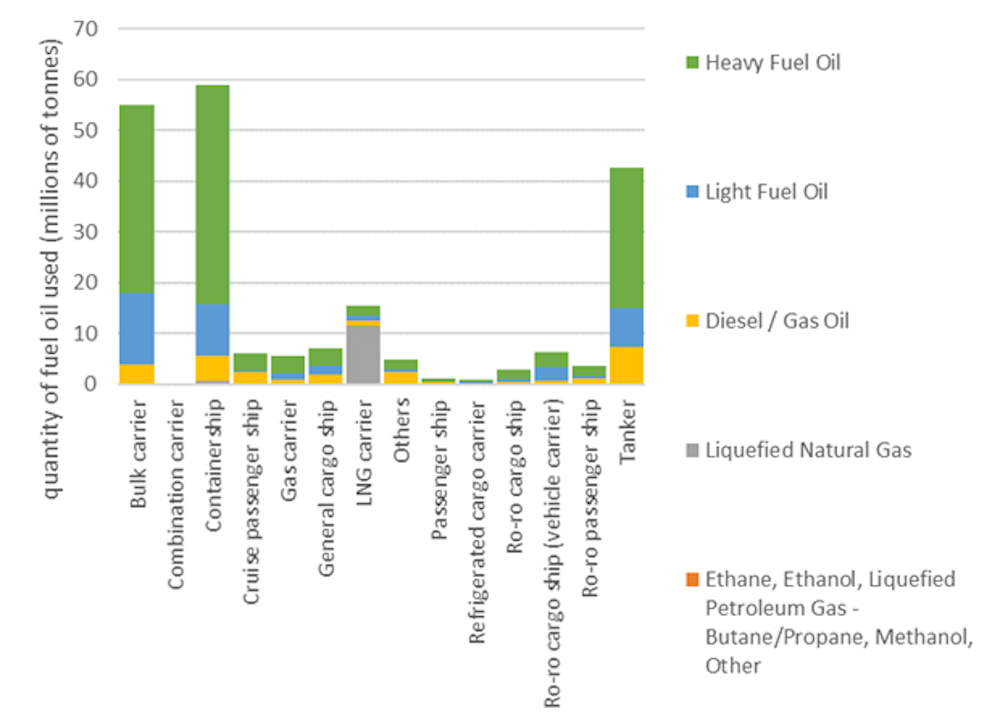
    Annual fuel oil consumption (by ship type):

    How different fuels were used by different ship types (2023 data).
    IMO Future Fuels, CC BY-NC-SA

    But here’s the problem: global demand for shipping is expected to grow by around 60% in that same time. So even with a 40% efficiency boost, total emissions from shipping could stay the same – or even go up – because so much more cargo will be moved.

    Despite this, many countries haven’t updated their policies to reflect this growing demand or to align with the IMO’s updated “30% cuts by 2030” target.

    Some countries, including Palau – a Pacific island nation vulnerable to climate change – and the UK, have pushed for stronger action. But there remains a long way to go before the world agrees on an ambitious path forward.

    Green energy

    The more hotly debated issue is around a fiendishly complicated set of “mid-term measures”. A key part of this is creating a “global fuel standard” – essentially, targets for how much “zero emission” (or “green”) fuel ships must use and by when.

    These rules would come with penalties or costs for using polluting fuels, which would effectively put a price on greenhouse gas emissions. Experts have long agreed that putting a price on shipping pollution is the most effective way to encourage cleaner and more efficient practices. But despite nearly 20 years of discussions, countries still haven’t agreed how to do this.

    Decisions are further complicated by wrangles over how to fairly distribute the revenues from these penalties.

    Who should get the revenues from shipping pollution?
    Uncle_Dave / shutterstock

    The good news is that the world is less than a week away from a decision which will put a price on shipping pollution in some form. The bad news is that proposals on the table could easily deliver a weak, uncertain price signal which doesn’t push the industry to invest in more green solutions. And the fuel standard itself might fall short of the ambitious climate targets set in 2023.

    Until now, talks on improving shipping efficiency and on pricing polluting fuels have happened separately. A big task at the IMO summit in London is to integrate the two into one coordinated plan.

    From a climate perspective, these policies should be judged by whether they will work together to cut shipping emissions by 30% by 2030 (the IMO’s current target).

    As things stand, that outcome is still possible – but is now an uphill battle. Agreement this week is crucial and countries will show their true colours. If they can’t agree to agree more ambitious policies it will undermine the IMO’s ability to regulate shipping emissions.

    Historically, the IMO tends to take its biggest decisions in the last hours of Thursday in week-long negotiations. Both ambitious and more cautious countries have a lot on the line, as the measure adopted will be legally binding for all of them.

    A positive result depends on whether powerful groups such as the European Union line up to support ambitious measures, as as proposed by African, Caribbean, Central American and Pacific countries as well as the UK.

    Although countries have agreed on climate targets for shipping, some still refuse to support the policies needed to actually phase out fossil fuels fast enough. That stance much change. If done right, IMO negotiations this week could be a turning point – not just for shipping, but for renewable energy and climate action worldwide.


    Don’t have time to read about climate change as much as you’d like?

    Get a weekly roundup in your inbox instead. Every Wednesday, The Conversation’s environment editor writes Imagine, a short email that goes a little deeper into just one climate issue. Join the 40,000+ readers who’ve subscribed so far.


    Simon Bullock is a member of the Institute of Marine Engineering, Science and Technology

    Christiaan De Beukelaer receives funding from the ClimateWorks Foundation.

    Tristan Smith owns shares in UMAS International, that working alongside UCL Energy Institute, provides advisory services on the subject of maritime decarbonisation. My research group is recipient of research funding from UKRI, Climateworks Foundation and Quadratue Climate Foundation. I am on the advisory board of the Global Maritime Forum, and the Strategy Board of the Getting to Zero Coalition – not for profit structures that work across governments and industry stakeholders on maritime decarbonisation.

    ref. At a pivotal meeting, the world is set to decide how to cut shipping emissions – https://theconversation.com/at-a-pivotal-meeting-the-world-is-set-to-decide-how-to-cut-shipping-emissions-253462

    MIL OSI – Global Reports

  • MIL-OSI Global: Children from poorer families do worse at school – here’s how to understand the disadvantage gap

    Source: The Conversation – UK – By Ceri Brown, Associate Professor (Reader) in Education, University of Bath

    Rawpixel.com/Shutterstock

    The problem of the disadvantage gap – also known as the attainment gap – is a persistent one in education in England. It refers to how children from certain groups, such as those from poorer backgrounds, ethnic minorities or who have been in care, do worse at school than their peers.

    It’s a central concern of the recent interim report of the ongoing review into England’s national curriculum, which points out that the current system is not working well for everyone.

    The disadvantage gaps between groups can be measured in different ways. The more simplistic way is to consider outcome measures, such as exam results, in isolation.

    For example, at the end of their primary schooling, eleven-year-olds in English state schools take standardised key stage assessments – SATs. These results are used to calculate the disadvantage gap index. The index ranks all pupils in the country and assesses the difference in the average position of disadvantaged pupils and others. It shows whether the gap between disadvantaged pupils and their peers is widening or closing.

    A disadvantage gap of zero would indicate that there is no difference between the average performance of disadvantaged and non-disadvantaged pupils. According to the Department for Education’s figures for 2023-24, the disadvantage gap index at this level is 3.13 in children’s key stage scores. While it had been decreasing between 2011 and 2018, the gap rose to the highest level since 2012 in 2022.

    For GCSEs, taken at age 16, the disadvantage gap index is 3.92. It has decreased slightly after widening in 2021, 2022 and 2023.

    Measuring progress

    A more sophisticated analysis of the disadvantage gap can be made by comparing the rate of progress that children achieve through their schooling career. Children in English state schools take a baseline assessment when they first enter their reception year, and their progress from this point can be measured by comparing with their SATs key stage results in year six.

    Ideally, all children would progress in their learning at the same rate. But research by one of us (Nadia Siddiqui) shows that pupils from persistently low socioeconomic groups do not progress at the same level as their counterparts.

    A recent longitudinal research study – meaning that it has tracked the same participants over years – has shown that since the pandemic, there has been a very big impact on the reading and maths progress of primary school children from poorer backgrounds.

    At secondary level, progress can be measured by comparing children’s progress from their SATs at the end of primary school with their GCSE exam results. This measure is called “progress 8”. It indicates how much a secondary school has helped pupils progress from their point of entry at year seven, when compared to a government-calculated expected level of improvement.

    The progress 8 measure focuses on the progression children make from their starting points, as opposed to fixating only on the end points in children’s learning.

    The disadvantage gap can be measured using test results to gauge progress over time.
    panitanphoto/Shutterstock

    The government uses this measure not to compare individuals, but rather schools to see how much value has been added by each school relative to other schools. But it also measures the progress of key groups, such as children receiving free school meals or of different ethnicities.

    The latest data shows that pupils from poorer backgrounds – those eligible for free school meals – made less progress than their peers. This was the case in every ethnic group.

    Reducing the gap

    In the last few decades, a number of education policies have been introduced to narrow the disadvantage gap determined by household poverty.

    Direct funding to improve educational targets is a popular approach and has been adopted in countries across the world. This means schools receive additional funding for admitting disadvantaged pupils. This money should be spent on evidence-informed interventions for improving educational outcomes of disadvantaged pupils.

    Since 2010, schools in England have been incentivised by pupil premium funding to invest directly in the academic learning of disadvantaged pupils if they are not reaching expected levels. Schools receive funding for each pupil who is, or has been, eligible for free school meals, and for those who have been in care.

    Pupil premium funding has changed the pattern of intake of disadvantaged pupils by schools. Segregation of poorer and wealthier pupils, in which pupils from poorer households are clustered in particular schools, has reduced. Schools now take more of a mix of children from poorer and wealthier backgrounds.

    This is good because mixed schools create fairer and more inclusive societies where pupils are better equipped to succeed in diverse environments. What’s more, the relative disadvantage gap has slightly improved for pupils at primary school.

    The evidence on interventions for disadvantaged pupils is still evolving. For practical reasons, approaches to improving the academic disadvantage gap are mainly applied at school level.

    However, in some places, area-based funding schemes, which channel funding to selected regions of particular high poverty, have been introduced. Our research is exploring the extent to which this may be a feasible way to narrow the disadvantage gap.

    Ceri Brown receives funding from UKRI (ESRC) and the Mayor of London’s Violence Reduction Unit.

    Nadia Siddiqui receives funding from UKRI, EEF, British Council.

    ref. Children from poorer families do worse at school – here’s how to understand the disadvantage gap – https://theconversation.com/children-from-poorer-families-do-worse-at-school-heres-how-to-understand-the-disadvantage-gap-235706

    MIL OSI – Global Reports

  • MIL-OSI Global: Nasa and Esa want to bring Martian rocks to Earth. Here’s what will happen to the samples once they get here

    Source: The Conversation – UK – By John Bridges, Professor of Planetary Science, University of Leicester

    Nasa/JPL-Caltech/MSSS

    A mission will deliver rock and soil from Mars to laboratories on Earth in the 2030s. Mars Sample Return (MSR) is led by Nasa with participation from the European Space Agency (Esa). The mission will allow scientists to use the best laboratory instruments on Earth to determine whether Mars hosted microbial life billions of years ago.

    So what will happen to the samples once they arrive on Earth?

    Nasa’s Perseverance rover has already been doing the hard work of collecting the samples. The rover has been exploring a Martian location known as Jezero Crater since landing in February 2021. Along the way, it has used its drill to extract cores – cylindrical samples of rock – from Martian rocks, depositing them in sample tubes on the floor of the crater.

    Present day levels of cosmic radiation at the Martian surface are thought to be too high for life to survive there. However, conditions may have been more hospitable to life billions of years ago, and it is these potential traces of ancient life that Perseverance was designed to seek out.

    In September 2023, an independent review board found MSR’s budget and schedule to be “unrealistic,” and said that this would potentially delay the mission’s launch beyond 2028. This has led Nasa to seek alternative approaches to carrying out the mission.

    The space agency issued a call for ideas from industry and is currently studying two proposals. But in terms of the broad mechanics, something – a rover or small helicopter – will need to collect the sample tubes and deliver them to a vehicle. That vehicle will then blast off the surface of Mars.

    A capsule, carrying those Martian samples, will eventually enter the Earth’s atmosphere and parachute down to a government facility in Utah, US. This is all projected to happen in the 2030s.

    Once safely on Earth, the samples from Jezero Crater will be analysed using sensitive instruments that are too big and complex to send on a rover to Mars. That’s the essence of MSR: in order to unambiguously identifying any traces of ancient Martian life, scientists will need to carry out multiple experiments and replicate the results.

    In other words, separate and independent scientific teams will have to show that they can get the same outcomes from those experiments.

    The scientific community is still making new discoveries with the 380kg of rock and soil from the Moon that was delivered to Earth by the six Apollo missions over 50 years ago. In the Apollo era, scientists had to work out a plan to keep the Moon samples pristine, in order to preserve them for generations of scientists to study.

    One concept for how Mars Sample Return would work.

    Their solution was to put them in glove boxes: sealed containers that allow users to manipulate the contents via long gloves that extend from the outside to the inside of the box. These glove boxes contain dry nitrogen gas that protects against chemical changes to the samples. That’s worked well for the Moon rocks; the Apollo 11-17 samples can be seen and studied at Nasa’s Johnson Space Center in Houston today.

    A more challenging plan will be needed for the approximately 500g of carefully selected Martian rock and soil. The facilities in which they are eventually stored will need to carefully control factors such as humidity and temperature. They will also need to prevent the samples from being contaminated by terrestrial microbes.

    The requirements for managing the Martian samples are decided by an organisation called the Committee on Space Research (Cospar). Under Cospar guidance, MSR is defined as a Category V Restricted Earth Return Mission.

    While scientists do not generally expect the Martian samples to contain present-day life, the requirements mean that the samples will be treated as if they do until the possibility is excluded. Cospar says: “A program of life detection and biohazard testing, or a proven sterilisation process, should be undertaken as an absolute precondition for the controlled distribution of any portion of the sample.”

    Thus, a major part of MSR planning is the design and construction of a sample receiving facility (SRF), a building where initial analyses of the rock and soil are to take place. The work will be conducted under strict biocontainment rules, which mean that scientists will use equipment and follow procedures usually deployed in some of the most world’s most secure labs, designed to study harmful bacteria and viruses such as Ebola and Marburg virus. This situation will persist until a “sample safety assessment” has taken place.

    This safety assessment will determine whether the samples can be studied at lower levels of biological containment. Only after that stage and another called “basic characterisation”, where scientists carry out an initial study of the minerals and chemistry of the rocks, will the samples gradually be released to the wider scientific community.

    One problem for the mission is the complexity and cost of the SRF, which is expected to rise to hundreds of millions of dollars, or euros. This is largely because of the need to not only comply with the Cospar rules but also to incorporate the range of microscopes and spectrometers needed for the analyses.

    Much of the reason for the delays in delivering the overall MSR programme come down to cost, so there is currently pressure to reduce the price tag. Against this background, Nasa and Esa have convened a measurement definition team, a panel of scientists who will determine which analyses are needed within the SRF. The resulting report will be published shortly.

    In parallel, a programme of work to design and build new technology for MSR that allows both biological containment and analysis of the minerals in Martian samples is taking place. Esa, with Nasa collaboration, is funding the design of secure chambers called multi-barrier isolator cabinets, inside which the Martian rock and soil can be studied.

    These cabinets will also incorporate the range of different scientific instruments needed for the basic characterisation stage. These could include powerful microscopes and a Raman spectrometer.

    Combining the requirements for containment and analysis in this way has the potential to not only reduce the time needed before samples can be released to the scientific community, but also to substantially reduce the costs of the SRF and thus help the overall MSR programme.

    John Bridges of Space Park Leicester, University of Leicester is funded by the European Space Agency and UK Space Agency to design and build isolator, spectroscopic and portable technology for Mars Sample Return at Space Park Leicester. He is a member of the NASA-ESA MSR Measurement Definition Team.

    ref. Nasa and Esa want to bring Martian rocks to Earth. Here’s what will happen to the samples once they get here – https://theconversation.com/nasa-and-esa-want-to-bring-martian-rocks-to-earth-heres-what-will-happen-to-the-samples-once-they-get-here-253914

    MIL OSI – Global Reports

  • MIL-OSI Russia: Dmitry Grigorenko congratulated Runet on its birthday

    Translartion. Region: Russians Fedetion –

    Source: Government of the Russian Federation – An important disclaimer is at the bottom of this article.

    April 7 marks the birthday of Runet in Russia. On this day in 1994, the .RU domain zone was launched, becoming the official starting point for the development of the Russian segment of the Internet. Deputy Prime Minister – Head of the Government Staff Dmitry Grigorenko congratulated industry workers and all users on the holiday.

    “Today, 84% of the country’s population over 12 years old uses the Internet. This is 101.7 million Russians who go online daily, and 103.1 million people – monthly. An important task is to ensure equal access to the Internet for residents of the entire country. The national project “Data Economy” pays much attention to increasing the level of Internet access throughout the country through satellite communications. It is planned that by 2030, the Russian low-orbit group will have over 290 satellites,” said Dmitry Grigorenko.

    Currently, there are about 6 million domains registered in the Russian domain zone. And the Russian domain space is growing faster than the global one: in 2024, the growth of the .RU domain zone was 7%, and the .COM domain zone decreased by 2.4%. This scale provides huge opportunities for the development of the industry, but at the same time imposes responsibility for the safety of users on both the state and the business that provides its services in the Internet space.

    “To protect citizens from cyber fraudsters, the Government, together with law enforcement agencies and the Bank of Russia, has developed a package of 30 measures. The amendments to the legislation adopted by the State Duma at the end of March and signed by President Vladimir Putin introduce identification of communication users, labeling of calls, and also prohibit employees of government agencies, banks and communication operators from interacting with citizens via messengers. These and other measures are aimed at preventing fraudulent activities,” Dmitry Grigorenko recalled.

    The use of modern identification tools will reduce the volume of fraudulent transactions and will allow for the reliable protection of personal funds and personal data of citizens.

    The Russian segment of the Internet is not only convenient services and services, but also a contribution to the economy. Thus, the share of e-commerce in Russia’s trade turnover is 19%. And the total volume of the Runet economy by the end of 2024 amounted to more than 20 trillion rubles. Over the past five years, the IT industry has become one of the fastest growing in the Russian economy. In order to create favorable conditions for further development, by decision of Russian President Vladimir Putin, the national project “Data Economy” was launched in 2025, which is aimed at accelerating the pace of digitalization of economic and social sectors, as well as achieving technological sovereignty and leadership.

    Please note: This information is raw content directly from the source of the information. It is exactly what the source states and does not reflect the position of MIL-OSI or its clients.

    MIL OSI Russia News

  • MIL-OSI Europe: Support for Irish Exporters – Minister Peter Burke

    Source: Government of Ireland – Department of Jobs Enterprise and Innovation

    • Enterprise Ireland stands up dedicated team to support exporters, with over 300 one to one meetings now held and a range of grants available
    • Diversification remains a key government export policy, with 156 out of a total of 190 overseas EI specialist staff based outside of the US, advising Irish SMEs on opportunities and areas for growth

    Minister for Enterprise, Tourism and Employment, Peter Burke said: 

    “My Department has been preparing for tariffs and economic shocks and we are working with our dedicated agency supporting Irish businesses, Enterprise Ireland. We have established a bespoke team which is currently engaging with SMEs, supporting businesses around tariffs and mitigation measures, as well as offering advice and support on diversification measures. One to one meetings have been held with over 300 companies exporting to the US, with further meetings planned. We continue to urge all businesses exporting to the US to engage directly with Enterprise Ireland.

     “Enterprise Ireland has 42 overseas offices, with specialist staff in place to grow businesses and explore new opportunities.  Market diversification remains a key priority, as it has been for decades, and which has seen significant success. There are 190 overseas market advisers employed by Government through Enterprise Ireland, with 156 of these outside of the US.

     “We also have dedicated schemes and grants, including a strategic consultancy grant for expert advice. We have an existing market discovery fund already open which I will top up further when demand is met, and I will be pro-actively engaging with businesses to make them aware of these supports and ensure they are accessed at scale. We have an expansive trade mission programme plan in place. I am conscious that this is an evolving situation which will be closely monitored and Government will not be found wanting when it comes to resourcing and supporting Irish SMEs, which are the backbone of our economy.“

    ENDS

    MIL OSI Europe News

  • MIL-OSI USA: Griffith Announces Start of 2025 Congressional Art Competition in Ninth District

    Source: United States House of Representatives – Congressman Morgan Griffith (R-VA)

    Each year, the U.S. House of Representatives sponsors the Congressional Art Competition for high school students. This competition is an exciting way for a student from our region to represent the Ninth Congressional District in Washington. The Artistic Discovery Contest is open to all high school students in the Ninth District.

    The chosen theme for 2025 is “Commemorating Virginia’s Contribution to the American Revolution.” Interested students must submit a photograph of their original artwork to either my Christiansburg or Abingdon office by 5:00 pm on Monday, April 28 for consideration. Each entry must be accompanied by a completed student information release form to qualify. The 2025 student information release form can be found at the bottom of this page.

    The overall winner of our district’s competition will be displayed for one year in the U.S. Capitol and will be invited to Washington for a reception. The second and third place selections will be displayed in my Christiansburg and Abingdon offices.

    Art works entered in the contest may be up to 26 inches by 26 inches (including the frame) and may be up to 4 inches in depth. Artwork must be two-dimensional and cannot weigh more than 15 pounds. The work may be:

    • Paintings: oil, acrylics, watercolor, etc.
    • Drawings: colored pencil, pencil, ink, marker, pastels, charcoal (It is recommended that charcoal and pastel drawings be fixed)
    • Collages: must be two dimensional
    • Prints: lithographs, silkscreen, block prints
    • Mixed Media: use of more than two mediums such as pencil, ink, watercolor, etc.
    • Computer-generated art
    • Photographs

    All entries must be an original in concept, design and execution.

    The Congressional Art Competition began in 1982 to provide an opportunity for members of Congress to encourage and recognize the artistic talents of their young constituents.  Since then, over 650,000 high school students have been involved with the nationwide competition.

    Rishi Nair of Blacksburg High School won the 2024 Congressional Art Competition in Virginia’s Ninth Congressional District. His artwork is entitled ‘Mabry Mill.’

    If you would like more information on the annual Congressional Art Competition, please contact my Abingdon office at (276) 525-1405 or visit the Congressional Art Competition website.

    ###

    MIL OSI USA News

  • MIL-OSI USA: Governor Stein Announces Council On Student Safety & Well-Being

    Source: US State of North Carolina

    Headline: Governor Stein Announces Council On Student Safety & Well-Being

    Governor Stein Announces Council On Student Safety & Well-Being
    lsaito

    Raleigh, NC

    Today at Moore Square Magnet Middle School, Governor Josh Stein announced his Advisory Council on Student Safety and Well-Being, co-chaired by Senate Democratic Leader Sydney Batch, Deputy Secretary William “Billy” Lassiter of the Department of Public Safety, and 2024 North Carolina Teacher of the Year Heather Smith. 

    “North Carolina’s children are our future, and it is crucial that they grow and learn in a safe environment that sets them on the right trajectory to thrive,” said Governor Josh Stein. “I am proud to establish this council of educators, mental health professionals, and law enforcement to identify ways to better keep our classrooms safe and our children healthy.”

    “Ensuring the safety of our students is not up for debate — it’s a fundamental responsibility of our state government,” said Democratic Leader Sydney Batch. “Every child in North Carolina deserves the freedom to learn in a secure, supportive environment. I’m proud to co-chair this council and committed to advancing real, enforceable policies that keep our kids safe and our schools strong — and I’m ready to work with anyone willing to get that important work done.”

    “Student and school staff security and wellbeing is an essential part of public safety,” said Deputy Secretary of Public Safety William L. Lassiter, who oversees the Division of Juvenile Justice and Delinquency Prevention. “We must use the tools at our disposal to upgrade the physical infrastructure of our schools and train our school staff how to recognize and respond to the early warning signs that can lead to public safety threats. We know our students must feel safe and have a healthy mental well-being to achieve academically. Working together, we can keep our students and our schools safe.” 

    “What I’ve seen in my classroom is that if students don’t feel safe, if they are not supported, it’s so much harder for them to learn,” said Teacher of the Year Heather Smith. “Our commitment to giving students the best starts with looking out for their safety and well-being, and I am eager to jump into this work.”

    Governor Stein’s advisory council will work across state agencies and with both state and local leaders to propose and implement policies and solutions that will improve student safety and wellbeing. It will advance recommendations, provide guidance to state agencies, work with local communities, and share best practices. The council’s first priority will be working with the General Assembly to support school systems in implementing policies that will make classrooms cell phone-free.  

    Click here to read Governor Stein’s executive order establishing the Council on Student Safety & Well-Being.

    The members of the Advisory Council are as follows:

    • Senate Democratic Leader Sydney Batch (co-chair)
    • William L. Lassiter, Deputy Secretary for the Division of Juvenile Justice and Delinquency Prevention, Department of Public Safety (co-chair)
    • Heather Smith, 2024 Burroughs Wellcome Fund North Carolina Teacher of the Year (co-chair)
    • Senator David W. Craven, Jr.
    • Representative Brian Biggs
    • Representative Lindsey Prather
    • Alan Duncan, Vice-Chair of the State Board of Education
    • Bettina Umstead, Board of Education Member, Durham Public Schools
    • Sharon Bell, Deputy Director, Division of Child and Family Wellbeing, North Carolina Department of Health and Human Services
    • Natalia Botella, Director, Public Protection Section, North Carolina Department of Justice
    • Dr. Ellen Essick, Section Chief for NC Healthy Schools, Department of Public Instruction
    • Karen Fairley, Executive Director of Center for Safer Schools, A Division of the State Bureau of Investigation
    • Anne Goldberg, School Counselor, Alamance-Burlington School System
    • Tara Hardy, School Social Worker, Craven County Schools
    • Roger “Chip” Hawley, Director of The North Carolina State Bureau of Investigation
    • Emma Hodson, In-House Counsel, Pitt County Schools
    • Kristie Howell, Chief Court Counselor-District 8, Division of Juvenile Justice and Delinquency Prevention, North Carolina Department of Public Safety
    • Melissa Lassen, BSN, RN, NCSN, Lead School Nurse, Chatham County Schools
    • Mark McHugh, Director of Safety, Charlotte-Mecklenburg Schools
    • Dr. Shaneeka Moore-Brown, President, North Carolina Parent Teacher Association
    • Asia Prince, Director of Court Programs, North Carolina Administrative Offices of the Courts
    • Deputy Rhyne Rankins, School Resource Officer, Iredell County Sheriff’s Office
    • Dr. Paul Smokowski, Executive Director, North Carolina Youth Violence Prevention Center
    • Beckie Spears, Principal, Wilkesboro Elementary School & 2024 Wells Fargo North Carolina Principal of the Year
    • Mary Katherine Stiles, M.A./S.S.P., School Psychologist, Cumberland County Schools
    • Justice Warren, Assistant Legal Counsel, North Carolina School Boards Association
    • Julie Cecelia Werry, Scholar Advisor, Morehead-Cain Foundation
    • Dr. Freddie Williamson, Superintendent of Public Schools of Robeson County 
    Apr 7, 2025

    MIL OSI USA News

  • MIL-OSI USA: Rod Serling documentary enters the Rhode Island Zone

    Source: US State of Rhode Island

    Leonardo DiCaprio’s production company, Appian Way, has partnered with Rhode Island-based production company, Verdi Productions, for the authorized documentary on the life of Rod Serling, most known as the creator, host, narrator and primary writer of The Twilight Zone.

    DiCaprio and Chad A. Verdi are producing, along with Jennifer Davisson, Phillip Watson, Michelle Verdi, Chad Verdi Jr., Paul Luba and Blake J. Harris. The documentary is authorized by Serling’s two daughters, Jodi Serling and Anne Serling, who are serving as Executive Producers along with Sera Verdi and Anthony Gudas. Jonah Tulis is directing and penned the screenplay. Tom DeNucci is portraying Rod Serling for the reenactments of the documentary. Principal photography wrapped in Rhode Island, taking place in East Greenwich, Providence and Wakefield.

    In the 1950s, the first episode of The Twilight Zone aired � it was a show that would later be heralded as one of the greatest television programs of all time. It was a genre-bending show unlike anything television had ever seen. Through the lens of these fantastical stories, the show tackled the social and political issues of the times like war, racism and the dangers of technology. The show was not simply great primetime entertainment, but rather, a cultural phenomenon of tales of morality with thought-provoking social commentary. And behind it all was one man, the creator and iconic host, Rod Serling. This documentary is an intimate portrait of Serling that explores the life and work of this visionary writer as he made his iconic television programs and how he helped change the face of television forever. While filming in Rhode Island, magnificent recreations of Serling’s life were shot, mirroring the same cinematic black and white style of The Twilight Zone.

    Verdi Productions President, Chad A. Verdi, stated “We are enthusiastic to finish another successful shoot with Appian Way in Rhode Island – our second co-production with them in the span of three months. Our company’s goal is to keep creating jobs in Rhode Island with high profile and meaningful projects that our small state can be proud of.” Verdi added, “We expect to announce our third collaboration with Leo and the Appian Way team very soon.”

    Steven Feinberg, Executive Director of the Rhode Island Film & Television Office, stated, “Prolific, creative and insightful, Rod Serling was a provocative storyteller whose narratives such as “The Twilight Zone” series and the original “Planet of the Apes” feature film impacted my life along with millions of others. Rod Serling has and always will be an inspiration. The Rhode Island film and t.v. community is honored to host our friends, Chad Verdi and Verdi Productions, along with Leonardo DiCaprio, Appian Way, and the Serling Family, as they create a much-needed documentary about the life and unique talents of the master storyteller Rod Serling. We know it will be a special event and we could not be prouder to be part of it!”

    This documentary marks the second Rhode Island production that Chad A. Verdi & Verdi Productions have co-produced with Leonardo DiCaprio & Appian Way in 2025. The first was Sleepwalker, a narrative psychological thriller which starred Hayden Panettiere, Beverly D’Angelo, Justin Chatwin, Mischa Barton and Lori Tan Chinn. Outside of their work with Appian Way, Verdi Productions recently produced The Roaring Game in Rhode Island, a sports comedy which starred Mickey Rourke, Darin Brooks, Fivel Stewart, Justin Chatwin, Eddie Kaye Thomas, Rob Gronkowski and William Forsythe ### The Rhode Island Film & TV Office is a government agency under the umbrella of the Rhode Island State Council on the Arts (RISCA)

    MIL OSI USA News

  • MIL-OSI USA: AARP Endorses Sorensen, Ciscomani Bill to Crack Down on AI Robocalls

    Source: United States House of Representatives – Congressman Eric Sorensen (IL-17)

    WASHINGTON, DC – The American Association of Retired Persons (AARP), representing more than 100 million Americans over the age of 50, recently endorsed Congressmen Eric Sorensen (IL-17) and Juan Ciscomani’s (AZ-6) Quashing Unwanted and Interruptive Electronic Telecommunications (QUIET) Act. The QUIET Act would require robocallers to disclose when they use artificial intelligence (AI) technology and increase penalties for scammers who use AI to impersonate individuals.  
    He reintroduced the legislation earlier this year with Congressman Juan Ciscomani (AZ-06). 

    “Endless robocalls are more than just annoying and frustrating, they can cause seniors to lose entire life savings when malicious scammers take advantage of new technology to impersonate their loved ones, their bank, or the government,” said Congressman Eric Sorensen. “I’m glad to have a partner in the AARP to help pass my bipartisan legislation that puts in place harsher penalties for scammers and protect our seniors from being unfairly targeted.” 

    “The advancement of technology combined with the integration of artificial intelligence (AI) have transformed robocalls from an occasional nuisance into a powerful tool used by scammers and other bad actors to defraud Arizonans, particularly seniors, out of their hard-earned money,” said Congressman Juan Ciscomani. “I know my constituents are fed up, which is why I am proud to partner with the Rep. Sorensen and the AARP on this critical legislation to require robocallers to disclose the use of AI, cut down on fraudulent calls, and protect seniors in my district from malicious scams like these.” 

    “We appreciate your leadership in protecting consumers from the growing threat of AI-driven scams and in strengthening safeguards against fraudulent robocalls,” said Bill Sweeney, Senior Vice President of Government Affairs at the AARP. “With AI’s growing ability to convincingly mimic voices and craft deceptive messages, the stakes have never been higher. The QUIET Act can help combat these deceptive tactics. The alarmingly high levels of fraud against older adults underscore that stronger protections are urgently needed.” 

    The QUIET Act increases penalties for violators who use AI to impersonate individuals or organizations with the intent to defraud, cause harm, or wrongfully obtain anything of value. This measure strengthens protections for seniors and vulnerable communities who are often the biggest targets of these scams.  

    Since coming to Congress, Sorensen has made fighting scam robocalls and robotexts a priority. Last Congress, he led a bipartisan effort urging the Federal Communications Commission (FCC) to outline its plans to combat these scams, which disproportionately target older Americans.  

    Sorensen’s leadership on this issue underscores his commitment to keeping Illinois families safe from fraud and ensuring AI is not used as a tool to exploit hardworking people. 

    MIL OSI USA News

  • MIL-OSI United Kingdom: Joint statement at the 58th Session of the UN Commission on Population and Development

    Source: United Kingdom – Executive Government & Departments

    Press release

    Joint statement at the 58th Session of the UN Commission on Population and Development

    Joint statement on the 58th Session of the UN Commission on Population and Development delivered by Sierra Leone on Monday 7 April 2025, on behalf of Albania, Andorra, Armenia, Australia, Austria, Belgium, Bosnia and Herzegovina, Brazil, Bulgaria, Cabo Verde, Cambodia, Chile, Colombia, Costa Rica, Croatia, Cyprus, Czechia, Democratic Republic of the Congo, Denmark, Dominican Republic, Estonia, Eswatini, Finland, France, Georgia, Germany, Greece, Guinea, Honduras, Iceland, Ireland, Israel, Italy, Japan, Latvia, Lebanon, Lesotho, Liberia, Liechtenstein, Lithuania, Luxembourg, Malta, Mexico, Monaco, Mongolia, Montenegro, Morocco, Nepal, Netherlands, New Zealand, North Macedonia, Norway, Panama, Papua New Guinea, Peru, Poland, Portugal, Republic of Korea, Republic of Moldova, Romania, Samoa, San Marino, Serbia, Sierra Leone, Slovakia, Slovenia, South Africa, Spain, Sweden, Switzerland, Thailand, Timor-Leste, Tunisia, Tuvalu, Ukraine, Uruguay, Zambia and the United Kingdom.

    We are making this collective statement to emphasise the urgent need for action to achieve Sustainable Development Goal (SDG) 3. Health is a human right and a foundation of sustainable development, driving economic growth, social cohesion, and individual dignity.

    Over the past decades, significant progress has been made in many areas of health. We have seen a reduction in maternal and child mortality, expanded access to modern contraceptive methods as well as maternal and newborn medicines and commodities, improvements in adolescent health and education, addressing sexually transmitted diseases including HIV, and a decline in child and early forced marriages. These achievements give us hope for a healthier future.

    However, significant challenges persist, and the urgent need for equal access to health services and opportunities for healthy lives remains out of reach for many.

    Health inequalities stemming from complex, interrelated factors such as economic disparities, social exclusion, significant financial hardship, discrimination, and unequal access to resources, has a profound impact on individuals and communities. These inequalities manifest in poor health outcomes, lower life expectancy, reduced household income, and weaker national economic growth potential. Income inequality exacerbates vulnerabilities, limiting access to health services in low-income countries and disadvantaged communities. Social disparities rooted in gender, race, age, class, religion, and ethnicity perpetuate stigma, violence, and adverse health determinants.

    Economic disparities within and among countries remain significant, impacting the lives of many individuals. Far too many people are unable to access essential health services or are forced to forgo care due to unaffordability. Rising out-of-pocket health costs are pushing millions into poverty, hindering the realisation of Universal Health Coverage. Conflicts and climate change are straining health systems and the health workforce, contributing to stagnating maternal mortality rates, growing mental health challenges, and the inability of health systems to cope with the rise of non-communicable diseases.

    Equitable, inclusive, and resilient health systems are essential to ensure healthy lives and promote well-being. It is imperative to prioritize universally accessible, quality, and comprehensive primary healthcare services. Sexual and reproductive health and reproductive rights must enable individuals to make free and informed decisions about their health and their lives. Addressing the social determinants of health – such as poverty, malnutrition, education, water and sanitation, and gender inequality – is critical for achieving inclusive economic growth that strengthens and benefits all of society.

    The health and well-being of adolescents and youth also demands greater attention – they require better access to health services, education, and information that enable them to make informed decisions about their lives.

    Investing in health, particularly sexual and reproductive health, is not just a matter of well-being, but also a powerful driver of economic growth. UNFPA estimates that allocating an additional $79 billion by 2030 to expand maternal health and family planning services could yield $660 billion in economic benefits by 2050—preventing 400 million unplanned pregnancies, 1 million maternal deaths, 6 million stillbirths, and 4 million newborn deaths, while also enhancing workforce participation and economic productivity (UNFPA, 2022). Similarly, closing the women’s health gap more broadly could further accelerate economic progress, with the World Economic Forum projecting a potential boost of at least $1 trillion annually to the global economy by 2040.

    Greater investments in health infrastructure, workforce capacity, and innovative solutions like digital health can improve service delivery and expand access to services. Strengthening and expanding the global health workforce is at the heart of this. We must address health workforce shortages, ensure equitable distribution, enhance training and pay attention to sustainable retention strategies.

    It is vital that we, as policymakers, health organizations, and civil society, address disparities within and among countries, ensuring that people in vulnerable situations, including women, children, older persons, migrants, people with disabilities, and those in extreme poverty, have access to quality, comprehensive health services without financial hardship and discrimination. Our role in promoting responsive health systems that cater to the unique needs of at-risk individuals are key to sustainable and inclusive progress.

    A healthier population is central to achieving the 2030 Agenda for Sustainable Development. The ICPD’s Programme of Action has guided countries toward inclusive, equitable policies advancing health and gender equality. By strengthening health systems and addressing inequalities, we can work toward a world where all people can live healthy, productive and fulfilling lives.

    Updates to this page

    Published 7 April 2025

    MIL OSI United Kingdom

  • MIL-OSI United Kingdom: AUKUS partnership strengthened with Prime Minister appointing new Special Representative

    Source: United Kingdom – Executive Government & Departments 3

    News story

    AUKUS partnership strengthened with Prime Minister appointing new Special Representative

    Sir Stephen Lovegrove appointed as the Prime Minister’s Special Representative on AUKUS.

    Britain will maximise the benefits of AUKUS and unlock more opportunities across the historic partnership, following the Prime Minister appointing Sir Stephen Lovegrove as his Special Representative on AUKUS today. 

    AUKUS is a landmark security and defence partnership between the UK and two of its oldest and closest partners, Australia and the United States. It will enable Australia to field a fleet of nuclear-powered submarines in the Indo Pacific; strengthen the defence industrial bases of both the UK and the US; and accelerate the development and deployment of cutting-edge technologies by all three countries. The AUKUS submarine programme is set to generate 7,000 additional British jobs, supporting the government’s Plan for Change to kickstart economic growth. 

    Sir Stephen will support the Defence Secretary and the National Security Adviser to drive the AUKUS programme forward. He brings a wealth of experience, having served as National Security Adviser at the time of the AUKUS announcement in 2021, the Prime Minister’s Defence Industrial Adviser, and as the Permanent Secretary at the Ministry of Defence.      

    Last year, the Prime Minister and Defence Secretary commissioned Sir Stephen to conduct a Review of the UK’s progress against its core commitments under AUKUS, identifying barriers to success, and setting out recommendations on how to unlock further areas of opportunity, both nationally and with the US and Australia.  Sir Stephen presented his findings to the Prime Minister and Defence Secretary earlier this year. His report will be shared with US and Australian partners and a public version released in due course. 

    Defence Secretary, John Healey said:

    AUKUS is a historic partnership which reinforces peace and stability across the Euro-Atlantic and Indo-Pacific, and will also provide thousands of highly skilled jobs and investment in communities across the UK.  It shows how defence can be an engine for growth across our three nations while keeping us secure at home, and strong abroad.

    Sir Stephen is fully committed to ensuring the UK plays a leading role within AUKUS and holds widely respected national security experience.  

    I am very grateful to him for taking up this appointment and look forward to working closely with him and our partners in the US and Australia as we take the AUKUS partnership to new heights.

    Prime Minister’s Special Representative on AUKUS, Sir Stephen Lovegrove, said:

    When the AUKUS partnership was announced in 2021 it was regarded, rightly, as the most significant capability collaboration since the Mutual Defence Agreement of 1958.  

    Since then, the strategic relevance of AUKUS has only increased. It is a uniquely powerful partnership which will develop and deliver cutting-edge capabilities, help to revitalise Britain’s defence industrial base and provide sustained employment for thousands of people across the UK, US and Australia. 

    I am delighted to accept the role as the Prime Minister’s Special Representative on AUKUS and I look forward to starting work immediately to help maximise the potential of this vital partnership.

    Sir Stephen will begin his role as Special Representative tomorrow. He is travelling to Washington DC this week to present his Review findings to the US government and will then travel to Canberra to share findings with the Australian government after the conclusion of the Australian federal election.    

    The AUKUS partnership is supporting more unified defence and industrial collaboration, better information and technology sharing and greater resilience. The development of SSN-AUKUS and new cutting-edge military technologies under AUKUS Pillar’s One and Two will help grow the UK’s industrial base and improve the enabling environment. It represents a multi-billion-pound investment into UK industry, supporting thousands of new British jobs.

    Updates to this page

    Published 7 April 2025

    MIL OSI United Kingdom

  • MIL-OSI Economics: A Colombian judge leads judicial transformation with Copilot 

    Source: Microsoft

    Headline: A Colombian judge leads judicial transformation with Copilot 

    MIL OSI Economics

  • MIL-OSI USA: Reps. Carbajal, Brownley, Panetta Demand the Trump Administration Halt its Illegal Plans to Close Facilities Vital to the Central Coast

    Source: United States House of Representatives – Representative Salud Carbajal (CA-24)

    Reps. Carbajal, Brownley, Panetta Demand the Trump Administration Halt its Illegal Plans to Close Facilities Vital to the Central Coast

    Washington, April 7, 2025

    Representatives Salud Carbajal (D-CA-24), Julia Brownley (D-CA-26), and Jimmy Panetta (D-CA-19) sent a letter to Acting Administrator Stephen Ehikian of the General Services Administration over the planned illegal closures of crucial facilities across the Central Coast. The planned closures will impact U.S. Department of Interior (DOI), National Oceanic and Atmospheric Administration (NOAA), the U.S. Department of Agriculture (USDA), and United States Forest Service (USFS) facilities in Ventura, Santa Barbara, and San Luis Obispo counties.

    “These are critical agencies that help support our local economies’ vitality and the American way of life,” wrote the lawmakers. “Efforts to justify these closures as a measure to help better serve the American people is, at best, disingenuous.”

    The full text of the letter is available
    As Representatives of the Central Coast, we write to demand that you halt planned facility closures at the U.S. Department of Interior (DOI), the National Oceanic and Atmospheric Administration (NOAA), the U.S. Department of Agriculture (USDA) and the United States Forest Service (USFS) that would impact our constituents in Ventura, Santa Barbara, and San Luis Obispo counties. These are critical agencies that help support our local economies’ vitality and the American people. These indiscriminate closures, done in an arbitrary and capricious manner, are antithetical to our Constitution and values as Americans.

    Trying to shutter the physical locations for these vital agencies is reflective of the illegal actions undertaken by DOGE to undermine the effectiveness of our government rather than working to improve it to better serve our constituents and the American people.

    DOI was created by an act of Congress in 1849 and is critical in managing our nation’s cultural heritage— including our public lands, which have been a boon to our local recreational economies. In fact, California is home to the nation’s largest active outdoor industry economy, contributing $73.8 billion in economic spending annually. This is not by coincidence. California is also home to nine national parks—more than any other state. The Central Coast of California alone is home to the Channel Islands National Park and Pinnacles National Park. The positive contribution to our economies is reflected by the fact that in 2023, 36.2 million visitors to California’s national parks spent $3.2 billion, supporting 39,678 jobs.

    Likewise, NOAA is essential to America’s innovation and economic vitality. Under the Department of Commerce, NOAA is tasked with the critical mission to provide daily weather forecasts, severe storm warnings, and support marine commerce. NOAA’s mission is carried out by some of our nation’s top scientists. The products and cutting-edge research generated by NOAA helps support more than one-third of America’s gross domestic product. Everyday Americans rely on NOAA’s science for basic day-to-day needs like determining the weather. This information is critical for commercial and public safety needs. It is NOAA’s data that helps provide the public with free and lifesaving alerts when Americans are facing natural disasters like hurricanes and wildfires.

    Furthermore, with more than $59 billion in agricultural sales, California leads the nation as the top producer of agricultural products in the United States. Throughout the world, California was the world’s largest agriculture producer in 2022. Closing USDA offices only serves to harm American families and our farmers who rely on USDA to ensure food safety, manage our natural resources, and support our food supply chains and economic well-being.

    Finally, the U.S. Forest Service manages 193 million acres of public lands and provides potentially life-saving expertise in fire management. Our constituents are no strangers to wildfires. Fires in the Western United States have only become larger, more destructive and deadly. We cannot pretend that this is not a reality that many Americans are experiencing.

    Efforts to justify these closures as a measure to help better serve the American people is, at best, disingenuous. As outlined above, these agencies are critical to our nations and region’s wellbeing and help maintain our economic vitality to support our way of life. Again, we demand that you cease these office closures. Further we ask that you let us know under what authority are you acting to close these offices without, at the very least, consultation with Congress—a co-equal branch of government.

    MIL OSI USA News