Category: Politics

  • MIL-OSI: NextNRG Extends Fueling Services to Sunbelt Rentals in Texas, Advancing Recurring Revenue Strategy

    Source: GlobeNewswire (MIL-OSI)

    Fueling operations now span six states with 144 active trucks, enabling broader service coverage and supporting growth in key commercial markets

    February fuel deliveries experienced 166% year-over-year growth

    MIAMI, April 04, 2025 (GLOBE NEWSWIRE) — NextNRG, Inc. (NASDAQ: NXXT), a pioneer in AI-driven energy innovation—transforming how energy is produced, managed and delivered through its advanced Utility Operating System, smart microgrid technology, wireless EV charging and on-demand mobile fuel delivery solutions—today announced the expansion of its commercial relationship with Sunbelt Rentals, one of North America’s largest equipment rental companies. Building on existing operations in Florida, the company will now support Sunbelt Rentals’ fueling needs in Texas.

    NextNRG’s mobile fueling platform provides direct-to-asset fuel delivery to commercial fleets, eliminating the need to travel to fueling stations and enabling efficient site-level logistics. The company currently operates a national delivery fleet of 144 trucks, delivering fuel across key markets, including Los Angeles, San Francisco, Detroit, Nashville, Phoenix, and major metro areas throughout Florida and Texas.

    NextNRG is expanding its fueling of Sunbelt equipment both at rental branches and directly on job sites, to the great State of Texas. To further support the relationship, NextNRG has developed a custom fueling portal for Sunbelt at sunbelt.ezfl.com/login, allowing authorized users to schedule deliveries, track fueling activity, and access real-time data and reporting.

    The expansion with Sunbelt Rentals follows the company’s recent integration of delivery assets from Shell Oil Products US and Yoshi Mobility, increasing its fleet capacity and geographic reach. These transactions support NextNRG’s strategy of serving enterprise customers across multiple states through centralized account management and operational scalability.

    “We’re pleased to deepen our relationship with Sunbelt Rentals, a valued partner that exemplifies the kind of long-term customer engagement we aim to scale nationally,” said Michael D. Farkas, Founder and CEO of NextNRG. “This expansion into Texas follows our second consecutive month of record mobile fueling performance, and we believe it reflects both the growing utility of our fueling platform and the operational value we deliver to partners managing high-demand fleets. The ability to service equipment directly on job sites or at their rental yards enhances efficiency and helps ensure uninterrupted project timelines.”

    NextNRG’s mobile fueling division delivered approximately 1.44 million gallons in February, representing 166% year-over-year growth and marking its highest monthly revenue to date. According to company estimates, direct-to-site fueling can reduce fleet fueling costs by over $3,000 per vehicle annually by minimizing fuel loss, labor inefficiencies and downtime.

    Service Overview:

    • On-Site Fuel Delivery: Fuel delivered directly to fleet equipment on-site
    • Scheduled and On-Demand Options: Flexible logistics to meet operational timelines
    • Centralized Reporting Tools: Fuel usage data and spend visibility for cost management
    • National Service Consistency: Support for multi-region operators via a single platform
    • Custom Fleet Portal Access: Secure user interface for scheduling, tracking, and reporting fueling activity

    Texas represents one of the most active construction and industrial equipment markets in the U.S., making it a priority geography for NextNRG’s expansion efforts. The company anticipates continued growth in fleet fueling volume and market penetration across this region throughout 2025.

    About NextNRG, Inc.
    NextNRG Inc. (NextNRG) is Powering What’s Next by implementing artificial intelligence (AI) and machine learning (ML) into renewable energy, next-generation energy infrastructure, battery storage, wireless electric vehicle (EV) charging and on-demand mobile fuel delivery to create an integrated ecosystem.

    At the core of NextNRG’s strategy is its Utility Operating System, which leverages AI and ML to help make existing utilities’ energy management as efficient as possible; and the deployment of NextNRG smart microgrids, which utilize AI-driven energy management alongside solar power and battery storage to enhance energy efficiency, reduce costs and improve grid resiliency. These microgrids are designed to serve commercial properties, healthcare campuses, universities, parking garages, rural and tribal lands, recreational facilities, and government properties, expanding energy accessibility while supporting decarbonization initiatives.

    NextNRG continues to expand its growing fleet of fuel delivery trucks and national footprint, including the acquisition of Yoshi Mobility’s fuel division and Shell Oil’s trucks, further solidifying its position as a leader in the on-demand fueling industry. NextNRG is also integrating sustainable energy solutions into its mobile fueling operations. The company hopes to be an integral part of assisting its fleet customers in their transition to EV, supporting more efficient fuel delivery while advancing clean energy adoption. The transition process is expected to include the deployment of NextNRG’s innovative wireless EV charging solutions.

    To find out more visit: www.nextnrg.com

    Forward-Looking Statements
    This press release includes forward-looking statements within the meaning of the Private Securities Litigation Reform Act of 1995. Any statement describing NextNRG’s goals, expectations, financial or other projections, intentions, or beliefs is a forward-looking statement and should be considered an at-risk statement. Words such as “expect,” “intends,” “will,” and similar expressions are intended to identify forward-looking statements. Such statements are subject to certain risks and uncertainties, including, but not limited to, those related to NextNRG’s business and macroeconomic and geopolitical events. These and other risks are described in NextNRG’s filings with the Securities and Exchange Commission from time to time. NextNRG’s forward-looking statements involve assumptions that, if they never materialize or prove correct, could cause its results to differ materially from those expressed or implied by such forward-looking statements. Although NextNRG’s forward-looking statements reflect the good faith judgment of its management, these statements are based only on facts and factors currently known by NextNRG. Except as required by law, NextNRG undertakes no obligation to update any forward-looking statements for any reason. As a result, you are cautioned not to rely on these forward-looking statements.

    Investor Relations Contact
    NextNRG, Inc.
    Sharon Cohen
    SCohen@nextnrg.com

    The MIL Network

  • MIL-OSI Global: What politicians could actually do about the issues raised in Adolescence

    Source: The Conversation – UK – By Robert Lawson, Associate Professor in Sociolinguistics, Birmingham City University

    Mounir Taha/Shutterstock

    Netflix hit Adolescence has ignited conversations across the UK about contemporary masculinity, online radicalisation and violence against women and girls. It has also raised questions about the interventions needed at home, in schools and by the government to counter the seductive power of harmful content on social media.

    The series suggests the key to solving some of these issues is parents and teachers understanding the “manosphere”. This is a collection of websites, influencers and communities where men talk about “men’s issues”. But, as I’ve explored in my research, anti-women and anti-feminist sentiment also prevails.

    In an interview about the series, Adolescence writer Jack Thorne says:

    Jamie is not a simple product of the ‘manosphere’. He is a product of parents that didn’t see, a school that couldn’t care and a brain that didn’t stop him. Put 3,000 kids in the same situation and they wouldn’t do what he did. Yet spend any time on forums on 4chan or Reddit, spend any time on most social media platforms and you end up, quite quickly, in some dark spaces. Parents can try to regulate this, schools can stop mobile phone access but more needs to be done.

    Successive UK governments have attempted to counter online misogyny and violence against women and girls through legislation and public education schemes. But what would really work?

    Adolescence attaches much importance to language and emojis used by teens to obscure meaning, though there is undoubtedly some creative license behind the depictions of the emojis used to mean “incel” (involuntary celibate).

    But focusing on “slang parents and teachers need to know” is misguided. Every generation finds ways of talking about their lives in coded ways. And teen language is frequently tied to moral panics about what it potentially hides. Research has shown that regular, open and supportive conversations between parents and children are much more important.

    The role of schools

    The prime minister has suggested that Adolescence should be shown in schools. And Netflix has made the series available to secondary schools across the UK.

    In December 2024, education minister Bridget Phillipson announced new teaching guidance about incel culture and online misogyny. She argued that it was “vital to recognise the signs of these dangerous ideas as early as possible”.

    It’s encouraging to see the government take these issues seriously, but there are pitfalls. Teachers are under substantial pressure, struggling with workload and staffing. How many have the capacity to lead meaningful and supportive discussions, especially with limited training on these topics?

    Some research suggests that female teachers encounter explicit misogyny in their classrooms. This makes it even more difficult to facilitate conversations about gender and violence. Sessions on countering misogyny also pose the danger of alienating boys, making them feel like they are being vilified for the actions of other men and boys.


    Read more:
    Adolescence in schools: TV show’s portrayal of one boyhood may do more harm than good when used as a teaching tool


    Ultimately, interventions to reduce gender-based violence and misogyny need a “whole-school” approach that integrates gender equality across the curriculum, rather than isolating it within relationships, sex and health education (RSHE) classes. This content could also be covered in initial teacher training courses.

    Researchers have developed resources to challenge dangerous gender norms for use in schools, community groups and other forums. These include toolkits from Dublin City University, University of Liverpool and the MascNet research network, which focus on improving critical thinking, unpacking dominant ideas of masculinity and reflecting on different ways of being a man.

    My own work on A-level English curricula also offers suggestions. Improving digital literacy is key to helping young men identify the mechanisms of manipulation in the content they consume and resist the siren call of manosphere influences. This can encourage young men to rethink their assumptions about gender politics and masculinity, with the ultimate aim of reducing gender-based violence.

    Other discussions have focused on recruiting more male teachers and the importance of models of masculinity based on caring, empathy and emotional vulnerability. Again, these are appealing solutions, but the evidence that male role models improve outcomes for young people is mixed.

    Perhaps the trickiest debate concerns the regulation of media and technology. Adolescence writer Thorne has backed the UK following Australia’s approach to ban social media for under-16s, and some argue the government should ban smartphones for teenagers entirely. Experts say that such bans could do more harm than good.

    The UK’s new online safety laws may go some way to holding social media companies to account for moderating illegal or harmful content and algorithms through fines. This covers intimate image abuse, cyberflashing and some other forms of online misogyny, but there are likely to be gaps when it comes to male supremacist and manosphere content.

    And there are serious concerns about how the law will affect free speech and undermine privacy online.

    Investing in youth

    The problem with many of these strategies is that they fail to acknowledge the material reality of many young boys’ lives. There have been significant cuts over the past 20 years to youth provision, from clubs and community centres to mental health support.

    Boys’ prospects in terms of educational attainment and secure employment lag behind girls’. These inequalities become even more pronounced across regions and social classes, and won’t be solved by banning social media.

    Add to this disconnected communities and a potent combination of insecurity, precarity and frustrated expectation, it is no surprise that many young men find solace in an online world which gives them validation, belonging and a sense of community.


    Read more:
    Blaming absent dads for the crisis of masculinity is too simplistic – many men want to be more involved


    Thankfully, a number of organisations offer better solutions. Charities like Beyond Equality, the Manhood Academy, AndysManClub and Progressive Masculinity have provided outreach, mentoring and mental health provision for boys and young men across the UK for years.

    Similarly, the S.M.I.L.E-ing Boys Project supports boys from black, Asian and minority ethnic communities to develop their emotional intelligence, with positive outcomes in terms of navigating relationships and interpersonal conflict. Government investment would help these organisations reach more young men, alongside improving access for underserved communities.

    Adolescence has started some important conversations among parents, teens and politicians. But to make a difference in how young men navigate the world, how they deal with rejection, and how they negotiate the difficulties that life throws at them, these conversations need to be backed up with investment and concrete action.

    Robert Lawson is a Research Fellow in the Institute for Research on Male Supremacism.

    ref. What politicians could actually do about the issues raised in Adolescence – https://theconversation.com/what-politicians-could-actually-do-about-the-issues-raised-in-adolescence-252978

    MIL OSI – Global Reports

  • MIL-OSI Global: More than just chips: Chinese threats and Trump tariffs could disrupt lots of ‘made in Taiwan’ imports − disappointing US builders, cyclists and golfers alike

    Source: The Conversation – USA – By Jay L. Zagorsky, Associate Professor Questrom School of Business, Boston University

    A cargo ship and containers are seen at the Port of Keelung in Taiwan on April 3, 2025. I-HWA CHENG/AFP via Getty Images

    What would the United States stand to lose economically if its current access to the Taiwanese market were upended or totally restricted?

    This seemingly theoretical question about the longtime U.S. trading partner has taken on more relevance in the past several weeks. First, longtime fears about a potential Chinese invasion of the island – which Beijing claims as its own – were magnified as China increased military pressure by sending patrols, firing live ammunition nearby, practicing blockading the island and even publicly revealing the existence of new barges that might be used in an invasion. If China uses force, Taiwan’s manufacturing capacity could be destroyed.

    Then on April 2, 2025, President Donald Trump announced a new 32% tariff on imports from Taipei, excluding semiconductors. Taiwan described the new tariffs, part of a radical upending of U.S. trade practices, as “deeply unreasonable.” They could also be deeply painful to U.S. consumers given the outsize role Taiwan imports play.

    The U.S. State Department calls Taiwan an important U.S. partner in “semiconductors and other critical supply chains.” But as I learned studying trade data and visiting the small but thriving island last fall, the U.S. depends on Taiwan for more than just sophisticated computer chips. In 2024, Taiwanese products constituted 3.6% of all U.S. imports.

    Overall trade figures

    Trade figures are known in detail because almost every government carefully tracks the contents of all shipping containers, cargo flights and bulk deliveries that legally leave and enter their borders. These figures are published online and broken down into very fine detail using a system called the Harmonized Tariff Schedule, or HTS. The HTS shows the tax or duty that must be paid for each kind of item and from every kind of country.

    In 2024, the U.S. exported US$1.7 trillion worth of goods to the world. Since few of us can conceptualize trillions, that is about $5,000 for every man, woman and child in the U.S.

    For its part, Taiwan in 2024 exported about that same amount per resident of the island just to the U.S., $5,000 – or about $90 billion overall. The U.S. is Taiwan’s second-biggest trading partner, after mainland China. Looking at their total exports, Taiwan shipped to the entire world about $20,000 worth of items for every resident.

    The vital technology component

    Not surprisingly, Taiwan’s biggest exports to the U.S. are computers, chips and other electronic hardware such as power supplies. These computer chips are so important that they were specifically excluded from the new tariffs.

    However, $90 billion of exports dramatically underestimates the amount of Taiwanese electronics that end up in U.S. hands. For example, the main chip inside all Apple iPhones is Taiwanese. However, these chips are sent from Taiwan to mainland Chinese factories where the phones are assembled. When these iPhones are exported from mainland China, the value of the chips inside the phone is not counted as U.S. imports from Taiwan. Instead, the whole phone is counted as an import from mainland China and slapped with a tariff.

    The building industry

    But while high-technology equipment often gets the headlines, imports from Taiwan are far broader – and the U.S. would face several economic shocks if Taiwan suddenly stopped exporting.

    First, the U.S. building industry could grind to a halt because Taiwan is a major producer of drywall screws. Though small and cheap, that’s a very significant product, given the prominence of drywall in the interior walls of almost every house, office and factory.

    Microchip and Taiwanese flag displayed on a phone screen.
    Jakub Porzycki/NurPhoto via Getty Images

    Overall, the U.S. uses a massive amount of drywall for new construction and remodeling. In 2024, the country consumed about 28 billion square feet of wallboard. That amount is enough to cover almost the state of Rhode Island.

    To hang drywall, every 100 square feet of the sheets needs about 125 screws. And the vast majority came last year from Taiwan. The U.S. imported over two-thirds of a billion dollars’ worth of the screws; the screws weighed over half a billion pounds.

    While the U.S. does make screws, domestic screw manufacturers primarily focus on high-value parts such as screws needed for airplanes, rocket ships and other performance vehicles, not lower-value screws whose wholesale cost is slightly more than a dollar a pound.

    Beyond screws, Taiwan is a major producer of tools. For example, approximately two-thirds of all socket wrenches, band saws, blowtorches, air compressors and grinders imported into the U.S. come from that island. Losing access to tools is not as crucial as losing access to the screws because many tools last a long time. But finding new suppliers is not trivial.

    The other basket of imports

    Finally, Taiwan is also a big U.S. supplier of sports goods.

    The country is a major producer of bicycles, with manufacturers such as Giant. In 2024, the U.S. imported from Taiwan over a quarter of a billion dollars in just bike parts, which U.S. manufacturers such as Specialized and Trek use when assembling bikes.

    Moreover, Taiwan controls a few key parts of the bike market. For example, over half of all bicycle crank sets, derailleurs and brake parts came from Taiwan. Without these products it is impossible to pedal, shift and even stop a bike.

    Taiwan is also one of the world’s leading suppliers of golf clubs, with the U.S. in 2024 importing about a quarter of a billion dollars’ worth of clubs from the island. To go along with the clubs, Taiwan also sent half a billion golf balls. Given that about 25 million people play on golf courses in the U.S. each year, that works out to 20 balls per player in just 2024.

    Finally, the island sent over a third of a million lacrosse sticks last year, which is almost one new stick for every member of the USA Lacrosse federation.

    All together, the data shows that not just Silicon Valley should be worried about geopolitical factors that disrupt imports from Taiwan. Taiwan might be a small island, but as the story of David and Goliath reminds us, size and impact are not related.

    Jay L. Zagorsky does not work for, consult, own shares in or receive funding from any company or organization that would benefit from this article, and has disclosed no relevant affiliations beyond their academic appointment.

    ref. More than just chips: Chinese threats and Trump tariffs could disrupt lots of ‘made in Taiwan’ imports − disappointing US builders, cyclists and golfers alike – https://theconversation.com/more-than-just-chips-chinese-threats-and-trump-tariffs-could-disrupt-lots-of-made-in-taiwan-imports-disappointing-us-builders-cyclists-and-golfers-alike-253729

    MIL OSI – Global Reports

  • MIL-OSI Global: Abolition wasn’t fueled by just moral or economic concerns – the booming whaling industry also helped sink slavery

    Source: The Conversation – USA – By Topher L. McDougal, Professor of Economic Development & Peacebuilding, University of San Diego

    An engraving of whalers at sea attacking a whale with a harpoon from 1820. Kean Collection/Getty Images

    Historians have long debated whether the end of slavery in the United States was primarily driven by moral campaigns or economic changes. But what if both perspectives are looking at only part of the puzzle?

    We are experts in economic development and social movements. Our new research uncovers what we believe to be a surprising and overlooked factor in the decline of slavery in the U.S. – the rise of the whaling industry.

    Starting around 1650, whaling expanded along the Northeast coast of the British American colonies. Whaling expeditions killed whales and brought back to port valuable animal products like oil, used for lamps and other items, and whalebone, used for products ranging from corsets to combs.

    Whalers also brought spermaceti, a waxy substance that comes from a sperm whale’s head and is used to produce candles and lubricants for precision machinery like watches and clocks.

    At its peak, in the 1850s, the American whaling industry alone employed 50,000 to 70,000 workers who worked on an estimated 700 to 800 ships.

    In the decades before cheap oil helped many industries truly take off, whaling played an important, but often overlooked, role in laying the groundwork for the antislavery movement.

    Black sailors made up perhaps 20% to 30% of whaling crews. Of these sailors, some were enslaved and used their hard-won earnings to buy their freedom. Some of these sailors went on to finance abolitionist efforts. Others built houses of worship.

    The whaling industry that produced oil to illuminate 19th-century lamps also added fuel to the fire of the antislavery movement. The city motto of New Bedford, Massachusetts – lucem diffundo, or “I diffuse light” in Latin – referred to the candles and lamps the whaling industry lit, as well as the moral clarity some whalers aspired to promote.

    Three Black whalers stand on a wharf in New Bedford, Mass., in an 1880 drawing.
    Smith Collection/Gado/Getty Images

    The missing link between whaling and abolition

    Slavery in the American colonies began in 1619 with a small enslaved population that grew to about 500,000 by the American Revolution in 1775. As slavery became institutionalized in law and American culture, the number of enslaved people grew, primarily in the South, to as many as 4 million in the years leading up to the Civil War in 1861.

    The first half of the 1800s saw a surge of abolitionist activism, rooted in early Quaker efforts and Indigenous wisdom. Abolitionism reshaped American politics into a fuller democracy, linking Black resistance, feminist struggles and labor rights to the broader fight for democracy and human rights.

    The decline and eventual abolition of slavery has been portrayed as the result of tireless activism and moral persuasion by early Quaker advocates like Benjamin Lay who considered slavery one of the worst sins. Abolitionists like Frederick Douglass would later go on to advocate for the Civil War to force a moral reckoning on the South.

    The result was an antislavery moral high ground from which the United Kingdom, and later the U.S., could measure other countries and monitor the high seas.

    Another common explanation for the end of slavery is the economic argument that slavery declined as fossil fuel-powered machinery replaced enslaved labor on farms and even in factories.

    Our research challenges this binary by showing that before steam engines transformed industry, whaling played an overlooked role in challenging the proposition that slavery was America’s most economically profitable form of labor organization at the time.

    Increased whaling, decreased slavery

    We analyzed data from U.S. Census records and the logbooks of American whaling voyages from 1790 to 1840 – systematized in a dataset maintained by the Mystic Seaport Museum and New Bedford Whaling Museum.

    This data came from well before the 1859 discovery and exploitation of oil in Pennsylvania.

    The results were striking: When the whaling industry brought back more oil, bone and spermaceti to specific ports, the proportion of enslaved people in the corresponding states declined.

    Statistically speaking, we saw a nearly perfect 1-to-1 inverse relationship between whaling and slavery.

    When whaling products went up 1%, slavery proportions went down by almost the same amount in that state in the following years. What’s more, we mapped these findings geographically and discovered that the more whaling occurred, the more widely decreases in slavery occurred in nearby states.

    In other words, our statistics suggest that increases in whaling led to decreases in slavery, and this effect diffused across state lines.

    Why whaling mattered

    Whaling was the first global industry in the colonies that eventually became the U.S.

    Whaling hubs like the Massachusetts towns of Nantucket and New Bedford and the island of Martha’s Vineyard became some of the wealthiest communities in the country.

    Whaling was also one of the few industries where Black Americans, both free and formerly enslaved, could make money and become wealthy. Individuals of all backgrounds could rise through the whaling industry ranks based on skill rather than birth.

    It also required a risk-embracing and entrepreneurial mindset, as immortalized in a song that the writer Herman Melville has the crew sing in the 1851 book Moby-Dick: “So, be cheery, my lads! may your hearts never fail! / While the bold harpooner is striking the whale!”

    By contrast, the plantation economy relied on rigid racial hierarchies and hereditary enslavement.

    Prince Boston was one example of an enslaved whaler, who, in 1773 at the age of 23, won the right in the local Nantucket court to purchase his own freedom from his owner, who lived locally, with the money he earned on a harpoon crew.

    This watershed moment saw the court make a precedent that was probably illegal at the time, but which supported and defended both the whaling industry as well as the aspirations of the people needed to make it thrive. Prince Boston’s free-born nephew, Absolom Boston, become the first Black whaling captain in 1822 – one of approximately 50 Black and Native captains in the American whaling industry throughout its history.

    Financing the fight against slavery

    The economic power generated by whaling helped fund the abolitionist movement in tangible ways.

    Wealthy Quaker merchants in whaling towns, like Martha’s Vineyard, were some of the earliest and most fervent supporters of abolition.

    Elihu Coleman, a Nantucket Quaker, wrote one of the first antislavery pamphlets in America in 1733. Douglass, the famed abolitionist and formerly enslaved man from Maryland, found refuge in New Bedford, a whaling town with a strong antislavery tradition.

    Whaling profits financed the construction of meeting houses and schools for free Black communities in these towns. The African Baptist Society in Nantucket, for example, was built by Black whalers who had achieved financial independence through their trade.

    Whalers cut pieces from a small whale on Long Island, N.Y., in 1900.
    Bettmann/Contributor/Getty Images

    Whaling’s vital role in ending slavery

    As an industry, whaling provided a meritocratic career path before fossil fuel mechanization made slavery obsolete. While industrialization eventually made enslaved labor less profitable by the mid- and late-1800s, whaling had already eroded slavery’s economic and social foundations decades earlier.

    Of course, whaling itself was not a morally pure endeavor. It was dangerous and devastating to whale populations. The American whaling industry killed perhaps 32,000 whales over the 74 years between 1835 and 1909. The global harvest of whales was many times greater. The U.S. officially outlawed whaling in 1971.

    Yet, whaling’s role in funding abolition and providing economic opportunities for free Black Americans is undeniable. It was, in many ways, a bridge between the world of forced labor and the energy-driven economy of the modern age.

    The authors do not work for, consult, own shares in or receive funding from any company or organization that would benefit from this article, and have disclosed no relevant affiliations beyond their academic appointment.

    ref. Abolition wasn’t fueled by just moral or economic concerns – the booming whaling industry also helped sink slavery – https://theconversation.com/abolition-wasnt-fueled-by-just-moral-or-economic-concerns-the-booming-whaling-industry-also-helped-sink-slavery-250980

    MIL OSI – Global Reports

  • MIL-OSI Global: The Trump administration says Tren de Aragua is a terrorist group – but it’s really a transnational criminal organization. Here’s why the label matters.

    Source: The Conversation – USA – By Ernesto Castañeda, Professor, and Director, Center for Latin American and Latino Studies, American University

    Venezuelan immigrants, whom the Trump White House says are members of the Tren de Aragua gang, arrive in El Salvador on March 31, 2025. El Salvador Press Presidency Office/Anadolu via Getty Images

    The U.S. State Department declared on Feb. 20, 2025, that the Venezuelan gang Tren de Aragua, as well as some Mexican drug cartels, are now considered foreign terrorist organizations.

    Is the new label warranted?

    Tren de Aragua is at the center of a controversial immigration case that the Supreme Court is going to consider.

    The Trump administration is using the 1798 Alien Enemies Act to justify deporting more than 100 of the 238 Venezuelan and Salvadoran male immigrants it sent to a prison in El Salvador on March 15. The administration says that these immigrants are members of gangs such as Tren de Aragua and are foreign enemies, so they can be sent away with just an order from the White House.

    The administration uses a checklist of items, including physical markers like tattoos, to determine these individuals’ association with Tren de Aragua. Although in reality, the Tren de Aragua gang members do not use any specific tattoos.

    Family members and lawyers representing some of the Venezuelan immigrants say that they are not actually associated with the gang, and that some of them were living in the U.S. legally.

    I am an expert on immigration, and I think it is important to understand why classifying Tren de Aragua as a foreign terrorist organization has sparked debate among observers.

    One important reason is that Tren de Aragua is primarily a profit-driven group, not an ideological one – placing the organization more firmly in the transnational organized crime category rather than a political terrorist group.

    Venezuelan immigrants deported from the U.S. arrived in El Salvador in March 2025.
    El Salvador Press Presidency Office/Anadolu via Getty Images

    Understanding Tren de Aragua

    Tren de Aragua originated as a small prison gang in the early 2000s within Tocorón prison in Venezuela’s state of Aragua, located near the country’s capital, Caracas.

    Over the past 25 years, Tren de Aragua has expanded rapidly across South and Central America, and evolved into a transnational criminal organization under the leadership of Hector Guerrero Flores. Also known as Niño Guerrero, Flores is a 41-year-old Venezuelan who first served time in Tocorón prison in 2010 for killing a police officer before he escaped for the first time in 2012. His current location is not known.

    Flores is wanted by the U.S. and Colombia for various crimes related to expanding the group’s criminal network throughout South and Central America.

    Today, an estimated 5,000 people are affiliated with Tren de Aragua, which is mainly focused on human trafficking and other crimes targeting migrants. The gang has also been linked to other criminal organizations in Latin America and is involved with extortion, kidnapping, money laundering and drug smuggling. The number of active members in the United States is in the low hundreds, and clearly the great majority of Venezuelans here are not members.

    Homeland Security Secretary Kristi Noem arrives at the presidential palace in San Salvador, El Salvador, to discuss the deportation of Venezuelan immigrants to the country on March 26, 2025.
    Alex Brandon-Pool/Getty Images

    Different end goals

    Tren de Aragua has expanded in part because of its ability to exploit weak governance within the state of Aragua, and eventually across Venezuela, which faces political instability and a weak economy. An expansion beyond Venezuela has allowed the gang to connect with other transnational criminal networks.

    Most accepted definitions of terrorism say it is a kind of violence, usually used against civilians, motivated by political and ideological beliefs and goals. Tren de Aragua does not fit that definition. It does not have a political ideology and therefore is not an actual terrorist organization.

    The U.S. government considers a foreign terrorist organization a foreign group that engages in terrorist activity, or plans to do so, in a way that threatens the security of U.S. nationals or the country more broadly.

    Tren de Aragua is among the eight groups that the State Department first classified as foreign terrorist organizations in the first few months of 2025 after Donald Trump’s inauguration. The other new groups put on the list primarily include Latin American drug trafficking organizations, like the Mexican Sinaloa cartel.

    While transnational criminal organizations and foreign terrorist organizations both engage in violence and illicit activities, their end goals are different.

    Foreign terrorist organizations such as al-Qaida and the Islamic State group seek political, religious or ideological change – or all three – as they try to use violence to reshape the political landscape of their regions.

    Terrorist groups and transnational criminal organizations are not the same

    Tren de Aragua, as well as other transnational criminal groups like MS-13 – which originated in Los Angeles but now operates throughout the Americas – and the Sinaloa cartel, carry out illegal, violent activities across borders in order to make money.

    These groups do not have political or ideological motives beyond creating conditions to maximize their own profits. They do not aim to take political power in the U.S. or elsewhere, or try to remake society in their own image. That is beyond their purview and capabilities.

    Properly distinguishing between terrorist organizations and transnational criminal organizations is crucial for devising effective policies and responses to their violence. Mislabeling these groups can lead to inappropriate responses such as putting aside civil liberties, due process and human rights.

    Incorrectly classifying Tren de Aragua and other criminal groups as terrorist organizations could shift U.S. foreign policy and resources toward counterterrorism efforts and away from decreasing the power and violence exercised by organized crime and drug cartels in many parts of Latin America.

    However, the way in which many Venezuelans and other immigrants have been deported from the country over the past few months without passing through immigration court seems to indicate that the main rationale for the talk about alien enemies and these terrorist designations is to aid in the goal of mass deportations, rather than to fight domestic or international terrorism.

    If the U.S. truly wants to curb undocumented immigration and reduce drug and human trafficking, then I believe that it should ensure that its classification of these organizations is accurate and aligned with its actual objectives.

    Melissa Vasquez, a graduate student at American University studying international affairs and the Northern Triangle in Central America, contributed to this piece.

    Ernesto Castañeda does not work for, consult, own shares in or receive funding from any company or organization that would benefit from this article, and has disclosed no relevant affiliations beyond their academic appointment.

    ref. The Trump administration says Tren de Aragua is a terrorist group – but it’s really a transnational criminal organization. Here’s why the label matters. – https://theconversation.com/the-trump-administration-says-tren-de-aragua-is-a-terrorist-group-but-its-really-a-transnational-criminal-organization-heres-why-the-label-matters-252793

    MIL OSI – Global Reports

  • MIL-OSI United Nations: Myanmar military’s attacks continue despite quake truce, warns UN’s Türk

    Source: United Nations 2

    Humanitarian Aid

    Myanmar’s military has continued to launch airstrikes and other attacks against opposition forces in the devastated country, one week since a 7.7 magnitude earthquake struck and despite announcing a ceasefire, UN human rights chief Volker Türk said on Friday.

    “In the days following the deadly earthquake that tore through central Myanmar last week, the Myanmar military continued operations and attacks, including airstrikes – some of which were launched shortly after tremors subsided,” said Ravina Shamdasani, spokesperson for the High Commissioner for Human Rights.

    “We urge a halt to all military operations and for the focus to be on assisting those impacted by the quake,” she told journalists in Geneva, reiterating Mr. Türk’s call for an “inclusive political solution” to end more than four years of fighting sparked by the junta’s February 2021 coup d’état.

    Latest data from the UN human rights office, OHCHR, points to at least 61 reported attacks across Myanmar since the disaster happened, including 16 since the ceasefire announced by the military took effect on 2 April.

    The tactics of the military – known as the Tatmadaw in Myanmar – include using near-silent adapted paragliders to bomb communities, said James Rodehaver, Head of OHCHR’s Myanmar team: “What those are is an individual military operative who uses a hang-glider with a backpack attached to his back or to his torso with a large fan on it and he uses that to essentially paraglide using the fan as a motor over areas and drop hand-held bombs or munitions onto targets below.”

    Widespread needs

    The development follows an urgent call by UN Secretary-General António Guterres for immediate and unrestricted humanitarian access to the country after the disaster claimed more than 3,000 lives and left millions in urgent need of aid.

    Speaking to reporters at UN Headquarters in New York, the UN chief warned that the earthquake had “supercharged the suffering”. “Myanmar today is the scene of utter devastation and desperation,” he said.

    The regions most impacted by the earthquake which struck at approximately 12.50pm local time on 28 March are Mandalay – the country’s second city and home to 1.2 million people – Sagaing, Nay Pyi Taw, Bago, Magway, Shan South and East.

    Assessments have shown widespread destruction across central Myanmar to critical infrastructure – including health facilities, road networks and bridges.

    In an update, the UN World Health Organization also reported that electricity and water supplies remain disrupted, worsening access to health services and heightening risks of waterborne and foodborne disease outbreaks.

    The UN refugee agency, UNHCR – which issued an appeal on Friday for $16 million to support 1.2 million survivors – said that up to 80 per cent of structures in Mandalay are estimated to have collapsed.

    Access obstacles

    UNHCR spokesperson Babar Baloch explained that the UN agency has already deployed existing emergency relief including plastic sheets and kitchen sets for 25,000 survivors in Mandalay, Sagaing and Bago regions, as well as the capital, Nay Pyi Taw, and parts of Shan State.

    UN partner the International Committee of the Red Cross (ICRC) meanwhile reported that 136 townships have been affected by the earthquake “and about 25 per cent are in areas not controlled by the Government, so that’s complicating the access”.

    Echoing those concerns, Ms. Shamdasani from the UN human rights office said that the scale of the disaster had been made worse by the information blackout caused by internet and telecommunications shutdowns “imposed by the military”.

    MIL OSI United Nations News

  • MIL-OSI Global: Life-size sculptures uncovered in Pompeii show that ancient women didn’t just have to be wives to make a difference

    Source: The Conversation – UK – By Emily Hauser, Senior Lecturer in Classics, University of Exeter

    Visitors to the site of Pompeii, the ancient Roman town buried (and so preserved for thousands of years) by the eruption of Mount Vesuvius in 79AD, don’t often think to look beyond the city walls. And it’s easy to understand why: there’s plenty on offer within this monumentally well-preserved town, from jewel-like wall paintings of myths and legends like Helen of Troy, to the majestic amphitheatre and sumptuously stuccoed baths.

    But step outside the gates for a moment, and you’re in a very different – yet no less important – world.

    For the ancient Romans, the roads and paths leading into and out of cities were crucial: not just for getting places, but as a very real kind of “memory lane”. Tombs lined these ancient byways – some simply bearing inscriptions to the memories of loved ones lost, others, more grand, accommodating space for friends and family to feast in remembrance of the dead.

    Some of the tombs even address the passerby directly, as if its occupant could speak again, and pass on what they’ve learned. Take one Pompeiian example, set up by the freedman Publius Vesonius Phileros, which opens with ineffable politeness: “Stranger, wait a while if it’s no trouble, and learn what not to do.”

    Going into Pompeii, and leaving it, was about being reminded of ways of living and ways of dying – as well as an invitation to tip your hat to those who trod the path before you, and to learn from their example.

    Which is why the recent discovery of a monumental tomb crowned by life-size sculptures of a woman and man, just outside the gates on the east side of the town, isn’t just a fascinating find in and of itself. It’s also a reminder to stop, and to remember the people who once lived and died in this bustling Italian town.


    Looking for something good? Cut through the noise with a carefully curated selection of the latest releases, live events and exhibitions, straight to your inbox every fortnight, on Fridays. Sign up here.


    The tomb’s main feature is a large wall, peppered with niches where cremated remains would have been placed, and surmounted by the astonishing relief sculpture of the woman and man. They’re standing side by side, but not touching.

    I rather like that she’s slightly taller than him, standing at 1.77m, while he’s 1.75m. She’s draped in a modest tunic, cloak and veil (symbols of Roman womanhood), and boasts a pronounced crescent-moon-shaped pendant at her neck called a lunula, that (through the age-old link with lunar cycles) tells a story about female fertility and birth. He, meanwhile, is dressed in the quintessentially Roman toga that instantly identifies him as a proud male citizen of Rome.

    Who do the statues depict?

    The status quo in archaeology, when a woman and a man are presented next to each other in tombs and burials like this, has always been to assume that she’s his wife. Yet here, there’s an unmissable clue that there’s more going on. That’s because, in her right hand, she’s holding a laurel branch – which was used by priestesses to waft the smoke of incense and herbs in religious rituals.

    Priestesses, in the Roman world, held unusual levels of power for women – and it’s been suggested that this woman might have been a priestess of the goddess Ceres (Roman equivalent of Demeter).

    So this high-status priestess is shown alongside a man. The inclusion of the symbols of her status (as priestess) alongside his (as a togatus, or “toga-wearing man”), shows that she’s there in her own right, as a contributing member of Pompeiian society. She might be his mother; she might even have been more important than him (which would explain why she’s taller). Without an inscription, we don’t know for sure. The point is: a woman doesn’t have to be a wife to be standing next to a man.

    What’s fascinating is this isn’t unique to Pompeii. In my new book, Mythica, which looks at the women not of Rome but of Bronze age Greece, I’ve found that new discoveries in archaeology are overturning the assumptions that used to be made about a woman’s place in society, and the value of their roles, all the time.

    One fascinating example is a royal burial in Late Bronze Age Mycenae: a woman and a man who’d been buried together in the royal necropolis, around 1700 years before the eruption of Mount Vesuvius decimated Pompeii. As is typical, this woman was immediately labelled, by the archaeologists who uncovered her, as the man’s wife. But then DNA analysis came into the picture.

    As recently as 2008, both skeletons were sampled for DNA – and came up with the game-changing result that they were, in fact, brother and sister. She’d been buried here as a member of a royal family by birth, not by marriage, in other words. She was there on her own terms.

    From golden Mycenae to the ash-blasted ruins of Pompeii: the remains from the ancient world are telling us a different story from the one we always thought. A woman didn’t have to be a wife to make a difference.

    So I think it’s worth listening to the advice of our friend Publius. Let’s look at the burials of the past, and learn.

    Emily Hauser does not work for, consult, own shares in or receive funding from any company or organisation that would benefit from this article, and has disclosed no relevant affiliations beyond their academic appointment.

    ref. Life-size sculptures uncovered in Pompeii show that ancient women didn’t just have to be wives to make a difference – https://theconversation.com/life-size-sculptures-uncovered-in-pompeii-show-that-ancient-women-didnt-just-have-to-be-wives-to-make-a-difference-253863

    MIL OSI – Global Reports

  • MIL-OSI Global: Peers elevated to the House of Lords after a career in the House of Commons are often merely being rewarded for loyalty – new study

    Source: The Conversation – UK – By Stephen Holden Bates, Senior Lecturer in Political Science, University of Birmingham

    CC BY-NC-ND

    House of Lords reform is being debated once again with the passage of the bill to end hereditary peerages. But far more wide-reaching reform is needed. Our research reveals potential flaws in the appointments system. Far from being a representative chamber filled with those from all walks of life, we found evidence to suggest that the House of Lords contains a large constituency of former MPs – who are often there as a reward for their partisan loyalty.

    Since the introduction of life peers in 1958 and especially since the removal of all except 92 hereditary peers in 1999, former MPs have become an increasingly important constituency in the House of Lords. They make up about a third of the approximate 1,600 life peers who have been created since 1958. The others have largely been appointed because of their specialist skills or life experiences or, apparently, because of how much money they donated to political parties.

    The Lords is getting more and more crowded.
    House of Lords/Flickr, CC BY-NC-ND

    At present, around a fifth of all peers and coming up to a quarter of life peers sat at one time or another in the House of Commons. And nearly a fifth of all MPs who sat in and subsequently left the Commons between 1979 and 2019 went on to become a peer at some point afterwards.

    These ex-MPs became peers having been nominated in a dissolution honours list prior to a general election, a resignation honours list when a prime minister departed from office, or a political list, which is used to top up the strengths of the three main parties in the chamber. A handful have been appointed as a government minister and therefore needed a seat in parliament.

    Becoming a peer is an attractive option for many ex-MPs. Not only do they become part of the titled nobility, but they also have membership of the House of Lords for life, access to a generous allowances system, and the ability to maintain (and expand) outside interests.

    Our research shows that MPs who become peers are whiter and older than those MPs who don’t make it to the upper chamber. They are more likely to be heterosexual and a member of the aristocracy. They are also more likely to be the child or grandchild of a former MP and to have been educated at a public school, attended university – in particular, Oxford or Cambridge – and have studied PPE (philosophy, politics and economics) at Oxford. They are less likely to have a PhD but also less likely to have had a manual occupation as their first career.

    We also found that serving on the front bench as an MP and resisting the temptation to rebel against your party makes you more likely to be elevated to the House of Lords after serving in the House of Commons.

    For elevated MPs who had served on the frontbench in the House of Commons, their length of frontbench tenure and whether or not they became a minister were the most important indicators of them later becoming a peer. But time served is not necessarily an indicator of excellence. As former MP Rory Stewart has argued, promotion to the frontbench “has nothing to do with expertise. It’s about loyalty and defending the indefensible”. To the extent that experience matters then, it can be said to be more in the sense of direct personal participation rather than accumulated knowledge.


    Want more politics coverage from academic experts? Every week, we bring you informed analysis of developments in government and fact check the claims being made.

    Sign up for our weekly politics newsletter, delivered every Friday.


    For those MPs who had remained backbenchers throughout their time in the Commons, their loyalty was the strongest indicator of their chances of becoming a peer. There is also some evidence, albeit weak, that familial links for backbenchers and aristocratic links for frontbenchers increase the likelihood of receiving a peerage. There are different pathways from the House of Commons into the House of Lords and some MPs appear to find it easier than others to travel along them.

    Our results suggest that for ex-MPs, almost certainly the largest sub-group in the House of Lords, elevation to the peerage is not based on merit alone. Loyalty and, to a lesser extent, nepotism also appear to matter and help to win you a ticket to the Lords.

    Fresh impetus for reform

    Overall, we believe our findings call into question the continued use of appointments to the Lords that are wholly based on the patronage of party leaders.

    The work of parliament is not enhanced by elevating ex-MPs who are in the upper chamber for reasons other than merit or expertise. Neither is it enhanced in the lower chamber through dangling the possibility of elevation to the peerage to encourage loyalty. Both of these sub-optimal situations are only made possible by the House of Lords’ size, which allows for a substantial number of MPs to be elevated in the first place, and it being entirely appointed.

    Every upper chamber in the world except the House of Lords is smaller than the lower chamber of its parliament. And a sizable majority of these upper chambers use elections, either direct or indirect, as the principal mode of designation of members.

    If we truly want to enhance the work of parliament, perhaps it is finally time for the UK to iron out some of its idiosyncratic constitutional kinks and fit in more with the crowd.

    The authors do not work for, consult, own shares in or receive funding from any company or organisation that would benefit from this article, and have disclosed no relevant affiliations beyond their academic appointment.

    ref. Peers elevated to the House of Lords after a career in the House of Commons are often merely being rewarded for loyalty – new study – https://theconversation.com/peers-elevated-to-the-house-of-lords-after-a-career-in-the-house-of-commons-are-often-merely-being-rewarded-for-loyalty-new-study-251968

    MIL OSI – Global Reports

  • MIL-OSI Global: US and Russia squabble over Arctic security as melting ice opens up shipping routes

    Source: The Conversation – UK – By Stefan Wolff, Professor of International Security, University of Birmingham

    “You cannot annex another country.” This was the clear message given by the Danish prime minister, Mette Frederiksen, at a recent press conference with the outgoing and incoming prime ministers of Greenland. It did not appear aimed at Russian president Vladimir Putin, but at Donald Trump, the president of one of her country’s closest allies, who has threatened to take over Greenland.

    Frederiksen, speaking in Greenland’s capitak Nuuk, was stating something that is obvious under international law but can no longer be taken for granted. US foreign policy under Trump has become a major driver of this uncertainty, playing into the hands of Russian, and potentially Chinese, territorial ambitions.

    The incoming Greenlandic prime minister, Jens-Frederik Nielsen, made it clear that it was for Greenlanders to determine their future, not the United States. Greenland, which is controlled by Denmark, makes its own domestic policy decisions. Polls suggest a majority of islanders want independence from Denmark in the future, but don’t want to be part of the US.

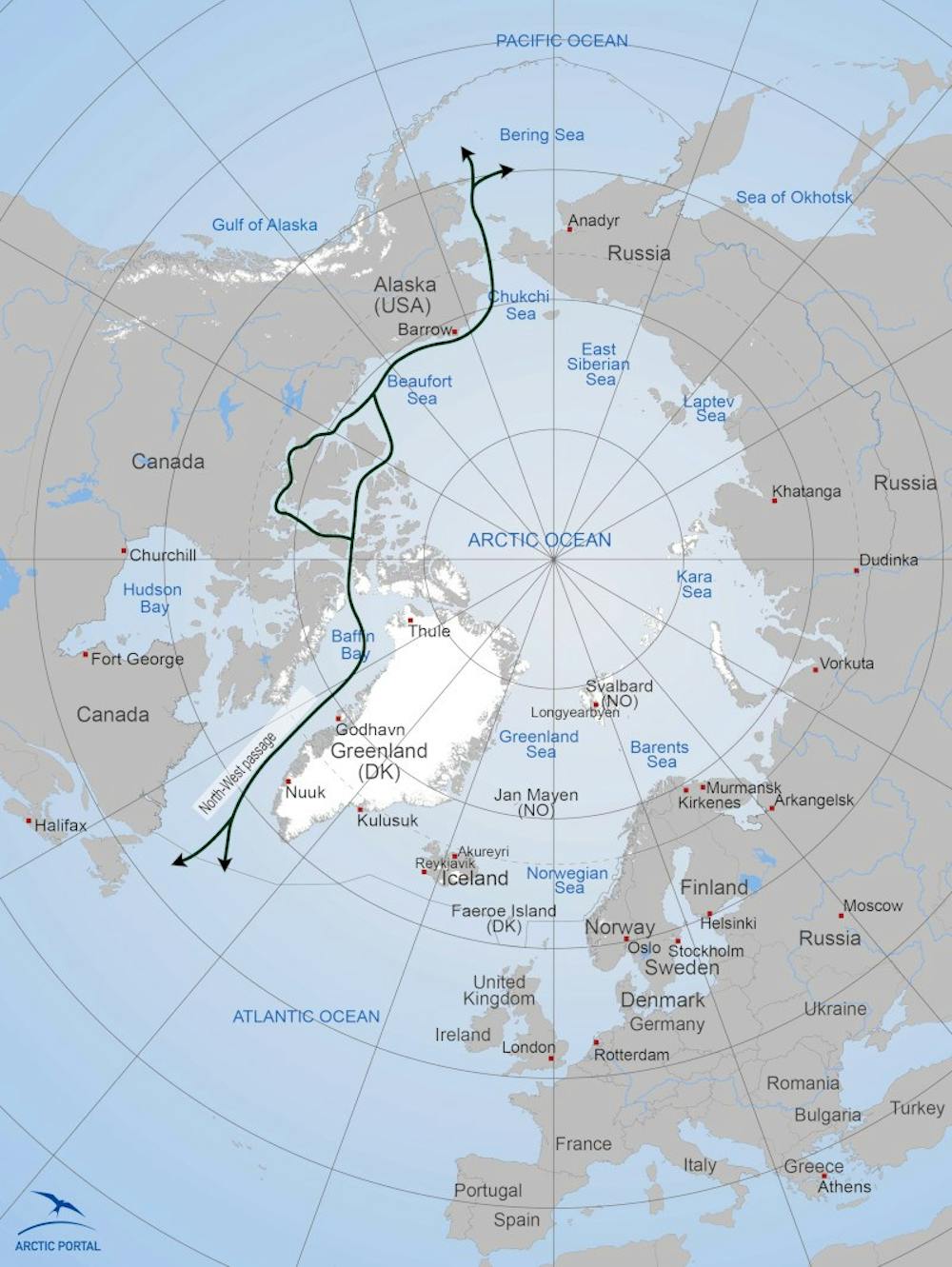
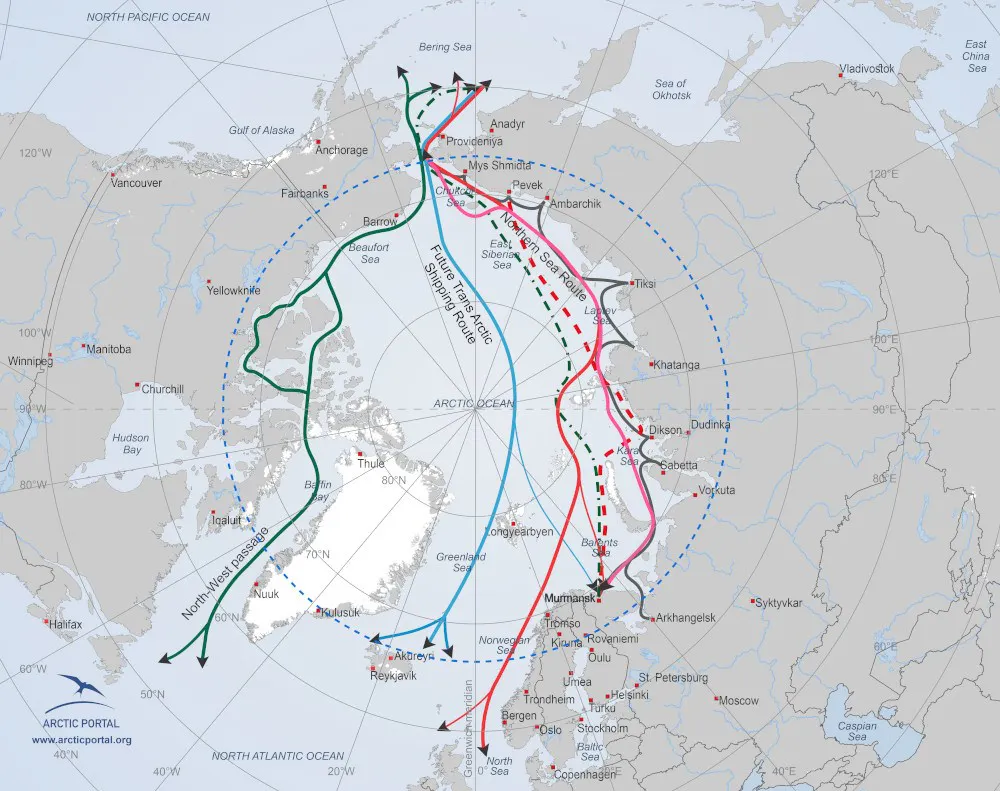
    Trump’s interest in Greenland is often associated with the island’s vast, but largely untapped, mineral resources. But its strategic location is arguably an even greater asset. Shipping routes through the Arctic have become more dependable and for longer periods of time during the year as a result of melting sea ice. The northwest passage (along the US and Canadian shorelines) and the northeast passage (along Russia’s Arctic coast) are often ice free now during the summer.


    Breaking the Ice: Arctic Development and Maritime Transportation, ArcticPortal.org

    This has increased opportunities for commercial shipping. For example, the distance for a container ship from Asia to Europe through the northeast passage can be up to three times shorter, compared to traditional routes through the Suez Canal or around Africa.

    Similarly, the northwest passage offers the shortest route between the east coast of the United States and Alaska. Add to that the likely substantial resources that the Arctic has, from oil and gas to minerals, and the entire region is beginning to look like a giant real estate deal in the making.

    Arctic assets

    The economic promise of the Arctic, and particularly the region’s greater accessibility, have also heightened military and security sensitivities.

    The day before J.D. Vance’s visit to Greenland on March 28, Vladimir Putin, gave a speech at the sixth international Arctic forum in Murmansk in Russia’s high north, warning of increased geopolitical rivalry.

    While he claimed that “Russia has never threatened anyone in the Arctic”, he was also quick to emphasise that Moscow was “enhancing the combat capabilities of the Armed Forces, and modernising military infrastructure facilities” in the Arctic.

    Equally worrying, Russia has increased its naval cooperation with China and given Beijing access, and a stake, in the Arctic. In April 2024, the two countries’ navies signed a cooperation agreement on search and rescue missions on the high seas.


    National Snow & Ice Data Center, Arctic Portal

    In September 2024, China participated in Russia’s largest naval manoeuvres in the post-cold war era, Ocean-2024, which were conducted in north Pacific and Arctic waters. The following month, Russian and Chinese coastguard vessels conducted their first joint patrol in the Arctic. Vance, therefore, has a point when he urges Greenland and Denmark to cut a deal with the US because the “island isn’t safe”.

    That the Russia-China partnership has resulted in an increasingly military presence in the Arctic has not gone unnoticed in the west. Worried about the security of its Arctic territories, Canada has just announced a C$6 billion (£3.2 billion) upgrade to facilities in the North American Aerospace Defense Command it operates jointly with the United States.

    It will also acquire more submarines, icebreakers and fighter jets to bolster its Arctic defences and invest a further C$420 million (£228 million) into a greater presence of its armed forces.


    Read more:
    Arctic breakdown: what climate change in the far north means for the rest of us


    Svalbard’s future role?

    Norway has similarly boosted its defence presence in the Arctic, especially in relation to the Svalbard archipelago (strategically located between the Norwegian mainland and the Arctic Circle). This has prompted an angry response from Russia, wrongly claiming that Oslo was in violation of the 1920 Svalbard Treaty which awarded the archipelago to Norway with the proviso that it must not become host to Norwegian military bases.

    Under the treaty, Russia has a right to a civilian presence there. The “commission on ensuring Russia’s presence on the archipelago Spitzbergen”, the name Moscow uses for Svalbard is chaired by Russian deputy prime minister Yury Trutnev, who is also Putin’s envoy to the far eastern federal district. Trutnev has repeatedly complained about undue Norwegian restrictions on Russia’s presence in Svalbard.

    From the Kremlin’s perspective, this is less about Russia’s historical rights on Svalbard and more about Norway’s – and Nato’s – presence in a strategic location at the nexus of the Greenland, Barents and Norwegian seas. From there, maritime traffic along Russia’s northeast passage can be monitored. If, and when, a central Arctic shipping route becomes viable, which would pass between Greenland and Svalbard, the strategic importance of the archipelago would increase further.

    From Washington’s perspective, Greenland is more important because of its closer proximity to the US. But Svalbard is critical to Nato for monitoring and countering Russian, and potentially Chinese, naval activities. This bigger picture tends to get lost in Trump’s White House, which is more concerned with its own immediate neighbourhood and cares less about regional security leadership.

    Consequently, there has been no suggestion – so far – that the US needs to have Svalbard in the same way that Trump claims he needs Greenland to ensure US security. Nor has Russia issued any specific threats to Svalbard. But it was noticeable that Putin in his speech at the Arctic forum discussed historical territorial issues, including an obscure 1910 proposal for a land swap between the US, Denmark and Germany involving Greenland.

    Putin also noted “that Nato countries are increasingly often designating the Far North as a springboard for possible conflicts”. It is not difficult to see Moscow’s logic: if the US can claim Greenland for security reasons, Russia should do the same with Svalbard.

    The conclusion to draw from this is not that Trump should aim to annex a sovereign Norwegian island next. Maritime geography in the north Atlantic underscores the importance of maintaining and strengthening long-established alliances.

    Investing in expanded security cooperation with Denmark and Norway as part of Nato would secure US interests closer to home and send a strong message to Russia. It would also signal to the wider world that the US is not about to initiate a territorial reordering of global politics to suit exclusively the interests of Moscow, Beijing and Washington.

    Stefan Wolff is a past recipient of grant funding from the Natural Environment Research Council of the UK, the United States Institute of Peace, the Economic and Social Research Council of the UK, the British Academy, the NATO Science for Peace Programme, the EU Framework Programmes 6 and 7 and Horizon 2020, as well as the EU’s Jean Monnet Programme. He is a Trustee and Honorary Treasurer of the Political Studies Association of the UK and a Senior Research Fellow at the Foreign Policy Centre in London.

    ref. US and Russia squabble over Arctic security as melting ice opens up shipping routes – https://theconversation.com/us-and-russia-squabble-over-arctic-security-as-melting-ice-opens-up-shipping-routes-253493

    MIL OSI – Global Reports

  • MIL-OSI Global: Why ChatGPT is a uniquely terrible tool for government ministers

    Source: The Conversation – UK – By Deepak Padmanabhan, Senior Lecturer in AI, Queen’s University Belfast

    Shutterstock/Prachova Nataliia

    The news that Peter Kyle, secretary of state for science and technology, had been using ChatGPT for policy advice prompted some difficult questions.

    Kyle apparently used the AI tool to draft speeches and even asked it for suggestions about which podcasts he should appear on. But he also sought advice on his policy work, apparently including questions on why businesses in the UK are not adopting AI more readily. He asked the tool to define what “digital inclusion” means.

    A spokesperson for Kyle said his use of the tool “does not substitute comprehensive advice he routinely receives from officials” but we have to wonder whether any use at all is suitable. Does ChatGPT give good enough advice to have any role in decisions that could affect the lives of millions of people?

    Underpinned by our research on AI and public policy, we find that ChatGPT is uniquely flawed as a device for government ministers in several ways, including the fact that it is backward looking, when governments really should be looking to the future.

    1. Looking back instead of forward

    Where government ministers should ideally be seeking new, fresh ideas with a view to the future, the information that comes out of an AI chatbot is, by definition, from the past. It’s a very effective way of summarising what has already been thought of but not equipped to suggest genuinely new ways of thinking.

    ChatGPT responses are not based on all past equally. The ever-increasing digitisation over the years steers ChatGPT’s pattern-finding mechanism to the recent past. In other words, when asked by a minister to provide advice on a specific problem in the UK, ChatGPT’s responses would be more anchored in documents produced in the UK in recent years.

    And notably, in Kyle’s case, that means that not only will a Labour minister be accessing information from the past, but he’ll be advised by an algorithm leaning heavily on advice given to Conservative governments. That’s not the end of the world, of course, but it’s questionable given that Labour won an election by promising change.

    Kyle – or any other minister consulting ChatGPT – will be given information grounded in the policy traditions reflecting the Rishi Sunak, Boris Johnson, Theresa May and David Cameron eras. They are less likely to receive information grounded in the thinking of the New Labour years, which were longer ago.

    If Kyle asks what digital inclusion means, the answer is more likely to reflect what these Tory administrations think it means rather than thoughts of governments more aligned with his values.

    Amid all the enthusiasm within Labour to leverage AI, this may be one reason for them to distance themselves from using ChatGPT for policy advice. They risk Tory policy – one they so like to criticise – zombieing into their own.

    2. Prejudice

    ChatGPT has been accused of having “hallucinations” – generating, uncanny, plausible-sounding falsehoods.

    There is a simple technical explanation for this, as alluded to in a recent study. The “truth model” for ChatGPT – as for any large language model – is one of consensus. It models truth as something that everyone agrees to be true. For ChatGPT, its truth is simply the consensus of views expressed across the data it has been trained on.

    This is very different from the human model of truth, which is based on correspondence. For us, the truth is what best corresponds to reality in the physical world. The divergence between the truth models could be consequential in many ways.

    For example, TV licensing, a model that operates only within a few nations, would not figure prominently within ChatGPT’s consensus model built over a global dataset. Thus, ChatGPT’s suggestions on broadcast media policy are unlikely to substantially touch upon TV licensing.

    Besides explaining hallucinations, divergences in truth models have other consequences. Social prejudices, including sexism and racism, are easily internalised under the consensus model.

    Consider seeking ChatGPT advice on improving conditions for construction workers, a historically male dominated profession. ChatGPT’s consensus model could blind it from considerations important to women.

    The correspondence model of truth enables humans to continuously engage in moral deliberation and change. A human policy expert advising Peter Kyle could illuminate him on pertinent real-world complexities.

    For example, they might highlight how recent successes in AI-based diagnostics could help tackle distinct aspects of the UK’s disease burden in the knowledge that one of Labour’s priorities is to cut NHS waiting times.

    3. Pleasing narratives

    Tools such as ChatGPT are designed to give engaging, elegant narratives when responding to questions. ChatGPT managed this partly by weeding out bad quality text from its training data (with the help of underpaid workers in Africa).

    These poetic pieces of writing work well for engagement and help OpenAI to keep users hooked on their product. Humans enjoy a good story, and particularly one that offers to solve a problem. Our shared evolutionary history has made us story-tellers and story-listeners unlike any other species.

    But the real world is not a story. It is a constant swirl of political complexities, social contradictions and moral dilemmas, many of which can never be resolved. The real world and the decisions government ministers have to make on our behalf are complex.

    There are competing interests and irreconcilable differences. Rarely is there a neat answer. ChatGPT’s penchant for pleasing narratives stands at odds with the public policy imperative to address messy real-world conditions.

    The very features that make ChatGPT a useful tool in many contexts are squarely incompatible with the considerations of public policy, a realm that seeks to make political choices to address the needs of a country’s citizens.

    The authors do not work for, consult, own shares in or receive funding from any company or organisation that would benefit from this article, and have disclosed no relevant affiliations beyond their academic appointment.

    ref. Why ChatGPT is a uniquely terrible tool for government ministers – https://theconversation.com/why-chatgpt-is-a-uniquely-terrible-tool-for-government-ministers-253294

    MIL OSI – Global Reports

  • MIL-OSI Europe: ASIA/SOUTH KOREA – Bishops after President Yoon’s impeachment: “Now the time for politics begins”

    Source: Agenzia Fides – MIL OSI

    Friday, 4 April 2025

    Photo Yiho

    by Pascale RizkSeoul (Agenzia Fides) – After 111 days since his indictment on December 14, 2024, South Korea’s 20th President, Yoon Suk Yeol, was definitively removed from office today, April 4, at 11:22 a.m. (local time) by the Korean Constitutional Court, following a unanimous ruling by all eight judges.”First and foremost, we call on the State authorities to make every effort to regain the people’s trust and establish harmony. In particular, we urge politicians not to forget that they exist to serve the people and to promote a policy of mutual respect and listening, oriented towards coexistence,” said the country’s Catholic bishops following the Constitutional Court’s ruling impeaching President Yoon Suk-yeol. “The process of electing a responsible and moral leader with a view to social reconciliation and the common good must be conducted in a democratic and mature manner,” the bishops emphasized. New elections must now be held within the next 60 days.Impeachment proceedings have been initiated against the South Korean president after he ordered the imposition of martial law on the night of December 3rd to “eradicate pro-North Korean forces and protect the democratic constitutional order.” Unlike the impeachment trial of former President Park Geun-hye in 2017, which lasted 11 days, and the trial of former President Roh Moo-hyun in 2004, who was reinstated 14 days after the hearings, the verdict against Yoon came after six weeks, during which many Koreans continued to demonstrate in public squares against or for Yoon. Protests have intensified over the past three weeks in front of the Constitutional Court building in Songhyeon Square, where 2,000 clergy and believers from various faiths, including 200 Catholic priests, gathered on Monday, March 31.Today, more than 14,000 police officers were deployed in Seoul to prevent violent riots. The security distance from the court building, originally set at 100 meters, was extended to 300 meters, with police buses used as barricades. Yoon’s declaration of martial law late last night appeared to many analysts as the latest attempt to maintain control over the country’s political decision-making process after his People’s Power Party failed to get a bill passed through the opposition Democratic Party-controlled parliament. His actions sparked a response from numerous Koreans, who staged massive protests outside the National Assembly. Despite attempts by elements of the military to prevent parliamentarians from voting to lift martial law, it was lifted just six hours after its declaration, before sunrise on December 4, 2024. The president was arrested on the basis of an arrest warrant issued on New Year’s Eve. The arrest took place on January 15 by officers of the Corruption Investigation Office (CIO). Yoon’s defense team won the Seoul Central District Court’s overturning of the arrest on Friday, March 7, citing several procedural loopholes in the prosecution. “It is said that history repeats itself, but today our nation and our people are forced to painfully write an unfortunate page of history that no one ever wanted to see. For the second time in our history, the impeachment proceedings against a popularly elected president have been upheld,” reads the bishops’ letter to the Korean faithful. “Now the time for politics begins: We must combine our wisdom to elect a new President who will lead our nation. We must choose a leader who deeply recognizes that presidential power is a power delegated by the people, a power that serves the people, and who has the attitude and willingness to sacrifice himself at any time to protect the lives and property of the people.” Over the past six weeks, several appeals for calm have been made to citizens, and politicians have been called upon to work to help South Korea overcome the crisis. “Respect and accept the Constitutional Court’s decision so that this national crisis can be resolved smoothly,” read the appeal published on March 5 by the Association of Major Religious Denominations in South Korea, including the Catholic Church (represented by Bishop Matthias Ri Long-hoon, Chairman of the Catholic Bishops’ Conference of Korea and Bishop of Suwon). In their “Statement to the People Before the Impeachment Trial,” the representatives of the religious communities stressed that “democracy is based on respect for rules.” One of the final appeals to the Constitutional Court was launched a few days ago by Cardinal Lazaro You Heung-sik, Prefect of the Dicastery for the Clergy. In a message addressed to the faithful in Korea on March 21, the Cardinal called for them to “listen with a heart of despair for the Republic of Korea in crisis” and “to the voice of justice and conscience that dwells deep within us” and to no longer hesitate to “make a judgment of conscience.” The Korean Bishops’ Conference also issued a statement on April 1, after the Constitutional Court announced that it would hold the impeachment proceedings against President Yoon Seok-yeol on April 4: “We must adopt a stance that welcomes any decision of the Constitutional Court. Regardless of the decision, the Church in Korea will pray in the hope that all citizens will respect and accept the ruling. In this way, our country will take another step toward becoming a more mature democratic nation.” In recent months, South Korea has been more polarized than ever. From the very first evening, the bitter cold of December did not stop Koreans from taking to the streets to rebel against the first declaration of martial law since the military regime (1961-1987). There were also defenders of the deposed President Yoon, while the belief that the will of the people is the foundation of democratic political institutions remains undiminished. Now everyone hopes that the verdict will help overcome the period of political turmoil the country is currently experiencing, which has also been hit by natural disasters, including the crash of a Korean airliner on December 29, 2024, which killed a total of 179 people. (Agenzia Fides, 4/4/2025)
    Photo Vincent Park

    Photo RGS Corea

    Photo Vincent Park

    Photo Vincent Park

    Share:

    MIL OSI Europe News

  • MIL-OSI Europe: AFRICA/SUDAN – After two years of war: Khartoum is slowly returning to normality

    Source: Agenzia Fides – MIL OSI

    Khartoum (Agenzia Fides) – Khartoum, the capital of Sudan, which was recaptured on March 26 by the regular army (Sudan Armed Forces, SAF) from the Rapid Support Forces (RSF) militiamen, is slowly returning to normality.Today, April 4, citizens were able to cross the Omdurman Bridge into Khartoum for the first time since the outbreak of war in Sudan almost two years ago. Omdurman is a satellite city of Khartoum, which had been captured by the RSF since the outbreak of war on April 15, 2023, and which had taken control of large parts of the administrative districts, including the Presidential Palace.After recapturing the city, the Sudanese government is trying to restore normal life in the Khartoum area, which includes the city of the same name, Omdurman, and Bahrī.In its first meeting at Khartoum headquarters since the outbreak of the war, the Khartoum State Administration announced a package of urgent emergency measures on April 2, including resolving water and electricity supply problems, operating hospitals, providing urgent food aid, and improving environmental conditions. During their withdrawal from Khartoum State, RSF militants allegedly committed crimes against the civilian population. According to local authorities, at least 89 people were killed by the RSF on March 27 in some villages north of Omdurman. Meanwhile, RSF Deputy Commander Abdel Rahim Hamdan Daglo threatened in a video to invade two northern States, signaling his intention to continue the war despite recent defeats. (L.M.) (Agenzia Fides, 4/4/2025)
    Share:

    MIL OSI Europe News

  • MIL-OSI: Brag House Announces Participation in The LD Micro Invitational Conference

    Source: GlobeNewswire (MIL-OSI)

    NEW YORK, April 04, 2025 (GLOBE NEWSWIRE) — Brag House Holdings, Inc. (NASDAQ: TBH) (the “Company”), a pioneering media-tech platform at the intersection of gaming, college sports, and social interaction, announced today that it will be participating in the 15th Annual LD Micro Invitational Conference at the Westin Grand Central in New York on April 9th and 10th, 2025.

    Brag House is scheduled to present on April 10, 2025, at 1:00 PM ET, with one-on-one investor meetings to follow. Lavell Juan Malloy II, Co-Founder and Chief Executive Officer, and Chetan Jindal, Chief Financial Officer, will deliver the presentation and represent the Company at the event.

    “The LD Micro Invitational offers a dynamic platform to connect with the investor community and showcase the momentum we’re building at Brag House,” said Malloy. “We’re creating a new kind of media experience—one that’s driven by engagement, inclusivity, and the digital habits of Gen Z. We look forward to sharing our story and vision at the conference in New York.”

    The LD Micro Invitational is one of the premier investor conferences dedicated to showcasing the most innovative and dynamic companies in the micro- and small-cap space. The event features a curated selection of presenters and provides a high-impact environment for networking and strategic dialogue.

    The presentation will be webcast live on the conference event platform, which can be accessed at https://ldinv15.sequireevents.com/

    For more information or to schedule a one-on-one meeting with Brag House, please contact acarey@allianceadvisors.com.

    About Brag House
    Brag House is a leading media technology gaming platform dedicated to transforming casual college gaming into a vibrant, community-driven experience. By seamlessly merging gaming, social interaction, and cutting-edge technology, the Company provides an inclusive and engaging environment for casual gamers while enabling brands to authentically connect with the influential Gen Z demographic. The platform offers live-streaming capabilities, gamification features, and custom tournament services, fostering meaningful engagement between users and brands. For more information, please visit www.braghouse.com.

    About LD Micro
    LD Micro aims to be the most essential resource in the micro-cap world. Whether it is the Index, comprehensive data, or hosting the most significant events annually, LD’s sole mission is to serve as an invaluable asset for all those interested in finding the next generation of great companies. To learn more about LD Micro, visit http://www.ldmicro.com.

    Forward-Looking Statements
    Certain statements in this announcement are forward-looking statements. Investors can identify these forward-looking statements by words or phrases such as “may,” “will,” “expect,” “anticipate,” “aim,” “estimate,” “intend,” “plan,” “believe,” “is/are likely to,” “potential,” “continue” or other similar expressions. These statements are subject to uncertainties and risks including, but not limited to, the risk factors discussed in the “Risk Factors” section of the Company’s filings with the SEC. Although the Company believes that the expectations expressed in these forward-looking statements are reasonable, it cannot assure you that such expectations will turn out to be correct, and the Company cautions investors that actual results may differ materially from the anticipated results and encourages investors to review other factors that may affect its future results discussed in the Company’s filings with the SEC, which are available for review at www.sec.gov. The Company undertakes no obligation to update or revise publicly any forward-looking statements to reflect subsequent occurring events or circumstances, or changes in its expectations that arise after the date hereof, except as may be required by law.

    Media Contact:
    Fatema Bhabrawala
    Director of Media Relations
    fbhabrawala@allianceadvisors.com

    Investor Relations Contact:
    Adele Carey
    VP, Investor Relations
    ir@thebraghouse.com

    The MIL Network

  • MIL-OSI United Kingdom: Government consents Rampion 2 Offshore Wind Farm

    Source: United Kingdom – Government Statements

    Press release

    Government consents Rampion 2 Offshore Wind Farm

    The Rampion 2 Offshore Wind Farm off the Sussex coast has been consented, securing 1.2 GW of clean, secure, homegrown power for British families.

    • Approval of Rampion 2 means that the government has consented enough clean energy to power 1.86 million homes, since July
    • Estimated 9,000 jobs created as a result of approving major offshore wind and solar projects
    • Delivers on government Plan for Change to make decisions on 150 Development Consent Order applications over this Parliament

    A major offshore wind farm capable of producing enough clean electricity to power the equivalent of one million homes – has today (Friday 4 April) been approved by the Energy Secretary Ed Miliband as part of the government’s Plan for Change.

    The Rampion 2 Offshore Wind Farm off the Sussex coast has been granted planning permission, securing 1.2GW of clean, secure, homegrown power for British families and businesses. 

    Seizing on the economic opportunity of the 21st century, accelerating towards clean energy will create the jobs of the future across the UK. The Rampion 2 developer estimates that this project alone will create 4,000 jobs in the construction of the 90 offshore turbines. 

    Approval moves the government a step closer to delivering clean power by 2030, putting the UK within 4 GW of the offshore wind range of 43-50 GW set out in the Clean Power Action Plan.  

    This step underlines the government’s commitment to unlocking vital infrastructure and backing growth and is the 15th Development Consent Order approved since July.

    This decision follows measures in the new Planning and Infrastructure Bill which will see dozens of clean energy projects, including wind and solar power, jump to the front of the queue for grid connections.  

    The Bill will pave the way for windfarms and other low carbon infrastructure to be approved and built faster as part of the government’s mission to deliver homegrown, clean power that Britain controls and lower energy bills for good.  

    Energy Security Secretary Ed Miliband said:  

    The UK has a boundless supply of wind that cannot be turned on and off at the whims of dictators and petrostates. 

    It’s time to get off the fossil fuel rollercoaster, roll out clean power, protect our energy security and bring down bills for good. 

    This project puts us within reach of our clean power offshore wind target. Through our Plan for Change we’re getting on with delivering the clean energy and jobs Britain needs.

    The government has already approved  a number of major energy infrastructure projects since July, including:  

    • Cottam Solar Farm: 600 MW, enough to power the equivalent of 180,000 homes and support over 1,000 jobs during construction
    • Heckington Fen Solar Farm: 500 MW, enough to power the equivalent of 150,000 homes and support over 1,000 jobs during construction
    • Mallard Pass Solar Farm: 350 MW, enough to power the equivalent of 100,000 homes and support around 400 jobs during construction
    • Sunnica Solar Farm: 250 MW, enough to power the equivalent of 150,000 homes and support around 1,690 jobs during construction
    • Gate Burton Solar Farm: 531 MW, enough to power the equivalent of 160,000 homes and support around 360 construction jobs
    • West Burton Solar Farm: 480 MW, enough to power the equivalent of 140,000 homes and support around 430 construction jobs

    In the last renewables auction round the government secured almost 5 GW of new offshore wind capacity, including the largest offshore windfarm project in Europe – the Hornsea 3 project off the Yorkshire coast. 

    Notes to editor 

    The details of the planning decision and the reasons for the decision are set out in the Secretary of State’s Decision Letter, which is published alongside the Report from the Examining Authority on the Planning Inspectorate website

    Updates to this page

    Published 4 April 2025

    MIL OSI United Kingdom

  • MIL-OSI United Nations: EU, IOM Senior Officials in Brussels for Eleventh Strategic Cooperation Meeting on Migration

    Source: International Organization for Migration (IOM)

    Brussels, 04 April 2025 – Senior officials from the European Union (EU) and the International Organization for Migration (IOM) met in Brussels today for their eleventh annual meeting under the EU-IOM Strategic Cooperation Framework.    

    The high-level exchange – co-chaired by Acting Director-General for Migration and Home Affairs, European Commission, Beate Gminder, and IOM Director General Amy Pope – centred on the importance of the strategic partnership between the EU and IOM to ensure well-managed migration policies that respond to emerging global challenges.  

    IOM Director General Amy Pope commended the EU’s long-standing support and reaffirmed IOM’s commitment to the dialogue and working with the EU on all aspects of migration and mobility.  

    “The partnership between IOM and the EU has been fundamental to serving the most vulnerable people in the world and assisting States to manage migration in a safe, orderly, and effective way,” said DG Pope. “More than ever, our cooperation needs to deliver. It should be focused, global in scope and comprehensive in practice.”   

    Acting DG Gminder emphasized how the historic agreement on the EU Pact on Migration and Asylum will contribute to more predictable and sustainable migration management and better rights protection in the EU, thanking IOM for its longstanding support.  She stressed the importance of continued cooperation in delivering on agreed policy and operational priorities working with partner countries along the migration routes to the EU.   

    “The International Organization for Migration is a key partner in our efforts to strengthen migration governance in the EU, to work towards safe, orderly and regular migration globally, and for finding and implementing sustainable solutions for existing and future challenges,” said B. Gminder.   

    Among the issues addressed, the senior officials focused on the latest developments in Ukraine, Syria and the region, a route-based approach to migration governance, effective return and reintegration in line with European and international law, and promoting regular pathways for migration.    

    Both sides also exchanged views on the new political and funding environment, confirming the EU as a strong and stable donor given its commitment to a strong multilateral system with the United Nations at its centre.  

    The EU and IOM agreed that enhanced partnerships and cooperation between countries are vital to address issues comprehensively at different points along the routes. This includes providing emergency assistance, humanitarian aid and protection, offering durable solutions to internal displacement, innovative approaches to climate mobility, and enhancing safe, regular pathways for migrants and displaced people, addressing irregular migratory flows and combating smuggling of migrants and trafficking in human beings.   

    Overall European Commission funding to IOM reached over EUR 590 million in 2024. Together with its Member States, the EU continues to be IOM’s key donor.   

    The EU-IOM meeting was hosted by the Directorate-General for Migration and Home Affairs (DG HOME). IOM Director General Amy Pope and senior IOM officials joined senior representatives from the Directorate-General for European Civil Protection and Humanitarian Aid Operations (DG ECHO), the Directorate-General for Enlargement and Eastern Neighbourhood (DG ENEST), the Directorate-General for International Partnerships (DG INTPA), the Directorate-General for Middle East, North Africa and the Gulf (DG MENA) and the European External Action Service (EEAS). On this occasion, DG MENA’s and DG ENEST’s participation in the Strategic Cooperation was also announced.  

    Background     

    In July 2012, the EU and IOM established a Strategic Cooperation Framework to enhance dialogue and collaboration on migration, development, humanitarian response and human rights issues. This built on their shared interest in bringing the benefits of well-managed international migration to migrants and society. Today’s meeting, the eleventh of its kind since the launch of the Strategic Cooperation, was one of the high-level discussions that advance cooperation between the two organizations. The first EU-IOM Senior Officials Meeting under the Strategic Cooperation Framework was held in Brussels on 3 May 2013.   

    For more information, please contact:  

    In Brussels: Ryan Schroeder, rschroeder@iom.int  

    MIL OSI United Nations News

  • MIL-OSI Africa: African Development Bank and Mozambique launch drone-based initiative to strengthen country’s disaster preparedness

    Source: Africa Press Organisation – English (2) – Report:

    MAPUTO, Mozambique, April 4, 2025/APO Group/ —

    The African Development Bank (www.AfDB.org), the government of Mozambique, and Korea’s government agency Busan Technopark have launched an innovative drone-driven initiative to strengthen disaster preparedness in Mozambique, a country frequently hit by floods, mudslides, cyclones, and other weather-related crises.  

    The launch event took place in Maputo, on Thursday, April 3.  

    The Drone-Based Disaster Management Project will establish a drone training centre in Mozambique to train 30 professionals, including 10 instructors. It will also implement a drone-based monitoring and response system across five high-risk flood zones.  

    It is expected to enhance real-time disaster monitoring, early warning systems, and predictive flood modeling, helping Mozambique better anticipate and mitigate climate-related disasters. The country is one of the most disaster-prone in Africa, with floods and cyclones alone causing severe destruction to infrastructure, agriculture, and communities. 

    The African Development Bank manages the $967,000 initiative, which was funded by the Korea-Africa Economic Cooperation (KOAFEC) Trust Fund. Korea’s Busan Techno Park, known for its expertise in technological innovation and disaster management, will implement the project over six months, with the intention of evolving into a centre of excellence and regional hub.  

    “We warmly welcome the Drone-Based Disaster Management Project as an innovative initiative that harnesses cutting-edge technology to strengthen our disaster preparedness and response,” said Mozambique’s Minister of Communication and Digital Transformation, Muchanga Américo, during the launch event. “This is just the beginning.” 

    During the six-month period, there will be technology and knowledge transfer, enabling the Mozambican side to take ownership of the drone solution and become autonomous for a period of three years if supplier agreements are concluded. 

    African Development Bank Country Economist, Flavio da Gama represented the  Country Manager for Mozambique. He emphasized how the project will harness innovation to protect communities and infrastructure. 

    “This project is not just about technology. It reflects the power of international cooperation, uniting governments, development institutions, and private sector partners in a shared mission: to protect lives, strengthen resilience, and promote sustainable development.” 

    “Drones provide critical data for flood management,” said Changmoon Yang, Managing Director of Busan Technopark. “This project will showcase how technology can save lives.”  

    The Korean ambassador to Mozambique, Bokwon Kang, said the country looked forward to further cooperation with the African Development Bank and Mozambique in digital innovation. 

    Korea is recognized as a leader in the development and use of Unmanned Aerial Vehicles or drones for real-time data collection and processing.  

    The launch event concluded with the signing of a tripartite agreement between the African Development Bank, Busan Technopark, and the Mozambican government, paving the way for full implementation. 

    The project aligns with the African Development Bank’s commitment to supporting climate resilience and digital transformation. The Bank envisions scaling this model across Africa, helping other disaster-prone regions to leverage drones and digital solutions for risk management. 

    MIL OSI Africa

  • MIL-OSI USA: Study: Police Finance Organizations Allow Steady Flow of Dark Money to Law Enforcement

    Source: US State of Connecticut

    Five years ago, thanks to a federal program that distributes surplus military equipment to local police, Bridgeport acquired a heavily armored vehicle capable of withstanding a mine blast. Other places like Bristol, Hartford, New London, and Willimantic also got one.

    As local media published town-by-town lists of the night vision goggles, rifles, thermal scopes, underwater sound equipment, reconnaissance cameras, and other armored vehicles acquired under the program, Connecticut legislators voted to henceforth prohibit the acquisition of certain military items.

    In a post-George Floyd world, when citizens nationwide openly question the use of police force and officers often find themselves an unwelcomed presence in neighborhoods, simple transparency, like those town-by-town lists, is paramount, says one UConn researcher.

    It’s also the thing most in danger, as what he calls “police finance organizations” introduce secrecy and a rising amount of dark money into policing.

    “Police departments are funded largely by taxpayers through municipal budgets, but we’ve found there’s a lot of other money going to police that you don’t know about or have control over as a voter or taxpayer,” says sociologist Simon Yamawaki Shachter, an assistant professor at UConn. “When you don’t know what’s going into a police budget, that raises questions about who the police are working for. Is it the community that pays taxes or someone else?”

    Shachter and researchers from Harvard University and the University of Chicago introduce the new concept of police finance organizations in their paper, “The Social Structure of Private Donations to Police,” published recently in Socius: Sociological Research for a Dynamic World.

    In it, they define such organizations as simply private entities that give resources to police. These private entities, however, aren’t subject to the same level of scrutiny as police departments, through freedom-of-information requests and public annual reports for example.

    Among the larger category of police finance organizations, they say there are three smaller types: “connectors,” “boosters,” and “havens.”

    In most cases, taxpayers and voters don’t know this is happening. &#8212 Simon Yamawaki Shachter

    Police connectors are entities that generally are in major U.S. cities and provide resources to multiple police departments, oftentimes serving as hubs between parts of the private funding network.

    Police boosters, on the other hand, give only to a single department and tend to be hyperlocal in their fundraising and giving. Police havens, though, are organizations that operate as a savings account for departments, that is, taking in private donations as deposits and making withdrawals to give to departments upon need or request.

    “While police finance organizations sound fine at face value, what’s interesting is that people can make their own tax-deductible gifts to police departments without an intermediary,” Shachter explains. “So, it’s curious why these organizations need to exist in the first place if people can just go to their local police department and write them a check. Why does there need to be this extra organization in the middle?”

    These organizations, he says, often are incorporated as nonprofits, and as 501(c)3s are not required to disclose donor lists, limiting the public’s knowledge of where the funding originated from. Not only don’t they have to report their donors, they’re also not subject to freedom-of-information laws, so even a written request doesn’t get the information.

    Nearly 1,000 police finance organizations nationwide 

    Shachter says the New York City Police Foundation, founded in 1971, was the first major private organization to support police, and even as others popped up over the years, their popularity was slow to grow until about 2015 when their number exploded.

    Police benevolent associations were not part of the study, Shachter notes, and weren’t considered police finance organizations because they’re a function of police unions and work to support officers, not general policing, namely equipment and training.

    Using information from GuideStar Candid, Shachter and the other researchers found thousands of entries just from the keywords “police,” “sheriff,” “law enforcement,” and “trooper” in tax filer names, mission statements, program accomplishments, expense descriptions, and addresses.

    They worked to winnow down the dataset and figure there are 961 police finance organizations nationwide, which, Shachter says, is a conservative estimate based on various limitations in the data and other roadblocks researchers hit.

    They managed to discern, however, that between 2014 and 2019, police finance organizations had a revenue of $480 million, of which $396 million went to police havens, $56 million to police connectors, and $28 million to police boosters, according to the study.

    The average donation to a police haven was $22,243 – a skewed number thanks to a handful of multimillion-dollar gifts, the study says, explaining that havens often gave money to individual officers, provided nonmaterial gifts to departments, facilitated discounted purchases by departments, and offered free loans of equipment.

    Those giving the most have strong political agendas and are trying to exert policy influence in different ways. &#8212 Simon Yamawaki Shachter

    Havens also exchanged $5 million among themselves through 80 individual donations, “creating a shadow network of internal financial exchanges,” the study says.

    Shachter says police finance organizations find all sorts of ways to secretly pass support to departments, including by donating to individual officers. If gifts are less than $5,000 per officer, the donation needn’t be disclosed.

    This means, for instance, the Chicago Police Memorial Foundation was able in 2020 to give that department 3,330 bulletproof vests and 1,720 vest covers by marking them for individual officers without having to report the $1.47 million donation, the study says.

    Two years prior in 2018, a different organization, the Chicago Police Foundation, purchased “special classes for CPD,” but details on what those classes were for aren’t readily available, a fact that’s not surprising to Shachter. The study notes that its disclosure at all was likely a mistake.

    “Most of the police departments and most of the organizations we studied are using this money for whatever they want, going around any public process,” Shachter says. “We have no idea what’s being offered in these trainings. We just know they’re held and that police go to them.”

    Gifts from billionaire donors 

    From youth programming and defibrillators to shields and even a helicopter, donations run the gamut.

    “Most of the gifts are very benign, supporting the health of canines and medical training for officers, things I think we all support and say should be part of public budgets,” Shachter says. “But if you look at the amount of money that moves through these organizations, it appears far more nefarious. Those giving the most have strong political agendas and are trying to exert policy influence in different ways.”

    Study researchers found three private donors who gave significant support.

    Howard Buffett, son of billionaire Warren Buffett, gave to police finance organizations in Illinois, which led to the ouster of the director of the Illinois Law Enforcement Training and Standards Board over ethical concerns.

    In Arizona, the younger Buffett made donations and became an active member of the Assist Team, giving him direct access to police and allowing him to develop a relationship with U.S. Border Patrol, according to the study.

    Founder of the hedge fund Citadel Kenneth Griffin himself disclosed gifts to police finance organizations, offering a combined $35 million to the University of Chicago Crime Lab in 2018 and 2022, the study says, noting that Griffin openly tied the gifts to mayoral, gubernatorial, and national policy. Because the University of Chicago is a private institution, it did not have to disclose the gift.

    And billionaires Laura and John Arnold, outspoken supporters of law enforcement, funded in 2016 a pilot surveillance drone program through a police haven supporting Baltimore police, the study says. When the community learned of the surveillance program, it was immediately shut down.

    There’s no doubt, Shachter says, that big donors are using their gifts to influence local, state, and national policy conversations.

    “Our goal with this study is to take the first step of shining a light on this area of dark money and then try to make it more transparent. We would love changes to the IRS tax code to require better reporting, like gifts to individual officers. They should report that just like other public officials,” he says.

    “In most cases, taxpayers and voters don’t know this is happening,” he continues. “City councils don’t even know, and if they’re not aware of these off-the-book line items how can they appropriately budget? There are so many ways these organizations are purposely avoiding transparency and that gives us reason for alarm.”

    MIL OSI USA News

  • MIL-OSI Security: Four Sentenced for Roles in Drug Trafficking Organization

    Source: Office of United States Attorneys

    MARTINSBURG, WEST VIRGINIA – Four people have been sentenced for their roles in a drug trafficking conspiracy operating in Berkeley, Morgan, and Hampshire Counties.

    According to court documents and statements made in court, 26 people were charged in 2023 in connection with the drug trafficking organization, led by Dorian Scott Burks and Andrew Ross Hose. The conspirators worked together to sell large quantities of methamphetamine, fentanyl, and cocaine. The investigation recovered drugs, firearms, and thousands of dollars.

    Those sentenced this week are:

    • Alexis Walsh, 30, of Jeannette, Pennsylvania, sentenced to 123 months in prison for the distribution of cocaine hydrochloride;
    • Michael Ramsbottom, age 68, of Berkeley Springs, West Virginia, sentenced to 84 months for conspiracy to possess with intent to distribute and to distribute methamphetamine hydrochloride, fentanyl, cocaine hydrochloride, and cocaine base;
    • Sathira Lynn Ewers, age 42, of Romney, West Virginia, sentenced to 70 months in prison for conspiracy to possess with intent to distribute and to distribute methamphetamine hydrochloride, fentanyl, cocaine hydrochloride, and cocaine base;
    • Eric Turner, age 38, of Winchester, Virginia, sentenced to three years of probation for conspiracy to possess with intent to distribute and to distribute methamphetamine hydrochloride, fentanyl, cocaine hydrochloride, and cocaine base.

    All defendants in the case have been convicted. Burks, age 29, of Jeannette, Pennsylvania, was sentenced to 262 months in prison in January 2025. Hose, age 40, of Bunker Hill, West Virginia, will be sentenced on May 5, 2025.

    Assistant U.S. Attorney Lara Omps-Botteicher prosecuted the cases on behalf of the government. The Potomac Highlands Drug Task Force, a HIDTA-funded initiative, investigated.

    This effort is part of an Organized Crime Drug Enforcement Task Forces (OCDETF) operation. OCDETF identifies, disrupts, and dismantles the highest-level criminal organizations that threaten the United States using a prosecutor-led, intelligence-driven, multi-agency approach. Additional information about the OCDETF Program can be found at https://www.justice.gov/OCDETF.

    U.S. District Judge Gina M. Groh presided. 

    MIL Security OSI

  • MIL-OSI Global: The problem with Trump’s takeover of the Kennedy Center isn’t the possibility of ‘Cats’

    Source: The Conversation – USA – By Joanna Dee Das, Associate Professor of Dance, Washington University in St. Louis

    Donald Trump visits the John F. Kennedy Center for the Performing Arts on March 17, 2025. Jim Watson/AFP via Getty Images

    When President Donald Trump announced that he was assuming control of the Kennedy Center for the Performing Arts, he described the move as a triumph over “wokey” programming. He subsequently fired the 17 board members appointed by President Joe Biden and installed himself as chairman.

    Some critics have reacted to the move by suggesting Trump doesn’t understand art.

    One protester declared that Trump has “no artistic bones in his body.” Theater aficionados claim that he misinterprets his favorite musicals, “Cats” and “Les Misérables.”

    The New Yorker magazine’s satirical description of the Kennedy Center’s 2025 programming under Trump included a fictional show called “Forbidden Branson.” The title plays on the show “Forbidden Broadway,” replacing New York’s storied theater district with the popular Ozarks tourist destination that has been maligned as a mecca of bad taste.

    To me, these responses play right into Trump’s hands, reinforcing his claims that liberals are out-of-touch elitists.

    I’ve spent the past seven years researching and writing a book about Branson, Missouri, a town that offers a plethora of live entertainment, including magic shows, country music performances and variety shows. Many of the productions have a conservative, Christian slant. In my view, a Branson-style show could – and should – belong among the offerings at the Kennedy Center.

    Rather than ridiculing the president’s taste, I think responses to the takeover would be better placed focusing on more fundamental questions about the role of the U.S. government in the nation’s artistic life.

    How can a national arts institution best reflect the country’s diverse range of people and interests? Prior to Trump, how well was the Kennedy Center doing at that?

    Historical opposition to arts funding

    For most of U.S. history, government had a very limited role in the arts.

    European royals had long patronized the arts. In contrast, the founders of the United States, fearful of tyranny, created a weak federal government that could barely impose taxes, let alone establish a national theater.

    Instead, artists of the 18th and 19th centuries operated in a for-profit marketplace. Their audiences rejected elitist cultural norms and watched Shakespeare mixed in with minstrel songs and comedy acts on the same program.

    At the end of the 19th century, the Second Industrial Revolution created a class of ultra-wealthy Americans who sought to imitate European royalty and their tradition of patronage. New cultural distinctions emerged. Opera, ballet and classical music were designated as high art; variety shows featuring comedians, popular songs and acrobatics were designated as low art. Musicals eventually found an uneasy niche as “middlebrow.” Performers who wished to avoid the grind of the commercial marketplace could now turn to private patrons. Nonwhite and working-class performers who lacked social connections to the upper crust had fewer opportunities to do so.

    The Great Depression compelled the U.S. government to fund artists for the first time. In 1935, President Franklin D. Roosevelt established Federal Project Number One, which included visual art, theater, music and writing programs. Its primary goal was to provide work for the unemployed. Its secondary purpose involved creating art that would be accessible to ordinary Americans both in terms of location – like murals in public buildings – and content, such as plays like “One Third of a Nation” that spoke to housing concerns.

    An audience enjoys a public Federal Theatre Project performance in New York in the late 1930s.
    Dick Rose/Library of Congress/Corbis/VCG via Getty Images

    Heated controversies over the program ensued. If the main criterion to receive a grant was need, not skill, would government funding churn out bad art?

    Conservative congressmen argued that Federal One artists were taking “unbridled license to ridicule American ideals and to suggest rebellion against our government.” In 1938, the newly formed House Committee on Un-American Activities accused the head of Federal One’s Theatre Project of supporting communism.

    Soon thereafter, the Federal One programs ended.

    The Cold War and the Kennedy Center

    The Cold War created a new opportunity for arts funding as the United States scrambled to counteract the Soviet Union’s depiction of America as “culturally barren.” Under President Dwight D. Eisenhower, the State Department began to sponsor American artists and fund international tours of their work.

    Even this modest attempt at public arts patronage – European nations were spending 20 to 40 times as much on the arts – faced pushback from conservatives, who cast the tours as a waste of taxpayer money. Nonetheless, Eisenhower persisted. In 1958, he signed the National Cultural Center Act to authorize a national arts complex.

    The act failed to provide enough money to actually build the center. In 1962, President John F. Kennedy embarked on a campaign to raise US$30 million in private money. Part of those fundraising efforts involved reassuring donors that their high-art tastes would be reflected.

    The Kennedy Center finally opened its doors in September 1971. Given the need for constant fundraising ever since, philanthropists have dominated its board.

    Today, the Kennedy Center receives $43 million as a public subsidy, or 16% of its budget. Ticket sales, facility rentals and donations comprise the other 84%. No government funds go to artistic programming, which has blunted potential criticism about censorship or propaganda. But this has also precluded the ability of regular people across the nation to weigh in about what appears onstage.

    With members of the Kennedy family looking on, President Lyndon B. Johnson shovels dirt during the groundbreaking ceremonies for the John F. Kennedy Center for the Performing Arts in 1964.
    Bettmann/Getty Images

    An uncertain future

    The Kennedy Center staff has attempted to work within the constraints of a philanthropy model to reach a broad audience and challenge high/middle/low distinctions. In its first year, the center appointed renowned choreographer Katherine Dunham as a technical adviser in intercultural communication. She aimed to “make the center more responsible to the community” and establish a model of local engagement in Washington that could be replicated throughout the country.

    It didn’t materialize. Programming remained in the traditional high art category until Kennedy Center President Deborah Rutter expanded into genres like hip-hop and comedy in the 2010s. In 2020, the center made progress toward Dunham’s vision with its Social Impact initiative, which focused on free performances and transportation to arts events for local Washington communities. Trump has since dissolved it.

    By declaring himself chairman and personally overseeing the programming, Trump has followed in the footsteps of Russian czars or monarchs like Louis XIV of France, who established arts institutions as extensions of royal power. In effect, it realizes 18th-century Americans’ fears about government involvement in the arts as a form of control.

    At the same time, the private philanthropy model has been far from perfect. It has left the Kennedy Center vulnerable to attacks of elitism. Perhaps future leaders can imagine more robust models of public support and stewardship that reflect America’s diverse and multifaceted national landscape – if they’re ever given an opportunity to do so.

    Joanna Dee Das does not work for, consult, own shares in or receive funding from any company or organization that would benefit from this article, and has disclosed no relevant affiliations beyond their academic appointment.

    ref. The problem with Trump’s takeover of the Kennedy Center isn’t the possibility of ‘Cats’ – https://theconversation.com/the-problem-with-trumps-takeover-of-the-kennedy-center-isnt-the-possibility-of-cats-253196

    MIL OSI – Global Reports

  • MIL-OSI Global: Being alone has its benefits − a psychologist flips the script on the ‘loneliness epidemic’

    Source: The Conversation – USA – By Virginia Thomas, Assistant Professor of Psychology, Middlebury

    Studies show that choosing ‘me time’ is not a recipe for loneliness but can boost your creativity and emotional well-being. FotoDuets/iStock via Getty Images Plus

    Over the past few years, experts have been sounding the alarm over how much time Americans spend alone.

    Statistics show that we’re choosing to be solitary for more of our waking hours than ever before, tucked away at home rather than mingling in public. Increasing numbers of us are dining alone and traveling solo, and rates of living alone have nearly doubled in the past 50 years.

    These trends coincided with the surgeon general’s 2023 declaration of a loneliness epidemic, leading to recent claims that the U.S. is living in an “anti-social century.”

    Loneliness and isolation are indeed social problems that warrant serious attention, especially since chronic states of loneliness are linked with poor outcomes such as depression and a shortened lifespan.

    But there is another side to this story, one that deserves a closer look. For some people, the shift toward aloneness represents a desire for what researchers call “positive solitude,” a state that is associated with well-being, not loneliness.

    As a psychologist, I’ve spent the past decade researching why people like to be alone – and spending a fair amount of time there myself – so I’m deeply familiar with the joys of solitude. My findings join a host of others that have documented a long list of benefits gained when we choose to spend time by ourselves, ranging from opportunities to recharge our batteries and experience personal growth to making time to connect with our emotions and our creativity.

    Being alone can help remind people who they are.

    So it makes sense to me why people live alone as soon as their financial circumstances allow, and when asked why they prefer to dine solo, people say simply, “I want more me time.”

    It’s also why I’m not surprised that a 2024 national survey found that 56% of Americans considered alone time essential for their mental health. Or that Costco is now selling “solitude sheds” where for around US$2,000 you can buy yourself some peace and quiet.

    It’s clear there is a desire, and a market, for solitude right now in American culture. But why does this side of the story often get lost amid the warnings about social isolation?

    I suspect it has to do with a collective anxiety about being alone.

    The stigma of solitude

    This anxiety stems in large part from our culture’s deficit view of solitude. In this type of thinking, the desire to be alone is seen as unnatural and unhealthy, something to be pitied or feared rather than valued or encouraged.

    This isn’t just my own observation. A study published in February 2025 found that U.S. news headlines are 10 times more likely to frame being alone negatively than positively. This type of bias shapes people’s beliefs, with studies showing that adults and children alike have clear judgments about when it is – and importantly when it is not – acceptable for their peers to be alone.

    This makes sense given that American culture holds up extroversion as the ideal – indeed as the basis for what’s normal. The hallmarks of extraversion include being sociable and assertive, as well as expressing more positive emotions and seeking more stimulation than the opposite personality – the more reserved and risk-averse introverts. Even though not all Americans are extroverts, most of us have been conditioned to cultivate that trait, and those who do reap social and professional rewards. In this cultural milieu, preferring to be alone carries stigma.

    But the desire for solitude is not pathological, and it’s not just for introverts. Nor does it automatically spell social isolation and a lonely life. In fact, the data doesn’t fully support current fears of a loneliness epidemic, something scholars and journalists have recently acknowledged.

    In other words, although Americans are indeed spending more time alone than previous generations did, it’s not clear that we are actually getting lonelier. And despite our fears for the eldest members of our society, research shows that older adults are happier in solitude than the loneliness narrative would lead us to believe.

    It’s all a balancing act – along with solitude, you need to socialize.

    Social media disrupts our solitude

    However, solitude’s benefits don’t automatically appear whenever we take a break from the social world. They arrive when we are truly alone – when we intentionally carve out the time and space to connect with ourselves – not when we are alone on our devices.

    My research has found that solitude’s positive effects on well-being are far less likely to materialize if the majority of our alone time is spent staring at our screens, especially when we’re passively scrolling social media.

    This is where I believe the collective anxiety is well placed, especially the focus on young adults who are increasingly forgoing face-to-face social interaction in favor of a virtual life – and who may face significant distress as a result.

    Social media is by definition social. It’s in the name. We cannot be truly alone when we’re on it. What’s more, it’s not the type of nourishing “me time” I suspect many people are longing for.

    True solitude turns attention inward. It’s a time to slow down and reflect. A time to do as we please, not to please anyone else. A time to be emotionally available to ourselves, rather than to others. When we spend our solitude in these ways, the benefits accrue: We feel rested and rejuvenated, we gain clarity and emotional balance, we feel freer and more connected to ourselves.

    But if we’re addicted to being busy, it can be hard to slow down. If we’re used to looking at a screen, it can be scary to look inside. And if we don’t have the skills to validate being alone as a normal and healthy human need, then we waste our alone time feeling guilty, weird or selfish.

    The importance of reframing solitude

    Americans choosing to spend more time alone is indeed a challenge to the cultural script, and the stigmatization of solitude can be difficult to change. Nevertheless, a small but growing body of research indicates that it is possible, and effective, to reframe the way we think about solitude.

    For example, viewing solitude as a beneficial experience rather than a lonely one has been shown to help alleviate negative feelings about being alone, even for the participants who were severely lonely. People who perceive their time alone as “full” rather than “empty” are more likely to experience their alone time as meaningful, using it for growth-oriented purposes such as self-reflection or spiritual connection.

    Even something as simple as a linguistic shift – replacing “isolation” with “me time” – causes people to view their alone time more positively and likely affects how their friends and family view it as well.

    It is true that if we don’t have a community of close relationships to return to after being alone, solitude can lead to social isolation. But it’s also true that too much social interaction is taxing, and such overload negatively affects the quality of our relationships. The country’s recent gravitational pull toward more alone time may partially reflect a desire for more balance in a life that is too busy, too scheduled and, yes, too social.

    Just as connection with others is essential for our well-being, so is connection with ourselves.

    Virginia Thomas does not work for, consult, own shares in or receive funding from any company or organization that would benefit from this article, and has disclosed no relevant affiliations beyond their academic appointment.

    ref. Being alone has its benefits − a psychologist flips the script on the ‘loneliness epidemic’ – https://theconversation.com/being-alone-has-its-benefits-a-psychologist-flips-the-script-on-the-loneliness-epidemic-250742

    MIL OSI – Global Reports

  • MIL-OSI United Kingdom: Monitoring continues after disease threatens native species

    Source: United Kingdom – Executive Government & Departments

    Press release

    Monitoring continues after disease threatens native species

    The Environment Agency is continuing to monitor a disease outbreak which is putting the future of the native white clawed crayfish on the River Ure at risk.

    Images shows a native white clawed crayfish

    Crayfish plague, which is normally spread by invasive American signal crayfish, is deadly for the native species and can quickly wipe out populations.

    It was first discovered in late 2020 upstream of Aysgarth Falls in the Yorkshire Dales, and the Environment Agency has since been monitoring the spread.  

    While the majority of the native species in the main river has been lost, so far, some populations of white-clawed crayfish in tributaries remain unaffected.

    Obstructions such as weirs and waterfalls create barriers that break up the native crayfish populations, preventing the plague from spreading.

    Crayfish plague spores can be easily moved from one part of a river to another or between river catchments via boots, clothes and equipment, so people are being urged to play their part by following ‘check, clean, dry’ advice to help stop the spread.

    In this case, there is no evidence of the signal crayfish in the river above the waterfalls, which means it’s likely the disease spores were brought to the River Ure via another route.

    Plague has been ‘moving through the catchment’

    Tim Selway, Environment Agency biodiversity specialist and crayfish expert, said:

    With so few populations of native crayfish remaining across the country, we must do everything we can to protect the future of the species.

    We’ve been monitoring the spread of crayfish plague on the River Ure since it was first discovered, and it has been moving through the catchment. Thankfully, it hasn’t affected all populations of the native species.

    We want to make sure it stays this way. People should follow advice to make sure the disease is not spread to currently unaffected tributaries.

    If the plague does spread into the unaffected tributaries, the Environment Agency would look to create ‘ark’ sites, where unaffected crayfish could be moved to safety. 

    Check, clean, dry advice

    People should follow ‘check, clean and dry’ advice to make sure they check their boots and equipment, clean them and give them time to dry before moving between different rivers or tributaries.

    Tim added:

    This situation shows just how easy it is to spread a fatal disease which can put at risk an endangered population.

    I would urge people to think before they go into a watercourse – are their boots cleaned from previous walks or have they cleaned their water sports or fishing equipment, for example? All of this really matters.

    The Environment Agency and Yorkshire Dales Rivers Trust is working with Yorkshire Wildlife Trust, which hosts the Yorkshire Crayfish Forum, and the Yorkshire Invasive Species Forum to tackle this threat.

    Marie Taylor, chief executive of Yorkshire Dales Rivers Trust, added:

    The spread of crayfish plague to an area of the Ure catchment where, to our knowledge, the invasive American signal crayfish isn’t present is a serious cause for concern.

    This highlights the urgent need for strict biosecurity measures, as natural barriers alone are not sufficient to prevent the devastating impacts of this invasive species.

    We strongly urge all river users, anglers, and outdoor activity organisers to take proactive steps in preventing further spread. If you require guidance on biosecurity best practices or need biosecurity equipment for organised water-based activities, we are here to help.

    Please visit our website for guidance or contact us directly via email at enquiries@ydrt.co.uk to discuss how we can support your event and help safeguard our rivers.

    Native species has struggled to survive

    Rare white-clawed crayfish are the UK’s only native, freshwater crayfish, and are most at risk from the American signal crayfish, which spread crayfish plague and out compete the native species. 

    They have struggled to survive after the more aggressive signal crayfish population has taken hold across the country, spreading crayfish plague as they go.

    The endangered white-clawed crayfish plays a vital role in keeping waterways clean and as a source of food for other native species.

    Anything that has contact with the water and riverbank needs to be cleaned thoroughly and dried until it has been dry for 48 hours.

    If this is not possible, cleaning and the use of an environmentally-friendly aquatic disinfectant is recommended. This helps prevent the spread of aquatic diseases and invasive species.

    More information about ‘check, clean, dry’ can be found on the invasive non-native species (INNS) website.

    If you see any crayfish, alive or dead, leave it where it is and report it immediately to the Environment Agency on 0800 807060.

    If possible, take close-up photos of the crayfish to help identify the species. It is illegal to handle or remove crayfish from the water without the correct licences.   

    Sightings of the invasive American signal crayfish can also be recorded via the INNS Mapper App, which can be downloaded for android and iPhone via the app store. More details can be found at the INNS Mapper website.

    Find out more about the work to save Yorkshire’s native white clawed crayfish.

    Updates to this page

    Published 4 April 2025

    MIL OSI United Kingdom

  • MIL-OSI United Kingdom: British High Commission Accra hosts Ambassador for a Day Awards

    Source: United Kingdom – Executive Government & Departments

    World news story

    British High Commission Accra hosts Ambassador for a Day Awards

    6 young Ghanaian girls have been selected to shadow the High Commissioners of UK, Italy, Barbados and selected female CEOs for a day.

    Winners of the Ambassador for a Day Competition 2025

    The British High Commission is proud to announce winners for the fourth annual Ambassador for a Day (AfD) competition; a flagship initiative dedicated to empowering young women to assume leadership roles, advocate for women’s rights and play an active role in diplomacy. This year’s event is being held in partnership with the Barbados High Commission, the Italian Embassy, the UK-Ghana Chamber of Commerce, Omni Group of Companies, and Cyndex Limited.  

    The Ambassador for a Day (AfD) competition provides winners with an opportunity to spend a day with Female Heads of Missions- and for the first time, Female CEOs, as well as engage in other mentorship activities with them.  

    This year, the six (6) winners who topped the competition were: Fafali Dorgbetor (matched with the British High Commissioner), Emelia Yaabi (matched with the Barbados High Commissioner), Miriam Nasigri (matched with Italian Ambassador), Issahaku Barichisu (matched with the Executive Director of the UK-Ghana Chamber of Commerce), Deborah Jonah (matched with the Group Managing Director of the Omni Group of Companies) and Nafisa Osman (matched with the CEO of Cyndex Limited). They will have the opportunity to act as Ambassadors and Corporate Executives for a Day. They will also receive soft skills training to strengthen their leadership and advocacy skills.   

    The following Heads of Missions and Female corporate CEOs will participate as mentors in the 2025 AfD competition – British High Commissioner, H.E. Harriet Thompson, the Barbados High Commissioner, H.E. Juliette Bynoe-Sutherland, the Italian Ambassador, H.E. Laura Ranalli, Adjoba Kyiamah – Executive Director of the UK-Ghana Chamber of Commerce, Pamela Zormelo – Group Managing Director, Omni Group of Companies, Cynthia Johanna Baffour – Chief Executive Officer of Cyndex Limited. 

    Congratulating the winners at the Awards Ceremony, the British High Commissioner, H.E. Harriet Thompson said:  

    Ghana is charting a new course. The Affirmative Action Act and the historic election of your female Vice-President are powerful indicators of your commitment to gender equality. There is however more to do to achieve the full realisation of the tenets of the Affirmative Action Act and beyond.

    Ambassador for a Day, with its mentorship component, is a powerful platform to build ambition and momentum for future female leaders. It’s not just a matter of fairness; it’s a matter of national development. Investing in women, who make up over half our population, is an investment in Ghana’s future.

    The AfD competition, is part of the British High Commission’s ‘Ghana Gender and Equalities Month initiative;’ an annual campaign which takes place in March – where Ambassadors / High Commissioners and female CEOs unite to inspire and promote the leadership and entrepreneurial potential of selected young women in Ghana, while supporting the Sustainable Development Goal (SDG 5) to promote Gender Equality and Women’s Empowerment, not only as a fundamental human right, but a necessary foundation for a peaceful, prosperous and sustainable world. 

    Between March and December all 6 winners will participate in Mentorship Learning and Sharing engagements organised by participating missions and organisations.  

    The winners will serve as Community Based Ambassadors (CBAs), catalysts and champions of change advocating for gender equality and female empowerment within their own communities. 

    The British High Commission partnered with Women’s Right and Youth Organisations such as Power to Girls Foundation, Fulani Youth Association of Ghana (FUYAG), Foundation of Security Development in Africa (FOSDA), Campaign for Female Education (CAMFED), Plan Ghana, Amnesty International, United Nations Population Fund (UNFPA), Purim African Youth Development Platform (PAYDP), Eclectic Love, African Women Leaders Network (Ghana Chapter) and the Affirmative Action Youth Coalition who allowed the girls to participate in this year’s competition.

    Updates to this page

    Published 4 April 2025

    MIL OSI United Kingdom

  • MIL-OSI United Kingdom: Londoners’ chance to nurture nature

    Source: United Kingdom – Executive Government & Departments

    Press release

    Londoners’ chance to nurture nature

    Spring sunshine on time for ‘happy’ outdoor events

    Walkers stepping out for their health and wellbeing, as part of the Natural England Happier Outdoors Festival. Photo: Sally Oldfield

    Groucho Marx said: “Yesterday is dead, tomorrow hasn’t arrived yet. I have just one day, today, and I’m going to be happy in it.”

    And with the warm spring sunshine greeted by so many like a long-lost friend, Londoners are being urged to get outside and connect with so-called green and blue spaces.

    Over the next 2 weeks, the Happier Outdoors Festival highlights the chance to discover the London you might not know. The capital’s hidden nature nuggets rubbing shoulders with the hustle and bustle of city life.

    With green land and waterways making up about half of Greater London, there is every reason to mark the return of longer, lighter days by feeling, embracing and being part of nature.  

    But one in 5 Londoners say they haven’t recently visited a green space, lower than any region in England [i]

    More than 70 classes, groups and sessions make up the city celebration of the great outdoors – a mix of walks, clubs and events to relax or educate the mind and improve both your physical and mental state.

    From Tai Chi classes in Harrow or counting bird numbers in Haringey, to taking a gentle stroll around woods and gardens in Lewisham or Croydon, building hotels for bugs in Barnet, and maybe putting your back into some organised gardening in Ealing.       

    Laura Brown, Natural England’s lead health adviser for London, said:

    “The importance of open spaces cannot be underestimated. Nature can relax us, educate us, and help reduce anxiety and depression.

    “We know there are countless benefits to connecting with nature – it makes us feel better, physically and mentally. The second Happier Outdoors Festival builds on last year, promoting the connection between people and urban nature.

    “I’m excited for Londoners to discover natural spaces just minutes from their home or be inspired by a new outdoor hobby they had never considered before.”

    Natural England founded the Happier Outdoors network, a group of more than 30 organisations running events to encourage people in London to connect with nature for improved health and wellbeing. 

    All events are free, and have either been arranged especially for the festival or continue throughout the year.

    A full list of what’s on and how to get involved can be found at https://happieroutdoors.london/. The Happier Outdoors Festival runs between 7 and 16 April.

    The clarion call to get outside comes as a wide-ranging survey opens into how exposure to natural spaces affects people’s health, behaviour and attitude to the environment over an extended period of time.     

    The three-year study will involve a sample of approximately 18,000 adults across the country, in a partnership between Natural England, the University of Exeter and the Natural Environment Research Council, and developed by organisations from a range of sectors.

    [i] The People and Nature Survey for England 2024: https://www.gov.uk/government/statistics/the-people-and-nature-surveys-for-england-adults-data-y5q2-july-2024-september-2024.

    Contact us:

    Journalists only: 0800 141 2743 or communications_se@environment-agency.gov.uk

    Updates to this page

    Published 4 April 2025

    MIL OSI United Kingdom

  • MIL-OSI United Kingdom: Have you got what it takes? Dynamic and talented people wanted to lead our prisons, as exclusive leadership programme launches

    Source: United Kingdom – Executive Government & Departments

    News story

    Have you got what it takes? Dynamic and talented people wanted to lead our prisons, as exclusive leadership programme launches

    His Majesty’s Prison and Probation Service (HMPPS) has today (4 April) launched the Future Prison Leaders Programme to recruit and train the next generation of prison leaders.

    • Recruiting has begun for up to 35 talented individuals to lead our future prisons
    • New scheme to invest in talented individuals who have what it takes to lead and inspire prison teams

    His Majesty’s Prison and Probation Service (HMPPS) has today launched the Future Prison Leaders Programme to recruit and train the next generation of prison leaders.

    The three-year programme aims to recruit 35 talented individuals from diverse backgrounds to help shape the future of the prison service. It offers a clear career pathway to a senior leadership position in prisons. But only the best will make the final cohort if they can negotiate a selection process that’ll be as tough as the role itself. 

    If you can make it through, you’ll have the unique chance to shape the future of our prisons, lead with vision and play a key role in revolutionizing rehabilitation and reducing reoffending. 

    Lord Timpson OBE, Minister of State for Prisons, Probation and Reducing Reoffending, says:  

    This is a leadership role like no other and we’re looking for the best people to create the next generation of leaders to transform our prison system.   

    Prison staff play a vital role in keeping the public safe and helping us to reduce reoffending. This critical work means it is vital that we find extraordinary, resilient individuals who want to join a challenging but rewarding working environment and make a difference.

    Successful candidates will serve as Prison Officers learning the full range of operational duties on the wings, before progressing to a Custodial Manager in year two, when they’ll manage a team of Prison Officers, and then a Head of Function management role in year three, taking responsibility across a whole prison in areas such as security, operations, drug strategy, residency and staffing. 

    Upon completion, participants will be prepared to undertake assessments to become a Deputy Governor, a senior manager accountable for providing leadership and direction, making strategic decisions and managing risks in a prison. 

    Jenifer McKechnie, 43, is Deputy Governor of HMP Leicester. She successfully joined a fast-track governor scheme in 2018. A mother of three, Jenifer balances her career with a busy home life. She is keen to progress to a governor role. 

    She says:  

    The fast-track scheme gave me an opportunity to develop my leadership skills while gaining real-world experience, and despite the challenges, it’s been an incredible journey that has opened doors I never thought possible. 

    The skills I’ve gained, the network I’ve built, and the experiences I’ve had mean that I can go as far as I want. Whether it’s becoming a Governing Governor or taking on even bigger roles in the future, I know that the only barrier is how far I am willing to go. 

    If you are determined, resilient, and passionate about making a difference, I would encourage anyone to apply. The support and opportunities available are second to none.

    To apply, you need people management experience or a degree. You need to be able to motivate staff and lead from the front, have great communication skills, to be analytical, make decisions and have the ability to think on your feet. 

    Key features of the comprehensive training programme include a clear progression pathway to senior leadership, operational experience, line management responsibilities all supported by senior operational leaders.

    If you’re motivated by a desire to make an impact and be recognised for hard work; want a career that offers growth, development, and the opportunity to contribute to society and an interest in the criminal justice system, then we want to hear from you.   

    Having the right people to lead our prison service is vital if we want to protect the public and reduce reoffending through rehabilitation. If you have the integrity, skills and strength of character we’re looking for then this could be the start of a successful career. 

    There’s leadership. Then there’s setting the culture for prison staff to live by. Do you think you’ve got what it takes to be a prison leader of the future? If so, we want to hear from you. For more information, register your interest at Prison and Probation Jobs

    Further information

    Someone like you 

    Being a prison leader is an extraordinary job, and it can be done by someone like you. If you have the potential to lead and want to pursue it, while making a difference to society by reducing reoffending, promoting rehabilitation, maintaining security and protecting the public, this leadership scheme is for you. 

    The Future Prison Leaders Programme will see you fast-track your way from Prison Officer to a Senior Leader running your own prison department in just three years. With a dedicated training programme and clear progression path, you will gain first-hand experience of working in a variety of roles and prisons to give you the skills and knowledge you’ll need to be a future prison leader. Your first year will see you on the frontline as a Prison Officer. This is where you will learn the realities of working on the ground and building positive and meaningful relationships with prisoners. With thorough training, you will progress into leadership roles in years two and three. 

    Become a prison leader – an extraordinary job. Done by someone like you. 

    • You’ll need a degree or people management experience
    • Benefit from a three-year accelerated leadership programme
    • Gain first-hand experience of prison roles and environments to prepare you to lead in a prison
    • A bespoke training programme and progression path

    To find out more, go to Prison and Probation Jobs.

    Updates to this page

    Published 4 April 2025

    MIL OSI United Kingdom

  • MIL-OSI Russia: We invite you to the presentation of the Moscow Government scholarship program

    Translartion. Region: Russians Fedetion –

    Source: State University of Management – Official website of the State –

    On April 9, the State University of Management will host a presentation of the “Moscow Government Named Scholarship” program.

    The event will tell you how to become part of the project team, gain practical experience, determine your career path, and open doors to all the opportunities in the capital.

    The Moscow Government’s personal scholarship is a platform of opportunities for the best students of Moscow, which helps them realize themselves not only within the walls of the university, but also in large-scale projects of the capital.

    Key areas of the program:

    City department. We develop your skills and competencies in the field of politics and city administration using the playing of famous board games and television shows. Here you can become part of our game universe and a cool team of Moscow.
    A healthy lifestyle, sports, the ecology of the city. We talk about a healthy lifestyle, training, alternative sports methods, explain the principles of proper nutrition and organize various festivals and events.
    Medicine. We talk about medicine in simple words and popularize the idea of ​​donation among Moscow universities and youth of Moscow. You have the opportunity to become speakers and participants in the project #medical sciences, blood donors or volunteers of city medical actions.
    Creation. We reveal creative potential and develop talents. Here you can show the world your emotions and feelings with the help of creativity and creativity.
    Meetings with VIP faces of the city. We give a chance to get acquainted with celebrities and statesmen through unique tasks, games and live communication.

    We are waiting for everyone who is ready not only to study, but also to be at the center of cool projects and change the capital for the better, at the presentation on April 9 at 14:45 in PA-203.

    Let us recall that in March, a student of the State University of Management became a resident of the Moscow Government Personal Scholarship.

    Subscribe to the tg channel “Our State University” Announcement date: 04/04/2025

    Please note: This information is raw content directly from the source of the information. It is exactly what the source states and does not reflect the position of MIL-OSI or its clients.

    MIL OSI Russia News

  • MIL-OSI United Nations: 4 April 2025 Departmental update The 7th Global Ministerial Summit on Patient Safety 2025 “Weaving Strengths for the Future of Patient Safety Throughout the Health-care Continuum”

    Source: World Health Organisation

    Message by the WHO Director-General

    The 7th Global Ministerial Summit on Patient Safety, organized by the Department of Health of the Republic of the Philippines and co-sponsored by WHO, was held in Manila, Philippines, on 3–4 April 2025. The Summit, themed “Weaving Strengths for the Future of Patient Safety Throughout the Health-care Continuum,” brought together delegates from XX countries, experts from academia, professional and international organizations as well as patients and their representatives. It focused on addressing the implementation gaps identified in the first Global Patient Safety Report 2024.

    Despite the progress made by countries in implementing the Global Patient Safety Action Plan 2021–2030, there is an urgent need for accelerated action and improvement. Addressing the Summit, WHO Director-General Dr Tedros said, “Patient safety must be a non-negotiable priority in all health systems, at all levels of care, in all communities and at all income levels.”

    The Summit discussed the need to support countries in implementing the Global Patient Safety Action Plan through partnerships, learning and innovation, and increased accountability through data and monitoring.

    At the conclusion of its deliberations, the Summit adopted the Mandaluyong Declaration, which recognizes the need for a renewed sense of urgency to accelerate action and calls for making patient safety a universal imperative by establishing patient safety as a foundational pillar of resilient, people-centred and equitable health systems that deliver quality care and drive improve health outcomes.

    The Summit is part of a series of Global Ministerial Summits on Patient Safety that have led the way in advancing the global patient safety agenda. Beginning with the first Summit in London in 2016 and continuing at various locations, and Santiago in 2024 most recently, these Summits have provided a high-level platform for bridging technical knowledge and expertise with political commitment. They laid the ground work for the adoption of the WHA resolution (WHA72.6.) on Global action on patient safety in May 2019, and continue to respond to the call for action articulated by the Global Patient Safety Action Plan 2021–2030 (WHA74(13) decision).

    Going forward, the Summits will continue to play a critical role in translating political commitments into action, ensuring that the fight against preventable harm to health remains at the heart of global health.

    MIL OSI United Nations News

  • MIL-OSI USA: Join Us on 4/24 for Law Day 2025: Constitutions, Unity, and the Rule of Law

    Source: US Global Legal Monitor

    On April 24 at 3 p.m. EDT, the Law Library of Congress and the American Bar Association will cohost our annual Law Day celebration with a Zoom-based panel discussion.

    Please register here.

    This year, the American Bar Association’s 2025 Law Day theme is “The Constitution’s Promise: Out of Many, One.” As the American Bar Association explains:

    The Constitution enshrines our collective responsibility to one another, and the 2025 Law Day theme urges us to take pride in a Constitution that bridges our differences to bring us together as a united nation. Our civic lives tie us together as one “We,” whether through legislative efforts that serve the common good, through military service, or by working together, every day, to fulfill the promise of E pluribus unum, or “out of many, one.”

    This panel discussion will explore how law, specifically constitutionalism, has been used to promote unity in nations around the world, exploring this theme from a comparative constitutional law framework, where we will explore the intricacies of constitutional design, focusing on how different nations create, revise, and enforce their constitutions. This program will examine the processes by which constitutions are drafted, highlighting the roles of founding documents, legal frameworks, and the negotiation processes that reflect a nation’s values and aspirations. The panel will discuss how constitutions evolve over time, whether through formal amendments, judicial interpretation, or societal shifts, and how these changes impact governance. The enforcement mechanisms that ensure constitutions remain a living document—through judicial review, political processes, and institutional checks—will also be critically analyzed, providing a deeper understanding of the balance between legal stability and necessary reform. Through this comparative lens, this program will shed light on the diverse approaches to constitutional governance across the globe.

    A logo for the Law Library of Congress and the American Bar Association’s event to commemorate Law Day 2025.

    The program will be introduced by the American Bar Association President William R. Bay and the Law Librarian of Congress, Aslihan Bulut.

    Dr. Alejandro Ponce. Photo courtesy of Dr. Ponce.

    The moderator is Dr. Alejandro Ponce. Dr. Ponce is the Executive Director of the World Justice Project (WJP), leading its global efforts to advance the rule of law through research, data-driven insights, and strategic initiatives.

    Dr. Ponce, a trained economist, has been instrumental in shaping WJP’s research agenda since its early years. As Chief Research Officer (2012–2025), he played a key role in developing the WJP Rule of Law Index and led the creation of major data products, including country and thematic diagnostics, environmental rule of law indicators, legal needs surveys in over 100 countries, and the first study to quantify the global justice gap. He also led WJP’s expansion in Mexico and the European Union, launching subnational justice indicators, advancing criminal justice research, and overseeing documentary film productions.

    Before joining the World Justice Project, Ponce worked as a researcher at Yale University and as an economist at the World Bank and the Mexican Banking and Securities Commission. He has conducted research in the areas of behavioral economics, financial inclusion, justice indicators, and the rule of law, and has been published in collected volumes as well as top academic journals such as the American Economic Review and the Journal of Law and Economics. Ponce is a frequent speaker on the rule of law at international conferences and policy forums and travels the world to help a wide variety of stakeholders turn rule of law data into action. He holds a B.A. in economics from ITAM in Mexico and an M.A. and Ph.D. in economics from Stanford University.

    The panelists include:

    Tariq Ahmad. Photo courtesy of Tariq Ahmad.

    Law Library of Congress Senior Foreign Law Specialist Tariq Ahmad. Tariq’s work at the Law Library of Congress covers mostly South Asian common law jurisdictions, particularly India and Pakistan. He takes a particular research interest in religion and law issues in the South Asia region. Tariq holds an LL.M. degree in international law from American University Washington College of Law and an LL.B. from University College London.

    Professor Zachary Elkins. Photo Courtesy of Professor Elkins.

    Dr. Zachary Elkins. Professor Elkins’ research focuses on issues of democracy, institutional reform, research methods, and national identity, with an emphasis on cases in Latin America. He is currently completing a book manuscript, “Steal this Constitution: The Drift and Mastery of Constitutional Design,” which examines the design and diffusion of democratic institutions. Much of his research is on the origins and consequences of national constitutions. With Tom Ginsburg (University of Chicago), Professor Elkins co-directs both the Comparative Constitutions Project, an NSF-funded initiative to understand the causes and consequences of constitutional choices, and the website Constitute, which provides resources and analysis for constitutional drafters in new democracies. Elkins earned his B.A. from Yale University, an M.A. from the University of Texas at Austin, and his Ph.D. from the University of California, Berkeley.

    Professor Mortimer Sellers. Photo courtesy of Mortimer Sellers.

    Professor Mortimer Sellers. M.N.S. Sellers is Regents Professor of the University System of Maryland, the highest honor in the Maryland Academic System. He is also Director of the University of Baltimore Center for International and Comparative Law (CICL), honorary President of the International Association for the Philosophy of Law and Social Philosophy (IVR), President-Elect of the American Society of Comparative Law, Director of Studies of the American Branch of the International Law
    Association and Counsellor to the American Society of International Law.

    Professor Sellers has written and edited seventeen books and innumerable articles on international law, comparative law, constitutional law, the philosophy of law, and legal history. He is the general editor of several book series, including the Cambridge University Press series ASCL Studies in Comparative Law (with David Gerber) and the Cambridge University Press series ASIL Studies in International Legal Theory (with Michael Cooper). He is the editor with Stephan Kirste of The IVR Encyclopedia of the Philosophy of Law and Social Philosophy, and with Gary Bell of the second edition of the International Encyclopedia of Comparative Law.

    Professor Sellers received his doctorate and civil law degrees from Oxford University, where he was a Rhodes Scholar and T.H. Green Fellow. He received his bachelor’s degree (summa cum laude) and law degree (cum laude) at Harvard University, where he was a Frank Knox Fellow and John Harvard Scholar and received the Edwards Whitaker and Detur prizes. He is an elected member of the International Academy of Comparative Law and of the International Association of Constitutional Law. Professor Sellers has been The H.L.A. Hart Fellow in Jurisprudence at University College, Oxford, Research Fellow of the Max Planck Institute for Comparative Public Law and International Law in Heidelberg, and a visiting professor at the

    Subscribe to In Custodia Legis – it’s free! – to receive interesting posts drawn from the Law Library of Congress’s vast collections and our staff’s expertise in U.S., foreign, and international law.

    MIL OSI USA News

  • MIL-OSI Europe: The OSCE promotes interfaith dialogue and environmental awareness in Kyrgyzstan through a tree-planting initiative

    Source: Organization for Security and Co-operation in Europe – OSCE

    Headline: The OSCE promotes interfaith dialogue and environmental awareness in Kyrgyzstan through a tree-planting initiative

    Ambassador Alexey Rogov and representatives of various religious confessions during a tree-planting event at Ataturk Park, Bishkek, 4 April 2025. (OSCE/Alima Omorova) Photo details

    BISHKEK, 3 April 2025 – More than 80 government representatives and members of various religious communities gathered in Ataturk Park to plant over 60 tree seedlings, aiming to enhance the urban environment and foster interfaith dialogue. The initiative, organised by the State Commission on Religious Affairs of the Kyrgyz Republic (SCRA KR) in partnership with the OSCE Programme Office in Bishkek and the environmental public organisation Move Green, sought to highlight the connection between environmental responsibility and social cohesion.
    This event formed part of the implementation of the Concept of State Policy in the Religious Sphere for 2021–2026, as well as the action plan of the Interfaith Council of Kyrgyzstan. It served as a platform to promote constructive dialogue among religious communities and to raise public awareness of the importance of interfaith co-operation in addressing societal challenges.
    “I am delighted to be part of this event, where people from different religious communities have come together. Such gatherings foster friendship, mutual understanding, and a spirit of unity within our society,” said Alexey Rogov, Head of the OSCE Programme Office in Bishkek.
    This tree-planting initiative not only contributed to a greener and healthier urban landscape but also demonstrated the power of collaboration in addressing both environmental and social issues. By bringing together people of different religious beliefs for a shared cause, it reinforced the importance of unity, respect, and sustainable development for the future of Kyrgyzstan.
    The Interfaith Council of Kyrgyzstan, established in 2018, currently unites representatives from 12 religious organisations. Over the years, it has carried out numerous initiatives aimed at fostering interfaith dialogue, promoting respect for religious diversity, and preventing radicalisation.

    MIL OSI Europe News

  • MIL-OSI Russia: “This is not just a challenge to Russia, it is also a challenge to our faith”

    Translartion. Region: Russians Fedetion –

    Source: State University Higher School of Economics – State University Higher School of Economics –

    This year Russia will celebrate the 80th anniversary of Victory in the Great Patriotic War. Center for Religion and Law Faculty of Law HSE University held a round table “Connection of Times. Holy War – Special Military Operation. Contribution of Religious Associations to Achieving Victory.” Representatives of different faiths met to recall history and discuss how clergy can support Russians today.

    “The topic that will be discussed today is very important for everyone, for each of us. Everyone is involved in what is happening now throughout the country,” said Dmitry Kuznetsov, Director of the Higher School of Law and Administration at the National Research University Higher School of Economics, opening the event. “But this topic is also deeply historical for us, so I am sure that today we will rely on our roots and talk about the present and, in many ways, predict the future that we need to build together in order to continue strengthening state sovereignty, so that the constitutional principles of interaction between religious associations are fully implemented.”

    Svetlana Nuzhdina, Director of the Center for Religion and Law at the Faculty of Law at the National Research University Higher School of Economics, noted that representatives of the heirs of those religious communities that supported the Russian people and forged victory during difficult times for the country were invited to participate in the round table, and this experience must be remembered and understood today.

    She also read out a greeting from HSE Rector Nikita Anisimov to those gathered.

    “Our country is multi-confessional, and this is its strength. During the difficult wartime, all religious communities of our Motherland showed themselves to be true patriots. The spiritual support of the Red Army soldiers at the front and home front workers undoubtedly helped us resist the enemy and prevent us from being broken in difficult times. The interaction between the state and religious organizations in those years must be studied, including in light of the events associated with the special military operation. I am confident that the discussions that will unfold at this round table will allow us to comprehend the lessons of the past and apply them to the present,” the rector’s greeting reads.

    Hegumen Serapion (August Mitko), Deputy Director Higher School of Law and Administration, the scientific director of the Center for Religion and Law of the Faculty of Law of the National Research University Higher School of Economics, noted that the last three years have become a test not only for the entire Russian people, but also for religious organizations. For the first time in a very long time, different sides in the conflict are justifying their case with religious arguments. “Many religious organizations have joined the anti-Russian campaign. What is happening is not only a challenge to security, not only a political one, but also a spiritual challenge. In addition to victory on the battlefield, there is also a spiritual victory and a spiritual defeat. Now we must understand that this Russophobia, hatred is not just a challenge to Russia, it is a challenge to our faith. We believe in truth, in goodness and in love, and we must preserve both true faith and love,” he emphasized.

    Metropolitan of Moscow and All Rus’ of the Russian Orthodox Old Believer Church Korniliy (Konstantin Titov) told the participants of the round table about the feats that believers accomplished during the Great Patriotic War, saving Moscow from the enemy army. “We constantly pray for help for our soldiers,” he said.

    Rabbi Aaron Gurevich, head of the Department of the Federation of Jewish Communities of Russia for interaction with the Armed Forces, the Ministry of Emergency Situations and law enforcement agencies of the Russian Federation, said that since the beginning of the Second World War, the Jewish community, which is on the side of the Russians, has found itself under double pressure. In his opinion, European politicians, who are now setting the agenda, instead of dealing with the internal problems of their countries, stubbornly oppose Russia, trying to take quasi-revenge for the defeat of their fathers and grandfathers in the Great Patriotic War.

    A person who helps gets much more than the one who receives help, reminded the mufti of the Moscow Region of the Spiritual Assembly of Muslims of Russia Denis Mukhutdinov. “When you immerse yourself in the process of providing help, when you begin to live this process, such a concept as someone else’s grief is erased for you. Each story that you learn becomes your own, and you learn to feel and empathize and, as a religious figure, begin to convey this to your flock,” he said.

    The head of the Department of Education and Science of the Spiritual Administration of Muslims of the Russian Federation, Ilgizar Davletshin, raised the issue of organizing and developing an institute for training military clergymen under special programs. This issue is very important for all faiths, he noted.

    Archpriest Yevgeny Lishchenyuk, head of the Service for Spiritual and Psychological Assistance to Participants in Combat Operations and Their Families at the Synodal Department for Church Charity and Social Service, director of the St. Anthony Smirnitsky Charitable Foundation, said that more than 20,000 clergy have already been to the front. Just like their flock, they find themselves on the front lines, many have been injured, and some have died.

    Vice-Rector for Social and Missionary Work at the Orthodox St. Tikhon’s Humanitarian University, Philipp Ilyashenko, spoke about the tasks of religious education. This is not only helping soldiers and those who returned from the front, but also educating students.

    The head of the public relations department of the Western Russian Union of Seventh-day Adventist Christians, Evgeny Ekimov, noted the importance of the contribution of home front workers to the victory and the need to highly value their work.

    Maria Mchedlova, head of the Department of Comparative Political Science at the Faculty of Humanities and Social Sciences at RUDN University and chief research fellow at the Institute of Sociology at the Federal Research Sociological Center of the Russian Academy of Sciences, discussed how social service is changing today. She noted that compassion and consolation are needed not only by direct participants in the SVO, but also by their relatives who remain in the rear, and especially by those who have lost loved ones. “True believers pray not to destroy the enemy, but for the human to triumph,” she emphasized.

    Crises lead to spiritual revival, noted the head of the Center for the Study of Religion and Society Problems of the Institute of Europe of the Russian Academy of Sciences, Deputy Director of the Institute of Europe of the Russian Academy of Sciences for Research Roman Lunkin. According to him, each of the difficult events for the country was experienced hand in hand by the spiritual and secular authorities, and this led to a fairly large-scale rethinking and restructuring of public consciousness.

    The war has moved from the historical to the value plane, emphasized the adviser to the head of the Federal Agency for Nationalities Aikaz Mikaelyan. “This is the most key value factor, because the memory of the Great Patriotic War is part of the family identity of each person. Every family in our country has such a memory. This is a large set of family values that unites us, the entire post-Soviet space. It is precisely this value understanding, work with young people – only this can guarantee victory,” he emphasized.

    Also speaking at the round table were the Chairman of the Central Spiritual Administration of Buddhists Geshe Yonten Lodoy (Sergey Kirishov), the Chairman of the Russian Union of Evangelical Christians-Baptists Petr Mitskevich, the head of the apparatus, the responsible secretary of the Spiritual Council of the Russian United Union of Christians of the Evangelical Faith (Pentecostals) Dmitry Taranov, a teacher at the Zaoksky Adventist University Dmitry Fokin, and the representative of the Russian and New Nakhichevan Diocese of the Armenian Apostolic Church, priest Gevorg Vardanyan.

    Please note: This information is raw content directly from the source of the information. It is exactly what the source states and does not reflect the position of MIL-OSI or its clients.

    MIL OSI Russia News

  • MIL-Evening Report: Albanese and Dutton both say they will return the Port of Darwin to Australian hands

    Source: The Conversation (Au and NZ) – By Michelle Grattan, Professorial Fellow, University of Canberra

    Anthony Albanese has announced that the government will ensure the Port of Darwin, currently leased by the Chinese company Landbridge, is returned to Australian hands.

    “Australia needs to own the Port of Darwin,” the prime minister declared late Friday.

    Albanese rang a Darwin radio station after Labor got wind of the fact that Opposition Leader Peter Dutton would on Saturday announce a Coalition government would return the port back to local control.

    Both the government and opposition are promising that, if necessary, they would bring the port’s lease into public ownership.

    Albanese said the government had been seeking a local buyer, but was prepared to acquire the port’s lease if that was the only solution.

    “We prefer that it be through superannuation funds or some other vehicle that doesn’t mean direct taxpayer’s funds, but we’re prepared to go down the road of taxpayer direct involvement, as well.”

    Asked to clarify whether the options were that the port remain privately owned or that it be returned to be a government asset, Albanese said, “yes, they are.”

    The Northern Territory government leased the port to Landbridge in 2015 for about $500 million. The lease was for 99 years.

    The federal government at the time was not directly involved in the deal, but the Northern Territory government sought advice from the Defence Department and security agencies, which didn’t raise objections. Later, US President Barack Obama chided then-Prime Minister Malcolm Turnbull for not giving the Americans a heads-up.

    The Chinese deal has caused serious controversy in the years since.

    When Dutton was defence minister in the Morrison government, his department did a review of the lease.

    A statement on Friday from Dutton and shadow ministers said a Coalition government would seek a private operator to take over the lease, but if one could not be found within six months, the government would acquire it “as a last resort”.

    It would use the Commonwealth’s “compulsory acquisition powers”, and the government would then compensate the Landbridge Group.

    “In the current geopolitical environment, it is vital that this piece of critical infrastructure, which is directly opposite to the Larrakeyah Defence Precinct, is operated by a trusted, Commonwealth approved entity.

    “We will appoint a specialist commercial adviser to work with the Northern Territory Government and officials from the Departments of Treasury, Finance, Defence and Infrastructure to provide advice and engage with potential new operators of the port.”

    Dutton said that a Coalition government would not allow the port to be leased by any entity that is “directly or indirectly controlled by a foreign government, including any state-owned enterprise or sovereign wealth fund.”

    Michelle Grattan does not work for, consult, own shares in or receive funding from any company or organisation that would benefit from this article, and has disclosed no relevant affiliations beyond their academic appointment.

    ref. Albanese and Dutton both say they will return the Port of Darwin to Australian hands – https://theconversation.com/albanese-and-dutton-both-say-they-will-return-the-port-of-darwin-to-australian-hands-253735

    MIL OSI AnalysisEveningReport.nz